


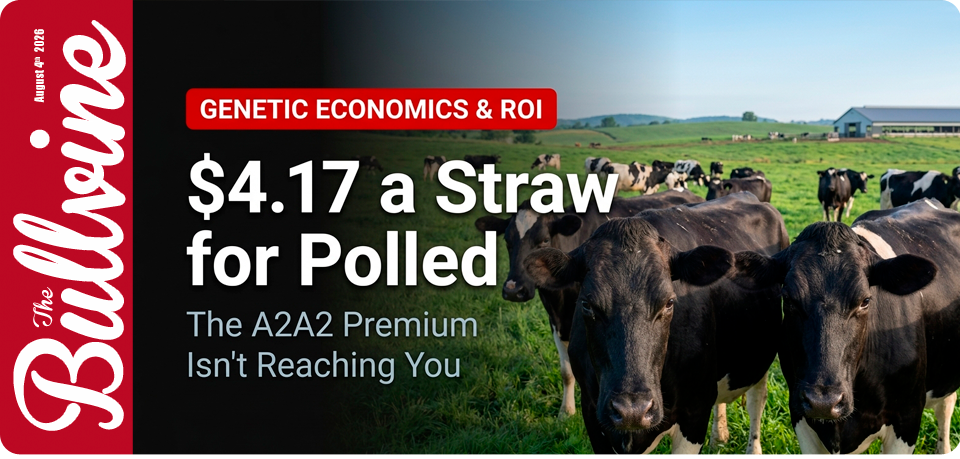






Purdue put the homozygous polled ceiling at $4.17 a straw — 2017 dollars, so call it $5.70 today. Meanwhile, only 15% of A2 converters say anyone is paying a premium. Your semen invoice is in the office; this analysis takes four minutes.
Joel Hendrickson started converting his herd to A2 genetics at Ten Finns Creamery in Menahga, Minnesota, back in 2014. Roughly three years to reach 100%. Then in 2019 he built an on-farm creamery, inspected by the Minnesota Department of Agriculture, to bottle and sell his own milk — because that turned out to be the way to get paid for what he’d bred.
Ask him why, and the answer isn’t a spreadsheet. “I am convinced that if all the cows in the United States were A2, humans would be healthier,” he told AURI in an August 2024 interview. He milks 140 cows now, 40–50% of production going direct to institutions and retail, the rest to his local co-op. He also supplies 10 Minnesota school districts at no premium at all, because state-funded schools don’t have the budget to pay more for A2 than for conventional.
That’s the honest shape of the A2 opportunity. It exists. Capturing it meant becoming a processor.
Polled genetics sit somewhere different. There’s a peer-reviewed number attached to that trait, published in dollars per straw, and you can check it against the invoice on your desk this afternoon.
Two Traits Moving in Opposite Directions
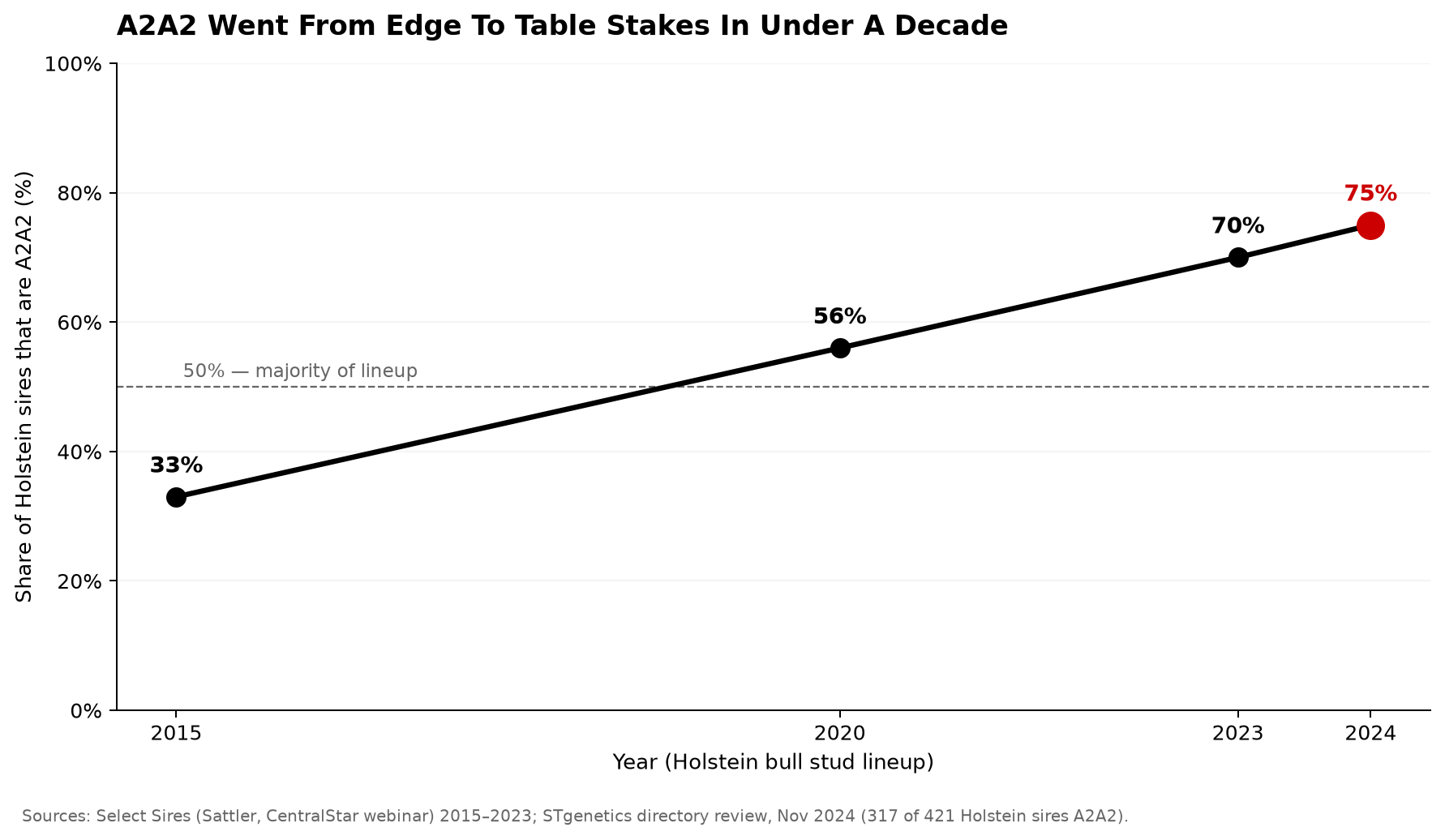
A2A2 used to be scarce. Not anymore. Chuck Sattler, vice president of genetic programs at Select Sires, laid out the trajectory in a CentralStar Cooperative webinar: 33% of Holstein bulls in the Select Sires program were A2A2 in 2015, 56% by 2020, 70% by 2023. A November 2024 review of STgenetics’ directory found 317 of 421 Holstein sires — 75% — were A2A2, along with 62 of 72 Jerseys and all five Guernseys. Sattler’s read is that producers can now select A2A2 sires with minimal sacrifice of other traits. Worth noting he works for one of the studs selling them.
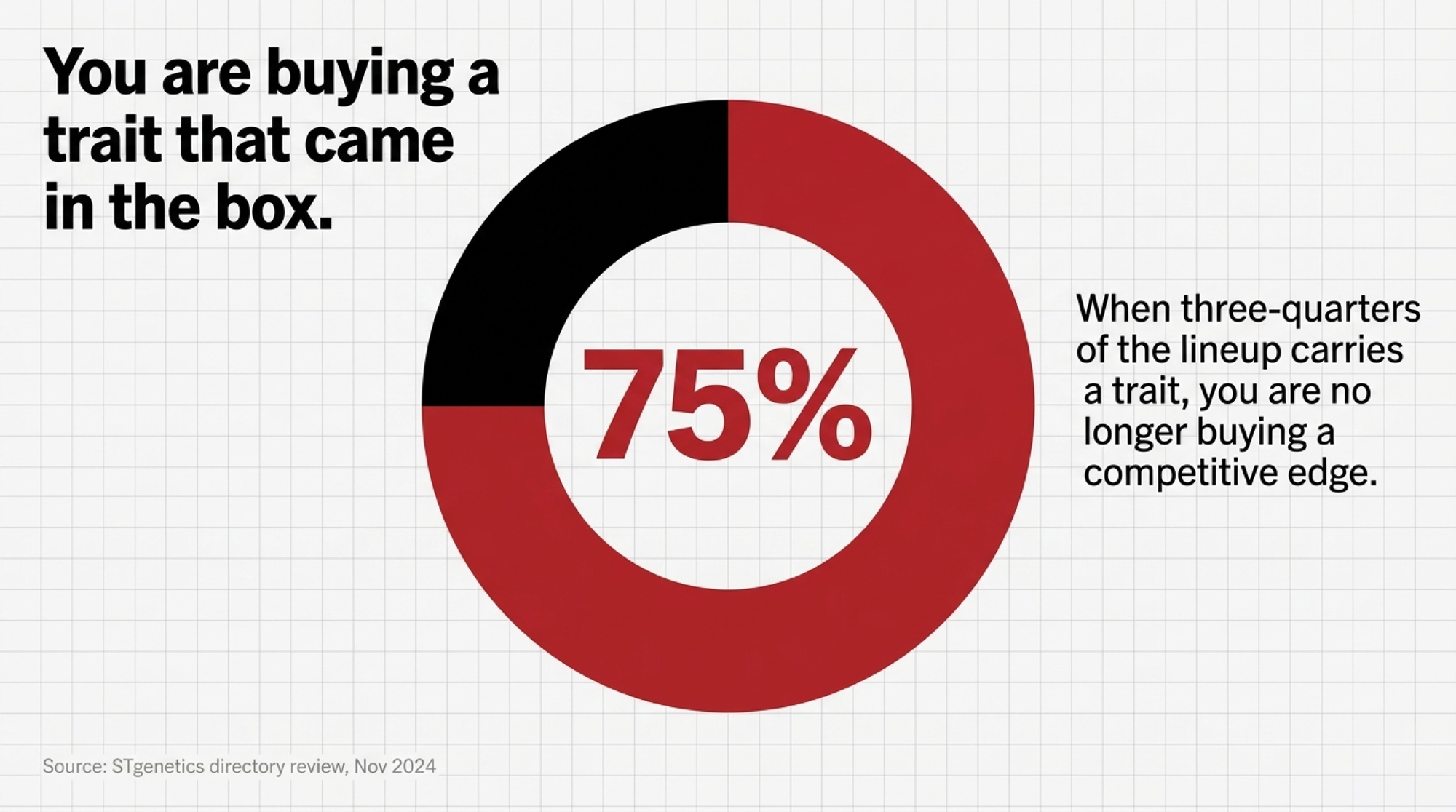
That 70% figure is nearly three years old, so today’s number is almost certainly higher. When three-quarters of the lineup carries a trait, you’re not buying an edge. You’re noticing something that came in the box.
Polled went the other direction. A heterozygous polled bull on a horned cow gives you roughly a coin flip — half polled calves, half horned. A homozygous PP bull gives you 100% polled offspring no matter what the dam carries. That guarantee still comes from a limited pool of sires, and while the merit gap against horned contemporaries has narrowed sharply, it hasn’t closed. Some polled sires still give up real production or type, and you should assume you’re choosing from a shorter list.
What Can You Pay for Polled and Still Break Even?
Here’s the number, and it’s Purdue’s, not ours. Nathanael M. Thompson, Nicole Olynk Widmar and Michael M. Schutz at Purdue, working with John B. Cole of USDA-ARS and Christopher A. Wolf, published stochastic budgets across dehorning and polled scenarios in the Journal of Dairy Science in June 2017 — volume 100, issue 6, pages 4941–4952.
Their dehorning finding: expected cost across four traditional methods ran US$6 to $25 per head, averaging $12 to $13 in 2017 dollars. Hot-iron disbudding without pain relief came in cheapest at $11.90/head — which, as Thompson told in an interview, “is consistent with what most producers are currently doing.”
Then the part that lands at the order desk. Their published conclusion, verbatim: producers could spend up to $5.95/head and $11.90/head more for heterozygous and homozygous polled genetics, respectively, compared with horned genetics — “or $2.08 and $4.17/straw of semen at an assumed average conception rate of 35%.”
So the per-straw figure isn’t a Bullvine conversion. It’s in the paper.
The 2017 Dollar Problem
Here’s what nobody quoting that $4.17 mentions: it’s a 2017 number, and you’re holding a 2026 invoice.
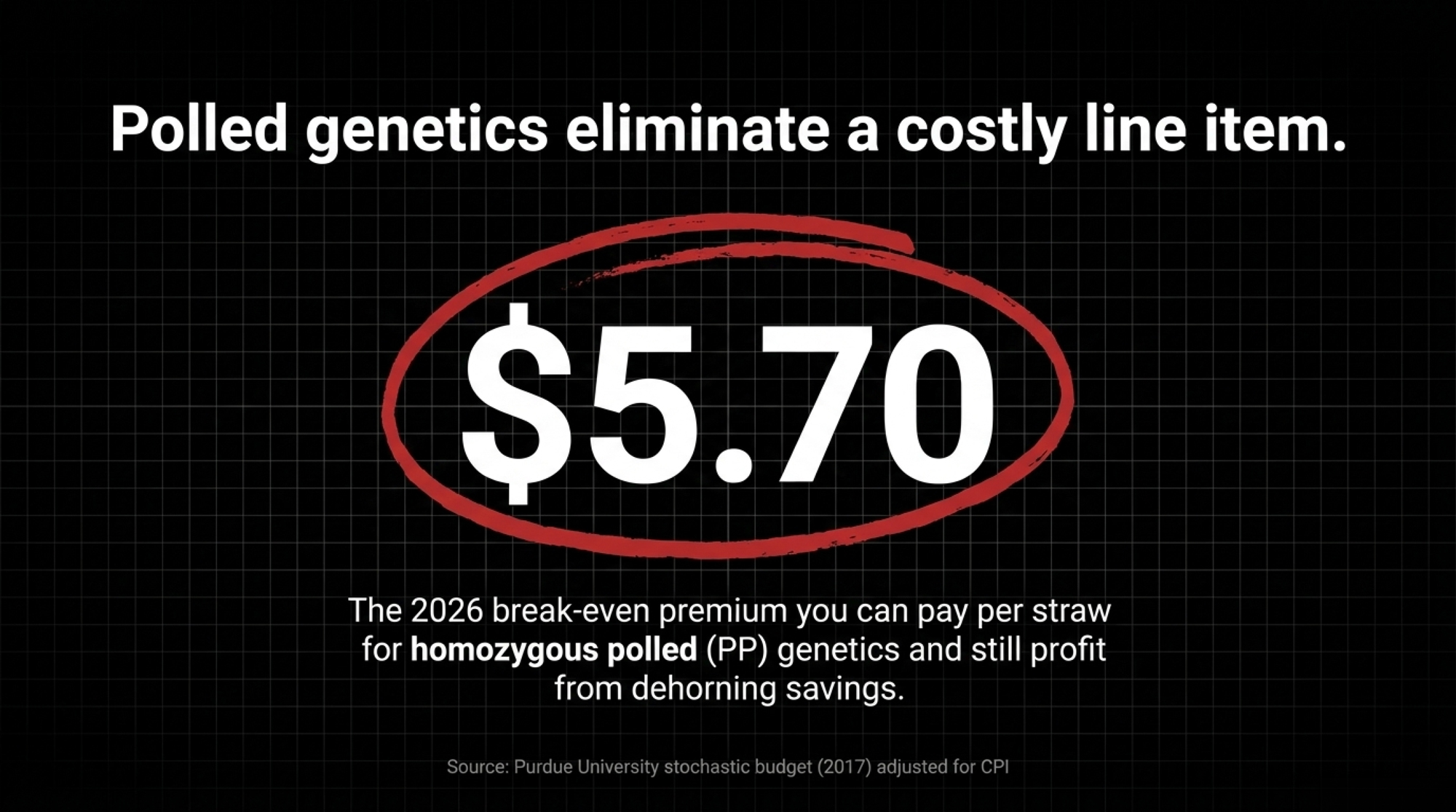
BLS puts CPI-U at 245.120 for 2017 and 335.123 for 2026 — a factor of 1.367, or 36.7% cumulative inflation. Run the published figures through it:
| Thompson et al. figure | As published (2017 USD) | Bullvine CPI adjustment (2026 USD) |
| Homozygous PP break-even | $4.17/straw | ≈$5.70/straw |
| Heterozygous P break-even | $2.08/straw | ≈$2.84/straw |
| Cheapest dehorning method | $11.90/head | ≈$16.27/head |
| Study’s average cost range | $12–$13/head | ≈$16.41–$17.77/head |
Arithmetic: $4.17 × 1.367 = $5.70. Audit it yourself. These adjusted figures are The Bullvine’s calculation, not the authors’ — Thompson’s team published nominal 2017 dollars and never claimed otherwise.
Two caveats on that column. Semen prices have risen since 2017 too, so the adjusted threshold is a directional correction, not a precise 2026 break-even. And dehorning cost is mostly labor, which has outrun general CPI over the same stretch — so $16.27/head is probably the conservative end.
One more, and it comes from the authors. Thompson’s team noted that sensitivity to individual farm semen and dehorning costs is likely to swamp the differences between their modeled scenarios. That’s not a weakness in their work. It’s precisely why the instruction here is check your own invoice rather than here’s the industry answer. The people who built the model said farm-specific costs dominate.
Where your herd sits on conception changes it too. Herd-level reproduction benchmarking shows only 16% of herds hit both a 40%-plus conception rate and a 50%-plus insemination rate, while 29% fall short on both. Irish figures run higher — ICBF’s analysis of 1.83 million dairy inseminations from 2018–2022 put conventional AI pregnancy rates at 64% and sexed at 59% — but that’s a seasonal grazing system on a different measurement basis, and it shouldn’t be read straight across to a North American freestall.
Better conception means fewer straws per pregnancy, which pushes the premium you can justify up, not down.
Where the Barn Math Actually Lands
Run the numbers off USDA NASS’s January 2026 Cattle report, and the U.S. dairy replacement pipeline is tighter than most rules of thumb assume: 2.50 million dairy replacement heifers expected to calve during 2026, against 9.57 million milk cows. That’s 26.1 heifers per 100 cows — down from 26.7 a year earlier, while the milking herd itself grew 2%. More cows, fewer replacements coming behind them.
So a 200-cow herd at that national ratio is bringing in about 52 replacements a year, not the 60-plus an older 30% rule would suggest. Both dollar frames:
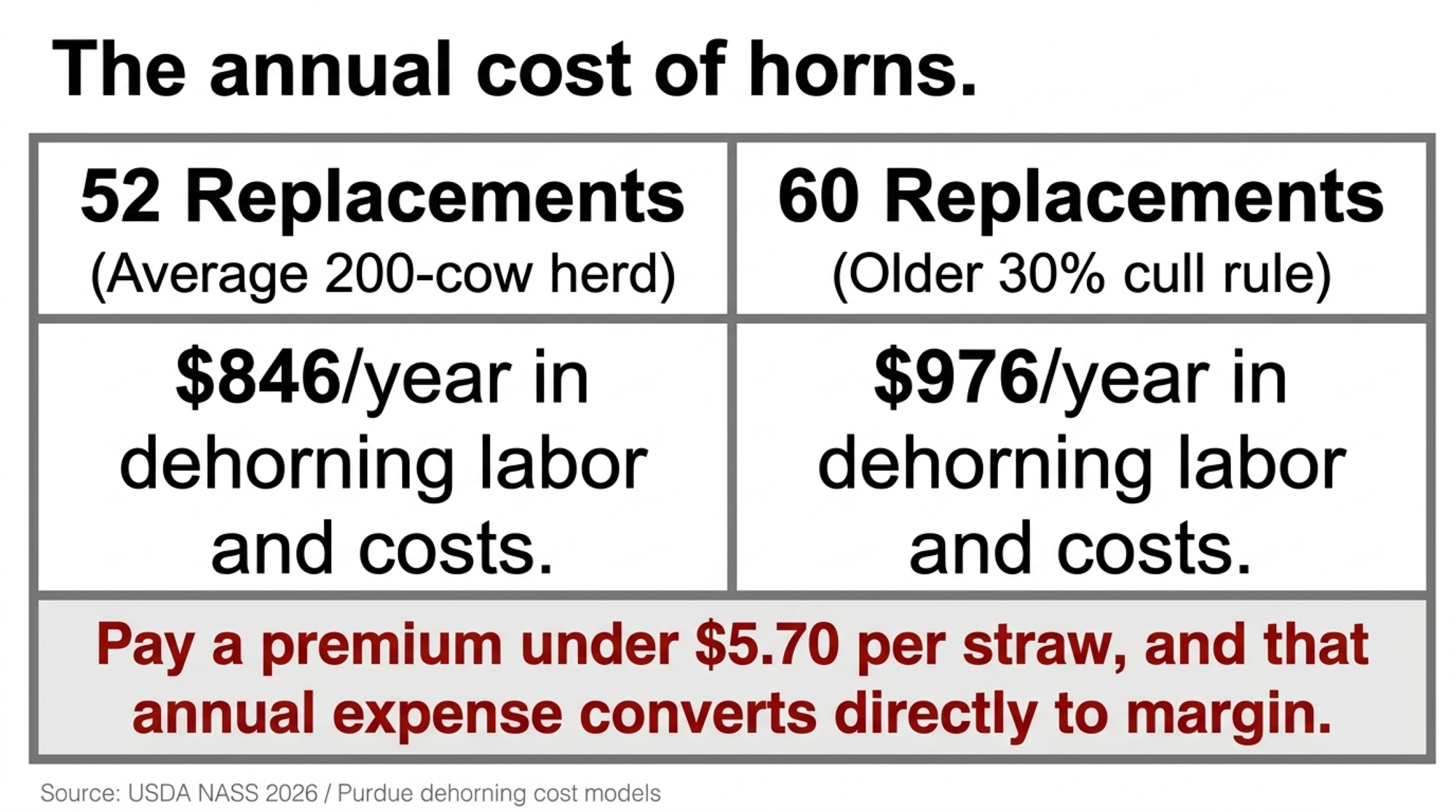
- 52 replacements: ≈$619/year at the published $11.90/head — or ≈$846/year at the CPI-adjusted $16.27
- 60 replacements (30% rate): ≈$714/year published — or ≈$976/year adjusted
Your number moves with your cull rate, your heifer retention, and whether you’re buying replacements instead of raising them.
Not dramatic money either way. But it recurs annually with no further decision required, and homozygous polled eliminates the line rather than halving it. And these are gross figures. Pay the full break-even premium, and you land at zero by definition — the saving only becomes margin when your actual premium comes in under the threshold.
A second simulation brackets the same ground. A Penn State paper we haven’t been able to obtain directly, written up by C. Jones ran 10,000 iterations and put expected dehorning cost at $5.84–$22.89 (average $11.79) against polled genetics at $0.47–$22.50 (average $10.73), concluding farms could spend an additional $7.50 for polled and break even. That $7.50 comes out of the full model, not the gap between the two averages — treatment costs and complication rates do most of the work. Same 2017-era dollar caveat applies.
The model skipped a few things worth money, too: reduced calf stress, the merit difference between polled and horned sires, public perception, and the plain value of not doing an unpleasant job. The authors flagged this themselves — the value of avoiding dehorning “may be larger for the industry, and perhaps some individual farms, than initially suggested if additional value is put on calf comfort and possible worker aversion to dehorning.” So the real case for polled probably sits better than either set of arithmetic shows.
Which bulls clear the threshold is a longer conversation than this article can hold. That’s a separate piece — and it starts with the fact that you can’t compare a German RZG to a Canadian LPI without getting the answer wrong.
Why Did So Few Converters Cite the Premium?
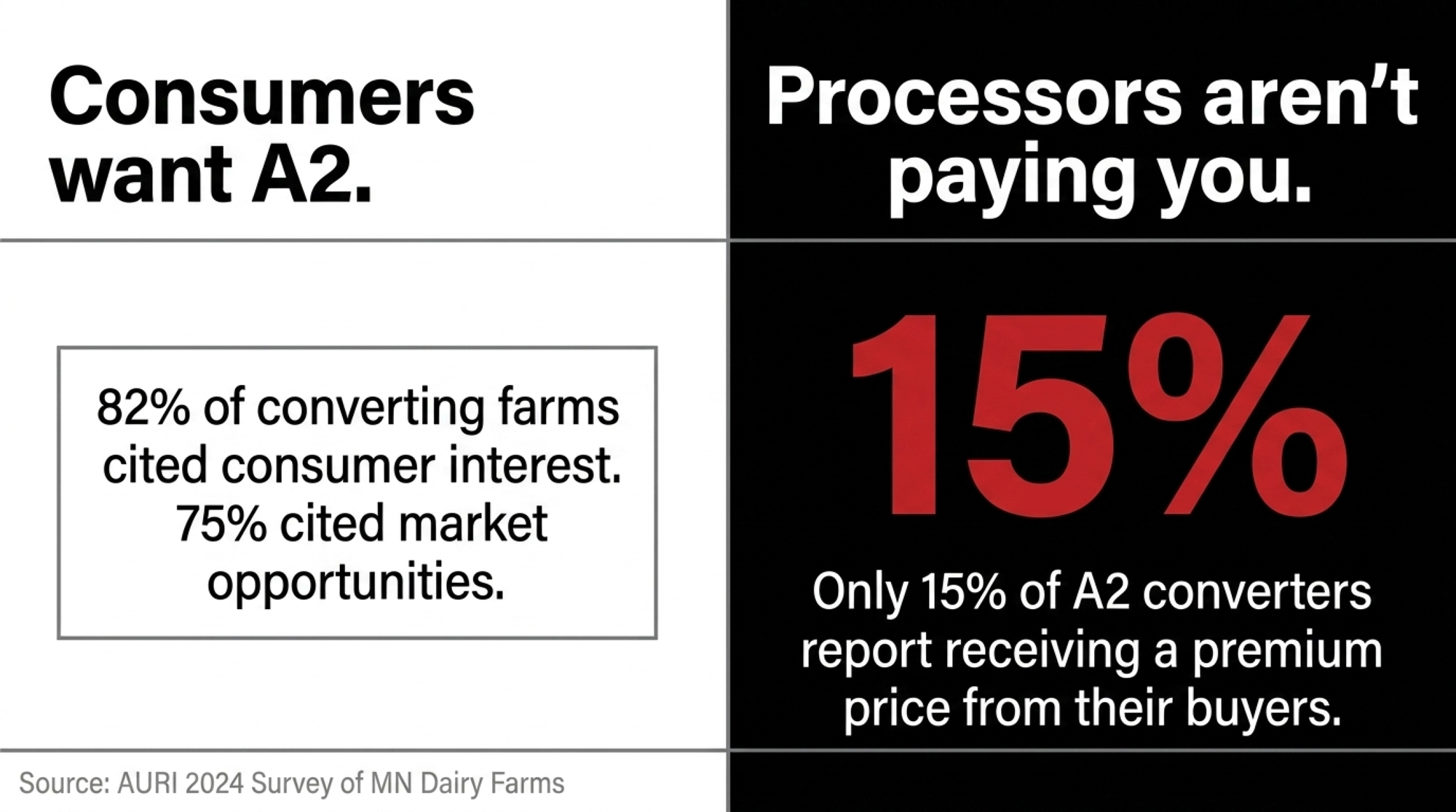
AURI’s survey ran mid-August to mid-September 2024, drew 75 completed responses from 36 Minnesota counties — roughly 4% of the state’s dairy farms — and 92% of respondents ship to processing cooperatives. Among them, 35% were converting to A2 genetics, 9% had finished, 48% hadn’t started, and 8% didn’t know what A2 milk was.
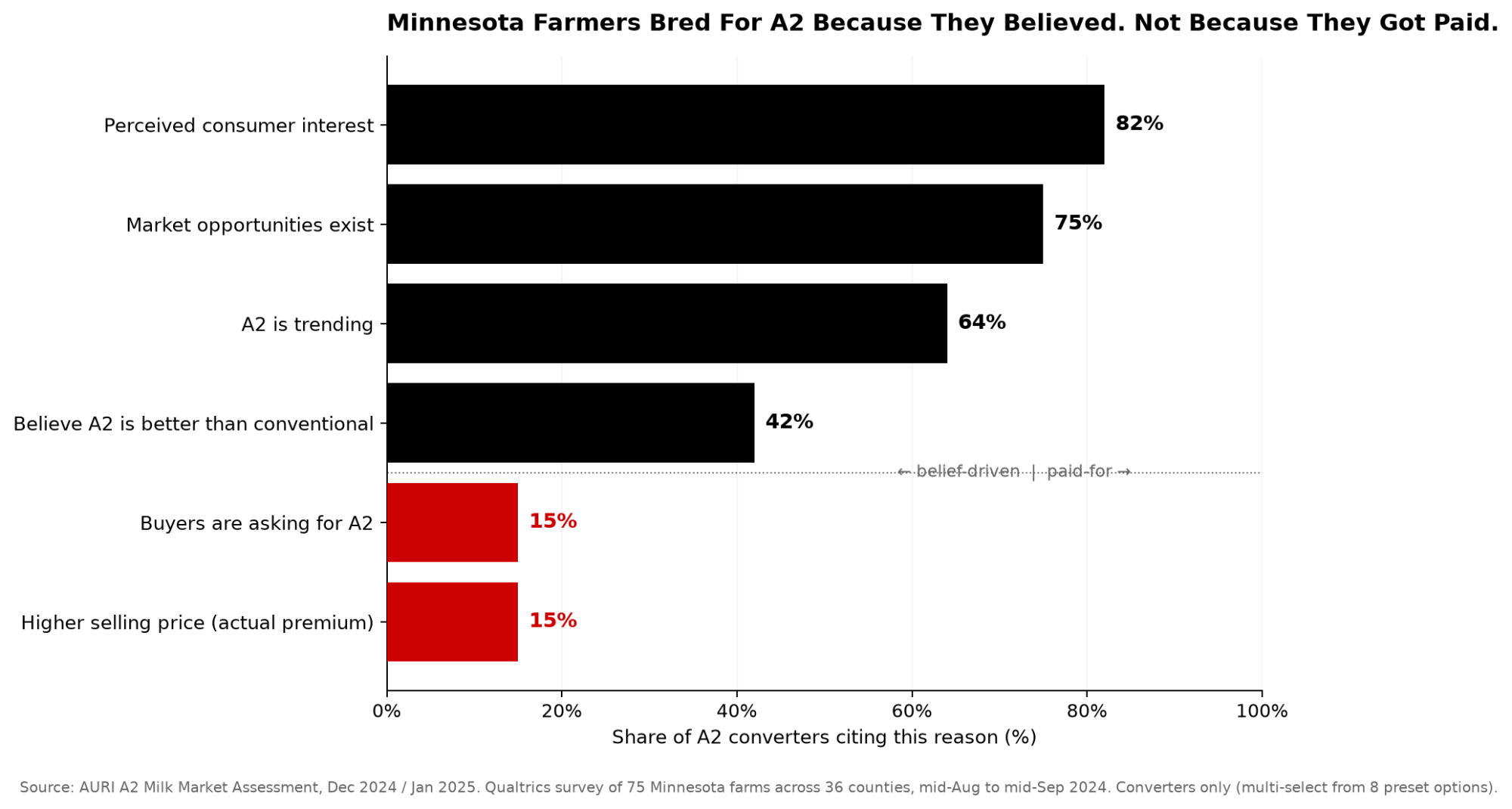
Then AURI asked the converters why, from a preset list of eight options. 82% cited perceived consumer interest. 75% cited market opportunities. 64% said A2 is trending. 42% believed A2 milk is better than conventional. And two options tied at the bottom: 15% said their buyers were asking for A2, and 15% cited a higher selling price.
AURI’s conclusion is blunt: producers see A2 as a trending market opportunity “despite not receiving a premium price for A2 milk,” and higher prices “appear to have a limited impact on farmers’ decisions to convert their herd.” The survey also found Minnesota processors weren’t driving A2 interest at all.
Among farms not interested in converting, 60% said market opportunities don’t exist, and 50% pointed to conversion cost. One respondent: “Currently, I do not know of a market for A2 milk. I don’t see the need to switch without market or premium prices.” Another, more wistful: “I would love to make some extra income from A2, but I don’t think our co-op wants to sell A2 milk.”
Scope caveat, stated plainly — Minnesota, 75 farms, one survey window, and AURI cautions the sample may not represent the true statewide conversion rate. Whether your region reads differently is exactly what the processor call below is for.
Retail explains the disconnect, and the two figures that look contradictory aren’t. A2 dairy hit 1.3% of the total dairy category in the North Central U.S. in 2024 — milk, yogurt and ice cream combined, from SPINS scanner data across 13,000 stores — up from 0.5% in 2022, with sales growing 161%. Measured against fluid milk alone, a much narrower base, retailers told AURI A2 sits under 1%, at a 60–70% shelf premium. Different denominators, not different findings. A half gallon of A2 fluid milk averaged US$6.10 in 2024 against $5.11 in 2022.
But four brands — The A2 Milk Company, Alexandre Family Farm, Zeal Creamery and Origin — control more than 90% of the A2 fluid market. Ten Finns is among the small local brands filling the remainder. So unless you ship to one of the big four, that shelf price is describing somebody else’s brand. Same trap that catches most premium market specialization in genetics: the trait is the easy part, the buyer isn’t.
The Index Numbers Behind Both Decisions
Two things get misread constantly, and either one can cost you.
Start with what the indexes actually measure. TPI, by Holstein Association USA’s own description, applies a constant that “adjusts for our periodic base change, allowing TPI values to be comparable across time.” It’s a ranking tool. Net Merit comes from USDA-ARS and CDCB, built from 12 individual traits plus 5 composite subindexes to estimate lifetime profit in dollars, per VanRaden, Toghiani, Basiel, and Cole’s 2025 revision. Selecting hard on one doesn’t optimize the other.
| Sire | Evaluation system & run | Index 1 | Index 2 | Reliability / note |
| Aurora GS Woodford-ET (#1 TPI) | Holstein USA / CDCB, Apr 2026 genomic | TPI +3565 | Net Merit +$1,296 | 65–75% genomic reliability |
| Welcome Gustavsson-ET (#10 TPI) | Holstein USA / CDCB, Apr 2026 genomic | TPI +3528 | Net Merit +$997 | Spread across top 10: 37 TPI points = $299 Net Merit |
| Stantons Remover PP | Lactanet, Dec 2025 → Apr 2026 | LPI +42 ↑ | Pro-Dollars −$299 ↓ | Same bull, same run window, opposite directions |
| Siemers Renegade Rozline-ET | Lactanet, Dec 2025 → Apr 2026 | Lost #1 → to Parfect | Pro-Dollars −$626 | Reranking event driven by 40/60 fat/protein flip |
Source: Holstein Association USA / CDCB April 2026 genomic evaluation run. Genomic-only reliability, typically 65–75%
Thirty-seven TPI points. Two hundred ninety-nine dollars in Net Merit. Ranking order and profit order aren’t the same list.
So what’s the table not telling you? Those are genomic bulls at 65–75% reliability. A daughter-proven figure isn’t the same animal — a young genomic sire can re-rank hard at the next run. And when a handful of young sires get used heavily across the breed before their proofs mature, the concentration compounds: that’s how a single backup bull ended up behind seven percent of every Holstein alive.
Even a proven bull moves, and not always in one direction. Stantons Remover PP gained 42 LPI points between Lactanet’s December 2025 and April 2026 runs — while losing 299 on Pro-Dollars, dropping from #4 to #8 on that list. Same bull, same run, two indexes pointing opposite ways. Check both before you commit volume.
Canadian and U.S. indexes don’t share a scale either. LPI comes from Lactanet on Canada’s genetic base. TPI is Holstein Association USA on a U.S. base. Different trait weightings, different base populations, different base-change years — reading a Canadian daughter-proven result off an American genomic ruler isn’t a gap, it’s a category error. Never rank them side by side.
Both systems just moved. Holstein USA raised TPI’s protein weighting from 19 to 24 and cut fat from 19 to 14 — a 24:14 split inside the production slice, about 1.7 to 1 in favor of protein, which is a bigger shift than “raised protein” suggests. ABS Global put the resulting drop at roughly 35 TPI points on average. It also brings TPI’s protein weighting problem into play. Lactanet flipped Holstein LPI’s production subindex to 40% fat / 60% protein in the same window. Siemers Renegade Rozline-ET lost 626 Pro-Dollars points between those two Lactanet runs and gave up #1 to Parfect. Pin down the run date and the exact list before you quote anyone’s ranking.
Does the Robot Barn Argument Hold Up?
Polled gets marketed hard to automated milking herds. The mechanism underneath is real — but be precise about what’s proven and what isn’t.
A peer-reviewed study of 21 horned dairy herds in loose housing measured blood-in-milk incidence from horn-related udder injury at monthly rates of 0.3% to 7.8%, averaging 2.2% ± 1.9% of the herd, with visible udder damage in 38% of cases. Risk ran significantly higher during confined barn season than with pasture access — odds ratio 2.39. Pack cows indoors, and horn injuries climb.
That maps onto AMS barns structurally. Rodenburg’s 2017 Journal of Dairy Science review of robotic milking design notes AMS layouts need adequate open space near milking stations plus escape routes to enable low-stress, voluntary access. The design literature already assumes cows need room to dodge each other around the robot. In a parlor, a person handles her. In a free-traffic robot barn at 2 a.m., nobody does — one more line item for anyone still running the numbers on the robotic milking bet.
What doesn’t exist is any study measuring horned-versus-polled injury rates at a robot entry point. The mechanism is peer-reviewed; the AMS-specific measurement isn’t. Treat it as reasoned extrapolation rather than a statistic — particularly in front of a lender.
And say this plainly: nothing in the research connects A2A2 status to any AMS operational benefit. It doesn’t change milking speed, robot visits, or teat placement.
Actionable Strategies: 4 Paths Forward
Path 1: Benchmark Your Polled Premium
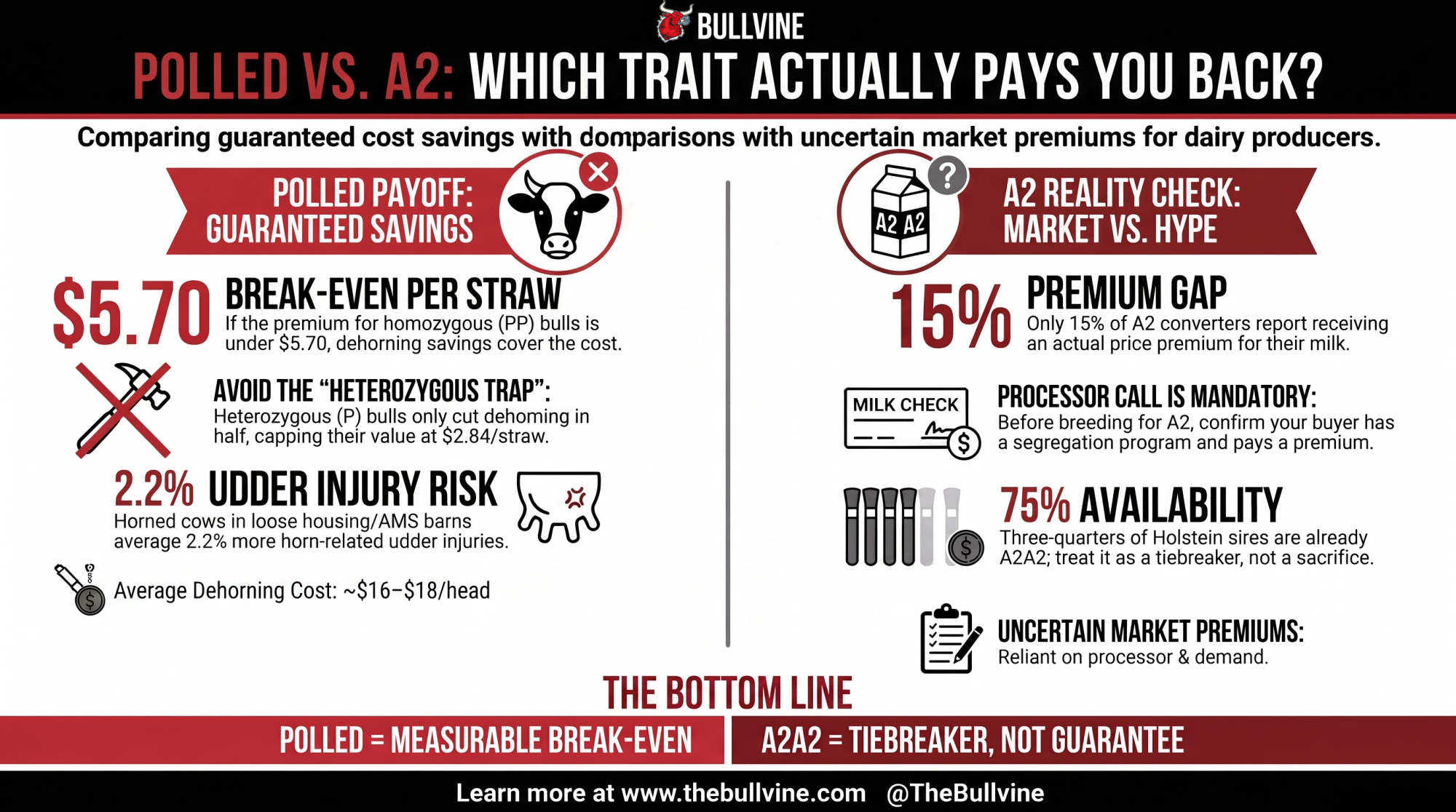
- Action: Check your semen invoices. If the homozygous polled premium is under $4.17/straw as published — roughly $5.70 in 2026 dollars — dehorning savings cover the cost.
- Works best if: You’re raising your own replacements and dehorning in-house. If you buy springers, this math doesn’t apply to you.
- A2 trait strategy: With 70–75% of Holstein lineups already A2A2, treat it as a tiebreaker between otherwise-equal sires rather than sacrificing total merit rank to chase it.
- The limit: Polled means a shorter list. Check each bull’s trait profile against your herd’s actual needs instead of assuming index rank covers it.
Path 2: Commit to Homozygous (PP) or Skip It
- Action: Avoid heterozygous (P) sires if your sole goal is eliminating dehorning. They only cut dehorning in half while capping your break-even at $2.08/straw published, roughly $2.84 in 2026 dollars.
- Works best if: You’re breeding a predominantly horned herd and want the line item gone rather than halved.
- The risk: Sire availability at your merit target. Most PP bulls still on offer are genomic-only at 65–81% reliability — that’s reliability risk stacked on top of the polled decision.
Path 3: Make the Processor Call First (do this within 30 days)
- Action: Call your milk buyer before ordering your next tank of semen. Three questions:
- Do you currently run an A2 segregation program?
- What is the minimum daily volume required?
- What is the actual premium paid per cwt?
- Why it matters: AURI found Minnesota processors weren’t driving A2 interest at all, and only 15% of converters said their buyers were asking for it. If yours says no, that closes the question before you breed toward a market that isn’t there. A phone call, not a project.
Path 4: Build the Channel (If Pursuing A2)
- Action: If you’re pursuing A2 without a co-op premium, factor on-farm processing or direct-to-consumer and institutional contracts into your business plan.
- Works best if: You already have retail or institutional relationships, or the appetite to build them. Not a fit for a farm that wants to ship and be done.
- The precedent: Hendrickson took about three years to convert, then built the creamery in 2019. Holstein Canada estimates an intense breeding strategy can reach 100% conversion in three to four years. He’s now pursuing A2 butter and exploring ice cream — the value-added categories AURI found growing fastest.
- The trade-off: He names his own frictions — product identity, the time cost of direct-to-institution relationships, and margin improvement that needs packaging automation he hasn’t yet capitalized on. You’re adding a business, not a trait.
On testing: A beta-casein-only milk protein test ran about US$25 per animal as of 2021 reporting. Writing in NODPA News that same year, Penn State dairy cattle genetics specialist Chad Dechow argued for genomic testing instead — modestly more expensive, but it returns production and fertility information alongside beta-casein status. Genomic testing ran $35–$45 per animal in 2026.
One More Reranking Event Is Already Here
CDCB’s August 2026 evaluations introduce three new traits: Resistance to Diarrhea (DIA), Resistance to Respiratory Problems (RSP), and First Service to Conception (FSC). The two calf health traits are the first national selection traits aimed at calfhood disease, built from more than 768,000 respiratory records and over 260,000 diarrhea records across breeds. At launch, they cover Holsteins and Jerseys, with DIA reliability at 43% for Holstein genomic sires and 48% for progeny-tested sires, and RSP at 45% and 53%.
Nothing in that work connects polled status to calf health — don’t let anyone tell you otherwise. The relevance is narrower: new traits entering the evaluation system mean another reranking event, on top of April’s TPI and LPI weighting changes. If you’re building a mating plan off a sire list, check which run it came from before you commit volume.
Key Takeaways
- If your homozygous polled premium runs under $4.17/straw as published — roughly $5.70 in 2026 dollars — Purdue’s break-even says dehorning savings cover it. Above that, you’re buying something other than the dehorning savings.
- If you’re using heterozygous polled sires, your break-even is $2.08/straw published, about $2.84 adjusted — not $4.17 — because you’re still dehorning about half your calves.
- Every Thompson et al. figure is in 2017 dollars, and dehorning is labor-heavy, so treat the CPI adjustment as directional and probably conservative. The authors themselves said farm-specific costs likely swamp the scenario differences — your invoice beats any published average.
- If your conception rate beats 35%, recalculate. Fewer straws per pregnancy raises the premium you can justify.
- Before weighting A2A2 in any mating decision, call your processor. Only 15% of surveyed Minnesota converters cited a higher selling price, and another 15% said their buyers were asking for it.
- If you’re shown a TPI gap and told what it costs per cow, ask for the Net Merit figure on the same bull, then check both indexes before committing. Remover PP gained 42 LPI and lost 299 Pro-Dollars in the same April 2026 run.
- If the PP bull on your shortlist is genomic-only, check reliability first — 65–81% is not daughter-proven, and a bull at 70% can move hard at the next run.
- If you’re working from a ranking published before April 2026, pull the current run — and never compare a Canadian LPI, a German RZG and a U.S. TPI figure as though they share a scale.
- Running an AMS barn? The horn-injury case rests on real housing-density data, but no AMS-specific study exists — frame it honestly with your banker.
So Which Trait Would You Still Pay For?
Polled has a peer-reviewed break-even published in dollars per straw. A2A2 has a shelf premium four brands mostly keep, and a Minnesota survey full of farmers who bred for it because they believed consumers wanted it — not because anyone was paying more.
Find the polled line on your last semen invoice. Under $4.17 a straw as published — call it $5.70 once you adjust for nine years of inflation — and the Purdue math says you’re already ahead, before you count calf welfare, labor, or what a horn does in a robot barn at two in the morning. Then make the processor call.
| Decision dimension | Polled (PP / P) | A2A2 |
| Peer-reviewed break-even | $4.17/straw published, ~$5.70 CPI-adjusted (Thompson et al., J. Dairy Sci. 100(6):4941–4952, 2017) | None published |
| Supply in Holstein lineup | Limited — still a shorter shortlist | ~70–75% of Holstein sires already A2A2 (Sattler / CentralStar; STgenetics directory Nov 2024) |
| Return mechanism | Line-item removed from replacement cost every year | Requires a paying buyer downstream |
| Buyer confirmation needed | No — dehorning savings are captured in-house | Yes — only 15% of MN converters report a premium (AURI A2 Milk Market Assessment, 2024) |
| Break-even sensitivity | Conception rate, semen premium, labor cost | Retail brand concentration — 4 brands hold >90% of A2 fluid (SPINS via AURI) |
| Verifiable this afternoon? | Yes — check the invoice | No — starts with a processor phone call |
Know Which Transaction You’re Making

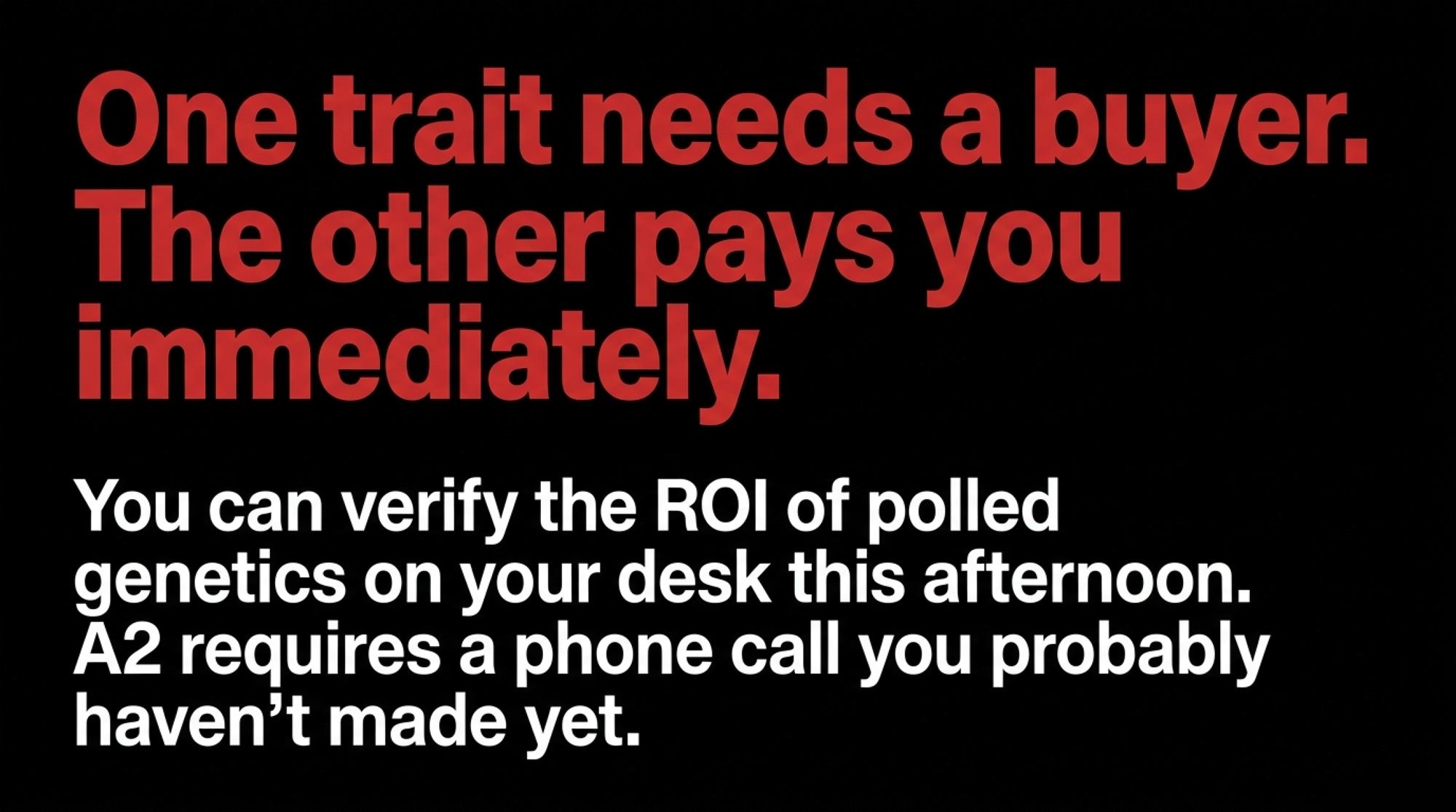
Polled genetics carry a measurable return calculated right down to the straw. A2 genetics need a buyer before they yield a dime. Hendrickson found one by building it himself. One of those you can verify on an invoice this afternoon. The other starts with a phone call you haven’t made yet.
We’re building the full Net Merit-by-herd-size comparison for the polled segment in an upcoming Bullvine Weekly — that’s where the genetic-merit side of this decision gets settled properly.
Methodology Note: Dehorning and polled break-even figures come from Thompson, Widmar, Schutz, Cole and Wolf, Journal of Dairy Science 100(6):4941–4952, June 2017 (DOI 10.3168/jds.2016-12099) — a stochastic budget model, not survey data, assuming a 35% conception rate, expressed in nominal 2017 U.S. dollars. CPI-adjusted equivalents are The Bullvine’s calculation using BLS CPI-U annual averages of 245.120 (2017) and 335.123 (2026), a factor of 1.367; they are directional, not a substitute for the published figures, and general CPI likely understates labor-driven dehorning inflation. The secondary simulation is a Penn State model, which we have not obtained directly. Replacement-heifer figures are calculated from USDA NASS Cattle, released January 30, 2026: 2.50 million dairy replacement heifers expected to calve during 2026 against 9.57 million milk cows, U.S. national. A2 supply, conversion, retail, and case-study data come from the Agricultural Utilization Research Institute’s A2 Milk Market Assessment (December 2024 / January 2025): a Qualtrics survey of 75 Minnesota farms across 36 counties conducted mid-August to mid-September 2024, retailer interviews, SPINS scanner data across 13,000 North Central stores, and an August 2024 interview with Joel Hendrickson of Ten Finns Creamery. AURI cautions the survey sample may not represent the true statewide conversion rate. Genetic evaluations reference Lactanet’s December 2025 and April 2026 Holstein runs (Canada, LPI and Pro-Dollars) and the Holstein Association USA / CDCB April 2026 genomic run (U.S., TPI and Net Merit). These systems are not directly comparable. Dollar figures are USD unless noted. National averages may not reflect your region, herd size, replacement rate, or management system. If your numbers differ, send them — we’d rather publish your math than our estimate. Underlying AURI report: reports@auri.org. Corrections to this article: contact us through thebullvine.com.
Learn More
- The Missing Piece in Genomic Selection: Why the Best Herds Still Walk the Pens — Delivers a practical sorting protocol combining early genomic testing with breeding-age physical structural checks. Shows how filtering heifers before breeding prevents forced culls and protects your $3,000-plus replacement investments.
- 9.57 Million Cows, 3.9 Million Replacements: Genetics Built This Dairy Herd Paradox – and 2027 Ends It — Exposes the structural replacement bottleneck facing North American herds through 2027. Details how capturing the $8,000-per-cow longevity dividend offsets skyrocketing heifer purchase costs as new processing capacity comes online.
- When Your “Elite” Genetics Start Costing You Real Money — Reveals the hidden financial drag of genomic inbreeding hidden beneath top TPI ranks. Arms producers with outcross mating tactics to recover up to $24 per cow in lost lifetime milk margin.
 The Sunday Read Dairy Professionals Don’t Skip.
 The Sunday Read Dairy Professionals Don’t Skip.
Every week, thousands of producers, breeders, and industry insiders open Bullvine Weekly for genetics insights, market shifts, and profit strategies they won’t find anywhere else. One email. Five minutes. Smarter decisions all week.




