OSHA proposed $246,609. Divide by the $16,550 serious cap and it’s 17 citations minimum, none willful. Four of the six dead worked for the contractor. Check your monitor’s calibration date.
Executive Summary: Six workers died of hydrogen sulfide exposure at Prospect Ranch LLC in Weld County, Colorado, on August 20, 2025, after a manure-system pipe disconnected. Four of them worked for Fiske Inc., the contractor hired to work on the system, not for the dairy — which puts the exposure on any operation that brings outside crews onto a pit. Release 26-285-DEN classifies the violations against Prospect Ranch and Fiske as serious and names no willful violation. Bullvine divided the three penalty totals by the $16,550 cap: the files hold at least 17 proposed citations, a floor any penalty reduction pushes higher. No outlet has published a count.
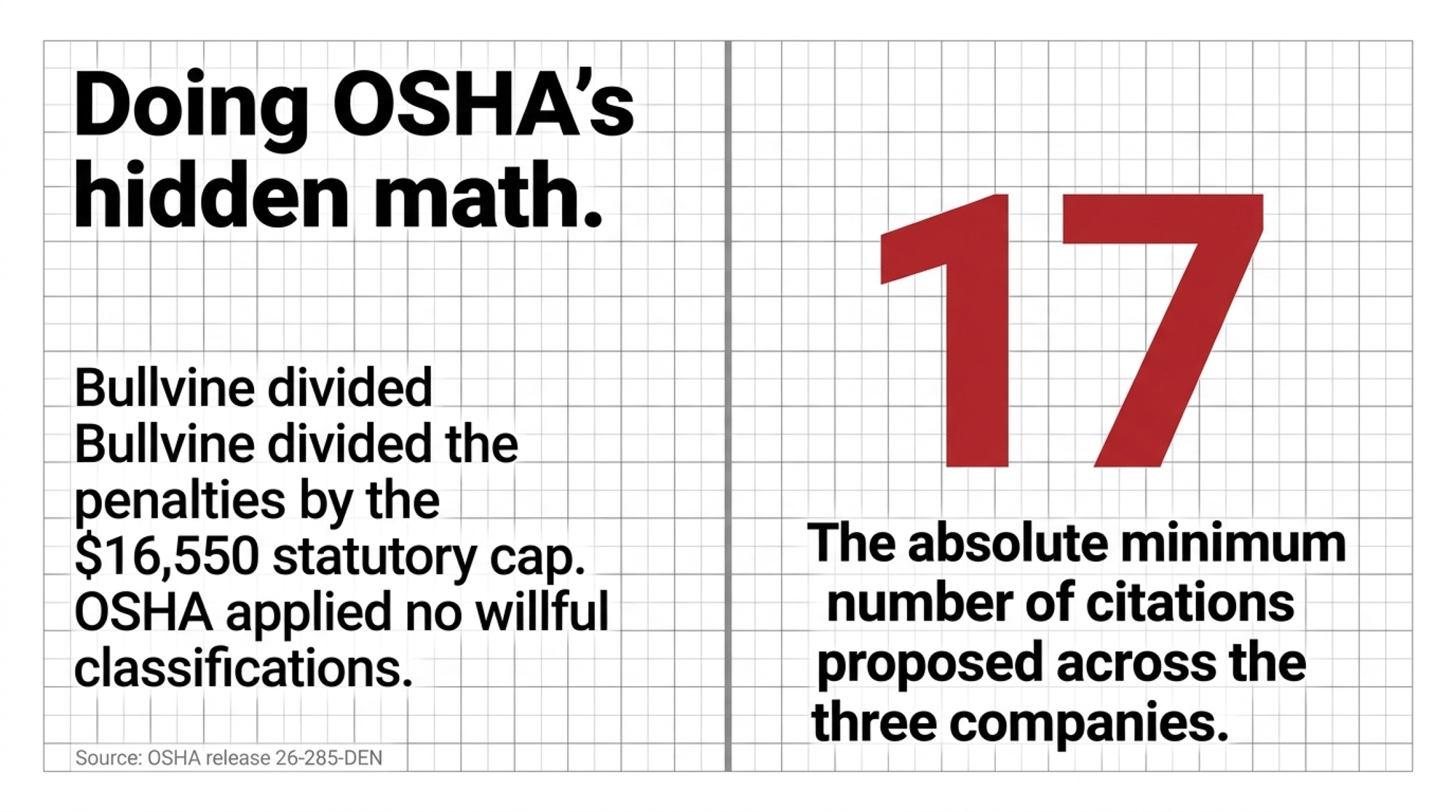
OSHA proposed $246,609 against three companies after six workers died of hydrogen sulfide exposure at Prospect Ranch LLC in Weld County, Colorado, on August 20, 2025. Release 26-285-DEN classifies the violations against Prospect Ranch and Fiske Inc. as serious and names no willful violation, a distinction worth ten times the ceiling per citation — $16,550 against $165,514. Bullvine divided the three penalty totals by the statutory cap: the files hold at least 17 proposed citations. No outlet has published a count. Four of the six dead worked for the contractor, and operations bringing outside crews onto a manure system carry that exposure across two safety programs.
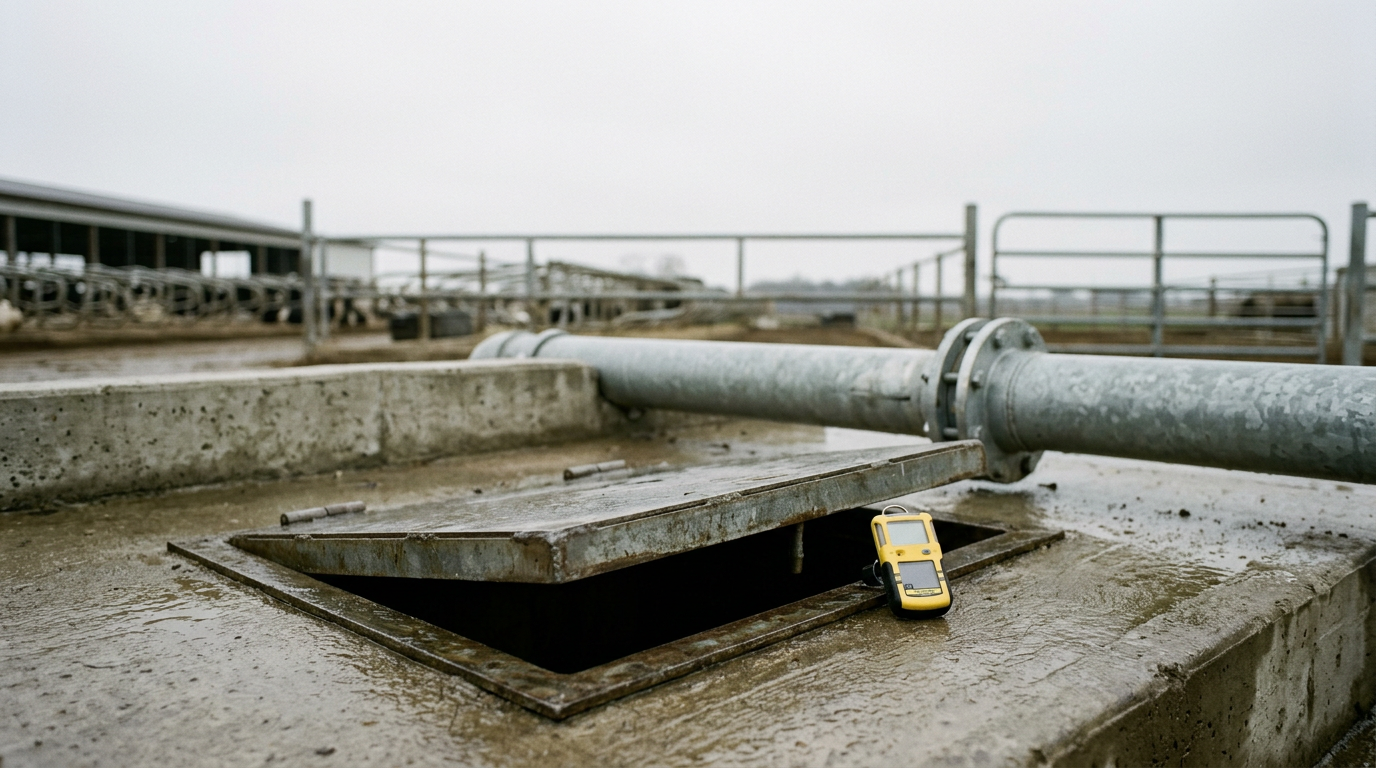
A pipe in the manure management system disconnected, releasing manure water and hydrogen sulfide. A Fiske Inc. employee and a Prospect Ranch employee tried to stop the flow and were overcome. Three more Fiske employees and one more Prospect Ranch employee then entered the pump room. Six workers died of hydrogen sulfide exposure. That is OSHA’s own account.
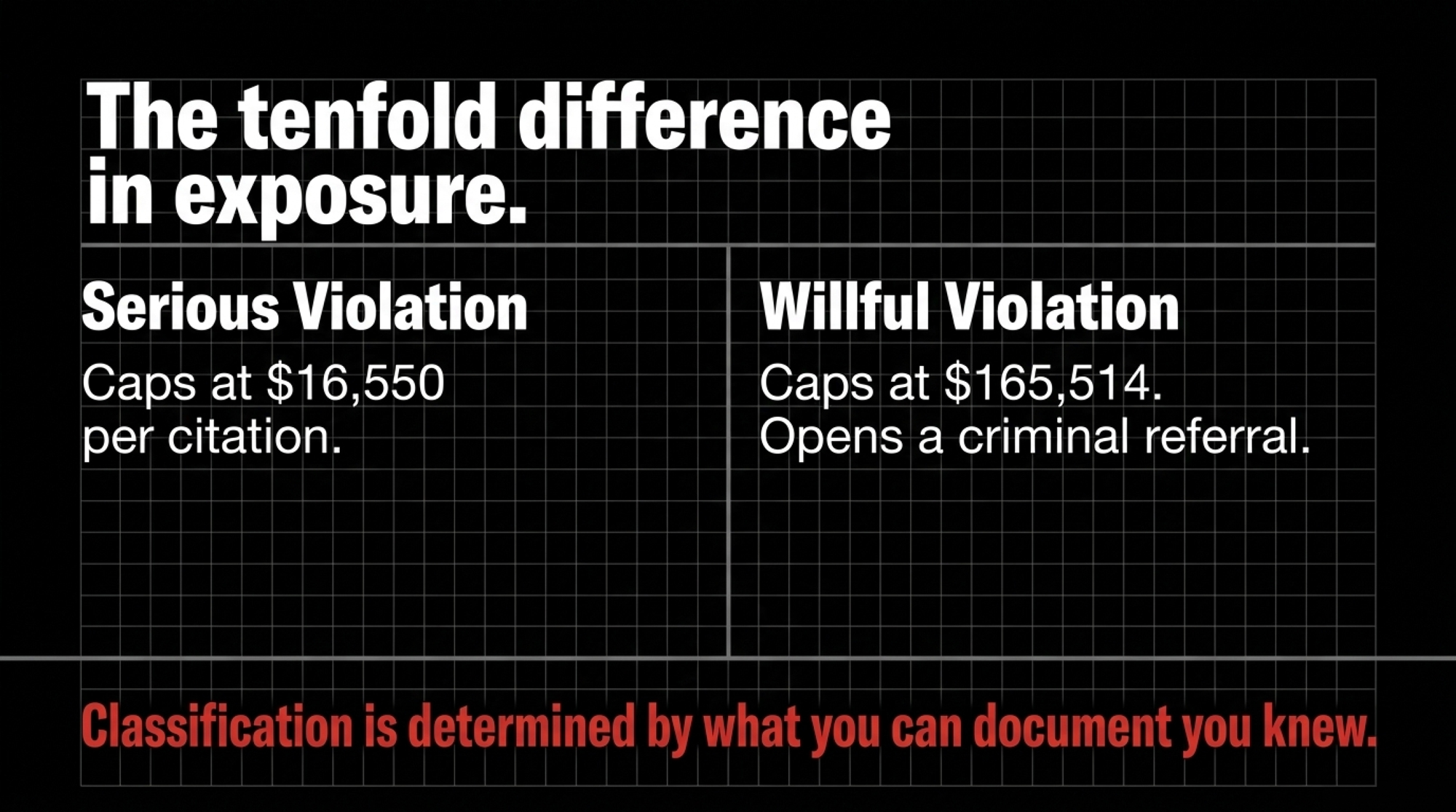
Under the 2026 schedule a serious violation caps at $16,550. A willful violation caps at $165,514 — ten times as much on identical facts, and willful is the only classification that opens a criminal referral. At least six outlets reported the serious classification the day it landed. Nobody divided the totals by the cap, and for anyone weighing dairy manure gas safety in 2026, that division is where the money sits.
The Chain Reaction: Four Contractors and One Family

Read the employer breakdown inside OSHA’s sequence. Four of the six dead worked for Fiske, whose High Plains Robotics business in Johnstown services dairy equipment. Two worked for the dairy. HD Builders LLC employees were on site and unharmed.
Four of the six were also one family. Alejandro Espinoza Cruz, 50, of Nunn, died alongside his sons Oscar Espinoza Leos, 17, and Carlos Espinoza Prado, 29, of Evans, and his son-in-law Jorge Sanchez Pena of Greeley. Ricardo Gomez Galvan, 40, and Noe Montanez Casanas, 32, both of Keenesburg, also died.
For anyone running a dairy, that split is the part with your name on it. The majority of the dead were not the dairy’s employees.
Serious Versus Willful: A Tenfold Difference in Ceiling
Running the Numbers — Bullvine calculation
Published evidence. Proposed penalties, OSHA release 26-285-DEN, February 24, 2026, U.S., USD: Prospect Ranch LLC $132,406; Fiske Inc. $99,306; HD Builders LLC $14,897. Total $246,609. Statutory maximums, OSHA 2026 annual civil penalty adjustment memo, May 21, 2026: serious $16,550 per violation; willful or repeated $165,514.
Stated assumption. One only: no citation can be assessed above the statutory maximum. That’s a certainty rather than an estimate, so dividing a total by the maximum returns an absolute floor — the fewest citations that could possibly add up to that figure. The release states neither the counts nor whether OSHA grouped any citations.
Bullvine math.
| Company | Proposed penalty | Citations implied (proposed), absolute minimum |
| Prospect Ranch LLC | $132,406 | at least 9 |
| Fiske Inc. | $99,306 | at least 7 |
| HD Builders LLC | $14,897 | at least 1 |
| Total | $246,609 | at least 17 |
Six dollars decide two of those rows. Eight citations at the $16,550 maximum come to $132,400, six dollars short of what OSHA proposed against Prospect Ranch, so the file holds at least nine. The same gap puts Fiske at seven rather than six.
Read the floor as a floor. OSHA can assess below the maximum, and its 2026 penalty memo describes a size-based reduction available to employers with 20 or fewer employees. Any reduction applied to any citation means more citations were needed to reach the same total. So 9, 7 and 1 are the arithmetic minimum. These are proposed citations; none has been established as a violation.
The ratio needs no assumption at all: $165,514 ÷ $16,550 = 10.0. Bullvine ran the per-worker figure of $41,101.50 in February. What’s new is the ceiling underneath it. Every citation OSHA classified in these files sits inside a category capped at a tenth of the one the release never invokes, and the release doesn’t classify HD Builders’ violations at all. The classification set the ceiling before any arithmetic began.
Status of the Penalties: Why the Public Record Went Dark
Treat $246,609 as an opening figure. OSHA’s release includes a notice that penalty amounts and classifications may not reflect the current or final status of a case, and the companies had 15 working days from receipt to comply, seek an informal conference, or contest before the Occupational Safety and Health Review Commission.
Bullvine searched trade and regional coverage from March through September 2026 and found no report of a contest, a settlement, or a final order. Three states are possible, and no source establishes which. The OSHA status query is outstanding.
What Is Confirmed, What Is Alleged, and Who Owns What
The entity names run close together, and they aren’t interchangeable — and the coverage hasn’t been consistent about them either. OSHA’s release cites Prospect Ranch LLC as the employer, and the Colorado Sun described that company as the dairy’s owner. The Associated Press, reading Weld County tax records in August 2025, put ownership of the property with Prospect Valley Dairy LLC, which lists a Bakersfield, California address for the owners. The Denver Gazette, citing the Colorado Secretary of State in August 2025, reported that Prospect Valley Dairy LLC was formed in January 2012, keeps a registered agent in Centennial, and was in good standing at that time. Arend Bos is identified as the dairy’s registered owner and as owner of Prospect Ranch LLC. Bullvine has not queried the registry directly and cannot reconcile which entity holds which interest today.
On August 19, 2026, the families of four of the six filed a wrongful-death action in Weld County District Court naming Prospect Valley Dairy LLC, Bos, and HD Builders LLC. The filing alleges the dairy operation had no gas monitors, no ventilation, no warning signs, and no rescue procedure or equipment when the pipe ruptured. Bullvine has not obtained the complaint and cannot confirm which defendant each allegation is directed at, or the current stage of the docket. Those are allegations in a filed complaint. Nothing has been ruled on, and no defendant has been found liable.
Arend Bos issued a written statement on behalf of Prospect Ranch in late August 2025: “We at Prospect Ranch and our employees are devastated by the tragic loss of our team members. While the cause is still under investigation, there is no indication that this is anything other than a terrible, isolated accident.” The statement added that “out of respect for the families and our employees, we will refrain from responding to the media at this point.” It predates both the citations and the lawsuit.
The company has stayed with that position through the enforcement action. Prospect Ranch LLC did not respond to requests for comment from the Colorado Sun on February 25, 2026, or Insurance Journal on February 27, 2026, according to both outlets. Bullvine wrote to Prospect Ranch LLC, Fiske Inc., and HD Builders LLC on September 11, 2026, putting the proposed penalties, the serious classification, and the complaint’s specific allegations to each company, and asking whether the citations were contested, settled, or became a final order. We set a deadline of September 18. None had responded by that deadline. We’ll update this article with any reply that arrives.
What Does a Safety Specialist Say Should Have Been Measured?
Dr. David Douphrate, then associate director of the High Plains and Mountain Center for Agricultural Health and Safety at Colorado State University, told CPR News in August 2025 that a manure-management system carries four gases of concern — ammonia, carbon dioxide, methane, and hydrogen sulfide — and that hydrogen sulfide is the one most often associated with manure-related deaths, capable of causing rapid loss of consciousness and death within minutes at high concentration.
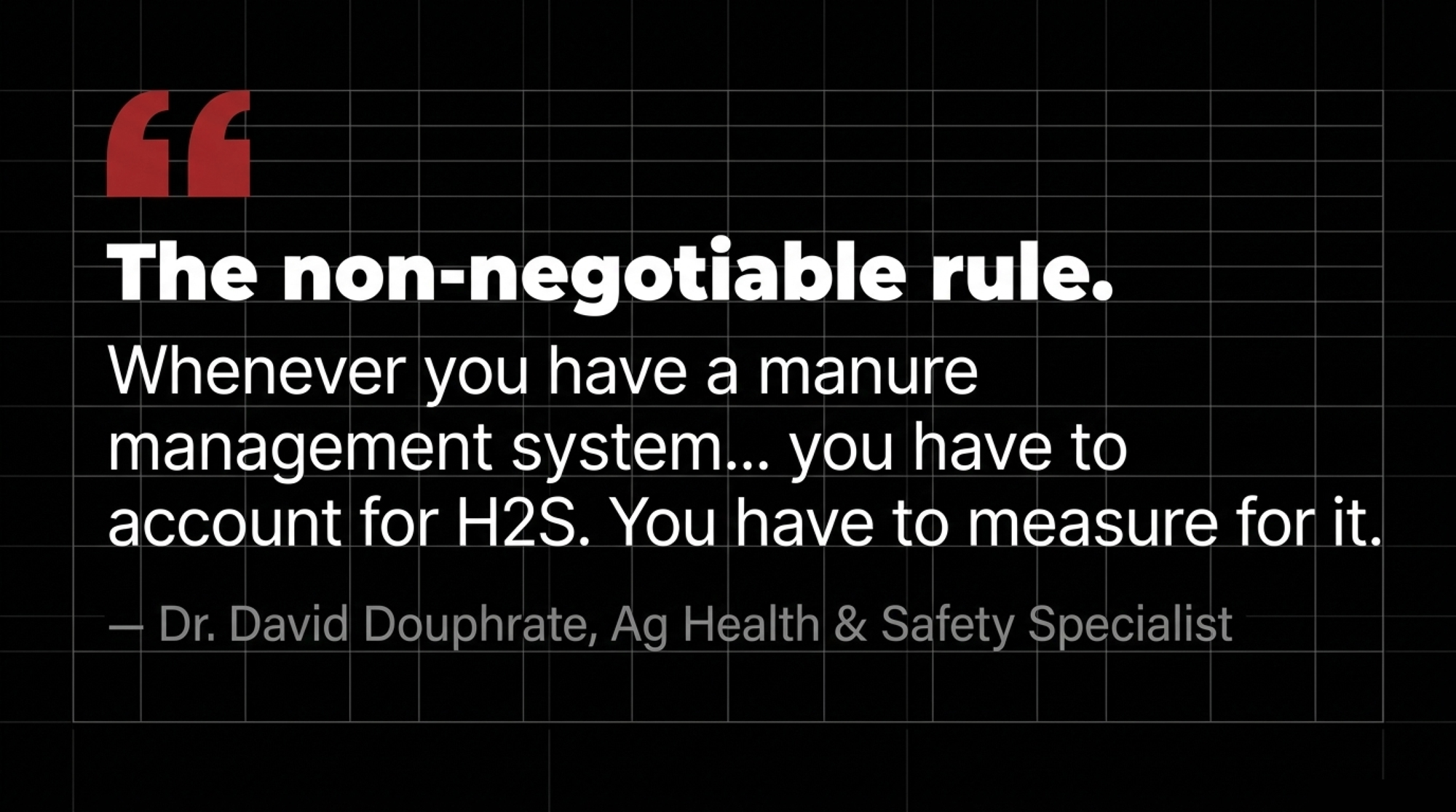
“Whenever you have a manure management system like what they have on large dairy operations, you have to account for [H2S],” Douphrate told CPR. “You have to measure for it.”
He continued, in the same interview: “You have to make sure and confirm that it is present, and if it is present at high enough concentrations, then you need to protect workers.”
Douphrate was describing manure systems generally, not this incident. OSHA’s citations six months later included failure to train workers on methods to detect hazardous gases. Bullvine asked Douphrate on September 11 whether his assessment changed after the citations were issued, and had no reply by the September 18 deadline.
Is Ten Meters From the Storage Far Enough on Agitation Day?
In work presented in 2015, Penn State researchers with USDA-ARS colleagues monitored ten Pennsylvania dairies across 19 fall and spring agitation events, placing multi-gas meters around each storage perimeter, ten meters downwind, and on the operator.
Downwind concentrations above 20 ppm at ten meters occurred in eight of the fourteen observations at farms using gypsum bedding. Twenty ppm is OSHA’s ceiling under 29 CFR 1910.1000 Table Z-2, which exposure may never exceed at any time. Four of the 19 operator-exposure observations also exceeded 20 ppm, and three of those four involved someone working over the rim of the storage. The authors concluded that children and animals within ten meters of a storage are at risk.
Now hold that against the geometry at Prospect Ranch. Penn State’s meters sat in open air, where the gas has somewhere to go. The six workers were in an enclosed pump room, where a gas heavier than air pools instead of dispersing. No document Bullvine has obtained establishes the concentration in that room, and this piece won’t estimate it. The comparison establishes direction: if open air at 33 feet broke a never-exceed limit on more than half the gypsum farms measured, an enclosed space at the source is the worst case.
Three limits belong on the Penn State data. These were Pennsylvania farms, not Colorado ones. The work appeared in the 2015 Waste to Worth conference proceedings, which state that the materials included are not refereed publications, so treat it as field measurement that hasn’t been through peer review. Penn State Extension also notes that not all farms using gypsum have safety problems. Extension guidance puts the highest-risk window in the first 30 to 60 minutes of agitation and notes that hydrogen sulfide is heavier than air, settling in pits and near storages, with the rotten-egg odor going undetected at dangerous levels. Whether Prospect Ranch used gypsum bedding isn’t established in any document obtained, and the physics doesn’t require it.
The Legal Trap: When General Industry Trumps the Ag Exemption
29 CFR 1910.146, the permit-required confined spaces standard, states that it “does not apply to agriculture.” CPR reported the practical effect plainly: for agricultural operations, the confined-space provisions function as guidelines rather than enforceable requirements.
Here is the distinction that blindsides dairy owners. Routine dairy farm labor sits inside the agricultural exemption. Contractor maintenance and repair work on your manure system does not — Department of Labor guidance places maintenance, repair, and refurbishing work under general industry, on a farm or anywhere else. That guidance is interpretive. It’s also the reading that best explains why OSHA reached three businesses instead of one. Two of the cited parties are contractors, hired to work on the system, and they hold $114,203 in proposed penalties between them.
Then there’s who OSHA can reach. Colorado is not an OSHA-approved State Plan state and falls under federal OSHA jurisdiction, which covers most private-sector workers. But federal OSHA cannot enforce standards on farms with 10 or fewer employees, under longstanding appropriations restrictions. CPR reported that of more than 300 Colorado dairies, only a few appear to receive planned inspections in a given year.
So exposure splits three ways. At 10 or fewer employees, federal OSHA enforcement largely doesn’t reach you, and your protection comes from contracts and insurance instead of inspections. Above that headcount, the agency has authority. And the moment you bring in an outside crew for pump work, pipe repair, or system commissioning, two employers with two safety programs meet at one hazard — and four of the six who died at Prospect Ranch were the contractor’s people.
The 30/90/365 Playbook Before the Next Agitation
30 days.
- Find the last calibration and bump-test date on every gas detection device you own. Requires: an hour. Threshold: no dated record inside the manufacturer’s interval means treat the device as absent. Backfire watch: a monitor alarming on a failing sensor teaches crews to ignore alarms.
- Confirm whether your written hazard communication program names hydrogen sulfide, and which party’s safety program governs contractor work on your manure system. All three cited companies were cited for hazard communication or gas-detection training. Requires: your contractor agreements and your written program. Threshold: any agitation, pump repair, or pipe work scheduled within 30 days. Backfire watch: naming a program you don’t train against creates a dated record of the gap.
- Set two rules in words the crew repeats back. No atmospheric reading, no entry. And no second person enters after a first goes down without supplied air and retrieval — OSHA’s narrative describes two workers overcome, then four more entering the pump room. Requires: ten minutes at a crew meeting and one person accountable for saying it again. Threshold: before the next agitation, with no exception for a short job. Backfire watch: a rule stated once and never repeated is a rule nobody follows by spring.
- Penn State Extension recommends a four-gas unit for professional manure haulers. If you contract hauling, ask what the hauler carries.
90 days.
- Read your contractor agreements for two things before an outside crew touches a pit: who carries indemnification, and who holds stop-work authority on site. Requires: your agreements, and counsel’s time if the language isn’t plain. Threshold: before the next contracted pump or pipe job. Backfire watch: the two questions are separate. One names who pays afterward. The other names who can stop the job before it starts.
- Write a non-entry rescue procedure with a staged retrieval system and rehearse it once with everyone who works near storage. Requires: equipment and an afternoon with the crew scheduled. Threshold: any pit entered in the last 12 months without a documented reading. Backfire watch: a plan built on a fire department response time nobody has timed.
- Ask your carrier in writing whether your employer-liability language excludes acts committed with deliberate intent to injure. One illustration of why that question matters, from outside Colorado: in Hoyle v. DTJ Enterprises, decided March 12, 2015, the Supreme Court of Ohio held that such an exclusion precludes coverage for employer intentional torts, because those claims require a finding of intent to injure. That decision does not control in Colorado, and Bullvine has not verified how Colorado courts treat the same clause, which is why the question goes to your carrier in writing. Requires: your policy and a written question. Threshold: now, if outside contractors touch your manure infrastructure. Backfire watch: a verbal assurance from an agent is not a coverage position.
365 days.
- Treat classification, not penalty size, as the exposure. Requires: a documented record that hazards were identified and abated. Threshold: the moment a known defect goes unrepaired through a second scheduled agitation, documented knowledge starts building. Backfire watch: maintenance logs recording the defect but not the repair build the other side’s file.
- Opportunity signal: as of June 2026, Colorado State University was running free confined-space safety training for Colorado livestock operations on roughly $190,000 in project funding, aiming to reach 500 workers. Training that also produces a dated training record beats training alone. Requires: enrolment and crew time. Threshold:before your next agitation season. Backfire watch: confirm the program is still enrolling before scheduling around it.
Running the Numbers — what closing the cited gap costs
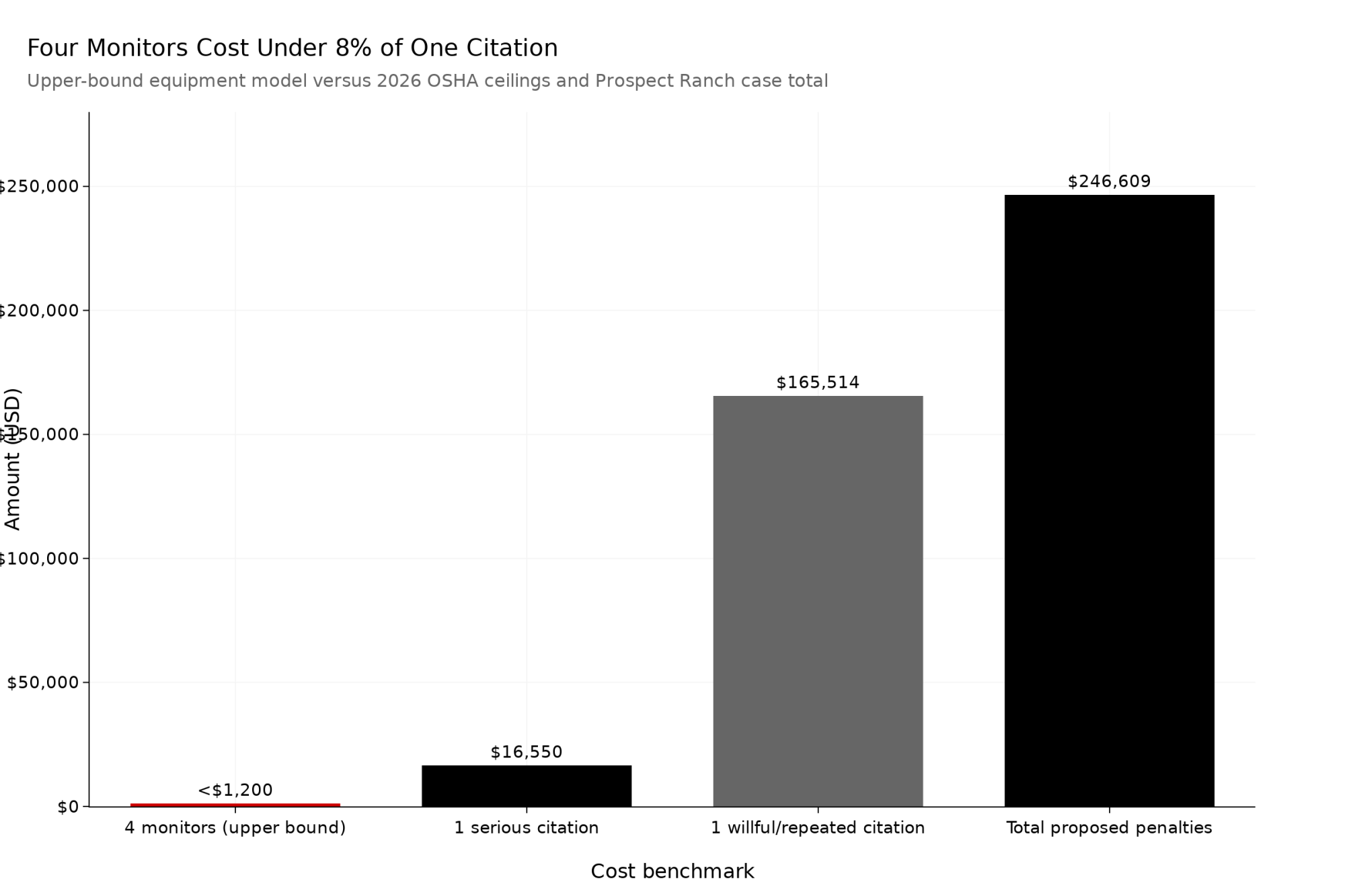
Published evidence. Penn State Extension recommends farm operators working around gypsum-bedded manure storages wear a single-gas hydrogen sulfide personal monitor, and says these cost under $300 each, are cell-phone sized, and have multi-year battery life. Serious-violation ceiling: $16,550, OSHA 2026 schedule.
Stated assumption. Four monitors cover a 400-cow operation’s crew working near storage during agitation. Scope: 400 cows, one enclosed pump pit, U.S., USD, one-time equipment cost excluding calibration and training hours. This is a reader model. The Keenesburg dairy may run more than 10,000 cows, according to records cited by CPR.
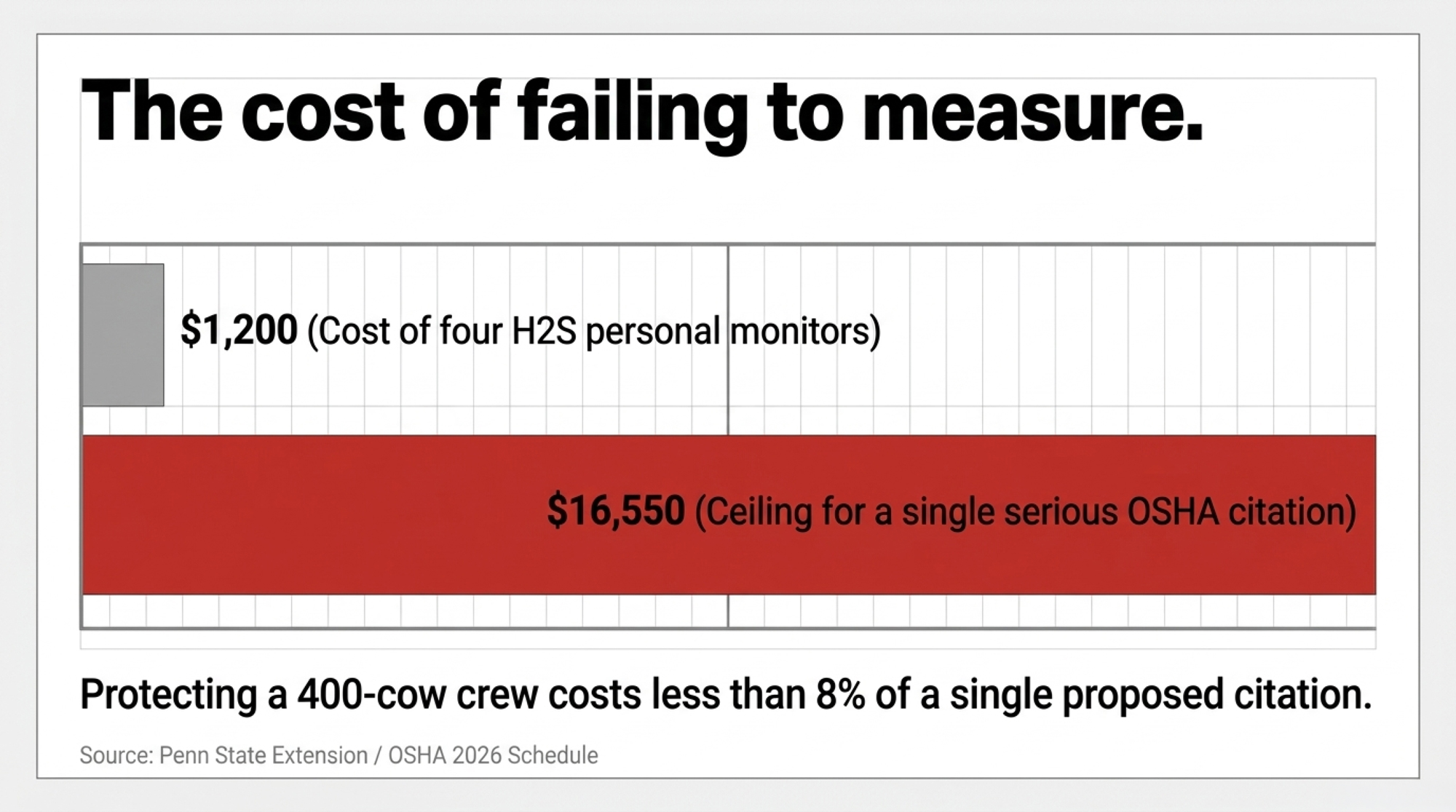
Bullvine math. One monitor at under $300 is under 2% of the $16,550 ceiling on a single serious citation for not training workers to detect the gas. Four monitors run under $1,200, or under 8% of that ceiling. Per cow: under $3.00, one time.
Calibration and training hours sit outside that figure. Add your own.
The Number to Check Before You Agitate
The trade-off here is that classification, not equipment cost, is where the exposure lives — and classification turns on what you can document you knew and when.
Douphrate put the requirement in four words: you have to measure. So find the calibration date on your gas monitor. If there’s no date, or no monitor, you have the same documented condition OSHA cited at Prospect Ranch, and you have it before anything has happened.

Key Takeaways
- Divide OSHA’s three penalty totals by the $16,550 statutory cap, and the files hold at least 17 proposed citations. Any reduction OSHA applied pushes that count higher.
- Classification is the exposure, not the penalty size. Serious caps at $16,550 per citation; willful caps at $165,514 and opens a criminal referral. What separates them is what you can document you knew and when.
- Four of the six who died at Prospect Ranch worked for the contractor. If outside crews touch your manure system, find out today whose safety program governs them, who carries indemnification, and who can stop the work.
- Federal OSHA can’t enforce standards on farms with 10 or fewer employees. Below that headcount your protection comes from contracts and insurance instead of inspections.

This article is based on OSHA records, court filings, and published reporting available as of September 11, 2026. The current stage of the OSHA enforcement case and of the Weld County District Court docket had not been confirmed at that date. Requests for comment were sent to Prospect Ranch LLC, Fiske Inc., and HD Builders LLC on September 11, 2026, with a deadline of September 18.
Learn More
- Manure Pit Safety: What Every Dairy Farmer Needs to Know — Arms your crew with immediate atmospheric testing protocols, ventilation run-times, and staged retrieval mechanics before entering any pit or pump room, preventing routine maintenance jobs from turning into multi-victim rescue disasters.
- Dairy Farm Labor and OSHA: The Regulations You Can’t Afford to Ignore — Breaks down how general industry compliance standards pierce traditional farm liability protections, walking producers through written hazard communication frameworks, inspection trigger thresholds, and contract clauses required to insulate multi-employer operations from five-figure regulatory penalties.
- Methane Digesters and Dairy Safety: Managing the New Gas Hazards — Exposes how closed-loop biogas systems and automated slurry loops concentrate lethal hydrogen sulfide and methane volumes, showing managers how to integrate continuous gas-monitoring telemetry and automated shut-offs into long-term facility infrastructure design.
 The Sunday Read Dairy Professionals Don’t Skip.
 The Sunday Read Dairy Professionals Don’t Skip.
Every week, thousands of producers, breeders, and industry insiders open Bullvine Weekly for genetics insights, market shifts, and profit strategies they won’t find anywhere else. One email. Five minutes. Smarter decisions all week.