








A 100-cow pen short on rest leaks up to $2,300 a month at $14.70 milk — before the $38–$60/cwt some farms earn just for proving how their cows live.
At The Lands at Hillside Farms in Shavertown, Pennsylvania, the milking herd carries a credential most dairies don’t: Certified Animal Welfare Approved by AGW — the only U.S. animal-welfare label Consumer Reports rates “excellent.” Hillside is a 412-acre nonprofit educational dairy that bottles its own herd’s milk and sells it straight from the farm store, which means it pockets the value of that label instead of watching a processor capture it. That’s the whole argument in one barn. While USDA’s June 2026 outlook pegs the 2026 all-milk price at $20.70/cwt, NODPA’s May 2026 report had grass-fed organic-certified dairies earning $38 to $50-plus per cwt — and regenerative organic herds running $50 to $60 per cwt.
Same cows. Same chores. A pay gap wide enough to decide which barn is still milking in 2030. The difference isn’t the genetics standing in the stalls — it’s whether the operation can prove how its animals live, and sell that proof. You can fill those stalls with the best-bred cows in the country, but a broken comfort environment or a dead-end marketing channel caps what that genetic horsepower can ever earn. That’s the part most of the industry is still leaving on the table.
The Death of the Volume-Only Mindset
For decades, how you cared for your cows lived on the cost side of the ledger — overhead first, then compliance, then a line to shave when the milk cheque got thin. The Federal Milk Marketing Order, established in 1937, pays you on volume and components, not on welfare. There’s no column on the pay stub for a comfortable cow. So producers chased the only incentive the system actually rewarded: more milk, at a lower price. That’s not anybody’s villainy — it’s how the system was wired.
But the premium tier keeps paying, and the capital is following it. Horizon Family Brands — owned by Platinum Equity — acquired the grass-fed organic pioneer Maple Hill Creamery on December 1, 2025, according to the company’s announcement. Organic mailbox prices climbed $8 to $15/cwt year-over-year heading into 2026, AgProud reported in March 2026. When private equity buys grass-fed brands and pays prices that jump into double digits, the market’s telling you where it sees value heading.
That capital story isn’t all upside, and it’s worth saying so. Watchdog group OrganicEye filed an FTC complaint in January 2026, arguing the Horizon–Maple Hill deal could lessen competition in organic fluid milk — by OrganicEye’s account, Horizon already controls the largest organic share in the country. Consolidation can lift prices and concentrate buyer power simultaneously. The premium is real — so is the risk of fewer buyers holding the pen.
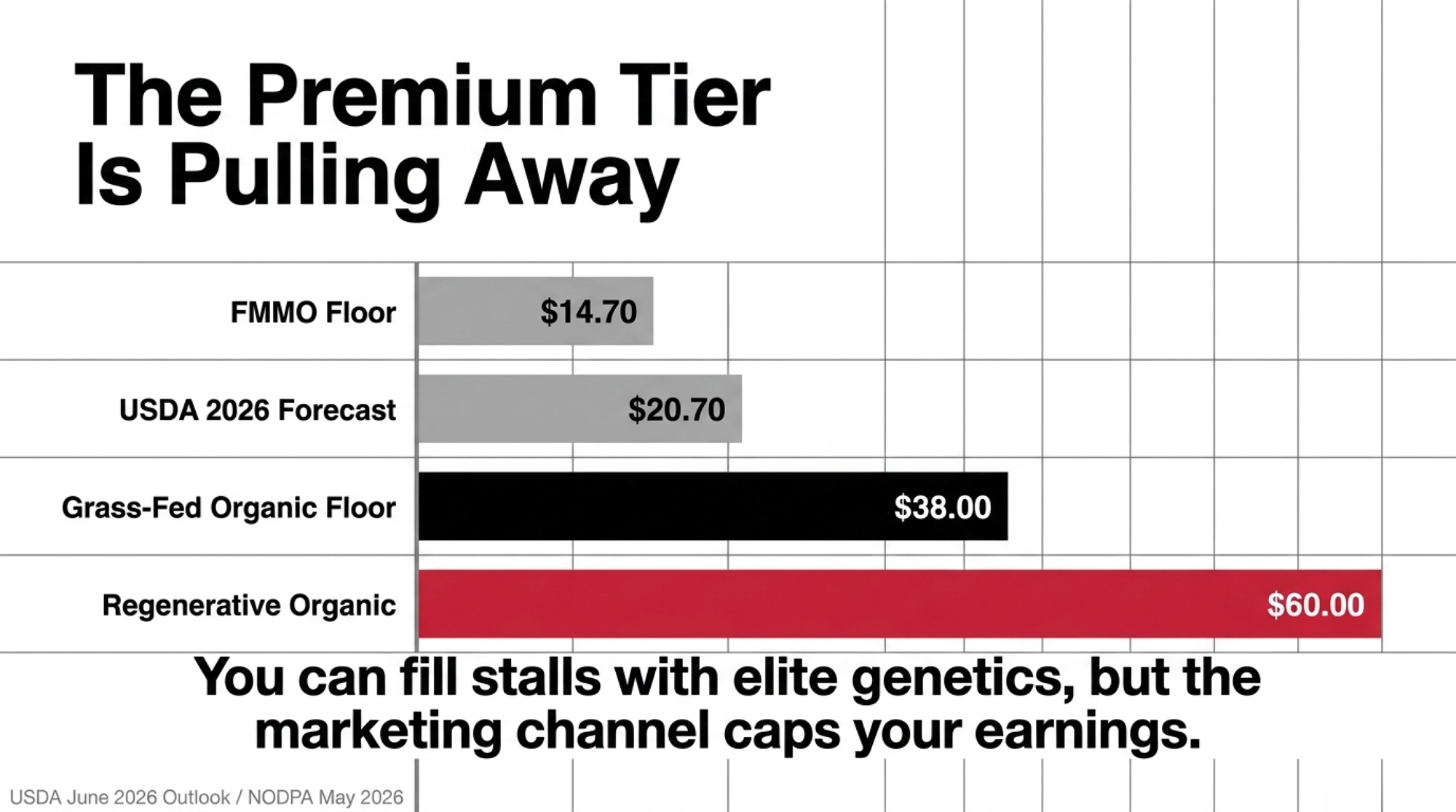
Here’s the harder part for anyone running the conventional treadmill. USDA’s June 2026 all-milk forecast of $20.70/cwt is a long way from the $38–$60 organic and grass-fed pay prices that NODPA tracked this spring. The gap between the two markets isn’t closing. If anything, the premium tier is pulling away while the commodity tier fights over fractions of a cent — and absorbs make-allowance hits the premium farms largely sidestep.
Welfare Pays in the Barn Before It Ever Hits a Label
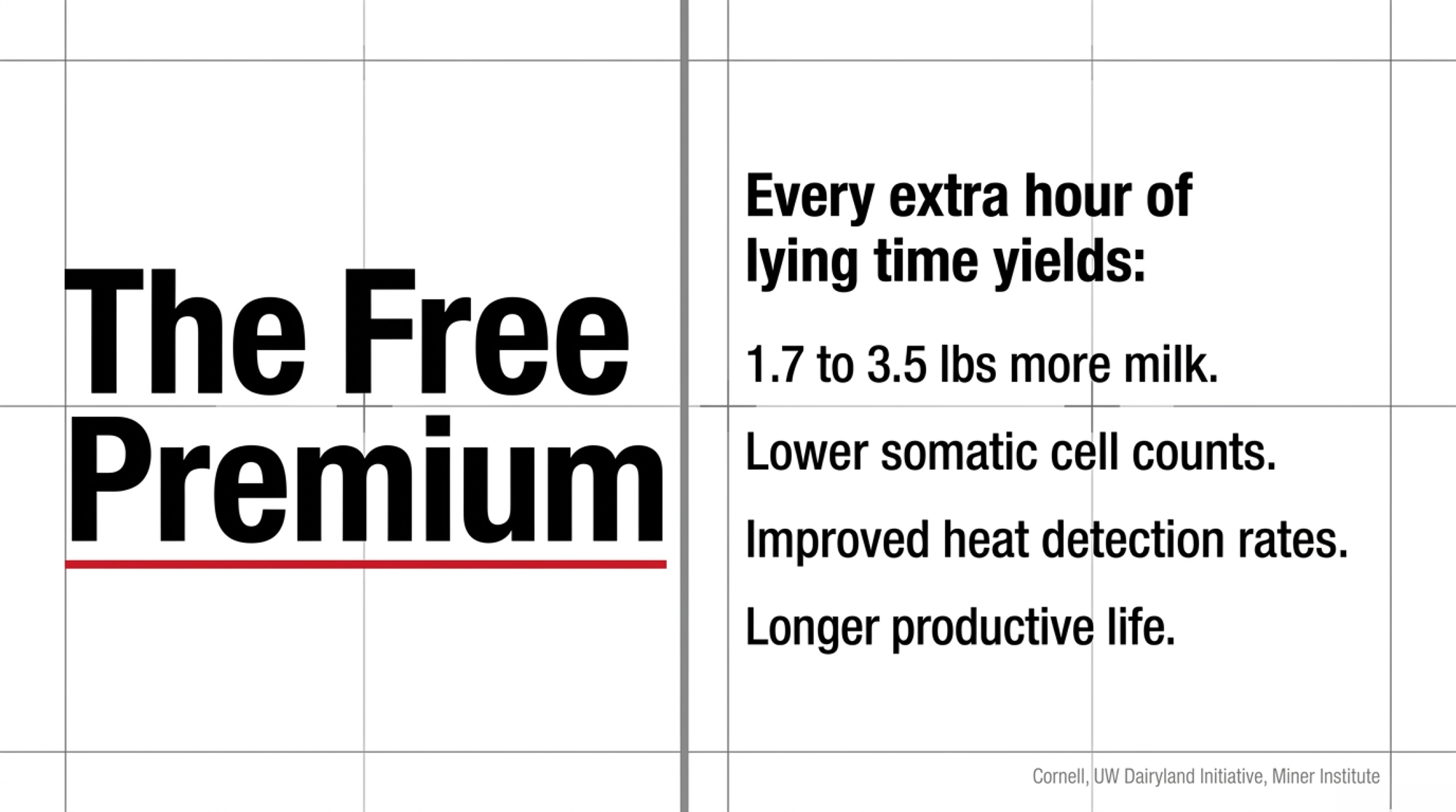
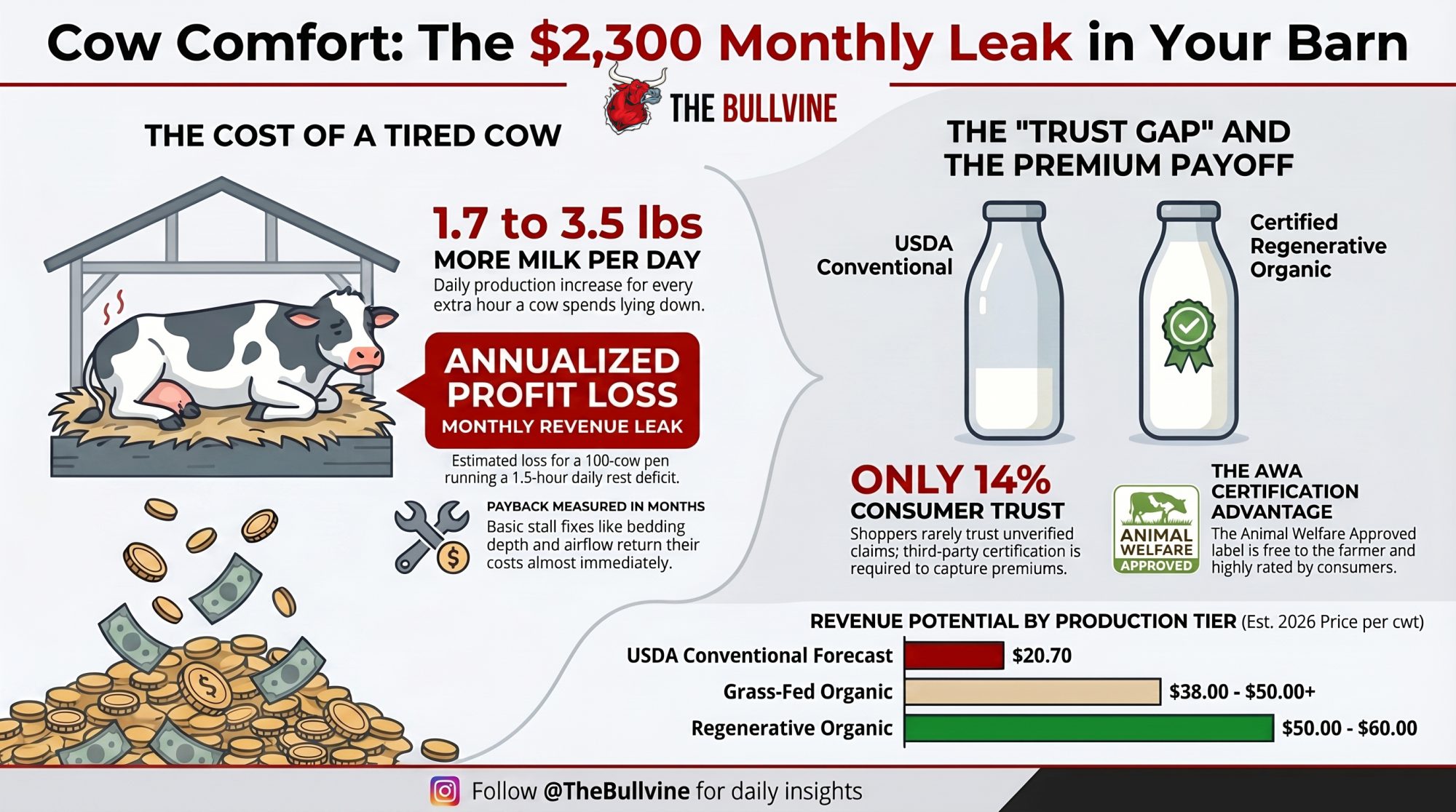
Here’s the part that needs no certificate, no new buyer, no transition paperwork. Welfare pays inside the barn first. Work from Cornell, the University of Wisconsin’s Dairyland Initiative, and the Miner Institute shows that every extra hour a cow spends lying down returns roughly 1.7 to 3.5 lbs more milk per day. Comfortable cows make more milk. That’s physiology, not ideology.
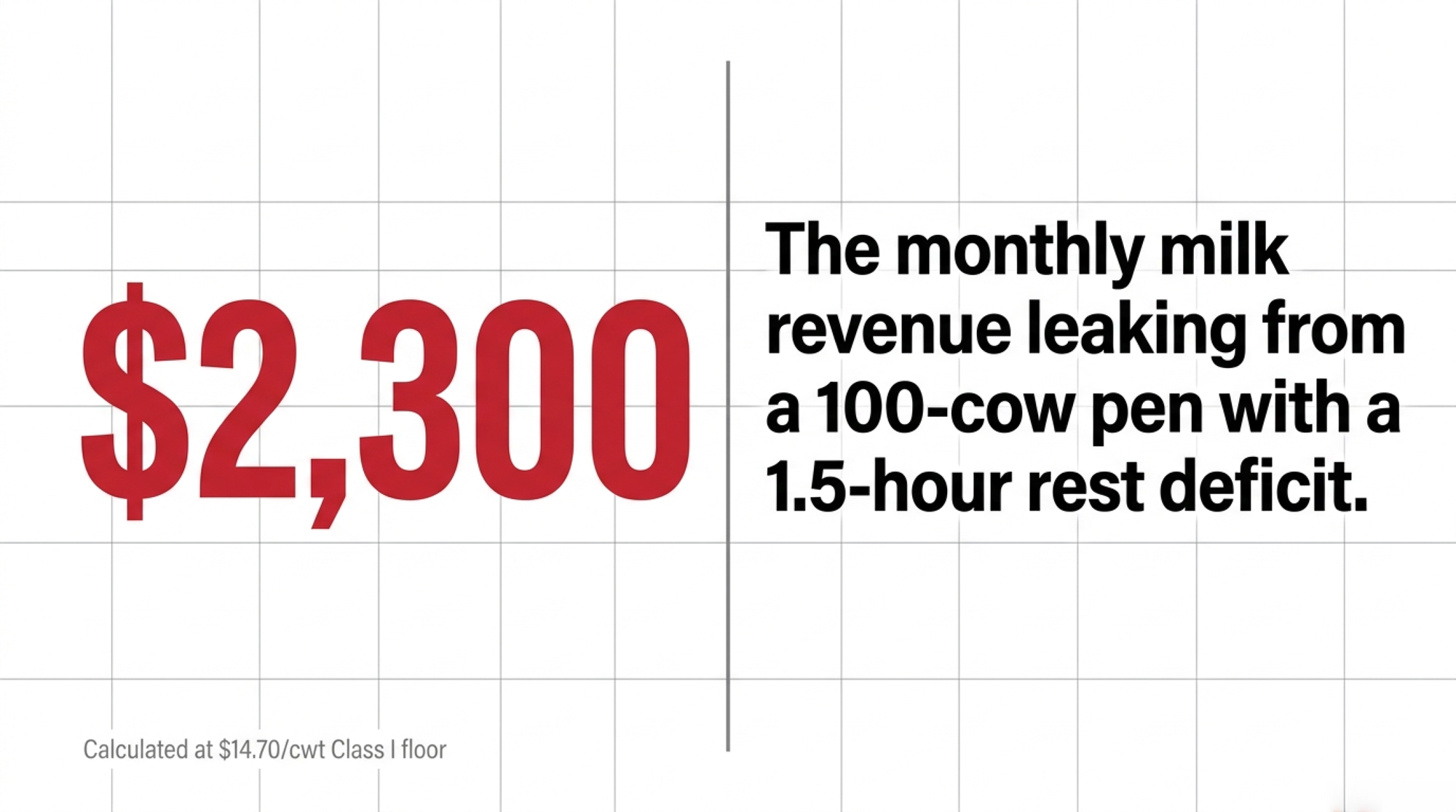
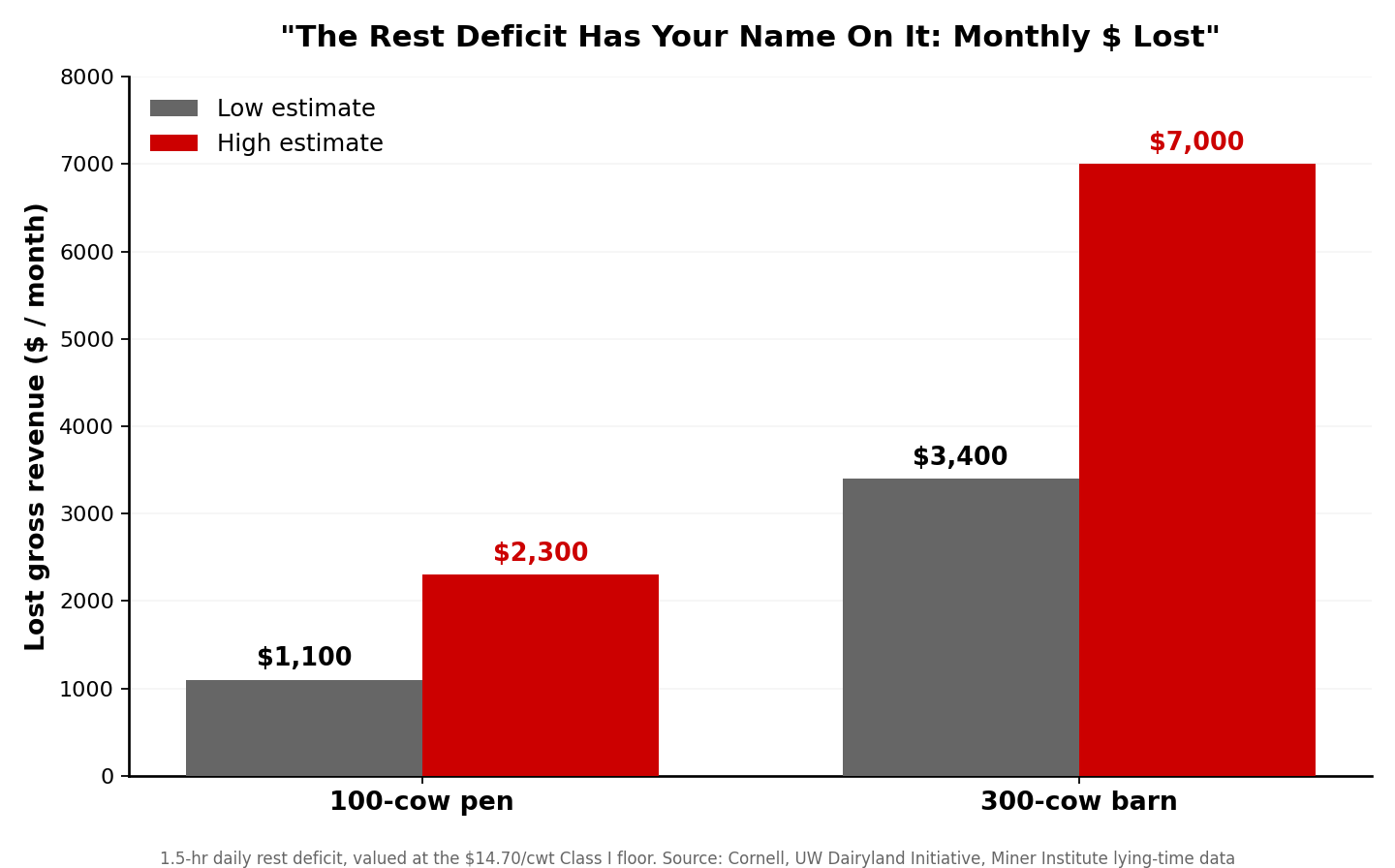
This is also where your genetics either earn out or sit idle. You can chase a high-PTA-milk bull and still strand that potential in a crowded pen — the cow can’t express what the environment won’t let her. Put numbers on it. Take a 100-cow pen running a 1.5-hour daily rest deficit — cows standing in alleys, waiting on crowded stalls, fighting heat. At those lying-time rates, that’s roughly 255 to 525 lbs of milk a day left in the alley. We’ll run the dollars at the $14.70 Class I floor, not the $20.70 forecast, so the number’s conservative on purpose: you’re still looking at about $1,100 to $2,300 a month in gross revenue gone, on cows you already paid top dollar to breed. Use your own mailbox price, and it climbs.
And the rest deficit rarely travels alone. The same crowded pen that costs you lying time tends to push up lameness and somatic cell counts, drag down heat detection, and shorten productive life — every one of them a quiet drain on the same milk cheque. Cornell Pro-Dairy modeling pegs the payback on basic stall fixes — neck rails, bedding depth, airflow — inside a few months. None of it requires a label or a conversation with a buyer. It’s money already on your farm that better cow comfort lets you keep.
The retail spread is where the bigger money lives. NODPA reported organic half-gallon milk averaging $5.24 to $5.43 at retail through early 2026 — against conventional jugs that rarely clear $2. Spot fluid organic was reportedly running in the $60/cwt range this spring, with supply short across the Northeast and nationally. The premium isn’t hypothetical anymore. It’s sitting in the dairy case, and right now the market can’t make enough of it.
The Grocery Store Hypocrisy
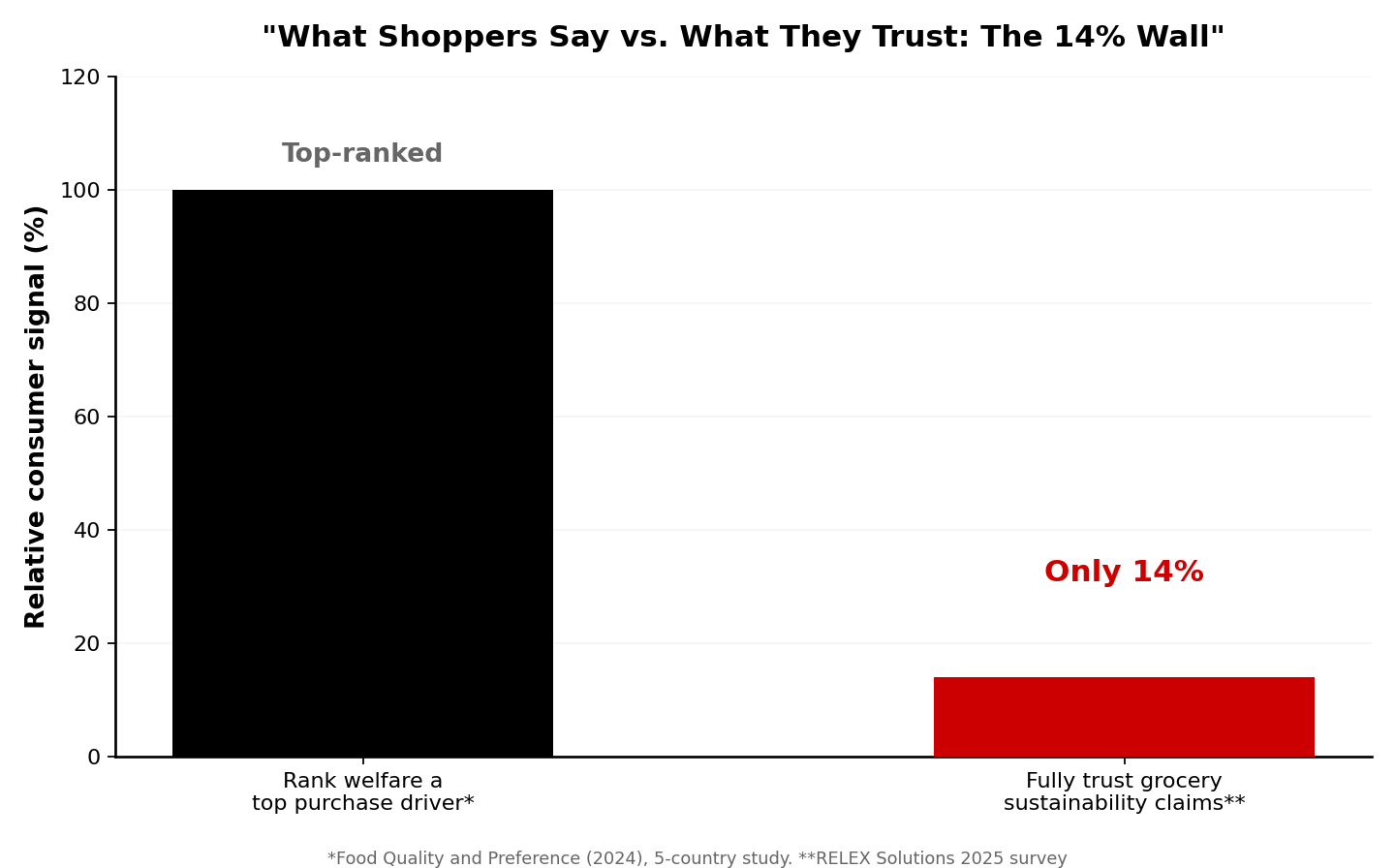
Shoppers will tell a pollster they care about animal welfare and then reach for the cheapest jug on the shelf. A 2024 study in Food Quality and Preference — run across the UK, Sweden, Spain, the Czech Republic, and Switzerland by researchers including Agroscope and the University of Portsmouth — found consumers consistently ranked animal welfare among the top purchase drivers, ahead of food miles, carbon footprint, and organic production. And then plenty of those same shoppers grab the $1.90 jug anyway. Call it grocery store hypocrisy: what people say at the survey table and what they do at the cooler door are two different animals.
That gap is exactly why third-party validation isn’t optional — it’s the enforcement mechanism. A label like organic, certified grass-fed, AWA, or Regenerative Organic forces the issue: if a shopper wants the welfare claim, they have to pay the price attached to the certified product. No certificate, no premium, no way to make the hypocrisy pay you back. Economist Nicolas Treich, in his 2025 book Animal Economics (Cambridge University Press), frames the root cause in structural terms — welfare behaves like a public good, so voluntary markets chronically under-pay for it. You don’t need the theory to feel it at the dairy case, though. The behavior is the proof.
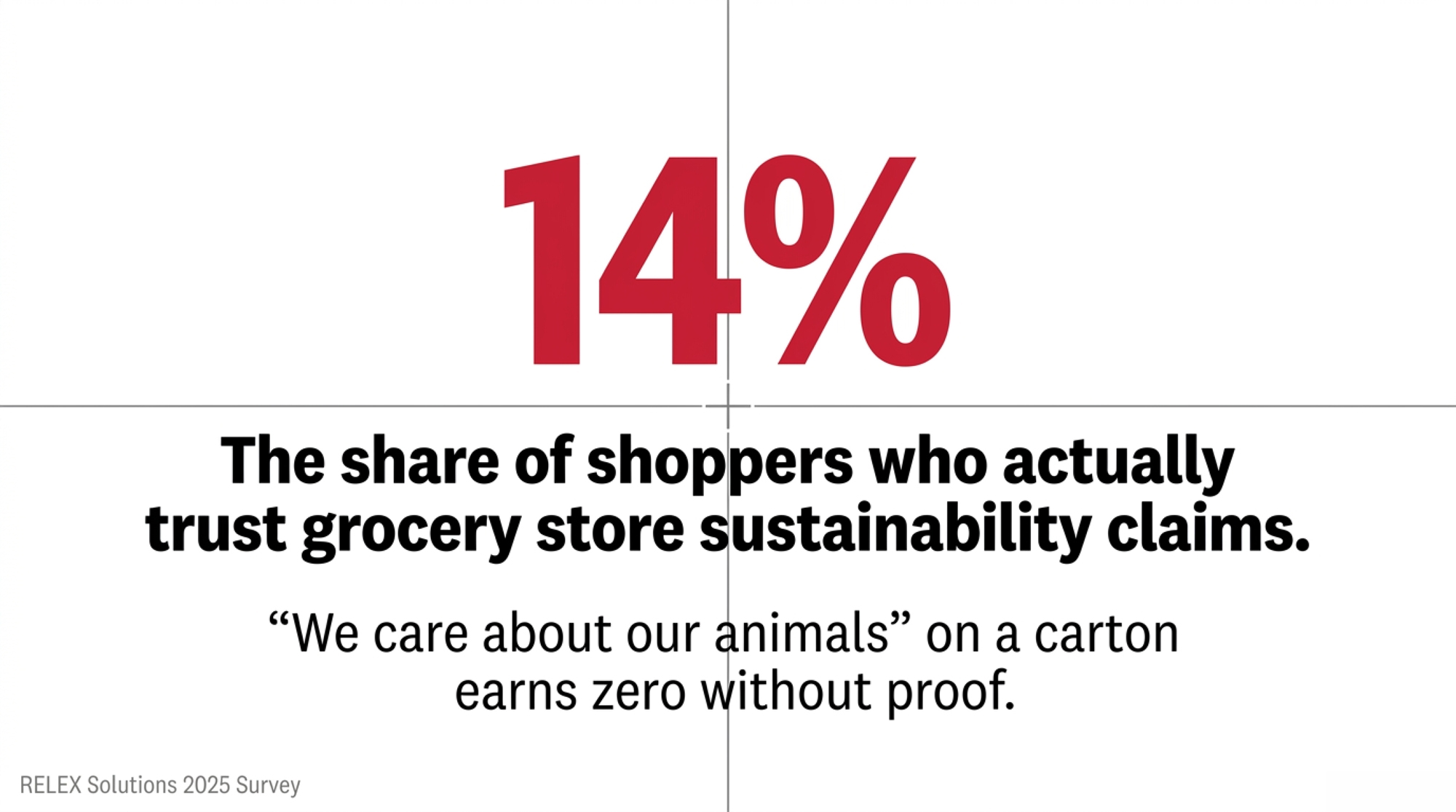
That’s the wall most producers hit. Only 14% of U.S. consumers fully trust grocery sustainability claims, according to RELEX Solutions’ 2025 survey. “We care about our animals” on a carton earns nothing without a third party standing behind it. Credible certification is the bridge between a welfare practice and a welfare premium. Without it, the practice is just an expense you can’t bill for.
There’s a warning shot buried in here, too. If markets structurally under-pay for welfare, the pressure to close that gap doesn’t vanish — it migrates to regulation. The EU has already moved that way on housing and transport, and a producer who builds a provable welfare system now is buying optionality: a premium today, and a head start if the floor rises tomorrow.
How Much Does Waiting Actually Cost You?
Run your own version of the barn-math before you write this off as somebody else’s strategy. If your cows are short on rest, the conventional milk you’re already shipping is worth less than it should be — revenue walking out the door today, at today’s price, no certification required. On a 100-cow pen at the top of that estimate, that’s roughly $2,300 a month at the $14.70 floor. Scale it to a 300-cow barn with the same deficit, and you’re somewhere between $3,400 and $7,000 a month, depending on where your lying-time loss actually sits. Twelve months of “we’ll get to it” isn’t neutral. It’s a number with your name on it.
The transition question is harder to time, and caution is fair. The University of Vermont’s grass-fed production guide is blunt about it: most farms see production costs rise and milk volume fall under grass-fed management. Organic also runs 36 months of organic-rule costs before organic pay arrives — a real cash-flow hole that’s sunk plenty of well-meaning transitions. The lower-risk sequence: bank the free in-barn gains first, then use that stronger cash flow to fund a slower, deliberate call on certification. You don’t have to bet the farm to start.
Is Your Welfare Story Provable, or Just Stated?
Here’s the gut-check. Walk your barn as a skeptical buyer — or a reporter — would, beside you. Can you show, not just say, how your animals live? Longevity, culling rates, lying time, clean housing, calf protocols, lameness scores? A provable welfare story is a marketable asset. A stated one is marketing copy nobody believes.
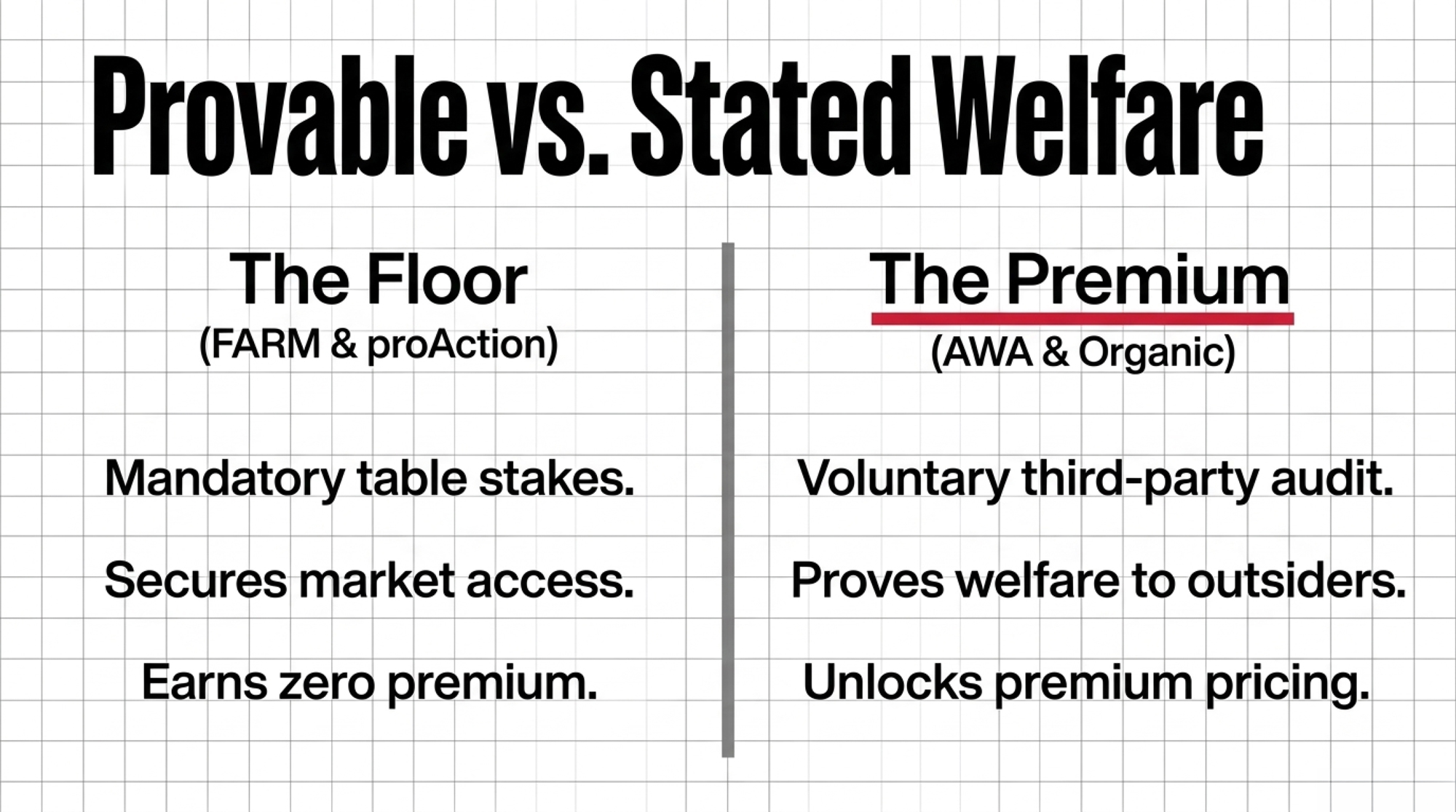
Worth knowing where the floor already sits. About 99% of U.S. milk production already participates in the National Dairy FARM program — more than 31,000 farms — and in Canada, proAction is mandatory on every licensed dairy. FARM and proAction are table stakes, not brand assets. They solve the floor, not the premium. The money lives in the layer you build on top — exactly what Hillside did when it stacked AGW certification onto a working dairy — and whether you can prove that layer to someone who walked in not believing you.
The proof has to be legible to an outsider, not just obvious to you. You know your cows are well cared for. The shopper at the dairy case doesn’t; the buyer signing a premium contract doesn’t, and, at 14% trust, neither assumes the best. A third-party audit is what turns “trust me” into “here’s the certificate” — and that’s the difference between a practice that costs you and one that pays you.
Four Strategic Paths: Where Does Your Barn Fit?
There’s no single right move. There’s a calculation that depends on your balance sheet, your buyer relationships, and your geography. Here’s what farms are actually doing.
| Strategic Path | Pay Premium | Up-front Cost / Cash-flow Risk | Certification Hurdle | Best Fit |
| Capture in-barn ROI first | None directly; recovers lost milk revenue | Near zero — payback in months (Cornell Pro-Dairy) | None | Every barn, this month |
| Animal Welfare Approved (AGW) | Premium only if a buyer/farm store pays | Free to farmer — application, cert & annual audit (AGW) | Pasture-based required; confinement won’t qualify | Pasture herds w/ direct sales |
| Transition to organic / grass-fed | $38–$50+/cwt (NODPA) | 36 months of organic costs first; volume typically drops (UVM) | High; multi-year | Strong balance sheet + buyer lined up |
| Direct / regional channel | Full retail spread captured ($5.24–$5.43/half-gal) | Marketing + food-safety burden most farms lack | Self-managed | Operators wanting pricing control |
- Capture the in-barn ROI first — start this month. Walk your stalls and pens this week. Measure lying time, check stocking density, look hard at neck rails and airflow. Almost no capital, no certification, payback in months per Cornell Pro-Dairy. Risk is near zero — and it’s the one path that unlocks the genetics you’ve already paid for. The only thing in the way is the half-day it takes to look honestly at your own barn.
- Certify with Animal Welfare Approved. A Greener World’s AWA program is free to the farmer — the application, certification, and annual audit run at zero cost, per AGW — and it’s the label Consumer Reports rates highest. Hillside runs it on a working dairy herd and sells the milk directly. The hard limit: AWA requires pasture-based, high-welfare systems, so confinement operations won’t qualify, and the label only pays if a buyer — or your own farm store — turns it into a price.
- Transition to organic or grass-fed. Biggest premium, biggest risk. NODPA had grass-fed organic certified pay at $38 to $50-plus this spring, but organic runs 36 months of organic costs first, and UVM warns that volume typically drops under grass-fed. Don’t start without a buyer relationship lined up — Maple Hill, for one, built its supply on roughly 140 small farms across upstate New York. And watch the consolidation: the OrganicEye FTC complaint is a reminder that fewer, bigger buyers can mean less leverage when your contract comes up for renewal.
- Build a direct or regional channel. Farm-direct fluid, on-farm processing, and artisan cheese — exactly Hillside’s model — let you own more of the chain, so the premium is actually captured rather than absorbed by a processor or retailer. It demands marketing muscle and food-safety compliance that most farms don’t have in-house. But it’s the path with the most pricing control, and the one least exposed to a processor cutting your premium on 30 days’ notice.
Key Takeaways
- If your pens are crowded or your cows are short on rest, run the lying-time math this month — at the $14.70 floor, a 100-cow pen with a 1.5-hour deficit may be leaking up to $2,300/month, and a 300-cow barn $3,400 to $7,000.
- The best genetics you can buy are capped by the barn they live in and the channel you sell into — fix the environment before you blame the cow.
- Treat stall comfort, airflow, and stocking density as a revenue decision, not a cost line — Cornell pegs the payback in months, not years.
- Before chasing any premium, ask one question: Will a credible third party certify my claim? At 14% consumer trust, an unverified story earns zero.
- If you’ve got pasture access, the AWA audit is free to the farmer — call A Greener World for an eligibility check before you assume it doesn’t fit your operation.
- If you’re weighing organic or grass-fed, line up the buyer before you start the 36-month clock — budget for lower volume, not just a higher price, and factor in who’ll still be buying after the next acquisition.
- Don’t assume FARM or proAction earns you a premium. They’re the floor. Name the differentiating layer you can actually prove on top — and make sure an outsider can read it.
A nonprofit dairy in Shavertown sells milk from a herd certified under the label Consumer Reports calls the best in the country, straight to the people who drink it. A buyer paying north of $50/cwt does it for milk it can vouch for. And the herd down the road ships into a $20.70 pool and never tells a soul how those animals live. The difference isn’t the genetics in the stalls — it’s whether the operation decided that the way it cares for its cows is worth proving and selling. So where does your operation sit on that line right now, and what would it take to move it ten feet?
Run Your Numbers
Dairy Profit Projector — This article runs the math at a $14.70 floor. Now run yours. Drop in your herd size, milk price, and ration to see your real breakeven, IOFC per cow per day, and 12-month margin — then stress-test what a premium contract would actually change.
If you want the deeper math — the full cost-per-cwt model by herd size, the 36-month transition cash-flow timeline, and which certifications actually pencil out at your scale — that’s what we’re building in the next Bullvine Weekly. That’s where the real numbers live.
 The Sunday Read Dairy Professionals Don’t Skip.
 The Sunday Read Dairy Professionals Don’t Skip.
Every week, thousands of producers, breeders, and industry insiders open Bullvine Weekly for genetics insights, market shifts, and profit strategies they won’t find anywhere else. One email. Five minutes. Smarter decisions all week.
Learn More
- Concrete, Air, and Shade: The Real Drivers Behind Milk Yield — Reclaims $1,100 to $2,300 in monthly revenue leaks by executing low-cost, 90-day payback stall modifications. This blueprint breaks down the exact dimensions, airflow settings, and bedding targets needed to force immediate lying-time production responses.
- FrieslandCampina Pays €2.63/100kg Sustainability Bonus – Why Your Milk Check Stays Blank. — Exposes the structural mechanisms premium cooperatives deploy to pass audited sustainability cash directly to producers. This analysis handles the corporate data-sharing metrics required to build a visible, $1.25/cwt premium line item on your check.
- 14% Believe Your Dairy Label. Jasper Hill Gets $22 a Wedge. The Difference Is One Certification. — Dismantles the financial illusion of unverified farm claims by contrasting generic commodity pooling with certified regional pricing. This investigation delivers the precise consumer behavior metrics and third-party audit strategies required to unlock $40–$50/cwt farm-gate pay.
Complete references and supporting documentation are available upon request by contacting the editorial team at editor@thebullvine.com.




