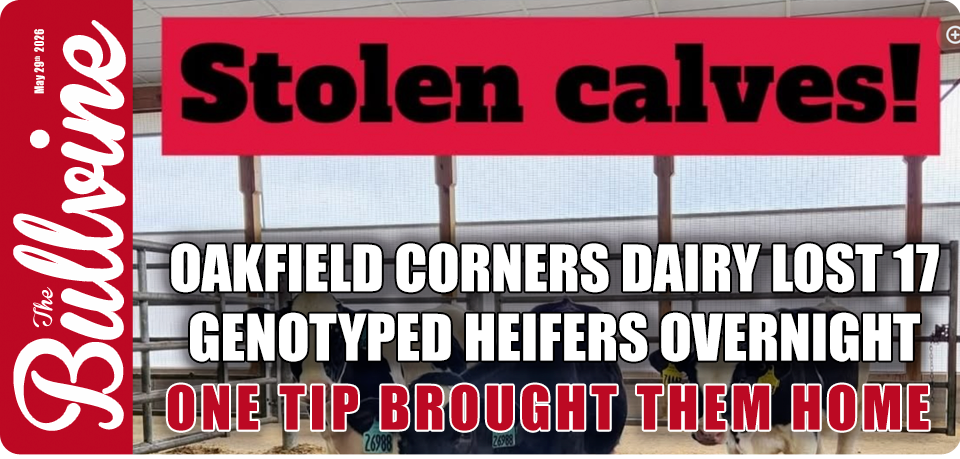





Seventeen genotyped Holsteins — $3,500 to $5,000 a head — gone from Lamb Farms’ pen overnight. No GPS found them. A fast-moving dairy network did, in roughly 48 hours.
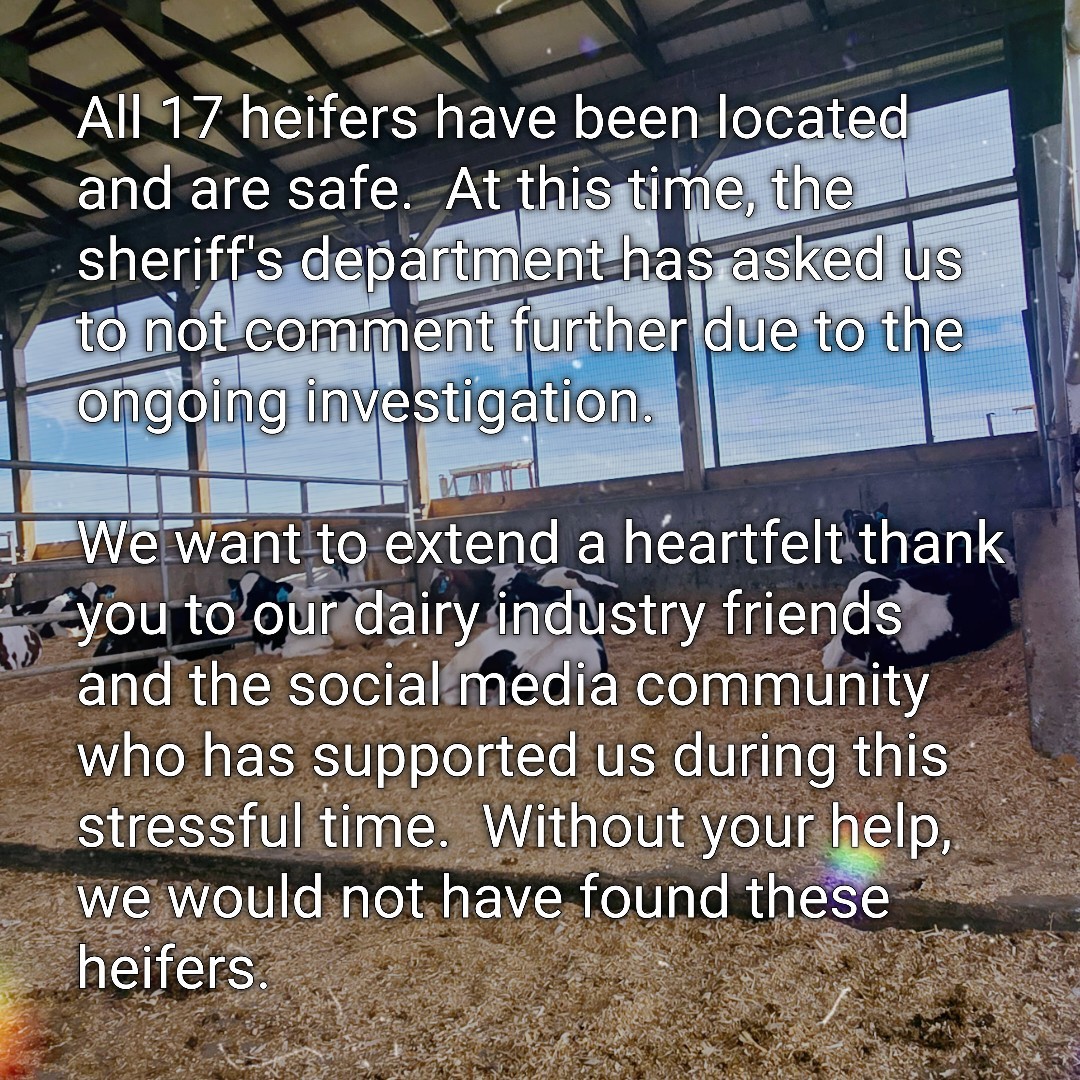
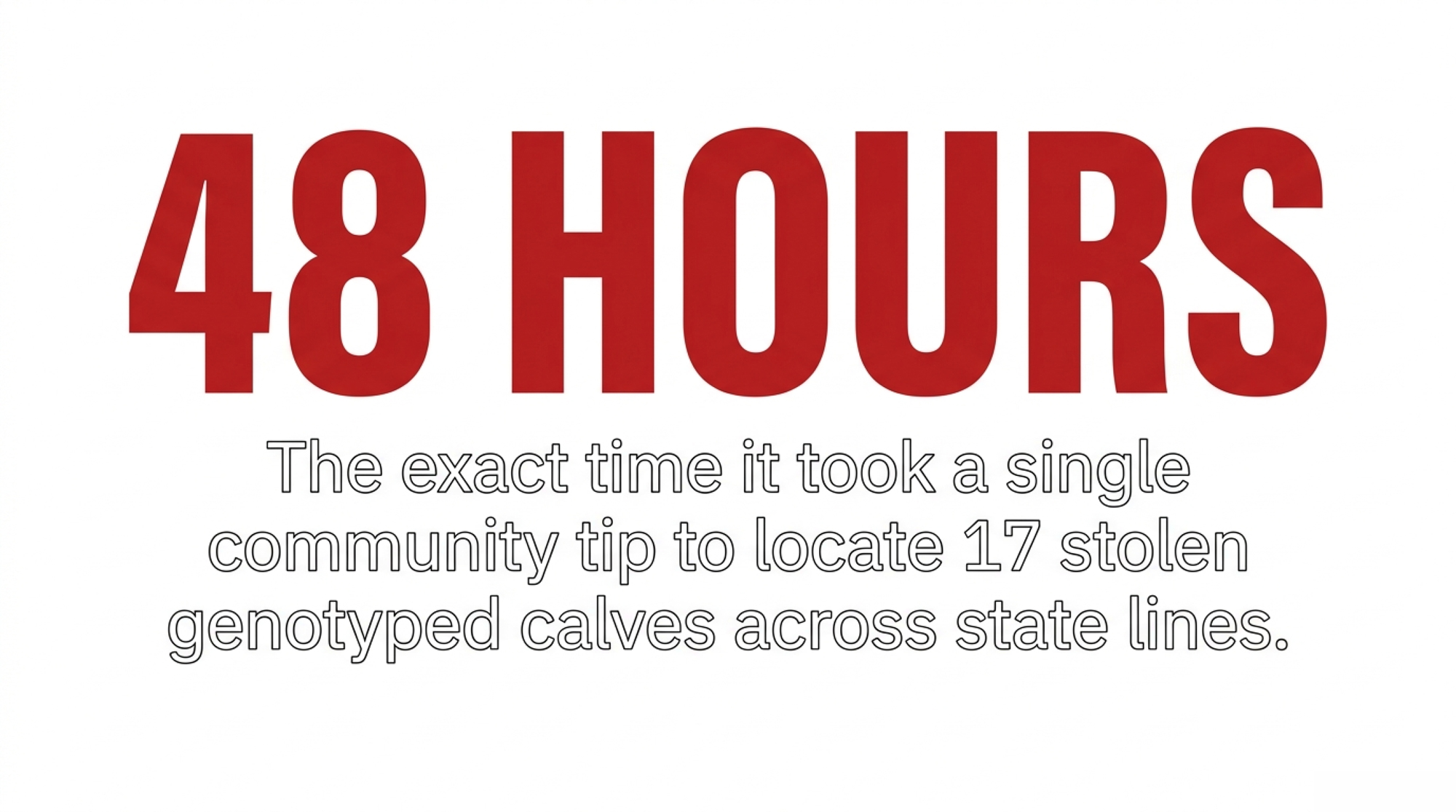
Picture walking out to your calf facility at daybreak and finding the pen empty. That’s what happened at Lamb Farms on Bliss Road in Oakfield, New York, after 17 five-month-old Holstein heifers went missing between 1 and 3 a.m. Sunday, according to The Batavian’s report on the farm’s Facebook alert (The Batavian). About 48 hours later, WKBW reported that all 17 calves had been located and confirmed safe by the Genesee County Sheriff’s Office (WKBW).
UPDATE — June 5, 2026: Arrests made. A Lockport couple has been charged in the overnight theft of 17 calves from Lamb Farms.
A husband and wife from Lockport, New York, are facing multiple felony charges in connection with the 17 genotyped calves taken from Lamb Farms in Oakfield. Torrence A. Schmitt, 25, and Kerisa J. Schmitt, 26, were taken into custody Wednesday in Jamestown, with assistance from Chautauqua County sheriff’s deputies, and transferred to the Genesee County Jail to await arraignment, The Daily News reported.
Both are charged with third-degree burglary, third-degree grand larceny, tampering with evidence, and first-degree falsifying business records. Each is also accused of removing and destroying the identification tags from 16 of the calves — the genotyping ear tags that ultimately made the animals traceable.
The calves disappeared overnight on May 24. According to investigators, a neighbor’s security camera on Lockport Road in Alabama captured a heavy-duty pickup pulling a cattle trailer, followed closely by a second vehicle, at 1:21 a.m. The animals were recovered May 27 at Lebanon Valley Livestock Market in Pennsylvania — roughly halfway between Harrisburg and Reading — and returned to Lamb Farms. Their total value was placed at $41,000.
The investigation was led by the Genesee County Criminal Investigations Division. Both Schmitts were released under the supervision of Genesee Justice and are scheduled to appear in Genesee County Court at a later date.
The Schmitts are charged but have not been convicted; the allegations described above are drawn from law enforcement and court information as reported by The Daily News.
The original industry-wide alert, published May 24, follows below.
That rarely happens. Calves move fast, tags get cut, and a trailer can be three counties gone before anyone’s had their first coffee. Oakfield beat the clock — and not because the system ran perfectly. It happened because a farm community moved fast enough to keep the animals visible. Here’s the whole story of how 17 genotyped Holstein heifers vanished and came home, and the playbook every registered herd should copy.
Why did the dairy community recover these calves before the trail went cold?
The Bullvine’s original alert pegged the group as 17 five-month-old genotyped Holstein heifers from Oakfield Corners Dairy, a division of Lamb Farms, hauled off in a truck and cattle trailer that headed west on Lockport Road (The Bullvine). With the Thruway right there, those calves could’ve been three states away by chore time.
Then the network kicked in. Public reporting confirms the recovery but leaves key details unanswered: where the heifers were located, which tip or tips moved the case, and whether any recovery details are being withheld because the investigation remains open (WKBW). That restraint matters. A clean public alert helps investigators; a rumor storm can wreck a case.
Investigators didn’t hide where the help came from. The Genesee County Sheriff’s Office confirmed the recovery, said the case is still open, and credited the ag community for the tips that moved it (WKBW).
That’s the real story here. A sheriff’s office can take the call. But it’s the farm community that makes stolen animals impossible to move — and then hands over the one tip that turns a missing-cattle report into a recovery.
How does a single tip beat a stolen trailer with a head start?
Run the timeline in your head. The heifers left Bliss Road overnight. By Sunday morning, the theft had been reported, and Lamb Farms had an alert up asking anyone who’d seen cattle being moved to speak up (The Batavian). About 48 hours after that, the calves were located out of state and headed home (WKBW).
That gap — head start versus recovery window — is the whole ballgame. Every hour the thieves move freely, the calves slide closer to a private sale or an informal channel where they stop looking stolen and start looking like inventory. What slammed that window shut wasn’t a GPS ping. It was a person who saw something that didn’t add up and knew exactly who to call.
And here’s the part worth sitting with: a watch list moving through the dairy community doesn’t stop at the county border. Neither does a trailer, a hauler, an order buyer, or a neighbor who clocks that a load of fresh five-month-old Holsteins showing up out of nowhere just doesn’t fit. Neither does a hauler, an order buyer, or a neighbor who clocks that a load of fresh five-month-old Holsteins showing up out of nowhere just doesn’t fit. That cross-border reach is exactly the kind of weak spot cattle thieves count on you not closing.
Social media did the one job rural networks couldn’t
Farmers have warned each other by phone tree, coffee shop, and sale-barn whisper network forever. Facebook just made that network visible — and fast. Lamb Farms’ Facebook alert asked neighbors with cameras to check for a truck hauling a cattle trailer between 1 and 3 a.m. Sunday and asked cattle people to watch for anyone trying to sell calves fitting the description (The Batavian). WKBW later reported that law enforcement credited the agricultural community’s tips as central to the recovery (WKBW).
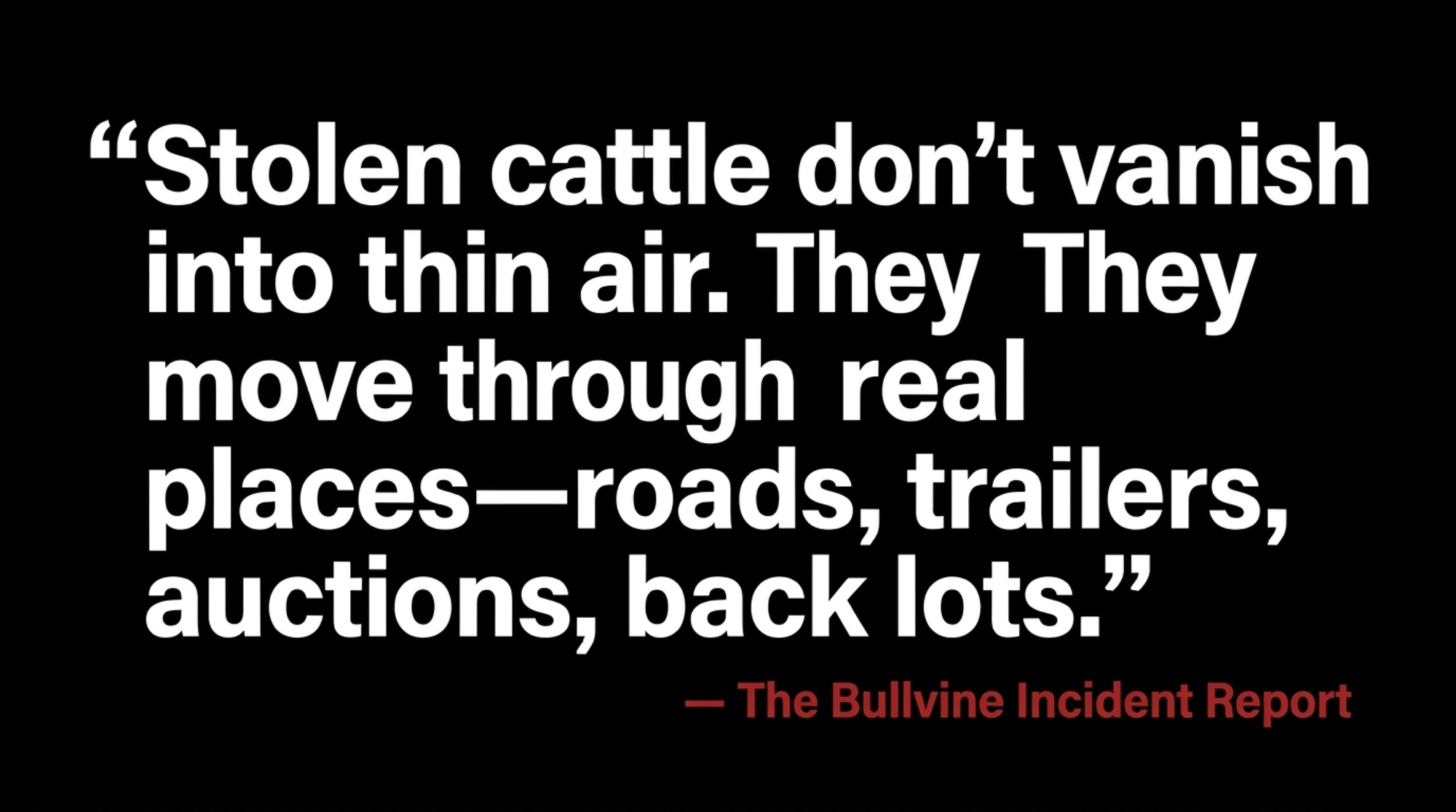
Stolen cattle don’t vanish into thin air. They move through real places — roads, trailers, auctions, back lots, holding pens. The Bullvine’s alert asked sale barns, order buyers, auction yards, neighbors, folks with driveway cameras, and haulers to keep an eye out and call the Genesee County Sheriff’s Office (The Bullvine).
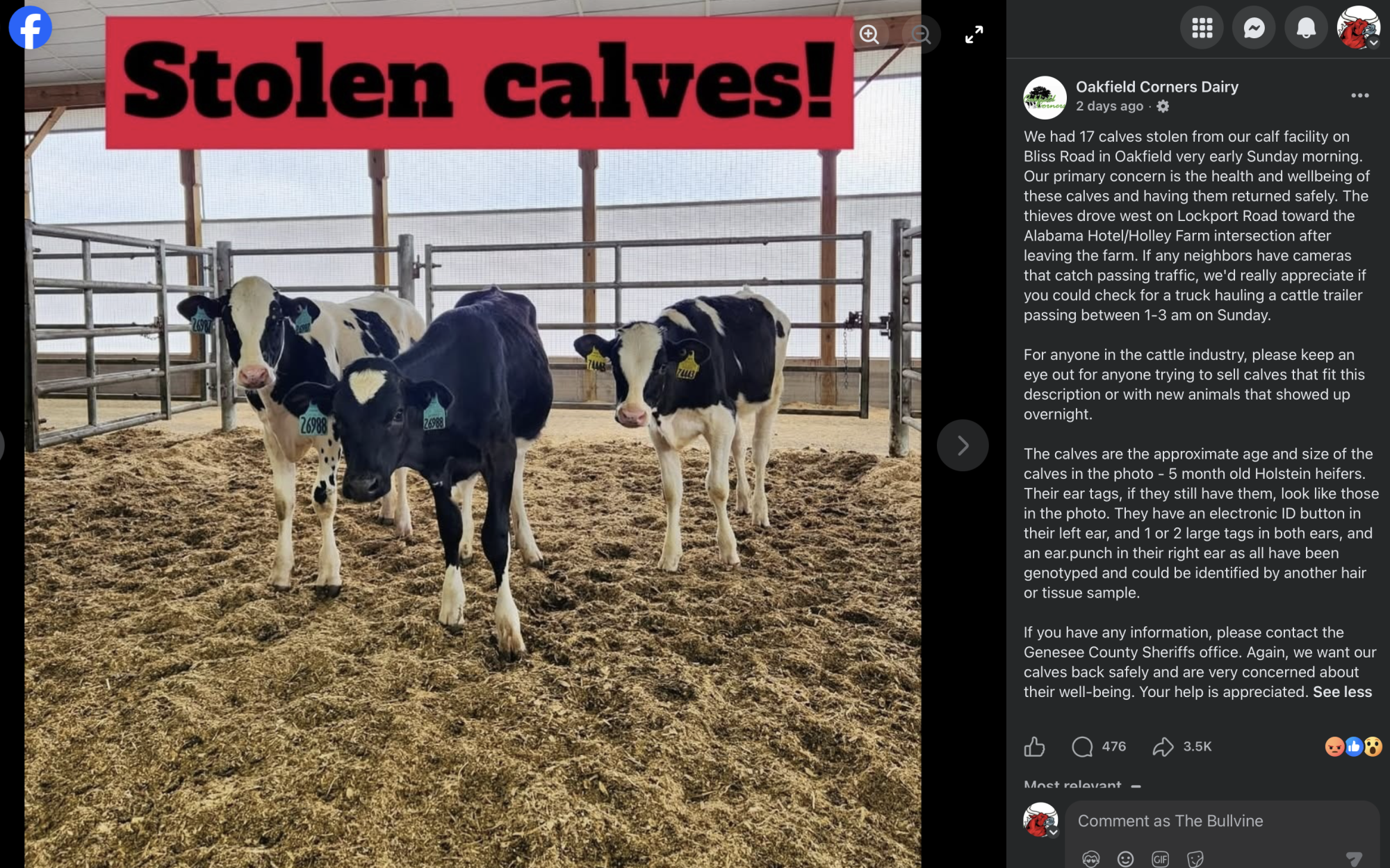
That’s where a post earns its keep. Not in outrage — in distribution. One good post puts a calf’s description in front of the guy unloading a trailer, the neighbor checking her camera, and the breeder who knows Oakfield cattle well enough to say, “That doesn’t belong there.”
The flip side writes itself: social media can also turn into a rumor mill with a keyboard. This one worked because the message stayed useful — missing calves, description, who to call, and a clear ask. No suspect names. No armchair detectives. And watch what Lamb Farms did after the recovery: they went quiet and let law enforcement work. That restraint is as much a part of the playbook as the alert itself.
These weren’t anonymous calves — and that changed everything
Oakfield Corners isn’t running feeder calves. It’s a division of Lamb Farms built on elite Holstein cow families, a large ET and IVF program, and both high-GTPI and show-quality stock (Oakfield Corners Dairy). GENEX’s profile of Alicia Lamb puts the combined operation at about 11,000 cows across three farms in western New York and one in western Ohio, with roughly 99% Holstein (GENEX).
So these weren’t commodity calves headed for a feedlot. The Bullvine’s original alert described them as fully genotyped heifers with layered ID — an EID button, visual management tags, and a tissue-punch site from which the genotype sample was taken (The Bullvine).
The Bullvine’s alert valued the group at $3,500 to $5,000 per head (The Bullvine). Do the kitchen-table math: 17 head at $3,500 is $59,500. At $5,000, you’re looking at $85,000 — and that’s before you factor in staff time, lost breeding opportunities, donor potential, or the gut-punch of losing animals from a program you’ve spent years building.
In New York, property worth more than $50,000 crosses into second-degree grand larceny, a class C felony (NY Penal Law 155.40). Nobody’s been charged with that here — the case is open, and charging calls belong to prosecutors (WKBW). But it tells you this isn’t a “couple kids grabbed a calf” story. It’s serious money, serious crime — and it landed in a replacement market where comparable animals are expensive and hard to source.USDA Agricultural Prices data, tracked by CoBank, put replacement heifers at an average of $3,010 per head nationally as of July 2025 — up 75% from $1,720 in April 2023 and near record highs (The Bullvine). When the pipeline’s that tight, stolen animals are that much harder to replace at any price.
Does a genotype actually help you get an animal back?
Honest answer: not directly, and public reporting has not confirmed that genomic data was used in this recovery. The break came from a tip, not a lab. What the records do change is what a thief can actually do with the animals once they’ve got them.
Think about where stolen calves usually disappear — a sale barn, an order buyer, a quiet private deal. That exit ramp is mostly closed when the calves are elite registered Holsteins. A pen of fresh five-month-old genotyped heifers from a program like Oakfield Corners isn’t anonymous in the registered world. People recognize this kind of cattle, and a load that shows up from nowhere raises eyebrows fast. That’s the same network The Bullvine alert leaned on when it asked sale barns, order buyers, and auction yards to watch (The Bullvine). The genotype doesn’t ping a location — but it can make calves harder to launder into legitimate cattle channels, which may buy time for tips, records, and investigators to catch up.
Here’s the formal backstop. ICAR defines animal-identification confirmation as the use of genomic markers to determine whether a tissue sample can be excluded as originating from a particular animal (ICAR). CDCB’s SNP-based parentage service runs those markers and returns a verdict — accepted, doubtful, or excluded (CDCB). Holstein Association USA will verify parentage when an animal’s ID gets challenged (Holstein Association USA).
In plain terms, with the records and a clean sample, a genotyped animal is a lot harder to sell into the legitimate cattle business. Not impossible. Harder. When a recovered calf shows up with a cut tag and a story that doesn’t hold, a genotype is the difference between “we think she’s ours” and “we can prove she’s ours.”
What a genotype won’t do is tell you where a calf spent Tuesday night, or prove who cut a tag, or replace video and witnesses. USDA APHIS is blunt: animal disease traceability exists to trace animals during disease outbreaks — it’s not a theft-tracking app (USDA APHIS). Still, biology’s a stubborn witness. Tags disappear. Paperwork gets creative. DNA’s a lot harder to argue with.
Your 840 EID tag is not a GPS — don’t bet your herd on it
This is where a few farms need a cold splash of water. An 840 tag tells the world an animal is who you say she is. It does not tell you where she is. Farm Progress reported in November 2024 that 840 tags carry no GPS and broadcast no location, at roughly $3 a head per NCBA (Farm Progress). USDA APHIS requires official eartags to carry a unique ID and be tamper-evident and high-retention — that’s identification infrastructure, not a tracking collar (USDA APHIS).
That matters because of how this theft actually ended. No tag pinged a location. A person did. The tag’s job starts later — once the animals are in hand, and someone has to prove who owns them before a prosecutor.
No single layer carries the load alone. EID proves identity. Genomics backstops it. Cameras show how she left. A social post turns one farm’s bad night into an industry-wide watch list. A tip from inside that network finds the animals. Law enforcement ties it together. Oakfield got its calves back because several of those layers fired at once — and the one that actually found them was human, not technological.
What happens to your insurance claim if those calves never come home?
If those 17 heifers hadn’t turned up, the ugly question follows fast: what were they insured as? Penn State Extension’s farm insurance guidance is clear that property coverage may include theft, but policies vary by company, limits cap what you can collect, and losses are valued at actual cash value, replacement cost, or functional replacement cost depending on the policy (Penn State Extension).
Here’s where the gap gets expensive. Take the worst-case spread: a policy that pays bare commodity actual cash value — the kind of payout a non-scheduled policy can default to — near the roughly $3,010-a-head replacement average reported by USDA and CoBank in mid-2025 (The Bullvine), set against the top of Oakfield’s genetics value at $5,000. On 17 head, that’s about $51,000 in your pocket against roughly $85,000 in real value — a gap of nearly $34,000 you’d eat, before any donor or show upside. Your insurer doesn’t pay for the cow family you spent a decade building unless the schedule says so.
There’s a sharper trap stacked on top. Penn State warns that animals being hauled in a truck or trailer often aren’t covered by the vehicle policy unless they’re specifically listed, and farms that move stock regularly need to confirm they’re covered under the farm owner’s policy (Penn State Extension).
A registered, genotyped Holstein heifer isn’t just “one head.” She might be a donor prospect, a bull-mother candidate, an IVF flush waiting to happen. If your insurance schedule doesn’t know that, neither will your claim. Plenty of registered operations are carrying a genetics portfolio on a commodity insurance frame — the same blind spot that makes genotyped females worth far more on paper than your balance sheet admits, and the kind of thing that should make any lender or herd advisor sit up.
Ohio shows the version where it doesn’t end well
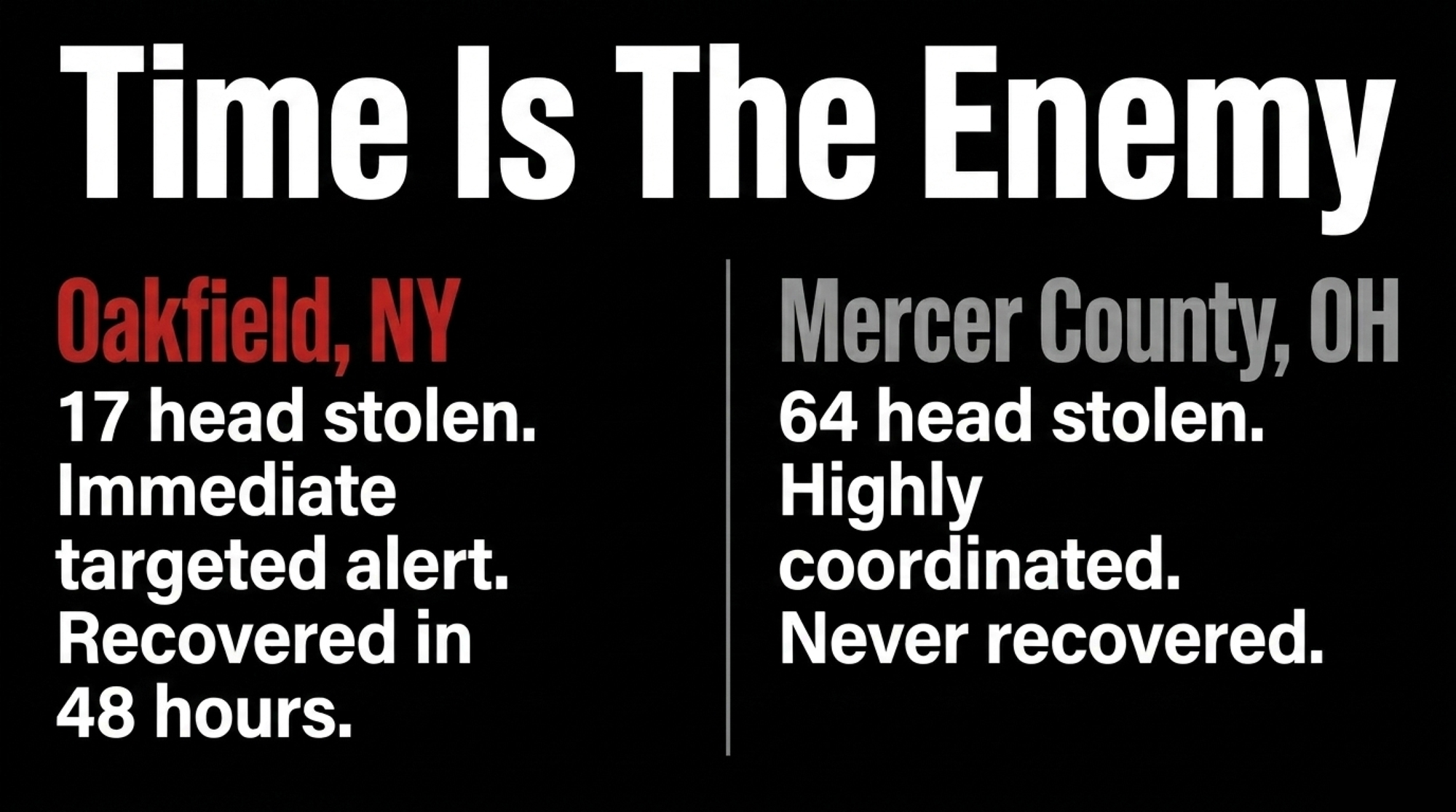
Oakfield is the hopeful case. Ohio is the warning shot. Sixty-four Holstein calves were stolen from a farm near Coldwater in Mercer County sometime between 10 p.m. Saturday, May 2, and the early hours of May 3 — valued at up to roughly $128,000 for the group (Farm and Dairy, Dayton 24/7 Now).
Mercer County Sheriff Doug Timmerman called it “highly coordinated.” As of his office’s May 7 update, there were no suspects, and investigators were still asking anyone with information to call the detective division at 419-586-7724 (Farm and Dairy). As of the May 5 Dayton 24/7 Now report and the May 7 Farm and Dairy update, no recovery had been reported in those articles.
Same crime, very different ending. That doesn’t prove genomics or any single tool would’ve guaranteed Oakfield’s outcome — their break came from a tip, and tips don’t run on a schedule. What it proves is that every hour matters and every layer counts. Once calves are commingled, sold quietly, or pushed through informal channels, the trail thins. Once the alert goes cold, the tips dry up. Once the video overwrites, you’ve got nothing. The lesson isn’t that every theft ends well. It’s that fast, accurate, community-wide attention narrows the escape route — and the farms that get their cattle back are usually the ones who were ready before the trailer ever pulled in.
Options and trade-offs: building a theft plan that actually works
If you run registered cattle, your recovery plan can’t live in your head. Four layers do the heavy lifting. Here’s what each one takes — and where each one bites.
1. Build the animal packet (do this within 30 days)
What it is: current photos, official ID, visual tag number, registration info, genotype sample ID, dam and sire, birth date, and ownership docs on every high-value heifer — stored where your team can pull them at 2 a.m. Holstein USA notes you can tie TSU numbers to ID and test ordering through Enlight to make this less of a chore (Holstein Association USA).
- When it works: recovery and insurance claims move fast, and you can prove ownership across a state line.
- Where it bites: it’s tedious to build, and a packet nobody can find at 2 a.m. is worthless.
2. Wire up the alert list — not just your Facebook followers
What it is: sheriff, neighbors, employees, haulers, sale barns, order buyers, your vet, breed contacts, genetics reps, local dairy media. Program your county sheriff’s non-emergency line into every barn phone now, so your people have a clear place to send a tip, as Oakfield’s network did.
- When it works: you get eyes on the real choke points, across regions — not just inside your county.
- Where it bites: a list you’ve never tested goes stale fast.
3. Put cameras where trailers move, not where they look nice
What it is: coverage on the exits and load-out points, not the pretty barn shot. Farm Progress reported that a basic farm video setup can run a few hundred dollars if you already have internet, while a professional five-camera system with software can cost several thousand (Farm Progress). Retail cellular and solar cameras run roughly $100–$400 each, before data plans and installation (Tractor Supply).
- When it works: you hand investigators a plate or a vehicle description within the first hour.
- Where it bites: footage overwrites in days — review it fast or lose it.
4. Call your broker this week with one uncomfortable question
What it is: ask flat out, “If my top 20 genotyped heifers walk off tonight and never come back, what check do I actually get?” Penn State’s guidance makes it clear that your policy limits, valuation method, and scheduled coverage determine what a loss becomes when it becomes a claim (Penn State Extension).
- When it works: you find the gap before the gap finds you.
- Where it bites: closing it may cost more in premium — pay now or pray later.
Key Takeaways
- Build the animal packet this month. Oakfield’s calves were found across a state line, and proof of ownership rides with the records, not the animal — if your team can’t pull photos and ID at 2 a.m., you can’t prove what’s yours.
- Call your broker about hauling coverage. Penn State warns animals in a truck or trailer often aren’t covered unless they’re scheduled on the farm policy — don’t assume the vehicle policy has you (Penn State Extension).
- Schedule your genetics, or expect a commodity check. A policy paying actual cash value lands closer to $3,010 per head than $5,000 — on 17 head, that’s roughly a $34,000 hole you eat, comparing the mid-2025 USDA/CoBank replacement average to the top of the genetics range.
- Point your cameras at the exit. Investigators need the trailer route and the load-out, not the front gate — put the lenses where animals actually leave.
- Alert first, then go quiet. Call law enforcement before you post, push one factual alert, then step back and let them work — the way Lamb Farms did to protect the prosecution.
- Sample DNA the right way. If animals come back with cut or altered tags, ask law enforcement and your vet how to document samples without breaking the chain of custody — that’s what turns “looks like ours” into proof.
So, where does your operation actually sit? If 17 head walked off your place tonight, could you get a clean, shareable alert in front of the right people before sunrise — and would the insurance check match what those animals are really worth? Oakfield got its calves back because the community moved fast, the alert stayed useful, and someone with information got it to the right people. The next stolen trailer might not be theirs, and the next tip might not come in time.
Pull your numbers, walk your camera angles, and make the broker call you’ve been putting off. If you want the full breakdown on what genotyped females are really worth on your balance sheet — and how to schedule them so a claim pays out instead of leaving you $34,000 short — that’s coming in our upcoming piece on insuring genotyped females, landing first in The Bullvine Weekly. Oakfield got the calves back. The rest of us got the warning.
Complete references and supporting documentation are available upon request by contacting the editorial team at editor@thebullvine.com.
Learn More
- Locked from the Inside: Dairy’s Darkest Crimes and the Weak Spots They Exploited — Exposes historical vulnerabilities in livestock transport, identification, and high-value animal insurance fraud, arming you with tactical red flags to watch for when executing private, high-stakes genetics sales.
- The DRP Window Sitting Open on Most Mid-Size Dairies — Delivers an operational game plan for shielding herd revenue by navigating complex cross-border policy changes and shifting regional market structures before key regulatory deadlines lock you out.
- The $500,000 Precision Dairy Gamble: Why Most Farms Are Being Sold a False Promise — Breaks down the true return on investment for smart camera arrays and calf sensors, dismantling precision tech sales pitches with hard cost-benefit numbers on early disease detection.
 The Sunday Read Dairy Professionals Don’t Skip.
 The Sunday Read Dairy Professionals Don’t Skip.
Every week, thousands of producers, breeders, and industry insiders open Bullvine Weekly for genetics insights, market shifts, and profit strategies they won’t find anywhere else. One email. Five minutes. Smarter decisions all week.