


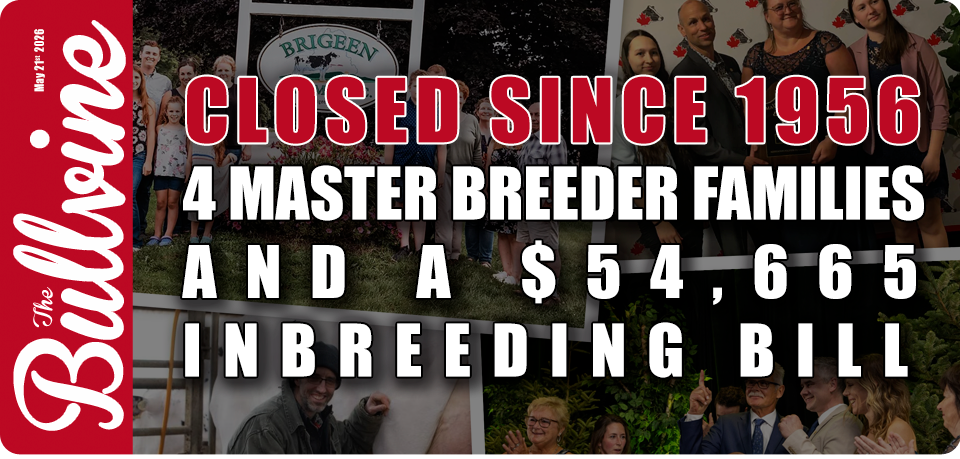





Larenwood hasn’t bought a heifer since Eisenhower. Lactanet just put Holstein heifer inbreeding at 9.99% — and on a 500-cow herd, that gap models out to $54,665 a year in lost milk alone.
Chris McLaren’s breeding story doesn’t start with a catalog bull. It starts with cow families his grandfather built outside Drumbo, Ontario, beginning in 1956.
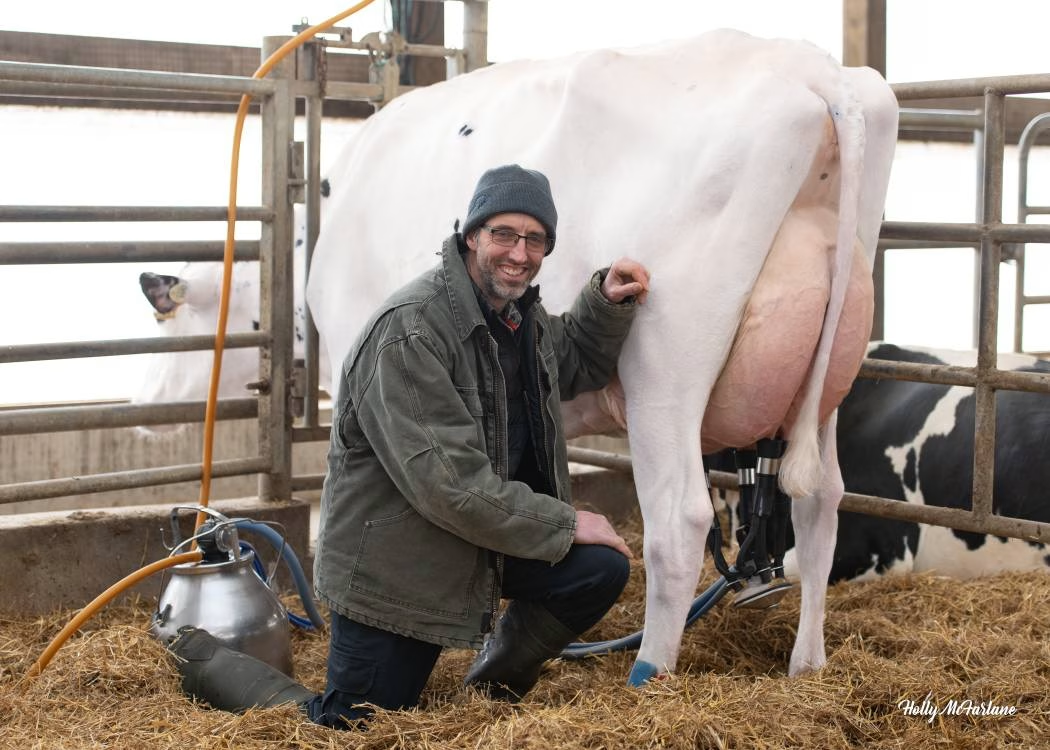
Larenwood Farms milks roughly 110–115 registered Holsteins off those same maternal lines today. Per Holstein Canada records, the operation ships well above the Ontario Holstein average on milk and components, with somatic cell counts well below the provincial DHI average — and has done it while keeping a closed herd for roughly 70 years. No purchased heifers. No outside cows walking in the lane.
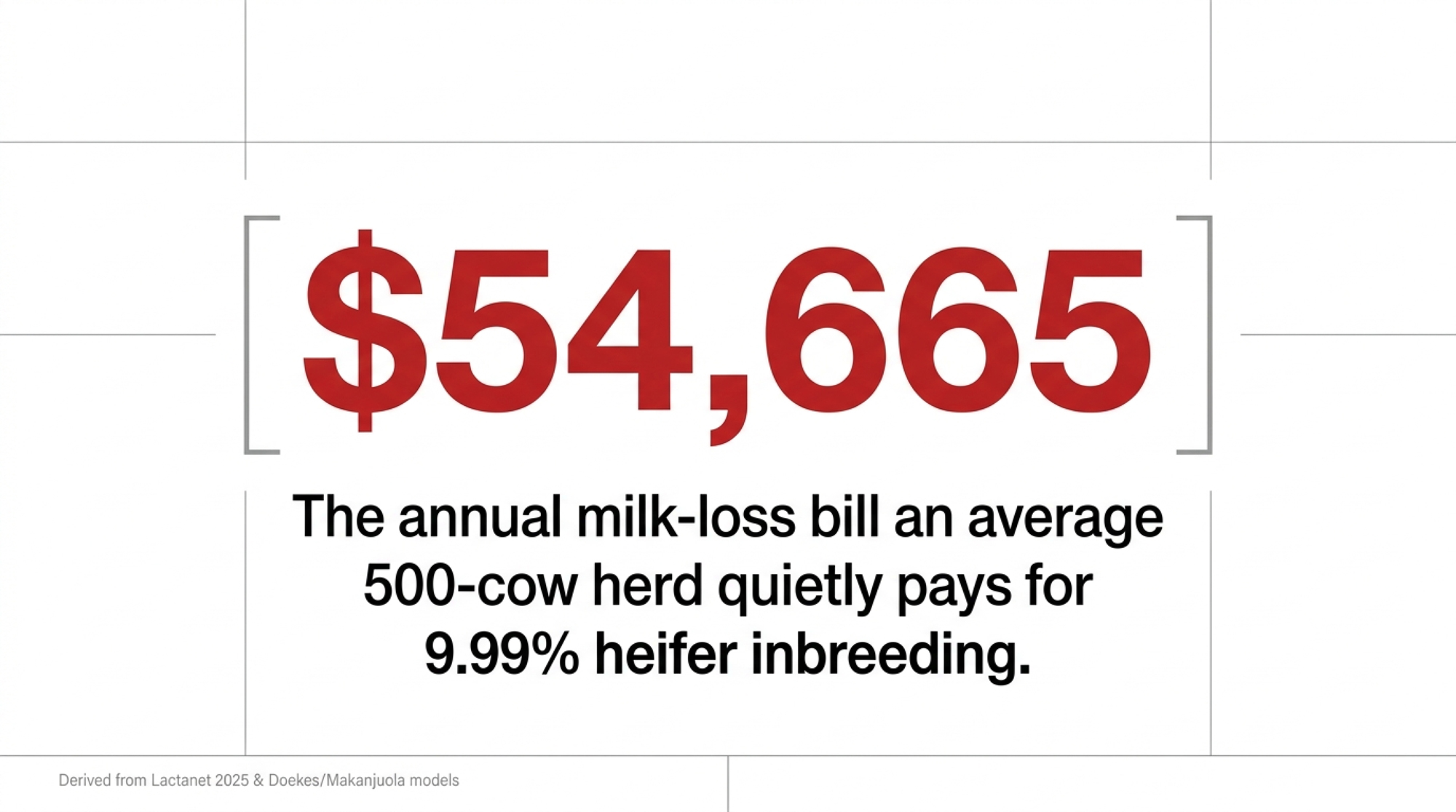
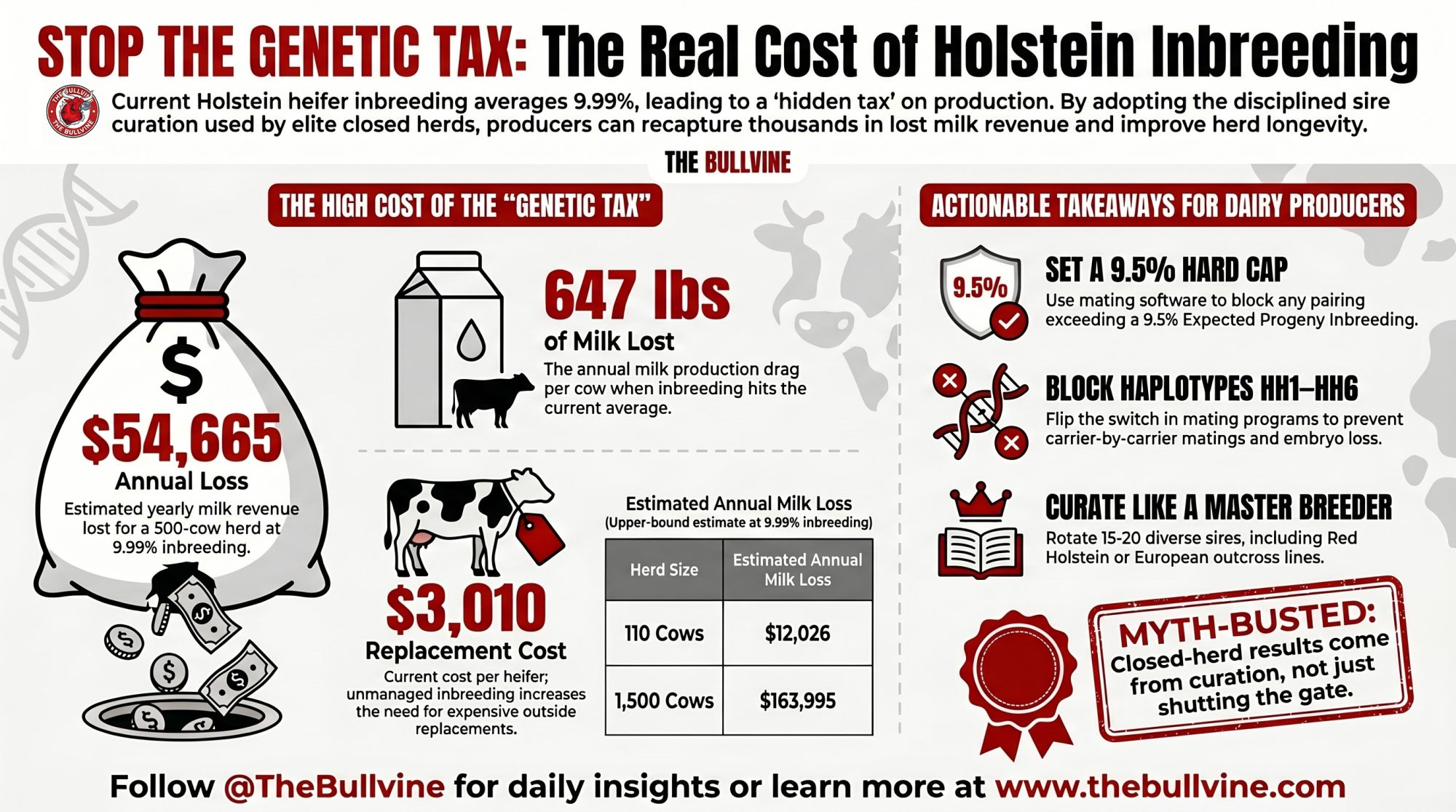
Run a typical 500-cow Holstein herd at the 9.99% Lactanet 2024 heifer-inbreeding average against a pre-genomic 4% baseline, and the modeled milk-loss gap works out to roughly $54,665 a year under the upper-bound Doekes/Makanjuola coefficient and a Class III milk price near $16.90/cwt — a figure consistent with USDA AMS Class III monthly announcements across recent quarters. That’s before any fertility, embryo-loss or longevity drag stacks on top. It’s the bill the open-catalog model quietly hands the average herd. The four farms profiled here almost certainly carry a smaller version of it, but none publish a herd-level inbreeding figure. The point isn’t that closing the herd erases inbreeding. It’s that they’re the ones who actually know what they’re paying.
In 2019, Larenwood took home a Holstein Canada Master Breeder shield. In the mid-2010s they topped Canada’s National Herd Management Score list (then administered by CanWest DHI, now Lactanet), scoring in the high 980s out of 1,000 across multiple consecutive years. McLaren has framed the program in Semex’s published Larenwood profile as a generational match-and-improve approach — making each generation of daughters better than her mother and investing in the cow families that built the herd.
For two decades the industry pitch has been the opposite: progress comes in a tank, not a cow family. If you want to keep up, you buy what you can’t breed.
But when you dig into the numbers, there’s a different story sitting underneath.
What’s Changing and Why
The genomic era was supposed to put elite genetics in every herd. Shorter generation intervals, sharper indexes, sexed semen — any operation could tap into “the top 1%” as long as the credit line held.
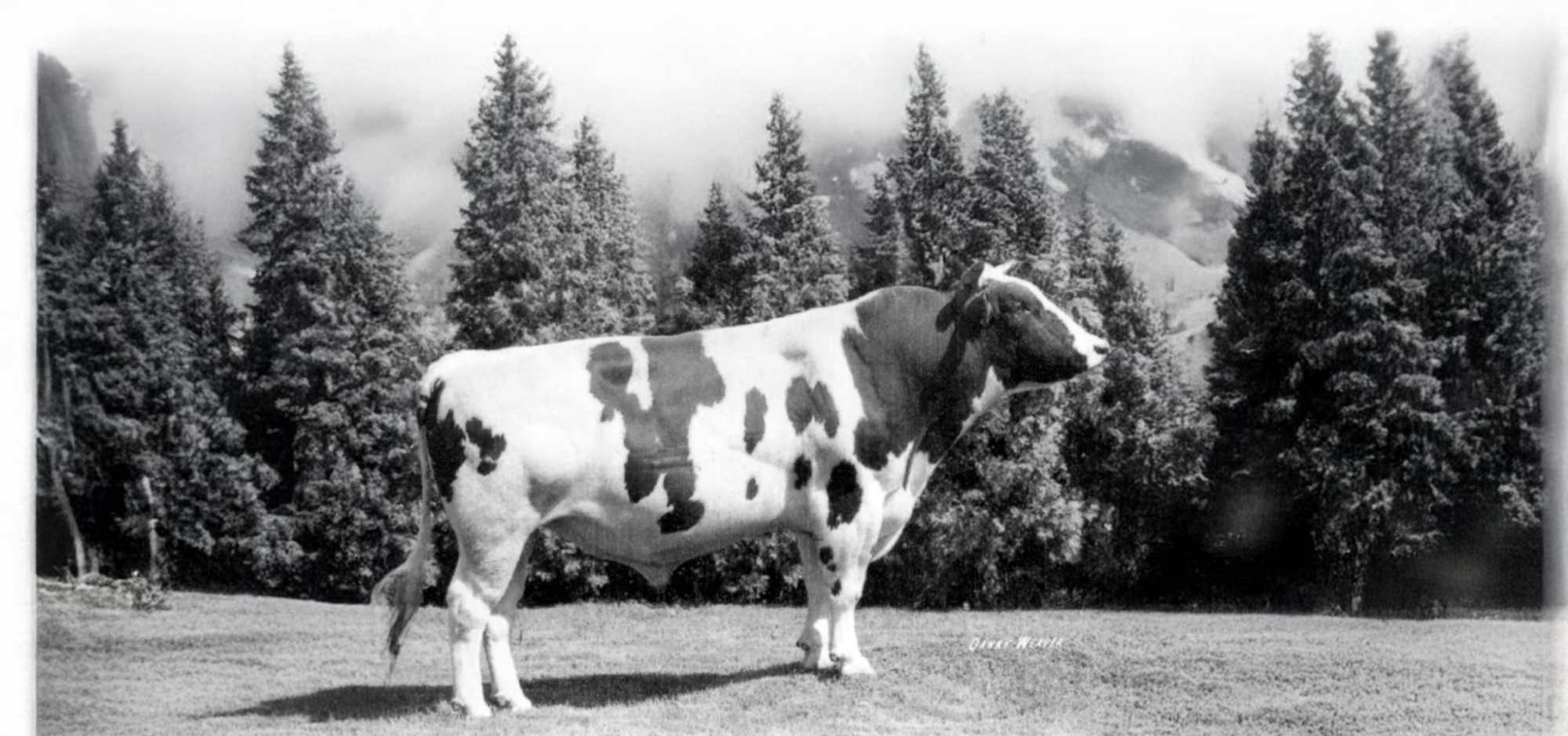
Pawnee Farm Arlinda Chief (1962–1978). His sons and grandsons were used so heavily that today, more than 60 years after he was born, an estimated 14% of the Holstein genome in North America still traces directly to him — and 99.84% of active Holstein AI bulls share his Y-chromosome or Round Oak Rag Apple Elevation’s. The bottleneck this article opens with starts here. (Read more: The $4,300 Gamble That Reshaped Global Dairy Industry: The Pawnee Farm Arlinda Chief Story)
In practice, it stacked a lot of cows on a very narrow base. Pedigree analysis of active Holstein AI bulls shows the overwhelming majority — published estimates place the figure above 99% — still trace back to two foundational patriarchs. They aren’t a clean two-grandfather story. Pawnee Farm Arlinda Chief (born 1962) and Round Oak Rag Apple Elevation (born 1965) are overlapping fountainhead ancestors born three years apart, with pedigrees that thread through nearly every modern North American Holstein. More than 60 years on, Chief alone still contributes a meaningful double-digit share of the modern Holstein genome per published pedigree analyses.
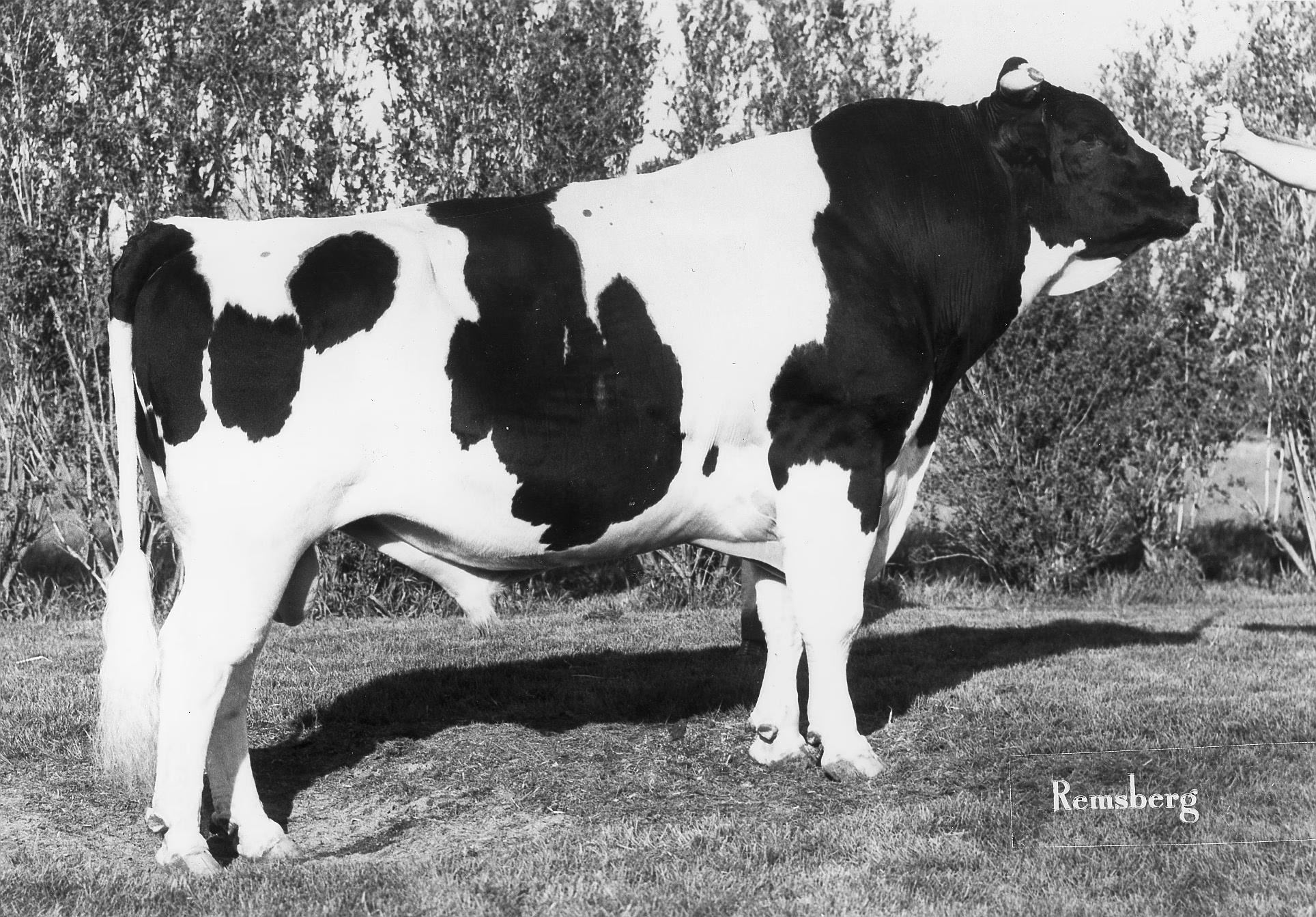
Round Oak Rag Apple Elevation (1965–1979). Bred at Round Oak Farm in Virginia and proven through ABS, Elevation became the most-used Holstein sire of his era and the second pillar of the modern bottleneck — every active North American Holstein AI bull that doesn’t trace paternally to Chief traces here. Together they account for 99.84% of the breed’s active Y-chromosome. (Read more: Round Oak Rag Apple Elevation: The Bull That Changed Everything)
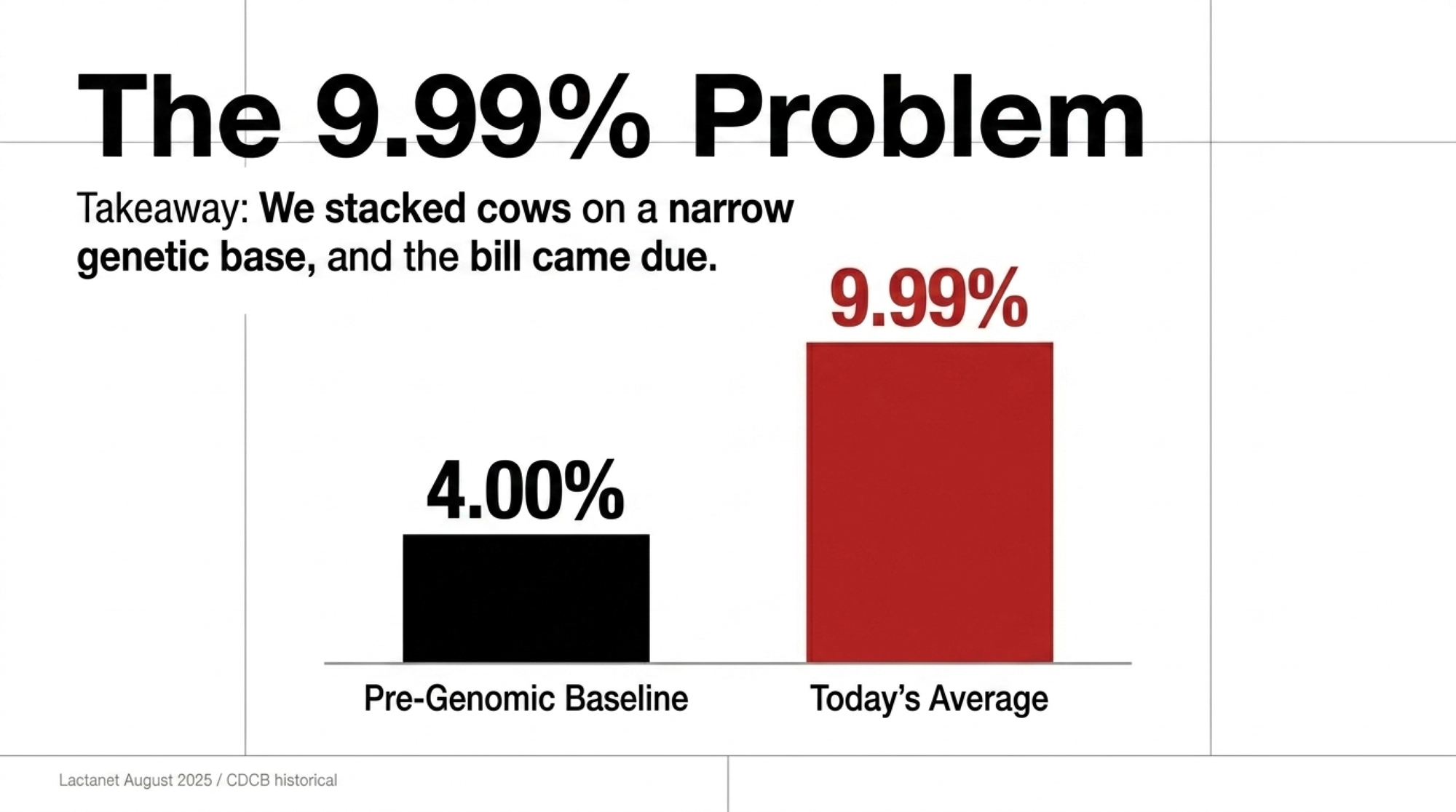
National inbreeding numbers climbed right alongside that concentration. Lactanet’s August 2025 update set the Canadian Holstein heifer average at 9.99%, gaining about 0.25 points per year — more than double the rate in Jersey, Ayrshire and Brown Swiss. U.S. Holstein cohorts run just under that on recent CDCB expected-future-inbreeding figures.
To be fair to the AI side: every major supplier — Semex, Select Sires, ABS, STgenetics — already offers EPI caps, haplotype blocking and outcross sire programs as part of their mating tools. The product set is there. What separates the four farms in this piece isn’t access to better software. It’s how disciplined they are about turning the right settings on and rotating the bull list with intent.
Closed herds aren’t immune to inbreeding. They use outside AI semen pulled from the same Chief-and-Elevation–descended bull pool as everyone else. The difference is how they use it — deliberate sire rotation, hard EPI caps, and a willingness to bring back outcross lines (Red Holstein, older AI sires through stored semen, European bloodlines) that most catalog-driven herds never look at twice. Run the top-20 list and you drift toward the national average. Curate the list like a closed-herd breeder does and you can hold heifer-crop inbreeding meaningfully below 9.99%.
Per Holstein Canada and Holstein USA records, four operations have built that kind of curation into multi-decade closed-female programs.
The Four Farms at a Glance
| Operation | Region | Herd Size | Standout Number | Closed-Herd Status | Operational Style |
| Larenwood | Drumbo, ON | ~110–115 cows | Multi-year topper of Canada’s National Herd Management Score | Closed since 1956 (~70 yrs) | Multi-generation maternal-line discipline; Master Breeder 2019 |
| Bokma | Shubenacadie, NS | ~700 cows | 7-robot DeLaval system | Closed-female, expansion via homebreds | Robot-flow trait selection; Master Breeder 2025 |
| Brigeen | Turner, ME | 580 cows | BAA 108.1, 50 EX, well above U.S. Holstein average production per Hoard’s Dairyman coverage, low five-figure SCC | Closed-female-replacement | Top-10 U.S. for 250+ cow herds; classification-led mating |
| Saintour / Ferme Barjo | Quebec | Mid-size Quebec herd | HPI 99 — 99th-percentile herd performance — sustained 16 yrs (Lactanet historical) | Closed-female with selective co-ownership | Generational improvement model; Master Breeder 2025 |
None are filling stalls with purchased outside females.
How This Plays Out on Real Farms
Put Larenwood beside a typical open-catalog herd of the same size and the operating model differs in ways the herdbook can document.
Per Holstein Canada’s Master Breeder citation, Larenwood’s mating program is run by Chris McLaren in collaboration with his father Grant, with multi-generation breeding records cross-referenced to classification outcomes. Holstein Canada credits the operation with maintaining its breeding direction across decades through that record discipline. They genomic test, but those numbers get read in the context of cow families they’ve watched calve, break in and finish multiple lactations.
In a 110-cow herd built mainly off a top-20 bull list, the genetics on offer are strong and the software is capable. The piece that’s harder to bottle is decades of on-farm context — which cow families pay off in which barn, and which need a different environment to perform. Some open-catalog herds carry that context internally. Many don’t.
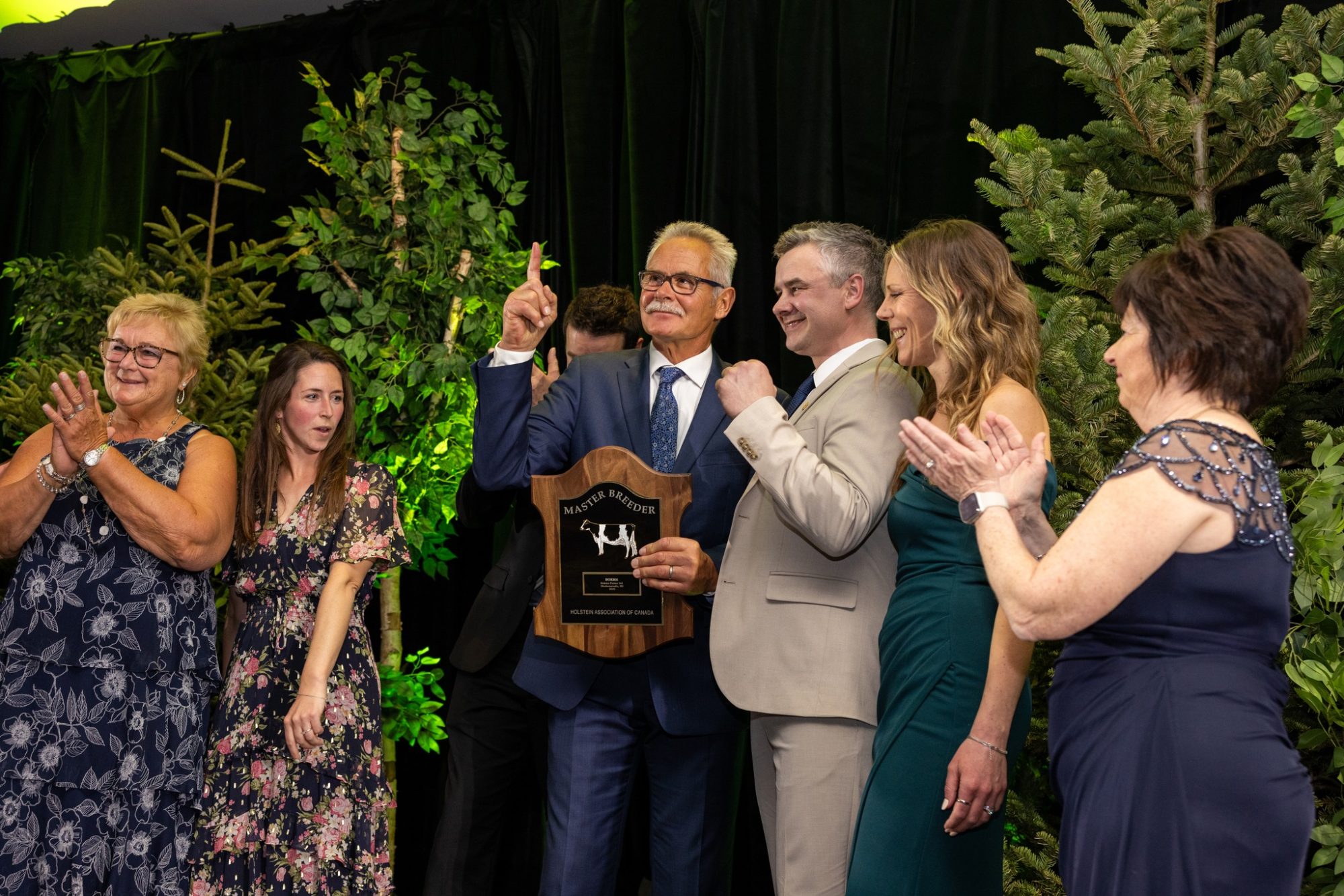
Bokma takes the same closed-female logic and bolts it onto robots. Per Holstein Canada’s 2025 Master Breeder citation and DeLaval’s published case material, the Bokma family — third-generation Dutch-Canadian operators in Shubenacadie, Nova Scotia — milks roughly 700 cows through seven DeLaval robots. The expansion to seven robots was supported by homebred replacements rather than purchased heifers, with the breeding program selecting for udders, feet and temperaments suited to robot flow.
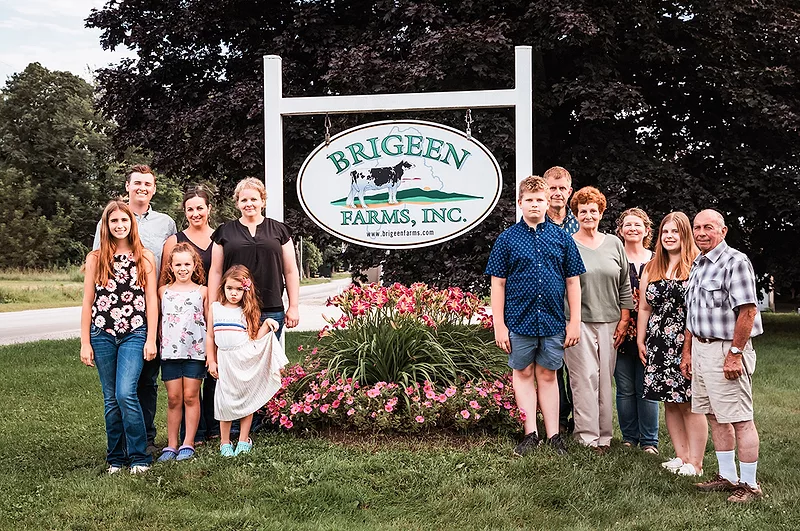
Brigeen tells the long version. Per Holstein USA records and Hoard’s Dairyman trade-media coverage, the Briggs–Bullard family has farmed the Turner, Maine ground since 1777 — the operation predates the U.S. Constitution. Over the last 25 years they’ve grown from about 60 cows to 580 registered Holsteins, while building one of the top type herds in the country: BAA 108.1, 50 EX, and a National Dairy Quality Gold Award. Per Hoard’s coverage, Betsy Bullard has run the mating program since returning to the farm in 2000 from a career with Cargill, leaning on deep maternal branches and homebred donors built up over two decades of breeding decisions. Bullard has publicly described her approach as measurement-driven, with classification scoring at the center of her breeding feedback loop.
Disclosure: Brigeen runs as a closed-female-replacement operation, not a fully closed herd. The commercial milking herd is built on homebred replacements, but per Holstein USA herdbook records and Hoard’s Dairyman coverage, the family has imported outside donor genetics for marketing and show-ring projects, kept separate from the commercial replacement pipeline.
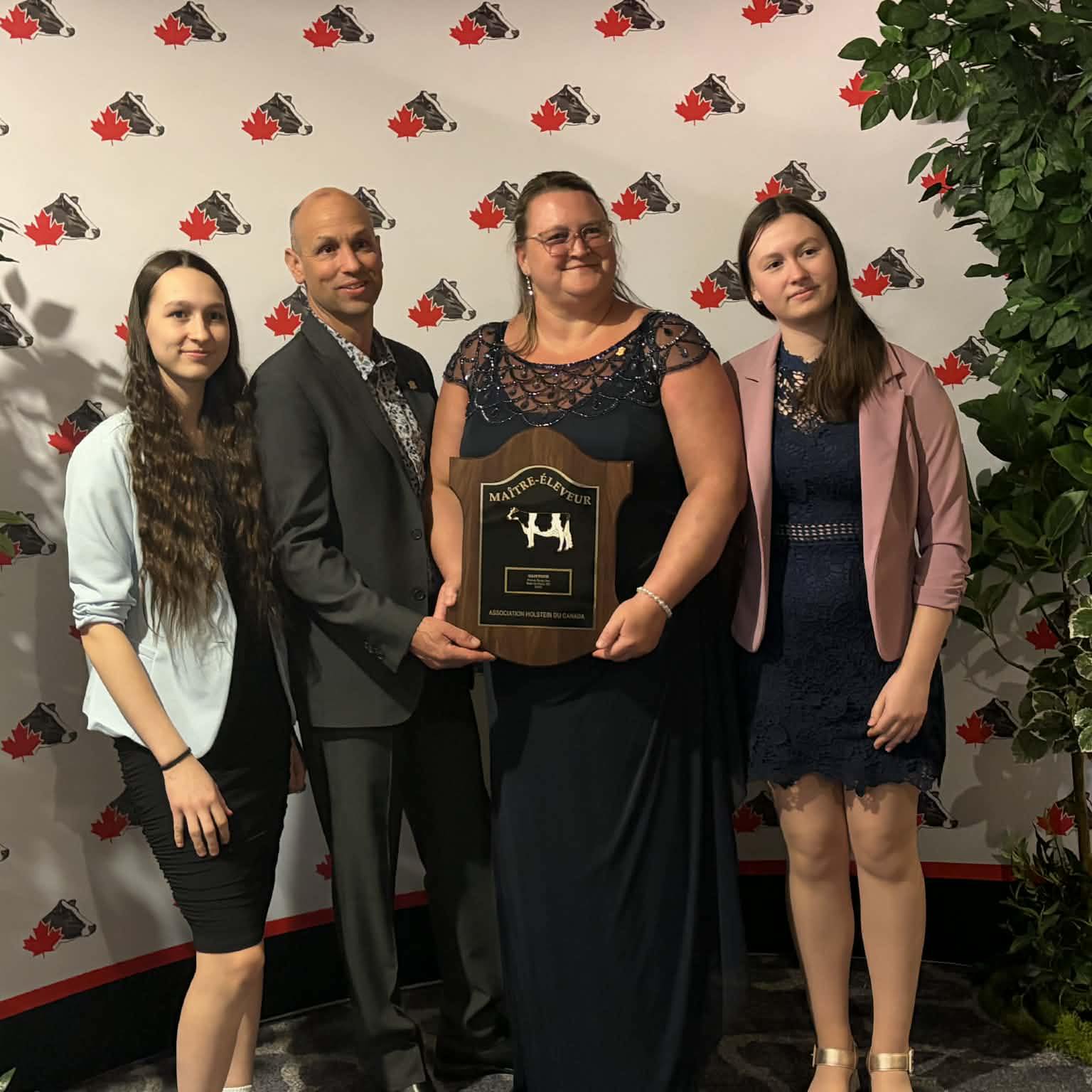
At Saintour, the story is in the index. Per Holstein Canada’s 2025 Master Breeder citation and Lactanet’s historical records, the Quebec herd, operated under Ferme Barjo by Dominique Bard and Amélie Tremblay, has held a Herd Performance Index (HPI) of 99 — a 99th-percentile herd performance ranking — for 16 consecutive years, ranked #1 nationally in 2010, and earned a first Master Breeder shield in 2025. The farm’s published tagline, “L’amélioration, une génération à la fois,” captures the program in five words: improvement, one generation at a time.
Disclosure: A co-ownership model in partnership with Ferme Bard inc. lets Saintour access elite outside female genetics — a structure designed to bring in outcross blood without opening the home replacement pipeline.
The Barn Math: What 9.99% Actually Costs
Here’s the mechanism behind that $54,665 figure, run for the average open-catalog herd — not for the four named farms.
Take a 500-cow Holstein herd whose heifer crop sits near the 9.99% Lactanet August 2025 average against a pre-genomic 4% baseline. The Doekes (2018) and Makanjuola (2020) regressions estimate milk loss in the 80 to 108 lbs per cow per 305-day lactation range for every 1% increase in pedigree inbreeding. Use the upper end and the math runs:
The 500-Cow Open-Catalog Calculation
| Step | Value | Source |
| Heifer-crop inbreeding | 9.99% | Lactanet, Aug 2025 |
| Pre-genomic baseline | 4.00% | CDCB / Lactanet historical |
| Delta | 5.99 points | derived |
| Upper-bound coefficient | 108 lbs / 1% / 305-day lactation | Doekes 2018 / Makanjuola 2020 (JDS) |
| Modeled milk loss per cow | ~647 lbs / yr | derived |
| Class III milk price | ~$16.90 / cwt | USDA AMS Class III monthly announcements, recent quarters |
| Loss per cow | ~$109 | derived |
| Loss on 500 cows | ~$54,665 / yr | derived |
Lower-bound check: Use the lower-bound coefficient (80 lbs / 1%) and the same herd loses about $40,500 a year in milk alone. Either way, you’re looking at the cost of a small pickup truck. And that’s just milk — fertility, replacement turnover and stillbirth losses sit on top.
Sensitivity note: Drop the Class III price by $1.00/cwt and the 500-cow figure shifts roughly $3,200 in either direction. The underlying milk-loss volume — 647 lbs/cow/yr at the upper-bound coefficient — is the figure that matters; the dollar tag rides whichever Class III month you anchor to at publish.
Here’s the part the four named farms get right that the average herd doesn’t: closing the gates doesn’t eliminate that tax. Curating the bull list does. A closed herd that runs the same lazy top-20 catalog can still drift toward 9.99%. A closed herd that rotates 15–20 deliberately diverse sires, caps single-sire usage at 10–12% of the calf crop, and sets a hard EPI cap below the national average tends to land below it. Per Holstein Canada Master Breeder profiles, the four farms in this piece lean hard on the second model.
That’s the genetic tax an open-catalog herd quietly pays when the relationship math gets away from it. Closed herds still pay some of it. They’re usually just the only ones in the room with a full picture of the bill.
The Mechanics Behind the Outcomes
Why do closed herds with disciplined sire rotation keep posting type and longevity numbers most open herds chase with catalog orders? Three things actually do the work, per Lactanet, CDCB and peer-reviewed literature on closed-population breeding.
Stack bulls on cow families they know. Closed herds don’t spread semen like peanut butter. They pick 15 to 20 bullsand use them deliberately across maternal lines they’ve watched for decades. Each bull is there to correct something specific — udder depth, heel depth, chest width — not just to hit a TPI or LPI target. The bull list is a multi-year working document, not a quarterly catalog refresh.
Cap inbreeding instead of just minimizing it. Most mating software defaults to “minimize inbreeding,” which sounds responsible until you read the settings. Closed herds that survive this long set hard caps on Expected Progeny Inbreeding (EPI) — typically around 9.0–9.5% — and refuse matings that cross the line. They flip the switch that blocks HH1 through HH6, HCD and CVM carrier-by-carrier matings. That’s how you avoid the bottleneck Chief built, where the HH1 mutation, before testing was widespread, has been linked in CDCB and VanRaden literature to several hundred thousand pregnancy losses globally and substantial heifer-value losses.
Run classification as a feedback loop, not a courtesy visit. In open-catalog herds, mating decisions often default to whatever the AI program suggests. In Master Breeder operations, classification day is an audit — which cows moved up, which lines stalled, what last decade’s mating decisions look like in the flesh. When Brigeen hits 108.1 BAA with 50 EX in a 580-cow herd, that’s not a fluke. It’s what happens when on-farm scoring closes the loop on every breeding decision.
A fair caveat: not every closed herd outperforms. Some hit a genetic ceiling, drift into founder bottlenecks, and stagnate without disciplined outcross rotation. The four farms in this piece are the ones who got the discipline right. The model works when you do the work.
How Much Is Your Inbreeding Actually Costing?
This is the question that drives the economics, and most herds can’t answer it.
Most operations know their rolling herd average. Fewer can tell you average pedigree inbreeding on the current heifer crop. Almost none have translated that number into dollars.
The math isn’t complicated, but you have to look at it. Under the upper-bound coefficient (108 lbs/1%), 2 percentage points of excess inbreeding — call it 10% instead of a disciplined 8% — costs roughly 160 to 216 lbs of milk per cow per year. On a 1,500-cow herd at Class III near $16.90/cwt, that lands in the $40,500 to $55,000 a year range in milk loss alone. A high-component herd capturing full butterfat and protein premiums on a strong mailbox price will see that figure run materially higher.
Then add the rest:
- Modeled mid-term abortions and embryo losses when you stack recessive haplotypes — in the $20,000 to $40,000/year range for commercial herds at +2 points of excess inbreeding.
- Shorter productive life forcing 20 to 30 extra replacements a year.
Replacement-cost reality check: U.S. springing-heifer values reported in USDA NASS Agricultural Prices monthly data averaged near $3,010 across mid-2025 reports, with replacement inventory at a 47-year low per the January 2025 NASS Cattle inventory report. Every extra cull that walks out the gate is now a four-figure decision, not a routine one — and that’s hitting open-catalog herds harder than it has in a generation.
Add it up — milk drag, modeled abortion and embryo losses, plus 20 to 30 net additional replacements at roughly $3,010 each — and the modeled hidden tax on a 1,500-cow herd with unmanaged inbreeding lands somewhere in the $90,000 to $180,000 a year range, depending on coefficient choice, component-price assumptions and how much of that replacement cost is already baked into your normal turnover budget. Closed herds with disciplined sire rotation typically carry a fraction of that, but not zero. The number you actually pay depends on how curated your bull list is — not whether your gates are open or shut.
You don’t have to close your herd to hate that number. You do have to know it.
Is Your Herd’s Genetic Strategy Already Behind?
This is the operational question Master Breeder herds force everyone else to answer.
If you’re picking bulls mainly off TPI or LPI lists, you’re already a step behind where these four farms operate. They aren’t ignoring the indexes — Holstein Canada and Holstein USA records show they use them as one filter among several. The real work happens in the barn and in the records.
A few honest questions:
- Who actually owns the mating program at your place — and could they tell a stranger why, off the top of their head?
- Do they know which cow families paid for the last parlour or the last robot?
- When a classifier knocks a cow down a point, does that change the next bull list, or does the score just get filed?
The closed herds documented in this story share one trait: a single person, or a tight team, who can answer those questions without opening a laptop. You don’t need to copy their model. But if nobody in your operation can name the cows that built the place and the bulls that kept them around, you’re running a breeding program on autopilot — and autopilot is what the 9.99% number is built on.
Options and Trade-Offs for Farmers
Most herds won’t go fully closed. That’s fine. What matters is knowing where you sit on the spectrum and what each option actually costs.
Path 1: Stay Open, but Put a Price Tag on Inbreeding
When it makes sense: You’re growing fast, need outside females to fill stalls, or you rely on ET and IVF to sell genetics and scale replacements.
What it requires: A real handle on your herd’s inbreeding levels — pedigree and ideally genomic. At least one barn-math exercise: what does a 2-to-3-point inbreeding bump cost you in milk and replacement budget?
Risks/limits: Apply the upper-bound coefficient to a 200-to-300-cow herd at 2 points of excess inbreeding and the modeled milk-loss drag at Class III near $16.90/cwt runs roughly $5,500 to $11,000 a year before fertility, embryo-loss and replacement costs. Layer those on and the all-in modeled tax can run two to three times the milk-only figure. You’re betting ET and high-priced semen will out-earn that drag. Some herds do. Many don’t.
Path 2: Semi-Closed — Homebred Replacements, Strategic Embryos
When it makes sense: You want biosecurity and herd consistency, but you also sell embryos, show cattle, or want diversification on a few specific families.
What it requires: Treating the homebred replacement stream as sacred. Outside embryos go into clearly labeled marketing or show projects, not into the commercial replacement line. Clear rules about how many outside matings and where they fit.
Risks/limits: It’s easy to slide from “semi-closed” into “we bought three heifers this year because the numbers looked good.” You need the same record discipline as a fully closed herd, plus the stomach to say no when somebody offers you a hot heifer. Per Hoard’s Dairyman coverage and Holstein USA records, Brigeen runs this model — closed on female replacements, selective on imported embryos for marketing cows. Saintour’s Ferme Bard co-ownership model is the same idea on a smaller scale.
Path 3: Fully Closed on Females, Curated Outcross Semen
When it makes sense: You know your cow families inside out, and you’ve got a successor — or at least a willing trainee — to carry the mental load.
What it requires: A hard stop on outside heifers and cows. A deliberate 15-to-20 bull rotation with caps on how much any one sire can contribute to your calf crop, often around 10–12%, and a willingness to use Red Holstein, European outcross sires and older AI bulls through stored semen to break up the Chief stack. Classification and on-farm notes back at the center of breeding decisions.
Risks/limits: Expansion is harder. Every extra stall has to be filled with a calf you bred. Cash-flow shocks bite deeper, because slashing cow numbers in a bad year cuts into the families the whole program depends on. The upside in 2026? With springing heifers near $3,010 and inventory at a 47-year low, closed herds are insulated from the heifer market that’s choking open-catalog cash flow. Per Holstein Canada records, Larenwood lives here — no outside females since 1956, Larenwood-prefix bulls in AI distribution, a Master Breeder shield earned the slow way.
Path 4: Closed-Herd Thinking Without Closing the Gates (the 30-day move)
When it makes sense: You’re not ready to change replacement policy, but you’re done paying dumb inbreeding tax.
What it requires: Within 30 days, sit down with your genetics rep and turn on inbreeding caps and haplotype blocking — set the EPI cap around 9.0–9.5% and switch on HH1–HH6, HCD and CVM blocking before the next semen order goes in. Within 90 days, identify your top three cow families by lifetime production, classification trajectory and longevity, and decide which gets sexed semen and which gets beef. Add at least two outcross sires to your rotation — Red Holstein, European bloodlines, or older AI bulls through stored semen — to break up the Chief stack.
Risks/limits: It’s easy to tell yourself you’re “breeding like a closed herd” while still buying cows that don’t fit your barn. Without someone owning the long-term vision, the settings drift back to convenience. This is probably the best 30-day starting point for most herds — flip a few toggles, pull a couple of reports, and at least see whether you’re carrying the same $54,665-style tax the 500-cow example shows.
Key Takeaways
- If your average heifer inbreeding is above 9.5%, assume you’re paying a five-figure annual penalty under current Doekes/Makanjuola assumptions and treat it like any other cost line — not a footnote.
- If three or more people share bull-selection authority with no one accountable for long-term direction, you’re not set up for closed-herd thinking — even if you stop buying cows tomorrow.
- If your mating software is set to “minimize inbreeding” rather than capped at a hard EPI threshold, you have a 30-day fix sitting in front of you. Set the cap around 9.0–9.5% and turn on HH1–HH6, HCD and CVM blocking before the next semen order.
- If your bull list this year shares a sire grandfather across more than half your matings, you’re stacking Chief whether you can see it or not — add at least two outcross lines before the next round.
- If you can’t name your top three cow families by lifetime contribution, stop sending their daughters to beef and start treating those lines as a 10-year asset.
- If springing-heifer prices near $3,010 are bending your cash flow, lean harder on homebred replacements before you lean harder on the auction barn.
So which side of the $54,665 line is your herd on — and would you actually know if you didn’t run the numbers?
If Larenwood can carry a 70-year closed herd in Ontario and put Larenwood-prefix bulls into AI distribution, and if Brigeen can hit 108.1 BAA with 50 EX in a 580-cow Maine herd, the question isn’t whether the closed-herd model “wins.” It’s how curated your bull list is, how disciplined your mating caps are, and whether your operation is set up for the long mental load that goes with both. For now, the next move is yours: pull your inbreeding report and see where you sit.
Complete references and supporting documentation are available upon request by contacting the editorial team at editor@thebullvine.com.
Run Your Numbers
Genomic Testing ROI Calculator — Before you decide which heifer calves deserve a stall and which ones get a beef straw, run the Genomic Testing ROI Calculator. It puts a dollar value on testing the calf crop, sorting the bottom quartile out, and managing the inbreeding risk the $54,665 example pressure-tests for the average open-catalog herd.
Learn More
- Holstein inbreeding hit 9.99%: the Bell 2.0 trap— Arms you with a step-by-step technical framework to flip hidden software toggles, adjust loose mating parameters, and protect your IVF donor pens from severe genetic relationship caps.
- Your Top Heifers All Trace to Three Cow Families. That’s a $ 93300-A-Year Trap. — Delivers a critical long-term warning against over-multiplying fragile maternal lines, showing how maternal concentration quietly spikes your annual replacement turnover costs by over $93,000.
- Holstein’s $40500 Inbreeding Bill – and the USDA Bulls Your Stud Isn’t Selling You— Exposes the rigid paternal bottleneck keeping the AI sire pool restricted to two Y-chromosome lines and reveals how to access radical, reconstituted outcross genetics through research channels.
 The Sunday Read Dairy Professionals Don’t Skip.
 The Sunday Read Dairy Professionals Don’t Skip.
Every week, thousands of producers, breeders, and industry insiders open Bullvine Weekly for genetics insights, market shifts, and profit strategies they won’t find anywhere else. One email. Five minutes. Smarter decisions all week.




