








An 8‑farm, 4,495‑cow trial shows how changing fresh‑cow and dry‑off protocols can turn metritis costs and withdrawal milk into about $111 of margin per cow — without adding a single stall.
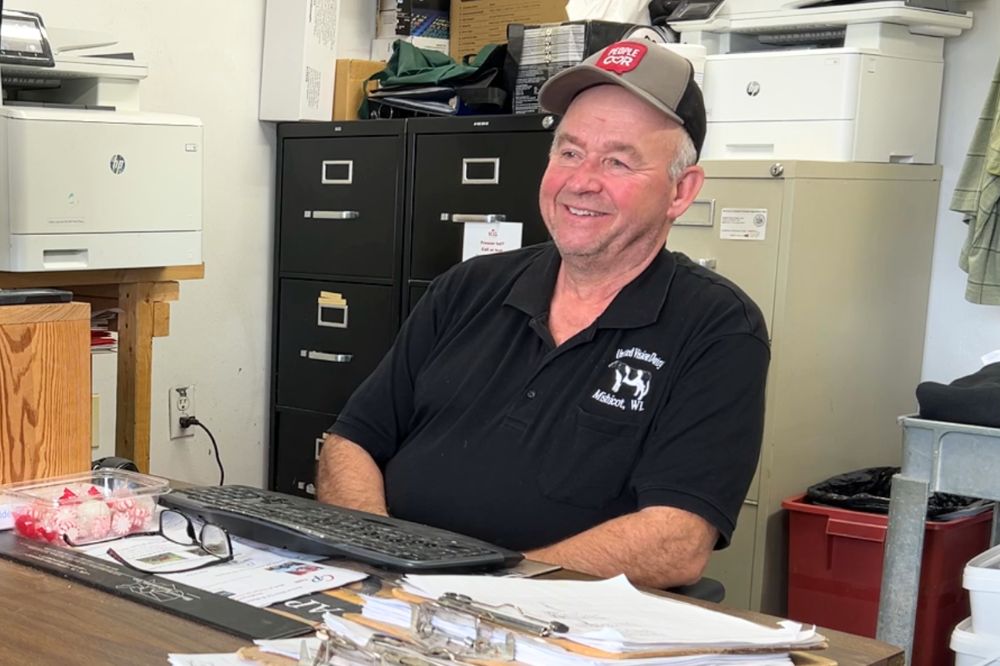
When a 1,000‑cow Wisconsin dairy stopped dumping fresh‑cow milk to withdrawal and changed how cows were dried off, pregnancy rates climbed to 61–62%, the barn went quiet, and the herd started collecting premium checks instead of just writing cull checks.

You track SCC. You watch the preg rate. You probably know your days open and death loss. But do you actually know how many dollars in withdrawal milk your fresh‑cow protocol quietly takes out of your tank every month — and what would change if you didn’t?
At United Vision Dairy in Wisconsin, herd manager Steve Jaeger used to joke that they were “always the ones cutting the check, not collecting it.” It’s a 1,000‑cow herd, well‑run and shipping good milk. But every freshening brought the same routine: treat the sick ones with antibiotics, pull their milk, listen to a noisy dry barn for a couple of days, and sign off on cull checks that felt too frequent. That started changing when Jaeger put every fresh cow — twins, triplets, all of them — on AHV’s proactive fresh‑cow protocol and switched his dry cows to StopLac. His first‑service conception rate climbed to about 61–62%, and in six months, they sold 70 dairy animals at premium prices instead of shipping them on a cull truck. After their first StopLac dry‑off day, the barn that used to be full of bawling cows just…stayed quiet.
Jaeger’s story fits a bigger pattern. In Oostburg, Wisconsin, herd manager Karl Gabrielse at Quonset Farms (1,350 cows) describes the change the same way: fewer fresh‑cow issues, less antibiotic use, calmer dry‑off, and a six‑point jump in first‑service conception, from 47% to 53%. And when eight Western U.S. dairies — 4,495 cows total — ran a controlled trial on their fresh cows, the numbers behind those barn stories became hard to ignore.
The Fresh Pen Math You’re Probably Not Doing
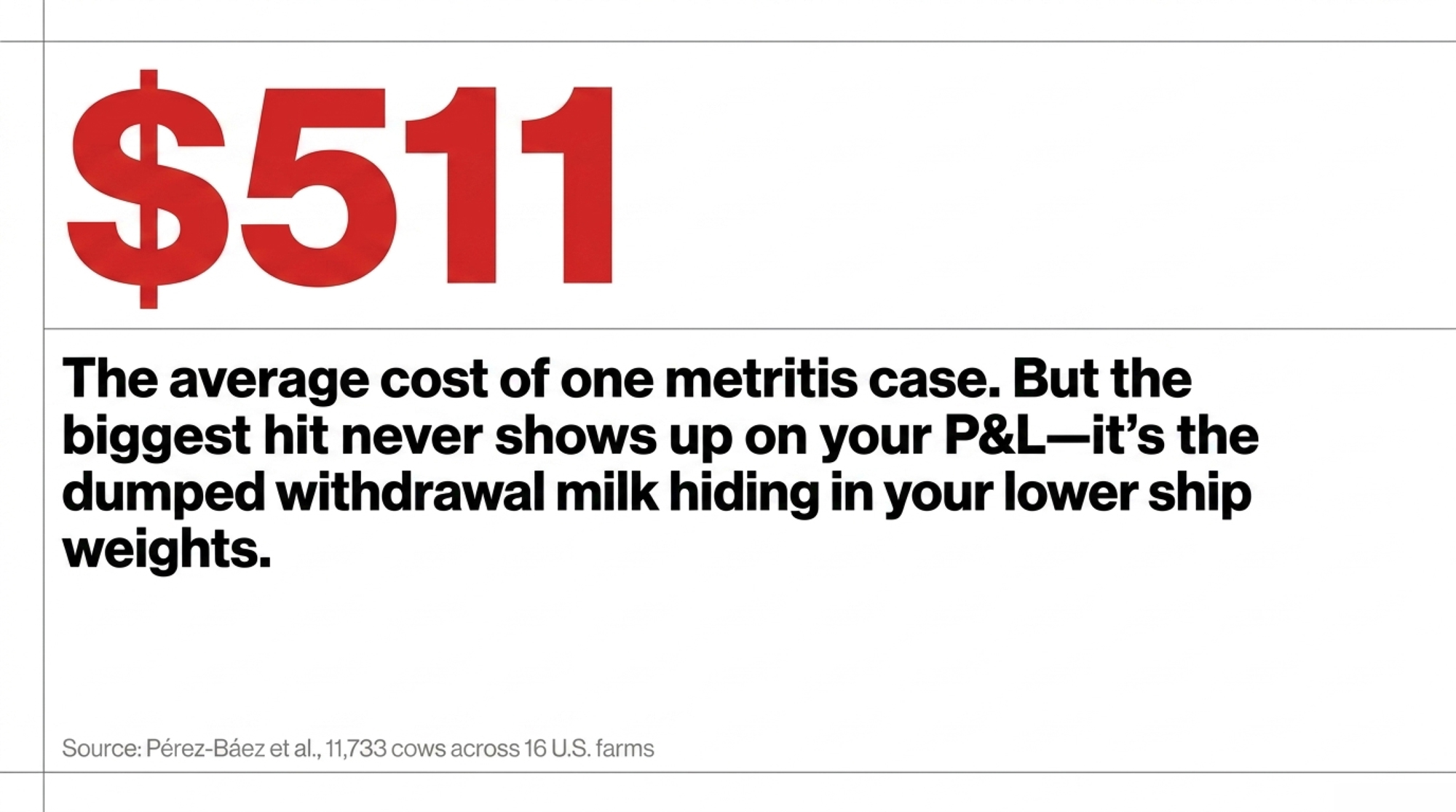
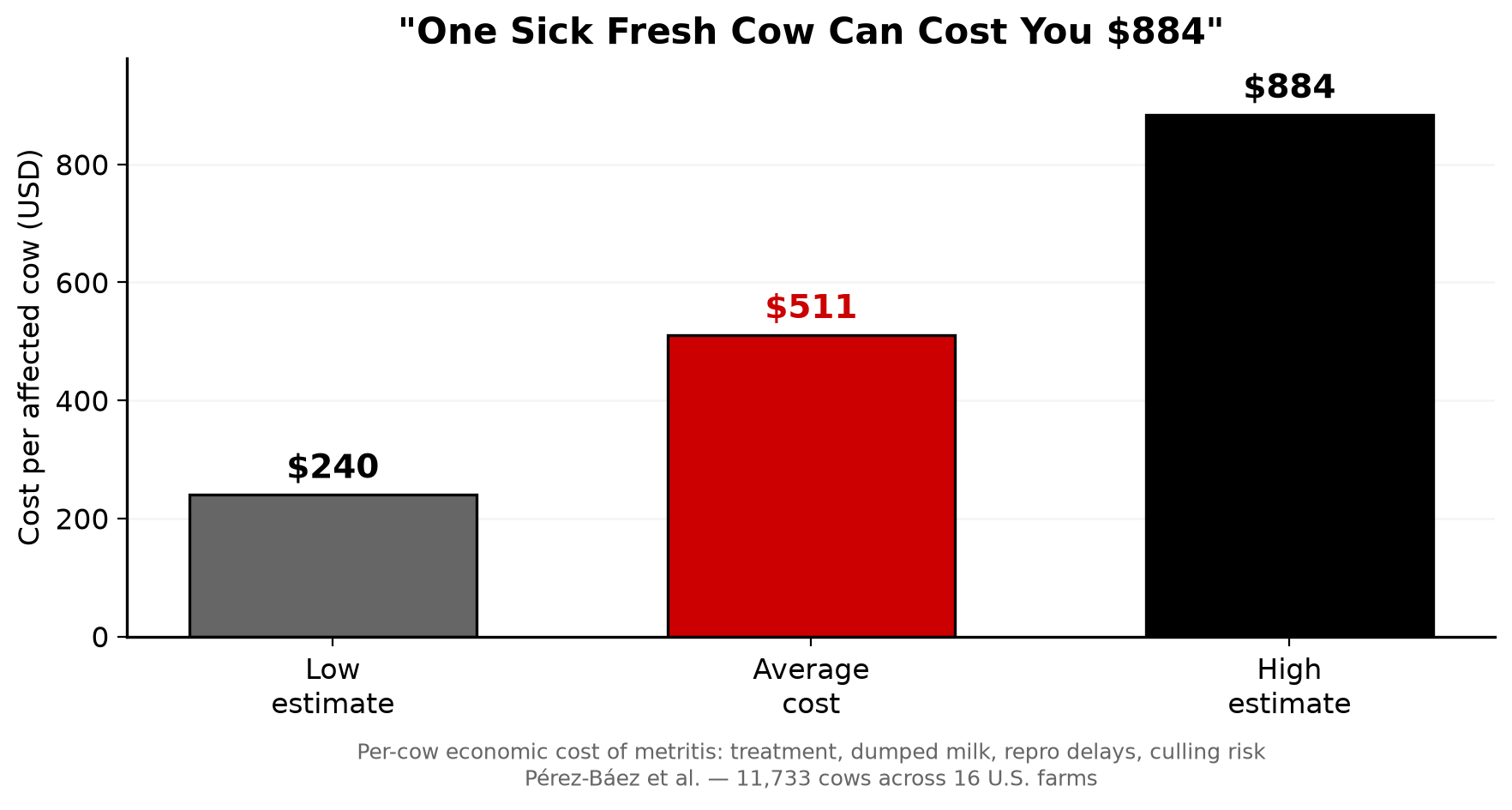
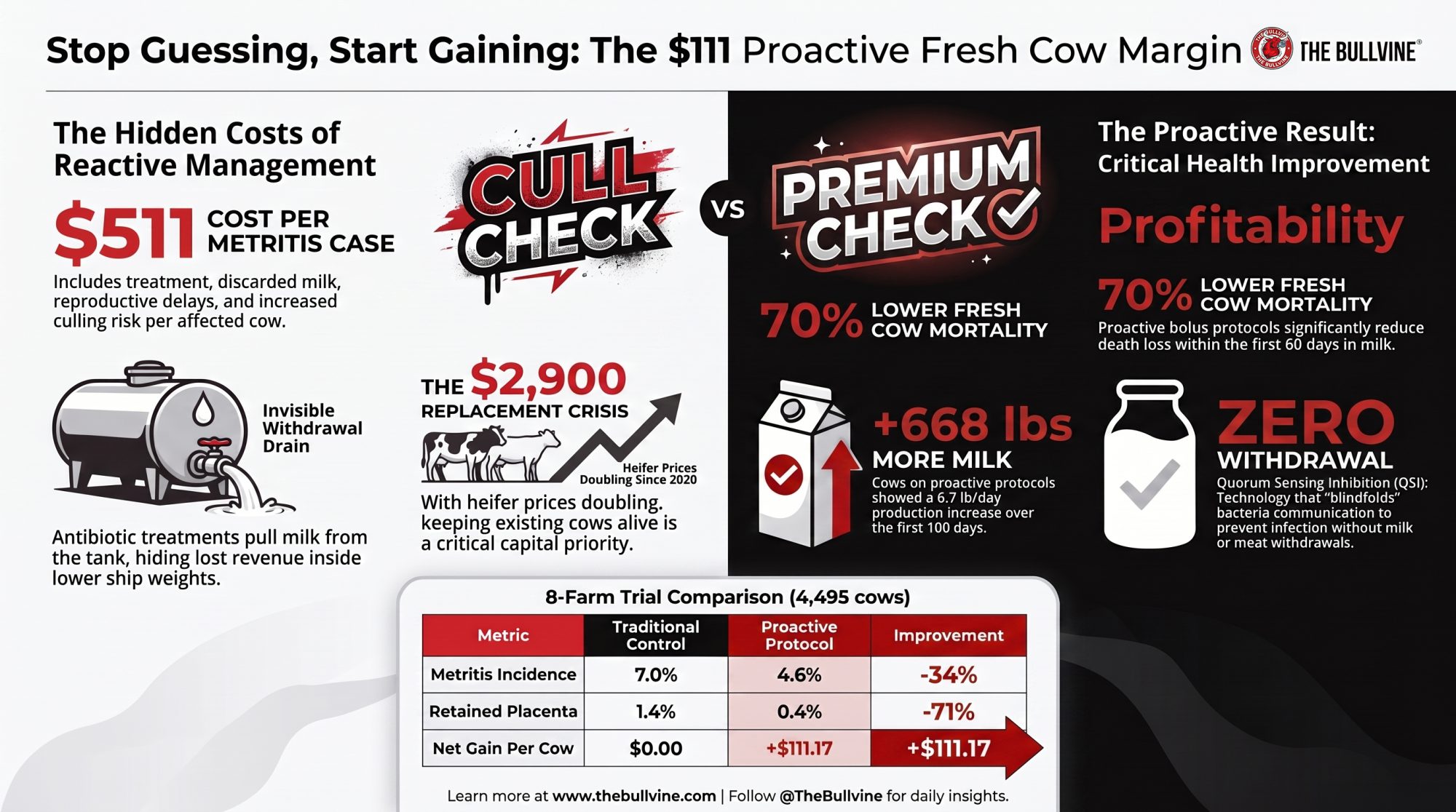
Metritis doesn’t look like a margin line when you’re treating one cow in one pen. But it is. Pérez‑Báez and colleagues estimated the average economic cost of metritis at $511 per affected cow, with a range of $240 to $884 when accounting for treatment, discarded milk, reproductive delays, and culling risk (11,733 cows across 16 U.S. farms). Depending on how you define and track postpartum uterine disease, up to 40% of cows can end up with metritis or endometritis in early lactation.
That’s just the obvious cost. The number almost nobody sees is the milk that never leaves the hospital list. Every time you treat a fresh cow with antibiotics, you pull her milk. On a 1,000‑cow operation freshening close to 1,000 cows a year, even a modest metritis and retained‑placenta rate means a lot of milk quietly going down a separate line. And because most herds don’t track withdrawal milk as its own line item, it never shows up on your P&L as “lost revenue.” It just hides inside the lower ship weight.
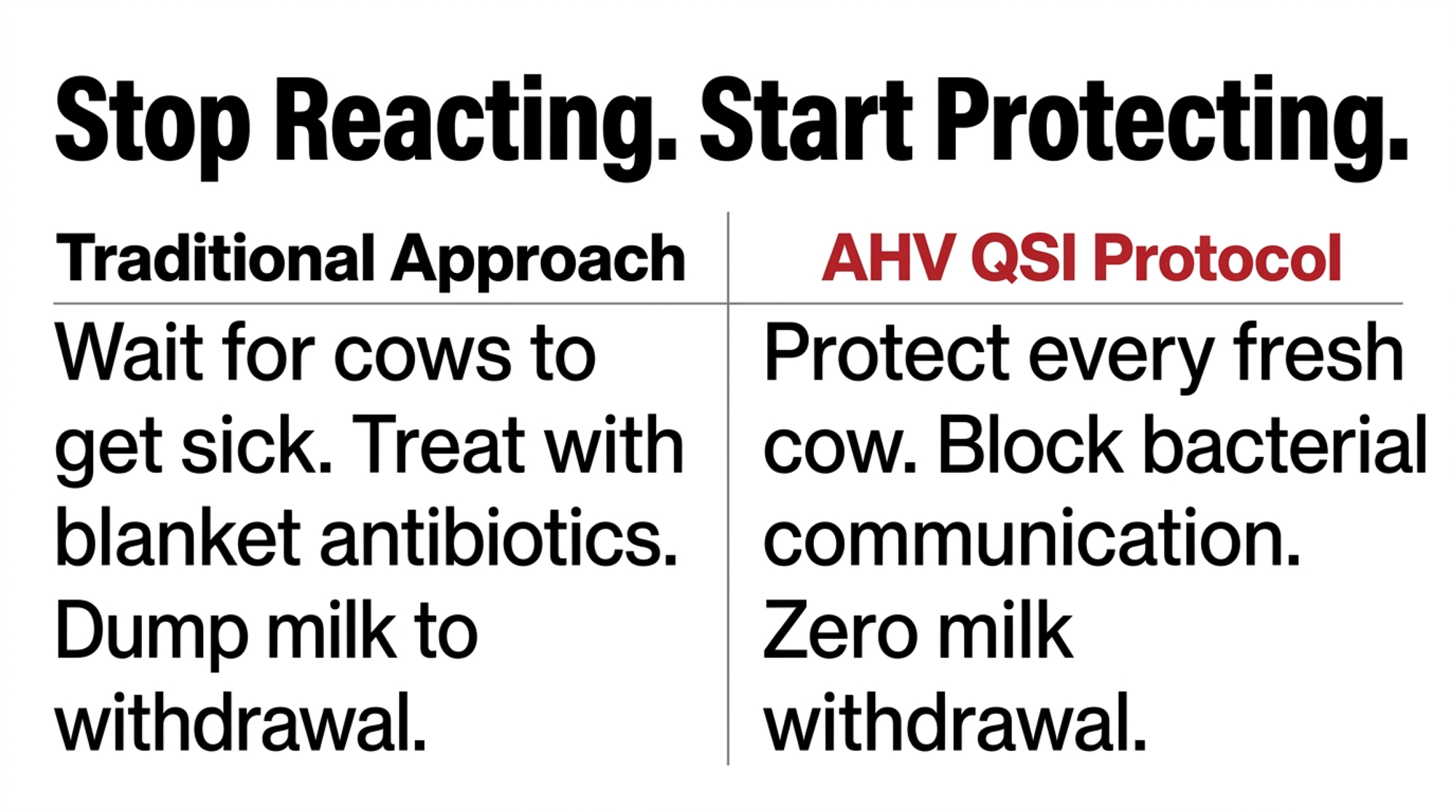
What’s different now is that the evidence for a different way to handle that fresh pen — a proactive, zero‑withdrawal approach built around quorum sensing inhibition (QSI) instead of blanket antibiotics — isn’t just a nice theory or a tie‑stall study anymore. In 2024, AHV USA ran an eight‑farm, 4,495‑cow commercial trial in the Western U.S. using a simple odd‑week/even‑week design. It’s company‑run data, not yet independently peer‑reviewed, but it’s one of the largest controlled looks at proactive fresh‑cow protocols in real freestall herds we’ve seen.
On top of that, a USDA SARE‑funded project (OS24‑178) is underway with Texas A&M at a certified organic dairy, measuring bacteriology, PCR, SCC, and economics around similar compounds. Results are expected by March 2026, so the independent check is coming.
What 4,495 Cows on Eight Dairies Actually Showed About Fresh Cow Protocol ROI
The 8‑farm design is one you could copy without hiring a statistician. Cows calving in odd‑numbered weeks went on a zero‑withdrawal oral protocol: AHV Metri Bolus, Aspi Bolus, and Fresh Start (Milk Start) Paste. Even‑week calvings stayed on each farm’s existing fresh‑cow program. Eight dairies, all in the Western U.S., ranging from 1,000‑cow herds up to 20,000; the average herd size was around 5,700 cows, with about 45,000 cows total behind the gate.
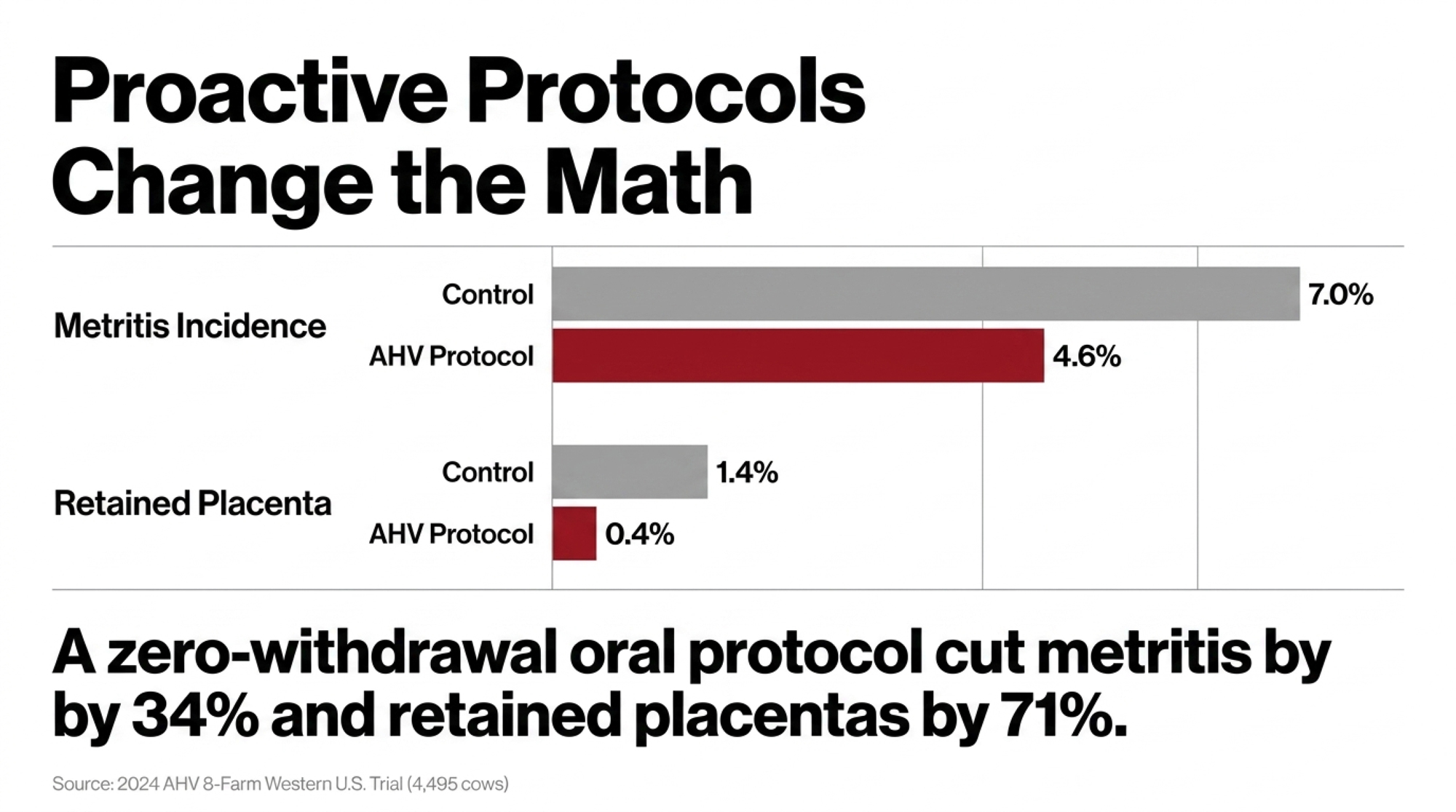
Here’s what they saw across 4,495 fresh cows (2,240 AHV, 2,255 control):
8‑Farm Trial Results at a Glance
| Metric | Control Group | AHV Protocol | Improvement |
| Metritis incidence | 7.0% | 4.6% | –34% (P<0.001) |
| Retained placenta | 1.4% | 0.4% | –71% (P<0.001) |
| Milk yield, first 100 DIM | 8,083 lb | 8,751 lb | +668 lb (+6.7 lb/day) |
| 1st‑service conception | 47.5% | 48.4% | +1.9 points (P=0.70, NS) |
| Net gain (all 4,495 cows) | — | — | +$111.17 per cow |
The 1.9‑point lift in first‑service conception didn’t reach statistical significance (P=0.70), so you shouldn’t treat this dataset as proof that conception will jump on every herd. In well‑run herds, even a couple of points can matter — which lines up with the six‑point gain Gabrielse reports at Quonset — but the strongest signals here are health and production: metritis, retained placenta, and early milk yield.
On the 2,240 protocol cows, AHV’s modeled 100‑day results looked like this:
- $566,370 in additional milk value
- $86,903 in retained‑placenta savings
- $8,258 in metritis treatment savings
- $22,475 in conception‑related gains
Total gross gain: $684,006. Subtract $184,295 for protocol cost, and the net comes to $499,712. Spread across all 4,495 cows in the trial — both protocol and control — that’s where the $111.17 per cow figure comes from.
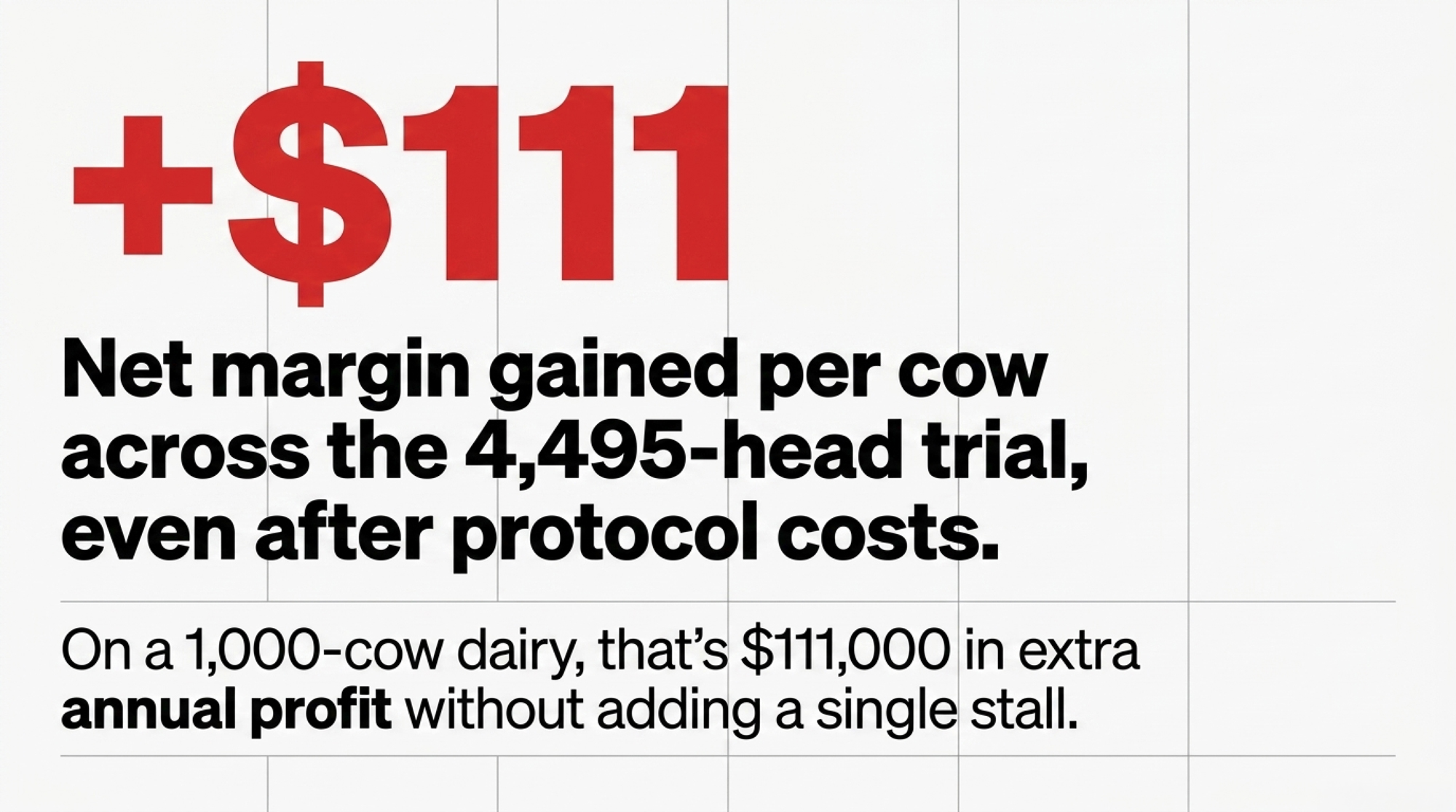
Now plug that into your own barn. On a dairy freshening 1,000 cows a year — roughly the size of United Vision Dairy — the trial’s average net gain of $111 per cow works out to about $111,000 in annual margin without adding a single stall. Using USDA’s February 2026 WASDE forecast of $18.95/cwt for all‑milk and ERS cost‑of‑production estimates around $19.14/cwt for large herds, that extra $111,000 is the difference between red and black for a lot of U.S. operations this year.
Why This Matters More Now Than It Did 5 Years Ago
The economics around replacement heifers have changed the stakes on fresh‑cow survival and longevity.
USDA’s January 2025 Cattle Inventory report puts dairy replacement heifers at 3.914 million head — the lowest level since the late 1970s. In 2025, replacement heifers were selling for well over $2,900 per head in many U.S. regions, roughly double what many producers were paying in 2020. Most analysts expect the pipeline to stay tight, with hundreds of thousands fewer heifers available than historical norms.
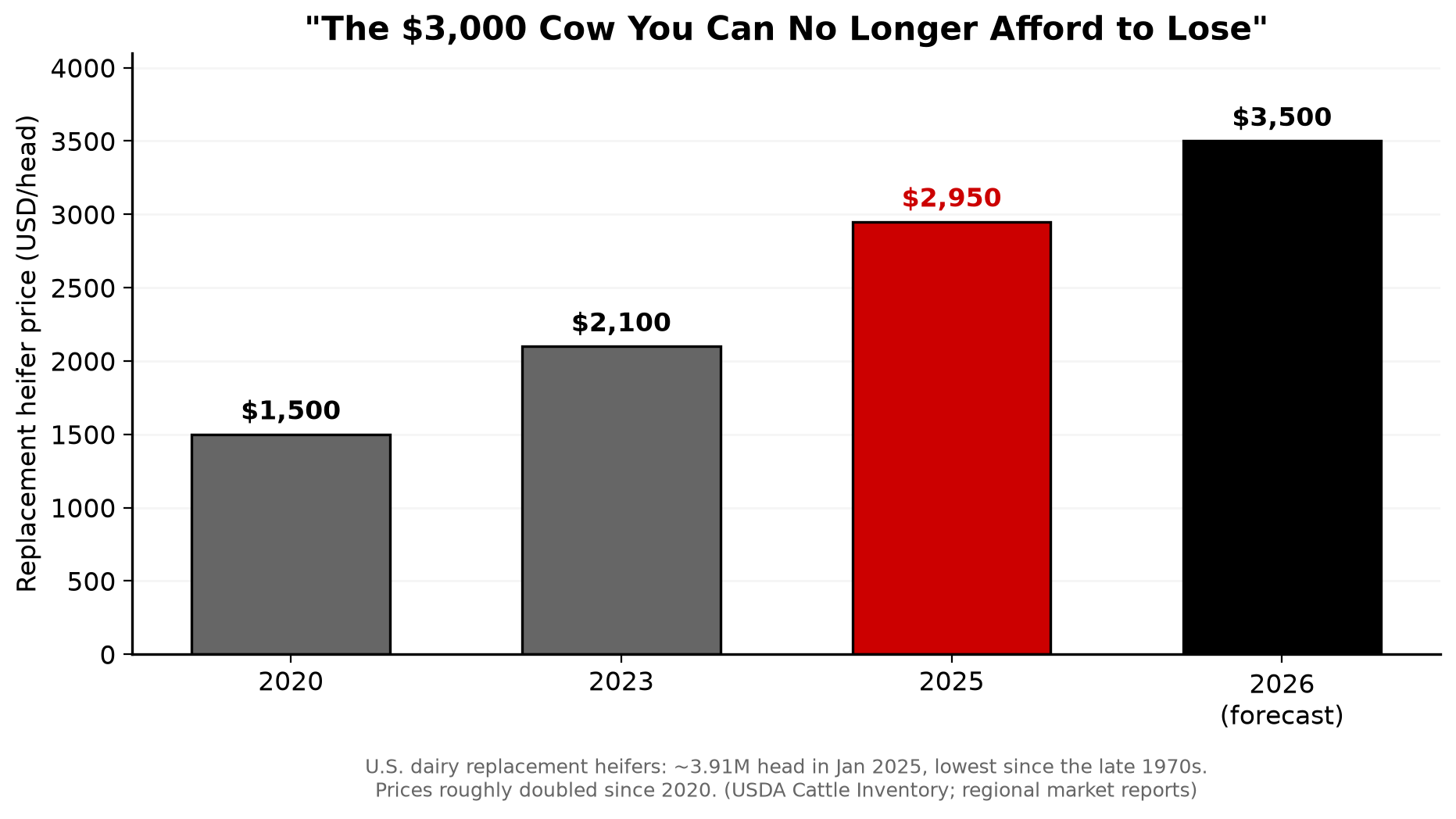
That means every cow you keep alive and milking past her payback point is a cow you don’t have to replace at $3,000–$4,000 — and in some regions, even more. A 70% reduction in 60‑day death loss on a 1,000‑cow herd with 3–5% fresh‑cow mortality translates to 21–35 fewer dead cows per year. At today’s replacement prices, that’s not a rounding error. It’s a six‑figure capital line over a few years.
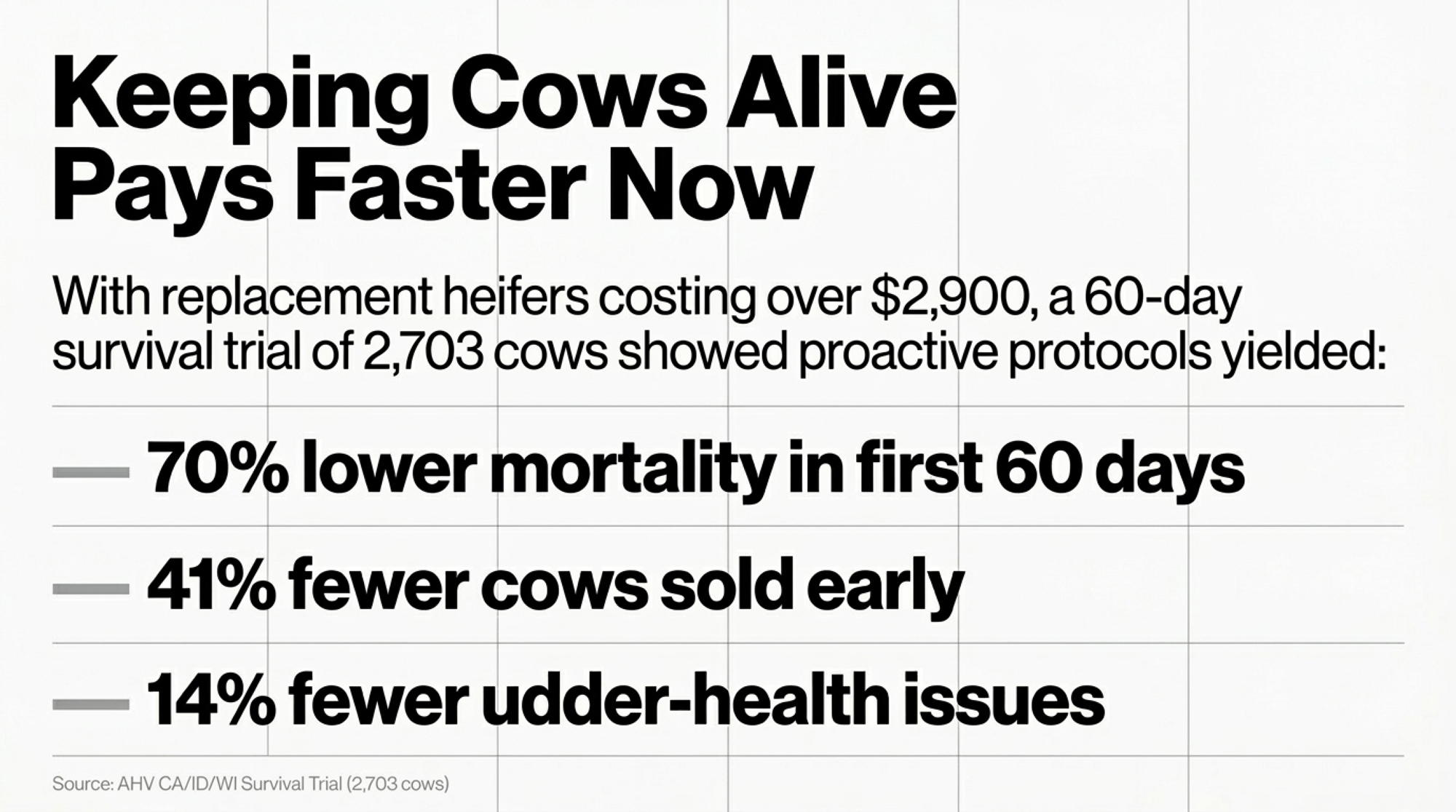
What the Survival Data Said About Keeping Fresh Cows Alive
The 8‑farm trial looked at metritis, retained placenta, and early milk. A separate AHV trial across California, Idaho, and Wisconsin focused on the first 60 days after calving.
That study tracked 2,703 cows. Of those, 1,134 received at least one AHV Extra Bolus in the first 14 days after calving; the remaining 1,569 cows were managed under each farm’s normal protocol.
Compared with controls, cows that received at least one Extra Bolus showed:
- 70% lower mortality in the first 60 DIM (P<0.001)
- 41% fewer cows sold in the first 60 DIM (P=0.006)
- 14% fewer udder‑health issues in the first 60 DIM (P<0.001)
On a 1,000‑cow herd, if your current 60‑day death loss is 3%, that’s 30 cows. A 70% reduction would bring that down to about 9 deaths, saving 21 cows in that window. At 5% mortality (50 cows) dropping to around 15, you’re saving 35 cows. Multiply that by even a conservative replacement value, and you’re quickly into tens of thousands of dollars — before you count milk and genetic potential.
When Bird Flu Turned into a Protocol Stress Test
You don’t get to schedule a perfect stress test. Sometimes it shows up as a virus you never asked for.
In late 2024, California dairyman Joe Soares watched both of his herds be hit by H5N1 avian influenza: about 2,500 cows at Turlock and 5,500 at Chowchilla. Same owner. Same management. Similar genetics. Very different treatment protocols.
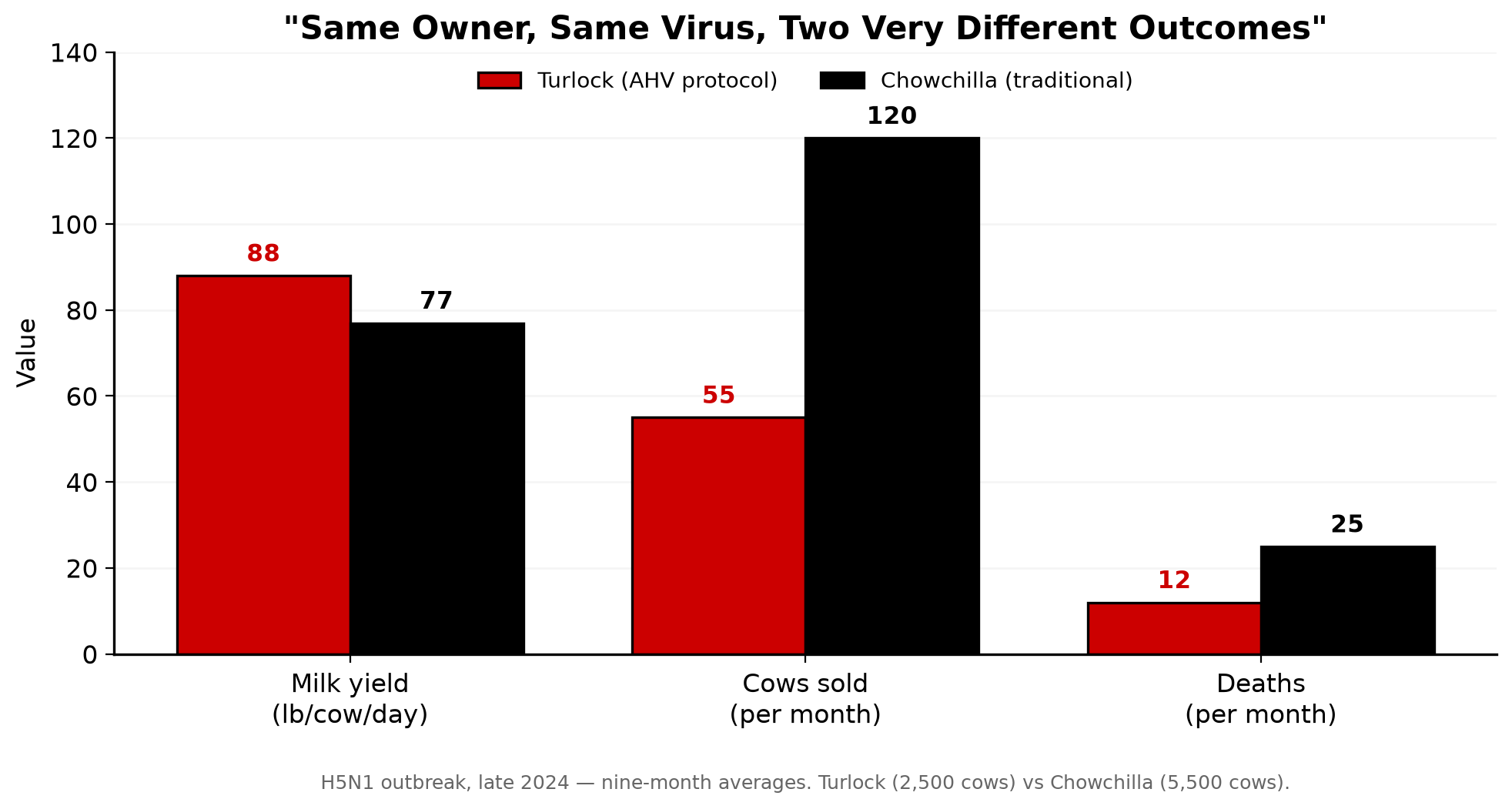
- Turlock was on AHV protocols: one Booster Bolus and two Aspi Boluses per cow — no drenching, single‑day application with a multi‑bolus gun. Cost: about $54.02 per cow.
- Chowchilla ran a traditional approach: electrolytes, NSAIDs, and a vitamin B12 injection given via drench over two days. Cost: about $26.71 per cow.
The cheaper protocol looked cheaper on paper until the numbers came back.
Turlock’s cows recovered milk production within days. SCR collar data showed improvement the day after treatment and full recovery by day three. Chowchilla saw months of up‑and‑down production.
Over the nine months after the outbreak:
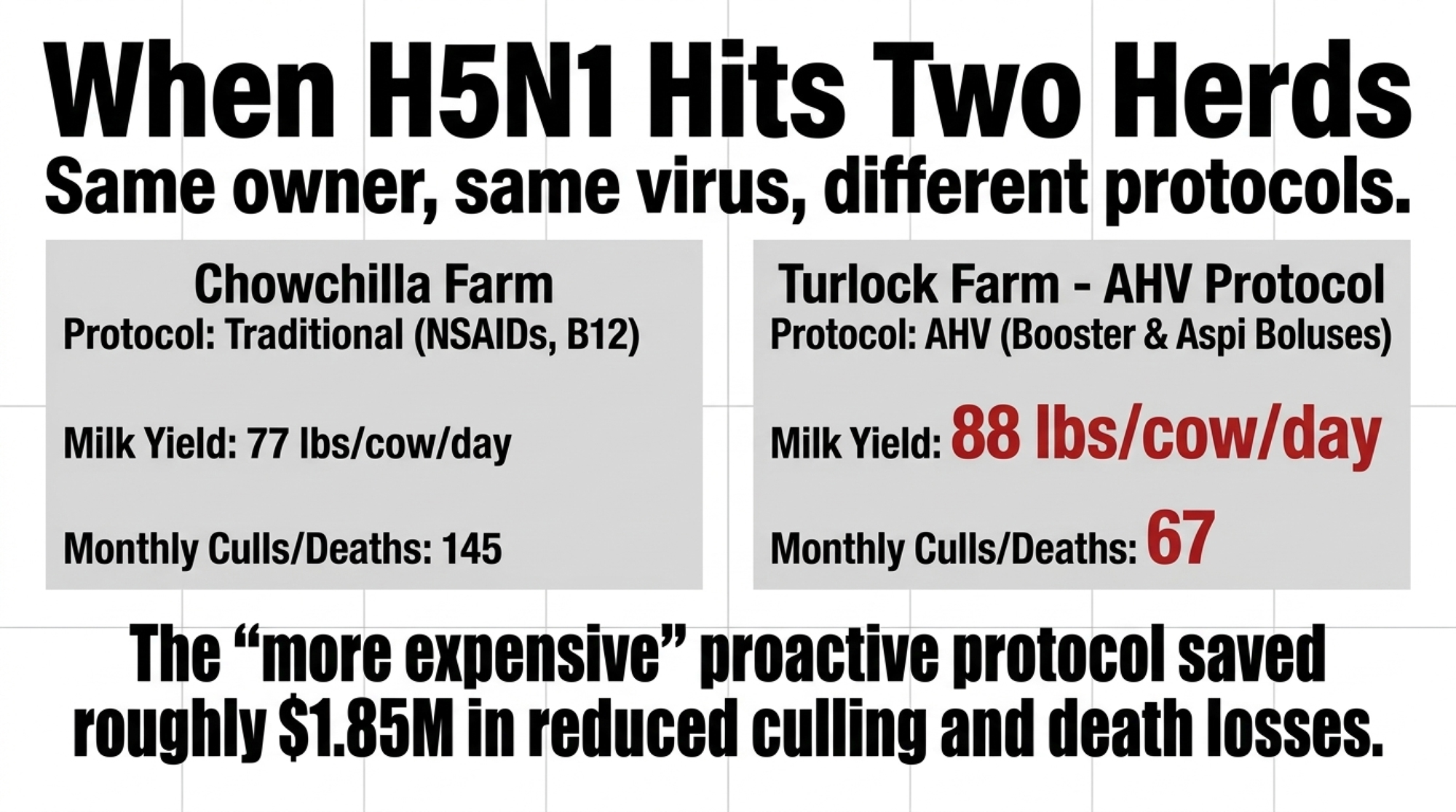
- Milk yield: Turlock Holsteins averaged about 88 lb/cow/day vs. Chowchilla’s 77 lb/cow/day — an 11 lb/day gap.
- Culling: Turlock averaged 55 cows sold per month vs. Chowchilla’s 120.
- Deaths: Turlock averaged 12 deaths per month vs. Chowchilla’s 25.
Using conservative U.S. replacement economics, AHV’s analysis estimates that the Turlock dairy saved roughly $1.5 million in reduced culling costs and about $350,000 in reduced death losses compared to the Chowchilla protocol over that period. And that’s before you add the milk revenue from 11 extra pounds per cow per day, which AHV’s breakdown pegs at about $670,000 per 1,000 Holsteins at a 20¢/lb milk price.
“We were able to bounce back quickly,” Soares says. “The cows didn’t suffer much, and we didn’t lose nearly the amount of milk that a lot of other facilities did.”
It’s not a randomized university trial. But it is two large dairies under the same management, hit by the same virus at the same time, running two different protocols. And the direction of the difference is hard to argue with.
How a Plant-Based Product Can Disrupt an Infection
If you’re skeptical that a bolus based on plant compounds can compete with injectable antibiotics, you’re not alone. Most of us were raised on the idea that you kill bacteria with drugs, or they kill the cow.
Here’s what AHV is actually doing instead.
Bacteria talk to each other. They use chemical signals — quorum sensing — to coordinate when to build biofilms, when to stick to tissue, and when to ramp up toxin production. Individually, they’re not that dangerous. In a coordinated biofilm, they’re hard to treat and hard for the cow’s immune system to clear. That’s why chronic infections feel like they sit there no matter how many times you hit them.
AHV’s QSI (quorum sensing inhibition) products don’t kill the bacteria outright. They use a purified allium‑derived extract to block those communication signals. Independent lab work, including external testing, has shown that AHV’s QSI molecules disrupt virulence in both gram‑positive and gram‑negative bacteria without killing them or creating antimicrobial resistance.
Dr. Geoff Ackaert, AHV’s technical director and global head of ruminants, puts it this way: “If you have a group of nasty people, you blindfold them and make them deaf. They can’t communicate anymore, so they’re immediately harmless. That’s what we do with these little nasty microorganisms — they can’t work as a group anymore.”
Once you’ve broken the communication, the cow’s own immune system — with a little help from supportive products like Aspi — can clean things up. Because the QSI products are classified as specialty feed additives, there’s no milk or meat withdrawal.
The core QSI technology is covered by several patents and has been validated in AHV’s in‑house microbiology, cell culture, and analytical labs, with external collaborations at places like Leiden University and Utrecht University. In the field, it showed up in that longevity study by Herrema and colleagues: 2,161 cows across 22 Dutch farms treated with the AHV concept had 8,653 kg higher lifetime production, a 19.8‑point lower replacement rate, and an estimated 11.1:1 ROI, with revenue per day of life up from €5.87 to €6.37.
Is This Really About Using Fewer Antibiotics?
No fresh‑cow article is honest if it pretends you can toss all your antibiotics. You can’t, and you shouldn’t.
In the 8‑farm trial, plenty of cows still needed intervention. And in a real fresh pen, you’ll always have a handful of train‑wreck cows that need a vet, a bottle, and sometimes a cull truck.
Here’s the honest middle ground the data supports:
- The metritis and retained‑placenta improvements came from treating every fresh cow proactively — not just reacting to the obviously sick ones.
- Antibiotics still had a role for true clinical cases.
- The real economic win wasn’t “never use antibiotics.” It was using fewer of them on fewer cows, and dumping a lot less milk to withdrawal.
AHV’s CEO Jan de Rooy says it this way in internal presentations: antibiotics remain an important tool, but they should be reserved for severe cases; the company’s goal is to keep its use to an absolute minimum. That’s a very different message from “antibiotics are bad.”
Meanwhile, regulators are watching. FDA data show that U.S. sales of medically important antibiotics for food‑producing animals jumped 16% in 2024 after several years of decline, with tetracyclines accounting for 69% of those sales and increasing by 20% year‑over‑year. That’s exactly the kind of chart that gets people in Washington and Brussels asking hard questions.
So this isn’t a moral argument against antibiotics. It’s an economic and regulatory argument for saving them for the cows that actually need them.
What Happens to Your Margin If You Don’t Count Withdrawal Milk?
You’d never sign a milk contract and ignore the component schedule. But a lot of herds effectively do something similar with withdrawal milk. They accept the hospital list, they dump the milk, and they never look at the line where that volume would’ve hit their pay stub.
If your fresh‑cow metritis rate is running north of 5%, your dry‑off program is still built around tubes, and you’re treating a decent chunk of fresh cows with systemic antibiotics, withdrawal milk is one of your biggest invisible cost centers. That’s true whether you’re milking 250 cows or 2,500.
The 8‑farm trial’s $111/cow net and the survival trial’s 70% mortality reduction are company numbers, not independent university trials — yet. But even if you cut those numbers in half, they still point in the same direction: for a lot of commercial herds, fresh‑cow and dry‑off protocols are now a six‑figure annual decision, not a footnote in the vet bill.
What Actually Changes in Your Dry-Off and Fresh Cow Routine?
On paper, protocols can sound like more work. Jaeger thought that at first. Then he realized what was going away.
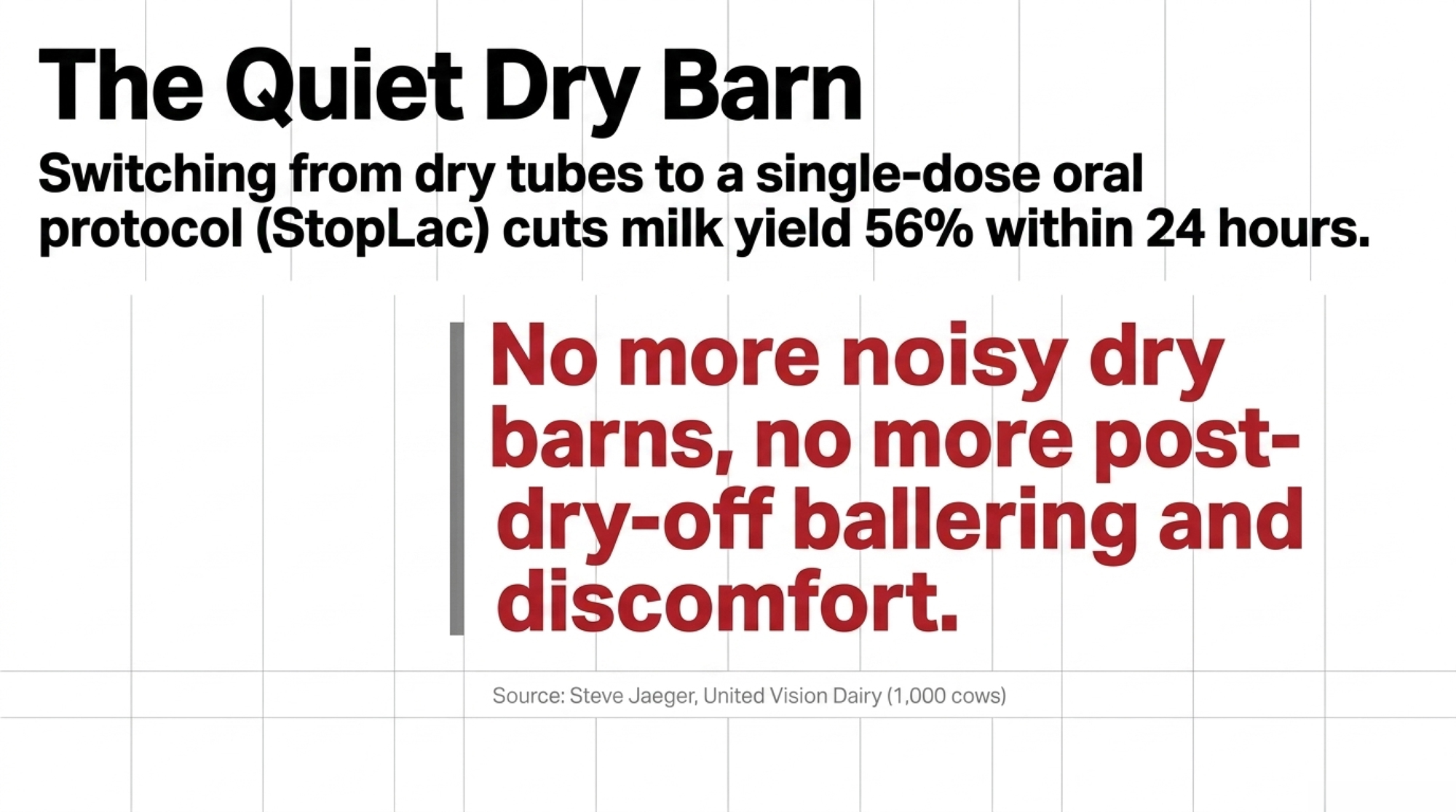
At United Vision Dairy, StopLac replaced dry tubes. Instead of orchestrating a whole team around a tube routine and then listening to cows bawl and kick for days, his crew gives a single oral dose. Utrecht University and AHV’s broader StopLac data show about a 56% reduction in milk yield within 24 hours in treated cows, with no spike in leaks or mastitis when the dry period is managed sensibly; in one Utrecht study, 47 cows dried off with StopLac dropped milk quickly and then returned to normal production with no long‑term udder damage. On Jaeger’s farm, that translated into something you can hear: no more noisy dry barns, no more post‑dry‑off “ballering” and discomfort.
In the field, StopLac has now been used on more than 52,700 cows across 14 countries, with U.S. and German data showing 62–70% reductions in milk leakage and fewer new intramammary infections at calving. Across two U.S. farms (404 cows), abrupt dry‑off with StopLac cut 60‑day death loss almost in half and reduced milk leakage, while maintaining next‑lactation yield with a 3 kg/day advantage over controls.
On the fresh‑cow side, both Jaeger and Gabrielse describe a similar practical shift. Instead of waiting for sick cows and then reacting, every fresh cow gets a bolus protocol at calving. That doesn’t remove all problems — you still have twins that go sideways and the occasional disaster — but it changes your default from “treat the sick ones” to “protect all of them.”
What’s the Smartest Way to Test a New Fresh Cow Protocol on Your Farm?
You don’t have to swallow the entire protocol story in one gulp. If you’re interested but skeptical, the most honest thing you can do is run a clean, on‑farm trial.
The odd‑week/even‑week design from the 8‑farm trial is simple enough for most record systems. Pick a start date and agree that cows calving in odd weeks get the proactive protocol, while even‑week calvings stay on your current program. Then track four things for at least 60–100 days: metritis, retained placentas, antibiotic treatments, and milk per cow at 100 DIM. You can add survival and culling in the first 60 DIM if you want to push it.
Within 30 days, you can at least see if protocol cows are showing up on the sick‑cow list less often and whether you’re dumping fewer pounds of withdrawal milk. By 60–100 days, you can compare milk and repro with enough cows to see whether the pattern lines up with the trial data or not.
How Much Should You Change at Dry-Off Before You Fix the Fresh Pen?
For some herds, dry‑off is the biggest pain point — labor, cow comfort, animal welfare pressure, or tube management — even more than metritis or mastitis. In that case, it can make sense to start there.
If you’re used to tubes, switching to a bolus that drops milk 50‑plus percent in one day feels like a big leap. That’s why many herds start by running StopLac alongside tubes for a few weeks, monitoring for leaks and mastitis, then phasing tubes out as they get comfortable with the results. You still need sound transition nutrition and stocking density in your dry pens; StopLac isn’t a fix for bad diets or overcrowding. But if you can get to quiet dry barns, fewer leaks, and no spike in mastitis, you’ve taken a lot of stress off your cows and your crew.

Sponsored Post
Options and Trade-Offs for Farmers
You don’t have to do everything at once. Here are four realistic paths — and what each one asks of you.
Path 1: Run a controlled on-farm trial this month.
- When it makes sense: You’re interested but skeptical, or your vet is. You want data from your own cows, not just somebody else’s case study.
- What it requires: Pick a start date and follow the odd‑week/even‑week design. Odd‑week calvings follow the AHV fresh‑cow protocol; even‑week calvings stay on your current program. Track metritis and RP within 21 DIM, antibiotic use, milk per cow at 100 DIM, and, if you can, culls and deaths in the first 60 DIM.
- Risks/limits: You need clean records and discipline to avoid “contaminating” the control group. And it takes 60–100 days to see meaningful trends.
- 30‑day action: Commit to a start date, set up the treatment codes in your software, and agree with your vet on what counts as “metritis,” “retained placenta,” and “fresh‑cow problem” before you start.
Path 2: Start at dry-off and work forward.
- When it makes sense: Your biggest pain is dry‑off — labor, cow comfort, animal welfare pressure, or tube management — more than metritis or mastitis.
- What it requires: Replace tubes with StopLac where your vet is comfortable, and monitor cows closely for the first 5–7 days post‑dry‑off. Make sure your transition nutrition and stocking density are in good shape first.
- Risks/limits: StopLac handles the milk drop; it doesn’t fix a bad transition diet or overcrowded dry pens. You still need to watch for metabolic issues and leaks as you dial it in.
- Forward signal: If you see quieter barns, fewer leaks, and no uptick in mastitis through the dry period, you’ve earned the right to look harder at fresh‑cow protocols next.
Path 3: Fix your tracking before you change anything.
- When it makes sense: You can’t easily answer “What’s my metritis rate?” or “How many pounds of milk do I dump to withdrawal every month?” from your current records.
- What it requires: Build three simple reports: metritis cases within 21 DIM, average hospital days per fresh cow, and total pounds (or liters) of milk tagged as “do not ship” per month.
- Risks/limits: You’ll probably uncover some uncomfortable numbers. But without them, you’re guessing.
- Forward signal: Once you know those three numbers, you can run any protocol comparison — AHV or otherwise — like a grown‑up business experiment.
Path 4: Keep your current program — but make it an explicit choice.
- When it makes sense: Your metritis rate is under 5%, fresh‑cow mortality is under 2%, and your withdrawal milk losses are already tracked and modest.
- What it requires: Verify those numbers, ideally for the last 12 months, and stress‑test them with your vet or adviser.
- Risks/limits: The main danger is complacency. If heifer prices keep rising and antibiotic rules tighten, the cost of sticking with “what’s always worked” could change fast.
- Forward signal: Re‑run your numbers annually. If you see metritis or early culls creeping up, or if your heifer pipeline tightens, revisit the other three paths.
Key Takeaways
- If your fresh‑cow metritis rate is above 5% and you don’t know how much milk you’re dumping to withdrawal, you’re guessing on one of your biggest controllable cost centers. Pull those numbers over the next 30 days and treat them like components.
- If you’re paying $2,900–$4,100 for replacement heifers, any protocol that cuts 60‑day mortality by even half of the 70% shown in the 2,703‑cow survival trial will pay for itself in avoided replacements alone. Don’t shrug off death loss at those prices.
- If your main concern is the strength of the evidence, treat AHV’s 8‑farm trial and survival study as what they are: large company‑run datasets pointing in a clear direction, backed by a peer‑reviewed longevity paper and an ongoing SARE/Texas A&M project. Then run your own odd‑week/even‑week trial to see if your herd lines up.
- If you’re not ready to switch protocols across the board, start where your pain is loudest — dry‑off stress, fresh‑pen chaos, or the hospital list — and use that as your test area. You don’t have to do everything at once to learn something real.

Steve Jaeger didn’t tackle any of this with a whiteboard full of equations. He started with a barn full of cows that calved and cleaned on their own, a dry barn that went from loud to quiet, and a mailbox that started seeing more premium checks than cull checks. The eight‑farm trial and the survival and bird‑flu numbers say his experience isn’t a fluke.
Complete references and supporting documentation are available upon request by contacting the editorial team at editor@thebullvine.com.
Learn More
- Is Your Fresh Pen Costing You $90000? The 90-Day Transition Fix for Pregnancy Rate — Delivers concrete targets for postpartum health and stocking densities, showing how a $511 metritis price tag combines with reproduction delays to bleed cash from commercial freestall pens.
- The $500 Transition Gap: Why Your Neighbor’s Fresh Cows May Outperform Yours by Next Winter — Exposes the massive financial variance between blanket treatments and targeted transition management, while tracking how international regulatory crackdowns are shifting industry-wide protocols away from prophylactic antibiotics.
- Your Repeat Mastitis Cows Have a 72-Hour Secret – Here’s How to Break It — Explains how pathologically synchronized bacteria build defensive biofilm fortresses within three days, breaking down the mechanical reality of quorum-sensing disruption to eliminate chronic hospital pen repeaters.
The Sunday Read Dairy Professionals Don’t Skip.

Every week, thousands of producers, breeders, and industry insiders open Bullvine Weekly for genetics insights, market shifts, and profit strategies they won’t find anywhere else. One email. Five minutes. Smarter decisions all week.




