




Archive for quorum sensing inhibition

Steve Jaeger’s $511 Fresh Cow Problem – And the Hidden $111‑Per‑Cow Fix 4,495 Cows Just Proved

An 8‑farm, 4,495‑cow trial shows how changing fresh‑cow and dry‑off protocols can turn metritis costs and withdrawal milk into about $111 of margin per cow — without adding a single stall.
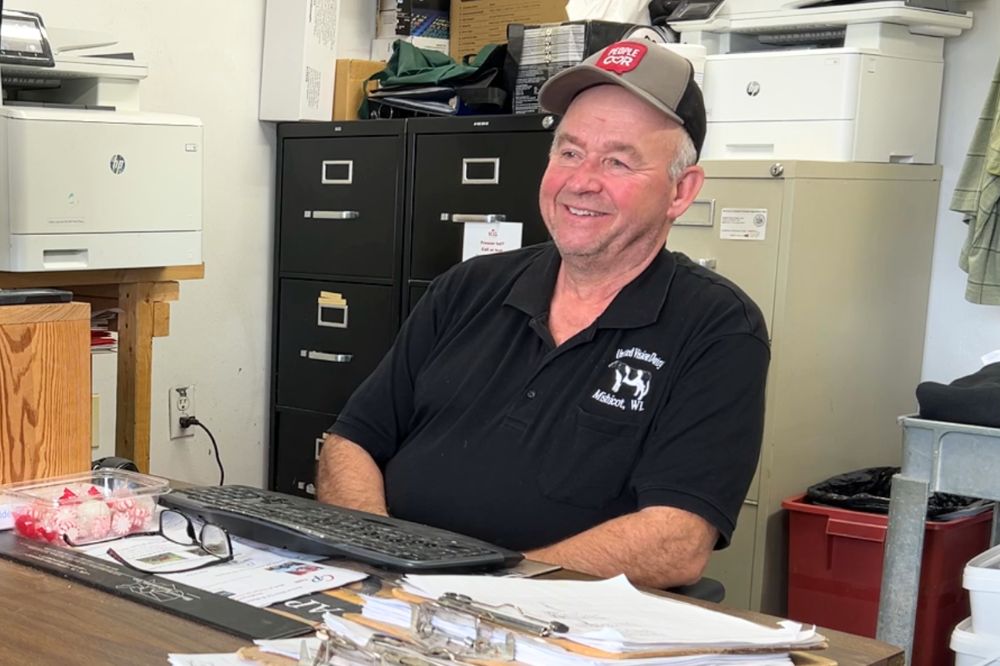
Steve Jaeger used to joke that United Vision Dairy was “always cutting the check, not collecting it.” After he put every fresh cow on a proactive protocol and switched dry-off to StopLac, the 1,000-cow Wisconsin herd sold 70 animals at premium prices in six months — and the dry barn finally went quiet.

When a 1,000‑cow Wisconsin dairy stopped dumping fresh‑cow milk to withdrawal and changed how cows were dried off, pregnancy rates climbed to 61–62%, the barn went quiet, and the herd started collecting premium checks instead of just writing cull checks.

You track SCC. You watch the preg rate. You probably know your days open and death loss. But do you actually know how many dollars in withdrawal milk your fresh‑cow protocol quietly takes out of your tank every month — and what would change if you didn’t?

At United Vision Dairy in Wisconsin, herd manager Steve Jaeger used to joke that they were “always the ones cutting the check, not collecting it.” It’s a 1,000‑cow herd, well‑run and shipping good milk. But every freshening brought the same routine: treat the sick ones with antibiotics, pull their milk, listen to a noisy dry barn for a couple of days, and sign off on cull checks that felt too frequent. That started changing when Jaeger put every fresh cow — twins, triplets, all of them — on AHV’s proactive fresh‑cow protocol and switched his dry cows to StopLac. His first‑service conception rate climbed to about 61–62%, and in six months, they sold 70 dairy animals at premium prices instead of shipping them on a cull truck. After their first StopLac dry‑off day, the barn that used to be full of bawling cows just…stayed quiet.

Jaeger’s story fits a bigger pattern. In Oostburg, Wisconsin, herd manager Karl Gabrielse at Quonset Farms (1,350 cows) describes the change the same way: fewer fresh‑cow issues, less antibiotic use, calmer dry‑off, and a six‑point jump in first‑service conception, from 47% to 53%. And when eight Western U.S. dairies — 4,495 cows total — ran a controlled trial on their fresh cows, the numbers behind those barn stories became hard to ignore.

The Fresh Pen Math You’re Probably Not Doing
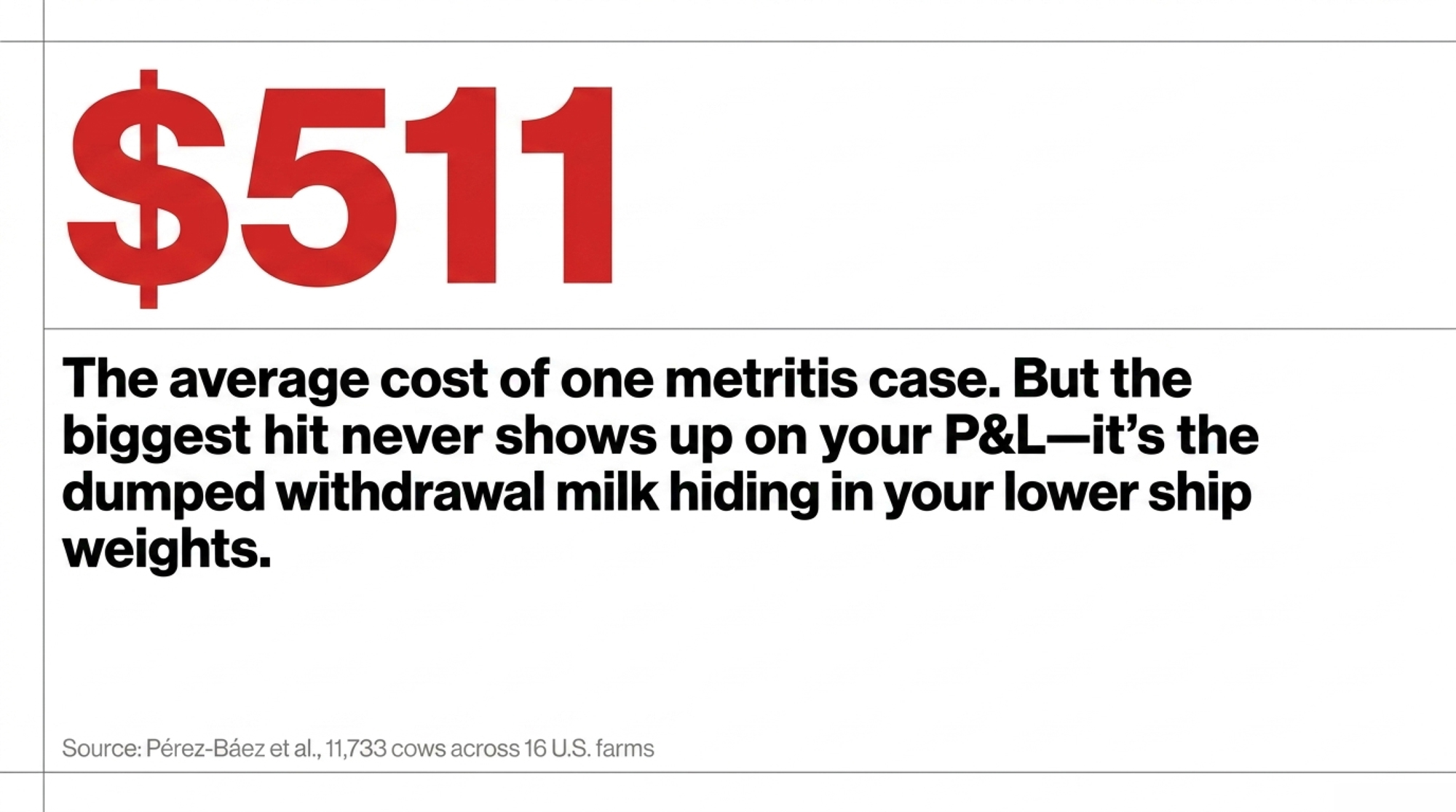
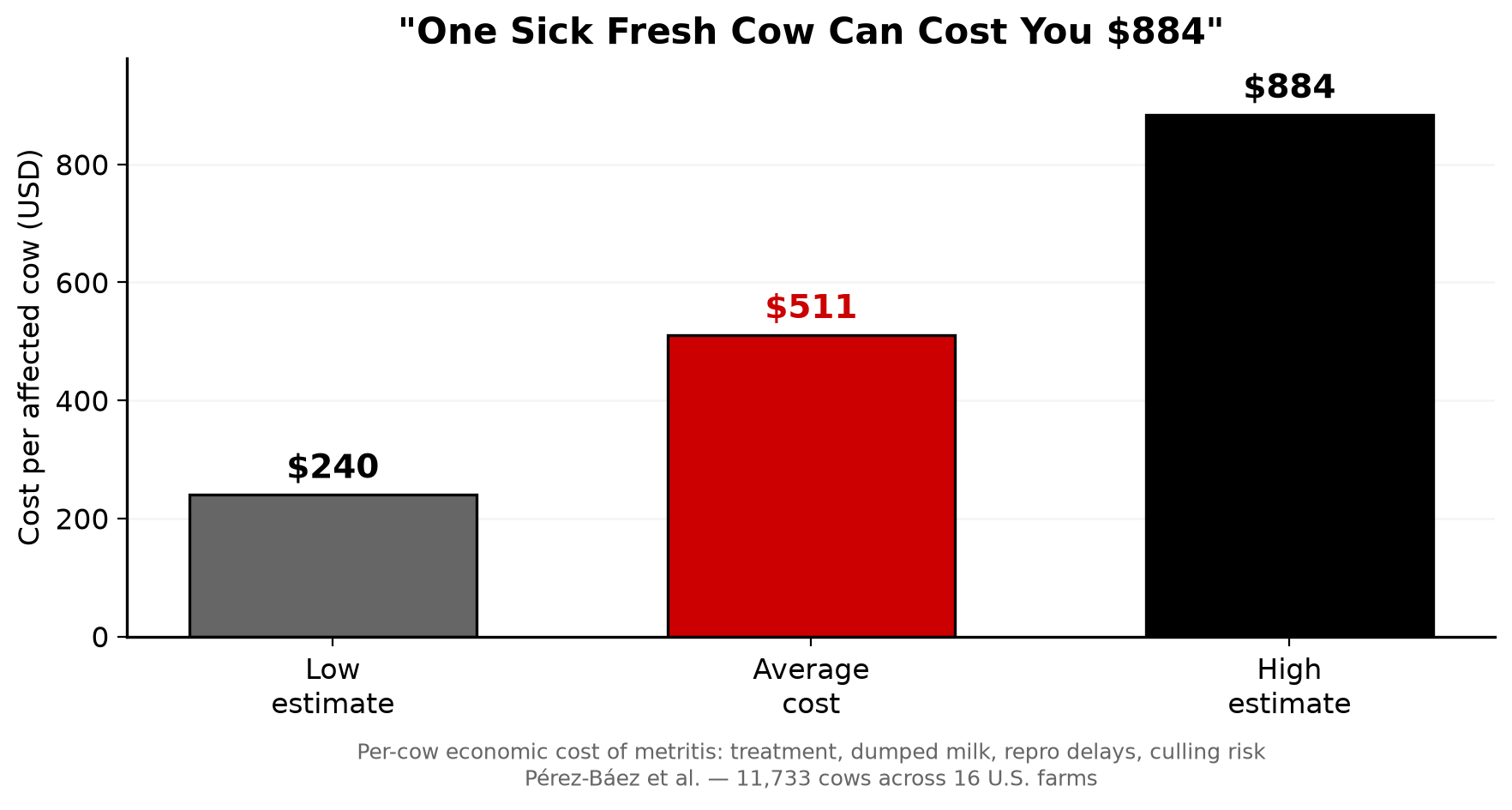
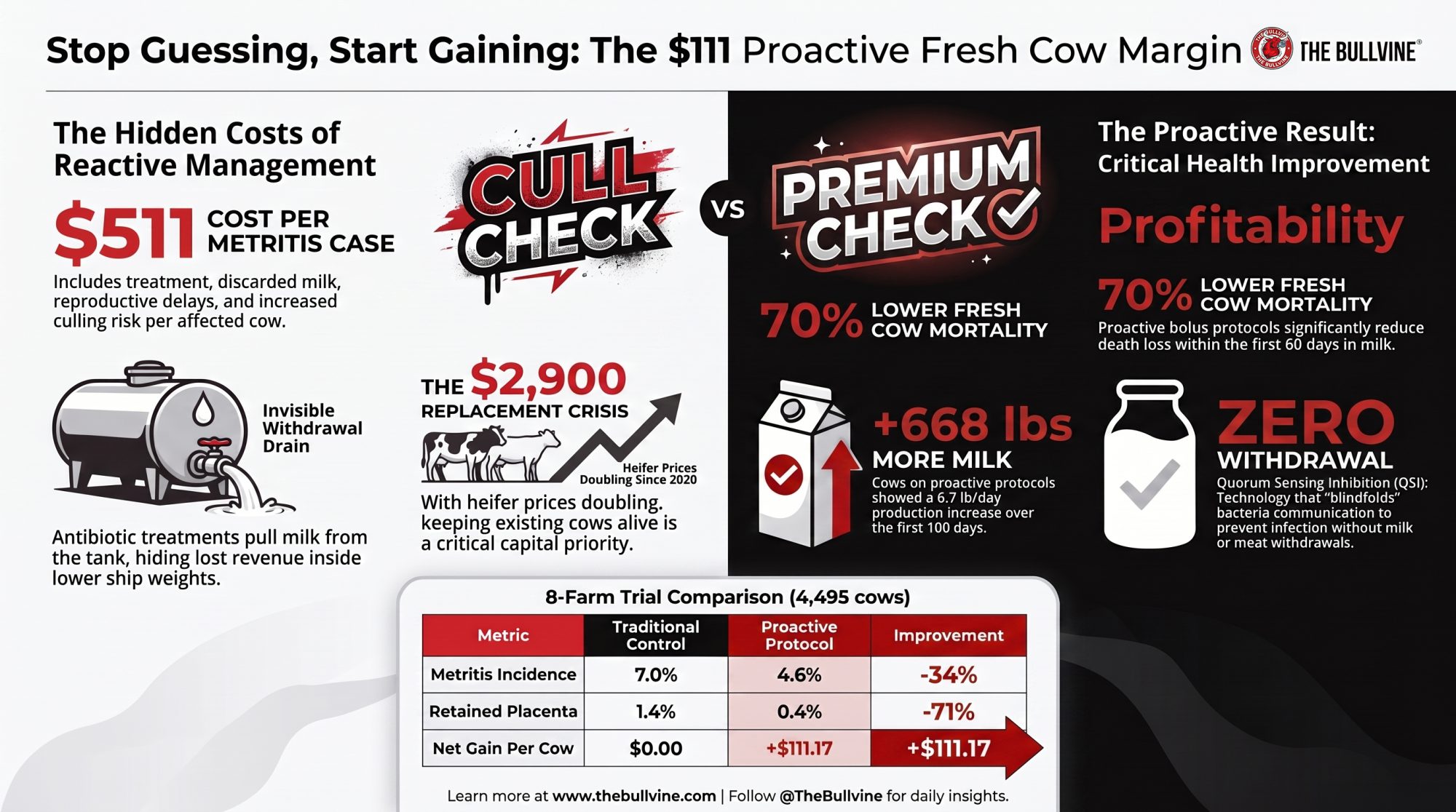
Metritis doesn’t look like a margin line when you’re treating one cow in one pen. But it is. Pérez‑Báez and colleagues estimated the average economic cost of metritis at $511 per affected cow, with a range of $240 to $884 when accounting for treatment, discarded milk, reproductive delays, and culling risk (11,733 cows across 16 U.S. farms). Depending on how you define and track postpartum uterine disease, up to 40% of cows can end up with metritis or endometritis in early lactation.
That’s just the obvious cost. The number almost nobody sees is the milk that never leaves the hospital list. Every time you treat a fresh cow with antibiotics, you pull her milk. On a 1,000‑cow operation freshening close to 1,000 cows a year, even a modest metritis and retained‑placenta rate means a lot of milk quietly going down a separate line. And because most herds don’t track withdrawal milk as its own line item, it never shows up on your P&L as “lost revenue.” It just hides inside the lower ship weight.
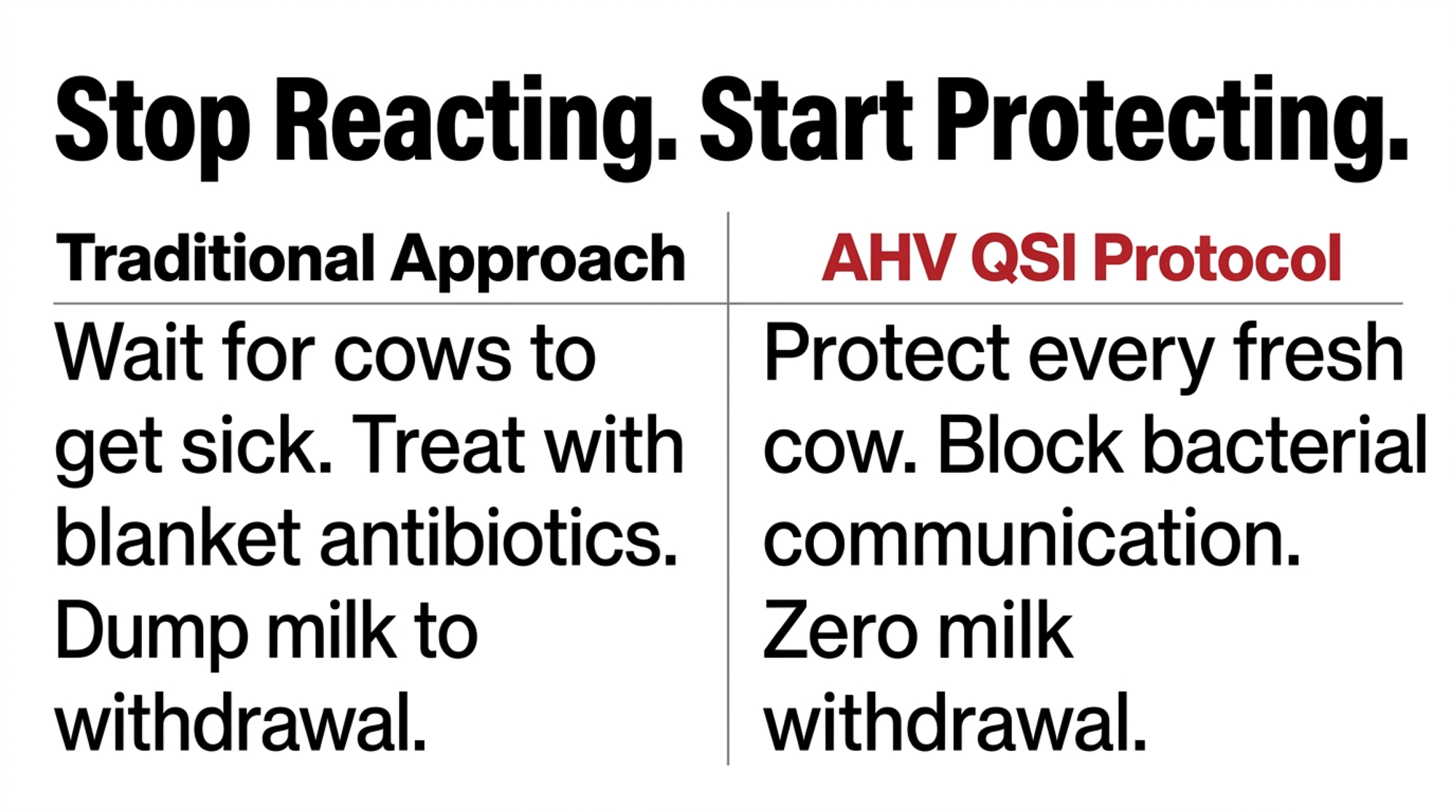
What’s different now is that the evidence for a different way to handle that fresh pen — a proactive, zero‑withdrawal approach built around quorum sensing inhibition (QSI) instead of blanket antibiotics — isn’t just a nice theory or a tie‑stall study anymore. In 2024, AHV USA ran an eight‑farm, 4,495‑cow commercial trial in the Western U.S. using a simple odd‑week/even‑week design. It’s company‑run data, not yet independently peer‑reviewed, but it’s one of the largest controlled looks at proactive fresh‑cow protocols in real freestall herds we’ve seen.

On top of that, a USDA SARE‑funded project (OS24‑178) is underway with Texas A&M at a certified organic dairy, measuring bacteriology, PCR, SCC, and economics around similar compounds. Results are expected by March 2026, so the independent check is coming.

What 4,495 Cows on Eight Dairies Actually Showed About Fresh Cow Protocol ROI

The 8‑farm design is one you could copy without hiring a statistician. Cows calving in odd‑numbered weeks went on a zero‑withdrawal oral protocol: AHV Metri Bolus, Aspi Bolus, and Fresh Start (Milk Start) Paste. Even‑week calvings stayed on each farm’s existing fresh‑cow program. Eight dairies, all in the Western U.S., ranging from 1,000‑cow herds up to 20,000; the average herd size was around 5,700 cows, with about 45,000 cows total behind the gate.

Here’s what they saw across 4,495 fresh cows (2,240 AHV, 2,255 control):

8‑Farm Trial Results at a Glance
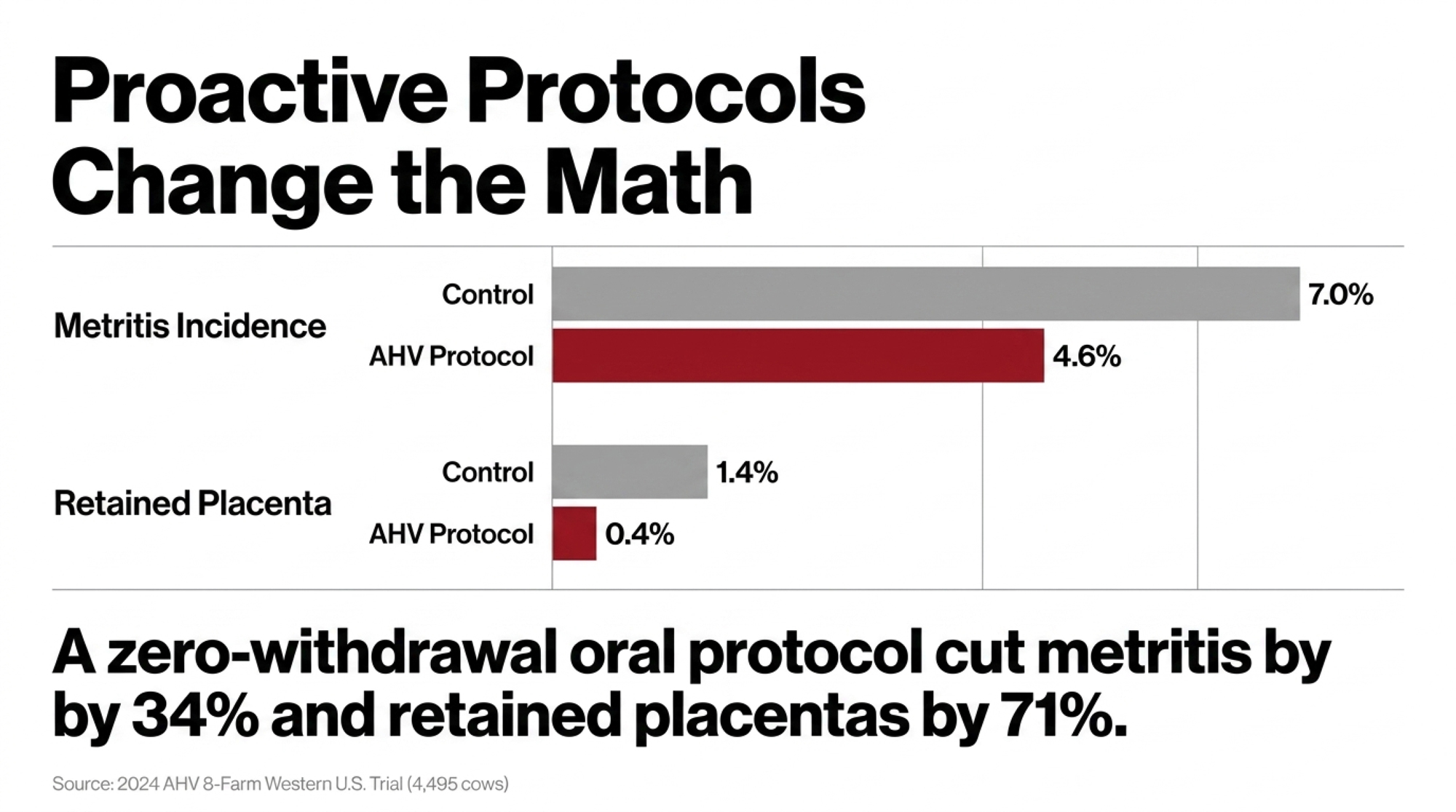
MetricControl GroupAHV ProtocolImprovement
Metritis incidence7.0%4.6%–34% (P<0.001)
Retained placenta1.4%0.4%–71% (P<0.001)
Milk yield, first 100 DIM8,083 lb8,751 lb+668 lb (+6.7 lb/day)
1st‑service conception47.5%48.4%+1.9 points (P=0.70, NS)
Net gain (all 4,495 cows)+$111.17 per cow

The 1.9‑point lift in first‑service conception didn’t reach statistical significance (P=0.70), so you shouldn’t treat this dataset as proof that conception will jump on every herd. In well‑run herds, even a couple of points can matter — which lines up with the six‑point gain Gabrielse reports at Quonset — but the strongest signals here are health and production: metritis, retained placenta, and early milk yield.

On the 2,240 protocol cows, AHV’s modeled 100‑day results looked like this:

  • $566,370 in additional milk value
  • $86,903 in retained‑placenta savings
  • $8,258 in metritis treatment savings
  • $22,475 in conception‑related gains

Total gross gain: $684,006. Subtract $184,295 for protocol cost, and the net comes to $499,712. Spread across all 4,495 cows in the trial — both protocol and control — that’s where the $111.17 per cow figure comes from.
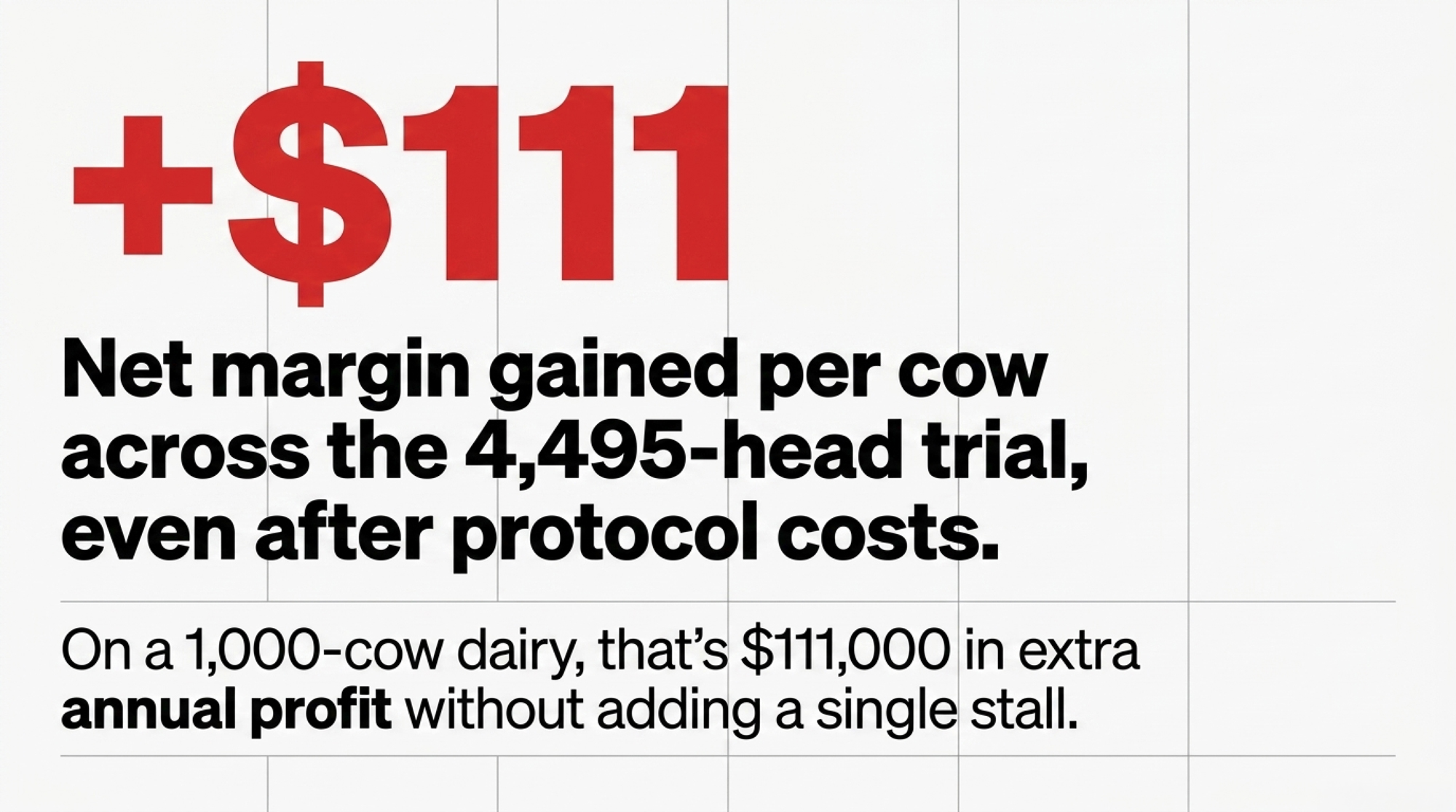
Now plug that into your own barn. On a dairy freshening 1,000 cows a year — roughly the size of United Vision Dairy — the trial’s average net gain of $111 per cow works out to about $111,000 in annual margin without adding a single stall. Using USDA’s February 2026 WASDE forecast of $18.95/cwt for all‑milk and ERS cost‑of‑production estimates around $19.14/cwt for large herds, that extra $111,000 is the difference between red and black for a lot of U.S. operations this year.

Why This Matters More Now Than It Did 5 Years Ago

The economics around replacement heifers have changed the stakes on fresh‑cow survival and longevity.

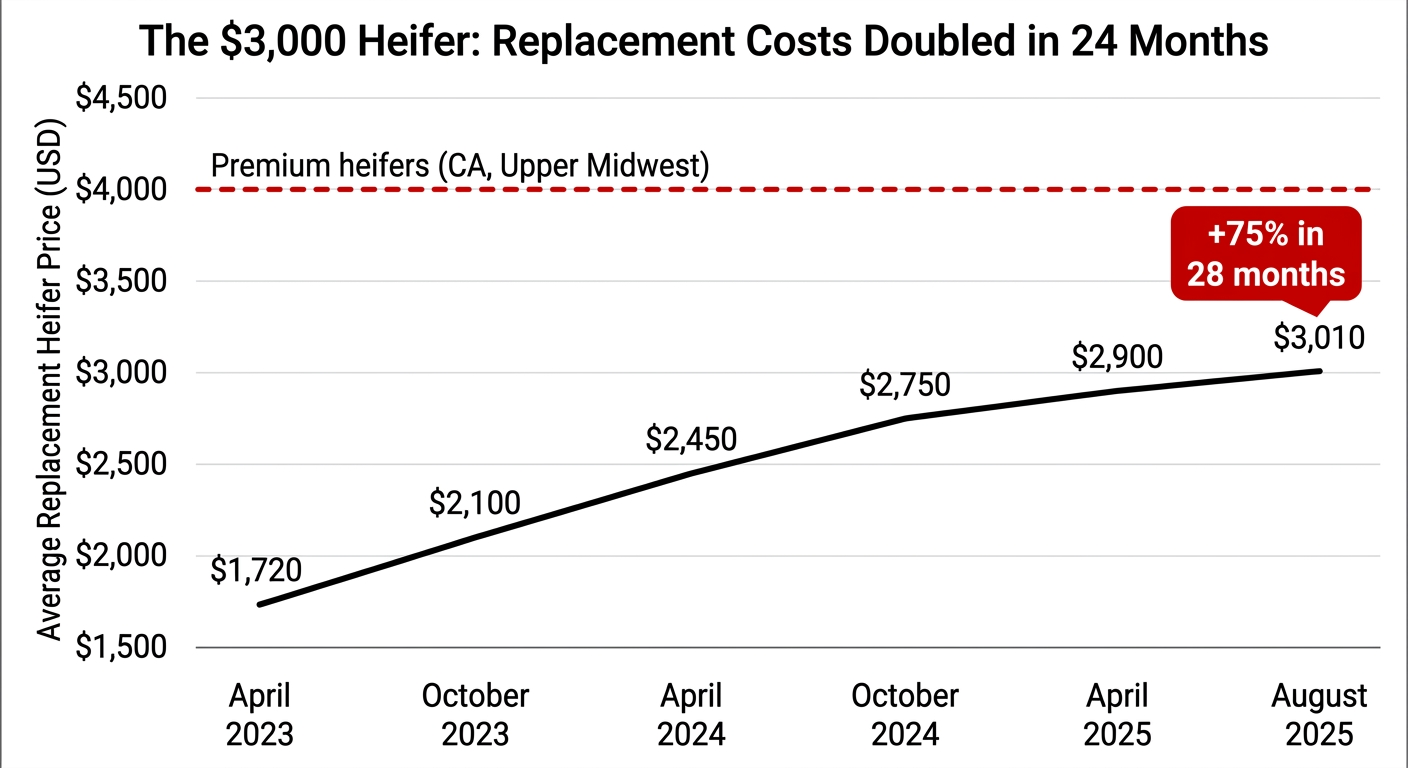
USDA’s January 2025 Cattle Inventory report puts dairy replacement heifers at 3.914 million head — the lowest level since the late 1970s. In 2025, replacement heifers were selling for well over $2,900 per head in many U.S. regions, roughly double what many producers were paying in 2020. Most analysts expect the pipeline to stay tight, with hundreds of thousands fewer heifers available than historical norms.
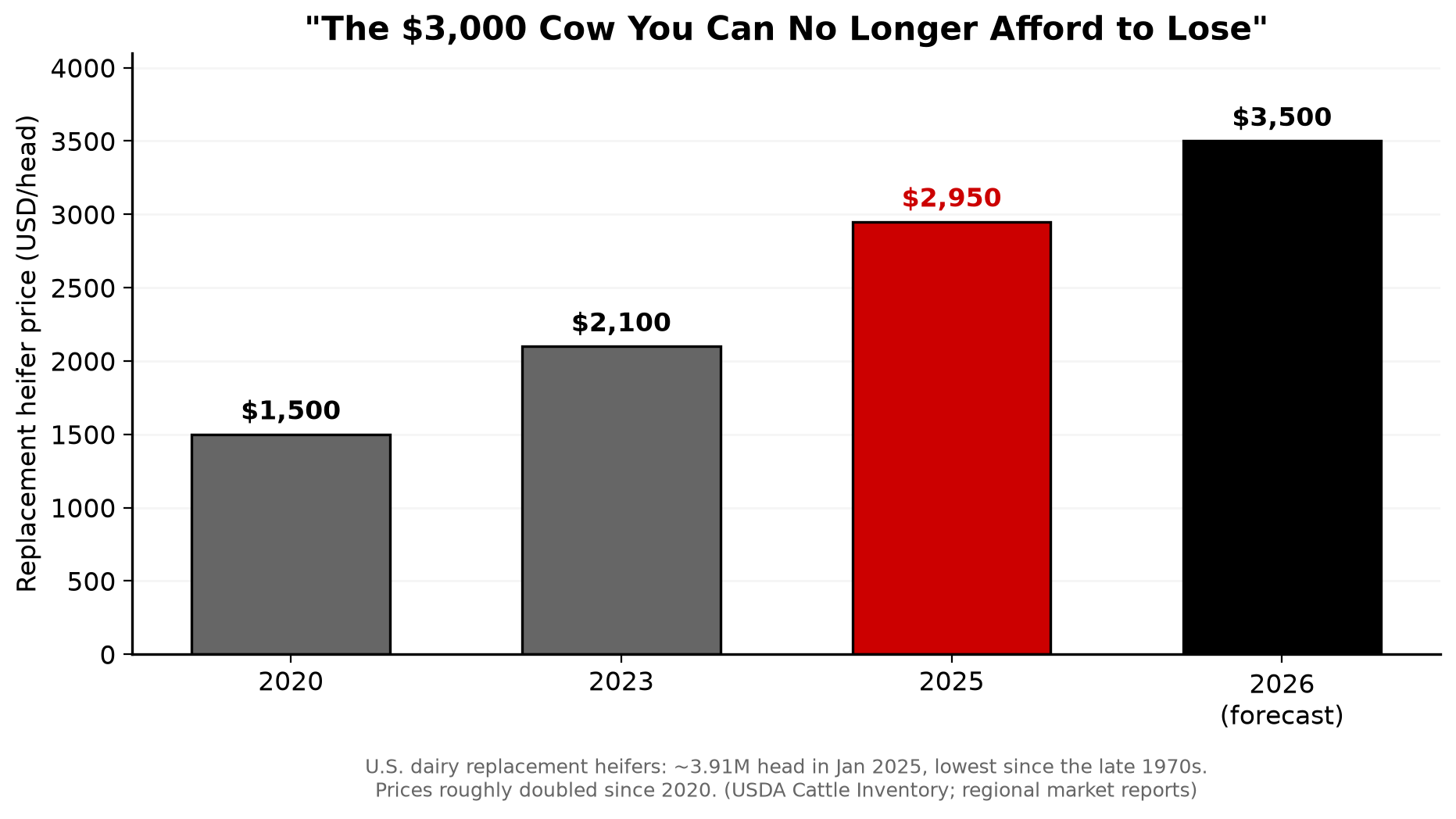
That means every cow you keep alive and milking past her payback point is a cow you don’t have to replace at $3,000–$4,000 — and in some regions, even more. A 70% reduction in 60‑day death loss on a 1,000‑cow herd with 3–5% fresh‑cow mortality translates to 21–35 fewer dead cows per year. At today’s replacement prices, that’s not a rounding error. It’s a six‑figure capital line over a few years.
What the Survival Data Said About Keeping Fresh Cows Alive

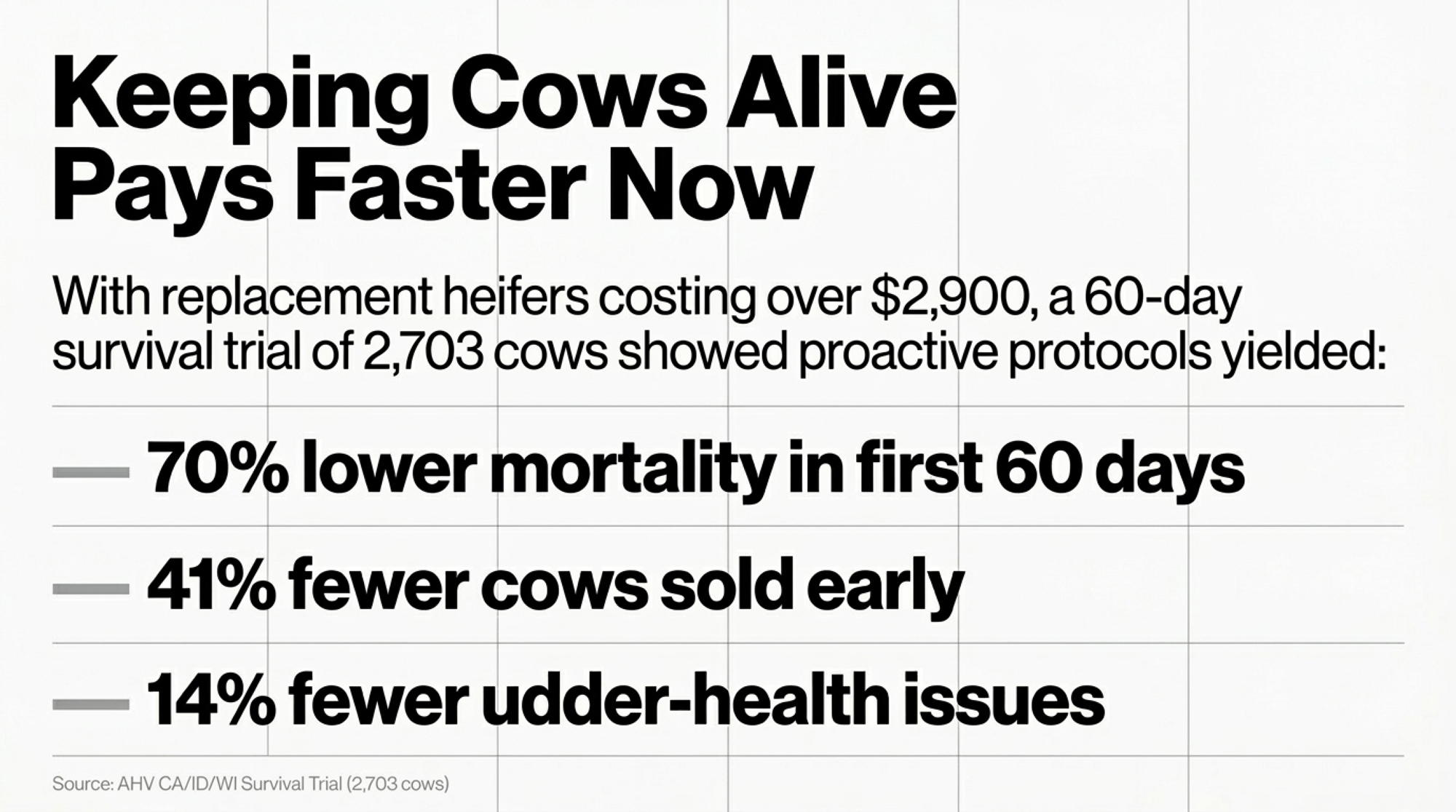
The 8‑farm trial looked at metritis, retained placenta, and early milk. A separate AHV trial across California, Idaho, and Wisconsin focused on the first 60 days after calving.

That study tracked 2,703 cows. Of those, 1,134 received at least one AHV Extra Bolus in the first 14 days after calving; the remaining 1,569 cows were managed under each farm’s normal protocol.

Compared with controls, cows that received at least one Extra Bolus showed:

  • 70% lower mortality in the first 60 DIM (P<0.001)
  • 41% fewer cows sold in the first 60 DIM (P=0.006)
  • 14% fewer udder‑health issues in the first 60 DIM (P<0.001)

On a 1,000‑cow herd, if your current 60‑day death loss is 3%, that’s 30 cows. A 70% reduction would bring that down to about 9 deaths, saving 21 cows in that window. At 5% mortality (50 cows) dropping to around 15, you’re saving 35 cows. Multiply that by even a conservative replacement value, and you’re quickly into tens of thousands of dollars — before you count milk and genetic potential.

When Bird Flu Turned into a Protocol Stress Test

You don’t get to schedule a perfect stress test. Sometimes it shows up as a virus you never asked for.

In late 2024, California dairyman Joe Soares watched both of his herds be hit by H5N1 avian influenza: about 2,500 cows at Turlock and 5,500 at Chowchilla. Same owner. Same management. Similar genetics. Very different treatment protocols.
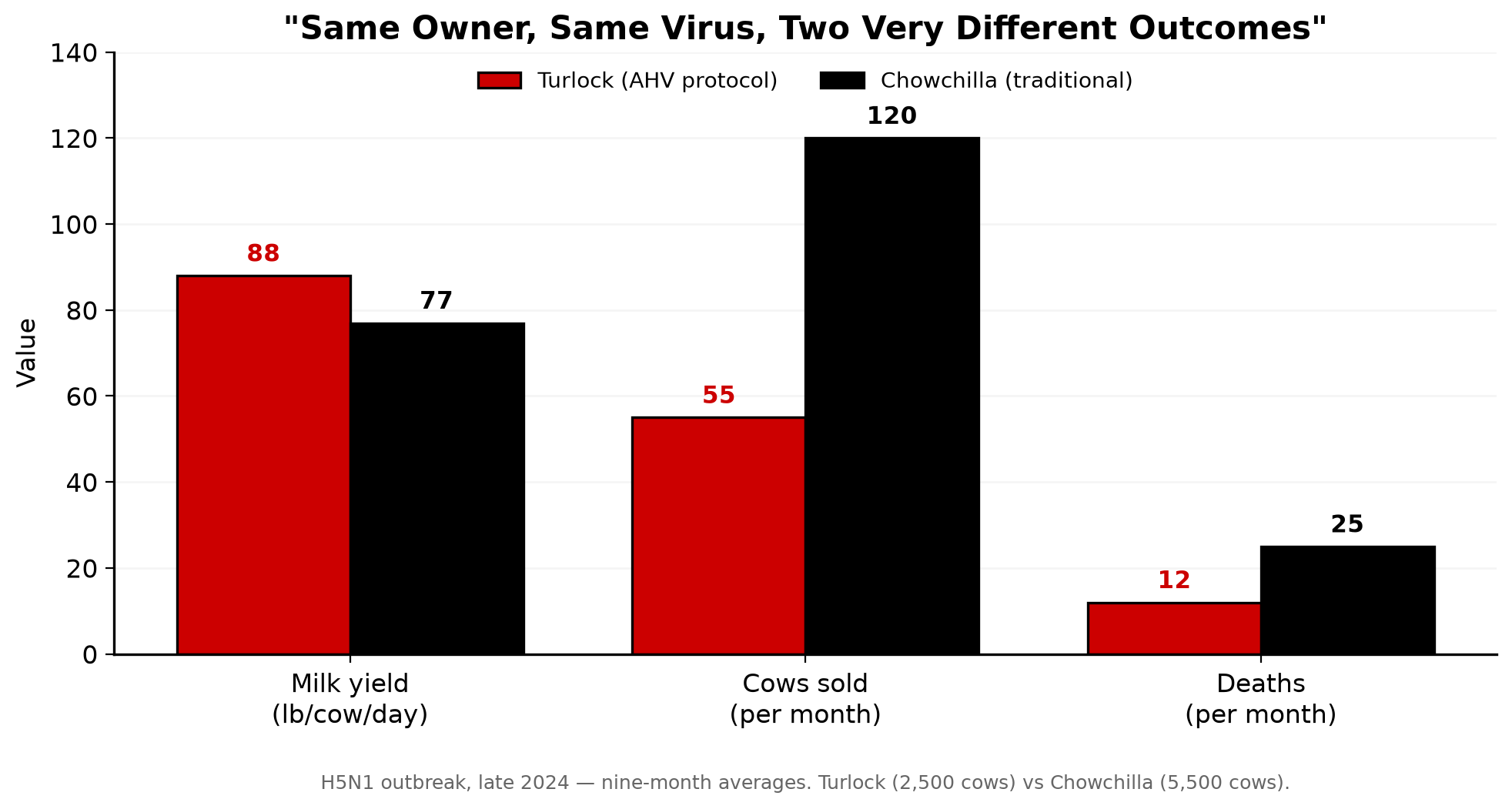
  • Turlock was on AHV protocols: one Booster Bolus and two Aspi Boluses per cow — no drenching, single‑day application with a multi‑bolus gun. Cost: about $54.02 per cow.
  • Chowchilla ran a traditional approach: electrolytes, NSAIDs, and a vitamin B12 injection given via drench over two days. Cost: about $26.71 per cow.

The cheaper protocol looked cheaper on paper until the numbers came back.

Turlock’s cows recovered milk production within days. SCR collar data showed improvement the day after treatment and full recovery by day three. Chowchilla saw months of up‑and‑down production.

Over the nine months after the outbreak:
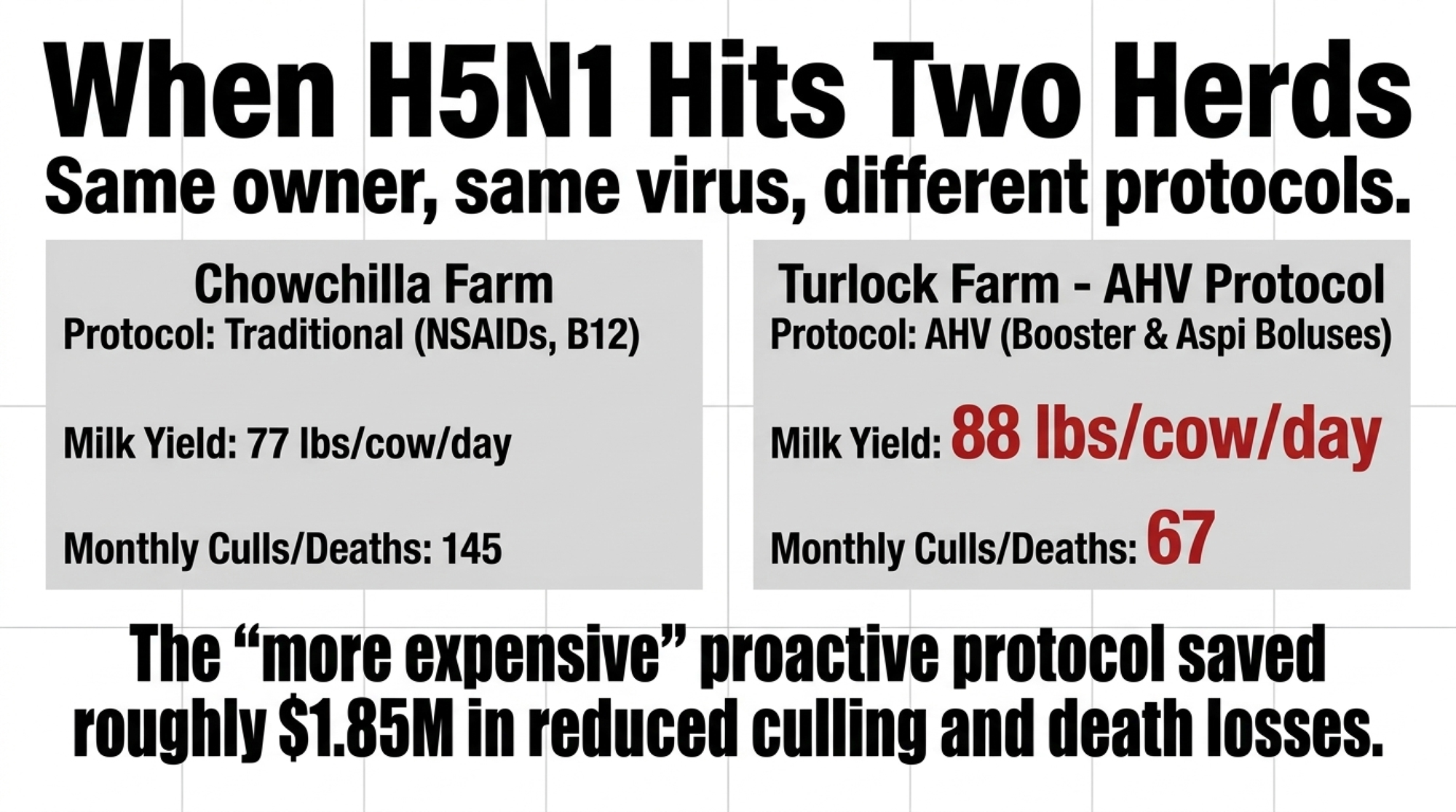
  • Milk yield: Turlock Holsteins averaged about 88 lb/cow/day vs. Chowchilla’s 77 lb/cow/day — an 11 lb/day gap.
  • Culling: Turlock averaged 55 cows sold per month vs. Chowchilla’s 120.
  • Deaths: Turlock averaged 12 deaths per month vs. Chowchilla’s 25.

Using conservative U.S. replacement economics, AHV’s analysis estimates that the Turlock dairy saved roughly $1.5 million in reduced culling costs and about $350,000 in reduced death losses compared to the Chowchilla protocol over that period. And that’s before you add the milk revenue from 11 extra pounds per cow per day, which AHV’s breakdown pegs at about $670,000 per 1,000 Holsteins at a 20¢/lb milk price.

“We were able to bounce back quickly,” Soares says. “The cows didn’t suffer much, and we didn’t lose nearly the amount of milk that a lot of other facilities did.”

It’s not a randomized university trial. But it is two large dairies under the same management, hit by the same virus at the same time, running two different protocols. And the direction of the difference is hard to argue with.

How a Plant-Based Product Can Disrupt an Infection

If you’re skeptical that a bolus based on plant compounds can compete with injectable antibiotics, you’re not alone. Most of us were raised on the idea that you kill bacteria with drugs, or they kill the cow.

Here’s what AHV is actually doing instead.

Bacteria talk to each other. They use chemical signals — quorum sensing — to coordinate when to build biofilms, when to stick to tissue, and when to ramp up toxin production. Individually, they’re not that dangerous. In a coordinated biofilm, they’re hard to treat and hard for the cow’s immune system to clear. That’s why chronic infections feel like they sit there no matter how many times you hit them.

AHV’s QSI (quorum sensing inhibition) products don’t kill the bacteria outright. They use a purified allium‑derived extract to block those communication signals. Independent lab work, including external testing, has shown that AHV’s QSI molecules disrupt virulence in both gram‑positive and gram‑negative bacteria without killing them or creating antimicrobial resistance.

Dr. Geoff Ackaert, AHV’s technical director and global head of ruminants, puts it this way: “If you have a group of nasty people, you blindfold them and make them deaf. They can’t communicate anymore, so they’re immediately harmless. That’s what we do with these little nasty microorganisms — they can’t work as a group anymore.”

Once you’ve broken the communication, the cow’s own immune system — with a little help from supportive products like Aspi — can clean things up. Because the QSI products are classified as specialty feed additives, there’s no milk or meat withdrawal.

The core QSI technology is covered by several patents and has been validated in AHV’s in‑house microbiology, cell culture, and analytical labs, with external collaborations at places like Leiden University and Utrecht University. In the field, it showed up in that longevity study by Herrema and colleagues: 2,161 cows across 22 Dutch farms treated with the AHV concept had 8,653 kg higher lifetime production, a 19.8‑point lower replacement rate, and an estimated 11.1:1 ROI, with revenue per day of life up from €5.87 to €6.37.

Is This Really About Using Fewer Antibiotics?

No fresh‑cow article is honest if it pretends you can toss all your antibiotics. You can’t, and you shouldn’t.

In the 8‑farm trial, plenty of cows still needed intervention. And in a real fresh pen, you’ll always have a handful of train‑wreck cows that need a vet, a bottle, and sometimes a cull truck.

Here’s the honest middle ground the data supports:

  • The metritis and retained‑placenta improvements came from treating every fresh cow proactively — not just reacting to the obviously sick ones.
  • Antibiotics still had a role for true clinical cases.
  • The real economic win wasn’t “never use antibiotics.” It was using fewer of them on fewer cows, and dumping a lot less milk to withdrawal.

AHV’s CEO Jan de Rooy says it this way in internal presentations: antibiotics remain an important tool, but they should be reserved for severe cases; the company’s goal is to keep its use to an absolute minimum. That’s a very different message from “antibiotics are bad.”

Meanwhile, regulators are watching. FDA data show that U.S. sales of medically important antibiotics for food‑producing animals jumped 16% in 2024 after several years of decline, with tetracyclines accounting for 69% of those sales and increasing by 20% year‑over‑year. That’s exactly the kind of chart that gets people in Washington and Brussels asking hard questions.

So this isn’t a moral argument against antibiotics. It’s an economic and regulatory argument for saving them for the cows that actually need them.

What Happens to Your Margin If You Don’t Count Withdrawal Milk?

You’d never sign a milk contract and ignore the component schedule. But a lot of herds effectively do something similar with withdrawal milk. They accept the hospital list, they dump the milk, and they never look at the line where that volume would’ve hit their pay stub.

If your fresh‑cow metritis rate is running north of 5%, your dry‑off program is still built around tubes, and you’re treating a decent chunk of fresh cows with systemic antibiotics, withdrawal milk is one of your biggest invisible cost centers. That’s true whether you’re milking 250 cows or 2,500.

The 8‑farm trial’s $111/cow net and the survival trial’s 70% mortality reduction are company numbers, not independent university trials — yet. But even if you cut those numbers in half, they still point in the same direction: for a lot of commercial herds, fresh‑cow and dry‑off protocols are now a six‑figure annual decision, not a footnote in the vet bill.

What Actually Changes in Your Dry-Off and Fresh Cow Routine?

On paper, protocols can sound like more work. Jaeger thought that at first. Then he realized what was going away.
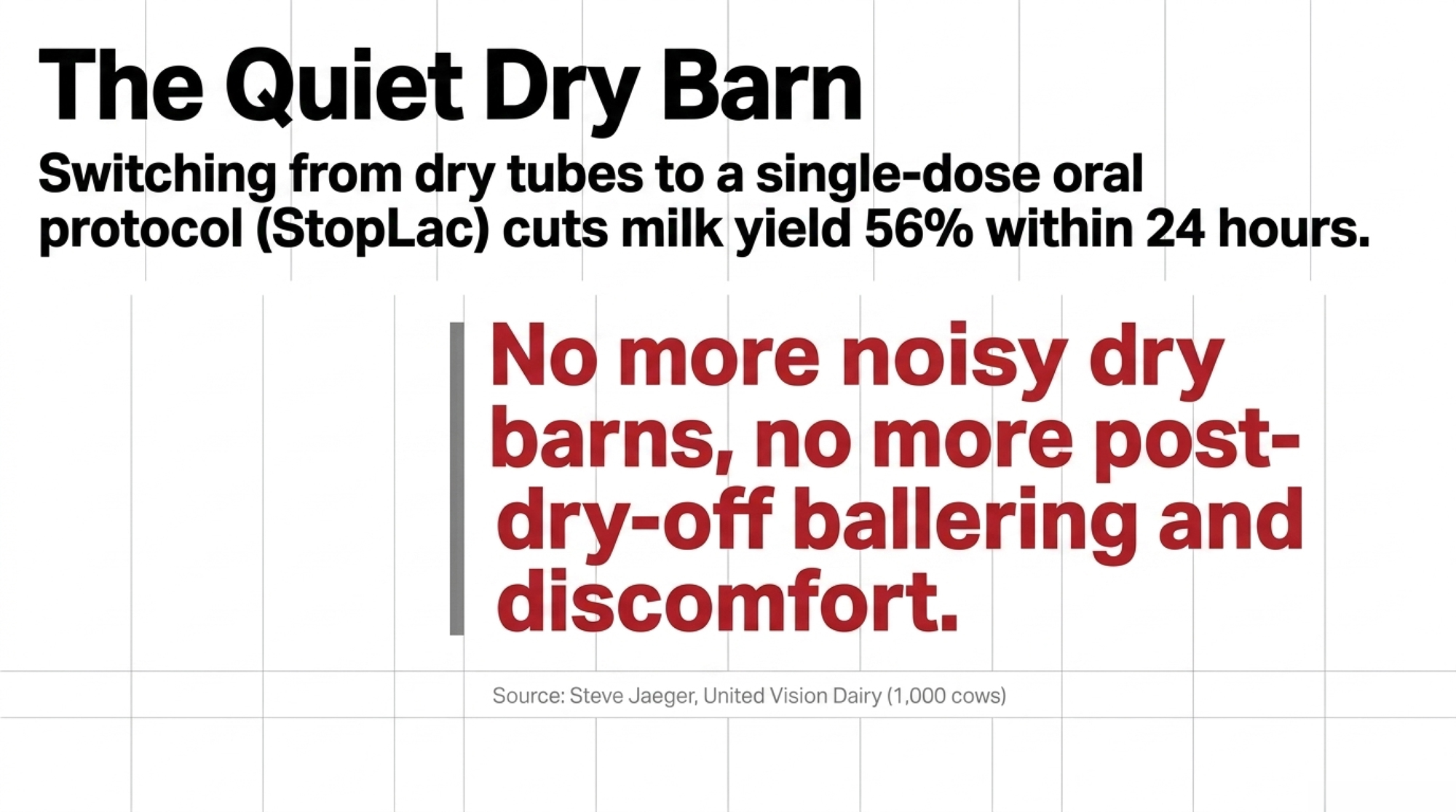
At United Vision Dairy, StopLac replaced dry tubes. Instead of orchestrating a whole team around a tube routine and then listening to cows bawl and kick for days, his crew gives a single oral dose. Utrecht University and AHV’s broader StopLac data show about a 56% reduction in milk yield within 24 hours in treated cows, with no spike in leaks or mastitis when the dry period is managed sensibly; in one Utrecht study, 47 cows dried off with StopLac dropped milk quickly and then returned to normal production with no long‑term udder damage. On Jaeger’s farm, that translated into something you can hear: no more noisy dry barns, no more post‑dry‑off “ballering” and discomfort.

In the field, StopLac has now been used on more than 52,700 cows across 14 countries, with U.S. and German data showing 62–70% reductions in milk leakage and fewer new intramammary infections at calving. Across two U.S. farms (404 cows), abrupt dry‑off with StopLac cut 60‑day death loss almost in half and reduced milk leakage, while maintaining next‑lactation yield with a 3 kg/day advantage over controls.

On the fresh‑cow side, both Jaeger and Gabrielse describe a similar practical shift. Instead of waiting for sick cows and then reacting, every fresh cow gets a bolus protocol at calving. That doesn’t remove all problems — you still have twins that go sideways and the occasional disaster — but it changes your default from “treat the sick ones” to “protect all of them.”

What’s the Smartest Way to Test a New Fresh Cow Protocol on Your Farm?

You don’t have to swallow the entire protocol story in one gulp. If you’re interested but skeptical, the most honest thing you can do is run a clean, on‑farm trial.

The odd‑week/even‑week design from the 8‑farm trial is simple enough for most record systems. Pick a start date and agree that cows calving in odd weeks get the proactive protocol, while even‑week calvings stay on your current program. Then track four things for at least 60–100 days: metritis, retained placentas, antibiotic treatments, and milk per cow at 100 DIM. You can add survival and culling in the first 60 DIM if you want to push it.

Within 30 days, you can at least see if protocol cows are showing up on the sick‑cow list less often and whether you’re dumping fewer pounds of withdrawal milk. By 60–100 days, you can compare milk and repro with enough cows to see whether the pattern lines up with the trial data or not.

How Much Should You Change at Dry-Off Before You Fix the Fresh Pen?

For some herds, dry‑off is the biggest pain point — labor, cow comfort, animal welfare pressure, or tube management — even more than metritis or mastitis. In that case, it can make sense to start there.

If you’re used to tubes, switching to a bolus that drops milk 50‑plus percent in one day feels like a big leap. That’s why many herds start by running StopLac alongside tubes for a few weeks, monitoring for leaks and mastitis, then phasing tubes out as they get comfortable with the results. You still need sound transition nutrition and stocking density in your dry pens; StopLac isn’t a fix for bad diets or overcrowding. But if you can get to quiet dry barns, fewer leaks, and no spike in mastitis, you’ve taken a lot of stress off your cows and your crew.

Sponsored Post

Options and Trade-Offs for Farmers

You don’t have to do everything at once. Here are four realistic paths — and what each one asks of you.

Path 1: Run a controlled on-farm trial this month.

  • When it makes sense: You’re interested but skeptical, or your vet is. You want data from your own cows, not just somebody else’s case study.
  • What it requires: Pick a start date and follow the odd‑week/even‑week design. Odd‑week calvings follow the AHV fresh‑cow protocol; even‑week calvings stay on your current program. Track metritis and RP within 21 DIM, antibiotic use, milk per cow at 100 DIM, and, if you can, culls and deaths in the first 60 DIM.
  • Risks/limits: You need clean records and discipline to avoid “contaminating” the control group. And it takes 60–100 days to see meaningful trends.
  • 30‑day action: Commit to a start date, set up the treatment codes in your software, and agree with your vet on what counts as “metritis,” “retained placenta,” and “fresh‑cow problem” before you start.

Path 2: Start at dry-off and work forward.

  • When it makes sense: Your biggest pain is dry‑off — labor, cow comfort, animal welfare pressure, or tube management — more than metritis or mastitis.
  • What it requires: Replace tubes with StopLac where your vet is comfortable, and monitor cows closely for the first 5–7 days post‑dry‑off. Make sure your transition nutrition and stocking density are in good shape first.
  • Risks/limits: StopLac handles the milk drop; it doesn’t fix a bad transition diet or overcrowded dry pens. You still need to watch for metabolic issues and leaks as you dial it in.
  • Forward signal: If you see quieter barns, fewer leaks, and no uptick in mastitis through the dry period, you’ve earned the right to look harder at fresh‑cow protocols next.

Path 3: Fix your tracking before you change anything.

  • When it makes sense: You can’t easily answer “What’s my metritis rate?” or “How many pounds of milk do I dump to withdrawal every month?” from your current records.
  • What it requires: Build three simple reports: metritis cases within 21 DIM, average hospital days per fresh cow, and total pounds (or liters) of milk tagged as “do not ship” per month.
  • Risks/limits: You’ll probably uncover some uncomfortable numbers. But without them, you’re guessing.
  • Forward signal: Once you know those three numbers, you can run any protocol comparison — AHV or otherwise — like a grown‑up business experiment.

Path 4: Keep your current program — but make it an explicit choice.

  • When it makes sense: Your metritis rate is under 5%, fresh‑cow mortality is under 2%, and your withdrawal milk losses are already tracked and modest.
  • What it requires: Verify those numbers, ideally for the last 12 months, and stress‑test them with your vet or adviser.
  • Risks/limits: The main danger is complacency. If heifer prices keep rising and antibiotic rules tighten, the cost of sticking with “what’s always worked” could change fast.
  • Forward signal: Re‑run your numbers annually. If you see metritis or early culls creeping up, or if your heifer pipeline tightens, revisit the other three paths.
Key Takeaways

  • If your fresh‑cow metritis rate is above 5% and you don’t know how much milk you’re dumping to withdrawal, you’re guessing on one of your biggest controllable cost centers. Pull those numbers over the next 30 days and treat them like components.
  • If you’re paying $2,900–$4,100 for replacement heifers, any protocol that cuts 60‑day mortality by even half of the 70% shown in the 2,703‑cow survival trial will pay for itself in avoided replacements alone. Don’t shrug off death loss at those prices.
  • If your main concern is the strength of the evidence, treat AHV’s 8‑farm trial and survival study as what they are: large company‑run datasets pointing in a clear direction, backed by a peer‑reviewed longevity paper and an ongoing SARE/Texas A&M project. Then run your own odd‑week/even‑week trial to see if your herd lines up.
  • If you’re not ready to switch protocols across the board, start where your pain is loudest — dry‑off stress, fresh‑pen chaos, or the hospital list — and use that as your test area. You don’t have to do everything at once to learn something real.

Steve Jaeger didn’t tackle any of this with a whiteboard full of equations. He started with a barn full of cows that calved and cleaned on their own, a dry barn that went from loud to quiet, and a mailbox that started seeing more premium checks than cull checks. The eight‑farm trial and the survival and bird‑flu numbers say his experience isn’t a fluke.

Complete references and supporting documentation are available upon request by contacting the editorial team at editor@thebullvine.com.

Learn More

The Sunday Read Dairy Professionals Don’t Skip.

Every week, thousands of producers, breeders, and industry insiders open Bullvine Weekly for genetics insights, market shifts, and profit strategies they won’t find anywhere else. One email. Five minutes. Smarter decisions all week.
NewsSubscribe
First
Last
Consent

Henry Yoder’s $3,447‑Per‑Cow Mastitis Wake‑Up Call: From 10–12 Cows Out of the Tank to 5–6 on His 1,100‑Cow Wisconsin Dairy

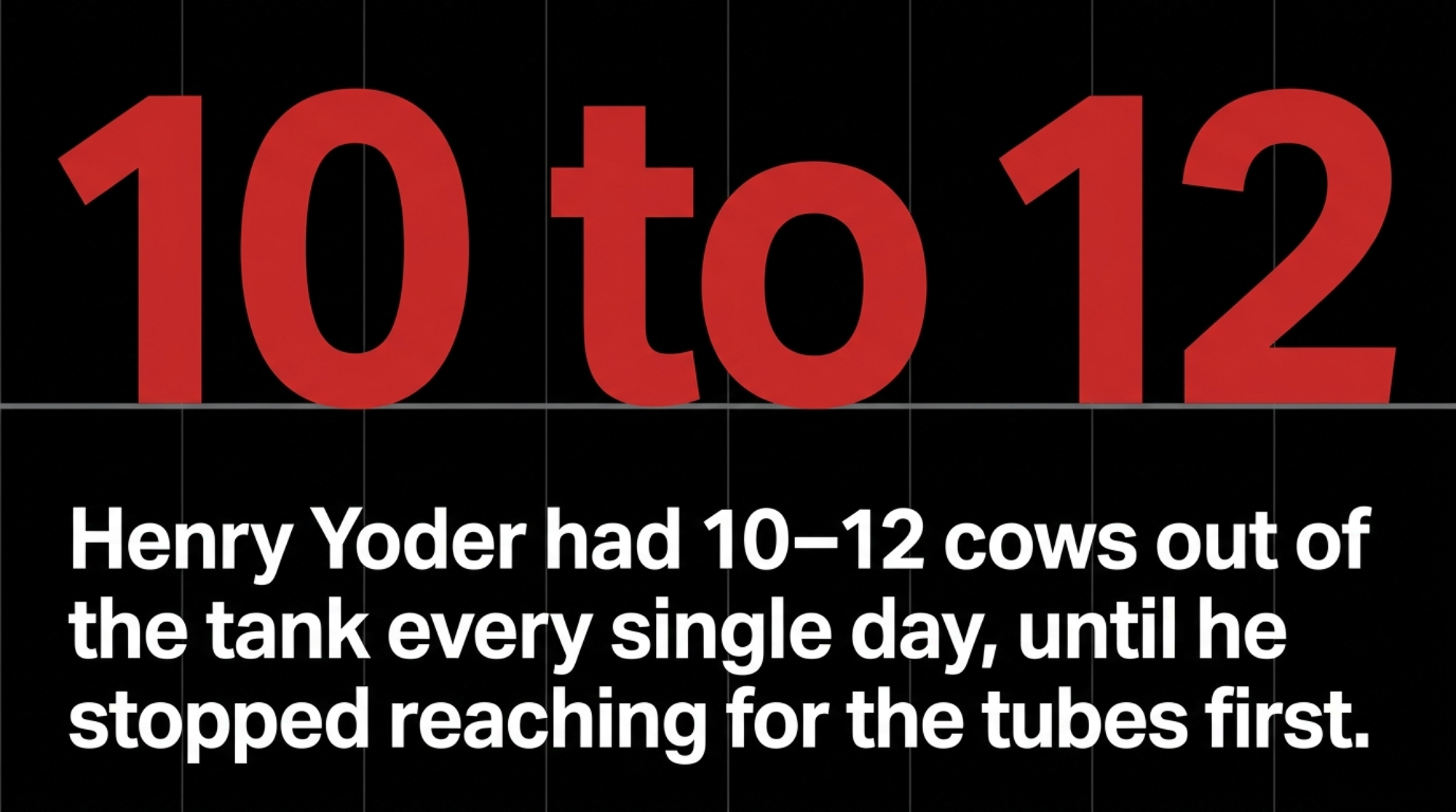
Henry Yoder had 10–12 cows out of the tank every single day. Same barns, same crew, same seven‑day treatments on repeat. Then he stopped reaching for the tubes first.

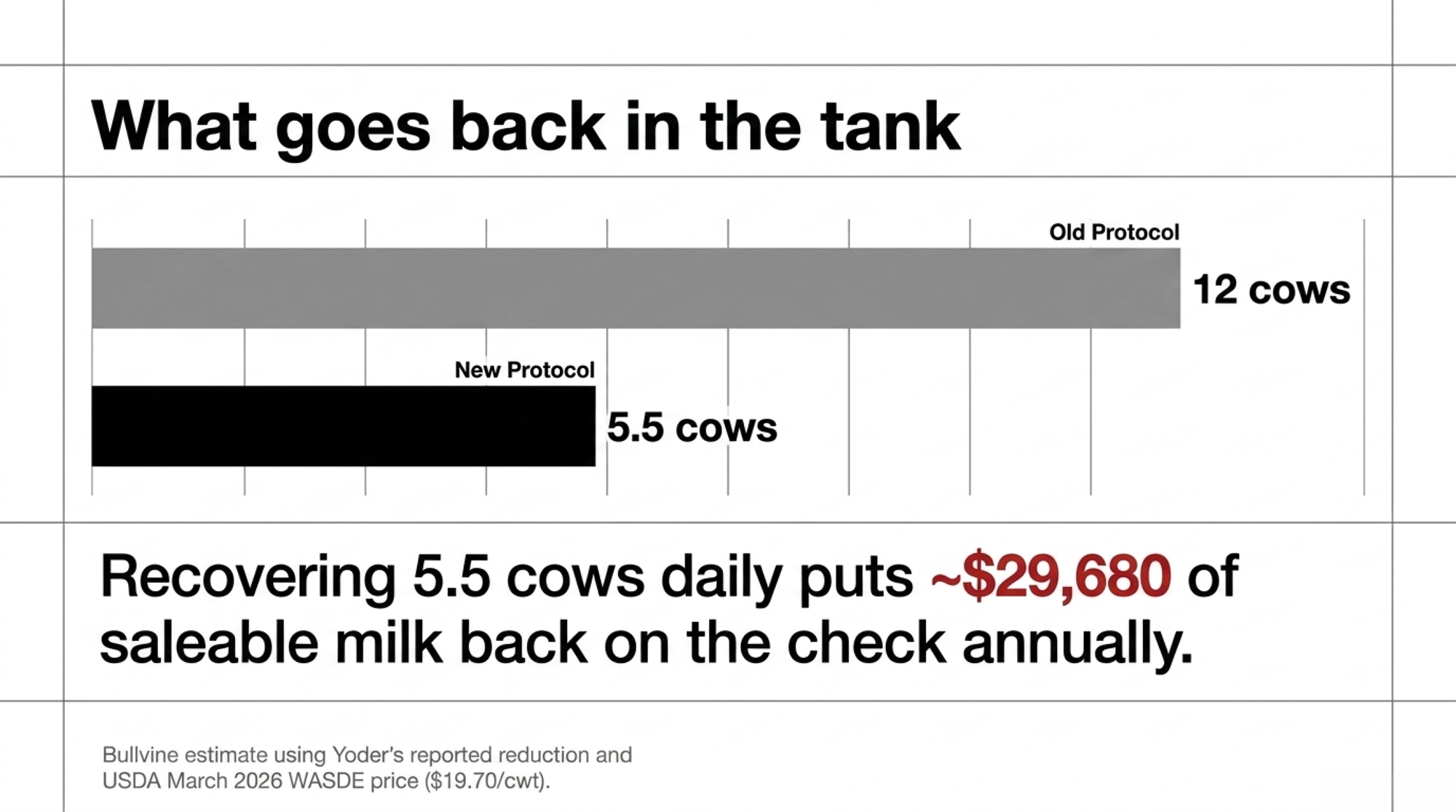
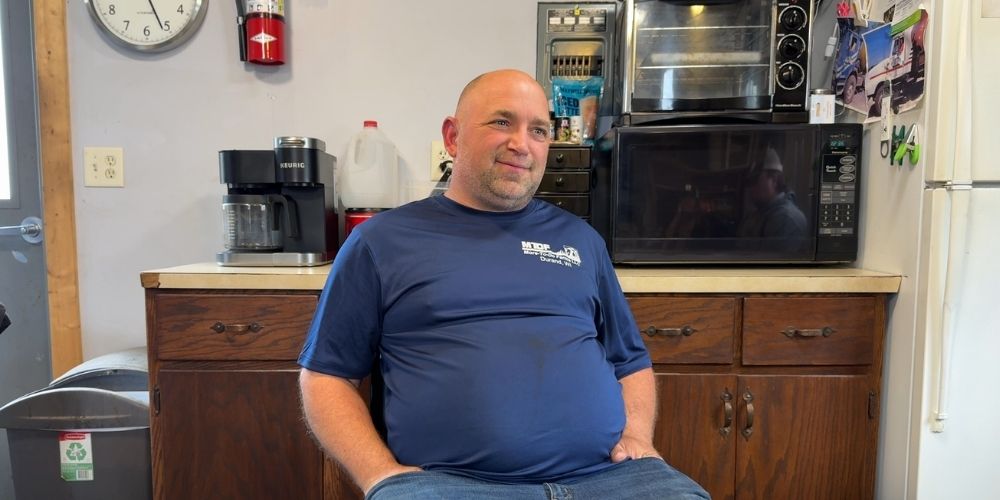
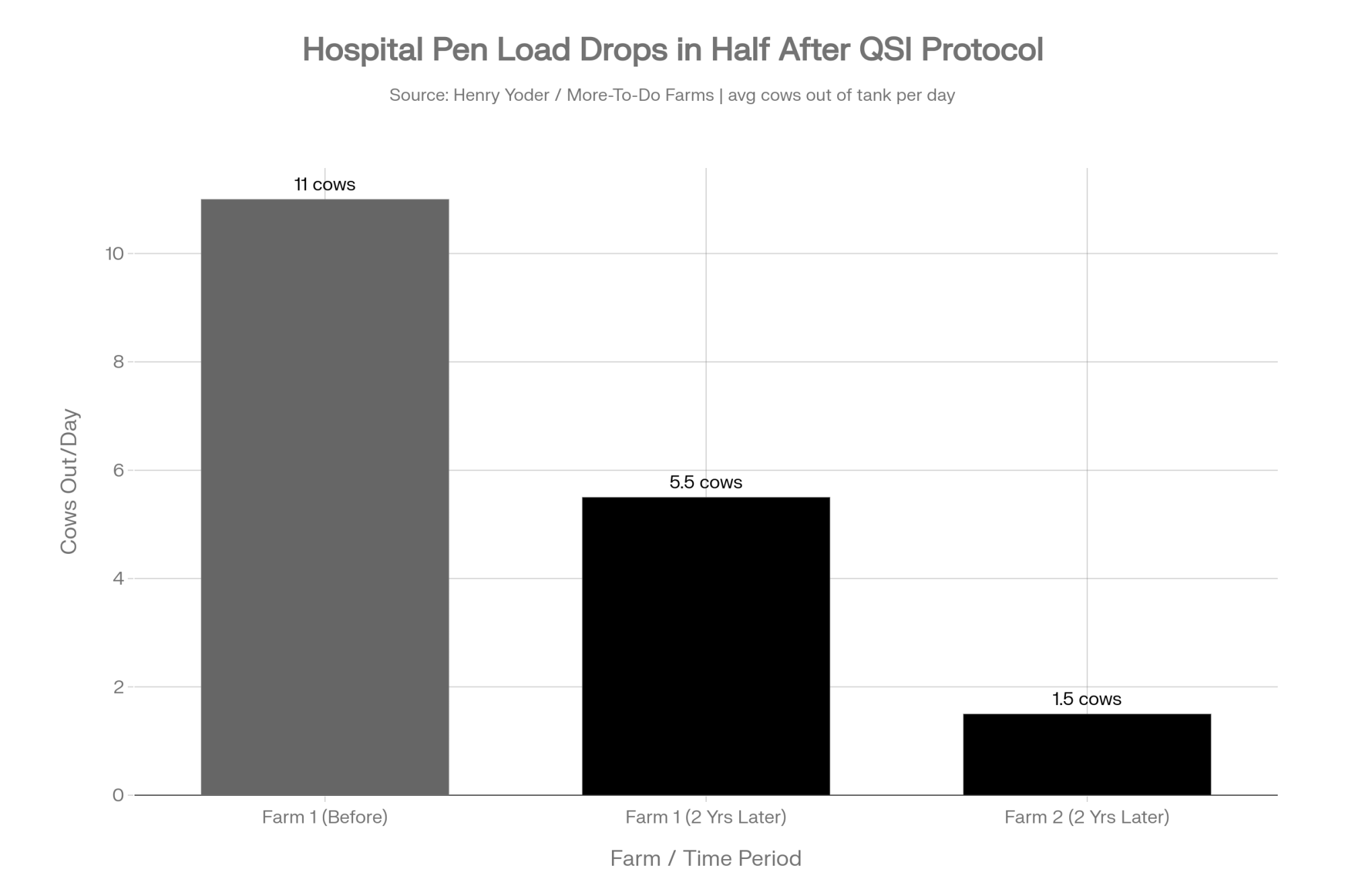
Henry Yoder of More‑To‑Do Farms in Durand, Wisconsin — the herd manager whose 1,100‑cow Holstein operation cut mastitis treatments 50–75% and dropped daily hospital cows from 10–12 down to 5–6 by putting biofilm‑first protocols in front of the antibiotic cabinet.

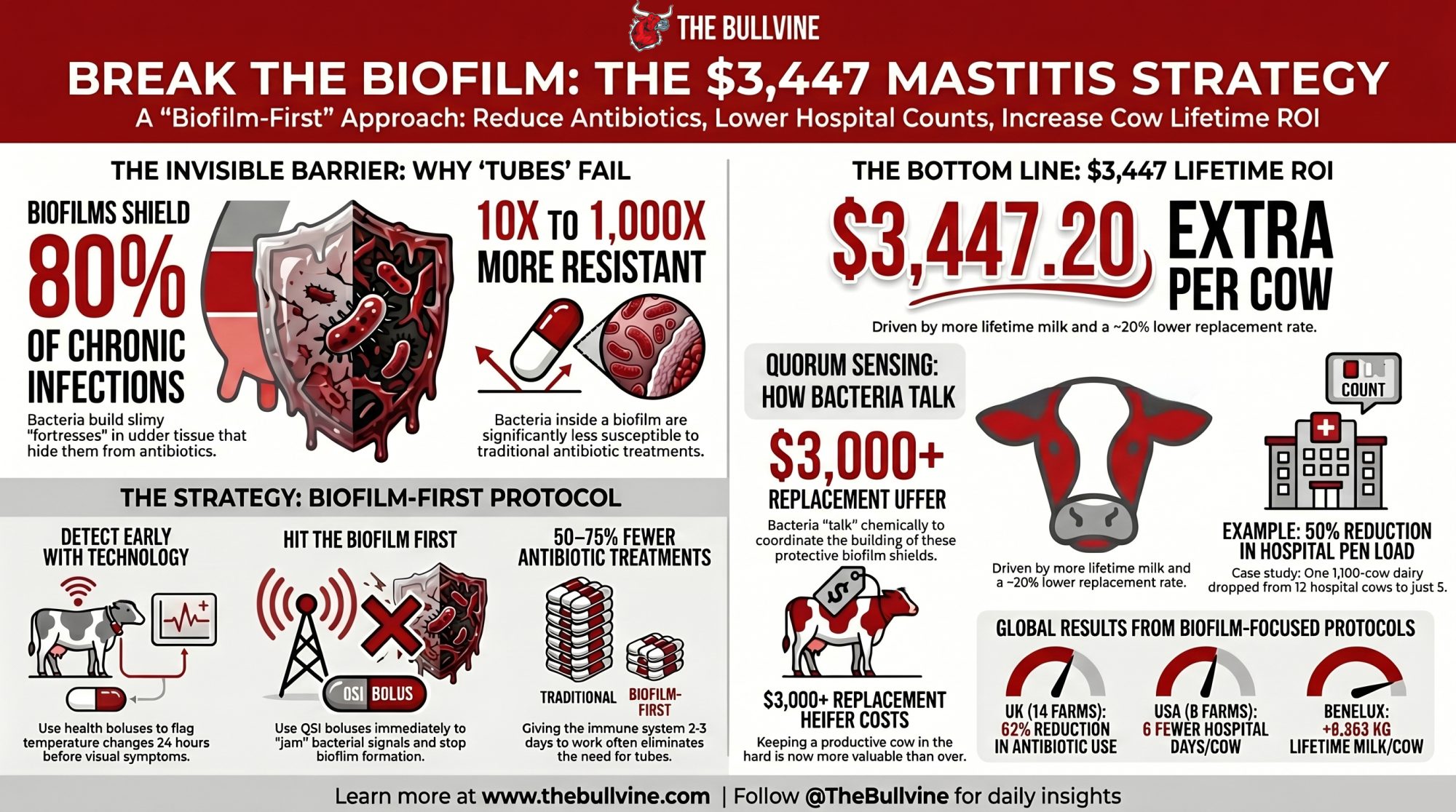
When Henry Yoder looked at his treatment logs for More‑To‑Do Farms’ 1,100 Holsteins in Wisconsin, he didn’t see a mastitis “program.” He saw the same cows cycling through seven‑day antibiotic treatments, over and over, with 10–12 cows out of the tank every single day. That’s a lot of milk in the hospital pen instead of on the milk check.

Two years later, Henry’s numbers look very different. Mastitis treatments are down 50–75%, hospital cows dropped to 5–6 a day, treatment duration shrank from seven days to two or three, and one barn has held bulk tank SCC under 100,000 for two straight months — on sawdust, not sand.

This isn’t a story about a magic new tube. It’s about changing what you aim at: biofilm‑protected udder infections that antibiotics alone were never designed to solve, and a different way to think about mastitis economics when replacement heifers are sitting around $3,000 a head.

What Changed on Henry’s Farm — And Why It Matters

Henry manages two Holstein dairies under the More‑To‑Do Farms umbrella in Wisconsin — about 1,150 milking and dry cows across two milking sites, plus roughly 650 head of heifers raised by a custom grower. The business was founded by Doug Knoepke in 1978 and has grown into a seven‑site operation united by a simple mission: “Passionate with Integrity and Ingenuity, for Our People, Our Cows, and Our Land.”

On paper, Henry’s herd looked solid. Cows were monitored with smaXtec boluses, which flag health problems via changes in internal temperature and rumination, roughly 24 hours before your milkers would spot them. His crew was steady. Stalls were clean. Milk was headed to Grassland for butter starting January 15, so every pound counted.

But the mastitis log told a different story. Cows were getting seven‑day courses of Spectrum SLC, clearing up, then flaring again a month later with the same quarter hot and the same cow back in red bands. Across the two dairies, they still averaged 10–12 cows out of the tank every day. 

“We are not here to milk a cow for three years. We want long‑term cows that are going to be here for 10 years.” — Henry Yoder.

So Henry did something uncomfortable: he changed the order of operations. Instead of reaching for antibiotics first, he put AHV’s quorum sensing inhibition (QSI) boluses in front of the drug cabinet and let smaXtec call the shots on which cows to touch.

What’s Really Driving These Chronic Mastitis Cases?

You already know the basics. When bacteria first hit an udder, they’re floating free — planktonic — and that’s where your intramammary tubes do their best work.

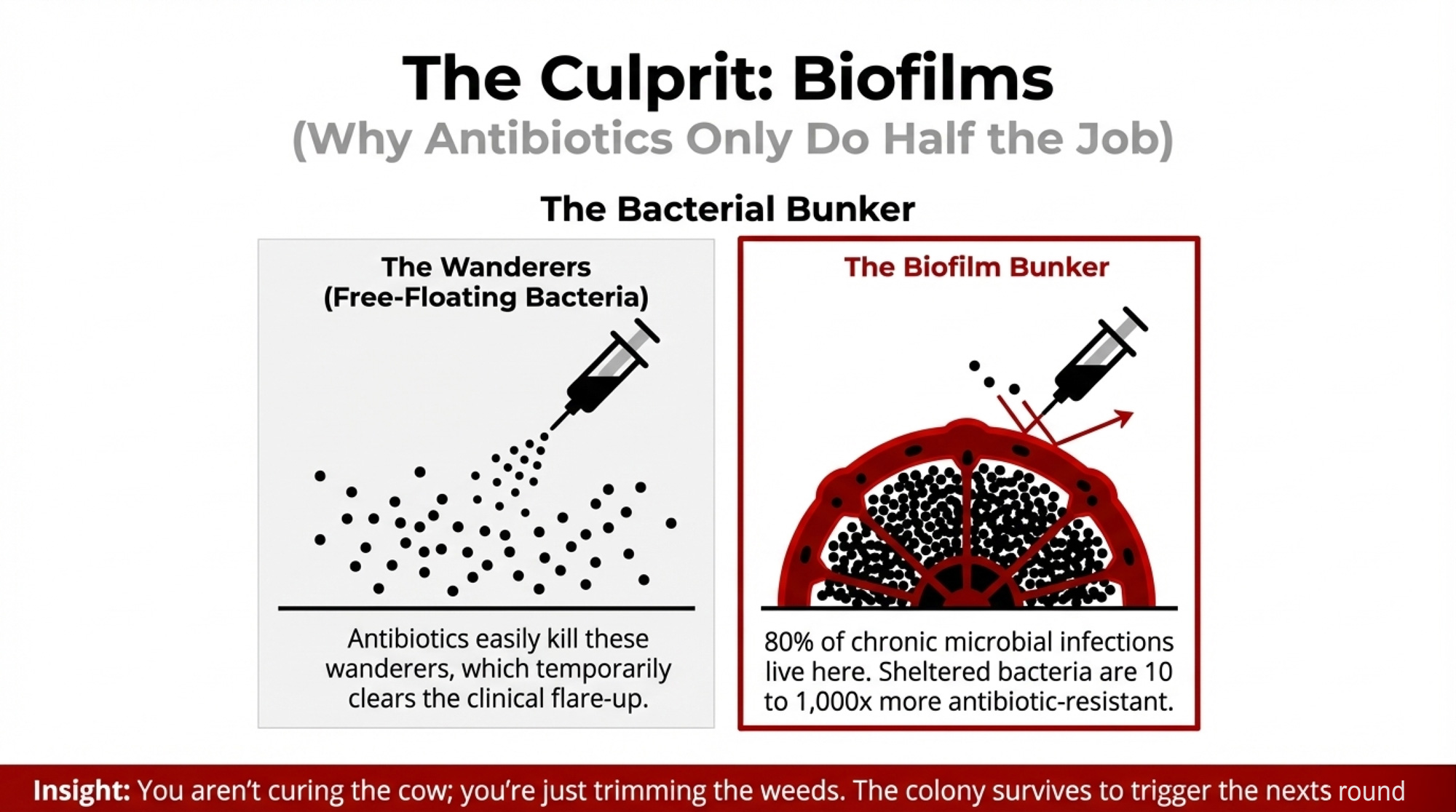
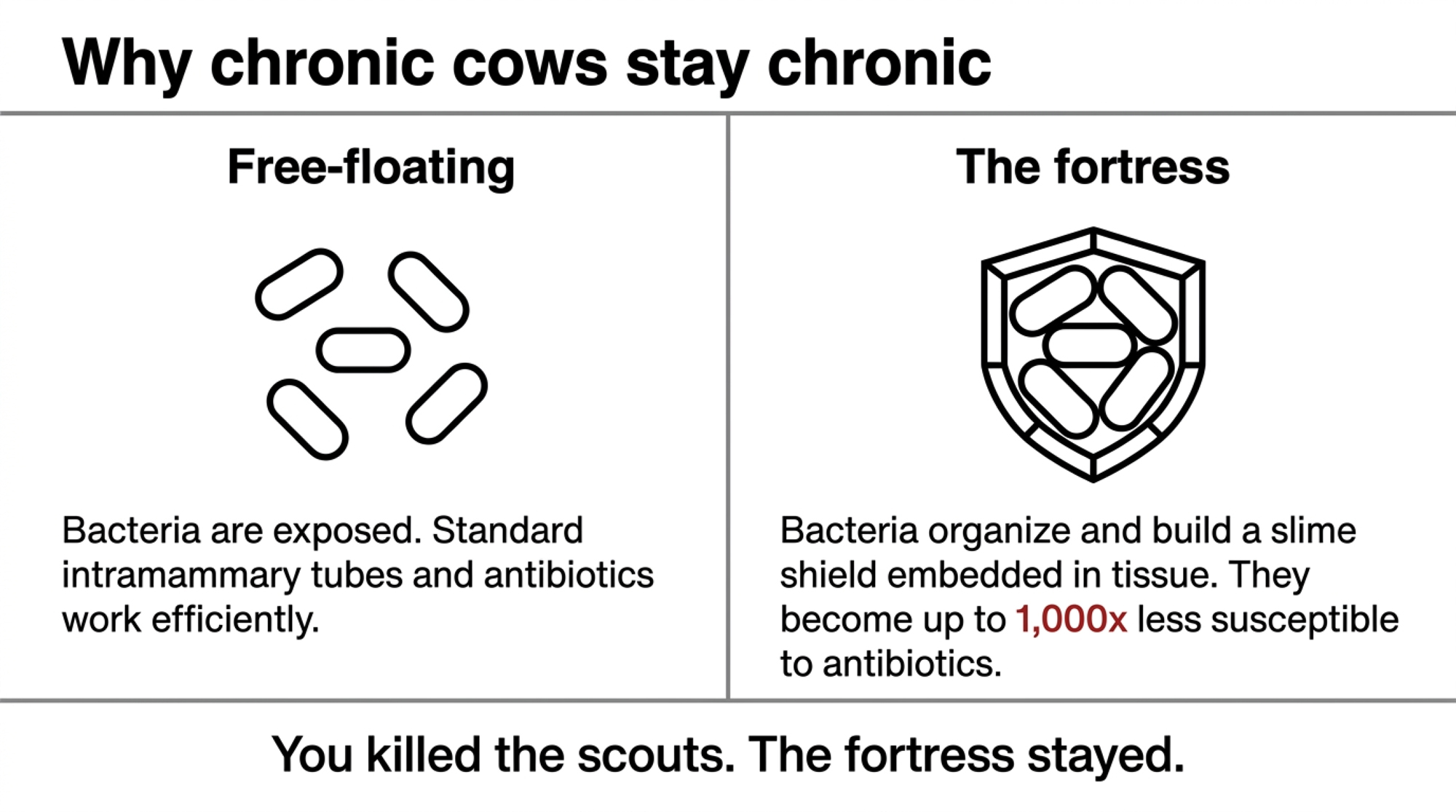
Trouble starts when those bacteria get organized. Through quorum sensing, they “talk” to each other chemically. When enough of them are present, they build a biofilm: a slimy, protective fortress embedded in udder tissue that shields them from immune cells and antibiotics.

Here’s the ugly part:

  • Bacteria inside a biofilm can be 10–1,000 times less susceptible to antibiotics than the same strain floating free.
  • Biofilms are involved in roughly 80% of chronic and recurrent infections in people and animals.

So when you treat that high‑SCC cow and she looks good for a month, then blows up again after calving or a pen move, it’s not always “treatment failure.” Often, it’s biofilm success. You killed the scouts. The fortress stayed.

Henry saw it in his own barn: “If you use a certain drug for years and years and years, they’ve got to build some resistance to it. … With Spectrum, all of a sudden you’re treating her three times in a lactation.” With the AHV protocol, he says, “there are very few cows that we treat with Spectrum twice in their lactation.”

That’s the pattern this QSI approach is trying to break.

How Does Quorum Sensing Inhibition Fit In?

AHV’s whole play is built around quorum‑sensing inhibition — essentially jamming the communication channelsbacteria use to organize and form biofilms.

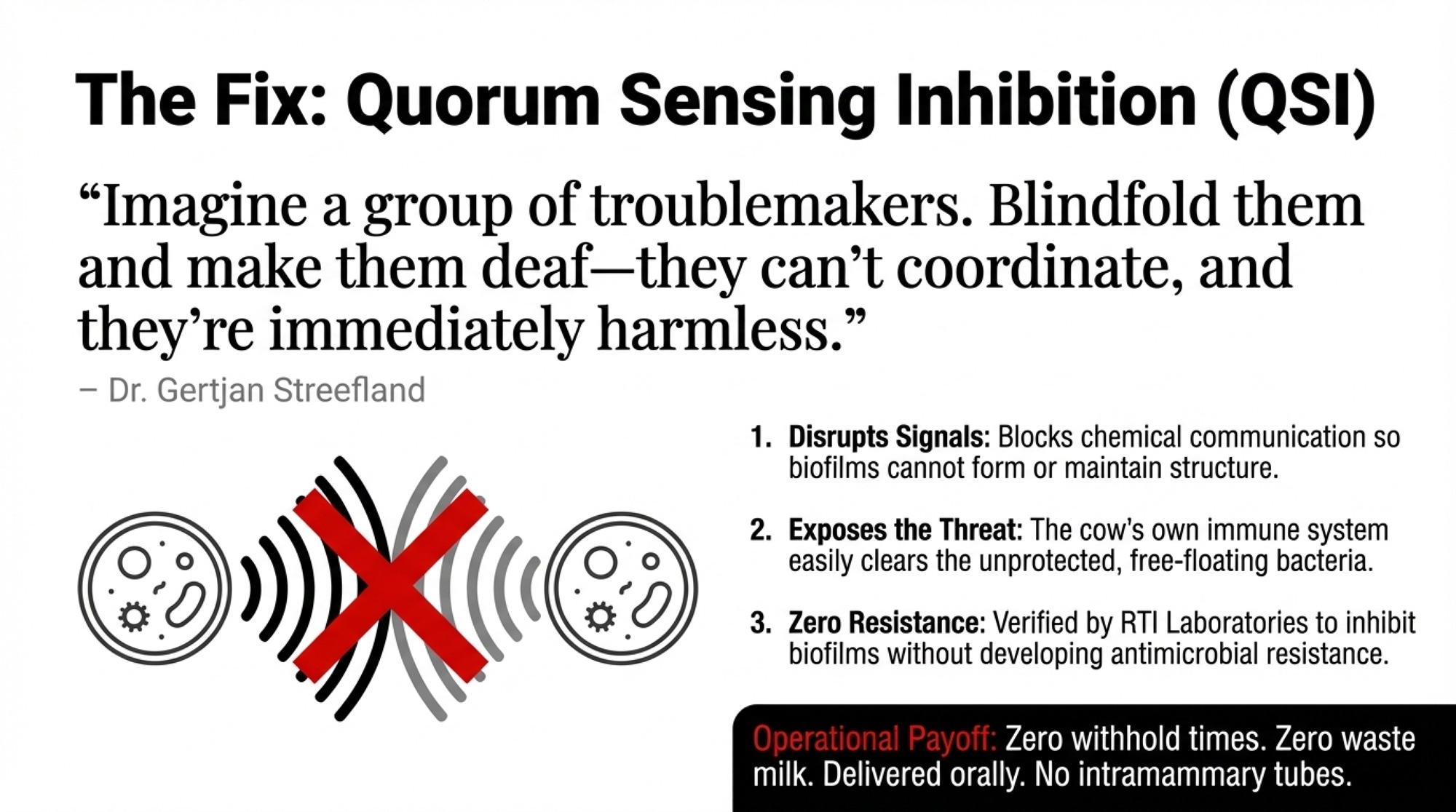
Instead of trying to force more antibiotics through the fortress, AHV’s boluses use plant‑derived compounds to disrupt bacterial signaling. Knock out communication, and bacteria can’t coordinate biofilm formation or switch on their virulence genes. They stay exposed, and the cow’s immune system has a fair shot again.

Dr. Gertjan Streefland, AHV’s founder and chief science officer, puts it in barn‑language:

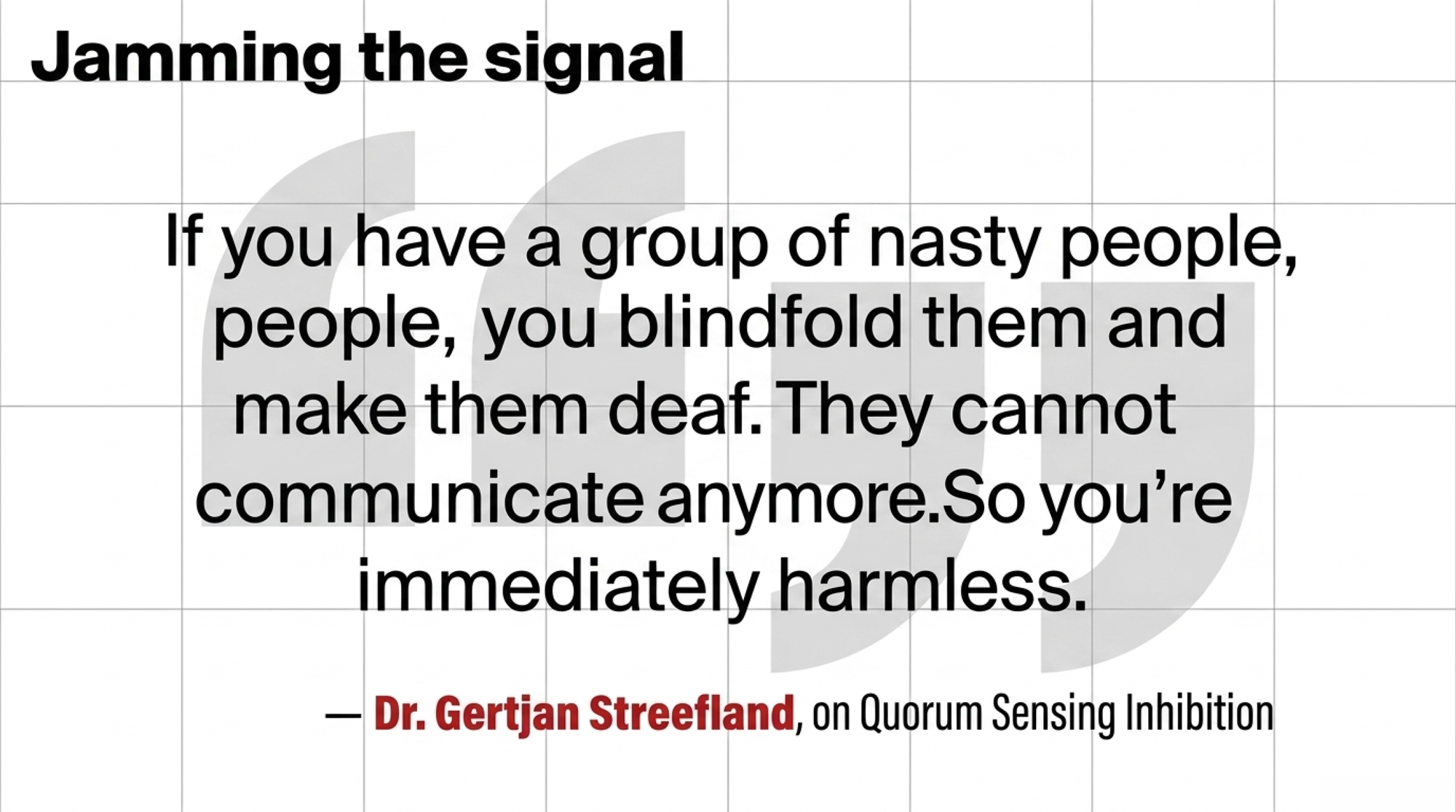
“If you have a group of nasty people, you blindfold them and make them deaf. They cannot communicate anymore. So you’re immediately harmless.”

External RTI lab work backs up the lab‑side claims: AHV’s patented compounds inhibit biofilm formation in field bacteria from both gram‑positive and gram‑negative species, with no resistance development detected in their tests. Because you’re not killing bacteria directly — you’re disabling their communication — there’s less selective pressure for resistance.

That’s the science layer. The question is whether it actually moves the needle in real barns like yours.

What Did Henry Actually Change Day‑to‑Day?

Henry didn’t throw out antibiotics. He just stopped letting them be the first move every time a cow blipped.

Here’s his current play on mastitis‑type alerts:

  • Step 1: Let the tech holler first. smaXtec flags a health problem — usually a temperature or rumination change — often a full day before anyone in the parlor would have noticed.
  • Step 2: Hit biofilms first. The flagged cow gets an AHV Quick bolus right away, followed by Aspi. That’s the first line of defense now, not the last.
  • Step 3: Wait 2–3 days. They give the cow’s immune system time to work with the bolus. If she clears, they never open the antibiotic drawer. If she doesn’t, then they treat — but it’s the exception, not the rule.

“Before, they were treating these cows for seven days,” Henry says. “All of a sudden, they were treating these cows for two to three days, and then back in the tank. Then we put the protocol in that they’re going to wait two to three days after the pill before we start treating. After that, all of a sudden, we hardly had any treated cows.”

He still leans on the broader udder‑health protocol — Quick, Extra, Aspi, and Booster — around high‑risk windows like dry‑off and the first weeks fresh. But the everyday story is simple: detect early, hit biofilms first, only reach for tubes if you still need them.

There’s also a human piece. “Nobody likes treating the cow,” Henry says. “Anytime we don’t have to treat a cow and put red bands on it, it is a positive thing.” More‑To‑Do doesn’t run a separate sick‑cow pen, so fewer treated cows also mean fewer chances for withheld milk to sneak into the tank.

StepOld Protocol (Antibiotic-First)New Protocol (Biofilm-First)Why It Changed
Detection triggerMilker spots clinical signs in parlorsmaXtec temp/rumination alert ~24 hrs earlyEarlier catch = smaller biofilm load
First intervention7-day Spectrum SLC intramammary courseAHV Quick bolus + Aspi immediatelyTarget biofilm communication, not just planktonic bacteria
Wait windowTreat continuously for 7 daysWait 2–3 days; let immune system workAntibiotic decision made after biology has a chance
Antibiotic decisionDefault YES on day 1Only if cow doesn’t turn corner by day 3Exceptions, not the rule
Avg treatment duration7 days2–3 daysFewer withhold days, less labor
Retreatment rateSame cow, same quarter, multiple times/lactationRare second treatment per lactationBiofilm disruption reduces cycling
Cows out of tank10–12/day5–6/day (Farm 1); 1.5/day (Farm 2)Hospital pen nearly eliminated on Farm 2
Milk dumped riskHigh (red bands on multiple cows daily)Low (red band cows are an exception)Fewer chances for a missed band to dump a tank

Micro Barn Math: What Did That Change Put Back in the Tank?

Let’s run Henry’s numbers with today’s price deck so you can map it to your own herd.

USDA’s March 2026 WASDE pegs the 2026 all‑milk price at $19.70/cwt, down about $1.47 from 2025’s revised average of $21.17.

On Henry’s first farm, he went from 10–12 cows out of the tank daily to 5–6 cows. Call it 5.5 cows recovered on an average day.

Assume:

  • 75 lbs/day per cow.
  • At $19.70/cwt, that’s $0.197 per lb.
  • Each recovered cow puts 75 × $0.197 ≈ $14.78/day back into saleable milk.
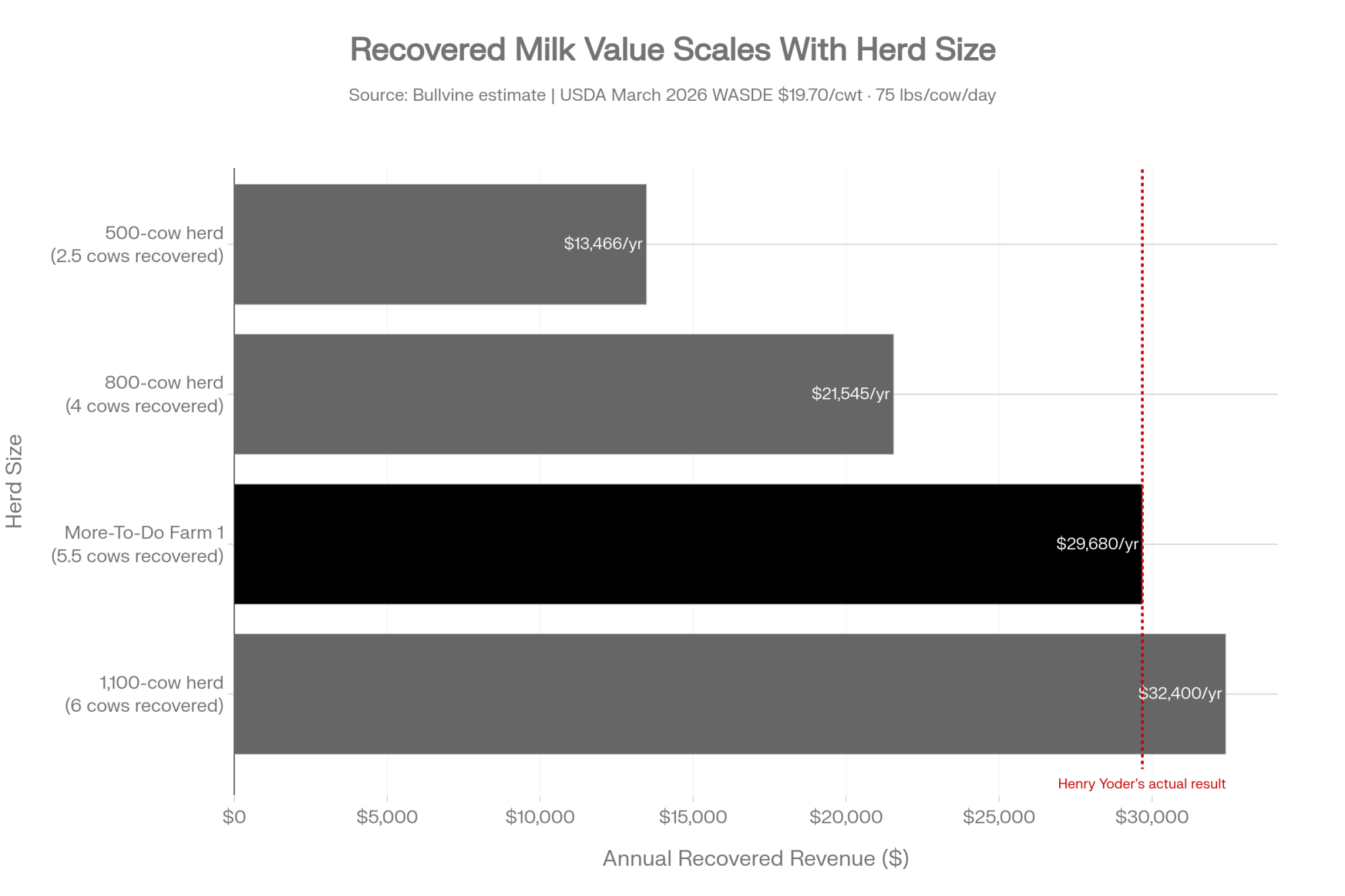
  • Over a year: 5.5 cows × $14.78 × 365 ≈ $29,680 of milk that used to live in the hospital pen. (Bullvine estimate using Henry’s reported reduction and USDA March 2026 WASDE price.)

That’s just the recovered milk, not counting fewer tubes, less labor catching treated cows, or the risk of dumping a whole tank if someone misses a leg band.

On Henry’s second site — 570 cows — he’s averaging just 1.5 cows out of the tank on a given day. That’s less than 0.3% of the herd. He actually has to pull some high‑SCC cows from the tank to have enough whole milk to feed calves — a problem you don’t hear often.

Now scale that down. If you’re a 500‑cow herd with, say, 5 cows out of the tank most days, and you cut that in half, you’re recovering roughly:

  • 2.5 cows × $14.78/day × 365 ≈ $13,500/year in milk alone.

You can plug in your own pounds and price, but the shape of the math won’t change much.

How Big Is the Mastitis Hole in Your Own Budget?

You already know mastitis isn’t cheap. But putting some numbers around it helps you decide whether a protocol shift is worth the fight.

A few benchmarks:

  • Bovine mastitis is estimated to cost the global dairy sector up to $35 billion a year.
  • Dr. Pam Ruegg’s work on 37 Wisconsin dairies (averaging ~1,300 cows) found per‑case clinical mastitis treatment costs ranging from $120 to $330 for essentially the same disease, depending on how the farm managed days treated and drug choices.
  • In that same dataset, 83% of farms treated clinical mastitis longer than the label allows — meaning a big chunk of cost was self‑inflicted.

Now overlay today’s replacement math.

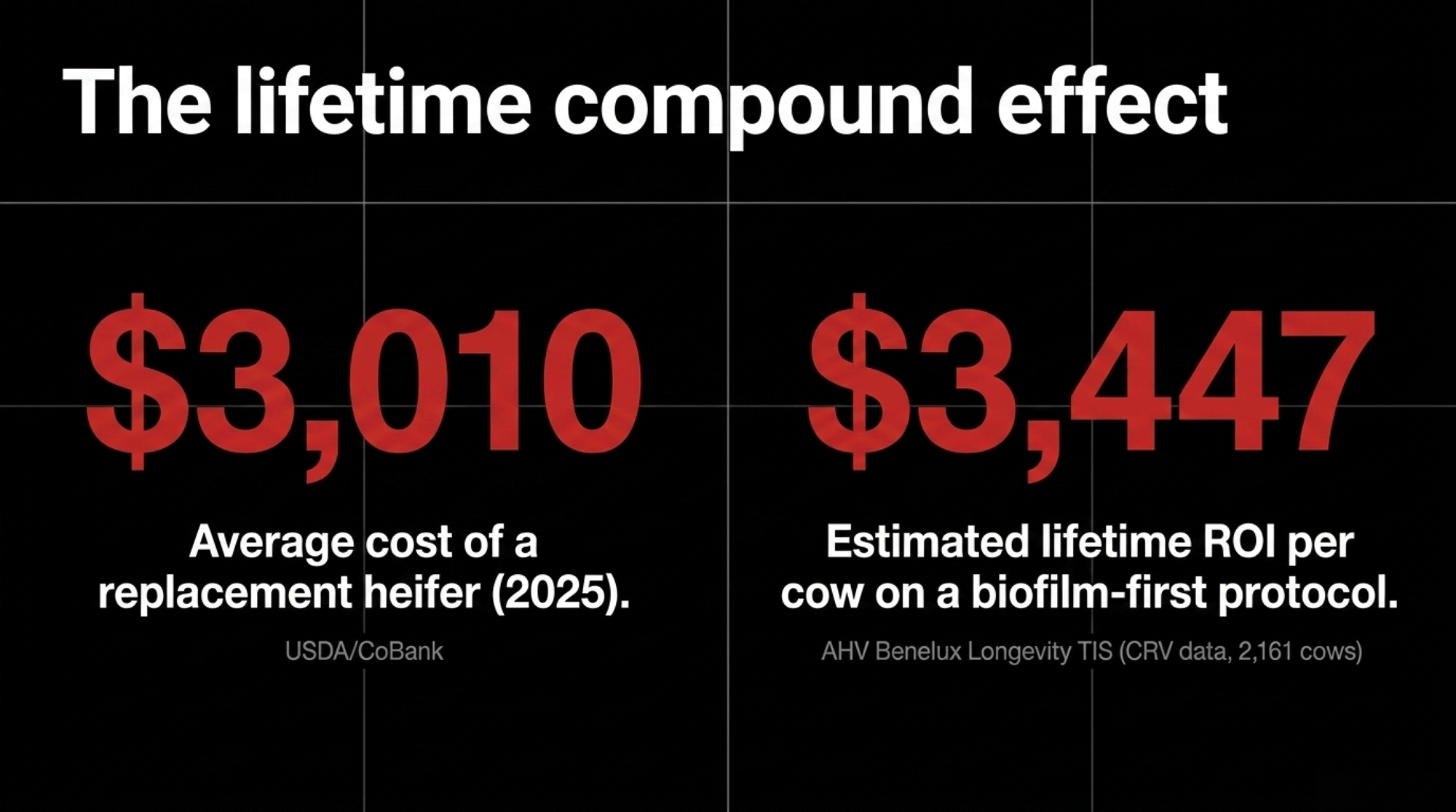
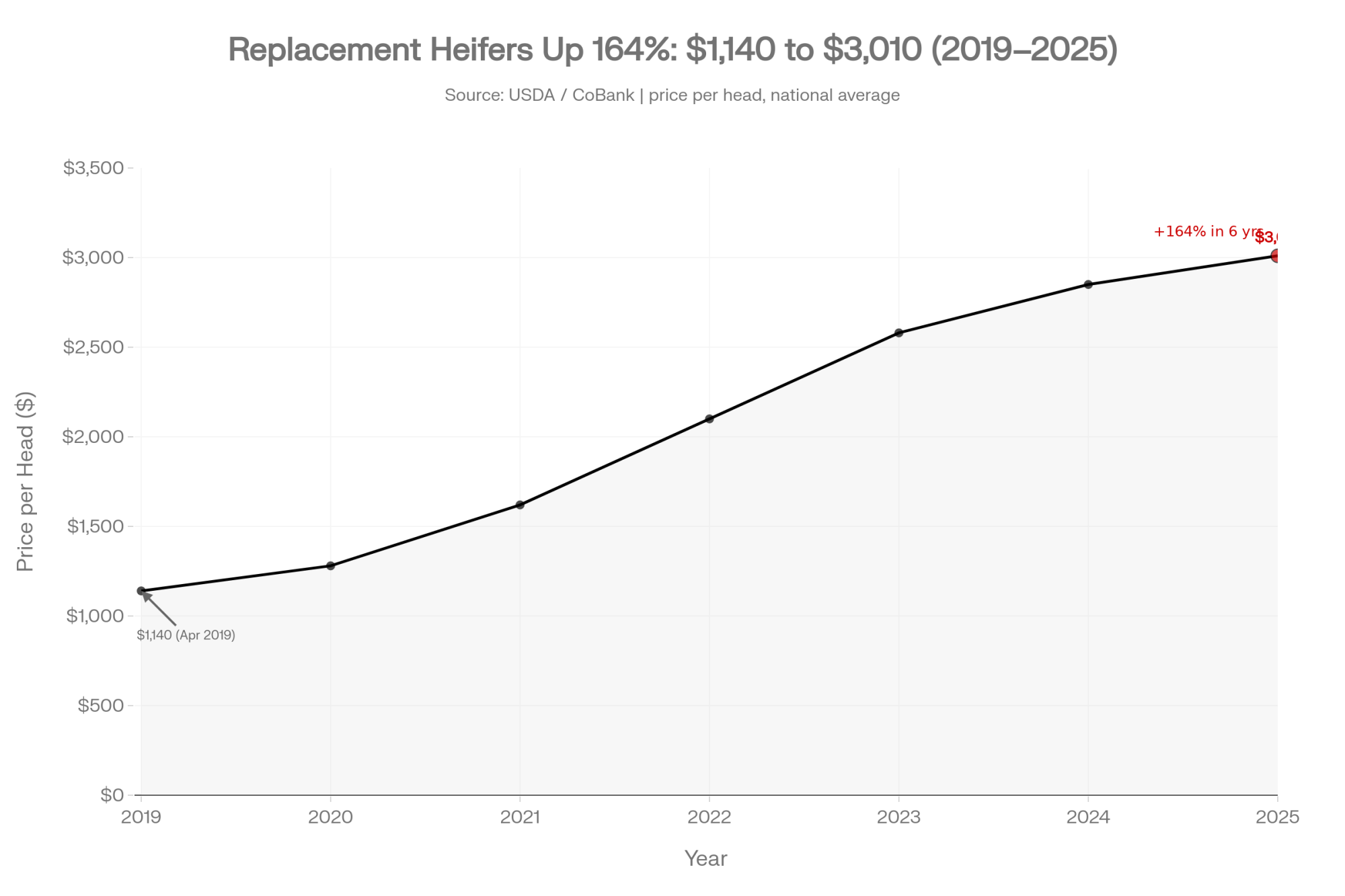
USDA and CoBank data show replacement heifers hitting about $3,010 per head in July 2025 — up roughly 164%from around $1,140 in April 2019. Later USDA estimates pushed that as high as $3,110 in late 2025 before backing off slightly, but top heifers in some regions still clear well above that.

According to AHV’s Benelux Longevity TIS, a multi‑farm dataset of 2,161 cows built on CRV records, the protocol works out to a lifetime ROI of $3,447.20 per cow, tied to:

  • 8,653 kg more lifetime milk per cow.
  • About €0.44 more revenue per day of life.
  • 19.8% lower replacement rate compared to Dutch CRV averages.

That’s not Henry’s own ROI sheet; it’s a multi‑farm European dataset. But it tells you this much: if you can safely keep cows productive longer and keep them out of the hospital pen, the compound economics are very real.

Can Other Farms Really Reproduce What Henry Is Seeing?

No two herds are the same. But Henry isn’t the only one seeing this kind of shift. AHV’s trial and field data, plus farm stories from different regions, point in the same general direction: less antibiotic use, fewer repeats, and more years on good cows.

Here’s what’s been measured so far:

RegionFarms / CowsKey ResultsSource & Timing
UK14 farms, 2,774 cows62% less antibiotic use for mastitis, 42% fewer clinical cases+29.3% 1st‑service conceptionAHV HHP Progress, 2023–2024
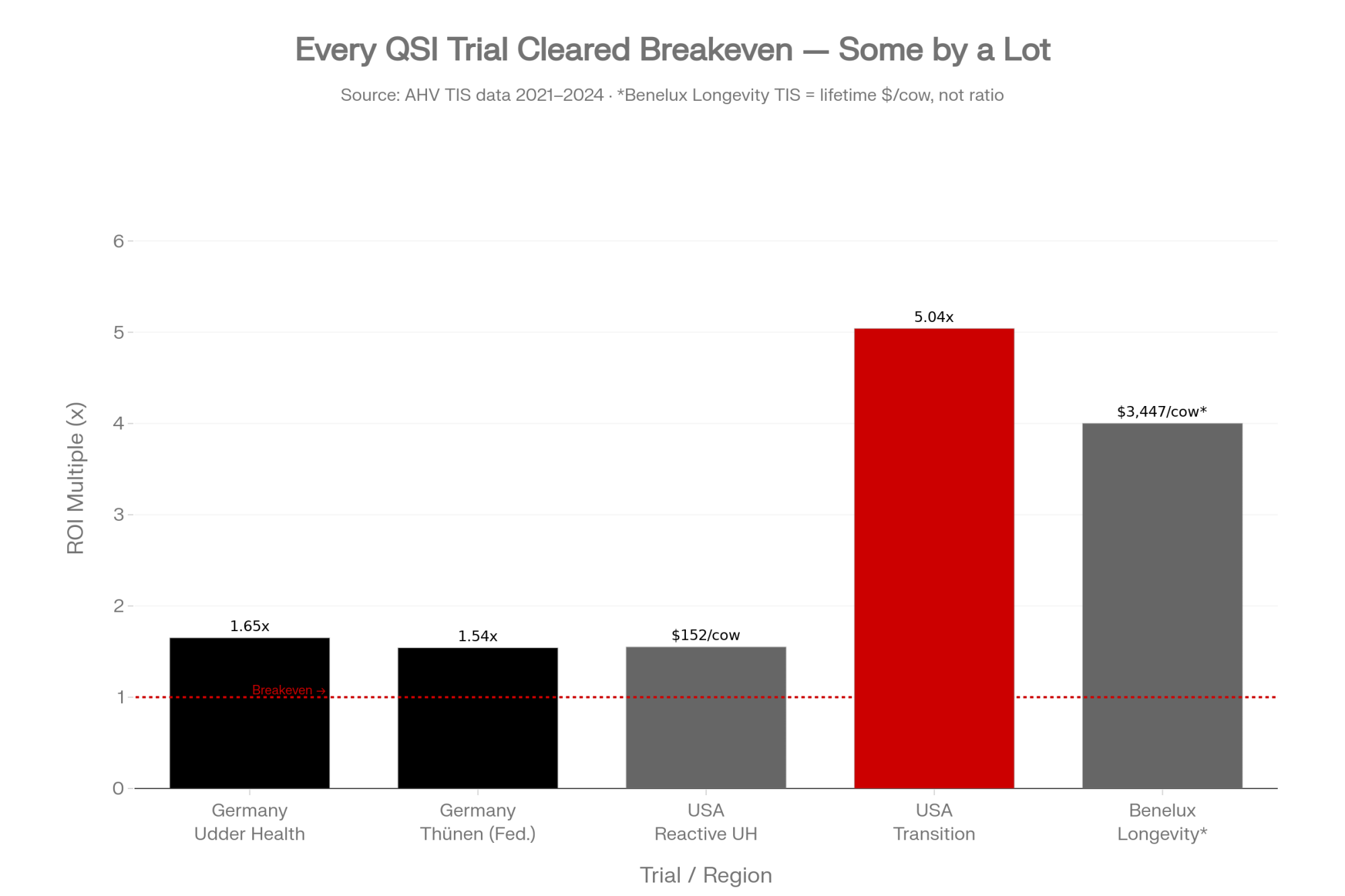
Germany6 farms, 325 cows75.7% drop in SCC (P<0.05), ROI 1.65, ≈€140 per cowAHV Udder Health TIS, 2021–2022
Germany (Thünen Institute)1 farm, 11 cows (pilot)€1.54 return per €1 invested, ~260.6 kg less waste milk per cowFederal research institute, 2024
USA (Reactive udder health)8 farms, 3,316 cows6 fewer hospital days per cow; $151.53 lower cost/cow from less waste milk and laborAHV TIS, 2022–2023
Benelux (Longevity)2,161 cows+8,653 kg lifetime milk, €0.44 more per day, 19.8% lower replacement$3,447.20 ROI/cowAHV Benelux Longevity TIS, based on CRV data
USA (Transition & Fertility)8 farms, 4,495 cows+3.2 kg/day milk first 100 DIM, −34% metritis, ROI 5.04 (~$160.76 per cow)AHV Transition/Fertility TIS, 2024

There’s also an independent trial you’ll want to watch: Texas A&M’s SARE project OS24‑178, “Evaluating a Non‑antibiotic Treatment of Mastitis in Organic Dairy Cows.” The project calls for about 120 lactating Holsteins in a Texas organic herd, randomized to AHV vs. organic standard care, with bacteriology, PCR, and SCC performed at TAMU.

That’s the kind of third‑party data vets like Ruegg have been asking for. Results are still pending. Until they land, you’re looking at:

  • Company‑associated multi‑farm field data.
  • A small but credible federal pilot (11 cows at Thünen).
  • Real‑world stories like Henry’s and Karl Gabrielse at Quonset Farms, where fresh cow problems dropped from 20% to 2% and conception rates climbed 6 points after implementing AHV protocols.

It’s not a slam‑dunk RCT portfolio yet. But it’s enough signal that serious producers are at least testing QSI, not just dismissing it outright.

Is the $3,447 ROI Number Something You Can Bank On?

You shouldn’t bank on anyone’s ROI number — ours, AHV’s, or your neighbor’s — without running your own. But you can use it as a reference point.

The $3,447.20 per cow comes from AHV’s Benelux Longevity TIS, built on CRV data across 2,161 cows. It represents extra lifetime milk, fewer replacements, and more revenue per day of life. It’s an average across many herds in a European system, not a guaranteed outcome for your barn in Wisconsin, Ontario, or New York.

Treat it like a sire proof:

  • Directionally useful.
  • Needs to be filtered through your milk price, your cull rate, and your vet’s comfort level.

If you want the deep dive on how longevity, replacement cost, and cull‑rate math actually stack up, that’s a follow‑up article on its own.

What Does This Look Like Operationally in Your Barn?

Switching any protocol — AHV or otherwise — creates friction. You’re asking people to change how they’ve done things for years.

Based on Henry’s experience and the trial data, you can expect a few things if you go down this road:

  • Less time in the hospital pen. AHV’s US reactive udder‑health TIS showed 6 fewer hospital days per cow, and Henry’s own numbers match that direction.
  • Shorter treatment windows. Seven‑day courses turned into two‑to‑three‑day interventions, often without tubes at all.
  • Fewer withhold headaches. Fewer drugged cows mean fewer chances for a red‑band miss to turn into a dumped tank.
  • Higher bar for milker prep. Henry is blunt: “It’s everything hand in hand. It’s on the milkers too — they have to do a good job of prepping. Clean stalls, everything plays hand in hand.”

If your stalls are sloppy and your prep is inconsistent, no bolus in the world is going to bail you out. Quorum sensing inhibition is a layer, not a shortcut past basic udder hygiene.

How Bad Is Your Udder Problem Really, and Is It Worth Changing Protocols?

First move is boring and free, but it’s the one most farms skip: audit your own records.

In the next 30 days, sit down with your DHIA reports and cull log and do three things:

  1. Calculate udder‑related culls for the past 12 months.
    1. What percentage of involuntary culls are tagged to mastitis, high SCC, or udder health?
    1. If you’re north of 20%, you’ve probably got a structural udder‑health issue, not just bad luck.
  2. Count your average hospital‑pen load.
    1. On a typical day, how many cows are out of the tank?
    1. If more than 1–1.5% of your herd lives there, you’re leaving more on the table than you think.
  3. Pick three “problem cows” and follow the money.
    1. How many times have you treated each this lactation?
    1. How many days was each cow out of the tank per treatment?
    1. Are they still in the string or on a truck?

Once you see those numbers on paper, you’ll know if a biofilm‑first approach is worth trialing — or if you’re mostly dealing with basics you can tighten up without changing products.

MetricGreen ZoneYellow ZoneRed Zone — Act NowHenry’s Farm 1 Start
Udder-related culls (% of involuntary culls)< 10%10–20%> 20%Not disclosed
Hospital pen load (% of herd on any day)< 0.5%0.5–1.5%> 1.5%~1.0% (10–12 of 1,100)
Avg treatment duration per clinical case≤ 3 days4–6 days7+ days7 days
Cow retreatment rate (same quarter, same lactation)Rare (<1/cow/yr)OccasionalCycling repeaters on your listSame cows monthly
Bulk tank SCC (cells/mL)< 100,000100,000–200,000> 200,000Not disclosed (Farm 2 now < 100k)
Replacement heifer cost (current regional price)< $2,000$2,000–$2,500> $2,500~$3,010 (national avg, July 2025)

If You Try a Biofilm‑First Protocol, Where Do You Start So It Doesn’t Blow Up in Your Face?

If your audit says, “Yeah, we’ve got an udder problem,” the next question is where to start without turning the barn upside down.

Best candidates for a trial:

  • Chronic repeaters you’re already thinking about culling.
  • High‑SCC cows caught early by monitoring systems (SCR, smaXtec, activity collars) before a quarter blows up.
  • Herds where stalls and prep are decent, but the same cows keep showing up on the treatment list.

Henry’s path looked like this:

  • Add smaXtec (or use what you already have) for early alerts.
  • When an alert hits, reach for Quick + Aspi first, not tubes.
  • Give it 2–3 days and let the cow’s immune system work with the bolus.
  • Only bring in antibiotics if she doesn’t turn the corner.

The big operational risk is confusion. Your team has to know:

  • Which cows are “AHV only.”
  • Which cows are on antibiotics.
  • Exactly when each cow is safe to go back in the tank.

The win is when “red‑band” cows become the exception — not a daily pattern your milkers are numb to.

Sponsored Post

Options and Trade‑Offs for Farmers

Path 1: 30‑Day Paper Audit (No Products, Just Records)

When it makes sense: If you don’t actually know your udder‑related cull rate or your average hospital‑pen load, this is your starting line.

What it requires:

  • One afternoon with your DHIA reports, cull records, and a notepad.
  • Maybe your lender, vet, or nutritionist on the phone for a second set of eyes.

What you get:

  • A clean “here’s where we stand” view on udder‑related culls, hospital‑pen load, and retreatment patterns.
  • The ability to plug your numbers into any ROI discussion — whether it’s AHV, a different product, or just tightening milking routines.

If your numbers are already good — low udder culls, low hospital counts, stable SCC — you may decide you’re doing enough. If they’re rough, at least you know you’re not imagining it.

Path 2: 90‑Day Pilot on Your Worst Group

When it makes sense: If your audit shows a clear udder problem and you’ve got a handful of chronic cows chewing up labor and drug spend, but you’re not ready for a whole‑herd flip.

What it requires:

  • Agreement with your herd vet on which cows qualify and how you’ll track them.
  • A written protocol — for example, “AHV Quick + Aspi on first alert, wait 2–3 days, then decide on antibiotics.”
  • Clean notes on SCC, hospital days, and total treatments over those 90 days.

What it costs:

We do know from German and US TIS data that:

  • In Germany, AHV’s udder‑health protocol showed an ROI of 1.65 and about €140 per cow benefit, driven by lower SCC and less waste milk (AHV Udder Health TIS, 2021–2022).
  • In US reactive udder‑health trials, farms saw 6 fewer hospital days per cow and about $151.53 per cow in reduced costs between waste milk and labor (AHV TIS, 2022–2023).

Risks and limits:

  • If your basics are weak, you might not see much improvement.
  • If your team isn’t on board, partial compliance will muddy the waters and make the trial look “inconclusive.”

At the end of 90 days, you should know if your chronic problem cows are still chronic — or if you’ve actually broken the cycle.

Path 3: 12‑Month Whole‑Herd Strategy Shift

When it makes sense: If you’ve nailed the basics, your hospital pen is still busier than you like, and you’re serious about pushing cows to fifth lactation and beyond — the way Henry is aiming for 20% of his herd there.

What it requires:

  • Full buy‑in from your vet, herd manager, and parlor crew.
  • A clear written protocol around dry‑off, fresh cows, and “alert” cows.
  • The patience to let biology catch up to your ideas — you’re changing the baseline, not flipping a switch.

Upside:

  • Higher probability of hitting the kinds of numbers seen in the AHV Benelux Longevity TIS — more older cows, lower replacement pressure, more milk per day of life.
  • A different relationship with antibiotics, which matters as regulations and consumer expectations tighten around antimicrobial use.

Risks and limits:

  • You’re betting on company‑associated data plus one small independent pilot and an in‑progress Texas A&M trial. The science of biofilms is solid, but product‑specific proof is still developing.
  • If milk prices or replacement markets swing again, the economics of longevity can shift too.

This is not a “set it and forget it” option. It’s a management philosophy change.

Key Takeaways

  • If more than ~20% of your culls are udder‑related or more than 1–1.5% of your herd lives in the hospital pen, you’ve got a structural udder‑health problem. Start with the 30‑day record audit before you try to buy your way out of it.
  • If the same cows keep cycling through mastitis treatments, there’s a good chance biofilms are part of your problem. That’s when it makes sense to at least pilot a biofilm‑first protocol with your vet, whether it’s AHV or another approach.
  • If replacement heifers are running in the $3,000 ballpark in your region, every cow you keep productive for one more lactation is worth a second look. Longevity‑driven ROI like the $3,447/cow figure (AHV Benelux Longevity TIS) comes from compounding effects — more older cows, fewer replacements, more milk per day of life — not just drug savings.
  • If your stalls are dirty, your prep is inconsistent, or your milking system is out of tune, fix those first. No QSI bolus, no matter how clever, will outrun bad basics. Even Henry is clear: the science helps, but it rides on cow comfort and routine.

You don’t have to be sold on AHV for this article to matter. You have to answer some uncomfortable questions about how many cows you’re really losing to udder health and how much milk is living in your hospital pen instead of on your milk check.

Henry didn’t change because of a white paper. He changed because his own numbers wouldn’t shut up.

In the meantime, pull your records, count your hospital cows, and ask yourself a simple question:

What would your barn feel like if half the red‑band cows disappeared from the string next month — for the right reasons?

Complete references and supporting documentation are available upon request by contacting the editorial team at editor@thebullvine.com.

Learn More

The Sunday Read Dairy Professionals Don’t Skip.

Every week, thousands of producers, breeders, and industry insiders open Bullvine Weekly for genetics insights, market shifts, and profit strategies they won’t find anywhere else. One email. Five minutes. Smarter decisions all week.
NewsSubscribe
First
Last
Consent

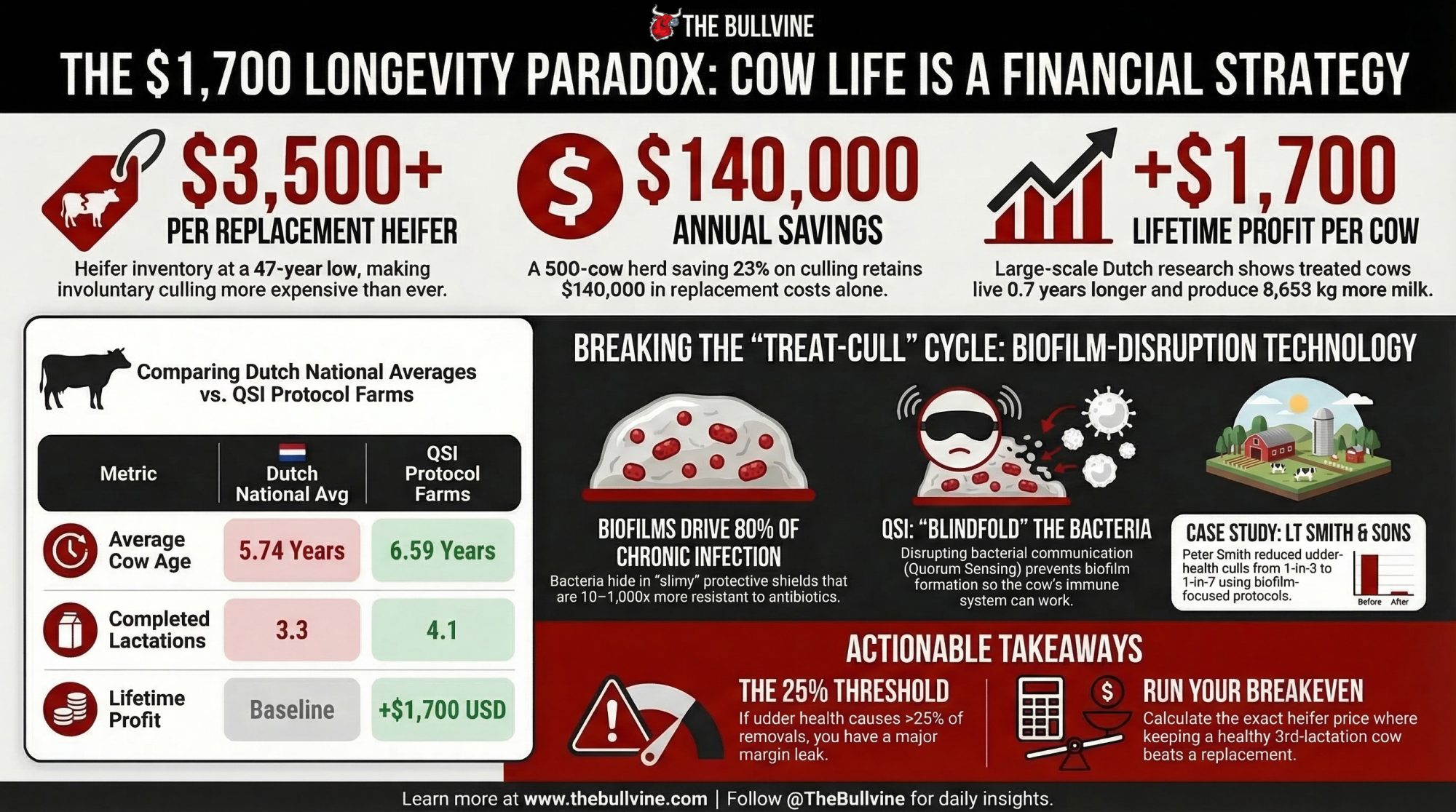
The $1,700 Longevity Paradox: How One 1,700-Cow Dairy Cut Udder Culls in Half

At $3,500 a head, every unnecessary cull hurts. A 1,700-cow operation cut udder-health culls from 1-in-3 to 1-in-7 — saving ~$189K/year on replacements.

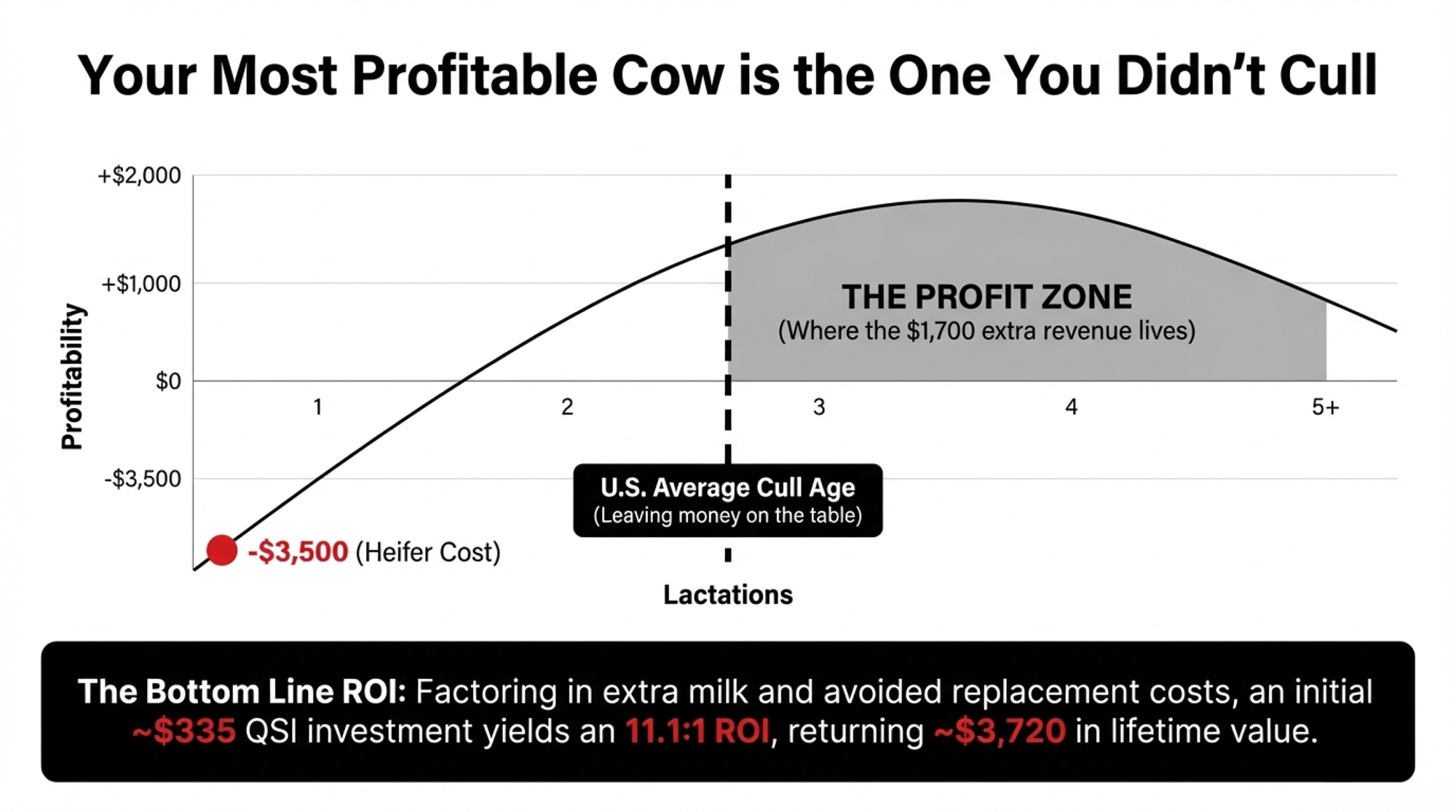
Your most profitable cow probably isn’t the one producing the most milk right now. She’s the one who sticks around long enough to pay back what she cost you — and then some. At $3,500 per replacement heifer, dairy cow longevity isn’t a soft welfare talking point. It’s a financial strategy.

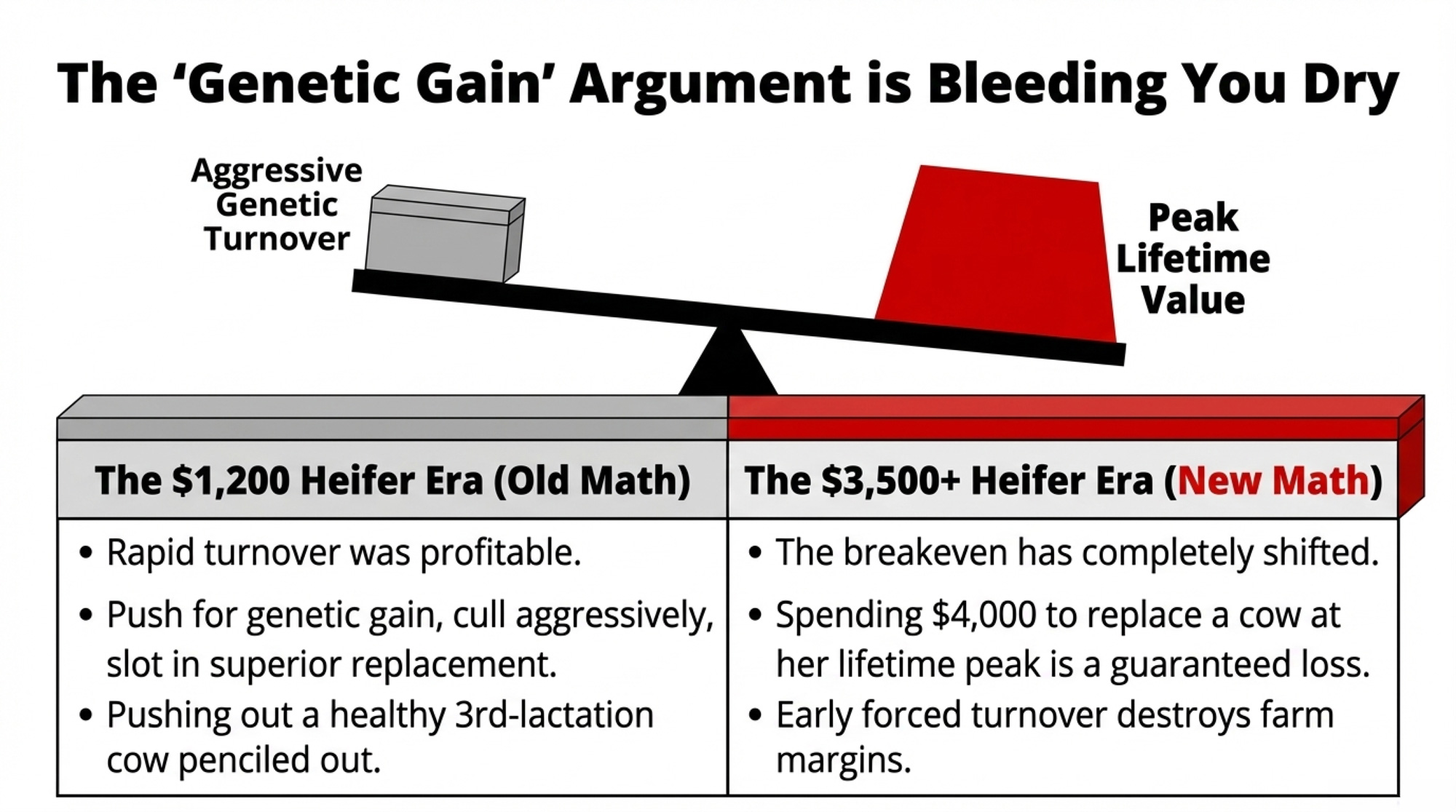
That’s a hard sell in an industry that’s spent two decades optimizing for peak lactation production. Push for genetic gain, cull aggressively, slot in a superior replacement, repeat. The logic held when a springer heifer ran you $1,200. It holds a lot less at $3,500.

A peer-reviewed study published in the Journal of Veterinary Health Science (Herrema et al., Vol. 4, Issue 3, 2023) analyzed 162,057 milk production records across 1,208 Dutch farms and 213,047 animals. Farms using a biofilm-disruption protocol — quorum sensing inhibition, which we’ll unpack — averaged €1,578 more profit per cow over her lifetime (roughly ~$1,700 USD at near-parity exchange rates; the study was conducted in the Netherlands, and all financial figures are in euros) and saw a 23% reduction in culling probability. The statistical confidence in that culling number? A P-value of 1e-46. The odds of it being a fluke are effectively zero.

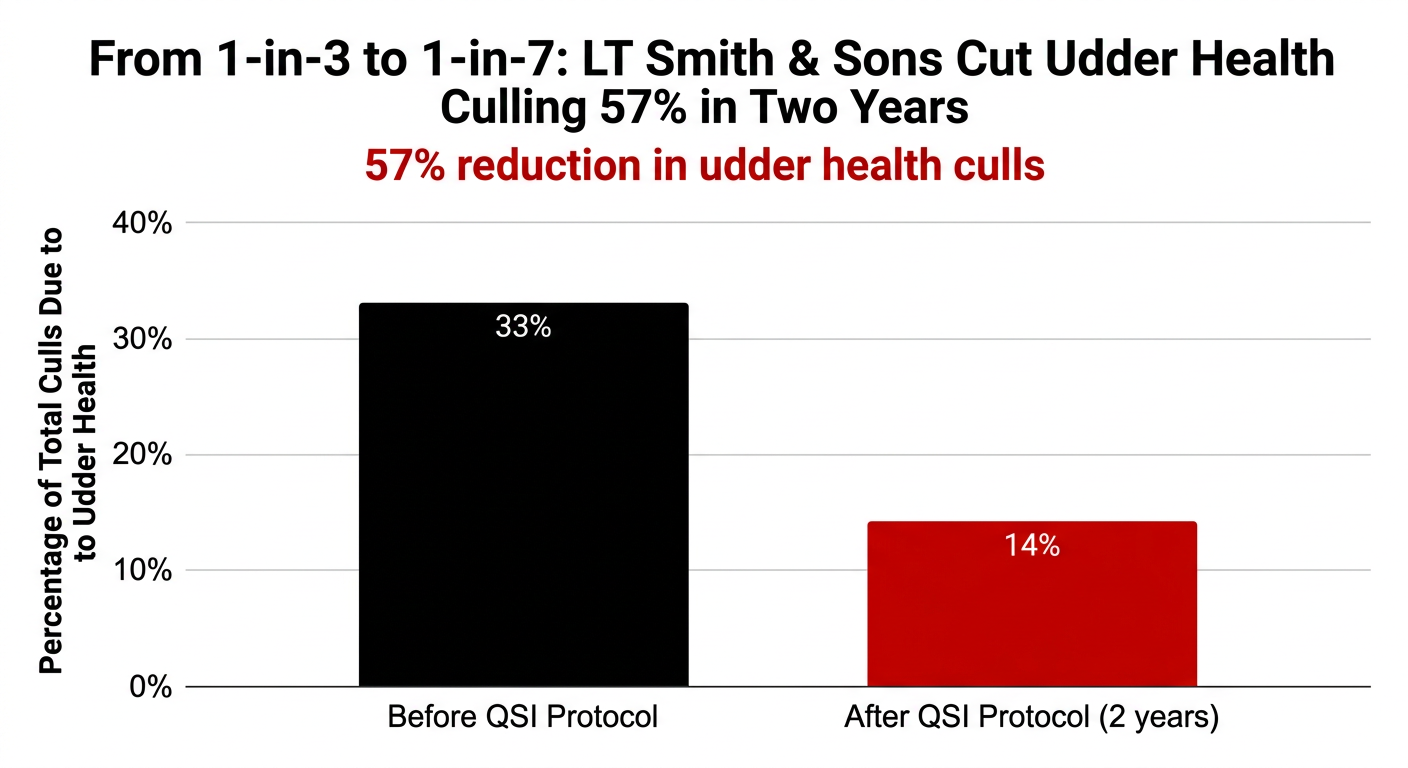
A 1,700-cow operation was culling 1 in 3 cows due to udder health problems. Today it’s 1 in 7. They didn’t change his genetics. Didn’t add staff. He changed how he thought about chronic infections — and the cows that used to cycle through his hospital pen stopped cycling through his cull list.

Full disclosure: the longevity study was conducted using AHV International’s proprietary protocols, and AHV co-authored the research. We’ll flag where the data comes from, AHV’s own analysis versus independent sources throughout. The dataset is large enough — and the supporting evidence broad enough — that the economics deserve a serious look regardless.

The Replacement Math That Changed

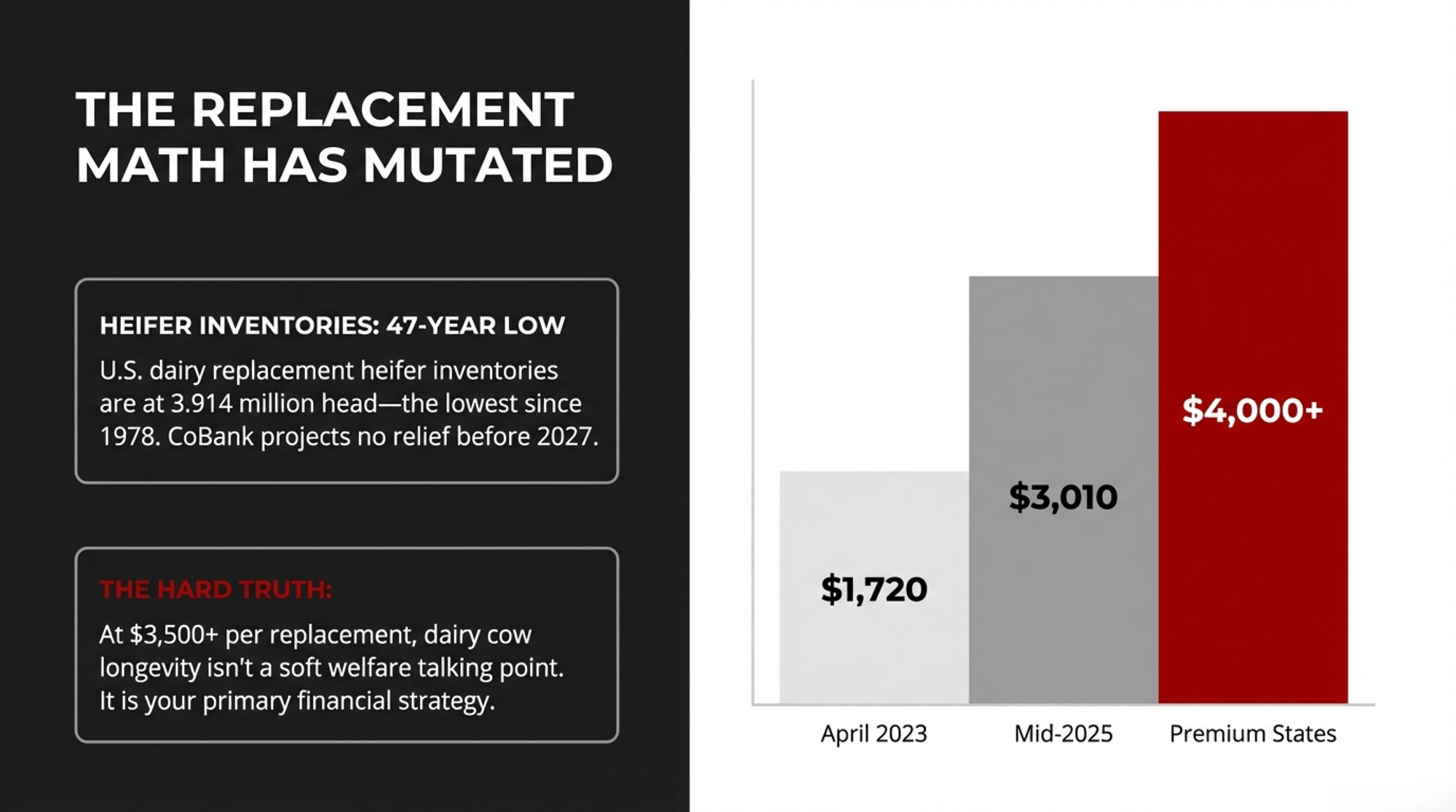
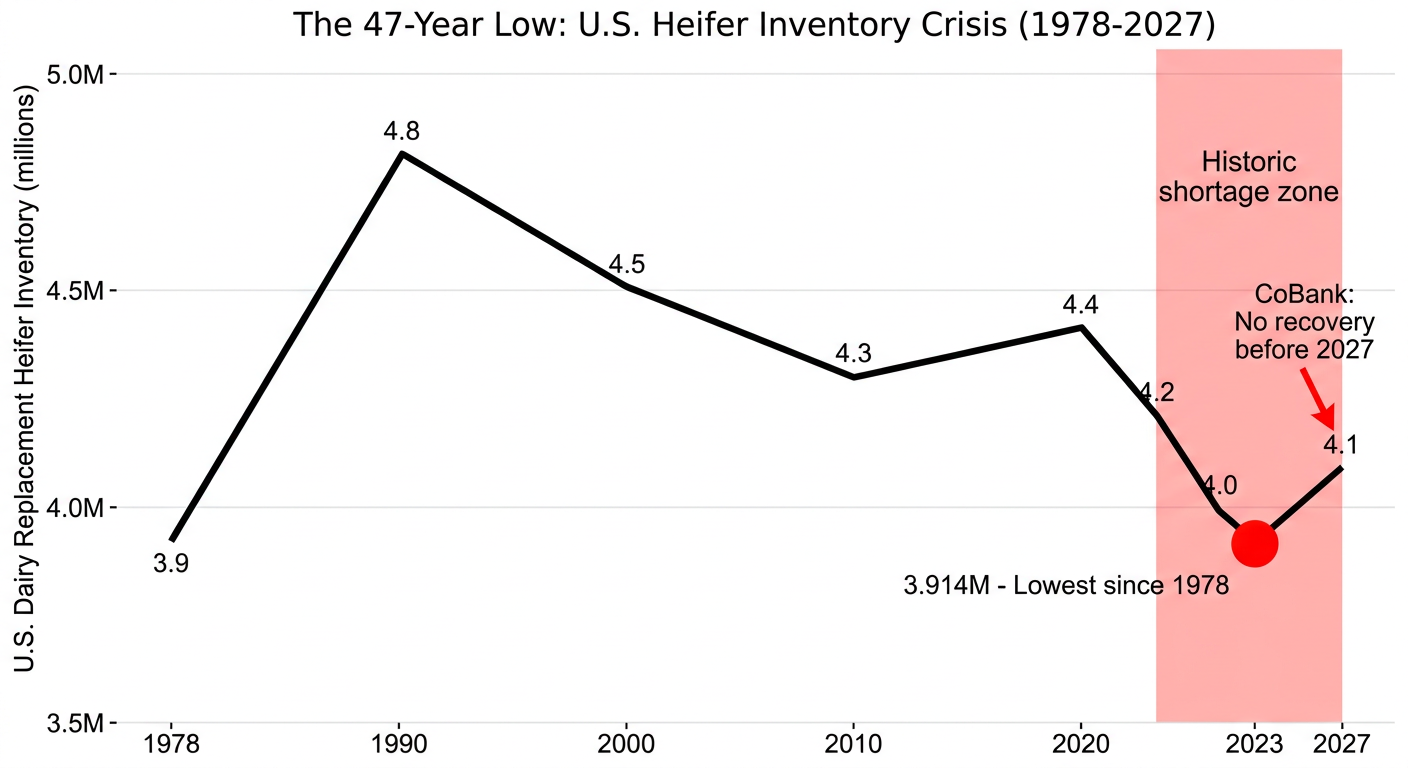
USDA’s January 2025 cattle inventory report put dairy replacement heifer inventory at 3.914 million head — the lowest since 1978. CoBank’s August 2025 Knowledge Exchange report tracked heifer prices climbing from $1,720 per head in April 2023 to $3,010 per head by mid-2025, with quality animals in California and the Upper Midwest clearing $4,000. This isn’t a blip. CoBank projects the shortage won’t meaningfully ease before 2027.

So you’re spending ,000–,000 to replace a cow that — if she’d stayed healthy through her 4th and 5th lactation — had already paid back her rearing costs and was producing at or near her lifetime peak. Studies estimate that 50% to 70% of dairy cows are forcibly culled at 4 to 5 years of age (Gosselink et al., 2008, V-focus). The average U.S. dairy cow lasts roughly 2 to 3 lactations (Pinedo et al., 2014, Journal of Dairy Science, 97(5)). The Dutch average, as tracked by CRV, is closer to 6 years (CRV, 2022). Research on the economically optimal replacement age varies — some analyses suggest 5 to 6 parities, while others put it as high as 8 to 9 lactations depending on genetics and carcass values (Evers & de Haan, 2017).

As Dr. Albert DeVries at the University of Florida has noted, U.S. dairy cows in the 1930s often had productive lives of 5 to 10 years after first calving — now that number is under 3 years. Replacement prices reaching record levels make that shortened productive life more expensive than at any point in the industry’s history.

Either way, the gap between optimal and actual productive life is where the €1,578 lives. And at $3,500+ per heifer, that gap got a lot more expensive.

What 162,000 Records Actually Showed

The Herrema et al. (2023) study is worth slowing down on. It’s unusually large for a longevity study, and the methodology is more rigorous than most.

Researchers compared 64,467 cows from 3,171 farms using AHV’s quorum-sensing inhibition protocol against Dutch national averages from CRV, the country’s official herd recording organization. They built separate XGBoost machine learning models for treated and non-treated groups—a counterfactual approach that adjusts for confounding factors like age at first treatment. One caveat: farms self-selected into the AHV protocol, so the dataset may partly reflect operations already focused on herd health. The counterfactual modeling addresses some of that, but observational studies can’t fully control for management quality. That said, 64,467 animals benchmarked against CRV national records is a scale that smooths out much of the individual-farm variation. The differences were statistically significant at levels orders of magnitude below p ≤ 0.001.

MetricQSI Protocol FarmsDutch National Avg (CRV)
Average cow age6.59 years5.74 years
Average lactations completed4.13.3
Culling probability reduction23% lowerBaseline
Additional profit/cow (lifetime)+€1,578 (~$1,700 USD)
Longevity improvement+0.7 years (8.5 months)

The paper’s ROI section used FrieslandCampina milk pricing (Milk Fat: €300/100 kg; Milk Protein: €595/100 kg) to calculate lifetime revenue. AHV-treated cows produced 43,881 kg of milk over their lifetimes, versus 35,228 kg for non-treated cows — a difference of 8,653 kg. That translated to €0.50 more revenue per day of life (€6.37 vs. €5.87), totaling €1,578 in additional lifetime profit from milk revenue alone.

A Benelux subset of 2,161 cows in AHV’s Trial Information Sheet (TIS, 2024) analysis further extended the picture: a 19.8% lower replacement rate on top of the production gains. Factoring in replacement savings, AHV’s own analysis pegs total lifetime ROI at 11.1:1 — approximately €310 (~$335 USD) invested per cow returning €3,447 (~$3,720 USD) through additional milk revenue, reduced replacement spend, fewer hospital pen days, and lower treatment costs. That broader ROI comes from AHV’s TIS marketing analysis, not the peer-reviewed paper. The paper supports the milk-revenue component; the replacement cost savings are AHV’s calculation.

A companion study published in Smart Agricultural Technology (Streefland, Herrema & Martini, 2023, Vol. 6, p.100302) — Elsevier-indexed — validated the milk-yield findings using a Gradient Boosting model with prediction errors under 2.5%, confirming improved yield across all three dairy companies in the trial.

One more journal note: the Journal of Veterinary Health Science (OPAST Publishers) isn’t top-tier—it’s not indexed in PubMed or Scopus. But the Elsevier-published companion validation and the sheer size of the CRV-benchmarked dataset give the production findings more weight than the journal alone would suggest. The direction aligns with independent, peer-reviewed research consistently showing that involuntary culling before optimal age is one of dairying’s largest unmanaged cost centers. The Bullvine’s own deep dive into the hidden costs of shortened productive life mapped this same tension between genetic progress and longevity economics — and that was before heifer prices hit $3,500.

Why Your Best Cows Keep Leaving Before Their 4th Lactation

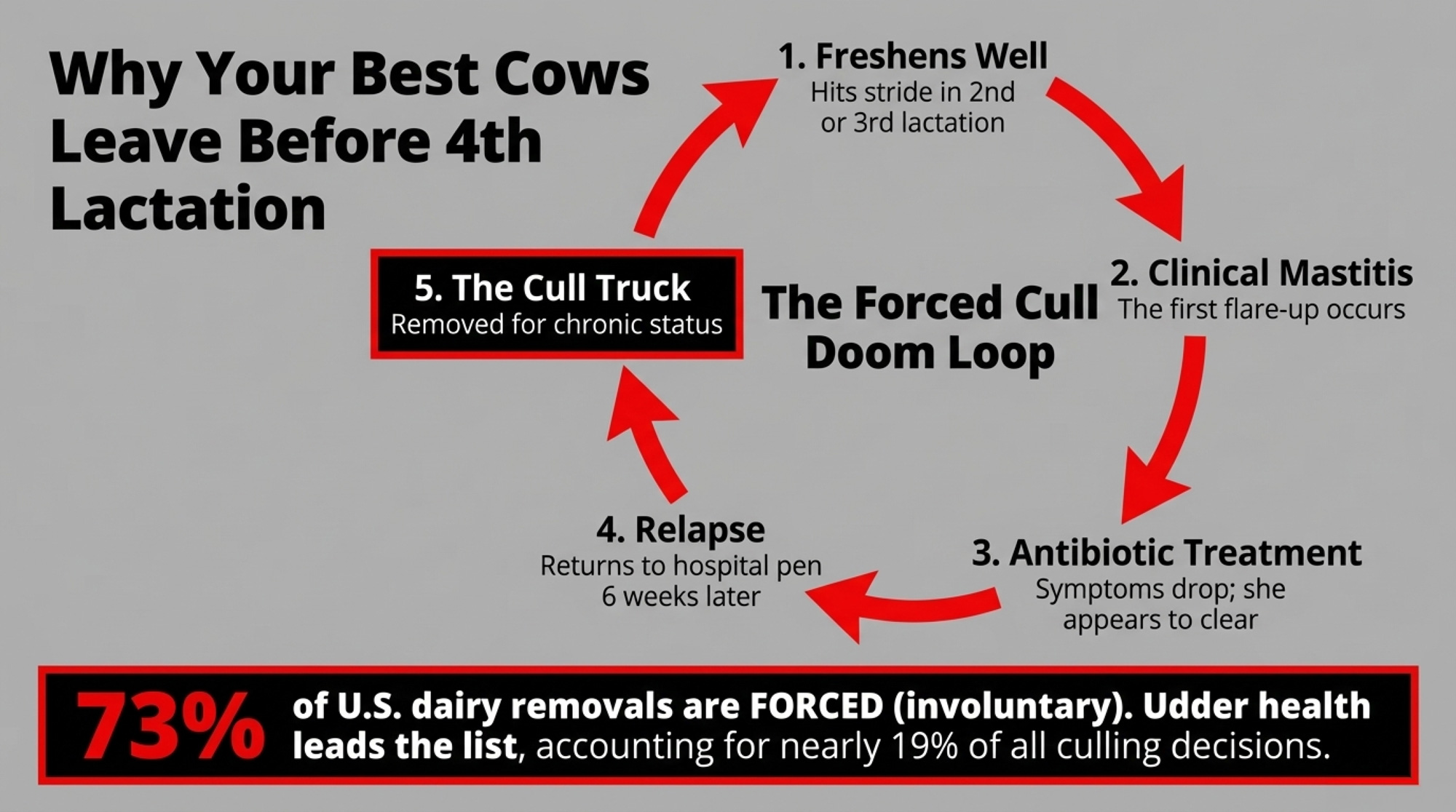
You know the cow. She freshened well, bred back, and hit her stride in 2nd lactation. By her 3rd, she’s putting serious milk in the tank. Then she picks up clinical mastitis. You treat it. She clears. Two months later, it’s back. Treat again. By the time she’s chronic, she’s on the cull list — not because she can’t produce, but because you can’t keep her healthy.

That treat-clear-relapse-cull cycle is the single biggest driver of premature exit from the milking herd. USDA/NAHMS 2018 data pegs total U.S. removal rates at 37.6% for Northeastern herds — 31.4% live culls plus 6.2% death loss. Only about 26.8% of those removals are voluntary. The rest are forced. Udder health, fertility, and lameness lead the involuntary list.

Here’s what’s actually happening inside those chronic mastitis cases: biofilms. Structured communities of bacteria coating tissue surfaces — think of the slime layer inside an old water pipe, except it’s growing in udder tissue. Biofilms contribute to roughly 80% of chronic and recurrent microbial infections. And bacteria sheltered inside a biofilm show 10 to 1,000 times greater antibiotic resistance than the same bacteria floating freely.

That’s why your antibiotic treatment clears the clinical flare-up but never fixes the underlying problem. You’re killing the bacteria that ventured outside the biofilm. The colony inside it barely notices. The cow clears clinically and returns to the string. Six weeks later, she’s in the hospital pen again. Eventually, she’s on the truck.

What Changed on a 1,700-Cow Dairy

As Dr. Gertjan Streefland, a veterinary microbiologist and AHV’s founder, puts it: “Imagine a group of troublemakers. Blindfold them and make them deaf — they can’t coordinate, and they’re immediately harmless. That’s what we do to the bacteria. We don’t kill them. We cut their communication so they can’t organize.”

That’s quorum sensing inhibition — QSI — in one sentence. Instead of killing bacteria (which hasn’t worked against biofilms for decades), QSI disrupts the chemical signaling bacteria use to coordinate biofilm formation. Block the signal, and bacteria can’t build their protective shield. The cow’s own immune system handles the rest.

AHV’s patented approach uses an allium-derived (onion plant) extract, screened and concentrated in their own BSL-2 lab for the specific fraction with the highest impact on quorum sensing. It’s delivered orally — no injections, no intramammary tubes, no withdrawal periods. RTI Laboratories tested the compounds on field bacteria from cows with active udder health issues — both gram-positive and gram-negative strains — and confirmed biofilm inhibition without the development of antimicrobial resistance.

That last point matters. A lot.

One producer started at dry-off. Another focused on fresh cows. Both saw the same downstream effect.”

On a 1,700-cow dairy, the full udder health turnaround took two years, with fresh cow protocols running for 14 months. That timeline is honest — this isn’t a 30-day fix. But within that window, udder health culling dropped from 1 in 3 to 1 in 7. The result: 10 to 12 additional cows in his daily milking string that would’ve been on the cull truck. Today, 17% of his herd exceeds 5 lactations.

“Come back in 5 years, and I’m extremely confident that we will be using AHV protocols. It just makes sense from a herd health and financial standpoint.” — Large-herd dairy operator.

These results aren’t the only North American data. A 2024 multi-farm trial (AHV TIS, 2024) across 8 U.S. operations— ranging from 1,000 to 20,000 cows, totaling 4,495 trial animals — showed a 34% reduction in metritis incidence3.2 kg/day (~7 lbs/hd/day) more milk in the first 100 DIM, and a positive ROI of €160.76 (~$174 USD) per cow(5.04:1 return) using a transition protocol built on the same QSI platform. A separate 2024 trial (AHV TIS, 2024) across farms in California, Idaho, and Wisconsin — 2,703 cows — showed a 14% reduction in udder health issues and a 70% reduction in mortality rate in the first 60 DIM.

How Much Does Involuntary Culling Cost a 500-Cow Dairy at $3,500 Heifers?

Let’s walk the barn math. Plug in your own numbers where yours differ.

Starting assumptions:

  • Current cull rate: 35% (USDA/NAHMS 2018 pegs total removal at 37.6% for NE herds; 35% is conservative)
  • Replacement heifer cost: $3,500
  • Annual replacements: 500 × 0.35 = 175 cows
  • Annual replacement spend: 175 × $3,500 = $612,500

With a 23% reduction in culling probability (matching the Herrema et al. study average):

  • New effective cull rate: 35% × 0.77 = ~27%
  • Replacements needed: 500 × 0.27 = 135 cows
  • New annual spend: 135 × $3,500 = $472,500
  • Saved: $140,000 per year on replacement costs alone

That’s 40 cows that stayed in the string instead of hitting the truck. At 4th- and 5th-lactation production levels, those cows are converting feed more efficiently than any first-calf heifer in the replacement pen.

Now the numbers from that 1,700-cow dairy. His improvement was specifically in udder health culling — from 1-in-3 to 1-in-7 as a share of total removals. That’s a different calculation than the 23% total-cull reduction from the study, and it’s important to keep the two separate. USDA/NAHMS data shows udder health issues account for roughly 18–19% of all culling decisions. On a 1,700-cow herd running ~33% overall cull rate, that’s approximately 104 udder-health culls per year. Cut that roughly in half — which is what moving from 1-in-3 to 1-in-7 approximates — and they eliminated about 54 udder-related replacements annually. At $3,500 per heifer, roughly $189,000 in avoided replacement cost per year. And that’s just the udder piece.

When you consider that the 800,000-heifer shortage is already forcing some families out of dairying entirely, every cow that stays productive one more lactation isn’t just a spreadsheet win — it’s the difference between expanding and contracting.

Sponsored Post

Does Keeping Older Cows Slow Your Genetic Gain?

With each additional lactation you keep a cow, there are fewer slots for a genomically superior replacement. If you’re running an aggressive genetic improvement program, extending cow life slows the rate of genetic gain. That trade-off is real.

But at what heifer price does it flip? At $1,200 heifers, rapid turnover for genetic gain penciled out for most herds. At $3,500, with a shortage projected through at least 2027, the breakeven has shifted. A 2025 analysis in Animals (MDPI) found that many early replacement decisions remain economically justified when accounting for genomic values and beef-on-dairy carcass premiums. So this isn’t a blanket “never cull early” argument. It’s a targeted one: if a cow is leaving your herd involuntarily for a chronic health issue that’s treatable, and she had two or more profitable lactations ahead of her, the math at today’s heifer prices says you’re almost certainly losing money on that transaction.

For many operations, the crossover point may now sit closer to lactation 3.5 or 4 than the industry has assumed — though your number depends on your genetics program, your replacement costs, and what a cull cow brings at auction.

What This Means for Your Operation

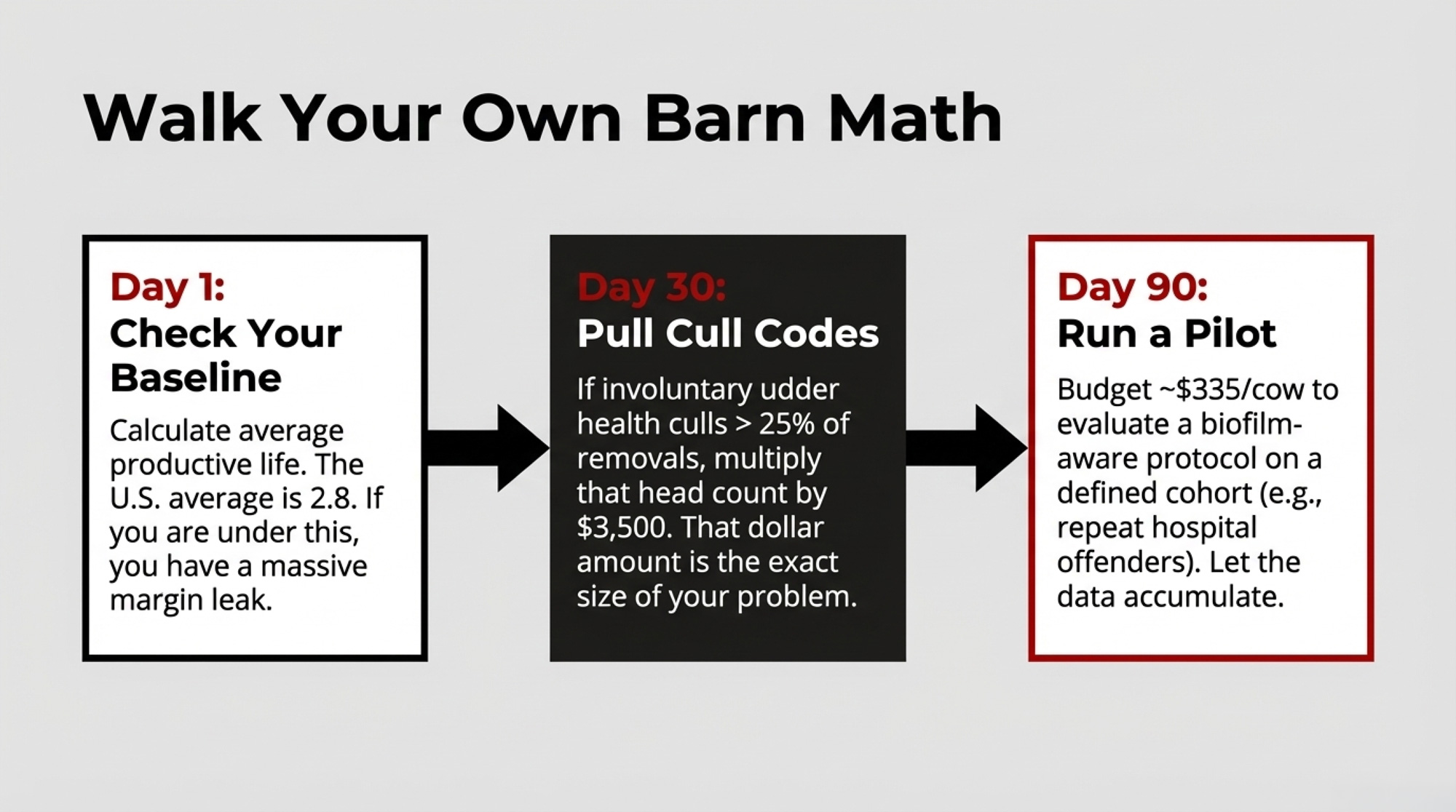
Day 1: Calculate your current average productive life in lactations. If it’s under 2.8, you’re below even the U.S. average, and this analysis applies directly to your herd. This takes five minutes in your herd management software.

In the next 30 days: Pull your involuntary cull rate for the last 12 months, separated by reason code. If udder health culls represent more than 25% of your total removals, you’ve found your single biggest margin leak. Two hours in DairyComp or PCDART. Cost: zero.

In the next 90 days: Run the replacement-cost math against your actual cull reasons. Rank them by economic cost per cull, not by frequency. One udder health cull that removes a 3rd-lactation cow producing 90 lbs/day costs more than three voluntary culls of open heifers. Multiply your involuntary udder culls by your current heifer price. That’s the number you’re managing against.

Over the next 365 days, evaluate a biofilm-aware protocol for your chronic and recurrent clinical cases. Start with a defined cohort — your hospital pen repeat offenders or your 2nd+ lactation cows entering dry-off. At ~€310 (~$335 USD) per cow invested, per the study’s protocol, the costs for a 100-cow pilot cohort run ~$33,500. Budget that against your projected replacement savings. The two-year timeline from that dairy timeline is realistic for a full udder-health turnaround at the herd level. They started at dry-off. They started with fresh cows. Both approaches built evidence before scaling. Benchmark against your own 12-month baseline before deciding on a herd-wide rollout.

Two thresholds to know: If your involuntary cull rate is already below 20% and your bulk tank SCC sits under 150,000, the marginal return from a biofilm-focused protocol is smaller — this math hits hardest for operations where chronic, recurrent cases are driving the cull truck. Conversely, if your average productive life already exceeds 3.5 lactations and your replacement rate sits below 28%, you’ve captured much of the low-hanging fruit. The biggest gains land on herds stuck between high involuntary culling, sound genetics, and cows leaving before they should.

Key Takeaways

  • If your udder health culls exceed 25% of total removals, run your replacement-cost exposure before your next management meeting. At $3,500 per heifer, that’s your single largest controllable cost center — and it’s probably bigger than you think.
  • Before adopting a biofilm-disruption protocol, ask two questions: Does your chronic/recurrent mastitis pattern match the biofilm profile these protocols target? And can you commit to two-year evaluation timeline? This isn’t a 30-day fix. Budget ~$335/cow for the pilot, benchmark your own baseline, and let the data accumulate.
  • The €1,578 (~$1,700 USD) lifetime profit figure is based solely on milk revenue, calculated using FrieslandCampina pricing for 64,467 cows. Factor in replacement savings from a 19.8% lower replacement rate, and AHV’s own analysis puts total lifetime ROI at €3,447 (~,720 USD) per cow. The dataset is large, and the direction is consistent with independent research—but AHV co-authored the study. Weigh accordingly.
  • Run your own breakeven: At what heifer price does keeping a healthy 3rd-lactation cow beat replacing her with a genomically superior heifer? If you don’t know that number for your operation, that’s the first calculation worth doing.

The Bottom Line

The dairy industry spent 20 years optimizing for peak milk per lactation. The economics of 2025 and 2026 may be forcing a different optimization: peak lifetime value per stall. With heifer inventory at a 47-year low and replacement prices that CoBank doesn’t expect to ease before 2027, every involuntary cull carries a price tag that would’ve seemed absurd a decade ago.

A 1,700-cow operation answered the longevity question two years ago. Others came in through dry-off protocols. Your answer might differ, but the replacement math stays the same. What’s your involuntary cull rate, and what would a 5-point drop be worth at your current heifer price?

Complete references and supporting documentation are available upon request by contacting the editorial team at editor@thebullvine.com.

Learn More

The Sunday Read Dairy Professionals Don’t Skip.

Every week, thousands of producers, breeders, and industry insiders open Bullvine Weekly for genetics insights, market shifts, and profit strategies they won’t find anywhere else. One email. Five minutes. Smarter decisions all week.
NewsSubscribe
First
Last
Consent

What’s Happening with the $2.7 Billion Hidden Loss in Our Dairy Herds – and How the Industry is Shifting

What if your mastitis problem isn’t about infection – but about bacterial communication?

You know, the thing about dairying is this—you start seeing patterns after a while. Like that one cow that keeps getting mastitis treatments over and over but never really clears up.

And while that’s happening, your milk check keeps shrinking and antibiotics keep creeping up. It’s frustrating, right?

What most folks don’t realize is just how much money is slipping through the cracks. Recent research from Wageningen University and the Dutch Ministry of Agriculture suggests that we’re looking at a $2.7 billion national impact.

The Silent Profit Killer: How $2.7 Billion Vanishes from Dairy Farms Annually

And when you break it down to a 200-cow farm, that loss? Could be well over $160,000 a year in lost milk, early culls, and all the extra hours nursing those cows that never quite snap back.

But let me be clear—this isn’t a sales pitch for any one product or company. There’s a significant shift underway in the industry.

Companies like AHV International—yeah, they’re out front with their patented quorum sensing inhibition technology—but there’s more to it. From smarter nutrition to better barn ventilation and tightened dry cow care, it’s a whole new look at herd health. (Read more: When Your Best Cows Keep Getting Sick: Why Some Dairies Are “Jamming” Bacteria Instead of Killing Them)

Rethinking How We Treat Mastitis

We’ve been trained for years to hit mastitis hard with antibiotics 100% of the time. But the truth? It doesn’t always stick.

Places like the University of Wisconsin and Cornell demonstrate that a significant number of these treatments fail to deliver lasting cures.

That means a lot of lost dollars in milk, more cows leaving early than you’d hope, and a whole lot of extra time spent on the sick pens.

What’s striking is how these costs often go unnoticed yet significantly impact your bottom line.

The Science That’s Changing the Game

Dr. Sarah Johnson, an independent dairy vet I respect, told me, “This push to cut antibiotics? It’s not just because the regulators say so—it’s a smart business move. Producers are seeking solutions that effectively interact with the cow’s immune system. And the science behind quorum sensing? Seriously promising.”

MetricTraditional AntibioticsQuorum Sensing InhibitionQSI Advantage
Biofilm PenetrationPoorExcellent+133%
Resistance RiskHighNone100% safer
Chronic Cure Rate30%70%+133%
Cost per Case$45$3522% less
Withdrawal Time72-96 hrs0 hrs100% better
Immune SupportNoneActive100% better

Then there’s Dr. GJ Streefland over at AHV, digging deep into how quorum sensing works—basically how bacteria in those sticky biofilms inside the udder keep in touch and work together to avoid being wiped out.

Think of biofilms as little bacterial fortresses, with their own internal messaging systems—quorum sensing.

Regular antibiotics? They don’t really break that communication chain.

AHV’s technology? It confuses the messages, allowing the cow’s immune defenses to break down those bacterial strongholds.

It’s not the whole answer—better management, feeding, and barn environment all still matter. But it’s a big part of the solution.

Farms That Are Turning the Tide

Take Trevor Nutcher, a dairy farmer from the Midwest, who claims to have reduced antibiotic use by over 95% in the past 18 months. “Our cows are healthier, fertility’s better, and SCC dropped from 180,000 to just over 120,000.”

Real Farm, Real Results: 95% Less Antibiotics, 33% Better Milk Quality

Out west, Joe Soares battled through bird flu better than most thanks to immune-focused protocols. His milk production held steady while his neighbors’ tanked.

Peter Smith up northeast says they’ve practically halved their culls for udder issues, going from 1 in 3 cows to 1 in 7. That’s a game-changer for their herd and their financials.

Keeping Cows Productive Longer: How Smart Protocols Slash Culling by 57%

It’s no magic bullet, though. These results stem from hard work, adjusting protocols to meet each farm’s specific needs, and a genuine dedication.

Quality Pays: How One Farm Earned $0.50/cwt Premium While Cutting SCC by 33%

Why Vet Visits Keep Coming Back

Here’s a little dirty secret: the traditional vet model sort of thrives on repeat visits.

It’s how many practices cover their costs. It’s not a blame, just business.

But what AHV and others are pushing for is a paradigm where you get it right the first time, cutting down on repeated treatments.

Like Dr. Streefland says, “This shift benefits both producers and vets but takes rethinking the business side of care.”

Progressive vets get it and are starting to embrace these changes for the long haul.

The Industry’s Fork in the Road

At this point, it appears that the dairy world is splitting into two distinct groups.

The ones adopting the new technology and management styles are seeing cows live longer, produce more milk, and gain access to better markets.

The others? They risk falling behind as the game continues to evolve.

Economic studies show farms sticking to old ways could be losing $200,000 or more a year just trying to keep up.

The Great Dairy Divide: Why Progressive Farms Earn $200K More Annually

Down in Europe, the gap’s only getting bigger, with farms using fewer antibiotics while maintaining or even improving their production.

What Should You Do?

If your herd’s fertility’s low, culling’s high, or you’re swamped looking after sick cows, it’s definitely worth a sober look at what’s really going on.

Start by upgrading your approach to diagnosing infections—know exactly who you’re dealing with.

Then, consider how you can incorporate targeted treatments—such as QSI technology, selective dry cow care, or enhanced nutrition.

And whatever you do, pick a time when your crew’s not burned out—winter or early spring are good bets.

Change takes guts. What works beautifully on one farm might look different on yours. However, with good coaching and a plan, you can achieve your goals.

The Bottom Line

Look, it’s not about chasing new gadgets or buzzwords. It’s about staying competitive and keeping your farm strong.

The smart money’s on those asking hard questions and trying new ideas—backed by science and real-world results.

Regulations aren’t slowing down; markets want cleaner production, and the competition isn’t waiting around.

So, what’s the cost of sitting still?

KEY TAKEAWAYS

  • $800-1,500 annual loss per affected cow from subclinical mastitis, with biofilm formation causing 80% of chronic infections—implement targeted QSI protocols during transition periods for documented 34% reduction in metritis incidence and 71% reduction in retained placenta
  • 11 lbs/day milk production advantage demonstrated in side-by-side trials during disease outbreaks when using biofilm disruption protocols versus traditional electrolyte treatments, translating to $670,000 additional annual revenue per 1,000 cows at current milk prices
  • 74.8% reduction in udder health antibiotics achieved within the first year of implementing proactive biofilm management on UK farms, with cows living 8.4 months longer and producing €3,009 ($3,300) more lifetime milk—particularly effective for operations facing regulatory pressure or premium market requirements
  • ROI of 5:1 within 100 days through strategic application of quorum sensing inhibition during dry-off and fresh cow periods, with 1.9% improvement in first service conception rates and 3.2 kg/day additional milk during the critical first 100 DIM
  • Regional implementation timing matters: Northeast and Upper Midwest operations see best results starting protocols in late winter/early spring before seasonal stress periods, while Southern operations benefit from year-round programs due to heat stress—work with advisors familiar with biofilm science to customize protocols for your herd size and management system

Sponsored Post

EXECUTIVE SUMMARY

Recent economic analyses reveal that mastitis costs the global dairy industry $32-35 billion annually, with subclinical cases accounting for 70% of these losses through reduced milk production, increased culling, and treatment failures. What farmers are discovering through field trials involving 65,000 cows is that biofilm-protected bacteria exhibit 100-1,000 times greater antibiotic resistance than free-floating bacteria, which explains why 30-70% of mastitis treatments fail to deliver lasting cures. The industry’s shifting toward quorum-sensing inhibition technology—disrupting bacterial communication rather than killing bacteria—with documented results showing 8.5-month longevity extensions, 74.8% reduction in antibiotic use, and $1,578 additional lifetime profit per cow. Research from universities and commercial operations demonstrates that proactive biofilm management protocols generate returns of $31,092 per 100 cows through improved conception rates (+9.3%), reduced days open (-28), and decreased treatment costs. The convergence of regulatory pressure, consumer demands for antibiotic-free production, and proven economic returns positions biofilm-targeted approaches as essential for competitive dairy operations moving forward.

Complete references and supporting documentation are available upon request by contacting the editorial team at editor@thebullvine.com.

Learn More:

  • Cut Mastitis Treatment Costs 60%: The $2.3 Billion Industry Secret That’s Reshaping Dairy Economics – Reveals how Michigan State’s 37-farm study proved farmers save $65.20 per case by following minimum treatment durations, plus Norwegian protocols that reduced mastitis costs from 9.2% to 1.7% of milk price, providing the tactical roadmap to implement selective treatment protocols that generate $50,000+ annual savings.
  • UK Dairy Farms Slash Antibiotic Use by 19%, Maintain Herd Health – Demonstrates how 879 UK herds achieved a 19% antibiotic reduction while improving mastitis rates from 42 to 26 cases per 100 cows through Selective Dry Cow Therapy and data-driven management, proving that reduced antibiotic dependence actually enhances both herd health and profitability when properly implemented.
  • Robotic Milking & Mastitis: The Hidden Profit Killer in Your Barn – Exposes how mastitis prevalence varies from 7.7% to 19.4% between different robotic systems, while 49% of AMS farms actually decreased clinical mastitis through system-specific management adaptations, providing critical insights for technology-forward operations seeking to optimize both automation efficiency and udder health outcomes. 

The Sunday Read Dairy Professionals Don’t Skip.

Every week, thousands of producers, breeders, and industry insiders open Bullvine Weekly for genetics insights, market shifts, and profit strategies they won’t find anywhere else. One email. Five minutes. Smarter decisions all week.
NewsSubscribe
First
Last
Consent
Send this to a friend