Every one of Harrisburg’s remaining shippers found a new processor within days. Not one of them got the unpaid milk back.
Executive Summary: Pennsylvania’s Milk Board handed 16 named farms $730,942.29 against $900,070.36 owed — 81 cents on the dollar, or about $3.25/cwt gone on milk already sold. Harrisburg Dairies stopped pickups on October 6, 2025, filed Chapter 11 on February 20, 2026, and sold its Herr Street plant for $4.95 million in April, with roughly $4 million going to secured creditors before producers saw anything. Every one of the bottler’s remaining shippers found a new processor within days, which is the part that should unsettle you: access to a buyer was never the problem; the receivable was. Pennsylvania’s bond is sized to 75% of the highest amount owed across a 40-day window, and when arrears stretch past that window the total owed outgrows the security — two months unpaid on 300 cows at 80 lb/day is 1,440,000 lbs, or roughly $46,700 you never get back at that per-cwt gap. Your state may work nothing like Pennsylvania’s: New York caps claims at the first consecutive 40 days and can void them entirely if you keep shipping after a known default, while Minnesota’s Chapter 27 trust can outrank your buyer’s bank — unless the cooperative carve-out writes you out of it. Two numbers settle your exposure, and one phone call gets both: your handler’s current security and coverage window, against your own days-outstanding right now. If yours runs longer than 40, the protection underneath you is already spent.
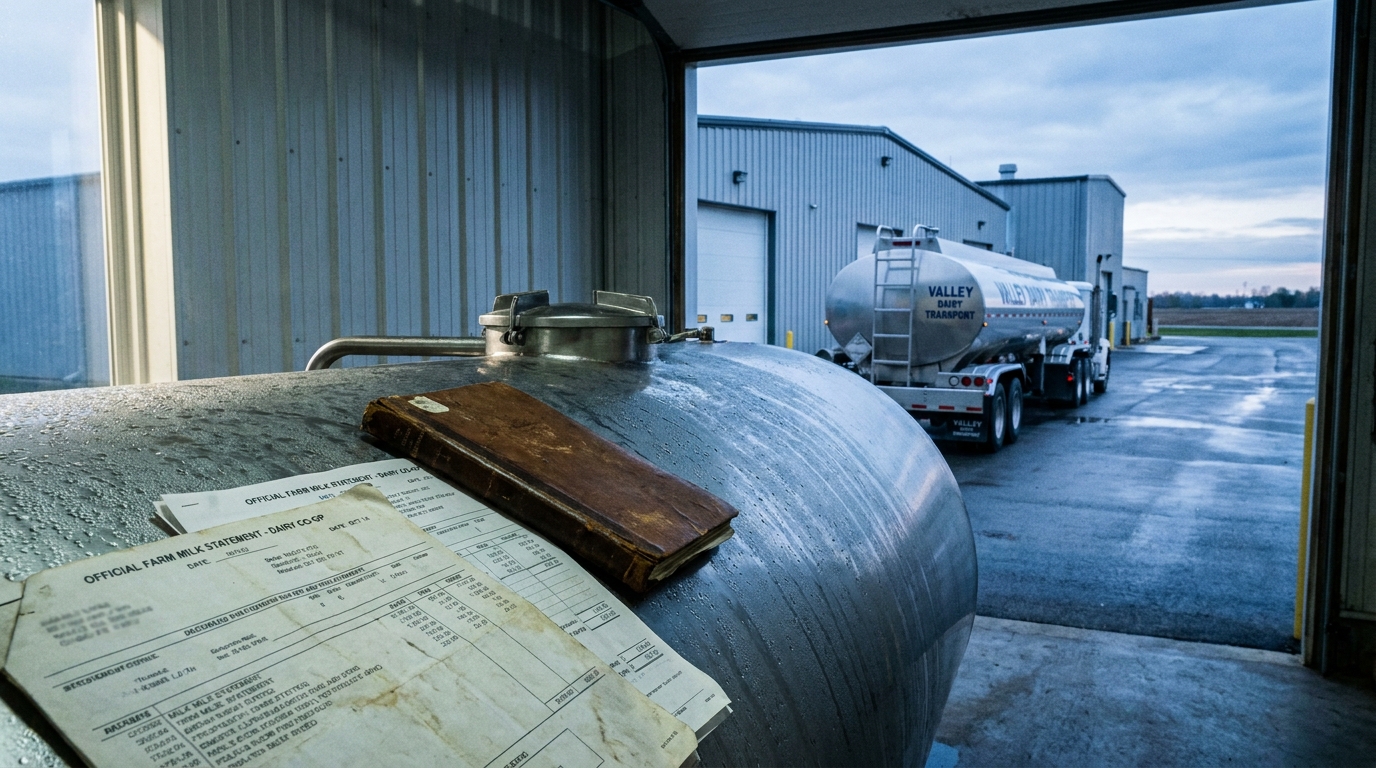
Harrisburg Dairies picked up Adam Kopp’s milk on October 5, 2025. The next day, the company told him it was the last time, Lancaster Farming reported.
Kopp is a third-generation dairyman from Middletown who had shipped to that bottler for two decades. By the time the trucks stopped, he told PennLive, Harrisburg hadn’t paid him for his milk in two months. He found another processor. The milk already gone was another matter. Kopp’s account comes from his interviews with Lancaster Farming and PennLive in October 2025; he was not interviewed for this article.
Three names sit on the same page of a Pennsylvania Milk Board order signed November 5, 2025: Merrimart Farms at $165,265.12, Lynncrest Holsteins at $3,482.26, Joel Heisey at $3,211.75. Sixteen producers in total, named in that public order, which lists each farm’s authorized distribution. None was interviewed for this article; no statements or views are attributed to them, and the amounts reflect what the Board authorized from a shared pool rather than any farm’s total loss.
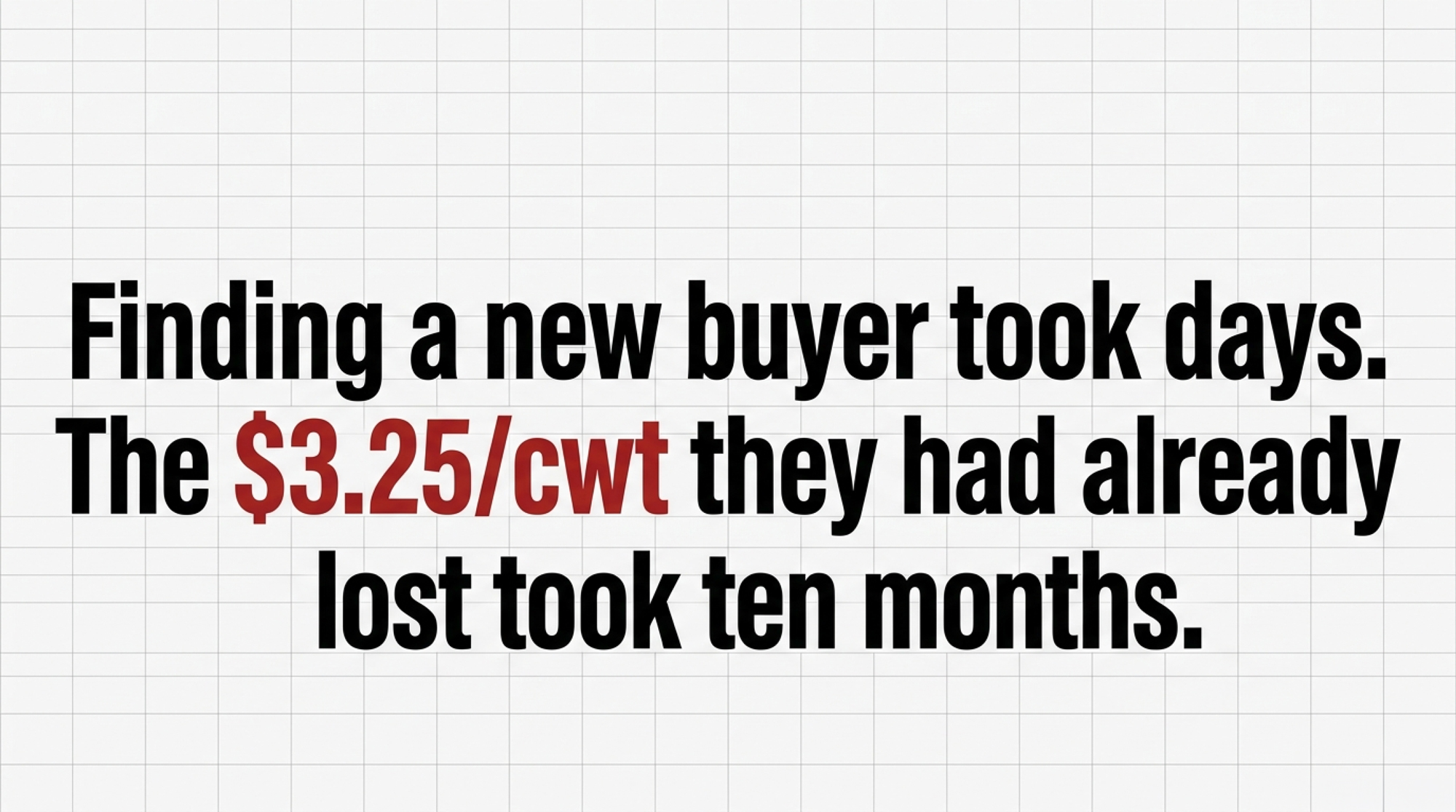
Run the arithmetic in that document, and here’s what you get. Those 16 farms were owed $900,070.36 on 5,209,618 pounds of milk. The state’s security fund and collateral bond together held $730,942.29. Per hundredweight, that’s $14.03 recovered against roughly $17.28 owed — a gap of about $3.25/cwt on milk that had already left the farm and been sold. Eighty-one cents on the dollar, which is genuinely better than producers in most states would have managed. It still took ten months to arrive.
| Producer | Authorized Payment | Recovery Rate | Estimated Shortfall |
|---|---|---|---|
| Merrimart Farms | $165,265.12 | 81% | ~$38,900 lost |
| Lynncrest Holsteins | $3,482.26 | 81% | ~$820 lost |
| Joel Heisey | $3,211.75 | 81% | ~$755 lost |
| All 16 Farms (Total) | $730,942.29 | 81% | ~$169,128 lost |
A Bottler That Lasted More Than Nine Decades
Harrisburg Dairies bottled milk in Pennsylvania’s capital for more than nine decades before financial trouble ended it — 94 years, by Lancaster Farming’s count. Milk Board Chairman Rob Barley told PennLive the company notified its remaining dairy farmers that week it was ceasing its contracts. All five of those farms found other processors, Barley said.
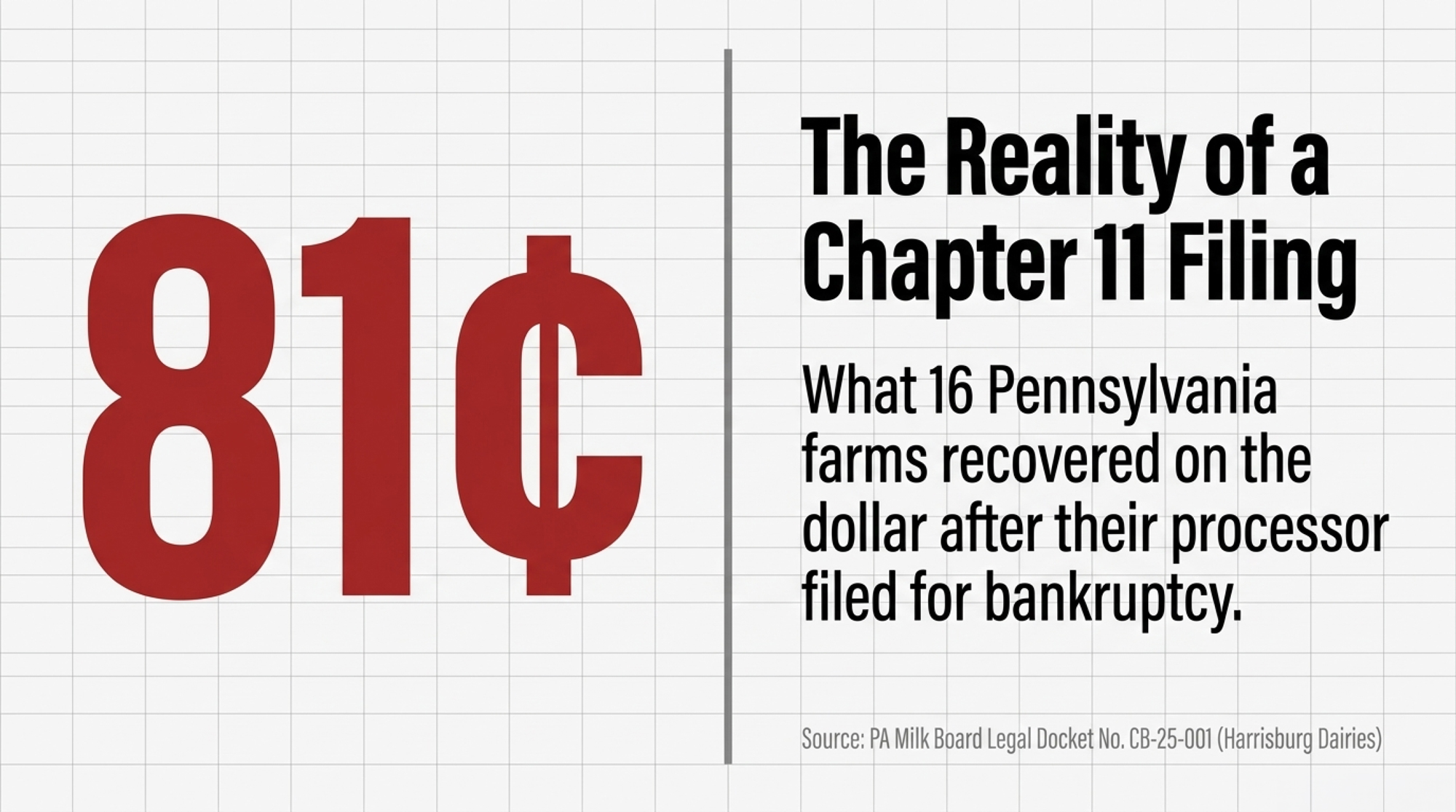
The actual recovery, once the Board finished the arithmetic, came in at 81 percent of what those 16 producers were owed.
Four months later, on February 20, 2026, Harrisburg filed Chapter 11 in the Middle District of Pennsylvania — Case No. 1:26-bk-00474, before Chief Judge Henry W. Van Eck, represented by Robert E. Chernicoff of Cunningham and Chernicoff PC. In April 2026, a federal bankruptcy judge approved the sale of the facility at 2001 Herr Street, along with equipment and the rights to the Harrisburg Dairies name, for $4.95 million. The buyer was Patanjali Dairy USA LLC, a Delaware-registered company that regional business coverage has described as New Jersey-based.
Why read this now, eleven months after the trucks stopped? The file only closed this summer. The Board didn’t finish distributing money to those 16 farms until August 2026; the buyer took over the plant in April, and every producer signing or renewing a contract this fall is making the same call Kopp’s neighbours made — stay or go, with incomplete information.
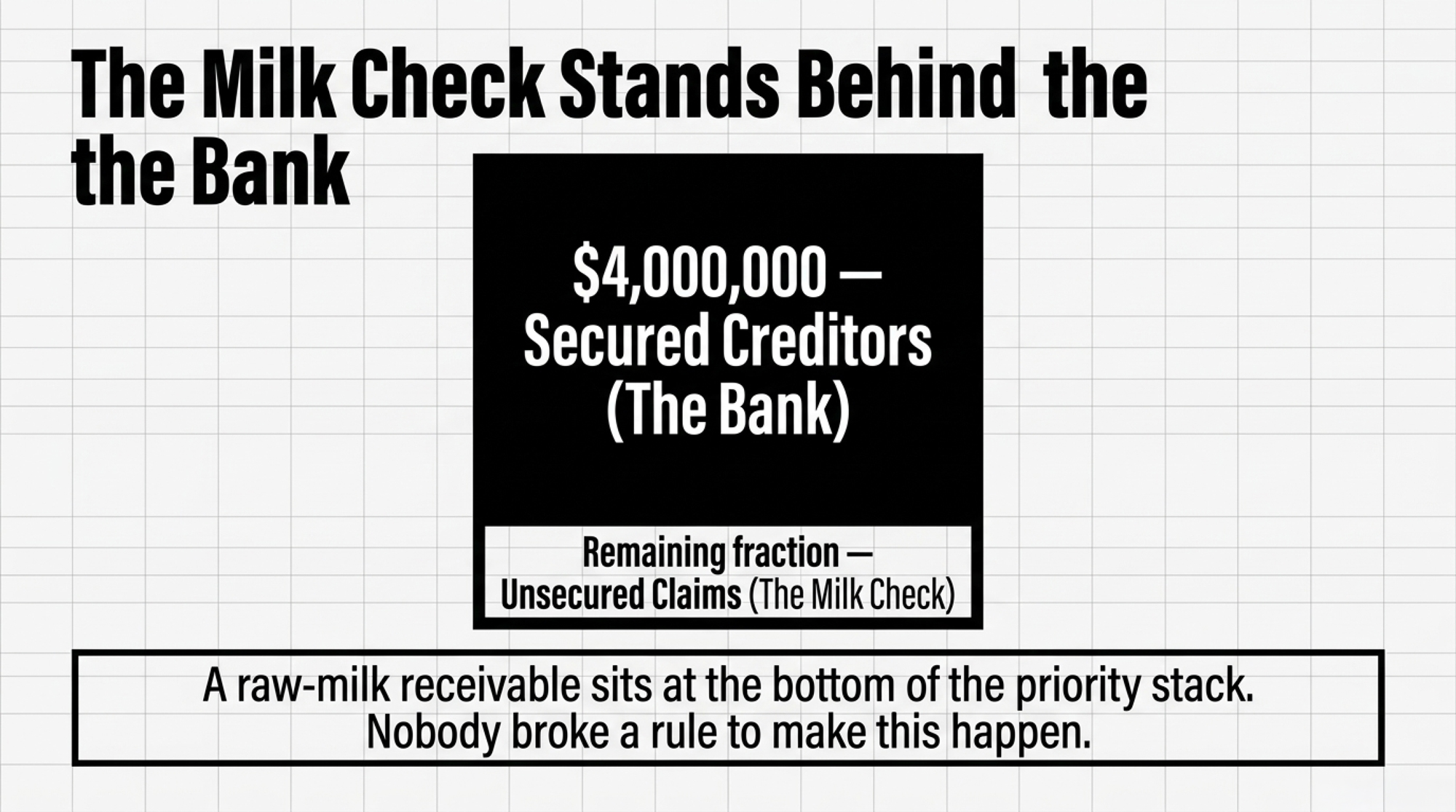
Now the part that should stop you. Roughly $4 million of that $4.95 million sale price went to secured creditors first. Whatever producers were still owed after the bond payout became an unsecured claim — payable only from what the lenders left behind. So the milk check stood behind the bank. Nobody broke a rule to make that happen. That’s simply where a raw-milk receivable sits in the priority stack, and if you ship to one buyer, you’ve probably never had a reason to find out.
What Two Months of Unpaid Milk Costs on 300 Cows
The Milk Board’s distribution method was mechanical. Divide available funds by total unpaid pounds, then multiply each farm’s unpaid pounds by that rate. All 16 producers signed consent agreements accepting it. Authorized payments ran from $3,211.75 to $165,265.12, averaging about $46,000. None of that spread reflects who deserved more. It tracks pounds shipped and unpaid, and nothing else.
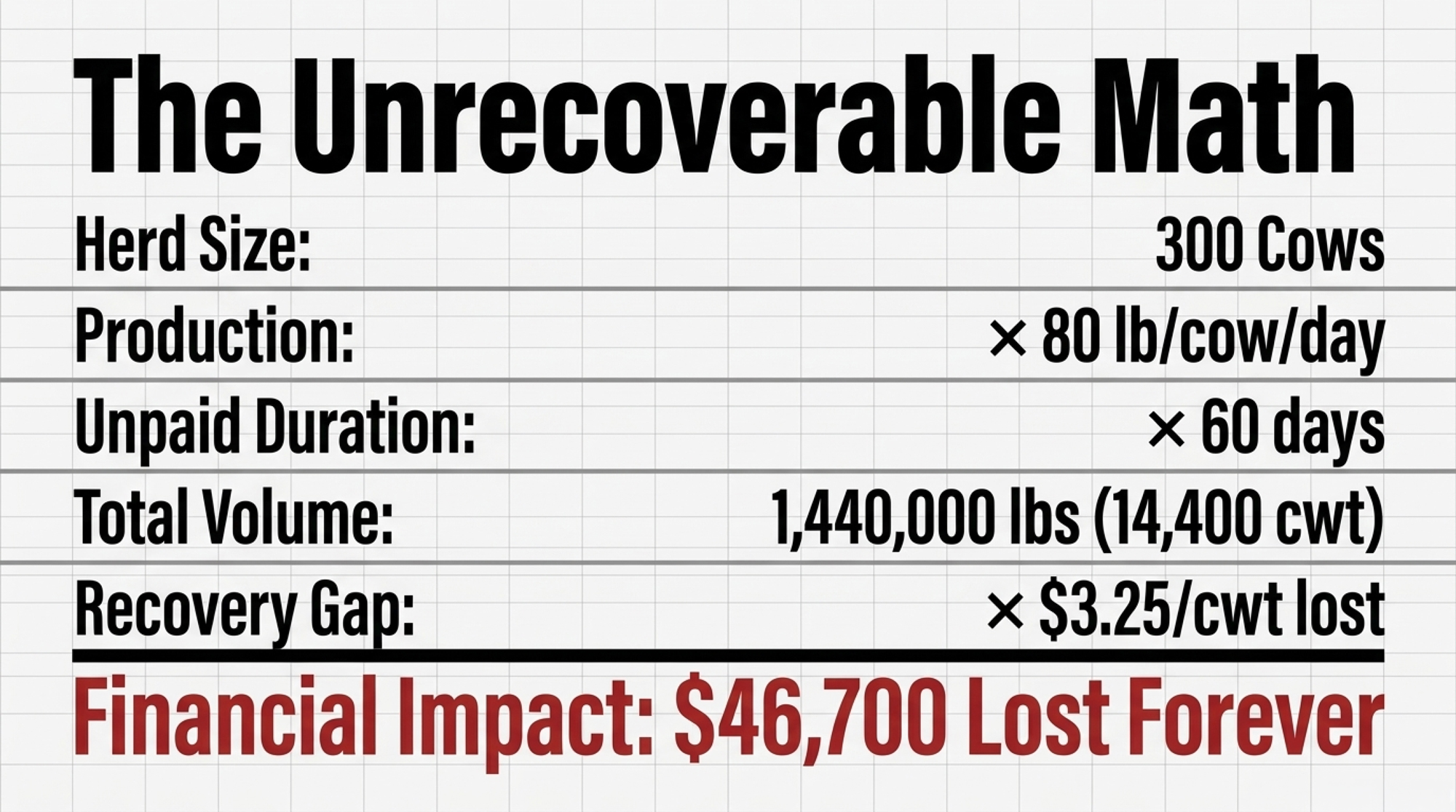
Put Kopp’s timeline on your own herd. Two months unpaid on 300 cows at 80 lb/cow/day is 1,440,000 pounds — 14,400 cwt. At the same $3.25/cwt gap those Pennsylvania farms absorbed, that’s roughly $46,700 that never comes back. Before legal costs. Before hauling. Before interest on whatever you borrowed to cover payroll while you waited.
Twenty years of shipping to the same plant, and the last two months of it went out the door. The 16 producers on the Board’s order eventually recovered 81 cents on the dollar.
The Deductions Nobody Audits — and Why They’re Two Different Problems
A second exposure sits inside your check, and it has nothing to do with the base price. Hauling and promotion assessments come off the top as though they’ve already been paid onward. Whether your handler is actually remitting what it deducts is a question most producers have never put in writing. You have no direct confirmation either way.
Those two line items aren’t the same kind of risk, and it’s worth knowing which one you’re carrying.
Hauling is a service charge — your handler deducts it and, in the ordinary course, owes the hauler. Nothing in the statutes reviewed here gives that deduction any special protected status. If a handler fails, that’s a commercial dispute between the handler and the trucking company, and you may end up in it if the hauler comes looking for payment on milk already moved.
Promotion is a federal assessment, and the mechanics are different. U.S. dairy farmers pay a 15-cents-per-hundredweight assessment on their milk under the Dairy Production Stabilization Act of 1983 and the Dairy Promotion and Research Order, administered by USDA AMS. Importers pay 7.5 cents per hundredweight on dairy products brought into the country. Here’s the part most producers get slightly wrong: the state and regional share isn’t a split — it’s a credit of up to 10 cents against that 15-cent national assessment for contributions to certified Qualified Programs. Producers and handlers of certified organic and 100-percent-organic product can apply for an exemption from the assessment entirely.
Your handler doesn’t own that money. It collects it and remits it — monthly, on USDA form DA-20 — as the responsible party under the Order.
Now the honest limit of what we can tell you. No authority was located resolving whether unremitted checkoff assessments held by a handler in bankruptcy retain any protected or trust character, or fall into the general estate alongside every other liability. That’s a real gap, not a hedge. Minnesota’s Chapter 27 trust attaches to the products and their proceeds — the money owed to you for milk — which is a separate question from assessments a handler collected on your behalf and never passed along. Want an answer specific to your situation? That’s a question for a bankruptcy attorney or USDA’s AMS Dairy Program, and it’s worth asking before you need it.
What you can do this month costs nothing: ask your handler, in writing, for confirmation that hauling and promotion deductions have actually been remitted. Keep the reply. It connects to a broader problem in why some deductions never appear on your statement.
Why a Bond Built for 40 Days Came Up Short
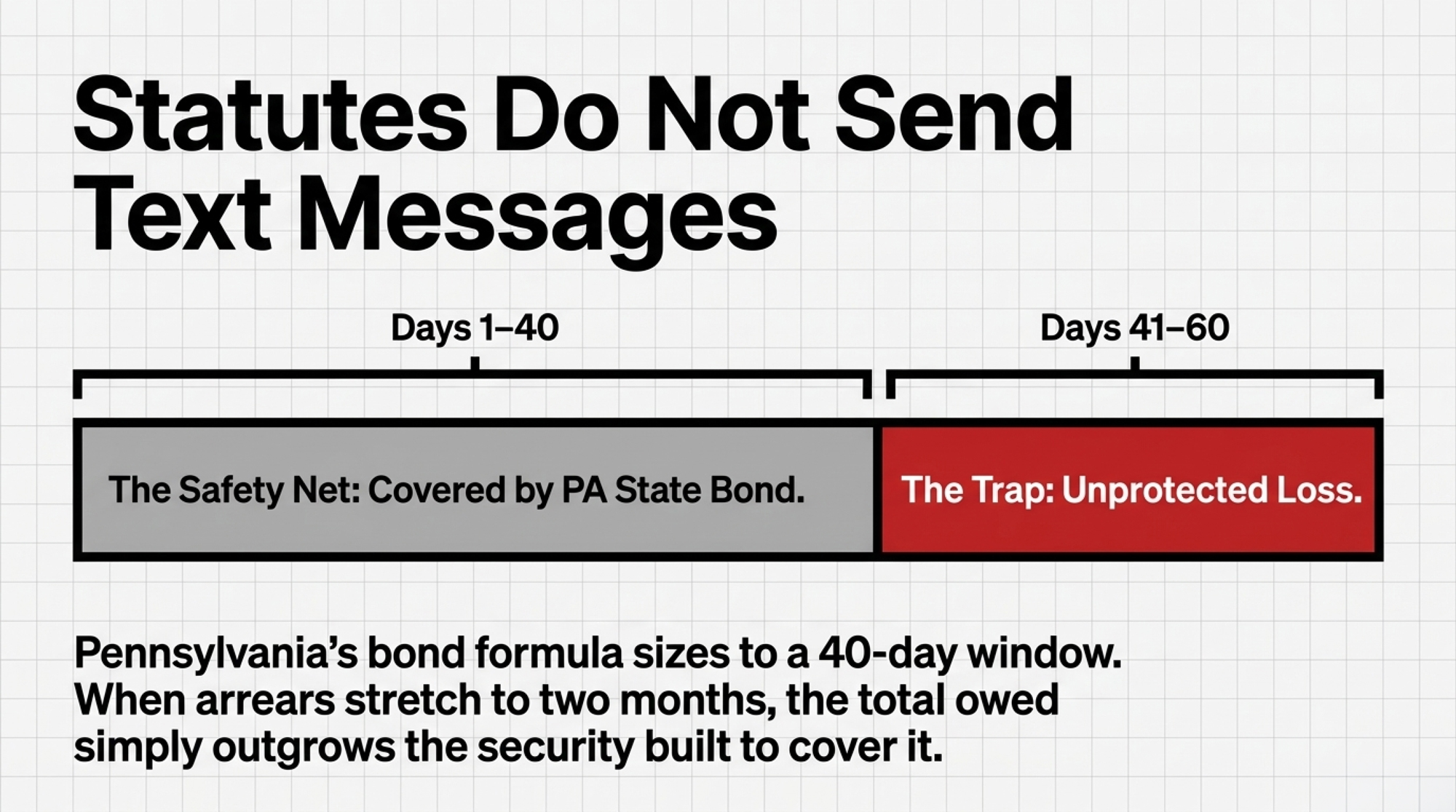
Pennsylvania’s Milk Producers’ Security Act sets a dealer’s bond at a minimum of 75% of the highest aggregate amount owed to producers across a 40-day window in the prior 12 months. Join the state security fund, as Harrisburg had, and the bond drops to a minimum of 30%. On October 7, 2025, Harrisburg’s fund balance stood at $514,942.29, with a $216,000 collateral bond behind it through a Fulton Bank letter of credit.
Forty days. That’s the whole story of the shortfall.
Kopp was two months out — roughly 60 days — and Lancaster Farming reported the company had been behind on payments to farmers for months. Seven Lebanon County farms had already lost their contracts after Whole Foods stopped buying Harrisburg’s milk, Lancaster Farming reported.
Here’s why the window matters. The bond is sized against the highest amount owed to all producers across 40 days. When arrears stretch well past that window, the total owed outgrows the security built to cover it. That’s the gap those 16 farms landed in, and it’s arithmetic rather than anyone’s bad faith.
The Board’s own record shows this wasn’t sudden. Harrisburg Dairies appeared as new business on the Milk Board’s May 7, 2025 Sunshine Meeting agenda under legal docket no. CE-25-004 — regulatory attention on this dealer predated the shutdown by five months. The Board’s November 5 order, Legal Docket No. CB-25-001, then cited the company for failing to timely pay producers for milk received during the 2025–2026 license year, in violation of the Milk Producers’ Security Act and a prior Board order. On October 7, 2025, Harrisburg Dairies executed a consent order, signed by company president Alec J. Dewey, acknowledging the company had failed to pay producers on time and consenting to a claim against the entire fund and bond.
Read that distinction carefully. It’s an admission of failing to pay on time. It isn’t a finding of fraud, and no court has ruled otherwise.
Barley was plain about the ceiling on what the state could do. “We’re just waiting on the process with the bank and the treasury,” he told Lancaster Farming. “We’re hoping (the payments) will be this week.” The full distribution reached farms the following August.
Is Your State’s Protection a Bond, a Fund, or a Trust?
Here’s where geography stops being trivia. Four states, four genuinely different answers — and Pennsylvania’s reputation as one of the better-protected states cuts both ways.
This is reporting on statutory frameworks, not legal advice. Confirm your own coverage with your state agency or your counsel before relying on it.
| State | Primary Protection Mechanism | Coverage Window / Formula | Who Files & Key Deadlines |
| Pennsylvania | Security fund + collateral bond, PMB-administered | Bond ≥75% of highest 40-day aggregate owed; 30% for fund participants (Act 136 of 1984) | Board-initiated. Producers did not file individual claims in the Harrisburg distribution (PMB order) |
| New York | Milk Producers Security Fund or full alternate security (NYSDAM) | Fund assessed $0.012/cwt plus bond ≥12 days’ purchases; alternate security = 40 days of purchases | Producer files. Claims capped at the first consecutive 40-day unpaid period, and shipments continued after a known default risk claim forfeiture under the reasonable-business-judgment test (Ag & Mkts § 258-b) |
| Wisconsin | Agricultural Producer Security Fund, DATCP-administered, Wis. Stat. ch. 126 | Payment due by the 4th and 19th monthly; contractors disqualified from the Fund post ≥75% of highest milk payroll obligation | Producer files a default claim with DATCP. Program line: (608) 224-2998 |
| Minnesota | Statutory trust, Minn. Stat. ch. 27 | Trust on products and proceeds, taking priority over other security interests (MDA) | Producer files within 40 days of the due date, with notice to the dealer, MDA, and the Secretary of State. Qualifying co-ops appear excluded from the definition of covered dealer |
That table shows a pattern worth naming. Pennsylvania and New York built dairy-specific machinery — a milk board, a milk producers’ security fund — and sized it to what a dairy regulator thinks a dealer’s exposure looks like. Forty days, or twelve days’ purchases. Tidy, bounded, and no bigger than the assumption behind it. Wisconsin and Minnesota folded milk into broader agricultural statutes instead, which means producers there inherit whatever that wider law happens to give.
And there’s a real irony in how that shook out. Pennsylvania built a whole board to look after its dairy farmers, then capped their protection at 40 days. Minnesota never built one — it filed milk in alongside fresh fruit, vegetables, and mushrooms — and gave producers a lien that can outrank the bank.
Minnesota’s Farm Products Dealers Act creates a trust that operates like a lien and takes priority over other security interests, and the statute expressly lists “milk and cream and products manufactured from milk and cream” as covered perishable farm products. A milk plant buying your milk for resale appears to fit the statute’s definition of a farm products dealer — the law even sets a milk-specific due date at 15 days following the plant’s monthly day of accounting. That’s more than PACA does, since PACA’s trust protection has never extended to dairy.
If you’re a Minnesota co-op member, read the exclusions closely before you count on any of it. On its face, the statute writes out any marketing cooperative association where substantially all voting stock is patron-held and at least 75% of business runs through member patrons. Whether your specific buyer falls inside or outside that carve-out is a question for MDA or your own counsel — not an assumption to carry into a crisis.
New York’s cap deserves a second look too. Claims stop at the first 40-day consecutive period of nonpayment, and no claim is allowed on milk sold after a dealer’s known failure to pay if the Commissioner decides your extension of credit “did not constitute a reasonable exercise of business judgment.” Plainly: in New York, continuing to ship to a buyer who’s already missed payments can void your claim on that later milk.
That points the opposite direction from the federal bankruptcy rule, where shipping more unpaid milk actually strengthens your position. Two rules, two directions. And each of these mechanisms has sat in a statute book for years, waiting for someone to look it up. Statutes don’t send you a text when they start to matter.
Finding a New Buyer Wasn’t the Hard Part. So What Was?
All five of Harrisburg’s remaining shippers found another processor, Barley told PennLive. Kopp was among those who did. For the farms still on the route at the end, access to a buyer wasn’t the problem.
The loss was the milk already gone — two months of it in Kopp’s case, and for the 16 producers on the Board’s order, a recovery that arrived ten months later at 81 cents on the dollar. That’s the trap. You can solve the buyer problem quickly. You cannot solve the receivable problem at all once the arrears run past your state’s coverage window.
Switching isn’t free either, and you should price it before you’re forced into it. Work it from the load, not the pool: a tanker carries about 350 cwt, and agricultural trucking runs roughly $4.00 to $5.50 per loaded mile. Add 50 miles to reach a new plant, and that’s 57¢ to 79¢/cwt — somewhere between $50,000 and $68,900 a year on 300 cows at 80 lb/day. Our analysis of what re-routing milk to a new buyer actually costs per cwt after DFA’s St. Albans idle put rerouting at $0.85 to $3.15/cwt depending on destination, so treat those figures as a floor rather than a worst case.
Compare that against $46,700 of unrecoverable milk. A haul premium is an annual cost you can budget and negotiate. Two months of unpaid pickups is a one-time hole you never fill.
What Should You Actually Check Before Friday?
Two numbers, and you can have both by the end of the week. First, your buyer’s current security — the amount and the window it’s built to cover. Second, your current days-outstanding on payment.
Hold them side by side. If your days-outstanding already runs longer than your state’s coverage window — 40 days in Pennsylvania, 40 days under New York’s alternate-security option — the safety net beneath you is functionally spent, and no statute is going to stretch to cover the difference. It takes one phone call and about fifteen minutes.
Options and Trade-Offs
The 30-Day Coverage Audit
- Action: Call your state milk board or department of agriculture and verify your handler’s current security amount and the coverage window behind it. Wisconsin producers: (608) 224-2998.
- When it makes sense: Always, and doubly so if one buyer takes all your milk.
- What it costs you: About 15 minutes.
- Failure point: It verifies the ceiling, not your handler’s liquidity. Harrisburg was bonded and on the Board’s docket months before it closed.
The Contemporaneous Ledger
- Action: For every milk check, log the date received, the milk period it covered, days late, and pounds paid.
- When it makes sense: Starting with the next check, regardless of how healthy your buyer looks.
- Why it matters: This documentation sustains both a state bond or trust claim and the two federal preference defenses — ordinary course of business and subsequent new value.
- Failure point: It only pays off if a buyer actually goes down. That’s the point of doing it before one does.
The State Filing Trigger
- Action: Map your state’s statutory clock now, before nonpayment happens, and confirm you’re actually eligible under it.
- When it makes sense: If your state requires you to file rather than paying out automatically — Minnesota and Wisconsin both do.
- Failure point: In Minnesota, missing the 40-day tripartite notice window — dealer, MDA, Secretary of State — destroys statutory trust status regardless of merit. The co-op carve-out may exclude you entirely.
The Preference Demand Protocol
- Action: Retain shipping records for every load delivered after you received a late or catch-up check.
- When it makes sense: From the first late payment onward.
- Why it matters: Payments received in the 90 days before a Chapter 11 filing can be reviewed as preference payments under 11 U.S.C. § 547. The ordinary-course defense turns on whether a payment matched the pattern between you and that buyer, not whether it was prompt. Subsequent new value is arithmetic — milk shipped after a payment and never paid for offsets exposure dollar for dollar.
- Failure point: Both defenses are fact-intensive, and New York’s business-judgment rule pushes against the new-value logic on state claims. After Dean Foods filed in 2019, roughly 500 former independent suppliers received demand letters from a contingency firm, and those without consistent payment history negotiated from weakness. Get a bankruptcy attorney the day a letter arrives.
Any of this gets harder in a region losing plants. It’s worth knowing where new processing capacity is actually being built before you assume a backup buyer exists within reach.
Key Takeaways
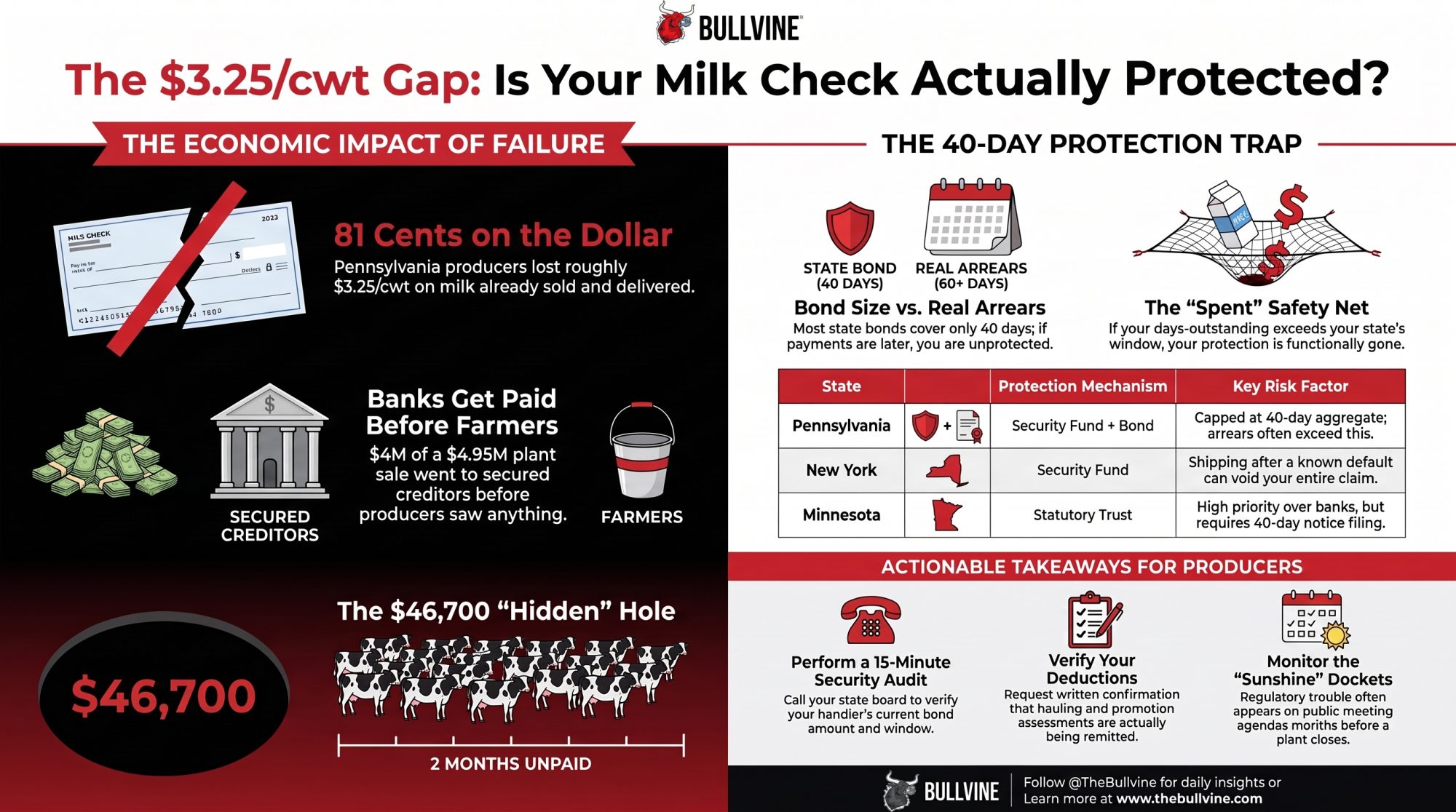
- If your days-outstanding on payment already exceeds your state’s coverage window, treat the protection as spent and start pricing a second buyer this week.
- If you can’t state your buyer’s current bond or fund amount from memory, that’s your 15-minute call — the figure is public record.
- If your state publishes regulatory meeting agendas, read them. Harrisburg was on the Milk Board’s docket five months before the trucks stopped.
- If your problem feels like “where will my milk go,” reframe it. Harrisburg’s remaining shippers all found new processors. None of them got the unpaid milk back.
- If you’ve never seen written confirmation that hauling and promotion deductions were remitted, ask for it in writing this month.
- If you’re claiming less than the full 10-cent Qualified Program credit against your 15-cent checkoff assessment, find out why — that’s a per-cwt line you can verify with your handler.
- If you’re certified organic, check whether you’ve filed for the assessment exemption. It exists, and it’s producer-initiated.
- If your state runs a dairy-specific board or fund, expect protection sized to a dairy regulator’s assumptions — bounded, and no bigger than the window behind it.
- If you’re a Minnesota co-op member, ask MDA directly whether the Chapter 27 trust reaches your buyer before assuming either way.
- If you ship a private plant in Minnesota and the trust applies, your claim can outrank their bank — but only if you give notice to three parties within 40 days of the due date, which for milk plants runs 15 days after the monthly day of accounting.
- If you ship in New York and your buyer has already missed a payment, continuing to ship can void your claim on that later milk. The federal rule and the state rule disagree here.
- If you don’t know what an added 50 miles of haul would cost you, run it at $4.00 to $5.50 per loaded mile across a 350-cwt load before you need a new plant, not after.
- If a preference demand letter ever lands in your mailbox, your shipping records from the weeks after each payment are the arithmetic that reduces the claim.
Adam Kopp shipped to the same bottler for 20 years and found a new one. What he couldn’t do was reach back and collect two months of milk that had already been sold — and Pennsylvania’s bond formula, sitting in statute since 1984, was never built to let him.
Pull your last twelve milk checks and count the days. You can have that number before this week is out. The harder question is what you’d do Monday morning if it came back longer than 40.
The full 90-day cash-flow map, exposure tables for 300- and 800-cow herds with best, base, and worst recovery scenarios, and the complete processor-risk audit checklist are in the Tier 3 breakdown in Bullvine Weekly — alongside the full creditor timeline and the 90-day clawback window. That’s where the per-cwt modeling by herd size lives.
Complete references and supporting documentation are available upon request by contacting the editorial team at editor@thebullvine.com.
Learn More
- Milk Check Transparency: The Co-op Exemption Leaving Farmers in the Dark — Audits the hidden deductions draining your net milk price and arms you with specific accounting questions to expose whether hauling charges and marketing line items are subsidizing plant balance sheets.
- DFA St. Albans Closure Exposes the Real Hauling Cost Crisis — Quantifies the structural fallout of Northeast processing consolidation, showing how rerouting milk across 100 extra miles adds $0.85 to $3.15/cwt in permanent hauling friction that erodes herd margins.
- Dairy Plant Closures Threaten Northeast While Midwest Expands — Exposes the shifting processing map where billions in new cheese capacity bypass aging fluid milksheds, giving forward-looking operators the strategic baseline needed to negotiate long-term processing access before regional bottlenecks shut them out.
 The Sunday Read Dairy Professionals Don’t Skip.
 The Sunday Read Dairy Professionals Don’t Skip.
Every week, thousands of producers, breeders, and industry insiders open Bullvine Weekly for genetics insights, market shifts, and profit strategies they won’t find anywhere else. One email. Five minutes. Smarter decisions all week.