








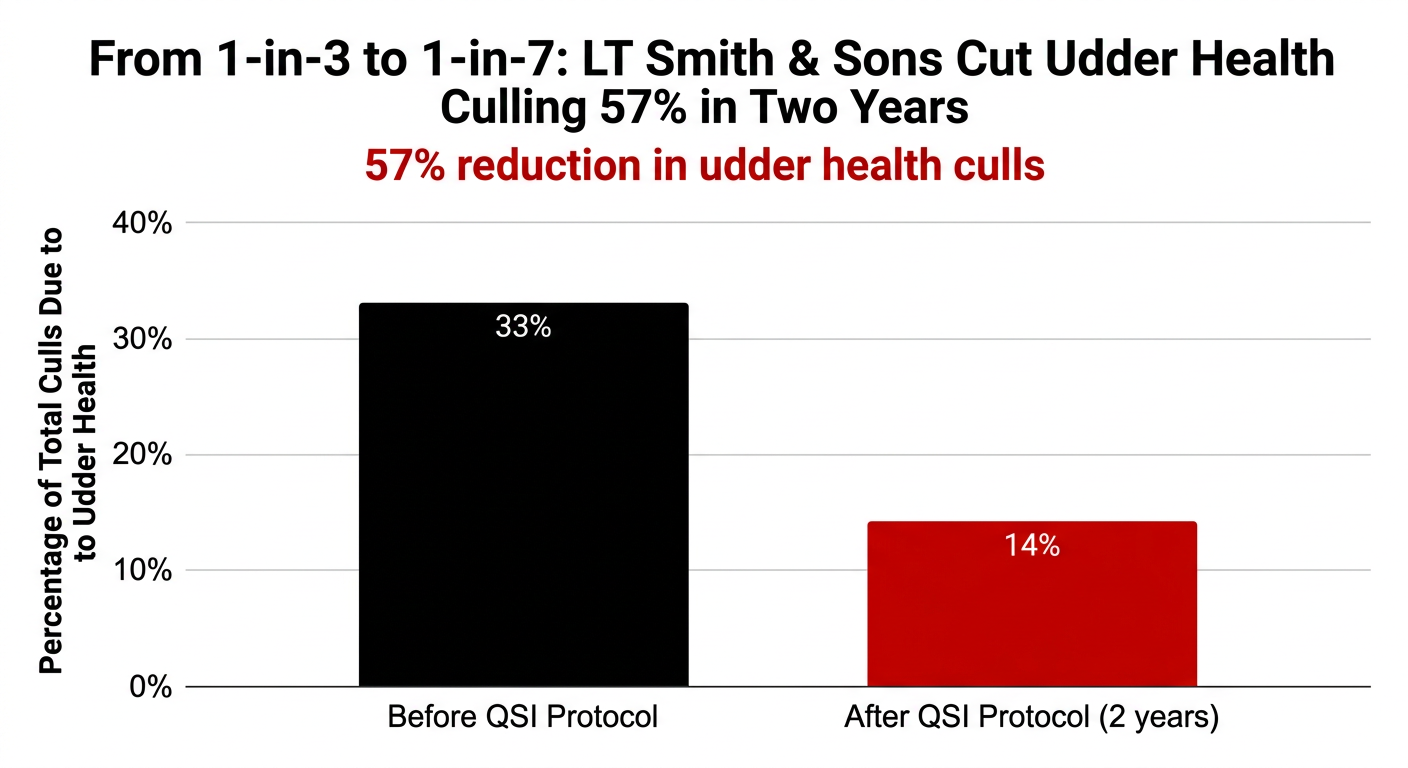
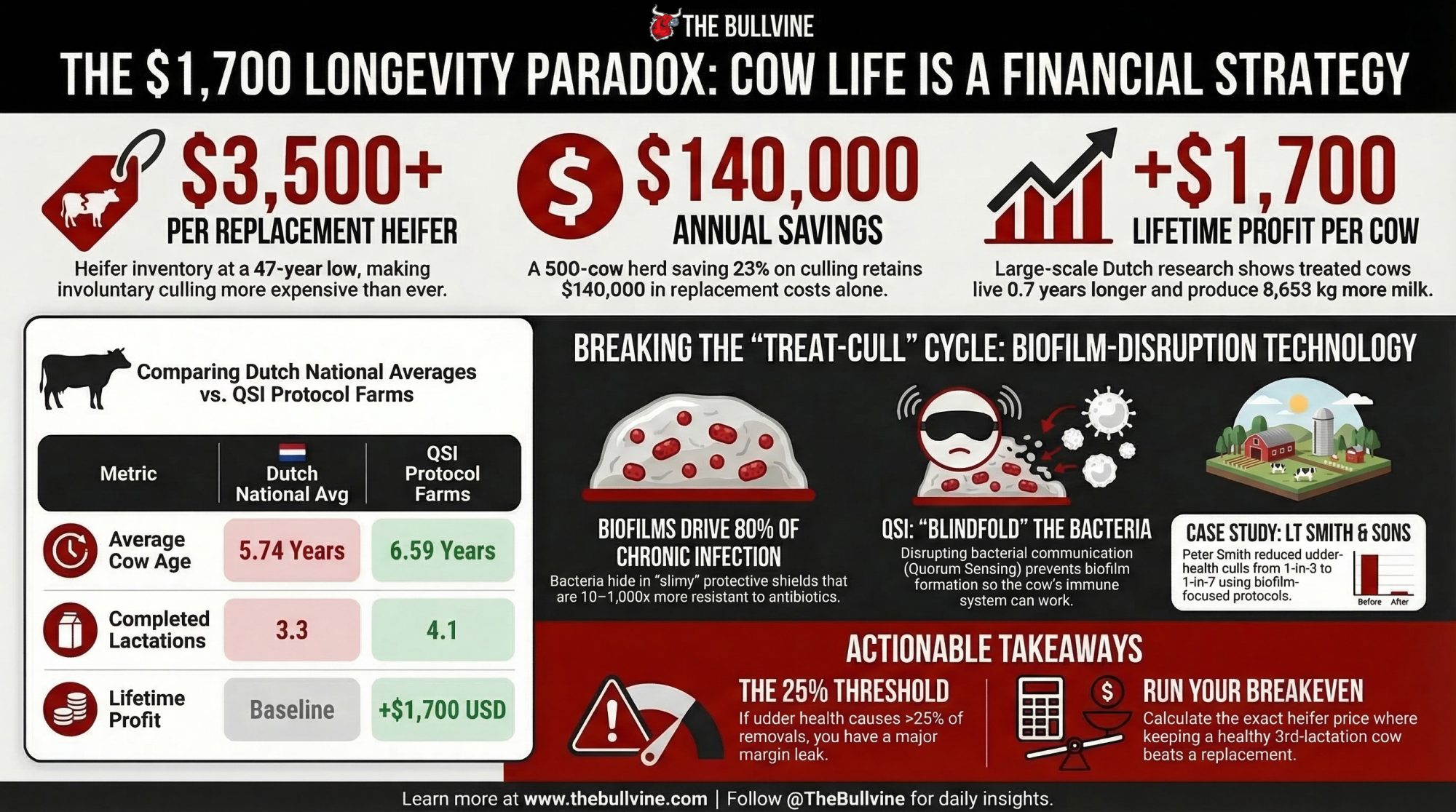
At $3,500 a head, every unnecessary cull hurts. A 1,700-cow operation cut udder-health culls from 1-in-3 to 1-in-7 — saving ~$189K/year on replacements.
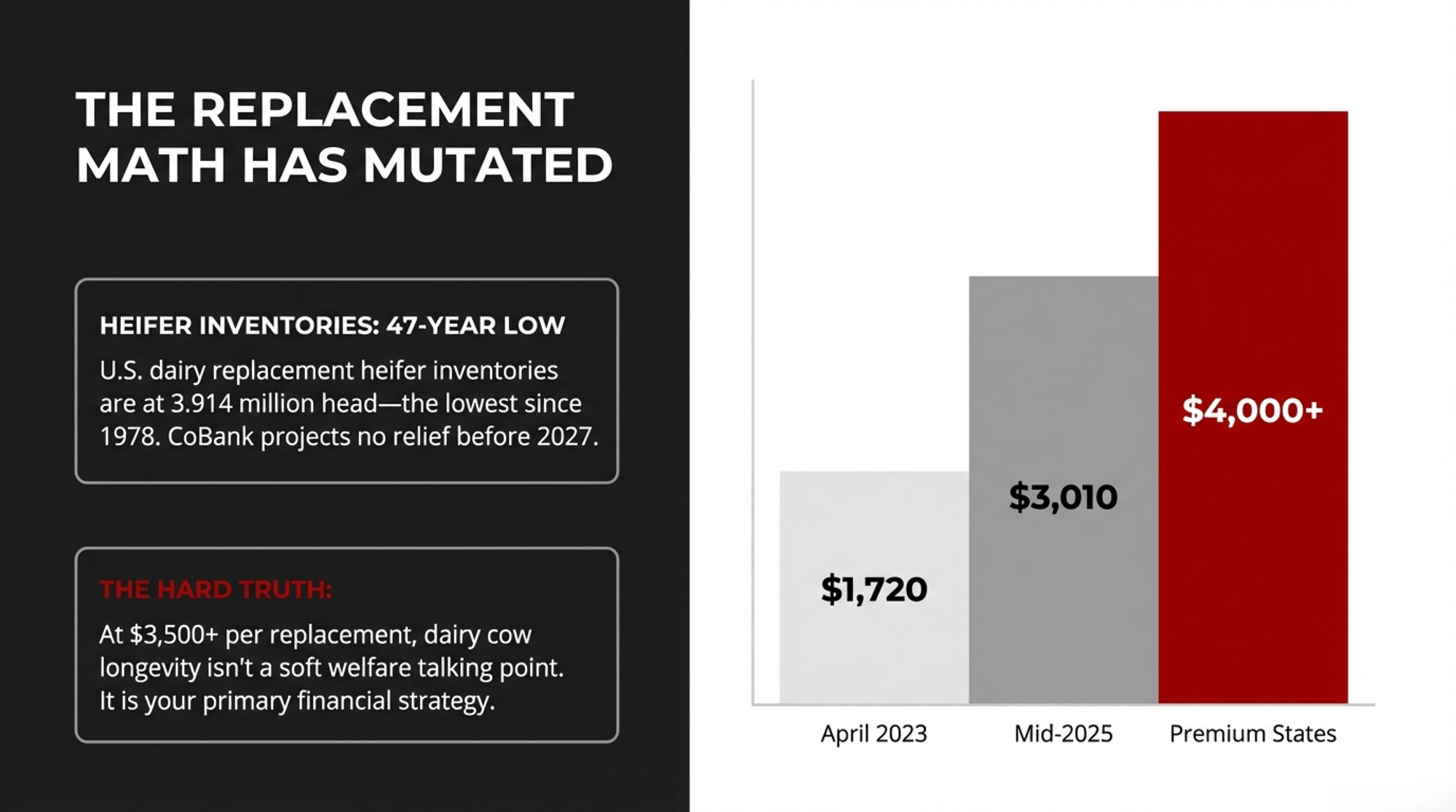
Your most profitable cow probably isn’t the one producing the most milk right now. She’s the one who sticks around long enough to pay back what she cost you — and then some. At $3,500 per replacement heifer, dairy cow longevity isn’t a soft welfare talking point. It’s a financial strategy.
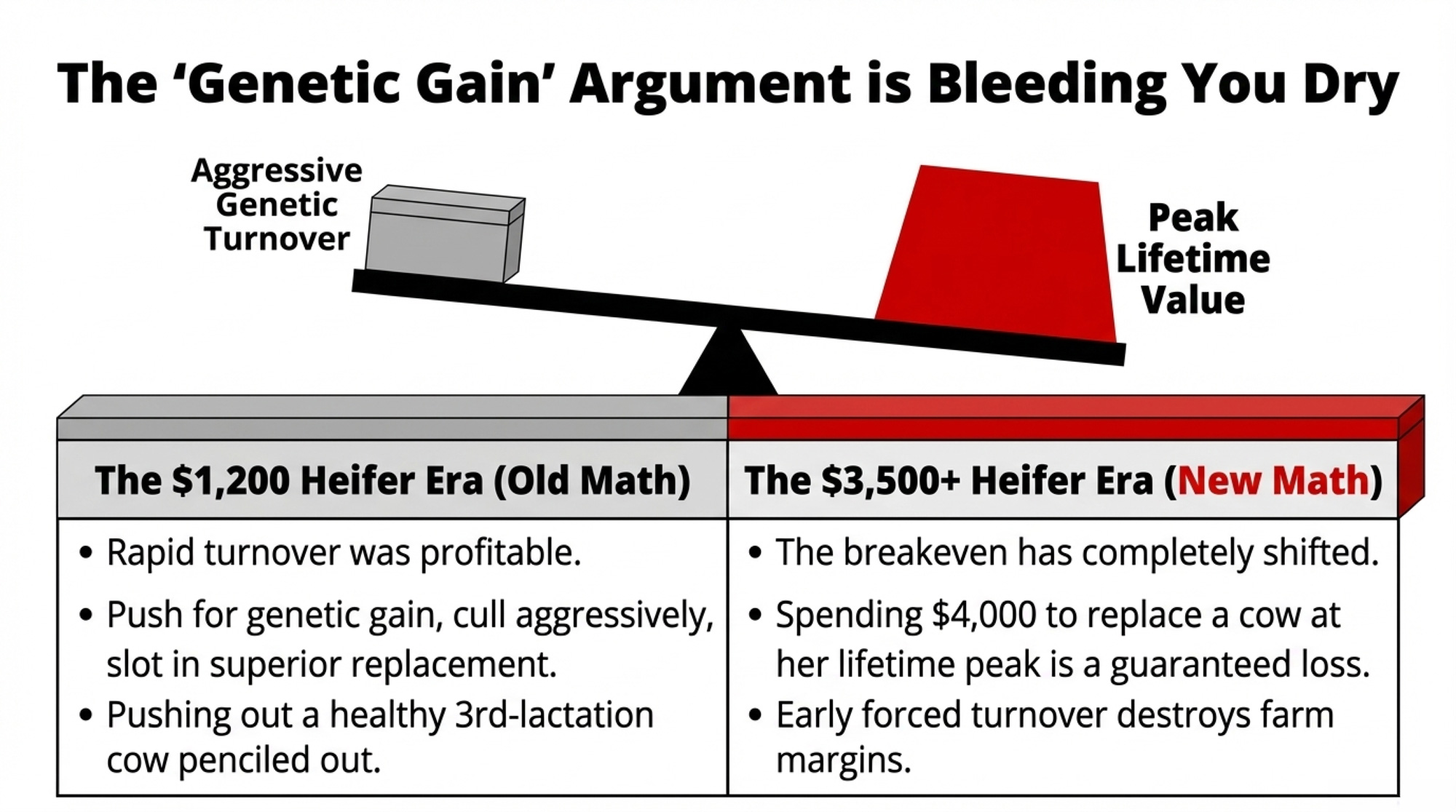
That’s a hard sell in an industry that’s spent two decades optimizing for peak lactation production. Push for genetic gain, cull aggressively, slot in a superior replacement, repeat. The logic held when a springer heifer ran you $1,200. It holds a lot less at $3,500.
A peer-reviewed study published in the Journal of Veterinary Health Science (Herrema et al., Vol. 4, Issue 3, 2023) analyzed 162,057 milk production records across 1,208 Dutch farms and 213,047 animals. Farms using a biofilm-disruption protocol — quorum sensing inhibition, which we’ll unpack — averaged €1,578 more profit per cow over her lifetime (roughly ~$1,700 USD at near-parity exchange rates; the study was conducted in the Netherlands, and all financial figures are in euros) and saw a 23% reduction in culling probability. The statistical confidence in that culling number? A P-value of 1e-46. The odds of it being a fluke are effectively zero.
A 1,700-cow operation was culling 1 in 3 cows due to udder health problems. Today it’s 1 in 7. They didn’t change his genetics. Didn’t add staff. He changed how he thought about chronic infections — and the cows that used to cycle through his hospital pen stopped cycling through his cull list.
Full disclosure: the longevity study was conducted using AHV International’s proprietary protocols, and AHV co-authored the research. We’ll flag where the data comes from, AHV’s own analysis versus independent sources throughout. The dataset is large enough — and the supporting evidence broad enough — that the economics deserve a serious look regardless.
The Replacement Math That Changed
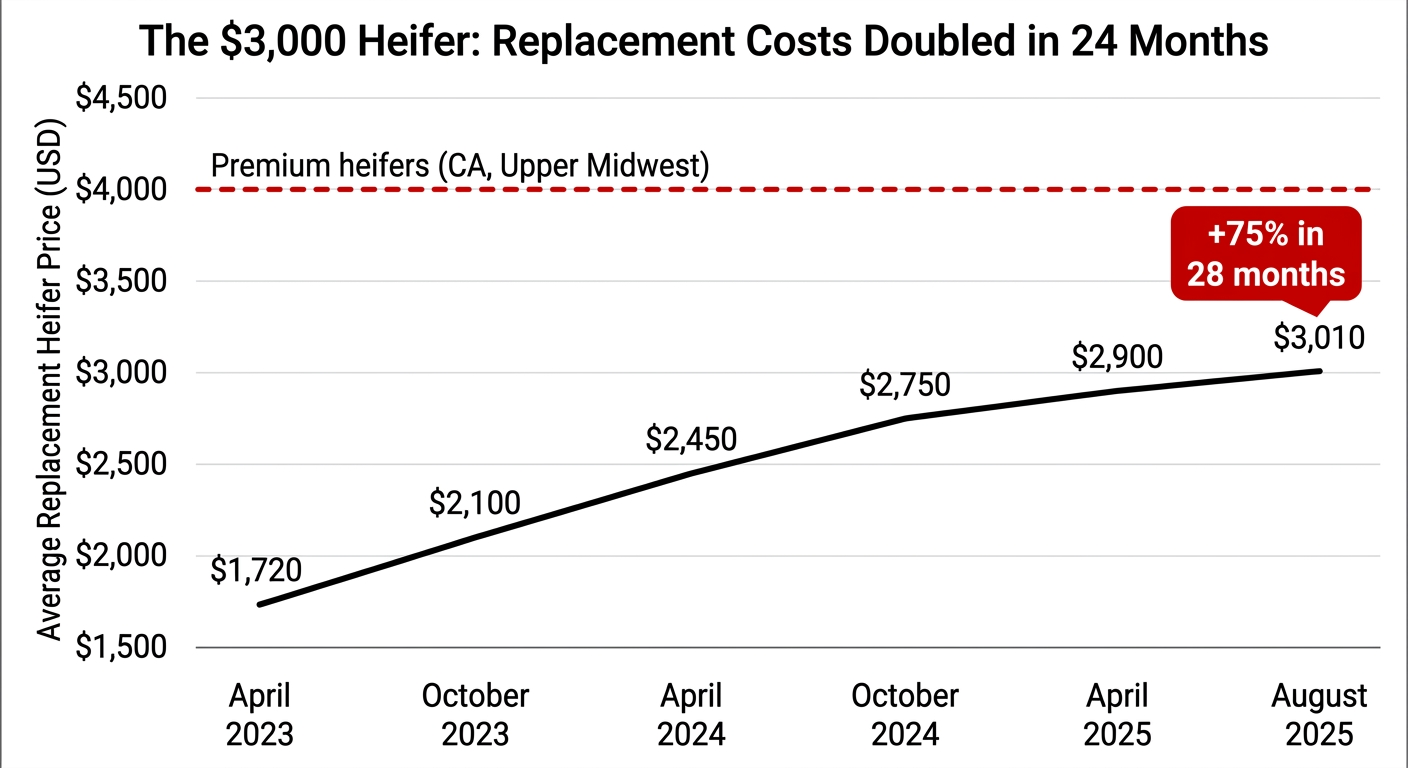
USDA’s January 2025 cattle inventory report put dairy replacement heifer inventory at 3.914 million head — the lowest since 1978. CoBank’s August 2025 Knowledge Exchange report tracked heifer prices climbing from $1,720 per head in April 2023 to $3,010 per head by mid-2025, with quality animals in California and the Upper Midwest clearing $4,000. This isn’t a blip. CoBank projects the shortage won’t meaningfully ease before 2027.
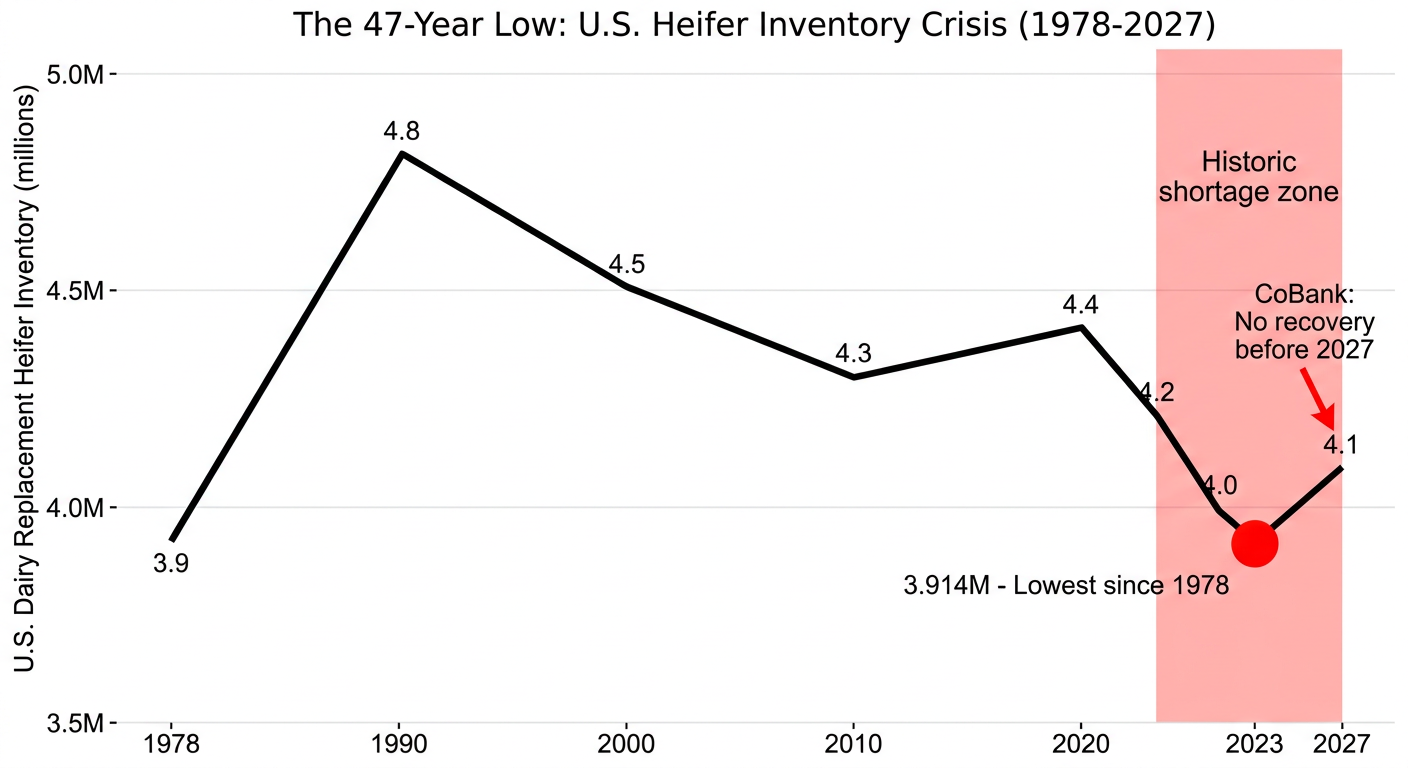
So you’re spending ,000–,000 to replace a cow that — if she’d stayed healthy through her 4th and 5th lactation — had already paid back her rearing costs and was producing at or near her lifetime peak. Studies estimate that 50% to 70% of dairy cows are forcibly culled at 4 to 5 years of age (Gosselink et al., 2008, V-focus). The average U.S. dairy cow lasts roughly 2 to 3 lactations (Pinedo et al., 2014, Journal of Dairy Science, 97(5)). The Dutch average, as tracked by CRV, is closer to 6 years (CRV, 2022). Research on the economically optimal replacement age varies — some analyses suggest 5 to 6 parities, while others put it as high as 8 to 9 lactations depending on genetics and carcass values (Evers & de Haan, 2017).
As Dr. Albert DeVries at the University of Florida has noted, U.S. dairy cows in the 1930s often had productive lives of 5 to 10 years after first calving — now that number is under 3 years. Replacement prices reaching record levels make that shortened productive life more expensive than at any point in the industry’s history.
Either way, the gap between optimal and actual productive life is where the €1,578 lives. And at $3,500+ per heifer, that gap got a lot more expensive.
What 162,000 Records Actually Showed
The Herrema et al. (2023) study is worth slowing down on. It’s unusually large for a longevity study, and the methodology is more rigorous than most.
Researchers compared 64,467 cows from 3,171 farms using AHV’s quorum-sensing inhibition protocol against Dutch national averages from CRV, the country’s official herd recording organization. They built separate XGBoost machine learning models for treated and non-treated groups—a counterfactual approach that adjusts for confounding factors like age at first treatment. One caveat: farms self-selected into the AHV protocol, so the dataset may partly reflect operations already focused on herd health. The counterfactual modeling addresses some of that, but observational studies can’t fully control for management quality. That said, 64,467 animals benchmarked against CRV national records is a scale that smooths out much of the individual-farm variation. The differences were statistically significant at levels orders of magnitude below p ≤ 0.001.
| Metric | QSI Protocol Farms | Dutch National Avg (CRV) |
| Average cow age | 6.59 years | 5.74 years |
| Average lactations completed | 4.1 | 3.3 |
| Culling probability reduction | 23% lower | Baseline |
| Additional profit/cow (lifetime) | +€1,578 (~$1,700 USD) | — |
| Longevity improvement | +0.7 years (8.5 months) | — |
The paper’s ROI section used FrieslandCampina milk pricing (Milk Fat: €300/100 kg; Milk Protein: €595/100 kg) to calculate lifetime revenue. AHV-treated cows produced 43,881 kg of milk over their lifetimes, versus 35,228 kg for non-treated cows — a difference of 8,653 kg. That translated to €0.50 more revenue per day of life (€6.37 vs. €5.87), totaling €1,578 in additional lifetime profit from milk revenue alone.
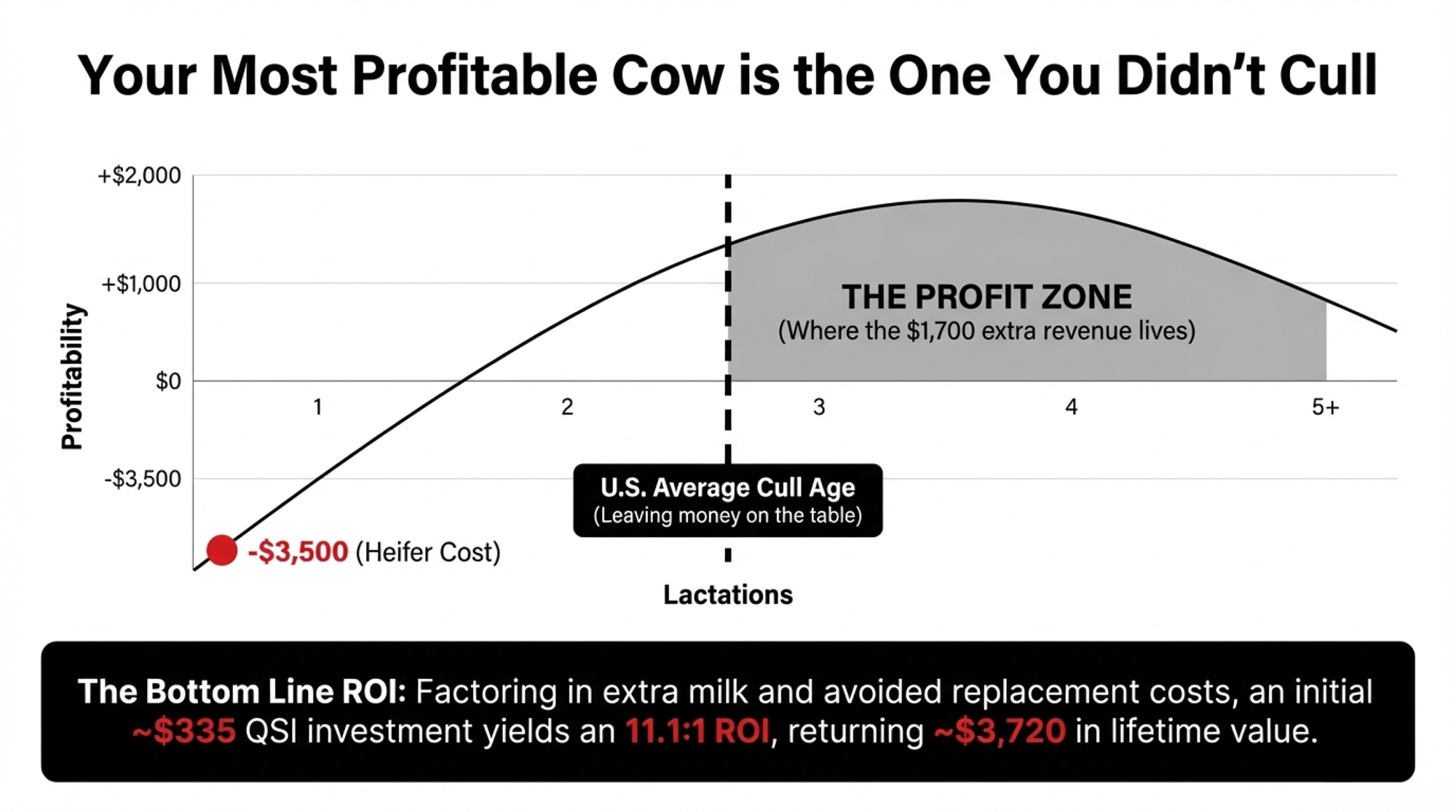
A Benelux subset of 2,161 cows in AHV’s Trial Information Sheet (TIS, 2024) analysis further extended the picture: a 19.8% lower replacement rate on top of the production gains. Factoring in replacement savings, AHV’s own analysis pegs total lifetime ROI at 11.1:1 — approximately €310 (~$335 USD) invested per cow returning €3,447 (~$3,720 USD) through additional milk revenue, reduced replacement spend, fewer hospital pen days, and lower treatment costs. That broader ROI comes from AHV’s TIS marketing analysis, not the peer-reviewed paper. The paper supports the milk-revenue component; the replacement cost savings are AHV’s calculation.
A companion study published in Smart Agricultural Technology (Streefland, Herrema & Martini, 2023, Vol. 6, p.100302) — Elsevier-indexed — validated the milk-yield findings using a Gradient Boosting model with prediction errors under 2.5%, confirming improved yield across all three dairy companies in the trial.
One more journal note: the Journal of Veterinary Health Science (OPAST Publishers) isn’t top-tier—it’s not indexed in PubMed or Scopus. But the Elsevier-published companion validation and the sheer size of the CRV-benchmarked dataset give the production findings more weight than the journal alone would suggest. The direction aligns with independent, peer-reviewed research consistently showing that involuntary culling before optimal age is one of dairying’s largest unmanaged cost centers. The Bullvine’s own deep dive into the hidden costs of shortened productive life mapped this same tension between genetic progress and longevity economics — and that was before heifer prices hit $3,500.
Why Your Best Cows Keep Leaving Before Their 4th Lactation
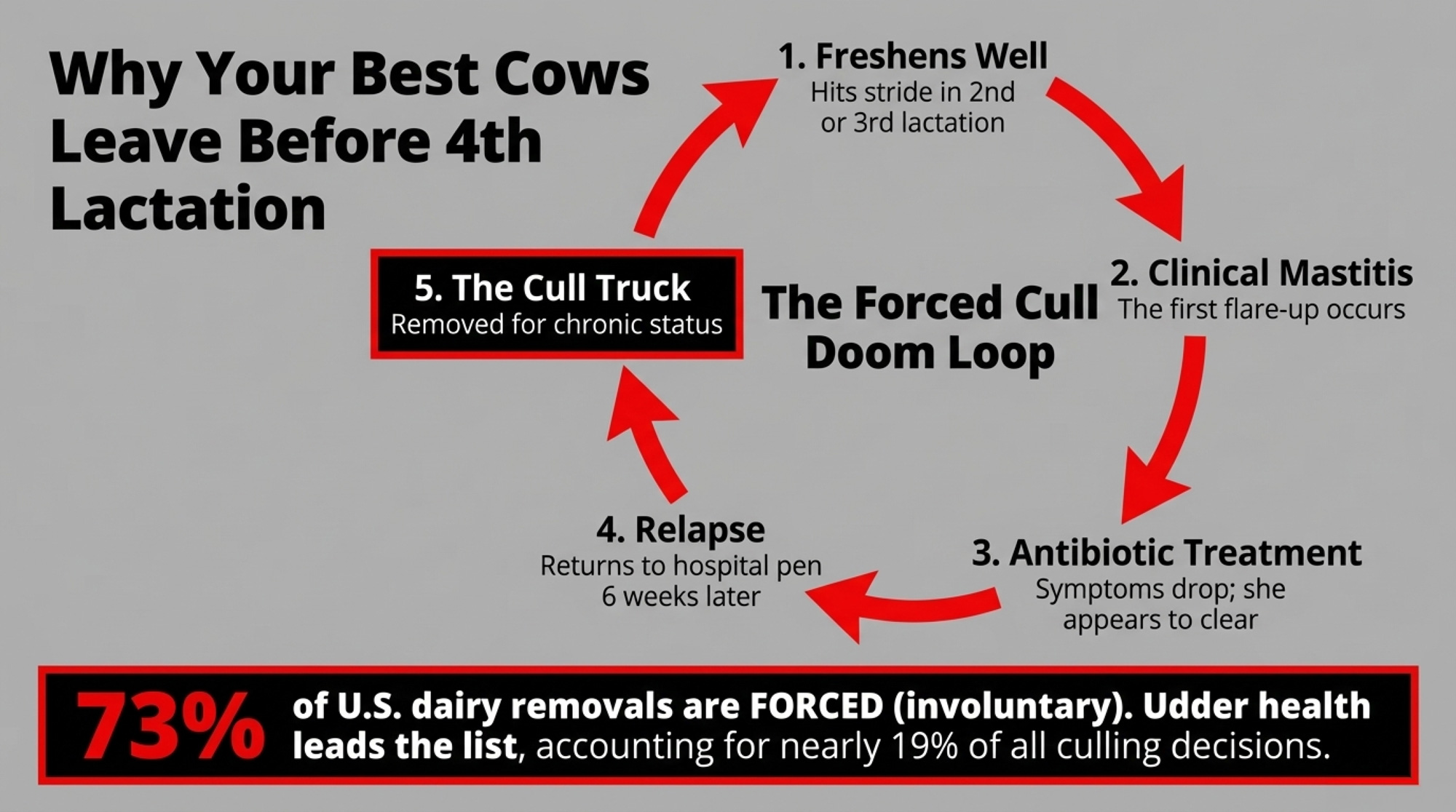
You know the cow. She freshened well, bred back, and hit her stride in 2nd lactation. By her 3rd, she’s putting serious milk in the tank. Then she picks up clinical mastitis. You treat it. She clears. Two months later, it’s back. Treat again. By the time she’s chronic, she’s on the cull list — not because she can’t produce, but because you can’t keep her healthy.
That treat-clear-relapse-cull cycle is the single biggest driver of premature exit from the milking herd. USDA/NAHMS 2018 data pegs total U.S. removal rates at 37.6% for Northeastern herds — 31.4% live culls plus 6.2% death loss. Only about 26.8% of those removals are voluntary. The rest are forced. Udder health, fertility, and lameness lead the involuntary list.
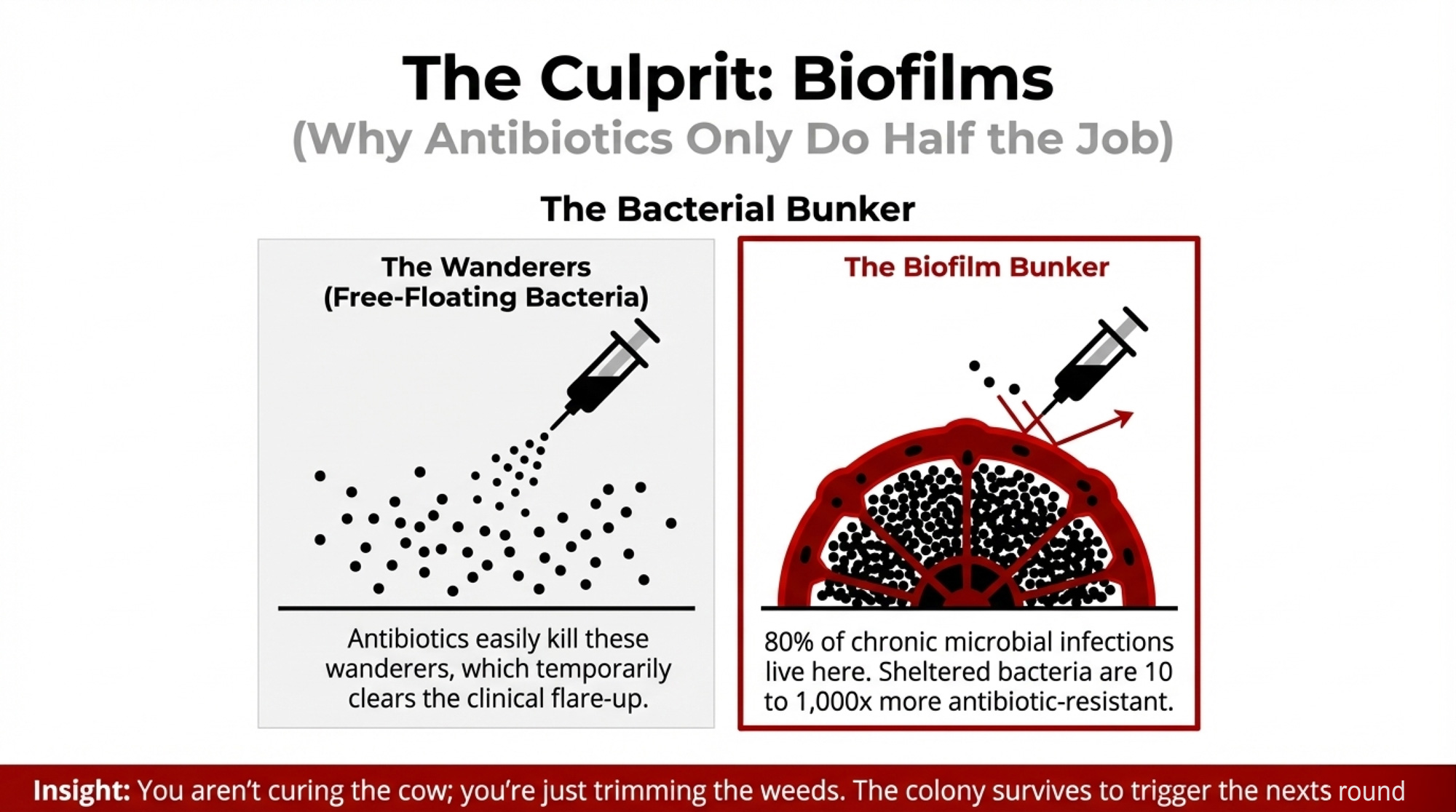
Here’s what’s actually happening inside those chronic mastitis cases: biofilms. Structured communities of bacteria coating tissue surfaces — think of the slime layer inside an old water pipe, except it’s growing in udder tissue. Biofilms contribute to roughly 80% of chronic and recurrent microbial infections. And bacteria sheltered inside a biofilm show 10 to 1,000 times greater antibiotic resistance than the same bacteria floating freely.
That’s why your antibiotic treatment clears the clinical flare-up but never fixes the underlying problem. You’re killing the bacteria that ventured outside the biofilm. The colony inside it barely notices. The cow clears clinically and returns to the string. Six weeks later, she’s in the hospital pen again. Eventually, she’s on the truck.
What Changed on a 1,700-Cow Dairy
As Dr. Gertjan Streefland, a veterinary microbiologist and AHV’s founder, puts it: “Imagine a group of troublemakers. Blindfold them and make them deaf — they can’t coordinate, and they’re immediately harmless. That’s what we do to the bacteria. We don’t kill them. We cut their communication so they can’t organize.”
That’s quorum sensing inhibition — QSI — in one sentence. Instead of killing bacteria (which hasn’t worked against biofilms for decades), QSI disrupts the chemical signaling bacteria use to coordinate biofilm formation. Block the signal, and bacteria can’t build their protective shield. The cow’s own immune system handles the rest.
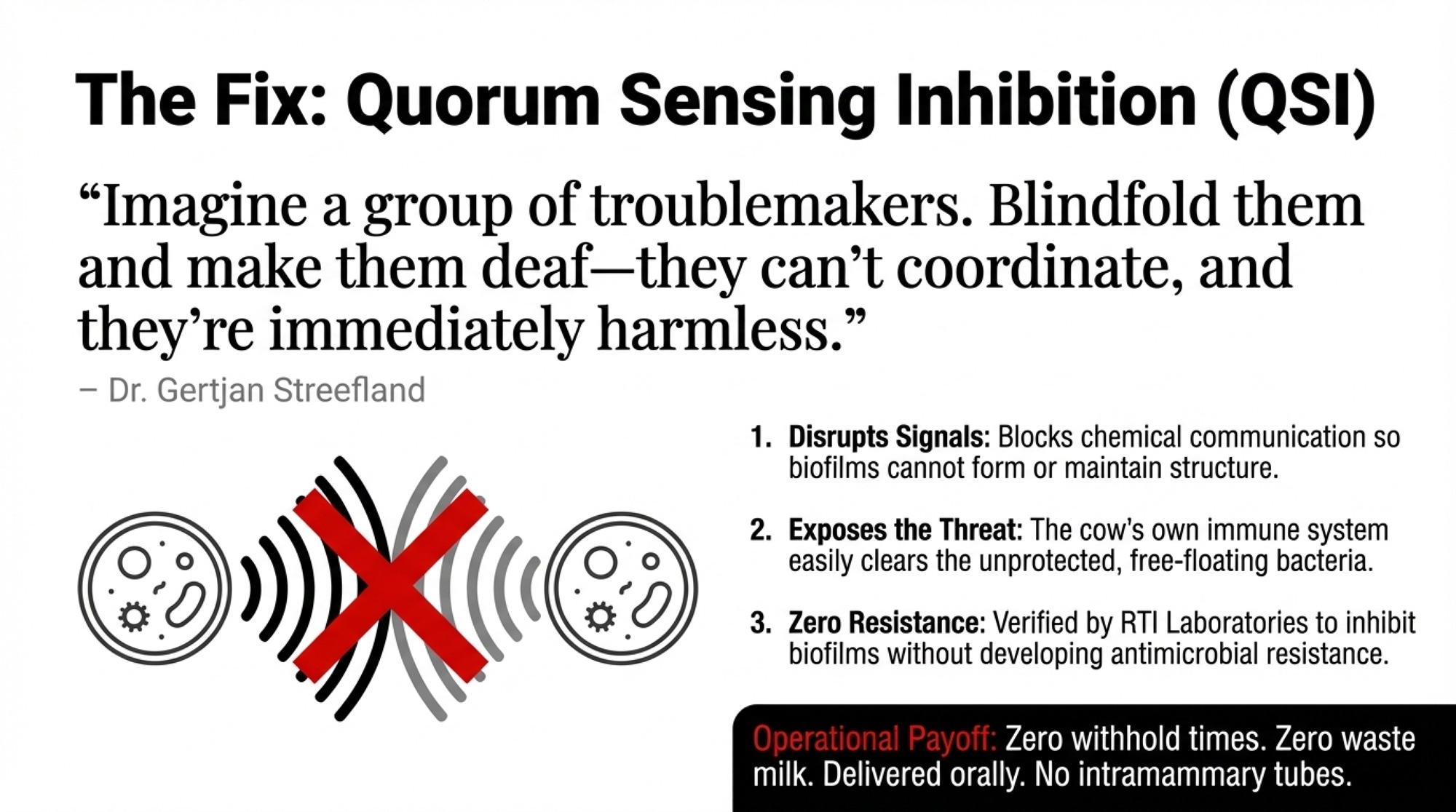
AHV’s patented approach uses an allium-derived (onion plant) extract, screened and concentrated in their own BSL-2 lab for the specific fraction with the highest impact on quorum sensing. It’s delivered orally — no injections, no intramammary tubes, no withdrawal periods. RTI Laboratories tested the compounds on field bacteria from cows with active udder health issues — both gram-positive and gram-negative strains — and confirmed biofilm inhibition without the development of antimicrobial resistance.
That last point matters. A lot.
One producer started at dry-off. Another focused on fresh cows. Both saw the same downstream effect.”
On a 1,700-cow dairy, the full udder health turnaround took two years, with fresh cow protocols running for 14 months. That timeline is honest — this isn’t a 30-day fix. But within that window, udder health culling dropped from 1 in 3 to 1 in 7. The result: 10 to 12 additional cows in his daily milking string that would’ve been on the cull truck. Today, 17% of his herd exceeds 5 lactations.
“Come back in 5 years, and I’m extremely confident that we will be using AHV protocols. It just makes sense from a herd health and financial standpoint.” — Large-herd dairy operator.
These results aren’t the only North American data. A 2024 multi-farm trial (AHV TIS, 2024) across 8 U.S. operations— ranging from 1,000 to 20,000 cows, totaling 4,495 trial animals — showed a 34% reduction in metritis incidence, 3.2 kg/day (~7 lbs/hd/day) more milk in the first 100 DIM, and a positive ROI of €160.76 (~$174 USD) per cow(5.04:1 return) using a transition protocol built on the same QSI platform. A separate 2024 trial (AHV TIS, 2024) across farms in California, Idaho, and Wisconsin — 2,703 cows — showed a 14% reduction in udder health issues and a 70% reduction in mortality rate in the first 60 DIM.
How Much Does Involuntary Culling Cost a 500-Cow Dairy at $3,500 Heifers?
Let’s walk the barn math. Plug in your own numbers where yours differ.
Starting assumptions:
- Current cull rate: 35% (USDA/NAHMS 2018 pegs total removal at 37.6% for NE herds; 35% is conservative)
- Replacement heifer cost: $3,500
- Annual replacements: 500 × 0.35 = 175 cows
- Annual replacement spend: 175 × $3,500 = $612,500
With a 23% reduction in culling probability (matching the Herrema et al. study average):
- New effective cull rate: 35% × 0.77 = ~27%
- Replacements needed: 500 × 0.27 = 135 cows
- New annual spend: 135 × $3,500 = $472,500
- Saved: $140,000 per year on replacement costs alone
That’s 40 cows that stayed in the string instead of hitting the truck. At 4th- and 5th-lactation production levels, those cows are converting feed more efficiently than any first-calf heifer in the replacement pen.
Now the numbers from that 1,700-cow dairy. His improvement was specifically in udder health culling — from 1-in-3 to 1-in-7 as a share of total removals. That’s a different calculation than the 23% total-cull reduction from the study, and it’s important to keep the two separate. USDA/NAHMS data shows udder health issues account for roughly 18–19% of all culling decisions. On a 1,700-cow herd running ~33% overall cull rate, that’s approximately 104 udder-health culls per year. Cut that roughly in half — which is what moving from 1-in-3 to 1-in-7 approximates — and they eliminated about 54 udder-related replacements annually. At $3,500 per heifer, roughly $189,000 in avoided replacement cost per year. And that’s just the udder piece.
When you consider that the 800,000-heifer shortage is already forcing some families out of dairying entirely, every cow that stays productive one more lactation isn’t just a spreadsheet win — it’s the difference between expanding and contracting.

Sponsored Post
Does Keeping Older Cows Slow Your Genetic Gain?
With each additional lactation you keep a cow, there are fewer slots for a genomically superior replacement. If you’re running an aggressive genetic improvement program, extending cow life slows the rate of genetic gain. That trade-off is real.
But at what heifer price does it flip? At $1,200 heifers, rapid turnover for genetic gain penciled out for most herds. At $3,500, with a shortage projected through at least 2027, the breakeven has shifted. A 2025 analysis in Animals (MDPI) found that many early replacement decisions remain economically justified when accounting for genomic values and beef-on-dairy carcass premiums. So this isn’t a blanket “never cull early” argument. It’s a targeted one: if a cow is leaving your herd involuntarily for a chronic health issue that’s treatable, and she had two or more profitable lactations ahead of her, the math at today’s heifer prices says you’re almost certainly losing money on that transaction.
For many operations, the crossover point may now sit closer to lactation 3.5 or 4 than the industry has assumed — though your number depends on your genetics program, your replacement costs, and what a cull cow brings at auction.
What This Means for Your Operation
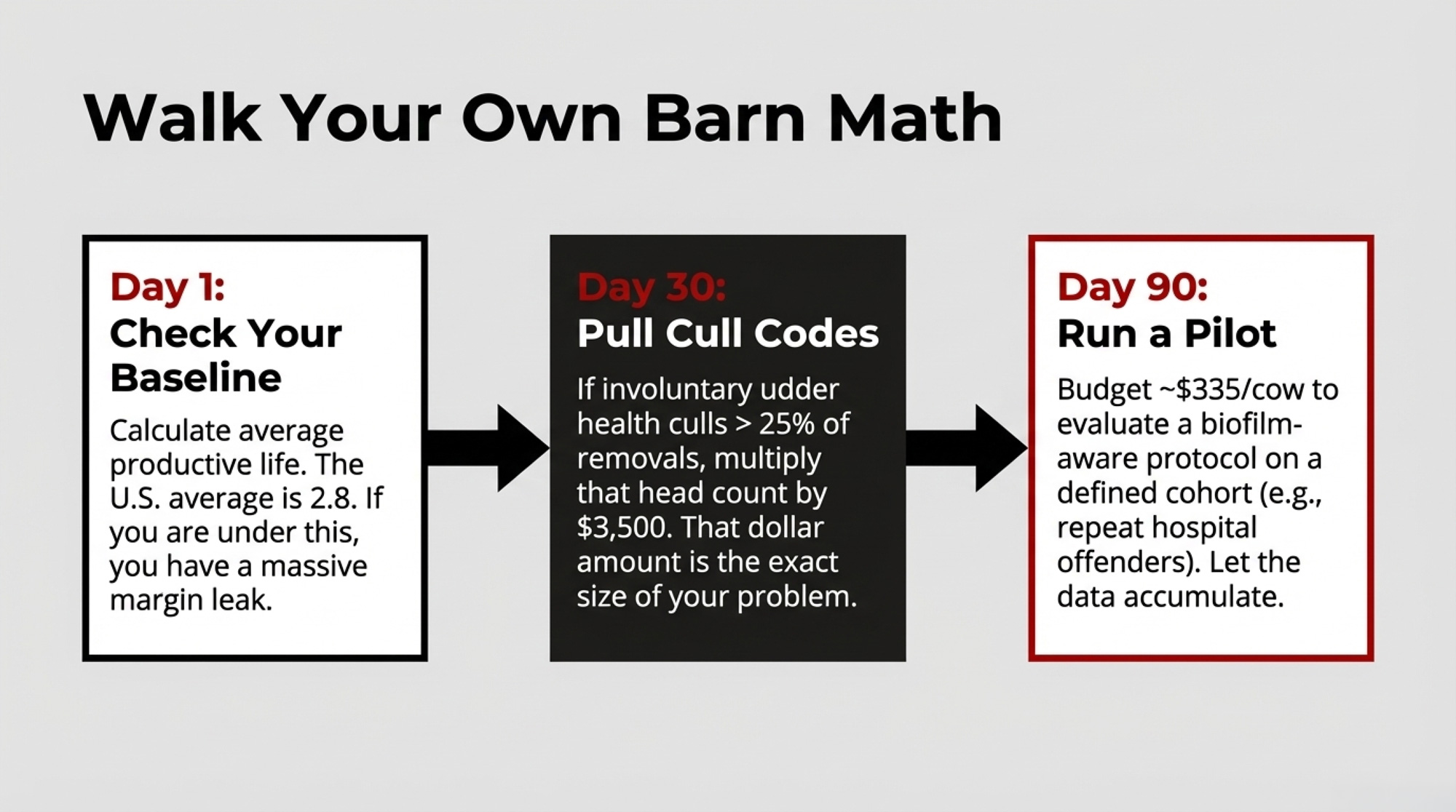
Day 1: Calculate your current average productive life in lactations. If it’s under 2.8, you’re below even the U.S. average, and this analysis applies directly to your herd. This takes five minutes in your herd management software.
In the next 30 days: Pull your involuntary cull rate for the last 12 months, separated by reason code. If udder health culls represent more than 25% of your total removals, you’ve found your single biggest margin leak. Two hours in DairyComp or PCDART. Cost: zero.
In the next 90 days: Run the replacement-cost math against your actual cull reasons. Rank them by economic cost per cull, not by frequency. One udder health cull that removes a 3rd-lactation cow producing 90 lbs/day costs more than three voluntary culls of open heifers. Multiply your involuntary udder culls by your current heifer price. That’s the number you’re managing against.
Over the next 365 days, evaluate a biofilm-aware protocol for your chronic and recurrent clinical cases. Start with a defined cohort — your hospital pen repeat offenders or your 2nd+ lactation cows entering dry-off. At ~€310 (~$335 USD) per cow invested, per the study’s protocol, the costs for a 100-cow pilot cohort run ~$33,500. Budget that against your projected replacement savings. The two-year timeline from that dairy timeline is realistic for a full udder-health turnaround at the herd level. They started at dry-off. They started with fresh cows. Both approaches built evidence before scaling. Benchmark against your own 12-month baseline before deciding on a herd-wide rollout.
Two thresholds to know: If your involuntary cull rate is already below 20% and your bulk tank SCC sits under 150,000, the marginal return from a biofilm-focused protocol is smaller — this math hits hardest for operations where chronic, recurrent cases are driving the cull truck. Conversely, if your average productive life already exceeds 3.5 lactations and your replacement rate sits below 28%, you’ve captured much of the low-hanging fruit. The biggest gains land on herds stuck between high involuntary culling, sound genetics, and cows leaving before they should.
Key Takeaways
- If your udder health culls exceed 25% of total removals, run your replacement-cost exposure before your next management meeting. At $3,500 per heifer, that’s your single largest controllable cost center — and it’s probably bigger than you think.
- Before adopting a biofilm-disruption protocol, ask two questions: Does your chronic/recurrent mastitis pattern match the biofilm profile these protocols target? And can you commit to two-year evaluation timeline? This isn’t a 30-day fix. Budget ~$335/cow for the pilot, benchmark your own baseline, and let the data accumulate.
- The €1,578 (~$1,700 USD) lifetime profit figure is based solely on milk revenue, calculated using FrieslandCampina pricing for 64,467 cows. Factor in replacement savings from a 19.8% lower replacement rate, and AHV’s own analysis puts total lifetime ROI at €3,447 (~,720 USD) per cow. The dataset is large, and the direction is consistent with independent research—but AHV co-authored the study. Weigh accordingly.
- Run your own breakeven: At what heifer price does keeping a healthy 3rd-lactation cow beat replacing her with a genomically superior heifer? If you don’t know that number for your operation, that’s the first calculation worth doing.
The Bottom Line
The dairy industry spent 20 years optimizing for peak milk per lactation. The economics of 2025 and 2026 may be forcing a different optimization: peak lifetime value per stall. With heifer inventory at a 47-year low and replacement prices that CoBank doesn’t expect to ease before 2027, every involuntary cull carries a price tag that would’ve seemed absurd a decade ago.
A 1,700-cow operation answered the longevity question two years ago. Others came in through dry-off protocols. Your answer might differ, but the replacement math stays the same. What’s your involuntary cull rate, and what would a 5-point drop be worth at your current heifer price?
Complete references and supporting documentation are available upon request by contacting the editorial team at editor@thebullvine.com.
Learn More
- Beef-on-Dairy’s $6,215 Secret: Why 72% of Herds Are Playing It Wrong – Capture an extra $4,200 in monthly revenue with this precision blueprint that stops the breeding guesswork, arming you with the specific reproductive “guard rails” needed to turn your Monday-morning breeding list into a high-margin profit center.
- Beef-on-Dairy’s $3,000 Trap: 800,000 Missing Heifers and Who Pays the Bill – Protect your equity against a structural 800,000-head replacement deficit as this analysis exposes the upcoming supply collision, delivering the market intelligence you need to navigate $4,100 price tags and secure elusive processor partnerships before the window slams shut.
- 9.57 Million Cows, 3.9 Million Replacements: Genetics Built This Dairy Herd Paradox – and 2027 Ends It – Unlock a $9,000 competitive advantage per cow by capturing the massive “longevity dividend” hidden in your genetics. This investigation reveals why 2027 marks a hard reset for culling, providing the disruptor’s edge over traditional volume-focused models.
The Sunday Read Dairy Professionals Don’t Skip.

Every week, thousands of producers, breeders, and industry insiders open Bullvine Weekly for genetics insights, market shifts, and profit strategies they won’t find anywhere else. One email. Five minutes. Smarter decisions all week.






