


Archive for pedigree analysis

World Dairy Expo 2026 Holstein Show Preview: 11th Place Is Now The Favorite

Butlerview Glitter Girl stood 11th in a 61-head calf class in this Coliseum last October. Ten heifers beat her. Two of them have since lost to her in Madison.
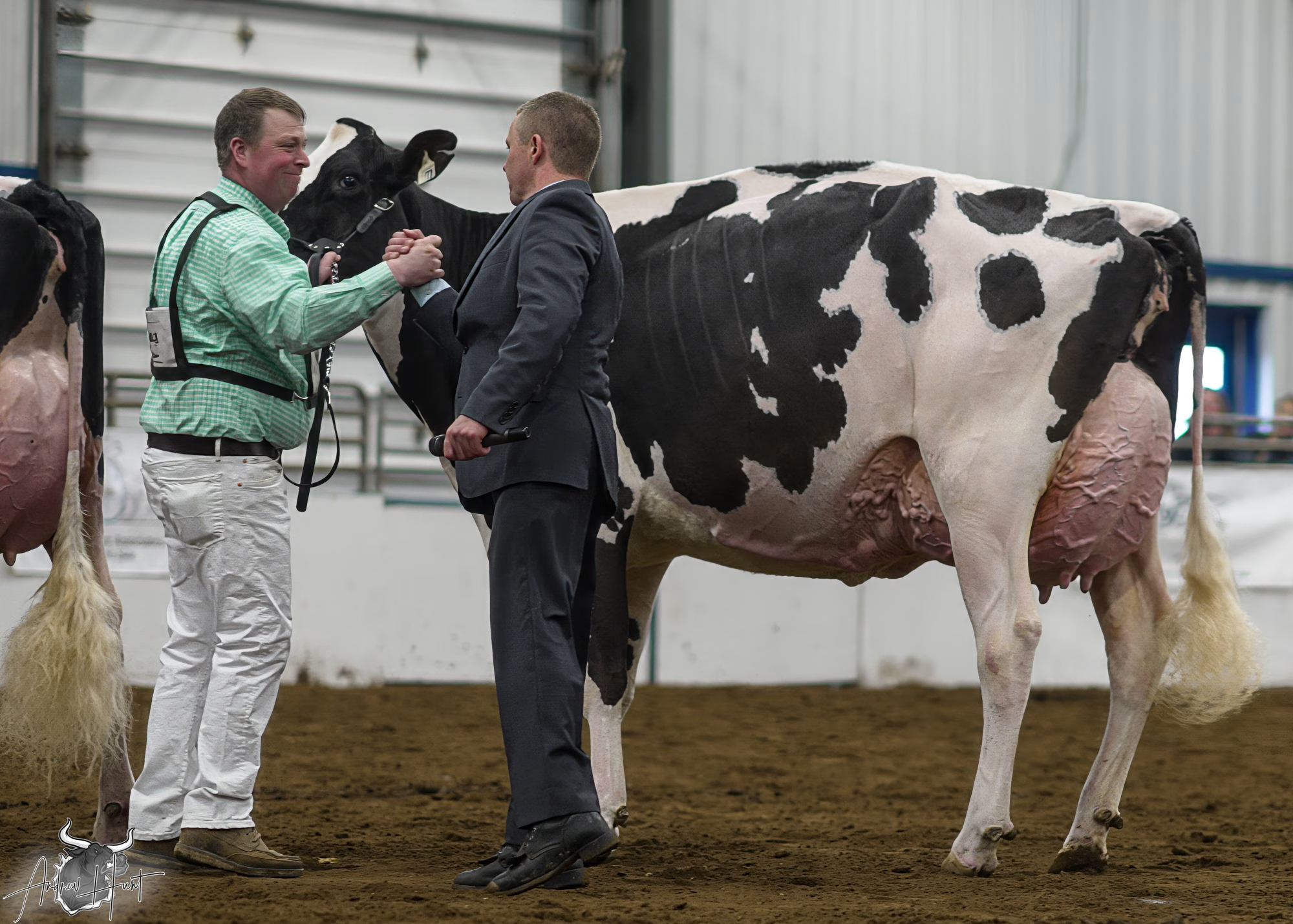
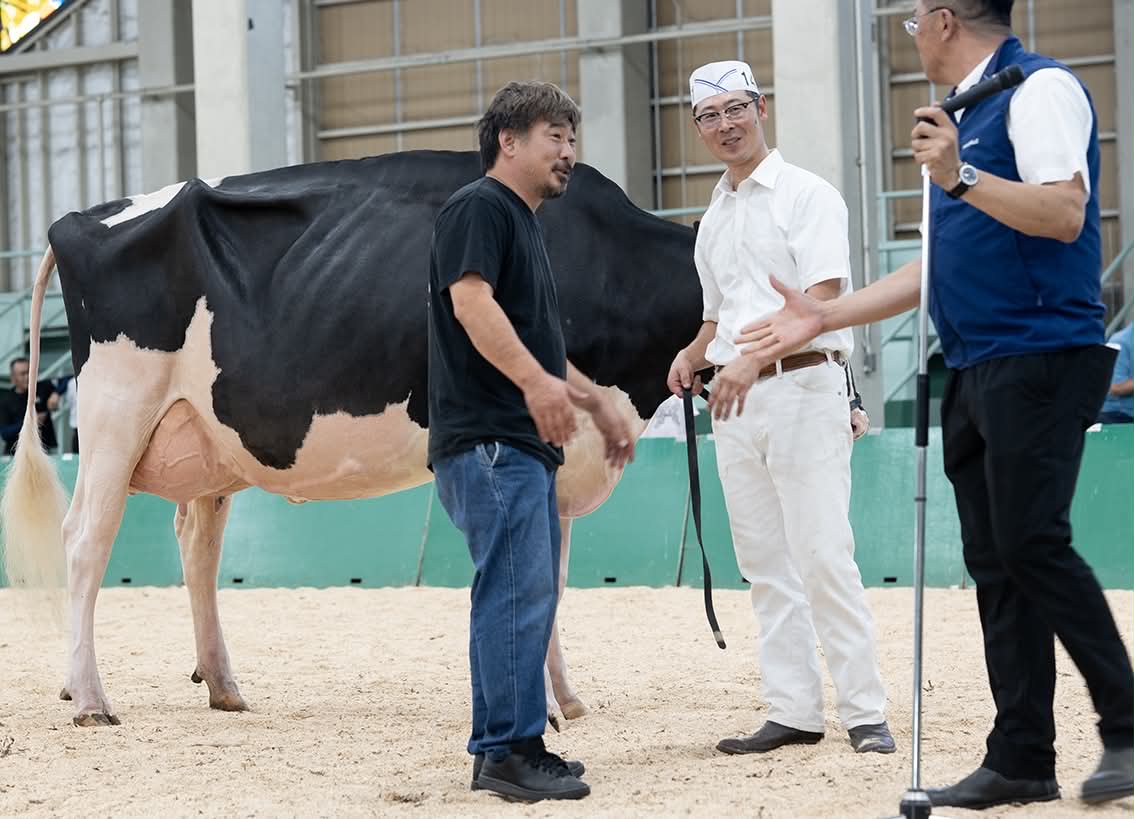
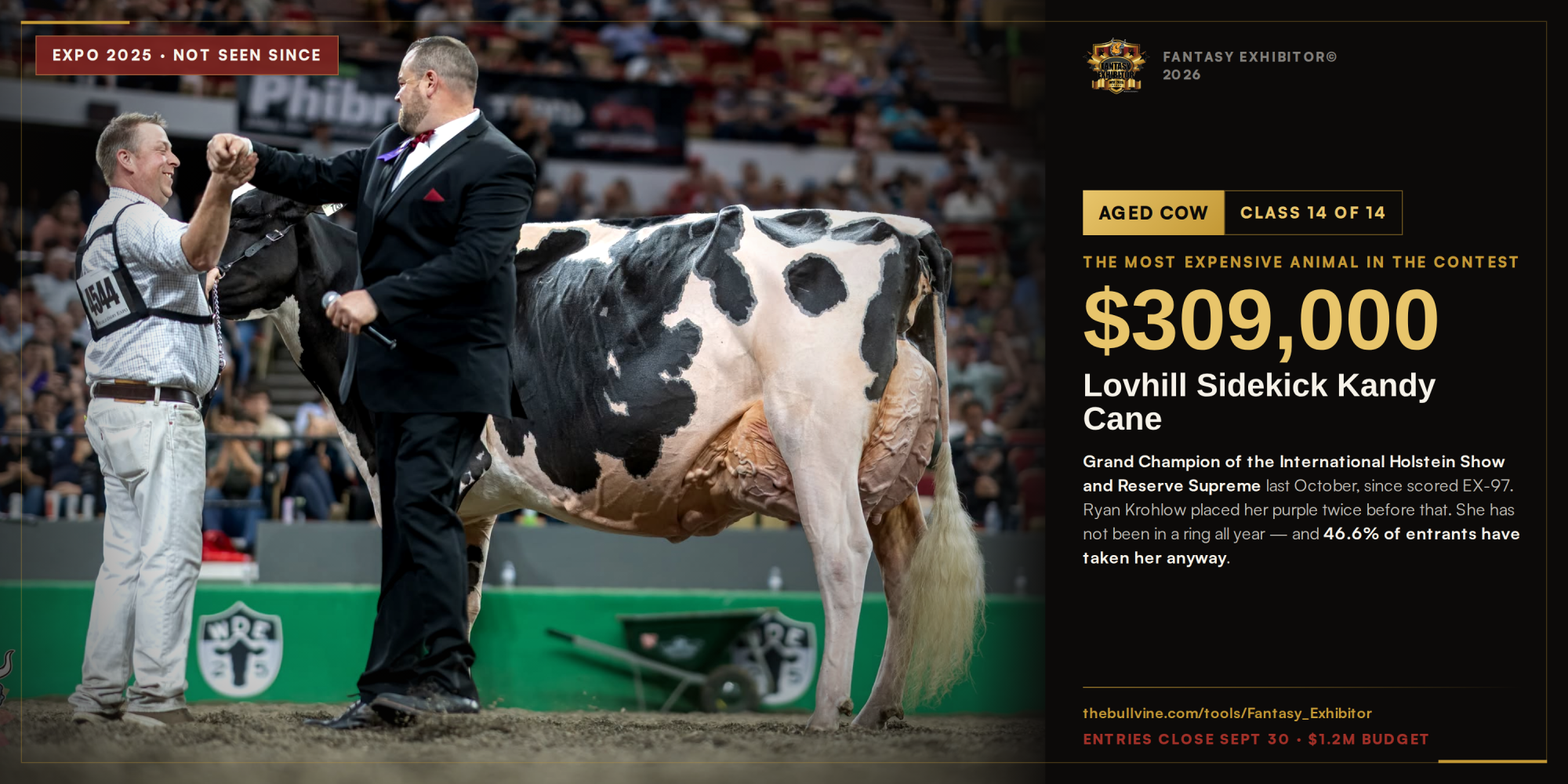
Hamburg, New York, March 2025. Ryan Krohlow, microphone still in hand, congratulates the leadsman after tapping Lovhill Sidekick Kandy Cane Grand Champion and Best Udder of Show at the New York Spring Show — the second time he had put this five-year-old on top, six months after doing it at the Eastern Fall National. He called her udder “perfect” and “symmetric.” Seven months after this handshake she was Grand Champion of World Dairy Expo. On Friday he holds the microphone at the show she won.

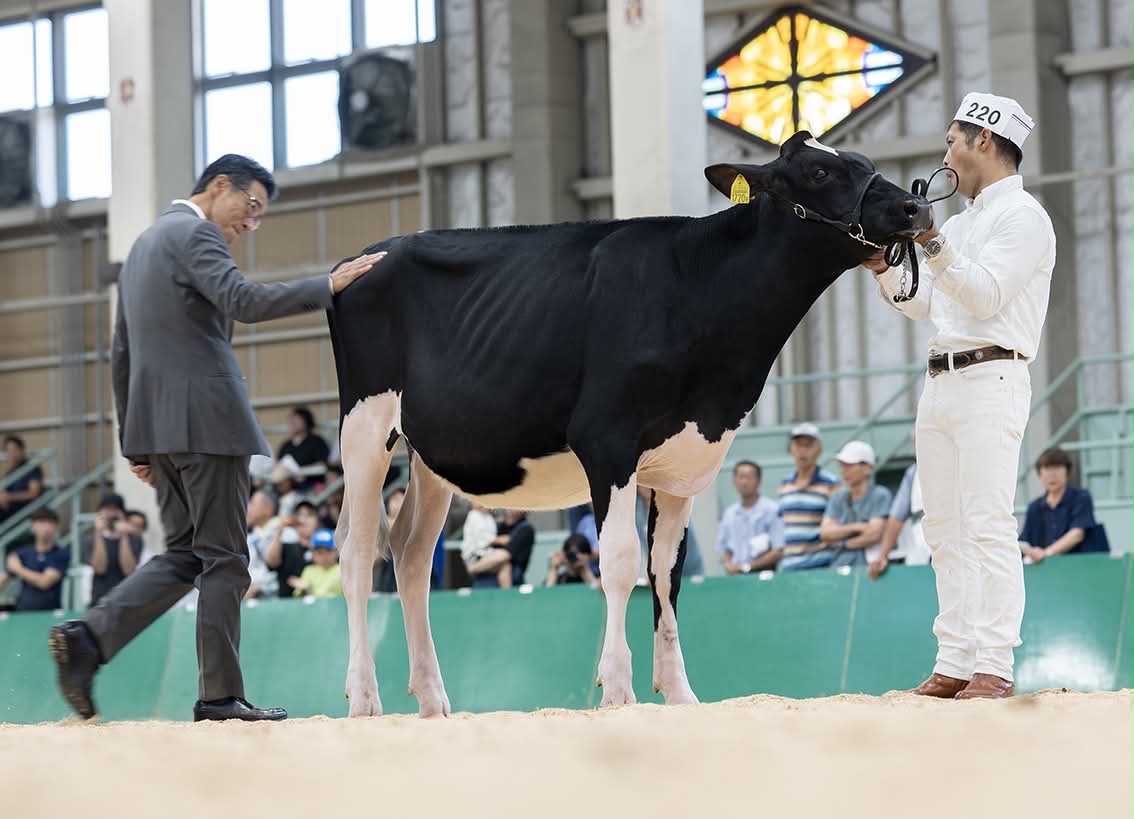
Harrisburg, September 2024. Ryan Krohlow taps a four-year-old Sidekick from Saskatchewan as Senior and Grand Champion of the Eastern Fall National.

Hamburg, March 2025. Krohlow again. Same cow, now a five-year-old, Grand Champion and Best Udder of Show. He calls her “on the money” — “dairy, long, and feminine yet has so much chest” — walking “so free,” with an udder he calls “perfect” and “symmetric”.

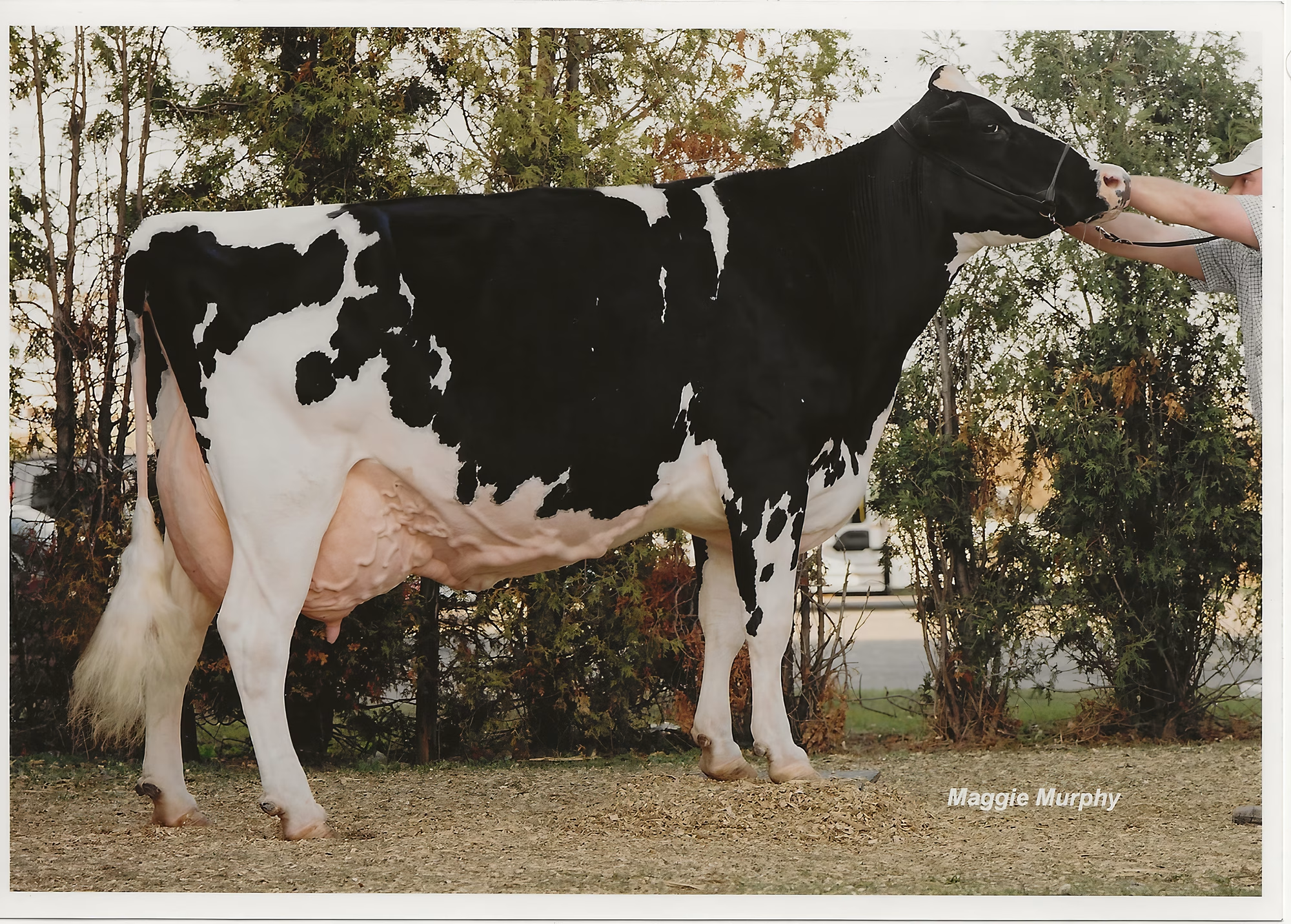
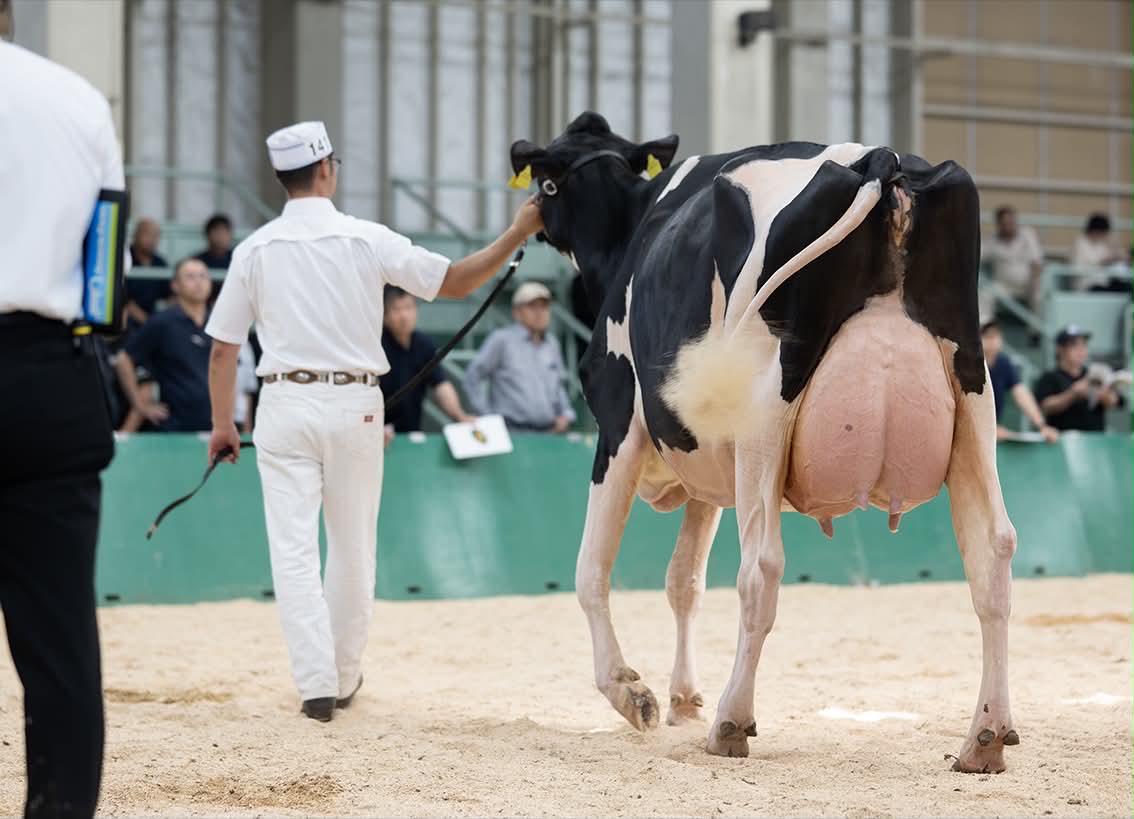
Madison, October 2025. Aaron Eaton takes one look and says it out loud: “when that 5-year-old came in the ring today, it was game over.” Lovhill Sidekick Kandy Cane — Grand Champion of the International Holstein Show, Reserve Supreme of World Dairy Expo.

Krohlow had her purple twice before Eaton ever laid a hand on her. He staked his reputation on that cow in two separate rings while the rest of the industry was still deciding. Now he holds the microphone at the show that made her famous — and Kandy Cane, since scored EX-97, has not been seen in a ring all year.

Neither has the Junior Champion who stood beside her in that final callout. Neither has the Reserve Junior Champion, the Honorable Mention Intermediate Champion, or the Honorable Mention Senior Champion. Of the nine animals who took a divisional banner in Madison last October, five have not surfaced at any of the sixteen major North American Holstein shows held in 2026 — a majority of that callout has been dark for eleven months.

One of the others surfaced in April, in Chilliwack, and won.

A caution before you bet anything: World Dairy Expo does not publish a public Holstein entry list, and entries closed August 31. Nobody outside these barns knows who is on the truck. What follows is who has earned a place in the conversation — and who has been conspicuously, deliberately quiet.
The Cow Who Beat Barabas Is Back — And She’s A Grand Champion Now
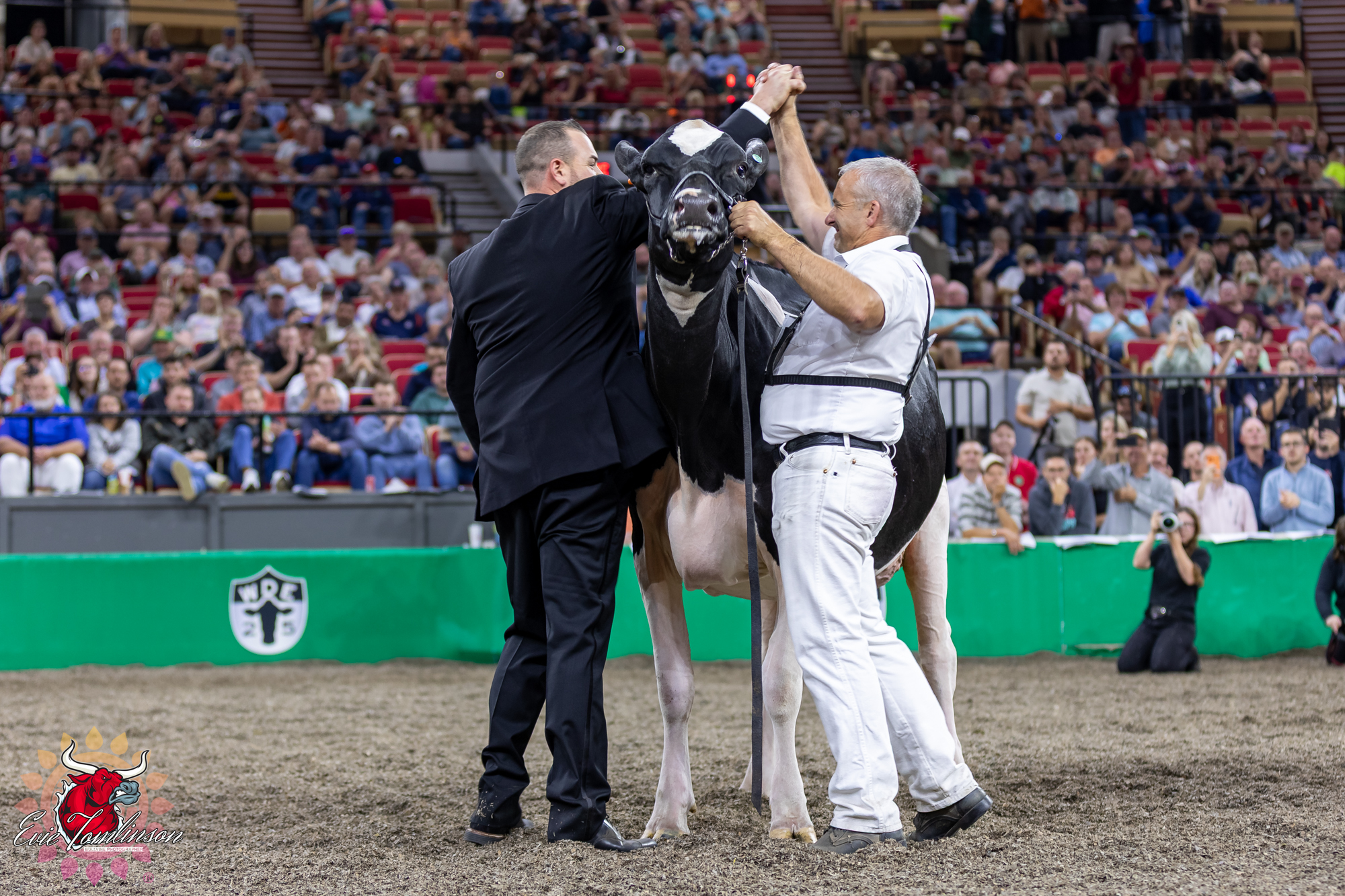
Madison, October 2025. Aaron Eaton lifts the leadsman Brian Carscadden’s hand in the Coliseum for West-Adub Lambda Sadie — Intermediate Champion and Reserve Grand Champion of World Dairy Expo, and the cow he put over Famipage Legend Barabas on being “a little cleaner” with “more quality” to her mammary system. “She runs away with it,” he said. Since this photograph she has sold part to Butlerview, calved into a four-year-old and won a Grand Champion banner of her own in British Columbia.

West-Adub Lambda Sadie was Intermediate Champion and Reserve Grand Champion of World Dairy Expo 2025. Eaton said she “runs away with it” — “so dairy, so open, so flawless in her parts” — and he put her over Famipage Legend Barabas for Intermediate on being “a little cleaner” with “more quality” to her mammary system.

She then sold at the Parade of Perfection to Butlerview Farm, with Westcoast Holsteins of Chilliwack retaining half interest. In April she walked into the BC Holstein Spring Show at the National Convention as a four-year-old and Jamie Black made her Grand Champion.

Barabas, meanwhile, aged into the same class and won Grand at the Ontario Summer Show — her second straight Ontario Summer Grand, after taking it as a senior three-year-old in 2025.

Two Grand Champions. One class. A rematch of the closest call of last year’s show. That’s Friday’s headline, and we’ll get to why it’s a fight between two completely different kinds of cow.

The Show You’re Walking Into

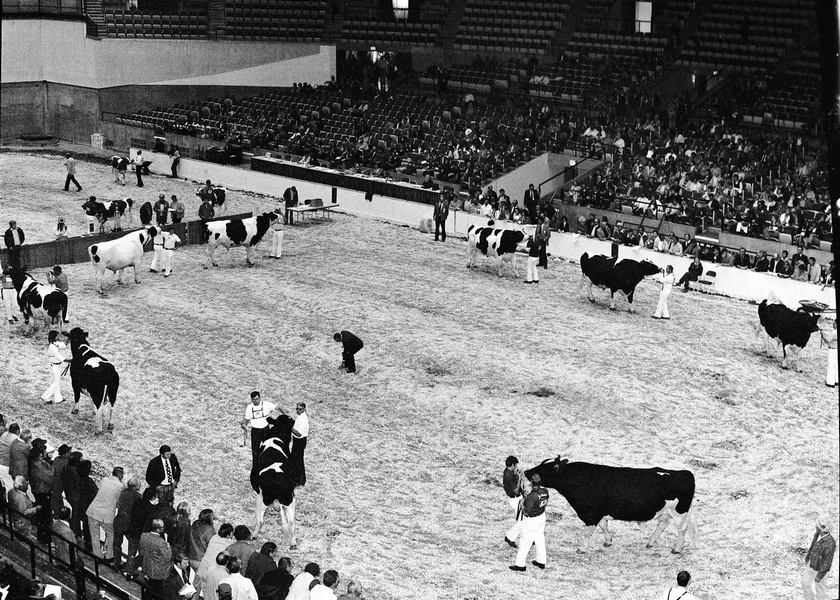
The scale, from last year: 468 Holsteins — 236 heifers, 169 intermediate cows, 63 mature cows. The winter heifer calf class alone ran 61 head, the spring calves 42. Judge Aaron Eaton spent two days on it.

The week starts earlier than most people think. The International Junior Holstein Show goes Friday, October 2nd at 10:00 a.m., official Ben Wallace of Stoughton, Wisconsin with associate Phillip Topp of Botkins, Ohio. That’s the junior-exhibitor ring, so it only catches the animals owned by juniors — but that list is not short this year, and it includes some of the best cattle in this preview. Sarah Hill’s Four-Hills Pazzle 71530-TW, Hayden Burrus’s Ms-AOL Alpha Ralpha, the Schmocker sisters’ Luck-E Merjack Asalia, Kolton Utecht’s winter calf, Tenley Chittenden’s JAKKS Arcitect Cupid-Red and Macie Noble’s aged cow all sit in junior hands. Watch Sunday and you get a free four-day preview of Thursday and Friday.

And it doesn’t end Friday morning. The Holstein Grand Champion goes on to the Parade of Champions at 4:00 p.m. Friday for Supreme, and the heifer Supreme is selected Thursday at 8:30 p.m. Last year Kandy Cane won the Holstein ring and still finished Reserve Supreme, beaten by the Red & White champion Golden-Oaks Temptress-Red. Winning Friday morning is not the last word.

Eleventh Place Is Now The Best Heifer On The Continent
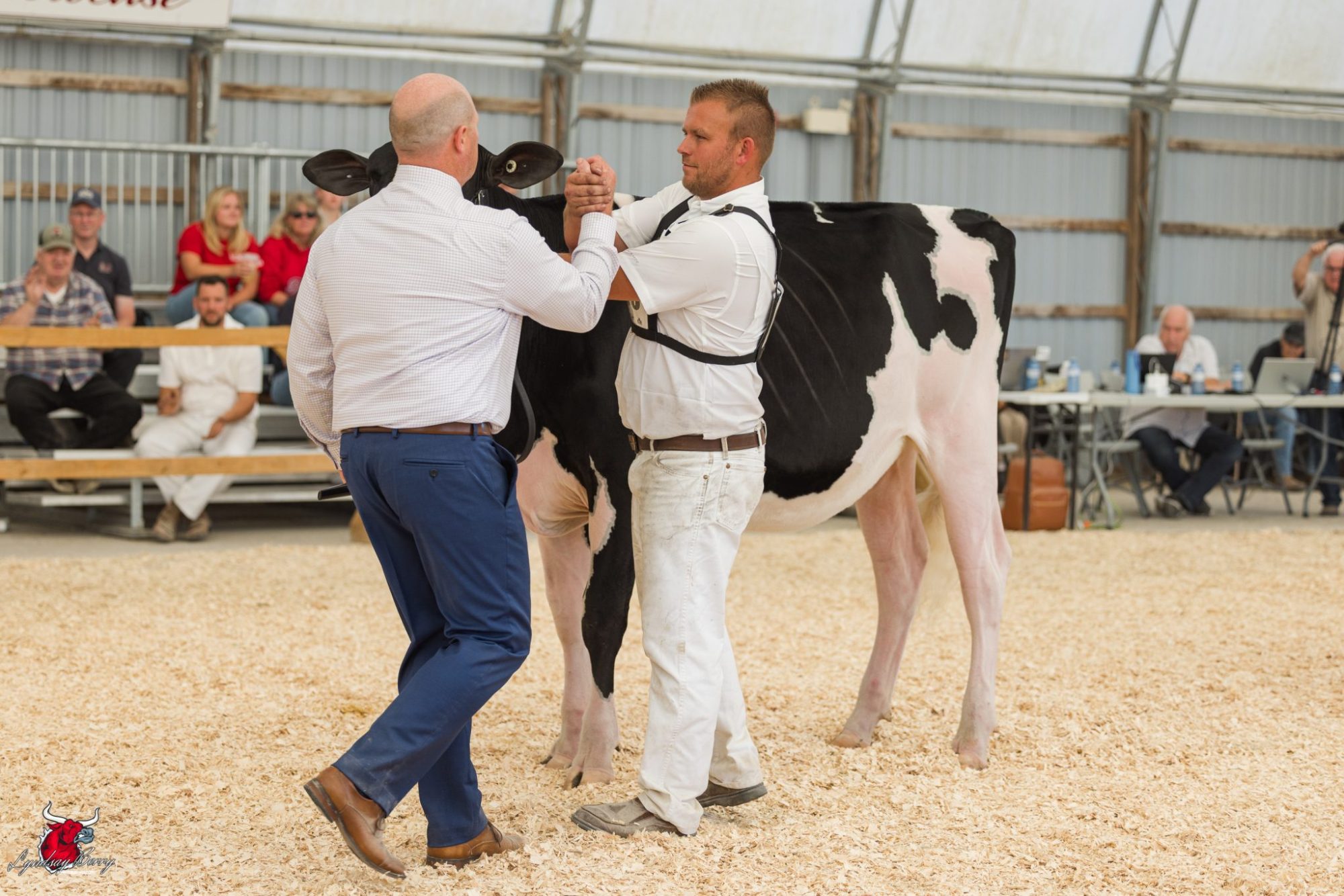
Ontario Summer Show, July 2026. Adam Hodgins lifts the leadsman’s hand for Butlerview Glitter Girl-ET — Junior Champion and Champion Bred & Owned Heifer, the third Junior Championship of her season after Midwest Spring National and Northeast Spring National. Hodgins had her on “so much length, width and body strength,” moving “free and comfortable.” Nine months before this photograph she stood eleventh in a 61-head winter calf class in Madison. Photo: Lyndsay Barry / The Bullvine

Butlerview Glitter Girl-ET finished 11th in the winter calf class at Expo last October — out of 61 head.

This season: Junior Champion at Midwest Spring National, Northeast Spring National and the Ontario Summer Show, winning the winter yearling class at all three. Brian Carscadden called her “one of the nicest heifers I’ve had the privilege to make Junior Champion in my career”.

She isn’t the anomaly. Crisdhome TStruck Abudahbi was 3rd in her class at Expo; she’s now Grand Champion of Northeast Fall National. Sandpiper Sidekick Disco was 3rd in hers; Grand Champion of the Atlantic Summer Classic. Cnossome Mirand Penelope was 4th in the senior three-year-olds; Grand Champion of Western Spring National. Ryan-Vu Awesome Rapture was 6th in the spring yearlings; Reserve Intermediate Champion of Midwest Summer National.

Five cows who got beaten in Madison came back as champions elsewhere — and Rapture did it on these exact shavings, at Midwest Summer National in August. Krohlow’s job Friday is to weigh those against the ones who haven’t shown at all.

The Cheat Sheet

Favorite = best 2026 form. Live threat = the animal most likely to beat her, which is sometimes a proven Expo performer who has gone quiet and sometimes a winner off a circuit the favorite has never faced. Dark horse (cow classes only) = the third argument in the class — a champion off a circuit nobody here has faced, or a cow whose 2026 placings are a freshness snapshot rather than a ceiling.

◆ = proven at Expo last October, unseen at any show since.

Heifers — Thursday, October 1, 1:30 p.m.

ClassFavoriteLive Threat
Spring CalfDo-N-Joy Major Jax-ETWSC TStorm Rattlin Bog-ET
Winter CalfGenosource Mjr Heartatak-ETExtondale Master Mae
Fall CalfNehls-Donk Best Giddy UpMs Vierra Back 4 More-ET
Summer YearlingButlerview Master Shock-ETCurr-Vale Detective Adeen-ET
Spring YearlingGo-Sho Detect Revenge-ETBeers Master Tulsi ◆
Winter YearlingButlerview Glitter Girl-ETMiss Master Elite-ET
Fall YearlingKamps-Rx Abercombi AbellaOur-Favorite Endzone-ET

◆ = proven at Expo last October, unseen at any show since.

Cows — Friday, October 2, 7:00 a.m.

ClassFavoriteLive ThreatDark Horse
Milking YearlingMs Campbell Run DL Konni-ETWeeksdale Major Lea ◆Sco-Lo Legendary-ET
Summer Junior 2-Year-OldFraeland Beckridge Energy BrieJolipre Master Angel ◆Walk-Era Eye Candy Rebel
Spring Junior 2-Year-OldUlmar Lambda DortheSilverdream Major Tootsie ◆Ryan-Vu Awesome Rapture
Winter Senior 2-Year-OldWinright Sidekick ChampagneEcho Glen Master Ivy ◆Axel Havenofear Camy
Fall Senior 2-Year-OldMs Have No Fear BetKawartha Chief Bailey ◆Jacobs Alligator Bawl-ET ◆
Junior 3-Year-OldCrisdhome TStruck AbudahbiCrackholm Lambda Cleavage ◆Millen Lambda Amelia
Senior 3-Year-OldCedar-Crown Tatoo AmeliaMicheret South Believe ◆Goldenflo Lambda Dominate-ET
4-Year-OldWest-Adub Lambda Sadie
Famipage Legend Barabas
(co-favorites)
Jacobs Chief DinaCnossome Mirand Penelope
5-Year-OldOby-Crest Victor AriaEixdale Pwrup AlongsideGouldhaven Alligator Ezroyal
Aged CowLo-Pine-Va Lady CrushLovhill Sidekick Kandy Cane ◆
Altona Lea Unix Herminie ◆
Jeffrey-Way Hardrock Twigs
Lifetime ProductionLuck-E Merjack AsaliaPeace & Plenty Doc Jubie16-ET ◆Walk-Le Delta-Lambda Breezy

One honest asterisk on our own aged-cow pick. Lady Crush is the form favorite on a March Grand Championship, but she was fresh since July 2025 when she won it. If Butlerview hasn’t recalved her she walks in roughly 15 months fresh, and a 15-month cow does not carry bloom. That pick is conditional on a calving date nobody outside her barn knows — which is exactly why the live threat and the dark horse in that row are both Grand Champions in their own right.

The senior three-year-olds carry two dormant Expo animals, not one: Believe won that class outright last October with Best Udder, and MD-Locustcrest P Zuriniah was HM Intermediate Champion of the whole show. Either one changes the class.

The four-year-olds are a genuine three-way, which is why the table carries two favorites instead of one. Sadie holds last year’s Reserve Grand; Famipage Legend Barabas answers it with back-to-back Ontario Summer Grand Championships. Jacobs Chief Dina is the live threat on the freshest record of the three — Grand and Best Udder of the whole show in this Coliseum five weeks ago.

One eligibility caveat, because it decides which day you watch. Several animals in this preview carry Red or red-carrier names — Cherry Lor Robin-P-Red, Golden Oaks I Altitu-Red-ET, Hilrose Ac Attababy-Red-ET, Carpsdale-J Fall-Red-ET, Ms Be Tempted-Red-ET among them. Registered Red & Whites show in the International Red & White Show, heifers Wednesday, September 30 at 2:00 p.m. and cows Thursday, October 1 at 7:00 a.m. — a different ring on a different day. Which ring any individual animal lands in depends on her registration, and we can’t confirm entries. Don’t be surprised to find one or two of these names in Wednesday’s lineup instead of Thursday’s.

Watch five and you’ve watched the show: Glitter Girl in the winter yearlings, Abudahbi in the junior threes, the three-way four-year-old fight, Aria in the five-year-olds, and the aged cows, where two 2026 Grand Champions and the cow who won this ring last October could end up in the same lineup.

What Krohlow Rewards, In His Own Words

He’s a fitter first — 18 years at it, plus three as a professional hoof trimmer, running HammerTime on 40 acres at Poynette, Wisconsin with his wife Haley and four kids, Callie, Conway, Cooper and Case, off eight to ten show heifers a year. By his own official Expo biography he prepared 17 Grand Champions at World Dairy Expo and nine at the Royalduring that fitting career, in Canada, England, Germany, Italy, Sweden, Switzerland and Mexico.

His stated ideal: “cows that are square frame, cows that are balanced and hard top, cows that walk out extremely comfortable front and rear,” with “tremendous udders, quality, texture, and symmetry.” In heifers, animals “extremely comfortable in their locomotion” with “quality from end to end” that “track straight both front and rear feet.”

Two tiebreakers repeat often enough to bet on. He splits close pairs on rib — “a tad more drop of rib,” “spring and openness all the way to her barrel,” “more depth right up in that fore rib.” And he reads the back of a rear udder hard enough to separate third from fourth on “more definition to see on the back of that rear udder” and “more seam, all the way at the bottom of that udder.”

He also forgives youth, praising one winter two-year-old as “a February heifer just moving 20 days out of being a junior two-year-old” with a “tremendous future” — and putting her top of the class over cows with more milk behind them.

The Fitter’s Eye: Why Over-Bagging Will Backfire

Eighteen years of fitting means eighteen years of hands on udders the night before a show. A man with that history knows the difference between glandular texture and fluid sitting in the rear seam, and he knows exactly what a cow looks like when she has been held too long — because at some point in 18 years he has been the one asked to do it.

His own reasons tell you he reads for the real thing rather than the volume. He moves cows up on “veination and quality all the way through her mammary system,” on “tightness right at the top of the rear udder attachment,” on “more quality and texture” in a fore udder, on “definition of the seam” at the bottom of the rear. Every one of those is a texture word, not a capacity word. And three years of commercial hoof trimming sit underneath the rest of it: he splits close cows on “bone and flatness right down in the hock,” on pasterns, on cows that “track so comfortably, so straight.” Extra weight in an udder shows up first in exactly the places a trimmer looks — a cow who roaches over her loin to carry it, or who stops handling her hocks cleanly by the second lap.

The rules are on his side, and they are not vague. World Dairy Expo lists “improper fitting practices, such as over filling and over bagging” as an ethics violation outright, alongside “treating an animal, particularly the udder, without a verifiable veterinary need… for the purpose of improving the appearance” and using any device to artificially create or enhance the udder crease. Overfilling udders carries a one-year suspension as a Category 1 violation; udder alterations are Category 2, a minimum two-year ban — and a second Category 1 inside three years is elevated automatically.

Enforcement is not theoretical either. The top one-third of every class is ultrasounded, and champions are ultrasounded and milk-sampled after their champion class and again after Supreme. Udder ultrasounds, milk sampling, hair pulls and blood draws are four of the ten testing actions every exhibitor consents to at entry. Expo also endorses the PDCA Show Ring Code of Ethics, adopted February 2025.

So the read for Friday: pushing extra capacity into a four-year-old or an aged cow to force the look of bloom risks two separate problems. It risks a judge who has spent two decades learning what fluid looks like under the lights and who scores on texture and seam definition rather than volume — and if her rear teats come off their plumb line or her top goes soft carrying it, he sees it before she finishes half a lap. Then it risks the ultrasound afterwards.
The Associate Factor: Kelly Barbee in the Big Heifer Classes
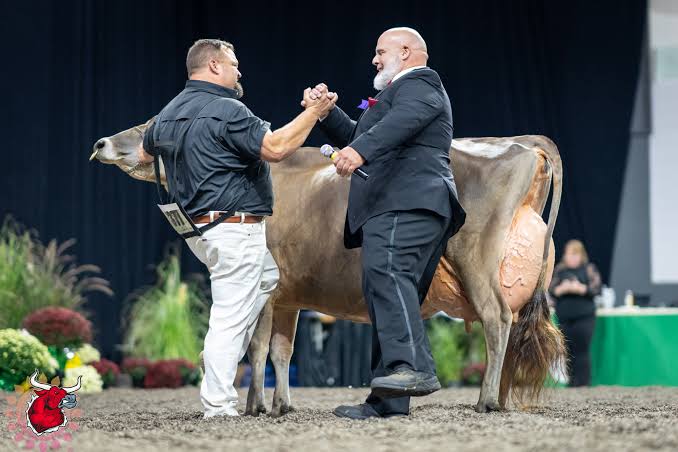
The associate is Kelly Barbee of Concord, North Carolina, and he is there because Krohlow put him there — at World Dairy Expo the official judge submits three names for associate, and the selection is then approved by a committee of Expo exhibitors. This is a pairing the official wanted.

Barbee is a territory sales manager for Trans Ova who has exhibited over 30 All-Americans or All-American nominations across multiple breeds, previously developed and boarded high-end show cattle for clients in the U.S. and Canada, and managed a large commercial herd for ten years before that. His two biggest assignments are both colored-breed: the 2010 World Dairy Expo Jersey Show and the 2008 Royal Winter Fair Jersey Show.

That Jersey pedigree is the thing to watch Thursday afternoon. A judge who has made his name sorting Jerseys is a judge trained on dairyness, clean thurls, open rib and silky hide rather than sheer scale — and Thursday’s first three classes are where those eyes earn their money. Last year the winter calf class ran 61 head and the spring calves 42. In a class that size nobody evaluates 61 animals equally; the depth of the lineup gets sorted while the top end is being walked. A coarse, round-boned calf with extra throat flesh can hide in the middle of a 60-head class under some panels. Against this one, expect her parked early.

Thursday: The Heifers

Spring Calf — the one class with no history
Born March through May of this year, so nobody holds a form line — which means pedigree is most of what you have to go on.

Do-N-Joy Major Jax-ET won 22 head at Midwest Fall for Brooklyn, Bryce & Blakely Kohls, Arlington, MN, with HM Junior Champion of the Junior Show. She’s a Robella Major out of Cresentmead Jaurora-Red-ET, born March 26. Major is the frame-and-cleanliness side of this cross; the red-carrier dam line is where the dairyness comes from, and it’s worth knowing which one she took after when she walks in — Major daughters that inherit too much substance from the maternal side get coarse, and this judging panel will not reward that.

WSC TStorm Rattlin Bog-ET (Thunder Storm) topped 38 at Eastern Fall for Hayden Weaver, Ephrata, PA — biggest spring calf class of the fall circuit. B-Will Mas Dancing Diva-ET(Master) won the class in the Coliseum itself at Midwest Summer National for Charlotte Wingert and Grace Salter, Pearl City, IL. Also Cornerest Altitud Magpie-ET (Altitude), 28 head at Northeast Fall for Kialah Nelson, and Winright Major Erica, 40 head at Ontario Summer, bred and owned by Brian Enright.

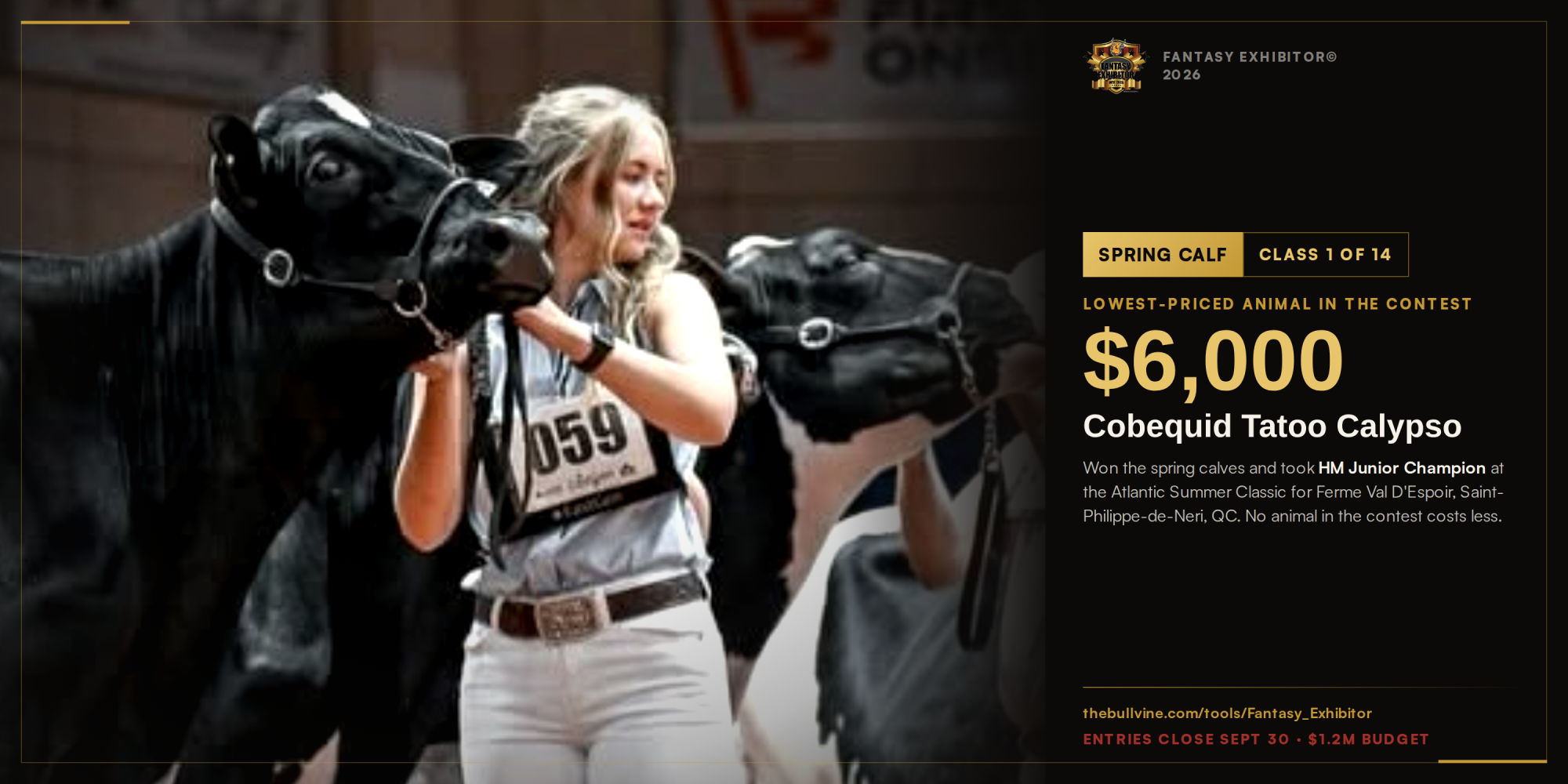
Two more with provincial credentials: Petitclerc Airdrop Samantha won the spring heifers at Le Suprême Laitier, bred and owned by Ferme Jean-Paul Petitclerc & Fils of St. Basile, QC, and Cobequid Tatoo Calypso (Tatoo) won the spring calves and took HM Junior Champion of the Atlantic Summer Classic for Ferme Val D’Espoir at Saint-Philippe-de-Neri, QC. In a class this young, a provincial final win in September is worth as much as a bigger class in August.

Winter Calf — the Canadian nobody has faced
Blacklilly Direct Lala-ET (Direct) won the winter calves at Northeast Spring for Eaton Holsteins, Glamourview Farms and Zeh & Cates Morrill of Marietta, NY — out of 12 head, which is the honest caveat on her, because two heifers in this class beat fields three and four times that size.

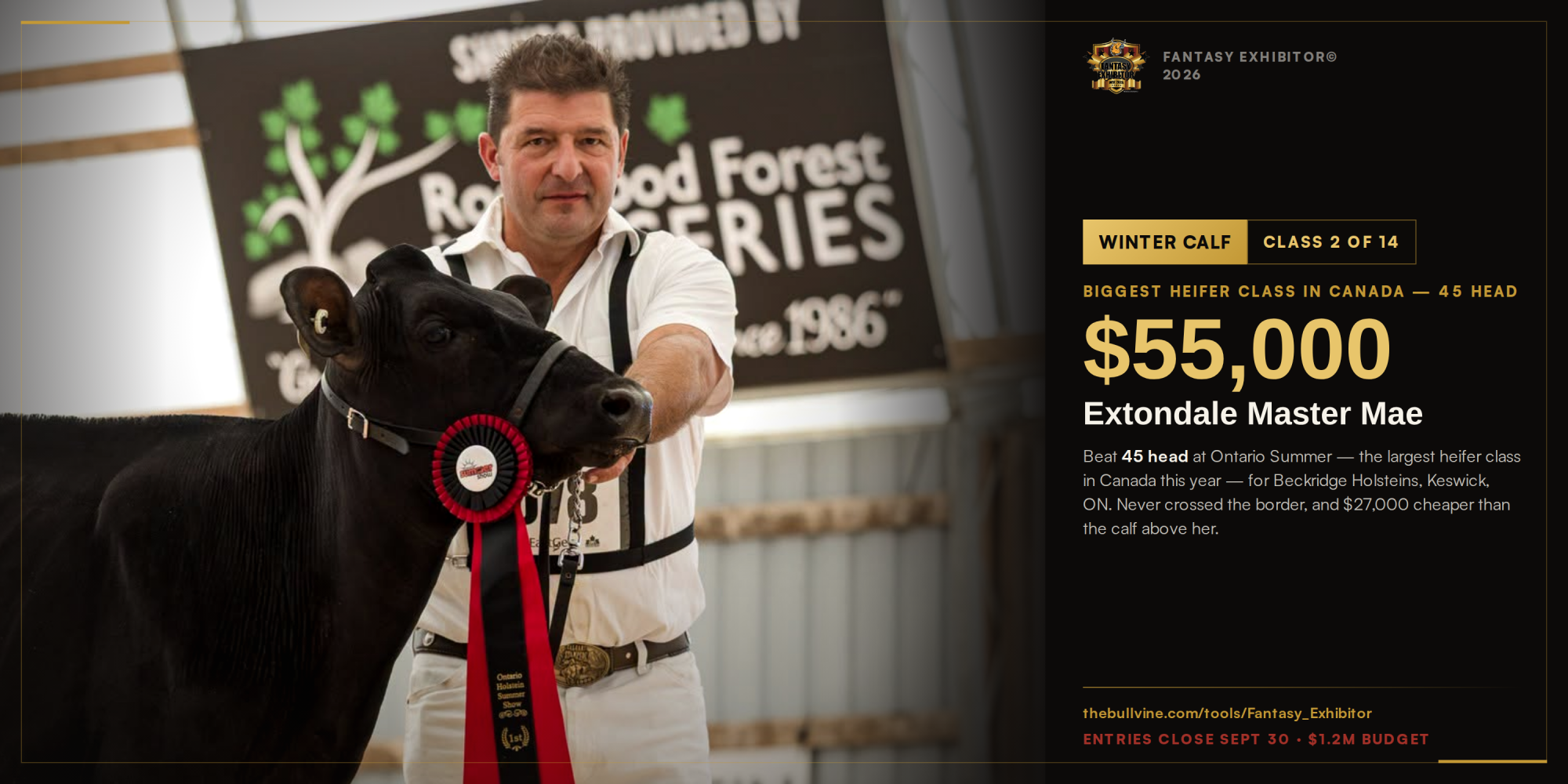
Extondale Master Mae (Master) won 45 head at Ontario Summer for Beckridge Holsteins, Keswick, ON — the largest heifer class held anywhere in Canada this year — and has never crossed the border. Against her: Genosource Mjr Heartatak-ET (Major) out of 40 at Eastern Fall for Billy Jo Rhodes and Chris & Jennifer Hill, Utecht Major Superstar (Major), Junior Champion of the Midwest Fall Junior Show bred and owned by Kolton Utecht, Fairmont Brielle-ET (Lombardi), Reserve Junior Champion of the Northeast Fall Junior Show for Ella Purchase, and Heritage Crazy Drama (Delta-Lambda), class winner at Midwest Summer National for Madison & Melanie Sarbacker.

Fall Calf — two circuits, one unbeaten record
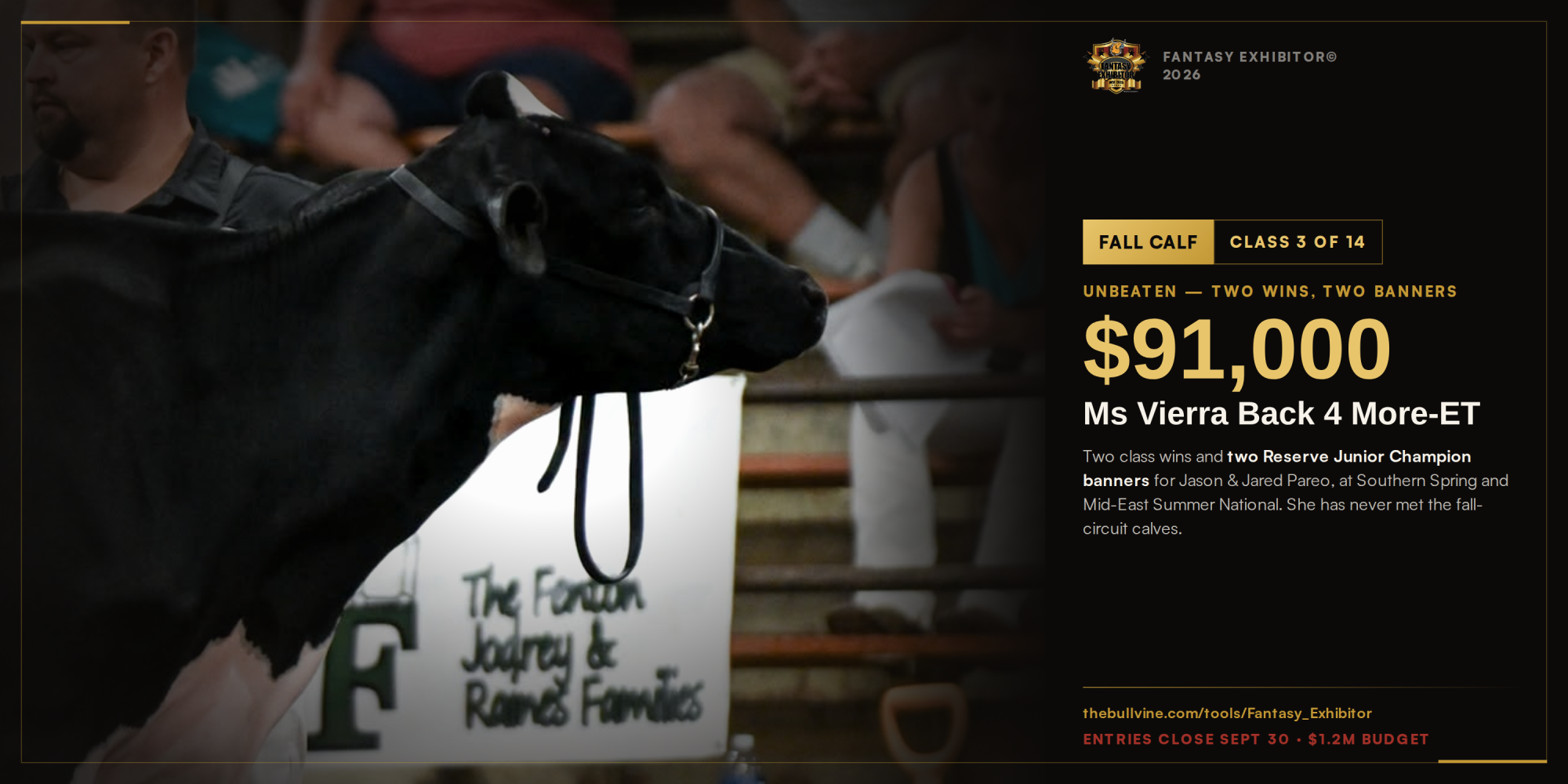
Ms Vierra Back 4 More-ET won the fall calf class at Southern Spring National in March and at Mid-East Summer National, taking Reserve Junior Champion both times for Jason & Jared Pareo. She has never met the fall-circuit calves.

Those are led by Nehls-Donk Best Giddy Up, Junior Champion at Midwest Fall over 30 head for KurthHaven, Melissa Sprecher and Doug Petzel. Her cross is the interesting one: Blexys Best Sidekick-ET out of Sheeknoll Unix Giselle-ET. A Unix-sired dam again — the same maternal sire sitting under Butlerview Glitter Girl, and the same bull whose daughters held the mature end of Quebec and the Maritimes together this year. If you’re tracking why two of the best young heifers in North America both read as long, wide and strong through the body, the answer is on the dam’s side of both papers.

Oakfield Major July-ET (Major) was Reserve Junior Champion at Northeast Fall for Trina & Garret Bailey. Hilrose Ac Attababy-Red-ET (Acetylene) beat 40 head at Eastern Fall for Justine Kelsey (check the Red & White sheets first — the R&W heifers go Wednesday, September 30 at 2:00 p.m., the day before this class), and Ocean View Sassy After Dark(Master) won the class at Midwest Summer National for Evan Hathaway.

Summer Yearling — the heifer who got better all season
Butlerview Master Shock-ET (Master) is the one who kept answering: class wins over 24 head at Midwest Spring and 27 at Northeast Spring, plus Reserve Junior Champion of the Midwest Spring Junior Show, for Addison Lortie, Albion, IN. Fifty-one head beaten across two spring shows is the deepest résumé in this class.

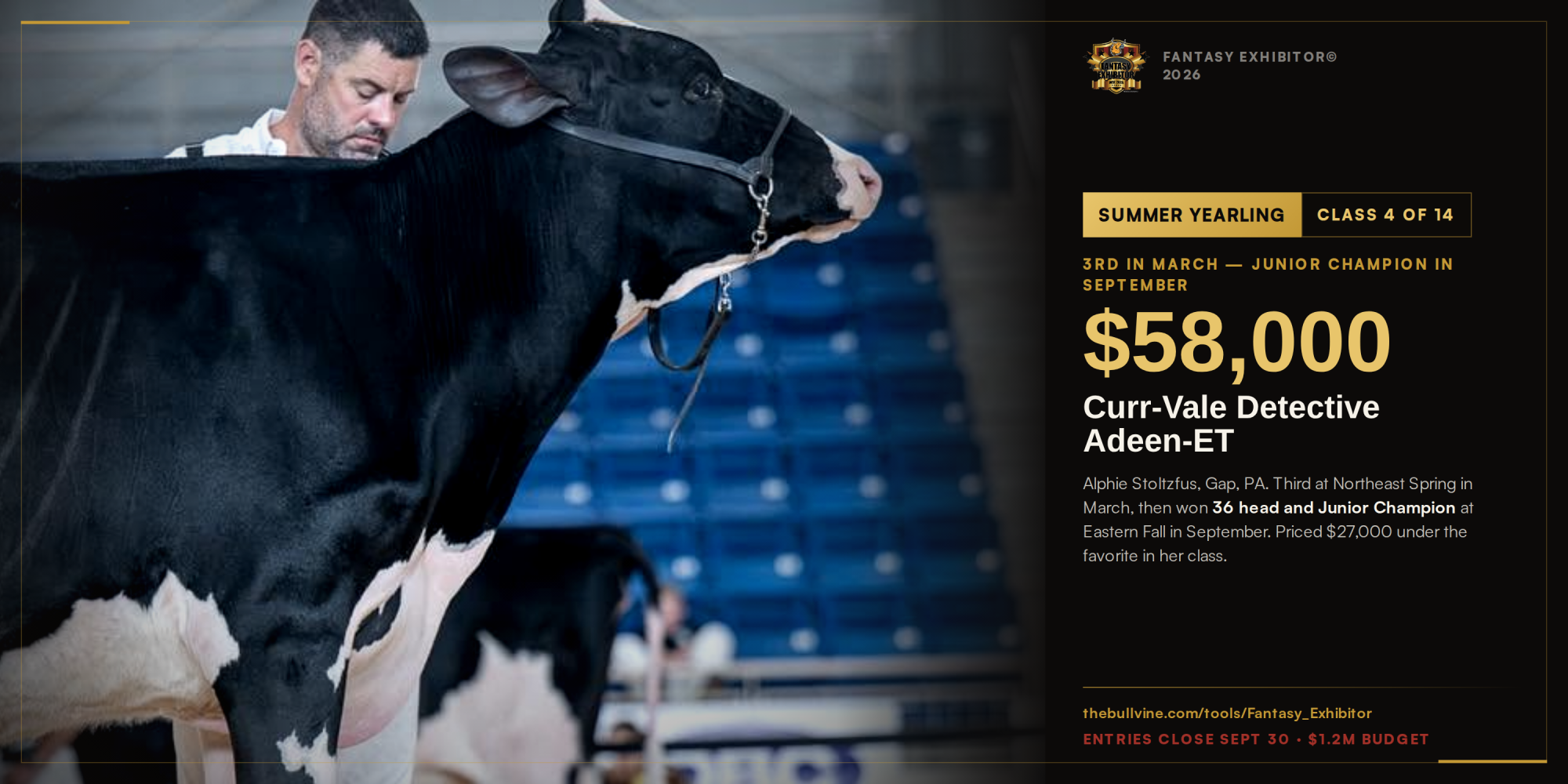
The one to fear is Curr-Vale Detective Adeen-ET (Detective), Alphie Stoltzfus, Gap, PA. Third at Northeast Spring in March; in September she won 36 head at Eastern Fall and took Junior Champion. Heifers on that trajectory peak in October. Carpsdale-J Sidekick Timber(Sidekick) took HM Junior Champion at Northeast Fall for Anthony & Kennedy Liddle, Echo Glen Master Irina (Master) won 26 at Ontario Summer for Beckridge, shown by Lily Beckett, and SPF Angel Eyes-ET (Eye Candy) won the class at Midwest Summer National plus HM Junior Champion of the Junior Show for the Harbaugh and Loehr families, Marion, WI.

Spring Yearling — the champion, and the calf who beat her once
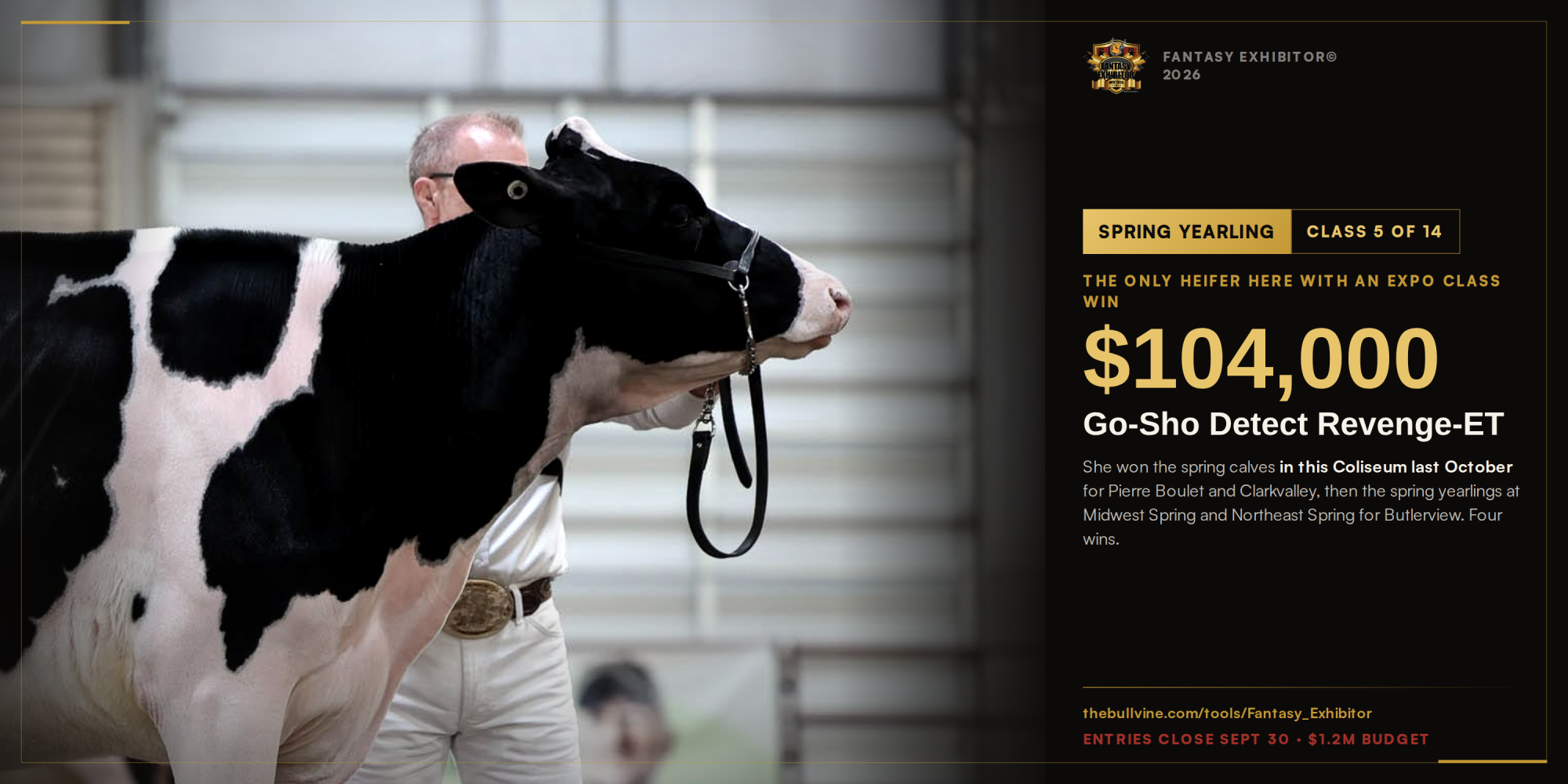
Go-Sho Detect Revenge-ET (Detective) is the only heifer here with an Expo class win banked — she took the spring calves last October for Pierre Boulet and Clarkvalley, then won the spring yearlings at both Midwest Spring and Northeast Spring for Butlerview.

Beers Master Tulsi (Master) stood second to her in Madison. Kale, Kley, Ryan and Logan Beer of Berne, Indiana haven’t shown her since. In a class Krohlow will split on a rib, twelve months of development is how second becomes first.

Behind them: Beslea Eyecandy C Electra-ET (Eye Candy), Junior Champion at Northeast Fall for Rick Allyn & Dan Hovden; Petitclerc Eyecandy Kayla (Eye Candy), Reserve Junior Champion at Eastern Fall for Ridgedale Farm, Jon Mortensen and Uma Thurman; Eastriver DL Carrera (Delta-Lambda), Junior Champion at Mid-East Summer; Esperanza-CC Tenacity-ET (Tatoo), Reserve Junior Champion at Midwest Fall.

Winter Yearling — the calf who beat her by nine places, and what happened next
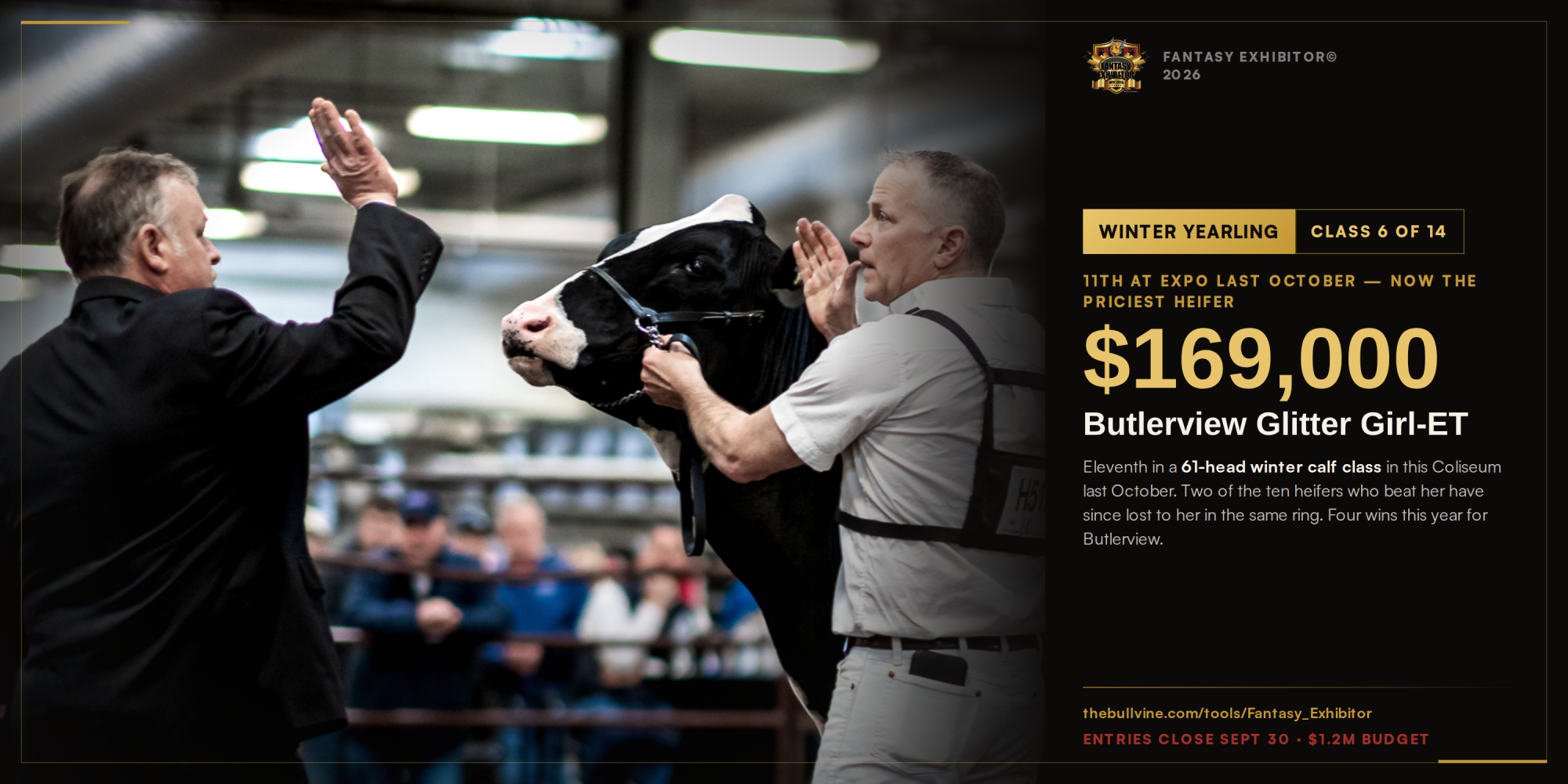
Glitter Girl’s pedigree is the reason she went from 11th to unbeatable. She’s a Jacobs Bruins out of Rosemary Unix Goldie EX-95 — a Unix-sired dam who was an All-American in her own right. Unix daughters are what held the mature end of Quebec together this year: Sicy Unix Adriene won the senior threes at Le Suprême with Best Udder, Knonaudale Tiffaney took Grand at the Atlantic Spring Showcase, Altona Lea Unix Herminie won the aged cows at Expo. That’s the frame and dairy strength underneath Glitter Girl, and it’s why the judges keep using the same three words on her — length, width, body strength.

Carscadden had her on “precision on all four legs,” barrel spring, a clean inner thigh and refinement through the neck. Adam Hodgins at Ontario Summer had her on “so much length, width and body strength,” moving “free and comfortable,” handling her hind legs “a touch nicer down in the foot.”

And there was one animal who had her number. Curr-Vale-AE Direct Epic-ET (Direct) finished second in that winter calf class — nine places ahead of Glitter Girl. Then the two met again at Midwest Spring National, and the result inverted: Glitter Girl won the winter yearlings bred and owned, and Epic stood sixth, taking first junior exhibitor for the Osinga family, Hico, TX. A nine-place deficit became a five-place win in about six months. That is the cleanest measurement anyone has of how much Glitter Girl improved over one winter — and the reason the 11th on her Expo card tells you nothing about Thursday.

The heifer who finished closest to her in that spring rematch is Miss Master Elite-ET (Master), second in that Midwest Spring class for Grai-Rose Cattle Co. and Jeremiah Lungwitz, Petaluma, CA — and a class winner bred and owned at Midwest Fall National. She is the live threat on the table on the strength of that finish plus a class win bred and owned at Midwest Fall National — the only heifer in this conversation who has both. Third in that same Midwest Spring class was Walk-Era Aint She Fancy-ET (Direct) — the heifer who was 3rd in the 61-head winter calf class at Expo, eight places ahead of Glitter Girl, and who took the class runner-up spot and HM Junior Champion at Midwest Summer National in August. Ten heifers finished ahead of Glitter Girl in Madison. Two of them — Epic and Aint She Fancy — have since been beaten by her in the same ring.

The most recent heifer to finish directly behind Glitter Girl is Crisdhome EC Tallahassee (Eye Candy), and she got a banner for it. At Ontario Summer in July she stood second in the winter yearlings and walked out Reserve Junior Champion of the show — one place and one banner behind Glitter Girl, who took the class, the Junior Championship and Champion Bred & Owned on the same afternoon. Brian Joseph Enright, Jaquemet Holsteins and Velthuis Farms Ltd of Winchester, Ontario own her.

Her other outing tells you she doesn’t only run second to Glitter Girl. At the Quebec Spring show she was second in the winter yearlings again — this time behind Jacobs Knowhow Bike, bred and owned by Ferme Jacobs, whose full sister placed fourth in the spring yearlings the same day out of the same VG-86-2YR 3* dam. That is the honest shape of Tallahassee’s season: two shows, two seconds, no class win, beaten once by the best heifer on the continent and once by a Ferme Jacobs cow family that is only starting to arrive. She is an Eye Candy, which is the other reason to watch — the same sire has a dark horse in Friday’s summer junior twos. If Krohlow is looking for length and a clean front end behind Glitter Girl, she is the one who has already been placed there by a judge this summer.

Also live: Petitclerc Jerry Adine (Jerry Lewis), who won the class and took HM Junior Champion at Expo last year for Clarkvalley and stood third at Ontario Summer in July; Reyncrest Dundee Affable (Dundee), Reserve Junior Champion at Northeast Spring for Glamourview. And out of Madison in August: Genosource Headliner-ET (Haniko) won this class and took Junior Champion of both the open and junior shows at Midwest Summer National for Katie Ledvina and Jacob Treml, Algoma, WI, with Aint She Fancy second and HM Junior Champion.

Fall Yearling — beaten twice, and the best pedigree in the ring
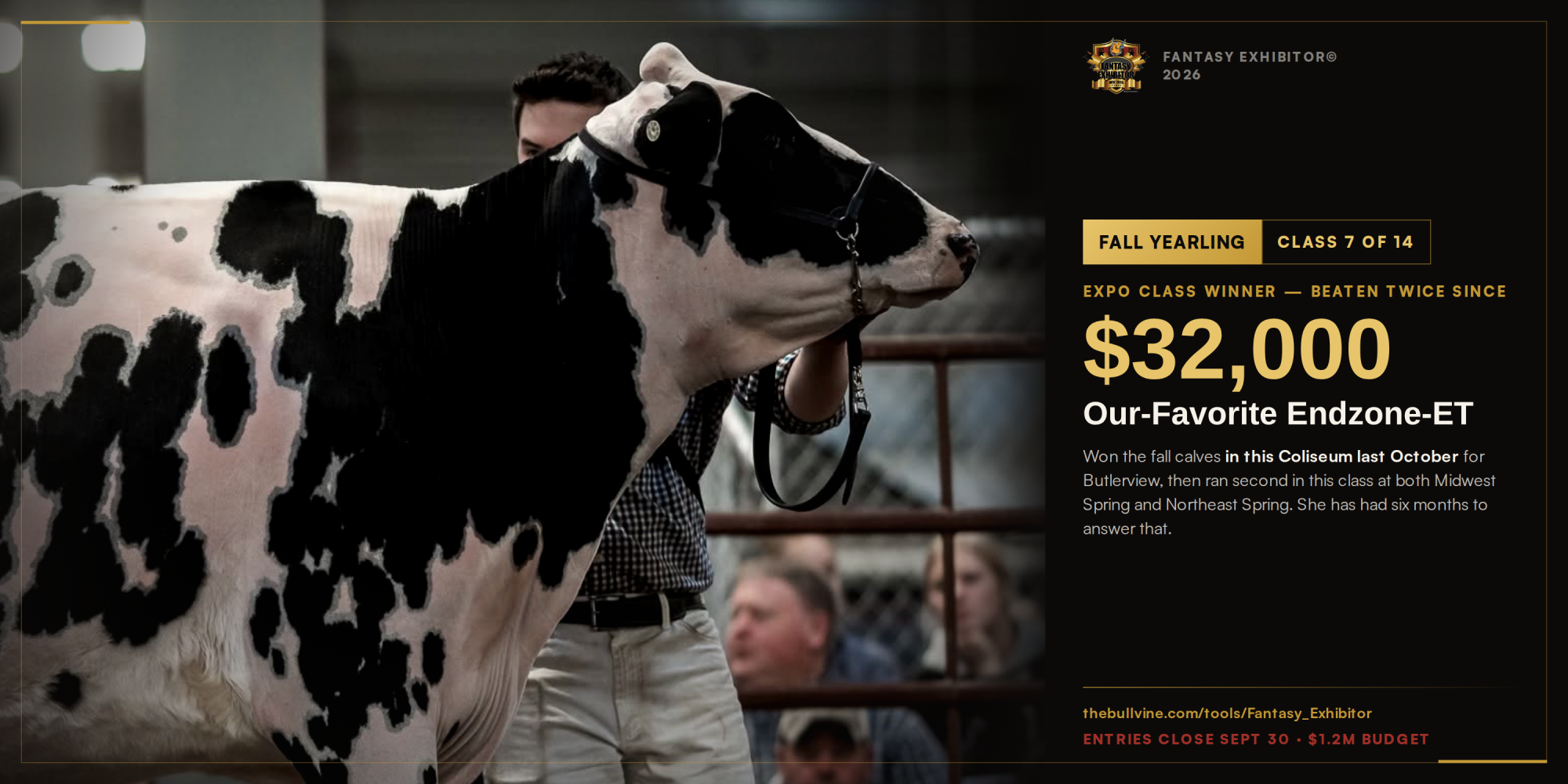
Our-Favorite Endzone-ET (Lombardi) won the fall calves at Expo last year for Butlerview, then ran second in this class at both Midwest Spring and Northeast Spring. Six months to answer that.

The cow who answered both times is Kamps-Rx Abercombi Abella (Master), 17 head at Midwest Spring with HM Junior Champion of the Junior Show, bred and owned by Demi, Elliot & Alayah Kamps, Darlington, WI. Also live: Appalachian AN Amaretto-ET (Analyst), HM Junior Champion at Eastern Fall; Ranway Handsome Spade-ETS (Handsome), HM Junior Champion at Northeast Spring, bred and owned by Alexis Schultz; Hans-Gen Master Roku(Master), Junior Champion at Southern Spring for the Osingas and a winner of this same class in the Coliseum at Midwest Summer National — two class wins on two circuits.

And note who is not eligible here any more: Sco-Lo Legendary-ET (Legend) was 2nd in the fall calves at Expo, 4th at the Royal and an All-American, but she calved before July. She is a cow now, and Friday’s milking yearling class is where to look for her.

Friday: The Cows

Two class-size patterns frame the whole day.

Milking yearling classes in 2026 drew 2 head at Mid-East Summer, 2 at Atlantic Summer, 4 at Midwest Fall, 6 at Northeast Fall, 8 at Ontario Summer, 11 at Eastern Fall. Junior three-year-olds drew 1 at Atlantic Spring, 3 at Northeast Spring, 4 at Midwest Spring. Those cows exist — they were bred to hit peak on October 2, and Madison is the first ring most of them will see.

Freshness Snapshot vs. Seasonal Ceiling

There is a third category on this card, and it is the one most likely to make you look foolish: the cow who already showed in 2026 and got beaten because she was too fresh to win yet.

A cow eight days into a lactation and a cow eight weeks in are two different animals wearing the same name. The early one has no bloom in her udder, she hasn’t come out in her top line, and she gets placed where the judge finds her that morning — fourth, seventh, wherever. Six weeks later she is the cow her breeder was always describing. The results sheet records the first version and says nothing about the second.

It happens every season, and it happened in plain sight this one:

  • Curr-Vale Detective Adeen-ET stood third at Northeast Spring in March. In September she won 36 head at Eastern Fall and took Junior Champion. Same heifer, six months of development.
  • Roquet Gelatine Reddit was only third in the junior three-year-olds at Quebec Spring. By Midwest Fall she won 14 head with Best Udder and went Intermediate and HM Grand Champion.
  • Ms-AOL Alpha Ralpha was third in the senior two-year-olds at Southern Spring in March. Two months later at Midwest Spring she won the class, took Reserve Intermediate of the open show and Intermediate Champion of the Junior Show.
  • Sco-Lo Legendary-ET was 2nd in the fall calves at Expo, 4th at the Royal and an All-American — then surfaced at Ontario Summer in July placing seventh, freshly calved as a milking yearling. Read that seventh as a calving date, not a verdict.

So when you scan the class results in this preview, read every mid-pack finish with a question attached: was she beaten, or was she early? October 2 is the date the whole continent breeds toward, and a cow who placed fourth in May while a month fresh is precisely the animal a barn holds back and points at this week. She will not be on anybody’s favorites list, including ours.

The Young Cow Shopping Floor: Why Friday Morning Sets the Market

Here’s the part that makes Friday morning worth watching even if you don’t care who wins: the intermediate classes are where diamonds get found, and the people doing the finding are standing at that rail right now.

The precedent is the best cow of the last decade. Erbacres Snapple Shakira-ET was bred by Francisco Rodriguez and the Erbsen family at Erbacres Holsteins in Lanark, Illinois — who this year took the 2026 Robert “Whitey” McKown Master Breeder Award on the strength of her. The partnership of Ferme Jacobs, Ferme Antelimarck 2001, Attaboy Holstein, Kilian Theraulaz and Ty-D Holsteins bought her as a fresh two-year-old — at World Dairy Expo, in 2017. She went on to Grand Champion of the International Holstein Show in 2021 and Supreme Champion of World Dairy Expo in both 2021 and 2023, scored EX-97 4E. Somebody watched a two-year-old walk a class in Madison, did the math on her family, and wrote a cheque. That is the whole business model in one cow.

It is still running. Three of the biggest names on Friday’s card changed hands as young cows:

  • Millen Lambda Amelia was purchased by Ferme Jacobs and presented as a junior three-year-old at Quebec Spring, where she took Intermediate Champion with Best Udder
  • Famipage Legend Barabas sold for $120,000 at the International Intrigue Sale to Ron Grandy as a senior three-year-old. She has been Grand Champion of the Ontario Summer Show twice since
  • West-Adub Lambda Sadie sold at the Parade of Perfection to Butlerview with Westcoast retaining half interest, months after winning Expo’s Intermediate Championship as a junior three-year-old

Ferme Blondin built an entire operation on this. The Bullvine’s own profile describes the deliberate turn into “an elite cattle sales and show operation” running 90 cows milking out of 550 head total, and Holstein Québec credits their buying — not just their breeding — with diversifying the herd and developing new bloodlines. Watch what that looks like in a results sheet: at Le Suprême Laitier this year Blondin put five head into the Spring Junior Two-Year-Old class alone, and collected second place in three more young classes — Bruview Fuel Rowan in the winter two-year-olds, Hill View Randall Praline in the senior twos, Charbend Detective Beatrice in the summer yearlings — without winning a class outright, then walked off with Premier Exhibitor anyway. Volume in the two-year-old ring is the strategy, not an accident.

Pierre Boulet works the same seam from Montmagny. In 2026 alone his name sits on Go-Sho Detect Revenge, Pierstein Dempsey Lexi, JM Valley Sidekick Jacuzzi, Clayhaven Crushabull Lysanna, Dubenoit Dynasty Ever Ready and Valrick Delta Lambda Pamela — cows carrying six different prefixes, none of them his.

And look hard at Butlerview’s 2026 championship list with this in mind: Aria, Lady Crush, Dominate, Champagne, Beast, Constance, Zany, Sadie. Eight champions and class winners, eight prefixes that aren’t theirs. The home-bred exceptions number two — Glitter Girl, and Butlerview Master Shock-ET, who won her summer yearling class at both Midwest Spring and Northeast Spring but did it in Addison Lortie’s string, not theirs. That isn’t a criticism — it’s the most successful show-ring model in North America right now, and it starts with somebody standing at the rail during a junior two-year-old class writing a name in a catalogue.

So when the milking yearlings and junior twos come in Friday morning and you don’t recognise half the names: that’s the point. Some of those cows will be wearing a different prefix’s halter within six months, and one of them is a 2030 Supreme Champion that nobody in the building has heard of yet.

Milking Yearling — the fragile class, and the weather nobody talks about

This is likely to be the biggest milking yearling class of the year — nothing on the 2026 circuit topped 11 head — and it’s also the most breakable. First-calf heifers are the animals that lose a show between the trailer ramp and the wash rack: they go off feed in a strange barn, they don’t let down for a new milker, and an udder that isn’t emptied on schedule for two days doesn’t come back by Friday morning.

Madison in early October gives you both problems at once. The October normal high is about 60°F with a normal low near 40°F, and that daily 20-degree swing is the real hazard — warm, still afternoons in a full barn followed by cold night drafts through the alleys. Fresh heifers are the first to shut down at both ends of that. The strings that win this class are the ones that hauled early, kept the milking interval identical to home, and blocked the drafts before the first night, not the ones who arrived Wednesday.

One more piece of the fresh-cow paperwork that catches people out: every lactating cow needs a negative Influenza A Virus PCR test within seven days of arrival, a rule in force since 2024, and exhibitors whose travel plus exhibition time exceeds the 10-day federal interstate window may need a second round of testing to get home. For a first-calf heifer, that’s another handling event in the week she can least afford one.

Ms Campbell Run DL Konni-ET (Delta-Lambda) won 11 head with Best Udder at Eastern Fall, bred and owned by Sarah Campbell and Evan Creek, Hagerstown, MD — the largest milking yearling class of the season. Carpsdale-J Fall-Red-ET (Acetylene) won at Northeast Fall, Fraeland Alpha Precious (Alpha) took 8 head with Best Udder at Ontario Summer, Sunkist A Palma (Anders) won at Midwest Fall, and Ms Be Tempted-Red-ET (Believe-P) took the class at Midwest Summer National for Milk Source.

The one with the biggest heifer reputation in the class is Sco-Lo Legendary-ET (Legend) — 2nd in the fall calves in this Coliseum last October, 4th at the Royal, an All-American — who freshened in time to place only seventh at Ontario Summer in July. On the evidence of this class she is a seventh-place milking yearling. On the evidence of her heifer career she is nothing of the kind, and three more months of udder is exactly what separates those two readings.

The quiet one comes out of last October’s fall calf class, which split two ways this year — still-dry heifers went to Thursday, the early-freshening ones come Friday. Weeksdale Major Lea(Major) was fifth in it and the top bred-and-owned heifer in the class for Weeksdale Holsteins, Pleasant Valley, PE.

Summer Junior 2-Year-Old — a Reserve Junior Champion, in milk, in a new barn
Jolipre Master Angel (Master) was Reserve Junior Champion of the International Holstein Show last October off a summer yearling class win for Joel Lepage of Amqui, Quebec, and she was named All-Quebec for the season. She now carries JM Valley Holstein ownership — the same barn that took Grand Champion at Le Suprême with Gouldhaven Alligator Ezroyal. Nobody has seen her with a calf behind her.

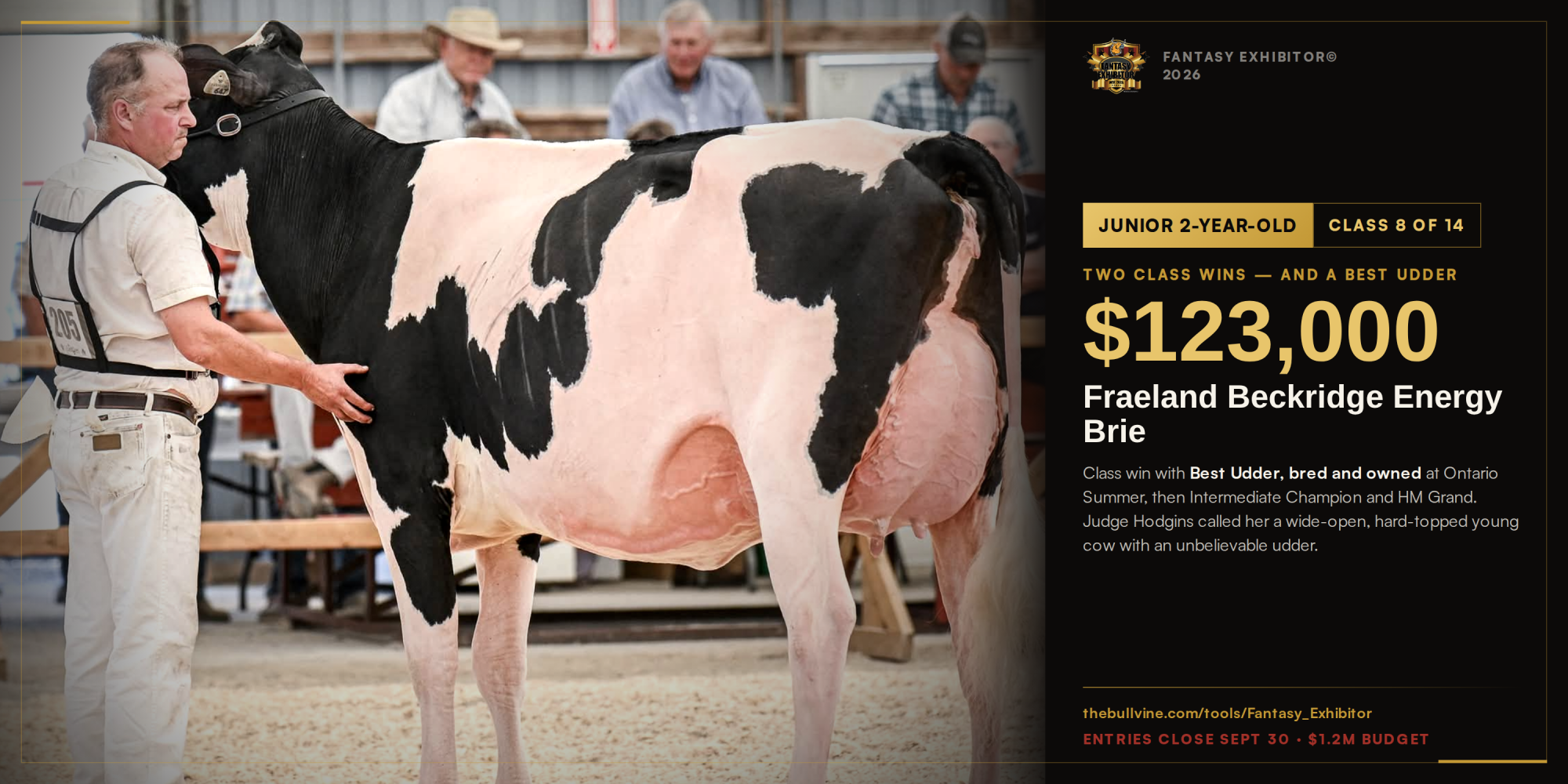
On form, Fraeland Beckridge Energy Brie (Energy) is the favorite: class win with Best Udder bred and owned at Ontario Summer, then Intermediate Champion and HM Grand. Hodgins called her “a tremendous winner,” a “wide-open, hard-topped young cow,” full through her midsection with depth “all the way down” and “an unbelievable udder.” Hard top plus free movement is Krohlow’s exact vocabulary.

The U.S. answer is Walk-Era Eye Candy Rebel (Eye Candy) for Budjon, Vail, Heartland Dairy, Genosource, Farnear and Demmer, Lomira, WI — she won the summer junior two-year-olds at Midwest Summer National in August and took Intermediate Champion and HM Grand Champion in the Coliseum. Note the barn: Budjon and Vail are also the people sitting on Crackholm Lambda Cleavage. Fier-View Energy Rhegan (Energy) took HM Intermediate of the Midwest Fall Junior Show; Peace & Plenty Have Too Zack (Have Too) won 12 head with Best Udder at Eastern Fall.

Spring Junior 2-Year-Old — Grandy’s other cow

Silverdream Major Tootsie (Major) won the spring yearling class at Expo last October and was an All-American for Ronald Grandy, Beaverton, ON. She hasn’t shown since. Grandy is the man bringing Barabas to the four-year-olds, and he doesn’t miss on development.

The form pick is Ulmar Lambda Dorthe (Delta-Lambda) — 16 head with Best Udder, bred and owned, plus Reserve Intermediate at Ontario Summer for Pfister Dairy, Beckridge and Quality Holsteins. Hodgins called her “the heifer that’s the most trending today,” long and angular, “a dairy machine.” Ryan-Vu Awesome Rapture (Awesome) is the one with Coliseum form — class win and Reserve Intermediate Champion at Midwest Summer National for Arizona Dairy Co, Maple Leigh and Grai-Rose Cattle, having placed 6th in the spring yearlings at Expo last year. Jacobs Tarmac Constance (Tarmac) won the class at Northeast Spring for Butlerview, having been third to Tootsie in Madison. Ms Bratcher-Vu Di Barbie-ET (Delta-Lambda) won 14 head with Best Udder at Eastern Fall; West-Aub Architect Sage (Architect) was Reserve Intermediate at Mid-East Summer. And Armcrest Select Bandana (Master) is unseen this year — the heifer Krohlow himself put top of the spring yearlings at Hamburg on her “long and clean” neck, “silky” hide and open rear rib.

Winter Senior 2-Year-Old — where the missing Junior Champion lands
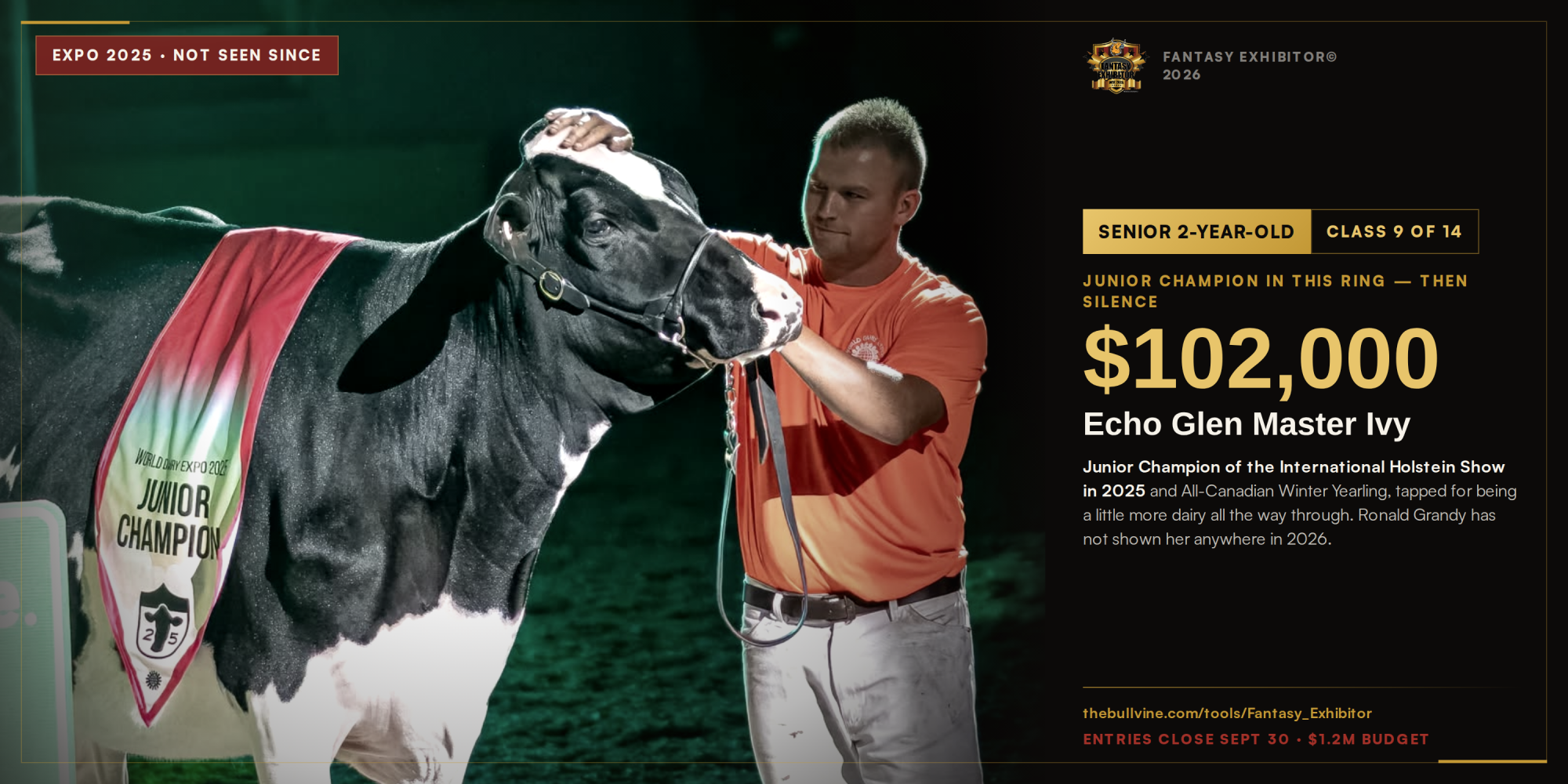
Echo Glen Master Ivy (Master) was Junior Champion of the International Holstein Show in 2025 and All-Canadian Winter Yearling, tapped for being “a little more dairy all the way through” and “maybe a rib longer in her makeup.” Ronald Grandy has not shown her anywhere in 2026.

Favorite is Winright Sidekick Champagne (Sidekick), who beat 12 head with Best Udder at Midwest Spring for Butlerview and went Intermediate Champion and HM Grand under Pierre Boulet. Her hardest 2026 opposition is Canadian: Axel Havenofear Camy won the class with Best Udder and took Intermediate Champion of Le Suprême Laitier for Ferme Jacobs, Cap-Santé — the best senior two-year-old result anywhere in Québec this year, and she has never met Champagne. Four-Hills Pazzle 71530-TW (Pazzle) was Grand Champion of the Northeast Fall Junior Show and HM Intermediate of the open show for Sarah Hill. Golden Oaks I Altitu-Red-ET (Altitude) took Reserve Intermediate at Northeast Fall; Mortenson Master Anika (Master) was second at Midwest Spring, then won the class with Best Udder at Midwest Fall.

One more absentee: Winright SK Creme Brulee-ET (Sidekick), second in the winter yearlings at Expo last year — and Krohlow’s own Junior Champion at Hamburg in 2025, where he gave her the nod on “a tad more drop of rib.” The judge has already decided he likes this cow.

Fall Senior 2-Year-Old — the Texas cow they kept home

The Osingas have won classes all year at Southern Spring and Midwest Spring. The one they haven’t shown is Kawartha Chief Bailey (Chief), who won the fall yearling class at Expo last October.

On the board: Ms Have No Fear Bet (HaveNoFear) took her class with Best Udder bred and owned plus HM Intermediate at Eastern Fall for Ernest Kueffner, Teri Packard and La Casa de Lac. AR-Line Eye Candy Aerial-ET (Eye Candy) was HM Intermediate at Mid-East Summer; Real-In-Lant Bella (Summerfest) Reserve Intermediate at Northeast Spring. Also unseen: Jacobs Alligator Bawl-ET (Alligator), winner of the milking yearling class at Expo for Budjon Farms, Peter Vail, Genosource & Farnear — her birth date decides whether she lands here or in the junior twos.

Junior 3-Year-Old — third place, twelve months, one purple banner
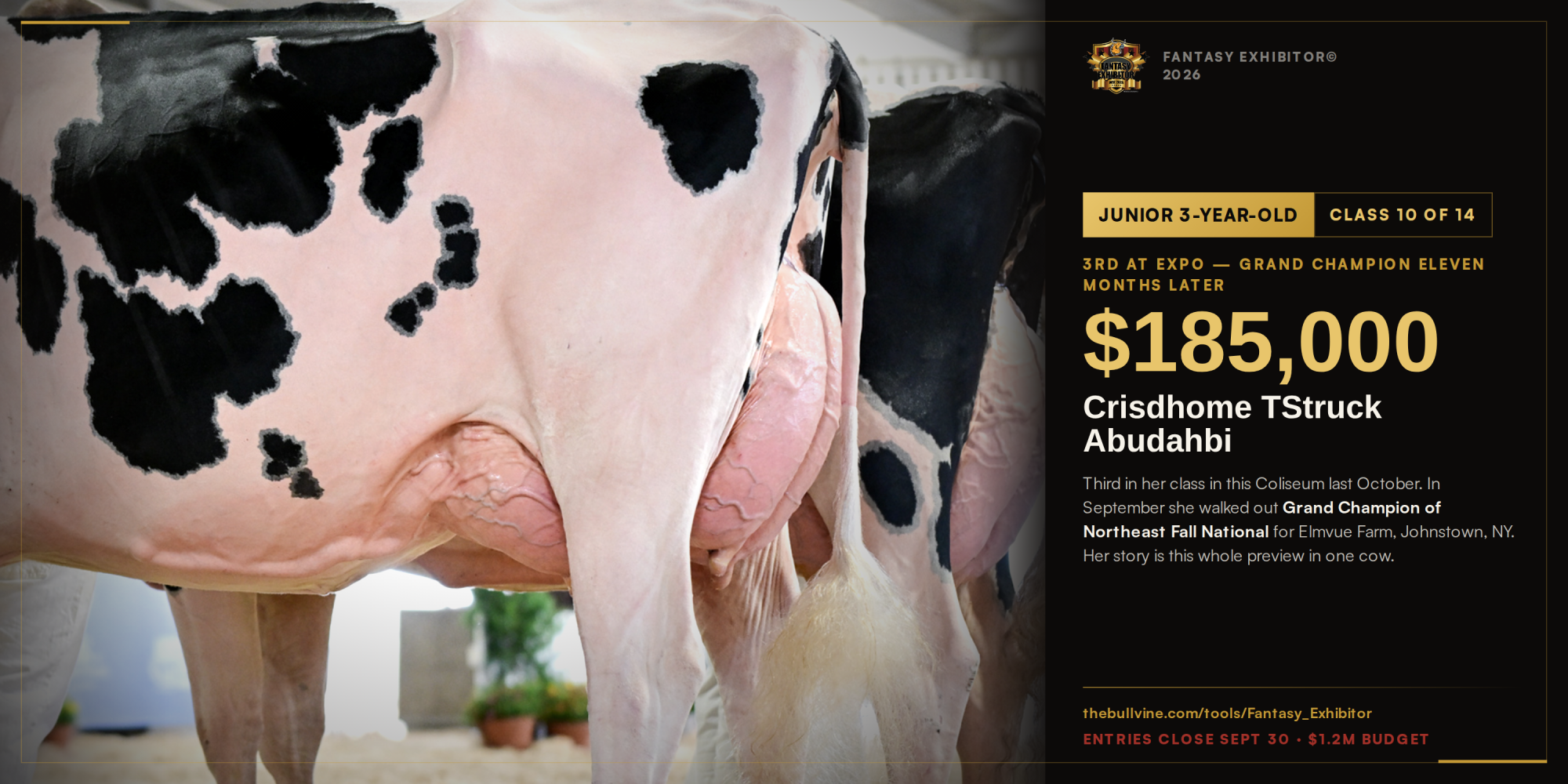
Abudahbi’s story is the article in one cow: 3rd at Expo last October, Grand Champion at Northeast Fall in September for Elmvue Farm, Johnstown, NY.

The cow who beat her by two places that day was Crackholm Lambda Cleavage (Delta-Lambda), for Budjon Farms and Peter Vail, Lomira, WI, and she hasn’t shown in 2026. Budjon and Vail don’t campaign a cow all summer when Madison is the target.

The rest is loaded. Roquet Gelatine Reddit (Reddit) won 14 head with Best Udder at Midwest Fall for Intermediate and HM Grand — and was only third in this class at Quebec Spring in the spring. Millen Lambda Amelia (Delta-Lambda) was Intermediate Champion with Best Udder at Quebec Spring for Ferme Jacobs. Blondin Eye Candy Salana (Eye Candy) took Reserve Intermediate at Le Suprême. Tex-Stein Unstopabull Lorel (Unstopabull) swept Intermediate, HM Grand and Champion Bred & Owned Cow at Southern Spring. Rosblais Tatoo Madisson(Tatoo) won the spring junior twos at Expo for Glamourview-Iager & Walton and is also unseen.

Senior 3-Year-Old — three Grand Champions, and the two ghosts the room is backing instead
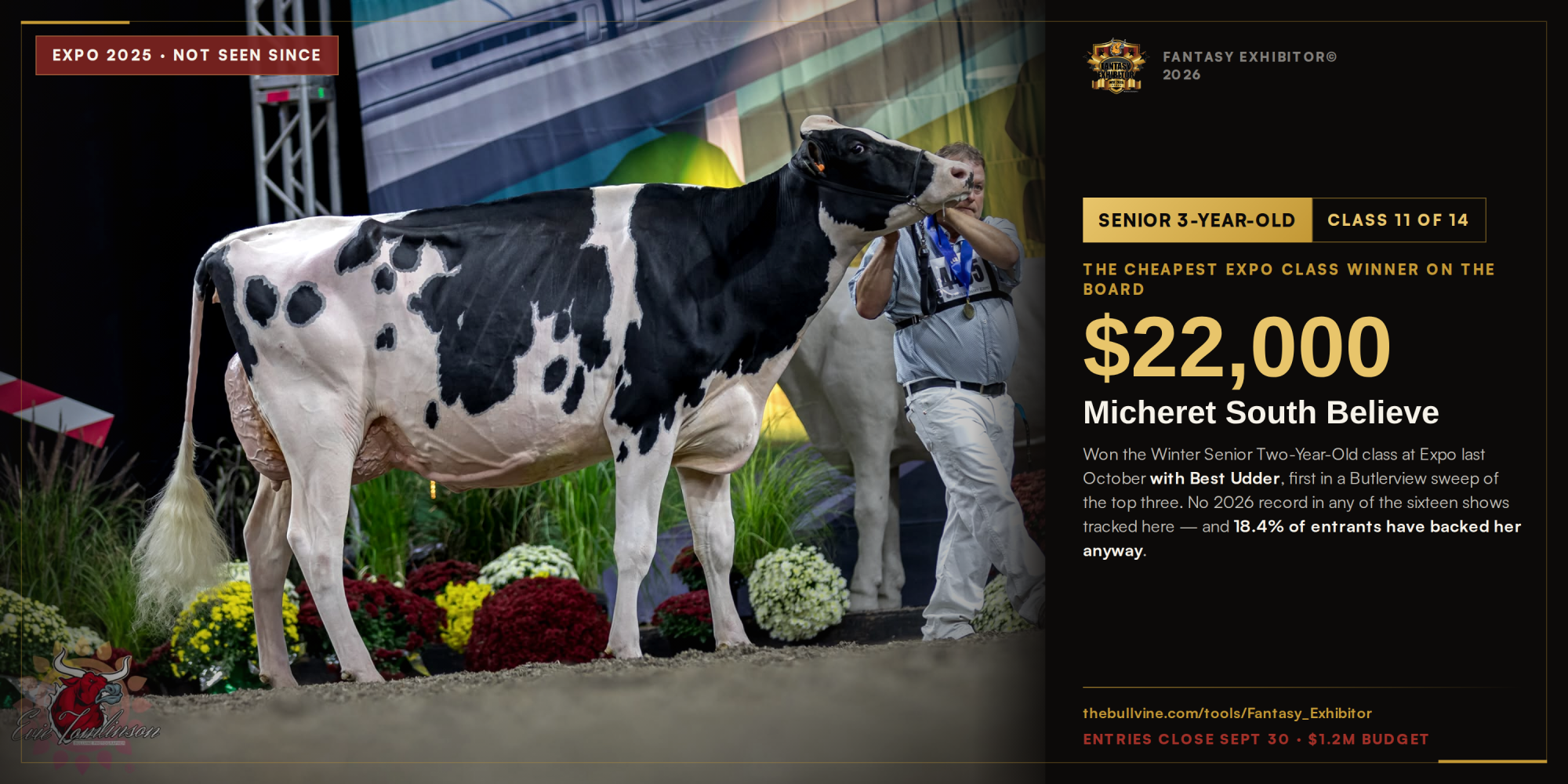
No class carries more proven purple, and almost none of them have met. Start with what happened here last October, because it explains the rest of the class: Butlerview owned the top three of the Winter Senior Two-Year-Old class at Expo 2025 — Micheret South Believe first with Best Udder, Goldenflo Lambda Dominate second with the production award, Sandpiper Sidekick Disco third. All three aged into this class. One of them has been a Grand Champion since, one has been an Intermediate Champion since, and the one who beat both of them has not been seen since.

Micheret South Believe is that cow. She won the class and the Best Udder in it, and there is no 2026 record for her anywhere in the sixteen shows tracked here. If she walks in Friday carrying another lactation, every placing below is provisional.

Ringside agrees, and not by a little. Believe and MD-Locustcrest P Zuriniah are the two most-backed cows in this class in our Fantasy Exhibitor contest so far, at 18.4% and 18.6% of entries — 37% of the senior three-year-old vote on two cows who have not been in a ring in 2026. Our own favorite in the class, Eastern Fall Grand Champion Cedar-Crown Tatoo Amelia, sits ninth at 4.1%; Midwest Fall’s bred-and-owned Grand Champion Carlan D-Lambda Annita draws 4.4%. Read that for what it is: the people who watch these cattle for a living are discounting summer-circuit form in favour of what they saw in this Coliseum last October.

Cedar-Crown Tatoo Amelia (Tatoo) is Intermediate and Grand Champion of Eastern Fall National for Oakfield Corners Dairy. Carlan D-Lambda Annita (Delta-Lambda) is Senior and Grand Champion of Midwest Fall National, bred and owned. Sandpiper Sidekick Disco (Sidekick) is Grand Champion of the Atlantic Summer Classic for Joel Phoenix, T & L Cattle Ltd and Weeksdale Holsteins. Cherry Lor Robin-P-Red (Journey) is Senior Champion and Reserve Grand at Northeast Fall for Elmvue (check the Red & White sheets first — the R&W cows go Thursday, October 1 at 7:00 a.m., which is before Krohlow’s heifers and a full day before his cows). Miley Challenger Beth (Challenger) is Intermediate and HM Grand at Mid-East Summer.

Goldenflo Lambda Dominate-ET is the technical pick. A Farnear Delta-Lambda out of Goldenflo Fitz Rice Krispies, second lactation, she won the class with Best Udder and took Intermediate Champion at Northeast Spring for Butlerview, where Carscadden cited frame length, a smoother neck-to-shoulder transition, a more level udder floor and “seamless blending of parts.”

The ghost: MD-Locustcrest P Zuriniah (Parfect), HM Intermediate Champion at Expo in 2025 and All-National Fall Senior Two-Year-Old, where Eaton praised her as a cow that “spells milk from one end to the other” despite being eleven months into her lactation — which is the durability argument in one line, not a knock. One more lactation on her, zero rings in 2026, for Chip, Chase & Connor Savage and Tom Mercuro, Union Bridge, MD.

4-Year-Old — a clash of two archetypes, not just a rematch
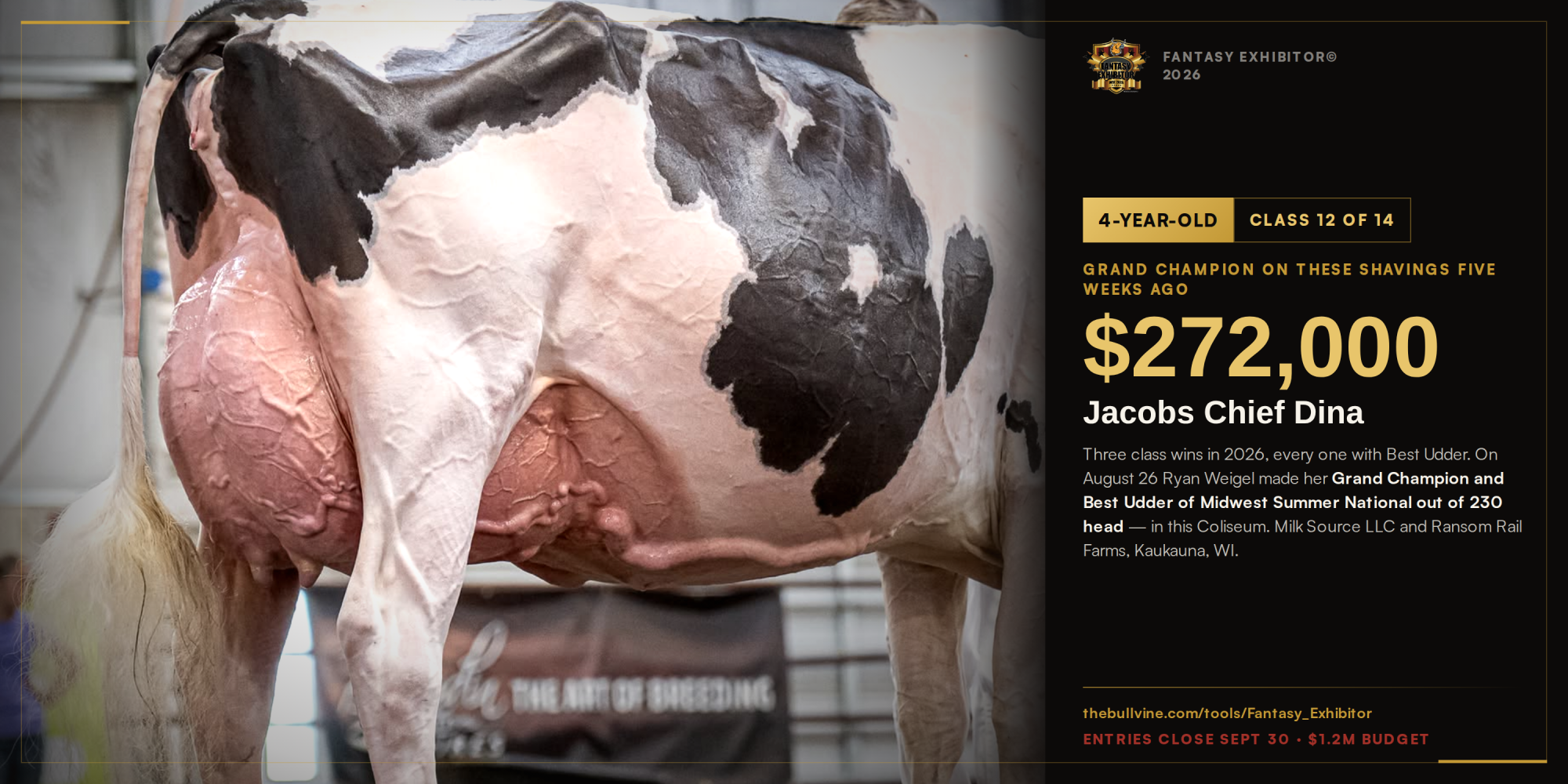
This is the class of the show, and the reason isn’t the rematch. It’s that Sadie and Barabas are opposite kinds of cow, a third one has the freshest win of the three, and Krohlow’s stated preferences cut every way at once.

Famipage Legend Barabas is power. A Legend daughter — Legend being a Walnutlawn Sidekick son out of Mosnang Jacoby Legendaire VG-89 — bred by Ferme Famipage, owned by Ronald Grandy, VG-89 as a three-year-old, All-Canadian Senior 3-Year-Old of 2025. Hodgins gave her Ontario Summer’s Grand on “a little more width all the way through,” “more comfort on her pasterns” and “a touch more venation in that rear,” calling her a cow that excels in “frame, capacity and a tremendous mammary system.” Wide, deep-chested, uphill, and she keeps her udder underneath all that mass.

West-Adub Lambda Sadie is quality. A Farnear Delta-Lambda out of Winright Sidekick Salsa, with an EX-91 mammary system, tracing back through Budjon-JK Gold Chip Ellen EX-91 and Budjon-JK Linjet Eileen EX-96 to Krull-Broker Elegance EX-96-USA 3E — the Elegance tap root is the engine. Eaton’s language on her was all refinement: “so dairy, so open, so flawless in her parts,” “a little cleaner,” “more quality to that mammary system.” Cut out through the front end, silky, with an udder glued to the body wall.

Now read Krohlow’s own words against that. He wants square frame, hard top, comfortable front and rear — Barabas. He also wants texture, symmetry and definition of the seam, and he breaks close pairs on drop of rib and the back of the rear udder — Sadie. He has spent 18 years with his hands on udders, and the two hardest things he’s said about mature cows are that he’s looking for the “complete package of dairy strength” and that he’ll move a cow up for “veination and quality all the way through her mammary system.”

Eaton split them on cleanliness and mammary quality and went Sadie. Hodgins, judging Barabas alone, rewarded width and venation. Krohlow is the one judge on record valuing both halves equally, which is exactly why this could go either way on the floor of an udder.

Then there’s the third Grand Champion in the class, and a skeptic should note she has the most recent win of the three. Jacobs Chief Dina (Chief), Milk Source LLC and Ransom Rail Farms, Kaukauna, WI, won the four-year-olds with Best Udder at Midwest Spring in May — then took the class again with Best Udder at Midwest Summer National in Madison on August 26, where Ryan Weigel made her Senior and Grand Champion and Best Udder of the show out of 230 head. She won that one on the same shavings this show uses, five weeks ago, under a judge who saw her against Wisconsin’s best. Sadie and Barabas both have Grands; Dina has a Grand in the Coliseum.

Behind those three it’s still deep. Cnossome Mirand Penelope (Mirand) is Grand Champion of Western Spring National for Logan & Lauren Silveira, Chowchilla, CA — and she was 4th in the senior threes at Expo last year. Cal-Denier-I Goldwyn Hez-ET (Goldwyn) is Senior and Grand Champion of Southern Spring National for Emma England, Murtaugh, ID. Tombeth House Ariat (Helix) was Reserve Grand and Champion Bred & Owned at Midwest Summer National for Thomas & Elizabeth Kearns, Gays Mills, WI. Chrisland Ashby Dazzle (Ashby) took HM Senior at Northeast Fall, Oakfield Honour Sing-ET (Honour) Reserve Senior at Eastern Fall bred and owned, Fricosos Sidekick Lasenza (Sidekick) Reserve Grand at Mid-East Summer, Martin-View Doc Hot Shot (King Doc) Reserve Grand at Ontario Summer. The one nobody has seen is Weeksdale Unix Tiktok, second in the senior threes at Expo last year and unseen since.

5-Year-Old — the favorite with nothing proven here
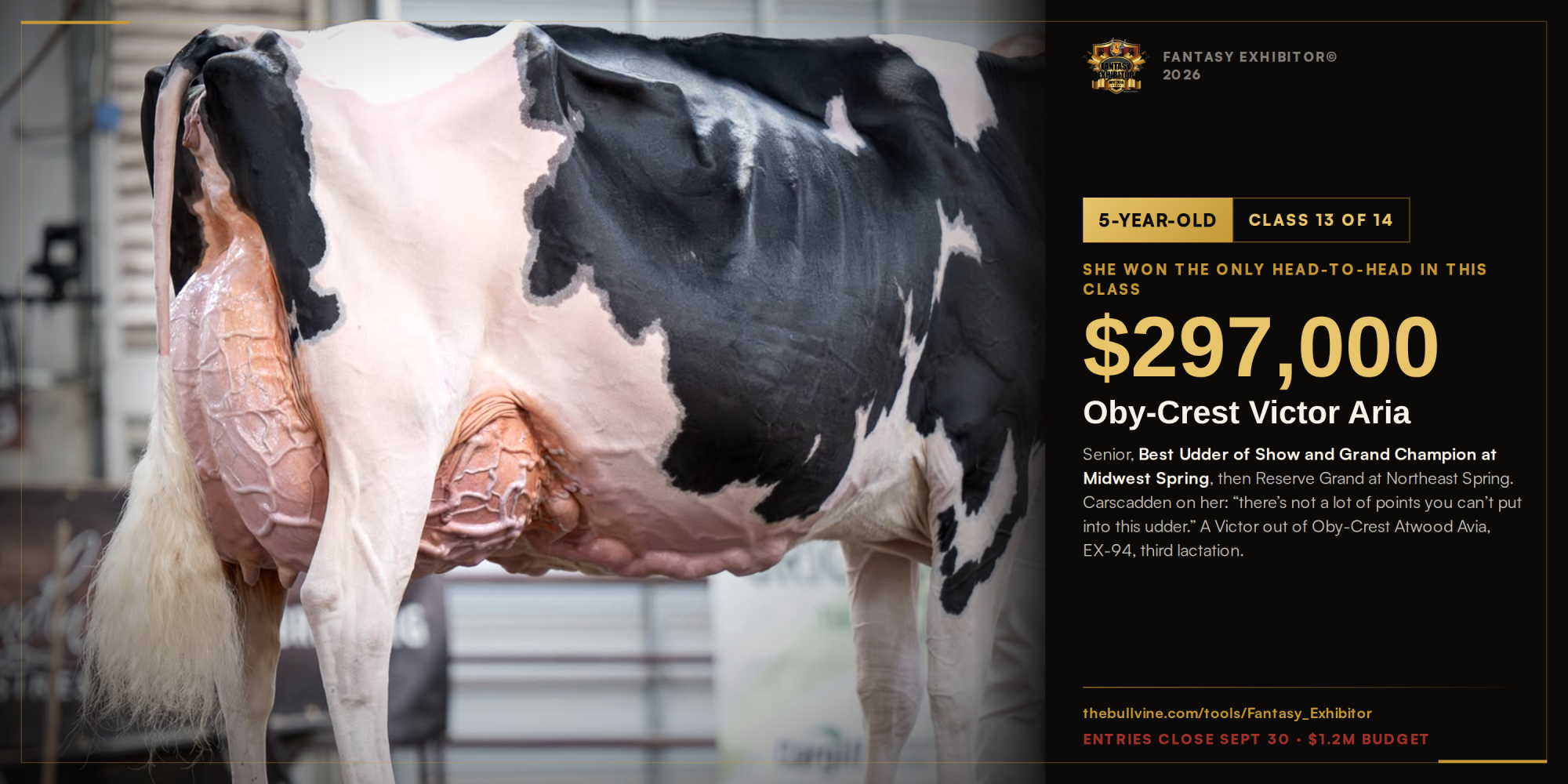
Oby-Crest Victor Aria is an Our-Favorite Victor-ET out of Oby-Crest Atwood Avia, EX-94, in her third lactation. She won her class and took Senior, Best Udder of Show and Grand Champion at Midwest Spring, where Boulet said simply, “what a show — and what a great show cow.” At Northeast Spring she won the class again for Reserve Senior and Reserve Grand, with Carscadden admitting, “I’m a sucker for a great udder,” and adding “there’s not a lot of points you can’t put into this udder.”

The catch: she was not in the top six of any class in Madison last year. Two 2026 Grand Championships, no Expo record.

The cow with the Expo record is Eixdale Pwrup Alongside (Alongside) — 2025 four-year-old winner and HM Grand for MilkSource — who stood second to Aria at Midwest Spring for Reserve Grand. That’s the one clean head-to-head. Directly behind Alongside in Madison sat Jacobs Lambda Baz-ET (Delta-Lambda), unseen in 2026, with another lactation on a Delta-Lambda daughter in the year his daughters hit their prime.

Also real: Gouldhaven Alligator Ezroyal (Alligator), class win with Best Udder and Grand Champion of Le Suprême for JM Valley Holstein, London Dairy Farms & Pat Conroy, where Dominic Fortier settled the championship on udder freshness — “more bloom and more veining.” Maiden-Kine Chief Cami (Chief), class win, Senior Champion, HM Grand and Bred & Owned Champion at Eastern Fall. Elm Bend Gapster (Master), class winner at Northeast Fall for Elmvue — a cow Krohlow judged as a four-year-old in 2025 and called a “laser cow” with “so much width power and chest.”

Aged Cow — the lactation question, and the banner that got taken back
The deciding factor here is calving dates, and the class carries the most complicated history in the show. Meet the three principals first, then the standoff.

Lo-Pine-Va Lady Crush is a Maverick Crush out of Lo-Pine-VA Aftershock Lilac, EX-96, bred by Terry Perotti, owned by Butlerview. At New York Spring in March, she was in her fourth lactation and fresh since July 2025 — and she won the aged cows, Senior Champion and Grand Champion, with Carscadden saying “today is this gal’s day” and calling her “bagged perfectly.” He described the split over Jeffrey-Way Hardrock Twigs as “splitting straws,” giving Lady Crush the nod on an udder that carried tighter to the body. If she’s still on that same lactation in October, she’ll be roughly 15 months fresh, so the live question is whether Butlerview has recalved her — because a 15-month cow does not carry bloom, and bloom is what Fortier and Krohlow both decide on.

Jeffrey-Way Hardrock Twigs (Hardrock) is the counterweight: Senior and Grand Champion of Mid-East Summer National, HM Grand at Northeast Spring, scored 96 points, second to Kandy Cane in the five-year-olds at Expo last year, for Doeberiener, Bowen, Conroy, Walker and R&F Livestock.

Twigs also carries the one piece of Expo history nobody in this business has forgotten. She was named Grand Champion of the International Holstein Show in 2024 and then removed from the results roughly two months after the show, with the Grand Champion title passing to Oakfield Solomon Footloose and Reserve to Erbacres Snapple Shakira. World Dairy Expo did not state a reason, referring exhibitors to its Showring Policy and Code of Ethics in the Premium Book. She has campaigned successfully since, including that Mid-East Summer Grand this summer. If she walks back into this ring, it’s the first time she has stood in front of an Expo judge since the banner was reassigned, and that is a genuine storyline rather than a footnote.

Pierstein Dempsey Lexi (Dempsey) won the mature cow class with Best Udder at both Quebec Spring and Le Suprême, with Reserve Grand and the Bred & Owned Grand Championship at Le Suprême. Higherground Hancock 860 (Hancock) won with Best Udder, bred and owned, at Midwest Fall for Reserve Grand. Arolene Duhibou Apple Elmay (Apple Crisp) took class, Reserve Senior, and HM Grand at Northeast Fall. Nobland Delta-Lambda Book (Delta-Lambda) won the aged cows and took HM Senior of the open show plus Senior and Grand Champion of the Junior Show at Midwest Summer National for Macie Noble, Lancaster, WI — a junior exhibitor holding a Grand Championship banner on the Coliseum shavings in August. Altona Lea Unix Herminie (Unix), last year’s aged cow winner and HM Senior Champion for Dalton Faris, is unseen in 2026.

Then there’s Kandy Cane. A Sidekick out of Lovhill Diamondback Crunch, from Lovhill Gold Karat EX-93-CAN 3E — a Gold Chip daughter and maternal sister to Lovhill Goldwyn Katrysha EX-96, Supreme Champion of World Dairy Expo 2015. Sidekick over Diamondback: the frame-and-dairy-strength cross on top, the udder family underneath, and that combination is precisely what made Krohlow stop walking in Harrisburg in 2024 and again in Hamburg in 2025. Bred by Lovholm Holsteins at Balgonie, Saskatchewan, she made Lovhill the first prefix to win the Expo Holstein Grand twice.

She’s now EX-97. What nobody outside Oakfield Corners knows is where she sits in her lactation.

So here is the standoff, and it’s the most handicappable decision on the card. If Lady Crush rolls in stale — 15 months on the same lactation, milking on frame — and Kandy Cane arrives fresh and in bloom, Krohlow won’t hesitate. He has crowned that cow twice; he decides on texture and seam definition, and bloom against stale is not a close call for anyone, least of all a judge with his history.

But if they both come in late in lactation, showing on heart, rib and frame, the whole thing moves onto ground Krohlow has been unusually explicit about: bone quality, locomotion, and what the back of a rear udder does at the bottom of the seam. That’s the scenario where the cows behind them get in — Twigs at 96 points, or Lexi with two mature-cow Best Udders this season. A mature-cow class decided on hocks, pasterns, and seam definition rather than freshness is exactly how a Reserve Grand becomes a Grand.

Lifetime Production — the class where the Junior Show already voted

Luck-E Merjack Asalia (Merjack), Tessa & Stella Schmocker, Whitewater, WI — class win with Best Udder at Midwest Spring, HM Senior Champion of the open show, Senior and Grand Champion of the Junior Show. She was second in this class at Expo last year. Walk-Le Delta-Lambda Breezy (Delta-Lambda) won at Eastern Fall for Walk-Le Farm, Thomasville, PA — though honesty requires the class size: she was the only lifetime production cow entered, and Asalia’s Midwest Spring class held two. No published reasons exist on Breezy, so the case for her is structural rather than comparative: she is a Delta-Lambda daughter in the one class where the udder has to survive the most lactations, and Delta-Lambda took ten class Best Udders across the fourteen shows tracked here, more than any other sire. If Krohlow discounts an aged cow for edema or stale attachments — and his stated brief asks for texture, symmetry and a visible seam — a Delta-Lambda mammary system is the modern alternative to raw production mass. Milibro Devour Lovely won at Quebec Spring, bred and owned with Best Udder. The one nobody has seen is Peace & Plenty Doc Jubie16-ET (King Doc), who won this class at Expo in 2025 for Showbox Sires and Milk Source Genetics and hasn’t been seen since.

The Bred & Owned Board Is Where The Breeders Are Winning

If the last section made it sound like the buyers own this game, here’s the other half of the ledger — and the two halves depend on each other. Somebody has to breed the cow before anybody can buy her. The Erbsen family sold Shakira as a two-year-old and won a Master Breeder award off what she became; that’s not a cautionary tale, that’s the business working.

But the banner you cannot buy is the one that comes with a cow you bred yourself, and in 2026 the homebreds weren’t just competing on that board — they were taking open championships with it.

Higherground Hancock 860 (Hancock) is the best case. Ashley, Emily, and Roger Meligren of Zumbro Falls, MN bred her, owned her, and won the aged cow class with Best Udder at Midwest Fall — then took Reserve Grand Champion of the open show, Champion Bred & Owned Cow, and Senior and Grand Champion of the Junior Show. One family, one cow, four banners.

Carlan D-Lambda Annita (Delta-Lambda) won Midwest Fall’s Grand Championship outright, bred and owned, for T & K Kohls and R & K Mackinson. Maiden-Kine Chief Cami (Chief) took her class, Senior Champion, HM Grand and Bred & Owned Champion at Eastern Fall for John & Molly Scoville of Lowville, NY. Tex-Stein Unstopabull Lorel (Unstopabull) swept Intermediate Champion, HM Grand, and Champion Bred & Owned Cow at Southern Spring for Gavin Steinberger. Pierstein Dempsey Lexi (Dempsey) won the mature cow class with Best Udder at both Quebec Spring and Le Suprême, taking the Bred & Owned Grand Championship at Le Suprême.

At Ontario Summer, bred-and-owned cows won six of the cow classes outright: Fraeland Beckridge Energy Brie in the summer twos, Ulmar Lambda Dorthe in the spring twos, Kingsway Lambda Scoobie in the senior twos, Kingsway Crushabull Catch Me in the junior threes, Knonaudale Miranda Lambert in the senior threes, and Glitter Girl in the winter yearlings. Sicy Unix Adriene did the same in Quebec, winning the senior three-year-olds at Le Suprême with Best Udder for Ferme Yvon Sicard.

Glitter Girl is the one to watch here, because she’s the rare animal that can win both boards at once — Butlerview bred her, and she has already taken Champion Bred & Owned Heifer plus Junior Champion at the same show.

The Junior Show Is Where Friday’s Upsets Get Rehearsed

Junior Show animals go back into the open ring, and in 2026 the Junior Show repeatedly found cows the open judge had placed mid-pack. If you want a shortlist of animals capable of beating their class order in Madison, this is it.

Four-Hills Pazzle 71530-TW (Pazzle), Sarah Hill, Bristol, VT — Grand Champion of the Northeast Fall Junior Show while standing only HM Intermediate in the open show. Seven-Heaven Haniko Delilah (Haniko), Chloe & Carly Feltmann — 2nd in her open class at Midwest Fall, then Intermediate Champion of the Junior Show. Robeth Doc Penpal (King Doc), Ella Kennett & Sarah Hill — 3rd in the open four-year-olds at Northeast Fall, then Senior and Reserve Grand of the Junior Show. Miss Showtime Hadley (Showtime), George & Lucille Hoffman — 4th in the open senior threes, then HM Grand of the Junior Show. Goodtime-KTT Doc Desiree (King Doc), Kylie Taylor and Trysten Verthein — 2nd in the open five-year-olds at Midwest Fall, then HM Senior and Grand plus Champion Bred & Owned Cow of the Junior Show.

Ms-AOL Alpha Ralpha (Alpha), Hayden Burrus, Friona, TX, is the cleanest illustration of the whole pattern: 3rd in the senior two-year-olds at Southern Spring in March, then a class win, Reserve Intermediate of the open show and Intermediate Champion of the Junior Show at Midwest Spring in May. Same cow, two months, three places.

Luck-E Merjack Asalia (Merjack), Tessa & Stella Schmocker, won the Lifetime Production class with Best Udder at Midwest Spring, took HM Senior of the open show — and Senior and Grand Champion of the Junior Show. In the heifers, JAKKS Arcitect Cupid-Red-ET(Architect), Tenley Chittenden, Whiting, VT was 2nd in the open spring yearlings at Northeast Fall and Junior Champion of the Junior Show.

Master Builds The Frame. Delta-Lambda Builds The Udder.

The sire story isn’t a win count — it’s a division of labor, and the Best Udder sheets prove it.

Golden-Oaks Master-ET owns the heifer rings. Junior Premier Sire at Le Suprême, the Ontario Spring Discovery Show, the Atlantic Summer Classic and the 2025 Expo heifer show. What judges say about his daughters is consistently about skeleton and cleanliness: Krohlow on the Master spring yearling Armcrest Select Bandana — “long and clean” neck, “silky” hide, a “beautiful” rib, more open about the barrel than anything near her. On the Master four-year-old Elm Bend Gapster — a “laser cow” with “so much width power and chest.” Extreme frame, length, clean bone, and enough rump width to carry it. He is the bull you bet Thursday.

Farnear Delta-Lambda-ET owns the milking rings. Premier Sire at Le Suprême, Ontario Spring Discovery, Ontario Summer, and the International Holstein Show in Madison last year. And across the fourteen shows where we have full class results, Delta-Lambda daughters took ten class Best Udders — while Master daughters took one. Konni, Briefless, Di Barbie, Beast, Risky, Dorthe, Scoobie, Lilah, Alibi Lambda, Loa. Add Krohlow’s own read on the Delta-Lambda senior three-year-old Donacin Delta-Lambda Rain, whom he moved to the top on “tightness right at the top of the rear udder attachment” and “veination and quality all the way through her mammary system.” That’s this generation’s udder bull, and at Le Suprême his weight sat in the three- and four-year-old rings — his best daughters are walking into their prime, not out of it.

Behind those two, Walnutlawn Sidekick is the bull tying the whole show together, and the tally puts him second rather than level: six class Best Udders across the same fourteen shows— Blexys Sidekick Blex, Lovhill Sidekick Kahlula, Sandpiper Sidekick Disco, Winright Sidekick Champagne, Knonaudale Miranda Lambert and Winterbay Sidekick Della. His reach is wider than that number, though. He sired Kandy Cane. He sired Legend, who sired Barabas. He is the maternal grandsire on Sadie’s papers through Winright Sidekick Salsa. Three of the four animals at the centre of this preview trace to one bull.

Chief is quietly arriving at the mature end — Maiden-Kine Chief Cami, Jacobs Chief Dina, Genosource Cookie Dough and Kawartha Chief Bailey all carry him, three of those with championship hardware. Architect is the one stepping into the heifer and young-cow rings now: Genosource Class Act, Ms Klinedell Arch Bella, Cookiecutter Arch Raisin, West-Aub Architect Sage, JAKKS Arcitect Cupid-Red. No Architect daughter took a class Best Udder in this dataset yet, which is what you’d expect from a sire whose daughters are still two-year-olds.

One honest note: Alleyoop has exactly one animal in any of these results — a spring calf placed 31st at Expo last year. Whatever he becomes, the 2026 show ring hasn’t shown it.

Beating Butlerview Means Beating Them Three Times

The banner board tells it faster than a results list. Butlerview Farm of Chebanse, Illinois, in various partnerships, was Premier Exhibitor at Expo in 2025; Premier Exhibitor Overall and Premier Breeder & Exhibitor of the Heifer Show at Midwest Spring National; and at Northeast Spring National took Premier Exhibitor of the open show and of the heifer show both.

Underneath that: Grand Champion at Midwest Spring, Grand Champion at Northeast Spring, three Junior Championships, an Intermediate Championship, class wins in eight separate divisions, and a half-interest in the cow who won the BC Spring Show.

And one line that says it better than any banner count: at Expo last October, Butlerview owned first, second, and third in the Winter Senior Two-Year-Old class — Believe, Dominate, and Disco. All three are senior three-year-olds now, and beating that class on Friday means beating one barn three times in a row.

That’s a bench, not a cow. Standing in their way: Grandy, Ferme Jacobs, Blondin, Boulet, JM Valley, Beckridge, Mt Elgin, Westcoast and T & L Cattle out of the north — and Elmvue Farm, who took Grand, Reserve Grand and HM Grand at Northeast Fall in September out of one string.

We Compared Every Class To The Crowd, And We Lost Nine Of Twelve

We launched the Fantasy Exhibitor contest on September 19. Within a day, it had become something we didn’t plan on: an independent read on this exact card, from several hundred people who had to commit to one animal per class rather than admire the whole lineup.

So we ran our cheat sheet against theirs, class by class, and published the result even though it isn’t flattering. Twelve classes line up one-to-one with our table. Through the first day of voting, the crowd picked the same animal as us in three of them.

Every figure in this section is a snapshot as of September 20. Entries stay open until the day before the show, so these shares will move — and the classes where we’re furthest apart are the ones most likely to move.

ClassOur favoriteWhere the crowd put herTheir favorite
Spring CalfDo-N-Joy Major Jax-ETtied 4th, 9.9%Petitclerc Airdrop Samantha, 20.0%
Winter CalfGenosource Mjr Heartatak-ET2nd, 13.4%Blacklilly Direct Lala-ET, 16.4%
Fall CalfNehls-Donk Best Giddy Up6th, 6.6%Oakfield Major July-ET, 16.2%
Summer YearlingButlerview Master Shock-ET3rd, 12.3%Curr-Vale Detective Adeen-ET, 17.8%
Spring YearlingGo-Sho Detect Revenge-ET1st, 19.5%agreed
Winter YearlingButlerview Glitter Girl-ET1st, 34.2%agreed
Fall YearlingKamps-Rx Abercombi Abella7th, 4.9%Our-Favorite Endzone-ET, 22.5%
Junior 3-Year-OldCrisdhome TStruck Abudahbi7th, 6.0%Millen Lambda Amelia, 22.2%
Senior 3-Year-OldCedar-Crown Tatoo Amelia9th, 4.1%Md-Locustcrest P Zuriniah, 18.6%
4-Year-OldWest-Adub Lambda Sadie1st, 31.0%agreed
5-Year-OldOby-Crest Victor Aria3rd, 12.3%Eixdale Pwrup Alongside, 28.5%
Aged CowLo-Pine-Va Lady Crushwrite-in only, ~1%Lovhill Sidekick Kandy Cane, 46.6%

Share of Fantasy Exhibitor entries received as of September 20, 2026. Voting remains open until the day before the show.

All three classes where we agree are the ones nobody argues about: Glitter Girl, Revenge, and Sadie are the most-backed animals in the contest and the three most obvious calls in this preview. Everywhere the class is genuinely open, the room went somewhere else.

Two of our misses look like straightforward errors of weighting. We led the spring calves with Jax off a 22-head win and left out Petitclerc Airdrop Samantha, who won the spring heifers at Le Suprême Laitier bred and owned, and Cobequid Tatoo Calypso, who won the spring calves and took HM Junior Champion at the Atlantic Summer Classic. Both are now in that class section. We also had Abella as the fall yearling favorite with Endzone as her threat; the crowd inverted that pairing by more than four to one.

And in three classes the crowd is simply making a different argument than we are.

The crowd is betting on the ghosts, and that’s this whole preview

Look at where the disagreements cluster. In the junior three-year-olds, the senior three-year-olds, the five-year-olds and the aged cows — the four most loaded classes on Friday’s card — the crowd’s pick either hasn’t shown in 2026 or beat our pick in Madison last October:

  • Md-Locustcrest P Zuriniah, senior three-year-olds — first at 18.6%, unseen in 2026, HM Intermediate Champion of Expo
  • Micheret South Believe, same class — second at 18.4%, unseen in 2026, won her class at Expo with Best Udder

Those two are within two-tenths of a point of each other, and neither has been seen in a ring this year. Our favorite in that class is a 2026 Grand Champion, and she is ninth. A room of show people looked at a class containing three cows who won Grand somewhere this season and put its money on two cows nobody has laid eyes on since October.

It goes on. Crackholm Lambda Cleavage is second in the junior threes at 15.1%, unseen since finishing ahead of Abudahbi at Expo. Echo Glen Master Ivy is third in the senior twos at 10.1%, unseen since winning Junior Champion of the show. Altona Lea Unix Herminie is second in the aged cows at 23.6%. And in the five-year-olds the gap is the strangest on the board: Aria won Grand at Midwest Spring and Reserve Grand at Northeast Spring this year, and finished third at 12.3%, while Eixdale Pwrup Alongside draws 28.5% — even though Aria beat Alongside head-to-head in that Midwest Spring ring, with Alongside standing Reserve behind her. The crowd is backing the cow who lost the only direct comparison either of them has in 2026.

Nobody coordinated that. It’s the same conclusion this preview reached from the results sheets, arrived at independently: silence through a season isn’t decline; it’s a barn pointing at one date. If you only take one thing from this article, take that the market of people who watch these cattle for a living agrees with it.

The bred-and-owned cows nobody is backing

The voting rewards reputation, so the cows carrying real 2026 hardware without a famous prefix are sitting untouched:

  • Higherground Hancock 860 — 0.8% of aged cow entries. She won her class with Best Udder, Reserve Grand of the open show, Champion Bred & Owned Cow, and Senior and Grand of the Junior Show at Midwest Fall. Four banners, one family, less than one percent of the room.
  • Carlan D-Lambda Annita — 4.4% of senior three-year-olds, having won Midwest Fall’s Grand Championship outright, bred and owned.
  • Maiden-Kine Chief Cami — 3.3% of five-year-olds, with a class win, Senior Champion, HM Grand, and Bred & Owned Champion at Eastern Fall.
  • Knonaudale Miranda Lambert — 3.3% of senior three-year-olds, a class win with Best Udder, bred and owned.

Every one of those beat a field this year. If the room is backing reputation, that’s where it isn’t looking.

Two cautions on all of it. The contest splits classes differently than Expo does — it runs one Junior Two-Year-Old and one Senior Two-Year-Old class where Krohlow will judge four, so those rows can’t be compared and aren’t in the table above, and it has no Milking Yearling or Lifetime Production class at all. And an entry board is not an entry list: backing an animal doesn’t put her on a trailer, and these are Bullvine readers who chose to play rather than a market with anything at stake.

The Bullvine Bottom Line

Three questions decide Friday.

Does Kandy Cane come, and is she fresh? Krohlow crowned her Grand in Harrisburg in 2024 and in Hamburg in 2025 before Madison ever did. She’s EX-97 now and has been invisible for twelve months. If she arrives carrying bloom, the judge has no learning curve. If she arrives late in lactation, the aged cow class belongs to Lady Crush or Twigs — and Lady Crush has her own lactation question, because she was fresh since July 2025 when she won in March.

Does the four-year-old split go on frame, on quality, or on recency? Jacobs Chief Dina is the complication nobody’s talking about — she won the class and the Grand Championship in this same Coliseum on August 26. Eaton chose quality and made Sadie Reserve Grand of World Dairy Expo. Both cows are 2026 Grand Champions now, in different countries, under different judges, and they have not stood in the same ring since last October. Krohlow is on record wanting a hard-topped, square, free-moving cow and an udder with texture, symmetry, and seam definition. This class is where those two sentences collide.

Do the ghosts show up at all? Ivy in the winter senior twos, Believe and Zuriniah in the senior threes, Cleavage in the junior threes, Tootsie and Angel in the junior twos, Creme Brulee waiting in a class where Krohlow has already tipped his hand. Every one of them beat the field on these shavings a year ago. Silence through an entire season isn’t decline — it’s a barn pointing at one date.

And one thing worth holding onto while you watch him work: Krohlow isn’t only picking a class winner. Whoever he taps Friday morning has to walk back into that Coliseum at 4:00 p.m. for the Parade of Champions and stand for Supreme against the champions out of the Red & White, Jersey, Brown Swiss, Ayrshire, Guernsey and Milking Shorthorn rings. Last year the Holstein winner did exactly that and lost — Kandy Cane took the black-and-white banner and finished Reserve Supreme behind the Red & White champion, Golden-Oaks Temptress-Red.

That back half of the day tends to weigh on a judge, and it weighs in one direction. A mature cow with proven locomotion who has already held up through a long season is a safer thing to send into a 4:00 p.m. lineup than a spectacular young cow eight weeks fresh who might be tired by then. It’s an argument for the aged cows and the four-year-olds over the intermediate end, and it’s an argument that has nothing to do with which animal is better on paper at seven in the morning.

Square frame. Hard top. Walks free front and rear. An udder with texture, symmetry, and a seam you can see from the rail — and enough cow to still look like that nine hours later. It’s the same brief Krohlow used in Harrisburg two years ago on a cow nobody had crowned yet.

Everything above is just the odds.

Think You Can Call It?

With the first day’s entries in, the room already disagrees with us in nine of twelve classes — and voting stays open until the day before the show. Our picks are above with the reasoning shown, and so is every place we’re exposed — the fall yearlings, the junior threes, and a five-year-old carrying a Grand and a Reserve Grand that seven entries in eight walked past.

One of us is going to be wrong on Friday morning. Come be right in public.

New to the shows? The 60-second version

Classes go by birth date, not size — a senior three-year-old was born September 2022 through February 2023, a junior three the following March through August. Heifers haven’t calved; the moment a female milks, she moves to Friday’s cow classes. Banners come in three layers: class winners return for a divisional callout — Junior Champion from the heifers, Intermediate Champion from milking yearling through senior three-year-old, Senior Champion from four-year-old up — and those three stand together for Grand Champion, which is why a second-place cow can still win purple. Best Udder is awarded inside each class, and it’s the best tell in the building: at Le Suprême this year, all three Intermediate finalists arrived carrying Best Udder from their classes. Bred & Owned means the exhibitor bred her themselves.

Methodology

Favorites come from placings at fourteen 2026 Holstein shows with full class results — Atlantic Spring Showcase, Midwest Spring National, Northeast Spring National, Southern Spring National, Ontario Spring Discovery, Quebec Spring, Ontario Summer, Atlantic Summer Classic, Mid-East Summer National, Midwest Summer National, Le Suprême Laitier, Midwest Fall National, Northeast Fall National and Eastern Fall National — plus champion-level results from the BC Holstein Spring Show and Western Spring National, sixteen shows in total.

◆ animals are top-six finishers from the 2025 International Holstein Show, advanced one age bracket under Expo class definitions and checked against all sixteen. It means absent from those shows, not absent from all competition — county, district, state and European shows sit outside this dataset, and our first pass missed West-Adub Lambda Sadie’s April Grand Championship in British Columbia until we checked her pedigree, and missed Micheret South Believe, Axel Havenofear Camy, Petitclerc Airdrop Samantha and Cobequid Tatoo Calypso until we ran this preview against our own readers’ contest entries. Treat every absence as a reporting limit, not a fact about a cow.

Entry-share figures are an interim snapshot of Bullvine Fantasy Exhibitor contest entries received between the September 19, 2026 launch and September 20, reported as a share of all entries received to that point. Voting does not close until the day before the show, so every share quoted here is provisional and will change. Spelling variants and write-ins naming an animal already on the board are merged into that animal. It is a self-selected sample of our own readers, not a prediction market and not a survey. The contest’s internal point values are a game-design mechanic with no relationship to any animal’s market value, and no such figure appears anywhere in this article.

World Dairy Expo does not publish a public Holstein entry list. No animal named in this preview is confirmed entered. Backing an animal in the contest is not evidence she is entered. Lactation, freshness, and classification details are as reported at the show named and may have changed since. Corrections welcome — this piece will be updated as entries and late results confirm.

The Sunday Read Dairy Professionals Don’t Skip.

Every week, thousands of producers, breeders, and industry insiders open Bullvine Weekly for genetics insights, market shifts, and profit strategies they won’t find anywhere else. One email. Five minutes. Smarter decisions all week.
NewsSubscribe
First
Last
Consent

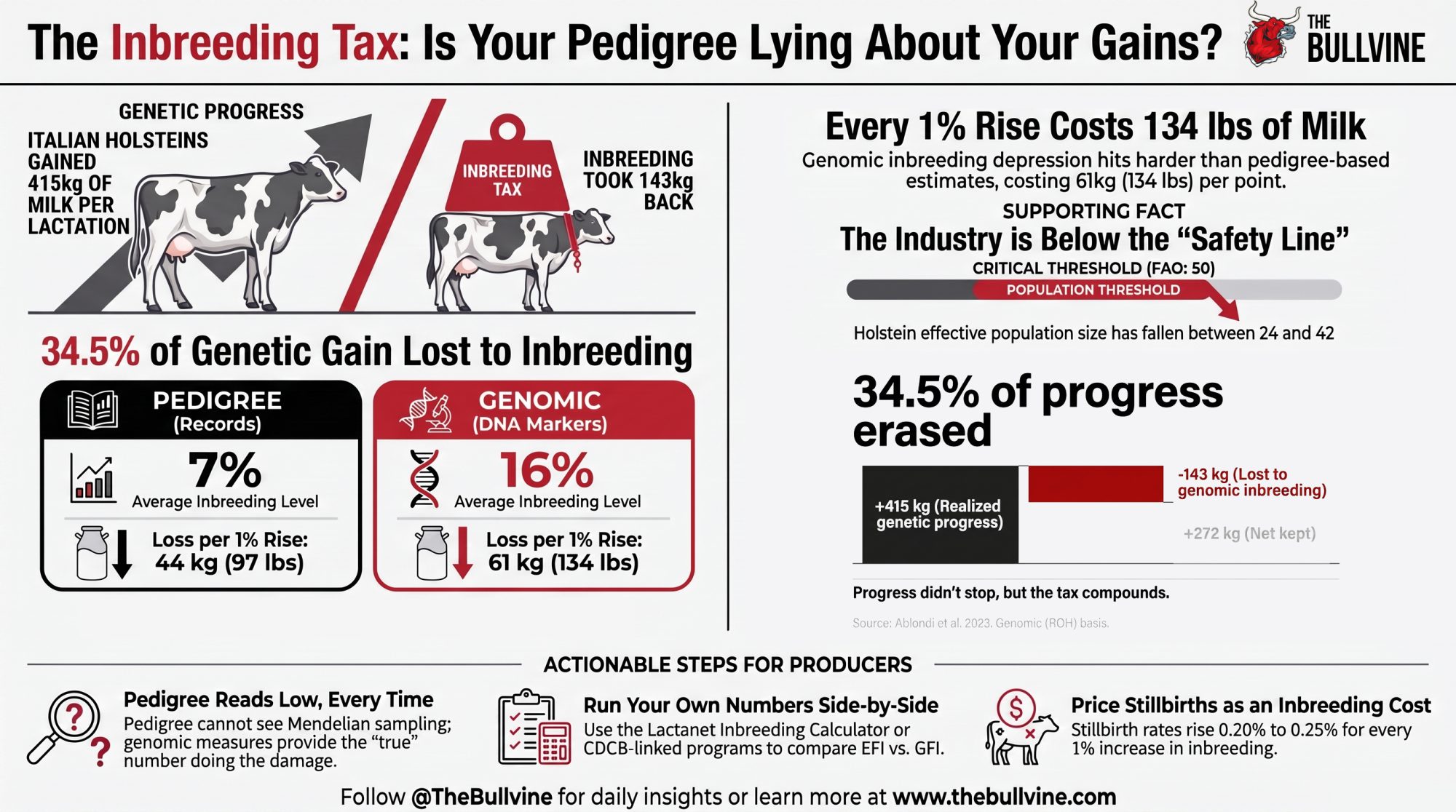
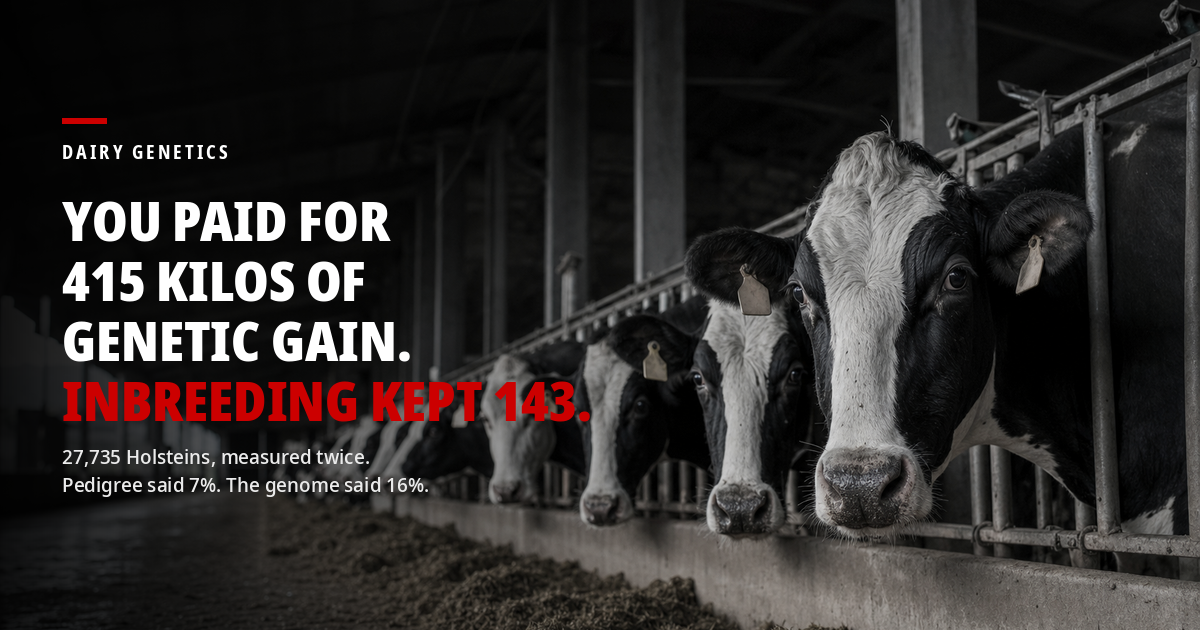
You Paid for 415 Kilos of Genetic Gain. Inbreeding Kept 143 of Them.

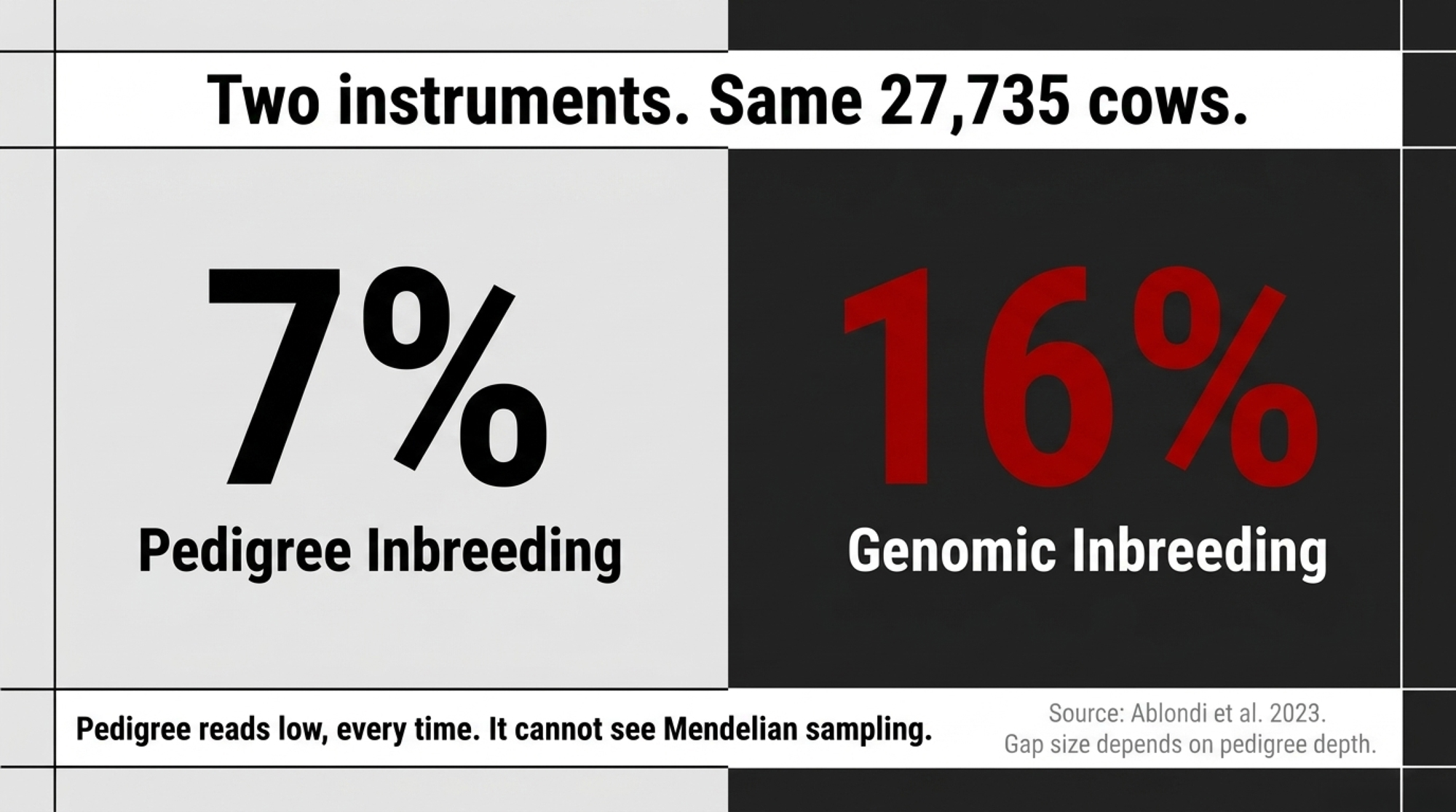
Italian researchers tracked 27,735 Holsteins for five years. The breed earned 415 kilos of genetic gain per lactation. Inbreeding took 143 back. Do you know your own herd’s number?

Executive Summary: Ablondi’s Parma team measured the same 27,735 Holsteins twice, and pedigree said 7% inbred while the genome said 16% — with the milk loss tracking the bigger number, 61 kg per point against 44. That gap matters to anyone genomic-testing females and still running matings off pedigree EFI, because you’re managing to the instrument that reads low. Across 2015 to 2020 the Italian Holstein banked 415 kg of genetic gain per lactation and inbreeding depression took 143 of it back, though the authors are careful to say the breed still kept 272 kg net; the worry is the trajectory, not a bill already due. Run Pryce’s scaling on your own operation — 0.4 to 0.6% of your rolling herd average per point of inbreeding — and a decade at the U.S. rate of 0.36 points a year costs a 12,000 kg herd 170 to 260 kg per cow, per lactation. North American Holstein’s genomic-era effective population size sits somewhere between 24 and 42, and even the optimistic end is under the FAO’s critical threshold of 50. Four major studs built internal elite-female programs between 2008 and 2015, only Select Sires has published a sourcing split, and none of the eight organizations we contacted responded — so nobody outside those companies can say where your next bull came from. The tools that fixed this in the 2000s are still available; the open question is whether anyone uses them at a 2.2-year generation interval, and whether you’ve ever seen your own two numbers side by side.

Michela Ablondi’s team at the University of Parma did something most inbreeding studies skip. They measured the same 27,735 Holstein cows twice.

Once on pedigree — the way most mating programs still calculate it, working back through recorded ancestors. Once on genome, marker by marker across 84,443 SNPs. Pedigree came back at 7% average inbreeding. The genome came back at 16%.

Then they checked which number the cows agreed with. Each 1% rise in pedigree inbreeding cost 44 kg (97 lbs) of 305-day milk. Each 1% rise in genomic inbreeding cost 61 kg — 134 lbs. Same animals, same lactations, and the depression tracked the bigger figure.

That’s the part worth sitting with, because Lactanet’s August 2025 figures put average inbreeding for Canadian Holstein heifers born in 2024 at 9.99%, climbing about a quarter point a year on a pedigree basis. If pedigree is the instrument reading low, then the number most producers are watching is not the number doing the damage.

Two Instruments, Same Cows, One Reads Low

The correlation between the two measures came in at 0.65. Related, nowhere near interchangeable. The reason matters: pedigree can’t see Mendelian sampling, and it’s only as good as the records behind it. Ablondi’s group had 24 generations to work with and a complete generation equivalent of 10.6 — deep by any standard — and pedigree still read less than half what the genome showed.

Your own two numbers won’t be 7 and 16 exactly. Ablondi’s herds had unusually complete records, and the size of your gap depends on your pedigree depth and how much recent breeding runs back through the same bulls. What won’t change is which direction the error runs. Pedigree reads low, every time.

Ablondi’s group also split inbreeding by age. Runs of homozygosity longer than 8 Mb — the fingerprint of recent inbreeding — carried the negative effect across every trait. Pryce and colleagues found the same thing in Australia a decade earlier with 8,853 Holsteins and 4,138 Jerseys: ROH over 3 Mb cut milk yield and captured recent inbreeding independently of overall homozygosity. Two teams, two continents, ten years apart. Recent inbreeding is what hurts.

In the U.S., Steyn and colleagues documented the annual increase accelerating from 0.11 percentage points a year between 2000 and 2008 to 0.36 between 2013 and 2021, working from CDCB data in the Journal of Dairy Science in 2022. Three continents, same direction.

The 143 Kilos You Paid For and Didn’t Keep

Now the cost at breed scale. Between 2015 and 2020, the Italian Holstein’s pedigree inbreeding climbed 2.35%. Realized genetic progress for milk came in at +415 kg (915 lbs) per lactation.

Inbreeding depression took back 143 kg — 315 lbs. That’s 34.5% of the gain.

Be precise about what that means, because the authors are. Their own conclusion is that “the realized genetic progress has so far successfully counterbalanced the negative effect of inbreeding” for milk yield. The breed kept 272 kg net. Progress didn’t stop, and anyone telling you the Holstein is going backwards isn’t reading the paper.

What worries Ablondi’s group is the trajectory. The tax compounds, it lands on fitness traits this study didn’t even measure, and inbreeding is projected to climb faster in the generations ahead. Run the same arithmetic on the pedigree measure and you get a smaller bill — 103 kg, 24.9%. Two instruments, two answers again, and only one of them is telling you what your matings actually cost.

Compare the extremes and it gets uglier. Moving from the 5th-lowest to the 95th-highest inbreeding percentile cost 263 kg (580 lbs) per lactation on pedigree — 2.4% of the herd average — and 561 kg, 1,237 lbs, on genomics, or 5.2% of the herd’s 10,836 kg (23,890 lbs) average. Fat dropped 1.31 kg and protein 2.45 kg on the genomic measure.

What nobody can measure is which bulls are driving it, because no public database records where an AI sire came from.

Below the Line Where Fitness Erodes

The FAO puts the critical effective population size at 50. Not 50 cows in a barn — 50 in the genetic sense, the number of breeding animals that would produce the inbreeding rate you’re actually seeing.

Makanjuola and colleagues measured it for North American Holstein and Jersey using Canadian Dairy Network records on 676,594 Holsteins, publishing in the Journal of Dairy Science in 2020. Across 1990 to 2018, Holstein Ne came in at 66 on pedigree and 43 to 46 on genomic measures. Jersey held up better at 64 to 85.

Narrow to the genomic-selection era and the rate of inbreeding per generation climbs to between 1.19% and 2.06%, depending on the measure. That puts Holstein Ne somewhere between 24 and 42.

Which is why you’ll never see an honest single number here. Pedigree and genomic measures disagree on the rate of inbreeding per generation by nearly a factor of two, so North American Holstein Ne isn’t a dot — it’s a corridor running from 24 to 42, and both ends sit under the FAO line. Same argument as the 7-versus-16 gap, one level up.

Behind it sits a generation-interval collapse. Holstein sires of bulls averaged 8.08 years in 1990 and 2.32 by 2016 — a 71% reduction. Guinan and colleagues documented the same trajectory in U.S. data on the sire-of-bulls pathway, 7.1 years down to 2.2.

Nordic populations get held up as the counterexample, and the picture is genuinely mixed. Tenhunen and colleagues found Nordic Holstein Ne falling from 54.3 before genomic selection to 42.8 after, with future Ne dropping from 198.8 to 42.7 and female coancestry rising from 0.02% to 0.39%. Their conclusion: Nordic Holstein “faces more pressing concerns.”

But read that comparison carefully. At 42.8, Nordic Holstein sits at the optimistic end of North America’s 24-to-42 corridor — better than the pessimistic read, roughly level with the generous one. Methods and study periods differ between the two papers, so treat it as directional, not a scoreboard. Nordic Jersey held essentially flat at 29.4 before and 30.3 after.

Against the FAO line the pattern is blunt. North American Holstein on genomic measures, Nordic Holstein, and Nordic Jersey all sit below 50. North American Jersey is the only measured population that clears it.

Can Anyone Tell You Where Your Next Bull Came From?

Not from anything published.

Every major stud runs an internal elite-female program now, and most say so openly. Select Sires launched ART in 2008, targeting Holsteins “genetically unique compared to those found in the general population.” Alta started PEAK in 2012 as its genetics development arm during a restructuring built around genomics, and PEAK joined URUS when that holding company formed in October 2018 — PEAK’s own materials date the entity to 2018. Semex founded Progenesis in 2013, calling it “Semex’s industry-leading internal dairy breeding program.” ABS Global shipped its first commercial units from an elite female nucleus herd in 2015.

Look at the dates. 2008, 2012, 2013, 2015 — every major stud built an internal elite-female program inside a seven-year window, and that window opens the year before USDA-AIPL published the first official U.S. genomic evaluations in January 2009. Four companies didn’t independently arrive at the same structure by coincidence. They read the same new tool the same way.

Four programs. One published split.

Select Sires puts roughly 40% of the Holstein bulls it samples each year as ART graduates, with 60% acquired from producers across the U.S. and Canada. That figure appeared in a January 2024 company post, and ART program manager Mark Kerndt repeated it on the record in a July 2025 Select Sires podcast, describing an internal female donor program running since 2008 and transferring roughly 15,000 IVF embryos a year. Two independent company sources, one of them a named executive speaking on tape.

Credit where it’s owed. That’s the only proportional sourcing figure any of the four has put in public, nobody made them do it, and it’s now better documented than anything else in this section. ABS, Semex and PEAK describe their programs without quantifying what share of released sires come through them — which leaves the one company that disclosed as the only one whose disclosure can be picked apart.

Semex says the Progenesis team “continues to add bloodlines that diversify the program.” That sentence is the whole problem in miniature. It’s substantive, it’s checkable in principle, and it’s unverifiable from outside. Semex may be entirely right. Nobody outside Semex can confirm it.

Past what companies volunteer, the trail goes cold. NAAB’s Semen Sales Report tracks units by breed and category, and we found no field recording origin. CDCB publishes proof runs and reliability figures on every sampled bull in the U.S. system, and we located no public output sorting sires by nucleus, contracted, or open-market origin.

The Counterweight Nobody Expected

Here’s what complicates everything above.

United Sires — NAAB codes 596 and 796, registered with NAAB in February 2024 — is an independent breeder partnership with no ownership tie to any of the majors. By The Bullvine’s count of Holstein Association USA’s top 200 TPI genomic young bulls — 85% genomic reliability minimum, from the CDCB run published April 7, 2026 — it holds 30 of them, 15%. That’s third behind Select Sires’ 59 (29.5%) and Semex’s 40 (20%), and ahead of ABS at 12, Alta at 11, GENEX at 9 and CRV at 8.

We’re citing April rather than the August 2026 run on purpose. April is when Holstein Association USA changed the TPI formula, shifting production weights from 19% protein and 19% fat to 24% protein and 14% fat, and it’s the snapshot that isolates what that change did to the standings. Bulls moved as much as 125 points in either direction without a single new daughter. Same bulls, same daughters, different instrument — the third time in this article that swapping the measuring tool has swapped the answer. Holstein Association USA has since published an August 2026 list, and the shares will have shifted some with it; treat the April figures as the post-formula-change baseline rather than today’s standings.

So whatever’s happening to the independent breeder, “shut out” doesn’t cover it. The pipeline is concentrating and a two-year-old breeder-owned partnership just took 15% of the top of the list. Both are true. Neither reconciles without the origin data nobody publishes — if the nucleus programs are as dominant as their scale implies, United Sires shouldn’t rank where it does.

Worth knowing what the modelling said before any of this got built. Dekkers and Shook, at Wisconsin-Madison, modelled nucleus schemes for commercial AI firms in the Journal of Dairy Science in 1990 (73:1920). Their finding, replicated since and echoed in Roden’s 1994 review: opening a nucleus raises both the intensity and the accuracy of female selection, and open systems deliver a higher rate of genetic gain than closed ones. They also found closed schemes could stay competitive at large nucleus sizes — so the easy version, closed bad and open good, is only half right. Design matters more than the label, which is exactly why the design should be public.

What It Costs, Country by Country

Four populations have been measured for inbreeding depression. Every one is negative:

StudyPopulationPer 1% inbreeding increase
Ablondi et al. 2023Italian Holstein, 27,735 cows−61 kg 305-day milk (ROH); −44 kg (pedigree)
Doekes et al. 2019Dutch Holstein-Friesian, 38,792 first-parity cows−36.25 kg (ROH); −37.95 kg (pedigree); −48.07 kg (genomic relationship)
Bjelland et al. 2013U.S. Holstein, University of Wisconsin−20 kg 205-day milk (ROH); −47 kg (genomic relationship); −53 kg (percent homozygosity)
Pryce et al. 2014Australian Holstein and Jersey, 12,991 genotyped cows−0.4% to −0.6% of phenotypic mean for milk, fat and protein

Figures as published. Multiply kg by 2.205 for pounds — 61 kg is 134 lbs, 36.25 kg is 80 lbs, 20 kg is 44 lbs.

Pryce’s framing is the one to run on your own operation, because it scales to whatever you produce. At 0.4 to 0.6% of the mean per 1% of inbreeding, a decade at the U.S. rate — 0.36 points a year, 3.6 points total — costs 1.4% to 2.2% of your herd average. On a 12,000 kg (26,455 lbs) herd, that’s 170 to 260 kg — 375 to 573 lbs — per cow, per lactation.

Ablondi’s team costed it in terms their readers feel immediately. Eighty percent of Italian milk goes into cheese, so they priced the loss in Parmigiano Reggiano — the country’s second-largest PDO consortium, 160,097 tonnes in 2022. Between the most and least inbred 5% of cows, the difference came to over half a wheel per cow per lactation on pedigree and more than a full wheel on genomics. Roughly €310 and €600 — about $360 and $700 USD, or $495 and $960 CAD, at 24-month-aged prices.

Pryce’s group mapped the damage to specific regions, finding stretches that cost up to 260 L of milk and 12.5 days of calving interval when fully homozygous. Ablondi’s team saw the same chromosome by chromosome — 16 of 29 autosomes carried a measurable hit to milk yield, with BTA14 the worst at −3.53 kg per 1% of homozygosity on that chromosome alone.

Bjelland’s U.S. work adds a cost that usually gets filed under calving management: stillbirths rose 0.25% for bull calves and 0.20% for heifer calves per 1% increase in inbreeding.

Doekes explains why recent matings matter most. New inbreeding — alleles identical-by-descent for the first time — cost 2.42 kg (5.3 lbs) of fat per 1%. Ancestral inbreeding cost essentially nothing, +0.03 kg. The damage lives in the matings you’re making right now.

The Tools You’re Probably Underusing

ToolWhat It MeasuresData Basis
CDCB Expected Future Inbreeding (EFI)Population-level inbreeding impactPedigree relationship to heifers born in the past 48 months; adjusts PTA accordingly
Genomic Future Inbreeding (GFI)True genomic relationshipDirect DNA marker overlap; consistently higher and more realistic than EFI
Lactanet Inbreeding CalculatorMating-specific inbreeding and parent averagePedigree-based; flags haplotypes and genetic conditions (LactanetGen.ca)

The EFI-versus-GFI choice isn’t academic. Makanjuola’s team found the correlation between pedigree and genomic inbreeding in Holsteins weakening materially across the period they studied — pedigree is getting worse at tracking reality, not better. Pryce’s conclusion was blunt: genomic measures can replace pedigree for estimating depression, using either the genomic relationship matrix diagonal or the proportion of homozygous SNPs.

Genomic-testing your females and then mating off pedigree inbreeding means managing to the number that understates the problem. That’s the whole finding, in one sentence.

One stud has published constraint evidence. C. Sun and colleagues at STgenetics presented Chromosomal Mating at ADSA in 2019 — a linear-programming system built on CDCB genomic relationship files covering 5,731 bulls and more than 1.3 million females, against a pedigree database of over 5 million animals. They reported average progeny predicted producing value up 17% and inbreeding down 30% against random mating.

Their design choice is the interesting part. Rather than setting a hard inbreeding ceiling, the system prices inbreeding as an economic penalty inside the optimization — a defensible way to handle a variable nobody has set a herd-level limit for. It’s also a company-authored conference abstract, seven years old and not independently validated, which is how you should read it.

Two Ways to Buy Pedigree Distance

One route stays inside the breed, and there’s a working example of it in Quebec. Blondin Sires — NAAB code 799, owned by Simon Lalande, Dann Brady and Nicolas Lalande — grew its share of Canadian sire usage from 2.8% in 2022 to 4.9% in 2023, a 75% jump in one year per Lactanet market data reported by The Bullvine in February 2026. The pitch is separation from the mainstream stack while staying Holstein; they prioritize proven performance in both conformation and productio, and use different sires than those targeting the top TPI or NM$ lists.

Be sure to check out our article with Dann Brady and team on their breeding strategy tomorrow. 

United Sires’ 15% share of the top 200 says there’s more room in that lane than the concentration story implies. The trade-off is real, though: independent-sourced bulls may carry lower reliability figures, and you’re still drawing from a gene pool whose effective size sits under the FAO line.

Going across breeds has a decade of peer-reviewed production data behind it. VikingGenetics’ ProCROSS rotates VikingHolstein, VikingRed and Coopex Montbéliarde, and a ten-year University of Minnesota study led by Les Hansen with Amy Hazel and Brad Heins measured it in high-performance Minnesota herds. ProCROSS cows returned 33% more lifetime profit and more daily profit — 13% for two-breed crosses, 9% for three-breed. Forty-one percent reached a fourth lactation against 21% of the Holsteins.

They also stayed 147 days longer, though Hansen’s own conference presentation of the combined two- and three-breed groups puts that at 153. Conception rate to first service in second and third lactation ran 45% against the Holsteins’ 35% — 1.9 services instead of 2.4. Health treatment costs came in 23% lower for two-breed crossbreds and 17% lower for three-breed across their lifetimes, with cull value 16% higher.

What does all that do to income over feed cost? Shonka-Martin and colleagues published twice in the Journal of Dairy Science in 2019, and the numbers favour the crossbreds. First-lactation crossbreds ate 2,807 kg (6,189 lbs) of dry matter over 4 to 150 days in milk against the Holsteins’ 2,948 kg (6,499 lbs) — about 5% less — with a further 6.5% reduction later while producing the same fat plus protein. Income over feed cost ran $0.34 to $0.60 higher per cow per day.

Read the inbreeding claim carefully, though. VikingGenetics’ ProCROSS material tells producers there are “no worries about inbreeding,” and for the crossbred animal in front of you that’s essentially right — heterosis does the work. It doesn’t mean the source populations are exempt. “No worries” is marketing shorthand, and the company’s own researchers documented real pressure on those source populations. They documented it in a peer-reviewed journal, which is the opposite of hiding it.

The component question depends entirely on your basis, and this is where a lot of crossbreeding arguments go sideways. On a single 305-day lactation, crossbreds produced less fat plus protein than purebred Holsteins in the Minnesota work — 24 kg (53 lbs) less for Montbéliarde crosses, 29 kg (64 lbs) less for Scandinavian Red. Across a lifetime the picture flips: daily fat plus protein ran 1% higher for two-breed crossbreds and 1% lower for three-breed, because they stuck around long enough to make it up. A rotation is also a multi-year commitment you can’t reverse next season, and crossbred replacements are harder to move if you sell breeding stock.

Then weigh all of it against a replacement market that punishes mistakes. USDA put the U.S. national average for milk cows sold as dairy herd replacements at $3,130 per head in April 2026, up from $2,980 in January and $2,860 a year earlier — 5% on the quarter, 9% on the year. USDA NASS put milk replacement heifer inventory at 3.90 million headon January 1, 2026, down slightly from the prior year. Fixing a genetic misstep costs more than it did two years ago, which argues for care in both directions.

Your Pre-Breeding Action Checklist

  • Pull your inbreeding report in the next 30 days. Run your last three years of sire selections through the Lactanet Inbreeding Calculator or your CDCB-linked mating program and count how many trace to a shared maternal grandsire. A few hours of records work, no new spend, before breeding starts.
  • Run both measures on the same animals, then move your matings to the genomic one. Ablondi’s cows read 7% on pedigree and 16% on genomics, and the depression tracked the bigger figure — 61 kg per point against 44. If you’ve never seen your own two numbers side by side, you don’t know which one your program has been deciding from.
  • If more than two of your last ten sire picks share a maternal grandsire, raise it with your mating consultant. Editorial rule of thumb, not a published standard — no threshold defines “too much overlap” at herd level, so you’re setting a baseline rather than measuring against one.
  • Check whether your TPI cutoff still means what it meant last year. The April 2026 formula change moved bulls up to 125 points without new daughter data. If your program screens on a fixed threshold, some sires dropped off your list on arithmetic alone.
  • Run Pryce’s scaling on your own rolling herd average — 0.4 to 0.6% per point of inbreeding, rather than borrowing an Italian or Dutch figure measured on a different population. At the U.S. rate, a decade costs a 12,000 kg herd 170 to 260 kg per cow per lactation. Multiply your own average by 1.4% to 2.2% to get your version.
  • Ask your supplier for its sourcing split at proof-run specificity, then log the answer or the non-answer. Not proof of anything on its own — but a pattern across several suppliers should shape how much of your lineup comes from one place. Select Sires has published 40% and put an executive on tape saying it; the others haven’t.
  • Before you compare any crossbreeding numbers, establish the basis. Single-lactation and lifetime daily figures point opposite directions on components: 24 to 29 kg less fat plus protein in one lactation, 1% more across a lifetime. Quoting one while meaning the other is the most common way that pitch gets made.
  • Price stillbirth rate as an inbreeding cost, not a calving-management line item. Bjelland’s work puts it in the first column.

Between 2000 and 2009 the industry drove Holstein rate of inbreeding down to 0.37% per generation and pushed Ne up to roughly 135, using optimum contribution selection, expected future inbreeding, and publicly posted relationship values. Those tools worked. Then genomic selection outran them, and they’re still sitting there unused at scale.

The measurement problem is the cheaper of the two fixes. Nobody has to build an origin database or rewrite an index for you to run both numbers on your own females and see which one your matings have been following. Ablondi’s team needed 84,443 markers and 939 herds to prove it at breed scale. You need an afternoon and a report you’re already paying for. The question is whether you’ll like what it says — and whether you’d breed differently if someone finally published where those bulls came from.

Run Your Numbers

Genomic Testing ROI Calculator — This article says pedigree reads low and only genomics shows the real number. The calculator prices what testing is worth on your farm, and flags the families where inbreeding risk needs tighter control. Run the conservative scenario first.

Methodology note: The 7% and 16% figures in this article’s headline are the pedigree and genomic inbreeding averages for Ablondi’s Italian Holstein population and are not presented as a universal read on any individual herd; the size of the divergence depends on pedigree completeness and recent breeding patterns. Nucleus program descriptions and dates are self-reported or from trade media: Select Sires ART (company history page, January 4, 2024 blog post, and a July 2025 Select Sires podcast interview with ART program manager Mark Kerndt, in which the roughly 40% figure refers to bulls sampled each year); PEAK (2012 program start, though official as PEAK in 2018); Semex Progenesis (company pages, founded 2013); ABS Global (company history, first commercial units 2015). USDA-AIPL published the first official U.S. genomic evaluations in January 2009; CDCB assumed responsibility for U.S. genetic evaluations in 2013. Only Select Sires has published a proportional sourcing split. 

Stud-share counts are The Bullvine’s own independent count of the Holstein Association USA Top 200 TPI Genomic Young Bulls list, April 2026 (85% genomic reliability minimum), drawn from the CDCB run published April 7, 2026, with stud assignment by the official NAAB marketing codes table. The April run is cited rather than a later one because Holstein Association USA implemented a TPI formula change in that run, moving production weights from 19% PTA Protein and 19% PTA Fat to 24% PTA Protein and 14% PTA Fat; individual bulls moved up to 125 TPI points with no new daughter data, so April 2026 shares are not comparable to earlier runs and represent the first post-change snapshot. An August 2026 list has since been published and current shares will differ. United Sires, LLC (NAAB 596/796) registered with NAAB on February 8, 2024. Blondin Sires Inc. (NAAB 799, St. Placide, Quebec) is owned by Simon Lalande, Dann Brady and Nicolas Lalande. 

Italian figures: Ablondi, M., A. Summer, G. Stocco, R. Finocchiaro, J.-T. van Kaam, M. Cassandro, C. Dadousis, A. Sabbioni and C. Cipolat-Gotet, Journal of Animal Science 101:skad382 (2023), doi:10.1093/jas/skad382 — 27,735 cows, 939 herds, 84,443 autosomal SNPs, 24 generations of pedigree depth. The 2.35% five-year rate is drawn from Ablondi et al. (2022) and the +415 kg realized progress from ANAFIBJ (2023). Three co-authors are affiliated with ANAFIBJ, which supplied the data and part-funded the work; the authors declare no conflicts of interest. The Parmigiano Reggiano comparison appears in Results and Discussion, using 24-month-aged wheel prices per CLAL (2022), and reflects the difference between the most and least inbred 5% of cows — not a typical per-cow loss. USD and CAD equivalents are editorial conversions at approximately €1 = $1.16 USD and €1 = $1.60 CAD as of September 3, 2026; because the underlying euro figure derives from 2022 cheese prices, the conversion is indicative of present-day value rather than a 2022 dollar equivalent.

Other depression studies use different lactation bases and are not directly interchangeable. Doekes, H.P. et al., Genetics Selection Evolution 51:54 (2019), doi:10.1186/s12711-019-0497-z. Bjelland, D.W., K.A. Weigel, N. Vukasinovic and J.D. Nkrumah, Journal of Dairy Science 96(7):4697–4706 (2013), doi:10.3168/jds.2012-6435 — 205-day, not 305-day. Pryce, J.E., M. Haile-Mariam, M.E. Goddard and B.J. Hayes, Genetics Selection Evolution 46:71 (2014), doi:10.1186/s12711-014-0071-7.

North American population figures: Makanjuola, B.O. et al., Journal of Dairy Science (2020), doi:10.3168/jds.2019-18013 — 676,594 Holstein and 304,676 Jersey pedigree records from the Canadian Dairy Network. Genomic-era Ne is derived from the paper’s reported 1.19–2.06% rate of inbreeding per generation using Ne = 1/(2ΔF), which is why it is reported here as a range rather than a point estimate; an earlier ADSA abstract from the same group reported 30 to 48, differing from the published paper. FAO critical Ne of 50 cited therein (FAO, 2015). Nordic figures: Tenhunen, S., J.R. Thomasen, L.P. Sørensen, P. Berg and M. Kargo, Journal of Dairy Science 107(8):5897–5912 (2024), doi:10.3168/jds.2023-24553; four of five authors are affiliated with VikingGenetics, and the study is open access and peer-reviewed. Methods and periods differ between Makanjuola and Tenhunen, so comparisons are directional.

Generation interval: Guinan, F.L. et al., Journal of Dairy Science 106(2):1110–1129 (2023), doi:10.3168/jds.2022-22205, with corrigendum; figures are for the sire-of-bulls pathway. García-Ruiz et al., PNAS 113(28) (2016), independently found that interval falling from roughly 7 years to under 2.5 between 1975 and 2015. U.S. inbreeding rates: Steyn, Y. et al., Journal of Dairy Science 105(12):9810–9821 (2022), doi:10.3168/jds.2022-22143, citing CDCB (2021).

Crossbreeding: ten-year University of Minnesota study of high-performance Minnesota herds led by L.B. Hansen with A.R. Hazel and B.J. Heins, published 2019. Single-lactation 305-day and lifetime daily component figures use different bases and are reported separately above. Shonka-Martin, B.N., A.R. Hazel, B.J. Heins and L.B. Hansen, Journal of Dairy Science 102:871–882 (2019), doi:10.3168/jds.2018-15318; and Shonka-Martin, B.N., B.J. Heins and L.B. Hansen, Journal of Dairy Science 102:3661–3673 (2019), doi:10.3168/jds.2018-15682. See also Hazel, A.R., B.J. Heins and L.B. Hansen, Journal of Dairy Science (2020). VikingGenetics’ “no worries about inbreeding” statement is a company marketing claim, not independently verified.

Mating programs: Sun, C., S. Westberry, D. Kendall and D. Castellani (STgenetics, Navasota, TX), ADSA Annual Meeting 2019, Abstract #365 — company-authored, not independently validated. Nucleus modelling: Dekkers and Shook, J. Dairy Sci. 73:1920 (1990). Replacement price: USDA, April 2026, U.S. national average with significant regional variation. Heifer inventory: USDA NASS Cattle, released January 30, 2026.

Learn More

The Sunday Read Dairy Professionals Don’t Skip.

Every week, thousands of producers, breeders, and industry insiders open Bullvine Weekly for genetics insights, market shifts, and profit strategies they won’t find anywhere else. One email. Five minutes. Smarter decisions all week.
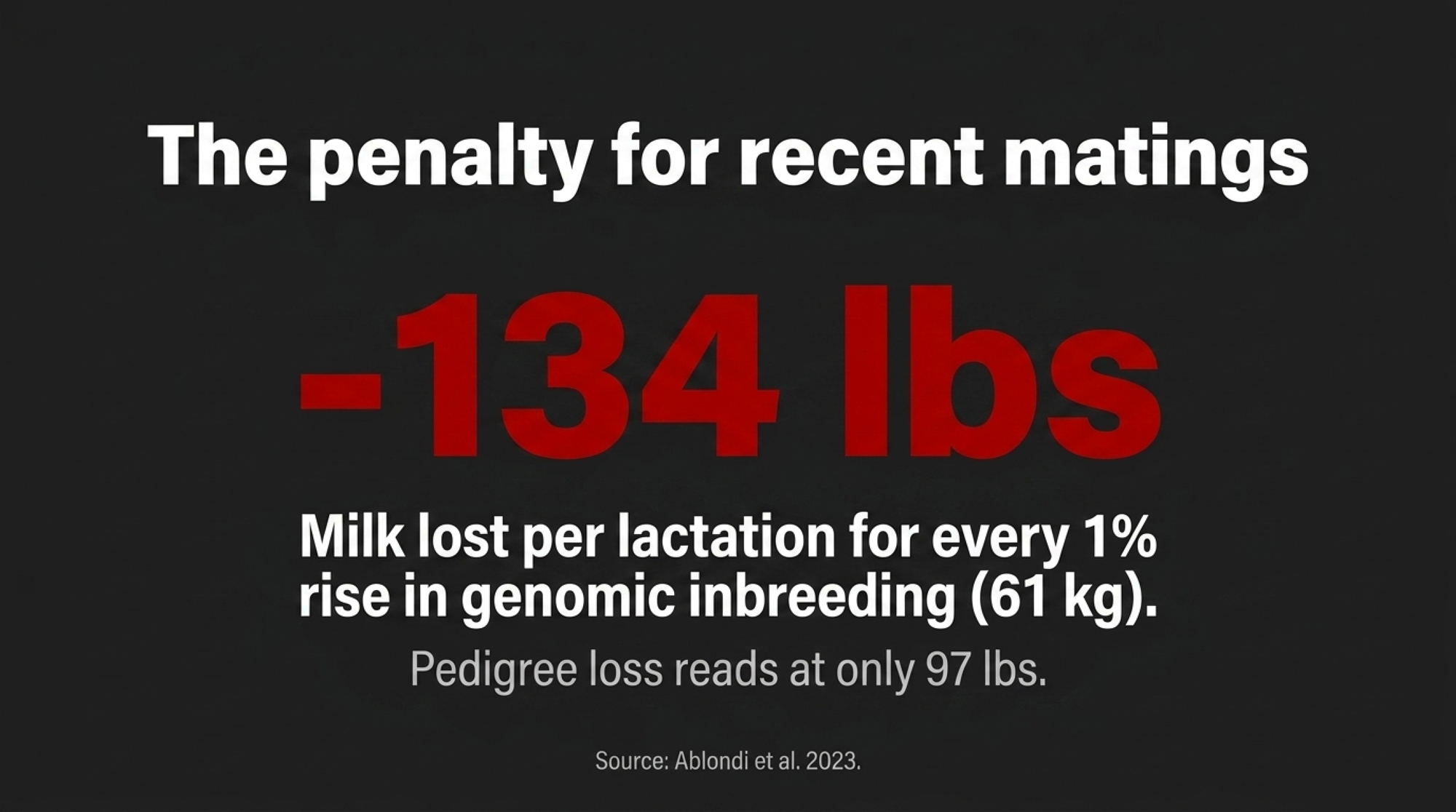
NewsSubscribe
First
Last
Consent

One Ring, Three Dynasties: The 1989 World Dairy Expo Class That Rewrote Holstein History

At the 1989 World Dairy Expo, three Senior Two-Year-Olds came back into the Madison ring after milking. The ribbons settled one afternoon. The consequences are still turning up in pedigrees around the world.

The 1989 Class at a Glance

  • The class: Senior Two-Year-Old, 1989 World Dairy Expo, Madison, Wisconsin. Judge: Howard Binder. Associate judge: Paul R. King. 
  • The result: Dupasquier Starb Winnie 1st, Comestar Laurie Sheik-ET 2nd, Aitkenbrae Starbuck Ada 3rd — reportedly re-sorted after milk-out. 
  • Why it matters: All three founded major maternal lines still active in global pedigrees. 
  • Winnie: GP-83 → EX-3E-CAN. WDE Grand Champion at eight (1994). 97,371 kg lifetime. 
  • Laurie Sheik: $45,000 sale topper; four millionaire AI sires; inaugural Holstein Canada Cow of the Year, 1995. 
  • Ada: Dam of Shoremar S Alicia EX-97-3E and Ms Kingstead Chief Adeen EX-94-2E; grandam of the Atlee/Atwood type dynasty. 

The milk had come down, the udders had changed, and Howard Binder had one more decision to make.

It was October 1989 at World Dairy Expo in Madison, back when cattle people still packed the Coliseum rail to study a cow after milking — because that was when the bloom was gone, and the udder had to speak for itself. Dupasquier Starb Winnie had the class. Behind her, the tension was between Comestar Laurie Sheik-ET and Aitkenbrae Starbuck Ada.

Breed-history accounts say Ada stood second before milk-out. When the three heifers came back, Laurie Sheik moved ahead on the strength of her udder texture, cleft and vein definition, taking second and the Best Udder nod of the class; Ada went third. The documentary trail for that switch is thinner than anyone would like — it runs through breed commentary rather than a recovered official World Dairy Expo results sheet — but the final order is clear. 

That would have been enough for a good Expo story. It became something much bigger, because in those few minutes Madison had placed three young cows who’d each become the head of a major maternal line. Winnie would grow into an eight-year-old World Dairy Expo Grand Champion. Laurie Sheik would turn an unfashionable mating into four millionaire AI sires and a family spread across more than 50 countries. Ada would leave Alicia, Adeen, Atlee and Atwood — a line that carried show-ring power straight into the genomic-type era. 

The ribbons named a winner, a second, and a third. Time sorted them differently.

Madison, October 1989: the Senior Two-Year-Old class lines up under the Coliseum lights as Howard Binder makes his final sort. Dupasquier Starb Winnie led, Comestar Laurie Sheik-ET took second and Best Udder after milk-out, and Aitkenbrae Starbuck Ada stood third. Every cow in the top three would go on to found a maternal line still turning up in pedigrees worldwide.

Act I: Before the Numbers Won

Now, the thing about 1989 is that Holstein breeding was already in the middle of an argument.

For decades, show breeders had built programs around the cow standing in front of them: balance, openness, feet and legs, mammary systems, strength where strength had to be. Meanwhile, the genetic evaluations were gaining force, and commercial dairymen were reading milk, fat, protein, and reliability numbers with growing seriousness. One side trusted the eye. The other trusted the index. Most barns, if we’re honest, were trying to figure out how to have both — and World Dairy Expo sat right in the middle of that argument.

This was a different dairy world. Embryo transfer worked, but international work still meant hand-signed health papers, ownership transfers, customs forms, phone calls, and fax machines. You’ll see “-ET” after a cow’s name in this story; that’s the marker for an animal produced by embryo transfer, and in 1989 it still signaled something faintly futuristic.

Classification reads differently through a modern lens, too. A GP-83 two-year-old might look ordinary on paper, but in the late 1980s classifiers didn’t hand lofty scores to first-lactation heifers. A young cow could be Good Plus and still have every bit of the raw material to become a great one. 

That year, Madison was already thick with history. Norm Nabholz took the Klussendorf Trophy. Roy Ormiston of Roybrook became the first Canadian honored with the Dairy Shrine Award. The Coliseum held the usual mix: cattlemen comparing notes, breeders quietly calculating what a good young cow might be worth, kids pressed along the rail trying to decide which animal they’d remember forever. 

Then Winnie, Laurie Sheik, and Ada walked in.

1989 WDE Senior Two-Year-OldCow1989 Owner / ExhibitorSire
1st · 1st BU (pre-milkout)Dupasquier Starb WinnieOscar Dupasquier, Guelph, ONHanoverhill Starbuck
2nd · Best Udder of ClassComestar Laurie Sheik-ETMarc Comtois / Belgistar Syndicate, QCPuget-Sound Sheik
3rdAitkenbrae Starbuck AdaLawson Bennett / Hygerian Associates, OHHanoverhill Starbuck

Best Udder credit reflects the post-milk-out re-sort described in breed-history accounts rather than a recovered official WDE results sheet.

Winnie and Ada were Hanoverhill Starbuck daughters. Laurie Sheik — contrary to a claim that keeps slipping into retellings — was not. She was by Puget-Sound Sheik. That distinction matters, because this wasn’t three Starbuck daughters in a sweep. It was two Starbuck daughters and a Sheik daughter, representing three sharply different breeding decisions. 

Starbuck was still the giant in the background. Bred at Peter Heffering’s Hanover Hill Holsteins in Port Perry, Ontario, he was born April 26, 1979, by Round Oak Rag Apple Elevation and out of Anacres Astronaut Ivanhoe VG-88. CIAQ bought him as a 45-day-old calf for $2,500 — a figure that reads almost absurdly small now. He grew into a 2,580-pound bull, 73.5 inches at the shoulder, and he stamped daughters with the kind of open rib, chest, udder, and consistency that made a breeder stop walking and take a second look. The record credits him with 10 milking-age All-American daughters, more than any bull in Holstein history, plus 82 All-American nominations and 130 All-Canadian honors among his daughters. His reach eventually became so wide that the industry had to take inbreeding and mating management seriously. 

But Starbuck didn’t make this class historic on his own. The story lives in what the three cows did with their chance.

Act II: Three Roads Out of Madison

Winnie and the patience to let a cow become one

Dupasquier Starb Winnie EX-3E-CAN, posed on an Ontario autumn afternoon — the frame and mammary that took a GP-83 two-year-old all the way to World Dairy Expo Grand Champion at eight. Deep-ribbed, wide through the chest, standing square on the feet and legs Oscar Dupasquier bred for. She’d finish with 97,371 kg of milk across six lactations. Photo: Patty Jones.

Oscar Dupasquier’s kind of breeding didn’t reward impatience.

Winnie was born October 13, 1986, by Starbuck and out of Allangrove AA Winnie VG-85 4* — those stars being Holstein Canada’s way of recognizing a cow whose progeny keep proving her worth. When Winnie won at Madison as a two-year-old, she was GP-83. Not a score to make a sale catalog shout, but one that asked a breeder to see past the first lactation and picture the mature cow waiting underneath. Dupasquier did exactly that. The old cattleman’s rule explains why: a cow had to be built to keep working, feet and legs had to carry the frame, the frame had to hold the capacity, and somebody had to be patient enough to let her prove whether the promise was real. 

Winnie became a case study in that patience. She climbed from GP-83 all the way to EX-3E-CAN — Excellent, reclassified upward three separate times as she matured — and earned eight Brood Cow Stars along the way. Her show record built slowly, then piled up: All-Canadian and All-American Senior Two-Year-Old in 1989, All-Canadian Three-Year-Old in 1990, All-Canadian Four-Year-Old in 1991, Reserve Grand Champion at World Dairy Expo in 1993, All-American Aged Cow in 1993. 

And here’s where it gets interesting.

At the 1991 Royal Agricultural Winter Fair — a 277-head show — Winnie stood Grand Champion. Her daughter, Dupasquier Black Winnie VG-88, was named Junior Champion in the same ring on the same day. Holstein Canada identifies the pair as the only dam and daughter to take those two major titles at the Royal in the same year. 

Think about what that actually requires. Not one great cow — a great cow who can hand the banner forward while she’s still winning it herself. One is memorable. Two is a dynasty.

Three years later came the summit. Winnie was eight years old when she stood Grand Champion at World Dairy Expo in 1994, the third straight Starbuck daughter to win Madison. Holstein International later treated the photograph of Winnie posed with Eric Dupasquier outside the Coliseum as one of those images that carries an entire era inside it: an aged cow, a young handler, the building behind them, and proof that maturity still counted for something in a breed sprinting toward numbers. 

Then she went home and worked — and this is the part that should stop a modern reader cold. Across six lactations, Winnie put 97,371 kilograms of milk in the tank. That’s 214,664 pounds, at 4.1 percent fat and 3.3 percent protein. Her 6-07 record ran 15,229 kilograms in 365 days, with 612 kilograms of fat and 477 of protein. Nobody could ever file Winnie away as a show-ring specialist. She could stand under the lights, then go home and fill the bulk tank for another year. 

Laurie Sheik and the bet nobody could see yet

Laurie Sheik came from a different kind of gamble.

Marc Comtois left school at fifteen to work with cattle. By eighteen he’d bought a farm in Princeville with 44 grade cows. He married France Lemieux on April 23, 1977, and the two of them started swapping grades for registered Holsteins, one practical decision at a time. Comestar didn’t begin as an empire. It began as a young couple putting their confidence into cattle. 

In 1985, Comtois bought Elysa Anthony Lea EX-15, a deep-ribbed daughter of Willowholme Mark Anthony. Then he bred her to Puget-Sound Sheik — a 1972-born VG-85 bull nobody was chasing anymore. In a business that runs on fashion as much as data, that takes some spine. The mating produced Laurie Sheik on December 1, 1986, and she came into the world wearing a broad white starburst on her forehead. A little too perfect, really. 

She won the Senior Two-Year-Old class at Victoriaville in 1989, then came to Madison and finished second with the class Best Udder nod. Picture her walking back in after milking — the Coliseum lights catching that white star, her udder collapsed clean and correct the way only the good ones do. That’s the moment the whole class turned on. 

“Flash gets attention; the empty udder gets respect.”

She’d go on to VG-88-CAN and 23 Brood Cow Stars. That distinction is worth making carefully: the 23 stars measure the strength of her transmitting record — they aren’t a claim that she had 23 Excellent daughters. The source record lists 18 Very Good daughters behind that total. 

This historic image captures a pivotal moment in Holstein history as a young Comestar Laurie Sheik VG-88 23* claims first place in the Senior 2-Year-Old class at Expo Victoriaville. The trophy being presented was sponsored by Edgar Comtois, father of Marc Comtois, creating a meaningful family connection as Laurie Sheik began her remarkable show career. What makes this moment especially significant is that this unassuming cow would go on to become one of the most influential matriarchs in Holstein history, producing four millionaire bulls and establishing a genetic dynasty that continues to influence dairy breeding worldwide today. This early show ring success hinted at the extraordinary genetic potential that would eventually extend to 51 countries and span multiple generations of elite Holstein breeding.

A pivotal moment in Holstein history as a young Comestar Laurie Sheik VG-88 23* claims second place in the Senior 2-Year-Old class at World Dairy Expo. What makes this moment especially significant is that this unassuming cow would go on to become one of the most influential matriarchs in Holstein history, producing four millionaire bulls and establishing a genetic dynasty that continues to influence dairy breeding worldwide today. This early show ring success hinted at the extraordinary genetic potential that would eventually extend to 51 countries and span multiple generations of elite Holstein breeding.

The real turn came at that first Comestar Sale in 1989, where Laurie Sheik topped the day at $45,000, and Eddy and Annie Pussemier of Bois Seigneur Holstein in Belgium bought a 50 percent interest, creating the Belgistar Syndicate. The price was a statement. Getting her genetics home was the hard part. Live-animal import restrictions meant the Pussemiers couldn’t simply load her on a plane, so the two families went the embryo route instead — a cross-border process run on the analog machinery of the day: paperwork, phone calls, faxes, health certificates, customs documents. 

Consider what that decision looked like from the Belgian side. The Pussemiers were converting a beef operation into an elite dairy herd, and they’d just committed serious money to half of a young Quebec cow they had no legal way to bring home. One can only imagine the conversation on the drive back. Everything depended on embryos surviving a paper trail nobody had built yet. 

It worked better than anyone had a right to expect. Laurie Sheik’s three To-Mar Blackstar daughters — Comestar Laura Black VG-87-CAN 24*, Comestar L Or Black VG-87-CAN 16*, and Comestar Lausan Black VG-87-CAN 23* — became the family’s multiplying point. Through Laurie Sheik and those branches came Comestar Leader, Comestar Lee, Comestar Lheros, and Comestar Outside: four millionaire AI sires. Lee alone was credited with 1.5 million doses and more than 183,000 daughters. The family reached 51 countries in the dossier record, and at Bois Seigneur roughly 70 percent of the herd traces to her — including Blacklaure de Bois Seigneur, credited with more than 100,000 kilograms of lifetime milk. 

A mating half the breed had written off ended up rewriting AI lineups on two continents.

Laurie Sheik became Holstein Canada’s first Cow of the Year in 1995. Twenty-seven years later, in 2022, Comestar Lamadona Doorman EX-94-2E — from that same family — took the identical honor. That’s the sort of bookend most breeders only dream about. 

She died April 30, 2004. But the bet Marc and France Comtois made on an out-of-fashion sire didn’t die with her. It became one of the breed’s most profitable arguments for looking past the fashionable page.

Read more: The Cow That Built an Empire: Comestar Laurie Sheik’s Unstoppable Genetic Legacy

Ada and the lesson of third place

Ada’s the reminder not to turn a class placing into a permanent verdict.

Aitkenbrae Starbuck Ada was born September 13, 1986, at Aitkenbrae Farm in Holstein, Ontario. Her sire was Starbuck; her dam, Aitkenbrae Sheik Arlene, was a GP-80 daughter of Puget-Sound Sheik. Before the 1989 Expo, Lawson Bennett and Hygerian Associates — the Ohio group led by Robert Binger and William Atkins — bought Ada after cattleman Ken Empey saw her two months fresh and recognized her dairy strength. And there was plenty to see: the record describes a massive, clean-boned cow with exceptional width of chest and a highly functional mammary system — the kind of animal that looks like she was built to milk hard for years, not just for a season. 

Think about the nerve that purchase took. An Ohio investment group, buying an Ontario heifer barely two months into her first lactation, largely on a cattleman’s word about what she’d become. The record doesn’t preserve what Binger and Atkins said to each other before they wrote that check, but anyone who’s ever syndicated a young cow knows the feeling — you’re not buying what’s standing there, you’re buying what you think is coming.

That’s the kind of call that separates good cattlemen from the rest of us. Some people look at cows. Others see them. But it was still a decision made on a young cow, and those can go either way.

Ada won the Michigan State Fair in 1989, then finished third in Madison. That December she sold again, this time to Gayridge and Kingstead Farms in Maryland — a move that dropped her into a donor-cow setting where a strong young show heifer could be given the chance to become something more.

She took it.

By 1990, Ada was Grand Champion at the Eastern National Show and Unanimous All-American Senior Three-Year-Old. She eventually classified EX-94-2E-USA DOM at fourteen years and two months — the 2E marking two upward reclassifications, and DOM standing, the designation for a cow whose type and production transmit reliably to her offspring. She earned four Brood Cow Stars in Canada and produced 137,732 pounds of milk across six lactations. At 2-05, she made 25,000 pounds in 362 days. 

But the daughters are where Ada’s story starts to feel almost unfair.

Flushed to Donnandale Skychief, she produced two full sisters: Shoremar S Alicia EX-97-3E and Ms Kingstead Chief Adeen-ET EX-94-2E DOM. Alicia reached Excellent-97 — one of roughly 35 Holsteins in North American history to get there, by the count in the breed record. Sit with that number a second. Ninety-seven, in a system where cracking the mid-90s makes a barn go quiet. She was nominated All-American five times in milking form and stood Supreme Champion at the 2000 Royal. And Howard Binder — the same judge who’d placed Ada third at Madison in 1989 — later became a part-owner of Alicia. Eleven years after he set the original order, he ended up connected to the daughter who made that order feel wonderfully incomplete. 

You couldn’t script that.

Shoremar S Alicia EX-97-3E — the Donnandale Skychief daughter who took Ada’s line to a score almost nobody reaches. Look at the mammary: high and wide behind, a clean fore attachment, veining you can read across the floor. One of roughly 35 Holsteins in North American history to reach Excellent-97, Supreme Champion at the 2000 Royal, and part-owned by Howard Binder — the judge who’d placed her dam third at Madison eleven years earlier. Photo: Maggie Murphy.

Adeen anchored the foundation at Butlerview Farms from 1999 until she died in 2011 at fourteen. The sources credit her with somewhere between 24 and more than 30 Excellent daughters — the exact count varies by record, which tells you something in itself about how many good cows she left behind. But it was Adeen’s daughter, MD-Delight Durham Atlee EX-92 GMD DOM — the GMD marking her a Gold Medal Dam for the production her progeny delivered — who turned show-ring type into an international commercial force. Atlee gave the breed Maple-Downs-I G W Atwood, the number-one proven type sire in the United States in August 2012 at +4.16 PTAT. And she didn’t stop at one. Ms Atlees Sht Aftershock came out of the same dam at +3.12 PTAT, alongside Mr Atlees AltaAmazing, Allyndale-I Atticus, Maple-Downs-I G.W. Atlantic and Ridgefield Delete. 

Two sire brothers over +3.00 PTAT out of one cow. That’s the number that tells you what actually happened here. Atlee didn’t just produce a good type bull — she produced a bench of them, and that bench is what carried Ada’s branch into the genomic era as the definitive source of global high-type sire stacks for the better part of two decades. So when Ms Atlees Goldwyn Ariel EX-92 sold as part of a $1.5 million package at the 2010 Parade of Perfection Sale, it only confirmed what breeders already knew: the third-place heifer from 1989 had laid the foundation for the most dominant high-type maternal line of the genomic era. 

Here’s what Ada really did, though. She made the jump from show cow to donor matriarch without giving up either side of the equation. Her family turned up in the United Kingdom, France, the Netherlands, Spain, and Japan — including Tanaka Farm’s TMR Adeen Dundee Chief-ET, grand champion at the Hokkaido Black and White Show. It also produced cattle that could compete in a world increasingly run on genomic information and type proofs. 

Third in Madison. Everywhere later.

Read more: From Show Ring to Genomic Legacy: The Transformative Impact of Aitkenbrae Starbuck Ada on Holstein Breeding

Sidebar: Three Families, One Afternoon

  • Winnie’s family. Dupasquier Starb Winnie EX-3E-CAN 8*, whose daughter Dupasquier Black Winnie VG-88 took Junior Champion at the 1991 Royal on the same day her dam took Grand. Other Dupasquier-prefix animals in the line include Starb Whitey and Starb Winda, with Windstar Wanity EX-90-2E-CAN, Rudlph Winnie EX-90-CAN, Rose-Vue Astro Whoosh EX-93-2E-USA and Rose-Vue Damion Wooki EX-91-2E-USA appearing in the family’s later records. 
  • Laurie Sheik’s family. From Elysa Anthony Lea EX-15 came Comestar Laurie Sheik-ET VG-88 23*, then the three To-Mar Blackstar sisters — Laura Black VG-87 24*, L Or Black VG-87 16*, Lausan Black VG-87 23*. Out of those branches: the millionaire sires Comestar Leader, Lee, Lheros and Outside. Further down the line sit Comestar Lautamie Titanic VG-89 33*, Comestar Lautama Goldwyn VG-88 22*, and Comestar Lamadona Doorman EX-94-2E, the 2022 Cow of the Year. 
  • Ada’s family. Aitkenbrae Starbuck Ada EX-94-2E DOM, dam of full sisters Shoremar S Alicia EX-97-3E and Ms Kingstead Chief Adeen-ET EX-94-2E DOM. Adeen’s daughter MD-Delight Durham Atlee EX-92 GMD DOM produced the type-sire bench: Maple-Downs-I G W Atwood (+4.16 PTAT, #1 US proven type sire, August 2012), Ms Atlees Sht Aftershock (+3.12 PTAT), Mr Atlees AltaAmazing, Allyndale-I Atticus, Maple-Downs-I G.W. Atlantic and Ridgefield Delete — plus Ms Atlees Goldwyn Ariel EX-92, sold in a $1.5 million package in 2010. 

Act III: What the Breed Saw — and What It Missed

Looking back, that class wasn’t historic because the cows photographed well or because Binder happened to find a memorable top three. It was historic because three breeding arguments walked into the same ring on the same afternoon.

Winnie was the argument for structure, patience, and the mature cow. GP-83 to EX-3E, major shows won as an aged cow, serious milk in the tank, quality passed to the next generation. Laurie Sheik was the argument for conviction — a young couple picked an unfashionable sire, sold half of their best young cow, moved embryos across an ocean and built a global AI family out of it. Ada was the argument for the long view: a third-place heifer became the dam of Alicia and Adeen, then the grandam of the animals that shaped type breeding in the genomic era. 

And Starbuck? He was the current running under the whole floor, but he wasn’t the whole story.

Hanoverhill Starbuck at fifteen, still carrying the frame that got him bought as a 45-day-old calf for $2,500 — 73.5 inches at the shoulder and 2,580 pounds of bull. He’d leave more than 200,000 daughters across 45 countries and roughly $25 million in semen sales, and his DNA is estimated to persist in about 83 percent of sequenced North American Holsteins today. Two of the three cows in that 1989 Madison class were his.

The record credits him with more than 200,000 daughters across 45 countries, roughly $25 million in semen sales, and 27 Premier Sire honors between 1986 and 1995. By 2000, about 95 percent of registered Holsteins in Quebec carried his genetics, and the research dossier estimates his DNA persists in roughly 83 percent of sequenced North American Holsteins today. That reach brought enormous progress — and a hard lesson in stewardship. When one bull gets that dominant, mating plans have to get smarter. 

“Genetic concentration isn’t a trophy if it quietly narrows the next generation’s options.”

Which brings us to the practical inheritance of that class, the part worth pinning to a barn wall.

Don’t confuse a first-lactation score with the finished cow. Fashion is not a breeding plan — let it make your decisions and eventually it’ll make a bad one for you. Never assume the cow standing third has finished writing her story. And when a sire gets that common? Manage the success instead of just celebrating it.

The best cattle people have always worked that way — looking at the cow, the pedigree, the numbers and the next two generations all at once.

The Tracks They Left

The banners are long folded away now.

Laurie Sheik died in 2004. Winnie lived to twelve, leaving three Excellent and four Very Good daughters behind her. Ada’s own show career gave way to Alicia, Adeen, Atlee, Atwood, and every branch still spreading from them. Starbuck died September 17, 1998, in Saint-Hyacinthe, Quebec, and the clone that followed him, Starbuck II, never entered commercial breeding after mitochondrial DNA discrepancies surfaced — a strangely fitting end to the whole idea of copying a great animal instead of breeding forward from him. 

There’s sadness in that, sure. But no emptiness, because good cows don’t disappear when the halter comes off.

Open a modern type pedigree and find Atwood or Aftershock sitting in it, and Ada’s third-place afternoon is right there in the background. Watch Comestar Lamadona Doorman get named Cow of the Year, and Laurie Sheik’s white-starred gamble is still paying. Stand at the rail while a mature cow comes back after milk-out with a better udder, more strength through her middle, sound feet and legs, and that look of an animal built to last — and Winnie’s standard is still part of the conversation, whether anybody says her name or not.

That’s why the 1989 Senior Two-Year-Old class matters. For a few minutes in Madison, three young cows stood on colored shavings while a judge sorted a class, and a few hundred people thought they were watching good young cattle. What they were really watching was inheritance itself — strength, udder, family, and faith in the cow. Nobody in that ring could have known how far those daughters and granddaughters and sons would travel, across provinces and oceans, through AI studs and donor programs and genomic pedigrees. But the evidence was standing right there the whole time: in the udder after milking, in the frame still growing, in the breeder willing to trust a bull nobody wanted, and in three cow families waiting patiently to become history. 

Key Takeaways

  • Winnie won Madison as a GP-83 two-year-old and finished EX-3E. If you’re culling on a first-lactation score, you’re culling cows before they’ve shown you what they are.
  • Comtois bred Elysa Anthony Lea to a 1972 bull nobody was using and got Laurie Sheik out of it. Pull one mating a year off the popular list and breed to what your cow actually needs.
  • Atlee threw two type sires over +3.00 PTAT. Real brood cows are rare — when one shows up in your barn, flush her while you’ve got her and give the family two generations to prove out.
  • Starbuck’s DNA is in roughly 83 percent of sequenced North American Holsteins. Run your matings for how deep that stacks before the safe, popular bull turns into your inbreeding problem.

Learn More

  • Hanoverhill Starbuck: The Bull That Changed Everything — Arms breeders with the genetic blueprint behind Starbuck’s global dominance, dissecting how his massive bloodline concentration shaped modern inbreeding levels and why managing pedigree depth determines long-term commercial longevity.
  • Marc Comtois: Master Breeder of Comestar Holsteins — Breaks down the high-conviction mating strategies and cross-border syndication models behind Laurie Sheik, delivering proven management tactics for turning out-of-fashion donor genetics into multi-million-dollar AI lineages.
  • MD-Delight Durham Atlee: The Type Queen That Built an Empire — Reveals how Adeen’s greatest daughter transformed third-place show-ring power into commercial dominance, tracing the genomic type stacks that generated six elite sire brothers and multi-million-dollar sale packages.

The Sunday Read Dairy Professionals Don’t Skip.

Every week, thousands of producers, breeders, and industry insiders open Bullvine Weekly for genetics insights, market shifts, and profit strategies they won’t find anywhere else. One email. Five minutes. Smarter decisions all week.
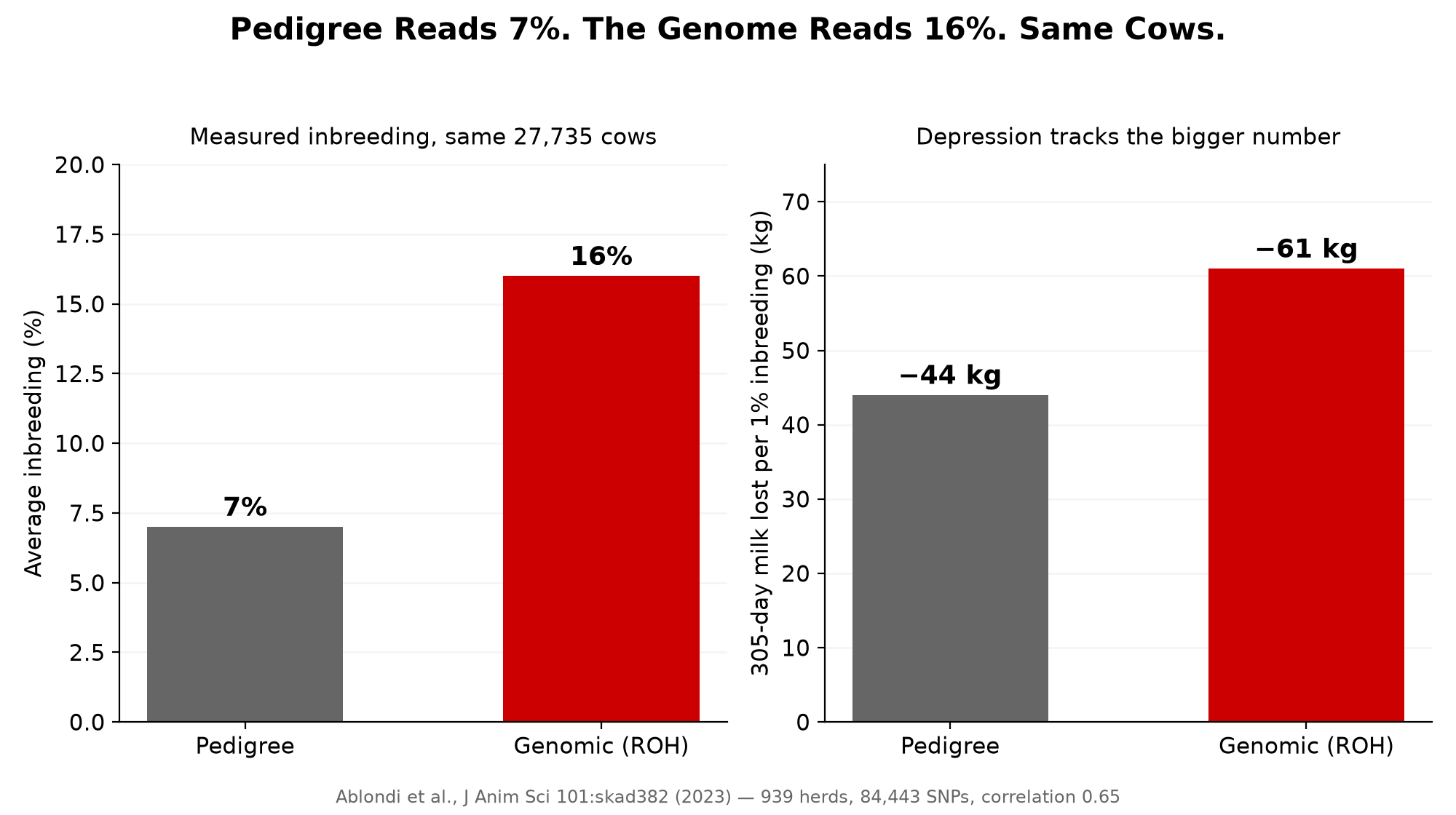
NewsSubscribe
First
Last
Consent

Uniqure Does It Again: Steria Dairy Service Repeats at the 55th Tokachi Livestock Show.

Elegance EX-95 put a cow at the top of a Hokkaido ring in August and a Grand Champion in BC this spring. Same family, same Lambda-over-Sidekick stack.

Ellie Smile Unix Uniqure took her second straight Tokachi Grand Championship on August 22, and judge Jun Hosono of Alta Japan gave his reasons on hide thinness, udder texture, and balance rather than scale — “the true qualities of a dairy cow.” Steria Dairy Service turned it into a three-banner day, adding Intermediate Champion HappyLine Baby Star ET and Reserve Intermediate at the 55th edition of Japan’s premier Holstein district show. Two of the three top banners went to Farnear Delta-Lambda daughters, a bull who left more than 11,000 daughters worldwide before dying in 2023 — meaning the sire in your tank three years ago is still deciding championships. The pedigree story is the one that should cost you time: Uniqure’s dam Sco-Lo Door Acura 2218 is the Doorman that Ferme Jacobs bought online at the 2018 Syracuse sale, and Reserve Grand Highroad Lambda Ecstasy traces Lambda × Sidekick × Beamer × Goldwyn straight back to Krull Broker Elegance EX-95 — the same family, same sire stack, that put West-Adub Lambda Sadie on top at the 2026 BC Spring Show. If you’re weighing embryos or a flush contract, that’s two continents and two management systems saying these lines transmit, which is worth more than any single banner. The opportunity with a shorter clock is Robella Major, a Blondin Sires bull barely into the Japanese market who just won Junior Champion off one of his first crops there — early Conformation confirmation ahead of the proof cycle. The risk is the usual one: paying family prices for animals that only ever won at home.

55th Tokachi Livestock Show · Holstein · Tokachi, Hokkaido, Japan · Saturday, August 22, 2026 · Judge: Jun Hosono, Alta Japan  

The Grand Championship

Ellie Smile Unix Uniqure, Grand Champion, 55th Tokachi Livestock Show — exhibited by Steria Dairy Service, Hokkaido, August 22, 2026. Judge Jun Hosono of Alta Japan cited “her balance, frame, and the thinness of her hide and udder texture” in awarding the mature cow her second consecutive Tokachi Grand Championship. Her dam, Sco-Lo Door Acura 2218-ET, is the Val-Bisson Doorman daughter purchased online by Ferme Jacobs at the 2018 Northeast Spring National in Syracuse, New York.

Ellie Smile Unix Uniqure, exhibited by Steria Dairy Service, was named Grand Champion — a repeat of her Grand Champion win at last year’s Tokachi Black & White Show. Judge Jun Hosono, whose officiating record includes the Hokkaido Black & White Show, the Chugoku Black & White Show, the East Japan Dairy Show and the All-Japan Black & White Show, put his reasons in the language of dairy character rather than sheer size: “Her balance, frame, and the thinness of her hide and udder texture all reflect the true qualities of a dairy cow. She is an outstanding individual.”  

That’s a specific compliment, not a generic one. Hide quality and udder texture are the classic indicators of dairy character — the openness and angularity that separate a milking machine from a merely large cow. Hosono led with balance and finished with hide, which tells you Uniqure won on framework and dairy character rather than brute scale.

Highroad Lambda Ecstasy, Reserve Grand Champion at the 55th Tokachi Livestock Show, exhibited by Junichi Ogura of Highroad Holsteins. The Farnear Delta-Lambda daughter returned with added maturity and refinement after taking Intermediate Champion at last year’s 16th All-Japan Holstein Show. Her pedigree runs Lambda × Sidekick × Beamer × Goldwyn × Dundee × Storm × Budjon JK Skych Elizabeth ET EX-92 × Krull Broker Elegance EX-95 — the same sire stack and the same maternal anchor behind West-Adub Lambda Sadie, Grand Champion at the 2026 BC Holstein Spring Show.

Reserve Grand Champion went to Highroad Lambda Ecstasy, exhibited by Junichi Ogura of Highroad Holstein, returning with added maturity and refinement after taking Intermediate Champion at last year’s 16th All-Japan Holstein Show.

Pedigree: Two Cow Families, One Ring

For pedigree breeders, the story of this championship is that both cows at the top trace directly to North American matriarchs.

Koichi Sato of Steria Dairy Service, left, and Junichi Ogura of Highroad Holsteins in the ring at the 55th Tokachi Livestock Show. Their two cows finished one-two: Sato’s Ellie Smile Unix Uniqure took Grand Champion, Ogura’s Highroad Lambda Ecstasy the Reserve. Between them they exhibited both halves of a championship built on North American maternal lines.
 Grand ChampionReserve Grand Champion
AnimalEllie Smile Unix UniqureHighroad Lambda Ecstasy
SireUnixFarnear Delta-Lambda
ExhibitorSteria Dairy ServiceJunichi Ogura, Highroad Holstein
Maternal anchorSco-Lo Door Acura 2218 (dam)Krull Broker Elegance EX-95
International linkDam bought online by Ferme Jacobs, Canada, at the 2018 Northeast Spring National, Syracuse, NYDirect line to one of North America’s most influential families

Ecstasy’s pedigree reads Lambda × Sidekick × Beamer × Goldwyn × Dundee × Storm × Budjon JK Skych Elizabeth ET EX-92 × Krull Broker Elegance EX-95. That combination isn’t a Japanese curiosity. It’s the same recipe winning at the top of the North American ring right now.

Same Family, Two Continents, Twelve Months

 Highroad Lambda EcstasyWest-Adub Lambda Sadie
ResultReserve Grand, 55th Tokachi Livestock Show, Aug 2026Grand Champion, 2026 BC Holstein Spring Show
Prior titleIntermediate Champion, 16th All-Japan Holstein ShowIntermediate Champion, World Dairy Expo 2025
SireFarnear Delta-LambdaFarnear Delta-Lambda
Second generationSidekickWinright Sidekick Salsa
Maternal anchorKrull Broker Elegance EX-95Krull-Broker Elegance
ExhibitorJunichi Ogura, Highroad HolsteinWestcoast Holsteins

Two continents, one cow family, the same Lambda-over-Sidekick stack, both winning inside the same twelve months. Uniqure’s dam Sco-Lo Door Acura 2218-ET is a Val-Bisson Doorman daughter who was shown at the 2019 National Holstein Show before the Ferme Jacobs purchase. Delta-Lambda’s reach makes the Ecstasy result unsurprising in hindsight — per STgenetics, the sire left more than 11,000 daughters worldwide before his death in 2023.

Steria’s Three-Title Sweep

HappyLine Baby Star ET, Intermediate Champion at the 55th Tokachi Livestock Show, held by her handler at the head of the class for Steria Dairy Service. Judge Jun Hosono rewarded the Farnear Delta-Lambda daughter for structural correctness, width throughout her body, and a mammary system with both exceptional texture and strong attachments — the udder quality visible here as she stands beside the cow placed behind her. Steria’s Intermediate Champion and Reserve Intermediate banners, plus Uniqure’s Grand, made three titles in one day.

Steria Dairy Service didn’t stop at the top banner. The herd also took Intermediate Champion and Reserve Intermediate Champion, completing a three-title day.

  • Intermediate Champion: HappyLine Baby Star ET, a Farnear Delta-Lambda daughter. Hosono cited her structural correctness, width throughout her body, and a mammary system distinguished by both exceptional texture and strong attachments.
  • Grand plus both Intermediate banners from one herd is the hardest combination to assemble at any show. It demands depth across two entirely different age brackets, not one exceptional individual.
  • The Intermediate reasons echo the Grand reasons — correctness first, then mammary quality. Hosono was consistent across divisions.

Major’s Debut Statement

SJ Farm Major Emina, Junior Champion at the 55th Tokachi Livestock Show, exhibited by Junya Obara. Judge Jun Hosono, at left, rewarded the heifer for structural correctness and dairy quality. Her sire, Robella Major, is a Blondin Sires bull whose semen has only recently reached the Japanese market — making this championship one of the first Japanese-born results on the board for him, and the kind of ringside proof that moves orders before the official proof cycle catches up.

Junior Champion went to SJ Farm Major Emina, exhibited by Junya Obara and sired by Robella Major, a Blondin Sires bull whose semen has only recently entered the Japanese market. Hosono rewarded her structural correctness and dairy quality.

Major is the bull Blondin Sires credits with much of its recent commercial momentum, with early daughter reports validating his Conformation and a proof built on balanced genetics and powerful cow families. Winning a Junior Championship in Tokachi off one of the first Japanese-born crops is the fastest possible endorsement of a new sire in a new market — and the kind of result that moves semen orders before the official proof cycle catches up.

What This Costs You

The argument above is only useful if you can act on it. Two paths, two very different clocks.

The family play. Elegance-family and Acura-family embryos trade at premium money precisely because of results like these, and the Tokachi–BC double gives sellers one more data point to price against. If you’re bidding on Lambda-over-Sidekick embryos this fall, expect the ask to reflect a family that just won on two continents. Verify current asking prices with the consignor before you commit — we’re not quoting a number we can’t source.

The sire play. Robella Major semen is the cheaper entry, and the Tokachi Junior Championship is early evidence rather than proof. One championship from an early crop justifies a trial package, not a herd-wide commitment.

The risk cuts the other way too. Paying family prices for animals that have only ever won at home is how breeders get hurt — the whole point of the Tokachi–BC parallel is that it’s evidence of transmission across two management systems, which is a materially different thing from a single impressive individual.

Key Takeaways

  • Uniqure’s back-to-back Tokachi Grands confirm her as the region’s dominant mature cow, adding to a résumé that already included Reserve honors in her class at the 16th All-Japan Holstein Show.
  • Two of three top banners went to Delta-Lambda genetics — HappyLine Baby Star as Intermediate Champion, Highroad Lambda Ecstasy as Reserve Grand.
  • Imported maternal lines dominated. Acura 2218 and Krull Broker Elegance anchor the two top cows. Tokachi’s winners are Japanese-bred and Japanese-managed, but internationally sourced.
  • Tokachi’s credentials as Japan’s premier Holstein district held up, consistent with the region producing Sakurand Doorman Rocket ET, the Shihoro cow who scored EX-95 to tie Japan’s second-highest classification ever for a female Holstein.
  • Herd management was named as the differentiator, not just genetics. One ringside observer: “Uniqure is proof of what happens when world-class genetics are matched with outstanding herd management.”

Looking Ahead

Uniqure’s ceiling. She’s now won Tokachi twice and placed Reserve in her class at All-Japan. The open question is whether a cow of this quality gets campaigned beyond Hokkaido. Japan’s biennial and quinquennial show calendar limits opportunities, which raises the value of every regional title she adds.

Whether Major becomes a Japanese mainstay. One Junior Championship from an early crop is a signal, not a trend. Watch whether Major daughters fill the yearling and two-year-old classes at the 2027 Hokkaido and Tokachi shows. If Major’s Conformation proof holds under Japanese management, this was the first of many.

Steria’s next assignment. A herd holding Grand plus both Intermediate banners has its next age group already in the barn. HappyLine Baby Star is the animal to track — Delta-Lambda daughters have proven they mature into Grand Champions elsewhere, as Lambda Sadie demonstrated in British Columbia this spring.

The Elegance and Acura families keep compounding. Both placed at the top of a Japanese ring and a Canadian ring within months of each other. For breeders selecting embryos, that cross-continental consistency is the strongest available evidence these lines transmit rather than simply producing one good individual.

The Sunday Read Dairy Professionals Don’t Skip.

Every week, thousands of producers, breeders, and industry insiders open Bullvine Weekly for genetics insights, market shifts, and profit strategies they won’t find anywhere else. One email. Five minutes. Smarter decisions all week.
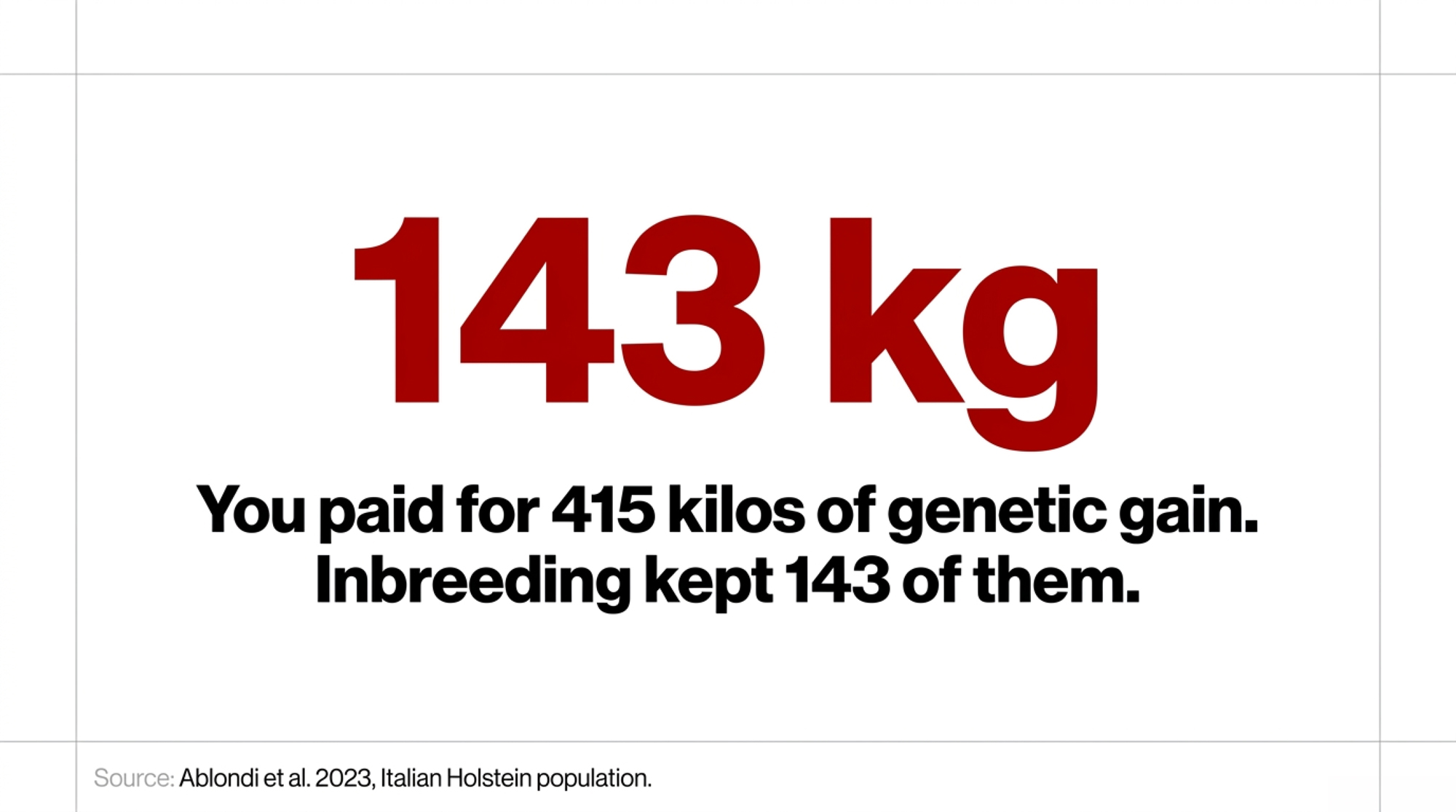
NewsSubscribe
First
Last
Consent

Rockwood Rocket Tone: 6-Time All-Canadian, and “an Absolute Disaster” as a Sire

Six times All-Canadian. One of the most formidable bulls ever shown. Then his daughters freshened—and Rocket Tone couldn’t breed. Only 1 in 6 champions ever could.

Rockwood Rocket Tone on the tanbark—six times All-Canadian and one of the most formidable bulls ever shown. The crowd could read his greatness at a glance. His daughters, freshening years later, would tell the truth the show ring couldn’t.

The crowd could see Rockwood Rocket Tone before he ever truly entered the ring.

That was the thing about the great show bulls of that vanished era. They didn’t just walk onto the tanbark—that soft brown bark-dust footing spread across the show floor. They arrived. Big necks, hard toplines, sweeping ribs, hides rubbed to a shine, handlers leaning into the halter just enough to make the whole performance look effortless. In those days—before bull classes disappeared from the major fairs and left the males to the semen catalogs—a champion male could still stop traffic at the Royal Winter Fair or the Canadian National Exhibition. And Rocket Tone was one of the most formidable ever to set foot on that floor. 

Look hard—you won’t see this again. A full class of aged bulls works the tanbark at the 1975 World Dairy Expo, before a coliseum that came just to watch the males. Within a generation these classes all but vanished from the great fairs, and with them went the stage where a bull could stop traffic on looks alone.

He was a son of Houckholme Sovereign Sky Rocket, bred at Rockwood Holsteins in St. Norbert, Manitoba, later proven at the Quinte District stud in Belleville, Ontario. Junior champion at the Toronto Royal Winter Fair in 1949. Then All-Canadian six times running—senior yearling, two-year-old, three-year-old, aged bull—a record beaten only by Montvic Rag Apple Marksman and Spring Farm Juliette. 

Six times. Let that sink in. This was back when hauling cattle was real work, fitting was closer to art than science, and a bull had to whip other great bulls face-to-face—not win a photograph contest. 

Rockwood Rocket Tone, immortalized by Strohmeyer & Carpenter. Study that topline, those ribs, that scale—this is the picture that won six All-Canadian banners. It’s also the picture that couldn’t tell you a single thing about what he’d breed.

And then, when the ribbons were boxed up, and his daughters began to freshen, the truth came in quiet.

Rocket Tone couldn’t breed.

Not the way breeders needed him to. Not the way that magnificent body promised he would.

“A dud, just an absolute disaster.” — E.Y. Morwick, on Rockwood Rocket Tone as a transmitter of desirable qualities 

E.Y. Morwick—one of the sharpest students of Holstein history this continent ever produced—didn’t soften it. That line still lands like a cold pail of water down the back of the neck. The old bull had fooled the eye. Or maybe, more honestly, the eye had fooled the men who trusted it too far. 

Now set him beside Smithcroft Snowball Rocket.

Snowball Rocket didn’t carry quite the same thunder. Gordon Smith of Milverton, Ontario bred him, a paternal grandson of Rockwood Rag Apple Remus, and Morwick described him as long, stylish, and beautifully balanced. He won All-Canadian as a two-year-old in 1956, then Reserve All-American and Reserve All-Canadian aged bull the year after. A lovely bull, sure. But not the mythic beast Rocket Tone appeared to be. 

Then his daughters started winning. And they didn’t stop.

Smithcroft Snowball Rocket—long, stylish, beautifully balanced, but never the thunder Rocket Tone carried into a ring. He didn’t need it. His daughters went on to win the only contest that ever counted.

Greenden Rocket, All-American two-year-old in 1958. Delightful Rocket, grand champion at Chicago and Reserve All-American four-year-old in 1960. His gets of sire—that’s a group of a bull’s offspring shown together as proof of what he stamps into them—were nominated for All-Canadian honors in 1960, 1961, 1962, 1963, and 1966, and he pulled off the rare trick of nominating two separate gets in a single year, 1963. Four times his gets were nominated All-American, headlined by that intimidating string Green Meadow Farms of Elsie, Michigan brought out in 1960. 

So there it is, laid out plain as a fresh classification card. Two related, structurally similar bulls from the same broad Canadian tradition. One a legend of the ring who left almost nothing. One a quieter champion who helped remake the breed.

That’s where this story really begins. Not in a straw-bedded calf pen—but in a warning. Admire the phenotype. Then interrogate the pedigree.

Act I: When the Ring Ruled

Most modern breeders can’t quite picture how much authority the show ring carried back then.

Today, a breeder studies genomic predictions, linear type breakdowns, daughter fertility, health traits, and production data that pours in faster than a barn cat at feeding time. Back then? A great bull standing under the lights at the Royal or the Waterloo Dairy Cattle Congress could become a breeding proposition almost entirely on the strength of looking the part. 

And the part mattered enormously.

A show bull was supposed to project power without coarseness, breed character without weakness, enough scale to promise a next generation of big, durable, profitable cows. The tanbark was theatre. But it was also the marketplace. A championship raised semen demand, lifted sale prices, and earned bragging rights that traveled from the county line clear across national borders. 

The whole theatre in one frame: Allen Hetts, one hand steady on the chain, walks Crescent Beauty Talent past the bunting—Reserve Grand Champion Bull in 1967, Grand Champion by 1969. That fall, Talent shipped to Japan, because a title like this didn’t just win a banner. It could move a bull halfway around the world.

Artificial insemination was beginning to change everything. The Oxford District Cattle Breeders Association, under herdsman Paul Jensen, did something almost no other Ontario stud bothered with—it actually campaigned its bulls at the shows. Snowball Rocket was one of those Oxford bulls, keeping company in the record with Baker Reflection Jerry, the All-Canadian two-year-old of 1960, and Clearcreek Model, Reserve All-Canadian bull calf in 1956. That mattered, because A.I. was becoming the bridge between a bull admired by a few thousand people at ringside and a bull whose daughters milked in barns from Ontario to Oregon. 

But the old question wouldn’t lie down.

Did the glamour bulls breed?

Morwick chewed on that through eleven of the most prominent Holstein breeding establishments in North America—six Canadian, five American—and his verdict was blunt. Most didn’t. By his own reckoning, only about half of the famous show bulls proved reliable transmitters, and only about a third of that half—call it one in six overall—ever reached the exceptional class. A follow-up analysis put numbers to the whole roster, scoring each institution’s show bulls from five, for a superior transmitter of type and production, down to zero, for a bull who as a breeder did next to nothing. 

So yes. The tanbark could crown a champion.

But the breeding shed kept its own book, and it balanced to the penny.

Here’s how the eleven houses finished, best to worst:

Breeding establishmentPrincipal breederScoreDaughter Verdict & Key Sires
Rosafe FarmsDr. Hector I. Astengo17Citation R. scored a perfect 5; Preceptor, Signet, and Shamrock Perseus each earned 4 off the A.B.C. Reflection Sovereign blood.
Mount VictoriaT.B. Macaulay16Marksman a 5, Sovereign and Monogram 4s, Hartog a 3—the Rag Apple dynasty at full power.
Carnation Milk FarmsE.A. Stuart16Governor Imperial and Royal Master perfect 5s, Homestead Revelation a 4, Matador Masterpiece a 2.
Pabst FarmsFred Pabst15Sir Roburke Rag Apple and Roamer Dean Walker Lad 5s—yet four-time All-American Fobes Burke managed a 1.
Elmwood FarmRobert V. Rasmussen14King Bessie Korndyke Ormsby a 5; Progressor, Senator, Gypsie each a 3.
Spring FarmJ.M. Fraser14Inka Jewel and Fond Hope 5s, Reflection a 4—and Sovereign Supreme, for all his ribbons, a 0.
Romandale FarmStephen B. Roman9Marquis a 5, Dividend a 4, while Governor and Argus both scored 0.
Franlo FarmF.W. Griswold8Roebuck Regent and Gen Treasure Model 4s; Chip Douglas King and Chip Montvic Royal, 0s.
Cash-MarC.M. Bottema Jr.8Ormsby Jerry and Jerry Darky Lassie 4s; Jerry Delight and TM Pell City, 0s.
SheffieldJohn Malcolm8Crown Prince, Dusty, Monarch, Chico—four pretty bulls, four scores of 2.
Glenafton FarmJ.J.E. McCague5Rag Apple Alert a 5; eight other campaign sires, all 0.

Rosafe seventeen. Glenafton five. Sit with that gap a moment, because the whole story lives inside it.

The best sires all shared something the failures didn’t. Deep maternal families. Linebred strength that held up. Daughters and sons who proved the body wasn’t just a lucky roll of the genetic dice. The great ones stood behind cows like Montvic Rag Apple Colantha Abbekerk, Lakefield Fobes Delight, Bonnie Lonelm Texal High, Soo Rag Apple Princess. The duds? Often glamorous enough to win—but without the additive power to stamp a daughter. 

That’s the whole difference between a great photograph and a great sire.

Act II: The Bulls Who Kept Faith—and the Ones Who Broke It

Mount Victoria: The Cathedral of the Rag Apples

If this story has a cathedral, it stands at Mount Victoria.

T.B. Macaulay’s herd at Hudson Heights, Quebec became the home of the Rag Apple blood that shaped North American Holstein breeding for decades, concentrating the line of Johanna Rag Apple Pabst into cattle that looked important before the records even confirmed it. And then came the brothers. 

Big, black, and beautiful. That’s exactly the feeling Morwick reached for when he wrote about Montvic Rag Apple Marksman and Montvic Rag Apple Sovereign, both sons of the great cow Montvic Rag Apple Colantha Abbekerk. They formed the All-Canadian produce of dam—the top-placed pair of offspring from one cow—in 1945, 1946, and 1947. Other famous male pairs had come before: Hays Taxpayer and Hays Alamoda, Hays Sensation and Hays Supreme, Man-O-War Progressor and Sir Man-O-War Heilo. Put them side by side and photographed against Marksman and Sovereign? Morwick said no contest. 

But the brothers had something those pairs didn’t. They bred.

Montvic Rag Apple Marksman—big, black, and beautiful, and rarest of all, a champion who bred as well as he looked. Seven times All-Canadian, then sire of five All-Canadian gets. This is what it looks like when the eye and the pedigree finally agree.

Marksman went All-Canadian seven times as an individual and then sired the All-Canadian gets of 1946, 1947, 1949, 1950, and 1951. Sovereign sired A.B.C. Reflection Sovereign and Houckholme Sovereign Sky Rocket—two of the most prolific sources of show-winning stock the breed had. And there’s a twist worth savoring: Sky Rocket was Rocket Tone’s own sire. The same family that produced the breed’s great disappointment also produced its engine. Blood is like that. Generous and cruel in the same breath. 

Now, the sad one.

Montvic Rag Apple Hartog spent too many of his best days on the show circuit and not enough at Hays Farms doing bull’s work. He wasn’t used nearly as hard as he should’ve been. And yet even from that neglect he threw Hays Supreme—the best bull, Morwick said, the Hays boys ever bred. Hays Supreme sired Supreme Ruby Echo, Canada’s first 200,000-pound milk cow, and anchored a line running down through Inka Supreme Reflection, A.B.C. Reflection Sovereign, Glenvue Nettie Jemima, and Spring Farm Fond Hope. A half-wasted bull. A river still deep enough to cut through generations. 

Carnation: Stacking the Production Deck

Swing south and west now, to Carnation Milk Farms in Washington.

E.A. Stuart wasn’t only chasing ribbons—he was building production and scale into cattle that had to hold up in real, commercial dairying. And at Carnation, the proof didn’t come from the show string. It came stacked three generations deep. Carnation Governor Imperial won All-American three times and sired seven Gold Medal sons—Gold Medal being the old honor for a bull whose daughters proved themselves in both the show ring and the milk pail. His son carried it forward, and his grandson, Carnation Homestead Revelation, topped the Honor List—the annual roll of the top proven sires by daughter records—in 1958, completing the breed’s first three-generation string of Honor List-leading sires. Grandfather, father, son, each ranked first in the nation. Nobody had ever stacked three like that, and the men in the Carnation barn knew exactly what they were standing on.

Then came Royal Master, and this time the proof arrived in a sale ring.

Carnation Royal Master sired two world-record sellers at once—Don Augur Mothermarthas Pride at $108,000 in 1966, and Oak Ridges Royal Linda at $62,000 in 1968. Picture the Don Augur ring that day: the bidding cracking past every previous mark, the crowd going still, an auctioneer’s voice climbing into territory nobody in the barn had ever heard for a female. That wasn’t showring smoke. That was hard cash betting on a bloodline that had already proven it delivered. 

The Wisconsin Invasion and the Illusion of Fobes Burke

Pabst Farms taught maybe the sharpest lesson of all—and it cut the opposite way.

Fred Pabst’s herd at Oconomowoc, Wisconsin, bred cattle of tremendous uniformity, and Pabst quietly produced non-show sires like Pabst Regal and Pabst Roamer who each threw two All-American gets. But the bull everyone came to see was Pabst Fobes Burke, classified EX-96—an outstanding score for a bull in that day. 

What a sight he must’ve been. He was All-American four times between 1953 and 1957, and he headed the Wisconsin invasion of the 1956 Royal Winter Fair, the year Pabst walked into Toronto and presented both grand champions—Fobes Burke and Plain View Inga. One can only imagine the mood at ringside for the Ontario men that afternoon. Wisconsin hadn’t come to compete. Wisconsin had come to take the flags home, and did. 

Then the daughters freshened.

Pabst Fobes Burke, classified EX-96—four-time All-American and the bull everyone crowded the rail to see when Wisconsin took both grand championships at Toronto in 1956. The body was flawless. What his daughters freshened into would tell a very different story.

And Fobes Burke—by the good sire Sir Regal Fobes, out of a Wisconsin Admiral Burke Lad daughter—did next to nothing. What stung most was where the real breeding power sat: not in the champion, but in the father who’d never drawn half the crowds. Sir Regal Fobes left thirty-four classified daughters averaging 82.7 points, six of them Excellent. Walk that number back to what it meant. In an era when a solid working cow scored in the high seventies, a bull who could pull a whole barn of daughters up past eighty-two—with a half-dozen going Excellent—was a genuine type-builder. Pabst Sir Roburke Rag Apple was better still: three All-Americans, fifteen Gold Medal daughters, 230 daughters over 100,000 pounds lifetime, and leading Honor List sire in 1961, 1962, and 1964. Roamer Dean Walker Lad ranked second on the Honor List in 1954 with nine Excellent offspring and Class Extra sons—Class Extra being the Canadian rating reserved for sires whose progeny stood out most sharply. The glamour bull in the middle of all that? A footnote. 

Maybe there’s nothing mysterious there. Maybe some bulls are simply great without being able to hand it down. That’s the uncomfortable part every breeder eventually swallows: an animal can be excellent without being prepotent.

Spring Farm: The Costliest Decision Jack Fraser Ever Made

Spring Farm made that same point—and it must have cost Jack Fraser some sleep.

Fraser, of Streetsville, Ontario, bred cattle that became part of the breed’s foundation memory. His Spring Farm Inka Jewel was an All-American bull calf in 1935, then opened in 1937, winning grand at Ottawa and reserve grand at the C.N.E. And then, at the Lindsay Fair, the bull got hung up in his halter, wrenched his back, and had to be destroyed.

Read that again. One tangled halter, one bad wrench, and a young sire of enormous promise was gone.

Except he wasn’t, really. In just three herds and a short life, Inka Jewel sired Inka Supreme Reflection and Inka Supreme Lillian for Jim Henderson, plus lines feeding into A.B.C. Reflection Sovereign, Spring Farm Juliette, and Spring Farm Fond Hope. Short life. Long shadow. That’s how it goes with the real ones. 

But the harder story—the one that stings—was Sovereign Supreme.

Spring Farm Sovereign Supreme, a son of Montvic Rag Apple Sovereign, went All-Canadian four times and All-American three. Fraser believed in him. The Herd Book from the late 1940s shows more than 100 Sovereign Supreme calves registered by Fraser—against just five he registered by Elmcroft Voyageur M, the other bull sharing his herd-sire duties. 

Picture Fraser years later, thumbing back through those pages. A hundred-plus by the bull who couldn’t transmit. Five by the bull who could.

“Using Sovereign Supreme to the near-exclusion of Voyageur M was probably the biggest mistake Jack Fraser ever made.” — E.Y. Morwick 

Sovereign Supreme was a write-off in the breeding shed. Voyageur M sired Spring Farm Fond Hope. 

And Fond Hope changed the arc of everything. All-Canadian as calf, senior yearling, and two-year-old, he and his full sister Spring Farm Juliette formed the All-Canadian produce of dam four years running, 1950 through 1953. His influence ran so deep that Senator Harry Hays drew on his sons as foundation stock for a whole new beef breed, the Hays Converter. When a Holstein bull leaves his mark outside the Holstein breed entirely, you know the ground moved under everyone’s feet. 

The Same Tune, Four More Times: Romandale, Franlo, Cash-Mar, Sheffield & Glenafton

The other houses kept singing verses of the same tune, so let’s take them together, because by now the pattern needs no introduction.

Stephen Roman—the mining magnate who poured a fortune into building Romandale at Unionville, Ontario—bred eight bulls that won twelve All-Canadian awards, and only two, Reflection Marquis and Dividend, truly cut through as sires. Marquis was the crown jewel, siring Agro Acres Marquis Ned and a string of sons, plus a daughter, Agro Acres Marquis Patsy, who went All-Canadian two years running. But Romandale Reflection Governor, three-time All-Canadian himself, left thirty-nine classified daughters averaging a dismal 51 percent Good Plus and better. Same prefix. Same glamour. And when the classifier worked down those Governor daughters, the cards came back with the kind of scores that make a breeder go quiet, set down his coffee, and rethink a whole mating plan. Argus, another All-Canadian, contributed nothing worth remembering. 

A Canadian bull, an Iowa coliseum, a crowd on its feet—Romandale Reflection Marquis stands Grand Champion at the 1962 National Dairy Cattle Congress in Waterloo, led by Mac Logan and breeder Dave Houck. Of eight Romandale bulls that won twelve All-Canadian banners, Marquis was one of only two who bred as well as they showed—the crown jewel of Stephen Roman’s Holstein empire, and living proof of the rule this whole story turns on. (Read more: THE ROMANDALE REVOLUTION: How a Uranium Billionaire & Cow Sense Conquered the Holstein World)

Griswold’s Franlo, in Hopkins, Minnesota, ran under manager Henry Bartel Sr.—a fitter’s fitter—who turned out show-winning males with cookie-cutter consistency, and most were write-offs in the shed. They mirrored their ancestor, Chip of Nettie Aaggie, the bull who whipped both Marksman and Sovereign at the 1946 Royal yet failed as a breeder. Franlo Chip Douglas King and Chip Montvic Royal looked unbeatable and bred like fence posts. The two exceptions, Roebuck Regent and Gen Treasure Model, both traced their strength to one good cow, Browns Mistress Corrine—the maternal line steadying what the glamour line couldn’t. 

Cash Bottema could fit and lead a bull with anybody who ever gripped a lead strap—”his bulls, not his own,” as Morwick dryly put it, needling the man who won on cattle he hadn’t bred. His Cash-Mar Ormsby Jerry and Jerry Darky Lassie proved solid, the latter posting a daughter-dam gain of 3,259 pounds of milk in a Montana herd. But Jerry Delight, three-time All-American, and TM Pell City left nothing behind. 

John Malcolm’s Sheffield gave us the prettiest cautionary tale of the lot—and it came with the biggest cheque. The 1960 Sheffield Dispersal averaged $3,154 on 75 head—the highest North American auction average to that time—but that money rode on the magnificent females, not the bulls. Crown Prince, Dusty, Monarch, Chico—four handsome sons of Rosafe Sovereign Supreme who caught every eye and changed nothing. 

And Glenafton. J.J.E. McCague bred nine bulls that won ten All-Canadian awards, and exactly one—Glenafton Rag Apple Alert—became an exceptional sire. Alert, a Marksman son, topped the 1944 All-Canadian Sale as a three-month calf at $5,100, then topped it again in 1947 selling to Chile for $11,500; he stayed under McCague–McIlquham ownership right through that fall’s Royal Winter Fair, where he placed first in the two-year-old class and stood reserve grand champion. His gift to the breed was Maplenix Rag Apple Mercury, a key sire of show type across Eastern Ontario in the 1960s. 

The other eight Glenafton show bulls won their banners and left the barn silent behind them. 

That contrast, all by itself, might be the whole article in miniature.

A generation after Rocket Tone, the tanbark still crowned its kings—Zeldenrust Fond Memory, Champion Bull at the 1974 World Dairy Expo. New decade, new coliseum, new champion under the lights. But the only verdict that ever counted was still waiting out in the barn, in the daughters he’d leave behind.

Act III: What the Daughters Always Knew

So the ledger closes on eleven great houses—and every one of them keeps circling back to a single, stubborn truth. A daughter doesn’t care about ribbons.

She either freshens with the udder, the feet and legs, the strength and production and staying power to make a breeder nod—or she doesn’t. A son either breeds beyond himself or he fades into yellowed photographs and old catalogs. The bull classes could honor a magnificent body, and sometimes the body told the truth. But the daughters spoke a language no judge could overrule.

Rosafe: When Beauty and Blood Finally Agreed

Rosafe Farms showed the dairy world what happened when beauty and breeding power finally lined up.

Dr. Hector Astengo, of Brampton, Ontario, bred bulls Morwick called scintillating and unequaled as breeders—most of them sons of A.B.C. Reflection Sovereign. Rosafe Signet was grand champion at the Royal in 1958 and 1959, and then his daughter Bond Haven Signet Sally took the Royal grand championship as a four-year-old in 1961. And this is the detail that ought to raise the hair on any breeder’s arm: that was the first time in history a Royal grand champion male had sired a Royal grand champion female. The photograph proved itself. The blood backed the beauty. 

Rosafe Citation R., Signet’s full brother, sired All-Canadian gets across four different years and led Canada’s Honour List in 1966, 1967, and 1969. And that’s exactly where the past reaches out and lays a hand on the present—because Citation R.’s blood didn’t stay in the 1960s. 

Rosafe Citation R.—the bull who ended the argument. Where so many champions couldn’t breed on, he earned a perfect transmitter score and topped Canada’s Honour List three times. This is what beauty and blood look like when they finally agree—and his blood was about to walk straight into the modern era.

The Genetic Echo: Where They Live Today

Follow Citation R. forward, and you arrive at Glenridge Citation Roxy.

Roxy was a Citation R. daughter out of Norton Court Model Vee. She classified EX-97, produced 209,784 pounds of milk and 9,471 pounds of fat in her lifetime, and became the first cow in the world to have ten daughters classified Excellent. Ten daughters, all Excellent. Mention that in a serious breeder’s barn today and watch the eyebrows climb, because plenty of good cows never leave one. Her maternal grandsire, Springbank Model Fame, traced straight back to that Franlo exception, Gen Treasure Model—the very bull whose good maternal foundation had rescued a risky glamour line a generation earlier. 

So the old debate between glamour and transmission didn’t end in some dusty essay. It walked, on four black-and-white legs, right into the pedigrees breeders still chase.

And Roxy wasn’t the only one carrying that blood forward, which is the part that always stops me cold. Trace the maternal line of Walkway Chief Mark—a bull whose name a lot of older breeders can still rattle off from memory, one of the great proven sires of his day—and it runs back through Cash-Mar Reflection Triune to Franlo’s Gen Treasure Model, that same steadying cow family, turning up in the pedigree of a household name where you’d never think to look. Then there’s Round Oak Rag Apple Elevation—the bull who became one of the most influential sires in the history of the breed, a name sitting behind an enormous share of modern North American Holsteins. His maternal granddam? Glenafton Gaiety. An uncampaigned Glenafton cow who never chased a single ribbon in her life. The best animal in the barn, it turns out, isn’t always the one wearing the sash. 

And if you think all that belongs safely in the past—that genomics finally settled the argument—look closer.

The Same Bet, Now in a Genomic Suit

The tools changed beyond recognition. The wager didn’t.

Today the glamour comes wrapped in a genomic test instead of a show halter. A chart-topping GTPI number, a headline LPI figure, an IVF-fueled flush program pulling dozens of embryos from a single donor, a six-figure genomic heifer changing hands before she’s ever milked—these are the modern equivalents of that big-necked bull stopping traffic on the tanbark. And the modern show ring still crowns its own royalty: names like Erbacres Snapple Shakira and Blondin Goldwyn Subliminal draw the same crowds, the same awe, the same assumption that a phenotype this good must breed on. Sometimes it does. Sometimes, just like Rocket Tone, it doesn’t.

The mandate hasn’t budged an inch. If the maternal line underneath all that data lacks the additive power to stamp the next generation, you aren’t buying breed improvement—you’re buying a very expensive lottery ticket with a prettier envelope. Genomics narrowed the odds. It never repealed the rule.

The Lesson That Outlived Them All

So what did the glamour bulls finally teach us?

To admire a great phenotype—and then interrogate it. That a bull’s own body is one performance, while his daughters are the encore that actually matters. That deep cow families and repeatable transmission must outweigh one perfect afternoon under perfect lights. 

And they taught humility. Because no honest breeder reads about Rocket Tone, Sovereign Supreme, Fobes Burke, Reflection Governor, or those eight silent Glenafton bulls without a chill of recognition. Those weren’t ugly animals. They weren’t nobodies. They were often magnificent. The trouble was never bad eyes. The trouble was trusting the eye, alone, to tell the whole story. 

But don’t mistake this for a scolding. It’s a tribute.

Because the bulls that did transmit gave the Holstein breed its backbone. Marksman and Sovereign lit the Rag Apple name for generations. Governor Imperial, Homestead Revelation, and Royal Master carried Carnation production down through record-shattering sales. Sir Roburke Rag Apple and Roamer Dean Walker Lad proved a show bull could be more than a pretty picture. And Citation R. carried Astengo’s genius into daughters and gets, and into one of the most revered cow families the breed has ever known. 

Maybe that’s the lesson still standing after all these years. Genomics changed the tools. Classification changed. The bull classes have all but vanished from the great fairs, and semen now travels farther than any show string ever could. But the old question hasn’t aged a day. Every time a breeder squints at a proof, watches a heifer cross the concrete, and wonders whether her beauty will outlast the photograph, that same quiet question is doing its work at the very heart of breed improvement—the one Rocket Tone’s daughters answered the hard way. Does she transmit?

Rockwood Rocket Tone deserves to be remembered—not for failing, but because his failure taught a lesson too expensive ever to forget. Smithcroft Snowball Rocket deserves to stand right beside him, not as the prettier legend, but as the bull who reminded everyone that the true champion is often crowned years after the judge’s hand comes down. Between the two of them lives the great and permanent lesson of Holstein history: the tanbark can crown the body, but only the daughters can crown the blood. The breed we milk today wasn’t built by the bulls who merely looked immortal—it was built by the ones whose daughters made them so. 

Key Takeaways

  • A show banner tells you what a bull is, not what he’ll leave behind—Rockwood Rocket Tone won All-Canadian six times and still bred like a fence post, while quieter Snowball Rocket remade the breed through his daughters.
  • Only about 1 in 6 of history’s most decorated show bulls became exceptional sires. Before you chase a phenotype, dig into the maternal line—deep, proven cow families are what separated Rosafe’s 17 from Glenafton’s 5.
  • The rule didn’t change with genomics. A chart-topping GTPI heifer or a six-figure flush donor still has to transmit, or you’ve bought a very expensive lottery ticket with a prettier envelope.

Continue the Story

  • The Vision of Mount Victoria: T.B. Macaulay’s Holstein Legacy – Long before Rocket Tone fooled the eye, T.B. Macaulay was using strict mathematical principles to build the foundational Rag Apple dynasty, proving that true breeding power is engineered through rigorous maternal selection rather than show-ring glamour.
  • The Bull Who Changed Everything: The Johanna Rag Apple Pabst Story – Walk the old barns of the 1920s Wisconsin circuit to see how a single prepotent sire defied the odds of Morwick’s one-in-six rule, anchoring the entire genetic framework of the modern Holstein breed.
  • Rosafe Citation R – Discover how Hector Astengo’s linebred masterpiece carried the ultimate triumph of blood over beauty forward through time, leaving an omnipresent blueprint of excellence that still dominates pedigrees in today’s genomic era.

The Sunday Read Dairy Professionals Don’t Skip.

Every week, thousands of producers, breeders, and industry insiders open Bullvine Weekly for genetics insights, market shifts, and profit strategies they won’t find anywhere else. One email. Five minutes. Smarter decisions all week.
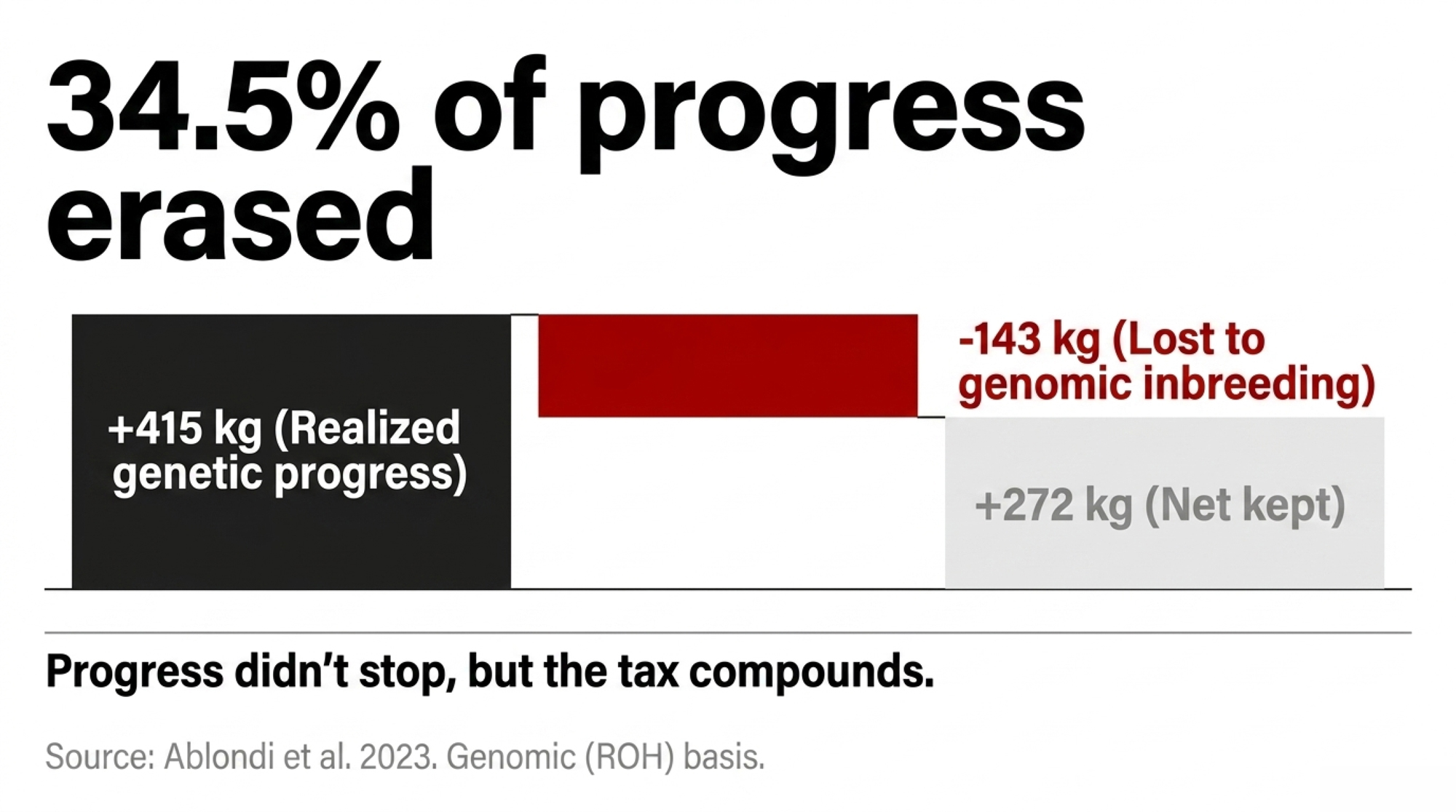
NewsSubscribe
First
Last
Consent

To-Mar Blackstar: The One-Embryo Holstein Sire Behind 15.8% of Today’s DNA – and the Genetic Debt in Your Herd

One farm ET that barely penciled out. Four decades later, the bull from that flush shapes 60% of Select’s lineup — and your herd’s inbreeding curve.

To-Mar Blackstar EX-93-GM: the coal-black Chairman son from Marengo, Iowa, who topped the TPI list, sold 500,000 doses, and left a 15.8% relationship to every Holstein alive. Photo: Remsberg.

One pregnancy.

That’s what Randy Tompkins got from his first embryo transfer attempt in 1981. He flushed To-Mar Wayne Hay — a solid, unglamorous second-lactation cow producing 25,110 pounds, sired by Cal-Clark Board Chairman — and the vet packed up with a single viable embryo for the whole effort. Anyone who’s sweated through an ET flush knows what that arithmetic feels like: you’re standing in the barn doing the math before the vet’s boots are off, stacking the cost against what a bull calf might bring, wondering if you just torched money you didn’t have to spare.

For a working dairy in Marengo, Iowa — registered cattle alongside commercials, always watching corn prices, every decision measured against the milk check — that kind of return was a gut-punch.

That single embryo became a coal-black bull calf born May 17, 1983, and nothing about him said history. The Tompkins family named him To-Mar Blackstar, went back to milking, and didn’t think much more about it.

For about nine years.

The Cow Nobody Wrote Up

What keeps pulling me back to the Blackstar story is where it started. Not with a legendary dam, not with a calculated million-dollar mating — it started with a cow named Hanna.

Royal-Cedar Oak Hanna was Wayne Hay’s dam, and she was the kind of cow that experienced dairymen notice, but nobody puts on a cover. Tight udder. Sturdy frame. Deep through the heart girth in a way that told you she’d been converting feed into milk for years without drama, without a vet call, without anyone having to worry about her. She wasn’t winning banners. She was paying bills — quietly, reliably, lactation after lactation.

You know this cow. You’ve probably got three of her in your barn right now, and if you’re honest, she’s the one keeping your operation solvent while the flashy ones eat up your time and your treatment budget.

To-Mar Wayne Hay EX-90-USA — the cow nobody wrote up. She wasn’t winning banners; she was paying bills. One ET flush produced Blackstar. With five AI-sampled sons, she’d be a Holstein International Global Cow winner today. Photo: Pete’s Photo.

Wayne Hay inherited that durability. The Tompkins operation wasn’t Hanover Hill — this wasn’t a high-profile genetics program with deep pockets and a marketing department. This was an Iowa dairy where every decision had to pencil out, or it didn’t happen, and when Randy decided to try ET for the first time, flushing Wayne Hay to Board Chairman and coming away with exactly one pregnancy… that was real money on a real gamble that hadn’t paid off yet.

Why Did the Holstein Breed Need Blackstar in 1985?

To understand why this particular bull landed like a bomb, you need to remember what the Holstein breeding world looked like in the mid-1980s — because the show ring and the milk parlor had drifted dangerously far apart.

Bell daughters were flooding barns with milk nobody had seen before — +1,704 pounds predicted difference, over 30% of the cows on the Holstein Locator List by mid-decade — but they were falling apart structurally by second lactation. Small frames, weak substance, udders that couldn’t sustain the metabolic load they were built to carry. The Bullvine’s own analysis calls Bell “the worst best bull in Holstein history,” and that’s not hyperbole: producers who’d built their programs around Bell production were watching replacement rates climb, and herd life drop, and the smarter ones were getting nervous.

Meanwhile, up in Canada, Starbuck was emerging as the type answer — 70% of his daughters scored Good Plus or better, 200,000 daughters by the mid-’80s, and he’d collect 27 Premier Sire titles between ’86 and ’95. Beautiful cattle, showring dominance. But the production gap was real, and Starbuck was a type bull in an era when the milk check still decided who survived. (Read more: Hanoverhill Starbuck’s DNA Dynasty: The Holstein Legend Bridging 20th-Century Breeding to Genomic Futures)

Hanoverhill Starbuck with Carl Saucier at Mount Victoria Farm, Québec, 1994 — 15 years old and still in service at CIAQ. 685,000 doses. 27 Premier Sire titles. 200,000 daughters. He was everything the show ring wanted. Blackstar was what the milk check needed.

The breeders paying attention — and by the late ’80s, that was a growing number — knew the breed needed something else entirely. A bull that could improve conformation without sacrificing components; type married to production in the same proof sheet. Everyone wanted it, and nobody could find it.

The bull that delivered it was sitting in a barn in central Iowa, bred by a family that wasn’t trying to solve the industry’s identity crisis. They were trying to make a good cow a little better.

The Mystery of 7H1897

Blackstar’s first proof dropped in January 1989, and the numbers were unlike anything the industry had seen from one animal: +58 pounds fat, +63 pounds protein, and a +3.16 PTAT.

A PTAT above 3.0 from a bull who was also positive on components — in 1989, that combination was unicorn territory. You picked type bulls, or you picked production bulls, and that was the deal everyone had accepted. Getting both at this level from a first-time ET calf out of a cow nobody outside Iowa County had heard of wasn’t supposed to happen.

But the moment that really captures how Blackstar emerged isn’t about the proof sheet. It’s about Ron Long.

Long was at Select Sires, working through classification data from herds across the country — the way you tracked genetic quality before genomics made everything instant. He kept flagging one sire code, herd after herd, state after state, because daughters of this particular bull were classifying well above expectations, and the pattern was unmistakable. But the bull wasn’t on anybody’s radar.

“I do not know which bull is 7H1897,” Long told his colleagues, “but his daughters are actually classifying extremely well.”

7H1897 was Blackstar. Before the industry knew his name, before a single marketing dollar was spent, before anyone at Select Sires had built a campaign around him, his daughters were already proving him on concrete — in real barns, on real DHIA sheets, from the Midwest to the Southeast. The data was finding him, not the other way around.

How Blackstar Topped the TPI List in 1992

Then the phone started ringing.

Blackstar had just topped the TPI list at 1,256 points — at that point was the highest total performance index any Holstein sire had ever achieved — and in a pre-internet world where you secured semen by picking up the telephone and hoping the AI stud had inventory, that number set off something close to a stampede. At Select Sires, the switchboard was overwhelmed: international calls stacking up, wire transfers from Germany, the Netherlands, Australia, New Zealand, breeders on three continents competing for straws selling at hundreds of dollars each in 1992 money, when proven semen from a solid bull ran a fraction of that.

Jeff Ziegler, Select’s breeding manager, would later put the constraint in perspective: “From Blackstar, no more than 500,000 doses were sold, since our semen collection methods back then were very different.”

Half a million doses from one bull in an era when collection technology produced far fewer straws per session than modern methods allow. No bull before him had generated that kind of sustained, global demand.

The morning that the first proof sheet must have arrived at the Marengo farm — a Select Sires envelope, a page of numbers that looked like any other mailing — it’s hard to imagine Randy Tompkins understood he was holding the breeding industry’s next decade in his hands. By all accounts, he wasn’t a man who sought the spotlight. He’d bred one bull, and the bull was doing the rest. But by the summer of ’92, with international calls coming in before dawn and wire transfers landing from three continents, the distance between that single-embryo gamble in 1981 and what it had become must have felt impossible to bridge.

What His Daughters Proved on Concrete

You could spot a Blackstar daughter from across the free-stall alley, and not because she was flashy — it was the opposite. She looked right. Depth through the heart that meant genuine capacity, not the narrow, weedy frame, the show ring had been rewarding for a decade. Spring of rib that told you she could handle a heavy TMR load without burning through body condition in sixty days. And the udders — tight fore attachment, strong medial, teat placement that meant your milking crew wasn’t fighting her twice a day, and this was back when udder quality actually differentiated sires, before everyone’s proof sheet started looking the same.

The real proof, though, was in the bulk tank.

LA-Foster Blackstar Lucy 607, down in North Carolina, became world production champion in 1998: 75,275 pounds of milk with 1,738 pounds of fat and 2,164 pounds of protein in a single 365-day lactation. The Foster family described her the way any dairyman would understand: “She’s either at the feed bunk or at the water trough. She eats and eats and produces that milk!” Over 200 pounds a day, sustained for an entire year, without breaking down — and when corn’s at seven dollars, and your margins are measured in pennies per hundredweight, that kind of metabolic engine separates the operations making the payment from the ones having a difficult conversation with their lender.

Stookey Elm Park Blackrose EX-96-USA 3E GMD DOM — All-American at two and three. Grand Champion, 1995 Royal Winter Fair. 149,881 pounds lifetime. She wasn’t just a show cow or a production cow. She was a Blackstar daughter — and that was the whole point. Photo: Wolfhard Schulze.

Then there was Stookey Elm Park Blackrose — classified EX-96-USA 3E GMD DOM, one of the highest classification scores ever assigned to a Holstein female. Bred by Jack Stookey and purchased by Mark Rueth and the Schaufs from Indianhead Holsteins as a hiefer, they developed her into something genuinely rare: All-American Junior Two-Year-Old in 1992, All-American Junior Three-Year-Old in 1993, and then Grand Champion at the 1995 Royal Winter Fair, joining that exclusive club of American-bred cows to win Canada’s most prestigious show. At 5 years old, she posted 42,229 pounds of milk, with 1,940 pounds of fat and 1,433 pounds of protein, and her lifetime production reached 149,881 pounds over 1,609 days in milk. She wasn’t just a producer and a show cow — she became a foundation brood cow whose AI sons carried the Blackstar blueprint into herds across the continent, and whose descendants were still winning banners as recently as the 2016 Hokkaido Winter Fair in Japan. (Read more: When Financial Disaster Breeds Genetic Gold: The Blackrose Story That Changed Everything)

Lucy and Blackrose weren’t outliers — and that’s what mattered most to producers milking Blackstar daughters day after day. As a group, his daughters consistently showed above-average productivity and lower somatic cell counts, peaking in their fourth and fifth lactations rather than flaming out as two-year-olds. The kind of cow your milking crew mentions at year’s end because she never once showed up on the treatment list, the kind that lets you amortize rearing costs over six or seven years instead of two.

That profile — the one every sustainability conversation in this industry eventually circles back to — came from a cow named Hanna.

2,500 Sons and the Mistake Nobody Stopped

The AI industry sampled nearly 2,500 of Blackstar’s sons globally, representing roughly half the world’s total sampling capacity in any given year, poured into the offspring of a single sire. The results were spectacular, and the consequences were severe, but nobody hit the brakes.

MJR Blackstar Emory EX-97-GM — the crown jewel. Half his sons made proven sire. His son Blitz topped 1.52 million doses. The line from here runs straight into your semen tank. Photo: Remsberg.

MJR Blackstar Emory was the crown jewel — 50% of his sons achieved proven sire status, against an industry norm of about 10%. Among them, Fustead Emory Blitz became a super-millionaire at over 1.52 million doses sold, a record at Select Sires that still stands. Blitz sired Velvet-View KJ Socrates, and Socrates gave us Roylane Socra Robust — who died young, before anyone fully grasped what they had — and from Robust came Seagull-Bay Supersire, a massive milk transmitter whose son JoSuper carried that Blackstar blueprint into yet another generation of elite matings. If that lineage sounds familiar, it should — Walkway Chief Mark, the backup bull behind 7% of every Holstein cow alive today, sits in these same pedigree networks.

Through Etazon Lord Lily, a millionaire son in his own right, Blackstar genetics reached Vision-Gen Ozzie and eventually influenced Ransom-Rail Facebook Paris. Up in Quebec, the Comestar program took Blackstar’s impact in a different direction entirely: three daughters out of Comestar Laurie Sheik produced six AI sons, including Comestar Lee, Outside, and Lheros — all millionaire sires distributed worldwide through Semex. One cow family, one mating sire, and a genetic footprint that reshaped Canadian breeding for a decade.

Comestar Laura Black VG-87-CAN 24 — Blackstar × Laurie Sheik. Twenty-four brood cow stars. Her son Lee became a super-millionaire at 1.5 million doses; Lheros and Lartist went global through Semex. This is what happened when Blackstar met the right cow family. Photo: PAB.* (Read more: The Cow That Built an Empire: Comestar Laurie Sheik’s Unstoppable Genetic Legacy)

And then there’s the line that ties the whole modern breed together. Through Dixie-Lee Bstar Betsie — dam of Carol Prelude Mtoto, the Italian specialist whose improbable origin story we profiled last year — and then through Mtoto’s son Picston Shottle, Blackstar’s fingerprint reaches into virtually every elite Holstein pedigree walking the planet today. If you’ve used Shottle genetics in the last fifteen years, and you have, you’ve been using Blackstar genetics whether you knew it or not.

Carol Prelude Mtoto — the £40 “failure” out of Dixie-Lee Bstar Betsie, a Blackstar daughter. Born in Italy, 1993. His son Picston Shottle sold 1.17 million doses and sired 9,674 Excellent daughters. If you’ve used Shottle genetics in the last fifteen years — and you have — you’ve been using Blackstar genetics.

This global saturation wasn’t just a numbers game; it was a masterclass in pedigree dominance that reached into every major breeding powerhouse. While the Comestar family was cementing the line in Canada, the influence was echoing through the Netherlands and Italy via the Dutch-born Blackstar Betsy. A daughter of the foundation cow Prices Chiefs Bess, Betsy’s ET journey across the Atlantic eventually produced Carol Prelude Mtoto, the sire of Picston Shottle—widely considered one of the top ten most influential bulls in history. Meanwhile, the lineage was branching through “super-millionaire” Fustead Emory Blitz to Roylane Socra Robust, and eventually to Siemers Lambda, ensuring that whether a breeder was looking for high-type show winners or high-profit commercial producers, they were inevitably tapping back into the same Marengo, Iowa, source.

Jeff Ziegler estimates that more than 60% of Select Sires’ current bull lineup carries Blackstar in its pedigree.

Sixty percent. From one ET pregnancy on a farm cow in Iowa.

Now, somewhere in the late ’90s, a breeder whose promising young sire got buried under the Blackstar avalanche — sampled too late, overlooked because the sure thing was already proven and available — must have said exactly what plenty of us are thinking now. But nobody was listening. When you look at the four bulls who reshaped the entire breed, Blackstar’s concentration story fits a pattern the industry has repeated — and may be repeating.

15.8% of Every Holstein Alive

USDA Animal Genomics and Improvement Laboratory data, estimated with a 1960 base year, puts the cost of that concentration in numbers nobody can argue with: Blackstar has a 15.8% relationship to the current your herd, higher than Elevation at 15.2%, higher than Chief at 14.8%, higher than any individual sire in the breed’s documented history. A 1999 Journal of Dairy Science study by P.M. VanRaden found that Blackstar’s expected inbreeding of future progeny — the metric that captures how deeply a single animal is embedded in the breed — was 7.9%, the highest of any Holstein sire evaluated.

And the breed’s effective population size — the measure geneticists use for how much diversity actually exists, regardless of raw numbers? Multiple peer-reviewed studies using both pedigree and genomic methods have estimated it at somewhere between 40 and 70 animals for major Holstein populations, with a consistent downward trend accelerating since genomic selection began. For context, conservation biologists flag vertebrate species with an effective population size below 50 as at risk of inbreeding depression under IUCN guidelines. We’re talking about the most numerous dairy breed on earth, and its genetic base has collapsed to the equivalent of a small village.

We did this to ourselves.

AI companies would never again sample as many sons from one bull as they did from Blackstar — not because his genetics fell short, but because the wholesale use of his offspring meant other potentially great bulls never got their chance. Good genetics pushed to the margins, diversity sacrificed because the sure thing was right there, proven, in demand, and profitable to sell.

The rate of inbreeding per generation has increased since genomic selection was introduced — a 2022 Frontiers in Veterinary Science study of Italian Holsteins found an annual inbreeding rate at +0.27% by pedigree and +0.44% by genomic measures, corresponding to roughly +1.4% to +2.2% per generation. Better tools, faster concentration, different instrument, same mistake. We learned the lesson with Bell in the ’80s: the risk of concentration, lethal recessives, structural compromise. Then we learned it again with Blackstar in the ’90s. And the genomic era is running the same experiment a third time, at higher speed, with more data and less excuse for not knowing better.

The Lesson from Marengo

Blackstar was classified EX-93-GM — as good a specimen as he was a genetic force. During his long career at Select Sires, his semen was nearly continuously sold out, the demand outlasting trend after trend as the industry moved through the ’90s and into the 2000s.

The traits he stamped on the breed — components, functional type, udder quality, productive life — remain at the center of every modern selection index. Automated milking systems reward the kind of teat placement and udder depth his daughters were known for; feed efficiency research validates the metabolic capacity his genetics delivered. When processors push harder on environmental metrics, and they will, the ability to produce more from less across more lactations is exactly what survival looks like. Every time you walk through a robotic barn and see a cow whose udder sits perfectly for the machine, whose body condition holds through peak, whose SCC stays low without intervention — you’re looking at traits Blackstar helped build into the breed.

But the lesson of To-Mar Blackstar isn’t just “breed for function over fashion.” That part’s been obvious for thirty years. The deeper lesson — the one this industry learned through him and appears determined to learn a third time through genomics — is about what happens when you find something extraordinary and use it on everything.

Randy Tompkins flushed one cow and got one calf. He was trying to make a good bull from a good cow on a working dairy where every decision had to pencil out. The industry took that bull and built a genetic monopoly — 2,500 sons sampled, half a million doses sold, pedigrees saturated across six continents — and four decades later, the narrowed genetic base he helped create is one of the breed’s most pressing long-term vulnerabilities.

One pregnancy. One bull. A breed forever changed and permanently narrowed.

What Blackstar’s Legacy Means for Your 2026 Matings

The math on inbreeding depression isn’t abstract anymore. Research estimates the cost at approximately $22–$24 per cow per lifetime for every 1% increase in pedigree inbreeding, in 1999 dollars. Canadian Holstein data show 2024-born heifers averaging 9.99% genomic inbreeding, roughly triple that of 2014. At those levels, you’re looking at $200–$400 per cow in hidden lifetime losses: extra breedings, transition problems, productive cows culled too soon — costs that don’t appear on any single report but show up everywhere in your bottom line.

Here’s what you can do about it:

  • This month: Pull your herd’s average inbreeding coefficient from your genetic management software, breed association records, or CDCB query. Identify what percentage of your pedigree traces through Blackstar, Chief, and Bell lineages. If your average exceeds 8%, you’re already paying for it.
  • Before the April proof run: Build a sire portfolio using a minimum of 8–10 unrelated sires. No single bull should appear on more than 12–15% of your matings. Prioritize outcross lines on your bottom-third genomic females — that’s where concentration costs compound fastest.
  • Over the next year: Genomically test every replacement heifer and run mating programs that cap individual-sire inbreeding contribution. Track your herd’s F-coefficient quarterly rather than annually. Treat genetic diversity like feed inventory — monitor it before it runs out, not after.

Key Takeaways:

  •  One ET calf on a commercial Iowa dairy became one of the most influential Holstein sires in history, with the USDA estimating that To-Mar Blackstar now has a 15.8% relationship to the US Holstein population.
  • His daughters combined high components, strong udders, and longer productive life, which drove roughly 500,000 doses sold and ~2,500 sons sampled worldwide, but also funneled a huge share of the breed’s genetics through a single sire line. ​
  • VanRaden’s 1999 work flagged Blackstar as the Holstein bull with the highest expected inbreeding of future progeny (7.9%), and more recent Italian Holstein data show that inbreeding is still climbing by about +0.27% to +0.44% per year in the genomic era.
  • Virginia Tech research pegs each 1% of inbreeding at $22–$24 in lost lifetime net income per cow (1999 dollars; roughly $43–$47 adjusted to 2026). At 2024-born Canadian heifer inbreeding levels of ~10%, that’s $430–$470 per cow in hidden lifetime drag.
  • For a working dairy, the punchline is simple: Blackstar genetics helped build the kind of cows you like to milk, but the article shows how to measure the inbreeding bill you’re paying and lays out a 30/90/365-day plan to diversify sires and protect profit. ​

The Bottom Line

The tension hasn’t changed since 1992: the best genetics concentrate the fastest, and managing that concentration is the cost of using them responsibly.

The next proof run is scheduled for April. Before you pick up the semen catalog, pull that inbreeding report and trace how much of it flows through a single bull from a farm where the family was trying to make the numbers work. Because somewhere in that catalog right now — ranking 300-something on TPI, priced at a premium nobody wants to pay, getting skipped for cheaper bulls with flashier numbers — is the next Blackstar. The next bull whose daughters show up every morning, breed back without complaint, and quietly outlast everything around them.

History says the cheap bulls with the big numbers don’t last.

Your move.

Continue the Story

The Sunday Read Dairy Professionals Don’t Skip.

Every week, thousands of producers, breeders, and industry insiders open Bullvine Weekly for genetics insights, market shifts, and profit strategies they won’t find anywhere else. One email. Five minutes. Smarter decisions all week.
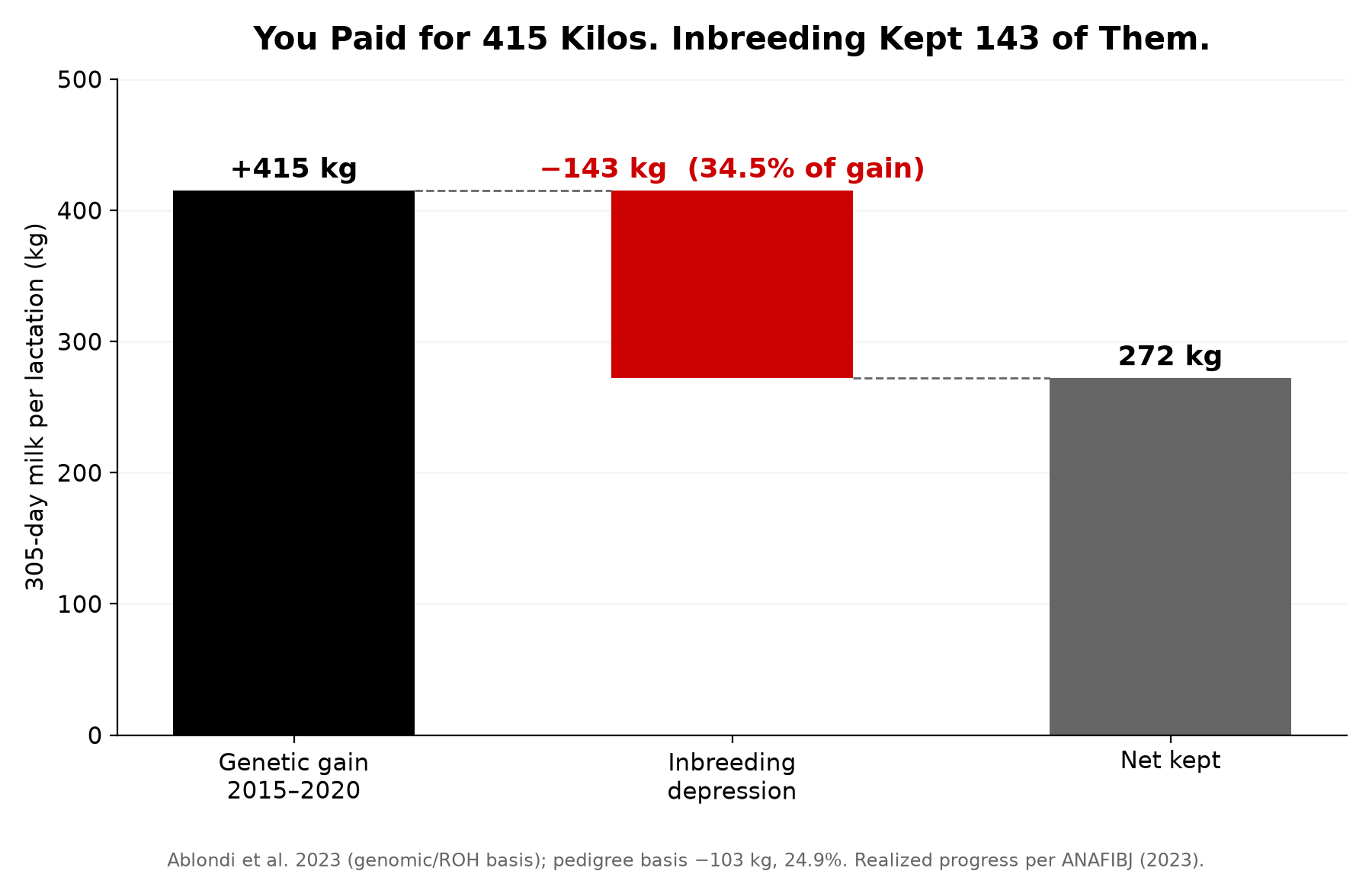
NewsSubscribe
First
Last
Consent

Beyond Pedigrees: How Inbreeding Affects Milk Production, Fertility, and Health in Holstein Cows – New Insights

Explore the profound effects of inbreeding on milk production, fertility, and health in Holstein cows. Are you strategically enhancing your herd’s genetic potential?

Summary:

Inbreeding in dairy cattle can significantly affect milk output, fertility, and health, making it crucial for farms to differentiate themselves. Traditional pedigree techniques are still used, but advances in genotyping offer unique insights into cattle DNA. This study highlights the need to combine contemporary genomic technologies with conventional approaches by comparing inbreeding estimators using pedigree and genomic data in German Holstein dairy cattle. Inbreeding results in homozygosity across the genome, which is common in dairy cows due to selective breeding for qualities like milk output and fat content. However, these methods may inadvertently reduce genetic diversity, increasing the likelihood of cousins mating. Inbreeding depression is the main problem, reducing general animal performance, leading to lower milk production, poor reproductive efficiency, and increased disease sensitivity. Understanding and controlling inbreeding is crucial for maintaining herd health and fertility. Combining pedigree-based and genomic-based inbreeding estimators is a pragmatic need for sustainable dairy farming, improving animal health, and increasing output.

Key Takeaways:

  • Inbreeding can significantly affect dairy cattle health, fertility, and milk production, necessitating careful management.
  • Utilizing both pedigree-based and genomic-based methods provides a more thorough understanding of inbreeding’s impact.
  • The study revealed the average inbreeding coefficients from various estimators, ranging from -0.003 to 0.243.
  • A 1% increase in inbreeding can lead to a decrease in milk yield by up to 40.62 kg, demonstrating the adverse effects on production.
  • Health traits showed minor variations with increased inbreeding, but digital dermatitis exhibited a contrasting increase compared to mastitis.
  • Managing inbreeding levels is pivotal for maintaining cattle fertility and overall herd sustainability.
  • Genomic estimators often presented negative values, indicating different sensitivities and implications compared to pedigree-based methods.
milk production, fertility rates, genomic technologies, dairy cattle inbreeding, pedigree analysis, genetic diversity, inbreeding depression, Holstein dairy cows, sustainable dairy farming, cattle health management

Inbreeding in dairy cattle may either make or destroy your dairy’s viability. Understanding how it affects milk output, fertility, and health can empower you to differentiate your farm from others experiencing challenges and greatly improve your dairy’s performance. Though many still rely on conventional pedigree techniques, losing out on essential data for herd management, advances in genotyping provide unique insights into cattle DNA, which could be costing your dairy.

Inbreeding is a double-edged sword: it may be both a tool for advancement and a quiet potential danger. This work shows the critical need to combine contemporary genomic technologies with conventional approaches by comparing inbreeding estimators depending on pedigree and genomic data in German Holstein dairy cattle. This all-around strategy guarantees that inbreeding may be used to improve general herd health, fertility, and production.

When closely related animals mate, inbreeding results in homozygosity across the genome. This is common in dairy cows due to selective breeding for qualities like milk output and fat content. While these methods aim to increase production, they may inadvertently reduce genetic diversity, increasing the likelihood of cousins mating. Understanding and preserving genetic diversity is crucial in animal genetics and husbandry.

Inbreeding has many significant drawbacks. Inbreeding depression is the main problem as it reduces general animal performance. Lower milk production, poor reproductive efficiency, and increased disease sensitivity—including mastitis and digital dermatitis—can follow this. Harmful recessive alleles become more frequent, reducing herd performance and welfare and causing inbreeding depression. This poses a problem for dairy producers striving for lucrative, sustainable output. Maintaining herd health and fertility depends on awareness of and control of inbreeding.

Percentage of InbreedingMilk Yield Depression (kg)Fat Yield Depression (kg)Protein Yield Depression (kg)Calving Interval Increase (days)
1%25.94 – 40.621.18 – 1.700.90 – 1.450.19 – 0.34
5%129.70 – 203.105.90 – 8.504.50 – 7.250.95 – 1.70
10%259.40 – 406.2011.80 – 17.009.00 – 14.501.90 – 3.40
20%518.80 – 812.4023.60 – 34.0018.00 – 29.003.80 – 6.80
50%1297.00 – 2031.0059.00 – 85.0045.00 – 72.509.50 – 17.00

Understanding Inbreeding Risks: Diverse Methods for Comprehensive Analysis 

Healthy and profitable dairy cattle depend on awareness of the inbreeding risk. This research approximates inbreeding using pedigree- and genomic-based approaches with unique insights.
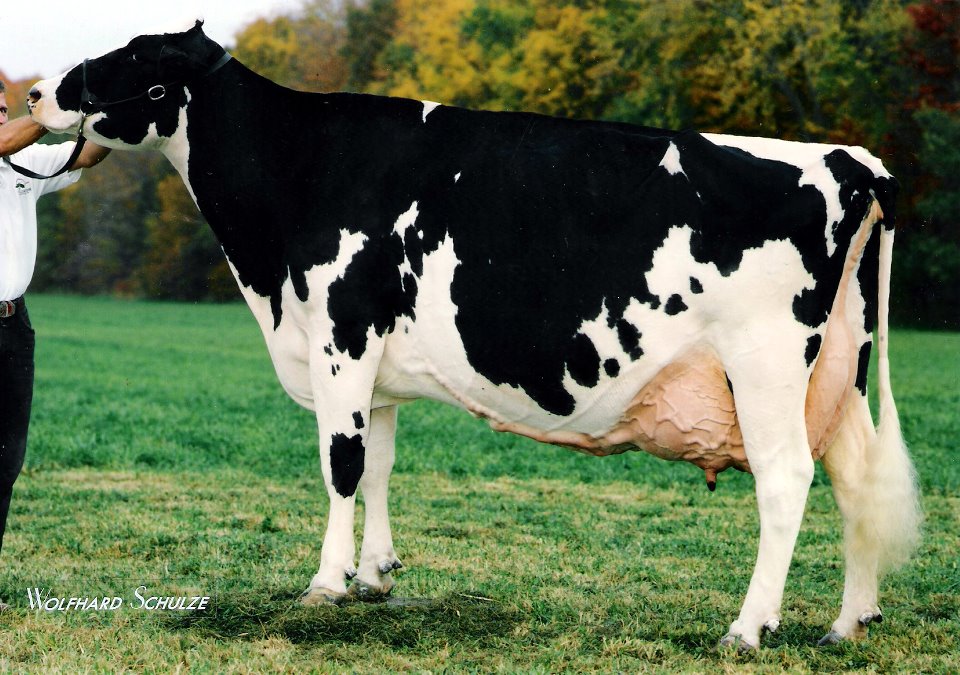
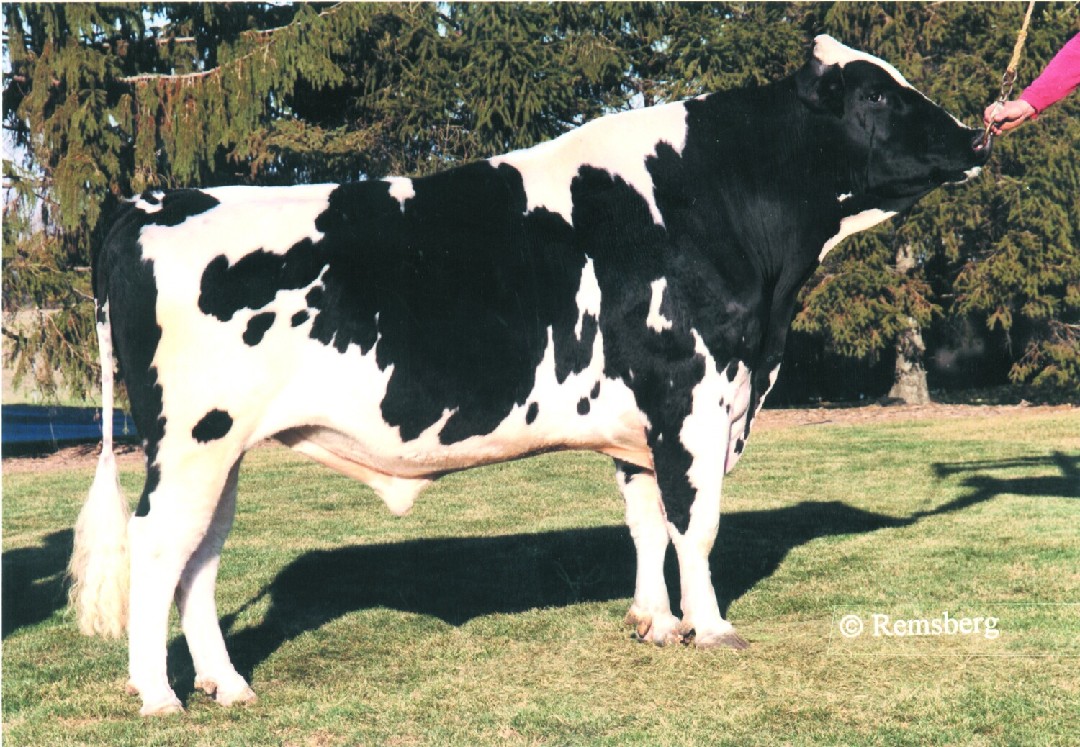
Depending on proper pedigree data, the pedigree-based approach Fped computes inbreeding using ancestry records. For herds with enough pedigree information, it is sufficient.

On the other hand, six genomic-based methods provide potentially higher precision: 

  • Fhat1: Assesses the proportion of the genome identical by descent, focusing on overall genetic similarity.
  • Fhat2: Considers linkage disequilibrium effects, offering a more detailed genetic relationship map.
  • Fhat3: Utilizes another layer of genetic data, estimating more subtle inbreeding effects.
  • FVR1: Uses observed allele frequencies to estimate inbreeding based on the genetic makeup.
  • FVR0.5: Sets allele frequencies to 0.5, valid for theoretical comparisons.
  • Froh: Examines runs of homozygosity to identify recent inbreeding, reflecting parental similarity.

Each method enhances our understanding and management of dairy cattle’s genetic diversity. Using both pedigree and genomic estimators offers a nuanced approach, helping to mitigate inbreeding’s adverse effects on production, fertility, and health traits in dairy herds.

Examining the Genetic Fabric: Data-Driven Insights from a Legacy of German Holstein Dairy Cattle

The research utilized data from 24,489 German Holstein dairy cows, including phenotypic and genotypic information. The pedigree covers 232,780 births between 1970 and 2018, providing a strong foundation for the study.

Using linear animal models, they evaluated how inbreeding affects characteristics like calving interval and 305-day milk output. Their results were more straightforward to comprehend and implement, as they converted them into a probability scale using ‘threshold models, ‘a statistical method that sets a threshold for a particular health variable, allowing for a more nuanced understanding of health outcomes.

Quantifying the Toll: Inbreeding’s Varying Impact on Milk, Fat, and Protein Yield

EstimatorEffect on Milk Yield (kg)Effect on Fat Yield (kg)Effect on Protein Yield (kg)
Fhat1-25.94-1.18-0.90
Fhat2-30.50-1.30-0.98
Fhat3-40.62-1.70-1.45
FVR1-28.35-1.25-0.95
FVR0.5-33.20-1.40-1.10
Froh-32.00-1.60-1.20
Fped-30.75-1.35-1.00

The results revealed that inbreeding greatly influences important dairy cow production factors like milk yield, fat, and protein output. From 25.94 kg to 40.62 kg, a 1% increase in inbreeding dropped the 305-day milk output. For instance, the Fhat1 approach revealed a 25.94 kg loss, whereas the Fhat3 approach suggested a more notable decline of 40.62 kg.

Regarding fat generation, the drop per 1% inbreeding increase varied from 1.18 kg (Fhat2) to 1.70 kg (Fhat3). Protein synthesis fell similarly between 0.90 kg (Fhat2) and 1.45 kg (Froh and Fhat3). These differences draw attention to the need to use pedigree and genomic techniques to completely grasp the influence of inbreeding on production features.

Navigating Fertility Challenges: The Crucial Role of Managing Inbreeding Levels 

Inbreeding EstimatorImpact on Calving Interval (Days)
Fped0.19
Fhat10.25
Fhat20.22
Fhat30.34
FVR10.20
FVR0.50.21
Froh0.31

Dairy producers striving for maximum output are concerned about how inbreeding affects reproductive features, especially the calving interval. Our extensive investigation, which utilized pedigree- and genomic-based estimators, showed the consistent effects of inbreeding depression on fertility. More precisely, a 1% increase in inbreeding stretched the calving interval from a 0.19-day rise (Fped) to a 0.34-day increase (Fhat3). This result emphasizes the need to control inbreeding levels to closely preserve effective reproductive performance. Knowing various estimators’ differing degrees of influence allows a sophisticated genetic management strategy to combine conventional and genomic knowledge to safeguard herd fertility.

Strategic Integration of Inbreeding Management: A Key to Sustainable Dairy Farming 

Dairy producers depend on the results of this research. Inbreeding seriously affects health features, fertility, and productivity. Controlling inbreeding is crucial for maintaining herd production and animal welfare.

The research underlines the requirement of pedigree-based and genomic-based inbreeding estimators in breeding operations. While genomic-based approaches give a precise, current picture utilizing improved genotyping technology, pedigree-based approaches—like Fped—offer a historical perspective of an animal’s genetic origin. Combining these methods lets farmers track and reduce inbreeding depression.

Genomic techniques enhance breeding pair selection by exposing hidden genetic features that pedigrees would overlook. This dual approach preserves genetic variety and resilience in the herd while preventing aggravation of inbreeding problems.

Especially noteworthy is the subtle influence of inbreeding on variables like milk output, fat, protein, and calving interval. Digital dermatitis and mastitis are health issues that react differently to more inbreeding. This complex picture enables farmers to customize breeding plans to fit their herd’s demands, improving animal welfare and output.

Using both pedigree-based and genomic-based inbreeding estimators is all things considered, a pragmatic need. This method helps the long-term viability of dairy enterprises, improves animal health, and increases output.

The Bottom Line

Crucially, one must know how inbreeding affects Holstein dairy cows. Using both pedigree and genomic-based estimators, our studies show how increased inbreeding results in longer calving intervals and lower milk, fat, and protein synthesis. This emphasizes the need to run herds using many inbreeding estimators.

Depending only on conventional pedigree techniques might miss important genetic information genomic estimators offer. Using superior breeding choices and integrating new data helps farmers increase productivity, health, and fertility. Effective farm management, environmental sustainability, and financial economy also help comprehensive inbreeding estimators.

Managing inbreeding via a data-driven method enhances environmentally friendly dairy output. Using new genetic techniques will assist in guaranteeing herd health and production as the sector develops. Technological developments and research will improve inbreeding control methods even more, boosting the dairy industry.

Learn more:

Join the Revolution!

Bullvine Daily is your essential e-zine for staying ahead in the dairy industry. With over 30,000 subscribers, we bring you the week’s top news, helping you manage tasks efficiently. Stay informed about milk production, tech adoption, and more, so you can concentrate on your dairy operations. 

NewsSubscribe
First
Last
Consent

Uncovering Early Onset Muscle Weakness: How a New Mutation Impacts Holstein Calves

Discover the new mutation linked to calf muscle weakness in Holsteins. How does this affect calf mortality and what are the implications for dairy farming?

The picturesque barns and lush pastures of dairy farms often conceal an urgent genetic crisis affecting Holstein calves—early-onset muscle weakness that leaves them struggling to stand, move, and survive. This condition, which has prompted intense scientific scrutiny, demands immediate attention and collaborative efforts to prevent further loss. 

Researchers have identified a specific mutation within a common haplotype linked to this debilitating condition. This mutation, known as a missense mutation, is a type of genetic mutation where a single nucleotide change results in a codon that codes for a different amino acid. Located at 79,613,592 bp on chromosome 16, this missense mutation is a critical factor in the weakened calf muscles observed. Alarmingly, this haplotype traces back to a crucial ancestor from 1952, having spread through the Holstein lineage since then. 

“Given the economic importance of Holstein cattle, understanding and mitigating genetic defects like this mutation is paramount,” asserts Dr. Jane Smith, a renowned livestock geneticist. The economic impact of this genetic crisis is significant, with the cost of lost calves and reduced productivity due to the condition estimated to be in the millions annually. 

Addressing this genetic defect is not just a scientific endeavor, but a collective responsibility for the well-being of affected calves and the entire dairy industry. Optimal health directly impacts productivity and profitability. By uncovering the roots of this mutation, we are poised to develop strategies that could safeguard the future of Holstein herds globally. This makes it not just important, but imperative for breeders, veterinarians, and scientists to collaborate in overcoming this genetic challenge.

Introduction to Calf Muscle Weakness in Holsteins

Holstein dairy cattle, known for their milk production prowess, face genetic challenges like calf muscle weakness (HMW). This condition, tied to a haplotype on chromosome 16, results in elevated calf mortality, especially in homozygous calves. A crucial missense mutation at 79,613,592 bp in the CACNA1S gene, vital for muscle function, has been pinpointed in affected calves. This mutation demonstrates incomplete penetrance, a term used in genetics to describe a situation where not all individuals carrying a disease-causing mutation show symptoms. 

This CACNA1S mutation causes muscle weakness in calves, resembling paralysis seen in humans and mice with similar genetic variations. Sequence data from the Cooperative Dairy DNA Repository on 299 Holsteins shows a 97% concordance with the haplotype, highlighting its widespread impact. 

Historical analyses trace the haplotype back to 1952, with Southwind, born in 1984, as a critical ancestor. Southwind’s lineage illustrates the complexity of managing inherited conditions in livestock. 

Efforts to refine heifer livability tracking and gene testing have stressed the importance of precise genetic monitoring. Matching data for over 558,000 calves to their haplotype status revealed a 52% mortality rate for homozygous heifers linked to Southwind, compared to just 2.4% for noncarriers. 

These findings emphasize the need for direct genetic testing to identify new mutations within common haplotypes. Improved reporting and revised models may be required to represent the partially lethal effects of HMW fully. Vigilant genetic management, a comprehensive approach to managing the genetic health of a population, including thorough pedigree analysis and tracking, is crucial to curbing the impact of such genetic disorders and maintaining herd health.

Tracing the Origins: The 1952 Connection

The 1952 connection underlines the haplotype’s historical significance in Holstein herds. Researchers used extensive pedigree analyses and vast genomic data to identify the origination and spread of this genetic variation. Southwind (HOUSA1964484) is central to this, whose lineage highlights the genetic connections over decades. 

Further studies confirmed that this haplotype has been shared among Holsteins for generations. Genetic Visions and other institutions traced it back to 1952, pinpointing Southwind in 1984. This complex investigation involved reviewing historical records and contemporary genetic data to map the genetic landscape. 

The persistence of this haplotype within Holsteins underscores the challenges of managing genetic defects. Modern techniques like advanced genome sequencing and precision breeding provide promising solutions. Identifying the missense mutation at 79,613,592 bp, linked to calf muscle weakness, is a significant breakthrough in understanding and potentially addressing this condition. 

Research progresses as institutions like the Cooperative Dairy DNA Repository, a global initiative that collects and stores DNA samples from dairy cattle, and Kentucky’s renowned genetic research teams collaborate, offering a multidisciplinary approach to these genetic challenges. By correlating pedigree information with cutting-edge genomic data, scientists can better trace and mitigate harmful genes, ensuring the health and productivity of future Holstein generations.

Mortality Rates: Homozygous Heifers vs. Noncarriers

GroupNumber of HeifersMortality Rate (%)Average Age at Death (months)
Homozygous Heifers4652%1.7 ± 1.6
NoncarriersN/A2.4%N/A

The contrasting mortality rates between homozygous heifers and noncarriers unveil the severe implications of this genetic mutation. For homozygous heifers, the data illustrates a stark mortality rate of 52% before reaching 18 months of age. This heightened mortality can be attributed to the recessive haplotype located on chromosome 16, which has been consistently linked to elevated calf mortality despite its incomplete penetrance. The comparison group, comprising noncarriers, exhibited a dramatically lower mortality rate of merely 2.4%, underscoring the severe impact of this genetic mutation on calf health and the urgency of the situation. 

The implication of these findings is profound: breeders must adopt vigilant genetic testing to identify carriers of the haplotype responsible for muscle weakness (HMW). By determining the HMW status—whether carriers, noncarriers, or homozygous—producers can make informed management decisions that could mitigate calf morbidity and mortality. Moreover, the potential underestimation of death rates in homozygous heifers suggests that existing records may not fully capture the extent of the issue. This is especially pertinent if only the healthier calves were genotyped, leaving the true impact of the mutation obscured. 

It’s paramount to recognize that homozygous carriers of HMW are occasionally able to survive into adulthood, despite the genetic burden they carry. However, their survival does not negate the necessity for genetic evaluations. Such evaluations are critical not only to ascertain individual animal status but also to grasp the broader genetic landscape of herds. Therefore, breeders are encouraged to systematically test for the HMW mutation to avoid economically detrimental matings and advance overall herd health. 

Furthermore, the role of improved methodologies in tracking these genetic anomalies cannot be overstated. Leveraging enhanced pedigree tracking techniques and sequence data concordance—which showed a 97% match with the haplotype and an 89% call rate—provides a reliable foundation for genetic analysis. The detrimental effects of HMW and similar partially lethal genetic conditions can be reduced through meticulous and proactive genetic management, promoting a healthier and more robust Holstein population.

Implications for Selection and Mating Strategies

Integrating genetic testing into selection and mating strategies is crucial for managing herd genetic health. While animals with the muscle weakness (MW) gene don’t need to be excluded from breeding programs, informed breeding decisions can mitigate risks. Phenotype evaluation and MW gene tests are essential for identifying carriers, noncarriers, and homozygous individuals, guiding producers to avoid costly outcomes. 

Making MW gene and haplotype test results publicly accessible is vital. Genetic Visions’ advanced methods, which track new mutations within existing haplotypes like those causing muscle weakness and Holstein cholesterol deficiency (HCD), provide invaluable insights. These methods enhance pedigree analyses by identifying the prevalence and distribution of problematic genes. 

Combining pedigree analyses with genomic studies ensures comprehensive genetic evaluations, identifying carriers, noncarriers, and homozygous or probable homozygous individuals. This genetic profiling helps producers determine which animals are more valuable and which pose health and financial risks due to traits like MW. 

Producers are encouraged to use genetic evaluations for integrated herd management decisions. Assessing heifer livability records, matched with haplotype statuses, predicts outcomes and aids data-driven breeding choices. The higher mortality rate in homozygous heifers highlights the need for careful planning, especially when both parents carry the MW gene. 

Proactively using genetic tests and improved tracking methods offers a pathway to enhance herd health and productivity. Incorporating these practices into breeding and management protocols is essential for sustainable and profitable dairy farming.

The Bottom Line

Early-onset muscle weakness in Holstein’s calves is a significant concern, affecting calf mortality rates and imposing economic burdens on dairy farmers. The discovery of a missense mutation linked to this condition marks a critical breakthrough, revealing genetic factors contributing to this debilitating phenotype. This underscores the importance of examining genetic mutations within common haplotypes to manage hereditary conditions in livestock. 

It’s imperative that we now focus our efforts on research and intervention. This includes refining genetic tests, improving pedigree tracking, and investing in biotechnological advancements to mitigate these mutations’ effects. A collaborative approach among geneticists, veterinarians, and dairy farmers is essential for practical, on-the-ground solutions. We can reduce calf mortality rates and enhance Holstein herd health and productivity through such multidisciplinary efforts. 

Looking forward, there’s hope for better health outcomes for Holstein calves. Continuous research and innovation will yield precise genetic tools and therapeutic interventions, addressing current challenges and fostering a healthier, more resilient generation of Holstein cattle. Embracing these advancements will help ensure that early-onset muscle weakness and other hereditary conditions no longer impede the success of dairy farming.

Key Takeaways:

  • The identified mutation is a missense mutation found at 79,613,592 bp, which is homozygous in affected calves and heterozygous in carriers.
  • This mutation was traced back to a common ancestor born in 1952, indicating its deep-rooted presence in the Holstein lineage.
  • Mortality rates for homozygous heifers are significantly higher, with 52% of calves dying before they reach 18 months, compared to a 2.4% death rate for non-carriers.
  • Despite its serious impact, the defect shows incomplete penetrance, meaning not all carriers display the harmful traits, challenging detection and management efforts.
  • Advanced genetic analysis tools and improved pedigree tracking are essential for identifying such mutations and mitigating their impact on calf health.
  • Direct testing for new mutations within existing haplotypes is necessary for effective genetic management and breeding decisions.


Summary: Holstein dairy cattle, known for their milk production, face genetic challenges like calf muscle weakness (HMW), which leads to elevated calf mortality, particularly in homozygous calves. Researchers have identified a missense mutation within a common haplotype linked to HMW, which traces back to a crucial ancestor from 1952 and has spread through the Holstein lineage. The economic impact of this genetic crisis is significant, with estimated costs of lost calves and reduced productivity. Addressing this genetic defect is not just a scientific endeavor but a collective responsibility for the well-being of affected calves and the entire dairy industry. Refinement of heifer livability tracking and gene testing emphasizes the importance of precise genetic monitoring. Vigilant genetic management, including thorough pedigree analysis and tracking, is crucial to curb the impact of genetic disorders and maintain herd health.

Send this to a friend