





A young bull sells semen from first release to proof and beyond — he’s earning the whole time. So the only thing the wait actually buys you is the proof itself. And on average, the proof tells you less than his DNA already did.
Editor’s Note: The stud manager in the opening is a composite scenario modeled on publicly reported AI-stud practices, used to illustrate a real industry dynamic. It does not depict a specific individual.
Run the scenario at a typical mid-size AI stud in spring 2026. The manager’s got roughly 100 young bulls in the lineup, each one a genomic bet placed two or three years ago. Every one was genotyped as a calf. He already knows, to a tight reliability band, what most of them transmit — and their semen has been selling the whole time. The question isn’t whether they earn their keep; they do. The question is what he’s still paying for on the ones he holds all the way to a traditional daughter-proof. Because that wait carries a cost almost nobody puts a number on — and buys something worth less than most people assume.
Holstein International ran a tidy table on this. Fifty studs, one column, retention rates running from “less than 5%” to a flat 100%. Aberekin keeps everything. Elitest and VikingGenetics keep almost nothing. The takeaway, more or less: proven bulls still sell, philosophies differ, isn’t that interesting.
It is interesting. It’s also a snapshot dressed up as an answer.
What does the wait for a proof actually buy?
Less than you’d think — and here’s the number nobody puts on it.
Start with what the proof costs to chase. A peer-reviewed decision tool, BullVal$, published in Animals in 2023, uses an AI company’s own estimate of $30 per bull per day to cover physical maintenance — feeding, housing, and veterinary care. That $30 is one company’s published figure, not an industry average, so treat it as order of magnitude. Hold a bull from his genomic debut as a yearling until his daughters milk and a proof lands — three to four years, call it 1,200 days — and that’s roughly $36,000 in maintenance.
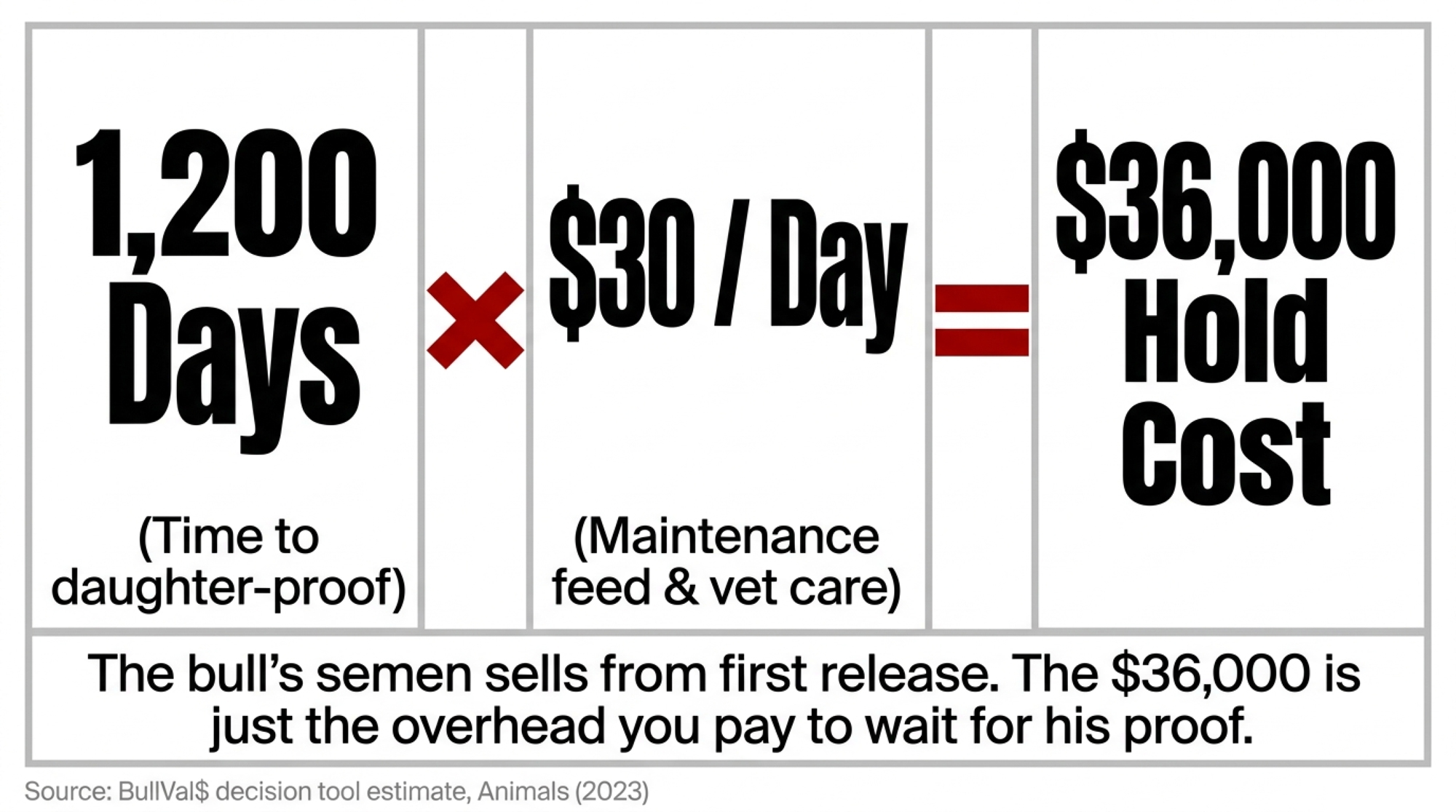
The carry, in one line
$30/day × 1,200 days ≈ $36,000 per bull in maintenance — running on top of, not instead of, the semen he’s selling the whole time. The doses earn; the wait is the cost.
His semen sells the entire time he stands, often at full price from first release. So the $36,000 isn’t money spent on an idle animal — it’s the overhead of running him long enough to reach a daughter-proof. Which raises the real question: what does that proof actually tell you that his genotype didn’t?
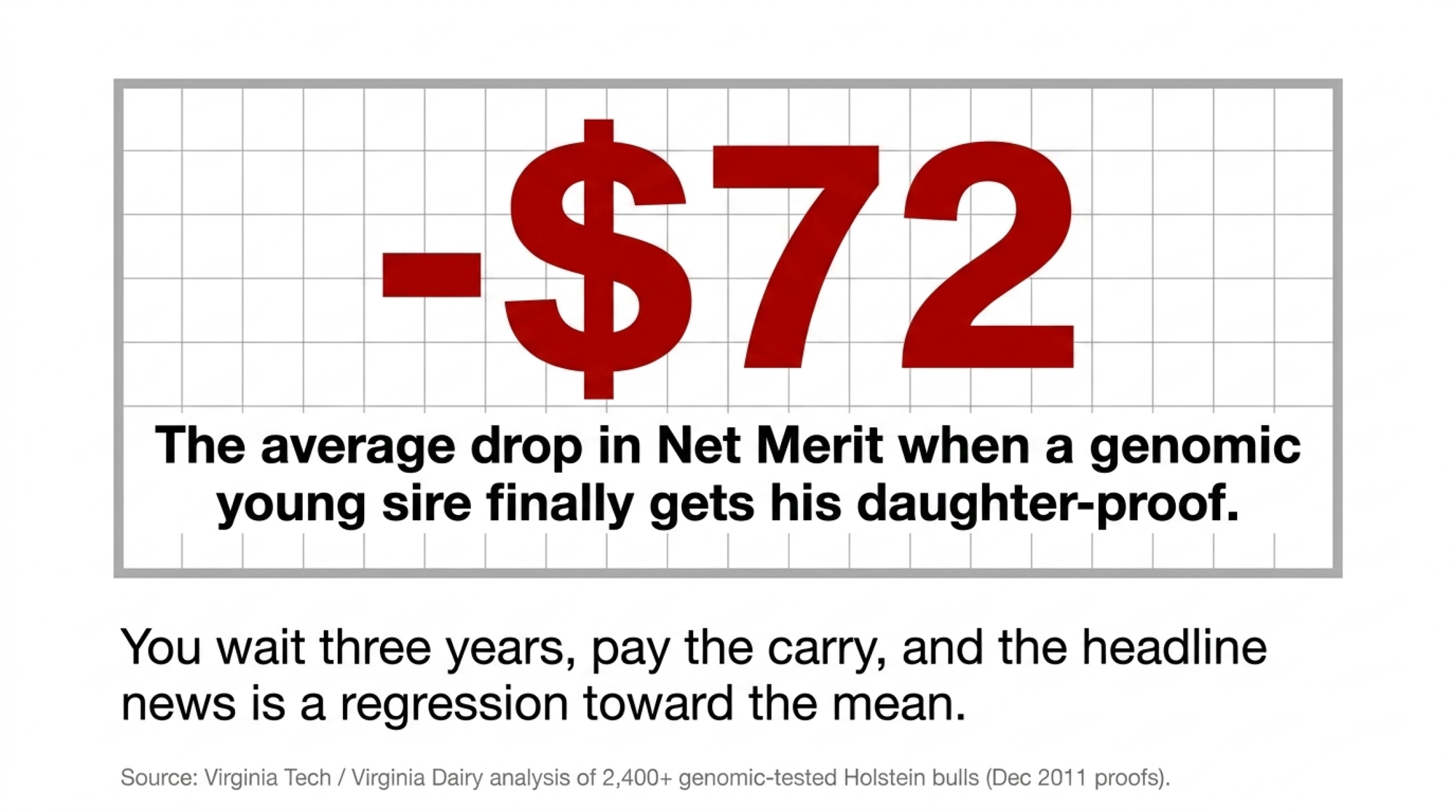
Here’s the answer, with a number on it. Virginia Tech tracked the December 2011 proofs on more than 2,400 genomic-tested Holstein bulls — bulls already marketed on their genomic predictions. When the daughters finally milked, the average daughter-proof came in $72 lower in Net Merit than the genomic figure those bulls had been sold on, and dropped nearly a month of Productive Life (Cassell, Virginia Tech / Virginia Dairy). You waited three to five years, paid the carry, and the proof’s headline news was a markdown.
That’s the trade nobody prices. As the same analysis put it, waiting to lift reliability from about 70% to about 85% is “a questionable decision on young bulls with some pretty fantastic genomic predictions.” Genomic young-sire semen often sells at a premium before a proof; the proof, on average, doesn’t add value — it regresses the bull toward the mean and sometimes docks his price just as his daughters arrive.
Proof-Chasing Overhead Simulator
Progeny Testing Carry Costs vs. Accelerated Genomic Pipelines
Pipeline Input Variables
Why did genomics speed up genetic gain — better predictions, or less waiting?
Less waiting. That's the part the proven-bull conversation keeps skipping.
When the U.S. moved to genomic selection, the rate of genetic progress jumped a gear. The Net Merit trend tells it plainly:
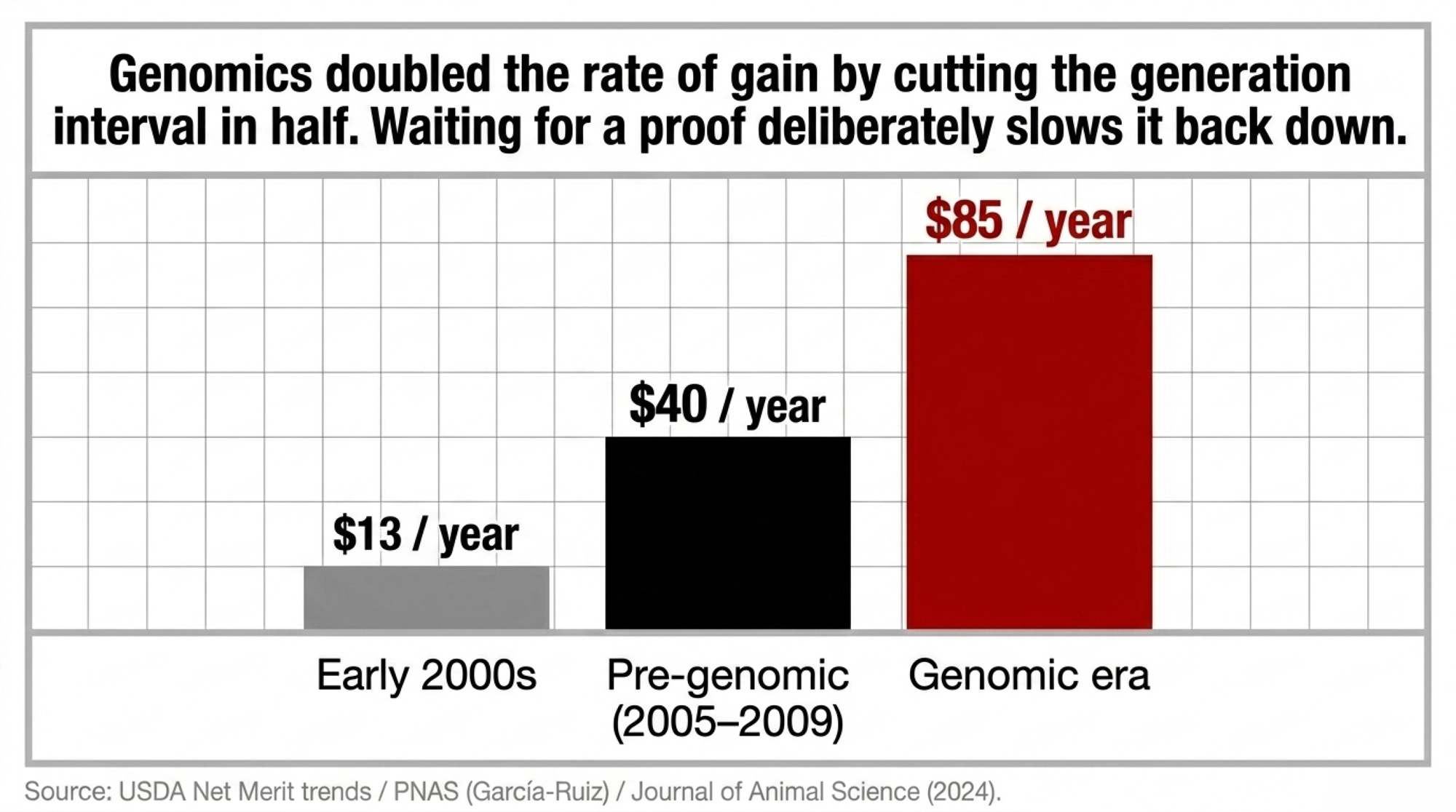
| Era | Annual genetic trend (Holstein bulls, Net Merit) |
| Early 2000s | ~$13 / year |
| Pre-genomic (2005–2009) | ~$40 / year |
| Genomic (service since 2011) | ~$85 / year |
That's more than double the pre-genomic pace. The published trend lines in Frontiers in Genetics spell it out, and The Bullvine has walked through this doubling before. Net Merit values shift with each base change and formula revision — the index was rebased to 2020-born cows in April 2025 — but nobody disputes the direction or the scale of the jump.
The why is where the genetics literature stops arguing. A 2024 review in the Journal of Animal Science concluded that "most of the increased genetic gain is attributed to reduced generation intervals." VanRaden's group put it plainer — genomics doubled gain "primarily through halving the generation interval," with bull-parent ages "now near the biological minimum." The landmark García-Ruiz study in PNAS measured U.S. Holstein generation intervals collapsing right after 2009.
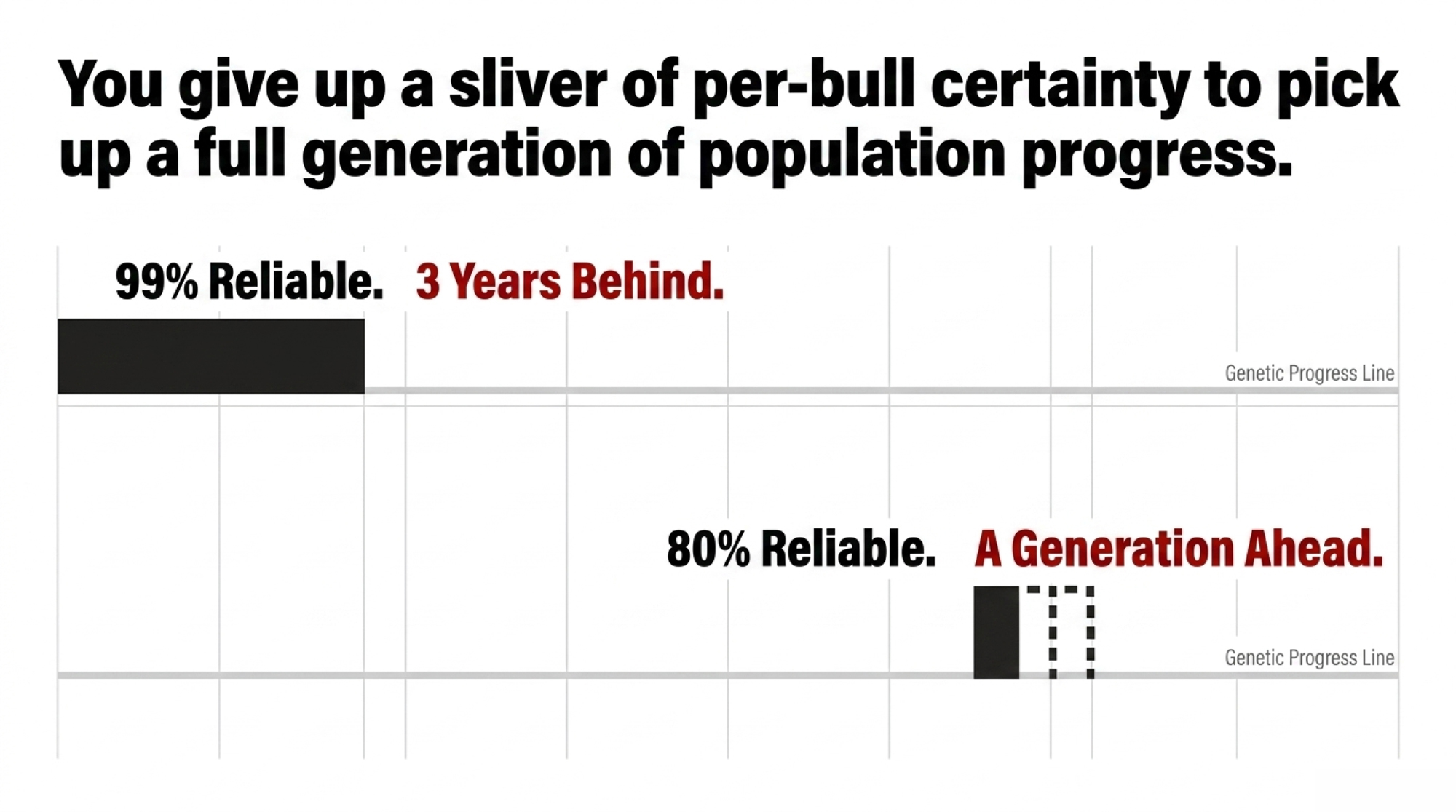
So sit with the contradiction. The engine of modern progress is turning generations faster. The sample-and-prove model does the opposite — it deliberately slows the interval back down on the bulls it holds. A bull you keep until proof is, by definition, old by the time that proof lands. You bought a little certainty with a lot of time, and time is the one input genetics can't spare anymore. Peer-reviewed simulation work confirms the mechanism: pairing genomic selection with a sharply shorter generation interval can double the rate of gain.
"But genomic reliability is only 70%" — true, and mostly beside the point
This is the proven-bull camp's strongest card. Genomic indexes sit around 70–80% reliability, so there's roughly a 30% chance a bull transmits differently than predicted. Proven bulls hit 90–99%. Why gamble?
Fair question. But it quietly assumes every trait you care about is equally uncertain at the genomic stage. It isn't. Sort the traits, and most of the gamble evaporates:
| What you're selecting for | Genomic reliability today | The real situation |
| Milk, fat, protein | ~75–82% | Plenty. Genomic testing reveals ~75% of an animal's genetic potential before she ever milks. |
| A2A2, BB kappa-casein, β-lactoglobulin, polled, recessive haplotypes | ~99–100% | Single-gene traits read straight off the DNA — not predictions. |
| Health & fertility | Lowest today, climbing | More female genotypes lift accuracy every year. |
On production, 80% is plenty. Milk, fat, and protein are moderately heritable — CDCB uses 15–29% for yield, with butterfat and protein around 20–25%. When you're chasing pounds of components, an 80%-reliable young sire who's three years of gain ahead beats the proven option that's three years behind. You give up a sliver of per-bull certainty and pick up a generation of population progress.
And on the traits that increasingly decide whether your milk gets sold at all, reliability isn't 70% — it's effectively 99–100%. Take BB kappa-casein, the "cheese-yield gene." Peer-reviewed work confirms the long-cited Ng-Kwai-Hang finding: milk with the BB variant shows roughly 10–40% shorter coagulation time and 20–140% greater curd firmness than AA milk, with BB delivering the highest curd firmness of any genotype. A2A2 beta-casein, beta-lactoglobulin, polled, clean haplotype status — you don't wait three years for a proof to know any of it. You know the day you genotype the bull. UW–Madison Extension reports that a quick survey of five AI stud websites turned up over 800 A2A2 Holstein bulls — "by far the most common" genotype — and says the breed "is quickly moving to be an A2A2 only breed."
Reliability is also a moving floor. Genotyping has collapsed in price — commercial dairy panels now run around $43/head, down from roughly $100 a decade ago — so genotyping every heifer calf at birth is becoming routine. That flood of female records is exactly what lifts accuracy on the health and fertility traits genomics is weakest on. Push young-bull reliability up 10 points, and the case for waiting on a proof gets thinner still.
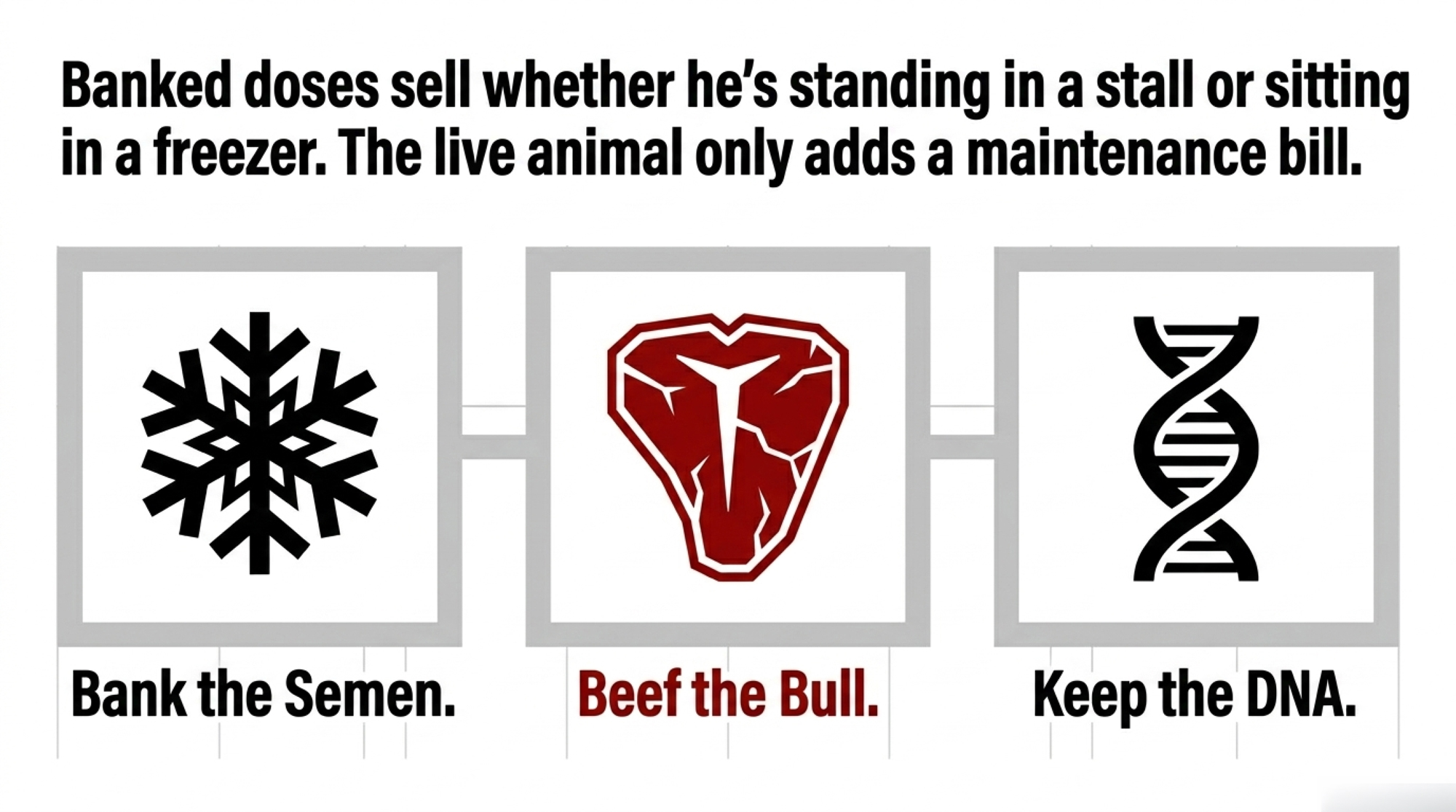
The clearest signal isn't in the survey answers — it's in what the inventory tanks already show. Serious studs freeze deep inventory on a bull — a few thousand doses on a routine young sire, tens of thousands on the high-genomic standouts — then send the bull himself to beef. The semen sits in a tank and keeps selling; the bull doesn't keep eating. And every one is genotyped, so the DNA's on file for re-analysis as new traits get added. You never needed the live, housed bull to keep selling him — the banked doses sell whether he's standing in a stall or sitting in a freezer. The only thing the live bull adds is the maintenance bill while you wait for a proof that, on average, docks his value.
| Factor | Hold to daughter-proof | Bank semen + beef the bull |
|---|---|---|
| Maintenance cost to reach decision | ~$36,000/bull (≈$30/day × 1,200 days) | $0 — doses sell from the tank |
| What the wait adds to value | Average −$72 Net Merit + ~0.8 mo Productive Life | Nothing lost; DNA on file for re-analysis |
| Reliability gained | ~70% → ~85% | Stays ~70–85% (plenty for yield) |
| Position on the gain curve | A full generation behind | A generation ahead |
| Single-gene / contract traits | Already known at genotyping | Already known at genotyping |
Are you keeping proven bulls for a customer who's disappearing?
Maybe. The honest core of the proven-bull case is that they "continue to sell" — and that's true and current. Cogent's December 2025 sire summary still leads with proven sires "for farmers who value consistency," and Semex still markets daughter-proven bulls at the top of its lineups. Real demand is real demand. Nobody should torch a profitable product line on theory.
There's a fair argument on the other side, too. The American Jersey Cattle Association's own Jersey Journal breed-improvement series argues that breeders have leaned too heavily on individual young sires and should use high-ranking proven bulls heavily while sampling young bulls lightly to find the next great ones. The AJCA has since backed that with hard structure — its new GenProgress sampling program, announced in late 2025, requires nominated young bulls to come from proven A.I. sires and documented maternal lines. That's disciplined sampling working as designed. The question this piece raises isn't whether to sample — it's who should carry the cost of that sampling, and whether a live, housed bull is still the cheapest way to do it when the semen can sit in a tank instead.
Then look at who that customer is becoming. U.S.-licensed dairy farms have fallen by about 45% since 2014, down to roughly 24,800, while average herd size has climbed to about 377 cows. Per the American Farm Bureau's analysis of USDA data, the largest operations now make most of the milk. The 200-to-500-cow family dairy buying a "safe" proven bull from a catalog — the exact customer this model was built for — is the segment getting squeezed hardest as consolidation grinds on. The buyer of the 2030s runs two or three times today's herd, employs a nutritionist and a geneticist, and thinks in rate-of-gain and component contracts. That buyer pays for speed, not for the privilege of waiting.
Are you still breeding to a bull that died in 2008?
Here's where this stops being a story about studs and starts being about you. The proven-bull instinct doesn't live only in semen barns — it lives in mating decisions made by breeders who reach for a name they trust rather than a plan they follow. Goldwyn. Lambda. Captain.
Braedale Goldwyn was born on January 3, 2000, and died in 2008. Chase his look in 2026, and you're linebreeding to a 26-year-old pedigree while the genomic frontier has moved three or four full generations past him. We get the romance — a favorite sire is a relationship, a genomic list is a spreadsheet. But the habit carries a bill most breeders don't see until it lands.
That bill is inbreeding. When everyone piles onto the same admired sire, the pool narrows fast:
- By 2008, Goldwyn and two other popular sires accounted for nearly 12% of all registered Holstein females in Canada.
- One bull, To-Mar Blackstar, sits behind an estimated 15.8% of today's Holstein DNA.
- Canadian Holstein heifers born in 2024 now average 9.99% inbreeding — the highest of any major dairy breed, per Lactanet's August 2025 update.
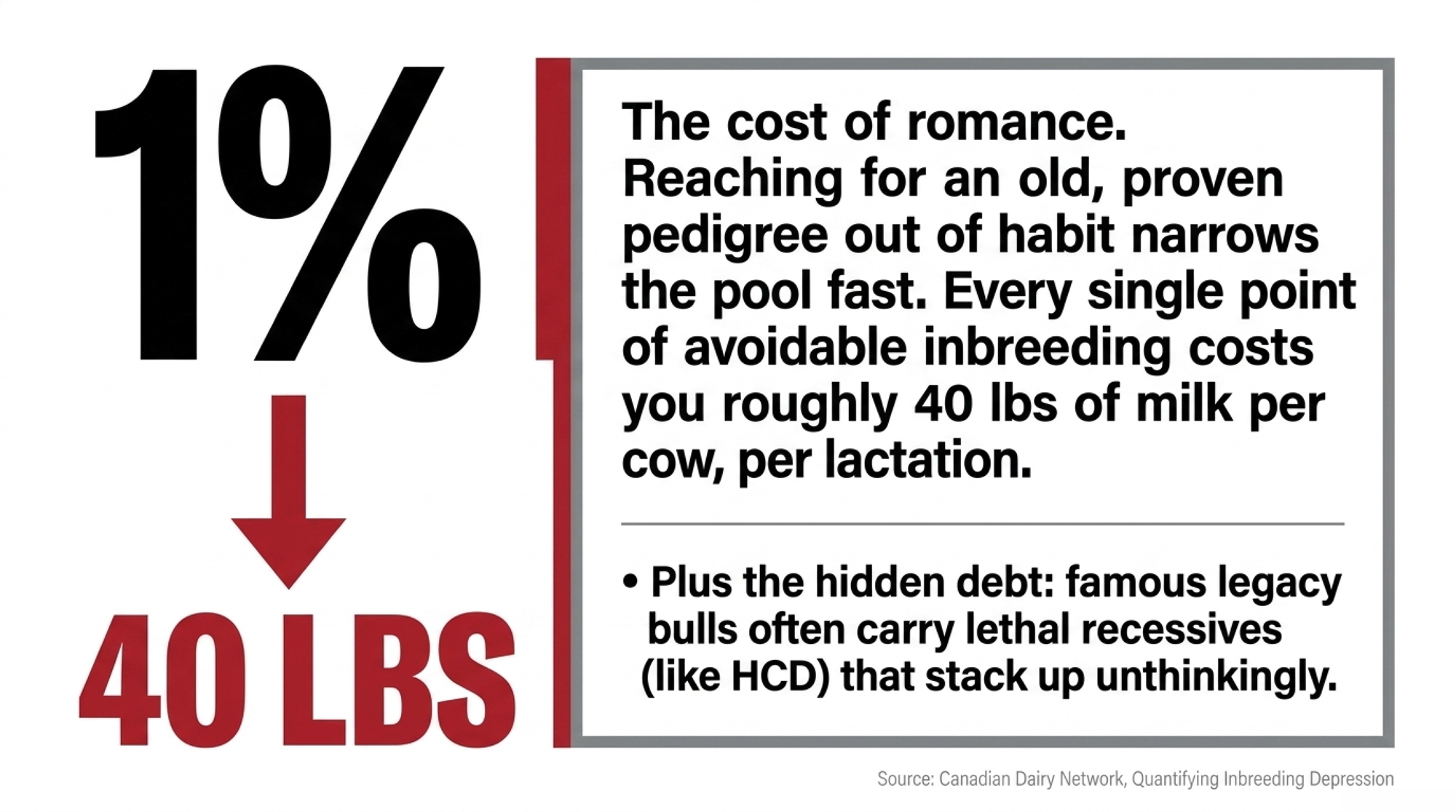
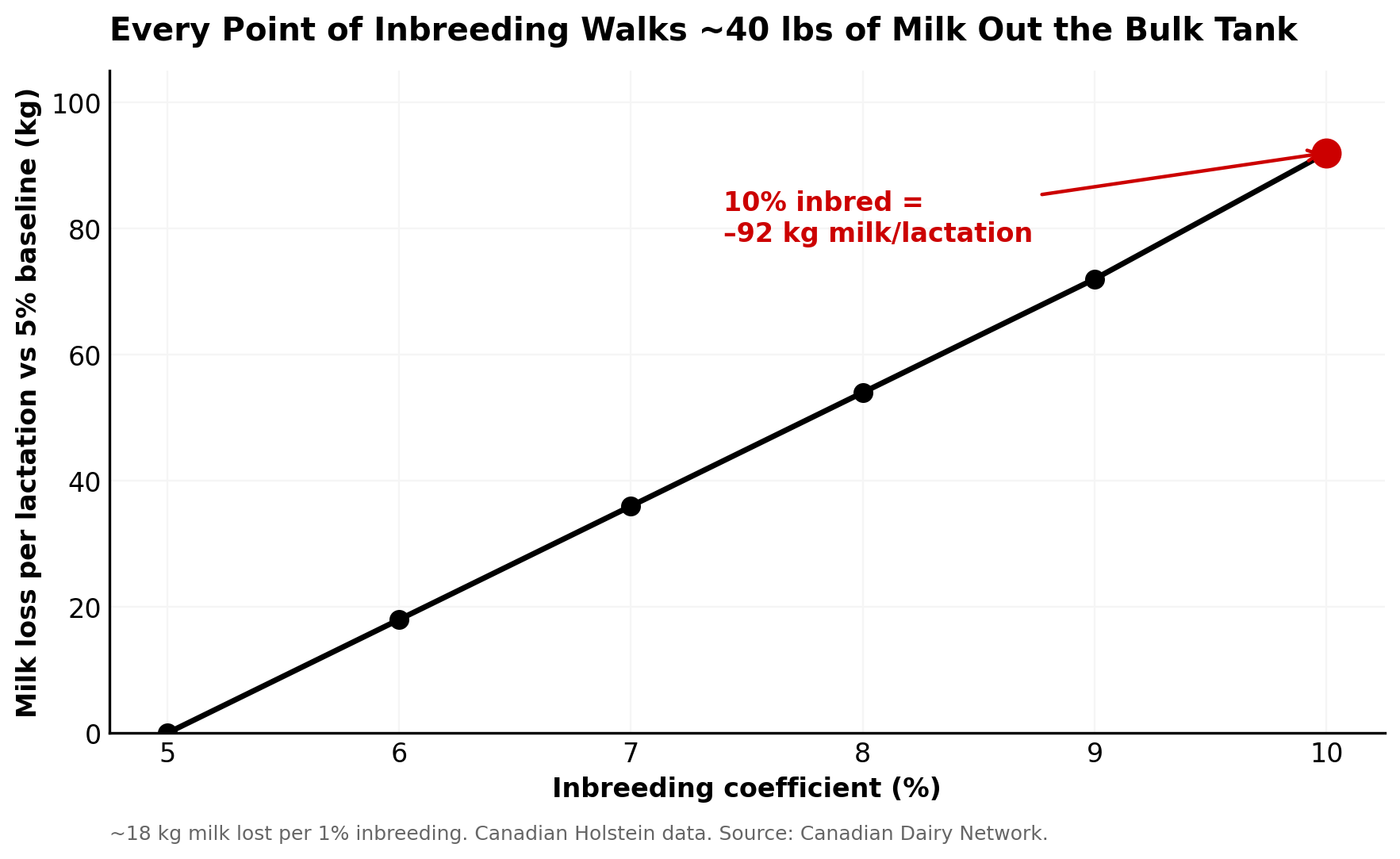
Here's the barn-math version you can map to your own herd. A Canadian Dairy Network analysis found that cows that are 10% inbred lose about 92 kg of milk per lactation compared with cows at 5% inbreeding — roughly 18 kg, or about 40 lbs, of milk for every 1% inbreeding climbs. On a 100-cow herd, a single point of avoidable inbreeding is roughly 4,000 lbs of milk per lactation walking out the bulk tank. Keep it in proportion, though: fewer than 5% of Canadian Holsteins are even above 10% inbred. This is a real, manageable leak — not a catastrophe. (Those figures are Canadian Holstein data; the biology travels, but U.S. herds should confirm against their own evaluations.)
And the legends carry hidden debts. Goldwyn is a known carrier of Cholesterol Deficiency (HCD), a lethal recessive traced to the APOB gene. Breed unthinkingly toward his pedigree, and you stack carrier on carrier without meaning to.
Options and trade-offs
There's no single right answer here — there's the answer that fits your operation, your breed, and what your milk buyer pays for. A few honest paths:
Stud running Holstein: go all-genomic, bank deep, keep the DNA. Makes sense when production traits dominate your breeding goal, and you've got the deepest reference population on earth working for you. What it requires is the discipline to send good-looking bulls to beef once their semen is banked. The risk: you give up a legacy product line some loyal clients still want — so hold a handful to proof if a profitable market asks, but call it a niche, not your gain engine.
Stud in Jersey, Brown Swiss, or a colored breed: lean hard on genomics, but sample with intent. Same $30/day housing cost, smaller population, higher stakes per decision. The Jersey camp makes a real case for disciplined sampling to find the next proven sires — the open question is whether you need a live bull in a stall to do it, or whether banked semen and DNA-on-file get you there more cheaply. For most thin-market breeds, the cost math leans hard toward banking.
Breeder with a favorite sire: trade the scrapbook for a plan. The fix isn't a different favorite — it's not having one. Set your breeding goal first, then refresh the bull team after each proof run against it, using the best young genomics available now and managing relationships to keep inbreeding down. The cow doesn't care that the bull is famous; she cares that he's the right outcross at the right reliability for the trait you're chasing.
Do this within 30 days: before your next mating run, pull your current sire shortlist and flag any bull born before 2015 or any sire you're using mostly out of habit. Run those matings through your herd's inbreeding/outcross tool against this season's young-genomic options. If a young sire gives you equal or better merit on your priority traits with lower inbreeding, the loyalty pick is costing you — and now you can see exactly how much.
Key Takeaways
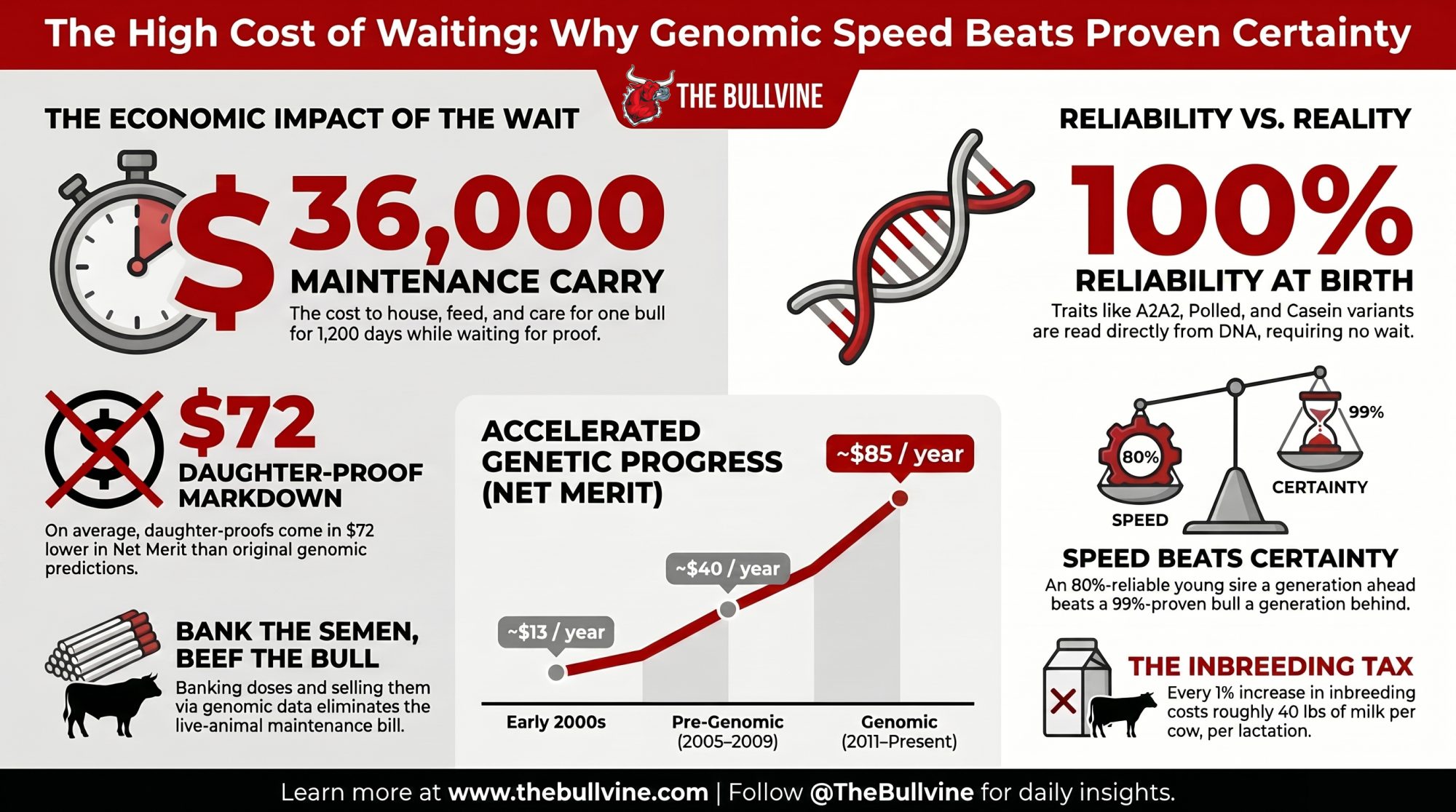
- The bull sells the whole time he stands, so the $36,000 hold-to-proof cost buys you one thing: the proof. And Virginia Tech found the average daughter-proof came in ~$72 lower in Net Merit than the genomic prediction the bull was sold on. Bank the semen, beef the bull, keep the DNA.
- If your breeding goal is pounds of components, an ~80% genomic young sire a generation ahead beats a 99% proven bull a generation behind. Reliability is the wrong thing to optimize when speed is what pays.
- If a trait decides whether your milk sells — A2A2, BB kappa-casein, polled, clean haplotypes — buy it straight off the genotype today at 99–100%. There's no proof worth waiting three years for on a single-gene trait.
- If you've used a sire born before 2015 mostly out of loyalty, price the habit: roughly 40 lbs of milk per cow per lactation for every 1% of inbreeding you stack, plus the carrier risk a famous pedigree can hide.

So, where does your bull team actually sit? Pull your last three mating runs and check how many of your top sires are genomic young bulls versus names you've trusted for years — then ask whether that ratio is a plan or a habit. If you want the full per-bull hold-cost model, the trait-by-trait reliability breakdown, and the thin-market-breed numbers worked all the way through, that's the deeper dive in The Bullvine's genetics coverage and the weekly newsletter — where this argument gets the spreadsheet it deserves.
Methodology note: The opening stud manager is a composite scenario modeled on publicly reported AI-stud practices, not a specific individual. Genomic young-sire semen is sold continuously from first release; the per-bull figure here is maintenance overhead concurrent with semen sales, not idle carry. The $30/bull/day maintenance estimate is from the peer-reviewed BullVal$ decision-support tool (Animals, 2023) — one company's figure, not an industry average — applied over a ~1,200-day hold-to-proof window; actual costs vary widely by facility, country, labor model, and bull. The proof-regression figure (average ~$72 Net Merit drop and ~0.8-month Productive Life drop from genomic prediction to daughter-proof, on December 2011 proofs of 2,400+ genomic-tested Holstein bulls) is from D. Cassell's Virginia Tech / Virginia Dairy analysis; individual bulls vary and regression direction can differ by trait and era. Genetic-trend figures (~$13/year early 2000s, ~$40/year pre-genomic, ~$85/year genomic) and the generation-interval/gain-doubling claims are drawn from the peer-reviewed sources linked throughout (PNAS — García-Ruiz et al.; a 2024 Journal of Animal Science review; Frontiers in Genetics — VanRaden; and peer-reviewed simulation work); Net Merit values shift with each base change, including the April 2025 rebasing to 2020-born cows. The inbreeding-on-milk figure (~18 kg of milk per 1% inbred, derived from a 92 kg loss between 5% and 10% inbreeding) is from the Canadian Dairy Network's "Quantifying Inbreeding Depression" analysis and reflects Canadian Holstein data; U.S. herds should confirm against their own evaluations. Kappa-casein BB cheese-yield effects (~10–40% shorter coagulation time; ~20–140% greater curd firmness vs AA, per Ng-Kwai-Hang) are reported in peer-reviewed work (Animals, 2023). Single-gene trait status (A2A2, kappa-casein, beta-lactoglobulin, polled, haplotypes) is determined by direct genotyping rather than genomic prediction reliability. The proven-bull product lines of Cogent and Semex are confirmed against the companies' own 2025 sire summaries; the disciplined-sampling argument is from the AJCA's Jersey Journal breed-improvement series and its GenProgress program; the Global Alliance housing-cost quote and the retention percentages by stud originate with Holstein International. National averages may not reflect your region, breed, or operation. Spot an error or have stud or on-farm numbers that sharpen the math? Tell us — corrections and counter-data are welcome.
Learn More
- Inbreeding by the Numbers: What Your Bull Proofs Aren't Telling You — Delivers a blueprint to trace the silent $23-per-cow annual financial hit caused by homozygosity. Breaks down exact lactation loss equations on milk, fat, and fertility parameters to prevent relationship selection errors.
- Dairy Cattle Genetics Explained: TPI, NM$, GTPI and Genomics - The Bullvine — Dissects the commercial trade-off between genetic speed and proof certainty across modern selection frameworks. Demonstrates how to capture an $869 lifetime profit advantage per cow using lower-density genotype tracking strategies.
- Beef-on-Dairy Math: $25200 Rides on Your Semen Order - The Bullvine — Reveals how to exploit terminal cross carcass quality traits to extract up to $150 extra per head on crossbred beef calves. Provides direct, actionable protocols to capitalize on Choice-Select spreads via verified sire grouping.
The Sunday Read Dairy Professionals Don't Skip.

Every week, thousands of producers, breeders, and industry insiders open Bullvine Weekly for genetics insights, market shifts, and profit strategies they won't find anywhere else. One email. Five minutes. Smarter decisions all week.