





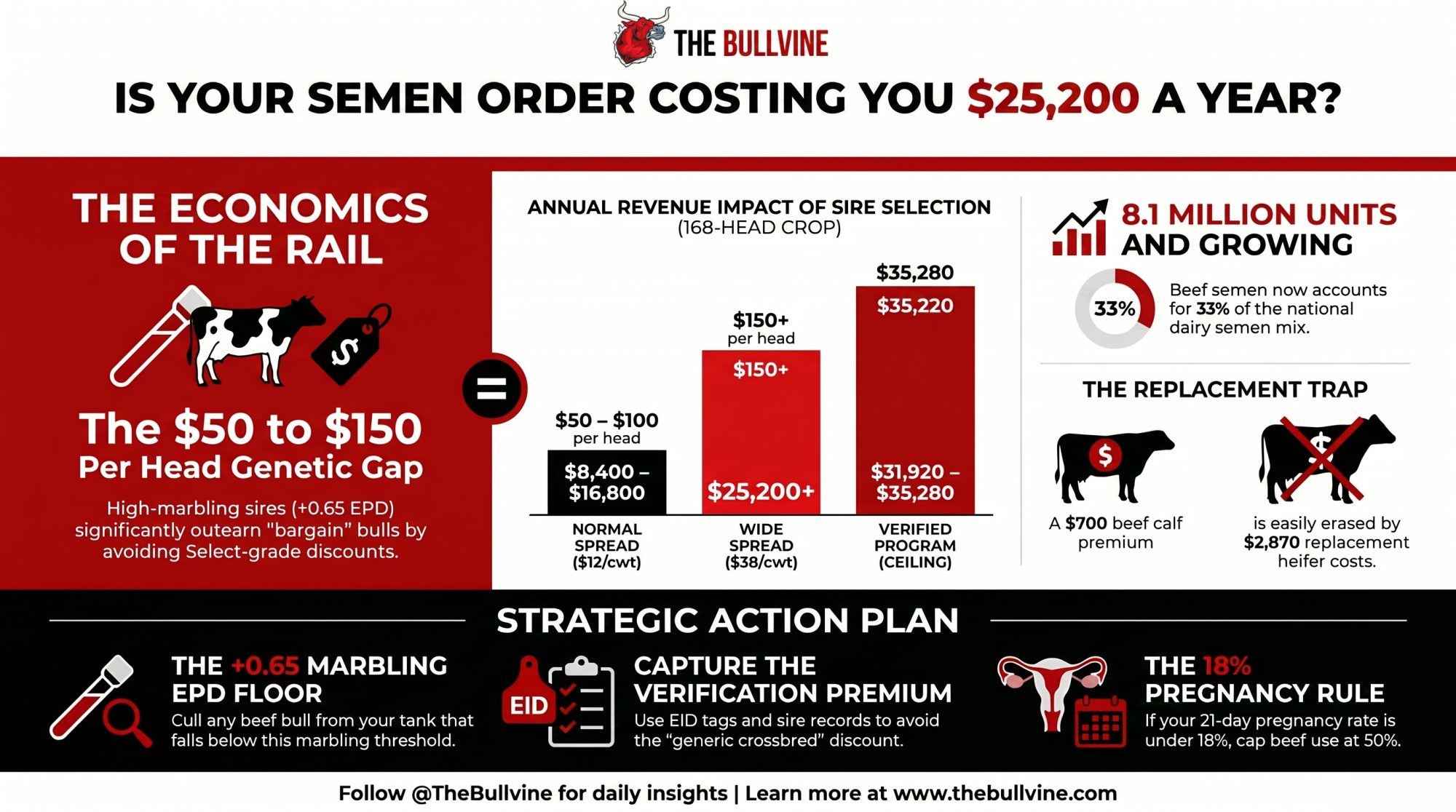
One Panhandle dairy pulled its full-year closeout — 168 head, too much Select, almost no Prime. The gap between a +0.65 marbling bull and a bargain straw? Up to $25,200 a year.
A 480-cow Holstein operator pulls up a chair at a Texas Panhandle packer’s procurement desk, a little after dawn, and asks to see the cumulative closeout on his entire year’s beef-on-dairy crop — 168 head, twelve months of kill dates, every grading line tallied. It’s the kind of plant visit you arrange when you finally want to know what 18 months of beef semen decisions actually paid.
What’s on the screen isn’t a wreck. It’s worse, in a way. The cattle are stuck in the middle — too much Select, almost no Prime, a clutch of yield grade 4s pulling discounts. And right beside it sits a verified beef-on-dairy closeout from another dairy: heavier carcasses, higher marbling, a clean Prime/CAB column. Same plant. Same twelve months. Very different cheques. In scenarios like this, the dairy without a sire record is usually the one that bought beef bulls on price.
(Editor’s note: this 480-cow operator is a composite, representative of mid-size Panhandle herds running about 35% beef-on-dairy, built from NAAB, USDA AMS, CoBank, Premier Select Sires, and Penn State data — not a single real farm.)
Beef-on-Dairy Stopped Being a Side Hustle
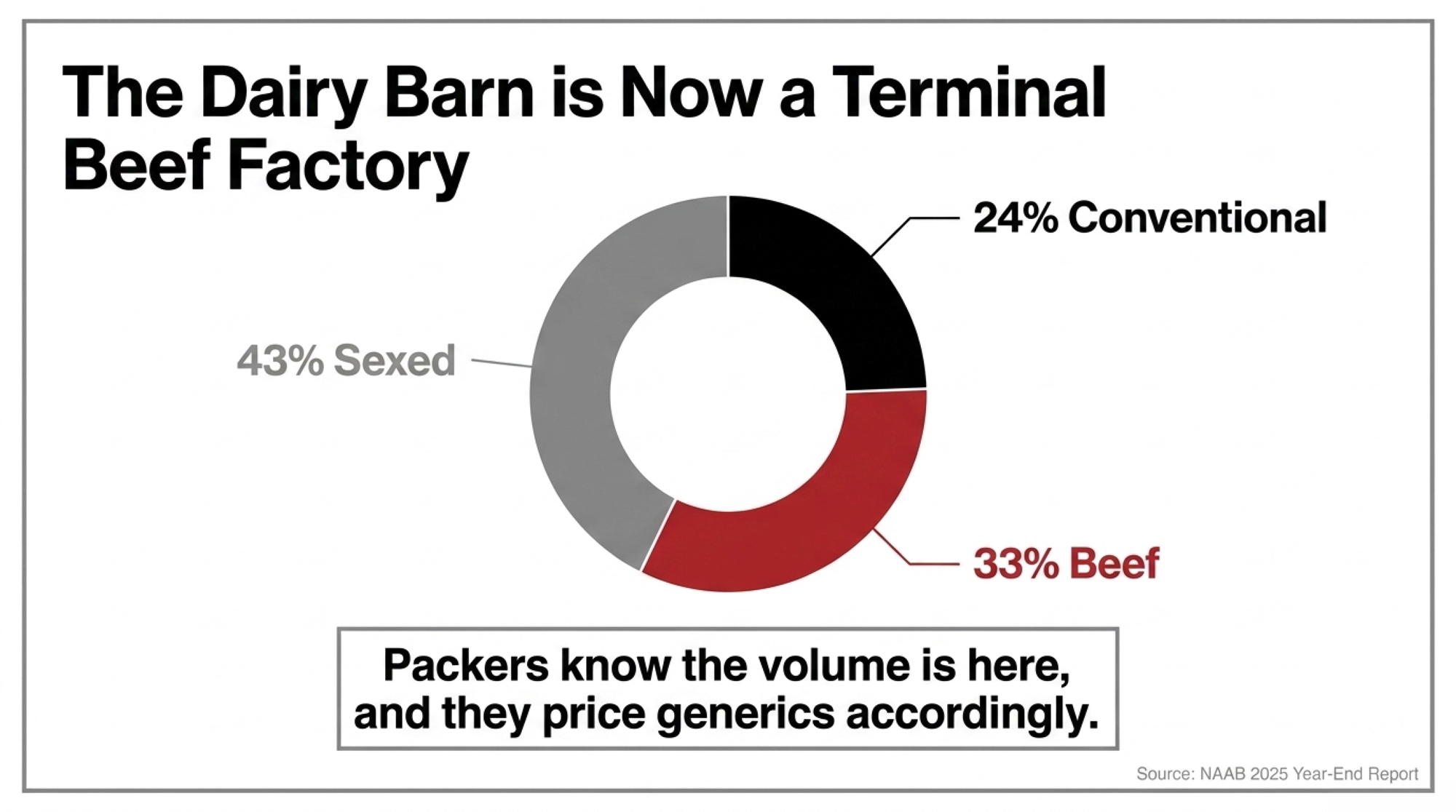
The numbers behind the trend are no longer small. NAAB’s 2025 year-end report shows 8.1 million units of beef semen went into U.S. dairy herds, up from 7.9 million in 2024 — and on the national dairy cow, the semen mix now runs 43% sexed, 24% conventional, and 33% beef. CattleFax data, cited by American Farm Bureau, put crossbred calf production climbing from roughly 50,000 head in 2014 to about 3.22 million in 2024.
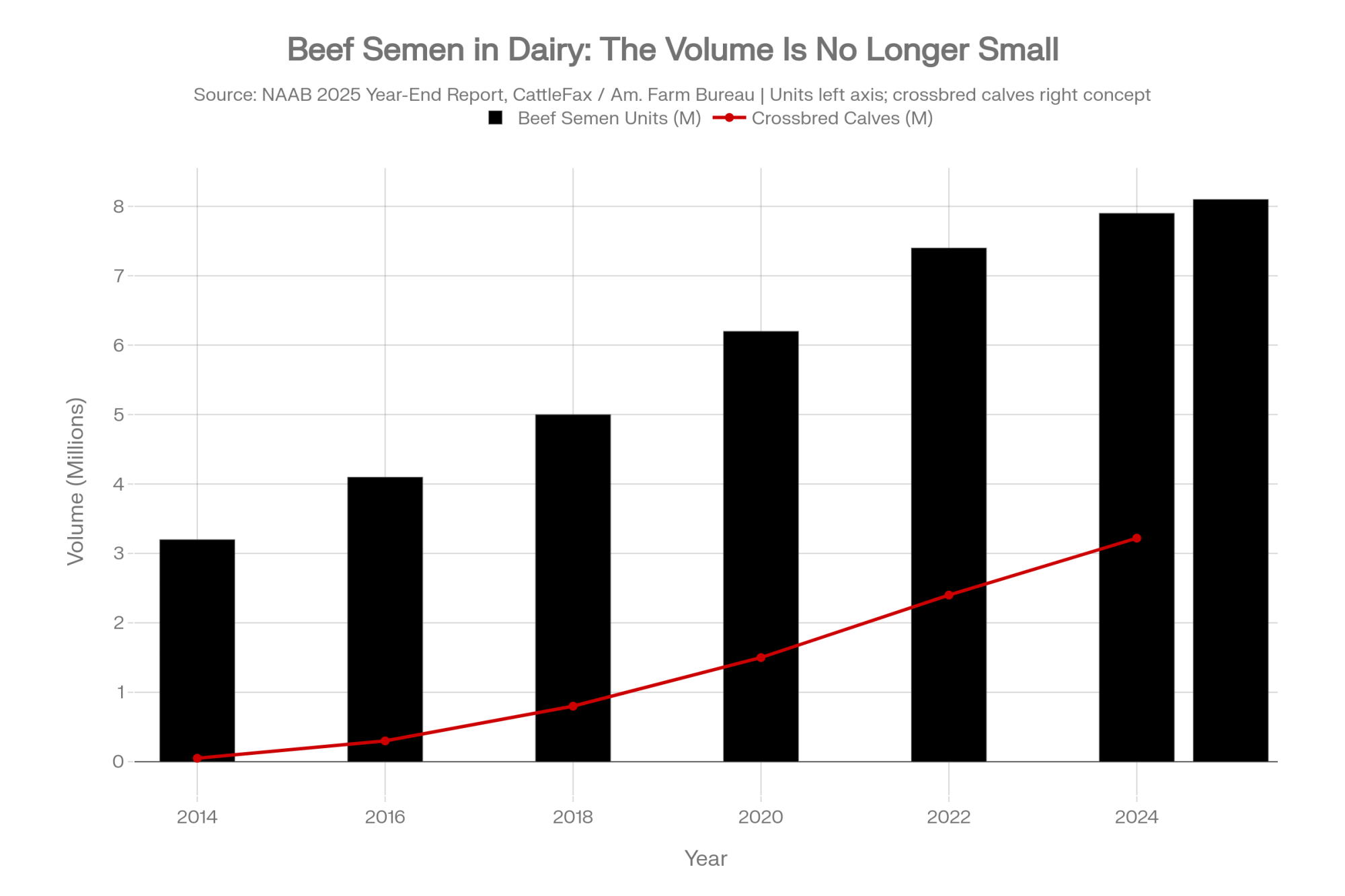
So the dairy barn quietly became a year-round terminal beef factory. And packers price it accordingly.
Here’s the part that’s shifting fastest: the data trail. Plants increasingly know which dairy a load came from, which sires those cattle trace to, and how the source’s earlier loads closed out. CoBank’s February 2025 Knowledge Exchange report found program-verified beef-on-dairy averaging slightly above purebred beef and well above straight dairy steers. Without that paperwork, your calves get bucketed as a generic “beef/dairy cross” — and that’s exactly where the discount lives.
The herds most exposed are the mid-size and large operations running 25–40% beef-on-dairy without verification, mixing sires by price, and assuming “Angus” on the invoice does the work. It usually doesn’t.
What Actually Drives the Spread on the Rail?
Three things move the cheque, and none are mysterious.
| Sire Breed | Marbling Score (USDA) | Grade Outcome (typical) | ADG (kg/day) | Est. Extra Days on Feed | Grid Risk |
|---|---|---|---|---|---|
| Red Angus × Holstein | 5.03 | Low Choice / CAB eligible | 1.69 | +3 vs. Angus | 🟢 Low |
| Angus × Holstein | 4.82 | Choice / CAB threshold | 1.76 | Baseline | 🟢 Low |
| Simmental × Holstein | 4.57* | Select / Low Choice | 1.60 | +8 | 🟡 Moderate |
| Charolais × Holstein | 4.30* | Select | 1.58* | +10 | 🟡 Moderate |
| Limousin × Holstein | 4.14 | Select / Slight | 1.55 | +13 | 🔴 High |
| Wagyu × Holstein | 6.50+ (est.) | Prime / Upper Choice | 1.39 | +26 | 🔴 High (DOF cost) |
Marbling does the heavy lifting. The Penn State sire-breed comparison published in Translational Animal Science(Basiel et al., 2024) ran 262 beef × Holstein steers and found Red Angus × Holstein at a marbling score of 5.03 — right at the bottom of low Choice — Angus × Holstein at 4.82, brushing the Choice line, and Limousin × Holstein at 4.14, sitting in Slight territory below the threshold most grids reward. A University of Minnesota trial of 50 beef × dairy steers (Sharpe & Heins, 2025) landed the same way: Angus-sired calves marbled at 616.9, well ahead of Charolais (521.3), Simmental (547.1), and Limousin (426.9).
Limousin and Continental sires get selected for cutability and yield, not marbling — different trait priorities, different grid outcomes. None of that is a knock on those breeds. It’s just that on a Choice/Select grid, marbling is the line that pays.
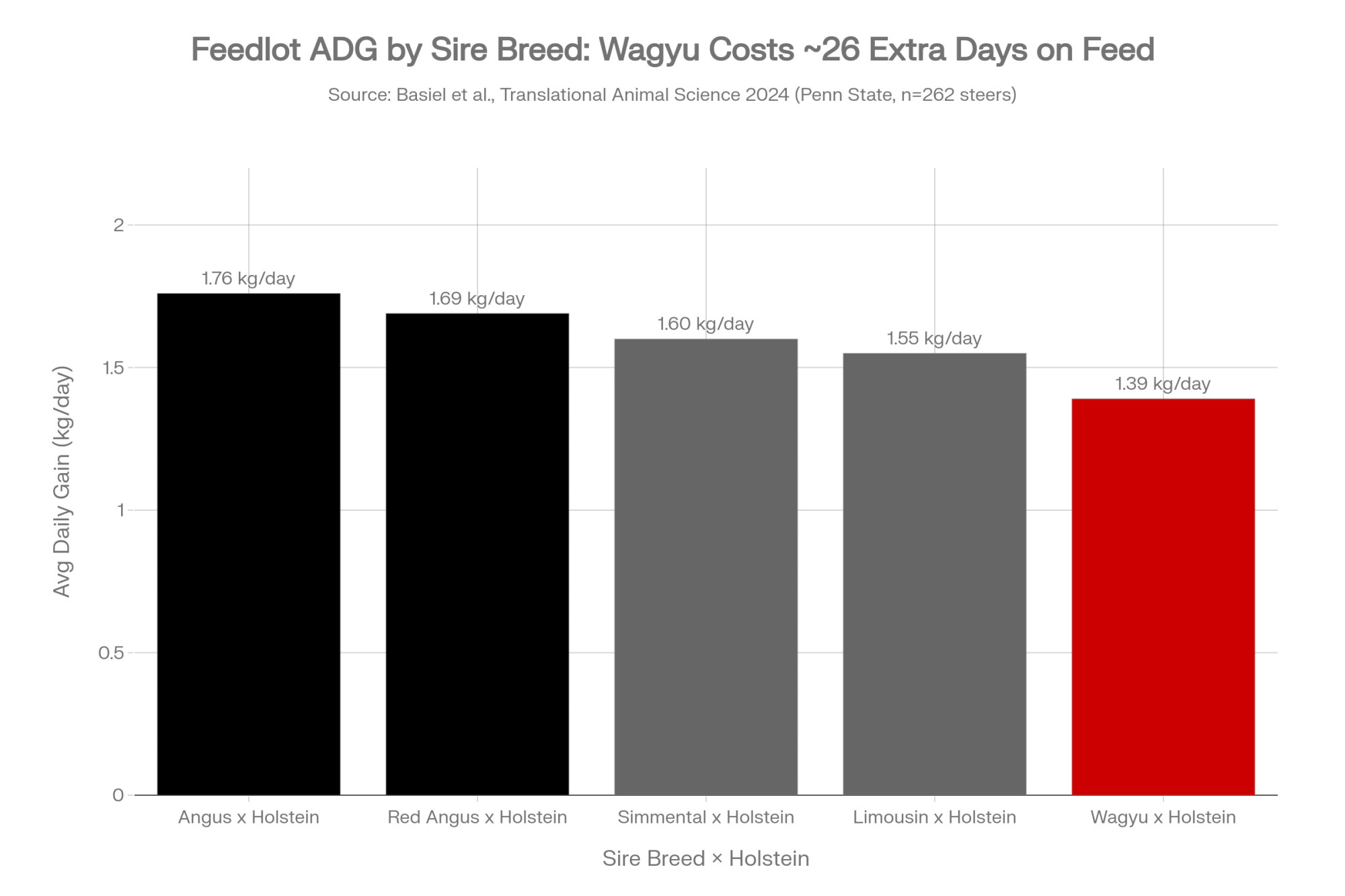
Dressing percentage and feedlot efficiency follow sire breed too. Beef-on-dairy cattle still run about a point lower in dressing percentage than purebred beef — that’s structural to the dairy dam, not something a sire fixes. But average daily gain shifts with the bull. In the Penn State trial, Angus crosses gained 1.76 kg/day while Wagyu crosses gained 1.39 kg/day, needing roughly 24–26 extra days on feed. The feedlot pencils every one of those days into next year’s bid.
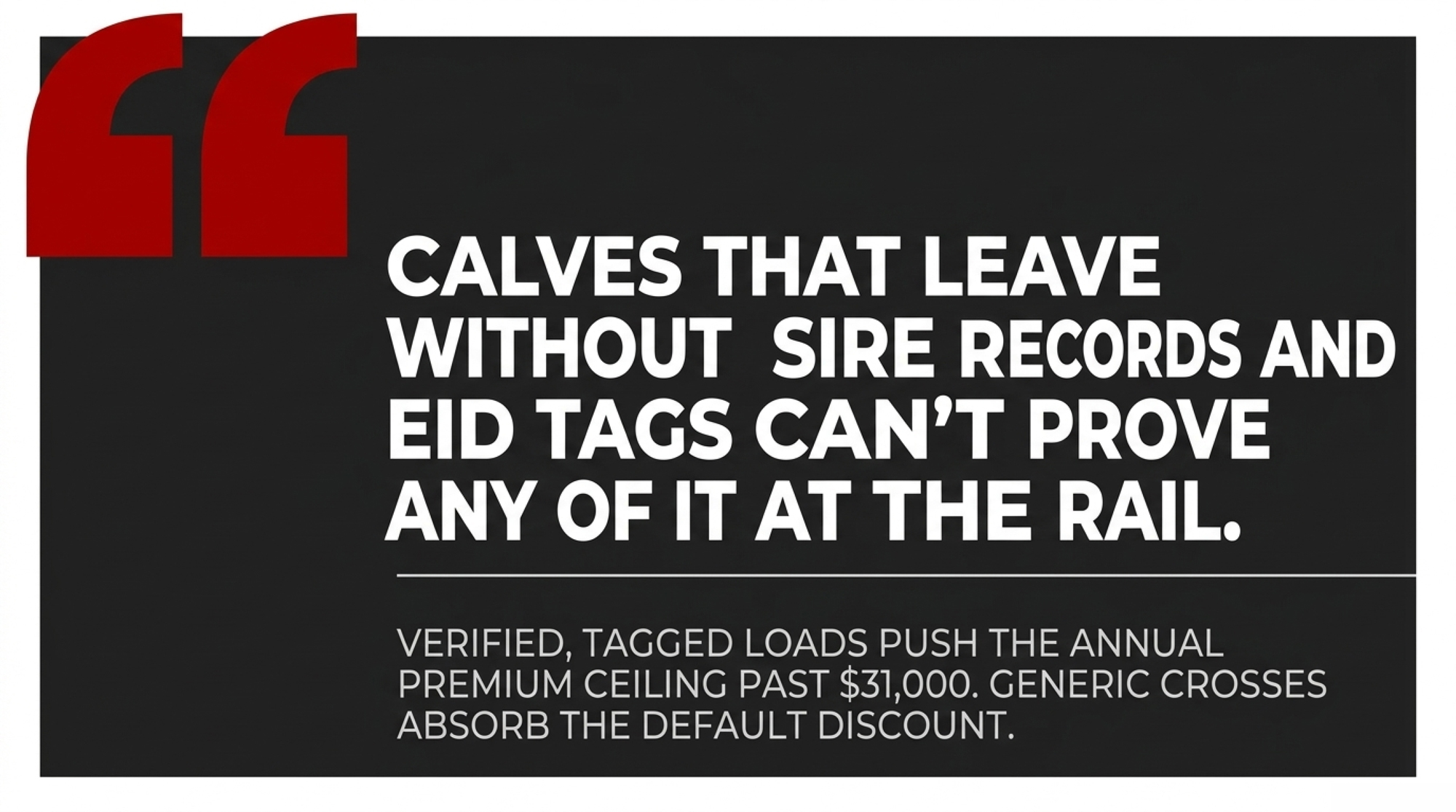
Verification is the third lever, and it’s the cheapest. Penn State Extension’s own marketing guidance is blunt about it: when you select beef bulls, ribeye area and frame score (5 or under for feed-efficient, moderate cattle) belong on the sheet right next to calving ease. Calves that leave without sire records and EID tags can’t prove any of it at the rail.
How Much Is the Wrong Bull Really Costing You Per Head?
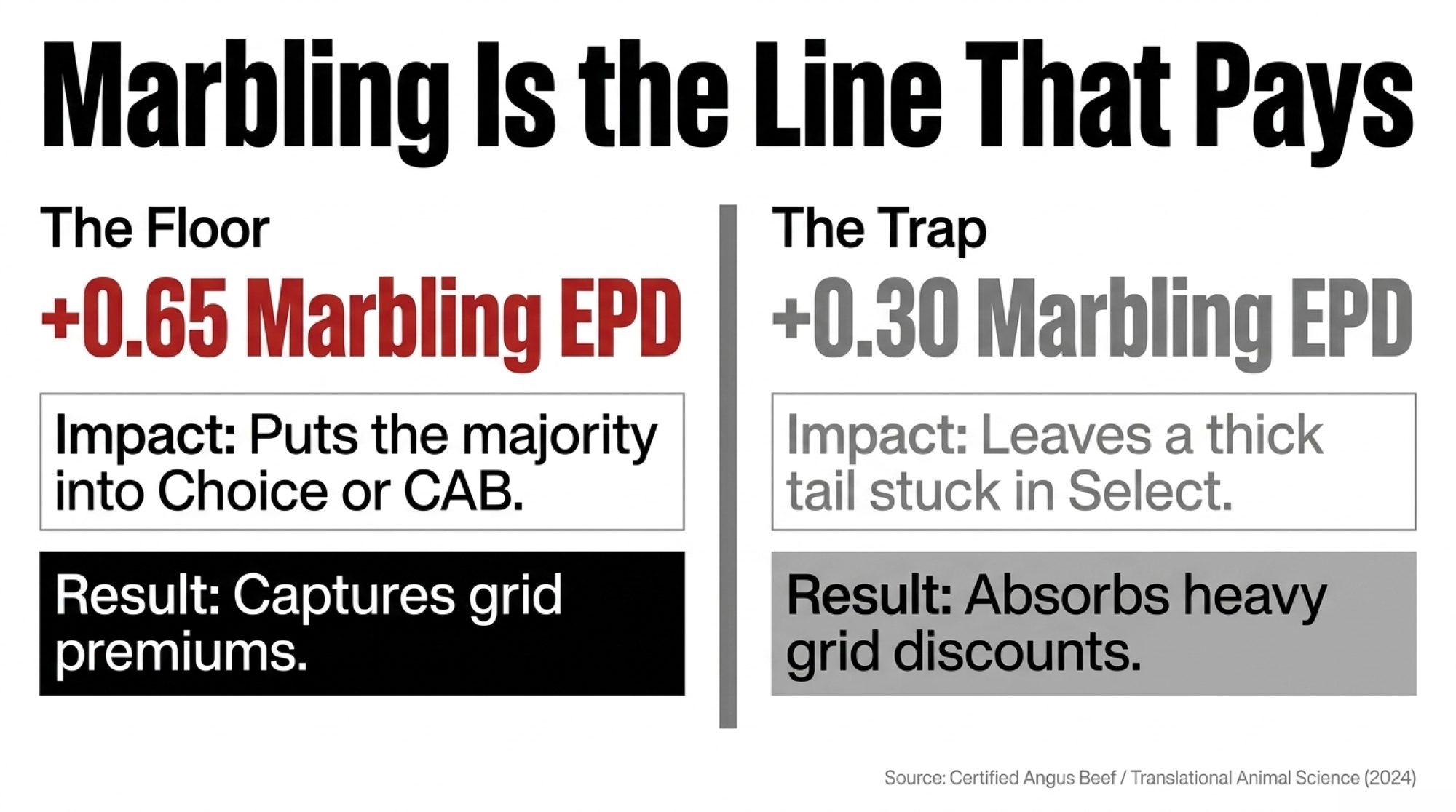
The key threshold is Certified Angus Beef’s “Targeting the Brand” Marbling EPD floor of +0.65. A high-marbling Angus sire at or above that line can put the majority of his calves into Choice or better; a bargain bull at +0.30 to +0.45 leaves a far thicker tail stuck in Select.
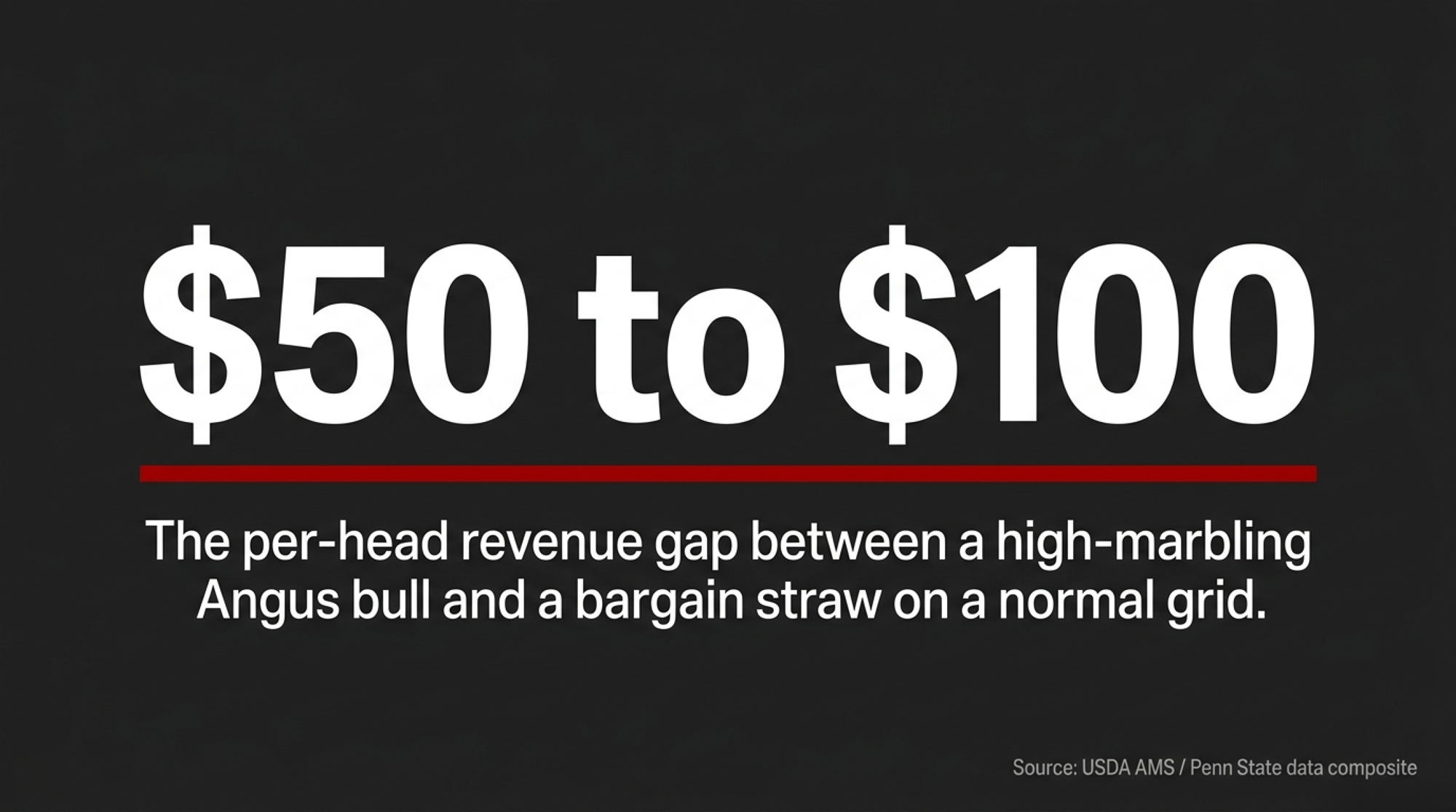
On a typical grid — featuring a $12/cwt Choice/Select spread, a $4/cwt CAB premium, and a $15/cwt Prime premium — the distribution gap between a high-marbling sire (+0.65 EPD) and a bargain bull (+0.30 EPD) is worth $50 to $100 per head. The catch is that the Choice/Select spread is a moving target: it set a record near $38/cwt in late 2025, but USDA AMS had its weekly figure down at just $5.76/cwt at the end of May 2026. When the spread is wide, the per-head gap stretches past $150; when it’s this thin, the marbling premium narrows with it. Run your own grid before you bank any single figure.
Scale those numbers across the composite’s 168-head crop:
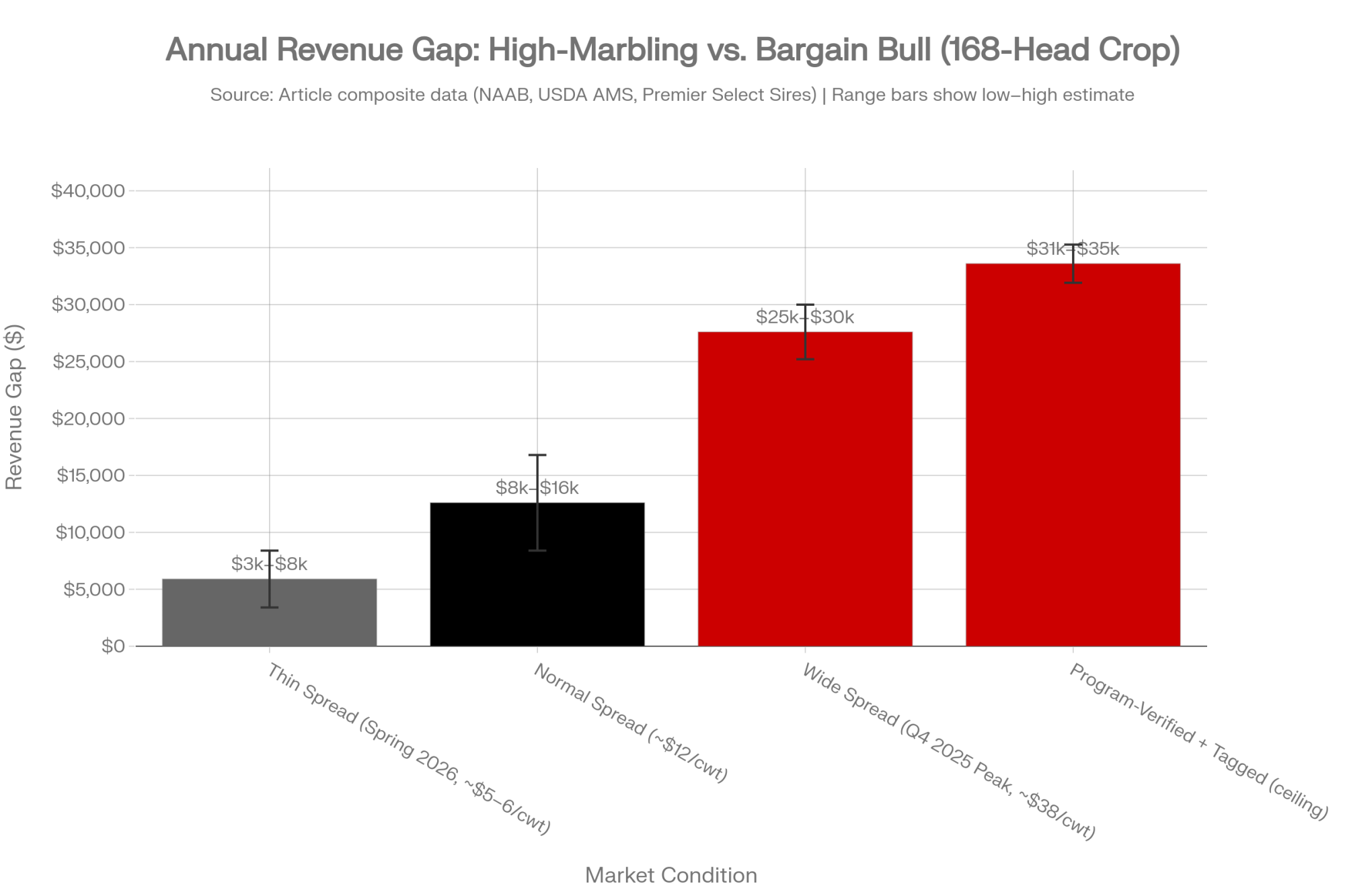
| Grid & market conditions | Per-head revenue gap | Annual value on 168-head crop |
| Thin spread (~$5–6/cwt, spring 2026) | $20 – $50 | $3,400 – $8,400 |
| Normal Choice/Select spread (~$12/cwt) | $50 – $100 | $8,400 – $16,800 |
| Wide spread (Q4 2025 peak, ~$38/cwt) | $150+ | $25,200+ |
| Program-verified & tagged (ceiling)* | $190 – $210 | $31,920 – $35,280 |
*The bottom row is a different animal from the rest. The $190–$210/head figure comes from Premier Select Sires’ April 2024 ProfitSOURCE brochure, comparing its program carcasses against non-program cattle — so these are the company’s own program results, measuring verification plus carcass uplift, not a single-bull marbling gap. We’re not aware of independent, third-party replication, so read that row as a best-case ceiling rather than a typical outcome. Other major studs run comparable verified programs — ABS Global’s Beef InFocus, for one, hand-picks beef sires on carcass performance and tags the resulting calves — so the principle, not any one brand, is the point.
So the honest range is the one in the deck: in normal-to-wide markets the defensible grid math runs $8,400–$25,200 a year on this crop, and the program-tagged ceiling pushes toward $33,000. In a thin-spread spring like this one, the gap compresses hard. Either way, it’s a grid line item already getting paid to somebody. The only open question is whether it’s getting paid to you.
A fair caveat: not every trial finds a windfall. The Minnesota study concluded that total revenue across Angus, Charolais, Hereford, Limousin, and Simmental crosses netted out statistically similar — $2,650 to $2,779/head — once carcass weight, days on feed, and yield grades balanced against each other. The spread is real, but it’s conditional. It pays out most when grids reward marbling hard, when you ship full loads, and when your alternative is genuinely bottom-tier commodity straws.
The Other Side of the Ledger Nobody Brags About
The calf cheque looks great until the replacement bill comes due.
Beef-on-dairy calves carried roughly $400–$1,000+ premiums over straight dairy calves through 2025’s strong market. On the composite’s 168 beef matings, that premium alone is real money. But then springers showed up at a historic national average near $2,870/head in late 2025, with some markets pushing toward $3,000 and beyond.
| Line Item | Metric / Assumption | Figure | Signal |
|---|---|---|---|
| Beef calves sold (168 head × $700 premium) | 35% beef share, 480-cow herd | +$117,600 | Revenue win |
| Missing heifers replaced (~50 head × $2,870) | Springer market, late 2025 avg | −$143,500 | Replacement liability |
| Net before other costs | Break-even zone | ~−$25,900 | ⚠️ Not a win |
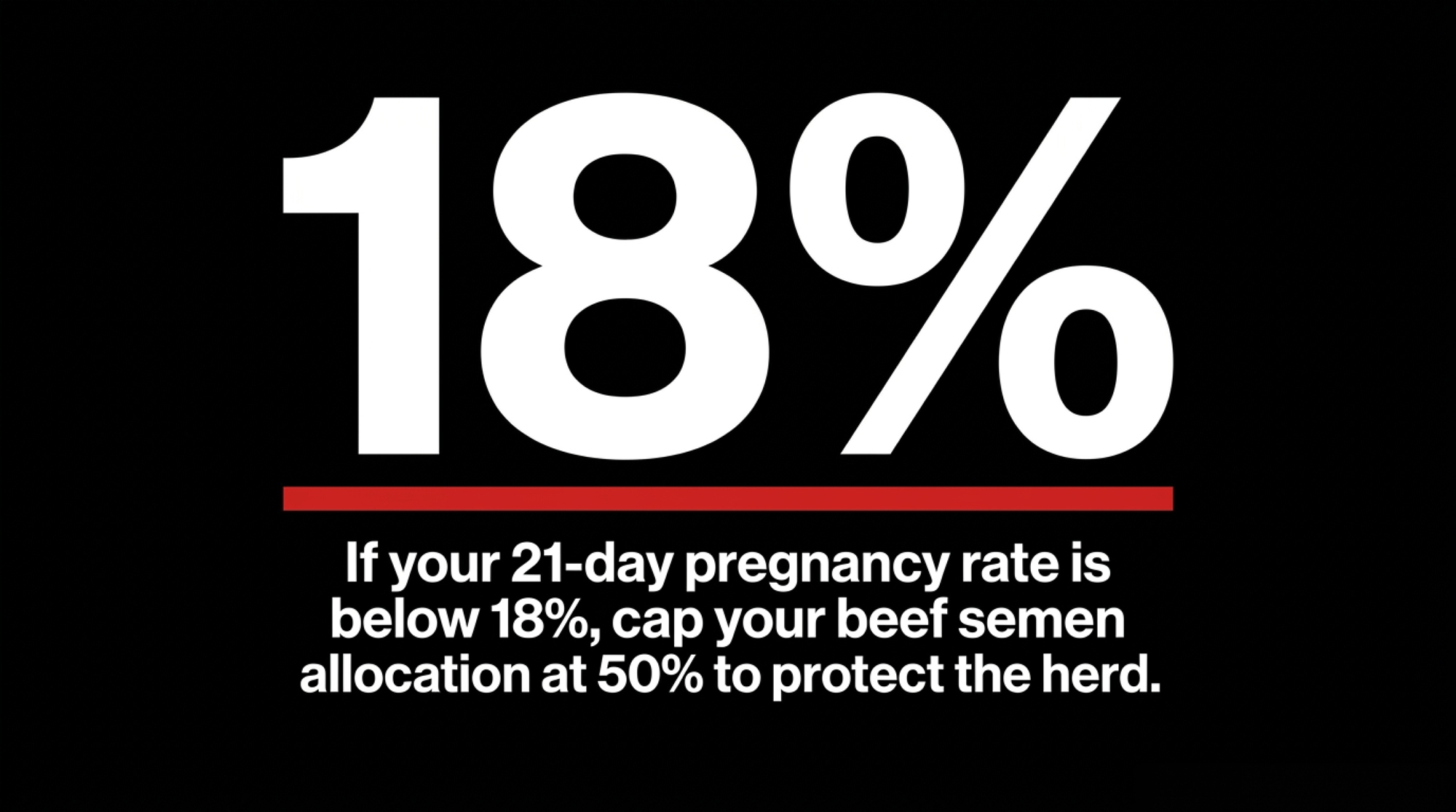
| Pregnancy rate floor to run >50% beef | UW Cabrera research threshold | 18% 21-day PR | Hard cap |
| Crossbred calf production projection (2026) | CattleFax | 5–6M head | Springer market stays tight |
Here’s the simple version of the trap. At 35% beef share, this herd is steering a big slice of its breedings away from making replacements — and University of Wisconsin work led by Dr. Victor Cabrera shows the flip side: herds holding 30%+ pregnancy rates can clear over $6,200 in net calf income a month through optimized beef-on-dairy. Push beef share too high without the repro to back it, and you trade that calf income for a replacement shortage. Below an 18% pregnancy rate, the research says cap beef allocation at 50%.
| Line item | Figure (illustrative) |
| ~50 missing heifers × $2,870 springer | ~$143,500 replacement liability |
| 168 beef calves × $700 premium | ~$117,600 added calf revenue |
| Net before any other cost | roughly breaks even |
That’s the whole point: at the wrong beef share, the calf “win” gets eaten by the replacement bill. And CattleFax projects crossbred production climbing toward 5–6 million head by 2026, so the springer market won’t loosen up to bail you out.
Is Your Breeding Sheet Already Behind the Market?
Quick gut check. Pull last year’s beef semen invoices and ask three questions: How many different bulls are on it? What’s the average Marbling EPD across them? How many calves left with sire ID and program tags?
If the honest answer is “more than five bulls, mixed carcass EPDs, no program,” your cattle are almost certainly in the bucket buyers price as generic beef-on-dairy. The fix isn’t a new system. It’s the next semen order.
What This Means for Your Operation
- If your beef calf cheque is funding more than 60% of your projected replacement liability, the breeding sheet — not the calf market — is the lever to pull first.
- If any beef bull on your sheet posts a Marbling EPD below +0.65, either replace him or run the math on what his Select-heavy tail costs on your buyer’s grid — remembering that in a thin-spread spring, that cost shrinks.
- If your 21-day pregnancy rate is under 18%, cap beef allocation at 50% — the economics stop favoring more beef below that line.
- If your calves leave without EID tags and sire records, you’re forfeiting the verification premium that tagged loads from the same dairy can already earn.
- If your 2027 plan leans on buying replacement springers near $3,000, the cheaper fix is on this year’s semen order, not next year’s purchase ledger.
- If you’ve never seen one of your loads grade, that’s the gap to close first — because every decision above is a guess until you do.
The Bottom Line: Your 30-Day Action Plan
If you’re running a 25–40% beef program, your next semen order shapes your 2028 bottom line. Three moves you can start this month:
- Audit the heifer pipeline. If your 21-day pregnancy rate is soft and beef use is above 30%, rebalance toward sexed dairy on your top cows before chasing calf prices — protect the replacements first.
- Capture the verification premium. Stop selling generic crossbreds. EID tags plus verified sire records let your loads be priced on what they are, not on a generic-cross discount.
- Test the channel. If you’ve never tracked carcass performance, ship a verified load and an unverified load through the same channel this quarter — and let the real closeout decide your genetics program.
🛑 5 Beef Bulls to Pull From Your Tank This Week
Next time your genetics rep stops by, cross these five liabilities off the order:
- The sub-floor sires — any beef bull with a Marbling EPD below +0.65, the Certified Angus Beef “Targeting the Brand” baseline.
- The “bargain” straws — any bull picked strictly on volume pricing rather than a verified, published carcass index.
- The data blanks — bulls with no published Ribeye Area (REA) or Yield Grade (YG) EPDs in their breed-association database.
- The “black-hide only” bulls — sires whose sole selling point on the sheet is coat color, with no carcass genetics behind it.
- The unvetted clean-up crew — the cheap, unscrutinized straws quietly thrown in the bottom of the tank to catch repeat services.
Key Takeaways
- If grids are rewarding marbling and you ship full loads, tightening to 2–3 sires above +0.65 Marbling EPD is worth roughly $50–$150/head — but in a thin-spread market like spring 2026, run your own grid before you bank it.
- If your pregnancy rate can’t support it, capping beef share protects your 2027–28 heifer pipeline more reliably than chasing this year’s calf premium.
- You don’t need to own the feedyard to own your data — EID tags plus sire records let your loads be priced on what they are, not on what a generic-cross discount assumes.
- The carcass-value gap is real but conditional. One trial found similar total revenue across beef breeds, so read your own grid and load size before banking the high number.
The producer in the composite isn’t a villain. He’s the rare one who actually went to the plant and pulled the cumulative closeout — most never do, which is exactly why most never learn their breeding sheet is 18 months behind the market. The next load off your dairy is already being graded in someone’s head, whether you’ve seen the data or not. So when your next 168 head close out at the rail, what will the grading sheet say about the bulls you ordered last fall? If you’re not sure, that’s your answer.
Complete references and supporting documentation are available upon request by contacting the editorial team at editor@thebullvine.com.
Learn More
- Beef-on-Dairy’s $6,215 Secret: Why 72% of Herds Are Playing It Wrong — Arms you with precise reproduction benchmarks by matching your 21-day pregnancy rate to a viable beef allocation strategy, proving why poor reproductive management completely deletes the monthly financial upside of crossbred calves.
- $3,010 Per Heifer. 800,000 Short. Your Beef-on-Dairy Bill Is Due. — Exposes the severe capital deficit facing operations that depleted their replacement heifer pipelines for quick calf checks, delivering four strategic paths to protect your balance sheet from surging springer costs.
- Stop Breeding by Color: Genomics, Heat Stress and Beef‑on‑Dairy Math That Can Add Over $4/cwt to Holstein Margins — Dismantles visual evaluation habits by using population genomics to optimize margins, demonstrating how a forty-dollar genetic index test shields a two-thousand-dollar heifer rearing investment from hidden production and heat-stress losses.
The Sunday Read Dairy Professionals Don’t Skip.

Every week, thousands of producers, breeders, and industry insiders open Bullvine Weekly for genetics insights, market shifts, and profit strategies they won’t find anywhere else. One email. Five minutes. Smarter decisions all week.