



Archive for Lactanet LPI

Does a Deep Pedigree Make a Genomic Young Sire Safer?

Before paying extra for a young sire’s recorded ancestry, ask whether it predicts proof stability beyond published reliability. Our review found no published Canadian or U.S. test answering that question.

You can name five generations behind him. Does that make his genomic proof safer?

VG dam. EX grandam. Three more generations of Excellent, every one with a milk record. If you spent years building that cow family, those lines represent breeding decisions, milk tests and cows you watched develop. You have reasons to trust them.

In The Bullvine’s Seagull Bay profile, Alan Andersen described the evidence he saw in his own herd: “Minnow has transmitted outstanding production and type through several generations of her offspring.” He used both proven bulls and young sires on his top cow families, and on Shauna, IVF let him use several different young sires “in order to lessen the risk.” He also made the pedigree case outright: “Young bulls with strong maternal lines will also receive an advantage over bulls with similar indexes but less proven cow families.” He was direct about genomic sires, too: “Certainly their proofs will change over time. We just don’t know how great of a change will occur.”

Bosdale’s Bos family made a similar case in a 2025 profile: “They are successful because they continue to breed high type productive cows that repeatedly transmit good genetics from generation to generation.”

Those are breeders’ own observations of how their families transmit. The question here is narrower: whether a recorded family history predicts smaller changes in a young sire’s proof once published reliability is accounted for.

Now put a genomic young sire without that depth of recorded ancestry beside a son of one of those families. Before you look at their reliabilities, which one feels safer to use?

Genomics has shortened the wait. In a 2022 analysis, Lactanet reported average young-animal LPI reliability of 78% with genomics versus 41% without it. For a breeder who values generations of performance, the buying question remains: does that deeper record provide protection the published reliability misses?

We went looking for a Canadian or U.S. study testing whether recorded pedigree depth predicts smaller proof changes after accounting for published reliability. We did not find one.

So we compared proof movement in 86 bulls from Lactanet’s elite genomic LPI lists, grouped by whether their dams had a classification score displayed in 2026. That tests a narrower association—not five generations of pedigree or the information available when the bulls were selected.

This piece tests one claim: proof stability. Whether a cow family earns its keep through longevity, managing recessives or what you know from her daughters in your own barn is a separate question. Answering it needs different data, such as herd-life and recessive records, and this article doesn’t settle it.

What Are You Paying Extra For?

The deep-pedigree argument bundles three questions:

  • Do bulls with more classified, milk-recorded, daughter-proven ancestors change less when daughters arrive?
  • Does that still hold once published reliability is accounted for?
  • Would using recorded ancestry actually improve which sires you pick?

Showing that deep-pedigree bulls move less wouldn’t, by itself, show that buying on pedigree picks better bulls.

There is relevant Canadian evidence. A 2019 CDN analysis of 275 Canadian-born bulls found Conformation reliability 1.3 percentage points higher for sons of classified dams. It did not test their subsequent proof movement.

That matters when you buy semen. If you pay a premium for paper depth, or pass over a high-merit bull because his sire and grandsire were genomic-only, you’re making a selection call. Lactanet describes reliability as the confidence behind a breeding value, built from performance records, relatives, progeny and genomic data. Without evidence that ancestry adds something reliability misses, a pedigree discount risks counting the same information twice.

Lactanet spells out what reliability is for: “This is why evaluations of young genomic bulls often change as daughter records accumulate, while evaluations of proven sires tend to be more stable.” It also says “a bull with a slightly lower value and very high reliability is more predictable.” That’s the stability gauge, and it’s already on the proof sheet, whether the sheet says LPI or NM$.

What the Pedigree Does—and Doesn’t—Tell You

Say the pitch is a deep cow family with classified dams for generations. Ask what supports the promise that his proof will hold. You can see the paper trail on a bull page. You can’t see how well his genetics are represented in the genomic reference.

There’s a second trap on the same page. A dam with no public classification or lactation line may still have added information to the evaluation. Lactanet’s 2026 explainer describes how relationships let information recorded on one animal contribute to the evaluation of another.

Proof stability is also only one part of the decision. A steadier bull with lower expected merit isn’t automatically the better buy. Choosing steadiness over merit is a legitimate strategy for some herds. It should be a deliberate choice, not something a pedigree slips into the mating plan.
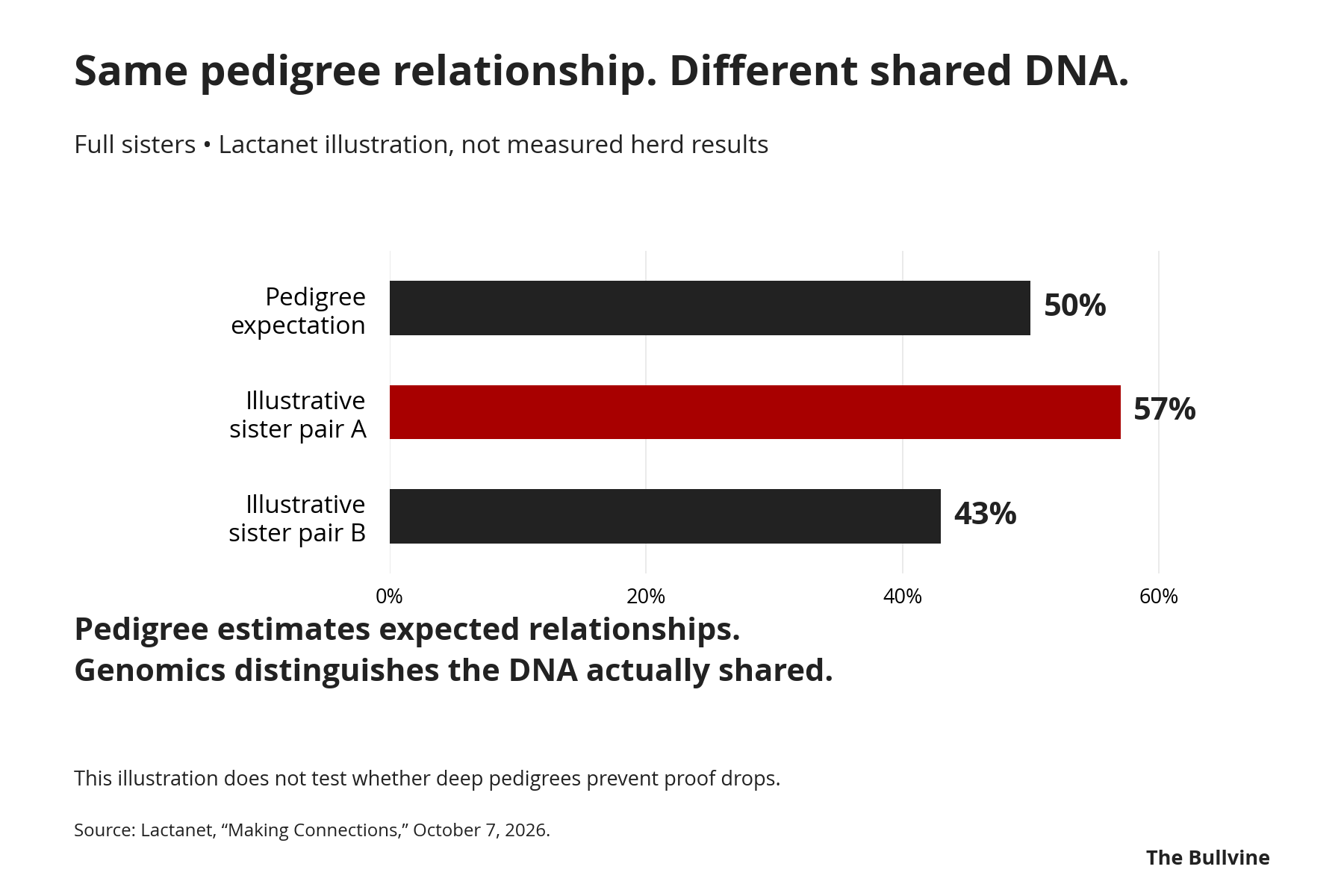
Full-sister pedigree expectation is 50%; Lactanet illustrates pairs sharing 57% or 43% of their DNA.

Both evaluation centers draw the same line. Lactanet: “pedigrees estimate how much DNA two animals are expected to share, while genomics measures how much they truly share.” Its illustration uses full-sister pairs sharing 57% or 43% of their DNA against a pedigree expectation of 50%. Speaking at the CDCB industry meeting, CDCB Chief Research and Development Officer Dr. John Cole put it more bluntly: “Genomics tells us what the true relationship between animals is.”

  • Recorded ancestry: how many generations of classification, milk records and proven sires sit on paper.
  • Reference connection: how closely a bull’s genetics are represented among the animals the genomic prediction was trained on.

Our Own Check: What Happened to Sons of Dams With a Displayed Score
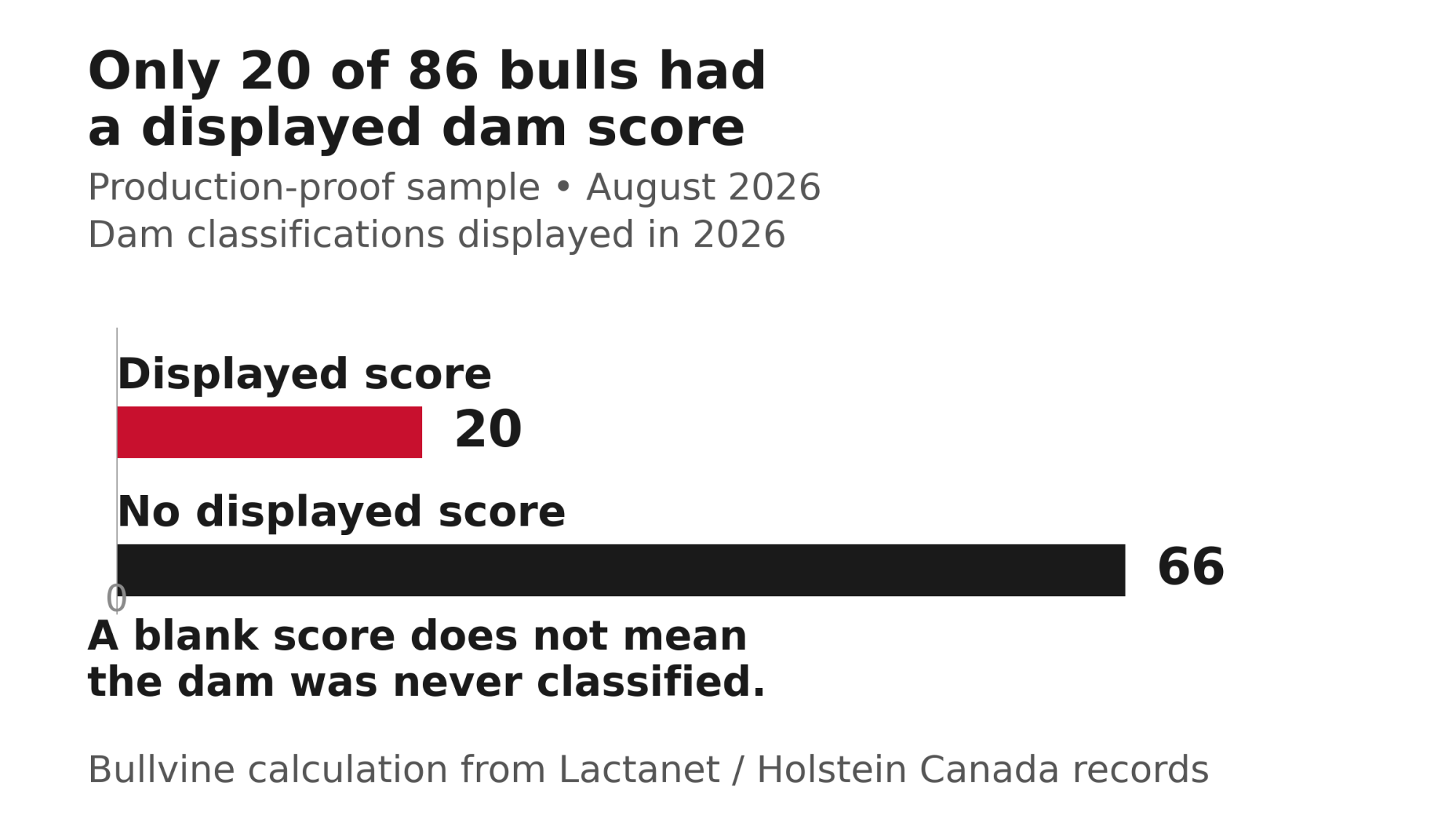
Of 86 bulls, 20 had a displayed dam score and 66 did not; a blank does not establish that a dam was never classified.

We took every second bull from Lactanet’s August 2022, December 2022 and April 2023 top-GPA LPI lists and followed them to their August 2026 evaluations. Eighty-six had daughter-based production proofs by then. Twenty had a dam with a classification score displayed; 66 didn’t.

Protein. After controls, sons of dams with a displayed score saw their protein proofs drop an estimated 6.5 kg more and swing 2.4 kg further in absolute terms. Both confidence intervals cross zero. So this doesn’t show a stability benefit, and it doesn’t rule one out.

Type. Among 67 bulls with daughter proofs for both traits, sons of score-displayed dams started higher on Conformation (+6.10 vs. +5.36). Their final raw means were +2.65 and +2.85. After controls, their absolute change in published Conformation scores was an estimated 1.7 points greater than that of sons whose dams had no displayed score. The model controlled for starting Conformation, but the published composite scores were not harmonized across the comparison period.

What to take from this comparison: on protein, we can’t tell whether a displayed dam score goes with steadier proofs. On type, those sons moved more, but these are unharmonized scores.

What this can’t tell you

  • It tests one generation, the dam, not five.
  • Only 20 bulls had a displayed dam score, against 66 without.
  • Dam scores are those displayed in 2026, not necessarily what a breeder knew at purchase. Only 7 of 86 bulls had a dam classification dated before their list; 77 had no verifiable date.
  • A blank score doesn’t mean a dam was never classified.
  • The bulls came from elite genomic LPI lists; 72 of 86 are U.S.-registered.
  • Half of the follow-up proofs (43 of 86) are GMACE, foreign evaluations converted to the Canadian scale.
  • Type scores are raw published composites, which annual base changes can’t cleanly correct.

Methods (Bullvine analysis)

  • Sample: 151 list entries, 124 distinct bulls; 86 with GEBV or GMACE production evaluations in August 2026 (43 each), each counted once at its earliest list. All evaluations are on the Canadian scale. Controls: starting protein, birth year, baseline list, registration region and proof route. Uncertainty accounts for shared dams.
  • Protein results: signed change −6.5 kg (95% CI −14.3 to +1.2); absolute movement +2.4 kg (95% CI −3.7 to +8.6).
  • Domestic GEBV only (43 bulls): signed −3.6 kg (95% CI −14.8 to +7.6); absolute +3.4 kg (95% CI −5.6 to +12.4).
  • Base add-back: current minus starting evaluation, plus Lactanet’s annual Holstein protein base changes (April 2023: 4.5 kg; 2024: 4.7; 2025: 4.7; 2026: 5.0). That’s 4.5 + 4.7 + 4.7 + 5.0 = 18.9 kg for 2022 lists and 4.7 + 4.7 + 5.0 = 14.4 kg for April 2023. This adjusts bases only; it isn’t a measure of daughters’ actual production.
  • Type sample: 67 bulls with GEBV or GMACE status for both traits (20 vs. 47). One GMACE record showed zero Conformation daughters; a 66-bull subset excluding it was tested separately.
  • Type results: signed −0.67 points (95% CI −3.18 to +1.85); absolute +1.66 points (95% CI +0.36 to +2.97), nominal p = 0.0135. An illustrative Bonferroni adjustment for six comparisons (not specified in advance) gives about 0.081. An illustrative common 3-point offset shrinks the gap to about 0.9 points, with an interval crossing zero.

Lactanet and Holstein Canada records captured November 16, 2026, and checked against the analysis dataset with no discrepancies. Dataset and audit package available on request from the editor.

What the Evaluation Systems Actually Do

Canada: no fixed 80:20

Canada’s published 2009 method weighted genomic information by reliability, at about 65% for young sires and heifers in its April 2009 factsheet and a 61% average for LPI in young bulls and heifers born 2007–2009. We found no current Lactanet document setting a fixed 80:20.

Some Canadian traits never used a two-part blend at all. Hoof health (November 2018), fertility disorders (December 2020) and feed efficiency (April 2021) were introduced as single-step evaluations using pedigree, performance and genotypes together.

The U.S.: multi-step for now

CDCB describes a four-step process: a traditional PTA from pedigree and phenotypes, deregression, genomic prediction, then a blend into a genomic PTA, with no fixed ratio given. CDCB is preparing single-step evaluations but hasn’t set a date. Cole said the change should reduce bias and mean smaller changes in a bull’s predictions when daughter data comes in.

What other countries found

In an August 6, 2020 presentation, Ireland’s ICBF warned that “a wider relationship gap is emerging between young sires and the proven animals in reference”: 98% of the sires of calves born in 2016 were in its milk reference, against 19% for calves born in 2020. That’s evidence about reference connection, not pedigree depth.

U.S. type research points the same way. Steyn and colleagues found prediction accuracy of 0.69 vs. 0.54 for stature using a core of 100 popular sires born 2001–2010 rather than 100 born before 1981. Pszczola and Calus simulated reliability falling from 0.37 to 0.21 over five generations without a reference update. Neither study counted classified generations.

Why a proof drop doesn’t settle it

A drop can come from the model, not the bull. In CDCB’s old fertility evaluations, more than 55% of bulls showed a steady decline in PTA at every run from December 2023 to December 2024. CDCB traced part of that to data timing and changed the evaluation in August 2026. More old data doesn’t always help either: Lourenco and colleagues found that dropping pre-1990 records didn’t reduce accuracy in 2,232 U.S. Holstein bulls. And bias can run downward: Patry and Ducrocq simulated a later conventional evaluation that ignored genomic preselection, pushing estimates 0.146 genetic standard deviations below true values in their reference scenario.

The Deep-Pedigree Claim Audit

We checked the cited public documents and research through November 16, 2026, alongside our own comparison. A relevant study may exist outside what we found.

ClaimVerdict
Canadian young-sire proofs are a fixed 80:20 SNP/PA blendUnsupported by evidence found
U.S. genomic PTAs are a fixed genomic/PA ratioUnsupported by evidence found
Canadian genomics began at about two-thirds SNP weightingSupported, with qualifications (65% for young sires and heifers; 61% LPI average)
Genomic-only ancestry necessarily raises SNP weightUnsupported by evidence found
Genomic-only ancestry independently causes upward biasNot established by the cited evidence
Distance from the reference hurts accuracySupported, with qualifications
Recorded pedigree depth measures reference connectionUnsupported by evidence found
Genomic evaluations are trained only on proven bullsLactanet’s 2022 article describes a Holstein reference of progeny-proven sires; not a universal statement for every trait
A steady run of young-bull proof drops means the genomics failedNot diagnostic on its own: CDCB identified data-timing bias and made changes in August 2026
Continued phenotyping mattersSupported
A classified dam protects a young sire’s protein or type proofUnresolved: starting reliability unavailable; type scores not harmonized
Recorded ancestry predicts proof stability beyond published reliabilityUnsupported by evidence found

Options for Your Operation

  • Herds prioritizing maximum genetic gain: Rank on the trait proofs you’re selecting for. Don’t apply a home-made discount for genomic-only ancestry; no Canadian or U.S. evidence we found supports one.
  • Herds prioritizing predictability: Compare trait-level reliability alongside expected merit. Check whether a higher-reliability option actually gives up merit on your shortlist. Don’t use paper depth as a stand-in for reliability.
  • Pedigree breeders marketing cow families: Keep the reasons for buying separate. If you value a particular family, say so. A claim that its young sire’s proof will hold needs separate evidence.

Before Your Next Semen Order

Ask for reliability on each trait you’re selecting for, not just the index: LPI or Pro$ in Canada, NM$ or TPI in the U.S. Lactanet publishes reliability at the trait level.

If you’re buying on U.S. fertility traits, know the lag. Since August 2026, daughter data isn’t included in DPR, CCR or FSC until the daughter is 36 months old.

Keep recording. Lactanet builds reliability from performance records, relatives, progeny and genomic data, so your milk tests and classifications are part of what feeds the evaluations.
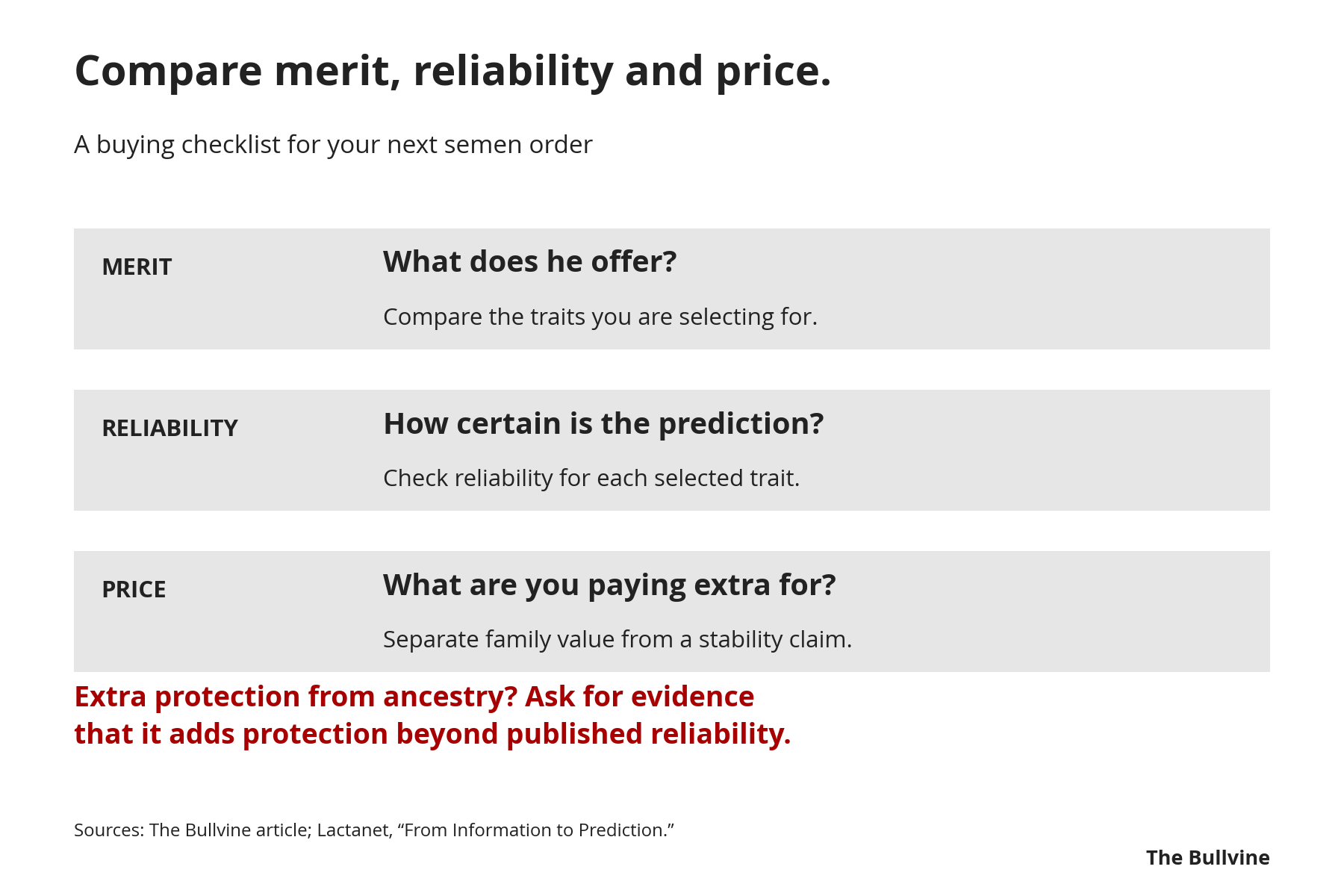
Compare trait merit, trait-level reliability and price; ask for evidence of extra protection from ancestry.

At your next semen order, compare merit, trait-level reliability and price. If recorded ancestry is offered as extra protection against a proof drop, ask for evidence that it adds protection beyond the reliability already published.

Complete references and supporting documentation are available upon request by contacting the editorial team at editor@thebullvine.com.

Learn More

  • Falling Semen Sales Aren’t Bad News – They’re Proof You Bred Better — Capitalize on genomic reliability by ruthlessly sorting your replacement pipeline. Breaks down the math behind 64% sexed-semen adoption and arms you with a Pipeline Index calculator to align your culling pressure with your true heifer inventory.
  • Dairy Farm Economics 2026: Milk Pricing, Margins & Risk Playbook — Tightening 2026 farmgate projections require shifting focus from elite pedigrees to hard margin math. Exposes how a $400 crossbred calf premium quietly adds $4.00/cwt to gross revenue, masking structural milk-pricing risks you must navigate over the next three years.
  • When Your “Elite” Genetics Start Costing You Real Money — By clinging to traditional sire rankings, herds forfeit significant production capacity to hidden inbreeding drag. Dismantles outdated selection habits and reveals how ignoring genomic relationships costs $24 per cow annually for every percentage point increase in your coefficient.

The Sunday Read Dairy Professionals Don’t Skip.

Every week, thousands of producers, breeders, and industry insiders open Bullvine Weekly for genetics insights, market shifts, and profit strategies they won’t find anywhere else. One email. Five minutes. Smarter decisions all week.
NewsSubscribe
First
Last
Consent

Logic-PP’s August 2026 Proof: 3909 LPI, and Two PP Sons Out of His Own Half-Sister

Select Sires calls Luster-P the highest-selling polled sire in Holstein history. His grandson Logic-PP debuted third on Canada’s proven LPI list at 3909, and two of Logic’s PP sons come from a maternal half-sibling mating.

Nearly one million units. That’s the semen-sales total Select Sires put on Cherry-Lily Zip Luster-P when it announced his death on October 27, 2025, weeks short of his ninth birthday. The stud calls him the highest-selling polled sire in the history of the Holstein breed. Rick VerBeek, Select’s senior Holstein sire analyst, said the mating was meant to produce a breed-leading homozygous polled bull: “While we were not lucky enough to get a homozygous Polled bull, we succeeded in creating one of the breed’s most influential, all-around sires of recent times.”

Luster-P doesn’t prove that every polled bull is elite. He proves the best polled options now compete near the top of the rankings.

The more interesting story is what came after. Drewholme Logic-PP, a Luster-P grandson in Ontario, came out at 3909 LPI on his first daughter proof in August 2026, with 173 daughters in 87 herds behind it. That put him third on Lactanet’s August 2026 domestic proven LPI list. He already has 10 homozygous polled sons in AI. Two of them come from a mating between maternal half-siblings, out of a daughter of Logic’s own dam.

A Bull With a Thin Paper Trail

Cherry-Lily Zip Luster-P (Zipit-P x Kingboy) came from a sire who saw little use and a second dam who was never scored. Select Sires calls him the highest-selling polled sire in Holstein history. He died in October 2025.

Luster-P was born in November 2016, bred by Hembury Farms and Marshman Farms of Muncy, Pennsylvania. He spent his career at Select Sires in Ohio.

His pedigree came with limited information. His sire, OCD Eraser Zipit-P, saw very little use because he was a poor semen producer. His dam, Cherry-Lor KBoy Loma-ET, was a VG-85 Kingboy. His second dam, a Supersire, was flushed as a heifer, never got pregnant and was never scored. That’s a gap in the record, not evidence she was weak. The proven depth sat one generation further back, in Tiger-Lily Lawnboy Lulu-Red, dam of Tiger-Lily Ladd-P-Red.

On farms, he dominated his matings. Across very different dams, his daughters kept showing balance, strong mammary systems and a habit of standing out in heifer pens. He could add teat length, put more set in the leg and lower the pins. That helps the cows that need it, and only those cows. Breeder Jorden Siemers described him as a balancer: use him on production cows to add type, or on type cows to add production.

OConnors Luster Love-P VG-87-VG-MS (Luster-P x Light My Fire), owned by Silvercap Holsteins and Vector Genetics, Puslinch, Ont. Balance and a strong mammary system, across very different dams, are what kept breeders coming back to Luster.

Daughters and Sons Who Carried It Forward

His best-known daughter, Siemers Lstr Hanan 33317-ET EX-91, was the 2024 Global Cow of the Year. She’s the dam of Hanx-P, Holy-P and Hulu-RC. Another daughter, Penn-England Candy 15944-P VG-87, is the dam of Penn-England Chew-P.

Two Canadian sons took the line further. Stantons Remover-PP is now #1 on Lactanet’s August 2026 proven LPI list at 3945. Vogue A2P2-PP EX-97 is Logic’s sire and the link to the next generation.

The Lambda Cow at Drewholme

Brian Carscadden of Blondin Sires was on the road in western Ontario when he saw a young Lambda cow at Andrew Martin’s Drewholme herd near Listowel. Her dam and granddam were both Excellent. Carscadden asked a price, and Blondin bought her in partnership with Quality Farms as a genetic cow. That fall, in 2021, she placed second in the summer two-year-old class at the National Holstein Show.

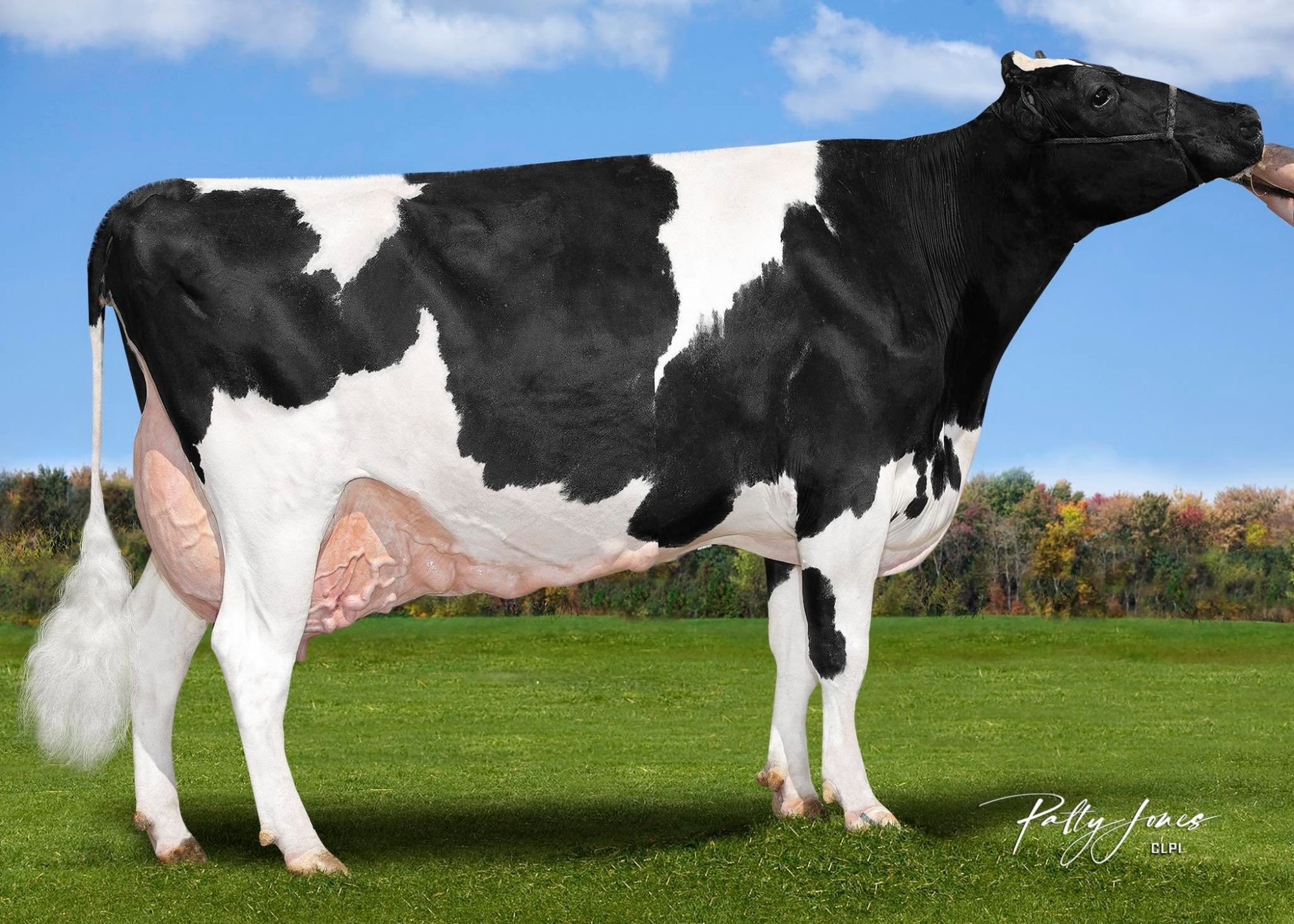
Drewholme Lambda Leysure P EX-92-5YR (Delta-Lambda x Zipit-P), the Drewholme cow Blondin bought with Quality Farms. Her second A2P2-PP son, Logic, ranked #3 on Lactanet’s August 2026 proven LPI list. His proof follows.

She was Drewholme Lambda Leysure P, a Delta-Lambda daughter of Drewholme Zipit Leysure P EX-90. She comes from the Ravenswell Lydia family behind Idee Lustre EX-95, the same family that produced Rockymountain Talent Licorice EX-95 and Winterbay Goldwyn Lotto EX-95. She’s now EX-92-5YR. She had two A2P2-PP bull calves. The first, Leyhigh, went to Semex. The second tested slightly higher. That was Logic.

Logic-PP’s August 2026 Canadian proof

MeasureLogic-PP (CDN, August 2026)
LPI3909, 91% reliability
Milk−18 kg
Fat+124 kg, +1.05%
Protein+43 kg, +0.34%
Conformation+16
Production daughters / herds173 / 87
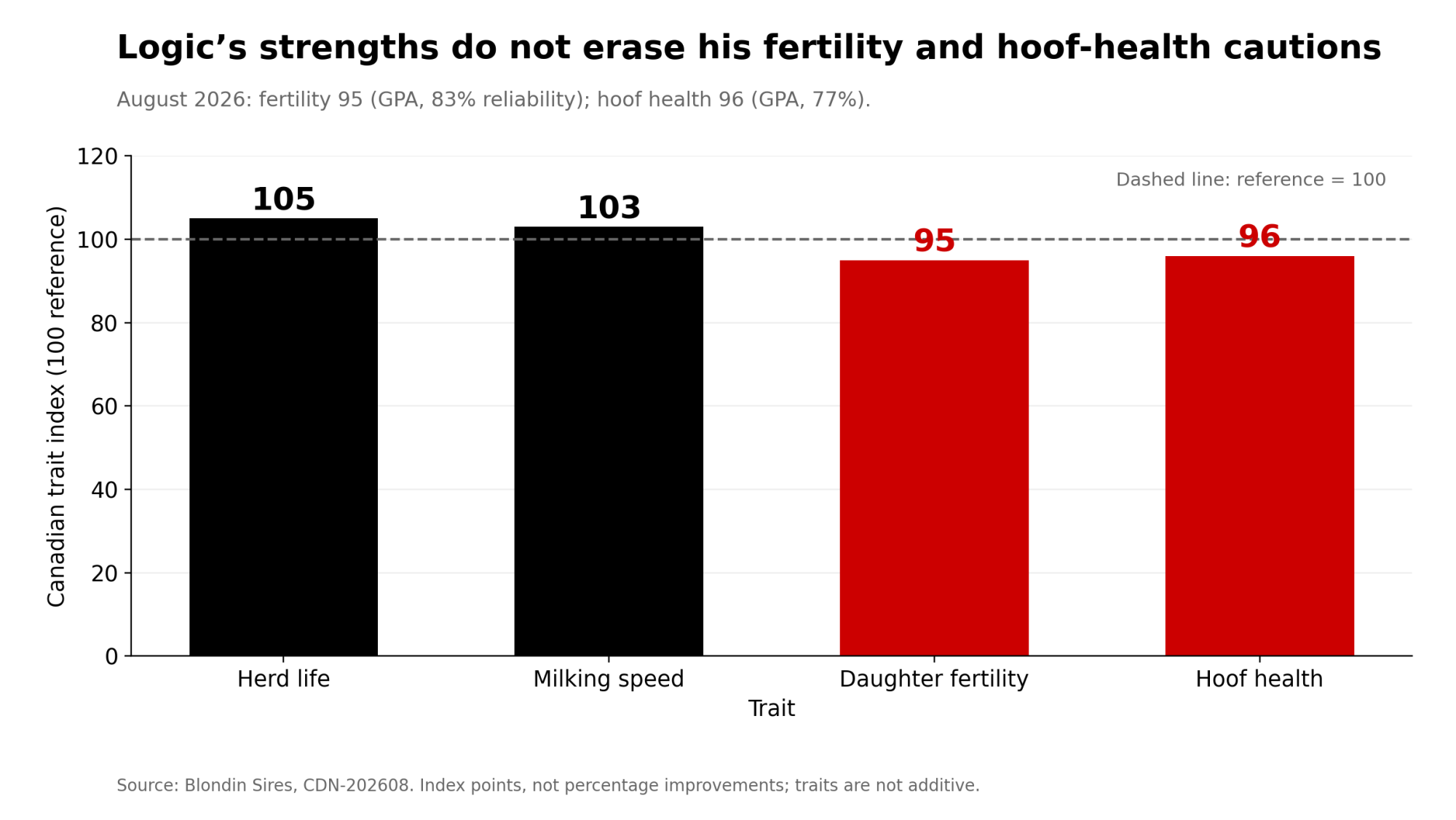
Herd life105 (92% rel.)
Daughter fertility95 (GPA, 83% rel.)
Hoof health96 (GPA, 77% rel.)
Rear legs side view−11 (toward straight)
Bone quality0
Milking speed103 (92% rel.)

Source: Blondin Sires, CDN-202608, accessed October 12, 2026. Canadian scale; don’t compare directly with U.S. values. GPA = genomic parent average, which Lactanet describes as a blend of parent average and the animal’s direct genomic value.

Canadian measureAugust 2026 valueWhat the value establishesSelection consideration
Milk−18 kgNear-neutral yield relative to the Canadian baseLimited predicted volume improvement
Fat+124 kg; +1.05 percentage pointsPositive yield and concentration breeding valuesAssess against the milk-payment system
Protein+43 kg; +0.34 percentage pointsPositive yield and concentration breeding valuesAssess alongside fertility and health
Conformation+16Positive overall type evaluationOverall type does not eliminate individual weaknesses

Source: Blondin Sires, CDN-202608. Production evaluation: 173 daughters in 87 herds; LPI 3909 at 91% reliability.

With Remover-PP at #1 and Logic-PP at #3 on Lactanet’s August list, two of Canada’s top three proven bulls are homozygous polled. The bull between them, Siemers Rengd Parfect-ET at 3932, isn’t polled.

The numbers explain what “extreme components” means here. At −18 kg, Logic offers little predicted milk-volume improvement over the Canadian genetic base. His strengths are fat, protein and conformation at +16.

Drewholme Logic Sparkle-P VG-2YR, a polled Logic daughter. One cow isn’t a proof: Logic’s +16 for conformation comes from his August 2026 daughter evaluation, and the cautions on legs and bone follow.

Carscadden says he’d protect Logic for slightly straight legs, bone quality and milk yield. The −11 for rear legs side view supports the straight-leg caution. Bone quality at 0 is a neutral value on that scale, so the bone caution is his assessment rather than something the number proves.

Daughter fertility (95) and hoof health (96) are below 100 and still reported as GPA, so they may move as more information enters the evaluation. His 103 for milking speed fits Carscadden’s view that daughters milk out faster than average.

None of that makes Logic an automatic choice for every herd paid on components. Fertility, feet, legs, relationship to your cows, semen price and the alternatives all still count.

Drewholme Supershot Leisure EX-92-5E 5*, Logic-PP’s great-granddam, with more than 100,000 kg lifetime by 2024. Her Zipit-P daughter, Drewholme Zipit Leysure P, is Logic’s maternal granddam. That’s how Zipit-P ends up on both sides of his pedigree.

His pedigree adds one more detail: Logic is already line-bred. OCD Eraser Zipit-P, Luster’s sire, also sired Logic’s maternal granddam, Drewholme Zipit Leysure P. That puts Zipit-P on both sides of Logic’s pedigree (Bullvine analysis of the Blondin, Select Sires and Holstein Canada records).

The Half-Sibling Mating

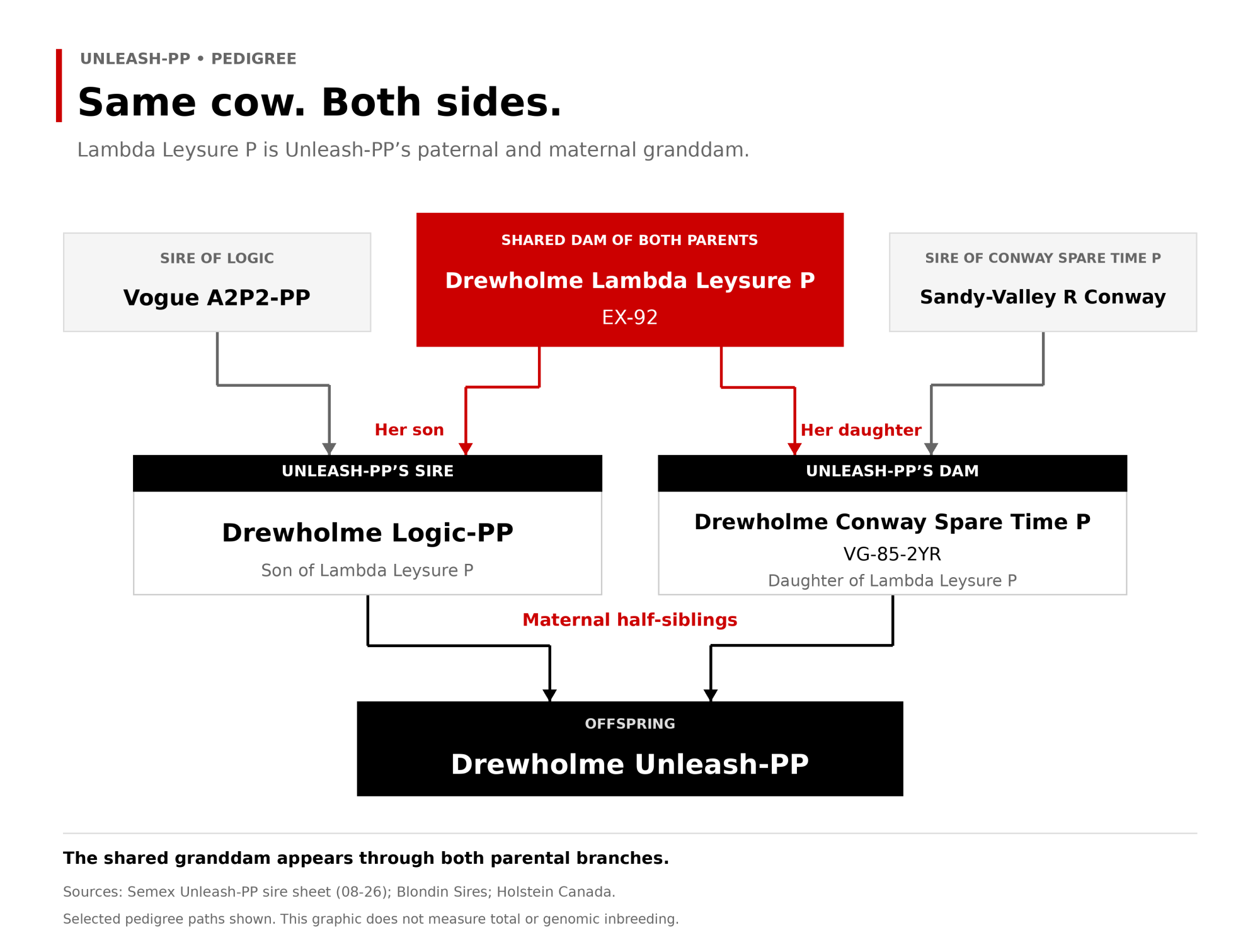
Unleash-PP and Spare Time-PP were bred under the Drewholme prefix and are marketed by Semex. Semex’s sire sheet for Drewholme Unleash-PP, with evaluations dated August 2026, lists his parents:

  • Sire: Logic-PP.
  • Dam: Drewholme Conway Spare Time P VG-85-2YR, a Sandy-Valley R Conway daughter.
  • Maternal granddam: Drewholme Lambda Leysure P EX-92.

Lambda Leysure P is also Logic’s dam, so Unleash’s parents are maternal half-siblings. Herd records published in October 2026 list a second son from the same mating, Drewholme Spare Time-PP, also at Semex. Semex’s April 2026 Holstein Highlights describes him the same way: a Logic son out of a VG-2YR Conway maternal sister to Leyhigh-PP.

That puts Lambda Leysure P two generations back on both sides of Unleash-PP. She’s his paternal granddam through Logic and his maternal granddam through Conway Spare Time P.

Same cow, both sides: Lambda Leysure P is Unleash-PP’s paternal and maternal granddam.

Pedigree loops: what 12.5% does and doesn’t mean

This is an illustration, not a measurement (Bullvine calculation from the published pedigree). A mating between maternal half-siblings creates one shared-dam loop. If the shared dam isn’t inbred herself, that loop alone contributes 12.5% to the offspring’s pedigree inbreeding coefficient. That isn’t a measured genomic coefficient, and it isn’t a complete pedigree calculation. Other shared ancestors further back can raise the total, and a full calculation has to count each valid path once without double-counting overlapping ancestry.

Close matings concentrate whatever a family carries, desirable and undesirable alike. The published pedigree establishes the relationship. It doesn’t tell us the breeder’s reasoning, or whether this mating’s gains outweighed its tradeoffs.

U.S. sire data put Unleash-PP’s expected future inbreeding at 12.1% and Spare Time-PP’s at 12.0%, against 9.9% for Luster-P. That’s the predicted inbreeding of their daughters across the breed, not the 12.5% loop in their own pedigree.

The breeding decision downstream is a separate question. A bull’s own inbreeding doesn’t tell you the predicted inbreeding of his calves out of a particular cow. That depends on how related he is to her.

Logic’s Sons and the Ancestors They Share

Logic has 10 PP sons in AI, all with extreme components and double-digit conformation. Here’s what the best-known of them carry, and what to look for in your own cows before you use them.

Son(s)Dam sideShared ancestors to check in your cows
Unleash-PP, Spare Time-PP (Semex)Conway Spare Time P, Logic’s maternal half-sisterLambda Leysure P (on both sides), Zipit-P, Luster-P, Vogue
Loaded-PP, Leverage-PP (Stantons full brothers)A Remover-PP daughterLuster-P twice (through Vogue and Remover), Zipit-P, Lambda Leysure P
Vector Fra Apollo-PP (Validity), Fraholme Vec Triton-PP (Blondin), Fraholme Vec Gideon-PP (Semex)Fraholme Allday Arielle-PLuster-P, Vogue, Zipit-P and Lambda Leysure P through Logic; dam side not traced here

Bullvine analysis of the Semex, Blondin and Holstein Canada pedigree records and the published herd history credited below.

This is one family’s route through North American polled breeding, and it isn’t the only one. In the Netherlands, CRV’s Delta Launch-PP-Red spread his influence mostly through daughters: about 16,000 milking by mid-2026, and a growing list of CRV bulls with him as maternal grandsire. In Germany, RUW’s Simon-P spread his through sons. He has 18 progeny-proven sons, 11 of them homozygous polled, plus descendants in France, Italy and Scandinavia. Some of those descendants, such as Rise Up, aren’t even polled. Launch and Simon deserve their own breakdown, and we’re working on one. For this mating decision the point is simpler. Polled progress isn’t running through a single sire, so the alternatives to a Logic son are real.

The question breeders need to ask has changed. “Is there a polled bull good enough?” now has an answer at the top of the rankings. The breed-wide question is genetic diversity, and this piece doesn’t measure the available pool. For a given herd, the decision is narrower: do you have enough suitable polled alternatives with low relationships to your own females?

What the Hot Iron Is Worth

A 2017 Journal of Dairy Science paper by Thompson and colleagues at Purdue, USDA-ARS and Michigan State put a price on dehorning. Under the study’s assumptions, producers could pay up to US$11.90 a head more for homozygous polled genetics, or US$4.17 a straw at a 35% conception rate. That’s measured against hot-iron disbudding without pain relief, the cheapest conventional method in the study. Heterozygous genetics came out at about half that, US$2.08 a straw, because half a heterozygous sire’s calves out of horned dams are expected to grow horns. Pain relief barely moved the math: the study priced it at US$11.90 a head.

Those are 2017 dollars. USDA NASS put U.S. livestock workers at US$18.15 an hour for the April 2025 reference week, up 4% from a year earlier. Our read: where disbudding labor is a real expense, the avoided cost is likely higher now. We haven’t re-run the model, though, so we won’t put a 2026 number on it.

As an illustration only (Bullvine math): 500 straws × US$4.17 = US$2,085, in 2017 dollars. Your farm’s number will differ. Beyond the avoided cost, a premium buys some mix of the bull’s genetic merit and the welfare and management value of not disbudding. Know which one you’re paying for. Our break-even analysis walks through the full method.

What This Means for Your Breeding Program

  • Check the genotype before you pay for it. P and PP aren’t the same product. Only PP sires guarantee every calf is polled. With horned dams, a heterozygous bull’s break-even in the 2017 study was about half as large.
  • Use Logic where he fits. He suits herds that need fat, protein and udders more than milk volume. Watch rear legs side view, the bone caution, fertility and hoof health, and expect the GPA traits to move.
  • Run the relationship check son by son. If your cows carry Luster, Vogue, Zipit-P or the Leysure family, pull predicted offspring inbreeding for each Logic son before you pick one. Use the table above as your list.
  • Judge descendants on their own proofs. Ancestry points you to candidates; the proof decides. That goes for Launch and Simon descendants too.
  • Keep proof systems separate. Canadian LPI, Dutch NVI and German RZG use different bases, so compare bulls within one system.
  • Price the premium against your own costs. Use your conception rate, straw count, wage rates and disbudding protocol, not the study’s 2017 assumptions.

Back to Nearly a Million

Nearly a million units is the number Select Sires put on Luster-P’s career. It was never the full measure of him.

A better measure is the Lambda cow Carscadden saw in the Drewholme barn. Blondin asked a price and bought her with Quality Farms as a genetic cow, and she finished second at the 2021 National that fall. Her son Logic now sits third on Canada’s proven LPI list, and his PP sons out of her Conway daughter are already at Semex.

At the top of the rankings, polled has caught up. What matters for the next mating is narrower: the bull’s own proof, and the predicted inbreeding of his calves out of the cow you’re breeding. For more on how polled sires reached the top, see Polled Just Hit 3371 TPI and our polled dairy cattle archive.

Key Takeaways

  • Logic-PP debuted #3 on Lactanet’s August 2026 proven LPI list at 3909 on his first daughter proof. That’s +124 kg fat and +43 kg protein against −18 kg milk, with fertility and hoof health still GPA.
  • Lambda Leysure P EX-92 is both paternal and maternal granddam of Unleash-PP. By our math, that one shared-dam loop alone adds 12.5% to his pedigree inbreeding before any older shared ancestors are counted.
  • With Remover-PP #1 and Logic-PP #3 in August 2026, polled isn’t the limit at the top of Canada’s proven list anymore. The thing to manage now is how closely a polled bull is related to your cows.

The Sunday Read Dairy Professionals Don’t Skip.

Every week, thousands of producers, breeders, and industry insiders open Bullvine Weekly for genetics insights, market shifts, and profit strategies they won’t find anywhere else. One email. Five minutes. Smarter decisions all week.
NewsSubscribe
First
Last
Consent

Learn More

The “No-Holes Sire” Approach Makes Perfect Sense: A Scientific Validation

Everyone brags about mega-genomic sires, but what if the real profit is bulls without a single ‘hole’ on their proof sheet?

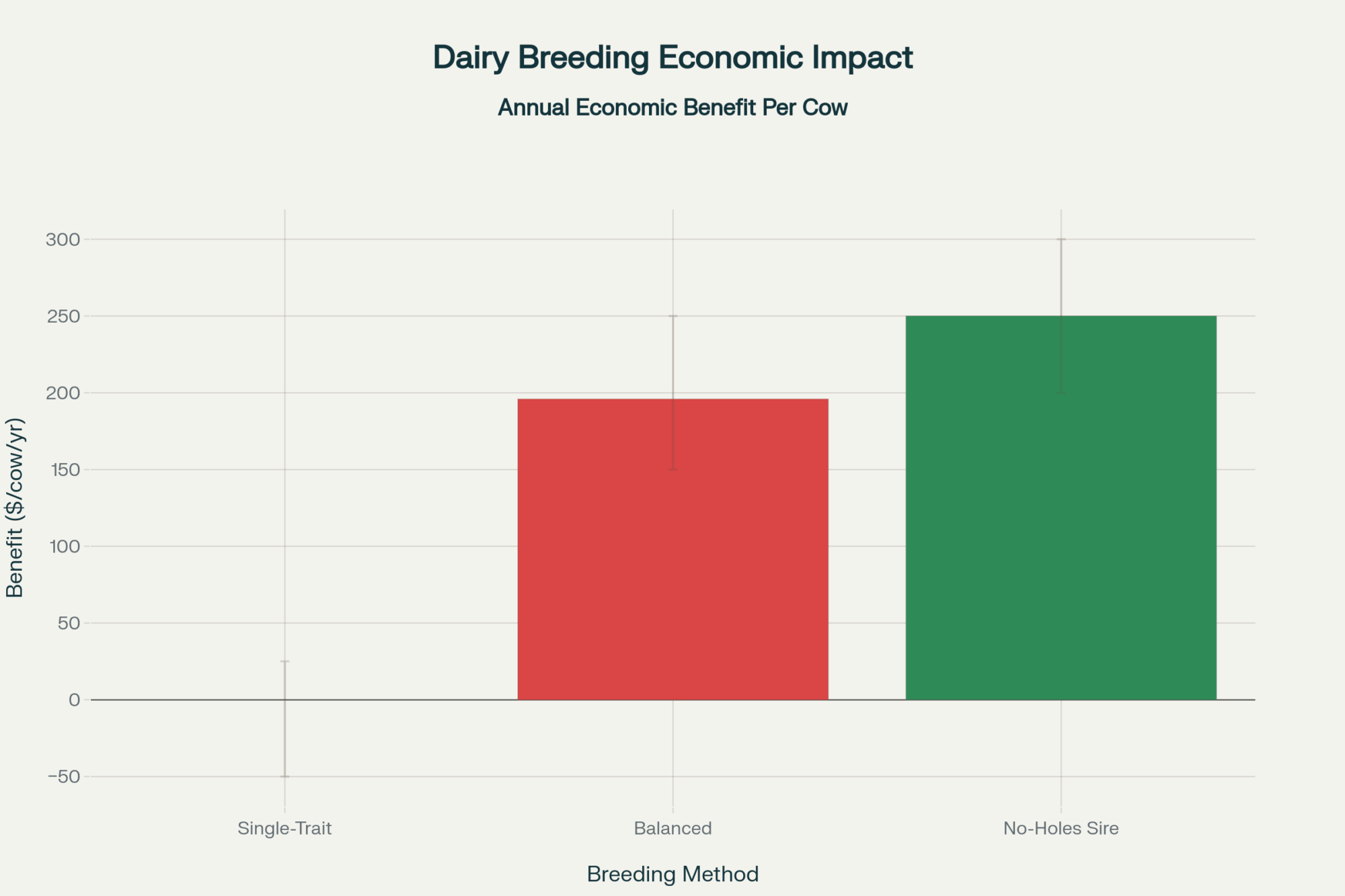
A “No-Holes Sire” breeding philosophy, based on Lactanet’s six subindexes and 50% RK thresholds, represents a scientifically sound approach to optimizing future dairy herd performance. The data strongly support this framework over traditional single-trait and total merit index maximization strategies.

The Problems with Single-Trait or Only Total Merit Selection

Research consistently demonstrates that, over time, chasing individual high-ranking traits or a single value index often creates genetic imbalances that undermine long-term herd productivity.

When producers focus exclusively on maximizing metrics like lactation yields, TPI/LPI, NM$/Pro$, or PTAT/CONF without considering trait balance, they often create “genetic holes” that manifest as:

  • Reduced fertility performance – despite high production potential
  • Increased health issues – particularly mastitis, lameness, and metabolic disorders
  • Shortened productive lifespans – undermining lifetime profitability
  • Management and labor challenges – from extreme trait combinations

As one industry analysis noted, “Strong selection focus on production traits challenges the homeostatic balance of animals, leading to diseases and compromising welfare.”

Lactanet’s Six Subindex Framework Validation

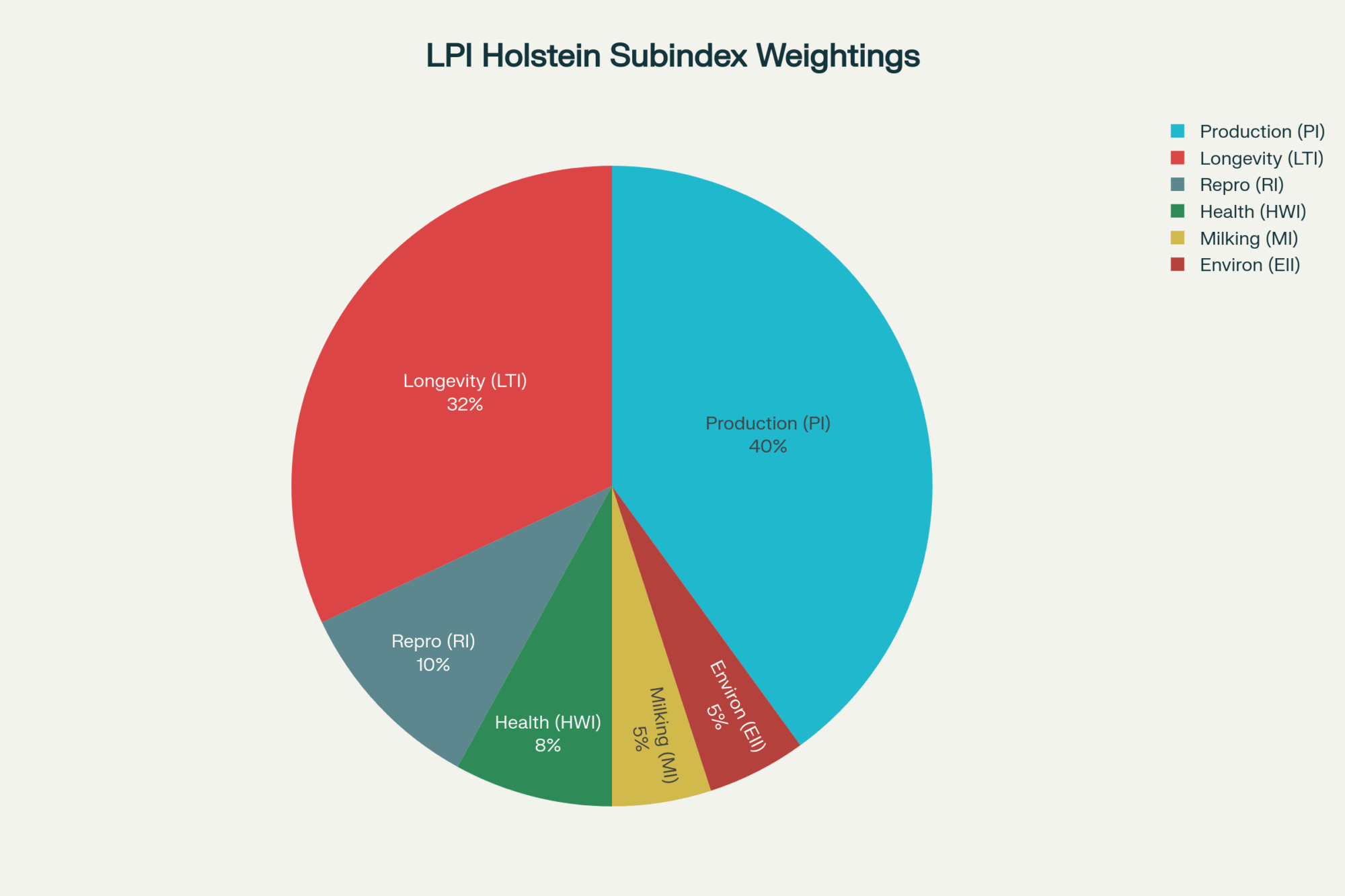
The modernized LPI system launched in April 2025 directly addresses these concerns by creating balanced selection tools. The six subindexes for Holstein cattle are:

SubindexWeightPrimary Focus
Production Index (PI)40%Fat and protein yields
Longevity & Type Index (LTI)32%Herd life, functional conformation
Health & Welfare Index (HWI)8%Disease resistance, metabolic, and hoof health
Reproduction Index (RI)10%Female fertility, calving performance
Milkability Index (MI)5%Milking efficiency, temperament, and udder form
Environmental Impact Index (EII)5%Feed efficiency, methane reduction, and body maintenance requirement

Each subindex is standardized with a mean of 500 and a standard deviation of 100, and percentile ranks are assigned, providing clear comparative metrics.

The 50%RK Threshold Strategy

The Bullvine recommends a “no-holes sires” selection approach with at least five of six subindexes above 50%RK, creating a balanced genetic foundation. This approach aligns with established breeding principles:

Scientific Basis: Using multi-subindex selection indices consistently outperforms single-trait or one-total-merit index approaches for optimal overall genetic progress. Research shows that “multi-subindex genomic prediction can be more beneficial than a single total merit genomic prediction”.

Percentile Interpretation: The 50% RK threshold ensures that sires perform above average across multiple genetic evaluation categories. As Lactanet documentation explains, percentile ranks allow producers to “compare values for each subindex and identify the elite sires”.

Risk Management: Sires weak in multiple areas (less than four subindexes above 50%RK) create genetic vulnerabilities that compound over generations.

Evidence Supporting Balanced Selection

Multiple studies validate this “no-holes sires” approach:

  • Economic Impact: Research on Irish dairy farms found “every €1 increase in herd EBI was associated with €1.96 net profit per cow” when using balanced selection indices rather than a single-trait focus.
  • Genetic Progress: Studies demonstrate that “reallocating a part of phenotyping resources to genotyping increases genetic gain regardless of the cost and amount of genotyping” – but only when selection remains balanced across economically important traits.
  • Long-term Sustainability: Analysis of breeding programs shows that “breeding programmes should optimize investment into phenotyping and genotyping to maximise return on investment” through multi-focus approaches.

Your Canadian Focus Advantage

Lactanet’s comprehensive genetic evaluations provide unique advantages for implementing this truly balanced breeding strategy:

  • Universal Coverage: All sires receive evaluation across the six subindexes regardless of origin.
  • Standardized Metrics: Consistent 500-point scale with percentile rankings
  • Regular Updates: Three annual evaluations ensure ongoing genetic assessments.
  • Integration Tools: Mating programs can be optimized for balanced trait improvement.

Validation from Industry Leaders

Leading breeding organizations increasingly recognize that “the goal is to identify a complete package of top genetics, one that balances improved production along with an outstanding blend of efficiency, reproduction, functional conformation and health characteristics”.

The shift toward balanced breeding reflects broader industry recognition that “genomic selection has revolutionized breeding by reducing generation intervals…while simultaneously democratizing access to elite genetics”.

Practical Implementation

For producers implementing this 50% and higher %RK strategy:

  1. Evaluate Current Sires: Review existing genetics against the six subindex criteria.
  2. Set Selection Standards: Require a minimum of five of six subindexes above 50%RK
  3. Monitor Genetic Progress: Track herd improvement across all trait categories to identify areas for improvement.
  4. Adapt Over Time: Adjust emphasis based on herd-specific needs while maintaining a balanced approach.

Table 1 features eight elite (99% RK) LPI sires and their corresponding subindexes, which dairy farmers can use to add total trait coverage, genetic uniformity, and superior performance to optimize sustainable herd performance.

TABLE 1: Eight 99%RK LPI “No-Holes Sires” Being Marketed in 2025

Bull NAAB Code LPI (% REL) PI (%RK) LTI (%RK) HWI (%RK) RI (%RK) MI (%RK) EII (%RK) Casein’s Other Sire Stack
Impulse 200HO13363 4067 (77%) 99 98 97 54 65 96 A2A2/BB #3 gLPI Sundance x Fellowship x Altazazzle
Cobot 014HO17486 3925 (76%) 99 87 99 78 82 72 A2A2/BB #2 gPro$ Rimbot x Monteverdi x Envoy
Apollo-PP* 724HO02040 3924 (79%) 95 99 70 41 85 58 A2A2/BB Logic-PP x Allday-P x Hotspot-P
Sheepster 007HO16276 3903 (78%) 99 88 56 71 59 51 A1A2/AB #2 TPI Trooper x Acura x Resolve
Brigade 551HO05964 3877 (76%) 99 92 67 66 62 85 A2A2/BB Gordon x Captain x Nightcap
Validated 200HO12169 3746 (90%) 96 89 91 94 61 86 A1A2/AB #16 LPI Altazazzle x Altahotjob x Achiever
Altazazzle** 011HO15036 3716 (96%) 98 90 90 67 85 50 A1A2/BB #21 LPI Marius x Altatopshot x Silver
Lightyear 029HO19205 3623 (89%) 93 87 97 95 59 61 A1A2/BE #4 Pro$ Yoda x Delta x Supersire

* Apollo-PP is the highest ranking PP sire with five of six subindexes over 50%RK
** Altazazzle has one son and one great-grandson on this “No-Holes Sire” list, plus five daughter proven sons in the top sixteen LPI listing, averaging 3808 LPI and 2818 Pro$

The Bottom Line

This “no-holes sire” philosophy represents a sophisticated understanding of modern dairy genetics. The scientific evidence overwhelmingly supports balanced multi-trait selection over single-trait maximization. Lactanet’s subindex system provides the tools to implement this approach systematically, potentially delivering superior long-term genetic progress and herd sustainability.

This strategy acknowledges that “breeding a super performing herd is not a one-trait/one total merit index/one subindex solution” – exactly the insight driving modern genetic evaluation systems toward more comprehensive, balanced, optimized approaches.

KEY TAKEAWAYS

  • Balanced genetics = real dollars: Herds using sires with at least 5/6 subindexes above 50th percentile see up to 15% longer herd life (Journal of Dairy Science, 2025). Step: Check the subindex spread of your current lineup.
  • Better fertility = less downtime: In 2025, farms adopting the balanced rule cut open days by up to 22%, boosting cash flow on every fresh cow. Step: Set 50%RK threshold on new bull choices right now.
  • Global proof, local impact: Irish data linked €1 index improvement to €2 profit per cow; Canadian and US extension data show the same.
  • Reduces costly disease calls: Balanced selection is linked to fewer mastitis/lameness cases—save on vet bills and keep cows milking. Step: Sort sires for health/welfare index, not just fat and PTAT.
  • Works for today’s market: With replacement costs up 18% and feed still volatile, building cows that last and breed back is pure survival. Step: Prioritize no-holes bulls on your next semen order—your future margin might depend on it.

EXECUTIVE SUMMARY:

You know what most folks miss? Chasing big production or conformation numbers alone is a one-way trip to more trouble and less profit. This piece lays it out plain: those ‘no-holes’ sires with five or six subindexes over 50th percentile aren’t just geek numbers—they’re putting real dollars in the bank. Irish research showed that every €1 increase in balanced genetic index delivered approximately €2 net per cow, and Canadian data now supports this finding with improved reproductive rates and fewer health setbacks. Herds adopting this approach are seeing more cows in milk by the third lactation, rather than in the cull pen. With global feed costs sky-high and replacement rates squeezing margins, this is more than a trend—it’s a way to get ahead finally. The article explains the farm-tested steps, not just theory, and ties it back to what’s working from Europe to Manitoba. If you haven’t tried “no-holes” yet, you might be paying for holes you can’t see—give it a real look.

Complete references and supporting documentation are available upon request by contacting the editorial team at editor@thebullvine.com.

Learn More:

  • Rethinking Balanced Breeding for 2028 and Beyond – This article provides a strategic framework for applying the “No-Holes” philosophy over the long term. It reveals how to adapt your breeding goals to anticipate future market demands, ensuring your herd remains profitable and genetically competitive for years to come.
  • The 6 Financial KPIs Every Dairy Farmer Should Be Tracking – Connect your genetic strategy to your bottom line. This piece demonstrates how balanced breeding directly impacts the most critical financial metrics, like herd equity and profitability, proving that a “no-holes” approach is a powerful driver of business success.
  • Is It Time to Start Breeding for Feed Efficiency? – Go deeper on one of the most innovative and economically important frontiers in genetics. This article explores practical strategies for leveraging feed efficiency—a key part of the EII subindex—to cut input costs and boost your herd’s sustainability dramatically.

The Sunday Read Dairy Professionals Don’t Skip.

Every week, thousands of producers, breeders, and industry insiders open Bullvine Weekly for genetics insights, market shifts, and profit strategies they won’t find anywhere else. One email. Five minutes. Smarter decisions all week.
NewsSubscribe
First
Last
Consent

Send this to a friend