





USDA’s proposed mandatory dairy plant-cost survey rule entered federal regulatory review on September 21, 2026, and remained pending as of November 20. Its February notice used 2028 as an example publication year for the first report, rather than a firm deadline. Meanwhile, the higher make allowances USDA implemented on June 1, 2025, remain in the milk-pricing formulas.
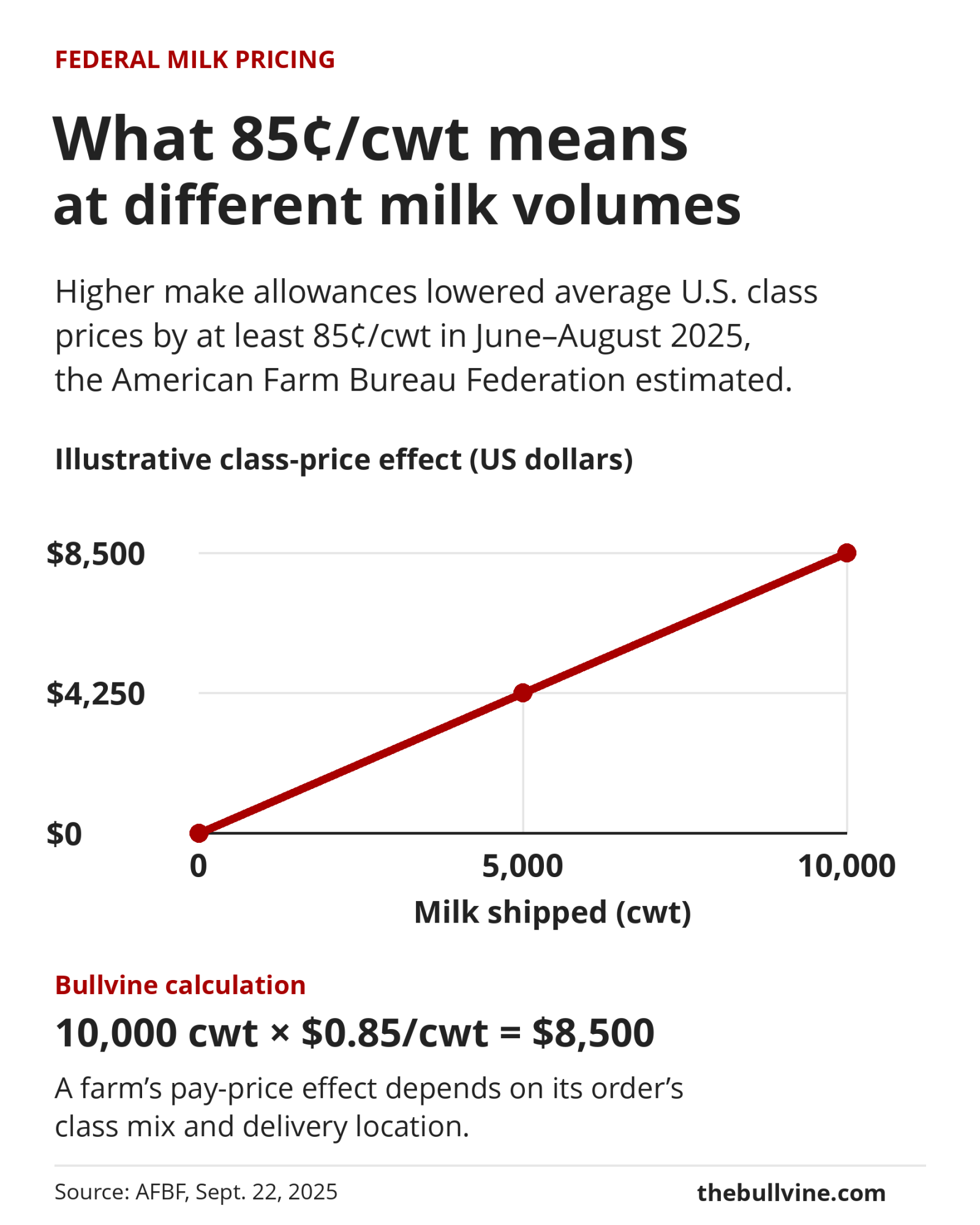
The American Farm Bureau Federation estimated that those higher manufacturing-cost deductions lowered average federal class prices by at least 85 cents per cwt in June–August 2025. On a 500-cow dairy shipping an assumed 230 cwt per cow annually, applying 85 cents to a full year’s 115,000 cwt gives an annualized illustration of $97,750, by The Bullvine’s calculation. That is not an observed annual milk-check loss. An individual farm’s settlement also depends on its order’s class mix and delivery location.
Tennessee’s 5th District elected Charlie Hatcher on November 3, 2026. The veterinarian and former state agriculture commissioner comes from a family that chose to bottle its own milk at its College Grove dairy in 2007. Constituents can ask their incoming representative to find out two things from USDA: when it expects to publish its first plant-cost report, and how it will verify what processors report.
Federal rules place 33 East Tennessee counties, including Knox, Hamilton and Sullivan, in the Appalachian marketing area (Order 5), and the rest of the state, including Williamson County, in the Southeast marketing area (Order 7). Tennessee Lookout describes the redrawn 5th District as stretching across northwest and far-west Tennessee, outside the Appalachian marketing area. A farm’s location alone does not determine where its milk is pooled.
Report language is one lever for Hatcher
Once seated, Hatcher can ask House Agriculture appropriators to include language requesting a USDA survey timetable in a future committee report. That would be a request for oversight, not a change to the pricing formulas.
He spent a decade as Tennessee’s state veterinarian and served as agriculture commissioner from January 2019 until the state announced his retirement in September 2025. His family’s fluid-bottling business does not, on the public record, establish his position on make allowances or processor-cost verification.
Class III took the largest cut, at 92¢/cwt
Farm Bureau estimated that higher make allowances reduced nationwide pool revenue by more than $337 million from June through August 2025. The largest estimated reductions were in the Upper Midwest ($64 million), Northeast ($62 million) and California ($55 million).
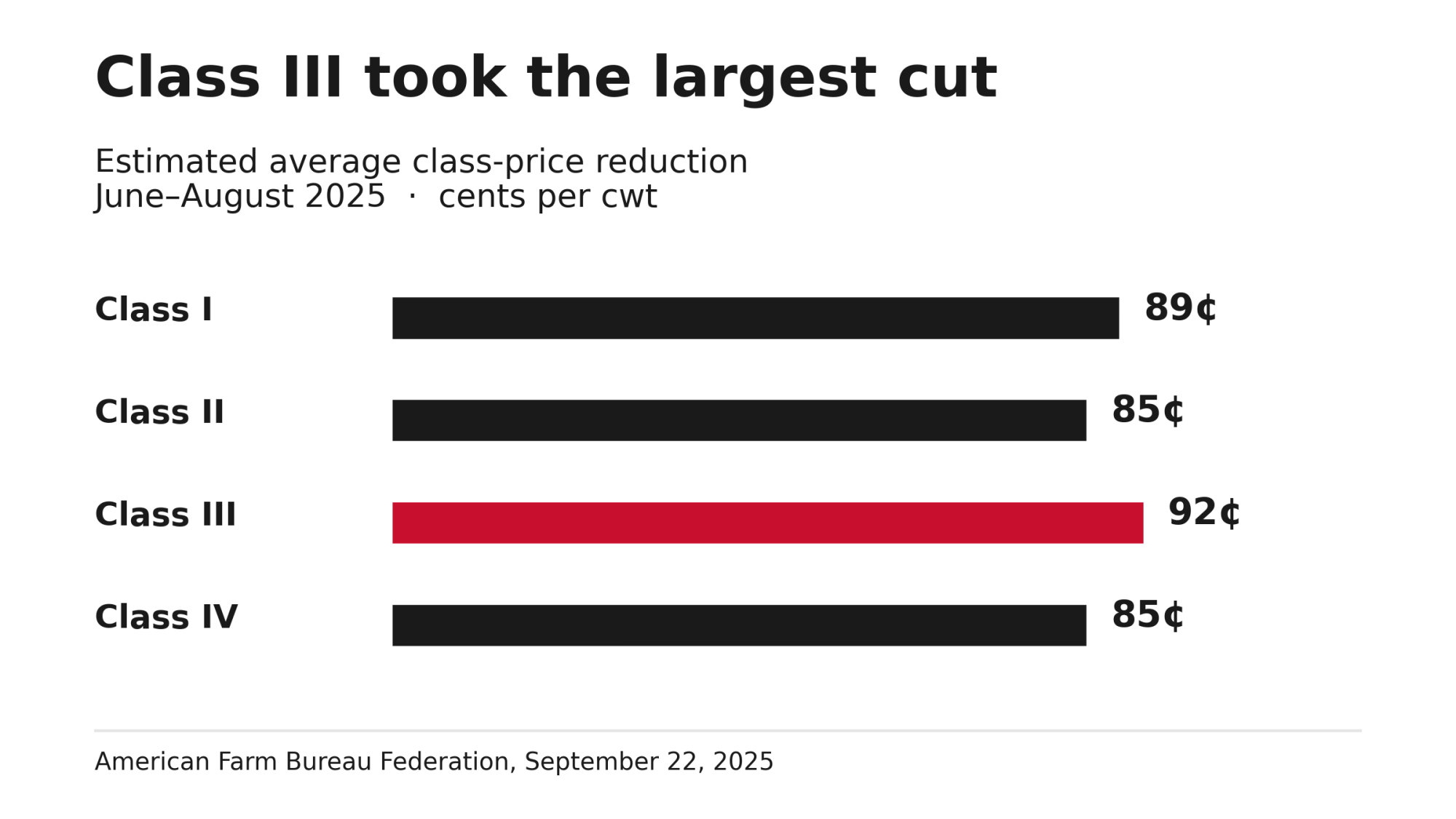
| Federal milk class | Estimated average reduction, June–August 2025 |
| Class I | 89¢/cwt |
| Class II | 85¢/cwt |
| Class III | 92¢/cwt |
| Class IV | 85¢/cwt |
Source: American Farm Bureau Federation, September 22, 2025. Estimates isolate the increase in make allowances.
Every 10,000 cwt multiplied by 85 cents per cwt equals $8,500, by our math. That calculation illustrates the size of the class-price effect; it does not account for the other formula changes or a farm’s settlement terms.
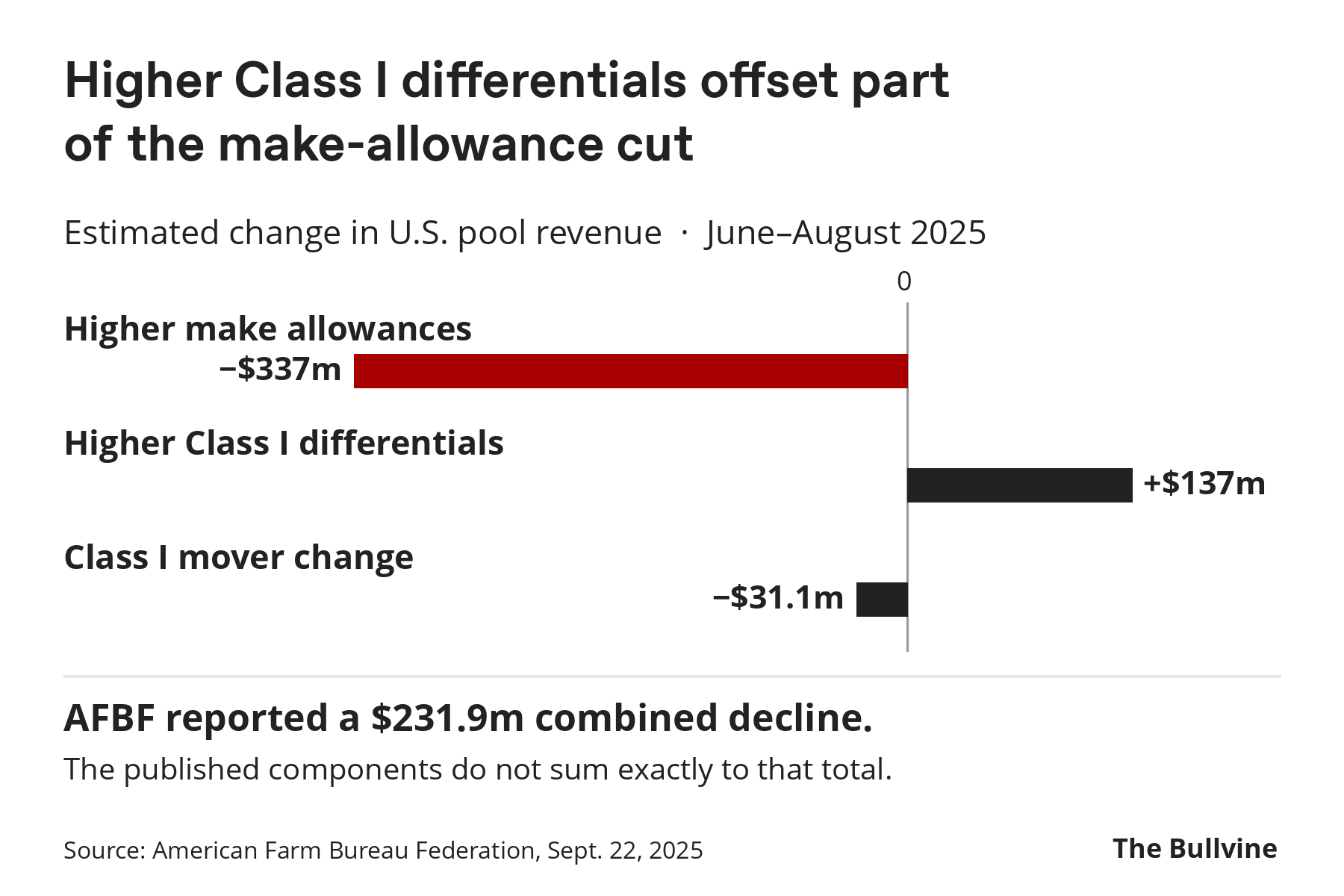
Farm Bureau estimated that higher Class I differentials added $137 million to pool revenue, while the change to the Class I mover reduced it by $31.1 million. It reported a combined nationwide decline of $231.9 million across those changes and higher make allowances. Farm Bureau’s published components don’t sum exactly to its net figure.
Farm Bureau’s Appalachian estimate comes from its January 7, 2025 analysis, which modeled USDA’s final pricing decision on 2020–2023 prices and found Appalachian pool value would have been higher under the revised formulas. That was a historical simulation, not an Appalachian breakdown of the June–August 2025 national estimate.
A farm’s result could still differ because the revisions also changed the location adjustment tied to where its milk was delivered. Farm Bureau cautioned that some producers could lose even in orders where pool values increased.
USDA’s 2028 report date is an example, not a deadline
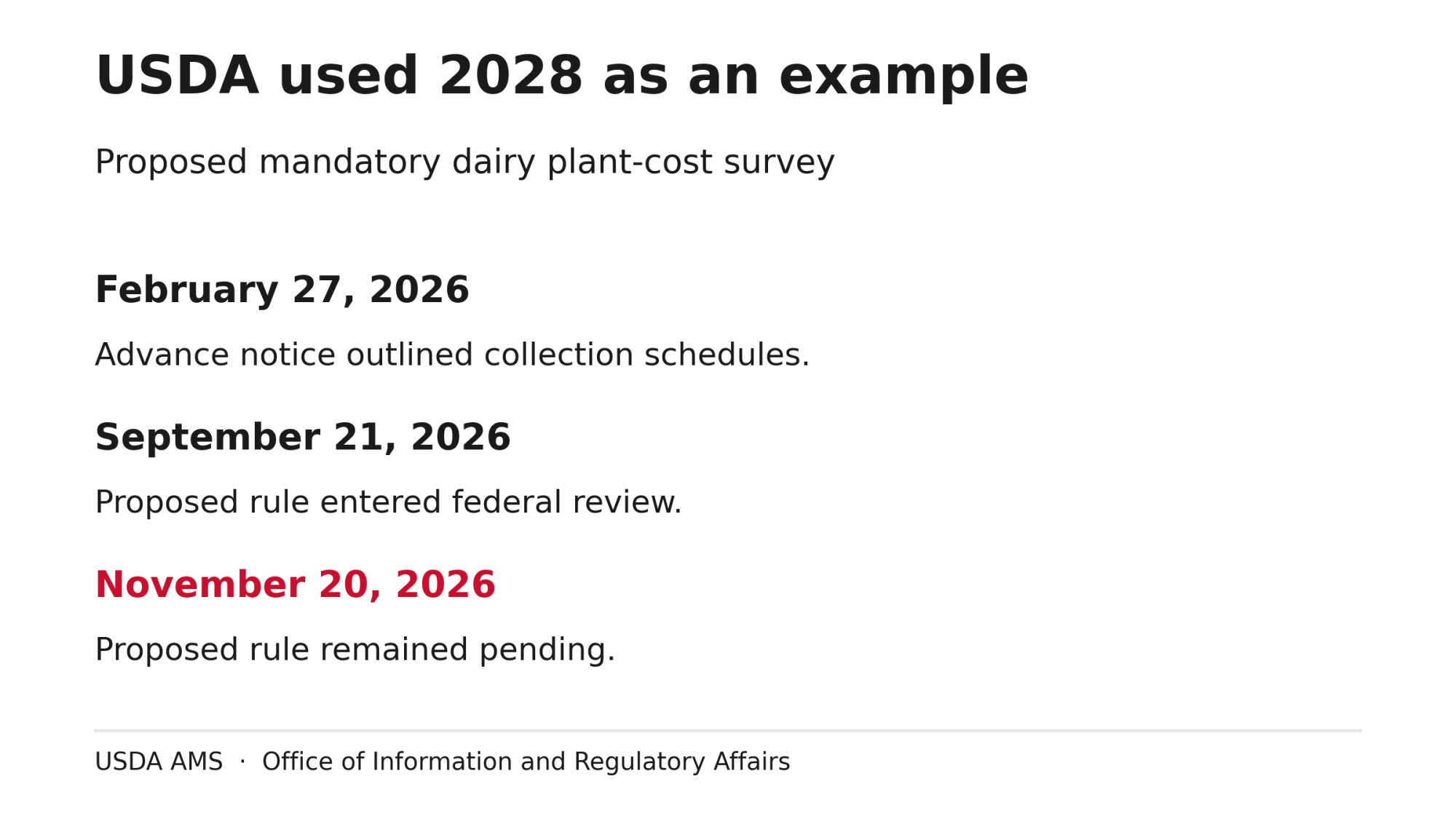
Under the first of three collection schedules in USDA’s February 27, 2026 advance notice, 91 FR 9732, a 2027 survey would collect 2025 and 2026 plant data. All three schedules used 2028 as an example publication year for the first biennial report.
The notice says reporting plants would have to make records available on request. The proposed rule would spell out how USDA will verify submissions. USDA would publish a commodity’s figures only when the data cover at least three plants and no single entity accounts for more than 60% of the volume for that commodity.
The proposed rule is listed in USDA’s regulatory agenda as RIN 0581-AE47. It entered Office of Information and Regulatory Affairs review on September 21, 2026, and remained pending as of November 20, 2026.
The notice covers plants required to report prices for products including butter, cheddar blocks, dry whey and nonfat dry milk. Farm Bureau said the earlier pricing hearing relied on manufacturing-cost figures submitted by a self-selected group of processors. The mandatory survey would provide evidence on manufacturing costs and yields. Changing make allowances would still require a separate federal-order hearing, and the evidence could support higher or lower allowances.
Two asks for Hatcher’s office, one estimate from the handler
Producers in Tennessee’s 5th District, along with shippers into the Southeast and Appalachian orders, can ask Hatcher’s office to obtain two answers from USDA in writing:
- Whether the agency has set a target date for its first plant-cost report.
- Which accounting records it will check against plant submissions, and whether it plans independent audits.
For federal-order shippers, the useful comparison holds the marketing month constant. Ask the co-op or handler whether it can estimate the pay price for milk marketed in June, July and August 2025 under the previous make allowances, holding other pricing inputs constant. The handler can also confirm which order pooled the milk in each of those months. Multiply each month’s estimated difference in dollars per cwt by that month’s shipments.
A separate estimate can show the effect of higher Class I differentials. Farm Bureau put those gains at $34 million in the Northeast and $30 million in the Mideast over the three months. California and the Upper Midwest, which Farm Bureau called the two hardest-hit orders, gained only $6 million to $8 million each from higher Class I differentials.
For the updated skim milk composition factors, the starting point is milk marketed in December 2025. Use the marketing month printed on the statement, since a check issued in December can cover milk shipped earlier. Farm Bureau estimated that update could add $200 million a year to pool value nationwide.
Complete references and supporting documentation are available upon request by contacting the editorial team at editor@thebullvine.com.
Learn More
- USDA’s New Class III Factors Lifted the Benchmark 41.6¢/cwt. The Cows Didn’t. — Arms you with a two-part settlement test to separate December 2025’s 41.6¢–58.5¢/cwt formula bump from actual shipped solids, extending our milk-check audit so you never credit a ration or sire for USDA math.
- USDA’s January Milk Forecast Beat Last Year’s Price in 6 of 10 Years — Stress-test your 2027 budget between $18.79 and $22.11/cwt before the December 18 DMC deadline. Ten years of WASDE error rates reveal how to plan multi-year cash flow while USDA’s plant-cost rule remains stalled.
- The 143-Hour Week at Clark Farms: The Real Math of On-Farm Creamery ROI and Your Time — Before bottling your own milk like the Hatchers to escape federal-order deductions, see how a New York dairy’s $3,000–$6,000 weekly creamery margin collapsed under 70–90 extra processing hours — exposing the real cost of going direct.
The Sunday Read Dairy Professionals Don’t Skip.

Every week, thousands of producers, breeders, and industry insiders open Bullvine Weekly for genetics insights, market shifts, and profit strategies they won’t find anywhere else. One email. Five minutes. Smarter decisions all week.