

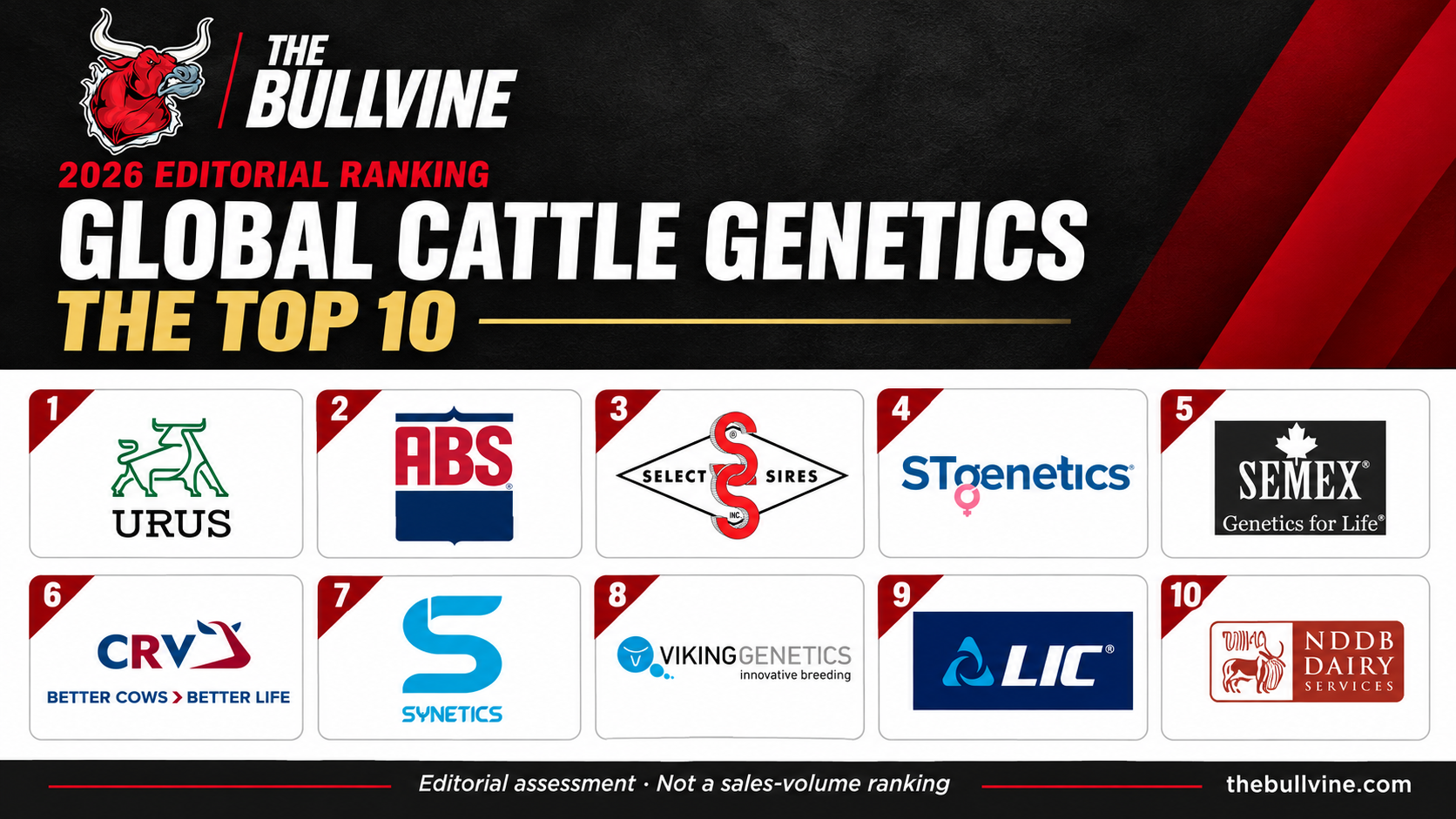


URUS leads our editorial ranking of global cattle-genetics influence, with ABS ahead of Select Sires and STgenetics above Semex. Here’s why—and what the order means for your next semen purchase.
The companies supplying your semen influence which bulls get developed, which traits receive investment and which reproductive technologies reach your farm. Their global influence matters—but it does not tell you which supplier deserves your next order.
Ranking cattle genetics companies by sales sounds simple. It isn’t. URUS publishes a figure of more than 31.5 million semen straws sold worldwide (URUS). NDDB Dairy Services publishes 47.32 million frozen doses, including 14 million buffalo doses (NDDB Dairy Services). Neither figure carries an explicit reporting period. Which organization sells more cattle semen? Those numbers cannot tell us.
SYNETICS adds another complication: its published figures span cattle and goat genetics, though we could not verify a current exact dose count. These figures describe substantial businesses, but they cannot support a comparable annual cattle semen sales ranking.
So we ranked on international commercial influence, using four criteria and giving the most weight to cross-border reach:
- Cross-border reach: international market access and the geographic spread of commercial operations.
- Commercial operations and scale: production, distribution, reproductive services, and herd-information systems supporting breeding decisions.
- Breeding programs: populations, breeds, and selection work.
- Reproductive technology: semen processing and preservation, sexing, IVF, and embryo services, including provision to other organizations.
We assess cattle-related operations. Activities in other species provide company context but don’t count toward the ranking. Distribution partnerships count as activity for both partners; they don’t merge companies. This is our editorial judgment about overall cattle-industry influence under the stated criteria, rather than a verified ranking by sales volume.
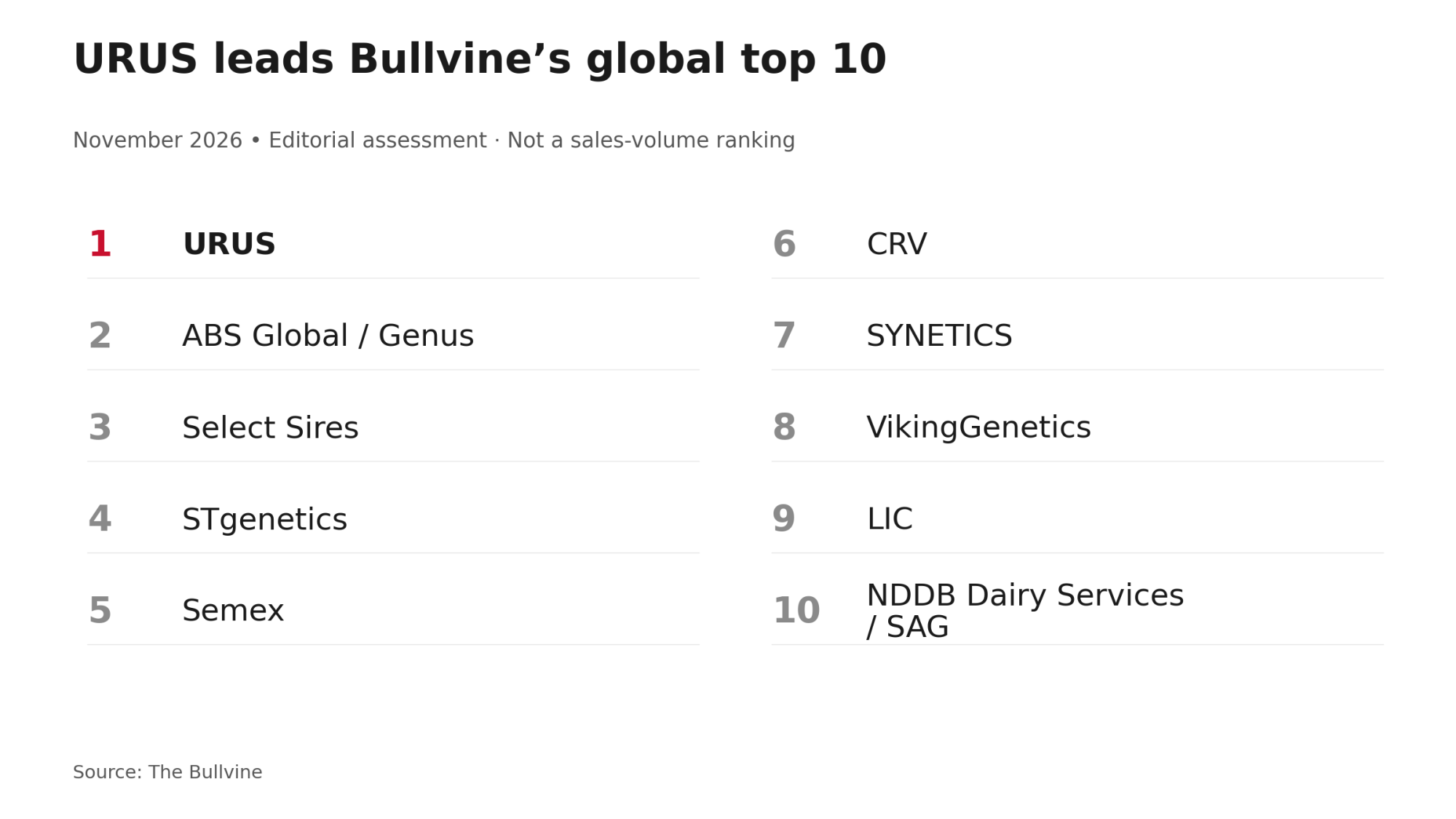
| Rank | Organization | Main reason for its position in this editorial ranking |
|---|---|---|
| 1 | URUS | Combines international genetics distribution, reproductive services, and herd-information businesses. |
| 2 | ABS Global / Genus | Combines international commercial operations with IntelliGen technology supplied beyond its own breeding programs. |
| 3 | Select Sires | Combines breeding programs, global distribution, and cooperative on-farm reproductive services. |
| 4 | STgenetics | Markets genetics and supplies sex-sorting technology within other organizations’ breeding programs. |
| 5 | Semex | Combines international distribution, Boviteq IVF licensing, selection tools, and distribution of partner genetics. |
| 6 | CRV | Combines multiple breeding programs with production operations across several regions. |
| 7 | SYNETICS | Combines broad cattle-breed coverage with extensive international distribution. |
| 8 | VikingGenetics | Exports Nordic health-focused breeding objectives through international subsidiaries. |
| 9 | LIC | Combines pasture-based breeding, herd-information services, and international distribution. |
| 10 | NDDB Dairy Services / SAG | Earns its place through national breeding infrastructure and indigenous cattle-breed coverage, rather than cross-border reach. |
The Bullvine’s editorial ranking of cattle-industry influence—not a verified ranking by annual semen sales, and not a supplier recommendation for every herd.
1. URUS
URUS reports wholesale supply in more than 80 countries (URUS). Its named businesses cover distinct functions. Alta Genetics and GENEX market genetics. Trans Ova provides IVF, embryo transfer, and embryo products. VAS runs DairyComp herd software, which it says producers in 52 countries use. URUS also reports more than nine million cows under data management across 5,000-plus herds, with retail sales in 14 countries.
We put URUS first for the combination of its international genetics distribution, reproductive services, and herd-information businesses. That breadth makes it our strongest overall choice under the four criteria.
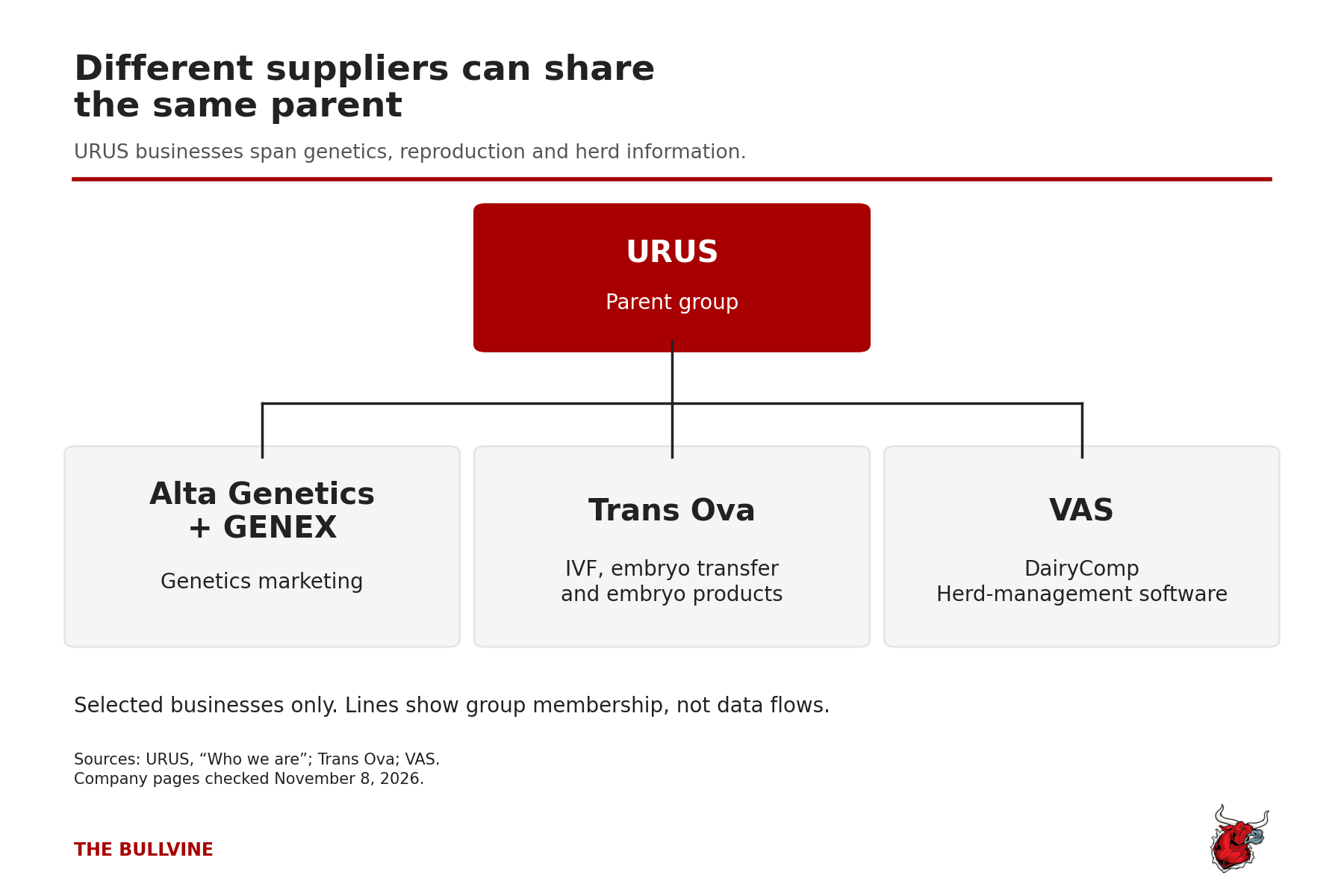
The practical point for buyers is ownership. Two catalogs on your kitchen table can belong to the same group. Different bulls and different reps don’t necessarily mean different owners competing for your business.
2. ABS Global / Genus
ABS reports marketing in more than 70 countries, serving more than 40,000 customers, and operating bull studs across Europe, North America, Latin America, and India. Its case for second place also rests on technology used outside its own breeding programs. Genus has documented an IntelliGen “technology transfer and license agreement” enabling Geno to produce sexed Norwegian Red genetics.
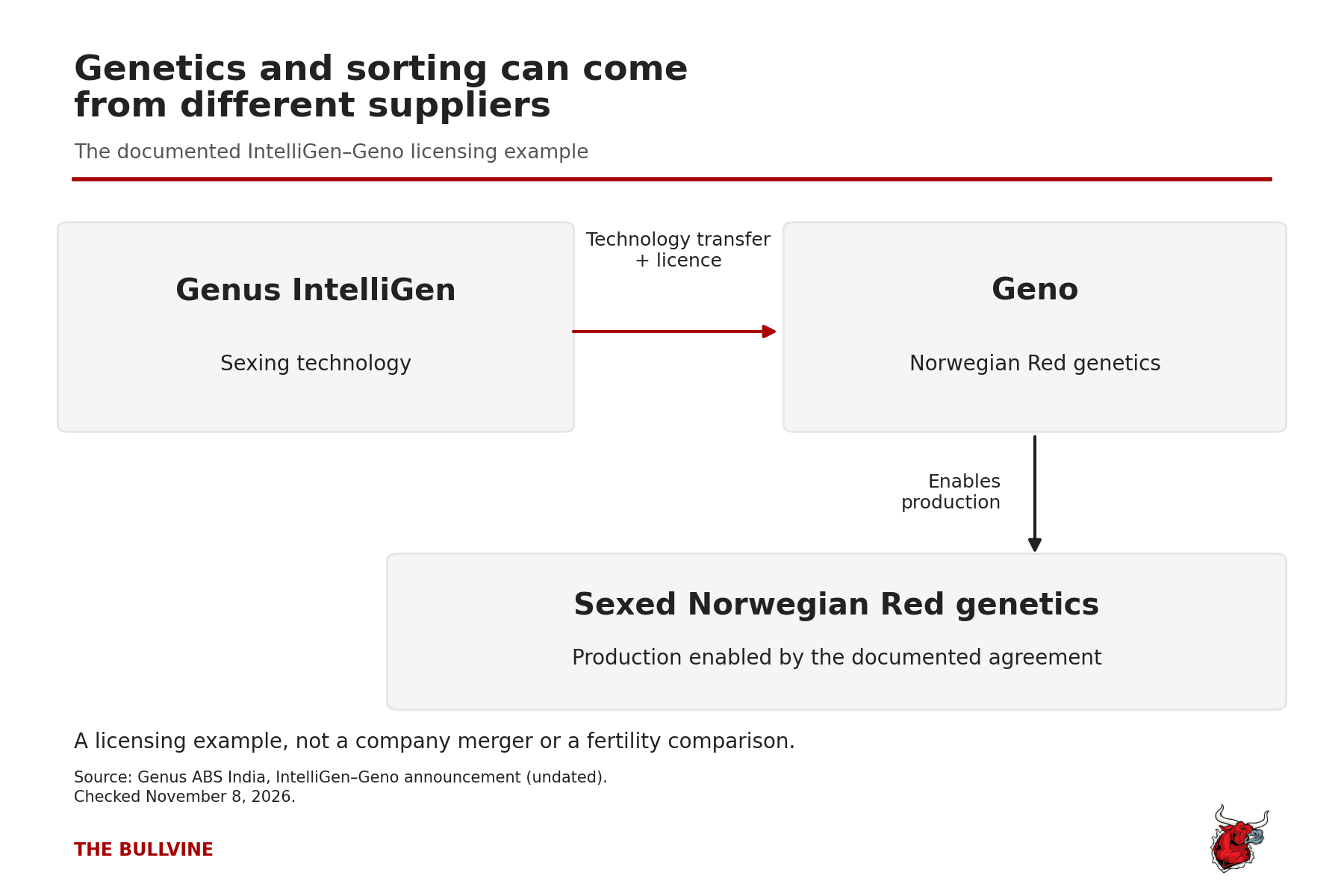
For producers, the distinction is practical: the company supplying the genetics and the company providing the sorting technology may be different.
3. Select Sires
Select Sires’ farmer-owned cooperatives combine genetics distribution with on-farm reproductive services. Select Reproductive Solutions provides consulting, herd-data analysis, and support for implementing reproductive programs. Select Sires’ subsidiary World Wide Sires describes a network of subsidiaries and distributors in more than 90 countries. That figure covers WWS’s network, not the parent group’s total footprint.
That combination of breeding programs, global distribution, and organized local service earns third place. On an individual dairy, the quality of the local team can matter more than any global ranking.
ABS vs. Select Sires: We give ABS’s combination of international operations and IntelliGen the edge over Select Sires’ distribution and cooperative service network. That’s an editorial judgment, not a finding about dose volumes. A ranking that put more emphasis on farmer-facing service could reverse those positions.
4. STgenetics
In a January 8, 2025, release, STgenetics said it ran 56 owned and licensed sorting labs in 20 countries. Its Indian subsidiary says it has provided sorting services in India since 2018, with labs run alongside BAIF and several state livestock organizations.
Fourth place rests on that dual role. STgenetics markets its own genetics and supplies sorting inside other organizations’ breeding programs. A count of export doses would miss that kind of influence.
5. Semex
Semex is owned by WestGen, EastGen, and CIAQ. Its company history describes representation in 80 countries through 110 distributorships, Boviteq IVF licensees in the UK, France, Switzerland, and Italy, and selection tools including Immunity+, Elevate, and methane efficiency ratings.
Its network also carries partner genetics. Swissgenetics says (September 30, 2025) it has distributed around half of all its semen doses through Semex since 2004.
Before buying into any specialty selection tool, ask what’s measured and how the evaluation was validated.
STgenetics vs. Semex: We place STgenetics ahead for supplying sorting technology inside other organizations’ programs. Semex’s case rests on IVF licensing and a distribution network that also carries partner genetics. Giving greater weight to embryo services strengthens the case for placing Semex above STgenetics. STgenetics’ cited lab count dates from January 2025; it should not be read as a verified November 2026 total.
6. CRV
CRV says it supplies genetics to more than 60 countries through offices and distributors. It describes production sites in the Netherlands, New Zealand, Brazil, Germany, and the Czech Republic where semen and embryos are produced. It’s owned by 23,000 farmers in the Netherlands and Flanders, and runs 12 breeding programs focused on health and efficiency.
CRV belongs on the list for breeding across multiple programs, with production operations in New Zealand and Brazil as well as Europe. For buyers, the useful question is where the semen or embryos in your order were produced, and on which of CRV’s 12 programs the bull was selected.
7. SYNETICS
EuroGenomics describes SYNETICS as a French-German cooperative of 35,000 farmers, distributing in 81 countries across 20 cattle breeds. Its dairy programs include Holstein, Red Holstein, Normande, and Fleckvieh, alongside beef breeds.
Its inclusion rests on breed breadth combined with wide distribution. A ranking built on North American Holstein visibility would understate it. If Normande, Fleckvieh, or beef breeds fit your farm’s objective, its breed range warrants examination.
CRV vs. SYNETICS: We give CRV the edge for its documented production presence across several regions. SYNETICS’ breed breadth and international distribution provide a strong counterargument. Our assessment gives greater importance to operating production facilities in multiple regions than to the number of markets served.
8. VikingGenetics
VikingGenetics reports farmer ownership across Denmark, Sweden, and Finland, plus subsidiaries in Australia, the UK, Germany, and the U.S. Its breeding approach draws on Nordic health and performance recording across VikingHolstein, VikingRed, and VikingJersey.
Eighth place rests on exporting health-focused Nordic breeding objectives through owned subsidiaries on three continents. If health traits and longevity drive your sire selection, that’s the program to examine.
9. LIC
LIC describes itself as a New Zealand farmer-owned cooperative. It says it exports more than 1 million frozen straws to over 20 countries, dispatches more than 4 million fresh straws domestically in spring, analyzes 11 million milk samples a year from 8,100 herds, and has subsidiaries in the UK, Ireland, and Australia.
LIC says three out of four New Zealand dairy cows are sired by an LIC bull. Its Sire Proving Scheme covers Holstein Friesian, Jersey, and KiwiCross bulls, selected using ancestry records, DNA testing, and daughter proving.
Influence across the industry and fit for your farm are separate rankings. For a seasonal grazing herd, LIC could top the shortlist.
VikingGenetics vs. LIC: We narrowly favor VikingGenetics for the international influence of its Nordic health-focused breeding programs. LIC’s combination of breeding, herd information, and international distribution makes this a close decision. Its pasture-based proving system is central to its identity, and it also markets a High Input Indexinternationally. Our ordering reflects the weight we give Nordic health breeding; an assessment emphasizing herd-information services could favor LIC.
10. NDDB Dairy Services / SAG
NDDB Dairy Services is a wholly owned subsidiary of India’s National Dairy Development Board. It runs the SAG semen station network and reports 9.1 million doses from 17 indigenous cattle breeds, alongside buffalo work we treat as context. NDDB Dairy Services also supports the upgrading of Central Cattle Breeding Farms and implements projects using sex-sorted semen and IVF embryos under India’s Rashtriya Gokul Mission.
We place NDDB tenth for its national role in supplying indigenous cattle genetics. This is the position where we give breeding-population coverage more weight than cross-border reach. Gènes Diffusion’s international cattle business, breeding programs, and reproductive services make it the strongest alternative.
Why Gènes Diffusion narrowly missed
Gènes Diffusion was a serious alternative for the final place. Its 2026 annual report (published June 18, 2026) describes several cattle businesses:
- Bovine export sales across Europe, the Americas, Asia, and Africa
- A SAFE BEEF beef-on-dairy program
- About 2,000 embryo collections a year
- A genotyping lab
The report gives 2.4 million bovine doses for the group without saying whether those were sold, produced, or distributed. Its counts of subsidiaries and international distributors cover the whole multispecies group.
Readers who give international distribution greater weight than domestic breeding infrastructure have a strong case for reversing this decision.
Other candidates we reviewed
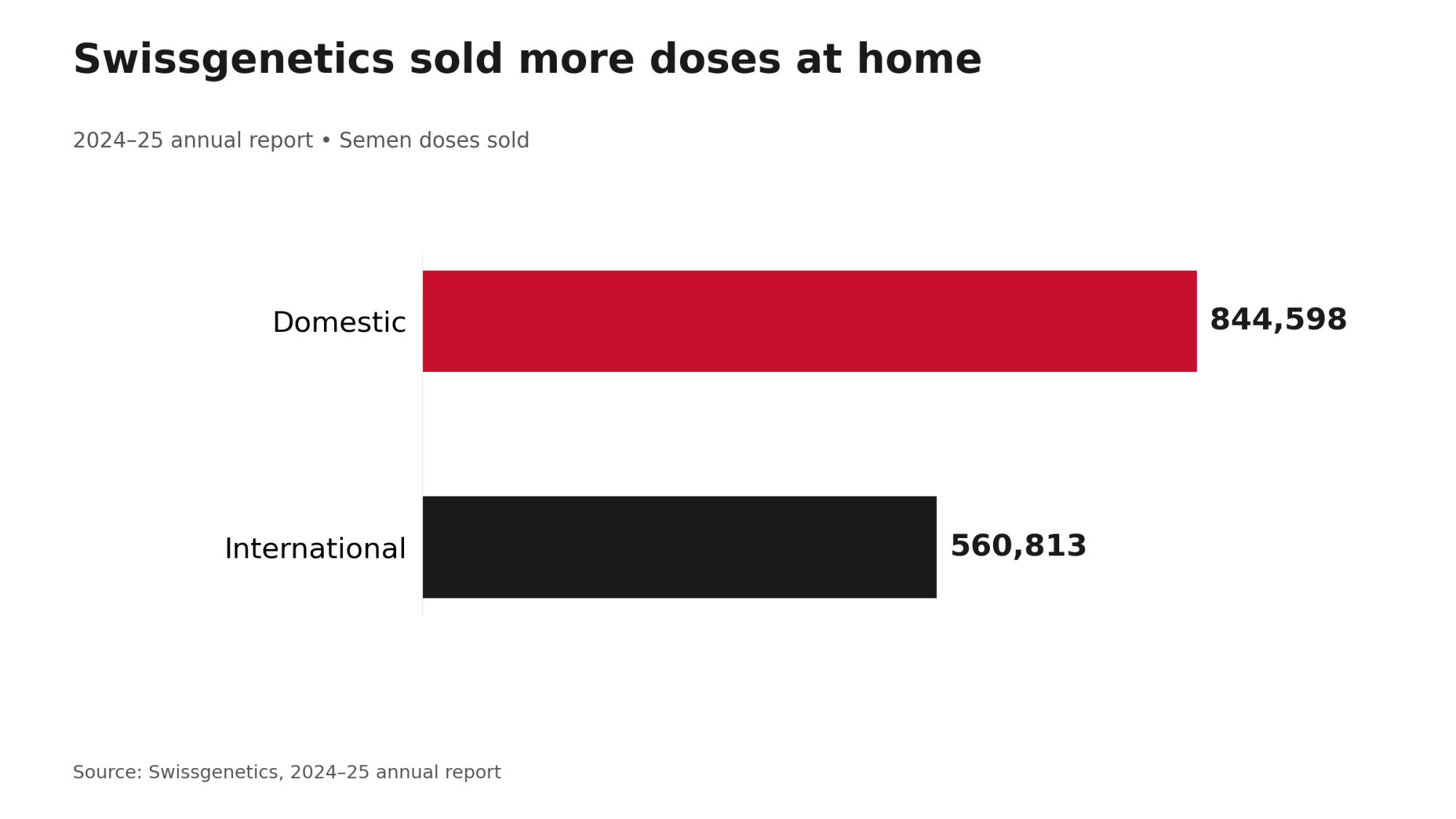
- Swissgenetics. Its 2024–25 annual report lists 560,813 doses sold internationally, 844,598 sold domestically, 1,823,615 produced, and 2,696 embryos produced. It runs Brown Swiss, Holstein/Red Holstein, Simmental, Swiss Fleckvieh, and Original Braunvieh programs, with a longstanding international distribution partnership with Semex. We placed LIC and NDDB ahead. LIC combines its breeding program with national-scale herd information and owned international subsidiaries. NDDB supplies indigenous cattle genetics across a national network.
- Geno. Geno reports 406,848 doses sold in Norway in 2025 and international sales growth. It runs its own sex-sorting operation and licenses IntelliGen. Geno’s SpermVital business gives it a substantial reproductive-technology argument in this comparison. We gave LIC the place for combining national-scale breeding with herd-information services.
- BAIF. BAIF is a substantial Indian alternative with a large field insemination program. Its published activity measures differ from NDDB’s in scope and reporting period, so they don’t establish a comparable cattle-sales ranking.
These were the alternatives we identified, not a census of every breeding organization.
Why we didn’t rank by volume
| Organization | Published figure | Cattle boundary and period |
| URUS | 31.5M+ semen straws sold worldwide | No species split or reporting period stated |
| NDDB Dairy Services / SAG | 47.32M frozen doses | NDS separately reports about 50 million doses produced and distributed annually. That measure still does not establish cattle-only sales comparable with URUS’s published figure. |
| SYNETICS | 7.5M units sold | Spans cattle and goat genetics; no period |
A defensible volume ranking would need a common reporting period, cattle-only counts, consistent company boundaries, and clear treatment of third-party sorting and transfers within groups. Our review did not establish a comparable dataset covering all ten companies.
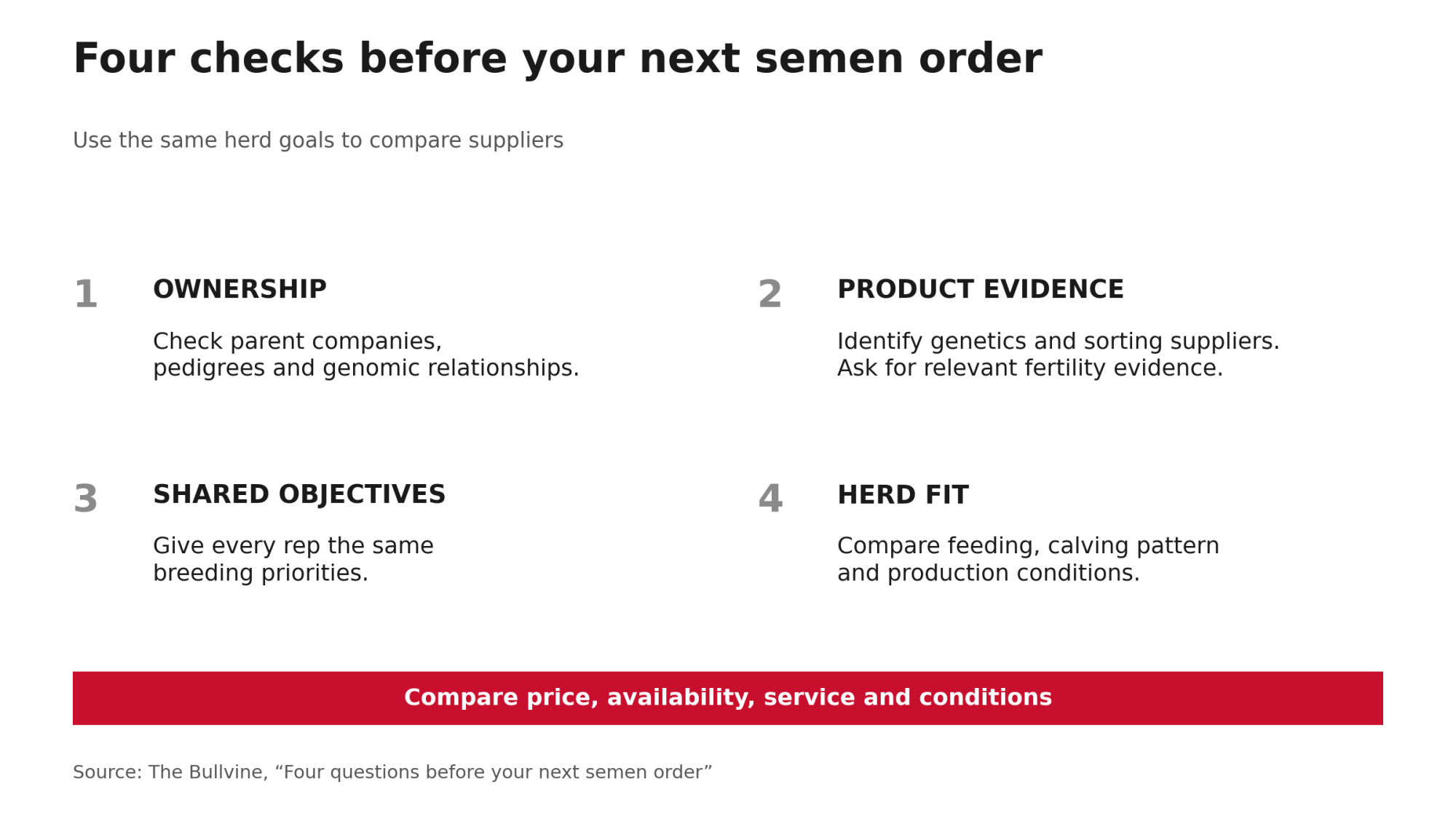
Four questions before your next semen order
| Question to ask | What to record or request | Distinction to keep clear |
|---|---|---|
| Which of my suppliers share a parent company? | Record the brand, parent company, and local supplier; check pedigrees and genomic relationships too. | Different brands may share an owner. Different owners do not guarantee unrelated genetics. |
| Who supplies the genetics, who provides the sorting, and what evidence supports the finished product? | Request fertility evidence relevant to the semen product, animal group, and breeding protocol you intend to use. | The genetics supplier and sorting-technology provider may be different organizations. |
| Will every rep work from the same objective? | Give every rep identical priorities for components, fertility, longevity, size, and calving; ask each to explain the trade-offs. | Compare proposed sire teams against the same priorities—not different sales pitches. |
| Was this sire evaluated in a system like mine? | Compare the evaluation population’s feeding, calving pattern, and production conditions with your own; ask the supplier to explain the differences. | Global influence and suitability for your herd are separate judgments. |
- Which of my suppliers share a parent company? Record the brand, the parent, and the local supplier, then check pedigrees and genomic relationships too. Different owners don’t guarantee unrelated genetics.
- Who supplies the genetics, who provides the sorting, and what evidence supports the finished product?Ask for fertility evidence relevant to the semen product, animal group, and breeding protocol you intend to use.
- Will every rep work from the same objective? Give each one identical priorities for components, fertility, longevity, size, and calving, and have them explain the trade-offs.
- Was this sire evaluated in a system like mine? Compare the evaluation population’s feeding, calving pattern, and production conditions with your own, and ask the supplier to explain the differences.
Compare availability, delivered price, service commitments, and program conditions alongside the proposed sire team. URUS leads our list. The company that should earn your biggest order is the one that best meets your herd’s goals, supported by your records.
For more, see our A.I. Industry coverage and our April 2026 proof results breakdown.
Ownership note: Select Sires and STgenetics
- August 2023, proposal. Select Sires Inc. and Inguran LLC (dba STgen) announced a letter of intent to combine production and R&D, subject to a definitive agreement and regulatory approvals.
- April 2026, reporting. Bloomberg reported (April 21, 2026) that the deal was “later abandoned when faced with a potential antitrust lawsuit,” and that Select’s July 2025 annual report showed it “again looking to link up with Inguran.” Beef Magazine reported (April 24, 2026) that enforcers were “mulling over a rechallenge.”
Sources reviewed November 8, 2026. Company pages without a publication date are linked as current at review.
Who would you move up, and what evidence earns it that spot?
Learn More
- Did Genomics Really Deliver What We Think It Did? $238,000 Says Yes – If You Steer It Right — Navigating modernized Canadian proofs correctly unlocks a $238,000 genetic dividend for your herd. Exposing why top 2024 sires fell behind on fertility and welfare traits, the data arms you with precise mating strategies before ordering semen.
- $18.95 Milk, $19.14 Costs: USDA’s 2026 Milk Price ‘Upgrade’ Still Leaves Your Dairy in the Red — Flawed federal forecasts threaten your 2026 balance sheet unless you lock in margins now. We dismantle the math behind the $18.95 all-milk projection, revealing why average herds face a $19.14 production cost despite the USDA’s upgrade.
- Lab-Grown Milk Has Arrived: The Dairy Innovation Farmers Can’t Ignore — Defend your market position against the accelerating commercialization of bioreactor-produced dairy. You receive a concrete survival blueprint for conventional operations facing startup competitors who bypass the methane problem entirely and slash carbon emissions by 82 percent.
The Sunday Read Dairy Professionals Don’t Skip.

Every week, thousands of producers, breeders, and industry insiders open Bullvine Weekly for genetics insights, market shifts, and profit strategies they won’t find anywhere else. One email. Five minutes. Smarter decisions all week.