

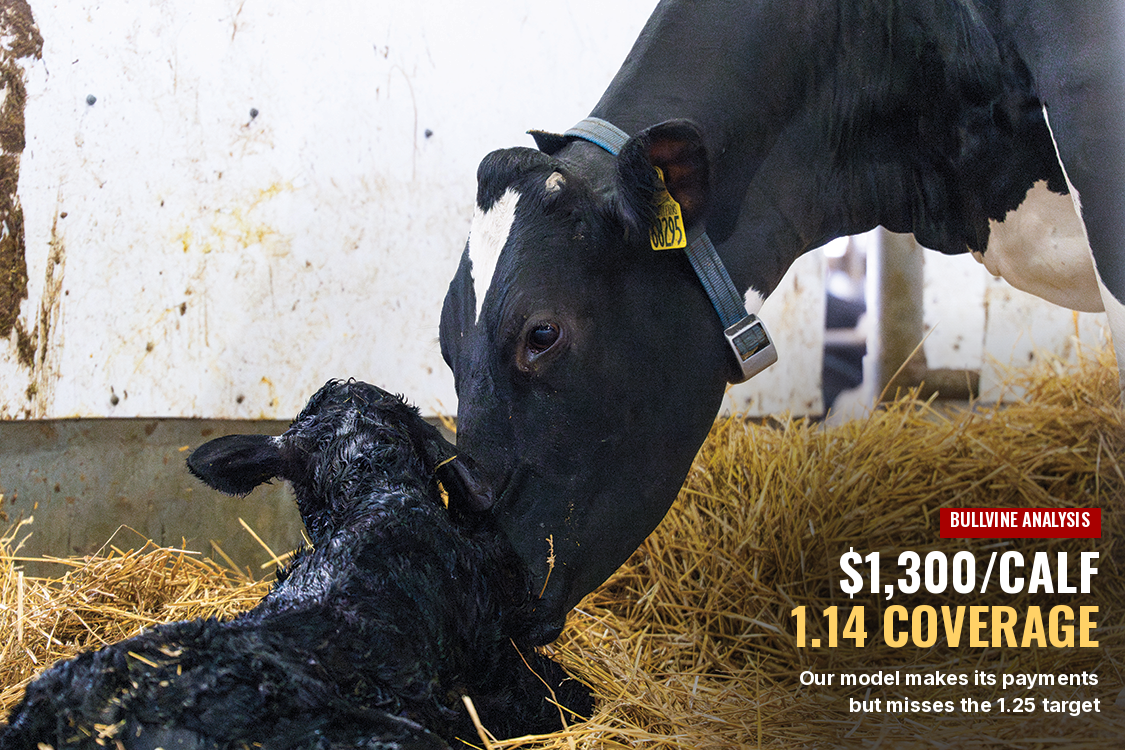




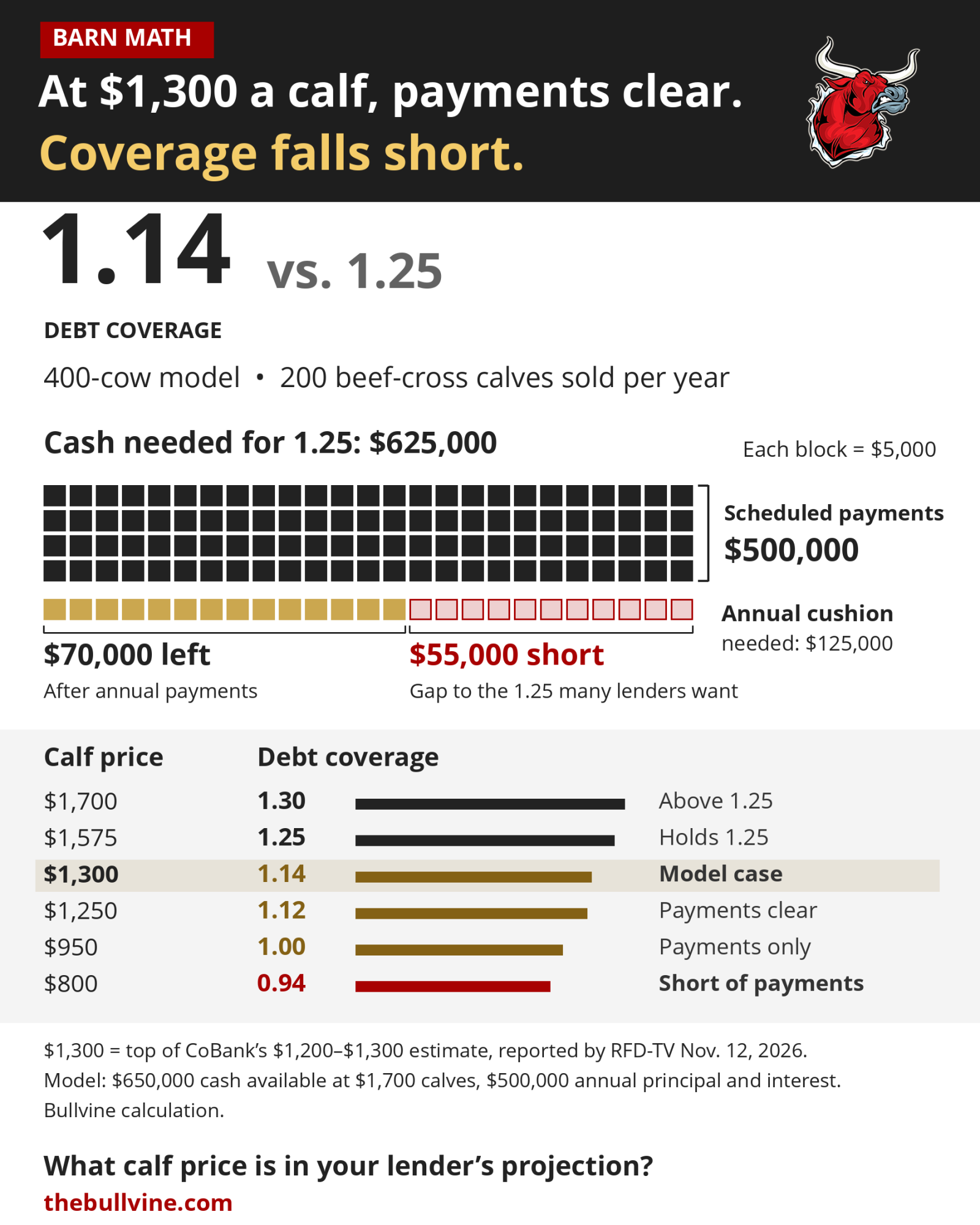
At 200 beef-cross calves sold a year, the farm has $70,000 left after scheduled payments. It still needs another $55,000 to reach 1.25 debt coverage.
CoBank economist Abbi Groves put day-old to week-old beef-cross calves at about $1,200 to $1,300 a head, RFD-TV reported on Nov. 12, against roughly $200 to $400 five to seven years ago. That price now sits inside the cash-flow projections lenders use to approve barn expansions.
Run a dairy expansion loan built on $1,700 calves (Bullvine’s starting assumption) through CoBank’s range. At $1,300 a head and 200 calves sold a year, the farm has $70,000 left after $500,000 in scheduled payments. That’s coverage of 1.14, and it needs another $55,000 to reach 1.25, the level Penn State Extension says many lenders look for. At $1,250, coverage falls to 1.12 and the gap widens to $65,000.
At $800 per calf, The Bullvine’s downside assumption, the 200-calf farm has $470,000 available for $500,000 of payments. That’s a $30,000 annual payment shortfall.
The $800 case is a stress test, not a forecast. “Right now, every calf in this market is benefiting from tight cattle supplies and strong beef demand,” Michigan State University Extension’s Jerad Jaborek said in an Aug. 10, 2026, Applied Animal Science release on his six-year auction study with MSU agricultural economist Jaime Luke. “But, markets are always changing.” MSU Extension’s write-up of the study warns that when beef cow inventory numbers increase, beef-dairy cross calves “could be positioned to take a larger relative drop in prices as compared to beef calves because buyers will have the ability to be more selective in the animals they purchase.” On Nov. 16, RFD-TV reportedthat CoBank expects cattle supplies to stay tight through 2027, with stronger herd rebuilding possible in 2028. A note signed today runs well past that.
Running the Numbers: Calf-Price Risk on a 400-Cow Expansion
To test how fast a barn expansion loses debt-service cushion, we modeled a 400-cow dairy carrying $500,000 in total annual principal and interest after expansion (existing debt plus the new note). At our $1,700-per-calf starting assumption, the farm generates $650,000 in cash available for debt service, a 1.30 coverage ratio.
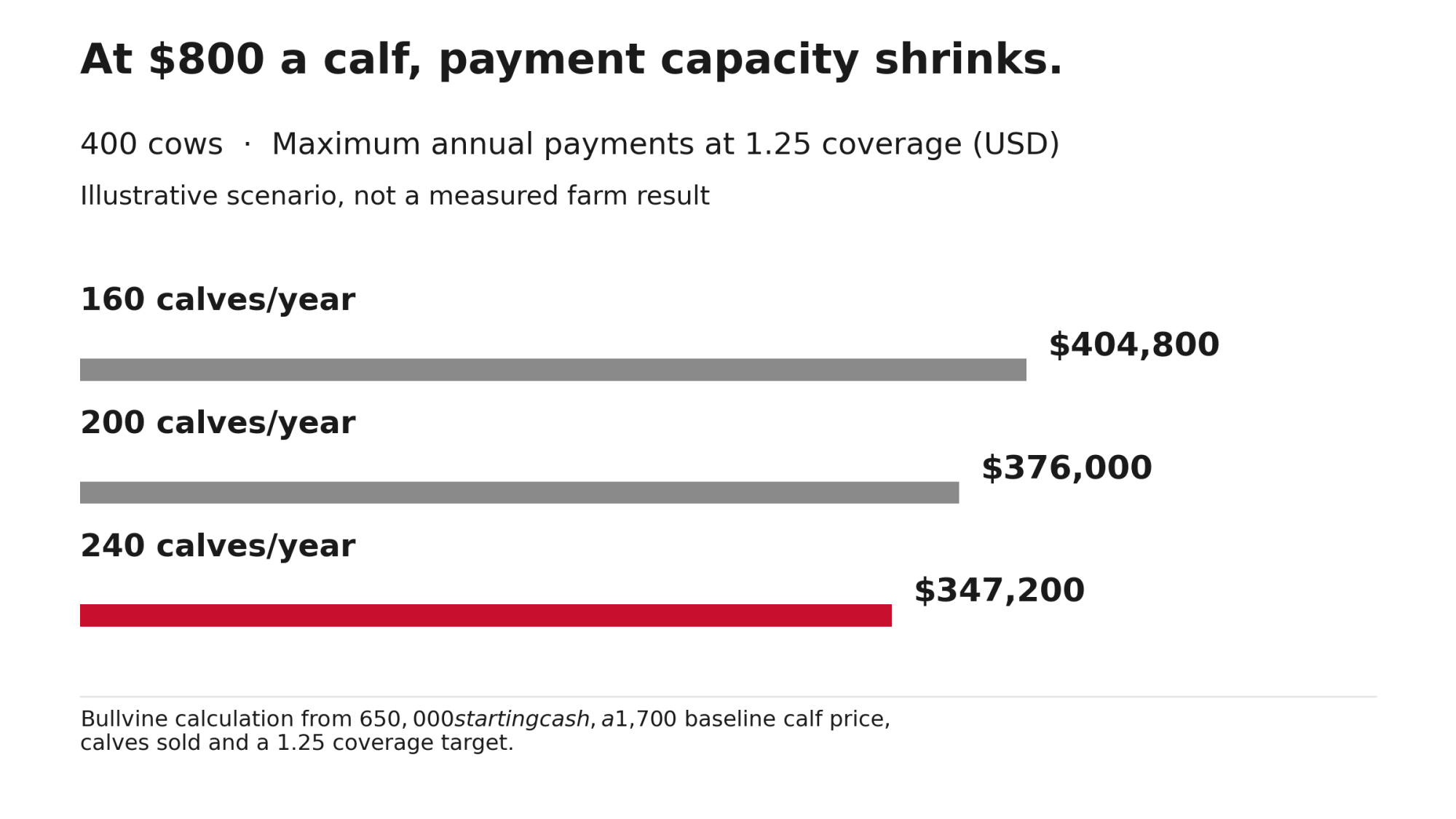
We ran three calf-crop volumes against three price scenarios:
- Volumes: 0.4, 0.5 and 0.6 beef-cross calves sold per cow per year (160, 200 and 240 head).
- Prices: $1,300 and $1,250, the top and midpoint of CoBank’s $1,200–$1,300 estimate reported by RFD-TV on Nov. 12, 2026, and an $800 downside stress test.
Every dollar below $1,700 per calf, multiplied by head sold, comes straight out of the $650,000 cash pool (all figures USD):
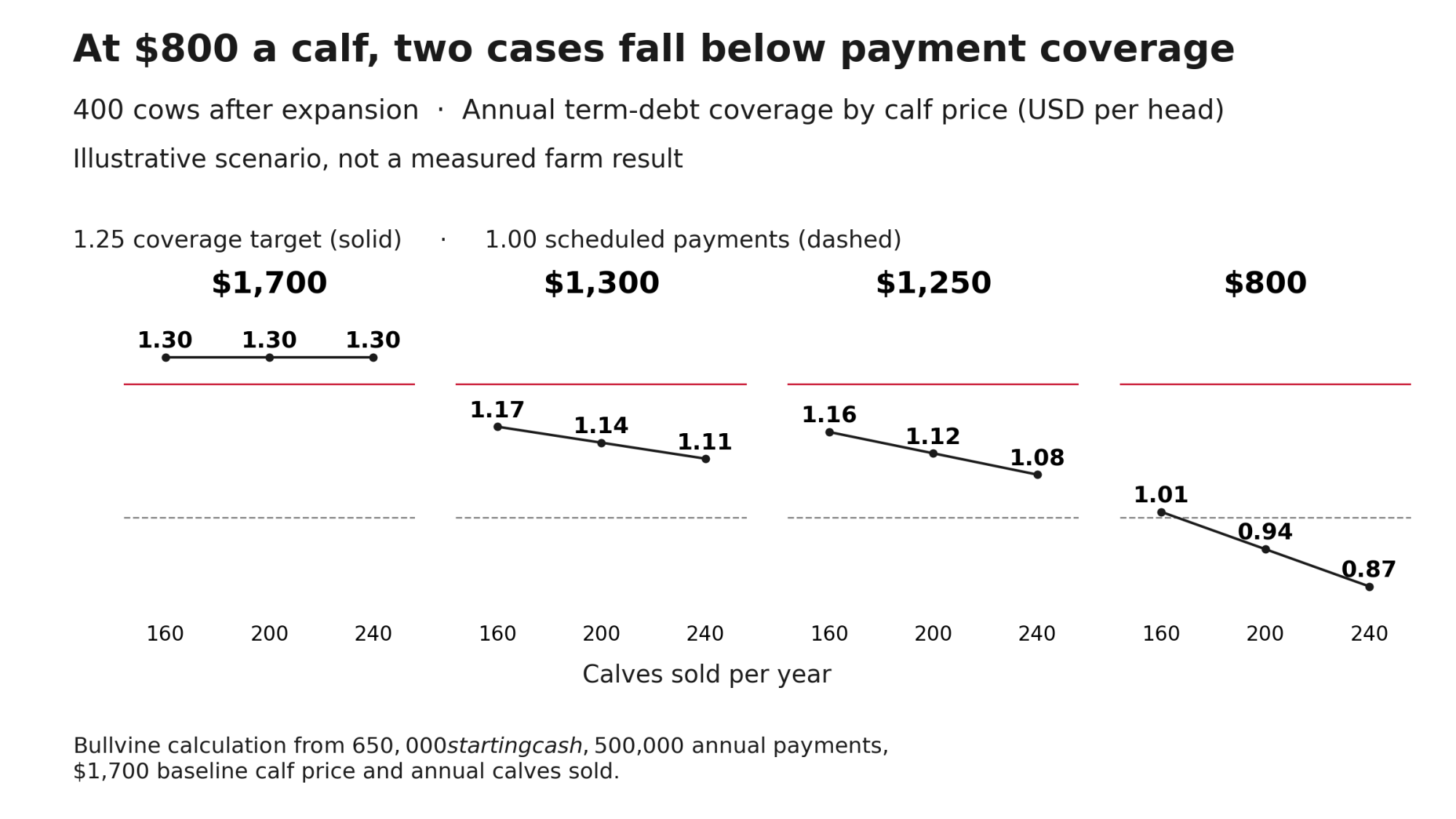
| Calves sold/year (per cow) | Coverage at $1,300 | Coverage at $1,250 | Coverage at $800 | Max debt service at 1.25, $800 calves | Annual payment cut needed |
| 160 (0.4) | 1.17 | 1.16 | 1.01 | $404,800 | 19% |
| 200 (0.5) | 1.14 | 1.12 | 0.94 | $376,000 | 25% |
| 240 (0.6) | 1.11 | 1.08 | 0.87 | $347,200 | 31% |
Debt coverage at $1,700, $1,300, $1,250 and $800 per calf for 160, 200 and 240 calves sold a year. The red line marks 1.25; the dashed line marks 1.00. Bullvine calculation.
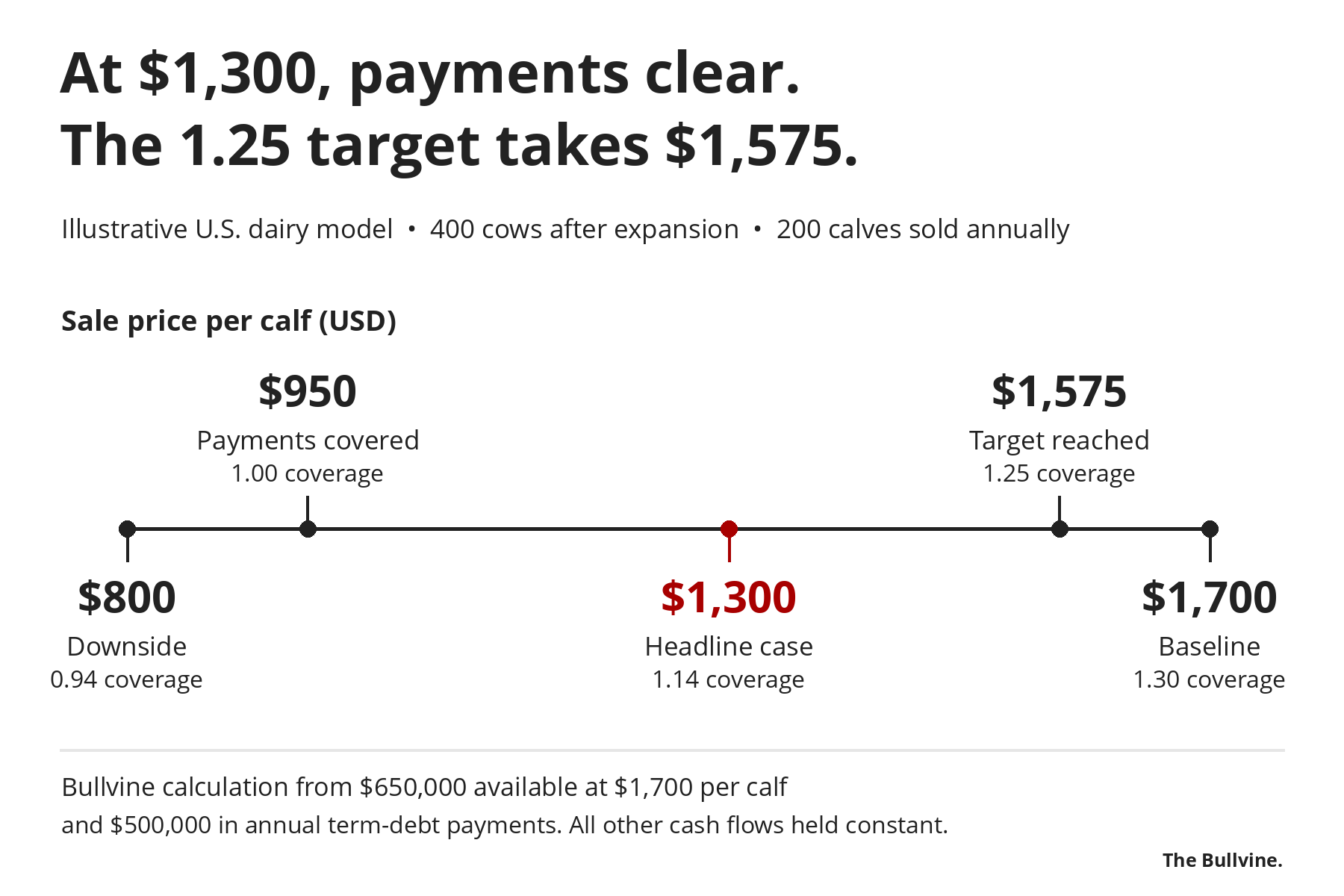
The 200-calf model needs $625,000 to hold 1.25 coverage on $500,000 of payments, which leaves $25,000 of room on the $650,000 it starts with, or $125 per calf. At $1,575 per calf, the farm holds 1.25. At $950, it has just enough cash to make its scheduled payments. At the $800 downside price, it can carry $376,000 in total annual payments, and payments on existing loans come off that before any of it goes to the expansion.
Will Your Barn Loan Hold 1.25 Coverage If Calf Prices Drop?
Enter your herd’s numbers and slide the calf price below to test your debt-service coverage, break-even calf price, and safe debt ceiling in under 60 seconds (all figures USD).
Illustrative estimate based on your inputs and CoBank / Penn State Extension / USDA ERS data cited in this article (Nov. 2026). Not financial advice. Bullvine calculation.
How we calculate this
1. Calves sold per year = Milking cows × Beef-cross calves sold per cow per year (head).
2. Stressed cash available (USD) = Projected cash available for debt service − [(Projected calf price − Stress-test calf price) × Calves sold per year]. Cull-cow income and milk margins stay constant.
3. Stressed coverage ratio = Stressed cash available ÷ Total annual term debt service. Many lenders look for at least 1.25x (Penn State Extension, Dec. 11, 2025).
4. Break-even calf prices (USD/head) = Projected calf price − [(Projected cash available − Target cash) ÷ Calves sold per year], where Target cash is 1.25 × Debt service for the lender floor and 1.00 × Debt service to clear scheduled payments.
5. Maximum debt service at 1.25x (USD/yr) = Stressed cash available ÷ 1.25.
Track weekly dairy margins, calf prices, and lender benchmarks in one Sunday read—or stress-test your milk check under Dairy Margin Coverage.
Why calf income belongs on its own line
USDA's Economic Research Service (LDP-M-389, Nov. 17, 2026) says supplemental revenue from beef-on-dairy calf sales is "expected to continue to support dairy herd expansion in 2026 and 2027 by encouraging producers to retain more cows."
A projection that folds calf sales into "other income" hides the one price this model turns on. The lender's file should show the calf price and head sold on separate lines.
Leprino's Lubbock incentives run to 2031. A milk agreement runs on its own dates.
Lubbock's March 2022 council document schedules a $19.3 million capital incentive for Leprino Foods, with installments running through 2031. That schedule binds the city and the plant, not the plant and any farm. For the added milk from a new barn, the supply or cooperative membership agreement has to carry three terms, and they belong next to the loan's payment schedule before the note is signed:
- The volume the buyer will take.
- The date shipments start.
- The notice either side must give to end the commitment.
In August 2026, fairlife said its Webster, New York, plant was sourcing milk from more than 40 farms. The same question goes to any buyer: how many farms it has committed to, and whether the new barn's milk is among them.
Dean's 2018 letter gave farms until May 31
Farm and Dairy reported that Dean Foods' Feb. 26, 2018, letter ended milk contracts for more than 100 farms in eight states effective May 31. By our count that's 94 days, and a barn note keeps billing through every one of them.
In 2018, Indiana dairy farmer Joe Kelsay called Walmart's new plant near Fort Wayne. Farm and Dairy reported that the plant was taking no additional milk when he called. Dean also offered to help the dropped farms find new buyers, according to Farm and Dairy.
KLFY reported that Borden will permanently close its Lafayette, Louisiana, plant on Jan. 9, 2027, and that the site bought milk directly from area farmers.
Dean and Borden are fluid-milk exits. Leprino's Lubbock plant makes mozzarella. The precedents show how much notice a farm can get, not what any particular plant will do.
The playbook before signing
When reviewing the projection. Find the projected calf price and annual head sold. Rerun coverage at the farm's recent average sale price and at a downside price agreed with the lender.
- Requires: the lender's cash-flow file and the farm's own calves-per-cow figure from sale receipts.
- Check first: If calf sales are buried in "other income," separate calves sold from price per head, then compare both with the last 12 months of sale receipts.
- Backfires if: cull cow income already in the projection gets counted a second time.
Before committing to the barn. Get the accepted volume, start date, term and termination notice in writing before signing either agreement. Ask the lender what annual payment the farm can carry at the downside calf price.
- Requires: the actual contract or membership agreement, not a summary of it.
- Urgent if: the agreement runs shorter than the note, or states no notice period at all.
- Ask the buyer: how much of the added milk the agreement covers, and what happens to milk above that volume.
Before counting on another buyer. If a new plant is within hauling distance, find out what it would pay for the milk the farm already ships before pricing a barn. Check whether the current agreement allows a change of buyer and whether the new outlet is accepting milk.
For notes already signed
Three checks belong in the next lender review.
- Break out beef income. Put it on its own line and take the rerun to the lender before the next covenant review, not after it.
- Price calf insurance. USDA's Risk Management Agency offers Livestock Risk Protection on unborn calves. Ask the agent to confirm the ownership requirement and show the sale window. Under the 2027 feeder endorsement, records must verify a qualifying sale from 30 days before through 30 days after the endorsement end date. Ask how the policy's ending value compares with the prices on the farm's calf receipts, and get a premium quote from an approved LRP agent before buying.
- Ask about covenant headroom. Ask how far repayment coverage can fall before the farm misses a loan requirement, and how much working capital is available if cash receipts fall short of scheduled payments.
On the 200-calf model, $1,300 calves leave coverage at 1.14. Holding 1.25 takes $1,575 calves, and at $800 calves the ceiling on annual debt service is $376,000.
Methodology
Debt coverage equals cash available for debt service divided by total annual term-debt principal and interest. Calf revenue changes equal the price difference multiplied by head sold, holding cull-cow income and milk margins constant. The $70,000 remaining after payments and $55,000 gap to 1.25 at $1,300, the $1,575 break-even (1.25 coverage) and the $950 payment break-even (1.00 coverage) are Bullvine calculations from the 200-calf case. The $1,700 baseline, $800 stress price, $650,000 starting cash available and $500,000 debt service are Bullvine model assumptions (USD), not industry benchmarks.
Complete references and supporting documentation are available upon request by contacting the editorial team at editor@thebullvine.com.
Learn More
- The $97,000 Breeding Meeting: How a 500-Cow Dairy Capped Beef at 35% — Cap the beef percentage before the calf buyer sets it. In this modelled 500-cow composite, going from 35% to 55% beef adds $120,000 in calf cheques and loses $97,000 once replacements are bought. A $900-calf stress column runs alongside.
- The Beef Check You Banked in 2023 Is the $3,010 Heifer You Can’t Afford in 2026 — Follows the money from a $1,720 springer in April 2023 to $3,010 by July 2025. CoBank's Corey Geiger reads that 75% jump as the signal for which mid-size herds still milk in 2030.
- New Holland’s Beef-Cross Calves Topped UW–Madison’s $1,125 Test—at a $260 Premium — Beef-cross bulls brought $1,255 at New Holland on Oct. 5, above every calf value UW–Madison's Journal of Dairy Science model tested. Holstein bulls sat just $260 behind, a 1.26:1 ratio that undercuts the free-money read on calf cheques.
The Sunday Read Dairy Professionals Don't Skip.

Every week, thousands of producers, breeders, and industry insiders open Bullvine Weekly for genetics insights, market shifts, and profit strategies they won't find anywhere else. One email. Five minutes. Smarter decisions all week.