






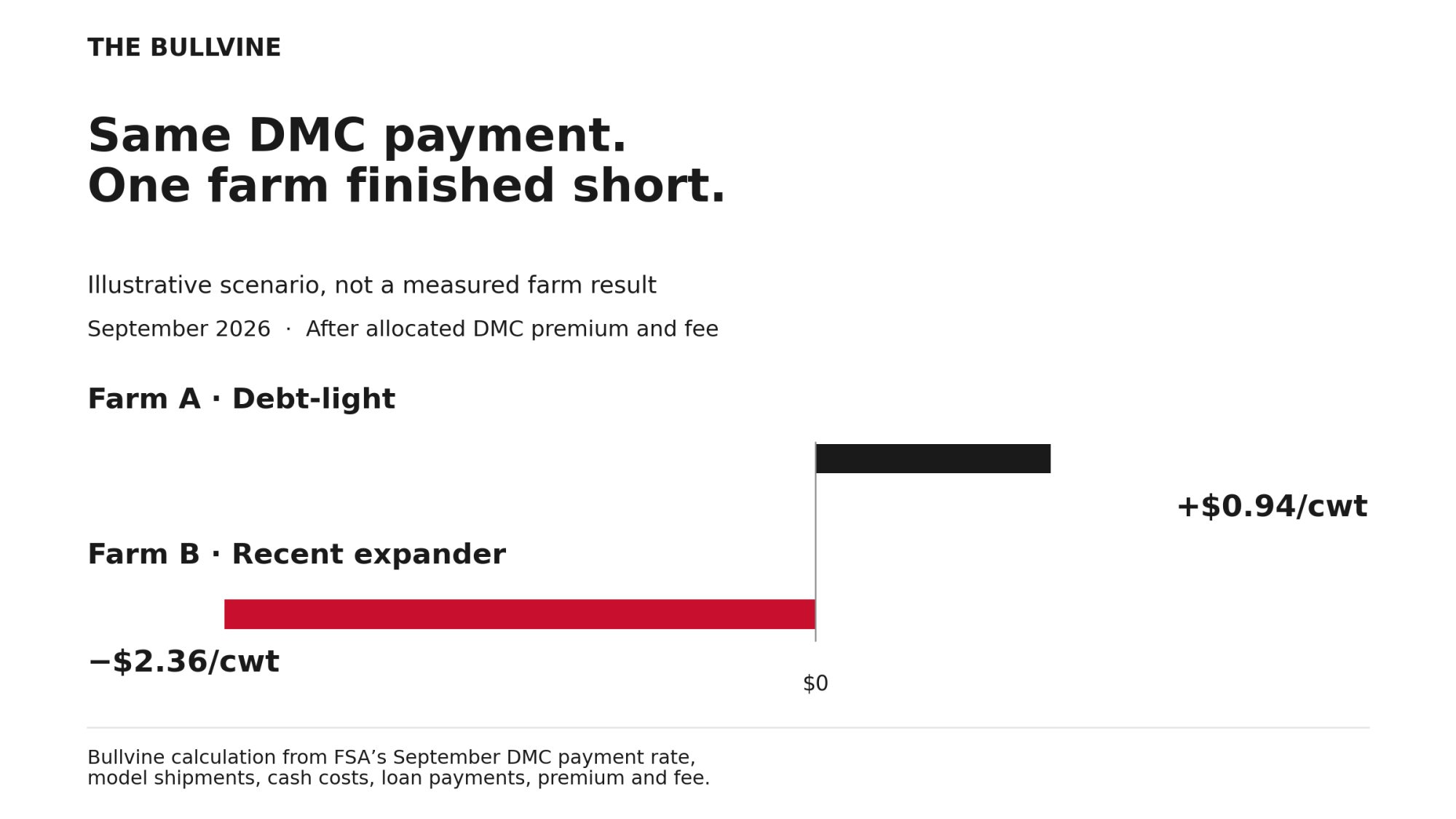
Two model 400-cow dairies shipped the same milk. After allocating the standard DMC premium and $100 fee, September left one 94¢ per shipped cwt ahead and the recent expander $2.36 short.
EXECUTIVE SUMMARY: FSA’s September DMC margin of $8.35/cwt paid $1.15/cwt at the $9.50 Tier 1 level, less 5.7% sequestration. On two modelled 400-cow herds, that’s the same $5,422, or 65¢ per shipped cwt. After the allocated premium and fee, the debt-light herd finished 94¢ ahead and the expander $2.36 short. A 30-year re-term still leaves the expander $1.58 short at September prices. Run the two-document worksheet, and file CCC-801 by December 18.
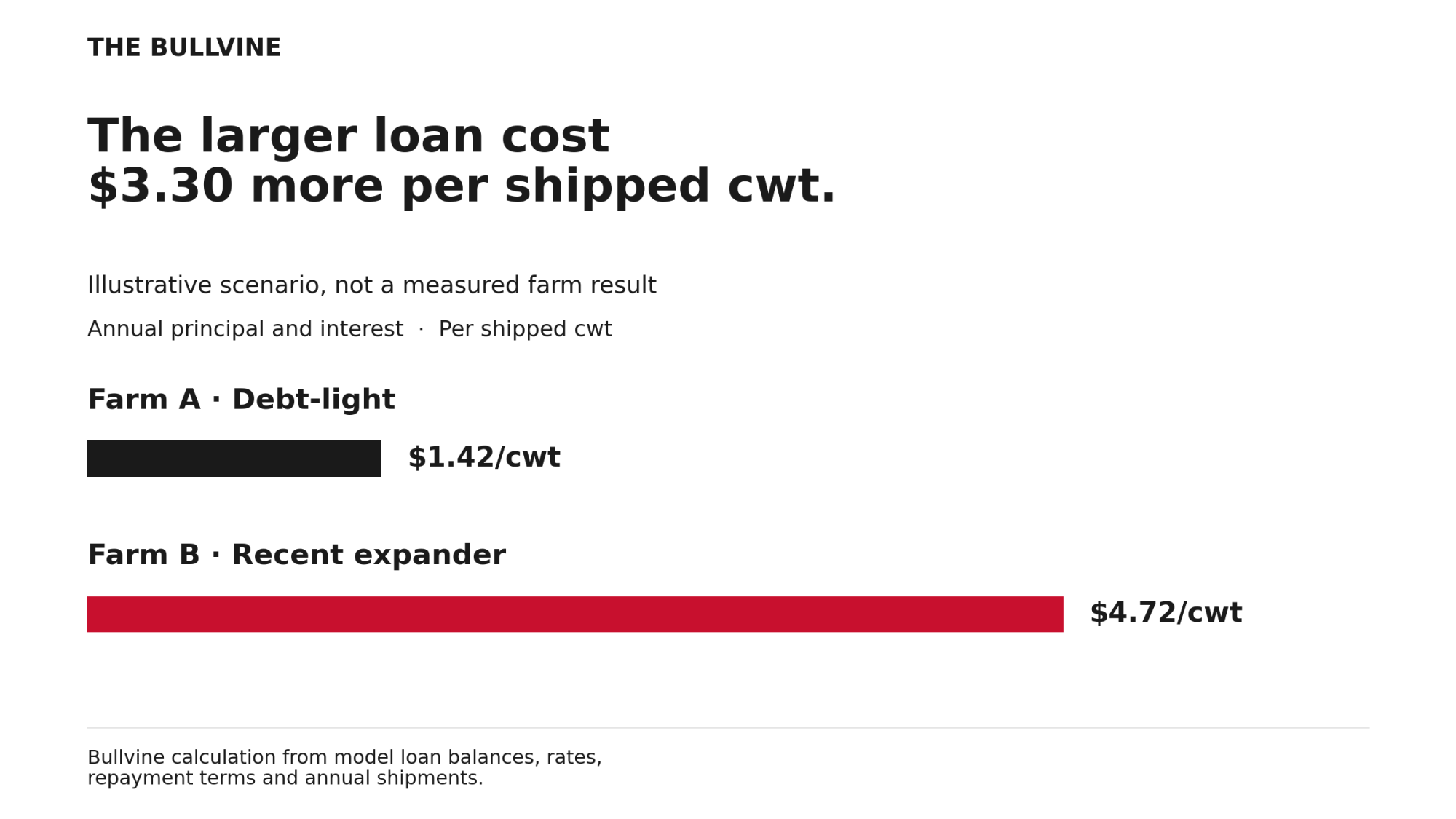
Both dairies are Bullvine models, built from FSA, AMS and UW–Madison Extension figures, with every input shown below. They ship the same milk and collect the same check. One carries $1.42/cwt in term debt, the other $4.72. That $3.30 difference never enters the federal formula. Once the standard $9,100 DMC premium and fee is spread across the year (9.1¢/cwt), September leaves the debt-light herd 94¢/cwt ahead and the expander $2.36 short.
USDA’s Farm Service Agency put September’s national Dairy Margin Coverage margin at $8.35/cwt, weeks before Dairy Margin Coverage 2027 enrollment closes December 18. The $19.50 all-milk price minus $11.15 in formula feed costs triggered Tier 1 payments at the $8.50, $9.00 and $9.50 coverage levels.
What does the $8.35 actually measure?
The DMC margin is a formula, not a farm. FSA takes the NASS national all-milk price and subtracts a feed cost built from fixed statutory weights: 1.0728 bushels of corn, 0.00735 tons of soybean meal and 0.0137 tons of premium alfalfa per cwt (UW–Madison Extension, August 31, 2026). We rebuilt September from FSA’s inputs ($4.81 corn, $365.95 meal, $241 hay) and got $11.15, a match to the cent.
UW Extension’s Leonard Polzin put it plainly on August 31: the gap between formula price and mailbox price “is structural, and the program does not capture it.” The same review sums up critics’ point: “DMC measures income over feed cost, not income over total cost.”
From 2019 through 2025, $9.50 Tier 1 coverage triggered in 39 of 84 months. For more, see our 2026 DMC coverage.
The check isn’t the price
All-milk is gross. Your mailbox price is what’s left after hauling, co-op dues, retains, re-blends, the federal order marketing fee and promotion assessments. USDA AMS defines it as “the net price received by producers for milk, including all payments received for milk sold, and deducting costs associated with marketing the milk” (Mailbox Milk Price Report, released October 26, 2026).
UW Extension puts the national gap at $0.75 to $1.00/cwt in normal years. It averaged about $0.90 from 2019 to 2024, then hit $2.22 in October 2020, when depooling tore pool prices apart. At the same coverage level, FSA uses the same national payment rate per covered cwt. Your mailbox gap never enters the calculation.
July 2026 mailbox milk prices
| Reporting area or aggregate | Mailbox milk price ($/cwt) |
|---|---|
| Selected reporting areas, average | $19.23 |
| Wisconsin | $17.28 |
| Minnesota | $17.90 |
| New York | $21.85 |
Source: USDA AMS, Mailbox Milk Price Report, July 2026 data, released October 26, 2026.
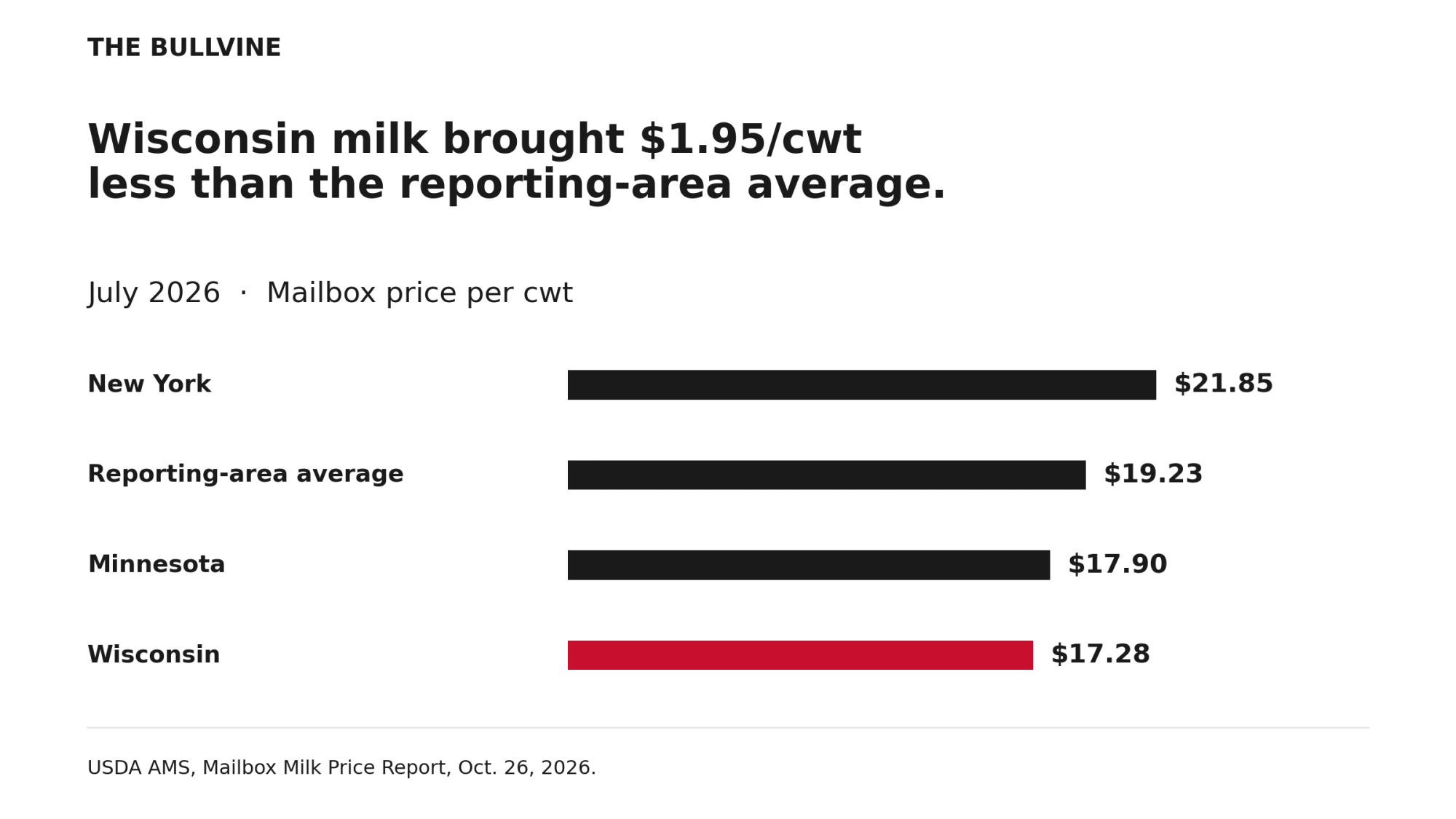
In July 2026, mailbox prices averaged $19.23/cwt across the selected federal order areas AMS reported. Wisconsin came in at $17.28, which is $1.95 under. Minnesota was at $17.90 and New York at $21.85. UW Extension ties the split to class utilization: cheese-heavy regions feel more compression when cheese and butter weaken. That $1.95 compares July mailbox prices. To measure a Wisconsin farm’s September margin, use its September settlement and feed cost.
DMC doesn’t know you built a barn
A lender collects principal and interest on the dates in your loan schedule. USDA ERS includes economic charges for capital, unpaid labor and land in its cost estimates. To budget the cash your milk has to cover, start with operating costs, scheduled debt payments and family living, then subtract cull and calf receipts.
Building the Breakeven
Published evidence
- September 2026 DMC margin $8.35/cwt; all-milk $19.50 (USDA FSA). Mailbox gap about $0.90/cwt, 2019–2024 average (UW Extension, Aug. 31, 2026).
- Tier 1 cap 6 million lb of covered production history; maximum level $9.50 (USDA FSA, Sept. 30, 2026).
- Federal sequestration cuts FY2027 DMC payments, including September’s payout, by 5.7% (UW–Madison Extension, Oct. 9, 2026). FSA’s September payment notice (DMC-106) confirms 5.7% for that month.
Stated assumptions
- Milk: 400 cows × 25,000 lb = 10 million lb (100,000 cwt) a year, with approved DMC production history assumed equal to current shipments. If a barn expansion happened after 2023 and your 2021–2023 history sat below 6.32 million lb (about 253 cows at 25,000 lb), the model’s Tier 1 payment per shipped cwt would fall below 65¢.
- Price and feed: net milk price $18.60/cwt ($19.50 − $0.90). Feed $10.50/cwt.
- Non-feed cash: $6.40/cwt, made up of $3.40 labor plus $3.00 for vet, breeding, bedding, fuel, repairs, utilities and insurance.
- Labor benchmark: the $3.40 is the midpoint of the $3.30–$3.50/cwt Midwest benchmark reported Sept. 16, 2026, by Jim Moriarty of Compeer Financial, a cooperative dairy lender. That benchmark includes heifer-raising and crop labor; farms using custom growers report $2.40–$2.80. If your labor figure already includes an owner or family wage, drop it here, because family living covers it. For more, see our labor cost per cwt breakdown.
- Family: family living $90,000 ($0.90/cwt). Cull and calf income $1.00/cwt.
- Debt: Farm A carries $1 million of term debt, 10 years, 7%. Farm B carries $5 million after an expansion, 20 years, 7%.
- DMC: 95% coverage, with 6M lb in Tier 1 at $9.50 and 3.5M lb in Tier 2 at $4.00.
Bullvine calculation (central case)
| Metric | Farm A (debt-light) | Farm B (recent expander) |
| Annual loan payment | $142,378 ($1.42/cwt) | $471,965 ($4.72/cwt) |
| Cash breakeven | $18.22/cwt | $21.52/cwt |
| September margin vs. $18.60 net | +$0.38 | −$2.92 |
| September DMC payment per shipped cwt | +$0.65 | +$0.65 |
| September after indemnity, before DMC premium and fee | +$1.03 | −$2.27 |
| September after indemnity, premium and fee (allocated) | +$0.94 | −$2.36 |
| Term debt coverage ratio (Sept. prices, no DMC) | 1.26 | 0.38 |
| Margin-over-feed hurdle | $7.72 | $11.02 |
At September prices before DMC, Farm A had $1.26 available for each $1 of scheduled term payments. Farm B had 38¢. If every month paid DMC like September, the 65¢ indemnity would only lift Farm B to 52¢. Penn State says many lenders look for at least 1.25 to consider a plan viable.
How the DMC line works: September’s Tier 1 payment is 5,000 cwt × $1.15 = $5,750, or $5,422 after 5.7%. Spread over 8,333 cwt shipped, that’s about $0.65/cwt.
What if non-feed costs run 90¢/cwt higher or lower?
| Non-feed cash cost | $5.50/cwt | $6.40/cwt | $7.30/cwt |
| Farm A hurdle | $6.82 | $7.72 | $8.62 |
| Farm B hurdle | $10.12 | $11.02 | $11.92 |
September left each farm $8.75/cwt after feed and indemnity. Even at the low $5.50 non-feed assumption, Farm B needed $10.12. It was still $1.37/cwt short.
Milk above Tier 1 (Bullvine calculation). With even shipments, the model markets 2.5 million lb per quarter. Tier 1 covers 1.5 million lb, Tier 2 covers 875,000 lb at $4.00, and 125,000 lb has no DMC coverage. In September, only the Tier 1 pounds triggered a payment. Raising Tier 2 doesn’t come cheap. At $8.00, Tier 2’s $1.813/cwt premium is 18.1 times Tier 1’s $0.100 for the same coverage level (7 CFR §1430.407(e), via UW–Madison Extension, Oct. 9, 2026).
Methodology and limitations.
- All dollar figures are USD.
- Loan payments: the model assumes even monthly shipments and one end-of-year loan payment, using standard amortization: P × r ÷ (1 − (1 + r)^−n). Paying the loan monthly from the milk check would trim Farm B’s annual debt service by roughly 7¢/cwt, to $4.65/cwt, leaving the September shortfall at about $2.20/cwt.
- The hurdle: non-feed cash plus the loan payment plus family living, minus cull and calf income, all per cwt shipped.
- Excluded: income tax, operating-line interest, and heifer-raising cost if it isn’t already inside non-feed cash. Treat any indemnity as taxable farm income, and settle the reporting treatment with your accountant.
- Herd size: our Sept. 1, Sept. 18 and Nov. 17 DMC pieces modelled 500 cows. This one uses 400, which still puts the herd above the 6-million-lb Tier 1 cap, with 40% of its milk outside Tier 1.
- Every input other than the published figures is an assumption. Farm A and Farm B are models, not real operations.
How do you know which farm you are?
Pull your final milk settlement, feed and cash-expense records, family draws, livestock receipts and loan schedules.
Document one: the September settlement stub. Use the final settlement, not the advance.
- Start with gross milk earnings on the final settlement. Count premiums, any applicable PPD and monthly cooperative earnings once. If you start from the net deposit, reconcile the deductions first.
- Subtract only what AMS counts as marketing costs: hauling, dues, retains, re-blends, the marketing fee and promotion.
- Divide by cwt shipped. That’s your mailbox price.
- Subtract your September feed cost per cwt and compare the result to $8.35.
Watch for these:
- Leave loan, insurance and feed-mill assignments out of the mailbox-price calculation. Count the underlying payments once in your debt, insurance or feed costs.
- Leave annual patronage and equity revolvement out as well.
- Check component prices against the announced FMMO prices. A few missing cents on protein may not show up as a clear line-item deduction.
Document two: the loan amortization schedule. Add your annual principal and interest to non-feed cash costs and family living. Subtract cull and calf income, then divide by annual cwt. That’s your margin-over-feed hurdle.
In the model, both farms had $8.75 after feed and indemnity. Farm A needed $7.72; Farm B needed $11.02.
To run your own month:
- Divide the month’s DMC indemnity after sequestration by all cwt shipped that month. Use the indemnity before any premium withheld from the deposit.
- Add that amount to mailbox price minus feed, both in dollars per shipped cwt.
- Subtract your cash hurdle per shipped cwt.
- Subtract the annual DMC premium and any fee you owe, divided by annual shipped cwt. Count each cost once.
In our model, an annual participant paying the standard rate and the $100 fee budgets $9,100 a year for DMC: 60,000 Tier 1 cwt × $0.15, plus $100. Across 100,000 shipped cwt, that costs 9.1¢/cwt. September then leaves Farm A about $0.94/cwt ahead and Farm B $2.36/cwt short. If you locked in, use your own premium.
This puts an annual loan payment on a per-cwt budget. Check the lender’s due dates against your cash balance to see when you need the money.
For a three-month check, add the three months’ milk revenue, indemnities and costs in dollars, then divide the balance by total cwt shipped over those months.
Can Your Milk Check and DMC Cover Your Barn Loan?
Enter your milk check, operating bills, and term debt to see your real per-cwt balance, lender debt-coverage ratio, and 30-year re-term impact in under 60 seconds.
Illustrative estimate based on your inputs and USDA FSA (Sept. 2026), USDA AMS (Oct. 26, 2026), UW–Madison Extension (Aug. 31 & Oct. 9, 2026), Compeer Financial / Ag Proud (Sept. 16, 2026), and Penn State Extension (Dec. 11, 2025). Not financial advice. Bullvine calculation.
How we calculate this
Every figure uses USD, even monthly shipments (annual cwt ÷ 12), and annual end-of-year loan amortization:
- Annual Loan Payment ($/yr): Principal × r ÷ (1 − (1 + r)−n), where r is annual interest rate and n is years. Divided by annual cwt shipped for $/cwt. (Monthly milk-check amortization lowers Farm B’s payment by roughly 7¢/cwt.)
- Margin-Over-Feed Hurdle ($/cwt): Non-Feed Cash ($/cwt) + Loan Payment ($/cwt) + (Family Living ÷ Annual cwt) − Cull & Calf Income ($/cwt).
- Cash Breakeven ($/cwt): Feed Cost ($/cwt) + Margin-Over-Feed Hurdle ($/cwt).
- Monthly DMC Indemnity ($/mo): Tier 1 covered cwt = minimum of 60,000 cwt (6M lb cap) or 95% of approved production history. Monthly Tier 1 cwt (covered ÷ 12) × max(0, $9.50 − DMC Margin) × (1 − 0.057 sequestration). Divided by monthly shipped cwt for $/cwt.
- Allocated DMC Cost ($/cwt): (Tier 1 covered cwt × premium rate + $100 fee unless waived) ÷ Annual cwt shipped.
- Term Debt Coverage Ratio (No DMC): Annual cash available for debt service [(Mailbox − Feed − Non-Feed − Family/cwt + Cull) × Annual cwt] ÷ Annual Loan Payment. Excludes income tax, operating-line interest, and any heifer-raising cost outside non-feed cash.
What does another 10 years on the barn loan buy?
Farm B earned $5,422 in September DMC indemnity and still came up $2.27/cwt short. Take that shortfall and the payment schedule to the lender.
On our annual-payment assumptions, extending $5 million at 7% from 20 to 30 years cuts annual debt service from $471,965 to $402,932. Across 100,000 cwt, that frees about $0.69/cwt. At September prices, Farm B would still be short about $1.58/cwt before DMC premiums and fees.
For the milk above Tier 1, ask your agent to price Dairy Revenue Protection for milk revenue risk and LGM-Dairy for milk-over-feed margin risk. RMA approved concurrent coverage between similar livestock programs starting with the 2027 crop year. Under the 2027 DRP and LGM-Dairy handbooks, three rules govern that stacking:
- Both policies must be written through the same Approved Insurance Provider (AIP). You can't split DRP and LGM-Dairy across two providers in the same quarter.
- Separate DRP endorsements can't insure the same pounds.
- Covered-production math counts milk already insured under other plans.
Ask your agent to mark the pounds covered by each policy.
If you locked in for 2026–31, do three things by December 18: certify commercial milk marketings, sign your 2027 CCC-801 contract, and pay the $100 administrative fee (unless waived). Your coverage level, percentage and 25% premium discount carry forward. But 2027 coverage doesn't take effect until you sign. A locked-in dairy that keeps marketing milk still owes the 2027 premium even if it misses the contract (7 CFR § 1430.404(e)). If a prior premium is outstanding, confirm its status with your county FSA office.
Existing dairies enrolling annually can no longer elect the 25% multi-year lock-in; only new operations can. Weigh the $0.15/cwt Tier 1 premium at $9.50 against your approved production history before December 18. For the lock-in and annual premium tables, see our November 17 DMC breakdown.
In this model, the gap comes from the loan. Both farms milk 400 cows. Before you sign a barn note, divide the proposed annual payment by the cwt you expect to ship, and run it through a weak month from your own books. If a 30-year term can't close the gap at September prices, a longer one won't fix the plan.
Key Takeaways
- FSA's September DMC margin was $8.35/cwt. Tier 1 paid at $8.50, $9.00 and $9.50, less 5.7% sequestration.
- The formula subtracts three feed inputs from a national gross milk price. Your mailbox deductions and loan payments never enter it.
- In our two-farm model, the same 65¢/cwt check, less 9.1¢ of allocated premium and fee, left the debt-light herd 94¢ ahead and the expander $2.36 short.
- Stretching the expander's $5 million from 20 to 30 years freed about 69¢/cwt and still left it $1.58 short at September prices.
- Lock-in holders must certify, sign CCC-801 and pay the $100 fee by December 18. Coverage doesn't start until you sign.
Three Dates on the Wall
- This week: run the two-document worksheet on your September settlement and loan schedule.
- By December 18: file CCC-801. If you're locked in, certify and pay the fee.
- Before any new note: divide the proposed annual payment by expected cwt, and run it through your weakest month.
We publish producer data and case studies, and we correct factual errors visibly at the top of the article rather than editing silently. If your own numbers differ, send them. Corrections and data: editor@thebullvine.com.
Learn More
- Milk Fell. Costs Rose. What Kept These Dairy Budgets Positive? — Arms you with a 10%, 25%, and 40% cattle-check stress test beyond DMC's milk-and-feed math, exposing how a 20.8% drop in cattle and other income erases a $1.48/cwt Northeast cash margin.
- USDA Raised Make Allowances Up to 42.6% on Self-Reported Processor Costs — Every year at any milk price, June 2025's unaudited FMMO make-allowance hikes cut 85¢–92¢/cwt—$97,750 to $105,800 on 500 cows—revealing the multi-year policy drag widening your mailbox gap well beyond 2027.
- Robot Milking ROI: Why 13 Saved Hours Only Yields 7 Minutes of Slack — Before financing automated milking to cut labor, see how four robots on 240 cows add $124,191 in annual cash costs—dismantling dealer payback math unless 12.9 of 13 freed hours actually leave payroll.
The Sunday Read Dairy Professionals Don't Skip.

Every week, thousands of producers, breeders, and industry insiders open Bullvine Weekly for genetics insights, market shifts, and profit strategies they won't find anywhere else. One email. Five minutes. Smarter decisions all week.