






The Land O’Lakes CEO on the texts she gets from farm families, what’s squeezing them and the case she makes for the cooperative model.
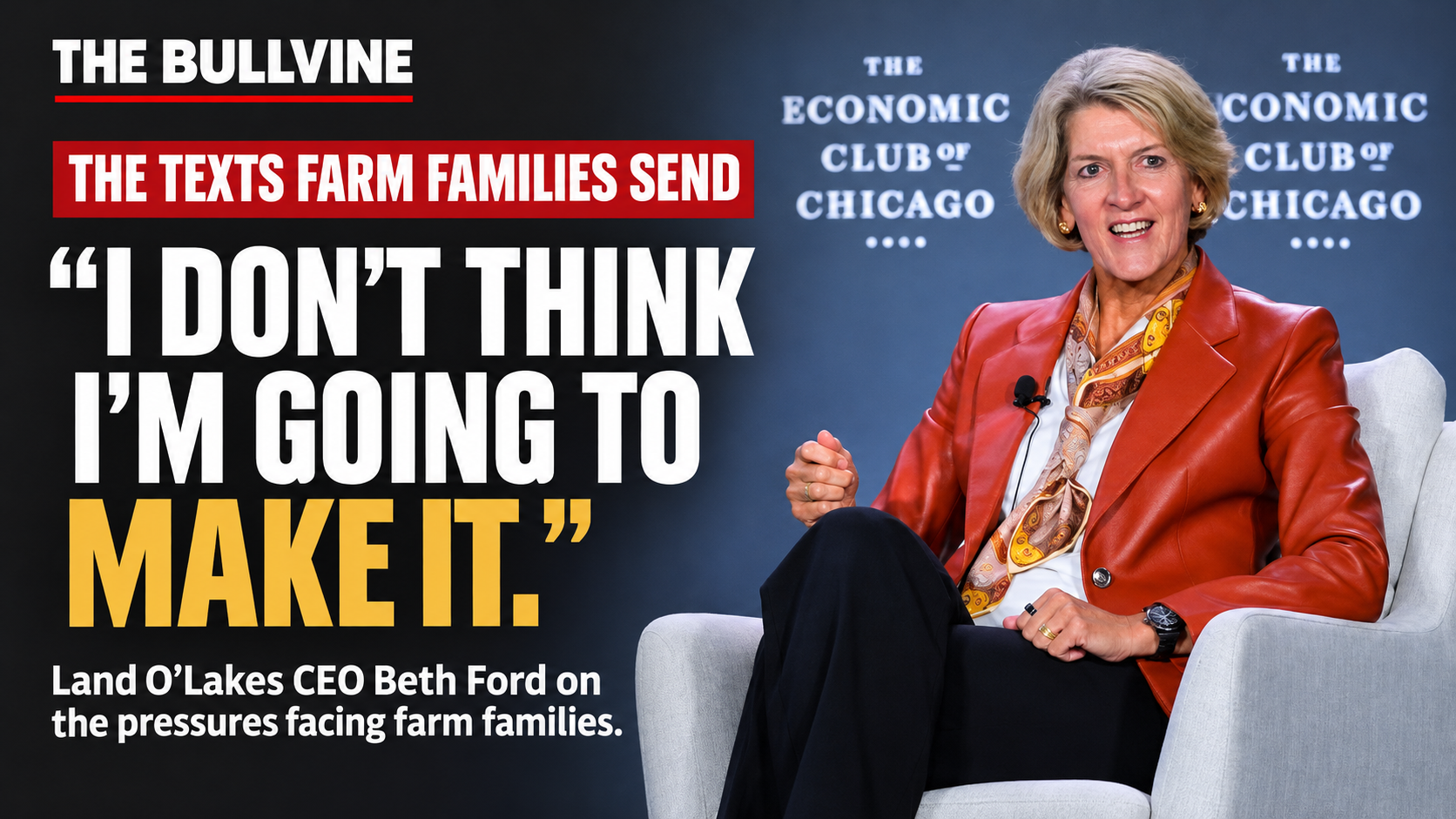
Fourth- and fifth-generation farm families text Beth Ford when they fear they can’t keep going. Some tell the Land O’Lakes CEO they’re eating into the next generation’s equity.
“Beth, I don’t think I’m going to make it.”
At the Economic Club of Chicago on October 26, 2026, Ford described her answer: “You haven’t done something wrong.”
The gathering storm
Moderator Penny Pritzker, a former U.S. Commerce Secretary, opened this part of the conversation with Ford’s warning of a “gathering storm” over American agriculture. Ford didn’t walk it back. Those pressures, she told the room, are continuing.
Land comes first. Rising values strengthen the balance sheets of farmers who already own ground. For new farmers, she said, they make getting in very expensive. Consolidation follows, and Ford argued it is “not because somebody did something wrong.” In her view, farms are scaling up because they sell into global markets while carrying domestic costs.
Then there’s the pressure that never shows up on a milk check. At kitchen tables, Ford pointed out, farmers mostly talk about their families, “and more recently their healthcare access.” A southern Minnesota farmer asked her why she thought his son, a welder, and his son’s wife both worked off the farm. Her guess was that the farm couldn’t feed the family. “No, it’s healthcare,” he told her. Ford was blunt about where that leads: “With Medicaid cuts, how that’s going to affect the rural farmer is really something I worry about.”
What it means for dairy
Three issues in Ford’s remarks matter directly to dairy producers.
Labor
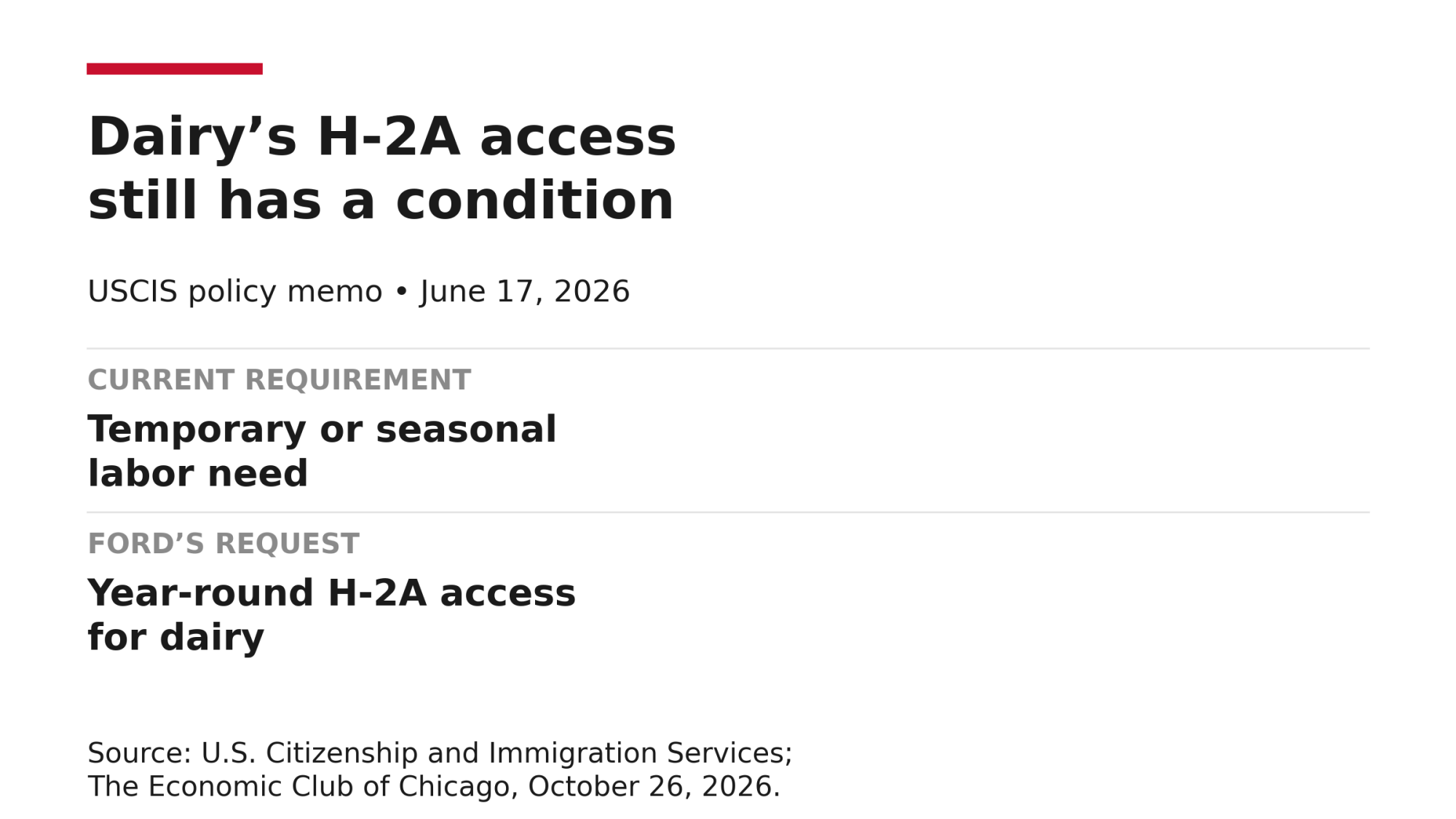
Ford’s main labor target is year-round H-2A access. “Cows are milking every day, multiple times a day, 24/7, 365. Can’t have a seasonal partner there.” The current program requires a temporary or seasonal labor need, and milking never stops for the season. A June 17, 2026 USCIS policy memo says dairying can qualify where the employer proves a temporary or seasonal need. The memo also says back-to-back petitions for the same dairy job without a meaningful break would generally support a denial. More detail: how current H-2A rules apply to dairy.
Domestic recruiting goes on, Ford stressed, but the work is “very difficult.” Two farmer-directors she walked with during a board meeting told her immigration worried them more than tariffs. “These are people who have been with them for 30 years. They’ve raised their children together.”
Pricing
Ford joked that only “three guys in a garage in New Jersey” understand federal order pricing, then defended what the system is for. Without it, she warned, an open market could slide to the “least common denominator”: “Let me pay you the least amount I possibly can.” The result would be more volatility at the farm level. “And there still is a lot of volatility, by the way.”
That’s her case for the system’s purpose, not a verdict on how the orders are working. Most of USDA’s amendments to all 11 orders took effect June 1, 2025. Ford defended the purpose of federal orders; her remarks did not establish how the recent amendments have affected members’ milk checks.
Patronage
Land O’Lakes pays dairy members through milk payments, premiums and patronage. Ford calls the co-op’s own dairy business “a skinny margin business.”
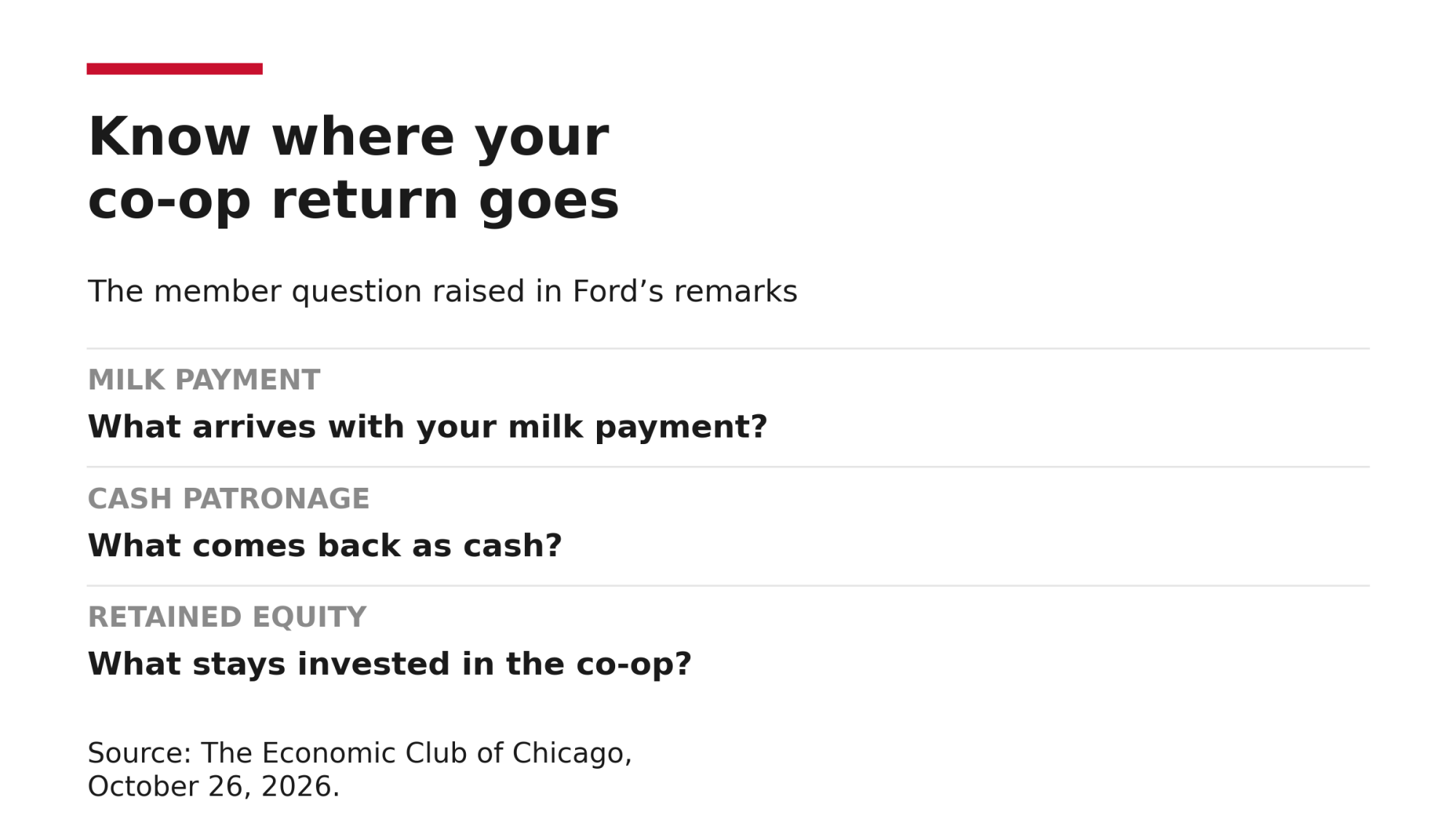
For members, the useful question is how the cooperative reports milk payments, premiums, cash patronage and retained equity. Ask which statements show each component, what period they cover and when retained equity may be redeemed.
A home for their milk
Ford traces the co-op back to Upper Midwest dairy farmers in the 1920s who wanted market power. Her case for the model today is that it gives members stability, technology, scale and a voice on policy. “If they don’t have a home for their milk, they don’t have a business.”
Technology is where her optimism runs into capital constraints. She told the story of a young family that had invested in robotic milkers. Ford credited the bet, since “labor is going to be a major issue,” but she said expense is the catch. Automation is one answer to the labor shortage. It takes capital, though, and by Ford’s account a number of farmers don’t have it right now.
A working-class foundation
Ford started at 12, detasseling corn outside Sioux City, Iowa, for $2 an hour. She was the fifth of eight children in what she calls a “working-class poor” family. Her father drove trucks and sold used cars, and her mother was a nurse.
At 11, she remembers, she was embarrassed by a car that kept breaking down and by coming up short at the cash register. Then one Thanksgiving, her mother took the family to deliver dinner to a family with even less. Two small children were running around their apartment in their underwear, because their one set of clothes was drying on the radiator. On the way out, Ford recalls, her mother asked: “Do you understand how much you have? Do you understand your responsibility to do with what you have?” Then she added: “Don’t disappoint me.”
The lessons followed her into a career few women entered in the 1980s. As a line foreman at Mobil Oil running tanker and barge docks, she was sent to oil spill response training in Texas with 25 men. Before a helicopter exercise, the instructor told everyone to call out their weight. Ford wrote hers down and handed it to him privately. He added five pounds. “Every woman lies about their weight,” he said. “Not when it’s life or death,” she shot back.
“Those lessons I think have been central to me,” Ford told the Chicago audience. “I want my work to be meaningful,” she said. After a decade at Mobil and roles at companies including PepsiCo and Scholastic, she joined Land O’Lakes in 2011 and became president and CEO in 2018.
Three questions for members
Ford’s remarks leave dairy members with three questions for their cooperative:
- Workforce: What is the cooperative doing now to help members address labor shortages?
- Returns: Where can members see cash patronage and retained equity separately?
- Milk market: What investments and market arrangements support dependable milk pickup and processing capacity?
Her case for the model today is that it gives members stability, technology, scale and a voice on policy.
Complete references and supporting documentation are available upon request by contacting the editorial team at editor@thebullvine.com.
Learn More
- Robotic milking ROI: the 7-year $8,776 cash-flow hole — Dismantles the dealer-promised three-year payback on automated technology. Arms you with the raw cash-flow curve required to survive the initial debt service, mapping exactly when labor savings actually overtake capital expenditure for a 140-cow herd.
- FMMO make allowances rose 42.6% on unaudited costs — Follows the money on the 2025 USDA amendments to reveal an estimated $200-per-cow annual margin hit. Exposes how processor data triggered the rate hikes and outlines exactly what ships into each class so you can forecast your milk check drop.
- Prairie Farms verdict: $241M lands on 500 farm families — Delivers a brutal wake-up call regarding cooperative liability and member equity. Highlights how a massive legal penalty ripples directly into patronage payments and redemption schedules, forcing you to closely evaluate the financial shielding of your milk buyer.
The Sunday Read Dairy Professionals Don’t Skip.

Every week, thousands of producers, breeders, and industry insiders open Bullvine Weekly for genetics insights, market shifts, and profit strategies they won’t find anywhere else. One email. Five minutes. Smarter decisions all week.