






Dairy spent years lobbying for H-2A access and finally got it on June 17. Same stretch, a Fresno court let a $2B wage cut stand — and the undocumented crew already milking your cows got nothing.
Executive Summary: On June 17, 2026, USCIS opened the H-2A guest worker program to dairies that can prove a “temporary or seasonal” labor need — the industry’s biggest immigration win in decades, and one corn, soybeans, and poultry couldn’t pull off, because farms staffed by immigrant labor produce 79% of U.S. milk. But read the fine print: you still can’t put your year-round milking crew on H-2A, eligibility is judged farm by farm, and the all-in cost runs roughly $877/cow — often right on top of what you’re already paying. The same stretch handed agriculture a DOL wage rule, now in effect after a Fresno court denied the UFW’s injunction on May 13, that cuts guest-worker pay by $2 billion (26–32%), with new AEWR rates taking effect July 1. None of it helps the undocumented workers already in your parlor, who got zero new protection. And the real exposure hasn’t moved: Drumgoon Dairy lost 38 of about 50 workers — 70% of the crew — in one I-9 audit and spent $110,000+ rebuilding, while a labor gap costing just 8 lbs/cow/day on a 400-cow herd bleeds about $662 a day before a single SCC penalty. If you lean on immigrant labor, the 30-day move isn’t filing H-2A paperwork — it’s running an I-9 self-audit, so you know your exposure before someone else finds it.
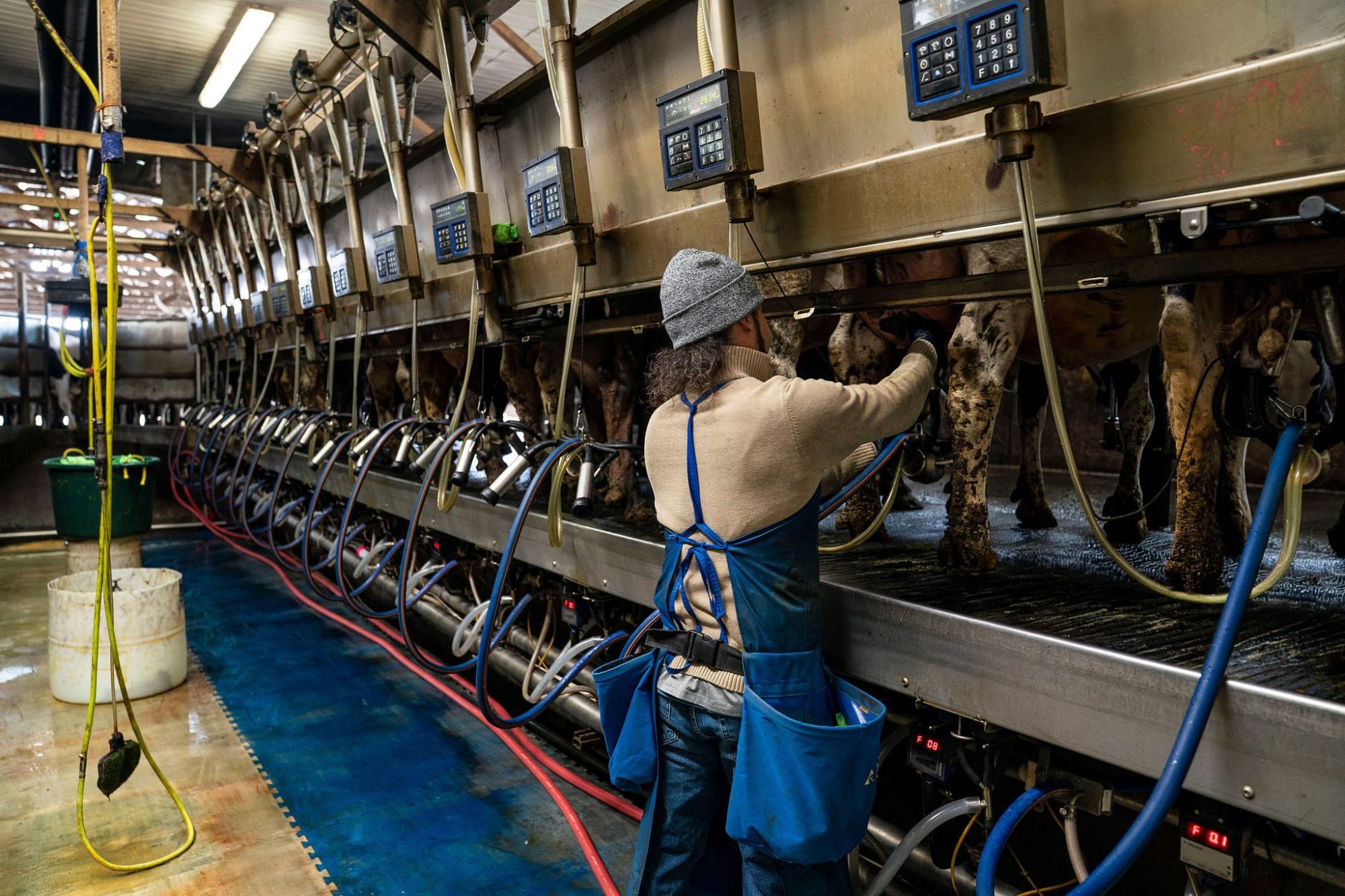
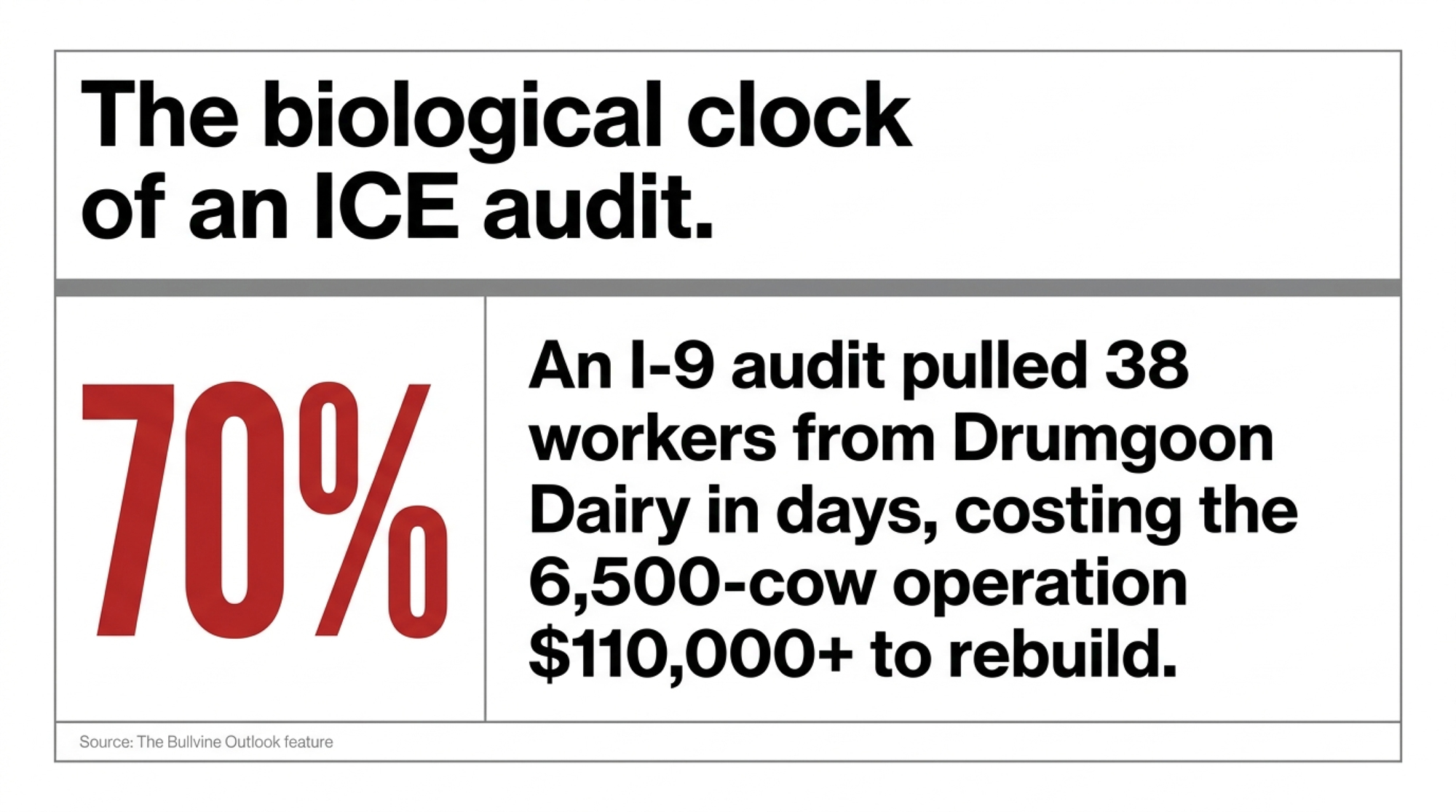
The Elliott family moved from a 140-cow farm in Northern Ireland and built Drumgoon Dairy near Lake Norden, South Dakota, into a 6,500-cow operation running 20 robots over nearly two decades. Then a Homeland Security I-9 audit pulled 38 of about 50 workers — roughly 70% of the crew — in a matter of days, and Nicole Elliott was running the place when it had to spend more than $110,000 rebuilding afterward. One paperwork check, and an operation that took 20 years to build suddenly faced the question every short-staffed dairy does: who’s milking tonight?
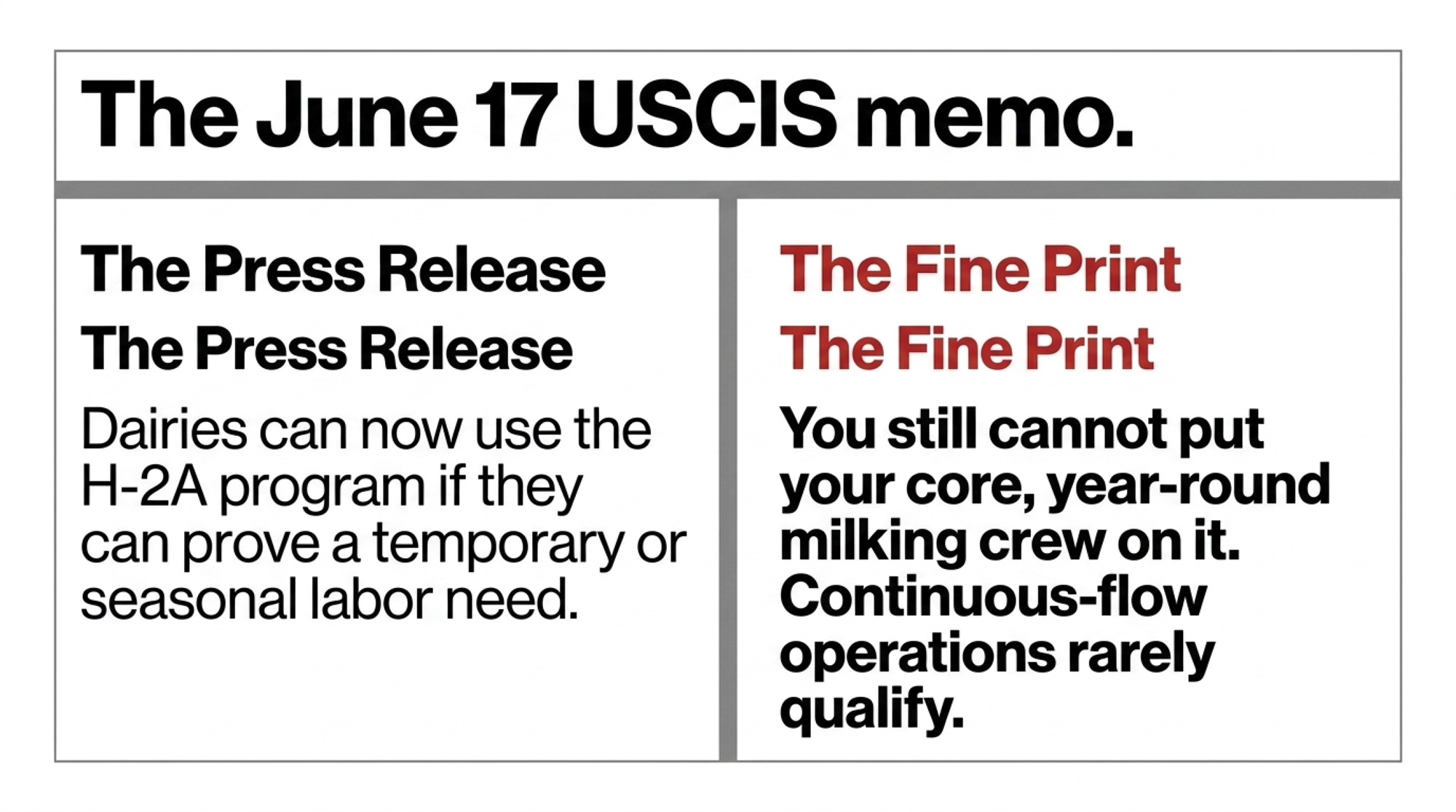
That’s the version of dairy’s labor crisis that never makes the press release. And it’s the pressure that pushed the industry to its biggest immigration win in decades. On June 17, 2026, U.S. Citizenship and Immigration Services issued Policy Memorandum PM-602-0200, opening the H-2A guest worker program to dairy operations that can show a “temporary or seasonal” labor need. If you run cows, this matters — just not in the clean, solved-problem way the celebration suggests.
The short version: dairy got a legal door it never had. The longer version is worth your time, because of what that door does and doesn’t open.
What Actually Changed on June 17
For decades, dairy was effectively locked out of H-2A. The program was built for seasonal work — fruit, vegetables, nursery crops that need a crew for a few months and then send them home. Cows don’t work that way. They need milking 365 days a year, so dairy never fit the “seasonal” box, and specialty crop growers used the program while dairy farmers watched from the sidelines.
The new memo doesn’t create a new visa. It reinterprets the old rule, telling adjudicators that dairying can involve a temporary or seasonal need and must be judged on a case-by-case basis, like any other H-2A petition. USDA welcomed it. The Green Bay–based Edge Dairy Farmer Cooperative called it a meaningful step for an industry that’s been asking for exactly this clarification for years.
Here’s why dairy had the leverage to get this when corn, soybeans, and poultry couldn’t. A 2015 Texas A&M AgriLife study for the National Milk Producers Federation found:
- 51% of all dairy workers are immigrant labor.
- Farms employing immigrant labor produce 79% of the U.S. milk supply.
- Pulling those workers out would push retail milk toward $6.40 a gallon and hit the broader economy by $32.1 billion.
Those figures are now a decade old, but the dependency hasn’t eased. That’s not a labor-rights pitch. It’s a grocery-shelf pitch — and it lands in rooms where immigration arguments stall out.
Why Was Dairy’s Argument the One That Worked?
Every ag sector says it’s essential. Corn says it. Poultry says it. They all have lobbyists making the same case. So why did dairy walk out with a memo nobody else got?
Because dairy’s ask was narrow and legal, not broad and political. The industry didn’t ask Washington to invent a new “dairy visa.” It pointed at the statute and said the law already lists dairying as eligible agricultural labor — your interpretation of “seasonal” is what’s broken. The Farm Bureau framed it the same way: flexibility, not amnesty. That’s a correction USCIS could make in a nine-page memo without waiting on Congress. One is a political ask. The other is a legal fix. And legal fixes are a lot harder to say no to.
But the same thing that made the ask winnable also caps what it delivers:
- Eligibility still hinges on proving a temporary or seasonal need, judged on a farm-by-farm basis.
- Immigration firm másLabor says very few dairies can actually satisfy that standard under the current framework.
- You can’t file H-2A for your year-round milking crew. You’d have to carve out something genuinely time-bound — a calving-season role — and prove you don’t need that same job the rest of the year.
That’s where most dairies hit the wall. A continuous-flow operation can’t easily claim a “season” when cows freshen every week of the year. The farms most likely to qualify are the ones with a concentrated calving block or a seasonal feed-and-forage push — not the bulk of confinement dairies. So read the memo for what it is: a real crack in a door that was fully shut, not the door swinging open.
| Labor Dimension | Before June 17, 2026 | After June 17, 2026 | Bottom Line |
|---|---|---|---|
| H-2A access for dairy | Effectively locked out — no seasonal framework | Legal pathway exists; case-by-case eligibility | Real crack in a shut door |
| Year-round milking crew eligibility | Ineligible | Still ineligible | ⚠️ Nothing changed |
| AEWR guest-worker wages | $15–$20/hr range (many states) | $8–$17/hr (26–32% cut, effective Jul 1) | Workers paid for the win |
| Undocumented workers in barn | No legal status, no pathway | No legal status, no pathway | ⚠️ Zero new protection |
| Farm-by-farm compliance risk | High (I-9 audit exposure) | Still high — memo doesn’t affect enforcement | Audit risk unchanged |
| FWMA / legalization track | Stalled in Senate | Still stalled | ⚠️ No movement |
| 2,000-cow operation calculus | H-2A unusable for core labor | H-2A usable for seasonal/forage roles | Marginal improvement |
| 400-cow operation calculus | H-2A unusable | H-2A theoretically available; rarely qualifies | Paper win; cash reality bites |
How This Plays Out in a Real Barn
Drumgoon wasn’t a one-off. In June 2026, an ICE raid hit Outlook Dairy in New Mexico, where owner Bos had 55 workers on payroll at sunrise and 20 by sundown — 35 gone in a single action, and milk production effectively stopped overnight. When the crew vanishes, the clock that matters isn’t political. It’s biological.
Miss milkings and cows pay for it fast. DairyNZ’s guidance notes that a quarter of cows not milked for seven days developed mastitis, with somatic cell counts spiking above 400,000 cells/mL and taking days to return to normal. The WH Miner Institute reports that even mild mastitis costs 11 to 18 pounds of milk per cow per day — and sometimes production never fully returns.
Here’s the barn math you can map straight to your own operation:
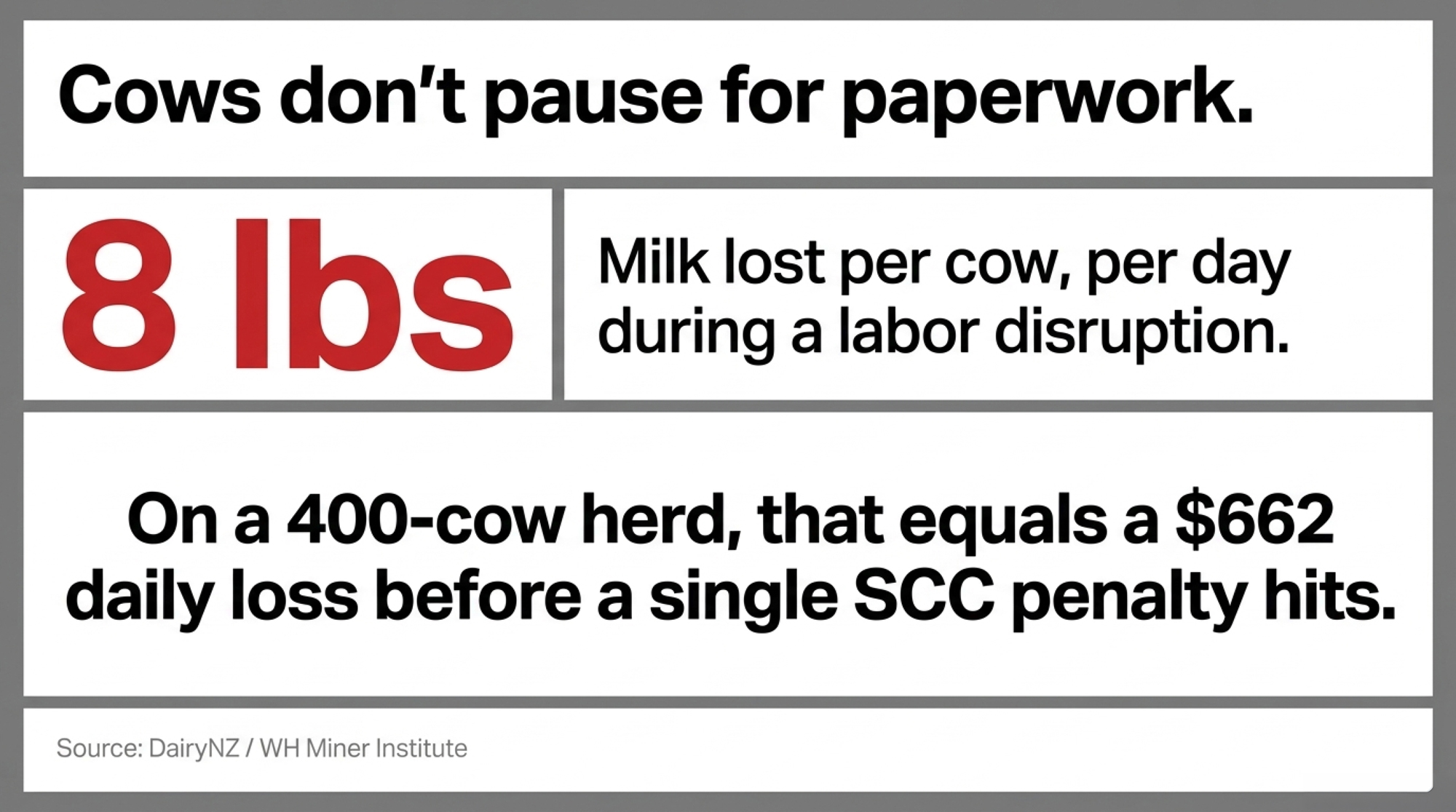
- A labor disruption costing a conservative 8 lbs/cow/day on a 400-cow herd = 3,200 lbs/day.
- At USDA’s 2026 all-milk forecast of $20.70/cwt, that’s about $662 a day walking out the door — before SCC penalties, dumped milk, or vet bills.
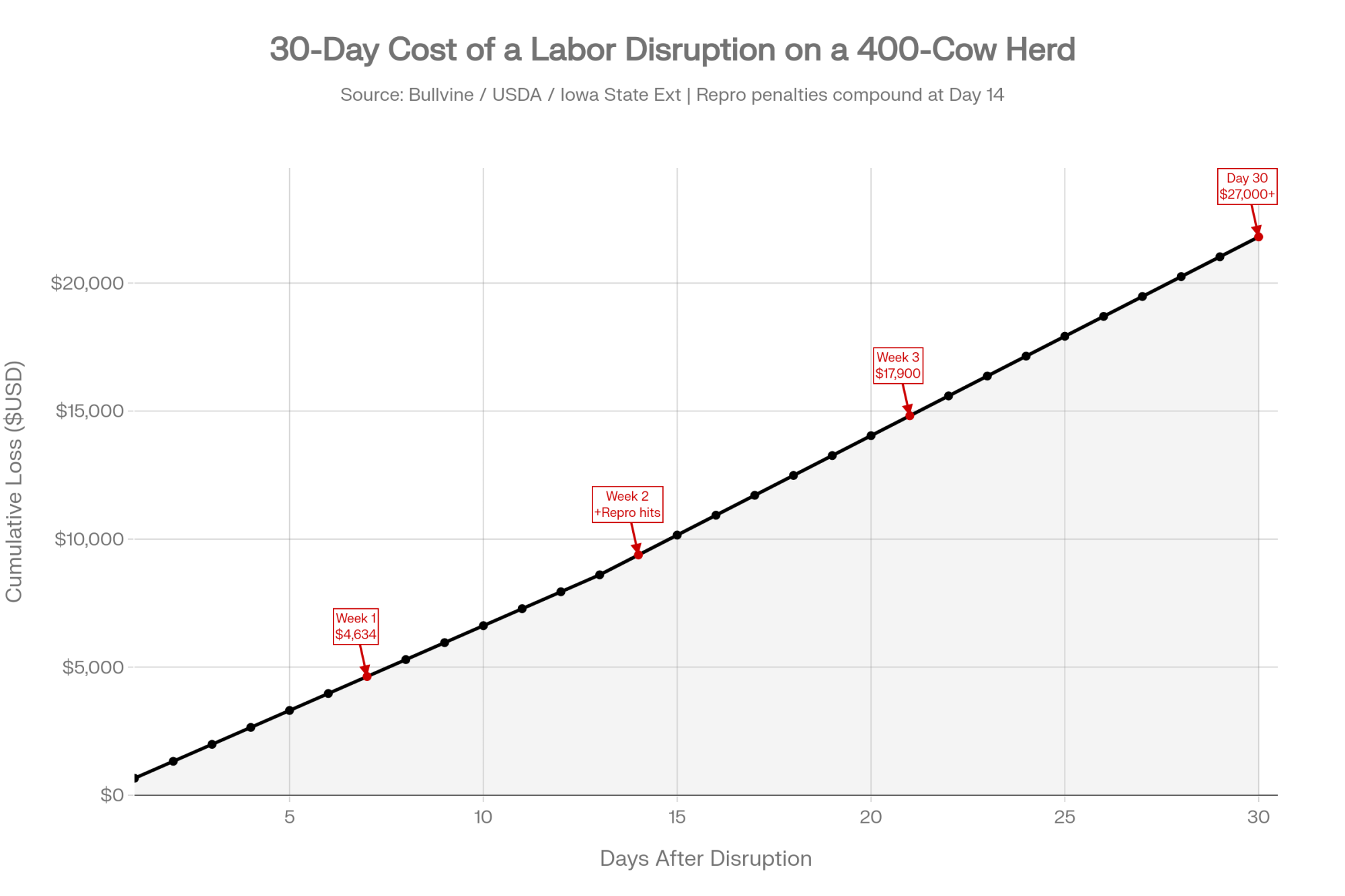
- Run that for a week while you wait on emergency labor, and you’re past $4,600.
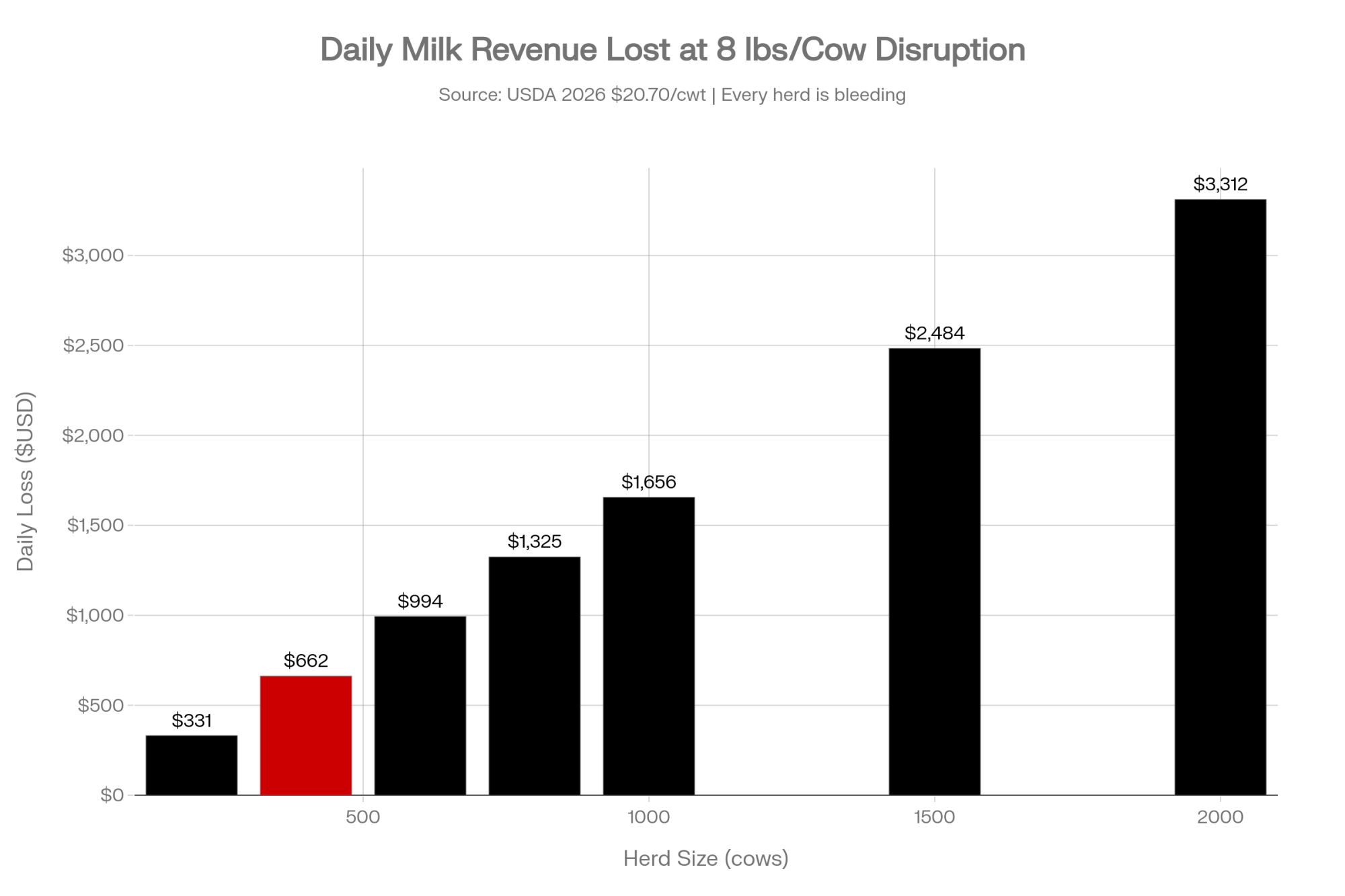
The cows don’t pause for paperwork.
And the lost milk is only the part you can see on the bulk-tank ticket. A short-handed crew cuts corners on heat detection, fresh-cow checks, and footbaths — the quiet jobs that show up three weeks later as open cows and lame cows. Iowa State Extension’s 2024–26 cost work estimates that the change in reproduction value is about $6 per cowwhen performance slips, with a missed breeding pushing the calving interval out by roughly 21 days. That’s the second wave of a labor shock, landing after the headlines move on. When neighboring farms sent workers to Drumgoon after its audit, that’s the wave they were trying to head off.
The Same Memo on a 2,000-Cow Operation
Scale changes the math, but not the constraint. On a large Western or Midwest dairy, the fixed costs of H-2A amortize better — a housing build or legal bill spread across 20 workers stings less per head on 2,000 cows than on 400. Bigger operations often already have bunk-style housing and HR staff, which makes the program’s housing, transport, and record-keeping rules more realistic. Wisconsin Public Radio reported that at least 14% of Wisconsin farms approved for visas this year already have dairy herds — mostly using H-2A for non-milking field and forage work.
But even at 2,000 cows, the wall is the same:
- You still can’t put your core milking crew — the ones on that 72-hour clock — on H-2A year-round under this guidance.
- You’re still bound by the one-year contract maximum and three-year cap, with workers required to return home.
- A continuous-milking operation with cows freshening evenly has less obvious seasonality to point to than a smaller herd with a tight calving window.
The memo hands big dairies a scalpel for specific seasonal jobs. It’s not a blanket over the year-round labor gap that keeps the lights on in the parlor.
What Does the “Win” Actually Pay Your Operation?
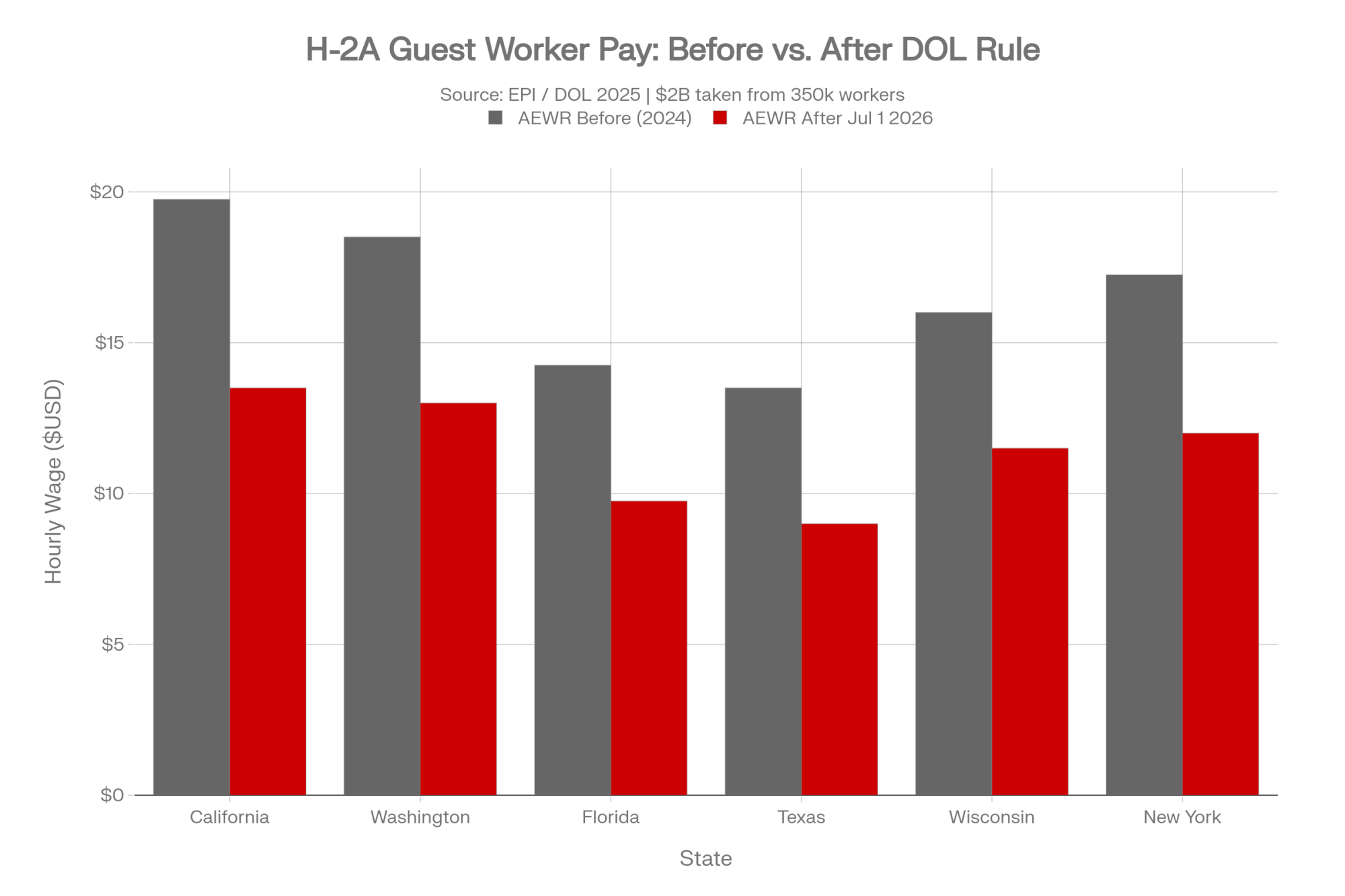
Less than the headlines suggest — and here’s the part the press releases skip. The same stretch of 2026 that handed dairy its H-2A door also brought a Department of Labor interim rule, effective October 2025, that rewrote how H-2A wages get set. The Economic Policy Institute estimates:
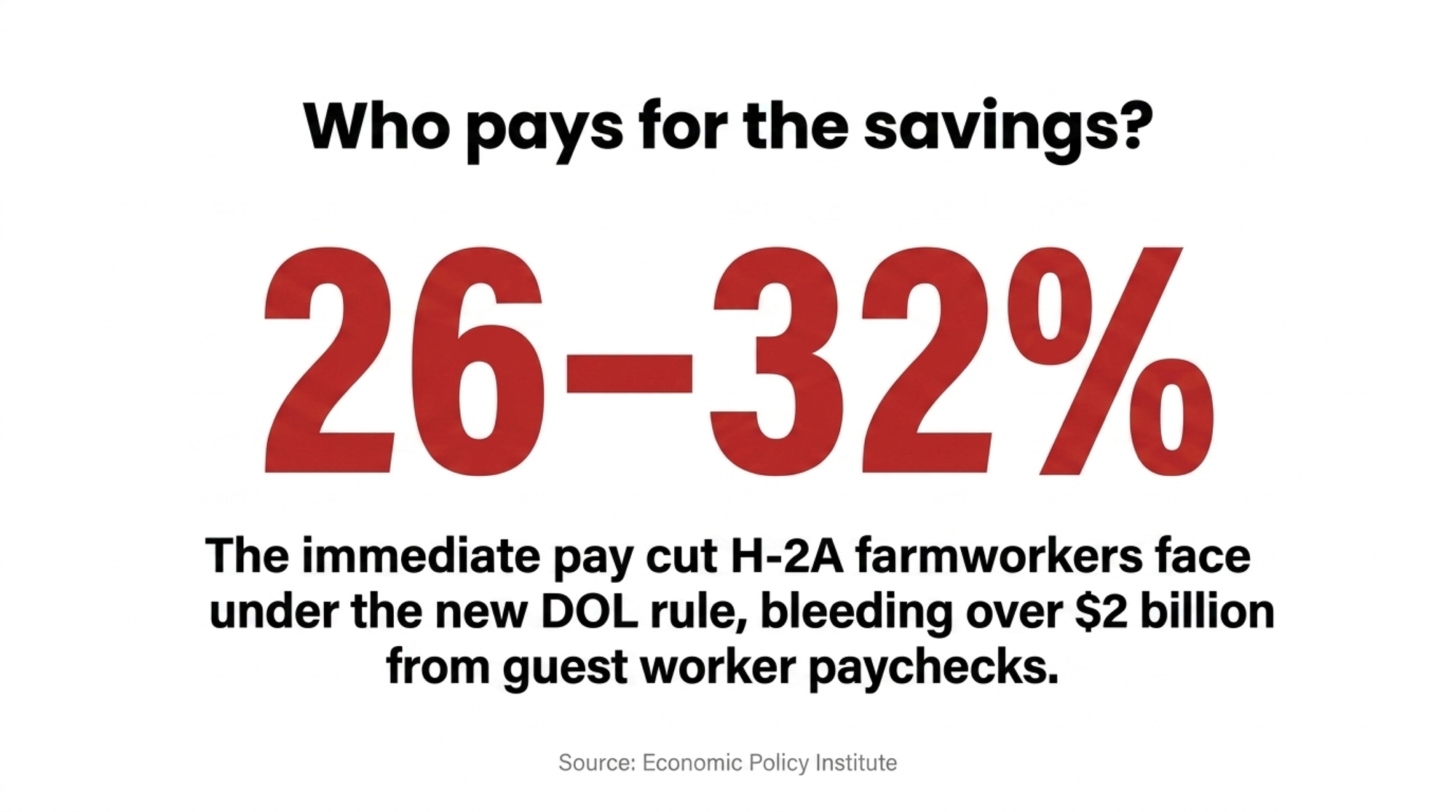
- Over 350,000 H-2A farmworkers will see pay cut by $2 billion or more in 2026.
- That’s a 26% to 32% reduction in their wages.
- In some states, H-2A pay drops from the $15–$20/hour range toward $8–$17.
So the employer side of agriculture got two things at once: dairy got access, and the whole sector got cheaper guest labor. That changes your per-cow math if you use the program. But say it plainly — those savings come straight out of worker paychecks. The United Farm Workers sued to block the rule, and on May 13, 2026, a federal judge in Fresno denied their request for an injunction, so the wage cut is in effect while the lawsuit grinds on toward a ruling on the merits. DOL is set to publish new wage rates under it effective July 1, 2026. The rule could still be struck down later — so don’t treat those lower numbers as permanent in a long-term budget.
Run the program cost honestly before you celebrate. H-2A requires you to pay the Adverse Effect Wage Rate, provide free housing, cover travel both ways, and hit a “three-fourths guarantee” on contract hours. Non-wage costs land around $10,000 per worker, with federal fees adding well over $1,000 a head.
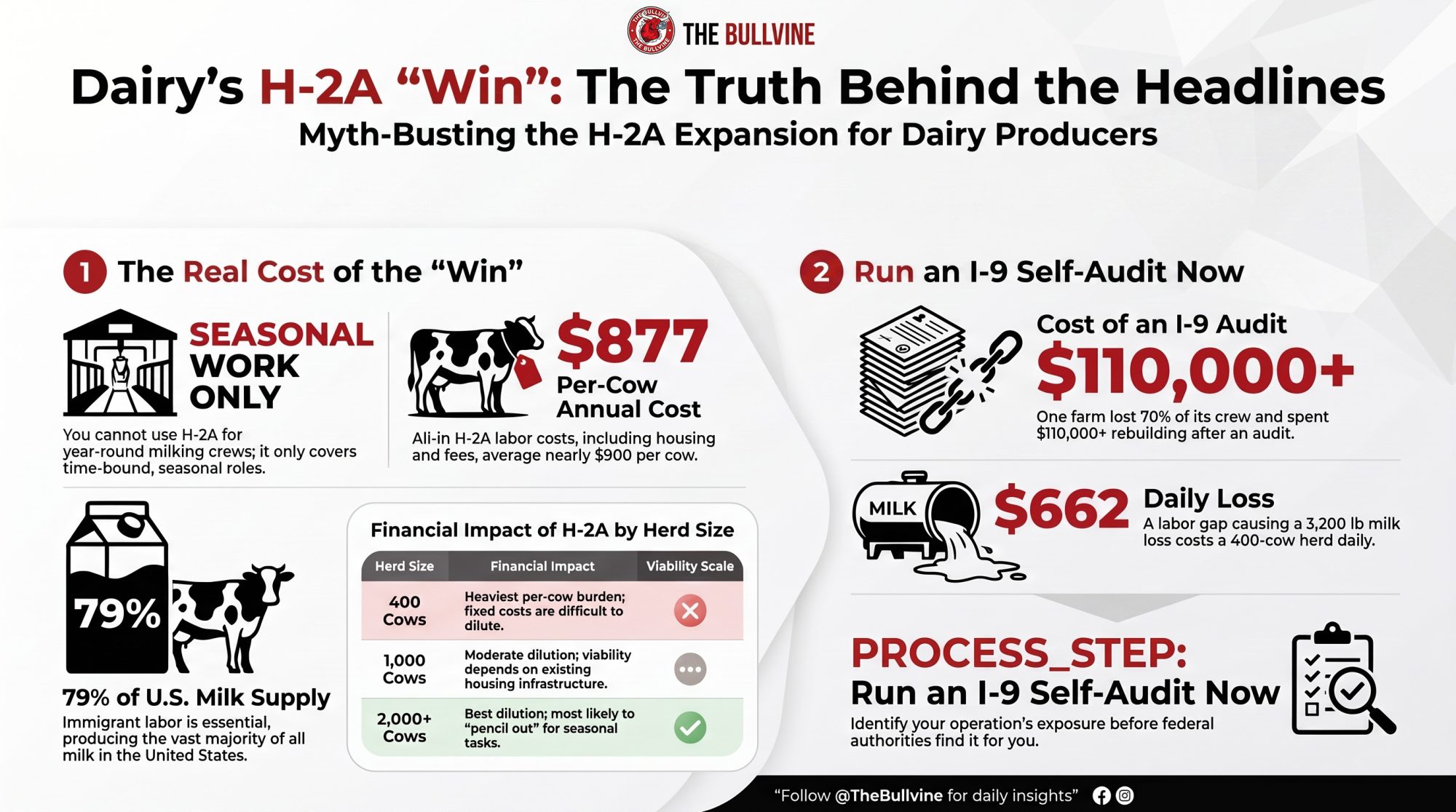
The number to run before you celebrate: The Bullvine’s own modeling pegs all-in H-2A dairy labor at roughly $877 per cow per year — often right on top of, or above, what you’re already paying.
How that lands depends entirely on your size, because the fixed costs spread differently across the herd:
| Herd size | H-2A fixed cost spread (housing, fees, travel, legal) | All-in labor lens |
| 400 cows | Heaviest per-cow burden; small crew can’t dilute fixed costs | Likely above current labor cost for most |
| 1,000 cows | Moderate dilution; depends on existing housing | Roughly break-even vs. current, case-by-case |
| 2,000+ cows | Best dilution; existing housing/HR helps | Closest to penciling, still capped by seasonality rule |
The table isn’t a verdict — it’s a reminder that the same memo pays out very differently on a 400-cow tie-stall than on a 2,000-cow freestall. Run your own number before you decide the win is yours.
What Happens to the Crew Already in Your Barn?
Nothing changed for them on June 17. The memo helps future hiring. It offers no legal status, no protection, and no pathway for the undocumented workers already milking your cows — the people who rode out every audit and every enforcement wave. They woke up on June 18 in the same position as June 16. Years of essential work, and still no door to legal status.
That’s the hard truth under the celebration. A large share of dairy’s immigrant workforce is undocumented — in some studied regions like the Northeast, estimates run as high as 90%, though that’s a regional figure, not a national census. Fixing that would take something this memo isn’t:
- A true year-round ag visa, or
- A legalization track tied to work history.
The Farm Workforce Modernization Act was the best-known attempt at the latter. It passed the House twice with bipartisan support but stalled in the Senate, and the Center for Migration Studies estimated it would have legalized about 235,600 undocumented agricultural workers and their families. It never became law. Until something like this does, your most experienced people remain essential and exposed.
Options and Trade-Offs for Farmers
There’s no single right move here. There are paths, and each one has a real cost.
| Option | Best Fit | Upfront Cost | Timeline to Impact | Key Risk | Core Limitation |
|---|---|---|---|---|---|
| H-2A for seasonal roles | Defined calving block; large herds (1,000+) | $10,000+/worker (housing, travel, legal) | 75–120 days lead time | ⚠️ Rates resting on live court fight | Year-round milking crew still ineligible |
| I-9 self-audit | Every operation, right now | Minimal (staff hours) | This month | Finding problems you’d rather not see | Fixes exposure; doesn’t fix status |
| 72-hour contingency plan | Any herd relying on immigrant labor | Staff time only | This week | Neighbors-helping-neighbors isn’t a plan | Labor shortage still materializes |
| Robotics / automation | Chronic labor gaps; capital-strong ops | $200,000–$500,000+ per milking unit | Multi-year payback | ⚠️ Doesn’t prevent an I-9 audit | No 72-hour fix; debt risk |
| Legalization track (FWMA) | All dairy ops employing undocumented crew | Lobbying/advocacy only | Stalled — no timeline | Congress required; Senate blocked twice | No active pathway exists |
- Use H-2A for genuinely seasonal roles. Works for larger operations with defined calving or breeding seasons, or time-bound forage work. Requires housing, legal help, 75-to-120-day lead times, and compliance systems. The risk: most core milking jobs still won’t qualify, and you front every dollar before a cow gets milked. The October 2025 wage rule makes the cost side look better than it did in 2024 — but those rates rest on a court fight that’s still live, so don’t build a decade-long plan on them.
- Run an I-9 self-audit this month. Works for every operation, regardless of size — this is the 30-day move. Requires a few hours and an honest look at your paperwork. The risk: you find problems you’d rather not see. But Drumgoon let 38 workers go after exactly this kind of DHS check. Knowing your exposure beats discovering it during a raid.
- Build a written 72-hour contingency plan. Works for any herd leaning on immigrant labor — statistically, most of them. Requires mapping who does what, lining up backup labor, and deciding now which pens you’d triage first. Drumgoon leaned on neighbors sending workers over — but that’s a favor, not a plan. The cows line up whether you’re ready or not.
- Look hard at automation. Works for operations facing chronic labor gaps that can carry the debt. Requiresserious capital; robots are a multi-year bet, not a 72-hour fix. The catch: Drumgoon’s 20 robots still didn’t insulate it from a DHS audit.
Key Takeaways
These are decisions to make, not points to remember.
- If you run defined calving or breeding seasons, ask your immigration attorney whether one specific, time-bound role could qualify for H-2A — but don’t assume your milking crew does.
- Before you budget H-2A, run the per-cow number. At roughly $877/cow all-in, check whether it beats your current labor cost or matches it — and remember a 400-cow herd dilutes fixed costs far worse than a 2,000-cow one.
- Do an I-9 self-audit this month. If one DHS check pulled 70% of Drumgoon’s crew and cost $110,000+ to rebuild from, the question isn’t whether you’d survive it — it’s whether you know your exposure before someone else finds it.
- If you lost 40% of your crew tomorrow, can you name who milks, which pens get triaged, and where your backup labor comes from? If not, that’s this week’s job.
- If you rely on long-term undocumented workers, factor in that the memo gives them zero new protection. Build that risk into your staffing plan, not your press clippings.
So Where Does Your Operation Actually Stand?
Picture an audit hitting you next Tuesday. How many of your people are still standing in the parlor Wednesday morning — and do you actually know, or are you guessing? That’s not a political question. It’s a milk-check question, and the answer is sitting in your I-9 folder right now.
The June 17 memo handed dairy a tool. Whether it fits your herd comes down to your size, your seasons, and your balance sheet. We’re breaking down the full H-2A cost-per-cow model by herd size — where it pencils, where it doesn’t, and how the July 1 wage rates change the math — in next week’s Bullvine Weekly. That’s where the real numbers live.
Run Your Numbers
Dairy Profit Projector — Drop that $877/cow H-2A figure into your own herd size, milk price, and ration and see what it does to your 12-month whole-herd margin, IOFC per cow per day, and breakeven milk price — before you decide the visa win actually pencils on your farm.
Complete references and supporting documentation are available upon request by contacting the editorial team at editor@thebullvine.com.
Learn More
- Dairy Finally Got Its H-2A Door. In Wisconsin, It Costs About $25 an Hour to Walk Through. — Insight into the true, hidden side-by-side cost difference between visa contracts and local hiring. This analysis exposes how a 39% domestic turnover rate silently inflates labor budgets past the H-2A administrative baseline.
- Outlook Dairy Lost 35 of 55 Workers Before Lunch. Then the Cows Lined Up. — Arms you with a concrete shift-by-shift coverage map strategy to handle sudden immigration enforcement actions. Delivers the exact 72-hour operational protocol needed to safeguard cow health and parlor throughput when human capital vanishes.
- Dairy Tech ROI: The Questions That Separate $50K Wins from $200K Mistakes — Reveals the precise $27.05 hourly wage crossover threshold where automated milking systems generate positive financial returns. Dismantles vendor trade-show performance claims by matching capital allocation to specific herd infrastructure and scale limits.
The Sunday Read Dairy Professionals Don’t Skip.

Every week, thousands of producers, breeders, and industry insiders open Bullvine Weekly for genetics insights, market shifts, and profit strategies they won’t find anywhere else. One email. Five minutes. Smarter decisions all week.




