





Trade media called the H-2A reinterpretation a win. Nobody ran the barn math: ~$877 a cow a year, about $25/hr all-in — right on top of the crew you’ve already got. Run your number first.
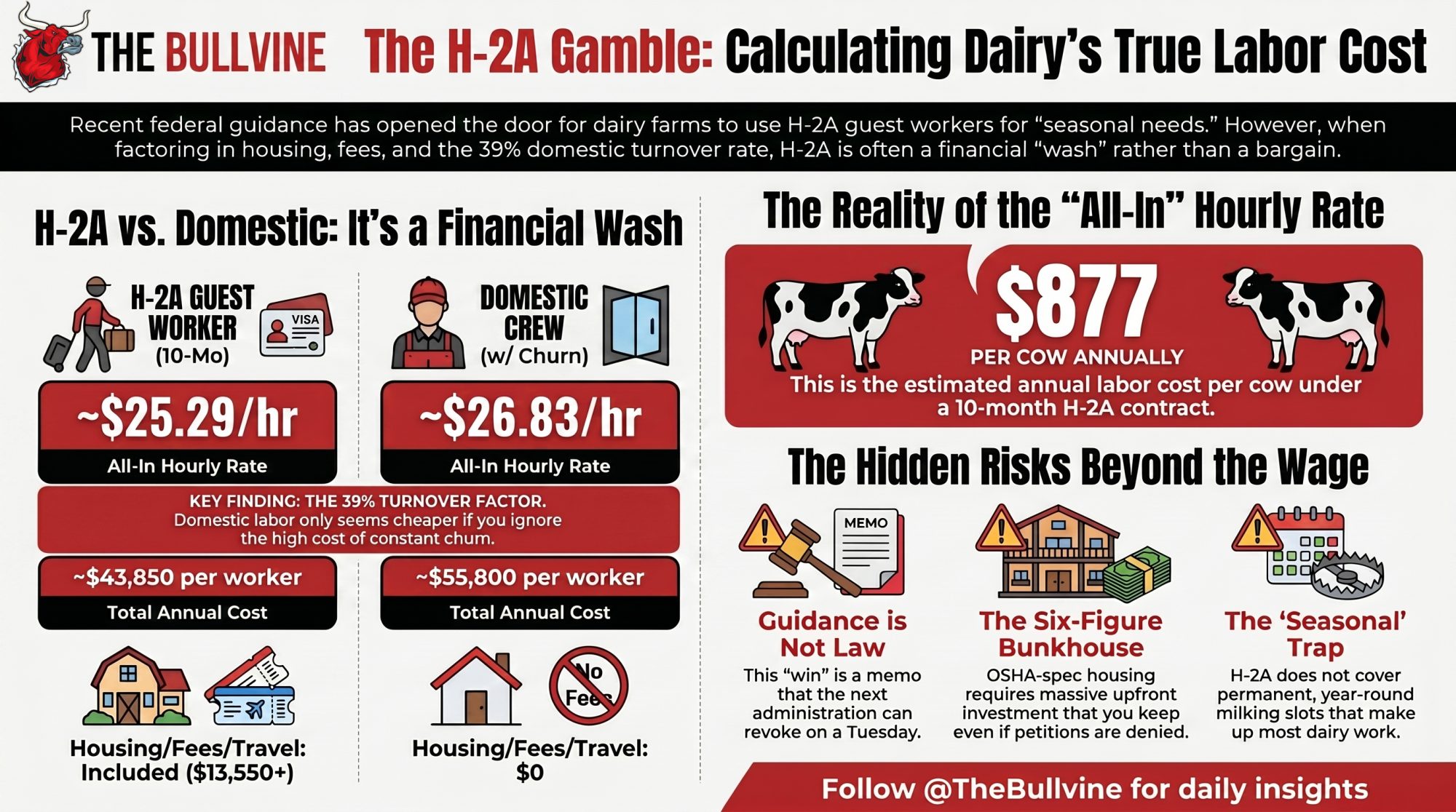
Executive Summary: After 40 years shut out, dairy can finally tap H-2A guest workers as of mid-June 2026 — but in Wisconsin the all-in cost lands near $25 an hour, about $877 per cow a year, right on top of what your current crew runs. This isn’t a new law; it’s a USCIS guidance memo reinterpreting “seasonal need,” which means the next administration can pull it as fast as it appeared, and it still won’t cover the year-round milking slots that make up most of the 51% immigrant share of the dairy workforce. Price your domestic crew honestly — wages plus the turnover hit at the 39% industry churn rate — and it runs about $26.83/hr, so H-2A isn’t a bargain or a blunder. It’s a wash. Which means the real decision was never cost; it’s stability versus compliance risk and a possible six-figure OSHA-spec bunkhouse you’ll still own if USCIS denies your petition. It pencils for higher-wage states with documentable seasonal spikes and existing housing — and stays a co-op conversation for the 240-cow herd milking the same five people all year. Pull your last 12 months of labor records before you call a recruiter, because the question isn’t whether the door’s open. It’s whether walking through pays for your herd.
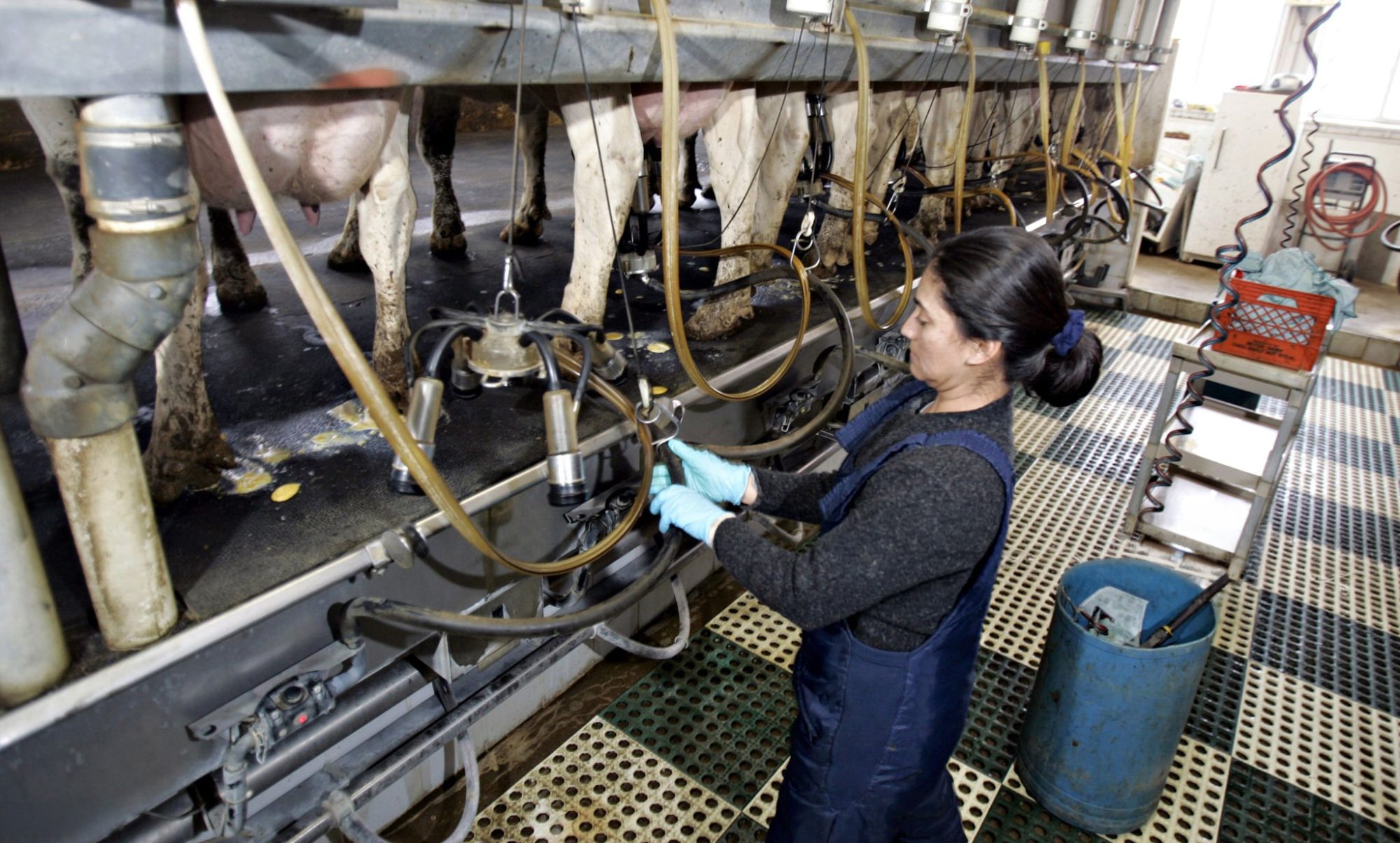
For four decades, the federal answer to dairy on H-2A was a near-automatic no. The program was built for harvest crews that come and go with the apples or the lettuce. Milking isn’t seasonal — cows don’t stop in December — so dairy never fit the box. That changed in mid-June 2026, when the government quietly reinterpreted the rules. The trade press ran it as a win. Nobody put a pencil to what walking through that door actually costs a working herd. So before you call a recruiter, here’s the math the headlines skipped.
What Actually Changed in June
U.S. Citizenship and Immigration Services issued new guidance directing its officers to stop reflexively rejecting dairy petitions and instead judge each one on whether the farm has a genuine temporary or seasonal need. Read that carefully. It’s a change in how existing rules get applied — not a new law, and not an expansion passed by Congress.
The distinction matters more than the headlines let on. A law takes an act of Congress to pass and another to repeal. Guidance is a memo. It tells the agency’s adjudicators how to read existing rules, and the next administration can issue a different memo on a Tuesday. So when you hear “dairy got H-2A,” what dairy actually got is a more favorable reading of the same statute that’s been on the books for years — not a new, durable right.
The industry welcomed it, carefully. The National Milk Producers Federation framed it as a step toward opening the door. Edge Dairy Farmer Cooperative called it an early, positive step for year-round producers. Both groups are membership organizations whose job is to advance producer interests, so a positive read is expected, which makes the hedging in their own words (“toward,” “first step”) worth noting. Even the people cheering aren’t calling it the fix.
Here’s the catch that didn’t lead the coverage. The guidance does not open H-2A to permanent, year-round milking. Cornell’s Ag Workforce Development team read it as covering temporary or seasonal jobs only — not permanent or back-to-back consecutive roles. File repeat petitions for the same milking slot with no real break, and USCIS will generally read that as proof of a permanent need — and deny you.
Who This Helps — and Who It Doesn’t
This change helps a specific kind of operation. Larger herds with a documentable seasonal spike — a tight calving window, a defined expansion phase, and seasonal feed work. Farms in higher-wage states, where the gap between the H-2A wage floor and your current payroll is already thin. And operations that either own compliant worker housing or can afford to build it.
It does a lot less for everyone else. Milk 240 cows in a low-wage state with the same five people all year, and there’s no seasonal spike to point to — and the all-in cost can run higher than what you pay now once housing and fees land. For those herds, this was something to talk about at the co-op, not a new labor source.
The biggest number in the room goes untouched. An NMPF-commissioned study put immigrant labor at roughly 51% of the dairy workforce, producing close to 79% of America’s milk — figures now about a decade old but still the standard reference. Most of those workers hold the year-round jobs this guidance doesn’t cover. So whatever H-2A becomes for dairy, it’s not a swap for the crew already in your parlor.
| Farm Profile Factor | H-2A Likely Pencils ✓ | H-2A Likely Doesn’t Pencil ✗ |
|---|---|---|
| Herd size | 500+ cows, multiple labor slots | 240 cows or fewer, same 5 people year-round |
| Seasonal need | Defined calving window, expansion phase | Year-round milking with no documented spike |
| State wage floor | Higher-wage states (WA, OR, NY, CA) | Low-wage states where AEWR adds little vs. local labor |
| Housing status | Own compliant OSHA-spec bunkhouse now | Aging trailer, shared bath, no locks — renovation = six figures |
| Turnover rate | 39%+ churn — you’re already paying the H-2A rate | Low churn, stable crew — domestic wins on simplicity |
| Risk tolerance | Can absorb a denial after fees are sunk | Cannot carry sunk housing cost if petition is denied |
| Visa fee trajectory | Locked into a short-cycle contract | Multi-year plan built on today’s $1,350 — fees keep climbing |
Does H-2A Actually Pencil Out for a 500-Cow Dairy?
Everyone assumed “access to H-2A” meant cheaper labor. The barn math says otherwise. Here’s how the numbers stack up for a 500-cow Wisconsin dairy running 10 full-time equivalents on a 10-month contract, against a traditional domestic crew. That one-worker-per-50-cows ratio swings with parlor type and automation — some herds run 8, some run 12 — so set yours before you trust the rest.
Running the Numbers: H-2A vs. Domestic Labor (Per Worker, Bullvine Model)
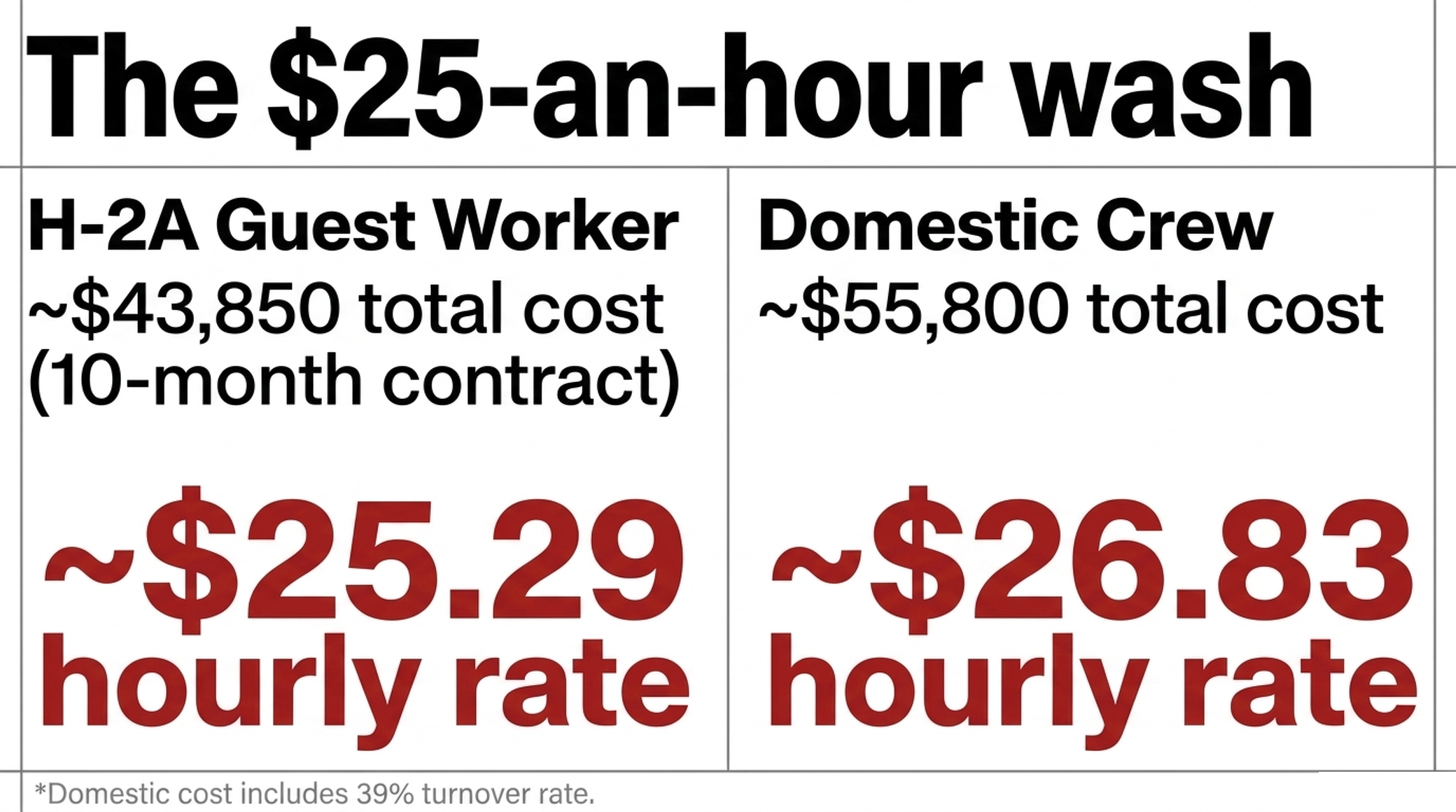
| Cost Category | H-2A Guest Worker (10-Mo. Contract) | Domestic Crew (Honest Costing w/ Churn) |
| Base cash wages | $30,300 (~1,733 hrs @ ~$17.50 effective) | $40,560 (2,080 hrs @ $19.50, Midwest working assumption) |
| Taxes & benefits | Included in fees/overhead | $7,440 (payroll taxes, modest perks) |
| Housing operating cost | $11,000 (USDA seasonal average) | $0 (assumes no farm-provided housing) |
| Visa & application fees | $1,350 (up ~$600 in two years) | $0 |
| Inbound/outbound travel & subsistence | $1,200 | $0 |
| Annualized turnover hit | $0 (contract-guaranteed term) | $7,800 (39% avg @ $20k replacement) |
| Total cost per worker | ~$43,850 | ~$55,800 |
| All-in hourly rate | ~$25.29/hr (over ~1,733 contract hrs) | ~$26.83/hr (over 2,080 hrs) |
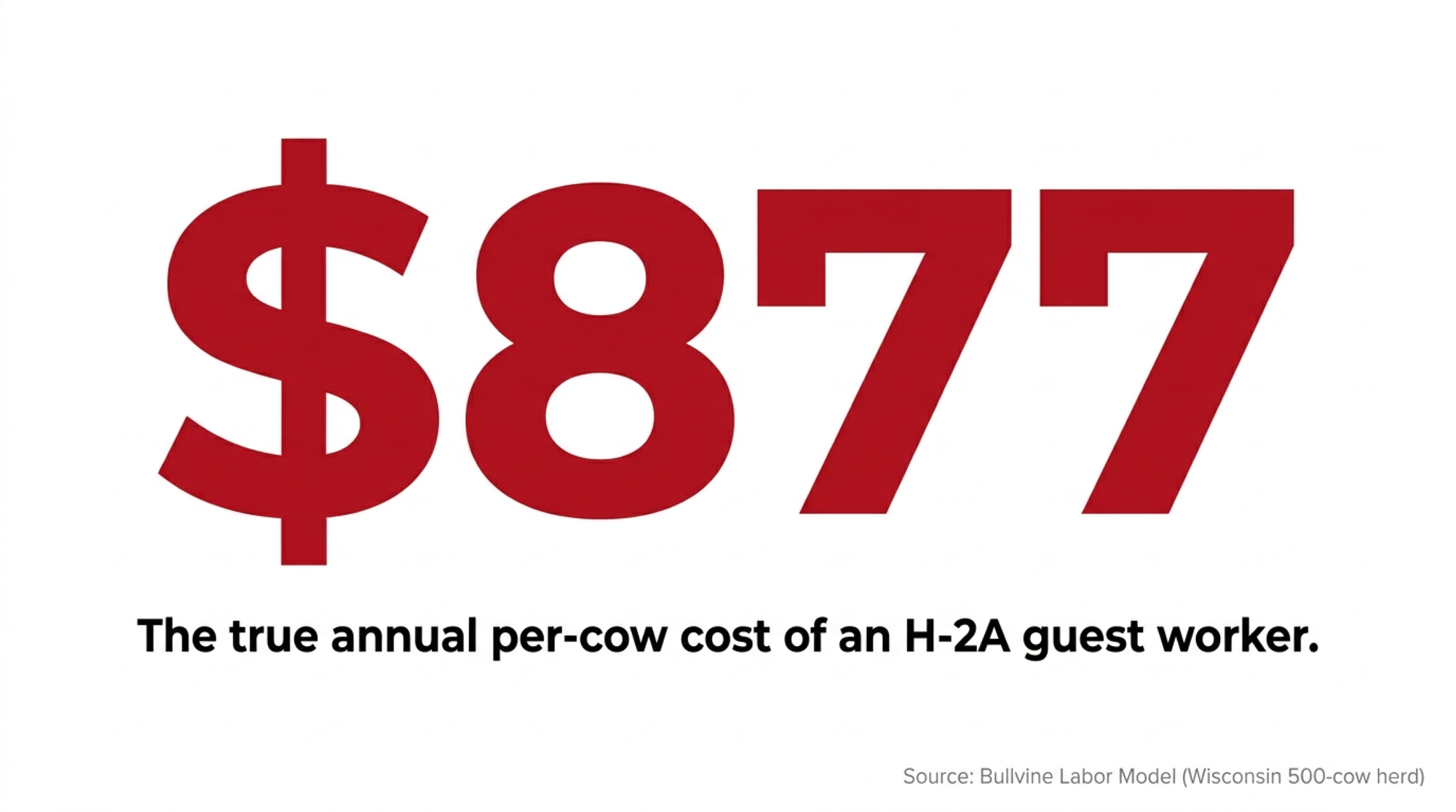
Run that per-worker H-2A number against the cows it covers, and you get the figure the headlines never quote: one worker per 50 cows at ~$43,850 a year is about $877 per cow annually — your single biggest controllable cost after feed, and a number you can plug your own ratio straight into.
Two notes on reading that table honestly. The H-2A wage assumes a 40-hour week across the contract — real barn hours often run longer, so scale it to your own schedule. And the two hourly figures sit on different denominators (1,733 contract hours versus 2,080 full-time hours), so treat them as all-in cost-of-labor rates, not identical-hour comparisons.
The $43,850 isn’t a single-sourced figure — it’s a stack of USDA’s housing range, AFBF’s fee data, and published academic transport costs. Housing costs and fees vary by state and farm size, so confirm your state’s current AEWR off the DOL table and price your own housing before you lock in a decision.
One more thing the table can’t show: the fees move. AFBF flagged the per-worker application and visa costs climbing by roughly $600 over two years. Build a five-year labor plan on today’s $1,350, and you’re already behind, because the one input that’s pure paperwork is the one that keeps rising.
The Turnover Line That Flips the Whole Comparison
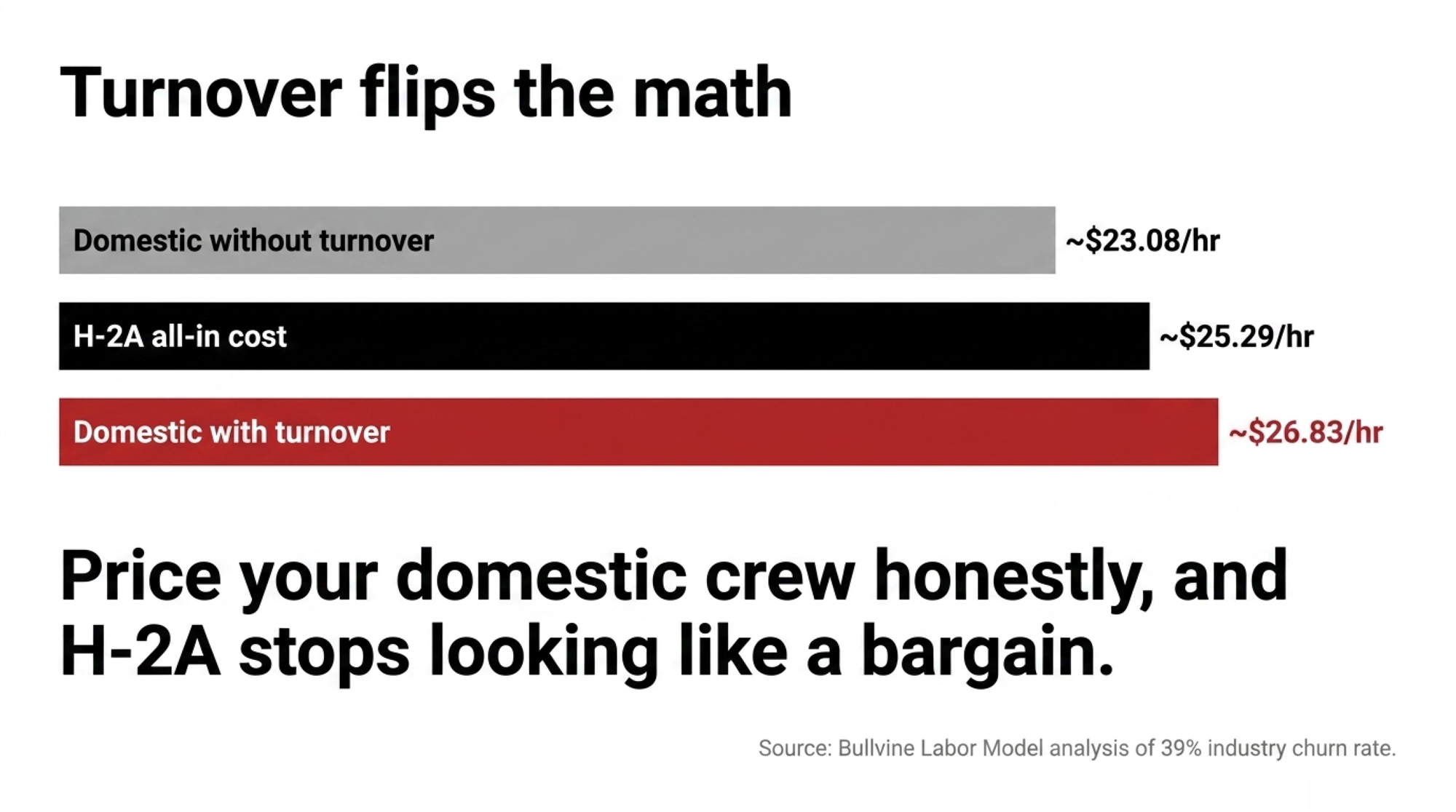
Look at the table without the turnover row and domestic labor wins clean — about $48,000 against H-2A’s $43,850. Add the churn back, and the gap closes to almost nothing. That’s the entire argument in one line item:
- H-2A, all-in: ~$25.29/hr — fixed by contract
- Domestic, turnover excluded: ~$23.08/hr — what most herds think they pay
- Domestic, turnover included: ~$26.83/hr — what they actually pay at the 39% industry average
The number herds skip is the one that decides this. Price your crew honestly, and H-2A stops looking like a bargain or a mistake. It looks like a wash. And a wash on cost means the decision was never really about cost at all, which is where most of these conversations go wrong from the first phone call.
Why It Was Never a Wage Question
Once those two numbers sit side by side, the real question flips. It’s not “Is H-2A cheaper?” It’s “which system gives me more stability for roughly the same dollars — and can I survive a denial letter after I’ve poured concrete for a bunkhouse?”
That’s the trade the table doesn’t price. H-2A buys you a contract-locked crew that shows up for the season and can’t quit for the dairy down the road offering fifty cents more. You give up flexibility, and you take on compliance risk. A domestic crew gives you flexibility and no petition to lose — but you carry the turnover, the recruiting, and the 2 a.m. text that someone isn’t coming in. Same money, different risk. Pick the risk you can actually manage. That’s the revolving door at the parlor most operators are quietly trying to close.
For a 500-cow herd, converting four genuinely seasonal positions to H-2A while keeping six domestic year-round might trim your labor line by a few cents to roughly $0.40/cwt — but only if you already own compliant housing and your petitions are approved. This is a marginal-savings figure from a partial conversion, not the same animal as the $877-per-cow all-in cost above — keep them separate. Here’s the arithmetic, with the production assumption stated: four H-2A at ~$43,850 plus six domestic at ~$55,800 runs about $510,000, against roughly $558,000 for an all-domestic crew priced for turnover. Spread the ~$48,000 gap across 120,000 cwt of annual production — that’s 500 cows at about 24,000 lb each — and you land near $0.40/cwt. Build housing from scratch, though, and you add maybe $1,500–$2,600 per worker per year in amortized cost — enough to erase that savings.
Why Is “Free Housing” a Six-Figure Decision?
The reason H-2A isn’t cheap comes down to what the program legally demands. Pay the highest applicable wage. Provide free housing that meets federal safety standards. Cover travel in and out. And guarantee at least 75% of the contracted hours, whether or not the work shows up. That three-quarters guarantee is the clause nobody mentions — if your calving peak runs late, you still owe the hours.
Compliant H-2A housing isn’t a spare farmhouse with a couple of mattresses and a space heater. Under OSHA’s temporary labor camp standard, you need at least 50 square feet of sleeping space per person, one toilet for every 15 workers, one shower for every 10, a stove per 10, a refrigerator for every 6, screened windows that open, working smoke detectors, and roughly 35 gallons of water per person per day. Build a bunkhouse for 10 to that spec, and you’re well into six figures.
| Housing Requirement | OSHA H-2A Standard | NY Dairy Survey Finding | Gap |
|---|---|---|---|
| Sleeping space | Min. 50 sq ft per person | Not measured directly | Unknown — likely underbuilt |
| Toilets | 1 per 15 workers | 48% of workers: no door locks on any bathroom | Non-compliant baseline likely common |
| Showers | 1 per 10 workers | Not separately measured | Likely insufficient in older housing |
| Windows | Screened, must open | 58% reported insect infestations | Indicates screened windows non-functional or absent |
| Structural integrity | No holes in walls/floors | 32% had holes in walls or floors | Direct structural non-compliance |
| Water supply | ~35 gal/person/day | Not measured | Unknown compliance rate |
| Security | Implied by safety standards | 48% had no door locks | Direct safety non-compliance |
| Estimated retrofit cost | — | — | $80,000–$150,000+ for a 10-worker bunkhouse |
A lot of existing dairy housing is nowhere close. A New York survey of dairy farmworker housing — general dairy housing, not H-2A-inspected units — found 58% of workers reported insect infestations, 48% had no door locks, and 32% had holes in their walls or floors. The point isn’t that H-2A housing is bad. It’s the gap. If your setup is an aging trailer with soft floors and one bathroom for eight guys, you’re not a coat of paint from compliance. You’re a renovation away.
Here’s where the housing math turns on you. Spend six figures retrofitting a bunkhouse to OSHA spec, then file a petition that USCIS denies because your “seasonal” need looks year-round, and the concrete doesn’t disappear. You own the building and none of the workers. That’s the asymmetry: the housing cost is certain and up-front, the approval is not.
Is the Real Fix Even Coming From Washington?
Be careful betting your operation on it. This is policy guidance, not a law — a future administration could rewrite it without a single vote in Congress. It’s a door that can be closed the same way it opened.
A real fix would need two hard things at once: legal status for the people already milking your cows, and a true year-round visa that admits cows don’t take winters off. The Farm Workforce Modernization Act proposed exactly that. It passed the House twice — in 2019 and 2021 — and died in the Senate both times. That’s the honest track record. Push for reform, by all means. But plan your next five to ten years as if it never arrives, and treat any progress as upside, not a rescue plan.
This is the same squeeze behind the fact that 51% of the dairy workforce is immigrant labor — a structural dependence no temporary-visa memo was built to solve.
The 30/90/365-Day Playbook for Herds Weighing H-2A
| Timeframe | Action | Estimated Cost | Reversible? | Red Flag Trigger |
|---|---|---|---|---|
| 30 Days | Pull turnover rate + true replacement cost | Staff time only — $0 out of pocket | Yes | Churn near 39%? Your crew already costs ~$26.83/hr |
| 30 Days | Contractor housing walkthrough vs. OSHA checklist | $500–$1,500 inspection fee | Yes | One bathroom for 8 workers = six-figure reno, not a paint job |
| 90 Days | Document seasonal need with legal help | $2,000–$5,000 attorney fees | Partial | Can’t define a clear start-and-stop? Treat petition as a coin flip |
| 90 Days | File H-2A petition (DOL + USCIS) | $1,350 visa & app fees per worker + legal | No — fees go to zero on denial | File late = approval lands after the work it was meant to cover |
| 90 Days | Invest same money in housing as retention tool | Varies — same housing, zero visa exposure | Yes | Pays back whether or not you ever file |
| 365 Days | Build/retrofit compliant bunkhouse | $80,000–$150,000+ for 10 workers | No — concrete doesn’t disappear on denial | Amortized cost erases $0.40/cwt savings if built from scratch |
| 365 Days | Model labor assuming no Washington reform | Internal planning cost only | Yes | If reform comes, treat it as upside — not a rescue plan |
30-Day Actions (run the checks before you call anyone):
- Pull your actual turnover rate and your true cost per worker, churn included. This is the one number that reframes every decision here. What to do: count departures over the last 12 months, multiply by the $15,000–$25,000 replacement range. Trigger: if your turnover is near the 39% average, your domestic crew may already cost what an H-2A worker would. Where it backfires: lowball your replacement cost, and you’ll talk yourself into a program you don’t need.
- Get a contractor’s housing quote before you get a wage quote. What it requires: a walkthrough against the OSHA checklist. Watch for: a “small renovation” that becomes a six-figure build once the inspector counts toilets and square footage.
90-Day Actions (structural moves that need planning):
- If you decide to pursue H-2A, document a genuinely seasonal need that survives USCIS scrutiny — a defined calving or expansion window, not a year-round milking slot. What it requires: legal help and clean records. Trigger: if you can’t draw a clear start-and-stop on the work, treat the petition as a coin flip. Backfire risk: a denial after you’ve sunk housing and fees.
- Or skip the visa and treat housing as a retention investment instead. Bullvine’s earlier reporting on Midwest dairies that invested in quality worker housing found turnover dropped as a result. The same housing pays back whether or not you ever file a petition.
- Time the petition to your start date. H-2A filings move through DOL and USCIS on a calendar, not on demand, so a crew you need for a spring calving push has to be filed months ahead. What it requires: a target start date locked now and a lead time confirmed with your ag-labor attorney. Backfire risk: file late, and the approval lands after the work it was meant to cover.
365-Day Moves (position for the next cycle):
- Build your labor model assuming Washington delivers nothing. If reform comes, it’s upside. Opportunity signal: if you’re in a higher-wage state, already own compliant housing, and your turnover is punishing, that’s the narrow case where H-2A genuinely pencils — move deliberately, not on the recruiter’s timeline.
- Watch the guidance’s legal footing. Because it’s policy guidance, not statute, build any multi-year housing investment so it pays off through retention even if H-2A access gets pulled.
- Stress-test your crew against a labor shock that empties your parlor. The herds that survive a sudden loss of workers are the ones that already know which jobs are seasonal, which are essential, and what each one really costs.
Key Takeaways
- If your annual turnover is near the 39% industry average, run your real replacement cost before you call a recruiter — your domestic crew may already cost what H-2A would.
- If you don’t already have compliant housing, get a contractor quote before a wage quote. You’re not comparing labor costs — you’re comparing labor plus a possible six-figure build.
- If you can’t document a genuinely seasonal need that survives USCIS scrutiny, treat the petition as a coin flip — the fees and housing go to zero the day a denial arrives.
- If you farm in a state with a wage floor under $16, check whether H-2A’s all-in cost actually beats your current payroll. It often won’t.
So, Where Does Your Operation Actually Land?
H-2A is a narrow tool that pays for specific herds in specific states, and guidance that can be rewritten as fast as it was written. The trade-off at the heart of this isn’t cost versus savings. It’s stability versus paperwork-and-risk, for roughly the same dollars.
So pull your last 12 months of labor records this week. What’s your real cost per worker once you factor in turnover — and would an H-2A worker at about $25 an hour, roughly $877 per cow per year, actually beat it, or would you just be paying for more paperwork and a bunkhouse you’ll owe whether the guidance survives or not? The full cost-per-cwt model run line by line, for both a 500-cow and a 1,500-cow herd, is in the next Bullvine Weekly.
Is H-2A a Wash or a Win for Your Herd?
The math shifts the second you cross a state line or change your housing footprint. Use this interactive calculator to plug in your regional wage floor (AEWR), current domestic payroll, and real worker housing situation to see the true cost per hour side-by-side.
Dairy Labor Cost Calculator
Compare H-2A Guest Workers vs. Real Domestic Costs
1. H-2A Setup & Regional Rules
2. Your Current Domestic Crew
*Industry average is 39%. Replacing one worker safely costs $15,000–$25,000 in lost efficiency & recruitment.
3. True Side-By-Side Rate Analysis
Complete references and supporting documentation are available upon request by contacting the editorial team at editor@thebullvine.com.
Learn More
- 38% Turnover Is Bleeding You Dry. One Wisconsin Dairy Got It Under 1% – With a Waiting List. — Wipes out a devastating $13,000 replacement penalty per employee departure by revamping your farm housing strategy and onboarding culture instead of relying on basic starting wage hikes.
- 79% of U.S. Milk Runs on Immigrant Labor. If Yours Vanishes, You Have 72 Hours. — Arms you with a concrete 72-hour operational contingency plan to buffer your herd against immediate milk-check losses and severe biological crises during sudden, catastrophic labor disruptions.
- Dairy Technology 2026: Robotics, Sensors, AI and Real-World ROI — Exposes the hidden maintenance fees and specific hourly wage thresholds required to make multi-million dollar automated milking box investments actually beat a highly efficient parlor setup.
The Sunday Read Dairy Professionals Don’t Skip.

Every week, thousands of producers, breeders, and industry insiders open Bullvine Weekly for genetics insights, market shifts, and profit strategies they won’t find anywhere else. One email. Five minutes. Smarter decisions all week.