Archive for CDCB proof run

You Paid for 415 Kilos of Genetic Gain. Inbreeding Kept 143 of Them.

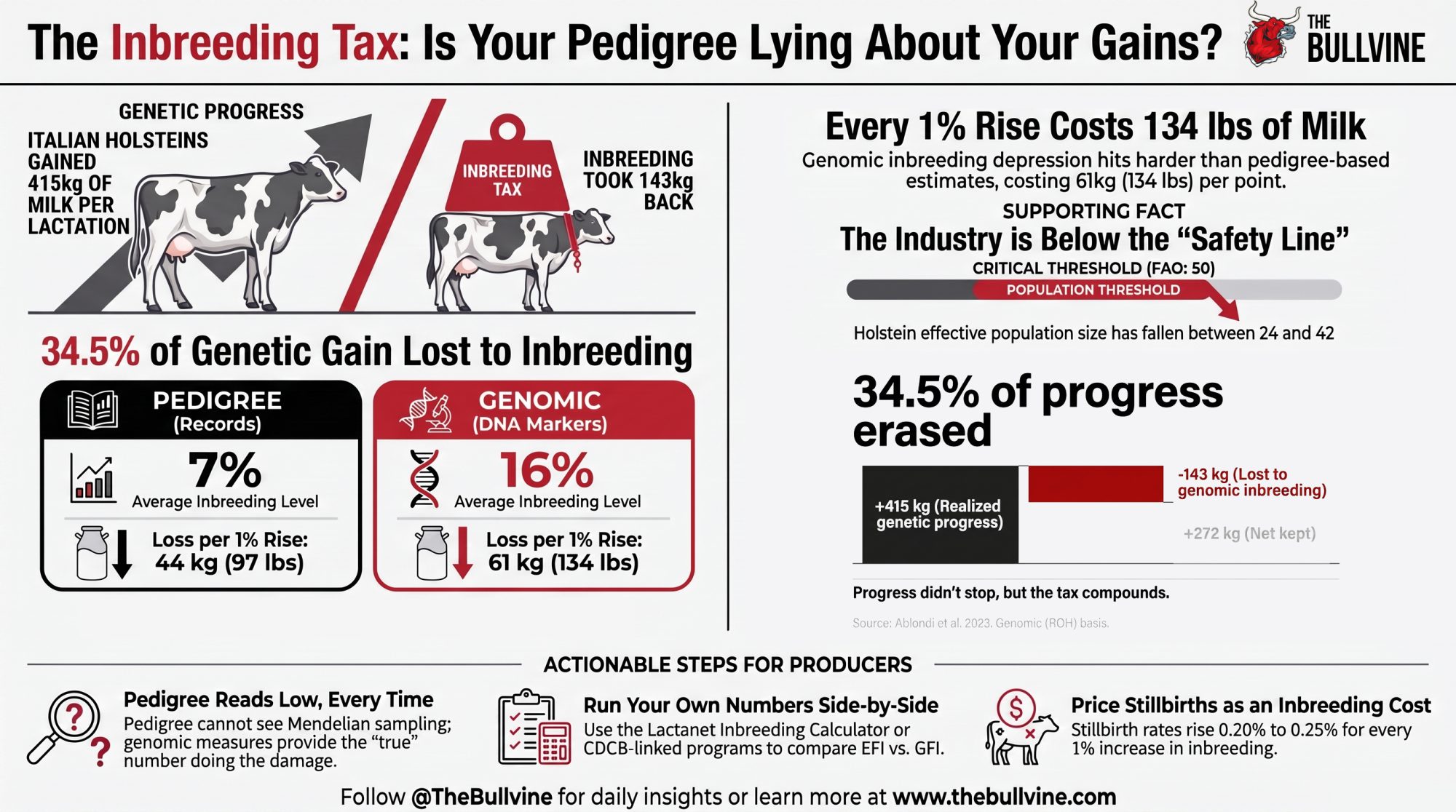
Italian researchers tracked 27,735 Holsteins for five years. The breed earned 415 kilos of genetic gain per lactation. Inbreeding took 143 back. Do you know your own herd’s number?

Executive Summary: Ablondi’s Parma team measured the same 27,735 Holsteins twice, and pedigree said 7% inbred while the genome said 16% — with the milk loss tracking the bigger number, 61 kg per point against 44. That gap matters to anyone genomic-testing females and still running matings off pedigree EFI, because you’re managing to the instrument that reads low. Across 2015 to 2020 the Italian Holstein banked 415 kg of genetic gain per lactation and inbreeding depression took 143 of it back, though the authors are careful to say the breed still kept 272 kg net; the worry is the trajectory, not a bill already due. Run Pryce’s scaling on your own operation — 0.4 to 0.6% of your rolling herd average per point of inbreeding — and a decade at the U.S. rate of 0.36 points a year costs a 12,000 kg herd 170 to 260 kg per cow, per lactation. North American Holstein’s genomic-era effective population size sits somewhere between 24 and 42, and even the optimistic end is under the FAO’s critical threshold of 50. Four major studs built internal elite-female programs between 2008 and 2015, only Select Sires has published a sourcing split, and none of the eight organizations we contacted responded — so nobody outside those companies can say where your next bull came from. The tools that fixed this in the 2000s are still available; the open question is whether anyone uses them at a 2.2-year generation interval, and whether you’ve ever seen your own two numbers side by side.
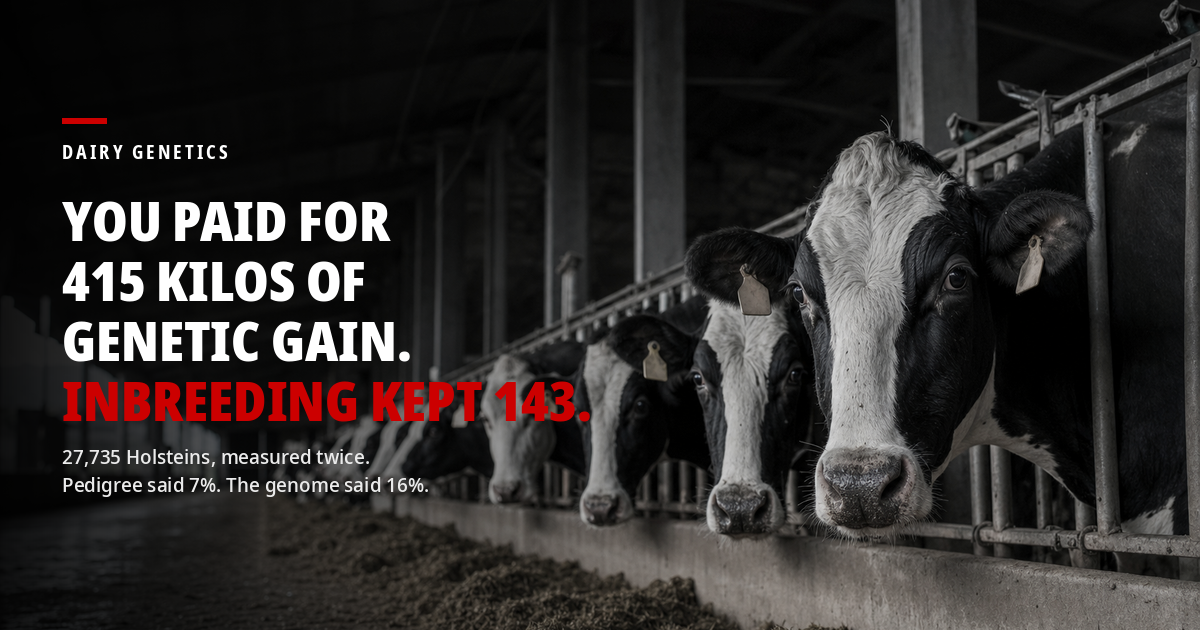
Michela Ablondi’s team at the University of Parma did something most inbreeding studies skip. They measured the same 27,735 Holstein cows twice.

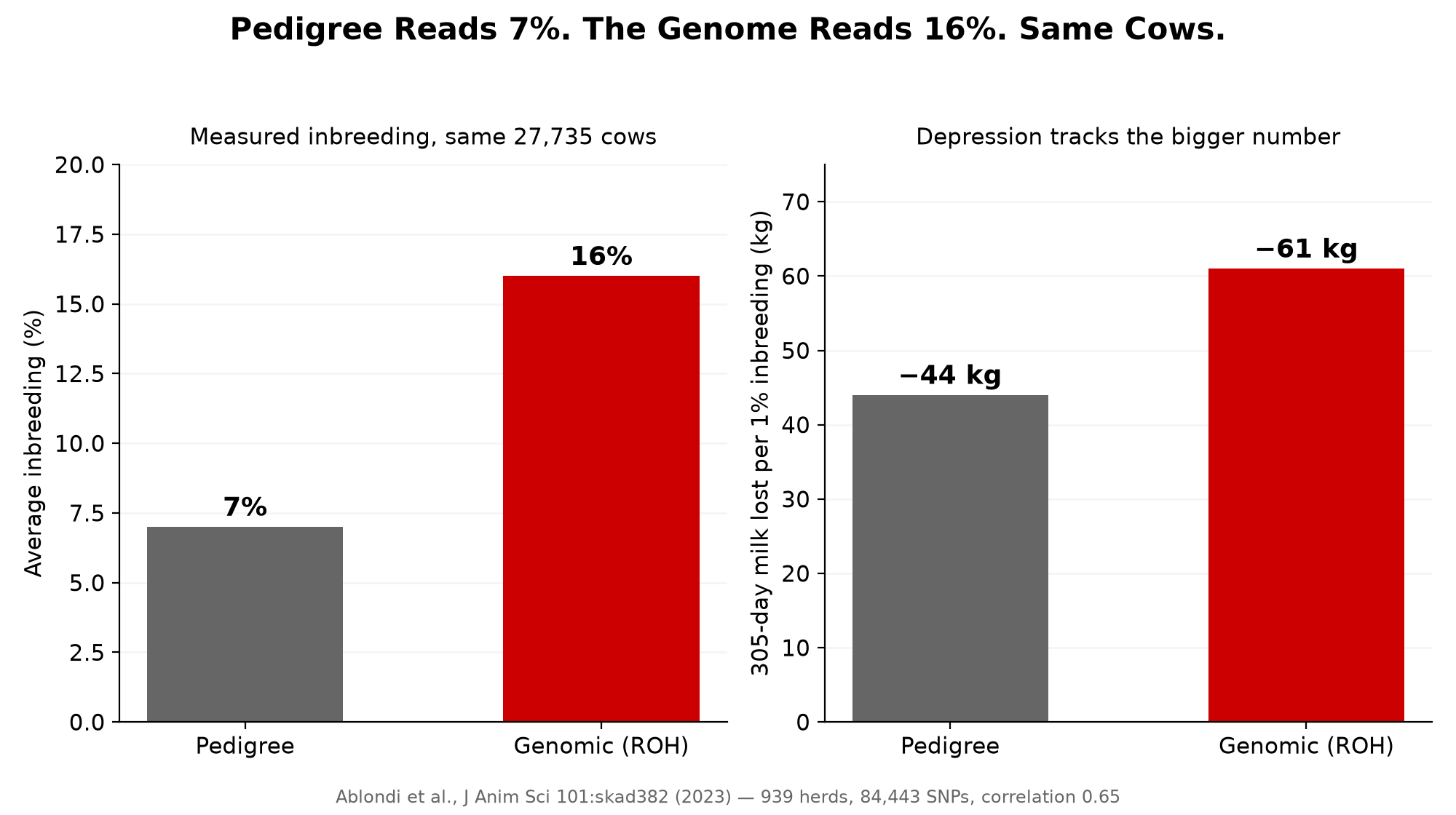
Once on pedigree — the way most mating programs still calculate it, working back through recorded ancestors. Once on genome, marker by marker across 84,443 SNPs. Pedigree came back at 7% average inbreeding. The genome came back at 16%.
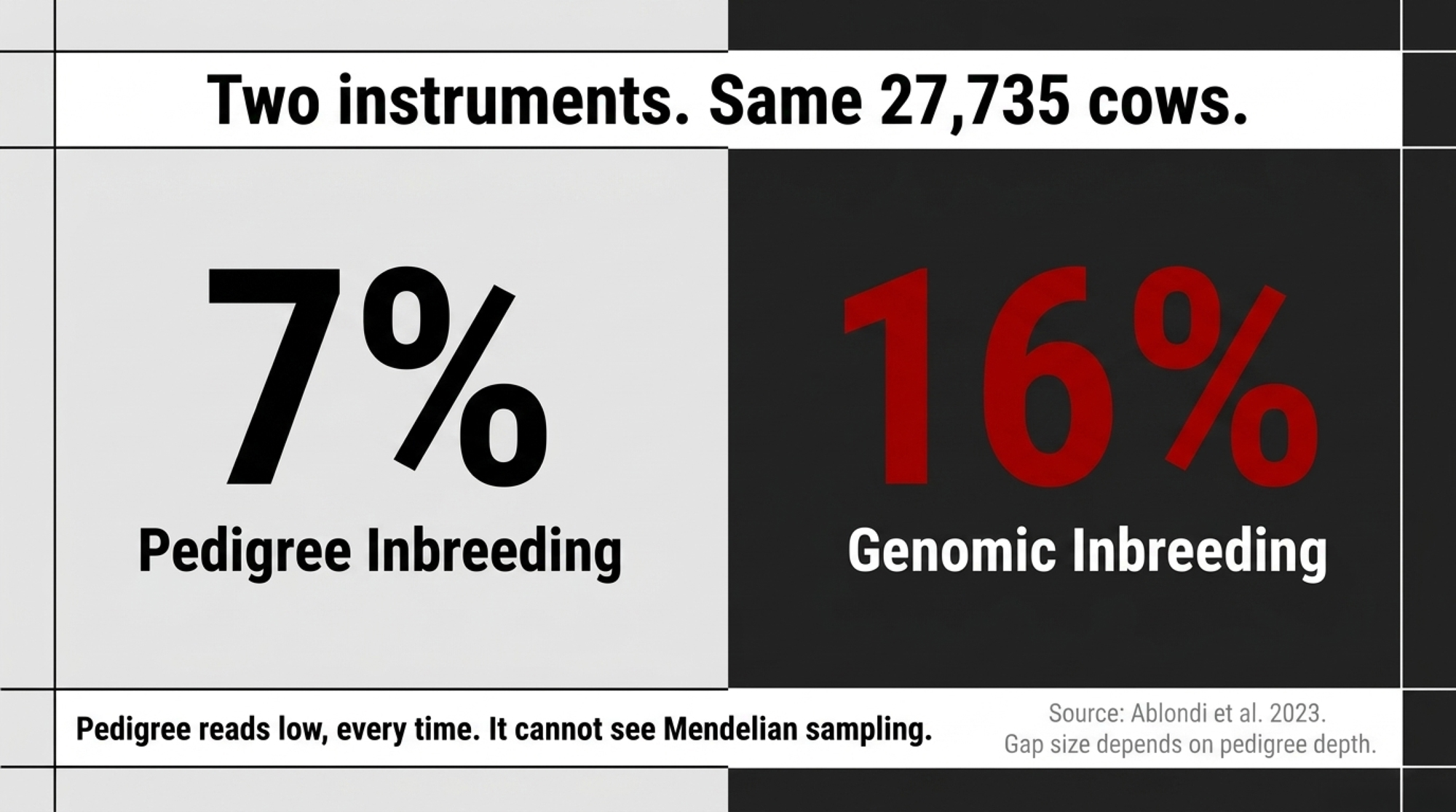
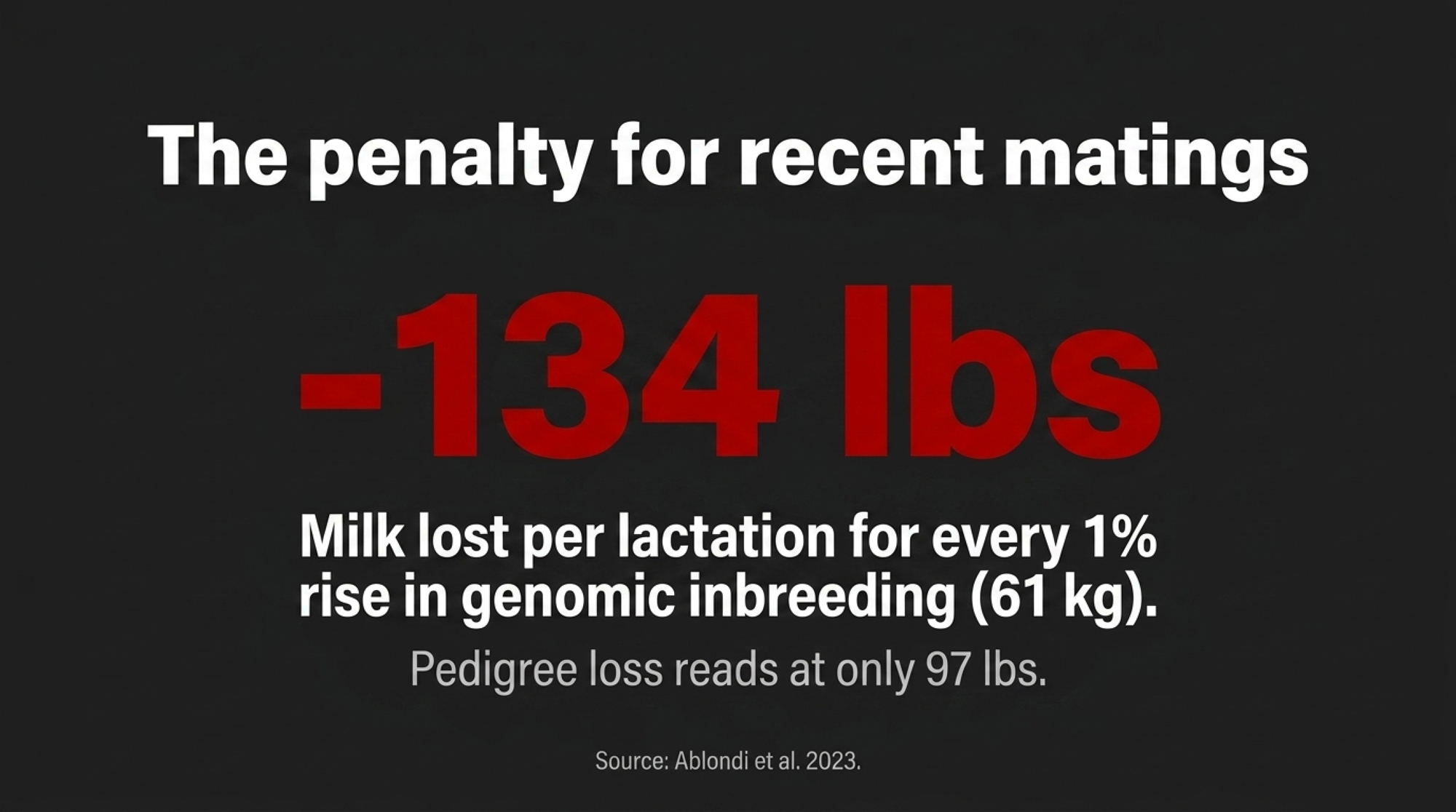
Then they checked which number the cows agreed with. Each 1% rise in pedigree inbreeding cost 44 kg (97 lbs) of 305-day milk. Each 1% rise in genomic inbreeding cost 61 kg — 134 lbs. Same animals, same lactations, and the depression tracked the bigger figure.
That’s the part worth sitting with, because Lactanet’s August 2025 figures put average inbreeding for Canadian Holstein heifers born in 2024 at 9.99%, climbing about a quarter point a year on a pedigree basis. If pedigree is the instrument reading low, then the number most producers are watching is not the number doing the damage.

Two Instruments, Same Cows, One Reads Low

The correlation between the two measures came in at 0.65. Related, nowhere near interchangeable. The reason matters: pedigree can’t see Mendelian sampling, and it’s only as good as the records behind it. Ablondi’s group had 24 generations to work with and a complete generation equivalent of 10.6 — deep by any standard — and pedigree still read less than half what the genome showed.

Your own two numbers won’t be 7 and 16 exactly. Ablondi’s herds had unusually complete records, and the size of your gap depends on your pedigree depth and how much recent breeding runs back through the same bulls. What won’t change is which direction the error runs. Pedigree reads low, every time.
Ablondi’s group also split inbreeding by age. Runs of homozygosity longer than 8 Mb — the fingerprint of recent inbreeding — carried the negative effect across every trait. Pryce and colleagues found the same thing in Australia a decade earlier with 8,853 Holsteins and 4,138 Jerseys: ROH over 3 Mb cut milk yield and captured recent inbreeding independently of overall homozygosity. Two teams, two continents, ten years apart. Recent inbreeding is what hurts.

In the U.S., Steyn and colleagues documented the annual increase accelerating from 0.11 percentage points a year between 2000 and 2008 to 0.36 between 2013 and 2021, working from CDCB data in the Journal of Dairy Science in 2022. Three continents, same direction.

The 143 Kilos You Paid For and Didn’t Keep

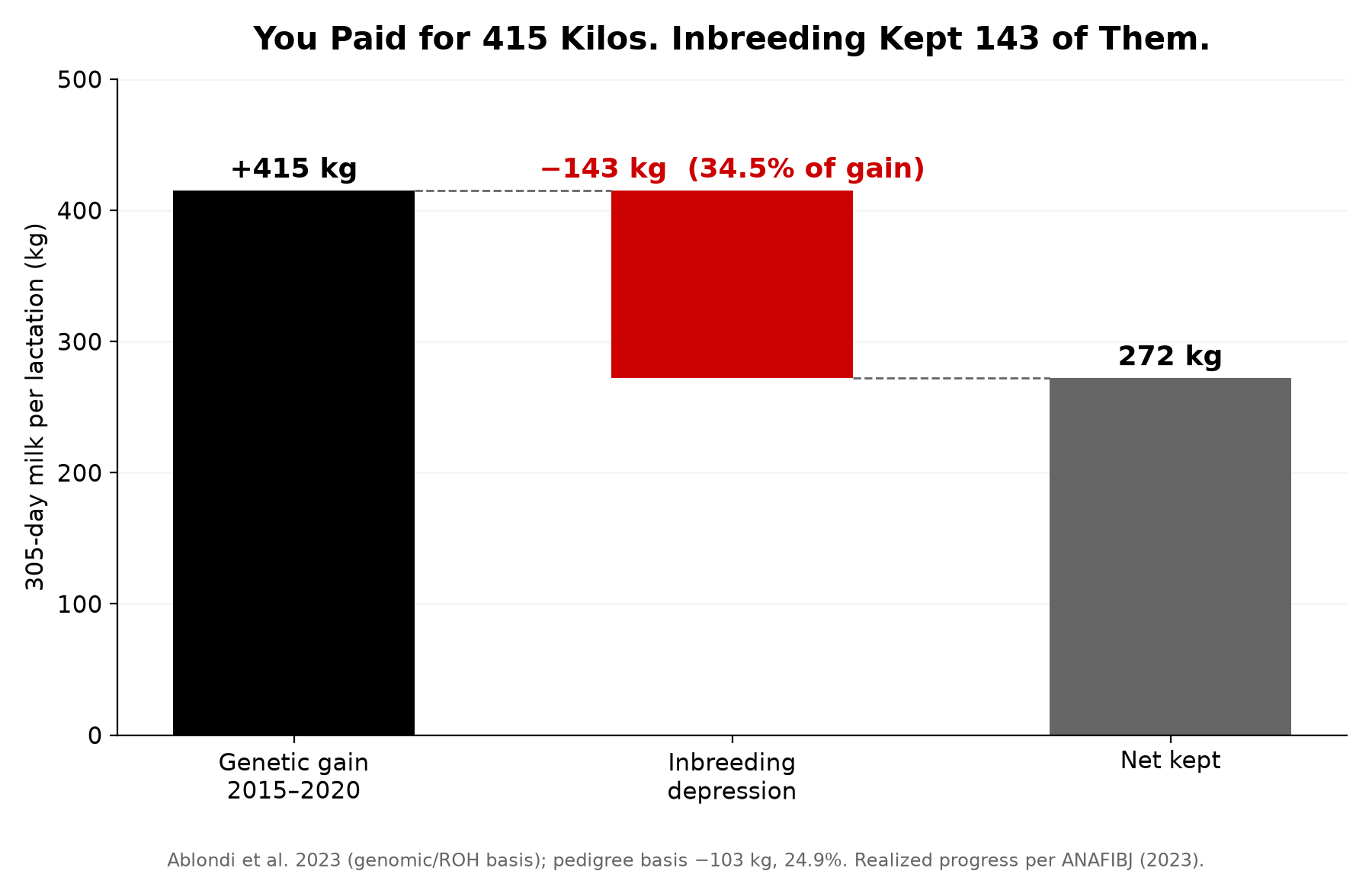
Now the cost at breed scale. Between 2015 and 2020, the Italian Holstein’s pedigree inbreeding climbed 2.35%. Realized genetic progress for milk came in at +415 kg (915 lbs) per lactation.
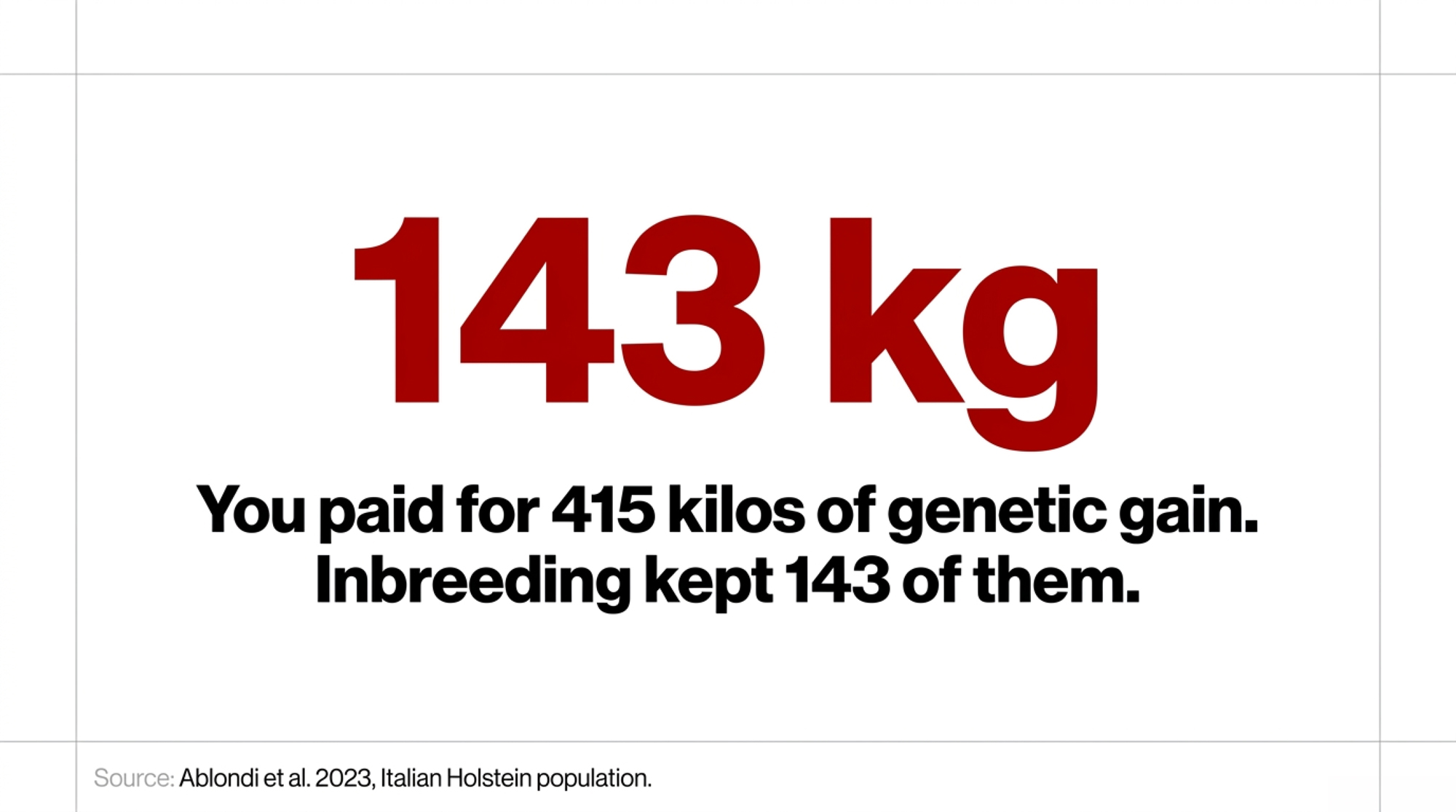
Inbreeding depression took back 143 kg — 315 lbs. That’s 34.5% of the gain.
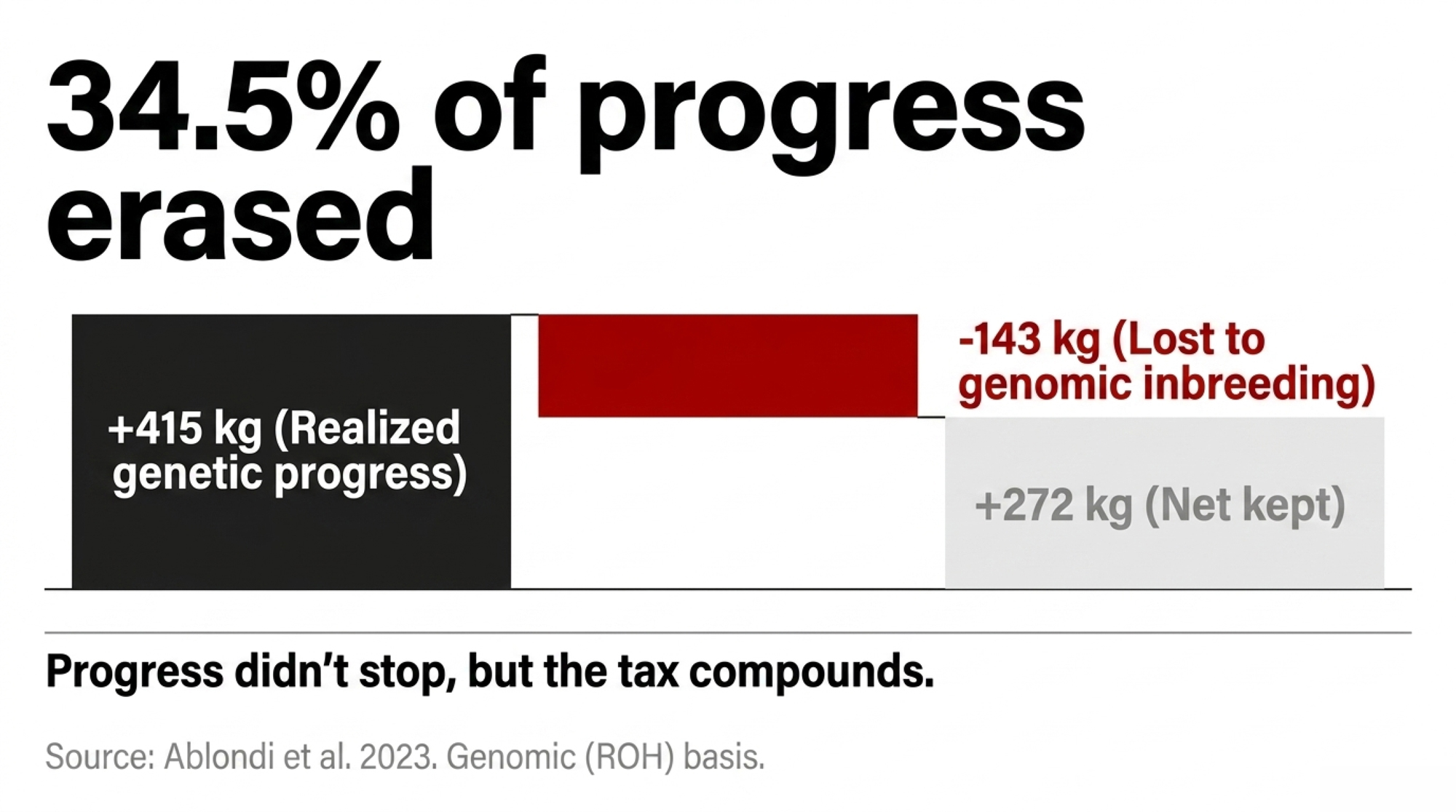
Be precise about what that means, because the authors are. Their own conclusion is that “the realized genetic progress has so far successfully counterbalanced the negative effect of inbreeding” for milk yield. The breed kept 272 kg net. Progress didn’t stop, and anyone telling you the Holstein is going backwards isn’t reading the paper.

What worries Ablondi’s group is the trajectory. The tax compounds, it lands on fitness traits this study didn’t even measure, and inbreeding is projected to climb faster in the generations ahead. Run the same arithmetic on the pedigree measure and you get a smaller bill — 103 kg, 24.9%. Two instruments, two answers again, and only one of them is telling you what your matings actually cost.
Compare the extremes and it gets uglier. Moving from the 5th-lowest to the 95th-highest inbreeding percentile cost 263 kg (580 lbs) per lactation on pedigree — 2.4% of the herd average — and 561 kg, 1,237 lbs, on genomics, or 5.2% of the herd’s 10,836 kg (23,890 lbs) average. Fat dropped 1.31 kg and protein 2.45 kg on the genomic measure.

What nobody can measure is which bulls are driving it, because no public database records where an AI sire came from.

Below the Line Where Fitness Erodes

The FAO puts the critical effective population size at 50. Not 50 cows in a barn — 50 in the genetic sense, the number of breeding animals that would produce the inbreeding rate you’re actually seeing.

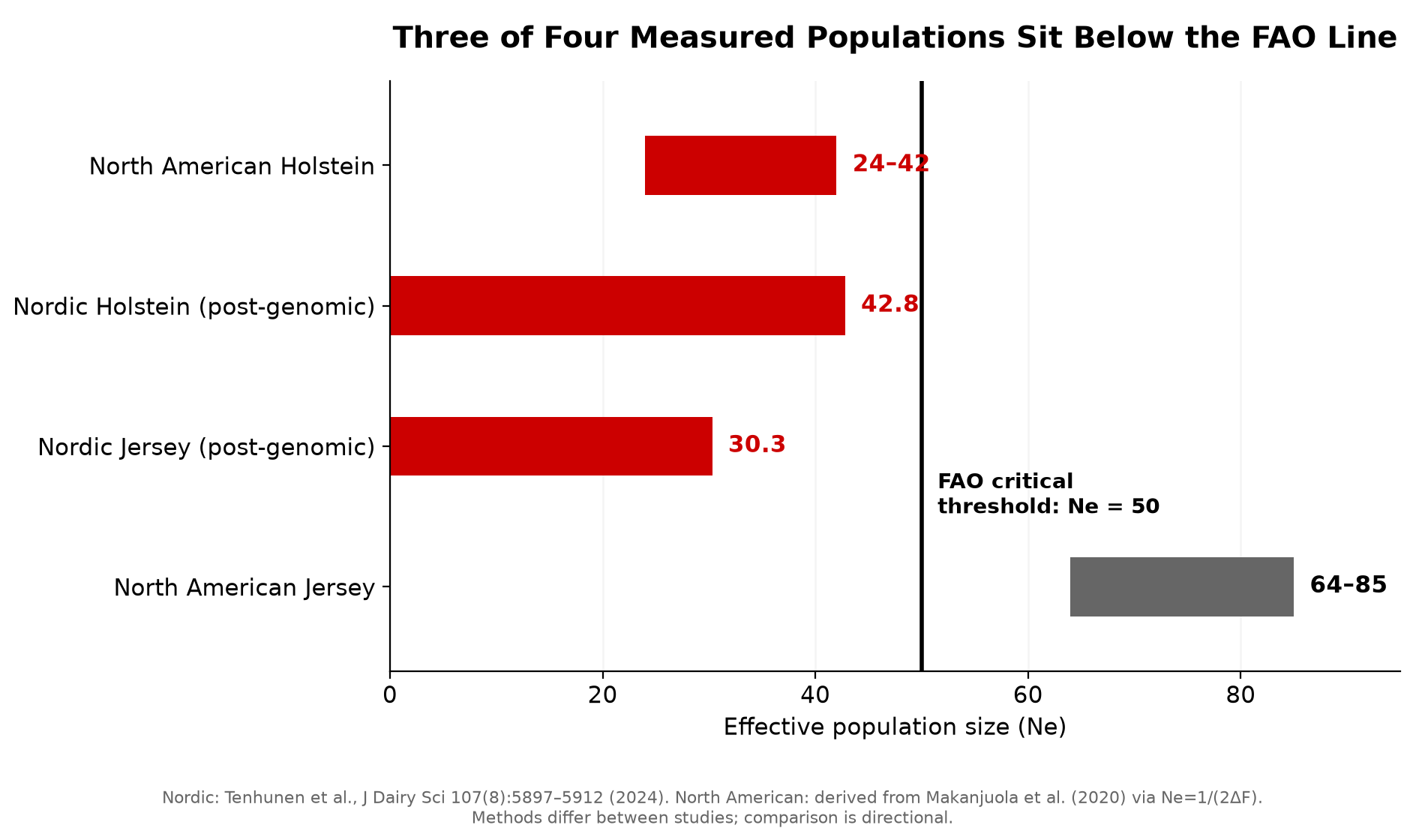
Makanjuola and colleagues measured it for North American Holstein and Jersey using Canadian Dairy Network records on 676,594 Holsteins, publishing in the Journal of Dairy Science in 2020. Across 1990 to 2018, Holstein Ne came in at 66 on pedigree and 43 to 46 on genomic measures. Jersey held up better at 64 to 85.
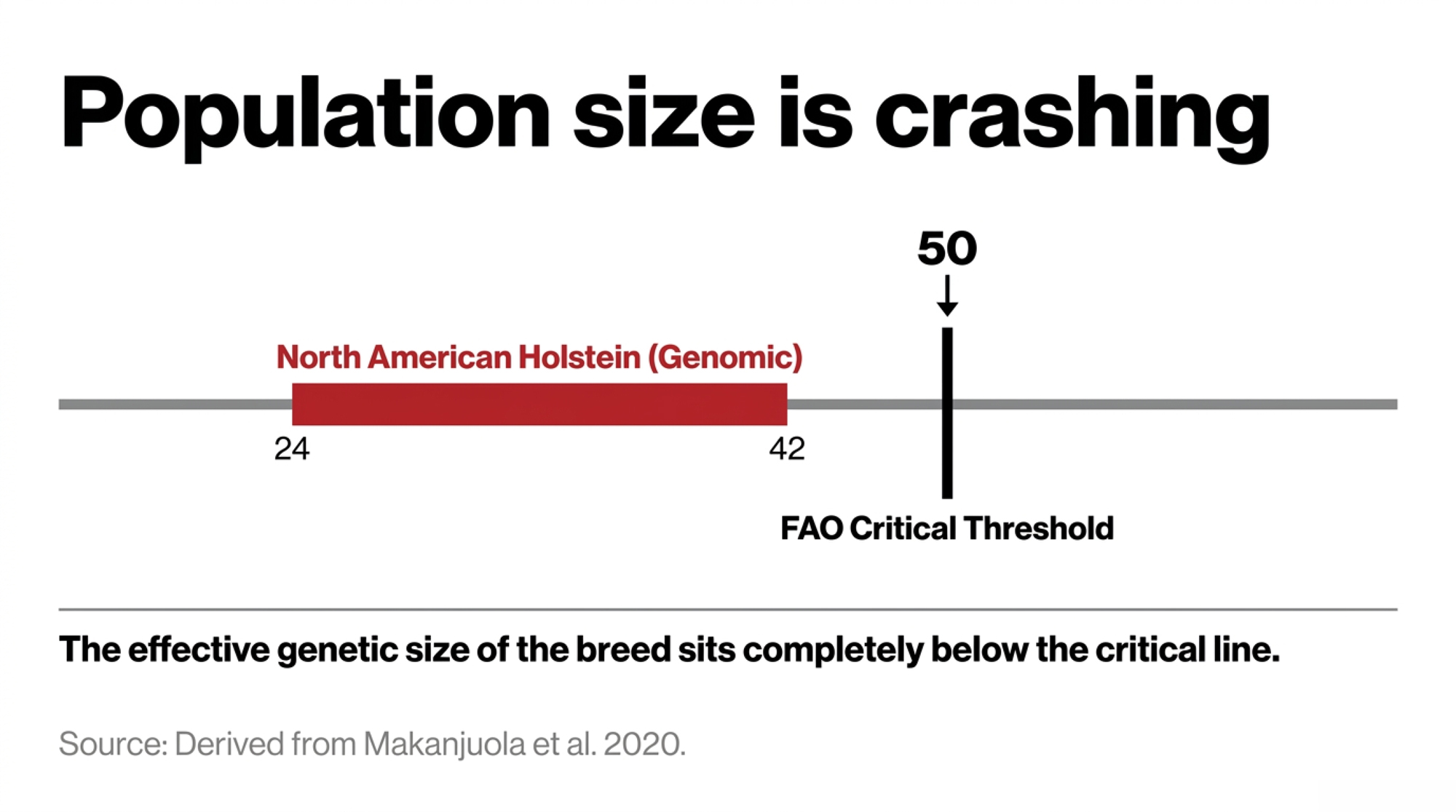
Narrow to the genomic-selection era and the rate of inbreeding per generation climbs to between 1.19% and 2.06%, depending on the measure. That puts Holstein Ne somewhere between 24 and 42.

Which is why you’ll never see an honest single number here. Pedigree and genomic measures disagree on the rate of inbreeding per generation by nearly a factor of two, so North American Holstein Ne isn’t a dot — it’s a corridor running from 24 to 42, and both ends sit under the FAO line. Same argument as the 7-versus-16 gap, one level up.

Behind it sits a generation-interval collapse. Holstein sires of bulls averaged 8.08 years in 1990 and 2.32 by 2016 — a 71% reduction. Guinan and colleagues documented the same trajectory in U.S. data on the sire-of-bulls pathway, 7.1 years down to 2.2.

Nordic populations get held up as the counterexample, and the picture is genuinely mixed. Tenhunen and colleagues found Nordic Holstein Ne falling from 54.3 before genomic selection to 42.8 after, with future Ne dropping from 198.8 to 42.7 and female coancestry rising from 0.02% to 0.39%. Their conclusion: Nordic Holstein “faces more pressing concerns.”

But read that comparison carefully. At 42.8, Nordic Holstein sits at the optimistic end of North America’s 24-to-42 corridor — better than the pessimistic read, roughly level with the generous one. Methods and study periods differ between the two papers, so treat it as directional, not a scoreboard. Nordic Jersey held essentially flat at 29.4 before and 30.3 after.

Against the FAO line the pattern is blunt. North American Holstein on genomic measures, Nordic Holstein, and Nordic Jersey all sit below 50. North American Jersey is the only measured population that clears it.
Can Anyone Tell You Where Your Next Bull Came From?

Not from anything published.
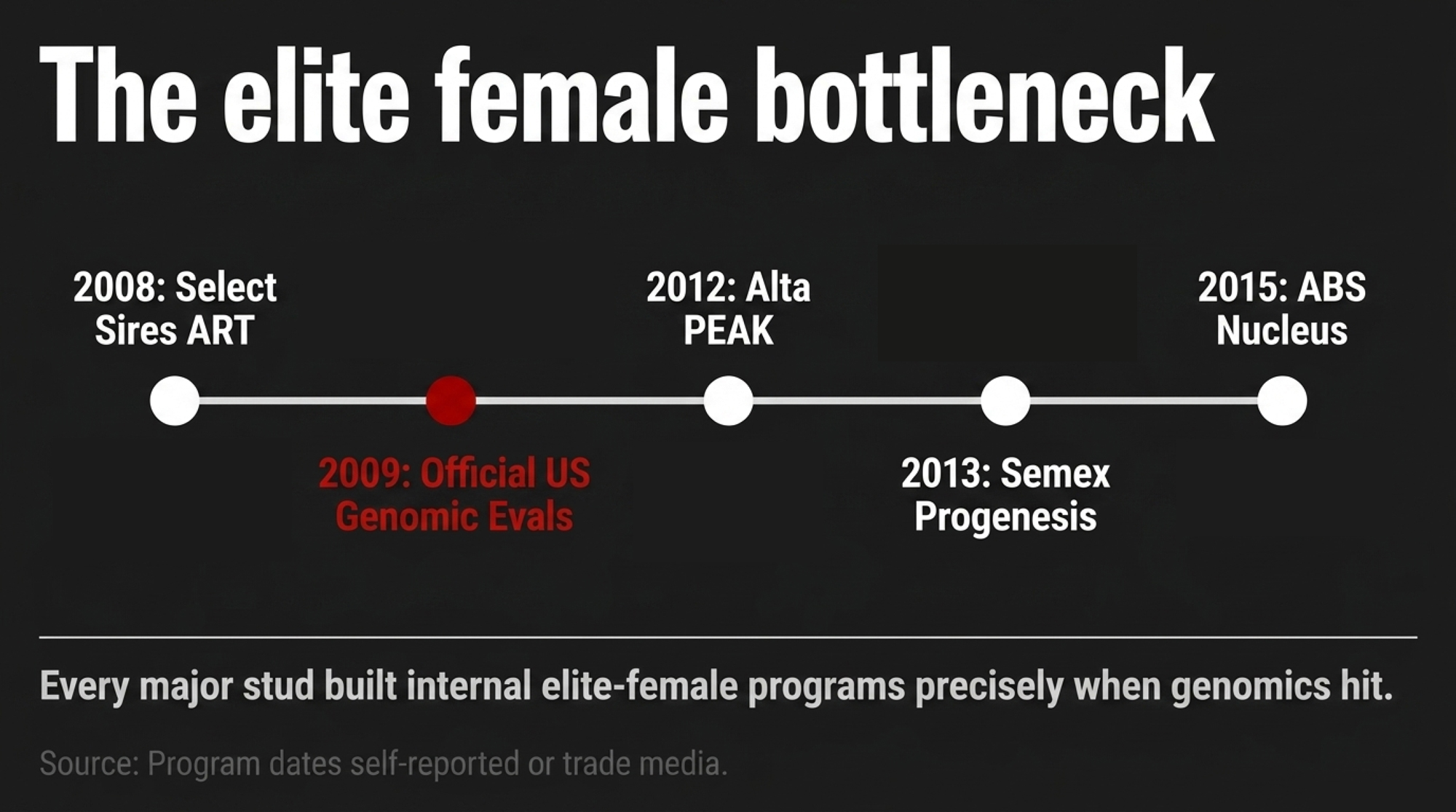
Every major stud runs an internal elite-female program now, and most say so openly. Select Sires launched ART in 2008, targeting Holsteins “genetically unique compared to those found in the general population.” Alta started PEAK in 2012 as its genetics development arm during a restructuring built around genomics, and PEAK joined URUS when that holding company formed in October 2018 — PEAK’s own materials date the entity to 2018. Semex founded Progenesis in 2013, calling it “Semex’s industry-leading internal dairy breeding program.” ABS Global shipped its first commercial units from an elite female nucleus herd in 2015.

Look at the dates. 2008, 2012, 2013, 2015 — every major stud built an internal elite-female program inside a seven-year window, and that window opens the year before USDA-AIPL published the first official U.S. genomic evaluations in January 2009. Four companies didn’t independently arrive at the same structure by coincidence. They read the same new tool the same way.

Four programs. One published split.

Select Sires puts roughly 40% of the Holstein bulls it samples each year as ART graduates, with 60% acquired from producers across the U.S. and Canada. That figure appeared in a January 2024 company post, and ART program manager Mark Kerndt repeated it on the record in a July 2025 Select Sires podcast, describing an internal female donor program running since 2008 and transferring roughly 15,000 IVF embryos a year. Two independent company sources, one of them a named executive speaking on tape.

Credit where it’s owed. That’s the only proportional sourcing figure any of the four has put in public, nobody made them do it, and it’s now better documented than anything else in this section. ABS, Semex and PEAK describe their programs without quantifying what share of released sires come through them — which leaves the one company that disclosed as the only one whose disclosure can be picked apart.

Semex says the Progenesis team “continues to add bloodlines that diversify the program.” That sentence is the whole problem in miniature. It’s substantive, it’s checkable in principle, and it’s unverifiable from outside. Semex may be entirely right. Nobody outside Semex can confirm it.

Past what companies volunteer, the trail goes cold. NAAB’s Semen Sales Report tracks units by breed and category, and we found no field recording origin. CDCB publishes proof runs and reliability figures on every sampled bull in the U.S. system, and we located no public output sorting sires by nucleus, contracted, or open-market origin.

The Counterweight Nobody Expected

Here’s what complicates everything above.

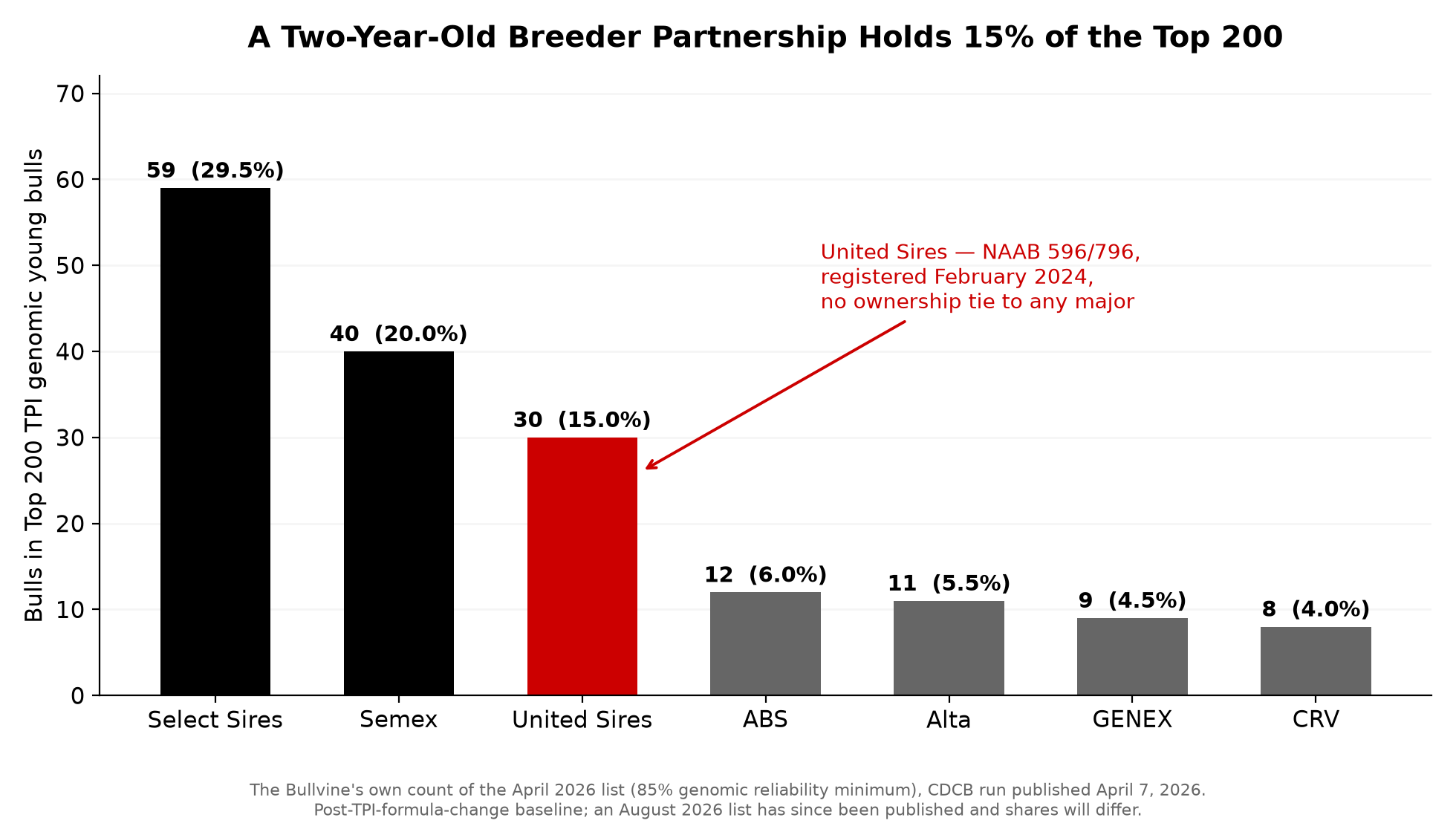
United Sires — NAAB codes 596 and 796, registered with NAAB in February 2024 — is an independent breeder partnership with no ownership tie to any of the majors. By The Bullvine’s count of Holstein Association USA’s top 200 TPI genomic young bulls — 85% genomic reliability minimum, from the CDCB run published April 7, 2026 — it holds 30 of them, 15%. That’s third behind Select Sires’ 59 (29.5%) and Semex’s 40 (20%), and ahead of ABS at 12, Alta at 11, GENEX at 9 and CRV at 8.

We’re citing April rather than the August 2026 run on purpose. April is when Holstein Association USA changed the TPI formula, shifting production weights from 19% protein and 19% fat to 24% protein and 14% fat, and it’s the snapshot that isolates what that change did to the standings. Bulls moved as much as 125 points in either direction without a single new daughter. Same bulls, same daughters, different instrument — the third time in this article that swapping the measuring tool has swapped the answer. Holstein Association USA has since published an August 2026 list, and the shares will have shifted some with it; treat the April figures as the post-formula-change baseline rather than today’s standings.

So whatever’s happening to the independent breeder, “shut out” doesn’t cover it. The pipeline is concentrating and a two-year-old breeder-owned partnership just took 15% of the top of the list. Both are true. Neither reconciles without the origin data nobody publishes — if the nucleus programs are as dominant as their scale implies, United Sires shouldn’t rank where it does.
Worth knowing what the modelling said before any of this got built. Dekkers and Shook, at Wisconsin-Madison, modelled nucleus schemes for commercial AI firms in the Journal of Dairy Science in 1990 (73:1920). Their finding, replicated since and echoed in Roden’s 1994 review: opening a nucleus raises both the intensity and the accuracy of female selection, and open systems deliver a higher rate of genetic gain than closed ones. They also found closed schemes could stay competitive at large nucleus sizes — so the easy version, closed bad and open good, is only half right. Design matters more than the label, which is exactly why the design should be public.

What It Costs, Country by Country

Four populations have been measured for inbreeding depression. Every one is negative:

StudyPopulationPer 1% inbreeding increase
Ablondi et al. 2023Italian Holstein, 27,735 cows−61 kg 305-day milk (ROH); −44 kg (pedigree)
Doekes et al. 2019Dutch Holstein-Friesian, 38,792 first-parity cows−36.25 kg (ROH); −37.95 kg (pedigree); −48.07 kg (genomic relationship)
Bjelland et al. 2013U.S. Holstein, University of Wisconsin−20 kg 205-day milk (ROH); −47 kg (genomic relationship); −53 kg (percent homozygosity)
Pryce et al. 2014Australian Holstein and Jersey, 12,991 genotyped cows−0.4% to −0.6% of phenotypic mean for milk, fat and protein

Figures as published. Multiply kg by 2.205 for pounds — 61 kg is 134 lbs, 36.25 kg is 80 lbs, 20 kg is 44 lbs.

Pryce’s framing is the one to run on your own operation, because it scales to whatever you produce. At 0.4 to 0.6% of the mean per 1% of inbreeding, a decade at the U.S. rate — 0.36 points a year, 3.6 points total — costs 1.4% to 2.2% of your herd average. On a 12,000 kg (26,455 lbs) herd, that’s 170 to 260 kg — 375 to 573 lbs — per cow, per lactation.

Ablondi’s team costed it in terms their readers feel immediately. Eighty percent of Italian milk goes into cheese, so they priced the loss in Parmigiano Reggiano — the country’s second-largest PDO consortium, 160,097 tonnes in 2022. Between the most and least inbred 5% of cows, the difference came to over half a wheel per cow per lactation on pedigree and more than a full wheel on genomics. Roughly €310 and €600 — about $360 and $700 USD, or $495 and $960 CAD, at 24-month-aged prices.

Pryce’s group mapped the damage to specific regions, finding stretches that cost up to 260 L of milk and 12.5 days of calving interval when fully homozygous. Ablondi’s team saw the same chromosome by chromosome — 16 of 29 autosomes carried a measurable hit to milk yield, with BTA14 the worst at −3.53 kg per 1% of homozygosity on that chromosome alone.

Bjelland’s U.S. work adds a cost that usually gets filed under calving management: stillbirths rose 0.25% for bull calves and 0.20% for heifer calves per 1% increase in inbreeding.

Doekes explains why recent matings matter most. New inbreeding — alleles identical-by-descent for the first time — cost 2.42 kg (5.3 lbs) of fat per 1%. Ancestral inbreeding cost essentially nothing, +0.03 kg. The damage lives in the matings you’re making right now.

The Tools You’re Probably Underusing

ToolWhat It MeasuresData Basis
CDCB Expected Future Inbreeding (EFI)Population-level inbreeding impactPedigree relationship to heifers born in the past 48 months; adjusts PTA accordingly
Genomic Future Inbreeding (GFI)True genomic relationshipDirect DNA marker overlap; consistently higher and more realistic than EFI
Lactanet Inbreeding CalculatorMating-specific inbreeding and parent averagePedigree-based; flags haplotypes and genetic conditions (LactanetGen.ca)

The EFI-versus-GFI choice isn’t academic. Makanjuola’s team found the correlation between pedigree and genomic inbreeding in Holsteins weakening materially across the period they studied — pedigree is getting worse at tracking reality, not better. Pryce’s conclusion was blunt: genomic measures can replace pedigree for estimating depression, using either the genomic relationship matrix diagonal or the proportion of homozygous SNPs.

Genomic-testing your females and then mating off pedigree inbreeding means managing to the number that understates the problem. That’s the whole finding, in one sentence.

One stud has published constraint evidence. C. Sun and colleagues at STgenetics presented Chromosomal Mating at ADSA in 2019 — a linear-programming system built on CDCB genomic relationship files covering 5,731 bulls and more than 1.3 million females, against a pedigree database of over 5 million animals. They reported average progeny predicted producing value up 17% and inbreeding down 30% against random mating.

Their design choice is the interesting part. Rather than setting a hard inbreeding ceiling, the system prices inbreeding as an economic penalty inside the optimization — a defensible way to handle a variable nobody has set a herd-level limit for. It’s also a company-authored conference abstract, seven years old and not independently validated, which is how you should read it.
Two Ways to Buy Pedigree Distance

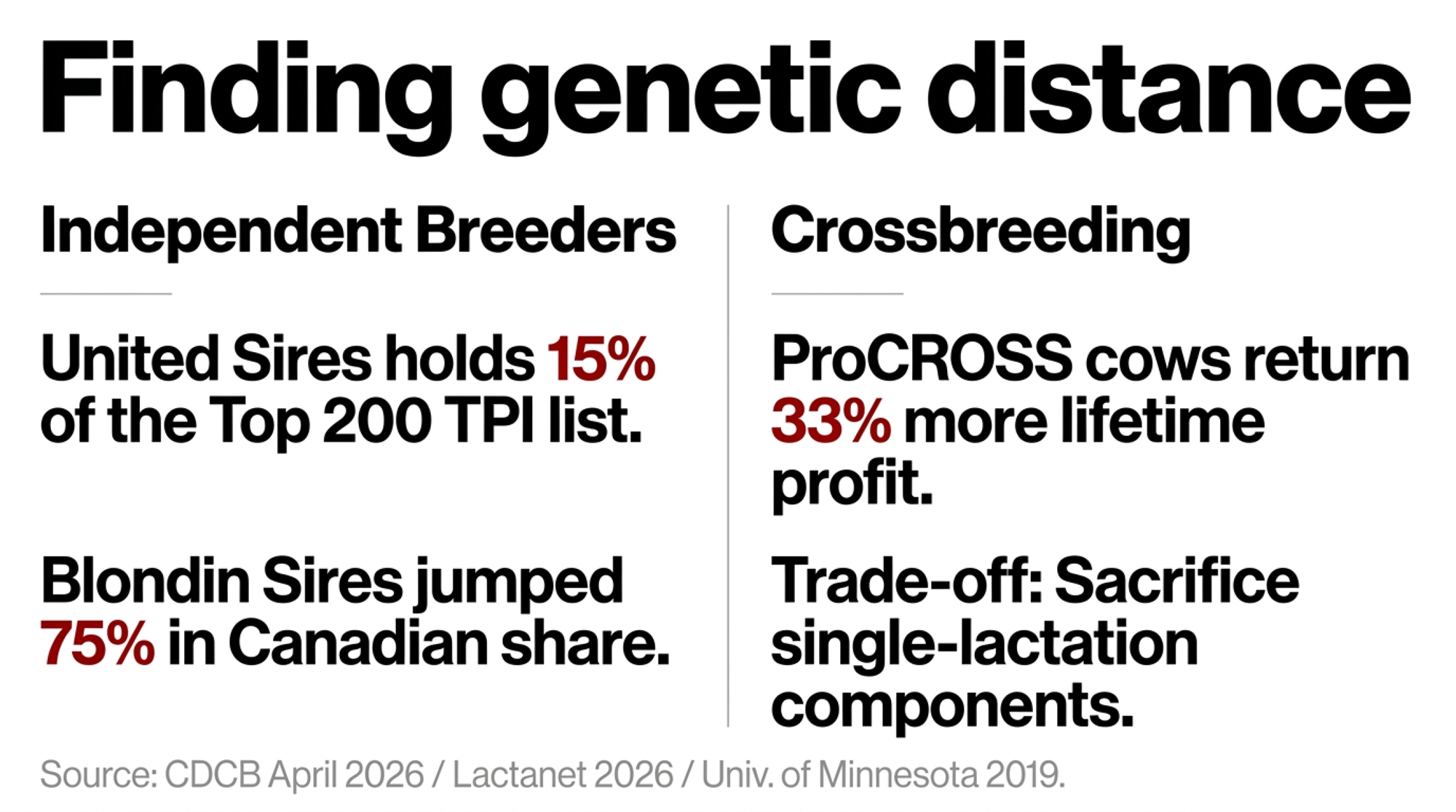
One route stays inside the breed, and there’s a working example of it in Quebec. Blondin Sires — NAAB code 799, owned by Simon Lalande, Dann Brady and Nicolas Lalande — grew its share of Canadian sire usage from 2.8% in 2022 to 4.9% in 2023, a 75% jump in one year per Lactanet market data reported by The Bullvine in February 2026. The pitch is separation from the mainstream stack while staying Holstein; they prioritize proven performance in both conformation and productio, and use different sires than those targeting the top TPI or NM$ lists.

Be sure to check out our article with Dann Brady and team on their breeding strategy tomorrow. 

United Sires’ 15% share of the top 200 says there’s more room in that lane than the concentration story implies. The trade-off is real, though: independent-sourced bulls may carry lower reliability figures, and you’re still drawing from a gene pool whose effective size sits under the FAO line.

Going across breeds has a decade of peer-reviewed production data behind it. VikingGenetics’ ProCROSS rotates VikingHolstein, VikingRed and Coopex Montbéliarde, and a ten-year University of Minnesota study led by Les Hansen with Amy Hazel and Brad Heins measured it in high-performance Minnesota herds. ProCROSS cows returned 33% more lifetime profit and more daily profit — 13% for two-breed crosses, 9% for three-breed. Forty-one percent reached a fourth lactation against 21% of the Holsteins.

They also stayed 147 days longer, though Hansen’s own conference presentation of the combined two- and three-breed groups puts that at 153. Conception rate to first service in second and third lactation ran 45% against the Holsteins’ 35% — 1.9 services instead of 2.4. Health treatment costs came in 23% lower for two-breed crossbreds and 17% lower for three-breed across their lifetimes, with cull value 16% higher.

What does all that do to income over feed cost? Shonka-Martin and colleagues published twice in the Journal of Dairy Science in 2019, and the numbers favour the crossbreds. First-lactation crossbreds ate 2,807 kg (6,189 lbs) of dry matter over 4 to 150 days in milk against the Holsteins’ 2,948 kg (6,499 lbs) — about 5% less — with a further 6.5% reduction later while producing the same fat plus protein. Income over feed cost ran $0.34 to $0.60 higher per cow per day.

Read the inbreeding claim carefully, though. VikingGenetics’ ProCROSS material tells producers there are “no worries about inbreeding,” and for the crossbred animal in front of you that’s essentially right — heterosis does the work. It doesn’t mean the source populations are exempt. “No worries” is marketing shorthand, and the company’s own researchers documented real pressure on those source populations. They documented it in a peer-reviewed journal, which is the opposite of hiding it.

The component question depends entirely on your basis, and this is where a lot of crossbreeding arguments go sideways. On a single 305-day lactation, crossbreds produced less fat plus protein than purebred Holsteins in the Minnesota work — 24 kg (53 lbs) less for Montbéliarde crosses, 29 kg (64 lbs) less for Scandinavian Red. Across a lifetime the picture flips: daily fat plus protein ran 1% higher for two-breed crossbreds and 1% lower for three-breed, because they stuck around long enough to make it up. A rotation is also a multi-year commitment you can’t reverse next season, and crossbred replacements are harder to move if you sell breeding stock.

Then weigh all of it against a replacement market that punishes mistakes. USDA put the U.S. national average for milk cows sold as dairy herd replacements at $3,130 per head in April 2026, up from $2,980 in January and $2,860 a year earlier — 5% on the quarter, 9% on the year. USDA NASS put milk replacement heifer inventory at 3.90 million headon January 1, 2026, down slightly from the prior year. Fixing a genetic misstep costs more than it did two years ago, which argues for care in both directions.

Your Pre-Breeding Action Checklist

  • Pull your inbreeding report in the next 30 days. Run your last three years of sire selections through the Lactanet Inbreeding Calculator or your CDCB-linked mating program and count how many trace to a shared maternal grandsire. A few hours of records work, no new spend, before breeding starts.
  • Run both measures on the same animals, then move your matings to the genomic one. Ablondi’s cows read 7% on pedigree and 16% on genomics, and the depression tracked the bigger figure — 61 kg per point against 44. If you’ve never seen your own two numbers side by side, you don’t know which one your program has been deciding from.
  • If more than two of your last ten sire picks share a maternal grandsire, raise it with your mating consultant. Editorial rule of thumb, not a published standard — no threshold defines “too much overlap” at herd level, so you’re setting a baseline rather than measuring against one.
  • Check whether your TPI cutoff still means what it meant last year. The April 2026 formula change moved bulls up to 125 points without new daughter data. If your program screens on a fixed threshold, some sires dropped off your list on arithmetic alone.
  • Run Pryce’s scaling on your own rolling herd average — 0.4 to 0.6% per point of inbreeding, rather than borrowing an Italian or Dutch figure measured on a different population. At the U.S. rate, a decade costs a 12,000 kg herd 170 to 260 kg per cow per lactation. Multiply your own average by 1.4% to 2.2% to get your version.
  • Ask your supplier for its sourcing split at proof-run specificity, then log the answer or the non-answer. Not proof of anything on its own — but a pattern across several suppliers should shape how much of your lineup comes from one place. Select Sires has published 40% and put an executive on tape saying it; the others haven’t.
  • Before you compare any crossbreeding numbers, establish the basis. Single-lactation and lifetime daily figures point opposite directions on components: 24 to 29 kg less fat plus protein in one lactation, 1% more across a lifetime. Quoting one while meaning the other is the most common way that pitch gets made.
  • Price stillbirth rate as an inbreeding cost, not a calving-management line item. Bjelland’s work puts it in the first column.
Between 2000 and 2009 the industry drove Holstein rate of inbreeding down to 0.37% per generation and pushed Ne up to roughly 135, using optimum contribution selection, expected future inbreeding, and publicly posted relationship values. Those tools worked. Then genomic selection outran them, and they’re still sitting there unused at scale.

The measurement problem is the cheaper of the two fixes. Nobody has to build an origin database or rewrite an index for you to run both numbers on your own females and see which one your matings have been following. Ablondi’s team needed 84,443 markers and 939 herds to prove it at breed scale. You need an afternoon and a report you’re already paying for. The question is whether you’ll like what it says — and whether you’d breed differently if someone finally published where those bulls came from.

Run Your Numbers

Genomic Testing ROI Calculator — This article says pedigree reads low and only genomics shows the real number. The calculator prices what testing is worth on your farm, and flags the families where inbreeding risk needs tighter control. Run the conservative scenario first.

Methodology note: The 7% and 16% figures in this article’s headline are the pedigree and genomic inbreeding averages for Ablondi’s Italian Holstein population and are not presented as a universal read on any individual herd; the size of the divergence depends on pedigree completeness and recent breeding patterns. Nucleus program descriptions and dates are self-reported or from trade media: Select Sires ART (company history page, January 4, 2024 blog post, and a July 2025 Select Sires podcast interview with ART program manager Mark Kerndt, in which the roughly 40% figure refers to bulls sampled each year); PEAK (2012 program start, though official as PEAK in 2018); Semex Progenesis (company pages, founded 2013); ABS Global (company history, first commercial units 2015). USDA-AIPL published the first official U.S. genomic evaluations in January 2009; CDCB assumed responsibility for U.S. genetic evaluations in 2013. Only Select Sires has published a proportional sourcing split. 

Stud-share counts are The Bullvine’s own independent count of the Holstein Association USA Top 200 TPI Genomic Young Bulls list, April 2026 (85% genomic reliability minimum), drawn from the CDCB run published April 7, 2026, with stud assignment by the official NAAB marketing codes table. The April run is cited rather than a later one because Holstein Association USA implemented a TPI formula change in that run, moving production weights from 19% PTA Protein and 19% PTA Fat to 24% PTA Protein and 14% PTA Fat; individual bulls moved up to 125 TPI points with no new daughter data, so April 2026 shares are not comparable to earlier runs and represent the first post-change snapshot. An August 2026 list has since been published and current shares will differ. United Sires, LLC (NAAB 596/796) registered with NAAB on February 8, 2024. Blondin Sires Inc. (NAAB 799, St. Placide, Quebec) is owned by Simon Lalande, Dann Brady and Nicolas Lalande. 

Italian figures: Ablondi, M., A. Summer, G. Stocco, R. Finocchiaro, J.-T. van Kaam, M. Cassandro, C. Dadousis, A. Sabbioni and C. Cipolat-Gotet, Journal of Animal Science 101:skad382 (2023), doi:10.1093/jas/skad382 — 27,735 cows, 939 herds, 84,443 autosomal SNPs, 24 generations of pedigree depth. The 2.35% five-year rate is drawn from Ablondi et al. (2022) and the +415 kg realized progress from ANAFIBJ (2023). Three co-authors are affiliated with ANAFIBJ, which supplied the data and part-funded the work; the authors declare no conflicts of interest. The Parmigiano Reggiano comparison appears in Results and Discussion, using 24-month-aged wheel prices per CLAL (2022), and reflects the difference between the most and least inbred 5% of cows — not a typical per-cow loss. USD and CAD equivalents are editorial conversions at approximately €1 = $1.16 USD and €1 = $1.60 CAD as of September 3, 2026; because the underlying euro figure derives from 2022 cheese prices, the conversion is indicative of present-day value rather than a 2022 dollar equivalent.

Other depression studies use different lactation bases and are not directly interchangeable. Doekes, H.P. et al., Genetics Selection Evolution 51:54 (2019), doi:10.1186/s12711-019-0497-z. Bjelland, D.W., K.A. Weigel, N. Vukasinovic and J.D. Nkrumah, Journal of Dairy Science 96(7):4697–4706 (2013), doi:10.3168/jds.2012-6435 — 205-day, not 305-day. Pryce, J.E., M. Haile-Mariam, M.E. Goddard and B.J. Hayes, Genetics Selection Evolution 46:71 (2014), doi:10.1186/s12711-014-0071-7.

North American population figures: Makanjuola, B.O. et al., Journal of Dairy Science (2020), doi:10.3168/jds.2019-18013 — 676,594 Holstein and 304,676 Jersey pedigree records from the Canadian Dairy Network. Genomic-era Ne is derived from the paper’s reported 1.19–2.06% rate of inbreeding per generation using Ne = 1/(2ΔF), which is why it is reported here as a range rather than a point estimate; an earlier ADSA abstract from the same group reported 30 to 48, differing from the published paper. FAO critical Ne of 50 cited therein (FAO, 2015). Nordic figures: Tenhunen, S., J.R. Thomasen, L.P. Sørensen, P. Berg and M. Kargo, Journal of Dairy Science 107(8):5897–5912 (2024), doi:10.3168/jds.2023-24553; four of five authors are affiliated with VikingGenetics, and the study is open access and peer-reviewed. Methods and periods differ between Makanjuola and Tenhunen, so comparisons are directional.

Generation interval: Guinan, F.L. et al., Journal of Dairy Science 106(2):1110–1129 (2023), doi:10.3168/jds.2022-22205, with corrigendum; figures are for the sire-of-bulls pathway. García-Ruiz et al., PNAS 113(28) (2016), independently found that interval falling from roughly 7 years to under 2.5 between 1975 and 2015. U.S. inbreeding rates: Steyn, Y. et al., Journal of Dairy Science 105(12):9810–9821 (2022), doi:10.3168/jds.2022-22143, citing CDCB (2021).

Crossbreeding: ten-year University of Minnesota study of high-performance Minnesota herds led by L.B. Hansen with A.R. Hazel and B.J. Heins, published 2019. Single-lactation 305-day and lifetime daily component figures use different bases and are reported separately above. Shonka-Martin, B.N., A.R. Hazel, B.J. Heins and L.B. Hansen, Journal of Dairy Science 102:871–882 (2019), doi:10.3168/jds.2018-15318; and Shonka-Martin, B.N., B.J. Heins and L.B. Hansen, Journal of Dairy Science 102:3661–3673 (2019), doi:10.3168/jds.2018-15682. See also Hazel, A.R., B.J. Heins and L.B. Hansen, Journal of Dairy Science (2020). VikingGenetics’ “no worries about inbreeding” statement is a company marketing claim, not independently verified.

Mating programs: Sun, C., S. Westberry, D. Kendall and D. Castellani (STgenetics, Navasota, TX), ADSA Annual Meeting 2019, Abstract #365 — company-authored, not independently validated. Nucleus modelling: Dekkers and Shook, J. Dairy Sci. 73:1920 (1990). Replacement price: USDA, April 2026, U.S. national average with significant regional variation. Heifer inventory: USDA NASS Cattle, released January 30, 2026.

Learn More

The Sunday Read Dairy Professionals Don’t Skip.

Every week, thousands of producers, breeders, and industry insiders open Bullvine Weekly for genetics insights, market shifts, and profit strategies they won’t find anywhere else. One email. Five minutes. Smarter decisions all week.
NewsSubscribe
First
Last
Consent

One Cow, Seven Bulls, Six Countries: What August 2026’s Proof Run Really Tells You About Your Semen Tank

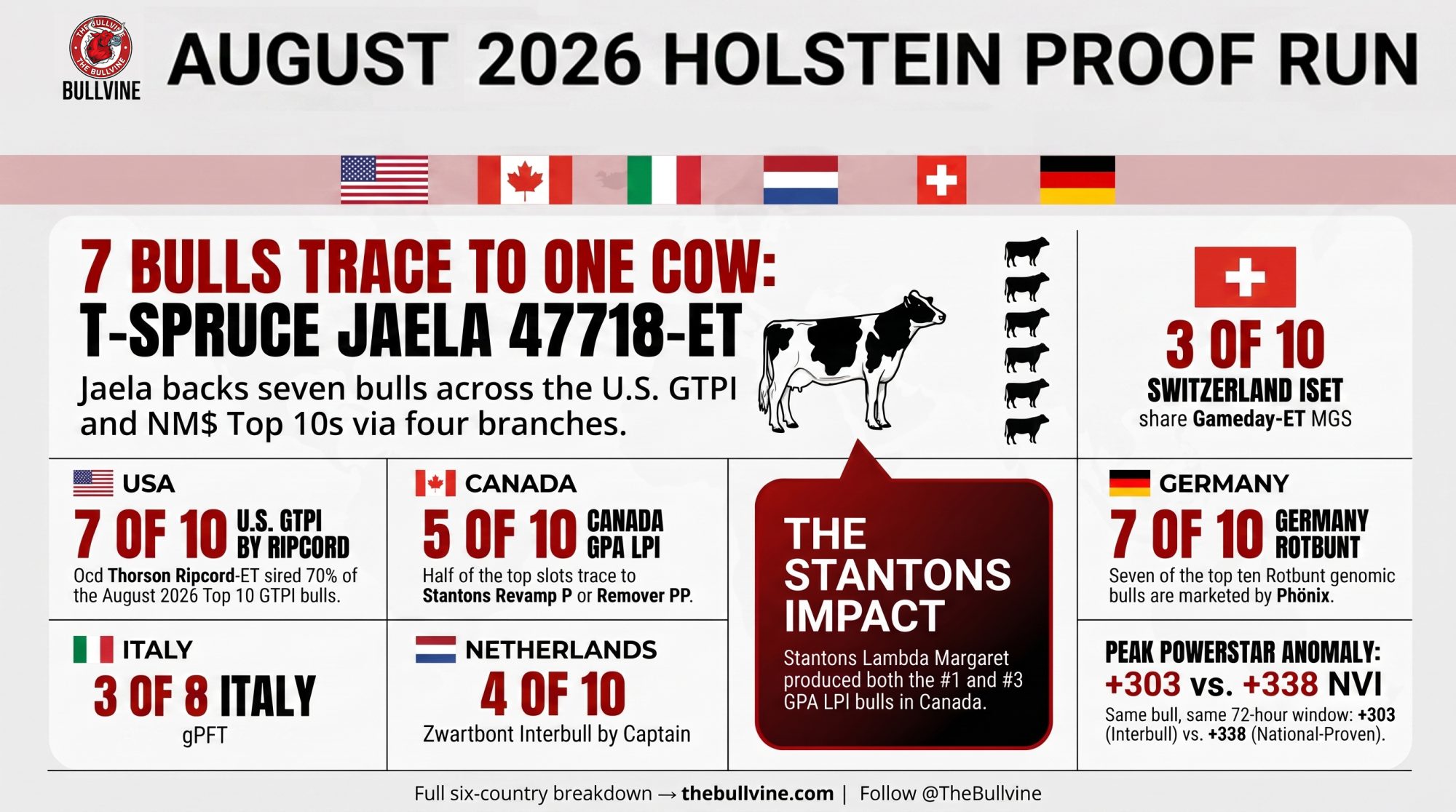
One sire owns 7 of 10 U.S. GTPI. One cow backs 7 bulls across two lists. Six countries, one 72-hour window, one honest question: how related is your tank, actually?

Ocd Thorson Ripcord-ET sired 7 of the U.S. GTPI Top 10 and 8 of Net Merit’s. One cow — T-Spruce Jaela 47718-ET — sits behind seven bulls across those two lists. In Canada, one full-sibling pair jumped from ranks 31 and 44 to #1 and #3. In Italy, five of ten domestic genomic slots turned over in four months. The world’s Holstein A-list came out August 11–13 across six countries — and if you order semen off it without pulling pedigrees three generations deep, you’re not diversifying. You’re buying one flush three different ways.

Every four months the numbers reset, and every four months most pedigree breeders make the same mistake: they treat a new list of names as a new set of choices. This August 2026 Holstein sire run — released inside a 72-hour window by Holstein Association USA/CDCBLactanet CanadaANAFIBJ ItalyCRV NetherlandsQualitas AG Switzerland, and vit/BRS Germany — is the cleanest case study we’ve seen for why that framing is broken. Six independent evaluation systems. Six different indexes. Six different bull populations. And underneath, one pattern the numbers can’t hide: modern Holstein genetics run through a shockingly narrow pipeline of sires, dams, and — most invisibly — single cow families.

Honestly, the awkward part is how much of this is happening at generations three and four, exactly where most producers stop reading the sire card.

A note before we dig in: almost every genomic bull named below is a first-crop sire with 0 daughters milking. Reliabilities cluster at 65–82% on the genomic side and 84–99% on the proven side. Every “Top 10” ranking mentioned here that’s genomic-based can and will re-rank at the next run. That’s not a caveat — it’s the whole reason the concentration story matters. And one internal note we use throughout: volatility score is our descriptive metric for how much a top 10 turned over run-over-run (new entrants + drop-outs + rank changes of ≥2 places). A “loud” list is roughly 15+; a “quiet” list is under 10. Not a Lactanet or CRV-published figure — just a way to compare movement between lists in this piece.

The August 2026 Concentration Snapshot

CountryTop 10 concentration this runTurnover vs. April
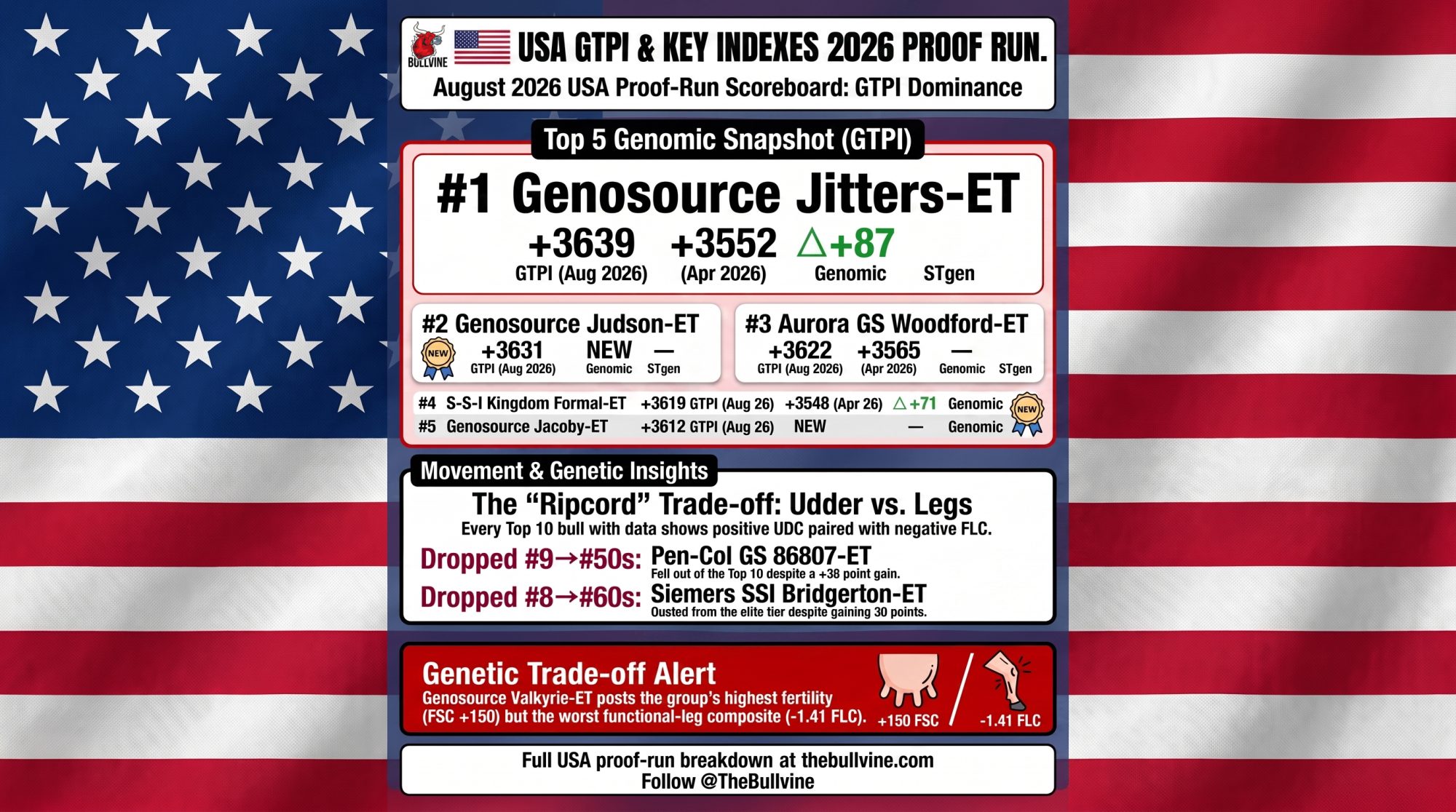
USA (GTPI)7 of 10 by Ocd Thorson Ripcord-ET6 new entrants
USA (NM$)8 of 10 by Ripcord; 5 trace to Sdg-Ph Delux Dominance-ET as MGS6 new entrants
USA (Red & White GTPI)3 of 10 are full siblings out of Aprilday Pwrstar Aurora-ET RCNew #1 (+94 clear)
Canada (GPA LPI)5 of 10 trace to Stantons Revamp P or Remover PP9 of 10 new to top 10
Canada (Domestic LPI)5 of 10 marketed by Select Sires; 6 of 10 by Select + Alta4 new entrants
Italy (Domestic Genomic gPFT)5 of 10 marketed by Intermizoo; 3 of top 8 are Vivify sons5 new entrants
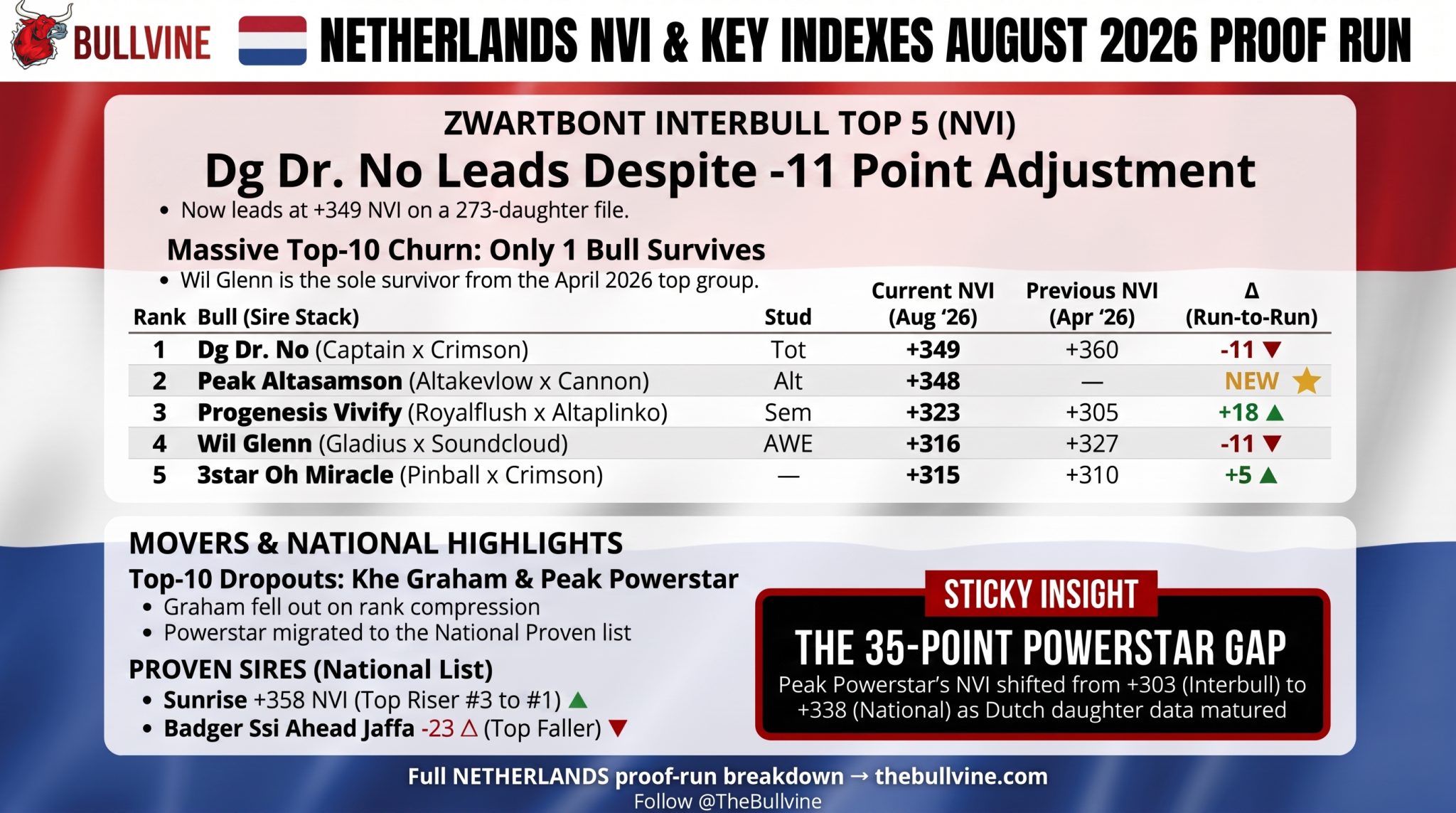
Netherlands (Zwartbont Interbull)4 of 10 sired by Genosource Captain9 of 10 new to top 10
Netherlands (Roodbont Interbull)6 of 10 owned by GGI; 3 of 10 by Sputnik Rf4 new entrants
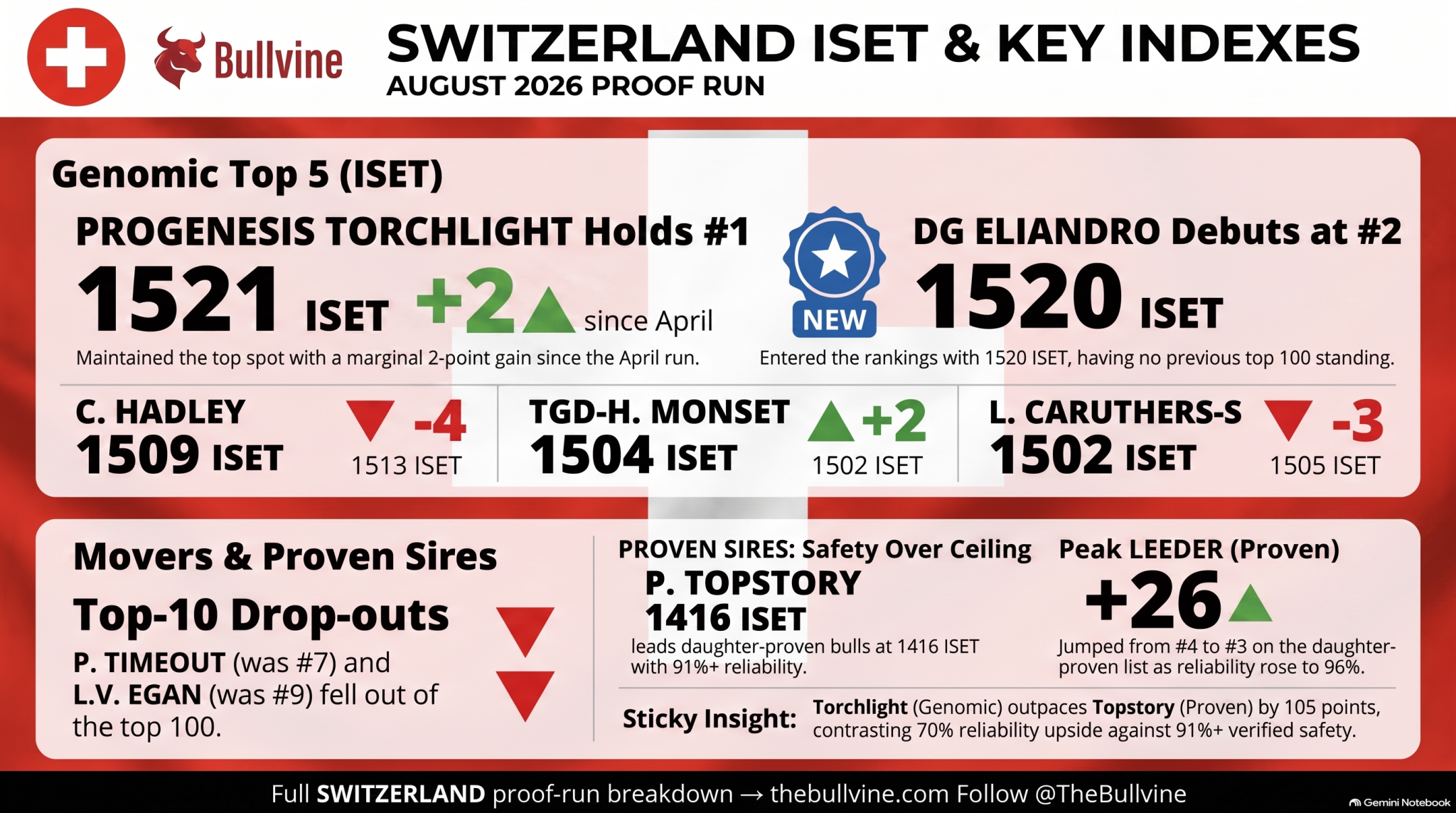
Switzerland (ISET Genomic)3 of 10 share Gameday-ET as MGS3 new entrants; 3 out of top 100
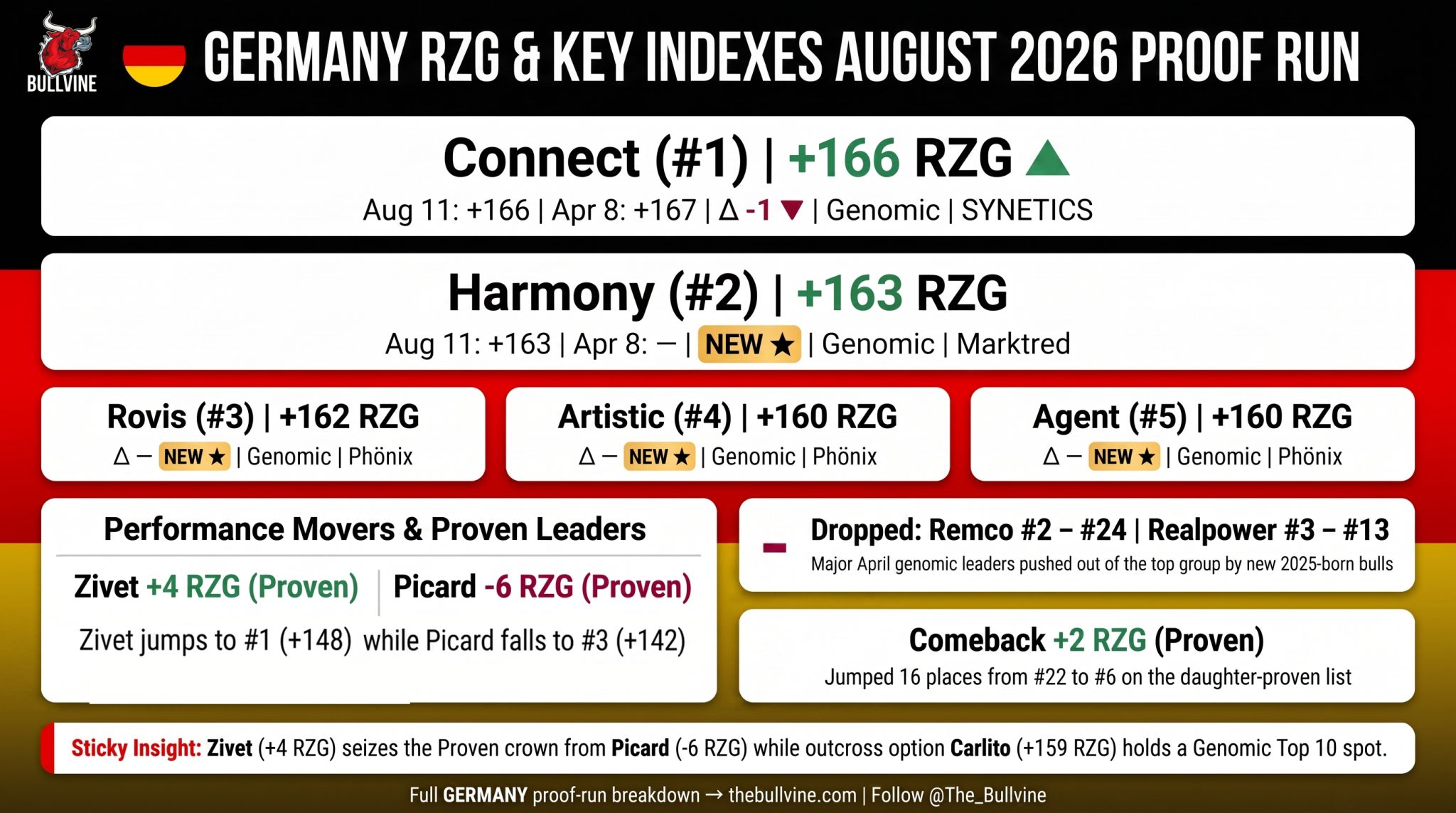
Germany (Schwarzbunt Genomic)6 of 10 are 2025-born new entrants; Argentum sires 2 of 106 of 10 new to top 10
Germany (Rotbunt Genomic)7 of 10 marketed by Phönix1 new entrant

Indexes are not numerically comparable across borders. Sources cited country-by-country below.

Here’s the full rundown, country by country, and what a working breeder should actually do with it before Monday.

The Ripcord Effect: Why the U.S. Top 10 Isn’t 10 Choices

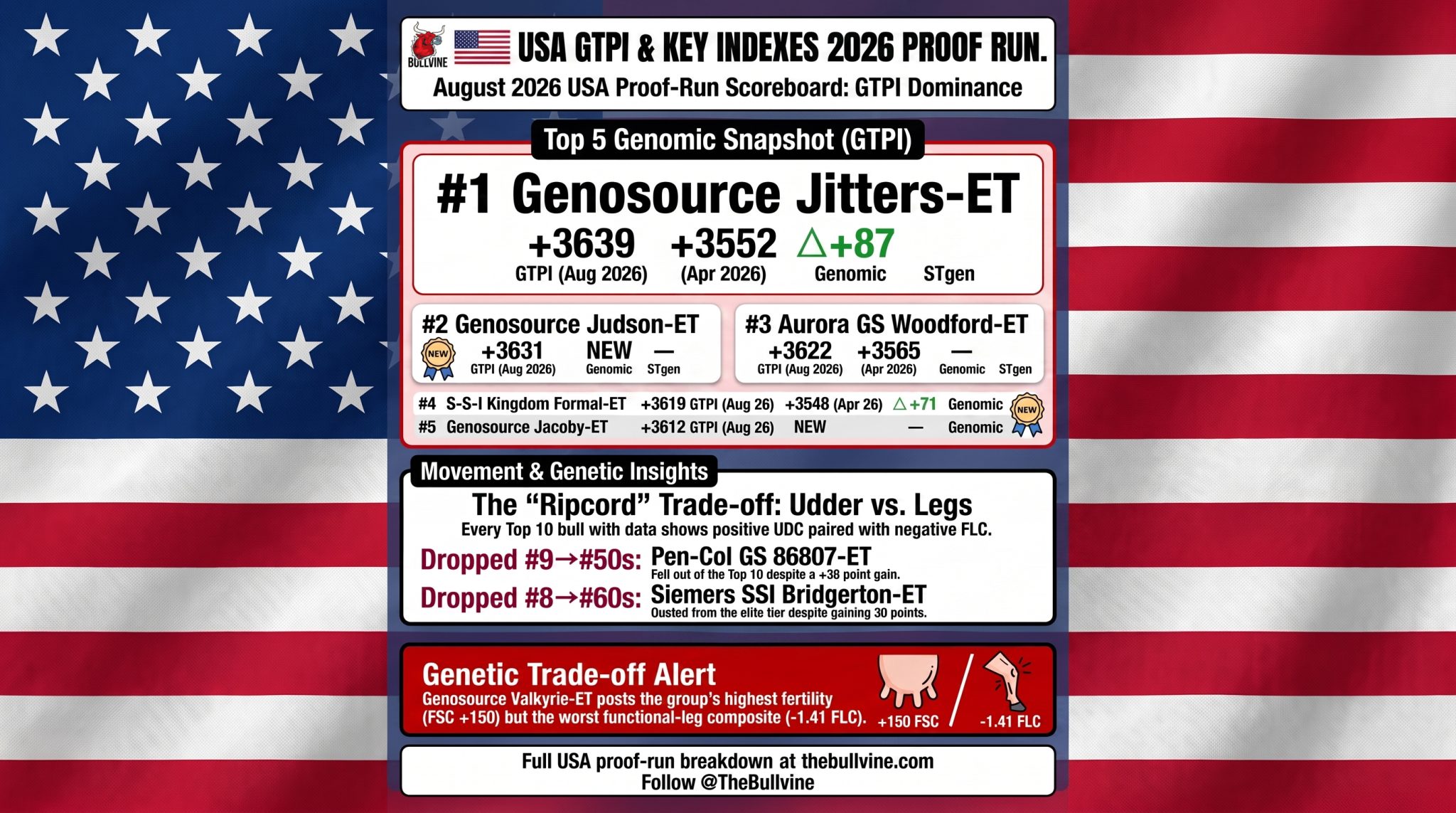
Start with what will drive North American mating decisions this fall. In the August 2026 CDCB/Holstein Association USA run, Ocd Thorson Ripcord-ET sired 7 of the top 10 GTPI bulls and 8 of the top 10 for Net Merit $. On a list of ten bulls at the very top of the world’s largest Holstein population, one sire owns seventy to eighty percent of the slots.

Sire concentration is the easy story — but pull one generation further and it gets tighter, not looser. Genosource Judson-ET, Genosource Jacoby-ET, and Genosource Jrue-ET — three separate names on the top of GTPI and Net Merit $ — are full brothers out of Genosource Hobbs 81451-ET from the same embryo flush. Judson and Jacoby were born the same day, July 31, 2025. Jrue was born two days earlier. Same sire, same dam, same flush. Three catalog listings, one biological choice.

And there’s one cow underneath most of it: T-Spruce Jaela 47718-ET. She sits as granddam or great-granddam behind seven bulls split across the GTPI and Net Merit $ Top 10s — Jitters, Judson, Jacoby, Jethro, Jrue, Jaco, and Patriot 76 — through four different maternal branches. That’s a cow family concentration deeper than the “Ripcord” story alone tells you, and it only shows up if you pull the sire card two generations past what most catalog spreads print.

A second cow family sits under the Delux Dominance cluster. Genosource Detox-ET, Genosource Domination-ET, and Genosource Decipher-ET share identical dam, MGD, and MGGD (Genosource Devi 77158-ET → Genosource Devoid 70904-ET → Genosource Deviate 46921-ET). One female line, three sons in the Top 10.

THE FUNCTIONAL WARNING ON THE RIPCORD LINES

Every Ripcord son in the GTPI Top 10 posts positive UDC and negative FLC — udders up, feet-and-legs down. The verified spread across the seven Ripcord sons: UDC +0.25 to +1.07 (Riptide is the strongest udder in the group), FLC −0.16 to −0.78 (Judson is the weakest leg composite). On the Net Merit $ side, the split gets sharper — Genosource Valkyrie-ET posts the worst functional-leg composite in either merit Top 10 at FLC −1.41 with UDC −0.81.

Components and productive life hold up on paper — no Ripcord son in the GTPI Top 10 sits under +176 CFP or under +3.3 PL. But the linear pattern is real, and the commercial consequence isn’t in the printed proof: stacking these sires across generations, especially onto shallow-heeled or hock-in cows, will compound mobility risk in freestall herds two lactations forward. Protected mating on foot angle and rear-leg-rear is not optional for a Ripcord-heavy tank.

The structural corrections in the matrix. Look for outcrosses whose own sire cards carry positive FLC — that’s the real fix. In this run’s outcross set, Bomaz Royalist-P-ET (UDC +1.07, FLC +0.93) on the Red Carrier list and Farnear Aircraft-ET (91–92%R, daughter-proven) on the Red/RC PTAT list are the cleanest structural pairings for a Ripcord-heavy cow group; Progenesis Espressivo-P clears the pedigree side outright. Ask for FLC on the sire card of any Jaela-line straw before you order.

Two genuine outcrosses exist in the entire U.S. run:

  • Progenesis Espressivo-P (Red Carrier GTPI #4, +3382, 77%R, 0 dtrs) — Beyond Hi-Level-ET × Trifecta Hike-ET × 3star Oh Ranger Red-ET on top; Progenesis Hike Escape RC × Progenesis Ranger Eskimo P RC × Progenesis Einstein Even P RC on the bottom. No traceable tie to Ripcord, Delux Dominance, Woodcrest King Doc, or T-Spruce Jaela on either side. The cleanest true outcross in the whole run.
  • Genosource Jaco-ET (GTPI #8, +3608, 82%R, 0 dtrs) — the closest mainstream alternative, and the biggest jumper in the Top 10 at +128 with the group’s best reliability. Still traces to the Jaela family — just not through Ripcord.

For herds prioritizing fertility and feed economics under CDCB’s rebuilt evaluation, the bulls actually worth chasing sit lower on the list. Genosource Domination-ET (NM$ #2, $1,324, ~77–79%R, 0 dtrs) posts DPR +2.8, CCR +4.9, FSC +143.0 with Feed Saved +402 — the fertility/feed anchor of this run. His linear split (UDC +0.21, FLC −0.95) is less extreme than Valkyrie’s but still Ripcord-typical. S-S-I Stagger Baelum-ET (GTPI #9, ~77–79%R, 0 dtrs) carries the best fertility in the GTPI Top 10 — DPR +3.0, CCR +5.2, FSC +154.0 — and still lost two ranks, which tells you everything about how fast the list moved.

On the Red & White side, Aprilday Pwrstar Aurora-ET RC just placed three full-sibling sons in the same Top 10: Aprilday Orphs Aesop-Red-ET (#3), Aprilday Ancho Peppr-Red-ET (#6), Aprilday Hrok Athens-Red-ET (#7). One cow, three different sires, three Top 10 sons. Pick one deliberately, or don’t pick any.

The daughter-proven anchor in this Red-list section: Farnear Aircraft-ET (Red/RC PTAT #9, +3.02, 91–92%R) is the one genuinely daughter-proven bull in the entire U.S. lookup — a real daughter file with production and udder-linear depth behind him. If you want a lower-risk anchor for a Red mating plan while genomic-only names above him swing, that’s him.

Barn-math the $47 gap. Between Net Merit $ #1 (Jentry, $1,326) and #10 (Decipher, $1,279) sits $47 per animal — roughly $4,700 in projected lifetime profitability across a 100-cow group of daughters. Real money on a first-crop genomic proof.

Read more: August 2026 USA Proofs: Four Sires Are Driving the Entire Top 10 – Is Your Semen Tank Truly Diversified?

Canada: One Bull Jumped 30 Places, His Full Brother Jumped 41

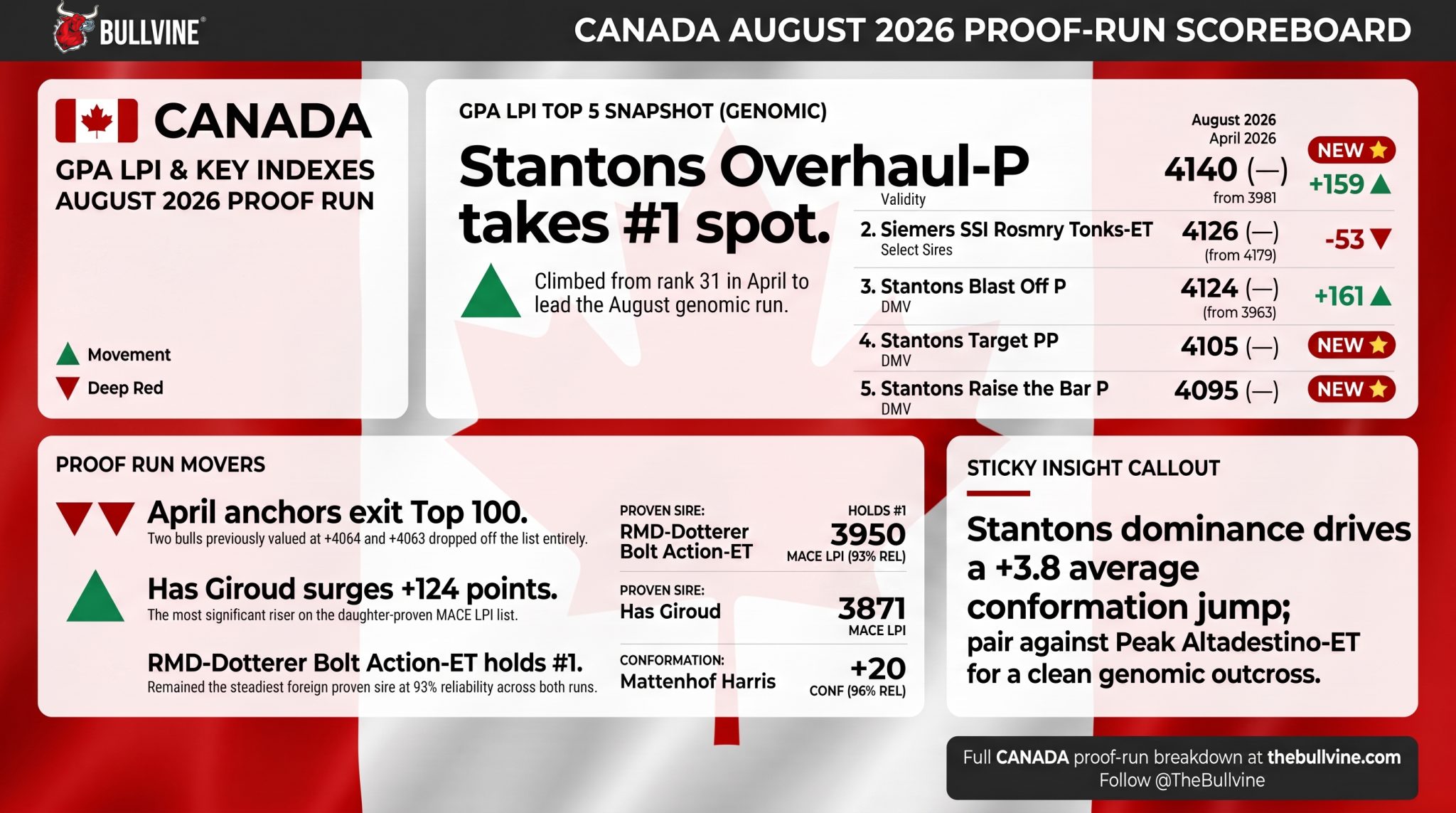
Canada’s August 2026 GPA LPI run handed the #1 spot to Stantons Overhaul-P (GPA LPI +4140, genomic, 0 dtrs) — up 159 points from +3981 (rank 31) in April. Nine of the ten August names are new to the top 10; five never appeared in April’s Top 100 at all. His full brother, Stantons Blast Off P (GPA LPI +4124, same sire Stantons Revamp P, same dam Stantons Lambda Margaret, 0 dtrs), moved from rank 44 to rank 3 in the same run.

Five of the ten August GPA LPI slots — Overhaul-P, Blast Off P, Stantons Target PP, Stantons Raise the Bar P, Stantons Agent PP — trace to sires Stantons Revamp P or Stantons Remover PP. That’s half the top of Canada’s genomic young-sire list running through one family’s breeding program. Target PP and Agent PP share dam Stantons What It Takes P. Overhaul-P and Blast Off P share dam Stantons Lambda Margaret.

A formula note worth flagging. Lactanet’s April 2026 LPI update shifted the Holstein Production subindex’s Fat:Protein weighting from 60:40 to 40:60 (higher-protein bulls now favoured) and added Calf Health to the Health & Welfare subindex. Both the April and August 2026 runs already reflect the same post-change formula, so the movements above are on a consistent scale — but any comparison you’re carrying forward from a pre-April printout is not.

What that’s worth in dollars: the gap between the Top 10’s highest Pro$ (Adaway Reaper Myboyblue-ET at $3,871) and lowest (Stantons Agent PP at $2,709) is $1,162 per animal. Applied across a 50-daughter sample, that’s roughly $58,100 in projected lifetime-profit difference — before a single daughter classifies or milks a day.

The proven side barely moved. Stantons Remover PP (LPI +3945, 98%R) took #1 domestic LPI, up 72 points from +3873 (rank 2) in April, swapping places with Siemers Rengd Parfect-ET (LPI +3932, 99%R, which gained 18 points itself and still slipped from #1 to #2). Six of April’s proven Top 10 are still there. And the stud story: Select Sires alone markets 5 of the August 2026 domestic Top LPI Top 10, with Alta Genetics adding a sixth. On the April run, Select Sires and Alta accounted for 9 of the 10.

MACE LPI — Canada’s ranking for foreign daughter-proven bulls — is the calmest list of all. RMD-Dotterer Bolt Action-ET has held #1 in both runs (+3927 April → +3950 August, 93%R). Has Giroud jumped from rank 33 to rank 4 (+124 points, 93%R), the standout mover.

The show-ring inheritance story. Jacobs Spear P debuts at #1 with +20 Conformation (+3900 LPI, genomic). Read his dam line and it becomes something else. His sire, Fraholme Vec Triton PP, sits at #43 on the same Conformation list at +16. His dam is a VG-86 (1-yr) by Allgaud out of a VG-87 (3-yr) by Ranger-Red, out of an EX-93 by Lautrust, out of Erbacres Snapple Shakira-ET EX-97 — the two-time Grand Champion and Supreme Champion of the World Dairy Expo International Holstein Show (2021 and 2023). Shakira is owned by Ferme Jacobs and partners of Cap-Santé, Quebec — the same Jacobs name behind the new #1 genomic Conformation bull. That is what a female line looks like when show-ring wins compound long enough to hand you a genomic proof. It’s also a reminder that Canadian type genetics still live in specific barns, not just spreadsheets. Character Andres holds #2 at +19 Conformation, tied with six other bulls at the identical value — a jam at the top the kind of pedigree work above tends to break through.

Read more: Stantons Overhaul-P Tops Canada’s August 2026 Genomic Rankings

Italy: Five Bulls Just Fell Out of the Top 10 in One Run

Italy’s August 2026 ANAFIBJ gPFT run is the most volatile of the six analyzed. (gPFT is Italy’s total-merit index for Holstein; IES € is the domestic economic sub-index; ICS-PR € is a production-focused economic composite. All three come from ANAFIBJ; all three move together but at different rates.) Five of ten domestic genomic top 10 bulls are new. The previous #1, ECBERT, slipped to #3. The new #1: QHR Inseme Santry ET (Rome × Cronk, Inseme) at +5487 gPFT / +1386 IES € / +1440 ICS-PR € (Rk 99, ANAFIBJ’s max genomic reliability, no daughters).

Five bulls need same-week replacement if they’re on your Italian mating list: Go-Farm Mirosh ET (was #4), DM Saxony (was #5), Isolabella Liverpool (was #6), Wil Sonador RF (was #9), GGA Jegolo (was #10 despite gaining 7 gPFT points — the list moved underneath him).

The trait swaps are cleaner than the ranking shuffle suggests:

  • Kg Fat / component power (Mirosh, Sonador): swap in Passini Odino (+0.28% fat) or GPlus Oakland(+0.60% fat, 107 Kg Fat).
  • Raw milk volume (Jegolo): swap in QHR Santry (+1,903 Kg Milk, now #1 overall).
  • Udder quality (Liverpool): swap in Passini Odino (Udder cmp 117, F&L 1.90 — best udder in the top 10).
  • Balanced type + longevity (Saxony): swap in SH Jalnus ET — AA κ-casein, Longevity 116, balanced fat/protein.

The Vivify concentration problem is real. Vivify sons hold 3 of the top 8 domestic genomic slots (Rascasse #4, Odino #6, Stormur #8). If your Italian herd is already Vivify-heavy, the outcross plays that don’t cost index are QHR Santry(Rome × Cronk), GPlus Oakland (Owen × Captain), and Gill Impeto (GTA × Beerbum).

On the daughter-proven side, Go-Farm Boero ET RF took #1 at +5241 (+79 in one run, Crisalis RF × Pursuit), unseating stablemate ZFZ Crisalis RF (–86). Boero is Italy’s highest reliability-plus-gPFT combination if you won’t bet contract heifers on genomic-only bulls.

The ceiling story worth pausing on. Denovo Locust-ET widened his Interbull-converted lead to +5613 gPFT — +126 clear of Santry, +372 clear of Boero. That’s the difference between what the Italian scale actually rewards and what an Italian breeder can safely mate to this month. If you can source him through the foreign-genomic pathway, he’s the real Italian ceiling.

And Progenesis Vivify himself graduated to foreign-proven #1 at +5491, putting Vivify and Santry inside noise of each other at the second tier. Intermizoo houses 5 of 10 domestic genomic slots (Huller, Rascasse, Impeto, Jalnus, Bangles) — the strongest single-stud grip on the Italian genomic list in the two runs directly comparable. Inseme (Santry, Stormur) and Chiacche./ABS Italia (Ecbert, Odino) are actively contesting it with the biggest movers.

Read more: ANAFIBJ August 2026 gPFT: QHR Santry Debuts at #1 (+5487) as Five Bulls Fall Out of Italy’s Top 10

The Netherlands: The Same Bull, Two Different Numbers, Same Publication

Take one thing from the Dutch August 2026 NVI runPeak Powerstar is carrying two published values this cycle — +303 NVI on April’s Interbull-converted list, +338 NVI (78%R, 57 dtrs) on August’s national daughter-proven list. Same bull. Same genetics. Same barn. Different daughter-eligibility pool. A 35-point gap.

That’s not a re-evaluation. That’s a category migration — a bull whose Dutch daughter file grew large enough to move him from foreign-converted MACE data to the domestic proven list. Same animal, different math. If you selected off April’s Interbull number, the number on his current national-proven card is 35 points higher not because he improved, but because his daughter file crossed a category threshold.

The Zwartbont Interbull-converted list posted the loudest movement (volatility score 19 — see intro note): nine of ten April slots gone. Dg Dr. No (Captain × Crimson, Tot) now leads at +349 NVI on 273 daughters, 84%R — though his own number actually fell 11 points from a previously reported +360. The rank looks like a rise; the bull went down. Clear-Echo Rix Rimbot (Rix × Denovo 2981 Sheldon, WWS) jumped 66 points from +249 to +315 NVI on 435 daughters, 70%R — the single biggest gainer in either Dutch daughter-proven list.

Captain-sired bulls occupy four of ten slots in the Zwartbont Interbull-converted top 10 (Dg Dr. No, Dg Just In Time, Dg Peace, Sdg Gs Gotti). For breeders wanting to avoid stacking Captain, Progenesis Vivify (Royalflush × Altaplinko, +323 NVI, 284 dtrs, 79%R) and Clear-Echo Rix Rimbot (+315 NVI, 435 dtrs, 70%R) are the ones outside that sire line entirely.

On the Roodbont side, Ceh Spotlight (Sputnik Rf × Gywer Rdc) held #1 in both runs at +321 NVI (346 dtrs, 72%R). GGI owns six of the ten slots. Sputnik Rf alone sires three of the ten (Ceh Spotlight, Stb Spot-Red P, Shake Red). Breeders wanting to break from both need 3star Keane PP Red (Mars P-Red × Solitair P — still GGI, +290 NVI, 104 dtrs, 72%R) or Global Red (Gnabry × Solitair P — outside GGI and outside the Sputnik Rf line, +278 NVI, 50 dtrs, 71%R).

The deepest daughter file in the whole Dutch dataset — and it’s not on the loudest list. Bomaz Magnific-Et(Zwartbont Interbull-converted #8, +314 NVI, 876 daughters, 74%R) carries more than three times the daughter count of anything else in that top 10. Dg Dv Rammstein Red (Roodbont National-proven #4, +318 NVI, 595 daughters, 89%R) is the deepest daughter file among the Roodbont bulls. If proof stability outranks peak NVI on your list, those two are the anchors in the whole Dutch run.

Read more: The Peak Powerstar Effect: Navigating Netherlands August 2026 NVI Rankings

Switzerland: Three Former Top-10 Bulls Just Vanished

Switzerland’s August 2026 ISET Genomic run held Progenesis Torchlight at #1 (+2 to 1521 ISET, 70–72%R, 0 dtrs). (ISET is Holstein Switzerland/swissherdbook’s total-merit index, published by Qualitas AG; it weights milk yield, components, functional traits and type on a nationally-calibrated scale — a top ISET score is not directly comparable to a top GTPI or LPI.) The real story is who’s gone. Progenesis Timeout, April’s #7 at 1476, dropped out of the top 100 entirely in one run. Les Verdaux Egan (April #9) and Sous-Moron Boston (April #8) also vanished from the top 100.

Behind Torchlight, DG Eliandro debuted at #2 (1520 ISET, 70%R, no prior top-100 ranking) on a volume-first profile — 2,063 kg milk (roughly 4,550 lb), modest components. Opposite profile at #10: Eichhof Dover (1468 ISET, 70–72%R) with just 1,416 kg milk but +0.56% fat and +0.30% protein. Same index, opposite paths.

Gameday-ET sits as maternal grandsire behind three of the current top 10 — Torchlight, Cookiecutter Hadley (1509 ISET), and TGD-Holstein Monset (1504 ISET, ITP 129 / udder 129 — the strongest type stack in the group). Herds diversifying away from that MGS line should look at DG Eliandro (MGS Altaalanzo-E) or Lars-Acres Caruthers-S (1502 ISET, MGS Van Gogh-ET, 70%R).

The domestic daughter-proven ISET list sits over 100 points below the genomic ceiling — Progenesis Topstory leads at just 1416 ISET (~94–96%R). That gap isn’t because Torchlight is a verified better animal. It’s because a 70–72% reliability genomic proof carries less statistical caution than a 90%+ reliability daughter-proven one. Three bulls vanishing from the top 100 in one run is what that caution looks like in practice.

The proven mover: Peak Leeder jumped from rank 4 to rank 3 (+26 points, 1383 → 1409 ISET, reliability climbing 94% → 96% alongside) — a genuine daughter-driven gain, not a re-rank artifact. The other one worth naming: 3Star Oh Ranger (1397 ISET, 99%R) — the highest-reliability proven sire on the entire Swiss list. If you want minimum re-rank risk into December in the Swiss population, that’s your name.

Read more: Switzerland’s August 2026 Proof Run: DG Eliandro Debuts at #2 as Progenesis Timeout Vanishes From the Top 100

Germany: Six New Bulls Just Rewrote the Schwarzbunt Genomic List

Germany’s 11 August 2026 RZG run posted the most dramatic reshuffle of any list in this global set. Six of ten Schwarzbunt genomic top 10 bulls are 2025-born new entrants that don’t appear anywhere in April’s top 100: Harmony, Rovis, Artistic, Agent, Almonty, Smetana — every one of them at 77%R with 0 daughters.

Connect (Comet-sired, SYNETICS) held #1 at +166 RZG (77%R, RZM 150 / RZN 136 — a rare high-milk / high-fitness combination). Behind him, six former April top-10 bulls fell clear out of the top 10:

  • Remco (April #2 at +162) → #24 at +157
  • Realpower (April #3 at +161) → #13 at +158
  • Realside (April #4 at +161) → #19 at +157
  • Evenstar (April #7 at +161) → #23 at +157
  • Romantiker (April #8 at +161) → #16 at +158
  • Highmilk (April #9 at +161) → #32 at +156

If Remco or Realpower is queued in a German mating plan built off April data, that plan is running on numbers four months stale.

On the Schwarzbunt proven side, Zivet (SYNETICS, +148 RZG, 97%R, RZM 150) took #1 with a +4 gain from +144 — the largest RZG gain of any bull tracked in this global report. Former #1 Picard (91%R) fell –6 (+148 → +142) to #3.

Watch this move. Comeback jumped from rank #22 to rank #6 on a +2 RZG gain (+139 → +141, 92%R). That’s a 16-place rank climb — the sharpest rank movement on any proven list in this global run, and it happened on essentially unchanged raw genetics. That’s what a list looks like when everyone above a bull loses ground while he holds his.

Rotbunt — Germany’s Red Holsteins — is quieter. Skype Red holds #1 at +163 RZG (77%R, unchanged from April), but only because Harmonic P (April’s leader) dropped 2 points. Nine of ten anchors carried over. On the proven side, three brand-new entrants — Spooky Red (+143 RZG, 87%R), Master P (+139, 87%R), Mat Red P (+137, 85%R) — cracked the top 10 on their first appearance in the daughter-proven population as they crossed from genomic-only into proven status.

Phönix places 7 of 10 Rotbunt genomic slots, 6 of 10 Rotbunt proven slots, and 5 of 10 Schwarzbunt genomic slots. Structural, not accidental.

Reliability anchors on the German proven lists: Mirco (+140 RZG, 98%R) on Schwarzbunt, Ginger (+138 RZG, 97%R, 1,204 daughters) on Rotbunt. If you want minimal re-rank risk into December in the German population, those two are the closest to guarantees in the whole dataset.

Read more: Germany’s August 2026 RZG Run: Zivet Retakes the Schwarzbunt Proven Crown

What Actually Unites Six Countries This Run

Read the six reports side by side and the same forces keep showing up.

Sire concentration is real and getting worse. Ripcord owns 70–80% of the U.S. GTPI/NM$ top 10s. The Stantons cohort owns 50% of Canada’s GPA LPI top 10. Captain owns 40% of the Dutch Zwartbont Interbull-converted top 10. Vivify sons hold 3 of Italy’s top 8. Phönix places 7 of 10 slots in Germany’s Rotbunt genomic list. Different indexes, different countries, same problem: fewer sires and studs are producing more of the top of every list.

Cow families are the deeper concentration, and almost nobody’s counting them. T-Spruce Jaela 47718-ET backs seven bulls across the U.S. GTPI and NM$ Top 10s through four different maternal branches. Genosource Deviate 46921-ET stacks three sons in one U.S. NM$ family. Stantons Lambda Margaret produced both Overhaul-P and Blast Off P — the #1 and #3 of Canadian GPA LPI. Aprilday Pwrstar Aurora-ET RC placed three full-sibling Red & White sons in the same U.S. Top 10. When you cross-check sire, then MGS, then MGD/MGGD, most “diversified” tanks turn out to be one or two cow families in disguise.

The volatility gap between genomic and daughter-proven lists is now the story, not a footnote. Italy turned over 5 of 10 domestic genomic slots in four months. Germany’s Schwarzbunt genomic list turned over 6 of 10. Switzerland lost three former top-10 bulls out of the top 100 entirely. The Netherlands’ Interbull-converted lists posted volatility scores of 19 (Zwartbont) and 12 (Roodbont); their National daughter-proven Roodbont list scored just 4. Canada’s proven MACE LPI list barely moved. The genomic side of every index in this run rearranged itself. The deep-daughter proven lists barely blinked. That’s not a temporary quirk — it’s the structural cost of ranking bulls on parent-average and genomic markers before daughters classify.

And the Peak Powerstar case in the Netherlands shows the fourth force nobody wants to talk about: the same bull can carry two different official numbers on the same publication cycle depending on which daughter-eligibility pool he falls into. +303 NVI on the Interbull list. +338 NVI on the national proven list. Same barn, same daughters, different math.

The December Watch List

Every four months you look at a top 10 you didn’t expect. Here’s who to actually track between now and December’s runs, drawn from this cycle’s movement patterns:

  • Genosource Jaco-ET (USA GTPI #8) — biggest jumper in the U.S. Top 10 (+128), best reliability of the group at 82%R. If he holds through daughter arrival, the Jaela-line challenger everyone will chase in December.
  • Stantons Overhaul-P / Stantons Blast Off P (Canada GPA LPI #1 and #3) — one full-sibling pair, both zero daughters, both first-run entrants at these levels. First-daughter data lands and this pair either confirms the flush or gives back all 159 points.
  • Peak Altasamson (Netherlands Zwartbont Interbull #2) — 65%R on just 85 daughters at +348 NVI. Lowest-reliability high-index bull in the whole Dutch dataset. He either stabilises or corrects hard.
  • Peak Powerstar (Netherlands National-proven #4) — the category-migration case. His number moved 35 points in one publication cycle; watch which daughter pool his December number lives in.
  • QHR Inseme Santry ET (Italy Domestic Genomic gPFT #1) and 3STAR Huller (Italy #2) — first-run debuts at the top of the pyramid, both Rk 99 but both first-cycle on the Italian scale. Two candidates to move meaningfully next run.
  • Peak Altasafezone-ET (Italy Foreign Genomic gPFT #7) — biggest single-run rank jump on Italy’s foreign list, from #20 to #7 (+87 gPFT). The bull to watch next run on the Interbull-converted side.
  • Harmony, Rovis, Artistic, Agent, Almonty, Smetana (Germany Schwarzbunt Genomic #2–#8) — six 2025-born bulls now sitting in Germany’s genomic top 10 with 0 daughters and 77%R. At least two of these will re-rank meaningfully.
  • Krispy / Milo (Germany Schwarzbunt Proven #2 and #4) — first-appearance proven bulls at 88%R. The volatility plays on the proven side.
  • Comeback (Germany Schwarzbunt Proven #6) — the +2 gain that jumped 16 ranks. If everyone above him keeps giving ground, he’s the December #3 or #4 candidate.

The Global Outcross & Specialist Matrix

Six countries, one 72-hour publication window, one honest answer to the question “which sire should I use?”: check the pedigree, not just the ranking. Sire tells you 25% of the pedigree story. Add maternal grandsire and you’re at 50%. Add MGD and MGGD — the fields most catalogs bury — and you’ll find the T-Spruce Jaela cases and the Stantons Lambda Margaret cases before you buy the same genetics three different ways.

One table. Every named outcross, fertility/feed anchor, and reliability anchor from all six countries. Reliability and daughter counts drawn from the source articles; watch-outs are the specific trade-off the source names for that bull.

SireCountry / listKey indexRel / DtrsBreeding role & pedigree cleanlinessWatch-out trait
Progenesis Espressivo-PUSA Red Carrier GTPI #4+3382 GTPI77%R / 0 dtrsTrue U.S. outcross — clean of Ripcord, Delux Dominance, Woodcrest King Doc, and Jaela on both sire and dam sidesRed Carrier only (not black-and-white); modest +12 GTPI gain this run
Genosource Jaco-ETUSA GTPI #8+3608 GTPI82%R / 0 dtrsClosest mainstream U.S. outcross; +128 biggest riser in Top 10Still traces to T-Spruce Jaela family — don’t stack with other Jaela bulls
Bomaz Royalist-P-ETUSA Red Carrier GTPI #2+3425 GTPIGenomic / 0 dtrsPolled/Red package (PC PO RC); elite udder + leg linears — UDC +1.07, FLC +0.93 — the rare positive-FLC option in this datasetBomaz Legacy cow family — check against existing Bomaz genetics
Genosource Domination-ETUSA NM$ #2~77–79%R / 0 dtrsFertility/feed anchor: DPR +2.8, CCR +4.9, FSC +143.0, Feed Saved +402UDC +0.21, FLC −0.95 — Ripcord-typical leg trade
S-S-I Stagger Baelum-ETUSA GTPI #9+3606 GTPI~77–79%R / 0 dtrsBest fertility in GTPI Top 10: DPR +3.0, CCR +5.2, FSC +154.0Lost 2 ranks despite gaining 59 points — list moving underneath him
Farnear Aircraft-ETUSA Red/RC PTAT #9+3.02 PTAT91–92%R / provenOnly genuinely daughter-proven bull in U.S. lookup; full production + udder-linear fileBelow the raw genomic ceiling on the Red list
Peak Altadestino-ETCanada GPA LPI #7+4087 GPA LPI77%R / 0 dtrsCanadian outcross: Peak Lorax-ET line; clears Stantons Revamp/RemoverFirst-run entrant to Top 10 — no prior LPI history at this level
Cristella Vertigo ETCanada GPA LPI #9+4051 GPA LPI77%R / 0 dtrsCanadian outcross: Cookiecutter Hadley-ET line; clears Stantons Revamp/RemoverNew to the Top 10 this run
Stantons Remover PPCanada Domestic LPI #1+3945 LPI98%R / provenProven-side anchor: gained +72 pts April→August; Canada’s flagship proven bull this runSame Stantons Revamp/Remover MGS pool driving the genomic list concentration
Siemers Rengd Parfect-ETCanada Domestic LPI #2+3932 LPI99%R / provenHighest reliability on Canada’s domestic proven list; gained 18 pts and still slipped from #1Select Sires marketing — same stud running 5 of Top 10
RMD-Dotterer Bolt Action-ETCanada MACE LPI #1+3950 MACE LPI93%R / provenSteadiest bull across either Canadian index this cycle — held #1 both runsForeign-daughter file — figure moves with each MACE update
Peak Altahothand-ETCanada Domestic LPI #7+3835 LPI99%R / proven99%R proven anchor from a non-Stantons sire lineSlipped 18 pts (April #5 → August #7); Alta Genetics marketing
QHR Inseme Santry ETItaly Domestic Genomic gPFT #1+5487 gPFTRk 99 / 0 dtrsItalian Vivify-free anchor (Rome × Cronk); +1,903 Kg Milk — highest raw yield in Top 10First-run debut at #1 — full recalibration risk next cycle
GPlus GP-OaklandItaly Domestic Genomic gPFT #9+5302 gPFTRk 99 / 0 dtrsVivify-free component specialist: +0.60% fat, 107 Kg Fat, 80 Kg PrFert 87 is the persistent brake on this profile
Gill ImpetoItaly Domestic Genomic gPFT #5+5317 gPFTRk 99 / 0 dtrsVivify-free volume-plus-quality: +1,507 Kg Milk, 80 Kg Fat, IQC 115First-run entrant at #5 — no prior top-10 track record
Go-Farm Boero ET RFItaly Domestic Proven gPFT #1+5241 gPFTProvenItaly’s highest reliability-plus-gPFT combination on the proven sideSits well below Denovo Locust’s +5613 Interbull ceiling
Denovo 23392 Locust-ETItaly Foreign Genomic gPFT #1+5613 gPFTGenomicThe real Italian ceiling — +126 clear of Santry, +372 clear of BoeroForeign-sourcing pathway; not on domestic list
Progenesis VivifyNetherlands Zwartbont Interbull #3+323 NVI79%R / 284 dtrsNon-Captain outcross on Dutch Zwartbont; established daughter fileSame Vivify concentration playing out on the Italian genomic list
Clear-Echo Rix RimbotNetherlands Zwartbont Interbull #6+315 NVI70%R / 435 dtrsBiggest gainer on the list (+66 NVI); Rix × Denovo 2981 Sheldon70%R is the lowest in the Zwartbont Interbull Top 10
3star Keane PP RedNetherlands Roodbont Interbull #4+290 NVI72%R / 104 dtrsHomozygous polled; Mars P-Red × Solitair P outside Sputnik Rf lineStill owned by GGI — doesn’t solve the stud-concentration problem
Global RedNetherlands Roodbont Interbull #7+278 NVI71%R / 50 dtrsOnly Roodbont Interbull Top 10 name outside both GGI and Sputnik RfJust 50 daughters — thinnest proof of the Roodbont group
Bomaz Magnific-EtNetherlands Zwartbont Interbull #8+314 NVI74%R / 876 dtrsDeepest daughter file in any Dutch Top 10 this run74%R still below top-tier proven bands
Dg Dv Rammstein RedNetherlands Roodbont National-proven #4+318 NVI89%R / 595 dtrsDeepest reliability-plus-daughter combination on the Dutch Red sideSlipped 8 points (+326 → +318) from April
DG EliandroSwitzerland ISET Genomic #21520 ISET70%R / 0 dtrsClears the Gameday-ET MGS cluster (MGS Altaalanzo-E); 2,063 kg milkModest components (+0.28% fat, +0.09% protein) vs. yield
Lars-Acres Caruthers-SSwitzerland ISET Genomic #51502 ISET70%R / 0 dtrsClears Gameday-ET MGS (MGS Van Gogh-ET); highest volume in ISET Top 10 (2,180 kg milk)Lower ITP (110) — trades type for output
3Star Oh RangerSwitzerland ISET Domestic Proven #41397 ISET99%R / provenHighest reliability of any sire named in this piecePeak ISET well below Torchlight’s 1521 genomic ceiling
Duett PPGermany Rotbunt Genomic #2+162 RZG77%R / 0 dtrsClears Handout P/Shield (sire Dressman P); RZM 143 — highest milk in Rotbunt Top 10Not in April’s Top 100 — brand-new entry, no track record
Bueno RedGermany Rotbunt Genomic #10+155 RZG78%R / 0 dtrsClears Handout P/Shield (sire Borax Red)Fell hardest inside the Top 10 (−5 from +160 April rank #3)
ConnectGermany Schwarzbunt Genomic #1+166 RZG77%R / 0 dtrsFitness + milk outcross: RZM 150 + RZN 136 — rare pairing; sire Comet clears ArgentumFirst-crop, 0 daughters — full re-rank risk stands
CarlitoGermany Schwarzbunt Genomic #10+159 RZG77%R / 0 dtrsSire Callum clears the Argentum stackLost −2 RZG from April to August (+161 → +159)
ZivetGermany Schwarzbunt Proven #1+148 RZG97%R / provenLargest RZG gain of any bull in this global report (+4); RZM 150Milk-first — type takes the back seat (RZE 116)
GingerGermany Rotbunt Proven #6+138 RZG97%R / 1,204 dtrsDeepest daughter file on any German list this runLower peak RZG than Rotbunt genomic ceiling
MircoGermany Schwarzbunt Proven #10+140 RZG98%R / provenHighest reliability on the German Schwarzbunt proven listOnly #10 on RZG — reliability, not peak index

Treat genomic proofs like the weather forecast they are. Three former Swiss top-10 bulls just fell out of the top 100 entirely. Six German Schwarzbunt genomic bulls just vanished from the top 10. Peak Altasamson entered the Dutch Interbull list at 65%R on 85 daughters. Peak Powerstar’s number moved 35 points on the same publication cycle. If you’re building a contract-heifer mating plan on a first-appearance genomic bull, wait a run. The proven side is where the certainty lives — for a reason.

Within 30 days: pull your active semen inventory. For every straw, look up sire, MGS, and — for anything Genosource-branded — MGD/MGGD. Cross-check against T-Spruce Jaela 47718-ET, Genosource Deviate 46921-ET, Stantons Lambda Margaret, Aprilday Pwrstar Aurora-ET RC, and the Gameday-ET MGS line.

When the cross-check comes back positive. Three straws tracing to the same cow family isn’t a crisis — it’s a signal. Rank the traced straws by index and reliability, keep the strongest one (or the highest-reliability one if the index gap is under 20 GTPI points), and replace the others with matrix outcrosses that either clear the sire line (Espressivo-P, Jaco, Altadestino, Vertigo, Santry, Oakland, Impeto, Vivify, Rix Rimbot, Keane PP Red, Global Red, Eliandro, Caruthers-S, Duett PP, Bueno Red, Connect, Carlito) or carry proven daughter depth from outside the concentration cluster (Farnear Aircraft, Remover PP, Rengd Parfect, Bolt Action, Boero, Rammstein Red, 3Star Oh Ranger, Ginger, Mirco). The point isn’t to stop using the strongest genetics you own — it’s to stop paying for the same genetics three times.

The August 2026 run wasn’t a random reshuffle. It was six independent evaluation systems, on the same 72-hour window, quietly telling the same story: the modern Holstein A-list is narrower than it looks. Diversifying takes work most breeders aren’t doing. The good news is it’s Friday morning. You’ve got the weekend to pull sire cards, cross-check MGD and MGGD against those five cow families, and walk into Monday with a mating plan that’s actually diversified — not just diversified-looking.

The Sunday Read Dairy Professionals Don’t Skip.

Every week, thousands of producers, breeders, and industry insiders open Bullvine Weekly for genetics insights, market shifts, and profit strategies they won’t find anywhere else. One email. Five minutes. Smarter decisions all week.
NewsSubscribe
First
Last
Consent

Editor’s technical note. Data synthesised from official August 2026 releases by CDCB / Holstein Association USA, Lactanet Canada, ANAFIBJ, Coöperatie CRV, Qualitas AG (Holstein Switzerland / swissherdbook), and vit/BRS — scope limited to Holstein and Red Holstein sires. National indexes (GTPI, LPI, gPFT, NVI, ISET, RZG) are calibrated to different national economics and populations and are not numerically equivalent across borders; no cross-country index comparison is made here. Genomic proofs at 65–77% reliability carry meaningfully higher re-rank risk than 84–99%-reliability daughter-proven values; “volatility score” is our internal descriptive metric (new entrants + drop-outs + rank changes of ≥2 places within a top 10), not a CRV-published figure. Sources: USA — CDCB/HAUSA · Canada — Lactanet · Italy — ANAFIBJ · Netherlands — CRV · Switzerland — Qualitas AG · Germany — vit/BRS. Spot a data point that looks off? Reach out to editorial and we’ll verify against the source country’s official bulletin.

August 2026 USA Proofs: Four Sires Are Driving the Entire Top 10 – Is Your Semen Tank Truly Diversified?

The same four sires turn up across GTPI, Net Merit, type, and the Red lists — and one great-granddam is quietly behind seven bulls on the two biggest lists. Pull your last order and count how many trace back.

Executive Summary: Every USA Holstein Top 10 released in August — GTPI, Net Merit $, PTAT, and both Red lists — traces back to basically four sire lines, led by Ocd Thorson Ripcord-ET, who sired 7 of the top 10 GTPI bulls and 8 of the top 10 for Net Merit $. Go one generation deeper and it gets tighter: one cow, T-Spruce Jaela 47718-ET, is a granddam or great-granddam behind seven different bulls split across the GTPI and Net Merit $ Top 10s. This is also the first proof run where the entire GTPI Top 10 sits above +3600, and the group’s floor climbed 77 points in just four months — nobody’s genetics went backward; the whole board just got faster. On the Red & White side, one cow — Aprilday Pwrstar Aurora-ET RC — placed three full-sibling sons in the same Top 10. If three or more straws in your current tank trace back to any of these names, you’re not diversifying your program; you’re just buying the same genetics three different ways. The real outcrosses do exist — Progenesis Espressivo-P and Genosource Jaco-ET are the cleanest options in this entire run — and under CDCB’s rebuilt fertility evaluation, the sires actually worth chasing for DPR, CCR, and feed efficiency aren’t necessarily the ones sitting at #1.

August 2026 USA proofs

If you’re building a semen order off this proof run, here’s the decision that actually matters: most of the bulls you’re choosing between aren’t independent choices. Ocd Thorson Ripcord-ET is behind the majority of the top of both GTPI and Net Merit $. But pull the pedigree one generation further and the concentration gets sharper, not looser — Genosource Judson-ET, Genosource Jacoby-ET, and Genosource Jrue-ET turn out to be from the same embryo flush, not three separate “options.” Here’s the full breakdown, index by index, then the cow families underneath it.

Seven of the Ten Top GTPI Bulls Share the Same Sire

GTPI is the lead index here — it tied Net Merit $ on total churn (new entrants, drop-outs, big rank jumps), and GTPI wins the tiebreak as the industry’s primary total-merit number.

RankBullGTPI (Aug 2026)GTPI (Apr 2026)ChangeSireMaternal grandsireUDCFLCKEY TRAIT NOTES
1Genosource Jitters-ET+3639+3552 (rank 4)+87Ocd Thorson Ripcord-ETMatcrest Arc Hayward-ET+0.98−0.48Protein-driven gain; UDC +0.98, FLC −0.48
2Genosource Judson-ET+3631new to the listOcd Thorson Ripcord-ETMatcrest Arc Hobbs-ET+0.84−0.78Full brother w/ Jacoby, Jrue; FLC −0.78 (weakest in Top 10)
3Aurora GS Woodford-ET+3622+3565 (rank 1)+57Ocd Thorson Ripcord-ETOcd Trooper Sheepster-ET+0.25−0.33!ANCHOR Only bull cracking both merit Top 10s
4S-S-I Kingdom Formal-ET+3619+3548 (rank 6)+71Ocd Kahn Kingdom-ETOcd Trooper Sheepster-ETn/a*n/a*Type outlier: highest PTAT +0.88, lowest components 183 CFP
5Genosource Jacoby-ET+3612new to the listOcd Thorson Ripcord-ETMatcrest Arc Hobbs-ET+0.83−0.63Full brother w/ Judson, Jrue; UDC +0.83, FLC −0.63
6Genosource Detox-ET+3610new to the listOcd Thorson Ripcord-ETSdg-Ph Delux Dominance-ET+0.42−0.56Delux Dominance cluster; UDC +0.42, FLC −0.56
7Genosource Riptide-ET+3608new to the listOcd Thorson Ripcord-ETPine-Tree Easton-ET+1.07−0.37Strongest UDC in Top 10 (+1.07); only maternal line standing apart
8Genosource Jaco-ET+3608+3480 (rank 86)+128Matcrest Arc Hayward-ETStgen Nash Buxton-ET+0.62−0.16Biggest jump in Top 10; best reliability (82%R); ties to Jaela family, not Ripcord
9S-S-I Stagger Baelum-ET+3606+3547 (rank 7)+59Ocd Hayk Stagger-ETSdg-Ph Delux Dominance-ETn/a*n/a*Fell 2 ranks despite gain; best GTPI Top 10 fertility (DPR +3.0, CCR +5.2)
10STgen Early-ET+3605new to the listOcd Thorson Ripcord-ETSdg-Ph Delux Dominance-ET−0.28−0.69Delux Dominance grandson; also Net Merit $ #12

All figures per Holstein Association USA’s GTPI ranking (CDCB genomic PTA inputs), April 2026 and August 2026 runs. 

The udder-vs-legs split matters here. Every single bull with data above carries positive UDC (udder composite) and negative FLC (feet & legs composite) — this isn’t one bull’s quirk, it’s the whole group’s signature. Genosource Riptide-ET’s +1.07 UDC is the strongest udder composite in the Top 10; Genosource Judson-ET’s −0.78 FLC is the weakest leg composite. Raw PTAT numbers wash this split out; UDC/FLC doesn’t.

Nine of ten have a close relative in this same Top 10, and the real relationships run deeper than sire lines. Only Genosource Riptide-ET’s maternal line stands genuinely apart. Everyone else sorts into one of four family clusters:

  • The Delux Dominance cluster: Genosource Detox-ET and STgen Early-ET trace to Sdg-Ph Delux Dominance-ET as maternal grandsire.
  • The Trooper Sheepster cluster: Aurora GS Woodford-ET and S-S-I Kingdom Formal-ET share the same maternal grandsire and the same maternal great-grandsire.
  • Full brothers: Genosource Judson-ET and Genosource Jacoby-ET — same sire, same dam (Genosource Hobbs 81451-ET), born the same day.
  • Uncle and nephew: Genosource Jitters-ET and Genosource Jaco-ET, tracing to the same T-Spruce Jaela 47718-ET cow family (full detail below).

Six of these ten weren’t in the Top 10 (or on the list at all) as of the April 2026 run. The spread from #1 to #10 actually tightened even as the group moved up — 37 points top-to-bottom in April, 34 now — and the floor climbed 77 points in four months. Every one of the six April Top 10 bulls that got bumped out entirely (Beyond Mican Hagrid, S-S-I Richard Chichester, OCD Whoops Sabotage, Siemers SSI Bridgerton, Pen-Col GS 86807, Welcome Gustavsson) still gained ground — 20 to 40 points apiece. Nobody backed up; the whole board just got faster.

One thing to hold in mind on every number above: none of these ten have a single daughter on the ground yet (0 Dtrs, 0 Herds on every individual proof, 77-82%R across the board). This is a genomic snapshot, not a locked verdict.

BULLGTPI RANK NOWGTPI RANK BEFOREINDEX CHANGESTATUSNOTE
Genosource Jaco-ET886!HIGH +128Riser, in Top 10Biggest jump this run; best reliability (82%R)
Genosource Jitters-ET14+87Riser, in Top 10New #1, protein-driven
S-S-I Kingdom Formal-ET46+71Riser, in Top 10Type outlier of the group
S-S-I Stagger Baelum-ET97+59!DROP Riser, rank fellBest GTPI Top 10 fertility, lost 2 ranks anyway
Aurora GS Woodford-ET31+57!DROP Riser, rank fellGained ground, lost the #1 spot
Pen-Col GS 86807-ET~50s (out)9+38!DROP Fell out of Top 10Gained points, still bumped out
Siemers SSI Bridgerton-ET~60s (out)8+30!DROP Fell out of Top 10Gained points, still bumped out
4 other April dropouts*outTop 10 (Apr)+20 to +40 (range)!DROP Fell out of Top 10Beyond Mican Hagrid, S-S-I Richard Chichester, OCD Whoops Sabotage, Welcome Gustavsson

The movers. Genosource Jaco-ET’s +128 is the biggest jump in the Top 10, and he’s also carrying this group’s cleanest reliability at 82%R. Genosource Jitters-ET is next at +87, driven more by protein yield than type. S-S-I Kingdom Formal-ET picked up 71 points and is the type outlier here — highest PTAT in the group at +0.88, lowest components at 183 CFP. S-S-I Stagger Baelum-ET gained 59 and posts the best fertility figures of the whole Top 10 under the rebuilt evaluation (DPR +3.0, CCR +5.2, FSC +154.0) — and still lost two ranks, which says everything about how fast this list is moving.

Who actually slipped? Aurora GS Woodford-ET gained 57 points and still fell from #1 to #3 — genetics up, rank down, because the list got faster underneath him. Pen-Col GS 86807-ET and Siemers SSI Bridgerton-ET both fell clean out of the Top 10 (from #9 and #8 down to the 50s and 60s) despite gaining 38 and 30 points each.

The CFP-and-PL-vs-legs trade every Ripcord buyer is actually making. Every Ripcord son here shows the identical linear pattern: negative Feet & Legs Score and hock-in Rear Legs-Rear. But look at what comes with it — components and productive life both hold up well across the same group:

Ripcord sonCFP (Fat+Protein)PLFeet & Legs ScoreRear Legs-Rear
Genosource Jitters-ET+197+4.0−0.34−0.93
Genosource Judson-ET+216+3.3−0.69−1.11
Genosource Jacoby-ET+192+4.8−0.75−1.25
Aurora GS Woodford-ET+217+4.1−0.39−0.60
Genosource Detox-ET+198+4.9−0.40−1.07
Genosource Riptide-ET+176+4.9−0.34−1.02
STgen Early-ET+221+3.4−0.46−1.29

Nobody in this group is under +176 CFP or under +3.3 PL — the feet-and-legs trade is real, but it’s not costing components or longevity on paper. Know the trade, don’t assume it’s a dealbreaker on its own.

The Cow Families Actually Behind These Numbers

Sire and maternal grandsire only tell you two generations. Pull the actual sire cards one generation further and a single cow shows up again and again in the MGD or MGGD field: T-Spruce Jaela 47718-ET.

  • Genosource Jaco-ET’s own dam is Genosource Jaunt 75046-ET — and Genosource Jaunt 75046-ET’s own dam is T-Spruce Jaela 47718-ET
  • Genosource Jitters-ET’s dam is Genosource Jamocha 81506-ET, whose dam is Genosource Jaunt 75046-ET (Jitters’ MGD) — meaning Jaco and Jamocha are half-siblings out of Jaunt, and Jaco is Jitters’ maternal uncle.
  • Genosource Jethro-ET’s dam, Genosource Hobbs 81296-ET, is also a daughter of Genosource Jaunt 75046-ET — so Jaco, Jitters, and Jethro all trace to Jaunt within two generations, and to Jaela beyond that.
  • Genosource Judson-ET, Genosource Jacoby-ET, and Genosource Jrue-ET are all from, Genosource Hobbs 81451-ET — they aren’t just “the same female line,” they’re full brothers from one flush (Judson and Jacoby born 07/31/2025, Jrue born 07/29/2025). Their MGD is Genosource Jagger 74599-ET, whose own dam is T-Spruce Jaela 47718-ET.
  • Genosource Patriot 76-ET (NM$ #3) traces through a fourth branch — dam Genosource Julep 81114-ET, MGD Genosource Jaelyn 73387-ET, MGGD T-Spruce Jaela 47718-ET.

Add it up: seven bulls (Jitters, Judson, Jacoby, Jethro, Jrue, Jaco, Patriot 76) split across the GTPI and Net Merit $ Top 10s all run back to T-Spruce Jaela 47718-ET through four different branches. That’s a deeper concentration than the sire-level “Ripcord” story alone tells you.

A second, tighter cow family sits under the Delux Dominance cluster. Genosource Detox-ET, Genosource Domination-ET, and Genosource Decipher-ET all share the identical dam (Genosource Devi 77158-ET), the identical MGD (Genosource Devoid 70904-ET), and the identical MGGD: Genosource Deviate 46921-ET. That’s one cow family stacking three Top 10 sons through one single daughter — tighter than the Jaela group, which spreads across four branches. Delux Dominance’s other daughters run through entirely separate families: Genosource Valkyrie-ET traces to Genosource Viral 47870-ET and TJR Nashvile Vicky 45221-ET; Genosource Emulate-ET traces to Genosource Evident 72519-ET and Pine-Tree 8178 Monu 8707-ET; and S-S-I Stagger Baelum-ET’s dam, Badger Ssi Dominanc 6001-ET, sits in a completely different ownership group’s cow family (Badger Ssi Rashan 17470-ET), showing Delux Dominance is working through genuinely distinct female lines, not one repeated cow.

On the Red & White side, the Aprilday Pwrstar Aurora-ET RC line goes back further than “one prolific cow.”Aprilday Hrok Athens-Red-ET’s own card lists his dam as Aurora, and Aurora’s own dam (his MGD) as S-S-I Trumpet Alarm-Red-ET, tracing further to Aprilday Ron Trumpet-Red-ET and Aprilday Magnitude Angel-ET RC. So the reason Aurora is stamping out three Top 10 sons by three different sires isn’t a fluke pairing — it’s a cow bred out of an established Aprilday Trumpet-Red female line built for exactly this kind of consistency.

Bomaz Royalist-P-ET traces to the Bomaz Legacy 608-ET VG-86 cow family (via dam Bomaz Military-P 11665-ET and MGD Bomaz Conway 10056-ET). Progenesis Safron traces to the Holyland Top Dog family (dam Holyland Earlybird Sunshine RC, MGD Holyland 3528 Top Dog 4366 RC). Both are genuinely separate female lines from everything above — real outcrosses on the dam side, not just the sire side.

FAMILY / LINETYPEBULLS TRACEDINDEX LISTS AFFECTEDCONCENTRATION NOTE
T-Spruce Jaela 47718-ETCow family (MGD/MGGD)Jitters, Judson, Jacoby, Jethro, Jrue, Jaco, Patriot 76 (7 bulls)GTPI Top 10 + NM$ Top 10!RISK Four different branches — deepest concentration in this run
Ocd Thorson Ripcord-ETSire7 of GTPI Top 10, 8 of NM$ Top 10GTPI, NM$!HIGH Dominant sire line across both merit indexes
Sdg-Ph Delux Dominance-ETMaternal grandsireDetox, Domination, Decipher (via dam Devi 77158-ET) + Valkyrie (Venice 78181-ET) + Emulate (Eminence 76892-ET) + Early3 of GTPI Top 10, 5 of NM$ Top 10Three distinct daughters; the Devi line alone stacks 3 sons
Genosource Hobbs 81451-ETDam (single embryo flush)Judson, Jacoby, Jrue — full brothersGTPI Top 10 (Judson, Jacoby) + NM$ Top 10 (Jrue)!RISK Same flush — not 3 independent choices
Woodcrest King DocMaternal grandsire/great-grandsireRedcarpet Story Arc, SHG Lego, Stone-Front Eyecandy Apollo, Jimtown Nelson-ET + 3 more on the Red/RC PTAT list (7 total)PTAT Top 10 + Red/RC PTAT Top 10Reaches across both the black-and-white and red populations
Aprilday Pwrstar Aurora-ET RCDamAesop-Red, Ancho Peppr-Red, Hrok Athens-Red — full siblingsRed & White GTPI Top 10 (#3, #6, #7)!RISK Three full sibs from one cow, three different sires
Bomaz Orpheus-Red-ETSireAesop-Red, Okafor-Red, Lyon-Red (ranks #3–#5)Red & White GTPI Top 10Three straight bulls, back-to-back ranks

Net Merit’s Top 10 Is Even More Inbred Than GTPI’s

RankBullNM$ (Aug 2026)NM$ (Apr 2026)ChangeGTPI rankSireMaternal grandsireUDCFLC
1Genosource Jentry-ET$1,326new#24Ocd Thorson Ripcord-ETGenosource Brockington-ETn/a*n/a*
2Genosource Domination-ET$1,324new#47Ocd Thorson Ripcord-ETSdg-Ph Delux Dominance-ET+0.21−0.95
3Genosource Patriot 76-ET$1,311$1,265 (rank 7)+$46#50Ocd Thorson Darth Vader-ETGenosource Brockington-ETn/a*n/a*
4Genosource Valkyrie-ET$1,309$1,308 (rank 1)+$1not in Top 100 (3492)Ocd Thorson Ripcord-ETSdg-Ph Delux Dominance-ET−0.81−1.41
5Genosource Emulate-ET$1,301new#65Ocd Thorson Ripcord-ETSdg-Ph Delux Dominance-ET+0.00−1.06
6Aurora GS Woodford-ET$1,299$1,296 (rank 2)+$3#3Ocd Thorson Ripcord-ETOcd Trooper Sheepster-ET+0.25−0.33
7Genosource Jrue-ET$1,293new#30Ocd Thorson Ripcord-ETMatcrest Arc Hobbs-ET+0.31−0.56
8Genosource Jethro-ET$1,284new#81Ocd Thorson Ripcord-ETMatcrest Arc Hobbs-ET+0.44−0.63
9Genosource Viper-ET$1,284$1,296 (rank 3)−$12not in Top 100 (3518)Ocd Thorson Ripcord-ETSdg-Ph Delux Dominance-ETn/a*n/a*
10Genosource Decipher-ET$1,279new#49Stgen T Schmidt-ETSdg-Ph Delux Dominance-ET+0.53−0.40

Per CDCB’s Net Merit $ ranking for the April and August 2026 runs. 

Eight of these ten are Ripcord sons, and five trace to Sdg-Ph Delux Dominance-ET on the bottom side — through three different daughters (full detail in the cow-family section above): Genosource Devi 77158-ET (Domination, Decipher), Genosource Venice 78181-ET (Valkyrie), and Genosource Eminence76892-ET (Emulate). Separately, Genosource Julep 81114-ET produced Genosource Jentry-ET (by Ripcord) and Genosource Patriot 76-ET (by Ocd Thorson Darth Vader-ET) — maternal half-brothers at #1 and #3, tracing to Genosource Brockington-ET rather than Delux Dominance. Add Genosource Jrue-ET and Genosource Jethro-ET (full brother with Judson, per the cow-family section) and Aurora GS Woodford-ET, and every bull in this Top 10 ties back into a cluster already mapped above.

What that spread means in dollars: the gap between #1 Jentry ($1,326) and #10 Decipher ($1,279) is $47 per animal. Scale that across a 100-cow group of daughters and you’re looking at roughly $4,700 in expected lifetime profitability separating the top and bottom of this list — a real number, even though every bull here is still a first-crop genomic proof.

The UDC/FLC split is sharper here than on GTPI. Genosource Valkyrie-ET’s −1.41 FLC is the single worst functional-leg composite in either merit Top 10, paired with the highest fertility number in the group (FSC +150.0) — the trade-off is explicit, not hidden. Genosource Domination-ET, by contrast, posts the best fertility (DPR +2.8, CCR +4.9, FSC +143.0) with a far less extreme FLC (−0.95). Genosource Viper-ET is the one genuine decliner in this whole file set — down $12, with a 126 lb drop in milk PTA to match. That’s a real re-evaluation, not a crowding story.

The Type List Has Its Own Version of Ripcord

Ranked by PTA Type itself; TPI and Net Merit $ shown for context. Per CDCB’s PTAT ranking, April and August 2026 runs.

RankBullPTA Type (Aug)PTA Type (Apr)ChangeTPINM$UDCFLCSireTraces to
1Redcarpet Story Arc-ET+3.77+3.78 (3)−0.012235−$642n/a*n/a*Farnear Architect-ET RCWoodcrest King Doc
2SHG Lego+3.76+3.84 (2)−0.082291−$640n/a*n/a*Siemers Fitters Choice-ETWoodcrest King Doc
3Stone-Front Eyecandy Apollo+3.70+3.72 (4)−0.022447−$428n/a*n/a*Mb-Luckylady Eye Candy-ETWoodcrest King Doc
4Genosource Seenofear-ET+3.66+3.71 (5)−0.052792−$73n/a*n/a*Mr Ernestanthony HavenofearCroteau Lesperron Unix
5Oakfield Larizio Tage-ET+3.64new2919$82n/a*n/a*Comestar Larizio MWSiemers Doc Hanford
6Curlys Admire+3.59+3.63 (7)−0.042633−$181n/a*n/a*Siemers Exc Hanans 31753-ETMaverick-I Crush
7Jimtown Nelson-ET+3.59+3.69 (6)−0.102433−$451n/a*n/a*Peak Hammer-ETWoodcrest King Doc; Eclipse Milio-ET
8Genosource Jason Derulo-ET+3.54+3.52 (12)+0.023008$248+2.42+1.51Farnear Delta-Lambda-ETCroteau Lesperron Unix
9Ruann Karat-45955-ET+3.53+3.92 (1)−0.392626−$297+2.25+1.59Siemers Wolf Hulu 37006-ETPeak Hammer-ET
10Eclipse Milio-ET+3.51+3.58 (8)−0.071991−$876n/a*n/a*Wilt EmilioMaple-Downs-I G W Atwood

*No individual sire card was available for these eight bulls, so UDC/FLC isn’t shown for them.

This is the real answer to “does frame cost you function” on this list, and for the two bulls we have full data on, the answer is no. Genosource Jason Derulo-ET (+3.34 Stature, “Tall”) still posts +2.42 UDC and +1.51 FLC — both elite. Ruann Karat-45955-ET, despite the biggest type drop on the list (−0.39, from #1 to #9) and genuinely extreme frame (+5.02 Stature, +4.31 Thurl Width), still carries +2.25 UDC and +1.59 FLC — her fall in rank is about a fertility and livability penalty (Fert. Index −0.5, Livability −4.0), not a udder or leg problem. Her dam line traces through Ruann Hammer 24Karat-30217 and Ruann Moov 24Karat-12241-ET to Katalinas Cb 24Karat-ET — the Ruann “24Karat” cow family, a genuinely distinct female line from everything else in this piece.

Woodcrest King Doc sits as grandsire or great-grandsire on four of these ten (Redcarpet Story Arc-ET, SHG Lego, Stone-Front Eyecandy Apollo, Jimtown Nelson-ET), and Croteau Lesperron Unix backs two more (Seenofear, Jason Derulo — the latter’s own dam line running Genosource Jawdropper-ET back to Ladyrose Caught Your Eye-ET EX-94). Jimtown Nelson-ET is also a direct son of Peak Hammer-ET — the same sire behind Ruann Archer-23755-ET on the Red list below — and a maternal grandson of Eclipse Milio-ET, his own #10 on this same list. Eclipse Milio-ET’s own dam line, Eclipse Octane Princess 13-ET VG-88 back to Eclipse Atwood Princess 8 VG-89, is the “Eclipse Princess” family — his extreme profile (−$876 Net Merit, RFI +297, Feed Saved −741, for +4.51 Stature and +2.79 Strength) is the most lopsided trade in the whole dataset.

Where’s the Real Outcross in Red Carrier GTPI?

Per Holstein Association USA’s Red Carrier GTPI ranking (CDCB genomic PTA inputs), April and August 2026 runs.

RankBullGTPI (Aug)GTPI (Apr)ChangeSire
1Aprilday Micn Nickels-RC-ET+3428new
2Bomaz Royalist-P-ET+3425+3363 (2)+62Winstar Rolf-P-ET
3Progenesis Safron+3408newProgenesis Watchman
4Progenesis Espressivo-P+3382+3370 (1)+12Beyond Hi-Level-ET
5Siemers Parfume-RC-ET+3377new
6Fly-Higher W Humberto-ET+3371new
7S-S-I Siemers Falciform-ET+3362+3322 (6)+40Ocd Trooper Sheepster-ET
8Winstar Endgame-P-ET+3352+3302 (8)+50Denovo 21054 Encourage-ET
9OCD Morris Lycoming-ET+3348+3347 (3)+1Genosource Morris-Red-ET
10OCD Morris Leopard-ET+3326+3323 (5)+3Genosource Morris-Red-ET

Answer: Progenesis Espressivo-P, and here’s his complete stack for anyone linebreeding around him: Beyond Hi-Level-ET (sire) x Trifecta Hike-ET (MGS) x 3star Oh Ranger Red-ET (MGGS), with the dam side running Progenesis Hike Escape RC x Progenesis Ranger Eskimo P RC x Progenesis Einstein Even P RC. No traceable tie to Ripcord, Delux Dominance, Woodcrest King Doc, or T-Spruce Jaela — the cleanest true outcross found anywhere in this proof run, on both the sire and dam sides. Genosource Jaco-ET’s full stack — Matcrest Arc Hayward-ET x Stgen Nash Buxton-ET x Genosource Captain-ET, dam side Genosource Jaunt 75046-ET x T-Spruce Jaela 47718-ET x T-Spruce Lionel 13196-ET — is the closest mainstream alternative, but note he’s still tied to the Jaela family covered above, just not through Ripcord.

S-S-I Siemers Falciform-ET, by contrast, is a direct son of Ocd Trooper Sheepster-ET, the same maternal grandsire behind Woodford and Kingdom Formal on the GTPI list. OCD Morris Lycoming-ET and OCD Morris Leopard-ET are the same cross run twice, both by Genosource Morris-Red-ET out of the OCD Thorson Liana female family. Bomaz Royalist-P-ET carries a genuinely stacked polled/red package (Winstar Rolf-P-ET over Bomaz Military-P, genetic codes PC PO RC) tracing to the Bomaz Legacy cow family, with strong udder linears (UDC +1.07, FLC +0.93 — both elite). Progenesis Safron is Canadian-bred (HOCAN registration), Progenesis Watchman on top, tracing to the Holyland Top Dog family on the bottom (UDC +1.21, FLC +0.49).

One Cow Just Placed Three Sons in the Same Top 10

Per Holstein Association USA’s Red & White GTPI ranking (CDCB genomic PTA inputs), April and August 2026 runs. The current-run source file skips a printed rank “3” — ranks below are re-sequenced by table order and are derived ranks, not official ones.

BullGTPI (Aug)GTPI (Apr)ChangeSireDam
1Siemers Amaranth-Red-ET+3322new
2Siemers Poppy-Red-ET+3256new
3Aprilday Orphs Aesop-Red-ET+3244+3177 (5)+67Bomaz Orpheus-Red-ETAprilday Pwrstar Aurora-ET RC
4Denovo 21873 Okafor-Red-ET+3228+3194 (1)+34Bomaz Orpheus-Red-ETDenovo Hercules 14124-ET RC
5Aprilday Orph Lyon-Red-ET+3228+3168 (10)+60Bomaz Orpheus-Red-ETAprilday Powerstar Lyfe-ET RC
6Aprilday Ancho Peppr-Red-ET+3227+3161 (11)+66Trent-Way-Js Pepper-Red-ETAprilday Pwrstar Aurora-ET RC
7Aprilday Hrok Athens-Red-ET+3226+3180 (2)+46Trent-Way Hayk Hard Rock-ETAprilday Pwrstar Aurora-ET RC
83Star Patser-Red-ET+3223+3175 (7)+483star Oh Shield Rdc-ET3STAR Patty
9Stgen Ocean-Red-ET+3214+3179 (3)+35Genosource Morris-Red-ETTrent-Way Fig Patty Cake-ET
10Trent-Way Richland-Red-ET+3200new

Aprilday Pwrstar Aurora-ET RC bred to three different sires and produced Aprilday Orphs Aesop-Red-ET (#3), Aprilday Ancho Peppr-Red-ET (#6), and Aprilday Hrok Athens-Red-ET (#7) — full siblings, all in this same Top 10, out of a cow whose own dam line (S-S-I Trumpet Alarm-Red-ET back to Aprilday Ron Trumpet-Red-ET) is a genuinely established Aprilday female line, per the cow-family section above. Bomaz Orpheus-Red-ET sired three of the ten outright (Aesop-Red, Okafor-Red, Lyon-Red, ranks #3-#5 back to back). Six of ten spots trace to essentially one cow family and one sire. Siemers Amaranth-Red-ET is a genuine new #1 — 94 points clear of April’s leader, a far wider gap than April’s own 17-point spread. OCD Morris Spirit-Red-ET, April’s #4, printed the identical GTPI number in both runs (+3177, no change at all) and still slid to roughly #20 — zero genetic movement, pure traffic.

Woodcrest King Doc’s Reach Doesn’t Stop at the Black-and-White Herd

Per CDCB’s Red Carrier & Red and White PTAT ranking, April and August 2026 runs.

RankBullPTA Type (Aug)PTA Type (Apr)ChangeSireRuns back to
1Redcarpet Story Arc-ET+3.77+3.78 (2)−0.01Farnear Architect-ET RCWoodcrest King Doc
2Ruann Karat-45955-ET+3.53+3.92 (1)−0.39Siemers Wolf Hulu 37006-ETPeak Hammer-ET
3Ruann Archer-23755-ET+3.25+3.32 (4)−0.07Peak Hammer-ETWoodcrest King Doc
4Shg Lazer-ET+3.20+3.25 (7)−0.05Peak Haxl-ETWoodcrest King Doc
5Eskdale Hulu Shoutout-ET+3.11+3.56 (3)−0.45Siemers Wolf Hulu 37006-ETPeak Axl-ET
6Progenesis Alastor+3.05+3.08 (12)−0.03Fepro Lindtclean of the other clusters
7Sunquest Holy Crypto PP-ET+3.04+3.15 (9)−0.11Siemers Fgo Holy-P 40167-ETWoodcrest King Doc
8Siemers Lazer Hambitious-ET+3.03+3.15 (10)−0.12Vogue Lazer-PP-REDWoodcrest King Doc
9Farnear Aircraft-ET+3.02+3.08 (13)−0.06Siemers Doc HancockBlondin Integral RC
10Golden-Oaks Tango-Red-ET+3.01newFarnear Altitude-Red-ETclean of the other clusters

Between this list and the all-breed PTAT ranking above, Woodcrest King Doc is grandsire or great-grandsire behind at least seven bulls total. Ruann Archer-23755-ET’s own card confirms his dam line: Ruann Doc Apple-80503-ET RC back to Ms Pg Pv Doorman Aspire-ET RC and Ms Apples Uno Armana-ET RC — a distinct Ruann female line from the “24Karat” family behind Ruann Karat-45955-ET. Two more sibling pairs show up here too: Shg Lazer-ET is a maternal half-brother of SHG Lego (same dam), and Eskdale Hulu Shoutout-ET is a paternal half-brother of Ruann Karat-45955-ET (same sire, Siemers Wolf Hulu 37006-ET). Farnear Aircraft-ET is the one genuinely daughter-proven bull found in this entire lookup (91-92%R with a full production and udder-linear data set), a different animal from every genomic-only bull surrounding him on this list.

Why the Same Bulls Keep Showing Up

Nothing sits at the top of every index here, because several of these populations don’t overlap — the Red segments run under the mainstream ceiling, and both Type lists actively select against the bulls topping the merit charts. The real pattern isn’t which bulls agree; it’s how few animals — and how few cows — are holding up four rankings that look unrelated on the surface.

Closest thing to cross-index agreement:

  • Aurora GS Woodford-ET: GTPI #3, Net Merit $ #6 — the only bull cracking both merit Top 10s, and the cleanest-bred Ripcord son in either one.
  • STgen Early-ET: GTPI #10, Net Merit $ #12 — also a Delux Dominance grandson.

The four sire lines actually running this proof run:

GrandsireRoleWhere he shows up
Ocd Thorson Ripcord-ETSire7 of GTPI Top 10, 8 of NM$ Top 10
Sdg-Ph Delux Dominance-ETMaternal grandsire3 of GTPI Top 10, 5 of NM$ Top 10, through 3 different daughters
Woodcrest King DocMaternal grandsire/great-grandsireAt least 7 bulls across both Type lists
Bomaz Orpheus-Red-ET / Aprilday Pwrstar Aurora-ET RCSire / dam3-6 of the Red & White Top 10

And underneath the sire lines, one cow family — T-Spruce Jaela 47718-ET — backs seven bulls across the GTPI and Net Merit $ Top 10s combined, cutting across three different immediate sires (Ripcord, Hayward, Darth Vader).

What This Means for Your Breeding Program

ROLEBULLINDEX HIGHLIGHTSWHEN TO USEWHEN TO AVOID
Genuine OutcrossProgenesis Espressivo-PRed Carrier GTPI #4 (+3382); no traceable tie to Ripcord, Delux Dominance, Woodcrest King Doc, or T-Spruce JaelaTank already loaded with Ripcord/Jaela genetics, need a true clean pedigree— safe pick, just watch your own future concentration
Closest Mainstream OutcrossGenosource Jaco-ETGTPI #8 (+3608), !HIGH +128 gain, 82%R best reliability in Top 10Want Top 10 GTPI power with the cleanest reliability availableStill ties to T-Spruce Jaela family — don’t stack with other Jaela-line bulls
Fertility/Feed Specialist (NM$)Genosource Domination-ETNM$ #2 ($1,324); DPR +2.8, CCR +4.9, FSC +143.0, Feed Saved +402Herds prioritizing fertility and feed efficiency under the rebuilt evaluationTank is already Ripcord/Delux Dominance heavy
Fertility/Feed Specialist (GTPI)S-S-I Stagger Baelum-ETGTPI #9 (+3606); best GTPI Top 10 fertility — DPR +3.0, CCR +5.2, FSC +154.0Want the same fertility profile in a GTPI-ranked packageLosing rank fast — list is moving underneath him
Frame With Function IntactGenosource Jason Derulo-ETPTAT #8 (+3.54); Stature +3.34 (“Tall”) yet UDC +2.42, FLC +1.51Need added frame without sacrificing udder/leg composites— rare balanced profile, no clear downside noted
!RISK Extreme Frame TradeEclipse Milio-ETPTAT #10 (+3.51); Stature +4.51, Strength +2.79, but NM$ −$876, RFI +297, Feed Saved −741Show-ring/frame-only priority, feed cost is not a constraintAny commercial or feed-cost-sensitive herd — most lopsided trade in the dataset
!RISK Type Leader, Fertility PenaltyRuann Karat-45955-ETPTAT #9 (+3.53, down from #1); Stature +5.02, Thurl Width +4.31, but Fert. Index −0.5, Livability −4.0Frame/type priority where fertility risk can be actively managedHerds already fighting fertility or livability issues
Daughter-Proven AnchorFarnear Aircraft-ETRed/RC PTAT #9 (+3.02); 91-92%R — only daughter-proven bull in this datasetWant a lower-risk proof to anchor a mating plan alongside genomic picksNeed maximum raw index — genomic Top 10 sires outscore him
  • Check the maternal grandsire — and one generation past that — before your next order. A “different” bull on the catalog page can still be a half-brother, or worse, a full brother from the same flush, once you flip the card over.
  • If you need fertility and feed economics under the new evaluation, go with Genosource Domination-ET(DPR +2.8, CCR +4.9, FSC +143.0, Feed Saved +402) or S-S-I Stagger Baelum-ET (DPR +3.0, CCR +5.2, FSC +154.0).
  • If you need a genuine outcross on both sire and dam sides, Progenesis Espressivo-P is your cleanest option in this entire file set — his complete stack is above. Genosource Jaco-ET is the closest mainstream alternative, though he’s still tied to the T-Spruce Jaela family, just not through Ripcord.
  • If you’re breeding Red & White, decide on purpose. Aesop-Red, Ancho Peppr-Red, and Hrok Athens-Red are all out of the same cow — pick one deliberately, don’t default into “different bull, same family” by accident.
  • This week: pull your current tank list and cross-check sire, maternal grandsire, and — for anything Genosource-branded — the MGD/MGGD fields against T-Spruce Jaela 47718-ET and Genosource Deviate 46921-ET. If three or more straws trace to the same cow family, that’s your cue to diversify before your next order, not after your next calf crop.

Full Lists

The Sunday Read Dairy Professionals Don’t Skip.

Every week, thousands of producers, breeders, and industry insiders open Bullvine Weekly for genetics insights, market shifts, and profit strategies they won’t find anywhere else. One email. Five minutes. Smarter decisions all week.
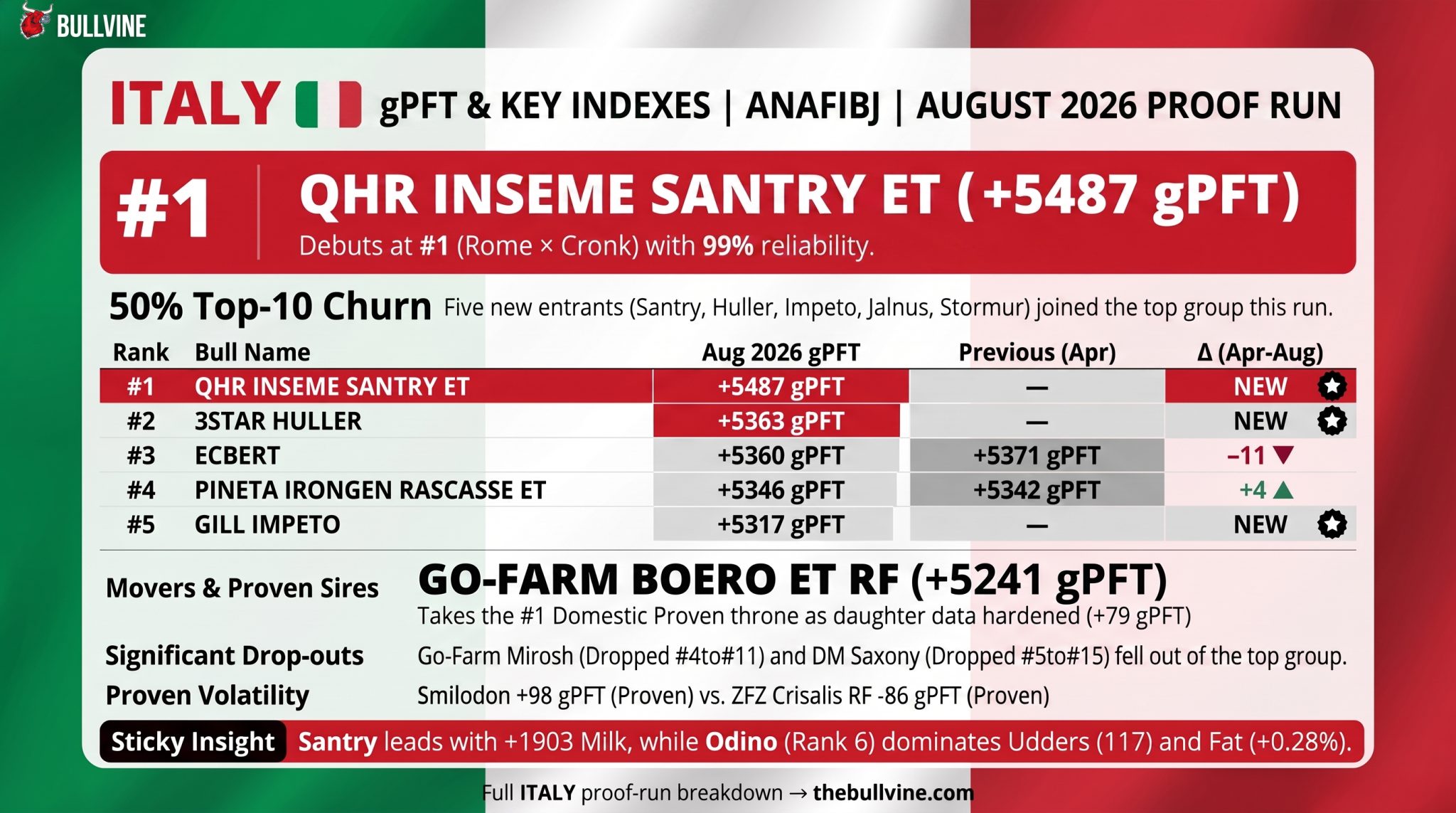
NewsSubscribe
First
Last
Consent

Sourcing, Methodology, and Limitations

How the pedigrees were sourced. Individual sire card data (dam, MGS, MGD, MGGS, MGGD, UDC, FLC, CFP, PL, and full linear profiles). Those figures are reported exactly as published; where a bull is also marketed through another AI organization’s own catalog, small presentation differences (rounding, which trait subset is displayed) can exist between sources. Nine NAAB codes — Aprilday Micn Nickels-RC-ET, Siemers Parfume-RC-ET, Fly-Higher W Humberto-ET, Siemers Amaranth-Red-ET, Siemers Poppy-Red-ET, Trent-Way Richland-Red-ET, and the UDC/FLC composites for Kingdom Formal, Stagger Baelum, Jentry, Patriot 76, and Viper — did not return a match. 

Methodology. Data drawn from six comparable Holstein Association/CDCB ranking files (April and August 2026 USA proof runs), NAAB-coded bulls over 12 months, cross-referenced with individual sire summary sheets. Bulls were matched run-to-run strictly by NAAB code; a bull with no NAAB match in the prior file is a new entrant, one absent from the current file is a drop-out — no missing value was estimated. GTPI led this analysis on a tied top-10 volatility score of 16 against Net Merit $ (new entrants + drop-outs + large rank shifts), tiebroken toward GTPI as the industry’s primary total-merit ranking. The Red & White GTPI file’s missing printed rank “3” was resequenced by row order and is a derived rank. Genomic inbreeding figures reflect each bull’s own relationship to the active cow population, not a herd or breed average.

Send this to a friend