





Virginia Tech’s $1.15 million project aims to get more milk protein from the same protein supply. Preliminary research-dairy savings have been reported. Here’s what to check—and how to calculate the return—before putting it in your budget.
Virginia Tech’s four-year, $1.15 million USDA-funded project is developing a Self-learning Dairy (SLDairy) tool. It would use robotic-milking data to match protein supply to individual cows. The university’s October 27 update describes the opportunity and puts no number on the commercial payoff.
Three Points from the Record
- Virginia Tech is testing whether moving protein from cows fed more than they need to cows that respond to more can raise herd milk-protein output without raising total protein fed. The one-third split it reports comes from research herds and says nothing about which cows in a commercial herd belong in which group.
- A 2024 University of Idaho account reported savings at a Tennessee research dairy and scheduled testing at four commercial dairies. Virginia Tech’s October 2026 update reports no results from those commercial tests.
- In a protein-only revenue scenario, 25¢ per cow per day of total incremental cost needs about 0.094 lb more milk protein daily at the September 2026 U.S. Federal Order protein price. The figure is Bullvine’s illustration and assumes no SLDairy price. Feed savings or changes in other milk revenue would move it.
Robotic-milking herds face two separate tests here. The first is whether the system delivers more milk protein with no increase in protein intake, which is the reallocation claim. The second is whether farm margin improves after every incremental cost, and that one decides the budget.
Matching Protein to the Cow
About a third of cows responded the way herd-average models predicted, according to Virginia Tech’s account of Mark Hanigan’s research. Another third needed significantly less protein than expected, and the rest benefited from more. His recent trials show cows vary considerably in their response to dietary protein. The announcement gives no sample sizes for the split.
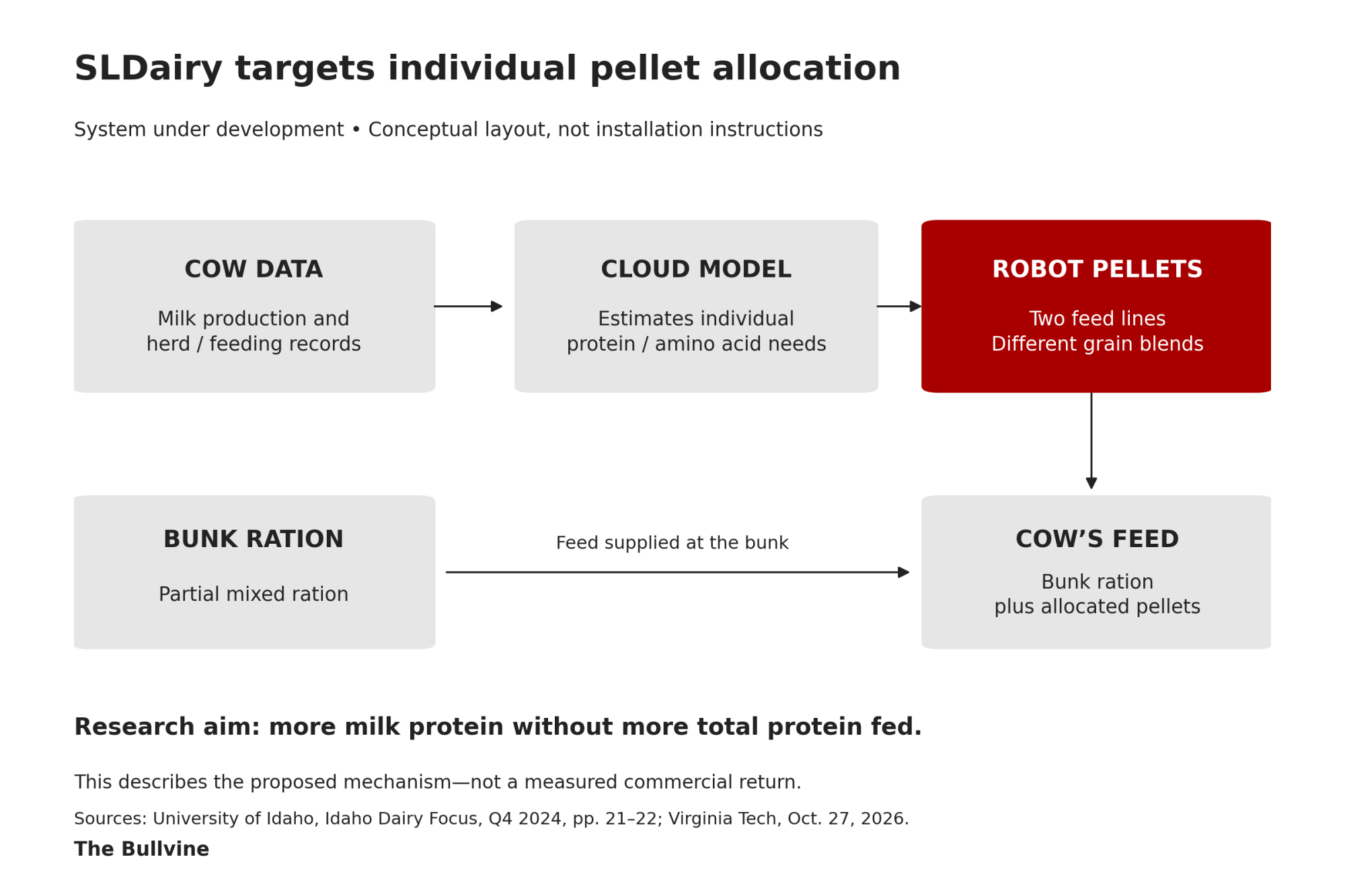
Hanigan has spent 35 years studying how dairy cows use dietary protein and energy. His research laid the groundwork for models that helped inform the National Academies’ 2021 Nutrient Requirements of Dairy Cattle. Under the proposed strategy, protein shifts from cows fed more than they need to cows that respond to additional supply. Virginia Tech says that could raise herd milk-protein production without raising total protein fed.
University of Idaho Extension dairy specialist Izabelle Teixeira described the problem in 2024 by comparing a ration designed for the average cow to handing medium-sized shirts to a large group. The shirts fit about a third of the people and are too small or too large for the rest.
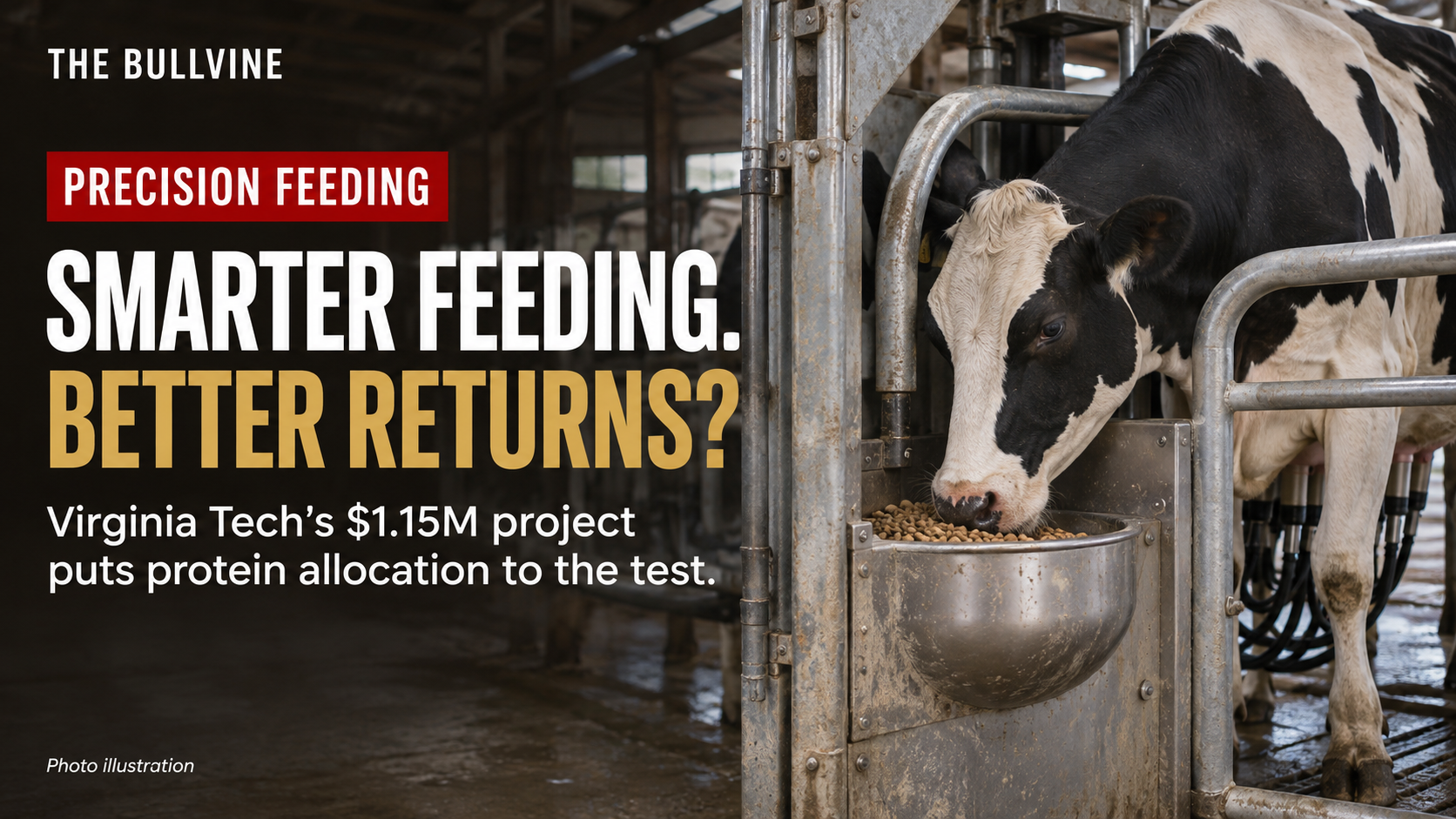
SLDairy is cloud-based and runs on existing automatic milking equipment. Cows get a partial mixed ration at the bunk, then pellets at the robot from two feed lines carrying different grain blends. The amount dispensed follows each cow’s modeled protein and amino acid needs.
What the Reviewed Accounts Show
The project launched in October 2024 under USDA-NIFA award No. 2024-68016-42391, with Virginia Tech as lead institution. At the University of Idaho, Extension agricultural economist Hernan Tejeda is helping analyze the savings the system achieves.
The 2024 account said the team “documented considerable savings” in small-scale testing at a Tennessee research dairy and gave no dollar figure. It scheduled testing at two commercial dairies the following fall and two more in spring 2026.
Virginia Tech’s October 2026 announcement reports no results from those commercial tests. On the investment question, the evidence that counts is a commercial comparison of protein intake, milk-protein yield and costs.
Two Algorithms, No Demonstrated Gain
A separate Virginia Tech experiment fed 24 Holsteins on two supplementation algorithms and compared them with conventional TMR feeding. One algorithm used each cow’s average past performance; the other used the slope of her past responses. The Journal of Animal Science published the results on September 15, 2025. This was not a test of SLDairy.
The differences in the table were not statistically significant. Means are reported using actual 2019 feed and milk prices.
| Feeding group | Income over feed cost (US$/head/day) |
| Conventional TMR | 3.33 |
| Algorithm 1 (past average) | 2.84 |
| Algorithm 2 (response slope) | 3.71 |
Neither algorithm showed improved economic performance. The study doesn’t show that individualized feeding can’t work. It does show that spotting individual responses and profiting from them are different problems, which puts attribution and repeatability first in any evaluation.
The authors also reported a measurement gap. There were no records of how often the milk-component sensor was calibrated, and no DHIA test results to compare against. Milk composition played no part in training or evaluating the algorithms. Any system judged on milk protein still needs component data checked against a credible reference.
The Longer-Term Breeding Potential
Dairy geneticist Rebecca Cockrum is working to identify genetic markers associated with high nitrogen-use efficiency, according to Virginia Tech. The university says identifying cows that consistently use nutrients more efficiently could open opportunities for selection.
The October announcement names no validated marker or selection tool from this work. A cow’s response to a ration change is a starting observation; a reliable genetic selection criterion needs more evidence than that. For breeders, this is research to follow, and the release makes no selection recommendation.
Five Evidence Checks
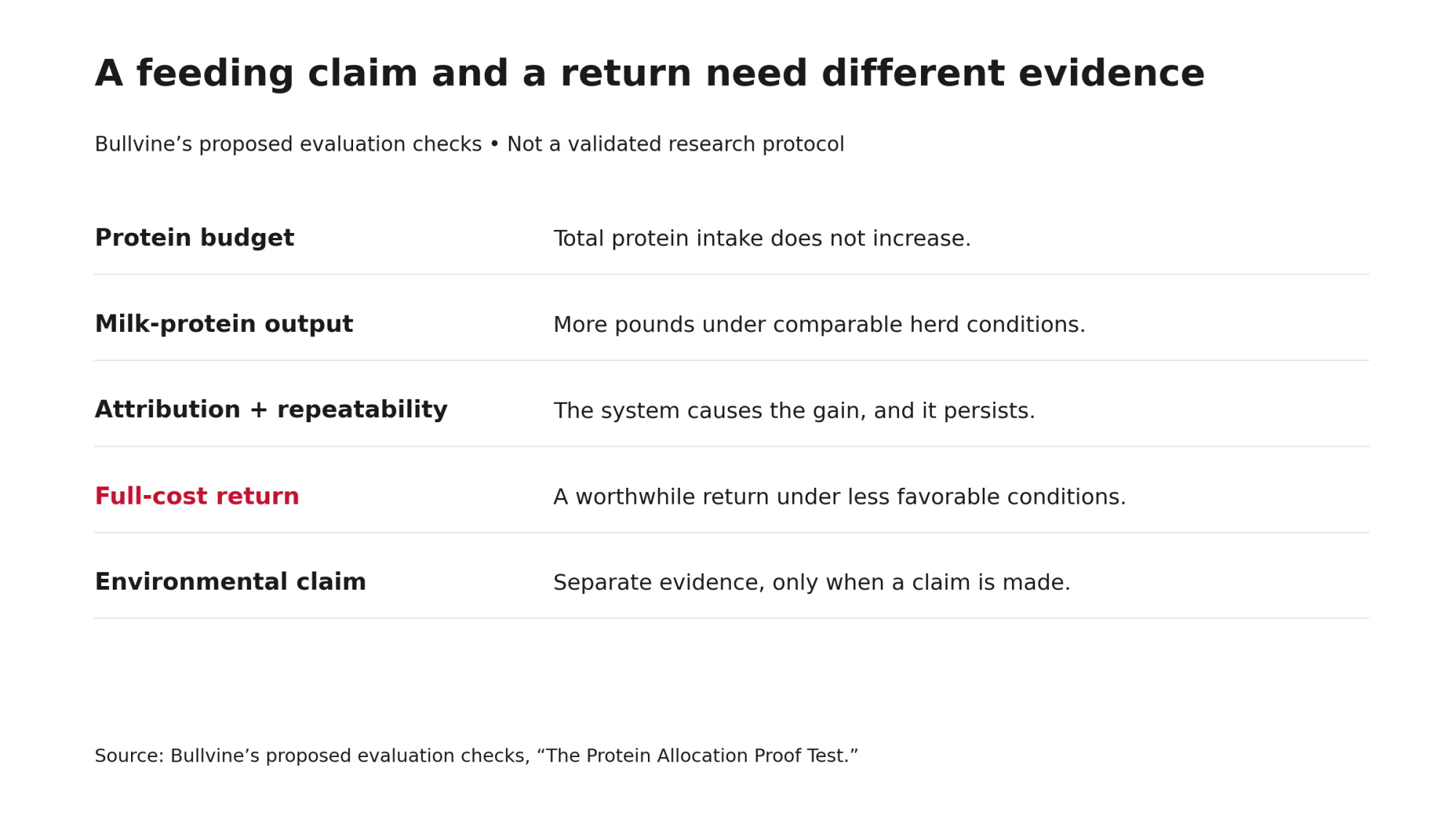
These are Bullvine’s proposed evaluation checks, not a validated research protocol. The first three test the specific claim of more milk protein from the same protein supply. The fourth tests the investment. The fifth applies only when someone claims an environmental benefit.
| Check | Evidence to request | What it needs to establish |
| Protein budget | Bunk-ration and robot-pellet intake, with feed analyses and consistent accounting | Total protein intake does not rise. Shifting delivery between bunk and robot is not an improvement by itself |
| Milk-protein output | Milk volume and protein concentration measured over compatible periods, with reliable reference testing | More pounds of milk protein under comparable herd conditions |
| Attribution and repeatability | A credible comparison treatment, an evaluation period suited to the response measured, follow-up beyond the data used to set allocations, and results from additional commercial herds | The improvement comes from the system and persists beyond the initial test |
| Full-cost return (investment test) | Changes in total milk revenue and feed cost, plus all added system and management costs | A worthwhile net return that stays positive under less favorable prices and responses |
| Environmental claim (if made) | Nitrogen measurements and, if lower ammonia is claimed, an ammonia comparison with a stated measurement boundary | Evidence that supports the specific claim |
The comparison has to account for stage of lactation, cows entering or leaving the group, feed changes and other management changes. A better result after installation does not, on its own, show that the system caused it.
The robot’s delivery log records pellets delivered, not each cow’s intake at the bunk. A pen-level protein balance needs feed deliveries, refusals, feed analyses and an allowance for losses. Claims about individual cows need individual intake measurements or a validated estimate.
Milk-protein yield depends on how milk volume and protein concentration are measured and matched over time. Sensor readings need checking against DHIA or another appropriate laboratory reference.
Virginia Tech’s October announcement reports no measured SLDairy ammonia reduction. That is a separate evidence question, and any unverified environmental payment stays out of the base investment calculation.
Running the Numbers
The simplest scenario has extra milk-protein revenue covering the system’s whole incremental cost. Other milk revenue holds steady, and any change in feed cost sits inside the incremental-cost figure.
Additional milk protein needed (lb/cow/day) = total incremental cost ($/cow/day) ÷ protein price ($/lb)
USDA AMS reports a September 2026 Federal Order protein price of US$2.6619/lb. It serves here as a historical benchmark, with no forecast of the price a farm would receive once a system is available.
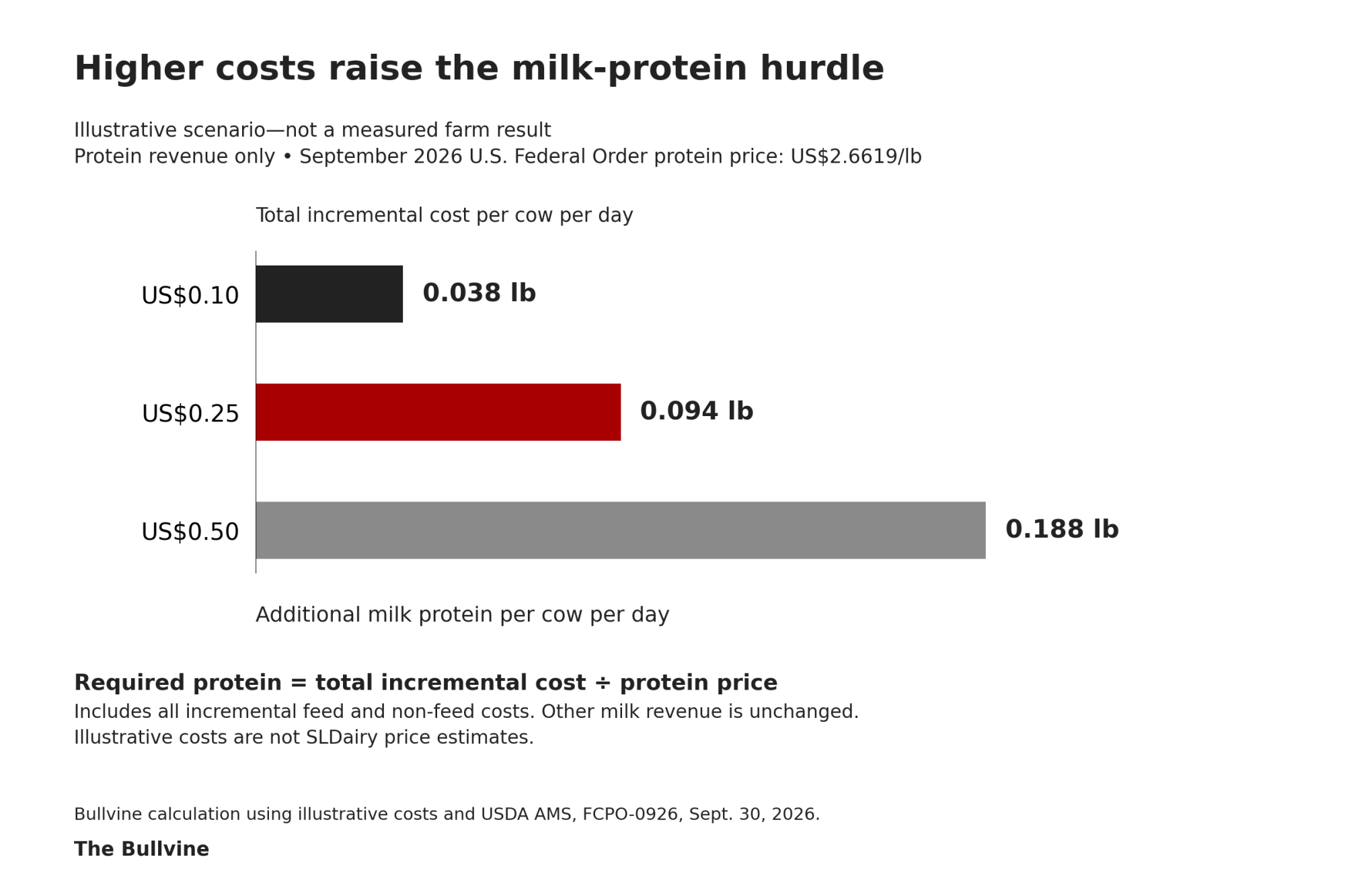
| Illustrative total incremental cost | Additional milk protein needed |
| US$0.10/cow/day | 0.038 lb/cow/day |
| US$0.25/cow/day | 0.094 lb/cow/day |
| US$0.50/cow/day | 0.188 lb/cow/day |
Four conditions sit under the table:
- All figures are U.S. dollars.
- The cost levels are illustrations and estimate no SLDairy price.
- Only additional milk-protein revenue is credited.
- Every incremental feed and non-feed cost is inside the cost figure tested.
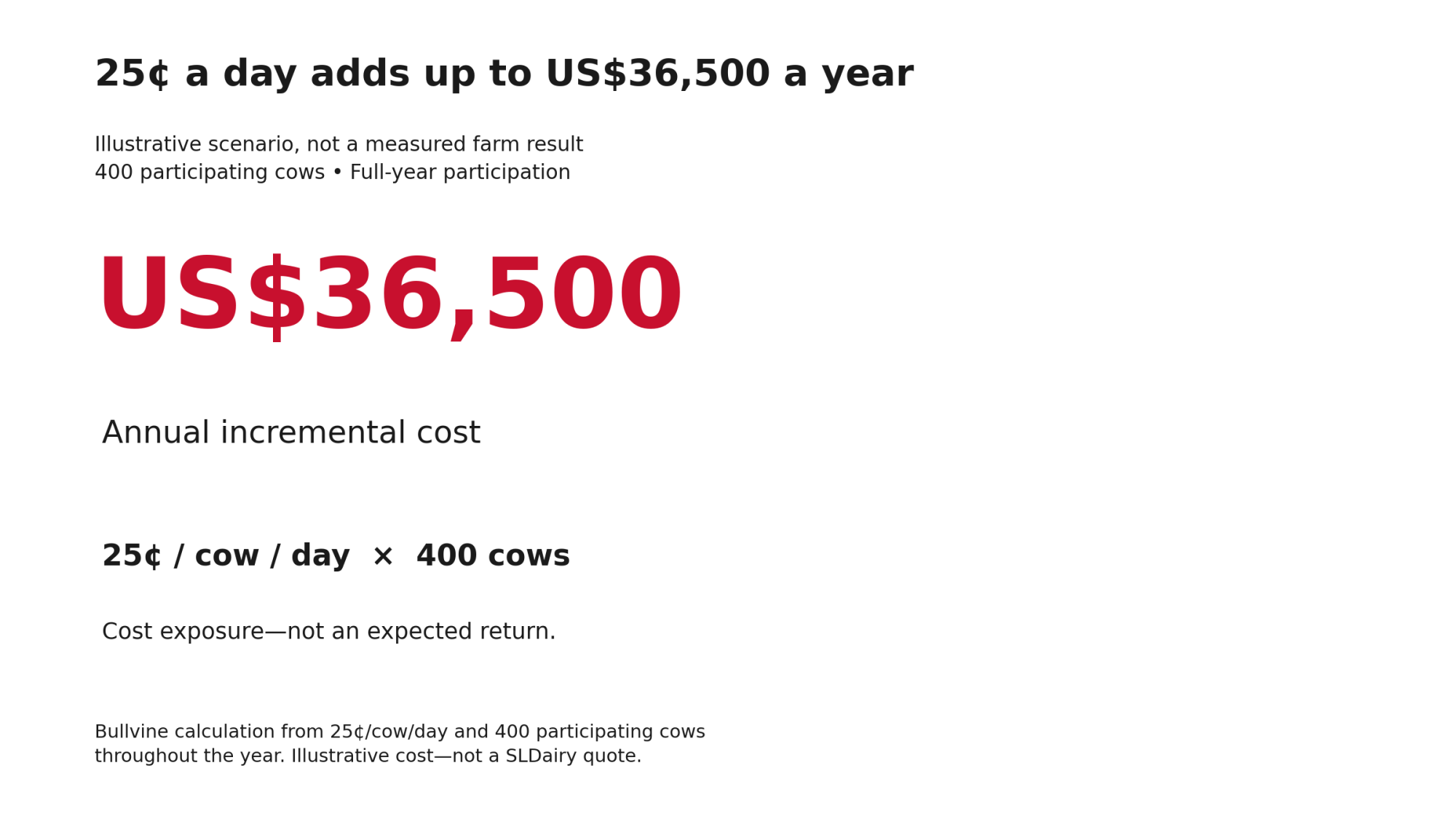
At 25¢ per cow per day, 400 participating cows would carry US$36,500 in annual incremental cost if they took part all year. That is cost exposure and projects no return. The calculation is Bullvine’s.
Feed cost can change even when protein intake doesn’t. Matching the pellets’ cost per pound of protein doesn’t hold total ration cost either, because bunk ingredients, pellet quantities and delivery costs all count. The full calculation includes:
- the actual cost change for both the bunk ration and the robot pellets,
- software, service, maintenance and management time,
- an annual ownership cost for any added equipment.
Every item goes on the same per-cow, per-day basis, with equipment counted once.
Net benefit per cow per day = change in total milk revenue − change in feed cost − added system and management costs
A system could pay through additional milk protein, feed savings, changes in other milk components, or a mix, and each changes the protein gain required. The farm’s own payment terms and measured responses belong in the calculation. A lower component price and a smaller production response are the first two stress tests. A result that barely clears breakeven on the September price has no margin for either.
Precision Protein Breakeven Calculator
Test the dealer’s quote before you buy. Calculate the exact milk-protein increase required to cover an individualized robotic feeding upgrade.
Breakeven Target
Extra protein/cow/day needed to pay for the system.
Annual System Cost
Total cost exposure for the herd per year.
Projected Net Return
Annual return after covering all system costs.
What This Means for Robot Herds
The next ration review should get answers from the nutritionist and the robot supplier on four points:
- whether the equipment can deliver the separate pellet blends the system requires,
- whether each cow’s feed allowance and recorded pellet delivery can be exported with dates and milk-production records,
- whether milk-component readings are checked against an appropriate laboratory reference,
- whether bunk feed, pellets, refusals and losses support a credible pen-level protein balance.
A purchase decision needs three things from the vendor: completed commercial comparisons, the implementation requirements, and a written quote covering every incremental cost. The baseline, comparison method, evaluation period and stopping criteria get agreed before any allocation changes.
The reported one-third split is no basis for deciding which cows get less protein. The university’s account doesn’t identify where any commercial herd’s cows fall in those groups.
In the accounts reviewed, SLDairy has a research-dairy savings report and no published commercial comparison.
Complete references and supporting documentation are available upon request by contacting the editorial team at editor@thebullvine.com.
Learn More
- Robotic Milking Labor Math: Fix the Problem or Grow Debt? — Exposes the hidden fixed-cost trap of automated milking investments. Arms you with a concrete playbook to stress-test your debt-service coverage ratio before trading variable hourly labor for a seven-year cash flow hole.
- Feed Smart: Cutting Costs Without Compromising Cows in 2025 — Follows the money on high-value co-products to defend your margin against incoming sustainability mandates. Delivers a direct procurement strategy designed to slash up to $470 per cow from your annual feed bill without sacrificing peak lactation.
- Everything Dairy Farmers Need to Know About Residual Feed Intake — Breaks down the raw metrics behind true biological feed efficiency. Reveals how isolating and selecting for negative residual feed intake builds a genetically superior herd that pumps out more fat-corrected milk on fewer pounds of dry matter.
The Sunday Read Dairy Professionals Don’t Skip.

Every week, thousands of producers, breeders, and industry insiders open Bullvine Weekly for genetics insights, market shifts, and profit strategies they won’t find anywhere else. One email. Five minutes. Smarter decisions all week.