






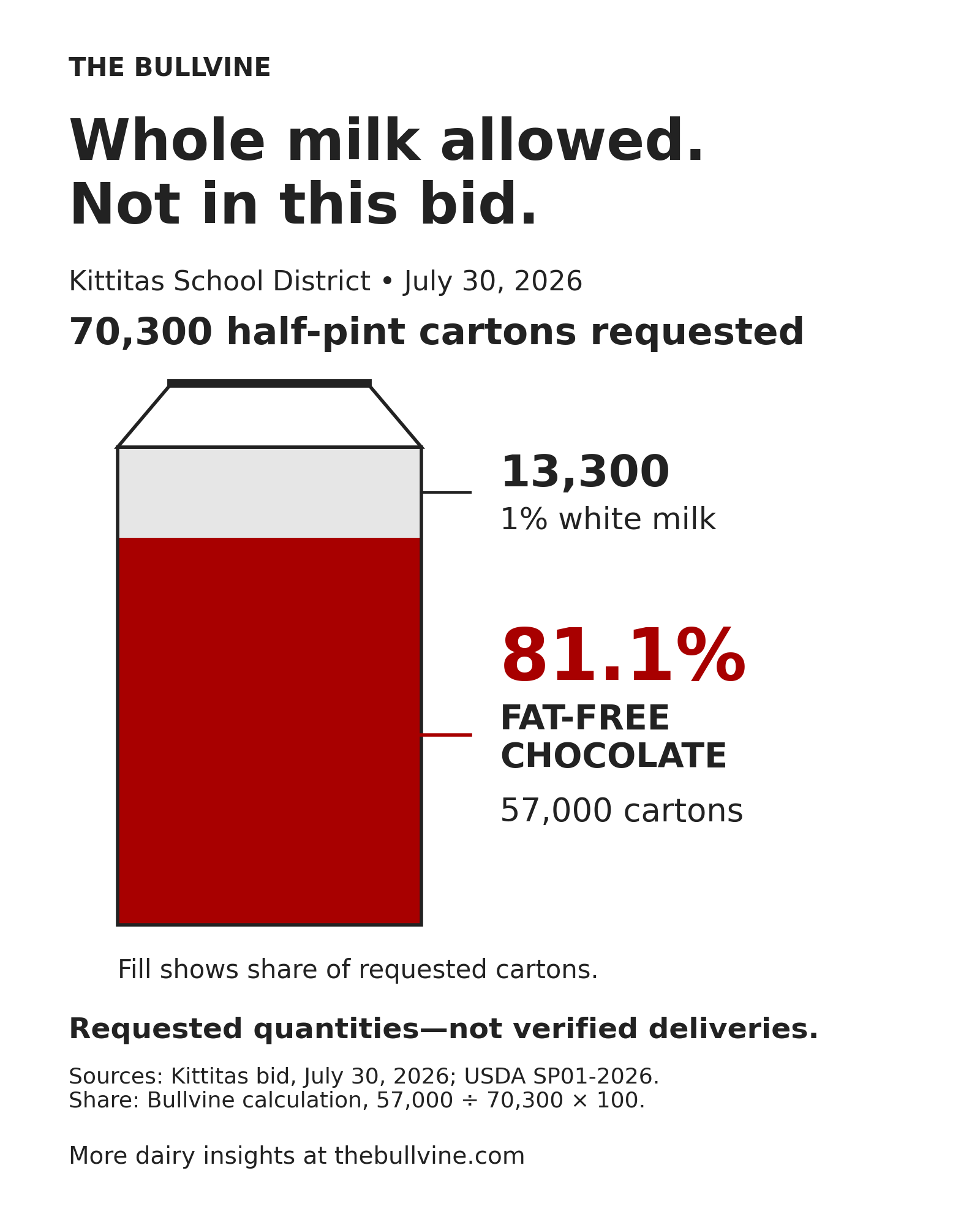
Whole milk had been allowed at school lunch for more than six months. Kittitas still listed 13,300 1% cartons and 57,000 fat-free chocolate, and chocolate’s 81% share drives most of the modeled butterfat gain.
Key Takeaways
- 70,300 cartons, none whole: Kittitas’s July 30 bid listed only 1% and fat-free chocolate, more than six months after whole milk was allowed.
- 81% chocolate: In Bullvine’s math, chocolate supplies about 85% of the modeled extra butterfat if both products went whole.
- The question to ask: Can your handler offer a compliant, priced whole chocolate carton a district buyer will authorize?
Kittitas School District, in Kittitas, Washington, posted its 2026/2027 milk bid on July 30, 2026. It asked for 13,300 half-pints of 1% milk and 57,000 half-pints of fat-free chocolate, 70,300 cartons in all. By then, whole milk had been allowed at school lunch for more than six months.
The bid listed only lower-fat products, even though the options had expanded. It doesn’t show what the district ultimately bought.
It’s a small account. The bid covers deliveries to two schools, Kittitas Elementary and Kittitas Secondary. That makes it a clean example to read line by line, not a sample of what districts nationally are buying.
Why the chocolate carton is the real question
Chocolate makes up 81.1% of the cartons Kittitas solicited (57,000 of 70,300), by Bullvine’s count. That’s why most of the modeled extra butterfat in this account comes from chocolate.
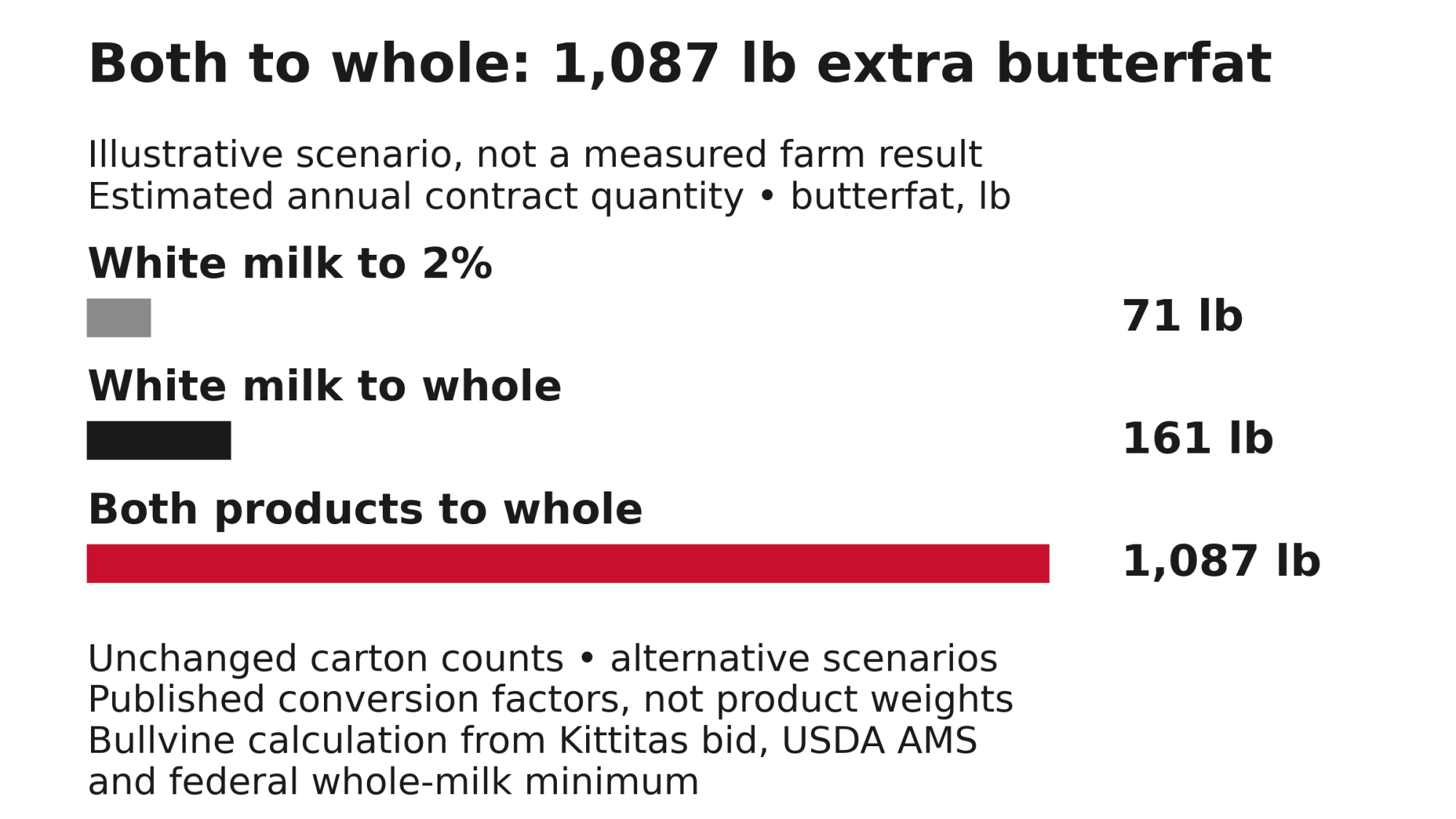
| Scenario | Product change | Estimated extra butterfat |
| White milk to 2% | Solicited 1% cartons become 2% | 71 lb |
| White milk to whole | Solicited 1% cartons become whole white milk | 161 lb |
| Both products to whole | 1% becomes whole white milk; fat-free chocolate becomes whole chocolate milk | 1,087 lb |
Bullvine calculation over the estimated annual contract quantity, not measured purchases. The scenarios are alternatives, so they don’t add up. Figures use published USDA AMS container-conversion factors, not verified product weights.
When both products go to whole, chocolate supplies about 930 of the roughly 1,090 extra pounds, or about 85%. Switching white milk alone covers only 19% of the cartons, which is why its number is so small.
That turns the opportunity into one specific question. Can a supplier offer a compliant, competitively priced whole chocolate carton that this buyer will buy?
What 1,087 lb looks like on a farm The largest Kittitas scenario adds roughly 1,087 lb of butterfat over the estimated annual contract quantity. That’s about one day of butterfat from one illustrative 400-cow herd, roughly 1,050 lb a day. The herd is a Bullvine assumption: 24,000 lb of milk per cow per year at 4.0% fat. It shows the size of one district account. It isn’t an estimate of the national school-milk opportunity.
What changed federally, and what didn’t
Public Law 119-69, signed January 14, 2026, says schools “may offer” whole and 2% milk. It doesn’t require them to. USDA’s guidance applied the change at lunch immediately. Its final rule extended the change to breakfast and other programs from June 8. The same law also lets schools offer nondairy beverages that are nutritionally equivalent to fluid milk. A buyer revisiting its milk specification has more than one direction to move.
Permission was settled before Kittitas wrote its bid. Whether whole milk actually reaches a tray still comes down to specifications, what suppliers can offer, price, menu nutrition and contract terms.
What the bid’s terms say, and what’s still unknown
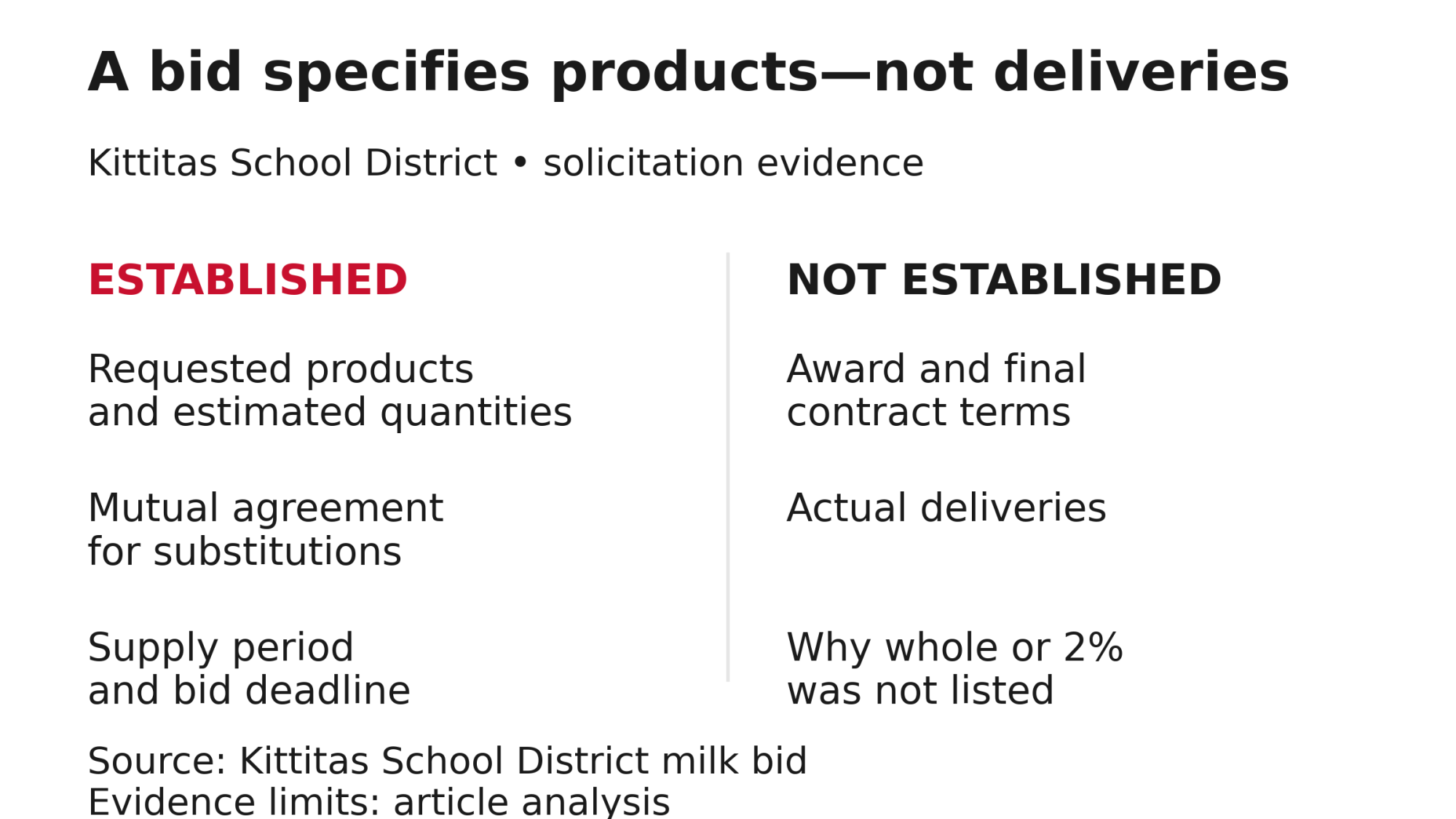
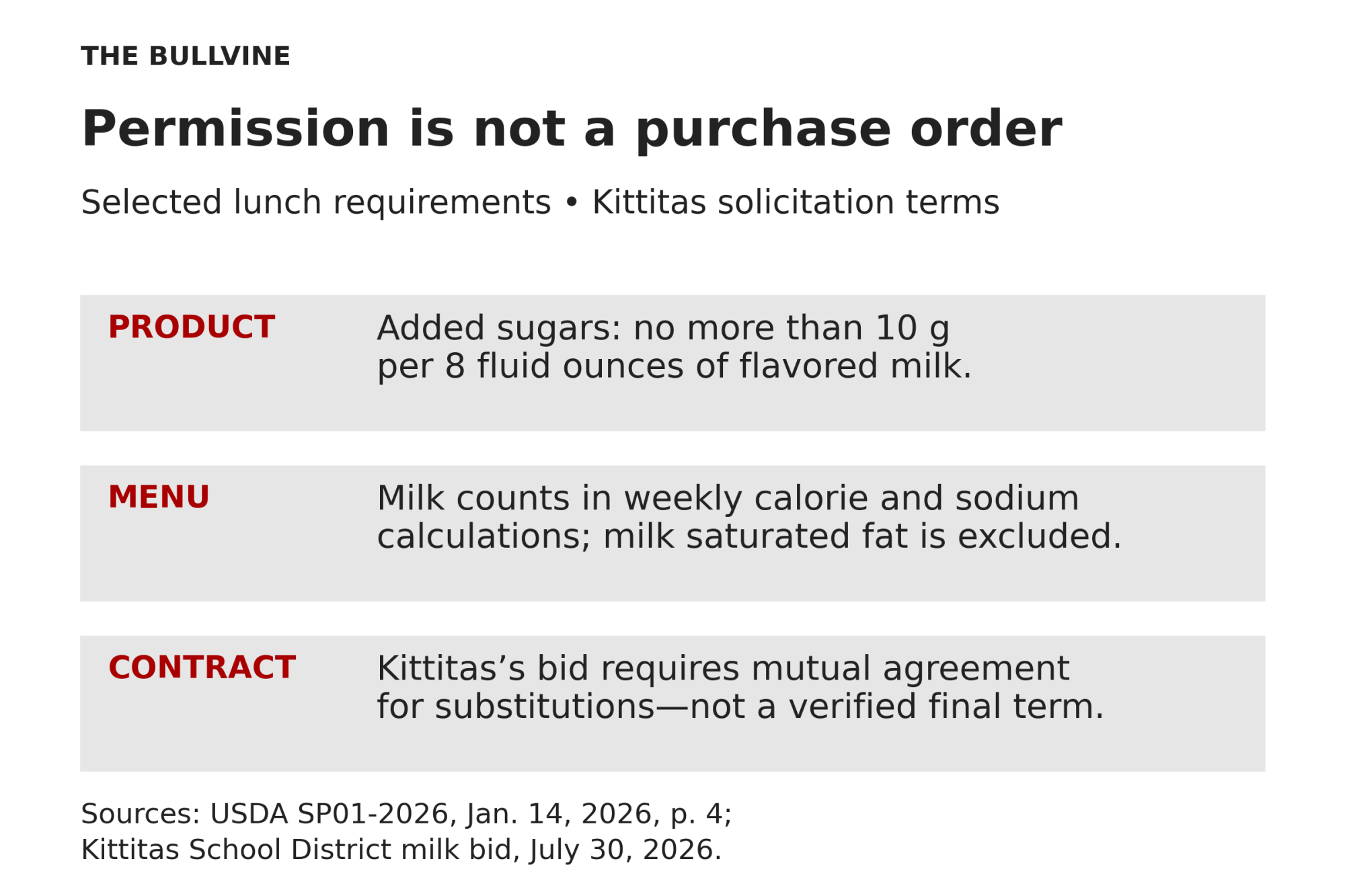
The bid covers September 1, 2026 through August 31, 2027. Bids closed August 21, and the award was scheduled for the August 26 school board meeting. The quantities are “based on participation from the previous school year.” The bid also states: “Substitutions shall be made only upon mutual agreement of the parties.”
If that term carried into the final contract, the law alone wouldn’t let a supplier change products. The buyer would have to agree. Even then, agreement between the two parties wouldn’t on its own show that every amendment fits the district’s purchasing rules.
Here’s where the public record stops.
The solicitation establishes:
- The products and estimated quantities requested
- That substitutions require mutual agreement
- The supply period and the August 21 deadline
Still unknown:
- The award and final terms
- What’s actually being delivered
- Why whole or 2% wasn’t listed
Supplier records, the board’s award minutes or a district response could fill those gaps.
Does more butterfat mean more gallons?
Not necessarily. Component demand isn’t the same as fluid volume demand.
These scenarios put more fat into the same number of cartons. That changes how much butterfat this one account buys. It doesn’t show more gallons, more national dairy demand or any change in producer prices. Volume stays flat only because the model holds carton counts constant, and enrollment and meal participation could move it either way.
To judge a real change, track three things separately: how many cartons or gallons the account buys, how much butterfat it buys, and how much milk students actually choose and drink.
What the nutrition rules require
USDA’s guidance sets three separate requirements:
- The flavored carton: no more than 10 grams of added sugars per 8 fluid ounces, in effect since July 1, 2025. A whole chocolate carton has to meet this.
- The menu: Milk still counts toward weekly calorie and sodium limits, and toward added sugars from July 1, 2027. These apply to the whole menu, not to each carton.
- Saturated fat: Fluid milk’s saturated fat no longer counts in the weekly saturated-fat calculation at lunch.
None of this makes whole milk noncompliant. It means a whole chocolate carton has to clear the sugar cap and fit within the menu’s weekly limits.
What should you ask your co-op?
Don’t ask whether schools can serve whole milk. Ask your co-op these three questions:
- Within about 30 days (a suggested work period): Ask for one supplied district’s current products and volumes, plus a compliant whole or 2% alternative with a delivered price. Where chocolate dominates, include a whole chocolate option.
- Before that district writes its next specification: Ask who can authorize a change, and when the next specification is prepared. Kittitas’s bid closed in August, so don’t assume one national bidding window.
- After a full year under any change: Ask for a before-and-after comparison over matching periods, by product and volume. Include participation and waste data where they exist, and treat component change and fluid-volume growth as separate outcomes.
Keep two numbers apart: the butterfat that moved and the gallons that were added. Neither tells you what reaches your milk check. That depends on how your handler prices the account and pays out, and on how Class I moves flow through your order’s pool. Our breakdown of October’s $1.84 Class I jump shows how differently that plays out by region.
The next answer to get is commercial, and you can check it. Is there a compliant whole chocolate carton at a delivered price this buyer will authorize? Ask your handler to find out.
Methodology Note
All figures are Bullvine math on the district’s estimated annual quantities, not purchases.
- Results: 71.49 / 160.85 / 1,087.10 lb of extra butterfat. Chocolate contributes 926.25 lb.
- Inputs: Whole milk at the 3.25% federal minimum. White cartons use the USDA AMS whole-milk factor of 0.5375 lb per half-pint at every fat level. Chocolate uses 0.5000 lb per half-pint, derived from AMS’s 8.00 lb per gallon for flavored whole milk. AMS uses these factors to convert volumes into container counts; they aren’t verified product weights. Fat-free is treated as 0% fat. Whole chocolate is modeled at 3.25% fat.
- Herd: 400 cows × 24,000 lb × 4.0% fat = 384,000 lb a year, or 1,052 lb a day.
- Account size: 4,393.75 gallons. No prices or farm-price effects are estimated.
Complete references and supporting documentation are available upon request by contacting the editorial team at editor@thebullvine.com.
Learn More
- Protein Will Drive Your 2026 Milk Check: Are Your Components Still Built for the Butterfat Era? — Defending your mailbox price requires balancing components, not just maximizing fat. This breakdown exposes why cheese plants penalize fat-heavy milk and arms you with specific sire and ration adjustments to hit the ideal protein-to-fat ratio.
- FMMO Pays $1.71/lb for Butterfat Worth $2.95: What USDA’s December Report Tells You About Your Milk Check in 2026 — True margin clarity comes from tracking where your exported butterfat actually ends up. This analysis dismantles the $1.24/lb gap between FMMO payouts and global values, revealing exactly how processors capture capital before your check prints.
- Whole Milk is Back in Schools. Here’s Why Only 834 Dairy Farms Will Really Win. — Survive the shift in institutional economics by recognizing supply limitations early. This contrarian report tracks the 13-year policy wait and delivers the brutal math proving why only herds over 1,500 cows will pocket meaningful premiums.
The Sunday Read Dairy Professionals Don’t Skip.

Every week, thousands of producers, breeders, and industry insiders open Bullvine Weekly for genetics insights, market shifts, and profit strategies they won’t find anywhere else. One email. Five minutes. Smarter decisions all week.