


Archive for inbreeding depression

Your Top Heifers All Trace to Three Cow Families. That’s a $ 93,300-A-Year Trap.

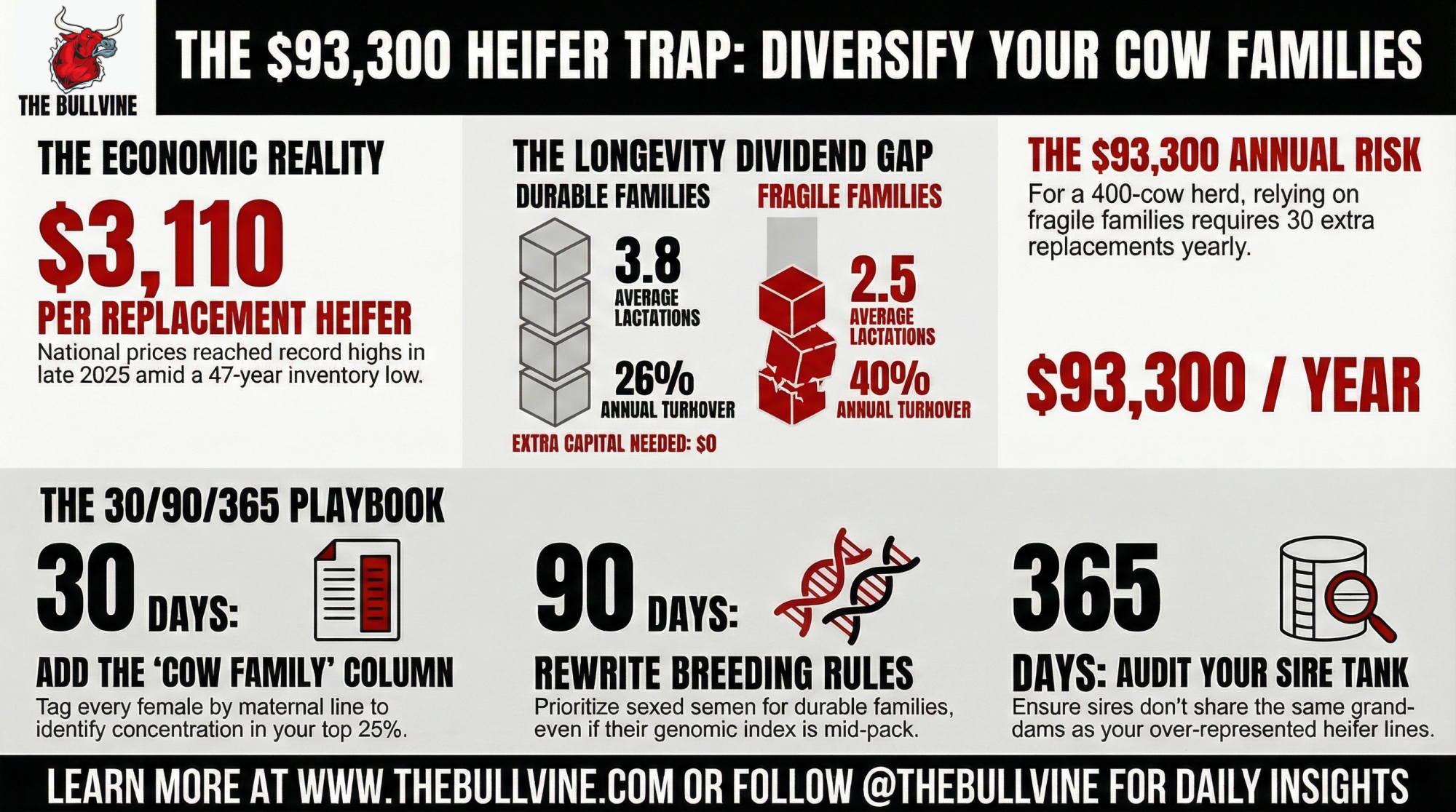
Your top genomic heifers probably trace to three cow families. In a $3,110 heifer market, that concentration can be a $93,300‑a‑year mistake.

Executive Summary: Replacement heifers averaged $3,110 per head in late 2025, inventories are sitting at a 47‑year low, and that makes your heifer pipeline one of the biggest financial risks on your farm. This article shows how herds like Glenn Kline’s — with every heifer genomic‑tested and beef‑on‑dairy dialed in — can still end up with most of their “best” heifers tracing back to just two or three cow families that don’t consistently last three or more lactations. When those same maternal lines also dominate your AI sires, you’re quietly concentrating inbreeding and fragility, not diversifying. On a 400‑cow herd, that concentration can mean 20–30 extra replacements every year, tying up about $93,300 in replacement capital at current prices. You get a concrete 30/90/365‑day playbook: add a cow‑family column to your data, run survival and culling by family, re‑aim sexed/IVF/beef rules at proven‑durable lines, and double-check your sire list by maternal line. The bottom line: genomics and beef‑on‑dairy still drive progress and cash flow — but adding cow family as a sorting column turns your breeding program into a risk‑management tool instead of a ,300‑a‑year gamble.
Cow Family Concentration

USDA’s October 2025 Agricultural Prices report pegged the average U.S. replacement dairy heifer at $3,110 per head— the highest figure ever recorded in that series. By January 2026, the national average eased to $2,860, but top springing heifers in California and Minnesota were still clearing above $4,000. U.S. replacement inventories? A 47‑year low, with CoBank estimating the country is short roughly 800,000 dairy heifers across 2025–2026.
At his Holstein herd in Pennsylvania, Glenn Kline has built exactly the kind of genomic program those prices reward: every heifer is genomic‑tested, lower performers are bred to beef, and IVF is used to multiply the top cows. “Back in 2011, we started on genomic testing, and boy, that’s made a huge difference in our herd,” he told the CDCB industry meeting at World Dairy Expo 2025. When he expanded and had to buy animals in, the gap was obvious. “There was really a significant difference with our original animals lasting longer,” Kline said.

The genomics worked. The bought‑in cows didn’t hold up. But here’s the question Kline’s spreadsheet doesn’t answer — and that most progressive breeders aren’t asking either: which cow families do his best genomic heifers actually belong to? And what does it cost when a handful of famous families quietly dominate your replacement pipeline in the tightest heifer market in five decades?

The Cull Math That Changes Everything

Penn State Extension’s cull‑rate benchmarking using USDA/NAHMS data shows how many cows never reach the point where they’ve truly paid their way. In U.S. dairy herds tracked by NAHMS, the annual combined cull and death rate is around 37–38%, with about 73% of culls involuntary — driven by infertility (23.3%), mastitis (18.6%), lameness, and other biological failures rather than planned marketing decisions.

Penn State and other economic analyses put the full heifer‑rearing cost from birth to calving in the $1,800–$2,400range, depending on system, with roughly $2,000 per head as a solid 24‑month benchmark for many U.S. herds. At that cost level, most operations need three or more lactations before a cow starts delivering a longevity dividend instead of just paying back her childhood.

But NAHMS data still shows average productive life below that three‑lactation mark in many herds, with a large share of cows leaving before they finish a third lactation. Every cow that reaches a fourth lactation saves you at least one replacement you didn’t have to rear or buy and delivers another year of mature‑cow production.
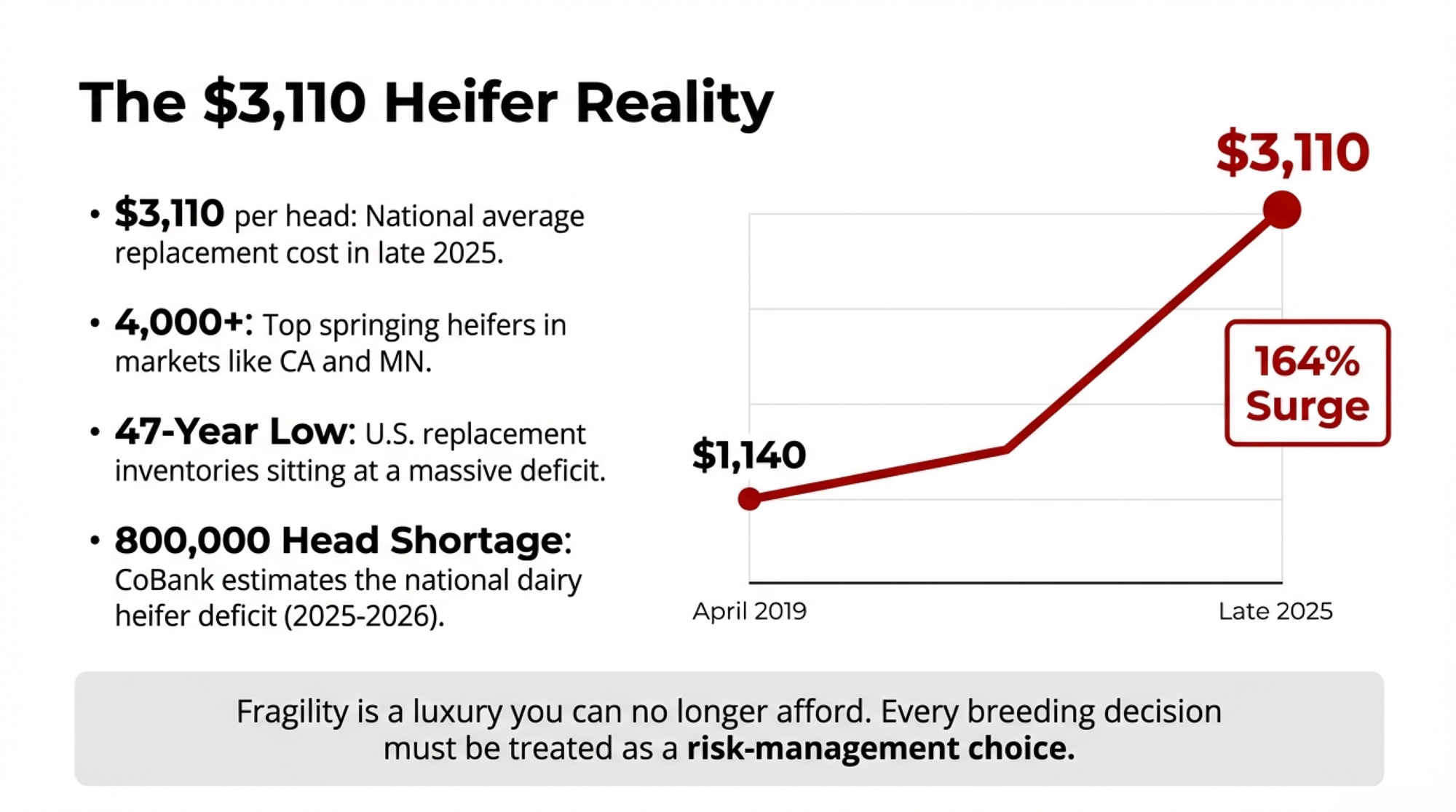
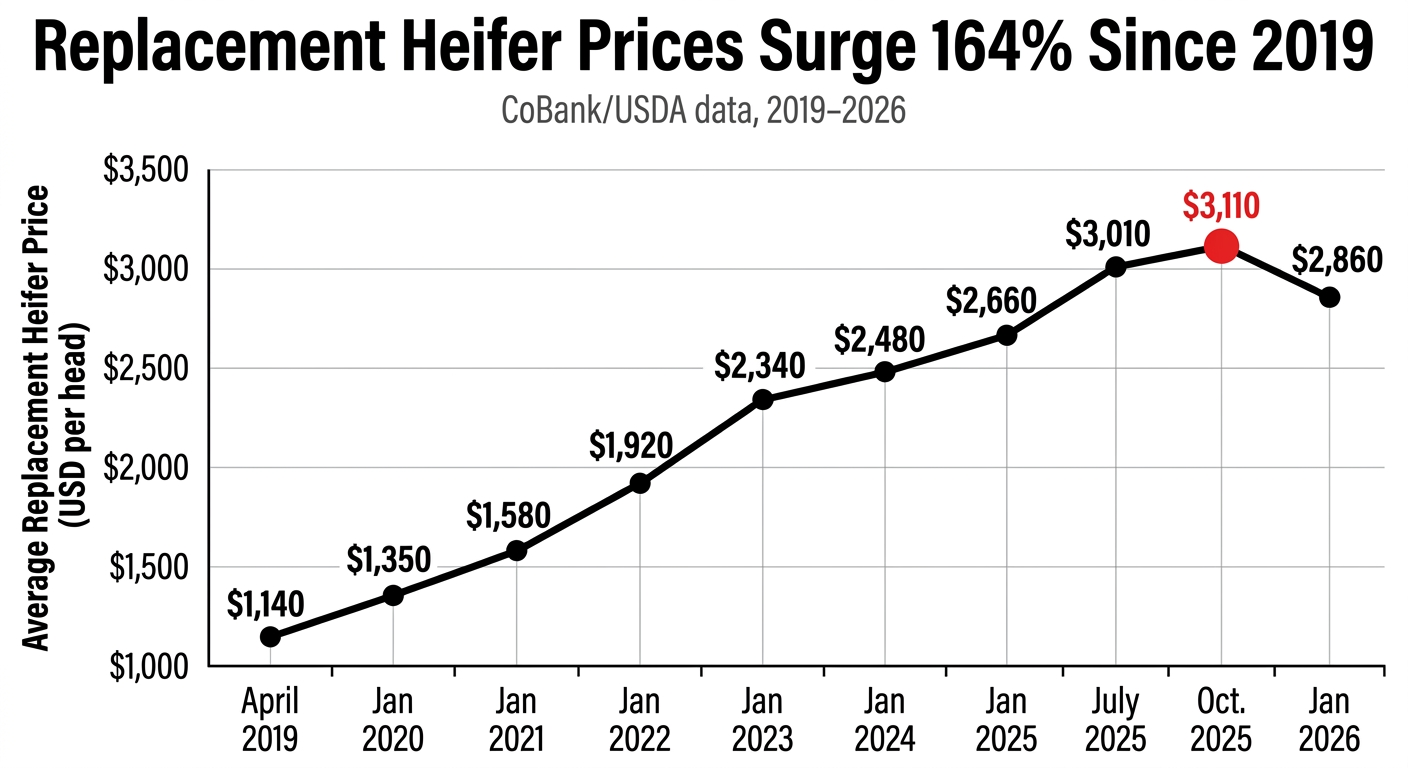
The replacement side of the equation flipped fast. CoBank’s Corey Geiger tracked national averages moving from around $1,140 per head in April 2019 to $2,660 by January 2025, then surging to $3,010 in July 2025 — a 164% jump from that 2019 low. That’s the backdrop for every breeding decision you make right now.
How Genomics Quietly Narrowed the Sire Base

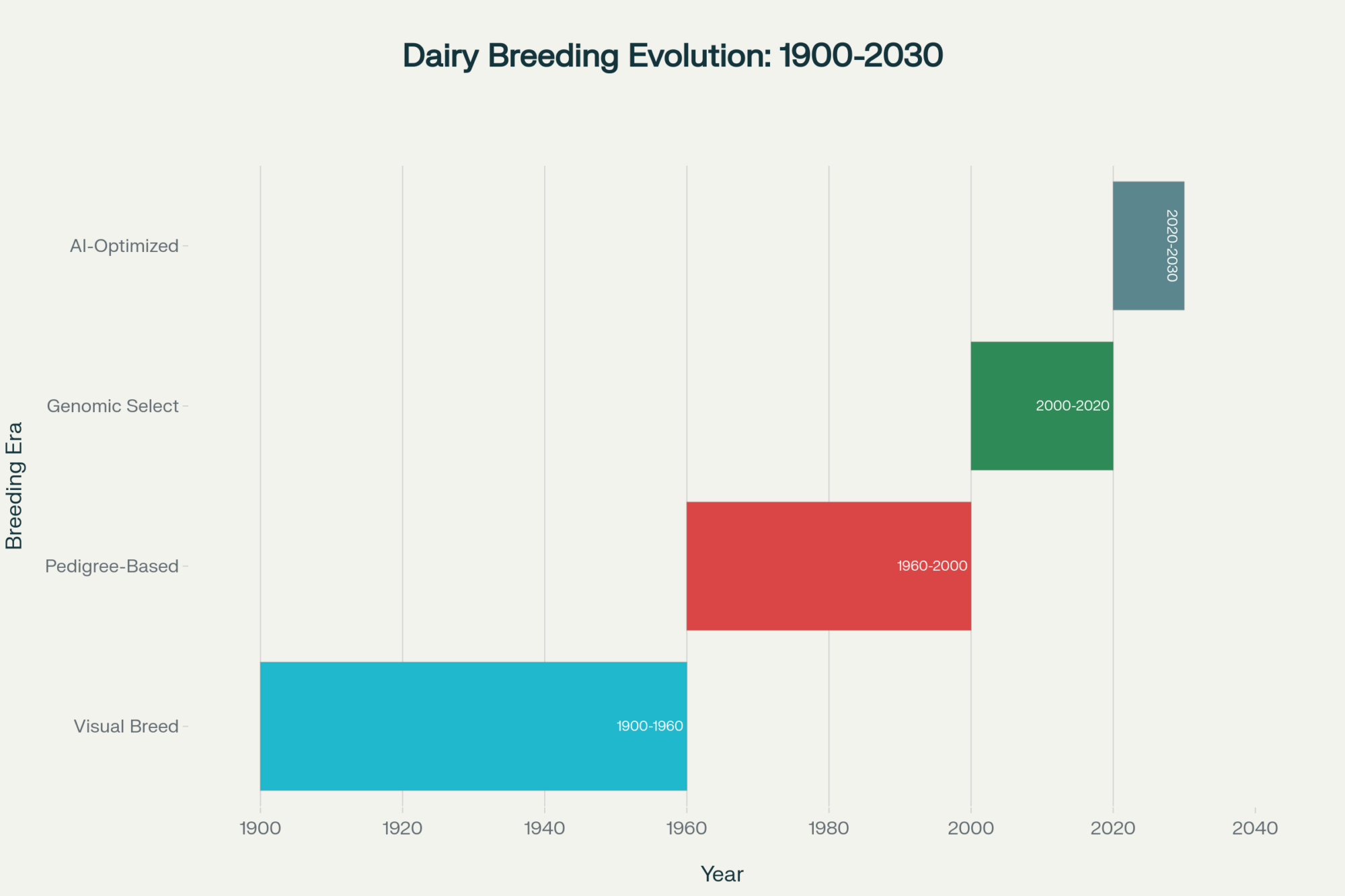
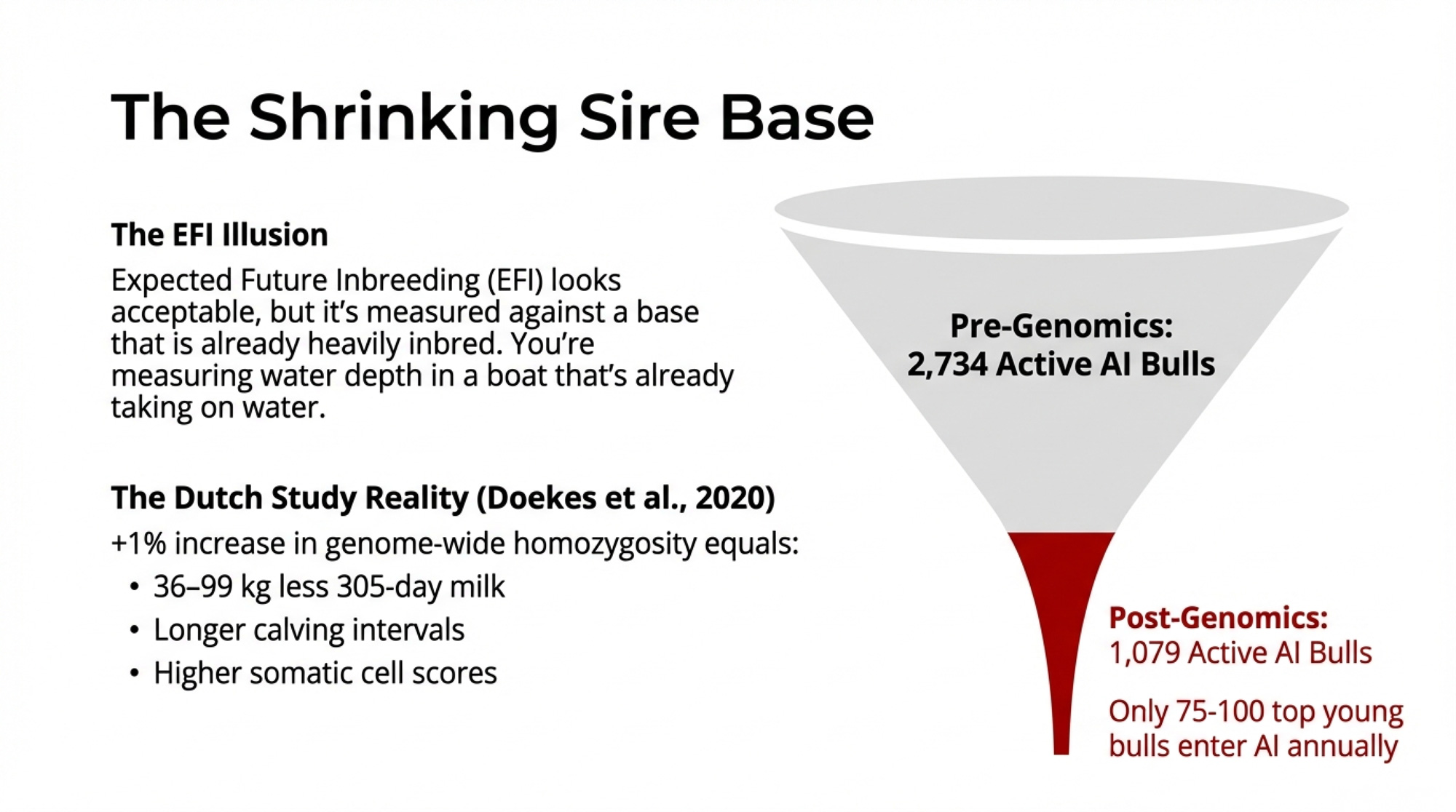
Here’s what the genomic revolution delivered alongside all that genetic gain: a smaller sire base and more concentrated maternal lines. Within the last decade, active Holstein bulls in AI programs dropped from about 2,734 to 1,079, and only 75–100 top genomic young bulls now enter AI each year in the U.S. — down from 1,000+ pedigree‑selected bulls annually before genomics. Big contraction on the male side. And because many of those “new” top bulls come from the same elite cow families, the female side narrows too.
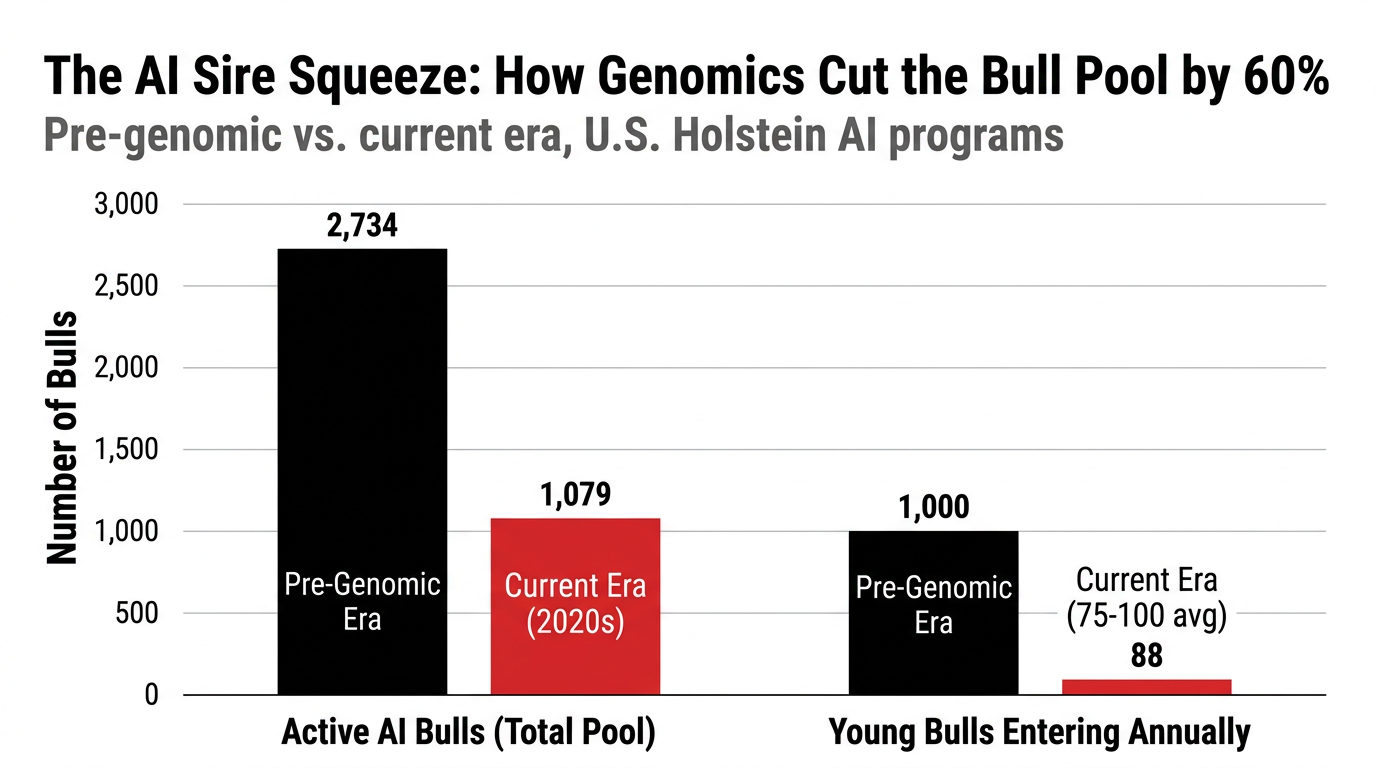
MetricPre-Genomic EraCurrent Era (2020s)
Active AI bulls (total pool)2,7341,079
Young bulls entering annually1,000+88 (avg 75–100)

When your genomic‑tested heifer pen is dominated by daughters from three famous cow families, and your AI lineup is stacked with sons and grandsons of those same families, you’re doubling up maternal lines from both sides of the pedigree. The Expected Future Inbreeding (EFI) number on a bull proof might still look acceptable, but EFI is calculated against a base population that’s itself more inbred than it was a decade ago. You’re measuring water depth in a boat that’s already taking on water.

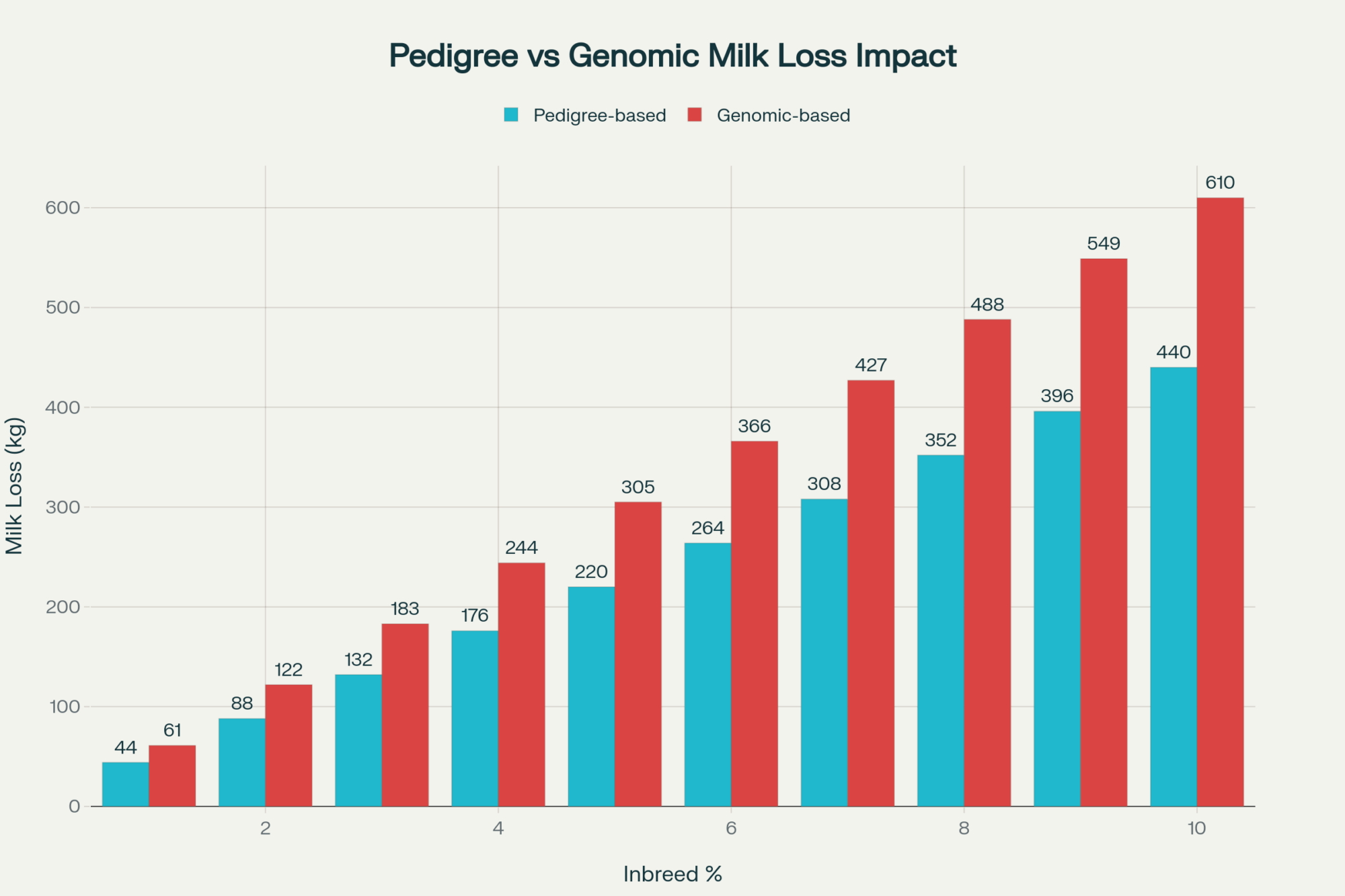
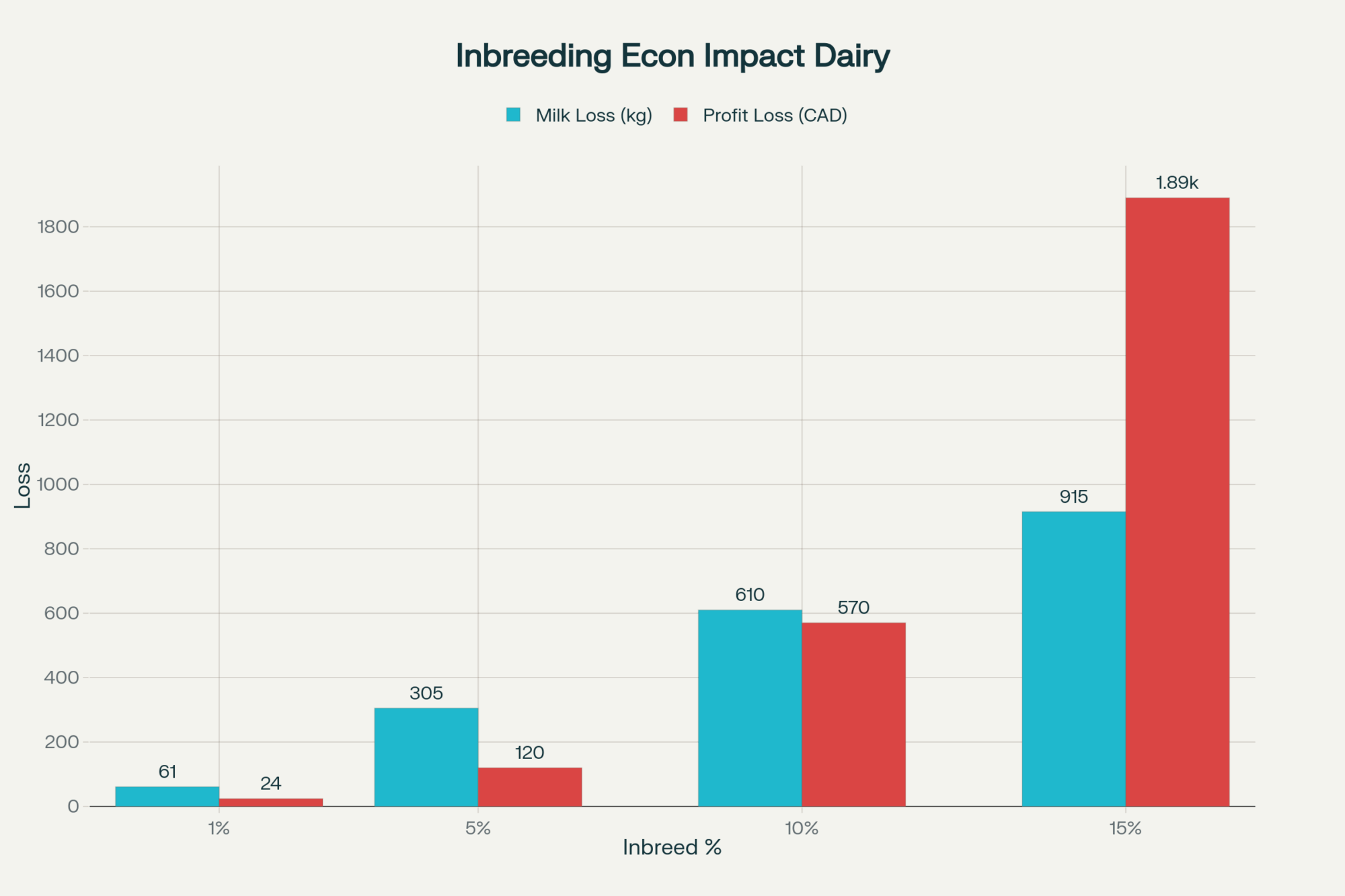
Doekes et al. (2020) analyzed Dutch Holstein Friesians and found roughly 36–99 kg less 305‑day milk per +1% increase in genome‑wide homozygosity, along with longer calving intervals and higher somatic cell scores. That’s the kind of quiet drag you feel when fresh‑pen performance doesn’t match the proofs. Misztal and Lourenco’s 2024 Journal of Animal Science review warned that genomic tools accelerate unfavorable changes in fitness traits alongside production gains, and that management alone can’t fully counteract them if inbreeding continues to rise.

Cow family tracking doesn’t fix inbreeding on its own. It lets you see where you’re stacking weight onto the same thin branches before your fresh‑cow pen and replacement budget start screaming.

What Does a $1,200 Beef‑on‑Dairy Calf Really Cost Your Replacement Program?
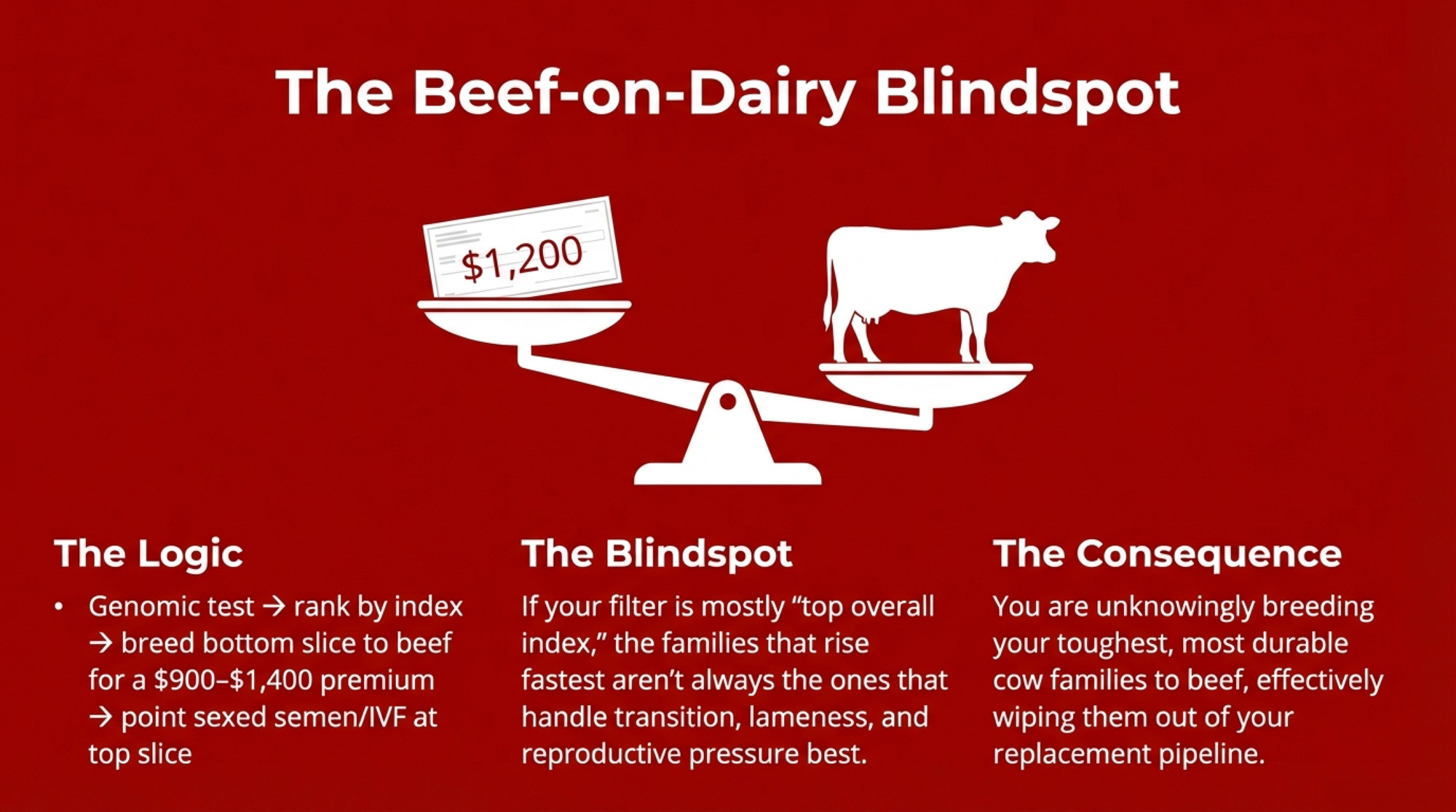
On paper, the beef‑on‑dairy logic is clean. You genomic‑test your heifers, rank them by index, breed the bottom slice to beef — capturing a $900–$1,400 beef‑cross calf premium in many 2024–2025 U.S. markets — and point sexed semen or IVF at the top slice to make replacements. The beef check shows up in 90 days. The genomic ranking tells you you’ve kept the “best” heifers.

Then you put the cow family on top. The picture shifts.
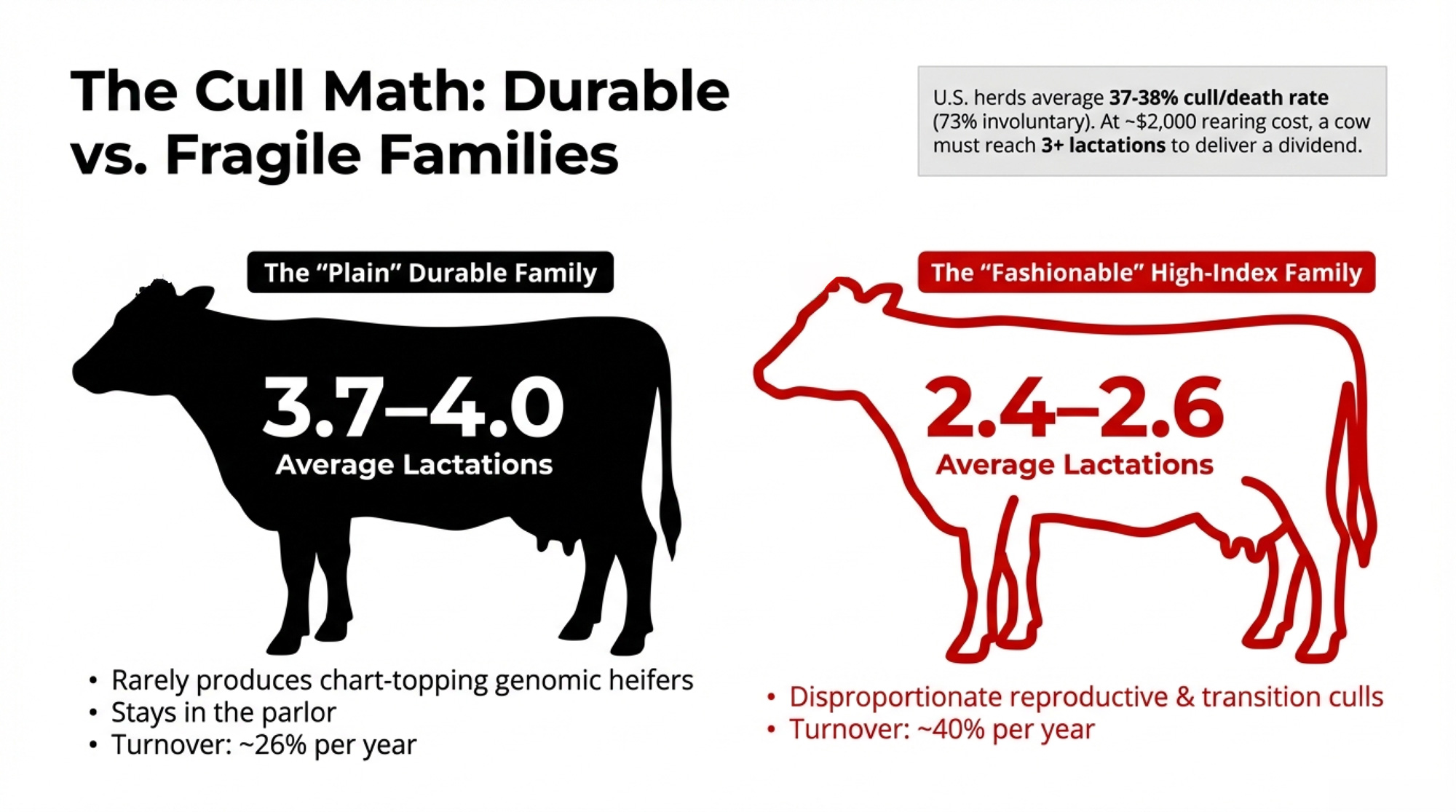
In a composite analysis built from several 300–500‑cow Holstein herds, one “plain” family that rarely produced chart‑topping genomic heifers quietly averaged 3.7–4.0 lactations in the parlor. Two fashionable high‑index families averaged 2.4–2.6 lactations, with disproportionate reproductive and transition‑disease culls. Those are herd‑record numbers, not theory. Your exact figures will differ, but the pattern probably feels familiar: some families stay; some don’t.

Genomics lets you see PL, DPR, and health indexes. But if your filter is still mostly “top overall index,” the families that rise fastest aren’t always the ones that handle your transition, lameness, and reproductive pressure best.

MetricFamily A (Durable)Family B (Fragile)Family C (Fragile)
Average lactations completed3.92.42.6
Share of genomic-tested heifers22%31%27%
Average GTPI rank (percentile)68th82nd79th
Involuntary cull rate28%42%39%
Top culling reasonsMastitis, injuryRepro, transitionLameness, repro

Running the Numbers: The Trade

Take a 400‑cow Holstein herd:

  • Herd size: 400 milking cows
  • Turnover target: 35% → about 140 replacements per year
  • Replacement purchase cost (national average): $3,010–$3,110 per head in mid‑ to late‑2025
  • Durable families: ~3.8 lactations average (turnover ~26% per year)
  • Fragile families: ~2.5 lactations average (turnover ~40% per year)

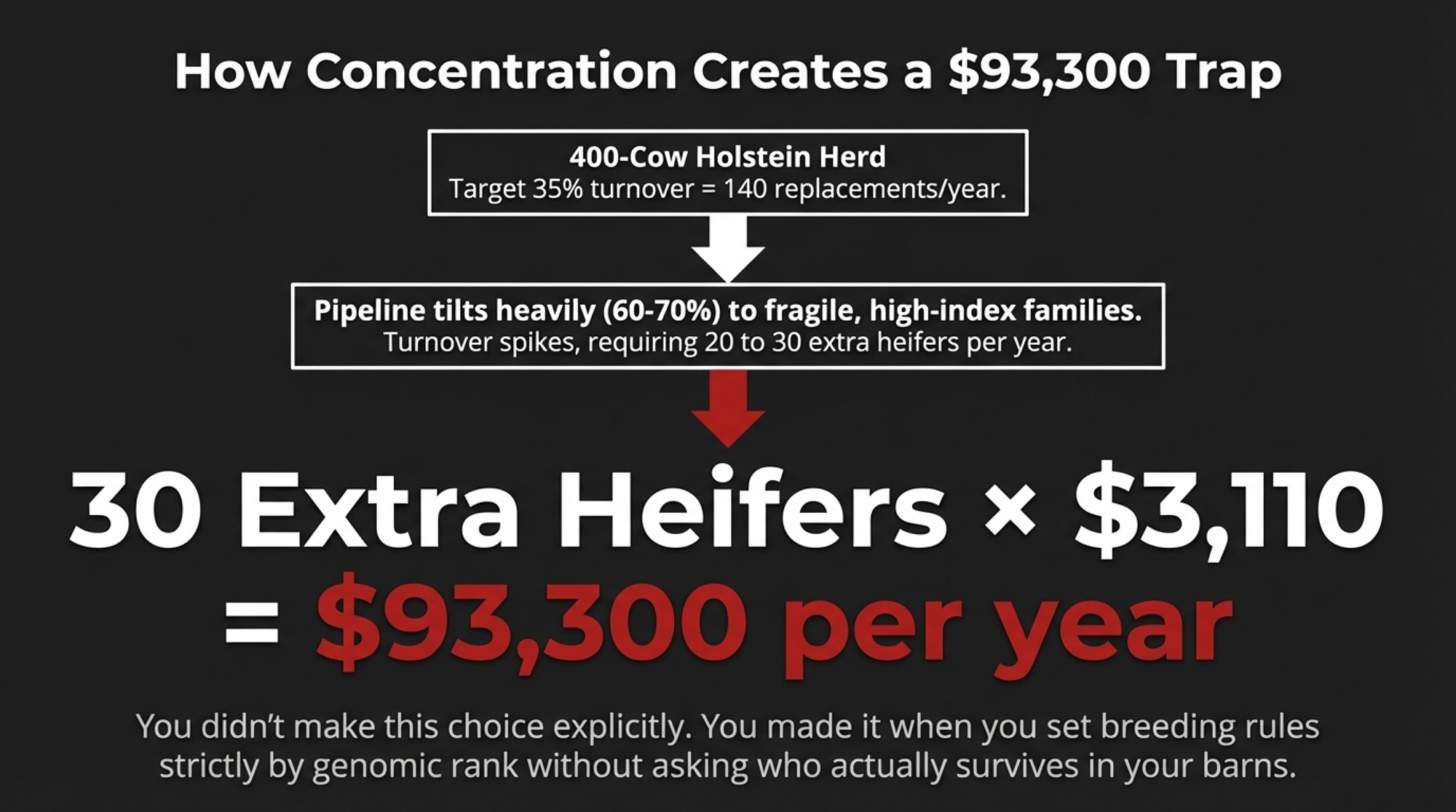
In a balanced scenario, overall turnover sits close to 35%. Replacement needs stay near 140 head. Now imagine your replacement pipeline is heavily tilted — 60–70% of your genomic‑tested replacements come from fragile families, rather than a more even mix. Based on the composite herd data, those herds saw replacement needs rise by 20–30 extra heifers per year.

At $3,110 per purchased replacement:

30 × $3,110 = $93,300 per year in additional capital

as long as that concentration-turnover gap persists.
MetricDurable FamiliesFragile Families
Average lactations completed3.82.5
Annual turnover rate~26%~40%
Replacements needed (400-cow herd)104 per year160 per year
Extra replacements vs. baseline+30 per year
Annual replacement cost at $3,110/head$323,440$497,600
Additional capital tied up+$93,300/year

You didn’t make that choice explicitly. You made it when you set beef‑on‑dairy and IVF rules strictly by genomic rank, without asking which families actually survive in your barns.

The 400‑Cow Herd That Added the Cow Family Column
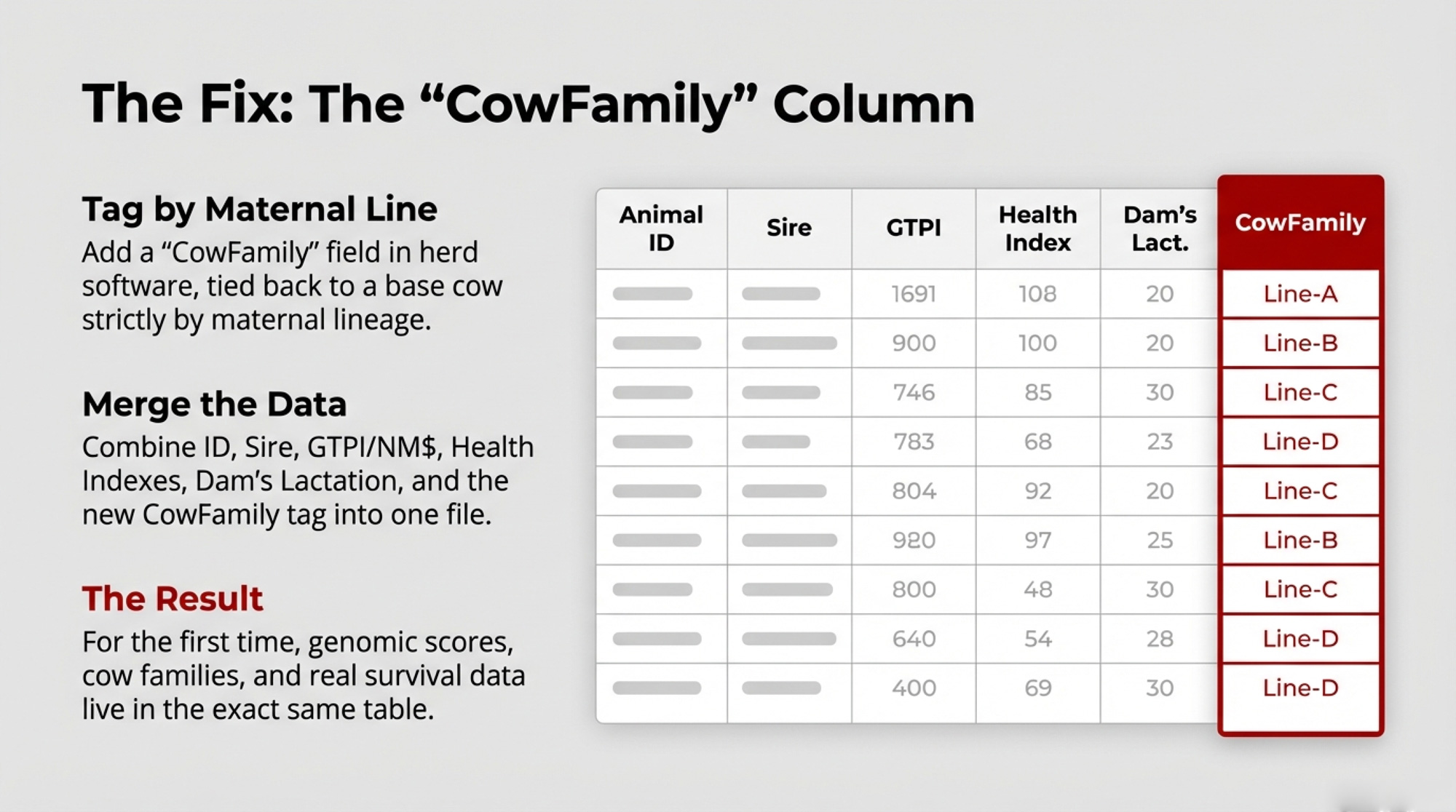
Here’s how those composite herds actually changed their breeding rules — built from several progressive Holstein operations that tracked maternal lines and shared data with their advisors.

Step 1 — Tag every female by maternal line. They added a “CowFamily” field in herd software. Every female was assigned to a family tied back to a base cow, defined strictly by maternal lineage — not marketing labels.

Step 2 — Build one combined heifer file. For every genomic‑tested heifer: ID, sire, birthdate, CowFamily, GTPI or NM$, PL/DPR/health indexes, and dam’s lactation number and culling status. For the first time, genomic scores, cow families, and real survival data lived in the same table.

Step 3 — Run family‑level stats. Average lactations completed, lifetime milk and components, primary culling reasons by family. The pattern was striking: some high‑index families had excellent longevity — gold. Others underperformed their genomic potential, with many second‑lactation exits. Several mid‑index families quietly averaged nearly 4 lactations, with fewer involuntary culls.

The lesson wasn’t “don’t trust genomics.” It was “don’t let genomics outrun what your cow families are telling you about your own barns.”

Step 4 — Rewrite three breeding rules.

  1. Sexed semen allocation. Top heifers within each proven‑durable family got priority, even if their GTPI was mid‑pack.
  2. IVF and donor lists. IVF on high‑index heifers from fragile families was capped; donor status went first to heifers from families that could reach third lactation under current management.
  3. Beef‑on‑dairy targets. Beef semen was pointed at over‑represented, short‑lived families after enough replacements were secured from the durable families.

Within about two years, those herds consistently reported: no single family supplied more than ~30% of replacements, the annual increase in genomic inbreeding slowed, and a higher share of cows reached third and fourth lactation.
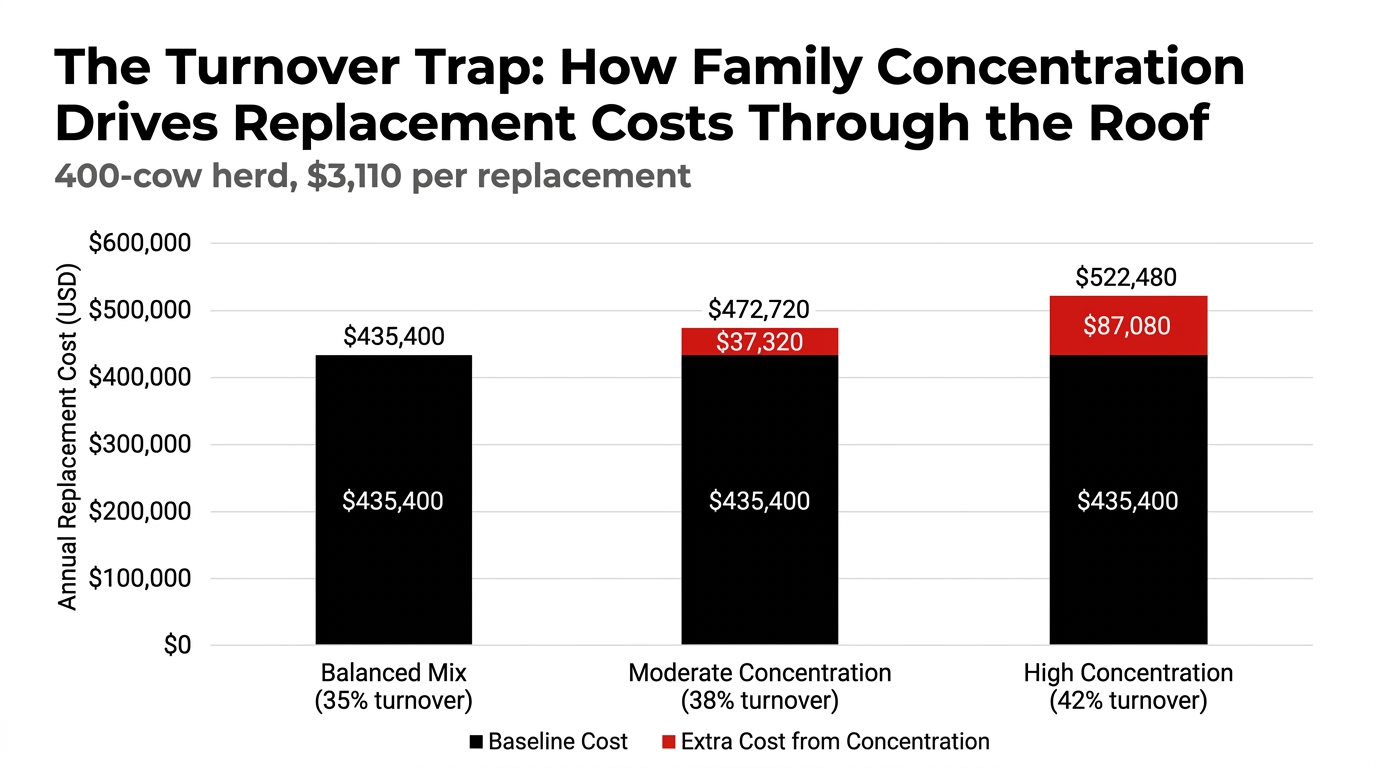
These aren’t randomized trials. But they’re real herd‑record results that line up with the math.

Your Sire Analyst’s Quiet Role in This

Your sire analyst isn’t out to sabotage your herd. They’re working with the same tools and incentives: genomic rankings, strong proofs, and semen that sells. When an AI program finds cow families that reliably produce top‑ranking sons, it’s logical to double down. Those families become donors and bull dams for everyone else. Over time, more bulls in your semen tank share the same grand‑dams and great‑grand‑dams, even if the sires change.

NAAB and industry reports show a concentrated semen market, with a small number of large organizations controlling most of the U.S. AI business. That’s efficient for pushing genetic gain. It also amplifies maternal‑line concentration in the client herds unless you actively steer away.

For breeders like Kline, the practical question isn’t whether AI companies are “wrong.” It’s whether their female programs are quietly overriding their own herd’s economics. If your bull list is heavy with sons of cow families that already account for a big chunk of your heifer pen, you’re not diversifying. You’re doubling down.

The Playbook: What to Do Before Your Next Breeding Cycle

In the Next 30 Days

  • Add the cow family column. Export your female inventory, add a “CowFamily” field, and tie each animal back to a base cow.
  • Run a concentration check. Pull your genomic‑tested heifer list, sort by GTPI or NM$, and look at the top 25–30%. If three or fewer families supply 60% or more of that group, you’re carrying the concentration risk this article describes.
  • Cross‑check your main sires. Note the cow families in their maternal pedigrees. If those match your over‑represented families, flag them as “use thoughtfully” instead of default choices.

In the Next 90 Days

  • Calculate family‑level survival from your own data. Average lactations completed, average lifetime milk, voluntary vs involuntary cull ratio, and top culling reasons — by cow family.
  • Identify your “insurance” families. Families averaging 3.5+ lactations with lower involuntary cull rates are your built‑in pipeline stabilizers.
  • Rewrite three core rules: Sexed semen priority goes to daughters from durable families. IVF donor lists start with high‑health, high‑PL heifers from durable families before fragile ones. Beef semen is allocated first to over‑represented, short‑lived families once replacement needs from durable families are met.

In the Next 365 Days

  • Audit your sire lineup by maternal line. For each bull you use heavily, record the cow family of his dam and grand‑dam. Don’t let half your semen volume come from bulls out of the same two or three families.
  • Set a practical inbreeding guardrail. Work with your genetic advisor to flag matings in which both the sire and dam come from your most common cow families.
  • Track outcomes, not intentions. As the first heifers under new rules freshen, watch average lactations completed by family, voluntary vs involuntary culling by family, and total replacements needed per year vs your target.
TimelineActionOutput / Deliverable
Next 30 DaysAdd cow family column to herd softwareEvery female tagged with maternal line ID
Next 30 DaysRun concentration check% of top genomic heifers from 3 families
Next 30 DaysCross-check main sires by maternal lineList of sires that double-up over-represented families
Next 90 DaysCalculate family-level survival statsAverage lactations, cull reasons by family
Next 90 DaysIdentify “insurance” families (3.5+ lact.)List of durable families for priority breeding
Next 90 DaysRewrite sexed/IVF/beef rulesUpdated protocols prioritizing durable families
Next 365 DaysAudit sire lineup by maternal lineMaternal diversity report for bull list
Next 365 DaysSet inbreeding guardrails with advisorFlagged mating pairs from same families
Next 365 DaysTrack outcomes by family as heifers freshenLactation/cull metrics by family, quarterly
OngoingMonitor replacements needed vs. targetAnnual replacement count and cost by family

What This Means for Your Operation

  • Your genomic ranking list is a tool, not a verdict. It doesn’t know which cow families actually survive under your feed, facilities, and disease pressure. Your cull and longevity records do.
  • Replacement cost has changed the tolerance for fragility. Going from $1,140 per head in 2019 to $3,010–$3,110 in 2025 means being wrong about cow family durability isn’t a nuisance — it’s a five‑ or six‑figure swing in capital exposure.
  • Inbreeding penalties are already in your tank and your parlor. The depression numbers from Dutch Holsteins — up to 99 kg less milk per +1% genomic inbreeding — aren’t abstract; they describe what happens when you stack too many related lines.
  • Beef‑on‑dairy decisions need a family filter. Before you write next season’s beef semen rules, pull the last 50 heifers you bred to beef and tag them by cow family and dam’s lactation. If your best longevity families are taking the hit, your protocol is backwards.
  • IVF amplifies whatever you point it at. If you aim your IVF budget at cow families that don’t last in your system, you’re multiplying fragility in the tightest replacement window in decades.
Key Takeaways

  • If three or fewer cow families supply 60%+ of your top genomic heifers, you’re carrying the concentration risk this article lays out. Put a hard cap on your breeding protocols and deliberately feed replacements from underrepresented, proven‑durable families.
  • If your annual replacement rate has drifted above the mid‑35% range without obvious disease crashes, check whether short‑lived families are quietly driving that turnover. Run replacements‑needed per year by cow family and compare that to your longevity and cull data.
  • Before your next beef‑on‑dairy semen order, block out an hour to run one report: last 50 heifers bred to beef, tagged by cow family and dam’s lactation number. If durable families are over‑represented in the beef column, fix the rules before the next breeding season.
  • On your next call with your sire analyst, ask one extra question: “Which bulls in your lineup come from cow families we don’t already have stacked in this herd?” Make maternal‑line diversity part of the conversation, not an afterthought.

The Bottom Line

Open your genomic heifer list right now. Add a cow family column. Sort by family instead of GTPI. How many maternal lines are you actually betting your next three years of replacements on — and do the families carrying the most weight have the track record in your barns to justify it? If you’re already doing what Kline did — leaning into genomics early, pushing for better cows — this isn’t about blaming you. It’s about upgrading the tools so your cow families, not just your proofs, protect the herd you’ve worked hard to build.

Complete references and supporting documentation are available upon request by contacting the editorial team at editor@thebullvine.com.

Learn More

The Sunday Read Dairy Professionals Don’t Skip.

Every week, thousands of producers, breeders, and industry insiders open Bullvine Weekly for genetics insights, market shifts, and profit strategies they won’t find anywhere else. One email. Five minutes. Smarter decisions all week.
NewsSubscribe
First
Last
Consent

To-Mar Blackstar: The One-Embryo Holstein Sire Behind 15.8% of Today’s DNA – and the Genetic Debt in Your Herd

One farm ET that barely penciled out. Four decades later, the bull from that flush shapes 60% of Select’s lineup — and your herd’s inbreeding curve.

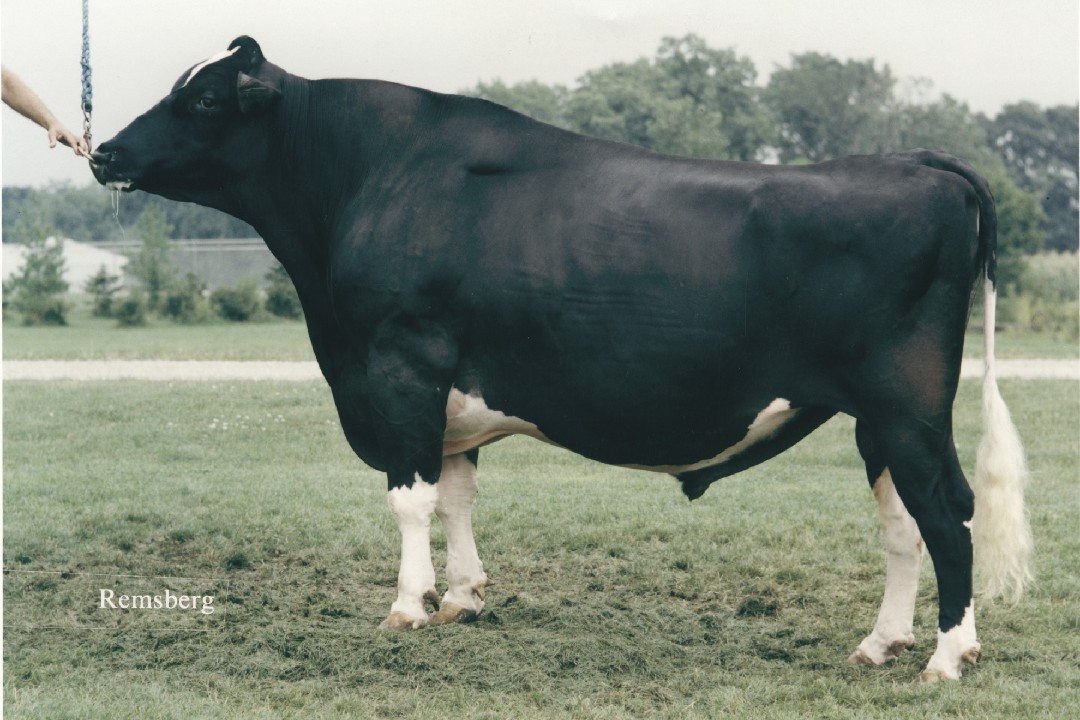
To-Mar Blackstar EX-93-GM: the coal-black Chairman son from Marengo, Iowa, who topped the TPI list, sold 500,000 doses, and left a 15.8% relationship to every Holstein alive. Photo: Remsberg.

One pregnancy.

That’s what Randy Tompkins got from his first embryo transfer attempt in 1981. He flushed To-Mar Wayne Hay — a solid, unglamorous second-lactation cow producing 25,110 pounds, sired by Cal-Clark Board Chairman — and the vet packed up with a single viable embryo for the whole effort. Anyone who’s sweated through an ET flush knows what that arithmetic feels like: you’re standing in the barn doing the math before the vet’s boots are off, stacking the cost against what a bull calf might bring, wondering if you just torched money you didn’t have to spare.

For a working dairy in Marengo, Iowa — registered cattle alongside commercials, always watching corn prices, every decision measured against the milk check — that kind of return was a gut-punch.

That single embryo became a coal-black bull calf born May 17, 1983, and nothing about him said history. The Tompkins family named him To-Mar Blackstar, went back to milking, and didn’t think much more about it.

For about nine years.

The Cow Nobody Wrote Up

What keeps pulling me back to the Blackstar story is where it started. Not with a legendary dam, not with a calculated million-dollar mating — it started with a cow named Hanna.

Royal-Cedar Oak Hanna was Wayne Hay’s dam, and she was the kind of cow that experienced dairymen notice, but nobody puts on a cover. Tight udder. Sturdy frame. Deep through the heart girth in a way that told you she’d been converting feed into milk for years without drama, without a vet call, without anyone having to worry about her. She wasn’t winning banners. She was paying bills — quietly, reliably, lactation after lactation.

You know this cow. You’ve probably got three of her in your barn right now, and if you’re honest, she’s the one keeping your operation solvent while the flashy ones eat up your time and your treatment budget.

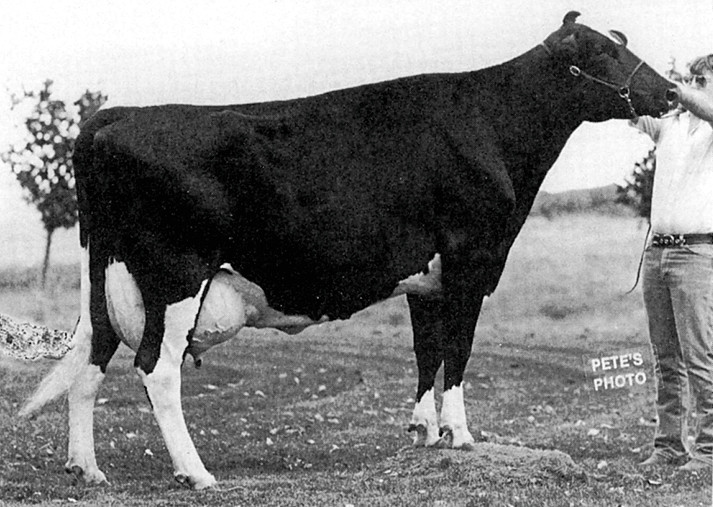
To-Mar Wayne Hay EX-90-USA — the cow nobody wrote up. She wasn’t winning banners; she was paying bills. One ET flush produced Blackstar. With five AI-sampled sons, she’d be a Holstein International Global Cow winner today. Photo: Pete’s Photo.

Wayne Hay inherited that durability. The Tompkins operation wasn’t Hanover Hill — this wasn’t a high-profile genetics program with deep pockets and a marketing department. This was an Iowa dairy where every decision had to pencil out, or it didn’t happen, and when Randy decided to try ET for the first time, flushing Wayne Hay to Board Chairman and coming away with exactly one pregnancy… that was real money on a real gamble that hadn’t paid off yet.

Why Did the Holstein Breed Need Blackstar in 1985?

To understand why this particular bull landed like a bomb, you need to remember what the Holstein breeding world looked like in the mid-1980s — because the show ring and the milk parlor had drifted dangerously far apart.

Bell daughters were flooding barns with milk nobody had seen before — +1,704 pounds predicted difference, over 30% of the cows on the Holstein Locator List by mid-decade — but they were falling apart structurally by second lactation. Small frames, weak substance, udders that couldn’t sustain the metabolic load they were built to carry. The Bullvine’s own analysis calls Bell “the worst best bull in Holstein history,” and that’s not hyperbole: producers who’d built their programs around Bell production were watching replacement rates climb, and herd life drop, and the smarter ones were getting nervous.

Meanwhile, up in Canada, Starbuck was emerging as the type answer — 70% of his daughters scored Good Plus or better, 200,000 daughters by the mid-’80s, and he’d collect 27 Premier Sire titles between ’86 and ’95. Beautiful cattle, showring dominance. But the production gap was real, and Starbuck was a type bull in an era when the milk check still decided who survived. (Read more: Hanoverhill Starbuck’s DNA Dynasty: The Holstein Legend Bridging 20th-Century Breeding to Genomic Futures)

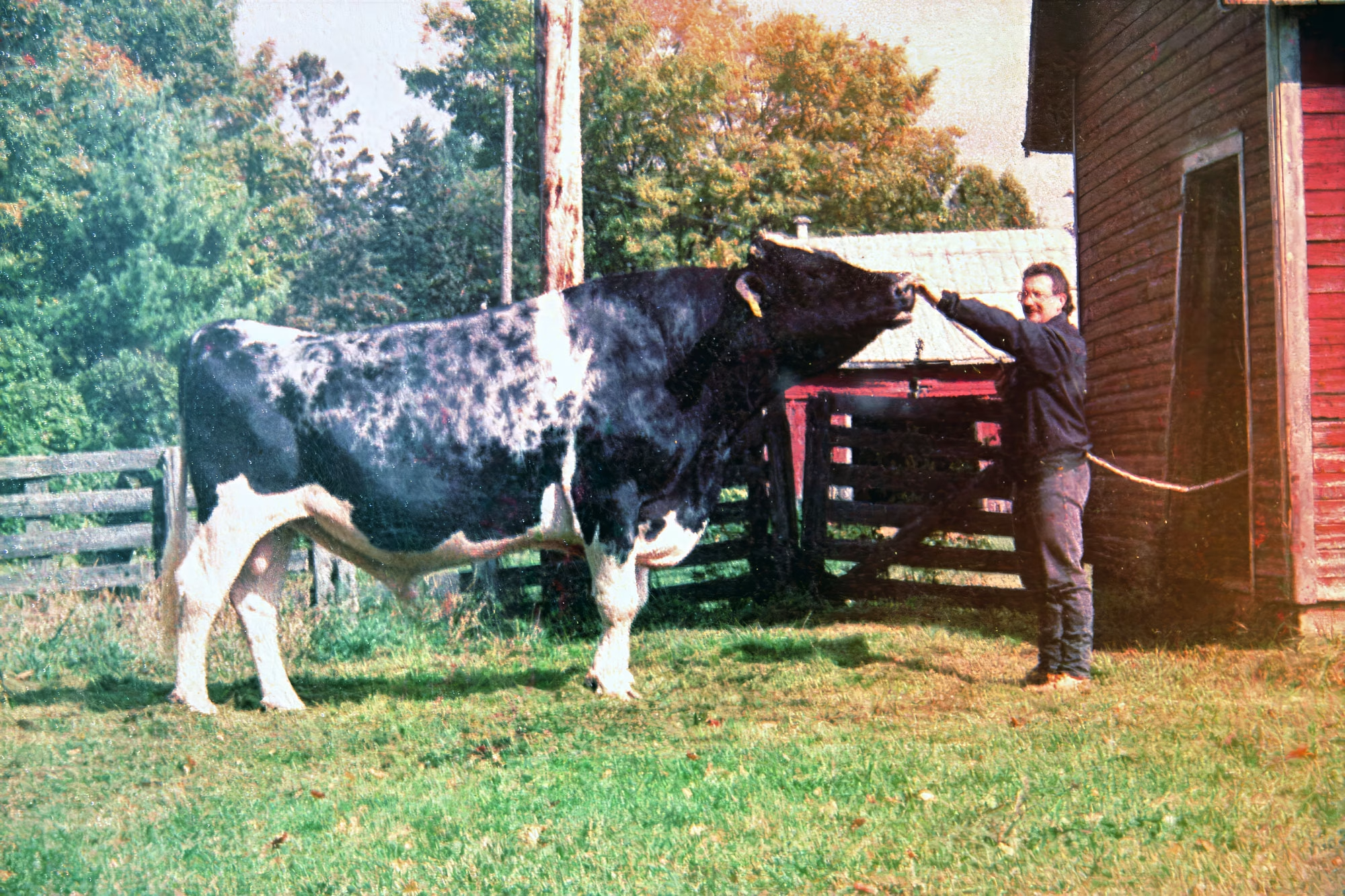
Hanoverhill Starbuck with Carl Saucier at Mount Victoria Farm, Québec, 1994 — 15 years old and still in service at CIAQ. 685,000 doses. 27 Premier Sire titles. 200,000 daughters. He was everything the show ring wanted. Blackstar was what the milk check needed.

The breeders paying attention — and by the late ’80s, that was a growing number — knew the breed needed something else entirely. A bull that could improve conformation without sacrificing components; type married to production in the same proof sheet. Everyone wanted it, and nobody could find it.

The bull that delivered it was sitting in a barn in central Iowa, bred by a family that wasn’t trying to solve the industry’s identity crisis. They were trying to make a good cow a little better.

The Mystery of 7H1897

Blackstar’s first proof dropped in January 1989, and the numbers were unlike anything the industry had seen from one animal: +58 pounds fat, +63 pounds protein, and a +3.16 PTAT.

A PTAT above 3.0 from a bull who was also positive on components — in 1989, that combination was unicorn territory. You picked type bulls, or you picked production bulls, and that was the deal everyone had accepted. Getting both at this level from a first-time ET calf out of a cow nobody outside Iowa County had heard of wasn’t supposed to happen.

But the moment that really captures how Blackstar emerged isn’t about the proof sheet. It’s about Ron Long.

Long was at Select Sires, working through classification data from herds across the country — the way you tracked genetic quality before genomics made everything instant. He kept flagging one sire code, herd after herd, state after state, because daughters of this particular bull were classifying well above expectations, and the pattern was unmistakable. But the bull wasn’t on anybody’s radar.

“I do not know which bull is 7H1897,” Long told his colleagues, “but his daughters are actually classifying extremely well.”

7H1897 was Blackstar. Before the industry knew his name, before a single marketing dollar was spent, before anyone at Select Sires had built a campaign around him, his daughters were already proving him on concrete — in real barns, on real DHIA sheets, from the Midwest to the Southeast. The data was finding him, not the other way around.

How Blackstar Topped the TPI List in 1992

Then the phone started ringing.

Blackstar had just topped the TPI list at 1,256 points — at that point was the highest total performance index any Holstein sire had ever achieved — and in a pre-internet world where you secured semen by picking up the telephone and hoping the AI stud had inventory, that number set off something close to a stampede. At Select Sires, the switchboard was overwhelmed: international calls stacking up, wire transfers from Germany, the Netherlands, Australia, New Zealand, breeders on three continents competing for straws selling at hundreds of dollars each in 1992 money, when proven semen from a solid bull ran a fraction of that.

Jeff Ziegler, Select’s breeding manager, would later put the constraint in perspective: “From Blackstar, no more than 500,000 doses were sold, since our semen collection methods back then were very different.”

Half a million doses from one bull in an era when collection technology produced far fewer straws per session than modern methods allow. No bull before him had generated that kind of sustained, global demand.

The morning that the first proof sheet must have arrived at the Marengo farm — a Select Sires envelope, a page of numbers that looked like any other mailing — it’s hard to imagine Randy Tompkins understood he was holding the breeding industry’s next decade in his hands. By all accounts, he wasn’t a man who sought the spotlight. He’d bred one bull, and the bull was doing the rest. But by the summer of ’92, with international calls coming in before dawn and wire transfers landing from three continents, the distance between that single-embryo gamble in 1981 and what it had become must have felt impossible to bridge.

What His Daughters Proved on Concrete

You could spot a Blackstar daughter from across the free-stall alley, and not because she was flashy — it was the opposite. She looked right. Depth through the heart that meant genuine capacity, not the narrow, weedy frame, the show ring had been rewarding for a decade. Spring of rib that told you she could handle a heavy TMR load without burning through body condition in sixty days. And the udders — tight fore attachment, strong medial, teat placement that meant your milking crew wasn’t fighting her twice a day, and this was back when udder quality actually differentiated sires, before everyone’s proof sheet started looking the same.

The real proof, though, was in the bulk tank.

LA-Foster Blackstar Lucy 607, down in North Carolina, became world production champion in 1998: 75,275 pounds of milk with 1,738 pounds of fat and 2,164 pounds of protein in a single 365-day lactation. The Foster family described her the way any dairyman would understand: “She’s either at the feed bunk or at the water trough. She eats and eats and produces that milk!” Over 200 pounds a day, sustained for an entire year, without breaking down — and when corn’s at seven dollars, and your margins are measured in pennies per hundredweight, that kind of metabolic engine separates the operations making the payment from the ones having a difficult conversation with their lender.

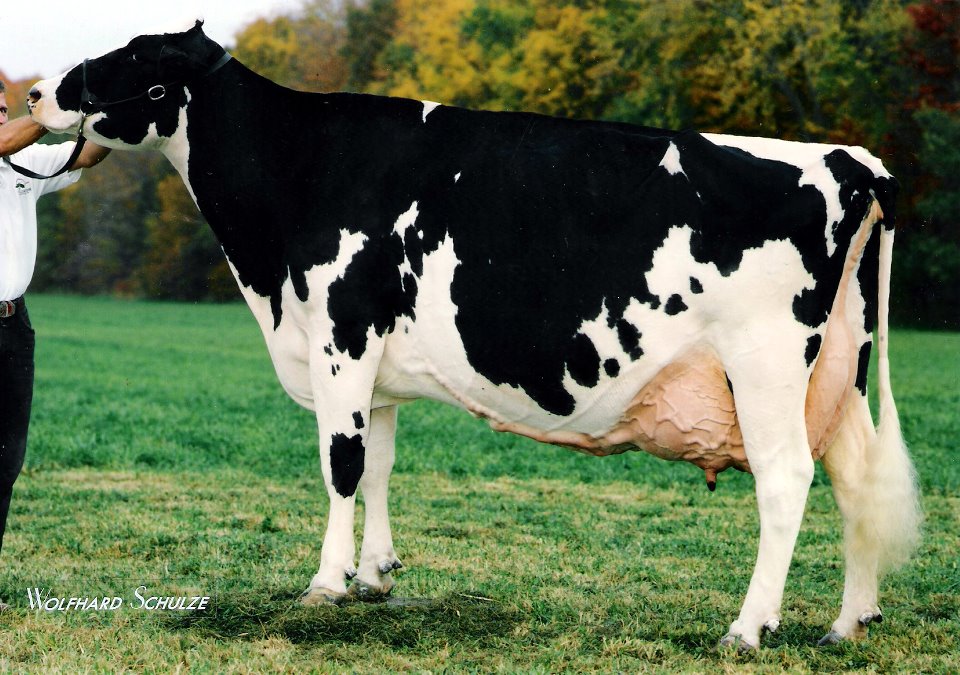
Stookey Elm Park Blackrose EX-96-USA 3E GMD DOM — All-American at two and three. Grand Champion, 1995 Royal Winter Fair. 149,881 pounds lifetime. She wasn’t just a show cow or a production cow. She was a Blackstar daughter — and that was the whole point. Photo: Wolfhard Schulze.

Then there was Stookey Elm Park Blackrose — classified EX-96-USA 3E GMD DOM, one of the highest classification scores ever assigned to a Holstein female. Bred by Jack Stookey and purchased by Mark Rueth and the Schaufs from Indianhead Holsteins as a hiefer, they developed her into something genuinely rare: All-American Junior Two-Year-Old in 1992, All-American Junior Three-Year-Old in 1993, and then Grand Champion at the 1995 Royal Winter Fair, joining that exclusive club of American-bred cows to win Canada’s most prestigious show. At 5 years old, she posted 42,229 pounds of milk, with 1,940 pounds of fat and 1,433 pounds of protein, and her lifetime production reached 149,881 pounds over 1,609 days in milk. She wasn’t just a producer and a show cow — she became a foundation brood cow whose AI sons carried the Blackstar blueprint into herds across the continent, and whose descendants were still winning banners as recently as the 2016 Hokkaido Winter Fair in Japan. (Read more: When Financial Disaster Breeds Genetic Gold: The Blackrose Story That Changed Everything)

Lucy and Blackrose weren’t outliers — and that’s what mattered most to producers milking Blackstar daughters day after day. As a group, his daughters consistently showed above-average productivity and lower somatic cell counts, peaking in their fourth and fifth lactations rather than flaming out as two-year-olds. The kind of cow your milking crew mentions at year’s end because she never once showed up on the treatment list, the kind that lets you amortize rearing costs over six or seven years instead of two.

That profile — the one every sustainability conversation in this industry eventually circles back to — came from a cow named Hanna.

2,500 Sons and the Mistake Nobody Stopped

The AI industry sampled nearly 2,500 of Blackstar’s sons globally, representing roughly half the world’s total sampling capacity in any given year, poured into the offspring of a single sire. The results were spectacular, and the consequences were severe, but nobody hit the brakes.

MJR Blackstar Emory EX-97-GM — the crown jewel. Half his sons made proven sire. His son Blitz topped 1.52 million doses. The line from here runs straight into your semen tank. Photo: Remsberg.

MJR Blackstar Emory was the crown jewel — 50% of his sons achieved proven sire status, against an industry norm of about 10%. Among them, Fustead Emory Blitz became a super-millionaire at over 1.52 million doses sold, a record at Select Sires that still stands. Blitz sired Velvet-View KJ Socrates, and Socrates gave us Roylane Socra Robust — who died young, before anyone fully grasped what they had — and from Robust came Seagull-Bay Supersire, a massive milk transmitter whose son JoSuper carried that Blackstar blueprint into yet another generation of elite matings. If that lineage sounds familiar, it should — Walkway Chief Mark, the backup bull behind 7% of every Holstein cow alive today, sits in these same pedigree networks.

Through Etazon Lord Lily, a millionaire son in his own right, Blackstar genetics reached Vision-Gen Ozzie and eventually influenced Ransom-Rail Facebook Paris. Up in Quebec, the Comestar program took Blackstar’s impact in a different direction entirely: three daughters out of Comestar Laurie Sheik produced six AI sons, including Comestar Lee, Outside, and Lheros — all millionaire sires distributed worldwide through Semex. One cow family, one mating sire, and a genetic footprint that reshaped Canadian breeding for a decade.

Comestar Laura Black VG-87-CAN 24 — Blackstar × Laurie Sheik. Twenty-four brood cow stars. Her son Lee became a super-millionaire at 1.5 million doses; Lheros and Lartist went global through Semex. This is what happened when Blackstar met the right cow family. Photo: PAB.* (Read more: The Cow That Built an Empire: Comestar Laurie Sheik’s Unstoppable Genetic Legacy)

And then there’s the line that ties the whole modern breed together. Through Dixie-Lee Bstar Betsie — dam of Carol Prelude Mtoto, the Italian specialist whose improbable origin story we profiled last year — and then through Mtoto’s son Picston Shottle, Blackstar’s fingerprint reaches into virtually every elite Holstein pedigree walking the planet today. If you’ve used Shottle genetics in the last fifteen years, and you have, you’ve been using Blackstar genetics whether you knew it or not.

Carol Prelude Mtoto — the £40 “failure” out of Dixie-Lee Bstar Betsie, a Blackstar daughter. Born in Italy, 1993. His son Picston Shottle sold 1.17 million doses and sired 9,674 Excellent daughters. If you’ve used Shottle genetics in the last fifteen years — and you have — you’ve been using Blackstar genetics.

This global saturation wasn’t just a numbers game; it was a masterclass in pedigree dominance that reached into every major breeding powerhouse. While the Comestar family was cementing the line in Canada, the influence was echoing through the Netherlands and Italy via the Dutch-born Blackstar Betsy. A daughter of the foundation cow Prices Chiefs Bess, Betsy’s ET journey across the Atlantic eventually produced Carol Prelude Mtoto, the sire of Picston Shottle—widely considered one of the top ten most influential bulls in history. Meanwhile, the lineage was branching through “super-millionaire” Fustead Emory Blitz to Roylane Socra Robust, and eventually to Siemers Lambda, ensuring that whether a breeder was looking for high-type show winners or high-profit commercial producers, they were inevitably tapping back into the same Marengo, Iowa, source.

Jeff Ziegler estimates that more than 60% of Select Sires’ current bull lineup carries Blackstar in its pedigree.

Sixty percent. From one ET pregnancy on a farm cow in Iowa.

Now, somewhere in the late ’90s, a breeder whose promising young sire got buried under the Blackstar avalanche — sampled too late, overlooked because the sure thing was already proven and available — must have said exactly what plenty of us are thinking now. But nobody was listening. When you look at the four bulls who reshaped the entire breed, Blackstar’s concentration story fits a pattern the industry has repeated — and may be repeating.

15.8% of Every Holstein Alive

USDA Animal Genomics and Improvement Laboratory data, estimated with a 1960 base year, puts the cost of that concentration in numbers nobody can argue with: Blackstar has a 15.8% relationship to the current your herd, higher than Elevation at 15.2%, higher than Chief at 14.8%, higher than any individual sire in the breed’s documented history. A 1999 Journal of Dairy Science study by P.M. VanRaden found that Blackstar’s expected inbreeding of future progeny — the metric that captures how deeply a single animal is embedded in the breed — was 7.9%, the highest of any Holstein sire evaluated.

And the breed’s effective population size — the measure geneticists use for how much diversity actually exists, regardless of raw numbers? Multiple peer-reviewed studies using both pedigree and genomic methods have estimated it at somewhere between 40 and 70 animals for major Holstein populations, with a consistent downward trend accelerating since genomic selection began. For context, conservation biologists flag vertebrate species with an effective population size below 50 as at risk of inbreeding depression under IUCN guidelines. We’re talking about the most numerous dairy breed on earth, and its genetic base has collapsed to the equivalent of a small village.

We did this to ourselves.

AI companies would never again sample as many sons from one bull as they did from Blackstar — not because his genetics fell short, but because the wholesale use of his offspring meant other potentially great bulls never got their chance. Good genetics pushed to the margins, diversity sacrificed because the sure thing was right there, proven, in demand, and profitable to sell.

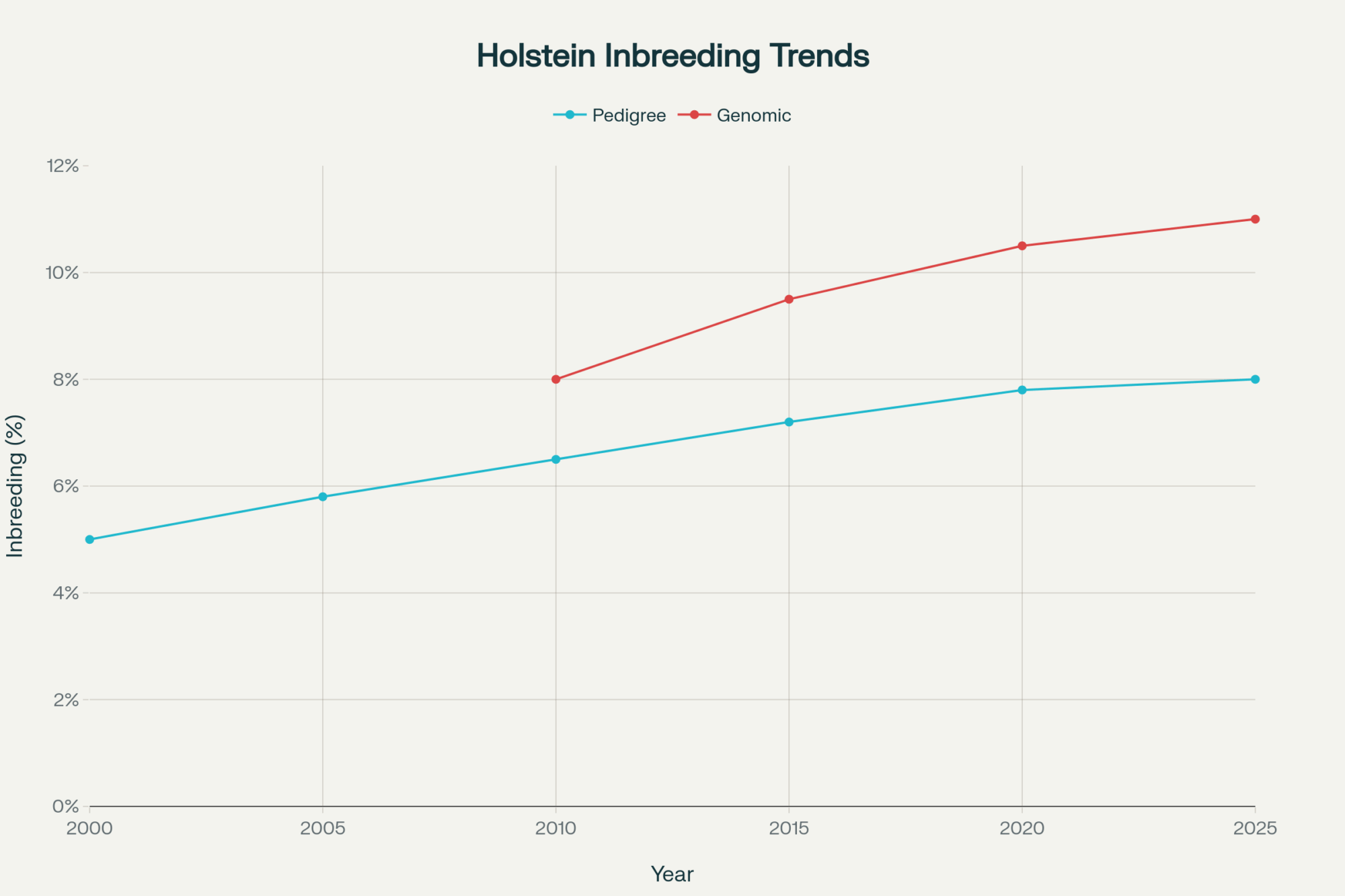
The rate of inbreeding per generation has increased since genomic selection was introduced — a 2022 Frontiers in Veterinary Science study of Italian Holsteins found an annual inbreeding rate at +0.27% by pedigree and +0.44% by genomic measures, corresponding to roughly +1.4% to +2.2% per generation. Better tools, faster concentration, different instrument, same mistake. We learned the lesson with Bell in the ’80s: the risk of concentration, lethal recessives, structural compromise. Then we learned it again with Blackstar in the ’90s. And the genomic era is running the same experiment a third time, at higher speed, with more data and less excuse for not knowing better.

The Lesson from Marengo

Blackstar was classified EX-93-GM — as good a specimen as he was a genetic force. During his long career at Select Sires, his semen was nearly continuously sold out, the demand outlasting trend after trend as the industry moved through the ’90s and into the 2000s.

The traits he stamped on the breed — components, functional type, udder quality, productive life — remain at the center of every modern selection index. Automated milking systems reward the kind of teat placement and udder depth his daughters were known for; feed efficiency research validates the metabolic capacity his genetics delivered. When processors push harder on environmental metrics, and they will, the ability to produce more from less across more lactations is exactly what survival looks like. Every time you walk through a robotic barn and see a cow whose udder sits perfectly for the machine, whose body condition holds through peak, whose SCC stays low without intervention — you’re looking at traits Blackstar helped build into the breed.

But the lesson of To-Mar Blackstar isn’t just “breed for function over fashion.” That part’s been obvious for thirty years. The deeper lesson — the one this industry learned through him and appears determined to learn a third time through genomics — is about what happens when you find something extraordinary and use it on everything.

Randy Tompkins flushed one cow and got one calf. He was trying to make a good bull from a good cow on a working dairy where every decision had to pencil out. The industry took that bull and built a genetic monopoly — 2,500 sons sampled, half a million doses sold, pedigrees saturated across six continents — and four decades later, the narrowed genetic base he helped create is one of the breed’s most pressing long-term vulnerabilities.

One pregnancy. One bull. A breed forever changed and permanently narrowed.

What Blackstar’s Legacy Means for Your 2026 Matings

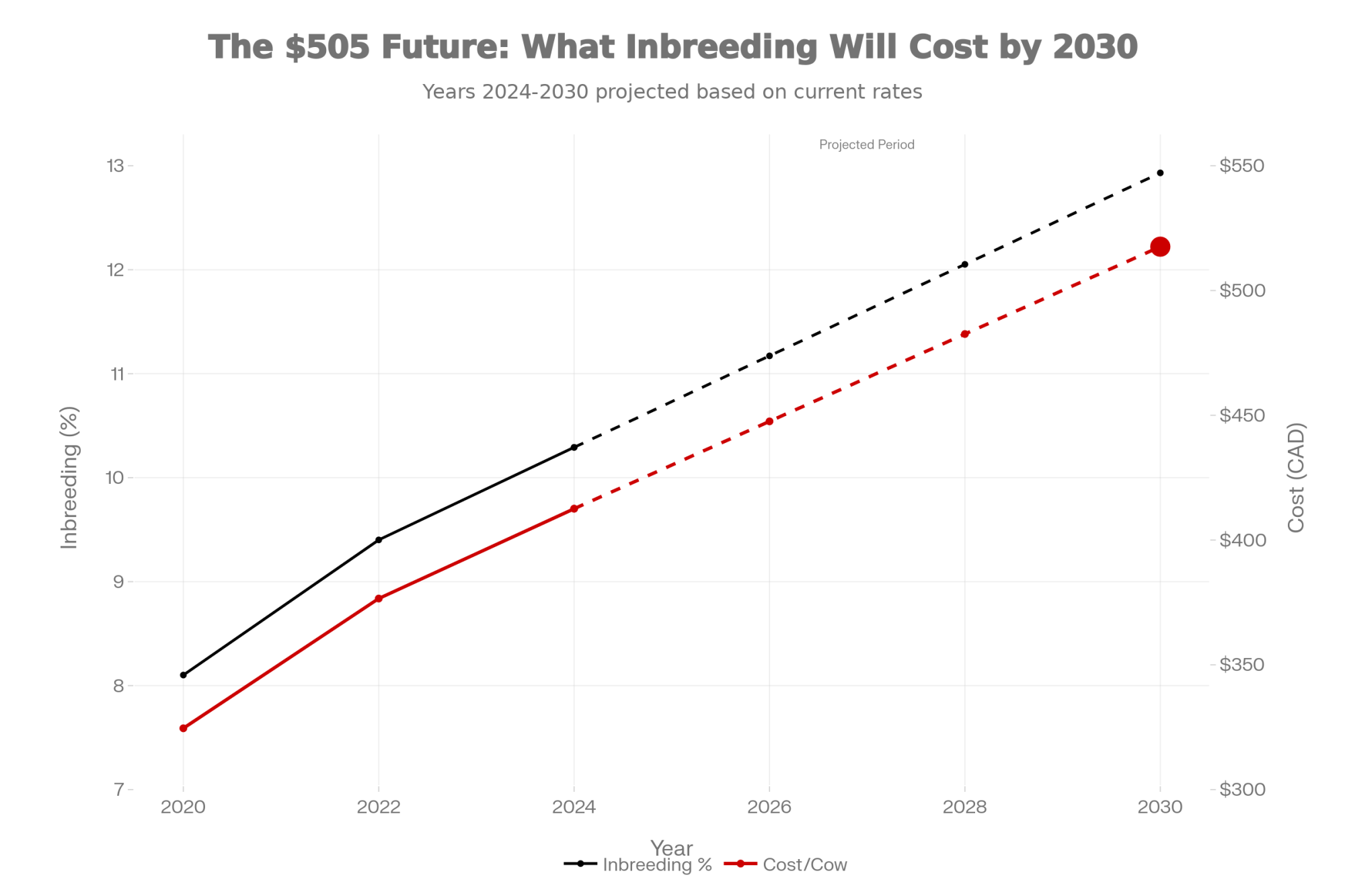
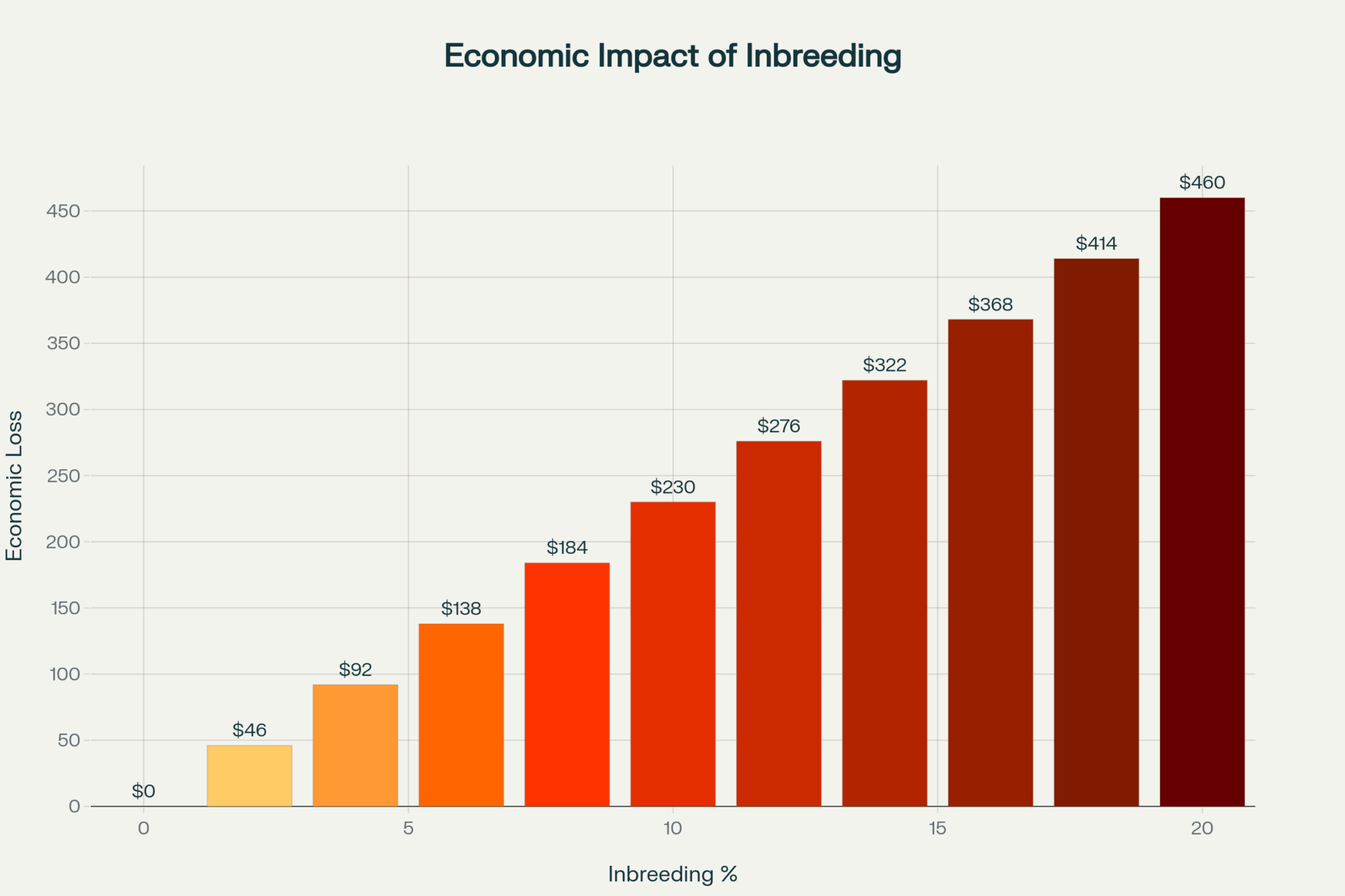
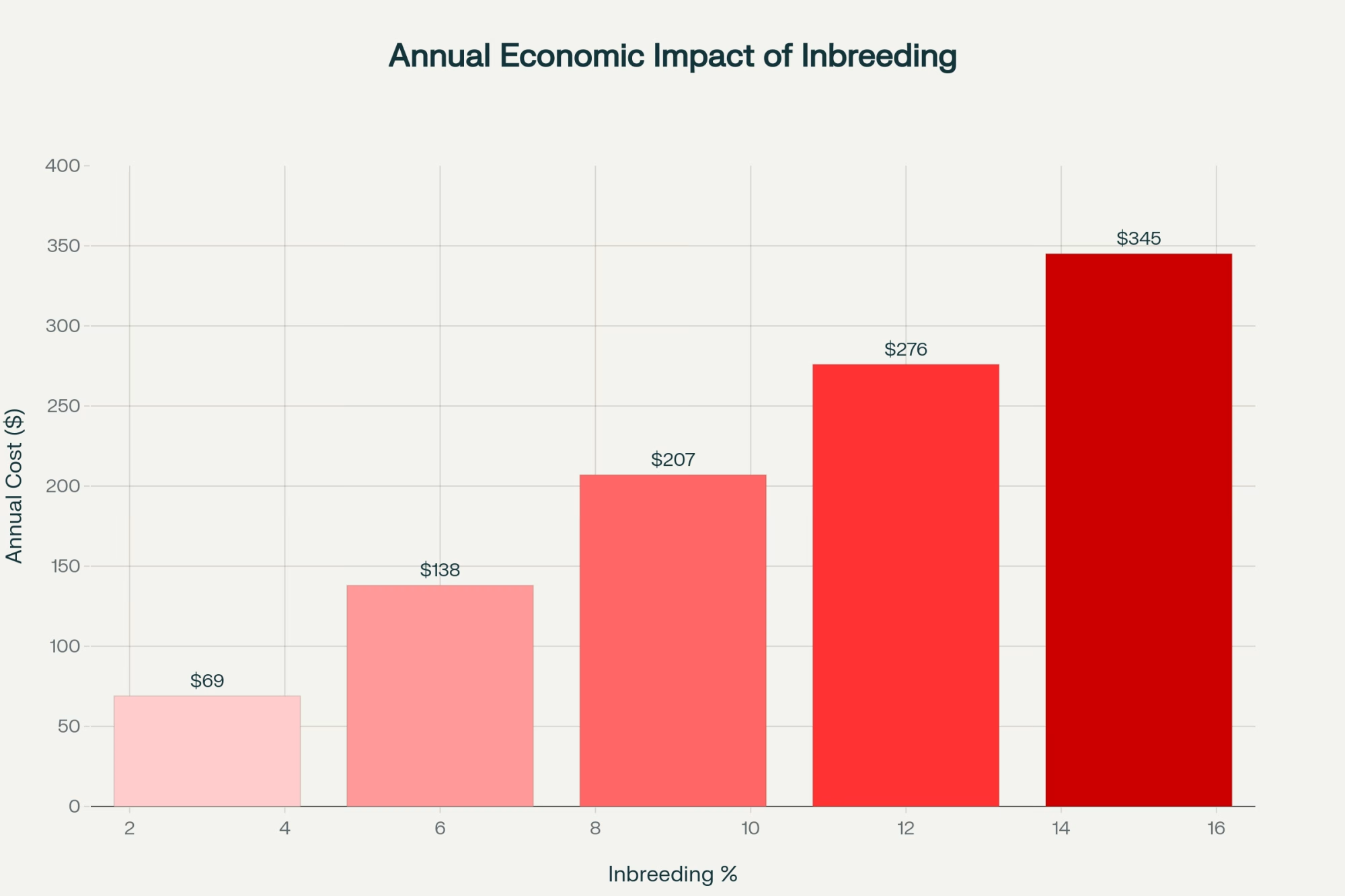
The math on inbreeding depression isn’t abstract anymore. Research estimates the cost at approximately $22–$24 per cow per lifetime for every 1% increase in pedigree inbreeding, in 1999 dollars. Canadian Holstein data show 2024-born heifers averaging 9.99% genomic inbreeding, roughly triple that of 2014. At those levels, you’re looking at $200–$400 per cow in hidden lifetime losses: extra breedings, transition problems, productive cows culled too soon — costs that don’t appear on any single report but show up everywhere in your bottom line.

Here’s what you can do about it:

  • This month: Pull your herd’s average inbreeding coefficient from your genetic management software, breed association records, or CDCB query. Identify what percentage of your pedigree traces through Blackstar, Chief, and Bell lineages. If your average exceeds 8%, you’re already paying for it.
  • Before the April proof run: Build a sire portfolio using a minimum of 8–10 unrelated sires. No single bull should appear on more than 12–15% of your matings. Prioritize outcross lines on your bottom-third genomic females — that’s where concentration costs compound fastest.
  • Over the next year: Genomically test every replacement heifer and run mating programs that cap individual-sire inbreeding contribution. Track your herd’s F-coefficient quarterly rather than annually. Treat genetic diversity like feed inventory — monitor it before it runs out, not after.

Key Takeaways:

  •  One ET calf on a commercial Iowa dairy became one of the most influential Holstein sires in history, with the USDA estimating that To-Mar Blackstar now has a 15.8% relationship to the US Holstein population.
  • His daughters combined high components, strong udders, and longer productive life, which drove roughly 500,000 doses sold and ~2,500 sons sampled worldwide, but also funneled a huge share of the breed’s genetics through a single sire line. ​
  • VanRaden’s 1999 work flagged Blackstar as the Holstein bull with the highest expected inbreeding of future progeny (7.9%), and more recent Italian Holstein data show that inbreeding is still climbing by about +0.27% to +0.44% per year in the genomic era.
  • Virginia Tech research pegs each 1% of inbreeding at $22–$24 in lost lifetime net income per cow (1999 dollars; roughly $43–$47 adjusted to 2026). At 2024-born Canadian heifer inbreeding levels of ~10%, that’s $430–$470 per cow in hidden lifetime drag.
  • For a working dairy, the punchline is simple: Blackstar genetics helped build the kind of cows you like to milk, but the article shows how to measure the inbreeding bill you’re paying and lays out a 30/90/365-day plan to diversify sires and protect profit. ​

The Bottom Line

The tension hasn’t changed since 1992: the best genetics concentrate the fastest, and managing that concentration is the cost of using them responsibly.

The next proof run is scheduled for April. Before you pick up the semen catalog, pull that inbreeding report and trace how much of it flows through a single bull from a farm where the family was trying to make the numbers work. Because somewhere in that catalog right now — ranking 300-something on TPI, priced at a premium nobody wants to pay, getting skipped for cheaper bulls with flashier numbers — is the next Blackstar. The next bull whose daughters show up every morning, breed back without complaint, and quietly outlast everything around them.

History says the cheap bulls with the big numbers don’t last.

Your move.

Continue the Story

The Sunday Read Dairy Professionals Don’t Skip.

Every week, thousands of producers, breeders, and industry insiders open Bullvine Weekly for genetics insights, market shifts, and profit strategies they won’t find anywhere else. One email. Five minutes. Smarter decisions all week.
NewsSubscribe
First
Last
Consent

The $8,100 Gamble on Missy, 198 Dragged Genes, and the 20-Year Breeding Blind Spot Hiding in Your Herd

Every time you pull up a sire list, there’s one question you almost never ask: what am I not measuring that’s already costing me money?

February 2003. Snow coming down sideways in a drafty barn at the Wisconsin Holstein Convention Sweetheart Sale. Experienced breeders — guys who’d driven hours through a Wisconsin winter to be there — were heading for the exits. The auctioneer’s voice was getting that tired, frustrated edge as bidding stalled out on a five-year-old Holstein whose rump “wasn’t entirely balanced.”

Matt Steiner called in from Pine-Tree Dairy in Ohio. He’d never laid eyes on the cow in person. Her second lactation ran 31,880 pounds at 4.1% fat and 3.2% protein — respectable, not revolutionary. He bid $8,100 for what everybody else in the room saw as just another decent cow past her prime.

Wesswood-HC Rudy Missy-ET EX-92 — the “unbalanced” Wisconsin sale cow whose $8,100 phone bid quietly rewrote Holstein genetics for the next 20 years.

That cow was Wesswood-HC Rudy Missy. And Steiner’s gamble would reshape the Holstein breed for the next two decades. (Read more: The Phone Call That Built a Genetic Empire: The Wesswood-HC Rudy Missy Story and The Room Went Quiet. Everyone Left. Then an $8,100 Phone Call Changed Holstein History Forever.)

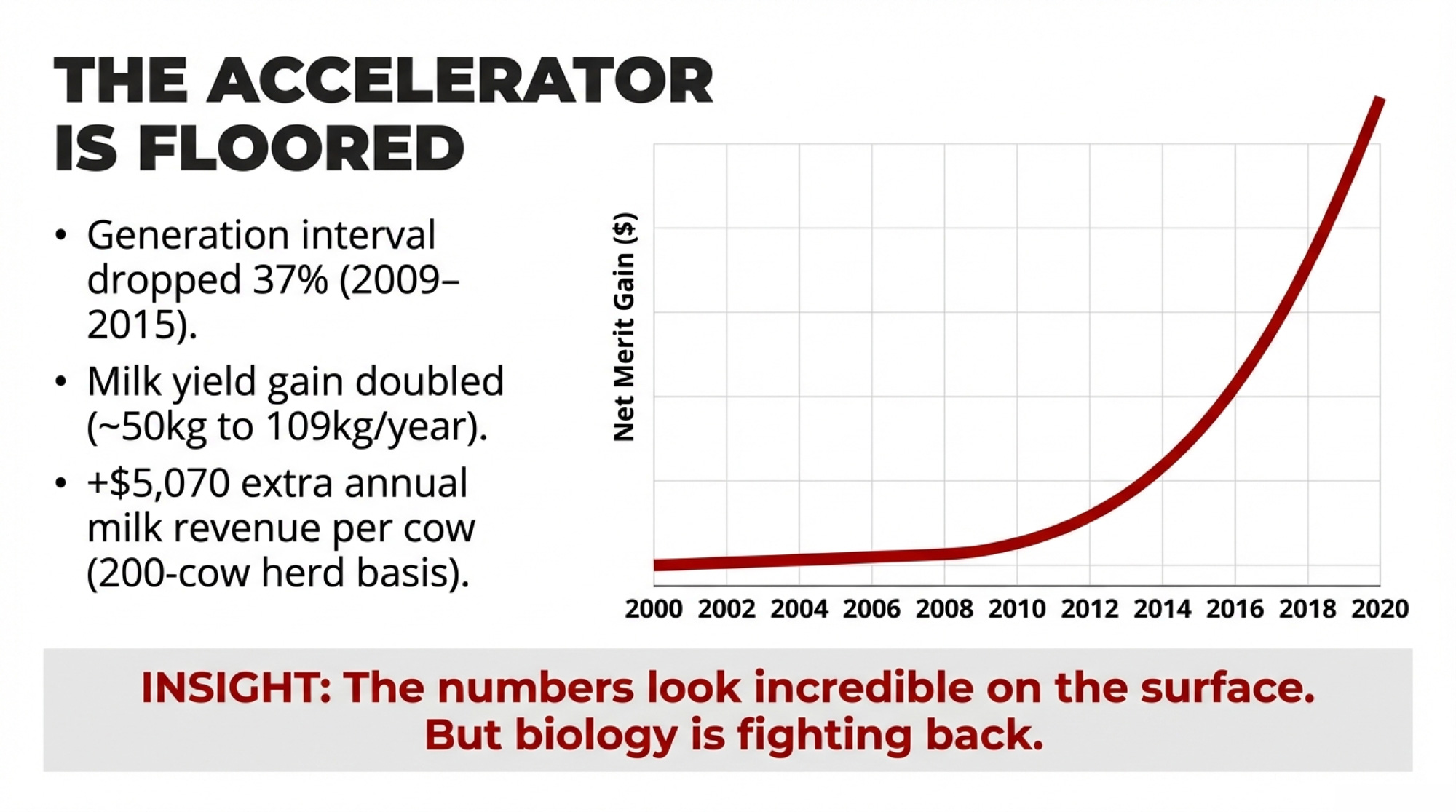
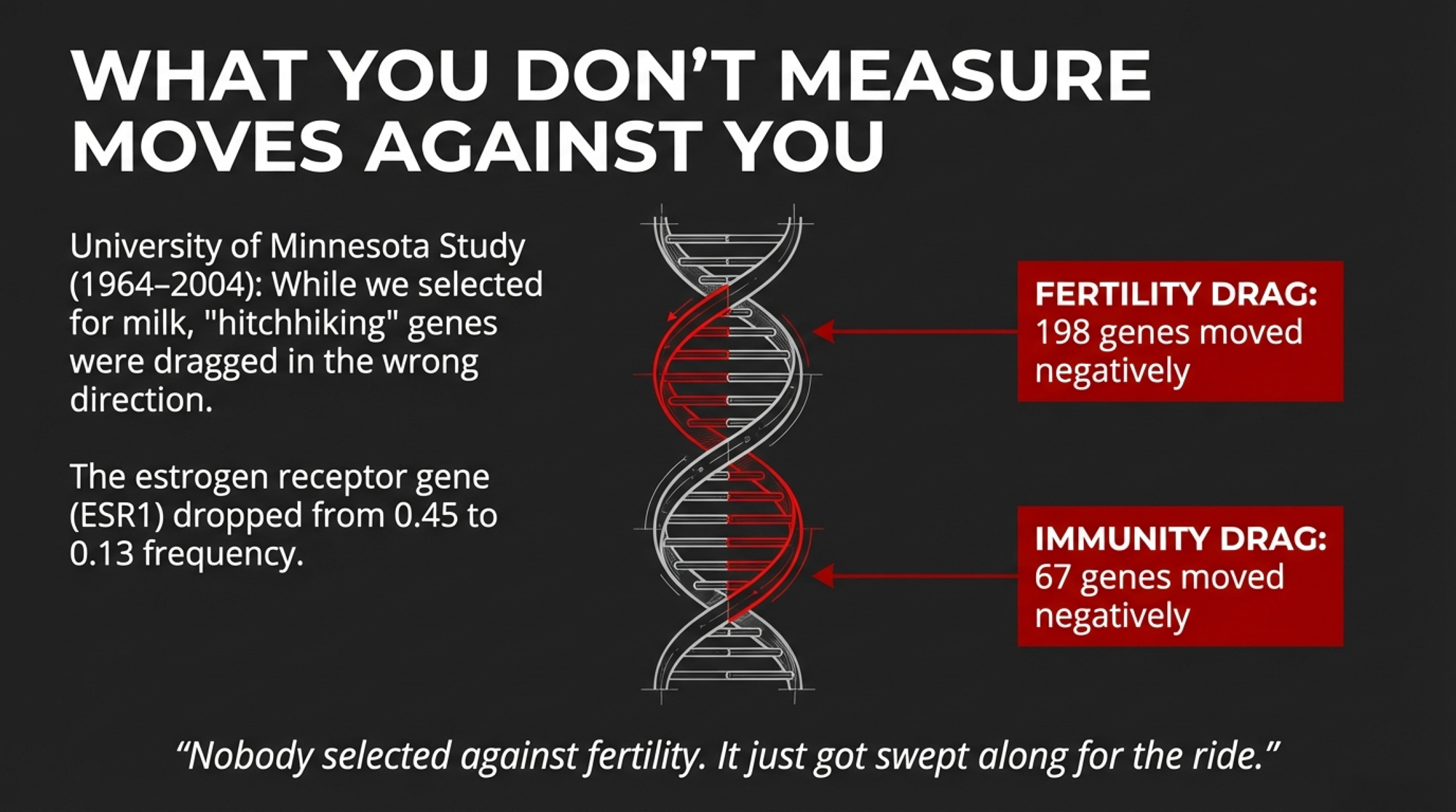
But here’s the part of that story nobody tells. The same breeding system that produced Missy — the same genomic toolkit that doubled annual genetic gain to 109 kg/year for milk in registered Holsteins (García-Ruiz et al., 2016, PNAS) — was simultaneously dragging 198 fertility genes and 67 immunity genes in the wrong direction. For 20 years. And the industry didn’t catch it. 

The question that should bother you: what’s getting dragged sideways in your herd right now?

How Fast the Engine Actually Runs

Before 2009, you waited five to seven years for a bull’s daughters to start milking before you knew if he was any good. Genomic selection rewired that math completely. Paul VanRaden and colleagues at USDA helped architect a system that estimates merit at birth, and the speed gain was dramatic. Across all four selection pathways that drive Holstein genetics (sire-of-bulls, sire-of-cows, dam-of-bulls, dam-of-cows), the combined generation interval dropped from 21.4 years in 2009 to 13.5 years by 2015 — a 37% reduction in just six years (García-Ruiz et al., 2016, PNAS). The sire-of-bulls pathway collapsed the fastest, from about 7 years to under 2.5.

Financially, the results are hard to argue with. Annual Net Merit gains climbed from $13 during 2000–2004 to more than $85 after 2010 (nominal dollars). Fat yield accelerated 173%. Protein yield, 156%. And the daughter pregnancy rate — which had been flat or declining for decades — finally reversed direction, rising to +0.26% per year.

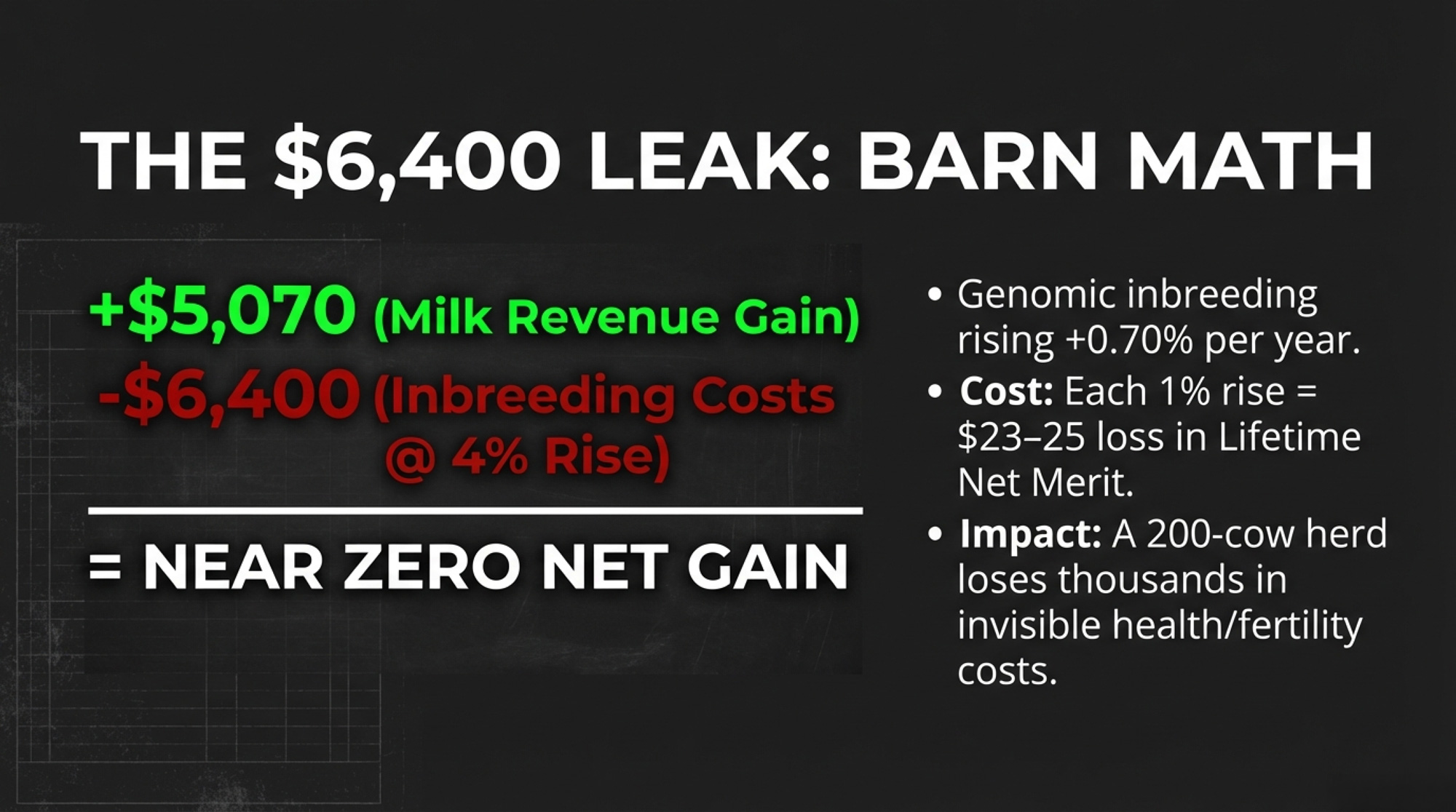
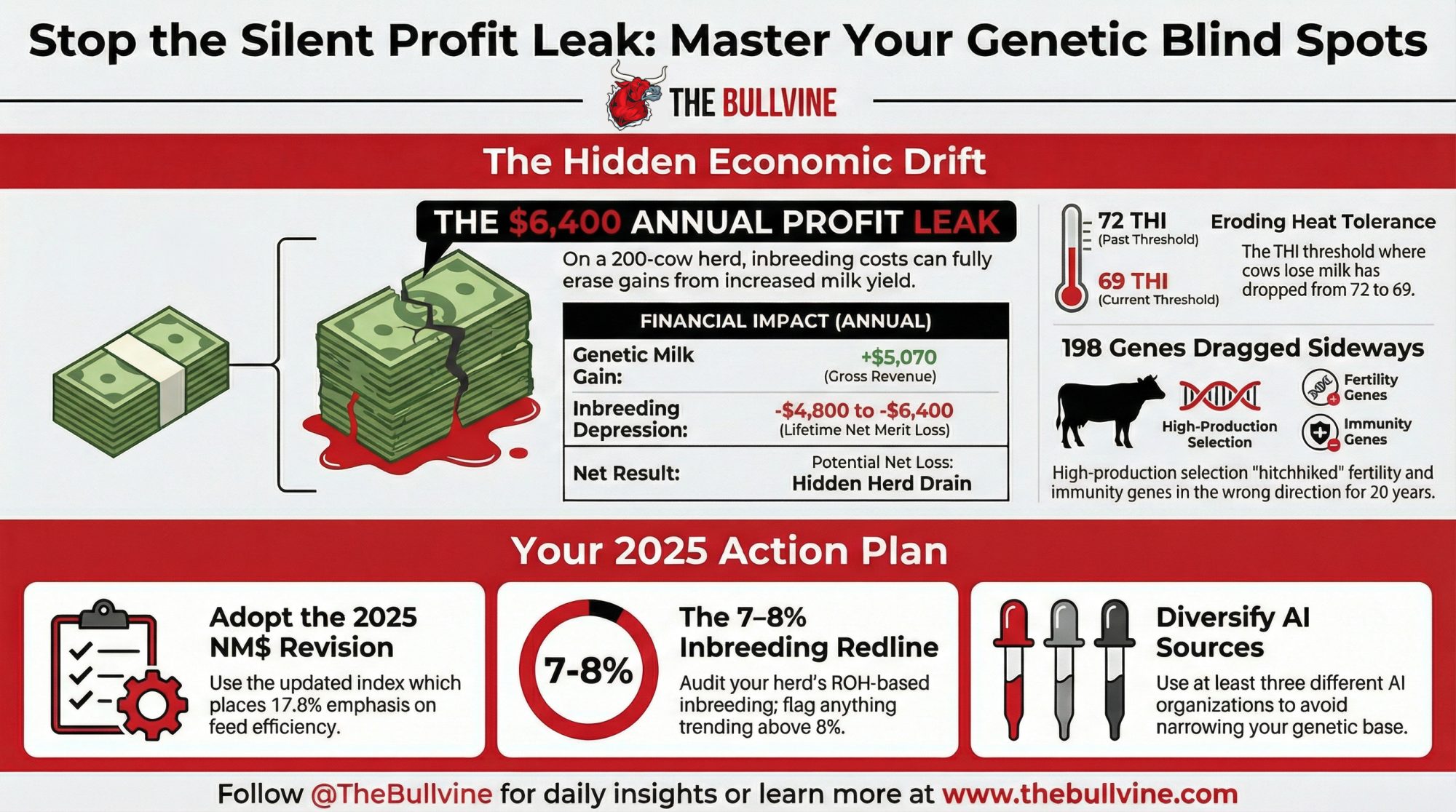
Here’s a way to feel that in your bulk tank. On a 200-cow herd averaging 85 lbs/day, the post-genomic milk yield acceleration alone (from ~50 kg/year to 109 kg/year for registered Holsteins) translates to roughly an extra 130 lbs of milk per cow per year in genetic potential over what the old system would have delivered. At a $19.50/cwt mailbox price, that’s about $5,070 in additional gross milk revenue across your herd annually — and it compounds every generation. Adjust that number for your regional mailbox price, but the scale holds. The record-breaking component shifts reshaping dairy’s economics are a direct product of this acceleration.

But the engine has a blind spot. And it’s biological, not mathematical.

What Happened When Nobody Was Measuring Fertility

The University of Minnesota’s research herd at the Southern Research and Outreach Center in Waseca did something nobody else bothered to do: they maintained an unselected Holstein control line alongside the commercially selected national population from 1964 onward. Same management. Same feed. Different genetics.

By 2004, the selected population had increased milk yield by 79%, from 6,309 kg to 11,324 kg. It had also lost roughly 30 additional days for successful conception compared to the control cows living right next door (Ma, Cole, Da & VanRaden, 2019, BMC Genomics 20:128).

That fertility decline wasn’t nutrition. Wasn’t repro protocols. Purely genetic. A breeding consequence nobody planned for.

The genome-level analysis revealed the mechanism. Within 234 chromosome regions shaped by four decades of milk selection, researchers found 198 genes involved in reproduction and 67 genes involved in immune function whose allele frequencies had shifted as collateral damage. The estrogen receptor gene ESR1 decreased from 0.45 to 0.13. The MHC region on chromosome 23 — the heart of immune diversity — showed significantly decreased heterozygosity.

CategoryCount
Fertility genes negatively affected198
Immunity genes negatively affected67
Total chromosome regions under selection234

Nobody selected against fertility or immunity. Those genes just happened to sit near milk-boosting alleles on the same chromosomes, and they got swept along for the ride. Geneticists call it hitchhiking. Producers who lived through the collapse in conception rates in the 1990s just called it expensive.

(This hitchhiking analysis comes from a single study using the unique Minnesota control line — the only unselected comparison herd of its kind. The broader fertility decline is independently confirmed across both the U.S. and Israeli dairy populations.)

Is the Same Thing Happening to Heat Tolerance Right Now?

The fertility crash is old news — the industry course-corrected, and genomic selection actually reversed the decline. The real question: where is the same pattern building today?

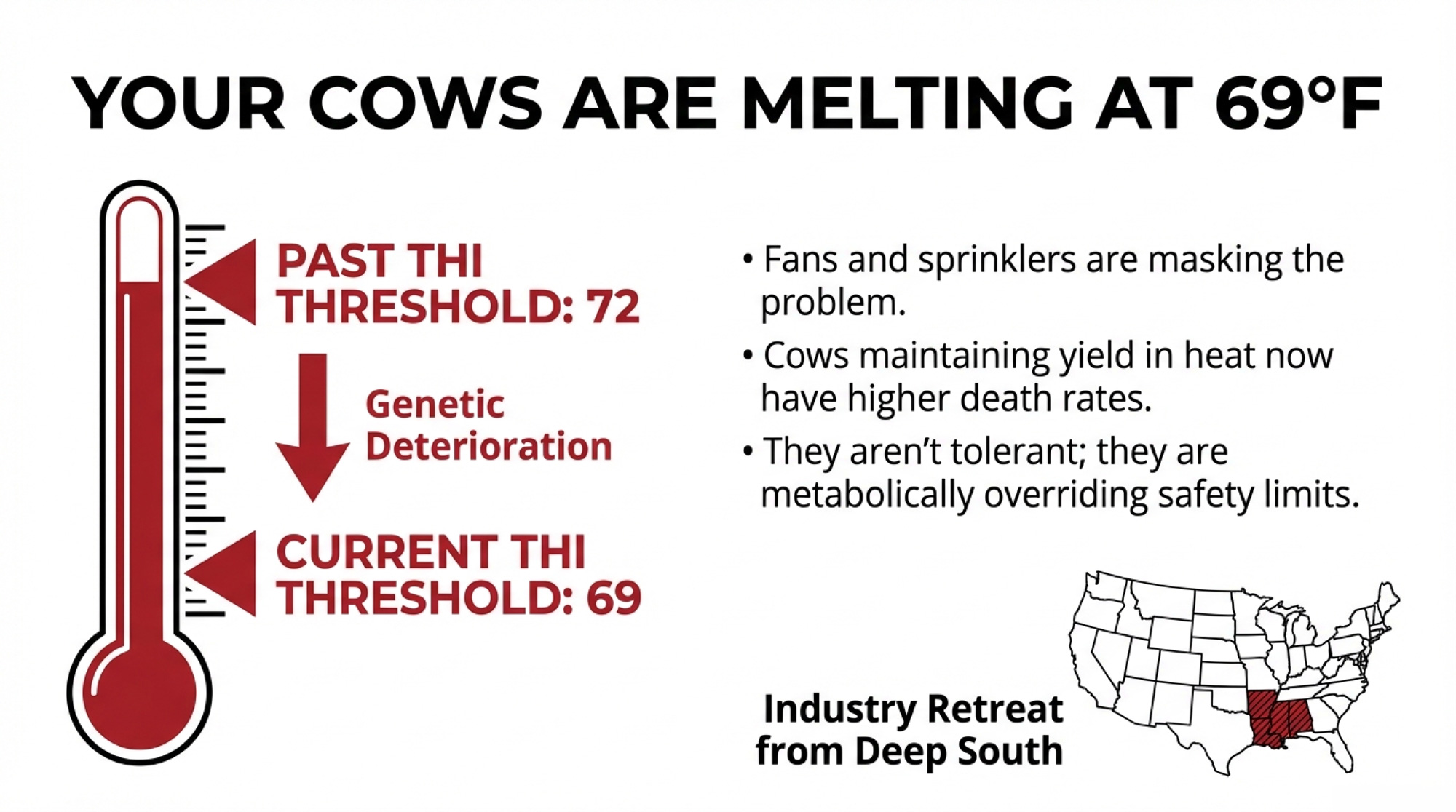
Heat tolerance is eroding, and almost nobody is selecting against it. Research led by Ignacy Misztal at the University of Georgia and Luiz Brito at Purdue found that the temperature-humidity index (THI) threshold where Holsteins start losing production has dropped from 72 to 69 over the past two decades (Misztal, Brito & Lourenco, 2024, JDS Communications 6(3):464–468). Your cows start suffering heat stress at lower temperatures than cows bred a generation ago.

And the grim part: cows that maintain production during heat stress peaks show an increased likelihood of death. They’re not tolerating the heat. They’re metabolically overriding their body’s protective shutdown. The authors note that better fans, sprinklers, and tunnel ventilation may actually be masking an even larger genetic deterioration underneath.

With the exception of Australia, dairy cows are not directly selected for improved heat tolerance anywhere in the world. In Alabama, Mississippi, and Louisiana, dairy has already become economically unviable — these states don’t even appear in the 24 major dairy states NASS tracks monthly (Misztal et al., 2024). A quiet testament to how completely the industry has retreated from the Deep South.

If your herd faces more than 60 days per year above THI 68, this isn’t an abstract research finding. It’s your next fertility crash in slow motion.

The Inbreeding Bill Coming Due

Genetic diversity is narrowing faster under genomics, not slower. A study of 74,485 Italian Holstein cows found the annual inbreeding rate based on runs of homozygosity (ROH) was +0.32% per year before genomic selection. After genomic selection took hold, it jumped to +0.70% per year (Ablondi et al., 2022, Frontiers in Veterinary Science8:773985). That’s above the 1% per generation threshold FAO considers critical for long-term sustainability.

CategoryValue
Pre-Genomic Annual Rate (Italy)0.32%
Post-Genomic Annual Rate (Italy)0.70%
U.S. Cumulative Increase 2010–2020168%

It isn’t just an Italian problem. U.S. Holstein inbreeding climbed from about 5.7% in 2010 to 15.2% by 2020 — a 168% jump — with CDCB analysis putting the cumulative cost to the national herd at an estimated $6.7 billion (The Bullvine, 2025 year-end review).

MetricAnnual Impact (200-cow herd)What’s Driving It
Extra Milk Revenue (Genomic Gain)+$5,070109 kg/year genetic gain vs. 50 kg/year pre-genomic (registered Holsteins, $19.50/cwt)
Inbreeding Drag (4% increase)−$4,800 to −$6,400$23–25/cow lifetime NM$ loss per 1% inbreeding, annualized over 3–4 year turnover
Net Realized Gain (Conservative)+$270 to +$1,070On fast-turnover herds, inbreeding wipes out nearly all the genomic advantage
Net on Fast-Turnover Herds−$1,330 (loss)Herds replacing >35% annually can lose more than they gain

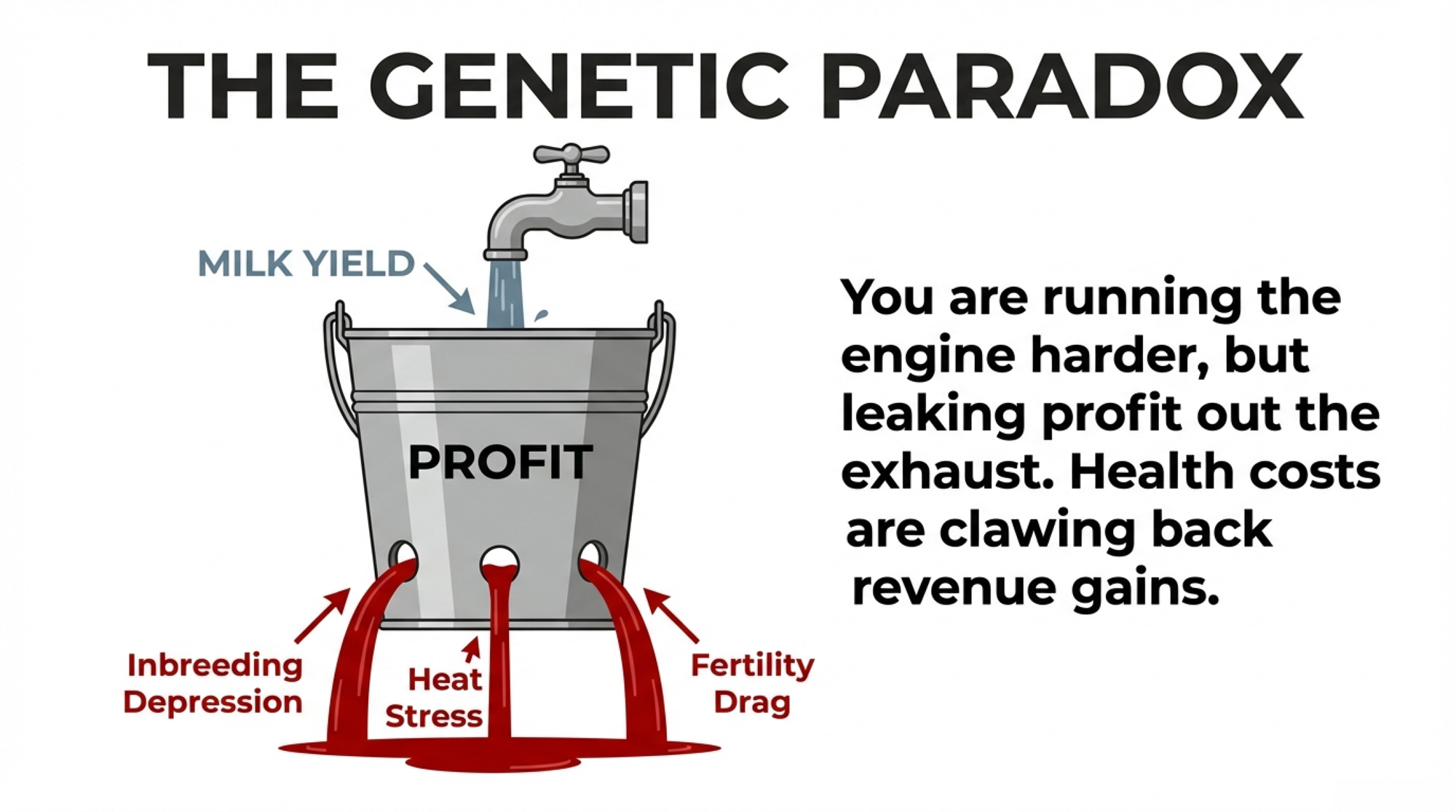
Here’s where the barn math gets uncomfortable. Each 1% increase in inbreeding costs roughly $23–25 off a cow’s lifetime Net Merit (USDA-ARS, 2025 NM$ revision). Go back to that 200-cow herd. If your average genomic inbreeding crept up 4 percentage points over the past decade — and given that the national average jumped 9.5 points in ten years, 4% is conservative — that’s about $96 per cow in lifetime profit quietly erased. Spread across a herd that turns over every three to four years, you’re looking at roughly $4,800 to $6,400 per year leaking out through health costs, fertility failures, and shortened productive life, depending on your actual turnover rate. Remember that $5,070 in extra annual milk revenue from faster genetic gain? At most turnover rates, inbreeding depression is clawing back nearly all of it — and on herds that turn over faster, the loss actually exceeds the gain. You’re running the genetic engine harder, and a big chunk of what it produces is leaking out the other side.

(Note: the $5,070 figure is gross milk revenue at $19.50/cwt; the $4,800–$6,400 range is annualized lifetime Net Merit loss, which captures health, fertility, and longevity effects beyond milk alone. They’re not identical units, but the scale of the offset is real — and the barn-math range depends on how quickly your herd turns over.)

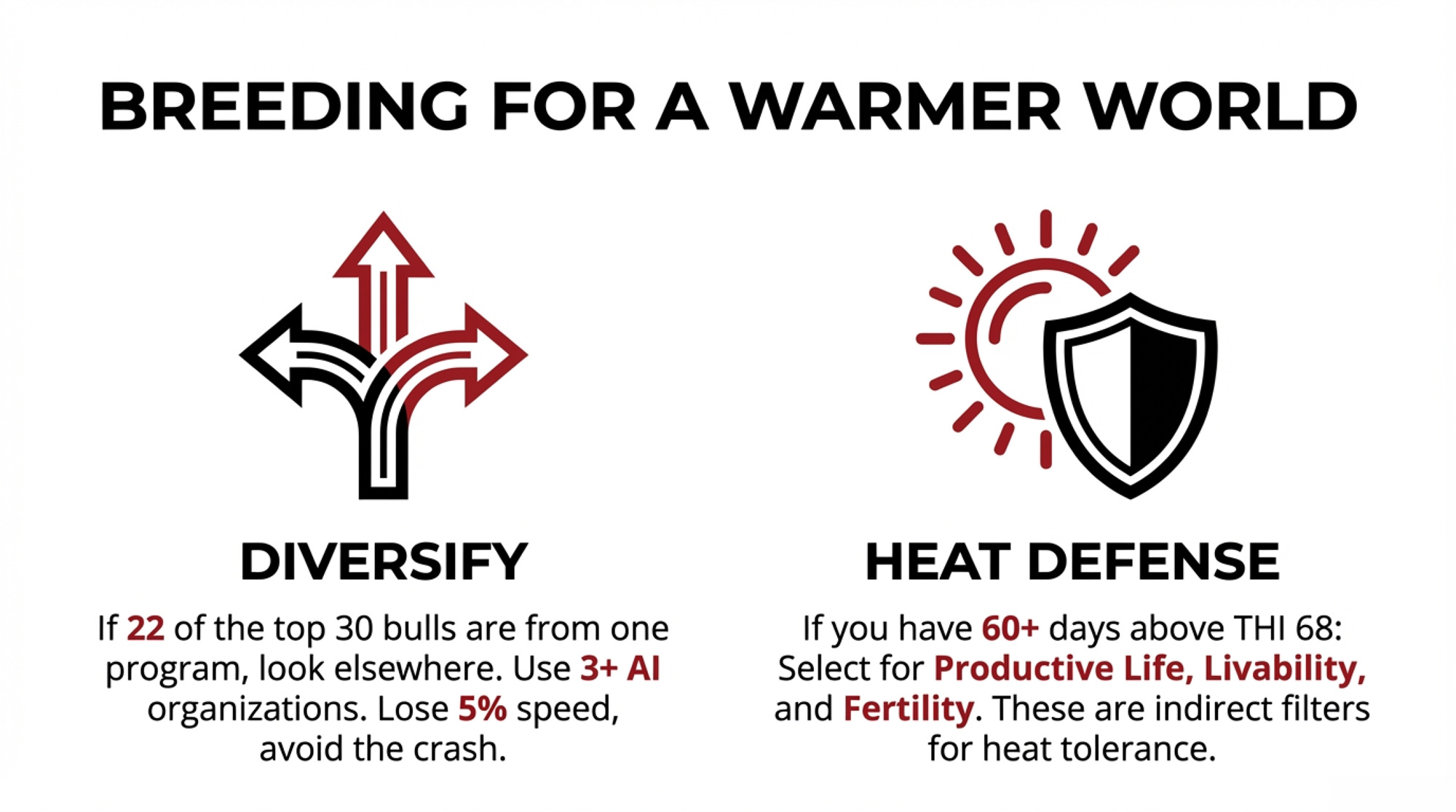
The December 2025 evaluations showed what concentrated genetics look like in practice. When 22 of the top 30 NM$ bulls come from one program, you’re getting results and concentrating the gene pool simultaneously. Understanding how inbreeding affects milk production, fertility, and health is the other half of this equation.

Options and Trade-Offs for Your Next Breeding Decisions

The fertility crash lasted 20-plus years because nobody measured the trait being eroded. Heat tolerance, inbreeding, and resilience are in a similar position today. Here’s what you can actually do about it — with the honest trade-offs attached.

ActionWhen to ActWhat You’re Hedging AgainstTrade-Off
ROH Inbreeding AuditIf genomic inbreeding >7–8%$23–25 lifetime NM$ loss per 1% increase; $4,800–$6,400/year drag on 200-cow herdRestricting matings may slow genetic progress 5–15%
Weight Productive Life + LivabilityIf you face 60+ days above THI 68Heat tolerance declining; THI threshold dropped from 72 to 69 over 20 yearsMay sacrifice 3–5% genetic gain on other traits
Diversify Across 3+ AI ProgramsIf top 5 bulls all trace to one programGenomic inbreeding rising 0.7%/year; 22 of top 30 NM$ bulls from one program (Dec 2025)Aggressively avoiding related matings costs ~5–15% progress
Contribute AMS/Activity Monitor DataIf you’re running precision dairy techNext hitchhiking problem: feeding the reference population so crashes get caught in 5 years, not 20Consistent data entry discipline required

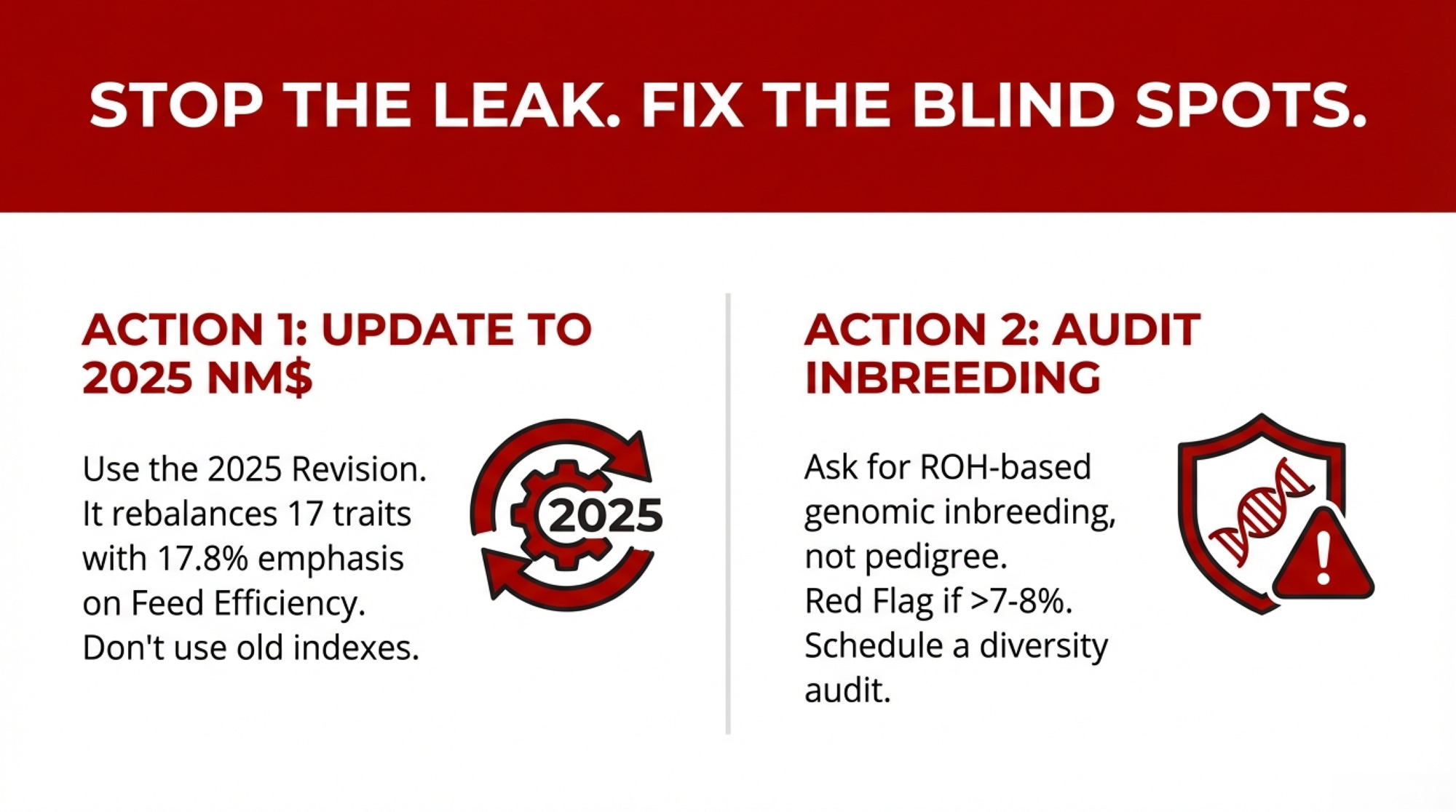
Confirm you’re using CDCB’s 2025 NM$ revision — and don’t override it. The updated index rolled out alongside the April 2025 base change. It now balances 17 traits for lifetime profitability, with feed efficiency (FSAV) carrying 17.8% of total emphasis — a substantial shift from prior weightings. If your genetics provider hasn’t updated to the 2025 revision, it’s worth a quick conversation; the trait emphasis shifted enough that older weightings are optimizing for a different market than the one you’re selling into. But even the right index can’t save you from yourself: if your top five bulls all rank in the top 20 for a single component while sitting below breed average for productive life, you’re running a single-trait program no matter what the index says. David Dyment at AG3 has built his program on exactly this principle — “consistency over unpredictability,” as he puts it — betting that balanced functional genetics outlast flavor-of-the-month rankings. The trade-off: you’ll pass on some high-component bulls that look great on paper. The fertility crash is what happened when the industry overrode balanced selection often enough.

David Dyment of AG3 built his breeding program on “consistency over unpredictability,” betting that balanced functional genetics will outlast the flavor-of-the-month sire list. (Show Ring Legend to Industry Innovator: The David Dyment Story)

Ask your genetics advisor for your herd’s ROH-based genomic inbreeding — this month. Pedigree coefficients underestimate actual homozygosity. In Italian Holsteins, pedigree inbreeding averaged 0.07 while genomic inbreeding was more than double at 0.17 (Ablondi et al., 2022). As a general rule of thumb, many geneticists start flagging concern when genomic inbreeding crosses 7–8% for Holsteins — there’s no official industry threshold, but herds above 9% should seriously consider a diversity audit. CDCB provides genomic inbreeding estimates — if your genetics provider isn’t using ROH-based calculations in mating plans, you’re flying partly blind. Diversify your sire lineup across at least three AI organizations. The trade-off: aggressively avoiding related matings can slow genetic progress — estimates vary, but the general range is somewhere around 5–15% depending on how restrictive you get. That’s a real cost. But inbreeding depression quietly eating your gains from the inside is worse — and that $4,800-to-$6,400-a-year leak on a 200-cow herd is real money.

If you’re in a heat-stress region, start weighting for it now. Increasing emphasis on productive life, livability, and fertility provides indirect selection pressure for thermotolerance — these traits correlate positively (Misztal et al., 2024). The trade-off: you may sacrifice 3–5% of genetic gain on other traits. In a warming climate, that’s a hedge worth paying for. If you’re south of the Mason-Dixon or running herds in the Central Valley, this isn’t optional — it’s self-defense.

Contribute the data you’re already collecting. If you’re running activity monitors, AMS systems, or feed intake tracking, those records can help build the reference populations for tomorrow’s evaluations. Contact CDCB or your breed association — in Canada, Lactanet already accepts health event and AMS data. The trade-off: consistent data entry takes discipline. But incomplete data contributed widely still beats perfect data that never leaves the farm. And it’s how the next hitchhiking problem gets caught in five years instead of twenty.

Key Takeaways

  • If your herd’s ROH-based genomic inbreeding is trending above 7–8%, schedule a diversity audit before your next mating run. Each 1% of inbreeding costs $23–25 off lifetime NM$ per cow, and on a 200-cow herd, a 4% accumulation translates to $4,800–$6,400 a year in hidden drag, depending on your turnover rate.
  • If you face 60+ days above THI 68, add productive life and livability emphasis to your sire selection now. Heat tolerance is declining genetically, even as heat abatement technology improves — the infrastructure is masking the problem.
  • If your genetics provider hasn’t updated to the 2025 NM$ revision, have that conversation this week. The updated index rebalanced 17 traits and added feed efficiency with an emphasis of 17.8%. Older weightings mean you’re optimizing for a market that’s already shifted.
  • If all your top sires trace to the same program, diversify across at least three AI organizations. Genetic gain means nothing if you’re narrowing the base that sustains it.
  • Before your next mating run, ask one question your genetics advisor probably won’t raise on their own: “Which traits am I not measuring that might be shifting in the wrong direction?” That’s the question the fertility crash should have taught us to ask in 1985.

The Bottom Line

Steiner’s $8,100 gamble in that drafty Wisconsin barn wasn’t a bet on a cow. It was a bet on seeing what the data couldn’t yet show him. Twenty-three years later, the tools are sharper than they’ve ever been — genomic testing at birth, AI-driven mating plans, embryo tech that was science fiction in 2003. The engine runs faster every year.

But the biology is still messier than the model. And the gap between what you’re optimizing and what you’re actually affecting is where unintended consequences compound. Silently. Generationally. The only question worth asking every time you pull up a sire list: What am I not measuring that I’m going to wish I had?

Editor’s Note: Genetic gain data from García-Ruiz et al. (2016, PNAS); the 37% generation interval reduction refers to the combined total across all four selection pathways (sire-of-bulls, sire-of-cows, dam-of-bulls, dam-of-cows), not any single pathway. Hitchhiking analysis from Ma, Cole, Da & VanRaden (2019, BMC Genomics 20:128), using the University of Minnesota unselected control line at Waseca, MN. Heat tolerance data from Misztal, Brito & Lourenco (2024, JDS Communications 6(3):464–468). Inbreeding data from Ablondi et al. (2022, Frontiers in Veterinary Science 8:773985), based on 74,485 Italian Holstein cows. U.S. inbreeding trends from CDCB analysis as reported in The Bullvine (December 2025). Barn-math calculations use $19.50/cwt mailbox price; inbreeding annualization assumes 3–4 year herd turnover and should be adjusted for your operation’s actual replacement rate. Per-trait figures are for registered Holsteins; all-cow population gains were approximately half this magnitude. NM$ figures are nominal. Missy auction details from The Bullvine’s Wesswood-HC Rudy Missy feature (July 2025), cross-referenced with the Wisconsin Holstein Association’s 2020 convention report.

Executive Summary: 

Genomic selection has more than doubled Holstein genetic progress, but it also proved something you feel in your own breeding records: traits you don’t measure still move, and sometimes they move against you. The same engine that helped make Wesswood-HC Rudy Missy a global brood cow quietly dragged 198 fertility genes and 67 immunity genes the wrong way for about 20 years before anyone caught it. Over those same decades, the THI threshold at which cows start losing milk slipped from 72 to 69, yet almost no one outside Australia selects directly for heat tolerance, even as better fans and sprinklers mask how fragile the genetics underneath have become. On the inbreeding side, genomic homozygosity in Holsteins is rising around 0.7% per year in some populations, and each 1% costs roughly $23–25 in lifetime Net Merit per cow — enough for a 200-cow herd to quietly leak $4,800–$6,400 a year, which can wipe out almost all of the roughly $5,070 in extra milk revenue from faster gain. You’ll see how those blind spots developed. You’ll see how those blind spots developed, then get concrete next steps: stick with the 2025 NM$ revision instead of custom tweaking, ask your genetics provider for ROH-based genomic inbreeding for your herd, and spread risk across multiple AI programs instead of loading your list from just one. If you’re staring down 60+ days above THI 68, it also explains how to lean harder on productive life, livability, and fertility as indirect heat-tolerance filters while feeding good data back into the system so the next crash is spotted in years, not decades. Underneath it all is one question this article keeps pushing you to ask every time you open a sire catalog: what am I not measuring that I’m going to wish I had?

Complete references and supporting documentation are available upon request by contacting the editorial team at editor@thebullvine.com.

Learn More

The Sunday Read Dairy Professionals Don’t Skip.

Every week, thousands of producers, breeders, and industry insiders open Bullvine Weekly for genetics insights, market shifts, and profit strategies they won’t find anywhere else. One email. Five minutes. Smarter decisions all week.
NewsSubscribe
First
Last
Consent

The $200-Per-Cow Blindspot: What Rising Inbreeding Is Costing You – and What a Decade of Crossbreeding Research Found

New research puts hard numbers on the hidden price tag of genetic progress—and what a 10-year crossbreeding study reveals might change how you think about your next breeding decisions.

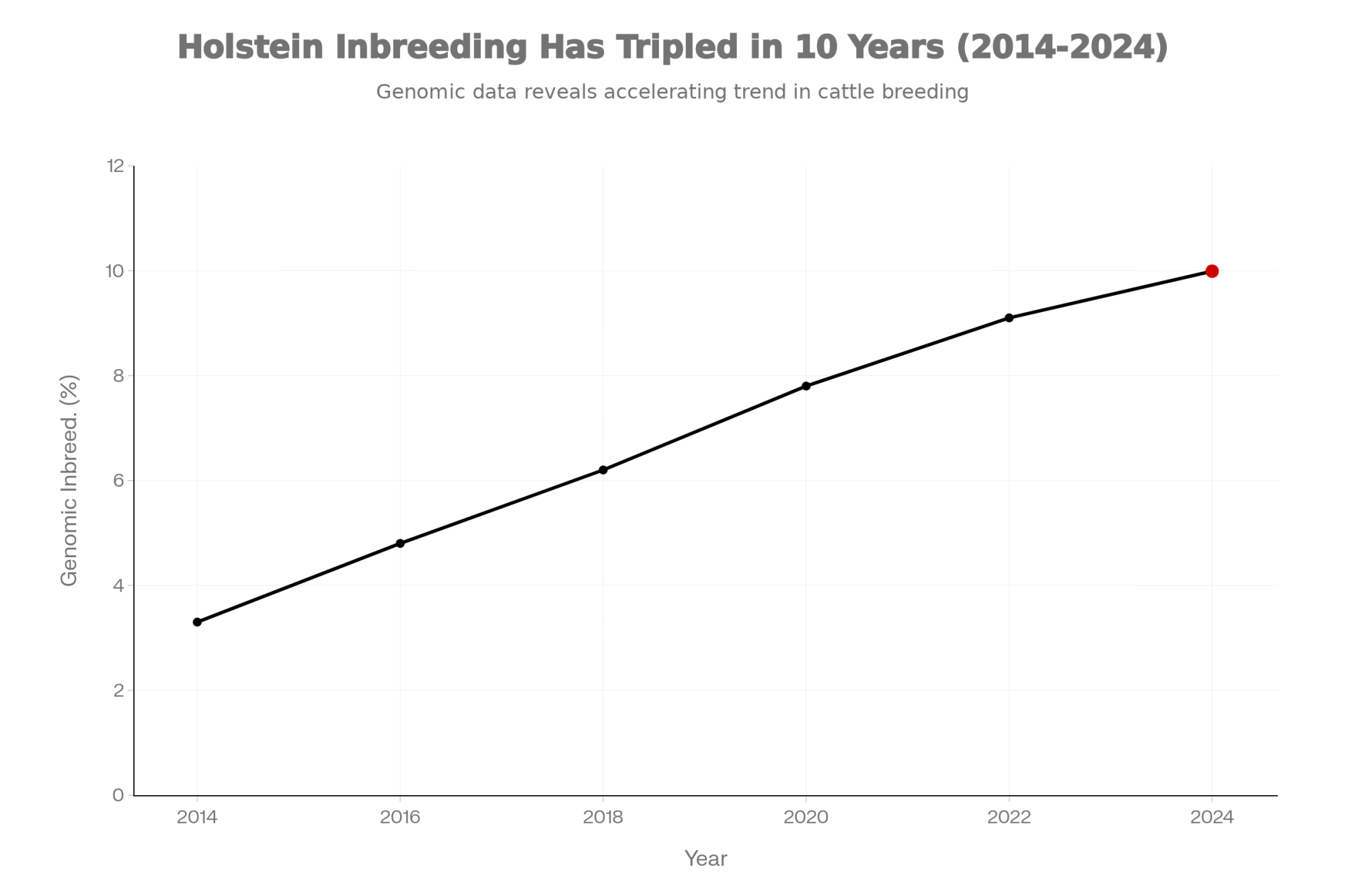
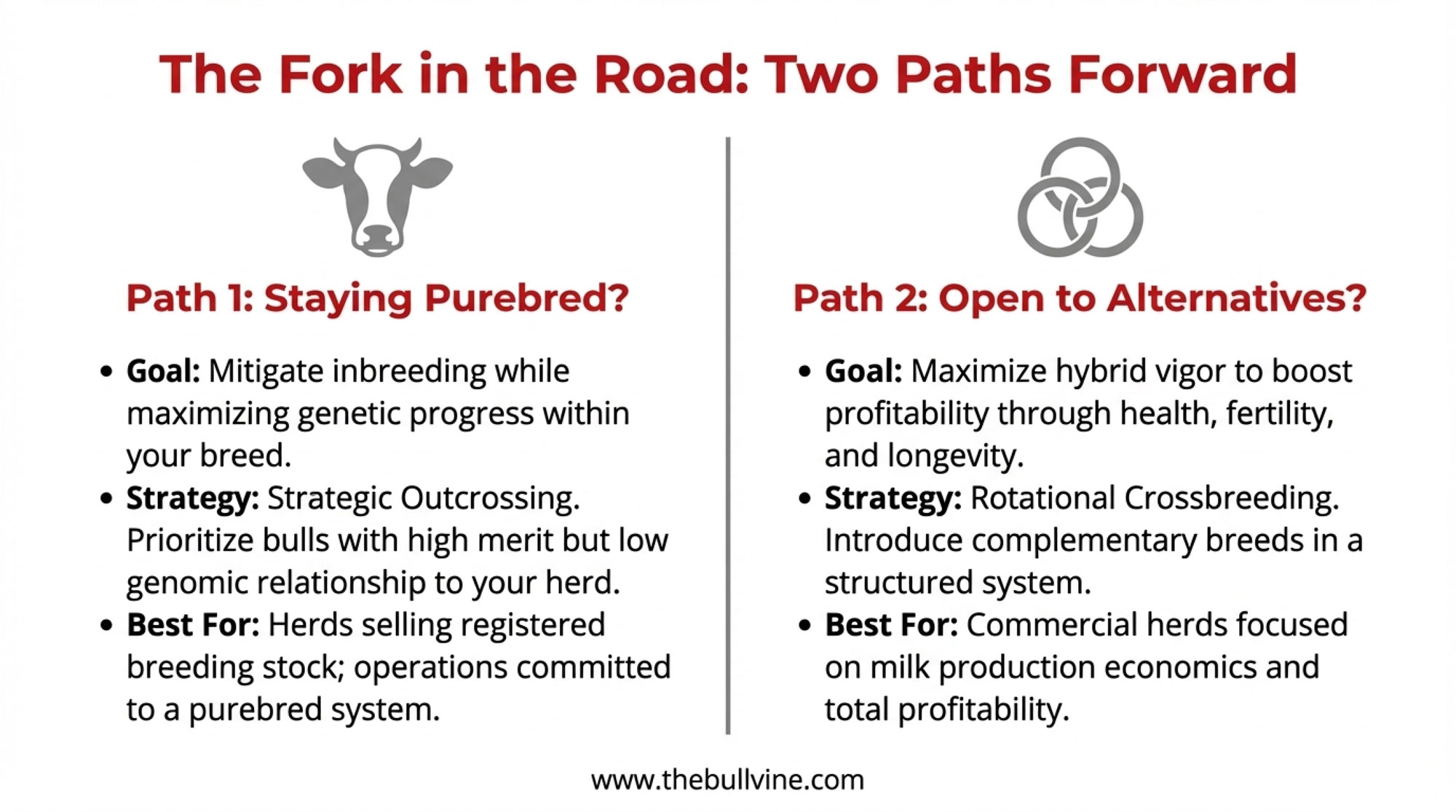
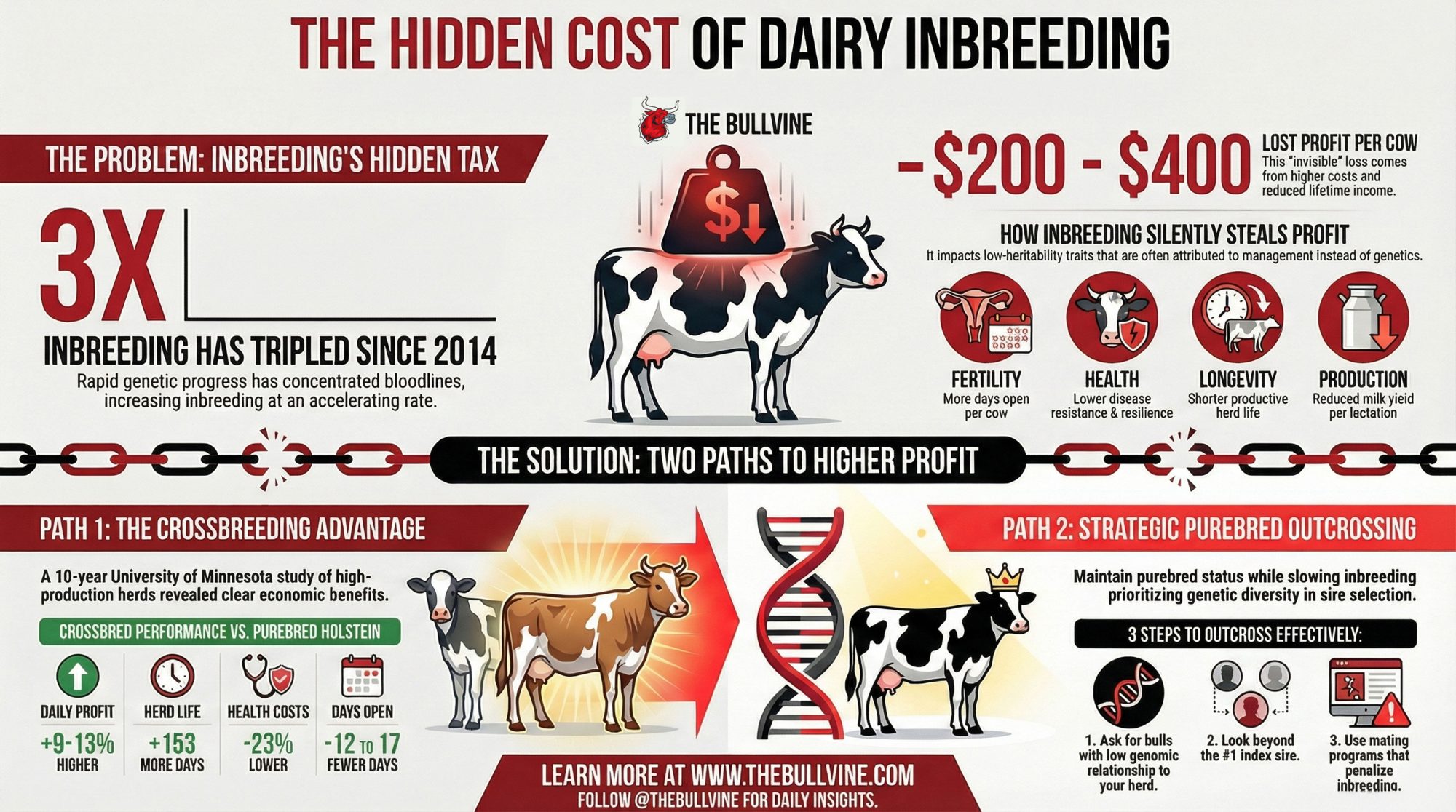
Executive Summary: Inbreeding in Holsteins has tripled since 2014—silently adding an estimated $200-400 per cow in lifetime losses. These costs are not reflected in any report but appear as extra breedings, transition problems, and productive cows culled too soon. A 10-year University of Minnesota study tracked seven high-production herds averaging nearly 30,000 lbs. The finding: crossbred cows made 9-13% more profit per day. Every herd. No exceptions. That doesn’t make crossbreeding right for every operation—but it does change the math. For purebred programs, strategic outcrossing can slow the trend. For those open to alternatives, a decade of data demands attention. Both paths start with understanding what your genetics are actually costing you.

Dairy inbreeding costs

Here’s a number that probably isn’t on your radar: $200 to $400 per cow.

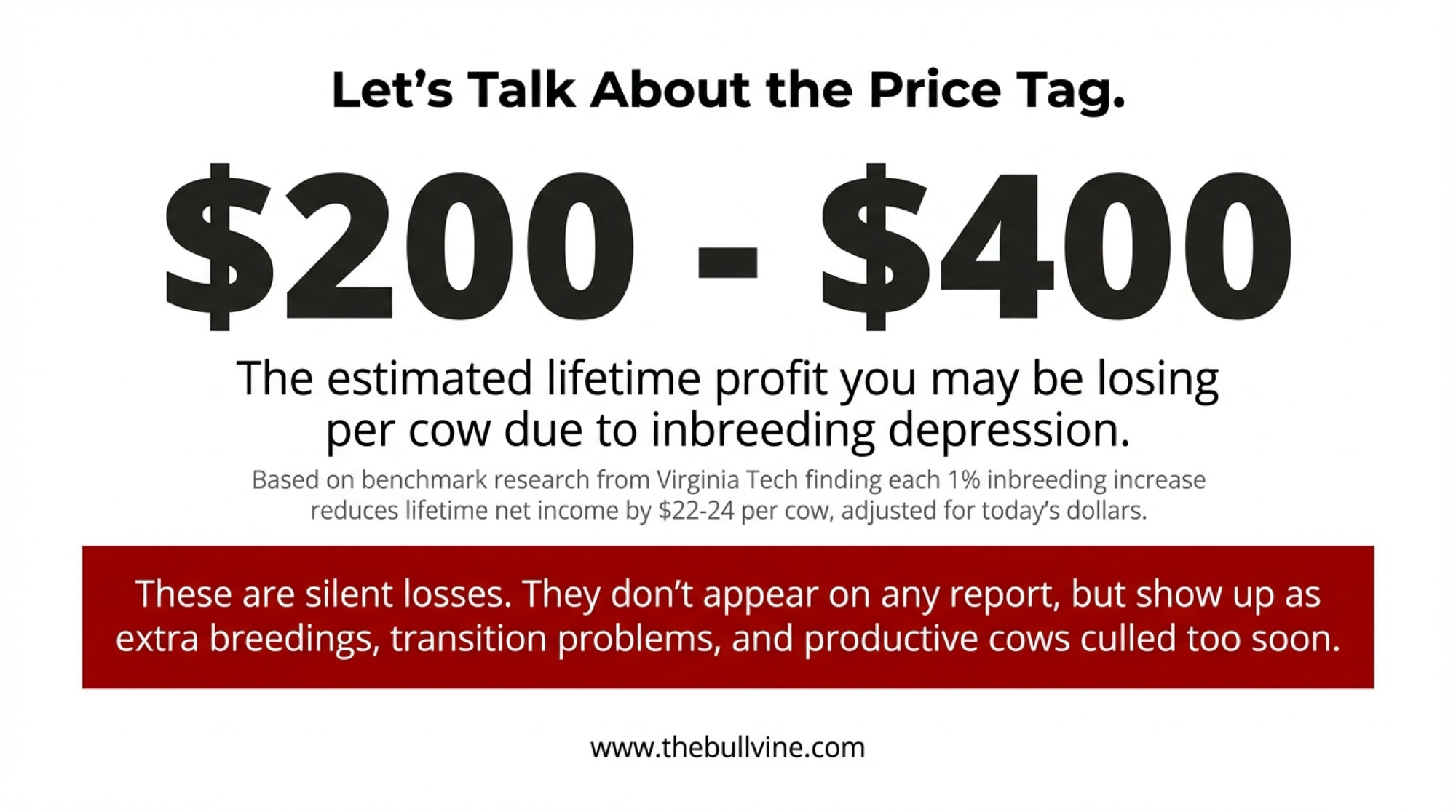
That’s the estimated lifetime profit you may be losing to inbreeding depression—losses that never show up on a breeding report, never get their own line item, and rarely get blamed on genetics. They show up as the cow that took an extra breeding. The calf that didn’t quite thrive. The cow you culled in the third lactation instead of the fifth. Most of us have seen these patterns in our herds without necessarily connecting them to genetics.

And here’s what makes this worth a closer look: Holstein genomic inbreeding has climbed dramatically over the past decade. The Council on Dairy Cattle Breeding’s trend data shows genomic inbreeding in young Holstein bulls has roughly tripled since 2014, with current averages pushing into the mid-teens percentage-wise. Lactanet Canada’s August 2025 update puts the average for Holstein heifers born in 2024 at 9.99%—nearly double what it was fifteen years ago. John Cole walked through this acceleration in detail at the 2024 Beef Improvement Federation symposium—and honestly, the rate of change caught even some industry veterans off guard.

Now, I want to be clear from the start: genomic selection has been one of the most valuable tools our industry has ever had. The genetic progress over the past decade has been remarkable. But there’s a growing body of research suggesting we need to look at the full picture—both the gains and the costs. And increasingly, producers I talk to are asking a fair question: What’s the net benefit when you account for everything?

Let me walk through what the research actually shows, what’s driving these trends, and what options might make sense for different operations.

What Inbreeding Is Actually Costing You

Let’s start with the economics, because that’s ultimately what matters when you’re making decisions for your operation.

Back in 1999, researchers at Virginia Tech—Cassell, Adamec, and Pearson—published a study in the Journal of Dairy Science that’s still the benchmark for understanding inbreeding costs. They found that each 1% increase in inbreeding reduces lifetime net income by $22-24 per cow, depending on whether you’re selling into fluid or cheese markets.

That study is over two decades old now, and I’ll be upfront about that. The underlying biology hasn’t changed, but dollar values certainly have. A rough inflation adjustment would put that figure somewhere around $40-45 per cow per percentage point in today’s terms—though I should note that’s a back-of-envelope calculation, not a formal research finding. We could really use an updated economic study on this, and I know several universities have been discussing it.

So, when genomic inbreeding rises substantially over a decade You’re potentially looking at $200-450 in lost lifetime profit per cow. For a 200-cow dairy in Wisconsin or a 500-cow operation in California’s Central Valley, that adds up to real money—$40,000 to $90,000 or more in economic impact that’s essentially invisible on your monthly reports.

Inbreeding depression silently steals profit from dairy producers because it is expressed mostly for traits that are not readily noticeable, such as embryo loss, less disease resistance, and shortened survival. That word “silently” is important. These aren’t losses you see on a vet bill or a milk check. They’re distributed across your operation in ways that are genuinely hard to track.

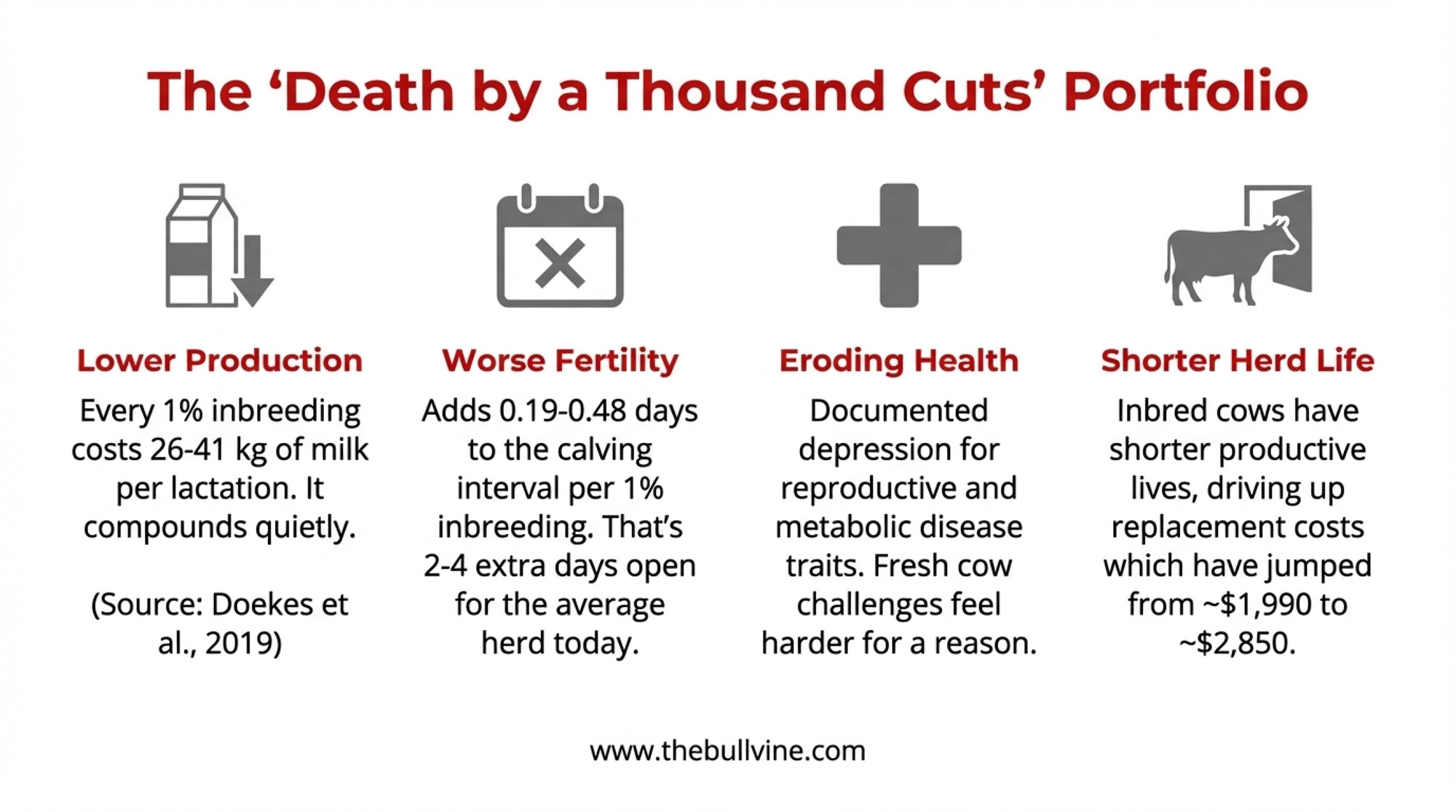
  • Production losses add up quietly. Research published in Genetics Selection Evolution—including detailed work by Doekes and colleagues in the Netherlands—found that every 1% increase in genomic inbreeding costs roughly 26-41 kg of milk per lactation. Doekes specifically documented a 36.3 kg decrease in 305-day milk yield per 1% increase in runs of homozygosity. Not dramatic for any single cow. But across a herd and over multiple lactations? It compounds.
  • Fertility takes a hit, too. That same body of research shows 0.19-0.48 additional days in the calving interval per 1% inbreeding increase. I know—sounds small. But if your herd is averaging 8-10% more inbreeding than a decade ago, that’s potentially 2-4 extra days open per cow. Talk to any reproductive specialist, and they’ll tell you what that costs over time.
  • Health resilience erodes. U.S. research involving hundreds of thousands of Holstein cows has documented significant inbreeding depression for reproductive and metabolic disease traits. The cows aren’t necessarily falling over sick, but they’re not quite as resilient as they could be. Fresh cow challenges. Transition period issues. Mastitis susceptibility. All of these have genetic components that inbreeding can compromise. I’ve had several producers tell me their fresh cow management seems harder than it used to be, and while there are many factors involved, this may be part of the picture.
  • Longevity shortens. Inbred cows tend to have shorter productive lives. And you know what replacement heifers cost these day, prices jumped from around $1,990 to $2,850. Getting four lactations instead of five from each cow changes your economics significantly.

Here’s what I find particularly telling: these are exactly the kinds of traits that don’t show up well on genomic evaluations. They’re low in heritability, hard to measure consistently, and easy to attribute to management rather than genetics.

The Numbers at a Glance

MetricData
Holstein genomic inbreeding trendRoughly tripled since 2014
Current Holstein heifer average (Canada)9.99% for 2024-born animals
Cost per 1% inbreeding$22-24/cow lifetime (1999 dollars)
Potential herd impact (200 cows)$40,000-90,000
Annual rate of increaseApproximately 0.35-0.44% per year

Data from Council on Dairy Cattle Breeding trend reports; Lactanet Canada August 2025; Cassell et al. 1999, Journal of Dairy Science; Doekes et al. 2019, Genetics Selection Evolution

What’s Behind the Trend

So why has inbreeding accelerated so dramatically? Several factors are working together, and here’s what’s worth understanding—each one made sense as an individual decision.

  • Genomic selection changed the timeline. Before genomics, progeny testing meant waiting 5-7 years to know if a bull was actually delivering what his numbers promised. Now we can identify elite genetics essentially at birth. That’s genuinely powerful, and it’s driven tremendous progress. But it also means popular sire lines spread through the population much faster than they used to. Bulls that would have taken a decade to significantly influence breed genetics now achieve similar penetration in 3-4 years. The genetics are better—but they’re also more concentrated.
  • Sexed semen reshaped breeding patterns. The technology has been transformative for heifer inventory management. Data from the UK’s Agriculture and Horticulture Development Board shows sexed semen now accounts for 84% of all dairy semen sales in Great Britain—with Holsteins specifically hitting 88-89% by April 2024. North American adoption continues climbing, too. The economics make sense for individual operations. But here’s the tradeoff: before sexed semen, breeding elite cows with conventional dairy semen produced roughly 50% bull calves, giving AI organizations a large pool of potential sires to evaluate. Today, that pipeline has narrowed considerably.
  • Beef-on-dairy became standard practice. And for good reason—those calves are worth real money, and the quality has improved dramatically. The National Association of Animal Breeders reported that beef semen represented about 31% of total semen sales to dairy operations in 2023, and Farm Bureau data from early 2025 indicates 72% of dairy farms now use beef genetics on at least part of their herd. That’s a rational economic decision for most operations. But combined with sexed semen on your top-end genetics, it means fewer Holstein matings overall. Canadian data from Lactanet shows Holstein-on-Holstein breedings have dropped from the mid-90s percent range to around three-quarters of matings in recent years
  • Industry structure evolved. This one’s worth understanding because it affects sire availability. Lactanet Canada’s analysis shows that between 2014 and 2019, bulls from AI-owned dams increased from 34% to 52% of marketed young bulls. I want to be clear about something: this isn’t a criticism of AI companies. They’re doing what makes business sense—investing in elite genetics and accelerating progress. And they’ve developed real tools to help manage inbreeding. But the concentration does have implications for genetic diversity that are worth being aware of when you’re making breeding decisions.

The Industry Perspective

It’s worth acknowledging that AI organizations aren’t ignoring this issue—far from it. Most major companies now offer mating programs that calculate genomic relationships and help avoid closely related matings. Tools like ABS’s Genetic Management System, Semex’s OptiMate, and similar platforms from other organizations are designed specifically for inbreeding management. These tools work, and they’re more sophisticated than what was available even five years ago.

And the industry has delivered real value. Various analyses suggest genomic selection has generated substantial economic benefit—potentially billions of dollars—through accelerated genetic progress over the past decade. That represents genuine improvement in production, health traits, and efficiency, as shown by milk checks and herd performance.

Here’s where it gets complicated, though. USDA geneticist Paul VanRaden and others have noted the fundamental tension: accepting slower genetic progress to manage inbreeding means potentially watching competitors move faster. For individual operations, using the highest-ranking bulls often makes economic sense regardless of relatedness. But when everyone does that, breed-wide inbreeding accelerates. It’s a classic collective action problem—individual optimization can lead to collective challenges.

Some countries have approached this differently. Nordic breeding programs in Denmark, Sweden, and Finland have historically weighted health, fertility, and longevity more heavily in their selection indexes—and their inbreeding trajectories look different as a result. Now, it’s not a perfect comparison. Different population sizes, different market conditions, different payment systems. But it does suggest that how we design selection indexes has real consequences for genetic diversity over time.

The question isn’t whether genomic selection has been valuable—it clearly has. The question is whether we’re fully accounting for all the costs alongside the benefits, and whether there are adjustments worth considering.

What a Decade of Crossbreeding Data Actually Shows

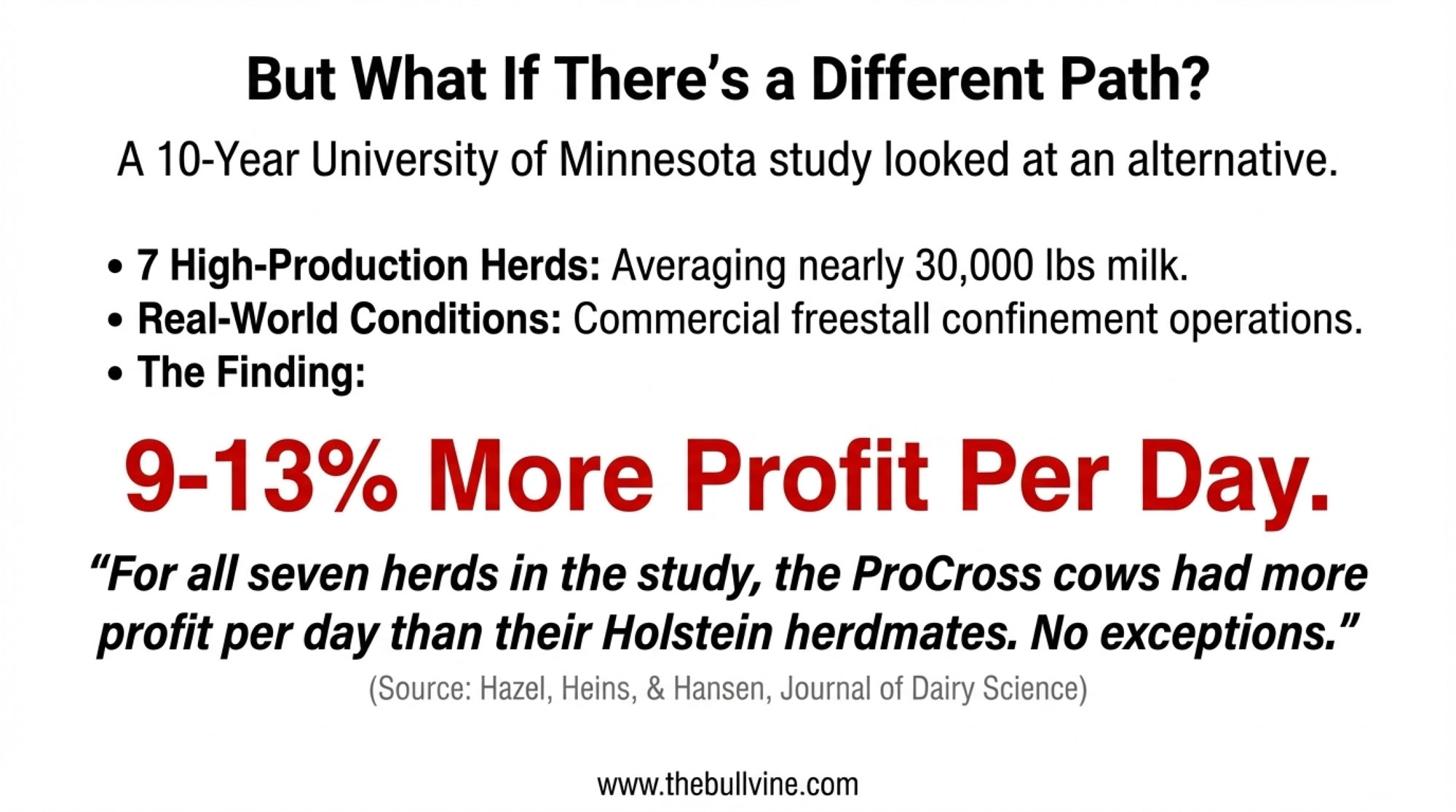
Here’s where the conversation gets really interesting: while most of the industry focused on maximizing genetic indexes in purebred Holsteins, researchers at the University of Minnesota spent 10 years collecting data on an alternative approach.

This wasn’t some small-scale grazing experiment or low-input system. These were seven high-producing herds averaging just under 30,000 lbs milk per cow—freestall confinement operations that would look familiar to commercial dairies across the Upper Midwest and beyond. The kind of herds where management is tight, and expectations are high.

The findings, published by Amy Hazel, Brad Heins, and Les Hansen in the Journal of Dairy Science, got my attention:

“For all seven herds in the study, the ProCross cows had more profit per day than their Holstein herdmates,” the researchers concluded. Not some of the herds. All seven.

Performance MetricHolstein (Baseline)Crossbred Advantage
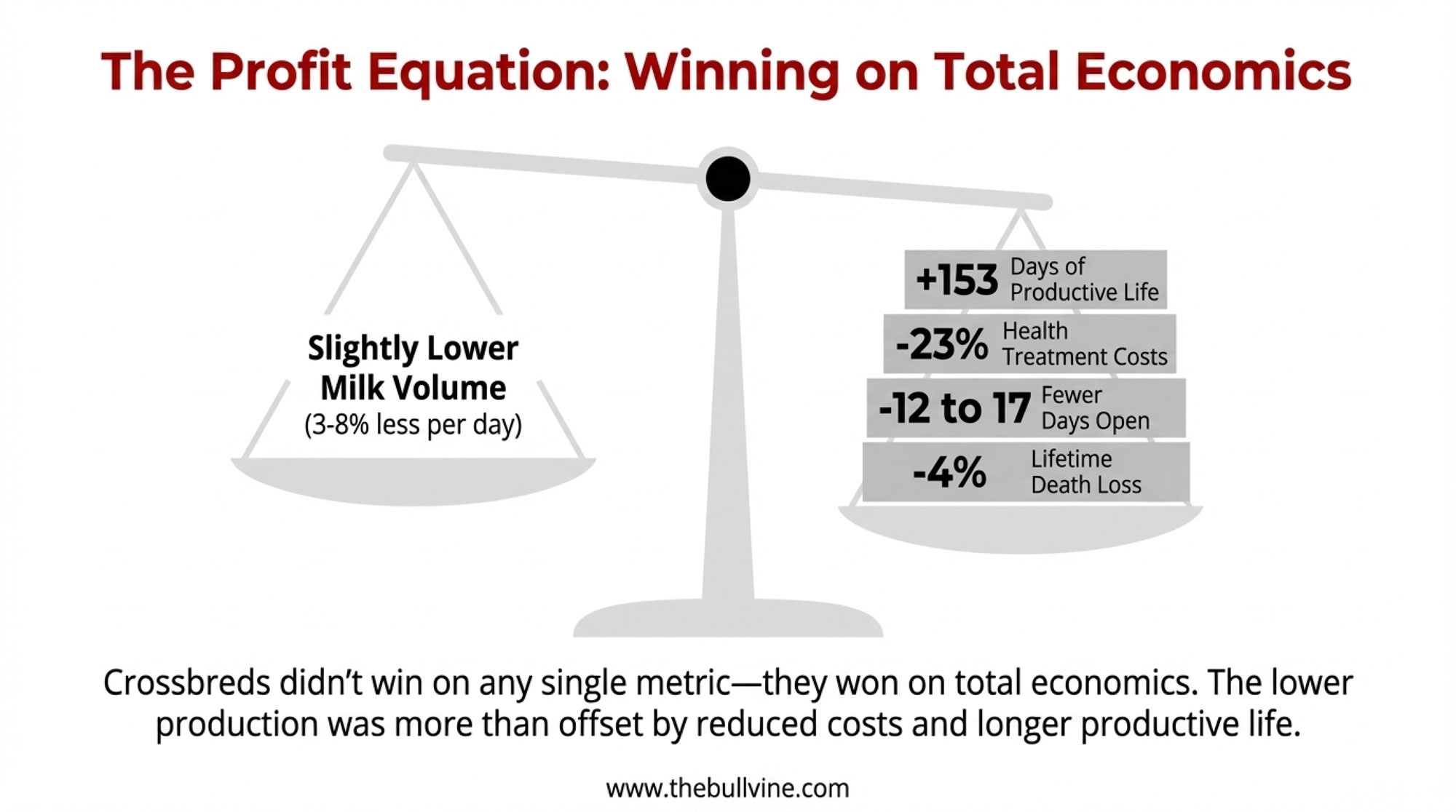
Daily ProfitBaseline+9-13% higher
Herd LifeBaseline+153 days
Health Treatment CostsBaseline23% lower
Days OpenBaseline12-17 fewer days
Stillbirth RateBaselineLower
Lifetime Death LossBaseline4% lower

Now, I can hear the question you’re probably asking: “What about production?” Fair point. Crossbred cows in these studies did produce somewhat less milk per day than their purebred Holstein herdmates—typically 3-8% less in early generations, depending on the specific cross and lactation.

But here’s what the data showed: the lower production was more than offset by reduced costs and longer productive life. The crossbreds weren’t winning on any single metric—they were winning on total economics. Lower vet bills, fewer reproductive interventions, and more lactations per cow.

Producer Case Study: Cunningham Dairy, Iowa

Kelly and Christy Cunningham lost their fluid milk market in 2017 and began looking for a cow that would produce high components with a moderate size. Their search led them to the ProCross program. After purchasing cattle from three established ProCross herds through Creative Genetics and beginning their own breeding program, they now keep detailed comparative records on their crossbred and Holstein groups.

Their results:

  • Days open: ProCross cattle are open 22 days less than Holsteins
  • Pregnancy rates: 4-5 percentage points higher than Holsteins
  • Fresh cow health events (ketosis, metritis, DA, milk fever, retained placenta): Half of what they experience with Holsteins
  • Mastitis and pneumonia: More than 50% less than Holsteins
  • Health costs: $0.28/cow/day, lower than Holsteins
  • Dry matter intake: 4-10% less for ProCross cows
  • Components: +0.3% fat and +0.2% protein compared to Holsteins

“We are very pleased with the ProCross cattle,” Kelly says. “We have realized better components, better health, better reproduction, and lower herd turnover rate. As our ProCross herd matures, milk volume and ECM are improving compared to Holsteins.”(Source: Creative Genetics of California / ProCross testimonials)

Performance MetricHolsteinProCrossWinner
Days OpenHigher by 22 daysBaselineProCross
Pregnancy RateLower by 4-5%BaselineProCross
Fresh Cow Health Events2× higherBaselineProCross
Mastitis & Pneumonia2× higherBaselineProCross
Health Cost/Cow/DayHigher by $0.28BaselineProCross
Dry Matter IntakeHigher by 4-10%BaselineProCross

European research published in the Journal of Dairy Science found similar patterns, noting that crossbreds achieved what researchers called a “win-win trade-off” on milk yield and fertility, while purebred Holsteins tended to show opposing trade-offs between the two. You could optimize heavily for one or the other, but getting both simultaneously was harder.

The mechanism behind this is well established in animal breeding: crossbreeding captures heterosis—hybrid vigor—which delivers approximately 5% improvement in production traits and 10-15% improvement in fertility, health, and survival. Those happen to be exactly the traits most affected by inbreeding depression. In a sense, crossbreeding reverses the inbreeding penalty while adding hybrid vigor on top.

Why More Farms Aren’t Crossbreeding

Given those results, you might wonder why rotational dairy crossbreeding remains relatively uncommon. I’ve had this conversation with producers across the country, and the reasons are worth understanding:

  • Index comparisons get complicated. Crossbred animals can’t be directly compared to purebreds on TPI or NM$, making it harder to evaluate genetic merit with the tools most of us rely on. For operations that use indexes as their primary selection framework, this creates genuine uncertainty. How do you track progress generation over generation when you can’t use the same yardstick?
  • Registration doesn’t fit. Breed associations require high purity thresholds—typically 87.5% or higher—for registration. If you’re selling breeding stock or involved in shows, crossbreds don’t work within that system.
  • Semen availability takes more effort. The breeds used in successful crossbreeding programs—Viking Red, Montbéliarde—aren’t as widely distributed through major North American AI organizations. You have to seek them out, work with specialized suppliers, and sometimes pay more for shipping.
  • Cultural factors are real. The dairy industry has deep roots in purebred genetics, and there’s social pressure—whether spoken or not—around breeding decisions.

For commercial operations focused primarily on milk production economics rather than registered genetics or show competition, these barriers may matter less than the profitability data suggests. But they’re real considerations, and I don’t think it’s helpful to dismiss them.

Practical Options for Your Operation

So what does this mean for your breeding decisions? It depends on your goals, your market, and honestly, your appetite for doing something different from your neighbors. Here’s how I’d think through the options:

If You’re Staying Purebred

Strategic outcrossing offers a middle path that many operations are exploring. The concept is straightforward: identify bulls with high genetic merit but low genomic relationship to your herd. You’re prioritizing diversity alongside performance rather than just chasing the highest index numbers.

What that looks like in practice:

  • Ask your AI representative for genomic relationship data, not just rankings. Most mating programs can generate this information—you just need to request it specifically.
  • Look at bulls’ pedigrees for underutilized sire lines. Sometimes the second or third-ranked bull is a better fit for your herd’s genetic profile than the top option.
  • Consider international genetics—Nordic, European, and New Zealand—that may be less related to dominant North American bloodlines.
  • Use mating programs that penalize inbreeding, not just maximize index. Most major AI organizations offer this setting, but it’s not always the default.

What about cost? Here’s something worth knowing: outcross bulls aren’t necessarily more expensive than top-ranked conventional options. Pricing depends more on proof of reliability and demand than on relatedness. In many cases, you can find bulls with strong genetic merit and lower relationship to your herd at comparable prices—you just have to ask specifically for that combination. Your AI rep can run the numbers for your situation.

Another option worth considering: use conventional semen on some of your top genetics. Sexed semen makes sense for maximizing heifer production, but using conventional semen on elite cows preserves the option for producing bull calves—potentially valuable if you’re interested in contributing to genetic diversity or selling to AI organizations looking for outcross genetics.

And here’s something important: for herds with high genetic merit that actively sell breeding stock into competitive registered markets, intensive purebred selection may remain the right strategy despite higher inbreeding levels. The premium prices for elite genetics can offset the inbreeding costs, and your market position depends on staying at the leading edge. Know your situation and your numbers.

If You’re Considering Crossbreeding

A measured approach lets you learn without betting the whole operation:

  • Start with 20-30% of your herd. This gives you enough animals to genuinely evaluate performance under your specific conditions—your feed program, your facilities, your management style—without a wholesale transformation. You’ll learn a lot in three years.
  • Choose breeds with research backing. Three-breed rotations using Holstein × Viking Red × Montbéliarde have the strongest long-term data behind them. The UMinn research specifically validated this combination in high-production environments.
  • Plan for the timeline. First crossbred daughters will calve approximately 3 years after initial breeding decisions. This isn’t a quick fix—it’s a strategic shift that requires patience.
  • Focus on commercial females. Crossbreeding strategies work best for cows whose daughters will enter your milking herd rather than the breeding stock market.

Organizations like Creative Genetics and Viking Genetics offer crossbreeding-focused programs and technical support if you want to explore this direction seriously.

Regardless of Which Direction You Go

Track your herd’s genomic inbreeding over time. Request runs of homozygosity (FROH) data from your genomic testing provider—Zoetis, Neogen, whoever you’re working with. Compare your herd average to breed benchmarks, and watch how it trends over generations.

And have a direct conversation with your AI rep. Ask specifically: “What are my outcross options? Which bulls in your lineup would reduce my herd’s average relatedness?” You might be surprised at what’s available when you ask the right questions.

A Few Things I’m Watching

A few developments worth keeping an eye on over the next several years…

  • Effective population size is a metric geneticists use to gauge long-term genetic health. Research published in the Journal of Heredity and elsewhere suggests that when effective population size drops below 50, populations face accelerated genetic drift and loss of rare alleles—genetic variation that can’t be recovered once it’s gone. Various studies estimate Holstein effective population size somewhere between 50 and 100, depending on methodology, which is why researchers are paying closer attention than they were a decade ago.
  • Evaluation systems may evolve. Some European breeding programs have begun incorporating inbreeding penalties into their selection indexes, rewarding bulls that combine high genetic merit with genetic diversity. If North American programs move in this direction—and there’s been discussion about it—that could shift which bulls rise to the top of rankings.
  • The math that keeps me up at night: At current accumulation rates of 0.35-0.44% per year, breed-average inbreeding will add another 2-3.5 percentage points by 2030. That’s $44-158 per cow in additional silent losses—already baked in unless breeding decisions change. The cows being bred this year will be milking through that reality.

Here’s how I think about it: You don’t buy fire insurance because you expect your barn to burn down. But you’re glad you have it if something unexpected happens.

Reader Challenge: What’s Your Herd’s Inbreeding Level?

Here’s something I’d genuinely like to know: What does your herd’s average genomic inbreeding look like?

Pull up your latest genomic herd report—whether it’s from Zoetis, Neogen, or another provider—and find your herd’s average FROH (runs of homozygosity) or genomic inbreeding percentage.

Drop your number in the comments below. No judgment here—we’re all dealing with the same industry trends. But seeing where different operations land could start an interesting conversation about what’s realistic to manage and what strategies are actually working.

If you’ve been actively using outcross sires or implementing crossbreeding, I’d especially like to hear how your numbers compare to where you started.

Not sure where to find this data? Your genomic testing provider can generate a herd inbreeding summary—you just need to ask for it.

Key Takeaways

  • The economics are real, even if they’re hard to see. Research from Virginia Tech found that each 1% increase in inbreeding costs approximately $22-24 per cow in lifetime profit. With breed-average inbreeding up substantially over the past decade—Lactanet Canada now reports 9.99% for 2024-born Holstein heifers—that represents meaningful money. Potentially $200-400 per cow that doesn’t appear on any line item but affects your bottom line.
  • Crossbreeding data is more compelling than many realize. The University of Minnesota’s 10-year study found crossbred cows delivered 9-13% higher daily profit across seven high-producing commercial herds. The advantages came from longer productive life, lower health costs, and better fertility. This was a decade of real data from real operations.
  • You have options within purebred programs. Strategic outcrossing—prioritizing bulls with high merit and low relationship to your herd—can slow inbreeding accumulation while maintaining genetic progress. The tools exist, outcross genetics are often competitively priced, and good AI reps can help you use them.
  • Track what matters to your operation. Request genomic inbreeding data on your herd and watch trends over time. Ask your AI representative specifically about outcross options, not just top rankings.
  • Match your strategy to your goals. Crossbreeding makes most sense for commercial operations focused on milk production economics. If you’re selling registered breeding stock into competitive genetic markets, intensive purebred selection may still be your best path. Neither approach is wrong. They’re optimizing for different outcomes.

The goal isn’t to abandon genomic selection—it’s delivered tremendous value to our industry. But making breeding decisions with full awareness of the trade-offs helps ensure short-term genetic gains don’t come at the expense of long-term herd profitability and resilience.

As with most decisions in dairy farming, the right answer depends on your situation. What’s changed is that we now have more data than ever to inform those decisions. The question is whether we’re willing to look at all of it, not just the parts that confirm what we’re already doing. 

Key research referenced: Cassell, Adamec, and Pearson (1999), Journal of Dairy Science; Hazel, Heins, and Hansen, Journal of Dairy Science (ProCross study); Doekes et al. (2019), Genetics Selection Evolution; Council on Dairy Cattle Breeding trend data; Lactanet Canada August 2025 Inbreeding Update; AHDB sexed semen market reports; American Farm Bureau Market Intel.

Complete references and supporting documentation are available upon request by contacting the editorial team at editor@thebullvine.com.

Learn More

The Sunday Read Dairy Professionals Don’t Skip.

Every week, thousands of producers, breeders, and industry insiders open Bullvine Weekly for genetics insights, market shifts, and profit strategies they won’t find anywhere else. One email. Five minutes. Smarter decisions all week.
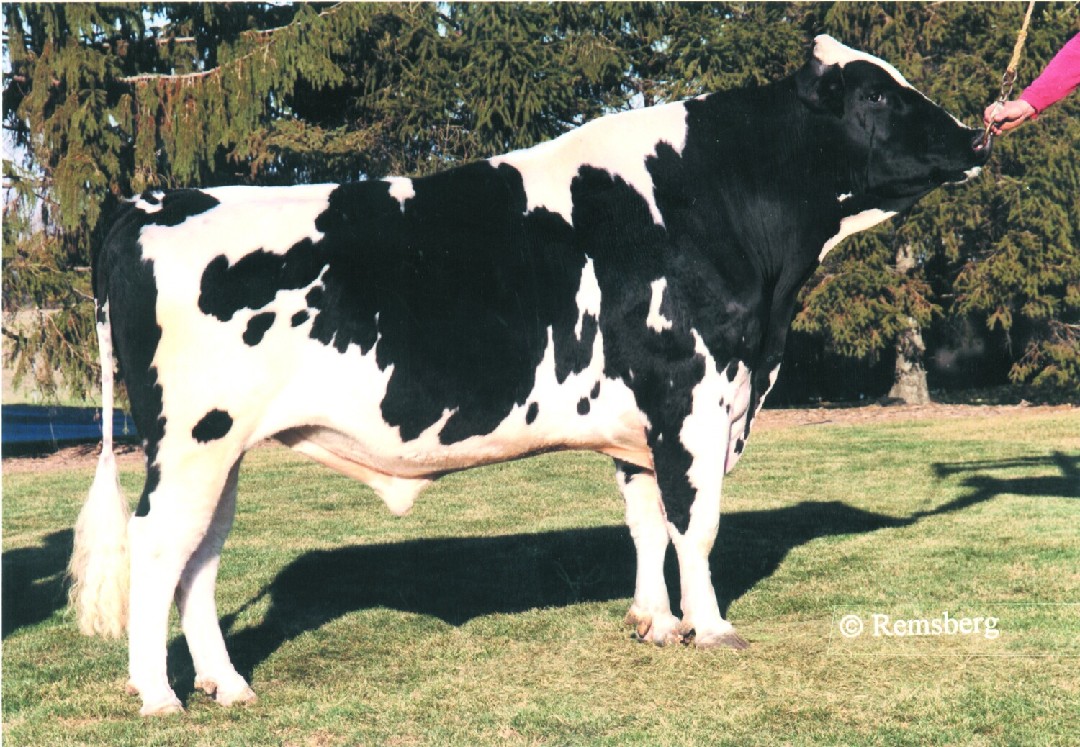
NewsSubscribe
First
Last
Consent

When Your “Elite” Genetics Start Costing You Real Money

Think chasing top TPI is pure profit? Your pocketbook might be tanking from inbreeding you can’t see.

A sentiment echoing from industry leaders around the world is that the genetic diversity challenge is about to shift from crucial to absolutely critical. What we’re seeing with inbreeding today is just the tip of the iceberg — this is poised to become a major industry crisis if we don’t get ahead of it now.

You know what keeps coming back to me during all these dairy chats I’ve been having lately? It’s how much time we spend chasing the highest genomic indexes and fancy TPI numbers, but we hardly ever dig into what’s lurking beneath those shiny scores — the risk of losing genetic diversity and quietly bleeding cash without even realizing it.

Just last month, I was up in upstate New York, walking through a solid 2,500-cow operation. The owner was beaming, boasting about his herd’s average TPI, which had hit 2,800. Great numbers, right? But here’s the thing… behind those glittering stats, the genetic base looked dangerously narrow. That’s when our conversation flipped — from celebrating elite genetics to facing the looming threat of a shrinking gene pool.

And honestly? It got uncomfortable real quick.

The Math That Should Keep You Awake at Night

Let’s talk dollars and cents — those losses you actually feel in your wallet. Every 1% uptick in a cow’s inbreeding coefficient can cost you around $22 to $24 in lifetime profit. That’s not some theoretical number buried in research papers; that’s real money walking right out your barn door.

Economic impact of inbreeding depression showing cumulative losses per cow based on inbreeding coefficient levels

However, here’s the kicker that really makes me sit up: a 2023 Italian study suggested that the real damage might be 40% worse than previous estimates indicated. Put simply, where pedigree-based calculations said you’d lose 44 kg of milk per 1% inbreeding increase, genomic data showed a 61 kg drop. Ouch.

Comparison of milk production losses calculated using pedigree-based versus genomic-based inbreeding assessments

With milk prices hovering near $18.93 a hundredweight and labor costs pushing $18 an hour, those losses aren’t small potatoes. They add up fast, especially when you multiply them across your entire herd.

Have you actually calculated your operation’s inbreeding exposure? Most producers I know haven’t. And I get why — it’s not exactly the sexy topic your AI rep brings up during sire selection meetings.

Economic Impact of Inbreeding on Dairy Cattle Showing Milk Yield and Profit Loss over Inbreeding Level (1-15%)

When “Elite” Becomes the Problem, Nobody Wants to Talk About

The unspoken consensus among many industry geneticists is that our most powerful tool for genetic advancement has become a double-edged sword. While genomic selection has driven incredible progress, it has also accelerated inbreeding at an unprecedented pace, creating a genetic bottleneck that threatens the health and productivity of our dairy herds.

“Our most powerful tool for genetic advancement has become a double-edged sword.”

That’s the paradox that’s reshaping everything. The numbers back this up. According to Council on Dairy Cattle Breeding data, genetic concentration in North American AI programs reached concerning levels by 2017, when just a handful of elite sires were responsible for producing the majority of young bulls entering AI programs globally. When you multiply that concentration across millions of breeding decisions… well, you get the picture.

The genetic bottleneck becomes inevitable.

Trend showing increasing inbreeding levels in Holstein cattle from 2000-2025, comparing pedigree-based versus genomic-based measurements

Enter the “Elite Outcross” Revolution

So what’s the fix? This is where things get interesting…

Once, outcrossing had a bad reputation — people feared it would dilute their prized bloodlines. Random mating to genetically distant but inferior animals? Yeah, that would set any breeding program back.

But now? It’s precision science, leveraging genomic data to make calculated, surgical strikes, not wild gambles.

Here’s something that’s caught my attention lately — many industry insiders from companies like Select Sires and ABS are moving away from the term “outcrossing” altogether. They’re talking about “diversity” instead, and their reasoning makes a lot of sense. The real goal isn’t just finding one genetically distant bull — it’s about using many different genetic lines to build true resilience in your herd. A single outcross bull might still be mediocre quality, but when you focus on genetic variety across both sides of the pedigree, you’re building something much stronger.

Look at proven examples: CO-OP BOSSIDE MASSEY brought wide appeal, ZANI BOLTON MASCALES introduced European bloodlines to North America, and more recently, stars like 14HO15179 TROOPER and his son 7HO16276 SHEEPSTER proved you can blend unique maternal lines with high merit to create genuine value.

These bulls validate the strategy: outcrossing isn’t gambling when robust genomic data and clear breeding objectives back it.

What’s fascinating is how this shifts the entire conversation. Instead of just asking “What’s his TPI?” the smart money now asks “What’s his relationship to my herd?” and “How does his genetic background complement what I’ve got?”

How the Smart Money Is Playing This Game

AI companies have figured this out, and they’re adapting fast. They’re not just selling semen packages anymore — they’re selling sophisticated genetic risk management.

However, here’s the challenge they’re all facing: German AI professionals have observed that large commercial operations often prioritize top performance indexes over everything else, including diversity of pedigree. The market reality is that many large dairies will select the bull with the highest TPI, regardless of genetic relationships, which doesn’t exactly reward companies for maintaining diverse genetic portfolios.

That’s what makes the Canadian approach so interesting. Semex has deliberately maintained what they call genetically “free” female lines — unique cow families that aren’t heavily related to the mainstream population. This strategy ensures they can always bring something genuinely different to the market when diversity becomes critical. It’s a long-term vision that’s particularly relevant for us here in Ontario, where Semex’s home base provides them with a Canadian perspective on sustainable breeding.

Take ABS Global’s approach. Their Genetic Management System 2.0 utilizes genomic intelligence to guide mating choices, explicitly incorporating genomic inbreeding calculations to manage relationships with greater precision than pedigree-based methods have ever allowed.

Semex hands the keys to farmers through tools like SemexWorks and OptiMate, letting producers define their own economic parameters and build personalized selection indexes. It’s like giving you the GPS instead of just telling you where to go.

Select Sires? They’re mixing high-touch consulting with modern tech, offering programs like StrataGEN that manage inbreeding by rotating distinct, unrelated sire lines every 18 months. Simple but brilliant.

My advice? Don’t take the sales patter at face value. Ask hard questions about true genetic diversity in their outcross catalogs. Who’s really getting you diverse genetics, and who’s just selling shiny promises?

The Future: When AI Meets Genetics

Timeline showing the evolution of dairy cattle breeding methods from visual assessment to AI-optimized genetic management

Here’s where it gets really exciting… the future belongs to machine learning, crunching massive genomic databases and optimizing matings through algorithms like Optimal Contribution Selection (OCS).

Think of it as playing chess on a global board, where every move considers not just immediate genetic gain but long-term sustainability. OCS calculates the ideal genetic contribution from each potential parent to maximize progress while simultaneously constraining inbreeding to acceptable levels.

The companies mastering this intersection of artificial intelligence and artificial insemination? They’ll dominate the next chapter. It’s not just about who has the best bulls anymore — it’s about who has the sharpest algorithms.

Your Action Plan (Because Knowledge Without Action Is Just Expensive Education)

First things first: audit your genetic risk exposure. Most producers I work with have zero clear picture of their herds’ inbreeding levels or the relationships among their AI sires. Begin by conducting genomic testing on your breeding females to establish a baseline.

Second, evaluate your AI company’s diversity management capabilities honestly. Companies that utilize genomic inbreeding calculations, offer genuine outcross options, and provide sophisticated mating programs will deliver superior long-term results.

Third, develop a systematic approach to elite outcrossing. Consider this scenario: You have cow families tracing back to the same popular sire line as half of your herd. Instead of using another bull from that same genetic background, identify a high-merit outcross that brings fresh genetics while maintaining or improving economic performance.

That’s not gambling. That’s strategic breeding.

The Global Picture (Because Your Herd Doesn’t Exist in Isolation)

Here’s something that might surprise you: the Holstein breed is now effectively a single global population. Elite genetics flow freely across borders, and North American bloodlines dominate worldwide — sometimes representing over 90% of genetics in certain regions.

Italy is taking this challenge seriously at a policy level. They’ve updated their national genetic index — the PFT — to include a direct mathematical correction based on each bull’s Expected Future Inbreeding. Bulls that increase inbreeding are penalized in their official rankings, while those that bring genetic diversity receive a boost. It’s the first time I’ve seen a country incorporate inbreeding management into its national breeding policy.

Organizations such as the Council on Dairy Cattle Breeding and Interbull work behind the scenes to coordinate international genetic evaluations and ensure data integrity. Their systems help producers understand how genetics will perform under specific conditions while managing global genetic diversity.

Looking Ahead: The Technology Revolution Continues

Gene editing with CRISPR holds incredible promise for precise genetic tweaks — adding polled genetics to elite lines, boosting disease resistance, even modifying milk composition for better cheese yield — all without the linkage drag of traditional breeding.

Think of it as the ultimate “elite outcross.” It’s the surgical introduction of desired genetic diversity without any of the associated baggage.

But regulatory and ethical hurdles remain significant, and public perception will play a huge role in adoption.

The Bottom Line

Ignore genetic risk management at your peril — it quietly drains profits while you’re not looking.

“The most expensive cow isn’t the one that costs the most upfront; it’s the one that silently costs you money for years without you knowing it.”

Start by gauging your herd’s genetic risk, rethink sire selection strategies, and demand transparency from your AI partners. This isn’t just theory — it’s what will separate thriving operations from those scrambling to catch up a decade down the road.

What questions do you have about your herd’s genetic diversity strategy? Because honestly, this conversation is just getting started, and waiting only makes managing the risk more expensive.

Those who act now will be the winners when genetic diversity becomes the industry’s scarcest resource.

KEY TAKEAWAYS:

  • Save up to $24 per cow annually by managing inbreeding levels strategically. Start by genomic testing your breeding females to establish baseline inbreeding coefficients (FROH). Context: Essential with 2025’s margin squeeze from high feed and energy costs.
  • Recover potentially 61kg of lifetime milk production per cow by reducing genetic bottlenecks. Ask your AI rep specifically about “elite outcross” sires that bring diversity without sacrificing merit. Context: Part of the global shift toward sustainable genetic management happening right now.
  • Cut veterinary and replacement costs through better fertility and longevity outcomes. Push for mating strategies using Optimal Contribution Selection (OCS) that balance gain with genetic health. Context: Forward-thinking operations are already seeing results with these AI-driven tools in 2025.
  • Future-proof your operation against the genetic squeeze that’s tightening worldwide. Demand transparency from your genetics provider about actual relationships in their bull lineup — don’t just take TPI at face value. Context: Critical as global “holsteinization” continues consolidating the gene pool faster than ever.

EXECUTIVE SUMMARY:

Look, I just dug into some eye-opening research that’s got me pretty fired up. That relentless chase for sky-high genomic indexes? It’s quietly costing you $24 per cow for every 1% jump in inbreeding — and most of us have no clue it’s happening. Here’s the kicker: new Italian data shows we’ve been underestimating milk losses by 40% — we’re talking 61kg drops per percentage point, not the 44kg we thought. With feed costs still brutal and milk prices bouncing around in 2025, this isn’t pocket change anymore. The thing is, this genetic squeeze is happening globally as the same elite bloodlines get used everywhere through AI. But here’s what smart producers are already doing — they’re using genomic testing and something called “elite outcrossing” to keep their herds genetically strong without sacrificing performance. Trust me, you need to get ahead of this before it really bites your bottom line.

Complete references and supporting documentation are available upon request by contacting the editorial team at editor@thebullvine.com.

Learn More:

The Sunday Read Dairy Professionals Don’t Skip.

Every week, thousands of producers, breeders, and industry insiders open Bullvine Weekly for genetics insights, market shifts, and profit strategies they won’t find anywhere else. One email. Five minutes. Smarter decisions all week.
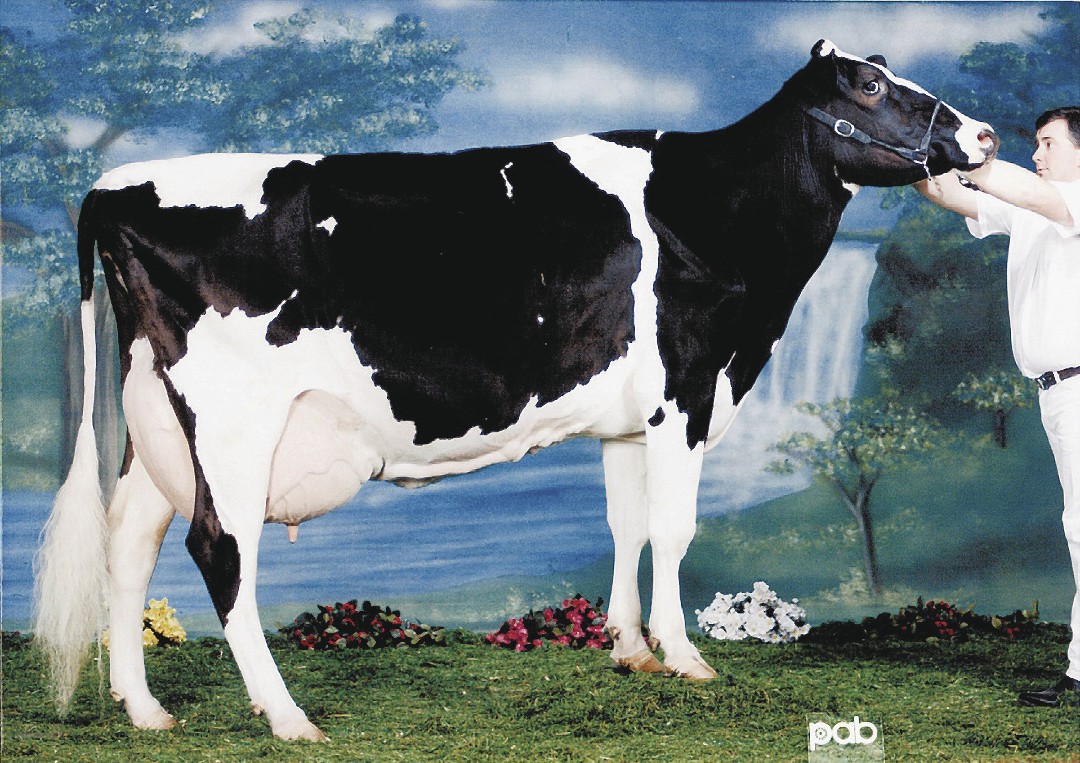
NewsSubscribe
First
Last
Consent

Inbreeding by the Numbers: What Your Bull Proofs Aren’t Telling You

Everyone says chase the highest milk yield… but what if that’s quietly draining your profits, one genomic bull at a time?

The numbers on the screen look great, but what are the hidden costs of our genetic choices?

You ever have that moment, late at night, scrolling through bull proofs with a cold cup of coffee, and something just doesn’t add up? On paper, your herd’s genetic merit is off the charts, but conception rates are slipping, and you’re seeing more health issues than you’d like to admit. Trust me, you’re not imagining things—and you’re definitely not alone.

I’ve been talking with producers from coast to coast—big dry lots out in California’s Central Valley, tie-stalls on the rolling hills of Wisconsin, and everywhere in between. There’s a quiet trend building, and it’s not about milk price or feed costs (though, let’s be honest, we all lose sleep over those too). This is something deeper—a multi-billion-dollar genetic reckoning that’s happening right now in all our herds.

Here’s what really sticks in my craw: we’re spending fortunes chasing the top 1% of sires, poring over genomic proofs until our eyes cross, and on paper, our herds have never looked better. So why does it feel like we’re running faster just to stay in the same place?

The $23-Per-Cow Problem That’s Adding Up Fast

Let me hit you with a number that’ll wake you up faster than a fresh cup of dark roast. According to a 2020 study from Penn State, between 2011 and 2019—right as genomic selection was gaining steam—the U.S. Holstein industry lost between $2.5 and $6 billion. That’s not a typo, and it wasn’t a market crash or feed crisis. That was the cost directly tied to rising inbreeding that came with our shiny new genomic tools.

For every 1% bump in inbreeding costs you about $23 per cow annually—and let’s be clear, that’s per lactation, not lifetime. Do the math. If you’re milking 1,000 cows, that’s $23,000 a year for every percentage point of inbreeding. Over five years? That’s $115,000—enough to replace 40 solid cows.

Annual economic impact of inbreeding shows escalating costs, with highly inbred cows (15%) costing $345 more per year than moderately inbred cows (3%), representing a five-fold increase in economic burden

But here’s what keeps me up at night: the very technology we embraced to future-proof our herds could be creating a systemic vulnerability if we’re not managing it with our eyes wide open. Genomic selection has been a game-changer. It’s slashed generation intervals from about 5.5 years to less than two, and according to recent CDCB research, genetic gain has jumped by 12% to over 100% compared to the old progeny testing days.

The problem? That same rocket fuel has driven the effective population size of U.S. Holstein bulls down to a historic low—just 43 to 66 animals. Think about it: the genetic diversity of the world’s most dominant dairy breed now rests on fewer animals than most high school graduating classes.

Pedigree vs. Genomic: Which Inbreeding Number Actually Matters?

Genomic selection dramatically reduced generation intervals from 7.0 to 2.3 years while nearly doubling genetic gain rates, demonstrating the revolutionary impact of genomic technologies on dairy cattle breeding efficiency

Here’s where things get interesting. When we talk about inbreeding, we’re really talking about two different numbers, and the difference matters more than you might think.

Pedigree-based inbreeding is what we’ve used for decades—it’s like cattle genealogy, calculating the odds that an animal inherited identical genes from a common ancestor. But it often underestimates what’s actually happening in the genome.

Genomic inbreeding, measured through runs of homozygosity (ROH), looks directly at the DNA to see where an animal truly has identical gene sequences. It’s the difference between assuming what went into a recipe and actually tasting the final dish.

What strikes me about the genomic approach is how it can distinguish between old inbreeding (from way back in the pedigree) and recent inbreeding (from repeatedly using popular sires). The recent stuff—that’s what’s really hurting us. A 2023 study from the University of Guelph showed that recent inbreeding under genomic selection has a sharper negative impact on both production and fitness traits than the “old” inbreeding our breeds have carried for generations.

So, which should you focus on? My take: use genomic measures for the animals you’ve got data on, and supplement with pedigree for everything else. Genomic tools give you the real picture of what’s happening now.

Where to Actually Find These Numbers (Because That Matters)

You can’t manage what you can’t measure. For U.S. herds, your best bet is the CDCB (Council on Dairy Cattle Breeding) website. They publish Holstein inbreeding reports that give you both pedigree and genomic inbreeding levels for AI sires. It’s free, it’s current, and it’s data you can use.

Canadian producers might have it even better—Lactanet has integrated genomic inbreeding tools right into their genetic evaluation system. You can get inbreeding levels on individual animals as part of your regular genetic evaluations.

Here’s what’s interesting, though: most breed associations don’t routinely publish inbreeding levels in their regular communications. It’s there if you dig, but it’s not as front-and-center as TPI or LPI rankings. That needs to change.

The Wake-Up Call: Genomic vs. Proven Sires

Rising inbreeding rates in Holstein cattle showing the dramatic increase since genomic selection implementation, with genomic measures revealing higher true inbreeding levels than pedigree-based calculations

Want something that’ll make you think twice about your next sire selection? Here’s a stat that’s been making the rounds among geneticists but hasn’t gotten the attention it deserves.

The top 10 TPI genomic sires—the young bulls everyone’s chasing—are averaging around 4–6% inbreeding. Proven sires typically run 3–5%. It’s easy to misread these numbers. That 4–6% inbreeding on a top genomic bull isn’t an additional amount; it’s his total inbreeding. Considering the average Holstein cow is already at 11%, this shows that AI companies are actively managing this trait, selecting elite bulls that are often less inbred than much of the female population. So, when you see those numbers on a bull proof, it’s showing you the bull’s own calculated inbreeding, not how much higher (or lower) he’s compared to the average cow in the population. This distinction matters because it means that even the most popular young sires are typically being selected with inbreeding management in mind, not just raw genetic merit.

Why are the genomic bulls a little more inbred than the proven ones? It comes down to selection intensity. When you can spot the “best” animals at 6 months old instead of waiting 5 years for daughters to freshen, the temptation is to concentrate selection on a smaller and smaller group of elite animals. The math works—until it doesn’t.

Holstein vs. Jersey: A Tale of Two Breeding Philosophies

Breed comparison reveals Holstein cattle have the highest inbreeding rates but lowest milk component percentages, while Jersey cattle show better component quality with lower inbreeding levels, highlighting the trade-offs between production volume and quality

This trend reveals something fascinating when you compare breeds. Current Holstein populations average around 11% genomic inbreeding, while Jerseys typically run closer to 9%. The economic impact? That $23-per-cow hit I mentioned earlier applies to Holsteins. Jerseys, with their more regional breeding patterns and less reliance on a handful of global sires, tend to experience less inbreeding and, as a result, see smaller economic losses from inbreeding depression.

What’s the difference? Scale and global reach. Holstein genetics flows globally—a popular sire in the Netherlands is used heavily in the U.S., Canada, and a dozen other countries. Jersey breeding, while international, tends to be more regionalized with more diverse sire usage patterns.

A Tale of Two Neighbors

MetricFarm A (Volume Focus)Farm B (Component Focus)
Breeding GoalMax Milk VolumeMax Component Yield & Health
Milk / Day100 lbs90 lbs
Butterfat %4.10%4.60%
Protein %3.00%3.40%
Total Solids / Day7.2 lbs7.2 lbs
Key OutcomeHigh Volume, High StressResilient Herd, Same Solids

Let’s bring this down to something you can picture—a real-world scenario that’s playing out in more herds than you might think.

Imagine two Holstein herds, each milking 80 cows. Both are run by savvy managers who keep a close eye on their numbers and aren’t afraid to try new things. For the last five years, both have used genomic selection, but their breeding philosophies have diverged.

Farm A is laser-focused on maximizing milk volume. They’ve chased the highest-ranking genomic bulls for milk yield, and their cows average 100 pounds per day. On paper, that looks impressive. But their herd averages 4.1% butterfat and 3.0% protein, which works out to about 7.2 pounds of combined fat and protein per cow per day.

Farm B takes a different tack. Their goal is to maximize component yield and herd health, not just volume. They select bulls based on fat and protein percentages, aiming for a more balanced cow. Their cows average 90 pounds of milk per day, but with 4.6% butterfat and 3.4% protein, also 7.2 pounds of combined solids per cow per day.

Now, here’s where it gets interesting. Even though Farm B’s cows are producing less milk by volume, they’re matching Farm A on actual solids shipped per cow. And with higher component percentages, Farm B’s milk checks are more resilient to market swings that reward fat and protein. Plus, their cows are under less metabolic stress, which means fewer health issues, better fertility, and less burnout for the staff. There’s less time spent in the hospital pen and more time with cows in the parlor where they belong.

Over time, Farm B’s approach pays off. Their vet bills are lower, cows stay in the herd longer, and staff turnover drops because the work is more manageable. When you pencil it out, Farm B’s cows are just as profitable—if not more so—than their higher-volume neighbors, all while running a less stressful, more sustainable operation.

The lesson? Chasing maximum milk yield isn’t always the path to maximum profit or herd health, especially when you focus on what really matters: pounds of fat and protein shipped, cow well-being, and a system that works for both people and animals.

The Numbers That Tell the Real Story

This isn’t just philosophical—there are hard numbers behind these observations. Research from multiple countries paints a consistent picture of what inbreeding depression actually costs:

  • Production hits: Every 1% increase in inbreeding typically reduces annual milk production by 26–41 kg (that’s 57–90 pounds). For fat and protein, you can expect losses of 1–2 kg each. Doesn’t sound like much? Multiply it across your entire herd and calculate the results over a full lactation and for longer productive lifetimes per cow.
  • Fertility takes the biggest hit: This is where inbreeding depression really shows its teeth. Calving intervals stretch out by about a quarter-day for every 1% of inbreeding. I know that sounds tiny, but when you’re already struggling to get cows bred back, every day matters.
  • The hidden costs: Here’s what really gets expensive—increased somatic cell counts, higher culling rates, more stillbirths, and what I call “mystery ailments.” These are cows that aren’t clinically sick but don’t thrive as they should.

What’s particularly concerning, based on recent research from Australia and Europe, is that the inbreeding we’re accumulating now under genomic selection appears to be more detrimental than the traditional inbreeding from past generations. This suggests we’re making genetic changes faster than natural selection can keep up with.

Managing the “Junk” in Our Gene Pool

The thing about genetics is you get the whole package—the good, the bad, and the downright ugly. There are over 130 known genetic defects in cattle, and that’s just the stuff we’ve identified so far and can test for. A significant portion of the real damage stems from early embryonic losses, which we often attribute to “didn’t settle” or “bad heat detection”.

This is where organizations like Lactanet in Canada and the CDCB in the U.S. earn their keep. They’re tracking these genetic defects and building tests to identify carriers. Most AI companies now provide carrier status for about 22 known genetic defects as part of their standard genetic evaluation reporting package.

But here’s what keeps geneticists up at night: new mutations keep popping up. When an influential AI sire carries a new deleterious mutation—especially if he’s a mosaic, meaning only some of his sperm carry it—that mutation can spread like wildfire before anyone notices. Remember the “Pawnee Farm Arlinda Chief” situation? One sire, one mutation, over 500,000 spontaneous abortions, and nearly $420 million in global industry losses.

Smart Strategies That Actually Work

Diagram: Instead of putting all your genetic eggs in one basket, Optimum Contribution Selection (OCS) diversifies your sire portfolio to maximize long-term gain while controlling inbreeding risk.

Alright, enough about the problems. Let’s talk solutions—real ones that producers are using right now with good results.

Optimum Contribution Selection is the technical term for what amounts to informed genetic planning. Instead of just using the highest-ranking bull for every breeding, OCS figures out the optimal genetic contribution from a whole group of candidates. The goal is to maximize genetic gain while keeping inbreeding under control.

Think of it this way: you might use the #1 TPI bull on 40% of your herd, the #5 bull on 30%, and a few others to fill out the genetic diversity. You’re still getting tremendous genetic progress, but you’re not putting all your eggs in one genetic basket.

The research backs this up. Multiple recent studies—including work involving Cornell and other major universities—have shown that OCS programs can achieve higher long-term genetic gain than traditional selection, all while keeping inbreeding rates in check. It’s not just theory; the scientific consensus is growing as more research teams publish real-world results.

Crossbreeding is another tool that’s gaining traction, especially among commercial producers who get paid on components. A well-planned three-way cross with Holstein, Jersey, and maybe Montbéliarde or Brown Swiss can deliver significant improvements in fertility and health through hybrid vigor. I know it’s not for everyone—especially if you’re in a market that demands Holstein cattle—but for commercial operations focused on profit per cow rather than genetic prestige, it’s worth considering.

Gene banking might sound like science fiction, but it’s actually a practical form of insurance. Storing and using semen and embryos from a diverse group of animals provides options down the road if current breeding trends create unforeseen problems.

The Reality Check: Implementation Hurdles

Implementing a diverse breeding strategy requires meticulous record-keeping and semen tank management, a key hurdle for many operations.

Here’s where theory meets the real world, and it’s not always a pretty picture. I’ve spoken to numerous producers who have attempted to implement these advanced breeding strategies, and the feedback is consistent: it’s more challenging than it sounds.

  • Logistics matter. If you commit to an OCS program, you might get a breeding plan that calls for very specific matings—Bull A to Cow 123, Bull B to Cow 456. That requires meticulous record-keeping and a well-organized semen tank. For operations where one person is responsible for all breeding, especially in larger herds, this can be a significant challenge.
  • Inventory costs add up. Using a diverse group of sires means keeping more bulls in your tank, which ties up capital and requires more careful inventory management than just ordering the “bull of the month.”
  • The human element is huge. It takes discipline to stick to a long-term plan when there’s a chart-topping TPI bull available. The mindset shift from maximizing every single mating to optimizing the long-term health, production efficiency, and welfare of the whole herd requires buy-in from everyone—owner, herd manager, AI technician.

That said, the producers who’ve made this transition tell me it gets easier with time, and the results speak for themselves.

Looking Forward: What’s Coming Next

The future of genetic diversity management is getting more sophisticated every year. Artificial intelligence is beginning to play a role in optimizing breeding strategies, not only for genetic gain but also for managing inbreeding and diversity across multiple generations.

Whole genome sequencing is becoming more affordable, which means we’ll be better in the future at identifying harmful mutations before they spread. The cost has dropped from thousands of dollars per animal to hundreds, and it continues to decline.

What’s particularly exciting is the development of combined strategies that use multiple approaches simultaneously—OCS, weighted selection for rare beneficial alleles, strategic outcrossing, and active management of genetic defects. Early research suggests these combined approaches can deliver the best of both worlds: continued genetic progress with better diversity maintenance.

The Bottom Line: Your Genetic Legacy

Look, we’re at a crossroads. We can continue to chase maximum short-term genetic gain and accept the hidden costs of genetic erosion as just the price of doing business. Or we can get smarter about how we breed cattle—capturing genetic progress while building herds that are resilient enough to handle whatever comes next.

The evidence is clear: producers who take genetic diversity seriously don’t sacrifice genetic progress—they optimize it for the long haul. They’re not accepting lower profits; they’re building more sustainable competitive advantages.

The tools exist. The research is solid. The question is whether we’ll be among the early adopters who see the writing on the wall, or whether we’ll wait until the problems are too big to ignore.

Your genetic decisions this year will impact your herd’s productivity and your farm’s profitability for generations to come. That multi-billion-dollar hit the industry has already taken? It’s both a warning and an opportunity. The producers who heed the warning will be the ones who capture the opportunity.

So here’s my challenge to you: next time you’re selecting sires, ask yourself—and your genetics advisor—some tough questions. What’s our herd’s current inbreeding level? How can we apply OCS principles to strike a balance between our goals? Which outcross sires would be suitable for our system?

The real question isn’t whether you can afford to implement these strategies. It’s whether you can afford not to.

Bottom line: Don’t just follow the crowd. The smartest producers in 2025 are protecting their herds—and their profits—by thinking beyond the next bull proof. Give these strategies a shot and let your milk check do the talking.

Coming up in our next article, “Part 2: A Deep Dive into the Data,” we’ll dig deep into the shocking statistics every breeder should know, including detailed comparisons of top genomic versus proven sires and breed-specific benchmarks to help you assess where your herd stands.

KEY TAKEAWAYS

  • Stop silent profit leaks: Every 1% rise in inbreeding costs you $23 per cow, per year.
    Action: Check your herd’s inbreeding numbers on CDCB or Lactanet today—don’t wait for a consultant.
  • Genomic testing is a double-edged sword: Yes, it boosts genetic gain by 12–100%, but it’s also shrinking your genetic base fast.
    Action: Ask your genetics rep for the inbreeding coefficient on every bull you buy—aim for below the breed average (currently ~11% for Holsteins).
  • Components beat volume for real ROI: Two herds with the same solids shipped (7.2 lbs/cow/day) can have wildly different stress, health, and profit—don’t chase milk pounds alone.
    Action: Shift your sire selection index to prioritize fat and protein percentages, not just yield.
  • Diversify or pay the price: Herds using optimum contribution selection (OCS) or crossbreeding are seeing lower vet bills and longer cow lifespans, even with lower daily milk.
    Action: Try OCS planning or introduce a crossbred bull—see how it impacts your cull rate and staff workload.
  • 2025 is all about resilience: Feed and labor costs aren’t dropping, so your genetics program needs to deliver more than just big numbers on paper.
    Action: Review your breeding plan with a focus on genetic diversity and operational sustainability—don’t get left behind.

EXECUTIVE SUMMARY

Let me lay it out straight—chasing the top 1% of genomic bulls might be costing you more than you think. According to a Penn State study, U.S. Holstein herds lost between $2.5 and $6 billion from inbreeding tied to aggressive genetic selection. Every 1% jump in inbreeding knocks $23 off your annual revenue per cow, and with herds averaging 11% inbreeding, that’s real money. Sure, genomic testing slashed generation intervals and doubled genetic gain, but it also shrank the effective bull population to just 43 animals. That’s not just a U.S. thing—global trends show the same squeeze on diversity, from Europe to Australia. The kicker? Herds focusing on fat and protein yield, not just milk pounds, are matching or beating their high-volume neighbors in profit and cow health. If you want to protect your margins in 2025’s tight market, it’s time to rethink your breeding strategy—try mixing in optimum contribution selection or crossbreeding, and watch your bottom line thank you.

Complete references and supporting documentation are available upon request by contacting the editorial team at editor@thebullvine.com.

Learn More:

  • Genomic Inbreeding: How Much Is Too Much? – Offers practical strategies for monitoring and managing inbreeding at the farm level, including step-by-step guidance on using genomic data to make smarter breeding decisions and immediately reduce risk in your herd.
  • The Dollars and Sense of Dairy Genetics – Reveals how genetic choices impact long-term profitability, with actionable insights on navigating market trends, economic trade-offs, and the real-world financial implications of different breeding strategies in today’s volatile dairy industry.
  • Dairy Breeding Innovation: Are You Ready for What’s Next? – Explores cutting-edge technologies and future opportunities, demonstrating how forward-thinking producers can leverage emerging tools and innovations to stay ahead of genetic challenges and build a more resilient, productive herd.

The Sunday Read Dairy Professionals Don’t Skip.

Every week, thousands of producers, breeders, and industry insiders open Bullvine Weekly for genetics insights, market shifts, and profit strategies they won’t find anywhere else. One email. Five minutes. Smarter decisions all week.
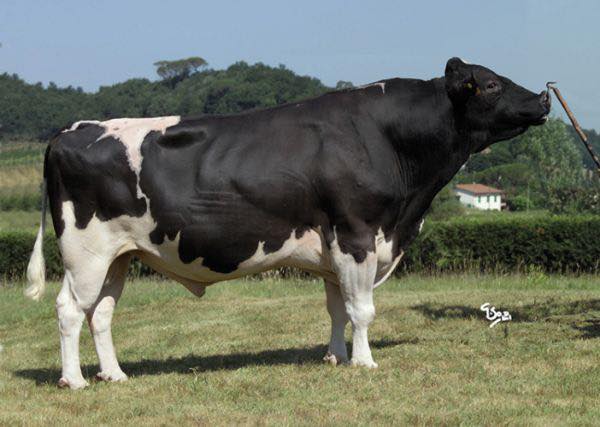
NewsSubscribe
First
Last
Consent

The Silent Genetic Squeeze: Is Holstein Breeding Painting Itself into a Corner?

Holstein inbreeding has tripled in a decade. Discover how hidden genomic risks threaten dairy profits and what you can do to protect your herd’s future.

The relentless pursuit of genetic advancement in Holsteins has created an uncomfortable truth the industry refuses to confront: we’re creating a narrow genetic highway with no exit ramps. While milk production has soared through genomic selection, inbreeding has silently tripled in elite lines over just one decade. This genetic narrowing threatens long-term sustainability and demands immediate action from every stakeholder in the dairy industry – including YOU.

Remarkable genetic progress in Holstein cattle has transformed dairy production, but beneath the celebrated gains lurks a concerning trend that many farmers either don’t notice or choose to ignore. The genomic revolution that accelerated genetic improvement has simultaneously accelerated inbreeding at rates unprecedented in breed history.

You’ve probably heard whispers about this at dairy conferences or read passing references in industry publications. Perhaps you’ve noticed subtle changes in the “modern Holstein” – that increasingly angular, refined animal appearing in show rings and high-ranking genomic lists. But few connect these dots to the underlying genetic squeeze right before our eyes. And why would they? The major AI companies aren’t highlighting this problem in their glossy catalogs, are they?

The Inbreeding Paradox: What the Numbers Tell Us

When did you last scrutinize the inbreeding metrics in your genetic evaluations? If you’re like most producers, you monitor Expected Future Inbreeding (EFI) values when selecting service sires. But here’s the uncomfortable truth: EFI isn’t telling you the whole story – and the organizations supplying your genetics know it.

The divergence between genomic inbreeding levels in Holstein bulls (rising to 15.2%) and the declining number of active AI bulls (down 61%) creates a dangerous genetic bottleneck.

The difference between EFI and genomic inbreeding is like comparing your TMR formulation to what the cow’s sort and consume. One gives you the big picture; the other tells you what’s happening where rubber meets road.

EFI measures a bull’s average relationship to the broader population (currently heifers born in 2020), while genomic inbreeding (F_ROH) directly measures actual homozygosity in an individual’s DNA. This distinction matters tremendously when making mating decisions in your breeding program.

What makes this particularly troubling is that the base population used to calculate EFI is becoming more inbred each year. Between 2015 and 2020, the average EFI of the Holstein base population jumped from 7.5% to 9.4%. This means the genetic “yardstick” we use to measure inbreeding is shrinking, creating the illusion of stability when inbreeding is accelerating. It’s like measuring water depth in a sinking boat – the numbers stay the same while you slowly drown.

DEBUNKED: “If a bull’s EFI is low, he’s an outcross.” This common assumption falls apart under scrutiny. A bull can show a low EFI relative to today’s highly inbred base population yet still be closely related to other elite lines. This creates a false sense of security when making breeding decisions, particularly when using multiple “elite” bulls across your herd that secretly share recent common ancestry.

Contract limitations on elite bulls further distort the picture. When high Net Merit$ sires are restricted to specific breeding programs or available only through exclusive contracts, their genetics eventually enter the broader population through sons and maternal grandsons. By then, a new generation of even more inbred sires dominates the market, continuing a cycle of intensifying homozygosity that isn’t fully captured by EFI values.

Follow the Numbers: A Decade of Genetic Narrowing

The data tells a compelling story of rapidly diminishing genetic diversity. In just one decade (2010-2020), genomic inbreeding in Holstein bulls skyrocketed from approximately 5.7% to 15.2% – a staggering 168% increase.

Meanwhile, active AI bulls declined precipitously, from 2,734 in 2010 to just 1,079 in 2020. That’s a 61% reduction in the available gene pool in just 10 years.

Let’s put this in perspective:

Metric20102020Change
Elite Genomic Sires5.7%15.2%+168%
Active AI bulls2,7341,079-61%
EFI base population7.5%9.4%+25%

You might think, “But genomic selection has dramatically improved our herds. Isn’t this just the price of progress?”

That’s partly true. Genomics allows us to identify elite genetics with unprecedented accuracy and speed. But the unintended consequence is that we’re now selecting from an increasingly narrow pool of animals that share more and more of their ancestry.

Only 75-100 top genomic young bulls enter AI programs annually today, compared to over 1,000 pedigree-selected bulls pre-2010. With three major U.S. cooperatives now controlling over 80% of semen sales, we’re essentially drinking from the same concentrated genetic well – and it’s getting more focused every year. Is anyone asking what happens when that well runs dry?

What’s Driving This Trend?

This genetic bottleneck didn’t happen by accident. Several forces are working together to squeeze our Holstein gene pool:

Genomic selection efficiency

Genomic testing has revolutionized our ability to identify genetic outliers earlier and more accurately. That’s the good news. The flip side? We’re identifying the same families repeatedly because we’re selecting for the same traits using the same algorithms. It’s like using the same filter on your DHIA sheets month after month – you’ll keep identifying the same cows as top performers. As these related animals dominate the rankings, they’re used more intensively, concentrating their genetics in the population.

Restricted access to elite genetics

Have you noticed that the most exciting new bulls often have fine-print limitations? These restrictions aren’t just marketing gimmicks- they fundamentally alter how genes flow through the population. Elite bulls primarily mate with elite cows, creating a separate genetic stream that only gradually filters down to commercial herds, by which time inbreeding has intensified further within the elite nucleus. When did you last have unrestricted access to the industry’s absolute top genomic sires? The answer is likely never.

Industry consolidation

Remember when there were dozens of competitive AI organizations, each with distinct breeding philosophies? Today’s landscape looks vastly different. Stud consolidation means fewer decision-makers directing the genetic future of the breed, often with similar selection objectives driven by identical economic indices like NM$, TPI, and JPI.

The beef-on-dairy effect

The explosive growth of beef-on-dairy breeding, 7.9 million units of beef semen used in dairy herds in 2023, means fewer dairy females contribute to the next generation of purebred Holsteins. This further shrinks the dairy genetic pool, concentrating selection on a smaller nucleus of elite cows bred to elite bulls. It’s like how keeping fewer replacement heifers intensifies selection pressure – except now we’re doing it across the entire breed.

The Real-World Impact on Your Herd

This isn’t just an abstract genetic discussion; inbreeding has tangible effects on your bottom line and day-to-day operation.

The economic impact of inbreeding rises from 10% to 20%, the lifetime profit loss per cow escalates dramatically from $450 to over $3,700, with corresponding declines in production and fertility. *

For every 1% increase in inbreeding:

  • Lifetime milk production decreases by 177-400 pounds
  • First-lactation fat and protein yields drop by about 2 pounds each
  • Productive life shortens by approximately 6 days
  • Calving interval extends by 0.19-0.34 days
  • Net Merit declines by about $23-25

These might seem like small numbers individually, but they compound quickly, much like subclinical milk fever impacts that aren’t obvious day-to-day but erode profitability over time. A cow at 15% inbreeding (now increasingly common) could face production losses of 584-730 kg of milk, extended calving intervals of 5-8.5 days, and lifetime profit reductions of $1,035-1,890 compared to a cow at 5% inbreeding.

However, perhaps the most concerning thing for some breeders is the emerging correlation with linear type traits. While research hasn’t definitively linked inbreeding directly to specific conformational changes, there’s growing evidence that our current selection path is creating a “modern type” characterized by:

  • Decreased strength scores
  • Shallower body depth
  • Higher pin placement

These trends align with recent changes to selection indices. The April 2025 update to the CDCB Net Merit formula explicitly increased emphasis on “smaller stature cattle with more focus on dairy form” while penalizing stature at -$0.45/lb.

What if… we’re selecting a dairy cow that excels on paper but lacks the physical robustness to thrive in real-world conditions? What if the next major disease outbreak targets a genetic pathway we’ve inadvertently narrowed through intense selection?

Is this the robust dairy cow we want for the future? Or are we blindly following economic indices without questioning the long-term consequences? The answer depends on your perspective and breeding goals. Still, the narrowing genetic base means we’re increasingly locking ourselves into a particular type with fewer options to course-correct if needed.

Where Are We Headed? Projecting the Future

If current trends continue unabated, with inbreeding increasing at 0.25-0.44% annually, elite Holstein bulls could reach 18-22% average genomic inbreeding by 2030. The effective population size could drop below 50, which geneticists consider the minimum threshold for maintaining long-term adaptability.

What happens after another decade of accelerating genetic concentration? The risks intensify:

Emerging recessive disorders

As homozygosity increases, so does the probability of expressing harmful recessive genes. Through testing, we’ve managed known haplotypes like HH1-6, CVM, and BLAD, but new, currently unidentified recessives will inevitably emerge as inbreeding intensifies. Without genetic diversity to provide alternative alleles, these conditions could become increasingly difficult to manage, like controlling digital dermatitis when every cow in your herd carries the same susceptibility genes.

Reduced genetic resilience

A narrow genetic base means less capacity to adapt to new challenges, whether emerging diseases, climate shifts affecting heat tolerance, or evolving consumer demands requiring different milk components. The traits we might need in the future could be the ones we’re inadvertently selecting against today. Are we removing the very genes that might help dairy cattle survive in an uncertain climate future?

Diminishing returns on genetic progress

Eventually, we hit what geneticists call the “genetic ceiling”-the point where progress slows or stalls because we’ve exhausted the available genetic variation. The very tools that accelerated our progress could ultimately limit our future options.

The economic impact compounds over time:

Inbreeding LevelMilk Yield Loss (kg)Calving Interval (+days)Lifetime Profit Loss ($)
10%259-4061.9-3.4230-450
15%584-7305.1-8.51,035-1,890
20%1,168-1,46010.2-17.02,300-3,780

Taking Control: Practical Solutions for Your Breeding Program

Despite these concerning trends, you’re not powerless. Here are practical steps you can take to balance genetic progress with maintaining diversity:

ACTION CHECKLIST: 5 STEPS TO MANAGE INBREEDING TODAY

  1. DEMAND genomic inbreeding information (F_ROH) from your genetic provider
  2. IMPLEMENT genomic audits of your replacement heifers
  3. SET a maximum acceptable inbreeding increase per generation (<0.1%)
  4. DESIGNATE 15-20% of matings to true outcross sires
  5. MONITOR linear traits for signs of reduced robustness

Look beyond EFI

When evaluating bulls, don’t just check the EFI value. Demand genomic inbreeding information (F_ROH) from your genetic provider. Some progressive AI companies now include this data, particularly for bulls marketed as “outcross” options. Understanding the homozygosity in your prospective matings gives you a more accurate picture of inbreeding risk.

Implement genomic audits

Consider genomic testing your replacement heifers, not just for selection, but specifically to monitor inbreeding levels. Pay special attention to runs of homozygosity (ROH) greater than 4 Mb, which indicate recent inbreeding that’s particularly concerning. These genomic audits can reveal inbreeding hotspots in your herd that pedigree analysis might miss, like how milk culturing identifies specific pathogens that bulk tank SCC alone doesn’t reveal.

Utilize advanced mating software

Modern mating programs like Select Mating Service (SMS), Optimal Genetic Pathways, and Genetic Audit can optimize for genetic gain and inbreeding control. Set a maximum acceptable inbreeding increase per generation (ideally <0.1%) and let the software help you balance progress with diversity. Tools like MateSel or the CDCB’s Inbreeding Calculator can help identify matings that minimize inbreeding while maximizing genetic gain.

Strategic crossbreeding

Consider structured crossbreeding systems like ProCROSS (Montbeliarde × Viking Red × Holstein) for a portion of your herd. Research consistently shows these systems maintain productivity while improving fertility, reducing calving difficulties, and eliminating inbreeding concerns in the crossbred animals. Dedicating 20% of your matings to well-planned crossbreeding can provide valuable genetic risk management, like diversifying your feed inventory rather than relying on a single forage source.

Seek true outcross genetics

Work with your genetic provider to identify bulls less related to your cow families. Sometimes these aren’t the highest-ranking bulls on popular indices, but they may offer valuable genetic diversity that pays dividends in future generations. Don’t just look at the bull’s inbreeding- examine his relationship to your specific herd’s genetic makeup.

Consider embryos from gene banks

The US National Animal Germplasm Program (NAGP) preserves 98.2% of segregating loci found in Holsteins. Access to this genetic material could provide true outcross options that are increasingly rare in commercial channels. These “genetic time capsules” represent diversity rapidly disappearing from the active population.

The Industry’s Responsibility

Individual farmers can’t solve this challenge alone. The entire dairy genetics industry needs to acknowledge the problem and take collective action:

CDCB reforms

The CDCB should report genomic inbreeding (F_ROH) alongside EFI in evaluations to provide a more complete picture. They could also implement inbreeding caps within selection indices to discourage excessive homozygosity. Making inbreeding more visible in evaluations would bring much-needed transparency to the issue.

Sire diversity quotas

AI studs should maintain genetic diversity by ensuring that 15-20% of their catalogs feature bulls with less than 8% genomic inbreeding and low kinship to the top 100 sires. This provides accessible outcross options to all breeders, not just those with the resources to seek specialty genetics. Why don’t we demand this level of transparency from our genetic suppliers?

Transparent reporting

Breed associations like Holstein Association USA should regularly publish trends in genomic inbreeding, not just in population averages, but specifically in the elite breeding nucleus where future AI sires originate. This data should be publicly available and easily understood, allowing farmers to make informed decisions.

Research incentives

Universities and the USDA-AGIL should prioritize research on optimizing the balance between genetic gain and diversity preservation, including developing selection indices that explicitly value genetic uniqueness. Current economic indices focus almost exclusively on short-term production traits without accounting for the long-term value of genetic diversity.

Education initiatives

Extension services and industry organizations must help farmers understand the full implications of inbreeding and provide practical guidance on managing it effectively. Many producers don’t realize how dramatically inbreeding has increased or how it might affect their operations over the long term.

The Bottom Line

The Holstein breed stands at a genetic crossroads. We’ve made remarkable progress in productivity, but we’re borrowing from the future to pay for today’s genetic gains. The narrowing genetic base, evidenced by skyrocketing inbreeding coefficients and a shrinking bull population, threatens the long-term sustainability and adaptability of the breed we depend on.

As one dairy geneticist bluntly stated, “We’re mining genetic capital faster than replenishing it. The bill will come due in calves born with recessive defects we can’t even name yet.”

You have the power to influence this trajectory, both through individual breeding decisions and by demanding more transparency and commitment to genetic diversity from industry organizations. The Holstein breed has thrived because of its adaptability, ensuring it maintains enough genetic variation to evolve for the next century.

Ask yourself: Are you selecting for the subsequent lactation or breeding for the next generation? Like balancing your ration for immediate milk production versus long-term cow health, your genetic strategy requires thinking beyond immediate results. The answer will determine not just your herd’s future, but the future of the Holstein breed itself.

The time for action is now. Start by examining the true inbreeding levels in your herd. Challenge your genetic provider to supply bulls with verified low genomic inbreeding. Implement mating strategies that actively manage homozygosity. And most importantly, join the conversation about genetic diversity at industry meetings, breed association gatherings, and in discussions with AI representatives.

What will you do differently in your next genetic selection decision? How will you balance your breeding program’s immediate needs with the long-term sustainability of the genetic resources we all share? What’s the ONE change you’ll make to your breeding strategy after reading this?

The time for this conversation isn’t somewhere in the future- it’s now, while we still have genetic diversity to preserve.

Key Takeaways:

  • Elite Holstein genomic inbreeding tripled (5% → 15%) in 10 years, faster than EFI metrics reveal.
  • EFI vs. reality gap: Base population adjustments mask elite subgroup risks, enabling “hidden” homozygosity.
  • Rising inbreeding correlates with -400 lbs milk/1%, +9-day calving intervals, and weaker conformation traits.
  • $1,890+/cow profit loss at 15% inbreeding; 20% levels could double losses by 2030.
  • Solutions: Crossbreeding (ProCROSS), gene banks, and industry-wide sire diversity quotas.

Executive Summary:

Modern Holstein breeding faces a silent crisis: genomic inbreeding in elite lines has surged from 5% to 15% in 10 years, driven by AI consolidation and overreliance on top sires. While industry metrics like Expected Future Inbreeding (EFI) downplay risks, true genomic inbreeding correlates with reduced milk yields, fertility issues, and a concerning “modern type” of weaker, shallower cows. With active AI bulls halved since 2010 and studs controlling 80% of genetics, unchecked trends could slash lifetime profits by $3,700/cow by 2030. The article urges immediate action, from crossbreeding to demanding genomic inbreeding (F_ROH) data, to balance genetic progress with diversity before the breed hits a genetic ceiling.

Learn more:

The Sunday Read Dairy Professionals Don’t Skip.

Every week, thousands of producers, breeders, and industry insiders open Bullvine Weekly for genetics insights, market shifts, and profit strategies they won’t find anywhere else. One email. Five minutes. Smarter decisions all week.
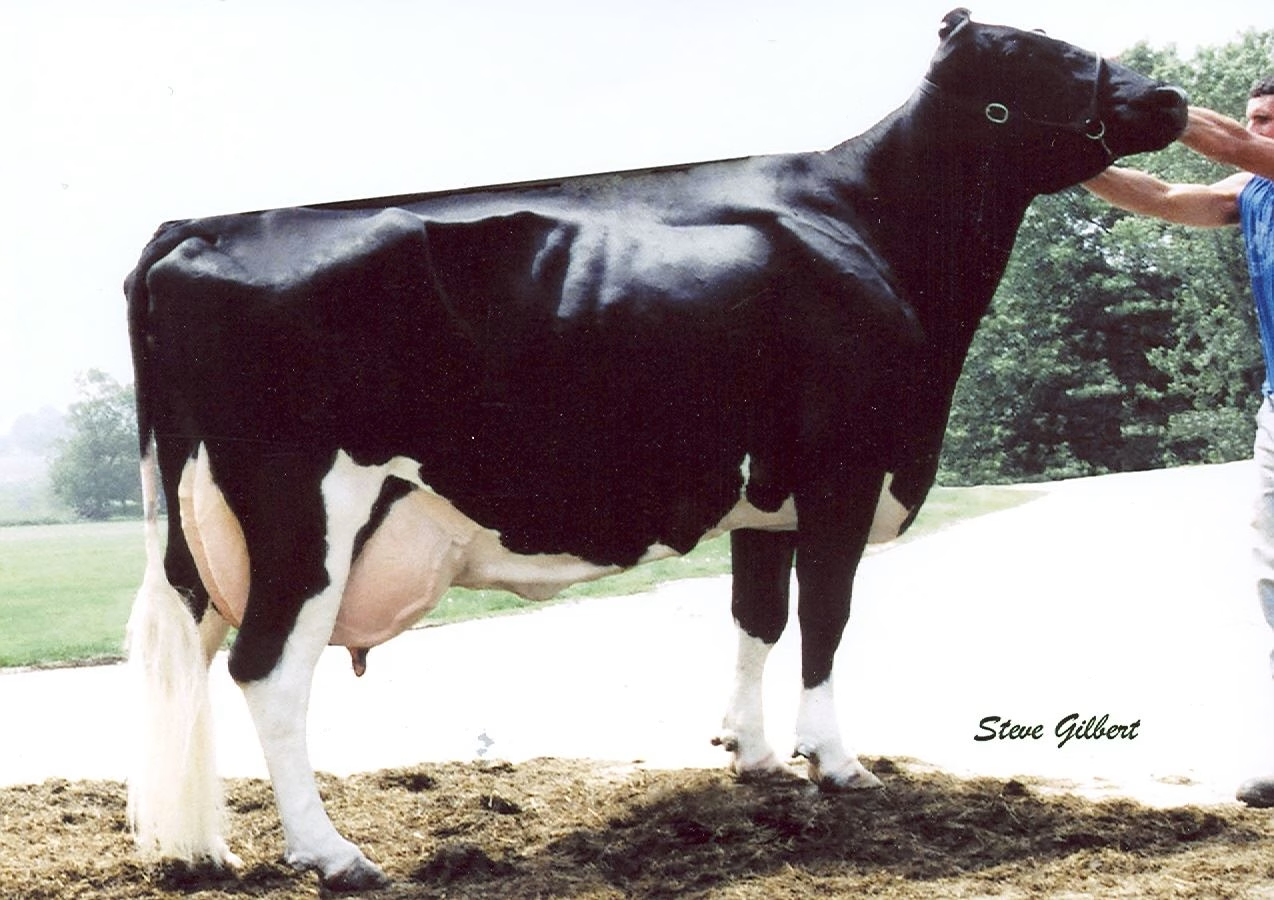
NewsSubscribe
First
Last
Consent

Beyond Pedigrees: How Inbreeding Affects Milk Production, Fertility, and Health in Holstein Cows – New Insights

Explore the profound effects of inbreeding on milk production, fertility, and health in Holstein cows. Are you strategically enhancing your herd’s genetic potential?

Summary:

Inbreeding in dairy cattle can significantly affect milk output, fertility, and health, making it crucial for farms to differentiate themselves. Traditional pedigree techniques are still used, but advances in genotyping offer unique insights into cattle DNA. This study highlights the need to combine contemporary genomic technologies with conventional approaches by comparing inbreeding estimators using pedigree and genomic data in German Holstein dairy cattle. Inbreeding results in homozygosity across the genome, which is common in dairy cows due to selective breeding for qualities like milk output and fat content. However, these methods may inadvertently reduce genetic diversity, increasing the likelihood of cousins mating. Inbreeding depression is the main problem, reducing general animal performance, leading to lower milk production, poor reproductive efficiency, and increased disease sensitivity. Understanding and controlling inbreeding is crucial for maintaining herd health and fertility. Combining pedigree-based and genomic-based inbreeding estimators is a pragmatic need for sustainable dairy farming, improving animal health, and increasing output.

Key Takeaways:

  • Inbreeding can significantly affect dairy cattle health, fertility, and milk production, necessitating careful management.
  • Utilizing both pedigree-based and genomic-based methods provides a more thorough understanding of inbreeding’s impact.
  • The study revealed the average inbreeding coefficients from various estimators, ranging from -0.003 to 0.243.
  • A 1% increase in inbreeding can lead to a decrease in milk yield by up to 40.62 kg, demonstrating the adverse effects on production.
  • Health traits showed minor variations with increased inbreeding, but digital dermatitis exhibited a contrasting increase compared to mastitis.
  • Managing inbreeding levels is pivotal for maintaining cattle fertility and overall herd sustainability.
  • Genomic estimators often presented negative values, indicating different sensitivities and implications compared to pedigree-based methods.
milk production, fertility rates, genomic technologies, dairy cattle inbreeding, pedigree analysis, genetic diversity, inbreeding depression, Holstein dairy cows, sustainable dairy farming, cattle health management

Inbreeding in dairy cattle may either make or destroy your dairy’s viability. Understanding how it affects milk output, fertility, and health can empower you to differentiate your farm from others experiencing challenges and greatly improve your dairy’s performance. Though many still rely on conventional pedigree techniques, losing out on essential data for herd management, advances in genotyping provide unique insights into cattle DNA, which could be costing your dairy.

Inbreeding is a double-edged sword: it may be both a tool for advancement and a quiet potential danger. This work shows the critical need to combine contemporary genomic technologies with conventional approaches by comparing inbreeding estimators depending on pedigree and genomic data in German Holstein dairy cattle. This all-around strategy guarantees that inbreeding may be used to improve general herd health, fertility, and production.

When closely related animals mate, inbreeding results in homozygosity across the genome. This is common in dairy cows due to selective breeding for qualities like milk output and fat content. While these methods aim to increase production, they may inadvertently reduce genetic diversity, increasing the likelihood of cousins mating. Understanding and preserving genetic diversity is crucial in animal genetics and husbandry.

Inbreeding has many significant drawbacks. Inbreeding depression is the main problem as it reduces general animal performance. Lower milk production, poor reproductive efficiency, and increased disease sensitivity—including mastitis and digital dermatitis—can follow this. Harmful recessive alleles become more frequent, reducing herd performance and welfare and causing inbreeding depression. This poses a problem for dairy producers striving for lucrative, sustainable output. Maintaining herd health and fertility depends on awareness of and control of inbreeding.

Percentage of InbreedingMilk Yield Depression (kg)Fat Yield Depression (kg)Protein Yield Depression (kg)Calving Interval Increase (days)
1%25.94 – 40.621.18 – 1.700.90 – 1.450.19 – 0.34
5%129.70 – 203.105.90 – 8.504.50 – 7.250.95 – 1.70
10%259.40 – 406.2011.80 – 17.009.00 – 14.501.90 – 3.40
20%518.80 – 812.4023.60 – 34.0018.00 – 29.003.80 – 6.80
50%1297.00 – 2031.0059.00 – 85.0045.00 – 72.509.50 – 17.00

Understanding Inbreeding Risks: Diverse Methods for Comprehensive Analysis 

Healthy and profitable dairy cattle depend on awareness of the inbreeding risk. This research approximates inbreeding using pedigree- and genomic-based approaches with unique insights.
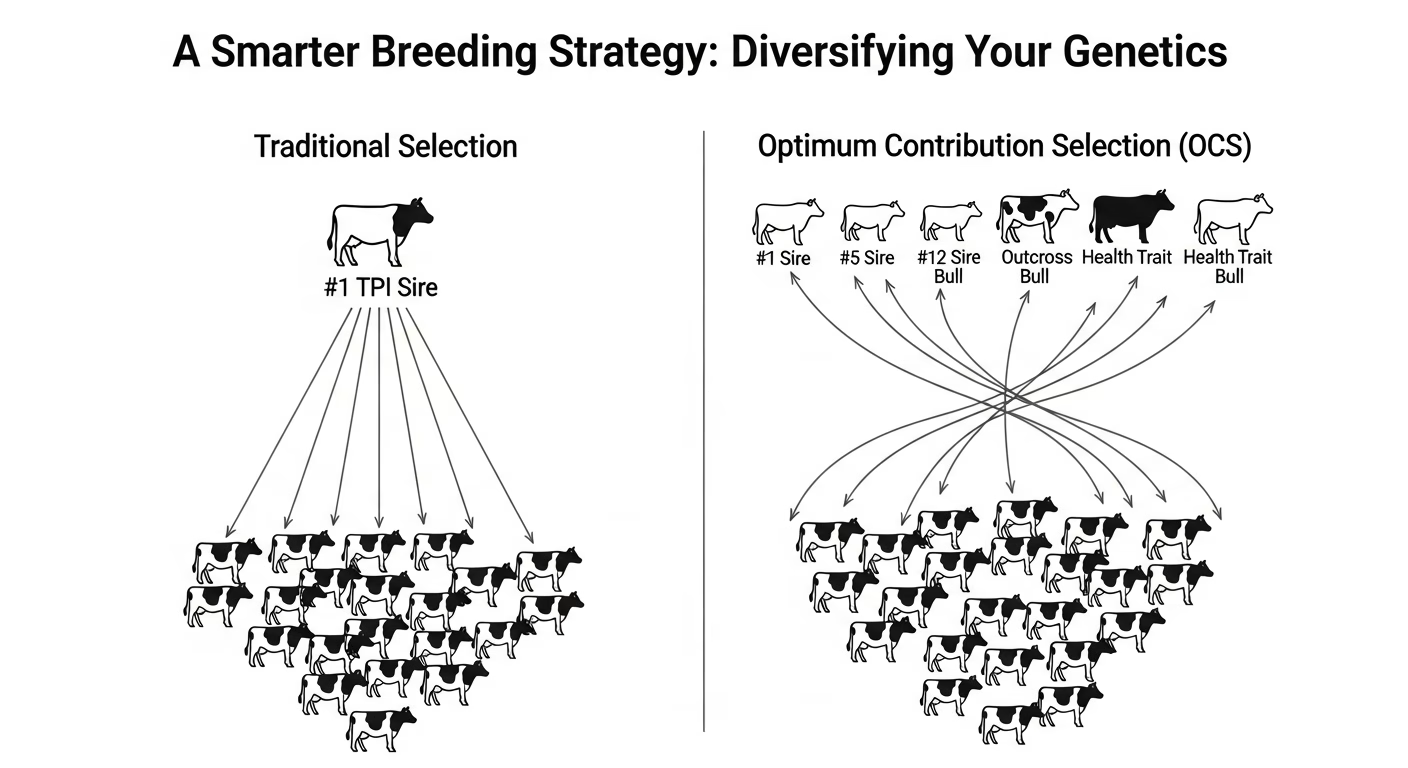
Depending on proper pedigree data, the pedigree-based approach Fped computes inbreeding using ancestry records. For herds with enough pedigree information, it is sufficient.

On the other hand, six genomic-based methods provide potentially higher precision: 

  • Fhat1: Assesses the proportion of the genome identical by descent, focusing on overall genetic similarity.
  • Fhat2: Considers linkage disequilibrium effects, offering a more detailed genetic relationship map.
  • Fhat3: Utilizes another layer of genetic data, estimating more subtle inbreeding effects.
  • FVR1: Uses observed allele frequencies to estimate inbreeding based on the genetic makeup.
  • FVR0.5: Sets allele frequencies to 0.5, valid for theoretical comparisons.
  • Froh: Examines runs of homozygosity to identify recent inbreeding, reflecting parental similarity.

Each method enhances our understanding and management of dairy cattle’s genetic diversity. Using both pedigree and genomic estimators offers a nuanced approach, helping to mitigate inbreeding’s adverse effects on production, fertility, and health traits in dairy herds.

Examining the Genetic Fabric: Data-Driven Insights from a Legacy of German Holstein Dairy Cattle

The research utilized data from 24,489 German Holstein dairy cows, including phenotypic and genotypic information. The pedigree covers 232,780 births between 1970 and 2018, providing a strong foundation for the study.

Using linear animal models, they evaluated how inbreeding affects characteristics like calving interval and 305-day milk output. Their results were more straightforward to comprehend and implement, as they converted them into a probability scale using ‘threshold models, ‘a statistical method that sets a threshold for a particular health variable, allowing for a more nuanced understanding of health outcomes.

Quantifying the Toll: Inbreeding’s Varying Impact on Milk, Fat, and Protein Yield

EstimatorEffect on Milk Yield (kg)Effect on Fat Yield (kg)Effect on Protein Yield (kg)
Fhat1-25.94-1.18-0.90
Fhat2-30.50-1.30-0.98
Fhat3-40.62-1.70-1.45
FVR1-28.35-1.25-0.95
FVR0.5-33.20-1.40-1.10
Froh-32.00-1.60-1.20
Fped-30.75-1.35-1.00

The results revealed that inbreeding greatly influences important dairy cow production factors like milk yield, fat, and protein output. From 25.94 kg to 40.62 kg, a 1% increase in inbreeding dropped the 305-day milk output. For instance, the Fhat1 approach revealed a 25.94 kg loss, whereas the Fhat3 approach suggested a more notable decline of 40.62 kg.

Regarding fat generation, the drop per 1% inbreeding increase varied from 1.18 kg (Fhat2) to 1.70 kg (Fhat3). Protein synthesis fell similarly between 0.90 kg (Fhat2) and 1.45 kg (Froh and Fhat3). These differences draw attention to the need to use pedigree and genomic techniques to completely grasp the influence of inbreeding on production features.

Navigating Fertility Challenges: The Crucial Role of Managing Inbreeding Levels 

Inbreeding EstimatorImpact on Calving Interval (Days)
Fped0.19
Fhat10.25
Fhat20.22
Fhat30.34
FVR10.20
FVR0.50.21
Froh0.31

Dairy producers striving for maximum output are concerned about how inbreeding affects reproductive features, especially the calving interval. Our extensive investigation, which utilized pedigree- and genomic-based estimators, showed the consistent effects of inbreeding depression on fertility. More precisely, a 1% increase in inbreeding stretched the calving interval from a 0.19-day rise (Fped) to a 0.34-day increase (Fhat3). This result emphasizes the need to control inbreeding levels to closely preserve effective reproductive performance. Knowing various estimators’ differing degrees of influence allows a sophisticated genetic management strategy to combine conventional and genomic knowledge to safeguard herd fertility.

Strategic Integration of Inbreeding Management: A Key to Sustainable Dairy Farming 

Dairy producers depend on the results of this research. Inbreeding seriously affects health features, fertility, and productivity. Controlling inbreeding is crucial for maintaining herd production and animal welfare.

The research underlines the requirement of pedigree-based and genomic-based inbreeding estimators in breeding operations. While genomic-based approaches give a precise, current picture utilizing improved genotyping technology, pedigree-based approaches—like Fped—offer a historical perspective of an animal’s genetic origin. Combining these methods lets farmers track and reduce inbreeding depression.

Genomic techniques enhance breeding pair selection by exposing hidden genetic features that pedigrees would overlook. This dual approach preserves genetic variety and resilience in the herd while preventing aggravation of inbreeding problems.

Especially noteworthy is the subtle influence of inbreeding on variables like milk output, fat, protein, and calving interval. Digital dermatitis and mastitis are health issues that react differently to more inbreeding. This complex picture enables farmers to customize breeding plans to fit their herd’s demands, improving animal welfare and output.

Using both pedigree-based and genomic-based inbreeding estimators is all things considered, a pragmatic need. This method helps the long-term viability of dairy enterprises, improves animal health, and increases output.

The Bottom Line

Crucially, one must know how inbreeding affects Holstein dairy cows. Using both pedigree and genomic-based estimators, our studies show how increased inbreeding results in longer calving intervals and lower milk, fat, and protein synthesis. This emphasizes the need to run herds using many inbreeding estimators.

Depending only on conventional pedigree techniques might miss important genetic information genomic estimators offer. Using superior breeding choices and integrating new data helps farmers increase productivity, health, and fertility. Effective farm management, environmental sustainability, and financial economy also help comprehensive inbreeding estimators.

Managing inbreeding via a data-driven method enhances environmentally friendly dairy output. Using new genetic techniques will assist in guaranteeing herd health and production as the sector develops. Technological developments and research will improve inbreeding control methods even more, boosting the dairy industry.

Learn more:

Join the Revolution!

Bullvine Daily is your essential e-zine for staying ahead in the dairy industry. With over 30,000 subscribers, we bring you the week’s top news, helping you manage tasks efficiently. Stay informed about milk production, tech adoption, and more, so you can concentrate on your dairy operations. 

NewsSubscribe
First
Last
Consent
Send this to a friend