



Archive for heat tolerance

 197 Bulls. 8 Years. Zero in Your NM$ Catalog: The Heat Tolerance Trait CDCB Still Won’t Publish

Trevor Parrish in NSW started filtering sires on HT ABV in 2017. By August 2024, 197 Holstein Good Bulls cleared the threshold. CDCB’s April 2025 NM$ revision added none of it.

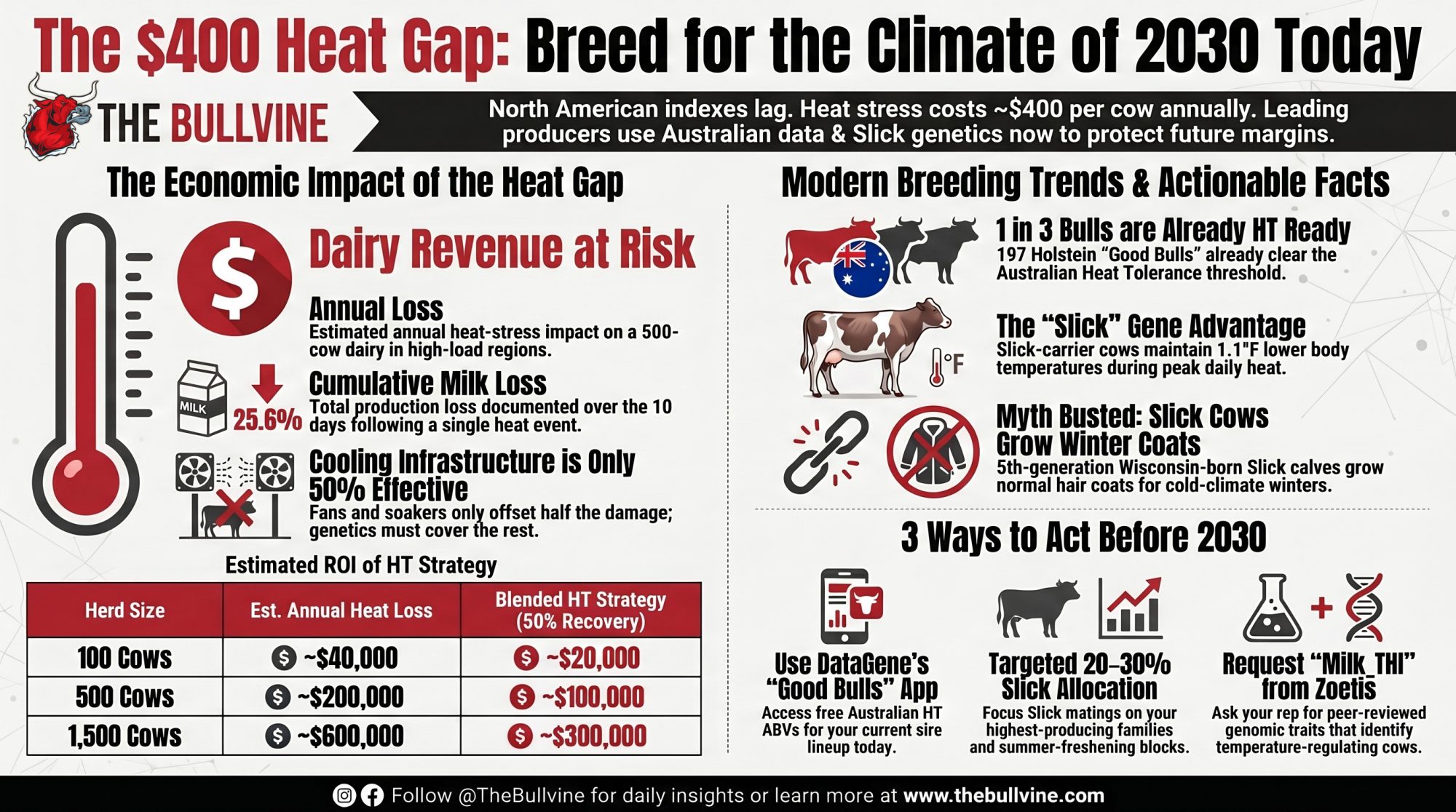
Executive Summary: Australia’s DataGene released a Heat Tolerance ABV in December 2017, and by the August 2024 run, 197 Holstein Good Bulls — roughly one in three — cleared the 100 threshold. CDCB’s April 2025 NM$ revision moved butterfat from 28.6 to 31.8 and dropped protein from 19.6 to 13, but added no heat tolerance trait; Lactanet hasn’t weighted it in LPI or Pro$ either, despite University of Guelph models hitting 0.97 rank correlation. The economic exposure for North American herds sits around $400/cow/year in heat-load regions — roughly $200,000 annually on a 500-cow dairy in southwestern Ontario or the Central Valley — based on the St-Pierre 2003 baseline adjusted for inflation and the 10% single-day, 25.6% 10-day cumulative milk losses documented in Science Advances (July 2025). Zoetis has peer-reviewed Milk_THI and CFS_THI traits in JDS (September and November 2025) that identify cows with measurably better rectal-temperature regulation. Select Sires’ ART program is now five Slick generations deep in Wisconsin, with parent averages tracking close to non-Slick matings and calves that still grow winter coat. The heifer you breed in May peaks in the early 2030s — waiting on CDCB locks in three more replacement cycles of thermal vulnerability, while DataGene’s Good Bulls App, Zoetis Clarifide, Australian proofs through Semex/Genex/ABS, and a 20–30% Slick allocation on your top cow families are all workable today. The question isn’t whether the margin math favours acting; it’s whether your AI rep can answer the HT question when you call tomorrow.
heat tolerance genetics

In late 2017, Holstein breeder Trevor Parrish of Kangaroo Valley, New South Wales, began weighting Heat Tolerance ABV into his sire selections — a decision still uncommon among his Australian peers at the time, according to DataGene’s adoption reporting and Parrish’s own May 2025 comments to Dairy News Australia. DataGene had just released the trait publicly: a quarterly-updated breeding value measuring how well a cow holds production when the Temperature-Humidity Index climbs past comfort. From that release forward, per his Dairy News Australia interview, Parrish treated Heat Tolerance as part of his standard sire-evaluation toolkit.

Eight years on, DataGene’s adoption data and Parrish’s published commentary tell the story of a breeder who treated the trait like calving ease — a filter you apply, not a debate you have. Meanwhile in Woodstock, Tulare, or Fond du Lac, no official North American genetic evaluation — not NM$, not TPI, not LPI — currently publishes a heat tolerance number at all. That gap has a dollar value. And it compounds every summer your replacement heifers come into the milking string.

What Australia Actually Did, Starting in 2017

DataGene released the Heat Tolerance ABV publicly in December 2017. The trait measures a cow’s ability to hold milk, fat, and protein output as THI rises past comfort thresholds. An ABV of 100 is breed average, and the trait sits inside the Balanced Performance Index (BPI) rather than floating as a standalone curiosity. A 2024 update lifted Holstein reliability by 10 percentage points and re-ranked the HT list more substantially for Holsteins than for Jerseys.

The adoption curve tells the more interesting story. In late 2016, during DataGene’s pilot work, only a handful of Good Bulls ranked meaningfully above 100 for HT. By the August 2024 ABV release, DataGene reported that one in three Holstein Good Bulls — 197 bulls — carried a Heat Tolerance ABV of 100 or above. That shift tracked a broader story of how climate pressure is reshaping dairy breeding priorities worldwide — but unlike most of the global picture, Australia already had the trait on the catalog page.

Speaking to Dairy News Australia in May 2025, Parrish framed the trait as part of a complete-cow picture: “Heat tolerance is part of that efficiency. As a breeder, you are trying to cover all the bases, and heat tolerance, now it has an ABV, is part of a solid, good quality cow.”

That isn’t a regulator’s decision. It’s a market filter, and it happened inside a decade.

Is the Science Strong Enough to Act On Without the Official Index?

Short answer: yes. And the research isn’t Australian-only. Three independent research pipelines — Australian, Canadian, and U.S. — now converge on the same conclusion: heat tolerance is a heritable, measurable, and economically significant trait in Holsteins.

Evidence streamMetricWhat it proves
Australia DataGene197 Holstein Good Bulls at HT ABV ≥100 by Aug. 2024Catalog-level selection signal exists
Canada Guelph / Lactanet-ready modelsRank correlations above 0.97 for Canadian Holstein bullsCanadian evaluation framework is technically stable
U.S. Zoetis genomic traitsMilk_THI: -1.3 to 1.0 kg/day/THI; CFS_THI: -6.2 to 5.3 pts/THIHeat tolerance can be genomically ranked in U.S. Holsteins
Slick allele field physiology1.1°F lower vaginal temperature at noon–3 p.m.Slick carriers regulate body temperature better under heat

The Three Scientific Proofs

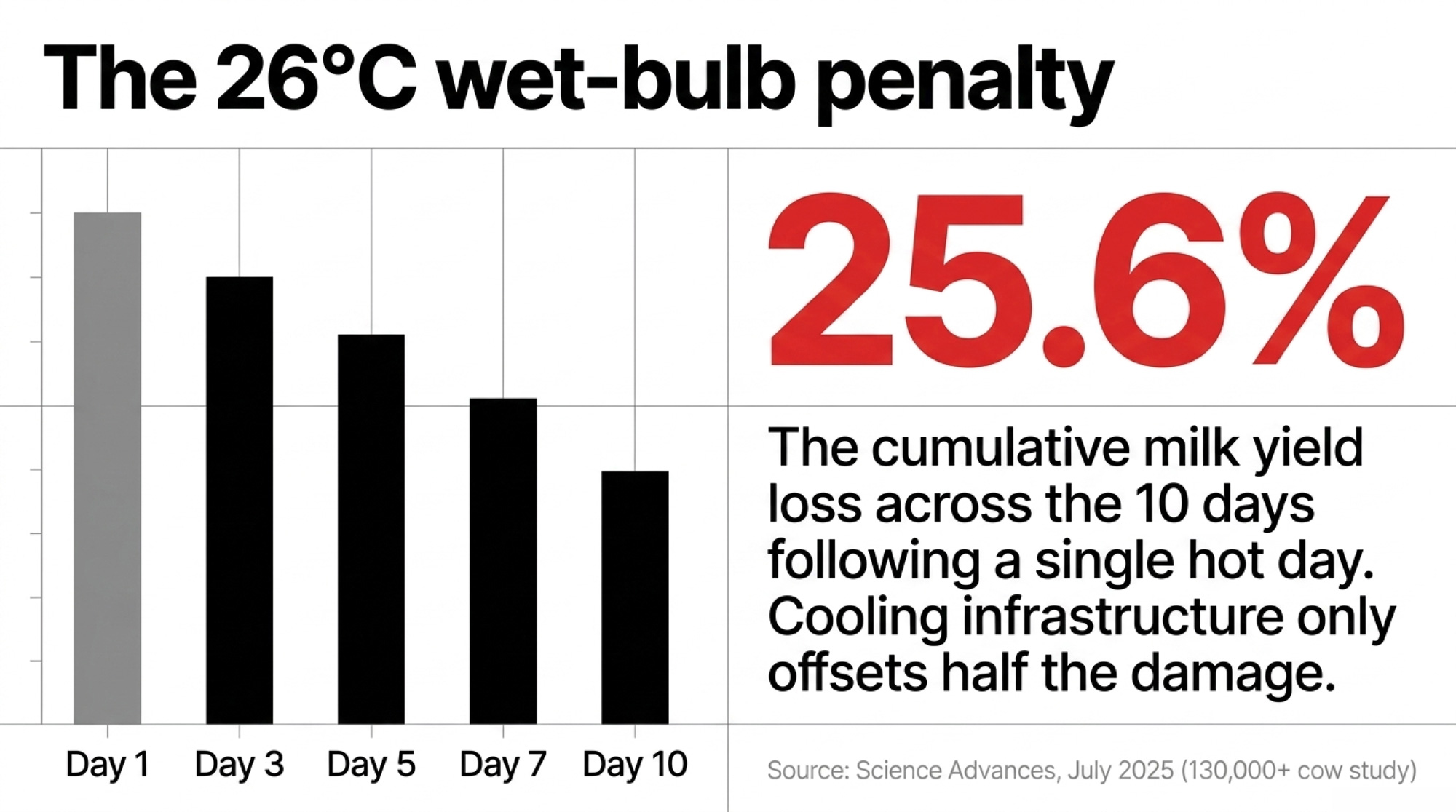
  • Australia — University of Chicago Climate Impact Lab (Science Advances, July 2025). Gong, Hsiang, Moscona and collaborators drew on production records from more than 130,000 cows over 12 years. Cooling infrastructure only offsets about half of the damage on the hottest days — fans and soakers cut losses by roughly 50% at a 20°C wet bulb, less than half overall at the top of the range.
    • Bottom line: Milk yield falls up to 10% on days when wet-bulb temperature exceeds 26°C. Cumulative loss across the 10 days following a single hot day reaches 25.6% of a single day’s baseline output.
  • Canada — University of Guelph (Schenkel, Miglior et al., Journal of Dairy Science). The Guelph group developed a Canadian heat tolerance evaluation framework using test-day production records and reaction-norm models. A follow-up 2025 JDS paper validated alternate models. Methodology is Canadian-ready; what’s missing is integration into LPI and Pro$.
    • Bottom line: Alternate models produce rank correlations above 0.97 for Canadian Holstein bulls — Lactanet has a validated, publication-ready HT evaluation sitting on the shelf.
  • United States — Zoetis research team (Vukasinovic et al., Journal of Dairy Science, September 2025). The team published validated genomic breeding values for heat tolerance in U.S. Holsteins. The specific traits are Milk_THI (change in daily milk yield per unit of THI, ranging from -1.3 to 1.0 kg per day per THI unit) and CFS_THI (change in conception at first service per unit of THI, ranging from -6.2 to 5.3 percentage points). A November 2025 JDS validation confirmed that higher standardized transmitting abilities on both traits corresponded to reduced rectal temperatures during heat stress.
    • Bottom line: The cows the Zoetis model ranks as heat-tolerant actually regulate body temperature better in the barn — the trait does what it says on the label.
The traits exist and are peer-reviewed. Whether Zoetis has integrated Milk_THI and CFS_THI into its customer-facing Clarifide reports is a question for your Zoetis rep. The September 2025 JDS paper establishes the methodology, not the commercial rollout timeline.

What Does the Barn Math Actually Look Like?

Published heat stress loss estimates for U.S. dairy herds anchor around 4 per cow per year as the unmitigated baseline, from St-Pierre, Cobanov and Schnitkey’s work in Journal of Dairy Science (2003) — early-2000s dollars. Aggregate U.S. dairy losses are modeled near $897 million annually at minimum heat abatement intensity, pulling back toward $500–$600 million with optimum abatement.
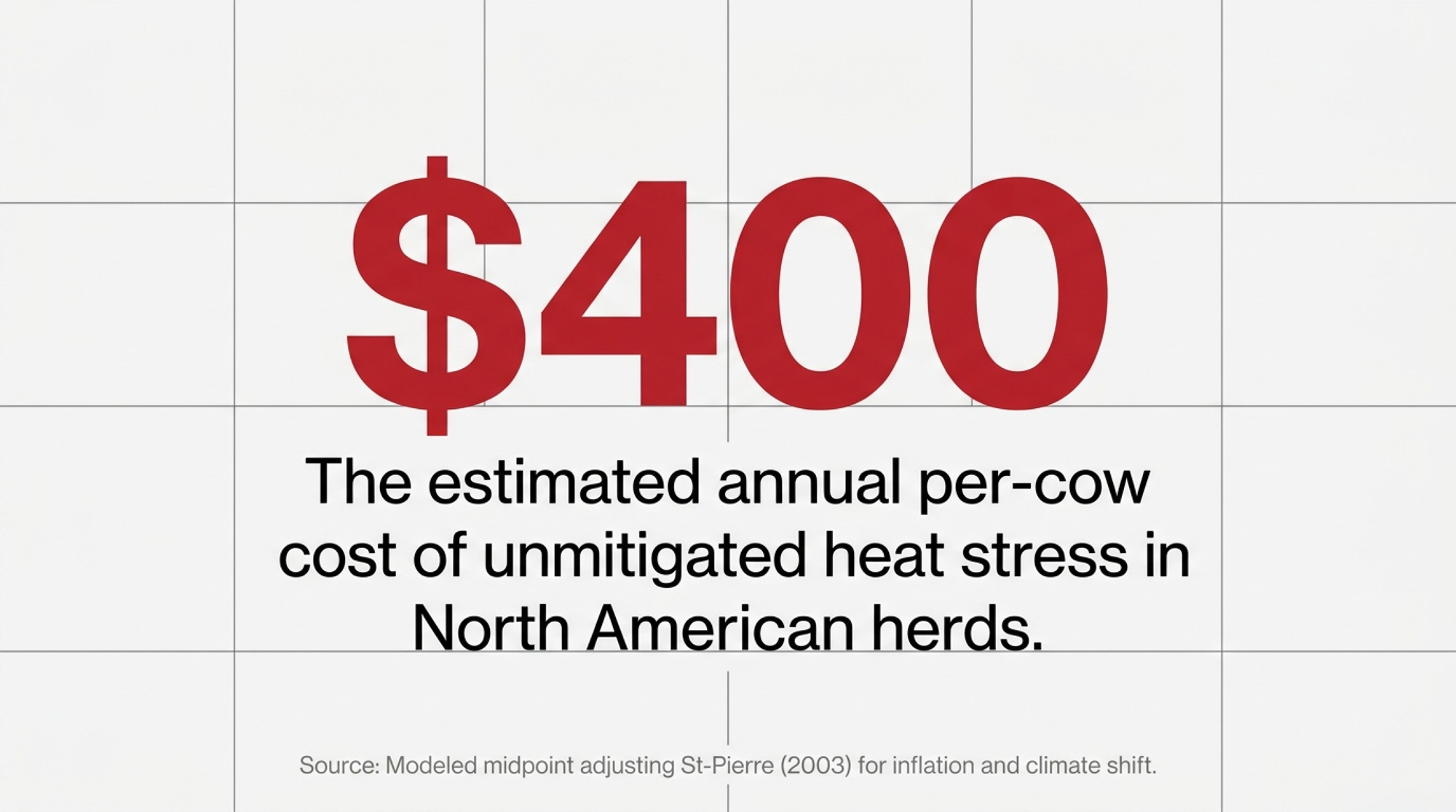
For herds in southwestern Ontario or California’s Central Valley — regions carrying a heavier seasonal heat load than the historical “temperate” framing suggests — a working midpoint of roughly $400 per cow annually is a reasonable illustrative figure once the St-Pierre baseline is adjusted for two decades of inflation and the climate shift documented in the Science Advances work. It’s a modeled estimate, not a published regional number. Operations still trying to cool their way out of the problem should also read our companion piece on where cooling infrastructure stops paying back.

The table below is an illustrative model built from that midpoint and a modeled 50% reduction assumption — the upper end of what combined cooling investment, Australian-style HT selection, and targeted Slick matings can plausibly deliver together. Actual results will vary with climate zone, milk price, Slick adoption percentage, and the sire mix already in the tank.

Herd SizeEst. Annual Heat Loss (Conventional)Blended HT Strategy (50% Reduction)Year-1 Implementation Cost (Est.)
100 cows~$40,000~$20,000~$10,000
500 cows~$200,000~$100,000~$40,000
1,500 cows~$600,000~$300,000~$115,000

Underlying inputs: $400/cow annual heat loss (modeled midpoint); 50% recovery assumption from combined cooling + HT selection + Slick matings; Year-1 costs scaled for genomic testing on replacement heifers and semen premium on targeted Slick matings.

On a 500-cow operation, the Year-1 cost sketch roughly covers genomic testing on replacement heifers plus a modest semen premium on about 150 targeted Slick matings (roughly a 30% allocation of annual breedings). Under those modeled assumptions, payback clears inside the second summer. The arithmetic isn’t the weak point. The inputs are. But the direction and order of magnitude hold up in almost any scenario a North American breeder plugs in.

Where CDCB and Lactanet Have — and Haven’t — Moved

The CDCB’s April 2025 evaluation revision implemented the every-five-year base change (moving from cows born in 2015 to cows born in 2020) and updated income and cost variables inside NM$, Cheese Merit $, Fluid Merit $, and Grazing Merit $. Butterfat weight moved from 28.6 to 31.8 and protein dropped from 19.6 to 13, per the official CDCB April 2025 evaluation change documentation and the USDA-AGIL technical report by VanRaden, Toghiani, Basiel, and Cole. No new traits were added. No heat tolerance number. Those weight shifts carry their own strategic implications — which we unpack in our analysis of the April 2025 Net Merit revision’s butterfat-protein trade-off.

CDCB’s caution isn’t inertia for its own sake — the national evaluation’s credibility rests on trait reliability, and adding a trait prematurely carries real costs. But the cost of waiting now has a measurable dollar value. Realistic integration of Heat Tolerance into NM$ sits several evaluation cycles out. Lactanet is in a comparable position. The Guelph group has produced usable Canadian methodology and the 2025 JDS work validates it — but no heat tolerance index is currently published as part of LPI or Pro$.
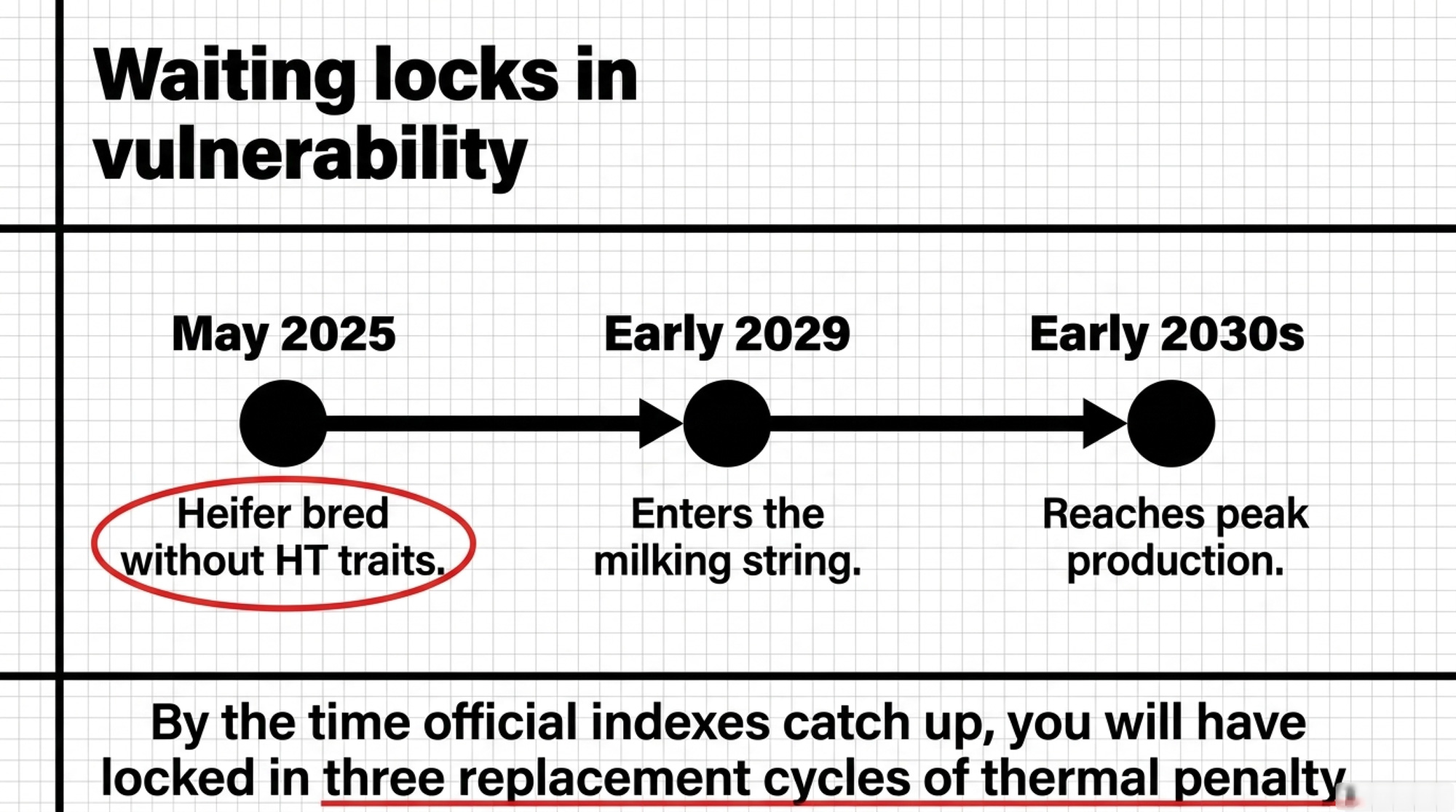
The replacement pipeline doesn’t care about governance timelines. A heifer bred this May enters the milking string in early 2029 and reaches peak production in the early 2030s — in a climate the Science Advances team projects will deliver materially more wet-bulb-26°C days across major dairy regions by midcentury, with 4% annual daily-yield losses baked in without adaptation. The genetic decision made this breeding cycle sets the thermal ceiling for that cow’s productive life.

The North American Program That’s Already Five Generations In

While CDCB hasn’t moved, Select Sires’ Aggressive Reproductive Technologies (ART) program has quietly been running the Slick playbook for years. Per an April 2026 blog authored by ART Program Manager Mark Kerndt, the program is now in its fifth generation of Slick calves, with all of them born in Wisconsin.

“We are breeding the horns out of the breed and are now also focusing on making the Holstein breed more heat tolerant, through the gradual introduction of the dominant slick allele into our cattle,” Kerndt wrote. “We expect several hundred potential slick calves to be born in our program in 2026 and the parent averages on these matings are very close to our non-slick matings.”
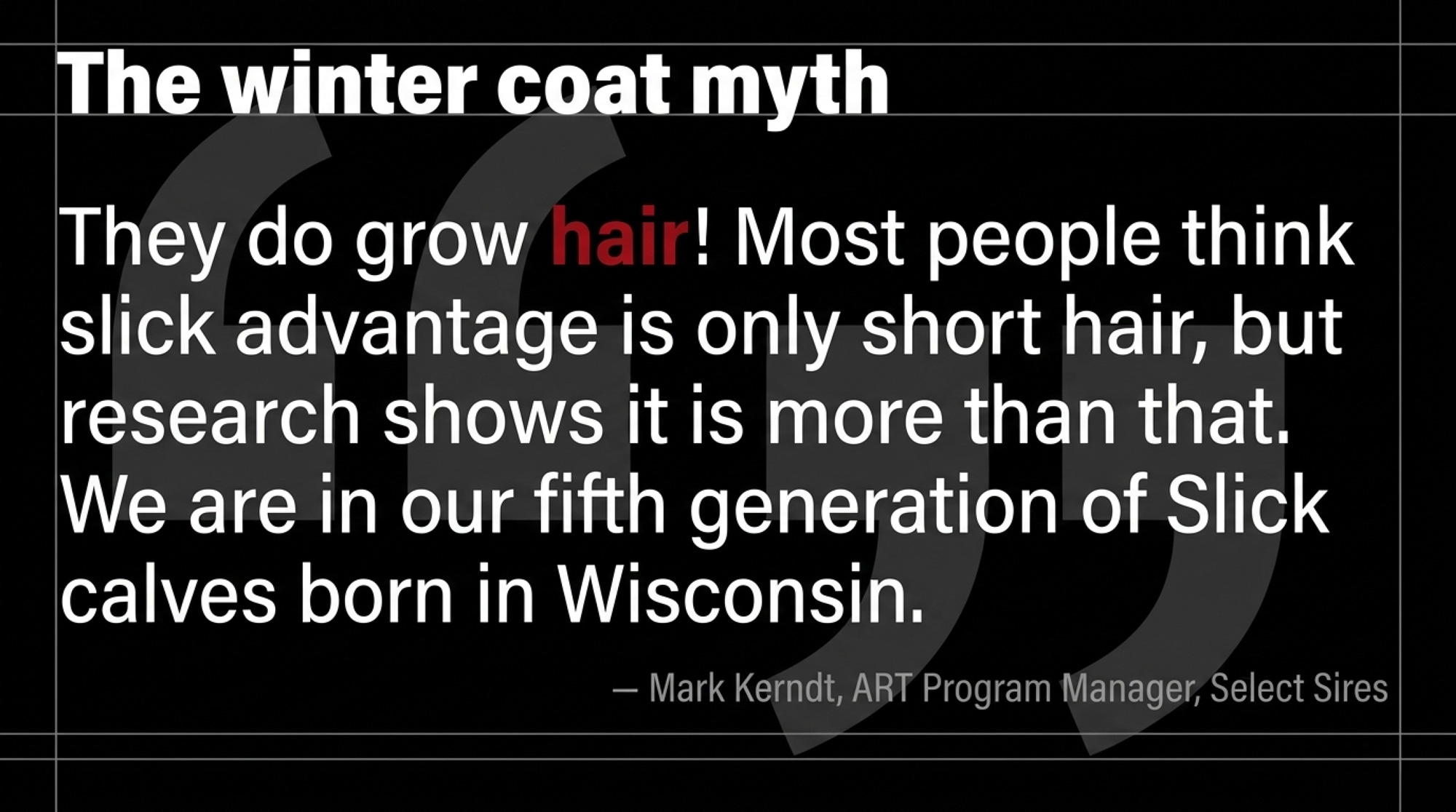
Two things worth holding onto from that. First: Wisconsin-born Slick calves grow hair in winter, which answers the most common North American objection before a breeder raises it. Kerndt again: “They do grow hair! Most people think slick advantage is only short hair, but research shows it is more than that.”

Second: parent averages on Slick matings sit close to non-Slick matings in the ART program. The production penalty breeders have long assumed isn’t showing up in the current generation. The piece of the picture North American breeders haven’t had — a named commercial program running the strategy long enough to produce fifth-generation data — is now on the record.

The piece still missing from the public record is the one that would close the circle: a named North American dairy producer, not an AI stud, who has been weighting HT or running Slick matings long enough to report two or three summers of their own production and fertility numbers. Those producers exist. Their data isn’t yet in the trade press. That’s the next story worth telling, and The Bullvine is actively reporting it — if you’re running one of these programs and willing to talk on the record, the editor’s line is open.

“But I Have -20°C Winters” — The Cold-Climate Objection That Isn’t Aging Well

The pushback from Ontario, Quebec, Wisconsin, and Minnesota breeders is almost always the same: “I don’t want a tropical cow in a -20°C barn.” Fair question. Until the data answers it.

Kerndt has answered it directly from Wisconsin, where January air temperatures regularly sit below -10°C. His fifth-generation Slick calves are born there, stay there, and — in his own words — “do grow hair!” The Slick allele isn’t producing tropical cattle incapable of holding coat in cold country. It’s producing cattle that thermoregulate more efficiently when THI climbs, while still growing a winter coat when the thermometer drops.

The framing error is calling it a “tropical gene” in the first place. Slick was characterized in Senepol cattle in tropical regions, yes — but the trait it delivers is heat dissipation efficiency, not tropical-only viability. And the climate the “temperate” label was built on doesn’t exist anymore. The Science Advances data shows that Ontario, the Upper Midwest, New York, and the Atlantic provinces are already accumulating enough wet-bulb-26°C days to put real dollars per cow per year on the table — the illustrative 0-per-cow midpoint in the Barn Math section lands squarely in those regions, not in Puerto Rico.

The decision has shifted. It used to be: “Is Slick worth the winter coat penalty?” The current data says: “Is holding onto an outdated temperate-climate mental model worth giving up 50% of the recoverable summer margin?”

Four Ways to Start Now — Without Waiting for CDCB

Active breeders split from waiters right here. Four approaches are already in use, each with a different cost, effort, and exposure profile. None require CDCB or Lactanet to move first.

MoveCost profileSignal usedBest fitDataGene Good Bulls AppFree lookupHT ABV; Holstein reliability around 48%Any breeder building a sire listZoetis Milk_THI / CFS_THI inquiryAccount / rep access dependentMilk-yield and first-service conception response to THILarge herds already using genomic servicesAustralian proof sheet requestRep request; sire coverage variesAustralian HT proof on eligible international siresHerds buying Semex, Genex, ABS or similar international geneticsCustom index layerGeneticist setup; usually 1–2 quartersNM$ or LPI floor plus HT as secondary filterOperations already using custom selection indexes


1. The Free Move — DataGene’s Good Bulls App. DataGene publishes HT ABVs quarterly in its freely available Good Bulls App. Pull it up, search a sire name, read the ABV. It costs nothing. DataGene’s own fact sheet recommends using a team of bulls because HT ABV reliability sits around 48% in Holsteins, lower than conventional production traits — but 48% on a trait that doesn’t exist in NM$ is still 48% more signal than you have today.

2. The Phone Call — Zoetis Milk_THI and CFS_THI. The Zoetis traits are peer-reviewed (Vukasinovic et al., JDS, September 2025; follow-up JDS validation, November 2025). Whether they’re accessible through Clarifide — and under what conditions — is a question for your Zoetis rep directly. Validation confirmed the traits identify cows that keep body temperature regulated during heat stress. Larger operations with existing account relationships are the ones most likely to get a useful answer first.

3. The Genetic Filter — Australian Proofs via International AI Partners. Sires distributed through international-facing AI partners — Semex, Genex, and ABS among them — may carry Australian proof data where their genetics are evaluated in the Australian system. Coverage varies by sire and stud. Ask your AI partner for the Australian proof sheet on specific bulls you’re considering. This is a phone call your rep can make today; no new account, no testing investment.

4. The Custom Index — Layering HT onto NM$ or LPI. For operations already running custom selection indexes, set NM$ or LPI as a floor and layer HT as a secondary filter — structurally how Australian farmers already use BPI alongside HT ABV. It takes a conversation with your AI partner’s geneticist and typically a quarter or two to implement cleanly. If you’re already building custom indexes, this is the obvious next add.

Slick Sires: What the Allele Actually Does — and Doesn’t

For operations ready to go further than a filter, weighting Slick sires into 20–30% of matings is the most direct structural play. Slick carriers are in commercial North American catalogs today, with Select Sires’ ART program the most openly documented pipeline — confirmed in the April 2026 Holstein Sire Directory. Swissgenetics also markets THERMO-ET P SL, the first European homozygous-polled Red carrier of the Slick gene. Coverage across other major studs varies; ask your AI partner what they currently carry or can source.

Here’s what the biology actually delivers. The Slick allele is a dominant mutation in the prolactin receptor gene that produces a short, sleek coat. University of Florida research by Dikmen and colleagues (Journal of Dairy Science, 2014) documented that Slick cows averaged 1.1°F lower vaginal temperatures at the hottest times of day (noon to 3 p.m.) compared with non-Slick herdmates housed in the same Florida freestall environment. And where summer-calving cows typically see a sharp first-90-day yield depression compared with winter-calving animals, that seasonal gap was substantially reduced in Slick carriers — Slick cows held closer to their winter-calving performance than wild-type animals in the same heat conditions. The regulatory and commercial path Slick has walked is worth comparing with how the PRLR-SLICK gene-edited variant stacks up on the 2029 milk cheque.

The strategy isn’t 100% Slick. It’s targeting Slick matings at your highest-producing cow families and summer-calving blocks, where heat stress hits the margin hardest. A 20–30% allocation blended with elite conventional sires selected on NM$ or LPI is where most breeders start. Per Select Sires’ own ART data, the production penalty Slick once carried isn’t showing up in the current generation.

Is Your Herd’s Genetic Strategy Already Behind Where Australia Was in 2019?

Not a rhetorical question. By the August 2024 ABV release, one in three Holstein Good Bulls cleared 100 for Heat Tolerance. Parrish told Dairy News Australia that Australian AI centres are moving toward filtering on HT the same way they already filter for calving ease: “AI centres won’t take bulls that aren’t good for Heat Tolerance. It will be like calving ease — now they won’t buy a bull that causes difficult calvings.”

That shift didn’t come from a regulator. It came from farmers like Parrish, year after year, building HT into what they asked their AI reps for.

North American studs respond to the same pressure. Kerndt has said plainly: “Heat tolerance is a valuable economic trait. By adding the slick trait to the elite genetic package offered by Select Sires, we can accomplish our goal of helping dairies everywhere become more profitable.”

When the conversation at the rep level shifts from “what’s your highest NM$ bull?” to “what’s your highest NM$ bull with Australian HT data above 100 or a validated Milk_THI value above zero?” — the catalogs move. Not in 2030. Sooner. The breeders best positioned will be the ones whose replacement heifers already carry heat-adapted genetics when that shift lands.

What This Means for Your Operation

  • If your herd regularly sees days with wet-bulb temperatures approaching or crossing 26°C, the Science Advances data says you’re already losing meaningfully on those days — even with fans and soakers running. Pull your summer milk-weight records against THI days from the last three years before your next breeding order.
  • If your replacement rate runs above 30%, you have enough genetic turnover to see measurable HT impact inside four years. Below 25%, stretch that timeline and adjust expectations accordingly.
  • If you already genomic-test 70% or more of your replacements, the incremental cost of adding HT screening at the sire level is effectively zero. The only reason not to add it is habit.
  • If your AI rep hasn’t raised heat tolerance in a sire presentation, that’s a conversation worth starting. The data exists. Whether your current stud has prioritized surfacing it is worth finding out before the next breeding order goes in.
  • If you breed for a specific milk market — components, cheese yield, A2A2 — weight HT as a filter on top of those targets, not a replacement for them. It stacks. It doesn’t substitute.
  • If you operate in what was traditionally called a “temperate” region — Ontario, Quebec, Upper Midwest, New York, Atlantic provinces — treat that label as historical, not current. The Science Advances midcentury projection work puts meaningful additional heat exposure in those regions.
  • If the winter-coat concern has kept you out of Slick matings: Select Sires’ fifth-generation Wisconsin-born Slick calves grow hair fine. The penalty isn’t what breeders have long assumed it was.
Key Takeaways

  • In the next 30 days: Pull your top 20 planned sires. Cross-reference each against DataGene’s Good Bulls App for HT ABV. Ask your Zoetis rep whether Milk_THI or CFS_THI values are accessible on those bulls. Request Select Sires’ April 2026 Holstein Sire Directory to identify current active Slick carriers. This is an afternoon’s work.
  • In the next 90 days: Identify your top-producing 20–30% of cow families and your May–July freshening block. Allocate Slick sire matings to those specific groups rather than broadcasting across the herd.
  • In the next 12 months: Begin documenting summer production and conception baselines now. When CDCB or Lactanet eventually integrates HT into NM$ or LPI, you’ll have your own performance delta in hand before your neighbor has results from their first Slick daughter.
  • If X, then Y: If your farm sits in a region that clears wet-bulb 26°C on more than a handful of days each summer and your replacement rate is above 30%, the cost of waiting another three years for CDCB exceeds the cost of starting a blended HT strategy now.
  • The wrong answers book-end the right one: 100% Slick is the wrong strategy for most North American herds in 2026. Zero Slick, in regions already carrying meaningful heat-day loads, is also the wrong strategy. The defensible position sits at 20–30%, targeted on your best, most heat-stressed genetics.

Parrish’s herd in Kangaroo Valley isn’t really the story. Select Sires’ fifth-generation Slick calves in Wisconsin aren’t quite it either. The story is that a producer in Woodstock, Tulare, or Fond du Lac could have started in 2019 or 2020 and closed most of the same distance by 2026. The tools have been sitting on the shelf. The question worth asking before the next breeding order goes in isn’t whether the climate will keep pressuring your margins. It’s whether the heifer you bred last Tuesday is built for the barn she’ll actually be milking in by the early 2030s — and if your AI rep can’t answer that question, what does that say about where the conversation needs to go next?

Complete references and supporting documentation are available upon request by contacting the editorial team at editor@thebullvine.com.

Learn More

The Sunday Read Dairy Professionals Don’t Skip.

Every week, thousands of producers, breeders, and industry insiders open Bullvine Weekly for genetics insights, market shifts, and profit strategies they won’t find anywhere else. One email. Five minutes. Smarter decisions all week.
NewsSubscribe
First
Last
Consent

The $8,100 Gamble on Missy, 198 Dragged Genes, and the 20-Year Breeding Blind Spot Hiding in Your Herd

Every time you pull up a sire list, there’s one question you almost never ask: what am I not measuring that’s already costing me money?

February 2003. Snow coming down sideways in a drafty barn at the Wisconsin Holstein Convention Sweetheart Sale. Experienced breeders — guys who’d driven hours through a Wisconsin winter to be there — were heading for the exits. The auctioneer’s voice was getting that tired, frustrated edge as bidding stalled out on a five-year-old Holstein whose rump “wasn’t entirely balanced.”

Matt Steiner called in from Pine-Tree Dairy in Ohio. He’d never laid eyes on the cow in person. Her second lactation ran 31,880 pounds at 4.1% fat and 3.2% protein — respectable, not revolutionary. He bid $8,100 for what everybody else in the room saw as just another decent cow past her prime.

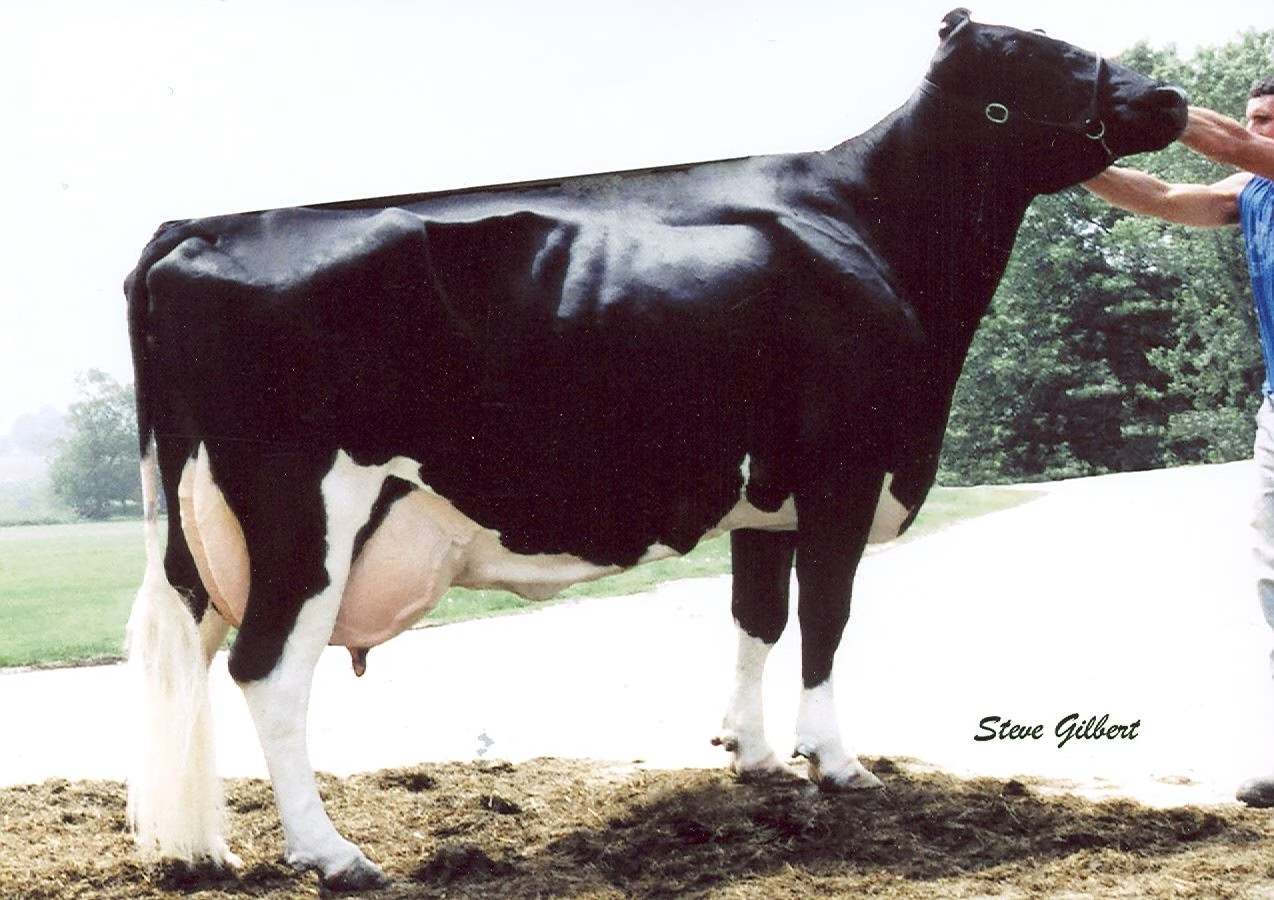
Wesswood-HC Rudy Missy-ET EX-92 — the “unbalanced” Wisconsin sale cow whose $8,100 phone bid quietly rewrote Holstein genetics for the next 20 years.

That cow was Wesswood-HC Rudy Missy. And Steiner’s gamble would reshape the Holstein breed for the next two decades. (Read more: The Phone Call That Built a Genetic Empire: The Wesswood-HC Rudy Missy Story and The Room Went Quiet. Everyone Left. Then an $8,100 Phone Call Changed Holstein History Forever.)

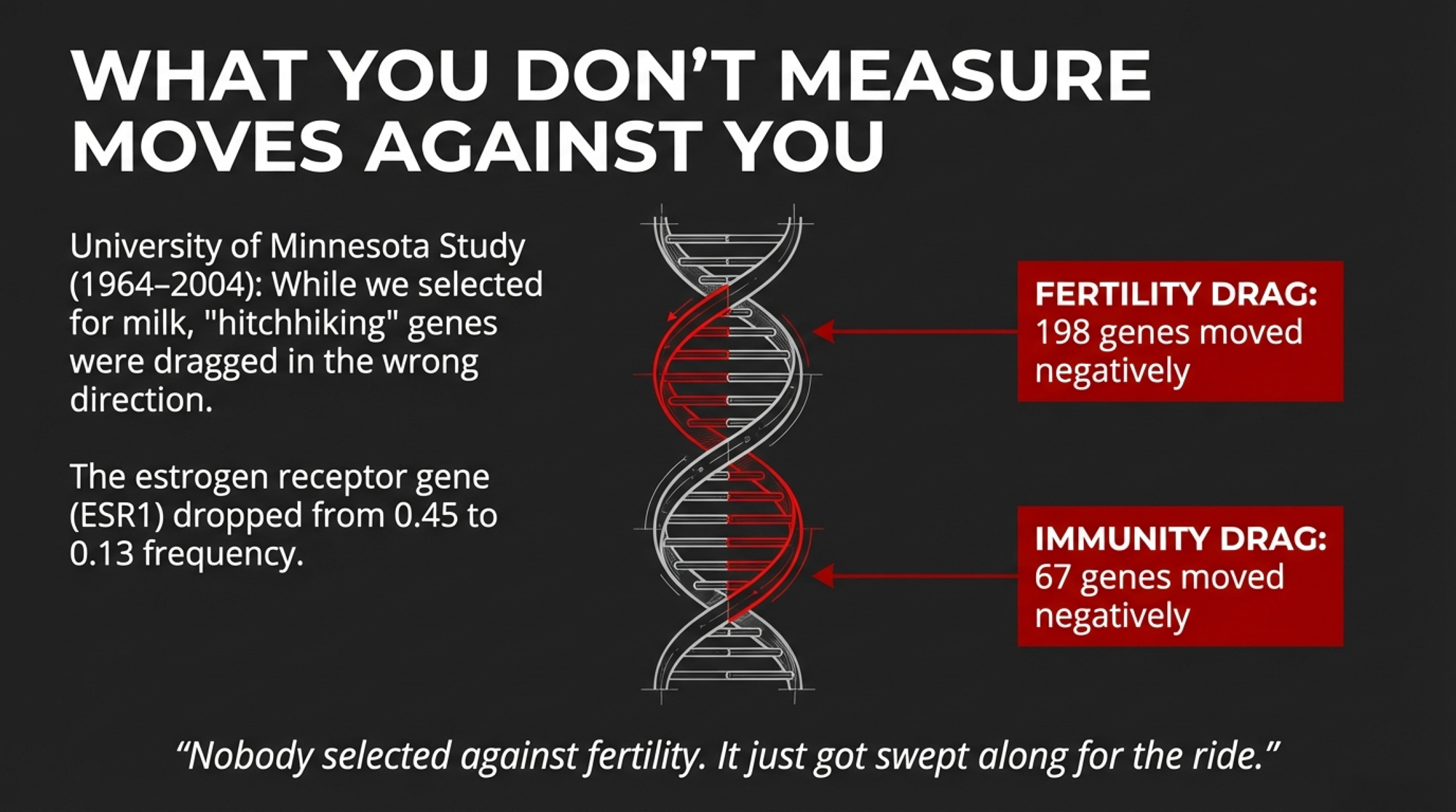
But here’s the part of that story nobody tells. The same breeding system that produced Missy — the same genomic toolkit that doubled annual genetic gain to 109 kg/year for milk in registered Holsteins (García-Ruiz et al., 2016, PNAS) — was simultaneously dragging 198 fertility genes and 67 immunity genes in the wrong direction. For 20 years. And the industry didn’t catch it. 

The question that should bother you: what’s getting dragged sideways in your herd right now?

How Fast the Engine Actually Runs

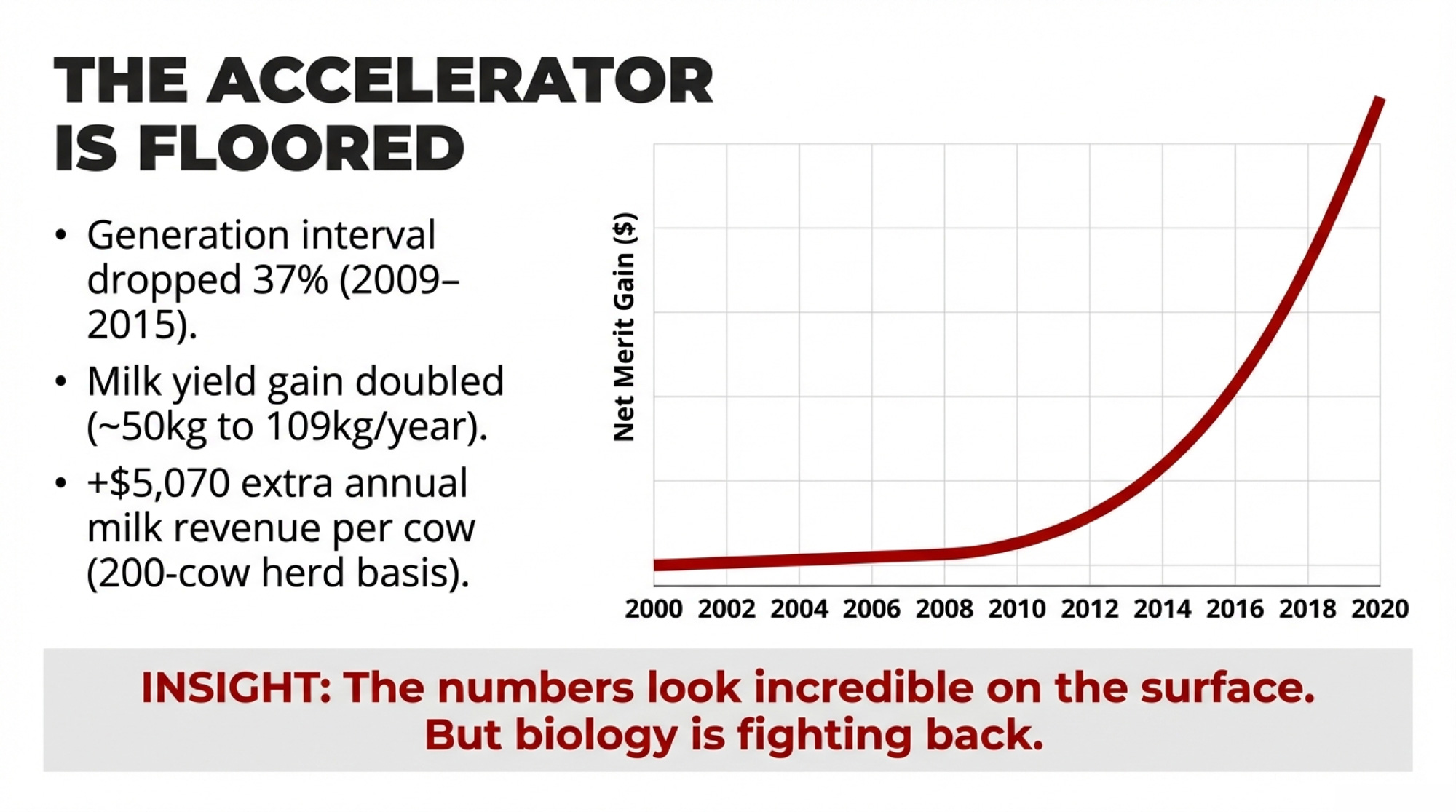
Before 2009, you waited five to seven years for a bull’s daughters to start milking before you knew if he was any good. Genomic selection rewired that math completely. Paul VanRaden and colleagues at USDA helped architect a system that estimates merit at birth, and the speed gain was dramatic. Across all four selection pathways that drive Holstein genetics (sire-of-bulls, sire-of-cows, dam-of-bulls, dam-of-cows), the combined generation interval dropped from 21.4 years in 2009 to 13.5 years by 2015 — a 37% reduction in just six years (García-Ruiz et al., 2016, PNAS). The sire-of-bulls pathway collapsed the fastest, from about 7 years to under 2.5.

Financially, the results are hard to argue with. Annual Net Merit gains climbed from $13 during 2000–2004 to more than $85 after 2010 (nominal dollars). Fat yield accelerated 173%. Protein yield, 156%. And the daughter pregnancy rate — which had been flat or declining for decades — finally reversed direction, rising to +0.26% per year.

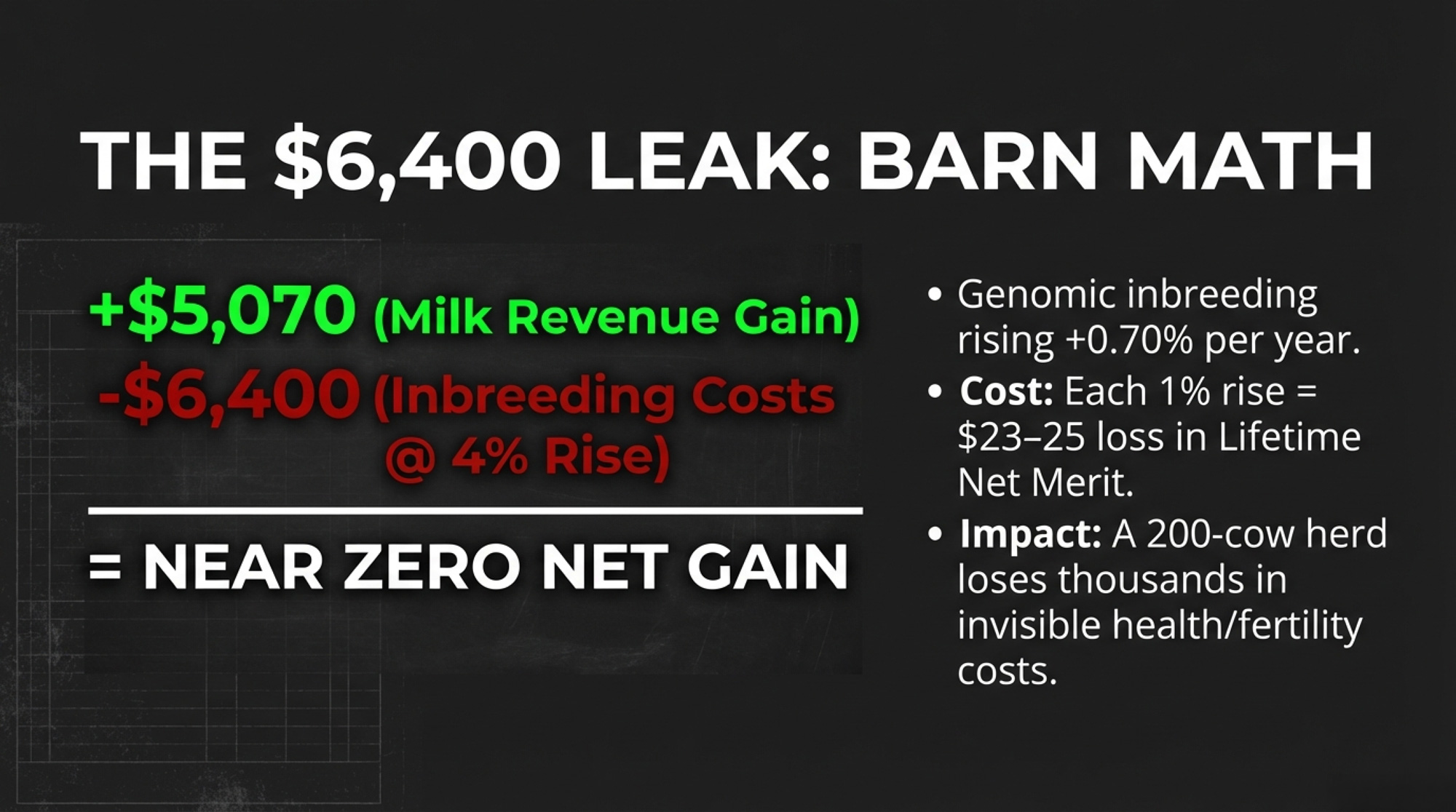
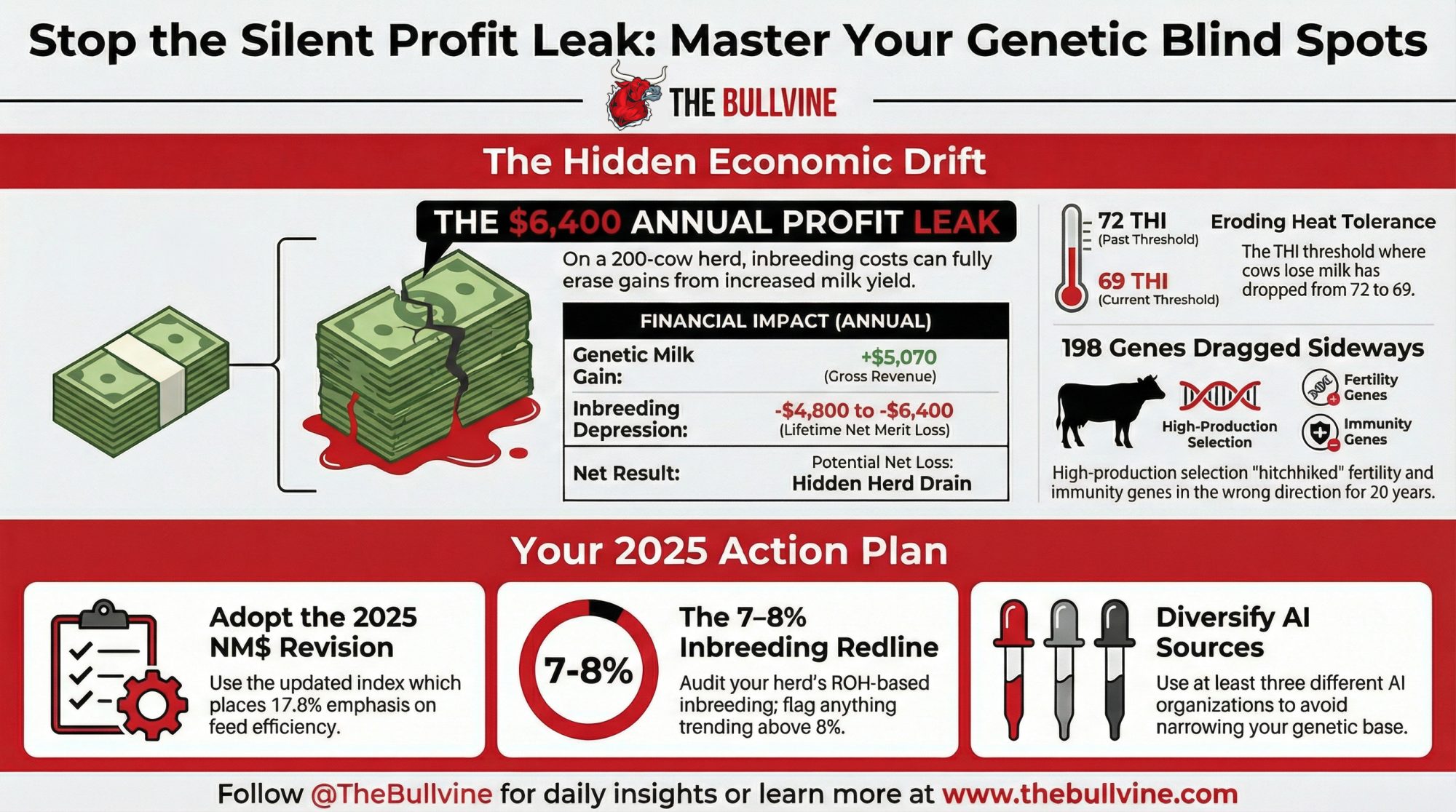
Here’s a way to feel that in your bulk tank. On a 200-cow herd averaging 85 lbs/day, the post-genomic milk yield acceleration alone (from ~50 kg/year to 109 kg/year for registered Holsteins) translates to roughly an extra 130 lbs of milk per cow per year in genetic potential over what the old system would have delivered. At a $19.50/cwt mailbox price, that’s about $5,070 in additional gross milk revenue across your herd annually — and it compounds every generation. Adjust that number for your regional mailbox price, but the scale holds. The record-breaking component shifts reshaping dairy’s economics are a direct product of this acceleration.

But the engine has a blind spot. And it’s biological, not mathematical.

What Happened When Nobody Was Measuring Fertility

The University of Minnesota’s research herd at the Southern Research and Outreach Center in Waseca did something nobody else bothered to do: they maintained an unselected Holstein control line alongside the commercially selected national population from 1964 onward. Same management. Same feed. Different genetics.

By 2004, the selected population had increased milk yield by 79%, from 6,309 kg to 11,324 kg. It had also lost roughly 30 additional days for successful conception compared to the control cows living right next door (Ma, Cole, Da & VanRaden, 2019, BMC Genomics 20:128).

That fertility decline wasn’t nutrition. Wasn’t repro protocols. Purely genetic. A breeding consequence nobody planned for.

The genome-level analysis revealed the mechanism. Within 234 chromosome regions shaped by four decades of milk selection, researchers found 198 genes involved in reproduction and 67 genes involved in immune function whose allele frequencies had shifted as collateral damage. The estrogen receptor gene ESR1 decreased from 0.45 to 0.13. The MHC region on chromosome 23 — the heart of immune diversity — showed significantly decreased heterozygosity.

CategoryCount
Fertility genes negatively affected198
Immunity genes negatively affected67
Total chromosome regions under selection234

Nobody selected against fertility or immunity. Those genes just happened to sit near milk-boosting alleles on the same chromosomes, and they got swept along for the ride. Geneticists call it hitchhiking. Producers who lived through the collapse in conception rates in the 1990s just called it expensive.

(This hitchhiking analysis comes from a single study using the unique Minnesota control line — the only unselected comparison herd of its kind. The broader fertility decline is independently confirmed across both the U.S. and Israeli dairy populations.)

Is the Same Thing Happening to Heat Tolerance Right Now?

The fertility crash is old news — the industry course-corrected, and genomic selection actually reversed the decline. The real question: where is the same pattern building today?

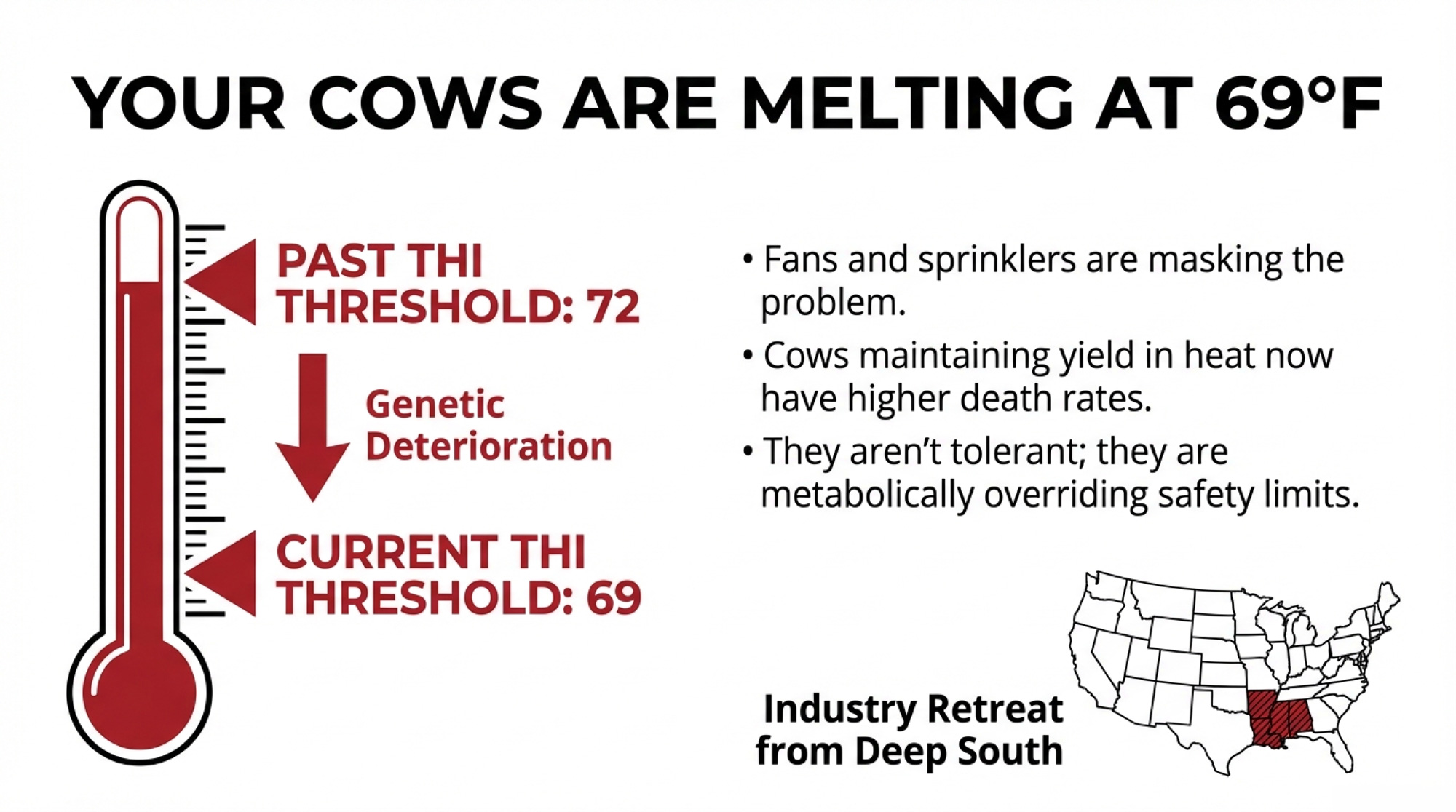
Heat tolerance is eroding, and almost nobody is selecting against it. Research led by Ignacy Misztal at the University of Georgia and Luiz Brito at Purdue found that the temperature-humidity index (THI) threshold where Holsteins start losing production has dropped from 72 to 69 over the past two decades (Misztal, Brito & Lourenco, 2024, JDS Communications 6(3):464–468). Your cows start suffering heat stress at lower temperatures than cows bred a generation ago.

And the grim part: cows that maintain production during heat stress peaks show an increased likelihood of death. They’re not tolerating the heat. They’re metabolically overriding their body’s protective shutdown. The authors note that better fans, sprinklers, and tunnel ventilation may actually be masking an even larger genetic deterioration underneath.

With the exception of Australia, dairy cows are not directly selected for improved heat tolerance anywhere in the world. In Alabama, Mississippi, and Louisiana, dairy has already become economically unviable — these states don’t even appear in the 24 major dairy states NASS tracks monthly (Misztal et al., 2024). A quiet testament to how completely the industry has retreated from the Deep South.

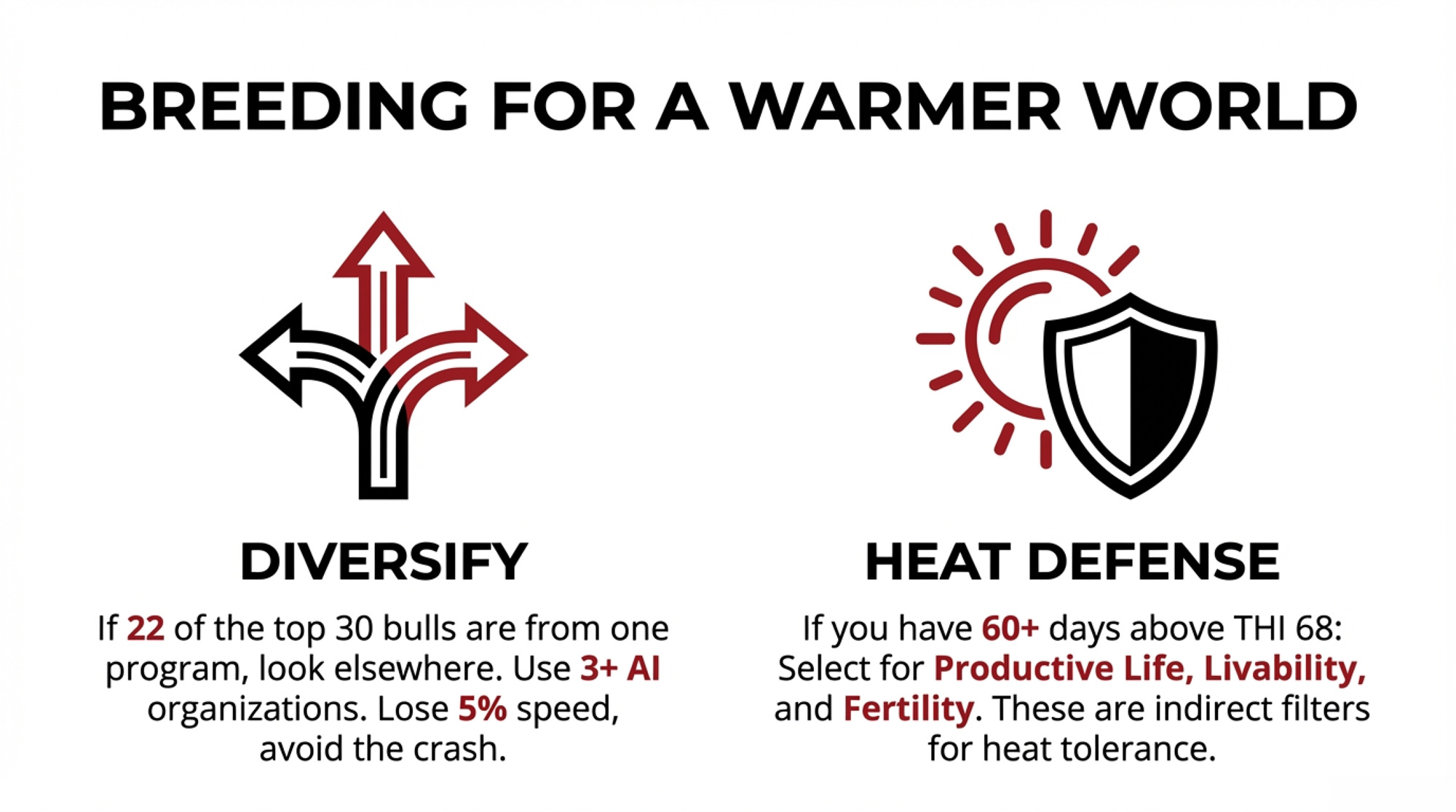
If your herd faces more than 60 days per year above THI 68, this isn’t an abstract research finding. It’s your next fertility crash in slow motion.

The Inbreeding Bill Coming Due

Genetic diversity is narrowing faster under genomics, not slower. A study of 74,485 Italian Holstein cows found the annual inbreeding rate based on runs of homozygosity (ROH) was +0.32% per year before genomic selection. After genomic selection took hold, it jumped to +0.70% per year (Ablondi et al., 2022, Frontiers in Veterinary Science8:773985). That’s above the 1% per generation threshold FAO considers critical for long-term sustainability.

CategoryValue
Pre-Genomic Annual Rate (Italy)0.32%
Post-Genomic Annual Rate (Italy)0.70%
U.S. Cumulative Increase 2010–2020168%

It isn’t just an Italian problem. U.S. Holstein inbreeding climbed from about 5.7% in 2010 to 15.2% by 2020 — a 168% jump — with CDCB analysis putting the cumulative cost to the national herd at an estimated $6.7 billion (The Bullvine, 2025 year-end review).

MetricAnnual Impact (200-cow herd)What’s Driving It
Extra Milk Revenue (Genomic Gain)+$5,070109 kg/year genetic gain vs. 50 kg/year pre-genomic (registered Holsteins, $19.50/cwt)
Inbreeding Drag (4% increase)−$4,800 to −$6,400$23–25/cow lifetime NM$ loss per 1% inbreeding, annualized over 3–4 year turnover
Net Realized Gain (Conservative)+$270 to +$1,070On fast-turnover herds, inbreeding wipes out nearly all the genomic advantage
Net on Fast-Turnover Herds−$1,330 (loss)Herds replacing >35% annually can lose more than they gain

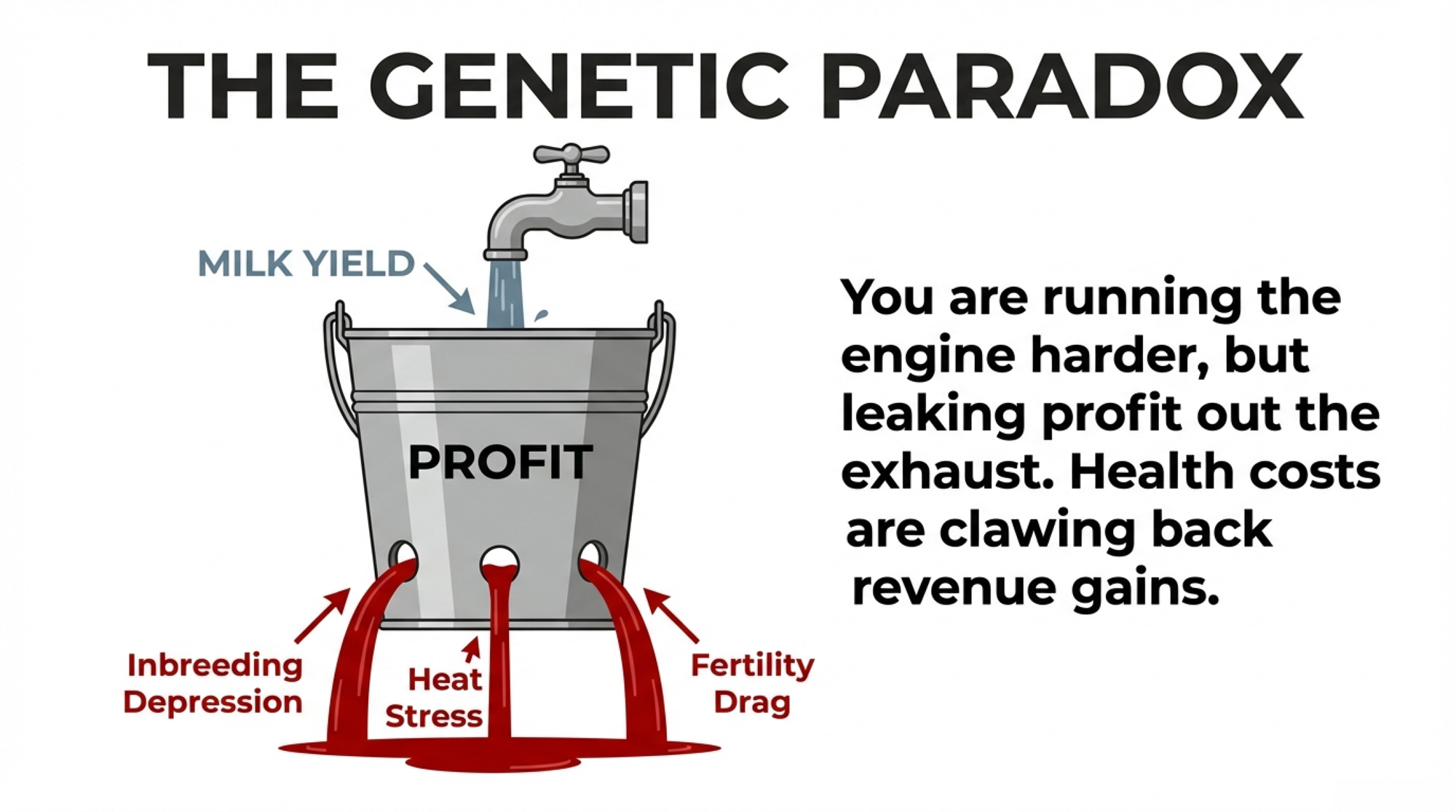
Here’s where the barn math gets uncomfortable. Each 1% increase in inbreeding costs roughly $23–25 off a cow’s lifetime Net Merit (USDA-ARS, 2025 NM$ revision). Go back to that 200-cow herd. If your average genomic inbreeding crept up 4 percentage points over the past decade — and given that the national average jumped 9.5 points in ten years, 4% is conservative — that’s about $96 per cow in lifetime profit quietly erased. Spread across a herd that turns over every three to four years, you’re looking at roughly $4,800 to $6,400 per year leaking out through health costs, fertility failures, and shortened productive life, depending on your actual turnover rate. Remember that $5,070 in extra annual milk revenue from faster genetic gain? At most turnover rates, inbreeding depression is clawing back nearly all of it — and on herds that turn over faster, the loss actually exceeds the gain. You’re running the genetic engine harder, and a big chunk of what it produces is leaking out the other side.

(Note: the $5,070 figure is gross milk revenue at $19.50/cwt; the $4,800–$6,400 range is annualized lifetime Net Merit loss, which captures health, fertility, and longevity effects beyond milk alone. They’re not identical units, but the scale of the offset is real — and the barn-math range depends on how quickly your herd turns over.)

The December 2025 evaluations showed what concentrated genetics look like in practice. When 22 of the top 30 NM$ bulls come from one program, you’re getting results and concentrating the gene pool simultaneously. Understanding how inbreeding affects milk production, fertility, and health is the other half of this equation.

Options and Trade-Offs for Your Next Breeding Decisions

The fertility crash lasted 20-plus years because nobody measured the trait being eroded. Heat tolerance, inbreeding, and resilience are in a similar position today. Here’s what you can actually do about it — with the honest trade-offs attached.

ActionWhen to ActWhat You’re Hedging AgainstTrade-Off
ROH Inbreeding AuditIf genomic inbreeding >7–8%$23–25 lifetime NM$ loss per 1% increase; $4,800–$6,400/year drag on 200-cow herdRestricting matings may slow genetic progress 5–15%
Weight Productive Life + LivabilityIf you face 60+ days above THI 68Heat tolerance declining; THI threshold dropped from 72 to 69 over 20 yearsMay sacrifice 3–5% genetic gain on other traits
Diversify Across 3+ AI ProgramsIf top 5 bulls all trace to one programGenomic inbreeding rising 0.7%/year; 22 of top 30 NM$ bulls from one program (Dec 2025)Aggressively avoiding related matings costs ~5–15% progress
Contribute AMS/Activity Monitor DataIf you’re running precision dairy techNext hitchhiking problem: feeding the reference population so crashes get caught in 5 years, not 20Consistent data entry discipline required

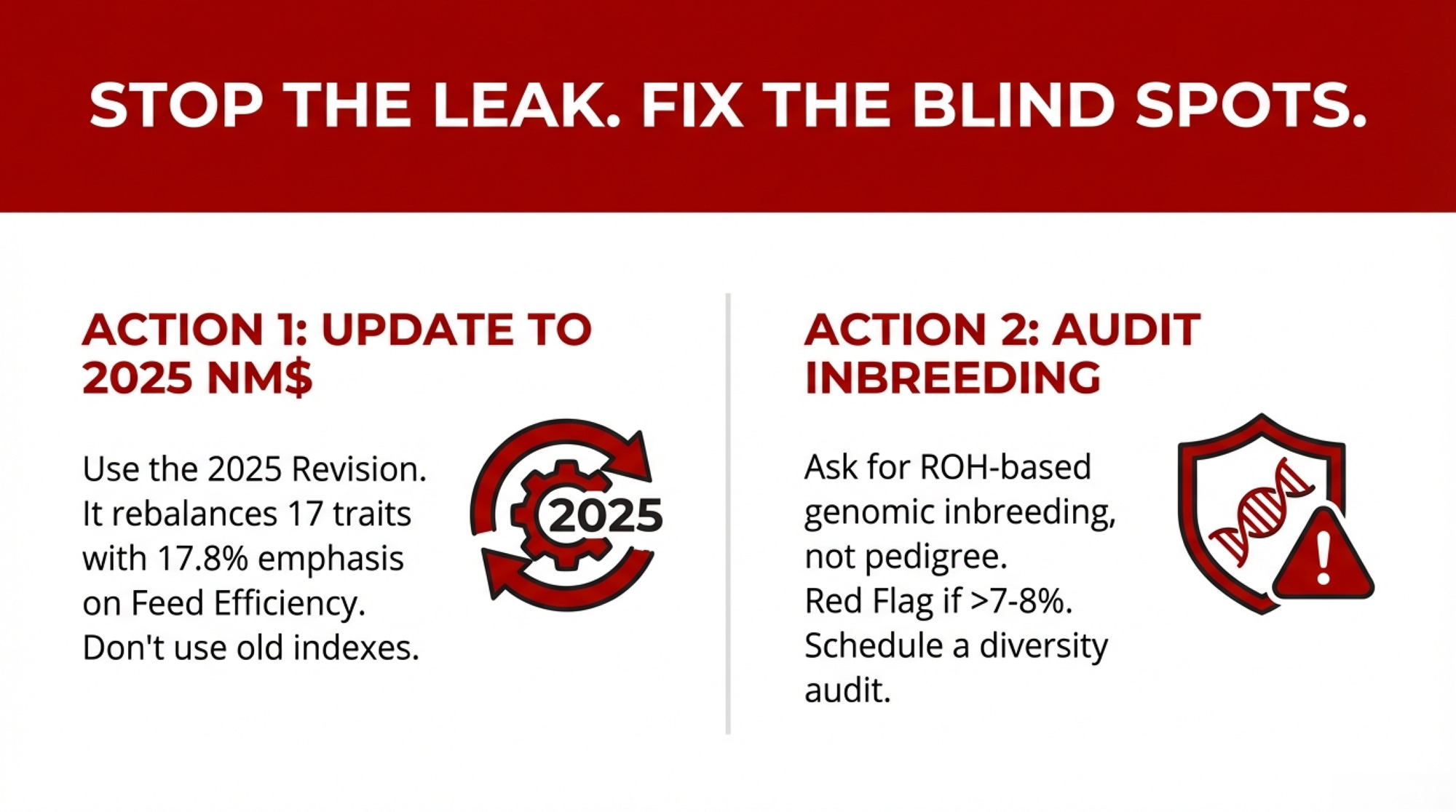
Confirm you’re using CDCB’s 2025 NM$ revision — and don’t override it. The updated index rolled out alongside the April 2025 base change. It now balances 17 traits for lifetime profitability, with feed efficiency (FSAV) carrying 17.8% of total emphasis — a substantial shift from prior weightings. If your genetics provider hasn’t updated to the 2025 revision, it’s worth a quick conversation; the trait emphasis shifted enough that older weightings are optimizing for a different market than the one you’re selling into. But even the right index can’t save you from yourself: if your top five bulls all rank in the top 20 for a single component while sitting below breed average for productive life, you’re running a single-trait program no matter what the index says. David Dyment at AG3 has built his program on exactly this principle — “consistency over unpredictability,” as he puts it — betting that balanced functional genetics outlast flavor-of-the-month rankings. The trade-off: you’ll pass on some high-component bulls that look great on paper. The fertility crash is what happened when the industry overrode balanced selection often enough.

David Dyment of AG3 built his breeding program on “consistency over unpredictability,” betting that balanced functional genetics will outlast the flavor-of-the-month sire list. (Show Ring Legend to Industry Innovator: The David Dyment Story)

Ask your genetics advisor for your herd’s ROH-based genomic inbreeding — this month. Pedigree coefficients underestimate actual homozygosity. In Italian Holsteins, pedigree inbreeding averaged 0.07 while genomic inbreeding was more than double at 0.17 (Ablondi et al., 2022). As a general rule of thumb, many geneticists start flagging concern when genomic inbreeding crosses 7–8% for Holsteins — there’s no official industry threshold, but herds above 9% should seriously consider a diversity audit. CDCB provides genomic inbreeding estimates — if your genetics provider isn’t using ROH-based calculations in mating plans, you’re flying partly blind. Diversify your sire lineup across at least three AI organizations. The trade-off: aggressively avoiding related matings can slow genetic progress — estimates vary, but the general range is somewhere around 5–15% depending on how restrictive you get. That’s a real cost. But inbreeding depression quietly eating your gains from the inside is worse — and that $4,800-to-$6,400-a-year leak on a 200-cow herd is real money.

If you’re in a heat-stress region, start weighting for it now. Increasing emphasis on productive life, livability, and fertility provides indirect selection pressure for thermotolerance — these traits correlate positively (Misztal et al., 2024). The trade-off: you may sacrifice 3–5% of genetic gain on other traits. In a warming climate, that’s a hedge worth paying for. If you’re south of the Mason-Dixon or running herds in the Central Valley, this isn’t optional — it’s self-defense.

Contribute the data you’re already collecting. If you’re running activity monitors, AMS systems, or feed intake tracking, those records can help build the reference populations for tomorrow’s evaluations. Contact CDCB or your breed association — in Canada, Lactanet already accepts health event and AMS data. The trade-off: consistent data entry takes discipline. But incomplete data contributed widely still beats perfect data that never leaves the farm. And it’s how the next hitchhiking problem gets caught in five years instead of twenty.

Key Takeaways

  • If your herd’s ROH-based genomic inbreeding is trending above 7–8%, schedule a diversity audit before your next mating run. Each 1% of inbreeding costs $23–25 off lifetime NM$ per cow, and on a 200-cow herd, a 4% accumulation translates to $4,800–$6,400 a year in hidden drag, depending on your turnover rate.
  • If you face 60+ days above THI 68, add productive life and livability emphasis to your sire selection now. Heat tolerance is declining genetically, even as heat abatement technology improves — the infrastructure is masking the problem.
  • If your genetics provider hasn’t updated to the 2025 NM$ revision, have that conversation this week. The updated index rebalanced 17 traits and added feed efficiency with an emphasis of 17.8%. Older weightings mean you’re optimizing for a market that’s already shifted.
  • If all your top sires trace to the same program, diversify across at least three AI organizations. Genetic gain means nothing if you’re narrowing the base that sustains it.
  • Before your next mating run, ask one question your genetics advisor probably won’t raise on their own: “Which traits am I not measuring that might be shifting in the wrong direction?” That’s the question the fertility crash should have taught us to ask in 1985.

The Bottom Line

Steiner’s $8,100 gamble in that drafty Wisconsin barn wasn’t a bet on a cow. It was a bet on seeing what the data couldn’t yet show him. Twenty-three years later, the tools are sharper than they’ve ever been — genomic testing at birth, AI-driven mating plans, embryo tech that was science fiction in 2003. The engine runs faster every year.

But the biology is still messier than the model. And the gap between what you’re optimizing and what you’re actually affecting is where unintended consequences compound. Silently. Generationally. The only question worth asking every time you pull up a sire list: What am I not measuring that I’m going to wish I had?

Editor’s Note: Genetic gain data from García-Ruiz et al. (2016, PNAS); the 37% generation interval reduction refers to the combined total across all four selection pathways (sire-of-bulls, sire-of-cows, dam-of-bulls, dam-of-cows), not any single pathway. Hitchhiking analysis from Ma, Cole, Da & VanRaden (2019, BMC Genomics 20:128), using the University of Minnesota unselected control line at Waseca, MN. Heat tolerance data from Misztal, Brito & Lourenco (2024, JDS Communications 6(3):464–468). Inbreeding data from Ablondi et al. (2022, Frontiers in Veterinary Science 8:773985), based on 74,485 Italian Holstein cows. U.S. inbreeding trends from CDCB analysis as reported in The Bullvine (December 2025). Barn-math calculations use $19.50/cwt mailbox price; inbreeding annualization assumes 3–4 year herd turnover and should be adjusted for your operation’s actual replacement rate. Per-trait figures are for registered Holsteins; all-cow population gains were approximately half this magnitude. NM$ figures are nominal. Missy auction details from The Bullvine’s Wesswood-HC Rudy Missy feature (July 2025), cross-referenced with the Wisconsin Holstein Association’s 2020 convention report.

Executive Summary: 

Genomic selection has more than doubled Holstein genetic progress, but it also proved something you feel in your own breeding records: traits you don’t measure still move, and sometimes they move against you. The same engine that helped make Wesswood-HC Rudy Missy a global brood cow quietly dragged 198 fertility genes and 67 immunity genes the wrong way for about 20 years before anyone caught it. Over those same decades, the THI threshold at which cows start losing milk slipped from 72 to 69, yet almost no one outside Australia selects directly for heat tolerance, even as better fans and sprinklers mask how fragile the genetics underneath have become. On the inbreeding side, genomic homozygosity in Holsteins is rising around 0.7% per year in some populations, and each 1% costs roughly $23–25 in lifetime Net Merit per cow — enough for a 200-cow herd to quietly leak $4,800–$6,400 a year, which can wipe out almost all of the roughly $5,070 in extra milk revenue from faster gain. You’ll see how those blind spots developed. You’ll see how those blind spots developed, then get concrete next steps: stick with the 2025 NM$ revision instead of custom tweaking, ask your genetics provider for ROH-based genomic inbreeding for your herd, and spread risk across multiple AI programs instead of loading your list from just one. If you’re staring down 60+ days above THI 68, it also explains how to lean harder on productive life, livability, and fertility as indirect heat-tolerance filters while feeding good data back into the system so the next crash is spotted in years, not decades. Underneath it all is one question this article keeps pushing you to ask every time you open a sire catalog: what am I not measuring that I’m going to wish I had?

Complete references and supporting documentation are available upon request by contacting the editorial team at editor@thebullvine.com.

Learn More

The Sunday Read Dairy Professionals Don’t Skip.

Every week, thousands of producers, breeders, and industry insiders open Bullvine Weekly for genetics insights, market shifts, and profit strategies they won’t find anywhere else. One email. Five minutes. Smarter decisions all week.
NewsSubscribe
First
Last
Consent

Understanding the “Slick Gene”: A Game-Changer for Dairy Farmers

Uncover the transformative impact of the “slick gene” on dairy farming. What advantages does this genetic innovation offer both livestock and their caretakers? Delve into this groundbreaking discovery now.

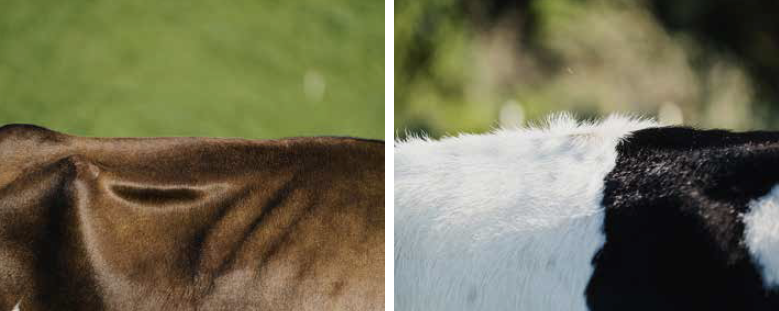
Left: A SLICK coat vs right: a normal non-SLICK coat (Photo:LIC)

Imagine a day when your cows are more tolerant of heat and more productive—game-changing—for any dairy farmer battling climate change. Allow me to present the “slick gene,” a ground-breaking tool destined to revolutionize dairy output. This gene is found in tropical cow breeds and gives greater output even in hot temperatures and more thermal endurance.

Agricultural genetic developments have revolutionized farming by increasing crop and animal yield and stress resistance. Precision alteration of features made possible by CRISPR and gene editing technologies increases agrarian performance. The slick gene could be essential for producing cattle that thrive in higher temperatures, ensuring the dairy industry’s future.

Examining the “slick gene” helps one understand why agriculture has attracted such attention. Knowing its beginnings, biological processes, and uses on farms helps one better understand the direction of dairy farming. This path begins with investigating the function and significance of this gene.

The “Slick Gene”: A Revolutionary Genetic Anomaly

Because of its significant influence on cow physiology and output, the slick gene is a fantastic genetic abnormality that has fascinated geneticists and dairy producers. Shorter, sleeker hair from this gene mutation helps cattle deal better in hot and humid environments and increases their health and milk output.

Initially discovered in the early 1990s, this genetic variant was found in a paper published in the Proceedings of the 5th World Congress on Genetics Applied to Livestock Production (pages 341–343) after primary research by Lars-Erik Holm and associates in 1994. Their efforts prepared one to appreciate the unique qualities of the slick gene.

The slick gene consists of prolactin receptor (PRLR) mutations essential for breastfeeding and thermoregulation. These mutations provide a unique hair phenotype, which helps cattle better control heat, and they are beneficial over the typical genetic features of Bos taurus breeds.

The slick gene is a significant scientific development with practical uses that enhance bovine well-being and milk output, especially in hot environments. It is crucial in selective breeding projects aiming to improve production under demanding circumstances.

The Thermoregulatory Genius: How the “Slick Gene” Redefines Bovine Physiology

Because of their thinner coats, cattle with the “slick gene” have far improved heat dissipating capacity. This thinner covering helps them maintain a lower core body temperature even in great heat by improving ventilation and sweating, lowering heat stress. Furthermore, this adaptation enhances feed intake, milk output, and fertility. These physiological changes provide a whole boost, so slick gene cattle are vital for dairy producers in warmer areas and increase the profitability and sustainability of their enterprises.

Beyond Heat Tolerance: The “Slick Gene” as a Catalyst for Enhanced Dairy Production

Beyond its thermoregulating advantages, the “slick gene” has excellent potential for dairy producers. Agricultural genetics particularly interests milk production, which this genetic characteristic affects. By displaying gains in milk output, quality, and consistency, cattle with the “slick gene” typically help dairy farms to be more profitable.

Evidence indicates, as noted in the Proceedings of the 5th World Congress on Genetics Applied to Livestock Output, that slick-coated cows—especially in warmer climates—maintain constant milk output during heat waves, unlike their non-slick counterparts. Known to lower milk output, heat stress may cause significant financial losses for dairy producers; consequently, this stability is essential.

One clear example is Holstein cows produced with the slick gene. In 2010, Lars-Erik Holm’s World Congress on Genetics Applied to Livestock Production found that these cows produced 15% more milk at the highest temperatures. Furthermore, milk quality was constant with ideal fat and protein content, which emphasizes the gene’s capacity to improve production measures under environmental pressure.

Their performance in unfavorable weather underlines the practical advantages of slick gene carriers for dairy production in warmer climates. Reducing heat stress helps the slick gene provide a more consistent and efficient dairy business. Including the slick gene is a forward-looking, scientifically validated approach for farmers to maximize productivity and quality in the face of climate change.

Navigating the Complex Terrain of Integrating the “Slick Gene” into Dairy Herds 

Including the “slick gene” in dairy cows creates several difficulties. The most important is preserving genetic variety. If one emphasizes too much heat tolerance, other essential features may suffer, resulting in a genetic bottleneck. Herd health, resistance to environmental changes, and illness depend on a varied gene pool.

Ethics also come into play. For the “slick gene,” genetic modification raises questions about animal welfare and the naturalness of such treatments. Critics contend that prioritizing commercial objectives via selective breeding might jeopardize animal welfare. Advocates of ethical farming want a mixed strategy that honors animals while using technological advancement.

One further challenge is opposition from the agricultural community. Concerning long-term consequences and expenses, conventional farmers might be reluctant to introduce these genetically distinct cattle. Their resistance stems from worries about milk quality and constancy of output. Dealing with this resistance calls for good outreach and education stressing the “slick genes” advantages for sustainability and herd performance.

The Future of Dairy Farming: The Transformative Potential of the “Slick Gene” 

The “slick gene” in dairy farming presents game-changing opportunities to transform the sector. Deciphering the genetic and physiological mechanisms underlying this gene’s extraordinary heat tolerance is still a challenge that requires constant study. These investigations are not only for knowledge but also for including this quality in other breeds. Visioning genetically better dairy cattle, researchers are investigating synergies between the “slick gene” and other advantageous traits like increased milk output and disease resistance.

Rising world temperatures and the need for sustainable agriculture generate great acceptance possibilities for the “slick gene.” Hot area dairy producers will probably be early adopters, but the advantages go beyond just heat tolerance. By advancing breeding technology, “slick gene” variations catered to specific surroundings may proliferate. This may result in a more robust dairy sector that minimizes environmental effects and satisfies world dietary demands.

Integration of the “slick gene” might alter accepted methods in dairy production in the future. Improvements in gene-editing technologies like CRISpen will hasten its introduction into current herds, smoothing out the change and saving costs. This genetic development suggests a day when dairy cows will be more resilient, prolific, and climate-adaptive, preserving the business’s sustainability. Combining modern science with conventional agricultural principles, the “slick gene” is a lighthouse of invention that will help to define dairy production for the next generations.

The Bottom Line

Representing a breakthrough in bovine genetics, the “slick gene” gives dairy producers a fresh approach to a significant problem. This paper investigates the unique features of this gene and its strong influence on bovine thermoregulation—which improves dairy production efficiency under high-temperature conditions. Including the “slick gene” in dairy herds is not just a minor enhancement; it’s a radical revolution that will help farmers and their animals economically and practically.

The benefits are comprehensive and convincing, from higher milk output and greater fertility to less heat stress and better general animal health. The value of genetic discoveries like the “slick gene” cannot be over emphasized as the agriculture industry struggles with climate change. These developments combine sustainability with science to produce a more robust and efficient dairy sector.

All dairy farmers and other agricultural sector members depend on maintaining current with genetic advancements. Adopting this technology can boost environmentally friendly food production and keep your business competitive. The “slick gene” represents the transforming potential of agricultural genetic study. Let’s be vigilant and aggressive in implementing ideas that improve farm profitability and animal welfare.

Key Takeaways:

  • Heat Tolerance: Cattle with the “slick gene” exhibit superior thermoregulation, enabling them to withstand higher temperatures while maintaining productivity.
  • Enhanced Dairy Production: Improved heat tolerance leads to increased milk yield and quality, even in challenging climatic conditions.
  • Genetic Integration: Incorporating the “slick gene” into existing dairy herds poses both opportunities and complexities, requiring careful breeding strategies.
  • Future Prospects: The “slick gene” has the potential to revolutionize dairy farming practices, offering a sustainable solution to climate-related challenges.

Summary:

The “slick gene” is a genetic abnormality in tropical cow breeds that enhances productivity and thermal endurance. It consists of prolactin receptor (PRLR) mutations essential for breastfeeding and thermoregulation. The short, sleeker hair of the slick gene helps cattle cope better in hot and humid environments, increasing their health and milk output. The slick gene is crucial in selective breeding projects aiming to improve production under demanding circumstances. Its thinner coats improve heat dissipating capacity, allowing cattle to maintain a lower core body temperature even in great heat. This adaptation also enhances feed intake, milk output, and fertility, making slick gene cattle vital for dairy producers in warmer areas and increasing profitability and sustainability. Holstein cows produced with the slick gene produced 15% more milk at the highest temperatures and maintained constant milk quality with ideal fat and protein content. The future of dairy farming presents game-changing opportunities for the “slick gene,” as researchers are investigating synergies between the gene’s extraordinary heat tolerance and other advantageous traits like increased milk output and disease resistance.

Learn More:

Modern Dairy Cows Suffer More Heat Stress: How Genetics, Barn Design, and Nutrition Can Help

Discover how genetics, barn design, and nutrition can help modern dairy cows combat heat stress. Are your cows suffering in the summer heat? Learn effective solutions now.

Every summer, as temperatures rise, dairy farmers face a hidden crisis: heat stress in dairy cows. This silent issue leads to decreased milk production and suppressed fertility rates, resulting in significant economic losses and impacting the global dairy supply. What makes modern dairy cows less resilient to heat stress than before? 

The answer lies in selective breeding for higher milk yield, which has inadvertently reduced heat tolerance. Heat stress is not just about animal health and comfort; it has substantial financial repercussions, costing farmers millions annually. 

We aim to explore solutions to mitigate these effects through genetics, improved barn design, and nutritional strategies. 

Join us as we uncover innovative solutions that promise relief to cows and farmers.

Adapting to Modern Challenges: Genetic Selection and Heat Stress in Dairy Cows

As dairy farming has evolved, genetic selection for high milk production has made cows more vulnerable to heat stress. Heat tolerance, the ability of an organism to withstand high temperatures, is a critical factor in this. The increased metabolism needed for higher yields generates more internal heat, compromising their heat tolerance. This physiological challenge necessitates interventions to ensure cow wellbeing and productivity. 

Countries like Australia and Italy have recognized the importance of heat tolerance by implementing genetic evaluations. These assessments involve analyzing the genetic makeup of animals to identify those better suited to handle heat. For instance, Italian data shows that daughters of bulls rated 105 for heat tolerance produce about 1.5 kg more milk under heat stress than those sired by bulls rated 95, translating to an economic difference of $1 per day per cow. The impact is significant, with 180 days of high temperatures annually in Italy. 

Integrating genetic evaluations into breeding programs can significantly reduce the effects of heat stress. Selecting heat-tolerant animals improves animal welfare and boosts productivity. As climate variability increases, the focus on genetic selection for heat tolerance will continue to grow, ensuring sustainable and profitable dairy farming worldwide.

Impact of Heat Stress on Feed Intake and Milk Production in Dairy Cows 

Heat stress significantly impacts the feed intake and milk production of dairy cows. Under heat stress, cows reduce their feed intake by 8-12%, leading to a drop in milk output. When a cow’s core body temperature rises above 38.8⁰C, it stands longer to dissipate heat, reducing blood flow to the udder and decreasing milk production. Cooling the cow’s core body temperature with fans providing wind speeds of at least 7 km/h and evaporative cooling systems can help. These methods imitate sweating, cooling the cow, improving comfort, and boosting milk production.

Maximizing Airflow for Heat Stress Mitigation: Modern Barn Designs and Fan Technology 

Effective air movement is crucial for cooling dairy cows. Modern barns feature retractable side walls to enhance natural airflow and reduce heat stress. 

Natural ventilation might not suffice on still, humid days. Thus, fans are essential. Eric Bussem from Abbi-Aerotech BV recommends positioning fans to blow fresh outside air into the barn, which improves airflow and energy efficiency

Cross-ventilation ensures all cows get fresh air, preventing competition for more excellent spots. Advanced fan technology, like direct-drive models, further boosts energy efficiency and cuts maintenance costs. New fans from Abbi-Aerotech, for example, use only 15 W/h under standard conditions, much less than a typical light bulb. 

By using modern barn designs and advanced fan systems, dairy farmers can better manage heat stress, improving animal welfare and productivity.

Enhancing Cow Comfort and Productivity through Cross Ventilation in Barns

Cross ventilation in barns, achieved by placing fans to blow air across from the sides, offers significant benefits over traditional end-to-end systems. This setup shortens the air travel distance, providing constant fresh air throughout the barn. Directing airflow from the sides gives each stall the same cooling effect, reducing cow competition for the best-ventilated spots. This cross-ventilation system is critical in enhancing cow comfort, promoting better rest, and increasing milk production. 

Even cooling across the barn enhances cow comfort, promoting better rest and increased milk production. Equalized air distribution encourages cows to lie in their stalls, which is crucial for optimal milk synthesis. This system reduces stress and distributes the herd more evenly, improving overall welfare and productivity.

Overlooked Heat Stress: The Critical Impact on Dry Cows 

While lactating cows often get the most attention, the heat load on dry cows is a crucial yet frequently overlooked issue in managing heat stress in dairy herds. Dr. Geoffrey Dahl from the University of Florida has highlighted significant consequences of heat stress during the dry period, affecting subsequent lactation, overall health, and calf development. His research shows that cows experiencing heat stress during these six weeks produce about 2 liters less milk per day in their next lactation than cooled ones. Heat-stressed dry cows also have fewer alveoli in the udder, reducing milk production, and are more susceptible to retained placenta, mastitis, and respiratory diseases. 

The adverse effects extend to the offspring as well. Calves from heat-stressed mothers are born earlier, with lower birth weights and poorer survival rates. These issues persist through weaning and puberty, affecting growth rates and immune status. Reduced milk yields are also seen in these calves’ daughters, continuing the cycle of heat stress impacts into future generations. 

Comprehensive Heat Stress Management: A Responsibility for Dairy Farmers

Maintaining hydration is critical to managing heat stress in dairy cows. Easy access to clean water is essential, but effective hydration management goes beyond that. Comprehensive strategies are needed to cool cows from the inside out, supporting feed and water intake, replenishing nutrients, and promoting gut health during heat stress. 

Bovine BlueLite from TechMix is a leading product designed to maintain optimal hydration in dairy cattle. Available in soluble powder and pellet forms, it combines electrolytes with energy sources to preserve cell volume and fluid balance. Fortified with vitamins and antioxidants, BlueLite helps combat oxidative stress, reducing heat’s adverse effects on production and reproduction. 

Research shows that supplementing cows with Bovine BlueLite during heat stress helps decrease body temperatures and sustain milk production. Integrating BlueLite into a farm’s heat stress management can improve herd well-being and productivity during challenging summer months.

The Slick Gene: A Beacon of Hope for Heat Tolerance in Dairy Cows

Introducing the “slick” gene—known for its short hair coat and extra sweat glands—is a game-changer for boosting heat tolerance in dairy cows. This gene, from Bos Indicus or Zebu cattle, was integrated into Holsteins via the Senepol breed to enhance their productivity and adaptability in hot climates. 

Pioneering this effort, Raphy Lopez of Puerto Rico combined top US Holstein lines with Senepol cattle to develop high-producing, heat-tolerant cows. The University of Florida furthered this work by importing slick genetics, making notable bulls like Slick Gator and Slick Blanco available. 

A breakthrough came with the breeding of El-Remanso Sinba-Red. This homozygous slick bull ensures that all offspring carry the slick gene. Mark Yeazel’s homozygous slick red and polled bull, Ja-Bob Eclipse, has recently sparked renewed interest in slick breeding. 

Beyond the Americas, Rudolf Haudenschild and the KeepCool Syndicate in Switzerland actively promote slick genetics in Europe. These global efforts highlight the slick gene’s potential to help dairy cows stay productive and healthy despite rising temperatures worldwide.

The Bottom Line

Modern dairy cows face increasing vulnerability to heat stress due to selective breeding for higher milk production, which has inadvertently decreased their heat tolerance. Utilizing a holistic approach that includes genetic selection for heat tolerance, improved barn designs with better ventilation, and nutritional strategies to maintain hydration and reduce internal heat production can significantly mitigate these adverse effects. 

Global implementation of genetic evaluations and the slick gene integration show promise. Evidence from Italy and Australia demonstrates real-world benefits like increased milk production and better overall bovine health. Additionally, innovative barn designs, advanced fan technologies, and thorough hydration strategies offer practical solutions to this pervasive issue. 

It’s important to acknowledge the broader implications. Heat stress affects not only immediate productivity and health but also the long-term well-being of future generations, impacting calves and subsequent lactations. The economic losses are substantial, amounting to millions annually, highlighting the need for proactive measures. 

Addressing heat stress in dairy cows requires a comprehensive approach. By leveraging advancements in genetics, technology, and nutrition, the dairy industry can develop more resilient herds capable of thriving despite rising temperatures, thus ensuring sustained productivity and animal well-being.

Key Takeaways:

  • Genetic Selection: Modern dairy cows are less heat tolerant due to selective breeding for higher milk production.
  • Heat Mitigation Strategies: Housing with better temperature control, nutritional strategies to reduce internal heat, and incorporating the “slick” gene are crucial measures.
  • Air Movement: Effective ventilation through fans and open barn designs enhances cooling and cow comfort.
  • Dry Cow Consideration: Heat stress during the dry period significantly impacts future lactation yields and overall cow health.
  • Hydration: Rehydration is essential for maintaining feed intake and overall health during heat stress.

Summary:

Heat stress in dairy cows is a significant issue that leads to decreased milk production and suppressed fertility rates, causing economic losses and impacting the global dairy supply. Selective breeding for higher milk yield has reduced heat tolerance, necessitating interventions to ensure cow wellbeing and productivity. Countries like Australia and Italy have implemented genetic evaluations to reduce heat stress effects, improving animal welfare and productivity. Modern barn designs with retractable side walls and advanced fan systems can help dairy farmers manage heat stress, improving animal welfare and productivity. Cross-ventilation in barns shortens air travel distance, provides constant fresh air, and directs airflow from the sides, reducing competition for the best-ventilated spots. Heat stress affects lactation, overall health, and calf development, resulting in lower milk production and poorer offspring. Dairy farmers must manage heat stress comprehensively, including maintaining hydration, supporting feed and water intake, replenishing nutrients, and promoting gut health during heat stress.

Learn more:

Meet Viatine-19: The World’s Most Expensive Cow Worth $4 Million

Meet Viatine-19, the world’s priciest cow, valued at $4 million. Want to know why this Nelore beef cow from Brazil is so valuable? Keep reading to find out.

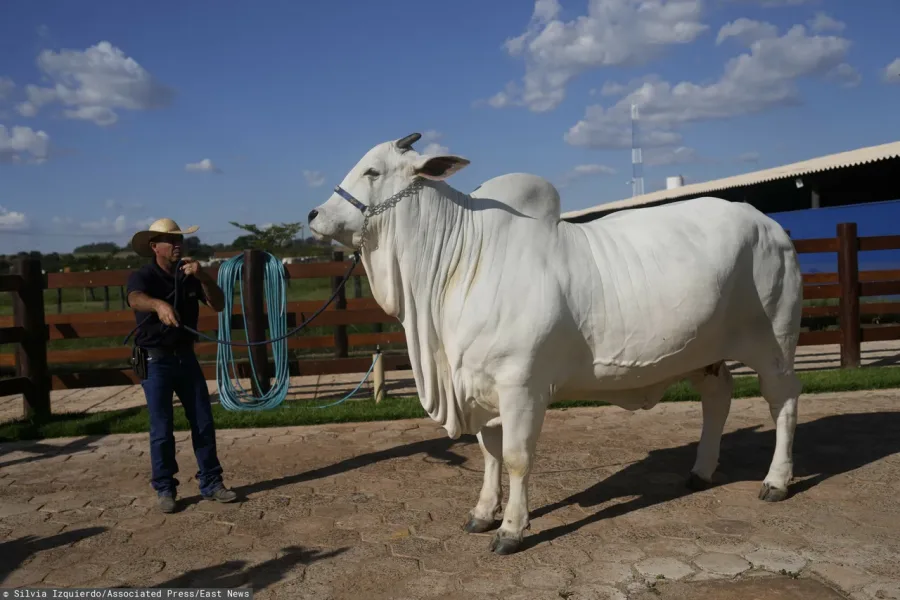
Selling for four million dollars, Viatine-19, a Nelore meat cow, has become historical in the energetic region of Minas Gerais, Brazil. This auction emphasizes the great importance of top-notch animals in the modern market.

An expert said, “Viatine-19 is not only a prized possession; she exemplifies genetic excellence in meat production.”

Among the beef breed globe, Viatine-19 stands out at 1100 kg (2420 lb). Guinness World Records confirms her record-setting price, which places her at the height of agricultural innovation and cattle breeding successes.

The Historic Significance and Modern Triumphs of the Nelore Breed

 A Legacy of Resilience and Adaptability: Originating in the Ongole cattle of India, the Nelore beef breed has intense physicality and flexibility. Originally imported to Brazil in the early 1800s, these precisely bred cattle were meant to flourish in Brazil’s challenging conditions. Renowned for their robustness, Nelore cattle can withstand tropical temperatures and fight infections and heat stress. Their unique characteristics—heat tolerance, disease resistance, and grazing adaptability—significantly improve their economic worth.

Particularly beneficial for meat production, the Nelore breed shows a remarkable development rate and excellent feed conversion efficiency. With relatively modest feed consumption, they may reach notable body bulk; their meat, known for its delicacy and taste, adds even more appeal to a worldwide market.

The breed’s success in Brazil is based on thorough genetic enhancements to maximize meat quality and production. Celebrating the greatest of Nelore genetics, annual events like ExpoZebu in Uberaba feature excellent specimens like Viatina-19, therefore highlighting the breed’s ideal. This continuous endeavor in improved cattle management and genetic purity strengthens Nelore’s great name.

The Distinctive Factors Elevating Viatina-19 to Unmatched Prestige 

Viatina-19 is unique in her unmatched genetic background, amazing physical features, and illustrious past. Her family reflects Brazil’s tradition in cattle breeding as famed Nelore breeds recognized for exceptional meat quality date back from. She has a remarkable muscular composition and is double the weight of a usual adult of her breed at 1,101 kg. Her honors highlight her distinctions, including Miss South America from the Champions of the World event. Her reproductive capacity promises to create new benchmarks in cow breeding, even if she intends to sell her egg cells abroad. Viatina-19 personifies bovine brilliance.

The $4 Million Sale of Viatina-19

 Catalyzing a New Era in the Beef Industry in Minas Gerais, BrazilSelling Viatina-19 for four million dollars significantly changes the cattle business. This deal emphasizes the increasing investment in premium cattle genetics, improving the Nelore breed’s value. Viatina-19’s genes, as a significant donor cow, will now affect ranchers and breeders worldwide, defining new benchmarks for meat output.

Economically, Viatina-19’s sales highlight the desire for beef breeds renowned for their meat quality and established new standards for cow pricing. This occasion also stimulated technological developments in animal genetics. Leading companies employing cloning and genetic manipulation to progress the sector include General Animal Genetics and Biotechnology.

Trade regulations among countries help Brazilian cattle genetics be more widely distributed. Leaders such as President Luiz Inacio Lula da Silva promote Brazilian beef globally, increasing economic possibilities through exports of superior cow egg cells. While this encourages international breeding projects, it raises questions about genetic diversity and the potential for spreading disease. However, overall, it strengthens the beef sector worldwide.

The sale of Viatina-19 marks a shift toward increased investment in genetics and breeding excellence, which will, therefore, influence market dynamics and raise industry standards worldwide rather than just a transaction.

Securing a Guinness World Record: A Mark of Unrivaled Distinction and Industry-Wide Impact 

Getting into Guinness World Records reflects an unmatched degree of quality. For Viatine-19, her acknowledgment as the most valuable cow in the world highlights her natural worth and the influence of her breed and ancestry. The standards for this recognition include exact documentation and validation of her selling price, unique qualities, and history. This thorough approach guarantees the record’s integrity through independent reviews by witnesses and industry experts. Guinness adjudicators closely investigated Viatine-19’s case, looking at her ancestry, significant weight, and unusual sale price. Reaching this distinction highlights the Nelore breed and agriculture industry breakthroughs in cow breeding, strengthening Viatine-19’s reputation.

Minas Gerais: The Agricultural Heartland and Cattle Breeding Powerhouse of Brazil 

Southeast Brazil’s Minas Gerais area stands out for its agricultural prowess and cattle ranching brilliance. It is a top center for beef cattle production because of its rich grounds and perfect grazing temperatures.

The province greatly influences the cattle business by hosting big farms supplying local and foreign markets. Its great importance in the worldwide beef industry is shown by its involvement in cattle contests.

Minas Gerais is committed to invention through sustainable farming and innovative genetic technology. This mix of history and modern technologies improves cow welfare and meat quality, fostering economic development in the beef sector.

The Bottom Line

The $4 million price tag of Viatina-19 emphasizes the changing dynamics of the beef sector, which is currently experiencing a shift towards increased investment in genetics and breeding excellence. This trend, exemplified by the sale of Viatina-19, highlights the value of the Nelore breed in Minas Gerais, Brazil. Emphasizing the breed’s importance, this record-breaking sale—documented by Guinness World Records—sets a new worldwide standard. Addressing environmental issues such as deforestation and methane emissions also clarifies difficulties, including keeping high-value animals and juggling economic viability for commercial producers. The sale of Viatina-19 highlights developments in genetics and breeding but also begs a review of beef sector profit policies and sustainability practices. This milestone might motivate ideas that combine environmental responsibility with financial success.

Key Takeaways:

  • Record-breaking sale: Viatine-19 was sold for an astonishing $4 million, marking the highest price ever recorded for a cow.
  • Breed excellence: As a Nelore beef breed, Viatine-19 exemplifies superior meat production qualities.
  • Significant weight: Weighing in at 1100 kg (2420 lb), she epitomizes robust and optimal cattle health.
  • Guinness World Record: Accredited by Guinness World Records, her sale is a hallmark of recognition and achievement.
  • Agricultural prowess: Housed in Minas Gerais, Viatine-19 represents the culmination of Brazilian excellence in cattle breeding.

Summary:

Viatine-19, a Nelore meat cow, was sold for four million dollars in Minas Gerais, Brazil, showcasing the importance of top-notch animals in the modern market and genetic excellence in meat production. Originating from the Ongole cattle of India, the Nelore breed has unique characteristics such as heat tolerance, disease resistance, and grazing adaptability, making them economically worth it. The sale of Viatina-19 will significantly change the cattle business, emphasizing the increasing investment in premium cattle genetics and improving the Nelore breed’s value. The sale will affect ranchers and breeders worldwide, defining new meat output benchmarks and setting new cow pricing standards. Trade regulations among countries encourage international breeding projects but raise questions about genetic diversity and disease spread. The sale of Viatina-19 marks a shift towards increased investment in genetics and breeding excellence, influencing market dynamics and raising industry standards worldwide.

Learn more:

Send this to a friend