


Trevor Parrish in NSW started filtering sires on HT ABV in 2017. By August 2024, 197 Holstein Good Bulls cleared the threshold. CDCB’s April 2025 NM$ revision added none of it.
Executive Summary: Australia’s DataGene released a Heat Tolerance ABV in December 2017, and by the August 2024 run, 197 Holstein Good Bulls — roughly one in three — cleared the 100 threshold. CDCB’s April 2025 NM$ revision moved butterfat from 28.6 to 31.8 and dropped protein from 19.6 to 13, but added no heat tolerance trait; Lactanet hasn’t weighted it in LPI or Pro$ either, despite University of Guelph models hitting 0.97 rank correlation. The economic exposure for North American herds sits around $400/cow/year in heat-load regions — roughly $200,000 annually on a 500-cow dairy in southwestern Ontario or the Central Valley — based on the St-Pierre 2003 baseline adjusted for inflation and the 10% single-day, 25.6% 10-day cumulative milk losses documented in Science Advances (July 2025). Zoetis has peer-reviewed Milk_THI and CFS_THI traits in JDS (September and November 2025) that identify cows with measurably better rectal-temperature regulation. Select Sires’ ART program is now five Slick generations deep in Wisconsin, with parent averages tracking close to non-Slick matings and calves that still grow winter coat. The heifer you breed in May peaks in the early 2030s — waiting on CDCB locks in three more replacement cycles of thermal vulnerability, while DataGene’s Good Bulls App, Zoetis Clarifide, Australian proofs through Semex/Genex/ABS, and a 20–30% Slick allocation on your top cow families are all workable today. The question isn’t whether the margin math favours acting; it’s whether your AI rep can answer the HT question when you call tomorrow.
In late 2017, Holstein breeder Trevor Parrish of Kangaroo Valley, New South Wales, began weighting Heat Tolerance ABV into his sire selections — a decision still uncommon among his Australian peers at the time, according to DataGene’s adoption reporting and Parrish’s own May 2025 comments to Dairy News Australia. DataGene had just released the trait publicly: a quarterly-updated breeding value measuring how well a cow holds production when the Temperature-Humidity Index climbs past comfort. From that release forward, per his Dairy News Australia interview, Parrish treated Heat Tolerance as part of his standard sire-evaluation toolkit.
Eight years on, DataGene’s adoption data and Parrish’s published commentary tell the story of a breeder who treated the trait like calving ease — a filter you apply, not a debate you have. Meanwhile in Woodstock, Tulare, or Fond du Lac, no official North American genetic evaluation — not NM$, not TPI, not LPI — currently publishes a heat tolerance number at all. That gap has a dollar value. And it compounds every summer your replacement heifers come into the milking string.
What Australia Actually Did, Starting in 2017
DataGene released the Heat Tolerance ABV publicly in December 2017. The trait measures a cow’s ability to hold milk, fat, and protein output as THI rises past comfort thresholds. An ABV of 100 is breed average, and the trait sits inside the Balanced Performance Index (BPI) rather than floating as a standalone curiosity. A 2024 update lifted Holstein reliability by 10 percentage points and re-ranked the HT list more substantially for Holsteins than for Jerseys.
The adoption curve tells the more interesting story. In late 2016, during DataGene’s pilot work, only a handful of Good Bulls ranked meaningfully above 100 for HT. By the August 2024 ABV release, DataGene reported that one in three Holstein Good Bulls — 197 bulls — carried a Heat Tolerance ABV of 100 or above. That shift tracked a broader story of how climate pressure is reshaping dairy breeding priorities worldwide — but unlike most of the global picture, Australia already had the trait on the catalog page.
Speaking to Dairy News Australia in May 2025, Parrish framed the trait as part of a complete-cow picture: “Heat tolerance is part of that efficiency. As a breeder, you are trying to cover all the bases, and heat tolerance, now it has an ABV, is part of a solid, good quality cow.”
That isn’t a regulator’s decision. It’s a market filter, and it happened inside a decade.
Is the Science Strong Enough to Act On Without the Official Index?
Short answer: yes. And the research isn’t Australian-only. Three independent research pipelines — Australian, Canadian, and U.S. — now converge on the same conclusion: heat tolerance is a heritable, measurable, and economically significant trait in Holsteins.
| Evidence stream | Metric | What it proves |
| Australia DataGene | 197 Holstein Good Bulls at HT ABV ≥100 by Aug. 2024 | Catalog-level selection signal exists |
| Canada Guelph / Lactanet-ready models | Rank correlations above 0.97 for Canadian Holstein bulls | Canadian evaluation framework is technically stable |
| U.S. Zoetis genomic traits | Milk_THI: -1.3 to 1.0 kg/day/THI; CFS_THI: -6.2 to 5.3 pts/THI | Heat tolerance can be genomically ranked in U.S. Holsteins |
| Slick allele field physiology | 1.1°F lower vaginal temperature at noon–3 p.m. | Slick carriers regulate body temperature better under heat |
The Three Scientific Proofs
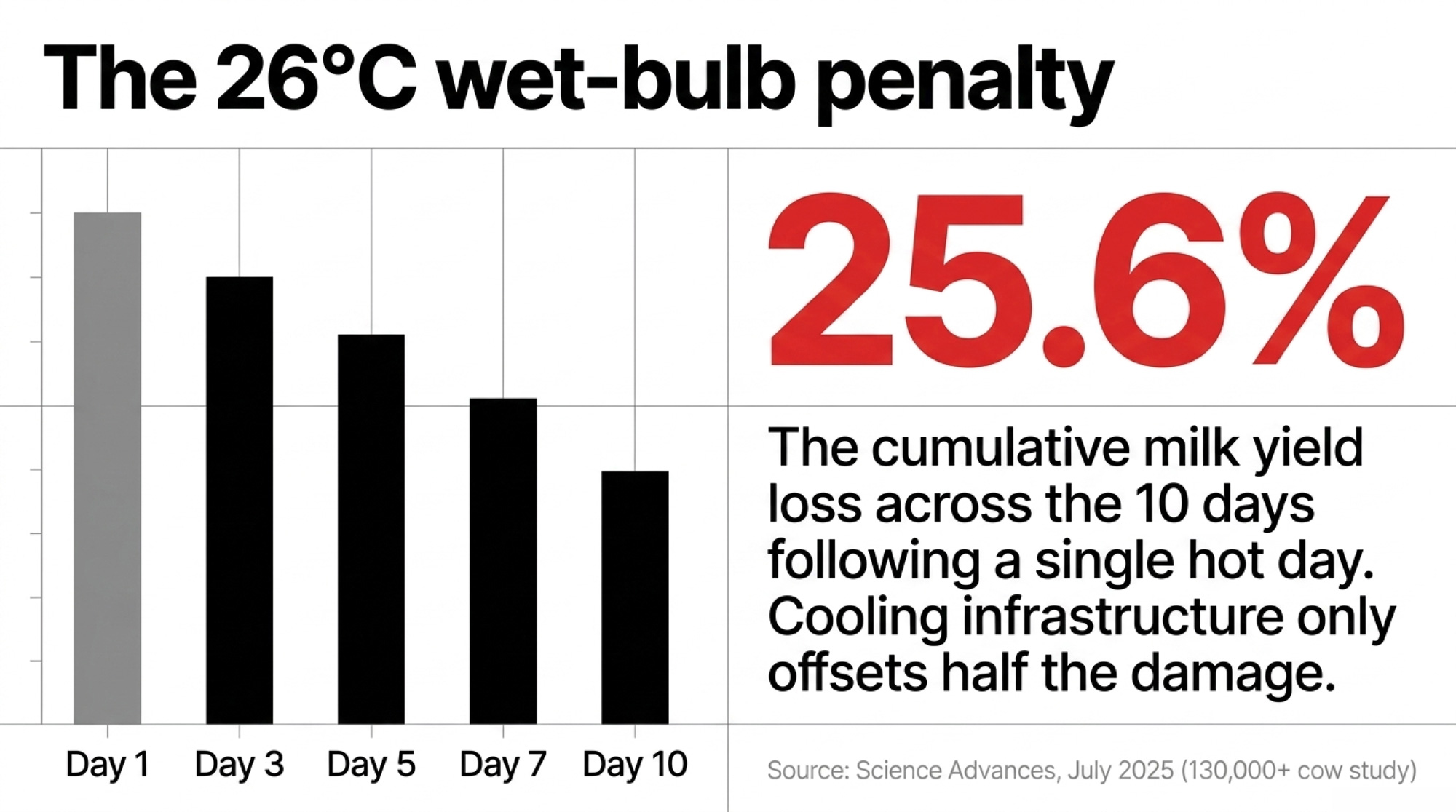
- Australia — University of Chicago Climate Impact Lab (Science Advances, July 2025). Gong, Hsiang, Moscona and collaborators drew on production records from more than 130,000 cows over 12 years. Cooling infrastructure only offsets about half of the damage on the hottest days — fans and soakers cut losses by roughly 50% at a 20°C wet bulb, less than half overall at the top of the range.
- Bottom line: Milk yield falls up to 10% on days when wet-bulb temperature exceeds 26°C. Cumulative loss across the 10 days following a single hot day reaches 25.6% of a single day’s baseline output.
- Canada — University of Guelph (Schenkel, Miglior et al., Journal of Dairy Science). The Guelph group developed a Canadian heat tolerance evaluation framework using test-day production records and reaction-norm models. A follow-up 2025 JDS paper validated alternate models. Methodology is Canadian-ready; what’s missing is integration into LPI and Pro$.
- Bottom line: Alternate models produce rank correlations above 0.97 for Canadian Holstein bulls — Lactanet has a validated, publication-ready HT evaluation sitting on the shelf.
- United States — Zoetis research team (Vukasinovic et al., Journal of Dairy Science, September 2025). The team published validated genomic breeding values for heat tolerance in U.S. Holsteins. The specific traits are Milk_THI (change in daily milk yield per unit of THI, ranging from -1.3 to 1.0 kg per day per THI unit) and CFS_THI (change in conception at first service per unit of THI, ranging from -6.2 to 5.3 percentage points). A November 2025 JDS validation confirmed that higher standardized transmitting abilities on both traits corresponded to reduced rectal temperatures during heat stress.
- Bottom line: The cows the Zoetis model ranks as heat-tolerant actually regulate body temperature better in the barn — the trait does what it says on the label.
The traits exist and are peer-reviewed. Whether Zoetis has integrated Milk_THI and CFS_THI into its customer-facing Clarifide reports is a question for your Zoetis rep. The September 2025 JDS paper establishes the methodology, not the commercial rollout timeline.
What Does the Barn Math Actually Look Like?
Published heat stress loss estimates for U.S. dairy herds anchor around 4 per cow per year as the unmitigated baseline, from St-Pierre, Cobanov and Schnitkey’s work in Journal of Dairy Science (2003) — early-2000s dollars. Aggregate U.S. dairy losses are modeled near $897 million annually at minimum heat abatement intensity, pulling back toward $500–$600 million with optimum abatement.
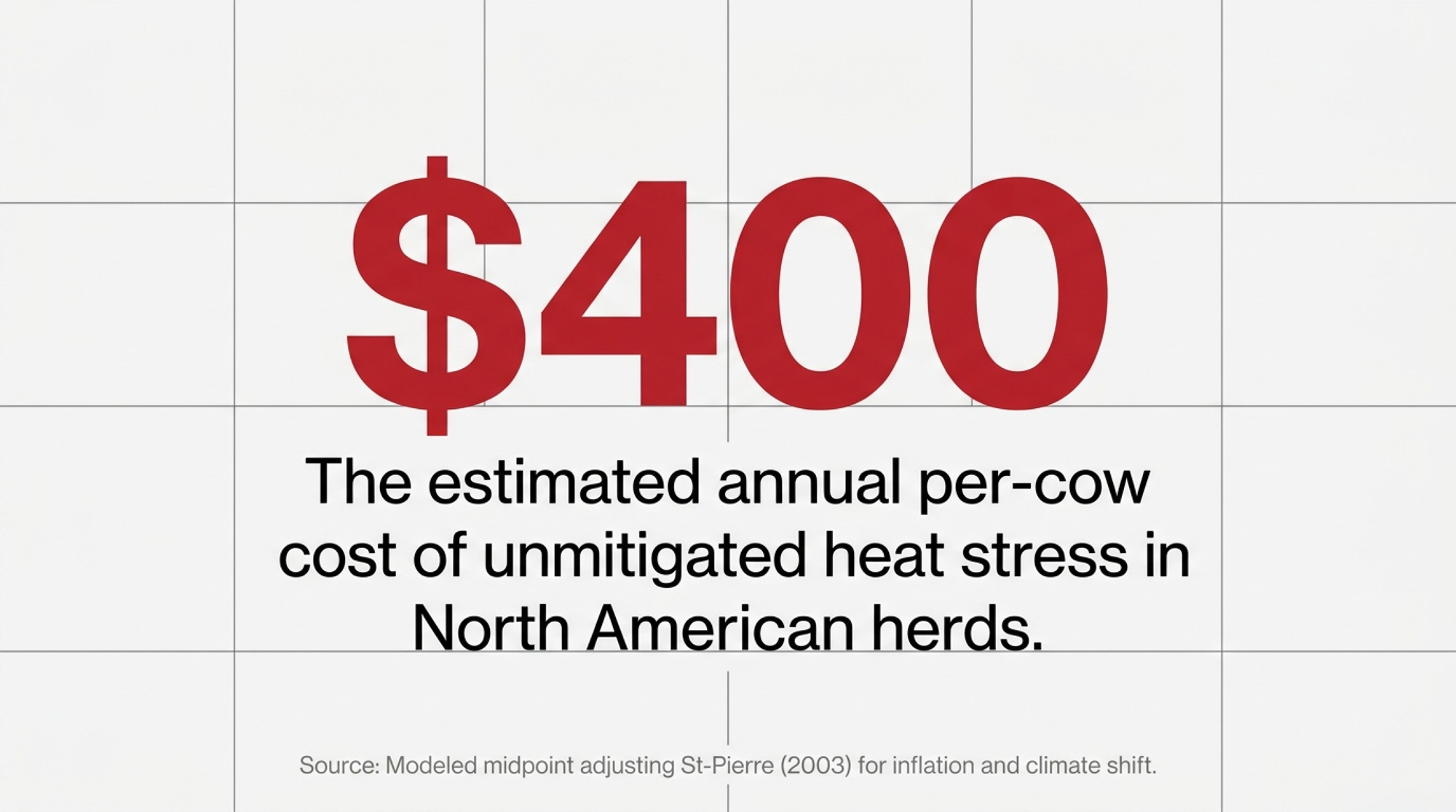
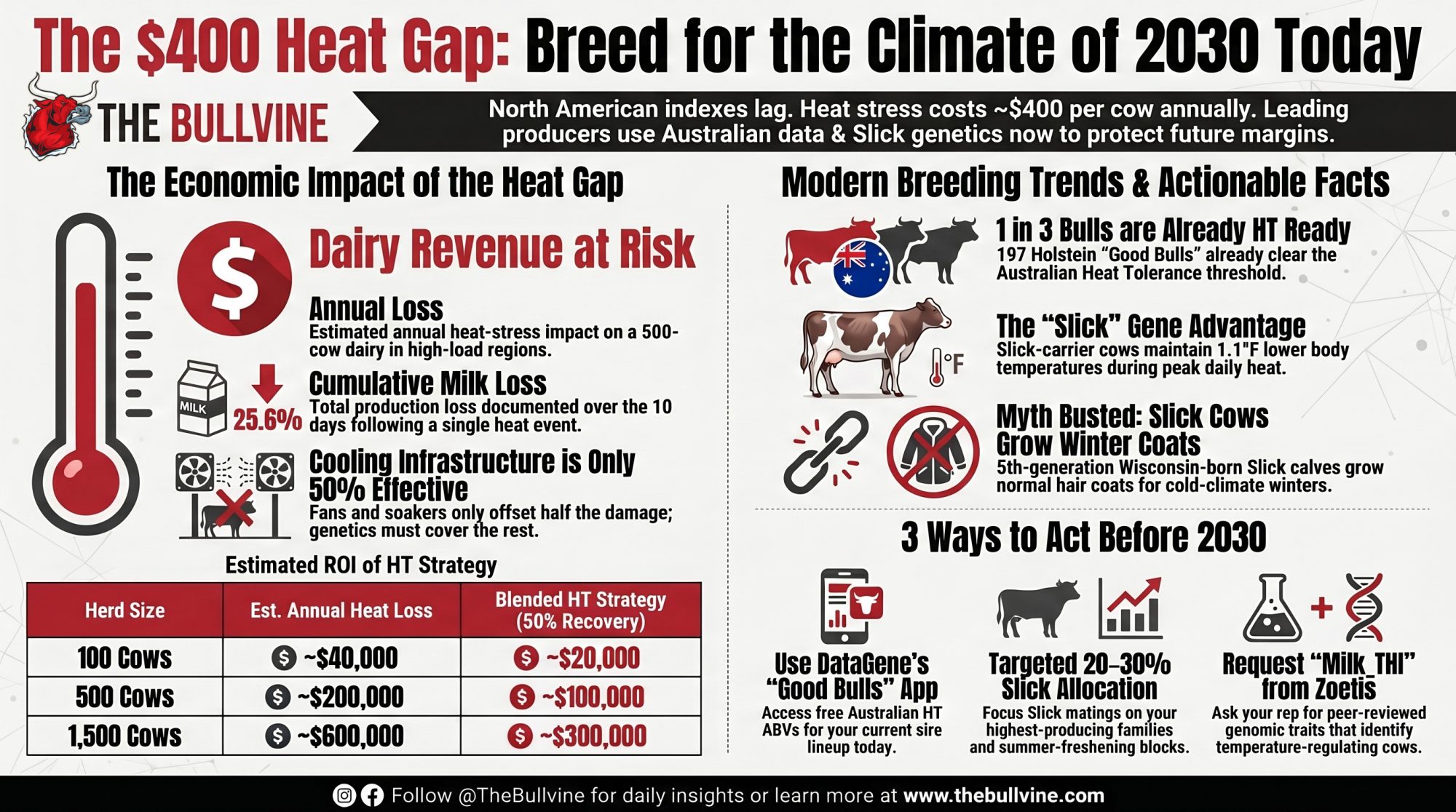
For herds in southwestern Ontario or California’s Central Valley — regions carrying a heavier seasonal heat load than the historical “temperate” framing suggests — a working midpoint of roughly $400 per cow annually is a reasonable illustrative figure once the St-Pierre baseline is adjusted for two decades of inflation and the climate shift documented in the Science Advances work. It’s a modeled estimate, not a published regional number. Operations still trying to cool their way out of the problem should also read our companion piece on where cooling infrastructure stops paying back.
The table below is an illustrative model built from that midpoint and a modeled 50% reduction assumption — the upper end of what combined cooling investment, Australian-style HT selection, and targeted Slick matings can plausibly deliver together. Actual results will vary with climate zone, milk price, Slick adoption percentage, and the sire mix already in the tank.
| Herd Size | Est. Annual Heat Loss (Conventional) | Blended HT Strategy (50% Reduction) | Year-1 Implementation Cost (Est.) |
| 100 cows | ~$40,000 | ~$20,000 | ~$10,000 |
| 500 cows | ~$200,000 | ~$100,000 | ~$40,000 |
| 1,500 cows | ~$600,000 | ~$300,000 | ~$115,000 |
Underlying inputs: $400/cow annual heat loss (modeled midpoint); 50% recovery assumption from combined cooling + HT selection + Slick matings; Year-1 costs scaled for genomic testing on replacement heifers and semen premium on targeted Slick matings.
On a 500-cow operation, the Year-1 cost sketch roughly covers genomic testing on replacement heifers plus a modest semen premium on about 150 targeted Slick matings (roughly a 30% allocation of annual breedings). Under those modeled assumptions, payback clears inside the second summer. The arithmetic isn’t the weak point. The inputs are. But the direction and order of magnitude hold up in almost any scenario a North American breeder plugs in.
Where CDCB and Lactanet Have — and Haven’t — Moved
The CDCB’s April 2025 evaluation revision implemented the every-five-year base change (moving from cows born in 2015 to cows born in 2020) and updated income and cost variables inside NM$, Cheese Merit $, Fluid Merit $, and Grazing Merit $. Butterfat weight moved from 28.6 to 31.8 and protein dropped from 19.6 to 13, per the official CDCB April 2025 evaluation change documentation and the USDA-AGIL technical report by VanRaden, Toghiani, Basiel, and Cole. No new traits were added. No heat tolerance number. Those weight shifts carry their own strategic implications — which we unpack in our analysis of the April 2025 Net Merit revision’s butterfat-protein trade-off.
CDCB’s caution isn’t inertia for its own sake — the national evaluation’s credibility rests on trait reliability, and adding a trait prematurely carries real costs. But the cost of waiting now has a measurable dollar value. Realistic integration of Heat Tolerance into NM$ sits several evaluation cycles out. Lactanet is in a comparable position. The Guelph group has produced usable Canadian methodology and the 2025 JDS work validates it — but no heat tolerance index is currently published as part of LPI or Pro$.
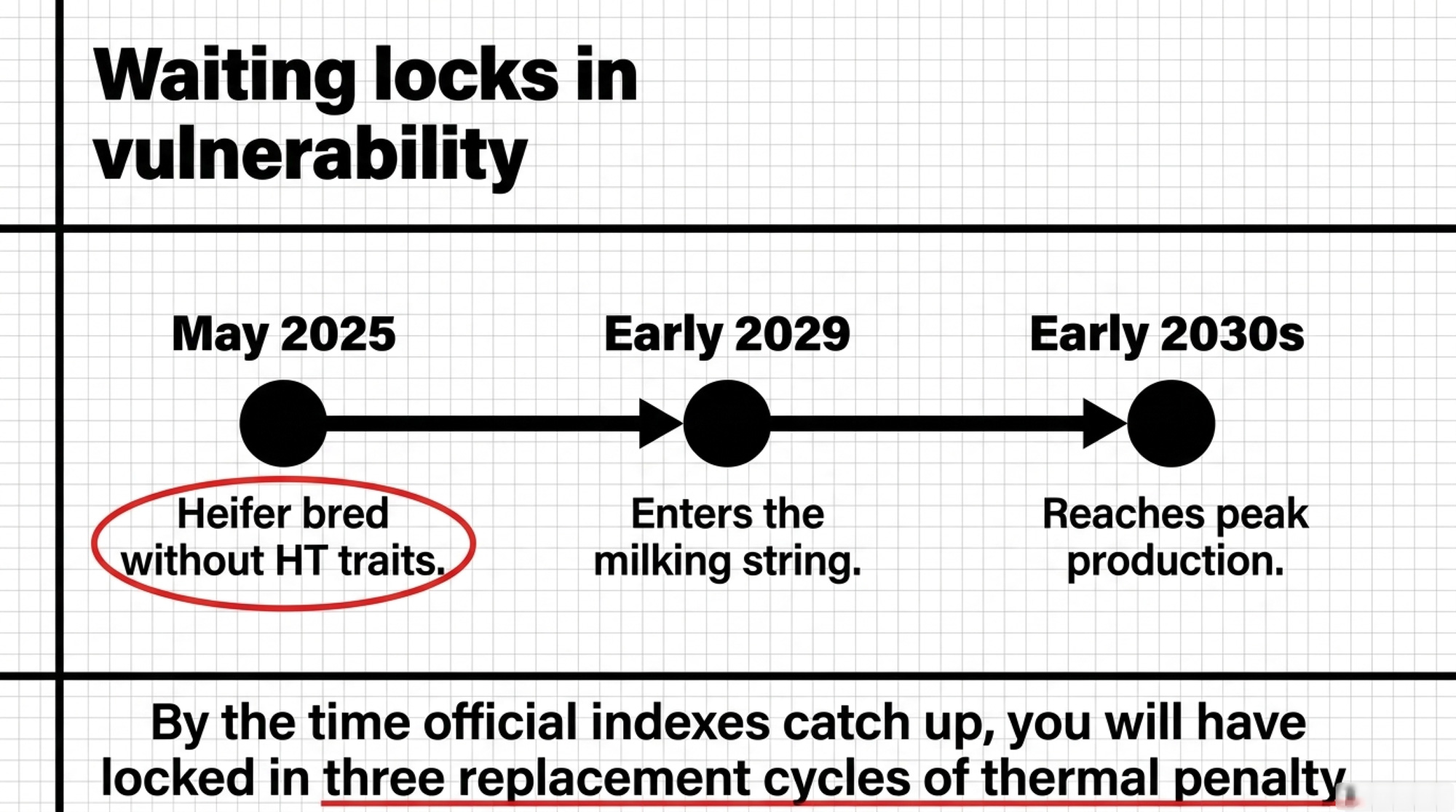
The replacement pipeline doesn’t care about governance timelines. A heifer bred this May enters the milking string in early 2029 and reaches peak production in the early 2030s — in a climate the Science Advances team projects will deliver materially more wet-bulb-26°C days across major dairy regions by midcentury, with 4% annual daily-yield losses baked in without adaptation. The genetic decision made this breeding cycle sets the thermal ceiling for that cow’s productive life.
The North American Program That’s Already Five Generations In
While CDCB hasn’t moved, Select Sires’ Aggressive Reproductive Technologies (ART) program has quietly been running the Slick playbook for years. Per an April 2026 blog authored by ART Program Manager Mark Kerndt, the program is now in its fifth generation of Slick calves, with all of them born in Wisconsin.
“We are breeding the horns out of the breed and are now also focusing on making the Holstein breed more heat tolerant, through the gradual introduction of the dominant slick allele into our cattle,” Kerndt wrote. “We expect several hundred potential slick calves to be born in our program in 2026 and the parent averages on these matings are very close to our non-slick matings.”
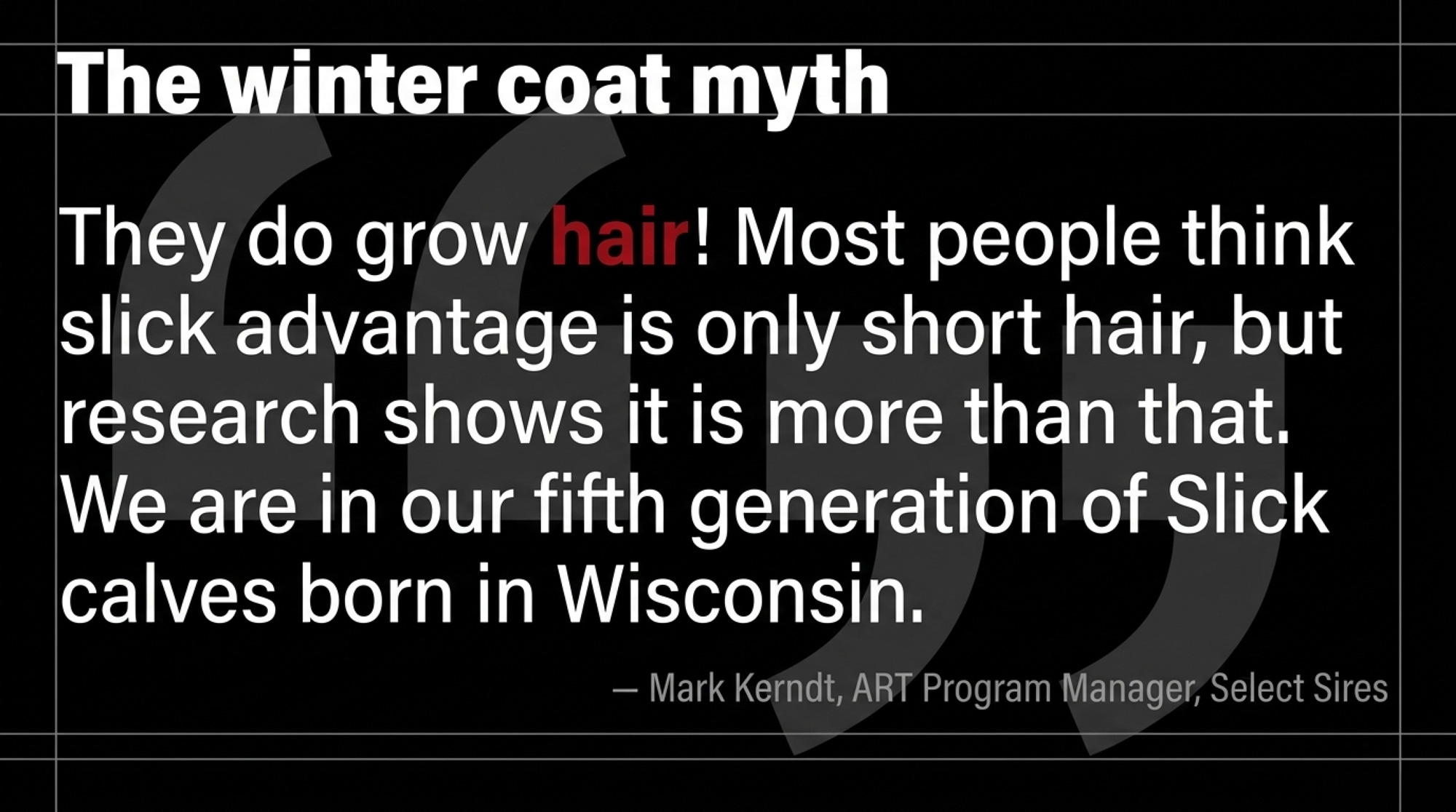
Two things worth holding onto from that. First: Wisconsin-born Slick calves grow hair in winter, which answers the most common North American objection before a breeder raises it. Kerndt again: “They do grow hair! Most people think slick advantage is only short hair, but research shows it is more than that.”
Second: parent averages on Slick matings sit close to non-Slick matings in the ART program. The production penalty breeders have long assumed isn’t showing up in the current generation. The piece of the picture North American breeders haven’t had — a named commercial program running the strategy long enough to produce fifth-generation data — is now on the record.
The piece still missing from the public record is the one that would close the circle: a named North American dairy producer, not an AI stud, who has been weighting HT or running Slick matings long enough to report two or three summers of their own production and fertility numbers. Those producers exist. Their data isn’t yet in the trade press. That’s the next story worth telling, and The Bullvine is actively reporting it — if you’re running one of these programs and willing to talk on the record, the editor’s line is open.
“But I Have -20°C Winters” — The Cold-Climate Objection That Isn’t Aging Well
The pushback from Ontario, Quebec, Wisconsin, and Minnesota breeders is almost always the same: “I don’t want a tropical cow in a -20°C barn.” Fair question. Until the data answers it.
Kerndt has answered it directly from Wisconsin, where January air temperatures regularly sit below -10°C. His fifth-generation Slick calves are born there, stay there, and — in his own words — “do grow hair!” The Slick allele isn’t producing tropical cattle incapable of holding coat in cold country. It’s producing cattle that thermoregulate more efficiently when THI climbs, while still growing a winter coat when the thermometer drops.
The framing error is calling it a “tropical gene” in the first place. Slick was characterized in Senepol cattle in tropical regions, yes — but the trait it delivers is heat dissipation efficiency, not tropical-only viability. And the climate the “temperate” label was built on doesn’t exist anymore. The Science Advances data shows that Ontario, the Upper Midwest, New York, and the Atlantic provinces are already accumulating enough wet-bulb-26°C days to put real dollars per cow per year on the table — the illustrative 0-per-cow midpoint in the Barn Math section lands squarely in those regions, not in Puerto Rico.
The decision has shifted. It used to be: “Is Slick worth the winter coat penalty?” The current data says: “Is holding onto an outdated temperate-climate mental model worth giving up 50% of the recoverable summer margin?”
Four Ways to Start Now — Without Waiting for CDCB
Active breeders split from waiters right here. Four approaches are already in use, each with a different cost, effort, and exposure profile. None require CDCB or Lactanet to move first.
MoveCost profileSignal usedBest fitDataGene Good Bulls AppFree lookupHT ABV; Holstein reliability around 48%Any breeder building a sire listZoetis Milk_THI / CFS_THI inquiryAccount / rep access dependentMilk-yield and first-service conception response to THILarge herds already using genomic servicesAustralian proof sheet requestRep request; sire coverage variesAustralian HT proof on eligible international siresHerds buying Semex, Genex, ABS or similar international geneticsCustom index layerGeneticist setup; usually 1–2 quartersNM$ or LPI floor plus HT as secondary filterOperations already using custom selection indexes |
1. The Free Move — DataGene’s Good Bulls App. DataGene publishes HT ABVs quarterly in its freely available Good Bulls App. Pull it up, search a sire name, read the ABV. It costs nothing. DataGene’s own fact sheet recommends using a team of bulls because HT ABV reliability sits around 48% in Holsteins, lower than conventional production traits — but 48% on a trait that doesn’t exist in NM$ is still 48% more signal than you have today.
2. The Phone Call — Zoetis Milk_THI and CFS_THI. The Zoetis traits are peer-reviewed (Vukasinovic et al., JDS, September 2025; follow-up JDS validation, November 2025). Whether they’re accessible through Clarifide — and under what conditions — is a question for your Zoetis rep directly. Validation confirmed the traits identify cows that keep body temperature regulated during heat stress. Larger operations with existing account relationships are the ones most likely to get a useful answer first.
3. The Genetic Filter — Australian Proofs via International AI Partners. Sires distributed through international-facing AI partners — Semex, Genex, and ABS among them — may carry Australian proof data where their genetics are evaluated in the Australian system. Coverage varies by sire and stud. Ask your AI partner for the Australian proof sheet on specific bulls you’re considering. This is a phone call your rep can make today; no new account, no testing investment.
4. The Custom Index — Layering HT onto NM$ or LPI. For operations already running custom selection indexes, set NM$ or LPI as a floor and layer HT as a secondary filter — structurally how Australian farmers already use BPI alongside HT ABV. It takes a conversation with your AI partner’s geneticist and typically a quarter or two to implement cleanly. If you’re already building custom indexes, this is the obvious next add.
Slick Sires: What the Allele Actually Does — and Doesn’t
For operations ready to go further than a filter, weighting Slick sires into 20–30% of matings is the most direct structural play. Slick carriers are in commercial North American catalogs today, with Select Sires’ ART program the most openly documented pipeline — confirmed in the April 2026 Holstein Sire Directory. Swissgenetics also markets THERMO-ET P SL, the first European homozygous-polled Red carrier of the Slick gene. Coverage across other major studs varies; ask your AI partner what they currently carry or can source.
Here’s what the biology actually delivers. The Slick allele is a dominant mutation in the prolactin receptor gene that produces a short, sleek coat. University of Florida research by Dikmen and colleagues (Journal of Dairy Science, 2014) documented that Slick cows averaged 1.1°F lower vaginal temperatures at the hottest times of day (noon to 3 p.m.) compared with non-Slick herdmates housed in the same Florida freestall environment. And where summer-calving cows typically see a sharp first-90-day yield depression compared with winter-calving animals, that seasonal gap was substantially reduced in Slick carriers — Slick cows held closer to their winter-calving performance than wild-type animals in the same heat conditions. The regulatory and commercial path Slick has walked is worth comparing with how the PRLR-SLICK gene-edited variant stacks up on the 2029 milk cheque.
The strategy isn’t 100% Slick. It’s targeting Slick matings at your highest-producing cow families and summer-calving blocks, where heat stress hits the margin hardest. A 20–30% allocation blended with elite conventional sires selected on NM$ or LPI is where most breeders start. Per Select Sires’ own ART data, the production penalty Slick once carried isn’t showing up in the current generation.
Is Your Herd’s Genetic Strategy Already Behind Where Australia Was in 2019?
Not a rhetorical question. By the August 2024 ABV release, one in three Holstein Good Bulls cleared 100 for Heat Tolerance. Parrish told Dairy News Australia that Australian AI centres are moving toward filtering on HT the same way they already filter for calving ease: “AI centres won’t take bulls that aren’t good for Heat Tolerance. It will be like calving ease — now they won’t buy a bull that causes difficult calvings.”
That shift didn’t come from a regulator. It came from farmers like Parrish, year after year, building HT into what they asked their AI reps for.
North American studs respond to the same pressure. Kerndt has said plainly: “Heat tolerance is a valuable economic trait. By adding the slick trait to the elite genetic package offered by Select Sires, we can accomplish our goal of helping dairies everywhere become more profitable.”
When the conversation at the rep level shifts from “what’s your highest NM$ bull?” to “what’s your highest NM$ bull with Australian HT data above 100 or a validated Milk_THI value above zero?” — the catalogs move. Not in 2030. Sooner. The breeders best positioned will be the ones whose replacement heifers already carry heat-adapted genetics when that shift lands.
What This Means for Your Operation
- If your herd regularly sees days with wet-bulb temperatures approaching or crossing 26°C, the Science Advances data says you’re already losing meaningfully on those days — even with fans and soakers running. Pull your summer milk-weight records against THI days from the last three years before your next breeding order.
- If your replacement rate runs above 30%, you have enough genetic turnover to see measurable HT impact inside four years. Below 25%, stretch that timeline and adjust expectations accordingly.
- If you already genomic-test 70% or more of your replacements, the incremental cost of adding HT screening at the sire level is effectively zero. The only reason not to add it is habit.
- If your AI rep hasn’t raised heat tolerance in a sire presentation, that’s a conversation worth starting. The data exists. Whether your current stud has prioritized surfacing it is worth finding out before the next breeding order goes in.
- If you breed for a specific milk market — components, cheese yield, A2A2 — weight HT as a filter on top of those targets, not a replacement for them. It stacks. It doesn’t substitute.
- If you operate in what was traditionally called a “temperate” region — Ontario, Quebec, Upper Midwest, New York, Atlantic provinces — treat that label as historical, not current. The Science Advances midcentury projection work puts meaningful additional heat exposure in those regions.
- If the winter-coat concern has kept you out of Slick matings: Select Sires’ fifth-generation Wisconsin-born Slick calves grow hair fine. The penalty isn’t what breeders have long assumed it was.
Key Takeaways
- In the next 30 days: Pull your top 20 planned sires. Cross-reference each against DataGene’s Good Bulls App for HT ABV. Ask your Zoetis rep whether Milk_THI or CFS_THI values are accessible on those bulls. Request Select Sires’ April 2026 Holstein Sire Directory to identify current active Slick carriers. This is an afternoon’s work.
- In the next 90 days: Identify your top-producing 20–30% of cow families and your May–July freshening block. Allocate Slick sire matings to those specific groups rather than broadcasting across the herd.
- In the next 12 months: Begin documenting summer production and conception baselines now. When CDCB or Lactanet eventually integrates HT into NM$ or LPI, you’ll have your own performance delta in hand before your neighbor has results from their first Slick daughter.
- If X, then Y: If your farm sits in a region that clears wet-bulb 26°C on more than a handful of days each summer and your replacement rate is above 30%, the cost of waiting another three years for CDCB exceeds the cost of starting a blended HT strategy now.
- The wrong answers book-end the right one: 100% Slick is the wrong strategy for most North American herds in 2026. Zero Slick, in regions already carrying meaningful heat-day loads, is also the wrong strategy. The defensible position sits at 20–30%, targeted on your best, most heat-stressed genetics.
Parrish’s herd in Kangaroo Valley isn’t really the story. Select Sires’ fifth-generation Slick calves in Wisconsin aren’t quite it either. The story is that a producer in Woodstock, Tulare, or Fond du Lac could have started in 2019 or 2020 and closed most of the same distance by 2026. The tools have been sitting on the shelf. The question worth asking before the next breeding order goes in isn’t whether the climate will keep pressuring your margins. It’s whether the heifer you bred last Tuesday is built for the barn she’ll actually be milking in by the early 2030s — and if your AI rep can’t answer that question, what does that say about where the conversation needs to go next?
Complete references and supporting documentation are available upon request by contacting the editorial team at editor@thebullvine.com.
Learn More
- Heat Stress 2.0: Why Your Current Cooling Strategy Is Costing You Big Money — Arms you with a blueprint for high-ROI cooling investments, proving that basic fans fail when metabolic heat spikes. Dismantles the “wait and see” approach by showing why tunnel ventilation pays back in under six years.
- Transform Heat Stress into Your Carbon Strategy’s Secret Weapon — Follows the money on climate-linked regulatory risks, detailing how heat-stressed herds face a 23% methane penalty. Breaks down how selecting for heat-tolerant genomics secures your herd’s environmental compliance and long-term production floor.
- Gene-Edited Cows Are Legal. Your 2029 Milk Cheque Isn’t Safe. — Exposes the massive regulatory shift making gene-edited Slick cattle a commercial reality. Highlights how PRLR-SLICK edits bypass decades of traditional breeding to deliver immediate thermal resilience and vital margin protection for the next decade.
 The Sunday Read Dairy Professionals Don’t Skip.
 The Sunday Read Dairy Professionals Don’t Skip.
Every week, thousands of producers, breeders, and industry insiders open Bullvine Weekly for genetics insights, market shifts, and profit strategies they won’t find anywhere else. One email. Five minutes. Smarter decisions all week.