



Archive for Holstein cows

Your 30‑kg Dry‑Off Cows Are Wrecking Colostrum Six Weeks Before Calving

23% of quarters still had open teat canals after six dry weeks. Your 30‑kg dry‑off cows are the ones keeping that number ugly.

Executive Summary: Your 30‑kg dry‑off cows are quietly wrecking colostrum six weeks before calving by keeping udders leaking when they should be sealed and rebuilding. Research on high‑yield Holsteins shows cows drying off above ~21 kg have more open teat canals, more new IMI, and, when they leak pre‑calving, lower Brix colostrum. Other studies tie short or rushed dry periods and heat‑stressed dry cows to reduced colostrum yield, weaker bioactive profiles, and daughters that give 2.2–6.5 kg/day less milk across three lactations. For a 200‑cow herd with 40% of cows drying off above 25 kg, UF’s barn math says fixing dry‑cow cooling alone is worth about $1,800/year before you count daughter milk. This piece reframes colostrum failure as a structural clash between high‑yield genetics, abrupt dry‑off, and mammary physiology — not something you can fix with another replacer or a better Brix gun. You’ll see clear thresholds for dry‑off yield, dry‑period length, and heat‑stress, plus barn‑tested options like tiered dry‑off and minimum‑effective cooling. If you’re already hitting 22–25% Brix but still buying too many scour treatments, this is the six‑week window you need to audit next.
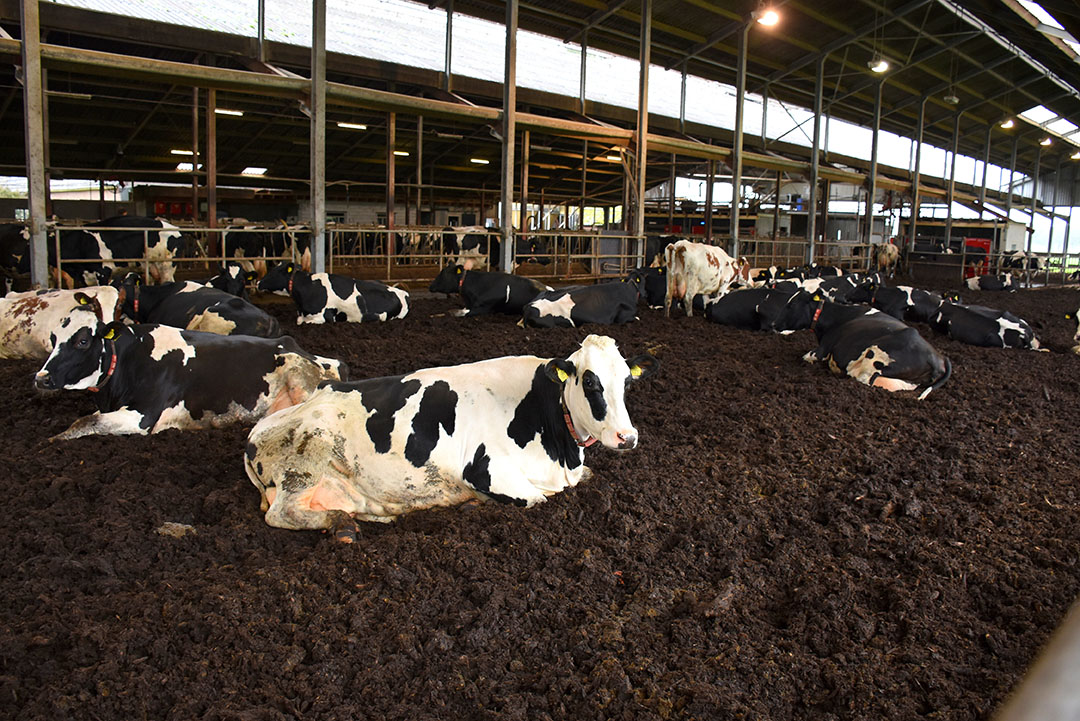
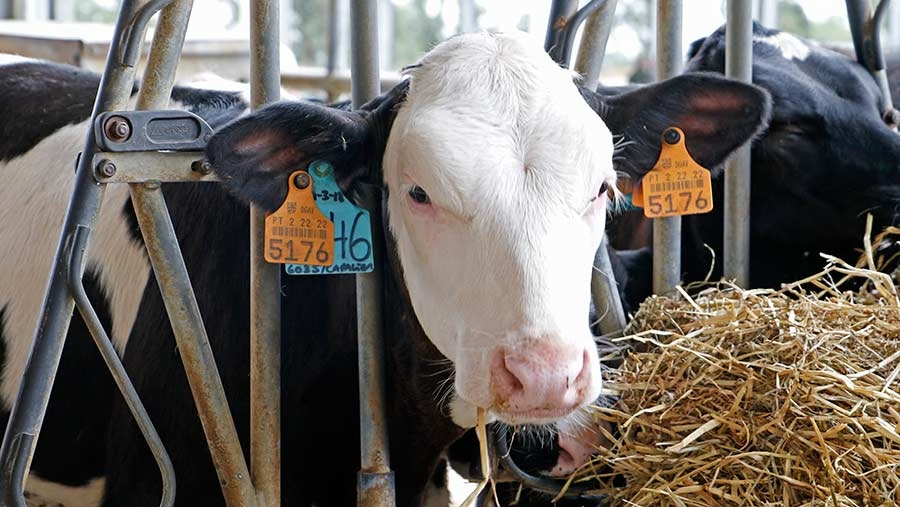
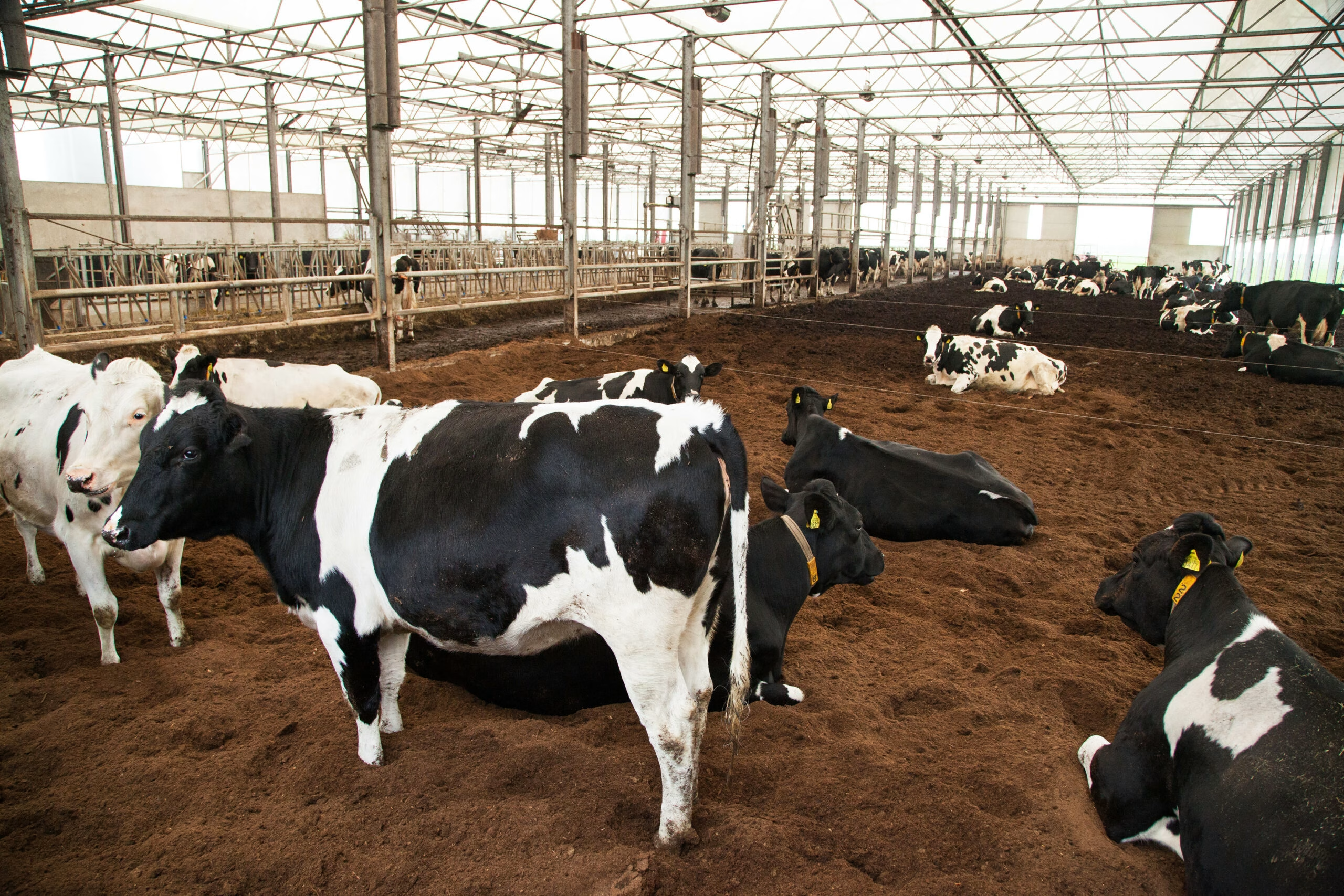
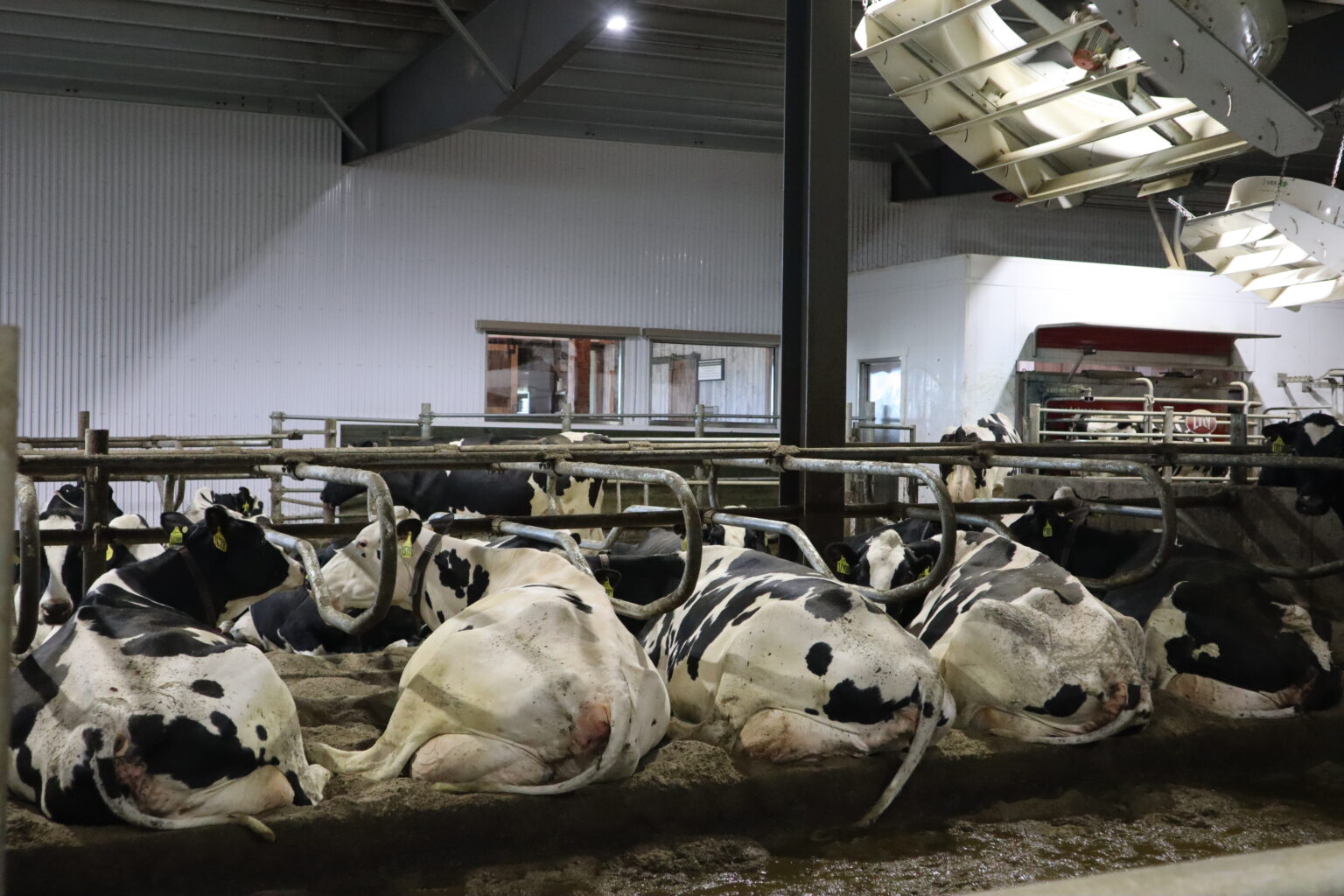
Fresh calved cows and older cows are kept in the pen bedded with woodchips. PICTURE: Chris McCullough

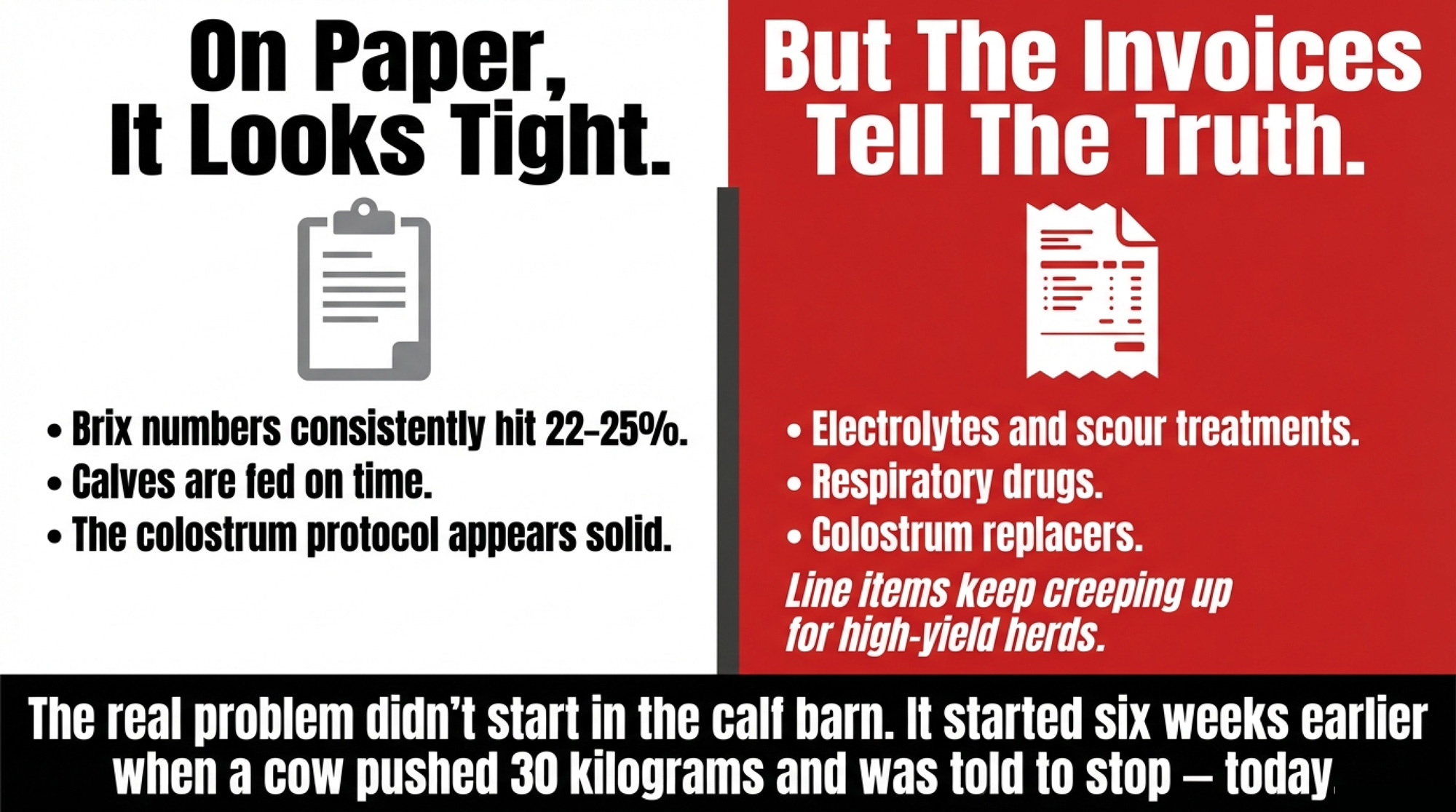
The invoice in the calf barn doesn’t lie. Electrolytes, scour treatments, respiratory drugs, colostrum replacer — those line items keep creeping up for a lot of high‑yield herds. On paper, the colostrum program looks tight. Brix numbers are solid. Calves get fed on time. But the real problem often started six weeks earlier, in the dry pen, when a cow walked out of the parlor still pushing 30‑plus kilograms and was told to stop — today.

If you’re breeding for 45‑kg peaks and drying off cows like it’s 1985, colostrogenesis is where that conflict shows up first.
What’s Really Happening in Those Six Weeks?

The mammary gland doesn’t sit idle between dry‑off and calving. It runs through three different jobs, and colostrum depends on each one finishing on time.

First is active involution, roughly the first two to three weeks after dry‑off. Milk stasis and intramammary pressure shut secretion down, old cells are cleared out, and the teat canal closes as a keratin plug forms. It’s the most vulnerable stretch for new intramammary infections (IMI), and the risk rises as milk yield at dry‑off goes up.

Next is steady‑state involution. This is the stretch a lot of herds treat as “dead time.” The cow isn’t milking, but the gland isn’t off. Tissue is regenerating, and the udder’s defenses against mastitis are at their highest.

Finally, about 15–20 days before calving, colostrogenesis kicks in. The mammary gland switches back into production mode — not for milk yet, but for colostrum. IgG starts moving from blood into secretions, and the gland begins synthesizing fat, protein, and a stack of bioactive compounds that shape the calf’s gut and immune system. In one Holstein study that followed cows through the dry period, IgG started building in pre‑partum secretions several weeks before calving in many cows, and those that accumulated IgG earlier and more gradually ended up with higher IgG at first milking.

So that six‑week window you’ve been treating as a holding pattern is actually colostrum’s entire production run.

How 30‑kg Dry‑Off Cows Blow Up the Timeline

Walk through a dry pen three weeks after dry‑off. Some cows look exactly how you want — udders soft, teats sealed, nothing leaking. Then there are the others: three weeks dry, udders still tight, milk beads at the teat ends or streaks down the back legs.

Those are the cows the dry‑off research keeps circling back to.
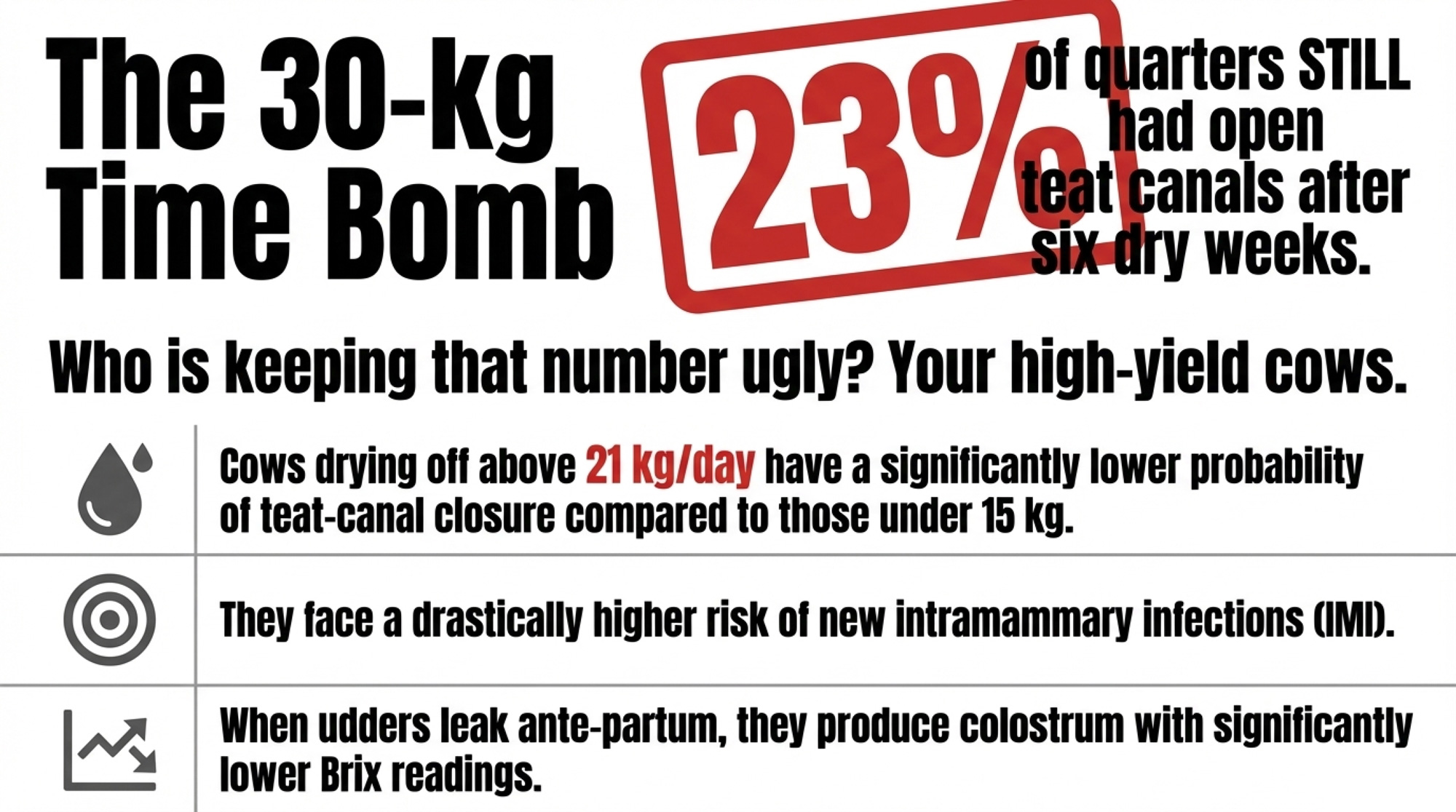
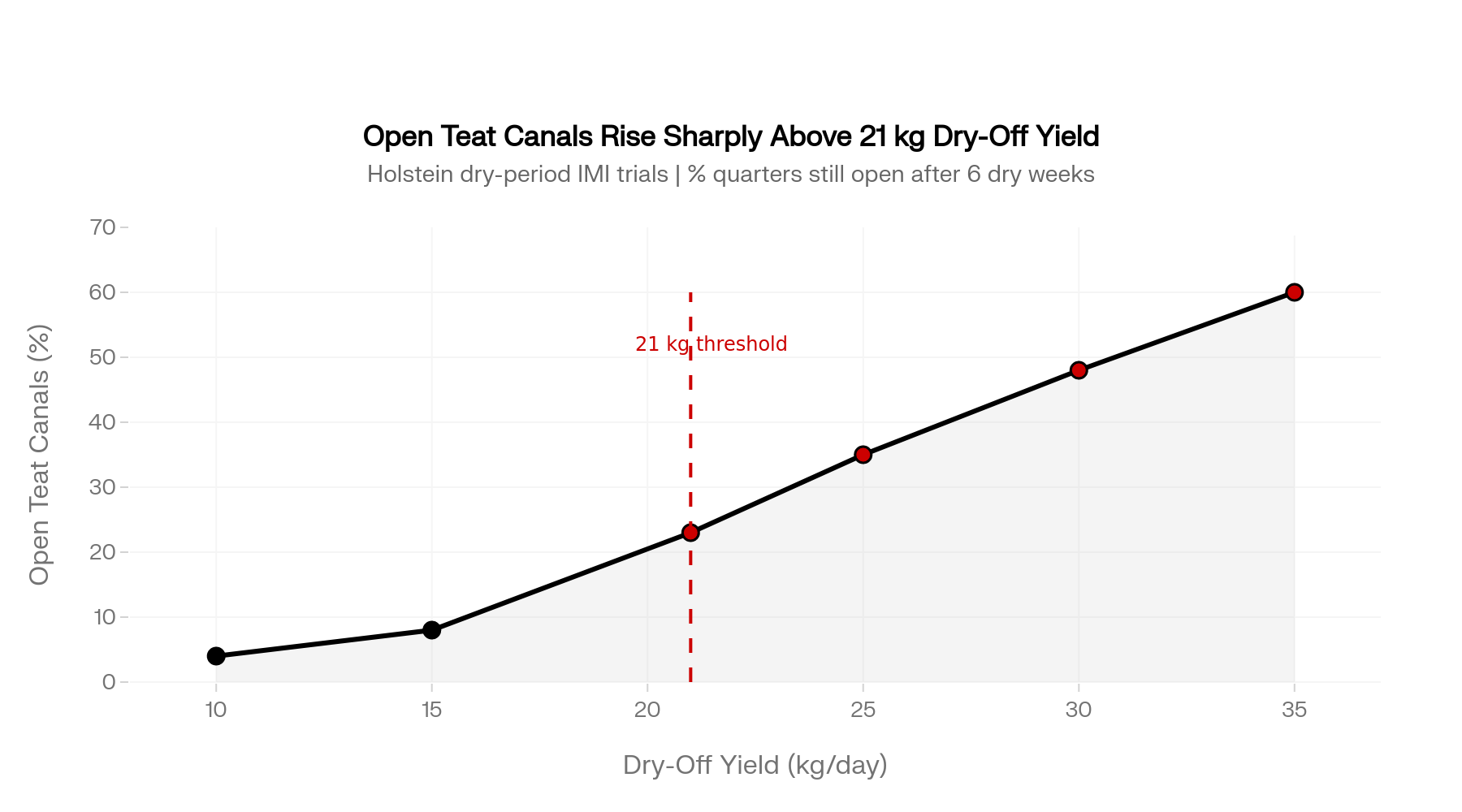
A landmark Holstein trial on drying‑off found that higher milk yield at dry‑off significantly increased the odds of new IMI during the dry period and delayed teat‑canal closure. After about six dry weeks, around 23% of quarters still had open teat canals, and cows with higher yields at dry‑off were more likely to be in that group. Cows producing more than 21 kg/day at dry‑off had a lower probability of teat‑canal closure and a higher risk of new IMI than cows drying off under 15 kg.
A 2024 study looking at milk leakage and udder pressure reported the same pattern: cows that leaked milk after dry‑off, and cows with higher udder pressure, were more likely to develop new IMI. The leaking cows were also the ones that had higher yields at dry‑off.

On the colostrum side, a multi‑herd study found that cows with ante‑partum leakage produced colostrum with significantly lower Brix readings than cows that stayed dry, and that dry‑period length, calving season, and herd size all influenced Brix values. Leakage wasn’t just a management annoyance — it showed up in colostrum quality data.

Now think about your own herd software. It’ll happily print “dry‑off today” beside a cow still giving 30 kg. That report doesn’t show you that you’ve just set that cow up for a rough involution, a leaky udder, and a higher chance of compromised colostrum.
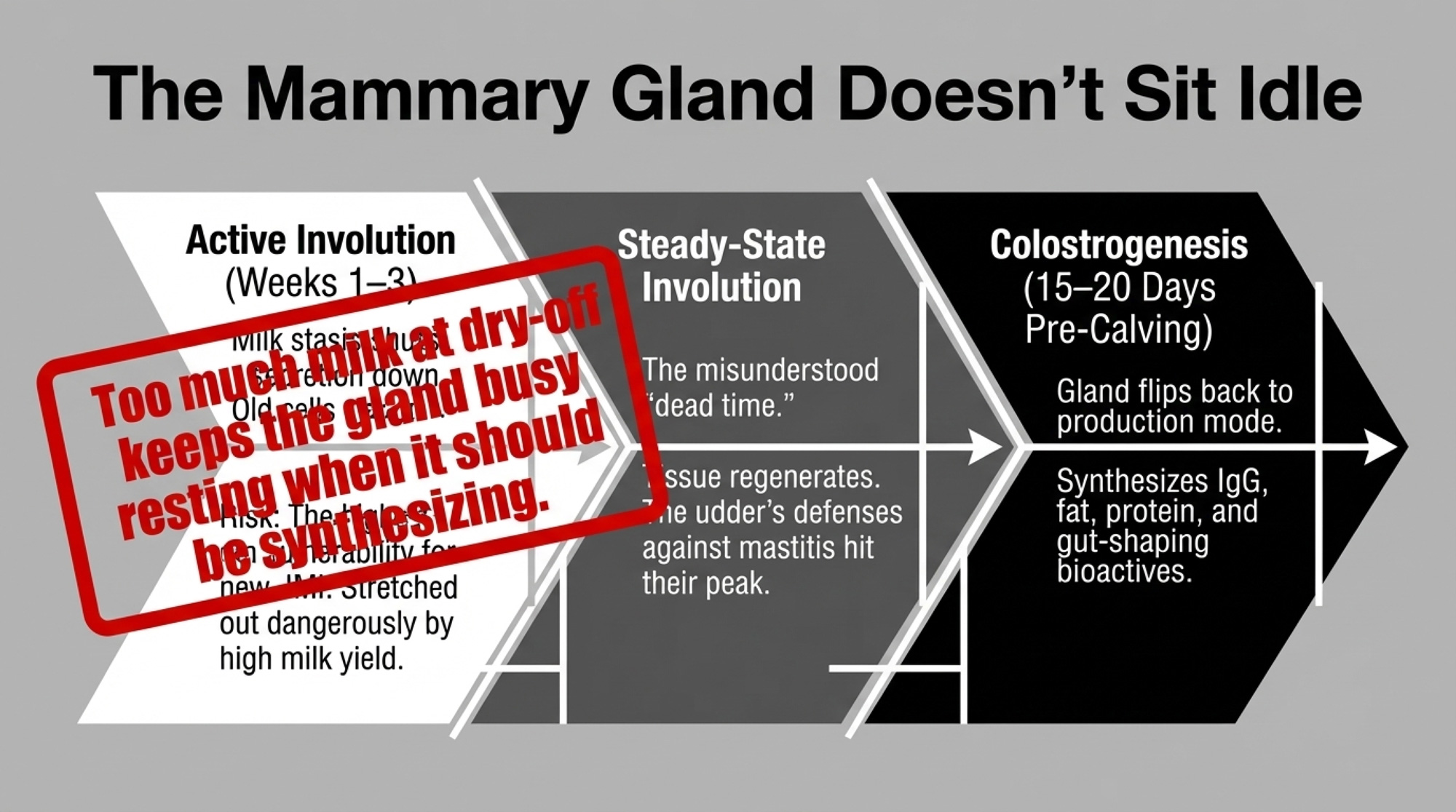
The biology is simple and ugly: too much milk at dry‑off stretches active involution, keeps mammary tissue “busy” when it should be resting, leaves teat canals open longer, and makes it harder for that gland to flip into a clean colostrum‑synthesis state at the right time.

What Your Brix Gun Can’t See

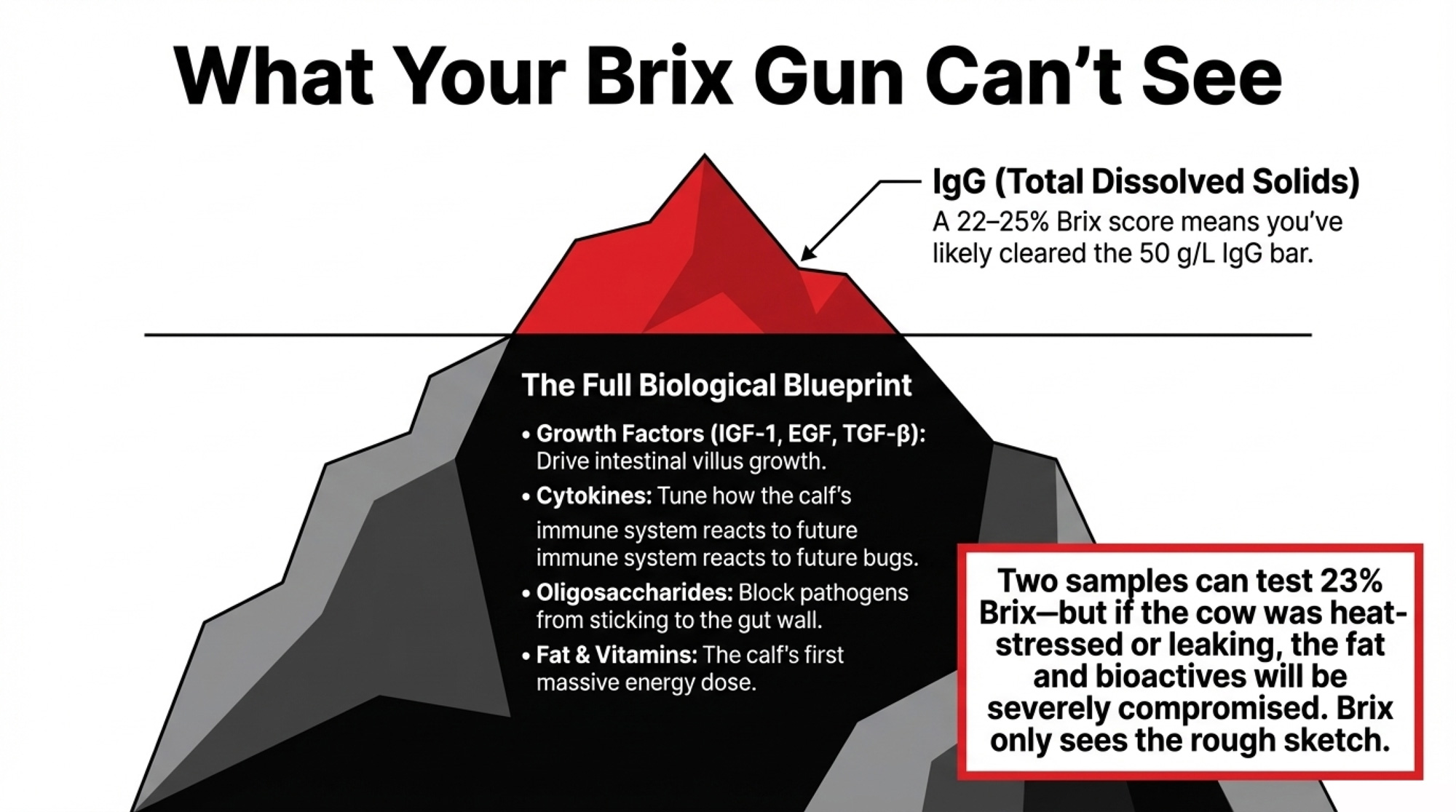
Brix refractometers have cleaned up a lot of colostrum programs. If you pull a sample at first milking and see 22–25% Brix, you can be reasonably confident you’re somewhere around 50 g/L IgG, often enough to hit the classic 10 g/L serum IgG target if you feed enough volume within two hours.
But Brix doesn’t tell you the whole story.

Brix is a total dissolved solids number. It was always meant to be an IgG proxy. It says almost nothing about the other pieces colostrum is supposed to deliver:

  • Growth factors like IGF‑I, EGF, and TGF‑β drive intestinal villus growth and enzyme activity in the small intestine.
  • Cytokines and immune modulators that tune how the calf’s immune system reacts to future bugs.
  • Oligosaccharides that feed beneficial bacteria and help keep pathogens from sticking to the gut wall.
  • Fat and fat‑soluble vitamins — the calf’s first big energy dose and a key support for early immune function.
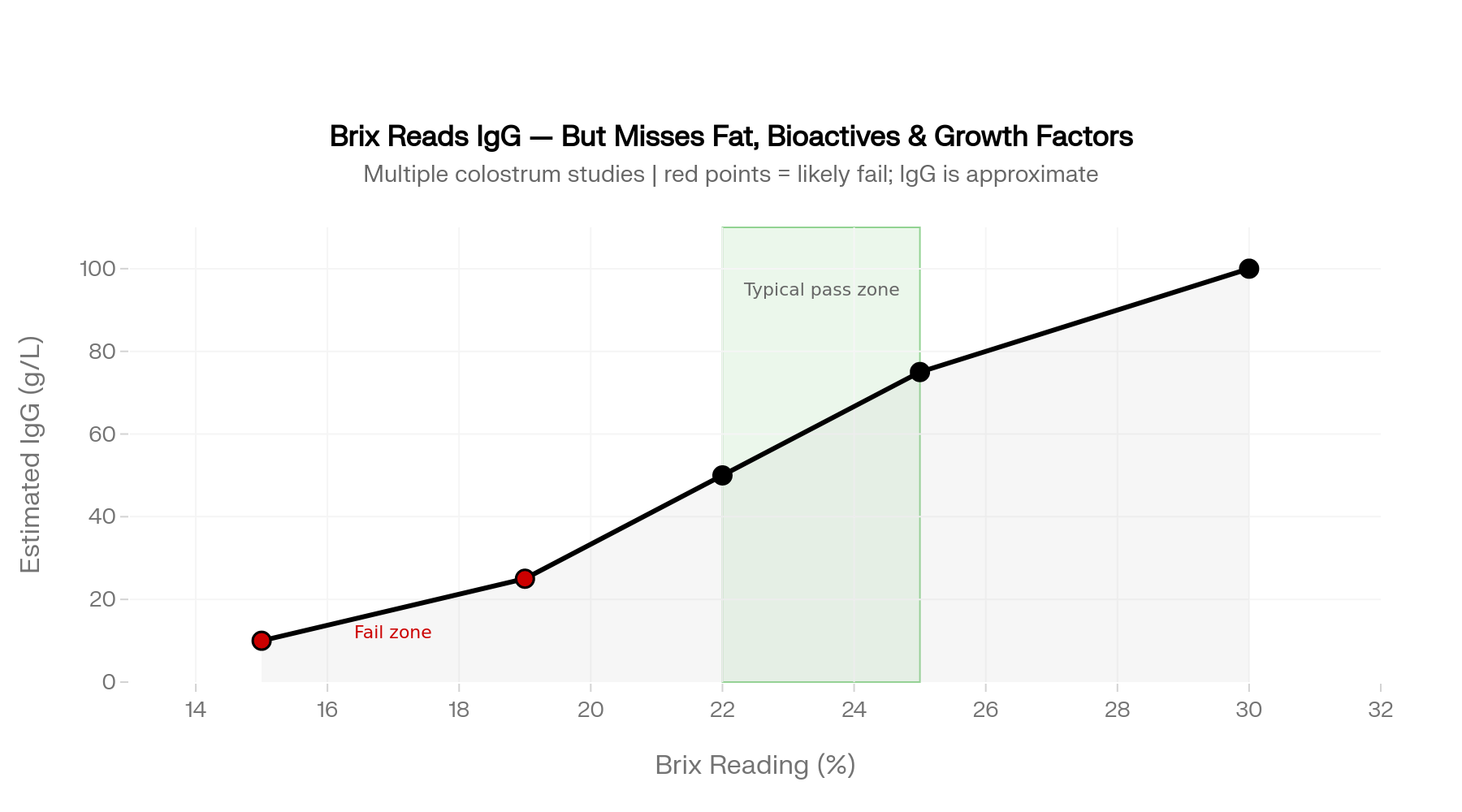
Several studies report strong correlation between Brix and colostrum IgG, with Brix readings of 19, 22, 25, and 30%as rough stand‑ins for 25, 50, 75, and 100 g/L IgG. That’s useful. But two samples can land at 23% Brix, carry similar IgG, and still be different animals when it comes to fat and bioactive profiles, depending on how the cow’s dry period went.

So yes, your colostrum can test 23% Brix and still be thinner on fat or certain bioactives if the cow spent the far‑off period leaking, heat‑stressed, or rushed through involution. Brix tells you you’ve probably cleared the IgG bar. It doesn’t tell you if the calf got the full biological blueprint or just the rough sketch.

Until there’s a practical field test for those bioactives, the upstream story is your best proxy: dry‑off yield, dry‑period length, far‑off pen stocking, heat‑stress exposure, and leakage.

Are Your Dry Periods Short‑Changing Colostrum and Longevity?

The same genetic pressure that pushed Holsteins into 45‑kg peaks also pushed dry‑off yields into the 25–30 kg band unless you actively manage the tail of lactation.
Colostrum traits themselves have real genetic variation. Recent work in Holsteins reported heritabilities around 0.21–0.23 for colostrum IgG and total Ig concentration, roughly double the heritability of colostrum yield (about 0.10). Genetic correlations between colostrum yield and IgG are low to moderate and can even be negative, and the links between colostrum traits and standard milk‑yield indexes aren’t strong. So breeding for higher milk doesn’t automatically protect colostrum; you’re dealing with different traits that need their own attention.

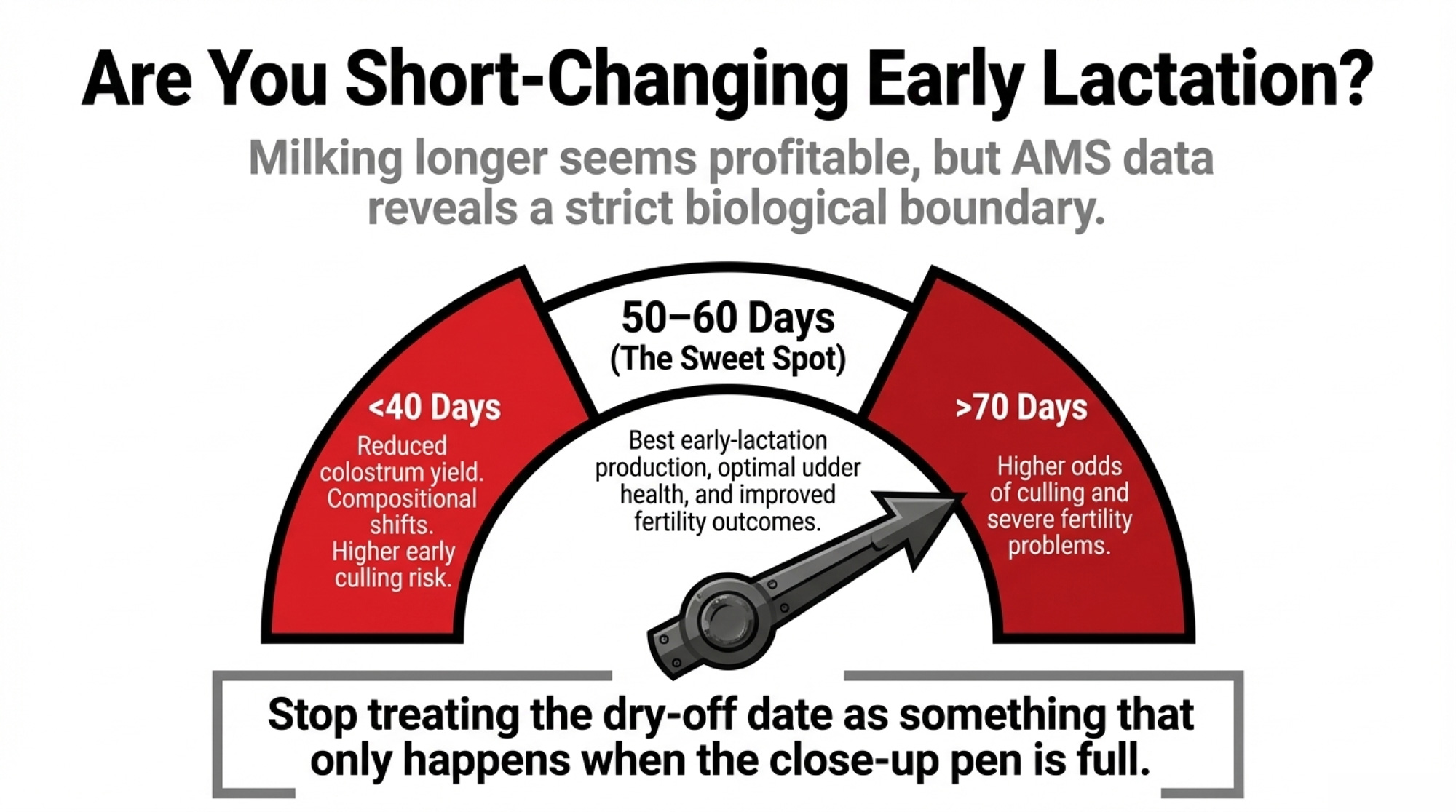
On the management side, a study in automatic‑milking herds found that dry‑period lengths under 40 days and over 70 days were linked with higher odds of culling in the first 60 days of lactation, compared to cows dried off in the 50–60 day band. Cows with very short or very long dry periods also had more fertility problems, while dry periods in the 40–70 day range delivered the best combination of early‑lactation production and udder‑health outcomes.
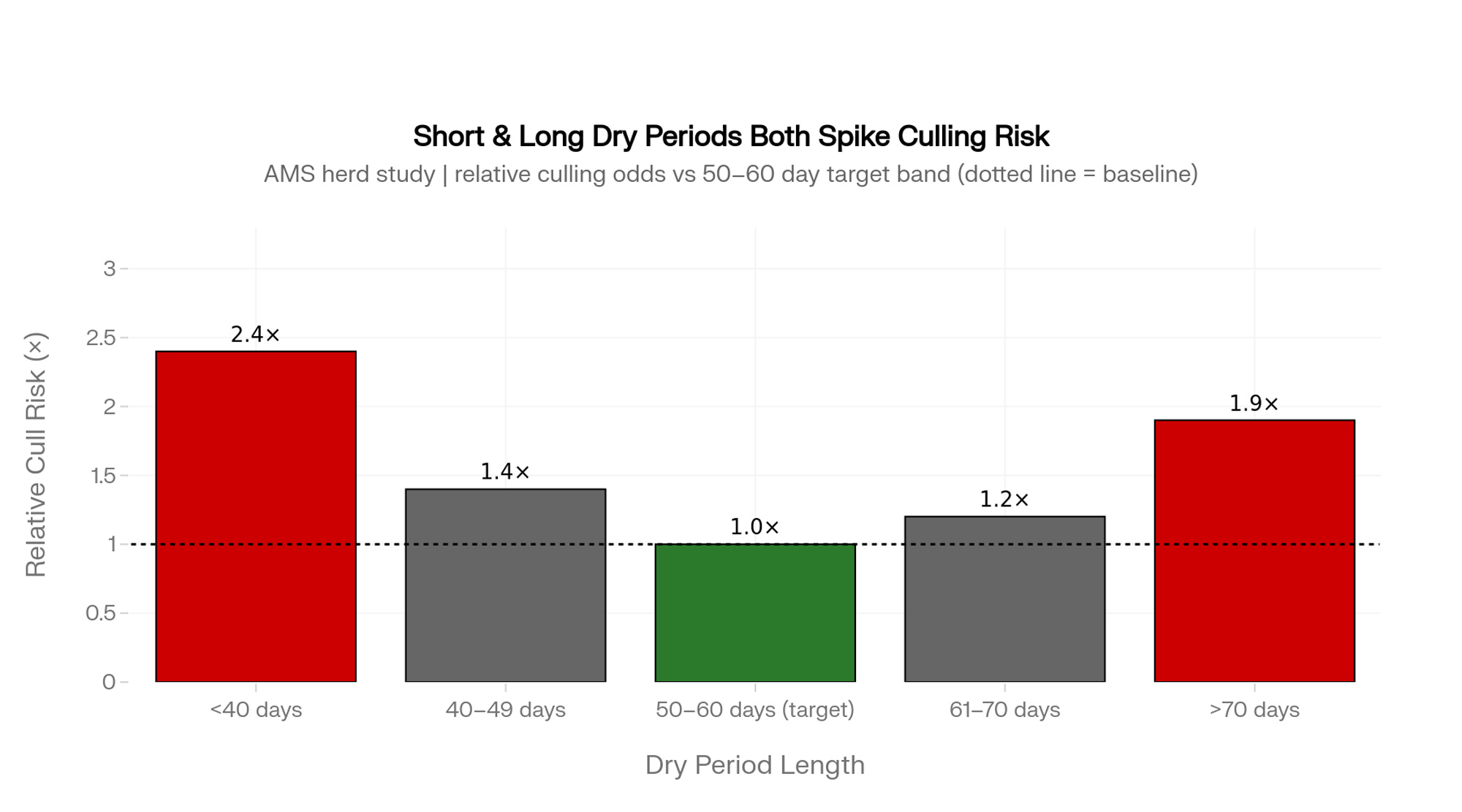
Shorter dry periods can improve postpartum energy status and, in some models, cash flow or emission numbers. But they also give the gland less time to involute and complete colostrogenesis fully. Several trials have reported reduced colostrum yields and compositional shifts in cows with short dry periods.

That’s the trade‑off in front of a lot of high‑yield herds right now: shaving the dry period to keep milk in the tank, versus protecting colostrum and early‑lactation stability. There isn’t a one‑size answer. The key is to stop treating the dry‑off date as something that happens when the close‑up pen is full.

The Economics You Don’t See on the Milk Cheque

Dry‑off and dry‑cow cooling tend to get framed as “soft” decisions. The UF/IFAS group has done the barn math on why they’re not.
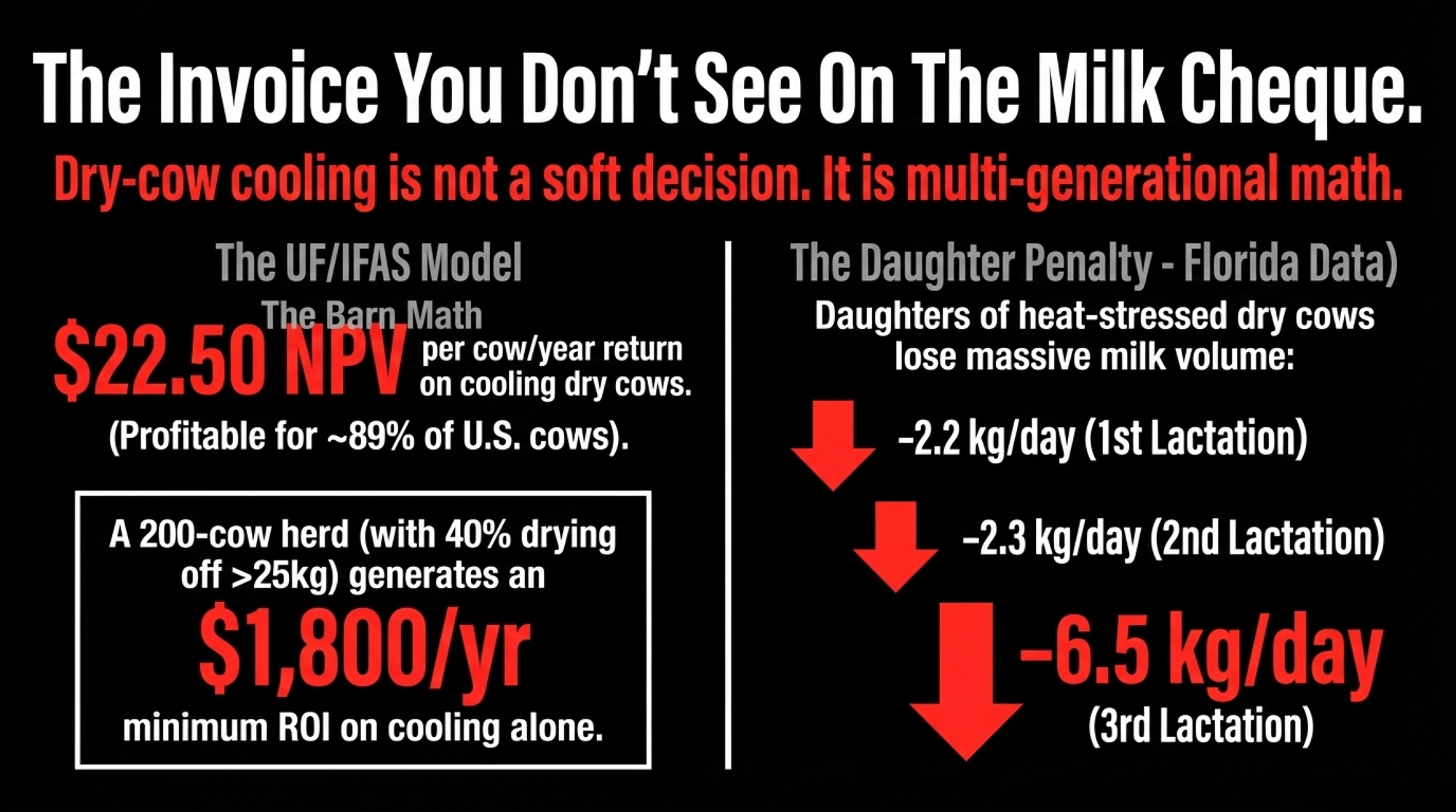
In a modeled scenario with 96 annual heat‑stress days and standard U.S. milk price and construction costs, the Economic Feasibility of Cooling Dry Cows analysis showed that cooling dry cows in a new barn returned a net present value of about $22.50 per cow per year, with a benefit–cost ratio of 1.45 and a payback period around 5.67 years. Under those conditions, the authors concluded it’d be profitable to cool dry cows for roughly 89% of U.S. cows.

A related paper on cooling dry cows suggested that failing to cool them could knock next‑lactation yields down by about 5 kg/day in some situations. Meanwhile, a pooled Florida dataset showed that daughters of heat‑stressed dry cows produced 2.2 kg/day less milk in first lactation, 2.3 kg/day less in second, and 6.5 kg/day less in third than daughters of cooled cows, and those daughters also had shorter productive lives.

Now pull that into your own barn.

Take a 200‑cow herd where 40% of cows dry off above 25 kg. That’s 80 higher‑risk dry‑off cows a year. Multiply that by $22.50 per cow per year from the UF dry‑cow cooling model, and you’re looking at roughly $1,800 per year tied just to improved dry‑cow performance and cooling, before you even count the milk those daughters don’t leave on the table in second and third lactation.

Cost/Benefit CategoryStatus Quo (No Cooling, High Dry-Off Yield)Progressive Protocol (Cooled, Tiered Dry-Off)
Dry-cow cooling NPV/cow/year$0$22.50 (UF/IFAS model)
Est. annual gain, 200-cow herd (40% at risk)$0~$1,800
Daughter milk loss, 1st lactation−2.2 kg/day~0 kg/day
Daughter milk loss, 2nd lactation−2.3 kg/day~0 kg/day
Daughter milk loss, 3rd lactation−6.5 kg/day~0 kg/day
New IMI risk during dry periodHigher (open canals >21 kg yield)Lower (<15 kg target at last milking)
Colostrum BrixMay pass IgG test; fat/bioactives depletedHigher probability of full bioactive profile
Dry-cow cooling payback periodN/A~5.67 years (new barn); faster for retrofits
Benefit–cost ratio (UF model)1.01.45

That’s not a made‑up “you could be losing…” headline. Those are the UF numbers. You can plug in your herd size and local cost/price structure and get your own version of the same math.

3 Ways to Stop Treating the Dry Period Like a Parking Lot

You’re not going to rebuild your dry‑off system in one shot. You don’t have to. But if the 30‑kg trap feels uncomfortably familiar, here are three places progressive herds are actually moving the needle.
1. Tier Dry‑Off by Yield Instead of DIM

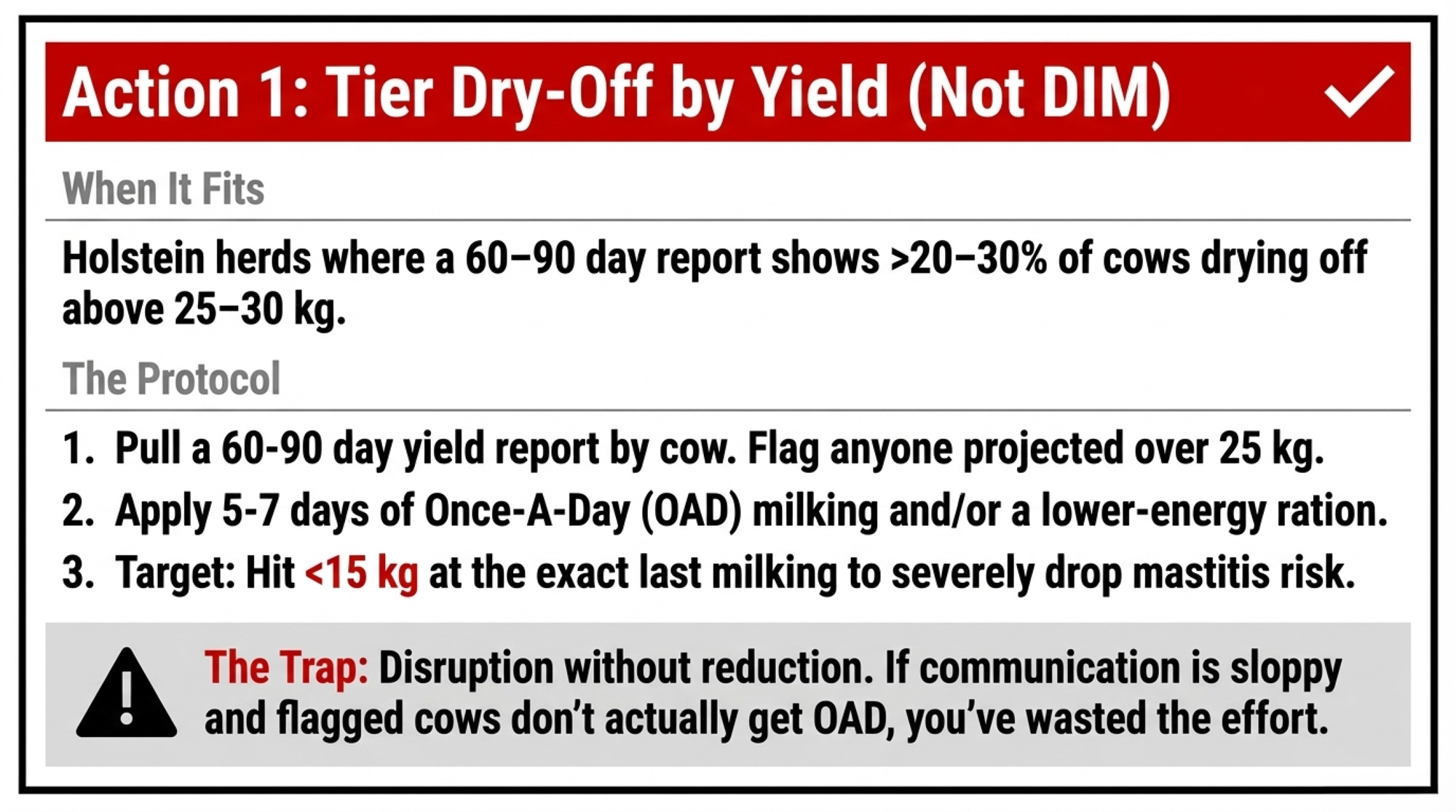
When it fits: Holstein herds where a quick 60–90 day report shows more than 20–30% of cows drying off above 25–30 kg.

How it works:

  • Pull a 60–90 day dry‑off yield report by cow.
  • Any cow projected to be over 25–30 kg at 10–14 days before dry‑off gets flagged for 5–7 days of once‑a‑day milking and, where possible, a lower‑energy ration or separate group.
  • Aim for <15 kg at the last milking before dry‑off treatment and moving to the far‑off pen, in line with data showing mastitis risk climbs as dry‑off yield rises above about 10–15 kg.

What it costs: Some complexity in the parlor and pens, especially if staffing is tight or grouping options are limited.

Where it can backfire: If communication is sloppy and flagged cows don’t actually get OAD or ration changes, you’ve added disruption without real yield reduction.
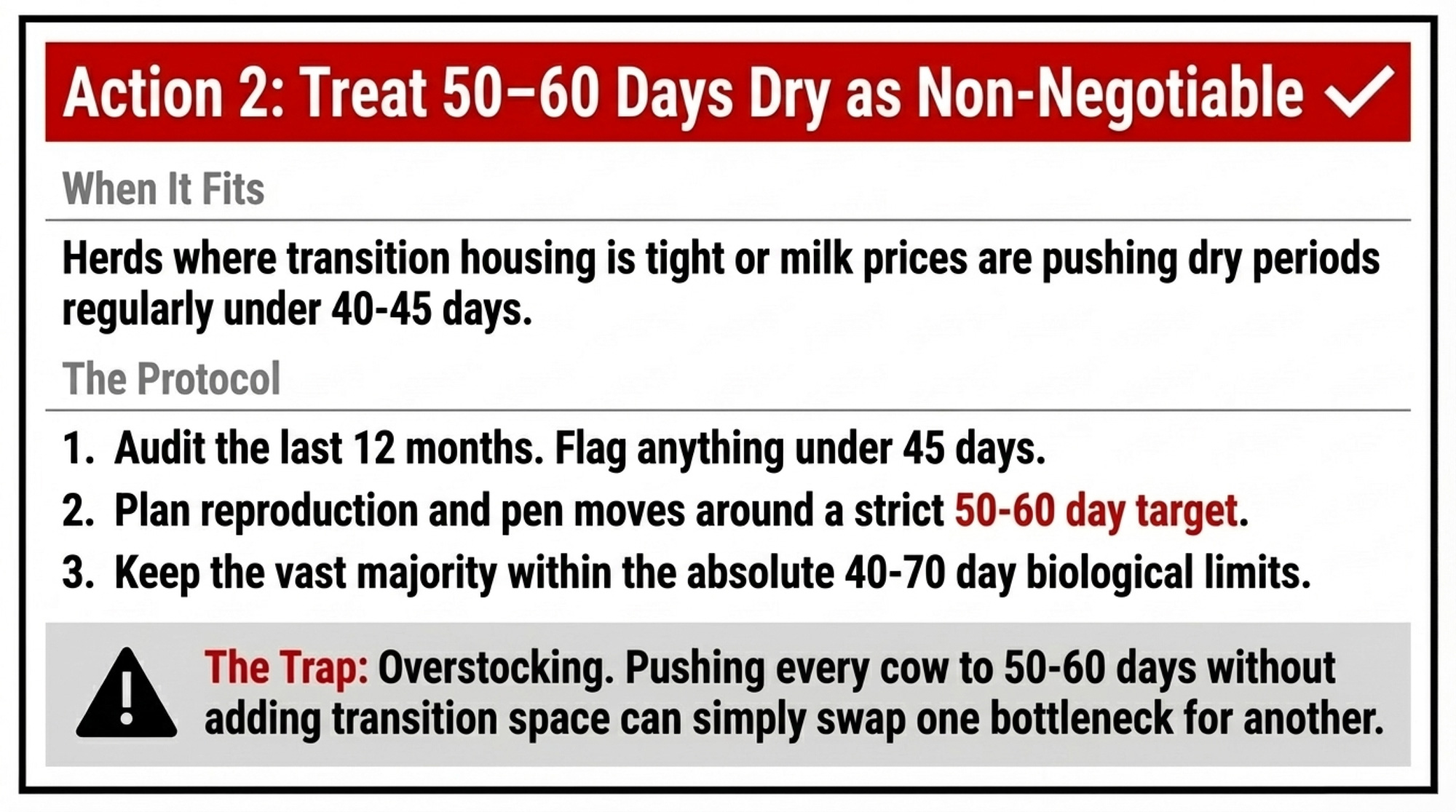
2. Treat 50–60 Days Dry as a Non‑Negotiable Band

When it fits: Herds where dry periods regularly slide under 40–45 days because transition housing is tight or the milk price is pushing you to keep cows milking.

How to check it:

  • Audit the last 12 months of dry periods and flag everything under 40–45 days.
  • Push to keep most cows in the 50–60 day band that AMS data linked with lower early‑culling odds and better fertility.
  • Keep the vast majority of cows within 40–70 days dry, where early‑lactation production and udder‑health outcomes were best.

What it costs: Discipline in repro and pen planning so cows actually make it to target dry‑off dates. In some cases, short‑term milk sales may feel like they’re taking a hit.

Where it can backfire: In herds already overstocked in transition, pushing every cow to 50–60 days without adding space or changing traffic can swap one bottleneck for another.
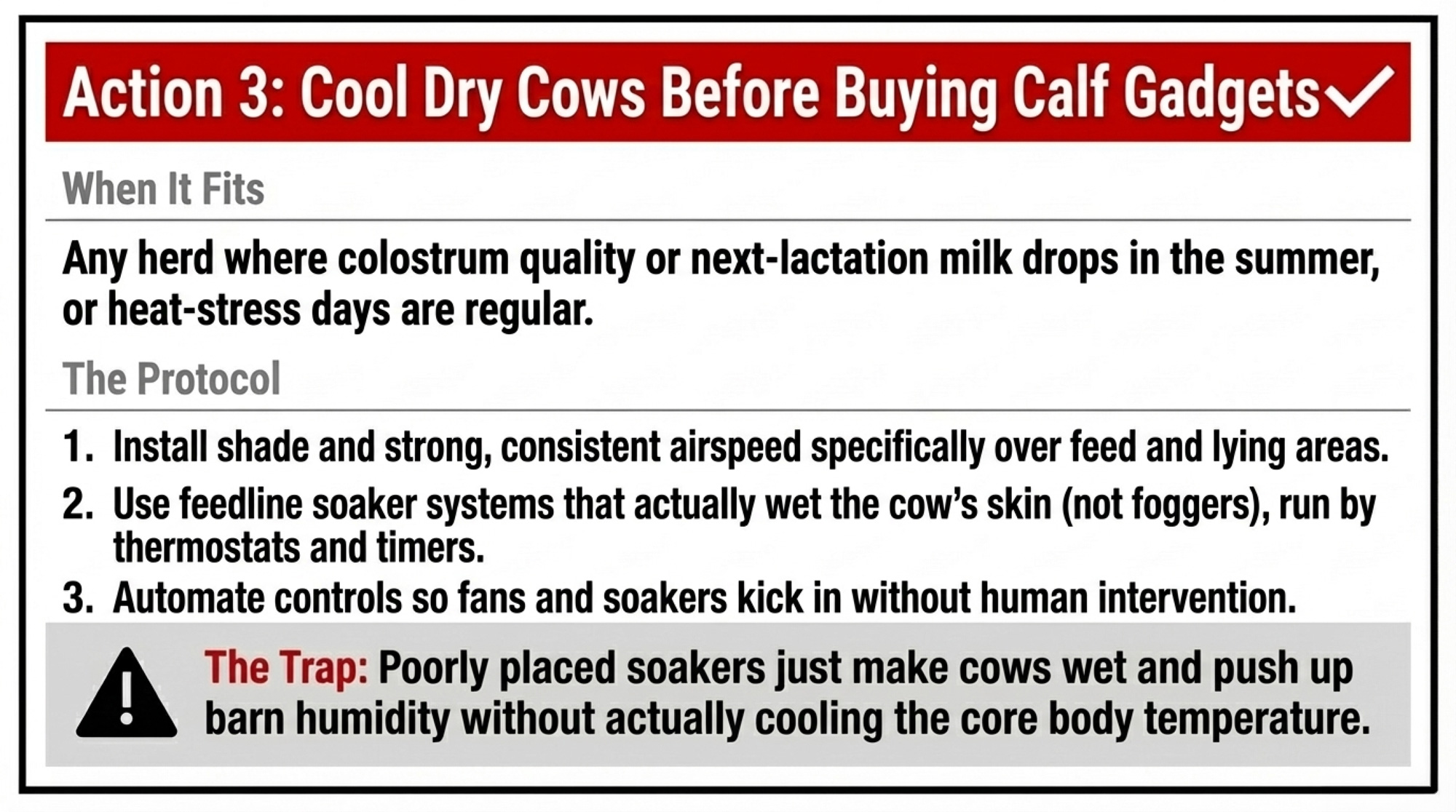
3. Cool Dry Cows Before You Buy Another Gadget for the Calf Barn

When it fits: Any herd where colostrum quality and next‑lactation milk clearly drop in summer, or where heat‑stress days are a regular feature.

What a minimum‑effective cooling setup looks like:

  • Shade and strong, consistent airspeed over feed and lying areas, not just down the alleys.
  • A feedline soaker system that actually wets the cow’s skin (not fog), on a thermostat and timer.
  • Automated controls so fans and soakers kick in when the barn is hot, without someone remembering to flip switches.

UF’s model says cooling dry cows can pay for itself in about five to six years for a new barn and faster for retrofits or hotter regions. Florida data say those decisions ripple through multiple lactations in daughters and granddaughters: 2.2 kg/day less in first lactation, 2.3 kg/day less in second, and 6.5 kg/day less in third for daughters of heat‑stressed dry cows compared with daughters of cooled cows.

Where it can backfire: If soakers are poorly placed or controls are wrong, you can make cows wet without truly cooling them and even push humidity up.

Old Rules vs Progressive Targets at Dry‑Off

FactorThe Old StandardProgressive TargetWhat Goes Wrong Without the Shift
Dry-off yield“Whatever she’s giving”<15 kg at last milkingOpen teat canals, more new IMI, lower-Brix colostrum
Dry period length“~45 days, give or take”50–60 days (core band)Higher culling odds in first 60 DIM; fertility problems
Dry period floorNo hard minimum≥40 days absolute minimumIncomplete involution; colostrum yield and composition compromised
Heat stress management“She’s not milking anyway”Feedline soakers + high-speed fans−2.2 to −6.5 kg/day in daughters across three lactations
Colostrum quality goal22% Brix / high volumeIgG + fat + full bioactive profileCalves clear IgG bar but lack growth factors, cytokines, oligosaccharides
Dry-off methodAbrupt / calendar-drivenTiered by yield (OAD + ration change)High-yield cows don’t hit <15 kg target; all downstream risks follow
Heritability of colostrum traitsIgnored / assumed milk-linkedSelected independently (h² ~0.21–0.23 for IgG)Milk-yield breeding doesn’t protect colostrum; different traits need different attention
Far-off pen investmentLow priorityCooling and stocking rate budget itemsEvery heat-stress dollar NOT spent there costs 3+ lactations of daughter milk

Your exact numbers will vary. The shift is what matters: stop treating the dry pen like a parking lot, and start treating it like the six‑week factory run for colostrum and the next lactation.

What This Means for Your Operation

  • If more than a third of your cows are drying off above 25–30 kg, treat abrupt dry‑off as a colostrum‑risk protocol, not just “how we do it here.” Pull a 60–90 day report and count how many cows hit that band.
  • If your dry periods are regularly under 40–45 days, recognize that you’re selling short your colostrum program and early‑lactation stability to keep milk in the tank this month. The AMS data say 50–60 days dry is where culling risk and fertility look better.
  • If you’re spending serious money on colostrum replacer and calf treatments but haven’t invested in cooling the far‑off pen, you’re fighting a problem the dry cows are still creating. UF/IFAS and Florida data show dry‑cow cooling pays in next‑lactation milk and in the daughters’ three lactations deep.
  • If your Brix gun says you’re “good enough” but calves still feel fragile, read your colostrum in the context of dry‑off yield, dry‑period length, leakage, and heat stress before blaming the colostrum bucket. Brix can’t see fat or bioactives.
  • Within 30 days, pull your last 3 months of dry‑offs, sort by yield at last milking, and draw a line at 25–30 kg. If the list above that line is longer than you’d like, that’s your first project list.

Key Takeaways

  • If your dry‑off report shows more than ~30% of cows leaving the parlor above 25–30 kg, start tiering your dry‑off protocol around yield, with OAD and ration changes to get those cows under 15 kg before you stop milking.
  • If your typical dry period keeps slipping under 40–45 days, treat 50–60 days dry as a non‑negotiable target band instead of a nice‑to‑have, and plan reproduction and pen moves around that.
  • If you haven’t cooled the far‑off pen yet, do the math on UF/IFAS’s $22.50/cow/year NPV and the 2.2–6.5 kg/day milk losses in daughters of heat‑stressed dry cows — then ask whether another calf‑barn gadget really solves the root problem.
  • If your Brix numbers look fine but calf performance doesn’t, start treating the dry period as the real colostrum program and use leakage, dry‑off yield, and dry‑period length as early‑warning signs.
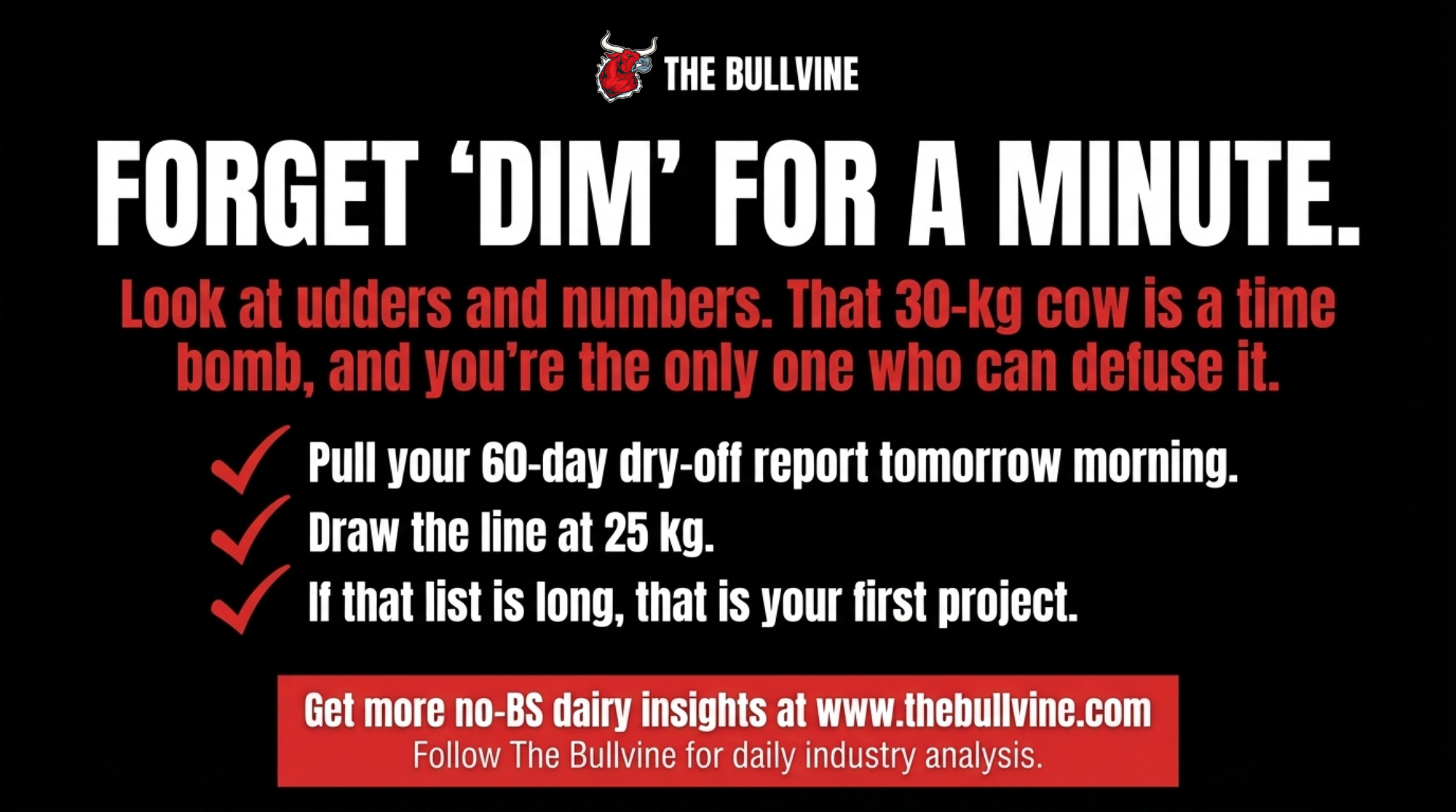
The next time you walk the dry pen, forget DIM for a minute and look at udders and numbers instead. How many cows are three weeks dry and still look like they could walk back into the parlor? That’s your 30‑kg time bomb — and you’re the only one who can defuse it.

Complete references and supporting documentation are available upon request by contacting the editorial team at editor@thebullvine.com.

Learn More

The Sunday Read Dairy Professionals Don’t Skip.
Every week, thousands of producers, breeders, and industry insiders open Bullvine Weekly for genetics insights, market shifts, and profit strategies they won’t find anywhere else. One email. Five minutes. Smarter decisions all week.
NewsSubscribe
First
Last
Consent

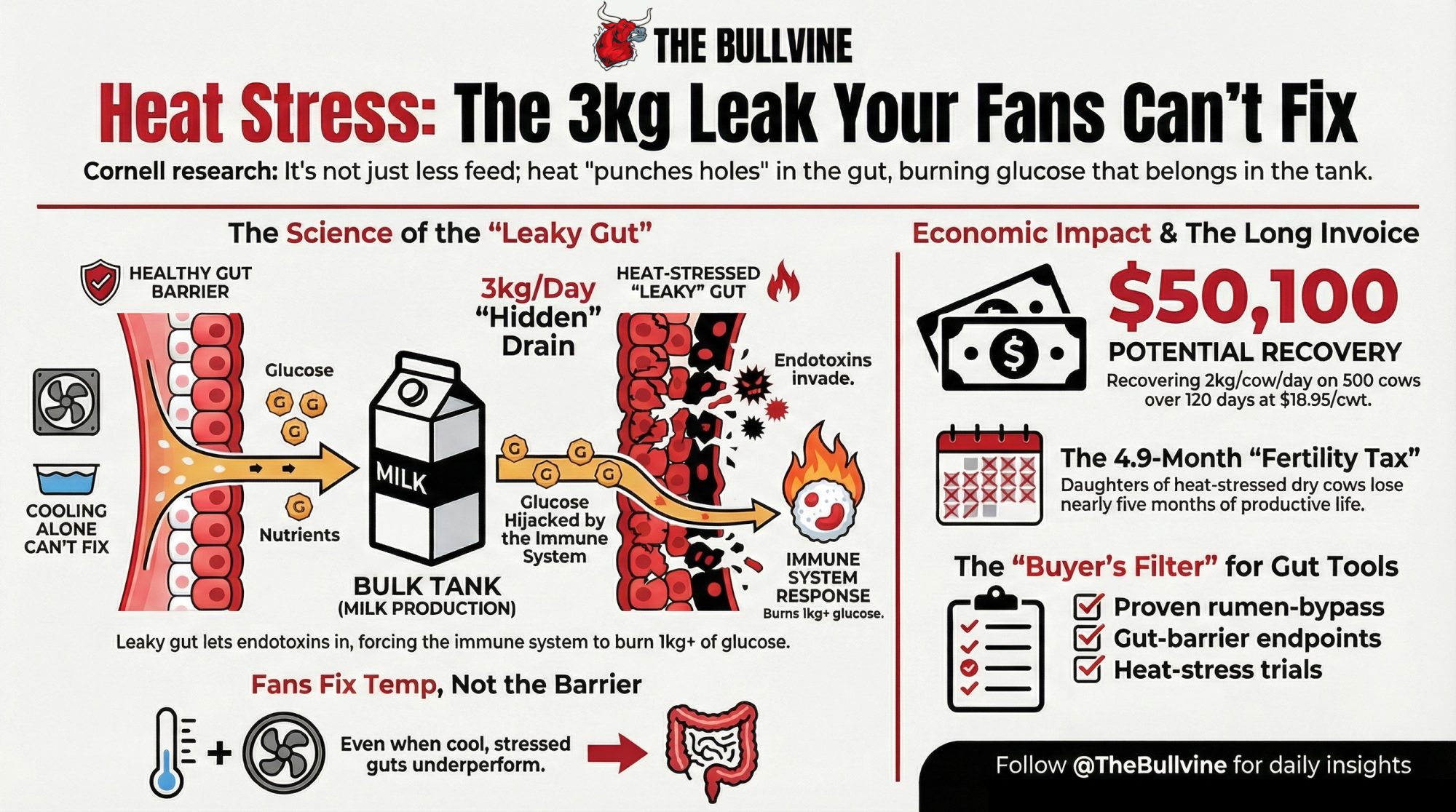
Cornell Found the 3 kg/Day Heat Stress Leak Your Fans Were Never Going to Fix.

A 46‑cow chamber trial proved heat‑stressed Holsteins are losing milk through the gut wall — not just from reduced intake. Here’s the barn math at $18.95/cwt.

Executive Summary: Cornell’s McFadden group proved that heat-stressed Holsteins lose about 3 kg of energy-corrected milk per cow per day through gut-wall failure — independent of reduced feed intake. In their 46-cow chamber trial, a pair-fed group kept cool but eating the same reduced diet still out-milked the heat-stressed cows, which means a real chunk of your summer leak is coming from somewhere fans and soakers can’t reach. What’s actually happening: endotoxins slip through a compromised intestinal barrier, and the immune system burns glucose that should’ve gone to milk — Kvidera’s work showed over 1 kg of glucose torched in just 12 hours. A microencapsulated organic acid/botanical blend restored gut permeability and cut inflammation in the trial, though a follow-up calf study found no growth response, so the strongest case is in lactating cows under sustained THI above 74. At $18.95/cwt, a conservative 2 kg/day recovery on 500 cows over 120 heat-stress days is worth roughly $50,100 in gross milk value — before you subtract product cost. The longer invoice is worse: Laporta’s 10-year Florida data showed daughters of heat-stressed dry cows lost 4.9 months of productive life, with a national cost estimated at 5 million/year.

heat stress milk loss

It’s July. Fans screaming at 100%, soakers drenching the holding pen, and your bulk tank still bleeding out. You’ve done everything the heat stress playbook says — but a Cornell research team reported heat‑stressed Holsteins losing about 3 kg of energy‑corrected milk per cow per day from a place your fans can’t reach: the gut wall.

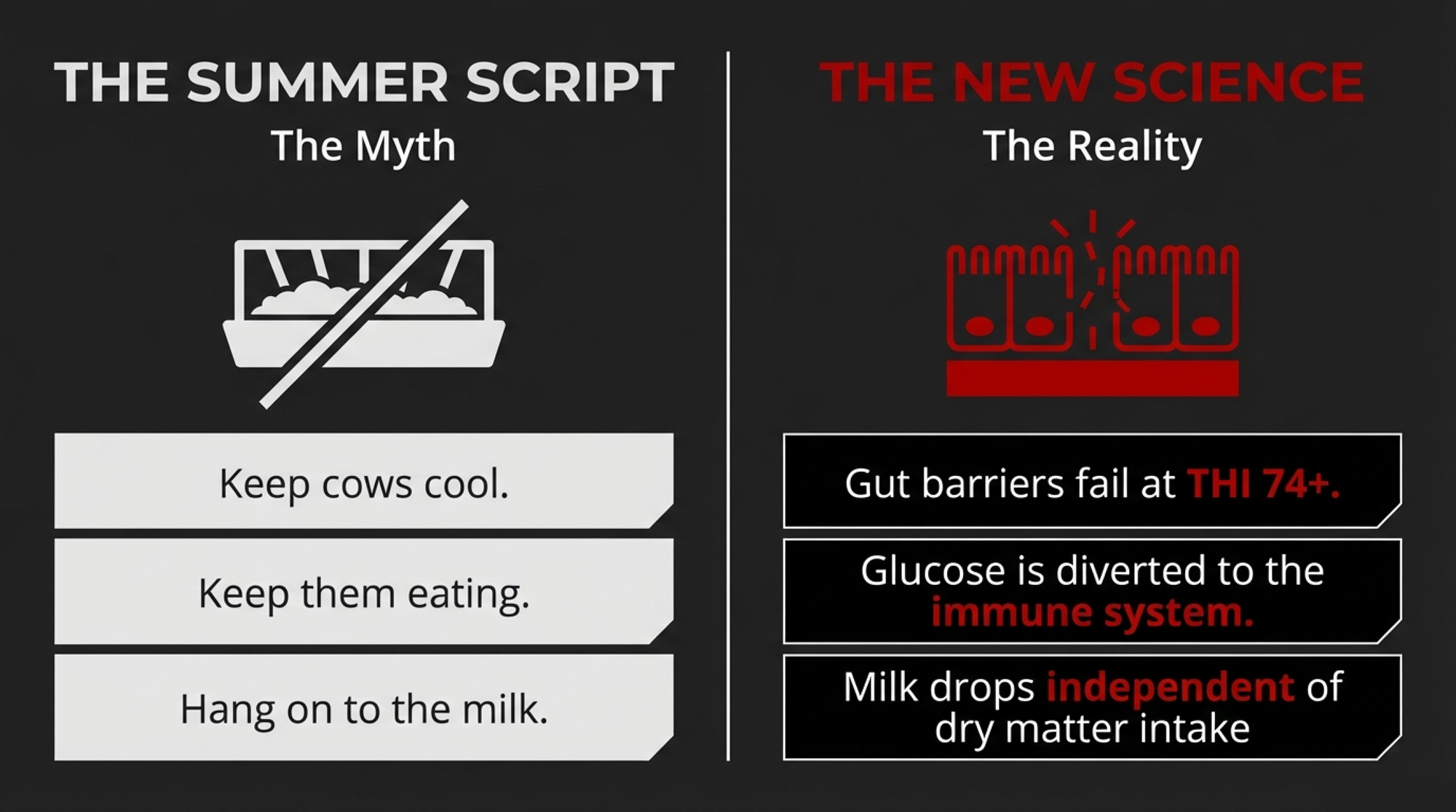
We’ve all been raised on the same summer script: keep cows cool, keep them eating, hang on to the milk. Joseph McFadden’s group at Cornell put that theory to the test in a chamber and showed it’s only half the story. They took 46 multiparous Holsteins, split them into four groups, and proved that even when feed intake is matched, heat stress still punches holes in the intestine and lights up the immune system — stealing glucose that was supposed to end up in your milk cheque (Fontoura et al. 2022, JDS 105:7842–7860).

The Part of Heat Stress Your Fans Can’t Touch

It only took three days of 74+ THI for the gut wall to start failing.

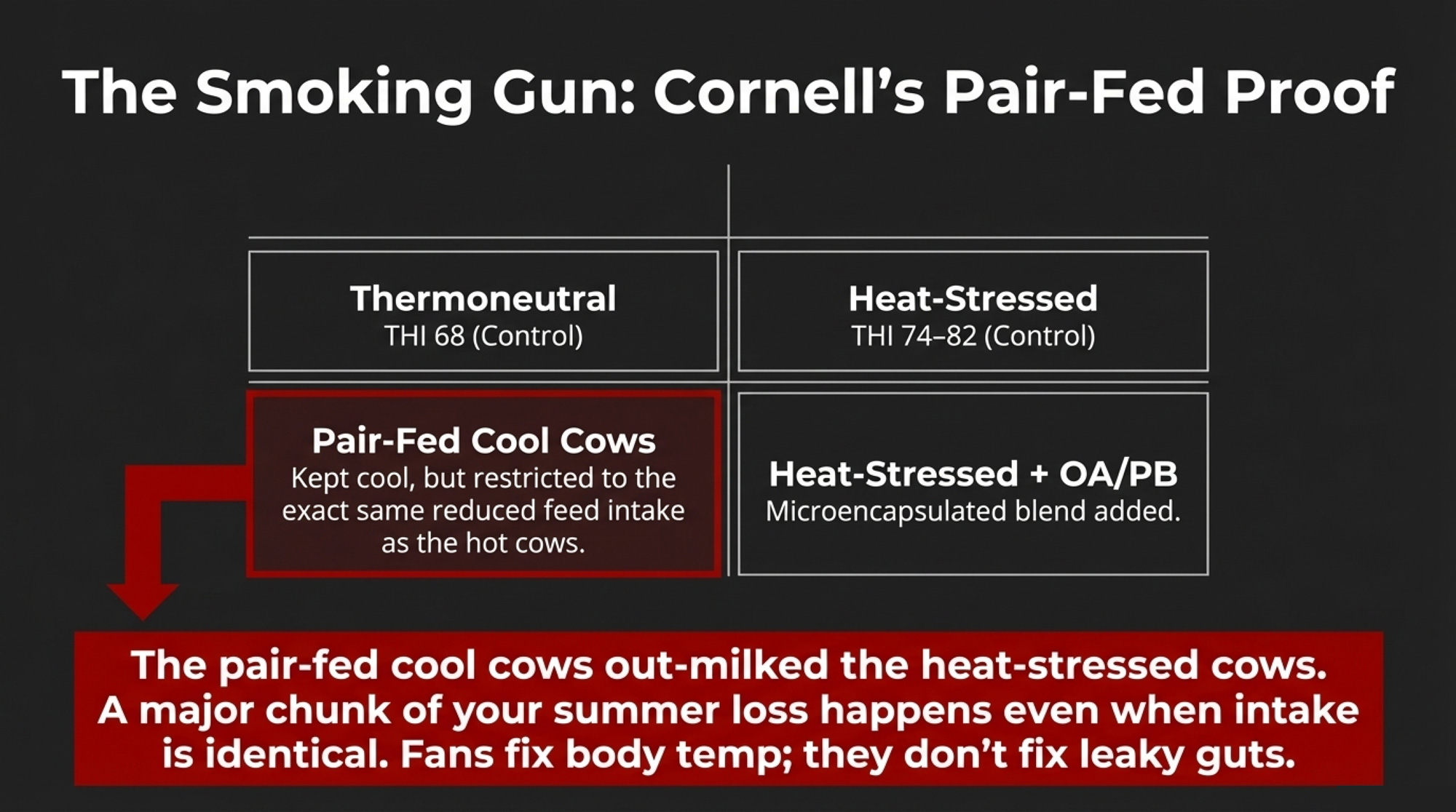
McFadden’s team ran four treatments:

  • Thermoneutral controls at THI 68.
  • Heat‑stressed controls cycling between THI 74 and 82.
  • A pair‑fed group kept cool but was restricted to the same intake as the hot cows.
  • Heat‑stressed cows on a microencapsulated organic acid/pure botanical (OA/PB) blend.

That pair‑fed pen is the smoking gun. Same reduced intake as the hot group, but kept cool — and they still out‑milked the heat‑stressed cows. In other words, a chunk of your summer loss is happening independent of dry matter intake. Fans and sprinklers fix body temperature. They don’t fix a leaky gut.

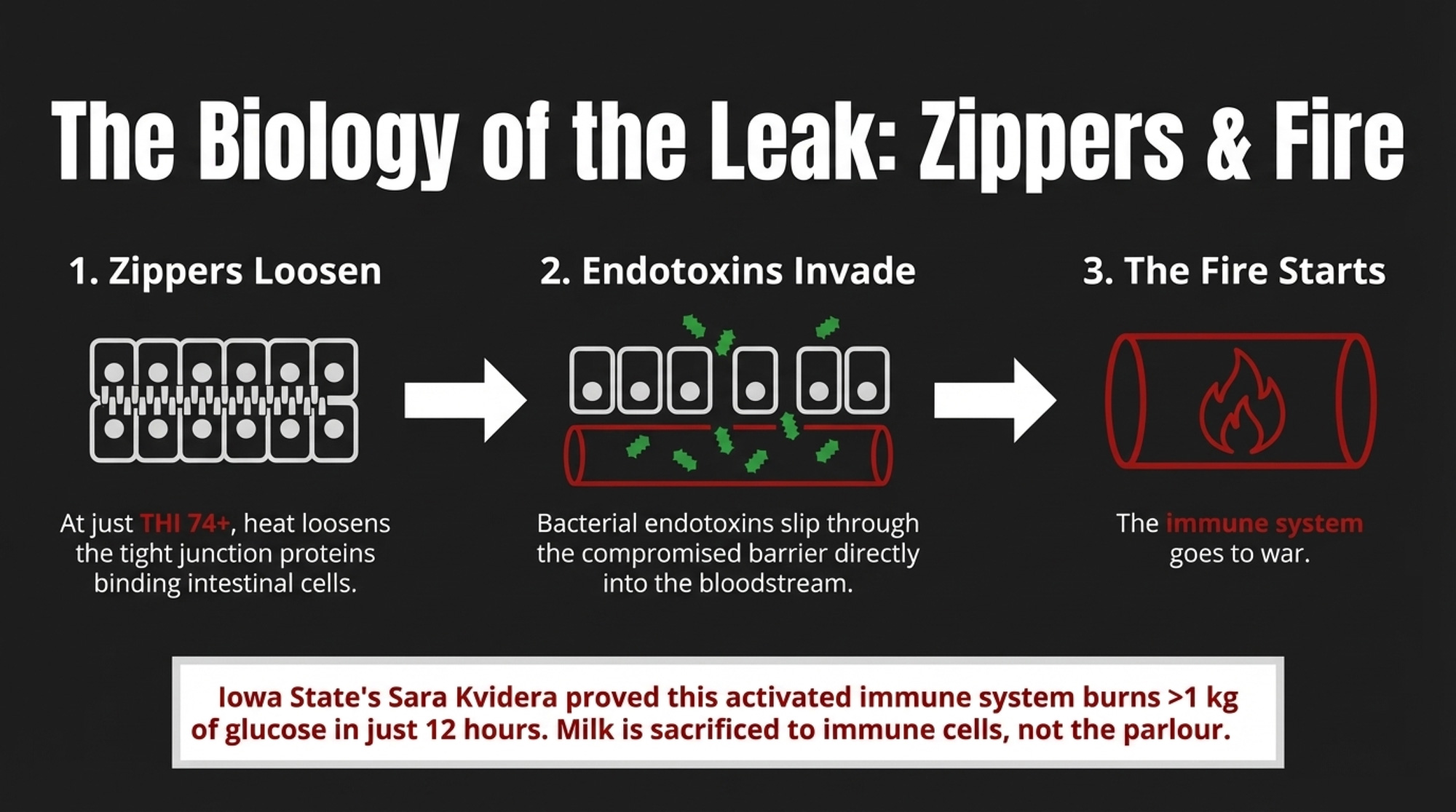
What’s actually happening? Heat stress loosens the tight junction proteins that zip intestinal cells together. Bacterial endotoxins slip through, hit immune receptors, and your cow’s immune system goes to war. Iowa State’s Sara Kvidera showed an acutely activated immune system in a lactating Holstein that burns more than 1 kg of glucose in just 12 hours. That’s several kilograms of milk sacrificed to immune cells instead of the parlour.

Cornell’s team summed it up: heat stress reduces production through “important mechanisms … independent of changes in DMI.” That’s the part your heat abatement system can’t touch.

What Cornell Actually Fed — And Why the Coating Matters

This wasn’t a random “gut health” sprinkle. On a dry‑matter basis, the OA/PB blend in the Cornell trial was:

  • 25.0% citric acid
  • 16.7% sorbic acid
  • 1.7% thymol
  • 1.0% vanillin
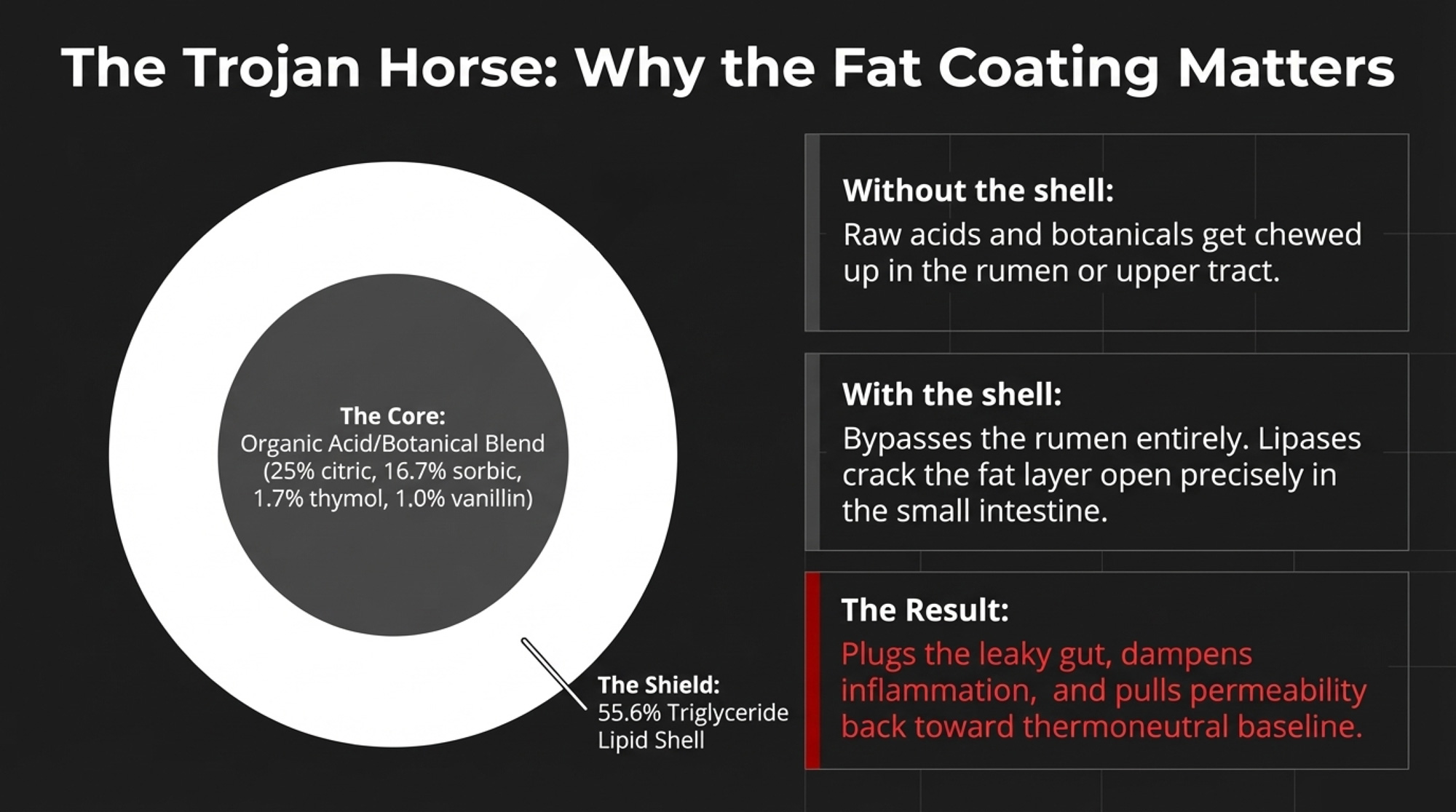
  • 55.6% triglyceride (the lipid shell)

The cows got it twice daily as a top‑dress; controls got the same amount of plain triglyceride carrier, so every pen was handled the same way. That triglyceride coating is the whole play. In vitro work showed minimal release in rumen‑like fluid and targeted release under intestinal conditions once lipases crack the fat layer open. Without that fat shell, most organic acids and botanicals get chewed up or absorbed upstream before they ever see the small intestine.

In the chamber, the coated OA/PB did three big things for the heat‑stressed group:

  • Pulled total‑tract gut permeability back toward thermoneutral values.
  • Lowered systemic inflammation markers like LBP and serum amyloid A.
  • Improved energy‑corrected milk and DMI vs. unsupplemented heat‑stressed controls.

Mechanistically, once the shell opens in the gut, the organic acids and botanicals act at three levels: they create pores in undesirable bacterial membranes, dampen mucosal inflammation, and upregulate tight junction proteins to help reseal the barrier.

But it’s not magic. A follow‑up calf study from the same group (Fontoura et al. 2023, JDS 106:2904–2918) showed the OA/PB improved gut‑integrity markers under heat stress but was not able to improve growth performance in heat‑stressed calves — the authors concluded reductions in DMI alone accounted for production losses in that class of stock. The strongest evidence of performance lies in heat‑stressed lactating cows, gut‑barrier endpoints, and milk energy. Not every animal responds the same way.

Disclosure: author E. Grilli is affiliated with Vetagro, the manufacturer of the OA/PB product used in the trial. The work is still a peer‑reviewed Journal of Dairy Science paper, with full affiliation spelled out — standard practice for industry/university collaborations.

Can Gut Integrity Really Pay at $18.95 Milk?

Cornell fed 75 mg/kg of body weight — that’s about 49 g/cow/day on a 650 kg Holstein. Real inclusion, not fairy dust.

The USDA’s February 2026 outlook puts the all‑milk price at $18.95/cwt, down from a revised $21.17/cwt in 2025. So any gut‑integrity program has to pay in a margin year, not just when milk is rich.

Here’s the barn math that matters.

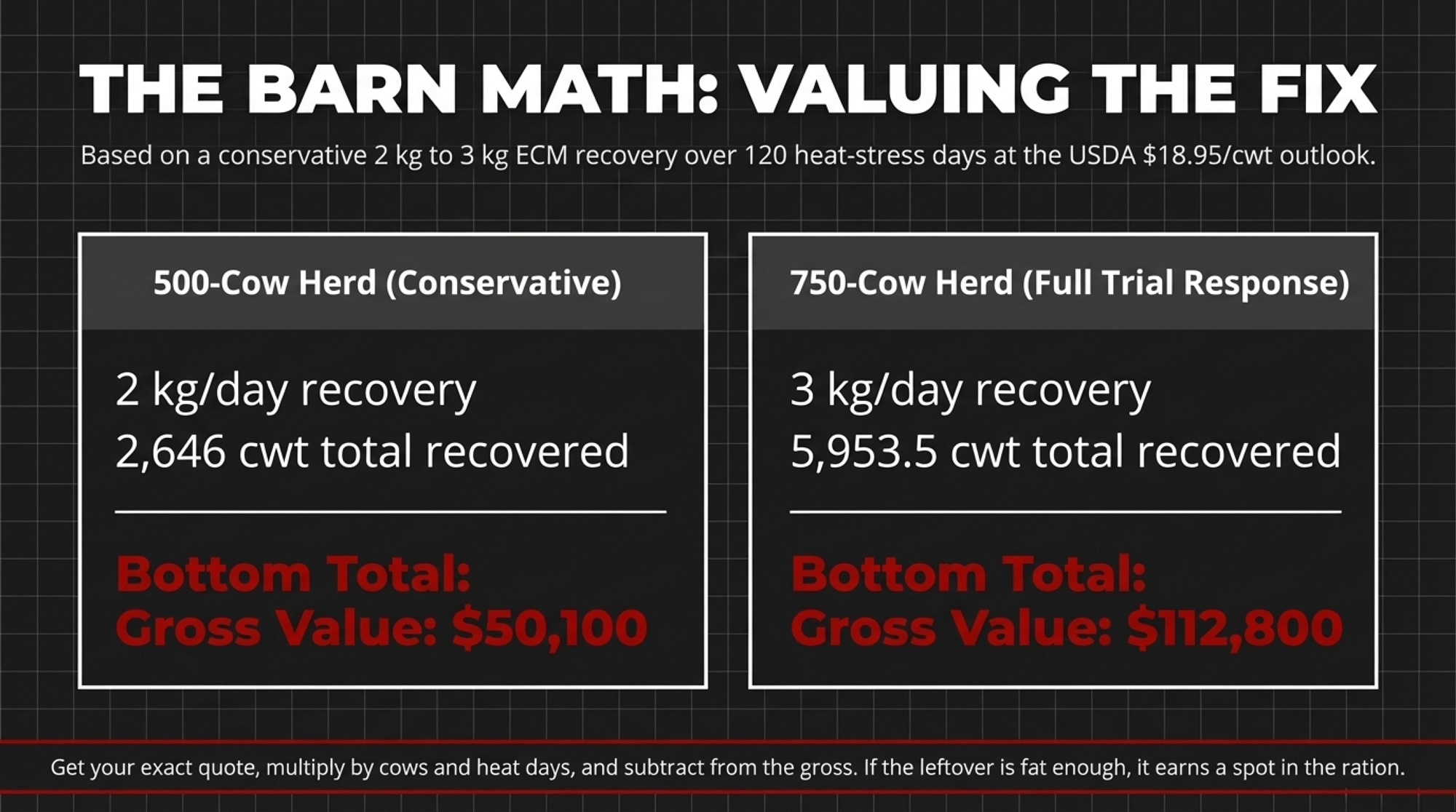
500‑Cow Herd — Conservative (2 kg/cow/day recovery)

Assume you’ll only claw back 2 kg ECM per cow per day instead of Cornell’s ~3:

  • 2 kg × 500 cows × 120 heat‑stress days = 120,000 kg
  • 120,000 kg × 2.205 lb/kg = 264,600 lb = 2,646 cwt
  • Gross milk value: 2,646 cwt × $18.95 ≈ $50,100

750‑Cow Herd — Full Cornell Response (3 kg/cow/day)

If you assume the full ~3 kg ECM/cow/day that Cornell reported under chamber conditions:

  • 3 kg × 750 cows × 120 days = 270,000 kg
  • 270,000 kg × 2.205 = 595,350 lb = 5,953.5 cwt
  • Gross milk value: 5,953.5 cwt × $18.95 ≈ $112,800
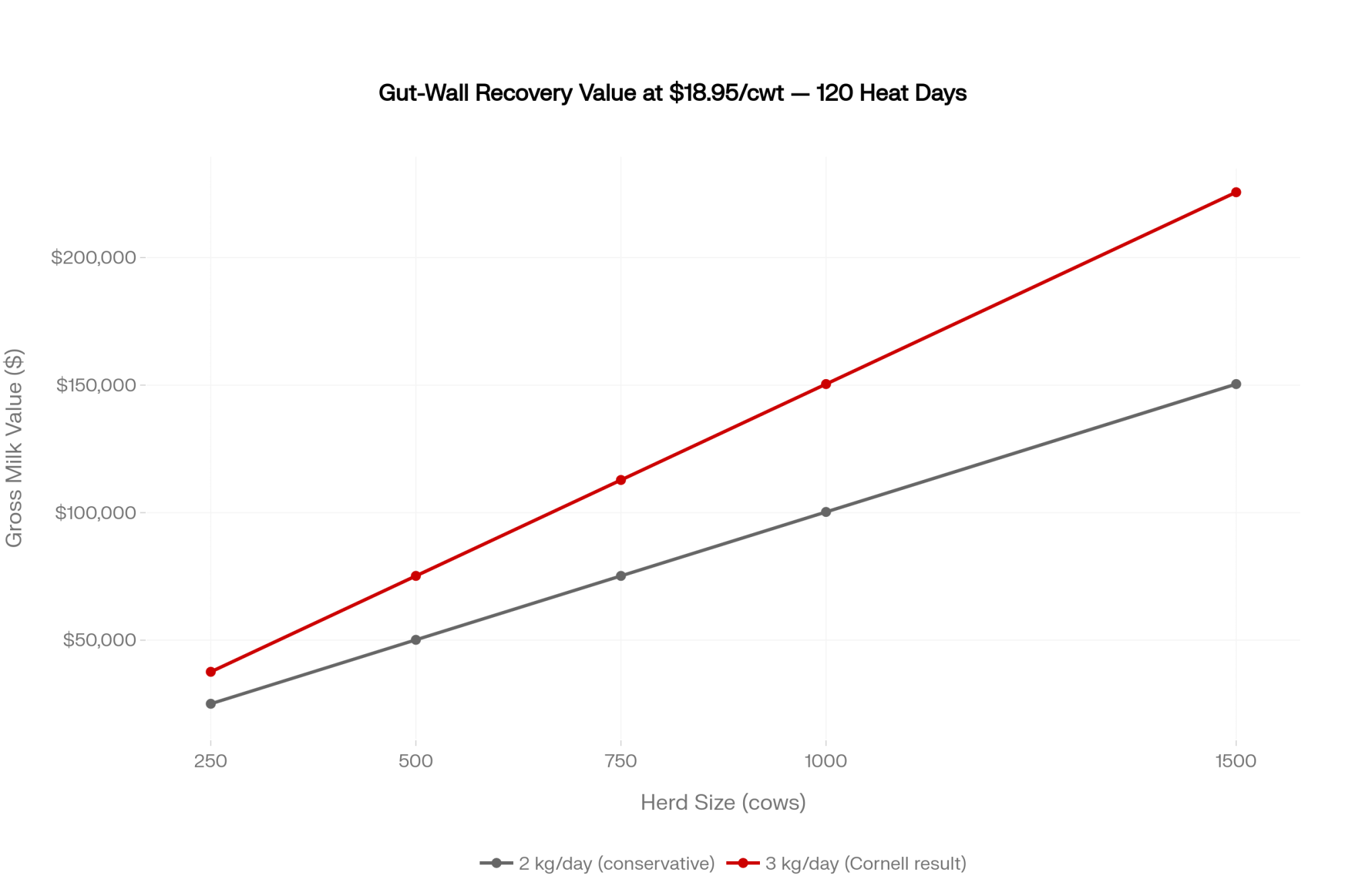
Herd SizeRecovery Scenariokg ECM Recoveredlbs RecoveredcwtGross Milk ValueNotes
250 cows2 kg/day (conservative)60,000 kg132,300 lb1,323 cwt$25,071Get a real product quote to net
250 cows3 kg/day (Cornell)90,000 kg198,450 lb1,984 cwt$37,597Chamber result; on-farm ~70% likely
500 cows2 kg/day (conservative)120,000 kg264,600 lb2,646 cwt$50,142Article baseline scenario
500 cows3 kg/day (Cornell)180,000 kg396,900 lb3,969 cwt$75,213
750 cows2 kg/day (conservative)180,000 kg396,900 lb3,969 cwt$75,213
750 cows3 kg/day (Cornell)270,000 kg595,350 lb5,954 cwt$112,817Article full-response scenario
1,000 cows2 kg/day (conservative)240,000 kg529,200 lb5,292 cwt$100,283
1,000 cows3 kg/day (Cornell)360,000 kg793,800 lb7,938 cwt$150,425

Those are gross numbers — the milk value recovered before you subtract product cost. Pricing for microencapsulated OA/PB blends varies by supplier, dose, and contract. Get your real quote, multiply it by your cows and your heat‑stress days, and subtract it from the gross. If the leftover is fat enough, the product earns a season in the ration. If it’s thin or negative, it doesn’t.

One caveat: if your barn rarely sees THI above 72, or your cooling system is genuinely keeping rectal temperatures and respirations tight, gut permeability may not be your biggest leak. This lever matters most for herds that sit in the mid‑70s THI or higher for weeks at a time.

For Canadian readers, the Canadian Dairy Commission approved a 2.3255% farmgate increase effective February 1, 2026, under its pricing formula for butterfat used in dairy products. Different currency, same math — every kilogram you leak in July still lands on your milk cheque.

The Ghost of Heat Stress Past: What It Does to Daughters and Granddaughters

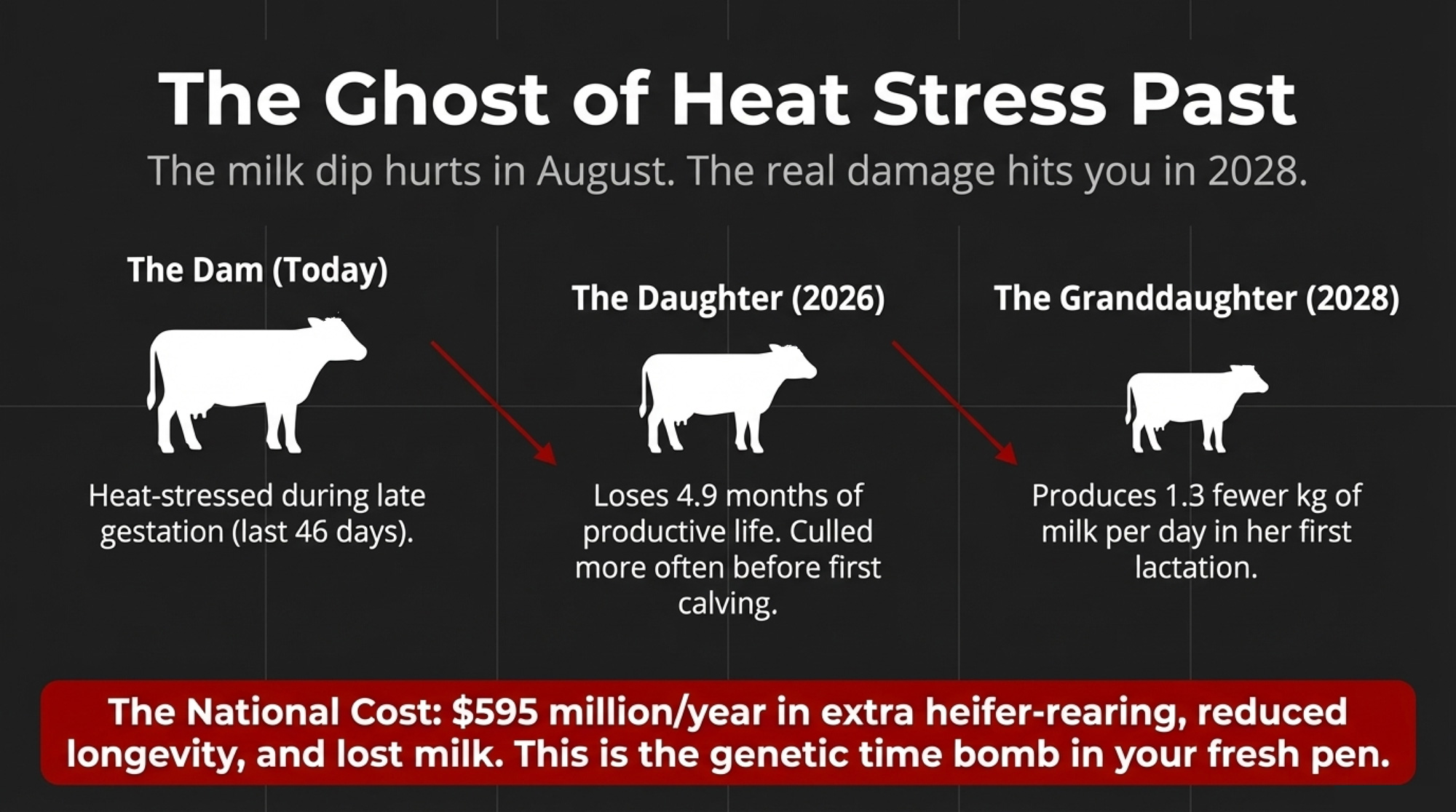
The milk dip hurts in August. The real damage hits you in 2028.

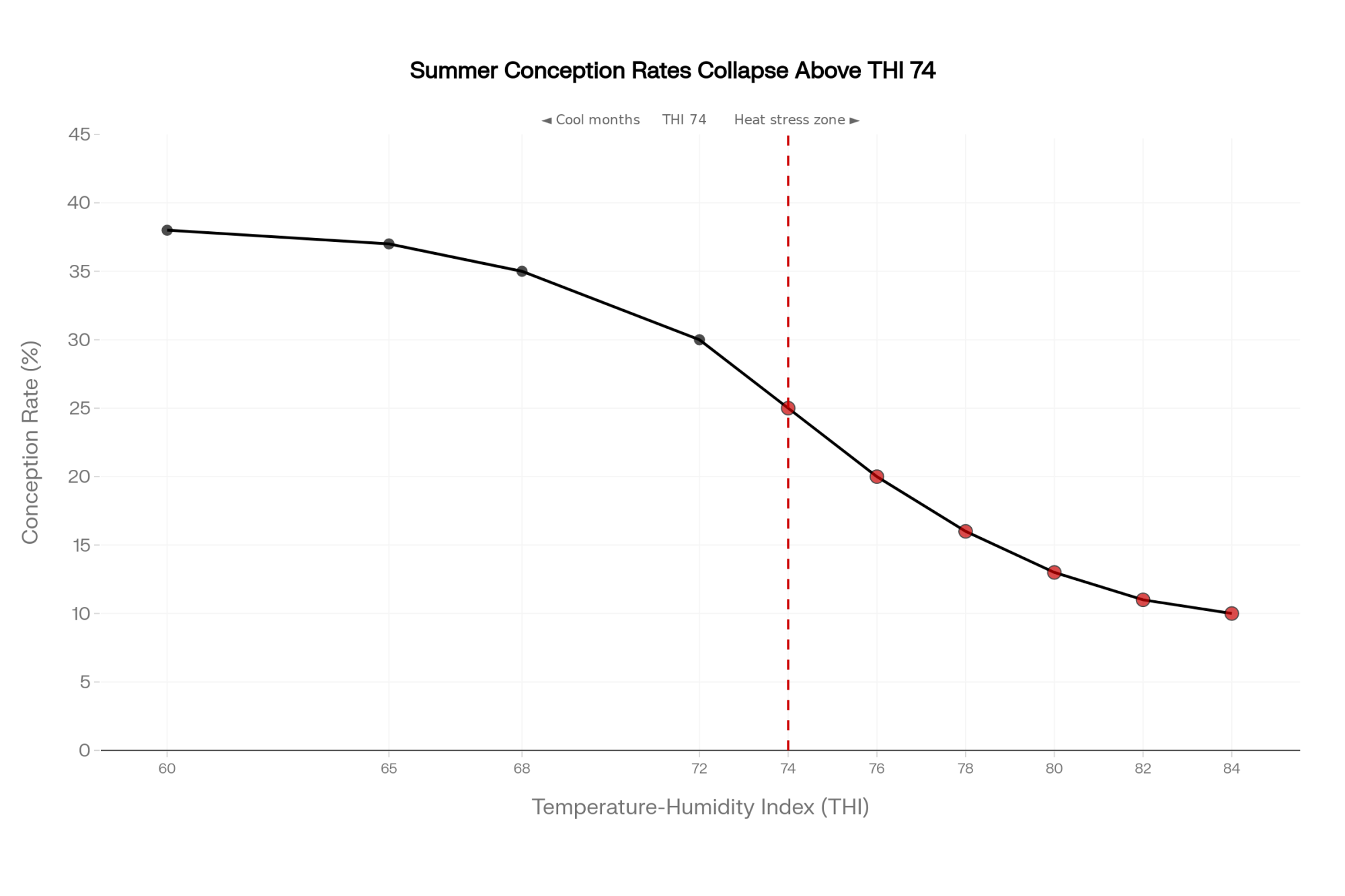
Heat‑stressed breeding seasons are a fertility tax. Peer‑reviewed field work and reviews show summer pregnancy rates routinely dropping from roughly 32–40% in cooler months down to 10–20% in severe heat, depending on region and THI. That’s not just semen baking in a hot AI kit. It’s inflammation, oxidative stress, and early embryos that never stand a chance. If you want to dig deeper into how those THI lines move conception rates, we’ve walked through it before.

The longer invoice comes from the dry pen. Laporta et al. (2020, JDS 103:7555–7568) followed daughters of heat‑stressed dry cows (n=198) against daughters of cooled dry cows (n=196) over 10 years of Florida Holstein data — dams cooled or not cooled during the last 46 days of gestation. A hot, dry cow today is a cull candidate’s mother.

Daughters of heat‑stressed dams:

  • Lost 4.9 months of productive life.
  • Lost 11.7 months of total lifespan.
  • Were culled more often before first calving.

The same paper reported granddaughters of heat‑stressed dams produced 1.3 fewer kg of milk per day in their first lactation than granddaughters of cooled dams. A University of Florida IFAS factsheet estimated that, on a national basis, late‑gestation heat stress in dairy cows costs about $595 million/year once extra heifer‑rearing, reduced longevity, and lost milk yield are added together.

If you’ve ever wondered whether there’s a genetic time bomb hiding in your fresh pen, this is one of the fuses.

You don’t see that bill on your August statement. You see it in a replacement pipeline that’s thinner and more expensive than it should’ve been.

If a gut‑integrity program can take even part of the inflammatory load off those cows — and Cornell’s permeability and inflammation data say it can, at least in mid‑lactation Holsteins — then it belongs in the same planning meeting as shade, soakers, and fan upgrades.

Not Every “Gut Health” Product Is Aimed at the Same Target

Here’s where this gets real in the nutrition office.

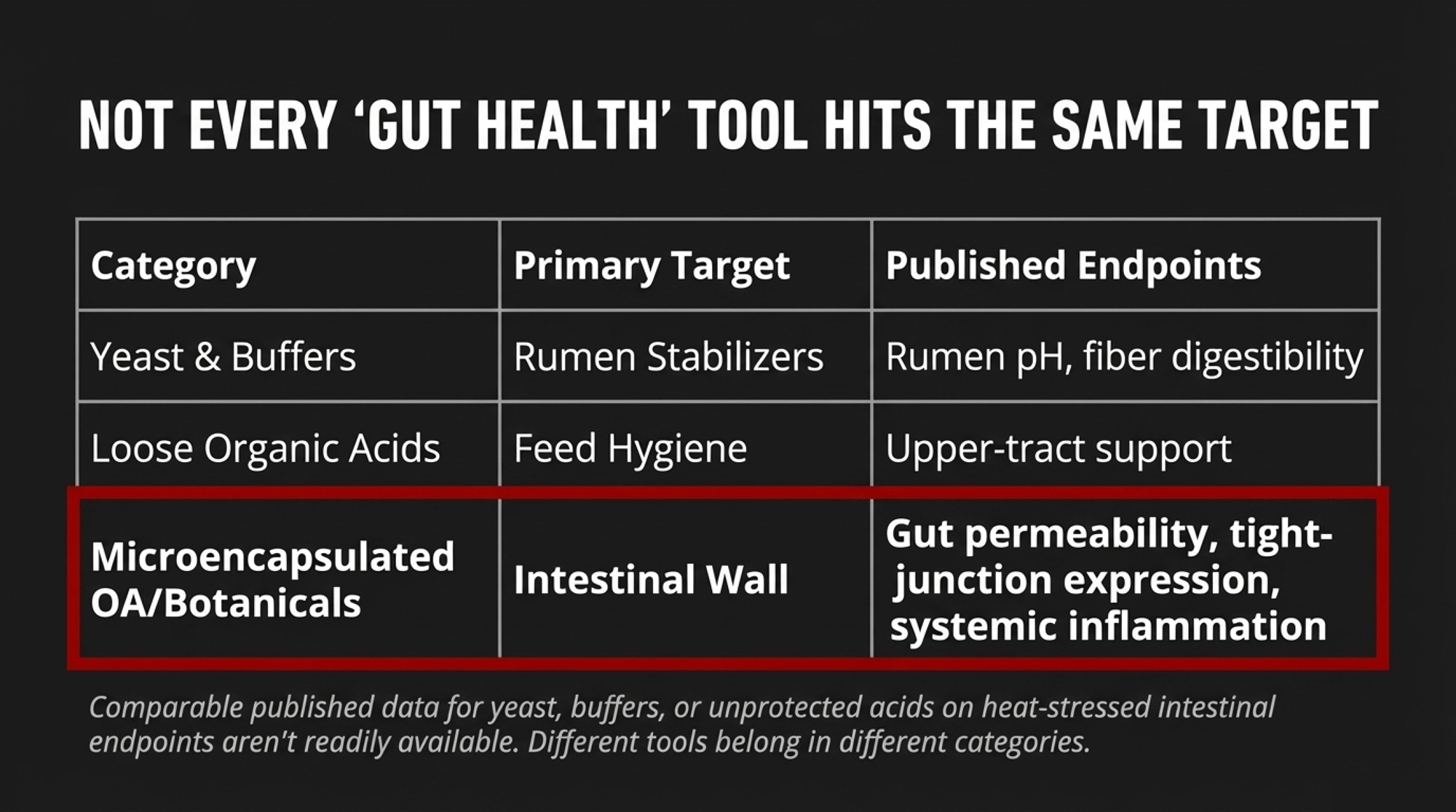
A lot of products sold under the “gut health” banner actually have their best published data in the rumen — pH stabilization, fibre digestibility, and components. That work has value. It’s just a different job than sealing an intestinal wall under heat stress.

The yeast and buffer literature is overwhelmingly rumen‑centric. Many of those companies are careful about what they claim — they market for rumen performance, and that’s what their trials measure. Loose organic acids mostly get fermented or absorbed in the upper tract before they ever see the small intestine.

Right now, the peer‑reviewed trials that specifically measure gut permeability, tight‑junction expression, and systemic inflammatory markers in heat‑stressed lactating Holsteins are centred on microencapsulated OA/PB blends like Cornell’s. Comparable published data for yeast, buffers, or unprotected acids at those exact endpoints aren’t readily available in the literature.

That doesn’t make what you’re already feeding bad. It just means different tools belong in different categories:

Product CategoryPrimary Site of ActionRumen-Bypass EvidenceGut Permeability TrialsHeat-Stress (THI ≥74) DataRecommended Use Window
Yeasts & BuffersRumen✗ Not required✗ Limited/none in peer review✗ Not testedYear-round rumen stabilization
Loose Organic AcidsUpper GI tract✗ Minimal✗ Absorbed upstream✗ Not tested at these endpointsFeed hygiene; silage preservation
Unprotected BotanicalsRumen / upper GI✗ Variable✗ Inconsistent✗ Data gapsTMR palatability; mild microbial control
Microencapsulated OA/PBSmall intestine✅ In vitro lipase-release data✅ Tight-junction & LBP data (Fontoura 2022)✅ Lactating Holsteins, THI 74–82Heat stress windows; high-inflammation periods
General ProbioticsHindgut / rumen✗ Species-dependent✗ Minimal heat-stress data✗ Not consistently testedTransition; post-antibiotic recovery
  • Yeast and buffers → rumen stabilizers.
  • Loose organic acids → feed hygiene and upper‑tract support.
  • Microencapsulated OA/botanicals → intestinal‑wall tools for heat stress and other high‑inflammation windows.

🔍 The “Gut Health” Buyer’s Filter

Before you write the next cheque, run every product through three questions:

1. BYPASS — Is there real rumen‑bypass data showing limited release in rumen fluid and targeted release in the intestine? Not a brochure line — actual in vitro or in vivo work.

2. ENDPOINTS — Do the trials measure gut permeability, tight‑junction proteins, or inflammatory markers under heat stress? Or just milk and DMI under thermoneutral conditions?

3. CONDITIONS — Were the key trials run in lactating Holsteins at THI in the mid‑70s or higher? Or in calves, dry cows, or another species entirely?

If your rep can’t clear all three bars, it doesn’t mean the product is junk — it means it wasn’t designed or tested for this specific job. Your expectations (and your spend) should match what the evidence actually supports.

What Would This Look Like on Your Farm?

Say you’re running 650 Holsteins in a THI‑75+ region and your high pen reliably drops 2.5–3.0 kg/cow/day every summer once night‑time THI stays over 70 for more than a week. Cooling is maxed. You can’t justify more concrete and steel. Here’s one way to put the Cornell data to work instead of just reading about it.

Pick a 240‑cow high pen with solid records and leave a matching pen on the base ration. Layer in a microencapsulated OA/PB product at ~49 g/cow/day, delivered as a top‑dress with the PM feeding to match Cornell’s dose. Start two weeks before THI historically climbs, and run the program for three straight calendar months. Track daily ECM, pen‑level DMI, and pregnancy rate on breedings that happen during the heat window.

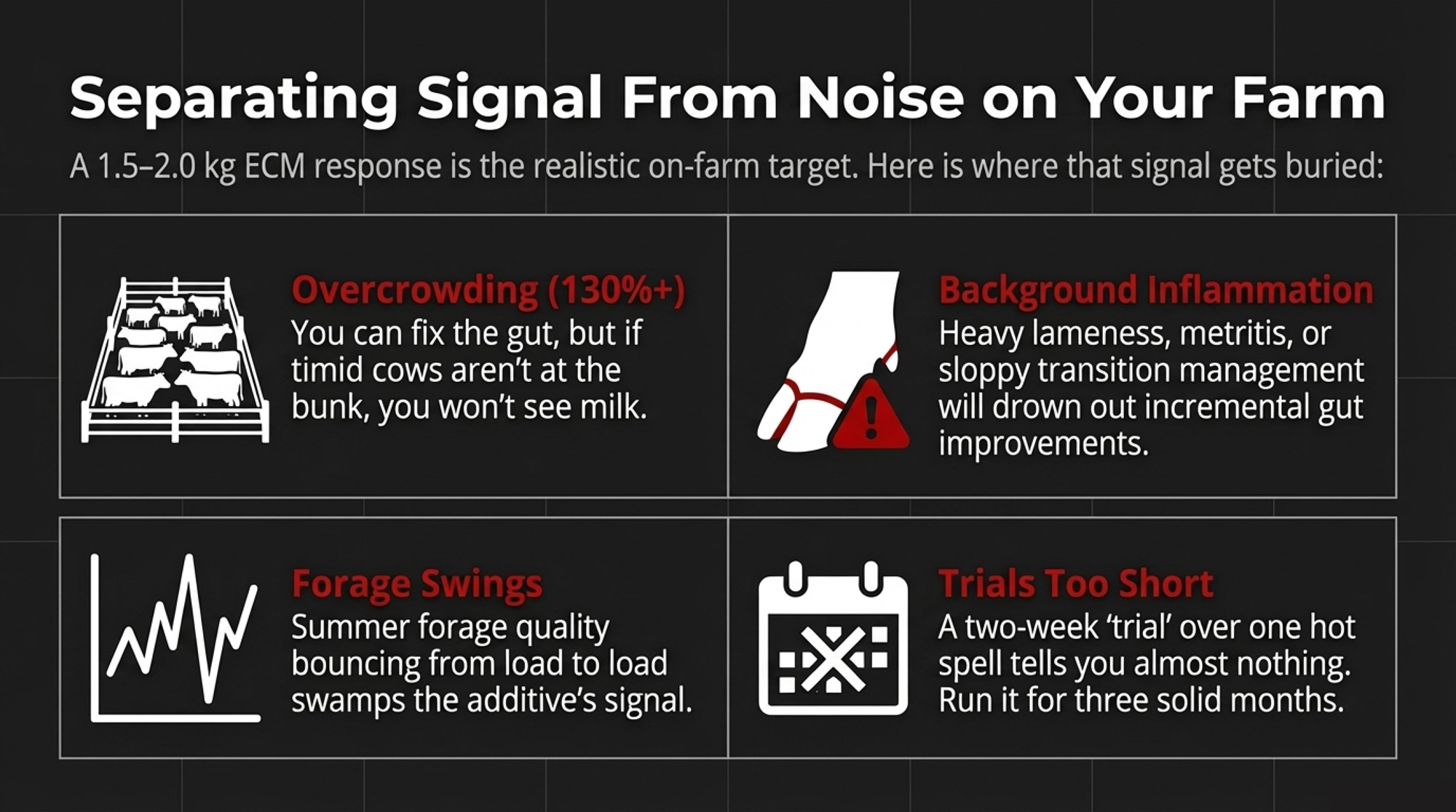
What should you be looking for? By weeks four to six of real heat, you want to see at least 1.5–2.0 kg ECM/cow/day better than your historic pattern, and summer fertility at least holding where it used to tank. If those numbers aren’t showing up at your product cost and your barn conditions, this lever doesn’t earn its spot. A 3 kg response like Cornell’s is a chamber result. On‑farm, 1.5–2.0 kg is a realistic bar to clear.

Every herd’s noise floor is different. This isn’t academic hand‑waving — it’s how you separate signal from marketing.

Where the Signal Gets Buried

Your barn isn’t Cornell. There are four places where a genuine 1–2 kg response can disappear:

  • Overcrowding at 130%+: Timid cows never see the bunk long enough. You can fix their gut, but if they’re not eating, you won’t see milk.
  • Background inflammation: Lameness, mastitis, metritis, or sloppy transition management already soaking the system in cytokines will drown out incremental gut improvements.
  • Forage swings: Summer forage quality bouncing from load to load can swamp any additive’s signal.
  • Trial too short: Cornell measured gut permeability at day 3 and followed cows through the full heat‑stress exposure. A two‑week “trial” over one hot spell tells you almost nothing.

If your numbers look flat, it doesn’t automatically mean the product is snake oil. It might mean your barn’s noise floor is too high to hear the signal.

What This Means for Your Operation

  • If your summer milk curve reliably drops 2–3 kg/cow/day once THI sits in the 70s, and your only tools so far are fans and sprinklers, you’ve got a quantified gut‑wall lever you haven’t tested. Cornell gives you both a dose and endpoints to benchmark against.
  • In the next 30 days, pull your last two summers of weekly bulk-tank or pen‑level milk data and overlay them against local THI. How many kg/cow/day did you actually lose, and for how many weeks? That’s the size of the hole any gut program has to fill on your farm.
  • Sit down with your nutritionist and ask: “Which products in this ration have peer‑reviewed data on gut permeability in heat‑stressed lactating Holsteins?” If the answer is “none,” there’s a gap between the tag’s gut‑health language and what the research has actually measured.
  • Compare your June–August pregnancy rates with January–March for the last two years. If you’re consistently 10–20 points lower in summer, that’s not bad luck. That’s heat‑driven inflammation and oxidative stress showing up in your repro numbers.
  • Walk your dry cow pens when THI is ugly. Laporta’s data — 4.9 months off productive life, 11.7 months off total lifespan, and roughly $595 million/year in multi‑generation losses across the US — deserves to be in the same budget meeting as shade structures and close‑up soakers.
  • When a rep pitches gut health, run their product through the bypass–endpoint–condition filter before you talk price. If the trials don’t deal with gut permeability and inflammation in heat‑stressed Holsteins, it’s not a gut‑wall tool — and shouldn’t be priced like one.

Key Takeaways

  • If THI routinely sits in the 70s and your summer drop is 2–3 kg ECM/cow/day, don’t stop at cooling. Fans fix body temperature. The Cornell work shows gut permeability is a separate problem with its own price tag.
  • At $18.95/cwt, a 2 kg ECM/cow/day recovery on 500 cows over 120 heat‑stress days is worth roughly $50,100 in gross milk value. Your net depends on product cost and the real response on your farm — not on anyone’s slide deck.
  • Products with rumen‑bypass data, gut‑barrier endpoints, and heat‑stress trials in lactating Holsteins are in a different evidence class from general “gut health” additives whose data stop at rumen pH or thermoneutrality in milk. Both can be useful — just not for the same jobs.
  • The consequences of heat stress don’t end when the weather breaks. They walk through your calving interval, your replacement pipeline, and your cull list for years, and the research team behind Laporta’s work has already put a national dollar figure on it.

The Bottom Line

Your bulk tank already knows how much heat stress is costing you. The real question is whether this is the year you keep calling it “just heat” — or the year you finally find out how much of that 3 kg leak is coming through the gut wall.

Complete references and supporting documentation are available upon request by contacting the editorial team at editor@thebullvine.com.

Learn More

The Sunday Read Dairy Professionals Don’t Skip.

Every week, thousands of producers, breeders, and industry insiders open Bullvine Weekly for genetics insights, market shifts, and profit strategies they won’t find anywhere else. One email. Five minutes. Smarter decisions all week.
NewsSubscribe
First
Last
Consent

Montbéliarde vs Holstein: New Study Shows Promise for Dairy Farm Profits

A new study comparing Montbéliarde and Holstein cows reveals surprising insights that could reshape your herd management strategy. From milk production to feed efficiency and overall profitability, find out which breed might give your farm the edge it needs in today’s competitive market.

A new study comparing Montbéliarde and Holstein cows could significantly influence herd management decisions. It examines how these breeds cope during challenging times, providing valuable insights that may improve profits.  (Journal of Dairy Science: Production and metabolic responses of Montbéliarde and Holstein cows during the periparturient period and a sequential feed-restriction challenge)

Study Breakdown 

Researchers monitored 22 Montbéliarde and 18 Holstein cows from a month before calving until about five months after. They observed how the cows handled calving time and feed shortages, trying to determine which breed could keep the milk flowing when times were tough. 

What They Found 

BreedMilk Yield (kg/305 days)Fat (%)Protein (%)
Holstein11,2534.083.32
Montbéliarde × Holstein10,1834.353.65

Milk Production

  • Holsteins pumped out more milk overall.
  • Montbéliardes maintained better body condition compared to Holsteins.

Health Stuff 

  • Early in lactation, Holsteins burn through body fat faster, which could lead to more health problems.
  • Montbéliardes seemed to handle the stress better.

Feed Challenge 

  • Both breeds adapted when feed was cut short, dropping milk production but bouncing back when full feed returned.
  • Holsteins started strong but ran out of steam faster during repeated feed cuts.

Financial Implications 

This is where it gets interesting for your wallet: Let’s talk about Feed Costs: 

  • Montbéliarde × Holstein crossbreds make about 1.6 lbs of milk per pound of feed, while Holsteins make 1.5 lbs.
  • This means crossbreds produce milk for about $0.17/lb and Holsteins for $0.18/lb.

Milk Quality: 

  • Crossbreds typically produce milk with higher fat and protein content, resulting in improved cheese yield and increased milk revenue.

Vet Bills: 

  • Purebred Holsteins can rack up $23 to $75 in health costs in their first lactation.
  • Crossbreds tend to stay healthier and stick around longer, saving on replacement costs.

Bottom Line: 

  • Over a lactation, Montbéliarde × Holstein crossbreds might put an extra $75 in your pocket compared to pure Holsteins.

Where This Research Comes From 

These findings aren’t just from one farm. Studies have been done: 

  • Across the U.S. in big commercial dairies
  • In France, looking at different feeding systems
  • Even in the mountains of Ecuador

They’ve examined how these cows perform in various setups, from farms with 30 cows to operations with hundreds in different climates and with various feeding and milking routines

Implications for Your Farm 

  1. Breed Choice: Holsteins are still milk-making machines, but Montbéliardes might save you headaches with better health.
  2. Feed Smarts: Both breeds can handle feed fluctuations, which is good news if you want to reduce feed costs.
  3. Cow Health: Montbéliarde cows might have an edge in staying healthy, especially right after calving.
  4. Consistent Performers: Your top cows will likely stay at the top, regardless of breed.
  5. Older Cows: Third, lactation and up, cows give more milk but might be slower to breed back.

Potential Impact on the Dairy Industry 

The widespread adoption of crossbreeding by farmers could lead to… 

  1. We might see healthier cows overall, with lower vet bills across the industry.
  2. Milk might have more components, which could be great for cheese makers.
  3. Dairy farms might reduce their environmental impact with more efficient cows.
  4. We could see more variety in dairy genetics, which is good for the industry’s long-term health.

How to Start Crossbreeding (If You’re Interested) 

  1. Start small – maybe breed 10-20% of your herd to Montbéliarde bulls.
  2. Pick bulls that fix what your herd needs help with (like fertility or components).
  3. Use top-notch bulls – don’t skimp on genetics.
  4. Keep good records to see how the crossbreds compare to your purebreds.
  5. Be ready to tweak your feeding and management for the crossbreds.
  6. Make a plan for the long haul – decide how you’ll keep the crossbreeding going.
  7. Talk to other crossbreeding farmers to learn from their experience.

The Bottom Line

This study gives us a lot to chew on. While Holsteins have been the go-to for high production, these Montbéliarde crossbreds show they have what it takes to compete and might even put more money in your pocket. 

Given the challenges in milk production efficiency and cow health, this study provides valuable insights for strategically selecting and caring for our herds in the long run. 

Consider evaluating your herd and financial data to determine the feasibility of implementing crossbreeding strategies based on the study results. Could some crossbreeding boost your bottom line? Chat with your vet or nutritionist about how these findings might work on your farm. Your future herd – and your wallet – might thank you for it. 

Key Takeaways:

  • Montbéliarde crossbreds provide better feed efficiency and can lead to cost savings on feed.
  • Holsteins excel in total milk production but are more prone to health issues early in lactation.
  • Crossbreeds offer higher fat and protein content in milk, benefiting cheese production and increasing milk value.
  • Cow longevity and reduced vet bills could make crossbreeds a financially wise choice.
  • Global studies support the potential benefits of integrating Montbéliarde genetics into dairy operations.

Summary:

The study on Montbéliarde and Holstein cows gives useful info for dairy farmers. Holsteins are great at producing milk, but Montbéliardes stay healthier and keep their weight better during tough times. Crossbreeding these types can lead to milk with better fat and protein, lower vet bills, and more profit. This study, done in different areas, shows Montbéliarde × Holstein crossbreds might improve how herds are managed, cut costs, and be kinder to the environment. If farmers want to try crossbreeding, they should start slow, use good genetics, and be ready to adjust their management. The findings highlight how choosing the right breed is important as the dairy industry changes.

Learn more:

Join the Revolution!

Bullvine Daily is your essential e-zine for staying ahead in the dairy industry. With over 30,000 subscribers, we bring you the week’s top news, helping you manage tasks efficiently. Stay informed about milk production, tech adoption, and more, so you can concentrate on your dairy operations. 

NewsSubscribe
First
Last
Consent

Cracking the Code: Behavioral Traits and Feed Efficiency

Uncover the hidden potential of Holstein cows’ behaviors for enhancing feed efficiency. Are you set to amplify dairy profits by delving into these genetic revelations?

Picture this: every bite your cow takes could boost profits or quietly nibble away at them. Feed efficiency, crucial in dairy farming, accounts for a staggering 54% of total milk production costs in the U.S. as of 2022 (USDA ERS, 2023). Like a car’s fuel efficiency, feed efficiency maximizes milk production per pound of feed, directly impacting profitability. Traditionally measured by Residual Feed Intake (RFI), it requires costly and labor-intensive individual feed intake tracking. But did you know hidden wisdom lies in your Holsteins’ daily routines? Their behaviors—captured through sensors monitoring rumination, downtime, and activity levels—offer incredible insights into feed efficiency, potentially saving resources without the hefty costs. Rumination time indicates efficient feed processing, lying time shows energy conservation, and steps reflect exertion, giving a cost-effective glimpse into feed efficiency.

Exploring Cow Behavior: A New Path to Understanding Productivity 

Let’s dive into the fascinating study that explores the genetic ties between behavioral traits and feed efficiency in lactating Holstein cows. Imagine observing what makes a cow more productive by observing its everyday habits. That’s what researchers aimed to uncover here. They looked at how cows spent their days—ruminating, lying down, and moving about—to see how those activities tied back to how efficiently cows used to feed.  Published in the Journal of Dairy Science:  Genetic relationships between behavioral traits and feed efficiency traits in lactating Holstein cows.

This was no ordinary study. It involved two major research stations, tapping into the knowledge of the University of Wisconsin-Madison and the University of Florida. Researchers gathered a wealth of data at each site using the latest animal monitoring technology. From fancy ear tags to trackers counting each step, they banked on the latest gadgets to give each cow its behavior profile and feed efficiency. The data was then analyzed using statistical methods to identify genetic correlations and potential applications for improving feed efficiency on dairy farms. 

Here’s a big part of what they did: They harnessed thousands of daily records about how many steps cows took, how long they spent ruminating (cow-speak for chewing their cud), and how much downtime they logged lying around. Then, they matched those with how well the cows converted feed into milk. This process helps pinpoint whether genetics have a hand in which cows become efficient producers. By breaking it down to basics like rumination time and activity levels, they hoped to draw links to feed efficiency without the usual heavy lifting of manually tracking each cow’s feed intake. This research can be applied to your farm using similar monitoring technology to track your cows’ behavior and feed efficiency.

Unlocking Feed Efficiency: The Genetic Link Between Cow Behaviors and Productivity

Understanding the intricate genetic connections between behavioral traits and feed efficiency gives us insightful information into dairy cattle production. Specifically, rumination time, lying time, and activity levels play significant roles. Rumination time is strongly correlated with higher dry matter intake (DMI) and residual feed intake (RFI), implying that cows with higher consumption tend to ruminate more and are generally less efficient. Meanwhile, longer lying times show a negative genetic correlation with RFI, suggesting that cows resting more are more efficient overall. 

From a genetic selection perspective, these behavioral traits exhibit varying heritability and repeatability, which are crucial for breeding decisions. Rumination and activity traits have moderate heritability, approximately 0.19, whereas lying time shows a slightly higher heritability, 0.37. These traits are not only genetically transferrable but also display high repeatability across different timeframes, indicating their potential for consistent genetic selection. Lying time stands out with a repeatability estimate ranging up to 0.84 when aggregated weekly, emphasizing its reliability as a selection criterion. 

Predicting feed efficiency using these traits is beneficial as commercially available wearable sensors easily record them. This technology supports the identification and selection of genetically efficient cows. It promotes healthier and more cost-effective dairy farm operations. Transitioning from traditional to sensor-based monitoring systems provides farmers practical tools to enhance herd productivity while leveraging genetic insights for sustained improvement. 

Delving into the Genetic Connections Between Cow Behaviors and Feed Efficiency

When we talk about cow behavior, we’re delving into a treasure trove of insights that can inform us about their efficiency in feed conversion. One standout finding from recent studies is the positive genetic correlation between rumination time and dry matter intake (DMI). In numerical terms, this correlation sits at a robust 0.47 ± 0.17. What does this tell us? Simply put, cows that spend more time ruminating tend to consume more, which might make them seem less efficient in terms of residual feed intake (RFI). Isn’t it fascinating to consider how chewing could unveil so much about a cow’s intake patterns? 

On the other hand, lying time paints a different picture. There’s a negative genetic correlation, with RFI hovering at -0.27 ± 0.11. This genetic wisdom suggests that our bovine friends who enjoy more downtime are more efficient. It makes you wonder: How might a cow’s leisure time hint at its overall efficiency? 

These behavioral gems potentially allow us to streamline farm operations. By monitoring cows’ rumination and lying times through wearable sensors, farmers can gradually identify superstars who convert feed more efficiently without the nitty-gritty of tracking every nibble they take. This saves time and labor and provides a more comprehensive understanding of each cow’s productivity, leading to more informed breeding and management decisions. 

Time to Transform Your Herd: Are We Overlooking the Quiet Achievers? 

Imagine pinpointing which cows in your herd are top producers and efficient eaters. Thanks to advancements in sensor-based data collection technologies, this is now possible! For those contemplating adding a layer of tech to their herd management, sensors can revolutionize how they select and breed Holstein cows. 

First, wearable sensors—like SMARTBOW ear tags used in recent studies—can provide continuous data on cow behavior, such as rumination time, lying time, and activity levels. You can identify genetic patterns that correlate with feed efficiency by understanding these behaviors. This means selecting cows that lie more and walk less, as they are more efficient producers. 

Beyond selection, these sensors offer multiple advantages in everyday management. They can alert you to changes in a cow’s behavior that might indicate health issues, allowing for early intervention. This proactive approach boosts cow welfare and can save significant costs for treating late-diagnosed health problems. 

Additionally, these real-time insights can enhance reproductive management. Sensors help pinpoint the perfect estrus detection, improving the timing of insemination and increasing success rates—every dairy farmer’s dream. With each chosen selection, you’re not just reducing reproductive waste; you’re enhancing the genetic lineage of your herd. 

The benefits of sensor technology extend to data-driven decision-making regarding feed adjustments. With precise intake and behavior data, farmers can tweak diets to match each cow’s nutritional needs, potentially skyrocketing productivity and reducing feed costs—a win-win! 

While the initial investment in wearable technology might seem significant, consider it an asset purchase rather than a liability. These devices pay for themselves through improved herd management, production rates, and more innovative breeding selections. So, ask yourself: Is it time to embrace Tech in your dairy operation? We think the ROI will echo with each moo of approval. 

The Bottom Line

The genetic interplay between behavioral traits like rumination time, lying time, and activity and feed efficiency is an intriguing research topic and a practical opportunity for the dairy industry. As we’ve uncovered, more efficient cows generally spend more time lying down—a simple indication that precision and efficiency can be quietly monitored through actions we might have previously overlooked. 

Behavioral traits are emerging as feasible proxies for assessing feed efficiency. They are already accessible through wearable technology. Behavioral traits offer a promising pathway to optimizing productivity without requiring intensive manual data collection. This presents a significant advancement for dairy farmers aiming to streamline operations and improve herd performance. 

But what does this mean for you? Whether you work directly on a dairy farm or serve the industry in another capacity, consider integrating these insights into your decision-making processes. Invest in the right technologies, monitor the right behaviors, and select cows with these traits to improve your herd’s economic outcomes. 

Don’t just take our word for it—try implementing these strategies and observe the results. We want to hear from you! Share your experiences and thoughts on how these findings could reshape your approach to herd management. Comment below, or start a conversation by sharing this article with your network. If you’re already using these wearable technologies, what changes have you noticed in your herd’s efficiency? 

Key Takeaways:

  • Behavioral traits like rumination time, lying time, and activity are heritable in lactating Holstein cows.
  • Rumination time shows a positive genetic correlation with dry matter intake (DMI) and residual feed intake (RFI), reflecting its potential as a proxy for feed efficiency.
  • more efficient Cows tend to spend more time lying down, which is linked to lower RFI.
  • Highly active cows, as measured by the number of steps per day, often demonstrate less efficiency due to higher energy expenditure.
  • Using wearable sensors can facilitate easy and practical data collection of behavioral traits on commercial farms.
  • Selection of cows based on these behavioral traits can improve feed efficiency without costly individual feed intake measurements.
  • This study highlights the potential of sensor-based behavioral monitoring to enhance dairy cow productivity and management.

Summary:

Welcome to the fascinating world of dairy cow genetics and behavioral traits! Imagine unlocking a new level of feed efficiency in your Holstein herd by understanding milk production or size and how your cows behave—how they rest, eat, and move. This intriguing study reveals that behaviors like lying time and activity are heritable and inversely related to feed efficiency, suggesting that the most relaxed cows might be the most efficient. Feed expenses account for a whopping 54% of U.S. milk production costs, and understanding this can bolster profitability. Researchers using wearable sensors have uncovered genetic links between behavioral traits and feed efficiency, showing cows with higher dry matter intake (DMI) and residual feed intake (RFI) tend to ruminate more, appearing less efficient overall. In contrast, more resting correlates with better efficiency. Predicting feed efficiency through these traits, quickly recorded by sensors, offers practical tools for enhancing productivity and sustaining improvements in dairy operations.

Learn more:

Join the Revolution!

Bullvine Daily is your essential e-zine for staying ahead in the dairy industry. With over 30,000 subscribers, we bring you the week’s top news, helping you manage tasks efficiently. Stay informed about milk production, tech adoption, and more, so you can concentrate on your dairy operations. 

NewsSubscribe
First
Last
Consent

Are You Wasting Money on Yeast Supplements? Discover the Facts for Pregnant Cows and Calf Health

Can yeast supplements for pregnant cows boost calf health? Find out if you’re maximizing your herd’s potential with these surprising discoveries.

Summary:  The study evaluated whether Saccharomyces cerevisiae var. bouldarii CNCM I-1079 (SCB) supplementation in cows during late gestation affects the immune function of their calves. Analyzing factors like IgG concentration, oxidative burst, and phagocytic capacity, the study found no significant differences between the treatment and control groups. Yet, variations in T cell percentages indicated SCB’s potential influence on immune components in gender-specific responses. Female calves showed higher percentages in CD21 and CD32 markers, while B cell functions remained unchanged. These findings call for a deeper understanding of SCB’s role in calf health. Known for its probiotic properties, SCB improves gut health, milk yield, reduces stress, and enhances immunity in dairy cattle. The study involved 80 Holstein cows, with 40 receiving SCB supplementation and 40 as controls. Findings suggest that SCB may alter immune functions that are not fully understood. Dairy producers should consider SCB supplementation as part of a larger strategy to optimize herd health.

  • Research examined the impact of SCB supplementation in cows during late gestation on calf immune function.
  • No significant differences were found in IgG concentration, oxidative burst, and phagocytic capacity between SCB-supplemented and control groups.
  • Variations were observed in T cell percentages, indicating potential gender-specific immune responses influenced by SCB.
  • Female calves exhibited higher percentages in CD21 and CD32 markers compared to male calves.
  • No changes were detected in B cell functions between the two groups.
  • SCB is recognized for enhancing gut health, milk yield, stress reduction, and immunity in dairy cattle.
  • Further research is needed to understand SCB’s role fully in altering immune functions in dairy calves.
  • Dairy producers are encouraged to consider SCB supplementation as part of a broader herd health optimization strategy.
Maternal supplementation, Saccharomyces cerevisiae, dairy cows, calf health, immune function, late gestation, Holstein cows, colostrum replacer, IgG concentrations, oxidative burst, phagocytic capacity, blood mononuclear cells, B cell function, T cell function, dairy farming, probiotics, SCB supplementation, calf immunity, dairy research, calf development

Have you ever wondered whether there is a secret ingredient that might improve the health of your calves straight from birth? Dairy producers prioritize the health and vigor of their newborn calves. Muscular, healthy calves are the foundation of a successful dairy farm, yet obtaining them might seem like solving a complicated problem. One fascinating aspect of this puzzle might be yeast supplements. Recent research has examined the impact of Saccharomyces cerevisiae var. boulardii (SCB), a kind of yeast, on pregnant cows and their calves, yielding encouraging results.

Unlocking the Power of Probiotics

Yeast supplements, mainly Saccharomyces cerevisiae var. boulardii (SCB), have acquired popularity in dairy production. SCB is a yeast strain noted for its probiotic properties, which thrive in the gastrointestinal tracts of both people and animals, providing health benefits. SCB supplementation improves gut health and production in dairy cattle by stabilizing gut flora, improving nutrient absorption, and encouraging efficient digestion.

General Benefits of Yeast Supplements: 

  • Enhanced Immunity: Yeast supplements strengthen the animal’s immune system, making it less vulnerable to illnesses and infections.
  • Increased Milk Yield: Cows may produce more milk with better digestion and nutritional intake.
  • Stress Reduction: Healthy gut flora reduces stress and improves overall metabolic performance, resulting in calmer and more productive animals.
  • Better Nutrient Utilization: Improved digestion ensures that animals get the most out of their meal, potentially lowering total feed expenditures.

In summary, including SCB and other yeast supplements in the diet of dairy calves may result in healthier animals, increased output, and cheaper operating expenses. As many dairy producers have discovered, a slight change in dietary supplements may generate significant rewards.

Bouncing Immunity: How SCB Supplementation Transforms Calf Health 

The research sought to determine the effects of Saccharomyces cerevisiae var. boulardii CNCM I-1079 (SCB) supplementation during late gestation on the immunological function of the children. A total of 80 Holstein cows were split equally into two groups: 40 got SCB supplementation, and 40 acted as controls. Their immune function was then evaluated using various blood samples and immunological parameters.

To guarantee a thorough and fair evaluation, the cows in the research were carefully screened by numerous critical factors before being assigned to study groups. The factors included the preceding 305-day milk output, parity, body condition score, and body weight. By doing so, the researchers hoped to reduce any pre-existing differences that would distort the data, allowing any detected benefits to be ascribed to the SCB supplement.

Once the calves were delivered, their first feeding was closely monitored. Each calf received a colostrum replacer in a liquid volume comparable to 15% of its birth weight across two feedings. This was done to meet the goal of the level of immunoglobulin G (IgG), which is 300 grams. Colostrum is essential for the passive transmission of immunity, and by employing a high-quality replacer, the researchers hoped to standardize the calves’ early-life immunological state, allowing for a more accurate assessment of the maternal SCB supplementation.

Unraveling the Immune Puzzle: Surprising Discoveries in Calf Health 

This research provides a detailed look at the effect of Saccharomyces cerevisiae var. boulardii CNCM I-1079 supplementation during late gestation on offspring immunological function. The findings are fascinating and demand further investigation. There were no significant variations in IgG concentrations, oxidative burst capability, or phagocytic capacity across the therapy groups. This suggests that, on the surface, SCB supplementation does not seem to influence these features of the calves’ immunological response. But don’t be fooled; the narrative becomes more intriguing.

Things began to become attractive in the T cell and B cell activities, which revealed significant disparities. Calves in the control group exhibited a larger proportion of T cells expressing WC 1.1 (34.5% vs. 23.1%) and WC 1.2 (36.3% vs. 21.4%) markers than those in the SCB-supplemented group. Female calves had more significant percentages of CD21 (7.0% vs. 4.3%) and CD32 (8.14% vs. 5.1%) markers in B cells than males.

So, what are the practical implications of these variances for dairy producers like you? The findings show that, although SCB supplementation may not directly improve particular immunological parameters, it may alter other subtle elements of immune function that we do not entirely understand. Consider these discoveries one piece of a much more giant jigsaw. While SCB supplementation may not be a game changer for all immunological measures, it is not without value. As a result, even if you don’t plan to add SCB to your cows’ diet right now, keeping an eye on future studies in this area may help you make better-informed choices.

The Bottom Line

The research on SCB supplementation during late gestation in dairy cows yielded some fascinating results. Although the results did not show significant improvements in immune function metrics such as IgG concentration, oxidative burst capacity, or phagocytic capacity, the higher percentages of specific T cell markers in control calves and the significant differences in B cell marker percentages between female and male calves warrant further investigation. Dairy producers should evaluate the nuanced results of such research. While SCB may not be a game changer in raising calves’ immunity right away, it may have the potential for additional advantages and uses. As usual, ongoing study and adaption of tactics to your farming practices may aid in optimizing herd health.

Learn more: 

Understanding the “Slick Gene”: A Game-Changer for Dairy Farmers

Uncover the transformative impact of the “slick gene” on dairy farming. What advantages does this genetic innovation offer both livestock and their caretakers? Delve into this groundbreaking discovery now.

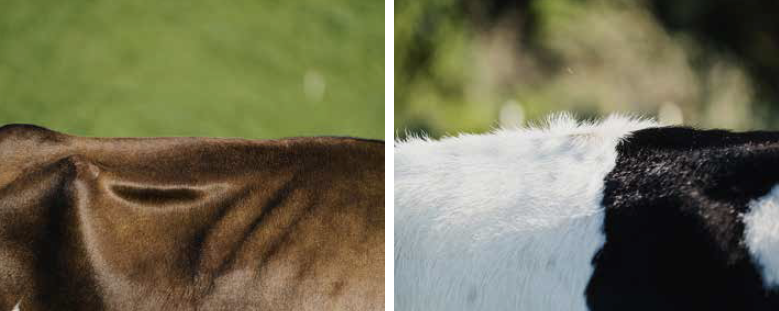
Left: A SLICK coat vs right: a normal non-SLICK coat (Photo:LIC)

Imagine a day when your cows are more tolerant of heat and more productive—game-changing—for any dairy farmer battling climate change. Allow me to present the “slick gene,” a ground-breaking tool destined to revolutionize dairy output. This gene is found in tropical cow breeds and gives greater output even in hot temperatures and more thermal endurance.

Agricultural genetic developments have revolutionized farming by increasing crop and animal yield and stress resistance. Precision alteration of features made possible by CRISPR and gene editing technologies increases agrarian performance. The slick gene could be essential for producing cattle that thrive in higher temperatures, ensuring the dairy industry’s future.

Examining the “slick gene” helps one understand why agriculture has attracted such attention. Knowing its beginnings, biological processes, and uses on farms helps one better understand the direction of dairy farming. This path begins with investigating the function and significance of this gene.

The “Slick Gene”: A Revolutionary Genetic Anomaly

Because of its significant influence on cow physiology and output, the slick gene is a fantastic genetic abnormality that has fascinated geneticists and dairy producers. Shorter, sleeker hair from this gene mutation helps cattle deal better in hot and humid environments and increases their health and milk output.

Initially discovered in the early 1990s, this genetic variant was found in a paper published in the Proceedings of the 5th World Congress on Genetics Applied to Livestock Production (pages 341–343) after primary research by Lars-Erik Holm and associates in 1994. Their efforts prepared one to appreciate the unique qualities of the slick gene.

The slick gene consists of prolactin receptor (PRLR) mutations essential for breastfeeding and thermoregulation. These mutations provide a unique hair phenotype, which helps cattle better control heat, and they are beneficial over the typical genetic features of Bos taurus breeds.

The slick gene is a significant scientific development with practical uses that enhance bovine well-being and milk output, especially in hot environments. It is crucial in selective breeding projects aiming to improve production under demanding circumstances.

The Thermoregulatory Genius: How the “Slick Gene” Redefines Bovine Physiology

Because of their thinner coats, cattle with the “slick gene” have far improved heat dissipating capacity. This thinner covering helps them maintain a lower core body temperature even in great heat by improving ventilation and sweating, lowering heat stress. Furthermore, this adaptation enhances feed intake, milk output, and fertility. These physiological changes provide a whole boost, so slick gene cattle are vital for dairy producers in warmer areas and increase the profitability and sustainability of their enterprises.

Beyond Heat Tolerance: The “Slick Gene” as a Catalyst for Enhanced Dairy Production

Beyond its thermoregulating advantages, the “slick gene” has excellent potential for dairy producers. Agricultural genetics particularly interests milk production, which this genetic characteristic affects. By displaying gains in milk output, quality, and consistency, cattle with the “slick gene” typically help dairy farms to be more profitable.

Evidence indicates, as noted in the Proceedings of the 5th World Congress on Genetics Applied to Livestock Output, that slick-coated cows—especially in warmer climates—maintain constant milk output during heat waves, unlike their non-slick counterparts. Known to lower milk output, heat stress may cause significant financial losses for dairy producers; consequently, this stability is essential.

One clear example is Holstein cows produced with the slick gene. In 2010, Lars-Erik Holm’s World Congress on Genetics Applied to Livestock Production found that these cows produced 15% more milk at the highest temperatures. Furthermore, milk quality was constant with ideal fat and protein content, which emphasizes the gene’s capacity to improve production measures under environmental pressure.

Their performance in unfavorable weather underlines the practical advantages of slick gene carriers for dairy production in warmer climates. Reducing heat stress helps the slick gene provide a more consistent and efficient dairy business. Including the slick gene is a forward-looking, scientifically validated approach for farmers to maximize productivity and quality in the face of climate change.

Navigating the Complex Terrain of Integrating the “Slick Gene” into Dairy Herds 

Including the “slick gene” in dairy cows creates several difficulties. The most important is preserving genetic variety. If one emphasizes too much heat tolerance, other essential features may suffer, resulting in a genetic bottleneck. Herd health, resistance to environmental changes, and illness depend on a varied gene pool.

Ethics also come into play. For the “slick gene,” genetic modification raises questions about animal welfare and the naturalness of such treatments. Critics contend that prioritizing commercial objectives via selective breeding might jeopardize animal welfare. Advocates of ethical farming want a mixed strategy that honors animals while using technological advancement.

One further challenge is opposition from the agricultural community. Concerning long-term consequences and expenses, conventional farmers might be reluctant to introduce these genetically distinct cattle. Their resistance stems from worries about milk quality and constancy of output. Dealing with this resistance calls for good outreach and education stressing the “slick genes” advantages for sustainability and herd performance.

The Future of Dairy Farming: The Transformative Potential of the “Slick Gene” 

The “slick gene” in dairy farming presents game-changing opportunities to transform the sector. Deciphering the genetic and physiological mechanisms underlying this gene’s extraordinary heat tolerance is still a challenge that requires constant study. These investigations are not only for knowledge but also for including this quality in other breeds. Visioning genetically better dairy cattle, researchers are investigating synergies between the “slick gene” and other advantageous traits like increased milk output and disease resistance.

Rising world temperatures and the need for sustainable agriculture generate great acceptance possibilities for the “slick gene.” Hot area dairy producers will probably be early adopters, but the advantages go beyond just heat tolerance. By advancing breeding technology, “slick gene” variations catered to specific surroundings may proliferate. This may result in a more robust dairy sector that minimizes environmental effects and satisfies world dietary demands.

Integration of the “slick gene” might alter accepted methods in dairy production in the future. Improvements in gene-editing technologies like CRISpen will hasten its introduction into current herds, smoothing out the change and saving costs. This genetic development suggests a day when dairy cows will be more resilient, prolific, and climate-adaptive, preserving the business’s sustainability. Combining modern science with conventional agricultural principles, the “slick gene” is a lighthouse of invention that will help to define dairy production for the next generations.

The Bottom Line

Representing a breakthrough in bovine genetics, the “slick gene” gives dairy producers a fresh approach to a significant problem. This paper investigates the unique features of this gene and its strong influence on bovine thermoregulation—which improves dairy production efficiency under high-temperature conditions. Including the “slick gene” in dairy herds is not just a minor enhancement; it’s a radical revolution that will help farmers and their animals economically and practically.

The benefits are comprehensive and convincing, from higher milk output and greater fertility to less heat stress and better general animal health. The value of genetic discoveries like the “slick gene” cannot be over emphasized as the agriculture industry struggles with climate change. These developments combine sustainability with science to produce a more robust and efficient dairy sector.

All dairy farmers and other agricultural sector members depend on maintaining current with genetic advancements. Adopting this technology can boost environmentally friendly food production and keep your business competitive. The “slick gene” represents the transforming potential of agricultural genetic study. Let’s be vigilant and aggressive in implementing ideas that improve farm profitability and animal welfare.

Key Takeaways:

  • Heat Tolerance: Cattle with the “slick gene” exhibit superior thermoregulation, enabling them to withstand higher temperatures while maintaining productivity.
  • Enhanced Dairy Production: Improved heat tolerance leads to increased milk yield and quality, even in challenging climatic conditions.
  • Genetic Integration: Incorporating the “slick gene” into existing dairy herds poses both opportunities and complexities, requiring careful breeding strategies.
  • Future Prospects: The “slick gene” has the potential to revolutionize dairy farming practices, offering a sustainable solution to climate-related challenges.

Summary:

The “slick gene” is a genetic abnormality in tropical cow breeds that enhances productivity and thermal endurance. It consists of prolactin receptor (PRLR) mutations essential for breastfeeding and thermoregulation. The short, sleeker hair of the slick gene helps cattle cope better in hot and humid environments, increasing their health and milk output. The slick gene is crucial in selective breeding projects aiming to improve production under demanding circumstances. Its thinner coats improve heat dissipating capacity, allowing cattle to maintain a lower core body temperature even in great heat. This adaptation also enhances feed intake, milk output, and fertility, making slick gene cattle vital for dairy producers in warmer areas and increasing profitability and sustainability. Holstein cows produced with the slick gene produced 15% more milk at the highest temperatures and maintained constant milk quality with ideal fat and protein content. The future of dairy farming presents game-changing opportunities for the “slick gene,” as researchers are investigating synergies between the gene’s extraordinary heat tolerance and other advantageous traits like increased milk output and disease resistance.

Learn More:

The Perfect Height: Why Your Holstein Cow Shouldn’t Exceed 60 Inches for Optimal Dairy Production

Why keeping your Holstein cows under 60 inches tall boosts dairy production. Are you optimizing your herd’s conformation for maximum yield?

Years of prioritizing size and height have shown that the Holstein breed may have gotten too tall. In cow breeding, the prevalent thinking was “bigger is better.” Recent studies and statistics, however, show otherwise. While those above 60 inches need 10% more feed, Holstein cows under 60 inches have shown a 15% increase in milk production efficiency. Cows under 60 inches have a 25% longer longevity. Knowing the repercussions of height impacts various aspects of dairy production, including feed economy, barn space efficiency, and, most significantly, the health and longevity of the cow. By focusing on maintaining Holstein cows at or below 60 inches, small dairy farms may achieve various benefits that immediately enhance milk production and reduce veterinary costs.

The Balancing Act: Navigating the Trade-Offs of Breeding Taller Holstein Cows 

Over the previous several decades, Holstein cow height has significantly increased due to selective breeding procedures to increase milk production and overall size. Although inherited factors are essential, other variables such as improved nutrition and more effective management tactics have also contributed. However, breeding taller Holsteins has significant trade-offs. Taller cows are more susceptible to various health issues, even if they reach maturity earlier and have better feed consumption and milk production. Shorter Holstein cows have a 20% lower incidence of metabolic disorders. Holstein cows over 60 inches had a higher incidence of lameness and 30% more calving issues. Smaller height Holsteins also have greater production efficiencies; cows under 60 inches had a 15% gain in milk production efficiency, a 12% higher conception rate, and a 25% longer lifespan. Breeders may achieve a balanced approach that benefits the herd’s health and longevity by prioritizing other factors, such as the mammary system and overall production oversize and stature. This all-around attentiveness improves animal welfare and boosts the dairy farm’s long-term profits.

Boosting Cost-Effectiveness on Small Dairy Farms with Holstein Cows Under 60 Inches 

Dairy farmers might save money by maintaining a herd of Holstein cows under 60 inches. Improved feed efficiency is an apparent economic gain. Holstein cows above 60 inches use 10% more feed. Conversely, more tiny cows produce more milk while consuming less grain, cutting feed costs without compromising production. This efficiency is beneficial because feed accounts for many dairy farms’ operating budgets.

Because shorter Holstein cows need less living area, barn building and maintenance costs are lower. Changing the proportions of stalls, feeding spaces, and milking parlors may help maximize resource use and decrease overhead costs. More miniature cows are also more straightforward to handle in restricted quarters, reducing stress and damage and lowering costs associated with cow welfare standards.

A herd of the appropriate height might help reduce the expense of veterinary care. Joint tension and lameness cause fewer health problems for little cows than for large cows. This saves on veterinarian visits, treatments, and drugs, allowing the herd to stay healthy and productive without incurring significant healthcare costs.

The Importance of Balancing Height with Overall Conformation in Holstein Breeding 

Holstein cows, known for their high milk yield, must meet rigorous confirmation standards to function well. One of the most important of these regulations is staying under 60 inches in height. This height increases the physical sustainability required for effective dairy operations and improves manageability inside barn structures. Reaching this height while retaining other essential characteristics such as udder quality, body capacity, and limb form requires effort.

Begin with bulls from lines that produce well-proportioned progeny; the sires listed below excel in high production while having relatively low stature. This genetic selection may significantly improve your chances of reaching your optimal height. Examining the maternal line may also assist in determining if female relatives have solid features and are within the ideal height range.

Naab CodeNameA2A2TIPNet MeritPTA MilkPTA TypeSTA
551HO05486Darth VaderA2A23342148224581.29-0.75
551HO04119CaptainA2A23287137523601.18-0.72
551HO04412JackA2A23287137523601.18-0.72
551HO04413JohnA2A23287137523601.18-0.72
551HO04958EllisonA2A23276132122951.560.37
250HO16741Hardin 3276126316612.110.54
007HO16735Karl Marx 3272127715351.640.84
551HO05246EnduranceA2A23267140916130.3-0.64
007HO17142StaggerA2A23259128918101.250.63
200HO13061Moodtime 3259122718172.280.79

The Financial Upside: Why Shorter Holstein Cows are a Smart Investment for Small Dairy Farms 

The economic implications of maintaining an optimal cow height are substantial, particularly for small dairy farm owners who must keep a keen eye on operational costs. Holsteins that do not exceed 60 inches can significantly reduce expenditures in several key areas, most notably feed, veterinary care, and housing requirements. 

Firstly, the feed cost savings are non-trivial. A smaller cow generally requires less feed due to lower maintenance energy needs. For instance, a standard Holstein cow, averaging around 1,500 pounds, might consume approximately 50 pounds of feed daily, costing around $5 at a rate of $0.10 per pound. On the other hand, a Holstein that is bred to be no more than 60 inches tall might weigh closer to 1,200 pounds and consume around 40 pounds of feed daily, costing $4. This $1 daily savings can accumulate quickly over a year: 

  • Standard Holstein: $5/day x 365 days = $1,825/year
  • Under 60 inches: $4/day x 365 days = $1,460/year
  • Annual Savings per Cow: $365

When maintaining even a modest herd of 50 cows, the annual feed savings alone can total $18,250

Moreover, shorter cows tend to have fewer health issues and require less intensive veterinary care. Taller cows often experience more stress on their joints and greater susceptibility to certain infections, translating to higher veterinary costs. For illustrative purposes, suppose the average annual veterinary expense for a standard-sized Holstein is around $300, whereas for a shorter cow, it might be approximately $250. With 50 cows, this can lead to significant savings: 

  • Standard Holstein: $300/year x 50 cows = $15,000/year
  • Under 60 inches: $250/year x 50 cows = $12,500/year
  • Annual Veterinary Savings: $2,500

Housing costs also benefit from smaller cows. Smaller animals require less space, leading to savings in building materials and maintenance expenses for barns and housing facilities. If the cost per housing unit for a standard cow is around $1,000 per year (including maintenance, bedding, etc.), whereas for a smaller cow, it might be $800, the annual savings can be computed as follows: 

  • Standard Holstein: $1,000/year x 50 cows = $50,000/year
  • Under 60 inches: $800/year x 50 cows = $40,000/year
  • Annual Housing Savings: $10,000

By optimizing cow height and integrating these savings across feed, veterinary care, and housing, a small dairy farm with 50 cows could potentially save as much as $30,750 annually. These savings underscore the economic importance of strategic breeding for optimal cow height.

Monitoring and Managing Holstein Height for Optimal Conformation 

Small dairy producers who value conformity must be able to manage the height of their Holstein cows efficiently. These valuable approaches might assist you in keeping your herd within the appropriate height range.

  1. Accurate record-keeping: Accurate record-keeping is fundamental to effective herd management. Keep accurate records of each cow’s height measurements from birth and at crucial development stages. Frequent updates to this data will assist in identifying patterns and providing a foundation for educated choices.
  2. Use Genomic Testing: Genomic testing may provide crucial information on potential offspring height. Testing for specific height markers allows you to make more educated breeding decisions. Businesses that provide such testing may examine DNA samples to predict future growth, allowing you to limit height proactively.
  3. Choose Bulls Carefully: When breeding, it is critical to choose the correct bulls. Examine the genetic histories of possible bulls and choose those with a track record of generating progeny in the desired range. Bloodlines with firm genetic profiles, such as Hanoverhill Starbuck and Carlin-M Ivanhoe Bell, may help to maintain adequate height. Examine pedigree data and, ideally, interact with bulls whose offspring regularly demonstrate balanced development patterns. Choosing the right bull for breeding is quite important. Examine the genetic histories of potential bulls and choose those with a history of producing target height range offspring.
  4. Customize Feed and Nutrition Plans: A healthy diet based on growth requirements may influence overall development, including height. Work with a livestock nutritionist to create a feeding plan that promotes regulated development while eliminating unwanted height increases caused by poor nutritional choices.

Combining these strategies allows dairy farm owners to maintain appropriate cow height, boosting overall farm efficiency and herd well-being. Proactive cow height monitoring and management highlight the importance of conformation in optimal dairy production.

The Bottom Line

Keeping Holstein cows at no greater than 60 inches has shown beneficial for several dairy farm management and production elements. The advantages include increased animal welfare, cost-effectiveness, and more efficient use of agricultural resources. By stressing height and overall conformation features, dairy producers may build a herd that thrives and contributes considerably to the farm’s prosperity. We advise dairy producers to carefully assess their existing breeding procedures and consider the benefits of raising Holstein cows of the appropriate height. This strategy may result in more sustainable and productive agricultural operations.

Call to Action: Reassess your breeding strategies to improve your dairy herd’s performance. Adjust to ensure your Holstein cows meet the ideal height and conformation standards.

Key Takeaways:

  • The height of Holstein cows is crucial for sustainability and efficiency in dairy farming.
  • Holsteins’s maximum height of 60 inches ensures improved manageability and reduced costs.
  • Holsteins under 60 inches show a 15% increase in milk production efficiency.
  • Smaller Holsteins have a 25% longer lifespan compared to taller cows.
  • Emphasis on the mammary system and overall production over size enhances milk yield.
  • Keeping Holsteins under 60 inches reduces feed and barn maintenance costs.
  • Small-sized Holsteins lead to lower veterinary expenses.

Summary: 

The height of Holstein cows plays a crucial role in ensuring sustainability and efficiency in dairy farming. Aiming for a maximum height of 60 inches offers improved manageability, reduced costs, and enhanced conformation. Balancing height with other traits optimizes productivity, health, and financial returns, especially for small dairy farms. Holsteins under 60 inches exhibit a 15% increase in milk production efficiency and a 25% longer lifespan, underscoring the trade-offs of breeding taller cows, including feed economy, barn space efficiency, and health. Prioritizing the mammary system and overall production oversize can enhance milk yield and lower veterinary costs. Keeping a herd of Holsteins under 60 inches saves on feed and barn maintenance while reducing veterinary expenses.

Learn more: 

Jersey vs. Holstein: Which Dairy Breed Delivers Greater Profitability for Farmers?

Find out whether Jersey or Holstein cows are more profitable for farmers. Learn about differences in milk production, feed efficiency, and costs to help make a smart decision.

Have you ever wondered why specific dairy farms succeed while others fail? The breed of cow you pick greatly influences your farm’s profitability. This article delves into the profitability of Jersey and Holstein cows, equipping you with the knowledge to make informed investment choices. Understanding milk output, feed efficiency, and total expenses is crucial in choosing the breed that will benefit your bottom line. With rising feed prices and growing environmental concerns, selecting the correct cow breed is more important than ever. Join us as we compare Jersey and Holstein cows regarding milk output and income, feed efficiency and cost, environmental sustainability, and breed transition. By the end, you’ll understand the factors influencing dairy farm profitability and know which breed generates the most profits. 

Holsteins: Pioneers of Dairy Profitability Through Superior Milk and Component Production 

BreedAnnual Milk Production (lbs)Component Production (lbs)Annual Revenue ($)
Holstein25,0001,5004560
Jersey18,0001,2004104

The economic advantage of Holsteins stems from their more excellent milk and component output. Holsteins reduce fixed costs by producing more milk and critical components such as fat and protein, increasing overall income. Their large component output, around 810 extra pounds annually, generates a substantial financial boost, resulting in approximately $456 more per cow yearly than Jerseys. This significant difference makes Holsteins the favored option in commercial dairy businesses that want to maximize milk supply and component volume for economic success.

Maximizing Revenue through Higher Milk and Component Output

Holsteins’ increased milk output per cow contributes significantly to their profitability by lowering fixed production costs. Holsteins may spread out expenditures such as housing, labor, and equipment usage by generating more significant quantities of milk and milk components across a lactation period, which do not vary much with the amount of milk produced. This cost dilution implies that the per-unit cost of milk production falls as output rises, allowing for more significant margins and overall income. As a result, the higher yield per cow covers fixed expenditures more effectively and increases total profitability, providing Holsteins a considerable economic edge over other breeds.

Bridging the Profitability Gap: Enhancing Jersey Milk Production for Competitive Advantage

Although Holsteins now have a significant economic advantage, Jerseys have the potential to close the gap via focused improvements in their milk production capacity. Increasing Jerseys’ daily milk supply from 60 to 70 pounds while retaining high component concentrations is a possible technique for bringing their profitability in line with that of Holsteins. Furthermore, Jerseys’ inherent efficiency as feed converters—producing 1.75 pounds of energy-corrected milk per pound of dry matter—shows that they may increase milk production without raising feed expenditures. With an emphasis on selective breeding and optimum nutrition, Jerseys have the potential to meet, if not exceed, Holstein earnings.

Comparative Feed Efficiency: The Subtle Edge of Jerseys in Dairy Sustainability

BreedFeed Efficiency (lbs of Energy-Corrected Milk per lb of Dry Matter Consumed)Feed Cost per lb of Fat ($)
Jersey1.751.82
Holstein1.671.97

When comparing feed efficiency between Jersey and Holstein cows, it is clear that Jerseys have a slight edge. Jersey cows produce around 1.75 pounds of energy-corrected milk per pound of dry matter ingested, whereas Holsteins produce roughly 1.67 pounds. Energy-corrected milk is a measure that accounts for the energy content of the milk, providing a more accurate comparison of feed efficiency. This marginal efficiency advantage means that Jersey cows produce more milk from the same amount of feed. As a result, although producing less milk in total volume, Jersey’s greater feed conversion rate may significantly improve cost-effectiveness and overall sustainability in dairy operations.

Economic Edge: Leveraging Lower Feed Costs of Jerseys for Enhanced Dairy Profitability 

Since feed costs account for a considerable amount of overall dairy production expenses, Jerseys’ reduced feed cost per pound of fat is a significant benefit. Jerseys had a feed cost of $1.82 per pound of fat against $1.97 for Holsteins. Although this difference may look tiny, it adds up over time, resulting in significant savings. For farms producing substantial milk, cumulative feed cost savings might result in considerable financial gains. This reduced feed cost boosts profitability per cow. It improves total herd profitability, establishing Jersey cows as a cost-effective alternative for dairy producers looking to reduce expenditures without losing output.

Environmental Efficiency and Sustainability: The Jersey Advantage

Resource UtilizationJerseyHolstein
Water Usage32% lessStandard
Land Usage11% lessStandard
Fossil Fuel Consumption21% lessStandard
Greenhouse Gas EmissionsLowerHigher

Incorporating Jerseys into dairy production may have tremendous environmental advantages. The dairy industry is increasingly focusing on resource management and reducing environmental impact. According to research, Jerseys use 32% less water, 11% less land, and 21% less fossil fuels to achieve the same output as Holsteins. This efficiency leads to a lesser environmental imprint. Furthermore, Jerseys emit fewer greenhouse gasses per unit of milk, making them suitable for farmers who prioritize sustainability. According to studies, it would take 109 Jersey cows to produce the same amount of cheese as 100 Holstein cows, but with 80% less greenhouse gas emissions and fewer resource needs. This trend in the dairy industry provides a strategic advantage for profitability and sustainability.

Efficiency-Driven Dairy Farming: The Role of Jersey-Hybrids in Modern Operations 

Modern dairies increasingly concentrate on improving efficiency and feed conversion to increase profitability. This tendency influences breed selection since efficient feed-to-milk conversion lowers operating costs and improves sustainability. Jerseys, for example, excel in feed conversion, producing 1.75 pounds of energy-corrected milk per pound of dry matter, compared to Holsteins’ 1.67 pounds. This advantage enables better returns on feed investments, making Jerseys an attractive alternative when feed prices increase.

Furthermore, the emphasis on efficiency has sparked interest in crossbreeding projects combining the qualities of both breeds. Crossbreeding Holsteins with Jerseys allows you to combine Holsteins’ high milk volume with Jerseys’ remarkable feed efficiency and environmental advantages. However, it’s important to note that crossbreeding projects also come with challenges, such as the need for careful genetic selection and management. Dairy producers increasingly utilize genetic data and performance measures to identify the most productive and sustainable breed combinations.

As the dairy business shifts toward leaner production practices, breed selection becomes more critical. Producers will use data-driven insights and genetic improvements to choose breeds that optimize milk yield while maintaining excellent feed conversion rates and a reduced environmental impact, satisfying profitability and sustainability objectives.

Strategic Breed Selection: Data-Driven Decisions for a Sustainable Future

Transitioning from Holsteins to Jerseys may be attractive owing to environmental advantages and improved feed efficiency. However, the situation is more complicated. Dairy farms contain infrastructure such as milking parlors and accessible stalls mainly intended for Holstein cattle. Retrofitting existing facilities to accommodate more miniature Jersey cows might be expensive, hurting profitability during the shift.

Holsteins produce more milk and components, making greater use of fixed expenditures like land, labor, and infrastructure. Each Holstein cow makes more money than a Jersey cow in the same area, resulting in increased profitability under the current structure. While Jerseys have their advantages, the economic consequences of switching breeds must be carefully considered.

Optimizing Fixed Costs: Holsteins’ Superiority in Facility Utilization Enhances Dairy Profitability

Holstein cows considerably improve dairy farm economics by increasing milk and component yields, resulting in more excellent cash per cow. By producing more milk, Holsteins distribute fixed production expenditures such as housing, milking equipment, and upkeep across a broader output. This reduces overhead costs per milk unit, increasing total profitability without further infrastructure expenditures. In facilities constructed for Holsteins, these cows maintain an economic advantage, making the switch to Jerseys less economically viable owing to decreased income per stall.

The Bottom Line

The decision between Jersey and Holstein cows is crucial to dairy production success. This comparison demonstrates Holsteins’ present income advantage owing to increased milk output and component yields. Jerseys, noted for their feed efficiency and sustainability, have a significant potential to close the profitability gap via focused productivity increases. Farmers should assess these elements against their individual requirements and operational setups. Ultimately, deliberate breed selection may result in increased profitability and environmental efficiency. Consider your conditions and make educated decisions to maximize the profitability of your dairy farm.

Key Takeaways:

  • Holstein cows generate approximately $456 more profit per cow annually compared to Jersey cows.
  • Holsteins achieve higher profitability primarily due to producing an additional 810 pounds of components per year.
  • Jersey cows demonstrate superior feed efficiency, converting 1.75 pounds of energy-corrected milk per pound of dry matter consumed compared to Holsteins’ 1.67 pounds.
  • The feed cost per pound of fat is lower for Jerseys at $1.82, versus $1.97 for Holsteins, contributing to their cost-effectiveness.
  • Jerseys are more environmentally sustainable, requiring less body mass, reducing greenhouse gas emissions, and needing less water and land for equal cheese production.
  • Transitioning facilities from Holstein to Jersey cows is generally not cost-effective due to infrastructure and fixed cost considerations designed for Holsteins.
  • Targeted productivity improvements in Jerseys can potentially bridge the profitability gap with Holsteins, making them equally viable for dairy operations.

Summary:

The article compares the profitability of Jersey and Holstein cows, focusing on milk output, feed efficiency, and total expenses. Holsteins have a significant economic advantage due to their superior milk and component output, reducing fixed costs and resulting in a $456 per cow yearly increase. Jerseys can bridge this gap by improving milk production capacity and efficiency as feed converters, producing 1.75 pounds of energy-corrected milk per pound of dry matter. They also have a slight edge in dairy sustainability, producing around 1.75 pounds of energy-corrected milk per pound of dry matter ingested. The Jersey breed also offers significant environmental advantages, using 32% less water, 11% less land, and 21% less fossil fuels to achieve the same output, making them suitable for farmers focusing on sustainability.

Learn more:

Reducing Johne’s Disease in US Holsteins: New Genetic Insights for Dairy Farmers

Explore how cutting-edge genetic research offers US dairy farmers a powerful tool against Johne’s disease in Holsteins. Could integrating national genetic evaluations be the breakthrough for healthier herds?

Imagine a quiet but terrible illness destroying a part of your dairy herd. Through lower milk production, veterinary expenses, and early culling, Johne’s disease (JD) is an infectious intestinal illness generating major health problems and financial losses. JD is a slow-burning catastrophe in the dairy sector, and affects farm profitability and herd health. Understanding the genetic causes of US Holsteins is not just important, it’s crucial. These discoveries, made possible by genetic research, empower farmers to choose JD-resistant features, enhancing sustainability and herd health. The role of genetic research in combating JD is significant, giving farmers the tools they need to take control of their herd’s health. Including JD resistance into national genetic campaigns helps to lower the prevalence of the illness, therefore safeguarding agricultural economy and animal welfare. This fresh research, which emphasizes the role of genetic research in combating JD, shows important genetic tendencies and provides useful advice that may completely change dairy farming methods, therefore empowering fresh waves of industry innovation and development.

Combatting Johne’s Disease: Strategies and Genomic Innovations for Dairy Farmers 

Mycobacterium avium subspecies paratuberculosis (MAP) causes the chronic bacterial illness known as Johne’s disease (JD) in dairy calves. It causes weight loss, ongoing diarrhea, lower milk output, and, finally, death. Although infection affects calves, dairy producers find it difficult because symptoms do not show until maturity.

JD affects the dairy sector with lower milk output, early culling, more veterinarian expenses, and even reputation loss. The illness may remain latent in herds for years because of a protracted incubation period during which infected cows disseminate MAP via feces, milk, and in-utero transmission.

Controlling JD typically involves:

  • Improving farm hygiene.
  • Managing calf-rearing practices.
  • Testing and culling positive animals.
  • Maintaining strict biosecurity.

These techniques have their limits. Intermittent MAP shedding means diagnostic tests often miss infections, and culling can be financially challenging, significantly if many cows are affected. 

Consider a mid-sized dairy farm in Wisconsin with 500 Holstein cows and a 5% prevalence rate of Johne’s disease. This translates to about 25 cows needing culling, each representing a financial loss of $1,500 to $2,000. Thus, the farm could initially hit $37,500 to $50,000, not including reduced milk production or veterinary costs. 

Frequent testing adds logistical hurdles and expenses. At $30 per sample, biannual testing of the entire herd could cost $30,000 annually. There’s also operational disruption from segregating infected animals, increased labor for handling and testing, and the need for continuous monitoring due to intermittent MAP shedding. 

For larger herds or multiple farms, these economic and logistical burdens grow even more. While genetic selection and advanced management practices promise long-term control of Johne’s disease, successful implementation must carefully balance costs, herd health, and farm sustainability.

Management strategies alone cannot eliminate JD. Still, its economic influence and frequency need more robust answers. Over time, a nationwide genetic examination for JD susceptibility, selective breeding of resistant cattle, and current management strategies might considerably lower Johne’s disease in dairy herds. This method emphasizes the need for genetic assessments in enhancing herd health and sustainability and presents a possible answer to a current issue.

Digging Deep: How Genetic and Phenotypic Data Can Unveil Johne’s Disease Susceptibility in US Holsteins 

Only one positive ELISA result from the first five parties was needed to classify a cow as JD-positive. This isn’t random; JD often appears in adult cows, so focusing on these early lactations captures the crucial infection period. This method ensures accuracy in detecting JD, laying a solid foundation for a reliable genetic evaluation. 

The first five lactations align with peak milk production periods, improving the precision of genetic parameter estimates. Using multiple parities ensures a comprehensive dataset, reducing the chance of false negatives. This thorough approach highlights the study’s dedication to accurately assessing JD susceptibility.

This method guarantees correct identification of sick animals and offers consistent information for genetic analyses.

To study the genetic basis of JD susceptibility, three models were used: 

  • Pedigree-Only Threshold Model (THR): This model utilizes pedigree data to estimate variance and heritability, capturing familial relationships’ contributions to JD susceptibility.
  • Single-Step Threshold Model (ssTHR): This model combines genotypic and phenotypic data, offering a precise estimate of genetic parameters by merging pedigree data with SNP markers.
  • Single-Step Linear Model (ssLR): This model uses a linear framework to combine genotypic and phenotypic data, providing an alternative perspective on heritability and genetic variance.

Unlocking Genetic Insights: Key Findings on Johne’s Disease Susceptibility in US Holsteins

The research results provide critical new perspectives on Johne’s disease (JD) sensitivity in US Holsteins, stressing hereditary factors and dependability measures that would help dairy producers address JD. Using threshold models, heritability estimates fell between 0.11 and 0.16; using a linear model, they fell between 0.05 and 0.09. This indicates some hereditary effects; however, environmental elements are also essential.

The reliability of estimated breeding values (EBVs) for JD susceptibility varied somewhat depending on techniques and models. The reliability of the IDEXX Paratuberculosis Screening Ab Test (IDX) ran from 0.18 to 0.22, and that of the Parachek 2 (PCK) protocol ran from 0.14 to 0.18. Though small, these principles are an essential initial step toward creating genetic assessments for JD resistance.

Even without direct genetic selection against JD sensitivity, the analysis revealed significant unfavorable genetic tendencies in this trait. Targeted breeding techniques allow one to maximize this inherent resilience. Including JD susceptibility in genetic assessments could help dairy producers lower JD incidence, lower economic losses, and enhance herd health.

The Game-Changer: Integrating Genetic Insights into Dairy Farming Practices 

Using these genetic discoveries in dairy farming seems to have a transforming power. Including Johne’s disease (JD) susceptibility into national genetic screening systems helps dairy producers make more educated breeding choices. Choosing cattle less prone to JD will progressively lessen its prevalence in herds, producing better cows and reducing economic losses.

Moreover, a nationwide genetic assessment system with JD susceptibility measures would provide consistent information to support thorough herd management plans. Farmers may improve herd resilience by concentrating on genetic features that support disease resistance, lowering JD frequency and related costs such as veterinary fees and lower milk output.

In the long term, these genetic developments will produce a better national Holstein population. The dairy business will become more efficient and profitable as more farmers embrace genetic assessment programs, which help lower the overall incidence of JD. Better animal welfare resulting from healthier cattle will increasingly influence consumer decisions and laws. 

These genetic discoveries provide a road forward for raising national dairy farming’s health and production standards and individual herd development. Including JD susceptibility into breeding techniques helps farmers safeguard their assets and guarantee a more lucrative and environmentally friendly future.

The Bottom Line

The analysis of Johne’s disease (JD) in US Holsteins emphasizes the use of genetic data to enhance herd health. By means of extensive datasets, insightful analysis, and stressing the relevance of this study in dairy farming, researchers have revealed vital new insights on JD susceptibility, which are, therefore, guiding breeding plans.

Recent research can benefit dairy farmers aiming to tackle Johne’s Disease (JD) in their herds. Using genetic insights and modern testing protocols, farmers can take steps to reduce this costly disease. 

Critical Steps for Dairy Farmers:

  • Regular Testing: Kits like the IDEXX Paratuberculosis Screening Ab Test (IDX) and Parachek 2 (PCK) screen milk samples from the first five parties.
  • Genetic Analysis: To gauge JD susceptibility, utilize SNP markers and models like pedigree-only threshold models or single-step models.
  • Selective Breeding: Incorporate JD susceptibility evaluation into your breeding programs to gradually reduce disease incidence.
  • Monitor Trends: Keep an eye on genetic trends in your herd and adjust breeding strategies accordingly.
  • Collaborate with Experts: Consult with geneticists and vets to understand JD’s genetic correlations with other important traits.

By adopting these strategies, dairy farmers can reduce the impact of Johne’s Disease, improving herd health and economic efficiency.

Including JD susceptibility in breeding campaigns helps produce healthier and more productive herds, lowering economic losses. Dairy producers should take these genetic elements into account when designing their breeding plans to fight JD properly.

Integration of JD susceptibility into national genetic assessments is next, and it is absolutely vital. This will simplify the choice process for JD resistance, therefore strengthening the dairy sector’s general resilience.

As a dairy farmer focused on herd health and productivity, including JD susceptibility in your breeding plans is crucial. Use these genetic insights to create a resilient dairy operationMake informed breeding choices today for a stronger future.

Key Takeaways:

  • Johne’s disease (JD) is a significant economic concern in the dairy industry, affecting ruminants globally.
  • Recent data show a 4.72% incidence rate of JD in US Holstein cattle.
  • Genetic and phenotypic data were analyzed using three models: THR, ssTHR, and ssLR.
  • Heritability estimates of JD susceptibility ranged from 0.05 to 0.16, indicating low to moderate genetic influence.
  • Reliability of genetic evaluations varied across models, with ssLR showing slightly higher reliability.
  • Despite no direct genetic selection, trends indicated a significant reduction in JD susceptibility over time.
  • Genetic correlations between JD susceptibility and other economically important traits were low, suggesting independent selection pathways.
  • Incorporating JD susceptibility into national genetic evaluations could help reduce incidence rates.

Summary:

Johne’s disease (JD) is a chronic bacterial illness affecting dairy cattle, causing weight loss, diarrhea, lower milk output, and death. It affects farm profitability and herd health, and genetic research is crucial for farmers to choose JD-resistant features. Controlling JD involves improving farm hygiene, managing calf-rearing practices, testing and culling positive animals, and maintaining strict biosecurity. However, these techniques have limitations, such as intermittent MAP shedding, which can lead to missed infections and financial challenges. A nationwide genetic examination, selective breeding of resistant cattle, and current management strategies could significantly lower JD in dairy herds. Integrating genetic insights into dairy farming practices could help producers make educated breeding choices, reduce JD prevalence, produce better cows, and reduce economic losses. In the long term, these genetic developments will lead to a better national Holstein population, making the dairy business more efficient and profitable.

Learn more:

Shorter or No Dry Periods: A New Frontier in Dairy Cow Management

Learn how reducing or removing the dry period in dairy cows can boost their health and milk production. Could this method enhance your herd’s performance?

Stalveen in de stal van Gerard Hoogland

The conventional 60-day dry period is critical for treating preclinical mastitis, preparing cows for lactation, and promoting mammary cell regeneration in dairy cow management. Could we cut or remove this period?

New methods are reconsidering the dry time and potentially revolutionizing dairy production. Research on Holstein cows comparing conventional, short, and no dry periods, conducted with an exact, data-driven approach, revealed significant increases in dry matter intake (DMI), milk output, and plasma glucose levels. A glucogenic diet rich in maize has further improved energy balance and lowered plasma beta-hydroxybutyric acid (BHVA), reducing the risk of ketosis. The potential to customize dry times based on body condition score (BCS) and milk production capacity offers a promising approach to balancing metabolic health and milk output. During mid-to-late lactation, targeted dietary plans can help cows avoid gaining weight during reduced or no dry spells. Post-peak lactation energy density and food composition management can assist farmers in maintaining lactation persistence and preventing excessive fat formation. These techniques underscore the potential for an exact, data-driven approach to dairy cow management, offering reassurance about the scientific rigor of the research and its potential to improve health, production, and financial feasibility.

Does a dairy revolution seem imminent? Should we abolish the traditional dry period? This work investigates the effects of different dry periods on energy balance, metabolic health, and general dairy production.

Reevaluating the Traditional 60-Day Dry Period: A New Frontier in Dairy Cow Management 

Analyzing the traditional 60-day dry time exposes compelling reasons for either lowering or doing away with it to enhance dairy cow performance and health. Research indicates these adjustments may increase milk output, control energy distribution, and minimize metabolic problems like subclinical ketosis. Dairy farmers may maintain a favorable energy balance by changing dietary control—especially the combination of proteins, lipids, and carbohydrates. A glucogenic diet, rich in starch, such as maize, helps balance the negative energy. It reduces ketone body synthesis, avoiding subclinical ketosis.

Eliminating the dry season might be difficult. Overweight cows run the danger of developing metabolic problems, compromising herd health and production. Moreover, the persistence of lactation might be compromised. Maintaining constant production depends on enough dietary energy and nutritional composition from peak milk output forward. However, careful management of dietary energy and composition can mitigate these risks, ensuring a smooth transition to a no-dry-period schedule.

Lack of a conventional dry time may affect mammary cell renewal, influencing udder health. Adapting to no-dry-period schedules depends on factors such as breed, genetic potential, and body condition score (BCS). For instance, high-producing breeds with a higher BCS may require a longer dry period to maintain their health and productivity. Customized dry spells might cause possible declines in milk sales; these should be balanced against lower illness expenses and better reproductive efficiency.

Although cutting the dry period has metabolic advantages, it requires a whole strategy. Dairy managers must use calculated nutrition changes and monitor cow body condition to maximize health advantages and lower dangers. This includes implementing advanced feeding techniques such as precision feeding, where the diet is tailored to the cow’s specific needs based on its production stage and body condition. It also involves customized cow management plans, which may include more frequent health checks and closer monitoring of milk production and body condition scores. Implementing this creative strategy effectively depends mostly on advanced feeding techniques and customized cow management plans.

Constant modifications in feed energy level and nutritional composition are essential when cows migrate from optimum milk yield. Reducing dietary energy might prevent needless fattening and help induce lactation persistence. This method requires an advanced understanding of every cow’s genetic potential, breed, and BCS.

Eventually, by carefully reducing or eliminating the dry time, dairy farmers have a fresh approach to improving cow health, guaranteeing constant milk supply, and maximizing lactation management. However, conventional 60-day dry cycles have long-standing worth; modern diets provide more flexible, health-conscious choices.

Optimizing Energy Balance: Transforming the Traditional Dry Period for Better Metabolic Health

The standard 60-day dry period significantly enhances dairy cows’ energy balance and metabolic health. However, reducing or eliminating this period could offer substantial benefits by further optimizing these aspects. The conventional dry season causes notable energy demand changes that result in negative energy balance (NEB) and conditions including subclinical ketosis. Reducing this interval helps distribute energy more fairly, supporting a stable energy balance and reducing severe NEB and related problems such as hepatic lipidosis.

Shorter dry period studies of cows show improved metabolic markers, including lower plasma concentrations of non-esterified fatty acids (NEFAs) and beta-hydroxybutyrate (BHVA), both of which are vital indications of improved energy balance and decreased risk of ketosis. Rich in maize post-calving, a glucogenic meal increases glucose availability, promoting energy usage and reducing ketone body synthesis. Improved energy efficiency helps with weight management and raises body condition score (BCS), which is essential for well-being and fertility and produces shorter calving intervals.

Promoting continuous lactation and removing the dry phase helps normalize energy production, matching the cow’s natural metabolic cycle and lowering metabolic stress. This reduces underfeeding in early lactation and overfeeding in late lactation, producing constant milk outputs and consistent lactation persistency.

Precision in Nutrition: Mastering the Dietary Balancing Act for Shortened or No Dry Periods 

Shorter or no dry spells need careful food control as well. Navigating the metabolic hurdles of this strategy requires an exact mix of proteins, lipids, and carbs. For instance, increasing the maize intake in the diet increases the energy availability via glucose precursors, avoiding too negative energy balance and lowering the risk of subclinical ketosis.

Diets intense in simple sugars and extra fats should be avoided because of their poor effectiveness for glucogenesis. Simple sugars cause fast increases and decreases in blood sugar levels, upsetting the energy balance even if they provide instant energy. Usually kept as body fat instead of being turned into glucose, excess extra fats have less impact on maintaining steady energy levels during early breastfeeding. Instead, emphasizing balanced carbohydrates like starch-rich maize will help dairy cows preserve energy and metabolic wellness. Changing dietary contents and energy levels from peak milk production forward helps manage lactation persistence and body condition. Customizing meal programs depending on individual cows provides optimal health and production considering the breed, genetic potential, and body condition score. Effective dairy management with either less or no dry spells requires proactive nutritional stewardship, which enhances metabolic health and preserves milk output.

A Glucogenic Diet: The Keystone to Metabolic Wellness and Energy Optimization in Dairy Cows 

An early lactation glucogenic diet is crucial for maintaining metabolic health and enhancing energy balance in dairy cows. This diet includes more maize, which is high in starch. It increases glucose precursors, therefore supporting glucogenesis and guaranteeing a consistent glucose supply. Early lactation, when cows are susceptible to negative energy balance (NEB), makes this especially crucial.

Preventing NEB is crucial as it lowers the risk of metabolic diseases, including ketosis, which could cause lower milk production and worse reproductive function. A glucogenic diet regulates blood glucose levels and encourages practical energy usage, lowering ketone body generation and preserving metabolic health.

Including extra maize in the diet also helps solve the lower feed intake during the close-up stage, which results from the growing uterine size. This guarantees cows have enough nutrients without undesired metabolic problems or weight increases. In dairy herds, such customized nutritional control enables optimum lactation performance and lifespan.

Balancing Act: Navigating the Risks and Rewards of No Dry Periods

Among the possible advantages of reconsidering dry periods, solving the problems related to the no dry period strategy is essential. Cows run the danger of growing obese without a break and of having lower lactation persistence in the subsequent cycles. This situation emphasizes the need to change dietary energy intake and nutritional content precisely from phases of maximum milk output forward. Dairy management may extend lactation by carefully reducing dietary energy intake post-peak production, preventing unwanted fattening. Customizing dry period treatment to maintain metabolic health and milk production efficiency depends on holistic factors, including genetic potential, breed variety, and body condition score (BCS).

Reassessing Milk Yield: The Challenges and Opportunities of Shortening or Omitting the Dry Period 

Reducing or eliminating the dry phase can provide the potential for milk production as well as problems. Although a 60-day dry period traditionally increases milk supply later, current studies show essential effects from changing this interval. While complete deletion may cause a 3.5% decline in milk output, shortening it might result in a 3% decline. This requires a calculated strategy for changing the dry period.

Furthermore, the consequences of primiparous and multiparous cows are different. First-lactation cows had additional lactating days and showed no drop in milk output when the dry period was reduced. By contrast, multiparous cows had gains in fertility and shorter calving intervals but suffered more production declines. This shows the requirement of tailored dry period plans depending on every cow’s lactation history and metabolic condition.

Enhancing Reproductive Efficiency: The Fertility Benefits of Shortened or Eliminated Dry Periods in Multiparous Cows

ParameterTraditional 60-Day Dry PeriodShortened Dry Period (30 Days)No Dry Period
Days to First Postpartum Estrus604540
Days Open120110100
Services per Conception3.02.52.2
Calving Interval (days)400380360

Shorter calving intervals result from higher fertility, shown by multiparous cows with reduced or abolished dry spells. This leads to a more sensitive and efficient reproductive cycle. Maintaining a stable and healthy herd helps the shorter time between calvings increase milk production and general farm output.

Metabolic Precision: Harnessing Customized Dry Periods for Optimal Health and Milk Yield in High-Yielding Dairy Cows

Modifying dry period durations offers one major benefit, especially for elderly or high-yielding cows prone to severe negative energy balance (NEB): improving metabolism and retaining milk output. High-yielding cows have great metabolic needs and, if improperly cared for, run a higher risk of problems. Cutting the dry time may help these cows maintain a better energy balance, thereby lowering their risk of illnesses like ketosis.

This strategy has many advantages. It helps to avoid the energy deficit that damages health and output by redistributing energy to suit the demands of late lactation and the transition phase. Reduced dry periods also improve metabolic efficiency, thus ensuring cows have sufficient power for upkeep and output without draining their bodily reserves.

Moreover, a customized dry duration helps to sustain the milk supply, preventing the notable drop seen with more extended dry periods. The more consistent and continuous milk supply resulting from this helps control herd dynamics and maximize milk sales.

Matching food plans with these tailored dry spells is very vital. Balanced in calorie content and rich in glucogenic precursors, nutrient-dense meals help the metabolic shift, improving well-being and output. This satisfies immediate metabolic demands and enhances reproductive function, reducing calving intervals and improving fertility results.

Modern dairy management’s strategic approach for reconciling metabolic health with production targets is customizing dry period durations. This guarantees the best performance of high-yielding dairy cows across their lactation cycles.

Assessing Economic Trade-offs: The Financial Implications of Customized Dry Periods in Dairy Management

CategoryTraditional 60-Day Dry PeriodShortened Dry PeriodNo Dry Period
Milk Yield Reduction0%3%3.5%
Feed CostHighModerateLow
Incidence of Metabolic DisordersHighModerateLow
Veterinary CostsHighModerateLow
Body Condition Score (BCS)OptimalVariableHigh
Labor CostsModerateLowLow
Overall Economic ViabilityModerateHighVariable

Analyzing the cost-benefit of tailored dry times means comparing the slight loss in milk sales, usually between 3% and 3.5%, against lower illness expenses. Although this would affect milk revenue, the strategic benefits would exceed losses.

One significant advantage is the savings in illness expenses. Thanks to improved energy balance and metabolic health from tailored dry spells, healthier cows suffer fewer metabolic diseases like subclinical ketosis. This lowers veterinarian and labor costs, as well as potential milk production losses brought on by disease. Improved metabolic health also increases fertility, reduces calving intervals, and enhances reproductive efficiency, raising long-term economic rewards.

Financial effects vary depending on the farm; variables like herd size, baseline health, and economic situation affect them. While a milk output drop is a cost, reduced veterinary bills and less sickness can save substantial money, improving overall profitability. Thus, tailored dry intervals are a reasonable approach, as lower illness expenses might balance or even exceed income lost from reduced milk supply

Consider this scenario with a Wisconsin dairy farm using a no-dry season approach for their 200-cow herd. A notable drop in veterinarian expenses and a decrease in subclinical ketosis cases helped to offset worries about lower milk output. Reduced medical costs and more regular milk output helped the farm to show a 12% increase in net profitability over one year.

Another instance in California was when dry time was reduced to thirty days. Maximizing energy at various lactation phases saves feed expenditures. It provides a 7% rise in cow body condition score, lower metabolic problems, and more excellent total lifetime milk supply. These changes demonstrate how economically beneficial adapting dry spells may be, surpassing first declines in milk output.

These practical examples highlight the possible financial benefits of changing the duration of the dry period and underline the need for careful supervision and customized dietary plans to offset or transform the economic effects.

Striking a Balance: University of Idaho’s Study on Dry Period Lengths and Their Implications for High-Producing Dairy Cows

University of Idaho scientists investigated the effects of either reducing or removing the dry period in high-producing dairy cows. While conventional 60-day dry intervals produced peak milk outputs surpassing 99 pounds per day for primiparous cows and 110 pounds per day for multipurpose cows, shorter or no dry periods improved energy balance and metabolic health at the expense of lowered milk yield. This work underlines the difficult equilibrium between preserving milk output in dairy management and enhancing metabolic health.

The Bottom Line

Dairy cows depend critically on the conventional 60-day dry season, although new research calls for its change. Reducing or eliminating this phase, especially in high-yielding cows, may improve energy balance and metabolic health. Key to this approach is a glucogenic diet high in maize to support energy demands during early breastfeeding and lower chances of negative energy balance and subclinical ketosis. By the conclusion of lactation, this method raises body condition scores. It enhances reproductive efficiency even if milk output somewhat decreases.

Reevaluating the dry phase involves strategic milk production reallocation and exact dietary changes to maintain metabolic health. This approach maximizes general well-being and production, improving metabolic conditions and reproductive performance. Dairy farmers may guarantee cows a good energy balance by carefully controlling the mix of carbs, lipids, and proteins, encouraging consistent milk output and supporting long-term health.

Key Takeaways:

  • Halving or eliminating the conventional 60-day dry period can significantly improve energy balance and metabolic health in dairy cows.
  • This strategy can lead to potential increases in bodyweight and condition score by the end of lactation.
  • Glucogenic diets, richer in starch like those incorporating more corn, support better energy balance and reduce the risk of metabolic disorders such as subclinical ketosis.
  • Avoiding high levels of supplemental fat and simple sugars in the diet is crucial for promoting glucogenesis.
  • Adjusting dietary energy levels from peak milk yield can help stimulate lactation persistency and prevent cows from becoming overweight in later lactation stages.
  • Primiparous cows show no impact on milk yield from shortened dry periods but benefit from an increased number of lactating days.
  • Multiparous cows experience improved fertility and shorter calving intervals with shortened or no dry periods.
  • Customized dry period lengths for older or high-yielding cows can mitigate milk yield reductions and enhance metabolic health.
  • Lower milk yields with shortened or omitted dry periods need to be weighed against reduced disease costs and improved metabolic health.
  • Research indicates that targeted nutritional adjustments are essential to optimize outcomes with shortened or eliminated dry periods.

Summary: The traditional 60-day dry period is crucial for dairy cow management, treating preclinical mastitis, preparing cows for lactation, and promoting mammary cell regeneration. However, new methods are reconsidering the dry time and potentially revolutionizing dairy production. Research on Holstein cows comparing conventional, short, and no dry periods revealed significant increases in dry matter intake, milk output, and plasma glucose levels. A glucogenic diet rich in maize has further improved energy balance and lowered plasma beta-hydroxybutyric acid (BHVA), reducing the risk of ketosis. Customizing dry times based on body condition score and milk production capacity offers a promising approach to balancing metabolic health and milk output. Targeted dietary plans during mid-to-late lactation can help avoid weight gain during reduced or no dry spells. Customized nutritional control during the close-up stage ensures cows have enough nutrients without undesired metabolic problems or weight increases. Customized dry period durations can significantly improve the health and milk yield of high-yielding dairy cows, especially those with severe negative energy balance.

The Dark Side of the Dairy Business: Seven Notorious Criminals in the Dairy Industry Unveiled

Discover the dark side of the dairy industry. Learn about its own infamous criminals in this thrilling series covering seven notorious figures.

Think of the notorious criminals like Pablo Escobar with the poppy trade or Al Capone dominating the illicit alcohol industry. But did you know that the dairy industry has its shadowy figures? Welcome to the hidden world of dairy crime. 

In the first of this series, we uncover the dark secrets of the dairy sector and expose how some have turned dairy farming into a hub for deceit and illegal activities. These dairy criminals have stories of intrigue, scandal, and murder. 

The Master of Holstein Thievery: Lercy Austin’s Tale of Deception 

Lercy Austin, notorious for his exploits in livestock theft, particularly targeting Holstein dairy cows, evaded capture for several years, perpetrating his crimes with remarkable skill and elusiveness. His operations spanned a broad geographic area, from the Midwest to the Deep South, rendering him a formidable challenge for authorities. 

His criminal activities resulted in substantial financial hardship for rural farmers, leading to numerous bankruptcies and significant losses. The farm press of the 1920s, recognizing the widespread impact of Austin’s thefts, raised alarms. J.C. Hays, Secretary of the Michigan Holstein Association, was notably vocal in his efforts to bring Austin to justice. On November 15, 1924, Hays penned a letter to the Holstein-Friesian World, stating: 

Editor World: 

A swindler named H.C. Helms, purportedly from Nashville, Tennessee, has defrauded one of our Holstein sales managers out of $650. This same individual, not limiting his fraudulent activities, also swindled a Jersey sales manager out of $100. Operating across various states, this swindler is described as approximately six feet tall, with light brown hair and brown eyes, and speaking with a distinct southern accent. Often referred to as a ‘very smooth gentleman,’ he should be pursued vigorously. 

Despite such warnings, Austin continued his illegal escapades until his eventual capture in Waterloo, Iowa. Operating under numerous aliases such as H.C. Helms, L.C. Lingle, and B.L. Baxton, Austin was sentenced to seven years in the Iowa State Penitentiary. 

Upon his release, Austin’s past fraudulent actions caught up with him. Two Michigan dairymen, victims of his previous schemes, re-arrested him with the aid of the local sheriff, ensuring that he faced justice back in Michigan. 

Austin’s modus operandi involved posing as a legitimate cattle buyer. He meticulously selected his targets, often timing his fraudulent transactions to coincide with bank closing hours on Saturdays. Armed with counterfeit credentials such as forged telegrams, passbooks, and bank drafts, his cheques were inevitably worthless, leaving his victims responsible for substantial financial losses. 

Austin’s schemes were remarkably effective, bolstered by his genuine expertise in dairy cattle, his personable demeanor, and his strategic choice of widely dispersed locations to perpetrate his crimes.

The Tainted Legacy of Dr. Morley Pettit: Ontario’s Veterinary Fraudster 

Dr. Morley Pettit, a once-prominent veterinary surgeon in Southern Ontario’s tobacco district, saw his career veer disastrously off course. Despite early promise, Pettit’s life unraveled, possibly due to what we would now diagnose as sociopathic or neurotic tendencies—though such terms were not in common parlance at the time. Alternatively, his fall from grace could have stemmed from living beyond his means during the dire days of the Great Depression

Pettit’s criminal journey began with relatively minor offenses. In May 1927, he was found guilty of theft and fraudulent concealment of a tractor valued at $963.00. After buying the tractor without paying for it, he hid it in the woods and repainted it to avoid its repossession by the rightful owner, the International Harvester Co. For this offense, he was fined $100.00 and placed on two years’ probation, with the stipulation that he support his family in a manner befitting Christian values. 

However, these early infractions only foreshadowed a deeper descent into criminality. By spring 1930, Pettit faced six counts of fraud tied to livestock procurement. His audacious scheme, which remarkably escaped the notice of others, involved persuading breeders to mail him purebred livestock, particularly young bulls. Masquerading as a forward-thinking dairy, stock, and tobacco farmer, he claimed ownership of grade cattle on par with purebreds and touted a $3,000.00 farm improvement initiative. 

Pettit’s modus operandi transcended breed distinctions. According to evidence presented, he sold these valuable animals to butchers at ludicrously low prices as soon as they arrived. Often, under the cover of night, these bulls and heifers were spirited directly from the railway car to the slaughterhouse. 

Rather than paying farmers directly, Pettit issued promissory notes or deferred payments, continually evading final settlement with what the Crown Attorney later called “devious excuses and representations.” One well-regarded livestock breeder testified that in his 20 years of shipping purebred livestock—on both cash and credit terms—Pettit was the only person to exploit his trust. 

Dr. Pettit’s fraudulent activities involved substantial sums and attracted notice from cattle breeders across Ontario. While he initially managed to avoid criminal court, he regularly appeared in division courts at Windham Centre and Simcoe. Local newspapers ironically praised his “outstanding craft and intellectual seamanship,” often enabling him to dodge serious legal repercussions. Nevertheless, he incurred 51 judgments in Windham, Delhi, and Simcoe courts, totaling $13,137.51

Once criminal charges were pressed, victims from Ontario and beyond sought redress, only to find that existing judgments against Pettit obstructed restitution efforts. Additionally, his wife held the title to their 175-acre farm and its chattels, further complicating matters. The property itself was highly regarded, complete with splendid buildings. 

Dr. Pettit faced judgment on June 29, 1930, before His Honour Judge T.W. Godfrey at the Provincial Court in Simcoe. Defended by A.A. Winter, K.C., appointed by the court due to Pettit’s claimed indigence, the proceedings saw Winter rigorously advocating for his client at every opportunity. 

Despite Winter’s diligence, Pettit was convicted on two counts of fraud and sentenced to five years at Portsmouth Penitentiary. In delivering the sentencefrey, Judge God remarked, “Yours has been a peculiar career. You were born, I understand, of estimable parents in a good, god-fearing, law-abiding community. This community has sent out some splendid men, some of the best jurists of the dominion, from one of Ontario’s primary, most enterprising counties. You were brought up by godly parents and educated in an ideal environment. Your family name, except for you, is untarnished in this county. I am reliably informed that at least one of your victims became a victim because he made an inquiry and heard that the name ‘Pettit’ was good in Norfolk. You probably played on that name to your undoing.” 

“I regret that I have to give a severe sentence in your case that will be a warning to yourself and others like you. The sentence of this court is that you be transferred to the Portsmouth Penitentiary for five years.”

The Elusive Duncan Spang: A Life of Holstein Cattle and Criminal Intrigue

When Duncan Spang passed away at St. Michael’s Hospital on March 27, 1983, the entire community mourned his loss, albeit with mixed sentiments. Even the farmers he had swindled with his non-sufficient funds (N.S.F.) checks acknowledged a certain respect. However, they often spoke critically of his character flaws. Roy Ormiston, a former 4-H member and junior farmer who knew Spang well, poignantly remarked, “What a career he could have had if only he had taken a different path.” 

Born on his parents’ farm in Claremont, Ontario, in 1911, Spang displayed an early and fervent interest in farming, particularly in Holstein cows. As a young man, he delved into the cattle trade, primarily dealing in Holsteins and spending countless hours on the road. Unfortunately, it wasn’t long before he found himself ensnared in legal troubles. He allied with John White, who operated a filling station and a used car lot in Greenbank, Ontario. 

White was entangled in fraudulent activities with a corrupt bank manager who facilitated illicit car loans. White convinced Spang to apply for loans on vehicles he had never seen. When the banks approved these loans, the proceeds were diverted to White. The Royal Canadian Mounted Police (RCMP) eventually exposed the scam, charging White, the bank manager, and their associates with fraud. While Spang’s trial lasted three days and resulted in a suspended sentence, White and the bank manager received two-year prison terms. 

In 1935, the Holstein Association revoked Spang’s membership for multiple misdemeanors, including falsifying an animal’s pedigree. This expulsion severely hampered his business activities, effectively “blackballing” him. He could no longer transfer animals into his name, complicating his already precarious financial situation. 

Struggling financially, Spang frequently issued checks that the bank would not honor. A resident from the Durham district commented, “It was widely known that accepting a check from Spang was a risky venture.” 

Despite his legal and financial difficulties, Spang had a discerning eye for cattle. Arnold Winter, a herdsman from Oak Ridge, credited Spang with locating some of Oak Ridge’s finest cattle. Nevertheless, potential buyers remained wary of his notorious bounced checks. 

In the late 1950s, Spang pursued daughters of Rosafe Domino, among the best cattle owned by Eastern Breeders. He also discovered noteworthy cows like Royalake Perseus Kimmy, who won the grand championship at the Ontario County B&W Show under Harold Grove’s ownership. Declined from the army due to failing a hearing test just before World War II, Spang communicated in whispers, a remnant of his partial deafness. 

Spang and his brother Harvey (“Hub”), both bachelors, resided together in a farmhouse in Pickering Township. Hub managed a nearby butcher shop. On December 12, 1982, Spang returned home around nine o’clock, startling three intruders. An assailant shot him in the stomach. 

Despite his grievous injury, Spang managed to drive to his brother’s meat shop and summon the police. The perpetrators were swiftly apprehended. When Spang succumbed to his injuries on March 27, 1983, the men faced murder charges. Robert Perrault, 22, from Seagrave Township, received a significant prison sentence.

The Uncatchy Miscreant: Jack C. Miller’s Herds of Fraud 

The media often resorts to catchy monikers when referring to professionals embroiled in controversies. While Dr. Sam Sheppard was labeled “the society osteopath,” and Dr. Charles Smith as “the disgraced pathologist,” Pennsylvania’s Jack C. Miller intriguingly escaped such branding. The press simply called him “Jack C. Miller,” despite his notorious escapades. 

Born and raised in Collegeville, Pennsylvania, Miller’s journey began with service in World War II. He later graduated near the top of his class from the Philadelphia College of Pharmacology. In a surprising career pivot, Miller shifted from pharmacology to the bull semen trade two decades later. Employed by Curtiss Breeding Service, he ascended to district manager before his abrupt dismissal led him to establish his own venture, importing Holstein semen from Canada. 

In October 1971, Miller’s curiosity took him to United Breeders in Guelph, Ontario, where he initially posed as an interested visitor. Through charm and cunning, he befriended key personnel such as Lowell Lindsay, a senior analyst, and Wouter Manten, the distribution manager. By his third visit, Miller’s familiarity with the facility allowed unrestricted access, further cemented by his friendship with Albert Ball, a truck driver. 

With insider connections secured, Miller commenced smuggling stolen semen into the U.S. with the aid of Purvis and Ball. Several secretive transfers were made, one even at a church parking lot along Highway 6. Wilbur Shantz, United’s manager, grew suspicious but lacked concrete proof. A late-night observation of shady activities led him to alert the authorities. 

Dr. G.W. Snider from Goshen, Indiana, was among those duped into purchasing 2,000 ampules of Pickland Citation R. semen from Miller at suspiciously low prices. His subsequent inquiries with the bull’s owner and United confirmed the fraudulent nature of the semen, culminating in arrests on theft, conspiracy, and fraud charges. 

Investigations uncovered Miller’s deceit, from relabeling to refilling low-quality or empty straws with water. Seized evidence included tanks and records detailing his operations. Facing smuggling charges in the U.S., Miller’s guilty plea resulted in a 90-day jail sentence, a $10,000 fine, and probation, delaying his appearance for Canadian charges. With Ball turning Crown witness, Canadian courts ultimately sentenced Miller to 33 months, supplemented by 18 months for conspiracy. 

The scandal led to widespread destruction of contaminated semen as Canadian authorities quarantined and tested tanks, involving prominent bulls like Roybrook Telstar and Bond Haven Nugget. The case’s breakthrough came from Sergeant John Ogilvie, who detected inconsistencies in ampule printing. 

Miller’s later years saw him driving a school bus and serving more jail time for narcotics offenses. He passed away on February 3, 2019, leaving behind a legacy that included a Japanese landscaping business, honored for its gardens in the Smithsonian archives.

Gordon Atkinson: The Holstein Fraudster of Barrie 

“I will not assist any endeavor in portraying Gordon Atkinson in a favorable light,” declared a close female relative, her voice tinged with bitterness, “because he was an evil person, a psychopath.”  

“He had some bad points, all right, and you had to be careful,” conceded a man who had engaged in considerable business with Atkinson. “He wasn’t someone you would want as a role model for your kids.”  

“Not so quick,” countered a seasoned Holstein breeder from Barrie. “Gordon had his share of fraud charges, no denying that, but don’t speak ill of him in front of me. He was the best neighbor I ever had. If you ever needed anything, he would be the first man there to help.”  

Gordon Atkinson, for better or worse, epitomized the energy and vigor that defined the Holstein business of the 1960s and ’70s. When prized cows came under the auctioneer’s hammer, he was invariably present, bidding with a fierce determination that often secured victory. At the Brubacher 300 sale in 1968, he made headlines by acquiring Seiling Perseus Anna for $37,500. Just two years later, at Orton Eby’s sell-out, he snagged Heritage Rockanne, Anna’s daughter, for $40,000—a record sum for a bred heifer. On that same day, he also procured Brubacher Supreme Penny for $23,000 and Seiling Adjuster Pet (EX) for $15,500.  

For over a decade, Atkinson’s checks bore astonishing figures. At Fred Lingwood’s dispersal in 1973, he shelled out $50,000 for Llewxam Nettie Piebe A. The ensuing years saw him acquire further costly animals. At the Romandale dispersal in 1979, he paid $66,000 for Romandale Telstar Brenda (EX).  

But where did this endless stream of money come from? Speculations ranged from an inherited fortune to shrewd investments in Toronto real estate. Regardless of the cows’ profitability—or lack thereof—Atkinson persisted in his purchases. The Brenda cow showed her appreciation by producing 15 bull calves sired by Rosafe Citation R. “They’re maternal brothers of the $400,000 bull,” Atkinson would proudly say. “No, I’m not losing sleep. They’re insured.”  

Tragedy struck on February 27, 1981, when a neighbor reported a blaze at Atkinson’s barn. Sixty head of cattle perished. “No big deal,” Gordon said, noting the calves were insured for $50,000. A second fire two years later claimed even more lives. Meanwhile, Seiling Perseus Anna, sent to Viapax for flushing, suffered a debilitating fall and had to be euthanized, fueling rampant rumors.  

More cows met untimely ends, including Farlow Valiant Rosie, who failed to live up to her All-Canadian 5-year-old potential and succumbed under mysterious circumstances. Atkinson, unfazed, recouped his losses through insurance.  

Skeptical, the Royal Insurance Company demanded proof of value. Atkinson sought Vernon Butchers for favorable appraisals. “Give me the values I want, and I’ll take care of you,” he promised Butchers. “Fifty thousand dollars today and another fifty when I get the insurance money.” Butchers complied, and Atkinson received a check totaling $2,098,500.  

The Royal Insurance Company, growing increasingly suspicious, began probing deeper. The O.P.P. bugged Atkinson’s phone, using a Wisconsin breeder to call him. The breeder inquired about killing an insured cow. “It’s easy,” Atkinson unwisely advised, “Use succinylcholine. Inject it under her tail.”  

John Atkinson, Gordon’s upstanding son, turned to the O.P.P. Anti-Rackets Squad, seeking immunity. “Tell us everything,” they urged. Subsequently, Gordon and George Atkinson faced fraud charges—not arson—for accumulating $12 million through deceitful means. Discovering John’s role as a Crown witness, George attempted to run him over with his car in a desperate act of vengeance.  

The Royal Insurance Company pursued legal action, suing the Atkinsons for $5,000,000. A plea deal led to suspended sentences, probation, and an order for restitution. Ultimately, they declared bankruptcy, leading the bank to seize the Meadowlake farm and its herd. Gordon Atkinson’s demise came by heart attack at the Toronto home of Mona Cimarone. Following his death, the Meadowlake cattle, once prized, sold for mere peanuts at Brubacher’s. 

The Enigma of Gregory Wilcom and James Wright: Suicide, Fraud, and Holstein Cattle 

The facts remain shrouded in mystery, the circumstances still in doubt, rendering this case intriguingly complex. Lindsey Gruson, a New York Times reporter, delved into a grim scenario where two men, Gregory Wilcom and James Wright, inexplicably took their own lives. Through interviews with the deceased’s widows, Detective William Graham of South Carolina, and local sheriffs who had scrutinized the case, Gruson illuminated the murky waters in a January 1994 Times article but arrived at no definitive conclusions. 

Two decades later, an innocuous conversation with a Holstein breeder from upstate New York resurfaced the case for a writer. Three cows had ostensibly been killed for insurance fraud. The writer, recognizing the names Wilcom and Wright, grew intrigued. Wilcom had been a successful Holstein exhibitor and co-owner of notable cows like Aitkenbrae Starbuck Ada, while Wright served as the herdsman at Hilltop-Hanover Farm under Dave Younger. Sensing scandal, Ed Morwich, a seasoned writer of Holstein history books and a lawyer, embarked on his own investigation, contacting the same sources Gruson had and exploring neglected facets of the case. 

The perplexing question lingered: Why did Wilcom and Wright end their lives? On March 8, 1993, Wilcom sat beside his wife, Pamela, on a couch, grasping her hand. “Cows will come and go, but you and I are forever. Through good times and bad, I love you,” he professed. Wilcom requested his premier exhibitor banner to be placed in his coffin before ingesting strychnine and expiring. Five days later, Wright rented a motel room and fatally shot himself in the chest. 

Authorities suspected a connection between their deaths and an insurance scheme involving three poisoned Holstein cows, for which Wilcom and Wright had claimed $330,000 from insurance policies. Yet, after nine months of probing, law enforcement remained no closer to uncovering the truth. “You don’t kill yourself over three cows,” remarked Carl R. Harbaugh of the Frederick County, Maryland, Sheriff’s Department. 

In December 1992, insurance malfeasance expert Detective William Graham had been contracted by the company insuring Fran-Lou Valiant Splendor, a cow co-owned by Wilcom and Wright. During his interview with Wright in Preble, NY, Wright seemed unperturbed by his loss, asserting that the cow’s death was sudden. Dr. Joseph Wilder, Wright’s veterinarian, concluded that the cow had suffocated in a bunk feeder, a seemingly accidental death. Wright’s justification for the $250,000 insurance claim on the $7,500 animal eluded Graham. 

Wright’s history with Wilcom was marred by misfortune. Wilcom had sold him two prized cows that soon perished on Wright’s farm. Graham’s inquiries with Wright’s acquaintances and professional contacts, alongside veterinarians and insurance companies, yielded no initial suspicions. However, he uncovered alarming details: two of Wright’s barns had experienced suspicious fires, and the three dead cows had been insured with different companies. Wright’s decision to summon a new vet for Splendor’s autopsy raised further red flags. 

Next, Graham visited Wilcom in Ijamsville, MD, a family steeped in agribusiness, owning a restaurant, racetrack, and two farms. Despite Wilcom’s sudden emergence in the high-end Holstein industry, another cow had died under suspicious circumstances as Graham arrived—a purported case of feed poisoning. Willis Conard, a former Hanover Hill herdsman, insinuated that Wilcom and Wright might have employed succinyl-choline, a muscle relaxant that causes instant, traceless death, to kill their animals. 

Suspecting financial misconduct, Graham confronted Wilcom with a demand for full financial disclosure and a sworn statement. Wilcom abruptly ended the call. Both men, fearing exposure, left home on March 4. Wilcom returned three days later with a severe migraine and injected himself with Banamine, a cattle drug not suited for human use, leading to his death. Wright followed suit five days later. 

Initial law enforcement theories suggested that fear of Graham’s scrutiny drove the suicides, but this was deemed improbable. Even if convicted of fraud, Wilcom and Wright would likely have faced probation rather than substantial jail terms. The mystery deepened when an F.B.I. agent was reported tailing the men at the Royal Winter Fair in Toronto. Rumors hinted at Wright being in witness protection, allegedly for trafficking cattle to Colombian drug lords. 

Opinions varied widely. “Wilcom was just a kid, died at 26,” commented Norman Nabholz. “Showing cows is an addiction, and Greg couldn’t support it financially.” John Buckley, an Ontario breeder with substantial business dealings with Wilcom, observed Wilcom thriving in 1993 but had no insights into the suicides. 

“They probably bought Fran-Lou Valiant Splendor just to get her insured,” speculated a New York dairyman. While the cow had a commendable pedigree, it wasn’t exceptional otherwise. Law enforcement lamented the lack of collaboration in resolving the case. “There’s no telling what we could have found had we all talked,” reflected Detective Peter Clagett. “Both men are dead now, so even if we find something, there’s nobody to arrest.” Ultimately, the insurance company settled the Splendor claim for $7,500.

The Bottom Line

Delving into the murky depths of the dairy industry, we unravel the extraordinary narratives of eight criminals whose transgressions have indelibly tainted the sector. From Lercy Austin’s infamous Holstein thefts to the intricate fraud schemes devised by Duncan Spang and Jack C. Miller, these stories of cunning deception underscore the unfortunate reality that no industry is beyond the reach of criminal machinations. The cases involving Gordon Atkinson, Gregory Wilcom, and James Wright vividly illustrate the profound entanglement of lives and livelihoods with fraud and devastation.

Want to read more on these stories and many more: Check out The Chosen Breed and The Holstein History by Edward Young Morwick
Anyone who appreciates history will enjoy either the US history (The Holstein History) or the Canadian History (The Chosen Breed) by Edward Morwick. Each of these books is so packed with information that they are each printed in two separate volumes.  We had a chance to interview Edward – Edward Young Morwick – Country Roads to Law Office and got a real sense of his passion and quick wit which also come shining through in his books.  Be sure to get your copies of this amazing compilation of Holstein history.

Key Takeaways:

  • The dairy industry, like other agricultural sectors, has its share of notorious criminals with intricate and deceptive schemes.
  • Lercy Austin managed to evade law enforcement while engaging in livestock theft for several years.
  • Dr. Morley Pettit faced multiple fraud charges related to the procurement and sale of purebred livestock, leading to multiple arrests.
  • Duncan Spang was expelled from the Holstein Association in 1935 due to repeated misdemeanors.
  • Jack C. Miller was a known smuggler in the bull semen trade, adding to the dairy industry’s dark side.
  • Gordon Atkinson defrauded farmers out of millions through a series of deceptive practices centered around Holstein cattle breeding.
  • Gregory Wilcom and James Wright’s story intertwines suicide, fraud, and Holstein cattle, symbolizing the complex and often tragic nature of dairy industry crimes.

Summary: The dairy industry is not without it’s share of deceit and illegal activities, causing financial hardship for rural farmers. Lercy Austin, known for livestock theft, evaded capture for years. Dr. Morley Pettit, a former veterinary surgeon, faced six counts of fraud related to livestock procurement. He persuaded breeders to mail him purebred livestock, selling them at low prices. Upon his release, his fraudulent actions caught up with him, and he was re-arrested by two Michigan dairymen. Duncan Spang was revoked from the Holstein Association in 1935 for multiple misdemeanors. Jack C. Miller, a bull semen trader, was known for his smuggling activities. Gordon Atkinson, a Holstein breeder, was charged with fraud, not arson, for accumulating $12 million through deceitful means.

Unlocking Holstein Fertility: How Genomic Daughter Pregnancy Rate Affects Postpartum Estrous

Unlock fertility in Holstein cattle: How does genomic daughter pregnancy rate impact postpartum estrous behavior? Discover the key to better reproductive management.

In the context of Holstein cattle, the postpartum transition period is a pivotal phase that sets the stage for successful dairy farming. This period, which spans the first three weeks after calving, is a critical time when cows are particularly vulnerable to health issues that can significantly impact their fertility and productivity. 

Health complications like retained placenta, ketosis, and displaced abomasum can reduce milk production and disrupt the metabolic balance, affecting the cow’s return to estrous behavior and timely conception. 

Early estrous resumption within the voluntary waiting period (VWP) signals good reproductive health, leading to shorter calving intervals and better fertility outcomes. Key benefits include: 

  • Improved milk production
  • Fewer metabolic disorders
  • Higher reproductive success

Understanding these factors is not just informative, but it also empowers dairy farmers to make informed decisions . By implementing these strategies, you can optimize herd health and reproduction, playing a crucial role in the success of your dairy farm.

Overcoming the Energy Deficit: Navigating the Transition Period in Dairy Cows

The transition period for dairy cows is full of challenges due to the energy deficit they experience. As cows ramp up milk production, their energy intake often falls short, leading to metabolic disorders like ketosis. This imbalance not only affects their health but also their reproductive performance

Energy-deficient cows are more likely to face anovulation, where the ovaries do not release an egg, leading to longer calving intervals and delayed conception. This delay decreases fertility rates and reduces the profitability of dairy farms. Early resumption of estrous cycles within the voluntary waiting period (VWP) is critical for better reproductive outcomes. 

Monitoring early postpartum cows is a crucial aspect of reproductive management. While methods like transrectal ultrasound or blood progesterone concentration can identify anovulatory cows, they can be resource-intensive. In contrast, automated activity monitoring systems present a more efficient and effective alternative. These systems track estrous activity and provide timely alerts for cows with poor reproductive performance, thereby enhancing the overall efficiency of reproductive management. 

By understanding the impact of negative energy balance and effectively monitoring postpartum cows, you can boost your dairy farm’s reproductive performance. This assurance is backed by scientific evidence, enhancing your confidence in these strategies and their potential to increase productivity and profitability.

Utilizing Technology to Identify Anovulatory Cows Efficiently 

Identifying anovulatory cows is essential for better reproductive outcomes. Traditional methods like transrectal ultrasound and progesterone tests are effective but time-consuming. Ultrasound directly visualizes corpus lutea, while progesterone tests confirm ovulation through hormone levels. 

Automated activity monitors are revolutionizing estrus detection. These systems use sensors to track changes in activity, signaling when a cow is in heat. By continuously measuring activity levels, these devices help accurately and timely identify the best breeding times. They can also alert you to health issues early by detecting deviations in regular activity. 

Automated monitors reduce the labor needed for estrus detection and enhance reproductive management withoutmanual effort. They replace traditional methods like tail paint or watching for mounting behavior, which are time-consuming and often require multiple daily checks. 

Harnessing GDPR for Enhanced Reproductive Efficiency in Dairy Cattle 

GDPR, or genomic daughter pregnancy rate, measures the likelihood of a bull’s daughter getting pregnant. This metric helps breeders choose bulls to enhance reproductive efficiency

GDPR is significant in predicting fertility. It helps farmers select bulls whose daughters conceive more efficiently, reducing calving intervals and boosting herd productivity. This is vital for maintaining optimal milk production and farm profitability. 

Advancements in genetic technologies, like single nucleotide polymorphism (SNP) platforms, have improved GDPR accuracy. These tools provide precise insights into genetic profiles affecting fertility. 

By integrating GDPR into breeding programs, farmers can identify high-fertility heifers and cows early. This proactive approach aligns with targeted reproductive management, boosting reproductive performance, reducing pregnancy loss, and increasing profitability. 

Diving into the Data: Analyzing 4,119 Lactations to Unveil GDPR’s Impact on Estrous Activity

The study analyzed 4,119 lactations from 2,602 Holstein cows to uncover the link between genomic daughter pregnancy rate (GDPR) and postpartum estrous activity. Hair samples were collected from the tail switch of each cow around two months old. These samples were genotyped with a single nucleotide polymorphism (SNP) platform to estimate GDPR.

Each first-calving cow wore a neck-mounted activity monitor, which recorded continuous activity and detected estrous events from seven to 30 days in milk (DIM). We measured estrous intensity (maximum activity level) and Duration (hours from start to end of estrus). 

Farm staff examined postpartum cows daily until 10 DIM. Calvings were classified as assisted, forced extraction, or unassisted. Health issues like retained placenta, ketosis, and left displaced abomasum were also logged, giving us a thorough view of each cow’s health and its effect on estrous activity.

GDPR and Estrous Activity: A Promising Connection for Dairy Herds 

ParameterHigh GDPR CowsLow GDPR CowsP-Value
Resumption of Estrous Expression (%)62.0%45.0%
First Insemination Pregnancy Rate (%)48.0%35.0%<0.05
Pregnancy Rate for All Inseminations (%)60.0%50.5%<0.05
Estrous Intensity (units)3.22.8<0.05
Estrous Duration (hours)18.515.0<0.01

The study revealed intriguing insights into the link between GDPR and estrous activity. Cows with higher GDPR showed higher intensity and longer Duration of estrous expression. This pattern was consistent across various lactation stages, proving GDPR’s value as a predictive marker.

In the study window of seven to 30 days in milk (DIM), 41.2% of cows resumed estrous activity. Specifically, 31% had one event, 10.2% had two or more events, and 58.8% showed no estrous signs.

First-lactation cows were more likely to resume estrous activity than older cows, suggesting a quicker postpartum recovery in younger cows.

Health issues like assisted or unassisted calving, retained placenta, or left displaced abomasum didn’t significantly affect estrous activity. However, ketosis reduced the frequency of estrous alerts. Moreover, the combination of ketosis and GDPR emphasized how metabolic health impacts reproductive performance.

The study highlights GDPR’s potential as a genetic and practical tool for better reproductive management. Cows with higher GDPR were likelier to show early, intense, and prolonged estrus, making this trait valuable for boosting herd fertility and productivity.

Genomic Merit vs. Metabolic Challenges: Understanding Ketosis and Estrous Activity

Health disorders like ketosis, which arises from severe negative energy balance, can significantly impact estrous activity in dairy cows. Ketosis is particularly detrimental. Cows suffering from ketosis often exhibit fewer estrous alerts postpartum, indicating impaired reproductive function. This reduced activity underscores the importance of addressing metabolic health to improve fertility outcomes. 

Interestingly, the interaction between ketosis and genomic daughter pregnancy rate (GDPR) sheds light on potential genetic influences on estrous behavior in the presence of health disorders. Data shows that cows with higher GDPR are more likely to exhibit estrous activity early postpartum, even if they experience ketosis. This suggests that genomic merit for fertility can partially mitigate the adverse effects of metabolic disorders on reproductive performance. 

In essence, while ketosis poses a significant barrier to resuming regular estrous cycles, leveraging high GDPR can offer a genetic advantage. By focusing on improving GDPR, dairy farmers can enhance reproductive success despite common health challenges during the transition period. 

Integrating GDPR and Automated Activity Monitoring Systems: A Revolution in Dairy Management 

ParameterCows with Greater GDPRCows with Lower GDPR
Intensity of EstrusHigherLower
Duration of EstrusLongerShorter
Resumption of Estrous ExpressionGreater ProportionLower Proportion
Pregnancy per A.I. at First InseminationIncreasedReduced
Incidence of KetosisLowerHigher
Proportion Expressing Estrus Postpartum with KetosisHigherLower

Integrating GDPR and automated activity monitoring can revolutionize dairy management. Using the predictive power of genomic daughter pregnancy rate (GDPR) with activity monitors, farmers can significantly boost reproductive performance. 

One key benefit is pinpointing cows with higher fertility potential. The study shows that cows with more excellent GDPR resume estrous activity in the early postpartum stage. This early detection enables timely insemination, shortening the interval between calving and conception. Automated systems enhance accuracy and reduce labor, ensuring insemination at optimal times. 

Better reproductive performance means improved herd management. Higher pregnancy rates per A.I. and reduced pregnancy loss allow for more predictable calving intervals, aiding planning and stabilizing milk production. 

Moreover, real-time health monitoring is another advantage. Cows with disorders like ketosis are quickly identified and managed, ensuring minimal impact on reproduction. Collected data informs nutritional and management adjustments during the transition period. 

Combining GDPR and automated activity systems optimizes herd practices. By focusing on superior genetic and reproductive traits, farmers can enhance their herds’ genetic pool, leading to long-term productivity and profitability gains. 

Ultimately, these technologies improve individual cow performance and offer a comprehensive herd management strategy, empowering data-driven decisions and enhancing operational sustainability.

The Bottom Line

The findings of this study show the crucial role of GDPR in improving reproductive outcomes in Holstein cattle. Higher GDPR is strongly linked to increased intensity and longer Duration of estrous activity in the early postpartum stage. This makes GDPR a reliable fertility predictor. By combining genomic data with automated activity monitoring systems, the dairy industry has an exciting opportunity to enhance herd management. Using these tools can boost fertility, improve health, and increase profitability. Adopting such technologies is vital for advancing reproductive management in dairy herds, ensuring the industry’s success and sustainability.

Key Takeaways:

  • The transition period in lactating dairy cows is critical, with 75% of diseases occurring within the first three weeks postpartum.
  • Negative energy balance during this period can lead to metabolic disorders like ketosis, which impede reproductive performance.
  • Early resumption of estrous behavior within the voluntary waiting period (VWP) correlates with better reproductive outcomes.
  • Automated activity monitoring systems are effective in identifying anovulatory cows, enhancing overall reproductive management.
  • Genomic daughter pregnancy rate (GDPR) can predict genetic improvements in pregnancy rates and is associated with various reproductive benefits.
  • Integrating GDPR with automated monitoring systems offers a new frontier in dairy herd management, targeting improved reproductive success and profitability.
  • Our study highlights the positive relationship between GDPR and estrous activity, providing actionable insights for the dairy industry.
  • First-lactation cows show a higher tendency for early postpartum estrous activity compared to older cows.

Summary: The postpartum transition period in Holstein cattle is crucial for successful dairy farming, as it occurs the first three weeks after calving. Health complications like retained placenta, ketosis, and displaced abomasum can significantly impact fertility and productivity. Early estrous resumption within the voluntary waiting period (VWP) signals good reproductive health, leading to shorter calving intervals and better fertility outcomes. Key benefits include improved milk production, fewer metabolic disorders, and higher reproductive success. Overcoming energy deficit in dairy cows is crucial for their reproductive performance, as energy-deficient cows are more likely to face anovulation, leading to longer calving intervals and delayed conception, decreasing fertility rates and farm profitability. Automated activity monitoring systems are revolutionizing estrus detection by using sensors to track changes in activity, alerting to health issues early. Integrating Genetically Modified Birth Rate (GPR) into breeding programs can identify high-fertility heifers and cows early, aligning with targeted reproductive management, boosting reproductive performance, reducing pregnancy loss, and increasing profitability. A study analyzed 4,119 lactations from 2,602 Holstein cows to uncover the link between genomic daughter pregnancy rate (GDPR) and postpartum estrous activity. Integrating GDPR and automated activity monitoring systems can revolutionize dairy management by enabling timely insemination and reducing labor. Better reproductive performance means improved herd management, with higher pregnancy rates per A.I. and reduced pregnancy loss, allowing for more predictable calving intervals and stabilizing milk production. Real-time health monitoring is another advantage, as cows with disorders like ketosis are quickly identified and managed, ensuring minimal impact on reproduction.

How Heat and Humidity Impact Milk Production in Holstein Cows: Insights from a 10-Year Study

Explore the impact of heat and humidity on Holstein cow milk production. What insights can a decade-long study provide on adapting dairy farming practices to an evolving climate? Learn more.

Picture this: rolling pastures with black and white Holstein cows under a clear, azure sky. While it may seem idyllic, beneath this serene landscape lies a pressing challenge for dairy farmers—how to safeguard milk production in the face of shifting environmental conditions. Increasing temperatures and fluctuating humidity rates are more than just atmospheric trivia; they are impactful variables affecting the very livelihood of dairy farming. Understanding how these climatic factors influence milk traits is not simply academic but indispensable for those tasked with the stewardship of these productive animals. 

In the quest for better insights, a decade-long retrospective study has analyzed the effects of heat and humidity on Holstein cows’ milk production and composition. Covering data from 723,091 test-day records collected between 2012 and 2021 across 157 farms in northern Italy, this extensive research delves into the intricate relationship between temperature-humidity indexes (THI) and various milk characteristics. The study’s goals are clear: 

“By meticulously associating historical environmental data with milk yield and composition, this research aims to offer dairy farmers actionable insights. Identifying critical thresholds at which milk production begins to wane can inform strategies to mitigate the detrimental impacts of heat stress.”

The study’s findings are not just academic, but they hold significant implications for the dairy industry. They provide a scientifically backed basis for developing both immediate and long-term strategies to sustain dairy farming amid climatic changes. This knowledge empowers dairy farmers and industry stakeholders to make informed decisions and take proactive measures to ensure the productivity and well-being of their herds.

Understanding the Temperature-Humidity Index (THI)

The Temperature-Humidity Index (THI) measures the combined effects of temperature and humidity on Holstein cows. By factoring in both elements, THI offers a better gauge of environmental heat load than just temperature or moisture. This is vital in dairy farming as high THI levels impact cow comfort, milk yield, and overall herd health

The Temperature-Humidity Index (THI) is a crucial tool for dairy farmers to understand the thermal conditions their cows face. It’s calculated with a simple formula: THI = (1.8 * T + 32) – (0.55 – 0.0055 * RH), where T is the temperature in Celsius, and RH is the relative humidity in percentage. This index provides a comprehensive view of the heat load on dairy cows , helping farmers make informed decisions about their herd management. 

This study used various THI indices to evaluate their effect on milk traits. Test-day records paired with historical weather data allowed for calculating yearly and seasonal THI indices. The annual index, like the average daily THI (adTHI) and maximum daily THI (mdTHI), offered a comprehensive view of the annual heat load. The seasonal index focused on the hottest months (June to August), using measures like average daily summer THI (adTHIs) and maximum daily summer THI (mdTHIs). 

THI significantly affects not only milk quantity but also its composition. Higher THI values correlate with reduced milk yield, altered fat and protein content, and changes in somatic cell counts, an indicator of udder health. These findings underscore the need for dairy farmers to monitor THI and adopt strategies to mitigate heat stress, ensuring sustainable milk production amid rising temperatures.

How Heat and Humidity Impact Holstein Cows’ Milk Yield

The study’s findings on the sensitivity of milk yield to temperature-humidity indexes (THI) are of utmost importance for dairy farmers. The data revealed a significant decline in milk production as THI levels increased, highlighting the vulnerability of Holstein cows to heat stress. This underscores the need for dairy farmers to monitor THI and adopt strategies to mitigate heat stress, ensuring sustainable milk production amid rising temperatures. 

During the summer months, the situation worsened. The average daily summer THI (adTHIs), maximum daily summer THI (mdTHIs), and the average daily THI of the hottest four hours (adTHI4h) significantly impacted milk yield. In contrast to milk fat, which plateaued under extreme conditions, milk yield declined, reflecting prolonged heat stress’s broader effects. 

This decline is primarily due to cows’ physiological responses to heat stress, such as increased core body temperatures, heightened respiratory rates, and reduced feed intake, diminishing nutrients available for milk synthesis. Maintaining optimal milk yield under rising temperatures is challenging without effective interventions. 

Elevated THI was linked to higher milk β-hydroxybutyrate (BHB) concentration, indicating a greater risk of negative energy balance. This metabolic shift suggests cows rely on body reserves, exacerbating milk production declines. High THI also correlated with increased somatic cell scores (SCS), stressing cow health and potentially leading to compromised milk quality and higher mastitis susceptibility. 

Given these insights, it’s crucial for dairy farmers and industry stakeholders to recognize the profound impact of THI on milk yield and composition. This understanding should motivate them to take proactive measures like improved ventilation, shading, and optimized feeding. As global temperatures rise, it’s our collective responsibility to safeguard dairy herds’ productivity and well-being.

Changes in Milk Composition Due to Heat Stress

The connection between elevated temperature-humidity index (THI) and milk composition in Holstein cows is not just a statistic but a sign of the physiological stress these animals face. Notably, as THI exceeds certain thresholds, we see a decline in milk’s fat and protein content, with milk yield dropping at an even higher THI. These changes highlight a complex bio-response to heat stress, impacting the milk’s yield and nutritional quality. 

Moreover, the study reveals a significant rise in milk β-hydroxybutyrate (BHB) levels with higher THI, indicating a negative energy balance as cows struggle to cope with heat. Elevated BHB levels hint at metabolic shifts that could affect dairy herds’ overall health and productivity

The somatic cell score (SCS) increases with higher THI, indicating inflammation or potential infection within the mammary gland, such as mastitis. A climb in SCS complicates milk quality and cow health, presenting further challenges for dairy farms

De novo fatty acids like C14:0 and C16:0 also decrease as temperature and humidity rise, suggesting impaired mammary gland function under heat stress. This reduction affects the milk’s taste and nutritional value, indicating broader physiological disruptions within the cows. 

Given these findings, yearly THI indexes are recommended for studying heat load effects on milk composition over time. However, for traits susceptible to extreme conditions—such as somatic cell count and milk yield—seasonal indexes for the hottest months offer more detailed insights. As global temperatures rise, the dairy industry must prioritize early identification and managing heat stress to protect milk quality and ensure animal welfare. This requires integrating adaptive measures and technological advances to mitigate the adverse impacts of elevated THI on dairy herds.

Seasonal Variations in Milk Production: Summer vs. Year-Round Analysis

The study highlights a substantial contrast between summer-specific and year-round temperature-humidity indexes (THIs) concerning their impact on milk production and composition. During summer, milk yield notably declined with high THIs, which is linked to increased cow stress and physiological adjustments to reduce heat stress. 

Summer-specific indexes like the average daily summer THI (adTHIs), maximum daily summer THI (mdTHIs), and the hottest four hours THI (adTHI4h) effectively showcased these stress responses. They revealed significant changes, such as increased β-hydroxybutyrate (BHB), indicating a likely negative energy balance during hot periods. 

In contrast, yearly indexes—average daily THI (adTHI) and maximum daily THI (mdTHI)—offered a broader view of how ongoing heat affects milk composition. These indexes are essential for continuous monitoring and developing strategies to counteract heat stress over time, helping dairy managers adapt to various climatic conditions throughout the year. 

The study advises using yearly THIs to examine milk composition changes due to heat load. Summer-specific THIs are recommended for acute heat effects and immediate drops in yield or somatic cell counts. As global temperatures rise, detecting and addressing heat stress with these indexes will be crucial for the sustainability of dairy farming operations.

Identifying Heat-Stressed Herds: Key Indicators

Recognizing heat-stressed herds involves identifying key indicators in milk composition and cow health. A primary sign is the decline in milk yield, which starts at higher THI levels than protein and fat content changes. This yield reduction results from the physiological stress heat imposes on cows, impacting their milk production capability. 

Alterations in milk composition, particularly in somatic cell scores (SCS) and milk β-hydroxybutyrate (BHB), also signal heat stress. Increased SCS, linked to udder health and infection, is a typical response to elevated THI, suggesting heightened stress and vulnerability to health issues. Similarly, elevated BHB levels indicate a higher risk of negative energy balance, as heat stress affects cows’ metabolic rates and energy needs. 

Changes in milk fatty acid composition, like reduced de novo fatty acids C14:0 and C16:0 at higher THI levels, point to compromised mammary gland activity. Monitoring these changes is crucial for dairy producers, as they affect milk’s nutritional quality. 

Using different THI indexes, such as yearly average daily THI (adTHI) and maximum daily THI (mdTHI), helps provide a detailed understanding of heat load impacts on milk traits over time. These indexes are adequate for studying chronic heat stress. In contrast, summer-specific indexes like the average daily summer THI (adTHIs) and the average daily THI of the hottest 4 hours (adTHI4h) target acute heat stress during peak summer months. 

Early identification of heat-stressed cows or herds through these milk composition indicators is vital for timely action. As global temperatures rise, the dairy industry must adopt adaptive measures to mitigate elevated THI’s effects on milk yield and composition. Enhancing cooling systems, adjusting feeding strategies, and employing selective breeding are essential actions to ensure the sustainability and productivity of dairy farms.

Adapting to Rising Temperatures: Strategies for the Dairy Industry

The dairy industry must take action to counteract the adverse effects of rising temperatures on milk yield and composition. Implementing cooling systems such as fans, sprinklers, and air conditioning in barns can help reduce heat stress on cows. Shade structures and better ventilation also play critical roles in lowering ambient temperatures. 

Dietary adjustments are another strategy to manage heat stress. Adding antioxidants, electrolytes, and buffers to feed can stabilize cows’ internal physiological processes, often disrupted by high heat and humidity. 

Early identification of heat-stressed herds through regular monitoring of milk composition is crucial for timely intervention. Precision dairy farming technologies, like automated milking systems with sensors, allow for real-time milk yield and quality tracking. These tools enable farmers to detect issues and address heat stress effects promptly. 

Genetic advancements provide a promising avenue for breeding more heat-tolerant Holstein cows. Selecting traits associated with heat resistance can gradually build more resilient herds. Continued research and collaboration with geneticists are essential for accelerating these developments. 

Continuous education and training for dairy farmers are paramount. Workshops, seminars, and extension services can offer valuable insights into the latest heat stress management strategies. Community knowledge sharing can lead to widespread adoption of best practices, ensuring the industry is better prepared for climate challenges

With global temperatures expected to rise further, the importance of these adaptive measures cannot be overstated. The dairy industry’s resilience will depend on its ability to innovate and implement effective strategies to protect milk production and composition from elevated temperature-humidity indexes.

The Bottom Line

The 10-year retrospective study demonstrates that increased temperature-humidity index (THI) detrimentally impacts milk yield and composition in Holstein cows. As THI rises, milk production declines, with protein and fat content being particularly vulnerable. Higher THI also corresponds with increased β-hydroxybutyrate (BHB) levels, indicating a risk of negative energy balance, alongside elevated somatic cell counts, which signal stress and potential mastitis. Changes in de novo fatty acids C14:0 and C16:0 further reveal impaired mammary gland function under heat stress. 

These findings emphasize the need for dairy farmers to adopt proactive management practices. Early detection systems to monitor milk composition changes can help identify heat-stressed herds. Implementing cooling systems and nutritional adjustments is critical to maintain milk productivity and ensure animal welfare as global temperatures rise. Preparing for the challenges of elevated THI will enable dairy producers to protect their livestock and livelihoods.

Key Takeaways:

  • Temperature-Humidity Index (THI) Importance: Elevated THI values are significantly associated with changes in milk yield and composition.
  • Milk Yield Reduction: Milk yield starts to decline at higher THI values, with protein and fat content decreasing even earlier.
  • Altered Milk Composition: Elevated THI impacts somatic cell scores (SCS), milk β-hydroxybutyrate (BHB) concentration, and milk fatty acid profiles, indicating stress and potential health risks for cows.
  • Seasonal Differences: Yearly and summer-specific THI indexes both influence milk traits, but summer indexes are crucial for examining extreme conditions.
  • Negative Energy Balance: Increased BHB concentration under high THI suggests cows face a greater risk of negative energy balance during heat stress.
  • Mammary Gland Activity: Higher THI results in reduced de novo fatty acids, impacting milk fat synthesis and overall milk quality.
  • Strategic Monitoring: Continuous monitoring of THI can help in early identification and timely intervention for heat-stressed herds.
  • Adaptation Strategies: Implementing measures to mitigate heat stress effects is essential for protecting milk yield and composition in the face of rising global temperatures.

Summary: A decade-long study in northern Italy has found that the Temperature-Humidity Index (THI) significantly impacts Holstein cows’ milk production and composition. High THI values correlate with reduced milk yield, altered fat and protein content, and changes in somatic cell counts, an indicator of udder health. The study highlights the need for dairy farmers to monitor THI and adopt strategies to mitigate heat stress, ensuring sustainable milk production amid rising temperatures. During summer months, increased THI levels significantly impact milk yield due to cows’ physiological responses to heat stress. High THI was linked to higher milk β-hydroxybutyrate (BHB) concentration, indicating a greater risk of negative energy balance, and increased somatic cell scores (SCS), stressing cow health and potentially leading to compromised milk quality and higher mastitis susceptibility. The study reveals a significant difference between summer-specific and year-round THIs in their impact on milk production and composition. Yearly THIs offer a broader view of how ongoing heat affects milk composition, essential for continuous monitoring and developing strategies to counteract heat stress over time.

Send this to a friend