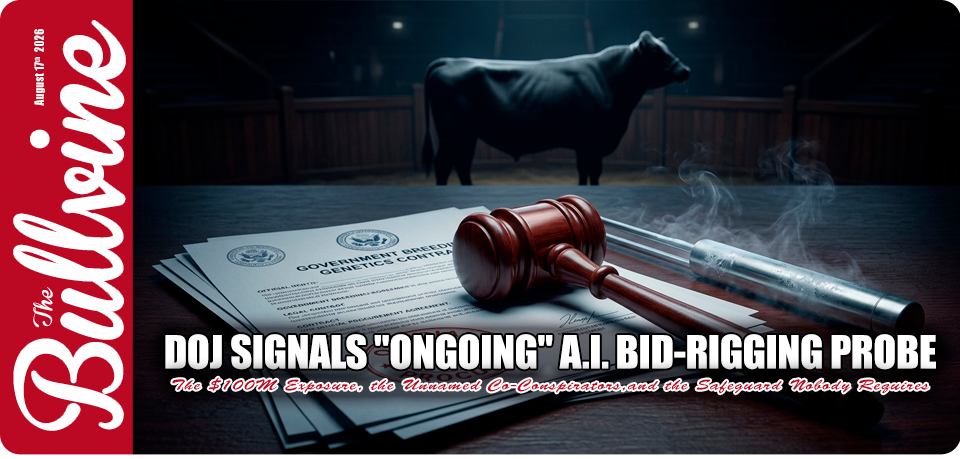



A guilty plea, a $100 million ceiling, a federal certificate that has banned this exact conduct since 1985 — and a one-line fix that belongs on the buyer registration card.
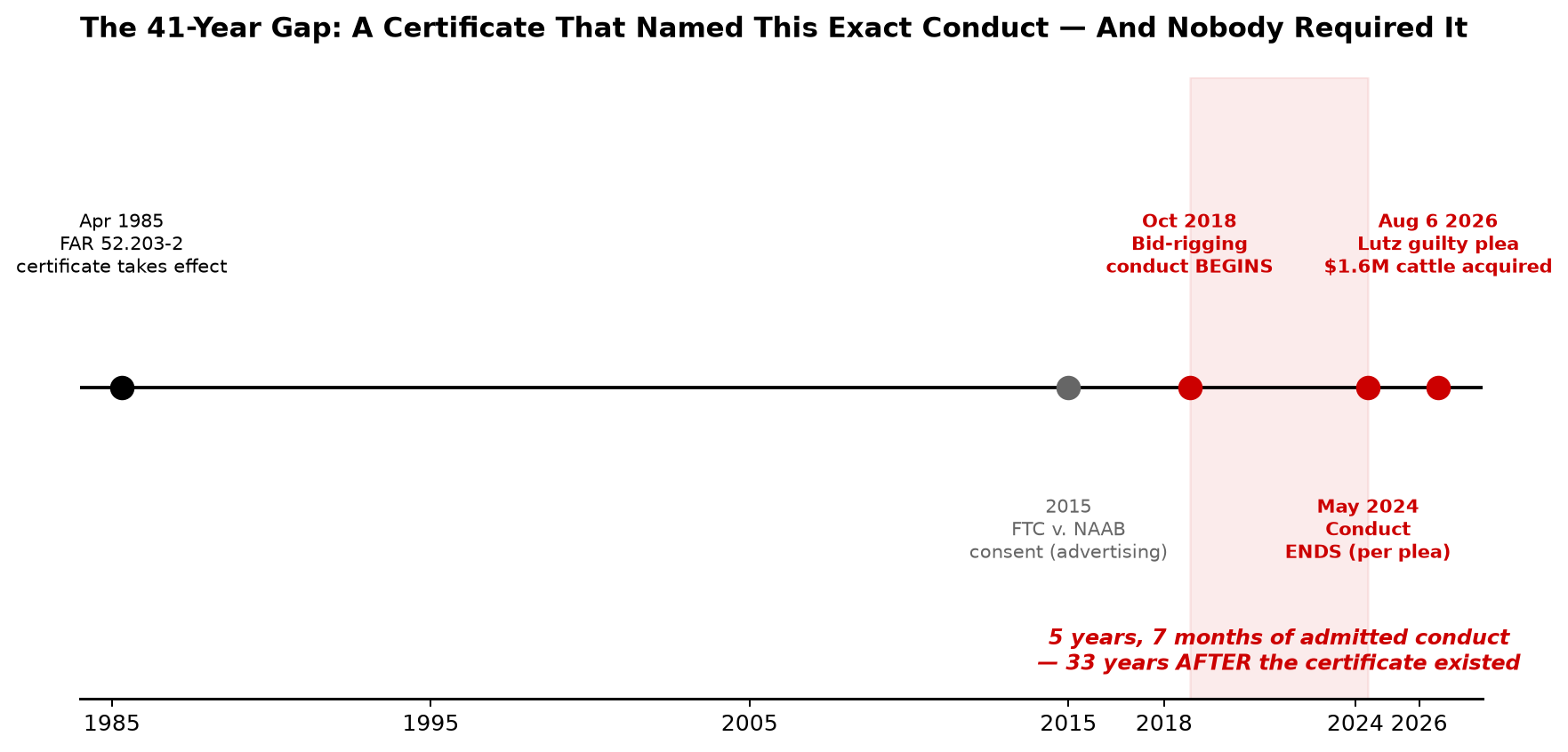
Since April 1985, a company submitting a fixed-price offer on a federal contract has had to certify in writing that it made “no attempt… to induce any other concern to submit or not to submit an offer for the purpose of restricting competition.”
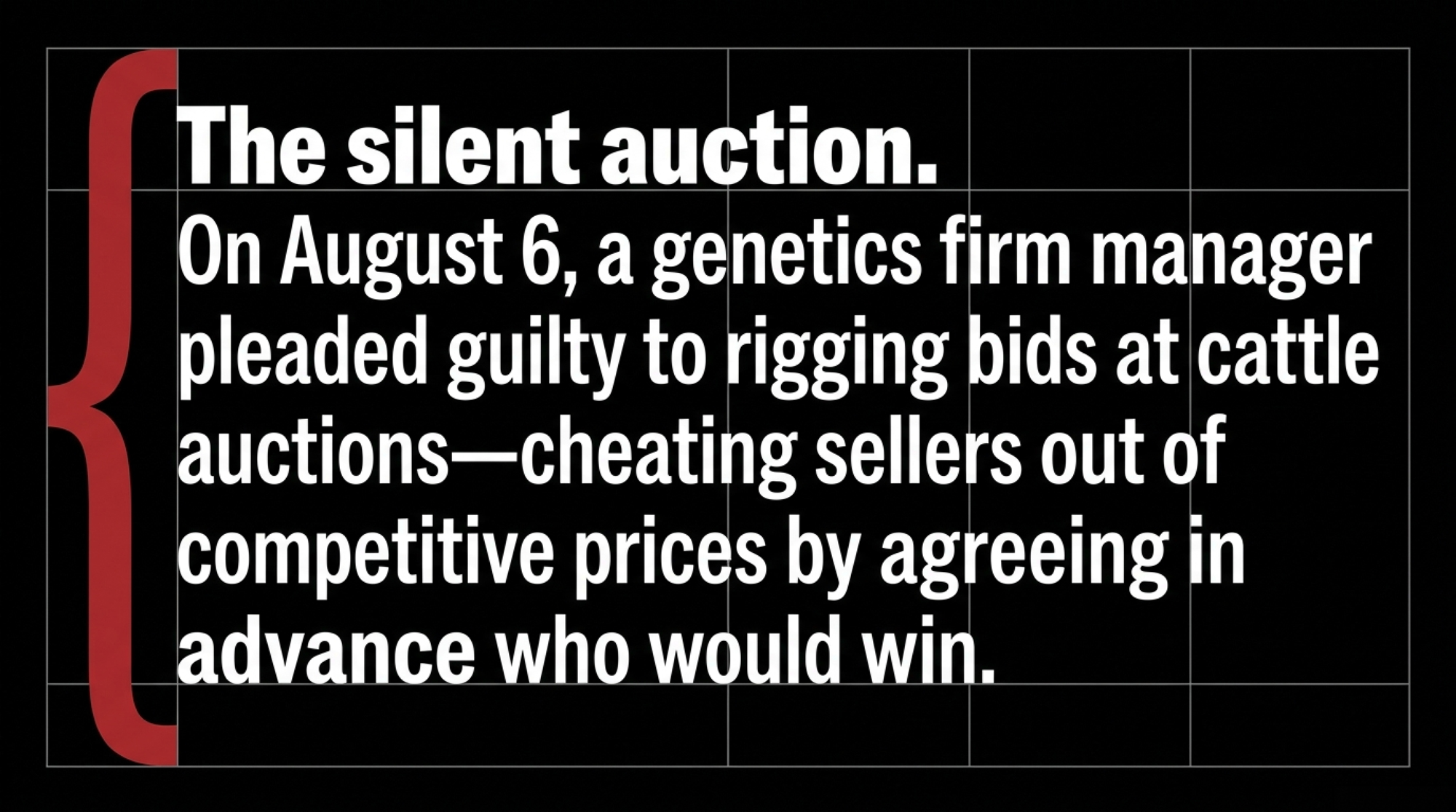
On August 6, a manager at a bovine A.I. firm pleaded guilty to doing precisely that at cattle auctions.
The certificate is free, standard, and short. Forty-one years on the books, and no genetics tender we could find has ever asked for it. Bull semen bid rigging is now an active federal enforcement category — and the language that describes the crime has been federal boilerplate since the Reagan administration.
What the Filing Establishes, and What It Withholds
Herbert D. Lutz, 56, of Chester, South Carolina, pleaded guilty in Judge Edmund A. Sargus’s courtroom in Columbus, Ohio. He admitted that before cattle auctions, he and co-conspirators agreed in advance which company would win; the designated loser sat out or bid to lose. The conduct ran from at least October 2018 to at least May 2024. His employer acquired cattle worth more than $1.6 million through those sales.
The Antitrust Division called him “the first defendant to be charged and to plead guilty in the ongoing investigation into bid rigging in the bovine artificial insemination industry.” Prosecutors describing a defendant as “first” are describing a sequence. Charles Fox, Barry Joyce, and Le’Loni C. English handled it for the Division’s Chicago Office, with investigative assistance from USDA’s Office of Inspector General.
The charging document identifies his employer as “Company A” and a competitor as “Company B.” Neither is named. No corporation has been charged. That’s not an oversight — the absence of company names is consistent with an investigation DOJ describes as ongoing, and it’s the most informative gap in the document.
The scope definition matters as much as the names. Per the charging document, “cattle” here reportedly extends beyond live animals to oocytes and IVF-session opportunities, and the conduct covered private sales alongside public auctions. That’s broad enough to reach most of how elite genetics actually change hands.
| Element of the Case | On the Record (Aug 6, 2026) | Withheld / Unpublished |
| Individual defendant | Herbert D. Lutz, 56, Chester SC — pleaded guilty | — |
| Conduct window | Oct 2018 – May 2024 (≥ 5 yrs 7 mo) | Number of affected lots or sales |
| Buyer-side figure | $1.6M in cattle acquired by employer | Per-head or per-sale harm to sellers |
| Employer identity | “Company A” | Actual corporate name |
| Competitor identity | “Company B” | Actual corporate name |
| Investigation status | Described as “ongoing”; Lutz is “first” defendant | Number and identity of remaining subjects |
| Corporate exposure | Up to $100M or 2× gross gain / 2× victim loss | Victim-loss estimate that fixes the ceiling |
| Leniency posture | Winner-take-all — one seat | Whether any application is pending |
If You’ve Sold at a Public Sale
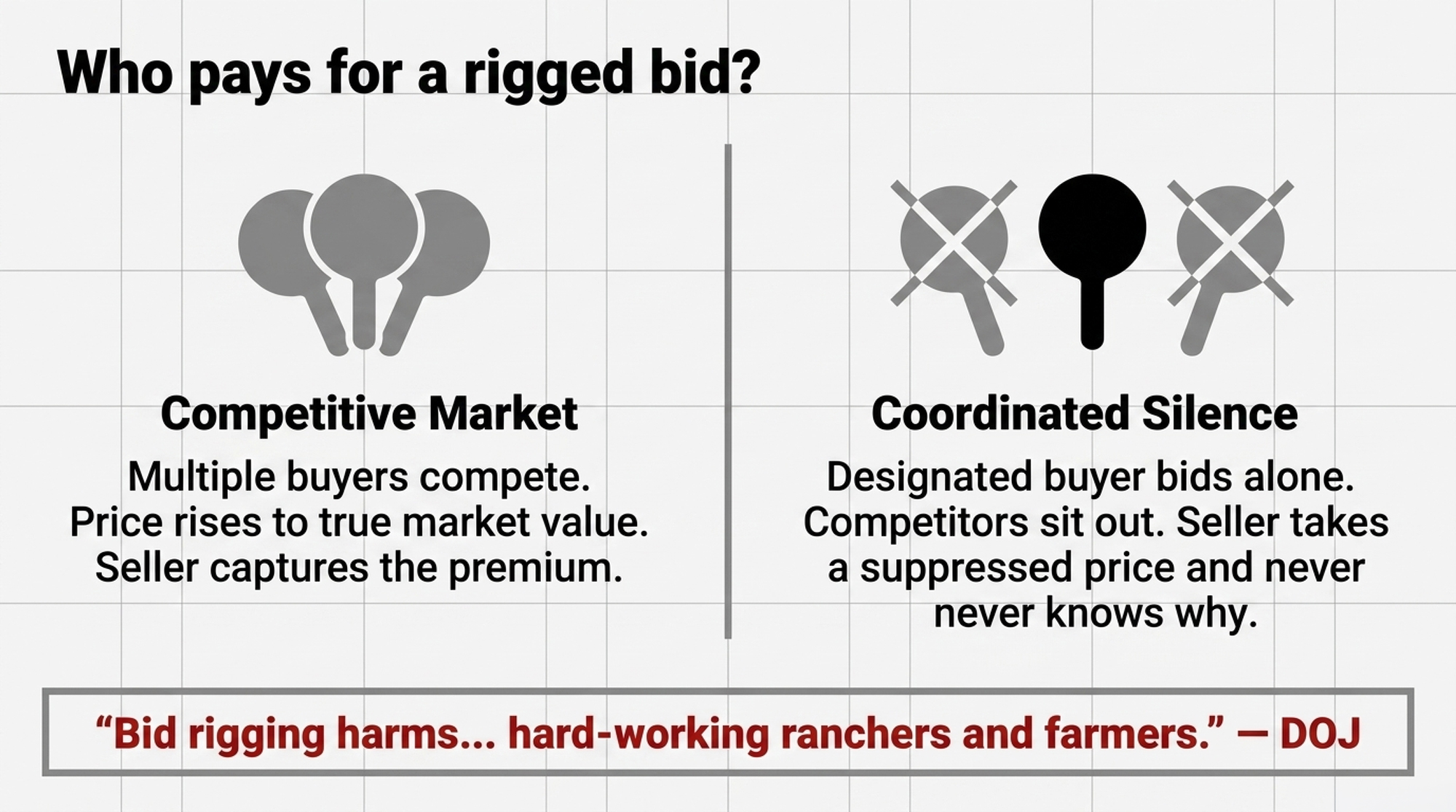
Here’s the part that matters if you’ve ever consigned a good one. The DOJ and USDA-OIG both identified the injured party, and it isn’t the A.I. company — it’s the seller. Acting Special Agent in Charge Salvador Gonzalez put it directly: “Bid rigging harms not only consumers, but also hard-working ranchers and farmers who are cheated out of competitive prices for their cattle.”
That’s the mechanism in one sentence. When two buyers who normally compete agree beforehand that only one will bid, the consignor gets a suppressed price and never knows why the second buyer went quiet on a lot everyone expected them to chase. The parent case in Columbus is where the partnership line actually sits — worth reading if you’re trying to work out whether coordinated bidding you’ve witnessed crossed a legal line or was ordinary group buying.
What nobody can tell you is how much that cost anyone. The $1.6 million figure is what one buyer paid for cattle — it is not a measure of what sellers lost. DOJ published no per-head harm estimate, no lot count, and no list of affected sales. So if you sold into that October 2018 to May 2024 window, your own sale records are the only place any individual would find evidence of anything, and even then a quiet bidder proves nothing on its own. Full order book, bad blood test, buyer who already got what he came for. Most of the time, that’s all it is.
There is one thing a consignor can do that isn’t retrospective. Ask the sale manager what the buyer registration card says. If it says nothing about independent bidding, ask why not — and keep reading, because the paperwork to fix that already exists.
What Does a $100 Million Ceiling Actually Signal?
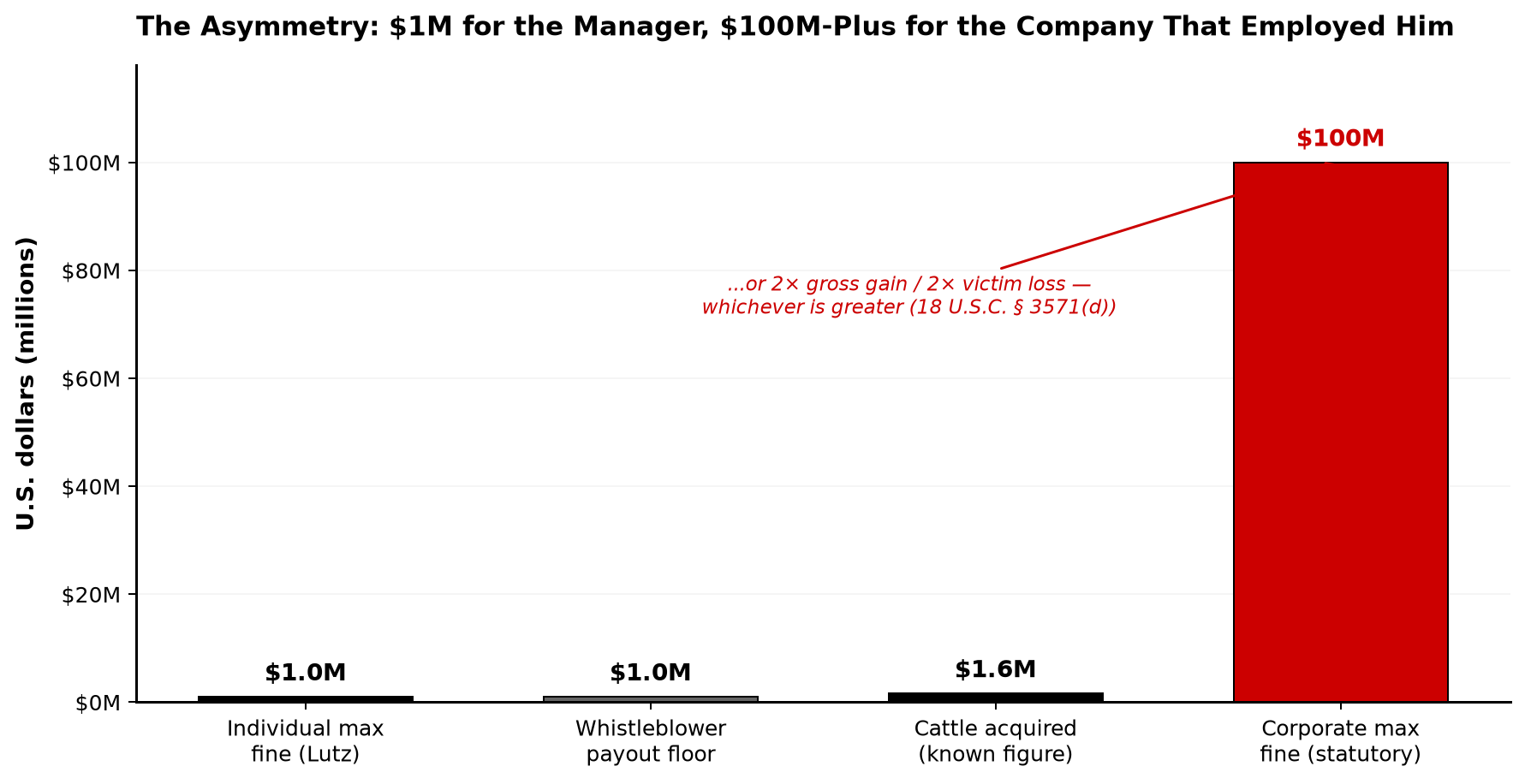
The penalty structure is where DOJ’s intent becomes legible.
| Entity | Maximum Statutory Exposure |
| Individual (Lutz) | Up to 10 years imprisonment; $1 million fine |
| Corporate (unnamed Company A / Company B) | Up to $100 million, or twice the gross gain, or twice the gross loss to victims (whichever is greater) |
| Victim loss in the record | Not published by DOJ |
Source: U.S. Department of Justice, Office of Public Affairs, August 6, 2026; alternative-fine provision at 18 U.S.C. § 3571(d). No corporation has been charged.
That doubling provision is the structurally important part, because it means corporate exposure scales off harm rather than off the acquisition figure everyone is quoting. And since DOJ never published a victim-loss estimate, the number that actually determines corporate liability in this case is unknown to everyone outside the Antitrust Division. Not undisclosed pending review. Simply not public.
Two more signals sit in the same release. The Division runs a whistleblower rewards program paying for original information that leads to criminal fines or recoveries of at least $1 million. And corporate leniency is winner-take-all — first company through the door gets protection, and there is one seat. The effect, whether designed or not, is that silence gets expensive in a market where everybody knows everybody.
Is the Sector’s Compliance Infrastructure Built for This?
Not for procurement, and the FTC’s 2015 complaint against NAAB shows how long that gap has been sitting there. Docket No. C-4558 counted about twenty-four regular members and about twenty-seven non-voting associates, and found NAAB’s members “have market power in the market for bull semen used to inseminate dairy cows in the United States,” accounting for “over ninety percent of the dairy cattle semen sales in the United States.”
Two Code of Ethics provisions drew the FTC’s attention. One barred naming competitors: “Member competitors will not be named in printed material comparing averages between members.” The other governed prices: “The purchase price of sires, purchased at private treaty, by NAAB members shall not be disclosed by the Buyer, and the Seller shall be requested not to quote the selling price. Also, prices of bulls purchased at public auction by AI organizations shall not be quoted in their printed statements, advertising, and/or publicity material.”
The FTC’s concern was consumer harm through restricted truthful information — an advertising case, not a procurement case. NAAB removed the provisions under the resulting consent agreement, and they were gone by 2017. The conduct in the Lutz case began in October 2018, after the removal. That history speaks to price transparency in bull genetics generally, and to nothing else in this case. NAAB has not commented publicly on the current investigation.
What the industry did build, it built well on the seller side. NAAB and Certified Semen Services run established quality-certification and antitrust-compliance programs, and the CSS Semen Quality Control audit program — added in 2011 — verifies that each breeding unit contains sperm of adequate quality. Buyer-side bid certification is the gap.
The Certificate That Names This Exact Conduct
FAR 52.203-2, the Certificate of Independent Price Determination, has been in the Federal Acquisition Regulation since April 1985. Federal contracting officers must insert it in solicitations whenever a firm-fixed-price contract is contemplated, subject to a short list of exceptions. A supplier signing it certifies three things:
| FAR 52.203-2 — the offeror certifies that: |
| (1) The prices in the offer have been arrived at independently, without consultation, communication, or agreement with any other offeror or competitor for the purpose of restricting competition. |
| (2) The prices have not been and will not be knowingly disclosed to any other offeror or competitor before bid opening or contract award. |
| (3) “No attempt has been made or will be made by the offeror to induce any other concern to submit or not to submit an offer for the purpose of restricting competition.” |
Certificate of Independent Price Determination (Apr 1985), Federal Acquisition Regulation.
Read that third clause against what Lutz admitted. A designated loser who sits out or bids to lose is the precise conduct that certificate has required suppliers to disavow, in writing, for forty-one years. Canada’s Competition Bureau publishes a comparable model Certificate of Independent Bid Determination requiring bidders to certify independence or disclose any arrangement with a competitor.
What the Certificate Can’t Reach
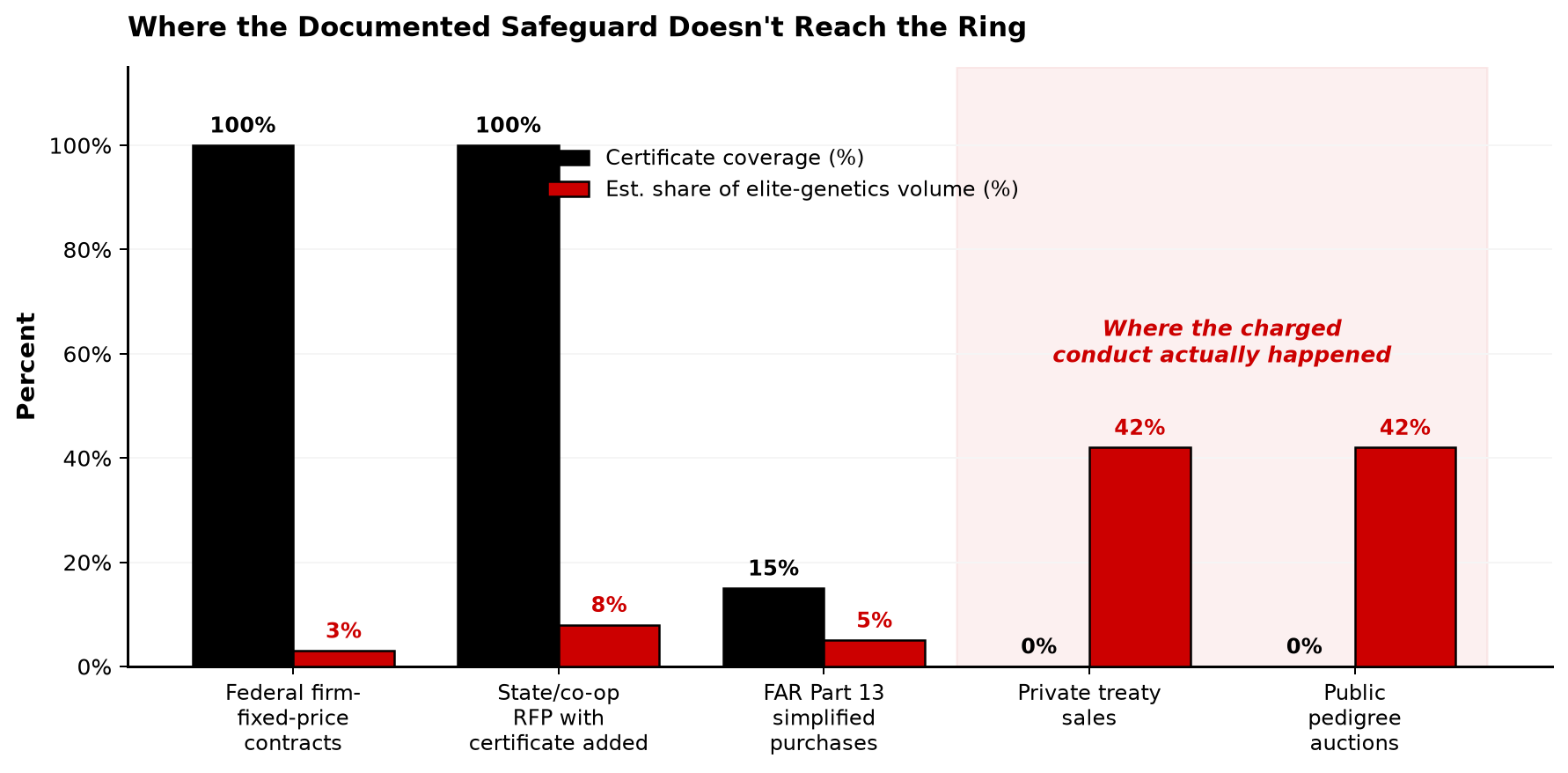
Here’s where the channels diverge, and it matters for who can actually act. FAR 52.203-2 is prescribed for solicitations — it references “bid opening (in the case of a sealed bid solicitation) or contract award (in the case of a negotiated solicitation),” and it takes effect through a signature on a submitted offer. That’s how a federal buyer procures semen or breeding services, and it’s the model most state procurement codes are built on. A public pedigree auction doesn’t work that way. There’s no solicitation package to attach a certificate to, no written offer to sign, and no bid opening.
Two limits on that instrument are worth stating plainly. The Federal Acquisition Regulation reaches federal acquisition only — it binds no private company, no co-op, and no sale organization. And the insertion requirement carries exceptions, including purchases made under the simplified acquisition procedures of FAR Part 13, which is where a routine semen or breeding-services buy would often land. So even inside the federal system, a fair amount of genetics purchasing never triggers it. The clause is free to add anyway. Nobody has to be told to use it.
None of which means the ring is a lawful place to do this. Section 1 of the Sherman Act reaches bid rigging at a public auction, a private sale, and a federal tender alike — Lutz’s plea proves that, and it involved no solicitation at all. Where the line actually falls between coordinated bidding and ordinary group buying is the question the Columbus case turns on. What the certificate adds is deterrence and a paper trail: every bidder on written notice before the fact, and a false certification hanging over anyone who signs and does it anyway.
So the safeguard question splits in two. On the institutional side, the tool exists, is free, and slots directly into an existing RFP process. Outside it, no public example of an equivalent independent-bidder requirement in U.S. cattle or genetics sale terms could be located — a gap in what’s findable, not proof that no sale organization has ever addressed it. Either way, the conduct Lutz admitted to reached both private sales and public auctions, and neither runs on a solicitation package. The documented safeguard doesn’t reach where the charged conduct happened.
If You’re the One Calling for Bids
For co-op procurement staff, university breeding program managers, and state ag purchasing officers, this is operational rather than theoretical.
Start with the bid package you already use. If it contains no independence certification, FAR 52.203-2 is public, standard, and short — three certifications and a signature block. Add it even if your purchase sits below the threshold that would require it of a federal buyer; nothing stops you, and the certification costs a supplier nothing but a signature. Then look at your bidder history across the last three cycles: same names every year, or a pool that’s actually moved? Neither answer proves anything by itself, and small specialized supplier pools are genuinely normal in genetics. But knowing which one you have is the difference between managing a known risk and assuming you don’t have one.
The Bid-Rigging Fix Already Sitting on the Registration Card
The certificate framework wasn’t built for the ring — but the paperwork to carry it already is. Buyer registration is standard practice across the channel. Superior Livestock Auction’s terms require that “each bidder must be pre-registered and have a Buyer Number to participate in the auction.” Western Video Market issues buyer numbers through a signed Buyer Registration and Consent Agreement. DVAuction requires an approved application before granting online bidding privileges. CattleUSA states it plainly: to bid on and purchase livestock, “you must read, agree with and accept all of the terms.”
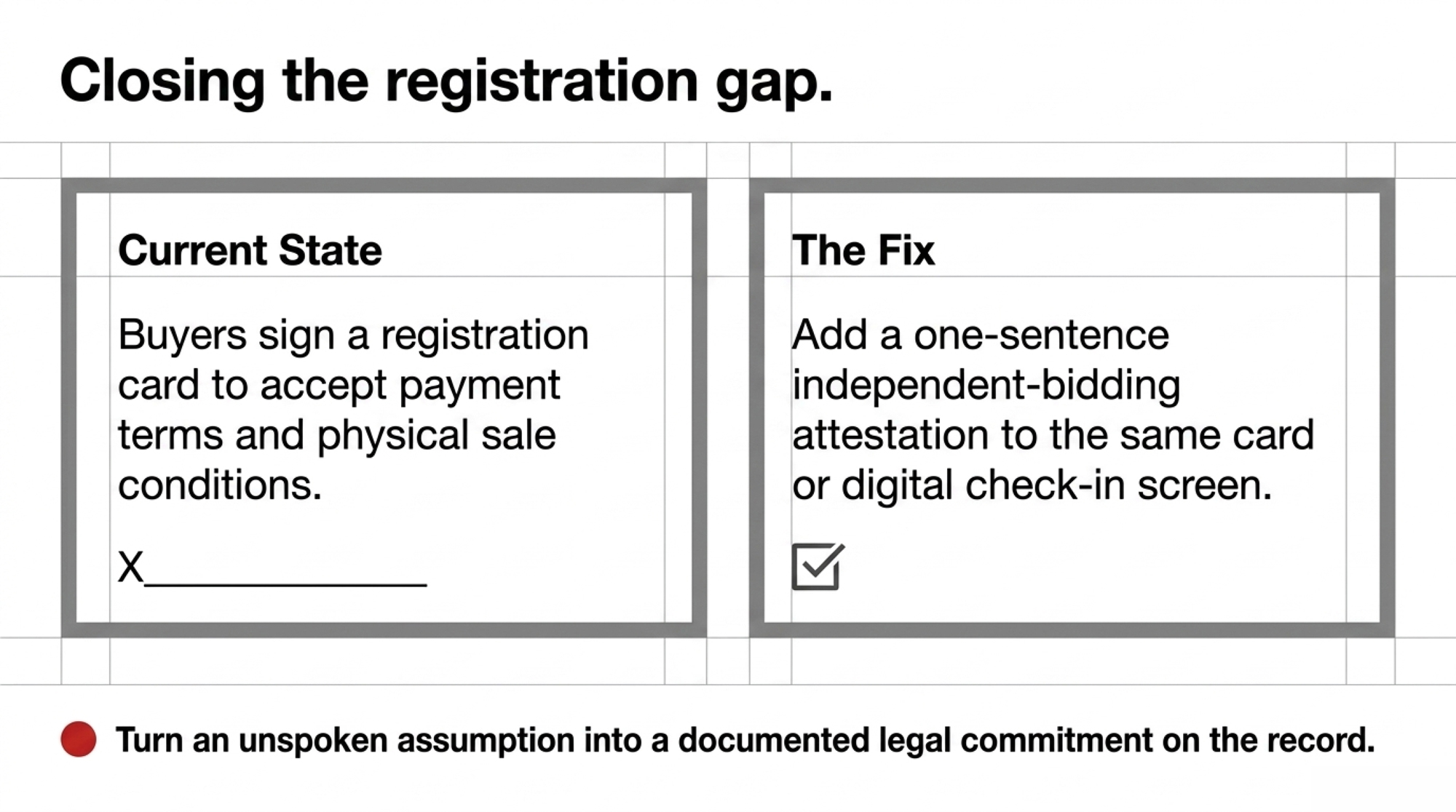
Every one of those is a signature or a click that already happens before the first lot sells. Adding a one-sentence independent-bidding attestation to standard sale conditions and digital check-in screens turns an unspoken assumption into a documented commitment on the record. And the vehicle for drafting model language already exists — the American Hereford Association, for one, publishes recommended Terms of Sale for auctions, which is exactly the kind of document breed associations are used to writing and circulating. This plea makes that harder to postpone.
| Sale Channel | Existing Buyer-Side Paperwork | Independent-Bidding Attestation Today? | Marginal Effort to Add |
| Superior Livestock Auction | Pre-registration + assigned Buyer Number required | None on the public record | One line in existing terms |
| Western Video Market | Signed Buyer Registration and Consent Agreement | None on the public record | One clause in existing agreement |
| DVAuction | Approved application before online bidding | None on the public record | One checkbox at signup |
| CattleUSA | Click-through acceptance of all terms | None on the public record | One line in existing terms |
| Breed-association public sales (e.g., AHA model Terms of Sale) | Recommended standard terms already published | None on the public record | One paragraph in model language |
| FAR 52.203-2 (comparison) | Signed at every federal fixed-price bid since 1985 | Yes — three certifications + signature | Already exists |
Antitrust Attention Beyond This Case
Concentration in the marketed lineup is a live feature of the business on both sides of the border. On Canada’s August 2026 domestic Top LPI list — a separate market from the U.S. figures above — one marketing organization accounts for five of the top ten proven sires.
Separately, and on an entirely different legal track, the Antitrust Division has been reviewing a proposed combination between Select Sires and Inguran/STgenetics since 2023, with enforcers reported as nearing a decision as of April 2026. That is a civil merger review — different statute, different conduct, no allegation of wrongdoing by anyone, and no reported connection to the criminal matter above.
To be explicit, because DOJ’s silence on company names invites guesswork: neither Select Sires nor STgenetics has been charged in, or identified by DOJ as a subject of, the bid-rigging investigation, and nothing in this article suggests either company is involved. Neither was asked to comment, because no allegation is made against either.
What the merger review does establish is narrower and still worth saying: genetics is no longer a quiet corner of that division’s docket.
Key Takeaways
- If you consigned at a public sale between October 2018 and May 2024, DOJ named sellers as the injured party but published no list of affected sales and no per-head harm figure. Your own sale records are the only place to look.
- The $1.6 million everyone’s quoting is what one buyer paid for cattle, not what sellers lost. Corporate exposure runs to $100 million or twice the gross gain or loss — and that loss figure has never been made public.
- If you write bid packages for a co-op, university, or state program, pull FAR 52.203-2 and check whether your current package has an independence certification. It’s free, it’s three certifications and a signature, and you can add it even on small buys that wouldn’t require it.
- Sale managers already collect a signature or a click from every registered buyer before the first lot sells. A one-line independent-bidding attestation on that card is the cheapest deterrent available, and no U.S. sale terms we could find have one.
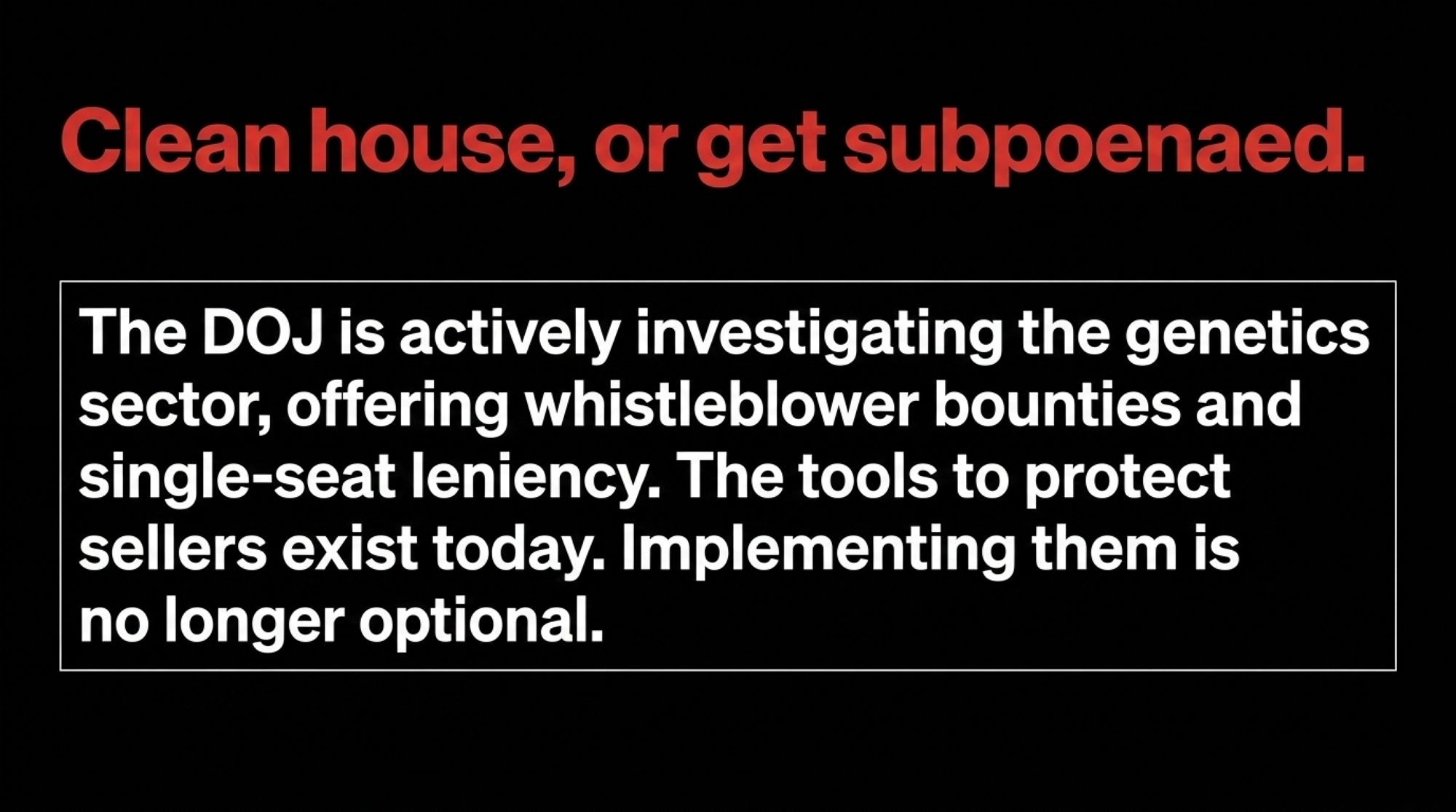
An active criminal investigation, a guilty plea entered, a whistleblower program paying at the $1 million threshold, one leniency seat, and a merger decision pending — all inside bovine genetics, all in August 2026. That’s the state of the record, and what it produces next is genuinely unknown. Anyone in this business telling you otherwise is guessing.
The certificate has been on the books since 1985. Whether breed associations, sale managers, and procurement officers adopt it now — or wait to find out whether the DOJ’s Chicago office names Company A and Company B — will determine whether the industry cleans its own house or has it cleaned by subpoena.
This article is based on public court records, the U.S. Department of Justice’s August 6, 2026 press release, Federal Trade Commission filings, the Federal Acquisition Regulation and 18 U.S.C. § 3571(d) as available on August 17, 2026, and published sale terms and buyer-registration agreements from Superior Livestock Auction, Western Video Market, DVAuction, and CattleUSA, together with the American Hereford Association’s recommended Terms of Sale for auctions. No company has been charged in the bid-rigging investigation, and the companies identified in the charging document as “Company A” and “Company B” remain unidentified by the Department of Justice. The Bullvine names no company as a participant in the charged conduct and has no information identifying either firm.
Learn More
- Your Genetics Rep Has Bad News – But Won’t Tell You Until January — Arms you with a 90-day contract playbook to defend your margin against a projected $12,000 annual breeding-cost hike, revealing how to lock multi-year supplier terms before international market fallout hits domestic semen price lists.
- Trans Ova Purchase of ReproLogix: The Genetics Consolidation Nobody’s Talking About — Follows the money on corporate reproductive acquisitions, delivering an actionable roadmap for 300-to-1,500+ cow herds to maintain multi-supplier diversity and avoid captive-buyer price penalties as corporate platforms integrate sorted semen with proprietary catalogs.
- The Holstein Genetics War: What Every Producer Needs to Know About the Battle for Our Breed’s Future — Dismantles catalog hype by exposing how corporate mating locks drove elite inbreeding past 15%, delivering the outcross and gene-bank mating framework needed to recover up to $94,000 in lost lifetime herd value.
 The Sunday Read Dairy Professionals Don’t Skip.
 The Sunday Read Dairy Professionals Don’t Skip.
Every week, thousands of producers, breeders, and industry insiders open Bullvine Weekly for genetics insights, market shifts, and profit strategies they won’t find anywhere else. One email. Five minutes. Smarter decisions all week.