





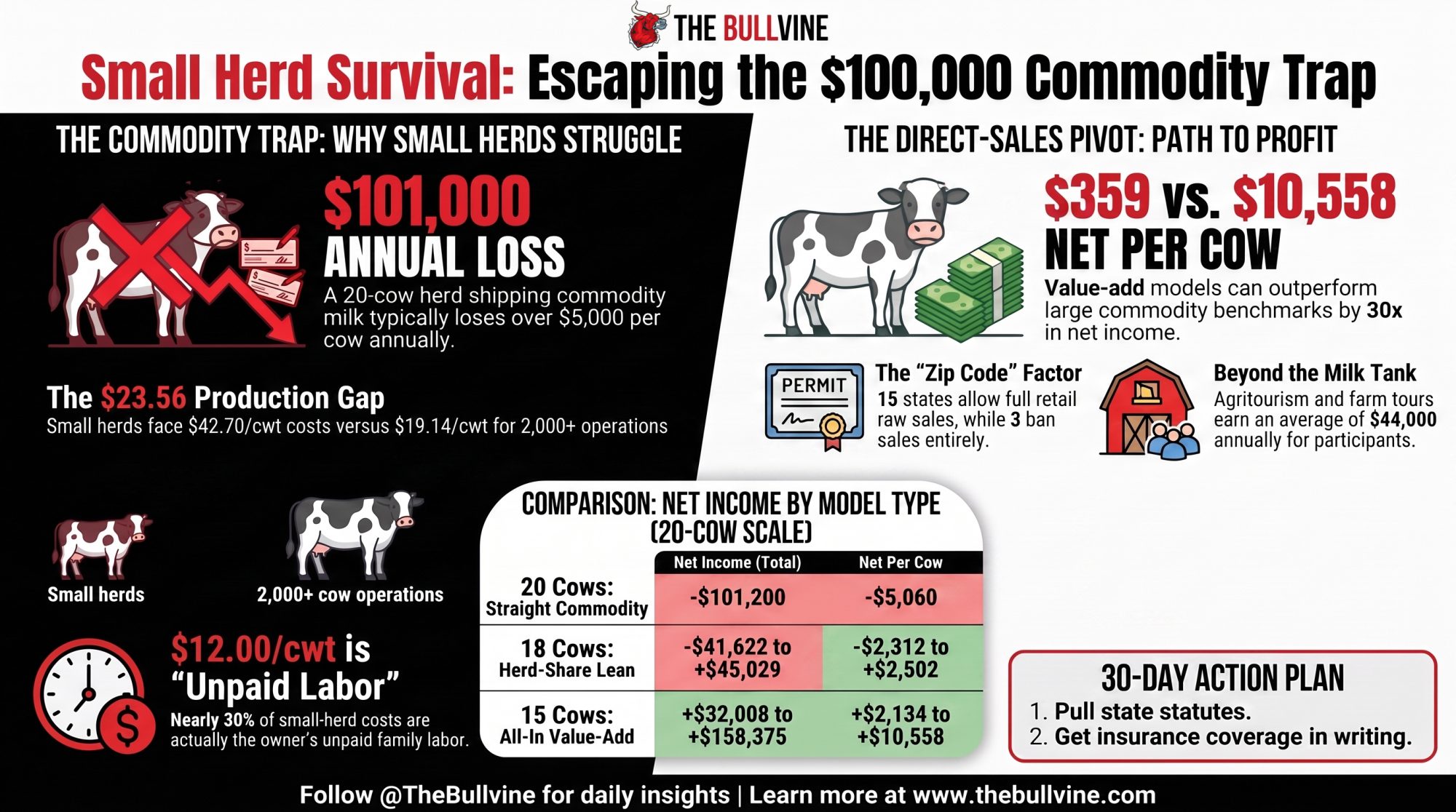
Your co-op check says you’re losing $101,000 a year on 20 cows. USDA’s own math says $12.00/cwt of that never left the checkbook.
EXECUTIVE SUMMARY: USDA pegs full production cost at $42.70/cwt for herds under 50 cows against $19.14 at 2,000-plus, which means a 20-cow herd shipping commodity milk into the 2026 all-milk forecast of $20.70 runs about $101,000 in the red, roughly $5,060 a cow. But nearly $12.00/cwt of that small-herd cost is unpaid family labor, priced at what those hours would’ve earned off-farm, so a big share of the “loss” never left the checkbook. It was your hours. Flip the same 15 cows into direct raw sales, farmstead curd, and farm tours and the modeling nets $2,134 to $10,558 per cow, against $359 per cow on a 200-cow commodity benchmark. What decides which side you land on isn’t your cows. It’s your statute book: 15 states allow full retail raw sales at up to $30 a gallon, 19 cap you on-farm nearer $6–15, seven force herd shares, and three ban it outright.
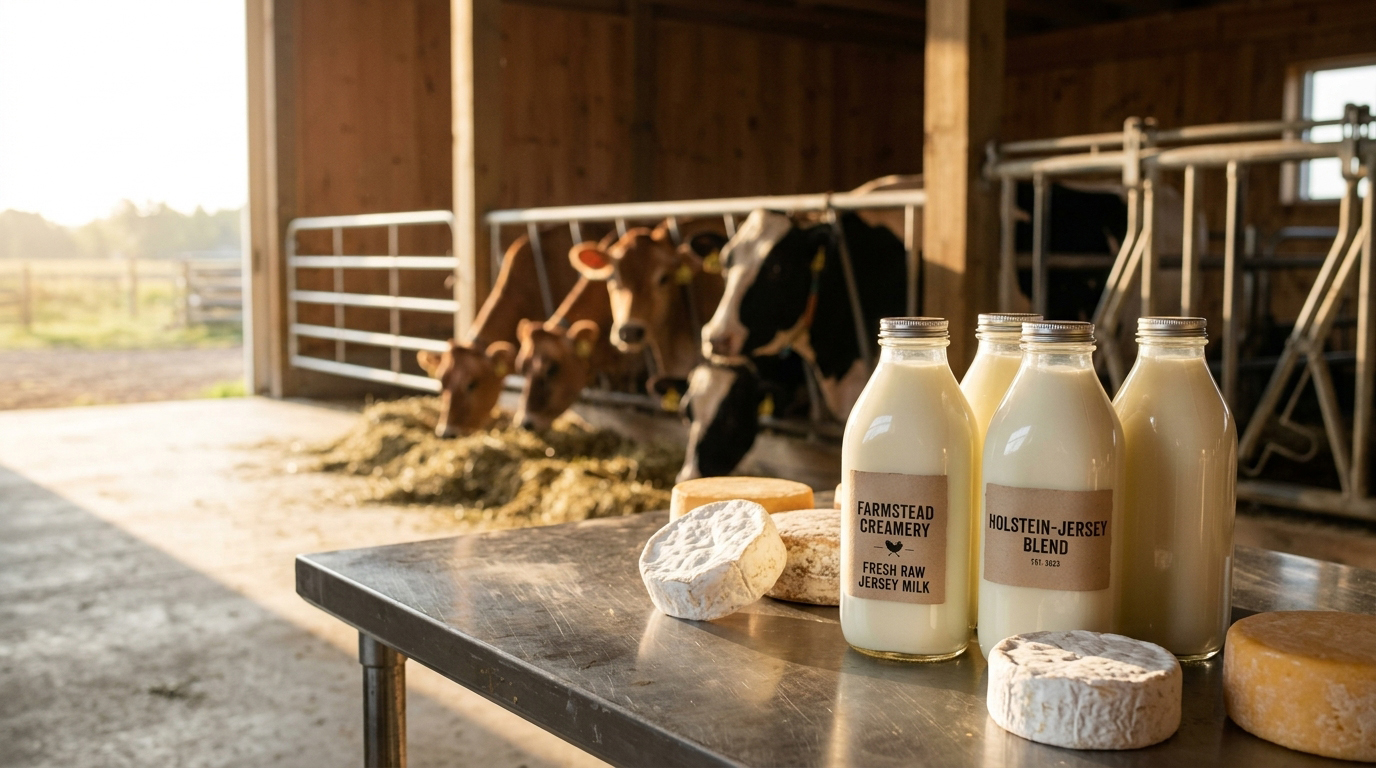
Jacy Vaughn didn’t set out to become a test case. She’s a first-generation farmer near Lamesa, out on the West Texas plains, who wanted to sell raw milk off her roughly 30-cow homestead straight to the families who came looking for it. Texas took her to court over an $800 permit she skipped, and by her own account she’s dumped more than 1,000 gallons of milk since 2025 while the case grinds on. Strip away the courtroom drama and the fight reflects a broader reality: for a small dairy, the battle over direct raw sales is a battle over the only business model that pencils out at that size.
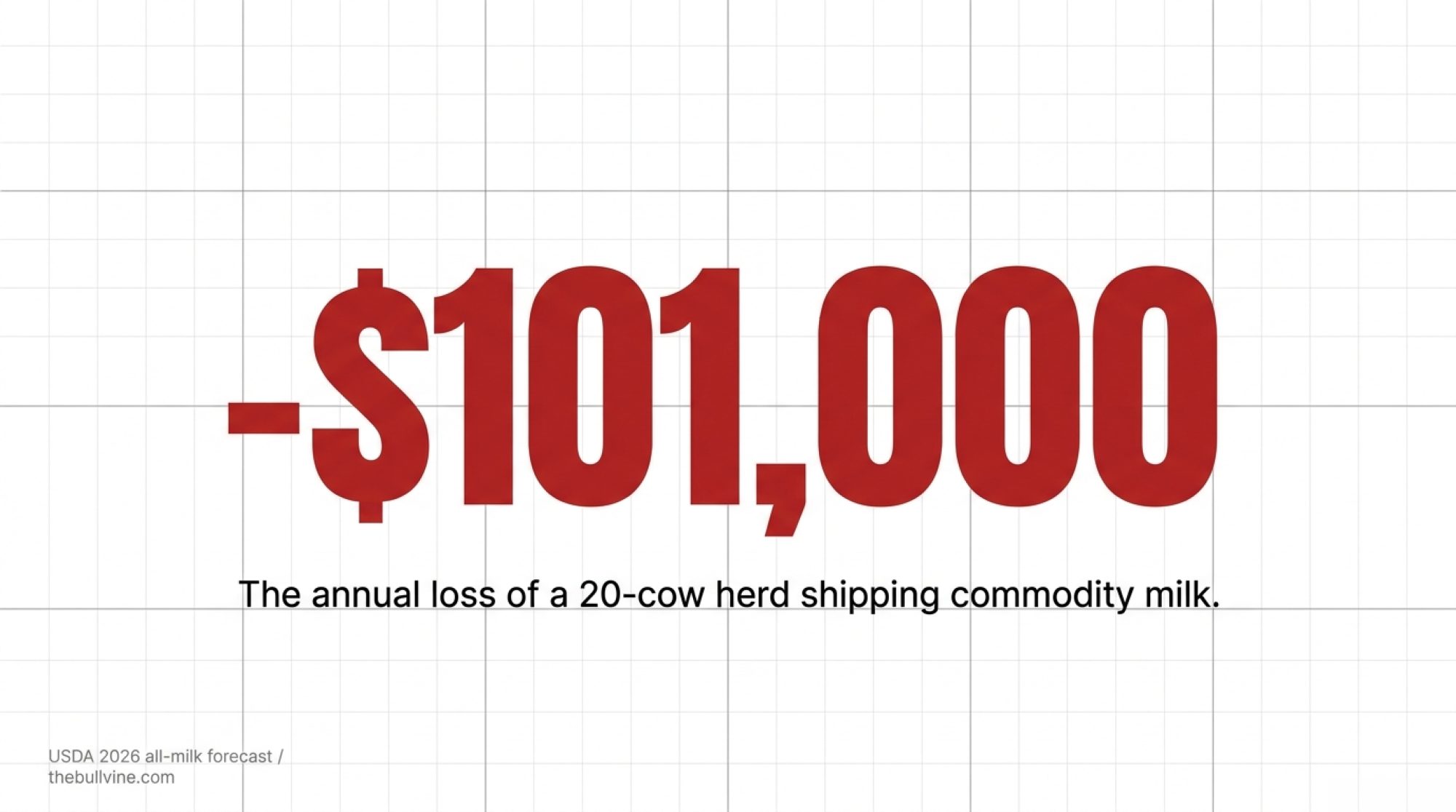
Picture a 20-cow herd anywhere in the country. Cows bred right, barn clean, milk in the tank every morning. The truck comes, the check comes, and at year’s end that farm is down roughly $101,000, about $5,060 per cow. Nobody did anything wrong. At 20 cows, shipping raw commodity milk at today’s price is a losing hand before you walk to the parlor. So if you’re staying small on purpose, how do you keep the cows without an off-farm job quietly subsidizing them?
Why can’t a small herd just cut costs and survive?
Because the cost gap isn’t a management problem; it’s baked into the size.
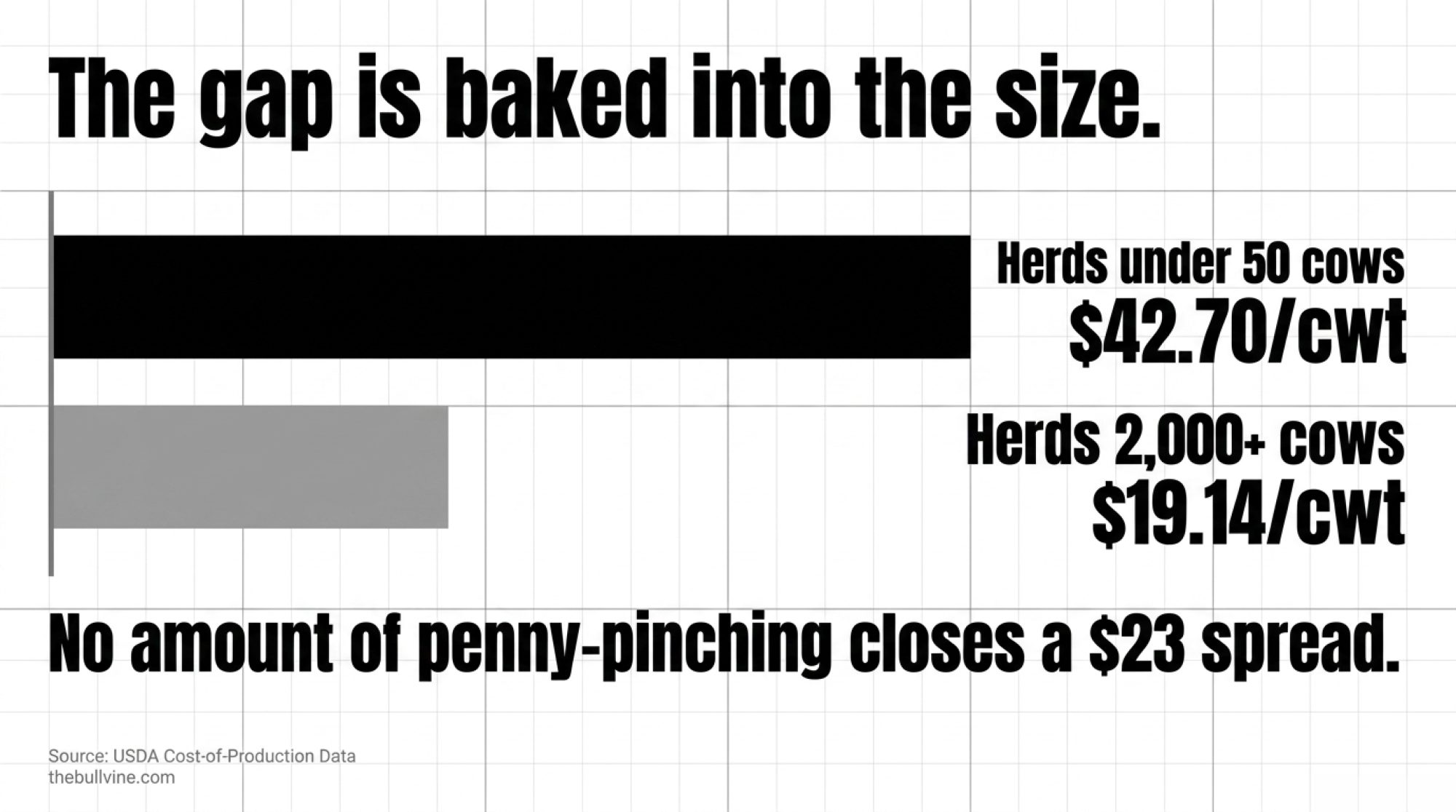
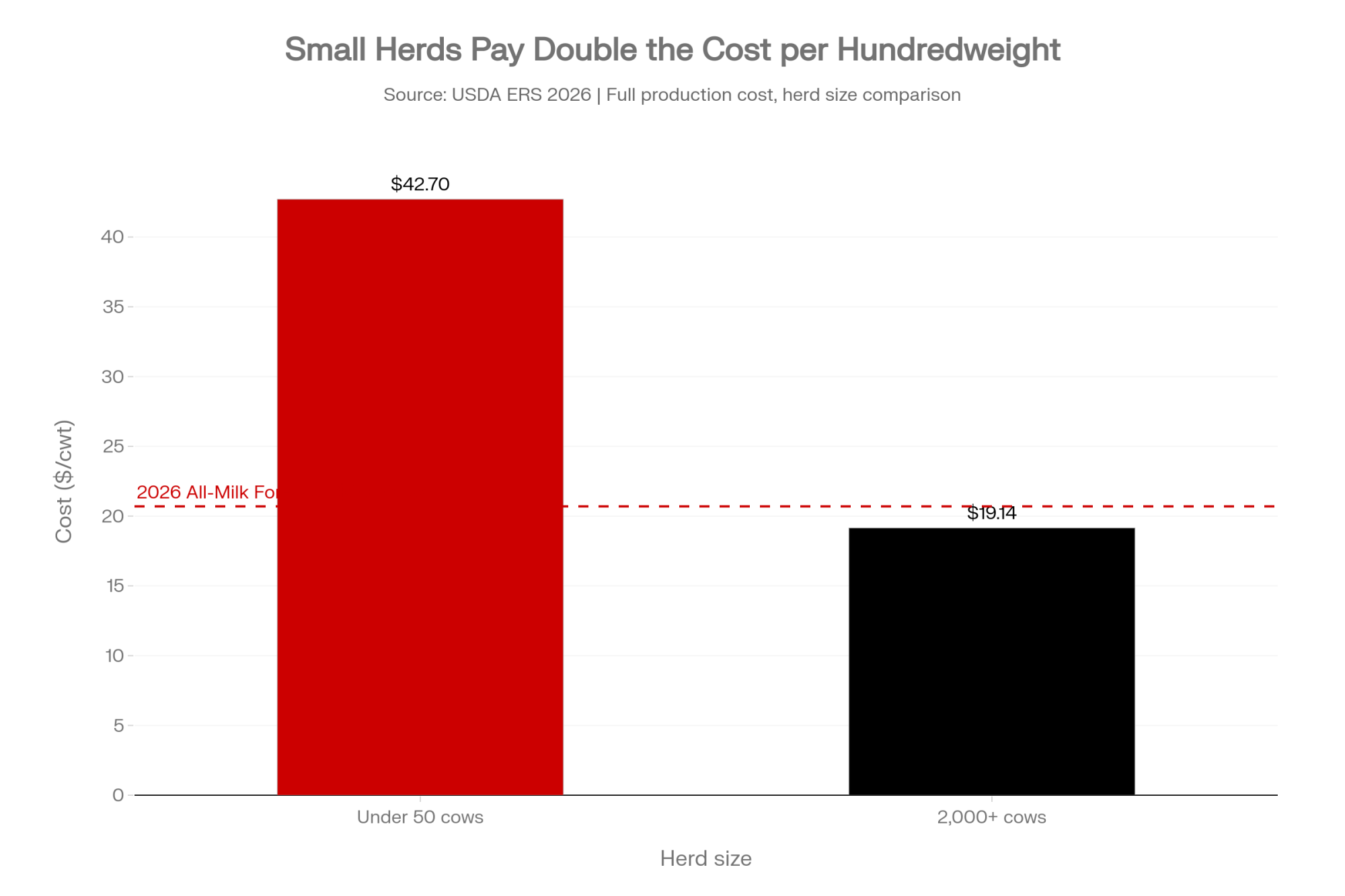
USDA’s cost-of-production data pegs full production cost at $42.70/cwt for herds under 50 cows, against just $19.14/cwt for herds of 2,000 or more. That’s a $23.56 spread on every hundredweight, and no amount of penny-pinching closes it. You can’t buy feed like a 2,000-cow operation. You can’t spread a parlor’s fixed cost across enough cows to matter. At USDA’s 2026 all-milk forecast of $20.70/cwt, a 42-dollar cost structure doesn’t clear.
Of every dollar a gallon of milk earns at retail, the farmer keeps about 25 cents.
Every mile between your bulk tank and somebody’s fridge, hauler to processor to store, takes a cut you can’t afford at 20 cows. So the survivors stop giving it away.
Show me the numbers: what actually pencils out?
Run three small farms against a 200-cow commodity herd and the story tells itself. The straight-commodity rows use USDA’s own cost figures directly: $42.70/cwt for the 20-cow herd, $19.14/cwt for the 200-cow benchmark.
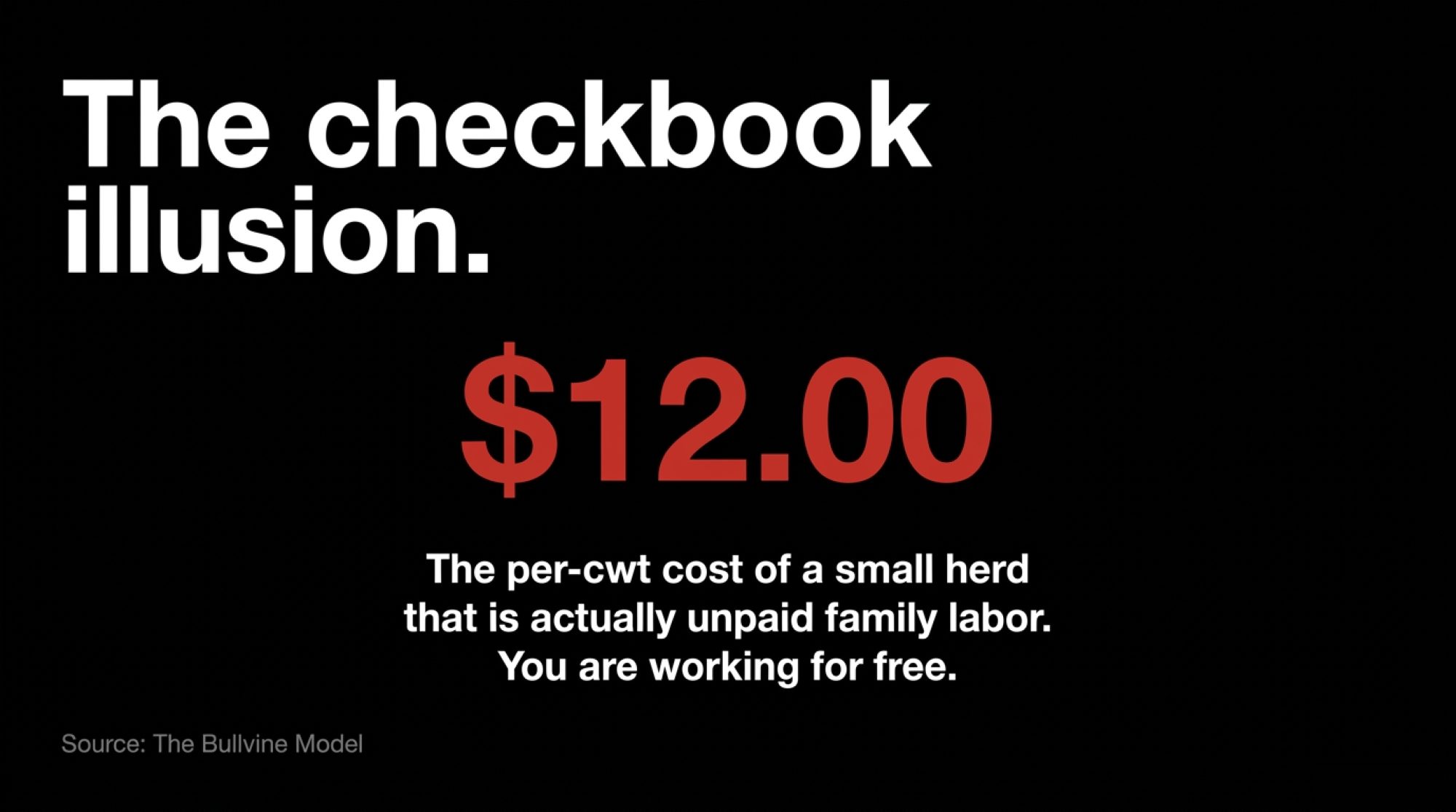
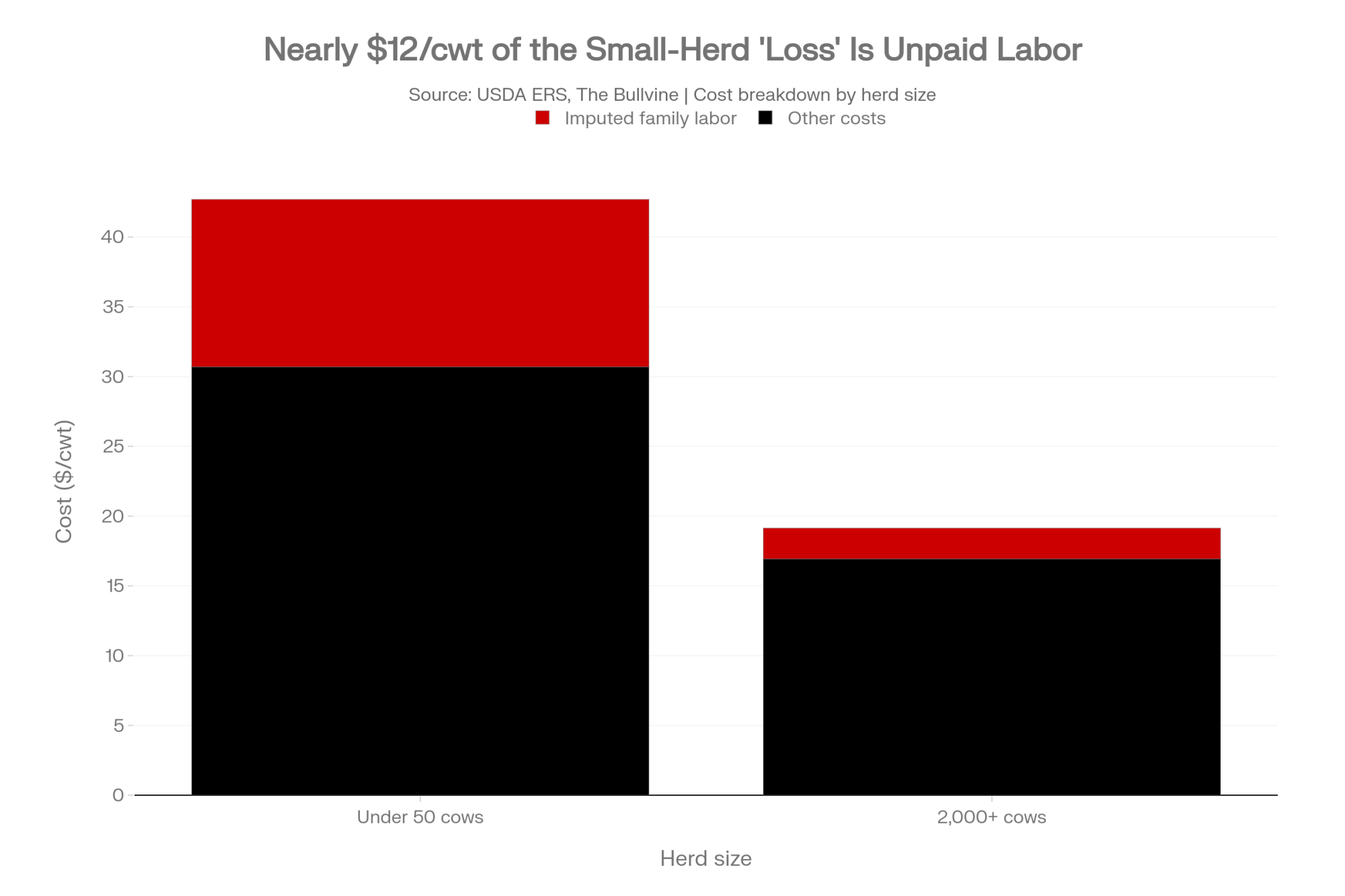
One thing to be clear about, because it changes how you read the table. These are full economic costs, not just cash out the door. USDA charges unpaid operator and family hours at what those people could have earned off-farm, roughly $20 to $30 an hour. On herds under 50 cows, that imputed family labor runs about 97% of the total labor bill, and labor alone sits near $12.00/cwt against $2.20/cwt at 2,000-plus cows. So the $101,000 hole isn’t only money leaving the checkbook. A chunk of it is you, working for free.
That cuts both ways on the value-add farms. Their higher per-cwt costs carry processing and agritourism overhead on top, but curd vats and farm tours don’t run themselves. If you’re already counted as working for free in the commodity model, adding a creamery and a tour schedule doesn’t make those hours free. It makes them longer. Treat the value-add net-per-cow ranges below as before-your-own-wage figures, and subtract whatever you’d have to pay someone else to do the processing and host the visitors.
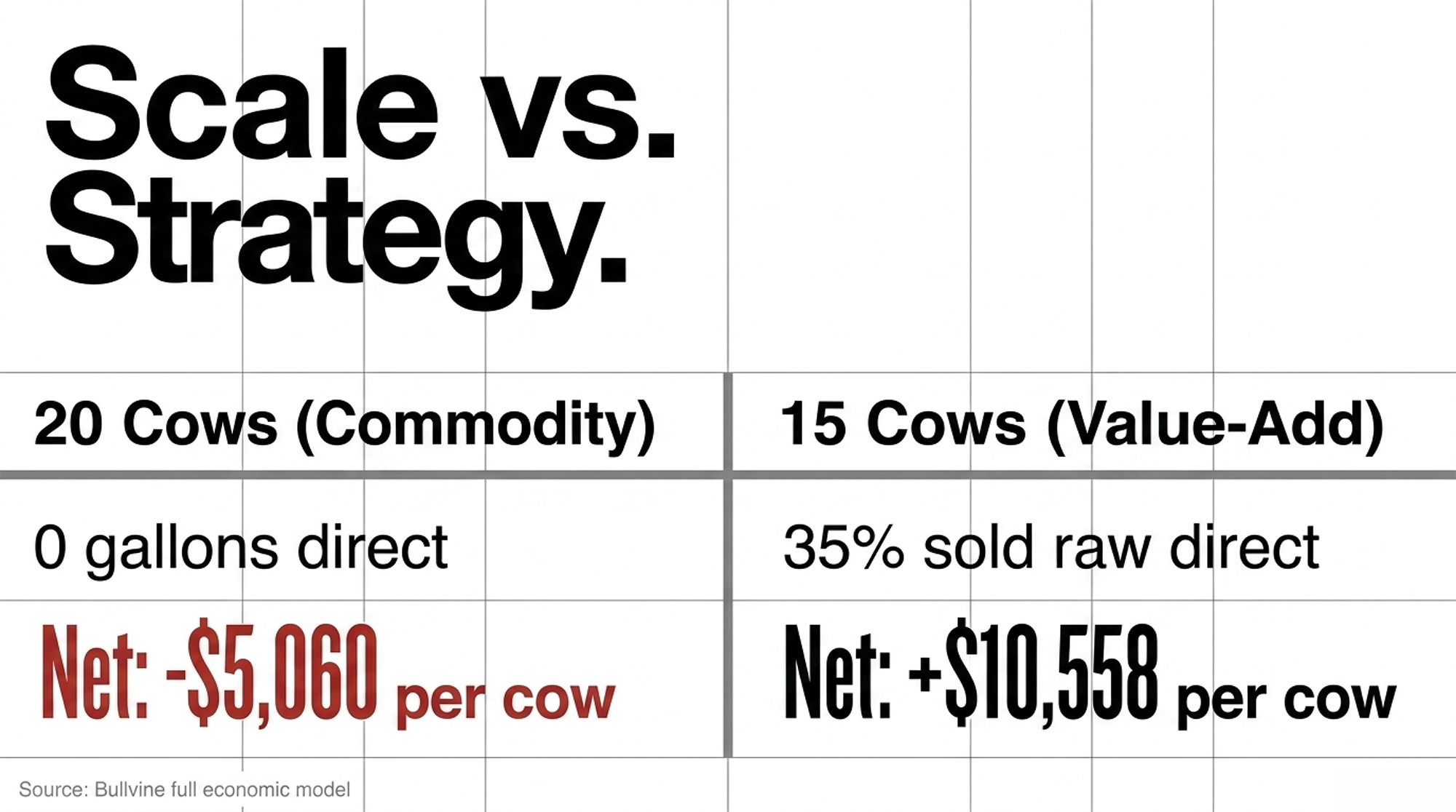
| The farm | Raw milk sold | Value-add | Revenue range | Total cost | Net income | Net per cow |
| 15 cows, all-in — 35% sold raw, farmstead curd/paneer, farm tours | 14,041 gal | 3,000 gal | $200,323–$326,690 | $168,315 | $32,008–$158,375 | $2,134–$10,558 |
| 18 cows, herd-share lean — 20% raw, light value-add | 9,628 gal | 1,500 gal | $146,156–$232,807 | $187,778 | -$41,622–$45,029 | -$2,312–$2,502 |
| 20 cows, straight to the truck | 0 | 0 | $95,220 | $196,420 | -$101,200 | -$5,060 |
| 200 cows, commodity benchmark | 0 | 0 | $952,200 | $880,440 | $71,760 | $359 |
Bullvine model. Built from USDA cost-of-production data and published raw-milk price bands; milk priced at USDA’s 2026 all-milk forecast. Assumes roughly 23,000 lb/cow/year and 8.6 lb per gallon. Costs are full economic costs including imputed unpaid labor. Illustrative scenarios, not real operations.
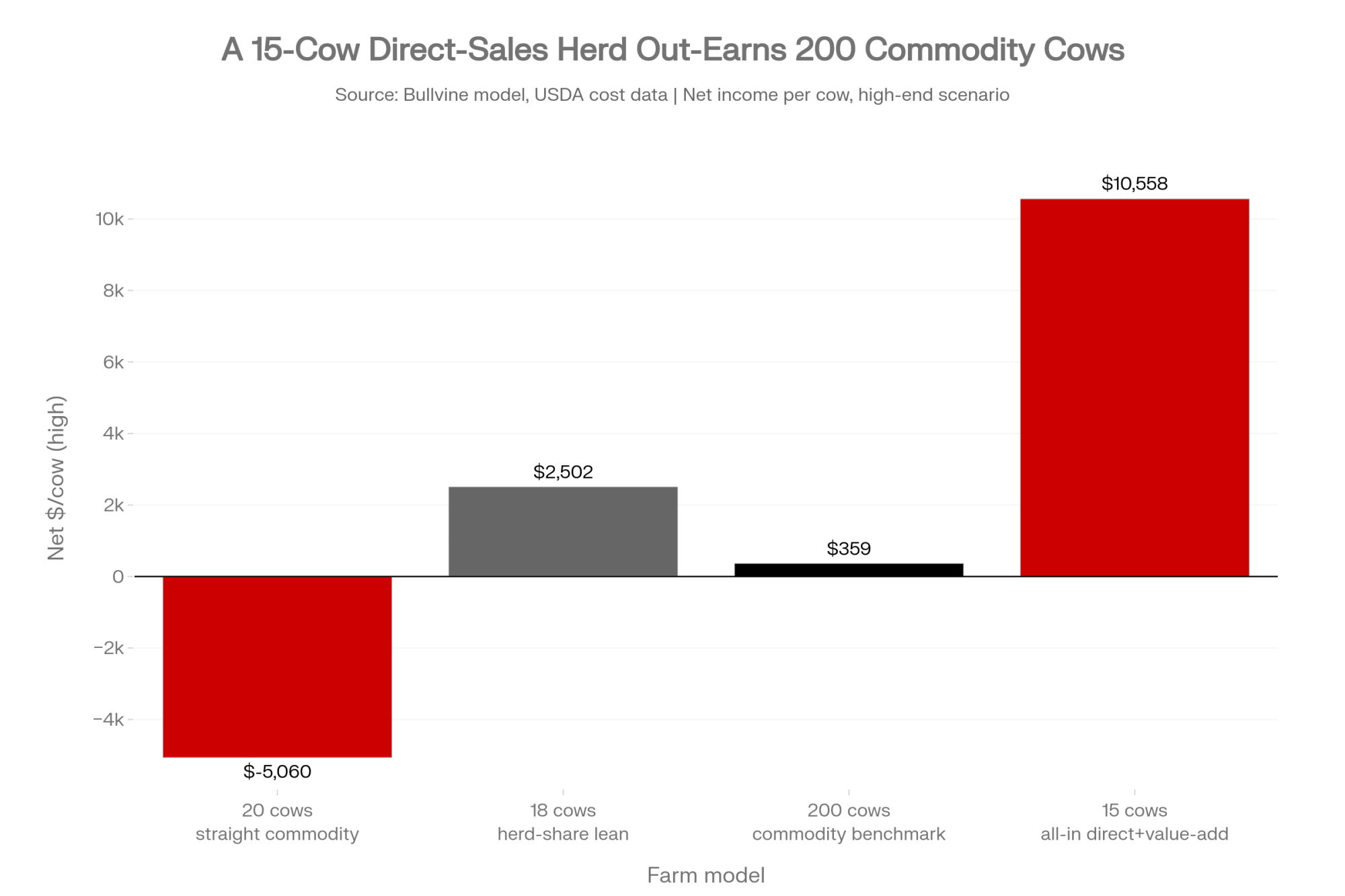
Look at the bottom two rows first. The straight-shipping 20-cow herd is six figures underwater. The 200-cow benchmark, ten times the cows with real scale and real efficiency, clears about $359 per cow. Now the top row. The 15-cow farm that commits to selling direct doesn’t just survive. At the high end, it nets over $10,000 per cow, beating that 200-cow operation many times over.
The 18-cow farm in the middle is the honest one. It swings from a $41,000 loss to a $45,000 gain depending on where its raw milk prices out. That’s the knife’s edge most micro-dairies actually live on. Half-committing to direct sales isn’t a safe middle path. It’s a coin flip.
Run it on your own herd. Take your cows, multiply by ~23,000 lb, divide by 8.6 to get gallons. Co-op farmgate works out to roughly $1.80 a gallon at today’s all-milk price. Move a gallon from that to direct raw at even $10, and you’ve added about $8.20 to the top line, before you subtract hauling, which only widens the gap. On a 15-cow herd, shifting about 35% of production to direct is over 14,000 gallons. North of $100,000 in revenue that never showed up on the co-op check.
Does your state decide this more than your cows do?
Mostly, yes. And that’s the wall Jacy Vaughn ran into in Texas: not a price problem, a permit problem.
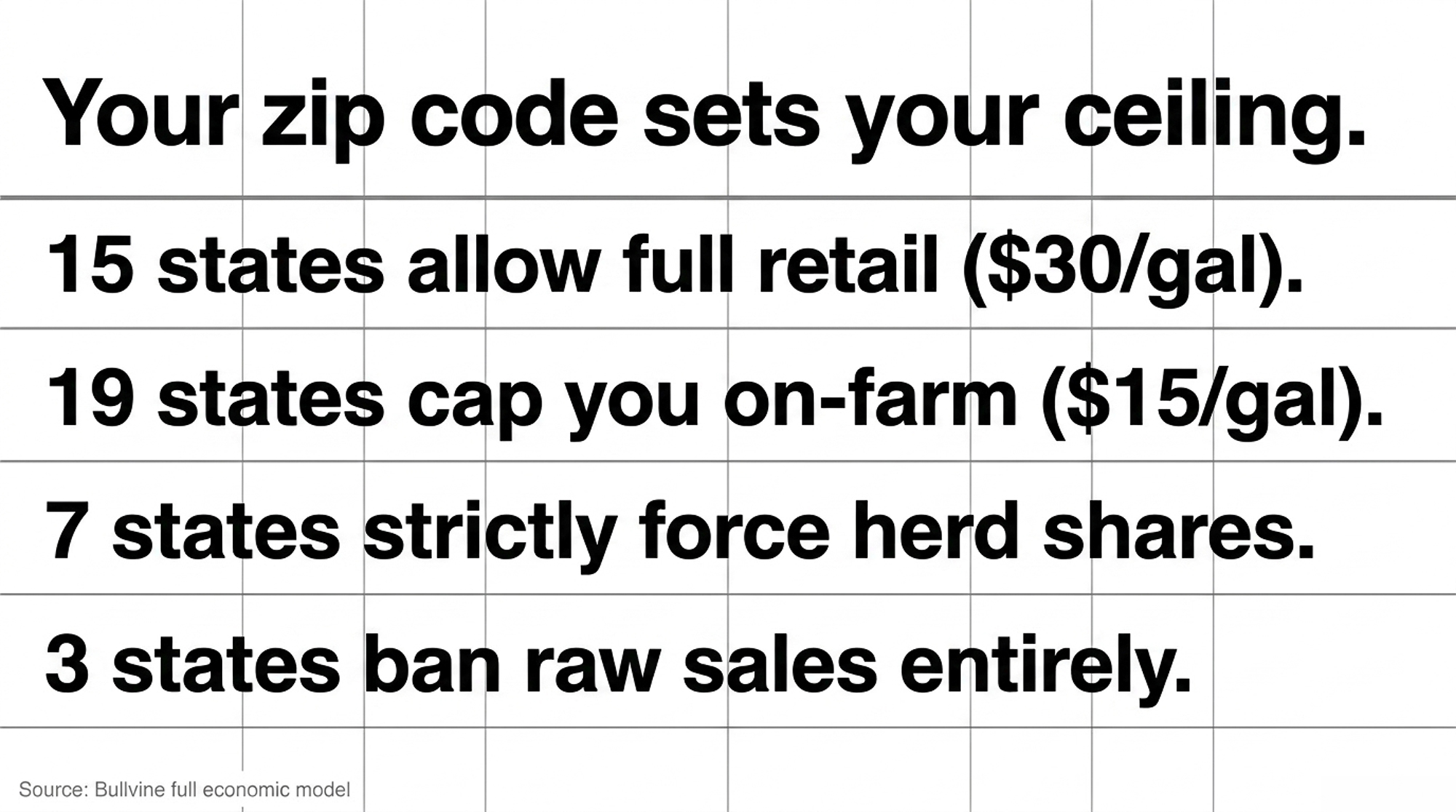
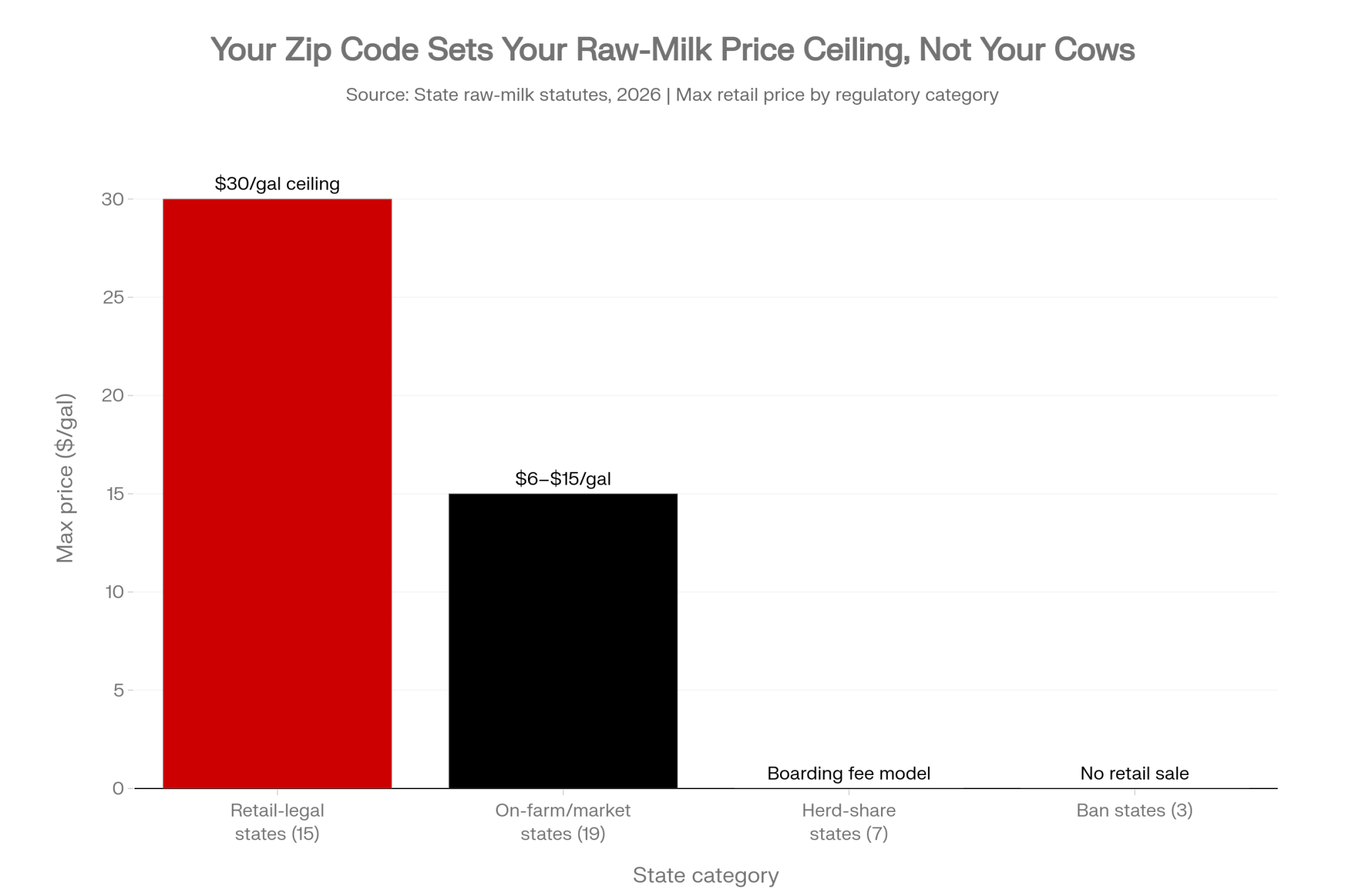
Raw milk retails anywhere from $6 to $30 a gallon, and here’s the kicker. That spread has almost nothing to do with quality. It’s your zip code. Live in one of the 15 states that allow full retail sales — California, Pennsylvania, Maine, Nevada, New Mexico, Arizona, Washington, Idaho, Oregon, and now Utah after its 2026 HB 179 — and you can reach that $30 ceiling in a grocery cooler. Cross a line into one of the 19 on-farm or farmers’-market states, and you’re capped closer to $6–15 a gallon, selling out of your own driveway. Same 15 cows, same butterfat, wildly different ceiling.
| Category | # of States | Price Ceiling | Sales Channel | Example States |
|---|---|---|---|---|
| Full retail-legal | 15 | Up to $30/gal | Retail/grocery | California, Pennsylvania, Utah (2026) |
| On-farm/farmers’ market | 19 | $6–$15/gal | Farm or market only | — |
| Herd-share model | 7 | N/A (boarding fee) | Member-owned cow shares | — |
| Full ban | 3 | N/A | None permitted | Hawaii, New Jersey, Virginia |
And the map keeps moving. Oklahoma just yanked its on-farm cap from 100 to 1,500 gallons a month in May 2026 and legalized advertising, though sales still have to happen at the farm, not in stores. Seven states box you into herd shares, where a customer legally owns a piece of the cow and pays you a boarding fee. Only three — Hawaii, New Jersey, and Virginia — ban raw sales in every form, with six more stuck at pet-milk only. Texas technically allows on-farm raw sales, which is exactly why Vaughn’s fight turns on the permit and her private-membership model, not on whether raw milk is legal at all.
That’s the caveat the model farms can’t show you. Direct raw carries liability and regulatory exposure a co-op contract never will. The FDA has linked 143 illness outbreaks to raw milk since 1987, and one event can end a farm-direct brand overnight. Vaughn argued her Private Membership Association kept sales member-to-member and outside the state’s reach; a Travis County judge sided with the state at the injunction stage, in Texas DSHS v. Like Wildflowers Homestead (Cause No. D-1-GN-25-010854). A permit fight alone can mean dumped milk and mounting legal fees before any safety question is even reached. Go in with your eyes open, and call an ag attorney before you call a customer.
Isn’t agritourism just a hobby that eats your Saturdays?
Not on these numbers. For a 20-cow herd, value-add and farm visitors aren’t the garnish. They’re often the meal.
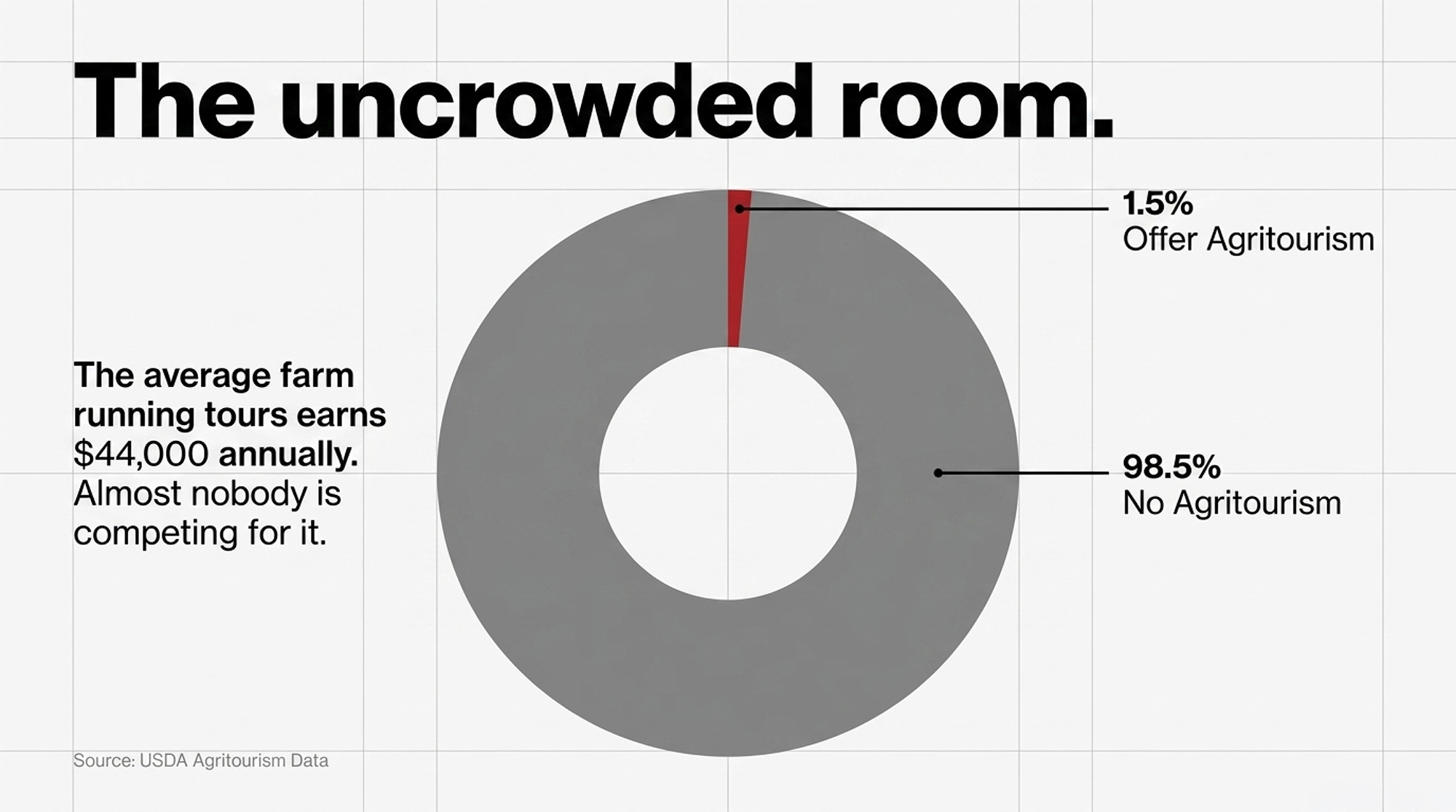
A 2026 peer-reviewed study of five small dairies found on-farm cheese processing shifted the underlying economics, not just the top line. Agritourism reads the same way. The average U.S. farm running tours, stays, or on-farm dining earns about $44,000 a year, though the spread is wide, with top counties averaging $161,000 and only around 1.5% of farms doing it at all. That last number is the opening. Almost nobody’s competing for it. Tours run $15–25 a head, on-farm dining $65–125, and most setups break even inside 12 to 36 months.
Why one dead cow hurts a micro-dairy more than a mega-dairy
Here’s where genetics stops being a big-herd luxury and becomes small-herd survival. When you’ve built a direct-sales brand on 15 cows, every animal is carrying a share of that $200,000-plus revenue line from the table above, not just producing milk but backing the herd shares and the standing orders. Lose one cow early to a bad calving or a lame foot, and you’ve knocked out 6–7% of your milking string in a single week, a hit a 500-cow herd wouldn’t even feel. On a business already living on the coin’s edge, that’s not a bad month. It can be the month the numbers stop working.
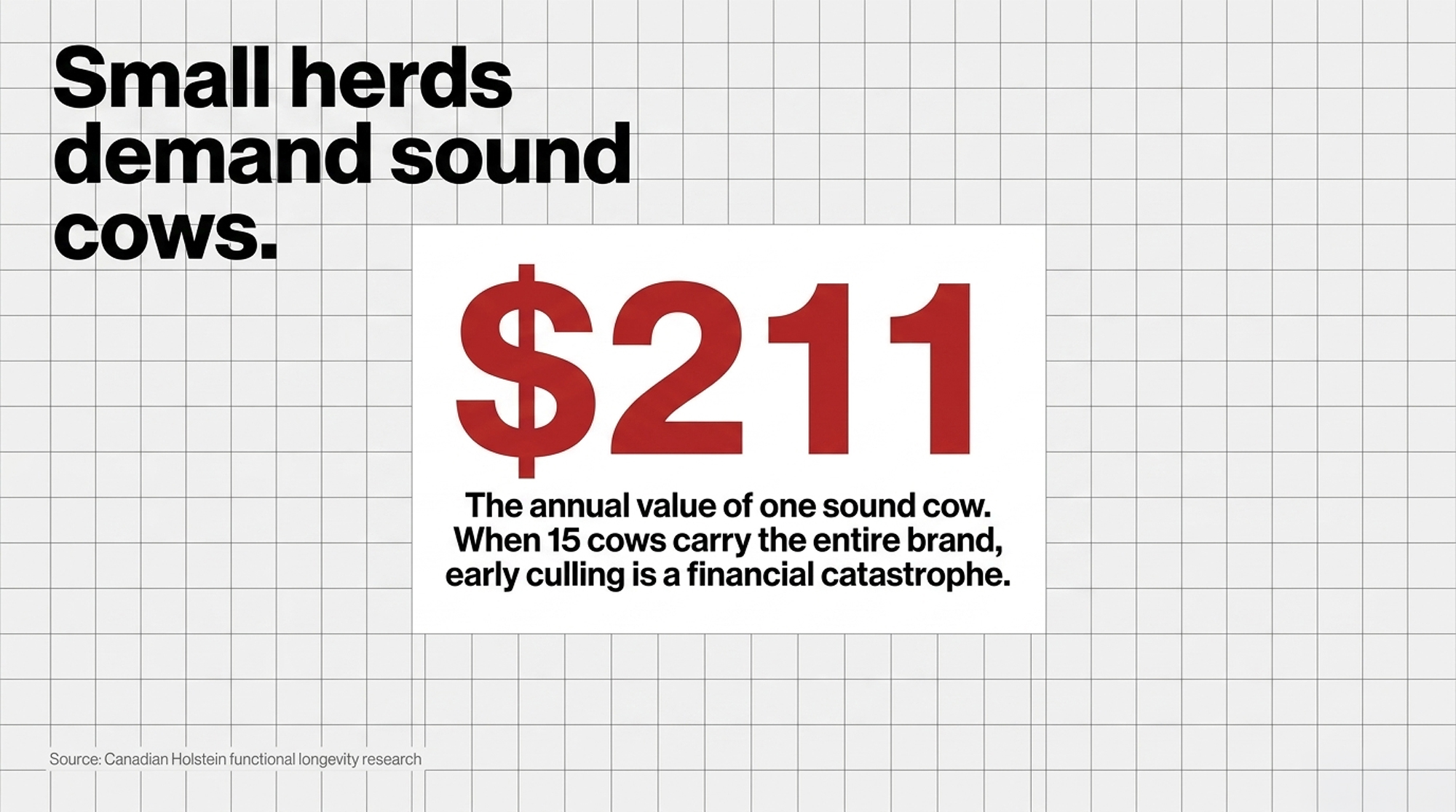
That’s why involuntary culling is a financial catastrophe at this scale, and why the genetics of staying matter more than the genetics of peak milk. Longevity is highly polygenic, built from hundreds of small-effect genes rather than one magic marker, so the genomic tools built for big commercial herds still work in a small barn. Canadian Holstein research ties reproduction traits directly to functional longevity: cows that breed back reliably age out on your schedule, not an emergency vet’s. One genetic study put a hard number on soundness. The gap between a “very good” conformation cow and a “poor” one was worth $211 a year and 307 extra days of productive herd life, almost all of it from better locomotion keeping cows out of the cull pen. Extension folks push the same lever from the calf side: aim for first calving around 23 months and pick sires for health and longevity, not just peak milk.
Options and trade-offs
| Farm Model | Cows | Net Range/Cow | Regulatory Dependency | Risk Level |
|---|---|---|---|---|
| Straight commodity | 20 | -$5,060 | Low (co-op contract) | Low risk, guaranteed loss |
| Herd-share lean | 18 | -$2,312 to $2,502 | High (7 herd-share states only) | Coin-flip / high volatility |
| Commodity benchmark | 200 | $359 | Low | Low risk, thin margin |
| All-in direct + value-add | 15 | $2,134 to $10,558 | Very high (state statute-dependent) | High reward, high compliance risk |
Go all-in on direct sales (the 15-cow model)
This is the path that beats a 200-cow herd per cow, but it turns you into a food business as much as a dairy. It makes sense if you’re in a retail-legal or strong herd-share state and you genuinely like customers as much as cows. You’ll need processing space, a permit, and a market you build yourself.
⏱ DO THIS IN THE NEXT 30 DAYS
1. Pull your state’s raw-milk statute. Confirm exactly what you can legally sell before you spend a dollar on infrastructure.
2. Get your insurance answer in writing. Ask your agent one question: does the policy cover raw-milk sales, or does it already exclude them? That exclusion is the trap that turned Jacy Vaughn’s permit skip into a five-figure headache.
Run herd shares and keep it lean (the 18-cow model)
This is the play in the seven herd-share states where retail raw is off the table. Overhead stays lower, but you’re on that coin’s edge. It only clears if you price the boarding fee right and hold onto your members. Lose a few families or misprice the share, and the same model that penciled at a $45,000 gain slides toward a $41,000 loss.
Add agritourism on top of either
This is the lowest-competition lever on the board, and it doesn’t fight your milk for volume. What it needs: land people actually want to visit, real liability coverage, and a tolerance for strangers on the place. Expect break-even somewhere in the one-to-three-year range.
Stay straight-commodity
This one only pencils if the dairy isn’t really the point. The off-farm job is, or the land and the lifestyle are. Nothing wrong with that choice. Just don’t expect 20 cows and a co-op check to pay for themselves.
Where’s this heading?
Direct-to-consumer demand keeps climbing, and more states keep loosening rules. Utah and Oklahoma both expanded access in 2026, with more bills moving in 2026 sessions. But a ruling against a small operator in a top-four milk state like Texas is exactly the enforcement posture regulators next door reach for. The window for early movers in low-competition markets is open now, and how long it stays open depends partly on cases like Vaughn’s.
Which means the decision in front of you isn’t really “should I go direct someday.” It’s whether your state’s rules and your own tolerance for customers make it viable this year, while the field is still thin.
Key takeaways
- If you’re under ~20 cows shipping straight commodity, you’re subsidizing the cows, full stop. Run your own version of the table before you defend the current model.
- If a big share of your “loss” is imputed family labor, know that before you panic. Near $12.00/cwt of small-herd cost is unpaid hours, not cash out the door.
- If your state is one of the 15 retail-legal or 7 herd-share states, that’s your single highest-value lever — bigger than any cost cut or genetics tweak you can make.
- If you’re half-committed to direct sales, you’re on the coin-flip farm. Pick a lane. The middle loses money more often than it makes it.
- If you’re going direct in a permit state, get the permit and the insurance answer before you sell a jar.Skipping the $800 is exactly what put Jacy Vaughn in a Travis County courtroom.
- If you’re keeping a tiny herd, treat every early cull as a revenue event, not just an animal loss. A sounder cow is worth ~$211/year and nearly a year of extra herd life, and at 15 cows that margin is your buffer.
- If agritourism fits your land and temperament, it’s the least-crowded income on the board. Only ~1.5% of farms have claimed it.

So where does your breakeven actually sit right now, and how much of it is really you working for nothing? Pull your milk records and your state’s raw-milk rules this week and run the gallons-times-price math on your own herd. If it comes up short on the co-op check, you already know which lever to pull first.
Run Your Numbers
Dairy Profit Projector — Drop in your herd size, production, and ration to see your own breakeven milk price and margin per cwt. It shows exactly how far your cost structure sits from today’s milk price, so you know what the direct-sales premium has to cover before you build a thing.
Complete references and supporting documentation are available upon request by contacting the editorial team at editor@thebullvine.com.
Learn More
- USDA’s $10.9 Billion Warning: $18.95 Milk, $19.14 Costs, and 29% of Farm Income from Government Checks — Breaks down the macroeconomic squeeze catching mid-sized and small herds, exposing how baseline margins turn negative when input costs outpace standard blend prices.
- Is Bigger Always Better? The Truth About Dairy Farm Size and Profitability — Dismantles the myth that scale alone guarantees survival, arming producers with margin-focused metrics that prioritize capital efficiency over relentless cow expansion.
- Breeding for Longevity: Why Productive Life Beats Peak Yield on the Balance Sheet — Delivers genetic selection strategies focused on sound locomotion and reproductive stayability to eliminate costly involuntary culling before cows reach peak lifetime profitability.
The Sunday Read Dairy Professionals Don’t Skip.

Every week, thousands of producers, breeders, and industry insiders open Bullvine Weekly for genetics insights, market shifts, and profit strategies they won’t find anywhere else. One email. Five minutes. Smarter decisions all week.