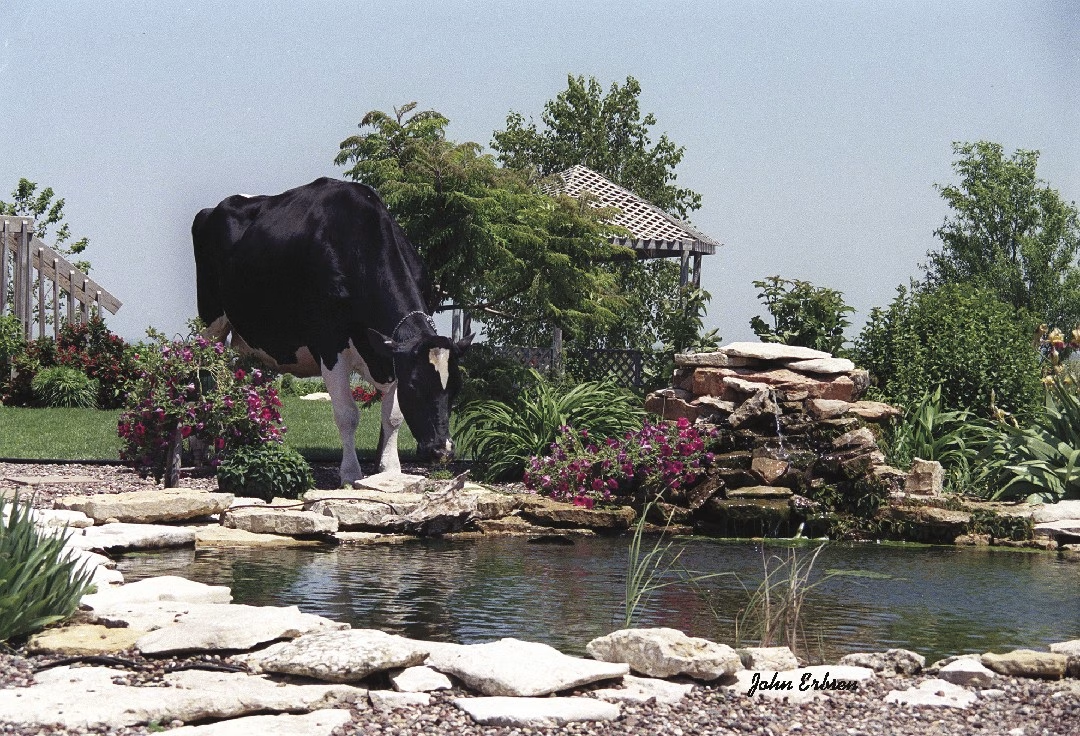
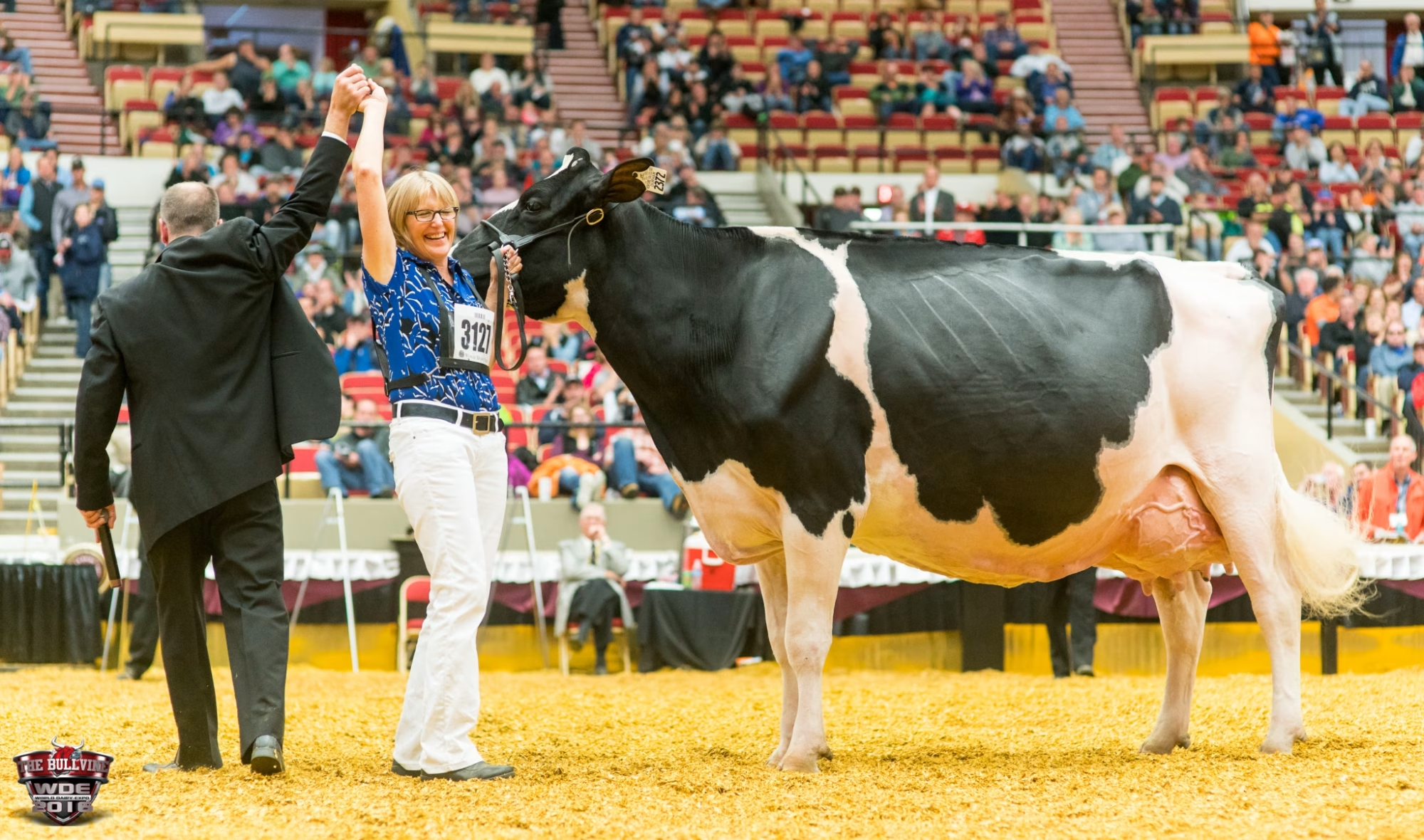
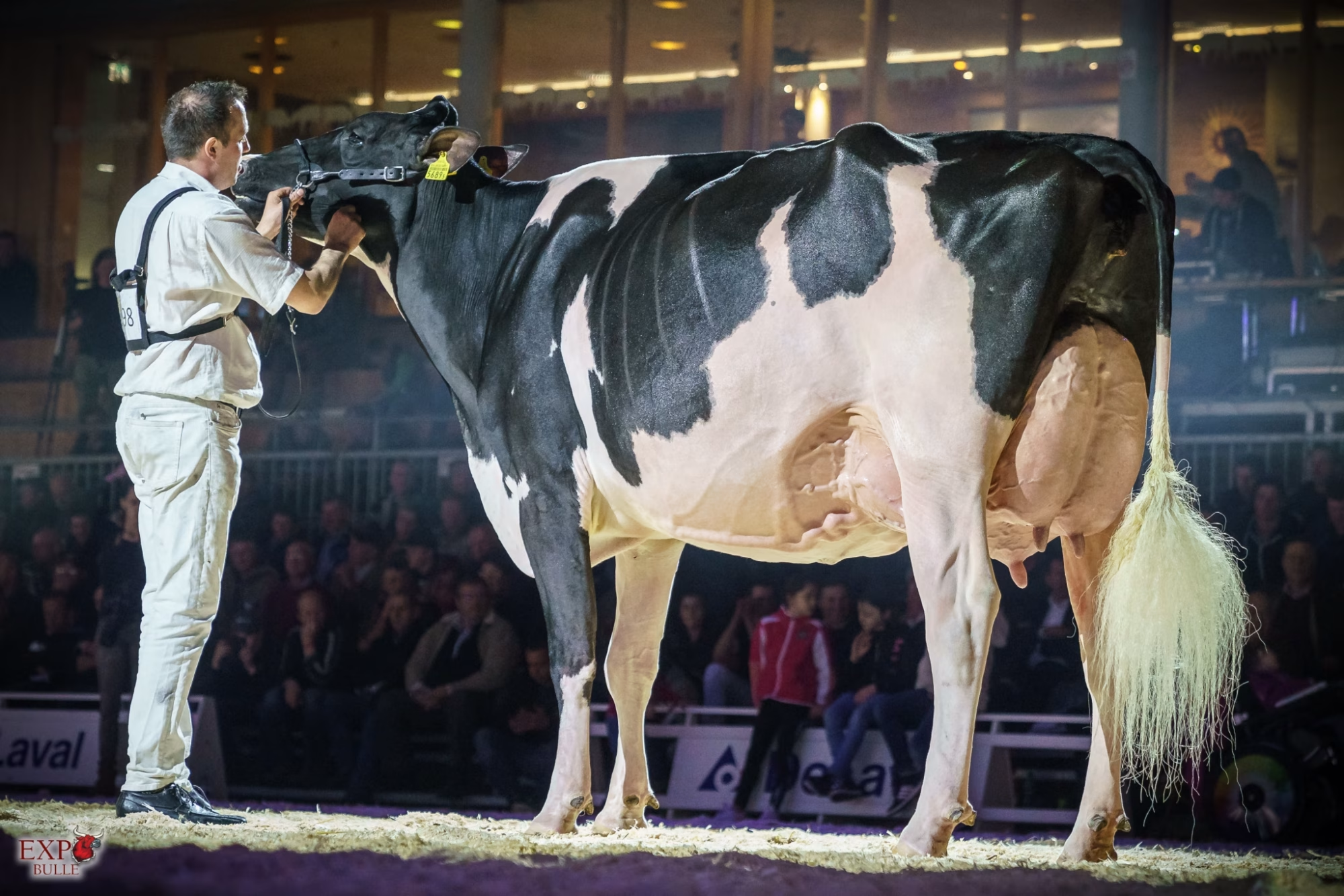
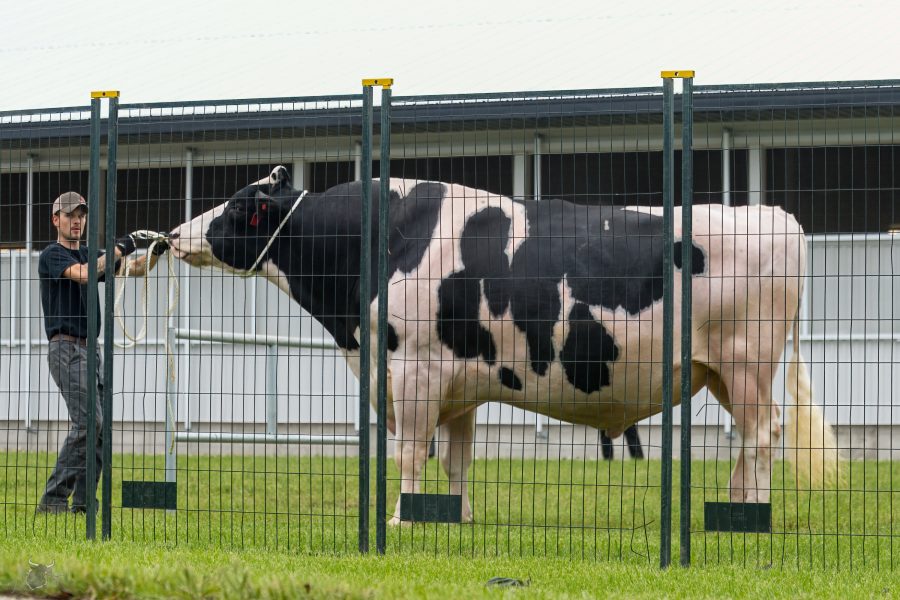
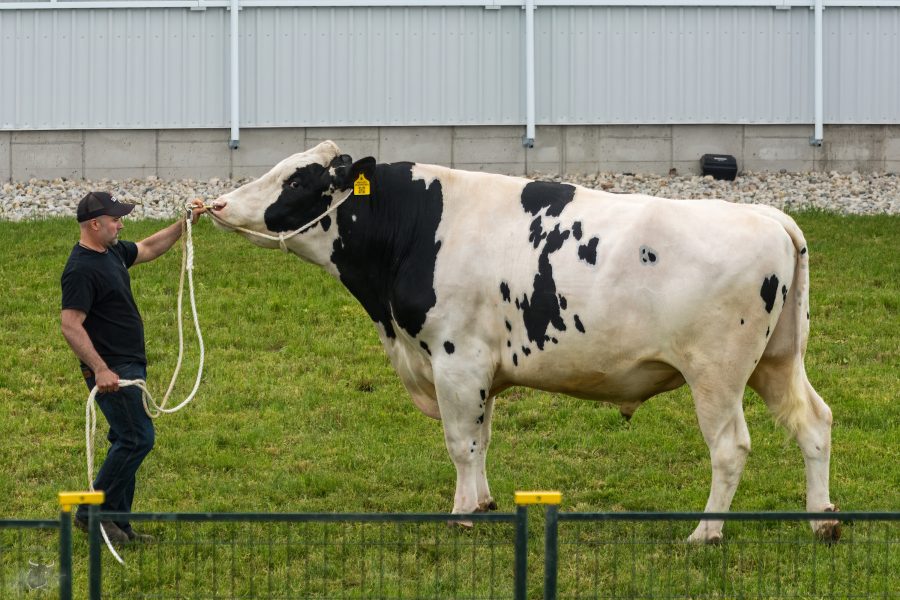
Roxy, Dellia, Blackrose and seven more didn’t just make famous pedigrees. They built the cow families still showing up in bull books, embryos and your best heifers.
Mother’s Day in the dairy business doesn’t look much like the card aisle.
It looks like a cow family that just keeps paying rent.
You know the kind. Pull up a pedigree in a good Holstein barn, go back four generations, then six, then eight, and suddenly there she is. Maybe it’s Roxy. Maybe Dellia. Maybe Blackrose, Laurie Sheik, Altitude, Missy, or Barbie.
And you catch yourself thinking: “There she is again.”
That’s the thing about great donor cows. They don’t really leave. They just stop standing in the barn and start showing up everywhere else.
This isn’t a show-cow ranking. It isn’t a prettiest-picture contest either, though some of these cows could stop you cold in a photograph. This is a Mother’s Day history piece about the cows that kept giving the breed daughters, sons, granddaughters, embryos, sale-ring moments, AI sires, and cow families breeders are still building around.
So pour the coffee. Let’s talk about ten mothers who helped build the Holstein breed.
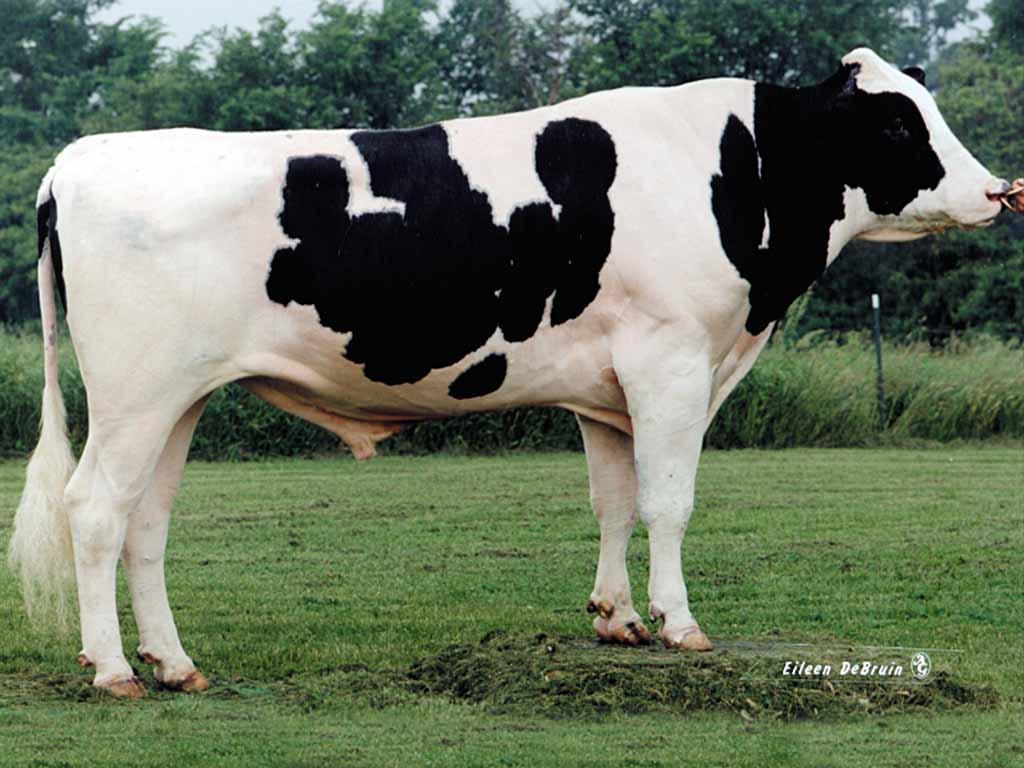
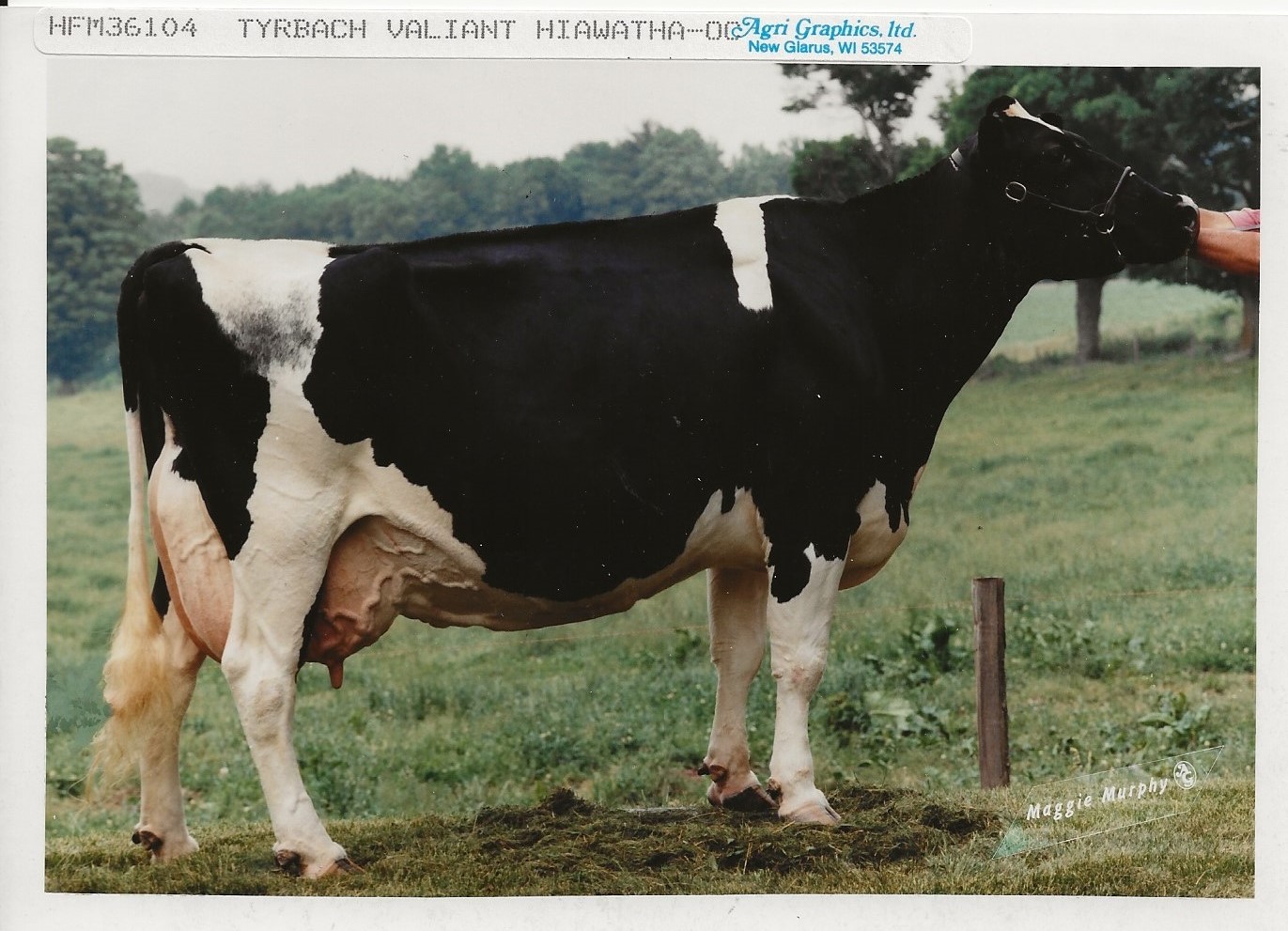
Glenridge Citation Roxy: The Queen Who Made the Picture Famous
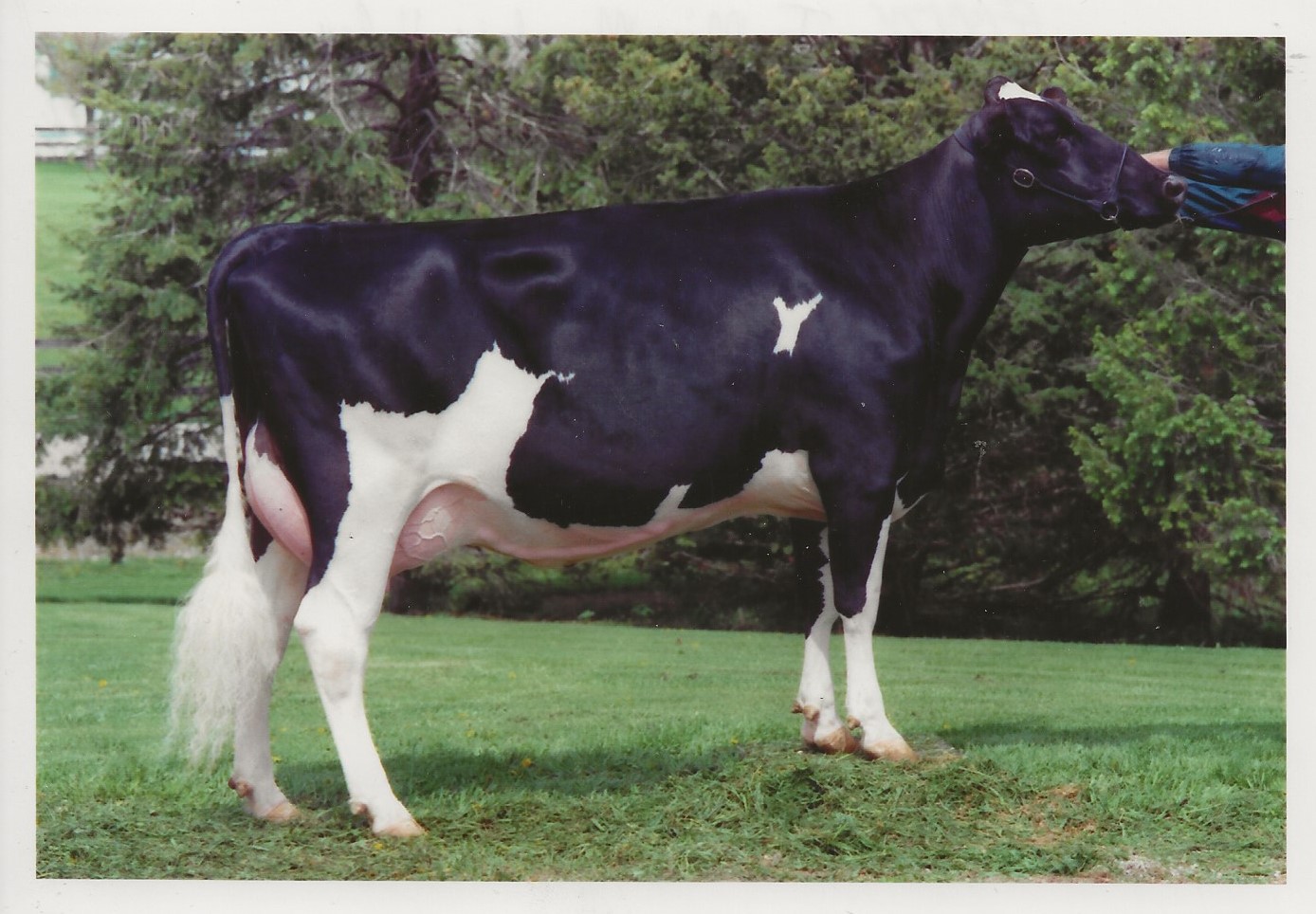
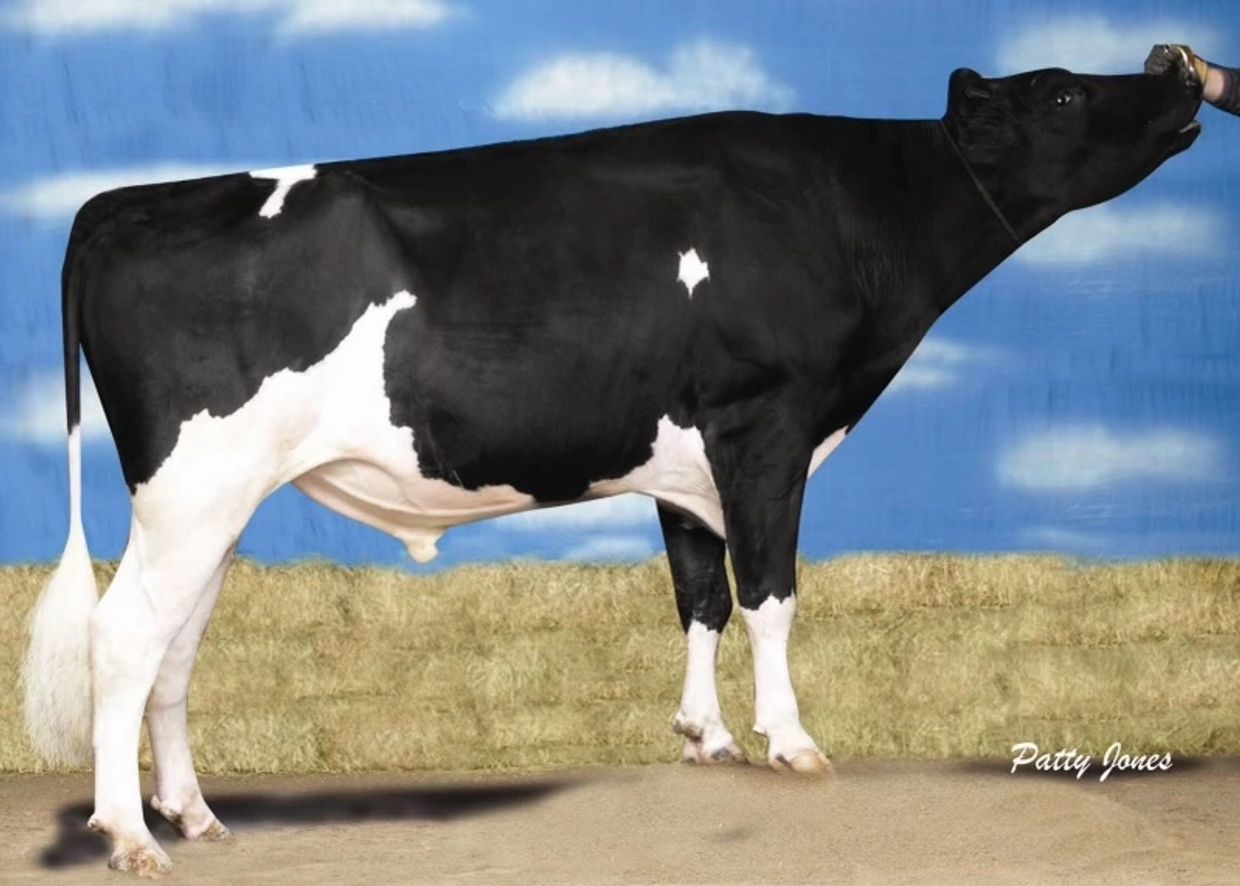
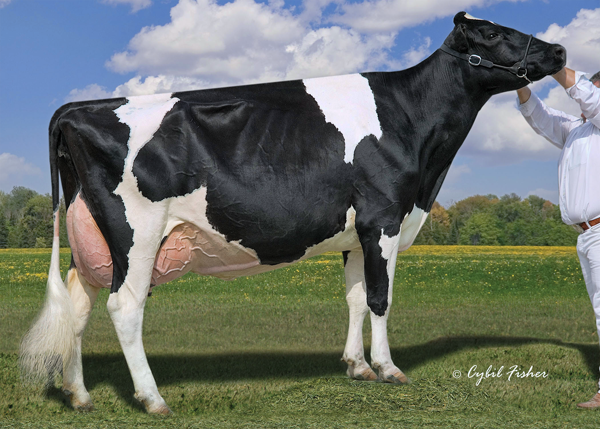
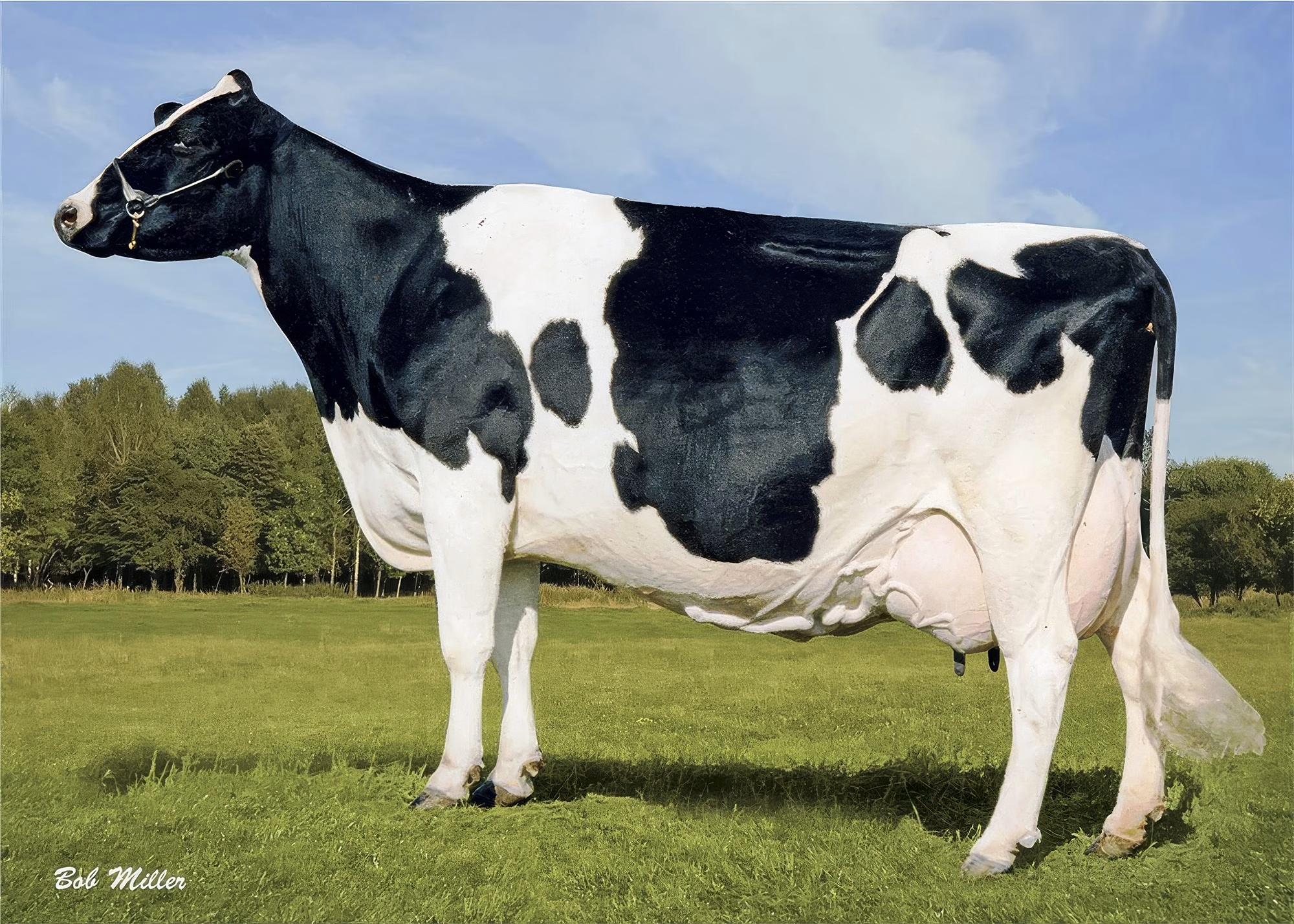
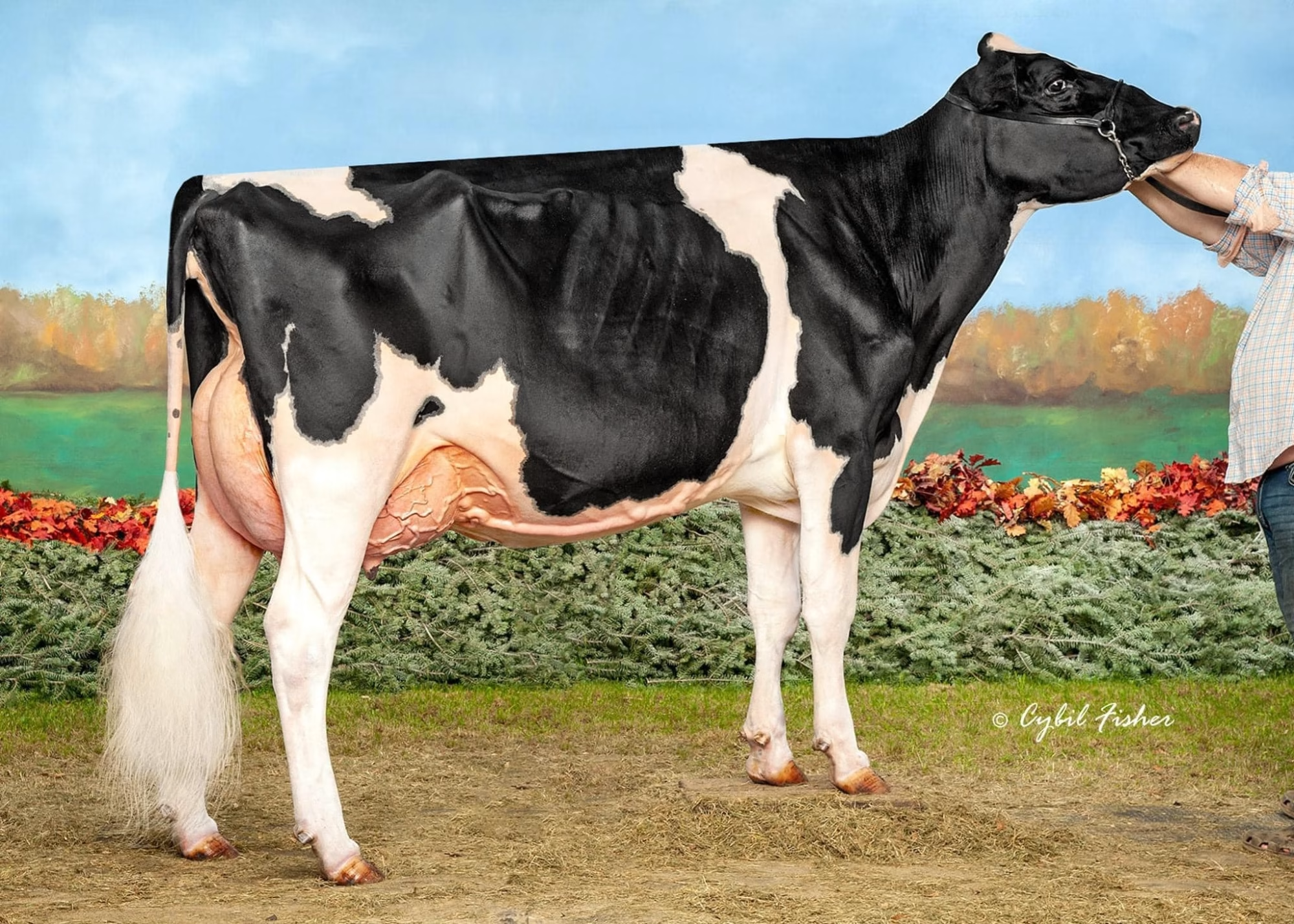
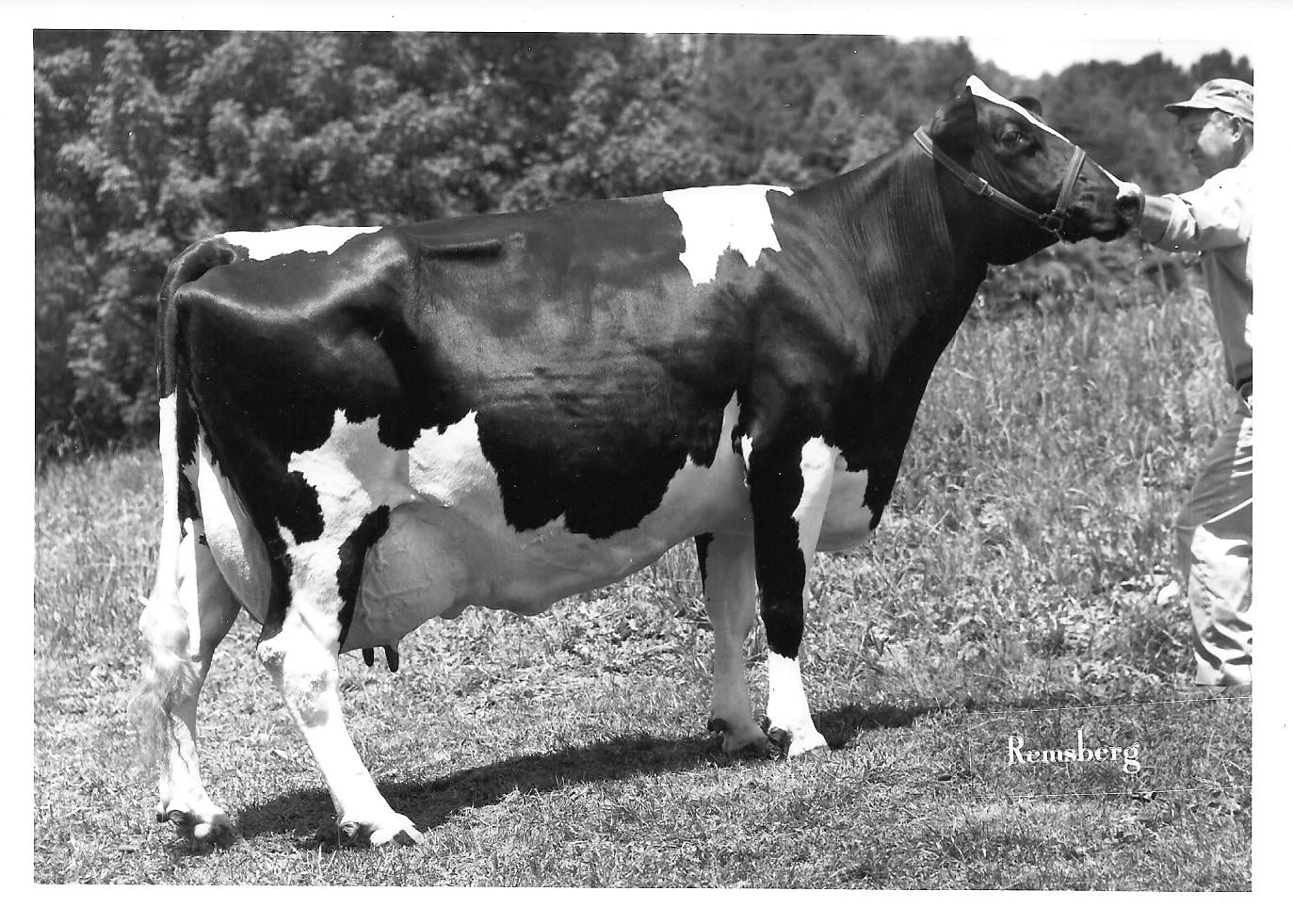
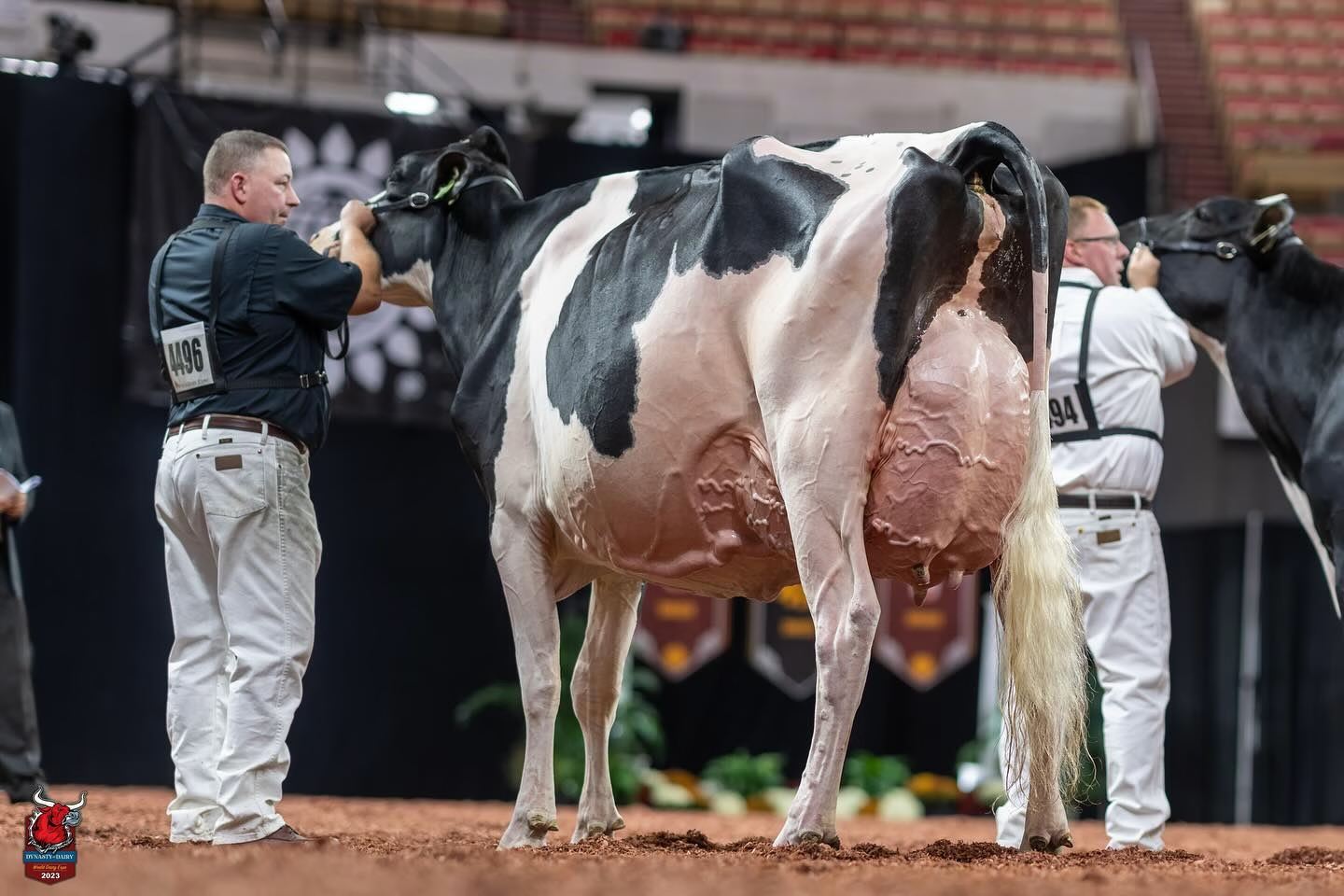
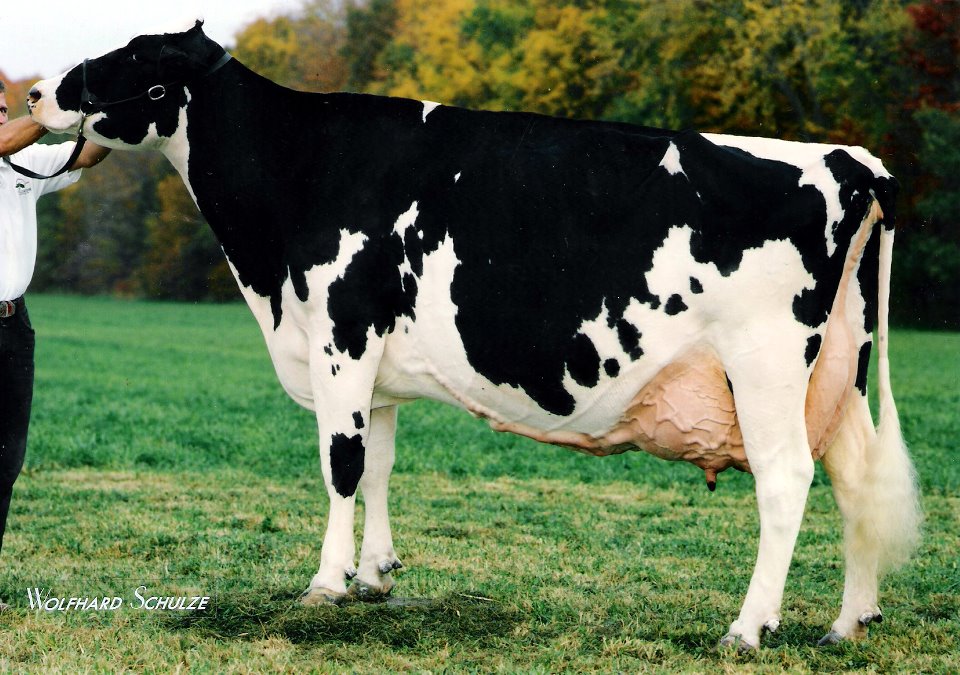
Glenridge Citation Roxy didn’t become a legend because of one perfect photo. The photo became famous because Roxy kept showing up where it mattered most: in daughters, cow families, bull books, and pedigrees breeders still recognize generations later. Read more: Glenridge Citation Roxy: The Legendary “Queen of the Breed”
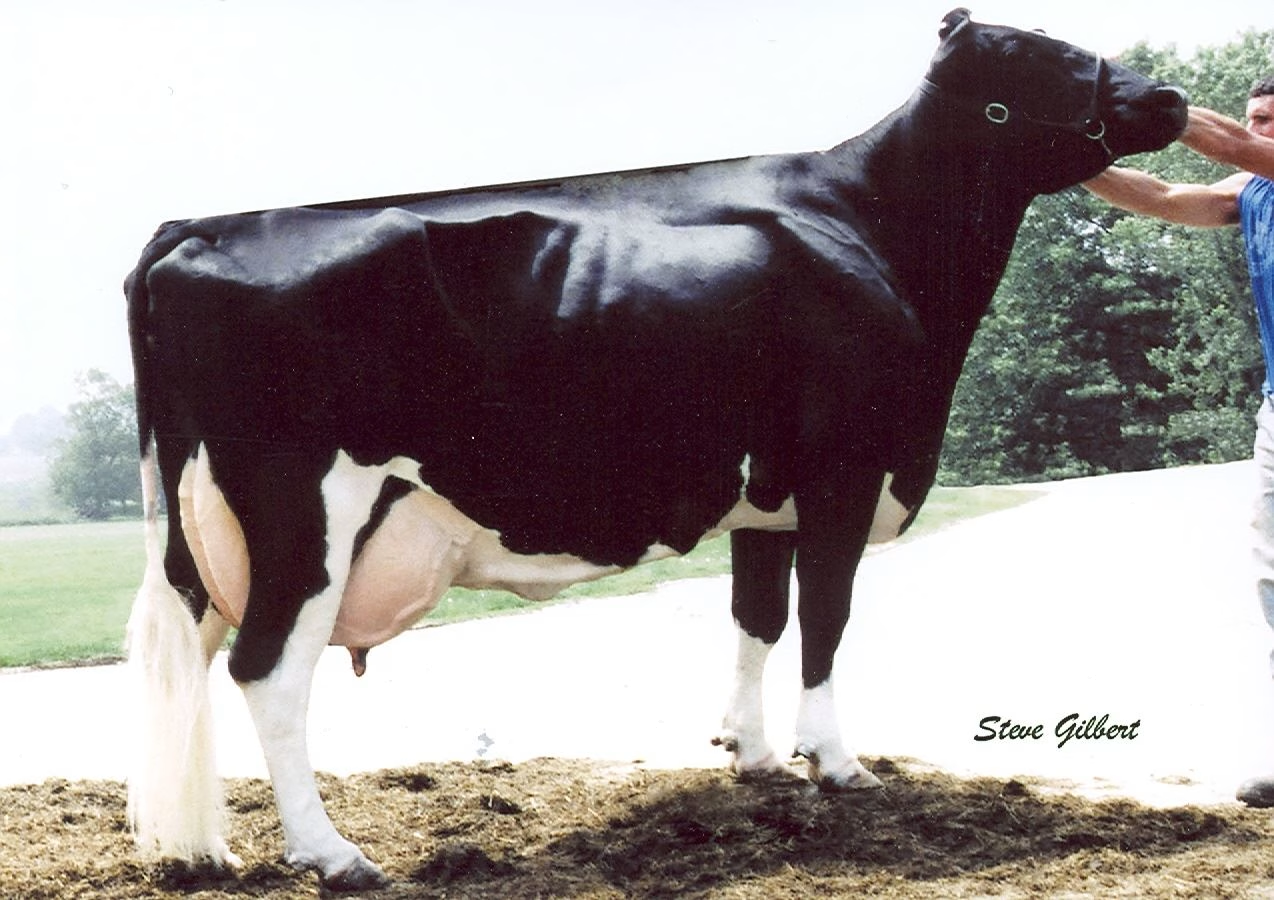
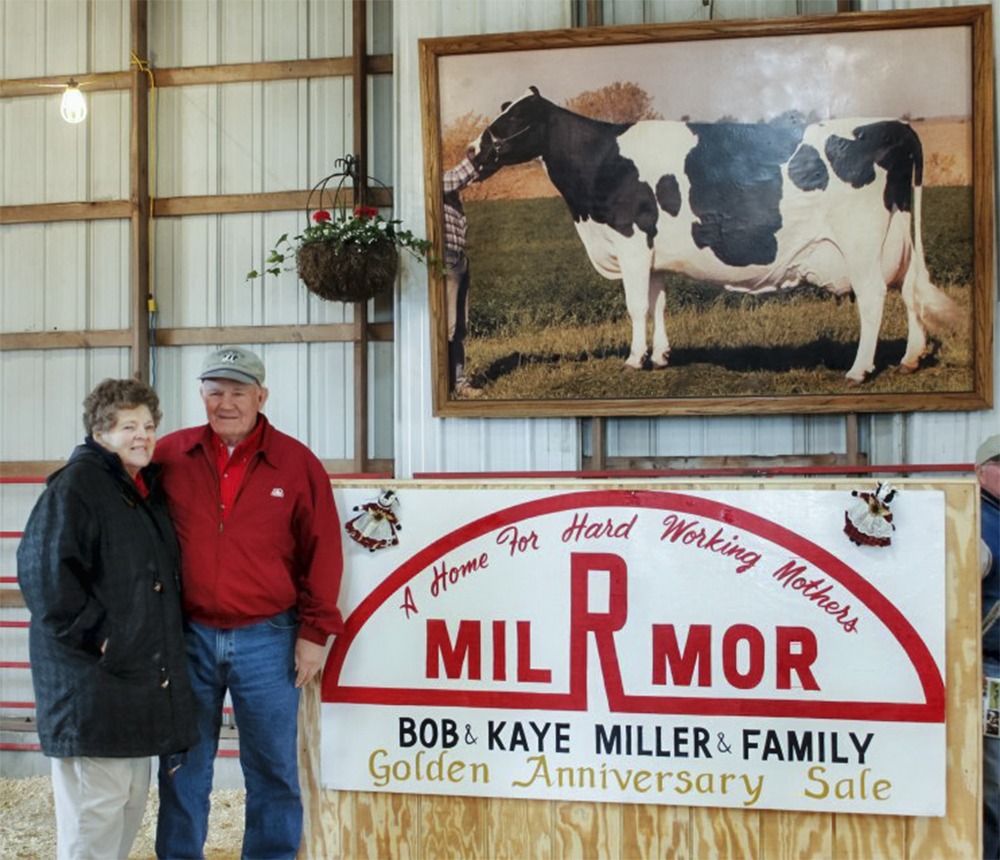
There’s a famous story about Glenridge Citation Roxy getting photographed at Mil-R-Mor in Dundee, Illinois. Bob Miller took one shot. Just one. Roxy was clipped, filled, and standing like she knew exactly who she was.
But honestly, the photo didn’t make Roxy great.
Roxy made the photo great.
Born April 15, 1968, at Lorne Loveridge’s Glenridge herd in Saskatchewan, Roxy became one of those rare cows whose name moved from pedigree line to breed language. The Bullvine profile records her as EX-97-4E-GMD, a third-generation 200,000-pound milk producer, and the first Holstein cow reported to have ten Excellent daughters. She eventually had 16 Excellent daughters . A Holstein Plaza family report also lists Roxy as the dam of 16 Excellent daughters, seven of them Gold Medal daughters.
That’s not a cow family. That’s a franchise.
Her daughter Mil-R-Mor Roxette became Canada’s first 30-star brood cow. Branches through Roxette, Lana Rae, Tony Rae, Debutante Rae, and others kept sending the Roxy influence into type, production, red-carrier lines, sale-ring value, and modern pedigrees.
Roxy sits at the top because she wasn’t just a great individual. She became a structure the breed kept building on.
That’s what great mothers do. They don’t just have a moment. They create a direction.
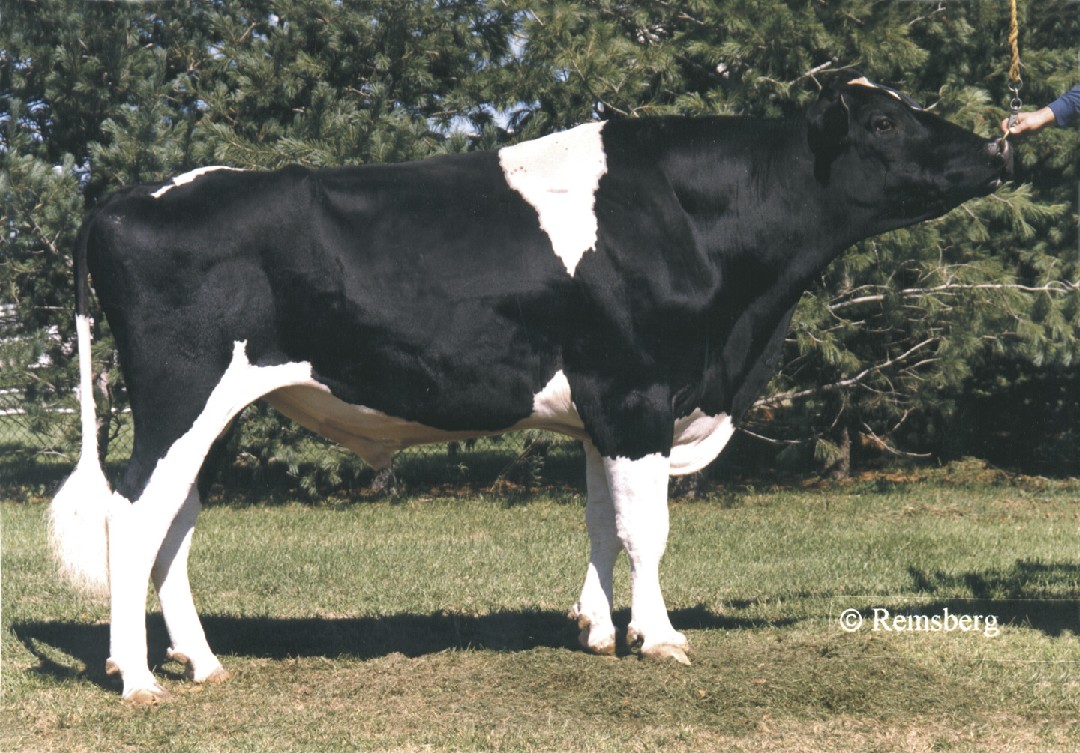
Snow-N Denises Dellia: The Cow Who Ended the Either-Or Argument
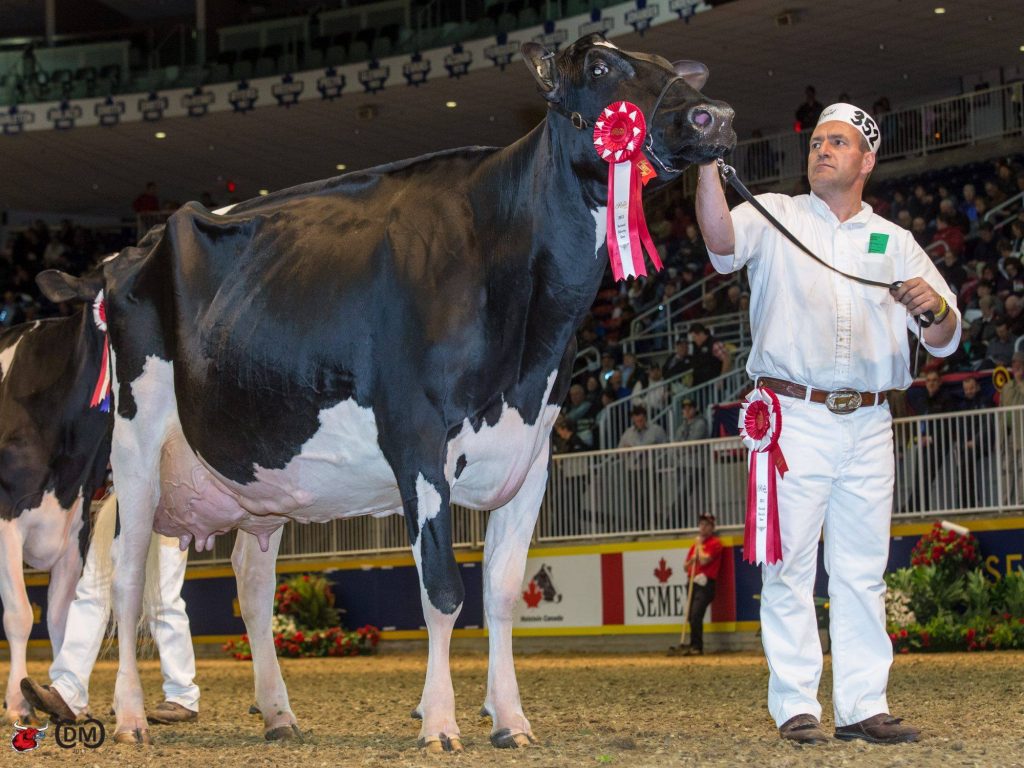
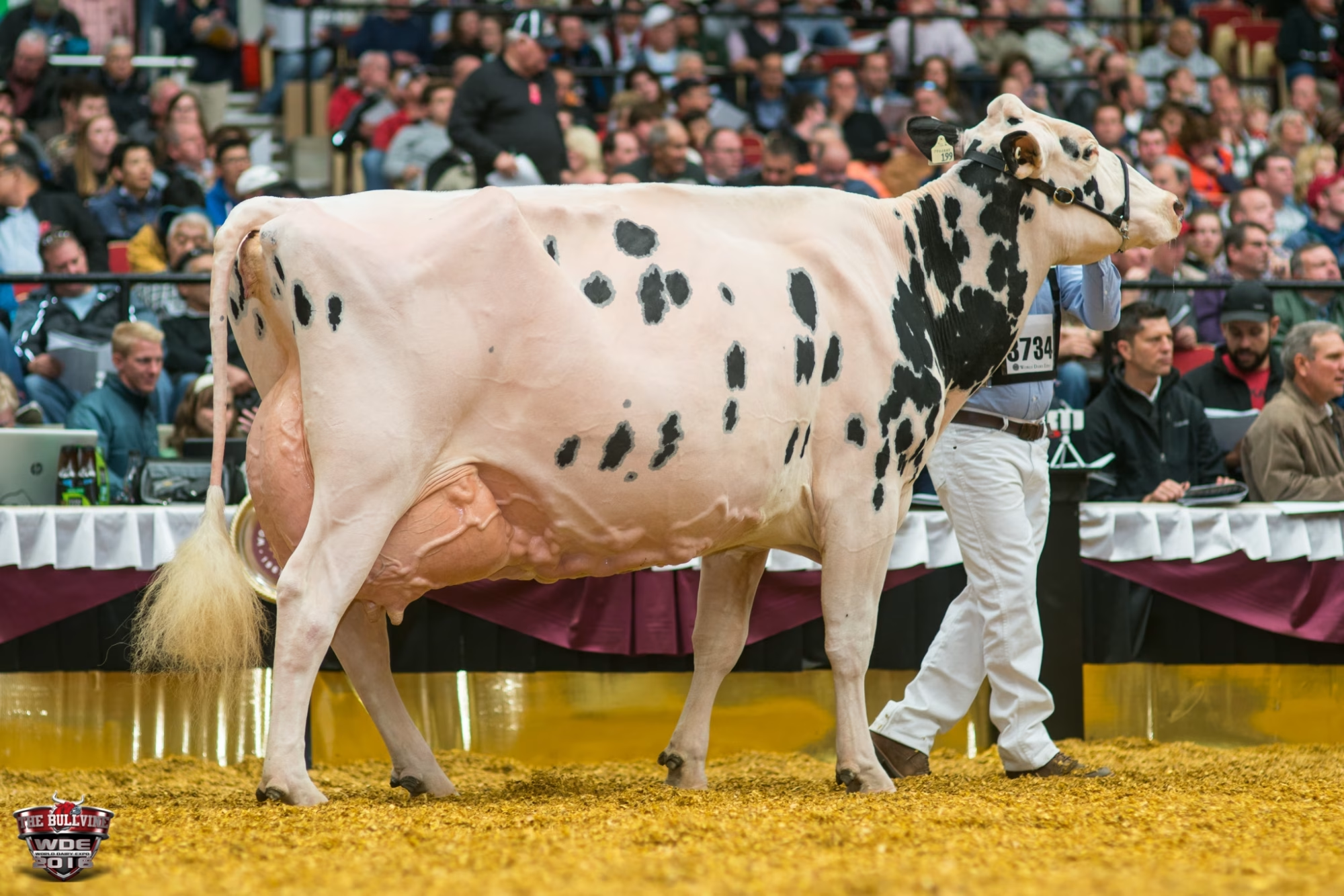
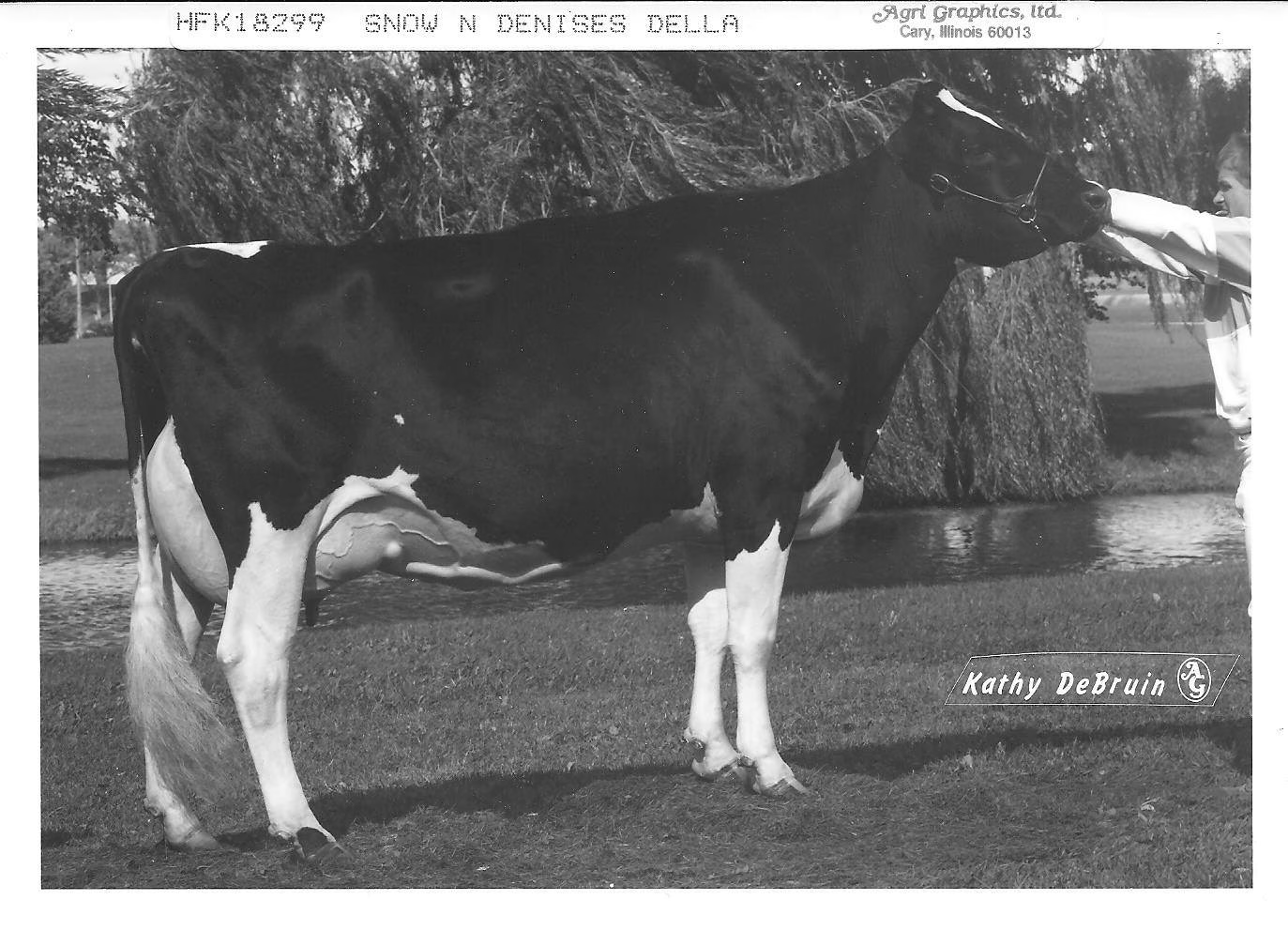
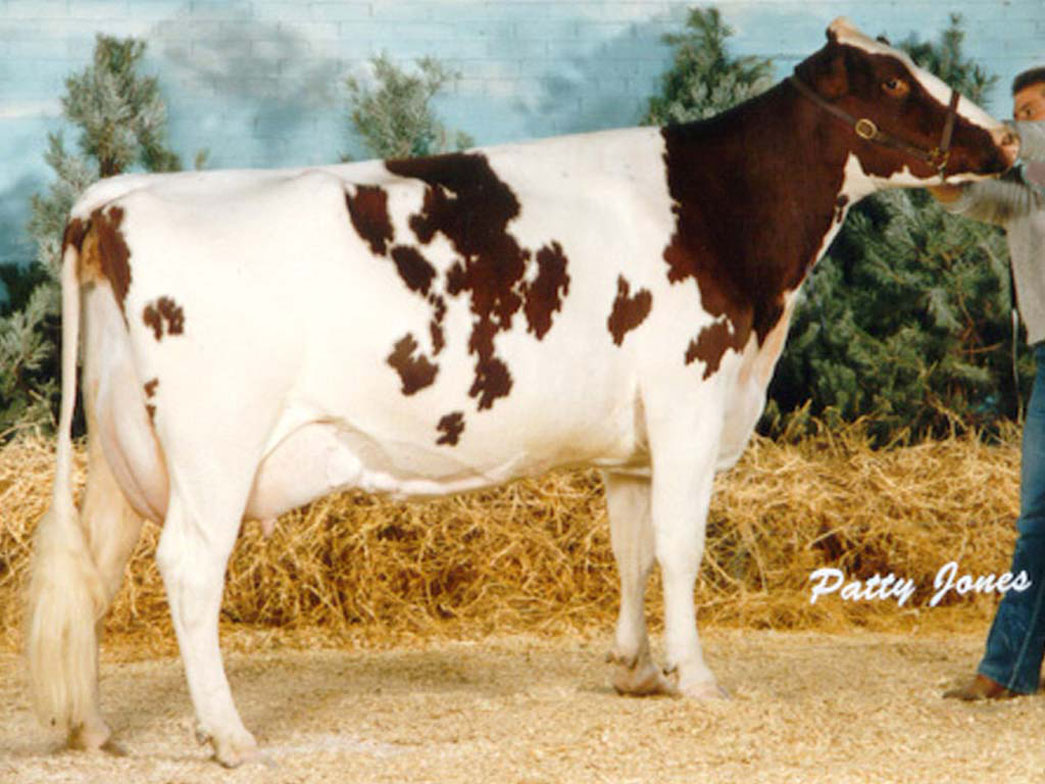
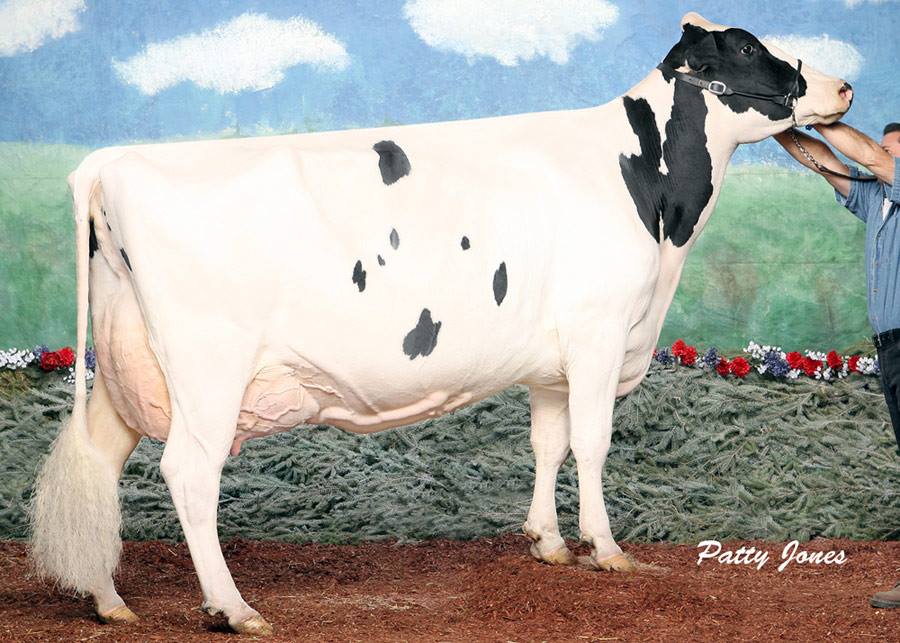
Snow-N Denises Dellia looks almost quiet here, but her influence wasn’t. Through Durham, Die-Hard, Million and generations of daughters, she helped prove type and production didn’t have to live on opposite sides of the barn. Read more: Snow-N Denises Dellia: The Holstein Legend Who Redefined Dairy Genetics
Before Dellia, breeders loved to argue like type and production had to live on opposite sides of the barn.
Then Snow-N Denises Dellia walked in and made the argument feel a little tired.
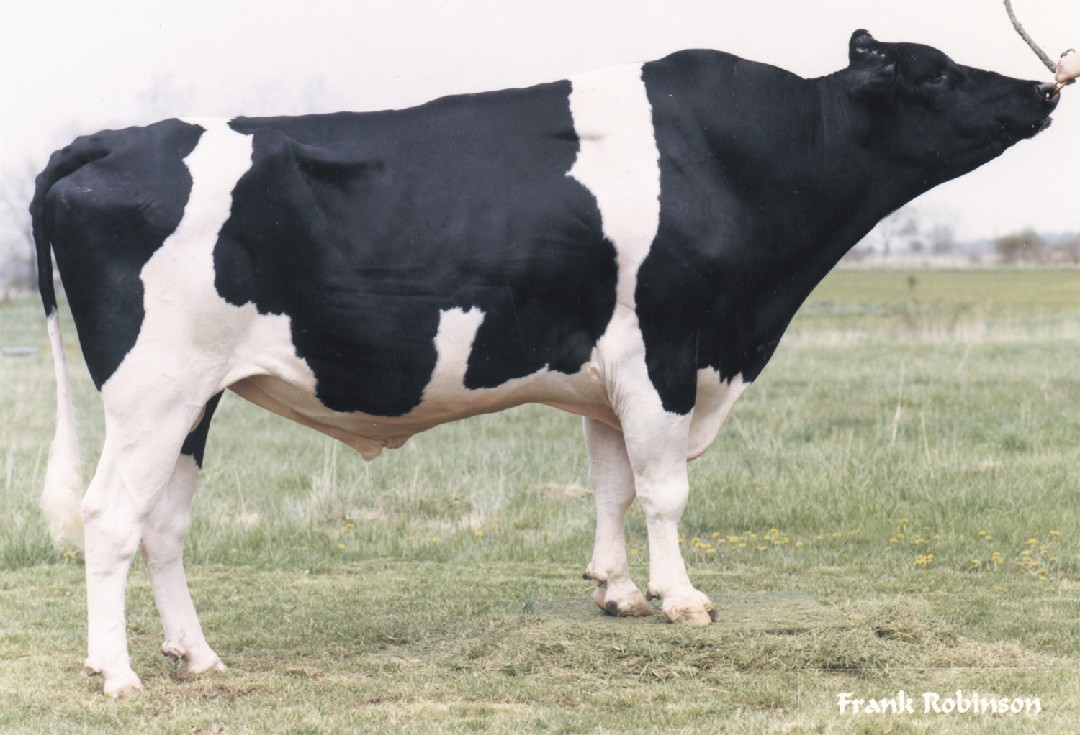
Born in 1986 on Bob Snow’s Wisconsin farm, Dellia was a Walkway Chief Mark daughter from Snow-N Dorys Denise, a Bell-family cow with the kind of maternal depth breeders spend lifetimes trying to stack. ALH Genetics describes Dellia as the breeder of Regancrest Elton Durham and the source of influential cattle including Die-Hard, Million, and Altiota.
And then there was Durham.
Regancrest Elton Durham became one of those sires who connected eras. He had enough cow sense for breeders who still trusted their eyes, and enough transmitting power for the modern proof-sheet crowd. Through Durham, Die-Hard, Million, and the wider Dellia family, her influence spread through elite type, commercial usefulness, and genomic-era pedigrees.
The reason Dellia ranks this high is simple. She changed what breeders believed could come in one package.
She wasn’t just pretty. She wasn’t just productive. She wasn’t just useful.
She was all three, and she passed enough of it on that people had to stop treating balance like a compromise.
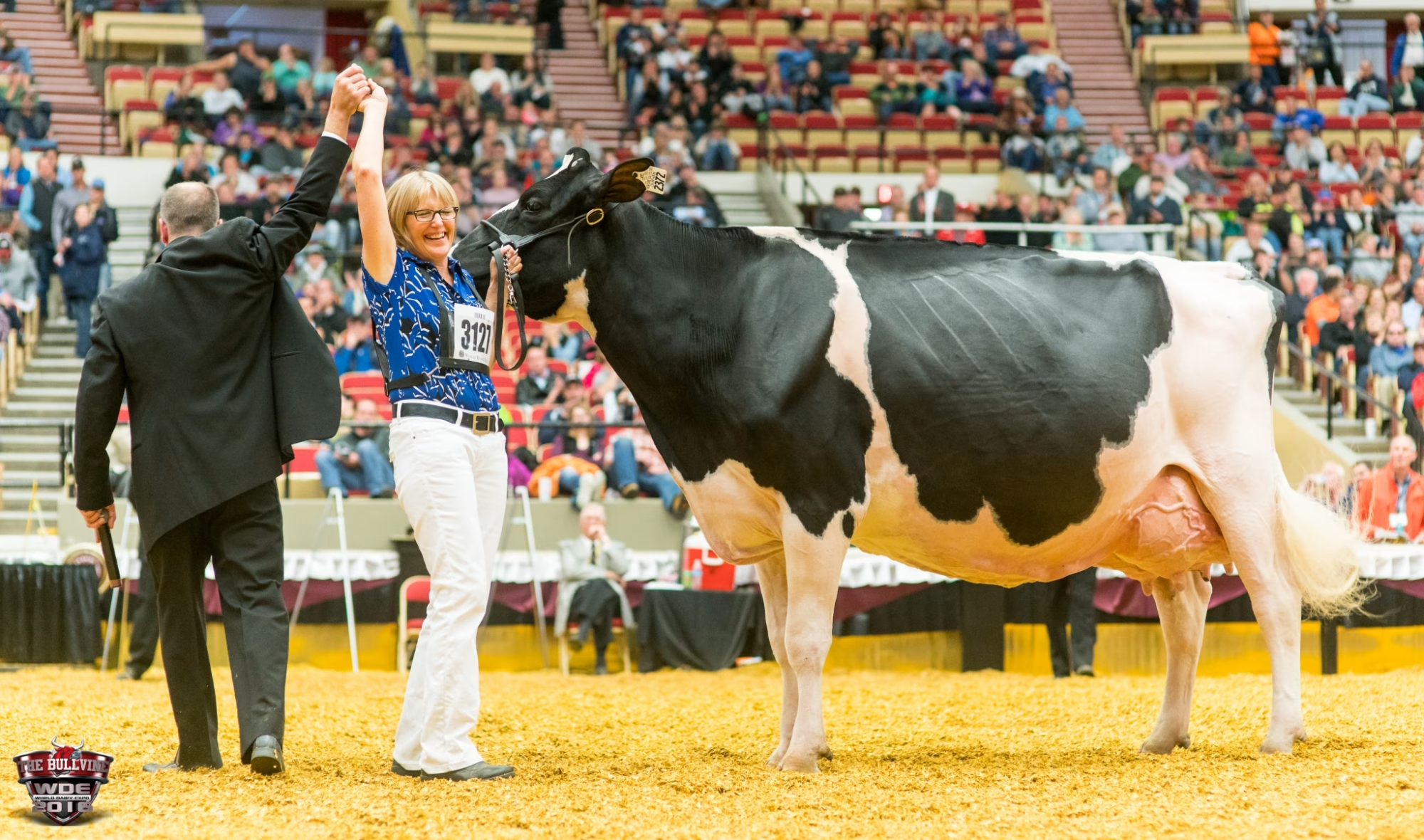
Stookey Elm Park Blackrose: The Bankruptcy Calf Who Became Genetic Gold
Some cow families start with perfect timing, polished facilities, and everyone already paying attention.
Blackrose didn’t get that kind of entrance.
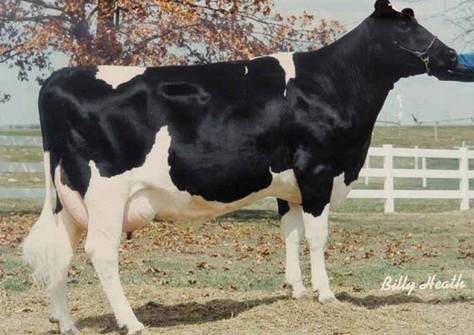
The Bullvine’s Blackrose story starts in the middle of financial wreckage: Jack Stookey’s collapse, Curt Prange’s rescue work, and a calf that could easily have been scattered into history before anyone understood what she was . That calf was Stookey Elm Park Blackrose, a To-Mar Blackstar daughter from Nandette TT Speckle-Red.
And what a cow she became.
The Bullvine profile records Blackrose as EX-96, a 42,229-pound producer at five years old, All-American as a junior two-year-old and junior three-year-old, and Grand Champion at the 1995 Royal Winter Fair . Holstein Plaza also identifies her as EX-96-3E-GMD-DOM .
But Blackrose’s real Mother’s Day case isn’t one banner. It’s what came after.
Her family helped shape Red and White breeding through cattle like Indianhead Red-Marker and Lavender Ruby Redrose-Red, the Red and White cow who went on to become Supreme Champion at World Dairy Expo , .
That’s why Blackrose belongs here. She’s the reminder that breed history isn’t always tidy. Sometimes the cow that changes everything comes out of a mess, lands with people who can see past the noise, and spends the rest of her life proving them right.
Comestar Laurie Sheik: The Cow That Built an Empire
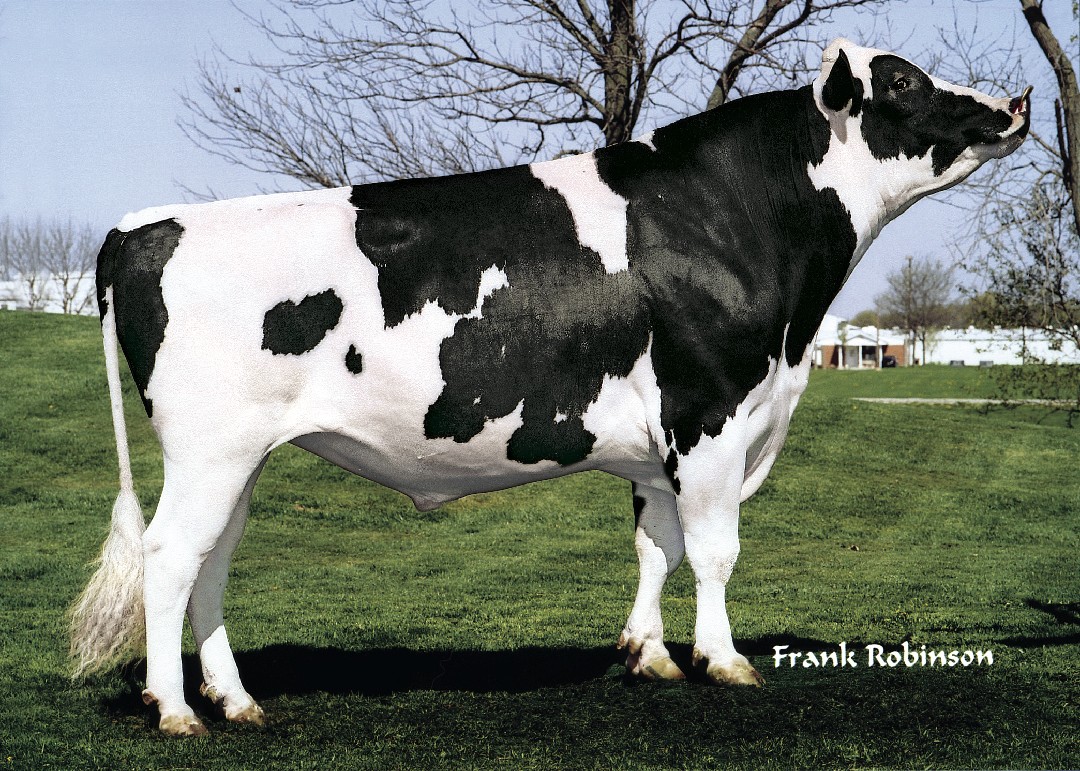
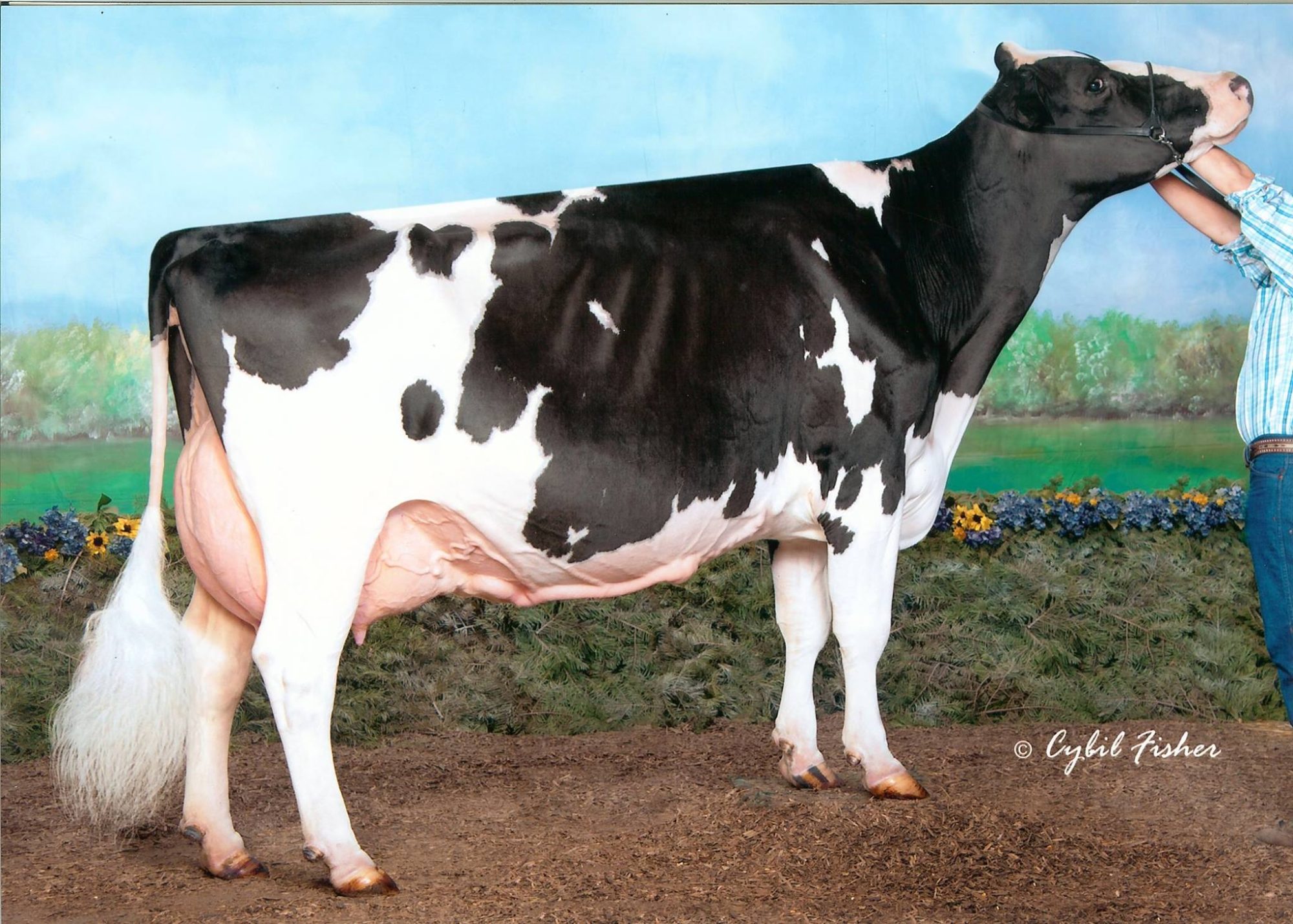
Comestar Laurie Sheik was already making people look twice at Madison in 1989. The bigger story came later, when that same cow became the foundation of a Comestar family that kept winning, breeding, and travelling far beyond Quebec. Read more: The Cow That Built an Empire: Comestar Laurie Sheik’s Unstoppable Genetic Legacy
Comestar Laurie Sheik didn’t begin as the obvious global answer.
That’s part of why her story is so good.
Marc Comtois bred Elysa Anthony Lea to Puget-Sound Sheik, and in December 1986, Comestar Laurie Sheik arrived . She would become VG-88-23*, the foundation of one of the most recognizable cow families in the world, and the cow behind a Comestar line that travelled far beyond Quebec .
Holstein International describes Laurie Sheik as the inaugural Canadian Cow of the Year in 1995. That same article notes that family member Comestar Lamadona Doorman EX-94 won Canadian Cow of the Year in 2022, which tells you something important: this wasn’t a one-generation firework .
Laurie Sheik’s family runs through cattle like Lylehaven Lila Z and Comestar Goldwyn Lilac, and through a wider maternal line that helped make the Comestar name feel almost like shorthand for balanced breeding , .
You don’t build that by accident.
Laurie Sheik belongs near the top because she did what only the best brood cows do. She made a prefix mean something. When breeders saw the name, they didn’t just see ancestry. They saw expectation.
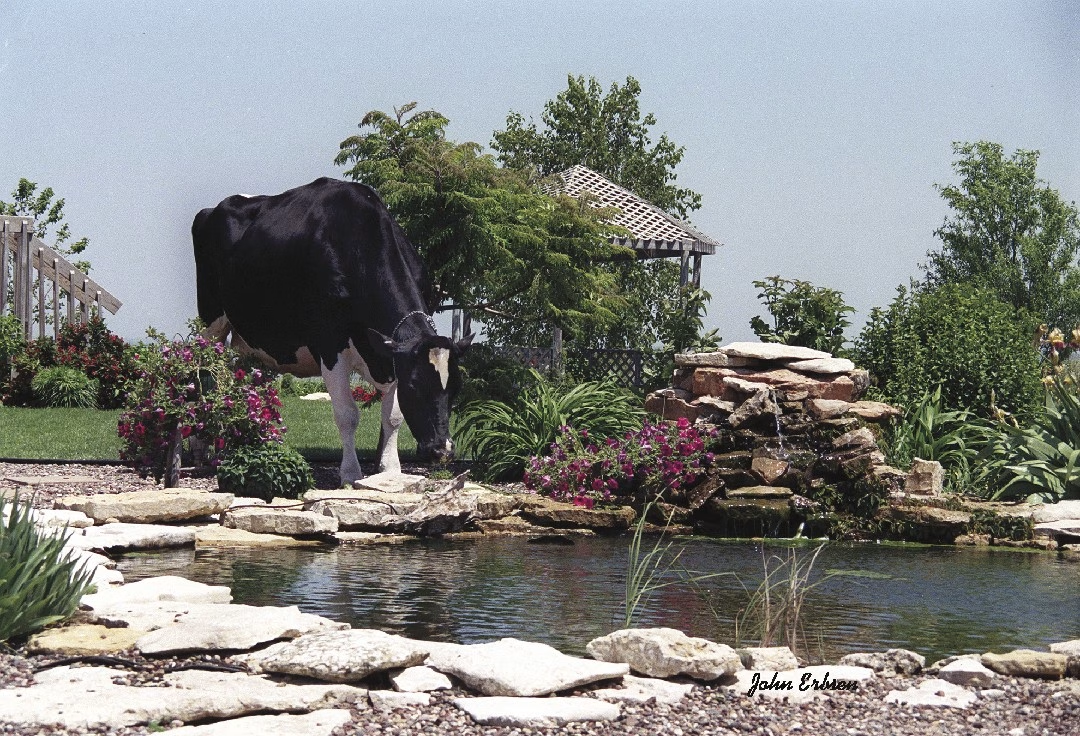
Kamps-Hollow Altitude-ET RC: The Red Gene That Became a Revolution
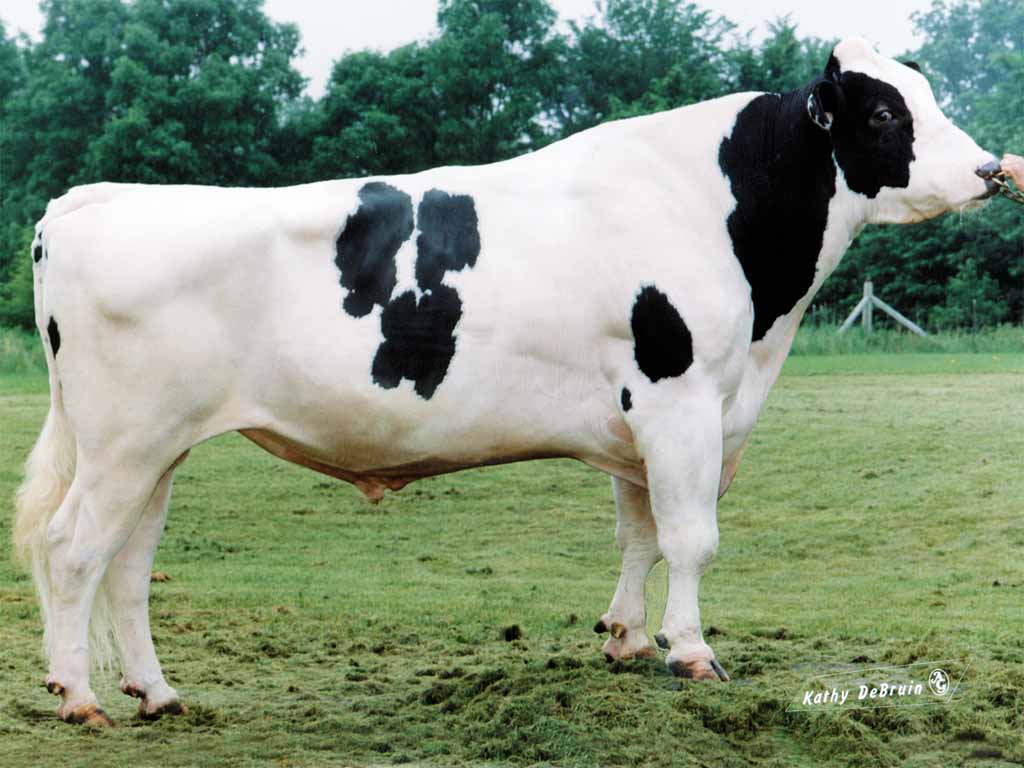
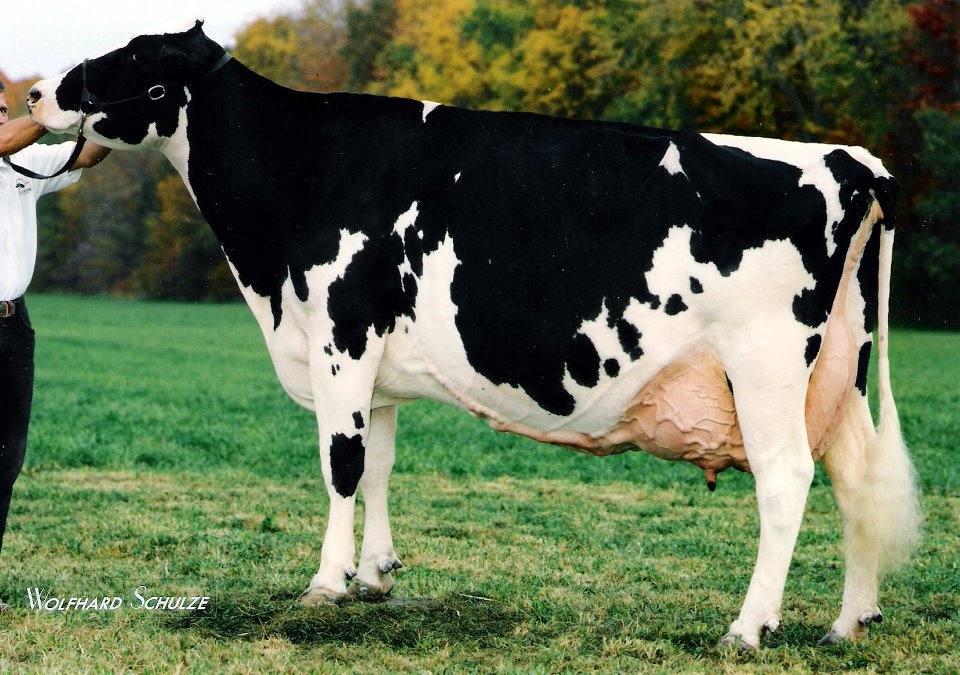
Kamps-Hollow Altitude-ET RC carried red quietly, but her descendants made sure the breed noticed. Through Advent, Apple, Acme, Jotan and the generations that followed, she turned a recessive gene into a serious breeding lane. Read more: Kamps-Hollow Altitude: The Red-Carrying Cow Who Rewrote Breeding History
Kamps-Hollow Altitude carried red quietly.
Her descendants did not.
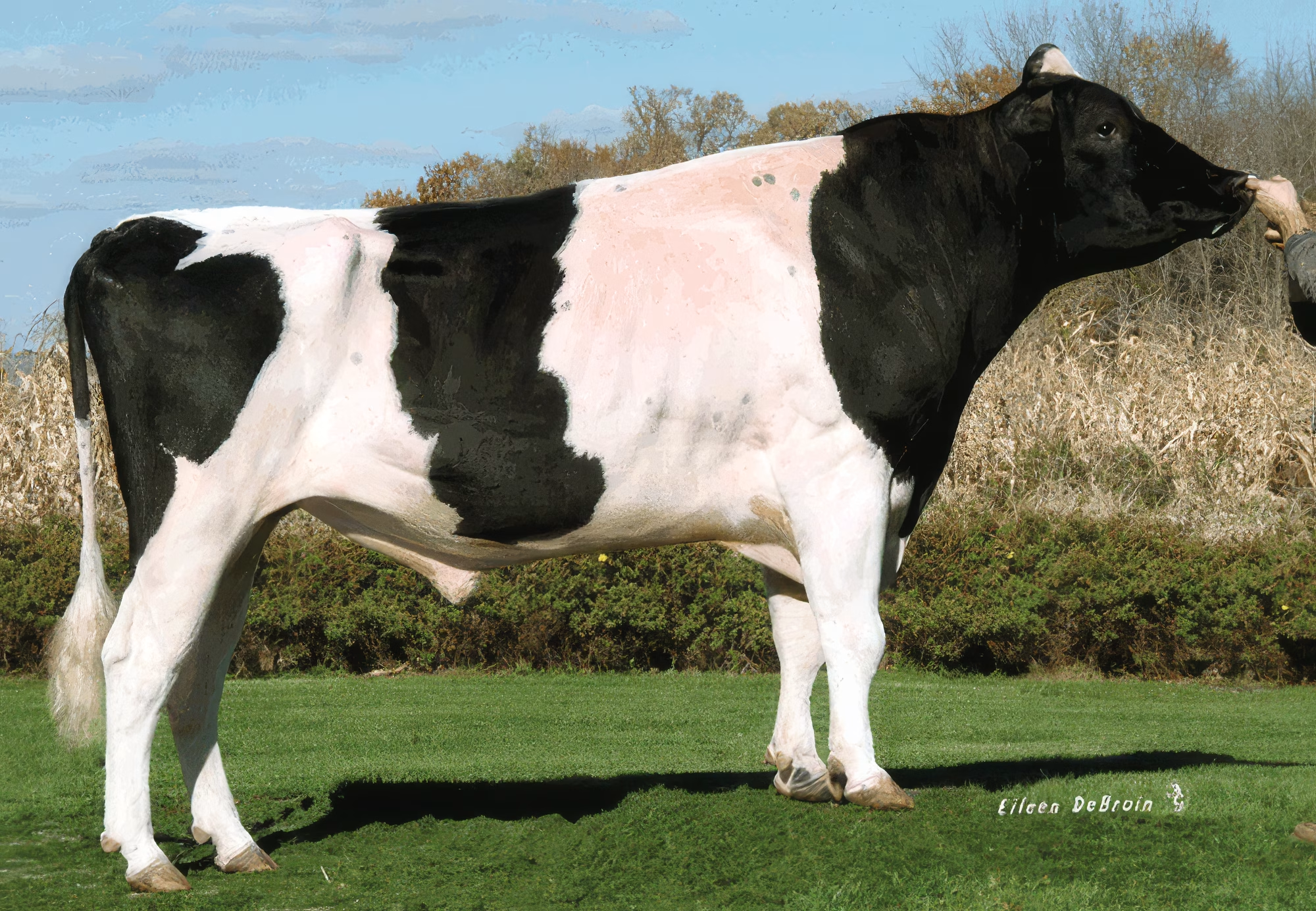
Altitude was a Durham daughter born January 11, 2000, later classified EX-95, and remembered as one of the defining brood cows in modern Red Holstein breeding . ALH Genetics reported that Kamps Hollow Durham Altitude RC EX-95 died at 15 years old and identified her as the mother of Advent, Acme, and Jotan, the grandmother of Amor Red, Absolute Red, Big Apple, and Armani, and the great-grandmother of Aikman and Addiction P Red .
And of course, there was Apple.
KHW Regiment Apple-Red was the daughter who made Altitude impossible to ignore. She took the red carrier story from pedigree talk to center ring, then sent it back into breeding programs through a cow family everyone wanted a piece of. Read more: KHW Regiment Apple-Red – Beauty, performance, and even more record accomplishments
ALH names KHW Regiment Apple Red EX-96 as Altitude’s best-known daughter . That alone would put Altitude in the conversation. But when you add Advent-Red, Acme, Jotan, Aiko, Absolute, Armani, Addiction P, and the later Apple branches, you get something bigger than one popular cow family , .
You get a turning point.
Altitude made the red factor feel less like a novelty and more like a serious breeding lane. She gave Red and White breeders style, marketability, type, and sons people actually wanted to use.
That’s why she’s here. In the right cow, behind the right udder, with the right people paying attention, a recessive trait stops being a footnote.
It becomes history.
Wesswood-HC Rudy Missy: The Phone Call That Rewired the Genomic Era
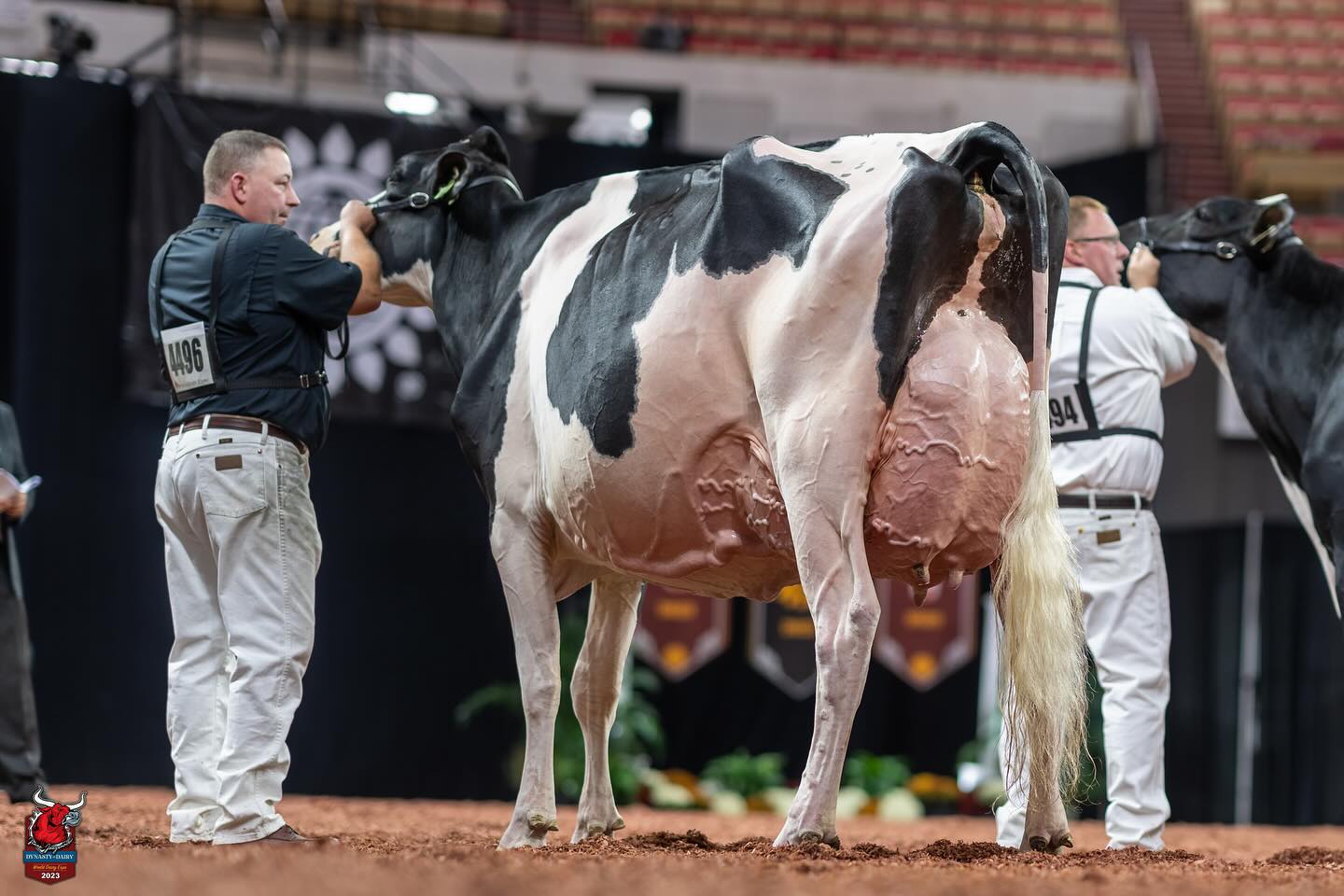
Wesswood-HC Rudy Missy didn’t need a show-ring spotlight to change the breed. One phone-call purchase put her in the right hands, and her family later surfaced through genomic-era names like Shauna, Supersire, Mogul, Silver and Balisto. Read more: The Phone Call That Built a Genetic Empire: The Wesswood-HC Rudy Missy Story
The Rudy Missy story has one of those scenes you can almost hear.
A sale. Buyers drifting. Interest softening. A cow that should have been getting more attention than she was.
Then a phone call.
The Bullvine profile tells the story of Matt Steiner buying Wesswood-HC Rudy Missy by phone and follows the family into Pine-Tree, Ammon-Peachey Shauna, Supersire, Mogul, Silver, and Balisto . Holstein International reports that Rudy Missy was selected as its Global Cow in 2014 after finishing second in 2012 and 2013 . The same article points to Mogul, Supersire, Silver, and Balisto as examples of her influence .
Missy’s power was not sentimental. It was practical. She hit the genomic era where it mattered: influential sires, high-use pedigrees, elite females, and commercial relevance.
That’s why she ranks ahead of some cows with more glamorous stories. Missy’s family didn’t just look good in a feature. It moved through breeding programs at scale.
The lesson is pretty simple, and a little uncomfortable.
The next great mother may not be the cow everyone is clapping for in the sale ring. She may be the one one person quietly refuses to let go cheap.
Larcrest Cosmopolitan: The Spotted Heifer From Minnesota
Larcrest Cosmopolitan never needed much noise to make her point. From a spotted Minnesota cow came a family that made Larcrest mean repeatability in bull books, embryo lists and the genomic-era pedigrees breeders kept coming back to. Read more: Larcrest Cosmopolitan: How a Spotted Minnesota Cow Built a Dynasty
Larcrest Cosmopolitan’s story doesn’t come at you with fireworks.
It sneaks up on you.
She was a Picston Shottle daughter born in September 2005 at Jon and Ann Larson’s Larcrest herd in Albert Lea, Minnesota . The Bullvine traces the family back through Larcrest Juror Chanel and the registered heifers Raymona Larson bought with her teacher’s retirement savings , .
That detail always gets me.
A teacher’s savings. A few heifers. A cow family that eventually becomes one of the most recognizable maternal lines of the genomic era.
Cosmopolitan turned that family into a brand. The Bullvine identifies Larcrest Crimson as her daughter and describes Crimson’s sons Calibrate, Camelot, Chavez, Conquest, Casual, and Cyclone as AI-stud staples . The same profile points to Larcrest Commander as another later family example with cross-border relevance in U.S. TPI and Canadian LPI conversations .
Cosmopolitan wasn’t loud. She didn’t need to be.
She made Larcrest mean repeatability. That’s a different kind of fame, and in many barns, a more useful one.
Harborcrest Rose Milly: The Cow Who Came Over the Hill
Harborcrest Rose Milly was the kind of cow that made people stop talking when she came over the hill. Her bigger legacy came through Paclamar Astronaut, turning one great cow into thousands of daughters and decades of Holstein influence. Read more: Harborcrest Rose Milly: From Pig Money to Holstein Royalty
Some cattle stories need a whole crowd.
Milly just needs one hill.
The Bullvine profile tells the scene from June 1961 in West Salem, Ohio: Dick Brooks visiting John Snoddy, cows coming over the rise, and Harborcrest Rose Milly walking at the head of the line . You can almost see it. The kind of cow that makes the conversation stop for a second.
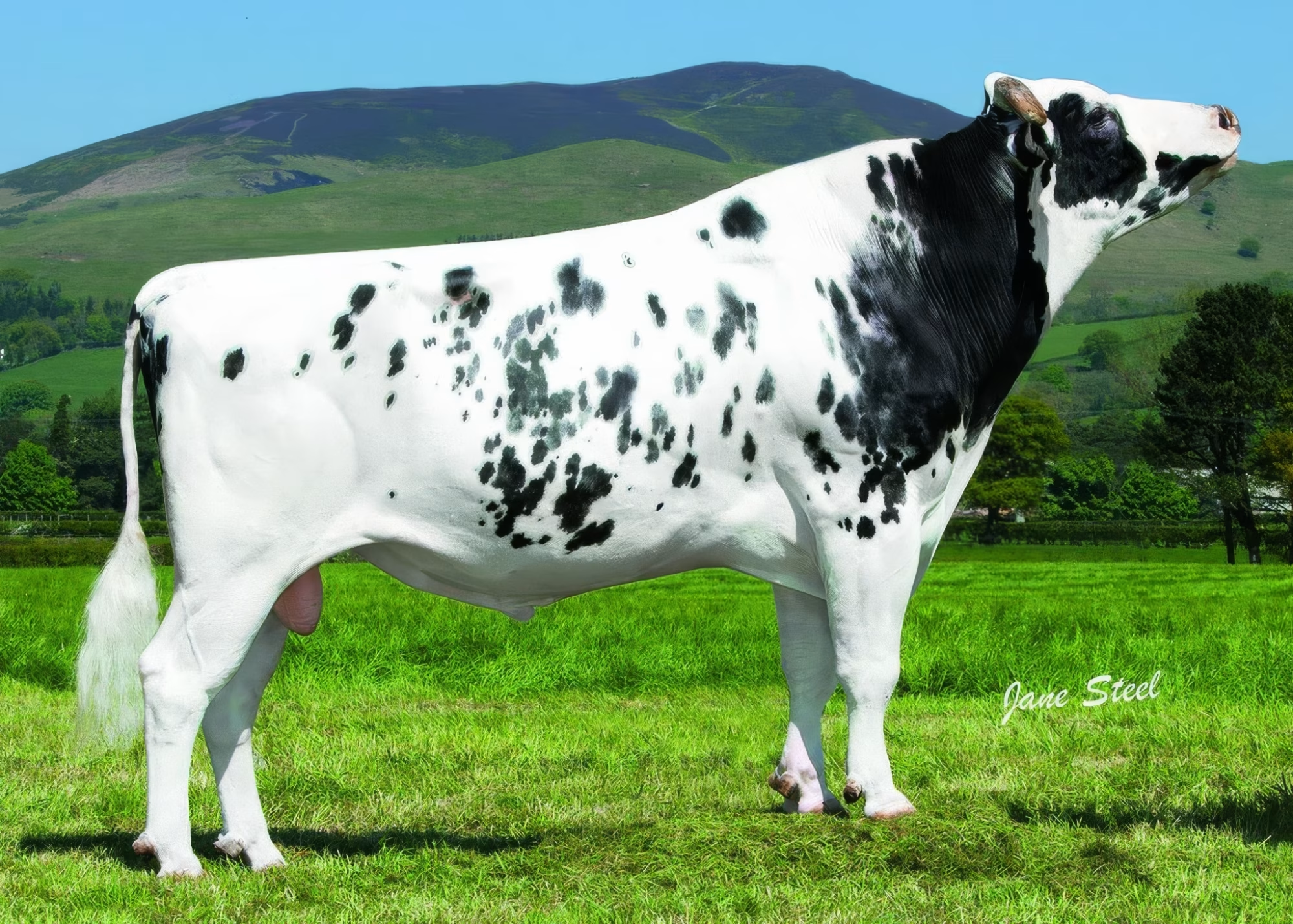
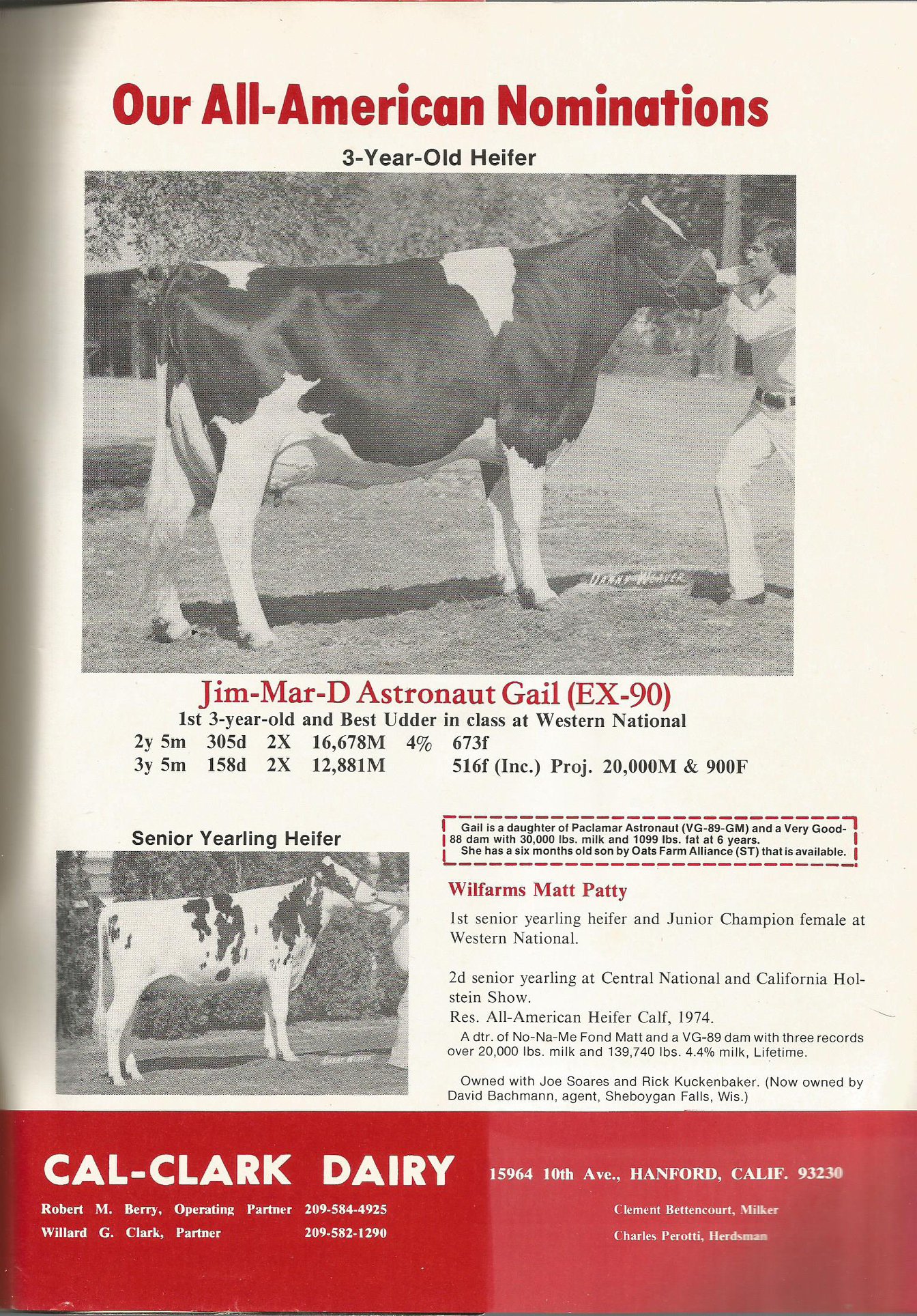
Milly was later recorded as EX-97-GMD, a three-time All-American Aged Cow, and the dam of Paclamar Astronaut . The King Barn Dairy MOOseum also identifies Astronaut as born in early 1964 to Harborcrest Rose Milly and describes Milly as a widely known All-American cow with a strong dairy record .
Her legacy runs through Astronaut.
The Bullvine profile credits Astronaut with 59,949 tested daughters and connects his daughters to later breed-shaping lines including Hanoverhill Starbuck and Startmore Rudolph . ABS Global’s bull database identifies Paclamar Astronaut as a proven Holstein bull born January 19, 1964 .
We don’t need to overstate it. The verified story is strong enough.
Milly produced Astronaut. Astronaut carried her influence into thousands of daughters. Those daughters helped open pathways into some of the most important bloodlines that followed.
That is maternal influence at breed scale.
One son. Thousands of daughters. Decades of echo.
Plushanski Chief Faith: The Cow Her Owner Would Not Sell
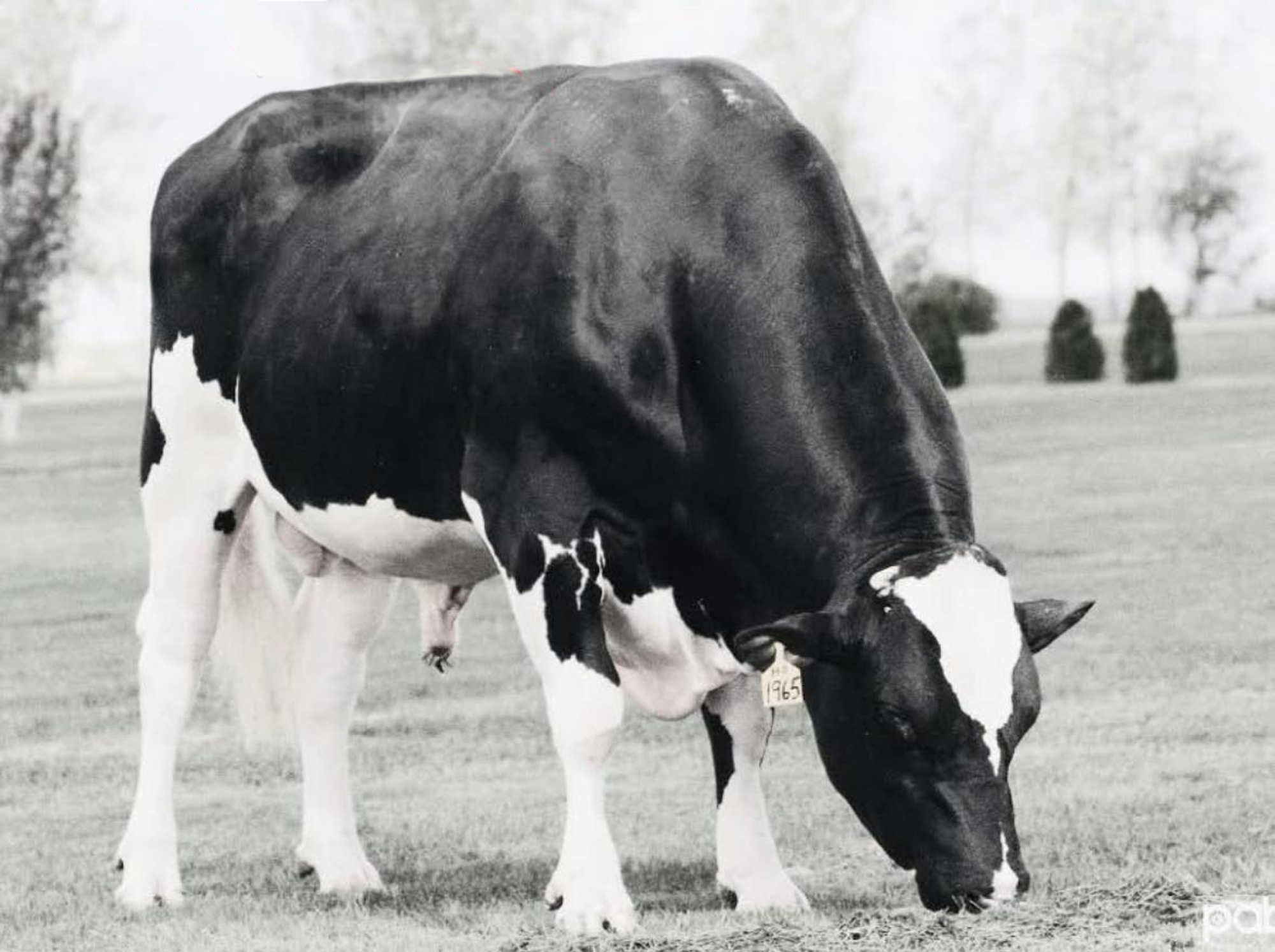
The Bullvine profile frames Plushanski Chief Faith around Charlie refusing to sell her before mating her to Pawnee Farm Arlinda Chief . Faith was born in November 1968, classified EX-94-4E-GMD, and credited in the profile with lifetime production of 242,863 pounds of milk and 11,353 pounds of fat . Holstein Plaza also identifies Plushanski Chief Faith EX-94-4E-GMD as a foundation cow in the Quality Gibson Finsco pedigree .
Faith’s strength came through daughters.
The Bullvine identifies Plushanski Valiant Fran, Plushanski Job Fancy, Plushanski Dawn Fayne, and Plushanski Star Faith as daughters that carried different parts of the family forward . The profile also connects the Faith line to Quality BC Frantisco, the EX-96 cow who became a two-time Royal Winter Fair Grand Champion through the Fran branch , .
This one feels less like a glossy genetics story and more like something every breeder understands.
Sometimes the whole future turns on a cow you decide not to sell.
Charlie Plushanski didn’t know he was protecting history. He just knew enough to trust the cow in front of him.
That’s not luck. That’s stockmanship.
Regancrest-PR Barbie: The Brood Cow Who Made Type Personal
Regancrest-PR Barbie looked good enough to get attention.
Then her daughters made her impossible to ignore.
The Bullvine profile places Barbie at the 2004 Minnesota State Fair as Reserve Grand Champion and follows her into one of the most concentrated type-transmitting stories of the modern era . By 2010, the profile says Barbie had produced eight Excellent and 19 Very Good daughters, with all but one of her 27-plus daughters classified VG or better on first lactation . The Bullvine’s earlier Golden Dam finalist profile also treated Barbie as one of the defining donor females of her era .
That’s the kind of family where even people who don’t follow every branch still recognize the landmarks . Eurogenes has also continued to identify top PTAT animals tracing back to Regancrest-PR Barbie, which shows the family remained visible in modern type rankings .
Barbie ranks tenth here only because the first nine cows have longer historical arcs or wider breed-building records. In almost any other feature, she could be the headline.
That says more about this list than it does about Barbie.
What These Mothers Knew
There’s a funny habit in dairy history. We talk about the bulls.
The bull got the stud code. The bull got the proof sheet. The bull got the semen tank, the ad, the argument, the daughters counted in tidy rows.
But behind the bull was usually a cow someone believed in first.
Roxy gave the breed a family that reproduced excellence. Dellia made type and production feel less like enemies. Blackrose turned a financial wreck into Red and White power. Laurie Sheik made Comestar a global name. Altitude made red serious. Rudy Missy helped wire the genomic era. Cosmopolitan made Larcrest repeatable. Milly gave Astronaut the maternal base to move through the breed. Faith rewarded one farmer’s refusal to sell. Barbie reminded everyone that type still needed mothers.
That’s the real Mother’s Day story.
Not the soft-focus version. Not the greeting-card version.
The real story is quieter and better. It’s a breeder standing in a barn, looking at a cow, and thinking, “There’s something here.”
Sometimes they’re right.
And when they’re really right, the rest of us are still seeing that cow generations later. In the heifer pen. In the bull book. In the embryo catalog. In the sale ring. In the pedigree of the cow that just freshened better than expected.
So walk the barn a little slower this Mother’s Day.
Find the cow that always breeds back. The one whose daughters freshen right. The one nobody makes much noise about because she simply works.
Pull her pedigree. Go back far enough.
Odds are, one of these mothers is waiting there.
Key Takeaways
Don’t give the bull all the credit. The cow family behind him often tells you more about repeatability, risk, and long-term value.
Pull the pedigrees on your best heifers and look for the mothers that keep showing up. That’s where the next breeding decision starts.
Great cow families aren’t built from one perfect mating. They come from breeders who notice the right cow early and keep stacking the right daughters.
Legacy still has barn value. If a family keeps breeding back, classifying well, and making useful daughters, don’t let fashion talk you out of it.
Continue the Story
From Laurie Sheik to Robotic Milking: Bois Seigneur Holstein’s Journey of Innovation – While Laurie Sheik provided the maternal spark, Marc Comtois built the engine. Step into the Quebec barns where this exact historical timeline played out, proving what happens when visionary stockmanship meets the right foundation cow at the perfect moment.
Edward Young Morwick – Country Roads to Law Office – Every legendary sire in a stud book traces back to a mother someone refused to cull. Explore the bull side of this history through the eyes of a Master Breeder, where names like Astronaut and Durham pushed maternal foundations into millions of modern pedigrees.
KHW Regiment Apple-Red-ET – Everything and more – When Altitude made the red factor a serious breeding lane, she laid the groundwork for an absolute dynasty. Trace how her most recognizable daughter took that exact foundation and relentlessly dominated both the shavings and the global genomic era.
The Sunday Read Dairy Professionals Don’t Skip.
Every week, thousands of producers, breeders, and industry insiders open Bullvine Weekly for genetics insights, market shifts, and profit strategies they won’t find anywhere else. One email. Five minutes. Smarter decisions all week.
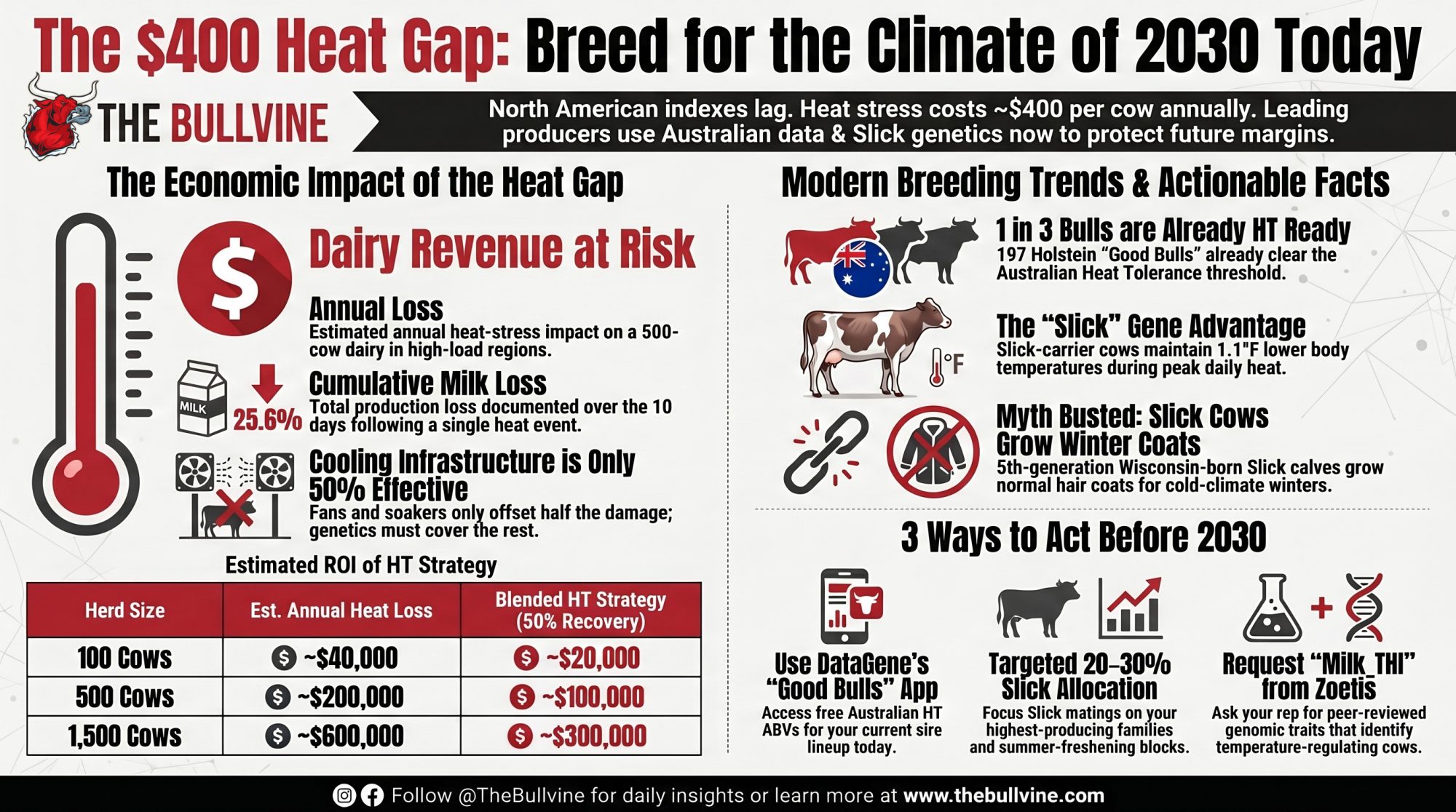
Trevor Parrish in NSW started filtering sires on HT ABV in 2017. By August 2024, 197 Holstein Good Bulls cleared the threshold. CDCB’s April 2025 NM$ revision added none of it.
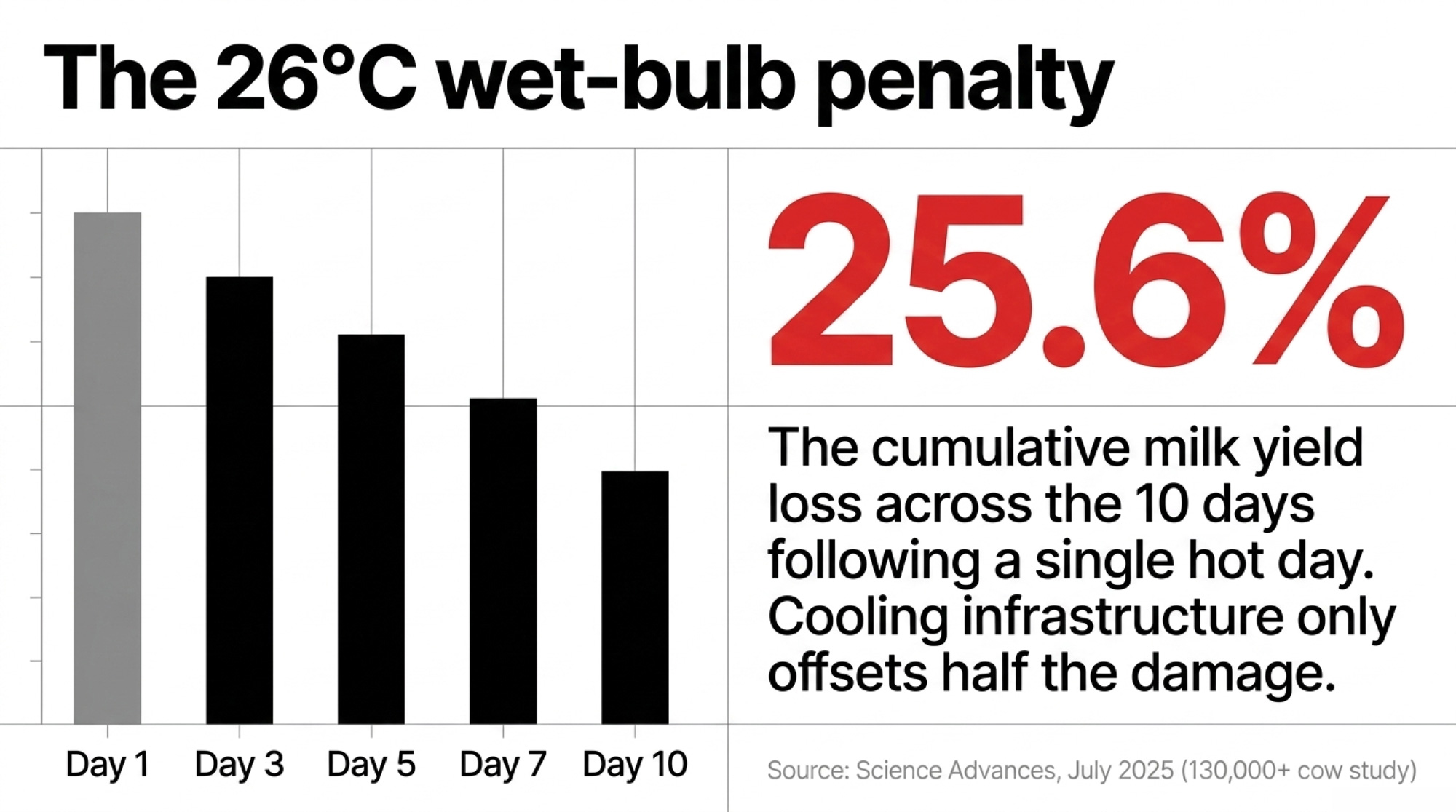
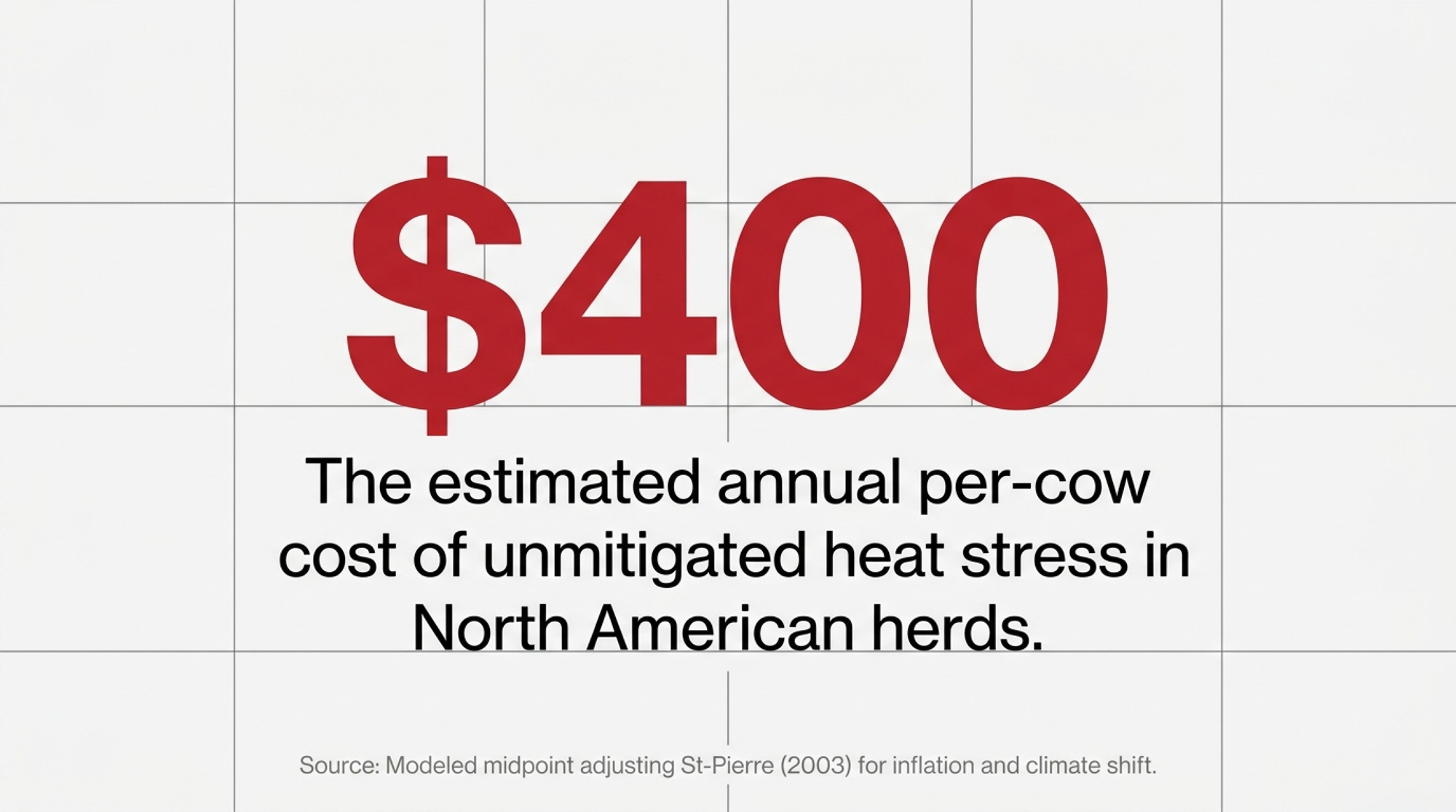
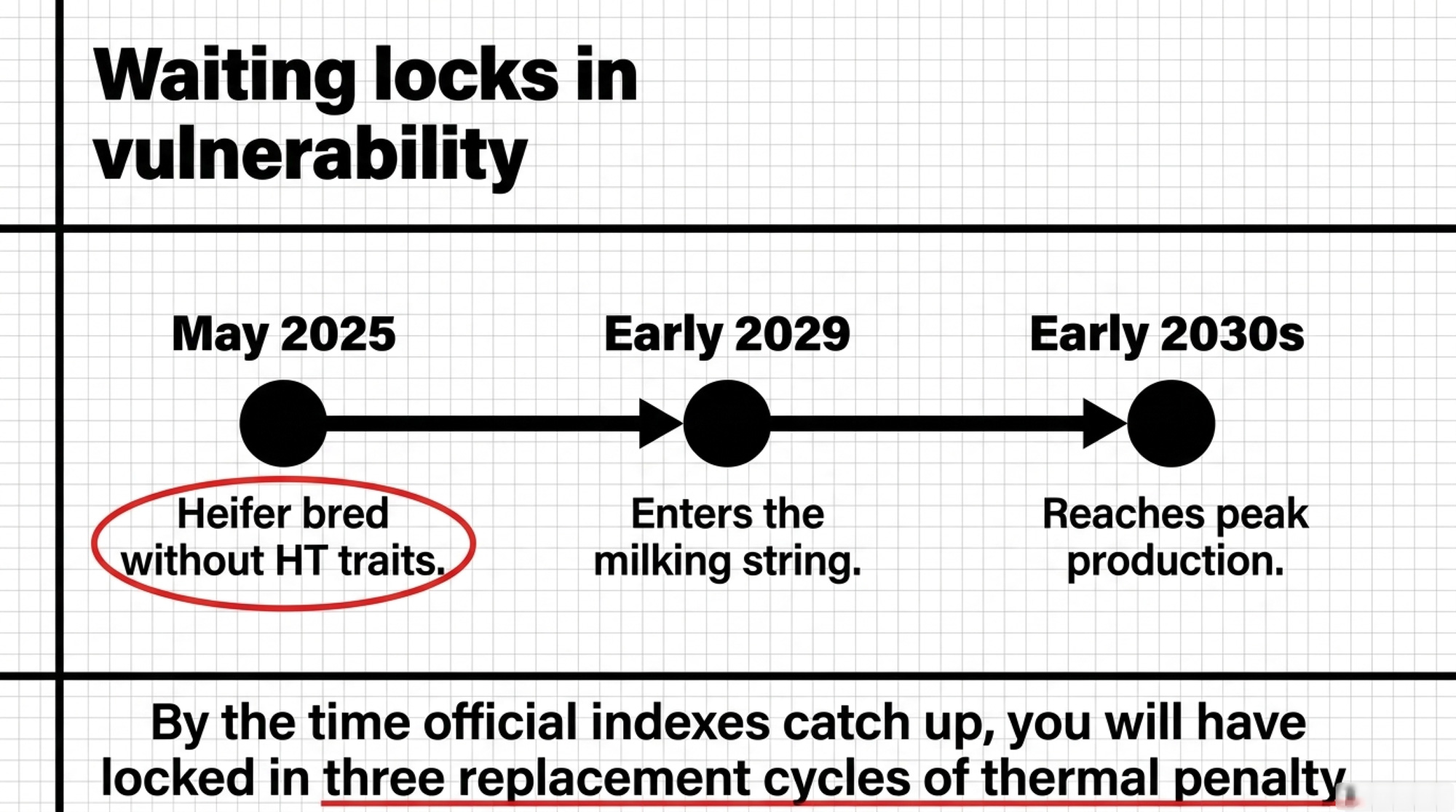
Executive Summary: Australia’s DataGene released a Heat Tolerance ABV in December 2017, and by the August 2024 run, 197 Holstein Good Bulls — roughly one in three — cleared the 100 threshold. CDCB’s April 2025 NM$ revision moved butterfat from 28.6 to 31.8 and dropped protein from 19.6 to 13, but added no heat tolerance trait; Lactanet hasn’t weighted it in LPI or Pro$ either, despite University of Guelph models hitting 0.97 rank correlation. The economic exposure for North American herds sits around $400/cow/year in heat-load regions — roughly $200,000 annually on a 500-cow dairy in southwestern Ontario or the Central Valley — based on the St-Pierre 2003 baseline adjusted for inflation and the 10% single-day, 25.6% 10-day cumulative milk losses documented in Science Advances (July 2025). Zoetis has peer-reviewed Milk_THI and CFS_THI traits in JDS (September and November 2025) that identify cows with measurably better rectal-temperature regulation. Select Sires’ ART program is now five Slick generations deep in Wisconsin, with parent averages tracking close to non-Slick matings and calves that still grow winter coat. The heifer you breed in May peaks in the early 2030s — waiting on CDCB locks in three more replacement cycles of thermal vulnerability, while DataGene’s Good Bulls App, Zoetis Clarifide, Australian proofs through Semex/Genex/ABS, and a 20–30% Slick allocation on your top cow families are all workable today. The question isn’t whether the margin math favours acting; it’s whether your AI rep can answer the HT question when you call tomorrow.
In late 2017, Holstein breeder Trevor Parrish of Kangaroo Valley, New South Wales, began weighting Heat Tolerance ABV into his sire selections — a decision still uncommon among his Australian peers at the time, according to DataGene’s adoption reporting and Parrish’s own May 2025 comments to Dairy News Australia. DataGene had just released the trait publicly: a quarterly-updated breeding value measuring how well a cow holds production when the Temperature-Humidity Index climbs past comfort. From that release forward, per his Dairy News Australia interview, Parrish treated Heat Tolerance as part of his standard sire-evaluation toolkit.
Eight years on, DataGene’s adoption data and Parrish’s published commentary tell the story of a breeder who treated the trait like calving ease — a filter you apply, not a debate you have. Meanwhile in Woodstock, Tulare, or Fond du Lac, no official North American genetic evaluation — not NM$, not TPI, not LPI — currently publishes a heat tolerance number at all. That gap has a dollar value. And it compounds every summer your replacement heifers come into the milking string.
What Australia Actually Did, Starting in 2017
DataGene released the Heat Tolerance ABV publicly in December 2017. The trait measures a cow’s ability to hold milk, fat, and protein output as THI rises past comfort thresholds. An ABV of 100 is breed average, and the trait sits inside the Balanced Performance Index (BPI) rather than floating as a standalone curiosity. A 2024 update lifted Holstein reliability by 10 percentage points and re-ranked the HT list more substantially for Holsteins than for Jerseys.
The adoption curve tells the more interesting story. In late 2016, during DataGene’s pilot work, only a handful of Good Bulls ranked meaningfully above 100 for HT. By the August 2024 ABV release, DataGene reported that one in three Holstein Good Bulls — 197 bulls — carried a Heat Tolerance ABV of 100 or above. That shift tracked a broader story of how climate pressure is reshaping dairy breeding priorities worldwide — but unlike most of the global picture, Australia already had the trait on the catalog page.
Speaking to Dairy News Australia in May 2025, Parrish framed the trait as part of a complete-cow picture: “Heat tolerance is part of that efficiency. As a breeder, you are trying to cover all the bases, and heat tolerance, now it has an ABV, is part of a solid, good quality cow.”
That isn’t a regulator’s decision. It’s a market filter, and it happened inside a decade.
Is the Science Strong Enough to Act On Without the Official Index?
Short answer: yes. And the research isn’t Australian-only. Three independent research pipelines — Australian, Canadian, and U.S. — now converge on the same conclusion: heat tolerance is a heritable, measurable, and economically significant trait in Holsteins.
Evidence stream
Metric
What it proves
Australia DataGene
197 Holstein Good Bulls at HT ABV ≥100 by Aug. 2024
Catalog-level selection signal exists
Canada Guelph / Lactanet-ready models
Rank correlations above 0.97 for Canadian Holstein bulls
Canadian evaluation framework is technically stable
U.S. Zoetis genomic traits
Milk_THI: -1.3 to 1.0 kg/day/THI; CFS_THI: -6.2 to 5.3 pts/THI
Heat tolerance can be genomically ranked in U.S. Holsteins
Slick allele field physiology
1.1°F lower vaginal temperature at noon–3 p.m.
Slick carriers regulate body temperature better under heat
The Three Scientific Proofs
Australia — University of Chicago Climate Impact Lab (Science Advances, July 2025). Gong, Hsiang, Moscona and collaborators drew on production records from more than 130,000 cows over 12 years. Cooling infrastructure only offsets about half of the damage on the hottest days — fans and soakers cut losses by roughly 50% at a 20°C wet bulb, less than half overall at the top of the range.
Bottom line: Milk yield falls up to 10% on days when wet-bulb temperature exceeds 26°C. Cumulative loss across the 10 days following a single hot day reaches 25.6% of a single day’s baseline output.
Canada — University of Guelph (Schenkel, Miglior et al., Journal of Dairy Science). The Guelph group developed a Canadian heat tolerance evaluation framework using test-day production records and reaction-norm models. A follow-up 2025 JDS paper validated alternate models. Methodology is Canadian-ready; what’s missing is integration into LPI and Pro$.
Bottom line: Alternate models produce rank correlations above 0.97 for Canadian Holstein bulls — Lactanet has a validated, publication-ready HT evaluation sitting on the shelf.
United States — Zoetis research team (Vukasinovic et al., Journal of Dairy Science, September 2025). The team published validated genomic breeding values for heat tolerance in U.S. Holsteins. The specific traits are Milk_THI (change in daily milk yield per unit of THI, ranging from -1.3 to 1.0 kg per day per THI unit) and CFS_THI (change in conception at first service per unit of THI, ranging from -6.2 to 5.3 percentage points). A November 2025 JDS validation confirmed that higher standardized transmitting abilities on both traits corresponded to reduced rectal temperatures during heat stress.
Bottom line: The cows the Zoetis model ranks as heat-tolerant actually regulate body temperature better in the barn — the trait does what it says on the label.
The traits exist and are peer-reviewed. Whether Zoetis has integrated Milk_THI and CFS_THI into its customer-facing Clarifide reports is a question for your Zoetis rep. The September 2025 JDS paper establishes the methodology, not the commercial rollout timeline.
What Does the Barn Math Actually Look Like?
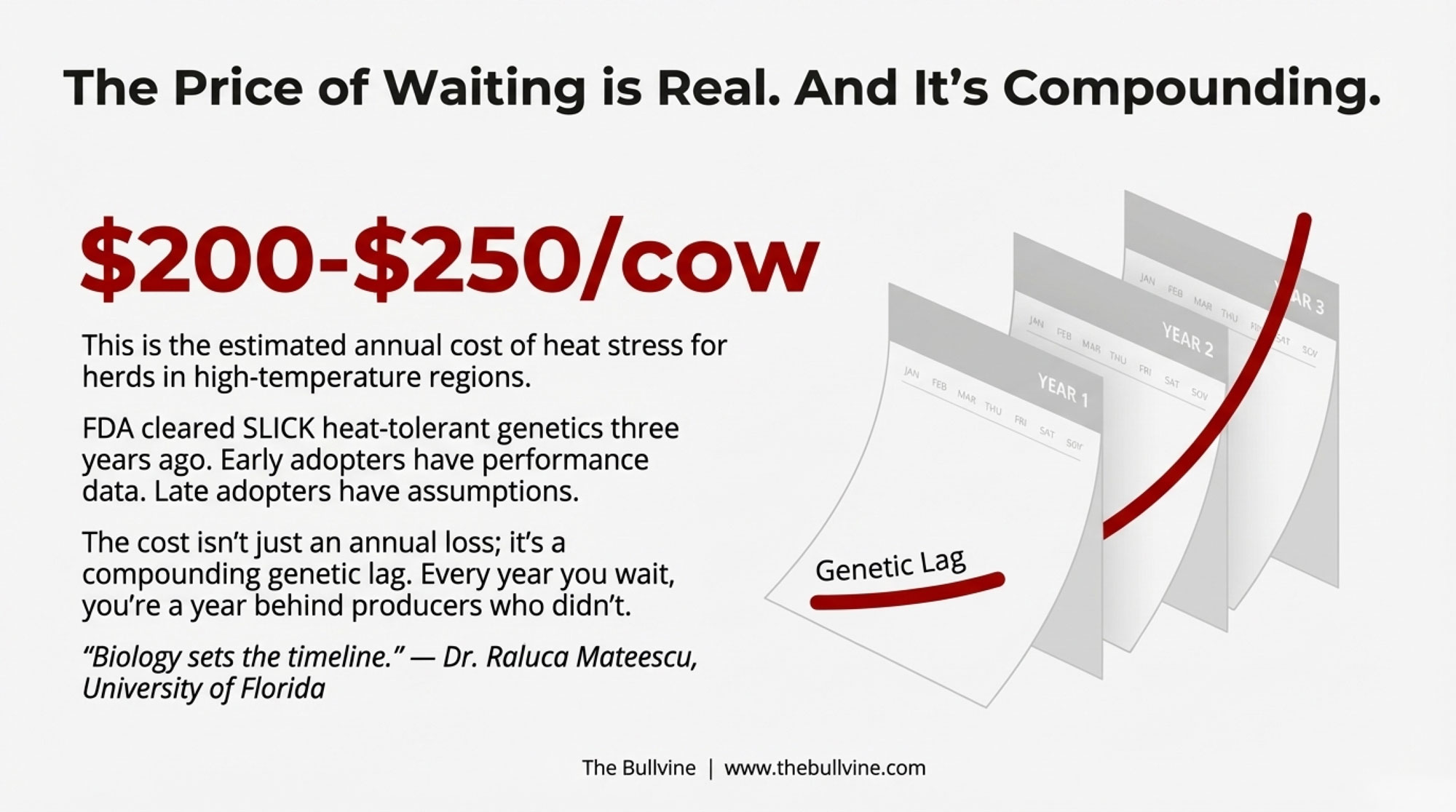
Published heat stress loss estimates for U.S. dairy herds anchor around 4 per cow per year as the unmitigated baseline, from St-Pierre, Cobanov and Schnitkey’s work in Journal of Dairy Science (2003) — early-2000s dollars. Aggregate U.S. dairy losses are modeled near $897 million annually at minimum heat abatement intensity, pulling back toward $500–$600 million with optimum abatement.
For herds in southwestern Ontario or California’s Central Valley — regions carrying a heavier seasonal heat load than the historical “temperate” framing suggests — a working midpoint of roughly $400 per cow annually is a reasonable illustrative figure once the St-Pierre baseline is adjusted for two decades of inflation and the climate shift documented in the Science Advances work. It’s a modeled estimate, not a published regional number. Operations still trying to cool their way out of the problem should also read our companion piece on where cooling infrastructure stops paying back.
The table below is an illustrative model built from that midpoint and a modeled 50% reduction assumption — the upper end of what combined cooling investment, Australian-style HT selection, and targeted Slick matings can plausibly deliver together. Actual results will vary with climate zone, milk price, Slick adoption percentage, and the sire mix already in the tank.
Herd Size
Est. Annual Heat Loss (Conventional)
Blended HT Strategy (50% Reduction)
Year-1 Implementation Cost (Est.)
100 cows
~$40,000
~$20,000
~$10,000
500 cows
~$200,000
~$100,000
~$40,000
1,500 cows
~$600,000
~$300,000
~$115,000
Underlying inputs: $400/cow annual heat loss (modeled midpoint); 50% recovery assumption from combined cooling + HT selection + Slick matings; Year-1 costs scaled for genomic testing on replacement heifers and semen premium on targeted Slick matings.
On a 500-cow operation, the Year-1 cost sketch roughly covers genomic testing on replacement heifers plus a modest semen premium on about 150 targeted Slick matings (roughly a 30% allocation of annual breedings). Under those modeled assumptions, payback clears inside the second summer. The arithmetic isn’t the weak point. The inputs are. But the direction and order of magnitude hold up in almost any scenario a North American breeder plugs in.
Where CDCB and Lactanet Have — and Haven’t — Moved
The CDCB’s April 2025 evaluation revision implemented the every-five-year base change (moving from cows born in 2015 to cows born in 2020) and updated income and cost variables inside NM$, Cheese Merit $, Fluid Merit $, and Grazing Merit $. Butterfat weight moved from 28.6 to 31.8 and protein dropped from 19.6 to 13, per the official CDCB April 2025 evaluation change documentation and the USDA-AGIL technical report by VanRaden, Toghiani, Basiel, and Cole. No new traits were added. No heat tolerance number. Those weight shifts carry their own strategic implications — which we unpack in our analysis of the April 2025 Net Merit revision’s butterfat-protein trade-off.
CDCB’s caution isn’t inertia for its own sake — the national evaluation’s credibility rests on trait reliability, and adding a trait prematurely carries real costs. But the cost of waiting now has a measurable dollar value. Realistic integration of Heat Tolerance into NM$ sits several evaluation cycles out. Lactanet is in a comparable position. The Guelph group has produced usable Canadian methodology and the 2025 JDS work validates it — but no heat tolerance index is currently published as part of LPI or Pro$.
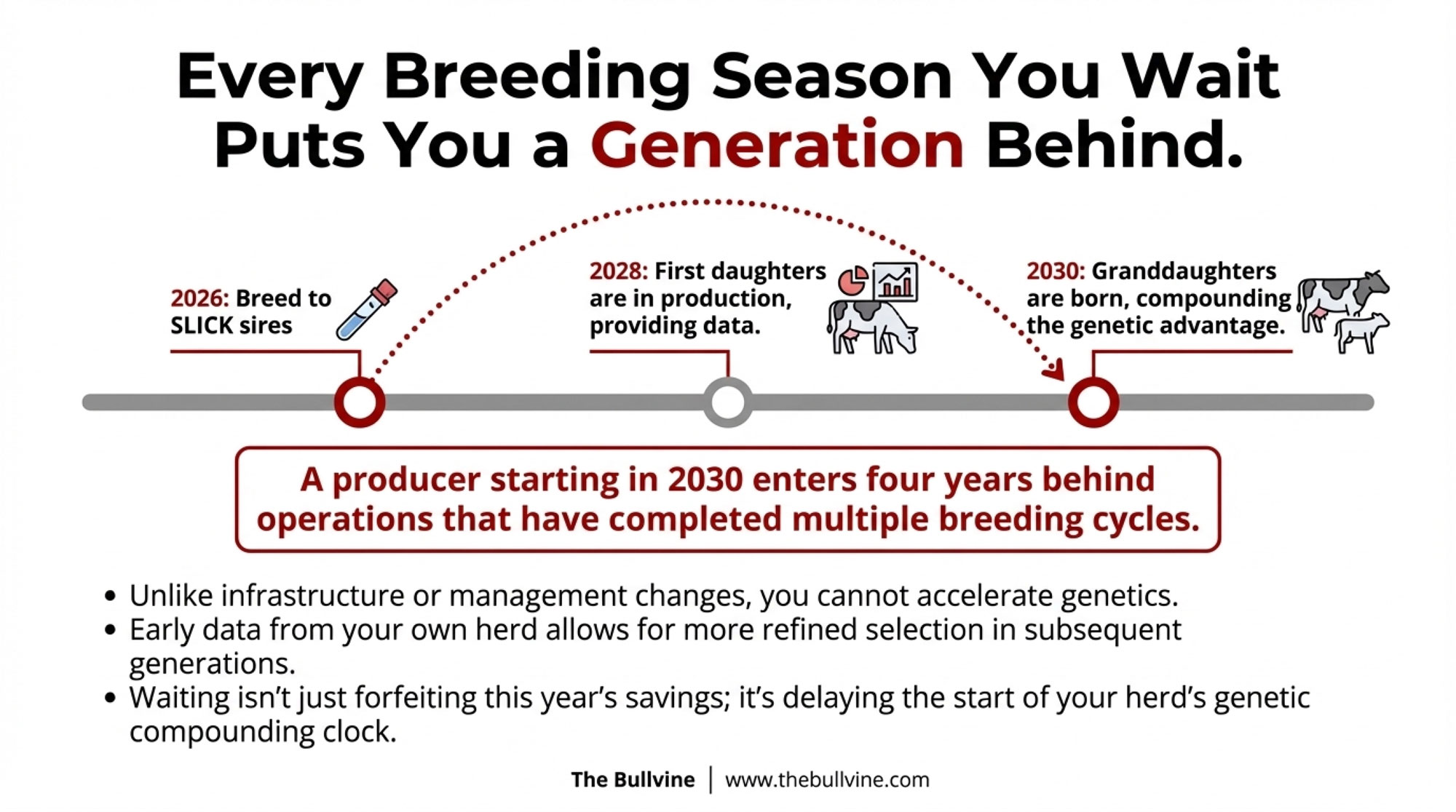
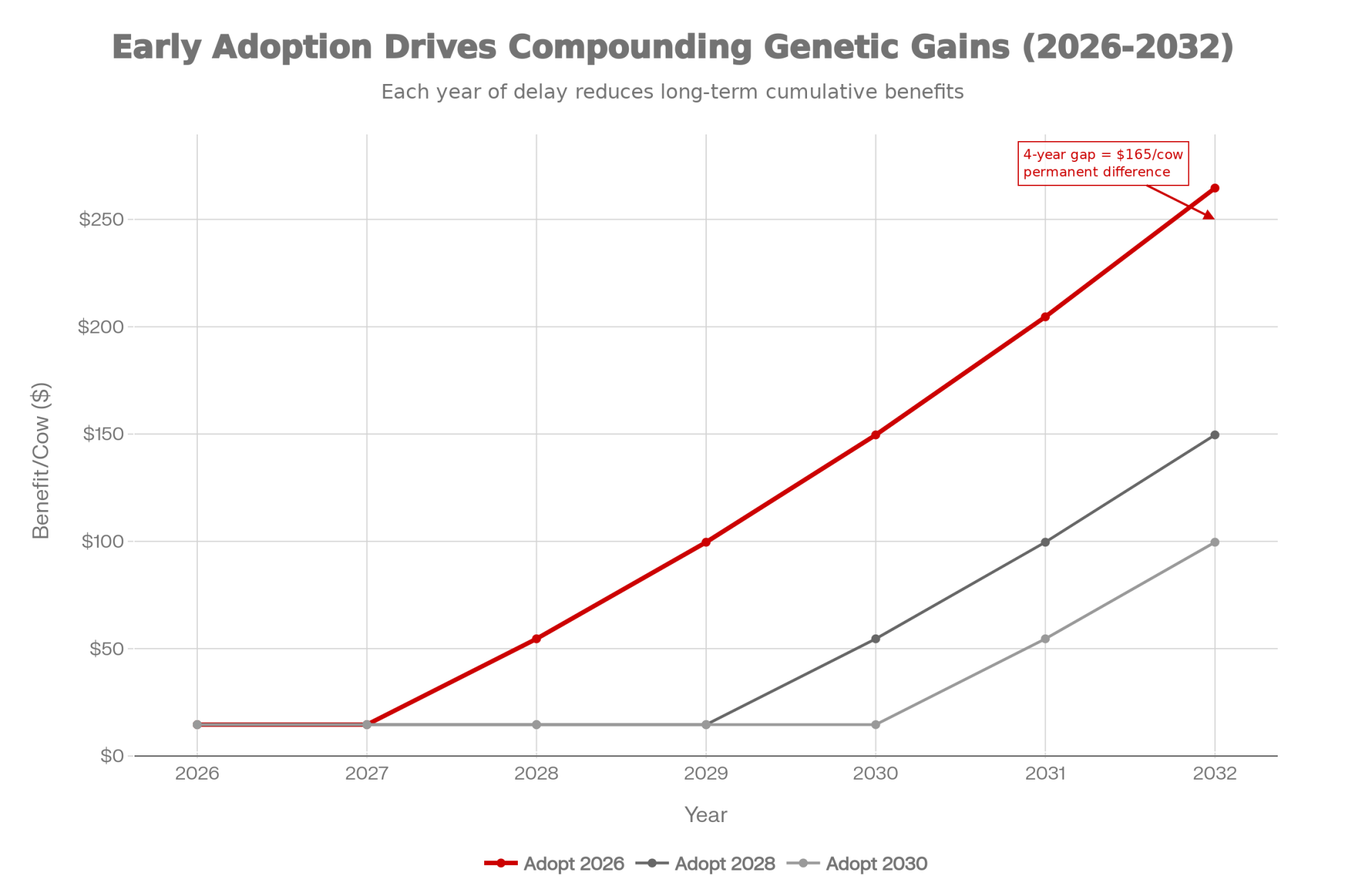
The replacement pipeline doesn’t care about governance timelines. A heifer bred this May enters the milking string in early 2029 and reaches peak production in the early 2030s — in a climate the Science Advances team projects will deliver materially more wet-bulb-26°C days across major dairy regions by midcentury, with 4% annual daily-yield losses baked in without adaptation. The genetic decision made this breeding cycle sets the thermal ceiling for that cow’s productive life.
The North American Program That’s Already Five Generations In
While CDCB hasn’t moved, Select Sires’ Aggressive Reproductive Technologies (ART) program has quietly been running the Slick playbook for years. Per an April 2026 blog authored by ART Program Manager Mark Kerndt, the program is now in its fifth generation of Slick calves, with all of them born in Wisconsin.
“We are breeding the horns out of the breed and are now also focusing on making the Holstein breed more heat tolerant, through the gradual introduction of the dominant slick allele into our cattle,” Kerndt wrote. “We expect several hundred potential slick calves to be born in our program in 2026 and the parent averages on these matings are very close to our non-slick matings.”
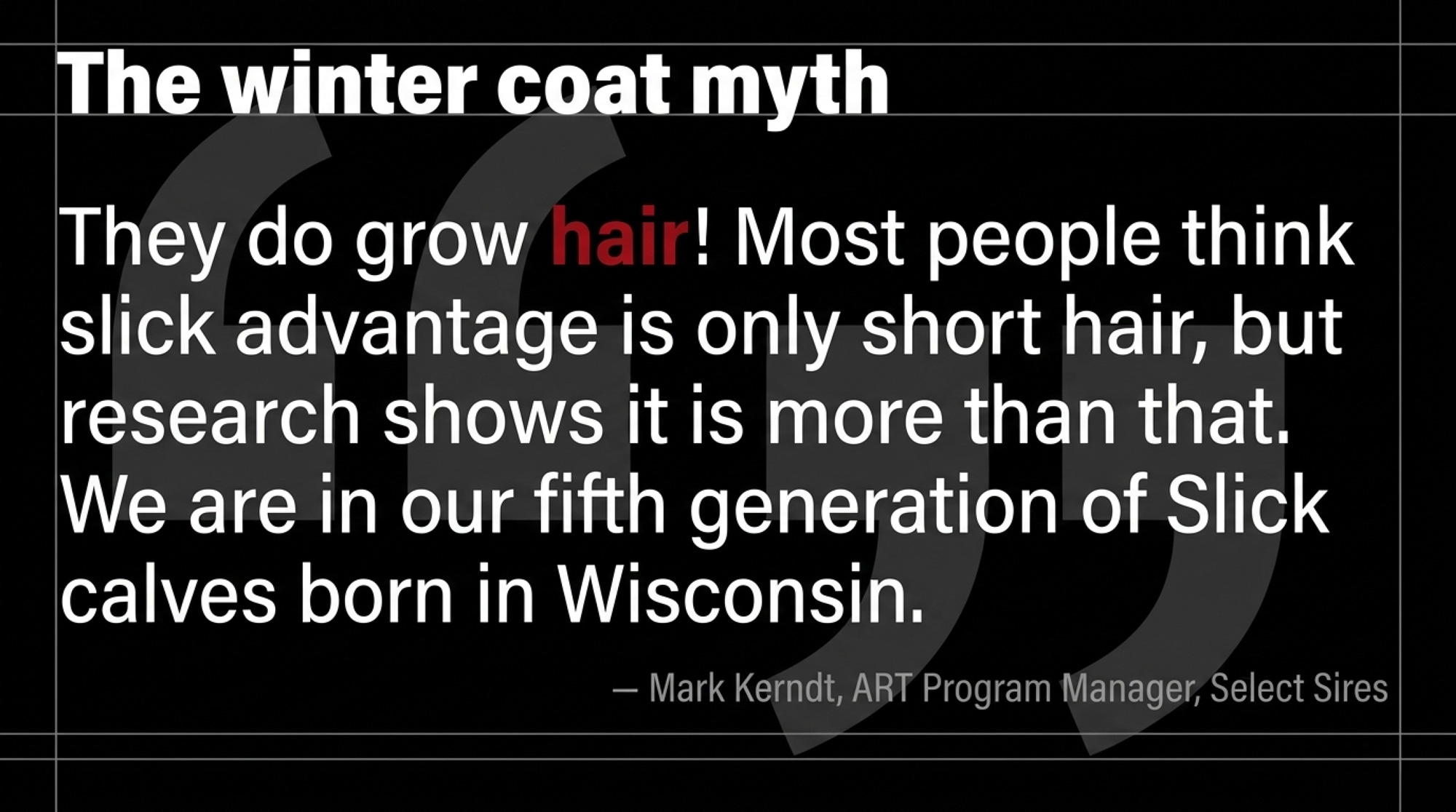
Two things worth holding onto from that. First: Wisconsin-born Slick calves grow hair in winter, which answers the most common North American objection before a breeder raises it. Kerndt again: “They do grow hair! Most people think slick advantage is only short hair, but research shows it is more than that.”
Second: parent averages on Slick matings sit close to non-Slick matings in the ART program. The production penalty breeders have long assumed isn’t showing up in the current generation. The piece of the picture North American breeders haven’t had — a named commercial program running the strategy long enough to produce fifth-generation data — is now on the record.
The piece still missing from the public record is the one that would close the circle: a named North American dairy producer, not an AI stud, who has been weighting HT or running Slick matings long enough to report two or three summers of their own production and fertility numbers. Those producers exist. Their data isn’t yet in the trade press. That’s the next story worth telling, and The Bullvine is actively reporting it — if you’re running one of these programs and willing to talk on the record, the editor’s line is open.
“But I Have -20°C Winters” — The Cold-Climate Objection That Isn’t Aging Well
The pushback from Ontario, Quebec, Wisconsin, and Minnesota breeders is almost always the same: “I don’t want a tropical cow in a -20°C barn.” Fair question. Until the data answers it.
Kerndt has answered it directly from Wisconsin, where January air temperatures regularly sit below -10°C. His fifth-generation Slick calves are born there, stay there, and — in his own words — “do grow hair!” The Slick allele isn’t producing tropical cattle incapable of holding coat in cold country. It’s producing cattle that thermoregulate more efficiently when THI climbs, while still growing a winter coat when the thermometer drops.
The framing error is calling it a “tropical gene” in the first place. Slick was characterized in Senepol cattle in tropical regions, yes — but the trait it delivers is heat dissipation efficiency, not tropical-only viability. And the climate the “temperate” label was built on doesn’t exist anymore. The Science Advances data shows that Ontario, the Upper Midwest, New York, and the Atlantic provinces are already accumulating enough wet-bulb-26°C days to put real dollars per cow per year on the table — the illustrative 0-per-cow midpoint in the Barn Math section lands squarely in those regions, not in Puerto Rico.
The decision has shifted. It used to be: “Is Slick worth the winter coat penalty?” The current data says: “Is holding onto an outdated temperate-climate mental model worth giving up 50% of the recoverable summer margin?”
Four Ways to Start Now — Without Waiting for CDCB
Active breeders split from waiters right here. Four approaches are already in use, each with a different cost, effort, and exposure profile. None require CDCB or Lactanet to move first.
MoveCost profileSignal usedBest fitDataGene Good Bulls AppFree lookupHT ABV; Holstein reliability around 48%Any breeder building a sire listZoetis Milk_THI / CFS_THI inquiryAccount / rep access dependentMilk-yield and first-service conception response to THILarge herds already using genomic servicesAustralian proof sheet requestRep request; sire coverage variesAustralian HT proof on eligible international siresHerds buying Semex, Genex, ABS or similar international geneticsCustom index layerGeneticist setup; usually 1–2 quartersNM$ or LPI floor plus HT as secondary filterOperations already using custom selection indexes
1. The Free Move — DataGene’s Good Bulls App. DataGene publishes HT ABVs quarterly in its freely available Good Bulls App. Pull it up, search a sire name, read the ABV. It costs nothing. DataGene’s own fact sheet recommends using a team of bulls because HT ABV reliability sits around 48% in Holsteins, lower than conventional production traits — but 48% on a trait that doesn’t exist in NM$ is still 48% more signal than you have today.
2. The Phone Call — Zoetis Milk_THI and CFS_THI. The Zoetis traits are peer-reviewed (Vukasinovic et al., JDS, September 2025; follow-up JDS validation, November 2025). Whether they’re accessible through Clarifide — and under what conditions — is a question for your Zoetis rep directly. Validation confirmed the traits identify cows that keep body temperature regulated during heat stress. Larger operations with existing account relationships are the ones most likely to get a useful answer first.
3. The Genetic Filter — Australian Proofs via International AI Partners. Sires distributed through international-facing AI partners — Semex, Genex, and ABS among them — may carry Australian proof data where their genetics are evaluated in the Australian system. Coverage varies by sire and stud. Ask your AI partner for the Australian proof sheet on specific bulls you’re considering. This is a phone call your rep can make today; no new account, no testing investment.
4. The Custom Index — Layering HT onto NM$ or LPI. For operations already running custom selection indexes, set NM$ or LPI as a floor and layer HT as a secondary filter — structurally how Australian farmers already use BPI alongside HT ABV. It takes a conversation with your AI partner’s geneticist and typically a quarter or two to implement cleanly. If you’re already building custom indexes, this is the obvious next add.
Slick Sires: What the Allele Actually Does — and Doesn’t
For operations ready to go further than a filter, weighting Slick sires into 20–30% of matings is the most direct structural play. Slick carriers are in commercial North American catalogs today, with Select Sires’ ART program the most openly documented pipeline — confirmed in the April 2026 Holstein Sire Directory. Swissgenetics also markets THERMO-ET P SL, the first European homozygous-polled Red carrier of the Slick gene. Coverage across other major studs varies; ask your AI partner what they currently carry or can source.
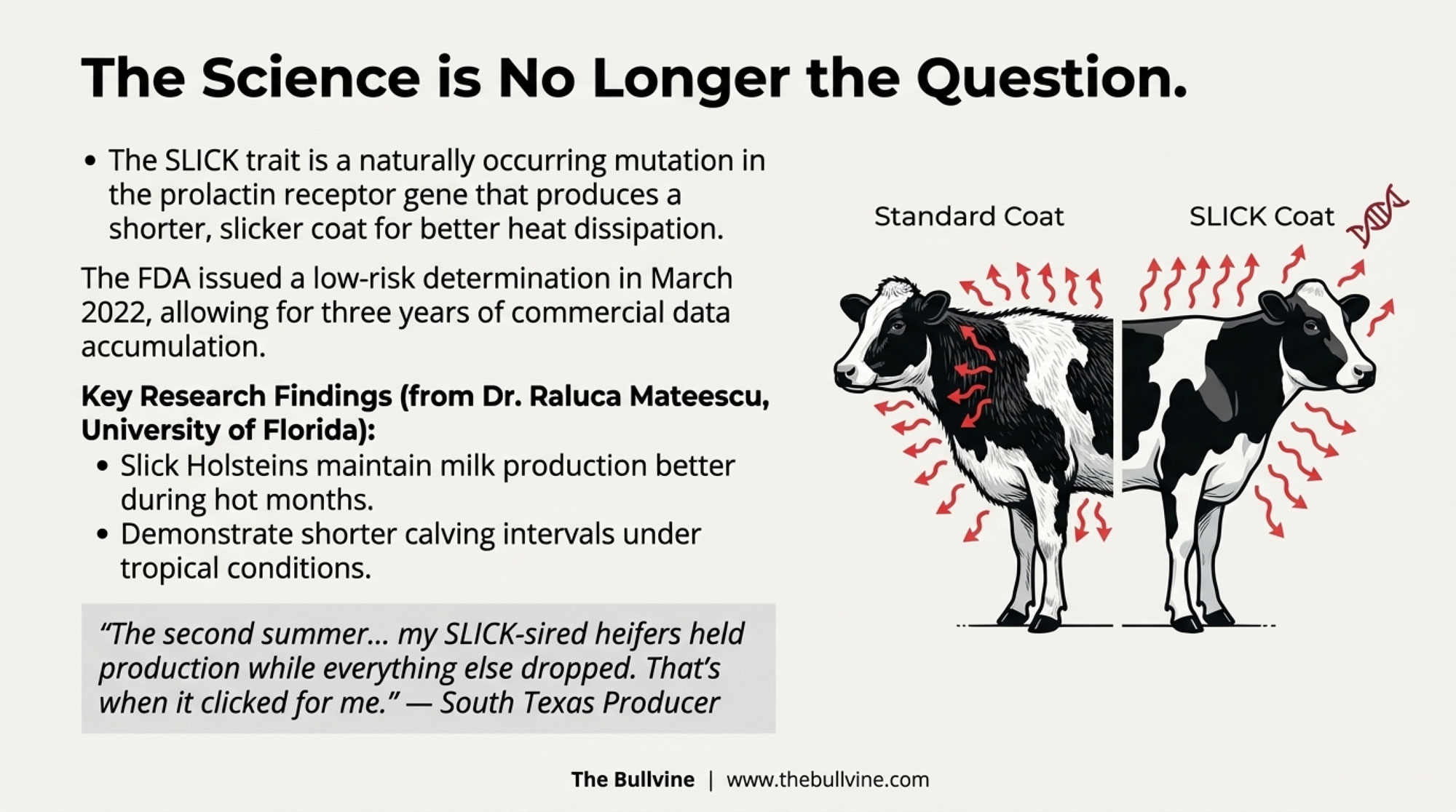
Here’s what the biology actually delivers. The Slick allele is a dominant mutation in the prolactin receptor gene that produces a short, sleek coat. University of Florida research by Dikmen and colleagues (Journal of Dairy Science, 2014) documented that Slick cows averaged 1.1°F lower vaginal temperatures at the hottest times of day (noon to 3 p.m.) compared with non-Slick herdmates housed in the same Florida freestall environment. And where summer-calving cows typically see a sharp first-90-day yield depression compared with winter-calving animals, that seasonal gap was substantially reduced in Slick carriers — Slick cows held closer to their winter-calving performance than wild-type animals in the same heat conditions. The regulatory and commercial path Slick has walked is worth comparing with how the PRLR-SLICK gene-edited variant stacks up on the 2029 milk cheque.
The strategy isn’t 100% Slick. It’s targeting Slick matings at your highest-producing cow families and summer-calving blocks, where heat stress hits the margin hardest. A 20–30% allocation blended with elite conventional sires selected on NM$ or LPI is where most breeders start. Per Select Sires’ own ART data, the production penalty Slick once carried isn’t showing up in the current generation.
Is Your Herd’s Genetic Strategy Already Behind Where Australia Was in 2019?
Not a rhetorical question. By the August 2024 ABV release, one in three Holstein Good Bulls cleared 100 for Heat Tolerance. Parrish told Dairy News Australia that Australian AI centres are moving toward filtering on HT the same way they already filter for calving ease: “AI centres won’t take bulls that aren’t good for Heat Tolerance. It will be like calving ease — now they won’t buy a bull that causes difficult calvings.”
That shift didn’t come from a regulator. It came from farmers like Parrish, year after year, building HT into what they asked their AI reps for.
North American studs respond to the same pressure. Kerndt has said plainly: “Heat tolerance is a valuable economic trait. By adding the slick trait to the elite genetic package offered by Select Sires, we can accomplish our goal of helping dairies everywhere become more profitable.”
When the conversation at the rep level shifts from “what’s your highest NM$ bull?” to “what’s your highest NM$ bull with Australian HT data above 100 or a validated Milk_THI value above zero?” — the catalogs move. Not in 2030. Sooner. The breeders best positioned will be the ones whose replacement heifers already carry heat-adapted genetics when that shift lands.
What This Means for Your Operation
If your herd regularly sees days with wet-bulb temperatures approaching or crossing 26°C, the Science Advances data says you’re already losing meaningfully on those days — even with fans and soakers running. Pull your summer milk-weight records against THI days from the last three years before your next breeding order.
If your replacement rate runs above 30%, you have enough genetic turnover to see measurable HT impact inside four years. Below 25%, stretch that timeline and adjust expectations accordingly.
If you already genomic-test 70% or more of your replacements, the incremental cost of adding HT screening at the sire level is effectively zero. The only reason not to add it is habit.
If your AI rep hasn’t raised heat tolerance in a sire presentation, that’s a conversation worth starting. The data exists. Whether your current stud has prioritized surfacing it is worth finding out before the next breeding order goes in.
If you breed for a specific milk market — components, cheese yield, A2A2 — weight HT as a filter on top of those targets, not a replacement for them. It stacks. It doesn’t substitute.
If you operate in what was traditionally called a “temperate” region — Ontario, Quebec, Upper Midwest, New York, Atlantic provinces — treat that label as historical, not current. The Science Advances midcentury projection work puts meaningful additional heat exposure in those regions.
If the winter-coat concern has kept you out of Slick matings: Select Sires’ fifth-generation Wisconsin-born Slick calves grow hair fine. The penalty isn’t what breeders have long assumed it was.
Key Takeaways
In the next 30 days: Pull your top 20 planned sires. Cross-reference each against DataGene’s Good Bulls App for HT ABV. Ask your Zoetis rep whether Milk_THI or CFS_THI values are accessible on those bulls. Request Select Sires’ April 2026 Holstein Sire Directory to identify current active Slick carriers. This is an afternoon’s work.
In the next 90 days: Identify your top-producing 20–30% of cow families and your May–July freshening block. Allocate Slick sire matings to those specific groups rather than broadcasting across the herd.
In the next 12 months: Begin documenting summer production and conception baselines now. When CDCB or Lactanet eventually integrates HT into NM$ or LPI, you’ll have your own performance delta in hand before your neighbor has results from their first Slick daughter.
If X, then Y: If your farm sits in a region that clears wet-bulb 26°C on more than a handful of days each summer and your replacement rate is above 30%, the cost of waiting another three years for CDCB exceeds the cost of starting a blended HT strategy now.
The wrong answers book-end the right one: 100% Slick is the wrong strategy for most North American herds in 2026. Zero Slick, in regions already carrying meaningful heat-day loads, is also the wrong strategy. The defensible position sits at 20–30%, targeted on your best, most heat-stressed genetics.
Parrish’s herd in Kangaroo Valley isn’t really the story. Select Sires’ fifth-generation Slick calves in Wisconsin aren’t quite it either. The story is that a producer in Woodstock, Tulare, or Fond du Lac could have started in 2019 or 2020 and closed most of the same distance by 2026. The tools have been sitting on the shelf. The question worth asking before the next breeding order goes in isn’t whether the climate will keep pressuring your margins. It’s whether the heifer you bred last Tuesday is built for the barn she’ll actually be milking in by the early 2030s — and if your AI rep can’t answer that question, what does that say about where the conversation needs to go next?
Complete references and supporting documentation are available upon request by contacting the editorial team at editor@thebullvine.com.
Transform Heat Stress into Your Carbon Strategy’s Secret Weapon — Follows the money on climate-linked regulatory risks, detailing how heat-stressed herds face a 23% methane penalty. Breaks down how selecting for heat-tolerant genomics secures your herd’s environmental compliance and long-term production floor.
Gene-Edited Cows Are Legal. Your 2029 Milk Cheque Isn’t Safe. — Exposes the massive regulatory shift making gene-edited Slick cattle a commercial reality. Highlights how PRLR-SLICK edits bypass decades of traditional breeding to deliver immediate thermal resilience and vital margin protection for the next decade.
The Sunday Read Dairy Professionals Don’t Skip.
Every week, thousands of producers, breeders, and industry insiders open Bullvine Weekly for genetics insights, market shifts, and profit strategies they won’t find anywhere else. One email. Five minutes. Smarter decisions all week.
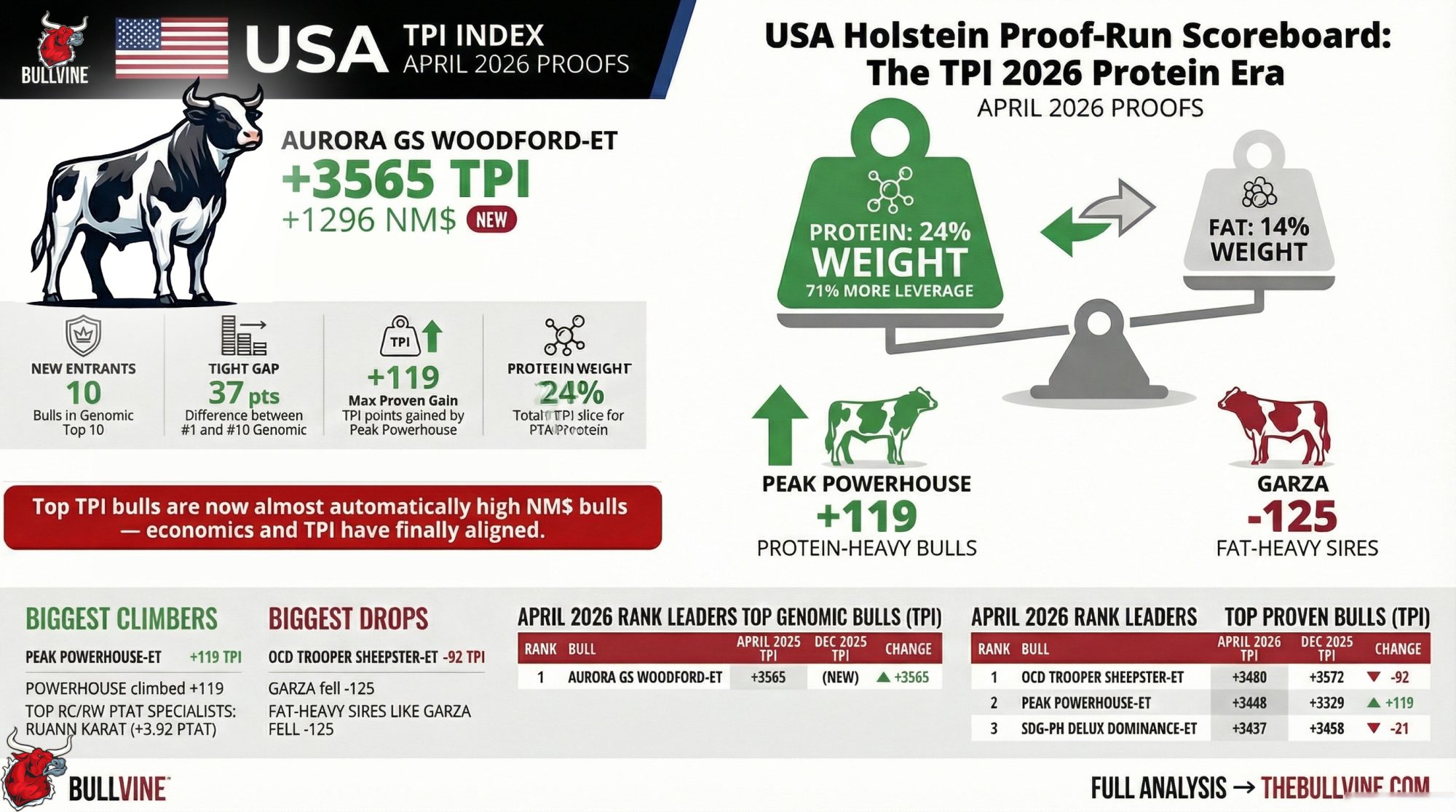
Powerhouse just picked up +119 TPI while Garza dumped −125 under the protein flip — if those two are in your tank, this run just changed your semen budget math.
Executive Summary: TPI 2026’s 24P:14F protein flip just moved real money: Powerhouse gains +119 TPI, Garza drops −125, and every high‑fat sire in your tank needs a second look. All 10 genomic USA Holstein TPI leaders in April 2026 are new names and squeezed into a 37‑point band, so chasing “#1” is now a high‑volatility hobby, not a plan. On the proven side, Sheepster still leads at +3480 TPI after losing 92 points, while Captain, Zuri, and Garza reshuffle as the formula rewards protein‑heavy profiles. Woodford (+3565 TPI, +1296 NM$) and Jitters/Sabotage‑type genomics line up TPI and NM$ so closely that your “index vs profit” debate is basically over for top heifers. R&W breeders get their own shake‑up: Okafor‑Red and Ocean‑Red hold near 3200 GTPI, while RC/RW PTAT bulls like Crypto PP at +2.82 PTAT force you to choose between show udders and milk cheque. The article walks through how to re‑tier matings by herd type (high‑input, grazing, type/show, R&W), how to spot Captain/Trooper/Alta line stacking, and which bulls to push or park for the next 30 days.
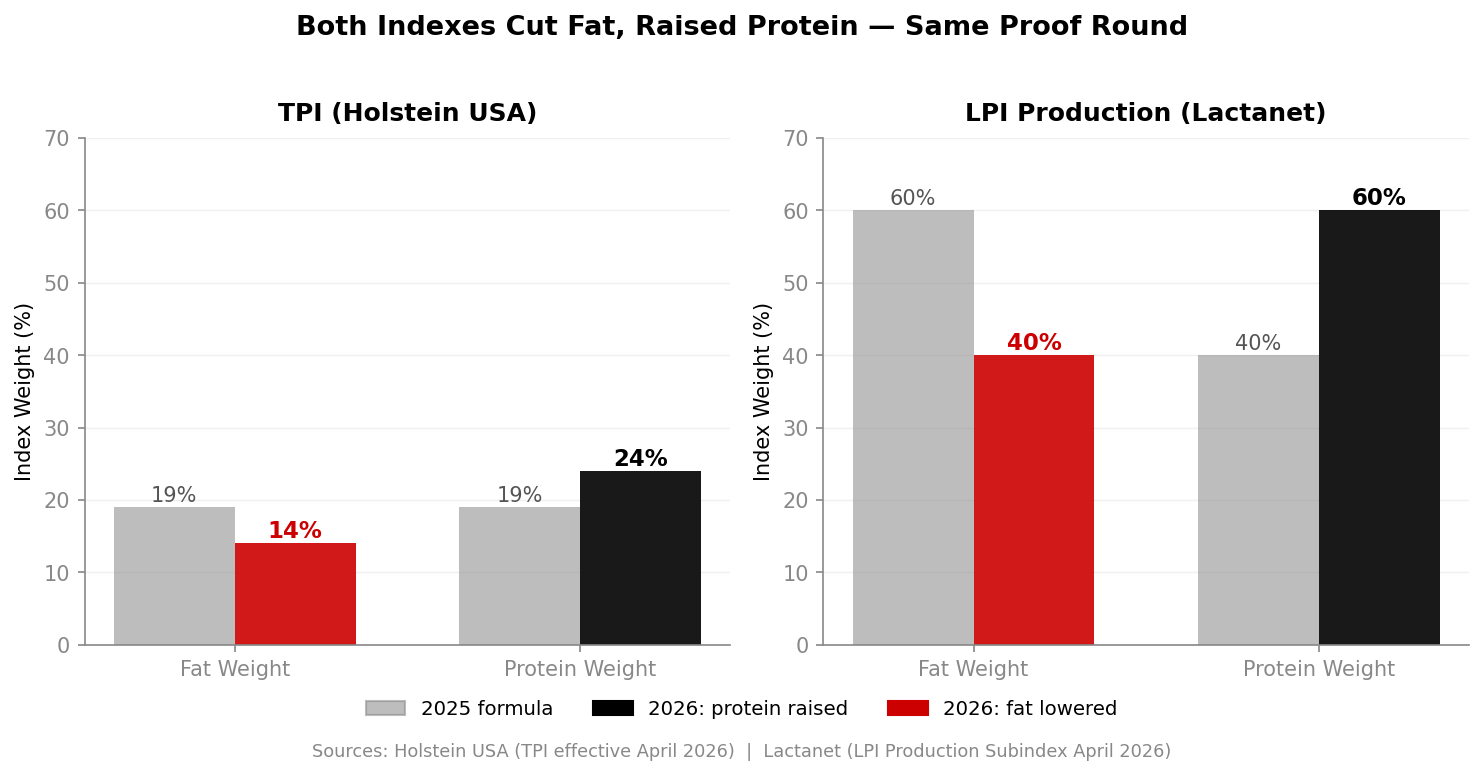
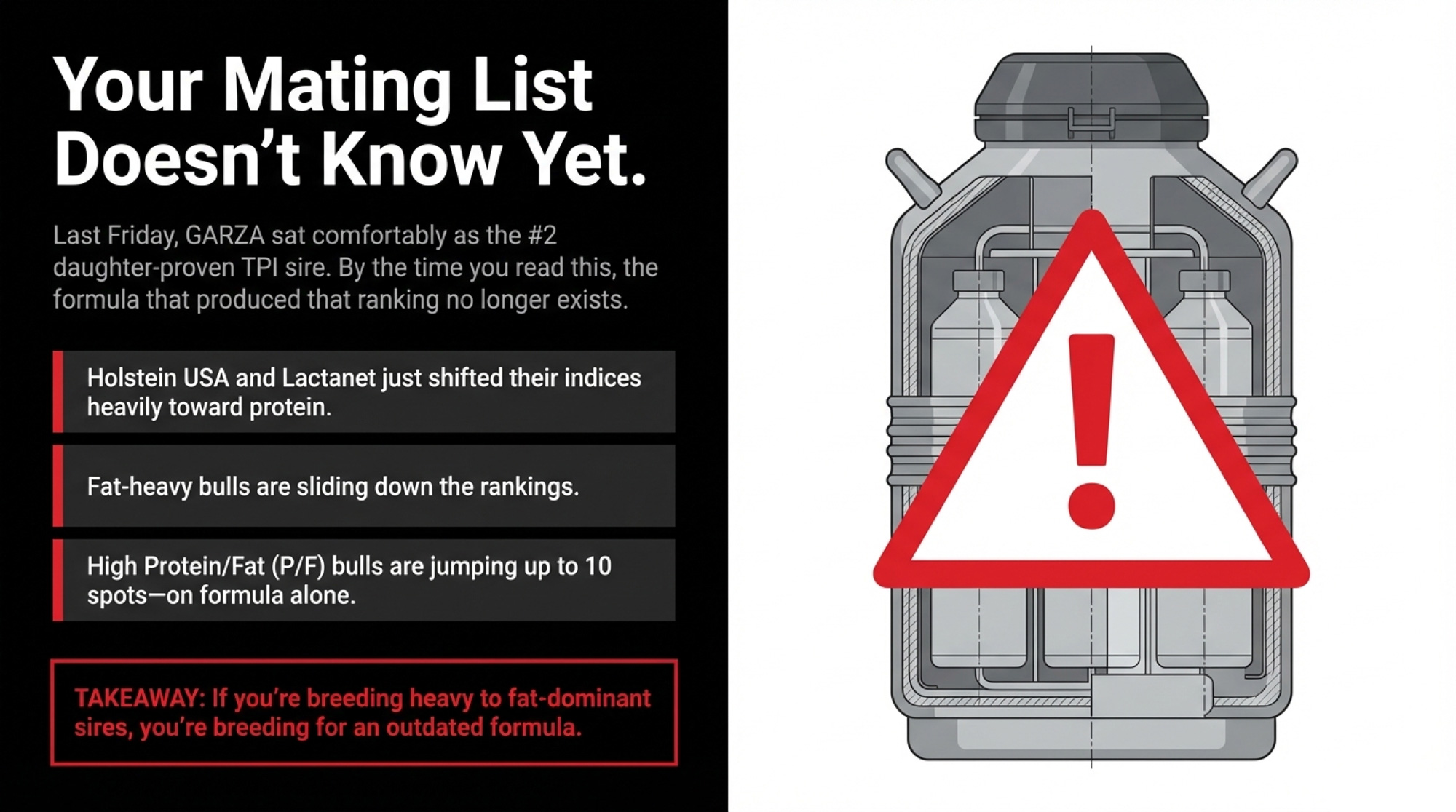
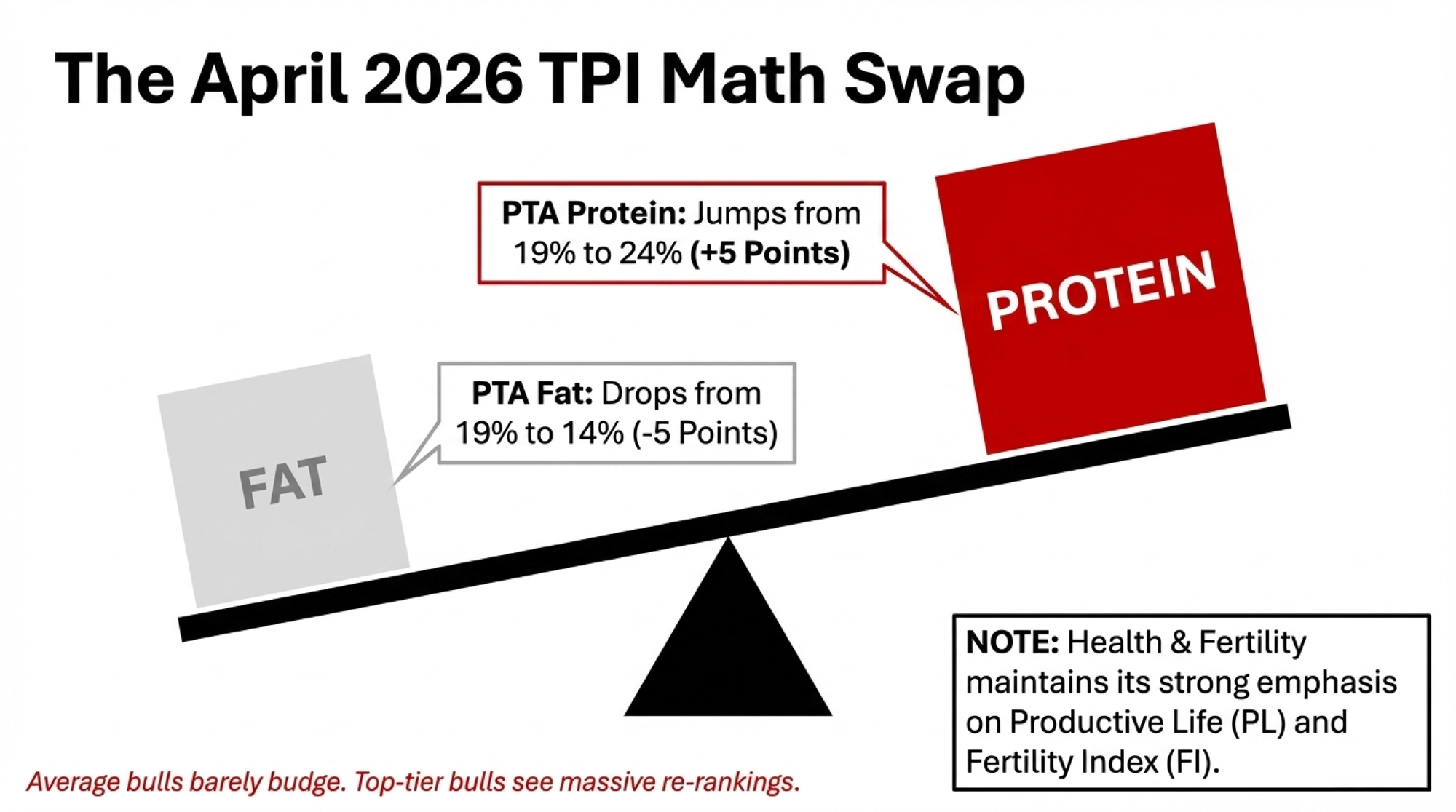
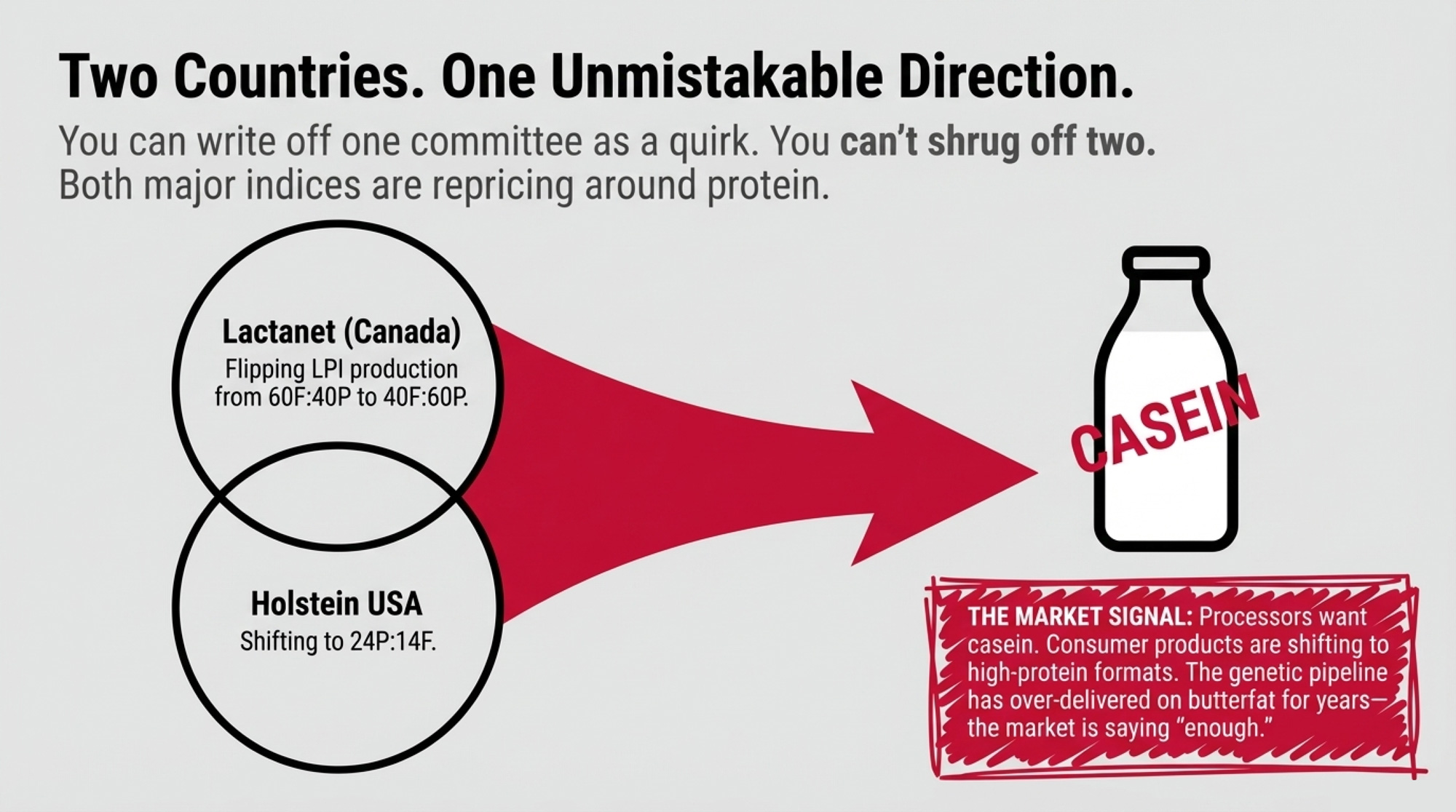
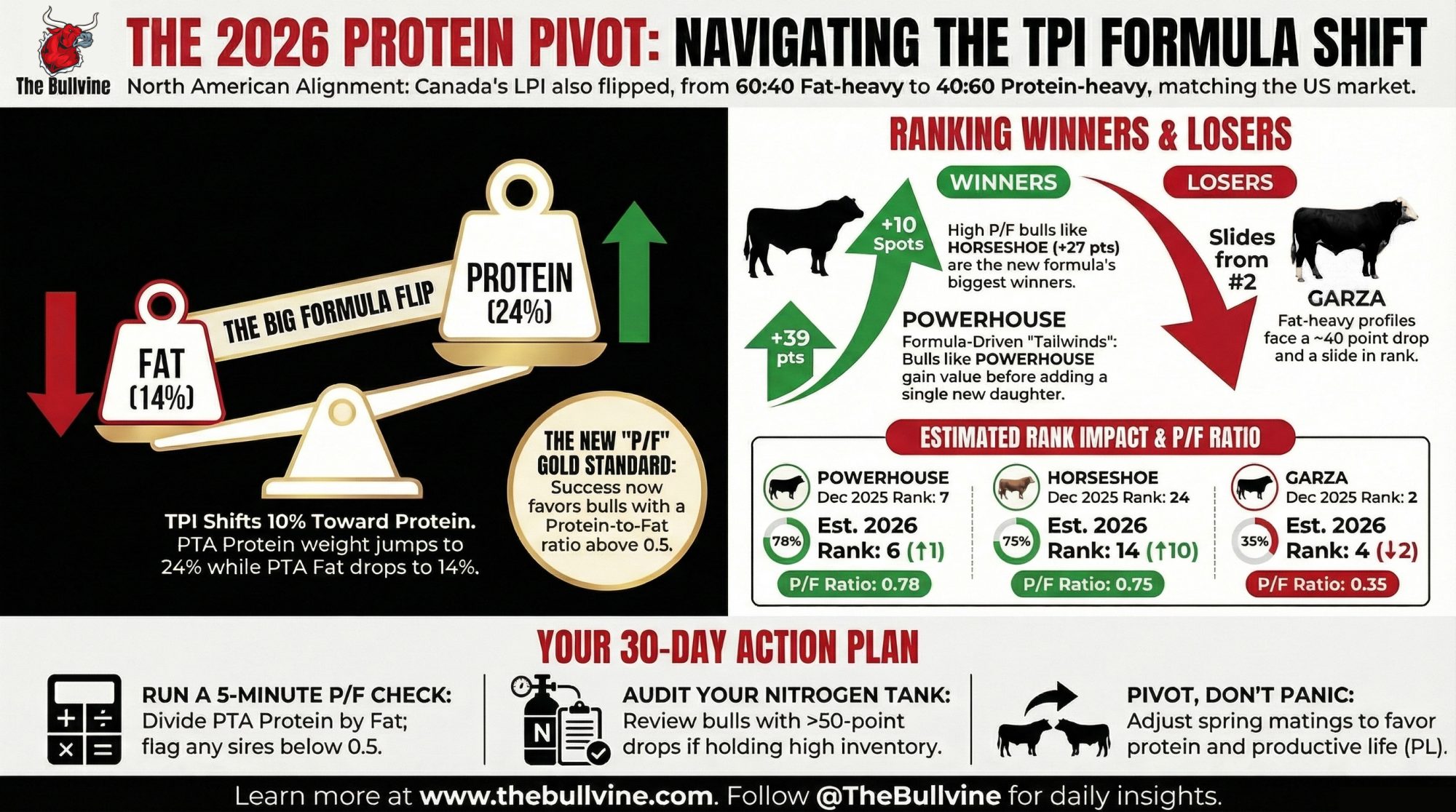
The hook for April 2026 is the TPI 2026 formula flip: more weight on protein, less on fat, which quietly reshuffled both genomic and daughter-proven lists and set up the kind of bulls that now rise to the top in the Holstein USA TPI, April 2026 run. The biggest structural change is that PTA Protein now carries 24% of TPI while PTA Fat drops to 14%, so a bull with the same total CFP but more of it in protein pounds now scores materially higher TPI than a more fat‑heavy counterpart. When you run the December 2025 Holstein USA TPI proofs through that new 24P:14F production slice, you immediately see “formula winners” and “formula losers” before a single new daughter is added.
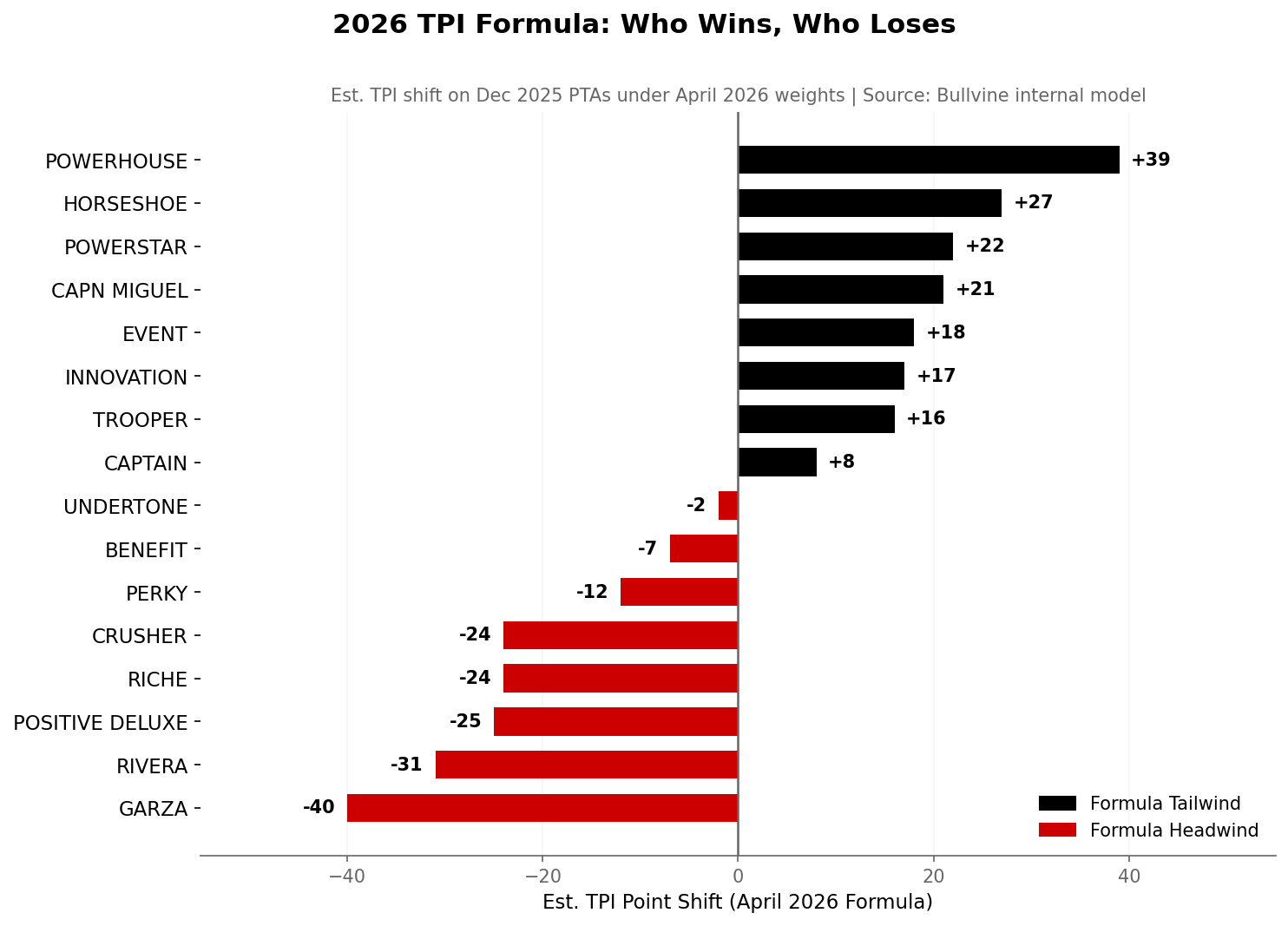
In this April 2026 USA run, that protein‑first logic shows up very clearly: genomic bulls like Aurora Gs Woodford‑ETare almost purpose‑built for TPI 2026, and on the proven side, bulls such as Peak Powerhouse‑ET gain roughly +119 TPI going from +3329 TPI (Holstein USA TPI, December 2025) to +3448 TPI (Holstein USA TPI, April 2026). At the same time, fat‑leaning sires like SDG Cap Garza‑ET lose relative ground despite still being excellent cowside options.
What Changed at the Top?
Genomic TPI leaders – April 2026
On the genomic side, the top 10 Holstein USA TPI, April 2026 bulls are all new faces compared with the December 2025 genomic top 10, reflecting both the formula change and the usual churn of new young sires.
Genomic TPI top 10 – Holstein USA TPI, April 2026
Rank (TPI)
Bull (NAAB)
TPI Apr 2026
NM$ Apr 2026
PTA Milk
PTA Fat
PTA Pro
PTAT
PL
1
Aurora Gs Woodford-ET (551HO06782)
+3565
+1296
+1498
+142
+78
+0.37
+4.5
2
Beyond Mican Hagrid-ET (7HO18312)
+3562
+984
+1351
+128
+66
+2.24
+3.7
3
S-S-I Richard Chichester-ET (7HO18102)
+3560
+1059
+1228
+112
+63
+1.54
+5.8
4
Genosource Jitters-ET (551HO07177)
+3552
+1127
+1637
+123
+68
+0.74
+4.2
5
Ocd Whoops Sabotage-ET (796HO10329)
+3551
+1076
+1274
+119
+64
+1.49
+4.6
6
S-S-I Kingdom Formal-ET (7HO18241)
+3548
+1139
+528
+129
+54
+0.91
+5.4
7
S-S-I Stagger Baelum-ET (14HO18123)
+3547
+1124
+897
+122
+62
+0.64
+5.7
8
Siemers Ssi Bridgerton-ET (250HO18331)
+3539
+1071
+1515
+110
+71
+0.96
+3.4
9
Pen-Col Gs 86807-ET (551HO06686)
+3529
+1119
+1853
+129
+73
+1.23
+3.8
10
Welcome Gustavsson-ET (200HO13730)
+3528
+997
+848
+115
+54
+1.61
+5.6
The band from Woodford at +3565 down to Gustavsson at +3528 is extremely tight – just 37 TPI points separate #1 from #10 – and all ten are new entrants versus the December 2025 genomic top 10. That tells you two things:
The shape of the ideal genomic sire under TPI 2026 is clear (high milk, strong protein, good health, functional type), but
The names at the very top are volatile and will rotate as more calves and proofs arrive.
Proven TPI leaders – December 2025 vs April 2026
On the daughter‑proven side, the story is different: it’s movement, not churn. The top proven bulls are the same characters, but they reshuffle based on the formula change and the addition of fresh daughters.
Daughter‑proven TPI top 10 – Holstein USA TPI, April 2026 vs December 2025
Rank Apr 2026
Bull (NAAB)
TPI Apr 2026
TPI Dec 2025
Δ TPI
Verdict
PTA Milk
PTA Fat
PTA Pro
PTAT
1
OCD Trooper Sheepster-ET (7HO16276)
+3480
+3572
!DROP −92
Formula loser
+1359
+133
+67
+0.86
2
Peak Powerhouse-ET (1HO16089)
+3448
+3329
!HIGH +119
Formula winner
+1937
+113
+92
+0.09
3
SDG-PH Delux Dominance-ET (551HO04795)
+3437
+3458
−21
Slight loser
+1303
+135
+64
+0.07
4
La-Ca-De-Le T Isaac 8731-ET (7HO15966)
+3396
+3390
+6
Neutral
+1336
+111
+62
+2.07
5
Peak Momento-ET (1HO16144)
+3360
+3334
+26
Formula winner
+1223
+113
+53
+0.40
6
Genosource Captain-ET (551HO04119)
+3356
+3428
!DROP −72
Formula loser
+1789
+117
+64
+0.33
7
Terra-Calroy Zuri-ET (97HO42585)
+3355
+3375
−20
Slight loser
+854
+104
+52
+1.81
8
SDG Cap Garza-ET (551HO04474)
+3339
+3464
!DROP −125
!RISK Formula loser
+1369
+140
+50
+0.03
9
Denovo 3946 Elgin-ET (29HO20623)
+3337
Outside top 10
!HIGH New entry
Formula winner
+2635
+100
+68
+0.45
10
Welcome Sensei-ET (200HO12140)
+3333
Outside top 10
!HIGH New entry
Formula winner
+1627
+97
+73
+0.87
Sheepster loses 92 points but still leads the Holstein USA TPI, April 2026 proven list at +3480 TPI, while Powerhouse is the classic “formula winner,” jumping about +119 TPI between runs thanks to his milk and protein‑heavy profile. Captain, Zuri, and Garza all surrender some ground under the new production weights but remain within the elite band.
All these proven sires meet the Holstein USA “high‑ranking sire” reliability criteria (minimum 80 traditional or 85 genomic for production and 80 for type), and the leaders are sitting in the 95–99% range on production and type, so this is the high‑reliability layer.
What TPI 2026 Is Rewarding (and Penalizing)
Protein vs fat in the new formula
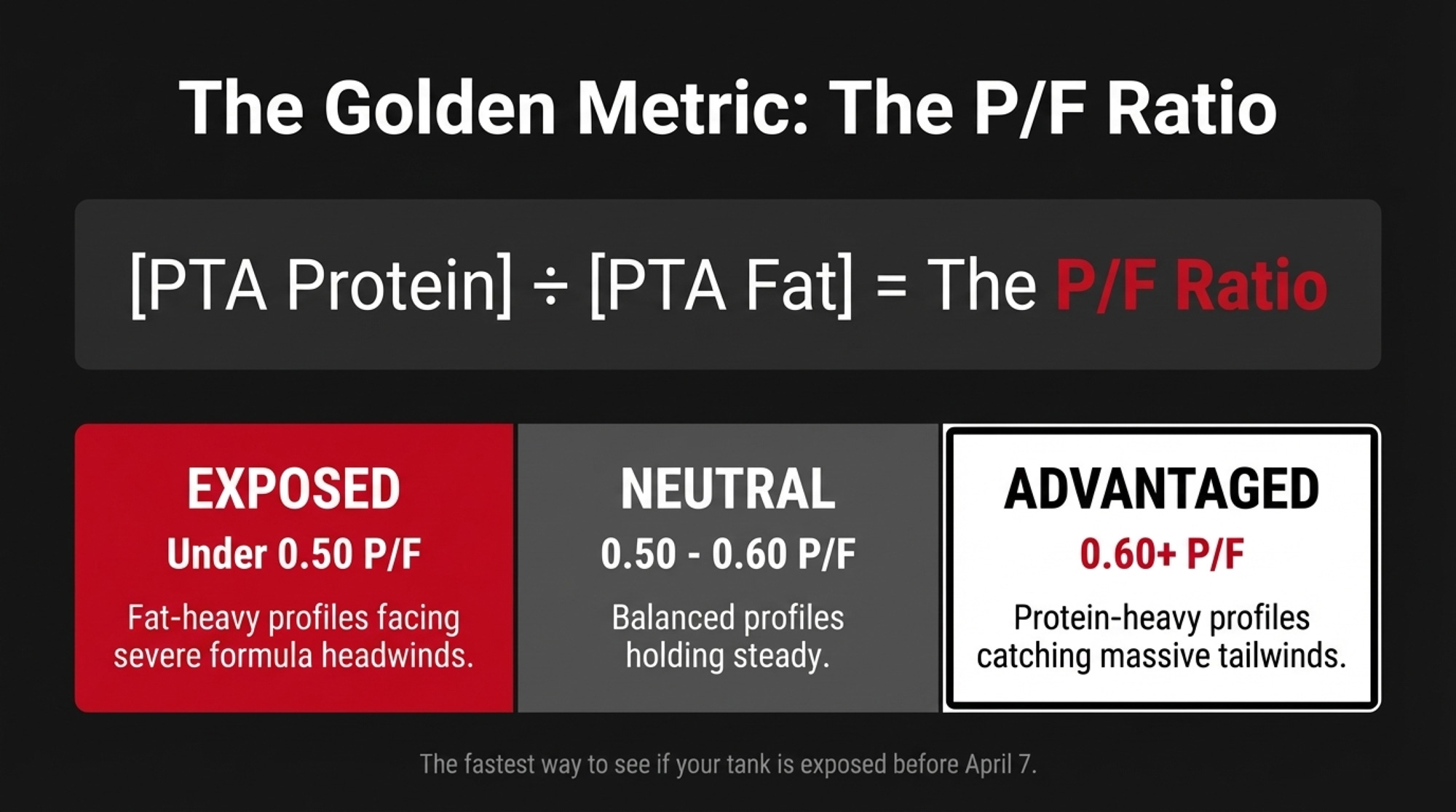
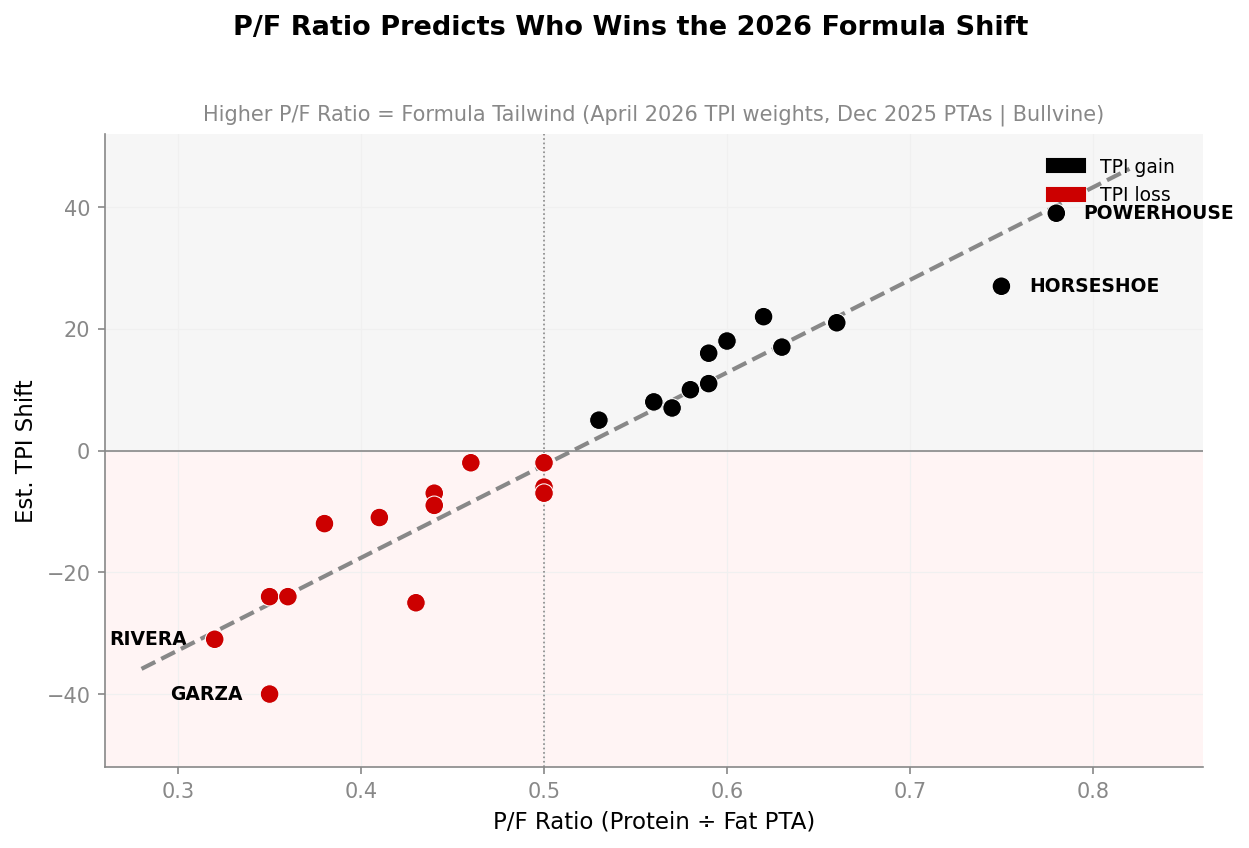
Holstein USA’s TPI 2026 formula allocates 24% weight to PTA Protein and 14% to PTA Fat, shifting 5 percentage points from fat to protein compared with the previous version. Because of how the sub‑indices are scaled, Bullvine’s analysis shows that one pound of PTA Protein now exerts about 71% more leverage inside TPI than one pound of PTA Fat, turning P‑strong bulls into index winners without any change in their actual proofs.
Running the December 2025 Holstein USA TPI values through the new matrix, Bullvine highlighted several clear patterns:
Bulls with high protein and balanced or strong P/F ratios gained TPI – example case studies include:
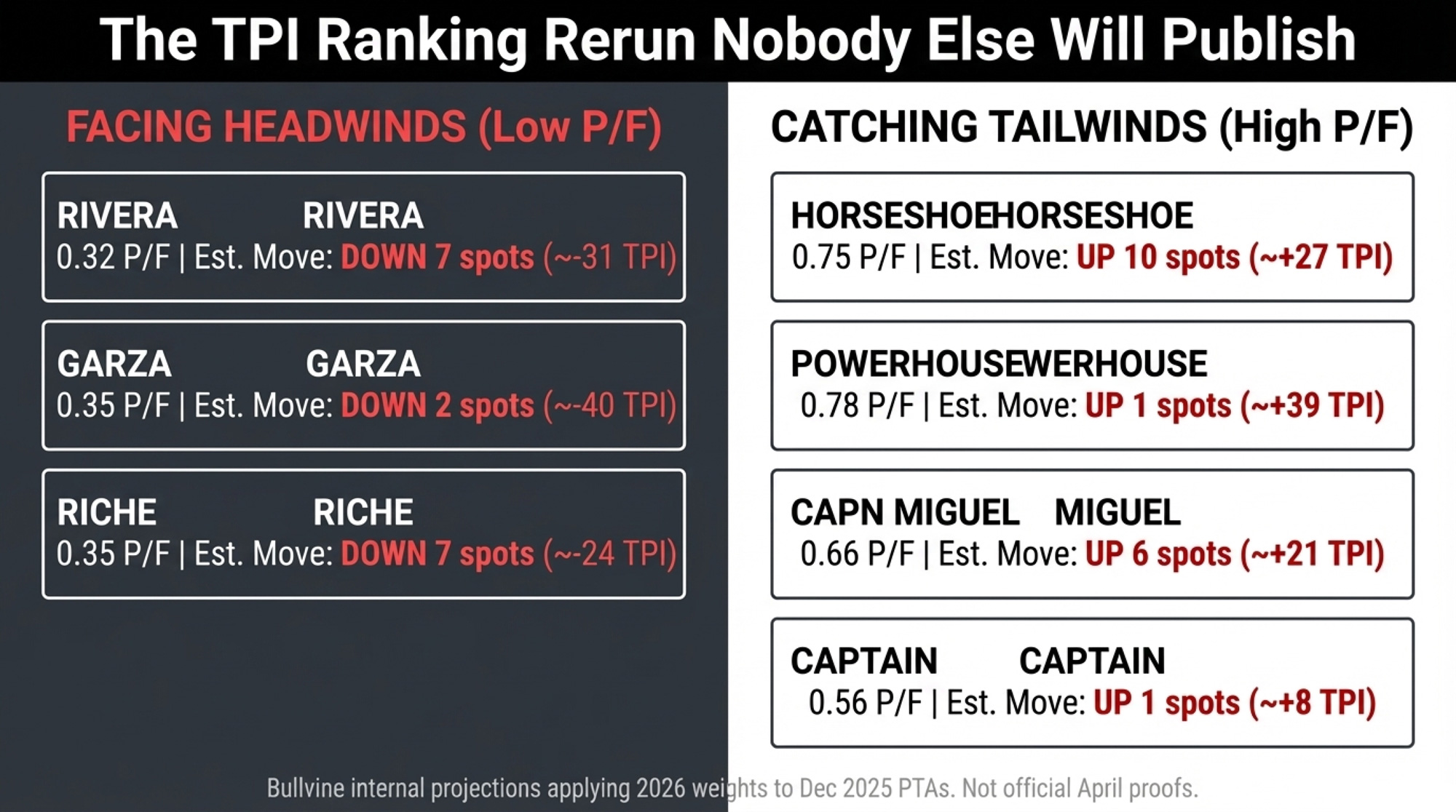
Peak Powerhouse‑ET (1HO16089) – big milk, strong protein, climbs from +3329 to +3448 TPI between December 2025 and April 2026.
Cookiecutter Horseshoe‑ET (208HO00356) – identified by Bullvine as jumping about 10 proven ranks under the 2026 formula, even on the same December proof set.
Multiple Captain‑line bulls like Captain himself and his sons.
Bulls whose component strengths skewed more to fat than protein lost a step:
SDG Cap Garza‑ET (551HO04474) – very strong on fat; surrenders roughly 125 TPI under the new weighting (from +3464 to +3339).
Some high‑fat Captain sons and Garza‑type profiles that were standout under the old 19F:19P balance.
Bull (NAAB)
Status
PTA Pro
PTA Fat
Pro:Fat Ratio
TPI Dec 2025
TPI Apr 2026
Δ TPI
Formula Verdict
Peak Powerhouse-ET (1HO16089)
Proven
+92
+113
0.81
+3329
+3448
!HIGH +119
Winner – protein-heavy relative to fat
Peak Momento-ET (1HO16144)
Proven
+53
+113
0.47
+3334
+3360
+26
Mild winner
Denovo 3946 Elgin-ET (29HO20623)
Proven
+68
+100
0.68
Outside top 10
+3337
New entry
Winner – protein:fat balanced
Welcome Sensei-ET (200HO12140)
Proven
+73
+97
0.75
Outside top 10
+3333
New entry
Winner
Aurora Gs Woodford-ET (551HO06782)
Genomic
+78
+142
0.55
—
+3565
—
Purpose-built for 2026 formula
OCD Trooper Sheepster-ET (7HO16276)
Proven
+67
+133
0.50
+3572
+3480
!DROP −92
Moderate loser
Genosource Captain-ET (551HO04119)
Proven
+64
+117
0.55
+3428
+3356
!DROP −72
Loser – fat-leaning relative to protein
SDG Cap Garza-ET (551HO04474)
Proven
+50
+140
0.36
+3464
+3339
!DROP −125
!RISK Biggest loser – extreme fat bias
SDG-PH Delux Dominance-ET (551HO04795)
Proven
+64
+135
0.47
+3458
+3437
−21
Slight loser
Trait profiles at the top – genomics
Looking at the Holstein USA TPI, April 2026 genomic top 10, the shared trait profile is obvious:
High PTA Milk – often +1200 to +1500 lb and beyond.
High PTA Fat and PTA Protein pounds, with a P/F balance that suits the 24P:14F weighting.
Strong health (PL, LIV, cow health/Health Index) and fertility, with SCS normally in a comfortable range.
Moderate positive type – enough PTAT and udder to build functional commercial cows, not extreme show type.
A few case studies:
Aurora Gs Woodford‑ET +3565 TPI (Holstein USA TPI, April 2026) and +1296 NM$ (Holstein USA NM$, April 2026), roughly +1498 PTA Milk, +142 PTA Fat, +120 PTA Protein, strong Health Index, and moderate but positive type.
Genosource Jitters‑ET +3552 TPI (Holstein USA TPI, April 2026), +1127 NM$ (Holstein USA NM$, April 2026); big CFP with strong survival and fertility.
Ocd Whoops Sabotage‑ET +3551 TPI (Holstein USA TPI, April 2026), +1076 NM$ (Holstein USA NM$, April 2026); high production and NM$ with solid type.
Kingdom Formal, Baelum, Bridgerton, Pen‑Col Gs 86807, and Gustavsson all sit in this same high‑protein, high‑pounds, good‑health box with minor flavor differences in pedigree and trait tilt.
Trait profiles at the top – proven
On the proven side, the Holstein USA TPI, April 2026 leader board is full of “TPI 2026‑friendly” production profiles with proven reliability.
Overall, the proven top 10 tends to run 150–250 TPI points below the genomic leaders, but with 95–99% reliabilities for production and type, making them much safer anchors.
AI Companies and Bloodlines: Who Owns the Top?
Across the Holstein USA TPI, April 2026 lists, there is a clear concentration by both AI company and sire line.
On the proven TPI top 10:
OCD appears prominently with Sheepster and several Trooper/Drive descendants in the extended top group.
Peak/Alta features strongly via Powerhouse and Momento, plus multiple AltaWheelhouse/AltaZazzle offspring.
Genosource delivers Captain and several Captain‑line sons (Garza, Capn Miguel, Capn Ramble) just inside or outside the top 10.
Denovo brings in Elgin under the Envy x Riveting cross.
Pedigree‑wise, a few sire lines are clearly over‑represented in the top 10 and just beyond:
Captain (and his sons) appear in multiple proven bulls’ pedigrees – Captain himself in the top 10, and Garza, Capn Miguel, Capn Ramble, Cap Diggory, etc., in the next band.
Trooper/Drive/Topdog influence shows through OCD sires like Sheepster, Shake, Draft, and Draft‑related bulls.
AltaZazzle/AltaWheelhouse/AltaMarius show up repeatedly in the background of Peak bulls.
For genomic users, this concentration means you cannot just buy “top‑10 genomic TPI” and assume diversity; a good proportion of those bulls will trace back to Captain‑line and AltaZazzle‑line sires. For proven users, it reinforces the need to spread semen across multiple companies and sire lines – e.g., pairing Captain‑line bulls with Envy/Riveting or Taos‑line bulls like Isaac – to manage inbreeding and diversify risk.
How Volatile Are These Rankings After the Protein Flip?
At the genomic level, volatility is a feature, not a bug.
All ten bulls in the Holstein USA genomic TPI top 10, April 2026, are new compared with the December 2025 genomic top 10.
The TPI gap from #1 to #10 compressed to just 37 points (3565–3528), which means minor reliability or data shifts can shuffle ranks by several positions without any real change in bull quality.
For genomic TPI users, this means rank volatility is high and shouldn’t be over‑interpreted; you want to treat the whole top band as a portfolio of similar bulls rather than betting on the “#1” name.
On the daughter‑proven side, the picture is much calmer.
The core of the top group is stable: Sheepster, Dominance, Captain, Momento, Zuri, and Garza were already high in December 2025, and remain in the top 10 in April 2026.
Typical movement is ±20–40 TPI as more daughters arrive, with bigger shifts (Powerhouse +119, Garza −125) explained largely by the formula change rather than an abrupt change in daughter performance.
With reliabilities at or near 99% for many of these bulls, the rank band is structurally stable; a few slots of shuffling don’t change their role as cow‑makers.
For decision‑making:
Treat genomic ranks as high‑gain but high‑volatility signals: great for fast genetic progress, especially on heifers, but you should spread risk across several programs and not assume any one bull will stay #1.
Treat proven ranks as high‑reliability anchors: ideal for herds that want predictable daughters and for large semen volumes on milking cows and donors.
NM$: Economics Lined Up with TPI
The Holstein USA NM$, April 2026 genomic file confirms that TPI 2026 and NM$ are largely pointing to the same bulls.
Genomic NM$ leaders vs TPI – Holstein USA, April 2026
NM$ Rank
Bull (NAAB)
NM$ Apr 2026
TPI Apr 2026
TPI Rank
Divergence Flag
Key Trait Tilt
1
Genosource Valkyrie-ET (551HO07040)
+1308
+3464
Outside top 10
!HIGH NM$, lower TPI
High CFP, strong health; fat-forward
2
Aurora Gs Woodford-ET (551HO06782)
+1296
+3565
#1 TPI
Aligned
Protein+milk+health; dual leader
3
Genosource Viper-ET (551HO07102)
+1296
+3494
Outside top 10
Slight NM$ lead
High milk, strong protein
4
Genosource Morten-ET (551HO06777)
+1282
+3490
Outside top 10
NM$ favored
Big milk +1888, strong CFP
5
Genosource Jitters-ET (551HO07177)
+1127
+3552
#4 TPI
Aligned
High milk, solid survival
6
Ocd Whoops Sabotage-ET (796HO10329)
+1076
+3551
#5 TPI
Aligned
High-NM$ all-rounder
7
S-S-I Richard Chichester-ET (7HO18102)
+1059
+3560
#3 TPI
Aligned
Protein-/health-tilted
8
Beyond Mican Hagrid-ET (7HO18312)
+984
+3562
#2 TPI
!RISK NM$ lag vs TPI
High PTAT +2.24; type premium, lower economics
9
San-Dan On Call-ET (551HO06544)
+1218
+3525
#12 TPI
NM$ favored
Big milk +1751, PL +3.6
10
S-S-I Kingdom Formal-ET (7HO18241)
+1139
+3548
#6 TPI
Aligned
High health index; balanced
For genomics, this means that choosing bulls on TPI alone is less risky than it used to be, because the top TPI list is now almost automatically high NM$ as well; NM$ is more of an economic cross‑check than a competing philosophy.
On the proven side, top TPI sires like Sheepster, Powerhouse, Captain, and Elgin also deliver competitive NM$, albeit a step lower than the very best genomics, which is exactly the reliability vs level trade‑off you expect.
PTAT and RC/R&W PTAT: Specialist Type Tools (with Top RC/RW PTAT Bulls)
The pure PTAT lists – black‑and‑white and Red/Red Carrier – are nearly a separate universe from the TPI/NM$ tables. From the Holstein USA PTAT, April 2026 file, top PTAT sires reach +3.5 to +4.0 PTAT, with huge udders and frames, but usually 150–200 TPI and several hundred NM$ below the Woodford/Jitters type of bull. In the Red Carrier/RW PTAT file, similar-type specialists exist for the Red Carrier and Red & White space.
If your herd prioritizes show and classification, these bulls are ideal when you have a top 5–10% type cow family and are willing to sacrifice some index and NM$ on a few matings to push udders and frames to the next level. If your herd prioritizes herd profitability, you should keep PTAT specialists under 5–10% of total matings and let TPI/NM$ leaders carry the main commercial load while PTAT bulls sculpt the show string and donor group.
Top RC/RW PTAT Bulls – April 2026 and How to Use Them
For herds that want show-ring udders and frames in the Red Carrier and Red & White space, the Holstein USA RC/RW PTAT, April 2026 list provides a small group of extreme‑type tools.
Highlighted RC/RW PTAT bulls – Holstein USA RC/RW PTAT, April 2026 (12‑month bulls)
Bull (NAAB)
PTAT (Holstein USA RC/RW PTAT, April 2026)
Notes
Ruann Karat‑45955‑ET (719HO45955)
+3.92 PTAT
Extreme frames and udders; very low production and index.
Redcarpet Story Arc‑ET (730HO00005)
+3.78 PTAT
High‑type RC bull; niche show sire.
Eskdale Hulu Shoutout‑ET (288HO00364)
+3.56 PTAT
Hulu‑line type for RC cows.
Ruann Archer‑23755‑ET (719HO23755)
+3.32 PTAT
Big frames, strong show pedigree.
Dg Santinus RC (551HO00612)
+3.31 PTAT
RC type bull with modest production.
Ski‑Brite Junior P RC‑ET (288HO00350)
+3.30 PTAT
Polled RC with high PTAT, lower index.
Shg Lazer‑ET (551HO00485)
+3.25 PTAT
Show‑oriented sire for udder and style.
Le‑O‑La Chisel‑ET (551HO06531)
+3.24 PTAT
High type, low production; pure show tool.
Siemers Lazer Hambitious‑ET (288HO00339)
+3.15 PTAT
Lazer son with modern show‑cow pattern.
Sunquest Holy Crypto PP‑ET (250HO18358)
+2.82 PTAT
Homozygous polled with strong PTAT and respectable TPI.
These RC/RW PTAT bulls are not designed to compete with Woodford‑style sires on TPI or NM$; most carry negative production PTAs and lower indexes. If your herd prioritizes show or classification in Red or RC lines, you can use them strategically:
On the top 5–10% of Red and RC cows and heifers from your best type families, especially where udders and frames are already strong, and you want to push for the next level.
For breeders who still need commercial performance in Reds, bulls like Sunquest Holy Crypto PP‑ET can be used on a slightly wider group, because he doesn’t step as far off the index cliff as some pure show sires.
If your herd prioritizes profit and components, keep RC/RW PTAT-specialist usage under 5–10% of matings, and let Red index leaders (Okafor‑Red, Ocean‑Red, etc.) carry the main R&W commercial load.
Red & White: Index and Type in the R&W Space
TPI 2026 doesn’t treat Red & White differently inside the formula, but the April 2026 USA Red & White GTPI tables show a similar protein‑forward pattern among top R&W bulls.
Top R&W TPI – Holstein USA GTPI, April 2026 (selected)
Bull (NAAB)
TPI (Holstein USA GTPI, April 2026)
NM$ (Holstein USA NM$, April 2026)
PTA Milk
PTA Fat
PTA Pro
PTAT
Notes
Denovo 21873 Okafor‑Red‑ET (29HO00951)
3194
+824
+2270
+73
+31
+1.24
High‑index Red, strong CFP, good health.
Aprilday Hrok Athens‑Red‑ET (250HO18217)
3180
+595
+956
+76
+16
+0.57
Protein‑friendly Red with solid health.
Stgen Ocean‑Red‑ET (551HO06846)
3179
+792
+1906
+69
+11
+1.12
NM$‑strong Red for commercial herds.
Ocd Morris Spirit‑Red‑ET (551HO06757)
3177
+872
+1536
+81
+11
−0.06
Big fat, good protein; strong fit for milk cheque.
Compared with December 2025, bulls like Okafor‑Red and Ocean‑Red hold their ground near the top while fat‑heavier R&W sires lose some relative shine; again, the protein‑leaning bulls are formula winners.
For type in the Red space, the Red Carrier/RW PTAT bulls above (e.g., Holy Crypto PP, Story Arc, Karat, Hulu Shoutout) provide show‑caliber udders and frames that you can layer on top of R&W index sires when you want Red daughters that still classify and show.
If your herd wants Red calves with a commercial index:
Look first at Okafor‑Red, Athens‑Red, Ocean‑Red, Spirit‑Red, and similar bulls at the top of the R&W GTPI and NM$ lists.
Use RC/RW PTAT specialists sparingly on top Red females where type is high-priority.
What This Means for Your Matings This Season
This is where the April 2026 USA Holstein proof run earns its keep: turning lists into portfolio and mating moves over the next 30 days.
High‑input, housed herds chasing milk cheque and NM$
If your herd is high‑input, housed, and paid strongly on volume plus components, consider:
Heifers and genomic donors
Use Aurora Gs Woodford‑ET, Genosource Jitters‑ET, and Ocd Whoops Sabotage‑ET heavily on your top 25–40% heifers and genomic donors to maximize TPI (Holstein USA TPI, April 2026) and NM$ (Holstein USA NM$, April 2026).
Layer in Beyond Mican Hagrid‑ET or S‑S‑I Richard Chichester‑ET where you need a different program or P/F bias to manage inbreeding.
Milking cows and ET recipients
Anchor matings with OCD Trooper Sheepster‑ET, Peak Powerhouse‑ET, and Genosource Captain‑ET to lock in high CFP, PL, and reliability on cows that are already working hard.
Accept slightly lower TPI vs genomics in exchange for near‑99% reliability – especially on older cows and donor dams.
Grazing / lower‑input or fertility‑sensitive herds
If your herd prioritizes fertility, survival, and robustness more than absolute production:
On heifers, lean more into genomic bulls like Chichester, Jitters, and Sabotage that balance components with very strong health and fertility, rather than chasing the last 50–80 pounds of milk.
On cows, emphasize proven sires with strong PL/LIV and fertility – e.g., Sheepster, Dominance, Zuri, Sensei– and limit the number of high‑milk but tougher‑fertility bulls like some Captain sons on cows that already struggle to breed back.
Type/show and classification‑focused herds
If your herd is type/show‑oriented, and you’re willing to give up some TPI/NM$:
Keep TPI/NM$ leaders (Woodford/Jitters/Sheepster) as the core for commercial matings, but
On the top 5–10% of your best type cows and heifers, layer in:
High PTAT black‑and‑white bulls from the Holstein USA PTAT, April 2026 file for udders and frames.
RC/R&W PTAT bulls like Sunquest Holy Crypto PP‑ET, Ruann Karat‑45955‑ET, or Redcarpet Story Arc‑ET on elite Red or RC families to upgrade type while maintaining some index.
You gain +3.0 to +4.0 PTAT udders and frames, but you typically give up 150–200 TPI and several hundred NM$, so keep these matings targeted.
Red & White focused herds.
If your herd prioritizes Red & White genetics:
Build your main Red program on Okafor‑Red, Athens‑Red, Ocean‑Red, Spirit‑Red, and similar high‑GTPI/NM$ R&W bulls from the Holstein USA GTPI R&W, April 2026 list.
Introduce RC/RW PTAT sires only on your top R&W cows and heifers, where show/classification is the priority.
Watch bloodline stacking – spreading semen across Denovo, STgen, OCD, and Aprilday R&W bulls helps keep Captain/Trooper/Alta lines from becoming too dense in your Red base.
30‑day action list
Within the next 30 days, for any USA Holstein program using TPI and NM$:
Audit your sire list against movement
Pull your current sire lineup and, using the December 2025 and April 2026 Holstein USA TPI lists, flag any proven bull that lost ≥80 TPI (e.g., Garza) and any that gained ≥80 TPI (e.g., Powerhouse).
Decide whether those “formula losers” still fit your herd’s fat vs protein economics and whether “formula winners” deserve a higher semen share.
Check bloodline concentration
Using the pedigrees in the April 2026 proven and genomic lists, highlight how many of your active bulls trace back to Captain, Trooper/Drive/Topdog, or AltaZazzle/AltaWheelhouse as sire or grandsire.
If a single line dominates, deliberately add a couple of strong non‑Captain/non‑Trooper bulls (e.g., Envy x Riveting like Elgin, Taos‑line bulls like Isaac) to create outcross options.
Re‑tier your matings by risk.
Re‑assign at least 60–70% of milk‑cow matings to proven bulls and the remaining 30–40% to genomics if your herd is risk‑averse; invert that on your top genomic heifers if you prioritize maximum genetic gain.
Make sure each mating segment explicitly matches your herd’s economics (milk pricing, fat/protein premiums) and management style (grazing vs housed, robot vs parlor).
Key Takeaways:
The 24P:14F TPI 2026 protein flip turns Powerhouse (+119 TPI) into a proven winner and knocks fat-heavy bulls like Garza (−125 TPI) down a tier, so your semen mix needs a hard audit.
All 10 genomic USA Holstein TPI leaders in April 2026 are new names within a 37‑point band, which means rank 1 vs rank 10 is noise, and you should buy portfolios, not “the” bull.
Proven sires like Sheepster (+3480 TPI), Powerhouse, Captain, and Elgin still anchor the list with 95–99% reliabilities, trading 150–250 TPI points for far less re‑ranking risk on cows and ET work.
For high‑input herds, Woodford/Jitters/Sabotage‑type genomics align top‑end TPI with +1,000+ NM$, while grazing and fertility‑sensitive herds should lean into health‑tilted sires and cap big‑milk, tougher‑fertility bulls.
Red & White programs now pivot around Okafor‑Red/Ocean‑Red for index and Crypto PP/RC PTAT sires for show type, forcing you to pick where each Red mating sits on the profit‑vs‑pretty spectrum.
Every week, thousands of producers, breeders, and industry insiders open Bullvine Weekly for genetics insights, market shifts, and profit strategies they won’t find anywhere else. One email. Five minutes. Smarter decisions all week.
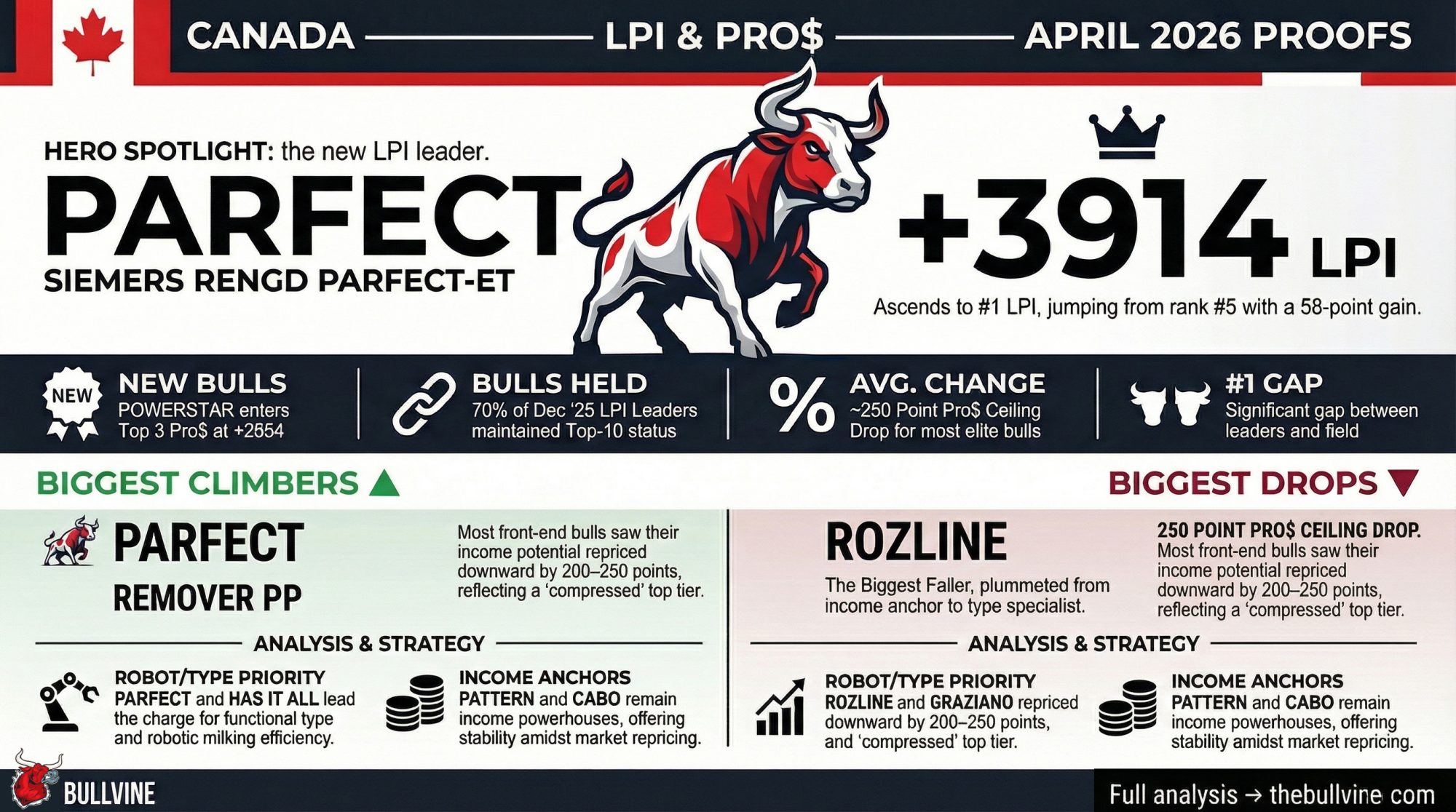
The Pro$ ceiling dropped ~250 points for most top bulls. If your sire lineup hasn’t changed since December, your income math has.
Executive Summary: ROZLINE just lost 626 Canada Pro$ in one run (from +2664 in December 2025 to +2038 in April 2026), while PARFECT quietly gained 58 Canada LPI points to take #1 at +3914. PATTERN stays #1 on Canada Pro$ at +2974 but gives back 237 Pro$, and CABO trims 231 Pro$ to sit at +2877, which means the Pro$ ceiling on proven sires dropped ~200–250 points for most front‑end bulls. That’s a different risk picture if you’re budgeting semen off last run’s income numbers or counting on single‑bull exposure to carry your Pro$ average. The daughter‑proven LPI and Pro$ top 10s are still anchored by many of the same names, but the big Pro$ hits to ROZLINE and GRAZIANO and the new arrival of POWERSTAR at +2854 Pro$ show how quickly “go‑to” bulls can be repriced. Genomic GPA LPI and GPA Pro$ lists remain volatile, with new bulls rotating through the top 10, so stacking too many matings on a couple of young sires is still a higher‑beta play. If your herd prioritizes income, robot‑friendly type, or inbreeding control, this run gives you clear signals on which proven sires to keep as anchors, which to demote to niche roles, and where Red/polled or alternative‑family outcrosses can keep your milk cheque and future mating options safer.
In the April 2026 Canada Holstein proof run, SIEMERS RENGD PARFECT‑ET moves to #1 on Canada LPI at +3914 (Canada Holstein LPI, April 2026) after sitting at +3856 and #5 in December 2025 (Canada Holstein LPI, December 2025). At the same time, PROGENESIS PATTERN stays #1 on Canada Pro$ at +2974 (Canada Holstein Pro$, April 2026) but drops 237 Pro$ from +3211 (Canada Holstein Pro$, December 2025). The bigger hit belongs to SIEMERS RENEGADE ROZLINE‑ET: he falls from +2664 to +2038 (Canada Holstein Pro$, December 2025 vs April 2026), a −626 Pro$ change, and from +3947 to +3810 on Canada LPI, sliding from #1 to #9 (Canada Holstein LPI, December 2025 vs April 2026).
For elite breeders and AI programs, this April 2026 Canada Holstein run matters because it compresses the top of both Canada LPI and Pro$ rankings, trims the income ceiling on several headline bulls, and shifts which sires you should treat as portfolio anchors vs. specialists over the next 6–12 months. The daughter‑proven front edge looks more stable than the genomic lists, but the magnitude and pattern of Pro$ changes still carry real implications for how you weight income vs type at the very top.
What Changed at the Top?
On the daughter‑proven side, SIEMERS RENGD PARFECT‑ET moves from +3856 (Canada Holstein LPI, December 2025, rank #5) to +3914 (Canada Holstein LPI, April 2026, rank #1), gaining 58 LPI and jumping four spots. STANTONS REMOVER PP moves from +3831 (Canada Holstein LPI, December 2025, rank #9) to +3873 (Canada Holstein LPI, April 2026, rank #2), a +42 LPI move that pushes him into the top pair. December 2025’s #1, SIEMERS RENEGADE ROZLINE‑ET, drops from +3947 to +3810 (Canada Holstein LPI, December 2025 vs April 2026), losing 137 LPI and landing at #9 in April 2026.
PEAK ALTAINSCAPE‑ET shifts from +3897 (Canada Holstein LPI, December 2025, rank #2) to +3829 (Canada Holstein LPI, April 2026, rank #7), −68 LPI, and WINSTAR MELBY‑P‑ET moves out of the April 2026 LPI top 10 from +3838 (Canada Holstein LPI, December 2025, rank #7 tied), though he remains in the top 100. Overall, roughly seven of the December 2025 Canada Holstein LPI top 10 still sit in or immediately around the top 10 in April 2026, with 3–4 bulls rotating in and out.
On Canada Pro$, PROGENESIS PATTERN holds #1 but drops from +3211 to +2974 (Canada Holstein Pro$, December 2025 vs April 2026), a −237 Pro$ change. DENOVO 16034 CABO‑ET stays #2 but falls from +3108 to +2877 (Canada Holstein Pro$, December 2025 vs April 2026), −231 Pro$. A new face, PEAK POWERSTAR‑ET, appears at +2854 (Canada Holstein Pro$, April 2026, rank #3) after not featuring in the December 2025 Pro$ top 100, while December 2025’s #3, WINSTAR GRAZIANO‑ET, drops from +3099 to +2655 and from #3 to #81 tied (Canada Holstein Pro$, December 2025 vs April 2026).
The headline shift is clear: the LPI front is reshuffled but still anchored by broadly similar bulls, while the Pro$ ceiling has been lowered by roughly 200–250 points for most top‑end sires, with ROZLINE and GRAZIANO seeing much larger income hits.
Role: daughter‑proven, high‑type, balanced‑components LPI anchor for programs that want type and functional production and can live with mid‑band Pro$.
STANTONS REMOVER PP
LPI: +3831 (Canada Holstein LPI, December 2025, rank #9) → +3873 (Canada Holstein LPI, April 2026, rank #2), +42 LPI.
Pro$: +3070 (Canada Holstein Pro$, December 2025, rank #4) → +2771 (Canada Holstein Pro$, April 2026, rank #8), −299 Pro$.
Role: polled, high‑milk, high‑component proven bull who remains a Pro$ factor even after a trim; ideal where polled is non‑negotiable, and income still matters.
PEAK POWERSTAR‑ET
Pro$: not in December 2025 Canada Holstein Pro$ top 100 → +2854 (Canada Holstein Pro$, April 2026, rank #3), new entrant.
Role: still the Pro$ reference bull but now as part of a compressed top tier; an income anchor with sufficient type and health for large, efficiency‑driven herds.
DENOVO 16034 CABO‑ET
Pro$: +3108 (Canada Holstein Pro$, December 2025, rank #2) → +2877 (Canada Holstein Pro$, April 2026, rank #2), −231 Pro$.
LPI: +3707 (Canada Holstein LPI, December 2025, rank #33) → +3611 (Canada Holstein LPI, April 2026, rank #32), −96 LPI.
Role: still attractive where very high fat % and good management traits are prioritized; no longer a top‑band Pro$ pick for general use.
What Canada LPI and Pro$ Are Rewarding This Run
The April 2026 Canada Holstein LPI top group is rewarding production and components with strong, but not necessarily extreme, type. PARFECT at +3914 (Canada Holstein LPI, April 2026) shows +894 Milk, +85 Fat, +57 Protein, +0.39%F, +0.19%P, +10 Conf, MS +4, FL +15, DS +7 — a balanced yield and type profile. STANTONS REMOVER PP at +3873 (Canada Holstein LPI, April 2026) pushes more volume with +1793 Milk, +113 Fat, +81 Protein, +0.36%F, +0.23%P, +8 Conf, MS +5, FL +9. DUCKETT PFCT HAS IT ALL‑ET at +3843 (Canada Holstein LPI, April 2026) runs +2294 Milk, +52 Fat, +65 Protein, +0.30%F, +0.10%P, +15 Conf, MS +10, FL +10, DS +16, clearly prioritizing volume and show‑type.
On Canada Pro$, April 2026 favors bulls that convert fat and protein into net income with a solid, workmanlike type. PATTERN at +2974 (Canada Holstein Pro$, April 2026) sits at +1199 Milk, +106 Fat, +71 Protein, +0.47%F, +0.23%P, +3 Conf, HL 108, DCA 104. CABO at +2877 (Canada Holstein Pro$, April 2026) is +685 Milk, +117 Fat, +73 Protein, +0.56%F, +0.27%P, 0 Conf. POWERSTAR at +2854 (Canada Holstein Pro$, April 2026) combines +695 Milk, +109 Fat, +72 Protein, +0.55%F, +0.29%P, +4 Conf, HL 105, DCA 104.
Three contrasting case studies spell out the trade‑offs:
PAZZLE (SIEMERS RZ PAZZLE 34954‑ET) +3810 (Canada Holstein LPI, April 2026), +2038 (Canada Holstein Pro$, April 2026), +16 Conf. +191 Milk, +145 Fat, +34 Protein, +1.16%F, +0.23%P, MS +5, FL +13, DS +16. Trade‑off: extreme type and fat %, solid but mid‑band Pro$ — excellent for show‑leaning programs that still care about components.
DUCKETT PFCT HAS IT ALL‑ET +3843 (Canada Holstein LPI, April 2026), +1960 (Canada Holstein Pro$, April 2026), +15 Conf. +2294 Milk with moderate components and strong MS/FL — big‑volume, high‑type, mid‑Pro$. Trade‑off: ideal for herds that monetize type and pedigree; less suited as a primary income sire.
PROGENESIS PATTERN +2974 (Canada Holstein Pro$, April 2026), +3766 (Canada Holstein LPI, April 2026), +3 Conf. +1199 Milk, +106 Fat, +71 Protein, strong health composite. Trade‑off: less eye‑catching than the extreme type bulls, but a more efficient income engine for commercial‑style and large herds.
In short, April 2026 Canada LPI still pays strongly for type and functional conformation when coupled with components, while Canada Pro$ is unforgiving about the income math and will only carry high‑type bulls when their fat/protein profiles justify it.
Stud Power, Family Power, and Outcross Space
AI stud codes in the April 2026 Canada Holstein lists show a familiar pattern. Semex 200 code bulls (PROGENESIS PATTERN, PROGENESIS MONTREAL, PROGENESIS MONTEVERDI, PROGENESIS PRAGMATIC, and others) occupy multiple slots in both the LPI and Pro$ top 100 lists. Codes 0007, 0011, and 0029 (Select, Alta/Peak, and related groups) are also heavily represented: PEAK ALTAINSCAPE‑ET, PEAK ALTACRAZE‑ET, PEAK ALTAHOTHAND‑ET, PEAK POWERSTAR‑ET, and a large set of genomic BEYOND/SHEEPSTER and Rosemary‑line bulls lead the young‑sire lists.
Bloodline concentration is particularly evident in the top 100 genomic by GPA LPI and GPA Pro$. SIEMERS SSI ROSMRY TONKS‑ET leads GPA LPI at +4179 in April 2026 (Canada Holstein GPA LPI, April 2026), with several other Rosemary‑line sires close behind. On GPA Pro$, SIEMERS RIM COBOT‑ET at +3755 and KENYON‑HILL OLYOP‑ET at +3732 (Canada Holstein GPA Pro$, April 2026) again tie back into a handful of sire stacks.
Within the daughter‑proven lists, genuine outcross space still exists:
DROUNER KL AUGUSTUS P RED at +3786 (Canada Holstein LPI, April 2026) and +2145 (Canada Holstein Pro$, April 2026) brings a Dutch Red, polled, alternative pedigree into the top 100.
KOEPON OH ROBIN RED at +3576 (Canada Holstein LPI, April 2026) and +2302 (Canada Holstein Pro$, April 2026) offers another competitive Red option with different bloodlines from the main Renegade/Parfect and BEYOND/SHEEPSTER clusters.
For ET and AI programs heavily invested in Renegade/Parfect, BEYOND, and related families, these Red and polled proven bulls — plus a handful of non‑cluster foreign codes — are where the practical outcross opportunities live, even if they sit 1–2 index tiers below the absolute top of LPI or a couple hundred Pro$ points below PATTERN/CABO.
How Volatile Are Canada’s LPI and Pro$ Rankings Right Now?
Between December 2025 and April 2026, the daughter‑proven Canada Holstein LPI and Pro$ lists show more compression than chaos. Around seven of the December 2025 LPI top‑10 bulls remain in or near the top 10 in April 2026, and a similar proportion holds for Pro$, with PATTERN, CABO, REMOVER PP, ALTAHOTHAND‑ET, and others still occupying high ranks despite level changes. The top‑end Pro$ bulls mostly lose 200–250 points (PATTERN −237 Pro$, CABO −231 Pro$, ALTAINSCAPE −245 Pro$), while ROZLINE and GRAZIANO see much larger drops (−626 and −444 Pro$ respectively).
Reliabilities for these leading daughter‑proven sires are high and in the mid‑ to high‑90s for production and conformation in both runs, as shown in the official lists. For bulls like PATTERN, PARFECT, CABO, REMOVER PP, ALTAINSCAPE, and GRAZIANO, these shifts are less about sampling noise and more about model and economic rebalancing across traits. That’s important: a 200‑point Pro$ or 60‑point LPI change signals a reset in how the index values their trait mix, but it doesn’t make existing daughters suddenly “wrong.”
The genomic lists are more volatile. OCD MILAN‑ET at +4137 (Canada Holstein GPA LPI, December 2025) gives way to SIEMERS SSI ROSMRY TONKS‑ET at +4179 (Canada Holstein GPA LPI, April 2026), with several bulls rotating in and out of the top 10. On GPA Pro$, PEAK ALTAPURPOSE‑ET at +3947 (Canada Holstein GPA Pro$, December 2025) is replaced by SIEMERS RIM COBOT‑ET at +3755 and a different mix of bulls in the +3700–3800 band (Canada Holstein GPA Pro$, April 2026). With no or very few Canadian daughters behind these bulls, this volatility is precisely the risk premium you should expect from genomic evaluations.
For portfolio planning, treat the daughter‑proven LPI and Pro$ front edge as relatively stable anchors and the genomic lists as higher‑beta tools where you spread risk across several bulls rather than betting heavily on any single name.
What This Means for Your Matings This Season
This is the section where April 2026 turns into decisions.
High-Input, Housed, Income-Driven Herds
If your herd prioritizes net income per cow in high‑input, housed systems, your starting point is Canada Holstein Pro$.
If your herd prioritizes maximum Pro$ with solid type, keep PROGENESIS PATTERN (+2974, Canada Holstein Pro$, April 2026) and DENOVO 16034 CABO‑ET (+2877, Canada Holstein Pro$, April 2026) as key anchors, and add PEAK POWERSTAR‑ET (+2854, Canada Holstein Pro$, April 2026) as a new proven income sire.
If your herd already relies on bulls that lost >250 Pro$ — ROZLINE (−626), GRAZIANO (−444), REMOVER PP (−299), ALTAINSCAPE (−245) — keep using them, but narrow them to matings where their specific strengths (type, fat %, polled, or other traits) justify the reduced Pro$.
Within 30 days, pull your active service list and flag every bull that dropped more than 250 Canada Holstein Pro$ between December 2025 and April 2026; for each, decide whether he remains a mainline income sire or becomes a targeted, trait‑specific option.
Robot Herds and Udder/Feet Priority
If your herd is on robots or runs high milking frequency with tight udder/feet requirements, you’ll put more weight on Canada Holstein LPI and Conformation.
If your herd prioritizes functional type with good components, look hard at PARFECT (+3914 LPI, +10 Conf, Canada Holstein LPI & Conformation, April 2026) and ALTAHOTHAND‑ET (+3853 LPI, +10 Conf, MS +7, FL +10, Canada Holstein LPI & Conformation, April 2026) as daughter‑proven anchors.
If your herd wants type with enough Pro$ to keep the accountant calm, PAZZLE (+3810 LPI, +2038 Pro$, +16 Conf) and HAS IT ALL (+3843 LPI, +1960 Pro$, +15 Conf) give you show‑influenced cows that still rank decently on Pro$.
Be cautious using low‑Conf, low‑MS bulls as day‑to‑day sires in robot herds, even when they’re high on Pro$. PATTERN, CABO, and POWERSTAR are all safe on that front; some other high‑Pro$ bulls are not.
Type/Show-Focused Programs
If you live off classification sheets, sales, and show results, this run confirms that the Canada Holstein Conformation list is stable and well-stocked.
If your herd prioritizes maximum Conformation, bulls like MATTENHOF HARRIS (+18 Conf, +278 Pro$, Canada Holstein Conformation & Pro$, April 2026), SWEETVIEW GRINCH P (+17 Conf), HAS IT ALL (+15 Conf), and PAZZLE (+16 Conf) remain prime options.
If your herd wants show‑type without walking away from income, focus your main matings on bulls that pair high Conf with Pro$ north of +1900 — again, PAZZLE and HAS IT ALL are prime examples — and reserve lower‑Pro$ extreme type sires for donors and best cow families.
Avoid treating ROZLINE as a top‑end Pro$ sire after his drop to +2038 (Canada Holstein Pro$, April 2026); he now fits best as a type and components tool.
Inbreeding-Sensitive ET Programs and Outcross Management
If your ET work already stacks Renegade/Parfect, BEYOND, SHEEPSTER, and Rosemary‑line bulls, the April 2026 lists are a reminder that the top of Canada Holstein LPI, Pro$, GPA LPI, and GPA Pro$ is heavily concentrated around a few families.
If your herd prioritizes inbreeding control, deliberately work bulls like DROUNER KL AUGUSTUS P RED (+3786 LPI, +2145 Pro$, Canada Holstein LPI & Pro$, April 2026) and KOEPON OH ROBIN RED (+3576 LPI, +2302 Pro$, Canada Holstein LPI & Pro$, April 2026) into donor matings as Red, alternative‑family outcrosses.
If your ET program leans heavily on a handful of genomic GPA LPI or GPA Pro$ bulls sharing similar sires and grandsires, spread risk by adding slightly lower‑ranked genomic sires with less pedigree overlap, even if their GPA LPI or GPA Pro$ is 50–100 points lower.
Within 30 days, run a quick pedigree audit on your donors against your top five service sires; any donor‑sire combination that repeats the same 2–3 sires or grandsires on both sides should have at least one Red or alternative‑family option added to the mating plan.
Genomic-Heavy Portfolios (Studs and Large Herds)
If your program leans heavily on genomic bulls, the April 2026 Canada Holstein GPA LPI and GPA Pro$ lists highlight both opportunity and churn.
If your herd prioritizes fast gain with controlled risk, you can use bulls like SIEMERS SSI ROSMRY TONKS‑ET (+4179, Canada Holstein GPA LPI, April 2026) or WELCOME GUSTAVSSON‑ET (+4064, Canada Holstein GPA LPI, April 2026) as sire‑of‑sons and key donor mates, but you should spread that exposure over multiple genomic bulls rather than anchoring on one.
If your herd wants more stability, aim to keep at least 40–50% of matings on high‑reliability daughter‑proven anchors like PARFECT, PATTERN, CABO, REMOVER PP, and ALTAINSCAPE, and use genomic sires as the “top‑up” rather than the core.
A practical threshold: if more than 60–70% of your planned matings for the next proof interval are to bulls from the top 10 of the April 2026 GPA LPI or GPA Pro$ lists, you’re probably carrying more genomic volatility than necessary for the same level of genetic gain.
Key Takeaways:
ROZLINE’s profile has flipped: he’s still +16 Conf and +3810 Canada LPI (April 2026) but lost 626 Canada Pro$ vs December 2025, so he’s now a type specialist, not a Pro$ anchor.
PARFECT (+3914 Canada LPI, April 2026) and PATTERN (+2974 Canada Pro$, April 2026) are the key proven anchors, but both sit in a compressed top band where 40–60 LPI or 200–250 Pro$ moves can reshuffle ranks without changing cow‑side reality.
GRAZIANO (−444 Canada Pro$) and several other December 2025 headliners took meaningful Pro$ trims, while POWERSTAR arrives at +2854 Canada Pro$ (April 2026), so any sire lineup built on last run’s income numbers needs a fresh audit.
Genomic GPA LPI and GPA Pro$ tops are still churning, so herds with >60–70% of matings on a handful of young sires are running higher portfolio risk than the Canada Holstein daughter‑proven lists alone would suggest.
For herds prioritizing income, robots, show type, or inbreeding control, this run clearly separates which bulls stay as everyday service sires (PATTERN, CABO, PARFECT, POWERSTAR) and which move to niche roles or outcross use (ROZLINE, PAZZLE, HAS IT ALL, AUGUSTUS P RED, ROBIN RED).
Every week, thousands of producers, breeders, and industry insiders open Bullvine Weekly for genetics insights, market shifts, and profit strategies they won’t find anywhere else. One email. Five minutes. Smarter decisions all week.
Holstein USA and Lactanet both shifted toward protein in the same proof round. Your mating list doesn’t know yet.
Executive Summary: HORSESHOE is the kind of bull most people had buried in the middle of the list; under the 2026 TPI formula, he jumps an estimated 10 spots while GARZA, the current #2, slides down the rankings on the same December proofs. Holstein USA is shifting TPI to 24% protein and 14% fat at the April 2026 run, and Lactanet is flipping Holstein LPI production from 60F:40P to 40F:60P, so both major indices are now paying more for protein than fat at the same time. Bullvine reran the December 2025 top‑25 daughter‑proven TPI sires through the new weights and found that fat‑heavy bulls like GARZA, RICHE, and RIVERA lose ground, while high P/F bulls like POWERHOUSE, HORSESHOE, and CAPN MIGUEL pick up points and rank before a single new daughter is added. If more than two of your top five service sires have P/F ratios under 0.5 and weak PL or DPR, you’re effectively breeding for the old formula while semen companies and processors are already repricing around protein and longevity. The immediate risk is over‑exposure to fat‑dominant sires you’re sitting on by the 100‑unit cane; the opportunity is to quietly pivot toward bulls whose component mix and PL match where TPI, LPI, and casein markets are actually headed. The article walks through the full “winners and losers” table, a simple P/F check you can run in five minutes, and a 30‑day plan to talk with your AI rep and adjust spring matings without panic.
Last Friday, GARZA sat comfortably as the #2 daughter-proven TPI sire in the Holstein breed — 3464 TPI, fat pounds through the roof, the kind of bull that makes a lineup card look impressive. By the time you read this, the formula that produced that ranking may no longer exists. Holstein Association USA’s board just moved PTA Protein from 19% to 24% of TPI and dropped PTA Fat from 19% to 14%, effective with next week’s April 2026 genetic evaluation.
That’s a 10-percentage-point swap between your two component traits. And it lands two weeks before proofs.
If you bred heavy to bulls like GARZA and RIVERA this winter, this is the week your stomach does a little flip. Nothing about their daughters changed. No new genes appeared. But the TPI formula 2026 update just tilted the math away from fat-dominant profiles and toward protein, Productive Life, and fertility — and it did it right before spring mating decisions lock in.
Across the border, Lactanet picked the same proof round to flip Holstein LPI’s production subindex from 60% Fat / 40% Protein to 40% Fat / 60% Protein. Two different countries. Two different committees. One unmistakable direction.
TPI (Holstein USA)
LPI Production (Lactanet)
Index owner
Holstein Association USA
Lactanet (Canada)
Effective date
April 2026 evaluation
April 2026 evaluation
Fat weight — before
19%
60%
Fat weight — after
14% (↓5pp)
40% (↓20pp)
Protein weight — before
19%
40%
Protein weight — after
24% (↑5pp)
60% (↑20pp)
Net direction
Protein > Fat
Protein > Fat
Stated rationale
Align with processor demand for casein; protein lags fat in pipeline
Milk pricing signals; butterfat doesn’t need more genetic push
Correlation with old formula
“Very highly correlated” (Holstein USA)
Structural, not incremental shift
Risk to fat-dominant programs
Moderate (−5pp swing)
High (−20pp swing on LPI)
Opportunity bulls
P/F ratio > 0.60 + strong PL
Same profile; protein-dominant cows stick around
Bullvine pulled the December 2025 top-25 daughter-proven TPI sires and ran their existing PTAs through the new 2026 weights. Same proofs. New formula. This isn’t a prediction of April proofs — new daughter data will still move bulls when those drop on April 7. But it’s a clean look at where the formula alone is pushing your favorite sires before that data even hits.
What Changed in the 2026 TPI Formula?
Strip it down to the parts that hit your tank.
Holstein USA’s board approved these changes for the April 2026 TPI formula:
PTA Protein weight jumps from 19% to 24% (+5 points).
PTA Fat weight drops from 19% to 14% (−5 points).
The Health & Fertility block maintains strong emphasis on Productive Life (PL) and the Fertility Index (FI)— which rolls up DPR, CCR, HCR, and EFC — carrying forward the longevity and reproduction tilt that’s been building since 2020.
Holstein USA says the new formula is very highly correlated with the old one. Across all bulls, TPI values barely budge. Single-digit points for the average sire.
But your top-25 list isn’t “average.”
Up at the top, bulls are bunched within a handful of points. Their component profiles — how much of their genetic value comes from protein vs. fat — are wildly different. When you crank protein up and pull fat down, some names that felt untouchable suddenly have the wind in their face. Others catch a tailwind they didn’t have last week.
The TPI Ranking Table Nobody Else Will Publish
Press releases are safe. They’ll tell you “more emphasis on protein” and “continued focus on health and fertility.” They won’t tell you what that does to GARZA, POWERHOUSE, HORSESHOE, RIVERA, and the rest of the short list you’ve been breeding to.
Bullvine did the part nobody else will print right now.
We took Holstein USA’s December 2025 top-25 daughter-proven Holstein sires by TPI and reran their December PTAs through the April 2026 TPI weights. That isolates the formula pressure — the shift caused by the new weighting alone — before any new daughter data moves anything on April 7.
Quick methodology: Base list is the top-25 daughter-proven Holstein sires by December 2025 TPI (Holstein USA). Inputs are December 2025 PTAs for protein, fat, and TPI. Outputs are the estimated rank and TPI shift under the 2026 formula. This is Bullvine internal modeling, not official April proofs. Treat every estimated number as directional.
Top 25 TPI Sires: December 2025 vs. 2026 Formula Pressure
Bull
Stud
Dec Rank
Est. Rank*
Move*
Dec TPI
Est. Shift*
PTA Protein (lb)
PTA Fat (lb)
P/F Ratio
SHEEPSTER
Select Sires
1
1
—
3572
+5
70
133
0.53
DOMINANCE
STgenetics
3
2
↑1
3458
−6
65
131
0.50
CAPTAIN
STgenetics
4
3
↑1
3428
+8
67
120
0.56
GARZA
STgenetics
2
~4
↓2
3464
~−40
51
145
0.35
ZURI
Alta
5
5
—
3375
−7
54
108
0.50
POWERHOUSE
Alta / Peak
7
~6
↑1
3329
~+39
81
104
0.78
TROOPER
Select Sires (CRI)
6
7
↓1
3334
+16
53
90
0.59
BOLT ACTION
Select Sires
9
8
↑1
3324
−11
38
93
0.41
JULIUS
STgenetics
11
9
↑2
3299
+10
64
110
0.58
UNDERTONE
Select Sires
10
10
—
3304
−2
54
108
0.50
POSITIVE DELUXE
STgenetics
8
~11
↓3
3325
~−25
56
129
0.43
POWERSTAR
Semex
14
12
↑2
3275
+22
49
79
0.62
MATTERHORN
Alta / Peak
12
13
↓1
3296
−2
45
98
0.46
HORSESHOE
GENEX
24
~14
↑10
3262
~+27
70
93
0.75
CAPN MIGUEL
STgenetics
21
~15
↑6
3263
+21
57
86
0.66
INNOVATION
ABS Global
19
~16
↑3
3266
+17
70
111
0.63
EVENT
Semex
20
~17
↑3
3265
+18
50
83
0.60
PERKY
Semex
13
~18
↓5
3292
−12
35
92
0.38
PIPELINE
STgenetics
18
~19
↓1
3268
+11
62
105
0.59
CAPN ELEMENT
STgenetics
23
~20
↑3
3263
+7
56
99
0.57
BENEFIT
ABS Global
15
~21
↓6
3273
−7
48
108
0.44
T REX
Select Sires
22
22
—
3263
−9
44
99
0.44
RICHE
Select Sires
16
~23
↓7
3272
~−24
35
100
0.35
RIVERA
STgenetics
17
~24
↓7
3269
~−31
35
111
0.32
CRUSHER
Select Sires
25
25
—
3250
~−24
42
118
0.36
Est. Rank, Move, and Est. Shifts are Bullvine’s internal projections that apply April 2026 TPI weights to December 2025 PTAs. They are not official April 2026 proofs. New daughter data on April 7 will further move these numbers.
Which Bulls Does the New Formula Lean On?
Start with the P/F Ratio column. It tells the story faster than anything else in the table.
GARZA (STgenetics) carries 51 lb protein and 145 lb fat — a 0.35 P/F ratio — with a December TPI of 3464. In the formula-only rerun, he gives back roughly 40 TPI points and slides from #2 to about #4. That’s exactly what a fat-heavy profile looks like when protein picks up 5 percentage points of weight.
RICHE (Select Sires) is the same math problem: 35P, 100F (0.35) — an estimated ~24-point drop and a seven-spot slide from 16th to around 23rd. RIVERA (STgenetics) is even more exposed: 35P, 111F (0.32, the lowest P/F ratio in the top 25) with a projected ~31-point loss and a similar seven-spot fall.
None of them suddenly became bad bulls. Their daughters are the same cows they were last month. But if your winter breeding list was built around fat-dominant profiles because the old 19:19 fat/protein balance made it look smart, the new math is less forgiving.
In the middle of the pack, PERKY (Semex) at 35P/92F (0.38) drops an estimated 12 points and falls from 13th to about 18th. BENEFIT (ABS Global) at 48P/108F (0.44) takes a smaller −7-point hit and moves from 15th to around 21st. Not dramatic. But enough to change who’s on your short list and who isn’t.
The Quiet Bulls Who Just Caught a Tailwind
Flip the lens.
POWERHOUSE (Alta/Peak) is the poster boy for this formula shift: 81 lb protein and 104 lb fat — a 0.78 P/F ratio, the highest in the top 25 — with a December TPI of 3329. Under the April 2026 weights, he picks up roughly +39 TPI points and edges into about 6th. That’s a bull whose protein strength was always there. The formula just started paying for it.
HORSESHOE (GENEX) is the sleeper worth watching. Sitting down on the 24th in December with 70P and 93F (0.75), the new formula gives him roughly +27 points and a 10-spot jump to around 14th. Ten spots. On formula alone. Nobody was talking about HORSESHOE as a top-15 bull two weeks ago.
CAPTAIN (STgenetics) — already a known story to Bullvine readers — has 67P and 120F (0.56) and quietly adds about +8 points, moving from 4th to around 3rd. Then there’s the cluster of CAPN MIGUEL, INNOVATION, EVENT, POWERSTAR, and PIPELINE — all carrying P/F ratios north of 0.6 — all picking up points and rank spots. (Read more: CAPTAIN: The Bull That Rewrote the Rules for Modern Breeding)
The pattern isn’t subtle: higher P/F ratios climb under this formula; lower P/F ratios slip. Before we even talk about how PL and DPR interact with April’s new daughter data.
Does the CAPTAIN/HOMECOMING Story Repeat Here?
If you’ve followed Bullvine through the last few proof runs, you know formula changes can set off ranking earthquakes that compound over time.
In our look back at the April 2020 genomic class, GENOSOURCE CAPTAIN gained 369 TPI points between April 2020 and December 2025 as his daughters came in and multiple formula tweaks, plus a base change, played in his favor. AOT HOMECOMING lost 414 points over that same window as fertility, health, and type corrections piled up.
Those swings didn’t happen in one proof run. They were biology — real daughters, real performance — combined with three or four rounds of index adjustments and a base reset.
The 2026 TPI update won’t blow 300 points off a bull overnight by itself. What it does is set the direction of the wind.The CAPTAIN profile — strong components tilted toward protein, respectable PL, workable type, and fertility — is now more aligned with where TPI is heading. The HOMECOMING profile — production without the backside to support it — faces a tougher formula and a tougher biological test as daughters age.
Why Did TPI and LPI Both Move Toward Protein at the Same Time?
You can write off one index committee as a quirk. You can’t shrug off two.
Lactanet’s April 2026 update is blunt about the rationale: Holstein LPI’s production piece is moving from 60% Fat / 40% Protein to 40% Fat / 60% Protein. They tie it directly to evolving milk pricing signals and the message from national pricing bodies that butterfat doesn’t need more genetic push. The Canadian dairy market is telling breeders: give us protein-dense milk from cows that stick around.
Against that, TPI’s shift to 24% Protein / 14% Fat looks like the US reading the same tea leaves. Processors want casein. Consumer products are shifting toward high-protein formats. And the genetic pipeline has been quietly overdelivering on fat for years, while protein gains have lagged.
This isn’t two committees having the same idea by coincidence. It’s a structural repricing signal. If your program has been aggressively stacking fat % and shrugging at protein, the formula change isn’t a one-off nuisance — it’s an early warning that your genetics are drifting from where both indexes, and probably your processor, are headed.
Should You Change Your Spring Matings — or Wait for April 7?
This is the real question. Not what changed in the formula. What do you do about it?
If you adjust now:
You start correcting a fat-heavy lineup before you add another crop of calves conceived under a formula that no longer exists.
You can steer semen orders toward bulls whose protein strength and PL fit the new incentives.
But you’re still working off December 2025 PTAs. Some bulls will move on April 7 because their daughter data changed — not just because the formula did.
If you wait until after April 7:
You get the combined effect of new proofs + new formula before making shifts.
You won’t overreact to an estimated shift that doesn’t match what actually happens.
But you spend another month of matings optimized for a world that TPI and LPI have both moved on from.
A realistic rule that won’t blow up your program: if your own rerun under the new formula shows three or more of your top five sires losing more than about 50 TPI points, book time with your breeding advisor before April proofs to identify some protein-plus-PL alternatives. If the shifts are smaller, mark the exposed bulls and let the April proofs settle before swapping anything wholesale.
What This Means for Your Operation
Run a P/F check on your top five sires. Divide each bull’s PTA Protein by PTA Fat. If more than two of your top five sit below roughly 0.5, your lineup leans fat-heavy relative to how both TPI and LPI now reward protein. Circle any that also carry weak PL or negative DPR — they’re taking a double hit. lactanet
Sort your semen inventory by exposure. Any bull with an estimated >50-point drop and a P/F ratio in the 0.35–0.4 range deserves a hard look if you’re holding 100+ units of him. That doesn’t mean dump him. It means ask yourself whether you want to keep stacking that profile into 2026 heifers.
Have a specific conversation with your AI rep. Don’t ask “what’s hot.” Show them your list. Ask: “Which of your bulls look more like POWERHOUSE and HORSESHOE on P/F and PL, and which look more like GARZA and RIVERA in this table?” Use the formula pressure as a starting point — then let April’s proofs confirm or contradict it.
Don’t chase every shiny name in April. The bulls that deserve more use are the ones that align with the new formula and show solid daughter performance under the new weights after a couple of proof runs. Use 2026 as the year you test which sires hold up under this TPI version, not the year you jump every time a list shuffles.
If you already bred this winter, don’t panic. Calves conceived in January and February don’t retroactively become worse animals because a formula changed. But do note which sires you used heavily and track how they land on April 7. That data tells you whether to continue or pivot for summer breeding.
Key Takeaways
If more than two of your top five sires carry P/F ratios under 0.5, your lineup is leaning into fat in a world where both TPI and LPI just shifted toward protein and longevity.
Bulls like POWERHOUSE (0.78 P/F) and HORSESHOE (0.75 P/F) are exactly the profiles the 2026 TPI formula rewards — even before new daughter data hits on April 7.
This table is a formula-only stress test on December 2025 proofs, not a crystal ball. Use it to see which bulls in your tank face a headwind or a tailwind, then let April proofs tell you which ones actually held.
The synchronized TPI and LPI protein shift isn’t a coincidence. It’s a structural market signal. Fat-dominant genetic programs that don’t adjust aren’t just chasing last year’s formula — they’re building toward a component mix that processors and pricing are moving away from.
The Bottom Line
When you rerun your own sire list under the new weights on April 7, how many of your “can’t-miss” bulls are still where you thought they were? And how many of the bulls you’d never considered just climbed into the conversation? That gap — between the list you had and the list you need — is the real story of this formula change. We’ll be tracking it through April proofs and beyond.
Complete references and supporting documentation are available upon request by contacting the editorial team at editor@thebullvine.com.
Every week, thousands of producers, breeders, and industry insiders open Bullvine Weekly for genetics insights, market shifts, and profit strategies they won’t find anywhere else. One email. Five minutes. Smarter decisions all week.
They started with grade cows and manure on their trousers. They built every genomic proof you chase today.
The year was somewhere in the mid‑2000s, and if you were lucky enough to lean on the rail at World Dairy Expo with a coffee in your hand, you felt it. The big banners and spotlights still belonged to the cow show—the Goldwyns, the Durhams, the glossy strings from famous prefixes—but when the sire lists went up on the bulletin boards outside the Coliseum, a different set of names rose to the top in black and white: Durham. Goldwyn. O‑Man. Rudolph. Shottle. Marshall. Mountain.
Now, the thing about that era is this: if you judged the future by those glossy ads and center‑spread photos, you’d have sworn the next great sires would all come out of investor barns with brass nameplates and full‑time fitters. But what a lot of people didn’t realize was that the real engine of change was turning miles away—in grade‑started herds where the breeder’s trousers were more likely streaked with manure than show sheen, and where the biggest “promotion” was a good proof and a paid‑off feed bill. Between roughly 1991 and 2010, a handful of farmer‑bred bulls, show‑ring architects, and fitness warriors quietly built the cow population that genomics would later “discover.”
Most of those bulls and cows are long gone now, except in the pedigrees. This is the story of how they earned their place there.
Act I – Hillsides, Sale Rings, and the Bulls Nobody Expected
If you want to understand how this Golden Age began, you don’t start in Madison or Toronto. You start on a Vermont hillside in 1946.
Everett’s Hills and the Mathematics of Manure
Bis‑May Farm sat in the rolling hills around Moretown, Vermont, about 17 miles west of Montpelier. It wasn’t a show palace. Everett and his father, Ralph, started with a grade herd; a few cows had papers, but most just had to earn their keep in a tie‑stall barn where every empty stanchion hurt. In 1950, they bought Kearsarge Governor Jean from C. Leland Slayton in New Hampshire, and a few years later, Everett’s fascination with the old Mount Victoria Rag Apple cattle pushed him to buy nine Canadian cows rich in Rag Apple blood, including Marie Pabst Lochinvar.
Through his college years, Everett had pored over Holstein‑Friesian World, thumbing through pictures of Montvic Rag Apple Gladiator and the rest of Thomas Macaulay’s great cattle. The Mount Victoria dispersal had already happened in 1942. The sale was over. But in his mind, those cows still had something to say.
Here’s the thing—Everett believed the math. There are thousands of farmer‑breeder herds. There are only a handful of Pabsts, Skokies, and Carnations. If great sires come from good cows, and there are vastly more good cows in ordinary barns than in famous ones, where do you think most of the real genetic power is hiding?
When he became chairman of the little Central Vermont Breeding Association, whose entire A.I. battery was Jersey bulls, he pushed the group to buy a Holstein: Walker Homestead Dawn, proven at Howacres in Vermont for high butterfat test and “exceptionally good type.” They did. Everett used him so heavily that when Dawn died, he bought 100 extra doses and kept right on breeding Dawn daughters.
Out of that web of grade cows, Rag Apple immigrants, and Dawn blood came three bulls no one would have picked out of a show catalog: Bis‑May Astro Jupiter, Bis‑May Tradition Cleitus, and Bis‑May S‑E‑L Mountain.
Mathematical probability, with manure on its boots.
Jupiter: Astronaut’s “Second Son” and the Brood Cow Maker
In the Paclamar Astronaut era, the headlines went to Bridon Astro Jet, and rightly so. But at Eastern A.I. in Ithaca, New York, there was another Astronaut son quietly doing the heavy lifting: Bis‑May Astro Jupiter, born in 1972. He was out of Bis‑May P Admiral Jana VG‑88‑GMD, a high‑lifetime Irvington Pride Admiral daughter backed by Bis‑May Homestead June, one of Everett’s precious Walker Homestead Dawn cows.
Jupiter’s daughters had that farmer’s wish‑list look—usually only medium for stature, but wide in the muzzle and chest, deep in the rib, and carrying big, capacious rear udders that could hold up to full meters of milk. The New York cow Welcome Jupiter Gala VG‑GMD‑DOM put up 31,360 pounds of milk at 4.1 fat as a 2‑11 365‑day record—a state record when she made it. When you asked her breeder, Bill Peck of Welcome Stock Farm, what kind of cow he wanted to breed, he’d tell you: “wide in the muzzle, wide in the chest, and wide in the udder.” When you asked which family did that best, he pointed straight at the Jupiter Galas.
Gala’s daughter, Welcome Valiant Gingersnap VG‑GMD‑DOM, produced Mark CJ Gilbrook Grand VG‑GM by Walkway Chief Mark, and Grand, in turn, became the double grandsire in the pedigree of Braedale Goldwyn—siring both Shoremar James (Goldwyn’s sire) and Braedale Gypsy Grand (Goldwyn’s maternal granddam).
So every time you see a Goldwyn daughter step into the ring at Madison, there’s a little strand of Bis‑May Astro Jupiter and Walker Homestead Dawn hiding in the fine print of that pedigree.
On the home farm, another Jupiter daughter, Bis‑May Jupiter Mabel VG, made a top record of 31,159 milk, 3.6 fat, and 3.3 protein—but she only classified Good Plus for udder. Her dam line, back through Zion‑View Amys Prince and U.N.H. Burke Ideal Graduate, was all about body capacity and power. The Maynards bred Mabel to the udder specialist Cal‑Clark Board Chairman, and the resulting daughter, Bis‑May Chairman Merri VG‑87‑DOM, made two heifer records, both over 28,600 pounds, with 3.3 protein.
Midway through Merri’s second lactation, they flushed her to Lekker Valiant Royalty. When they consigned Merri and her five Royalty pregnancies to the North‑East Kingdom Sale, Steve Smith and Chet Crosby of Shade‑E‑Lane bought the package for $14,500. One of those Royalty calves would make the whole thing look cheap.
Mountain: The “Poor‑50” Bull Whose Daughters Didn’t Read His Proof
To‑Mar Mountain Helen VG — a stylish Bis‑May S‑E‑L Mountain daughter whose frame, udder, and balance give breeders a rare visual glimpse of what the famous 50‑point “homely anti‑hero” was actually capable of siring.
Under the Shade‑E‑Lane roof, one of those Royalty calves grew into Bis‑May S‑E‑L Mountain. He was proven at Sire Power in Pennsylvania. He had two flush brothers. When Sire Power analyst Steve Neeley had to choose between them, he did what sire analysts do: he looked at type, frame, legs, and testicles—because bigger testicles meant earlier and heavier semen production. Mountain got the nod.
Then the classifier came.
The classification report on Mountain is one of those documents you’d frame if you like irony: “Poor. Fifty points. Straight legs and almost no middle.” That’s almost comical in an era when Good still meant something—back when a 50‑point score really meant “don’t bother taking his picture.” For a moment, you can imagine folks at the stud wondering if they’d backed the wrong brother.
But the classification sheet didn’t tell the whole story. As Mountain daughters freshened, their proofs started rolling in, and they were “pumping out the protein like nobody’s business,” as one contemporary account put it. They weren’t all pretty, but they were resilient producers with better‑than‑average type and solid milk.
When A.I. centers started using Mountain sons because of those daughters, the people rose in protest. Holstein‑Friesian World and the Holstein Association were flooded with cranky letters about a 50‑point bull being used as a sire of sons. The cows didn’t care. They just milked.
From that “homely anti‑hero” came an elite trio of 100% U.S. blood bulls scattered around the globe: Jesther CV in France, Etazon Addison in the Netherlands, and Elite Mountain Donor in Australia. Another daughter, Emerald‑Acr‑SA Tannice VG, produced Emerald‑Acr‑SA Dawson, a popular protein sire in the early 2000s.
Think about that for a second. In a time when breeders still slapped bull pictures on the fridge, one of the defining protein sires of his era was a 50‑point bull whose best “photo” might have been his proof sheet.
Cleitus: The Milk Bull That Slipped in the Side Door
If Mountain taught the industry not to judge a bull by his picture, his herdmate Bis‑May Tradition Cleitus EX‑GM taught it not to judge a bull by his dam’s index.
When Bis‑May Conductor Coral VG‑88‑GMD‑DOM, a tall, deep‑bodied Wapa Arlinda Conductor daughter out of Bis‑May Bold C Coconut VG‑87 (by Nicolk Sunshine Bold Chief), dropped an early Sweet‑Haven Tradition son in 1987, his numbers were low enough that the first A.I. stud the Maynards approached turned him down. Tradition semen was hard to get, and Coral’s index didn’t look like bull‑mother material on paper.
Eastern A.I. remembered what Jupiter had done for them and decided to roll the dice. The young bull they took was named Bis‑May Tradition Cleitus.
Cleitus grew into one of the key production sires of his time and one of the best Elevation grandsons in the books. His best son, Norrielake Cleitus Luke EX‑GM, stood at Alta Genetics in Alberta and sired Dixie‑Lee Aaron EX‑GM and Lexvold Luke Hershel GM, both out of Mascot daughters. Aaron daughters clicked beautifully with O‑Bee Manfred Justice to produce bulls like Long‑Langs Oman Oman VG‑GM, while Hershel’s sons included Sandy‑Valley Bolton EX‑GM, a big milk and protein bull that earned a reputation as a serious freestall sire.
Norrielake Cleitus Luke EX‑GM — the powerful Alta Cleitus son whose Aaron and Hershel lines carried Bis‑May blood straight into Oman Oman, Bolton, Snowman, and the protein‑driven pedigrees of the genomic age.
Another Cleitus son, Paradise‑R Cleitus Mathie EX‑GM, was selected by Charlie Will for Select Sires and sold upwards of two million doses, making him the highest semen seller in Holstein history at the time.
By the late 1990s and early 2000s, you could hardly scan a top TPI or Net Merit list without bumping into Cleitus, Luke, Aaron, or Hershel in the pedigree. Everett’s Hill Farm in Vermont had done exactly what his probability instincts predicted: stock the A.I. shelves from farmer‑bred cows.
Act II – Madison Architects and Fitness Warriors
All that milk, type, and protein needed a frame to live on—and a body that would last long enough to pay for itself. That’s where the second act of this Golden Age really takes hold.
Dellia, Durham, and Five Years at the Top of Madison
Snow‑N Denises Dellia EX‑95‑2E‑GMD‑DOM wasn’t bred as a glamour cow. She was a Bell x Mark granddaughter developed by Bob Snow and young herdsman John Steinhoff out of a hard‑doing family that had to travel down a pasture, cross a creek, and walk back up to the barn every day. By all accounts, there were nights when she walked into the parlor carrying three gallons of sand in her udder.
Frank Regan saw Dellia and couldn’t shake her from his mind. He came back. Looked again. Eventually, he bought her, on the condition that she show one more time at the Wisconsin Spring Show in 1991 before heading to Regancrest in Iowa.
The night before the show, Dellia looked a little drawn. So the crew did what cow people do: they fed her four bales of hay, warmed up her beet pulp—Dellia liked it that way—and let her settle down. The next day, judge Niles Wendorf walked her out first in the four‑year‑old class, gave her the best udder, and slapped her grand champion of the show. That creek‑bottom cow had just crossed a completely different kind of river.
Back at Regancrest, Frank called Select Sires’ Charlie Will. “What should I use on her?” he asked. The answer came back: Emprise Bell Elton, a Bell son whose daughters were building a reputation for udders, feet, and legs, and longevity. The Dellia x Elton flush produced four sons. First choice went to Japanese buyers for $20,000. The second choice went to Alta Genetics for similar money. Select Sires took the third bull, Regancrest Elton Durham. The Regans used the fourth.
Nobody in that semen office knew they’d just picked up the bull who’d become Premier Sire at World Dairy Expo five years in a row, 2003 through 2007—a run that, as the Durham profile notes, may stand for a very long time.
Sheeknoll Durham Arrow EX — a signature Regancrest Elton Durham daughter, captured in her World Dairy Expo moment, showing exactly the kind of balanced frame and welded‑on udder that kept her sire on the Premier Sire podium for five straight years.
The thing about Durham daughters is that you could pick them out from the stands: long bodies, flat and wide rumps, and udders that looked like they’d been hung with a level—high rear udders, smooth fore udders, clean teat placement. More than one dairyman has said his Durhams weren’t always the highest milk cows on the test sheet—but they were some of the most trouble‑free cows he ever milked. They bred back, they walked well, and they often looked their best at four and five—exactly when the milk check really starts to count.
Durham sons—Mr. Sam, Duplex, Damion, Modest, Drake, D‑Fortune, Primetime—filled type lists from Canada to Europe. His daughters—Kamps‑Hollow Altitude, Lylehaven Lila Z, MD‑Delight Durham Atlee, Regancrest‑PR Barbie, Scientific Debutante Rae—founded families that still show up behind modern genomic stars.
Looking back, the signs were there: Durham gave the breed a blueprint for “classic” dairy cow architecture exactly when the industry was learning to care about cell counts, fertility, and productive life as much as it cared about banners.
If Durham was the architect of style, Braedale Goldwyn GP‑Extra was the finisher who wouldn’t leave a seam out of place.
Goldwyn was born January 3, 2000, a Semex young sire out of Braedale Baler Twine VG‑86, the Maughlin Storm daughter of Braedale Gypsy Grand VG‑88, both cows deeply rooted in Sunnylodge breeding. His sire was Shoremar James GP‑Extra, a Mark CJ Gilbrook grandson out of an Aerostar daughter.
His pedigree is a masterclass in line breeding. Goldwyn carries three close crosses to Madawaska Aerostar (through James, Storm, and Moonriver), and three to Walkway Chief Mark (through James, Gypsy Grand, and Sunnylodge Chief Vick). There’s also a tight knot in the ninth, tenth, and eleventh dams involving Hays Inspiration and Ajax Sovereign B, both tied to Montvic Rag Apple Sovereign and the anchor Dutch cow Vrouka 9198 H.H.B.—the same foundation that produced Osborndale Ivanhoe.
Put simply, Goldwyn didn’t just pop out of nowhere. Canadian breeders deliberately stacked old Sovereign and Rag Apple blood, via Aerostar and Chief Mark, because they believed those cows still had something to say—if you lined them up just right.
On diets and bedding that looked a lot more modern than Dellia’s creek‑bottom pasture, Goldwyn daughters made people rethink what “mammary perfection” meant. Their udders were high, silky, and veiny, with square teat placement and rear udders that looked welded onto the pelvis. They carried long, stylish dairy frames and near‑perfect feet and legs.
RF Goldwyn Hailey EX-97—the next dynastic champion who captured Supreme Champion at World Dairy Expo in 2012 and 2014, ensuring Goldwyn daughters wore the ultimate crown for four consecutive years.
In 2008, Goldwyn ended Durham’s run and became Premier Sire at World Dairy Expo—the youngest sire in 25 years to win it and the first bull at the top of Canada’s LPI list to do so. You could feel the shift in the Coliseum that night. The banners still said “Madison,” but the cow families and sire stacks behind those udders were starting to look a lot like the pedigrees that would soon feed into genomic flush programs.
When Eastside Lewisdale Gold Missy EX‑95 sold for roughly $1.2 million in 2009 and then went on to be grand at Madison and the Royal, it wasn’t just a big number. It was proof that deep Canadian cow families, carefully line‑bred back to Vrouka and Sovereign, could still ring the cash register in an era about to be dominated by SNP chips.
Eastside Lewisdale Gold Missy EX‑95 — the $1.2‑million Goldwyn daughter who turned mammary perfection into both Madison and Royal banners, proving just how valuable those deep Canadian cow families still were in the genomic age.
And if you trace a Goldwyn pedigree far enough, you still find Welcome Jupiter Gala, Mark CJ Gilbrook Grand, Walker Homestead Dawn tucked into the background—the same farmer‑bred math that was quietly powering Mountain cows in commercial parlors.
If there’s a single moment where you can say “everything changed,” it’s probably that 2008 Premier Sire banner. Durham had ruled Madison for five straight years. Goldwyn took his place while sitting at or near the top of LPI for conformation, and the genomic era was just around the corner. The old show‑ring order had just shaken hands with the future.
O‑Man and Formation: The Fitness Wars
Now, while all that was happening under the Madison lights, another battle was raging in the proofs—a battle over fitness. Cows were getting taller and fancier, but fertility was slipping, and cows weren’t lasting like they used to. The industry needed bulls that could keep daughters in the herd.
O‑Bee Manfred Justice (O‑Man): The Fitness Turning Point
The fitness story starts with a cow called Rynd‑Home Valiant Cutie EX‑91, who earned the “Mama Protein” nickname by producing two sons, Cubby and Curious, who topped protein lists in 1992. Her son Osdel‑Endeavor Bova Cubby EX‑94‑GM sired Ha‑Ho Cubby Manfred GP‑GM, bred by the Grose family in North Carolina.
Manfred’s proof at Accelerated Genetics was a strange mix: high production, deep udders, plain type—but with outstanding fertility and longevity numbers. As Net Merit shifted to reward health traits, Manfred suddenly looked like “America’s answer” to the longevity and fertility concerns of the early 2000s.
His best son was O‑Bee Manfred Justice, EX‑GM, known everywhere as O‑Man. Bred by Obert Bros. of Illinois, O‑Man was a Manfred son out of Meier‑Meadows El Jezebel EX‑92‑GMD, an Emprise Bell Elton from an Arlinda Melwood daughter, backed by Chief Mark and Rockalli Son of Bova.
When O‑Man’s proof hit in 2002, it landed like a rock in a pond. At a time when the whole world was suddenly worried about fertility, he scored positive for all the major health traits—productive life, daughter fertility, somatic cell score—with enough milk and type to keep most programs comfortable. Holstein International even called his appearance a “turning point in global Holstein breeding.”
By August 2009, O‑Man sons held five of the top ten spots in high‑ranking sire reports. Long‑Langs Oman Oman VG‑GM (from a Dixie‑Lee Aaron dam) and Schillview Garrett GM (from a Carol Prelude Mtoto dam) were near the very top. Schillview Oman Gerard EX‑GM, out of Schillview Marsh Glash VG‑89‑DOM, tied Marshall’s production to O‑Man’s health.
And then came Flevo Genetics Snowman 388965513, O‑Man’s high‑type son from Broeks MBM Elsa EX‑90, the Mara‑Thon BW Marshall daughter named Global Cow of the Year 2009, and later recognized again in 2010 by World Wide Sires Germany. Snowman’s genomic numbers were so strong that he became a worldwide sensation before his daughter’s proofs were even in; he died during the waiting period, but not before his genetics were widely used.
Looking back, it’s hard not to see O‑Man as the hinge where health traits stopped being an afterthought and started driving breeding decisions.
Formation: Burke Lad 33 Times Over
Shen‑Val NV LM Formation EX — the white Leadman son loaded with 33 crosses to Admiral Burke Lad, whose balanced udders and stay‑in‑the‑herd daughters made him the quiet longevity specialist of the fitness revolution.
Running alongside the O‑Man wave was a quieter bull: Shen‑Val NV LM Formation, a Leadman son whose pedigree carried 33 crosses to Wisconsin Admiral Burke Lad.
Formation daughters weren’t extreme—they were correct. Good udders, strong ligaments, enough strength, and cows that just kept coming back through the parlor doors. His biggest contribution to this era came through Lylehaven Form Laura EX, who produced Lylehaven Lila Z EX‑94, the million‑dollar Durham daughter that anchored a host of Goldwyn and genomic descendants.
Lylehaven Lila Z EX‑94 — the million‑dollar Formation granddaughter whose sweeping rib and welded‑on udder turned a quiet longevity sire into one of the most respected brood‑cow makers of his time.
At the time, most folks saw Formation as “one of those good Leadman sons.” Decades later, breeders would recognize that he’d helped pipe Burke Lad’s balanced, long‑lasting daughters straight into some of the most intensively used cow families in the world.
Act III – Shottle, Rudolph, Marshall, and the Hand‑Off to Genomics
By the early 2000s, A.I. had truly gone global. British cows were shaping American proofs, Canadian cow families were being flushed to Italian and German bulls, and American fitness sires were showing up in Dutch programs. As the genomic era dawned, three bulls sat right at the intersection of all those threads: Picston Shottle, Startmore Rudolph, and Mara‑Thon BW Marshall.
Picston Shottle: Sharon’s Son and the Bull No One Could Knock Off
The Shottle story starts at Don McLean’s Condon dispersal in Ontario.
At that 1991 sale, Condon Inspiration Sally VG‑87, a Hanover‑Hill Inspiration daughter from the Cranford Sovereign Marjorie family, walked through the ring with a nine‑month‑old Madawaska Aerostar heifer at her side named Condon Aero Sharon. Sharon sold for $4,400 to an English buyer who eventually moved her to joint ownership between John and Helen Pickford (Picston) and Anthony Brough (Tallent).
Under their care, Sharon became a force. By the time the smoke cleared, Condon Aero Sharon EX‑91‑60* had earned 60 brood cow points based on 37 daughters averaging 87 points and seven sons with a median score of 91. She was, as the Shottle profile says outright, one of the most powerful brood cows in U.K. history.
When the Pickfords and Brough sat down to pick a mating, they chose Carol Prelude Mtoto EX‑SP, a bull known for strong, functional type and low somatic cells whose sire stack—Prelude, Blackstar, Chief Mark, Bell, Elevation, Bootmaker—and maternal Holtex Peggy line were full of respected Canadian and U.S. names.
The calf from that mating, born July 23, 1999, was registered as Picston Shottle. According to pedigree expert Douglas Blair, Shottle had “the best proof in the world” at the time, and Blair noted he’d never seen a modern pedigree with so many respected Canadian bulls and prefixes lined up in a row. Helen Pickford later admitted they still had to “pinch themselves” when they thought about the impact he’d made—the kind of remark that tells you how surreal it felt even to the people who bred him.
On the ground, Shottle’s daughters weren’t prima donnas. You could park a Shottle daughter in a 400‑cow freestall or in a county fair front row, and she’d look like she belonged in both places—quiet, correct, with an udder that didn’t need excuses. They milked, they bred back, they walked well, and they did it in barns from Staffordshire to Wisconsin to northern Italy.
Huntsdale Shottle Crusade EX‑95‑3E — Nasco International Type and Production Award winner at World Dairy Expo, living proof that Picston Shottle’s daughters didn’t just win banners but milked their way through multiple lactations with the kind of trouble‑free udder that changed what breeders expected from a type sire.
For a stretch in the mid‑2000s, Shottle sat at or near the top of type and production lists in the U.S., Canada, and Italy at the same time. In late 2010, ABS sire summaries still showed him at +1334 milk, +63 fat, +36 protein, and +2.95 on overall type, on 30,049 daughters in 7,276 herds, with semen at $100 a dose. Round after round, new proofs came and went, but breeders kept finding one constant at the top of the page: Old Shottle, still sitting there.
If Durham gave the blueprint and Goldwyn fine‑tuned the udder, Shottle was the bull you used when you wanted a cow that would work anywhere on the planet.
Startmore Rudolph: The Brood Cow Fountain
Startmore Rudolph VG‑Extra — the Aerostar son from Jim‑Mar‑D Astronaut Gail’s family whose daughters became the most prolific source of brood cows in modern Holstein history, with eleven lines still running through Genosource Captain alone.
Then there’s Startmore Rudolph VG‑Extra, born July 17, 1991, on Earl Start’s farm near Woodstock, Ontario.
Rudolph’s story really begins at the Reflections of Milly Sale in May 1976 in Henrietta, New York. Earl had been a Guernsey man all his life—official judge, major shows, the whole bit. But by the mid‑’70s, he’d decided to move into Holsteins. That wasn’t easy emotionally; his family had gotten their first Guernsey for doing a neighbor’s fall plowing back in 1931, one of the worst years of the Depression.
He and his neighbor, Gerry Row, drove down to the sale with their wives. As they walked up to the Monroe County Fairgrounds sheds, they saw a big black cow being led to water. That was it. They could hardly think of anything else. The cow was Jim‑Mar‑D Astronaut Gail EX‑11, Honorable Mention All‑American 3‑year‑old the year before, an Astronaut from a 30,000‑pound Rosafe Shamrock Perseus granddaughter.
Jim‑Mar‑D Astronaut Gail EX‑11 — the Honorable Mention All‑American 3‑year‑old whose combination of Astronaut power and Perseus production made her the sale‑ring purchase that ultimately put Startmore Rudolph and his brood‑cow dynasty on the map.
“The more we looked at her, the more we liked her,” Earl recalled some 35 years later, although he didn’t think they could touch the price. Gerry finally said, “Well, Earl, I’d like to buy half,” even though either man could have bought her alone. They bought them together for $15,500.
Back home, when an investor group came sniffing around, Earl did some mental math on ten flushes and quoted what he figured she was worth. “I didn’t say I’d sell her for that,” he told them. “I’m just giving you an idea of what she’s worth.” He and Row started flushing her, taking turns picking bulls. Earl leaned on S‑W‑D Valiant, Row favored Nelacres Johanna Senator, and later Earl added Butlerview Mattador after seeing a group of Mattador daughters at an Eastern Breeders display.
Gail’s daughters and granddaughters—Startmore Chanel (by Valiant), Startmore Rachelle (by Mattador), and others—built a family of cows that were, as one account put it, “virtually royal,” packed with brood cow power. Out of Rachelle by Madawaska Aerostar came Rudolph.
As a young proven bull, Rudolph debuted at the top of Canada’s LPI list in August 1996 and sat there for four consecutive years. His young sire semen allotment sold out so quickly in 1992 that Canadian breeders nearly cleaned him out before any daughters calved. By the end of his career, he’d sold 1,495,000 doses, just shy of the “super‑millionaire” status (1M+ units) only nine bulls in the breed had ever achieved.
At first, he was used for high type and production. Later, as fitness traits entered the indexes, people realized his real gift was late maturity, longevity, and low cell count—a gift traced back through his maternal grandsire, Butlerview Mattador EX‑ST, one of the top longevity and fertility bulls of his day.
Wesswood‑HC Rudy Missy EX‑92‑3E‑GMD‑DOM — the deep‑ribbed Rudolph daughter whose production, fertility, and bull‑making consistency turned a good cow family into the genomic powerhouse behind Mogul, Supersire, and an entire generation of TPI leaders. (Read more: The Phone Call That Built a Genetic Empire: The Wesswood-HC Rudy Missy Story)
Rudolph’s daughters turned into a who ’s-who of brood cows. By the mid‑2000s, sale catalogs read like a roll call of Rudolph daughters—Wesswood‑HC Rudy Missy, Windsor‑Manor Rud Zip, Ladys‑Manor Ruby Jen, Gloryland Lana Rae—anchoring the footnotes on bulls that would dominate the TPI lists for a decade. Rudy Missy sits behind Mogul, Supersire, Silver, Balisto; Rudy Zip behind Miss OCD Robst Delicious and sons like Delta and Denver; Ruby Jen behind Ruby D and Ladys‑Manor PL Shamrock; Lana Rae behind a string of Excellent daughters, including Gloryland Liberty Rae EX‑95.
The 2025 Rudolph feature spells out just how deep that influence goes: modern superstar Genosource Captain carries Rudolph 11 times in his pedigree, and Global Cow winner Siemers Lambda Paris traces to Rudolph nine times. Permanently and intensely interwoven, as the article put it.
If you want one bull story that sums up the quiet side of this Golden Age, Rudolph is it: a bull whose sons did fine, but whose daughters changed the breed.
Mara‑Thon BW Marshall: The Needle in a Haystack from Hemingway Country
Mara‑Thon BW Marshall VG‑GM — Charlie Will’s “needle in a haystack,” the Upper Peninsula Bellwood son whose protein daughters and Rudolph‑cross sons now thread through nearly every modern TPI pedigree.
Finally, we come to Mara‑Thon BW Marshall VG‑GM, a bull from a place almost no one associates with global Holstein influence: the Upper Peninsula of Michigan, the same country where Ernest Hemingway wrote “Big Two‑Hearted River.”
Marshall was bred by Mara‑Thon Associates—a partnership of Brad Morgan of Sears, Michigan, and the Brunink family of McBain. His sire was Maizefield Bellwood, and his dam, Morgan‑Valley Elton Mara VG‑87‑GMD‑DOM, was an Emprise Bell Elton daughter out of a tall, strong, wide Mel‑Est Valiant Irose Melvin EX‑GM cow whose structure clearly stamped Marshall’s daughters.
Marshall’s sire stack reads like a who ’s-who of high‑production sires: Pawnee Farm Arlinda Chief, Glendell Arlinda Chief, Arlinda Rotate, Arlinda Melwood, Maizefield Bellwood. Many of his best sons came from Brabant Star Patron and Startmore Rudolph daughters: Jenny‑Lou Mrshl Toystory GM and his full brother Jenny‑Lou Marshall P149 VG‑Extra out of Jenny‑Lou Patron Toyane VG‑89‑GMD; Regancrest‑HHF Mac EX‑GM and Regancrest‑HHF Marcus EX‑GM out of Rudolph daughter Regancrest Rudolph Dena VG‑89; England‑Ammon Million EX‑GM out of Regancrest‑HHF Maya VG.
Jenny‑Lou Mrshl Toystory — the Marshall son from Mystic Valley Dairy who sold over two million units of semen worldwide, turning Mitch Breunig’s quiet, balance‑and‑longevity breeding philosophy into one of the most commercially successful Holstein stories ever written. (Read more: Mystic Valley Dairy: The Secret Behind Their Jaw-Dropping 125-Pound ECM Average)
His daughter, Broeks MBM Elsa EX‑90‑5Y, out of Ever‑Green‑View Elsa VG‑89 (by Dixie‑Lee Aaron), was named Global Cow of the Year 2009 and later recognized again in 2010 by World Wide Sires Germany. Elsa became the dam of Flevo Genetics Snowman, O‑Man’s high‑type son. Elsa’s own maternal line, bred at Tom and Gin Kestell’s Ever‑Green‑View herd in Wisconsin, stacked Ever‑Green‑View Elsie EX‑92 by Emprise Bell Elton, then Excellent daughters by Drendel Melvin Grant and Stardell Valiant Winken.
In 2009, another family member, Ever‑Green‑View My 1326 EX‑92, set a world milk record at 72,036 pounds of milk in 365 days, sharing the same granddam, Elsie, with Broeks MBM Elsa. That’s the kind of tribe Marshall walked into.
Charlie Will, who bought Marshall for Select Sires, later called him proof that not all good sires come from elite cow families. “Just like in the days of Blackstar,” he said, “I view Marshall as a needle that was found in a haystack.”
By the time Shottle and Rudolph proved out, and Marshall’s daughters hit the big lists, it was clear the Golden Age had done its job. The genomics era was putting numbers to what cow people had already built.
Key Takeaways
The Holstein’s Golden Age was driven by farmer‑breeders, not investor show strings—people like the Maynards, Starts, and Kestells quietly breeding great cows in everyday barns.
Durham and Goldwyn defined a new “classic” cow: Madison‑winning style on udders, feet, and legs that still hold up in big freestall herds.
O‑Man, Formation, and their kin dragged fertility, longevity, and low SCC onto the front page of breeding goals and baked fitness into modern Holsteins.
Shottle and Rudolph knit North American and European cow families together, flooding proofs with daughters that became brood‑cow factories.
Today’s genomic headliners—Captain, Paris, Snowman, Oman Oman, Bolton, and more—stack multiple lines to these sires, so every “hot” proof still sits on Golden Age foundations.
The Bottom Line – Names in the Small Print, Foundations Under Genomics
Today, when you pull up a proof sheet for a hot young bull, your eyes go straight to the genomic numbers. That’s just how the business works now. But scroll down into the pedigree, and those same old names keep peeking out of the fine print: Jupiter. Cleitus. Mountain. Durham. Goldwyn. O‑Man. Formation. Shottle. Rudolph. Marshall.
Every time you admire a Goldwyn udder, you’re seeing the echo of Walker Homestead Dawn and a New York cow family that Bill Peck insisted be “wide in the muzzle, wide in the chest, and wide in the udder.” Every trouble‑free Durham daughter in your freestall pen carries a little bit of Dellia’s creek‑bottom toughness and the Elton flush that almost went somewhere else.
Every time your herd’s somatic cell count runs lower, and cows stick around for one more lactation because of O‑Man, Rudolph, or Marshall blood, that’s the fitness revolution those bulls kicked off in the early 2000s, finally paying out in your own bulk tank. And when you see a modern sire like Genosource Captain with eleven lines back to Rudolph stacked on top of O‑Man, Goldwyn, Marshall, and Shottle, you’re not just looking at a clever genomic mating—you’re looking at three decades’ worth of cow people betting on the right kind of cows long before a computer told them they were right.
Genosource Captain and his breeding team — a barn‑aisle snapshot of the genomic era, where coverall‑clad farmer‑breeders quietly distilled Rudolph, Marshall, O‑Man, Shottle, and Goldwyn into the TPI‑topping kind of bull the old show herds could only dream about. (Read more: CAPTAIN: The Bull That Rewrote the Rules for Modern Breeding)
If there’s one equation that sums up this Golden Age, it might be the one borrowed from the Durham story: Classic = Quality + Time. Durham and Goldwyn gave the breed quality you could see from the stands at Madison. O‑Man, Formation, Rudolph, Marshall, and the Bis‑May bulls made sure that quality would still be there in ten years by hard‑wiring fitness, protein, and durability into the bones of the cow population.
So the next time you lean on the rail at Expo or flip through a proof list in the pickup with the radio low and the windows fogged, pause when you see those names in the small print. Remember the Vermont hills and the creek in Wisconsin, the Milly sale ring in New York, the Upper Peninsula snow, the British sale barns, and all those kitchen tables spread with bull pictures. These aren’t just sires. They’re the architects of the most quietly revolutionary era our breed has ever seen—and the foundation under every genomic number we chase today.
Continue the Story
From Depression-Era Auction to Global Dominance: The Picston Shottle Legacy – Explore another parallel journey of a farmer-bred legend built in the same era. This narrative honors the patient builders at Condon Farm who developed the maternal line that eventually produced the global icon, Picston Shottle.
Sire Spotlight: The Backup Bulls Who Created Holstein History – Deepen your understanding of the historical world these bulls were navigating. This retrospective examines the industry forces and “backup” status of legends like O-Man and Elevation, proving that the foundation held even when the experts looked elsewhere.
When Lightning Strikes: The Braedale Goldwyn Story That Changed Everything – Connect the line from then to now by tracing how Goldwyn carried forward the genetic engine of his predecessors. This piece highlights his lasting influence on conformation and how his impact is still visible in today’s genomic headliners.
The Sunday Read Dairy Professionals Don’t Skip.
Every week, thousands of producers, breeders, and industry insiders open Bullvine Weekly for genetics insights, market shifts, and profit strategies they won’t find anywhere else. One email. Five minutes. Smarter decisions all week.
From bachelor farmers to world-class photographers, meet the visionaries who trusted the maternal line when nobody else did — and reshaped the breed one daughter at a time. This is the story of seven of them. And of the breeders who recognized what they had before anyone else did.
One shot. That’s all they took that day.
It was sometime in the mid-1970s at Mil-R-Mor Farm in Dundee, Illinois, and the cow standing in front of that camera was Glenridge Citation Roxy — clipped, washed, full of milk after a visit from a group of Japanese buyers. Miller’s son held the halter. His wife worked the trunk. And in that single frame, Miller captured what many consider the finest Holstein photograph ever taken.
Glenridge Citation Roxy EX‑97‑4E — Queen of the Breed I & II, International Cow of the Century (1999), first cow in the breed with 10 Excellent daughters and more than 300 Excellent descendants, foundation of the only 4‑generation direct line with 11+ Excellents and the family behind 30* brood cow Mil‑R‑Mor Roxette, EX‑96 Tony Rae, EX‑97 Rustler‑Red and countless high‑production Roxy daughters worldwide.
But here’s the thing about that picture. It didn’t make Roxy famous. Roxy made the picture famous. Because behind that perfect broadside image stood a cow who would produce 16 Excellent daughters, generate 50 direct maternal lines of four-plus generations of Excellents, and earn more popular-vote titles — Queen of the Breed I, Queen of the Breed II, Top Cow of the Top Ten Cows of the Century, International Cow of the Century — than any Holstein before or since.
She wasn’t the only one. In the three decades between 1968 and 2001, a handful of Holstein cows emerged whose genetic impact was so profound and commercially transformative that calling them “great cows” doesn’t begin to do them justice. They were franchise cows — biological engines that didn’t just win shows or set records but built entire empires of daughters and sons that reshaped the breed worldwide. Good luck finding a sale catalogue without a Roxy on page three.
This is the story of seven of them. And of the three breeders — a bachelor farmer, a livestock photographer, a bankruptcy trustee’s unlikely partner — who recognized what they had before anyone else did.
I. The Photograph and the Cow Behind It
Glenridge Citation Roxy was born on April 15, 1968, on Lorne Loveridge’s farm at Grenfell, Saskatchewan — about as far from the corridors of North American Holstein power as you could get. Loveridge’s grandfather had milked Ayrshires. His father, Gordon, switched to Holsteins in the 1920s. When Lorne took over management in 1957, he changed the prefix from Norton Court to Glenridge and set about his life’s work.
Roxy’s sire was Rosafe Citation R. Her dam, Norton Court Model Vee (EX-6*), was a Star Brood cow whose own dam, Norton Court Reflection Vale (VG-4*), was a Roeland Reflection Sovereign daughter. That gave Roxy two close A.B.C. Reflection Sovereign crosses — and, possibly, the red factor that would surface generations later in one of her most celebrated descendants.
What the pedigree doesn’t tell you is what Roxy looked like in person. Andy Clawson, the classifier who scored her 96 points in 1976, said she was closer to perfection than any cow he’d ever scored. Avery Stafford, who gave her 97 two years later when she was ten, said the same thing. Between them, Clawson and Stafford had classified half a million cows.
R.F. Brown — Bob Brown, who owned Green Elms Echo Christina, a cow who ranked right up there with the best in any era — called Roxy the best he’d laid eyes on. Brown was known for fair assessments, not flattery.
And then there were Doug Blair and Lowell Lindsay. Blair owned Alta Genetics; Lindsay was the sire procurement officer for United Breeders. They’d visited the Loveridge farm a few months before Miller, seen Roxy, and been overwhelmed. They discussed buying her on a 50-50 basis. At the end of the day, they couldn’t come up with the kind of money Loveridge was asking. One has to wonder how long that decision haunted them.
The Move to Illinois
Miller, a transplanted Canadian from Brome, Quebec, worked part-time as a livestock photographer. In 1973, he was summoned to Grenfell to photograph Roxy and her dam. He’d been searching for a cow family for some time, and he had very specific requirements: type, production, and longevity. Roxy and her family met all three.
Loveridge, for his part, was beginning to realize that his farm’s remote location precluded visitors from seeing the cow. Miller’s Illinois base was better suited for promotion and merchandising. Within a year, Miller had bought Roxy and a half-interest in Vee and moved the pair to Dundee.
Even though embryo transfer was still in its infancy — this was the early 1970s, when flushing a cow was more gamble than science — Miller put Roxy on an ET program. Over the years, she produced 30 ET offspring and three natural calves. Twenty daughters. And she became the first cow in the world to have ten of those daughters classify Excellent. By the time the final tally came in, 16 daughters had earned the Excellent designation.
Bob and Kaye Miller at Mil‑R‑Mor’s Golden Anniversary Sale, standing beneath the iconic one‑shot photograph of Glenridge Citation Roxy that helped turn their quiet Illinois herd into one of the most influential cow families in Holstein history.
In Miller’s hands, Roxy made four records over 1,000 pounds of fat, reaching 26,470 pounds of 4.4% milk and 1,166 pounds of fat in her best year. Career total: 209,784 pounds of milk at 4.5% butterfat and 9,471 pounds of fat. She rounded out three generations of 200,000-pound producers — her dam and granddam had both hit that mark. At 12 years of age, she earned a 4E rating, and her show record included All-Illinois honors from 1976 through 1979, a win in the dry-aged class at the 1979 Central National Show, and membership in eight All-American, All-Canadian, or Reserve All-Canadian groups.
The Empire She Built
But the real story wasn’t what Roxy did. It was what her daughters did. And her granddaughters. And their daughters after them.
Seven of Roxy’s daughters earned Gold Medals. By 2004, according to Holstein World, 50 direct maternal lines of at least four generations of Excellents descended from Roxy, with Roxy appearing as the second Excellent dam in each. Her 16 Excellent daughters produced 34 Excellent daughters. Those 34 had 52. Those 52 had 48. That’s the kind of cow family that just keeps writing cheques your herd can cash.
Until 1977, Miller had never sold a Roxy daughter. He relented that year when he consigned Roxy’s Elevation daughter, Mil-R-Mor Roxette, born on Valentine’s Day the year before, to the National Convention Sale at Columbus, Ohio. Peter Heffering bought her for $25,000, the third-highest price of the sale, and took her to Hanover Hill Farms at Port Perry, Ontario.
The transaction nearly collapsed. Miller hadn’t understood his heifer would be sold on investor terms — one-third down and the balance over two years. But years later, Miller acknowledged he was glad Roxette ended up at Hanover Hill. She eventually became an Excellent Gold Medal Dam who lived into her late teens, produced over 100 pregnancies, left 13 Excellent daughters and eight Excellent sons, and added upwards of two million dollars to Hanover Hill coffers.
The Roxette daughters branched in every direction. There was Hanoverhill Star Roxy (EX-92-3E-GMD-DOM), a Starbuck daughter developed by the Conard family at Ridgedale Farm in Sharon Springs, New York, whose Leadman daughter produced a Milestone-Red granddaughter, who in turn produced Sir Ridgedal Rustler-Red (EX-95) at Trans-World Genetics. Rustler became enormously popular in Germany — so popular that grateful German breeders arranged an all-expense-paid trip for Wayne Conard and his wife in 2006.
There was Mil-R-Mor Toprox (EX-94-3E-GMD), Roxy’s highest-record daughter and one of the breed’s first 2,000-pound fat cows, who became the fountainhead of the Brigeen herd’s Roxy family. Mary Briggs of Brigeen Farms described the Roxys this way: “Healthy and fertile — the indexes around the world for somatic cell count, fertility and longevity highlight the family’s real strengths. They just go along doing their business,”
Liddlehome Beemer Rockstar ET EX‑92 — a modern, high‑type show cow whose pedigree runs Beemer × Durham Rhonda EX‑95 × Miss Ridgedale Rhonda EX‑92 × Hanover‑Hill‑R Rhonda EX‑94 × Hanover‑Hill Star Roxy ET EX‑92 × Mil‑R‑Mor Roxette EX‑90 × Glenridge Citation Roxy EX‑97, proof that Roxy’s maternal line is still throwing frame, udders, and banners generations later.
If you’ve ever bought into a cow family and watched it perform under your management the same way it did under theirs — no drama, no fuss, just daughters that score Excellent and milk like freight trains — you know exactly what that consistency feels like.
That’s the kind of cow Roxy was. And her daughters were the same. Wide through the rear end, correct in the rump, sound on their feet, and absolutely relentless at the milk pail. No drama. Just production and reproduction, generation after generation.
On July 8, 1984, Glenridge Citation Roxy died at 16 years of age. A stone monument on the Mil-R-Mor farm reads:
Glenridge Citation Roxy 4E-97-GMD. April 15, 1968 – July 8, 1984. Lifetime 209,784M-4.5%-9,471F. First cow in the world to have ten daughters classified Excellent. First cow in the world to accomplish 4E-97-GMD plus be a 3rd generation 200,000-lb. milk producer.
II. The Bachelor, the Sale Bill, and the Black Cow at Bob Snow’s
Snow‑N Denises Dellia EX‑95 — the quietly powerful brood cow behind Durham, Dundee and Derry, pictured here doing what she did best at Bob Snow’s farm: looking like “just another cow” while building one of the most profitable maternal lines the Holstein breed has ever seen.
Here’s how different the Dellia story is from Roxy’s. No livestock photographer. No Illinois showplace. No Japanese buyers. Just a bachelor farmer sitting in a kitchen corner while his mother made lunch, thumbing through the Holstein-Friesian World.
Robert Snow — “a sober man of direct gaze and resolute jaw; not a man who moves on a whim; reflective; prudent,” as one neighbor described him; “never a man to be anybody’s fool” — started farming in 1951 on a grade herd inherited from his father in Monroe County near Sparta, Wisconsin. The county extension workers pushed him toward purebreds, and Snow liked the idea. There was more to life, he felt, than milking a bunch of grades.
He chose his prefix early. “I wanted to use my last name,” Snow explained, “but I thought just plain ‘Snow’ was too simple. So I added an ‘N’. I can’t tell you why I chose the letter ‘N’. It doesn’t stand for anything. I could just as well have chosen X, Y, or Z. I just thought it sounded nice — ‘Snow-N’.”
That last week of July 1970, what caught Snow’s eye in the magazine was a sale advertisement for the Adolph Buergi dispersal, one of Barron County’s finest groups of registered Holsteins. Buergi had been at the game for 32 years. On the first page of the ad, below a banner headline touting “A Foundation Daughter of Creator Fobes Governor,” were four photographs of the same cow: Ce-Buerg Homestead Governor Jo. Broadside view. Three udder shots — left, right, and rear.
Rice Lake was 125 miles away, and Snow was of no mind to waste time and gasoline. “I wasn’t interested in the middle or the bottom,” he confided 35 years later. “If I was going to the sale, I would buy off the top.”
He picked up an old uncle who lived near Rice Lake and took him out for the day. They bought a sandwich and coffee at the sale, sat down, and watched the cattle come through. Snow bid only on the top animals, as promised. The high seller was the “Jo” cow at $2,800 — Snow was the runner-up bidder. By day’s end, he’d bought three head: an open two-year-old at $1,500, a yearling at $800, and Ce-Buerg Creator Hartog Fobes, an inbred three-year-old right up to calving who looked like a million dollars. Snow paid $2,500 for her.
Almost three decades later, Snow wasn’t entirely sure which of those three cattle was Dellia’s direct ancestor. Turned out he’d bought both dam and daughter — Hartog Fobes and her St. Croixco Pioneer daughter, Ce-Buerg Creator Fobes Garnet — and they became the seventh and sixth dams, respectively, in the maternal line of Snow-N Denises Dellia.
A Breeding Strategy Built on Balance
Now, the thing about Snow’s approach — and this is what made Dellia possible — was his alternating-sire philosophy. He’d follow a strength bull with a dairy one, then back to strength, always maintaining balance and striving for a functional dairy type. Garnet got Cedardale Corporal, a calving-ease sire. That daughter, Edith, got Harborcrest Happy Crusader — strength, substance, square rumps, particularly good udders. Crusader’s daughter, Ellen, inherited Arlinda Commander’s stature and clean bone. Commander’s daughter Ella got MD-Sunset-View R A Wonder — an Elevation son who sired large frames, wide chests, and ample bone.
Snow-N Denises Dellia, the legendary Holstein matriarch, sired by Walkway Chief Mark and out of Snow-N Dorys Denise, with maternal grand sire Carlin-M Ivanhoe Bell. This EX-95 cow revolutionized dairy genetics with her exceptional balance of production and type, leaving an indelible mark on the industry. Her legacy continues to shape modern Holsteins worldwide
Then, in the winter of 1983, Snow won two units of Carlin-M Ivanhoe Bell semen at a barn meeting. He used them on his two best animals. One was Snow-N Ellas Dory, a virgin. From that mating came Snow-N Dorys Denise — a typey cow with considerably more strength than the average Bell daughter, a shapely udder, and correct feet and legs.
Peter Blodgett later explained why the combination worked so well: “There have been thousands of Marks out of Bells, but I think the thing that makes Dellia different is MD-Sunset-View R A Wonder, her granddam’s sire. Wonder was one of those extreme bulls that sired a lot of bone. It’s rare that you combine a bull like Wonder with Bell. The fact that those two bulls were combined is the work of a ‘master breeder’ for sure.”
When it came time to breed Denise, Snow’s hired man, John Steinhoff — a young man just out of high school from the Tomah area who was “up” on his bulls — picked Walkway Chief Mark. The Mark-Bell combination was already considered one of the “golden crosses,” with Mark joining width, capacity, and udders to the correct feet and legs of Bell daughters.
The resulting heifer calf, born December 20, 1986, was registered as Snow-N Denises Dellia.
“Who Is That Cow?”
At the Wisconsin Championship Show, judged by Loren Elsass, Dellia placed second in the senior two-year-old class behind Miklin Starbuck Beth in a class of 23, but won best udder. Frank Regan, one of the partners at Regancrest Farms in Waukon, Iowa, happened to be at the show. It had rained early that morning, and when Frank looked out at his recently cut hay, he decided there’d be no haying that day and bundled up his family for the drive.
They arrived about noon. As Regan walked into the arena, they were starting the two-year-old class. He saw a black cow coming through the gate and said to himself, “Wow! Who is that cow?”
That’s the moment that changed everything — for Regan, for Dellia, and, it’s no exaggeration to say, for the Holstein breed.
After the class, Regan followed her back to the barn. He approached Bob Snow and asked his price. The figure was high, so Regan thought, we’ll get a daughter instead. Snow was flushing Dellia to Blackstar and agreed to sell a Blackstar daughter.
But Regan couldn’t let go. The truth was, he was looking for a herd-building kind of cow — a franchise dam he could flush and make some money on — and he’d looked at other Chief Marks. Dixie-Lee Chief Liza, others. It kept coming back to the black cow at Bob Snow’s. The farm was only a hundred miles away, so Regan made it his business to stop often.
“I started at $10,000,” Snow said. “And every so often, I boosted it by $5,000. I got up past $50,000 pretty quick.”
A couple of weeks before the Wisconsin Spring Show of 1991, Regan paid Snow another visit. Dellia was entered and looked like she might win. They settled on a price. Regan would lead her at the show; Snow would own the cow until after, then Regan would take her home.
The day before the show, Orville Kemmink came up to Regan. “Are you the kid who bought this cow?” Regan said he was. “Don’t you think you paid too much?” Kemmink asked. Dellia had been flushed several times, and a lot of embryos had been sold. “You won’t get your money back,” he warned.
That night, over supper, Regan asked Snow to guarantee a number of embryos. “How many do you want?” Snow replied.
But that night, Dellia looked empty. She had a perfect udder but was a little shallow in the body, and they needed to fill her out. So Regan bought four bales of hay — three grassy and one alfalfa — and a bag of calf feed to mix with her grain. “She likes warm water with her beet pulp,” Snow told him.
Regan started feeding her, and by the next morning, she began to straighten out. By ten o’clock, people were filing into the barn to see her. The word had spread. Instead of looking like a racehorse, Dellia had started to look like a winner.
With Niles Wendorf judging, Dellia topped the four-year-old class, won best udder, and was named grand champion of the Wisconsin Spring Show of 1991. After the show, Bob Snow had to back his car into the arena to load all the trophies.
“There were a lot of disgruntled people,” Snow recalls. “They were upset that a ‘nobody’ could come in and clean up.”
The Dellia Dynasty
What Regan and his partners built from that one cow defies easy summary. According to Regancrest records, Snow-N Denises Dellia produced 76 registered daughters by 21 different sires. Forty-four sons were A.I.-sampled. Three earned Gold Medals: Regancrest Elton Durham, Regancrest Dundee, and Regancrest Emory Derry. Official figures show 34 Excellent and 49 Very Good offspring. Dellia was very fertile, averaging 15 embryos per flush — she once produced 25 Melwood embryos in a single collection.
Sheeknoll Durham Arrow EX‑96, Grand Champion of the 2016 World Dairy Expo, celebrating on the colored shavings and showing exactly what Snow‑N Denises Dellia bred true for through Durham — balance, power, and the kind of udder that still wins when the announcer calls for champions.
Durham, by Emprise Bell Elton, went to Select Sires. Dundee, by Mar-Crest Encore, was proven by A.B.S./St. Jacobs in Canada and eventually scored EX-95. Derry, by MJR Blackstar Emory, landed at Select Sires as well. These three bulls, alongside grandsons like Erbacres Damion (EX-94-GM) and Regancrest-HHF Mac (EX-92-GM), flooded A.I. barns across North America and beyond.
Tim Abbott while at A.B.S. Global put it this way: “Dellia and her family are all about type — just everyday nice-uddered cows that people are happy with. People consistently say their Durham daughters are trouble-free cows. They’re good-uddered young cows that don’t cause any problems and just kind of blend with the herd.”
Scott Culbertson while at Select Sires went further: “Dellia’s impact through her daughters has sent more dollars back into farmers’ pockets across the world than any other cow.”
DH Gold Chip Darling EX‑96‑CH, Swiss Expo Champion and Dellia descendant, lighting up the ring and reminding everyone that Snow‑N Denises Dellia didn’t just make bull mothers — she bred the kind of balance, udder and ring presence that still wins under the brightest lights.
Two months after the Regans took Dellia home from the Wisconsin Spring Show, she took a crampy spell and started kicking at her belly. The vet recommended surgery, cut her open, and removed three gallons of sand from her stomach. Snow had a sandy farm with a creek behind the barn; cows sometimes stirred up the water and drank sand. After the operation, Dellia bounced right back. She was that kind of cow.
S‑S‑I Doc Have Not 8783‑ET EX‑92 — a modern proof that Snow‑N Denises Dellia still stamps cows the same way decades later: tall, sharp, snug‑uddered and built to work, carrying Dellia’s genetics into today’s high‑index, high‑production Holstein era.
She lived until December 8, 2001, with a lifetime record of 180,240 pounds of milk at 3.9% butterfat, 7,108 pounds of fat at 3.2% butterfat, and 5,723 pounds of protein. Even near 15 years old, she walked on a perfect set of legs and feet. The Regans’ tribute in Holstein World read: “She has influenced our lives in ways we never would have imagined. Her legacy will live on not only through her offspring but in the lesson she taught to many — that the demand for high type plus production never goes away.”
Now here’s a story that couldn’t have been invented.
Nandette TT Speckle‑Red EX‑93 — the red‑and‑white Triple Threat daughter whom judge David Houck called “a happy combination of strength, breed character, and sufficient angularity.” When the investor empire around her collapsed, Louis Prange saw what the bankruptcy trustees couldn’t: the cow who would become Blackrose’s dam.
Nandette TT Speckle-Red was bred by Burdette Holt of Delavan, Wisconsin, born November 11, 1978, sired by Hanover-Hill Triple Threat. She first showed up in the magazines in November 1981 when she placed sixth in the two-year-old class at Madison. Her owner at the time was Elm Park Farms Limited, Sheboygan Falls, Wisconsin — Louis Prange’s outfit.
A month later, Prange took Speckle to the Royal Winter Fair in Toronto. His string was tied beside the Browndale and Cher-Own herds of R.F. Brown and his son, David. Dave Brown took a shine to the heifer and helped get her ready. On show day, Prange got the bad news: Speckle was eight days too old for the two-year-old class. She had to show as a three-year-old and placed third.
Two months later, Dave Brown went down to Wisconsin and bought her. Prange’s price was $60,000, and Brown paid it. Title transferred to Browndale Farm.
Speckle aborted her calf and wasn’t shown in 1982, came back in 1983, placing sixth as a four-year-old at Madison, then was second at the Royal that fall behind Brookview Tony Charity, whom judge Doug Wingrove later made grand champion.
Then Jack Stookey showed up.
The Investor Era’s Wild Ride
Flush with investor money, Stookey bought Speckle from the Browns on investor terms: $275,000, one-third down and the balance in two annual payments. He paid the deposit and took her home.
What followed was textbook investor-era madness. Stookey went on a buying rampage, picking up top cows on similar contracts. Before long, he was taking home Premier Exhibitor banners at major shows, including Madison. Under Stookey’s ownership, Speckle showed as a five-year-old at the 1984 Wisconsin Spring Show, where judge David Houck made her grand champion, calling this red-and-white cow “a happy combination of strength, breed character, and sufficient angularity with plenty of chest and heart.”
But the stories were already starting. Some had truth; many were fiction. People whispered that an angry investor had dynamited the porch off Stookey’s house. That the Mafia was involved. That he was a smooth talker who couldn’t follow through.
The reality was messier but more mundane. Stookey’s books were a disaster — piles of paper two feet deep covered the office floor. He’d charge investors $750,000 for cows he’d bought for $250,000. When the returns didn’t materialize, investors stopped paying. Stookey couldn’t honor his own contracts with the breeders who’d sold him the cattle. By the late 1980s, it all collapsed. Bankruptcy. Creditors — including the Browns, who’d only ever seen the initial down payment on Speckle — received legal notices listing large debts and meager assets.
Most took one look and decided there was no point chasing it.
Prange’s Rescue
And this is where the story takes its most improbable turn. Louis Prange — the same man who’d originally owned Speckle before selling her to Brown — received an order for embryos from a Brazilian buyer who wanted the best. Prange knew Stookey’s cattle were now under the control of a bankruptcy trustee. So he went to Leesburg, Indiana, to talk.
He leased a dozen of the Stookey cows, took them home, and flushed them. After filling the Brazil order, he realized what a nucleus he had. He negotiated a longer-term arrangement: Prange would pay all expenses and take full ownership of male calves; all females had to be sold before age two, with sale proceeds divided half to Prange, a quarter to the bank, and a quarter to Stookey.
Stookey insisted on one thing: all calves had to carry the Stookey prefix. He still dreamed of someday returning and winning Premier Breeder banners.
He got his way.
Nandette TT Speckle was one of the cows in the Prange-Stookey ET program. Prange had visited To-Mar Farm in Iowa and been impressed with To-Mar Wayne Hay, dam of To-Mar Blackstar. He thought Blackstar would suit Speckle perfectly. Stookey’s preferred sires were Rosafe Citation R and Browndale Commissioner, and he pushed hard for them. Prange told him to send the semen.
A day or two later, Stookey called back: “Can’t send you the semen, Louie. My semen tank ran dry.”
So Speckle was flushed to Blackstar instead.
Stookey Elm Park Blackrose was born on March 24, 1990 — a cow who never would have existed if Jack Stookey had managed to keep his semen tank topped up.
From $5,400 to Show Ring Royalty
In December 1991, fitter and breeder Mark Rueth of Oxford, Wisconsin, was working the Elm Park Red Futures Sale. His friend Mark VanMersbergen of Lynden, Washington — a Guernsey man switching to Holsteins — was looking for brood cows. Rueth pointed him to an 18-month-old Blackstar heifer: deep-ribbed, wide-rumped, the kind that catches a cattleman’s eye.
They bought her for $5,400 — Rueth, VanMersbergen, and later Bob and Karyn Schauf of Indianhead Holsteins in Barron, Wisconsin, who took a one-third interest in exchange for housing her. The Schaufs were known for big-framed, deep-pedigreed cows and a low opinion of pure index breeding.
What happened next was extraordinary. Blackrose was voted All-American and All-Canadian junior two-year-old in 1992. All-American and All-Canadian junior three-year-old in 1993. In 1995, she became one of the few U.S.-bred cows to win grand champion at the Royal Winter Fair — and was named Reserve All-American and Reserve All-Canadian five-year-old. She came back in 1997 as a Reserve All-American and Reserve All-Canadian aged cow.
Even though she was a Blackstar daughter with two records over 40,000 pounds of milk, Blackrose was never really treated as an “index cow.” Her type credentials told a different story: +3.77 PTAT with udder and feet-and-leg composites of +2.78 and +2.87, making her the No. 1 type cow in the breed at that time.
Stookey Elm Park Blackrose EX — the $5,400 Blackstar daughter born from a bankrupt semen tank, whose massive frame, textbook udder, and +3.77 PTAT made her the No. 1 type cow in the breed and the foundation behind Talent, Advent‑Red, and the EX‑95 Supreme Champion Lavender Ruby Redrose‑Red.
A Brood Cow Without Equal
By 2004, Blackrose had 30 Excellent sons and daughters. Her sons included Markwell Kite (Skychief), marketed by St. Jacobs and A.B.S., who sired KHW Kite Advent-Red; Indianhead Red-Marker (Stardust), a former No. 1 type sire; Rosedale Reflection (Starbuck) at Foundation Sires; and Rosedale Big Sky (Skychief) at Semex. They were promoted under a line that summed it up: “At a time when our breed most needed an infusion of substance and strength, Blackrose and her sons were there.”
The culmination of a dynasty: Lavender Ruby Redrose-Red (EX-96). In 2005, she achieved the impossible, becoming the first and only Red & White cow ever named Supreme Champion at World Dairy Expo, proving the enduring magic of the Blackrose line.
The most remarkable branch came through Kinglea Leader, a red-factor son of Ca-Lill Standout Cavalier from a Conductor dam. Leader to Blackrose produced five Excellent daughters, two of whom — Rosedale Lea-Ann and Markwell Leader Rose — founded the family’s strongest branches. Leader Rose produced the Storm son Ladino Park Talent (EX-ST), a rump and udder specialist at Semex Australia who became one of the most popular red-factor sires of his era. And from Lea-Ann, through a Rudolph daughter named Northrose-I Lavender, came Lavender Ruby Redrose-Red (EX-95) — All-Breed Supreme Champion at World Dairy Expo in 2006.
Ladyrose Caught Your Eye EX‑96 — three consecutive World Dairy Expo Senior Champion titles, dam of champions and high‑demand A.I. sires — showing the rear‑udder width, substance, and sheer presence that trace straight back through the Blackrose dynasty born from a $5,400 bankruptcy‑sale heifer and an empty semen tank.
Speckle herself lived to 18, dying at TransOva in 1996. All nine of her daughters owned by Prange were eventually classified as Excellent. Stookey Elm Park Blackrose died at Alta Genetics in 2004, with seven Excellent daughters, 17 Very Good daughters, and offspring registered in Holland, England, Germany, and Japan.
Jack Stookey never did come back to win those Premier Breeder banners. After leaving the cattle business, he worked as a hospital administrator. His wife, Darla, studied for the ministry at Oral Roberts University and later served as a minister. Jack Stookey died in 2007. But those calves still carry his prefix — and the greatest of them was born because his semen tank ran dry.
IV. The Supporting Cast: Faith, Kaye, Pala, and the Hiawathas
Roxy, Dellia, and Blackrose were the headliners. But they weren’t the only franchise cows rewriting the Holstein playbook in those years. A handful of others — less celebrated, perhaps, but no less consequential — were building their own dynasties in their own quiet corners of the dairy world.
The Cow Charlie Plushanski Wouldn’t Sell
Plushanski Chief Faith EX‑94‑4E — the deep‑bodied, wide‑fronted brood cow Charlie Plushanski refused to sell in 1973, built on heavy‑duty production sires and an udder that defied Chief’s reputation, and whose four main branches would later dominate Locator Lists, fuel Japanese bull sales, and put cows like Quality B C Frantisco in the centre of the Royal ring.
Charlie Backus tried to get her consigned to the National Convention Sale. Pete Heffering, assembling the first cows for Hanover Hill, tried to buy her outright. Neither man could get it done.
When it came to Plushanski Chief Faith, Charlie Plushanski wouldn’t budge. It wasn’t about money. It went deeper.
Plushanski had come home from World War II — where he’d been a Marine Corps boxer who once had a ringside match stopped by none other than Jack Dempsey, who put on the gloves himself and knocked out the winner — and settled on a farm in Berks County, Pennsylvania, at a place called Kutztown. In the fall of 1965, his brother Henry, who worked for what would become Sire Power, told him about a dozen Kingpin daughters on Allen Yoder’s farm in Selinsgrove. Charlie bought the lot. One of them — Ady Whirlhill Frona, exactly one year old that day — became Faith’s dam.
Faith, born in November 1968, scored EX-94 with a 4E rating and piled up lifetime totals of 242,863 pounds of milk and 11,353 pounds of fat. Her early adulthood came just ahead of widespread ET use, so her first calves were natural — and that was fitting, because the Plushanski philosophy was never about show ring flash. The sires they used were heavy-duty production bulls. None of them would ever be accused of siring a show ring champion. They fathered solid type — dairy character, deep barrels, functional legs, and mammary systems — but they weren’t bulls who’d ever threaten to win Premier Sire at Madison.
The four main branches — through Astronaut Frolic (EX-DOM), Valiant Fran (EX-35*), Nugget Fobes (VG-88-GMD), and Job Fancy (VG-87-GMD) — spread across North America. When Plushanski sold Valiant Fran to Paul Ekstein of Quality Holsteins in Woodbridge, Ontario, it was to acquaint Canadians with what this family could do. Fran’s 35 Star Brood Cow points made her the highest-numbered Canadian brood cow, and her descendant Quality B C Frantisco was twice grand champion at the Royal Winter Fair, five times All-Canadian, and International Cow of the Year in 2005.
Quality B C Frantisco‑ET EX‑96‑3E 18* — the twice Royal Winter Fair grand champion and 2005 International Cow of the Year — carrying Plushanski Valiant Fran’s blood and proving just how far Plushanski Chief Faith’s family could climb when given a bigger stage.
By 1996, four of the top 20 animals on the national Locator List were from the Chief Faith family. When Charles Plushanski died in 1991, his obituary noted that more Plushanski-bred bulls had gone to Japan between 1985 and 1991 than from any other herd.
Fred Rice found the source of his family’s future contentment the old-fashioned way: he offered to do chores for an ailing neighbor.
Jay Knepper, down the road, called his place Terracelane. While Knepper recovered from surgery, Fred milked his cows. The first day, he noticed something. One bunch of cows, about five head, seemed to milk way better than the others. Milked their heads off, in fact. Fred checked them out. They were all related.
When Knepper later sold off his heifers, Fred and his brother Dale bought one: Terracelane Ideal Star. She scored 76 points as a two-year-old — nothing to write home about — but climbed to VG-88 at eight and piled up 207,000 pounds of milk lifetime. She was creating a family.
Several generations later, through Ricecrest Elevation Ella and Ricecrest Ned Boy Noreen, came Ricecrest Southwind Kaye — and the protein floodgates opened. Three dozen Kaye sons entered A.I. service. In September 1999, three of them — Ricecrest Lantz, Ricecrest Brett, and Ricecrest Marshall — all placed on the Top 100 TPI list simultaneously, with Lantz at number one. No other Holstein cow had ever accomplished that.
Ricecrest Southwind Kaye EX‑90 — the modest‑looking brood cow who quietly rewrote the TPI lists, dam of three Top 100 TPI sons that all hit No. 1 and the protein powerhouse behind the Ricecrest phenomenon.
Holstein International dubbed it “The Ricecrest Phenomenon.” The herd had placed 10 bulls on the TPI list. Detractors pointed to the family’s modest type scores. Elite sale selectors often walked right past them. “Just good milk bulls, that’s all,” said several anonymous insiders. But through Kaye’s full sister Ricecrest Southwind Amy’s descendants, and through Ricecrest Bwood Brianne at the Bauer brothers’ Sandy-Valley herd, came Sandy-Valley Bolton (EX-GM) — the Luke Hershel son who ranked No. 1 on TPI lists in 2006 and 2007, standing alongside Shottle and Goldwyn as one of the defining bulls of the 2000s.
Next time someone tells you type doesn’t matter, ask them who Bolton’s great-granddam was.
Kaye’s critics don’t have much to say about Bolton.
Jim and Nina Burdette started dairy farming in 1974 on a rented farm with 19 Ayrshires and four Holsteins. They bought cows other men didn’t want — animals with minor defects, maybe slow milking — as long as they had compensating features: strong frames, broad rumps, chest width. Burdette’s quick fix for subpar udders was Round Oak Rag Apple Elevation. On this type of animal, Elevation worked particularly well.
When Quality Ultimate’s daughters swept the four-year-old class at World Dairy Expo in 1983, Burdette rushed home and used Ultimate on two of his cows. One was Windy-Knoll-View Creek Pauline (VG-88). On March 14, 1985, she produced Windy-Knoll-View Ultimate Pala.
It dawned on Burdette how powerful Pala was when she produced Melvin twins, one of whom — Windy-Knoll-View Priss-Twin — was All-American summer yearling of 1990 and later scored EX-93. At the 1991 Pennsylvania Spring Show at Harrisburg, Pala accomplished something that had never been done before: she furnished four class-winning daughters by four different bulls. The five females — Pala and her daughters — won the produce of dam, dam-daughter, and best three females classes.
Three generations in one frame: Windy‑Knoll‑View Pledge‑ET EX‑95‑3E leads the way, followed by her dam Windy‑Knoll‑View Promis‑ET and the matriarch herself, Windy‑Knoll‑View Ultimate Pala EX‑94‑3E‑DOM — the cow who furnished four class winners by four different sires at Harrisburg and whose maternal line stretches 21 generations back to an 1884 Dutch import.
Over time, Pala produced 18 Excellent offspring and 33 Very Good. By 2007, she was dam, granddam, or great-granddam of 23 All-American or Junior All-American nominations. But the A.I. industry, deep in an index binge, wanted nothing to do with her sons because of Quality Ultimate so close in the pedigree.
It took Jim Burdette’s friend Jeff Resner and a marketing pitch called “My Three Grandsons” — brought to Dick Witter at Taurus Service in Mehoopany, Pennsylvania — to break through. Witter, who’d known the Burdettes for years and shared their conviction that the industry put too much emphasis on production indexes, liked the idea. Popular, Promote, and Powerhouse — all Outside grandsons — entered the Taurus lineup.
“The sire analysts focus on the sire stack,” Witter said, “which resulted in the overlooking of the Palas because of the presence of Quality Ultimate. At Taurus Service, we have always selected from a complementary mating sire standpoint and put extra weight on the maternal side of the pedigree.”
Pala’s maternal line goes back 21 generations to Xanthe 8793 H.H.B., imported from Holland in 1884. Sometimes the long view is the only view that matters.
The Hiawathas: A Half-Million-Dollar Heifer and the Kitchen-Table Breeder Who Made Her Possible
The Hiawatha family didn’t begin in the investor-era frenzy that made it famous. It began at a kitchen table in Hoosick Falls, New York, where Sherman Herrington sat with Bill Weeks, the developer of the aAa system, and hammered out a breeding philosophy. Herrington liked Weeks’ way of thinking, but he pushed it further. “I focused on longevity,” he explained. “In my view, a cow was at her best when she was 10 years of age.”
From Herrington’s Sher-Mar Farm came Sher-Mar Lee Mitzi (EX), top Honor List cow for 1979, and her daughter by the Marquis son Puget-Sound Highmark: Sher-Mar Highmark Hiawatha (EX-94-2E), the cow who gave the family its name. In 1981, Hiawatha claimed second position on the Honor List by producing 34,970 pounds of milk, 5.0% fat, and 1,763 pounds of fat as a six-year-old. The June 25, 1980, Holstein World even put a four-generation Hiawatha group on its cover — “these cows had everything,” one observer wrote, “production and pulchritude, both.”
Tyrbach Valiant Hiawatha EX‑94‑DOM — a powerful S‑W‑D Valiant daughter from Dreamstreet Rorae Hesper and Sher‑Mar Highmark Hiawatha, carrying the Sher‑Mar Hiawatha family from Sherman Herrington’s kitchen‑table breeding program into the big‑money investor era without losing the frame, udders, and longevity that made the line famous.
That was when George Morgan of Dreamstreet Holsteins in Walton, New York, stepped in. When news broke that Morgan was buying into the Hiawathas, people were strangely relieved. “This is good for the industry!” they said. “They’re bringing together some great cattle!” — the same people who, not long before, had muttered darkly about the whole investor craze.
Later in 1981, Dreamstreet sold Sher-Mar Highmark Hiawatha privately to Mansion-Valley Farm in South Kortright, New York, for $280,000, where Dave Rama was manager. At Mansion-Valley, Hiawatha produced Mansion-Valley Niagara, a daughter of Ocean-View Sexation born in September 1982. Niagara went through the Designer Fashion Sale of 1983 at the exact same $280,000 price her mother had brought. Hilltop-Hanover Farms, Yorktown Heights, New York, signed the cheque. At 95 points, Niagara became the highest-classified Sexation daughter in the breed and, later in life, completed an eleven-year-old record of 48,910 pounds of 4.0%, 3.0% milk — the highest record for age in North Carolina history under her then-owner Edgar Miller of Winston-Salem.
Back at Sher-Mar, Hiawatha had left more than one mark. She birthed six Excellent daughters, among them Mansion-Valley Precious (EX-94) by Mars Tony. Precious, in turn, was dam of the Blackstar daughter Clover-Mist Black Peach (EX-92), who left Excellent daughters in Ireland and the Netherlands. But it was Precious’s Elevation daughter, Dreamstreet Rorae Pocohontis (EX-93), who lit the biggest fire.
Pocohontis first went through the Designer Fashion Sale in 1981, selling at ten months of age for $225,000 to the Pocohontis Syndicate of Turner, Maine. Two years later, in the 1983 Designer Fashion Sale, she came back as a milking two-year-old and hammered down for $530,000. The buyer was William Ogden, a banker from Stamford, Connecticut. At the time, that price put her in the same rarefied air as the highest-valued cattle in Holstein history.
Ogden boarded Pocohontis at Golden Oaks Farm in Wauconda, Illinois. Golden Oaks’ owner, John Crown, was so impressed by the cow that he wanted a piece of the action himself. Rather than trying to buy her outright, he concentrated on her daughters. He bought Sexation and Valiant daughters from Pocohontis, and each one he took home eventually made an Excellent daughter for him.
One of those branches ran straight into Japan. Ogden Hanover Sexy Prudence (EX), a Sexation daughter from Pocohontis, was sold young to Japanese buyers. Before she left, though, Sexy Prudence dropped a Chief Mark daughter: Golden-Oaks Mark Prudence. As her dam was being exported, Prudence stood in the Golden Oaks heifer pen looking every inch the brood cow. They decided to flush Sexy Prudence to Chief Mark one more time. The flush resulted in four full sisters, among them Golden-Oaks Mark Marion (EX-92) and Golden-Oaks Mark Merle (EX), both of whom found their way to Don Mayer’s Mayerlane Farm in Bloomer, Wisconsin, while another sister went to California and became the dam of four Excellent Prelude daughters.
Mayer later bought Golden-Oaks Mark Prudence herself in the Golden Oaks Top 10 Sale. She’d already been flushed to Prelude and had left two daughters: Golden-Oaks Prelude Pru (EX), who went to Rolling Lawns Farms in Illinois, and Golden-Oaks Prelude Pie (EX), who stayed at Mayerlane. Then, under Mayer’s ownership, Mark Prudence set the world’s highest 3X milk record in December 1996: 62,981 pounds of milk in 365 days — just shy of the 2X record but a world record for three-times-a-day milking.
Ms Crushable Carolina, Reserve Intermediate Champion at World Dairy Expo 2022, carrying a stacked Golden-Oaks Rae family pedigree (Crushabull × Golden-Oaks By Charlotte EX‑90 × Golden-Oaks MCC Charlina EX‑90 × Golden-Oaks ATWD Charla EX‑93 × Golden-Oaks Champ Rae EX‑93) that proves the Roxy–Rae maternal line is still writing banners in the modern show ring.
By the late 2000s, Don Mayer was working with members of several famous maternal lines — Roxy, Dellia’s tribe, and the Hiawathas, among them. Asked to compare them, he didn’t hesitate. “We work with cows from several top families,” he said, “but the Hiawatha family is my absolute favorite. They have a lot in common with the Roxys, and we have a few of those in production here. Both families consistently produce cows with lots of frame and lots of milk.”
It was a neat kind of symmetry: a kitchen-table breeder obsessed with ten-year-old cows, an investor-era banker willing to write a half-million-dollar cheque, a Midwestern dairyman pushing cows to world records — all of them orbiting a family that, like Roxy’s, turned frame and longevity into a global brand.
V. The Long Shadow
What ties all these cows together isn’t just Excellent scores or Gold Medal dams or A.I. contracts worth hundreds of thousands of dollars — though there’s plenty of all that. Here’s the thing nobody wants to say out loud: the conviction, held by a handful of breeders against the prevailing wisdom of their eras, that the maternal line matters.
Bob Snow spent 35 years building toward Dellia — alternating strength sires with dairy sires, generation after generation, never rushing. Bob Miller searched for years before he found a cow family that met his requirements for type, production, and longevity. The Plushanskis used heavy-duty production bulls that would never win a show, but built a family that dominated TPI lists and shipped bulls to Japan. Fred Rice noticed five head that milked their heads off in a neighbor’s barn and had the sense to buy their relative. Jim and Nina Burdette bought cows that other men didn’t want and saw past Quality Ultimate when the rest of the industry couldn’t. Sherman Herrington bred ten-year-old cows while the world chased short-term numbers.
These weren’t accidents. These were philosophies, held with patience and executed over decades.
The Bottom Line
Today, you can’t pick up a sale catalogue without finding a Roxy descendant tracing back to her in the direct maternal line. You can’t look at a TPI list without seeing Dellia’s influence through Durham and Dundee and their sons. Blackrose’s type credentials echo in every Talent or Advent-Red daughter walking into a show ring. Bolton — Kaye’s great-grandson — helped define what a modern sire proof looks like. In Pennsylvania, Pala’s grandsons and great-grandsons are still siring the kind of udders that make a dairyman stop and stare in the milking parlor. And scattered from Illinois to Japan, the Hiawatha daughters and granddaughters carry forward that big-frame, big-milk profile that made them investor darlings in the first place.
Bob Miller took one photograph that afternoon at Mil-R-Mor. One shot, one cow, one moment caught in silver gelatin. But the cows in this story — Roxy, Dellia, Blackrose, Faith, Kaye, Pala, the Hiawathas — they weren’t one-shot wonders. They were the biological engines of a breed, the franchise mothers whose influence would outlast every index revision, every genomic recalculation, every shift in breeding fashion.
They go along doing their business. And the breed is better for it.
So the next time a sire analyst tells you a cow family doesn’t matter because the genomic index says otherwise, ask them one question: where do they think those indexes came from?”
KEY TAKEAWAYS
The maternal line is the most overlooked profit center in your herd. Every franchise cow here was built by breeders who invested decades in dam lines while the industry chased sire stacks. Roxy’s family is still producing Excellents 40 years after her death. Your current genomic rankings won’t be.
The best brood cows don’t announce themselves. Terracelane Ideal Star scored GP-76 as a two-year-old. Blackrose cost $5,400 from a bankruptcy sale. Bolton’s great-granddam was a cow elite sale selectors walked right past. Look harder at what’s already in your barn.
Bob Snow bred strength-dairy-strength-dairy for 35 years. The result was Dellia. One cow. Three Gold Medal A.I. sons. Seventy-six registered daughters. A family that, according to Select Sires’ Scott Culbertson, “sent more dollars back into farmers’ pockets across the world than any other cow.”
The type-vs.-production debate was settled by the cows themselves. Roxy: 97 points, 209,784 lbs lifetime milk. Dellia: EX-95, three Gold Medal sons. Kaye: modest type, three sons on Top 100 TPI at once. The answer was never either/or — it was knowing what your cow family does best and breeding to it.
When the hot sire of 2024 is forgotten by 2027, the brood cow who throws Excellents regardless of the bull she’s mated to is the one asset that holds its value. These seven families prove it. Cow families aren’t nostalgia. They’re the genetic insurance policy genomics can’t replace.
Continue the Story
The 10 Greatest North American Holstein Breeders of All Time – While Miller and Snow were carving out legacies with Roxy and Dellia, these masters were operating in that same high-stakes world. Discover the other visionaries who defined the golden age of pedigree breeding alongside them.
The 10 Most Influential Holstein Sires of All-Time – These franchise mothers didn’t work in a vacuum; they were mated to the giants. Deepen your understanding of the sire side of the era, exploring the genetic forces like Elevation and Starbuck that shaped these dynasties.
Snow-N Denises Dellia – The Empress of the Breed – Follow the thread from a single barn-meeting semen prize to the global dominance of Durham and Dundee. This feature traces how one cow’s influence carried forward to build the very foundation modern Holstein breeders stand upon today.
The Sunday Read Dairy Professionals Don’t Skip.
Every week, thousands of producers, breeders, and industry insiders open Bullvine Weekly for genetics insights, market shifts, and profit strategies they won’t find anywhere else. One email. Five minutes. Smarter decisions all week.
Holstein USA widened the stature scale. Most barns didn’t. Here’s the milk you’re leaving on the lunge box.
Kip Law didn’t have a genetics problem. He had a concrete problem.
The stalls in his 70‑cow tiestall in Sherburne, New York, were — in his words — “too small for Holsteins.” More cows than stall spaces, six hours to milk, and a steady stream of animals scrambling in and out of beds that didn’t fit them. Nothing on a proof sheet would’ve told you that.
That disconnect — between what genetics are building and what concrete can carry — is quietly bleeding milk and culling cows from progressive Holstein herds across North America. In late 2024, Holstein Association USA revised its stature linear scale from 51–61 inches to 55–65 inches because the breed had physically outgrown the old range. It was Dr. Jeffrey Bewley’s 2023 cow measurement project that exposed the discrepancy — Holsteins had become too tall for the existing scale. Many freestall barns poured during the expansion years of the late 1990s and 2000s are still sitting at roughly 45–46 inches of stall width. The cows standing in them pay for that gap every time they try to rest.
How Big Is the Stall Gap, Really?
Start with the frame. Holstein USA’s Body Size Composite and Stature PTA have trended toward larger cows for years. Stack a couple of points of stature over multiple generations, and you end up milking daughters that carry hundreds of pounds more live weight than the cows your barn was designed around.
Nigel Cook and the University of Wisconsin’s Dairyland Initiative turned that reality into barn specs. Their current freestall design table sizes stalls by cow body weight for adult Holsteins:
Around 1,200 lb: recommended stall width (divider spacing) is 45 inches.
Around 1,400 lb: 48 inches.
Around 1,600 lb: 50 inches.
Around 1,800 lb: 54 inches.
A lot of older barns were built on 45‑inch centres because they were designed around smaller cows or heifers. When your cows grow, and your concrete doesn’t, you create a mechanical penalty every time a big cow tries to lie down or get up.
Visualizing the Stall Fit Gap
Based on the Dairyland Initiative’s freestall dimension table for adult Holsteins:
Cow size (approx. weight)
Recommended stall width
Common 2000s stall width
The “gap”
~1,200–1,400 lb
45–48 in (45 in @ 1,200 lb; 48 in @ 1,400 lb)
45–46 in
0–3 in depending on actual cow weight
~1,600 lb
50 in
45–46 in
4–5 in
~1,800 lb
54 in
45–46 in
8–9 in
Imprint width defines minimum stall space—the lateral distance from hock to abdomen when resting narrow. For mature Holsteins, that’s about 132 cm (52 in.). Your 45-inch stalls? They’re forcing cows to compress into a space 7 inches narrower than their resting posture. That’s not comfort—that’s forced perching.” (Source: Ontario Ministry of Agriculture, Food and Rural Affairs
Cook’s team notes that, in most situations, a 48‑inch‑wide stall is already an improvement over a 45‑inch stall for mature Holstein cows. For a lot of modern +stature cows in older barns, that missing 3–9 inches is exactly what your time‑budget and lameness numbers are screaming about.
Cook’s analysis of AgSource DHIA data from April 2008 puts production numbers on top of that picture. In herds with more than 500 cows — mostly freestall operations — the mature‑equivalent milk (ME) gap between first‑lactation and third‑or‑greater‑lactation cows averaged 1,046 kg. In herds under 100 cows — predominantly tiestalls — the same gap was just 475 kg. The freestall environment was disproportionately punishing older, bigger cows, not genetics, suddenly “quitting.” In remodels where stalls were widened and surfaces improved, that gap shrank dramatically — in some herds, it essentially disappeared.
That’s not “bad feet and legs genetics.” That’s the barn punishing the frame those genetics created.
Why Did Holsteins Outgrow Their Stalls?
At the 130th National Holstein Convention in 2015, Nate Zwald, with Alta at the time, put numbers on something a lot of breeders already felt. He reported a genetic correlation of about 0.50 between stature and the udder composite, and highlighted how strongly PTAT is associated with stature in the U.S. Holstein population. In plain language: when you chase UDC and FLC through type, you drag stature along for the ride.
“We think we are selecting for better UDC and FLC, but the unintended effect is that we are also making bigger cows,” Zwald told the crowd.
He built the case with three hypothetical bulls. Same production, same health traits — the only difference was about one point each on type, feet and legs, and udders. The tallest bull landed around 4th on TPI. The moderate bull sat near 100th. The smallest slid toward 1,000th. That type inflation, driven heavily by stature, was worth roughly 115 TPI points for the tall bull compared to the moderate one — enough to earn elite flushes and heavy semen demand, even though the mid‑ranked bull had more than enough type for commercial freestalls.
Bull Profile
Production
Health Traits
Type/UDC/FLC
Approx. TPI Rank
Tall Bull (+Stature, +PTAT)
Same
Same
High
~4th
Moderate Bull (0.0 Stature)
Same
Same
Moderate
~100th
Small Bull (−Stature)
Same
Same
Lower Type
~1,000th
TPI Gap (Tall vs. Moderate)
—
—
—
~115 TPI points
Breeders often keep chasing those bulls for a simple economic reason: high‑TPI and high‑PTAT animals can command higher sale prices for cattle and embryos, even when they’re harder to keep efficient in a crowded commercial stall. That’s the conflict a lot of herds live with — proofs that look great on paper but quietly work against the barn you already own.
Holstein USA lists stature as one of the more heritable linear traits, with heritability estimates commonly in the low‑to‑mid 0.4 range in U.S. Holstein evaluations. When you select for tall, you reliably get tall. Research and breeding work have shown that larger body size and higher stature are unfavorably associated with longevity and fertility — cows bred for size tend to have shorter productive lives and poorer reproductive performance.
Work from Ontario, Guelph, and the USDA has established a clear economic relationship between body size and feed efficiency: genetically larger cows consume more energy for maintenance and tend to produce milk less efficiently once you account for that overhead. That’s why the 2021 Net Merit revision put stronger negative economic weight on Body Weight Composite and added a new Feed Saved component, explicitly rewarding breeders who select for more efficient, moderate‑sized cows. By the 2025 NM$ update, BWC emphasis had reached −11%, and total Feed Saved emphasis hit 17.8% — the index actively penalizes every extra pound of body weight at roughly 5.5 lbs of DMI per lactation.
The Indexes Caught On. Did Your Mating Plan?
AHDB geneticist Marco Winters has seen the same paradox in UK data. “Everywhere I go, farmers tell me they don’t want bigger cows,” he’s said, “but all the genetic trends tell us that’s what they’re breeding.” AHDB figures show average Holstein body weight is climbing, and UK indexes have responded with more emphasis on maintenance and efficiency.
Holstein USA’s stature scale change in 2024 and classification’s tighter eye on extreme size are another signal. The math in the national indexes has already turned against huge frames. The question is whether your mating plan has followed — or whether you’re still penciling in +stature sires into a barn that was poured around smaller Holsteins.
The genetics drifted. The concrete stayed put.
When Stall Width and Holstein Size Collide
Cassandra Tucker’s group at the University of British Columbia has spent years watching what big Holstein cows actually do in undersized stalls. In one set of studies, cows averaging roughly 1,600 pounds were housed in stalls 44, 48, and 52 inches wide. Lying time increased when the stall width increased from 44 to 48 inches, with smaller gains between 48 and 52 inches. In the narrow stalls, cows spent more time perching — front feet on the bed, rear feet in the alley — exactly the posture you see in mature pens that are too tight for the cows living there.
“Proper neck rail placement and adequate stall width let cows stand straight with all four feet on the bed—the posture that protects claws and suspensory apparatus. When stalls are too narrow or neck rails are too far forward, cows perch (front feet on bed, rear feet in alley), loading the claw’s suspensory structures and driving sole ulcers. Tucker’s UBC work showed lying time dropped and perching spiked in 44-inch stalls vs. 48-inch stalls. Your barn tells you which side of that line you’re on.” (Source: Ontario Ministry of Agriculture, Food and Rural Affairs)
Perching isn’t just ugly. It’s the first step in a cascade. Longer standing bouts overload the claw’s suspensory apparatus, driving more sole hemorrhage and ulcers. Once those structural changes happen inside the hoof, you don’t “fix” them; you manage around them until the cow leaves.
Rick Grant at the Miner Institute translated that behavior into milk. His work suggests each lost hour of lying time is associated with roughly 2–3.5 lb less milk. Cook’s freestall time‑budget data from 17 Wisconsin barns found that cows averaged about 11.3 hours, with a range of 2.8 to 17.6 hours. The worst‑off cows weren’t just a bit behind. They were living in a completely different reality.
Stall Width Is Only Half the Story: The Lunge Box
As cows get taller, they don’t just need a wider bed. They need somewhere to put their head when they get up.
The Dairyland Initiative’s adult freestall dimensions specify that a mature Holstein needs about 10 feet of stall length against a wall to allow a full forward lunge, and about 17 feet on a head‑to‑head platform so cows can lunge without colliding with the cow across from them. They treat 16 feet as a minimum platform length; going shorter forces cows to lunge to the side and lie diagonally, which drives perching and bed contamination.
Rising cows need 61 cm (24 in.) of forward lunge space, with the nose arcing 10–30 cm above the bed. Short platforms (<16 ft head-to-head) or obstructions force side-lunging and diagonal lying—the perching behavior you see in pens where big cows outgrew the concrete. That missing foot of platform length isn’t a rounding error—it’s a daily lying-time penalty.” (Source: Ontario Ministry of Agriculture, Food and Rural Affairs)
In many older barns, head‑to‑head platforms were built around that minimum 16‑foot length from earlier design recommendations, rather than the 17 feet now preferred for mature Holsteins. That might have been acceptable for smaller 1,200–1,400‑lb cows. Push stature toward the top end of Holstein’s new 65‑inch scale, and the nose‑to‑tail length and lunge arc increase — but the concrete doesn’t. The result: more side‑lunging, more diagonal lying, and more stall‑use frustration you can see in any overgrown pen.
Head-to-head platforms need 5.5 m (18 ft) for mature Holsteins to lunge forward without hitting the cow across from them. Older barns built to 16 ft minimums force cows to lunge sideways through loops or lie diagonally, driving bed contamination and perching. That missing 1–2 feet isn’t a comfort upgrade—it’s the difference between cows using stalls normally vs. fighting the barn every time they lie down.” (Source: Ontario Ministry of Agriculture, Food and Rural Affairs)
Kip Law’s herd was living that reality before he built his new barn.
Kip Law’s 8‑lb‑a‑Day Concrete Fix
Law’s old setup was a classic Northeast tiestall: a 70‑cow pipeline arrangement with more cows than stalls, Holsteins that had outgrown their beds, and milking that took roughly six hours because cows had to be rotated in and out. “It was taking us about six hours to milk,” he told Progressive Dairy. Stalls were “too small for Holsteins,” and the facility no longer fit the herd.
He didn’t start by rewriting a mating program. He started by changing the barn.
Law built a new freestall with a double‑eight parlor, deep sand bedding, proper lunge space, and stalls sized for mature Holsteins. Within three weeks, milk jumped about 8 lb per cow per day. Over roughly two years, his average daily production climbed from about 55 lb to 70 lb per cow — a 27% increase. The milking herd grew from about 80 to 130 cows, and overall milk production doubled. Somatic cell count dropped to about 100,000.
“The overall herd health is a lot better. Our cows are a lot calmer than they used to be,” Law said. “In two years, it’s a completely different herd.”
Same cows. Same genetics. New concrete.
The Barn Math on Missing Milk
To get a feel for what’s at stake, take a simple example. Say 50 of the biggest cows in a 200‑cow freestall herd — mostly third‑lactation and older — lose just 1.5 hours of lying time per day because stalls are too narrow. Using Grant’s mid‑range estimate of 3 lb per lost hour, that’s:
1.5 hours × 3 lb = 4.5 lb per cow per day.
4.5 lb × 50 cows = 225 lb per day.
225 lb × 305 days = 68,625 lb of milk in a lactation.
That’s barn math, not Law’s actual numbers — but it lives in the same neighbourhood as what he saw when he fixed stall fit and watched milk move.
Cook’s freestall remodels show the same pattern: widen stalls and improve surfaces, and the 1,046 kg ME gap between first‑calvers and older cows starts to shrink. In some herds, it disappears.
In Florida, Don Bennink took the opposite route and ended up in a similar place — cows that fit their environment.
In a 2017 profile, North Florida Holsteins in Bell, Florida, was milking about 4,200 cows at any one time, with roughly 4,800 cows on the farm and around 10,000 head on site. They were shipping approximately 140 million pounds of milk per year with a rolling herd average of 29,357 lb at 3.6% fat and 3.0% protein on 3× milking, all through about 4,000 sand‑bedded freestalls in a mix of tunnel‑ventilated and naturally ventilated barns. Bennink moved his herd from western New York to Florida in 1980 and built the operation from there — figuring out quickly that hot, humid conditions and a Northern European breed demanded relentless attention to comfort, cooling, and housing. (Read more: NORTH FLORIDA HOLSTEINS. Aggressive, Progressive, and Profitable!!)
“High production, strong health traits and feed efficiency,” Bennink said in that profile. “They are the bywords for breeding profitable cows.” He doesn’t mince words about what profitable doesn’t look like. The taller, more angular cow favoured in the show ring, the classification system, or the current PTAT formula is “so far removed from what most milk producers want that it is irrelevant to the majority of dairy operations,” he argued.
The results back up the philosophy. Between 1981 and 2021, more than 200 bulls carrying the NO‑FLA prefix were enrolled with the National Association of Animal Breeders. Bennink bred the dam of Mr. T‑Spruce Frazz LIONEL‑ET — NO‑FLA Montross 42446‑ET — who topped the TPI list in April 2022, tracing back at least five generations of North Florida breeding. NO‑FLA MATRIARCH sits in the top 20 all‑time among proven bulls with a PTA Productive Life of 7.3. The farm has produced 55 dams of merit awardees, 11 gold-medal dams, 9 94‑point animals, and 15 93‑point animals. In 2024, the National Dairy Shrine honored Bennink as Distinguished Dairy Cattle Breeder — recognition built squarely on functional trait selection and profitability, not show‑ring aesthetics.
He built his own North Florida Index around pounds of protein shipped, health traits, daughter fertility, and calving ease. Stature and sharpness don’t enter the equation. He actively selects bulls that are negative for stature, even as many breeders still chase high PTAT and lofty frames.
If you’re breeding for Madison or the Royal, you’re playing a different game with different priorities. If your milk cheque comes from a 46‑inch freestall, Bennink’s math may be closer to what your barn needs than the TPI top‑ten list.
He didn’t widen stalls to keep up with ever‑taller cows. He bred cows that work in the freestalls he already had. The trade‑off is real: go too far shrinking stature without watching udder and locomotion traits, and you can sacrifice udder height or rear‑leg structure, which is why Bennink leans hard on individual udder and leg traits instead of chasing overall type composites.
Two herds, two different levers. Both stopped letting body size run the show.
The “Stop the Growth” Breeding Manifesto (Month 0–3)
You can stop making the mismatch worse this week without spending a dollar on concrete.
Hard cap: Stature PTA ≤ 0.0. Net Merit 2021 and subsequent updates have already placed a negative economic weight on the larger Body Weight Composite due to higher maintenance costs — by 2025, BWC emphasis in NM$ hit −11%. There’s no financial case for adding more frame in a tight barn.
Weight tax: Body Weight Composite ≤ 0.0. Larger‑bodied cows eat more just to maintain themselves. USDA research behind the NM$ formula estimates that each extra unit of BWC costs roughly 5.5 lbs of DMI per lactation.
The real “type”: Prioritize Productive Life (PL), Daughter Pregnancy Rate, and the individual locomotion traits (rear legs rear view, locomotion, foot angle) instead of chasing PTAT points that are heavily tied to stature.
The goal: A moderate, efficient cow that fits the stall and lasts — not a frame race. The exact weight and production numbers vary by region and system; the point is to stop rewarding size for its own sake in a barn that can’t carry it.
Write it down as a farm rule: “No sires over 0.0 Stature or positive BWC until mature‑cow stalls are at least at Dairyland’s recommendation for our cow size.” That one line keeps you honest the next time a glossy proof sheet lands on the desk.
Concrete and Comfort: Sequencing the Physical Fix (Month 0–24)
Chase the Cheap Cow Comfort Wins (Month 0–6)
Concrete can wait a year. Behavior and time budgets can’t.
Drop effective stocking density in the fresh and high‑cow groups below about 110% of stalls where you can.
Tighten bedding management: more bedding, more often, with level, well‑groomed beds — especially if you’re on mats or mattresses.
Walk pens with a simple anemometer. If air speed at cow level runs under about 1 m/s in high‑risk pens, you’re leaving heat‑stress risk on the table.
Score locomotion monthly in the fresh and high groups. Treat and block score‑3+ cows quickly and give them the best stalls you have — because a 2022 University of Wisconsin study pegged lameness cases at about $337each in lost milk, treatment, and culling.
These moves cost time and operating money, not six figures. They can still deliver a few pounds per cow per day and peel points off your lameness rate inside the first six to nine months.
Pilot Stall Widening Where It Pays Fastest (Month 6–18)
Instead of waiting until you can redo the entire barn, fix one pen.
Pick the highest‑value group — fresh cows or your top production string. Widen those stalls by moving or replacing divider loops. Using Dairyland’s table, if your average mature cow weighs around 1,600 lb, you should aim for about 50‑inch centres, not 45–46. Get as close as your building will let you, even if it temporarily reduces stall count in that pen.
Then track milk, lying behavior, and lameness scores in that pen against unchanged pens. Cook’s Western Canadian Dairy Seminar work was blunt: after stall-surface changes, increasing stall width for large, mature Holstein cows was the second most important improvement in both sand and mattress facilities. Your pilot pen becomes proof of that in your own herd — and evidence for your lender.
Use the Extra Milk to Fund the Concrete (Month 12–24)
If the combination of a genetic freeze and comfort fixes adds even 4 lb/cow/day across 200 cows, that’s 800 lb/day. Over a full lactation, you’re looking at roughly 244,000 lb of additional milk. The exact margin depends on your component price and feed cost, but that kind of volume moves the needle in a loan conversation.
Instead of walking into the bank saying, “I read I should widen stalls,” you walk in with a year’s worth of herd data showing that better stall fit in one pen produced real milk. That’s a fundamentally different conversation.
What rarely works: still using high‑stature bulls because they rank on the elite lists, and relying on more frequent hoof trimming to outrun the concrete.
Your 5‑Minute Barn Audit
Use this as a quick pass before you ask your breeding rep to bring another batch of +stature proofs.
Stall width vs cow size. Tape‑measure at least five stalls in your mature‑cow pen. Check your average mature cow weight from Lactanet or your nutritionist’s records. If you’re milking roughly 1,600‑lb cows in 45‑inch stalls, Dairyland says you’re 4–5 inches short.
Platform length and lunge. Measure your head‑to‑head platform. Anything under 16 feet is below Dairyland’s minimum recommendation for forward lunge for mature Holsteins. Short plus wide forces side‑lunging and diagonal lying.
Lameness and locomotion check. Score 20 mature cows on a 1–5 locomotion scale. If more than about 20% land has a score of 2 or worse, you likely have more lameness than you think — and stall design is almost always part of that story.
Stall Comfort Index proxy. Walk your high group two hours before milking. If more than 20% of cows touching a stall are standing idle instead of lying, your SCI is giving you a clear warning sign — regardless of what your Feet & Legs composites say.
Genetic pressure. Pull the last three years of sire BWC and Stature values. If your average is positive on BWC and above zero on Stature, you’re still breeding cows that are bigger than the ones that built your barn.
Breeding rep reality check. Ask, “Given my stall width and cow size, what’s the maximum Stature PTA you’d be comfortable using here?” If that number is lower than what’s on your current sire list — or they can’t answer — you’ve just found the DNA of your facilities‑genetics mismatch.
30‑day action. In the next 30 days, pull the BWC and Stature values on every active sire in your lineup and cross‑check them against your stall tape. Any bull that doesn’t fit both your index and your concrete comes off the mating list first.
What This Means for Your Operation
If your three‑year average sire BWC is positive and your mature‑cow stalls are under 48 inches, your mating program and your barn are pulling in opposite directions. You don’t fix that with more hoof‑trimming visits.
Cook’s Wisconsin data showed a 1,046 kg ME gap between first‑lactation and third‑or‑greater‑lactation cows in large freestall herds — more than double the 475 kg gap in tie-stall herds. That’s the environment punishing bigger, older cows, not genetics suddenly “quitting.”
Law’s herd gained 8 lb/cow/day in three weeks — not by changing sires, but by giving them stalls that actually fit. Over two years, daily milk increased by 27%, and SCC fell to about 100,000, despite the same genetics.
Bennink ships about 140 million pounds a year (as of 2017) by selecting smaller, tougher cows and ignoring stature‑heavy PTAT — running them through sand‑bedded freestalls he already had. That’s breeding for the barn you have, not the one on the semen catalogue cover.
The 2021 Net Merit revision began the turn against body size; by 2025, BWC emphasis in NM$ hit −11%, and total Feed Saved emphasis reached 17.8%. Holstein USA’s updated stature scale and classification changes reinforce that same direction. The math in the indexes has already turned against huge frames.
Replacement heifers are expensive — and getting more so. USDA Ag Prices data show U.S. dairy replacement values climbing from about $2,140 per head in April 2024 to around $2,660 by early 2025, reaching a record$3,110 in October 2025 before easing to $2,860 in January 2026, with top lots in California and Minnesota still clearing north of $4,000. Every cow you cull early because she can’t stay sound in an undersized stall is a capital loss, not just a hoof‑trimmer bill.
Key Takeaways
If your average sire BWC is positive and your stalls are built for smaller cows, cap Stature and BWC at 0.0 on your mating list until your concrete catches up. That alone stops the facilities‑genetics mismatch from getting worse.
If your mature‑cow stalls measure 45–46 inches and your average cow is in the 1,600‑lb range, you’re 4–5 inches short of Dairyland’s recommendation. Expect more perching, more lameness, and a bigger ME gap in older cows until that changes.
If more than 20% of cows touching stalls are standing instead of lying two hours before milking, treat it as a red‑alert comfort problem, not a personality flaw in your cows. That’s barn design talking, not “weak feet.”
If your herd is already built on big, sharp cows, you don’t have to choose between genetics and concrete.Freeze height and body size now, chase cheap comfort and ventilation wins, then use the extra milk to justify stall and platform upgrades.
The Bottom Line
If you walked your barn this afternoon with a tape measure in one hand and your last proof run in the other, would they tell the same story — or would they argue with each other all the way down the alley?
Complete references and supporting documentation are available upon request by contacting the editorial team at editor@thebullvine.com.
Learn More
Net Merit 2025 | The Bullvine – This implementation guide reveals how to stop Net Merit 2025’s new $57-per-point “weight tax” from working against you. It arms you with non-negotiable filters for Feed Saved, ensuring your sire stack generates margin rather than just frame.
$3,010 Per Heifer. 800,000 Short. Your Beef-on-Dairy Bill Is Due. – This strategic deep dive exposes the massive capital risk hiding in today’s record-high $3,000+ replacement market. It delivers a 90-day blueprint to rebalance your breeding and secure your 2028 pipeline against inventory fragility.
Robotic Milking Revolution: Why These Money Machines Are Crushing Traditional Parlors – This innovation brief breaks down how automated systems recover the “hidden hours” lost to parlor routines. You’ll gain a 13% average net return advantage by leveraging precision data to finally match milking frequency with each cow’s biological potential.
The Sunday Read Dairy Professionals Don’t Skip.
Every week, thousands of producers, breeders, and industry insiders open Bullvine Weekly for genetics insights, market shifts, and profit strategies they won’t find anywhere else. One email. Five minutes. Smarter decisions all week.
You’re rearing every heifer. McCarty isn’t. His $40 genomic test caught a 28% error and freed up $104,750 a year on a 500–cow dairy.
Executive Summary: McCarty Family Farms runs a $40 genomic test on every heifer and discovered a 28% parentage error across its 19,000‑cow Holstein herd. That shock turned genomics into a core profit center, feeding embryo work, a Danone supply partnership, and a disciplined sort where the top half of the heifers make replacements, and the bottom half go to beef. When you run the same logic on a 500‑cow dairy, the barn math points to roughly $104,750/year in cash‑flow swing from tighter heifer rearing and beef‑cross premiums, before you even count long‑term genetic gain. Independent data from AHDB, CDCB, and Holstein Canada back the principle: genomic testing roughly doubles reliability over pedigree and widens the profit gap between herds that test most heifers and those that don’t. The biggest thing holding mid‑size herds back isn’t the $40 test cost — it’s the identity hit of culling daughters from cow families that built the prefix, as Kelly and Luke Donkers openly admit. This feature unpacks McCarty’s system, the supporting research, and four realistic strategies — from tightening margins to selling into a hot heifer market — that get sharper once you stop treating genomics as optional.
Ken McCarty doesn’t agonize over which heifers to keep. At McCarty Family Farms — a fourth-generation, B Corp-certified operation running the world’s largest registered herd of Holsteins across five dairy farms in Kansas, Nebraska, and Ohio — every heifer calf gets a genomic test before anyone decides her future. A Zoetis Clarifide Plus panel. About $40–$50 per head. Top half by index: sexed dairy semen. Bottom half: beef. The protocol is the same whether the calf traces back to the herd’s best flush family or walked in on a transfer truck last Tuesday. (Read more: The McCarty Magic: How a Family Farm Became the Dairy Industry’s Brightest Star)
At 19,000 cows, that discipline is table stakes. At 400 cows — where you know every heifer by name and her grandmother’s show record — it’s something else entirely. The genomic testing technology is available to any freestall in Wisconsin, Pennsylvania, or anywhere else with a FedEx drop, for less than the cost of a bag of milk replacer. So why are most mid-size herds still breeding blind, rearing every heifer, hoping the bottom end sorts itself out in the milking string? The answer has less to do with money than most people think. It has everything to do with identity.
$18.95 Milk, $20.85 Costs: Where the Squeeze Lands Hardest
USDA’s February 2026 WASDE pegged the all-milk forecast at $18.95/cwt — up 70 cents from January’s $18.25 projection, but still $2.22/cwt below the revised 2025 average of $21.17. For a 500-cow herd at 23,000 lbs/cow — about 115,000 cwt shipped per year — that drop means roughly $255,000 less gross milk revenue compared to last year.
Now lay that price against USDA’s Economic Research Service cost-of-production estimates, updated in 2024 using the 2021 ARMS dairy survey:
Herd Size
Feed Cost ($/cwt)
Labor Cost ($/cwt)
Total COP ($/cwt)
Margin vs. $18.95 Milk
2,000+ cows
$8.00 – $12.00
$2.20
$19.14
-$0.19/cwt
200–499 cows
$8.50 – $12.50
$12.00
$20.85
-$1.90/cwt
100–199 cows
$9.00 – $13.00
$14.00+
$24.00 – $26.00
-$5.05 to -$7.05/cwt
$19.14/cwt for 2,000+ cow herds
About $20.85/cwt for 200–499-cow herds
$24–$26/cwt for the average 100–199-cow operation
The biggest herds are scraping breakeven. The average mid-size dairy? Roughly $1.70–$2.00/cwt in the red on a full economic basis — and that’s before debt service.
Feed usually gets the blame. But ERS data show feed costs range from $8–$12/cwt across all herd sizes, and the difference between mid-size and the largest herds is often less than $1.50/cwt. The real gap sits in labor and overhead: smaller herds carry roughly $12/cwt in labor, counting unpaid family hours, versus about $2.20/cwt for mega-dairies, and fixed costs per cwt balloon when you’re spreading a parlor and freestall across 300 cows instead of 5,000.
You can tighten the feed. But you won’t feed your way past a structural overhead gap. Something else has to give. And if you look at where the biggest on-farm processing investments are landing — and the economics driving those decisions — the mid-size herd’s margin problem isn’t going away on its own.
How McCarty’s Genomic Program Works — And Why He Leaned In So Hard
McCarty’s genetics page lays out the priorities: high type, elite health, high components, positive production, feed efficiency, and longevity. The herd averages more than 94 lbs/day, with 4.2% butterfat and 3.33% protein, according to the farm’s website. Holstein USA classifiers visit the farms three times a year, typically scoring more than 2,000 cowsper round.
The rule is brutally simple: the top half of the breeding herd creates the next generation, the bottom half goes to beef — regardless of age or stage. And there’s a reason McCarty leaned into genomics so hard. Speaking on the Zoetis-sponsored Uplevel Dairy Podcast in December 2024, Ken admitted — with characteristic bluntness — that when the farm first ran genomic evaluations, they discovered a 28% parentage error across the herd.
Twenty-eight percent. More than one record in four was wrong.
“How can we ever drive the appropriate rate of genetic progress, reduce inbreeding to levels where we want them to be, make the types of breeding decisions that will propel our business and our farms forward with that type of error inherently built into our systems?” — Ken McCarty, Uplevel Dairy Podcast, December 2024
Genomic testing fixed that overnight — and once parentage was right, the data unlocked everything else. McCarty described the shift from treating genetics as “just a piece of what we do every day” to something much bigger:
“As we’ve tried to take genetics and move it from just a piece of what we do every day and transition it into an actual business center — or hopefully a profit center of our business — having that genomic information and being able to isolate those animals that have a unique set of traits or are very high-end animals in terms of various indices, that unlocks the capability and the potential for us to create an entire new avenue for our business and our farms.” — Ken McCarty, Uplevel Dairy Podcast, December 2024
The $40 test isn’t just parentage correction and heifer ranking. For McCarty, it became the entry point for embryo production, genetic sales, and a direct relationship with Danone — an entirely new revenue stream built on data he didn’t have before genotyping.
Parentage Errors: Not Just a McCarty Problem
That parentage problem isn’t unique to McCarty’s scale. AHDB’s Marco Winters, head of animal genetics, flagged the same issue in UK herds: 17% of calves had their sire records updated once genotypes were analysed — 7% had the wrong sire recorded, another 10% had no sire recorded at all.
“It’s surprising how many animals have been misidentified, often assigned the wrong sire, and sometimes even the wrong dam.” — Marco Winters, AHDB, June 2024
If you’ve never genotyped your herd, you don’t know how deep your own parentage error runs. That’s not a comfortable thought when you’re spending $1,850 per head to rear replacements based on those records.
Source
Herd/Sample Size
Parentage Error Rate
What That Means
McCarty Family Farms (US)
19,000-cow Holstein herd across 5 farms
28% error
More than 1 in 4 breeding records wrong — sire, dam, or both misidentified before genomic testing
AHDB (UK)
National Holstein data, 2024 genotyping analysis
17% total correction rate (7% wrong sire, 10% no sire recorded)
Nearly 1 in 5 calves had parentage corrected after genotyping — systematic misidentification across UK herds
Implied Industry Baseline (CDCB/Holstein Canada)
Not directly quantified, but reliability data suggests 20–30% pedigree uncertainty
Estimated 15–25% error in herds without systematic verification
Breeding decisions, genetic evaluations, and culling choices built on unreliable foundation
The operation earned World Dairy Expo’s 2025 Dairy Producer of the Year award on October 1 — a recognition not just of scale, but of on-farm milk processing, a direct supply partnership with Danone North America, and a genomic discipline applied consistently across all five farms. The fifth generation is beginning to join the operation.
What Does a $40 Genomic Test Actually Change About Your Breeding Decisions?
Here’s what matters for a 400-cow herd: the technology is the same. And the reliability jump tells the whole story.
According to Holstein Canada, the parent average prediction has about 35% reliability for a young animal. A genomic test bumps that to roughly 70%. That’s a doubling of certainty for $40 a head. VanRaden’s foundational 2009 study in the Journal of Dairy Science documented realized reliabilities of 50% for genomic predictions versus 27% for parent averages when averaged across all 27 traits in North American Holsteins. The CDCB’s own data on health traits shows genomic reliability of 40–49% in young animals versus just 11–18% from pedigree alone.
Put differently: you’re making $1,850-per-head rearing decisions on 35% information. Or you’re spending $40 to make the same decision with 70% of the information. The math isn’t subtle. And that’s the same principle that turned a handful of bold sire bets into the modern Holstein breed — except now any producer can run the numbers on their own herd instead of waiting a decade for progeny proof.
AHDB’s June 2024 analysis found that UK producers genotyping 75–100% of their heifers averaged a £430 PLI for their 2023 calves, versus £237 for those testing under 25% — a £193 gap. Winters called it “a massive difference in profit potential between the best and worst herds.” The theoretical value runs about £19,300 on a typical 175-head herd, but AHDB’s analysis of actual margins from farm business accounts pegged the advantage at over £50,000. UK adoption backs the trend: a record 112,507 new females were genomically evaluated in 2024, up 19% from the year before. The index names differ across borders, but the genotyping-gap pattern holds wherever it’s been measured.
A fair caveat: Winters himself notes that “the genetic benefits seen in the top herds are not necessarily only a consequence of heifer genomic testing” — producers who test are also more likely to be genetically engaged across the board. But that’s the point. The $40 test isn’t just a parentage check or a ranking tool. It’s the entry point to a different way of managing your breeding program. The herds that start testing tend to make better decisions everywhere else, too. That’s the gap Kelly Donkers was staring at when she decided the grey-haired cows might need a harder look.
Why Aren’t More Herds Genotyping? The Barrier Nobody Talks About at Extension Meetings
If the math works this cleanly, why isn’t every mid-size herd running these panels?
It’s not the $40. And it’s not access — Zoetis, Neogen, and others will ship kits to any address in the country. When EastGen surveyed producers at Canada’s Outdoor Farm Show who weren’t genomic testing, the answers ranged from “we don’t have time” to “it’s a waste of money.” But those are the polite answers. The real friction runs deeper.
“There are probably more grey-haired cows on our farm than just about anybody else.” — Kelly Donkers, Rose Vega Farm
Her husband, Luke, conceded that he regularly keeps cows in the milking herd for sentimental rather than profitability reasons. But he also outlined the potential benefits of analyzing genomic evaluations — from building on the positive traits of cow families to avoiding genetic defects. Genetics can’t be overlooked, he agreed.
The Donkers aren’t the cautionary tale here — they’re the honest ones. Most farms that keep low-genomic animals don’t talk about it publicly. Kelly and Luke did so at an industry event in front of their peers. That candor is exactly what makes the identity barrier visible — and it’s the same tension every mid-size herd eventually has to confront.
That tension — I know what the data says, but she’s earned her place here — scales differently depending on herd size. At McCarty’s operation, no individual animal carries emotional weight. The sort is automatic. But at 100 cows, or 400, or 700, some of your worst genomic heifers are also the ones whose families built your prefix, won your first banner, and convinced your daughter she wanted to stay on the farm.
EastGen’s Jamie Howard framed the shift bluntly: “At all dairy farms these days, no matter if they’re milking 1,000 cows or 40 cows, there needs to be a genetic strategy that feeds into keeping the farm profitable.” The workshop exercise — asking producers to visually assess four genomic-tested heifers and decide which two to keep — revealed how often gut instinct and genomic data pointed in different directions.
A $40 test doesn’t just rank your calves. It directly challenges the way you’ve always picked bulls, evaluated cows, and told your herd’s story. That’s not a technology barrier. It’s an identity cost. And the pattern plays out repeatedly at workshops across the industry — the hardest part isn’t the first round of results. It’s the second round: you’ve already seen the math work, and now you have to decide whether the data or the pedigree wins every single time. That’s why the adoption curve for female genotyping looks nothing like the adoption curves for activity monitors or feed software.
Can a $40 Test Really Swing Six Figures on 500 Cows?
Here’s the math. Walk through it with your own numbers after.
Assumptions: 500 milking cows, 23,000 lbs/cow/year, 28% annual replacement rate = 140 replacements needed. Heifer rearing cost: $1,700–$2,000/head based on FINBIN and Penn State Extension data from 2016–2021 ($1,709 Upper Midwest average, $2,034 Pennsylvania average). Iowa State Extension calculated 2024 rearing costs at just over $2,600 for 24 months. Midpoint for this example: $1,850/head — a conservative figure that understates the current swing.
The Cost of Breeding Blind: Side-by-Side Comparison (500-Cow Herd)
Expense / Income
Blind Strategy
Genomic Strategy
Difference
Genomic testing
$0
−$8,000 (200 calves × $40)
−$8,000
Heifer rearing
$259,000 (140 head × $1,850)
$194,250 (105 head × $1,850)
+$64,750 saved
Beef-on-dairy calf premium
$0 (all Holstein)
+$48,000 (60 beef-cross × $800 avg premium)
+$48,000
Net Year 1 cash-flow impact
$0 (baseline)
+$104,750
+$104,750/yr
Genetic merit lift not included in Year 1 total. CDCB genetic trend data and VanRaden’s 2025 NM$ revision (USDA AGIL, ARR-NM9) show national NM$ gains of approximately $80–$120 per year over the past decade. That compounding advantage materializes in the milking string starting in Year 3 and accelerates from there — it’s the portion of the math that doesn’t show up in a first-year cash-flow table but is the reason Kline’s genomic-selected cows outlasted his purchased animals over 14 years.
At Iowa State’s updated $2,600/head rearing cost, the rearing savings alone jump to $91,000 — and with Premier Livestock’s January 2026 auction data showing beef-dairy cross calves at $1,000–$2,000 and most Holstein bulls at $900–$1,425, the premium spread per calf may run well above the $800 midpoint used here. The realistic swing for many herds in early 2026 pushes into the $130,000–$160,000+ range. And that’s before the compounding genetic lift from keeping only your best replacements in the pipeline — a lift that AHDB’s farm business account data suggests is worth over £50,000 once the genetic gap materializes in actual production and fertility.
The exact number is yours to calculate. The direction isn’t debatable.
What Does Genomic Testing Unlock? Four Paths at $18.95 Milk
Path
What It Is
You Gain
You Give Up
1. Fix the Margins
Genotype heifers, tighten replacement selection, shift 50–60% matings to beef on bottom end, extend lactations on high-persistency cows
Lower rearing load, higher average cow, beef-cross revenue, ,750+ savings
Comfort of doing what you’ve always done; 12–18 months for pipeline to reflect change
2. Go Bigger
Expand to spread fixed costs, but stress-test at $16.65 milk; secure processor contracts early; lock in 70–80% of supply long-term
Per-cwt overhead closer to $19.14 (mega-dairy level); access to premium contracts
Flexibility — multi-year contracts lock volume, plant, quality spec; hard to exit
3. Differentiate
Organic ($33–$50/cwt) or A2 conversion; requires consumer proximity and marketing capacity
50–130% premium over conventional; different pricing power
3-year organic transition costs; ability to pivot if niche cools; not viable for most rural ops
4. Sell Into Strength
Strategic exit during 2026 heifer shortage (springers at $3,200–$4,400); planned dispersal vs. forced liquidation
$400,000–$680,000 preserved family equity vs. $100,000–$200,000 forced sale; control over timing
Chance to ride next upcycle; farm identity
Once you accept both the math and the identity shift, the question becomes which version of “change” fits your operation. Genomic testing doesn’t just save money on rearing — it fundamentally changes what each of these strategies can deliver. None is universally right. All are better than standing still at $18.95 milk and $20+ costs.
Path 1: Fix the margins — use genomics to ensure every stall earns its keep. Genotype your heifer crop. Tighten replacement selection. Shift 50–60% of matings to dairy on your best animals by index, and a controlled share to beef on the bottom. Extend lactations selectively on high-persistency cows instead of chasing a 40% replacement rate — and consider tightening your heifer breeding window to match your tighter selection criteria. Glenn Kline at Y Run Farms LLC in Troy, Pennsylvania, started genomic testing his roughly 500-cow herd back in 2011 — one of the earlier mid-size adopters — and has used the data to sharpen breeding and culling decisions over more than a decade. If your feed-cost basis is already locked and your component test is trending right, this path is halfway done — genomics sharpens the blade. You gain: lower rearing load, higher average cow, beef-cross revenue. You give up: the comfort of doing what you’ve always done. It takes 12–18 months for the replacement pipeline to reflect the change fully.
Path 2: Go bigger — but stress-test it at $16 milk. Run your expansion pro forma at USDA’s $16.65/cwt Class IIIforecast, not the price you hope to see. If the plan only survives at $20 milk, it’s a bet, not a budget. IDFA confirmed on October 2, 2025, that more than $11 billion in new and expanded dairy processing capacity is under construction or planned across 19 U.S. states, with over 50 projects coming online through early 2028. CoBank’s analysis found processors have already pre-secured 70–80% of their required milk supply through long-term contracts, predominantly with operations milking 2,000+ cows. One central Pennsylvania producer was recently offered a premium for exclusive supply but required a commitment to all production through the decade’s end — no spot sales, no price shopping during market spikes. If you’re already at 500 cows and your facility can handle 750 without a new barn, the per-cwt math on your existing overhead flips fast. But if expansion means $3 million in concrete and steel, pressure-test that debt at the price floor, not the price hope. You gain: fixed-cost spread closer to the mega-dairy’s $19.14/cwt COP. You give up: flexibility — multi-year contracts lock you to a plant, a volume, and a quality spec that’s hard to exit.
Path 3: Differentiate. Organic pay prices in early 2025 ranged from $33–$45/cwt for grain- and pasture-fed, with grass-fed certified operations seeing $36–$50/cwt — a 50–130% premium over conventional, per the Northeast Organic Dairy Producers Alliance. A2 is gaining traction too — AURI’s 2024 market assessment documented increased interest in A2 genetics among Minnesota dairy farmers, with some actively converting their herds. The question is whether you have the consumer proximity and marketing stomach for it — most rural operations don’t, and a three-year organic transition is expensive when milk is already below cost. You gain: a different kind of pricing power. You give up: three years of organic transition costs and the ability to pivot quickly if the niche cools.
Path 4: Sell into strength.CoBank’s August 2025 outlook flagged 438,844 fewer dairy heifers projected for 2026 — driven by 398,925 more beef-on-dairy calves born and 198,925 fewer dairy calves reaching the completion rate threshold, only partially offset by 170,181 additional heifers from sexed semen. Top-quality Holstein springers at Pipestone Livestock in Minnesota brought $3,200–$4,000 per head in February 2026, with Premier Livestock in Pennsylvania reporting $2,800–$4,400 the same week, and CoBank projects the deficit won’t recover until 2027. A planned dispersal can preserve $400,000–$680,000 in family equity versus $100,000–$200,000 in forced liquidations. If you’ve been thinking about this for more than a year and the next generation isn’t coming back, the math for selling has never been better — and waiting rarely improves it. You gain control over timing and what comes next for your family’s equity. You give up: the chance to ride the next upcycle.
Year
Heifer Inventory (relative to 2024 baseline)
Market Price Range for Top Springers
2024
0 (baseline)
$2,200 – $2,800
2025
-150,000
$2,800 – $3,400
2026
-438,844 (CoBank projection)
$3,200 – $4,400
2027 (projected recovery start)
-300,000 (recovering)
$2,800 – $3,600
2028 (projected)
-100,000 (continued recovery)
$2,400 – $3,200
What to Do Before Your Next Calf Crop Hits the Ground
This month: Pull a full-cost breakeven — family labor at a realistic wage, depreciation, return to management, all of it. Compare it to $18.95. If you’re more than $1.50/cwt over, structure determines your 2026, not luck.
Within 30 days: Order genomic panels on your next calf crop. Start with one round of heifer calves. The cost is $8,000 on 200 head. The information value could reshape your breeding program for the next decade.
90 days after results arrive: Review the NM$ spread within your own herd. If the gap between your top and bottom calves exceeds $200, that’s your starting point for restructuring your breeding plan. If the spread is tighter than expected, your past sire selection has been better than you thought — and genomics just confirmed it for less than the cost of one heifer’s feed bill.
Check your parentage before you trust your matings. McCarty found 28% error. AHDB found 17%. You don’t know your own number until you test.
Watch DMC margins. The Center for Dairy Excellence projected January 2026’s margin at roughly $7.52/cwt— nearly $2/cwt below the $9.50 Tier I trigger. DMC Tier I coverage expanded to 6 million pounds for 2026.
365 days from now: Compare your first genomic cohort’s actual first-lactation data against your pre-genomic replacements. That’s your real ROI — not the model, the milk check.
Key Takeaways
McCarty’s first whole‑herd genomic run found a 28% parentage error across 19,000 cows, making a ~$40 heifer test a baseline requirement, not a luxury.
On a modeled 500‑cow herd, using genomics to tighten replacement selection and push the bottom end to beef unlocks about $104,750/year in cash flow before long‑term genetic gains.
Independent data from AHDB, CDCB, and Holstein Canada confirm the engine behind that math: genomic testing roughly doubles reliability over pedigree and consistently widens the profit gap for herds that test most heifers.
The real barrier for mid‑size dairies isn’t the test cost — it’s the identity friction of cutting daughters from cow families you’re emotionally attached to, even when the numbers say they’re dragging the herd.
In the next 30 days, you can test one calf crop, rank heifers by NM$, and draw a hard line (for example, bottom 25% to beef, top 50–60% for sexed dairy) so every replacement you raise fits one of four clearer paths: fix the margin, grow, differentiate, or sell into strength.
The Bottom Line
McCarty’s operation didn’t grow from a Pennsylvania dairy started near Sugar Run in 1914 — through Tom and Judy’s 150-cow barn, to 250 cows loaded onto trucks bound for Rexford, Kansas, on April 1, 2000 — to the world’s largest registered Holstein herd by accident. But the lesson for a 400-cow herd isn’t “get bigger.” It’s the same $40 panel, the same NM$ index, and the same binary sort that could be running in your barn next month – just like the Donkers began weighing at their own kitchen table after that EastGen workshop.
Pull your last 12 months of calf sales. Add up what you spent rearing every heifer that freshened below herd average last year. That’s your number. Is it worth $40 a head to know it in advance?
Complete references and supporting documentation are available upon request by contacting the editorial team at editor@thebullvine.com.
Learn More
$3,010 Per Heifer. 800,000 Short. Your Beef-on-Dairy Bill Is Due. – This analysis exposes the 800,000-head replacement gap locked into the 2026 market. It delivers the strategic intelligence needed to survive dairy’s structural reset, revealing why beef-on-dairy premiums are no longer a no-brainer for every herd.
The Next Frontier: What’s Really Coming for Dairy Cattle Breeding (2025-2030) – This outlook reveals how AI and precision genetics will drive $3,000–$5,000 in additional annual revenue per cow. It delivers an implementation roadmap for robotic systems and health-trait selection to slash labor costs while boosting milk yields.
The Sunday Read Dairy Professionals Don’t Skip.
Every week, thousands of producers, breeders, and industry insiders open Bullvine Weekly for genetics insights, market shifts, and profit strategies they won’t find anywhere else. One email. Five minutes. Smarter decisions all week.
Did genomics really deliver what you think it did—or is that extra $238,000 in profit still stuck in your semen tank?
Let’s sit with a big number for a minute: a couple thousand dollars more lifetime profit per cow. That’s the kind of difference Lactanet uses in its Pro$ examples when it compares daughters of today’s high‑Pro$ sires to daughters of a decade older, lower‑ranking bulls, because Pro$ is built to reflect expected lifetime profit per cow based on real Canadian revenue and cost data up to six years of age or disposal.
If you spread that kind of genetic advantage across a few hundred cows over several breeding seasons, you’re quickly into tens of thousands of dollars in extra lifetime profit per year, the result of breeding decisions—assuming your fresh cow management, herd reproduction, and culling strategy actually lets those genetics show up in the tank.
That’s not hype. That’s the math behind Pro$, and it aligns with what genomic selection has achieved globally, where genetic progress in milk, fat, protein, health, and longevity has accelerated by 50–100% compared with the pre‑genomic era.
What’s interesting, though, is that when you start peeling back the layers on how we got here, you see both huge wins and some red flashing lights—especially around diversity, fertility, and hidden genetic risks.
That’s what this conversation is really about.
When Banners Steered the Breeding Bus
If you look back 15–20 years, you can probably still picture the late‑2000s bull lists. In Canada, Holstein Canada sire‑usage data from that era show a relatively tight group of sires—Goldwyn, Buckeye, Dolman, and their close relatives—accounting for a significant share of registrations.
In 2008, just three bulls (Dolman, Goldwyn, Buckeye) accounted for about 12% of all registered Holstein females in Canada, and the top five sires together made up roughly 15.7% of registrations. That kind of concentration perfectly reflected the breeding philosophy of the time: moderate yield, “true type” conformation, and pedigrees that lit up both classifier sheets and show‑ring banners, but not always the enterprise balance sheet.
On many commercial freestall and tie‑stall farms, those cows were often the ones that:
Struggled harder through the transition period
Needed more care of their feet and legs
Didn’t routinely make it to that profitable fourth or fifth lactation
That isn’t just coffee‑shop talk. Work from the University of Guelph and Agriculture and Agri‑Food Canada has consistently shown that lifetime profitability is closely tied to lifetime milk revenue, length of productive life, days dry, age at first calving, and reproductive-related interventions. Cows that leave early, spend more time open, racking up vet bills, and simply don’t deliver their potential lifetime profit—even if they look great and milk well in first lactation.
Producers like Don Bennink at North Florida Holsteins have been lightning rods on this topic for years. He’s been very blunt that high production, strong health traits, and feed efficiency are the bywords for breeding profitable cows—not show ribbons—and that genomics has “increased our progress at a rate we could never have dreamed of previously,” creating a huge profitability gap between herds that use genomic information and those that don’t.
So even before we talk about SNP chips and genomic proofs, there was already a clear split between what wins banners and what pays bills in freestalls, robots, parlors, and dry‑lot systems.
From Pedigree and Type to Profit and Function
The Canadian Holstein breeding landscape has gone through one of the most profound shifts in its history since about 2008. Over 16 years, selection has moved from pedigree‑driven, visually focused decisions to a much more complete “facts‑first” approach that prioritizes profitability, health, and functionality based on accurate animal and herd data.
You can see this change clearly in which sires actually sired the most daughters in Canada. In 2008, the most‑used 20 sires accounted for about 33.5% of all registered females, and the average “top‑sire” had over 4,300 daughters. By 2024, that share dropped to around 22.6%, and the average daughters per top sire fell to roughly 2,984. At the same time, the top five sires in 2024 (Pursuit, Alcove, Lambda, Fuel, Zoar) represented only about 9.1% of registrations—down from that 15.7% level in 2008.
Overview of Top Sires of Canadian Holstein Female Registrations
Category
2008
2012
2016
2020
2024
Total Female Registrations
257,040
272,264
273,785
297,192
263,149
Five Sires with Most Daughters
Dolman
Windbrook
Impression
Lautrust
Pursuit
Goldwyn
Fever
Superpower
Impression
Alcove
Buckeye
Steady
Jett Air
Alcove
Lambda
Frosty
Lauthority
Dempsey
Bardo
Fuel
Sept Storm
Jordan
Uno
Unix
Zoar
Percent of Registrations
– Top Five Sires
15.70%
14.80%
7.30%
7.50%
9.10%
– Top Ten Sires
23.70%
22.20%
13.50%
12.60%
14.90%
– Top Twenty Sires
33.50%
30.10%
22.20%
20.20%
22.60%
– Top Thirty Sires
39.90%
34.70%
28.10%
25.90%
28.70%
Top Twenty Sires – avg # Daus
4,309
4,093
3,035
3,001
2,984
Highest Ranking Genomic Sire
30th
27th
8th
6th
5th
No. Genomic Sires in Top Ten
0
0
1
4
5
Percent of Sires – A2A2
20%
25%
35%
50%
60%
That’s not a “bull of the month” world anymore. That’s breeders intentionally spreading genetic risk, targeting specific trait profiles, and using more bulls per herd for shorter periods, while still driving genetic gain.
The underlying philosophy has evolved from two narrow extremes—high‑conformation or high‑milk two‑lactation cows that were often culled early—to a more complete target: four‑plus‑lactation, healthy, fertile, self‑sufficient, high‑solids cows that can survive modern housing, automation, and economic pressure.
What Genomics Actually Changed
When genomic evaluations hit around 2008–2009, they blew the doors off the old progeny‑testing model. Researchers like Adriana García‑Ruiz and Paul VanRaden, working with US national Holstein data at USDA‑AGIL, showed that once genomics was adopted, sire‑of‑sons generation intervals were effectively cut in half, dropping from roughly 6–10 years down to around 2.5–3 years. Canadian data tracked the same pattern.
That shorter generation interval, combined with higher selection intensity and more accurate young‑animal evaluations, is exactly why genetic gains picked up speed. Analyses of Holstein breeding programs published in the Journal of Dairy Science and the Proceedings of the National Academy of Sciences report:
50–100% higher rates of genetic gain for milk, fat, and protein in the genomic era
3–4x higher genetic progress in some health and productive‑life traits between 2008 and 2014
Metric
2008 (Progeny-Testing Era)
2024 (Genomic Era)
Average LPI (Top 20 Sires)
1,985
3,531
Average Pro$ (Top 20 Sires)
-$1,558
+$1,978
Milk Proof (kg)
-578
+860
Fat Proof (kg)
-33 (-0.10%)
+85 (+0.31%)
Protein Proof (kg)
-27 (-0.07%)
+50 (+0.15%)
Top 5 Sires’ Market Share
15.7%
9.1%
Daughters per Top Sire
4,300
2,984
Top 20 Sires’ Market Share
33.5%
22.6%
Inbreeding (Top Sires’ Daughters)
~9.5%
11.5%
Canada’s own data comparing bull April 2025 indexes on the 20 most‑used sires, 2008 vs 2024, makes this very real:
The average LPI of those bulls climbed from about 1,985 in 2008 to around 3,531 in 2024—roughly +97 LPI points per year.
Pro$ swung from about –$1,558 in 2008 to about +$1,978 in 2024—roughly +$221 per year in predicted daughter lifetime profit.
Average proofs for those sires went from roughly –578 kg milk, –33 kg fat (–0.10%F), and –27 kg protein (–0.07%P) in 2008 to about +860 kg milk, +85 kg fat (+0.31%F), and +50 kg protein (+0.15%P) by 2024.
That works out to about +90 kg of milk, +7.4 kg of fat, and +4.8 kg of protein in genetic improvement per year in the bulls that Canadian Holstein breeders actually used the most.
Year
LPI
Pro$
2008
1,985
-$1,558
2010
2,180
-$980
2012
2,420
-$340
2014
2,690
+$230
2016
2,875
+$650
2018
3,045
+$1,040
2020
3,210
+$1,380
2022
3,375
+$1,680
2024
3,531
+$1,978
Put simply: genomics, combined with LPI and Pro$, did exactly what it was supposed to do in Canada—faster genetic gain for production and overall profit.
Indexes for Twenty Sires with the Most Registered Daughters
Year
LPI
Pro$
Milk
Fat / %F
Protein / %P
CONF
Mammary
Feet & Legs
D Strength
Rump
2008
1985
-1558
-578
-33 / -.10%
-27 / -.07%
-6
-6
-4
1
0
2012
2378
-728
-415
-14 / .01%
-17 / -.02%
1
-1
0
4
3
2016
2680
173
130
6 / .00%
2 / -.05%
1
0
1
2
3
2020
3054
1016
555
45 / .21%
25 / .04%
5
3
3
4
4
2024
3531
1978
860
85 / .31%
50 / .15%
8
6
8
7
5
Change/Year
97
221
90
7.4
4.8
0.88
0.75
0.75
0.38
0.31
*Lactanet Indexes Published in April 2025
Where biology pushes back is on which traits move fastest. Higher‑heritability traits like milk, fat, and protein, as well as major type traits, make faster genetic progress than lower‑heritability traits like fertility, health, and productive life. Genomics improves accuracy across the board, but when semen catalogs and marketing materials still lead with production and type, it’s easy for those traits to keep outrunning fertility and health on the genetic trend lines.
That’s how we end up with a proof landscape that shows: extreme strength in production and conformation, modest but improving gains in fertility and health, and some nagging functional issues that still frustrate producers.
The Diversity Question: Are We Painting Ourselves Into a Corner?
One major concern that doesn’t appear directly on a proof sheet is genetic diversity.
Geneticists talk about effective population size—the number of prominent sires contributing progeny, especially genomic sires entering AI programs and daughters being used as bull dams. Dutch and Italian Holstein genomic studies have examined this closely. In one well‑cited Dutch‑Flemish analysis, effective population size in AI bulls born between 1986 and 2015 ranged from about 50 to 115 prominent sires at different periods, with lower values during times of intense selection. Italian and Nordic Holstein work using both pedigree and SNP data has reported similar patterns—effective population sizes are often below 100, with prominent sires trending downward in the genomic era.
International guidelines from the FAO and genetic diversity experts generally suggest that an effective population size of 100 or more prominent sires is acceptable. Values below about 50 for prominent sires raise concerns about inbreeding depression and lost adaptability.
At the same time, genomic and pedigree analyses across multiple countries have shown that inbreeding is rising faster each year in the genomic era—often increasing by 0.3–0.5 percentage points annually. At current generation intervals, that can mean 1.5–2.5% per generation. Pedigree studies summarized by Chad Dechow at Penn State and reported in Hoard’s Dairyman have also highlighted how a disproportionate share of modern Holstein ancestry traces back to just a handful of bulls (Chief, Elevation, Ivanhoe), underlining how concentrated the global gene pool has become.
In the Canadian context, that broader story plays out in very practical ways. The 20 most‑used sires in 2024 have daughters with an average inbreeding coefficient of about 11.5%—above a Holstein breed average already considered uncomfortably high at around 10.6%. That means the bulls delivering the most genetic progress on paper are also nudging herds further into undesirable inbreeding territory.
Practically, if you always grab the top two or three bulls on the list:
You’ll quickly improve your herd’s genetic level.
While you’ll also make your heifers more closely related to each other, especially if those bulls also share cow families.
On farm, that’s when inbreeding starts to show up in ways you feel: more fertility trouble, more health events, and cows that don’t seem as robust as the previous generation—even while milk solids and type keep improving.
Hidden Passengers: Haplotype and Recessive Stories
Another layer that genomics exposed is fertility haplotypes and single‑gene defects.
Over the past decade, collaborations between the USDA’s Animal Genomics and Improvement Lab, European institutes, and AI organizations have identified several Holstein haplotypes—HH1, HH2, HH3, HH4, HH5, HH6—and defects like cholesterol deficiency (CD/HCD) that are tied to embryonic loss or weak calves.
The pattern is pretty straightforward:
These haplotypes are stretches of DNA where homozygous calves (same version from sire and dam) often die early in gestation or are born weak and fail to thrive.
Carrier frequencies in many national populations sit in the low single digits but can reach 5–10% for some haplotypes in certain birth years and cow families.
The cholesterol deficiency story is a good cautionary tale. CD traces back to lines including Maughlin Storm and involves a mutation affecting fat metabolism; affected calves often die within weeks due to diarrhea and failure to thrive, while carriers look normal and can be high‑index animals.
The good news:
Major AI studs routinely test their bulls for these defects, and they, their breeds, and genetic evaluation centers publish the carrier status of animals.
Mating programs can automatically avoid carrier × carrier matings once herd and sire statuses are known.
If you don’t use those tools, the math can quietly bite you. Even a few percent of pregnancies lost to lethal combinations in a 400–500 cow herd can mean thousands of dollars in dead calves, extra breedings, and longer calving intervals each year—losses that are largely avoidable with the data breeders already have access to.
The 2025 Modernized LPI: A Better Dashboard
All of this—faster genetic gain, tighter diversity, more trait data, and new environmental pressure—is why genetic evaluation systems are updating how they calculate and present information.
In Canada, Lactanet launched a modernized Lifetime Performance Index (LPI) framework in April 2025. The old three‑group structure (Production, Durability, Health & Fertility) was replaced with six subindexes for Holsteins and five subindexes for the other breeds:
Production Index (PI)
Longevity & Type Index (LTI)
Health & Welfare Index (HWI)
Reproduction Index (RI)
Milkability Index (MI)
Environmental Impact Index (EII)
For Holsteins, these subindexes carry specific weightings in the new LPI formula: about 40% on Production, 32% on Longevity & Type, 8% on Health & Welfare, 10% on Reproduction, 5% on Milkability, and 5% on Environmental Impact. As well, Lactanet has an online routine where breeders can rank bulls by assigning their own weightings for the subindexes.
Two important comfort points from Lactanet:
The correlation between the current and modernized LPI is expected to be around 0.98, so the bulls you like don’t suddenly become “bad”—their strengths and weaknesses just become more visible.
Splitting Health & Fertility into Health & Welfare and Reproduction, plus the creation of a separate Milkability subindex, allows new traits such as calving ability, daughter calving ability, milking speed, temperament, and environmental traits (such as feed and methane‑related efficiencies) to be properly handled in the indexing.
For a lot of producers, the practical value is this: you can now see at a glance where a bull stands not only on overall LPI or Pro$, but on:
Reproduction
Health & Welfare
Environmental footprint
On separate scales, without having to decode 20 individual trait proofs.
What the Top 2024 Sires Miss—and What That Means for 2026 Matings
Here’s where the Canadian sire usage data really tells a story.
April ’25 Indexes for Twenty 2024 Sires with Most Registered Daughters
Category
Avg Index
Index%RK
Range in %RK
% Sires Below AVG
Lifetime Performance Index (LPI)
3531
98%RK
81 – 99 %RK
0%
Production Subindex (PI)
659
93%RK
70 – 99 %RK
0%
Longevity & Type Subindex (LTI)
678
98%RK
57 – 99 %RK
0%
Health & Welfare Subindex (HWI)
500
50%RK
02 – 93 %RK
60%
Reproduction Subindex (RI)
450
29%RK
01 – 65 %RK
75%
Milkability Subindex (MI)
516
52%RK
10 – 92 %RK
45%
Environmental Impact Subindex (EII)
475
40%RK
02 – 96 %RK
75%
When you line up the 20 sires with the most registered daughters in 2024 and score them on the new subindexes, you get a clear pattern:
They’re elite for LPI, Pro$, the Production, and the combined Longevity & Type subindexes.
They’re roughly breed average for Health & Welfare and Milkability subindexes.
They’re significantly below the breed average for Reproduction and Environmental Impact subindexes.
Their daughters are running about 11.5% inbreeding vs a breed average of 10.6%.
In plain language:
We’ve done an excellent job selecting bulls that lead the pack in production, type, and overall profit indexes.
We’ve been less aggressive on fertility, cow survival under stress, and environmental footprint.
The bulls that did the most “work” in Canadian herds in 2024 also nudged inbreeding higher.
That sets up the key question for 2026: What are you going to do when you breed those daughters?
If you continue stacking similar high‑production, below‑average‑fertility, high‑relationship sires on top of them, you’ll keep moving LPI and Pro$ up—but you may also:
Push inbreeding higher.
Put more strain on reproduction and transition‑cow programs.
Lag on traits processors and regulators are starting to reward, like feed efficiency and methane‑related performance.
The alternative is to stay aggressive on genetic gain where it matters most for your herd, while using the new LPI subindexes and genomic tools to protect functional traits and diversity.
It’s worth noting that many AI companies are now actively promoting outcross or lower‑relationship bulls and subindex “balanced” sires to help address future genetic needs. Those options are on the semen delivery truck—it just comes down to whether we actually use them.
What Progressive Herds Are Doing Differently
Across Canadian Lactanet‑profiled herds, US herds highlighted in Hoard’s and Dairy Herd, and European setups facing tight environmental rules, the most progressive operations tend to do four things with their breeding programs.
1. They Don’t Stop at the Top Line Index
Most of us have, at some point, just circled the top two or three bulls on our preferred total merit index list—LPI, Pro$, Net Merit, etc.—and then called it a breeding plan. It’s quick—and to be fair, it used to work “well enough.”
The herds that are pulling ahead now ask:
What are my top three herd problems right now—reproduction, mastitis, lameness, culling age, transition disease?
How do those problems line up with the Reproduction, Health & Welfare, Longevity & Type, and Milkability subindexes?
Then they pick bulls that are high enough on LPI/Pro$/Net Merit and are very strong where their herd is weakest.
Examples:
A Western Canadian quota herd shipping into a butterfat‑heavy market may load more weight on fat %, reproductive efficiency, and Environmental Impact (feed efficiency, methane efficiency), because contract and policy pressures are moving in that direction.
A robot barn in Ontario may rank bulls first on Milkability (speed, temperament, udder/teat traits compatible with robots), then on LPI/Pro$, because slow‑milkers drag down box throughput.
The point is: the overall index gets you in the right ballpark; the subindexes and trait profiles decide whether you actually fix the problems that cost you money.
2. They Set Clear Inbreeding and Relationship Limits
Modern mating programs—whether through AI company software or integrated herd tools—let you set an expected inbreeding ceiling per mating.
A common approach:
Target: keeping individual matings under about 8% expected inbreeding (roughly “cousin‑level” or less).
Cap: avoid using any one sire providing more than 5–10% of replacements in a given year, so you don’t wake up in five years and realize half the herd traces back to only two bulls.
Genomic relationship data give much sharper views of how closely related bulls actually are, so herds and advisors are using it to:
Avoid stacking very closely related sires on the same cow families.
Balance high‑index sires across different lines to keep the gene pool wider.
This isn’t about avoiding genomics—it’s about using genomics to capture speed without painting yourself into a corner.
3. They Treat Haplotypes and Recessives as Standard Inputs
In 2026, ignoring fertility haplotype and genetic defect data is a bit like ignoring somatic cell counts. You can do it, but it will cost you.
The practical rule of thumb:
Carrier sires are okay if they bring needed strengths.
Carrier × carrier matings are not made.
On the farm, that means:
Genomically test all replacement heifers.
Make sure genomic testing and AI reports clearly identify carrier cows and bulls for known Holstein defects (HH1–HH6, CD/HCD, and others tracked by your provider).
Turn on “block carrier × carrier” in mating programs.
Review your herd’s carrier percentages; if a high proportion of heifers carry a given defect, re‑balance the sire lineup to avoid stacking that issue deeper.
Preventing even a handful of lost pregnancies or weak calves per year more than pays for the time it takes to configure those filters.
4. They Mix “Rocket Fuel” and “Workhorse” Genetics on Purpose
A pattern that shows up in data‑driven herds is deliberate stratification of matings.
For example:
Use a select group of very high‑index “rocket fuel” sires (top LPI/Pro$/Net Merit) on the very best genomic heifers and cow families to keep the top of the herd pushing forward fast.
Use a broader group of balanced “workhorse” sires—above average for Reproduction and Health & Welfare, solid for Longevity & Type—on the rest of the herd, especially family lines that have given you trouble on fertility or health.
That way, you:
Capture the upside of genomics where it pays the most.
Build a herd that isn’t full of fragile “one‑and‑done” cows that leave before third lactation.
A Quick Ontario Illustration
Imagine a 400‑cow Holstein herd.
The numbers say:
Too many cows are leaving before their fourth lactation.
Reproduction is “okay” but not great.
The current sire used list is heavy on very high LPI/Pro$ bulls that are below breed average for Reproduction Index and only average for Health & Welfare, with some matings up around 12–14% expected inbreeding.
A revised 3–4 year strategy might look like this:
Keep one or two of those elite genomic or proven sires for your best genomic heifers and highest‑index cows.
Add three to four “workhorse” genomic or proven less inbred bulls that are at or above breed average for Reproduction Index and Health & Welfare Index, and still have solid LPI/Pro$ numbers, even if they’re 200–300 points lower than the “rocket fuel” bulls.
Set an inbreeding ceiling goal of around 8% in the mating program.
Turn on avoidance for key haplotypes and genetic defects.
Over the next few years, you’re likely to see:
Modest improvement in pregnancy rate and fewer days open.
More cows are making it into fourth and fifth lactation without a parade of health or welfare events.
Slightly slower LPI/Pro$ progress on paper, but higher actual milk shipped per cow over a lifetime, because more cows stick around long enough to exceed paying back their rearing cost and reach peak productivity.
Here’s the rough math on that last point. If shifting your sire mix means an average cow stays an extra 0.3–0.5 lactations, and each additional lactation is worth roughly $1,500–$2,000 in net margin after feed and overhead, you’re looking at $450–$1,000 extra net income per cow over her lifetime. In a 400‑cow herd turning over 30–35% of cows per year, that trade‑off can easily be worth $50,000–$100,000+ per year on the income side—money that more than offsets a slightly slower climb on paper index.
Metric
“Rocket Fuel Only” Strategy
Balanced “Rocket + Workhorse” Strategy
Difference
Avg LPI/Pro$ Annual Gain
+110 LPI / +240PRO$
+85 LPI / +190PRO$
-25 LPI / -50PRO$
Avg Productive Life (Lactations)
2.8
3.3
+0.5 lactations
% Cows Reaching 4th Lactation
32%
48%
+16 percentage points
Avg Inbreeding (%)
12.8%
9.2%
-3.6 percentage points
Pregnancy Rate (21-day)
18.5%
22.0%
+3.5 points
Extra Net Income per Cow (Lifetime)
Baseline
+$650–$900
+$650–$900
400-Cow Herd (Annual Impact)
Baseline
+$65,000–$90,000/year
+$65,000–$90,000/year
3–5 Year Cumulative ROI
Baseline
$195,000–$450,000
$195,000–$450,000
That trade‑off—slightly less “flash” for more “cows that work longer and require less individual care”—is where the real money often sits.
Three Questions to Ask Your AI Rep This Spring
If you’re not sure where to start, these questions cut through the catalog noise fast:
“Which bulls in your lineup are above breed average for both Reproduction and Health & Welfare subindexes, and still strong on LPI/Pro$?” This forces the conversation beyond the very top LPI or Net Merit names.
“Can you run a report showing my herd’s average expected inbreeding and carrier status for major Holstein haplotypes and genetic defects?” This gives you a baseline for both diversity and hidden risk.
“If I wanted to balance my sire lineup between a few elite ‘rocket fuel’ bulls and more ‘workhorse’ functional sires, what would that look like for my herd?” This turns a product pitch into a strategy discussion tailored to your data.
A Straightforward Pre‑Order Checklist
Before your next semen order or breeding push, a simple checklist ties all of this together:
Pull the last 2 years of herd data.
Look at culling reasons and ages; how many cows leave before fourth lactation?
For each bull, jot down Production, Longevity & Type, Reproduction, Health & Welfare, Milkability, and Environmental Impact scores under the new LPI structure.
Flag bulls that are strong for Production but clearly below breed average for Reproduction or Health & Welfare.
Decide on an inbreeding ceiling and diversity plan.
Work with your advisor to set a mating target (e.g., an expected inbreeding level below 8%).
Consider setting limits on how much any single bull can contribute to replacements over the next 1–2 years.
Make sure haplotype and recessive filters are turned on.
Confirm your mating software blocks carrier × carrier matings for known Holstein haplotypes and genetic defects.
Ask for a herd‑level carrier summary so you know your starting point.
Balance your sire list.
Keep a select group of elite “rocket fuel” sires for the very top females.
Add at least one or two “workhorse” sires that are clearly strong for Reproduction and Health & Welfare to shore up your everyday cows.
If you remember nothing else, remember those three pillars: protect functional traits, manage diversity, and balance elite and workhorse genetics. Together, they do more for long‑term profitability than chasing any single proof list.
So, Did Genomics Deliver? The $238,000 Answer
If we’re honest, the answer is “yes—and.”
Yes, genomics delivered faster progress and more precise selection. Studies from the US, Canada, and Europe are very clear: genetic gains in production, health, fertility, and longevity traits are higher now than in the old progeny‑testing era.
And at the same time, genomics amplified both the strengths and the weak spots in our breeding goals:
We pushed production and type forward fast.
We made positive strides in some health and fertility traits, but they still lag behind production in terms of genetic gain rate.
We leaned hard on a relatively small set of sire and cow families, tightening the gene pool and increasing inbreeding.
We uncovered haplotypes and genetic defects hitchhiking on high‑index lineages, reminding us that progress always comes with complexity.
The good news is that the tools to manage those trade‑offs—modernized LPI, Pro$, genomic testing, mating software, and herd analytics—are better than ever.
The Bottom Line
Here’s the critical point: without genomics, there is no measurable ROI on genetic improvement. In the pre‑genomic era, you couldn’t reliably capture this kind of return because you couldn’t accurately identify high‑profit genetics early enough or fast enough. Today you can—and the math works out. A 400‑cow herd making smarter breeding decisions with genomic tools can realistically capture $50,000–$100,000+ per year in additional lifetime profit from cows that stay longer, breed back faster, and require less intervention. Over a typical planning horizon of three to five years, that’s the $238,000 question answered: genomics delivered the tools; your breeding decisions determine whether you actually capture that ROI.
Most of us aren’t in this to win a banner once and sell the herd. The goal is herds we actually like milking: cows that calve in with ease, handle transition without a parade of treatments, breed back on a reasonable schedule, stay sound on their feet, and survive long enough to make heifer raising pencil out positively.
The bulls you choose this year will still have daughters freshening in your barn in 2032. The closer those daughters are to the cows you actually want in your parlor—on reproduction records, on health reports, and on your balance sheet—the more of genomics’ promise you’ll actually capture.
Genomics gave us the speed. Now the job is making sure we’re steering it in the right direction for our own future dairy enterprise.
Key Takeaways
Genomics delivered: Genetic gains for milk, fat, protein, health, and longevity have roughly doubled since 2008—faster than progeny testing ever achieved.
But there’s a catch: Intense selection on a small elite group has pushed inbreeding past 11% and narrowed the gene pool, quietly eroding fertility and robustness.
New tools help you see the trade-offs: Lactanet’s six LPI subindexes show exactly where a bull stands on Reproduction, Health & Welfare, Milkability, and Environmental Impact—not just total merit.
Progressive herds are steering, not chasing: They mix “rocket fuel” and “workhorse” sires, cap inbreeding under 8%, and block carrier × carrier matings for haplotypes and defects.
The payoff is real: A 400-cow herd using these strategies can capture $50,000–$100,000+ per year in extra lifetime profit—that’s the $238,000 answer over 3–5 years.
Executive Summary:
Genomic selection has roughly doubled the rate of genetic gain for milk, fat, and protein, while also improving health and longevity traits compared with the old progeny‑testing era. Canadian data on the 20 most‑used Holstein sires show LPI and Pro$ values rising so fast since 2008 that daughters now generate several thousand dollars more lifetime profit per cow, adding up to $50,000–$100,000 or more per year in a well‑run 400‑cow herd. The flip side is that heavy reliance on a small group of elite families has increased inbreeding and reduced effective population size, which can chip away at fertility, health, and robustness if it’s ignored. Lactanet’s modernized LPI, with subindexes for Reproduction, Health & Welfare, Milkability, and Environmental Impact, gives breeders the dashboard they need to see those trade‑offs instead of just chasing one total merit number. Leading herds are using genomics to cap inbreeding, avoid carrier‑to‑carrier matings for haplotypes and defects, and deliberately mix a few high‑index “rocket fuel” sires with more balanced “workhorse” bulls that protect functional traits. In that context, the “$238,000 question” has a clear answer: genomics really can deliver that level of return over a few years, but only for farms that actively steer their breeding programs rather than letting the proof list do the driving.
Complete references and supporting documentation are available upon request by contacting the editorial team at editor@thebullvine.com.
Learn More
The Missing Piece in Genomic Selection: Why the Best Herds Still Walk the Pens – Stop the profit drain of early exits by identifying why cows leave before paying back their $2,600 rearing costs. This breakdown arms you with a tactical checklist to filter genomics through “cow sense” and secure more third-plus lactations.
2025 Dairy Year in Review: Ten Forces That Redefined Who’s Positioned to Thrive Through 2028 – Exposes the ten structural forces—from beef-on-dairy premiums to a shrinking replacement pipeline—shaping the next three years. It delivers the strategy to treat breeding as capital allocation, positioning your operation to thrive through the most volatile heifer market in 20 years.
Every week, thousands of producers, breeders, and industry insiders open Bullvine Weekly for genetics insights, market shifts, and profit strategies they won’t find anywhere else. One email. Five minutes. Smarter decisions all week.
What dairy breeders are discovering about the gap between traits that theoretically eliminate bulls and the ones that actually prevent collection and sale
EXECUTIVE SUMMARY: The traits that should disqualify bulls increasingly don’t—and that gap is costing commercial producers real money. While genomic screening has driven lethal haplotype carriers below 2% according to Lactanet data, problematic traits like elevated SCS and marginal udders now get marketed with management caveats rather than screened out. Operations ranging from small tie-stalls to 20,000-cow multi-state enterprises share a striking philosophical alignment: cow families and validation matter more than catalog numbers alone. GenoSource tracks cow families across generations—their matriarch, Miss OCD Robust Delicious, Holstein International Cow of the Year in 2018, still contributes embryos today. McCarty Family Farms discovered that roughly a quarter of their parentage records were incorrect before implementing systematic tracking that now achieves compliance in the mid-to-high 90s. Canadian operations like Walnutlawn, Lovholm, and Bosdale have bred World Dairy Expo champions while focusing on cow families rather than chasing the latest rankings. Their shared conviction: genomics tells you what genes an animal carries, but pedigree analysis reveals whether families actually transmit predictably. Commercial producers can close this gap through greater sire diversification, realistic expectations about young genomic predictions, and systematic tracking of what actually works in their own herds.
Here’s a number that caught my attention when I first saw it: according to a 2023 paper in Animals describing the BullVal$ decision-support model developed at the University of Wisconsin-Madison, when researchers applied their economic framework to actual AI company inventory, they recommended culling 49% of bulls because their projected net present value was negative.
Nearly half. That’s not a typo.
Whether those bulls were actually removed from service? The paper doesn’t say. And honestly, that gap between “should cull” and “actually culled” tells you a lot about how knockout traits really work today.
For decades, the industry operated on a pretty straightforward premise: certain genetic weaknesses could render an otherwise elite bull unmarketable. Terrible udders on a high-production bull? Knockout. Daughters that couldn’t get pregnant despite great indexes? Knockout. These single-trait failures were supposed to disqualify bulls regardless of their other merits.
But the reality has gotten more nuanced. The traits that actually prevent bull collection have narrowed considerably, while the traits that probably deserve more scrutiny often get marketed around rather than screened out. With component prices holding strong and butterfat premiums rewarding production efficiency, the economic stakes of genetic decisions have rarely been higher. Understanding this dynamic matters whether you’re running 200 cows in Vermont or 5,000 in the Central Valley.
What Actually Constitutes a Knockout Trait Today
Let’s start with what genuinely prevents a bull from being collected and marketed. Based on industry data and published research, true knockouts fall into surprisingly narrow categories.
Physical impossibilities remain absolute barriers. Bulls that can’t produce viable semen, have poor libido, or produce semen that doesn’t survive freezing simply can’t generate revenue. Studies on breeding bull disposal consistently show that subfertility issues—especially poor semen quality, inadequate libido, and poor semen freezability—are among the leading reasons bulls get culled from AI programs. These physical limitations account for the vast majority of young bull removals, not genetic trait concerns.
Genomically verifiable defects create binary decisions. Haplotypes like HH1 through HH6, which cause embryonic loss or calf mortality, are now routinely screened via genomic testing. Genetic evaluation centers like CDCB publish carrier status for these defects on most bulls marketed in North America—it’s become standard practice.
The screening has been effective. Lactanet reports that for Canadian Holsteins born between 2020 and 2023, carrier frequencies for HH1 through HH4 are now below the 2% level. HH5 carriers have dropped to close to 5%, and HH6—discovered only in 2019—has reached nearly 2% for 2023 births. The newer concern is Early Onset Muscle Weakness Syndrome (MW), which Lactanet added to its routinely published evaluations in 2024. Because it’s a more recent addition to screening panels, carrier frequency remains higher and warrants continued attention. But for the established haplotypes, genomic testing has largely solved the problem before bulls ever reach collection—exactly what the technology was supposed to do.
Trait Category
Industry Performance
Current Status
Feedback Loop Speed
Farmer Action Needed
Lethal Haplotypes (HH1-HH4)
✓ Solved
Below 2% carriers
Immediate (genomic test)
Trust genomic screening
HH5 Haplotype
⚠ Improving
~5% carriers
Immediate (genomic test)
Verify carrier status
Somatic Cell Score (SCS)
⚠ Unresolved
Bulls >3.00 SCS still marketed
1-2 lactations
Apply personal cutoffs
Inbreeding Accumulation
✗ Worsening
Doubling annually vs. pre-genomic era
3-5+ generations
Diversify bloodlines now
Young Bull Prediction Accuracy
✗ Overstated
Common 100+ NM$ downward drift
5-6 years (daughter proof)
Mentally discount 10-15%
Stature Extremes
✓ Self-corrected
Market shifted to moderate
1-2 lactations
Select <+2.0 stature
You either carry the mutation, or you don’t. There’s simply no gray zone to work around.
Market-specific requirements have emerged as conditional knockouts—and they vary more by geography than most North American producers realize.
For Jersey programs in some regions, sexed semen production capability has become nearly essential. In VikingJersey herds, sexed semen usage reached 72% of all dairy inseminations by March 2021, according to VikingGenetics. In Norway, 99% of VikingJersey semen sales are sexed. In the United States, the trend is growing but less dramatic—Journal of Dairy Science data shows Jersey sexed semen usage increased from 24.5% to 32.1% between 2019 and 2021. Still, a Jersey bull that can only produce conventional semen faces a shrinking market regardless of his genetic merit.
Market/Region
Breed
Sexed Semen Usage (%)
Implication for Bulls
Norway
Jersey
99%
Cannot produce sexed = unmarketable
VikingJersey Herds (Mar 2021)
Jersey
72%
Sexed capability near-essential
United States (2019)
Jersey
24.5%
Conventional bulls still viable
United States (2021)
Jersey
32.1%
Growing pressure for sexed capability
A2A2 status has become essential for producers targeting A2 milk premiums—a consideration that barely existed ten years ago.
In Dutch and Flemish markets, the NVI total merit index places substantially more weight on functional traits—longevity, health, udder health, fertility, and claw health—than on production, according to CRV documentation. That’s a fundamentally different emphasis than TPI’s production-heavy weighting. Buyers in these markets apply stricter thresholds for feet and legs, udder health, and milking speed than typical US selection criteria.
What does that fragmentation mean practically? A bull that ranks elite on TPI may look mediocre on NVI or RZG because those indexes weigh traits so differently. Getting a sire that fits all systems requires more, not less, due diligence, as genomic selection has expanded internationally.
The Gray Zone: Traits That Deserve Attention But Don’t Stop Collection
Experienced breeders often report similar patterns when it comes to somatic cell score. Bulls with SCS predictions around 3.00 or higher tend to leave daughters with noticeable cell count issues. The correlation isn’t perfect, but it’s consistent enough that many elite operations treat elevated SCS as a serious concern regardless of other merits.
You’ve probably noticed this in your own cows. Genetic evaluations consistently show that higher SCS breeding values are associated with a higher genetic predisposition to mastitis, which is why many breeders treat elevated SCS as a red-flag trait when choosing sires.
But here’s the market reality—elite genetics operations represent a small fraction of total semen purchases. When a breeder decides not to use a bull because of concerning SCS, the AI company’s sales numbers barely register the difference. They’ve already moved thousands of units to commercial operations that evaluated the NM$ ranking and placed orders.
Regional Threshold Differences
What constitutes a knockout varies substantially by market—and understanding those differences matters if you’re selling genetics internationally or evaluating bulls developed for other markets.
European buyers, particularly in the Netherlands and Belgium, tend to apply harder cutoffs on functional traits than North American selectors. The Dutch-Flemish NVI devotes substantial weighting to health, fertility, longevity, and conformation, with claw health and saved feed costs explicitly included since 2018. A bull borderline on udder health or feet and legs might move thousands of units in Wisconsin but struggle to gain traction in the Dutch-Flemish market. Conversely, some international markets still use raw milk volume as a primary screening threshold—which might seem outdated to producers focused on fat-plus-protein economics, but reflects local pricing structures.
The practical implication: when evaluating an imported bull or one heavily marketed for “global” appeal, check how he actually ranks in his home market’s index system. Elite TPI doesn’t guarantee elite LPI, RZG, or NVI performance—and the gaps can be substantial.
Industry geneticists at major AI companies acknowledge that severely negative mammary scores effectively disqualify bulls in most international markets. That sounds like a knockout trait. But what actually happens when an elite genomic bull tests at + with a slightly negative udder composite?
In practice, the marketing materials emphasize his exceptional production genetics and outstanding feet and legs. The udder concern gets mentioned—but perhaps framed as “best suited for herds with excellent management protocols.” Let me be direct about what that language means: when a catalog says a bull is “best suited for excellent management,” it’s a signal that his daughters will need him. The bull gets collected. The semen gets sold. And to be fair, in many well-managed operations, those daughters may perform just fine.
This isn’t meant as criticism of AI companies—they’re responding to market signals and customer demand. But it does mean commercial producers benefit from understanding that “knockout trait” and “marketed with management caveats” represent different categories.
The Stature Correction: How Trait Priorities Actually Shift
Perhaps no trait better illustrates how genetic priorities evolve—and why some corrections happen faster than others—than stature.
For decades, the dairy industry selected for taller cows. Show rings rewarded height. Classification systems scored it positively. The prevailing assumption was that a bigger frame meant bigger capacity for high production.
That’s changed. Tall bulls that would have commanded premiums a decade ago now face resistance in many markets—a change driven largely by commercial producer feedback rather than show ring preferences.
What changed wasn’t the underlying biology. What changed was that commercial producers—particularly those with freestall facilities—accumulated enough direct experience to question the institutional preference for height. Many breeders with freestall operations learned the same lesson independently: their tallest cows didn’t hold up as well in the stalls, often ending up moved to alternative housing or culled earlier than expected.
Research eventually caught up to what farmers were observing. A Canadian Dairy Network analysis found that stature had essentially no meaningful correlation with herd life compared with other functional traits—despite decades of positive selection for tall cows. European research has similarly shown that very heavy cows are often less efficient than moderate-weight animals, producing less milk per unit of feed intake at the extremes of body size.
Why did the stature correction actually work? A few key characteristics made the difference:
The problem was visible within individual herds. Farmers could see their tall cows go lame, struggle with stall fit, and get culled earlier. Attribution was relatively clear—tall cows had specific, observable problems that were harder to blame on nutrition or management alone. The solution was straightforward: select for moderate stature. And crucially, there was no competitive penalty—shorter bulls still carried high genetic merit for production.
This last point matters enormously. When you can address a problem without sacrificing production, the market tends to self-correct. When fixing a problem means accepting lower genetic merit… those corrections stall. Sometimes for decades.
The Problems That May Not Self-Correct
Here’s where the conversation gets more complicated—and more important for long-term planning.
Inbreeding rates are increasing. A 2022 study in Frontiers in Veterinary Science analyzing Italian Holstein populations found that genomic inbreeding has been increasing measurably since the adoption of genomic selection, with annual genomic inbreeding growth roughly doubling compared to the pre-genomic era. Studies in Dutch-Flemish, French, and North American populations show broadly similar patterns.
Why doesn’t this trigger a market correction like stature did? Probably because inbreeding depression manifests through diffuse symptoms—slightly lower fertility here, slightly higher disease incidence there, somewhat shorter productive life. No individual producer can easily identify inbreeding as the specific cause of their herd’s challenges. The effect appears real, but it’s invisible primarily at the individual farm level.
Genomic predictions for young bulls tend to be optimistic. Canadian and US evaluation centers have documented that daughter proofs for genomically preselected sires often drift downward relative to their original genomic predictions. The mechanism makes sense: when you genomically test millions of animals and select the absolute best fraction of a percent as bull mothers, you’re selecting from an already pre-selected population. The genomic model assumes something closer to random sampling. Reality works differently.
We’ve seen this pattern play out as daughter data accumulates. Several heavily-used young sires from 2021-2022 have come in meaningfully below their original predictions—in some cases by 100 points or more on NM$. The pattern isn’t universal—some bulls hold or even improve—but the downward drift is common enough that mentally discounting those catalog numbers reflects reality better than taking them at face value.
What does this mean practically? Consider this scenario: if you’re selecting bulls at +900NM$ expecting +$900 performance, but reality delivers something closer to +$720, that’s a meaningful gap in genetic merit you’re not capturing. Across 100 replacement heifers per year, that kind of shortfall adds up to real money—potentially tens of thousands of dollars annually in genetic value you expected but didn’t receive. That’s not a published industry average; it’s a realistic scenario producers should be prepared for when relying heavily on young genomic bulls.
Heat tolerance is becoming increasingly relevant. Genetic and management research has highlighted a tension between high production and heat tolerance. Higher-producing cows generate more metabolic heat, making them more vulnerable to heat stress in hot, humid conditions—a relationship that Lactanet and other organizations have flagged in their heat-tolerance extension materials.
This tension between genetic selection and climate adaptation may not self-correct through normal market mechanisms. The feedback is slow, attribution is difficult, and any producer who prioritizes heat tolerance typically accepts some trade-offs in production metrics. For operations in the Southeast or Southwest, this is already pressing. Upper Midwest operations have more runway, but increasingly intense summer heat events are changing that calculus.
The Feedback Loop Challenge
What really distinguishes problems that get market correction from problems that persist?
Stature got corrected because problems became visible in 1-2 lactations, cause-and-effect was reasonably clear, solutions didn’t require sacrificing production, and individual farmer decisions aggregated into a market signal.
Challenges like inbreeding accumulation, genomic prediction bias, and heat tolerance adaptation may persist because problems emerge gradually across 3-5+ lactations, attribution is genuinely difficult at the individual herd level, solutions often involve trade-offs against genetic merit, and there’s no clear mechanism for individual observations to aggregate into market pressure.
Here’s a concrete timeline that illustrates the problem: A bull marketed heavily in early 2021 produces daughters that start calving in late 2022. You get meaningful first-lactation performance data by mid-2024. By the time you have enough information to evaluate whether he delivered on his genomic promise—late 2025—you’ve already bred to his sons and grandsons for two or three generations. If there’s a problem, it’s already propagated through your herd before you knew it existed.
Genomic selection compressed generation intervals to 2.3 years—bulls have grandsons breeding before their daughters even finish first lactation. Meaningful validation requires 5-6 years, creating a catastrophic timing mismatch
Genomic selection now proceeds in 2-3 year cycles—generation intervals have dropped from around 5 years pre-genomic to as low as 2.3 years for some selection pathways. But daughter performance feedback still takes 5-6 years to accumulate. The math doesn’t work in the producer’s favor.
To be fair, genomics has delivered substantial progress on many traits—something AI company geneticists rightly point to when defending the system. US data from CDCB and Holstein USA show that rates of severe calving difficulty have dropped substantially over the past few decades as breeders have consistently selected for calving ease. But calving ease had characteristics that enabled rapid correction: immediate feedback, clear attribution, and universal agreement that it was worth addressing.
The traits that concern forward-thinking breeders today often lack those same characteristics.
What Elite Operations Do Differently
Two operations—one placing around 200 bulls into AI annually from a large Iowa herd, the other managing the largest registered Holstein herd in the United States across multiple states—share a striking philosophical alignment with smaller, elite breeders: cow families and validation matter more than catalog numbers alone.
The Genomic Validators
“We’re not afraid to mate apparent opposites. Progress requires calculated risks,” says Kyle Demmer, COO of GenoSource, a family-owned Iowa operation that’s become a global genetics powerhouse since eight families combined their herds in 2014. But those calculated risks aren’t blind bets on genomic numbers—they’re grounded in cow-family evaluation spanning generations.
When GenoSource CEO Tim Rauen discusses his favorite cow, the answer isn’t their highest-testing heifer. It’s T-Spruce Jaela 47718 VG-87. As Rauen explained in The Bullvine’s profile of the operation: “Out of her, already more than 50 sons, grandsons, and great-grandsons have left for AI, so she will truly have a lot of influence.” That’s not a genomic prediction—that’s multi-generational transmitting consistency you can actually verify.
Their legendary Miss OCD Robust Delicious proves the point even more dramatically. Named Holstein International Cow of the Year in 2018, this bovine matriarch still contributes valuable embryos to their program today. Her genetic fingerprint is evident across their top GTPI sires. Rauen notes that Delicious combines high genetic merit with strong mammary traits and efficiency, which is why her influence shows up in so many of GenoSource’s highest-ranking bulls. In an industry where youth often reigns supreme, Delicious demonstrates that longevity and productivity can validate genomic promise—but only if you’re tracking results long enough to see it.
GenoSource’s approach to show cattle reinforces this philosophy. Their three-time World Dairy Expo champion Ladyrose Caught Your Eye-ET isn’t just a show animal—sixteen of her daughters score VG-87 or higher and are productive members of working herds, according to The Bullvine’s coverage. That’s the kind of validation genomics alone can’t provide.
The operation tests a large number of bull candidates annually, placing around 200 in AI programs with companies such as Select Sires, Semex, ABS, and others. But what separates GenoSource from operations that simply chase genomic numbers is their insistence on tracking cow families across generations—verifying whether genomic promise translates into barn performance.
The Data-Driven Approach at Scale
At McCarty Family Farms—2025 World Dairy Expo Dairy Producers of the Year, operating the largest herd of registered Holsteins in the United States across Kansas, Nebraska, and Ohio—the approach scales differently, but the principle holds.
“Unlike managing by feel, we allow the data to drive many of our decisions,” Ken McCarty has explained. But critically, that data isn’t just genomic predictions—it’s actual performance systematically tracked across their operation.
When the McCartys first implemented comprehensive genomic testing, they discovered something sobering: roughly a quarter of recorded parentage in their herd was incorrect. As Ken reflected in interviews, how can you drive appropriate genetic progress or make the breeding decisions that will propel your business forward with that kind of foundational error? Today, after overhauling data capture and mating systems, their monthly compliance reports for mating recommendations consistently reach the mid-to-high 90% range.
McCarty’s standardization approach offers a template for commercial operations. Each farm operates the same synchronization protocols, treatment protocols, breeding strategies, and vaccination strategies. This consistency across their multi-site operation creates the statistical power to identify which sire families actually deliver—and which disappoint.
Since the early 2010s, they’ve increased both milk yield and overall output per cow substantially as the operation expanded, reflecting the combined impact of genetics, nutrition, and management changes. Their focus on genetic enhancement of milk protein content, which is notably harder to improve via diet than butterfat, serves both customer demand and sustainability goals.
Ken acknowledges they haven’t abandoned traditional cow sense—they’ve augmented it with technology and analytics. Being able to sharpen the focus on traits where the herd may be deficient has been transformational, he notes. Their newest facility in Rexford, Kansas, completed in 2023, reflects this commitment to both scale and precision management.
The Common Thread
What GenoSource and McCarty share with smaller elite breeders isn’t rejection of genomics—both operations embrace genomic testing extensively. What they share is a conviction that validation matters.
GenoSource tracks cow families across generations. Jaela’s 50+ descendants to AI, Delicious still producing and contributing embryos, Captain’s daughters showing up in global herds while his grandsons continue the legacy. McCarty standardizes protocols specifically to enable performance comparison—consistent data entry, identical definitions across locations, real-time feedback on what’s actually working. Both prioritize multi-generational transmitting consistency over single-point genomic tests.
Rauen captures the philosophy when discussing their flagship bull GenoSource Captain: “Captain’s consistency across generations is unprecedented. His daughters dominate global herds while his grandsons, like Garza, continue the legacy.” Consistency—that’s what genomic predictions alone can’t guarantee.
The practical application for commercial producers is clear: when evaluating bulls, verify how the cow family has performed across multiple generations and multiple environments. Check if daughters from that line actually delivered on the genomic promise in similar operations to yours. Elite operations at every scale don’t trust catalog numbers alone.
Proof of Concept From Small Herds
While operations like GenoSource and McCarty demonstrate these principles at commercial scale, it’s worth noting what smaller operations have accomplished. Recent Bullvine profiles have highlighted Canadian herds such as Walnutlawn, Lovholm, and Bosdale, which have bred World Dairy Expo champions and amassed impressive numbers of Excellent-classified cows relative to their herd sizes.
“Cow families are probably number one,” says Michael Lovich of Lovholm Holsteins. “If I don’t like the cow family the bull comes from, we won’t use him. When I see bulls that are out of three unscored dams, I don’t care what the numbers are.”
Their cows average considerably longer productive lives than the industry norm. When you can keep cows productive that much longer than average, your entire economic model shifts.
The common thread across all these operations—whether 72 cows or approaching 20,000—is disciplined focus on cow families and consistent transmission, not just chasing the latest bull rankings.
Practical Strategies for Commercial Operations
Given these market realities, what can commercial producers actually do? You can’t completely insulate yourself from system-wide dynamics—but you can meaningfully reduce your exposure.
Strategy
Bulls Used
Avg. Genetic Merit
Risk if 2 Bulls Disappoint
Annual Cost/Cow
Verdict
Concentrated “Elite”
4-6 bulls
Top rankings (+NM$)
$20,000-$40,000 lossacross 3-4 years(40-50% of breedings affected)
$0 genetic trade-off+ high disappointment risk
High risk
Diversified Insurance
10-15 bulls
85th-95th percentile(20-30 NM$ lower)
$4,000-$8,000 lossacross 3-4 years(15-20% of breedings affected)
Diversify more than conventional wisdom suggests. If you’re currently using 4-6 bulls, consider spreading across 10-15. The genetic merit trade-off is real—you might average 20-30 NM$ lower across breedings compared to concentrating in your top picks. On a 500-cow herd, that’s foregone genetic potential.
But here’s the math that matters: if two of your concentrated bulls disappoint significantly—which happens more often than catalog marketing suggests—you’ve absorbed that loss across a large portion of your herd. When you spread breedings across more sires, individual disappointments hurt less. The insurance usually wins.
Recognize which predictions deserve more confidence. Production traits (milk, fat, protein) and linear type traits have relatively strong genomic prediction accuracy—reliability often above 70%—because they’re highly heritable and measured on enormous reference populations.
Trait Category
Reliability(%)
Confidence Level
Milk production
75%
High – Trust prediction
Fat production
75%
High – Trust prediction
Protein production
73%
High – Trust prediction
Linear type traits
68%
High – Trust prediction
Somatic cell score
40%
Medium – Moderate confidence
Longevity
15%
Low – Skepticism warranted
Metabolic resilience
8%
Low – Skepticism warranted
Daughter fertility (DPR)
4%
Very Low – Near guesswork
Daughter fertility (heritability around 4%), metabolic resilience, and longevity have substantially lower prediction accuracy. When choosing between bulls with similar production indexes, consider breaking the tie based on proven functional traits from older bulls in the pedigree.
Develop your own red flag checklist:
SCS above +2.8 (potential mastitis pressure—could cost $100-200/cow annually based on university extension estimates)
Stature above +2.0 (mobility and facility-fit considerations)
Extreme production combined with a negative udder composite (potential antagonism)
Heavy concentration of single bloodlines in recent generations (inbreeding risk)
Consider the 85th-95th percentile rather than chasing top rankings. Bulls in the 85th-95th percentile typically deliver strong genetic gain without the extreme trait combinations that sometimes accompany absolute top rankings. You might sacrifice 50-100 pounds of milk per lactation—call it $8-15 per cow annually at current component prices—but potentially avoid antagonisms that accompany extreme selection.
Track performance systematically in your own herd. Most modern DHI programs and herd management software—DC305, PCDART, DairyComp, BoviSync—can generate sire-based performance reports when appropriately configured. After 3-4 years, you’ll start seeing patterns emerge. When three consecutive bulls from the same bloodline show similar problems in your operation, that’s a signal worth acting on.
Learn from operations that actually track results. McCarty’s discovery that roughly a quarter of their parentage records were incorrect before implementing systematic tracking should concern every producer who hasn’t verified their own data quality. Their subsequent improvement to compliance in the mid-to-high 90s shows what’s possible when you take data integrity seriously.
Use proven bulls strategically. You can’t use daughter-proven bulls exclusively without falling behind on genetic progress. But for your best cow families, your older cows that have already proven their value, and animals with reproductive challenges? The predictability of proven genetics has genuine worth.
What This Means for Your 2026 Breeding Decisions
With the spring breeding season approaching and proof updates coming in April and August, here’s how to put this analysis to work.
Before your next semen order: Pull your current bull lineup and honestly assess concentration. How many distinct sire lines are you actually using? If fewer than 8-10, you’re probably overconcentrated.
Apply realistic expectations. When evaluating young genomic bulls, remember that daughter proofs often come in below initial predictions. If a bull is still attractive, assuming some regression from his current numbers, proceed. If your enthusiasm depends entirely on that top-end number being accurate, that’s a warning sign.
Ask better questions of your AI rep. Instead of “who’s your hottest young bull,” try: “Which bulls have you seen daughters from, and how are they holding up?” Good reps appreciate being treated as consultants rather than order-takers.
For Southeast and Southwest operations: Heat tolerance should already be a significant factor in your bull selection. Don’t wait for more data—the direction is clear.
For Upper Midwest and Northeast operations: You have more runway on heat tolerance, but start tracking summer performance by sire now. The data you collect this year will inform decisions in 2027-2028.
For Canadian producers: The same principles apply to LPI—the prediction mechanics and preselection dynamics work the same way, even if the index construction differs.
Looking Ahead
Heat tolerance is transitioning from academic interest to practical necessity. Lactanet and other organizations are beginning to publish heat tolerance metrics worth monitoring.
Feed efficiency selection is entering mainstream genetic programs, which introduces complexity. French national research has highlighted the importance of preserving robustness and reproductive performance while pursuing efficiency gains—flagging concerns about excessive body condition loss during the transition period when cows are genetically selected for extreme efficiency.
Early data on residual feed intake shows it’s heritable (estimates generally range from 0.12 to 0.38), which means we can select for it. Whether aggressive selection before we fully understand the reproductive and health implications makes sense is worth careful consideration.
Regional data-sharing cooperatives represent one mechanism that could strengthen market feedback. If 10-15 commercial dairies in your area agreed to pool anonymized daughter performance data by sire, you’d collectively have enough statistical power to identify performance patterns years before official evaluations reflect them. Your local DHI cooperative or breed association can tell you what’s available in your region.
Six Things to Do This Breeding Season
The system won’t protect you from genetic disappointment. AI companies are doing their job: selling semen. Your job is the hard part—living with the results. A 72-cow tie-stall operation has bred World Dairy Expo champions by trusting cow families. A 20,000-cow operation discovered that a quarter of its parentage records were incorrect before fixing them. Your job is to find your own version of that balance: diversify against the bulls that won’t deliver, be realistic about predictions that may be optimistic, and track what actually works in your barn. That’s not cynicism. That’s what people who breed elite cattle have been doing all along.
This week: Pull your current bull lineup. Count distinct sire lines—if you’re under 8-10, start planning to diversify.
Before your next order: Be realistic about young bull predictions. If he’s still your pick, assuming some regression from catalog numbers, proceed with confidence.
This breeding season: Reserve your proven bulls for your top 20% cow families and any animals with reproduction challenges.
Within 90 days: Set up sire-based reporting in your herd management software. The capability is probably there—you just haven’t configured it yet.
This season: Verify your parentage data before trusting it for your genetic decisions. What McCarty found wasn’t unique; it’s what they found when they actually looked.
This year: Start a conversation with 3-4 neighboring operations about comparing sire performance informally. Shared observations over coffee can reveal patterns that help everyone.
Your cows are generating information about which genetics actually work in your operation. The question is whether you’re capturing that information systematically—and whether you trust it as much as you trust the marketing materials.
Key Takeaways
True knockouts have shrunk to physical impossibilities and verified genetic defects. Lactanet data shows haplotype carriers HH1-HH4 are now below 2% in recent Holstein births. Meanwhile, traits like elevated SCS and marginal udders get marketed with “best suited for excellent management” caveats—translation: his daughters will need it.
Be realistic about young bull predictions. Canadian and US evaluation centers have documented that genomic proofs for heavily preselected sires often decline when daughters are added. That gap between expectation and reality can cost you meaningful genetic progress over time.
Validation beats prediction at every scale. GenoSource tracks cow families across generations—Delicious is still contributing embryos after being named the 2018 Cow of the Year. McCarty discovered roughly a quarter of their parentage records were wrong before implementing mid-to-high 90s mating compliance. Canadian operations have bred WDE champions by focusing on cow families rather than catalog rankings. The common thread: multi-generational transmitting consistency.
Diversify harder than you think you should. Use 10-15 bulls, not 4-6. When concentrated bulls disappoint, you’ve absorbed that loss across a large portion of your herd. Spreading breedings means individual disappointments hurt less. The insurance math usually wins.
Your cows are generating data—use it. Elite operations from small tie-stalls to multi-state enterprises track sire performance systematically. The question isn’t whether that information exists; it’s whether you trust your barn data as much as the marketing materials.
Complete references and supporting documentation are available upon request by contacting the editorial team at editor@thebullvine.com.
The Year Dairy Lost $6.7 Billion: The Bullvine’s Top 15+ Articles of 2025 – Arms you with the “survival architecture” industry disruptors use to defy consolidation. This analysis exposes the GenoSource and McCarty playbook for collective investment and vertical integration, providing the blueprint for building a resilient, multi-generational business moat.
The Sunday Read Dairy Professionals Don’t Skip.
Every week, thousands of producers, breeders, and industry insiders open Bullvine Weekly for genetics insights, market shifts, and profit strategies they won’t find anywhere else. One email. Five minutes. Smarter decisions all week.
Every breeding decision you’ll make next year connects to lessons buried in this year’s best journalism. A $260,000 gamble from 1926 that critics called insanity. A bankruptcy that produced three generations of World Dairy Expo champions. A bull whose daughters added $6,500 per head in today’s dollars, while his modern genomic evaluation shows negative Net Merit—a $2,117 swing from December 2025’s top bull. These aren’t just stories – they’re the strategic frameworks top breeders reference when everyone else is guessing.
Look, we published over 300 feature articles this year. Breeder profiles, sire spotlights, donor stories, industry investigations. When our editorial team sat down to identify which ones actually mattered—not which got the most clicks, but which ones readers bookmarked, shared with their herd managers, or referenced in breeding meetings—ten articles kept coming up.
These pieces combined a strong readership with lasting impact. Our Elevation story generated over 340 comments and was shared more than 2,800 times across platforms. The Blackrose piece prompted eight separate emails from readers who’d reconsidered their approach to dispersal auctions. The “Death of Get Big” article? At least a dozen producers told us they’d shared it with their lenders.
That’s the standard we used. Months after publication, readers were still emailing about these stories, arguing about them, applying them.
If you’re planning your 2026 breeding strategy, reviewing dispersal auction opportunities, or just trying to understand why certain genetic decisions matter more than others, these articles deserve your attention. Your competitors have probably already read them twice.
Here’s the thing about Holstein history—most of us think we know it. We can name the big bulls, recite a few famous prefixes. But this article did something different. It traced four distinct breeding philosophies through five legendary figures and showed how each remains valid today.
Take T.B. Macaulay’s gamble on Johanna Rag Apple Pabst in 1926. According to Bank of Canada inflation calculations, that $15,000 purchase represents roughly $260,000 in today’s dollars—for one animal, in a post-WWI economy when farmers were still digging out from agricultural depression. The critics thought he’d lost his mind.
And here’s what makes this relevant to your operation right now: Holstein Canada pedigree records confirm that virtually every registered Holstein walking the planet today carries that bull’s blood.
Why Macaulay’s Math Still Works
What made Macaulay different? He came from actuarial science, not cattle breeding. He was doing progeny testing—evaluating bulls by their daughters’ actual performance—decades before Holstein Association formalized the practice in the 1930s. The man treated genetic improvement like a math problem while everyone else bred on gut instinct and show-ring appearance.
The article pairs Macaulay’s data-driven approach against Stephen Roman’s empire-building through marketing muscle, Roy Ormiston’s patient cow-family development, and Heffering and Trevena’s paradigm-shifting partnership at Hanover Hill.
The question worth asking yourself: Are you breeding like Macaulay (data-first), Roman (marketing-first), Ormiston (cow-family-first), or some combination? Your answer shapes every semen purchase you’ll make in 2026. Knowing your bias reveals your blind spots.
You can’t have a serious conversation about Holstein breeding without talking about Elevation. But this article went beyond the usual tribute piece—it interrogated his legacy while respecting it. That tension is exactly what makes it Editor’s Choice material.
Born in 1965 on a modest Virginia farm from what the article calls “a questionable mating,” this unassuming black-and-white calf became the most significant genetic influencer Holstein breeding has ever seen. His bloodline now runs through nearly 9 million descendants. Almost every glass of milk you’ve ever enjoyed likely came from a cow with some connection to this sire.
His numbers were off the charts for the era: daughters averaging 29,500 pounds of milk during their first lactations—beating their peers by 15%—while sporting picture-perfect udders described by Charlie Will of Select Sires as having “high and wide rear udders with exceptional shape and symmetry”.
Here’s where it gets interesting for your bottom line. Those udders stayed attached for 2-3 lactations longer than average, translating into an extra $1,200 in profit per cow in 1970s dollars. Adjusted for inflation, that’s roughly $6,500 per cow today—the difference between a profitable and breakeven herd on longevity alone.
The Paradox Every Breeder Should Understand
What sets this piece apart is how it handles the tension between Elevation’s historical importance and his modern genomic evaluation. His current CDCB summary shows a Net Merit of -$821. Compare that to December 2025’s #1 Net Merit bull, Genosource Retrospect-ET, sitting at +$1,296 NM. That’s a $2,117 swing—representing six decades of genetic progress built on Elevation’s foundation.
That seems damning until you understand—as the article carefully explains—that these numbers compare him to a modern Holstein population he helped create. As Will put it: “Elevation’s genes form the baseline against which we measure progress—you can’t delete the foundation of a skyscraper and expect it to stand”.
Six decades after his birth, his DNA still runs through 14.5% of active proven Holstein sires. Understanding why matters when your genetics rep is pushing the latest trendy lineup. Foundation sires created the genetic architecture you’re building on. Ignoring that context leads to concentration mistakes.
READER ACTION: Before your next mating batch, review CDCB’s relationship tools to understand how heavily your current herd relies on Elevation and Chief genetics. Concentration you don’t see is concentration you can’t manage.
This is the kind of story conventional dairy media won’t touch—financial ruin, bankruptcy, bull calves sent to slaughter just to keep the electricity on. But it’s also a story about vision, opportunity recognition, and the staying power of superior genetics.
Picture it: mid-80s, brutal January morning. Jack Stookey—once a larger-than-life figure who owned some of North America’s most elite cattle—can’t scrape together payroll. Decades of careful breeding sitting in legal limbo. And Louis Prange looks at that situation and sees a buying opportunity where everyone else sees disaster.
Prange worked out a deal with the bankruptcy trustee: lease the best cows, flush embryos, split proceeds three ways. His vision was what breeders call a “corrective cross”—mating two animals whose strengths perfectly complement each other’s weaknesses. He wanted to breed the red-and-white champion Nandette TT Speckle to To-Mar Blackstar, a production powerhouse who needed help on the structural side.
On March 24, 1990, Stookey Elm Park Blackrose came into this world.
From $4,500 Purchase to Dynasty
Sold as an 18-month-old for $4,500—about $10,400 in today’s money—she grew into a commanding presence that dominated wherever she went. Her numbers: 42,229 pounds of milk at five years old, 4.6% butterfat, 3.4% protein, EX-96 classification. She won All-American honors as both a junior two-year-old and a junior three-year-old, then captured the Grand Champion title at the Royal Winter Fair in 1995, joining an exclusive club of U.S. cows to win Canada’s most prestigious show.
But what really earns this story Editor’s Choice status is tracing Blackrose’s influence forward. Her descendants include Lavender Ruby Redrose-Red, who in 2005 became the first and only Red & White cow ever named Supreme Champion over all breeds at World Dairy Expo. And Ladyrose Caught Your Eye—a Unix daughter born in 2019 who’s won World Dairy Expo three consecutive years (2021-2023) with 16 milking daughters classified VG-87 or higher.
Financial disaster. Genetic gold. Same story, same cow family. If you’re not looking at dispersal auctions and bankruptcy sales as potential genetic opportunities, this article might change your mind.
READER ACTION: Before your next dispersal auction, ask: what second-chance genetics might be available that well-funded operations are overlooking? The Blackrose story suggests financial distress creates buying opportunities—if you know what you’re looking for.
“Have you ever gotten one of those calls that just stops you cold? Mine came the day after Christmas, 2013. Hardy Shore Jr. was gone.”
That opening line sets the tone for something different—not just a breeder profile, but a meditation on legacy, creative genius, and the personal costs of relentless pursuit of excellence.
The Shore story spans four generations, from William H. Shore’s leap into purebreds in 1910 (when most thought he’d lost his mind) to Hardy Jr.’s embryo exports in the genomic era. It’s a century of dairy evolution through one family’s decisions.
Why This History Matters Right Now
What really struck me, rereading this article, is how it mirrors challenges producers face today. Consider William’s decision to buy those first purebred Holsteins from Herman Bollert when mixed farming was safe, predictable, and profitable. Sound familiar? How many of us are weighing similar pivots right now with robotic milking systems, precision nutrition protocols, or carbon-neutral initiatives?
The genetic throughline is extraordinary. Follow it from Hardy Sr.’s twin bulls Rockwood Rag Apple Romulus and Remus, through Shore Royal Duke, to Fairlea Royal Mark—described as “possibly the best bull to come out of Western Ontario”—and you’ll find it leads directly to Braedale Goldwyn. Breeding decisions made in the 1940s shaped the breed through to the 2000s and beyond.
The article doesn’t shy away from Hardy Jr.’s personal struggles either. “The same creative fire that produced breakthrough genetics also fueled personal demons that few understood”. The industry’s response—celebrating his contributions while acknowledging his difficulties—showed the best of our community.
That’s nuanced, human storytelling. The dairy industry deserves more of it.
If Elevation changed everything, Chief changed it alongside him. According to CDCB data cited in this article, up to 99% of AI bulls born after 2010 can be traced back to either Round Oak Rag Apple Elevation or Pawnee Farm Arlinda Chief. That’s not influence—that’s near-total genetic dominance of the modern Holstein population.
This piece opens with a pregnant cow traveling 1,152 miles by train from Nebraska to California in 1962, then traces how her calf would revolutionize milk production worldwide. Chief contributed nearly 15% to the entire Holstein genome—a level of genetic concentration unprecedented in livestock breeding.
The Question That Makes This Essential Reading
What earns this story Editor’s Choice status isn’t just the historical account—though that’s compelling. It’s the article’s willingness to honestly interrogate the legacy.
Chief transmitted tremendous production, yes. But he also passed along udder conformation challenges that breeders spent decades managing. The piece asks a provocative question: would Chief still have become the most influential Holstein sire in history if today’s genomic tools had been available? Would we have managed his genetics differently if we’d known what we know now from the start?
That’s not second-guessing history. That’s learning from it. And it’s exactly the kind of uncomfortable question we exist to ask.
READER ACTION: Run your herd through CDCB’s haplotype and relationship tools. Understanding your concentration on foundation sires like Chief helps you make smarter outcross decisions—and avoid repeating mistakes the breed made when we couldn’t see what we were building.
For years, the industry’s biggest voices told mid-size dairies to expand or exit. This article asked: what if that conventional wisdom was incomplete—and what if the data revealed something more nuanced?
Every decade has its orthodoxy. For the past fifty years, dairy’s orthodoxy has been scale. This piece challenged it directly, examining how mid-size operations leveraging precision technology achieve profitability metrics that compete with operations several times their size in specific market conditions.
Now, to be clear: scale advantages are real. Recent USDA data shows larger operations generally achieve lower per-unit costs, and the correlation between size and overall profitability remains strong in aggregate. The article didn’t dispute that.
What the Article Actually Found
What it documented was more specific: certain 500-cow operations in the Upper Midwest using robotic milking, precision feeding, and intensive management protocols were achieving component yields and margin-per-cwt figures that challenged the assumption that they were simply waiting to be consolidated out of existence.
The key variable wasn’t size—it was technology adoption intensity and management focus. Operations that couldn’t compete on scale were competing on precision.
That’s a different argument than “small is better.” It’s an argument that technology can substitute for some—not all—of the scale advantages when management intensity matches the investment.
The response from readers was telling. At least a dozen producers emailed us about sharing this article with their lenders when justifying technology investments over expansion. One Wisconsin producer credited the piece with helping secure $180,000 in automation financing instead of a $2.4M expansion loan that would have stretched his operation thin.
If you’re running a mid-size operation and feeling pressure to “grow or go,” this article offers a more nuanced framework for evaluating your options.
The Human Stories: Hearts, Tragedy, and Triumph
Not every Editor’s Choice selection centers on breeding decisions and production records. Two articles this year reminded us why the human element matters—and earned their place through reader impact rather than genetic analysis.
This Youth Profile documented young dairy farm girls battling extraordinary health challenges while their families remained committed to dairying. What struck readers wasn’t just the adversity—it was the community response. The article traced how neighboring operations stepped in during medical crises, how 4-H networks mobilized support, and how the fabric of rural dairy communities showed its strength when tested.
The piece generated more reader emails than any other youth profile we’ve published. Several readers mentioned sharing it with family members who questioned why they stayed in dairy when the economics got tough. It captured something data can’t measure—the emotional core of agricultural life, the values that keep operations running when spreadsheets say they shouldn’t.
This profile showed how setbacks can catalyze the kind of focused intensity that produces greatness. Bons’s trajectory—tragedy, rebuilding, excellence—provided both inspiration and a practical framework for breeders facing their own obstacles.
The article documented specific decisions Bons made during his lowest points that positioned him for later success: doubling down on cow families he believed in when others suggested selling, maintaining classification standards when cutting corners would have been easier, and building relationships that paid dividends years later.
For anyone dealing with challenges right now—and honestly, between labor pressures, feed costs, and processor consolidation, who isn’t?—this piece offers more than motivation. It offers a model.
Some topics require going beyond surface-level reporting. The competing visions for Holstein breeding’s direction—the economic forces, policy implications, and philosophical tensions shaping the breed’s future—demanded exactly that treatment.
This article examined the battle lines between different approaches to genetic improvement: index-driven selection versus holistic breeding programs; concentration of elite genetics versus diversity; and short-term gains versus long-term sustainability. It named the tensions other publications dance around—including specific industry voices pushing concentration and the researchers warning against it.
Whether you’re navigating US component pricing shifts, EU Green Deal compliance costs, Canadian quota considerations, or NZ emissions regulations, the strategic questions this article raises apply across markets. The breed’s direction isn’t being set in a vacuum. Policy, economics, and genetic decisions interact in ways this piece helped readers understand.
The article generated exactly the kind of productive disagreement we aim for—readers with strong opinions engaging substantively rather than nodding along. When industry professionals argue thoughtfully about something we’ve written, that tells us we hit a nerve worth hitting.
If your genetics rep is pushing hard for one approach, this article gives you a framework for asking better questions and evaluating whether their recommendations align with your operation’s long-term interests.
Trade policy isn’t sexy. We made it essential reading anyway.
By connecting Canada’s supply management debate to real-world implications for American producers, this article transformed dry policy discussion into a story about survival, fairness, and the future of family farming. It examined the evidence honestly—acknowledging both legitimate criticisms of supply management and the genuine problems it addresses that free-market systems struggle with.
The response was polarized. Some readers sent passionate disagreements, arguing that any government intervention distorts markets and punishes efficiency. Others thanked us for finally explaining a system they’d heard criticized but never understood—and pointed to the stability Canadian producers enjoy while American operations ride brutal price cycles.
Both responses tell us the same thing: this was journalism that mattered to people trying to understand their competitive environment.
Whether you think Canadian dairy policy is a model worth studying or a cautionary tale about protectionism, understanding how it actually works—rather than relying on political talking points from either side—makes you a better-informed decision maker.
Articles That Almost Made the List
A few pieces came close and deserve mention for readers looking to go deeper:
Bell’s Paradox: The Worst Best Bull in Holstein History examined a bull who excelled in production traits while transmitting significant type faults—challenging comfortable assumptions about what “best” even means in genetic evaluation. Strong engagement, genuine controversy, but slightly narrower application than our final selections.
The Robot Truth: 86% Satisfaction, 28% Profitability—Who’s Really Winning? found that robotic milking adopters reported high satisfaction rates, but far fewer achieved projected profitability targets within expected timeframes. If you’re considering automation investments, add this to your reading list before signing anything.
The Silent Genetic Squeeze documented inbreeding coefficients in the Holstein population rising steadily over recent decades, with specific data on haplotype frequency changes that affect fertility and calf survival. Important reading for anyone concerned about where genomic selection’s concentration is taking the breed.
The Bottom Line: Your 2026 Reading List
Looking at this collection, patterns emerge. We gravitate toward stories that challenge assumptions rather than reinforce them, connect historical decisions to present-day implications, humanize the industry without losing analytical rigor, and tackle uncomfortable topics when the evidence demands it.
You can read publications that confirm what you already believe, or you can read the ones that make you uncomfortable enough to improve. These ten articles fall in the second category. That’s why they earned Editor’s Choice.
The conversations these articles started aren’t finished. Genomic selection keeps evolving—as the December 2025 proofs showed, with Genosource capturing 22 of the top 30 Net Merit positions and reshaping the competitive landscape overnight. The tension between consolidation and resilience intensifies. Component pricing shifts and processor relationships tighten. And the human stories—the triumphs, the setbacks, the stubborn persistence of people who believe in this industry—keep unfolding.
We’ll be here to cover them. Starting in January with our deep-dive into what the December 2025 proof run means for your spring matings—and why three bulls everyone’s talking about might not deserve the hype.
With data. With nuance. And with the same commitment to making you think rather than just nod along.
That’s what these ten articles delivered in 2025. That’s what we’re aiming for in 2026.
EXECUTIVE SUMMARY:
‘We published 300 articles in 2025—these ten are the ones readers bookmarked, argued about, and shared with lenders and genetics reps months later. Inside: the $260,000 gamble that put one bull’s blood in every registered Holstein alive today, a bankruptcy that spawned three consecutive World Dairy Expo champions, and data showing tech-savvy 500-cow dairies beating mega-farms on margin-per-cwt. You’ll find Elevation’s $6,500/cow longevity advantage explained against his -$821 Net Merit—a $2,117 swing from today’s #1 bull representing sixty years of progress built on his foundation. Each piece delivers actionable breeding frameworks for 2026, not just history. One Wisconsin producer used our scale article to secure $180,000 in automation financing instead of a $2.4M expansion loan. Your competitors already read these twice—have you?
The Sunday Read Dairy Professionals Don’t Skip.
Every week, thousands of producers, breeders, and industry insiders open Bullvine Weekly for genetics insights, market shifts, and profit strategies they won’t find anywhere else. One email. Five minutes. Smarter decisions all week.
Three years ago, the FDA cleared gene-edited cattle. Today, early adopters have data. Late adopters have… assumptions. Which are you betting your genetics program on?
EXECUTIVE SUMMARY: Dairy farmers estimate 60% of consumers reject gene-edited products. Research shows only 18% are firmly opposed. That perception gap may be the most expensive blind spot in your genetics program. Three years after the FDA cleared SLICK heat-tolerant cattle, early adopters have data—late adopters have assumptions. For heat-stressed herds, the cost of waiting runs $200-250/cow annually, with genetic improvements compounding each generation you delay. But the math isn’t universal: California operations losing $275/cow face a different decision than Wisconsin herds at $75-80. Meanwhile, Indonesia and Pakistan are now importing heat-tolerant genetics—positioning matters. This analysis delivers the research, the regional economics, and a threshold framework to help you decide: adopt, wait, or pass. Your answer depends on your numbers, not industry noise.
Three years and potentially $200-250/cow in heat-stress savings later, North American dairy producers are weighing a decision that’s less about the science itself and more about competitive timing. Here’s what the emerging data suggests—and why the assumptions driving most producers’ hesitation may be years out of date.
Mark Thompson (name changed at his request) runs 650 Holsteins outside Fresno, California, where summer temperatures routinely top 105°F. Last July, he watched his herd’s conception rates drop to 18%—down from 42% in the cooler months. His cooling infrastructure costs nearly $85,000 in electricity alone annually.
“I’ve been following the SLICK genetics conversation for two years now,” Thompson told me when we spoke in early December. “My AI rep keeps bringing it up. But every time I think about pulling the trigger, something holds me back. It still feels like we’re early on this.”
You know, Thompson’s hesitation reflects what I’m hearing from producers across the country—a reasonable caution about adopting new technology balanced against growing questions about what waiting might cost. That push-and-pull is worth unpacking.
Semen premium at current pricing: ~$60/breeding × 200 breedings = ~$12,000/year
Net potential benefit: ~$167,000/year (before accounting for multi-year genetic lag)
Your numbers will be different. That’s exactly the point.
Region
Annual Heat Stress Cost per Cow
Typical THI Days >72
SLICK Break-Even at $60 Semen Premium
Adoption Priority
California (Central Valley)
$250-275
90-120
Year 1
High
Texas (South)
$220-240
85-110
Year 1
High
Arizona
$260-280
95-125
Year 1
High
Wisconsin
$75-80
25-35
Marginal
Evaluate
Minnesota
$60-70
20-30
No
Low
Pacific Northwest
$50-65
15-25
No
Low
What European Regulatory Shifts Signal for You
European regulatory shifts on gene-edited crops signal where livestock rules may eventually head—but if you’re tracking this space, don’t expect quick clarity. The EU has been moving toward a more permissive framework for new plant genomic techniques, though several member states, including Germany and Austria, remain cautious. Livestock-specific regulations are still being worked out, and Germany’s retail sector may create de facto barriers regardless of what Brussels decides.
Here’s what matters for your planning: A 2024 survey commissioned by the German Association for Food without Genetic Engineering (VLOG) and conducted by the Civey polling institute with over 5,000 respondents found that 84% of German voters want mandatory labeling for new genetic engineering in food. That’s a significant number, and it creates real tension between regulatory permission and actual market acceptance.
German retailers have shown they’re willing to go beyond what regulations require. Back in 2022, ALDI’s German chains committed to shifting their private-label fresh milk to higher Haltungsform animal welfare tiers, and since then, they’ve steadily moved away from lower-tier sourcing—using welfare labeling as a competitive signal to consumers. Industry observers expect similar dynamics could develop around gene-edited dairy, where regulation might eventually permit it, but major retailers will continue to differentiate based on production methods.
In practice, this probably means Europe’s gene-edited dairy market—whenever it materializes—will develop as a two-speed structure. Denmark, the Netherlands, and parts of France appear more receptive to the technology. Germany and Austria may maintain de facto barriers through retail positioning, regardless of what Brussels ultimately permits. For North American producers thinking about export opportunities down the road, this regional variation matters.
Canadian producers face additional considerations given Health Canada’s separate regulatory process for novel foods and animal products—another variable for cross-border operations to track.
The Performance Data That’s Accumulating
While European regulators deliberate, North American genetics companies have been building a meaningful head start. SLICK genetics—the naturally occurring mutation in the prolactin receptor gene that produces a shorter, slicker coat for better heat dissipation—have been commercially available in beef cattle since the FDA issued its low-risk determination and chose enforcement discretion in March 2022. That’s three years of real-world performance data.
Dr. Raluca Mateescu, professor of quantitative genetics at the University of Florida and one of the lead researchers on SLICK cattle, has documented the performance differences in studies published in the Journal of Dairy Science and Journal of Heredity. Research from her team and collaborators in Puerto Rico has shown that slick Holsteins hold milk production better during hot months and demonstrate shorter calving intervals under tropical conditions compared with their herd-mates—indicating measurable advantages for both production and fertility in heat-stress environments.
I spoke with a producer in south Texas who adopted SLICK genetics two years ago. “The first summer, I wasn’t sure I was seeing much difference,” he told me. “The second summer, when we had that brutal August, my SLICK-sired heifers held production while everything else dropped. That’s when it clicked for me.” His experience isn’t universal—results vary by operation and climate—but it reflects the pattern researchers are documenting.
What’s particularly worth considering is how genetic advantages compound over generations. Producers implementing SLICK genetics in 2026 will have daughters producing by 2028. Those daughters provide lactation data that refines selection for subsequent generations. A producer starting in 2030 enters four years behind operations that have already completed multiple breeding cycles.
Dr. Mateescu framed it this way: “The genetics that go into your herd this year produce daughters that lactate in 2027-2028. Every year you wait, you’re a year behind the producers who didn’t wait. And unlike other management decisions, you can’t accelerate genetics. Biology sets the timeline.”
That’s a consideration worth weighing—though it needs to be balanced against the legitimate questions some producers have about technology maturity and market acceptance.
The Case for Deliberate Waiting
Not everyone is convinced the timing pressure is as urgent as some suggest, and those perspectives deserve serious consideration.
I spoke with a third-generation dairy operator in central Wisconsin who has deliberately decided to hold off. “My heat stress losses run maybe $75-80 per cow in a bad year,” he told me. “Most years it’s less. At current semen premiums, the math just doesn’t work for my operation. I’m not opposed to the technology—I’m just not going to pay a premium for a problem I don’t really have.”
His point is worth sitting with. A Wisconsin producer at $80/cow heat losses and a Fresno producer at $280/cow are facing fundamentally different math. For Upper Midwest, Northeast, and Pacific Northwest operations, where heat-stress events are less frequent and less severe, the economic case looks fundamentally different.
There’s also a reasonable argument for letting early adopters work through the learning curve. “Someone has to be first,” another producer in Minnesota mentioned. “But that doesn’t have to be me. I’d rather see three or four more years of commercial data before I commit my breeding program.”
That’s not resistance to technology—it’s rational risk management.
Beyond Heat Stress: The Broader Genetic Shift Coming
Heat tolerance represents the first commercially available application of gene editing in cattle, but it’s not the only trait in development. The same precision editing techniques are being applied experimentally to other welfare-relevant traits—and this broader shift may reshape how consumers and producers think about genetic technology altogether.
Gene editing has already been used experimentally to produce polled dairy calves—born without horn buds—which, if commercialized at scale, could eliminate the need for traditional dehorning. According to USDA’s 2014 NAHMS Dairy study and related welfare research, roughly 94% of U.S. dairy operations disbud or dehorn heifer calves. No commercial timeline for polled gene-edited dairy cattle has been announced, but the research is progressing.
As these alternatives approach availability, an interesting question arises: How will consumers view operations that continue traditional procedures when genetic alternatives exist? I don’t think anyone knows the answer yet, but it’s worth considering.
Work from Dr. Candace Croney’s team at Purdue University’s Center for Animal Welfare Science suggests that when gene editing is explicitly tied to animal welfare benefits—such as reduced pain or better heat comfort—consumer acceptance rises noticeably, and a substantial share of consumers report they’d be willing to pay more for those products.
Consumer Segment
No Context (%)
Heat Comfort Benefit (%)
Polled Benefit (%)
Firmly Opposed
22%
18%
15%
Skeptical but Persuadable
28%
20%
18%
Neutral
30%
25%
22%
Supportive
15%
24%
28%
Strong Supporters
5%
13%
17%
The Perception Gap You Should Know About
This brings me to something genuinely surprising from the research—and it’s worth paying attention to.
European consumer research, including work from the University of Copenhagen published in peer-reviewed journals, has found that when benefits are clearly explained, only about one in five consumers express firm opposition to gene-edited dairy products—substantially lower than most farmers estimate.
When farmers in those same studies estimated consumer response to gene-edited dairy, most thought only 30-40% would accept it. The research suggests acceptance runs considerably higher than that.
Think about that: most of us have been making breeding decisions based on consumer resistance assumptions that the research says are roughly twice the actual level. That’s a meaningful blind spot.
Why might this be? Anti-GMO messaging is organized, visible, and gets significant media coverage. But across multiple consumer studies on GM and gene-edited foods, researchers commonly find a relatively small but vocal minority who are strongly opposed, while a much larger middle group is either neutral or open to these technologies once they understand the benefits—particularly when those benefits relate to animal welfare.
There’s also loss aversion to consider. Behavioral economics research consistently finds people weight perceived losses roughly twice as heavily as perceived gains when evaluating new decisions—a pattern that applies to technology adoption in agriculture. The immediate $50-75 premium for gene-edited semen feels more significant than a delayed annual benefit per cow—even when the math clearly favors adoption over time.
Dr. Nicole Olynk Widmar at Purdue, who’s done extensive published work on agricultural technology perceptions, put it to me this way: “Producers are making rational decisions based on the information environment they’re in. But that information environment is heavily weighted toward vocal opposition. The silent majority of consumers who are neutral or positive just don’t show up in the same way.”
Consumer attitudes can shift, and survey responses don’t always predict purchasing behavior. But the size of this perception gap suggests many producers may be working with assumptions that are years out of date.
The Global Picture—And Why It Matters for Your Genetics
For those of you tracking export genetics opportunities, here’s the global context in brief.
Indonesia has set a target of importing around 1 million dairy cattle by 2029 under their Fresh Milk Supply Road Map, according to Agung Suganda, director general of livestock and animal health at Indonesia’s Ministry of Agriculture. The opportunity isn’t selling commodity milk—it’s supplying heat-tolerant genetics that make tropical dairy production viable.
In May 2025, University of Florida researchers shipped the first SLICK Holstein genetics to Pakistan, working with a commercial operation called DayZee Farms in Bahawalpur, Punjab province, where temperatures routinely exceed 115°F in summer. Traditional Holstein genetics struggle in those conditions—this is exactly the kind of market where heat-adapted genetics could become essential.
China is building domestic breeding capabilities rather than remaining dependent on Western genetics. And recent trade actions—China imposed provisional duties of up to 42.7% on EU dairy products effective December 23, 2025, according to multiple news sources, including Reuters and ABC News—suggest the country views dairy increasingly through a strategic lens.
Operations building heat-adapted genetics now are positioning for export markets that may become significant—but that window may not stay open indefinitely.
Running Your Numbers: A Decision Framework
So what does this mean for your operation? Here’s how to think through it:
As a rough threshold: Operations seeing heat-stress losses above $150/cow annually in an average year are likely candidates for serious evaluation. Those below $75/cow may find the current semen premium harder to justify. Between those numbers? That’s where your specific circumstances—facilities, climate trajectory, breeding goals—really matter.
Understand your actual heat stress economics. Pull DHI records from the last three summers. Identify days when your Temperature-Humidity Index exceeded 68-72. Calculate the production drop compared to your spring and fall baseline. When Thompson dug into his records, he estimated that heat stress was costing him about $250-300 per cow annually. The Wisconsin producer pegged his at $75-80. Those aren’t national benchmarks—they’re individual calculations that show how sharply the economics diverge by region.
Have the availability conversation. SLICK genetics are commercially available through university programs and select AI providers, with availability expanding. Ask your rep about current sire offerings and pricing in your market, and whether they can connect you with producers in your region who’ve made the switch.
Factor genetics into infrastructure decisions. If you’re planning significant upgrades to cooling infrastructure, consider model genetics as a partial alternative. SLICK genetics won’t eliminate cooling needs in serious heat-stress environments, but they may deliver a meaningful portion of the benefit at lower cost.
Document your baseline. Whatever you decide, keep detailed records. If you adopt, you’ll want data showing improvement. If you wait, you’ll want to understand what that decision cost—or saved—you.
Heat Stress Loss ($/cow/year)
Years to Break Even
Annual ROI
Economic Verdict
Typical Regions
$50-75
5-7 years
Low (10-15%)
Hold – Wait for cost decline
PNW, Upper Midwest
$75-125
3-4 years
Moderate (20-30%)
Marginal – Evaluate closely
Wisconsin, N. Minnesota
$125-175
2-3 years
Strong (35-50%)
Favorable – Consider adoption
Iowa, S. Wisconsin, N.Y.
$175-250
1-2 years
Very Strong (60-80%)
Strong – Adopt strategically
Missouri, S. Texas
$250+
<1 year
Exceptional (90%+)
Compelling – Delay costs money
CA, AZ, S. TX
Your Next 30 Days
Pull DHI records for the last three summers—calculate your actual heat stress cost per cow
Call your AI rep and ask specifically about SLICK sire availability and current pricing
If cooling infrastructure investment is on your horizon, model genetics as a partial alternative
Watch for processor/retailer sustainability messaging shifts in your market
Document your 2025 baseline so you can measure whatever you decide
Finding the Right Path for Your Operation
The gene-editing question isn’t really about whether the science works—the accumulating data from the University of Florida and commercial operations suggest it does. And it’s increasingly less about whether consumers will accept it—the research shows most will when benefits are explained, though some uncertainty remains.
The question is about timing, risk tolerance, and competitive positioning. And reasonable people can reach different conclusions.
Thompson called me last week with an update. He’s planning to breed 30% of his heifers to SLICK sires starting this spring. “I’m not going all-in,” he said. “But I’m done waiting for perfect certainty. The cost of being wrong looks a lot smaller than the cost of being late.”
That’s one framework—partial adoption that builds experience while maintaining flexibility. The Wisconsin producer is taking a different approach, deliberately waiting until the economics make more sense for his climate. The Minnesota dairyman wants more commercial data before committing.
Each of these can be the right decision depending on circumstances.
What’s clear is this decision deserves fresh evaluation—not because adoption is right for everyone, but because the assumptions driving most producers’ hesitation may be three years out of date. The landscape has evolved. In a global market, you’re either the one setting the pace or the one wondering where the margin went. Your 2026 breeding list is the first signal of which one you intend to be. Choose based on your math, not your neighbor’s comfort zone.
Key Considerations for Your Decision
Your heat stress threshold matters most. Above $150/cow in annual heat losses? Serious evaluation warranted. Below $75/cow? Current premiums may not pencil. Know your number before deciding.
Consumer resistance is lower than you probably think. European research consistently shows that only about one in five consumers firmly oppose gene-edited dairy when benefits are explained. Most farmers estimate roughly half that acceptance level—a meaningful blind spot worth correcting.
The welfare narrative is shifting. When gene editing is framed around animal welfare benefits, consumer acceptance increases substantially. Watch for shifts in processor messaging in your market.
Genetic improvement compounds. Decisions made in 2026 produce results in 2028; subsequent generations build on that. Biology sets the timeline—you can’t accelerate later.
European markets are fragmenting. German retail dynamics may create barriers even with EU regulations in place. Factor this into export genetics calculations.
Deliberate waiting can be rational. For cooler climates with minimal heat stress, or operations wanting more commercial data, waiting may be appropriate. The right answer depends on your math, not industry hype.
The Bottom Line
Here’s my take: Gene editing in dairy isn’t a question of if anymore—it’s a question of when and whether it fits your operation. The producers I respect most aren’t rushing in or digging in their heels; they’re running their own numbers, watching the early data, and making decisions based on their specific circumstances rather than industry hype or outdated fears.
KEY TAKEAWAYS
You’re likely 3X wrong on consumer rejection. Farmers estimate 60% oppose gene editing. European research shows 18%. That gap may be the most expensive assumption in your genetics program.
Your threshold: $150/cow in heat-stress losses. Above that annually? Gene editing math likely works. Below $75? It probably doesn’t. In between? Your specific numbers decide.
Genetics compound. Delay doesn’t. 2026 semen → 2028 daughters → 2030 granddaughters. Wait until 2030 to start, and you’re four years behind the herds that moved now.
Same technology, 4X different economics. A Fresno operation losing $275/cow and a Wisconsin herd at $75/cow aren’t facing the same decision—even when the pitch sounds identical.
Deliberate waiting is thoughtful. Defaulting to “not yet” isn’t. If you’re holding off based on your climate and math, that’s a strategy. If you’re holding off based on 2019 assumptions, that’s a blind spot.
Complete references and supporting documentation are available upon request by contacting the editorial team at editor@thebullvine.com.
Learn More
Genetics vs Management: The Multi-Million Dollar Dairy Tug-of-War – Reveals exactly where management failures mask your genetic potential. This guide breaks down the “profit leak” audit, ensuring you stop wasting elite genetics on facilities that simply cannot support the extra production.
The Global Dairy Outlook: Strategic Positioning for 2025 and Beyond – Exposes the structural shifts in global trade that will favor “cleaner” genetics. It arms you with the foresight to position your herd for premium export markets before the window of opportunity slams shut.
Gene Editing: The Next Frontier in Dairy Cattle Breeding – Delivers a technical roadmap for the traits following heat tolerance. Understand the commercial timeline for disease-resistant edits, giving you the competitive edge to pivot your breeding program before the rest of the industry reacts.
The Sunday Read Dairy Professionals Don’t Skip.
Every week, thousands of producers, breeders, and industry insiders open Bullvine Weekly for genetics insights, market shifts, and profit strategies they won’t find anywhere else. One email. Five minutes. Smarter decisions all week.
The untold stories of Rudy Missy, Blackrose, and the stockmen who saw what the experts couldn’t
It was early October in Madison, Wisconsin, and World Dairy Expo week had arrived.
For the Genosource team back in Iowa, this year carried extra weight, this year carried extra weight. Ladyrose Caught Your Eye—the Unix daughter they’d acquired immediately after Madison in 2021—had already achieved EX-95, cementing her place among the breed’s elite. Now she was back on the colored shavings, a three-time class winner, an All-American, an All-Canadian, representing a bloodline that had defied the odds for three decades.
Ladyrose Caught Your Eye on the colored shavings at World Dairy Expo—a three-time class winner whose EX-96 mammary system tells only part of the story. The real story is the three decades of setbacks, second chances, and stubborn belief that put her there.
“She is one of those rare cows that combines cow family, show-winning type, and high genomics,” Tim Rauen of Genosource recalls. Standing in that ring in October, she was living proof.
I’ve covered many Expos over the years I’ve been writing about this industry. But what keeps bringing me back to this cow isn’t the banners or the scores—it’s knowing the decades of setbacks, second chances, and stubborn belief that led to her standing in that ring.
Because here’s what most people watching that week didn’t fully understand: they weren’t just witnessing one cow’s achievement. They were seeing the living proof of stories that began with barn fires, bankruptcy courts, rock stars investing in Holsteins, and phone calls that changed everything.
And those stories—the ones behind the cow in front of them—are what this is really about.
The Call That Changed Everything
Twenty-one years earlier, on a February afternoon in 2003, snow was falling sideways outside the Wisconsin Holstein Convention Sweetheart Sale.
The room was emptying. Experienced breeders—men who had driven through farm country slush and missed morning milking to be there—were already heading for the exits. A five-year-old Holstein named Wesswood-HC Rudy Missy stood in the ring, and the bidding had stalled at a price that felt almost insulting.
Her rump “wasn’t entirely balanced.” That’s what they were saying. And in the unforgiving world of elite cattle auctions, that phrase might as well be a death sentence.
Steve Hayes watched another bidder shake his head and walk away, and felt that familiar mix of disappointment and creeping doubt that every breeder knows—the voice that whispers whether you’ve been fooling yourself all along. This cow he’d helped develop, believed in, poured years into. Was she really going to slip through the cracks like this?
Then the phone rang in the back office.
Matt Steiner’s voice crackled through from Pine-Tree Dairy down in Ohio. The man had never even laid eyes on this cow in person. But something about her—maybe thirty years of studying what makes genetics tick, maybe an instinct honed through decades of disappointment and triumph—told him everything he needed to know.
Seagull-Bay Supersire-ET stands proudly at Select Sires, representing the commercial pinnacle of the Wesswood-HC Rudy Missy genetic legacy. From a cow that couldn’t attract buyers at $7,000 to a bull achieving millionaire status in AI sales, Supersire embodies how exceptional maternal genetics can reshape an entire industry. His success validates what Matt Steiner saw in that 2003 phone bid—sometimes the most transformative genetics come in unexpected packages.
I keep thinking about that moment. A roomful of experts walking away from a cow that would reshape the breed, and one man on a phone line three states away who saw what they couldn’t. Today, her descendants include Seagull-Bay Supersire—with over 100,000 daughters worldwide—and Genosource Captain, who held the #1 TPI position for seven consecutive proof runs through December 2024 and remains among the breed’s most influential sires. The genetic value flowing from that single $8,100 phone bid has generated hundreds of millions in semen sales.
But here’s what I keep coming back to when I think about this story. It’s something Steve Wessing, Missy’s original co-breeder, said when reflecting on her journey: “I don’t think she would’ve ever scored EX-92 at our place.”
That’s the kind of honesty you don’t hear often enough—recognizing that cattle reach their potential in different environments, under different management systems. Matt Steiner didn’t just buy a cow that day. He gave her a stage where she could finally perform.
Of course, Steiner didn’t know that’s what he was doing. Nobody did. That certainty only comes later, when you’re telling the story. Living it is different.
The Two Steves: A Friendship Built Across a Fence Line
To understand how Rudy Missy even existed, you have to go back to a different Wisconsin pasture in the early 1990s.
Steve Wessing had started with eighteen registered Holsteins from the Milkstein herd—animals that came with warnings. “There wasn’t a lot of type in that herd,” the industry veterans told him and his wife, Cheryl. And honestly? The experts weren’t wrong. When those first cows got classified, only one scored Very Good: Milkstein Citation Della.
Nothing about Della screamed “genetic goldmine.” She was just a cow that showed up every day, did her job, and kept producing. The kind of cow you don’t think twice about.
But Steve Wessing trusted his eyes over other people’s opinions. And his neighbor, Steve Hayes, was paying attention.
Here’s what I love about this part of the story. Hayes walked past that fence line between their places every morning. He’d pause and study those young cows—the depth through their hearts, how they moved around the feed bunks. That quality you recognize when you see it, even if you can’t quite name it yet.
When Della’s granddaughter Wesswood Elton Mimi came along, both Steves knew they were looking at something special.
“She was a treasure of a cow, very low maintenance, easy to work with,” they’d later recall. “When new feed was delivered, she made sure she had her own place at the front of the line.”
I can picture her so clearly from that description. The kind of cow with personality. The kind you remember long after she’s gone.
Then the fire came.
The Night Everything Almost Ended
Anyone who’s been through it knows that a barn fire is the nightmare that never fully leaves you. The smell of smoke mixing with the panicked bellowing of cattle. The helplessness of watching years of work potentially disappear into the night air. The questions that come later—what could I have done differently, was there something I missed, why us?
Devastating flames tore through the Wisconsin barn one night, and thirteen-year-old Claudette—Mimi’s grandmother, who had already pumped out a quarter million pounds of milk for the Wessings—stood among the smoke and chaos. She survived, thank God. But hip problems from the trauma meant her production career was effectively over. She would have easily hit 300,000 pounds.
Steve Wessing stood in that ash-covered milking parlor afterward, doing the math that nobody wants to do. Adding up what was lost. Subtracting what insurance might cover. Trying to figure out if there was a path forward, or if this was the ending he’d never planned for.
By December 1994, he made the call that went against every farming instinct he had: dispersal sale.
Anyone who’s ever had to let go of something they built knows what that decision costs. It’s not just business. It’s admitting that sometimes the thing you poured yourself into doesn’t get to continue the way you planned. It’s signing the paperwork and then going home to a barn that feels different. Quieter. Wrong.
But then—and this is the part that still gets me—something happened that only happens when people genuinely care about each other.
Steve Hayes had worked out an understanding with his neighbor before the auction: if Hayes bid highest on Mimi, they’d own her together.
Think about that for a moment. A neighbor, watching another neighbor face the unthinkable, steps in instead of standing back. Not to buy cheap—to share the burden. To make sure the genetics survive. To keep his friend connected to something worth saving.
Watching Hayes keep raising his hand as the price climbed past what made most breeders squirm was something those present never forgot. When the gavel fell, two friends from rural Wisconsin suddenly owned what would become one of the most valuable cows in Holstein history.
Neither of them had any clue what they’d just bought.
The Heifer Calf Nobody Expected
When Mimi was bred to Startmore Rudolph—a breeding the AI stud specifically wanted because they expected a bull calf—the two Steves stood in that pasture together, both knowing this decision would either validate their partnership or haunt them for decades.
In 1997, a heifer calf was born: Wesswood-HC Rudy Missy.
At the time, a heifer when you wanted a bull just feels like the universe not cooperating. Again. You do the math on what you were hoping to sell, and you adjust. You move on. It’s only looking back that you can see how the thing that frustrated you became the thing that mattered most.
But that’s cold comfort when you’re standing in the barn wondering what went wrong.
As a cow, though, Missy became what geneticists call a “genetic multiplier”—ultimately producing eighteen sons in AI service and forty-two daughters classified Excellent or Very Good.
What nobody talks about is the waiting. You make a breeding decision, and you won’t really know if it worked for years, sometimes longer. You’re betting a piece of your future on outcomes you can’t see yet. Every one of these breeders lived through stretches where they just had to trust the process and keep showing up—not knowing whether they were building something or wasting their time.
Today, the Steiner family atPine-Tree Dairystill welcomes Holstein enthusiasts during Ohio Holstein Convention tours. The legacy Matt Steiner’s phone call started continues through his sons, who initially had their doubts about Missy’s curved legs and long teats but learned to trust their father’s eye.
“We acquired her immediately after Madison in 2021,” Tim Rauen of Genosource recalls about Caught Your Eye, another cow woven into this genetic tapestry. “She is one of those rare cows that combines cow family, show-winning type, and high genomics.”
You see the same thing happening, over and over: stockmen seeing what others miss, trusting instinct over auction-day consensus, waiting to find out if they were right.
Breeding Gold from the Ashes of Financial Disaster
While Rudy Missy’s story unfolded in Wisconsin, another drama was playing out that would prove equally consequential—this one born from complete financial collapse.
The 1980s Investor Era had transformed dairy breeding into a playground for tax-bracket-chasing bankers. Section 46 of the Internal Revenue Code allowed wealthy outsiders to write off cattle purchases against their personal income, and prices went absolutely insane. Bulls that should have commanded $50,000 were selling for ten times that.
This was the era when John Lennon of The Beatles invested through George Morgan’s Dreamstreet operation—”threw so much money in the pot that they had to get rid of some of it very quickly,” as industry insiders recalled. Spring Farm Fond Rose, purchased for $56,000 with Lennon’s investment, sold for $250,000 just a few years later. Even rock royalty couldn’t predict which bloodlines would endure—but the money flowing into Holstein genetics signaled something extraordinary was happening in American agriculture.
Jack Stookey was the perfect man for that era—smooth as silk, could charm anyone. He built an empire on other people’s money, snapping up champions and dominating shows.
But bubbles always burst. They always do.
When the IRS started challenging these tax schemes, the money dried up overnight. What followed is hard to tell, even now.
On a Saturday afternoon in winter 1985, Stookey couldn’t pay his hired help, so he instructed them to load a trailer with bull calves destined for slaughter—animals he had previously planned to sell for breeding purposes. Among them were three sons of Continental Scarlet. An AI stud had already spoken for one of the bulls, but Jack couldn’t wait. The bills couldn’t wait.
I think about the hired hands who had to load those calves, knowing what was coming. About Jack making that call because there was no other call to make. About genetics that could have shaped the breed for generations, gone because the bills couldn’t wait another week.
There’s no clean way to tell that story. It’s just loss, compounded.
The Man Who Saw Something in the Wreckage
But where most people saw only the ashes of Stookey’s empire, Louis Prange saw something else entirely.
While everyone else was running from the mess, Prange looked at that barn full of world-class cattle sitting in legal limbo and recognized what nobody else could see. Decades of careful breeding don’t just vanish because someone files for bankruptcy, right? The genetics are still there. The potential is still there.
Prange worked out a deal with the bankruptcy trustee to lease the best cows, flush embryos, and split the proceeds. Among those salvaged genetics was Nandette TT Speckle-Red—the same red-and-white cow that had been dominating shows just years before.
What Prange did next still strikes me as quietly brilliant.
He planned what’s called a “corrective cross”—mating two animals whose strengths perfectly complement each other’s weaknesses. He wanted to breed Speckle to To-Mar Blackstar, a production powerhouse who could pump out incredible milk volumes but needed help on the structural side.
Jack, even in bankruptcy, was still trying to call shots, pushing for different bulls. When it came time to deliver the semen: “My tank ran dry,” he told Prange during that famous phone call.
So Prange went with his gut.
On March 24, 1990, Stookey Elm Park Blackrose came into this world—born in the shadow of bankruptcy court, conceived through a vision of what could be rather than what was.
Of course, standing in that barn in March 1990, nobody knew any of this. Prange had a calf. That’s all. Whether she’d amount to anything—whether any of them would—was still just hope and guesswork. The certainty only comes later, when you’re telling the story. Living it means showing up every day, not knowing if the bet will pay off.
First and Only: The Red Revolution That Changed Everything
The legendary Stookey Elm Park Blackrose, a cow whose massive frame and amazing udder, captured here, hinted at the genetic revolution she would unleash.
When Blackrose hit the auction block in December 1991, she was just an 18-month-old Blackstar daughter selling for $4,500.
Mark Rueth was fitting cattle at that sale, and he had this feeling about her. He told his buddy Mark VanMersbergen: “This heifer’s got something special. Deep-ribbed, wide-rumped… you just know.”
They partnered with the Schaufs from Indianhead Holsteins on what turned out to be one of the most significant cattle purchases in Holstein history.
Blackrose grew into a massive, commanding presence that dominated wherever she went. Her numbers were off the charts: 42,229 pounds of milk at five years old, with 4.6% butterfat and 3.4% protein. That EX-96 classification put her in conversation with the most structurally perfect cows ever evaluated.
But the real magic was what she produced.
The culmination of a dynasty: Lavender Ruby Redrose-Red (EX-96). In 2005, she achieved the impossible, becoming the first Red & White cow ever named Supreme Champion at World Dairy Expo, proving the enduring magic of the Blackrose line.
Her lineage eventually led to Lavender Ruby Redrose-Red, who in 2005 did something that still stops me when I think about it—first Red & White cow ever named Supreme Champion over all breeds at World Dairy Expo.
First and only. Let me tell you what that moment meant.
For decades, breeders working with red genetics had been told—sometimes subtly, sometimes not—that their cattle were “second tier.” Beautiful, sure. Competitive within their color class, absolutely. But Supreme Champion material? The conventional wisdom said no.
When Redrose-Red stood alone in that Coliseum at the Alliant Energy Center in Madison, above every black and white champion in the building, it wasn’t just a win. It was permission. Permission to finally exhale. To stop defending what they’d chosen to love. To know, just once, that the doubters had been wrong all along.
For people who had spent their careers hearing “not quite good enough,” watching that cow take her place in history meant something that went bone-deep. The kind of vindication you wait a lifetime for and aren’t sure will ever come.
From bankruptcy to the history books in fifteen years.
And now, two decades later, that same bloodline flows through Ladyrose Caught Your Eye—the EX-95 cow who dominated the colored shavings at World Dairy Expo 2024 and proved the dynasty is far from finished.
What the Industry Still Gets Wrong
Here’s the uncomfortable truth that these stories reveal, and it’s something most people in our business don’t want to admit:
We are systematically terrible at recognizing genetic value when it stands right in front of us.
Rudy Missy’s “unbalanced rump” had breeders heading for the exits. Designer Miss sold for $2,100—the lowest price at the legendary 1985 Hanover Hill dispersal—while Brookview Tony Charity commanded $1.45 million at the same sale. Blackrose went for $4,500 at a bankruptcy auction. Even Lennon’s money couldn’t predict which Dreamstreet genetics would endure and which would fade.
Every single one of these so-called “rejects” outperformed the million-dollar sure bets.
The conventional wisdom of their eras dismissed them. The data available couldn’t fully capture what made them special. And yet, stockmen like Matt Steiner, Louis Prange, and the two Steves saw something—felt something—that the catalogs and classification scores couldn’t quantify. (For more on influential maternal lines, see The 7 Most Influential Holstein Brood Cows of the Modern Era.)
Today’s genomic tools are powerful. They tell us more than we’ve ever known. But even now, in December 2025, with all our technology, the fundamental challenge remains the same: the biggest mistake in dairy genetics isn’t buying the wrong cow—it’s walking away from the right one because she doesn’t look perfect on paper.
The Living Proof
As I write this, the legacies of these matriarchs aren’t historical footnotes—they’re actively shaping breeding decisions on farms from Wisconsin to New Zealand.
Genosource Captain—who held the #1 TPI position for seven consecutive proof runs through December 2024 and remains among the breed’s elite sires—traces directly back to Rudy Missy. The cow everyone walked away from at that Wisconsin sale barn is now the grandmother of one of the most influential bulls of his generation.
Ladyrose Caught Your Eye has produced four high-type sons by Lambda—currently one of the breed’s most sought-after sires for type—while continuing to dominate show rings. Her lineage traces directly back to Blackrose, the bankruptcy-born cow that rewrote what was possible for Red Holsteins.
And here’s something that keeps me thinking: Rudy Missy’s great-granddaughter, Ammon-Peachy Shauna-ET, was named 2015 Global Cow of the Year—making grandmother and great-granddaughter back-to-back Global Cow winners. That kind of consistency across generations isn’t luck. It’s something deeper.
Ammon-Peachy Shauna-ET in front of the milkhouse at Seagull Bay Dairy.
The Steiner family at Pine-Tree Dairy continues hosting tours for Holstein enthusiasts, passing on the philosophy that maternal lines matter more than we ever thought.
I’d be lying if I said these outcomes were inevitable. Good decisions help. But so does timing you can’t control, and breaks that could easily have gone the other way. The two Steves were skilled, but they were also lucky—lucky the fire didn’t take more, lucky Hayes had the cash to bid, lucky that heifer calf had the genetics she had. Skill positions you. Luck decides.
What This Means for All of Us
I’ve spent months with these stories, and what strikes me most isn’t the scale of the achievement—it’s how human the whole thing is.
These aren’t tales of corporate breeding programs with unlimited resources. They’re stories of neighbors becoming partners across fence lines. Of a man betting his career on a phone call to buy a cow he’d never seen. Of someone salvaging genetics from a bankruptcy court when everyone else had given up. Of friendships that turned into dynasties.
What drove all of them forward wasn’t just data or dollars. It was observation, intuition, and the willingness to trust what they saw when everyone else was walking away.
What I don’t want to do is make this sound easy—like all you need is good instincts, and everything works out. For every Rudy Missy, there are cows that didn’t pan out. Partnerships that didn’t survive. Bets that cost people money they couldn’t afford to lose. The stockmen in these stories weren’t right every time. They were right often enough, and they kept going anyway. That’s the part that’s harder to teach.
The lessons these matriarchs leave us are simple to say, harder to live:
Trust your eyes over conventional wisdom. Steve Wessing bought cattle that others warned him about. Matt Steiner bid on a cow he’d never seen. Louis Prange invested in genetics that everyone else had abandoned.
Build partnerships with people who share your vision. The two Steves created more together than either could have alone. Great genetics need great teams.
Focus on transmission, not just individual performance. The cows that built empires weren’t always the flashiest—they were the ones who consistently passed their best traits to the next generation, regardless of the environment.
Be patient through adversity. Fires, bankruptcies, dismissive auctions—these setbacks became stepping stones for those who kept going when quitting would have been easier. And quieter. And probably smarter, on paper.
The Question That Matters
The next time you’re at a sale—or walking through your own barn before dawn, studying a heifer that doesn’t quite fit the mold—I hope you’ll think about these stories.
That heifer in the back pen, the one with the slightly off topline your neighbor dismissed last week. Maybe she’s nothing special. Or maybe she’s carrying something you can’t see yet—something that won’t show up for another generation or two.
Somewhere right now, a cow that nobody’s paying attention to is quietly carrying the genetics that will reshape our industry for the next fifty years. The question isn’t whether she exists.
The phone’s ringing. The room’s going quiet. The experts are walking away.
And somewhere in that ring—or in your own barn tomorrow morning—there’s a cow nobody’s fighting for.
Maybe that’s the one.
KEY TAKEAWAYS:
$8,100 built a genetic empire. Matt Steiner bought Rudy Missy by phone while experts walked away. She became the 2014 Global Cow of the Year—her descendants are worth hundreds of millions.
The cheap cow won. Designer Miss: $2,100. Brookview Tony Charity: $1.45 million. Same 1985 sale. The “reject” outperformed the record-breaker.
Friendship outlasts disaster. When fire forced Steve Wessing’s dispersal, his neighbor bid to share the loss—not profit from it. That partnership built a dynasty.
Bankruptcy can’t kill great genetics. Louis Prange salvaged Blackrose from court chaos. Fifteen years later: the first and only R&W Supreme Champion in World Dairy Expo history.
The cow nobody’s fighting for might be the one. Every empire here started with an animal that the industry dismissed. The next Rudy Missy is in someone’s barn right now. Maybe yours.
Why This Dairy Market Feels Different – and What It Means for Producers – Double your genetic progress using targeted breeding programs that deliver 2% annual productivity gains. This blueprint for robotic ROI breaks down how technology investments translate into actual margin instead of just higher debt.
The Sunday Read Dairy Professionals Don’t Skip.
Every week, thousands of producers, breeders, and industry insiders open Bullvine Weekly for genetics insights, market shifts, and profit strategies they won’t find anywhere else. One email. Five minutes. Smarter decisions all week.
Discover how genetic innovations have reversed declining fertility in U.S. Holstein cows. Can improved breeding and management boost both productivity and sustainability?
For years leading up to 2000, U.S. Holsteins grappled with a critical issue. As milk productionsurged, fertility rates saw a discernible decline. This concerning trend stemmed from the inherently negative correlation between production and fertility in dairy cows. The genetic traits that facilitated increased milk yields also predisposed these cows to diminished reproductive efficiency. As milk production soared, reproductive performance faltered—a biological trade-off rooted in dairy cattle genetics.
The Year 2000 Marked a Significant Turning Point for U.S. Holstein Fertility
The turn of the millennium initiated a pivotal shift in breeding strategies, pivoting towards a more holistic approach emphasizing long-term health and productivity beyond mere milk yields. Previously caught in a downward spiral due to an exclusive focus on production, dairy cow fertility began to experience a much-needed resurgence.
What catalyzed this change? The cornerstone was the broadening of genetic ambitions. Until the turn of the century, breeding initiatives were singularly geared toward maximizing milk production, often at the expense of crucial traits such as fertility. However, starting in the late 1990s, the industry began recognizing the importance of herd longevity and overall fitness.
In particular, 1994 marked a watershed moment by including the ‘Productive Life’ trait in the Net Merit index. This move indirectly promoted better fertility rates through extended productive lifespans. By integrating longevity and its beneficial link to fertility, breeders indirectly enhanced fertility within herds.
The early 2000s heralded the advent of direct fertility metrics in selection indexes. With the introduction of the Daughter Pregnancy Rate (DPR) in 2003, the dynamics of dairy genetics underwent a transformative change. For the first time, dairy producers could target fertility directly without compromising milk production.
These strategic adjustments fostered a balanced approach to genetic selection, resulting in favorable milk yield and fertility trends. This dual focus arrested the decline in fertility and spurred ongoing improvements. It exemplifies the synergistic power of cutting-edge genetic tools and strategic breeding objectives.
DPR Introduction (2003): Impact of Directly Selecting for Cow Fertility
Introducing the Daughter Pregnancy Rate (DPR) into the Net Merit Index 2003 catalyzed a paradigm shift in dairy breeding strategies. By directly targeting cow fertility, dairy producers gained a valuable tool to enhance reproductive performance with precision. This strategic emphasis on fertility bolstered pregnancy rates and significantly advanced herd health and sustainability.
Before DPR’s inclusion, fertility was frequently marginalized in dairy cow breeding, overshadowed by the relentless focus on milk yield. The incorporation of DPR empowered breeders to select bulls whose daughters exhibited superior reproductive efficiency, thereby directly confronting fertility challenges. This resulted in marked gains in pregnancy rates and decreased inseminations required per conception.
Moreover, selecting for DPR extends well beyond fertility improvement; it enhances herd longevity. Cows with higher conception rates typically experience fewer health issues, leading to extended productive lifespans. This improves animal welfare and translates into substantial economic advantages for dairy producers, such as decreased veterinary expenses, reduced involuntary culling rates, and streamlined herd management.
Environmental gains are also significant. Increased fertility and prolonged productive lifespans of cows mean fewer resources are needed to sustain the herd, thereby decreasing the environmental footprint of dairy farming. Enhanced pregnancy rates are critical in lowering greenhouse gas (GHG) emissions, leading to more sustainable dairy production practices.
Integrating the Daughter Pregnancy Rate within the Net Merit index has redefined the dairy cattle breeding landscape. Dairy producers have successfully pursued holistic and sustainable genetic progress by balancing fertility with production traits. This strategic evolution highlights the essential nature of a comprehensive breeding approach—one that equally prioritizes production efficiency, animal health, and environmental responsibility.
National Database Contributions: Establishment of Sire, Cow, and Heifer Conception Rates (2006 and 2009)
When the Council on Dairy Cattle Breeding (CDCB) introduced the national cooperator database, it marked a seminal development in dairy genetic evaluation. Initiated between 2006 and 2009, this comprehensive database encompassed vital traits such as Sire Conception Rate, Cow Conception Rate, and Heifer Conception Rate. By leveraging millions of phenotypic records, the database enabled more nuanced and precise genetic evaluations, refining the selection process for enhanced fertility. This pivotal innovation empowered dairy producers to manage their herds with unprecedented precision, ultimately propelling productivity and sustainability to new heights.
The emphasis on phenotypic data facilitated an exceptional breadth of analysis, unearthing insights previously beyond reach. This treasure trove of data has informed more sophisticated decision-making and laid the groundwork for continuous improvement. Through the evaluation of observed data from millions of dairy cows, breeders have been able to discern patterns and correlations that are instrumental in shaping future breeding strategies. The granularity of these genetic evaluations has translated into tangible, on-farm benefits, optimizing herd performance and driving real-time improvements.
Integrating traits such as Sire Conception Rate, Cow Conception Rate, and Heifer Conception Rate has profound implications. These metrics serve as critical indicators of reproductive efficiency, highlighting areas where improvements are needed and celebrating successes. By monitoring these traits closely, producers can implement targeted management practices to overcome specific bottlenecks in reproduction, thereby enhancing the overall health and productivity of the herd.
The national cooperator database also spotlighted the efficacy of collaborative efforts. With contributions from dairy producers, geneticists, veterinarians, and advisors, the database has evolved into a formidable knowledge repository, driving the evolution of breeding strategies. This collective approach expanded the genetic tools available to producers. It propagated best practices across the industry, ensuring that advancements were comprehensive and widely adopted.
The ripple effects of this initiative are far-reaching. These extensive datasets have facilitated enhanced accuracy in genetic evaluations, leading to the development of more effective breeding programs. Dairy producers are now equipped to breed cows that are not only more productive but also exhibit greater resilience, improved health, and better adaptability to modern dairy farm conditions.
The national cooperator database has been a transformative force in U.S. dairy cattle breeding. It has provided a vital infrastructure supporting ongoing genetic advancements, resulting in higher fertility rates and enhanced overall productivity for cows. This progress is not merely theoretical; it manifests in improvements in dairy operation efficiency, economic profitability, and environmental sustainability. The integration of fertility traits within this framework has set the stage for a future where genetic and management practices coalesce to produce more robust and productive dairy herds.
Evolution of Selection Indexes: How Selection Indexes Define Breeding Goals
Selection indexes have long been integral to cattle breeding by summarizing multiple traits into a single numerical value. This composite score drives genetic progress, ranks animals, and simplifies management decisions for producers. Each trait in the index is weighted according to its genetic contribution toward farm profitability.
Weighting of Fertility Traits in Net Merit Formula
In the modern Net Merit formula, fertility traits have been given significant importance. For example, the daughter’s Pregnancy Rate (DPR) is weighted at 5%. Additionally, Cow and Heifer Conception Rates collectively account for 1.7%. These weightings ensure a balanced selection approach that prioritizes both productivity and reproductive efficiency.
Incorporation of More Health and Fitness Traits
Over the years, the Net Merit index has evolved to include an array of health and fitness traits beyond fertility. Including traits like cow and heifer livability, disease resistance, and feed efficiency has resulted in a more holistic and sustainable breeding strategy. This balanced approach recognizes that a cow’s overall health and lifespan directly impact her contribution to the farm’s profitability.
Genetics and Management Synergy: Improvement in Dairy Management Practices Alongside Genetic Progress
While genetic tools are the foundation for enhancing cow fertility, the critical influence of progressive dairy management practices cannot be understated. By refining reproduction protocols, adjusting rations, optimizing cow housing, and improving environmental conditions, dairy producers have cultivated an environment conducive to realizing the full potential of genetic improvements.
A tangible testament to this synergy between genetics and management is the notable reduction of insemination attempts required for successful pregnancies. Among U.S. Holsteins, the average number of inseminations per conception has decreased from 2.5 in 2010 to 2.0 in 2020. This trend is similarly reflected in U.S. Jerseys, where breedings per conception have declined from 2.2 to 1.9 during the same timeframe.
This decreased need for insemination underscores dairy operations’ financial savings and efficiency gains, emphasizing the necessity of a comprehensive strategy that integrates advanced genetic insights with meticulous management practices.
Fertility and Stewardship: Impact on Dairy Operation Efficiency and Profitability
Dairy producers are keenly aware of the benefits of improved reproductive practices—fewer days open, quicker return to calving, reduced involuntary culling, and substantial savings in insemination, veterinary care, and other operational expenses. These advances are vital for enhancing operational efficiency. Furthermore, shorter calving intervals and improved reproductive efficiency expedite genetic improvements, leading to permanent and cumulative gains.
Often overlooked, however, are the profound sustainability benefits. Today’s consumers demand responsible production practices, particularly concerning animal welfare and environmental impact. Healthier cows with better fertility exhibit a longer productive life—a critical factor in sustainable dairy operations.
Enhanced reproductive efficiency reduces the need for replacements and lessens resource consumption to maintain herd size, subsequently lowering emissions. For example, improving pregnancy rates significantly diminishes the U.S. dairy greenhouse gas (GHG) footprint; a 10% reduction in herd methane equates to a $49 per cow per year profit increase.
Additionally, reducing the age at first calving in heifers by two months (when bred at optimal weight) cuts the heifer’s carbon footprint by 30%, translating to a $150 saving per heifer.
Sustainability encompasses three crucial dimensions: social, economic, and environmental. Socially, healthier cows mean reduced hormone use and less involuntary culling. Economically, better reproduction results in animal-specific savings and increased profitability. Environmentally, fewer replacements and inputs are necessary, which reduces emissions.
Dairy geneticists, producers, veterinarians, and other industry experts have united to enhance U.S. dairy cow fertility. A persistent focus on improved reproduction is evidently beneficial—it promotes animal welfare, advances dairy farm profitability, and ensures sustainability.
Sustainability Aspects: Social Benefits of Animal Health and Reduced Hormone Usage, Economic Savings and Profitability Enhancements, Environmental Improvements Through Reduced Resources and Emissions
Examining the broader spectrum, enhancing cow fertility is pivotal for sustainability across multiple dimensions. Socially, healthier cows necessitate fewer interventions, minimizing stress and reducing hormone usage. Consequently, the rates of involuntary culling drop significantly. This benefit is advantageous for the cows and enhances herd dynamics, alleviating ethical and practical challenges associated with animal health management.
Economically, the advantages are equally profound. Improved reproductive efficiency translates into cost savings by lowering insemination, veterinary care, and feed expenses. Shorter calving intervals further drive genetic progress, significantly bolstering long-term profitability for dairy operations. Every phase of a fertile cow’s lifecycle is fine-tuned to deliver maximal returns in milk production and breeding outcomes.
Perhaps the most compelling argument for prioritizing fertility improvement lies in its environmental impact. Fertile cows are more resource-efficient, requiring less feed and water to maintain herd size, thus leading to reduced emissions. Enhanced pregnancy rates can markedly decrease U.S. dairy farms’ greenhouse gas (GHG) footprint. For example, boosting pregnancy rates can significantly cut methane emissions, benefiting the environment. Additionally, reducing the age at first calving decreases the environmental footprint associated with heifer rearing.
Advancing fertility in dairy cows yields extensive social, economic, and environmental benefits. By concentrating on these facets, you not only enhance your profitability but also contribute to a more sustainable and ethically responsible dairy industry.
The Bottom Line
It is manifest that the once-prevailing narrative of declining fertility in U.S. Holsteins has been fundamentally altered. Dairy producers have successfully reversed this trend through deliberate modifications in genetic selection protocols and an integrated strategy that merges advanced data analytics with enhanced management methodologies. Presently, the industry witnesses tangible benefits in elevated pregnancy rates and diminished insemination attempts, coupled with significant advancements in sustainability and profitability. This comprehensive emphasis on genetic advancement and bovine welfare delineates an optimistic outlook for dairy farming, evidencing that enhanced production and bolstered fertility are compatible objectives.
Key Takeaways:
Strategic changes in genetic selection have reversed the decline in U.S. Holstein fertility.
Advanced data tracking and improved management practices play crucial roles in this positive trend.
Improved pregnancy rates and fewer insemination attempts reflect the success of these efforts.
Enhanced fertility in dairy cows contributes significantly to sustainability and farm profitability.
Holistic genetic progress that includes cow welfare heralds a promising future for dairy farming.
Increased milk production and improved fertility can coexist successfully.
As you navigate the path toward achieving optimal dairy cow fertility, staying informed about the latest genetic and management advancements is crucial. Implement these strategic changes in your breeding program to improve your herd’s reproductive efficiency and boost profitability and sustainability. Take the step today: consult with your veterinarian or a dairy geneticist to explore how you can incorporate these tools and practices into your operation. Your herd’s future productivity and health depend on it.
Summary:
In the past, U.S. Holsteins experienced a decline in fertility rates while milk production soared due to a negative correlation between production and fertility in dairy cows. Genetic traits that enabled cows to produce more milk but predisposed them to lower reproductive efficiency led to this decline. In 1994, the Net Merit index was expanded to include traits beyond just production, such as Productive Life and Somatic Cell Score, laying the groundwork for a more holistic approach to dairy cow breeding. The introduction of the Daughter Pregnancy Rate (DPR) in 2003 marked a turning point in dairy breeding strategies, enabling more accurate and effective selection for cow fertility. The Council on Dairy Cattle Breeding (CDCB) introduced the national cooperator database between 2006 and 2009, enabling comprehensive genetic evaluations and refining selection for fertility. Selection indexes have long been integral to cattle breeding by summarizing multiple traits into a single numerical value, driving genetic progress, ranking animals, and simplifying management decisions for producers. Modern Net Merit formulas have evolved to include health and fitness traits beyond fertility, such as cow and heifer livability, disease resistance, and feed efficiency.
Uncover the critical variations in dairy cattle genetic assessments for conformation and PTAT between Canada and the USA. What implications do these standards hold for breeding practices?
For breeders aiming to produce the next World Dairy Expo Champion or an EX-97 cow, utilizing the American PTAT or the Canadian Conformation index is not just an option—they are essential tools in your breeding arsenal. While both PTAT and Conformation indices are invaluable, they are not interchangeable. This article will explore the distinctions between Canadian and American genetic evaluations for conformation and PTAT, shedding light on how each system functions and what sets them apart.
The Evolution of Genetic Evaluation Systems in Dairy Cattle: A Tale of Two Nations
The historical trajectory of genetic evaluation systems in dairy cattle within Canada and the USA signifies an evolution of both countries’ dairy industries. Originally hinging on fundamental pedigree analysis, these systems have dramatically advanced with cutting-edge genetic technology and data analytics. Canada launched its first formal genetic evaluation for dairy cattle in the mid-20th century, focusing on production traits. By the 1970s, Canadian dairy scientists incorporated type traits, utilizing linear classification systems to quantify conformation characteristics. This method allowed breeders to objectively evaluate and select superior dairy cattle based on body and udder traits.
In parallel, the USA advanced from essential herd records to sophisticated evaluations, incorporating production and type traits by the 1980s. A key milestone was the establishment of Predicted Transmitting Ability (PTAT), revolutionizing how type traits were genetically assessed. PTAT provided a standardized measure allowing breeders to predict genetic merit regarding conformation, facilitating more informed breeding decisions.
The 1990s and early 2000s marked a crucial phase with genomic evaluations. Canada and the USA swiftly integrated genomic data, increasing accuracy and efficiency. Genomic selection enabled early identification of desirable traits, accelerating genetic progress and enhancing herd quality. Collaborative efforts between Canadian and American dairy geneticists have recently refined methodologies, incorporating advanced statistical models and extensive phenotype databases.
Today, the genetic evaluation systems in both nations reflect a blend of historical advancements and modern innovations. Conformation and PTAT assessments are entrenched in a framework valuing genetic merit for production, longevity, health, and robustness, ensuring dairy cattle improvement remains responsive to the industry’s evolving demands.
Dairy Cattle Conformation in Canada: An Intricate Evaluation Framework
Genetic evaluations for dairy cattle conformation in Canada meticulously examine a comprehensive set of traits. Key characteristics like stature, chest width, body depth, angularity, rump angle, and leg traits are assessed to ensure aesthetic appeal and functional efficiency, particularly for durability and productivity.
Mammary system traits, including udder depth, teat length, and placement, are critical for milking efficiency and udder health. Feet and leg conformation, which is vital for mobility and longevity, is also evaluated.
In Canada, conformation blends individual traits like udder attachment and teat placement into a single index. Each trait is scored meticulously, providing a detailed evaluation of an animal’s overall conformation. This approach helps breeders make informed decisions, improving dairy cattle’s genetic quality and functional efficiency. Integrating these traits into one index highlights the importance of a balanced dairy cow. Traits such as udder conformation, feet, leg health, and overall robustness work together to enhance performance and longevity in a herd.
The Canadian Dairy Network (CDN) spearheads this complex evaluation process. Utilizing advanced genetic methodologies, the CDN integrates phenotypic data with genetic models to offer accurate breeding values. This scientific approach strengthens the genetic quality of the Canadian dairy herd.
Supporting organizations, such as Lactanet and Holstein Canada, play crucial roles. Lactanet provides comprehensive herd management services, including conformation assessments. Holstein Canada sets standards and trains classifiers for consistent on-farm evaluations. These organizations form a network dedicated to enhancing the genetic standards of dairy cattle through diligent conformation evaluations, supporting breeders in informed selection decisions, and maintaining Canada’s reputation for producing world-class dairy cattle.
PTAT and Comprehensive Type Evaluation in the United States: A Framework for Genetic Excellence
In the United States, dairy cattle conformation evaluation hinges on the Predicted Transmitting Ability for Type (PTAT) and a detailed type evaluation system. Unlike Canada, where conformation is a composite index of individual traits, PTAT in the United States is calculated based on the final classification score about herd mates. PTAT assesses an animal’s genetic potential to pass on type traits to its offspring, focusing on various aspects of physical structure, such as stature, body depth, and udder conformation. Critical traits include:
Stature: The height of the animal at the shoulders and hips.
Udder Depth: The distance from the udder floor to the hock affects milk production efficiency.
Body Depth: The depth of the ribcage, indicating overall body capacity.
Foot Angle: The angle and structure of the foot influence mobility and longevity.
Rear Leg Side View: The curvature of the rear legs when viewed from the side.
These traits are meticulously recorded and analyzed for a robust genetic evaluation. Under the USDA, the Council on Dairy Cattle Breeding (CDCB) leads the effort in collecting, analyzing, and sharing genetic and genomic evaluations. Their extensive nationwide database, sourced from dairy farms, provides comprehensive genetic insights.
Breed-specific organizations like the Holstein Association USA and the American Jersey Cattle Association (AJCA) refine evaluations for specific breeds. They collaborate with the CDCB to ensure accurate and relevant assessments, offer educational resources to breeders, and promote best practices in genetic selection. This collaborative framework ensures that U.S. dairy farmers have access to cutting-edge genetic information, enhancing the genetic merit of dairy herds and advancing dairy cattle breeding nationwide.
Unified Yet Diverse: Genetic Indices Shaping Dairy Excellence in North America
For decades, significant efforts have been undertaken to harmonize the evaluation of type traits and the classification programs generating the requisite data for genetic evaluations on an international scale. While substantial progress has been achieved, occasional surprises still emerge. These unforeseen developments typically pertain not to production traits but to type and management traits.
In Canada, Conformation is quantified on a scale where each standard deviation equals five points. Conversely, the United States expresses PTAT in standard deviations. Consequently, a confirmation score of 5 in Canada generally corresponds to a PTAT score of 1 in the U.S. However, assuming a direct equivalence between a PTAT of 1 and a Conformation score of 5 can be misleading. Lactanet in Canada recently conducted an extensive study comparing over 4,000 bulls with daughters and genetic proofs in both countries to elucidate this. The correlation between the TPI and LPI was notably high at 0.93. Interestingly, the correlation between Canada’s Pro$ and the TPI was even higher, reaching 0.95. As anticipated, production traits demonstrated strong correlations, with Milk at 0.93, Fat at 0.97, and Protein at 0.95, given that production can be measured objectively. However, the variations were more pronounced when evaluating the type of health and management traits.
Type Indexes
The correlation between PTAT in the United States and Conformation in Canada is 0.76. In the United States, the direct contribution of type to the Total Performance Index (TPI) emerges from three primary sources: the PTAT (8%), the udder composite (11%), and the feet & leg composite (6%). In Canada, these components are called Conformation, Mammary System, and Feet & Legs, respectively. A crucial point to understand is that these are composite indices composed of various individual traits within each category, and each nation applies a distinctive formula to weight these traits. Consequently, the differing weightings lead to modestly lower correlations for udders (0.80) and feet & legs (0.65). It’s also essential to recognize that both composites are adjusted in each country to be independent of stature. This adjustment allows for the specific selection of udder or leg improvements without inadvertently promoting increased stature.
Mammary System
Among the mammary system traits, evaluations of Udder Depth (0.95), Teat Length (0.94), Rear Teat Placement (0.90), Fore Teat Placement (0.87), and Fore Attachment (0.93) exhibit remarkable consistency between Canada and the United States. Nevertheless, a divergent perspective emerges with Median Suspensory (0.73), Rear Udder Height (0.78), and Rear Udder Width (0.66), which display significantly lower correlations. This disparity suggests that traits such as rear udder height, rear udder width, and suspensory ligament are appraised with varying degrees of emphasis and interpretation in each country.
Feet and Legs
Feet and legs exhibit a moderate correlation of 0.65 between Canada and the United States. Examining specific traits within this category, the rear leg side view reveals a high correlation of 0.91, indicating substantial similarity between the countries. However, the rear leg rear view (0.76) and foot angle (0.73) diverge more significantly. A noteworthy distinction lies in the traits recorded: while foot angle is commonly observed globally, Canada also measures heel depth. The rationale behind this difference stems from the susceptibility of foot angle to recent hoof trimming, a variable that does not affect heel depth.
The overarching objective of selecting for superior feet and legs is to mitigate lameness and enhance longevity. In Canada, the mammary system exhibits a 0.25 correlation with herd life, slightly higher than the composite feet and legs score of 0.22. Yet, individual traits within this composite tell a different story. Foot angle shows a negative correlation with longevity at -0.16, whereas heel depth, boasting a positive correlation of +0.20, stands out prominently. This raises a pertinent question: why is heel depth not universally recorded over foot angle?
Further analysis of specific traits reveals minimal impact on longevity. The rear leg side view holds a correlation of -0.08, the rear leg rear view is 0.03, locomotion is 0.05, and bone quality is a mere -0.01. Given these negligible impacts, particularly bone quality in its current linear measurement, it might be worth exploring its assessment as a medial optimum trait, balancing frailty and coarseness.
Additionally, Canada uniquely records front legs, correlating with her life at 0.18, second only to heel depth. In the broader context of overall frame traits, stature maintains a high concordance at 0.97 between both countries. In contrast, body depth (0.71) and chest width (expressed as strength in US evaluations, 0.69) have lower correlations, highlighting regional differences in evaluation emphasis.
The Bottom Line
Examining genetic evaluations for dairy cattle conformation and type in Canada and the USA reveals distinctive approaches and converging goals, underlining the importance of tailored yet comprehensive systems. We’ve explored the evolution of genetic frameworks in both nations, highlighting Canada’s detailed evaluations and the USA’s focus on PTAT and holistic type assessment. From composite traits to specific evaluations of mammary systems and feet and legs, each country aims to boost genetic excellence in dairy cattle.
As these systems continue to adapt to scientific advancements and industry needs, the goal remains to develop a robust, genetically superior dairy cattle population capable of thriving in diverse environments. This endeavor highlights the critical intersection of genetic science, industry priorities, and animal welfare, shaping the future of dairy cattle breeding. While methods may differ, the objective is shared: achieving dairy excellence through rigorous and innovative genetic evaluations that benefit producers, consumers, and cattle. Collaborations and continual improvements ensure North America stays at the forefront of dairy cattle genetics, leading global dairy production.
Key Takeaways:
The genetic evaluation systems for dairy cattle conformation in Canada and the USA have evolved with distinct methodologies, reflecting different priorities and breeding goals.
Canada emphasizes an intricate evaluation framework that assesses a variety of composite traits, ensuring a comprehensive understanding of a cow’s overall physical attributes.
In the USA, PTAT (Predicted Transmitting Ability for Type) serves as a crucial metric, further supported by detailed evaluations of specific type traits to drive genetic excellence.
Both nations utilize genetic indices that consider multiple aspects of conformation, significantly contributing to the genetic advancement and overall quality of dairy cattle.
Feet and legs, as well as mammary systems, are critical areas of focus in both Canadian and American evaluation systems, reflecting their importance in dairy cattle productivity and longevity.
The integration of scientific research and technological advancements has been instrumental in refining genetic evaluations, as referenced by numerous studies and scholarly articles.
Summary:
Genetic evaluation systems in dairy cattle in Canada and the USA have evolved through historical advancements and modern innovations. Canada introduced its first formal genetic evaluation in the mid-20th century, focusing on production traits. By the 1970s, Canadian dairy scientists integrated type traits and linear classification systems to quantify conformation characteristics, allowing breeders to objectively evaluate and select superior cattle. The USA advanced from essential herd records to sophisticated evaluations by the 1980s, with the establishment of Predicted Transmitting Ability (PTAT). The 1990s and early 2000s saw a crucial phase with genomic evaluations, integrating genomic data to increase accuracy and efficiency. Today, genetic evaluation systems in both countries value genetic merit for production, longevity, health, and robustness. Supporting organizations like Lactanet and Holstein Canada play crucial roles in enhancing genetic standards and maintaining Canada’s reputation for producing world-class dairy cattle.
Unlock the secrets to successful dairy cattle breeding. Are your decisions thoughtful enough to ensure optimal results? Discover why careful planning is essential.
Understanding the intricacies of dairy cattle breeding is not a task to be taken lightly. It’s a complex art that requires thoughtful decisions, which serve as the bedrock of a sustainable farm. These decisions, whether immediate or long-term, have a profound impact on your herd’s vitality and the economic success of your dairy farming.
Today’s decisions will affect your herd’s sustainability, health, and output for future generations. Breeding dairy cattle means choosing animals that enhance the genetic pool, guaranteeing better and more plentiful progeny. The variety of elements involved in these choices, from illness resistance to genetic diversity, cannot be overestimated.
This article is designed to empower you to make informed breeding choices. It emphasizes the importance of balancing short-term needs with long-term goals and the role of technology in modern breeding methods.
The Critical Role of Thoughtful Decisions in Dairy Cattle Breeding
Think about how closely environment, managerial techniques, and genetics interact. Your herd’s future is shaped via deliberate breeding aims. It’s not just about selecting the best-yielding bull; it’s also about matching selections with long-term goals like improving features like milk production, fertility, and health while appreciating genetic links impacting temperament and other characteristics.
Genetic enhancement in dairy breeding is a blend of science and art. It requires a deep understanding of your business’s beneficial traits. This involves a continuous commitment to change, particularly in understanding the genetic links between variables like milk production or health and temperament. The choice of sire must be intelligent and comprehensive, considering all these factors.
Including temperamental qualities in breeding plans highlights the difficulty of these choices. Environmental factors across different production systems affect trait expression, so precise data collection is essential. Informed judgments, well-defined breeding goals, and coordinated efforts toward particular goals depend on milk yield data, health records, and pedigrees.
Decisions on thoughtful breeding are vital. They call for strategy, knowledge, and awareness. By concentrating on controllable variables and employing thorough herd data, dairy farmers may guide their operations toward sustainable, lucrative results, ensuring future success.
Understanding Genetic Selection for Optimal Dairy Cattle Breeding
Choosing bulls for certain features shows the mix of science and art in dairy cow breeding. Apart from increasing output, the objectives include guaranteeing sustainability, health, and behavior and focusing on excellent productivity, health, and good behavior. Positive assortative mating, which is breeding individuals with similar traits, helps raise milk output and herd quality.
A well-organized breeding program must include explicit selection criteria and control of genetic variety to avoid inbreeding. Crucially, genomic testing finds animals with excellent genetic potential for milk output, illness resistance, and temperament. Friedrich et al.’s 2016 work underlines the relevance of genetic variations influencing milk production and behavior.
Genomic discoveries in Canada have improved milking temperament and shown the genetic linkages between temperament and other essential characteristics. Breeders must provide sires with proven genetic value as the priority, confirmed by thorough assessments so that genetic advancement fits production targets and sustainable health.
The Long-Term Benefits of Strategic Breeding Decisions
Strategic breeding decisions are not just about immediate gains; they shape your herd’s future resilience and output. By emphasizing the long-term benefits, we aim to foster a sense of foresight and future planning, ensuring sustainability and enhancing genetic development. Choosing sires with high health qualities helps save veterinary expenses and boost overall herd vitality, enabling the herd to withstand environmental challenges and diseases. This forward-thinking strategy prepares your dairy business for a prosperous future.
Genetic variety also lessens vulnerability to genetic illnesses. It improves a breeding program’s flexibility to market needs, climatic change, or newly developing diseases. While preserving conformation and fertility, setting breeding objectives such as increasing milk supply calls for careful balance but produces consistent genetic progress.
The evolution of genetic testing is revolutionizing dairy cow breeding. This method allows for precisely identifying superior animals, empowering farmers to make informed breeding choices and accelerate genetic gains. The assurance of resource optimization ensures that only the most significant genetic material is utilized, guaranteeing the best herd health and production outcome. This reassurance about the effectiveness of modern techniques aims to inspire confidence and trust in these methods.
Performance-based evaluation of breeding programs guarantees they change with the herd’s demands and industry changes. This means that your breeding program should be flexible and adaptable, responding to the needs of your herd and industry changes. Using sexed semen and implanted embryos gives more control over genetic results, enabling strategic herd growth.
Well-considered breeding choices produce a high-producing, well-rounded herd in health, fertility, and lifespan. Balancing production, sustainability, and animal welfare, this all-encompassing strategy prepares dairy farms for long-term success.
Tools and Techniques for Making Informed Breeding Decisions
Although running a successful dairy cow breeding program is a diverse task, you are not alone. Genetic testing is a method for identifying early animals with excellent illness resistance and milk output. This scientific breeding method improves genetic potential, promoting profitability and sustainability. Having such instruments helps you know that you have the means to make wise breeding selections. This section will delve into the various tools and techniques available as a breeder or dairy farmer and how they can help you make informed breeding decisions.
One cannot stress the importance of herd statistics in guiding wise breeding choices. Correct data on milk output, health, and pedigree let breeders make wise decisions. This data-centric strategy lowers negative traits by spotting and enhancing desired genetic features, producing a more robust and healthy herd.
Retaining genetic variety is also vital. Strictly concentrating on top achievers might cause inbreeding, compromising herd health. A balanced breeding program with well-defined requirements and variety guarantees a solid and efficient herd.
For guiding the gender ratio towards female calves, sexed semen technology is becoming more and more common, hence improving milk production capacities. Similarly, intentionally improving herd genetics by implanting embryos from elite donors utilizing top indexing sires enhances.
Fundamentals are regular examinations and changes in breeding strategies. Examining historical results, present performance, and new scientific discoveries helps to keep the breeding program in line.
Avoiding Common Pitfalls in Dairy Cattle Breeding
None of even the most incredible instruments can prevent all breeding hazards. One often-common error is depending too much on pedigree data without current performance records. Although pedigrees provide background, they need to be matched with current statistics.
Another problem is ignoring concerns about inbreeding. While this may draw attention to positive qualities, it can also cause genetic problems and lower fertility. Tracking inbreeding and promoting genetic variety is crucial.
Ignoring health in favor of more than simply production characteristics like milk output costs money. A balanced strategy values udder health and disease resistance and guarantees long-term herd sustainability.
Ignoring animal temperament is as troublesome. Choosing excellent temperaments helps handler safety and herd well-being as stress lowers output.
Adaptation and ongoing education are very vital. As welfare standards and genetics improve, the dairy sector changes. Maintaining the success of breeding programs depends on being informed by studies and professional assistance.
Avoiding these traps calls for coordinated approaches overall. Maintaining genetic variety, prioritizing health features, and pledging continuous learning help dairy herds be long-term successful and healthy using historical and modern data.
The Economics of Thoughtful Breeding: Cost vs. Benefit
Cost
Benefit
Initial Investment in High-Quality Genetics
Higher Lifetime Milk Production
Use of Genomic Testing
Improved Disease Resistance and Longevity
Training and Education for Breeding Techniques
Enhanced Breeding Efficiency and Reduced Errors
Advanced Reproductive Technologies
Accelerated Genetic Gains and Shortened Generation Intervals
Regular Health Monitoring and Veterinary Care
Decreased Mortality and Morbidity Rates
Optimized Nutritional Programs
Improved Milk Yield and Reproductive Performance
Although the first expenses of starting a strategic breeding program might appear overwhelming, the long-term financial gains often exceed these outlay. Modern methods like genetic testing, which, while expensive initially, may significantly minimize the time needed to choose the finest animals for breeding, are included in a well-considered breeding strategy. This guarantees that only the best indexing sires help produce future generations and simplifies choosing.
Furthermore, employing sexed semen and implanted embryos helps regulate the herd’s genetic direction more precisely, thus maybe increasing milk output, enhancing general productivity, and improving health. Such improvements immediately result in lower expenses on veterinarian treatments and other health-related costs and more milk production income.
One must also consider the financial consequences of juggling lifespan and health with production characteristics. Although sound milk output is crucial, neglecting elements like temperament and general health might result in more expenses for handling complex animals. Including a comprehensive breeding strategy guarantees a more resilient and productive herd, providing superior returns over time.
Furthermore, ongoing assessment and program modification of breeding initiatives enables the best use of resources. By carefully documenting economically important characteristics, dairy producers may maximize efficiency and production and make wise judgments. This data-driven strategy also helps identify areas for development, guaranteeing that the breeding program develops in line with the herd’s and the market’s requirements.
Ultimately, knowledge and use of these long-term advantages determine the financial success of a deliberate breeding plan. Although the initial outlay might be significant, the benefits—shown in a better, more efficient herd—may guarantee and even improve the financial sustainability of a dairy running for years to come.
The Future of Dairy Cattle Breeding: Trends and Innovations
Year
Expected Improvement in Milk Yield (liters/year)
Expected Increase in Longevity (months)
Projected Genetic Gains in Health Traits
2025
200
3
10%
2030
350
5
15%
2035
500
7
20%
As the dairy sector develops, new trends and ideas change cow breeding. Genomic technology has transformed genetic selection, making it possible to identify desired features such as milk production and disease resistance. This speeds up genetic advancement and increases the precision of breeding choices.
Furthermore, data analytics and machine learning are increasing, which enable breeders to examine vast performance and genetic data. These instruments allow individualized breeding techniques to fit particular herd objectives and environmental variables and, more precisely, estimate breeding results. This data-driven strategy guarantees that every choice is measured toward long-term sustainability and output.
Additionally, holistic breeding goals, including environmental sustainability and animal welfare, are increasingly stressed. These days, breeders prioritize milking temperament, lifespan, and feed efficiency. Studies like Friedrich et al. (2016) show the genetic connections between specific characteristics and general agricultural profitability.
Reproductive technologies like in vitro fertilization (IVF) and embryo transfer (ET) powerfully shape dairy cow breeding. These techniques improve herd quality via the fast multiplication of superior genetics. Combined with genetic selection, these technologies provide unheard-of possibilities to fulfill farmers’ particular needs, from increasing milk output to enhancing disease resistance.
The sector is nevertheless driven forward by combining biotechnology with sophisticated breeding techniques. Precision genetic changes made possible by gene editing technologies such as CRISpen introduce desired phenotypes. From improving efficiency to reducing the environmental effects of cattle production, these developments solve essential problems in dairy farming.
Finally, the complex interaction of genetics, data analytics, reproductive technologies, and biotech developments defines the direction of dairy cow breeding. Using these instruments helps dairy farmers make wise, strategic breeding choices that guarantee their herds flourish in a changing agricultural environment.
The Bottom Line
In essence, wise decision-making determines the success of your dairy cattle production program. Understanding genetic selection, matching production features with health, and using modern methods can help you improve herd performance. A sustained business depends on avoiding typical mistakes and prioritizing economic issues.
Investing in careful breeding plans can help you turn your attention from transient profits to long-term rewards. Give characteristics that increase income priority and reduce costs. One benefits greatly from a comprehensive strategy involving efficient feed cost control and consideration of herd wellbeing.
Thinking about the long-term consequences of your breeding decisions results in a solid and profitable herd. Maintaining knowledge and initiative in breeding choices is crucial as the sector changes with fresh ideas and trends. Commit to deliberate, strategic breeding today and see how your herd performs and how your bottom line changes.
Key Takeaways:
Thoughtful breeding decisions are vital for the long-term health and productivity of dairy herds.
The selection of genetic traits should be backed by comprehensive data and rigorous analysis.
Strategic breeding can enhance milk production, disease resistance, and herd quality over generations.
Investing in high-quality genetics upfront leads to significant economic benefits over time.
Modern tools and technologies, such as genomic testing, play a crucial role in informed breeding decisions.
Summary
Dairy cattle breeding is a complex process that requires strategic decision-making and careful selection of animals to ensure healthier and more productive offspring. Genetic improvement in dairy breeding is both science and art, requiring a deep understanding of beneficial traits. Sire selection must be comprehensive and strategic, involving accurate data collection from milk yield, health records, and pedigrees. Positive assortative mating, which focuses on high productivity, health, and favorable behaviors, significantly improves milk production and herd quality. A well-structured breeding program requires clear selection criteria and genetic diversity management to prevent inbreeding. Genomic testing is critical for identifying animals with top genetic potential for milk yield, disease resistance, and temperament. Breeders must prioritize sires with proven genetic merit, validated through rigorous evaluations, to align genetic progress with sustainable health and productivity goals. The economics of thoughtful breeding include cost vs. benefit, with initial investment in high-quality genetics leading to higher lifetime milk production, improved disease resistance, enhanced breeding efficiency, reduced errors, advanced reproductive technologies, regular health monitoring, veterinary care, and optimized nutritional programs.
Learn More
In the realm of dairy cattle breeding, knowledge is power. To make informed decisions that will lead to healthier, more productive herds, it’s essential to stay updated on the latest strategies and techniques. Here are some valuable resources to deepen your understanding:
Join Semex’s 50th anniversary celebration with a grand bull parade and tributes to its founding fathers. Curious about the legacy and festivities? Discover more here.
Celebrating a milestone like a 50th anniversary is a big deal. For Semex, it marks 50 years of significant impact in the agricultural and livestock industry. Since its start, Semex has been known for innovation, quality, and excellence, continually setting new standards and pushing the industry forward. This success wouldn’t have been possible without the dedication and hard work of the Semex staff from around the world and industry partners. To celebrate this special occasion this past week, staff from and partners gathered at their offices in Guelph for an impressive bull parade followed by a recap of their rich history.
Reflecting on this milestone, Robert Chicone, former CEO of Semex, remarks, ‘Has it been 50 years already?’ Having been part of the industry when Semex was founded, I now have the privilege of witnessing its vibrant 50th birthday. The time has truly flown by! If I were to summarize my thoughts in one paragraph, I would say this: Semex’s 50th anniversary is not just a celebration of a company, but a testament to the resilience and innovation of the Canadian genetics industry, which continues to lead despite a relatively small population of dairy animals. The company’s longevity results from its innovation, research, leadership, service excellence, and collaboration among various industry stakeholders.
Semex’s Rich 50-Year History
The 1940s marked a turning point for bovine artificial insemination in Canada. Dairy producers began using fresh semen but faced challenges due to its short shelf life. Many local centers, often co-ops, started to emerge. In the 1950s, frozen semen trials began. In 1954, a significant breakthrough occurred at the co-op in Waterloo, near Guelph, Ontario. Thanks to the University of Guelph, Waterloo became the first to use only frozen semen. This technology allowed for long-term storage of semen, making it possible to make the best use of top bulls and to combine small centers despite geographical distances.
Frozen semen also made inter-provincial and international trade easier. In 1955, Ontario centers started trading semen across provinces, and by 1959, Canadian semen reached the University of Munich in Germany. This milestone was highlighted in Roy G. Snyder’s book, “Fifty Years of Artificial Insemination in Canada.” The 1960s saw the development of progeny testing programs for young dairy bulls, which sped up genetic improvements. Ontario also led global frozen semen exports through the Ontario Association of Animal Breeders (OAAB) under Roy G. Snyder’s leadership.
As interest from abroad grew, so did OAAB’s business strategies, resulting in partnerships with other Canadian centers. By 1974, recognizing the need for a name reflecting national supply, ‘Semen Exports Canada’ became ‘Semex Canada.’ The 1970s and 1980s were golden years for Semex as Canadian genetics gained global prominence. Semex played a pivotal role in this transition, with north American Holstein genetics replacing European black-and-white Friesians, which was helped by favorable health regulations, giving Semex a leading role in international trade.
During this period, promotional events and technological advances, primarily through Boviteq, highlighted Semex’s leadership. However, increased competition from Europe and the U.S. in the 1990s posed challenges, leading to the creation of the Semex Alliance in 1997. This was a testament to their resilience and adaptability, as they unified Canadian resources to adapt to changing market demands under leaders like Paul Larmer. This spirit of resilience and adaptability continues to guide them as they look towards the future.
In the following years, Semex successfully navigated international regulations and diversified its revenue streams, preparing for the genomics era and ensuring Canada’s continued leadership in bovine genetics. Semex’s journey spans the Atlantic to the Pacific, showcasing the team’s collaboration and dedication.
Semex’s 50-year journey is a powerful story of innovation, perseverance, and community.
Summary: Semex celebrates its 50th anniversary in the agricultural and livestock industry, marking a significant milestone in the industry’s history. The company has been known for innovation, quality, and excellence, setting new standards and pushing the industry forward. The company’s longevity is a testament to the resilience and innovation of the Canadian genetics industry, which continues to lead despite a relatively small population of dairy animals. The company’s rich 50-year history began in the 1940s with the introduction of frozen semen trials, which allowed for long-term storage of semen and improved inter-provincial and international trade. The 1960s saw the development of progeny testing programs for young dairy bulls, and the Ontario Association of Animal Breeders (OAAB) led global frozen semen exports. Semex played a pivotal role in the transition to north American Holstein genetics, replacing European black-and-white Friesians. The creation of the Semex Alliance in 1997 reflects the company’s resilience and adaptability in navigating international regulations and diversified revenue streams.
To provide the best experiences, we use technologies like cookies to store and/or access device information. Consenting to these technologies will allow us to process data such as browsing behavior or unique IDs on this site. Not consenting or withdrawing consent, may adversely affect certain features and functions.
Functional
Always active
The technical storage or access is strictly necessary for the legitimate purpose of enabling the use of a specific service explicitly requested by the subscriber or user, or for the sole purpose of carrying out the transmission of a communication over an electronic communications network.
Preferences
The technical storage or access is necessary for the legitimate purpose of storing preferences that are not requested by the subscriber or user.
Statistics
The technical storage or access that is used exclusively for statistical purposes.The technical storage or access that is used exclusively for anonymous statistical purposes. Without a subpoena, voluntary compliance on the part of your Internet Service Provider, or additional records from a third party, information stored or retrieved for this purpose alone cannot usually be used to identify you.
Marketing
The technical storage or access is required to create user profiles to send advertising, or to track the user on a website or across several websites for similar marketing purposes.
To provide the best experiences, we and our partners use technologies like cookies to store and/or access device information. Consenting to these technologies will allow us and our partners to process personal data such as browsing behavior or unique IDs on this site and show (non-) personalized ads. Not consenting or withdrawing consent, may adversely affect certain features and functions.
Click below to consent to the above or make granular choices. Your choices will be applied to this site only. You can change your settings at any time, including withdrawing your consent, by using the toggles on the Cookie Policy, or by clicking on the manage consent button at the bottom of the screen.
Functional
Always active
The technical storage or access is strictly necessary for the legitimate purpose of enabling the use of a specific service explicitly requested by the subscriber or user, or for the sole purpose of carrying out the transmission of a communication over an electronic communications network.
Preferences
The technical storage or access is necessary for the legitimate purpose of storing preferences that are not requested by the subscriber or user.
Statistics
The technical storage or access that is used exclusively for statistical purposes.The technical storage or access that is used exclusively for anonymous statistical purposes. Without a subpoena, voluntary compliance on the part of your Internet Service Provider, or additional records from a third party, information stored or retrieved for this purpose alone cannot usually be used to identify you.
Marketing
The technical storage or access is required to create user profiles to send advertising, or to track the user on a website or across several websites for similar marketing purposes.









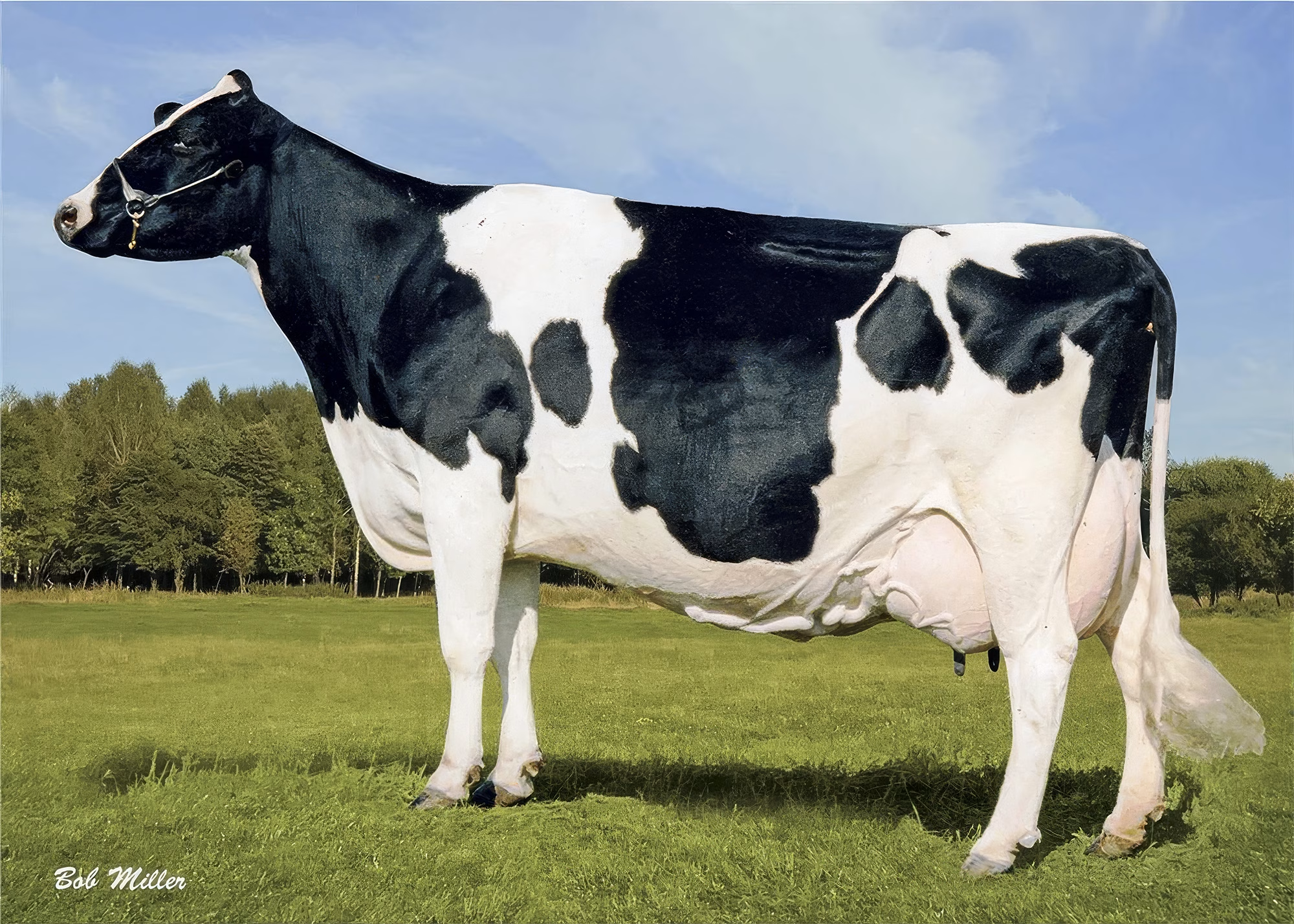
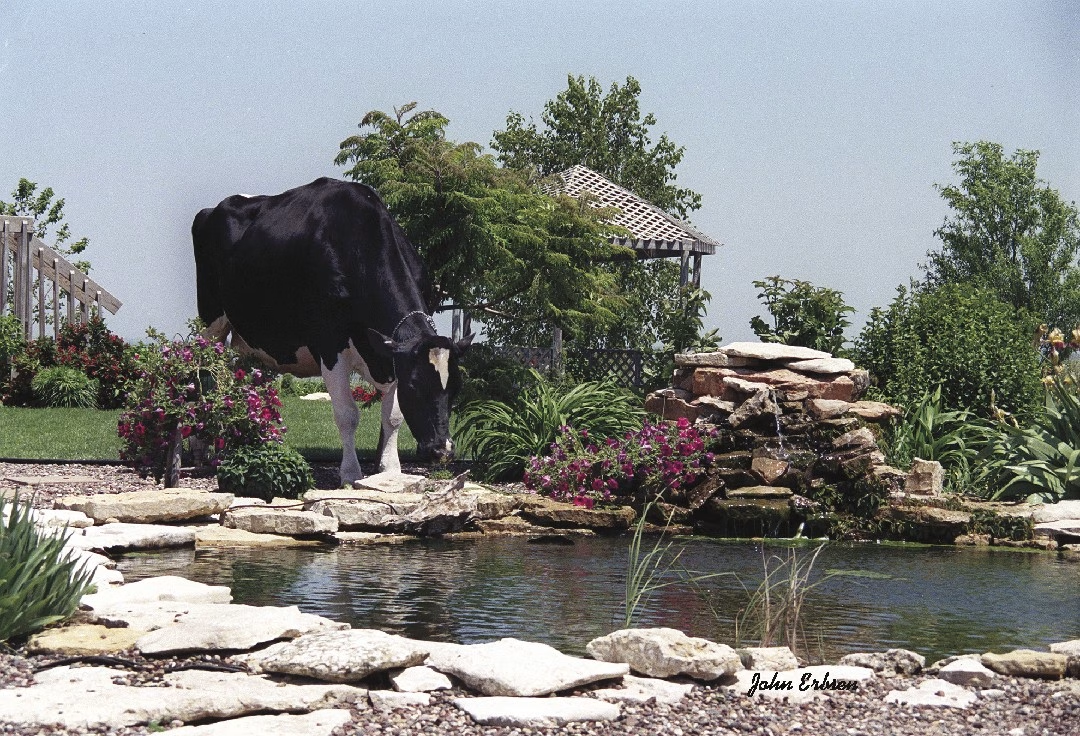
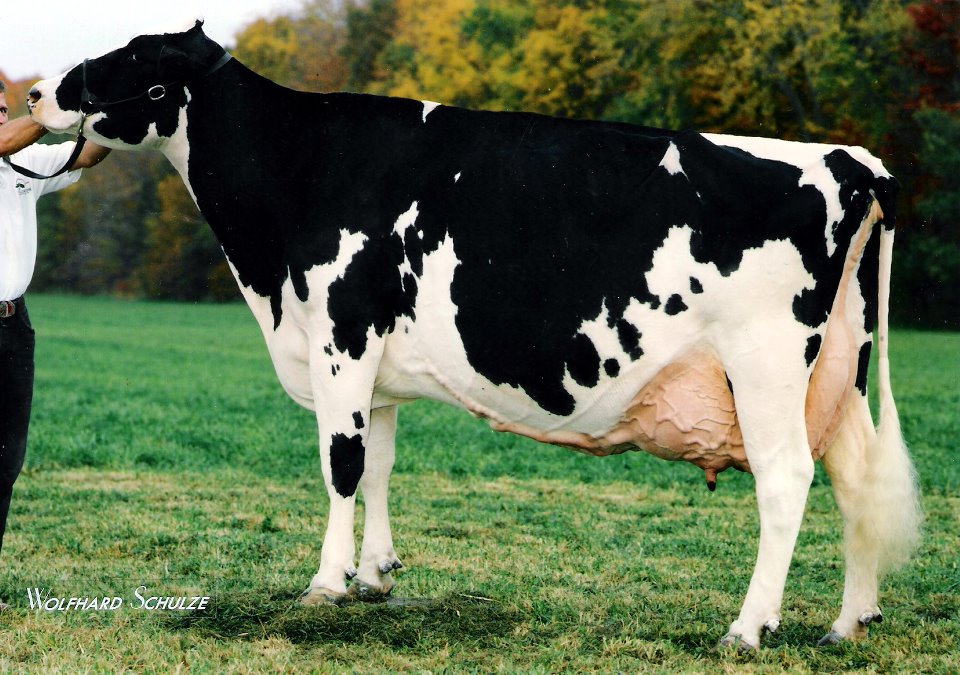
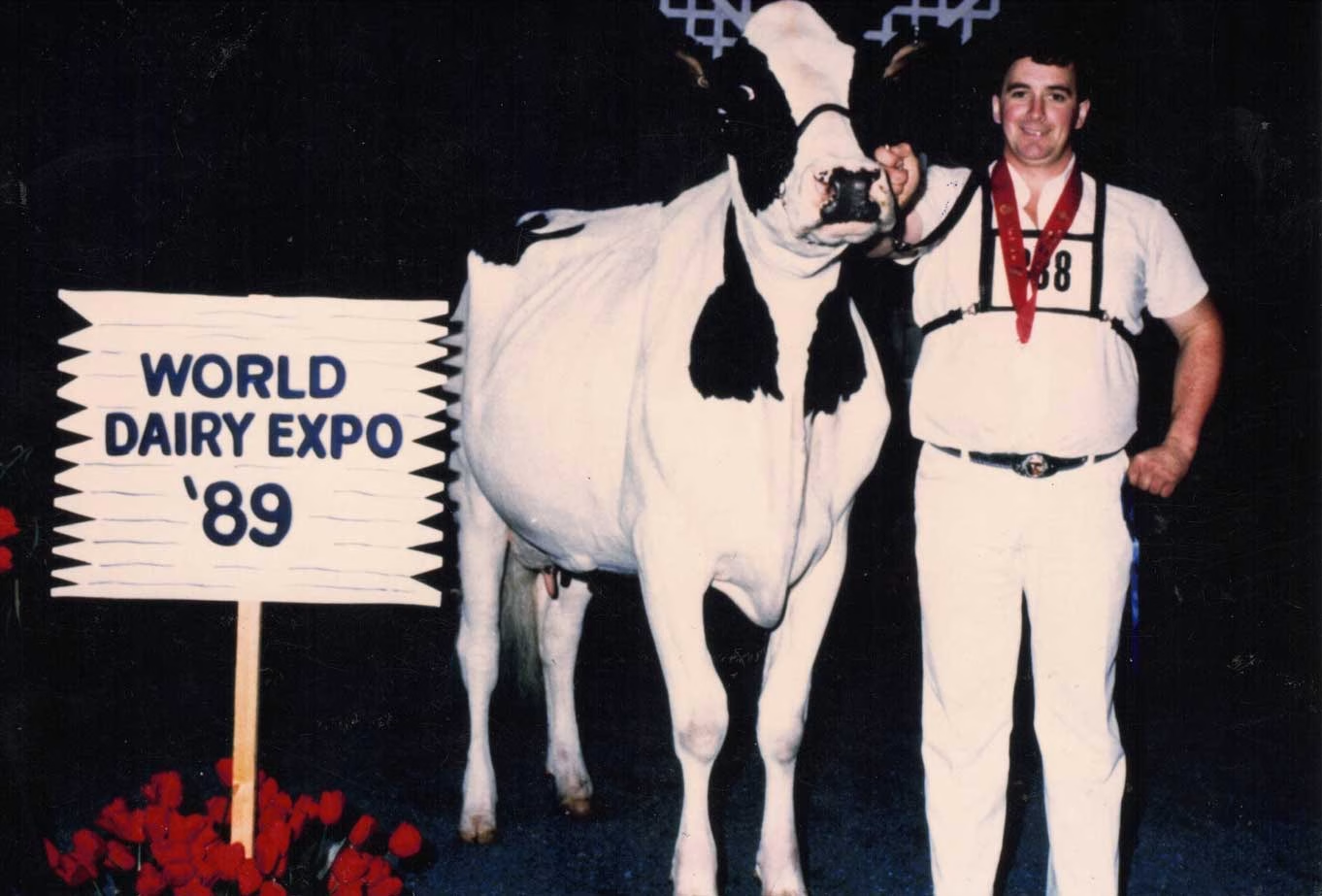
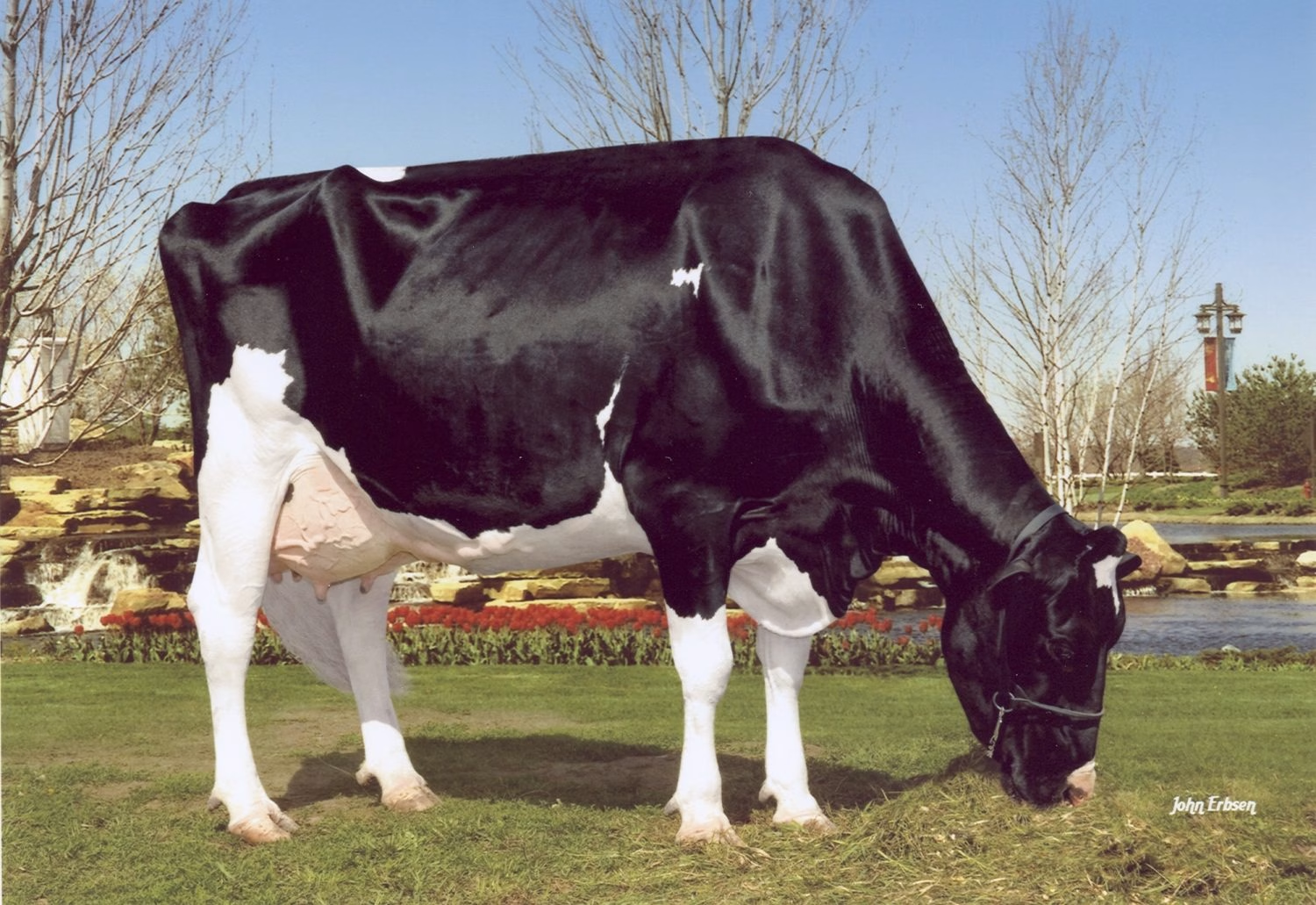
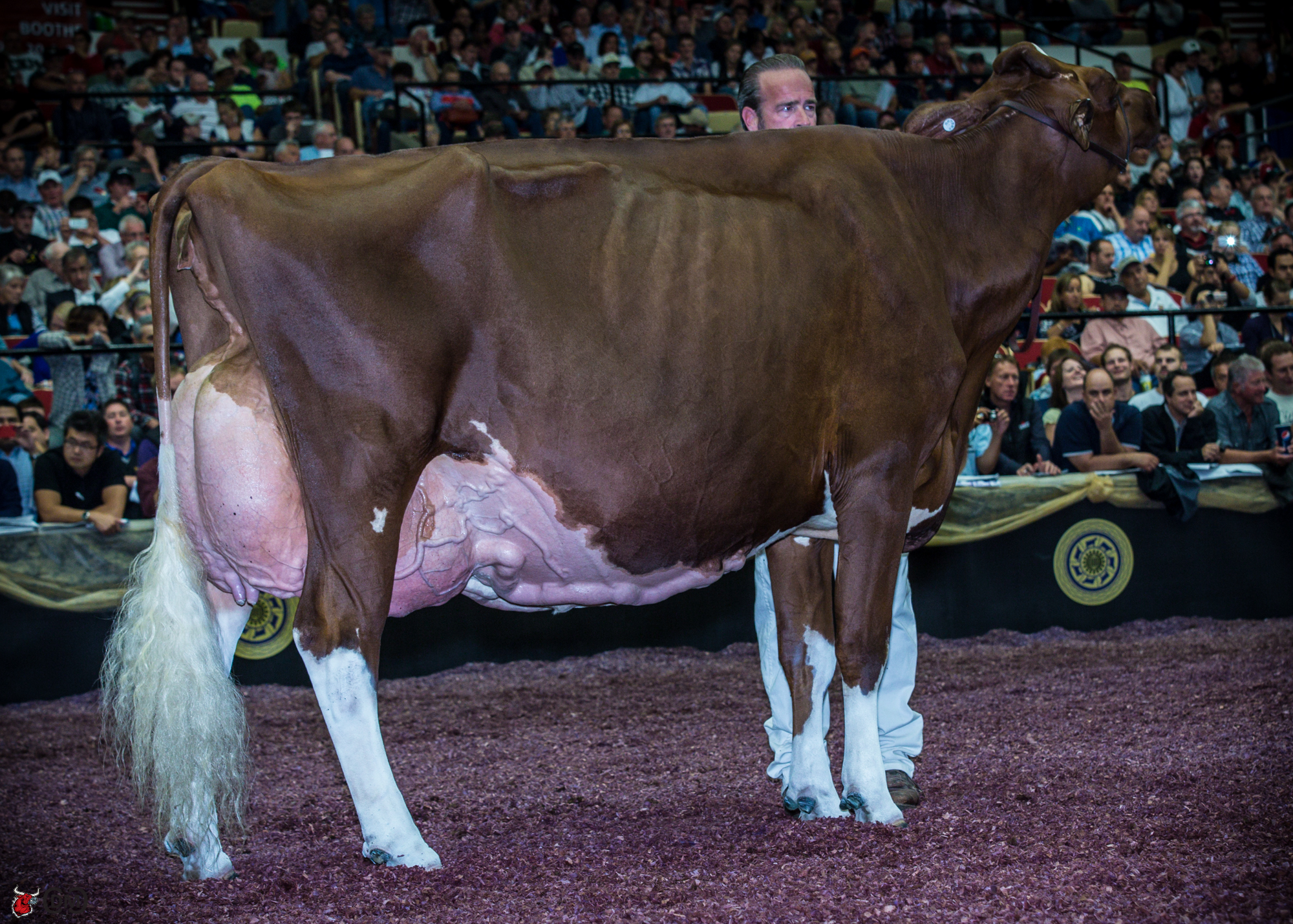
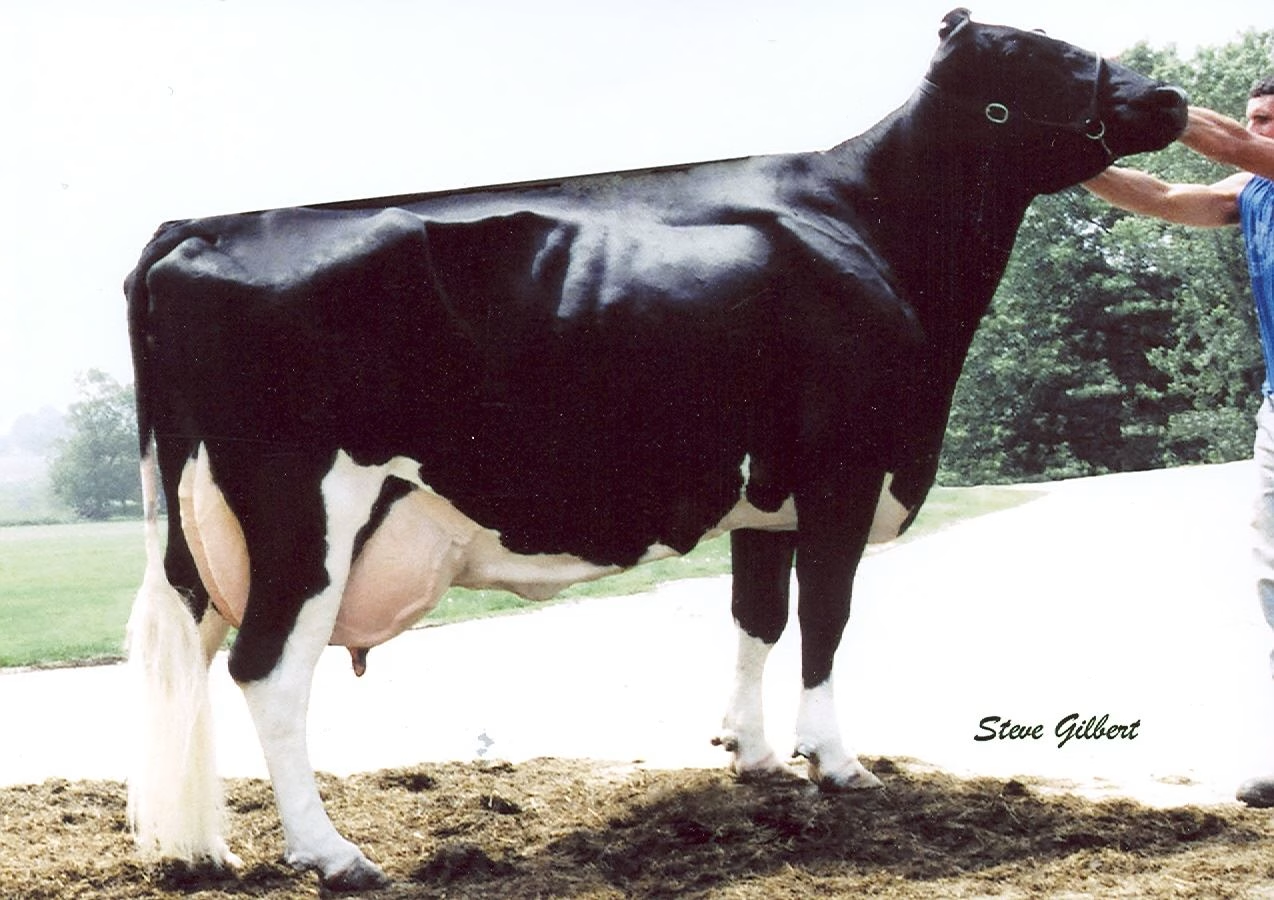
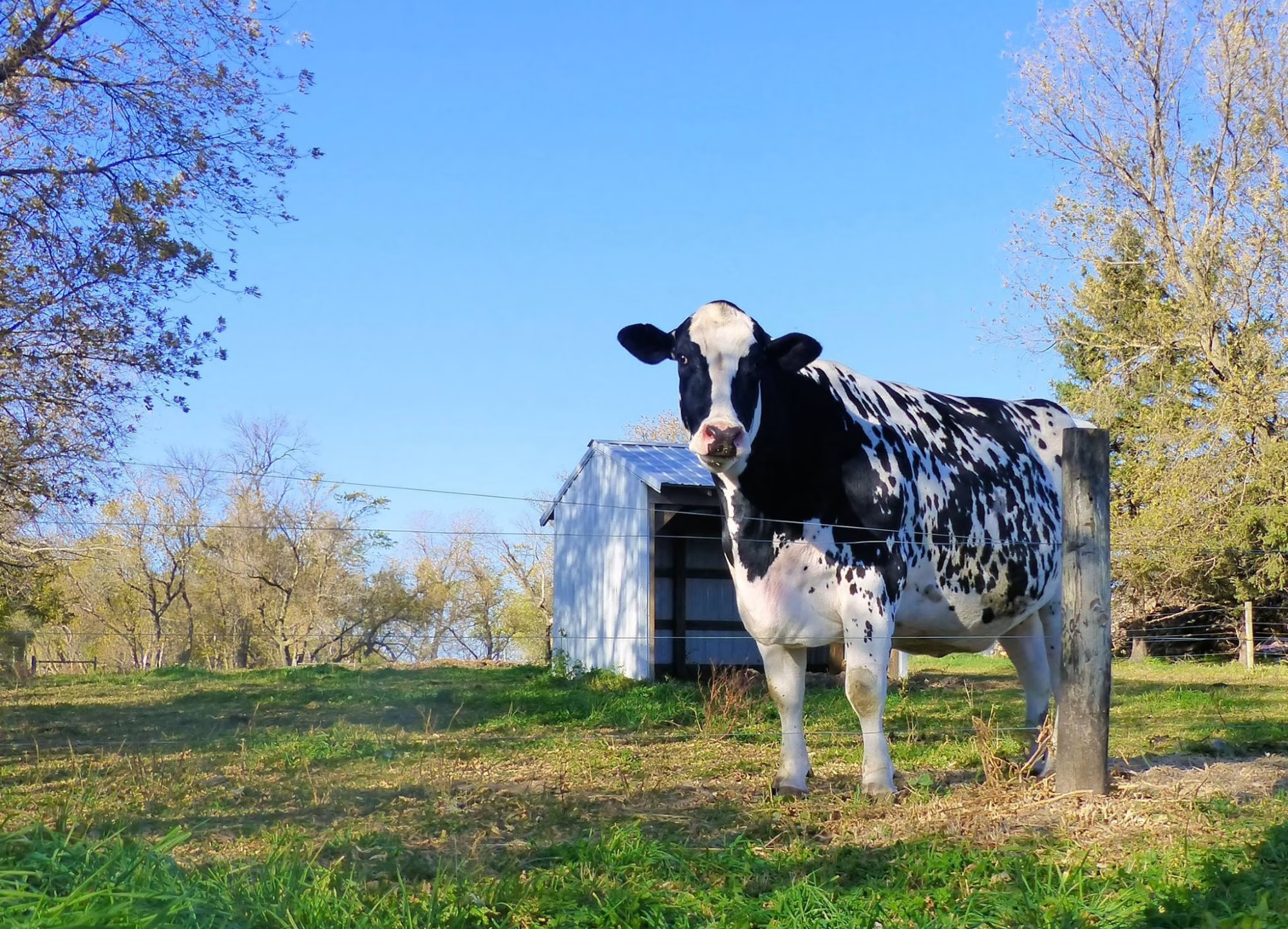
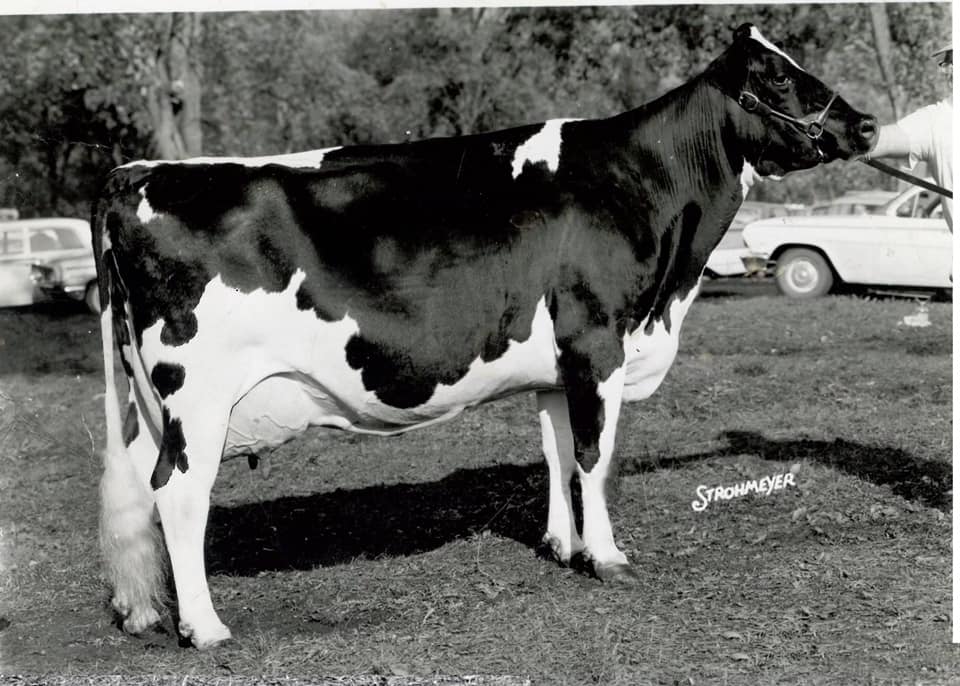
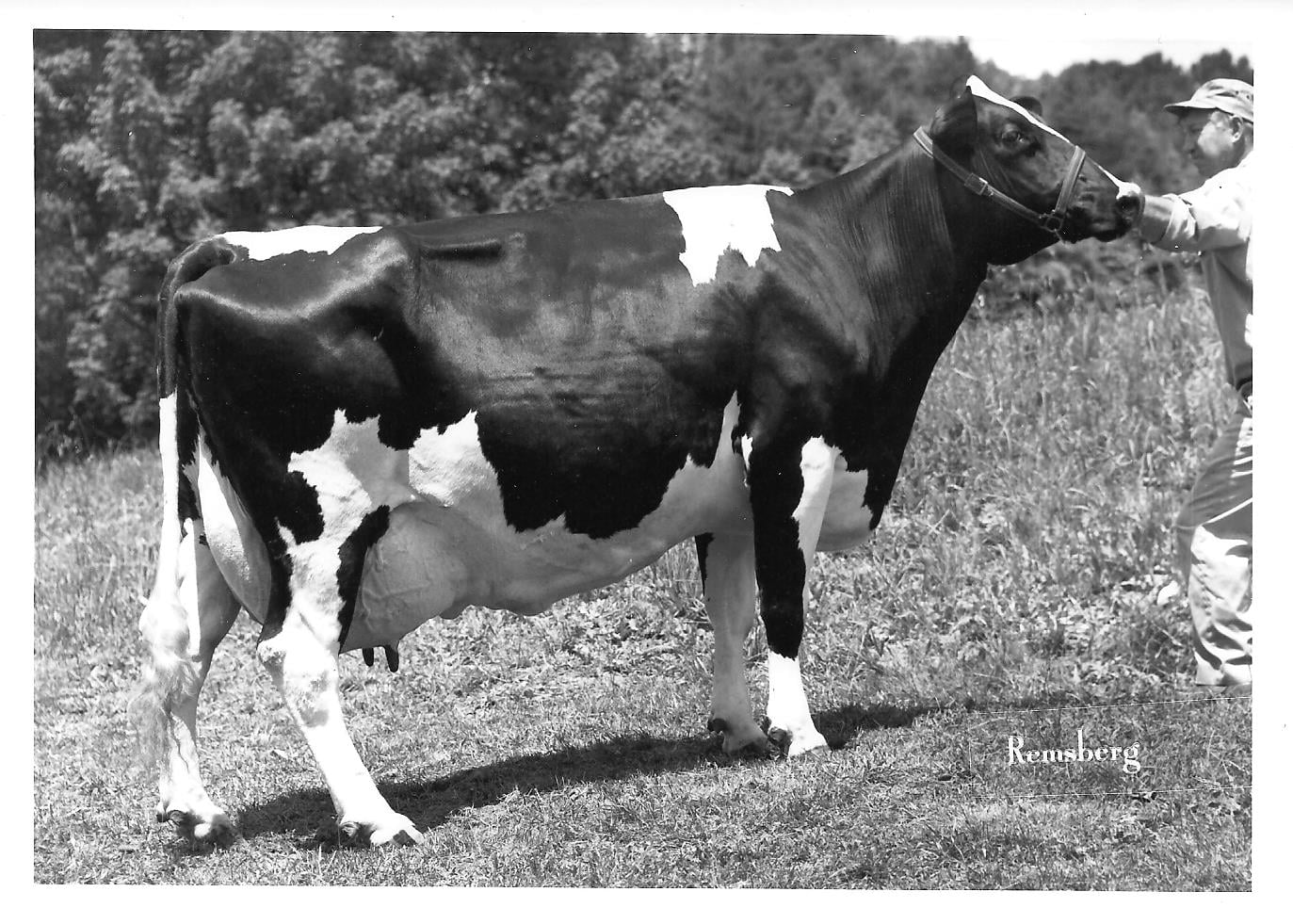
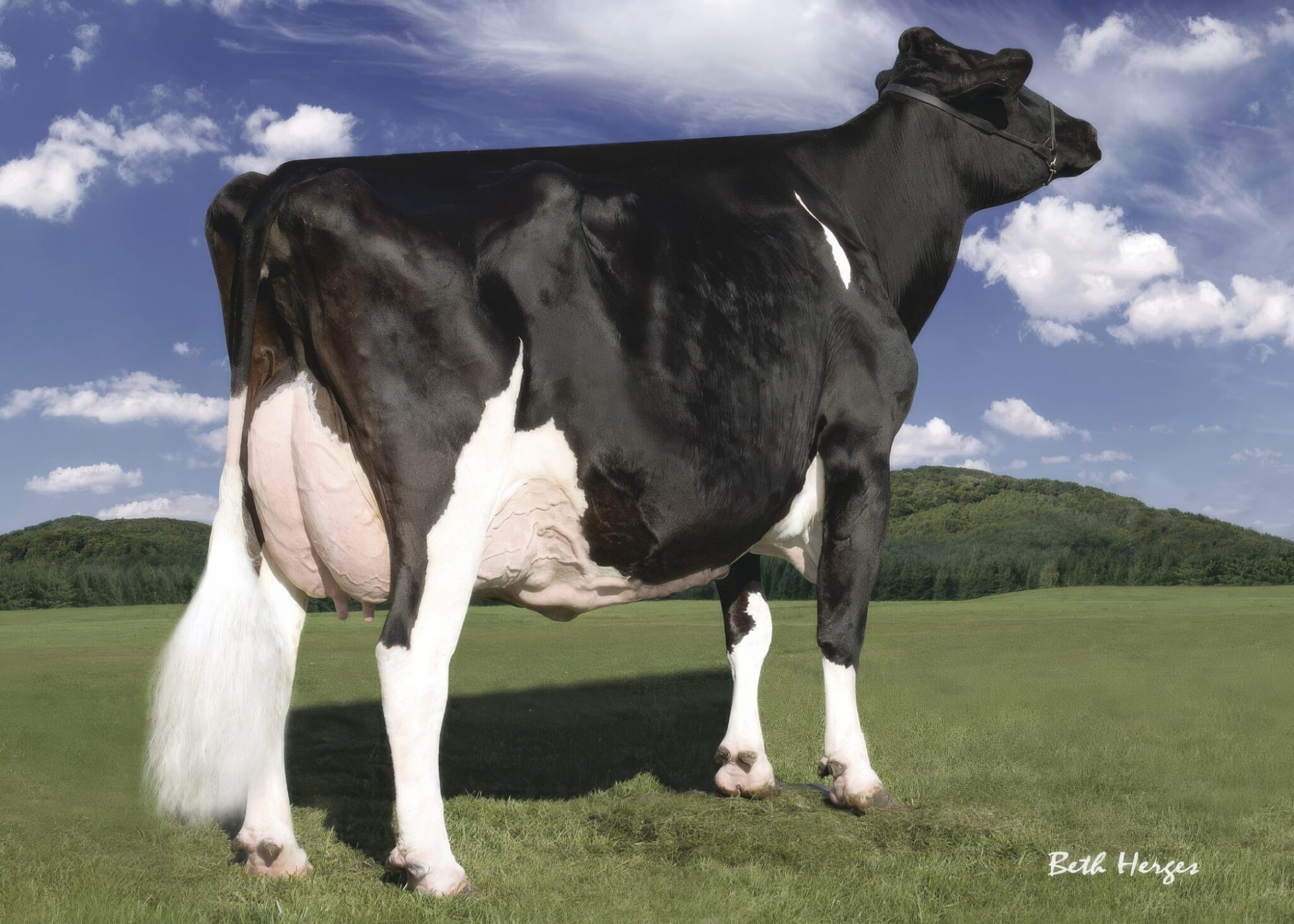
 The Sunday Read Dairy Professionals Don’t Skip.
 The Sunday Read Dairy Professionals Don’t Skip.