A 50¢ diesel move costs a 19,000-cow dairy roughly $427,500 a year. The McCartys book ~90% of next year’s gallons before Jan 1 — and treat beating the bottom as luck, not skill.
According to a May 8, 2026 report and an industry strategic-analysis brief, McCarty Family Farms aims to enter each fiscal year with roughly 90% of its diesel needs already booked for the next 12 to 18 months, working with Compeer Financial economist Dr. Megan Roberts on a layered procurement plan. Applied to a 45 gal/cow proxy at McCarty’s roughly 19,000-cow scale, a single 50-cent move on diesel would represent about $427,500 in annual exposure. That’s the kind of budget hole the McCarty hedging system is designed to prevent.
The system was built by four brothers — Mike, Clay, Dave, and Ken — who took a 15-cow Pennsylvania herd, moved it to western Kansas in 1999, and grew it into a roughly 19,000-cow operation across Kansas, Nebraska, and Ohio, with a workforce that has grown beyond the 130-plus head count cited in earlier coverage, and a long-term Danone milk contract. Right now, with U.S. retail on-highway diesel sitting at $5.64/gal as of May 12, 2026 per EIA’s weekly update — roughly a 61% jump from a year earlier — that discipline is the difference between funding the next generation and funding the pump.
📌 Editor’s Perspective: Where This Fits in the Bullvine Universe
This piece is the energy-risk leg of a margin story we’ve been mapping all month. Bullvine’s May 2026 Corridor Trap analysis pegged the annual drag at roughly $221,760 on a 600-cow Upper Midwest herd as basis slid from –$0.35 to –$0.85/cwt. The Corridor Trap is what happens to your milk check on the revenue side. The McCarty diesel rule is what locks down the cost side. Same farm. Same lender meeting. Different lever.
What’s Changing — and Why It Hits 24/7 Operations Hardest
Diesel isn’t a line item on a modern dairy. It’s the bloodstream. Feed delivery, manure hauling, milk hauling, cropping, generators, and third-party freight surcharges all move with the price of crude. Brownfield Ag News reported in early May 2026 that one dairy producer’s milk check was running close to .00/cwt while feed and fuel were eating the margin alive — part of a broader 2026 ag-economist warning from David Widmar’s April 28, 2026 Managing for Profitcolumn that energy-market volatility is now a primary 2026 cost-side risk.
For a 24/7 operation, a 50-cent move isn’t an inconvenience. It’s a quarterly-budget derailment. And it’s landing on top of the FMMO Make-Allowance 2025 update — effective June 1, 2025, per the USDA AMS final rule — which trimmed an estimated $0.85–$0.93/cwt off Class III–IV values, with Class III near $0.92/cwt. Stack those two numbers and you can see why lenders are starting to ask for a written energy-risk plan before they renew a line of credit.
The farms feeling it first are the ones running the most equipment hours per cow — large freestall operations with custom hauling contracts, long milk routes to a tightening number of plants, and irrigation. If that’s you, the math below isn’t theoretical.
How This Plays Out on Real Farms — The Energy Risk Management Math
Here’s the back-of-the-envelope every dairy CFO should run today. Using an industry proxy of roughly 45 gallons of diesel per cow per year — covering feeding, manure, and basic forage transport — a 500-cow herd burns about 22,500 gallons annually. A 50-cent spike costs that herd $11,250. A dollar move costs $22,500. At 5,000 cows, the same 50-cent move costs $112,500. At McCarty’s roughly 19,000-cow scale, illustrative math points to about $427,500 in exposure on that one move.
Herd Size
Annual Diesel (gal)
25¢ move
50¢ move
$1.00 move
500 cows
22,500
$5,625
$11,250
$22,500
1,000 cows
45,000
$11,250
$22,500
$45,000
5,000 cows
225,000
$56,250
$112,500
$225,000
McCarty (~19k)
855,000
$213,750
$427,500
$855,000
40,000 cows
1,800,000
$450,000
$900,000
$1,800,000
Source: 45 gal/cow/year industry proxy. Your actual intensity moves with cropping system, hauling distance, manure logistics, and how much fuel sits on a custom operator’s invoice rather than yours. Farms growing most of their own forage will run hotter than this proxy.
🎯 The Magic Number: $0.09/cwt
That’s the cost of a 50-cent diesel move on a 200-cow herd shipping 24,000 lbs/cow (9,000 gallons × $0.50 = $4,500; ÷ 48,000 cwt of milk ≈ $0.09/cwt). On its own, a rounding error. Stacked on the FMMO Make-Allowance 2025 drag of roughly $0.92/cwt and a basis slide, it can be the number that breaks the bank — and on a marginal book, the variable that tips a Debt Service Coverage Ratio below 1.25x.
The Mechanics: Three Pillars of the McCarty System
The McCarty system rests on three pillars: proactive layering, historical benchmarking, and mitigation over speculation. They don’t try to call the bottom — the McCartys are described as treating that as luck, not skill. As forward months become available, the team books physical gallons in increments — 20–25% at a time — smoothing what the Compeer team has publicly framed as the “fat tails” of the energy market.
Success isn’t beating the spot price. It’s landing in the bottom third or bottom half of the 5- to 10-year historical average — or simply staying consistent year over year — so milk margins can be calculated with precision before the cows ever produce them. Compeer’s Chief Risk Officer Bill Moore calls it “controlling the controllables.” Translation: lock down breakeven, watch the consensus, and stress-test what happens if ad-hoc government payments fall or Class III drops below $15/cwt.
The 18-month plan is a family-business mechanism for the McCarty brothers — Mike, Clay, Dave, and Ken — built on the same data discipline behind their genetics program, their 2012 Rexford milk condensing plant, and the long-term Danone partnership that anchors their revenue side. None of this is about the next quarter. It’s a question every multi-generational operation faces: whether the next generation inherits a balance sheet they can run, or one they have to dig out from under.
The Hidden Exposures a Hedge Doesn’t Cover
Worth saying out loud: a 90% fuel hedge is not a shield. Three exposures still run through the system the contracts can’t reach.
Hauling adjusters. Milk haulers and commodity deliverers run fuel surcharges that re-price weekly off the EIA index. Your tank is locked. Their truck isn’t.
The processing paradox. As regional plant capacity tightens, dairies get pushed to longer milk routes to find an accepting plant. Longer routes mean more surcharge surface area.
Embedded energy. Mineral premixes, plastic resin, distillers grains, equipment parts — all carry crude-oil cost inside the invoice. Lock the diesel; the inflation still leaks in.
That’s why the 90% target matters. Shrinking the surface area of the things you can’t control is the entire point.
How Much Does Skipping the Hedge Actually Cost You?
Run your own number. If you milk 500 cows and diesel moves $1.00 — and weekly EIA retail diesel did exactly that, climbing roughly $2.14/gal year-over-year through May 2026 — that’s $22,500 you didn’t budget for. On 1,000 cows, $45,000. That’s well above the USDA NASS national livestock-worker average of $17.51/hr for the October 2024 reference week, per the November 20, 2024 Farm Labor release — i.e., real wage money, regardless of region. It’s also more than seven times the bid on a single replacement heifer at the USDA AMS national average of $3,010/head, with USDA NASS’s January 30, 2026 Cattle Inventory printing 3.90 million dairy replacement heifers — the lowest since 1978, per Farm Progress’s February 16, 2026 reporting on the same release.
Every dollar you don’t lose to a fuel spike is a dollar that stays in the business — for cows, for people, for technology, for principal paydown.
Is Your Lender Already Asking About This? — The Energy Risk Management Conversation
In Bullvine’s May 2026 Corridor Trap analysis, a corridor-aware stress test pegs the annual drag at roughly $221,760 on a 600-cow Upper Midwest herd as basis slid from –$0.35 to –$0.85/cwt — and lenders increasingly want to see that same kind of stress test applied to your fuel budget. A documented energy-risk plan — even a one-pager showing how you forward-book diesel — improves your risk profile. In a corridor-aware stress test, an unhedged fuel budget can be the variable that tips a marginal Debt Service Coverage Ratio from acceptable to constrained.
If your bank hasn’t asked yet, your next renewal conversation is the right moment to bring the document yourself.
Options and Trade-Offs for Farmers — Including Dairy Margin Coverage Stacking
You don’t need a 19,000-cow footprint or a quant analyst on retainer to copy the discipline. You do need to pick a lane.
Strategy
Primary Benefit
The Price You Pay
Best-Fit Dairy
Watch This Metric
Lock fixed diesel price
Budget certainty before the fiscal year starts
Lose upside if spot diesel falls
Any dairy with predictable annual fuel use
Coverage above 90% can leave no room for usage surprises
Stabilizes more of the milk, feed, and fuel margin
Premium cost plus more paperwork
Margin-managed dairies with lender scrutiny
Net margin after premium, not gross protection
Keep spot-market exposure
Maximum upside if diesel falls
No protection when the market jumps
Only farms with low fuel intensity or strong cash reserves
50¢ move exposure before Jan. 1
Co-op forward booking — the 500-cow blueprint. Work with your local fuel co-op to forward-contract gallons 12 months out. Lock 25% in September for Q1 delivery. Another 25% in December for Q2. And so on. By the time the calendar flips, you’ve layered four price points instead of betting on one. When it works: you’ve got working capital and a lender comfortable with prepaid inventory. Risk: if spot prices fall below your locked rate, you’ll pay more than the neighbor who didn’t hedge. You’re buying budget certainty, not the bottom of the market.
The “Jan 1, 90%” rule. Set a hard target to have 90% of next year’s diesel booked before the fiscal year starts. When it works: any size farm running an annual budget. Requires: 12 months of clean fuel-use data. Limit: leaves 10% open for genuine consumption surprises — herd expansion, new acreage, beef-on-dairy intensity.
30-day on-ramp. This month, pull last year’s fuel invoices, calculate your gallons-per-cow, and call your fuel supplier to ask what forward-contract terms they offer. That’s the entire starting move. No working capital required to make the phone call.
Integrate fuel with milk and feed risk. Fuel hedging is one piece of a margin toolkit. Compeer’s published framework treats it alongside DRP for component-based revenue protection, LGM-Dairy for bundled feed risk, and Dairy Margin Coverage as a Tier 1 backstop that’s often too small for large herds. None of these tools work alone. Pair them.
The trade-off table — benefit vs. cost, plain English:
Strategy
Primary Benefit
The “Price” You Pay
Locking price
Budget certainty
Loss of “downside” opportunity if spot falls
Layering 25% increments
Cost averaging across the cycle
Increased admin and supplier time
Prepaying forward gallons
Lender confidence in your risk plan
Working capital tied up
Pairing with DRP / LGM-Dairy
Margin certainty across feed + milk
Premium cost on the policy
Key Takeaways
If you can’t say what you paid per gallon over the last 12 months, you don’t have a fuel strategy — you have a fuel bill.
If your fuel exposure on a 50-cent move would change a hire, an expansion, or a debt payment, you have a hedging case. Run the test: gallons/cow × $0.50 × your herd size.
If you can hit 50% coverage by January 1, you’re ahead of the spot-market crowd. 90% is the McCarty benchmark, not the entry point.
If you book a layer, book another. One fixed price isn’t a strategy — three or four staggered layers is.
If you hedge fuel without hedging milk or feed, you’ve stabilized one leg of a three-legged stool. Pair it with DRP, LGM-Dairy, or a forward milk contract.
If your milk hauling, mineral premix, or replacement heifer bills are climbing faster than diesel, the embedded energy is leaking in. Track those line items separately.
If your next lender meeting is inside 90 days, bring a one-page energy-risk plan before they ask for it.
The Real Question
The next 50-cent diesel move is coming. The only question is whether your operation has decided in advance who it’s going to hurt — the market, or you. Where does your fuel coverage sit on January 1, and what would you have to change this month to get it closer to 90? The McCarty brothers built a 12–18 month answer to that question. Many multi-generational dairy families face the same calculus when planning for succession — and yours can do the same work at a smaller scale.
Reporting in this article is based on published trade-press coverage (Dairy Herd Management, Brownfield Ag News, Farm Progress, Bullvine archive), public Compeer Financial materials, USDA AMS and NASS data (USDA NASS Farm Labor 11/20/2024; USDA NASS Cattle 01/30/2026), EIA weekly retail diesel data, and an industry strategic-analysis brief. The Bullvine did not independently interview McCarty Family Farms or Compeer Financial for this piece. Diesel-cost figures are illustrative calculations using a 45 gal/cow industry proxy and will vary by farm.
Complete references and supporting documentation are available upon request by contacting the editorial team at editor@thebullvine.com.
Every week, thousands of producers, breeders, and industry insiders open Bullvine Weekly for genetics insights, market shifts, and profit strategies they won’t find anywhere else. One email. Five minutes. Smarter decisions all week.
You’re rearing every heifer. McCarty isn’t. His $40 genomic test caught a 28% error and freed up $104,750 a year on a 500–cow dairy.
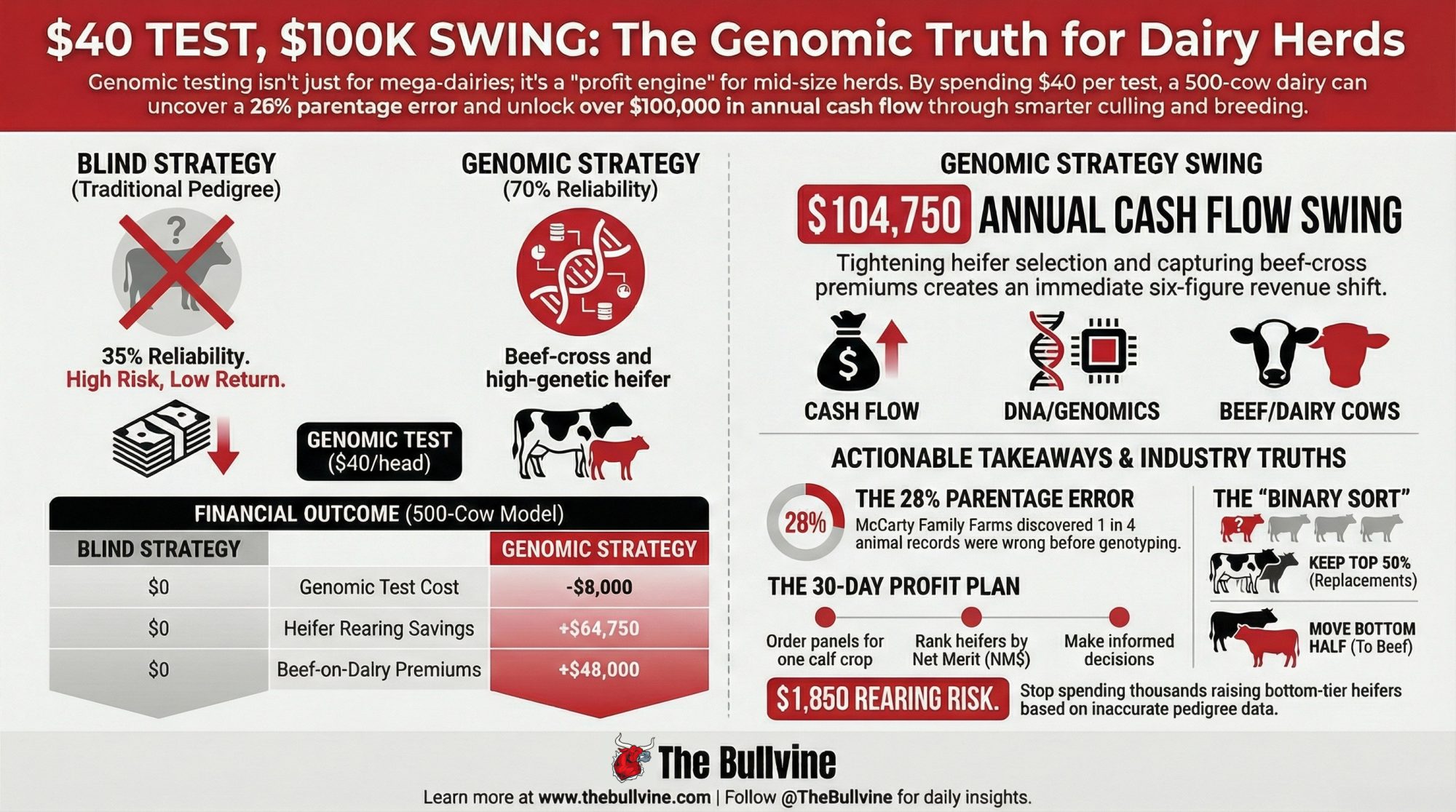
Executive Summary: McCarty Family Farms runs a $40 genomic test on every heifer and discovered a 28% parentage error across its 19,000‑cow Holstein herd. That shock turned genomics into a core profit center, feeding embryo work, a Danone supply partnership, and a disciplined sort where the top half of the heifers make replacements, and the bottom half go to beef. When you run the same logic on a 500‑cow dairy, the barn math points to roughly $104,750/year in cash‑flow swing from tighter heifer rearing and beef‑cross premiums, before you even count long‑term genetic gain. Independent data from AHDB, CDCB, and Holstein Canada back the principle: genomic testing roughly doubles reliability over pedigree and widens the profit gap between herds that test most heifers and those that don’t. The biggest thing holding mid‑size herds back isn’t the $40 test cost — it’s the identity hit of culling daughters from cow families that built the prefix, as Kelly and Luke Donkers openly admit. This feature unpacks McCarty’s system, the supporting research, and four realistic strategies — from tightening margins to selling into a hot heifer market — that get sharper once you stop treating genomics as optional.
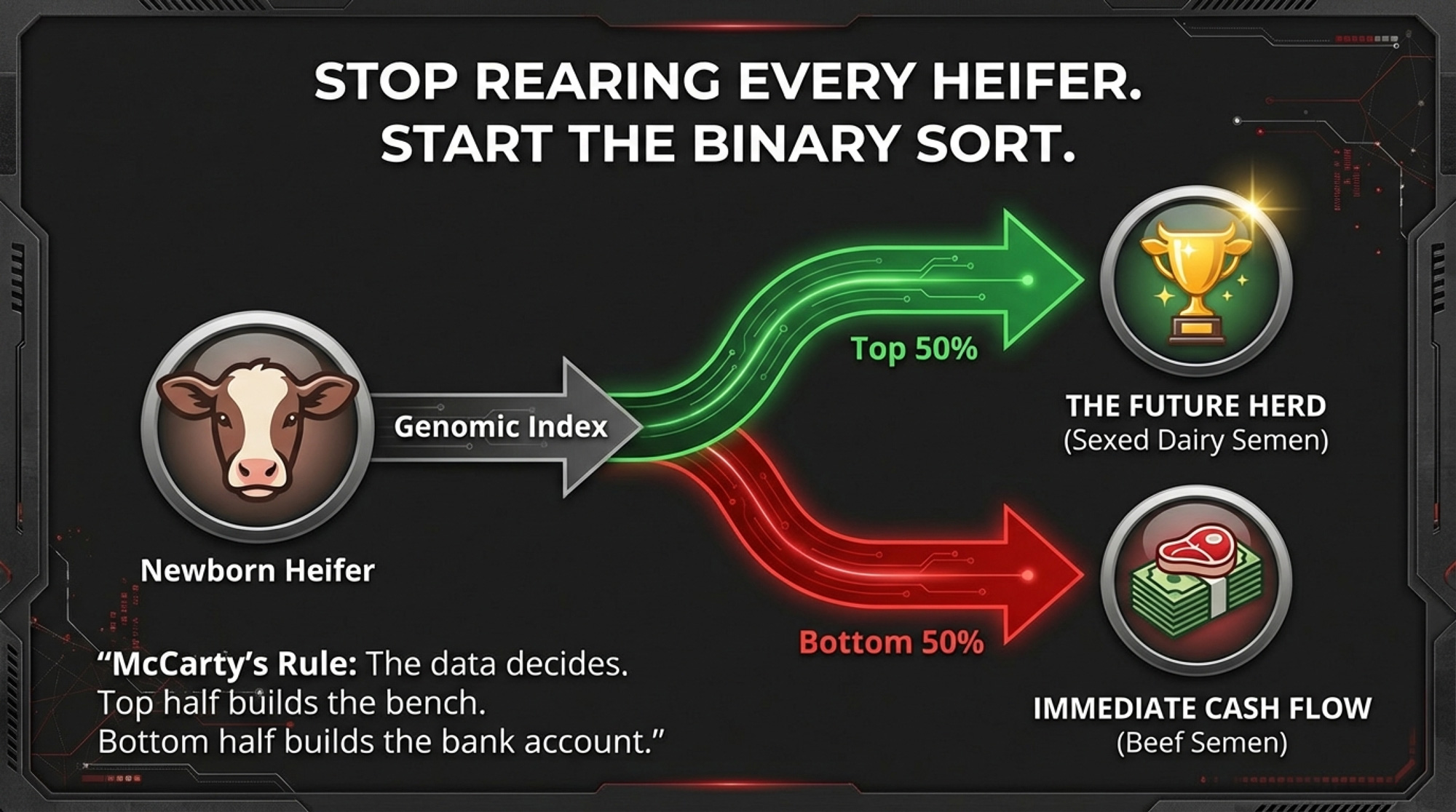
Ken McCarty doesn’t agonize over which heifers to keep. At McCarty Family Farms — a fourth-generation, B Corp-certified operation running the world’s largest registered herd of Holsteins across five dairy farms in Kansas, Nebraska, and Ohio — every heifer calf gets a genomic test before anyone decides her future. A Zoetis Clarifide Plus panel. About $40–$50 per head. Top half by index: sexed dairy semen. Bottom half: beef. The protocol is the same whether the calf traces back to the herd’s best flush family or walked in on a transfer truck last Tuesday. (Read more: The McCarty Magic: How a Family Farm Became the Dairy Industry’s Brightest Star)
At 19,000 cows, that discipline is table stakes. At 400 cows — where you know every heifer by name and her grandmother’s show record — it’s something else entirely. The genomic testing technology is available to any freestall in Wisconsin, Pennsylvania, or anywhere else with a FedEx drop, for less than the cost of a bag of milk replacer. So why are most mid-size herds still breeding blind, rearing every heifer, hoping the bottom end sorts itself out in the milking string? The answer has less to do with money than most people think. It has everything to do with identity.
$18.95 Milk, $20.85 Costs: Where the Squeeze Lands Hardest
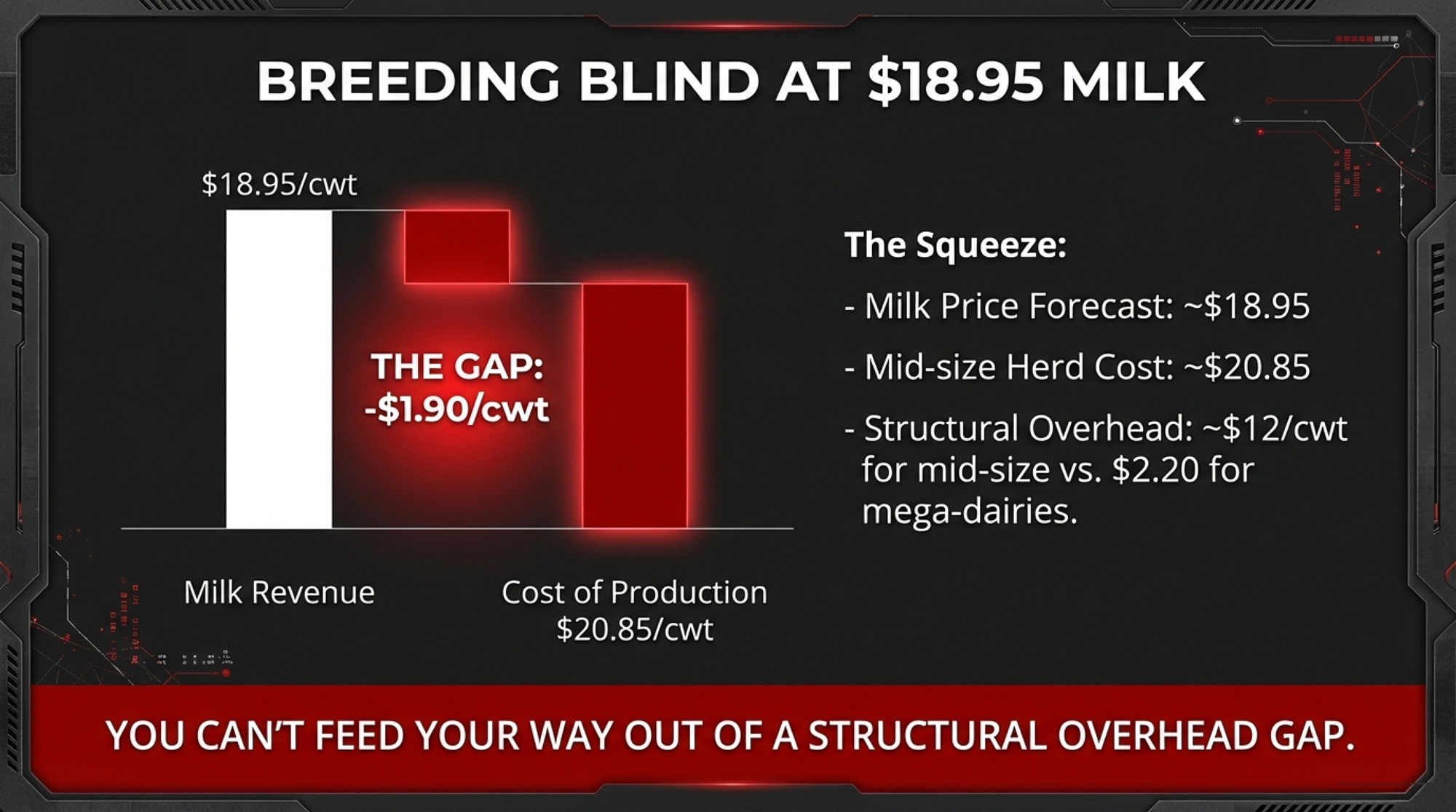
USDA’s February 2026 WASDE pegged the all-milk forecast at $18.95/cwt — up 70 cents from January’s $18.25 projection, but still $2.22/cwt below the revised 2025 average of $21.17. For a 500-cow herd at 23,000 lbs/cow — about 115,000 cwt shipped per year — that drop means roughly $255,000 less gross milk revenue compared to last year.
Now lay that price against USDA’s Economic Research Service cost-of-production estimates, updated in 2024 using the 2021 ARMS dairy survey:
Herd Size
Feed Cost ($/cwt)
Labor Cost ($/cwt)
Total COP ($/cwt)
Margin vs. $18.95 Milk
2,000+ cows
$8.00 – $12.00
$2.20
$19.14
-$0.19/cwt
200–499 cows
$8.50 – $12.50
$12.00
$20.85
-$1.90/cwt
100–199 cows
$9.00 – $13.00
$14.00+
$24.00 – $26.00
-$5.05 to -$7.05/cwt
$19.14/cwt for 2,000+ cow herds
About $20.85/cwt for 200–499-cow herds
$24–$26/cwt for the average 100–199-cow operation
The biggest herds are scraping breakeven. The average mid-size dairy? Roughly $1.70–$2.00/cwt in the red on a full economic basis — and that’s before debt service.
Feed usually gets the blame. But ERS data show feed costs range from $8–$12/cwt across all herd sizes, and the difference between mid-size and the largest herds is often less than $1.50/cwt. The real gap sits in labor and overhead: smaller herds carry roughly $12/cwt in labor, counting unpaid family hours, versus about $2.20/cwt for mega-dairies, and fixed costs per cwt balloon when you’re spreading a parlor and freestall across 300 cows instead of 5,000.
You can tighten the feed. But you won’t feed your way past a structural overhead gap. Something else has to give. And if you look at where the biggest on-farm processing investments are landing — and the economics driving those decisions — the mid-size herd’s margin problem isn’t going away on its own.
How McCarty’s Genomic Program Works — And Why He Leaned In So Hard
McCarty’s genetics page lays out the priorities: high type, elite health, high components, positive production, feed efficiency, and longevity. The herd averages more than 94 lbs/day, with 4.2% butterfat and 3.33% protein, according to the farm’s website. Holstein USA classifiers visit the farms three times a year, typically scoring more than 2,000 cowsper round.
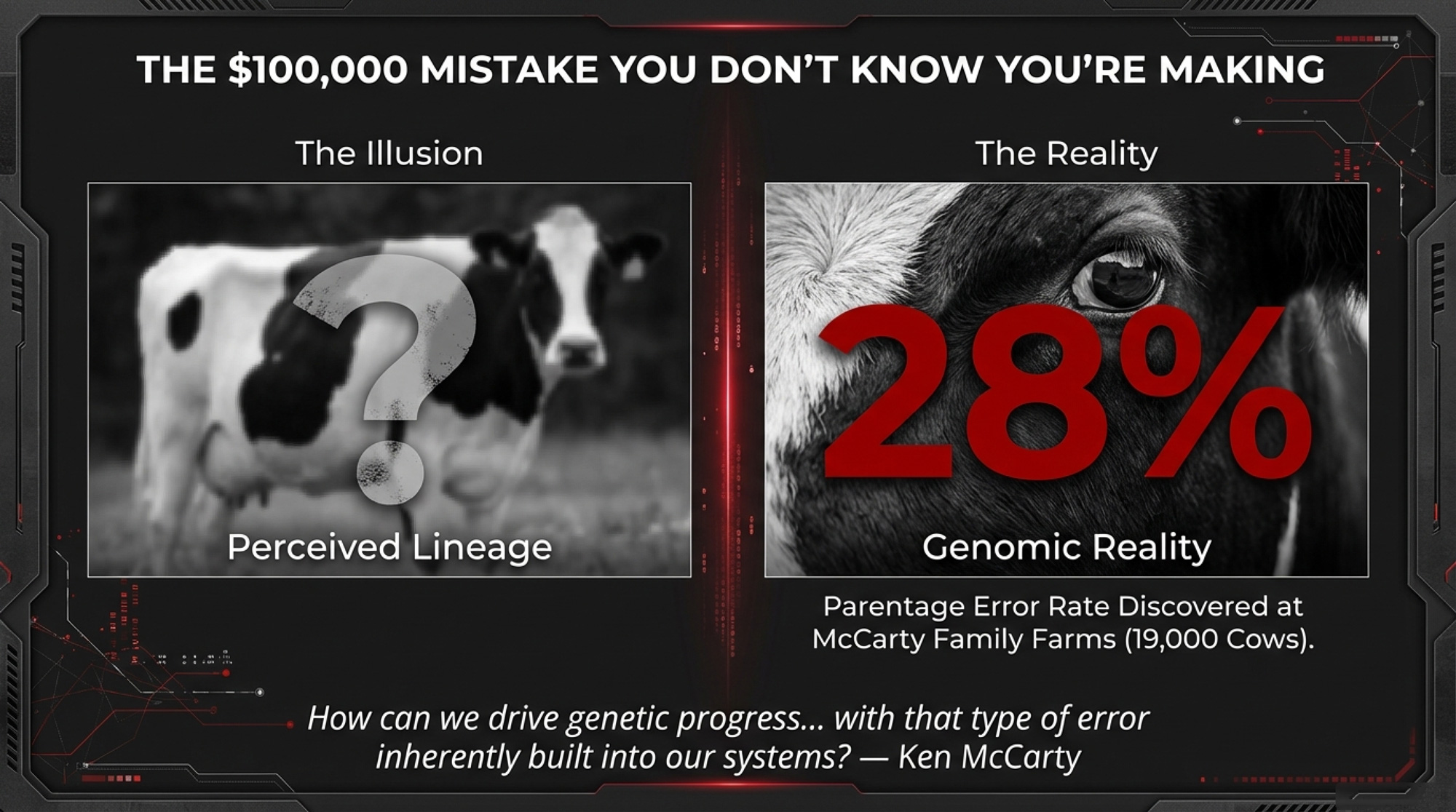
The rule is brutally simple: the top half of the breeding herd creates the next generation, the bottom half goes to beef — regardless of age or stage. And there’s a reason McCarty leaned into genomics so hard. Speaking on the Zoetis-sponsored Uplevel Dairy Podcast in December 2024, Ken admitted — with characteristic bluntness — that when the farm first ran genomic evaluations, they discovered a 28% parentage error across the herd.
Twenty-eight percent. More than one record in four was wrong.
“How can we ever drive the appropriate rate of genetic progress, reduce inbreeding to levels where we want them to be, make the types of breeding decisions that will propel our business and our farms forward with that type of error inherently built into our systems?” — Ken McCarty, Uplevel Dairy Podcast, December 2024
Genomic testing fixed that overnight — and once parentage was right, the data unlocked everything else. McCarty described the shift from treating genetics as “just a piece of what we do every day” to something much bigger:
“As we’ve tried to take genetics and move it from just a piece of what we do every day and transition it into an actual business center — or hopefully a profit center of our business — having that genomic information and being able to isolate those animals that have a unique set of traits or are very high-end animals in terms of various indices, that unlocks the capability and the potential for us to create an entire new avenue for our business and our farms.” — Ken McCarty, Uplevel Dairy Podcast, December 2024
The $40 test isn’t just parentage correction and heifer ranking. For McCarty, it became the entry point for embryo production, genetic sales, and a direct relationship with Danone — an entirely new revenue stream built on data he didn’t have before genotyping.
Parentage Errors: Not Just a McCarty Problem
That parentage problem isn’t unique to McCarty’s scale. AHDB’s Marco Winters, head of animal genetics, flagged the same issue in UK herds: 17% of calves had their sire records updated once genotypes were analysed — 7% had the wrong sire recorded, another 10% had no sire recorded at all.
“It’s surprising how many animals have been misidentified, often assigned the wrong sire, and sometimes even the wrong dam.” — Marco Winters, AHDB, June 2024
If you’ve never genotyped your herd, you don’t know how deep your own parentage error runs. That’s not a comfortable thought when you’re spending $1,850 per head to rear replacements based on those records.
Source
Herd/Sample Size
Parentage Error Rate
What That Means
McCarty Family Farms (US)
19,000-cow Holstein herd across 5 farms
28% error
More than 1 in 4 breeding records wrong — sire, dam, or both misidentified before genomic testing
AHDB (UK)
National Holstein data, 2024 genotyping analysis
17% total correction rate (7% wrong sire, 10% no sire recorded)
Nearly 1 in 5 calves had parentage corrected after genotyping — systematic misidentification across UK herds
Implied Industry Baseline (CDCB/Holstein Canada)
Not directly quantified, but reliability data suggests 20–30% pedigree uncertainty
Estimated 15–25% error in herds without systematic verification
Breeding decisions, genetic evaluations, and culling choices built on unreliable foundation
The operation earned World Dairy Expo’s 2025 Dairy Producer of the Year award on October 1 — a recognition not just of scale, but of on-farm milk processing, a direct supply partnership with Danone North America, and a genomic discipline applied consistently across all five farms. The fifth generation is beginning to join the operation.
What Does a $40 Genomic Test Actually Change About Your Breeding Decisions?
Here’s what matters for a 400-cow herd: the technology is the same. And the reliability jump tells the whole story.
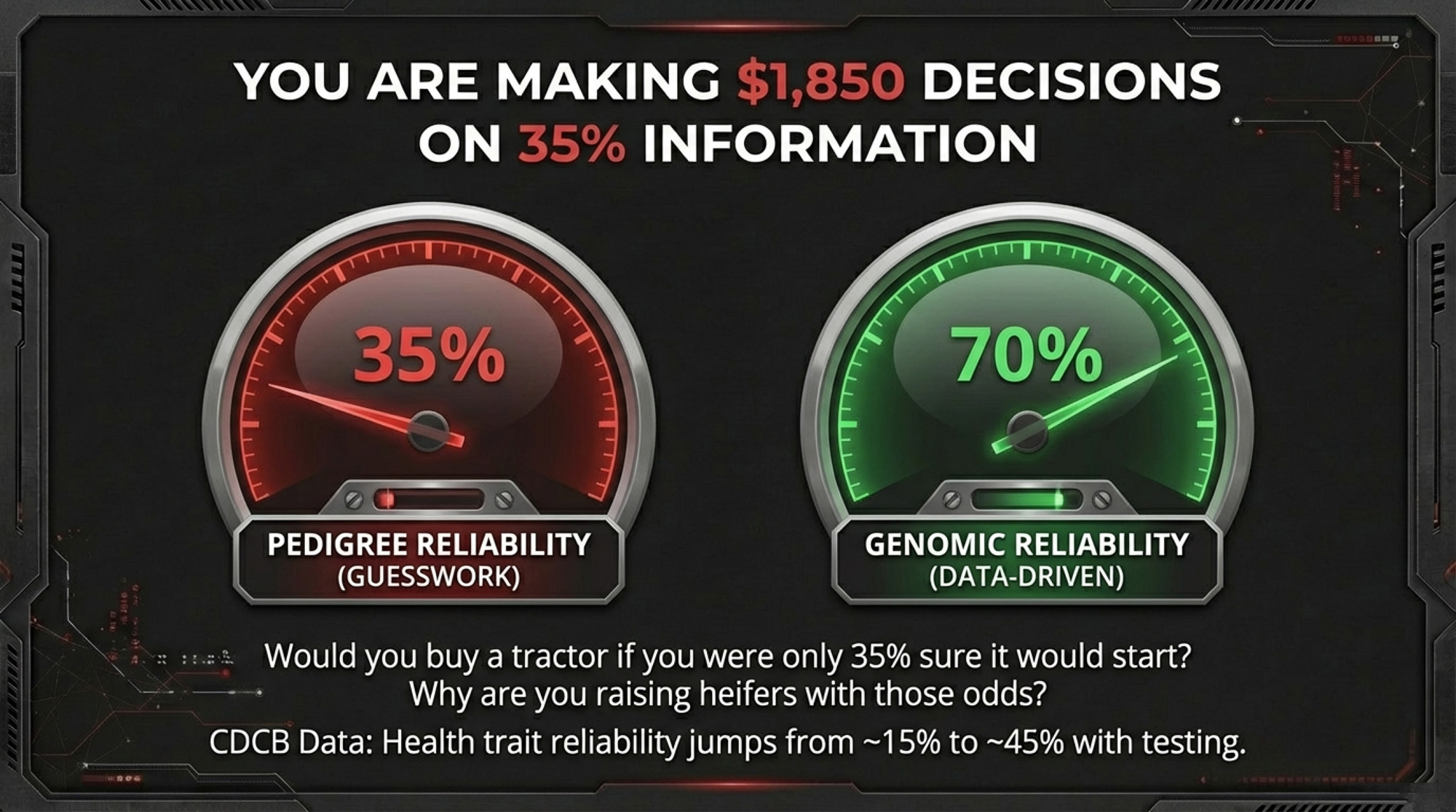
According to Holstein Canada, the parent average prediction has about 35% reliability for a young animal. A genomic test bumps that to roughly 70%. That’s a doubling of certainty for $40 a head. VanRaden’s foundational 2009 study in the Journal of Dairy Science documented realized reliabilities of 50% for genomic predictions versus 27% for parent averages when averaged across all 27 traits in North American Holsteins. The CDCB’s own data on health traits shows genomic reliability of 40–49% in young animals versus just 11–18% from pedigree alone.
Put differently: you’re making $1,850-per-head rearing decisions on 35% information. Or you’re spending $40 to make the same decision with 70% of the information. The math isn’t subtle. And that’s the same principle that turned a handful of bold sire bets into the modern Holstein breed — except now any producer can run the numbers on their own herd instead of waiting a decade for progeny proof.
AHDB’s June 2024 analysis found that UK producers genotyping 75–100% of their heifers averaged a £430 PLI for their 2023 calves, versus £237 for those testing under 25% — a £193 gap. Winters called it “a massive difference in profit potential between the best and worst herds.” The theoretical value runs about £19,300 on a typical 175-head herd, but AHDB’s analysis of actual margins from farm business accounts pegged the advantage at over £50,000. UK adoption backs the trend: a record 112,507 new females were genomically evaluated in 2024, up 19% from the year before. The index names differ across borders, but the genotyping-gap pattern holds wherever it’s been measured.
A fair caveat: Winters himself notes that “the genetic benefits seen in the top herds are not necessarily only a consequence of heifer genomic testing” — producers who test are also more likely to be genetically engaged across the board. But that’s the point. The $40 test isn’t just a parentage check or a ranking tool. It’s the entry point to a different way of managing your breeding program. The herds that start testing tend to make better decisions everywhere else, too. That’s the gap Kelly Donkers was staring at when she decided the grey-haired cows might need a harder look.
Why Aren’t More Herds Genotyping? The Barrier Nobody Talks About at Extension Meetings
If the math works this cleanly, why isn’t every mid-size herd running these panels?
It’s not the $40. And it’s not access — Zoetis, Neogen, and others will ship kits to any address in the country. When EastGen surveyed producers at Canada’s Outdoor Farm Show who weren’t genomic testing, the answers ranged from “we don’t have time” to “it’s a waste of money.” But those are the polite answers. The real friction runs deeper.
“There are probably more grey-haired cows on our farm than just about anybody else.” — Kelly Donkers, Rose Vega Farm
Her husband, Luke, conceded that he regularly keeps cows in the milking herd for sentimental rather than profitability reasons. But he also outlined the potential benefits of analyzing genomic evaluations — from building on the positive traits of cow families to avoiding genetic defects. Genetics can’t be overlooked, he agreed.
The Donkers aren’t the cautionary tale here — they’re the honest ones. Most farms that keep low-genomic animals don’t talk about it publicly. Kelly and Luke did so at an industry event in front of their peers. That candor is exactly what makes the identity barrier visible — and it’s the same tension every mid-size herd eventually has to confront.
That tension — I know what the data says, but she’s earned her place here — scales differently depending on herd size. At McCarty’s operation, no individual animal carries emotional weight. The sort is automatic. But at 100 cows, or 400, or 700, some of your worst genomic heifers are also the ones whose families built your prefix, won your first banner, and convinced your daughter she wanted to stay on the farm.
EastGen’s Jamie Howard framed the shift bluntly: “At all dairy farms these days, no matter if they’re milking 1,000 cows or 40 cows, there needs to be a genetic strategy that feeds into keeping the farm profitable.” The workshop exercise — asking producers to visually assess four genomic-tested heifers and decide which two to keep — revealed how often gut instinct and genomic data pointed in different directions.
A $40 test doesn’t just rank your calves. It directly challenges the way you’ve always picked bulls, evaluated cows, and told your herd’s story. That’s not a technology barrier. It’s an identity cost. And the pattern plays out repeatedly at workshops across the industry — the hardest part isn’t the first round of results. It’s the second round: you’ve already seen the math work, and now you have to decide whether the data or the pedigree wins every single time. That’s why the adoption curve for female genotyping looks nothing like the adoption curves for activity monitors or feed software.
Can a $40 Test Really Swing Six Figures on 500 Cows?
Here’s the math. Walk through it with your own numbers after.
Assumptions: 500 milking cows, 23,000 lbs/cow/year, 28% annual replacement rate = 140 replacements needed. Heifer rearing cost: $1,700–$2,000/head based on FINBIN and Penn State Extension data from 2016–2021 ($1,709 Upper Midwest average, $2,034 Pennsylvania average). Iowa State Extension calculated 2024 rearing costs at just over $2,600 for 24 months. Midpoint for this example: $1,850/head — a conservative figure that understates the current swing.
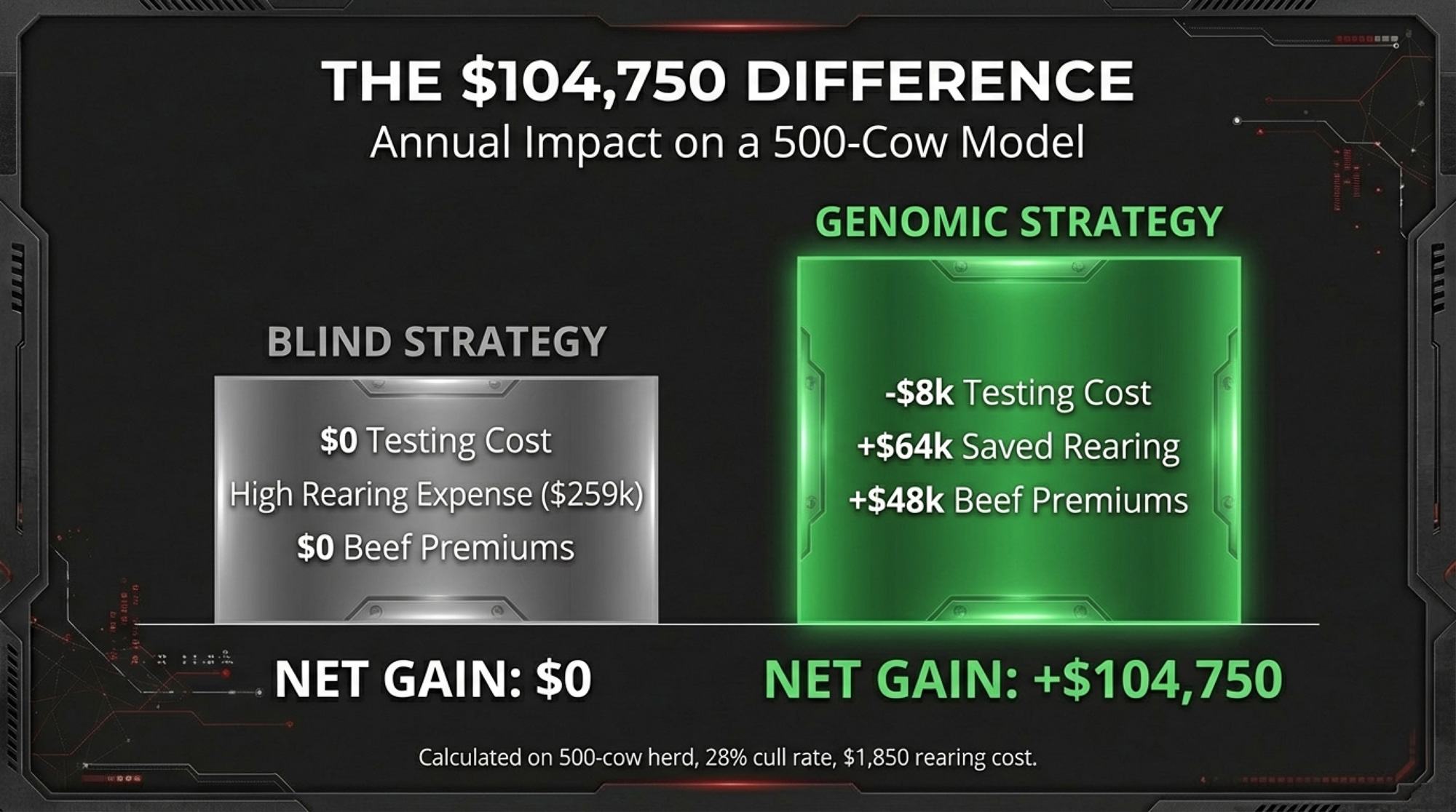
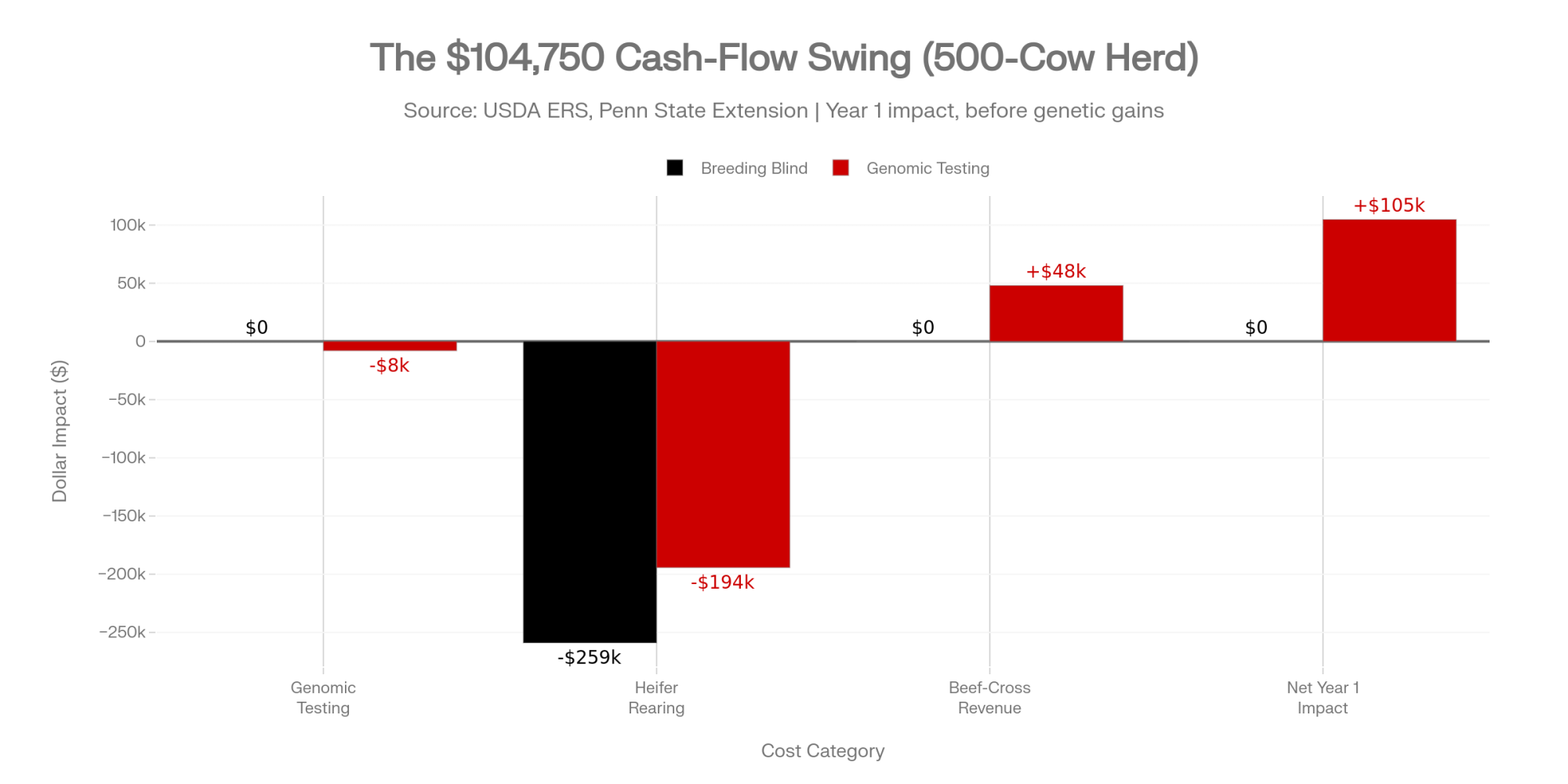
The Cost of Breeding Blind: Side-by-Side Comparison (500-Cow Herd)
Expense / Income
Blind Strategy
Genomic Strategy
Difference
Genomic testing
$0
−$8,000 (200 calves × $40)
−$8,000
Heifer rearing
$259,000 (140 head × $1,850)
$194,250 (105 head × $1,850)
+$64,750 saved
Beef-on-dairy calf premium
$0 (all Holstein)
+$48,000 (60 beef-cross × $800 avg premium)
+$48,000
Net Year 1 cash-flow impact
$0 (baseline)
+$104,750
+$104,750/yr
Genetic merit lift not included in Year 1 total. CDCB genetic trend data and VanRaden’s 2025 NM$ revision (USDA AGIL, ARR-NM9) show national NM$ gains of approximately $80–$120 per year over the past decade. That compounding advantage materializes in the milking string starting in Year 3 and accelerates from there — it’s the portion of the math that doesn’t show up in a first-year cash-flow table but is the reason Kline’s genomic-selected cows outlasted his purchased animals over 14 years.
At Iowa State’s updated $2,600/head rearing cost, the rearing savings alone jump to $91,000 — and with Premier Livestock’s January 2026 auction data showing beef-dairy cross calves at $1,000–$2,000 and most Holstein bulls at $900–$1,425, the premium spread per calf may run well above the $800 midpoint used here. The realistic swing for many herds in early 2026 pushes into the $130,000–$160,000+ range. And that’s before the compounding genetic lift from keeping only your best replacements in the pipeline — a lift that AHDB’s farm business account data suggests is worth over £50,000 once the genetic gap materializes in actual production and fertility.
The exact number is yours to calculate. The direction isn’t debatable.
What Does Genomic Testing Unlock? Four Paths at $18.95 Milk
Path
What It Is
You Gain
You Give Up
1. Fix the Margins
Genotype heifers, tighten replacement selection, shift 50–60% matings to beef on bottom end, extend lactations on high-persistency cows
Lower rearing load, higher average cow, beef-cross revenue, ,750+ savings
Comfort of doing what you’ve always done; 12–18 months for pipeline to reflect change
2. Go Bigger
Expand to spread fixed costs, but stress-test at $16.65 milk; secure processor contracts early; lock in 70–80% of supply long-term
Per-cwt overhead closer to $19.14 (mega-dairy level); access to premium contracts
Flexibility — multi-year contracts lock volume, plant, quality spec; hard to exit
3. Differentiate
Organic ($33–$50/cwt) or A2 conversion; requires consumer proximity and marketing capacity
50–130% premium over conventional; different pricing power
3-year organic transition costs; ability to pivot if niche cools; not viable for most rural ops
4. Sell Into Strength
Strategic exit during 2026 heifer shortage (springers at $3,200–$4,400); planned dispersal vs. forced liquidation
$400,000–$680,000 preserved family equity vs. $100,000–$200,000 forced sale; control over timing
Chance to ride next upcycle; farm identity
Once you accept both the math and the identity shift, the question becomes which version of “change” fits your operation. Genomic testing doesn’t just save money on rearing — it fundamentally changes what each of these strategies can deliver. None is universally right. All are better than standing still at $18.95 milk and $20+ costs.
Path 1: Fix the margins — use genomics to ensure every stall earns its keep. Genotype your heifer crop. Tighten replacement selection. Shift 50–60% of matings to dairy on your best animals by index, and a controlled share to beef on the bottom. Extend lactations selectively on high-persistency cows instead of chasing a 40% replacement rate — and consider tightening your heifer breeding window to match your tighter selection criteria. Glenn Kline at Y Run Farms LLC in Troy, Pennsylvania, started genomic testing his roughly 500-cow herd back in 2011 — one of the earlier mid-size adopters — and has used the data to sharpen breeding and culling decisions over more than a decade. If your feed-cost basis is already locked and your component test is trending right, this path is halfway done — genomics sharpens the blade. You gain: lower rearing load, higher average cow, beef-cross revenue. You give up: the comfort of doing what you’ve always done. It takes 12–18 months for the replacement pipeline to reflect the change fully.
Path 2: Go bigger — but stress-test it at $16 milk. Run your expansion pro forma at USDA’s $16.65/cwt Class IIIforecast, not the price you hope to see. If the plan only survives at $20 milk, it’s a bet, not a budget. IDFA confirmed on October 2, 2025, that more than $11 billion in new and expanded dairy processing capacity is under construction or planned across 19 U.S. states, with over 50 projects coming online through early 2028. CoBank’s analysis found processors have already pre-secured 70–80% of their required milk supply through long-term contracts, predominantly with operations milking 2,000+ cows. One central Pennsylvania producer was recently offered a premium for exclusive supply but required a commitment to all production through the decade’s end — no spot sales, no price shopping during market spikes. If you’re already at 500 cows and your facility can handle 750 without a new barn, the per-cwt math on your existing overhead flips fast. But if expansion means $3 million in concrete and steel, pressure-test that debt at the price floor, not the price hope. You gain: fixed-cost spread closer to the mega-dairy’s $19.14/cwt COP. You give up: flexibility — multi-year contracts lock you to a plant, a volume, and a quality spec that’s hard to exit.
Path 3: Differentiate. Organic pay prices in early 2025 ranged from $33–$45/cwt for grain- and pasture-fed, with grass-fed certified operations seeing $36–$50/cwt — a 50–130% premium over conventional, per the Northeast Organic Dairy Producers Alliance. A2 is gaining traction too — AURI’s 2024 market assessment documented increased interest in A2 genetics among Minnesota dairy farmers, with some actively converting their herds. The question is whether you have the consumer proximity and marketing stomach for it — most rural operations don’t, and a three-year organic transition is expensive when milk is already below cost. You gain: a different kind of pricing power. You give up: three years of organic transition costs and the ability to pivot quickly if the niche cools.
Path 4: Sell into strength.CoBank’s August 2025 outlook flagged 438,844 fewer dairy heifers projected for 2026 — driven by 398,925 more beef-on-dairy calves born and 198,925 fewer dairy calves reaching the completion rate threshold, only partially offset by 170,181 additional heifers from sexed semen. Top-quality Holstein springers at Pipestone Livestock in Minnesota brought $3,200–$4,000 per head in February 2026, with Premier Livestock in Pennsylvania reporting $2,800–$4,400 the same week, and CoBank projects the deficit won’t recover until 2027. A planned dispersal can preserve $400,000–$680,000 in family equity versus $100,000–$200,000 in forced liquidations. If you’ve been thinking about this for more than a year and the next generation isn’t coming back, the math for selling has never been better — and waiting rarely improves it. You gain control over timing and what comes next for your family’s equity. You give up: the chance to ride the next upcycle.
Year
Heifer Inventory (relative to 2024 baseline)
Market Price Range for Top Springers
2024
0 (baseline)
$2,200 – $2,800
2025
-150,000
$2,800 – $3,400
2026
-438,844 (CoBank projection)
$3,200 – $4,400
2027 (projected recovery start)
-300,000 (recovering)
$2,800 – $3,600
2028 (projected)
-100,000 (continued recovery)
$2,400 – $3,200
What to Do Before Your Next Calf Crop Hits the Ground
This month: Pull a full-cost breakeven — family labor at a realistic wage, depreciation, return to management, all of it. Compare it to $18.95. If you’re more than $1.50/cwt over, structure determines your 2026, not luck.
Within 30 days: Order genomic panels on your next calf crop. Start with one round of heifer calves. The cost is $8,000 on 200 head. The information value could reshape your breeding program for the next decade.
90 days after results arrive: Review the NM$ spread within your own herd. If the gap between your top and bottom calves exceeds $200, that’s your starting point for restructuring your breeding plan. If the spread is tighter than expected, your past sire selection has been better than you thought — and genomics just confirmed it for less than the cost of one heifer’s feed bill.
Check your parentage before you trust your matings. McCarty found 28% error. AHDB found 17%. You don’t know your own number until you test.
Watch DMC margins. The Center for Dairy Excellence projected January 2026’s margin at roughly $7.52/cwt— nearly $2/cwt below the $9.50 Tier I trigger. DMC Tier I coverage expanded to 6 million pounds for 2026.
365 days from now: Compare your first genomic cohort’s actual first-lactation data against your pre-genomic replacements. That’s your real ROI — not the model, the milk check.
Key Takeaways
McCarty’s first whole‑herd genomic run found a 28% parentage error across 19,000 cows, making a ~$40 heifer test a baseline requirement, not a luxury.
On a modeled 500‑cow herd, using genomics to tighten replacement selection and push the bottom end to beef unlocks about $104,750/year in cash flow before long‑term genetic gains.
Independent data from AHDB, CDCB, and Holstein Canada confirm the engine behind that math: genomic testing roughly doubles reliability over pedigree and consistently widens the profit gap for herds that test most heifers.
The real barrier for mid‑size dairies isn’t the test cost — it’s the identity friction of cutting daughters from cow families you’re emotionally attached to, even when the numbers say they’re dragging the herd.
In the next 30 days, you can test one calf crop, rank heifers by NM$, and draw a hard line (for example, bottom 25% to beef, top 50–60% for sexed dairy) so every replacement you raise fits one of four clearer paths: fix the margin, grow, differentiate, or sell into strength.
The Bottom Line
McCarty’s operation didn’t grow from a Pennsylvania dairy started near Sugar Run in 1914 — through Tom and Judy’s 150-cow barn, to 250 cows loaded onto trucks bound for Rexford, Kansas, on April 1, 2000 — to the world’s largest registered Holstein herd by accident. But the lesson for a 400-cow herd isn’t “get bigger.” It’s the same $40 panel, the same NM$ index, and the same binary sort that could be running in your barn next month – just like the Donkers began weighing at their own kitchen table after that EastGen workshop.
Pull your last 12 months of calf sales. Add up what you spent rearing every heifer that freshened below herd average last year. That’s your number. Is it worth $40 a head to know it in advance?
Complete references and supporting documentation are available upon request by contacting the editorial team at editor@thebullvine.com.
Learn More
$3,010 Per Heifer. 800,000 Short. Your Beef-on-Dairy Bill Is Due. – This analysis exposes the 800,000-head replacement gap locked into the 2026 market. It delivers the strategic intelligence needed to survive dairy’s structural reset, revealing why beef-on-dairy premiums are no longer a no-brainer for every herd.
The Next Frontier: What’s Really Coming for Dairy Cattle Breeding (2025-2030) – This outlook reveals how AI and precision genetics will drive $3,000–$5,000 in additional annual revenue per cow. It delivers an implementation roadmap for robotic systems and health-trait selection to slash labor costs while boosting milk yields.
The Sunday Read Dairy Professionals Don’t Skip.
Every week, thousands of producers, breeders, and industry insiders open Bullvine Weekly for genetics insights, market shifts, and profit strategies they won’t find anywhere else. One email. Five minutes. Smarter decisions all week.
His neighbors called it a gamble. World Dairy Expo just called him the 2025 Producer of the Year. What happened in the 13 years between? That’s the story nobody tells.
EXECUTIVE SUMMARY: When World Dairy Expo announced its 2025 award winners, the industry celebrated innovation that was finally recognized. But behind every honor lies a story the press releases don’t tell: the validation gap—those brutal years between building something new and anyone noticing it matters. The McCartys spent 13 years operating a processing plant that they had no experience running. Juan Moreno pioneered sexed semen technology when 88% of farmers wouldn’t touch it. Jim Mulhern showed up to policy meetings for 45 years before anyone called him Industry Person of the Year. This isn’t a story about awards. It’s about what happens in the silence of year six—and why the producers who survive that silence change the permission structure for everyone who comes after.
The cows still needed milking on the morning the award was announced. That’s the thing nobody tells you about recognition—it doesn’t change the work. It changes who believes the work was worth doing.
There’s an image from the McCarty story I can’t shake.
It was April 2012. Ken McCarty was standing in a building he had absolutely no idea how to operate.
The hum of refrigeration units filled the empty processing plant. Stainless steel gleamed under fluorescent lights—everything new, everything untested. The smell of industrial cleanser and fresh concrete hung in the air. Somewhere, a compressor cycled on—that mechanical heartbeat of a facility that represented everything his family had risked. And there stood Ken, in the middle of McCarty Family Farms in Rexford, Kansas, wondering if he’d just made the worst decision of his life.
The facility was designed to handle half a million pounds of milk daily. Thirty-one specialized employees had been recruited from outside the dairy world—people who knew processing but had never set foot on a working dairy. The whole thing was built through a partnership with Danone that seemed either visionary or completely insane, depending on who you asked.
What moves me most is Ken’s honesty about that moment. He didn’t pretend to have it figured out. He later admitted something that takes real courage to say out loud: “We had no experience running a milk processing plant before 2012. We depended heavily on the Danone teams to help us develop our skill set.”
I keep coming back to that sentence. Here’s a dairy farmer whose family has been milking cows for generations. And he’s standing in a facility that represents millions in investment, that his neighbors think is a gamble, that his banker barely understands—and he’s telling the world he had zero experience operating it.
That takes a kind of courage that doesn’t photograph well. There’s no triumphant moment to capture. Just a man in a humming building, hoping he hasn’t bet everything on a dream that won’t work.
That was Day One.
Day 4,745 would arrive on a March evening in 2025, when World Dairy Expo announced the McCarty Family as Dairy Producers of the Year—the industry’s highest recognition for farming excellence.
What happened in between those two days? That’s the story nobody tells about agricultural innovation. And honestly, it’s the part that matters most.
The McCarty Family: Generations of dairy farming excellence stands proudly in one of their innovative free-stall barns. From left to right, brothers Mike, Clay, Tom (father), Dave, and Ken McCarty have transformed a 15-cow Pennsylvania dairy into a sustainability-focused operation spanning multiple states, earning them World Dairy Expo’s prestigious 2025 Dairy Producer of the Year award.
The Valley Nobody Warns You About
Every innovation story we love to celebrate follows the same arc: Someone has a vision. They build something new. The industry recognizes their genius.
What gets edited out is the decade in between steps two and three.
Agricultural researchers have a clinical term for this brutal middle period: the “Valley of Death.” It’s where emerging tools and approaches remain stuck, unable to advance from proof of concept to widespread adoption. The funding gap hits. The adoption gap hits. And most pioneers? They don’t survive the crossing.
For the McCartys, the valley looked like years of learning to operate a processing plant while simultaneously managing dairy expansion. Technical problems for which no solutions had been documented. Equipment designed for average milk composition that couldn’t handle their herd’s exceptional genetics.
Here’s the part that still gets me: Their cows kept getting better. Through careful breeding, their herd was producing 4.5-4.6% butterfat—well above the industry average of 3.7-3.8%. Sounds like a triumph, right?
Except their processing plant separators weren’t designed for milk that rich. Ken explained it with characteristic plainness: “We have to run our plant slower.”
Think about what that actually means. Your breeding program succeeds beyond your wildest expectations—and it creates a whole new problem. Your genetics outpace your equipment. Most dairy farmers never face this challenge because, as Ken put it, their “connection to that separator ends at the back of a milk tanker.” The McCartys saw it all the way through—every improvement revealing new bottlenecks nobody else had ever needed to solve.
That’s what the validation gap actually looks like. Not a dramatic failure that makes for good storytelling. Just constant, grinding problem-solving with zero external validation that you’re even on the right path.
The Weight of the Unseen Years
In every innovator’s journey, there are moments of doubt that never make the official story.
The McCartys have spoken openly about the technical challenges of those valley years—equipment struggles, the complexity of managing what no one in their region had ever attempted before. The processing team they’d recruited? Ken shared something remarkable about them: “Most of those team members are still with us 13 years later.”
That kind of loyalty doesn’t happen by accident. It happens when people believe they’re building something worth staying for, even when the world hasn’t noticed yet. I think about those employees sometimes—the ones who showed up in 2012 to work for a dairy family with no processing experience, and decided to stay anyway. What did they see that others missed?
I think about what those years must have felt like. Not the dramatic crises, but the quieter weight. The mornings when you walk into that plant knowing you’re solving problems nobody else has faced—and the equipment manual on your desk is one you’re writing as you go.
“We enjoyed creating things,” Dave McCarty would later explain about why they left Pennsylvania for Kansas. “My dad and mom just allowed us to make it ours.”
What strikes me about that quote is what it doesn’t say. It doesn’t say they always believed it would work. It doesn’t say the doubt went away. Creating things means making something that didn’t exist before, which means you can’t know in advance whether it should exist. The McCartys built anyway. But I suspect there were mornings when “enjoying” wasn’t quite the right word. Mornings when it was just stubbornness. Just being too far in to turn back.
But they kept going. Not because they knew it would work—they couldn’t have known that. Because stopping felt worse than continuing.
There’s a moment in every innovator’s journey—usually around year five or six—when the hardest question arrives.
It’s not “Is this working?” By year five, you have data. You know if the economics function.
The hard question is this: “Is this worth it when nobody else seems to care?”
Your neighbors are milking cows, shipping milk, and going home. Their operations look simpler. Less stressful. More manageable. They’re not dealing with food safety inspections, processing plant employees, or equipment that wasn’t designed for what you’re trying to do.
Meanwhile, you’re solving problems nobody else has. You’re operating at the edge of industry knowledge. And when you look around for validation—for someone to say “Yes, this matters, keep going”—the silence is deafening.
Juan Moreno knows this silence intimately.
When Moreno was pioneering gender-sorted semen technology, the industry wasn’t celebrating his vision. They were skeptical. In 2012, only about 12% of U.S. dairy operations used sexed semen. Nearly half of the dairy farmers surveyed had never even tried it. The technology worked, but most farmers weren’t buying it—literally.
Moreno’s response? He kept building anyway.
Juan Moreno, CEO of STgenetics, stands at the forefront of his company’s facilities where revolutionary genetic technologies are developed. Under his visionary leadership, Moreno has transformed the dairy breeding industry through innovations in sexed semen technology and genomic testing that have fundamentally changed how farmers approach herd genetics worldwide.
“It all started on my family’s cattle operation, where an early fondness for animal husbandry took root,” he explained after receiving the 2025 International Person of the Year award. “Those early experiences shaped my understanding of the daily practical challenges farmers face.”
He wasn’t building sexed semen technology to revolutionize the industry. He was solving a problem nobody else thought was worth solving yet—the frustration of unwanted bull calves, the slow pace of genetic progress, the coin-flip uncertainty of every breeding decision.
By 2024, adoption had reached 84% in Great Britain—the world’s highest rate. Moreno’s decades of work finally looked like genius. But in 2005? In 2010? In all those years, when most farmers considered the technology too expensive and unreliable?
He was just a man in a lab, wondering if anyone would ever see what he saw.
Not all validation gaps end with visible, dramatic operations like on-farm processing plants.
Some end with policy infrastructure that touches every dairy farmer in America—without most of them ever knowing the name of the person who built it.
Jim Mulhern spent 45 years doing work that most dairy farmers never saw. Congressional testimony. USDA comment periods. Coalition-building with farm organizations. Endless meetings with staffers whose names would never appear in industry publications.
I find myself wondering what sustains someone through that kind of invisible work. Forty-five years. Think about that. Forty-five years of showing up to meetings where your name never appears in the headline. Forty-five years of watching legislators change, programs rise and fall, knowing that the farmers who benefit from your work will never know you built the infrastructure that saved their milk check.
How do you keep going when the work is that invisible?
When Mulhern received the 2025 Industry Person of the Year award, his colleagues’ description revealed the answer: “His work has made lasting impacts on dairy and ag policy, and his colleagues routinely say his kindness, hard work, and collaborative nature are unmatched in policy circles.”
Kindness.
In 45 years of policy work—the meetings, the testimony, the endless negotiations—that’s what people remembered most. Not the wins. Not the programs. The way he treated people during the long, unglamorous middle.
The Dairy Margin Coverage program—which distributed $1.27 billion to 17,059 operations in 2023 alone—exists in part because of Mulhern’s decades of policy architecture. Federal order reforms that affect every milk check in America bear his fingerprints.
But here’s what strikes me most: Mulhern didn’t separate survival from legacy.
He didn’t spend 20 years doing policy work and then 25 years building something meaningful. His survival strategy WAS building policy infrastructure that protected all dairy farmers—including himself. Every hour spent in committee meetings was simultaneously about keeping the industry viable and creating something that would outlast him.
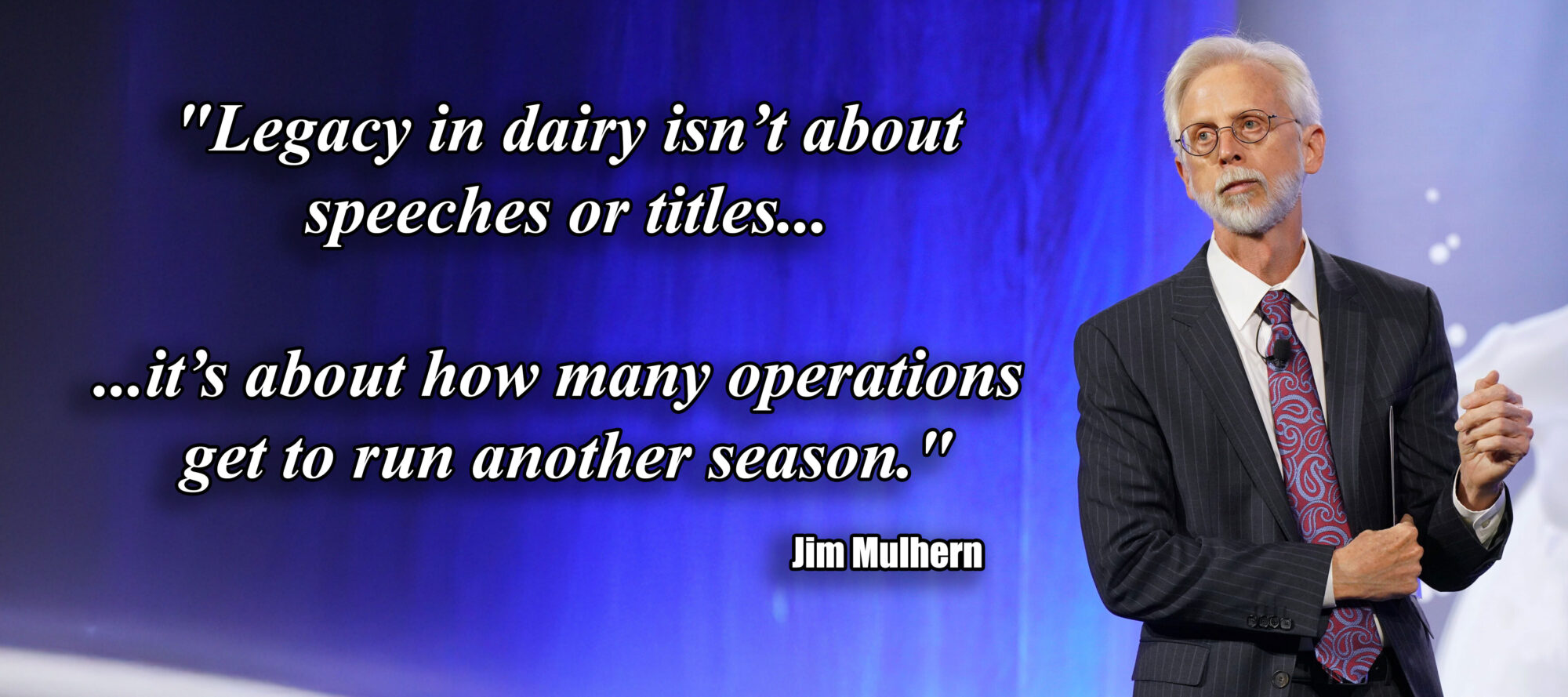
Legacy isn’t what you build after you survive. Legacy is what you build while surviving.
That kind of invisible courage—showing up for decades without recognition—requires the same thing the McCartys needed: the willingness to be vulnerable to failure without anyone watching.
But most producers I talk to face the opposite challenge. Their fear isn’t invisibility. It’s visibility.
You’ve probably said this yourself. In hundreds of conversations with mid-size dairy producers, I’ve heard the same refrain: “That’s for the big guys. I’m too small to matter to Land O’Lakes or Danone or any of these programs.”
I’ve come to believe something uncomfortable about that sentence. In most cases, it’s not a size problem at all. It’s a fear problem wearing a scale costume.
The McCartys had advantages, yes. Scale, Kansas State University support, and a Danone partnership. But Randy Kortus won Dairy Producer of the Year in 2023 with approximately 90 cows across three breeds—Holsteins, Jerseys, and Ayrshires. Ninety cows. That’s not mega-scale. That’s the kind of operation thousands of producers run while telling themselves they’re “too small to matter.”
The difference wasn’t Kortus’s cow count. It was his willingness to be seen. To share operational data with universities for benchmarking. To host farm tours and engage with industry visitors. To present at conferences about what worked and what didn’t. To document his practices in ways that helped other producers learn.
“Too small” protects us from vulnerability. It’s easier to say “Programs like that aren’t for farms my size” than to make the call, share the data, and risk rejection.
But here’s what I’ve learned: Land O’Lakes TruTerra accepts operations of ALL sizes. They paid $5.1 million to farmers in 2022 for carbon sequestration—distributed among thousands of participants, most of whom were mid-size operations.
USDA EQIP programs often score smaller operations HIGHER because they can demonstrate greater per-acre environmental impact.
Regional processors actively seek mid-size operations for premium programs because they want authentic “family farm” stories for their marketing.
The question isn’t whether you’re big enough to matter. The question is whether you’re brave enough to become visible.
And I get it—visibility is terrifying. When you’re visible, people see your failures as well as your successes. Your neighbors know when you’re struggling. Industry colleagues witness your challenges.
But here’s what I’ve noticed about every producer who eventually earned recognition: They were all terrified, too. They didn’t conquer the fear. They just got tired of letting it make decisions for them.
What Separated the Stayers from the Leavers
Looking at the producers who emerged from the valley faster, I started noticing patterns. Three habits kept showing up—and none of them were what I expected.
Most producers do the opposite of all three. They compete instead of connect. Hoard instead of share. Protect instead of expose.
They became connectors instead of competitors. When you consistently highlight other farmers doing innovative work—profiling their approaches, sharing their data, celebrating their successes—something shifts. You become indispensable without ever asking to be. Within a year, people start asking you, “Who should I talk to about X?” You’ve built influence without ever self-promoting, because the person who knows who’s doing innovative work IS the expert.
The 2024 Industry Persons of the Year, GPS Dairy Consulting, won not by promoting their own expertise but by consistently highlighting their clients’ achievements. “Inspiring change and growing leaders in the dairy industry is the hallmark of success for GPS Dairy Consulting.” They spent years making other people look good—and in the process became indispensable.
They built tools others could use. Not just case studies about their own success, but actual decision-making frameworks. Spreadsheets calculating carbon program ROI. Checklists assessing direct-marketing feasibility. Templates that other farmers could adapt to their own situations.
The McCartys built a 7,500-square-foot Learning Center featuring VR experiences that show how dairy foods are made. That’s not altruism—that’s infrastructure that makes their approach replicable. Every visitor becomes a potential advocate. Every tour validates the model for someone who might have otherwise dismissed it.
They answered the questions everyone was afraid to ask. Every producer community has uncomfortable questions for which nobody has real data. “Do carbon credits actually generate meaningful income?” “Can direct marketing work at 500-cow scale?” The producers willing to answer those questions—with real numbers, including what didn’t work—become the authorities. Not because they claimed expertise, but because they provided the transparency everyone else was withholding.
The common thread? All three approaches are about serving rather than promoting. You never say “Look at me.” You say, “Look at this problem I’m helping solve.”
Dairy culture has a long memory for people who show up to help. Recognition eventually finds them—often years after they’ve stopped expecting it.
What Actually Changes When Recognition Arrives
Here’s where something remarkable reveals itself.
When World Dairy Expo announced the McCartys as Dairy Producers of the Year, nothing changed about their operation. The cows still needed milking. The processing plant—now handling 2.2 million pounds daily, up from that original 500,000—still ran the same equipment. The economics were identical to what they’d been the day before.
But something profound shifted in the broader industry.
Within months, the media amplification cascade began. K-State Magazine, Brownfield Ag News, High Plains Journal, and Dairy Herd Management—publication after publication profiled the operation. A YouTube documentary that had been quietly accumulating views suddenly surged past 92,000.
But here’s what matters most: the institutional permission structure transformed.
Before recognition: “On-farm processing? That’s too risky for our lending portfolio.”
After recognition: “On-farm processing? The World Dairy Expo Producers of the Year operate one. Let’s look at the model.”
Before recognition: “Cost-plus pricing partnerships with major processors? That’s not how dairy works.”
After recognition: “Danone publicly documented their partnership model with the McCartys. Maybe we should explore similar arrangements.”
The award didn’t make the McCartys’ approach work. It gave everyone else permission to believe it could work for them.
And in an industry where 2,800 operations closed their barn doors in 2024—most of them mid-size dairies that ran out of options before they ran out of determination—that permission to believe matters more than any number can capture.
That’s the real legacy of surviving the validation gap. You don’t just prove your model works. You compress the timeline for everyone who comes after. The next producer exploring vertical integration won’t face thirteen years of isolation. Maybe five to seven years instead—because now there’s a proof of concept. A name to cite when their banker raises objections.
The Question That Matters
I should be honest about something: For every McCarty family that survives thirteen years in the valley, others did similar things and didn’t make it. Not because they lacked courage or vision, but because timing, circumstances, or just plain bad luck worked against them. This isn’t a story about guaranteed outcomes. It’s a story about what becomes possible when you stay long enough to find out.
If you’re a mid-size producer reading this, fighting to survive the next milk check while wondering whether any of this applies to you, here’s the question that determines everything:
“Is the survival work I’m doing today solving a problem worth documenting for others?”
If yes: Document it. Share it. Stay committed. Whether or not awards ever arrive, you’ll have built something meaningful.
If no: There’s honor in survival itself. Not every farm needs to be a case study. Some just need to keep milking cows and supporting families, and that’s enough. That’s always been enough.
But whatever you do, don’t fall into the trap of thinking you’ll survive first, then build a legacy later.
The McCartys didn’t wait until year thirteen to start documenting their model. They were sharing, teaching, and opening their operation to visitors throughout the valley—building that Learning Center, hosting tours, answering questions from producers who wondered if such a thing was even possible.
Moreno didn’t wait until 84% adoption to advocate for sexed semen technology. He was presenting, publishing, and partnering while skeptics still dominated the conversation.
Legacy is what you build while surviving. Or it’s not built at all.
What This Means for All of Us
As nominations open for the 2026 World Dairy Expo awards, thousands of producers will read the criteria and think: “That’s not for someone like me.”
Some of them are right. The survival challenges they face don’t translate into industry-wide impact, and that’s okay.
But some of them are wrong. They’re in year five of something meaningful. Year eight of building infrastructure that could help thousands. Year three of solving a problem publicly that others are desperate to understand.
To those producers: The validation gap is real. The silence of year six is brutal. The temptation to quit and return to simpler operations is constant.
But so is what waits on the other side.
I think about Ken McCarty standing in that processing plant in 2012. Stainless steel and fluorescent lights. The smell of concrete, possibility, and fear, all mixed together.
And I think about him standing in that same building in 2025, knowing exactly how every system works, having solved problems nobody else had documented, watching the industry finally catch up to what his family had been building for thirteen years.
The cows still needed milking that morning. They always do.
But something had changed. Not in the plant. Not in the economics. In everyone else’s permission to believe that what the McCartys built was possible for them, too.
The 2,800 farms that closed in 2024? They faced the same choices the McCartys faced in 2012. The same uncertainty. The same skeptical neighbors and confused bankers, and years of wondering if the risk was worth it.
The difference was refusing to stop—answering questions when nobody seemed to be listening, documenting when it felt pointless, staying visible when hiding felt safer.
The industry always catches up eventually. The only question is whether you’ll still be there when it does.
World Dairy Expo award nominations are open now. Visit worlddairyexpo.com for current deadlines and nomination forms. Whether you nominate your neighbor, or simply take inspiration from those who’ve walked this path before—the work you’re building today is the legacy that matters.
KEY TAKEAWAYS
All three WDE 2025 winners survived the same invisible battle: The McCartys (Dairy Producer of the Year), Juan Moreno (International Person of the Year), and Jim Mulhern (Industry Person of the Year) endured 13-45 years of building before recognition arrived
The validation gap kills more innovations than failure does: Those brutal middle years—when the work is real but nobody’s watching—is where most pioneers quit. The McCartys survived 4,745 days of it.
“Too small” is fear wearing a scale costume: Randy Kortus won 2023 Producer of the Year with 90 cows. Land O’Lakes TruTerra paid $5.1M to mid-size farms in 2022. The barrier isn’t size—it’s visibility.
Awards change permission, not profit: The McCartys’ honor didn’t improve their margins. It transformed “on-farm processing” from a banker red flag to a validated model.
Legacy is built while surviving, not after: Document now. Share now. Answer the hard questions now. That’s what separated the 2025 winners from the 2,800 farms that closed last year.
The Sunday Read Dairy Professionals Don’t Skip.
Every week, thousands of producers, breeders, and industry insiders open Bullvine Weekly for genetics insights, market shifts, and profit strategies they won’t find anywhere else. One email. Five minutes. Smarter decisions all week.
From 15 cows to 20,000: How the McCarty family revolutionized dairy farming while maintaining values and earning the industry’s top honor.
The McCarty Family: Generations of dairy farming excellence stands proudly in one of their innovative free-stall barns. From left to right, brothers Mike, Clay, Tom (father), Dave, and Ken McCarty have transformed a 15-cow Pennsylvania dairy into a sustainability-focused operation spanning multiple states, earning them World Dairy Expo’s prestigious 2025 Dairy Producer of the Year award.
Have you heard about the McCarty family? Since I visited their operation last month, I can’t stop thinking about their incredible story. Picture this: from a tiny 15-cow Pennsylvania dairy to becoming the World Dairy Expo’s 2025 Dairy Producer of the Year with nearly 20,000 cows across multiple states! What’s truly remarkable isn’t just their size but how they’ve managed to grow while staying true to their family values and pushing the envelope on sustainability.
From Humble Beginnings to Dairy Powerhouse
Do you know how most family farms struggle to make it past one generation? The McCarty story began in 1914 when Taylor McCarty started milking cows near Sugar Run, Pennsylvania. Even then, they weren’t just any operation- Taylor’s little herd received recognition from the National Dairy Association for their exceptional butterfat content!
Ken McCarty (the youngest of the four brothers running things now) told me this great story about his great-grandfather: “He was kind of an innovative guy. He sold tractors when everyone else was still using horse and buggy!”
When Harold McCarty (that’s Ken’s grandfather) took over in 1945, he expanded to about 40 Holsteins. Then Tom and Judy McCarty- who’d been teaching, can you believe it? -jumped in full-time in 1970, building a new barn for 150 cows. By 1981, the Pennsylvania Governor was touring their place, calling it “one of the most progressive” dairies in the state.
A young Tom McCarty tends to the dairy herd in Sugar Run, Pennsylvania, circa 1970s—never imagining his family’s operation would one day span multiple states with 20,000 cows. In this humble tie-stall barn where the McCarty brothers would learn to milk alongside their father, Tom was already dreaming of creating something his four sons might someday want to continue. “Dad always believed in hands-on learning,” Ken recalls. “Looking at this photo reminds me that our story isn’t just about growth—it’s about the values and work ethic that started right here in Pennsylvania and traveled with us to Kansas.
But here’s where things get interesting. The McCartys hit a crossroads in the 1990s. Tom and Judy realized that all four sons- Mike, Clay, and Dave- wanted to join the family business, but their Pennsylvania location couldn’t support it.
“Dad sat us down,” Ken told me, “and said, ‘Hey, we either need to change what we’re doing completely, or we need to think about moving otherwise we’re probably not going to survive this.'”
Can you imagine making that decision? After careful research, they took an enormous leap of faith, purchasing a wheat farm in Northwest Kansas and starting fresh with 250 cows on April 1, 2000. April Fool’s Day! Ken laughs about how many of their big moves happened on that date.
The Pennsylvania operation they left behind wasn’t just small-it was wildly inefficient by modern standards. Ken described it: “We were farming about 1,000 acres on 135 different fields spread 28 miles one way across the river, through multiple towns.” No wonder they were looking for a more sustainable approach!
And talk about challenges- they’d already survived two “hundred-year” floods just three years apart in the 1970s and weathered the devastating interest rate crisis of the 1980s. Moving west wasn’t just about growth and giving their multi-generation family business a fighting chance.
The Kansas Adventure and a Game-Changing Partnership
McCarty Family Farms’ state-of-the-art facility in northwest Kansas showcases their remarkable growth from 250 cows in 20,000 to a sophisticated operation with modern free-stall barns, processing facilities, and innovative design. This aerial view captures how the family’s bold relocation transformed both their business and the surrounding rural community.
Their initial Kansas operation grew quickly to 800 cows as the brothers started returning to the farm. In 2008, they were approached by a local economic development foundation about building a second dairy in Bird City. The foundation offered financing help to make it happen because they’d seen how dairy operations could revitalize rural communities and schools!
“The privately funded Economic Development Group approached us about building a dairy there,” Ken explained. “At the time, we weren’t financially capable of taking on that, and we honestly informed them of that.” However, through creative financing, the economic development group took a second position as their primary lender, and they made it happen.
By 2009, the McCartys were named Kansas Distinguished Dairy Farm Family of the Year. They continued thoughtful expansion, adding a location in Scott City and growing to about 7,000 milking cows.
Then came 2009-a catastrophic year for the dairy industry, with milk prices plunging. The McCartys had fortunately hedged about 50% of their production, allowing them to weather the storm better than many operations. This experience reinforced their commitment to risk management- a theme shaping their future business model.
But the real plot twist came in 2010. A simple phone call about alternative milk marketing approaches led to a revolutionary partnership with Danone (then Dannon Yogurt).
“We met with them in April 2010 to discuss a different relationship for buying and selling milk,” Ken explained. “The vision of a direct supply model immediately aligned between their teams and ours.”
This partnership was transformative but required something innovative: their on-farm processing plant.
Vertical Integration: The Secret Sauce
The McCarty Family Farms milk processing facility in Rexford, Kansas, represents the cornerstone of their vertical integration strategy. Built in 2012, this plant processes up to 2.2 million pounds of milk daily, condensing it before shipping to Danone while reclaiming water for reuse—putting 75% fewer trucks on the road and giving the family unprecedented control over their product quality from cow to customer.
You know how most dairy farms just ship their milk off and never see it again? In 2012, the McCartys flipped the script by building an on-farm milk processing facility at their Rexford location. Talk about a learning curve!
“We had no experience running a milk processing plant before 2012,” Ken laughed. “We depended heavily on the Danone teams to help us develop our skill set.”
Initially designed to process about half a million pounds of raw milk daily, they’ve since expanded it to handle up to 2.2 million pounds daily. They’re processing about 1.4 to 1.5 million pounds daily from their western operations.
But getting there wasn’t easy. Ken explained that they had to recruit people with processing plant experience. “Most of those team members are still with us 13 years later,” he noted proudly. They even hired their veterinarian, who was process-flow-oriented and focused on Lean Six Sigma principles, to help build the foundation of their plant management approach.
This is so brilliant because it gives them real-time feedback on milk quality. Imagine knowing within hours, not days, if there’s an issue with components or somatic cell counts! It creates this beautiful closed-loop system where the farm and plant teams work harmoniously.
The plant condenses milk before shipping it to Danone’s manufacturing facilities, separates and pasteurizes cream, and even reclaims water from the milk for cleaning and irrigation. It’s saved them from putting 75% of the trucks they would normally need on the road. That’s a win for efficiency AND the environment.
This vertical integration has also transformed their approach to herd health and antibiotic stewardship. “We have limited the potential milk residue antibiotics that we use on the farm to almost zero,” Ken told me. “Those that we do use are tightly controlled, typically at one location that is not a milk-producing site’s our dry cow and calving facility.”
As their cows have become more productive-routinely producing milk with butterfat levels of 4.5-4.6%-they’ve faced unexpected challenges at the processing level. “Our processing plant separators weren’t designed to accommodate butterfat levels that high, so we have to run our plant slower,” Ken explained. “Most dairymen, their connection to that separator ends at the back of a milk tanker. We see it all the way through.”
East Meets West: The MVP Partnership
The McCarty and VanTilburg families stand united at their MVP Dairy facility in Ohio, where these fourth-generation farm families from Kansas and Ohio joined forces in 2018 to create a groundbreaking partnership that combines western dairy expertise with eastern agricultural innovation. Their collaborative vision has transformed both operations and created a model for sustainable dairy production across America’s heartland.
Even with their expanded processing capacity, by 2017, the McCartys were looking for new opportunities. This led them to partner with the VanTilburg family in Ohio, creating the McCarty-VanTilburg Partnership (MVP) Dairy.
“The VanTilburgs wanted to connect their crops more directly to finished goods,” Ken explained. “We brought our Danone relationship and dairy expertise to the table. They brought the land and local reputation.”
The Ohio operation, which opened in November 2018, milks about 4,000 cows and ships raw milk directly to Danone’s yogurt plant 18 miles away. What I love about this story is how they took what they learned, Ohio-specifically about tunnel-ventilated barn designs, and brought it back to improve their Kansas operations.
The newest Kansas facility includes two, 120-cow DeLaval rotaries with four, six-row tunnel-ventilated free stall barns feeding each rotary, eight total barns sitting tail-to-tail, sharing a common feed lane, common manure management system.” This design optimizes cow flow, labor efficiency, and animal comfort.
Meanwhile, their Beaver City, Nebraska location was transitioned into a specialized heifer-raising facility, further demonstrating their strategic approach to operational specialization.
Throughout all this growth, they’ve remained committed to their relationship with Danone North America. Today, MVP Dairy ships raw milk directly to Danone, while their western operations process milk through their plant before shipping it to Danone and a few other customers.
The Brothers McCarty: Four Pieces of One Puzzle
The McCarty brothers standing together at their Rexford facility: Mike, Clay, Dave, and Ken. Each manages a distinct aspect of the operation—farm operations, feeding, finances, and processing/sustainability respectively—creating a seamless leadership puzzle that has guided their growth from 15 to 20,000 cows across multiple states.
Have you ever wondered how family businesses work together without driving each other crazy? The McCarty brothers have figured it out by each finding their lane.
The youngest, Ken, oversees the processing plant genetics work and leads their environmental sustainability and animal welfare initiatives. He smiled, “My preference is working directly with cows, but I spend much more time in front of a laptop than I ever intended to.”
Dave handles “basically everything financial”-banking relationships, budgeting, and overseeing the office team.
The two oldest brothers, Clay and Mike, focus on farm operations, feed buying, and managing the farming side of the business.
Their secret? “We more or less stay out of each other’s areas,” Ken explained simply.
This clear division of responsibilities allows each brother to develop expertise in his domain while ensuring the operation runs smoothly. The management approach has evolved as the business has grown more complex.
I asked Ken how they’ve managed to maintain harmony throughout decades of working together. He attributes it to genuine respect for each other’s strengths and a shared commitment to the family legacy. Unlike many family businesses that fracture under pressure, McCartys has used its complementary skills to build something greater than any other business could have accomplished individually.
Now, they’re beginning to bring in the fifth generation. With 11 family members between ages 8 and 24, the oldest is just starting to join the business after college. It’s a different world than when the current generation started, and his brothers “grew up with a shovel and a pitchfork.” Still, today’s dairy industry requires technological savvy, business acumen, and environmental expertise.
“The eight-year-old says he wants to be a farmer but also says he wants to be a fighter pilot and soldier and a policeman and firefighter,” Ken laughed. “So, he’s eight.” However, succession planning is already in motion for the older fifth-generation members.
Commitment to Team Member Well-Being
A McCarty team member meticulously preparing the rotary parlor for the next milking shift. The farm’s commitment to cleanliness reflects their DIRT principles (Dedication, Integrity, Respect, Teamwork) and ensures both quality milk production and a safe working environment for employees.
One practice that really impressed me about the McCartys is their approach to employee care and retention. In an industry often criticized for labor practices, they’re proving that treating people right is both ethical AND good business.
“Great employees are the backbone of any successful operation,” Ken told me. “We strive to offer competitive compensation packages with comprehensive benefits including health insurance and 401k plans, which helps us attract and retain quality team members.”
This approach has helped them build remarkable stability in their workforce, with many employees having been with them for 10, 15, even 25 years. In rural communities with limited job opportunities, the McCartys have become employers of choice.
Ken acknowledges that recent inflation has created challenges in keeping pace with rising costs, but the family maintains their commitment to creating a positive work environment through both compensation and culture.
Their management philosophy is encapsulated in their DIRT principles: Dedication, Integrity, Respect, and Teamwork. These values guide every aspect of operations, from daily milking routines to long-term business decisions.
They’ve invested in a full human resources team focused on employee engagement, training, and ensuring everyone understands their role in the larger operation. The McCartys also lead by example, following the wisdom of Tom McCarty: “If you ask a team member to be a foot deep in manure, you best be two feet.”
One clever practice they’ve implemented is using third-party remote monitoring to identify problems and catch employees doing things right. “When our remote viewers notice our team members scratching a cow’s ear or doing positive things, we use that as training tools,” Ken explained. This positive reinforcement approach helps build a culture of genuine animal care.
Data-Driven Dairying with a Dash of Cow Sense
“Through genetic testing, we gather data for nearly 100 traits and indexes on our calves. This data helps us make breeding decisions that make our herd healthier and more sustainable with each generation.” – Ken McCarty on the family’s data-driven approach to herd improvement
When I asked Ken about managing multiple operations, he emphasized their reliance on standardization and protocols. “Each farm operates the same synchronization protocols, treatment protocols, breeding strategies, and vaccination strategies,” he explained. “We work with the same nutritionist, use the same training protocols, and consult the same independent experts.”
This standardization extends to how they collect and analyze data. They’ve invested considerable time ensuring that data entry is consistent across all locations, from how feed ingredients are coded to how health conditions are defined.
“As we’ve stepped away from day-to-day cow-side activities and into more of a true ownership and management role, that standardization has made our systems better,” Ken reflected. “Unlike managing by feel, we allow the data to drive many of our decisions.”
One example Ken shared was the challenge of consistently defining health conditions across facilities. “How do you define an RP (retained placenta)? Everybody in the dairy industry has a slightly different attitude regarding what defines an RP. So, making sure that everybody in our system defined it the same way and entered it the same way so that data analysis and farm management is streamlined, standardized, and simple- those were some of the bigger challenges.”
But Ken quickly added that they haven’t abandoned traditional “cow sense.” Instead, they’ve augmented it with technology and analytics, creating a more precise approach to management.
Their newest facilities in Kansas feature 220-stall DeLaval rotaries with tunnel-ventilated free-stall barns arranged tail-to-tail with common feed lanes. This design optimizes cow comfort, labor efficiency, and operational flow. Their technology includes activity meters for heat detection, milk meters tracking flow and yield, and sophisticated monitoring systems.
I found it fascinating how they’ve integrated this high-tech approach with traditional dairy wisdom. Ken noted that, in some ways, their current team members are even better “cow people” than he and his brothers were, thanks to the combination of data-driven protocols and hands-on training in observing cow behavior and comfort.
Sustainability That Sets Industry Standards
McCarty’s state-of-the-art flush system in action—where sustainability meets practicality in modern dairy farming. This water recycling system represents just one piece of the comprehensive environmental approach that earned them B Corp certification. While most visitors focus on adorable calves or impressive milking parlors, it’s innovations like this automated manure management that dramatically reduce water usage while improving barn hygiene. As Ken explains, “In dairy farming, sometimes the most impactful environmental solutions are the ones most visitors never think to ask about.
In December 2020, McCarty Family Farms achieved something remarkable- B Corp certification- joining a select group of companies meeting the highest social and environmental performance standards. This makes them one of the few dairy farms globally to meet these rigorous standards.
“As 4th generation dairy farmers, our family has a long-established commitment to environmental stewardship and using our business as a force for good in the world,” Ken explains. “Becoming a Certified B Corp™ amplified our commitment by prioritizing mission-driven collaboration with our partners to drive real, systemic change and create impact at scale.”
What makes their sustainability metrics particularly impressive is how they compare to industry benchmarks:
Their reduction of 8,474 tons of CO₂ equivalent significantly outpaces industry trends. While the dairy industry has decreased greenhouse gas intensity by 42% since 1971, total emissions increased by 14% due to production growth.
They implement cover crops on 95% of MVP Dairy’s 4,500 acres, far exceeding typical adoption rates in the Midwest.
Their innovative manure management aligns with research showing advanced technologies can reduce GHG emissions from manure by 58-80%.
They’ve achieved these results partly through productivity improvements, increasing milk production by approximately 14-15% without synthetic growth hormones. “All that has been achieved by improved feeding, milking procedures, and the elimination of stress,” Ken explained.
Their approach to resource conservation extends to water and energy as well. They worked with Kansas State University to redesign sand reclamation units that now capture over 97% of sand for reuse as bedding. They’ve implemented innovations in smart cow cooling systems that don’t run water when cows leave the pen, and they continuously evaluate ways to reduce electrical usage and fuel consumption.
The McCartys don’t just protect the environment but actively enhance it. They’ve planted trees, created pollinator habitats, and maintained wildlife boxes around their farms. Today, they have more than 58 wildlife boxes and 25 acres dedicated to native plants for pollinators.
According to Danone North America, McCarty Family Farms produces 30% more milk with fewer resources from cows living longer, healthier lives. They became the first farm in the world to achieve the highest animal welfare status from Validus, and they used water collected from the condensing plant to irrigate nearby crops.
A 2024 study from Ireland validates their approach, showing that implementing climate change mitigation strategies can reduce emissions by 12% while increasing farm net savings. The McCartys are living proof that environmental and economic sustainability can go together.
Weathering the Storm: Risk Management in Volatile Times
When I asked Ken about the industry’s biggest challenges, his answer was immediate: risk mitigation in an increasingly unpredictable world.
“They were called black swan events because they were pretty dang rare,” he observed, “but it seems like black swan events happen about every six months anymore.”
He cited several factors: “Consolidation continues to happen. Consumer connection to agriculture continues to dwindle. Geopolitical impacts on the ag world continue to slip further and further from our control.”
The McCartys’ approach focuses on long-term stability rather than short-term gains. Their Danone relationship allows them to take “a much longer-term view of management strategies, investments, and risk management.”
This means:
Securing energy costs years in advance
Acquiring more cropland to stabilize feed costs
Developing relationships with equipment providers to minimize maintenance uncertainties
Creating systems that can weather market volatility
Ken sees progress in the industry’s ability to manage risk, noting that tools like Livestock Risk Protection (LRP) and Dairy Revenue Protection (DRP) didn’t exist 25 years ago. Still, he acknowledges the challenges of implementing comprehensive risk management while handling the day-to-day demands of a complex agricultural operation.
This focus on stability over speculation starkly contrasts the boom-and-bust cycle that defines much of agriculture. By taking a conservative, long-term approach to business planning, McCartys has positioned itself to survive and thrive through industry cycles that have bankrupted many operations.
A Day in the Life: Where High-Tech Meets High-Touch
McCarty’s 120-cow DeLaval rotary parlor epitomizes modern dairy efficiency where precision engineering meets animal care. This aerial view showcases the carefully choreographed milking process where thousands of cows move through daily with remarkable calm. While data screens monitor every aspect of production in real-time, it’s the thoughtful facility design and gentle handling that truly makes the difference. Here, cutting-edge technology doesn’t replace the human element—it enhances it, allowing team members to focus more on cow comfort while achieving impressive throughput that was unimaginable in the family’s Pennsylvania tie-stall beginnings.
What would it be like to spend a day at McCarty Family Farms? I got a glimpse during my visit to their Rexford operation.
The day starts early, as it does on all dairy farms, but what strikes you immediately is the calm, methodical approach of the team. In the control room of the rotary parlor, large monitors display real-time data on each cow’s milk flow, yield, and conductivity measurements that might indicate mastitis and activity patterns.
“See that cow there?” one of the herdsmen points to a dot on a screen. “Her activity spiked last night, and she’s showing all the signs of heat. She’ll be bred today.” This seamless integration of technology and biological awareness is at the heart of their operation.
In the barns, the tunnel ventilation creates a comfortable environment even on a hot Kansas day. Cows lounge on clean, reclaimed sand bedding, and the feed lanes are meticulously maintained. Feed pushers- both automated and human-ensure fresh feed is always available.
One of the most fascinating parts of the operation is watching the communication between the farm and processing plant teams. When a milk tanker arrives at the plant-just, a short drive from the dairy-it’s tested immediately. Results flow back to the farm managers within the hour, allowing for real-time adjustments.
“This morning, we saw our butterfat was running a bit higher than yesterday,” a feed manager explained. “We’re already looking at the ration to see if any changes might have caused that.” This rapid feedback loop creates a level of responsiveness that would be impossible in a traditional dairy model.
The commitment to animal welfare is evident everywhere. Cows move easily through well-designed handling systems, employees use gentle voices and touch when interacting with the animals, and veterinary protocols prioritize prevention over treatment.
The farm’s water reclamation system is equally impressive. Water extracted during the milk condensing process is captured, treated, and reused first for cleaning, then potentially for irrigation. “Nothing goes to waste here,” Ken told me. “That’s part of our commitment to being good stewards.”
The Ultimate Recognition: 2025 Dairy Producer of the Year
From these humble roots grew a dairy dynasty: Young McCarty brothers (L to R) Mike, Clay, Dave, and Ken in the 1980s, their early passion for farming culminating in World Dairy Expo’s 2025 Producer of the Year honor.
All these efforts culminated in March 2025 when Ken, Mike, Tom, Dave, and Clay McCarty were named World Dairy Expo’s 2025 Dairy Producer of the Year. This prestigious award recognizes producers who excel in efficient production and quality breeding while incorporating progressive management practices.
What makes them deserving? Several factors stand out:
Their vertical integration model gives them greater control over product quality and environmental impact
Their direct supply relationship with Danone creates economic stability
Their B Corp certification demonstrates verified commitment to environmental and social responsibility
Despite their size, they’ve maintained family values and a hands-on approach
They consistently adopt and adapt technology to improve operations
With the fifth generation beginning to join, they exemplify successful farm succession
For Ken, success in the dairy industry boils down to something simple yet profound: “Very few businesses ever make it beyond the first generation, let alone the second or the third. We’ve been fortunate enough to survive to the fourth generation, hopefully, the fifth, but not only survive, but we’ve also been able to prosper in the dairy industry, and that’s a hell of a lot of fun.”
He added a sentiment that speaks volumes about their approach to the business: “To be able to survive and to prosper, and to do it in such a way, in an industry that you love being in, don’t feel like I go to work any day, I just get to go do what I enjoy.”
This passion for the work itself is beyond mere business success everything at McCarty Family Farms. When I asked Ken about retirement plans, he answered immediately: “Never. I love what I do.”
At the Judy McCarty Dairy Learning Center, the family’s commitment to education comes alive as visitors of all ages experience hands-on learning about modern dairy farming. Named after Ken’s mother, this interactive space embodies the McCarty philosophy that knowledge—like their farming legacy—should be accessible to the next generation of dairy enthusiasts and consumers. This dedication to transparency and education reflects the same forward-thinking approach that has guided their farm management decisions for over a century.
The Bottom Line: Lessons for Progressive Dairy Farmers
If you’re looking to apply some McCarty wisdom to your operation, here are the stand-out lessons:
Vertical integration through on-farm processing can create stability and quality control advantages
Standardization of protocols across multiple sites enables consistent performance
Data-driven decision-making complements traditional “cow sense” for optimal management
Regenerative agriculture practices can improve both environmental outcomes and economic performance
Strategic risk management creates operational stability in volatile markets
B Corp certification provides a framework for measuring and improving social and environmental performance
Thoughtful succession planning is critical for transitioning to the next generation
As one of their team members put it: “The McCartys aren’t just building a business-they’re building a legacy.” This focus on long-term sustainability-environmental, social, and economic positioned them at the forefront of an industry in transition.
Their partnership with Danone has created a model for direct supply relationships in the dairy industry, reducing market volatility while ensuring consistent quality for consumers. The fact that this initial experiment has lasted over a decade and expanded to multiple facilities speaks to its success.
The McCartys’ approach to technology adoption is similarly instructive. Rather than chasing every innovation, they carefully evaluate technologies based on their impact on cow comfort, employee efficiency, environmental footprint, and economic return. When they find something that works, their tunnel-ventilated barn design implements it systematically across their operations.
Perhaps most importantly, they demonstrate that scale and sustainability aren’t mutually exclusive. At nearly 20,000 cows, they’ve built one of the most significant dairy operations in the country while simultaneously setting industry standards for environmental performance and animal welfare.
As I reflect on the McCarty story, what impresses me most isn’t just their growth from 15 to 20,000 cows-it’s how they’ve done it with integrity, innovation, and a genuine commitment to people and the planet. In an era of increasing challenges for family farms, McCarty Family Farms proves that with vision, adaptation, and commitment to excellence, the family farm has a place in modern agriculture and can lead the way.
And that, my friend, is why their recognition as World Dairy Expo’s 2025 Dairy Producer of the Year isn’t just well-deserved- it’s a hopeful sign for the future of dairy farming in America.
Key Takeaways
Vertical integration creates stability and control: Their on-farm processing plant provides real-time quality feedback, reduces transportation costs, and creates environmental benefits while buffering market volatility.
Standardized protocols + data drive success: Consistent practices across multiple farms, combined with meticulous data collection and analysis, enable strategic decision-making while complementing traditional “cow sense.”
Sustainability and profitability work together: Their B Corp certification, regenerative agriculture practices, and resource conservation initiatives have improved environmental outcomes while enhancing economic performance.
Clear role division prevents family conflict: Each brother has distinct responsibilities that leverage their individual strengths, creating harmony through respected boundaries and shared vision.
Long-term thinking beats short-term gains: Their approach to risk management, succession planning, and infrastructure investment focuses on creating stability in an inherently volatile industry.
Executive Summary
The McCarty Family Farms’ remarkable journey from a 15-cow Pennsylvania operation to World Dairy Expo’s 2025 Dairy Producer of the Year showcases how strategic innovation can transform a family business across generations. After relocating to Kansas in 2000, the four McCarty brothers established a groundbreaking direct supply partnership with Danone in 2010, building an on-farm milk processing plant that revolutionized their quality control and environmental impact. Their operation now spans multiple states with nearly 20,000 cows, implementing advanced sustainability practices that earned them B Corp certification while maintaining clear family governance where each brother manages distinct areas of expertise. Perhaps most impressive is how they’ve balanced cutting-edge technology and data-driven management with traditional farming values and a genuine passion for dairy farming, creating a model that proves family farms can not only survive but thrive in modern agriculture.
Learn more:
Mastering Dairy Farm Succession Planning: A Step-By-Step Guide – Learn the essential steps for transitioning your dairy operation to the next generation, with insights that complement the McCarty family’s approach to bringing in their fifth generation.
How Ben & Jerry’s is Using Dairy to Fight Climate Change – Discover another innovative approach to sustainability in the dairy industry that parallels McCarty Family Farms’ commitment to environmental stewardship and B Corp certification.
Every week, thousands of producers, breeders, and industry insiders open Bullvine Weekly for genetics insights, market shifts, and profit strategies they won’t find anywhere else. One email. Five minutes. Smarter decisions all week.
To provide the best experiences, we use technologies like cookies to store and/or access device information. Consenting to these technologies will allow us to process data such as browsing behavior or unique IDs on this site. Not consenting or withdrawing consent, may adversely affect certain features and functions.
Functional
Always active
The technical storage or access is strictly necessary for the legitimate purpose of enabling the use of a specific service explicitly requested by the subscriber or user, or for the sole purpose of carrying out the transmission of a communication over an electronic communications network.
Preferences
The technical storage or access is necessary for the legitimate purpose of storing preferences that are not requested by the subscriber or user.
Statistics
The technical storage or access that is used exclusively for statistical purposes.The technical storage or access that is used exclusively for anonymous statistical purposes. Without a subpoena, voluntary compliance on the part of your Internet Service Provider, or additional records from a third party, information stored or retrieved for this purpose alone cannot usually be used to identify you.
Marketing
The technical storage or access is required to create user profiles to send advertising, or to track the user on a website or across several websites for similar marketing purposes.
To provide the best experiences, we and our partners use technologies like cookies to store and/or access device information. Consenting to these technologies will allow us and our partners to process personal data such as browsing behavior or unique IDs on this site and show (non-) personalized ads. Not consenting or withdrawing consent, may adversely affect certain features and functions.
Click below to consent to the above or make granular choices. Your choices will be applied to this site only. You can change your settings at any time, including withdrawing your consent, by using the toggles on the Cookie Policy, or by clicking on the manage consent button at the bottom of the screen.
Functional
Always active
The technical storage or access is strictly necessary for the legitimate purpose of enabling the use of a specific service explicitly requested by the subscriber or user, or for the sole purpose of carrying out the transmission of a communication over an electronic communications network.
Preferences
The technical storage or access is necessary for the legitimate purpose of storing preferences that are not requested by the subscriber or user.
Statistics
The technical storage or access that is used exclusively for statistical purposes.The technical storage or access that is used exclusively for anonymous statistical purposes. Without a subpoena, voluntary compliance on the part of your Internet Service Provider, or additional records from a third party, information stored or retrieved for this purpose alone cannot usually be used to identify you.
Marketing
The technical storage or access is required to create user profiles to send advertising, or to track the user on a website or across several websites for similar marketing purposes.







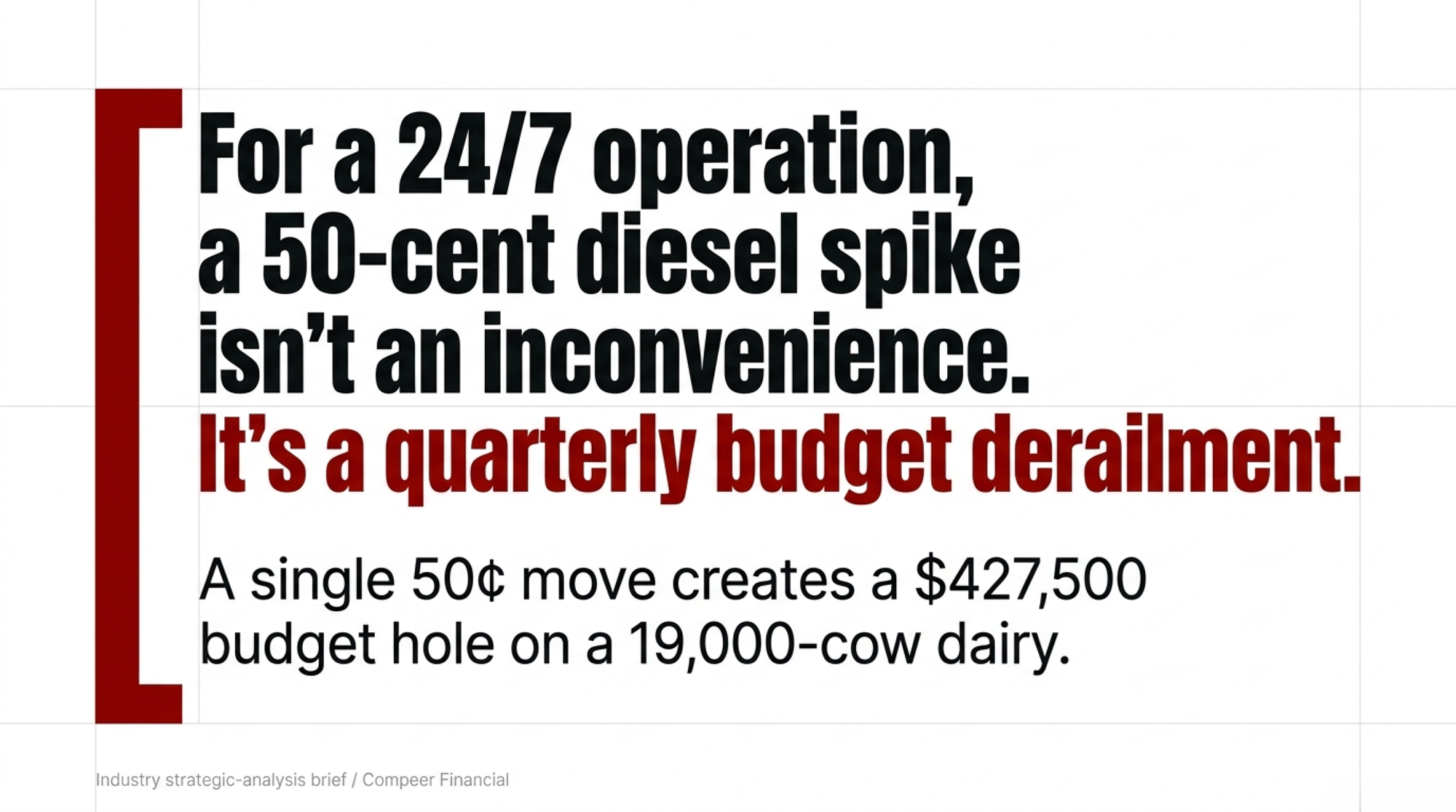
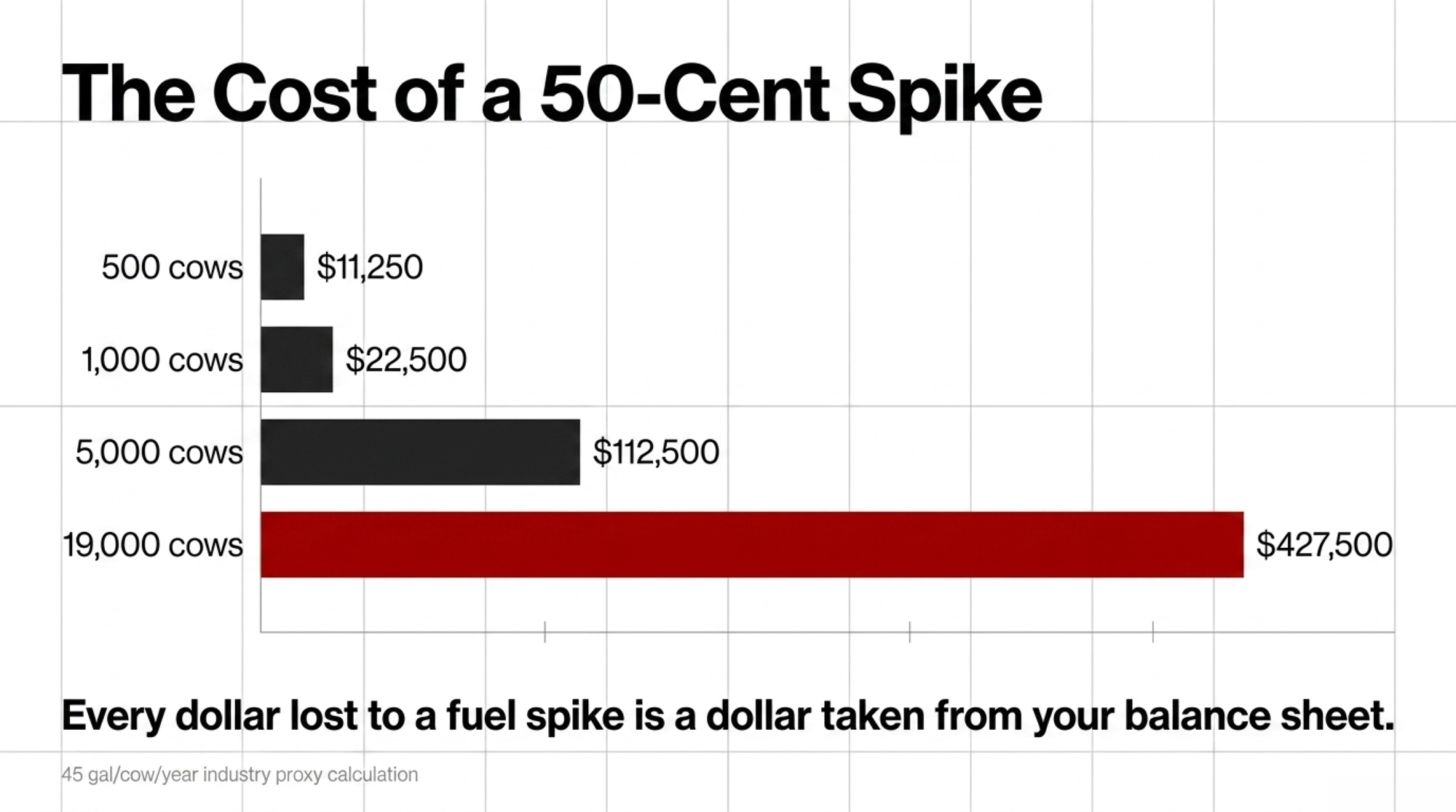
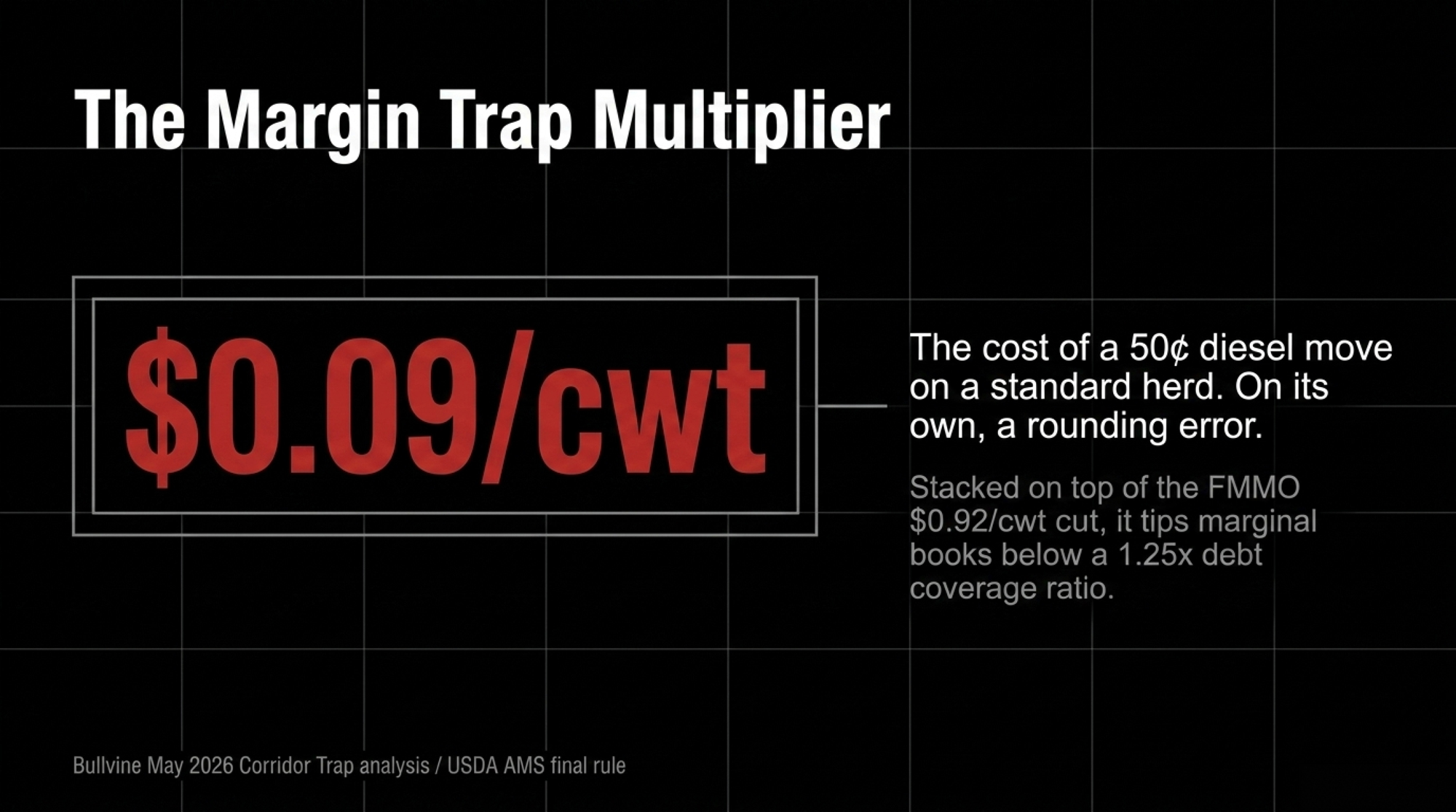
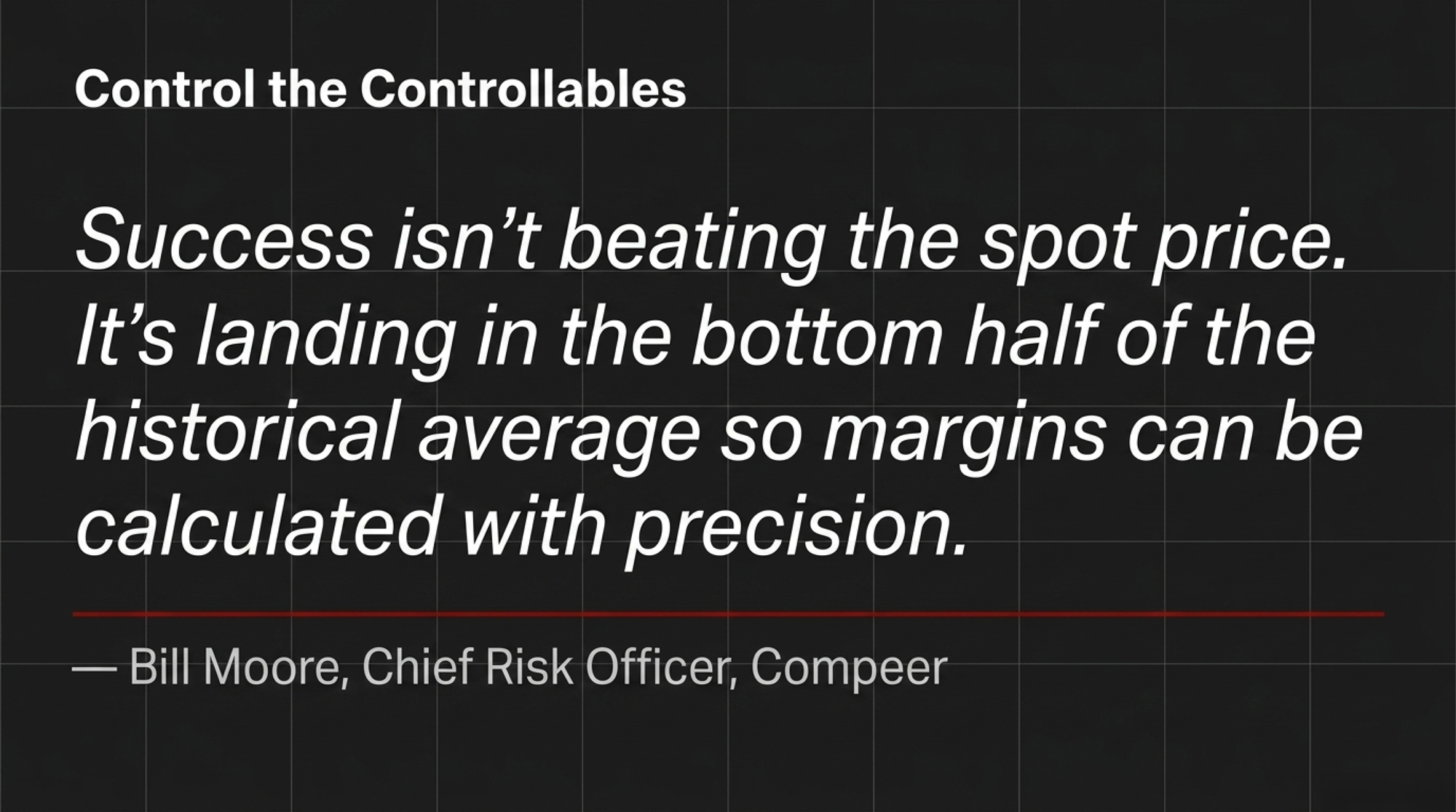
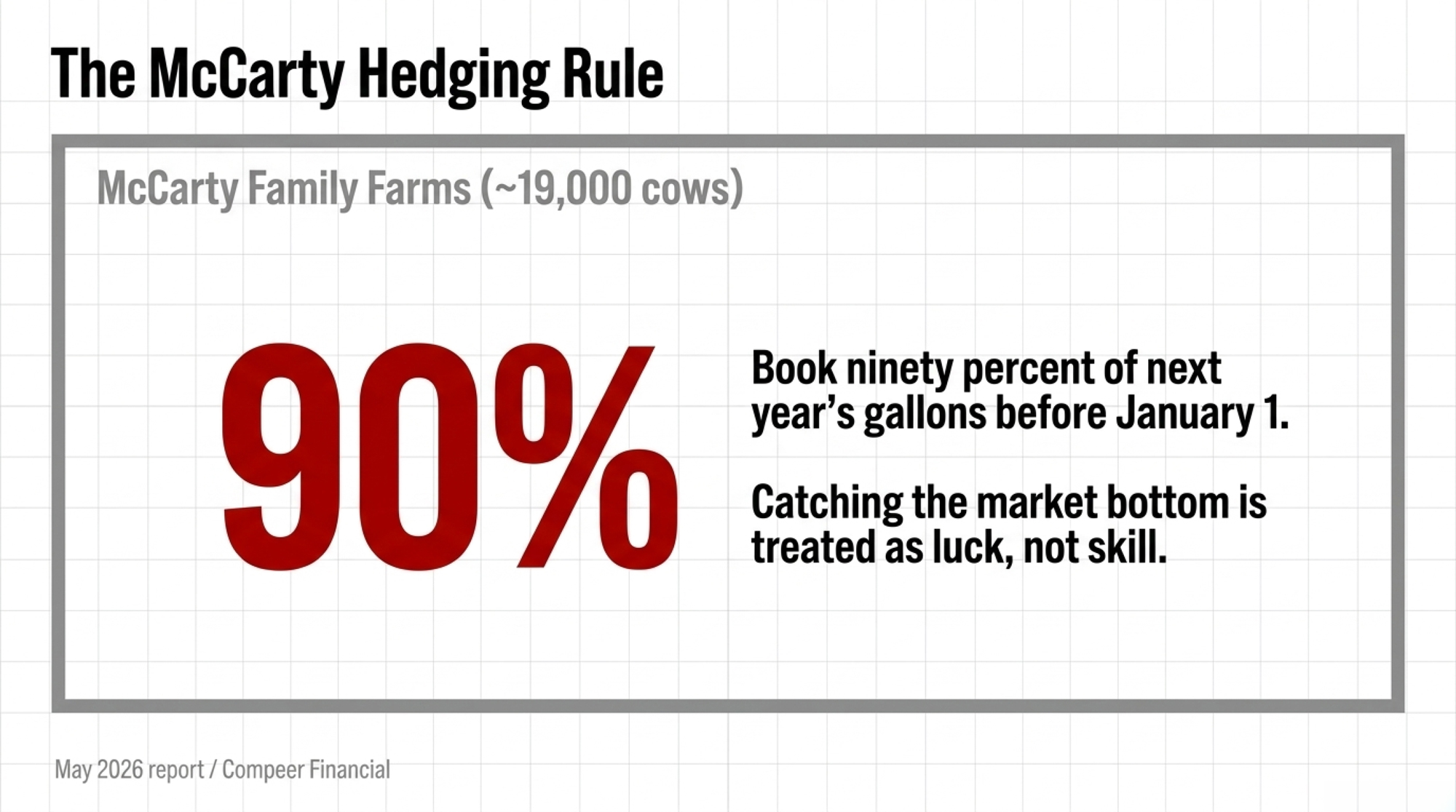
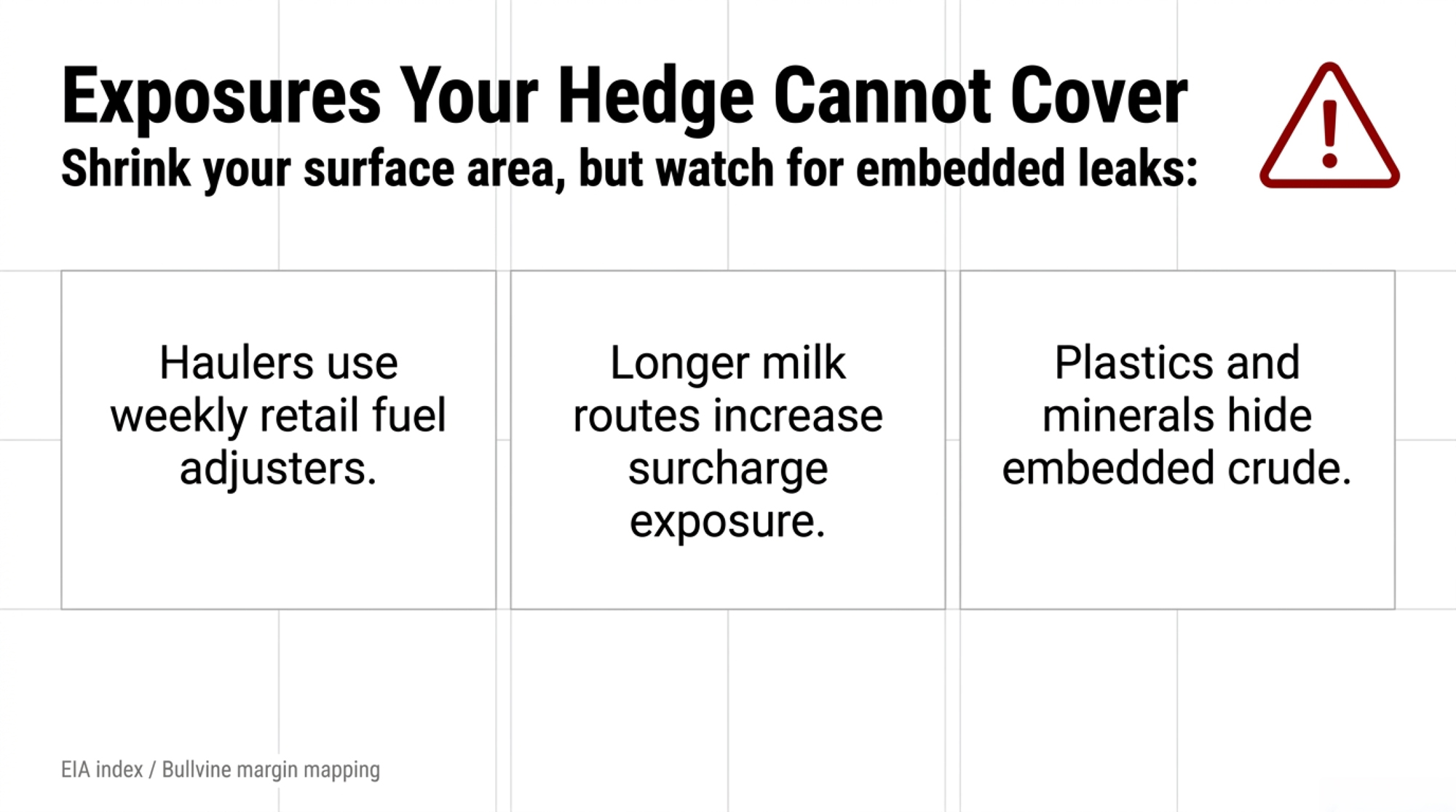
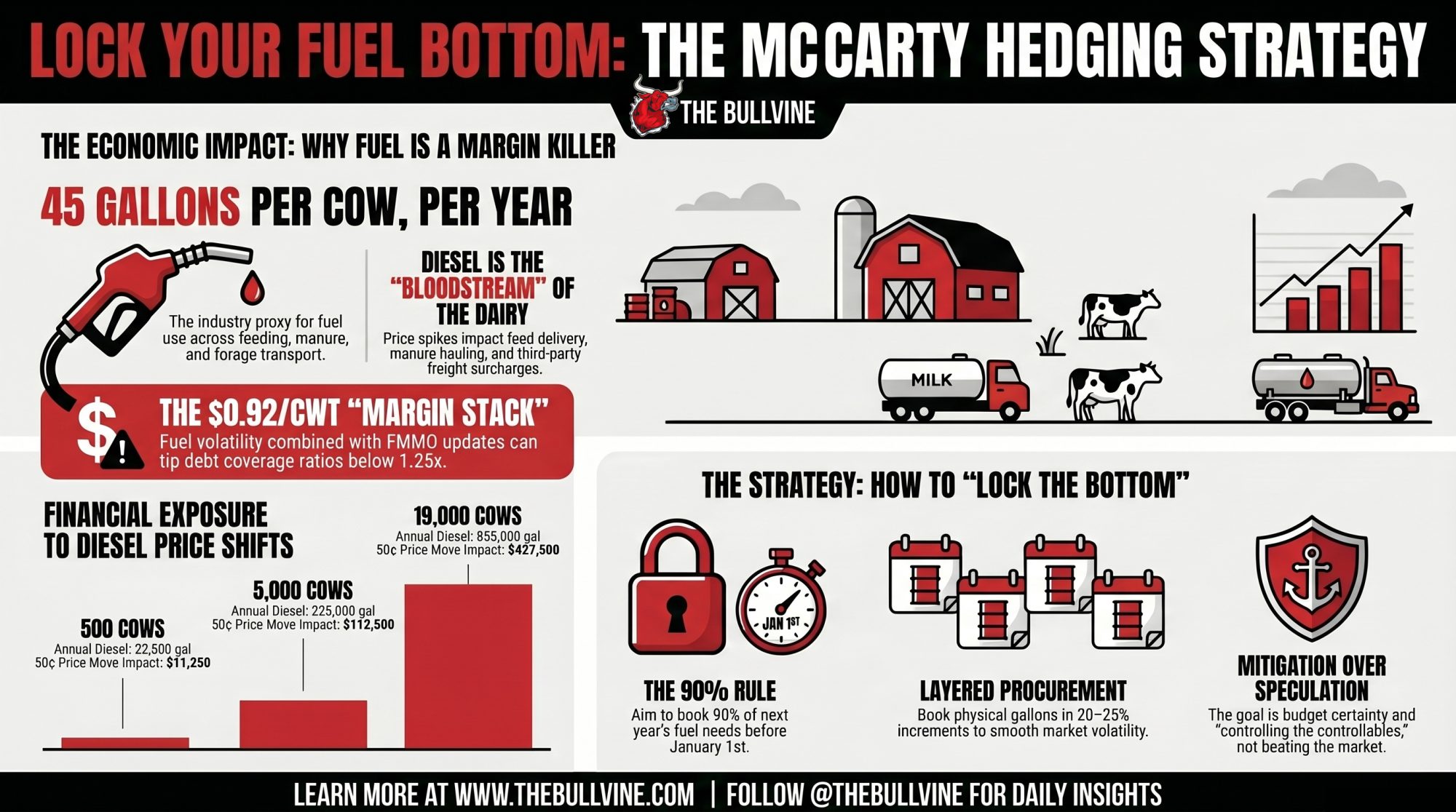
 The Sunday Read Dairy Professionals Don’t Skip.
 The Sunday Read Dairy Professionals Don’t Skip.