




A FOIA request pried loose USDA’s own file on Alexandre — ‘systemic failures’ the farm denied for years. The farm had recently dropped its ROC regenerative certification but held a separate one; USDA put it on stage anyway.
Executive Summary: A FOIA request pried loose USDA’s own investigation file on Alexandre Family Farm — the Crescent City, California operation that built a premium on regenerative and A2/A2 milk — and it confirmed “systemic failures” the farm had denied for years. The violations Alexandre admitted to include dragging cows with hip clamps, horn-tipping without pain relief, and cutting the teat off a mastitic cow; the National Organic Program logged them between 2019 and 2023. Then USDA put owner Blake Alexandre on a December 2025 podium to launch a $700 million regenerative pilot — even though the farm had recently let its ROC regenerative certification lapse while keeping a separate one, Land to Market, active (see correction). Here’s why it lands on your operation and not just his: welfare and organic milk have been paying $40–$50/cwt against a Class I base near $14.70, so a 400-cow organic herd is carrying roughly $2 million a year on certifications a single inspection report can suspend overnight (Bullvine certification reporting, February 2026). Lose them, and your costs stay organic-level while your check gets cut by more than half — and a revocation means a 36-month re-entry with no organic premium the whole way. A federal class action and a Humboldt County cruelty suit are both still live, neither decided. The move this month: pull your own certifier file and your five worst animal-care cases and read them cold, before someone with a FOIA request or a subpoena does it for you.
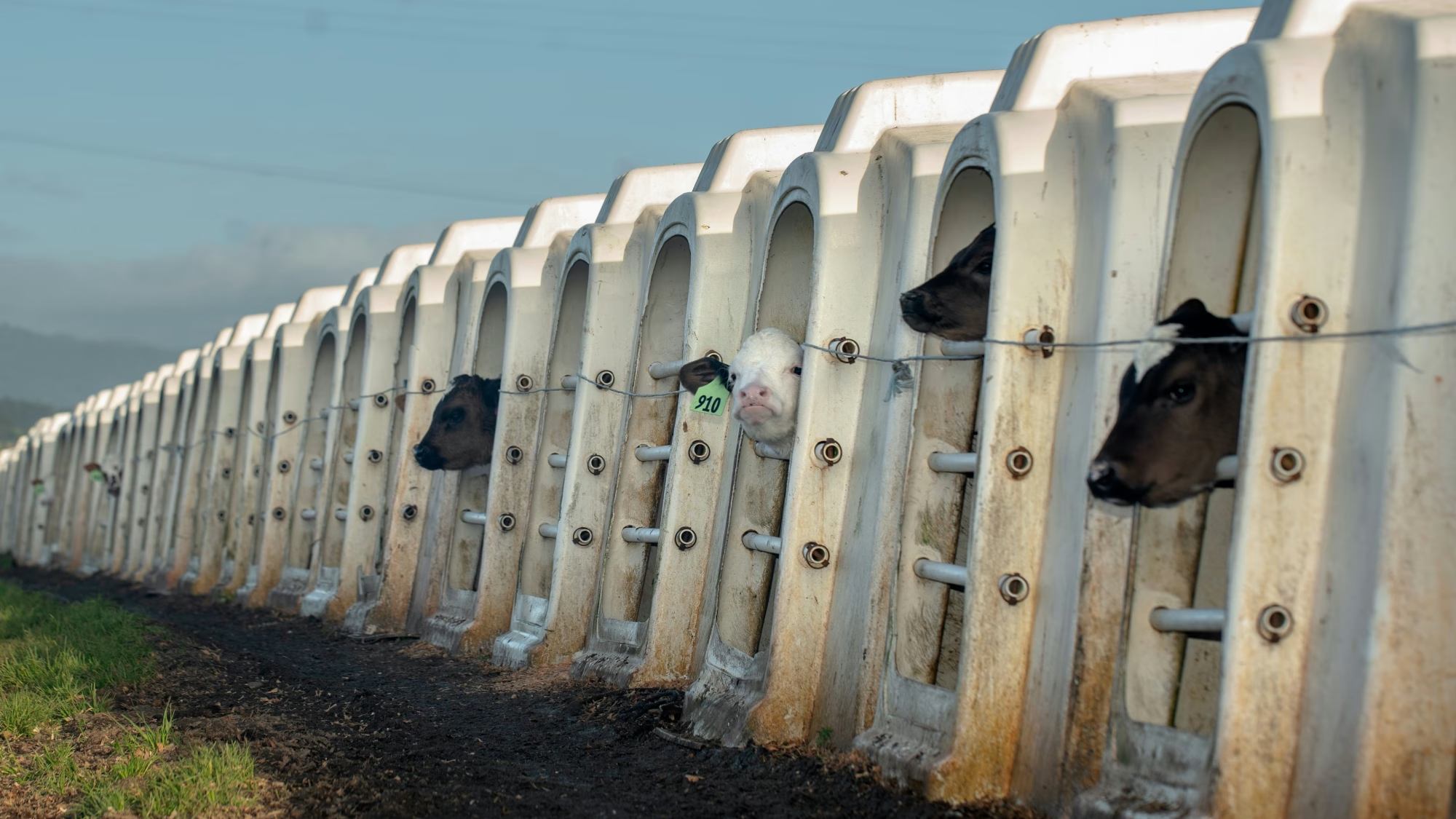
In December 2025, Agriculture Secretary Brooke Rollins put dairy farmer Blake Alexandre on a USDA podium to announce a $700 million regenerative farming pilot, alongside RFK Jr. and Dr. Oz. Alexandre told the room his Crescent City, California operation was the first U.S. dairy certified regenerative organic, and that regenerative farming meant “farming in harmony with nature, with the way that God intended”.
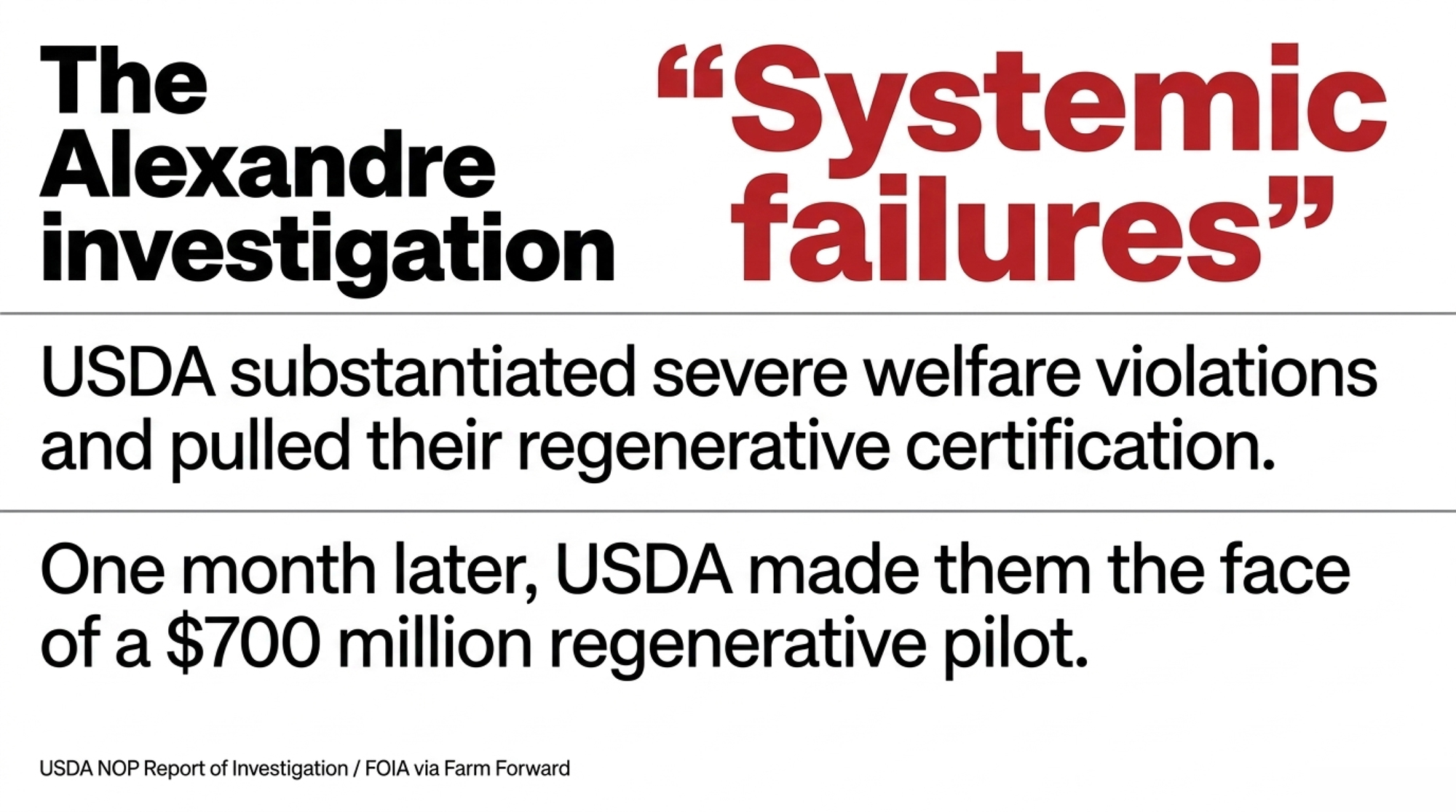
What nobody on that stage mentioned: a USDA investigation had already substantiated animal-welfare violations at his farm and found “systemic failures”.
| The Label Claimed… | The Federal File Found… | Timeline | Status (as of July 2026) |
|---|---|---|---|
| “Certified Humane” practices | Hip-clamping to drag cows; horn-tipping without pain relief | 2019–2023 | Federal class action live, not decided |
| “Regenerative Organic Certified” | NOP logged systemic welfare failures; ROC status ended in 2025″ | Pre-Dec 2025 | ROC ended 2025 — Farm Forward: suspended; farm: non-renewal. Land to Market cert retained (Nov 2025–Nov 2026) |
| “First U.S. dairy certified regenerative organic” | CCOF proposed suspension; 2-year heightened oversight settlement | Feb 2024 | Settlement in place; new welfare concerns flagged June 2024 |
| USDA podium endorsement (Dec 2025) | USDA’s own NOP file documented “systemic failures” | 2024 ROI | FOIA’d by Farm Forward; now public |
| Farm committed to “upholding organic standards” | OrganicEye filed fresh NOP + OIG complaints | Oct 2025 | Unresolved; allegations not yet substantiated |
That gap — between the milk carton and the federal file — is the whole story. And it’s a warning for any dairy whose premium rides on a label.
Blake and Stephanie Alexandre built the kind of operation most people only sketch on a napkin. A fifth-generation family running grass-based organic dairies on California’s North Coast, with A2/A2 and Certified Humane milk on Whole Foods shelves. From the outside, that stack of premium labels looked unbreakable.
Then Farm Forward filed a Freedom of Information Act request. And USDA’s own file told a different story than the one on the carton.
What’s Changing and Why
The National Organic Program investigated alleged welfare problems between 2019 and 2023, substantiated several, and laid out “systemic failures” in a 2024 Report of Investigation. None of it was public until the FOIA documents surfaced. The secret wasn’t the barn. It was the paper trail nobody outside the certifier had ever seen.
The Alexandre case isn’t really about one farm making bad calls. It’s about how a premium built on labels turns into a liability the moment your records can’t back it up.
If you sell organic, grass-fed, A2, regenerative, or welfare-certified milk, you’re making a claim a federal program can test — and document forever. Under USDA rules (7 CFR §205.662), your certifier puts every noncompliance in writing, and a proposed suspension stays on your record as an adverse action even after you fix the problem. Passing your next inspection doesn’t erase it.
Groups like Cornucopia and OrganicEye — and plaintiffs’ lawyers — can pull that record years later and quote your worst day without ever mentioning your best one. So who’s most exposed? Not the operation cutting corners on purpose. It’s the producer who genuinely believes in the model, stacks two or three labels, and never thought to stress-test the paperwork behind them.
How the Labels Fell — Faster Than the Milk Stopped Moving
The certifications didn’t all collapse at once. They peeled off one at a time while the milk kept shipping.
It started with the CCOF settlement on February 16, 2024. Facing a Combined Notice of Noncompliance and Proposed Suspension, Alexandre signed on to two years of heightened oversight — one unannounced inspection a year, plus regular healthcare-treatment and culling records handed to the certifier. An outright suspension was on the table. The settlement pulled it back.
In October 2025, the Cornucopia Institute downgraded Alexandre on its Organic Dairy Scorecard, flagging both product lines as “under increased scrutiny”. That same month, OrganicEye filed fresh complaints with the NOP and USDA’s Office of Inspector General, including alleged conflicts of interest involving the certifier. Cornucopia notes those OrganicEye allegations “have not been substantiated”.
Then the most visible label changed. The farm’s Regenerative Organic Certified (ROC) status for the dairy ended in 2025 — Farm Forward’s timeline describes it as a suspension after an audit report; the farm says it chose not to renew. Either way, the ROC seal that anchored the brand was on its way off the carton. The farm retained a separate regenerative certification, Land to Market — Bullvine has reviewed the certificate, valid November 2025 through November 2026 — and says it has been continuously certified regenerative throughout.
And the timing turned sharp. The specific label most associated with Alexandre’s national profile — ROC — was already lapsing by the December stage, whether by suspension or non-renewal. The farm was not without a regenerative certification, though: it held Land to Market throughout. Farm Forward’s Andrew deCoriolis called the USDA’s choice of poster child “disappointing,” warning it signals “it’s fine if you violate organic and animal welfare rules. You’ll be rewarded with a national spotlight”.
You don’t have to take a side here to see the gap between the public story and the record.
What’s a Premium Milk Check Actually Worth?
Start with what the premium is actually worth, because that’s the number that moves this from a compliance headache to a balance-sheet problem.
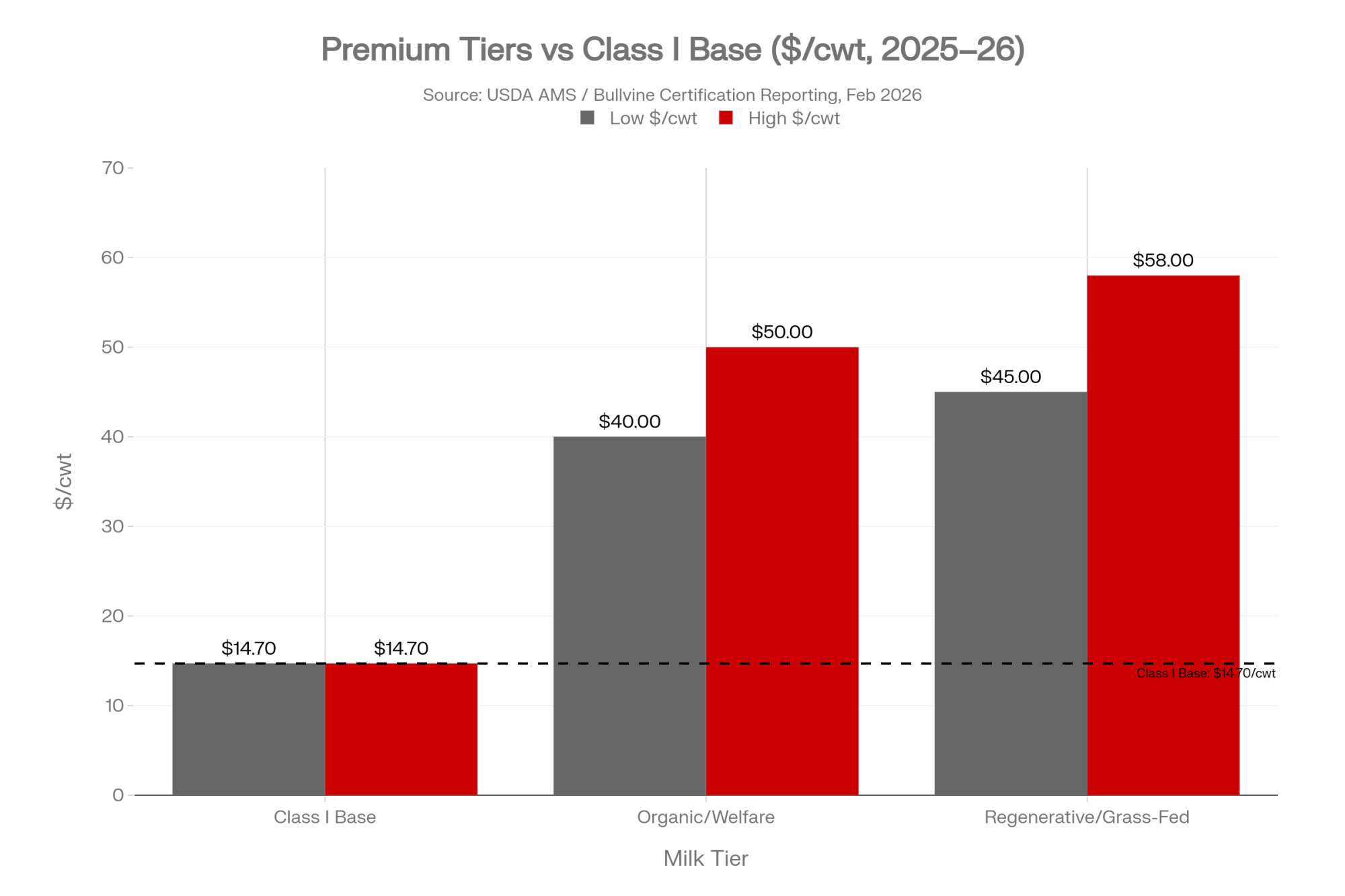
According to Bullvine certification reporting (February 2026), welfare-backed and organic brands — Jasper Hill, Maple Hill, Alexandre, AGW-certified herds — have been seeing farm-gate pay in the $40–$50/cwt range against a Class I base near $14.70, plus a retail premium around $2.63 per half gallon. Regenerative and grass-fed contracts can sit at the top of that band.
So the spread between a stacked premium and the base price often runs $25 to $35 a hundredweight. Sometimes more.
The barn math, one herd at a time
Take a 400-cow organic herd shipping roughly 80,000 cwt a year — about 55 lb/cow/day across the herd. Put the premium at a conservative $25/cwt over the Class I base. That’s $2 million a year riding on certifications a single inspection report can pull. Every year.
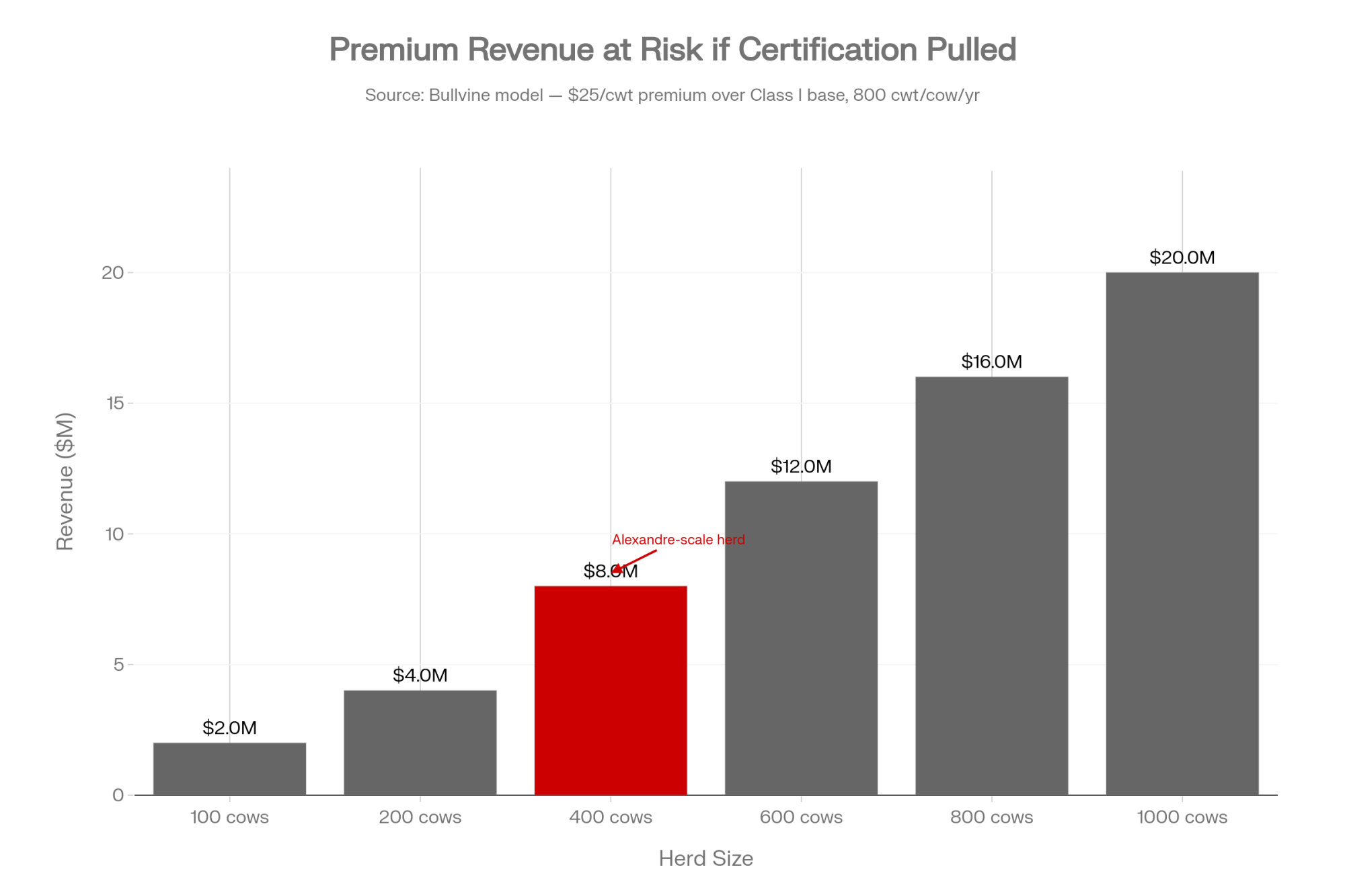
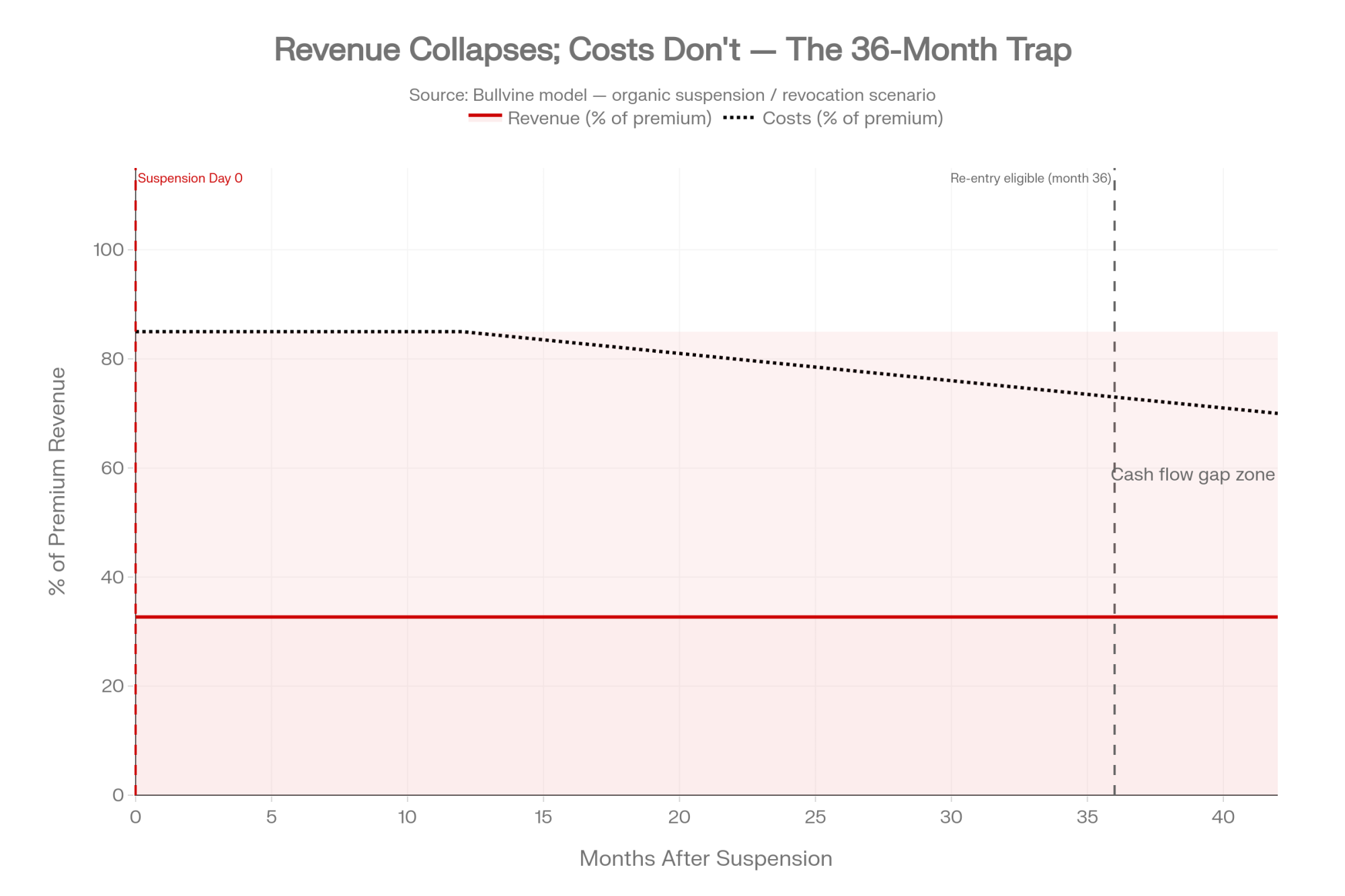
Lose them overnight, drop back toward base, and your costs are still organic-level while your milk check just got cut by more than half. The cost side can’t shrink anywhere near as fast as the revenue disappears.
And suspension isn’t even the worst case. If a certification gets revoked and you have to re-enter organic, you’re looking at a 36-month transition — three years of organic-level costs without the organic check while the land re-qualifies. That tail is where the real damage lives.
What the farm admitted — and where the cases stand
Here’s the part that’s already settled, not alleged. According to the USDA report, the violations Alexandre admitted to include dragging cows with hip-clamping machinery, horn-tipping without pain relief, cutting the teat off a cow with mastitis, spraying a diesel mixture on animals to ward off flies, animals going without feed, and animals dying from trampling. The farm admitted multiple violations of organic standards.
The farm also did real corrective work. Per the NOP Report of Investigation, it trained staff, hired an animal-welfare consultant, and corrected the existing noncompliances. A June 2024 unannounced CCOF inspection confirmed those corrections — though it also flagged a few new welfare concerns, including improper horn trimming on an unknown timeline.
Two lawsuits are still moving. A federal consumer class action in the Southern District of California accuses Alexandre and the Certified Humane program of “humane-washing,” seeking more than $5 million for conduct from at least 2019 through summer 2024. A separate animal-cruelty suit from Legal Impact for Chickens, filed in Humboldt County in September 2024, survived Alexandre’s writ challenge when the Court of Appeal denied it on September 11, 2025; the parties are now in discovery. Neither case has been decided.
In a statement, the farm said its “commitment to upholding organic and regenerative standards and bringing healthy food to our customers is unwavering”.
Both things are true at once. The farm improved and kept defending its product — and the record of what came before is permanent. Reached after publication through the reputation firm The Next Solutions Group, and in a statement the farm’s co-owner confirmed for attribution, Alexandre Family Farm disputed that its regenerative certification was ‘pulled.’ The farm said it ‘chose not to seek renewal’ of its ROC certification for the dairy and ‘elected to maintain’ a separate Land to Market regenerative certification, adding that it ‘continued to have a valid regenerative certification at the time of the news conference… and we continue to be certified regenerative to this day.’ Bullvine reviewed the Land to Market certificate, effective November 19, 2025 through November 19, 2026.
The Mechanics Behind the Outcomes
So how does a farm that genuinely cares end up with “systemic failures” in a federal file? Three forces stack up. Scale outruns oversight. Audits tend to check paperwork more than they check the worst corner of the barn. And every treatment decision doubles as a revenue decision.
There’s also a coverage gap most people miss. Modern Farmer reported that while Alexandre marketed whole-farm values, only a fraction of the milking herd actually met certain label criteria at any given time. That’s how the marketing and the barn drift apart even when some acres are genuinely managed to the highest standard.
The label becomes the identity. The barn becomes the thing you manage around the label. You file the paperwork, you pass the inspection, you assume it’s working. But the file your inspector sends to NOP reads more like a prosecutor’s memo than a thank-you note. Few of us ever read what NOP enforcement actually looks like cold.
How Much Premium Is Actually Riding on Your Certification?
Run the number before someone else does. Multiply your annual hundredweight by your premium over base, and that’s your exposure if a label gets pulled.
For a 400-cow herd at a $25/cwt premium, that’s about $2 million a year. That’s not a marketing risk. That’s your main business line.
Then add what the milk-check math leaves out: a retailer delisting your brand after a bad headline, cull buyers tightening up on who they’ll take, and a lender who modeled your debt service on that premium and now wants to re-run your covenants. If that premium vanishes for even a few months, the conversation with your banker changes overnight — which is exactly how a values-based premium quietly becomes a liability when the records don’t hold.
Can You Reconstruct Your Worst Five Animal-Care Cases From the Records Alone?
This is where Alexandre actually got hurt — not only in what happened, but in what the file could prove.
Pick the five worst animal-health events on your place in the last two years. The downer cow. The calving wreck. The calf-care mistake you still feel in your gut. Now pull the paper trail first, before you go ask anyone what happened.
Can you show, inside 24 hours, the animal ID, the treatment-or-euthanasia decision and the reasoning, who signed off, and where that cull went and when? If your honest answer is “not consistently,” that’s your weak spot — even if you’ve never done anything close to what’s in that file. NOP rules require written euthanasia plans and prompt treatment. The gap usually isn’t your intentions. It’s your documentation.
Remember, Alexandre’s settlement specifically required handing healthcare-treatment and culling records to its certifier on a regular basis. That connects straight to the dollars: certified welfare and organic claims can sit well above base price, which is precisely why the records behind them have to hold.
Options and Trade-Offs for Farmers
There’s no single right answer here. There’s the one that fits your market, your team, and your tolerance for risk. Jump to the path that matches your operation.
| Certification | Est. Premium Over Base ($/cwt) | Re-Entry Period if Revoked | Key Audit Risk | Who Can Pull the File |
|---|---|---|---|---|
| USDA Organic | $25–35 | 36 months | Treatment records, feed logs | NOP / any FOIA requester |
| Certified Humane | $3–8 | Case-by-case | Animal handling events, euthanasia plan | Auditor + civil plaintiffs |
| Regenerative Organic Certified | $8–15 | Immediate suspension possible | Welfare pillar + grazing practices | ROC auditor + Farm Forward |
| A2/A2 | $2–5 | None (genetics-based) | Sire verification, herd testing records | Buyer / co-op audit |
| Grass-Fed (AGA/PCO) | $5–12 | 12–24 months | Grazing logs, TMR documentation | Certifier + FTC complaint |
Path 1 — Double down on fewer, higher-value labels
- When it makes sense: Your premium is real and durable, and your team keeps clean records.
- What it requires: Tighter SOPs, real staff training, consolidated files.
- The risk: You gain margin but lose flexibility. One bad inspection or one ugly video hits harder than it used to.
Path 2 — Stay organic, skip the extra badges
- When it makes sense: Organic already does the heavy lifting and your processor doesn’t reliably pay more for welfare or regenerative claims.
- What it requires: An honest talk with your buyer about what actually shows up on the pay stub.
- The risk: You lose some shelf story to farms stacking more labels — at least until one of those stories goes sideways, the way Alexandre’s did.
Path 3 — Run premium practices quietly, without the logo
- When it makes sense: In regions where premiums are thin or volatile.
- What it requires: Keeping the welfare and grazing benefits without carrying the certification exposure.
- The risk: Lost revenue upside, and you can still get cross-wise with buyers if you talk premium without backing it.
Path 4 — Audit your own file in the next 30 days (start here)
- When it makes sense: Always, and now.
- What it requires: Pull your certifier file and your five worst animal-health cases and read them cold — the way Cornucopia or a plaintiff’s lawyer would. Hunt for vague timelines, missing treatment records, and any noncompliance language you forgot was in there.
- The signal to watch: How retailers handle cases like Alexandre over the next year or two. Quieter delistings and fewer single-farm promotions would tell you the market is already pricing in label risk.
Key Takeaways
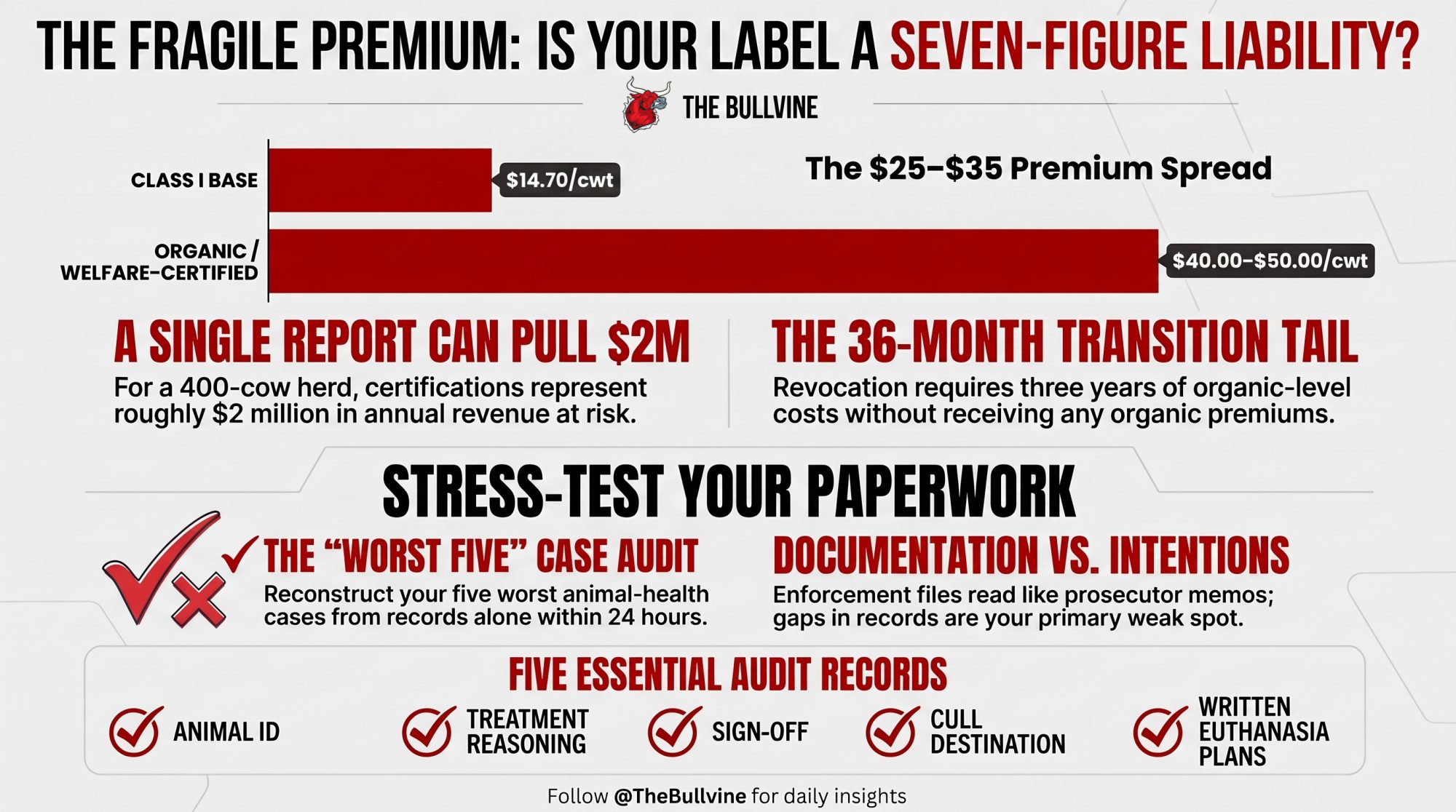
- If your premium runs more than $15/cwt over base, treat it as exposure, not a bonus — for a 400-cow organic herd that’s roughly $2 million a year riding on a label a single inspection report can pull.
- A suspension cuts your check while your costs stay organic-level, and a revocation means a 36-month re-entry with no premium the whole way — the revenue drops overnight, the cost side can’t.
- USDA’s findings on Alexandre only surfaced because Farm Forward filed a FOIA request; proposed suspensions and noncompliances stay on your record even after you fix them.
- This month, pull your certifier file and your five worst animal-care cases and read them cold — animal ID, treatment-or-euthanasia call, sign-off, and cull destination — the way a plaintiff’s lawyer or Cornucopia would.
The Gut Check Worth Sitting With
Strip it down and it’s one question with a dollar sign on it. If your premium runs more than $15/cwt above base, that’s not a bonus — it’s exposure, and a suspension is a seven-figure event even for a mid-size herd. If you can’t reconstruct your five worst animal-care cases from records alone, inside 24 hours, your real risk isn’t the barn — it’s what you can’t prove.
So read your certifier file end to end this month, and read it cold — the way Cornucopia or a plaintiff’s lawyer would. Assume every word could go public, because Alexandre’s did, via FOIA. If your labels vanished tomorrow, would what’s in your files and your barn still stand up — and could your business survive the milk-check hit while it did?
If you’re not sure, that uncertainty is the point, and this is the window to close it before someone tests it for you. We’re breaking down the full premium-exposure model in an upcoming Bullvine Weekly — what a suspension costs by herd size and label stack, the 36-month transition tail, and the FOIA-grade record checklist that keeps you out of the file.
Correction, July 9, 2026: An earlier version stated that Alexandre Family Farm’s regenerative certification had been ‘pulled’ and that the farm had lost ‘two’ premium labels. The farm says it chose not to renew its Regenerative Organic Certified (ROC) certification for its dairy and maintained a separate Land to Market regenerative certification, which Bullvine has reviewed (valid Nov. 2025–Nov. 2026). The article has been updated to correct the characterization and to add the farm’s response. The USDA Report of Investigation findings and litigation status are separately sourced and unchanged.
📊 Interactive Premium Risk Simulator
Calculate your operation’s financial exposure if certifications or labels are suspended or revoked.
The difference between your stacked premium price and Class I base.
Losing your label cuts this cash flow instantly while operational overhead remains flat.
Estimated regulatory cost if revoked. Requires 3 years of organic-level input costs while receiving only conventional base pay checks.
This article is based on USDA’s 2024 NOP Report of Investigation (obtained via FOIA by Farm Forward), Cornucopia Institute records, court filings, and published reports available as of July 4, 2026.
Learn More
- Your Cows Are Comfortable. The Milk Check Doesn’t Know It Yet. — Arms you with an execution plan to convert routine cow-comfort upgrades into immediate revenue. This blueprint identifies zero-cost welfare labels that capture up to $60/cwt without plunging your cash flow into a multi-year transition deficit.
- Organic Valley’s Lawsuit Is About $0.72. The Risk on Your Farm Is $19.89. — Reveals the hidden financial cliff waiting if your premium buyer exits or renegotiates your pooling terms. You get a three-scenario stress test to protect your equity and insulate your debt covenants from sudden market shifts.
- The Buyer, Not the Bull: How Forest Glen Cracked Costco’s A2 Lane — Dismantles standard breeding logic by prioritizing market contracts over generic index metrics. This case study shows how a commercial herd captured Costco’s high-margin A2 pool using targeted genetics to bypass traditional commodity marketing channels.
 The Sunday Read Dairy Professionals Don’t Skip.
 The Sunday Read Dairy Professionals Don’t Skip.
Every week, thousands of producers, breeders, and industry insiders open Bullvine Weekly for genetics insights, market shifts, and profit strategies they won’t find anywhere else. One email. Five minutes. Smarter decisions all week.




