






Forest Glen’s 2,200 Jerseys run 77.8% A2A2 by breed — but that’s not why Costco buys the milk. The genetics were the easy part. The buyer and the 3-year clock weren’t.
The quick numbers: ~2,200 registered Jerseys · organic since the mid-1990s · milk flows into Costco’s Kirkland Organic A2 line ($15.79–$22.99 per 4-pack) · Jerseys run ~77.8% A2A2 by breed · a 0.15% protein bump pencils to 25–40¢/cwt.
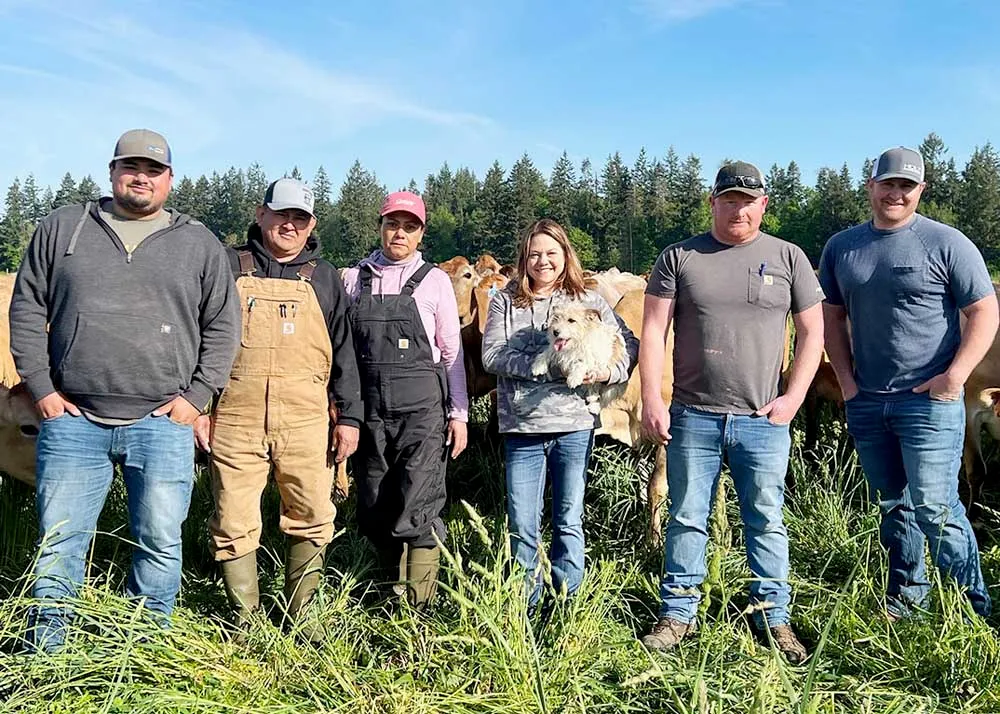
Robert Kircher was about 11 years old when he started working summers with the Jersey cows at Forest Glen, the Dayton, Oregon, operation he now co-owns and runs with his brother, Stewart, and owner Dan Bansen. Three decades and an Oregon State dairy science degree later, the two Forest Glen herds — Forest Glen Jerseys and Forest Glen Oaks — milk roughly 2,200 registered Jerseys, certified organic since the mid-1990s. And here’s where it gets interesting: “A lot of our milk goes to Nancy’s, to Costco for Costco Organic A2 milk,” Kircher said this June.
That’s a premium lane most operations — especially Holstein herds — can’t access without years of work. The genetics that got Forest Glen there? Those were never the hard part.
What’s Actually Changing
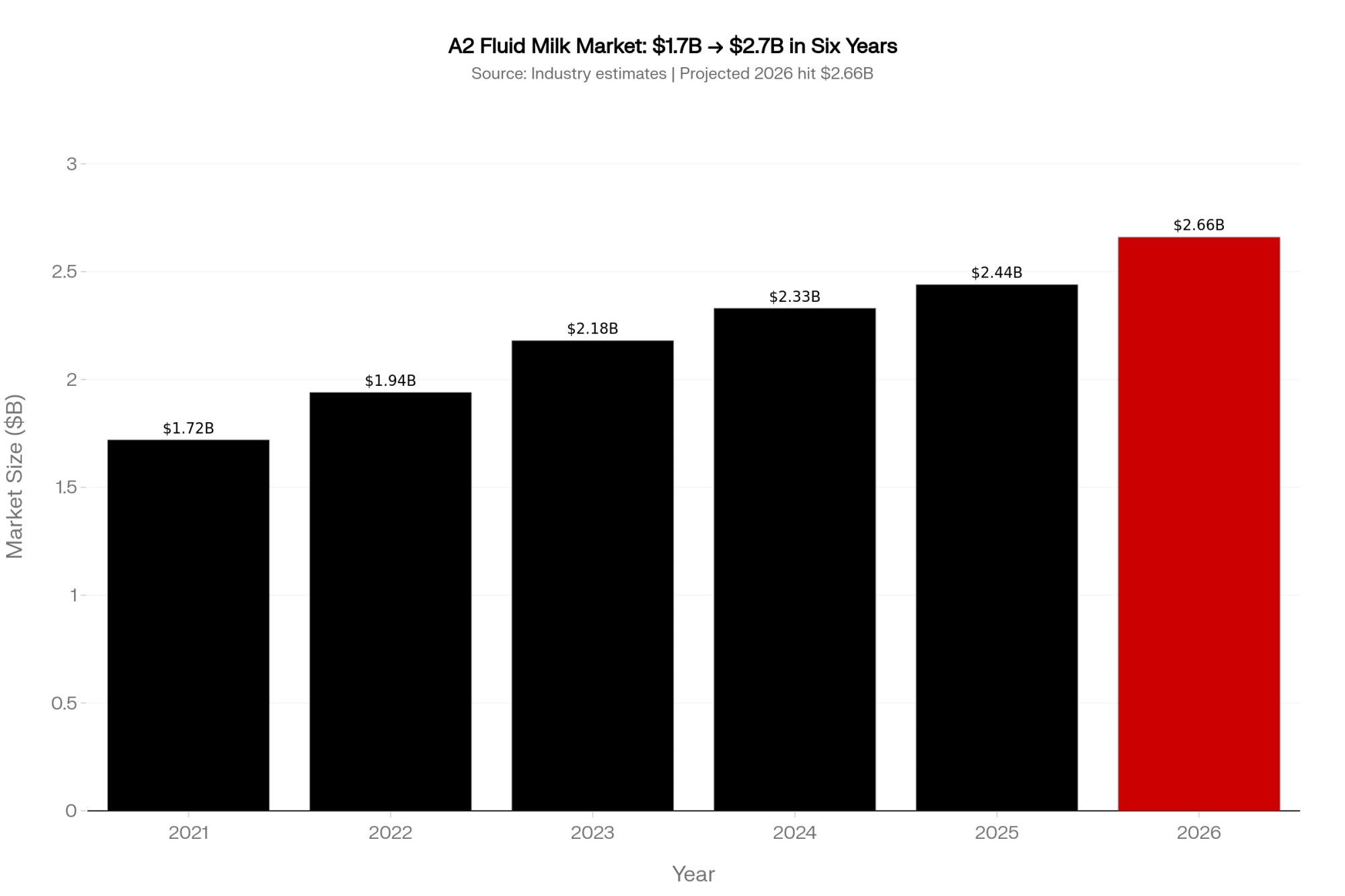
A2 milk is fluid milk from cows that carry only the A2 form of beta-casein, a protein some consumers find easier to digest — though the human-health evidence remains thin and contested. The market doesn’t much care about the debate; it’s buying. A2 fluid milk carries a 25–50% premium in many markets. The broader A2 category was valued at about $2.44 billion in 2025 and is projected to hit $2.66 billion in 2026. Costco’s Kirkland Organic A2 whole milk ranges from $15.79 to $22.99 for a 4-pack of half-gallons, depending on the warehouse and date.
Organic is no longer niche, either. Organic fluid milk’s share of total US fluid sales more than doubled, from 3.3% in 2010 to 7.1% in 2024. Stack an A2 claim on an organic claim, and you’re selling into the part of the dairy case that’s actually growing while conventional fluid keeps shrinking.
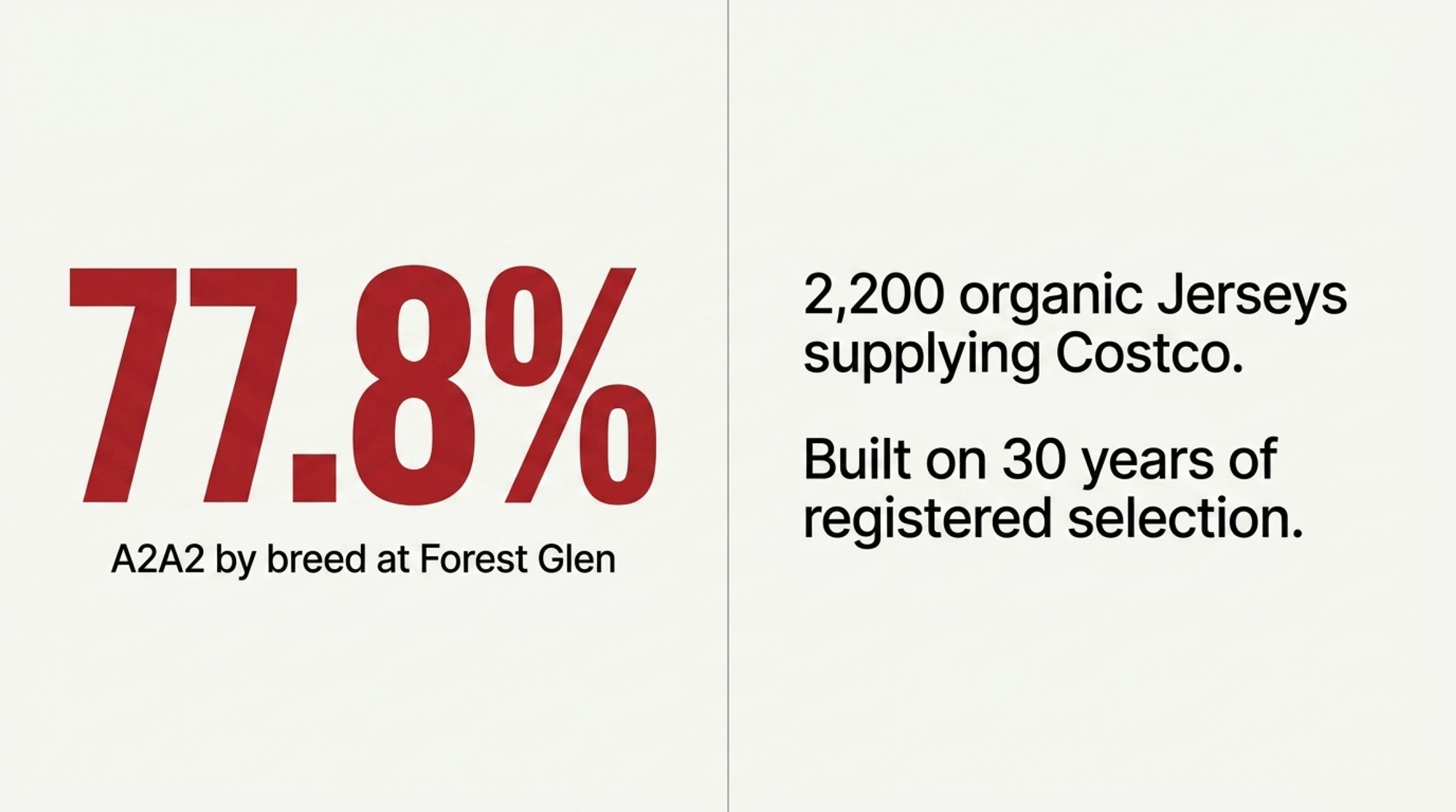
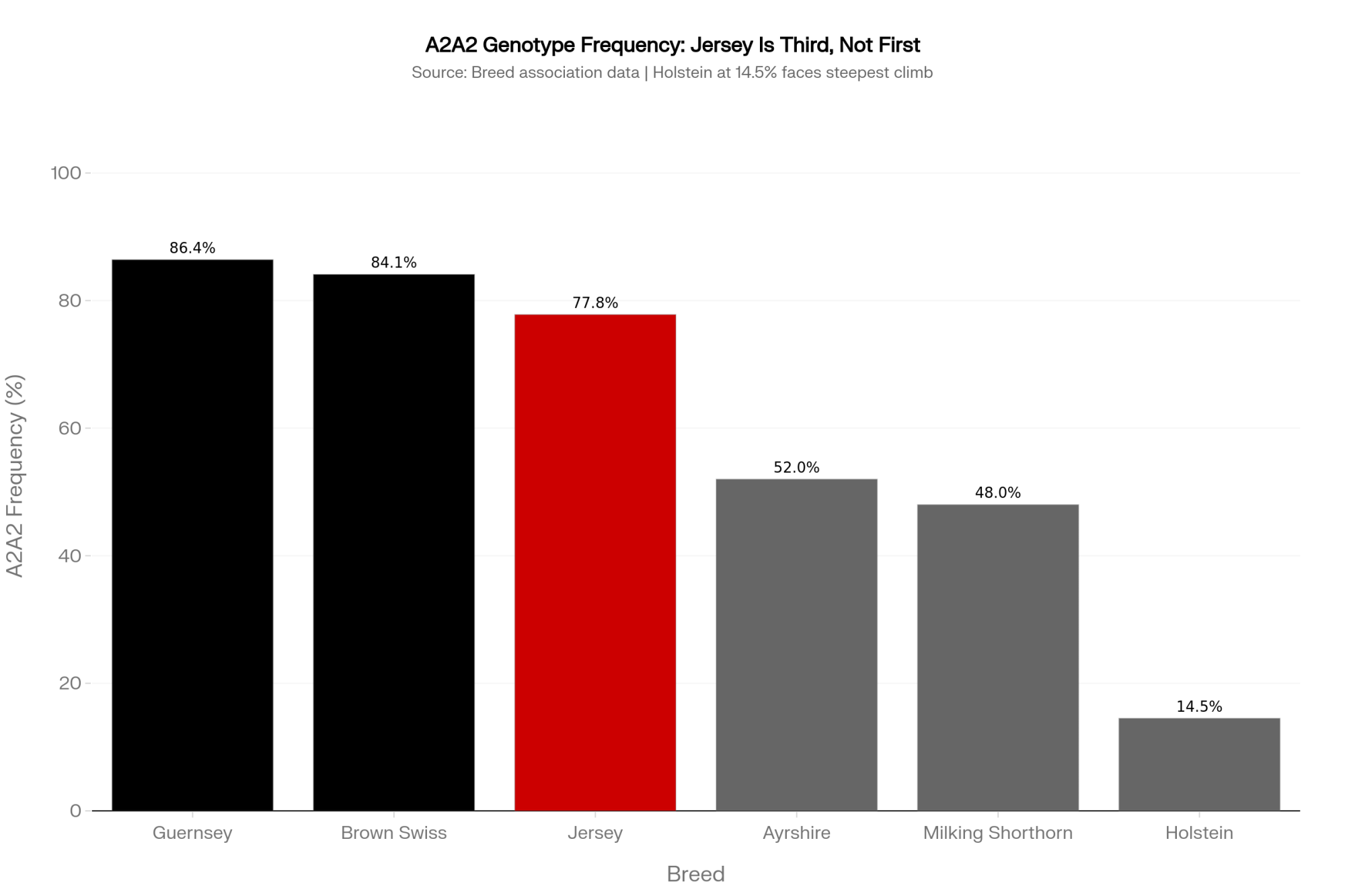
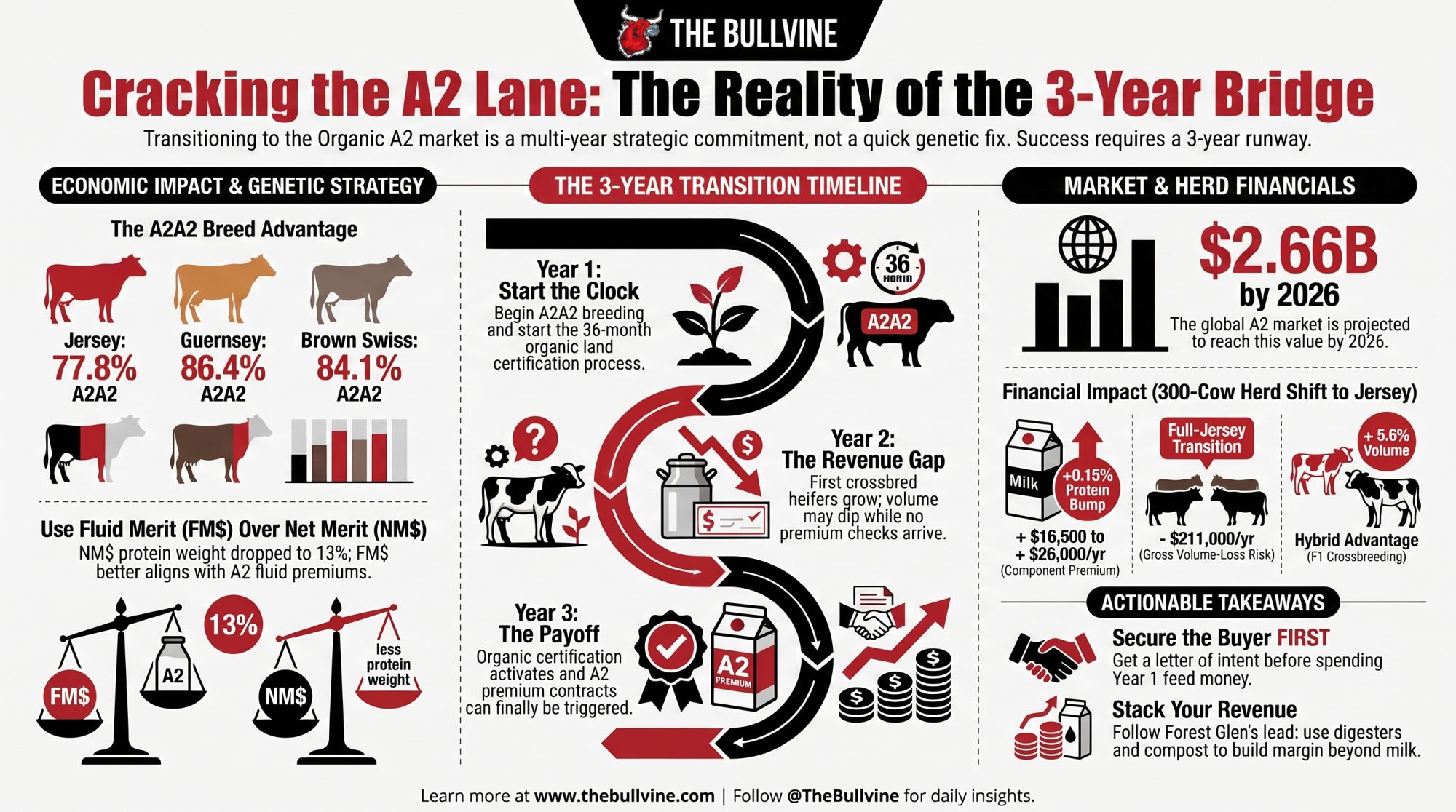
Genetics determine who can even play. Jersey cattle carry the A2A2 genotype at about 77.8% breed-wide — third-highest of any breed, behind Guernsey at 86.4% and Brown Swiss at 84.1%. A2A2-tested semen is readily available, but building a fully A2A2 herd takes years of selective breeding — there’s no shortcut, and understanding that timeline is crucial to planning your genetic strategy.
The Genetics Didn’t Happen Overnight
Here’s the piece most “switch to Jerseys” pitches skip: Forest Glen isn’t just a big Jersey herd, it’s a deep one. Back in 2010, the AJCA-recorded lactation average across the herd was 16,529 lbs of milk, 737 lbs of fat, and 614 lbs of protein — serious component output for a grazing-organic Jersey operation. Dan Bansen was recognized with national Jersey awards for that breeding program.
The herd has bred its own genomic sires, too. Forest Glen Visionary Marker (29JE3897) was released as a genomic young sire that ranked among the top Jersey bulls at the time, and the operation has historically carried multiple cows and heifers ranking in the top 1.5% of the breed on GJPI. Translation: the A2 and component story here rides on 30 years of registered-Jersey selection — not a quick semen swap.

That’s the honest gap between Forest Glen and a Holstein operator reading this. You can buy A2A2 Jersey semen tomorrow. You can’t buy 1996.
How This Plays Out on a Real Farm
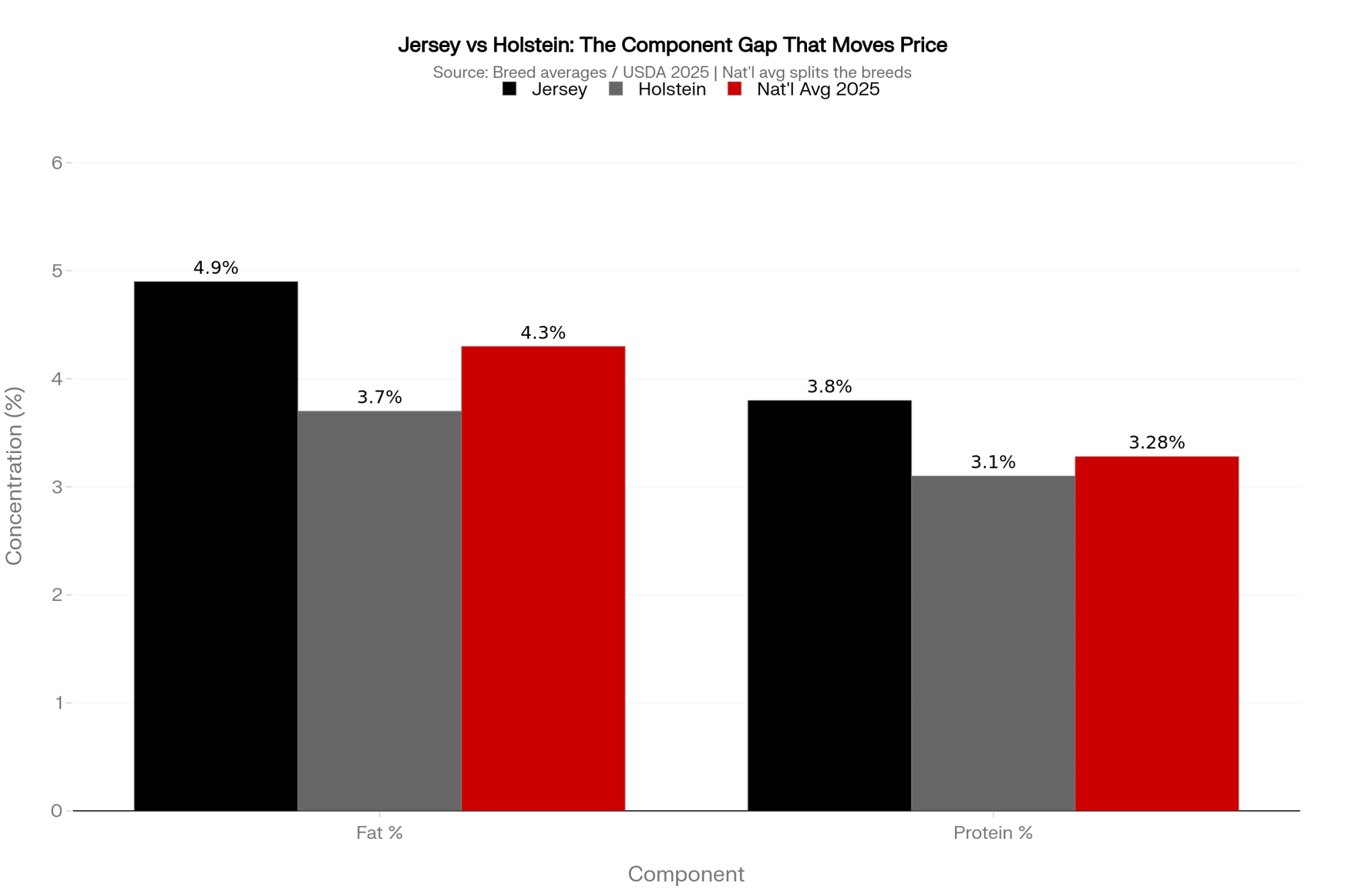
The component math is tangible. As a breed reference, Jersey milk contains about 4.9% fat and 3.8% protein, compared with Holstein’s roughly 3.7% fat and 3.1% protein. The national all-breed average has itself climbed to about 4.30% fat and 3.28% protein in 2025, so your own gap depends on where your herd already sits. For a processor paying on protein concentration, that difference shows up on every load.
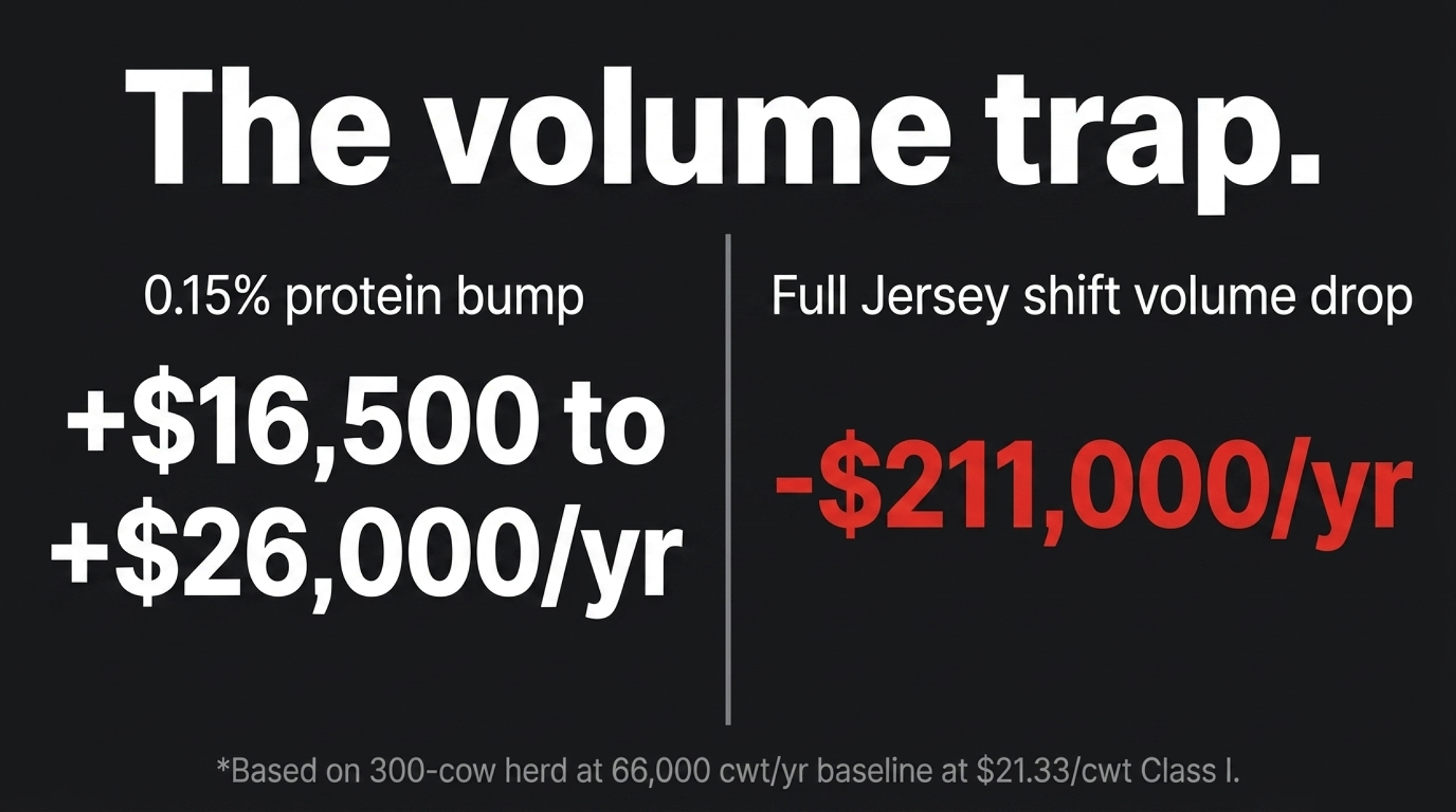
Run a 300-cow herd at around 22,000 lbs a cow — about 66,000 cwt a year — through the numbers, and the two sides of the bet sharpen up fast.
| Metric / Scenario | Baseline (Holstein) | Shift Toward Jersey | Financial Impact |
| Component premium, 0.15% protein bump | 66,000 cwt/yr | Increased concentration | +$16,500 to +$26,000/yr |
| Volume-loss risk, full-Jersey transition | 66,000 cwt/yr | −15% volume (−9,900 cwt) | −$211,000/yr at $21.33/cwt Class I |
| Volume effect, F1 Holstein × Jersey | parental average | +5.6% vs. breed average | Softens the volume hit |
The premium is real, but it’s small. The volume swing is the big one — and which way it cuts depends entirely on how far toward Jersey you go. One honest caveat on that −$211,000: it’s gross milk sales, before the lower feed and replacement costs a Jersey herd incurs, which claw back a chunk of it. Component premiums are also set region by region under federal milk marketing orders, so plug your own order, processor, and production into the same three rows before you trust anyone’s headline figure.
That’s the trap in “Jerseys give less milk.” Go full Jersey or pure-Jersey crossbred, and you’ll likely ship less; one Irish dataset put pure Jersey crossbreds about 625 kg per cow below Holsteins. But a first-cross Holstein × Jersey (F1) can actually beat the parental average — that peer-reviewed 5.6% bump. The premium shows up later; the volume change hits early. F1 crossbreeding is the lever that softens the gap you have to eat in between.
What Would the Transition Actually Look Like, Year by Year?
Walk it forward on a real calendar, because the sequence is where operations get hurt.
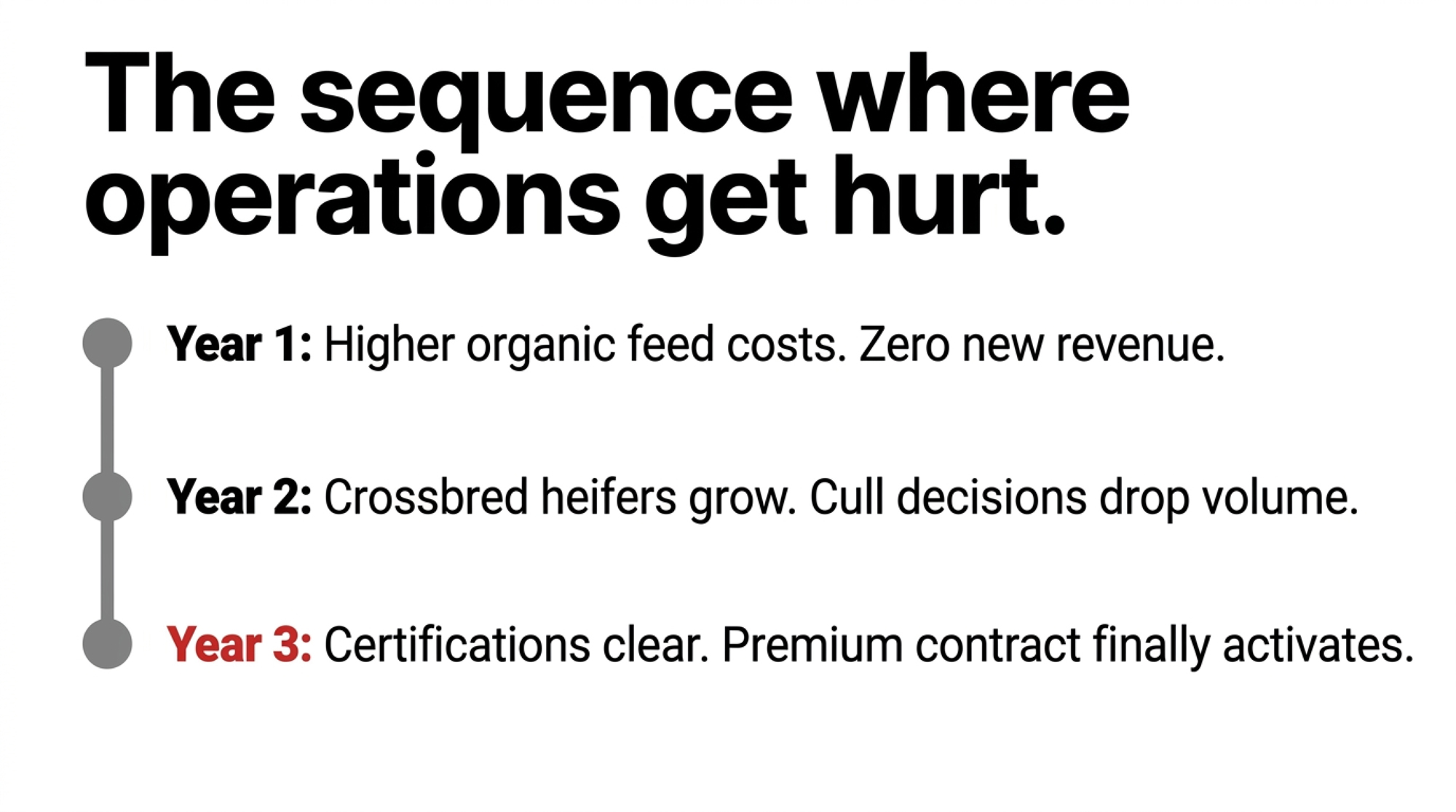
- Year 1: You start breeding A2A2-tested Jersey or component semen onto your Holstein dams, and you begin the organic land and feed clock if you’re chasing the organic-A2 lane. No new revenue. Higher feed cost if you’ve gone organic.
- Year 2: Your first crossbred heifers are growing but not milking; if you’ve pushed hard toward full Jersey, your earliest culling-and-replacement decisions start nicking volume. Still no premium cheque.
- Year 3: Your first F1 or Jersey-influenced animals freshen, components climb, and — if you sequenced it right — your organic certification comes through, and a premium contract can finally activate. That’s the earliest a premium dollar realistically lands. So you carry two to three years of cost before the upside shows. Forest Glen absorbed that runway back in the 1990s. You’d be absorbing it against today’s feed and interest costs.
The Mechanics Behind It
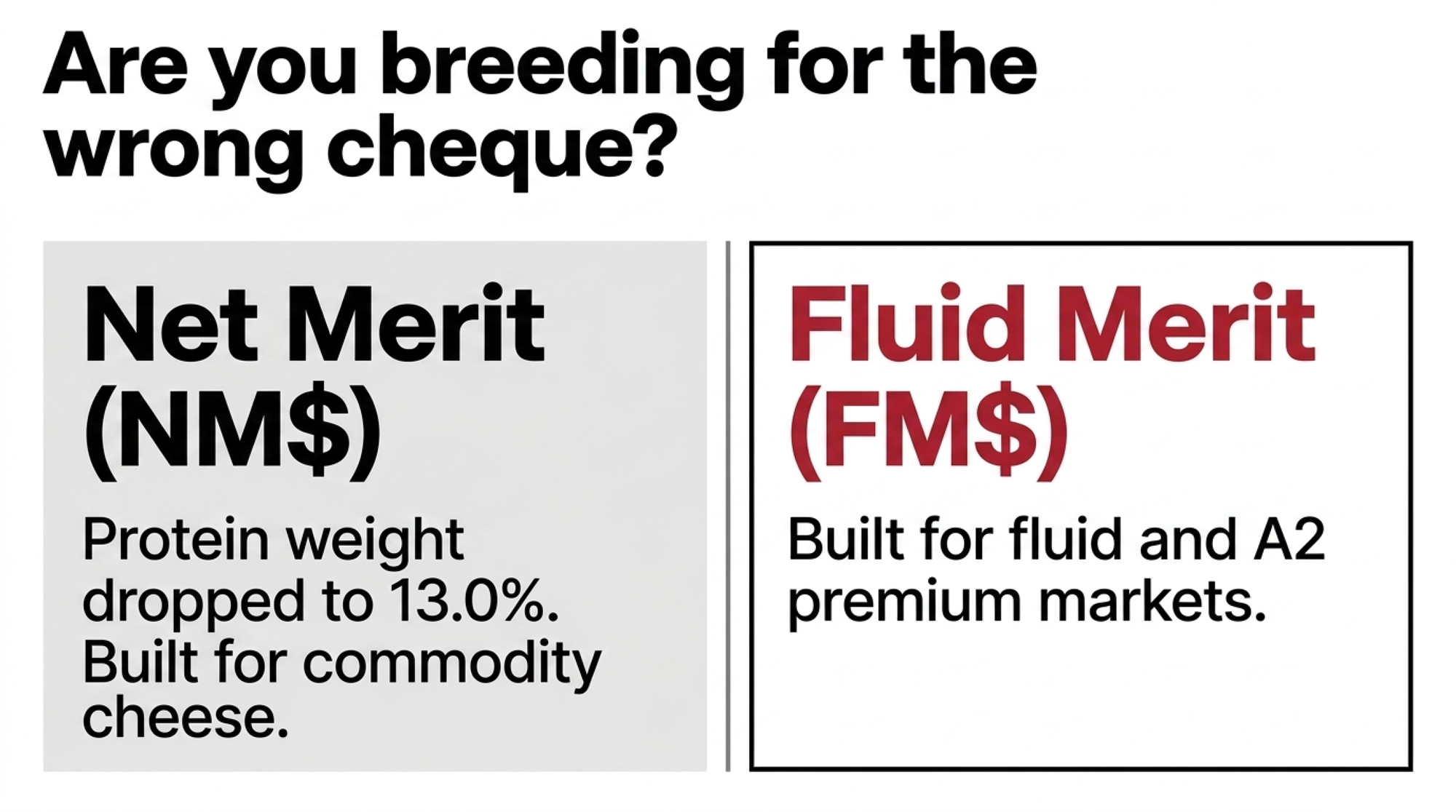
There’s a quiet split underneath all this — between what the breeding index rewards and what the premium market pays. On April 1, 2025, the USDA’s Net Merit (NM$) index reduced protein’s weighting from 19.6% to 13.0% and increased fat’s weighting from 28.6% to 31.8%. CDCB has been straight about why: the change reflects recent component price trends in the commodity-and-cheese market most farms sell into.
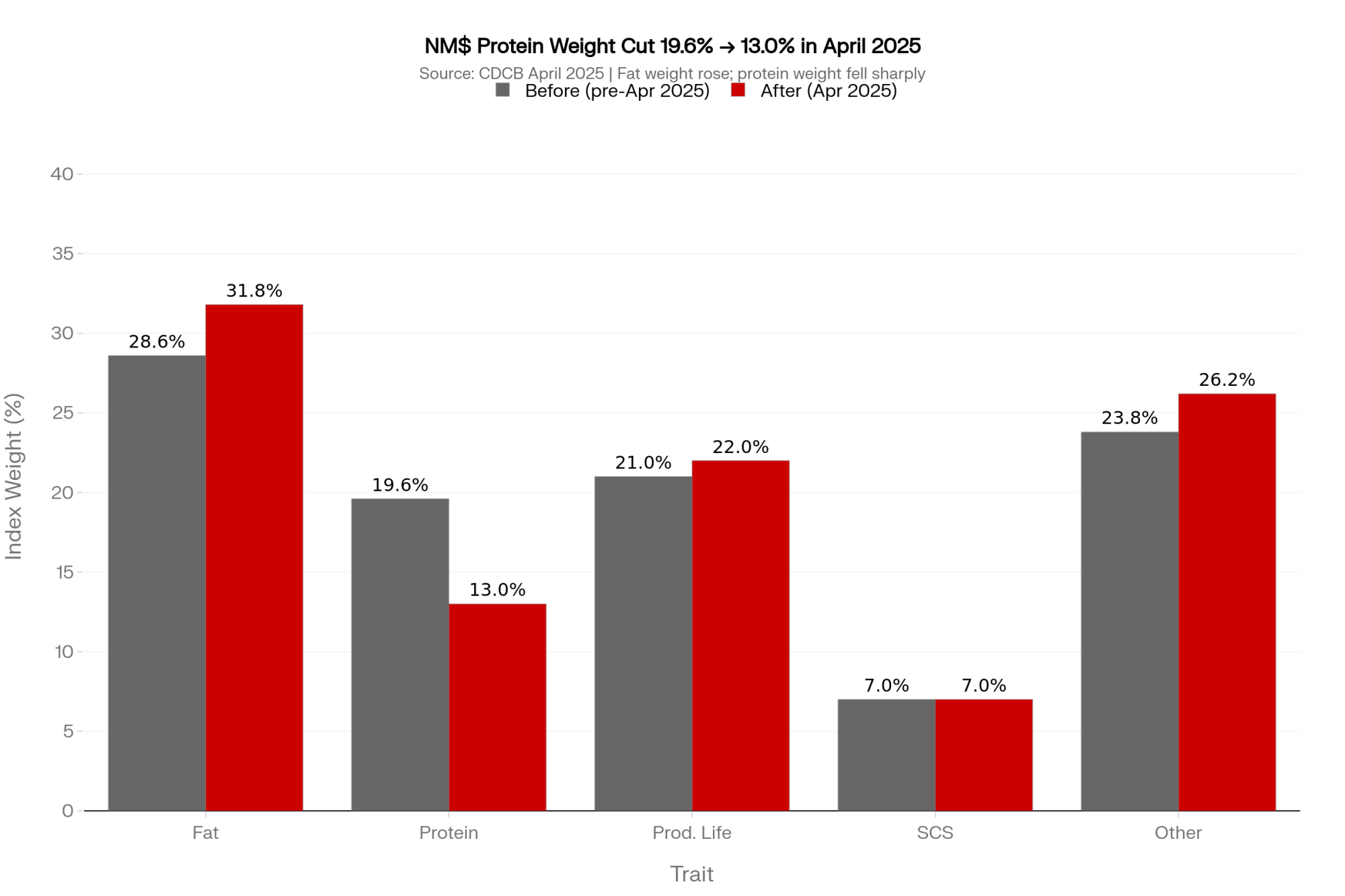
So two things are true at once. The index is calibrated correctly for the market most producers are in. And it’s miscalibrated for the market Forest Glen is in. If you’re chasing a fluid A2 protein premium but still ranking bulls on NM$, you’re using a tool built for a different milk cheque.
CDCB already publishes a better-fit tool — Fluid Merit (FM$), one of the lifetime merit indices refreshed alongside NM$ in April 2025, built around the fluid market rather than cheese yield.
| Index | Optimized For | Protein Weight | Fat Weight | Best Fit Market |
| NM$ (post Apr 2025) | Cheese/commodity | 13.0% | 31.8% | FMMO cheese pools |
| NM$ (pre Apr 2025) | Cheese/commodity | 19.6% | 28.6% | FMMO cheese pools |
| FM$ (Fluid Merit) | Fluid milk market | Higher protein emphasis | Balanced | Fluid, bottling, A2 contracts |
| CM$ (Cheese Merit) | Cheese yield | Fat + protein yield | High | Cheddar, mozzarella processors |
| GM$ (Grazing Merit) | Pasture-based systems | Moderate | Moderate | Organic, grass-based operations |
How Much Does Waiting on the Buyer Actually Cost?
More than the feed bill — it can cost you the buyer. The organic whole-herd transition runs 12 months of documented organic management before milk qualifies, a one-time exception under the USDA rule. But the land underneath has to be clean for three full years first, so the real-world runway is closer to three years, not one. A2A2 herd conversion stacks on top of that. By the time you’re certified and qualified, the contract slots may already be filled. The Bullvine has reported that major processors locked much of their long-term supply in 2023–2024 while planning current expansions, often favoring larger, consistent-volume operations.
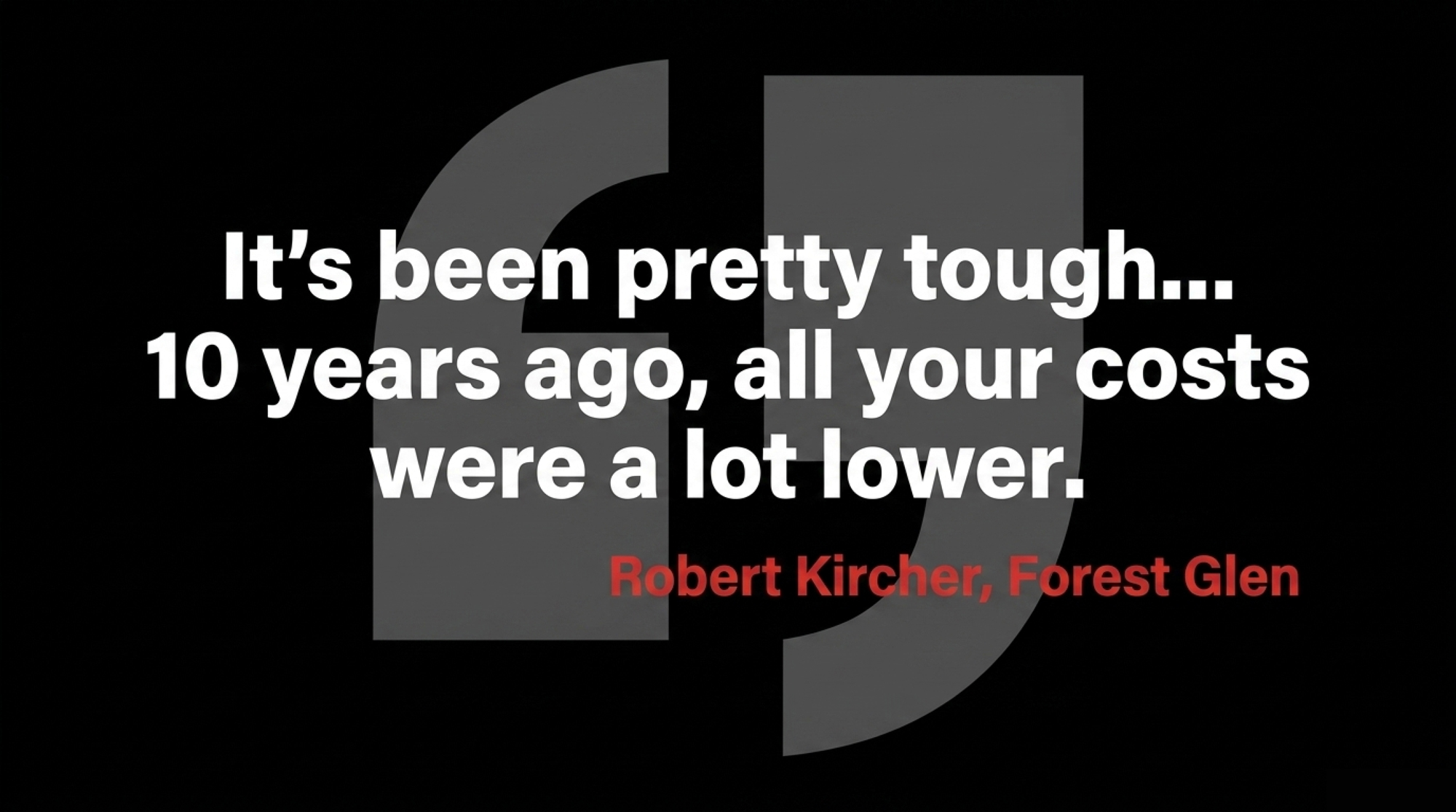
And premium pay doesn’t erase costs. Forest Glen makes the organic-A2 model work, but Kircher is blunt about the squeeze: “It’s been pretty tough. We’re getting near to what we were seeing pricewise in 2014. But 10 years ago, all your costs were a lot lower.” Organic feed costs more, Oregon’s overtime rules apply the same as to any dairy, and the processor captures the bulk of the retail premium. The lesson isn’t speed — it’s sequence: get the market signal first, then start the clock you can’t reverse.
Is Your Genetic Strategy Pointed at the Wrong Cheque?
Pull your last twelve months of milk cheques and look hard at what they actually reward — protein concentration, fat, fluid, or volume. Then check whether your sire selection matches. If you’re selling into a fluid or A2 premium market but ranking bulls on NM$ — which now leans harder toward fat than it did — or chasing PTA Protein pounds instead of PTA Protein percent, your genetics may be drifting away from your own pay structure.
It’s a thirty-minute job. Pull the cheque, pull your sire list, lay them side by side, and see if they tell the same story. Most operations have never done it.
The Strategic Playbook
Four moves, in the order they actually protect you. No single path fits every barn — but the sequence matters more than the breed.
- Test what you’ve already got — start this month. A2 genotyping is available as a standalone test or as a genomic add-on through labs such as UC Davis VGL. Map your herd, then filter your next semen order for A2A2 status plus positive PTA Protein %. Low cost, low risk, and it tells you whether you’re already sitting on a qualifying pool. What it won’t tell you: whether a buyer exists. That’s the next move, not this one.
- Secure the buyer before you build. This is the discipline most transitions skip — and it’s the one that protects the other three. Forest Glen’s milk has a contracted home through Nancy’s Probiotic Foods, the Springfield Creamery family operation running since 1960, which gives the farm a stable outlet for organic Jersey milk. Get a letter of intent or a cooperative commitment before you spend Year 1 feed money. But treat an LOI as a maybe, not a yes: sequencing failure (no buyer at all) and counterparty failure (a soft commitment that evaporates) are different risks. Pin down volume and term in writing before the feed order changes.
- Crossbreed toward A2A2 and components — but mind how far you go. A first-cross Holstein × Jersey can hold or even gain volume while lifting components; a push to full Jersey trades volume for concentration. Works when a buyer conversation is already moving. Fails when you build the genetics before the market exists. The deeper you breed toward Jersey, the bigger the volume bet you’re making.
- Stack revenue beyond the milk cheque. Forest Glen runs a 370-kilowatt digester generating about 3.1 million kWh a year for Portland General Electric, sells registered Jersey genetics, and moves composted fiber to Willamette Valley vineyards. None of that is milk; all of it is margin. Works when you’ve got the scale and capital to build it — not a standing-start play in Year 1.
The thread running through all four: check whether your genetics already match your pay structure before you spend a dollar changing either one.
Key Takeaways
- The genetics were the cheap part. Forest Glen’s edge is a contracted home through Nancy’s into Costco’s A2 line — line up your buyer before you breed or certify a single cow.
- Run your own three rows before you trust the pitch: a 0.15% protein bump pencils to 25–40¢/cwt, but a full-Jersey shift can cost six figures in gross volume that lower feed and replacement costs only partly claw back.
- If you sell into a fluid or A2 premium market, stop ranking bulls on NM$ alone — its protein weighting dropped to 13.0% in April 2025, and Fluid Merit (FM$) is built for the cheque you’re actually cashing.
- The clock is the killer, not the breed. Organic land runs a three-year wait, and A2A2 conversion stacks on top, so the slots may be full by the time you qualify — which is why securing the contract comes first.
The Real Question for Your Operation
Forest Glen didn’t pivot into a premium lane. They were already most of what that lane required — a registered Jersey herd, organic since the mid-1990s, running high-A2A2 by breed and breeding its own top-1.5% genetics — before the A2 category took off. So the real question for your operation isn’t “should I run Jerseys.” It’s this: if a premium buyer in your region went looking for a reliable supply next year, would your genetics and your certifications already qualify you — or would you be three years and a contract short?
Robert Kircher started learning these cows at 11 years old. The position he’s in now took thirty years to build, and even then, he’ll tell you it’s “been pretty tough.”
Run Your Numbers
Component Value Tracker — This whole story turns on what protein is worth in your check. Run the tracker to put a real dollar figure on that 0.15% bump in your herd, and see whether breeding for components pencils against the volume you’d trade away.
Complete references and supporting documentation are available upon request by contacting the editorial team at editor@thebullvine.com.
Learn More
- TPI 2026’s $17500 Protein Trap: Breeding Holsteins for a Protein Market That Doesn’t Exist — Arms you with a blunt audit strategy to check if your sire choices are accidentally chasing a low-value protein ratio rather than total component pounds, protecting your farm from a multi-thousand-dollar genetic margin drag.
- Why the A2 Boom Bypassed Heritage Breeds – And What’s Actually Working — Exposes the harsh plant math that dictates premium lane access, proving why a 150-cow heritage herd’s volume disappears into the tank without a pooled neighborhood stream or a 50,000-pound daily processing minimum.
- A $45 Heifer Test Now Decides Who Qualifies for Gene-Edited Milk — Delivers a critical genetic playbook warning that early adopters capture the margin while latecomers catch a commodity, utilizing low-cost heifer genomic profiles to position your herd before the next specialized processor contract window slams shut.
 The Sunday Read Dairy Professionals Don’t Skip.
 The Sunday Read Dairy Professionals Don’t Skip.
Every week, thousands of producers, breeders, and industry insiders open Bullvine Weekly for genetics insights, market shifts, and profit strategies they won’t find anywhere else. One email. Five minutes. Smarter decisions all week.




