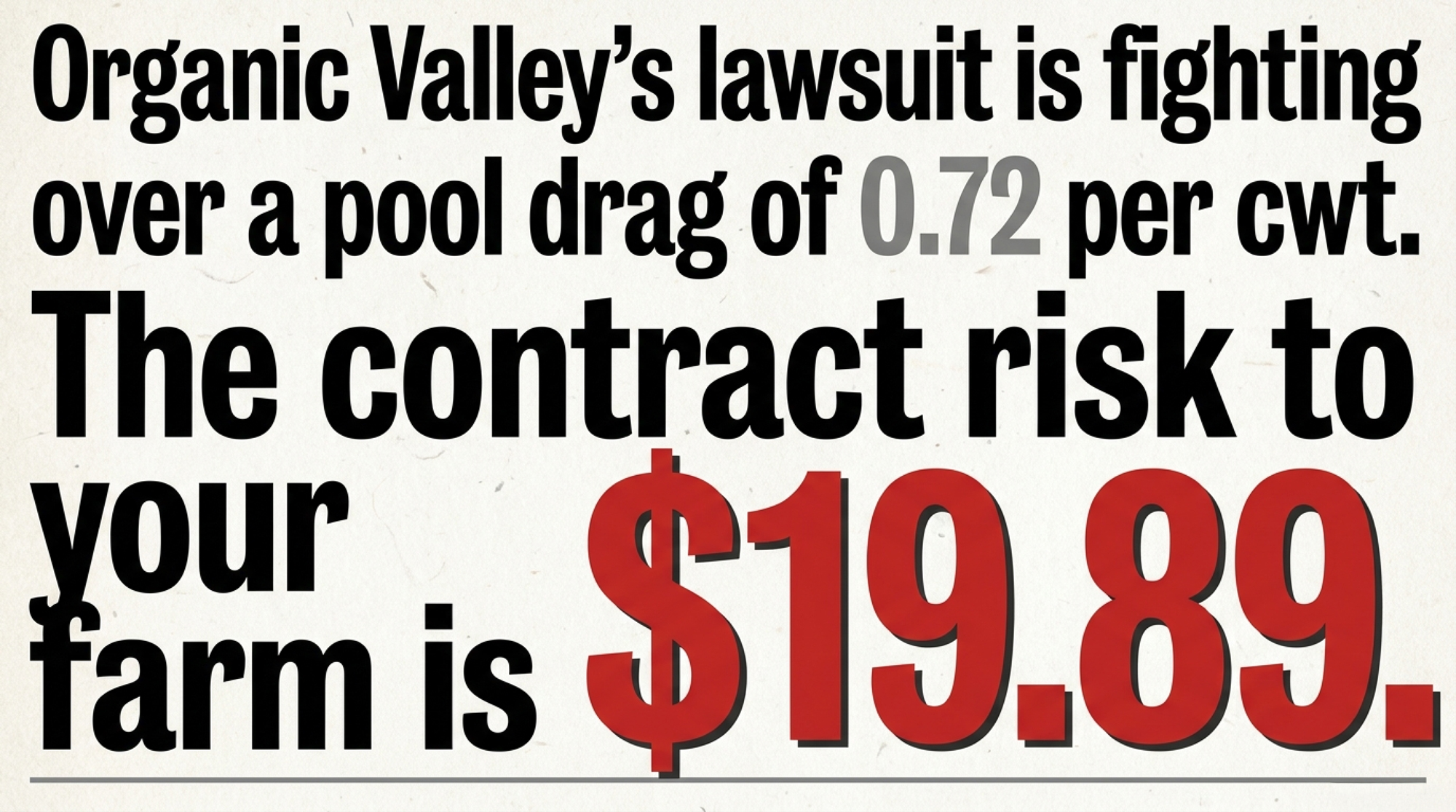
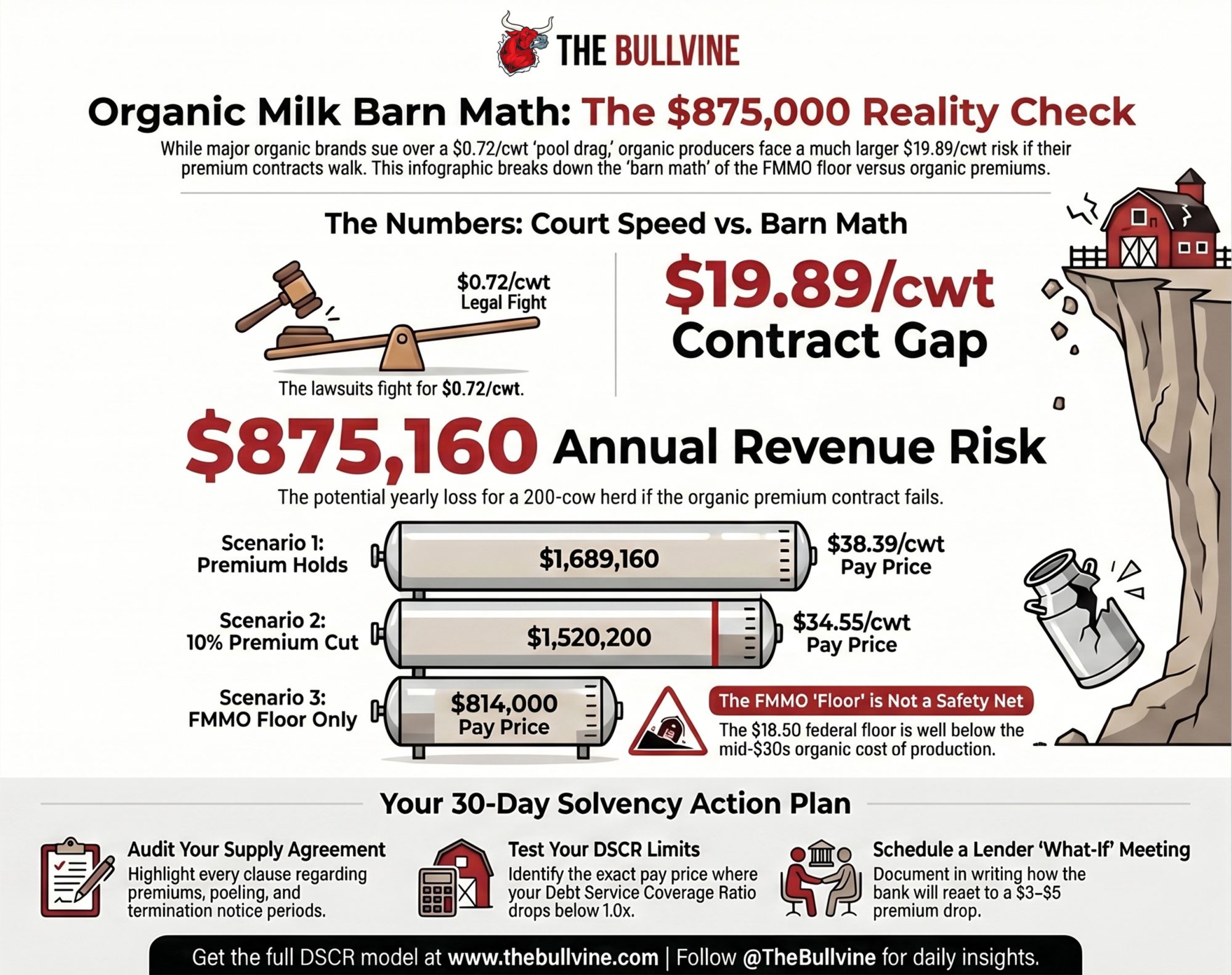
Four federal filings on April 28. The pool drag in court is $0.72/cwt. On a 200‑cow organic herd, the real spread is $19.89/cwt — $875,160 a year if your contract walks.
Executive Summary: Organic Valley/CROPP, Aurora, and Horizon filed four federal lawsuits on April 28, 2026 — in the Western District of Wisconsin, the District of Colorado, and the U.S. Court of Federal Claims — to pull organic milk out of the FMMO and recover more than $60 million in six years of pool payments. Plaintiffs, including CROPP owner‑member Elvin Ranck of Mifflin, PA, peg the implied drag at roughly $0.72/cwt; that’s about $31,680/year on a 200‑cow organic herd producing 44,000 cwt. The bigger barn‑math number isn’t in court. With NODPA’s 2025 weighted‑average organic pay price at $38.39/cwt and the Order 1 statistical uniform price hovering near $18.50/cwt in early 2026, the spread is $19.89/cwt — or $875,160/year if a premium contract walks and the FMMO floor is all that’s left. Layer in the June 2025 make‑allowance reset (AFBF: $0.85–$0.93/cwt) and “protection” looks like an insurance policy with a deductible roughly half your milk check. The 30‑day move: pull your supply agreement and loan docs, highlight every premium, pooling, MAC, and DSCR clause, and walk a three‑scenario sheet — $38.39, $34.55, $18.50 — into your lender’s office before fall contract review. Court speed won’t decide your 2027 pay program; your contract and your covenants will.
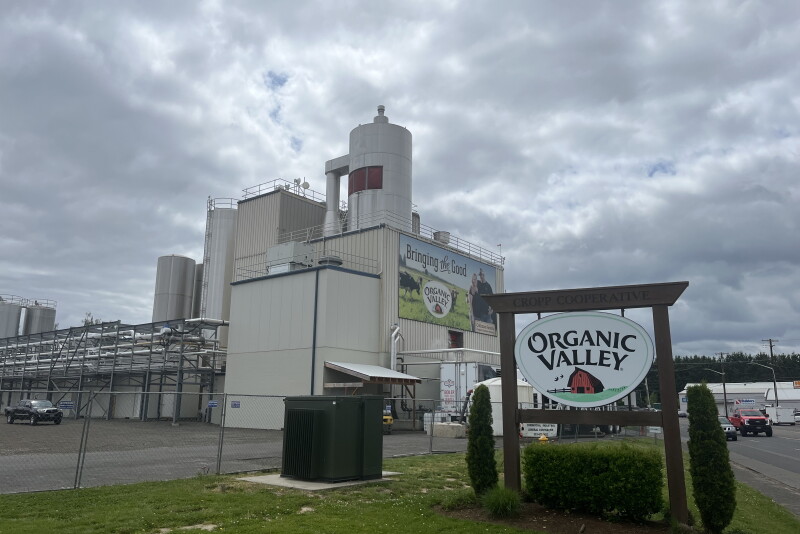
The quote that kicked this loose is blunt. “The federal government has locked in an updated dairy pricing regulation that actively harms organic dairy farmers. It systematically siphons tens of millions of dollars away from organic dairy farmers like me for the benefit of conventional dairy farmers.” That’s Elvin Ranck, an organic producer near Mifflin, Pennsylvania, and a CROPP Cooperative (Organic Valley) owner‑member, in the April 28 class‑action announcement from the Coalition for Organic Dairy Exemption (CODE).
Ranck is one of the named plaintiffs behind four federal lawsuits filed April 28, 2026 — in the Western District of Wisconsin, the District of Colorado, and the U.S. Court of Federal Claims. CODE wants two things: an exemption for organic dairy from the Federal Milk Marketing Order (FMMO) system, and more than $60 million in damages for six years of pool payments plaintiffs say never came back to organic farms. That’s the legal fight. The barn math underneath is what should land on your kitchen table well before the next round of organic contract “adjustments.”
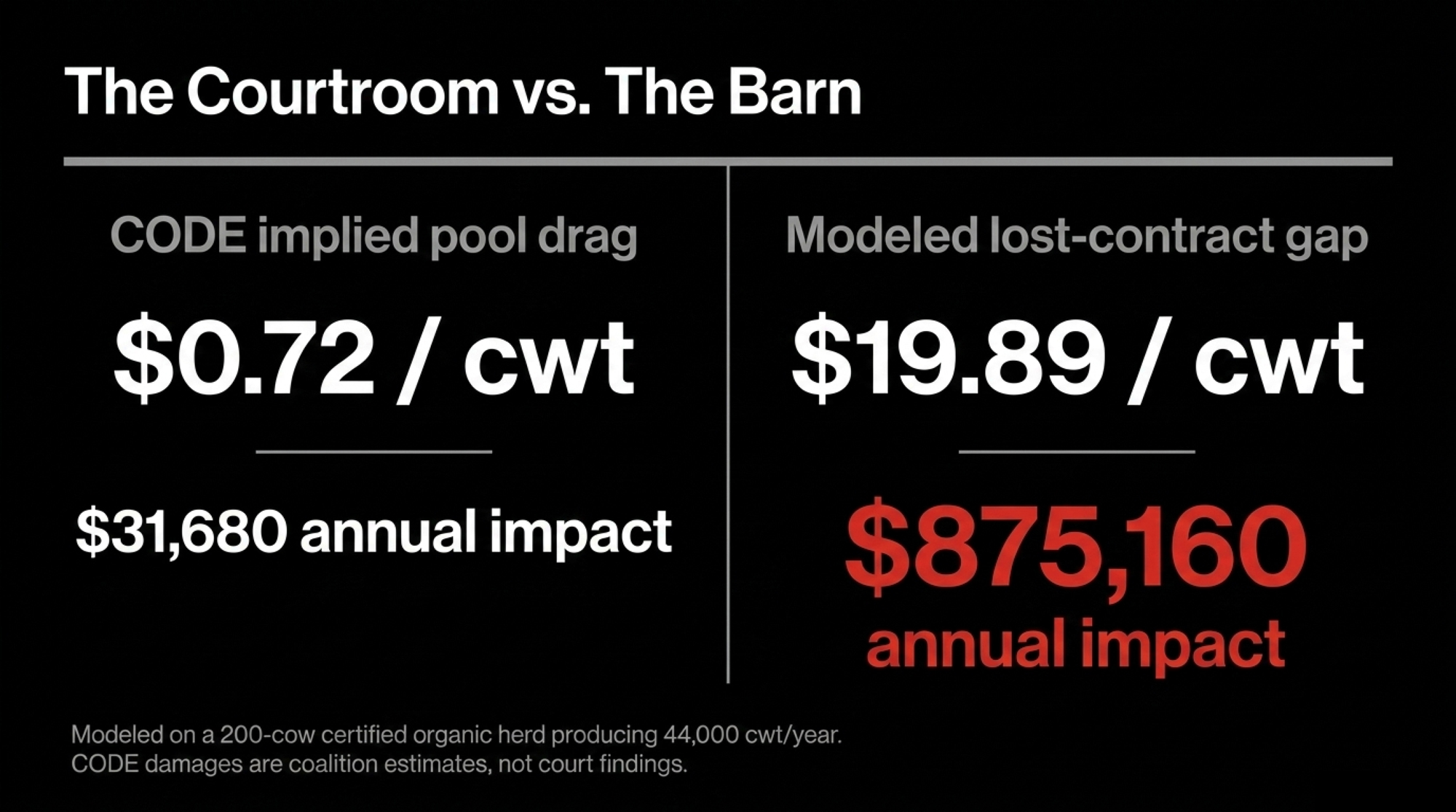
On a 200‑cow certified organic herd, the modeled gap between today’s contract price and the FMMO floor isn’t a rounding error.
$875,160 / year
The modeled milk‑revenue gap on a 200‑cow certified organic herd if the premium contract walks and FMMO pooling is all that’s left.
Editor’s note: This article relies on the public CODE class‑action filings and announcements, on‑record reporting in various media reports including: Sentient Media, Brownfield, Dairy Processing, and NatLawReview, and published USDA AMS, NODPA, and AFBF data. Organic Valley/CROPP, Aurora Organic Dairy, Horizon Organic Dairy, NMPF, IDFA, and USDA were not contacted directly for additional comment for this piece. The 200‑cow herd referenced throughout is a transparent modeled scenario, not a single named operation.
What the Lawsuits Actually Say
CODE — CROPP Cooperative, Aurora Organic Dairy, and Horizon Organic Dairy — argues that organic milk doesn’t belong in a Depression‑era pooling system built for fungible conventional milk. Organic milk must be physically segregated, sourced from certified herds, and can’t be swapped for conventional product. Yet organic handlers still pay into FMMO pools like everyone else.
The coalition’s Washington release calls those pools ones that “don’t serve” organic handlers, even though organic dollars keep flowing in. The class‑action filing in the Court of Federal Claims pegs damages at more than $60 million over six years. Spread across CROPP’s volume in that period, that pencils out to an implied pool drag of roughly $0.72/cwt on organic milk — a CODE estimate, not a court finding. CODE also estimates that organic milk has transferred close to $400 million into conventional‑focused pools since 2006 — a coalition calculation, not a court‑adjudicated figure.
Adam Warthesen, Organic Valley’s senior director of government and industry affairs, shared on April 27 that the FMMO pulls tens of millions of dollars out of organic dairy farms each year, and that CROPP is seeking an exemption because the current system doesn’t reflect how organic milk is produced or marketed. Sentient Media puts the organic share of U.S. fluid milk at about 7% of milk products sold in 2025 — small in volume, but large enough to move real dollars when those Class I premiums are pulled into the pool.
The National Milk Producers Federation and the International Dairy Foods Association — both long‑standing public advocates for the FMMO system — have not yet issued a detailed response in public coverage of the lawsuits. USDA hasn’t commented on the specific lawsuits either. Your milk check won’t wait for the docket.
How Big Is the Gap on a 200‑Cow Organic Farm?
Now the barn math. Take a 200‑cow certified organic herd you’d actually see in Pennsylvania, Vermont, or Wisconsin:
- 200 cows · 22,000 lb/cow/year · 4,400,000 lb/year · 44,000 cwt/year
For the organic price, use NODPA’s latest national figure. In its May 2026 Pay and Feed Prices update, the Northeast Organic Dairy Producers Alliance reports a weighted‑average producer pay price of $38.39/cwt for 2025. For the floor, anchor on a recent Northeast Order 1 statistical uniform price. Bullvine markets coverage and USDA reports place that uniform price near $18.50/cwt in early 2026, depending on components and utilization.
The Three‑Scenario Cliff (44,000 cwt/year)
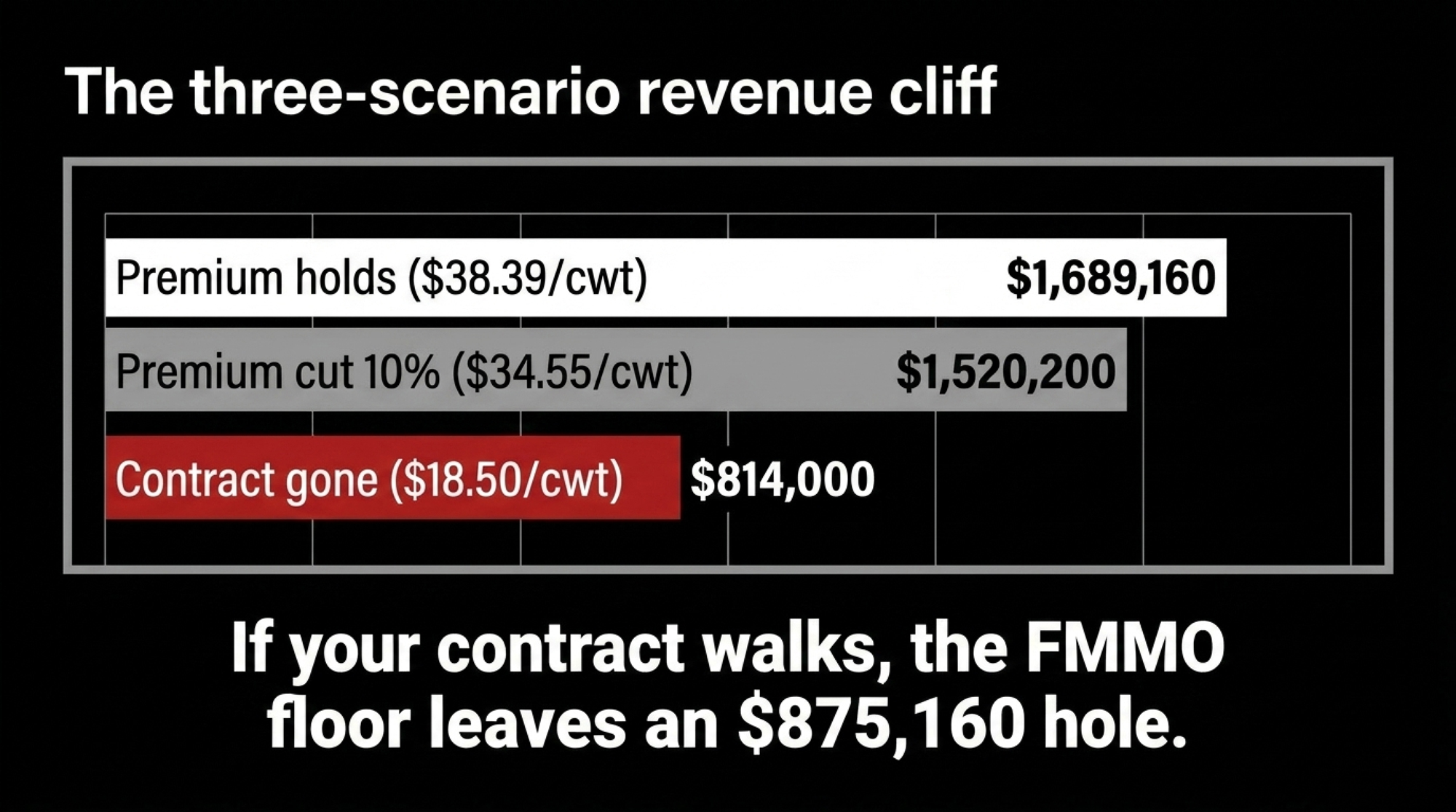
| Scenario | Pay Price | Annual Revenue | Δ vs. Today |
| 1 — Premium holds | $38.39/cwt | $1,689,160 | — |
| 2 — Premium compresses 10% | $34.55/cwt | $1,520,200 | −$168,960 |
| 3 — Contract gone, FMMO floor only | $18.50/cwt | $814,000 | −$875,160 |
The fight in court is the small number. The fall is the big one.
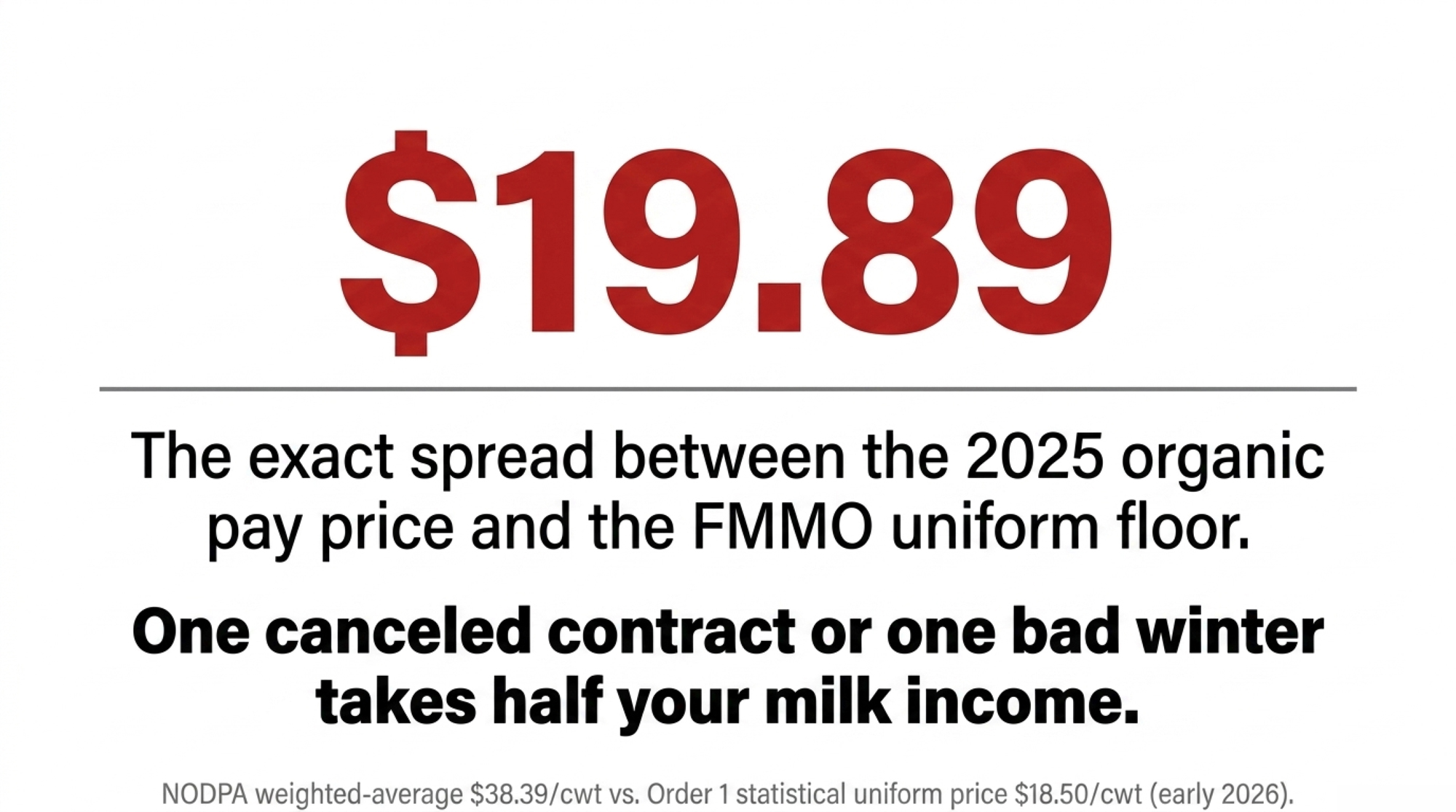
$19.89/cwt
The modeled spread between today’s organic premium and the Order 1 statistical uniform price.
× 44,000 cwt = $875,160/year
One contract clause, one bad winter — half your milk income.
CODE’s implied pool drag, by contrast, lands at about $31,680/year on the same farm — $0.72/cwt × 44,000 cwt. Real money. Also roughly one‑twenty‑seventh of what disappears the day your premium contract walks out the door.

The lawsuits are built around the small number. Your banker’s built around the big one.
What the FMMO Is Really Doing for You
Two prices live on every organic milk check, and they don’t touch the same envelope.
The FMMO pool draw is what your handler pays into and pulls out of the federal pool. USDA AMS’s May 19, 2026 announcement set the base Class I skim milk price for June 2026 at $16.75/cwt, up $2.63 from May. Layer in butterfat, location, and Boston’s differential and the June Class I mover lands in the low‑20s per cwt. The pool pays handlers back at the weighted‑average statistical uniform price, which has hovered in the $18–$19/cwt band in early 2026. The gap between Class I in and uniform price out is the dollar value CODE’s lawsuits are challenging.
Your premium contract is something else entirely. Organic producers don’t get paid out of the pool — they get paid through private supply agreements with co‑op pay programs at Organic Valley, or contracts with buyers like Horizon or Aurora. NODPA’s monthly reports place those programs in the $33–$45/cwt range nationally, with grass‑fed and branded premiums into the high‑40s. The FMMO uniform price sits well below that world. It’s a backstop, not a livelihood.
The June 1, 2025 FMMO amendments permanently reset the make‑allowance formulas. Bullvine’s “$20 Milk Paradox” coverage, citing American Farm Bureau Federation analysis, put the hit at roughly $0.85–$0.93/cwt off announced class prices in many orders. On 44,000 cwt, that’s another $37,400–$40,920/year in lost revenue for any portion of your check that tracks those class values. The “floor” is on a slow slide of its own.
So what does the FMMO actually do for you as an organic producer?
- It forces your handler to pay into a pool at a high Class I price.
- It returns money at a lower uniform price.
- It sets a floor at $18–$19/cwt — well below organic cost of production.
NODPA’s monthly producer reports peg all‑in organic mailbox costs in the mid‑30s per cwt across many Northeast herds, with feed, labor, and certification overhead doing most of the lifting. At an $18–$19/cwt uniform price, you’re not “saved.” You’re losing money slightly more slowly than if your check hit zero.
How Much Does FMMO “Protection” Actually Buy You?
Treat FMMO participation like an insurance policy and the deductible becomes obvious.
| What FMMO Costs You | What FMMO Protects You From |
| $31,680/year pool drag (CODE estimate) | A zero milk check |
| $0.72/cwt × 44,000 cwt | Not from a negative DSCR |
| Tens of thousands a year, every year | Only kicks in after ~half your milk income is already gone |
You’re paying tens of thousands of dollars a year into a system whose “benefit” only kicks in after you’ve already lost roughly half your milk income. And once you hit that floor, your cost structure still looks like an organic farm — feed, labor, certification, and all — not a conventional one.
So when somebody tells you the FMMO protects organic farmers, translate it into barn language. It protects you from a zero milk check. It does not protect you from a negative DSCR.
What Should You Be Asking Your Lender Before September?
If you’re shipping organic and carrying term debt, your lender conversation this summer needs to be more than small talk about feed costs. You’re trying to answer three questions before anyone touches your 2026 contract.
1. “What happens to my loans if my organic contract is cut or terminated?” Sit down with your loan documents and your lender. Make them point to the DSCR or coverage covenants and how often they’re tested. Find out whether a covenant miss caused by a documented contract loss or premium cut is an automatic event of default, or something the bank can waive. Read every line of any Material Adverse Change (MAC) language that lets them accelerate, re‑price, or freeze your operating line if milk income drops sharply.
2. “At what DSCR do you stop giving me the benefit of the doubt?” You don’t need their internal credit playbook. You do need a number. Is 1.25× where they get nervous? 1.0×? Lower? Then run your own three‑scenario math: DSCR at $38.39/cwt today, DSCR at $34.55/cwt with a 10% premium cut, and DSCR at $18.50/cwt if the contract walks. If the floor scenario pulls you below 1.0×, you want that on the table now — not after the fact.
3. “Can we document what happens if my pay price drops $3–$5/cwt?” It doesn’t have to be a contract addendum. An email recap of your meeting will do: “Confirming my understanding — if my DSCR drops below 1.0× due to a documented contract change of $3–$5/cwt, the bank will first explore restructure options (amortization change, temporary interest‑only) before considering acceleration.” If your lender won’t put any version of that in writing, you’ve learned a lot about how much real flexibility you have.
Options and Trade‑Offs for Farmers
You can’t litigate your way to a safe milk check. Even if CODE wins an exemption or a payout, your day‑to‑day risk still lives in your contract and on your balance sheet. Here’s where producers are actually moving right now.
Option 1 — Stay in the co‑op and engage on pooling policy from the inside. This is the path most Organic Valley members are on. It makes sense if your organic pay price is still in the high‑30s to low‑40s per cwt, your DSCR sits at or above 1.25× at today’s price, and you believe member pressure can move board policy. What it takes is showing up with numbers, not feelings — asking for audited breakdowns of total FMMO pool payments, organic vs conventional contributions, and how those costs are allocated in the pay program. The risk: co‑op governance moves at board speed, not milk‑check speed. With AFBF flagging organic class‑price pressure from the June 2025 make‑allowance reform and pay prices already drifting in NODPA’s monthly reports, plan for the possibility that pay‑program terms get reviewed before pooling policy is resolved.
Option 2 — Stay, but run the contract + covenant checkup in the next 30 days. This is the highest‑return move almost every organic farm can make this summer. Within a month, print your milk supply agreement and highlight every reference to “premium,” “over‑order premium,” “pooling,” “FMMO,” “regulatory charges,” “market adjustments,” “termination,” “notice,” and “volume caps.” Print your loan documents and highlight DSCR or coverage covenants and any MAC clauses. Build a one‑page summary — current pay price and DSCR, DSCR at a 10% premium cut, and DSCR at the floor — and walk it into your lender’s office. Risk is minimal. Time investment is a weekend and one serious meeting. Payoff is knowing exactly how much runway you have if your premium gets “reviewed” this winter.
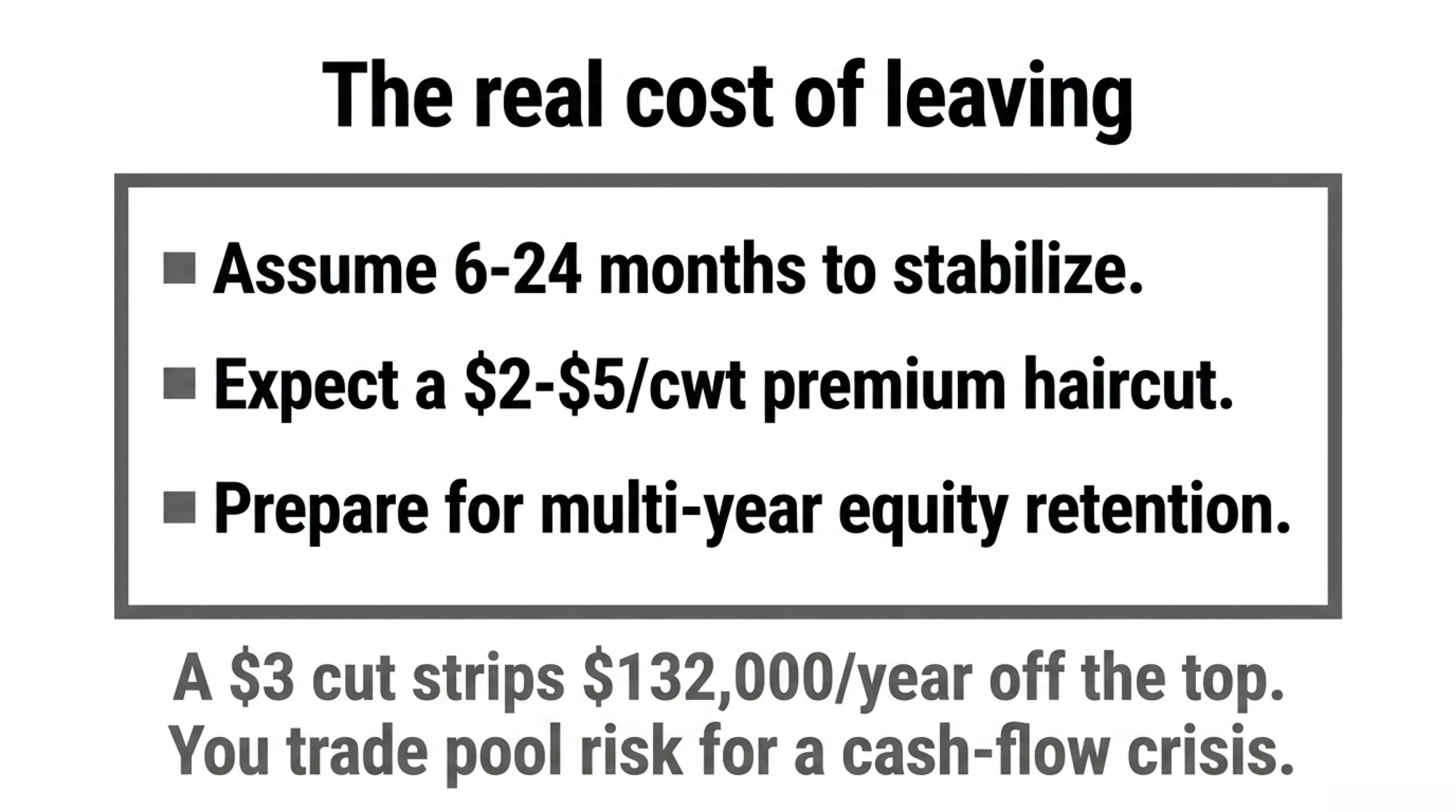
Option 3 — Map an exit to a different organic buyer. Some producers are already having quiet conversations with other organic handlers. This only makes sense if there’s another buyer in hauling range who actually wants your volume and will put a number on paper. Assume 6–24 months from “I want out” to “I’m stable with a new buyer,” a likely $2–$5/cwt premium haircut on the new deal, and a redemption horizon that, in many dairy cooperatives, runs several years; build cash flow assuming retained equity isn’t available immediately, and verify your co‑op’s actual schedule with its member services office. On 44,000 cwt, every $1/cwt haircut is $44,000/year. A $3/cwt cut is about $132,000/year off the top — enough to push many farms with thin DSCR cushions into covenant territory in a hurry, depending on debt service and operating costs. You’re trading pool‑policy risk for immediate cash‑flow pressure. Sometimes that’s the right trade. Sometimes it isn’t.
Option 4 — Diversify how you sell milk. This is the long, hard path. It can look like on‑farm bottling and direct sales, a branded partnership with a regional organic label, or a hybrid where part of your volume stays with the co‑op and part flows into a higher‑margin, lower‑volume channel. It needs capital for processing or packaging, real compliance and marketing horsepower, and an honest read on how many cwt your local market can absorb. Risk is high. But if you’re already at 1.0× DSCR with today’s premium, it might be the only path that ever gets you out from under the FMMO‑vs‑contract crossfire.
| Option | Time to Stability | Est. $/cwt Impact | DSCR Risk at Floor | Capital Needed | Best For |
|---|---|---|---|---|---|
| Stay in co-op, engage on pooling | Ongoing | 0 (today) — risk of future cut | High if premium falls | Low | DSCR ≥ 1.25× today |
| Stay + 30-day contract/covenant audit | 30 days | 0 (awareness only) | Identifies risk early | None | Every organic farm |
| Map exit to different organic buyer | 6–24 months | -$2 to -$5/cwt haircut | Moderate-High during transition | Low-medium | DSCR > 1.1× with options in hauling range |
| Diversify to on-farm/branded sales | 2–5 years | Potentially +$5–$15/cwt | High during buildout | High (processing/packaging) | DSCR ≥ 1.0× with capital access |
Key Takeaways
- If your DSCR drops below 1.0× at a 10–15% premium cut, your first job is a lender plan, not a co‑op fight. That’s the line where bankers stop being patient.
- If your supply agreement lets a buyer change pooling or utilization strategy without re‑negotiating price, treat that as a built‑in price‑cut option. The lawsuit doesn’t alter that clause.
- If your co‑op can’t show, with numbers, how organic over‑order premiums and FMMO pool costs are tracked separately from conventional, push for policy clarity, not reassurance.
- If your exit plan depends on co‑op equity coming back quickly, redo the math. Confirm your own co‑op’s redemption schedule in writing, and run cash flow without assuming early payouts.
- If your lender won’t put anything in writing about a $3–$5/cwt pay‑price drop, you’ve already learned something. Get an email summary of your DSCR conversation in the next 30 days.
- If you’re at 1.25× DSCR or better at today’s price, you have time to engage on pooling policy. Below 1.1×, the bigger threat is contract loss and covenant pressure, not the pool itself.
Before You Sign the Next Contract
The CODE lawsuits will move at court speed, not barn speed. Even if organic eventually wins an FMMO exemption or a refund, that ruling won’t tell your lender how many bad years they’ll tolerate or your co‑op how to structure your 2027 pay program. Those decisions still live in your contracts, your covenants, and your own numbers.

So before this fall’s contract review season hits, ask yourself three questions. Where does your DSCR break if your premium drops 15%? Which lines in your milk agreement let someone else move the goalposts on pooling and premiums without your signature? And if a new contract showed up in your mailbox tomorrow, could you and your lender sit down, run the barn math, and know — not guess — what it does to your 200‑cow operation?
Run Your Numbers
Farm Benchmark Snap Check — Stress-test your milk check against a $19.89/cwt swing before fall contract review. Plug in your own cwt, debt service, and premium, and see where your DSCR breaks if the organic contract walks or compresses 10%.
Complete references and supporting documentation are available upon request by contacting the editorial team at editor@thebullvine.com.
Learn More
- Coles and Brownes Just Exposed The $386000 Hole In Your Milk Contract — Arms you with a contract auditing protocol to identify hidden counterparty risks like unreleased exclusivity clauses and volume caps before signing your next processor agreement.
- The $20 Milk Paradox: Solving 2026 Dairy Basis Risk — Explains how the permanent FMMO make-allowance amendments baked an automatic $0.85–$0.93/cwt structural haircut into milk checks, forcing a 1,000-cow dairy to cancel its long-term expansion plans.
- Surviving the $0.94/cwt Dairy Make Allowance Hit — Exposes how regulatory manufacturing allowances permanently strip over $105,000 annually from a 400-cow operation, revealing why mandatory audited surveys could lock in this pricing drain for the next decade.
 The Sunday Read Dairy Professionals Don’t Skip.
 The Sunday Read Dairy Professionals Don’t Skip.
Every week, thousands of producers, breeders, and industry insiders open Bullvine Weekly for genetics insights, market shifts, and profit strategies they won’t find anywhere else. One email. Five minutes. Smarter decisions all week.