








DPR’s been rebuilt and CCR now carries real weight. The DPR-CCR correlation just hit +0.94 — here’s how to use it to sort your tank into hold, watch, and swap before Aug 11.
Executive Summary
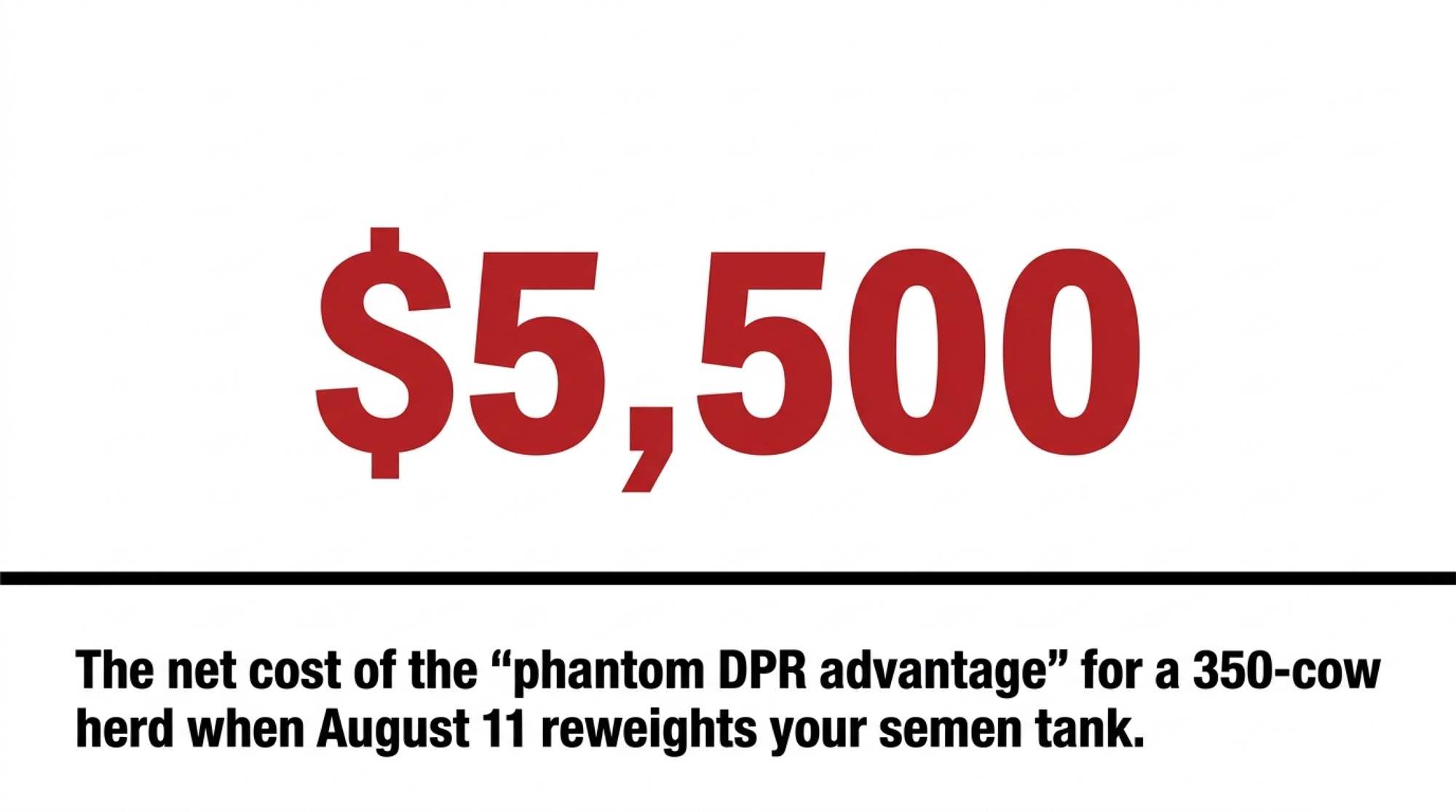
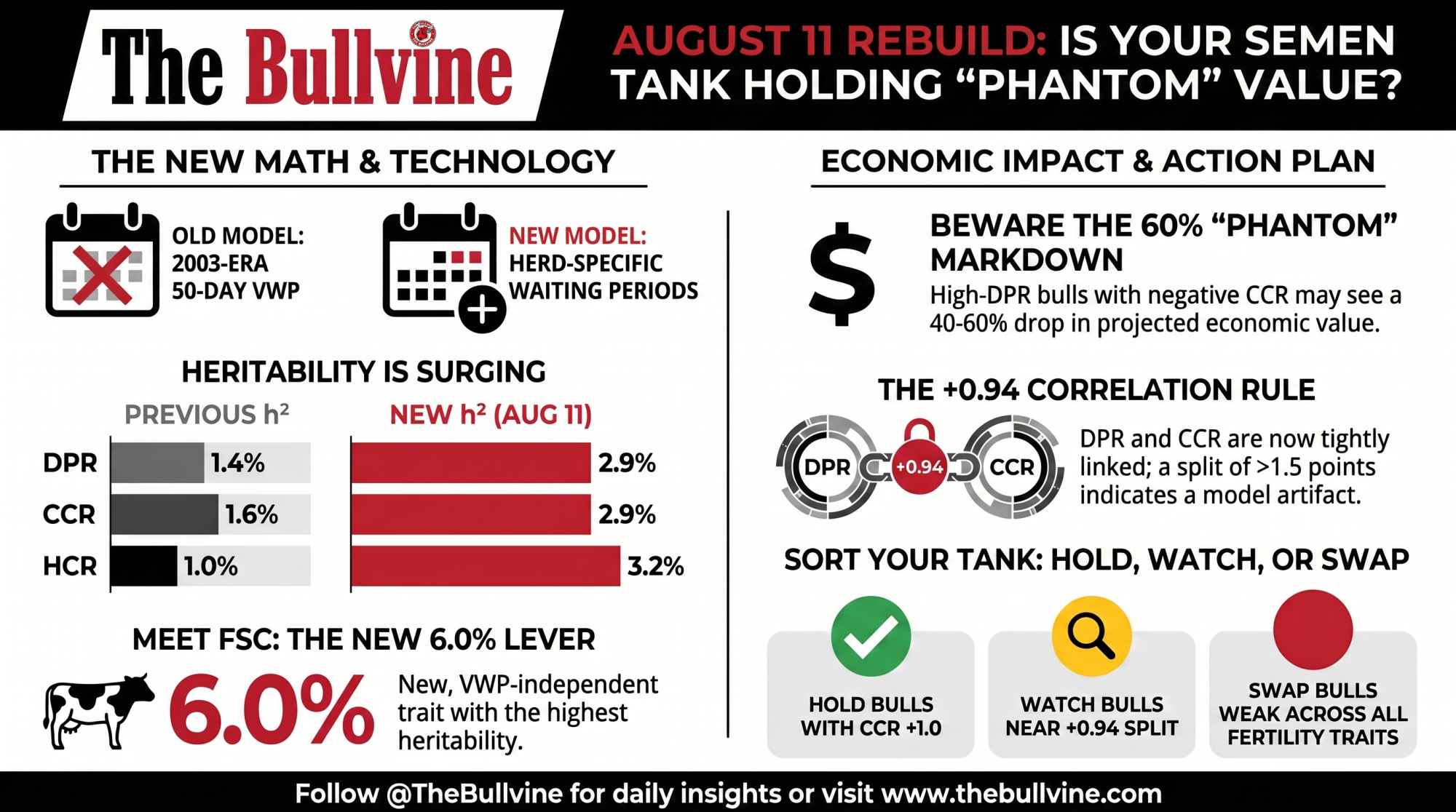
On August 11, CDCB rebuilds all four female reproductive traits — DPR, CCR, HCR, and EFC — and adds three new ones, so the bull you bought this spring on DPR may reprice the morning the run lands. The fix scraps the fixed 50-day voluntary waiting period DPR has run on since 2003 and swaps in herd-year, lactation-specific waiting periods that match how you actually breed — which is why more than 55% of young bulls were sliding at every run from December 2023 to December 2024. Here’s the tool to sort your tank now: the DPR-CCR correlation jumped to +0.94, so any bull sitting above +1.5 DPR with CCR at zero or negative is a flag, not a hold. CCR heritability climbs to 2.9% and HCR more than triples to 3.2%, meaning a -0.8 CCR that used to read as noise now carries real weight. Run the barn math and a “phantom DPR advantage” worth $9,450 in projected open-day savings on a 350-cow herd can shrivel to $3,500–$5,500 once CCR reweights — a 40-to-60% markdown on the edge you thought you paid for. The further your VWP sits past 50 days, the more your numbers move, so pull your average days-to-first-service and your first-service conception by sire before August 11.
CDCB started a foundational review of its reproductive trait portfolio in 2024. The result lands August 11: Daughter Pregnancy Rate (DPR), Cow Conception Rate (CCR), Heifer Conception Rate (HCR), and Early First Calving (EFC) all get rebuilt, and a new trait — First Service to Conception (FSC) — joins them. All five run across Holstein, Jersey, Brown Swiss, Ayrshire, Guernsey, and Milking Shorthorn, for males and females alike.
The research carries the names of CDCB’s research team — T.M. McWhorter, J.R. Graham, E. Nicolazzi, longtime USDA scientist P.M. VanRaden, A. Ling, S. Savoia, and A. Legarra. CDCB says the package touches ten separate model components at once. That’s not a quarterly tweak. It’s a two-year rebuild that ran across seven consecutive triannual evaluations for stability and passed Interbull’s international validation in January–February 2026, per CDCB.
The core problem is older than most of the cows in your barn. Since 2003, DPR has run on a fixed 50-day voluntary waiting period with a 20-day grace period — applied to every herd in the database, no matter what that herd actually does. The industry moved on. Synchronization programs, sexed semen, beef-on-dairy, and a wide spread of VWPs — all standard now. The model stayed put.
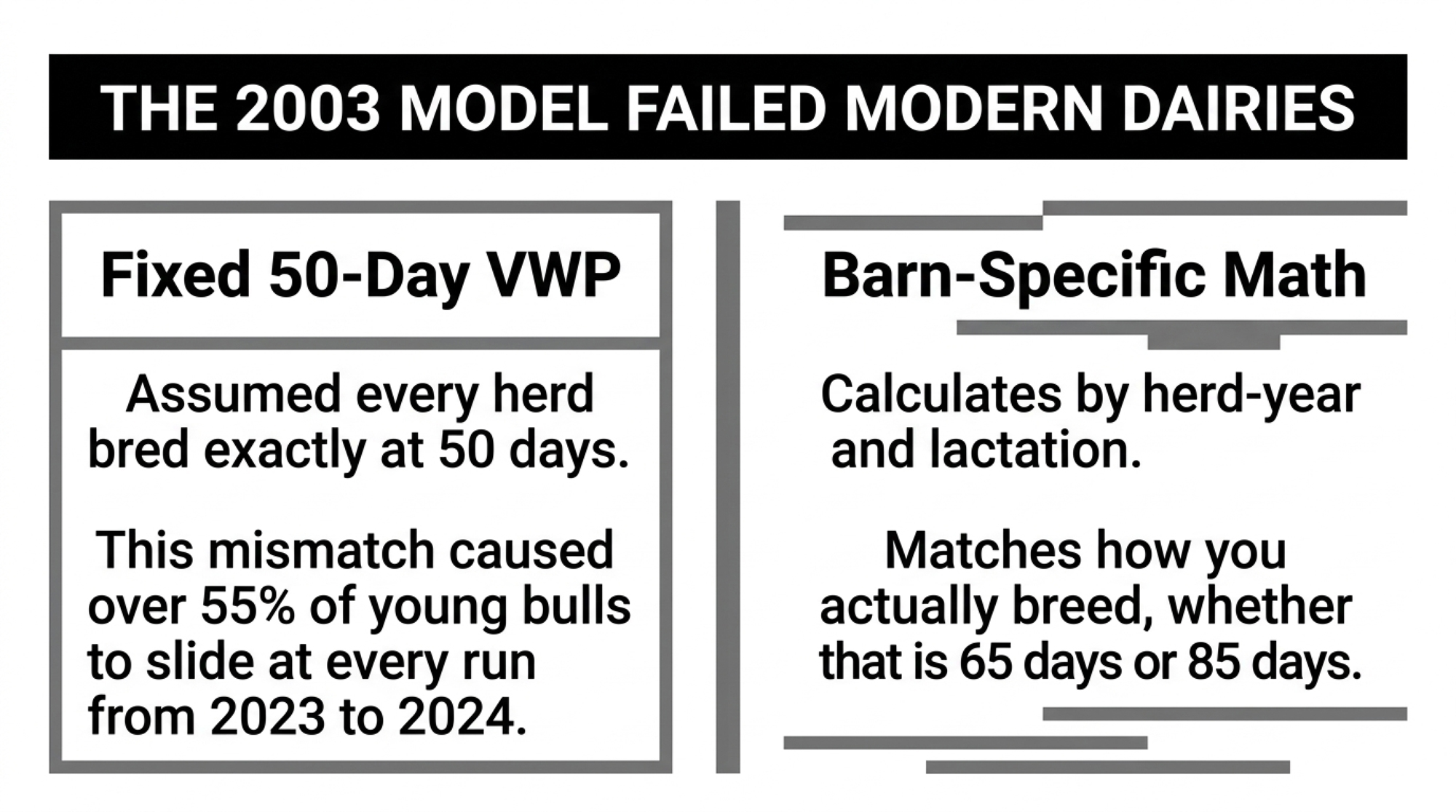
That mismatch dragged young-bull numbers one direction. In the legacy system, more than 55% of bulls showed constantly declining PTAs at every run from December 2023 to December 2024 — which shouldn’t happen, because fresh daughter data ought to push roughly equal numbers up and down. CDCB flagged the gap itself and built the fix: herd-year and lactation-group-specific waiting periods, calculated separately for first lactation and later lactations, that match how operations really breed.
Every Trait Being Repriced — at a Glance
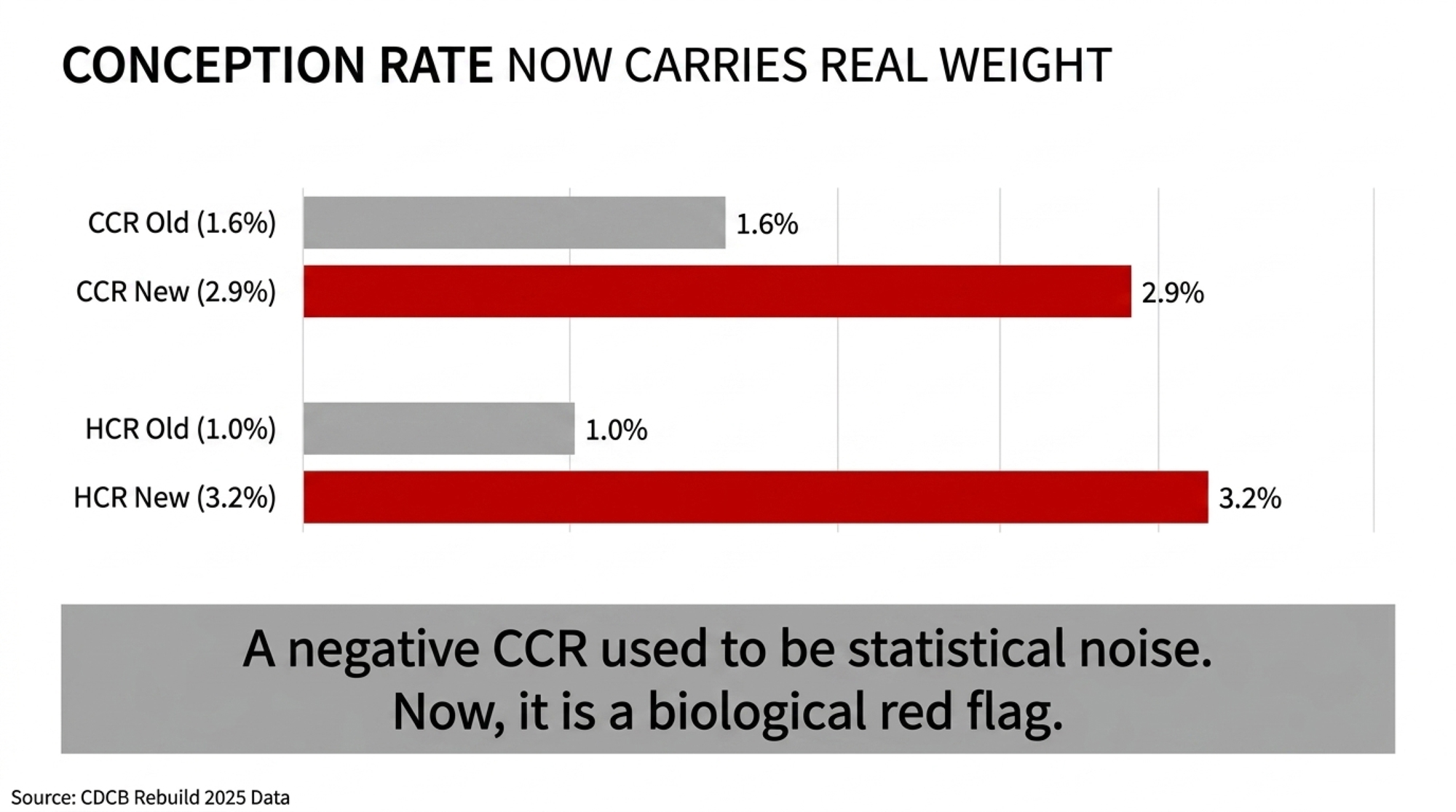
| Trait | Old h² | New h² | Direction | Key Model Change | Sire Selection Action |
|---|---|---|---|---|---|
| DPR | 1.4% | 2.9% | ↑ ~2× | Fixed 50-day VWP → herd-year/lactation-specific VWP | Flag any bull above +1.5 DPR with CCR ≤ 0 |
| CCR | 1.6% | 2.9% | ↑ ~2× | DIM-at-first-service covariable added | Elevate from tiebreaker to primary fertility signal |
| HCR | 1.0% | 3.2% | ↑ 3×+ | Heritability more than triples — now a real selection lever | Start weighting in replacement-heifer programs now |
| EFC | 2.7% | 1.4% | ↓ ~½ | Moved to single-trait model | Dial back EFC emphasis if you’ve been pushing hard |
| FSC | — | 6.0% | 🆕 New | VWP-independent; measures days 1st insem. → conception | Use as CCR crosscheck; identical genetic signal (+0.98 corr.) |
Watch EFC. It runs the opposite way — heritability drops from 2.7% to 1.4%, so age-at-first-calving selection just got a touch less responsive, not more. If you’ve been pushing hard on EFC, that’s worth a second look.
The genetic trends now line up with what producers see in the barn. Older proven bulls with big daughter counts stay stable; the young bulls stop sliding. The biology didn’t change. The model did.
The One Number That Audits Your Tank Right Now
Here’s the tool you already have, weeks before the run.
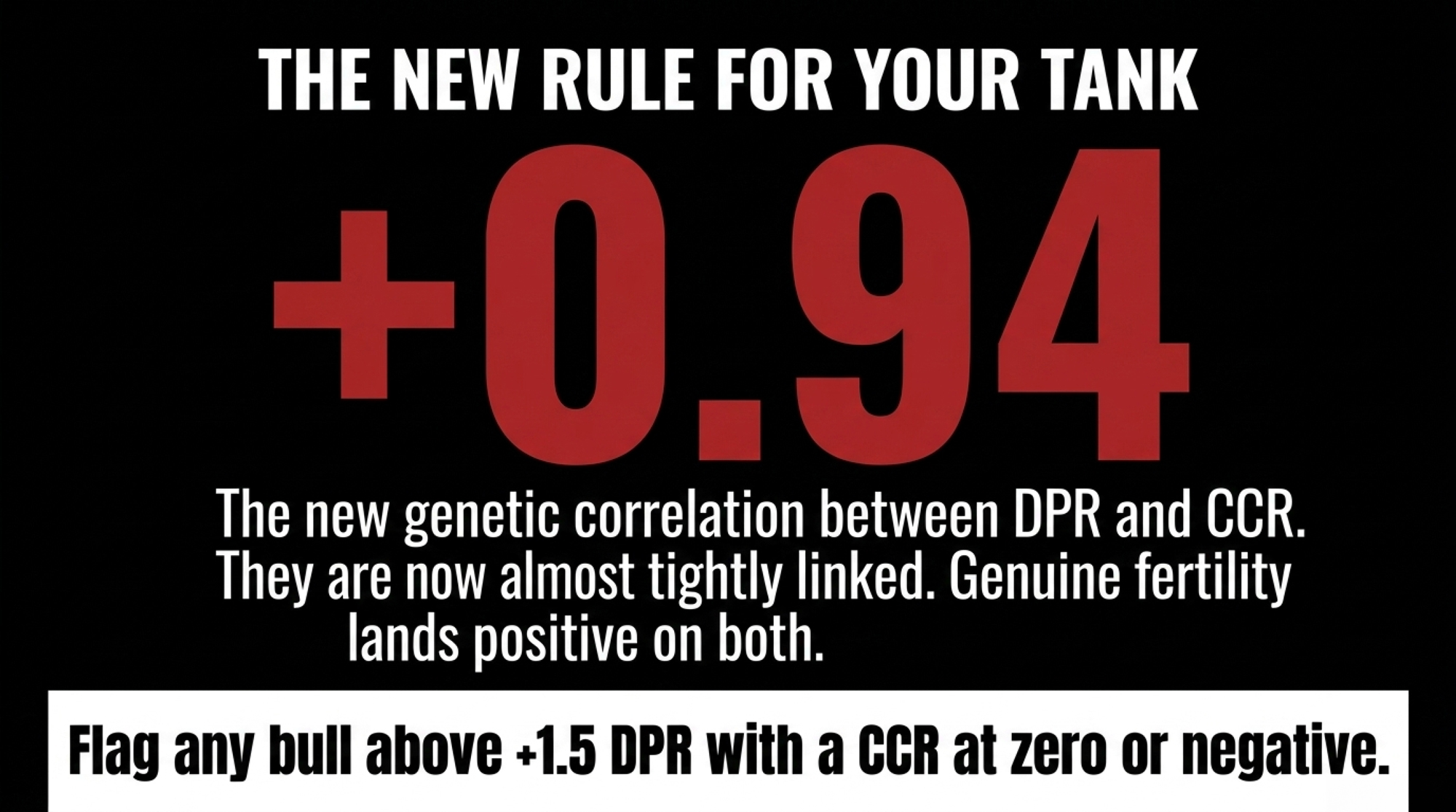
The revised model puts the genetic correlation between DPR and CCR at +0.94, up from +0.86 — that’s per CDCB’s December 2025 test run, with the official figure confirming August 11. That’s about as tightly linked as two traits get. A bull with genuine fertility should land positive — or at least consistent — on both. When they split by more than roughly a point and a half in opposite directions, you’re probably looking at a measurement artifact, not real biology.
So pull your top five bulls by units used since January. Write down each one’s spring DPR and CCR. Any bull above +1.5 DPR with CCR at zero or negative is your first flag. He’s not necessarily a bad bull. But his legacy DPR may have been propped up by the old waiting-period mismatch — and his CCR is about to carry more genetic weight than it used to.
That weight shift is the part producers keep underestimating. CCR heritability climbs to 2.9% from 1.6%, and HCR more than triples to 3.2% from 1.0%. DPR itself roughly doubles, 1.4% to 2.9%. Still low-heritability traits, all of them — but under the old model a -0.8 CCR was barely distinguishable from noise. Under the new one, it means something. If you’ve treated CCR as a tiebreaker rather than a trait worth weighting, this is the run that changes the math.
The correlations also shifted underneath the headline traits. DPR-HCR jumped to +0.56 from +0.36, and CCR-HCR to +0.52 from +0.45. The new FSC trait lands tight against the others — CCR-FSC at +0.98, DPR-FSC at +0.96. Translation: FSC and CCR are almost the same genetic signal expressed two ways, one in days, one in percent.
What Does the “Phantom Advantage” Actually Cost?
Take a 350-cow timed-AI herd. Eighty-five-day VWP, Presynch-Ovsynch, 90% service rate — 315 cows in play. This is an illustrative scenario, not a real herd’s books, and every assumption is stated so you can swap in your own.
Assumptions: $5 per day open — the top of the $3–$5 range University of Wisconsin-Madison extension work puts on each additional day open, depending on milk price and replacement cost. $25 per unit of conventional semen. 35% conception rate per service.
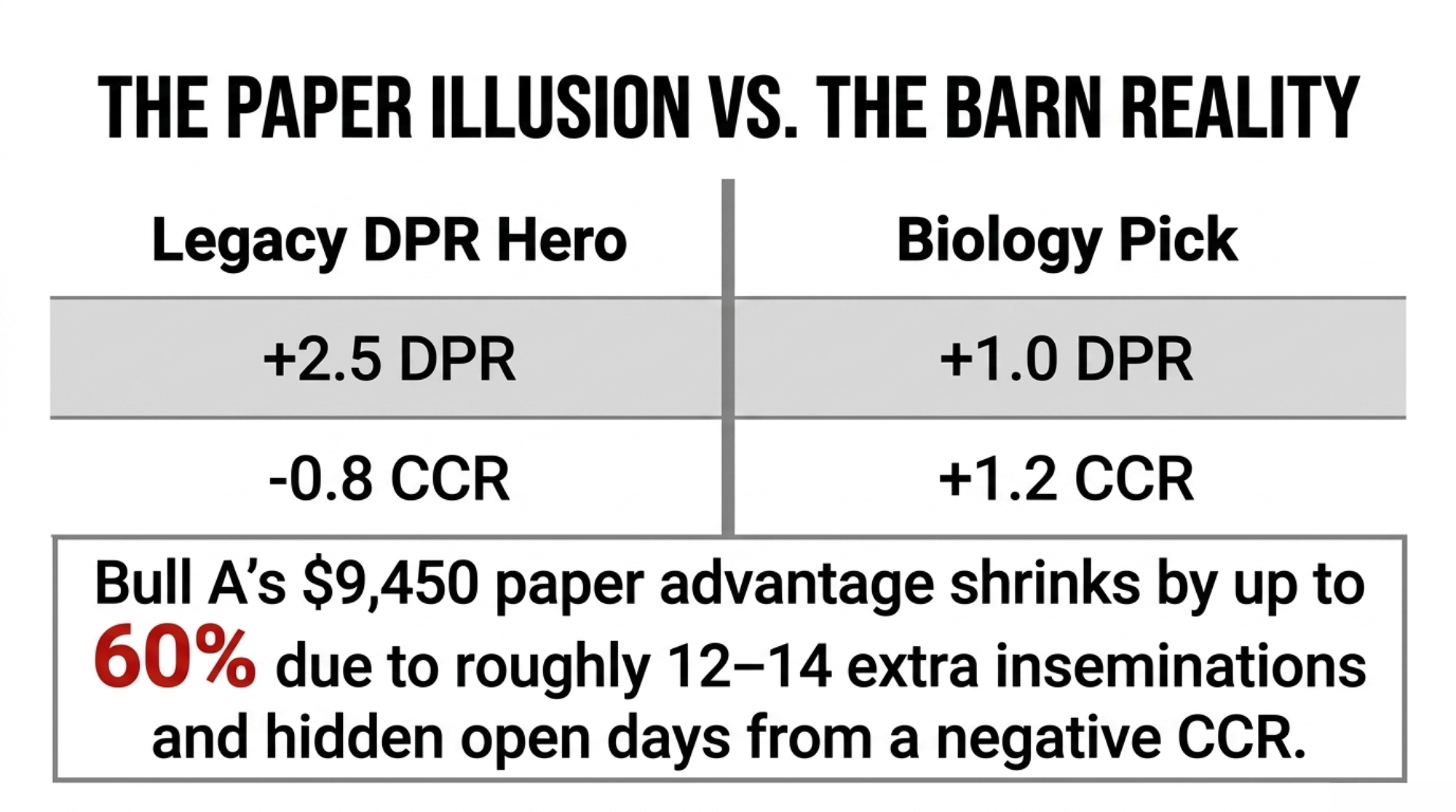
Two bulls. Bull A is the legacy DPR hero: DPR +2.5, CCR -0.8. Bull B is the conception-biology pick: DPR +1.0, CCR +1.2. Here’s how Bull A’s edge erodes once August reweights CCR:
| Metric | Bull A (DPR Hero) | Bull B (Conception Pick) | Edge |
|---|---|---|---|
| DPR PTA | +2.5 | +1.0 | Bull A +1.5 pts |
| CCR PTA | -0.8 | +1.2 | Bull B +2.0 pts |
| Paper open-day savings (85-day VWP, 315 cows) | +$9,450 | +$0 baseline | Bull A on paper |
| CCR penalty (semen + synch labor) | -$325 to -$500 | — | Bull B |
| Hidden open-day bleed (extra services → late conception) | -$2,800 to -$6,600 | — | Bull B |
| Net real advantage | ~$1,850–$5,500 | $0 baseline | Bull A shrinks 40–60% |
| Post-Aug 11 CCR weight | ↓ Risk — h² jumps 1.6→2.9% | ↑ Strengthens | Bull B |
| FSC signal (proxy) | Likely negative | Likely positive | Bull B |
| Verdict | Watch / flag before Aug 11 | Hold / preferred | Bull B wins biology |
- The paper illusion. CDCB’s documentation confirms a DPR +1.0 PTA equals four fewer days open, per a prior USDA study — so Bull A’s 1.5-point edge reads as about six fewer days open per daughter. Six days × $5 × 315 cows = $9,450 in projected open-day savings. On paper, Bull A wins.
- The reality check (CCR penalty). That -0.8 CCR against Bull B’s +1.2 is a two-point swing. There’s no published point-to-services conversion, so model it yourself: call it two extra services per 100 cows per cycle. Across 315 cows over two cycles, that’s roughly 12–14 extra inseminations — about $325 in semen plus an estimated $100–$170 in synch labor.
- The hidden bleed. Those extra services push four to six additional days open onto the cows that don’t settle. At $5/day, that’s roughly $2,800–$6,600 across the 140–220 cows most likely affected — pull the real count from your own herd’s non-conception rate.
- The net result. The $9,450 paper advantage shrivels toward a $3,500–$5,500 net range — a markdown of roughly 40% to 60%.
Not zero. But not the bull your spring order was built around, either. If that feels familiar, it should — it’s the same trap as buying a proof on one headline number and eating the markdown later, the way three-year-old proofs averaged a $72 markdown when the daughters finally landed.
Does VWP Length Change Your Exposure? Run It at 65 Days
Now run the same comparison on a shorter-VWP herd — say 65 days, a cow-by-cow program that breeds on heat earlier. The DPR correction bites less there, because the old fixed 50-day assumption wasn’t as far from your reality to begin with.
Bull A still loses ground on CCR — that two-point swing doesn’t care about your waiting period. But the DPR rescale moves him less, so the phantom advantage that needs erasing was smaller to start. Walk it through: at 65 days, Bull A’s legacy DPR edge might pencil at four fewer days open instead of six, trimming the paper savings to roughly $6,300 across the same 315 cows. The CCR penalty stays put at $3,200–$6,800. The net swing lands closer to break-even — Bull A and Bull B end up much nearer each other.
Here’s the rule that falls out of both scenarios: the further your actual VWP sits from that old 50-day baseline, the more August moves your DPR numbers. An 85-day herd has more correction coming than a 65-day herd. That single fact — how far your barn breeds from 50 days — is the best predictor you’ve got of how exposed your tank is. Pull your own average days-to-first-service before August 11 and you’ll know which camp you’re in.
Buying DPR while ignoring CCR is like buying a tractor for its horsepower rating while ignoring its fuel burn per hour under a heavy load. The number was real. It just wasn’t measuring the thing you thought it was.
The New Trait Nobody Ordered — FSC
Then there’s the one nobody put on an order sheet: First Service to Conception, or FSC.
FSC measures days from a cow’s first insemination to conception, and a positive PTA means fewer days. The design choice that matters: it’s explicitly not a function of the VWP, so it reflects individual-cow management no matter when your barn starts breeding. Holstein active-AI bulls range from -24.8 to +20.7 days against a breed base of 55.60 days, per the December 2025 run.
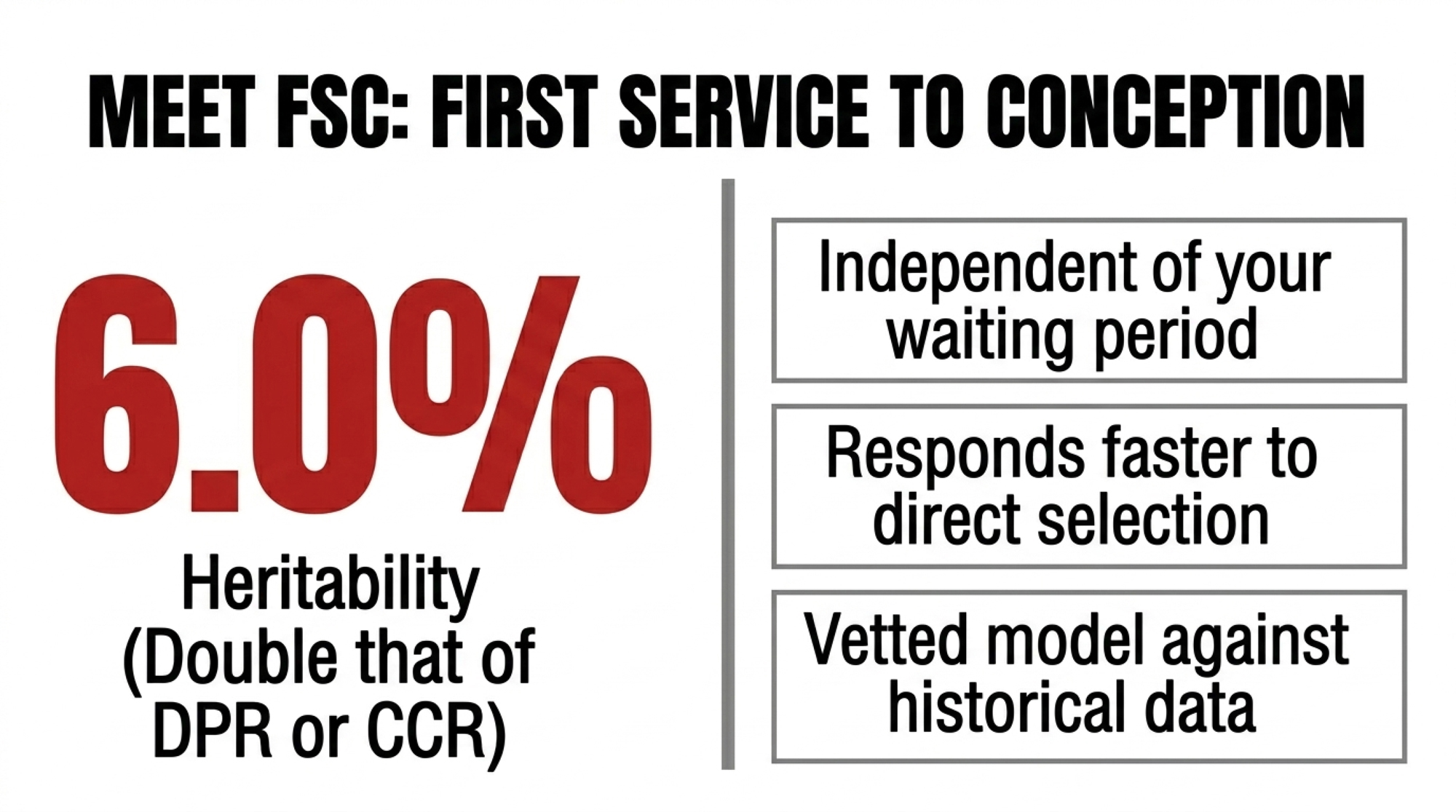
Its heritability is 6.0% — the highest in CDCB’s reproductive portfolio, roughly double DPR or CCR. That means it responds faster to direct selection than the traits breeders have leaned on for years. And while August 11 is the first official run to publish FSC PTAs, the trait isn’t untested science — CDCB already ran it against historical data through the December 2025 test run before releasing it, so the underlying model is vetted, not experimental. For herds running cow-by-cow waiting-period calls, FSC is closer to what DPR was always trying to be.
The Calf-Health Pair Sharing the Stage
The two other new traits — Resistance to Respiratory Problems (RSP) and Resistance to Diarrhea (DIA) — are easy to miss in the reproductive noise, but August 11 is their debut too. They’re the first national selection tools aimed at calf respiratory disease and scours, built from the same National Cooperator Database that already feeds 50 traits and four indexes off roughly four million cows of annual data.
If you’ve been buying calf survival indirectly through livability and management, this is the run that gives you a direct genetic lever on two of the costliest pre-weaning problems in the barn. They won’t reshuffle your sire ranking the way the reproductive rebuild will. But for herds bleeding labor and treatment cost on sick calves, they’re worth a column on the mating sheet starting now.
How the Model Decides What Counts
One underappreciated change sits in the data edits, and it explains why some young bulls will move more than others. Under the rebuild, daughter data doesn’t enter DPR, CCR, or FSC until 36 months after the cow’s birth — giving high- and low-fertility daughters time to show up closer together, instead of letting the early-calving, easy-breeding daughters set the tone. That means a young bull may need one or two extra triannual runs before his first daughters move his number.
CDCB also tightened the edits: cows with a missing sire are dropped, records with missing calving dates or days open are removed, and contemporary groups with fewer than four observations are tossed entirely. CCR and HCR now account for service-sire breed, mating type — sexed, conventional, natural, or unknown — and short cycling, those re-breeds landing 10 to 17 days after the last service. If you run a lot of beef-on-dairy or sexed semen, that last fix is quietly aimed at you: the old model wasn’t separating those services cleanly, and the new one does.
The Tank-Sorting Action Plan
You don’t have to wait for the run to act. You have to be ready for it. Work this as a sequence:
| Category | DPR | CCR | HCR | Your Conception Data | Reorder? | Notes |
|---|---|---|---|---|---|---|
| ✅ HOLD | Any | +1.0 or better | Neutral to positive | Tracks within 2 pts of proof | Yes — maintain | Conception biology is real; most should hold or improve Aug 11 |
| ⚠️ WATCH | +1.5 or higher | 0 or negative | Any | Below CCR proof | No — wait for Aug 11 run | Legacy DPR may be propped by old 50-day VWP mismatch |
| 🔴 SWAP | Below average | Negative | Negative | Consistently underperforms | No — replace | Weak across all 3 reproductive traits; production numbers don’t fix fertility |
| ⚠️ WATCH | Average | Neutral (0 to +0.5) | Below average | Matches proof ±1 pt | Conditional | Flag for post-Aug 11 review; HCR tripling may move ranking |
1. Pull barn benchmarks — this week. Extract your average days-to-first-service and your first-service conception rates by sire from your herd management software (DairyComp or equivalent). Days-to-first-service tells you how far you breed from the old 50-day baseline — the single best predictor of how much your DPR-heavy bulls will move.
2. Identify the splits — next week. Audit your top five most-used bulls. Flag any sire where the legacy DPR and CCR split by more than 1.5 points in opposite directions. If your own conception data runs consistently below a bull’s CCR proof, weight your data — that gap is your signal, not the proof.
3. Grill your stud rep — two weeks out. Call your genetic supplier. Ask exactly how their proprietary fertility flags — Select Sires’ FertilityPRO, Semex’s Repromax, and the equivalents at ABS and Alta — are shifting to account for the new CDCB weights. A rep with a real answer has done the homework.
4. Categorize your tank — by August 10. Sort your physical inventory into three piles:
- Hold — CCR +1.0 or better, DPR consistent within a point. Conception-biology bulls; most should hold or improve through the run.
- Watch — DPR +1.5 or higher with CCR at zero or negative. Don’t reorder until the run lands; the waiting-period correction may quietly trim that DPR lead.
- Swap — weak across DPR, CCR, and HCR, however good the production numbers look. August doesn’t fix biology.
Two things to keep in mind as you sort. If heifer conception is eating your replacement budget, this is the run to start weighting HCR seriously — heritability more than tripling to 3.2% finally makes it a real selection lever. And don’t brace for an index reshuffle: CDCB confirms the revisions don’t change trait emphasis in the lifetime merit indexes, because those weights are economic and aren’t being updated — but any bull whose CCR correction is material still moves on the Fertility Index, which weights DPR and CCR equally.
The run doesn’t change a single cow in your barn. It changes what you know about the bulls you’ve already paid for. The real question isn’t whether the new numbers are more accurate — by CDCB’s own validation, they are. It’s whether you’ll have your tank sorted into hold, watch, and swap before August 11, or whether you’ll be reading your mating sheet backward in September. Which pile does your heaviest-used sire fall into right now?
Run Your Numbers
Pregnancy Rate Economics Calculator — The phantom advantage lives or dies on days open. Plug in your herd size, cost per day open, and conception rate to put a real dollar value on the CCR gap before you reorder — and pressure-test whether that high-DPR bull actually pencils in your barn.
Complete references and supporting documentation are available upon request by contacting the editorial team at editor@thebullvine.com.
Learn More
- Navigating the CDCB August 2026 Genetic Rescale and New Fertility Traits — Arms you with a post-run tactical blueprint to align your herd’s specific breeding protocol—whether a uniform pen VWP or a cow-by-cow program—directly against the newly published FSC, DPR, and CCR evaluations.
- Daughter Pregnancy Rate (DPR) vs. Cow Conception Rate (CCR): Which will help you improve your herd’s fertility? — Dismantles the historical confusion between long-term cycling genetic trends and immediate per-service conception success, establishing how to position your genetic inventory to permanently slash expensive, wasted AI semen overhead.
- dairy cow breeding — Exposes the aggressive structural pivot of global genetic indexes—including the U.S. 40-40 shift—away from pure legacy DPR dominance to prioritize robust cows that recover fast and conceive immediately.
 The Sunday Read Dairy Professionals Don’t Skip.
 The Sunday Read Dairy Professionals Don’t Skip.
Every week, thousands of producers, breeders, and industry insiders open Bullvine Weekly for genetics insights, market shifts, and profit strategies they won’t find anywhere else. One email. Five minutes. Smarter decisions all week.




