





Five “backup” bulls nobody wanted now shape most Holstein pedigrees. At 9.99% inbreeding, your next 15–20% sire choice will decide how your herd survives.
Monroe was supposed to be the bull.
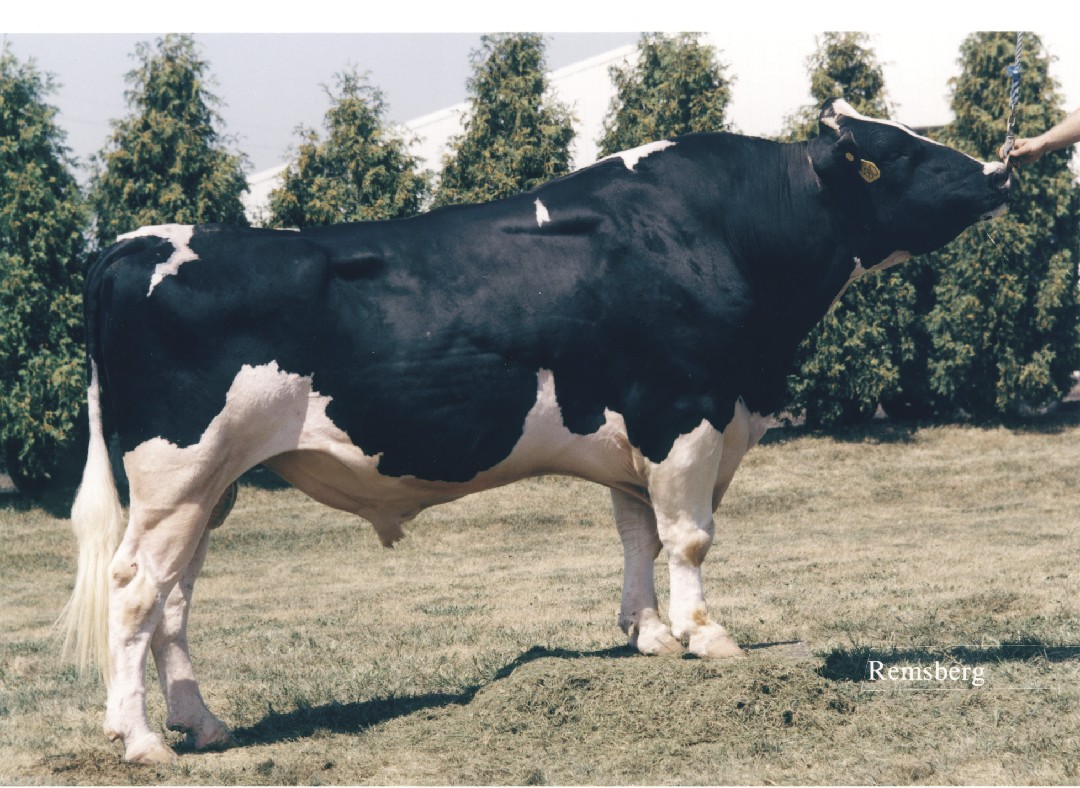
Select Sires had contracted the young sire — a Chief son out of Walkway Matt Mamie (EX-90 GMD DOM) — for collection in 1978. When Monroe died during test services before a single straw was frozen, Charlie Will, a young sire analyst on his first acquisition, bought Monroe’s full brother instead. Registration HOUSA000001773417. Walkway Chief Mark (Bullvine Podcast E484, Feb 2026).
That backup bull’s DNA now sits in roughly seven percent of every Holstein on the continent (2020 Holstein Pedigree Analysis). His name appears twenty-five times in the pedigree of Farnear Delta-Lambda, whose daughter, West-Adub Lambda Sadie, won Intermediate Champion at World Dairy Expo in 2025. And Mark is just one of five bulls who reshaped the breed precisely because they started as Plan B — the overlooked outcross genetics nobody was chasing. With Canadian Holstein heifers born in 2024 averaging 9.99% inbreeding (Lactanet Canada), backup bulls aren’t just good history. They’re survival gear.
The Backup Bull Pattern at a Glance
| Bull | The “Plan A” | Why He Was Plan B | Key Legacy Stat |
| Walkway Chief Mark | Monroe (full brother) | Sibling replacement after Monroe died | 7% of North American Holstein genome |
| Carol Prelude Mtoto | Bell-line “rockets” | Italian import; £40/straw | Sire of Shottle (1.17M doses) |
| O-Bee Manfred Justice | Durham (type king) | UDC of -3.22; too plain for show barns | ~13% genetic relationship to breed |
| Fustead Emory Blitz | Blackstar A-list sons | Small-farm prefix; unremarkable pedigree | 1.52 million straws sold |
| Round Oak Rag Apple Elevation | None — low-priority mating | Known fertility limitations | 15.28% of Holstein genome |
The Heifer Pen Where Mark Was Born
Foster Walk farmed outside Neoga, Illinois. The Bullvine’s podcast profile described him as having “an eye for diamonds in the rough” — a farmer who purchased groups of heifers at 21 cents a pound and built quality through cow sense rather than catalog pedigrees. His herd wasn’t the kind that generated buzz in Holstein World classifieds. But it produced Mark’s dam, and that turned out to matter more than every splashy sale catalog of the decade.
By the late 1970s, breeders were deep in the first great wave of Pawnee Farm Arlinda Chief genetics — Chief’s contribution eventually measured at 14.95% of the entire Holstein genome (2020 Holstein Pedigree Analysis). Every AI organization wanted more of his sons. Will had come looking for one. He left with a different one.
One backup bull is an accident. Keep reading.
Udders That Won, Feet That Lost
When Mark’s first daughters freshened, coded 7HO980 in every AI catalog in the country, the udder results were hard to argue with. Fore attachments, rear attachments, teat placement, udder depth — all trending well above the competition.
But a structural curse traveled with the package. Shallow heels. Weak pasterns. The problem traced back through Mark’s maternal line, through No-Na-Me Fond Matt. As one breeder recalled in the Bullvine’s profile: “When they come into the show, you love them. However, when they turned sideways, you see the legs and high pins.”
Breeders who treated Mark as a specialist tool — using him exclusively on cow families with strong feet and legs — built the best udders of their generation. The ones who spread him indiscriminately spent a decade managing foot problems. He eventually recorded 57,654 production-tested daughters, more than most AI studs produce from their entire lineup in a decade.
Can a Backup Bull Really Appear 42 Times in 10 Elite Pedigrees?
When analysts traced the pedigrees of the breed’s top 10 GTPI females circa 2015, Mark appeared forty-two times — thirty-three as sire of a female in the lineage, nine as sire of a male. Only Starbuck, at thirty-five, came close.
His most consequential genetic path ran through a son named Mark CJ Gilbrook Grand, connecting eventually to Seagull-Bay Supersire — who debuted at +2530 gTPI as a genomic young sire in December 2012 and graduated as the breed’s No. 1 proven GTPI sire in April 2015 at +2613 GTPI with NM$ of +$834 (Bullvine, April 8, 2015; Select Sires). Supersire sold over one million units of semen. Three separate Mark crosses sit in Braedale Goldwyn’s pedigree.
The Bullvine’s Mark profile also documented a hidden cost in his legacy: the APAF1 mutation, traced back through his sire Chief, caused the loss of more than 500,000 calves worldwide over 30 years — more than 100,000 in the United States alone — before Harris Lewin’s team at UC Davis identified it (Adams et al., 2016, UC Davis College of Biological Sciences; also covered by the Bullvine, October 2016). The economic toll: an estimated $420 million.Greatness and genetic risk travel in the same pedigree. That’s the trade-off every backup bull forces you to confront.
Carol Prelude Mtoto: The £40 “Failure” From Italy
Two backup bulls are a coincidence. But the pattern was just getting started.
By the late 1990s, the industry was hooked on first-lactation records. Bell daughters and their descendants were flooding barns with milk at volumes nobody had seen before. But those daughters were falling apart structurally by the second lactation. Small frames, weak substance, udders that couldn’t sustain the metabolic load.
“It was like a battlefield,” producers from that era told the Bullvine in our 2025 Mtoto profile. “Cows are down with milk fever everywhere. Others were standing with their legs all splayed out, trying to hold up udders that had completely broken down. We were getting maybe two, two and a half lactations before they were done.”
What Does a £40 Outcross Buy You?
Mtoto was born July 13, 1993, in Italy’s Parmigiano-Reggiano region. Average size. Production genetics that looked mediocre next to the Bell-line rockets everyone else was marketing. When Avoncroft brought him to Britain in 1998, his straws cost £40 each — roughly four times the going rate for standard proven bulls.
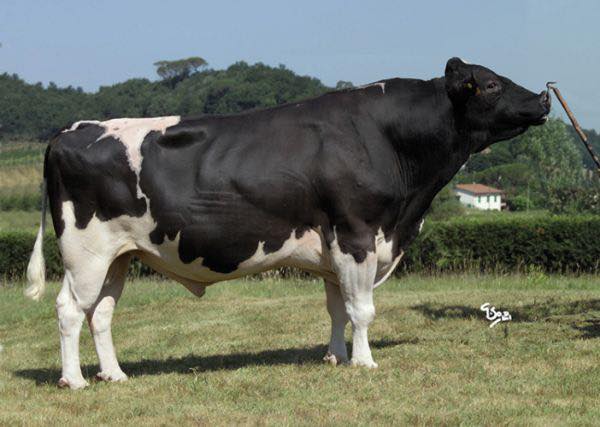
But Mtoto had been deliberately bred to fix what Bell broke. His sire, Ronnybrook Prelude — a Starbuck son — brought good frame and dairy character. His dam, a Blackstar daughter, brought constitution. And Chief Mark was back there for the udders. The pedigree read like a correction formula.
Mtoto’s daughters weren’t production champions. They were survivors — lasting six profitable lactations while Bell-line contemporaries washed out after two. His mature proof (UK, August 2025 run) shows somatic cell scores of -13, a HealthyCow index of +17, and a lameness advantage of +0.7. Thirty years on, those health advantages haven’t eroded.
An Eight-Year-Old Cow, a £40 Sire, and a Bull Worth 1.17 Million Doses
The real payoff came one generation later. The Pickford family at Picston Farm (Spot Acre Grange, Staffordshire), along with Anthony Brough of Tallent Farm in Cumbria, had purchased Condon Aero Sharon (EX-91) at the Great Yorkshire Show in 1991. By 1999, Sharon was eight years old — an age when most breeding programs have long since moved on.
Helen Pickford recalled the pushback in our 2025 profile: “The reps kept showing us data on first-lactation heifers. Dad just kept saying, ‘But Sharon’s still here, still producing well. These heifers you’re pushing — will their daughters still be milking in eight years? “
The Pickfords bred Sharon to Mtoto through ABS’s progeny testing program. Louise Pickford, then a Genus ABS sire analyst, identified the resulting bull calf for the company’s Cornerstone program (ABS Global, July 2014). That calf was Picston Shottle, born July 23, 1999.
Shottle hit No. 1 TPI (2060) in the US in January 2008 and dominated rankings on both sides of the Atlantic — including seven consecutive evaluations atop the UK’s Profitable Lifetime Index (ABS Global; Bullvine Shottle Legacy, June 2025). He achieved 9,674 Excellent daughters worldwide through 2014, and ABS documentation confirms the sale of over 1.17 million doses. Sharon herself was voted Global Cow of the Year in 2007.
When feed costs spiked and milk prices crashed in 2008, herds heavy with Shottle daughters weathered it better than operations that had chased peak first-lactation yields. “Shottle daughters saved farms,” producers told the Bullvine. “When feed doubled, and milk crashed, operations with higher-producing herds went under. Those moderate-production cows that lasted six lactations? They kept us alive.”
O-Bee Manfred Justice: The Anti-Type Bull
Three backup bulls. Same pattern emerging. And the next one would make the show crowd furious.
The early 2000s belonged to Regancrest Elton Durham — five consecutive Premier Sire banners at World Dairy Expo from 2003 to 2007. Long bodies, broad and flat rumps, outstanding dairyness. Goldwyn succeeded him in 2008 and claimed ten Premier Sire banners at World Dairy Expo — seven consecutive from 2008 through 2014 (Semex, October 2014), interrupted by Pine-Tree Sid in 2015, then recaptured in subsequent years for a total of ten through 2018 (Farmers Forum, October 2018; Bullvine, February 2026).
Too Plain for the Ring, Too Profitable to Ignore
O-Bee Manfred Justice — born March 8, 1998, sired by Manfred with Elton as maternal grandsire — didn’t fit that mold. His NAAB linear profile tells the story: UDC of -3.22, Dairy Form at -3.45, Feet & Legs score of -1.07 (NAAB Sire Evaluation Database). Commercial farmers saw a cow that would stay in the herd. Show breeders saw a cow they’d never lead into the ring.
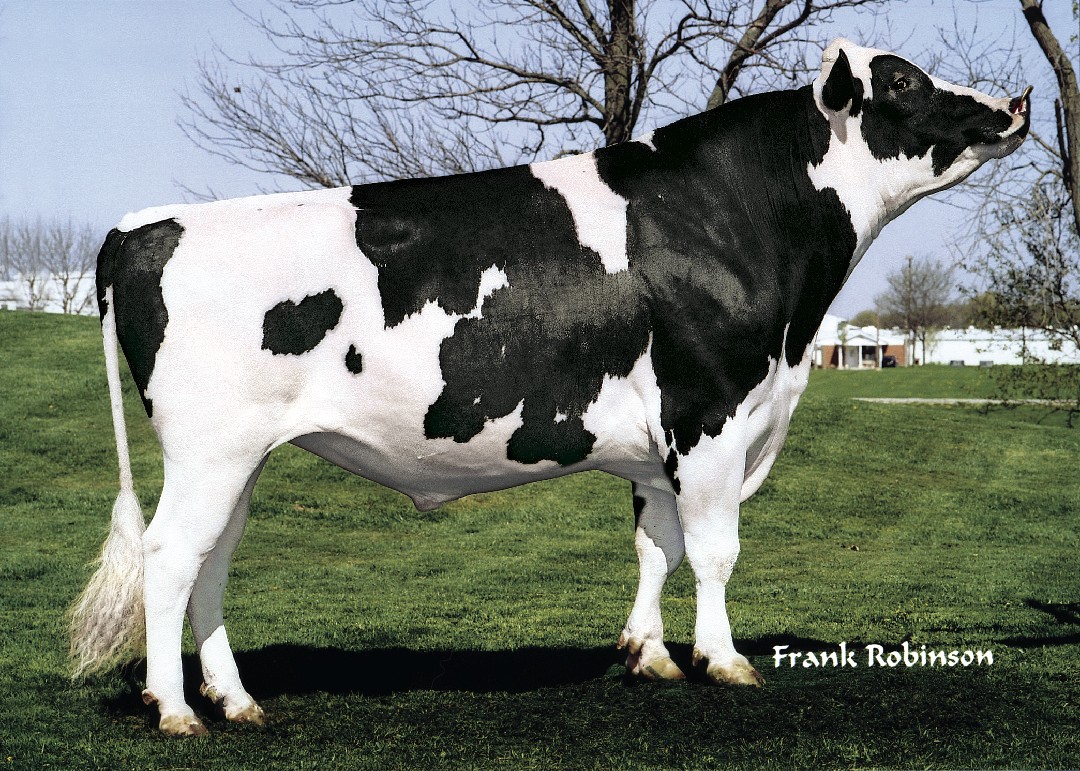
A landmark PNAS study (Dechow & Cole, 2016) noted that “O-Man was notable as an outlier for Net Merit, the primary economic index promoted by the USDA, in part because he was also an extreme bull for longevity.” When the A-list was Durham for type and high-index production bulls for the commercial crowd, O-Man occupied an awkward middle ground that turned out to be exactly where the money was.
He received his first official proof in May 2003, and the commercial dairy world noticed immediately. Calving ease. Productive life. Daughter pregnancy rate. The traits commercial dairymen had been quietly prioritizing for years.
O-Man eventually sold over one million units of semen worldwide (NAAB records; Select Sires documentation per Charlie Will’s 2025 NAAB Pioneer Award). Will had now acquired three of the five bulls on this list — Mark, Blitz, and O-Man — all from farms outside the industry’s inner circle.
How Does a -3.22 UDC Bull End Up in 13% of the Breed?
O-Man’s genetic relationship to the breed sits at roughly 13% (USDA Animal Genomics and Improvement Laboratory) — not far below Chief at 14.8% or Elevation at 15.2%. Fragomeni et al. (2023, JDS Communications) ranked him 12th in genetic importance among all US Holstein sires. His influence ran almost entirely through his sons.
Every proof run still produces bulls with outstanding economic indexes and mediocre type scores. The temptation is always to skip them. O-Man is the permanent rebuttal.
Fustead Emory Blitz: 1.52 Million Straws From a Farm Nobody Knew
Four backup bulls. Nobody designs this. The pattern keeps showing up.
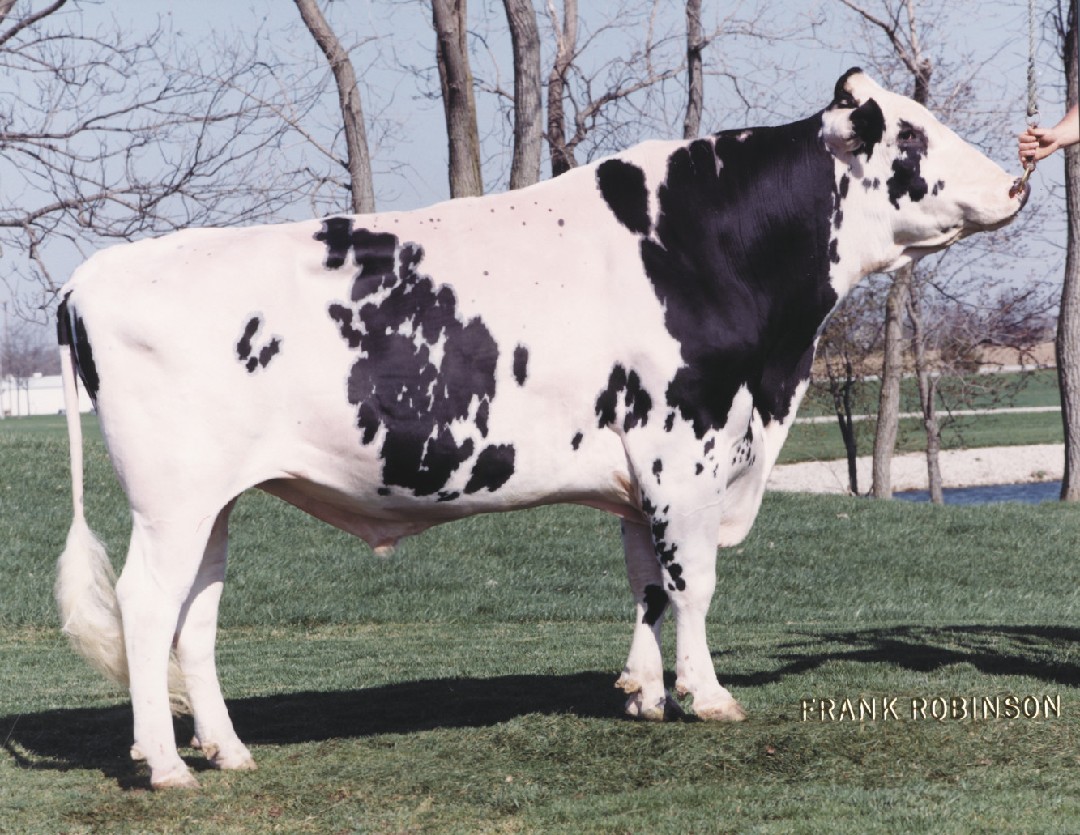
By the mid-1990s, the Blackstar pipeline was flowing at full capacity through Select Sires, with the emphasis on bulls that combined Blackstar’s power frame with the emerging Durham-style type. Fustead Emory Blitz — born March 2, 1996, bred by Brian and Wendy Fust — didn’t fit that bill. His sire was MJR Blackstar Emory (EX-97-GM), his dam was Fustead Tesk Bev (EX-90). Solid breeding, but not the kind of pedigree that commanded premium sale prices.
A Bullvine profile described him as “a rough diamond nobody wanted” (Bullvine, October 2025). Charlie Will acquired Blitz for Select Sires — the same analyst who’d bought Mark two decades earlier and O-Man three years later.
The Reorder Signal That Couldn’t Be Ignored
Then came the daughters. Holstein International dubbed Blitz “the comeback bull.” When dairy farmers milked his daughters, they wanted more. Not the prettiest cows in the barn, but they showed up, produced consistently, and stayed healthy.
The numbers tell it. Blitz eventually sold over 1.52 million units of semen, as confirmed by Hoard’s Dairyman’s “Super Millionaires Club,” among the highest totals in breed history. With 42,268 daughters in 11,499 herds (per Alta Genetics data), that reorder rate represents the most honest form of breeder validation: commercial farmers used him, liked what they milked, and came back for more.
His genetic legacy flows through some of the breed’s most consequential modern sires. He sired Velvet-View KJ Socrates (EX-94-GM), and Socrates produced Roylane Socra Robust (VG-88), who debuted at +2230 GTPI and led Select Sires’ proven lineup for NM$ (+782), CM$ (+834), and FM$ (+742) upon graduation. From Robust came Supersire. The sire stack powering genomic breeding today traces back to a bull the industry initially overlooked.
Round Oak Rag Apple Elevation: The Mating Nobody Prioritized
Five backup bulls. Five decades. The same pattern every time.
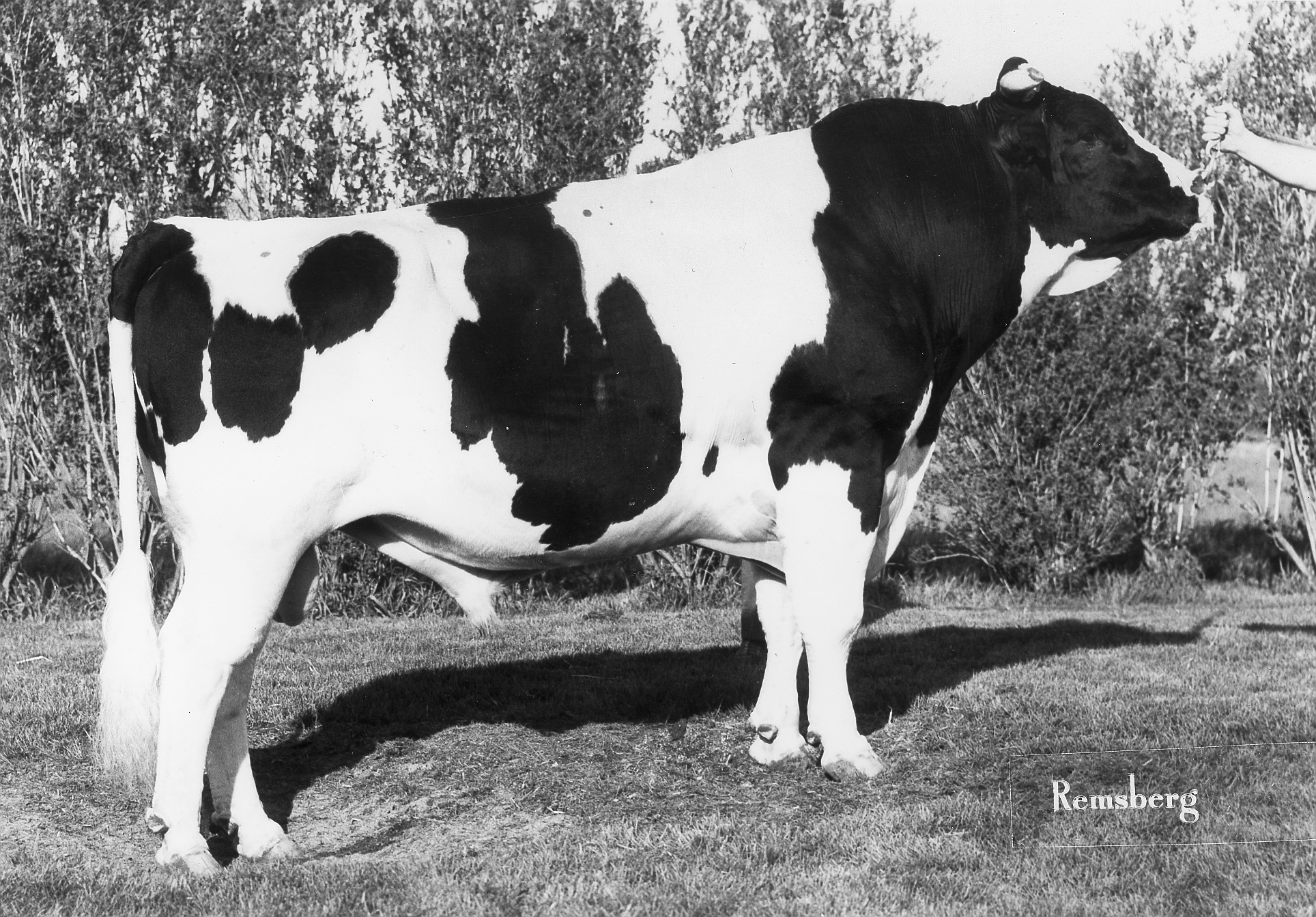
In 1965, first cousins Ronald Hope Sr. and George Miller had spent a quarter-century layering Burke and Ivanhoe bloodlines into their herd at Round Oak Farm in Virginia. They bred Tidy Burke Elevation — a bull with known fertility limitations — to Round Oak Ivanhoe Eve, a cow that had matured more slowly than some of her contemporaries. As the Bullvine documented in our Elevation profile (March 2025), neither parent was anyone’s top choice for a high-impact mating.
Elevation was just a young, unproven sire when the Virginia Animal Breeders Association joined Select Sires. His semen costs member organizations under $1.50 per unit. No premium. No expectations. [Read more: Round Oak Rag Apple Elevation: The Bull That Changed Everything]
When the First Daughters Freshened
The results spoke for themselves. Elevation was the first proven Holstein bull in the modern era to combine a high production proof with the ability to sire show-winning type. Daughters averaged 29,500 pounds of milk in their first lactation — 15% above contemporaries in the 1970s — while maintaining exceptional udder structure and extended productive lives.
George Miller put it plainly in the Bullvine’s Elevation profile: “It’s been said that Elevation built the barns at Sire Power and Select Sires.” Revenue from one backup mating funded the infrastructure of what became the world’s largest AI cooperative.
Holstein International named Elevation “Bull of the Century” — and the data backs it up. His genetic contribution measured at 15.28% of the Holstein genome (2020 Holstein Pedigree Analysis), the highest of any individual sire at the time. Over 10,000 registered sons. An estimated 8.8 million descendants worldwide (Bullvine Elevation profile, March 2025). Semen is shipped to 45 countries.
While the industry average hovered at 2.8 lactations per cow in the 1970s, Elevation daughters averaged 4.2 lactations— a 50% increase in productive life. Up to 99% of AI bulls born after 2010 trace back to either Elevation or Chief. That single stat tells you everything about why the breed’s genetic base is where it is today.
The Holstein Squeeze: Why Backup Bulls Are Survival Gear
Every bull on this list came from outside the breeding establishment’s centre. Mark’s dam was purchased at commodity heifer prices. Mtoto was an Italian import in a North American-dominated market. O-Man’s type proofs would disqualify him from any show-oriented program. Blitz came from a farm without a marquee prefix.
Elevation’s dam wasn’t a priority in her own herd. This isn’t a coincidence — when the entire industry chases the same fashionable genetics, the bulls that offer something genuinely different almost always emerge from breeders working outside the mainstream.
The commercial reorder signal flagged every one of these bulls before the industry consensus caught up. Blitz’s 1.52 million units. O-Man’s million-plus. Shottle’s 1.17 million doses. Commercial farmers who milk daughters every day knew what they had. The rankings took years to agree.
Today’s Backup Candidates: Who Fits the Profile Right Now?
Here’s the practical question: if these five bulls changed the breed by being undervalued outsiders, who fits that profile today?
Dr. Chad Dechow at Penn State reports US Holstein inbreeding around 8%, with young bulls running 9–10%. Lactanet Canada’s figure for 2024-born heifers: 9.99%. The damage isn’t theoretical.
Ablondi et al. (2023, Journal of Animal Science) showed inbreeding across 27,735 Italian Holstein cows severe enough to cost over half a wheel of Parmigiano-Reggiano per cow per lactation in lost production — roughly 310 to 600 eurosdepending on the inbreeding measure.
The Europeans saw this coming decades ago. CRV in the Netherlands deliberately draws from 40 different black-and-white sires of sons to maintain population diversity. Their bull Delta Boyan (Warren P RF × Endless RF) scores +19% CRV Efficiency and +6% CRV Health, with breeding values of 112 udder health and 111 hoof health (CRV, August 2025).
VikingHolstein’s VH Sandro (VH Skills × Youngster) carries a gNTM of +38, projects daughters with 12,289 kg milk, 4.24% fat, and 3.54% protein, and averages 963 days in production (VikingGenetics, August 2025 official proofs). Neither bull will ever appear on your TPI top-100 list. Both fit the Mtoto profile: health-heavy, functionally bred, invisible to anyone filtering by North American indexes alone.
On this side of the Atlantic, the Bullvine’s four-slot sire roster framework identified FB 8084 Adebayo-P-ET as a longevity/fertility fixer — PL +5.3, LIV +4.5, FI +2.5, SCS 2.78, polled, confirmed on the Holstein Association August 2025 TPI list and the NAAB December 2025 Top 200 TPI Proven Bulls report. His production proofs (56M, 54F, 33P) would get scrolled past by anyone chasing leaderboard rankings. That’s exactly the point.
The 2026 Mtoto is probably in your catalog right now. Nobody’s using him because we all filter for top-50 and never scroll further.
All proof data is current as of December 2025. Rankings may shift at the April 2026 evaluation.
What This Means for Your Operation
☐ In the next 30 days: Pull your EFI report. Check your herd’s average Expected Future Inbreeding from your mating software. If it’s above 7%, you need a backup bull in the rotation today — not next proof run. Any bull that pushes a mating above your ceiling, regardless of index ranking, moves to the beef-on-dairy list for that cow.
☐ In the next 90 days: Audit sire usage against the plan. Most operations aim for a diversified lineup but end up putting 60% of matings through one or two bulls. Pull breeding records from the last two proof cycles: intended allocation vs. actual. If your franchise bull consumed more than 40% of matings, your roster isn’t doing its job.
☐ Run the math on genomic testing. For 200 replacement heifers, genomic testing costs roughly $7,000–$10,000 (at $35–50/head). Virginia Tech research found each 1% increase in inbreeding costs approximately $40–43 per cow in lifetime profit (inflation-adjusted from 1999 data, per the Bullvine’s February 2026 analysis). On a 200-cow herd averaging 10% inbreeding, the accumulated lifetime drag runs somewhere around $80,000–$86,000. Dropping the average EFI by 1% across those 200 heifers avoids roughly $8,000–$8,600 in lifetime production drag. The test pays for itself before the first calf hits the ground.
☐ Structure a four-slot sire roster. One franchise profit bull (your NM$/CM$ leader), one high-component hammer, one durability/fertility fixer, and one genuine outcross. The Bullvine’s December 2025 sire roster framework assigns roughly 35/25/25/15% allocation across those four slots.
☐ Over the next 12 months: Track reorder rates, not first-use popularity. When commercial herds keep coming back for more of the same bull, pay attention. That signal predicted Blitz’s 1.52 million units years before the industry caught on. Ask your AI rep which bulls are generating the strongest repeat-order rates among herds milking 100+ daughters. That’s where the next backup bull is hiding.
Key Takeaways
- If your proof filters stop at top-50 TPI, you’re missing the next Mtoto. The bull ranked 200th–400th for elite health traits and an outcross pedigree; it is this generation’s backup candidate. Or look outside TPI entirely — CRV and Viking bulls won’t appear on that list at all, which is part of the point.
- Specialist sires require specialist use. Mark built the best udders of his generation for breeders who protected every mating against his feet-and-leg weakness. Used indiscriminately, he created a decade of foot problems. Know your bull’s hole and mate accordingly.
- The reorder rate is the most honest proof. Blitz sold 1.52 million units, not because of marketing, but because farmers milked his daughters and wanted more. That commercial signal beats any catalog ranking.
- Premium-priced outcross genetics look expensive today and cheap in retrospect. Farms that paid £40 for Mtoto in 1998 are still making a profit. More than a few farms that bought cheaply are gone.
The Bottom Line
The bulls you quietly add at 15–20% of matings over the next year will do more to shape your herd’s long-term resilience than whatever sits atop the TPI list today. That’s been true for five decades running.
Your catalog’s open. Your EFI report is one click away. What’s your backup plan?
Continue the Story
- The Maternal Mastermind: How Douglas Dunton’s Breeding Philosophy Revolutionized Holstein Genetics – Walked the same barns as Douglas Dunton, the genetic architect who built the potent maternal foundations behind Elevation and Chief. This profile explores a parallel era where patience and cow sense outlasted the industry’s loudest trends.
- Carol Prelude Mtoto: The £40 ‘Failure’ That Saved the Holstein Breed – Understand the world they were both navigating by diving into the metabolic battlefield that necessitated a genetic revolution. This feature uncovers the high-production era’s hidden costs and why the industry was crying for a correction.
- From Depression-Era Auction to Global Dominance: The Picston Shottle Legacy – Discover how they carried forward what they started by tracing the extraordinary genetic throughline from a 1941 Depression-era auction to global dominance. This story proves that the foundation held and continues to pay dividends today.
 The Sunday Read Dairy Professionals Don’t Skip.
 The Sunday Read Dairy Professionals Don’t Skip.
Every week, thousands of producers, breeders, and industry insiders open Bullvine Weekly for genetics insights, market shifts, and profit strategies they won’t find anywhere else. One email. Five minutes. Smarter decisions all week.