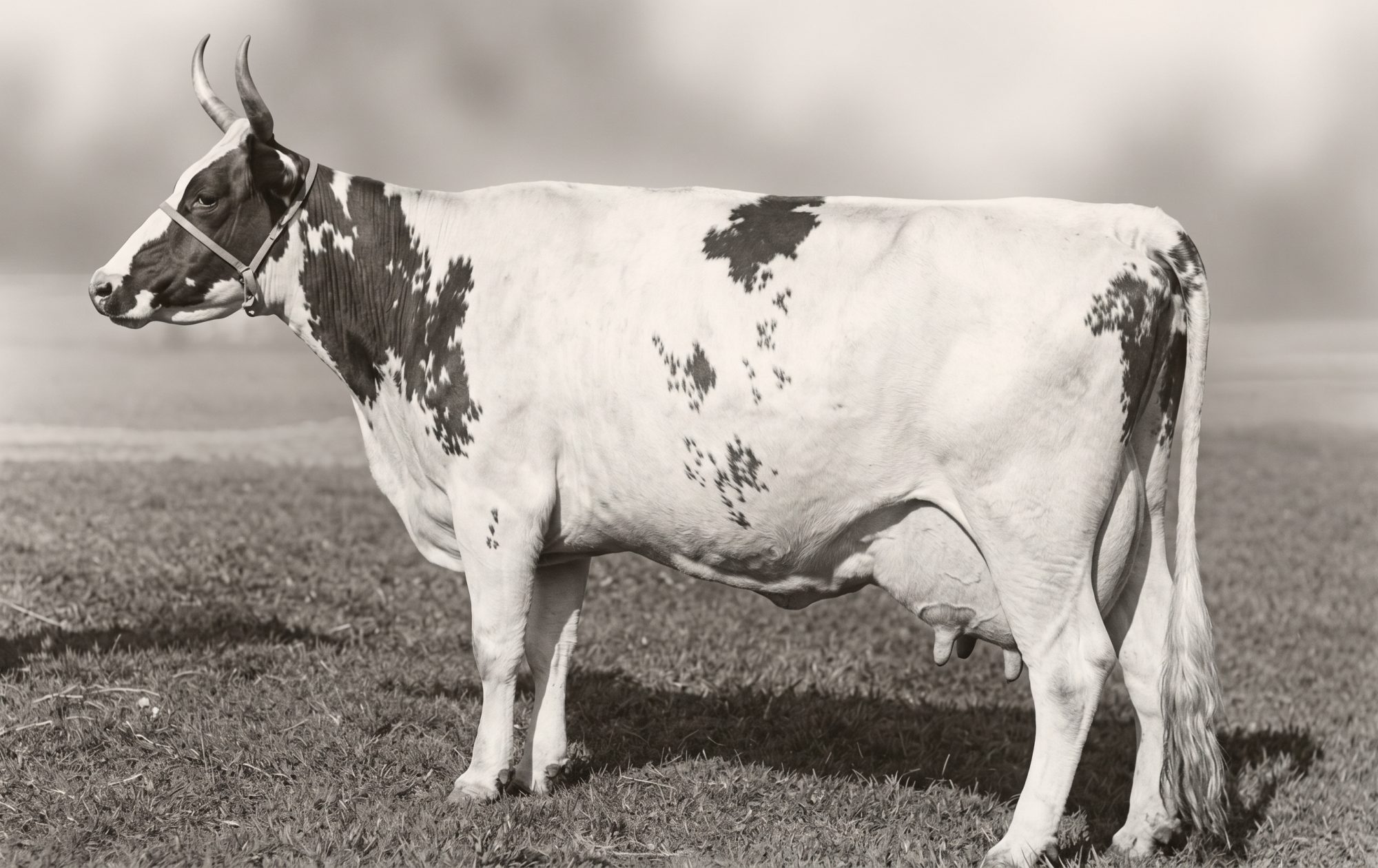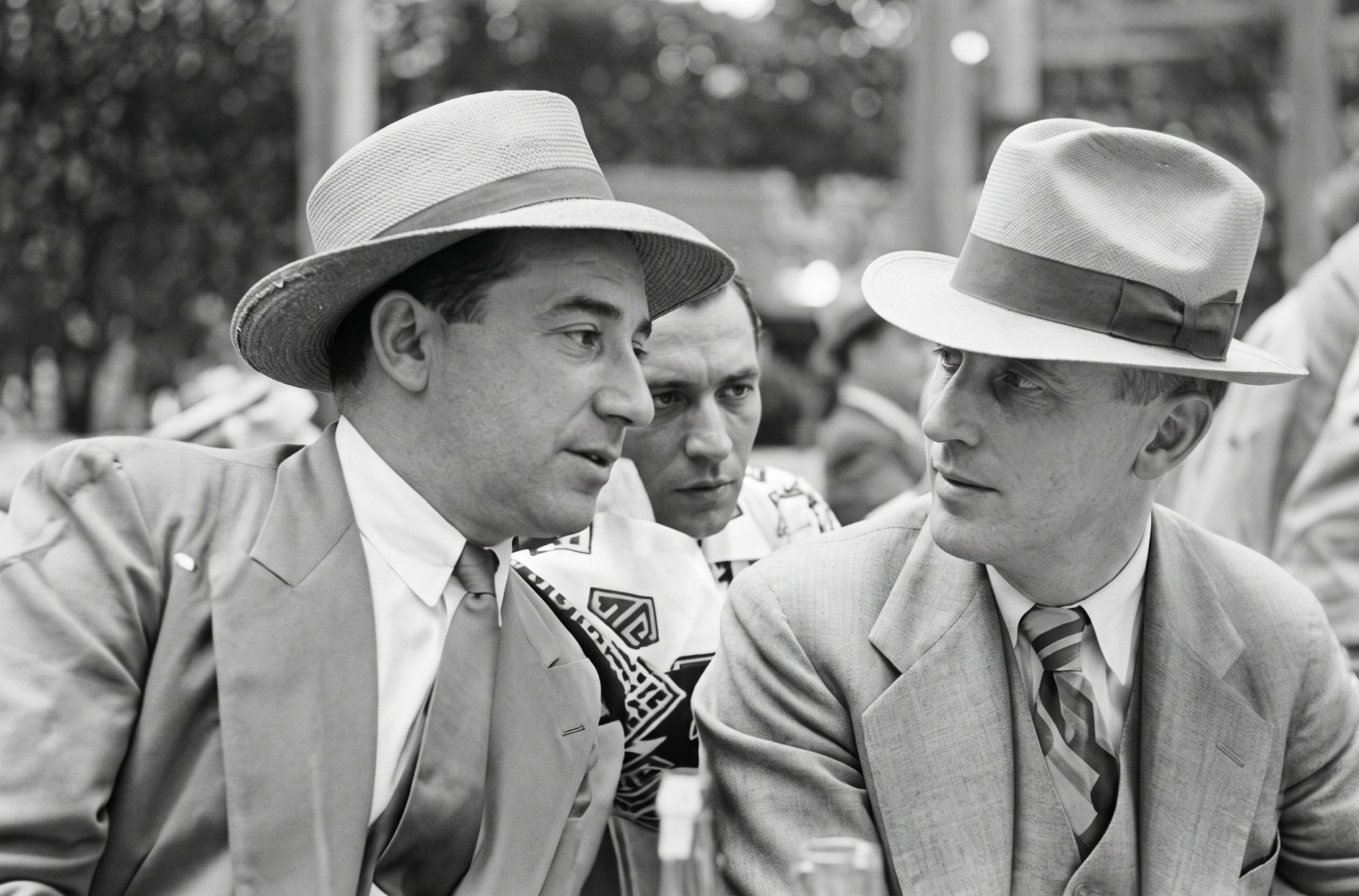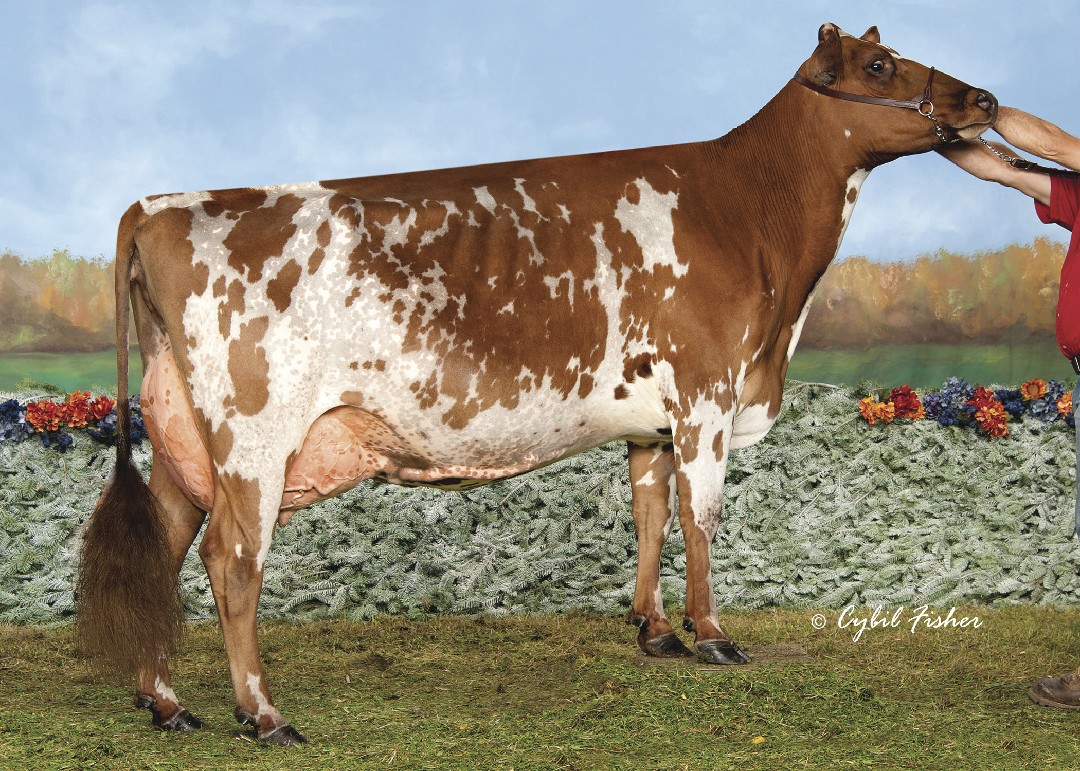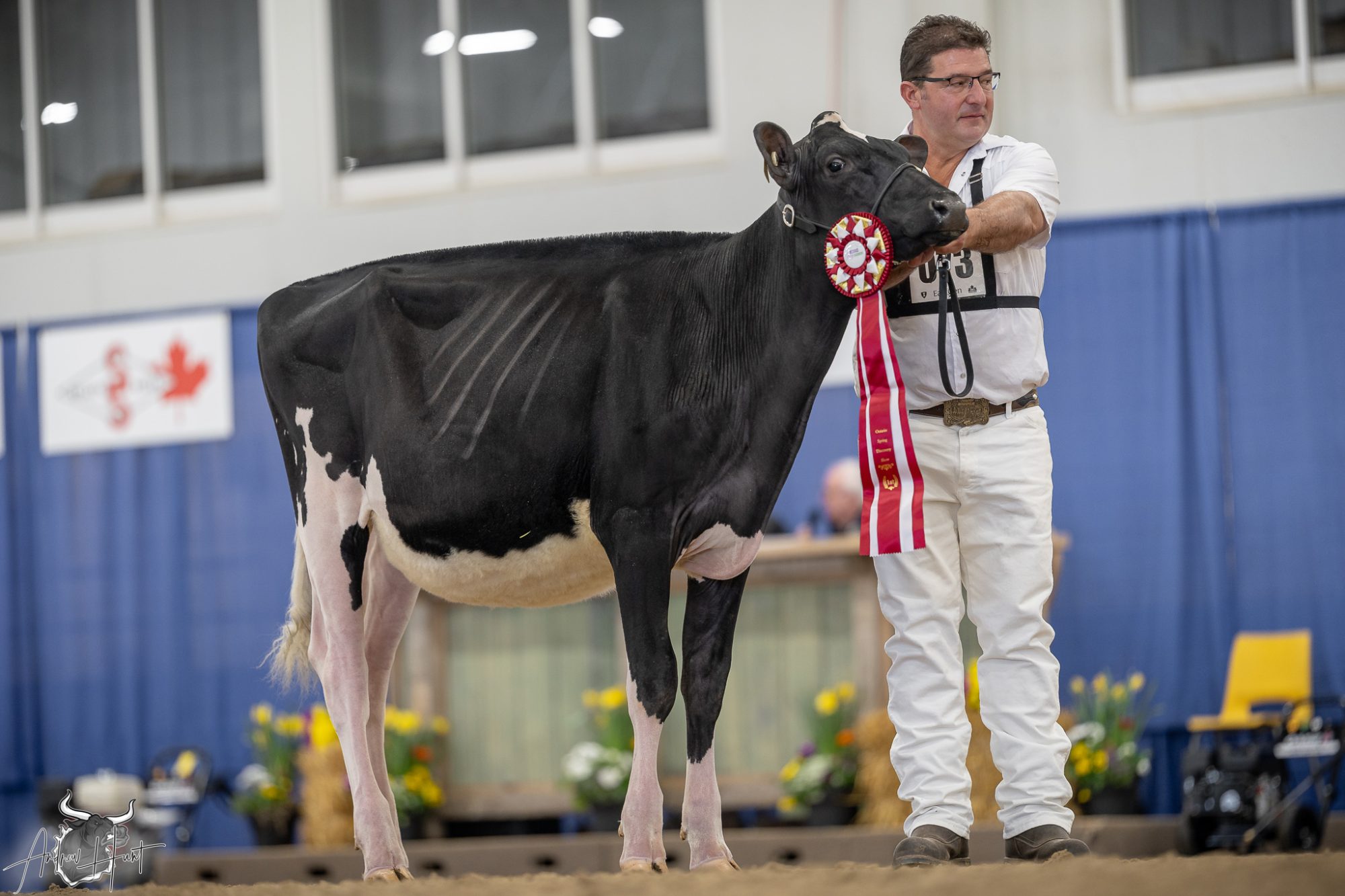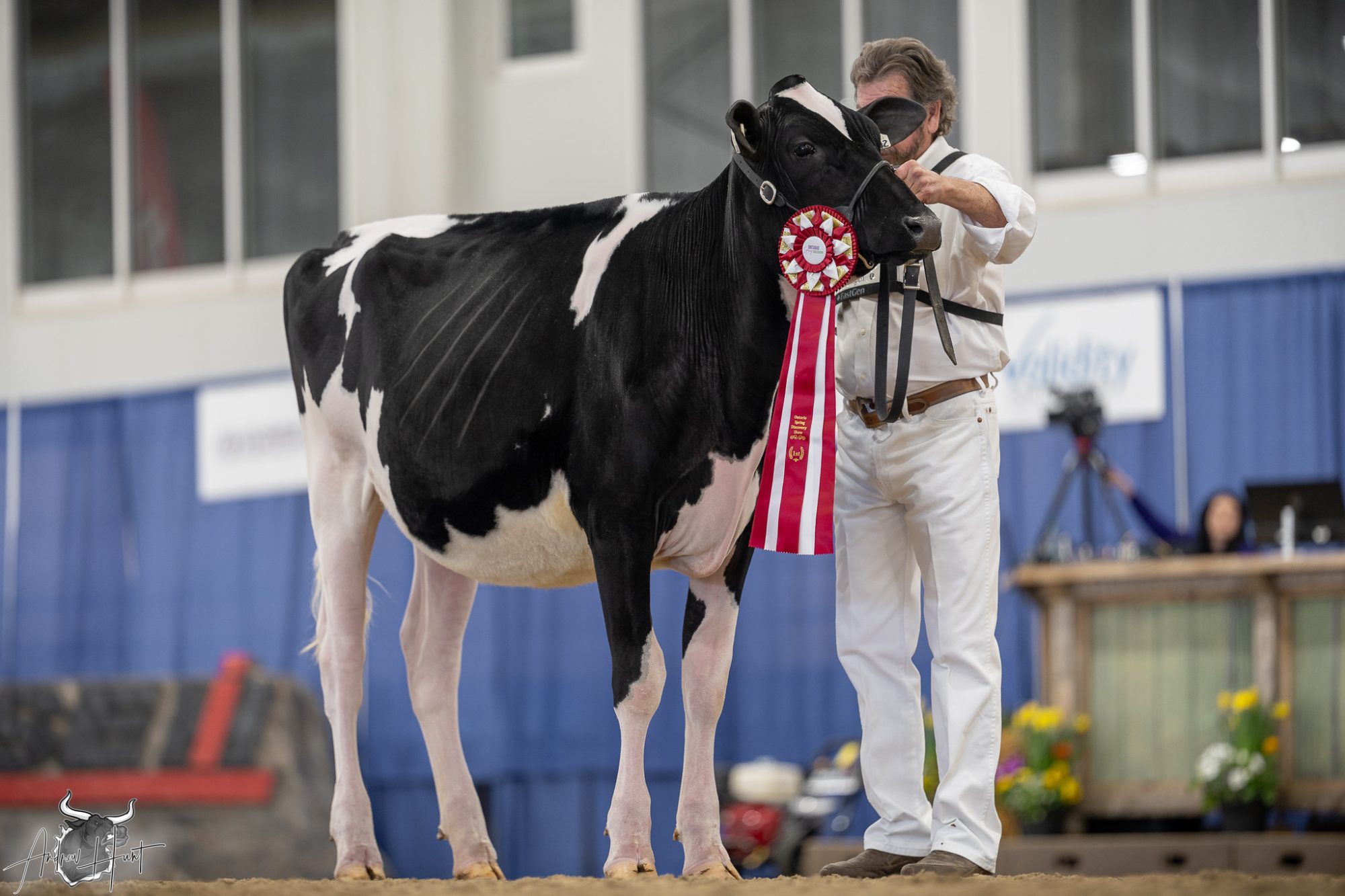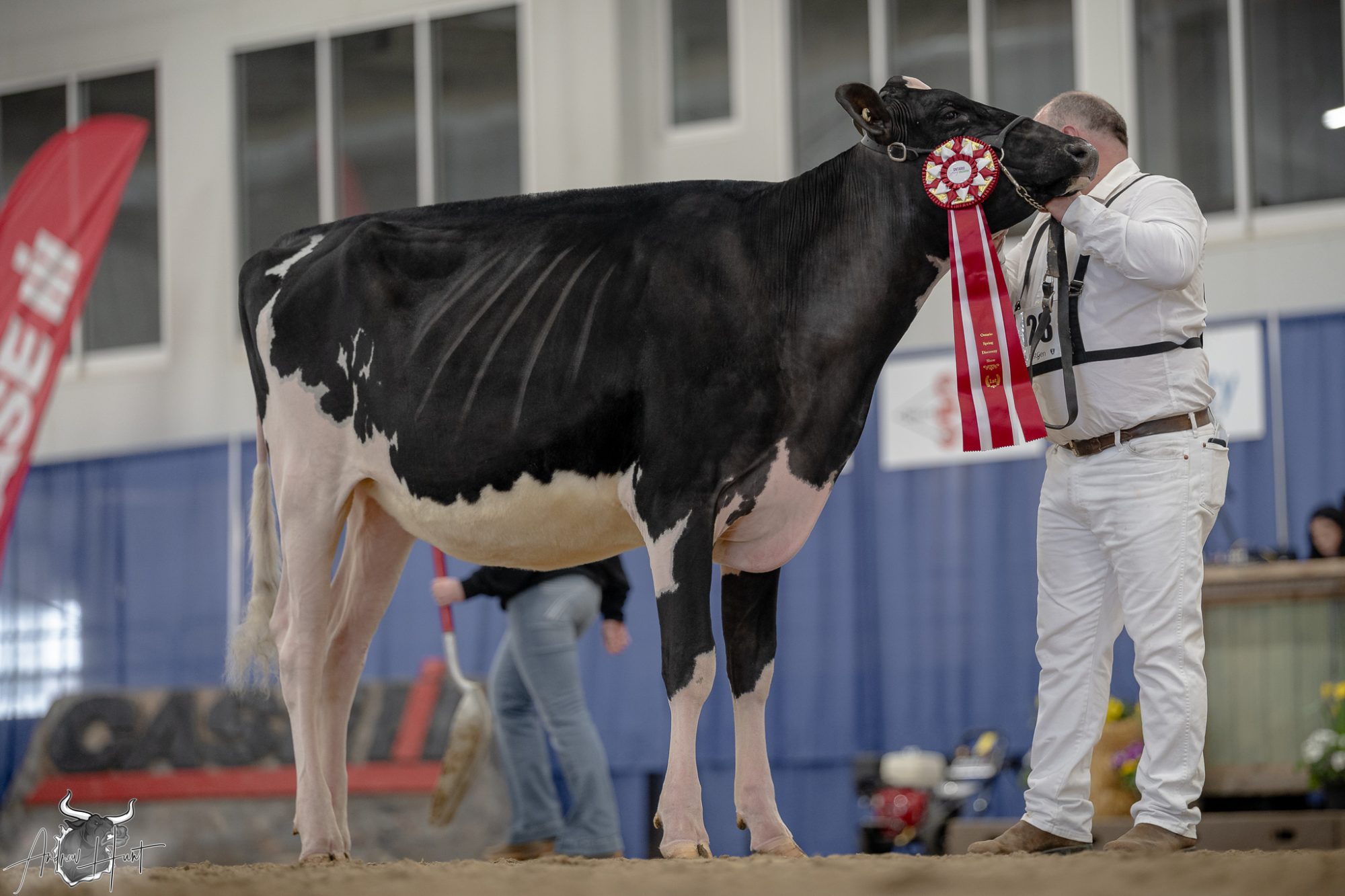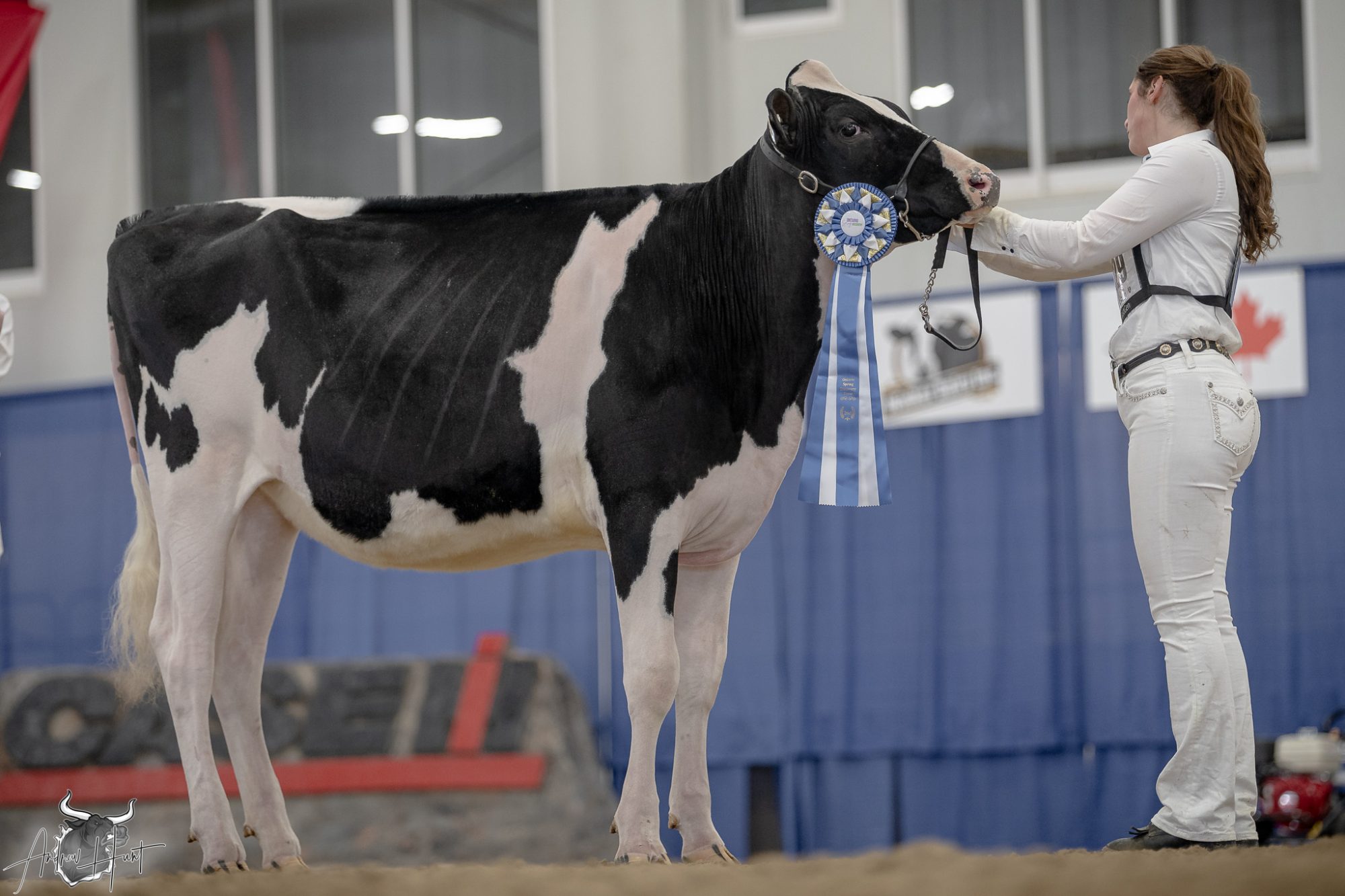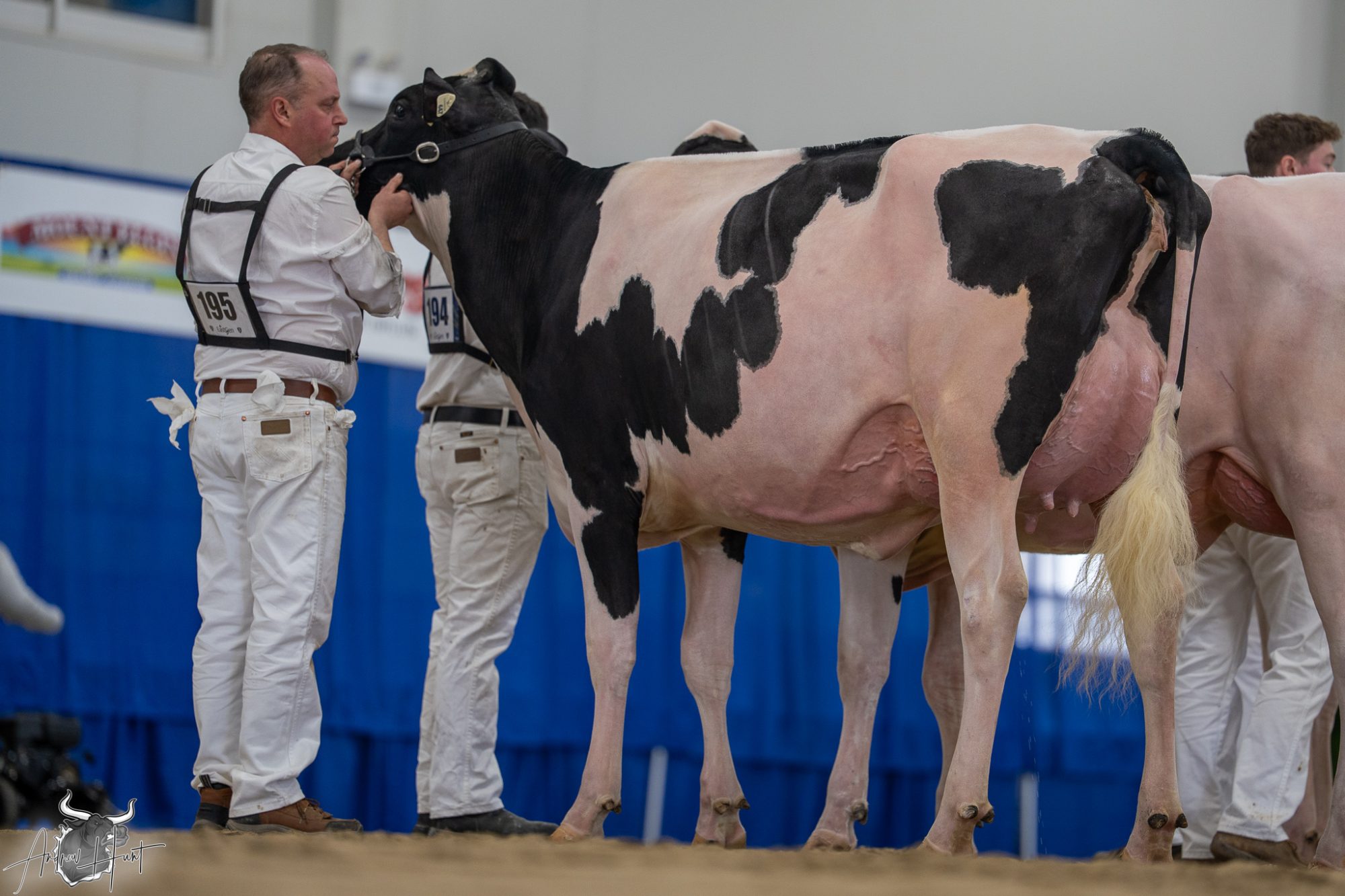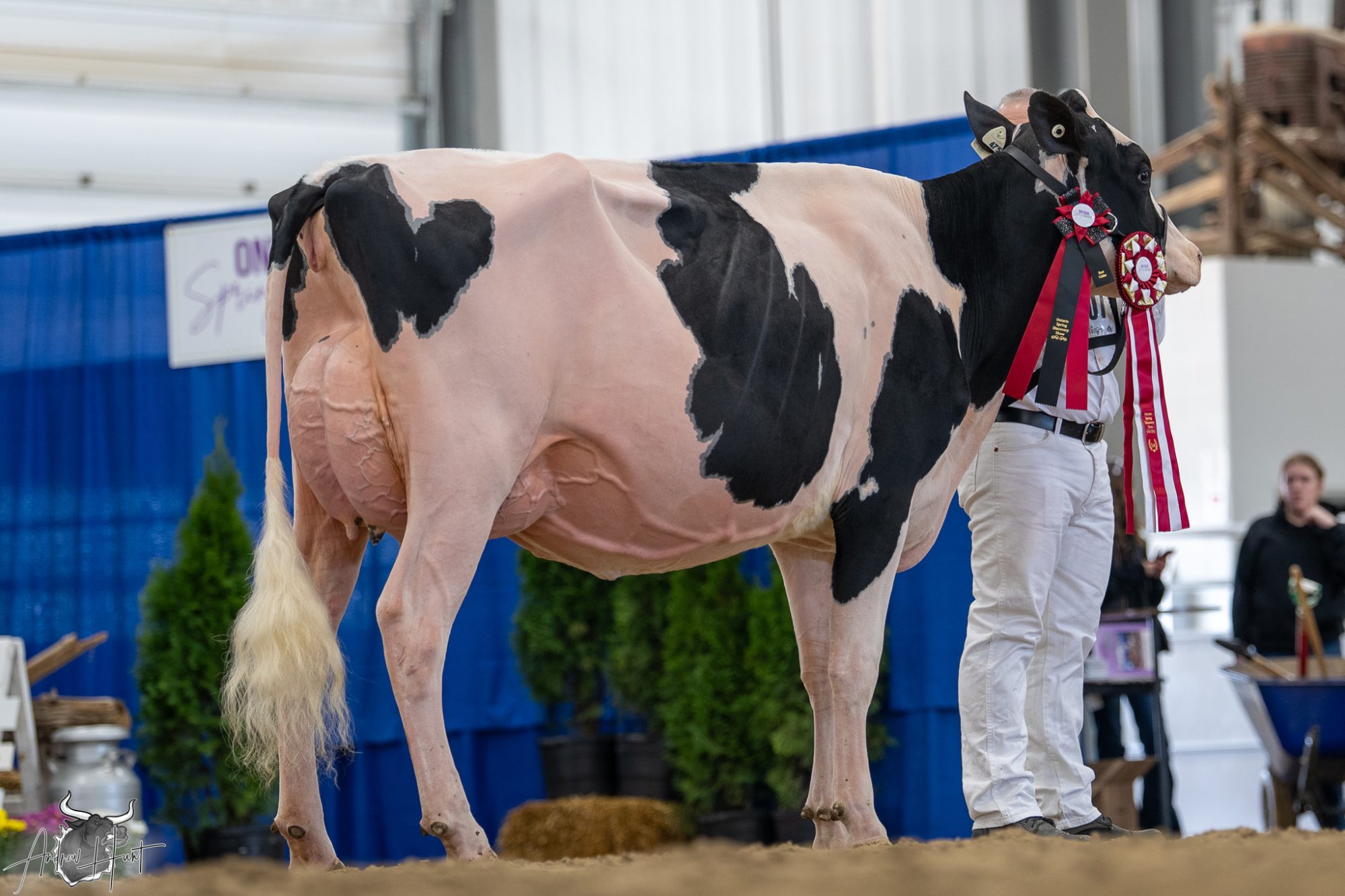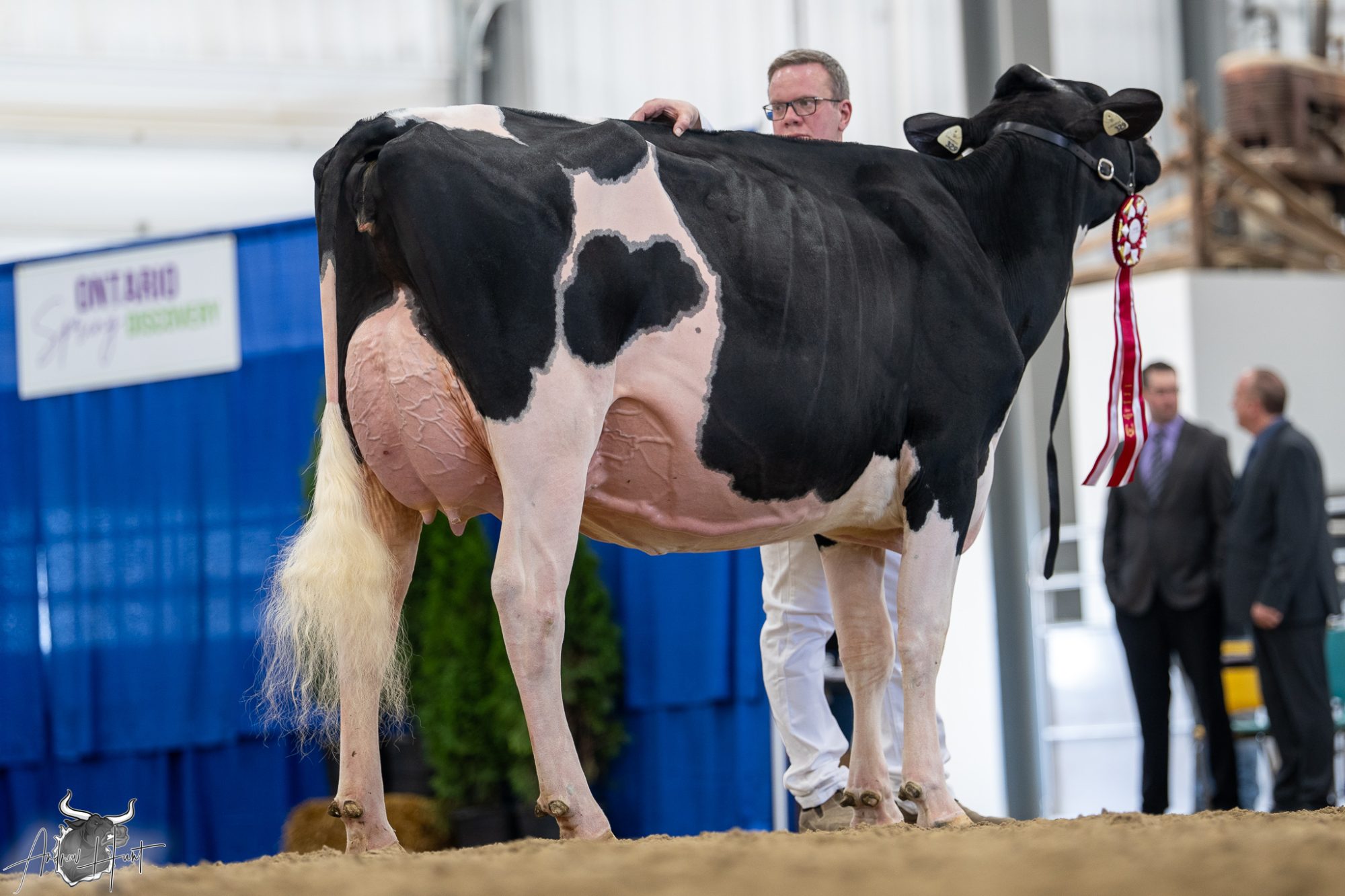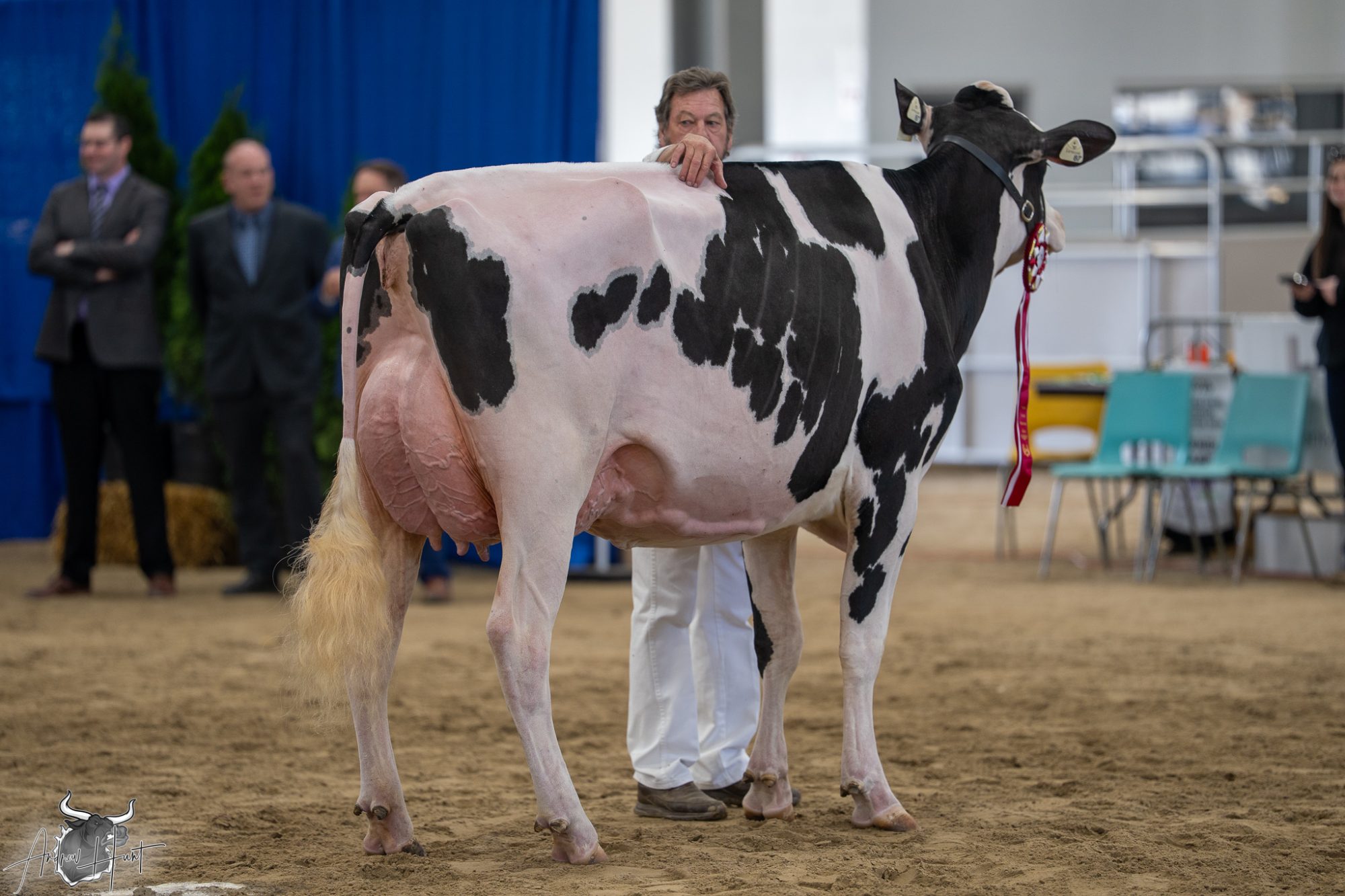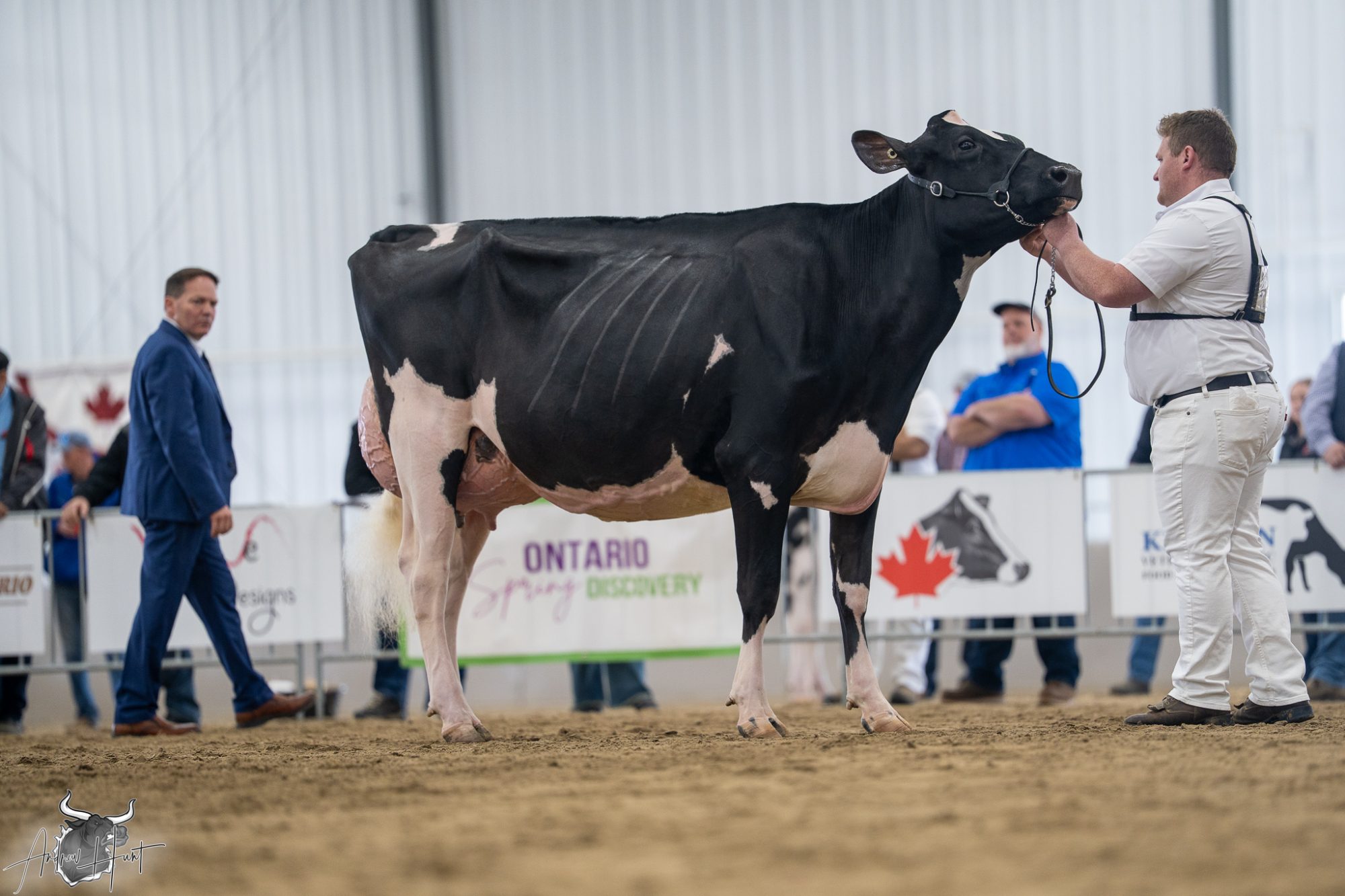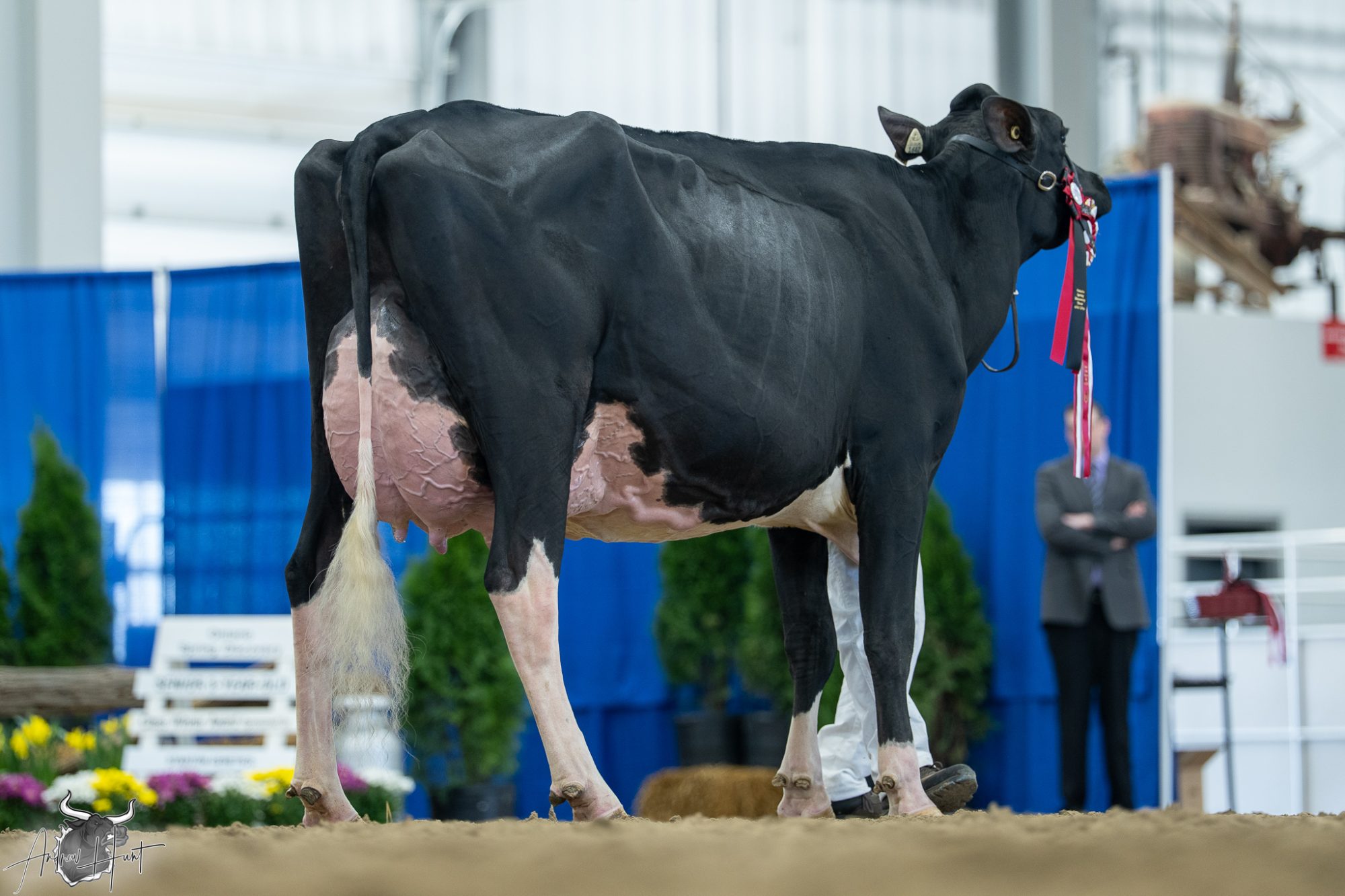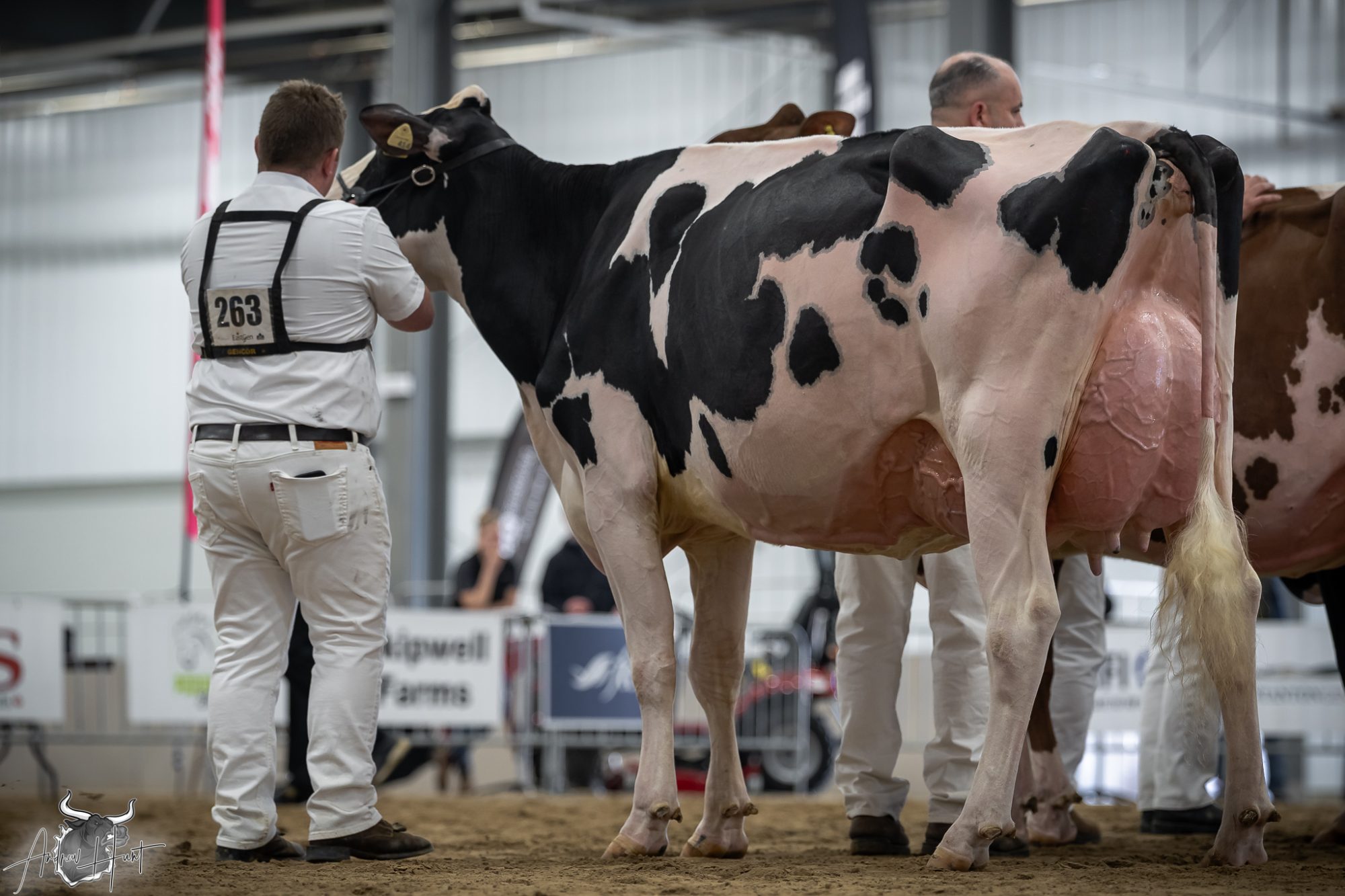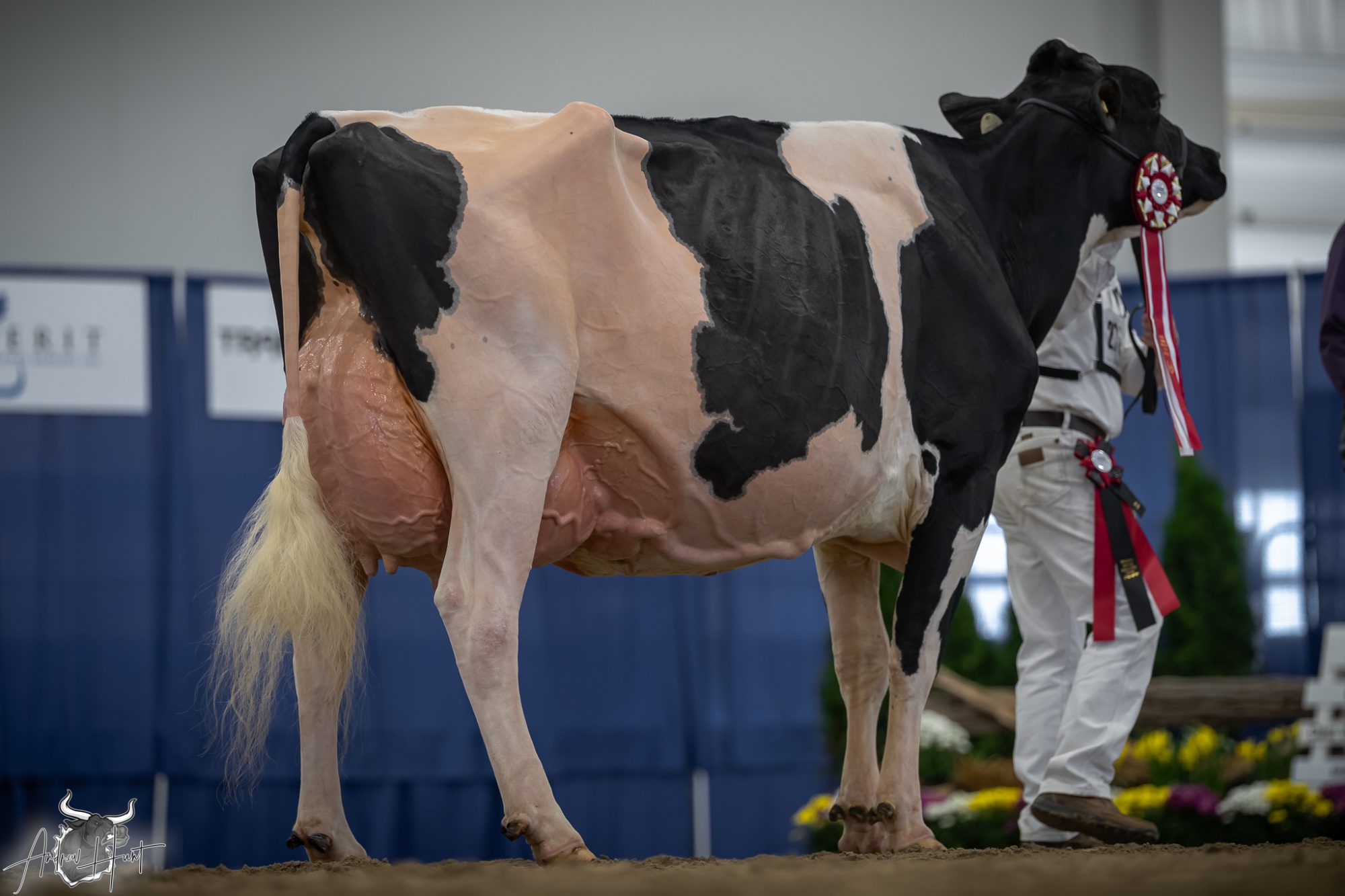


The Lambs sold her at their 2019 Spring Sensations Sale, bought her back in 2022, and rode her to 178,000 lbs lifetime and three Eastern Fall National banners. Worth the round trip.
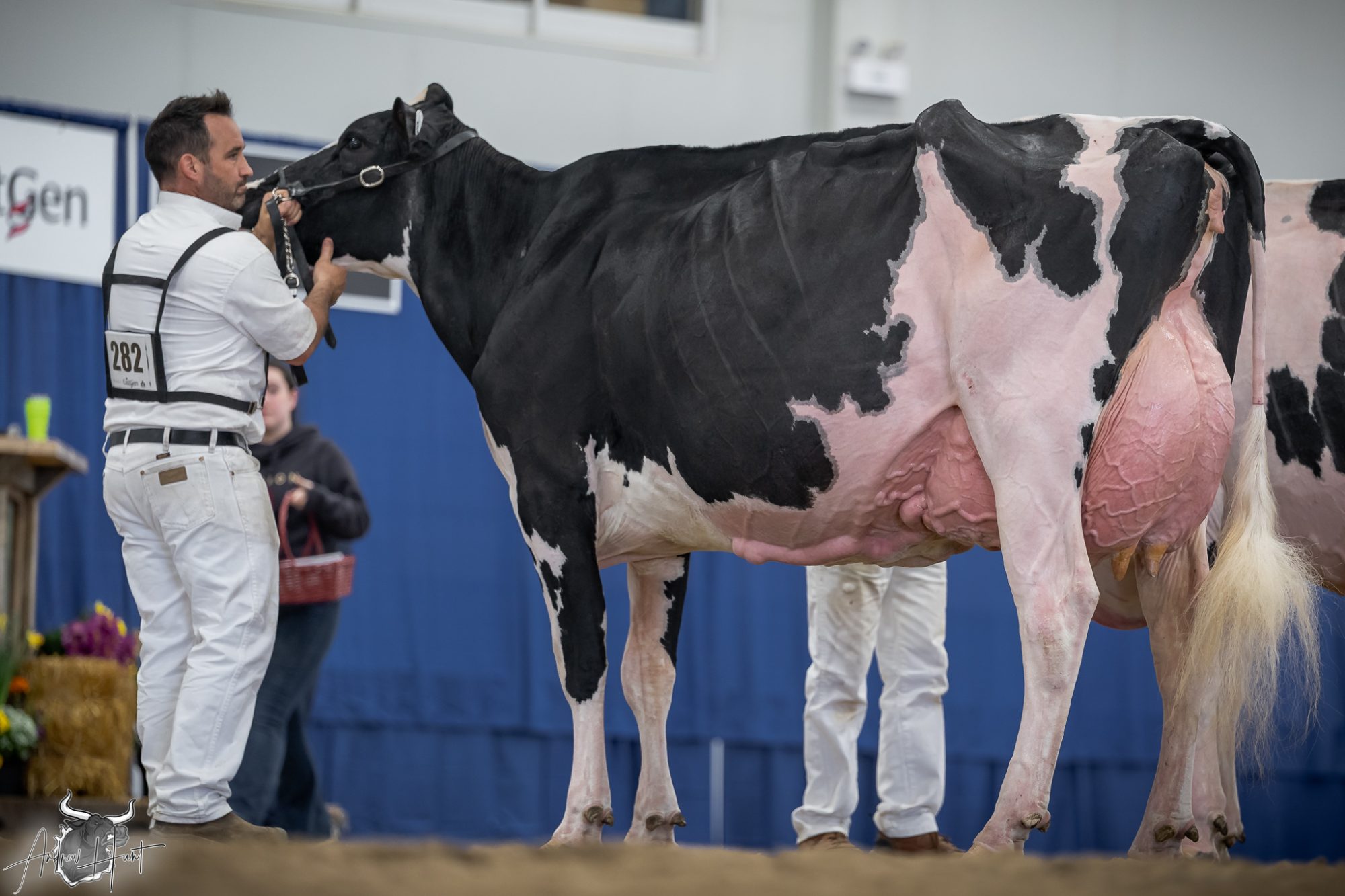
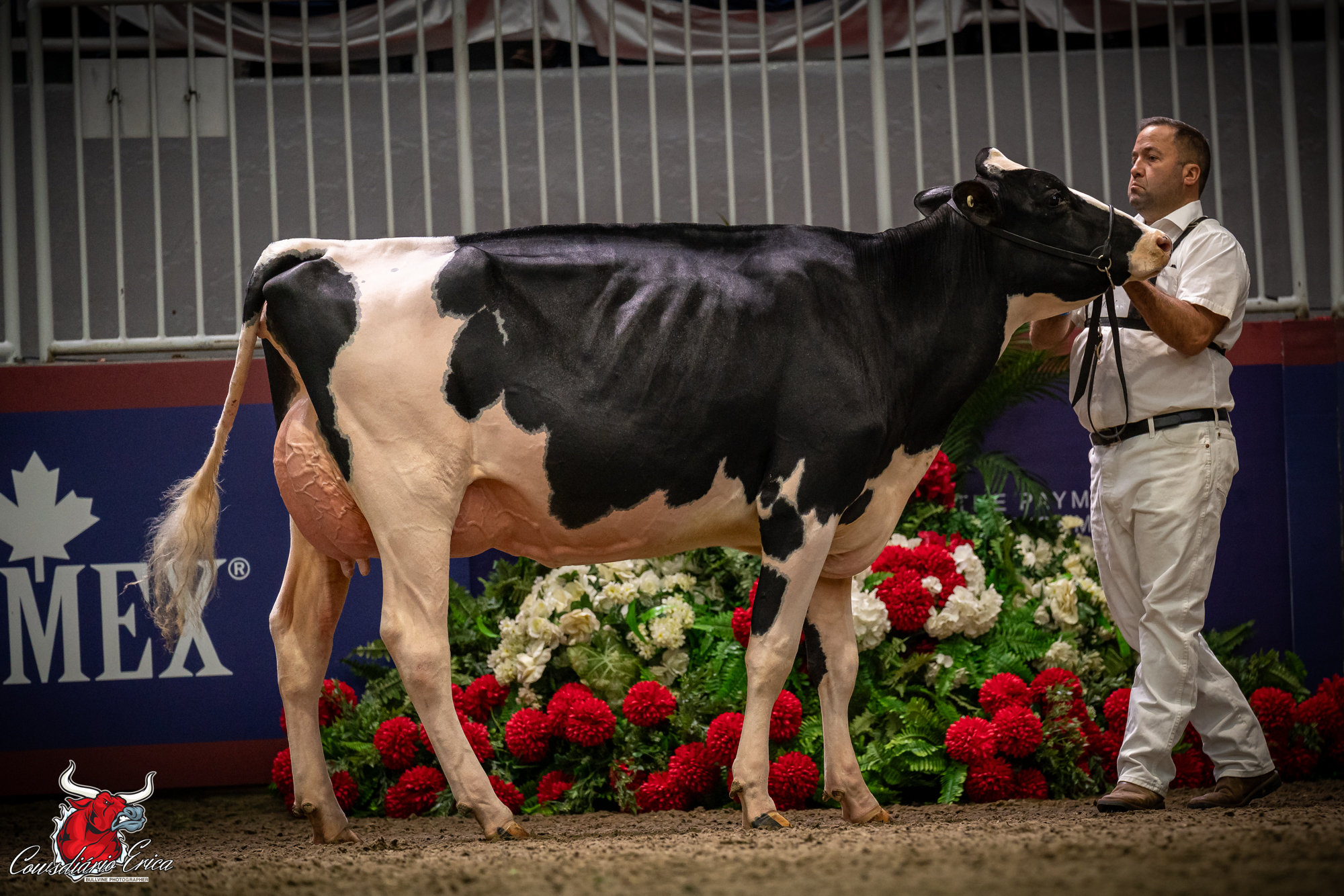
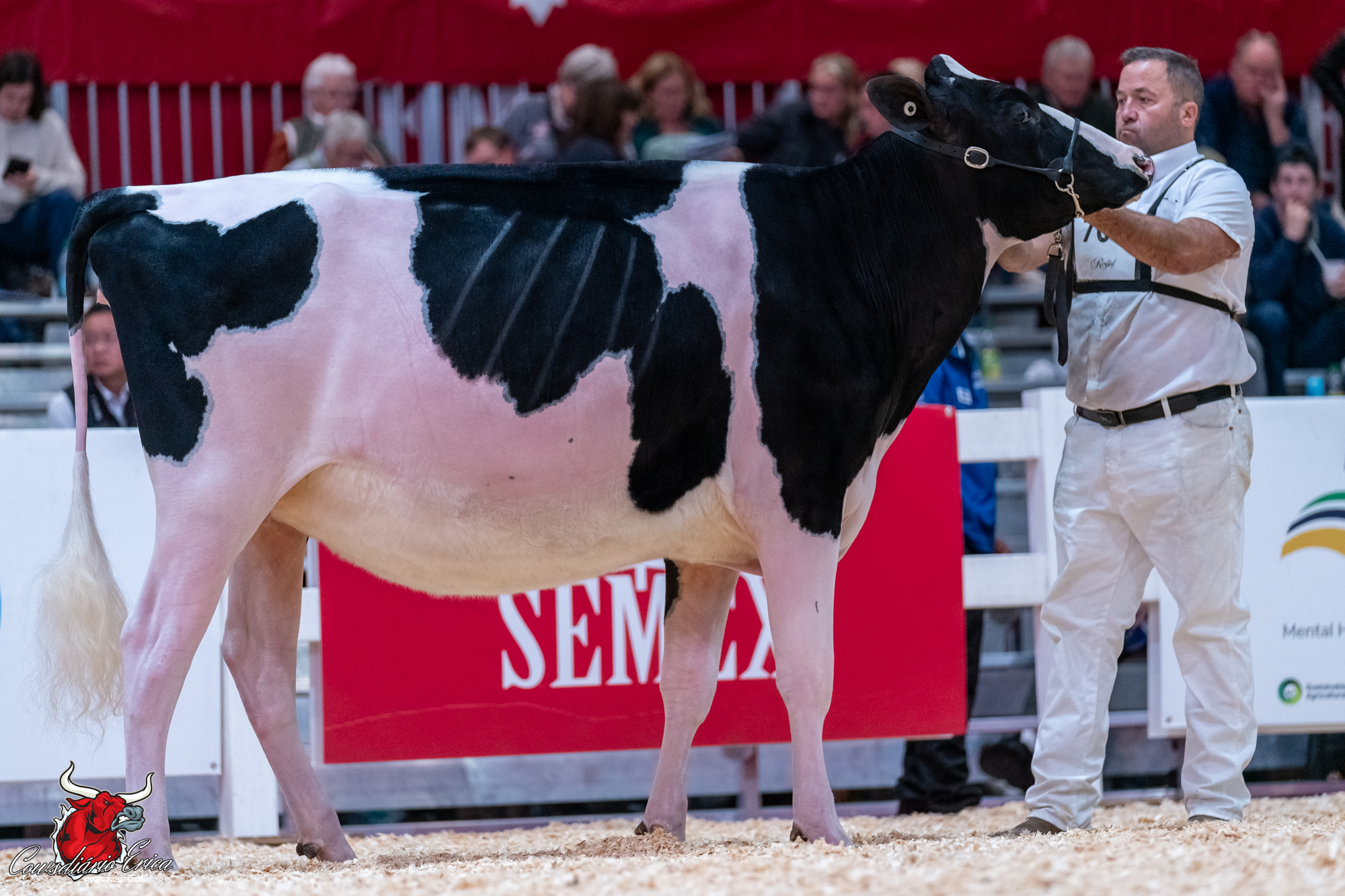
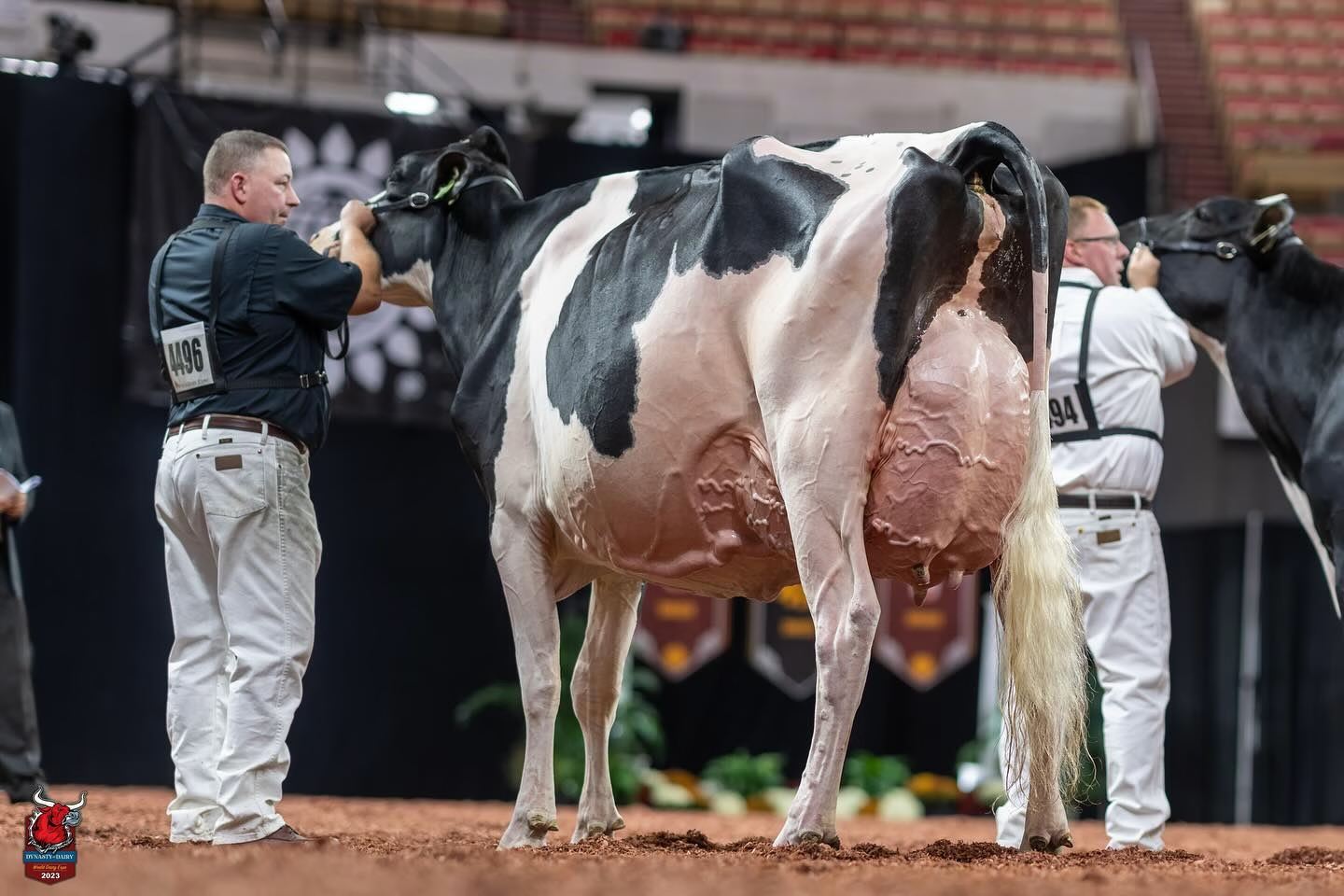
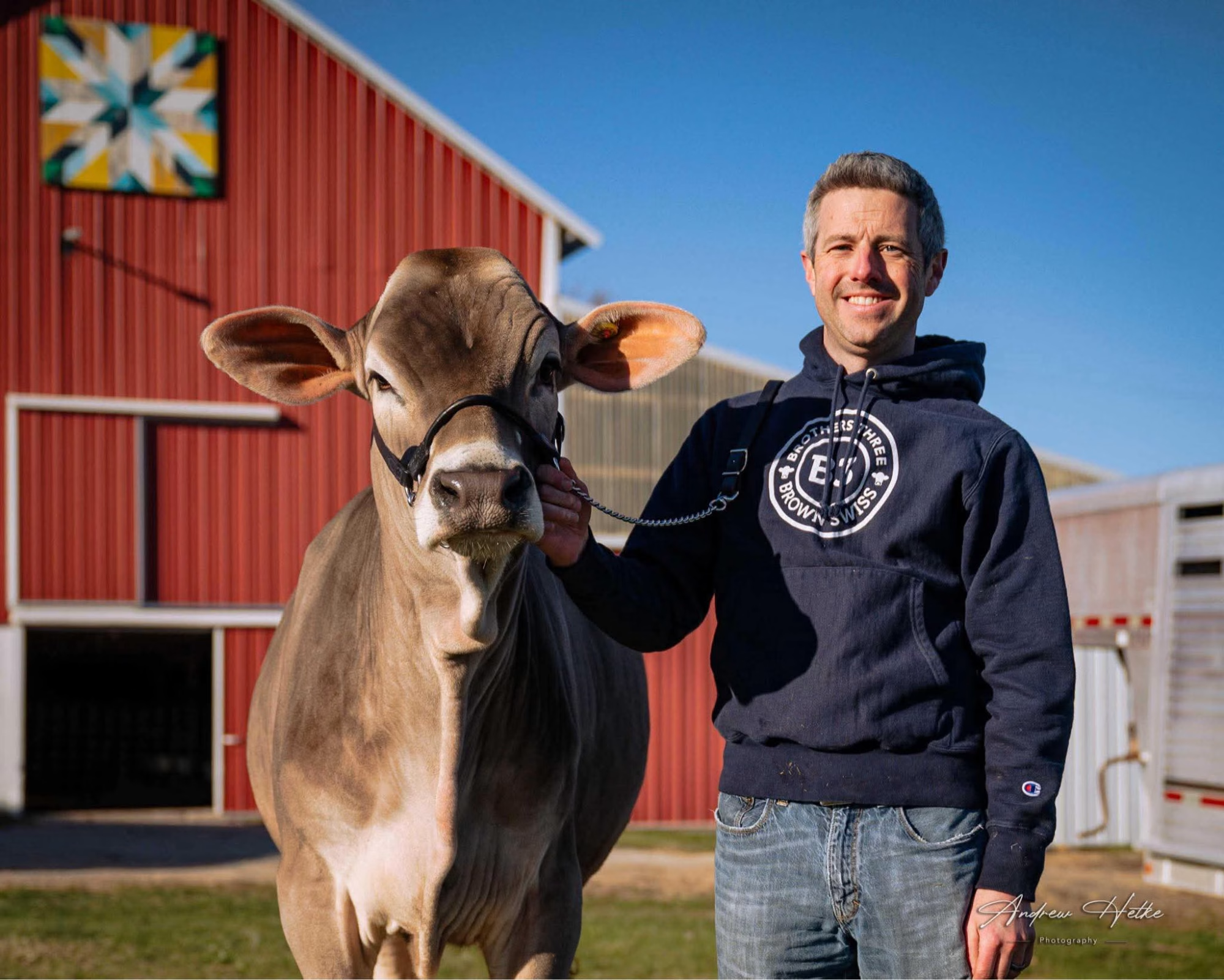
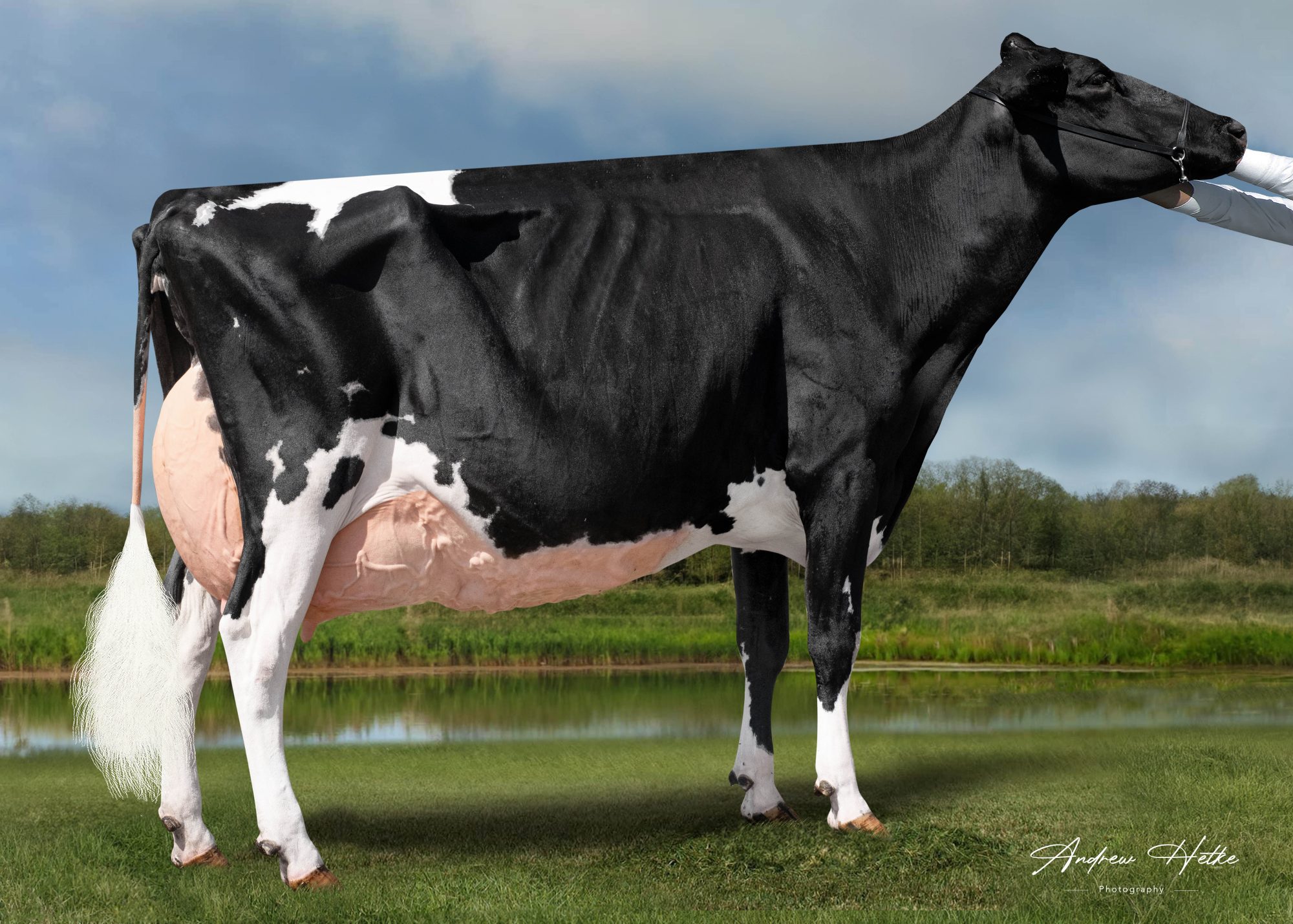
Oakfield Solomon Sunset-ET has been named the 2025 Star of the Breed by Holstein Association USA. Sunset is owned by Jonathan and Alicia Lamb of Oakfield, New York. Photo Credit: Andrew Hetke Photography
Holstein Association USA just handed its top honor to a cow who wasn’t supposed to come home again. Oakfield Solomon Sunset-ET EX-96 2E is the 2025 Star of the Breed—bred by Jonathan and Alicia Lamb at Oakfield Corners Dairy in western New York, sold to Adam Liddle in 2019, and bought back three years later when it became obvious she was the one that got away.
This isn’t a lifetime achievement handshake. The Star of the Breed is the only award in the Registered Holstein® world that forces a cow to deliver in the barn and the ring—top-five at a National show, a completed lactation in the last year, TriStar enrollment, and an official classification score. No split-decision winners.
Show Herd Manager Jamie Black, who looks after her every day, puts it plainer: “She’s a cow that grabs your attention as soon as you look at her. She looks like a cow that works hard every day and does it easy.”
The Buy-Back Story
Start with the dam. The Lambs bought Bella-Rosa GW Sara-ET EX-96 3E at the 2013 National Holstein Convention Sale—a cow Alicia describes as “not the prototypical show cow at the time. She wasn’t super tall. But she was just perfectly balanced.” Sara later did her damage at Madison in her later years.
By 2019, Sara had thrown a fall group of Solomon, Avalanche, and High Octane daughters. Oakfield Corners dropped three of Sara’s fall calves into the ring together at the Spring Sensations Sale on choice. Adam Liddle took first pick—and then agreed to take all of them. Sunset went with him.
The Lambs saw her again as a fresh two-year-old at the Greenwich state show. Asked the price. She wasn’t bred. They walked. When she calved as a three-year-old, they came back and brought her home in 2022.
Jamie doesn’t sugarcoat the early days. “Her first big show, she didn’t pay at the New York State show. We went to Harrisburg and I basically walked her backwards the whole time, because she just was not having any.”
Then she figured it out.
2022 Eastern Fall National — First in class, Grand Champion, Best Bred & Owned, Supreme Bred & Owned
2023 Eastern Fall National — First in class, Grand Champion, Best Bred & Owned
2024 Eastern Fall National — First in class, Reserve Grand (beat by Candy Cane), Best Bred & Owned
2025 Northeast Spring Show — Bred & Owned winner, a full year in milk when the judge questioned it
Three straight Best Bred & Owned titles at Harrisburg. “Probably one of the proudest things we as breeders have in our inventory,” Jamie says.
The Classification Day That Almost Wasn’t
Sunset’s EX-96 moment nearly didn’t happen. “She had been put up once before and had one of her sunset days, where she didn’t want to do anything right,” Jamie recalls. The classifier came back around the next visit. She passed “very easy.”
The tell, Jamie says: “Every time you walk in the barn, she looks the exact same.”
The Pedigree Behind Her
Sunset’s by Solomon—a bull Jonathan describes as “popular for a bit, dropped off, then came back once a few daughters calved.” Behind Sara sits Linette Spend Deed EX-90, and behind her Spending Spirit EX-95, honorable mention All-American Aged Cow. “A lot of All-American in the pedigree. Very deep.”
The Breeding Philosophy
Jonathan isn’t chasing the tallest cow in the tent, and he’ll tell you so.
“We don’t want to have the biggest, but we want to have the most correct. And we certainly want them to have plenty of width and power and strength.”
Translation for anyone still stuck on stature: functional type is winning again.
Is She Transmitting?
Early signs say yes. Adam Liddle has an EX Tattoo daughter that keeps gaining points each scoring. The Lambs’ favorite mating so far is Crushable, which produced two daughters inside the top three at National shows in milking form this past year. Every other Crushable daughter they have is still a two-year-old.
“Her calves and heifers in the hutches—they all have the same look,” Jamie says. “Very striking. Deep-ribbed, hard-topped, good-legged heifers.”
Jonathan tempers the hype appropriately. “Those were our first daughters from her. They’re turning three this year, so very young. It’s going to be a lot of fun as more of her daughters calve.”
What’s Next for Sunset
She flushes consistently—not extreme, but “every time we flush, we’re going to get at least one or two calves,” Jonathan says. She’s still milking well. She still looks incredible. The open question in the Oakfield office right now: one more show, or keep her home, happy, and healthy?
“We’ll make a decision fairly soon.”
How the Award Actually Works
Most people nod along at “Star of the Breed” without knowing the filter. Here’s the real one, in place since 2007:
Top-five placing at a National Holstein Show
Completed lactation within the last year
Herd enrolled in the TriStar℠ program
Official classification score on file
From the eligible pool, HAUSA runs this calculation:
Combined ME Fat and Protein + Age-Adjusted Classification Score × (Breed Average ME CFP ÷ Breed Average Age-Adjusted Score)
A weighted blend that refuses to let a show queen with mediocre components win, and refuses to let a component monster with a weak udder win either. Both, or nothing.
Oakfield Corners, By the Numbers
Jonathan is a 12th-generation farmer—his family has been farming in the U.S. since arriving from England roughly 200 years ago, most of it in western New York. Today, Oakfield Corners milks about 11,000 cows across four locations: three in western New York, one in western Ohio. The marketing strategy runs on two parallel tracks: gTPI/NM$ index cattle aimed at the next sire dam, and show-cow matings engineered for marketable heifers through sales like Spring Sensations.
Jonathan’s operating principle, straight from the podcast: “Continual improvement. Find the bottlenecks, fix them, move on to the next ones.”
What Recognition Means Here
“It’s humbling,” Alicia says. “For a cow we’ve bred and worked with, and a cow family we really love and appreciate, to be recognized at this level—it’s a great honor for us. A great honor for Sunset.”
Jonathan frames it against Sara’s legacy. “We didn’t bring Sara to national shows because we didn’t think she was big enough at times. Sunset is a little more modern—not one of these huge cows either—but excessive in width and power and strength. That exemplifies the type of cows we’re trying to breed today.”
The Orlando Recognition
Sunset will be officially honored at Holstein Association USA’s 140th Annual Meeting, part of the 2026 National Holstein Convention in Orlando, Florida, June 22–25. Registration is open through May 20, with two new all-inclusive packages this year. Details at holsteinconvention.com. Deeper profile in the Spring 2026 issue of The Pulse, plus the full Holstein Connections podcast episode at linktr.ee/holsteinconnections.
Every week, thousands of producers, breeders, and industry insiders open Bullvine Weekly for genetics insights, market shifts, and profit strategies they won’t find anywhere else. One email. Five minutes. Smarter decisions all week.
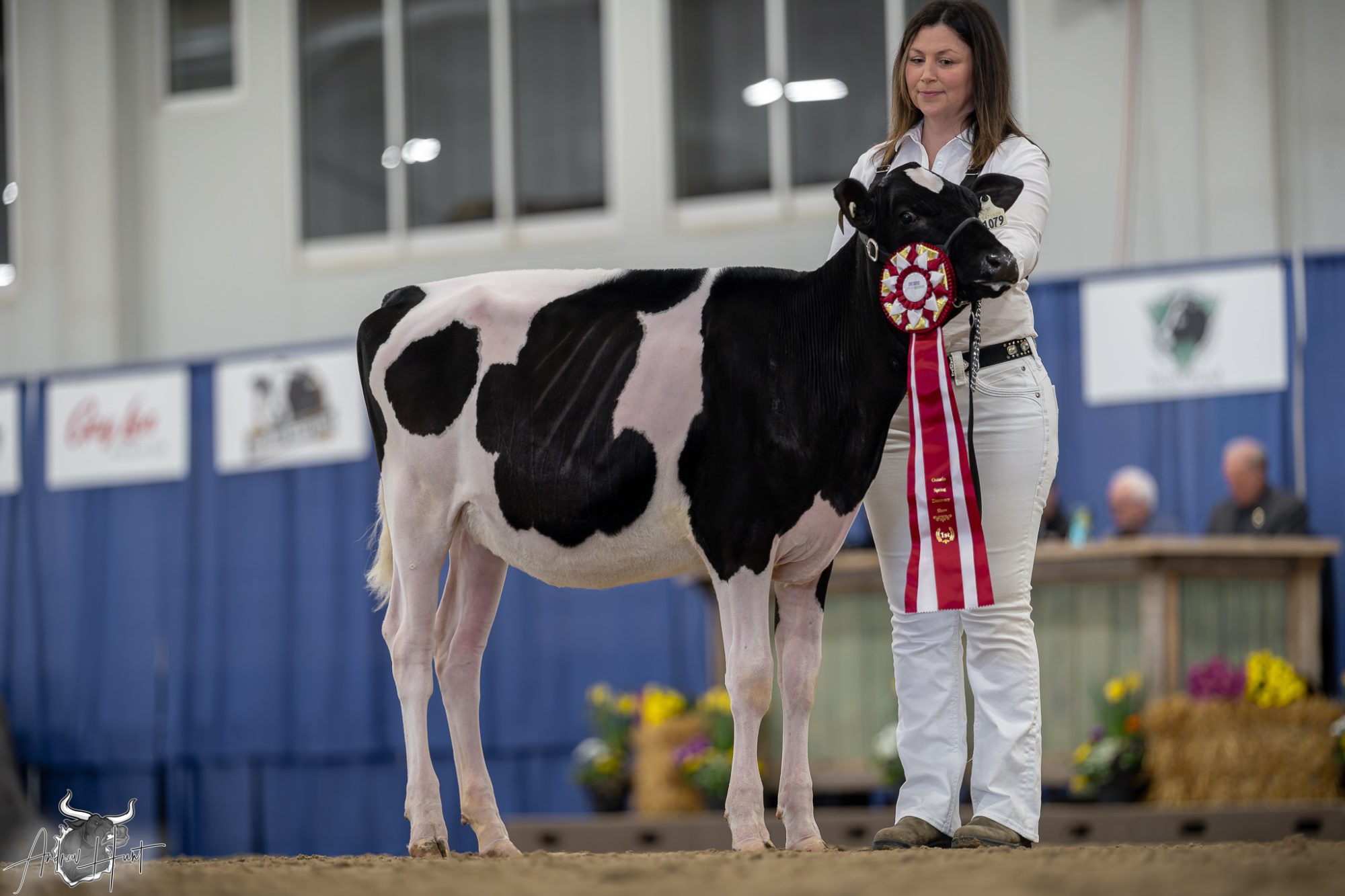
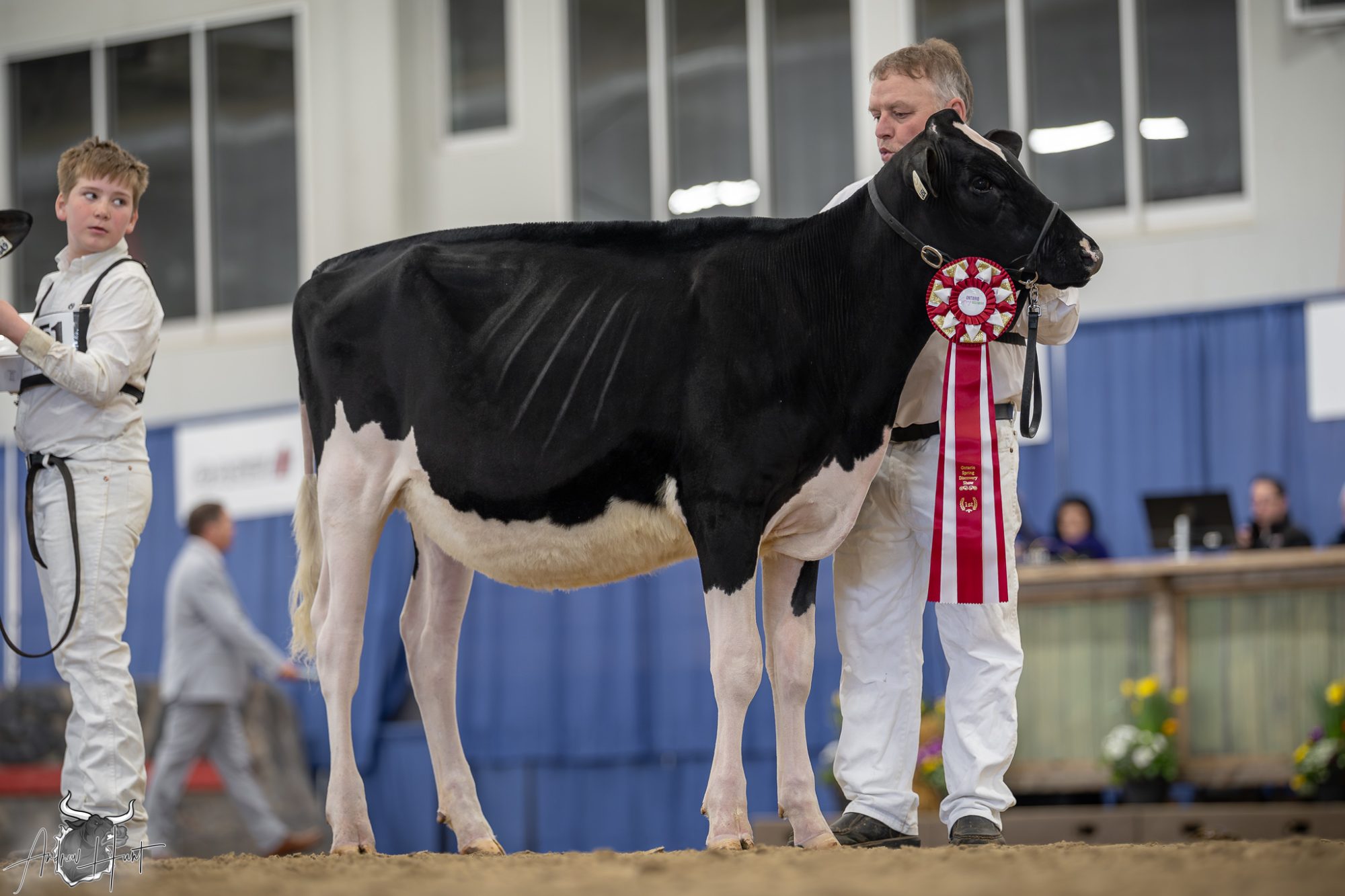
Ontario Spring Discovery 2026: A Deep, Dairy Show in Ancaster
Spring shows used to be the place where you forgave a heifer for looking a little green. Not in 2026. The cattle that walked into the ring at the Ontario Spring Discovery Show looked mid-summer ready — hair set, udders full, heads up, feet tracking clean. Judge Brent Howe (Howe’s Holsteins, Elmira, ON), assisted in the ring by Devin O’Hara of Dandelion Holsteins, got the Holstein assignment.
What followed was a full day of real dairy cows and heifers, hair-splitting line-ups, and two judges who delivered concise, specific reasons that anyone from a 4-H first-timer to a Madison veteran could follow.
Here’s how it broke down — class by class, champion by champion — plus the sires, families, and storylines worth watching as we head into the summer circuit.
🌟 Supreme Junior Champion Heifer: ECHO GLEN MASTER IRINA — Beckridge Holsteins — a “no-fault” heifer with width, sharp shoulder, hard top, open spring of rib and clean bone. She edged the Jersey on strength and power up front. Reserve Supreme: LEECHLAND MINNIE MOUSE K (Jersey) — Colin & Karen Leach Honourable Mention Supreme: BLONDIN ALPHA WHIPPET-RED — Ronald Grandy
Red & White Junior Champion: Blondin Alpha Whippet-Red | Reserve: Ember-Lit Believe Lucky-Red (B & B Donnay/Lizzy Partnership) | HM: Royhaven Warrior Freedom (Mt. Elgin)
Holstein Premier Breeder & Exhibitor: Karnview Farms, Woodstock, ON (Junior Breeder Herd went to Echo Glen) Jersey Premier Breeder & Exhibitor: Golden Jerseys, Mildmay, ON
The judges’ through-line: Howe rewarded open, angular rib, width through the rump, and correct, comfortable feet and legs — front and rear. The Supreme call came down to Irina’s extra power and front-end strength edging a very fancy Jersey.
Intermediate Champion
🏆 Intermediate Champion (& Best Udder): GLEANN LAMBDA QUALIFY — Andrew den Haan, Mount Kolb Farm & Plum Valley Holsteins, Fergus, ON
🥈 Reserve (& Best Udder of division): MAIFIELD LAMBDA MONIQUE — Blondin Sires & Ferme Blondin, Saint-Placide, QC
Judge Brent Howe: “A great young-cow show — dairyness, mammary quality, and structure with real futures on every one of these. My Champion wins on more width and height at the top of the rear udder, more capacity through the fore udder with a smooth blend, and a silky-hided, true-dairy look that moves beautifully on her front legs. Reserve and Honourable Mention were tight — it came down to Reserve’s extra width through the rear udder over a cow that’s fuller, deeper in the rear flank with real vein on my Honourable Mention. Three cows with big runs ahead of them.”
Grand Championship
Grand Champion (& Best Udder): Carleton Bad to the Bone — Hodglynn Holsteins
Reserve Grand: Gleann Lambda Qualify — den Haan/Mount Kolb/Plum Valley
Grand Champion Red & White: Beauvair Baba Revere — Mt. Elgin Dairy Farms
Howe’s take: “Look at these three cows. My Grand Champion has had five calves and still walks out gracefully on balanced, true-type feet and legs. My Reserve — a three-year-old — you could split a teardrop on her shoulder.” Both Reserve and HM were three-year-olds Howe kept together for their whole run through the championship line-up.
Premier Awards & Herd Honours
Premier Breeder: Fraeland Farms (Fergus, ON) — a fitting win on a day when Fraeland names appeared in class after class, from the Energy Brie winner down to the Midnight Actress veteran. Premier Exhibitor: Mt. Elgin Dairy Farms (Guelph, ON) — depth across both heifer and cow show. Premier Sire: Farnear Delta-Lambda-ET — the common thread on many top udders. Junior Premier Sire: Golden-Oaks Master-ET — dominant through the heifer classes, including Irina, Izzy, Winnie, Eloise, Alabama and more. Senior Breeder Herd: Fraeland (Steven Fraser, Fergus, ON). Junior Breeder: Karnview Farms Inc (Woodstock), Echo Glen Farm (Dorchester), Ferme Jean-Paul Petitclerc & Fils Inc. Junior Exhibitor: Karnview Farms Inc, Butlerview/Clarkvalley, Echo Glen Farm.
A final nod: Howe used a significant chunk of his Grand Champion microphone time to thank the Spring Discovery show committee, sponsors, volunteers, ring man Doug Green, his associate Devin O’Hara, the fitters in the barns, and the 4-H kids working alongside seasoned veterans. “It’s been in my blood a long time. It’s an honour to be here.”
🥈 Reserve Junior Champion: BUDJON LCOURAGE BOSTON-ET — Story Book Holsteins, Owen Sound, ON
🎖️ Honourable Mention: MARFLOACRES MAJOR MARINO — Butlerview Farm & Clarkvalley Holsteins, Chebanse, IL
Judge Brent Howe: “You’ve got to admire the correctness of my top two — both balanced, both open and deep through the midsection, and both tracking beautifully on their feet and legs. I kept them together right down to the wire. My Junior Champion gets the nod on that extra length of body we talked about in class. Reserve edges the Honourable Mention on strength through the front end, a crisper top line, and a straighter, cleaner walk on her rear legs. A great group of efforts — a great show all the way through.”
And IRINA didn’t stop there — tapped Supreme Champion Heifer to cap the day. 🌟
Winter Heifer Calf
BESLEA LAMBDA CAPONE — Clarkvalley Holsteins, Woodville, ON
KARNVIEW MAJOR ABYSS — Karnview Farms Inc, Woodstock, ON
REDCARPET SOLO DANCER-ET — Joel Phoenix / Red Carpet / Unique Holsteins, Cannington, ON
SILVERDREAM MASTER MIDNITE — Jeff Stephens, Troy, ON
Judge Brent Howe: “My winner puts it all together — balance from end to end, feminine through the head, strong over the shoulder, and tracking correctly on her feet and legs. She takes it handily over second on crop strength, body length, and fullness through the middle. Third is a pretty, feminine red calf with length and spring of rib, but second wins on body depth. Fourth gives up length of neck and rump, while fifth is an open, deeper-ribbed calf that can’t match fourth’s rear leg quality or tail-head setting. Beautiful class to start the day.”
FRAELAND LADY GLITTER SPARKLES — Beckridge Holsteins, Keswick, ON
Judge Brent Howe: “My top pair are both balanced efforts, but the winner takes it on a feminine head, a hard top, and real width through the rump, hooks, and pins — plus more drop and spring to her midsection. Second beats third on length from nose to tail, a sharper head and neck, and correct feet and legs. Third comes forward on balance, openness of rib, and a more comfortable set to her front and rear legs with stronger pasterns than fourth. Fourth wins on added body mass and length over a refined, clean-boned fifth-place calf.”
Summer Yearling
ECHO GLEN MASTER IRINA — Beckridge Holsteins, Keswick, ON
BUDJON LCOURAGE BOSTON-ET — Story Book Holsteins, Owen Sound, ON
BLONDIN ALPHA WHIPPET-RED — Ronald Grandy, Oshawa, ON
PETITCLERC ANEESH PAULA — Butlerview Farm, Clarkvalley Holsteins & Pierre Boulet, Chebanse, IL
Judge Brent Howe: “My winner — the July heifer — puts it all together: high style, extra length, a beautiful open turn of rib, and width from end to end. She captivates the eye anywhere in the ring and edges second on midsection length and a cleaner set to the hock. Second over third on width of chest, more comfortable front legs, and deeper rear flank with more spring of rib, over a very long-bodied third. Third wins on rump width and length from hooks to pins and nose to tail. Fourth takes fifth on bone quality through the hock and a more comfortable stride, over another dairy heifer with a big open rib.”
Spring Yearling
MARFLOACRES MAJOR MARINO — Butlerview Farm & Clarkvalley Holsteins, Chebanse, IL
ECHO GLEN MASTER ELOISE — Echo Glen Farm, Dorchester, ON
FRAELAND BECKRIDGE EN BEATRIX — Beckridge Holsteins & Fraeland Farms, Keswick, ON
EMBER-LIT BELIEVE LUCKY-RED — B & B Donnay & The Lizzy Partnership
Judge Brent Howe: “My top pair are similar-made, balanced, dairy heifers — but the winner takes it on a smoother blend of head and neck into the shoulder, a more level rump from hooks to pins, and a big open turn of rib. She’s high style and tracks correctly on her feet and legs. Second beats third on a stronger pastern and cleaner rear leg — she doesn’t knuckle over — plus more refined bone overall. Third comes forward on length of body and greater openness, depth, and capacity through the midsection viewed from behind. Fourth wins on dairyness, bone quality, a cleaner flank, and wider chest over a red heifer in fifth with real ring presence and a wide muzzle.”
PETITCLERC JERRY ADINE — Ronald Grandy, Oshawa, ON
CENTURY STAR JERRY LEWIS GIFT — Mt. Elgin Dairy Farms, Guelph, ON
CHARBEND MASTER DESIREE (B&O) — Charbend Farm, Brantford, ON
WCG UNIX COPYCAT — Willowcreek Genetics, Hagersville, ON
Judge Brent Howe: “Not the biggest class, but quality from top to bottom. My winner fits the style we’ve rewarded all day — more feminine through the head, longer in the neck, thinner-thighed and cleaner all the way through, and most importantly walking straighter and more comfortably on her rear feet and legs than second. Second earns her spot on a wider muzzle and chest, more drop to the fore rib, and real openness and spring over third. Third beats fourth on length of body against a longer-necked calf. Fourth takes fifth on cleaner bone in the leg and a more correct set to the front feet, over a nice open-ribbed heifer in fifth.”
Fall Yearling
BENRISE MASTER BAD HABIT — Coxlyn Farms Ltd & Frankhaven Holsteins, Uxbridge, ON
INTENSE ALPHA GALLY — Story Book Holsteins, Owen Sound, ON
JOREN HNF WIGGLE — Joren Holsteins & Tarten Inn Holsteins, Wilmont, ON
Judge Brent Howe: “Small class, real quality. My winner takes it on length of body, a neater-set tail head, a wider chest, and more drop to the fore rib — opening into a capacious midsection second can’t match. Second beats third on overall length from nose to tail and a more refined bone quality. Third — our red heifer — steps up on a harder top line, more open spring of rib, and straighter tracking on her rear feet over a very open-ribbed fourth-place calf. A really nice group to work with.”
Summer 2-Year-Old
🥇 FRAELAND BECKRIDGE ENERGY BRIE — Best Udder (Bred & Owned) — Beckridge Holsteins & Fraeland Farms, Keswick, ON
SARMAR ALLIGATOR PAULA — Mt. Elgin Dairy Farms, Guelph, ON
BECKHOLM CHIEF RAVEN — Beckholm Holsteins, Sunderland, ON
EXTRAMILE AMBROSE WRATH RED — 1st Red & White — Mt. Elgin Dairy Farms, Guelph, ON
Judge Brent Howe: “My winner rises to the top handily — feminine, long-necked, dairy, wearing the best udder in the class. She stands square and wide through the chest, carries a hard top, and blends smoother into the forearm than second, with more openness and drop of rib. Second beats third on a stronger pastern and a more comfortable walk around the ring. Third is a real dairy individual, winning on dairyness and mammary volume over a fresh red-and-white fourth — nicely attached udder, veins coming, just needs a month on her to develop and compete higher.”
MAGOLAIT LAMBDA CHARLIE — Joel Phoenix & T. & L. Cattle Ltd, Cannington, ON
VALE-O-SKENE LAMBDA BELLINI — M & G Lintvedt, R Shore & B Verthein / Vale-O-Skene Holsteins, Woodville, ON
Judge Brent Howe: “My winner wears the best udder — feminine, thin-thighed, wide through the muzzle and chest, with the flattest udder floor, sharper median suspensory, and more width at the top of the rear udder. Second is a silky, angular two-year-old who beats third on sheer dairyness, openness of midsection, and correct feet and legs. Third earns the bump on udder volume, length of frame, and extra length from hooks to pins. Fourth takes fifth on a snugger fore udder, more vein, a cleaner cut and stronger loin, over a very dairy fifth with an admirable wide rear udder.”
CADDEDALE MASTER AOK — Ethan Bloomfield, Ilderton, ON
Judge Brent Howe: “My winner is modern dairy with the best udder in the class — width from end to end, a big open spring of rib, smooth fore-udder blend, strong veination into the rear udder, and textbook median suspensory. Second is a powerful, feminine cow that gives up only overall dairyness. Second beats third on chest width, a more level udder floor, wider top of rear udder, smoother fore-udder attachment and stronger pasterns — even though third captivates you on length of neck and style. Fourth earns it over fifth on a snugger udder and cleaner bone, over a promising young cow with real muzzle, chest and a hard top.”
Fall 2-Year-Old
🥇 MARTIN-VIEW BULLSEYE CROSBY — Best Udder (Bred & Owned) — Breamont Holsteins & David Martin, Tavistock, ON
CYRMO LEGEND RAMONA — Clarkvalley Holsteins & Pierre Boulet, Woodville, ON
WEBHAVEN EYECANDY ERMINA — Jeff Stephens, Troy, ON
DANDYLAND HIA TARTAR SAUCE — Clarkvalley Holsteins, Woodville, ON
Judge Brent Howe: “Side profile is one thing — when you line them up shoulder to shoulder, it’s another. My winner steps up on a wider chest, carries her milk higher and wider at the top of the rear udder, and shows more width throughout over a high-style, feminine, clean-thighed second. Second beats third on a smoother fore-udder blend into the body wall and style over a very dairy third. Third earns the bump on balance, length from nose to tail and harder pasterns. Fourth takes fifth on more dairyness, thinner thigh and cleaner bone through the rear hock, over a fifth with real rump strength and a beautiful mammary that just needs a cleaner leg.”
Junior 3-Year-Old
🥇 GLEANN LAMBDA QUALIFY — Best Udder — Andrew den Haan, Mount Kolb Farm & Plum Valley Holsteins, Fergus, ON
BRENLAND AVENGER HAZEL (B&O) — Brenland Holsteins, Millbank, ON
DUCKETT LAMBDA NOLA-ET — Royal Lynn Holsteins, Cayuga, ON
HATCHLEY LEGEND DAIRY 396 — Talsma Farms Inc, Harley, ON
Judge Brent Howe: “My winner is a dairy machine — milked through, thin-hided, with all kinds of dairy strength. The call came down to the mammary: height and width at the very top of the rear udder put her above a beautiful side-profile second. Second beats third on fore-udder volume blending smoothly into a big open rib — just wants a little more lift at the top of the rear udder to challenge for the win. Third earns it over fourth on added vein, a smoother attachment and sharper median suspensory. Fourth takes fifth on added dairy strength, a lower udder floor and cleaner bone through the hock.”
FRAELAND LEGEND ESPIONAGE — Fraeland Farms, Fergus, ON
JACOBS UNSTOPABULL LISA-RED — Fraeland Farms, Fergus, ON
POPLARVALE SIDEKICK LILLIAN — Mt. Elgin Dairy Farms, Tavistock, ON
ANDREANE LAMBDA BUBLY — Clarkvalley Holsteins & Pierre Boulet, Woodville, ON
Judge Brent Howe: “My winner wears the best udder in the class — body, dairy strength, a level udder floor and real width, height and carry through the rear udder. Second is high-style, feminine, thinner-thighed, longer in the neck and cleaner in the bone — just doesn’t match the winner’s udder volume. Third — and take nothing away from this red cow — has a gorgeous side profile, strength and width of chest, and edges fourth on openness and spring of rib through the rear flank. Fourth earns the bump on length of body and a quality fore udder over a fifth with a wide muzzle, wide chest and a big open rib that can milk.”
4-Year-Old
🥇 ALLEGRO THUNDER STRUCK CABELL — Best Udder — Frankhaven Holsteins, Ingersoll, ON
BEAUVAIR BABA REVERE — 1st Red & White — Mt. Elgin Dairy Farms, Guelph, ON
Judge Brent Howe: “More frame in this class — and the top pair separates on the mammary. My winner carries huge width through the rear udder, a textbook median suspensory top to bottom, and a capacious fore udder that blends smoothly into the body wall. Wide muzzle, wide rump, real dairy cow. Second beats third on more correct front feet, wider chest, stronger pasterns and sharper median suspensory in the rear udder. Third — feminine, dairy all the way through — wins on mammary quality over a fresh 5-week fourth that will really bloom in another 40–50 days. Fourth takes fifth on openness through the midsection and a more comfortable walk, over a fifth with a high, wide rear udder.”
Mature Cow
🥇 CARLETON BAD TO THE BONE — Best Udder — Hodglynn Holsteins, Kincardine, ON
TOLAMIKA DIAMONDBACK BLAINE — Ronald Grandy, Oshawa, ON
Judge Brent Howe: “Wouldn’t you like to milk a pair of cows like this every day? My winner has had five calves and still shows a wide muzzle, a feminine, long body, and open-angular dairyness. She earns it on stronger loin, a better pin set, and a mammary system with more length into the fore udder, a more level floor and a sharp median suspensory. Second is a wide-muzzled, long-bodied cow in her own right — she just needs to tighten up in the loin and dairy up a touch more to push for top honours. A real nice pair.”
Longtime Production Cow (70,000 kg)
🥇 RUTI CHIEF NATALIA — Best Udder — Marthaven Holsteins & Skipwell Farms Inc, Woodstock, ON
Judge Brent Howe: “Two six-calf veterans and a tough decision, but my winner takes it on dairyness — feminine through the head, thinner-hided, with plenty of width through the rump and cleaner bone through the hock. The mammary closes the deal: a more level udder floor and a fore udder that blends just a touch smoother into the body wall. Take absolutely nothing away from second — she’s a heck of a cow with real dairy strength, a wide flare muzzle, wide chest and big rear-udder width. First is simply a touch more refined in the bone and more feminine throughout. What a pair.”
Four Minnesota farmers bet $25,000 on a calf they could still pick up. A century later, his hidden gene produced a World Dairy Expo Supreme Champion.
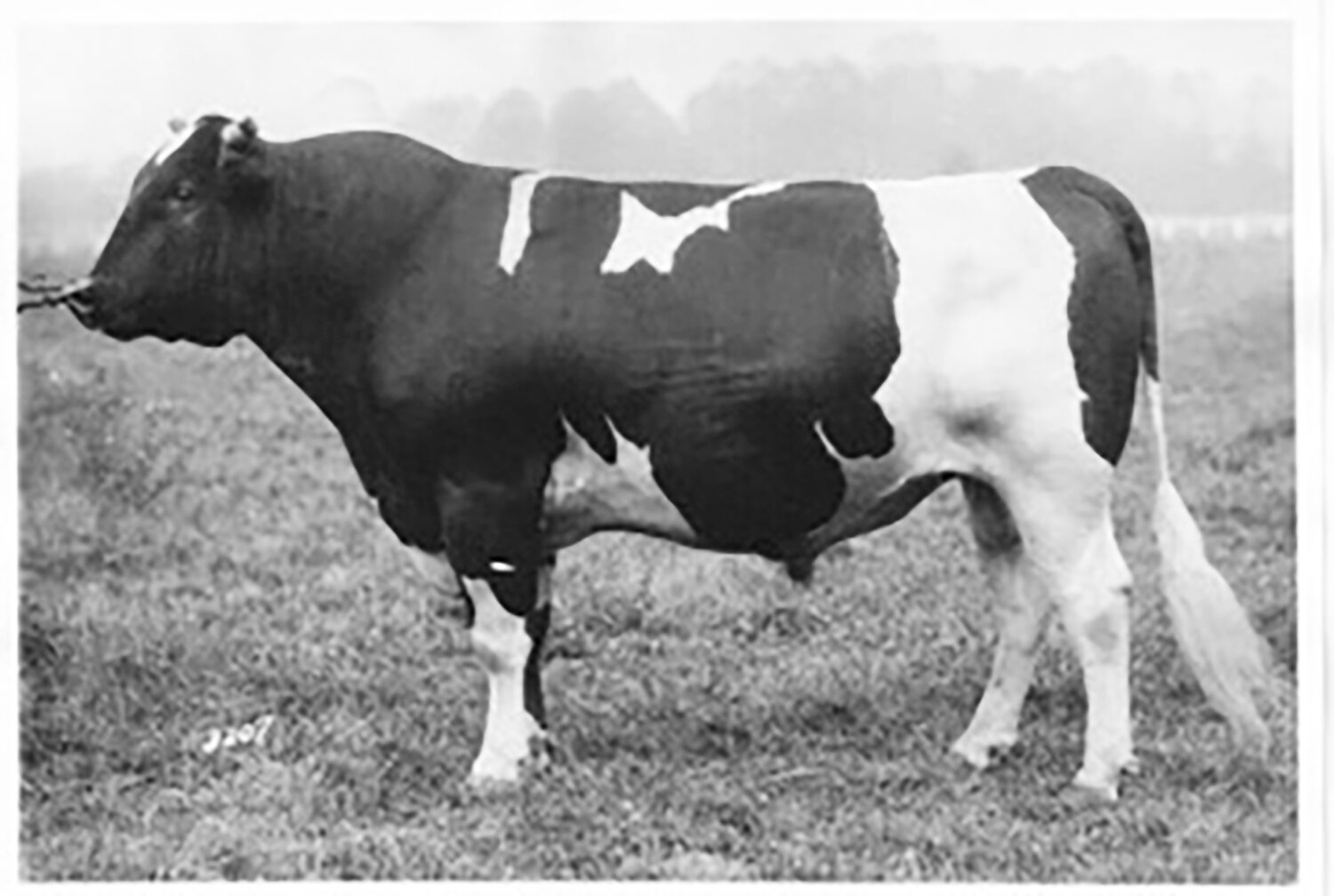
Sir Inka May at Carnation Milk Farms, the “Crown Prince” whose black‑and‑white frame quietly carried the red gene that would reshape Holstein history and help pave the way to a Red & White Supreme Champion.
The auctioneer’s chant bounced off the rafters in that Philadelphia sale barn like hoofbeats on a wooden bridge. It was the Fourth Brentwood National Sale in 1925—one of those days when you could look down the rows and see every kind of dairyman, from small‑town breeders in their Sunday coats to corporate buyers with sharper suits and even sharper pencils. Then the next lot stepped into the ring: a two‑year‑old bull with that big‑time show bloom and a catalog page that read like a wish list. Sir Inka May. When the gavel finally crashed at 12,000 dollars to Carnation Milk Farms out in Seattle—and word buzzed through the crowd that Carnation had been willing to go to 30,000 if they had to—you didn’t need a crystal ball to know this bull was going to matter.
What nobody in that ring could see—not the auctioneer, not the Minnesota men who’d raised him, not even the Carnation buyer signing off on the biggest bull check of his career—was that this wasn’t just a sale. It was the opening scene of a story that would run a hundred years, stretch from a 75‑cow outfit in Austin, Minnesota, to the colored shavings at World Dairy Expo, and peak with a Red & White cow named Golden‑Oaks Temptres‑Red‑ET walking out of Madison as Supreme Champion. The thread that ties those moments together is the bull the Mower County News once called the “Crown Prince of the Inka herd”—and one small, recessive gene the Holstein world wanted nothing to do with at the time.
Act I – A Crown Prince in a Little Powerhouse
To really understand Sir Inka May, you’ve got to start in Austin, Minnesota. Not the Seattle of Carnation advertisements, but a place where cream cans rattled down gravel roads, and neighbors knew which barns housed the good cows.
In 1919, Vere Culver and his partner Alpha Eberhard set out to build more than just a herd there. They created the Minnesota Holstein Company. On the surface, it was a small Holstein operation. In reality, it was an early boutique genetics program. The herd never topped 75 head, youngstock included, yet in eight years they piled up 85 first‑place ribbons and 14 championships at national Holstein shows. In 1925, they attended the National Cattle Congress in Waterloo, Iowa, and returned with both the Premier Breeder and Premier Exhibitor banners. Think about that for a second: a herd you could walk through in under an hour, being called the best in the country that year.
Here’s what made that possible. Her name was May Walker Ollie Homestead.
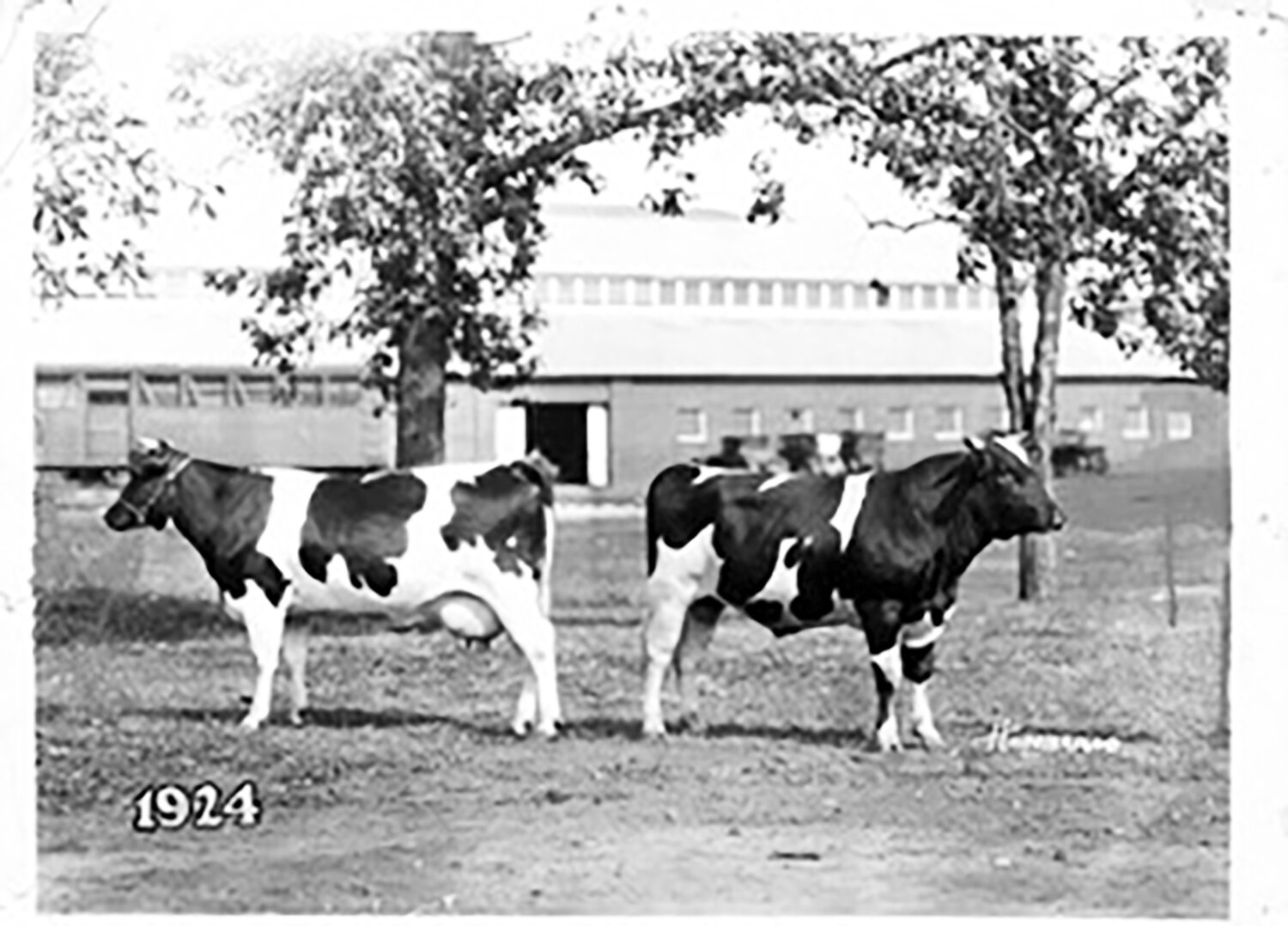
May Walker Ollie Homestead (left) on the showgrounds, 1924—the cow whose 31,608 lbs of milk and 1,521 lbs of butterfat made test sheets look like misprints and gave Sir Inka May the maternal firepower that changed a breed.
By all accounts, she was the kind of cow that made people change their travel plans. On December 18, 1922, just as winter settled in, she wrapped up a lactation that made test sheets look like misprints—31,608.6 pounds of milk and 1,521.59 pounds of butterfat. This was the era of hand milking, wooden stanchions, and hay and grain. That record didn’t just push the envelope; it blew it right open. Her butterfat record held nearly five years. She went on to be the dam of three All‑Americans and an All‑American produce of dam, and the Farmers Independent noted that no other animal had performed so “sterlingly for the upbuilding of the dairy industry.”
Now, put yourself in Culver and Eberhard’s boots. You’ve got a cow like that in your barn. You’ve watched the milk scales, felt the spring in her pasterns after months of that kind of production, seen her hold condition. What keeps you up at night? The hope that she’ll give you a son who can pass it on.
On April 8, 1923, hope hit a straw. May Walker Ollie Homestead calved a bull by Sir Inka Superior Segis. The Mower County News didn’t play coy. “This introduces you to the Crown Prince of the Inka herd,” they wrote, adding that he was being “groomed to keep up the family trait of being American champion of something.” That’s rural Minnesota in 1923—half humor, half prophecy.
Sir Inka Superior Segis already had a reputation for siring winners. The Minnesota Holstein Company had six All‑Americans on the farm at one time; this calf came from the very center of that genetic storm. No wonder breeders were watching.
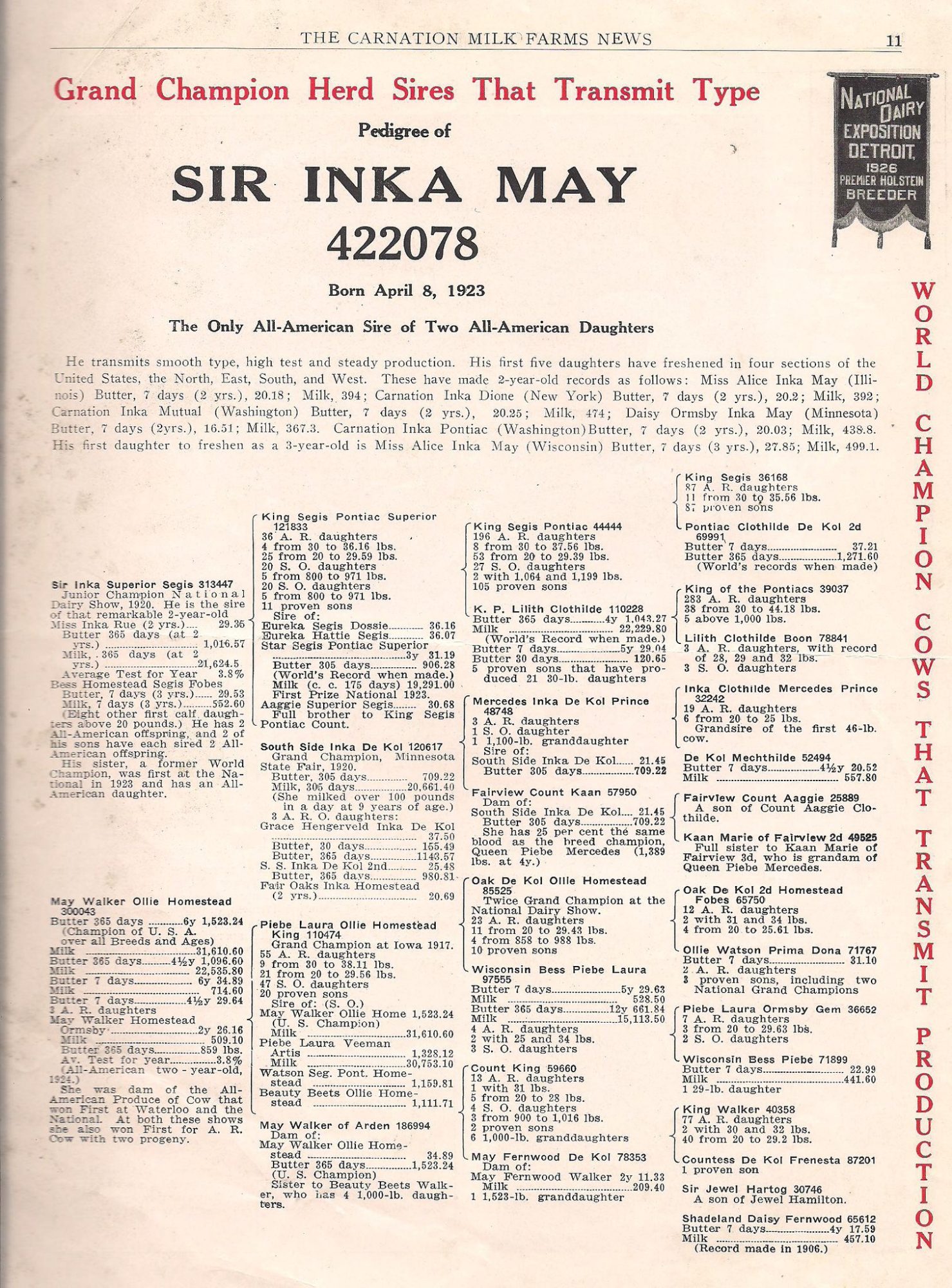
Sir Inka May’s pedigree page in The Carnation Milk Farms News—a 1920s proof sheet showing the “Crown Prince” as the only All‑American sire of two All‑American daughters, backed by May Walker Ollie Homestead’s record 31,608‑lb lactation and a stack of red‑carrier ancestors the breed didn’t yet understand.
A few months later, four breeders from McLeod County sat down at a kitchen table with that calf’s future in front of them. By all accounts, that’s when talk turned to numbers that made thumbs drum against the tabletop. They decided to buy a 50% interest in Sir Inka May for $ 25,000. In today’s money, that’s around 476,000. That’s not “let’s see how he does” money. That’s a level of risk that makes your stomach feel light when you sign.
You can picture it. Catalogs pushed aside, coffee cups cooling, someone saying, “We’re not going to see another one out of a cow like May Walker any time soon.” Another answering, “If he sires like she milks, we’ll be glad we did it. If he doesn’t…” Silence. Then somebody pushes his chair back, walks over to the desk, and does the hardest part of any breeding decision: puts pen to paper.
The next year, 1924, the wider Holstein world got its first real look at the “Crown Prince.” The All‑American program had just been formalized in the Holstein‑Friesian World in 1922. Sir Inka May went into the junior yearling bull classes and came out as an All‑American Junior Yearling—one of the first bulls to carry that new national “ideal” All‑American title beside his name. According to dairy historian Ron Eustice, he didn’t stop there. He became the first All‑American bull to sire an All‑American daughter, proving that his show-ring quality wasn’t going to stop with him.
Back home in Minnesota, he was doing the quieter work that really builds a legacy. During his tenure there, Sir Inka May sired at least 70 calves in the state, more than 30 of them in those McLeod County herds. This was still pre‑A.I. If his daughters looked good, the neighbors saw them. If they milked like their granddam, the talk at the local creamery reflected it.
Nobody in those conversations was thinking about coat color genetics. Red calves popped up here and there in the breed, usually met with frowns or quiet culls. The Holstein identity was black and white. Folks talked about Segis, Rag Apple, and Clothilde; recessive alleles were still a mystery. Sir Inka May’s promise, as far as anyone knew, was about more milk and better-looking cows, period.
Act I ends in that sale ring, with a great Minnesota hope going west—and a gene nobody understood hitching a ride in his semen.
Act II – Carnation, Red Calves, and a Breed That Wasn’t Ready
Now, the thing about that 1925 Brentwood Sale is that it wasn’t just a fancy auction; it was a snapshot of where the Holstein breed was headed. The sale grossed 88,950 dollars—serious money in an era when the average cow was a 3,000‑pound milker. Buyers came from 18 states and three countries. Breeders sent cattle there to make statements.
Carnation Milk Farms didn’t come to watch. They came to buy.
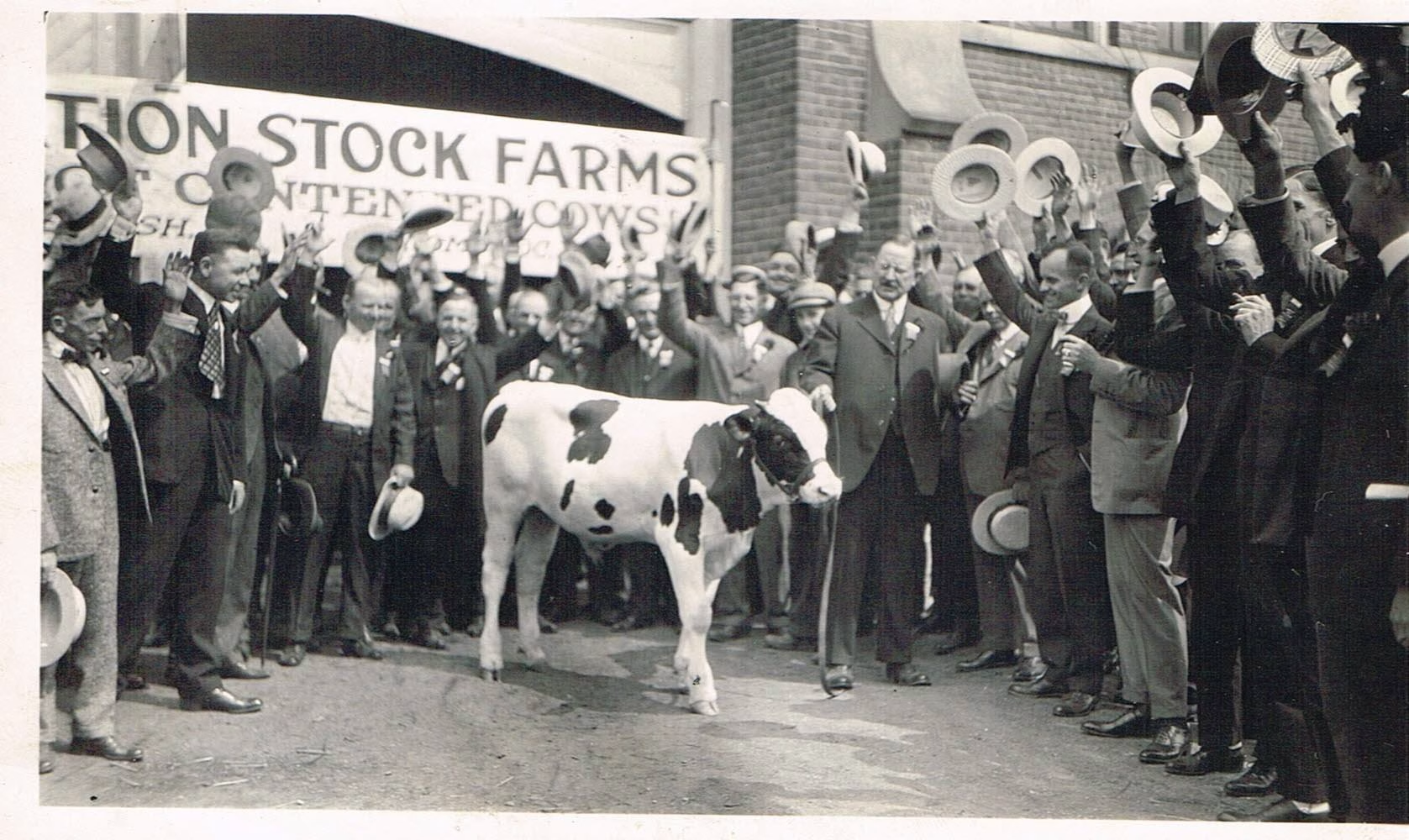
Carnation King Sylvia on tour in 1918—E.A. Stuart’s $106,000 “whistle‑stop” calf, paraded under the CARNATION STOCK FARMS banner, proving long before Sir Inka May that big Holstein bulls and bigger cheques could turn genetics into nationwide marketing.
Owned by the Carnation milk products company—which would later end up under Nestlé—Carnation Milk Farms was built around a simple idea: breed cows so productive that their numbers alone would sell semen back to the dairymen whose milk Carnation was hauling. At a time when the national average cow gave about 3,000 pounds of milk in 1900 and 7,000 pounds by 1950, Carnation was recording herd outputs of 37,000 pounds as early as 1927. They weren’t there to hang ribbons. They were using genetics as part of a corporate business plan. (Read more: When Cows Were Kings: Revisiting Carnation’s Golden Age of Dairy Breeding)
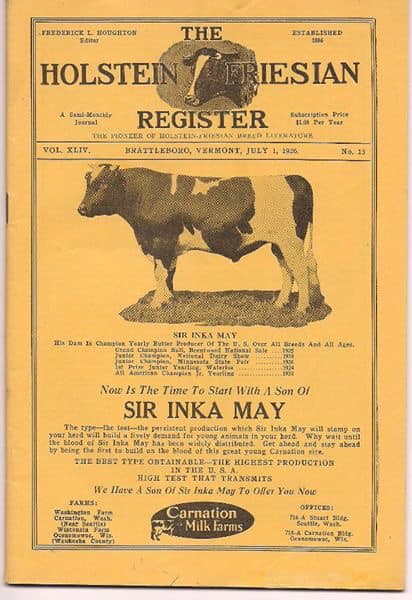
Carnation’s own ad for Sir Inka May on the July 1, 1930 cover of The Holstein‑Friesian Register—proof that the “Crown Prince” from Minnesota had become the headline sire in a program built on turning big records into even bigger semen sales.
Sir Inka May arrived in Seattle with exactly what they were looking for: All‑American credentials, a dam with a world‑record butterfat test, and a growing reputation for prepotency. The fact that they’d been prepared to pay 30,000 if necessary tells you just how badly they wanted him in their bull barn.
One can imagine those first Sir Inka May daughters freshening in the Carnation barns. Long, airy concrete barns, lime dusting the floor, the new sound of milking machines chugging where hand milking used to echo. Herdsmen with clipboards, watching test weights and butterfat numbers, circling the ones that made their eyebrows go up.
Within a few years, his calves had already racked up over 90 blue ribbons in the 1926 and 1927 show seasons. By October 1940, Holstein‑Friesian World wrote that he had 11 daughters over 1,000 pounds of fat and 45 over 800—more than any other living sire of any breed. In the records, only Matador Segis Ormsby sat ahead of him. The magazine concluded that “the Sir Inka May production and his influence on the breed today is perhaps greater than that of any other sire now living.” Carnation’s own people later said no bull had ever had more impact on their program.
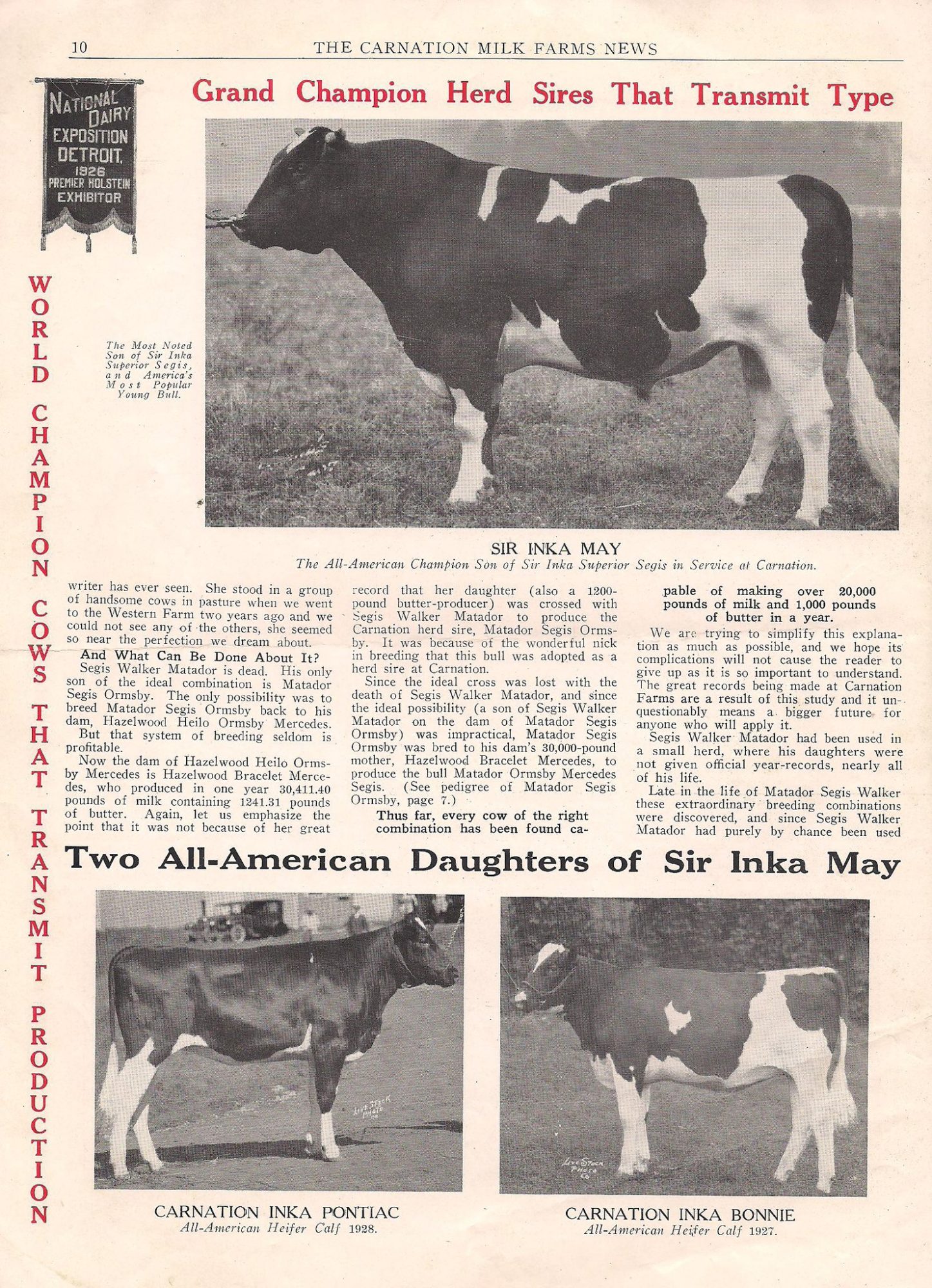
Sir Inka May featured in a 1927 issue of The Carnation Milk Farms News—pitched as the All‑American champion sire whose daughters and All‑American heifers, Inka Pontiac and Inka Bonnie, were proving that one Minnesota bull could stamp both type and production across Carnation’s herd.
Behind those numbers were bulls and cows that carried his name. By 1940, Sir Inka May had sired four of Carnation’s main herd sires, and at least six of his grandsons were also serving as herd bulls there. At that point, you could walk down the bull line and see his influence in every pen.
But while the production records were climbing, something in the calving pens was making the company nervous.
Between 1928 and 1937, Sir Inka May sired at least 13 red‑and‑white calves at Carnation. His sons, used in that same herd, also threw red. This wasn’t entirely new—Carnation’s records show a red calf as early as 1915, and a bull named Carnation Segis ProspectRC siring red calves in 1923–24. But when your top sire, the bull you’ve hitched your program to, starts throwing that color in your best cow families, the stakes feel higher.
Picture a scene from those years. A Carnation herdsman, coat collar turned up against Washington drizzle, is in a box stall with a Sir Inka May daughter whose test sheet has been making everybody smile. The calf hits the straw; they wipe it off with a sack; the lantern light hits the coat, and it’s not black. Not mostly black with a funny cast. It’s clearly red and white. There’s probably a long pause. Maybe a muttered, “Well, that’s not what we ordered.”
Breeders hate mysteries in a pedigree. To explain the red calves, a story started that you still hear in some corners today: that Sir Inka May’s red gene came from an unrecorded Ayrshire in his background—a fence‑jumper somewhere along the line. It was a convenient way to pretend “true” Holsteins didn’t carry that gene.
Eustice’s research shuts that down. The red factor was already present in the Holstein breed through imported Dutch cattle such as Clothilde and Coronet. Sir Inka May’s sire, Sir Inka Superior Segis, was a known red carrier. His full sister, May Walker Inka Segis—sold to Senator A.C. Hardy in Ontario at the Minnesota Holstein Company dispersal—was a red carrier. A maternal brother, Sir Bess Ormsby May, went to Osborndale Farm in Connecticut and sired red calves. The gene was woven into some of the breed’s most elite families. No Ayrshire needed.
Carnation, though, had a brand to protect. As late as 1963, long after Sir Inka May was gone, their own magazine ran a line that many old‑timers still remember: “The red factor is becoming so much a problem in some places that it does not seem advisable to run the risk of further spreading the factor throughout the breed.” One Carnation editor, looking back on the red calves those years later, wrote that they made some folks “nervous” even when the numbers on their dams were spectacular—numbers like Sir Inka May’s daughters were posting. That tension between what the eye liked and what the ledger demanded was playing out in real time in their barns.
They weren’t alone in that attitude. Both the Holstein‑Friesian Association of America and its Canadian counterpart held the line for decades against registering Red & Whites. Some state associations placed ads arguing that adding red cattle to the herdbook would damage the Holstein “brand.” Red calves were not just unfashionable; they were seen as a threat.
Sir Inka May himself kept doing the only job he knew. He worked at Carnation until about a year before his death. On July 15, 1943, they euthanized him at the farm. He was 20 years old, a venerable age for a bull that had seen the breed shift from hand milking to milking machines and watched new bulls come and go while his daughters stayed in the milking string.
By then, his official record was sealed: 18 All‑Americans and 15 Reserves, 33 banners in total; 11 daughters with 1,000‑pound fat records and 45 with 800 pounds or more, more than any living bull of any breed at the time; four sons and six grandsons at work in the Carnation bull barns. If his story had ended right there, he would still be remembered as one of the great sires of that era.
But the gene nobody wanted was still out there, riding quietly in the pedigrees of the cows and bulls he’d made famous.
And this is where the story that started with that 12,000‑dollar bid in 1925 starts climbing toward its peak.
Act III – Sovereign, Outcasts, and a Red & White Supreme
The Minnesota Holstein Company itself didn’t last long on paper. In 1927, after only eight years, they dispersed the herd. At that sale, 61 head averaged 1,078 dollars—about three times the industry’s average cow price of 376 dollars at the time. The buyers might not have been thinking about recessive color genes, but they definitely recognized elite cattle when they saw them.
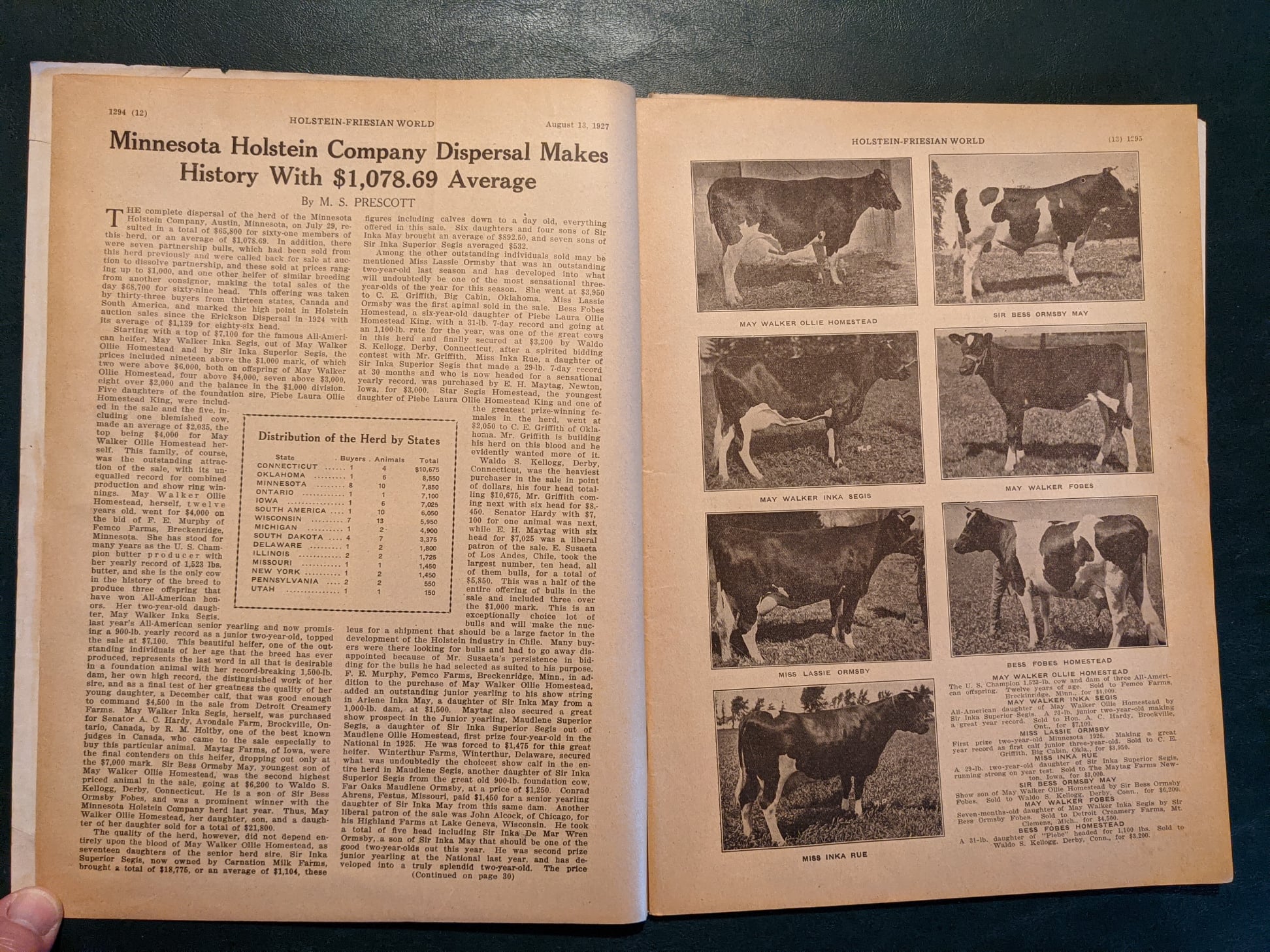
Minnesota Holstein Company Dispersal Makes History with $1,078.69 Average” — the 1927 Holstein‑Friesian World spread that proved Culver and Eberhard’s 75‑cow “boutique” herd was no hobby, with buyers from across North America paying triple the going rate for cows like May Walker Ollie Homestead and the families behind Sir Inka May.
Looking back, Eustice wrote that through its cattle, the Minnesota Holstein Company “unknowingly and irrevocably disseminated the recessive gene for red hair color throughout the North American Holstein population.” That word “unknowingly” sits heavily. Culver, Eberhard, and the McLeod County breeders—they were chasing performance, type, and banners. They didn’t set out to change the breed’s palette. They just happened to put a powerful red gene carrier at the center of a very influential program.
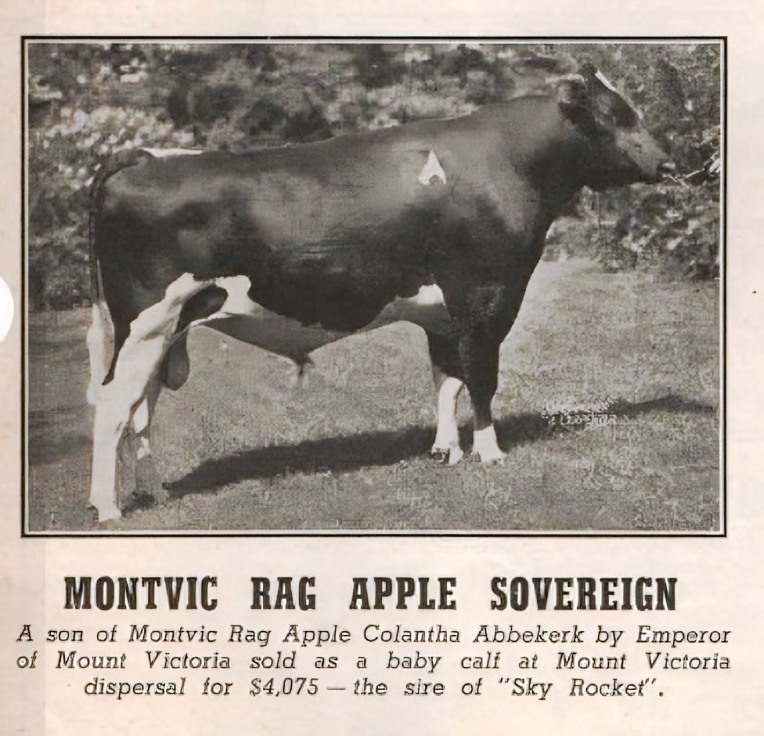
The survival and eventual triumph of that gene runs through one key link: Montvic Rag Apple Sovereign.
Sovereign was born April 17, 1942, at Mount Victoria Farm in Hudson Heights, Quebec, under the eye of another legend: T.B. Macaulay. Macaulay had a very specific vision. He wanted Holsteins that could consistently test 4% butterfat with udders that would stand the strain year after year. At a time when breeders sometimes accepted leaky udders in exchange for big production, that was a clear, disciplined breeding philosophy.
Montvic Rag Apple Sovereign—born at T.B. Macaulay’s Mount Victoria in 1942, sold as a two‑month‑old for $4,075, and then, through early A.I., the great‑grandson of Sir Inka May whose semen spread the red gene into more Holstein pedigrees than any other bull of his era.
Sovereign was a great‑grandson of Sir Inka May. When the Mount Victoria dispersal came in 1942, he was only a two‑month‑old calf, but he still fetched 4,075 dollars from Tom Dent and Clark Brown. That price told you everything: people believed in the breeding behind him, not his size on sale day.
Here’s where timing helped. Artificial insemination was stepping out of its experimental phase. Sovereign became one of the bulls to ride that first real wave of A.I. At one point, he had more registered offspring in the Canadian herdbook than any other sire. Instead of influencing a handful of herds the way a natural service bull would, his genetics spread coast to coast—and beyond.
The line sharpened again at ABC Farms in Brampton, Ontario. There, ABC Inka May EX showed what Sir Inka May’s family could do from the female side—a four‑year‑old All‑Canadian with a record of 24,141 pounds of milk and 1,128 pounds of fat. She was sired by Inka Supreme Reflection and traced back to Temple Farm May, a 400‑dollar purchase that turned out to be one of those cows whose price looks comically small in hindsight.
When ABC Inka May was mated to Montvic Rag Apple Sovereign, they produced A.B.C. Reflection Sovereign EX‑Extra. The bull books tell you what happened next. Reflection Sovereign dominated the show ring in the 1950s, siring seven All‑Canadian Gets and five All‑American Gets. Breeders across North America built cow families on his daughters. Because he carried the red gene from Sir Inka May, those lines quietly banked that recessive factor even as the official herdbooks still refused to print “Red & White” beside a registration number.
A.B.C. Reflection Sovereign EX‑Extra—the Sovereign son from ABC Inka May whose daughters dominated the 1950s show strings, with seven All‑Canadian Gets and five All‑American Gets, quietly banking Sir Inka May’s red gene in the very cow families the breed was most proud of.
Meanwhile, the institutional resistance was still in full swing. The Holstein‑Friesian associations in both the U.S. and Canada stood firm against the registration of Red & Whites. Some state associations ran ads warning that letting red cows into the registry would tarnish the Holstein image. As late as 1963, Carnation’s magazine was still warning that the red factor was “becoming so much a problem… that it does not seem advisable to run the risk of further spreading the factor.” That line tells you all you need to know about how deep the prejudice ran.
But the cows—and the data—were winning. Around the world, demand for high‑production Holstein genetics often meant buying semen from bulls that happened to carry the red gene. The first Red & White show at World Dairy Expo was held in 1968. Canada opened its herdbook to Red & Whites in 1969. The U.S. followed in 1970. In 1969, Carnation themselves—the same outfit that had spent years trying to breed red out of their own herd—introduced Red & White bulls into their A.I. lineup to meet global demand. Talk about coming full circle.
By that point, as Eustice notes, almost all Red & White and red‑carrier Holsteins in the world could be traced back to Montvic Rag Apple Sovereign. Follow that line back a little farther, and you land squarely on Sir Inka May. A bull who’d once been valued for his black‑and‑white daughters and fat records had become, through his great‑grandson, the backbone of a color variety the breed had spent decades trying to keep out.
And this is where the story that started with that high price in Philadelphia finally hits its peak.
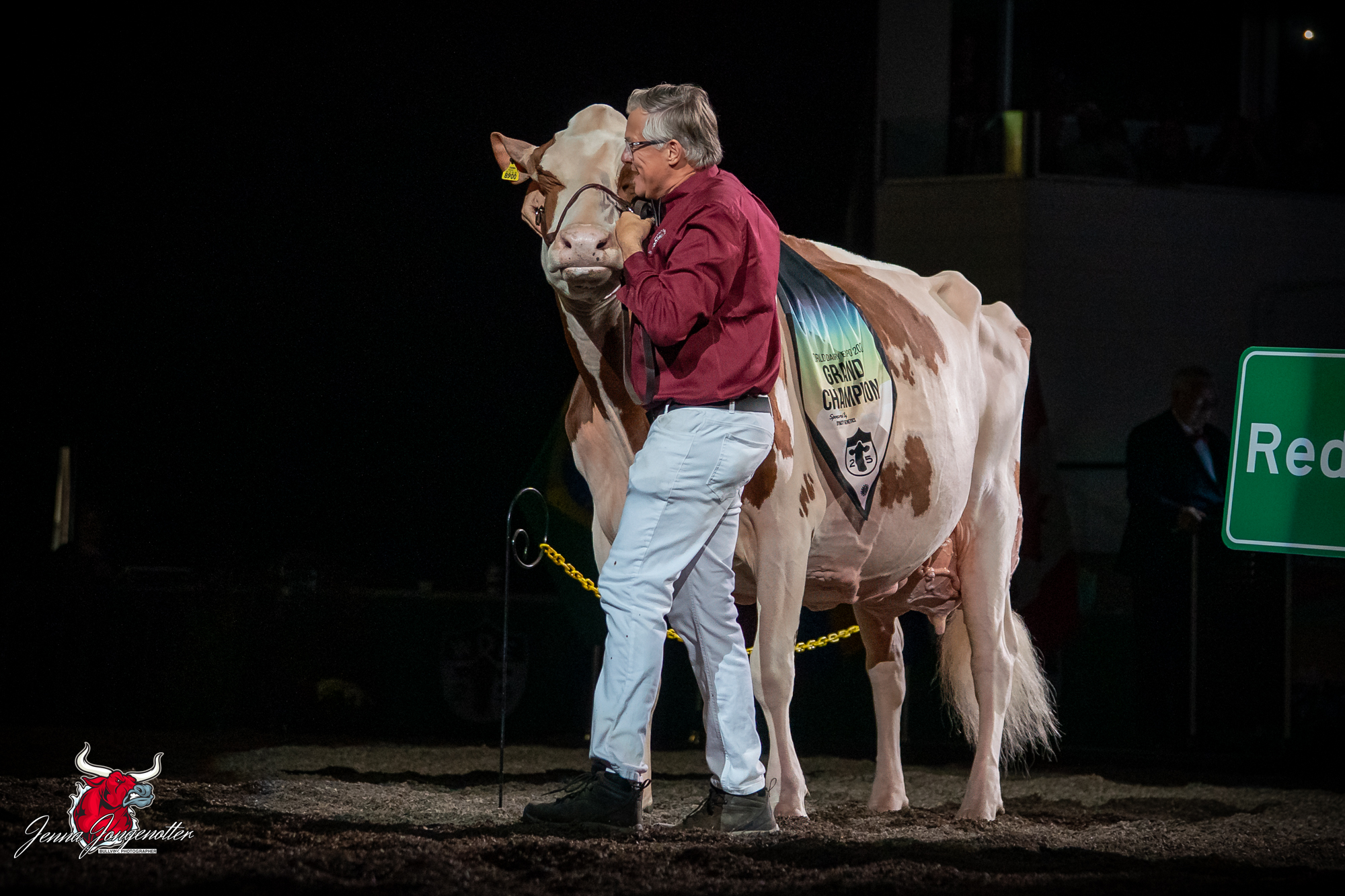
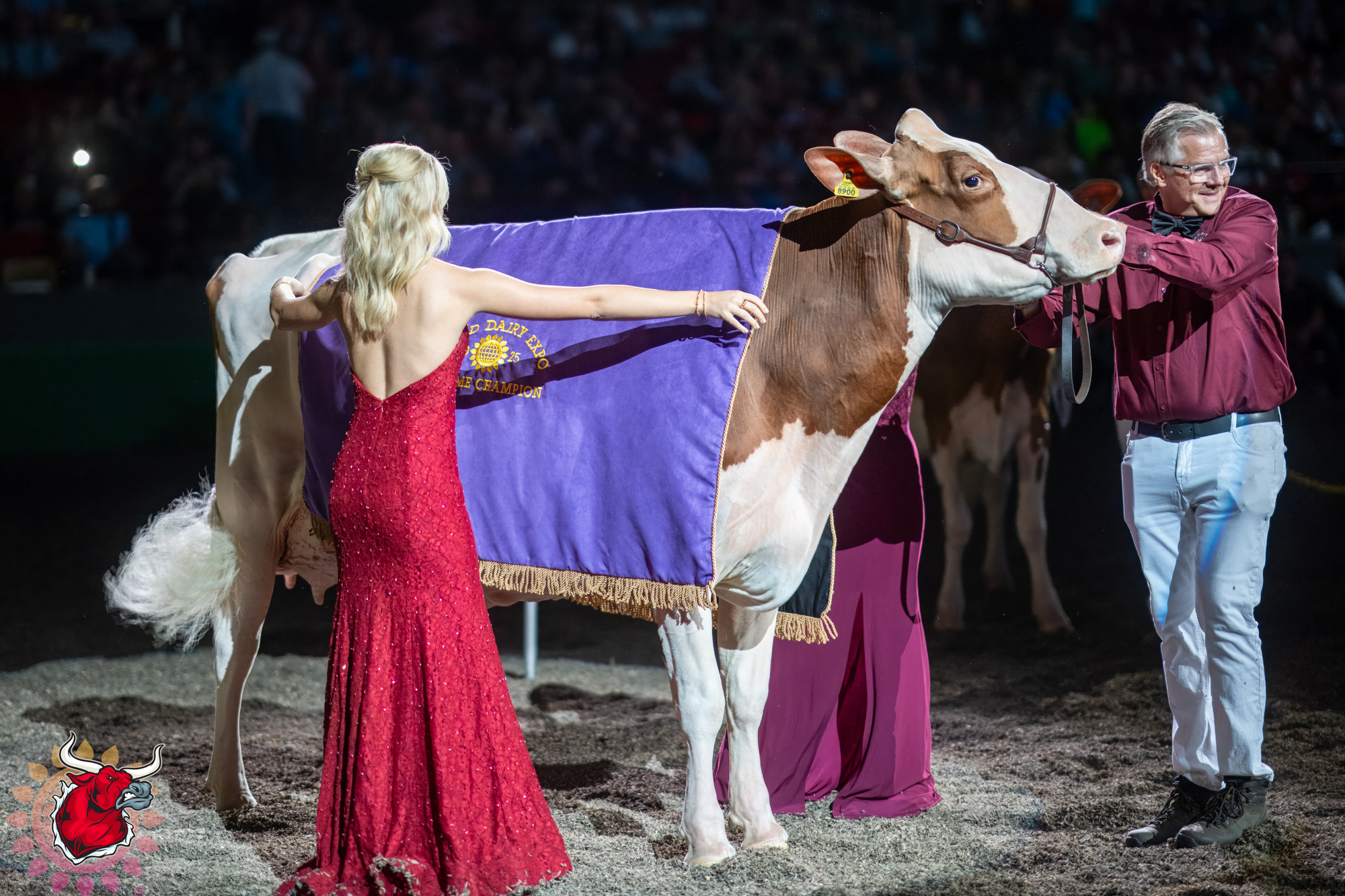
Fast‑forward to Madison, Wisconsin, 2025. If you’ve been to World Dairy Expo, you can smell it just thinking about it—sawdust, coffee, hoof black, and cool fall air. In the International Red & White Show, Golden‑Oaks Temptres‑Red‑ET walks into the ring. The minute she does, you can tell the class has just changed. Classified EX‑94, she’s got that welded‑on udder, that long, clean frame, that way of carrying herself that makes judges forget their lunch breaks.
There’s that familiar hush in the Coliseum—the kind where you can hear a shank chain rattle three rows over—while the Supreme lineup stands under the lights. Then there are her numbers. As a three‑year‑old, Temptres had already rung up 37,030 pounds of milk and 1,510 pounds of butterfat in 365 days. Put that beside May Walker Ollie Homestead’s 1922 record—31,608.6 pounds of milk, 1,521.59 pounds of fat—and it sends a little chill up your spine. Different eras, different rations, different technology, same kind of ridiculous capability in the milking parlor.
Her pedigree is a Red & White road map. Dam: Miss Pottsdale DFI Tang‑Red EX‑94. Granddam: Al‑N‑Tine Debonair Tart‑ET EX‑92 3E. Further back, C Alanvale Inspiration Tina EX‑95 2E, plus a list of elite red and red‑carrier names that any modern breeder will recognize. Underneath it all, if you walk the branches back far enough, you find Sovereign, Reflection Sovereign, and the Inka lines that lead back to Sir Inka May.
When the announcer in Madison finally says it—Temptres named Supreme Champion of World Dairy Expo 2025—everything that had come before folds into that moment. This isn’t just a Red & White cow winning her color show. This is a Red & White cow, carrying elite production and elite type, standing as the top Holstein on the grounds. The gene Carnation, once called “a problem,” and the associations that once wouldn’t register are under the spotlight, and nobody’s complaining.
That’s the climax. That’s the peak. A story that started with a record cow in Minnesota, a high‑priced bull calf, and some red calves that made people mutter in the barn has finally walked to the colored shavings and taken the whole show.
Golden-Oaks Temptres-Red Supreme Champion – World Dairy Expo 2025 Milk Source, Fischer, Steincrest & Crescentmead Kaukauna, WI
Why Sir Inka May Still Matters in Today’s Barns
So why should a producer in 2026, juggling feed costs, labor, and breeding decisions, care about a bull born in 1923?
First off, Sir Inka May is living proof that influence in this breed doesn’t spread out evenly. If you’ve ever flipped through a pile of pedigrees and seen the same name pop up three, four, five times in four generations, you’ve seen what happens when one bull ends up at the center of multiple powerful herds. Put a highly prepotent sire in a boutique show herd like the Minnesota Holstein Company, then move him to a corporate production herd like Carnation, and you’re not just making a good bull. You’re laying down a genetic highway that his traits can travel for generations.
Another thing his story says, loud and clear: you don’t get to choose which genes tag along with the ones you’re chasing. We assess milk, fat, udder quality, feet and legs, and health traits. The rest of the package—fertility quirks, disease resistance, coat color—climbs into the trailer with them. Sir Inka May was used heavily because he made the kind of daughters Carnation needed and sired sons that bred true. The red gene never asked permission. It just stayed in the blood and kept moving forward.
Stand him between Culver and Eberhard at that kitchen table in Austin and the Carnation team reading test sheets in Seattle, and you can watch the breed walk from kitchen tables to conference rooms. On one side, you have a small herd, big goals, and a lot of faith in what you can see in front of you. On the flip side, you have herd records, planned matings, and a corporate mindset that uses genetics as a tool in a larger business machine. Sir Inka May is a reminder that the tension you feel today between what the computer says and what the cow in front of you looks like has long been part of this breed.
And if you’re milking Red & Whites today—or even just using red‑carrier bulls in a black‑and‑white herd—this isn’t ancient history. Every time you trace a Red & White pedigree back and find Sovereign or Reflection Sovereign, every time you see RC show up in a bull’s proof and shrug because his daughters are exactly what you want in your free stalls, you’re staring right down the line that runs back to Sir Inka May. Every Supreme Champion Red & White at Madison, Temptres included, is another banner hanging on the same genetic rope he helped string.
A Quiet July Day, and a Long Echo
Let’s go back, one last time, to Carnation Milk Farms in July of 1943. By then, Sir Inka May had been walking those alleys for nearly two decades. He’d seen the barn change around him—new paint on the walls, new milking units, new bulls on either side of his stall. His daughters had filled the milking strings, and his grandsons were already standing in the bull pens.
The records tell us, not the memories, that he was euthanized on July 15. One can imagine the day. Summer haze over the fields. A few of the long‑time herdsmen pause as they walk by his pen, thinking of the calves they’d pulled from his daughters, the fat tests that had rolled off the tester’s scale, the herd sires with his name on their registration papers. For them, the bull wasn’t just a list of numbers; he was a fixture.
By then, Holstein‑Friesian World had already called his influence on the breed “perhaps greater than that of any other sire now living.” Carnation had acknowledged that no bull had shaped their program more. On paper, his story was staggering: 18 All‑Americans, 15 Reserves; more 1,000‑pound‑fat daughters than any other living sire of any breed; four sons and six grandsons in the Carnation bull barns.
If that were all he’d done, Sir Inka May would still deserve his place in Holstein history. But we know now that the deepest part of his legacy wasn’t visible in those 1940s scorecards. It was in the quiet way a recessive gene slipped out from under the shadow of prejudice, stayed alive in elite families, and eventually walked into the center ring at Madison with a Supreme banner over its head.
Without Sir Inka May, Carnation’s production records would have different numbers beside them. Mount Victoria’s breeding experiments might have taken a different turn. Sovereign’s widespread impact on A.I. would look different in the herdbook. Without him, the Red & White pedigrees behind cows like Temptres would read another way, and it might have taken longer for the breed to admit what the cows had been saying all along: that excellence comes in black and white—and in red and white.
Every time a breeder today opens a catalog and sees RC next to a bull’s name, every time a Red & White calf hits the straw and the reaction is a smile instead of a sigh, there’s a little bit of Sir Inka May in that moment. When Golden‑Oaks Temptres‑Red‑ET walked out of the ring in 2025 as Supreme Champion of World Dairy Expo—with a 37,000‑pound record and a pedigree that leads back through Sovereign to Minnesota’s Crown Prince—that was his echo, loud and clear.
In 1923, a small-town newspaper introduced a newborn bull as the “Crown Prince of the Inka herd” and joked that he’d be groomed to be “American champion of something.” A hundred years later, we can say they were right in ways they never could have imagined. He helped lift a little Minnesota herd into the spotlight. He gave Carnation the sires they needed to rewrite what “high production” meant. And he quietly carried a red gene that turned out to be one of Holstein history’s greatest stories of redemption.
So the next time you watch a Red & White cow circle the ring at Madison, or look at a red‑carrier bull’s proof, wondering how his daughters will look in your barn, remember that quiet July day at Carnation and that loud day in the Philadelphia sale ring. Remember the world‑record cow in Austin, the four farmers betting 25,000 dollars on her son, and a corporate herd that tried to keep the red gene behind the curtain even as it rode their best pedigrees.
You’re not just looking at color. You’re looking at the long echo of a bull born in 1923 whose influence ran farther and lasted longer than anyone in that first barn could have guessed.
Crown Prince, indeed.
Key Takeaways:
Sir Inka May turned a 75‑cow Minnesota show string into a global genetic force, anchoring both Carnation’s record herds and the emerging A.I. era.
His daughters’ 1,000‑lb fat records and multiple All‑Americans made him a sire-of-sires at Carnation—even as his red calves were treated as a problem to erase.
The red gene he carried spread quietly through elite lines to Montvic Rag Apple Sovereign and A.B.C. Reflection Sovereign, seeding almost all modern Red & White and RC Holsteins.
Association resistance to Red & Whites finally broke in 1968–1970, setting the stage for cows like Golden‑Oaks Temptres‑Red‑ET to stand Supreme at World Dairy Expo.
For today’s breeders, his story is a reminder that you can’t cherry‑pick only the “good” genes—concentrated influence always brings hidden passengers along for the ride.
Continue the Story
The Vision of Mount Victoria: T.B. Macaulay’s Holstein Legacy – In the same era Sir Inka May was transforming Carnation, T.B. Macaulay was applying actuarial science to create the Rag Apple bloodline. This profile explores how Macaulay’s quest for 4% butterfat parallelled the high-production dreams born in Minnesota.
Sire Spotlight: The Backup Bulls Who Created Holstein History – Deepen your understanding of the historical world these bulls were navigating. This retrospective examines the industry forces and “backup” status of legends like O-Man and Elevation, proving that the foundation held even when the experts looked elsewhere.
A.B.C. Reflection Sovereign – Trace the line from Sir Inka May’s hidden gene to the bull who carried it into the modern era. This analysis shows how Reflection Sovereign became the ultimate genetic bridge, proving that excellence and color could finally walk the same path.
The Sunday Read Dairy Professionals Don’t Skip.
Every week, thousands of producers, breeders, and industry insiders open Bullvine Weekly for genetics insights, market shifts, and profit strategies they won’t find anywhere else. One email. Five minutes. Smarter decisions all week.
A runner-up at the biggest Holstein show in Japan doesn’t usually get a second act. This one did.
Sakuland Hasit Loewe ET — a Has It All daughter bred and owned by Naoki Miyahara, Sakuland Holsteins, Miyazaki, Japan — lines up at a Japanese Holstein show. Two years old, and the udder and frame are already delivering everything the pedigree promised.
She wasn’t the one who won at All-Japan. She was the one who almost did.
Sakuland Hasit Loewe ET — a Has It All daughter — placed second in her class at the 2025 All-Japan Holstein Show, the event Japan holds once every five years. Impressive, but not the banner. Then she sold for $27,000 USD at the Golden National Sale, shipped south to Kyushu, and landed at Sakuland Holsteins in Miyazaki Prefecture.
At the All-Kyushu Black & White Show, the wait paid off. Loewe entered the 2-Year-Old Junior class, won it, and kept going — all the way to Grand Champion.
Both Rocket and Loewe trace their maternal line back to the same foundation: C Glenridge Citation Roxy EX-97-4E-GMD — born April 15, 1968, on Lorne Loveridge’s farm at Grenfell, Saskatchewan. The pathway runs through Mil-R-Mor Roxette, the branch of the Roxy family that Bob Miller developed after purchasing Roxy in 1973.
Roxy’s career lifetime production totaled 209,784 lbs of milk at 4.5% fat and 9,471 lbs of fat — a third-generation 200,000-lb producer. She was the first cow in the world to have ten daughters classified as Excellent. Sixteen eventually scored EX. She earned the title Queen of the Breed twice, was named Top Cow of the Century and International Cow of the Century, and was part of eight All-American and All-Canadian groups.
The Bullvine’s own research into the Roxy family has documented over 381 descendants achieving Excellent classification — branches producing Grand Champions, high-genomic sires, and elite donors across North America, Europe, and now Asia.
That a Roxy-family heifer just claimed Grand Champion in Kyushu — seven generations deep and half a world away from Saskatchewan — says more about the durability of that maternal line than any genomic printout ever could.
$27,000 Was a Read, not a Gamble
Here’s what’s easy to miss: this wasn’t a long shot. Loewe placed second at the biggest Holstein show in Japan, from one of the most documented cow families in breed history, and moved to a region where she could develop and compete.
In North American show circles, $27,000 USD for this kind of pedigree depth wouldn’t raise an eyebrow. In Japan’s intensely competitive but smaller-scale Holstein show culture, it was a deliberate, conviction-driven purchase — the kind of move that only makes sense if you trust the cow and trust the bloodline.
Six months later, the cow proved the read was right.
From Hokkaido to Kyushu — That Climate Jump Matters
Hokkaido is Japan’s northern dairy heartland: cool climate, large-scale operations, conditions that feel closer to Wisconsin or the Netherlands than to anything subtropical. Kyushu sits at the opposite end of the country. Heat, humidity, and conditions that stress Holsteins hard.
Loewe made the transition and went Grand. The Roxy family has now produced Excellent and Grand Champion females on four continents, across vastly different management systems and climates — from Grenfell, Saskatchewan, in 1968 to Kyushu in 2026.
What This Means for Your Breeding Program
Show banners don’t automatically translate to profit — we’ve said it before. But deep cow families with this kind of documented, multi-generational track record aren’t just show-ring nostalgia. Over 381 EX descendants across multiple countries and management systems is evidence that the genetic floor in this family is genuinely high.
If you’re building a donor program or evaluating embryo purchases, the Roxy family’s record is worth a look. And if someone tells you cow families don’t matter in the genomic era, point them to Kyushu.
Loewe placed second at All-Japan, sold for $27,000, and went Grand Champion at All-Kyushu. The pedigree — seven generations back to Roxy EX-97 — told you she would.
The Roxy legacy is real and still growing. Over 381 documented EX descendants. Sixteen Excellent daughters from one cow. Career lifetime production of 209,784 lbs at 4.5% fat. The family keeps delivering because the genetic floor is that high.
$27,000 bought a cow family, not a placing. There’s a difference between paying for a show result and paying for seven generations of proven maternal depth.
Loewe moved from Hokkaido-bred genetics into Kyushu’s subtropical heat and went Grand. Cow families that hold up across environments aren’t just show assets — they’re breeding stock that travels.
Learn More
Glenridge Citation Roxy: The Legendary “Queen of the Breed” – The full deep dive into the cow behind Loewe’s maternal line. Breaks down Roxy’s 381+ EX descendants, the Mil-R-Mor Roxette branch, and how one Saskatchewan-born cow’s genetics ended up dominating show rings on four continents.
Every week, thousands of producers, breeders, and industry insiders open Bullvine Weekly for genetics insights, market shifts, and profit strategies they won’t find anywhere else. One email. Five minutes. Smarter decisions all week.

The heifer looked fine. She was eating her morning feed, moving normally, ready for the ring at Canada’s most prestigious dairy show in about 48 hours. Twenty years of experience told Maxime Petitclerc everything was on track. The rumen bolus sitting in her stomach told a different story.
It was November 2025, preparation week for the Royal Agricultural Winter Fair, and Ferme Petitclerc’s show string was bedded down in Quebec before the long haul to Toronto. Core body temperature on one heifer: trending upward. Rumination: starting to drop. The Farmfit monitoring system flagged what no one could see yet—this animal was probably 12 to 18 hours from showing obvious signs of illness.
“We saw her temperature rising, and we started treatments,” Petitclerc explained in a recent interview with STgenetics Canada. “We caught it much sooner. She wasn’t showing many symptoms yet, but the data showed things sooner than our eyes can see them.”
STgenetics Canada facilitated the interview and background access for this story; all research citations and ROI calculations in this article have been independently sourced and verified by The Bullvine editorial team.
Check out the interview with Max following the show
That early catch likely saved Petitclerc from a cascade that could have cost tens of thousands in lost sales, scratched entries, and the kind of reputation damage that Oklahoma State University research shows causes a quarter of cattle buyers to walk away entirely—regardless of an animal’s individual quality.
By evening feeding—the next time anyone would’ve given her a close look—she likely would’ve been obviously off. At that point, you’re looking at a potential scratch from competition, a vet call, and questions about whether she should even make the trip. Instead, early treatment kept her in sound and show-ready condition.
MILLEN LAMBDA ANNETTE HOCANF14907820, third in the Fall Yearling in Milk class at the Royal Winter Fair, exhibited by Ferme Jean‑Paul Petitclerc & Fils Inc., St‑Basile, QC—one of the fresh heifers Ferme Petitclerc wasn’t willing to leave to chance when they bolused their Royal string.
Here’s the part that actually changes your math: catching problems early doesn’t just save animals—it makes treatment more effective, reduces the risk of antimicrobial resistance building in your herd, and costs less than waiting until symptoms become obvious. With Farmfit, the temperature curve can be marked with treatment times, making it easy to see whether your intervention is working or needs adjustment.
Most farms do the opposite. This wasn’t some pilot project on commercial cattle. Petitclerc put the monitoring technology on his most valuable animals first—the ones headed to The Royal. And that decision runs against how most farms approach new technology.
The Reputation Tax Is Real—Here’s the Math
Before we dive into the technology itself, let’s talk about why this matters so much for exhibitors. Everyone in the industry understands that sick cattle cost money. But on the show circuit, the math works differently than it does in the commercial milking string—and the stakes are considerably higher.
Direct costs are straightforward enough: on-site veterinary work at a major show can easily run $200 to $500 per case. Anyone who’s made that call at World Dairy Expo or The Royal knows exactly what I’m talking about.
What gets expensive fast is everything else.
Research on cattle marketing shows that seller reputation significantly influences buyers’ willingness to pay. Oklahoma State University survey work found some striking numbers here. Certified cattle from positive reputation sellers commanded premiums averaging $10.42 per hundredweight, while uncertified cattle from positive reputation sellers still earned $2.86/cwt premiums over base prices. That’s real money.
But here’s the part that should make every exhibitor pause: according to the University of Wisconsin Livestock Extension’s summary of this research, roughly 25% of buyers indicated they wouldn’t bid at all on cattle from sellers with negative reputations, regardless of the animal’s individual quality. One in four potential buyers walks away if your reputation takes a hit.
The Show Circuit Risk Calculation
If a quarter of your buyer pool disappears after a public health incident, the cost of monitoring technology gets covered by a single saved sale. For a high-profile problem at The Royal or World Dairy Expo, the cascade includes immediate vet costs ($200-500), scratched competition entries ($500-2,000 in prep and fees), evaporated private sale discussions (potentially $10,000-50,000 depending on genetics), and long-term reputation damage that can follow a prefix for years. Run your own numbers—the math usually isn’t close.
For Ferme Petitclerc, with nearly two decades of Royal Winter Fair history behind them, one public health failure could undermine years of careful breeding decisions. That’s the context for understanding why Petitclerc was willing to try monitoring technology on his show cattle first—not as an experiment, but as protection for genetics that took generations to develop.
What Would a Health Miss Have Cost Petitclerc?
Let’s make this concrete. Petitclerc had 22 animals in his Royal string. At $99 CAD per bolus, plus one Internet Gateway ($700 CAD) and one Collector for the barn setup ($600 CAD), his total Farmfit investment came to approximately $3,478 CAD—about $158 per head.
Now consider what a missed fever on that heifer could have cost:
Entry fees, transport, and prep already spent: Easily $1,500-2,500 for a single animal headed to The Royal
Emergency vet care at the show: $300-500 minimum, potentially more for after-hours calls
Scratched from competition: The primary reason for making the trip—gone
Private sale conversations that evaporate: Hard to quantify, but if that heifer had serious buyer interest, we’re talking $8,000-25,000 in potential lost revenue.
Breeding season impact: Stress and illness during show prep can extend calving intervals by weeks, at roughly $5-6 per day in delayed production
Add it up, and a single serious health incident could easily exceed $15,000 to $ 30,000 in combined direct costs and lost opportunity costs. Against a monitoring investment of $3,478 CAD for the entire show string, the insurance math makes sense.
Cost Category
Low Estimate
High Estimate
Entry fees + transport + prep (sunk)
$1,500
$2,500
Emergency vet at show venue
$300
$500
Scratched competition entry
—
—
Private sale conversations lost
$8,000
$25,000
Breeding season delay (stress impact)
$150
$400
Reputation damage (hard to quantify)
—
—
Total potential loss per incident
$9,950
$28,400
And that’s before we factor in the reputation effects that compound over the years.
A Growing Industry Response
Petitclerc’s preventative save isn’t just a lucky break—it’s a microcosm of a broader shift in how we manage livestock. The precision livestock farming market has grown substantially, reaching roughly $7.5 billion in 2024 according to Grand View Research’s industry analysis, with projections suggesting it could approach $20 billion by 2033.
That kind of investment flooding into the sector means your neighbor is probably evaluating this technology too—and the farms that figure out the ROI math first will have an edge in both production efficiency and genetics marketing.
About 70% of large-scale farms now use at least one precision agriculture technology, based on the latest USDA data. But when you look specifically at livestock operations, the picture is more nuanced. Wearable technology adoption—such as activity collars and rumen boluses—currently sits at around 12% on large farms, while robotic milking systems are deployed in roughly one in five large dairy operations. So we’re still in relatively early days, at least compared to what’s happened in crop agriculture with GPS and variable-rate applications.
Canadian adoption figures are harder to pin down, though anecdotally, Ontario and Quebec appear to be leading in adoption among elite genetics programs. The combination of high-value registered cattle and a concentrated show season creates natural pilot conditions.
The typical adoption pathway makes sense from a risk management perspective: try new technology on your commercial animals first, work out the kinks, validate that it delivers value, then consider expanding to higher-value genetics. There’s nothing wrong with that approach.
Ferme Petitclerc took a different path.
When STgenetics Canada approached them about Farmfit—their rumen bolus monitoring system—Petitclerc decided to start with the 22 animals heading to The Royal. His show string. The cattle that carry his prefix onto the national stage.
“Right now, we have 22 on the bedding here, and all 22 have the bolus,” he explained. “We wanted that little bit of an edge, to be a step ahead—especially with the long hours of trucking.”
One detail that makes Farmfit particularly practical for show operations: the Collectors can be mobile. STgenetics had a farm whose cattle were continuously monitored from Washington state to World Dairy Expo using a Collector mounted in the trailer that traveled with the animals. For anyone who’s ever worried through a long haul, that kind of continuous data is a different level of peace of mind.
Petitclerc’s experience represents an early-adopter perspective—about 3 weeks of use at the time of the interview. That context matters when evaluating any new technology. But the technology’s performance is either verifiable or it isn’t—and third-party research supports the core claims about its early-detection capabilities.
Within three weeks, he was already planning to expand beyond show cattle. “Eventually, we’re going to have more boluses. We’ll invest more in it. It’s working well so far.”
Why the Show Circuit Stress-Tests Everything
Here’s what I find compelling about Petitclerc’s choice of testing ground: the show circuit effectively stress-tests every assumption about health-monitoring technology.
Think about what these cattle go through. You’re taking a genomically valuable heifer, putting her on a trailer for hours, changing her environment completely, disrupting her feeding routine, and then asking her to peak physically in a crowded arena. That’s a lot of variables working against her immune system.
Research on cattle transport consistently supports this. Even relatively short hauls trigger measurable stress responses—elevated cortisol, altered immune function, and shifts in energy metabolism—that can persist for days after arrival. There’s a solid body of peer-reviewed work documenting these effects, and they’re significant enough that the European Food Safety Authority conducted a comprehensive review in 2022. EFSA identified 11 distinct welfare consequences during cattle transport: group stress, handling stress, heat stress, injuries, motion stress, prolonged hunger, prolonged thirst, respiratory disorders, restricted movement, restlessness, and sensory overstimulation. That’s a lot of physiological challenges hitting animals simultaneously.
The fall show circuit adds another layer that anyone who’s hauled cattle in November understands. Temperature swings across the Northeast and into Ontario mean animals acclimated to outdoor conditions are suddenly housed in climate-controlled facilities, or vice versa. Many Quebec and Ontario producers I’ve talked with over the years mention this transition as particularly tricky—you’re managing animals through environmental stress at exactly the moment you need them looking their best.
In Canadian quota systems, there’s an additional wrinkle worth considering. Sick cattle don’t just cost treatment dollars—reduced production affects your ability to fill quota and can impact long-term quota holdings. The opportunity cost extends beyond the individual animal.
The Hidden Cost of Calfhood Disease
This is the piece most people miss about the economics of early detection—and why monitoring young stock matters more than most producers realize.
A 2021 meta-analysis published in the Journal of Dairy Science by Buczinski, Achard, and Timsit reviewed 27 studies on bovine respiratory disease (BRD) in calves. The numbers are pretty hard to ignore:
2.9 times higher odds of dying for heifers that had BRD as calves
2.3 times higher odds of being removed from the herd before first calving (dead, culled, or sold)
Average daily gain reduced by 0.067 kg/day
121 kg less milk during the first lactation
U.S. data suggest the average incidence of calfhood respiratory disease is around 37%, depending on the publication, with a total cost of roughly $237 per case when accounting for treatment, poorer growth, and lost future production.
What’s particularly striking is that this lung damage from calfhood respiratory disease is permanent. The research followed the animals throughout their productive lives. By the time those heifers enter the milking string, the damage is already done.
This is where Farmfit’s design becomes relevant. Unlike systems designed primarily for mature cows, Farmfit boluses can be administered as early as the first month of life. That means you can identify temperature spikes indicating respiratory challenges before they do permanent damage to lung tissue—damage that would otherwise follow that animal through every lactation she completes.
For operations raising heifers at a separate facility—which is increasingly common—this matters even more. Those animals often don’t get seen as frequently as the milking herd. Continuous temperature monitoring fills that gap and provides early warning for animals quietly drifting off track.
Comparing Your Monitoring Options
Whether you’re running a 100-cow operation in the Eastern Townships or a 3,000-head facility in California’s Central Valley, the monitoring options have expanded considerably. Each system has distinct strengths and tradeoffs.
Monitoring Technology Comparison
Technology
Primary Strength
Temperature Accuracy
Cost Range
Key Limitation
Rumen Bolus (ex. Farmfit)
Early illness/fever detection
High (core body, ±0.1°C)
$110–$125/head*
Low overall lameness sensitivity (~5%)
Activity Collar
Heat detection
High for activity; moderate for temp
$80–$150/unit
Environmental interference (wind, cold)
Ear Tag Sensors
Low entry cost
Moderate (skin surface)
$30–$80/unit
Weather variability affects readings
*Farmfit pricing based on typical 100-head installations with 1 Gateway + 2–3 Collectors; individual boluses are $99 CAD. Detection sensitivity data from Pfrombeck et al. 2025 SimHerd study, Journal of Dairy Science.
What I notice in talking with producers who’ve tried multiple systems is that each optimizes for different priorities. For Petitclerc’s specific situation—show cattle under transport stress where early fever detection mattered most—the bolus approach made sense. For a commercial dairy prioritizing heat detection in a large breeding pen, collars have proven their worth over decades.
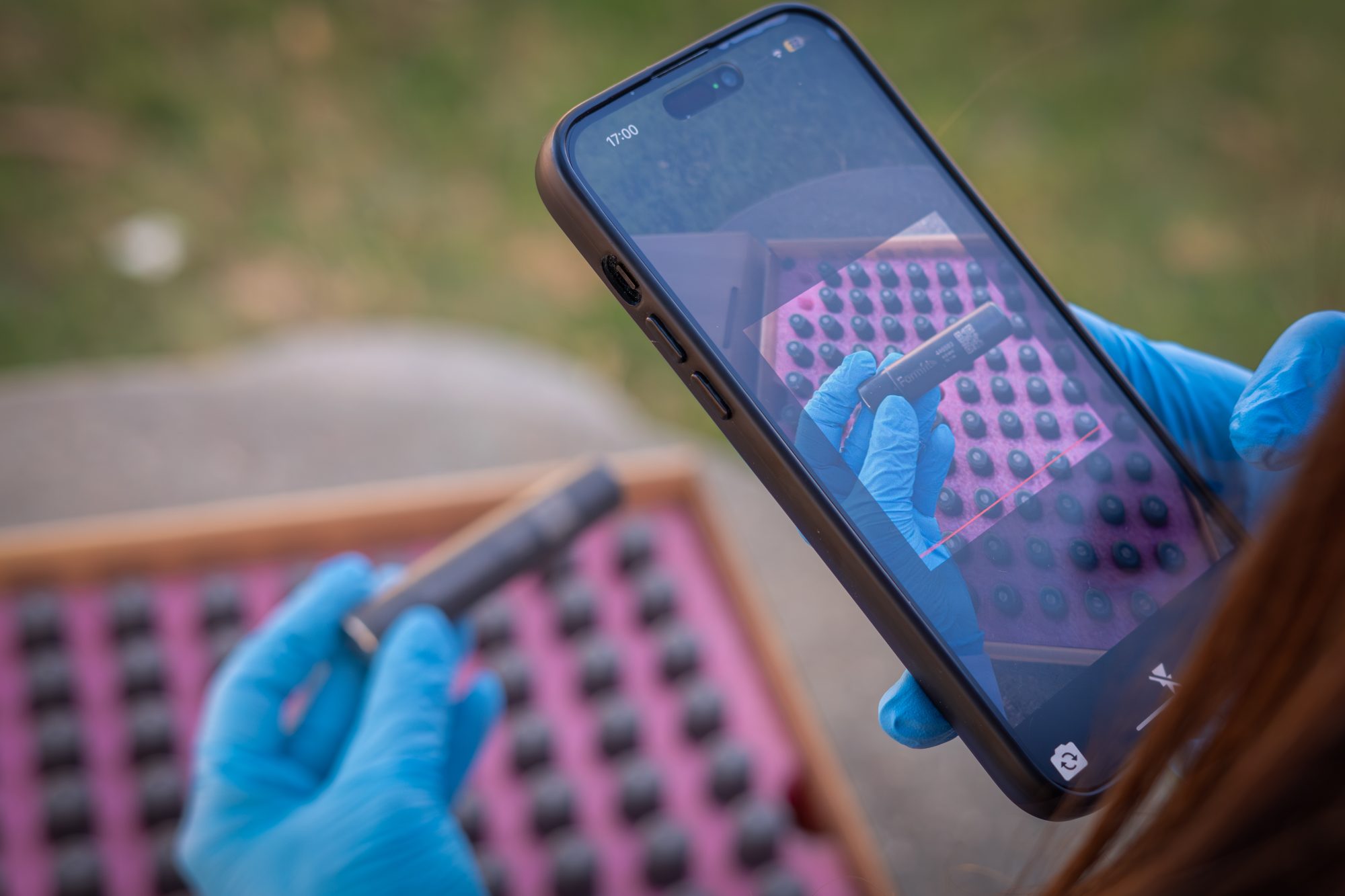
Scanning a Farmfit bolus with the QR code assigns that $99 sensor to a specific cow in seconds—so every temperature spike and rumination dip is tied to the right animal from day one.
Rumen boluses remain in the reticulum throughout the animal’s lifetime, providing continuous core temperature readings unaffected by external conditions. They measure every 15 minutes, tracking temperature, rumination patterns through accelerometers, and activity levels. Temperature change is the early, leading indicator of disease—often moving 12 to 48 hours before visible signs or rumination drops—while rumination change tends to follow as a secondary indicator. Farmfit includes an integrated magnet for hardware disease protection, which explicitly captures wire fragments, nails, and staples that end up in TMR. Farmfit boluses have a 5-year battery life, and there are no subscription fees—you get a full dairy management software platform included. The significant limitation is that overall lameness detection sits around 5% in the modeling work. Most non-infectious hoof problems don’t create a strong temperature signal. That said, Farmfit users and STgenetics’ team have identified lameness cases linked to infectious causes, such as footrot, in which fever was the primary early symptom. So you will catch some lameness—but mainly those cases where systemic infection is driving a temperature spike, not every cow with sore feet.
Activity collars remain the gold standard for heat detection, having undergone years of refinement. They’re moderately effective for illness detection, with a typical battery life of 5 to 7 years. Research indicates that external sensors are susceptible to environmental conditions, so operations in Manitoba or Alberta that deal with extreme temperature swings should factor that into their evaluation.
Ear tag sensors offer the lowest barrier to entry, but they’re measuring skin surface temperature rather than core body temperature. In the variable conditions of a show barn—or most transitional housing situations—that accuracy gap matters.
What Ferme Petitclerc’s Implementation Looked Like
The practical details of the Petitclerc experience offer useful insights for anyone considering precision monitoring, particularly for show or elite genetics programs.
They started focused: 22 head in the Royal string, bolused before show preparation and the trip to Toronto. Daily monitoring happened through the Farmfit phone app—checking overnight temperature trends, rumination patterns, and activity data became part of the morning routine.
PETITCLERC LAMBDA SKY HOCANF121565497, second in the Winter Yearling class and Best Bred & Owned at the Royal Winter Fair, exhibited by Ferme Fortale Holstein Inc. and Ferme Jean‑Paul Petitclerc & Fils Inc., Saint‑Christophe‑d’Arthabaska, QC—exactly the kind of heifer Ferme Petitclerc trusted a $99 bolus to protect.
The key moment came early. That heifer whose temperature began to rise before she showed any visible symptoms.
What made early detection matter in this case was something every show exhibitor understands: the schedule. Show cattle typically get fed twice daily during events. If you miss a subtle sign at the morning feeding—maybe an animal that’s slow to get up or doesn’t clean up her grain quite as fast—you might not get another close look until evening. That’s a 10- to 12-hour window when problems can develop unnoticed, especially when you’re busy with fitting, washing, and ring preparation.
Checking overnight alerts on the Farmfit app turns every cow’s temperature and rumination curve into a morning to‑do list, instead of a surprise vet call.
Farmfit flagged the temperature trend while the heifer still looked essentially normal to experienced eyes. Dominique Petitclerc, who works with the heifers daily, used that data to trigger treatment. By the time visual symptoms would’ve been obvious, intervention was already underway.
“It’s an eye 24 hours a day, seven days a week for the well-being of your animals,” Maxime said. “You wake up in the morning, and you have the data from the night—you see activity levels, you see heats, you see what’s coming.”
I’ve heard similar observations from other early adopters. Nic Sauder of River Valley Farm, a Jersey operation in Tremont, Illinois, mentioned checking the app “first thing in the morning before I even get into the barn” to know what to expect. Brian Oster of Retso Holsteins, who runs about 150 milking cows near Schodack Landing, New York, and boards show cattle for several outside clients, called it “an extra set of eyes,” providing peace of mind for both his staff and the breeders whose cattle they manage.
The common thread is a reduction in uncertainty—knowing before you walk in the barn whether something needs attention.
For operations already using STgenetics genomics, the integration creates a single dashboard view of both genetic potential and real-time health status—useful for identifying whether high-genomic animals are actually expressing their potential or being held back by subclinical issues that traditional observation might miss.
The ROI Reality Check
Marketing materials for precision livestock technology often make impressive claims. The independent research paints a more nuanced picture—still generally positive in the right circumstances, but with important caveats.
On the cost side, Farmfit runs approximately $110-125 per head for typical installations (100 boluses at $99 CAD each, plus one Gateway at $700 CAD and 2–3 Collectors at $600 CAD each to cover barn areas). Smaller installations like Petitclerc’s show that string work costs roughly $158 per head due to fixed infrastructure costs spread across fewer animals.
What’s particularly noteworthy is how returns vary based on your starting point. A study published in the Journal of Dairy Science (Pfrombeck et al. 2025) used SimHerd modeling on 65 dairy cows with rumen bolus sensors and found annual net returns that ranged dramatically based on baseline herd health:
Economic Returns by Herd Health Status
Baseline Herd Health
Annual Return Per Cow (EUR)
Annual Return Per Cow (USD)*
Poor health (above-average disease incidence)
+€23 to +€119
+$25 to +$130
Average health
-€12 to +€84
-$13 to +$92
Excellent health (below-average disease)
-€33 to +€63
-$36 to +$69
*USD figures calculated at approximately $1.09/€1.00 exchange rate as of January 2026.
If you’re facing above-average disease rates, the research suggests you could see annual returns of $25 to $ 130 per cow. If your health protocols are already excellent, you might actually lose money on the investment.
Here’s the uncomfortable truth the technology vendors won’t tell you: if your transition program is already running at 90th-percentile health metrics, you might be better off spending that $15,000 on an extra part-time employee than on sensors. The math only works when there’s something to catch.
One important nuance here: those mature cow ROI numbers are already discounted by whatever lung damage and health losses happened back in calfhood, because those animals never had early intervention to reduce BRD impacts. In other words, the modeled returns don’t capture the extra upside of catching respiratory disease in calves before it permanently affects lifetime performance.
That said, Natalia at STgenetics confirms that this matches their field experience: herds with unresolved health issues make the biggest gains from adopting the technology. If you know you’ve got problems but can’t quite pin them down, that’s where monitoring shines.
That same study found detection rates that varied considerably by condition:
Detection Sensitivity by Condition
Health Condition
Detection Rate
Retained placenta
64%
Clinical milk fever (hypocalcemia)
61%
Mastitis
43%
Metritis
25%
Lameness
5%
The pattern reveals what the technology does well and where it struggles. Systemic and metabolic conditions—where core temperature changes early as a leading indicator—are more reliably caught. Reproductive tract issues show moderate detection. Locomotion problems largely escape notice because a bolus sitting in the reticulum can’t see what’s happening in the hooves unless infection is driving a systemic fever.
On disease prevention specifically, the numbers are encouraging where detection works. University of Wisconsin Dairy Extension shows that preventing a single case of clinical ketosis saves roughly $289 and boosts 305-day milk yield by about 3.5 percent—numbers that should get the attention of any producer managing fresh cows.
For show operations, the math shifts because animals have fundamentally different value profiles. A Royal-bound heifer isn’t comparable to a commercial fresh cow. The cost of monitoring a 20-animal show string is modest, whereas a serious health incident during a major show could cost several times that amount.
Canadian Availability and Considerations
For Canadian producers, some regional context is helpful.
STgenetics has been actively expanding Farmfit availability through its Canadian headquarters in Sainte-Marie-Madeleine, Quebec. The system operates in the 915 MHz frequency band, which is compatible with North American regulations—an important technical detail, since some European systems use different frequencies.
One practical advantage worth noting: Farmfit charges no subscription fees. Once you’ve purchased your boluses and infrastructure, you’ll have full access to their dairy management software platform with no ongoing monthly costs. For operations that closely monitor cash flow, a predictable cost structure matters.
Competing options include smaXtec (pricing varies by distributor, with producers reporting costs in the $250- $ 400/bolus range for full-featured systems) and collar-based systems from Allflex, SCR, and several others.
Five Questions to Ask Before You Invest
What’s actually costing you money? Pull your 12-month health records. Count your transition disease cases. That’s your baseline problem rate—and the ceiling on what monitoring can save you.
How does this integrate with your setup? Get a demonstration of your actual herd management software. Compatibility issues are the most common frustration I hear about.
What does support look like when something breaks? Ask for references from Canadian operations of similar size. Find out response times.
What’s your realistic learning curve? Factor in the time it takes your team to become comfortable checking data daily. A system nobody looks at is worthless.
Will you actually use it? Be honest. If it doesn’t become part of the morning coffee routine, you’re wasting money.
Who Should—and Shouldn’t—Consider This Technology
The Ferme Petitclerc experience suggests specific applications, though what makes sense varies considerably by operation.
For show exhibitors and elite genetics programs: If your show string insurance (entry fees, transport, prep costs) exceeds $3,000 per animal and your average private sale value exceeds $8,000, monitoring technology likely pays for itself with a single prevented incident. Transport stress, environmental changes, and compressed timelines create exactly the conditions where early detection matters most.
For commercial operations with fresh cow challenges: If your transition program is where problems concentrate—above-average rates of metritis, ketosis, or displaced abomasums—that’s where monitoring investment pays back fastest. The research consistently shows stronger returns in herds with higher baseline disease incidence.
For heifer-raising operations: This is an application that deserves more attention. Many farms raise heifers at a separate facility, where those animals aren’t observed as frequently as the milking herd. Given research showing that calfhood respiratory disease causes permanent lung damage that reduces lifetime productivity—121 kg less milk in the first lactation alone—catching respiratory issues early in young stock may be where monitoring delivers its biggest long-term payback.
For smaller herds with limited labor, the “always watching” aspect is particularly valuable when there aren’t enough people to conduct frequent visual observation. Being able to check overnight data before morning chores could catch issues that would otherwise wait until evening feeding. Producers running 80 to 150 cows often find real value here, particularly during busy seasons like planting or harvest.
For operations with excellent existing outcomes: This one requires honest self-assessment. If your protocols are already working well—low transition disease rates, strong reproduction, minimal fresh cow losses—monitoring technology might not meaningfully improve your numbers. That capital might be further invested in facilities, genetics, nutrition, or additional labor. Not every technology makes sense for every operation.
Dr. Robert Van Saun, Professor of Veterinary Science at Penn State University, has emphasized in his work on transition cow metabolic health that monitoring technology functions best as a supplement to skilled observation rather than a replacement for it. The goal is earlier detection and better-informed decisions—not hands-off management.
Petitclerc’s approach reflected this philosophy. His father, Réjean, still handles most breeding decisions on the farm. Farmfit didn’t change that dynamic—it just gave them better information to work from.
The precision livestock market’s projected growth—from $7.5 billion to nearly $20 billion over the next decade, according to Grand View Research—suggests the industry broadly agrees this technology category is here to stay.
The technology works. The question isn’t whether precision monitoring can catch problems earlier—the research confirms it can. The question is whether your specific operation has enough problems to catch.
What This Means for Your Operation
If this sounds like you, monitoring probably pays:
You haul high-value show cattle multiple times a year and a single scratch or health incident would blow a five‑figure hole in your genetics revenue.
Your calf BRD rate is north of ~25% and you’re seeing too many heifers culled or underperforming in first lactation.
Your fresh-cow pen is a mess—metritis, ketosis, DA—and you’re constantly reacting instead of catching problems a day early.
If this sounds like you, fix the basics before buying boluses:
Your herd health is already excellent, with low transition disease and BRD rates and no obvious weak spots in records.
You rarely ship cattle, most animals stay on‑farm, and visual observation is genuinely happening several times a day.
Most of your losses are hoof‑driven (lameness, cow comfort, flooring) rather than metabolic or respiratory disease.
Your 30/90/365-day checklist:
Next 30 days: Pull 12 months of vet and treatment records. Count your BRD, metritis, ketosis, and DA cases, and estimate a real cost-per-case (vet, drugs, lost milk, culls).
Next 90 days: Pilot monitoring on one high-risk group—your show string, fresh cows, or off‑site heifers—and track whether alerts actually move treatment timing earlier.
Next 365 days: Compare this year’s BRD and transition disease rates, cull rates, and treatment timing against your baseline. If the numbers and timing don’t change, cut the tech and put the money into facilities, feed, or labor.
Key Takeaways
A $3,478 bolus investment on 22 head at The Royal likely saved Ferme Petitclerc from a five‑figure hit in scratched entries, vet bills, and lost genetics sales.
Reputation is the hidden cost driver: once your health reputation tanks, roughly one in four potential buyers stops bidding, no matter how good the animal looks.
Calf BRD at “normal” levels (≈37%) quietly burns $26,000+/year in a 300‑cow herd before you count the lost 121 kg of first‑lactation milk per sick heifer.
Rumen boluses make financial sense when you haul cattle often or run BRD above ~25%; smaller, closed herds often get more ROI from fixing basics like ventilation and vaccine timing.
The article hands producers a 30/90/365‑day checklist to prove whether monitoring is insurance or just another expensive dashboard.
The Bottom Line
After nearly 20 years of showing cattle at The Royal, Maxime Petitclerc discovered that sometimes the best way to see your cattle clearly is to supplement what your eyes can catch.
“It’s an eye 24 hours a day, seven days a week for the well-being of your animals,” he said. “We always want to have that little edge—to be a step ahead.”
The trade-off is straightforward: monitoring technology costs $110-160 per head, depending on installation size, catches 60%+ of metabolic issues through early temperature changes, but misses most non-infectious lameness. For show cattle under transport stress, that’s a good bet. For a pasture-based operation where hoof health is your primary concern, it’s probably not.
Know your numbers. Know your gaps. Let the math make the decision.
Complete references and supporting documentation are available upon request by contacting the editorial team at editor@thebullvine.com.
Learn More
Tech Reality Check: The Farm Technologies That Delivered ROI in 2024 (And Those That Failed) – Stop guessing and start measuring with this brutal 90-day roadmap that separates high-performing tech from expensive barn ornaments. It arms you with verified ROI figures—like a 2.1-year payback on sensors—to protect your balance sheet from underperforming vendor promises.
Beyond Efficiency: Three Dairy Models Built to Survive $14 Milk in 2026 – Secure your operation’s future with three battle-tested business models designed to survive structural shifts in processing. This strategy reveals how to pivot from volume-chasing to risk-diversified stability, ensuring you’re positioned to capture premiums through 2028 and beyond.
Every week, thousands of producers, breeders, and industry insiders open Bullvine Weekly for genetics insights, market shifts, and profit strategies they won’t find anywhere else. One email. Five minutes. Smarter decisions all week.
California dairy shows are back. Now every entry form is a three-way bet on genetics, H5N1 risk, and whether your kids’ hard work really pays.
Executive Summary: California dairy shows are back on the calendar after CDFA lifted its statewide H5N1 exhibition ban, allowing poultry and dairy cattle to return to fairs and junior rings in 2026. That call comes after a year where H5N1 touched more than 700 California dairy herds and about three‑quarters of all U.S. HPAI‑affected farms were inside one state—a level of risk that shut down barns, youth projects, and show‑driven marketing plans overnight. Now the pressure shifts back to you: every entry form in 2026 is a three‑way bet on genetics promotion, H5N1 exposure, and whether your kids’ hard work ends up paying off or just adding stress. This article breaks down how the ban unfolded, what it actually cost fairs, youth programs, and breeder herds, and why state officials finally felt confident enough to let cattle back onto the shavings. Most importantly, it gives you a clear, kitchen‑table playbook—how to talk through risk with your vet, decide whether you’re a show‑forward, selective, or stay‑home herd this year, and make sure any banner you chase still pencils out in terms of Net Merit, PTAT, components, and long‑term profit.
Here’s what’s really going on. After a full year of empty dairy barns and pulled classes, California has finally flipped the switch. The statewide ban on poultry and dairy cattle exhibitions at fairs and shows is gone, and the show community is rushing—some excited, some cautious—to figure out what 2026 actually looks like.
If you’re running a serious herd in California, or you sell genetics into that market, this isn’t just a nice headline. It changes how you market cattle this year, how you manage disease risk, and what your 4‑H and FFA kids are working toward when the barn lights come on at 5 a.m.
How We Got Here: From Full Stop to “You’re Back On”
In early January 2025, California’s State Veterinarian, Dr. Annette Jones, sent a letter that landed on fair boards across the state: all poultry and dairy cattle exhibitions at fairs and shows were banned, effective immediately and “until further notice.” That wasn’t an academic exercise in risk management—it was a response to a very real fire.
By that point, state and local reports showed that more than 700 dairy herds and around 60 poultry flocks in California had already been affected by H5N1, with over 15 million birds lost or depopulated. Hoard’s Dairyman’s “Washington Dairygrams” reported that, as of early January 2025, 918 farms in 16 states had confirmed HPAI, and 703 of them were in California. Roughly three‑quarters of every infected farm in the country was in one state.
That’s not a “we’ll keep an eye on it” moment. That’s a “we need to stop giving the virus free rides” moment.
The logic behind the exhibition ban was brutal but clear:
Fairs and shows bring cattle and poultry from many herds into the same barns and wash racks.
Field investigations and early research showed infected dairy cows often had subtle signs—lethargy, drop in yield, off feed—rather than the dramatic mortality we see in poultry, which makes it easy to miss unless you’re testing and watching carefully.
Genetic sequencing linked H5N1 viruses in some California dairy herds to nearly identical strains in Colorado, pointing straight at cattle movement and people, not just wild birds, as key drivers.
CDFA’s ban language said the goal was to “minimize the danger of exposing people and non‑infected cows and birds to the disease.” With 703 of 918 infected farms nationwide sitting inside California, there weren’t many soft options left.
So the state did the one thing it could control quickly: it shut down the highest‑risk mixing points—poultry and dairy cattle at fairs and shows.
On the other end of the curve, CDFA didn’t just let the order quietly expire. After months of surveillance, trend analysis, and consultation with state and federal epidemiologists, Dr. Jones issued a new letter in December 2025 announcing that the statewide ban on poultry and dairy cattle exhibitions was lifted, effective immediately. On January 16, 2026, CDFA followed with a public release confirming that fairs and shows could bring poultry and dairy cattle back, citing:
Improved H5N1 infection trends.
A better understanding of how the virus behaves in dairy cattle.
Stronger mitigation and biosecurity tools at farm and fair levels.
So yes, the state has changed the rule. But the risk management has been handed back to you.
What the Ban Actually Cost: Youth, Barns, and Banners
Let’s talk about what this did where you live: in the barns, not in the press releases.
Youth projects ran into a wall
CDFA’s “Statewide Ban on Poultry and Dairy Cattle Exhibitions” FAQ doesn’t dance around who’s affected. It names 4‑H, FFA, Grange, and independent youth exhibitors as part of the ban and explains that dairy cattle in those programs cannot be shown while the order is in place. The ban specifically targeted the highest‑risk dairy classes: lactating and recently lactating cows and replacement heifers—the exact animals most dairy kids show. cdfa.ca
For a 13‑year‑old, losing one fair is disappointing. For a 17‑year‑old senior, it can be the difference between walking into the ring for a final year and aging out without that moment. UC ANR materials and county messaging describe county fairs as core agricultural education spaces; in 2025, dairy projects simply weren’t part of that picture.
We’re not naming specific kids in this article, and that’s on purpose. Until juniors and families are ready to tell their stories on the record, we’re not going to pretend we know exactly whose senior year got cut short. What’s clear from the record is that a lot of youth dairy work had nowhere to land last year.
County fairs lost more than a couple of classes
Take dairy and poultry out of a county fair, and the whole atmosphere shifts.
The California Mid‑State Fair publicly announced in March 2025 that all live poultry and dairy cattle exhibits were removed for that year because of “the alarming spread of bird flu across the state” and to comply with the State Veterinarian’s ban. San Joaquin’s AgFest and similar events posted the CDFA orders and told families outright that dairy cattle weren’t coming through the gates in 2025.
The Santa Cruz County Fair, which operated under that ban, is now making a point of discussing its return. In January 2026, CEO Dori Rose Inda said, “We are thrilled to have poultry and the dairy cows back with the amazing youth that care for them and show them at the 2026 Fair,” framing the animals and the kids as core to what makes the fair feel like a fair again.
You don’t have to be a show junkie to know that when the dairy barns go quiet, the rest of the grounds don’t feel quite right.
Show‑driven marketing plans stalled out
There’s another layer here. Shows aren’t just about trophies—they’re marketing infrastructure for genetics‑driven herds.
Operations like Vierra Dairy in Hilmar have built a national reputation by combining consistent show success—especially in Jerseys—with classification and genomic data to move embryos, live cattle, and bull contracts. Local and regional shows inside California have always been part of the pipeline that feeds into national stages and sales:
Genomic heifers often get their first exposure there.
Young cows get shown close to home to build momentum before a big sale.
Junior members of key cow families get in front of local buyers and visiting breeders.
When California pulled dairy shows from fairs for 2025, that mid‑tier exposure vanished. We don’t have a precise dollar figure for lost entry fees, cancelled show consignments, or delayed sales—that’ll require fair data and breeder interviews in a follow‑up piece. But we do know entire segments of the show calendar simply didn’t happen.
If you rely on the show ring to help tell your genetics story, you lost a year of that storytelling.
The Herd‑Health Math: Why the Ban Actually Made Sense
It’s easy now to say, “They went too far.” Let’s walk through why, from a herd‑health perspective, the ban was the least bad option at the time.
The virus was moving with cattle, not just wild birds
Research and field reports from 2024–2025 pulled together a consistent picture:
In dairy cattle, H5N1 often showed up as mild, non‑specific illness: reduced milk production, lower feed intake, and some respiratory signs—nothing like the catastrophic mortality seen in poultry barns.
Genetic analysis linked H5N1 viruses in dairy herds in Texas, Colorado, and California; strains in some California herds were nearly identical to those in Colorado, strongly suggesting that cattle that fought the virus were moved between herds.
USDA responded with a Federal Order requiring testing for Influenza A before lactating dairy cattle move across state lines and tightening reporting requirements for infected herds.
The big takeaway: H5N1 in dairy wasn’t just a wildlife problem. It was a movement and contact problem.
Now take that reality and look at a state fair dairy barn: cattle from different herds, shared equipment, shared wash racks, people bouncing from string to string, and no practical way to enforce strict separation without major structural changes.
From CDFA’s perspective, with 703 infected farms in California out of 918 nationally, those barns started to look like disease amplifiers rather than showcases.
By the time the ban hit, the fire was already burning
Could the state have tried intermediate steps—like “no lactating cows, heifers only,” or “negative tests for all show animals” first? Maybe, if they’d moved earlier. But the timeline matters: CDFA and fair accounts show H5N1 hitting California dairy herds and poultry flocks hard through late 2024, with the ban announced only after the numbers turned ugly.
By early January 2025, California wasn’t managing a handful of cases. It was carrying roughly three‑quarters of all HPAI‑affected farms in the country. At that point, shutting down high‑traffic exhibition points while they got a handle on transmission was the logical move, even if it landed hard on show families.
Where We Are Now: Risk Is Lower, But It’s Still Risk
So what changed enough for CDFA to say “yes” again?
In late 2025, CDFA, UC Davis extension, and local fair communications all point to the same factors when explaining the decision to lift the ban:
Infection trends improved. Surveillance programs—milk testing, herd monitoring, and reporting—showed fewer new H5N1 detections in dairy herds, and known cases were being managed under quarantine and control programs.
The industry understands the virus better. By then, USDA and researchers had months of data on how H5N1 behaved in cows, how long shedding lasted, and what worked to contain it in real dairy environments.
Mitigation tools got sharper. Movement permits, testing requirements for certain categories of cattle, and farm‑level biosecurity improved compared to early 2024.
On that basis, CDFA lifted the statewide exhibition ban. But they’ve been very clear that lifting the ban is not an “all clear.” Current guidance to fairs and exhibitors emphasizes:
Don’t haul or exhibit animals that look even slightly off.
Use veterinary oversight aggressively at fairs and at home.
Expect ongoing H5N1 monitoring and be ready for new guidelines if risk indicators change.
The risk environment is better, but you’re still operating with a virus in the background, not a virus that’s gone.
The First Real Chances to Get Back in the Ring
Let’s get specific about where your cattle and your kids might actually be headed.
County fairs are rebuilding dairy barns
California Mid‑State Fair – Paso Robles The Mid‑State Fair’s 2025 decision to remove all poultry and dairy cattle exhibits is well‑documented. Now that the ban has been lifted, they can rebuild those programs for 2026. That means recruiting exhibitors back, updating health rules, and resetting expectations after a blank year.
Santa Cruz County Fair – Watsonville Santa Cruz County Fair communications now highlight that poultry and dairy cattle will be back for the 2026 fair, with CEO Dori Rose Inda publicly celebrating the return of both the animals and the youth who care for them.
Other county fairs and agfests San Joaquin AgFest and others have circulated CDFA’s FAQs and updates, encouraging exhibitors to stay on top of state guidance as they prepare to reintroduce dairy cattle and poultry. For most fair managers, 2026 looks like a rebuild year: same barns, new rules.
Western Classic and other dairy‑focused events
The Western Classic Junior Dairy Show in Tulare has long been a magnet for junior exhibitors and top‑end showstrings from across the West. Its published entry info and social channels now reflect the reality that California dairy shows are allowed again, making Western Classic one of the earliest big tests of how junior dairy shows function under the post‑ban biosecurity expectations.
On the breed side, California is still home to some of the most aggressive show herds in North America. Herds like Vierra have made a business case out of combining show results with proof sheets and classification to drive semen, embryo, and live‑animal demand. With California shows back on the calendar, those herds can once again use a local and regional ladder to support their national ambitions, instead of having to jump straight to out‑of‑state events.
The Hard Question: Is Hauling a String Worth It in 2026?
Here’s where it gets uncomfortable. Just because the ban is gone doesn’t mean hauling a showstring is automatically the smart move for your operation this year.
You’re balancing two real forces:
The upside: genetics marketing, ROI on show cattle, youth development, and community connection.
The downside: H5N1 and other disease risk from mixing cattle in shared barns, plus the financial and labor cost of showing.
What you stand to gain
If your operation leans on shows as part of your marketing engine, a functioning show season gives you tools you don’t get by just posting pictures on Facebook.
A class‑winner or champion can bump:
Embryo values for that cow family.
Live‑animal sale prices on daughters and maternal sisters.
Bull‑dam visibility when AI studs are sorting cow families and photos.
Regional show results, tied to classification and genomic proofs, can give your online sales and consignment offerings credibility that pure numbers sometimes can’t.
Herds like Vierra have shown that when you line up banners, solid type, production, and genomic profiles, you can turn show success into real contracts and long‑term demand. That’s genetics ROI, not just bragging rights.
And for youth? Having a real show season again is about more than hardware. It’s about:
Learning to manage animals under pressure.
Dealing with judges, buyers, and the random person in the stands who doesn’t know which end of the cow is which.
Figuring out if they actually see a future for themselves in agriculture.
Those are hard things to replicate without a show ring.
What you’re putting at risk
On the other side, the disease risk and cost structure haven’t magically disappeared.
H5N1 is still present in North American dairy cattle; the difference now is more monitoring and better tools, not zero risk.
Movement of cattle and people has been clearly implicated in the spread between herds and states.
Fairs and shows remain high‑traffic environments for both animals and humans.
Layer on top of that:
Entry fees.
Hauling and fitting.
Labor pulled off the home farm.
The risk is that a problem in the string becomes a problem in the main herd if you don’t have good separation.
The smart question isn’t “Can we go?” It’s “For this show, and this animal, in this year, does the upside actually justify the cost and risk?”
A Practical 2026 Show Decision Checklist
Here’s a straightforward way to think this through—no fluff, just the questions you’d ask yourself around the kitchen table.
1. Get clear on why you’re showing
Before you send an entry, ask:
Are we promoting a specific cow family ahead of a sale or a flush program?
Are we trying to build a bull‑dam’s profile for AI conversations?
Are we primarily doing this for youth development and family experience?
If the honest answer is “because we always go,” then you’re in the tradition/hobby lane. That’s okay if you can afford it—but don’t pretend it’s a pure business decision.
2. Be brutally honest about your herd health and physical setup
With your herd vet, walk through:
Any unexplained production dips or health quirks in the last few months.
How realistically you can separate show animals from the main herd:
Separate pens or a dedicated show facility.
Dedicated boots, coveralls, halters, pitchforks, and brushes for show cattle.
A plan for how long returnees stay isolated and how you’ll watch them.
If separation is mostly theoretical, then any show‑related disease exposure is a herd‑level risk, not just a show‑string risk.
3. Put show organizers on the hook—in a respectful way
Before you invest:
Ask if the show is working under the current CDFA guidance for poultry and dairy cattle exhibitions.
Ask whether a veterinarian will be on-site and how they’ll handle an animal that appears ill in the barn.
Ask whether any testing or additional health documentation is required this year.
If answers are vague, or you get the sense that “business as usual” is the only plan, that should factor into your decision.
4. Do a back‑of‑the‑envelope ROI on one key animal
For one heifer or cow you’re thinking of hauling, jot down:
Her realistic value if she stays home this year.
A realistic bump in value if she wins or places well—embryos, live sales, or bull contracts, not fantasy numbers.
Total costs: entries, hauling, fitting, extra feed, plus your time.
A rough “risk cost” in your head: what happens if she or a herd mate picks something up as a result of that trip.
If the upside is only marginally better than the combined cost and risk, you’re probably in hobby territory, not high‑ROI marketing. That may still be fine—but you should know which one it is.
Youth Exhibitors: They Lost More Than a Banner
For adults, a lost show season is a business and logistics problem. For youth, it can be the moment that either pushes them away from agriculture or pulls them deeper in.
CDFA’s FAQ and UC ANR summary both state that youth exhibitors were directly affected by the ban, and county fair leadership has been blunt that losing dairy and poultry removed a big piece of youth programming in 2025. Fairs like Santa Cruz are now emphasizing that bringing dairy cattle and poultry back is partly about restoring those youth opportunities, not just filling barns.
If you’re a parent, project leader, or advisor, your 2026 show choices send signals:
That herd health and biosecurity matter in your operation.
That you’re willing to weigh risk and reward out loud, instead of just “hoping for the best.”
That you still see a future in dairy worth your kids’ time, even after a tough year.
The “right” answer—haul or don’t haul—won’t be identical for every family. But involving your kids in that reasoning process is part of what makes this more than just a season of banners.
What You Should Actually Do in the Next 60–120 Days
Let’s put this into a simple playbook you can actually use.
Step 1: Build a realistic 2026 show calendar
Contact the fairs and shows that matter to you and confirm:
Dates and locations.
Which dairy breeds and classes they’re offering in 2026.
Any new health, testing, or biosecurity requirements for entries.
From there, build a calendar that fits your labor, cash flow, and animal inventory—not just the “we always go” list.
Step 2: Decide which “show herd” you are this year
Be clear which lane you’re in:
Show‑forward herd: You’ve got the people, facilities, and genetics to target a handful of major shows. You invest in biosecurity and expect a marketing return.
Selective marketing herd: You choose one or two strategic shows, then build photography, video, and sales messaging around those results.
Stay‑home herd: You decide the H5N1 and logistics risk isn’t worth it this year. You lean into genomic proofs, classification, production records, SCC, components, and good storytelling to market cattle without leaving the yard.
All three strategies can work. The key is not lying to yourself about which you’re actually following.
Step 3: Build a show‑specific biosecurity plan with your vet
This year isn’t the year to wing it.
Ask your herd vet to help you set:
Pre‑show health check criteria and any recommended testing.
A clear isolation and monitoring protocol for animals returning from each event.
Rules for people and equipment moving between the showstring and main herd.
Tie that plan directly to what USDA and CDFA have said about H5N1 in dairy cattle—subtle clinical signs, movement‑driven spread, and the continued need for surveillance.
Step 4: Make sure the show results feed your bottom line, not just your ego
If you’re investing in a show season:
Make sure pedigrees, sire stacks, classification scores, and production records are ready to share alongside ring photos.
Capture high‑quality pictures and video at shows and at home.
Decide in advance how the show results will plug into:
A sale catalog,
An online offering,
AI stud conversations, or
A flush or IVF program.
Shows can still be a powerful lever. In 2026, that lever has to connect to Net Merit, PTAT, components, and long‑term herd strategy—not just a banner in the office.
The Bottom Line: The Ban Is Gone, but the Responsibility Isn’t
California lifting the exhibition ban tells you three things at once:
The H5N1 situation is better than it was, but it’s still on the radar.
The state now expects producers, vets, and fair organizers to do more of the practical risk management.
The show ring is once again a legitimate tool for youth development and genetic marketing—if you use it intentionally.
The barns are open again. Whether that’s a net win for your operation depends on the choices you make from here—about herd health, about where you chase banners, and about the example you set for the next generation watching you call the shots.
Use shows where they genuinely support your herd, your kids, and your business—not just because “we always go.” Respect the virus, respect your neighbors, and don’t assume another emergency order is impossible.
Everyone would like this reopening to stick. Whether it does will come down to how carefully fairs, exhibitors, and vets handle the next season.
We Want Your Story
If you’re a California exhibitor—youth or adult—who lived through this ban, we’d like to hear your side:
What year of your project did you lose?
Which cow or heifer never got her shot in the ring?
What sale or marketing plan did you have to shelve?
Where will you take your string first now that the barns are open?
Email andrew@thebullvine.com or message The Bullvine on Facebook. With your permission, we’ll build a follow‑up feature around the people behind these decisions—because policies and case counts matter, but it’s your lives, your cows, and your communities that make this story worth telling.
Key Takeaways
Shows are back—risk isn’t: CDFA lifted California’s year-long H5N1 exhibition ban, but the virus is still out there. Every entry form in 2026 is a three-way bet on genetics, disease exposure, and whether the trip actually pays.
Youth projects took the hardest hit: 4-H, FFA, and Grange kids sat out an entire season. For seniors, that wasn’t a setback—it was their last ring, gone.
Show-driven marketing lost a year: Herds that use banners to move embryos, build bull-dam profiles, and drive sale prices had no California stage in 2025.
Now you run the numbers: Decide if you’re show-forward, selective, or staying home—and tie every show decision back to Net Merit, PTAT, components, and long-term herd profit, not nostalgia.
Biosecurity is the price of entry: Work with your vet on pre-show health checks, return isolation protocols, and strict separation between showstring and main herd. Winging it isn’t a plan anymore.
The Sunday Read Dairy Professionals Don’t Skip.
Every week, thousands of producers, breeders, and industry insiders open Bullvine Weekly for genetics insights, market shifts, and profit strategies they won’t find anywhere else. One email. Five minutes. Smarter decisions all week.
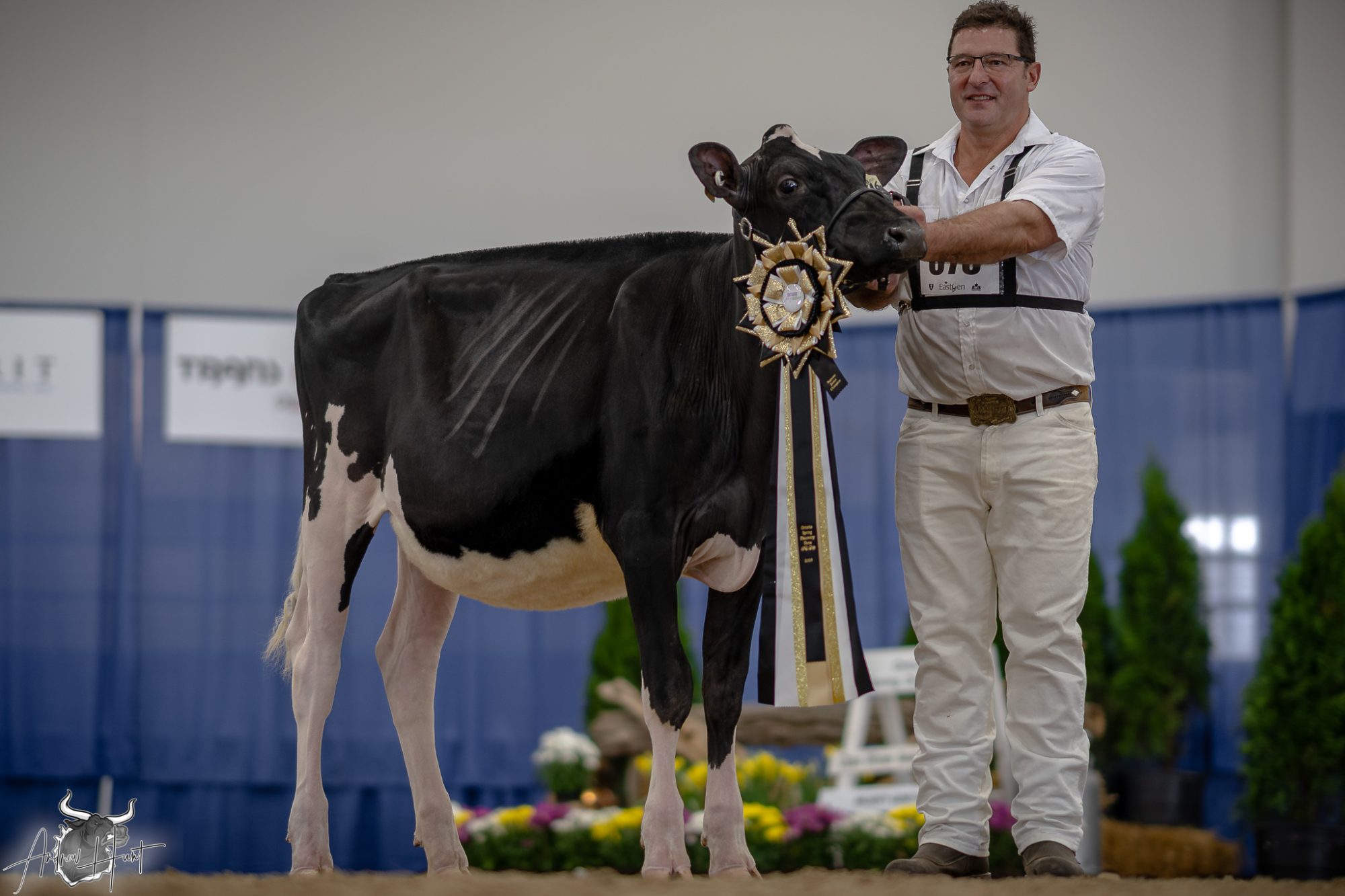
The untold stories of Rudy Missy, Blackrose, and the stockmen who saw what the experts couldn’t
It was early October in Madison, Wisconsin, and World Dairy Expo week had arrived.
For the Genosource team back in Iowa, this year carried extra weight, this year carried extra weight. Ladyrose Caught Your Eye—the Unix daughter they’d acquired immediately after Madison in 2021—had already achieved EX-95, cementing her place among the breed’s elite. Now she was back on the colored shavings, a three-time class winner, an All-American, an All-Canadian, representing a bloodline that had defied the odds for three decades.
Ladyrose Caught Your Eye on the colored shavings at World Dairy Expo—a three-time class winner whose EX-96 mammary system tells only part of the story. The real story is the three decades of setbacks, second chances, and stubborn belief that put her there.
“She is one of those rare cows that combines cow family, show-winning type, and high genomics,” Tim Rauen of Genosource recalls. Standing in that ring in October, she was living proof.
I’ve covered many Expos over the years I’ve been writing about this industry. But what keeps bringing me back to this cow isn’t the banners or the scores—it’s knowing the decades of setbacks, second chances, and stubborn belief that led to her standing in that ring.
Because here’s what most people watching that week didn’t fully understand: they weren’t just witnessing one cow’s achievement. They were seeing the living proof of stories that began with barn fires, bankruptcy courts, rock stars investing in Holsteins, and phone calls that changed everything.
And those stories—the ones behind the cow in front of them—are what this is really about.
The Call That Changed Everything
Twenty-one years earlier, on a February afternoon in 2003, snow was falling sideways outside the Wisconsin Holstein Convention Sweetheart Sale.
The room was emptying. Experienced breeders—men who had driven through farm country slush and missed morning milking to be there—were already heading for the exits. A five-year-old Holstein named Wesswood-HC Rudy Missy stood in the ring, and the bidding had stalled at a price that felt almost insulting.
Her rump “wasn’t entirely balanced.” That’s what they were saying. And in the unforgiving world of elite cattle auctions, that phrase might as well be a death sentence.
Steve Hayes watched another bidder shake his head and walk away, and felt that familiar mix of disappointment and creeping doubt that every breeder knows—the voice that whispers whether you’ve been fooling yourself all along. This cow he’d helped develop, believed in, poured years into. Was she really going to slip through the cracks like this?
Then the phone rang in the back office.
Matt Steiner’s voice crackled through from Pine-Tree Dairy down in Ohio. The man had never even laid eyes on this cow in person. But something about her—maybe thirty years of studying what makes genetics tick, maybe an instinct honed through decades of disappointment and triumph—told him everything he needed to know.
Seagull-Bay Supersire-ET stands proudly at Select Sires, representing the commercial pinnacle of the Wesswood-HC Rudy Missy genetic legacy. From a cow that couldn’t attract buyers at $7,000 to a bull achieving millionaire status in AI sales, Supersire embodies how exceptional maternal genetics can reshape an entire industry. His success validates what Matt Steiner saw in that 2003 phone bid—sometimes the most transformative genetics come in unexpected packages.
I keep thinking about that moment. A roomful of experts walking away from a cow that would reshape the breed, and one man on a phone line three states away who saw what they couldn’t. Today, her descendants include Seagull-Bay Supersire—with over 100,000 daughters worldwide—and Genosource Captain, who held the #1 TPI position for seven consecutive proof runs through December 2024 and remains among the breed’s most influential sires. The genetic value flowing from that single $8,100 phone bid has generated hundreds of millions in semen sales.
But here’s what I keep coming back to when I think about this story. It’s something Steve Wessing, Missy’s original co-breeder, said when reflecting on her journey: “I don’t think she would’ve ever scored EX-92 at our place.”
That’s the kind of honesty you don’t hear often enough—recognizing that cattle reach their potential in different environments, under different management systems. Matt Steiner didn’t just buy a cow that day. He gave her a stage where she could finally perform.
Of course, Steiner didn’t know that’s what he was doing. Nobody did. That certainty only comes later, when you’re telling the story. Living it is different.
The Two Steves: A Friendship Built Across a Fence Line
To understand how Rudy Missy even existed, you have to go back to a different Wisconsin pasture in the early 1990s.
Steve Wessing had started with eighteen registered Holsteins from the Milkstein herd—animals that came with warnings. “There wasn’t a lot of type in that herd,” the industry veterans told him and his wife, Cheryl. And honestly? The experts weren’t wrong. When those first cows got classified, only one scored Very Good: Milkstein Citation Della.
Nothing about Della screamed “genetic goldmine.” She was just a cow that showed up every day, did her job, and kept producing. The kind of cow you don’t think twice about.
But Steve Wessing trusted his eyes over other people’s opinions. And his neighbor, Steve Hayes, was paying attention.
Here’s what I love about this part of the story. Hayes walked past that fence line between their places every morning. He’d pause and study those young cows—the depth through their hearts, how they moved around the feed bunks. That quality you recognize when you see it, even if you can’t quite name it yet.
When Della’s granddaughter Wesswood Elton Mimi came along, both Steves knew they were looking at something special.
“She was a treasure of a cow, very low maintenance, easy to work with,” they’d later recall. “When new feed was delivered, she made sure she had her own place at the front of the line.”
I can picture her so clearly from that description. The kind of cow with personality. The kind you remember long after she’s gone.
Then the fire came.
The Night Everything Almost Ended
Anyone who’s been through it knows that a barn fire is the nightmare that never fully leaves you. The smell of smoke mixing with the panicked bellowing of cattle. The helplessness of watching years of work potentially disappear into the night air. The questions that come later—what could I have done differently, was there something I missed, why us?
Devastating flames tore through the Wisconsin barn one night, and thirteen-year-old Claudette—Mimi’s grandmother, who had already pumped out a quarter million pounds of milk for the Wessings—stood among the smoke and chaos. She survived, thank God. But hip problems from the trauma meant her production career was effectively over. She would have easily hit 300,000 pounds.
Steve Wessing stood in that ash-covered milking parlor afterward, doing the math that nobody wants to do. Adding up what was lost. Subtracting what insurance might cover. Trying to figure out if there was a path forward, or if this was the ending he’d never planned for.
By December 1994, he made the call that went against every farming instinct he had: dispersal sale.
Anyone who’s ever had to let go of something they built knows what that decision costs. It’s not just business. It’s admitting that sometimes the thing you poured yourself into doesn’t get to continue the way you planned. It’s signing the paperwork and then going home to a barn that feels different. Quieter. Wrong.
But then—and this is the part that still gets me—something happened that only happens when people genuinely care about each other.
Steve Hayes had worked out an understanding with his neighbor before the auction: if Hayes bid highest on Mimi, they’d own her together.
Think about that for a moment. A neighbor, watching another neighbor face the unthinkable, steps in instead of standing back. Not to buy cheap—to share the burden. To make sure the genetics survive. To keep his friend connected to something worth saving.
Watching Hayes keep raising his hand as the price climbed past what made most breeders squirm was something those present never forgot. When the gavel fell, two friends from rural Wisconsin suddenly owned what would become one of the most valuable cows in Holstein history.
Neither of them had any clue what they’d just bought.
The Heifer Calf Nobody Expected
When Mimi was bred to Startmore Rudolph—a breeding the AI stud specifically wanted because they expected a bull calf—the two Steves stood in that pasture together, both knowing this decision would either validate their partnership or haunt them for decades.
In 1997, a heifer calf was born: Wesswood-HC Rudy Missy.
At the time, a heifer when you wanted a bull just feels like the universe not cooperating. Again. You do the math on what you were hoping to sell, and you adjust. You move on. It’s only looking back that you can see how the thing that frustrated you became the thing that mattered most.
But that’s cold comfort when you’re standing in the barn wondering what went wrong.
As a cow, though, Missy became what geneticists call a “genetic multiplier”—ultimately producing eighteen sons in AI service and forty-two daughters classified Excellent or Very Good.
What nobody talks about is the waiting. You make a breeding decision, and you won’t really know if it worked for years, sometimes longer. You’re betting a piece of your future on outcomes you can’t see yet. Every one of these breeders lived through stretches where they just had to trust the process and keep showing up—not knowing whether they were building something or wasting their time.
Today, the Steiner family atPine-Tree Dairystill welcomes Holstein enthusiasts during Ohio Holstein Convention tours. The legacy Matt Steiner’s phone call started continues through his sons, who initially had their doubts about Missy’s curved legs and long teats but learned to trust their father’s eye.
“We acquired her immediately after Madison in 2021,” Tim Rauen of Genosource recalls about Caught Your Eye, another cow woven into this genetic tapestry. “She is one of those rare cows that combines cow family, show-winning type, and high genomics.”
You see the same thing happening, over and over: stockmen seeing what others miss, trusting instinct over auction-day consensus, waiting to find out if they were right.
Breeding Gold from the Ashes of Financial Disaster
While Rudy Missy’s story unfolded in Wisconsin, another drama was playing out that would prove equally consequential—this one born from complete financial collapse.
The 1980s Investor Era had transformed dairy breeding into a playground for tax-bracket-chasing bankers. Section 46 of the Internal Revenue Code allowed wealthy outsiders to write off cattle purchases against their personal income, and prices went absolutely insane. Bulls that should have commanded $50,000 were selling for ten times that.
This was the era when John Lennon of The Beatles invested through George Morgan’s Dreamstreet operation—”threw so much money in the pot that they had to get rid of some of it very quickly,” as industry insiders recalled. Spring Farm Fond Rose, purchased for $56,000 with Lennon’s investment, sold for $250,000 just a few years later. Even rock royalty couldn’t predict which bloodlines would endure—but the money flowing into Holstein genetics signaled something extraordinary was happening in American agriculture.
Jack Stookey was the perfect man for that era—smooth as silk, could charm anyone. He built an empire on other people’s money, snapping up champions and dominating shows.
But bubbles always burst. They always do.
When the IRS started challenging these tax schemes, the money dried up overnight. What followed is hard to tell, even now.
On a Saturday afternoon in winter 1985, Stookey couldn’t pay his hired help, so he instructed them to load a trailer with bull calves destined for slaughter—animals he had previously planned to sell for breeding purposes. Among them were three sons of Continental Scarlet. An AI stud had already spoken for one of the bulls, but Jack couldn’t wait. The bills couldn’t wait.
I think about the hired hands who had to load those calves, knowing what was coming. About Jack making that call because there was no other call to make. About genetics that could have shaped the breed for generations, gone because the bills couldn’t wait another week.
There’s no clean way to tell that story. It’s just loss, compounded.
The Man Who Saw Something in the Wreckage
But where most people saw only the ashes of Stookey’s empire, Louis Prange saw something else entirely.
While everyone else was running from the mess, Prange looked at that barn full of world-class cattle sitting in legal limbo and recognized what nobody else could see. Decades of careful breeding don’t just vanish because someone files for bankruptcy, right? The genetics are still there. The potential is still there.
Prange worked out a deal with the bankruptcy trustee to lease the best cows, flush embryos, and split the proceeds. Among those salvaged genetics was Nandette TT Speckle-Red—the same red-and-white cow that had been dominating shows just years before.
What Prange did next still strikes me as quietly brilliant.
He planned what’s called a “corrective cross”—mating two animals whose strengths perfectly complement each other’s weaknesses. He wanted to breed Speckle to To-Mar Blackstar, a production powerhouse who could pump out incredible milk volumes but needed help on the structural side.
Jack, even in bankruptcy, was still trying to call shots, pushing for different bulls. When it came time to deliver the semen: “My tank ran dry,” he told Prange during that famous phone call.
So Prange went with his gut.
On March 24, 1990, Stookey Elm Park Blackrose came into this world—born in the shadow of bankruptcy court, conceived through a vision of what could be rather than what was.
Of course, standing in that barn in March 1990, nobody knew any of this. Prange had a calf. That’s all. Whether she’d amount to anything—whether any of them would—was still just hope and guesswork. The certainty only comes later, when you’re telling the story. Living it means showing up every day, not knowing if the bet will pay off.
First and Only: The Red Revolution That Changed Everything
The legendary Stookey Elm Park Blackrose, a cow whose massive frame and amazing udder, captured here, hinted at the genetic revolution she would unleash.
When Blackrose hit the auction block in December 1991, she was just an 18-month-old Blackstar daughter selling for $4,500.
Mark Rueth was fitting cattle at that sale, and he had this feeling about her. He told his buddy Mark VanMersbergen: “This heifer’s got something special. Deep-ribbed, wide-rumped… you just know.”
They partnered with the Schaufs from Indianhead Holsteins on what turned out to be one of the most significant cattle purchases in Holstein history.
Blackrose grew into a massive, commanding presence that dominated wherever she went. Her numbers were off the charts: 42,229 pounds of milk at five years old, with 4.6% butterfat and 3.4% protein. That EX-96 classification put her in conversation with the most structurally perfect cows ever evaluated.
But the real magic was what she produced.
The culmination of a dynasty: Lavender Ruby Redrose-Red (EX-96). In 2005, she achieved the impossible, becoming the first Red & White cow ever named Supreme Champion at World Dairy Expo, proving the enduring magic of the Blackrose line.
Her lineage eventually led to Lavender Ruby Redrose-Red, who in 2005 did something that still stops me when I think about it—first Red & White cow ever named Supreme Champion over all breeds at World Dairy Expo.
First and only. Let me tell you what that moment meant.
For decades, breeders working with red genetics had been told—sometimes subtly, sometimes not—that their cattle were “second tier.” Beautiful, sure. Competitive within their color class, absolutely. But Supreme Champion material? The conventional wisdom said no.
When Redrose-Red stood alone in that Coliseum at the Alliant Energy Center in Madison, above every black and white champion in the building, it wasn’t just a win. It was permission. Permission to finally exhale. To stop defending what they’d chosen to love. To know, just once, that the doubters had been wrong all along.
For people who had spent their careers hearing “not quite good enough,” watching that cow take her place in history meant something that went bone-deep. The kind of vindication you wait a lifetime for and aren’t sure will ever come.
From bankruptcy to the history books in fifteen years.
And now, two decades later, that same bloodline flows through Ladyrose Caught Your Eye—the EX-95 cow who dominated the colored shavings at World Dairy Expo 2024 and proved the dynasty is far from finished.
What the Industry Still Gets Wrong
Here’s the uncomfortable truth that these stories reveal, and it’s something most people in our business don’t want to admit:
We are systematically terrible at recognizing genetic value when it stands right in front of us.
Rudy Missy’s “unbalanced rump” had breeders heading for the exits. Designer Miss sold for $2,100—the lowest price at the legendary 1985 Hanover Hill dispersal—while Brookview Tony Charity commanded $1.45 million at the same sale. Blackrose went for $4,500 at a bankruptcy auction. Even Lennon’s money couldn’t predict which Dreamstreet genetics would endure and which would fade.
Every single one of these so-called “rejects” outperformed the million-dollar sure bets.
The conventional wisdom of their eras dismissed them. The data available couldn’t fully capture what made them special. And yet, stockmen like Matt Steiner, Louis Prange, and the two Steves saw something—felt something—that the catalogs and classification scores couldn’t quantify. (For more on influential maternal lines, see The 7 Most Influential Holstein Brood Cows of the Modern Era.)
Today’s genomic tools are powerful. They tell us more than we’ve ever known. But even now, in December 2025, with all our technology, the fundamental challenge remains the same: the biggest mistake in dairy genetics isn’t buying the wrong cow—it’s walking away from the right one because she doesn’t look perfect on paper.
The Living Proof
As I write this, the legacies of these matriarchs aren’t historical footnotes—they’re actively shaping breeding decisions on farms from Wisconsin to New Zealand.
Genosource Captain—who held the #1 TPI position for seven consecutive proof runs through December 2024 and remains among the breed’s elite sires—traces directly back to Rudy Missy. The cow everyone walked away from at that Wisconsin sale barn is now the grandmother of one of the most influential bulls of his generation.
Ladyrose Caught Your Eye has produced four high-type sons by Lambda—currently one of the breed’s most sought-after sires for type—while continuing to dominate show rings. Her lineage traces directly back to Blackrose, the bankruptcy-born cow that rewrote what was possible for Red Holsteins.
And here’s something that keeps me thinking: Rudy Missy’s great-granddaughter, Ammon-Peachy Shauna-ET, was named 2015 Global Cow of the Year—making grandmother and great-granddaughter back-to-back Global Cow winners. That kind of consistency across generations isn’t luck. It’s something deeper.
Ammon-Peachy Shauna-ET in front of the milkhouse at Seagull Bay Dairy.
The Steiner family at Pine-Tree Dairy continues hosting tours for Holstein enthusiasts, passing on the philosophy that maternal lines matter more than we ever thought.
I’d be lying if I said these outcomes were inevitable. Good decisions help. But so does timing you can’t control, and breaks that could easily have gone the other way. The two Steves were skilled, but they were also lucky—lucky the fire didn’t take more, lucky Hayes had the cash to bid, lucky that heifer calf had the genetics she had. Skill positions you. Luck decides.
What This Means for All of Us
I’ve spent months with these stories, and what strikes me most isn’t the scale of the achievement—it’s how human the whole thing is.
These aren’t tales of corporate breeding programs with unlimited resources. They’re stories of neighbors becoming partners across fence lines. Of a man betting his career on a phone call to buy a cow he’d never seen. Of someone salvaging genetics from a bankruptcy court when everyone else had given up. Of friendships that turned into dynasties.
What drove all of them forward wasn’t just data or dollars. It was observation, intuition, and the willingness to trust what they saw when everyone else was walking away.
What I don’t want to do is make this sound easy—like all you need is good instincts, and everything works out. For every Rudy Missy, there are cows that didn’t pan out. Partnerships that didn’t survive. Bets that cost people money they couldn’t afford to lose. The stockmen in these stories weren’t right every time. They were right often enough, and they kept going anyway. That’s the part that’s harder to teach.
The lessons these matriarchs leave us are simple to say, harder to live:
Trust your eyes over conventional wisdom. Steve Wessing bought cattle that others warned him about. Matt Steiner bid on a cow he’d never seen. Louis Prange invested in genetics that everyone else had abandoned.
Build partnerships with people who share your vision. The two Steves created more together than either could have alone. Great genetics need great teams.
Focus on transmission, not just individual performance. The cows that built empires weren’t always the flashiest—they were the ones who consistently passed their best traits to the next generation, regardless of the environment.
Be patient through adversity. Fires, bankruptcies, dismissive auctions—these setbacks became stepping stones for those who kept going when quitting would have been easier. And quieter. And probably smarter, on paper.
The Question That Matters
The next time you’re at a sale—or walking through your own barn before dawn, studying a heifer that doesn’t quite fit the mold—I hope you’ll think about these stories.
That heifer in the back pen, the one with the slightly off topline your neighbor dismissed last week. Maybe she’s nothing special. Or maybe she’s carrying something you can’t see yet—something that won’t show up for another generation or two.
Somewhere right now, a cow that nobody’s paying attention to is quietly carrying the genetics that will reshape our industry for the next fifty years. The question isn’t whether she exists.
The phone’s ringing. The room’s going quiet. The experts are walking away.
And somewhere in that ring—or in your own barn tomorrow morning—there’s a cow nobody’s fighting for.
Maybe that’s the one.
KEY TAKEAWAYS:
$8,100 built a genetic empire. Matt Steiner bought Rudy Missy by phone while experts walked away. She became the 2014 Global Cow of the Year—her descendants are worth hundreds of millions.
The cheap cow won. Designer Miss: $2,100. Brookview Tony Charity: $1.45 million. Same 1985 sale. The “reject” outperformed the record-breaker.
Friendship outlasts disaster. When fire forced Steve Wessing’s dispersal, his neighbor bid to share the loss—not profit from it. That partnership built a dynasty.
Bankruptcy can’t kill great genetics. Louis Prange salvaged Blackrose from court chaos. Fifteen years later: the first and only R&W Supreme Champion in World Dairy Expo history.
The cow nobody’s fighting for might be the one. Every empire here started with an animal that the industry dismissed. The next Rudy Missy is in someone’s barn right now. Maybe yours.
Why This Dairy Market Feels Different – and What It Means for Producers – Double your genetic progress using targeted breeding programs that deliver 2% annual productivity gains. This blueprint for robotic ROI breaks down how technology investments translate into actual margin instead of just higher debt.
The Sunday Read Dairy Professionals Don’t Skip.
Every week, thousands of producers, breeders, and industry insiders open Bullvine Weekly for genetics insights, market shifts, and profit strategies they won’t find anywhere else. One email. Five minutes. Smarter decisions all week.
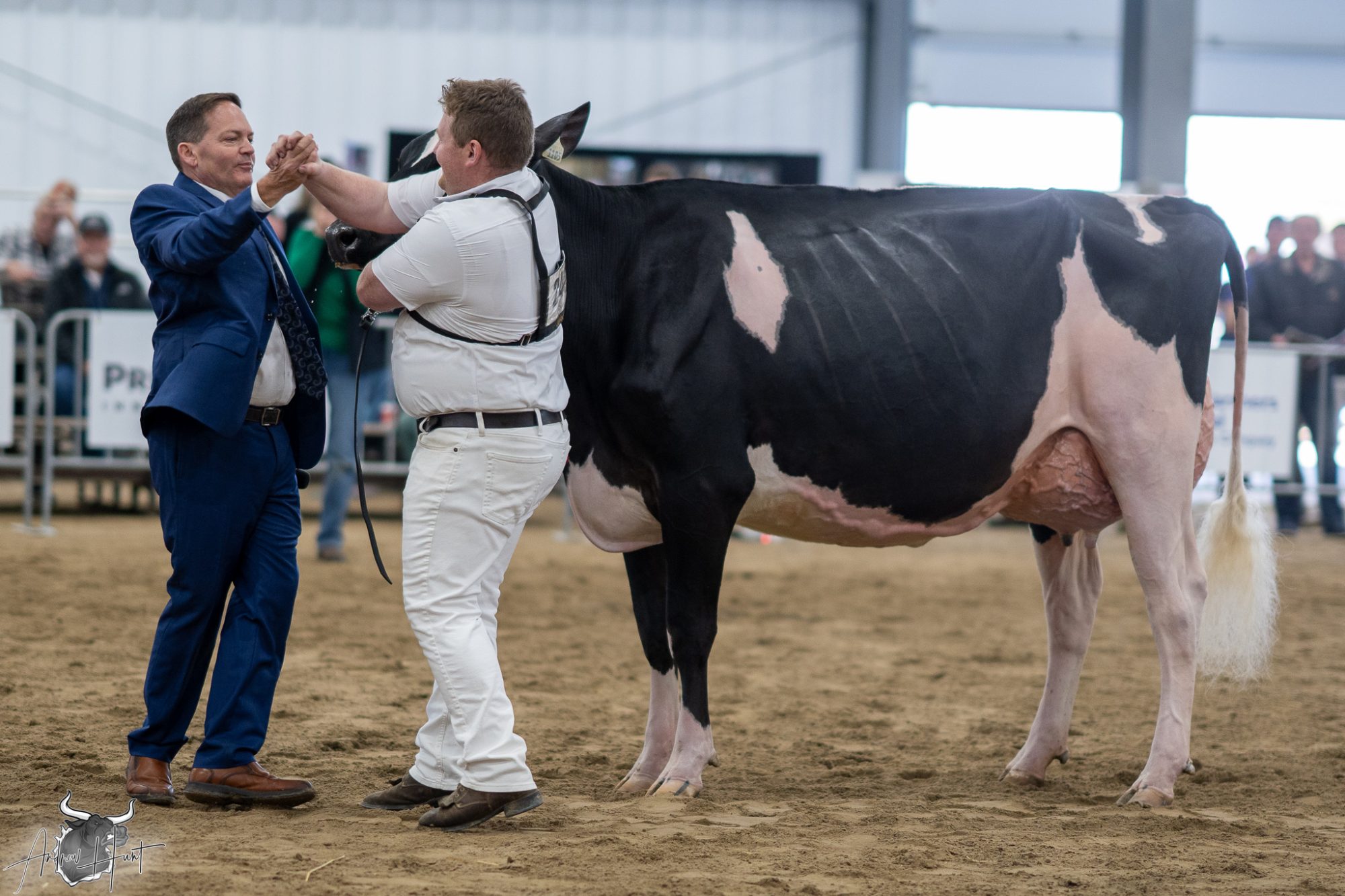
Traveling 12+ countries yearly with less than 100 nights at home, Alberto Medina has turned cattle fitting into a global art form built on charm and excellence.
A master in his element. This candid shot captures Alberto Medina’s calm, observant focus amidst the bustling pre-ring at the 2014 Royal Agricultural Winter Fair, completely at home in the organized chaos. (Photo by Carl Saucier)
You know that rare person who walks into any room and somehow makes everyone feel like they’ve just met their new best friend? Alberto Medina is that guy—except his “rooms” happen to be cattle barns scattered across five continents, and his magnetic presence has turned him into something of a legend in the dairy world.
Less than 100 nights a year—that’s how often this Spanish-born cattle fitter actually sleeps in his own bed. The rest of the time? He’s somewhere between customs lines and show rings, navigating airports with the confidence of a seasoned diplomat and somehow managing to be the most genuinely admired professional in an industry not exactly known for its abundance of humble superstars.
Here’s what strikes everyone about Alberto—in a business where success can breed contempt and competition often gets ugly, Alberto has managed to achieve unprecedented global recognition while earning genuine respect from virtually everyone he encounters.
The Boy Who Never Lost His Wonder
The story begins at Argomota Holsteins, where young Alberto absorbed something special from his parents—not just their passion for showing cattle, but their fundamental approach to treating people well. “My parents always loved the shows, so I started showing at a very early age,” he tells me, and you can hear decades of genuine enthusiasm still bubbling under those words.
A pivotal moment: Alberto Medina (left) and Santiago Llera celebrate their first National Grand Champion title with Llera Goldwyn Gala, a testament to Alberto’s early eye for exceptional cattle and a foreshadowing of his global success
What’s remarkable about Alberto’s journey is how organically it unfolded. While others fought their way up through regional politics and industry hierarchies, Alberto simply continued to excel at his craft, maintaining the same authentic enthusiasm that had first drawn people to him as a teenager, when he would clip cattle for friends.
After a decade with Semex Spain providing customer support and fitting services, he made the leap that changed everything: he went full-time as an independent fitter. “After that, I became a full-time fitter, and that’s how the traveling started. I was looking to fulfill my working days,” he explains with characteristic modesty, as if describing a weekend hobby rather than embarking on what would become an unprecedented global career.
A young Alberto Medina (second from the right) with the CIAQ/Semex daughter display team, showcasing his early commitment to the dairy genetics industry.
Living the Impossible Dream
Picture this: You land in Madrid after two weeks in Canada, rush home to change suitcases, maybe catch four hours of sleep, then hop on a 6 AM flight to New Zealand. Most people would be staggering zombies. Alberto steps off that plane looking refreshed and ready to tackle whatever challenges await.
“Sometimes I have to go home for a day, change luggage, sharpen my blades… and fly again the next day,” he says matter-of-factly. The logistics alone would break most people—navigating different electrical systems, language barriers, and cultural expectations that shift with every border crossing. But Alberto has mastered it all with an ease that borders on the supernatural.
Twelve to fifteen different countries annually. Thirty-plus shows a year. Only five of those shows are in his native Spain. That’s not just a career—that’s a lifestyle that would terrify most of us, yet Alberto has turned it into an art form.
Precision under pressure—Alberto’s ring-ready finish is the quiet edge behind champion results.
The Stories That Reveal Character
Every conversation with Alberto eventually becomes storytelling time, and his tales reveal layers of humor and grace under pressure. Take the great goat invasion: “A goat running in the ring full of cows was priceless,” he recalls with obvious delight. You can picture the whole scene—some prestigious European show, everything formal and serious, then suddenly chaos as a goat careens through a ring full of Holstein cows.
Or the highway cow chase during a trip from Spain to Italy: “We stopped for milking, one of the cows escaped and was so close to jumping onto the highway.” The way he tells it, you can feel the adrenaline spike, the frantic teamwork, the collective relief when disaster was averted. These aren’t just amusing anecdotes—they’re windows into someone who finds adventure and humor even in moments that would traumatize others.
But perhaps the story that best captures Alberto’s character involves a cow whose breeder wanted to milk her out before the show because, “in their opinion, she didn’t look any good.” Alberto saw something others missed—and she ended up Supreme Champion. That’s not just professional expertise; that’s someone who believes in potential when others have given up hope. This moment perfectly illustrates his ability to see beyond surface appearances and trust his instincts, even when others doubt him.
Mastering the moment. Alberto Medina guides Au Parchy Doorman Jolie in the spotlight at the 2019 Expo Bulle, where their flawless presentation led to a stunning upset victory for Grand Champion
The Professional Who Elevates Everyone
What distinguishes Alberto from other elite professionals is his collaborative philosophy. “Make a good team at every show because showing animals is not a one-person thing. Success is about teamwork,” he explains, and this isn’t just strategic thinking—it’s how he approaches every aspect of his career.
Rather than hoarding trade secrets or maintaining a competitive advantage through secrecy, Alberto freely shares knowledge and actively builds others up in the industry. When he talks about buying a cow with friends back in 2006 that became Grand Champion at the European Dairy Show in Italy in both 2008 and 2009, then Junior Champion at the Swiss Expo in 2020, you hear the joy of shared achievement. These weren’t solo victories—they were friendship triumphs that created lasting bonds across continents. His willingness to invest in partnerships and celebrate collective success has earned him respect that transcends mere professional accomplishment.
Teamwork makes the dream work at IDW 2020. Alberto Medina (standing) with the talented Blue Chip crew including Sheila Sundborg (kneeling, center left) and Katie Kearns (kneeling, center right) and Kelvin Cochrane (Queensland), embodying the collaborative spirit that defines his approach to the global show circuit.
The Master Who Wears Success Lightly
Alberto’s technical mastery is undeniable—he’s adapted to feeding systems ranging from TMR to pasture to full hay programs, stayed current with equipment that’s “changed completely in the past 30 years,” and somehow manages mental transitions between regional showing standards that would challenge seasoned diplomats.
Llinde Ariel Jordan—Grand Champion and Best Udder at Cremona, the matriarch Alberto has believed in for a decade.
Take his relationship with Llinde Ariel Jordan, a cow he first encountered as a “small, narrow, straight-legged, soft-pastured” two-year-old. Most professionals would have written her off as unpromising. Alberto saw potential and patiently watched her develop “into one of the best show cows in the world.” At 14 years old, she continues to compete and improve her skills. The pride in his voice when discussing her isn’t just professional satisfaction—it’s genuine affection for watching someone (even four-legged someones) exceed expectations.
Even challenging animals earn his respect. Kingboy Birdy is “one of the hardest cows I ever walked into the ring with,” yet he speaks of her with bemused fondness rather than frustration. He appreciates strong personalities even when they complicate his job.
A challenging partnership, a dream fulfilled. Alberto Medina presents Vinbert Kingboy Birdy in the final lineup at the 2022 Royal Agricultural Winter Fair, an event he called the realization of a lifelong dream after a rewarding year with “one of the hardest cows I ever walked into the ring with.
The Gentle Revolutionary
Here’s something most people don’t realize about operating at Alberto’s level—sometimes excellence itself becomes controversial. “People tried to ban me from going to do my job at a show because they think I’m too good at it. Yes, this happened,” he admits with characteristic understatement.
Praise from peers often means the most. Alberto shared his pride in this post from industry veteran Carl Saucier, which places him in the direct lineage of show ring legends like Donald Dubois—a testament to the deep respect he has earned at the highest level.
Think about that scenario: being so consistently successful that competitors attempt to exclude you from events. It’s the kind of situation that could make anyone defensive or bitter. Alberto tells the story with the same bemused calm he brings to everything else, seemingly genuinely puzzled by such reactions to professional excellence. His grace under this kind of pressure reveals the depth of his character and professional maturity.
The Philosophy of Authentic Excellence
Alberto’s approach to both life and work reveals someone who’s found genuine fulfillment in an unconventional path. His downtime activities perfectly capture his character: ‘Hanging out with friends, good restaurants, more traveling, and getting my heifers ready for the next show.’ Even relaxation centers on the things he values most—relationships, experiences, and continued engagement with his passion
Alberto’s approach to both life and work reveals someone who’s found genuine fulfillment in an unconventional path. His downtime activities perfectly capture his character: “Hanging out with friends, good restaurants, more traveling, and getting my heifers ready for the next show.” Even relaxation centers on the things he values most—relationships, experiences, and continued engagement with his passion.
When I ask about maintaining personal connections with such an intense travel schedule, he’s refreshingly honest: “It’s truly difficult.” But there’s no self-pity, just acceptance of choices made in pursuit of something he genuinely loves. That emotional honesty extends to his professional relationships as well.
The life of a nomad is better with family. Alberto and his brother, Jose Medina, share a moment while en route to the World Dairy Expo in 2015, a rare bit of downtime in a schedule packed with international travel.
The Visionary with Feet on the Ground
Alberto’s insights about the industry come from an unmatched global perspective. His philosophy about cattle evaluation challenges conventional wisdom: “Wideness is the true type of cow. Modern cows have to have a wide chest, wide open rib, wide rumps, much more than being long and tall.” But he presents these views as contributions to ongoing conversation rather than final pronouncements, inviting discussion rather than demanding agreement.
The technical challenges of transitioning between different regional standards reveal the complexity of his work. “Still hard to adapt when you have 2 months in North America and go back straight to a show in Italy. Not so easy to change your mind that quick on… getting the udders too full,” he notes. This kind of cultural and technical switching demonstrates the mental agility required to succeed at his level.
The focus of a master craftsman. Alberto Medina demonstrates the precision and skill that make him sought-after worldwide, here fitting a show cow for Blue Chip at Australia’s International Dairy Week (IDW) in 2020.
His advice for aspiring professionals reflects both extensive experience and fundamental optimism: “Travel and see other ways of showing because every country is different and there are so many ways to do the same thing.” It’s counsel about embracing the world with curiosity and openness—life philosophy disguised as career guidance.
The Honest Realist
When I ask about his reputation for being universally liked, Alberto cuts through diplomatic nonsense with refreshing candor: “I don’t think so! Some people love me, but also many on the other side.”
That honesty is quintessentially Alberto. He’s not trying to convince anyone he’s perfect—just being genuine about the realities of high-level success. Yes, most people genuinely enjoy working with him. Yes, his consistent achievements have created some resentment. Both things can be true, and Alberto’s comfortable with that complexity in ways that reveal deep emotional maturity.
Dreams Still Dancing
Dreams realized across borders. Alberto proudly leads Marsella to Grand Champion honors at Agro Expo Bogota, Colombia, a testament to his ongoing pursuit of excellence and the global impact of his expertise.
Even after achieving global recognition that most professionals can only imagine, Alberto maintains specific ambitions that keep him energized. “I’ve been in the middle of the ring at the end of the day at almost every show I’ve been in the world but Expo,” he admits with a smile. World Dairy Expo—the crown jewel of North American dairy shows—remains unconquered territory.
This perspective—always having meaningful goals ahead—might explain how someone maintains enthusiasm across decades of demanding travel and competition. The moment you think you’ve achieved everything is probably when excellence starts to fade. Alberto’s far too fascinated by what’s around the next corner to let that happen.
The passion that fuels the dream. Alberto shares a heartfelt embrace with the Grand Champion at a recent show in Ecuador. Victories like these, filled with joy and genuine affection, are the moments that power his pursuit of a World Dairy Expo title
The Living Proof
What strikes me most about Alberto Medina isn’t his unprecedented travel statistics or technical expertise, though both are extraordinary. It’s how he’s demonstrated that success and kindness aren’t mutually exclusive—that you can achieve global recognition while maintaining the values that make you genuinely likable.
In an industry that sometimes rewards sharp elbows over generous spirits, Alberto has built an international reputation on competence paired with character. Every airport conversation, every patient explanation of a technique, and every shared celebration of others’ achievements contribute to a legacy that transcends mere professional accomplishment.
Those fewer than 100 nights at home annually represent something profound: a commitment to relationships and excellence that has literally transformed an entire industry. Every clipping session becomes an opportunity to mentor. Every show becomes a chance to help someone else achieve dreams they might not have believed possible.
As young professionals watch Alberto work—whether in Auckland or Amsterdam—they see living proof that excellence doesn’t require ego. His patient teaching, infectious enthusiasm, and genuine investment in others’ success have redefined what global leadership can look like.
The next time you encounter perfectly prepared cattle in any show ring around the world, remember the man who’s probably logged more miles in service of our industry than anyone else, while somehow making the whole impossible journey look like the most natural thing in the world.
Alberto Medina’s greatest achievement isn’t any single championship or distance record. It’s proving that the most effective way to conquer the world is to help it succeed, one genuine relationship at a time. For aspiring professionals in any field, his example provides both inspiration and practical guidance: master your craft, treat everyone with respect, find joy in the journey, and remember that the best victories are always shared.
And somewhere tonight, Alberto is probably planning his next adventure, sharpening his clippers, and reminding everyone lucky enough to be around him that work stops being work when you love what you do and genuinely care about the people you do it with. That might be the most beautiful lesson of all.
Key Takeaways:
Embrace adaptability: Master working across diverse cultures, climates, and management systems rather than limiting yourself to one approach
Build strong, collaborative teams: Success depends on teamwork—”showing animals is not a one-person thing”
Practice genuine humility and kindness: Authentic relationships and respect open more doors than technical skill alone
Commit to continuous learning: Stay current with evolving techniques and technology throughout your entire career
Trust your professional intuition: Learn to identify potential that others might miss, even when conventional wisdom disagrees
Develop resilience for challenges: Accept that pursuing excellence involves logistical difficulties and personal sacrifices
Balance passion with realistic expectations: Understand the trade-offs required for global success, including limited time at home
Prioritize long-term preparation: Focus on consistent, year-round excellence rather than relying on last-minute efforts
Executive Summary
Alberto Medina, the most traveled cattle fitter in the dairy industry, embodies a unique blend of technical mastery, humility, and genuine charm that has made him a beloved figure across five continents. Born at Argomota Holsteins in Spain, Alberto’s career spans over three decades, with annual travels to 12-15 countries and participation in more than 30 shows worldwide—sleeping fewer than 100 nights at home each year. Renowned for his ability to adapt effortlessly to diverse cultures, feeding systems, and show standards, he builds lasting relationships through authentic kindness and collaborative spirit, all while maintaining top-tier performance that has led to multiple championship wins, including his work with Llinde Ariel Jordan, who successfully competed at 14 years old. What sets Alberto apart isn’t just his unmatched global experience or technical expertise, but his rare combination of professional excellence and personal warmth—proving that in an industry where egos often clash, success and genuine likability can coexist beautifully, making him not just the most traveled fitter in the business, but quite possibly the most respected.
Learn More:
7 Things You Must Do To Win In The Show Ring – This article provides a tactical checklist for aspiring showmen. It breaks down the key preparations and mindset, offering practical strategies to translate the professional excellence demonstrated by Alberto Medina into your own repeatable success in the ring.
The 21st Century Guide to Marketing Your Genetics – Moving from individual skill to business strategy, this piece explores how to build a powerful brand around your herd’s genetics. It reveals modern methods for capitalizing on show ring success to create long-term value and market influence.
Is It Time To Rethink The Perfect Dairy Cow? – This forward-looking analysis challenges breeders to consider the future of dairy type. It complements Alberto’s story by examining the evolving standards and economic realities that will shape the champion cows of tomorrow, prompting readers to innovate their breeding strategies.
The Sunday Read Dairy Professionals Don’t Skip.
Every week, thousands of producers, breeders, and industry insiders open Bullvine Weekly for genetics insights, market shifts, and profit strategies they won’t find anywhere else. One email. Five minutes. Smarter decisions all week.
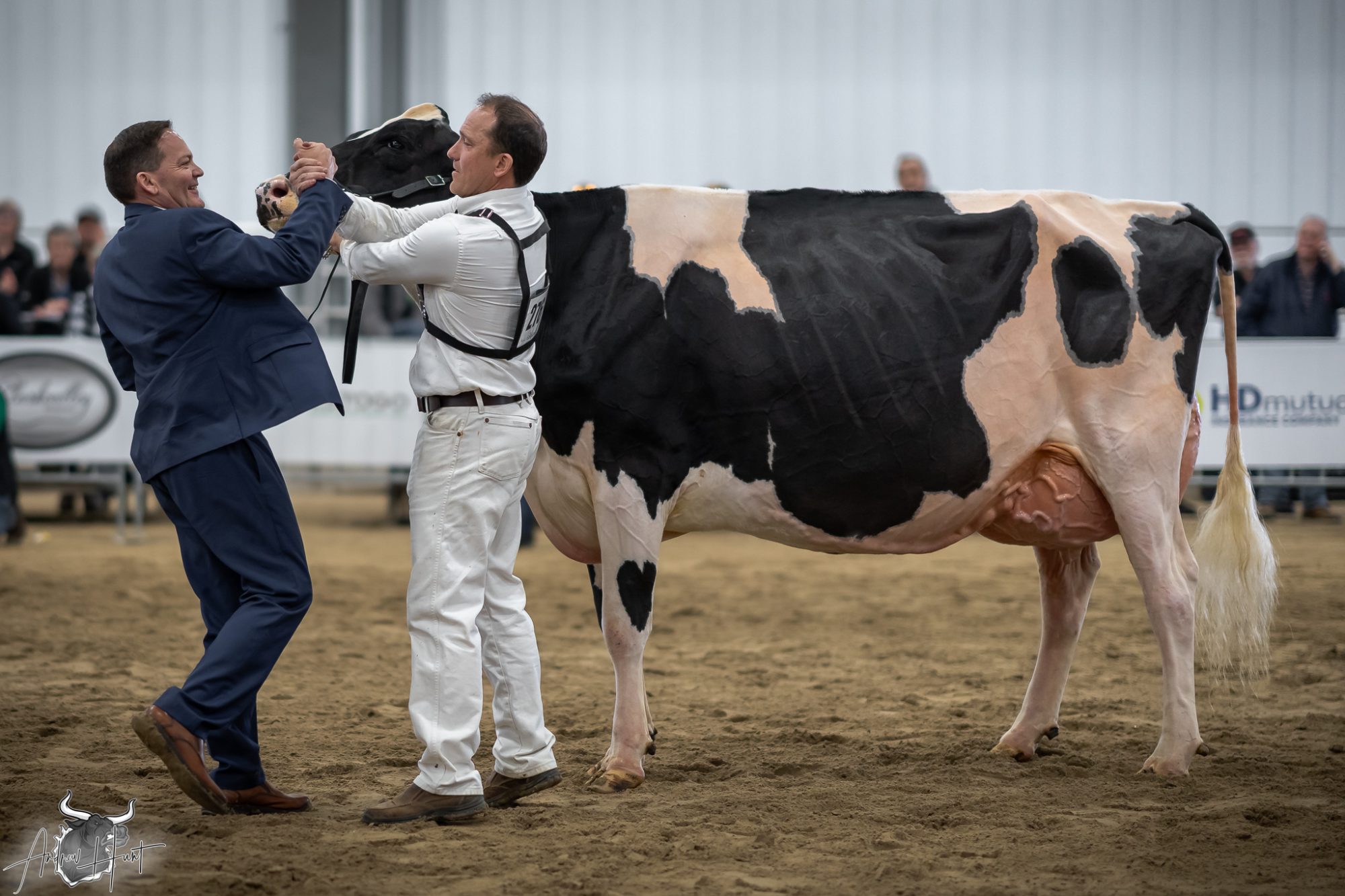
From 4-H novices to genomics pioneers: How three brothers built an elite Brown Swiss legacy while balancing corporate careers and family life.
The morning sun streams across the Wisconsin pasture as Josh Hushon moves among his prized Brown Swiss cattle. What began in 1991 as a humble 4-H project has evolved into Brothers Three Brown Swiss, one of the country’s most respected Brown Swiss breeding operations. This remarkable journey intertwines with Josh’s influential career at Cargill and his reputation as a respected cattle judge, creating a unique story of passion, expertise, and family legacy in the dairy industry.
The Brothers Three team celebrates under the iconic willow trees at World Dairy Expo in Madison, Wisconsin, showcasing their champion Brown Swiss. From humble 4-H beginnings in 1991 to elite breeders today, this family partnership exemplifies how passion, mentorship, and genetic expertise can build a lasting Brown Swiss legacy while balancing careers and family life.
Humble Beginnings to Brown Swiss Legacy
The Brothers Three story didn’t begin with generations of dairy farming knowledge or an established Brown Swiss herd. Instead, it started with youthful curiosity and a willingness to learn that continues to define their approach today.
“We are first generation into Brown Swiss and even into showing at all, so I think being open-minded and learning from people we look up to is ingrained into us,” Josh explains. “We didn’t know anything about Brown Swiss when we started in 1991, so there was no ‘this is our breeding philosophy or how we do things’ to help or hold us back.”
That blank-slate approach may have been their greatest advantage. Without preconceptions about how things “should” be done, the Hushon family approached every challenge with humility and adaptability. Josh recalls how his parents had to find mentors to teach them techniques so they could pass that knowledge to their children. “I think that’s why we’ve never been afraid to ask the people we respect for help; we watched Mom and Dad do that constantly as kids.”
This foundation of learning from others has remained central to their operation even as they’ve risen to prominence. From local county fairs to the prestigious World Dairy Expo in Madison, Brothers Three has methodically climbed the ranks of the Brown Swiss world, gained knowledge, and perfected their craft with each step.
A Philosophy of Continuous Learning
Josh and Casey Hushon stand alongside mentoring partners Kyle Barton and Kenzie Ullmer at a recent show. As Josh notes, “We learn from each other, push each other, and have been showing together for the past four years with a lot of success and fun along the way!” This collaborative approach to continuous improvement embodies Brothers Three’s philosophy of learning from peers within the industry.
The Hushons exemplify the power of the mentor-mentee relationship in agriculture. As Josh eloquently says, “To know the road ahead, ask those coming back.” This approach has connected them with influential industry figures like Luke Peterson, who guided their preparation for the World Dairy Expo, turning a $1,200 purchase into a third-place finisher and Honorable Mention All-American. More recently, mentors like Tom Foss of Pit-Crew Genetics, Kelli and Tom Cull at Budjon and the Kyle Barton and Kenzie Ullmer team have shared invaluable insights about showing, selling, and merchandising strategy.
Family Dynamics and Evolution
What makes Brothers Three unique is how the brothers balance distinct roles while maintaining a unified vision. Though never anyone’s full-time job, their passion for Brown Swiss cattle drives their collaborative approach.
“Brothers Three has never been anyone’s full-time job, so our roles have all changed a lot in the 30+ years we’ve been in Brown Swiss as our careers and seasons of life have changed,” Josh notes. “Our Dad set the vision for us as we started in the breed, but over the past 15 years, we’ve taken that on.”
The farm operates with each brother contributing according to their strengths:
Jake leverages his role at New Generation Genetics to make most mating decisions, bringing industry-wide genetic insights
Josh and Casey manage day-to-day development and merchandising, determining which animals to show and invest in
Joe’s career has taken him toward agronomy, but he remains critical during the World Dairy Expo, helping balance careers and Brothers Three responsibilities
A pivotal moment came in 2014 when Josh and Casey purchased a small farm and began rebuilding their operation. “From 2009 until then, we had dwindled our numbers and were only boarding a few with the Topps in Ohio, who have been great friends and partners for years. The Brothers Three prefix might have become history without a major change,” Josh explains.
Josh and Casey Hushon celebrate with Topp B-3 Woodford after claiming the Intermediate Champion banner at the 2023 World Dairy Expo-a triumphant moment representing years of collaborative breeding decisions, shared daily management, and perseverance through setbacks. This championship exemplifies how Brothers Three’s division of responsibilities allows each brother to contribute their unique strengths toward a unified vision of excellence.
This move allowed them to strategically rebuild their herd by acquiring animals from favorite cow families in the Brown Swiss and Ayrshire breeds. They incorporated advanced reproductive technologies like IVF and partnered with Crave Brothers for embryo implantation. They quickly improved their show string and established themselves as a source of top-quality animals in prestigious spring sales.
Daily Life at the Brothers Three
Far from the romantic notion of full-time farming, Brothers Three represents the reality of modern agricultural passion projects. Josh describes their operation as “a morning, evening, weekend, and any other spare moment that Casey and I can find a job!”
The farm maintains 10-15 show heifers at their small farm, with milk cows owned in partnership with the Nehls and Wolf families, who are boarded at quality operations like Budjon and Smith-Crest. (Read more: Making Dreams Come True: The Journey of Tom & Kelli Cull) Their daily routine involves pre- and post-work chores, with weekends dedicated to catching up on farm tasks.
Their showing schedule has expanded to nearly year-round activity. By January, they’re already back into the regular habit of clipping and working with heifers. Casey manages their meticulous hair care rotation—washing, conditioning, and rinsing—which intensifies for spring shows and continues through October.
Breeding Philosophy: Balancing Show Ring and Commercial Viability
At the heart of Brothers Three’s success is their commitment to breeding cattle that excel both in the show ring and the milking parlor—a balance that has become their hallmark.
“We have always bred for both type and production, even though we don’t have our dairy,” Jake explains. “It was always important to us that our cattle be productive in the milk string for the dairymen or partners who milk them as well as competitive in the show ring for us.”
Their breeding program builds upon the foundation established by their father, who emphasized four key elements: type, udders, cow families, and milk production. The first three attributes catered to show success, while milk production ensured their animals delivered value to the dairy farmers who milked them.
However, about a decade ago, the Brothers Three began experiencing reproductive challenges in their herd. Based on Jake’s experience with New Generation Genetics customers, they prioritized daughter pregnancy rate (DPR) in their breeding decisions—a forward-thinking move that anticipated industry trends.
“The show industry embraced this as well, and now many show-type breeders breed for positive daughter fertility traits, but 10 years ago, that wasn’t a huge part of bull selection,” Jake notes.
Victory moment: Topp B-3 Woodford is named Intermediate Champion at the 2023 World Dairy Expo Brown Swiss Show. This triumph represents the culmination of Brothers Three’s balanced breeding philosophy-producing animals that excel in both the show ring and commercial settings while demonstrating the resilience that makes Brown Swiss cattle so valuable to the dairy industry.
“I love that cow more than you should love a cow… she’s broken my heart more than once, but I will keep putting my heart out there. She is my once-in-a-lifetime cow.” – Josh Hushon on Woodford
Advanced Reproductive Technologies in Practice
Brothers Three has embraced cutting-edge reproductive technologies to accelerate genetic progress. Their strategic use of in vitro fertilization (IVF) in partnership with Crave Brothers for embryo implantation has been instrumental in rapidly rebuilding their herd quality after 2014.
This approach allows them to multiply genetics from their most valuable females, as evidenced by the “ET” (Embryo Transfer) and “ETV” (Embryo Transfer Viable) suffixes that frequently appear in their animals’ names. The strategic mating of Woodford with Deluxe exemplifies this approach, producing three daughters with All-American nominations in just two years, plus a fourth that sold for $30,000 as the second-highest seller at the recent Quest for Success sale.
“Our goal is to breed great heifers who become great cows which is why we are really picky about the maternal lines we invest into and the bulls that we use,” Josh added. “If you buy one from us, we want her to have the potential to be a foundation animal in your herd.
Genomics: The Game-Changer
Genomic testing has revolutionized Brothers Three’s breeding approach, providing crucial insights that guide their decision-making process.
“Genomic testing has had a massive impact on our breeding program and continues to play a pivotal role,” Jake explains. “We started to test all females to get a glimpse into the future of each heifer. Just as each animal is designed with a specific nutrition program to maximize potential, genomics allows us to maximize the genetic potential through our matings.”
Their genomic strategy follows a dual approach:
Testing all females to assess their genetic potential
Selecting bulls that both maximize positive traits and address genetic weaknesses simultaneously
This genomic data integration has accelerated their genetic progress significantly, allowing them to make more informed breeding decisions than possible through traditional visual assessment and pedigree analysis alone.
Show Ring Success: Building Elite Cow Families
Brothers Three Wisper 2E-92: The matriarch who transformed a 4-H project into a breeding legacy. Twice named All-American, this beloved foundation cow contributed to nearly half of the operation’s 50 All-American nominations through her descendants. More than her impressive show ring achievements, Wisper embodied the personal connection that defines Brothers Three-recognizing her handlers, perking up her distinctive Brown Swiss ears when called, and taking a family of first-generation exhibitors to heights they “only dreamed of.” The backyard-raised heifer who became their first homebred All-American represents the perfect union of genetic excellence and heartfelt passion.
The Foundation: Brothers Three Wisper
The foundation of Brothers Three’s breeding program is Brothers Three Wisper 2E-92, a granddaughter of Top Acres EJ Whistle. Twice named All-American, Wisper was Junior Champion at the World Dairy Expo in 2001 and Grand Champion of the Junior Show in Madison in 2003.
Her genetic impact has been extraordinary, with 25 classified daughters, 21 Very Good or Excellent. “Almost half of our 50 All-American Nominations belong to her and her offspring,” Josh proudly states.
The most successful mating with Wisper came through Sunnyisle Total, producing daughters like Brothers Three TV Willa (the dam of their celebrated cow Woodford) and Brothers Three TV Wisco EX-93, who received three All-American nominations in milking form.
Creating Championship Genetics
Josh and Casey Hushon proudly pose with B3-Ayr Tux Wilma, their 2023 UNANIMOUS All-American Summer Yearling who dominated the show circuit with championship wins at World Dairy Expo and as Junior Champion at the North American International Livestock Exposition (NAILE). Wilma exemplifies Brothers Three’s commitment to developing elite genetics with both style and substance.
Brothers Three has methodically built its reputation on developing elite animals with staying power. Their success includes:
14 All-Americans and 8 Reserve All-Americans
50 total All-American nominations, with nearly half coming from Wisper’s family line
The 2023 Intermediate Champion at World Dairy Expo (Topp B-3 Woodford)
Successful entries in both Brown Swiss and Ayrshire breeds, including Junior Champion Ayrshire at World Dairy Expo
The Woodford Story: Perseverance Rewarded
Topp B-3 Woodford, shown here during her winning appearance as 1st Place Junior Three Year Old at the 2023 World Dairy Expo International Brown Swiss Show. Just 16 months after losing her calf and facing setbacks, Woodford’s triumphant return to the ring culminated in being named Intermediate Champion-a testament to Brothers Three’s perseverance and Josh Hushon’s unwavering faith in his “once in a lifetime cow.”
Perhaps no story better illustrates the Brothers Three’s journey than that of Topp B-3 Woodford, whose path to championship glory embodied both heartbreak and triumph.
“Standing in a pasture in late spring 2022 with tears in my eyes as they confirmed that Topp B-3 Woodford had lost her calf and was open, I could never have imagined in a million years that she would be Intermediate Champion at World Dairy Expo 16 months later,” Josh reflects with emotion.
Woodford had shown promise as a heifer, earning Reserve All-American Summer Yearling honors. After losing her calf, Josh feared his dreams for her were delayed, if not derailed. Yet, against all odds, she calved at 2 years and 11 months, and by August, she was named Intermediate and Reserve Grand Champion at the Wisconsin State Show under Jason Lloyd’s evaluation.
Her rise continued at World Dairy Expo 2023, where she claimed the Intermediate Championship, cementing her place in Brothers Three history. “I tell people that I love that cow more than you should love a cow, and she’s broken my heart more than once, but I will keep putting my heart out there. She is my once-in-a-lifetime cow,” Josh says with undisguised pride.
Star in the Spotlight: Casey Hushon with Budjon-Vail Autograph Kristina ETV as she enters the Supreme Junior Champion Parade at World Dairy Expo. The dramatic purple lighting highlights the results of Brothers Three’s distinctive show preparation regimen-where Casey’s meticulous hair care rotation combines with their growth-focused nutrition approach. This Winter Yearling champion exemplifies their philosophy that proper development creates animals with both the mass to compete and the style to win, representing hundreds of hours of daily care, conditioning, and hands-on work that defines the Brothers Three showing program.
Show Preparation Techniques
Their show preparation regimen reflects their thoughtful, long-term approach to development. Rather than focusing solely on show-ready conditions year-round, they prioritize growth during winter months.
“I think one of the things that sets us apart from others, though, is that we feed them to grow through the winter, and if they come into the spring carrying more weight than ideal for showing, we’re fine with that,” Josh explains. “I joke that I am the guy that got the Junior Champion Ayrshire from Madison beat last year at Spring Show and was perfectly fine with that because I believe these heifers need that mass and growth to make the distance to Expo.”
This growth-focused approach continues until June or July, when they begin managing weight more actively. For yearlings needing to lose condition, their regimen can be intensive—Josh recalls walking two yearlings a mile daily after dinner, with each heifer completing this route more than 40 times between August and September. One of these animals became Junior Champion Ayrshire at the World Dairy Expo.
Their nutrition program benefits directly from Josh’s Cargill expertise, while Casey manages their comprehensive hair care routine, which becomes increasingly intensive as show season approaches. This combination of nutrition, hair care, exercise, and hands-on development forms their integrated approach to show preparation.
5 Key Breeding Strategies from Brothers Three
Prioritize Fertility: Select a positive daughter pregnancy rate (DPR) to ensure reproductive success
Balance Show Appeal and Commercial Viability: Breed for type, udders, and strong cow families while maintaining milk production
Leverage Genomic Testing: Test all females to guide mating decisions and accelerate genetic progress
Focus on Maternal Lines: Build upon proven cow families for consistent genetic transmission
Strategic Partnerships: Form co-ownership relationships to access elite genetics and share risk
Josh Hushon: Bridging Corporate Strategy and Cattle Expertise
Josh Hushon delivers a presentation at the 2022 Connect Dairy Summit in his role as Strategic Dairy Marketing Lead for North America at Cargill. His expertise in corporate dairy strategy complements his passionate approach to Brown Swiss breeding at Brothers Three.
What makes the Brothers Three story particularly unique is Josh Hushon’s dual identity as both a passionate Brown Swiss breeder and a corporate strategist at Cargill. Since March 2020, Josh has served as Strategic Dairy Marketing Lead for North America at Cargill, leading a team responsible for crafting the North American dairy strategy and portfolio development.
His career journey includes previous roles as Calf & Heifer Commercialization Lead and Marketing Communications Lead at Cargill and five years as an Associate Editor at Hoard’s Dairyman from 2003-2008. This blend of agricultural journalism experience and corporate marketing expertise has shaped his approach to Brothers Three and his understanding of the broader dairy industry.
“At Cargill, I am the Director for strategy, marketing, and technology for our dairy nutrition business in the U.S. and Canada, and I see several mutual benefits to this dual role with my cattle,” Josh explains. “Working at Cargill gives me access to some of the best nutrition minds in the world. I’ve learned much about rumen development, reading a hay sample, and the latest technologies, such as phytogenics, which we’ve integrated into our program.”
This knowledge exchange works both ways. “At the same time, being a customer at Cargill and spending my social time with other dairy producers keeps me grounded in a reality that makes our work more impactful to our customers. As a marketer, having daily real-world insight helps our team to remain practical and innovative in our work.”
Sustainability Initiatives and Industry Impact
Josh brings valuable insights from Cargill’s sustainability initiatives to his farm operation. In a recent podcast appearance with Dr. Kate Cowles, Cargill’s North American Ruminant Innovation Lead, Josh highlighted the dairy industry’s significant progress in reducing its environmental footprint: “A gallon of milk now compared to 10 years ago to 60 years ago is probably 60 to 70% smaller carbon footprint in that timeframe, which is amazing progress as an industry.”
At Cargill, Josh helps develop dairy nutrition strategies that enhance production efficiency and environmental performance. The company leverages sophisticated tools like Dairy MAX™ software, which includes sustainability metrics to help producers understand and manage their rations’ environmental impact, particularly regarding methane emissions and nutrient efficiency.
This sustainability focus extends to Brothers Three, where Josh applies Cargill’s nutritional insights to optimize feed efficiency and animal health. His position at the intersection of corporate agricultural strategy and hands-on breeding gives him a comprehensive perspective on how sustainability initiatives can benefit individual operations and the industry.
Industry Service and Judging Impact
Josh Hushon with one of his prized Brown Swiss heifers at their Wisconsin farm. His hands-on experience raising elite cattle provides the foundation for his industry leadership and judging expertise, contributing to his upcoming 2025 Wisconsin Service Award.
Josh’s industry involvement extends well beyond Brothers Three and Cargill. After moving to Wisconsin in 2003, he quickly found community in the Wisconsin Brown Swiss Association, where he has made significant contributions, leading to his 2025 Wisconsin Service Award.
As the World Dairy Expo Representative for the Wisconsin Brown Swiss Association, Josh bridges his passion for the breed with organizational leadership. He has chaired two National Brown Swiss Conventions in Wisconsin (2013 and 2024). He has been instrumental in consolidating Wisconsin Spring Shows and Wisconsin State Shows into all-breeds events in Madison—an inter-breed collaboration he believes strengthens the entire dairy community.
Josh is an accomplished judge, earning All-American honors in 4-H Dairy Judging and being judged collegiately at Penn State University. His recent judging assignments include the Kentucky Spring National Brown Swiss Show and the Brown Swiss and Other Colored Breeds Show at Green County Dairy Days in 2024.
His brother Jake has also established himself as a respected cattle judge, bringing the Brothers Three philosophy into the evaluation ring. When approaching a class of Brown Swiss cattle, Jake emphasizes the balance of dairy character, strength, body depth, style, and an elusive “it factor” distinguishing top animals.
“In cows, the udder is by far the most important trait, and for me, it takes something truly special for the best-uddered cow in each class not to be in first,” Jake explains. His evaluation process systematically assesses feet and legs, topline strength, rump angle, and overall width and depth to sort animals through the class.
Brown Swiss vs. Holstein: Competitive Advantages in Today’s Market
Characteristic
Brown Swiss
Holstein
Component Production
Higher butterfat and protein percentages
Higher total milk volume
Heat Tolerance
Superior heat tolerance
Less heat tolerant
Longevity
Greater productive lifespan
Variable lifespan
Beef Value
Superior carcass value for crossbred calves
Lower beef value
A2 Status
High percentage of A2 genetics
Lower percentage of A2
Feed Efficiency
Good converters with strong components
Efficient volume producers
The Next Generation and Future Vision
Looking ahead, Brothers Three balances tradition with a fresh perspective as they consider the next generation. The four boys who make up what they call “B3 Gen 2,” with a fifth on the way in July 2025, represent potential future leadership for the operation.
“The oldest boys are just old enough for 4-H, so we’ll give them all a chance to show if they have an interest in it, and if not, that’s okay too!” Josh says, reflecting the same open-minded approach that has defined Brothers Three from the beginning.
Market Trends and Growth Opportunities
As the story of the Brothers Three unfolds, Josh and his brothers remain optimistic about the future of Brown Swiss cattle in an evolving dairy landscape. Jake identifies two key opportunities for the breed: its growing popularity in the show ring, with high-profile breeders adding Brown Swiss to their operations, and its economic advantages in commercial settings.
“In economic terms, our breed fights for stall spaces and uterus slots on large dairy farms today with many dairy breeds, European red breeds, and now beef semen,” Jake observes. “Two things Brown Swiss can and must capitalize on are the high payment for fat and the sale carcass value of the beef calves out of Brown Swiss cattle vs. a Holstein or Jersey at market. Add in A2, which is a large percentage of the population, and our opportunity to become a mainstream breed in the USA, like they are in Europe, is here.”
Adapting to Industry Shifts
Josh acknowledges the impact of industry consolidation on the Brown Swiss breed. “We certainly feel consolidation as we see smaller farms exit that were long-time Brown Swiss breeders, and we find more of our show calf market being driven by hobbyists like us or even Holstein breeders looking to diversify with a Brown Swiss. I suspect that trend will continue, and it will be interesting to see the profile of someone buying Brown Swiss a decade from now.”
This changing landscape creates both challenges and opportunities. The traditional base of commercial Brown Swiss herds may be shrinking, but interest from show enthusiasts, specialized breeders, and crossbreeding programs offers new markets. The breed’s inherent advantages—component production, heat tolerance, and carcass value—position it well for specialized applications in a diversifying dairy industry.
Brothers Three continues to adapt by focusing on high-value genetics that appeal to show enthusiasts and progressive commercial producers. Their emphasis on balanced traits—combining show appeal with functional attributes like fertility and production—aligns perfectly with the needs of this evolving marketplace.
The Brothers Three team at World Dairy Expo 2023, where family tradition meets future vision. Representing both current leadership and the next generation of “B3 Gen 2,” this moment captures the essence of their legacy-building approach as they introduce the youngest family members to the show ring environment that has defined their three-decade journey in Brown Swiss breeding.
The Bullvine Bottom Line: A Legacy Built on Passion and Actionable Wisdom
The Brothers Three’s journey—from novice 4-H participants to respected breeders of champion Brown Swiss cattle—embodies the best of American agriculture: innovation, dedication, and a willingness to learn from both success and setbacks.
Through Josh Hushon’s unique perspective as a Cargill executive and passionate cattle breeder, Brothers Three has positioned itself at the intersection of corporate agricultural strategy and hands-on cattle expertise. This balance allows them to appreciate the microscopic details of an individual animal’s development and the macroscopic trends shaping the global dairy industry.
Lessons for Progressive Dairy Breeders
The Brothers Three story offers valuable insights for anyone pursuing excellence in dairy genetics:
Seek Knowledge from Proven Mentors: As Josh says, “To know the road ahead, ask those coming back.” Find mentors who have achieved your goals and follow their guidance precisely.
Leverage Genomic Testing Strategically: Test females early to “glimpse their future” and make more informed breeding decisions. Use the data to both maximize strengths and address weaknesses in your herd.
Balance Show Appeal with Commercial Viability: Even if showing is your passion, breeding for production, components, and fertility ensures your animals deliver value beyond the ring.
Invest in Your Best Cow Families: Focus resources on developing strong maternal lines. As Brothers Three demonstrates with Wisper’s family, one exceptional female can transform an entire breeding program.
Embrace Adaptability and Innovation: From reproductive technologies to marketing approaches, be willing to evolve your operation to meet changing market demands and capitalize on new opportunities.
What began as three brothers learning to show cattle has evolved into a multi-generational legacy of excellence in the Brown Swiss world. With their eyes fixed firmly on the future—from genomic advancements to the next generation of family involvement—Brothers Three continues to write new chapters in their remarkable story of agricultural passion and achievement.
As Josh reflects on his journey with Brothers Three, his words capture the essence of their success: “To know the road ahead, ask those coming back.” By honoring tradition while embracing innovation, Brothers Three and Josh Hushon have not only found their road—they’re helping chart the course for Brown Swiss breeders everywhere.
Key Takeaways
Mentorship drives success: The brothers attribute their achievements to strategic mentor relationships at each career stage-from early guidance on showing technique to advanced breeding partnerships-proving that knowing when to seek expert advice accelerates progress.
Balanced breeding philosophy: Their approach balances four key elements (type, udders, cow families, milk production) while incorporating fertility traits, creating animals that succeed both in elite shows and commercial settings.
Genomic testing as a game-changer: By testing all females and using data to guide mating decisions, they’ve accelerated genetic progress beyond what traditional visual assessment allows, transforming breeding strategy.
Specialty positioning creates opportunity: In a consolidating industry, Brown Swiss offers advantages in component production, heat tolerance, and beef value-creating market potential even as traditional farms disappear.
Passion projects can achieve excellence: Despite never being anyone’s full-time occupation, Brothers Three demonstrates how strategic partnerships, specialized knowledge, and dedicated off-hours management can build elite genetics without requiring full-time farming.
Executive Summary
Brothers Three Brown Swiss represents a remarkable journey from a humble 1991 4-H project to a nationally respected Brown Swiss breeding operation, demonstrating how passion projects can achieve excellence without requiring full-time farming. Founded by the Hushon brothers with no prior dairy experience, the operation thrives on their collaborative approach-with Jake handling genetics through his New Generation Genetics role, Josh and Casey managing daily development while Josh applies his Cargill executive expertise, and Joe contributing crucial support during World Dairy Expo. Their success stems from a balanced breeding philosophy that produces cattle excelling both in show rings and commercial settings, strategic adoption of technologies like genomic testing and IVF, and their foundational belief in continuous learning from mentors-epitomized in Josh’s mantra: “To know the road ahead, ask those coming back.” This unique blend of corporate strategy and hands-on breeding has positioned Brothers Three to adapt to industry changes while establishing a multi-generational legacy.
Learn more:
International Brown Swiss Show 2024 – Follow the latest results from Madison where top Brown Swiss breeders competed, including notable achievements in the same show where Brothers Three’s Woodford previously claimed honors.
Are dairy genetics a commodity? – Explore this thought-provoking analysis of modern dairy genetics economics that complements Brothers Three’s balanced breeding philosophy of combining show ring excellence with commercial viability.
National Brown Swiss Convention 2024 – Discover highlights from the Wisconsin-hosted event that Josh Hushon helped chair, bringing together over 200 Brown Swiss enthusiasts to celebrate the breed’s community and accomplishments.
The Sunday Read Dairy Professionals Don’t Skip.
Every week, thousands of producers, breeders, and industry insiders open Bullvine Weekly for genetics insights, market shifts, and profit strategies they won’t find anywhere else. One email. Five minutes. Smarter decisions all week.
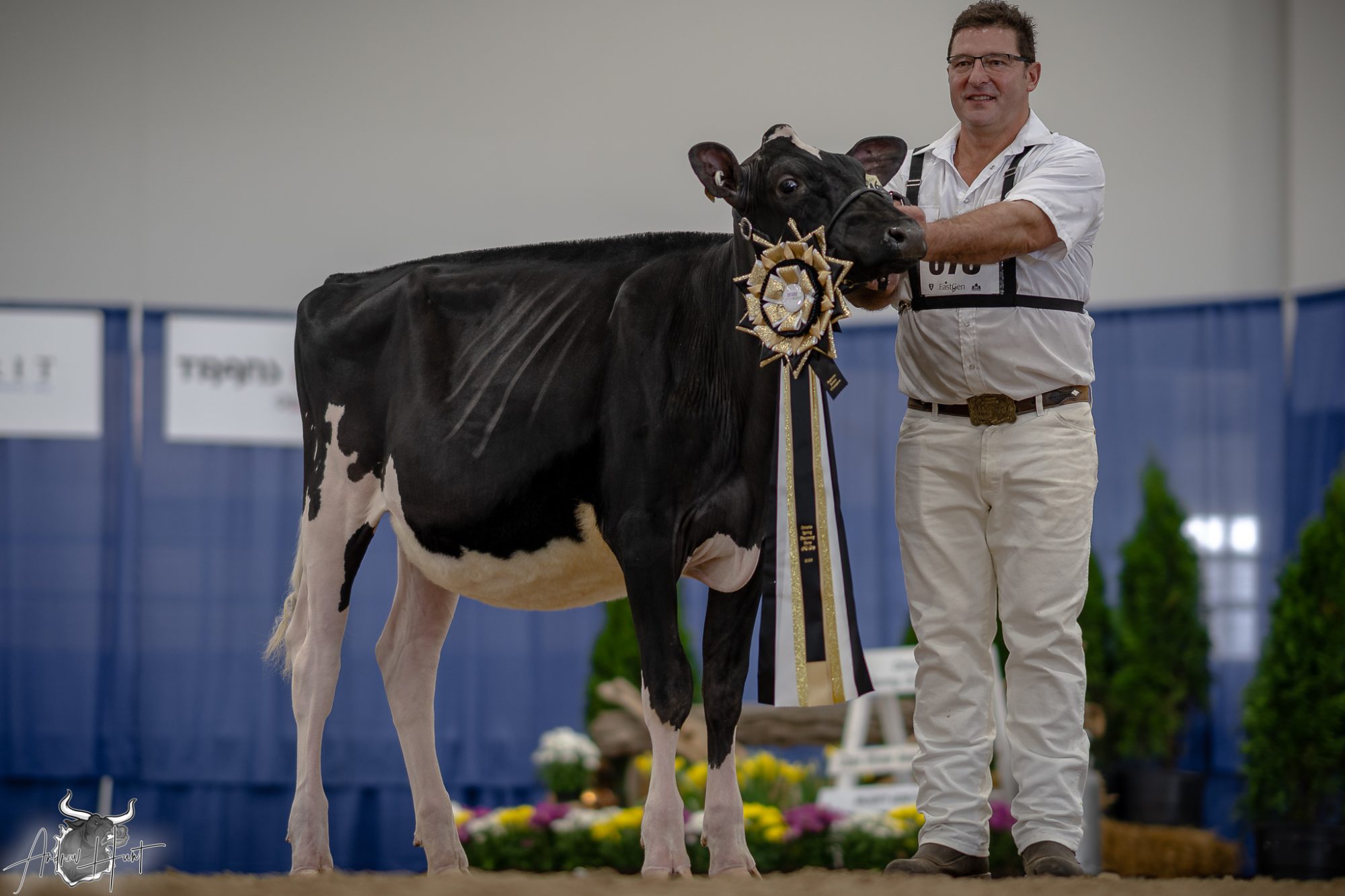
To provide the best experiences, we use technologies like cookies to store and/or access device information. Consenting to these technologies will allow us to process data such as browsing behavior or unique IDs on this site. Not consenting or withdrawing consent, may adversely affect certain features and functions.
Functional
Always active
The technical storage or access is strictly necessary for the legitimate purpose of enabling the use of a specific service explicitly requested by the subscriber or user, or for the sole purpose of carrying out the transmission of a communication over an electronic communications network.
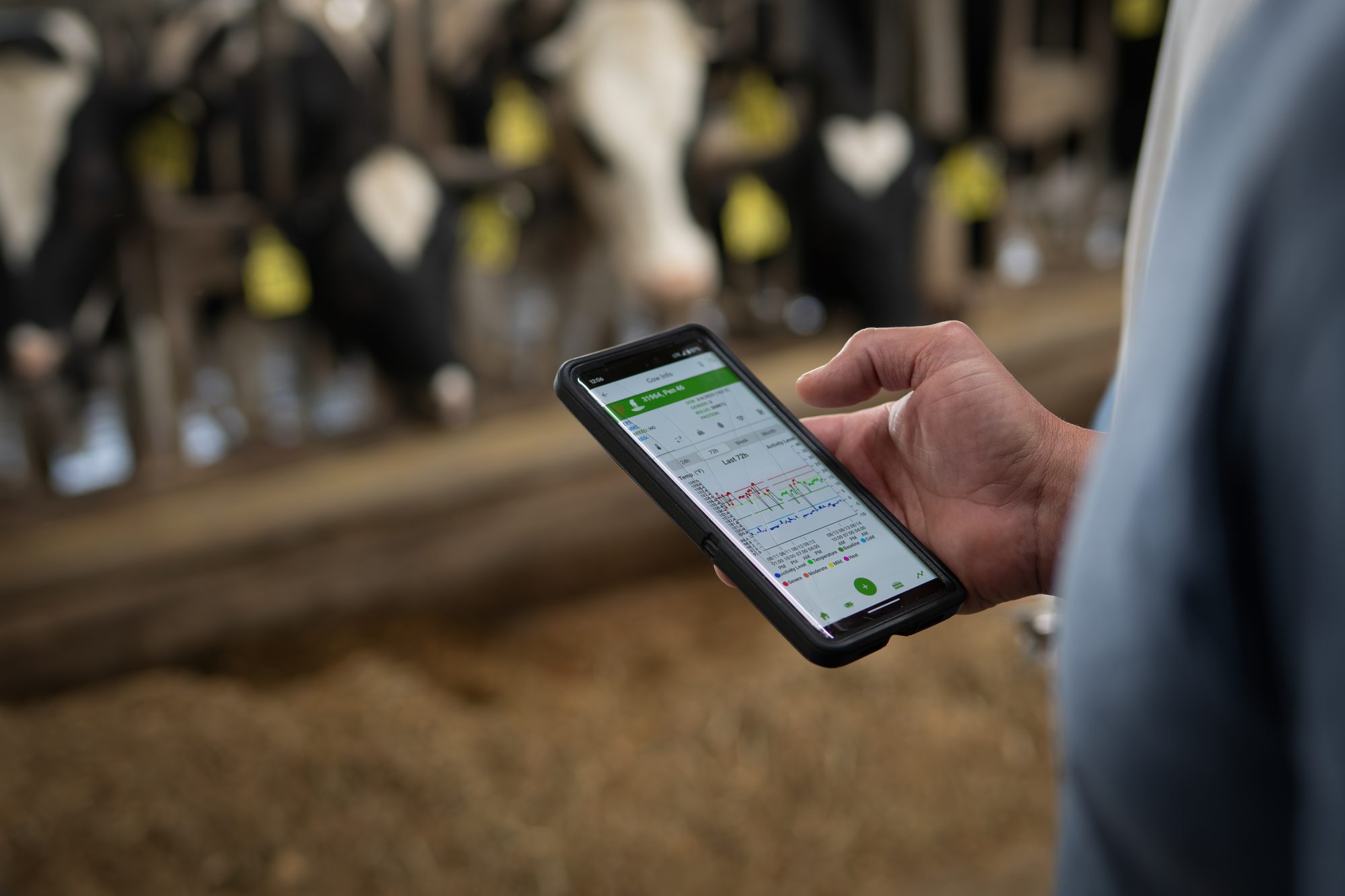
Preferences
The technical storage or access is necessary for the legitimate purpose of storing preferences that are not requested by the subscriber or user.
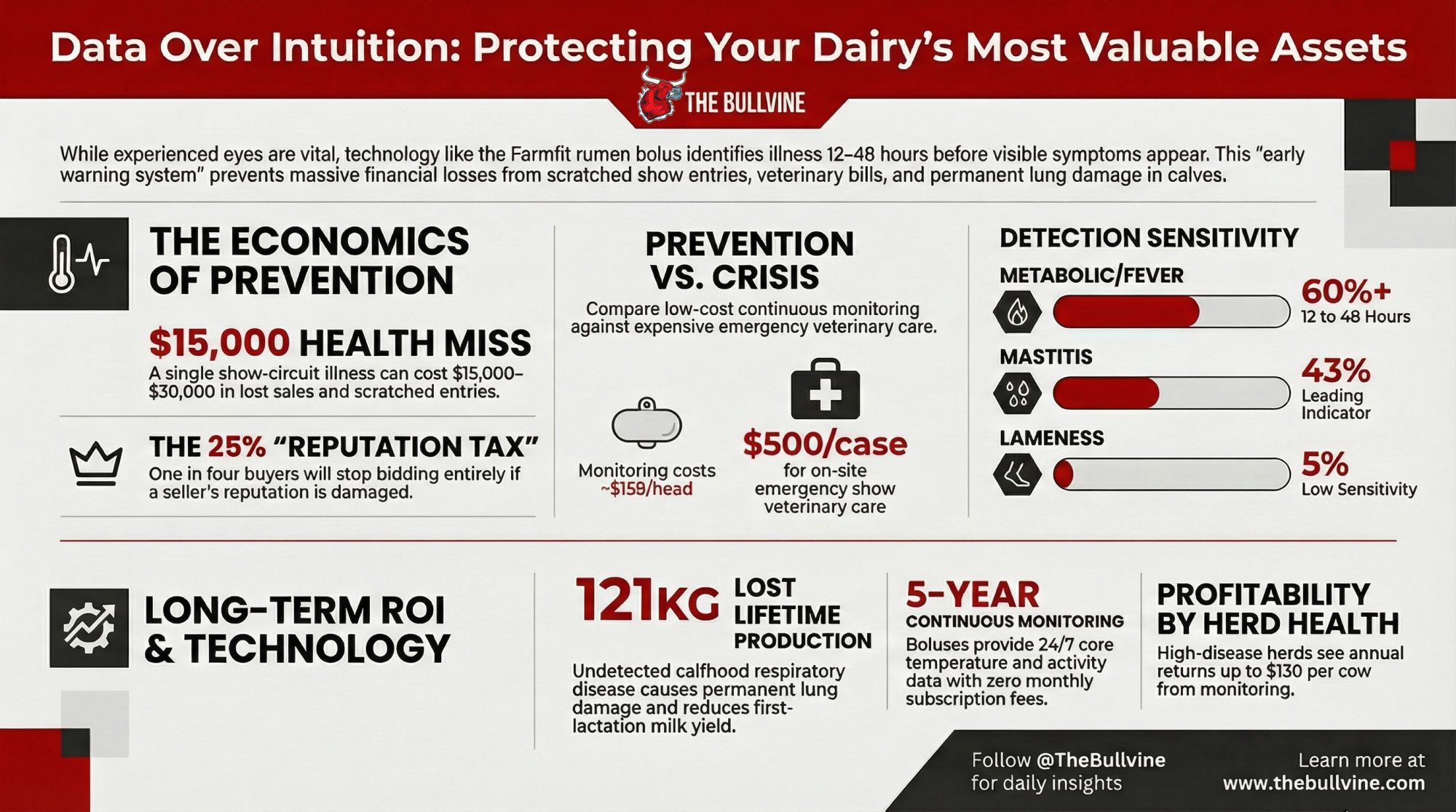
Statistics
The technical storage or access that is used exclusively for statistical purposes.The technical storage or access that is used exclusively for anonymous statistical purposes. Without a subpoena, voluntary compliance on the part of your Internet Service Provider, or additional records from a third party, information stored or retrieved for this purpose alone cannot usually be used to identify you.
Marketing
The technical storage or access is required to create user profiles to send advertising, or to track the user on a website or across several websites for similar marketing purposes.
To provide the best experiences, we and our partners use technologies like cookies to store and/or access device information. Consenting to these technologies will allow us and our partners to process personal data such as browsing behavior or unique IDs on this site and show (non-) personalized ads. Not consenting or withdrawing consent, may adversely affect certain features and functions.
Click below to consent to the above or make granular choices. Your choices will be applied to this site only. You can change your settings at any time, including withdrawing your consent, by using the toggles on the Cookie Policy, or by clicking on the manage consent button at the bottom of the screen.
Functional
Always active
The technical storage or access is strictly necessary for the legitimate purpose of enabling the use of a specific service explicitly requested by the subscriber or user, or for the sole purpose of carrying out the transmission of a communication over an electronic communications network.
Preferences
The technical storage or access is necessary for the legitimate purpose of storing preferences that are not requested by the subscriber or user.
Statistics
The technical storage or access that is used exclusively for statistical purposes.The technical storage or access that is used exclusively for anonymous statistical purposes. Without a subpoena, voluntary compliance on the part of your Internet Service Provider, or additional records from a third party, information stored or retrieved for this purpose alone cannot usually be used to identify you.
Marketing
The technical storage or access is required to create user profiles to send advertising, or to track the user on a website or across several websites for similar marketing purposes.