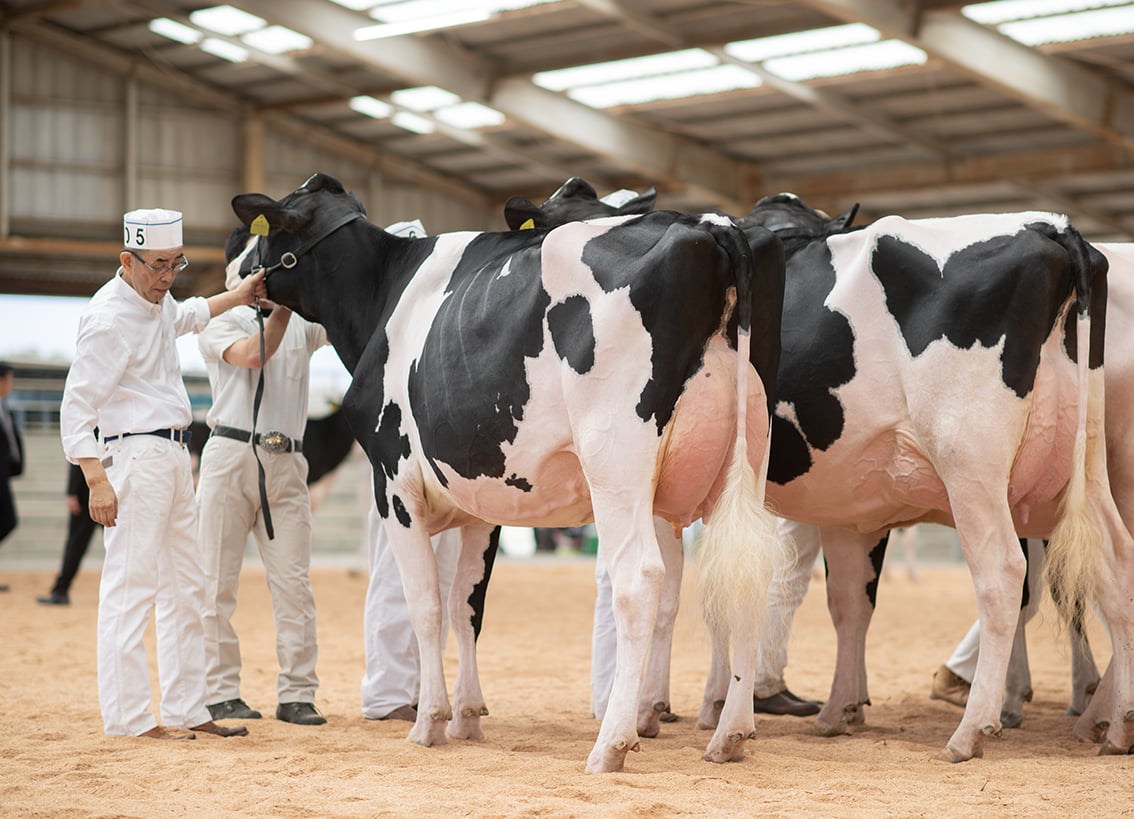







A five-year-old named Prominence Oham Rocket ET walked into Japan’s biggest Black & White ring, and the oldest story in the Holstein breed walked in with her
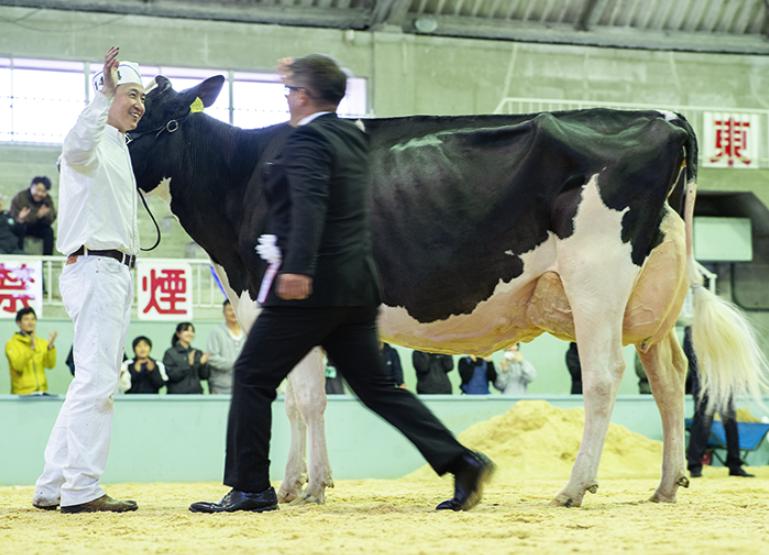
A cow born in Saskatchewan in 1968 just won a show in Hokkaido in 2026. Not literally — but stand at ringside and the line between literal and not gets awfully thin.
When Prominence Oham Rocket ET (Awesome-Red × Doorman × Gloryland-I Goldwyn Locket EX-94) led into the Grand Champion lineup at the 2026 Hokkaido Black & White Show, the five-year-old owned by Terasawa Farm of Betsukai carried more than her own show record into the ring. Pull her pedigree back far enough and you arrive at a single name that has been writing winners’ lists for more than half a century: C Glenridge Citation Roxy EX-97 — the cow the breed simply calls “Queen.”
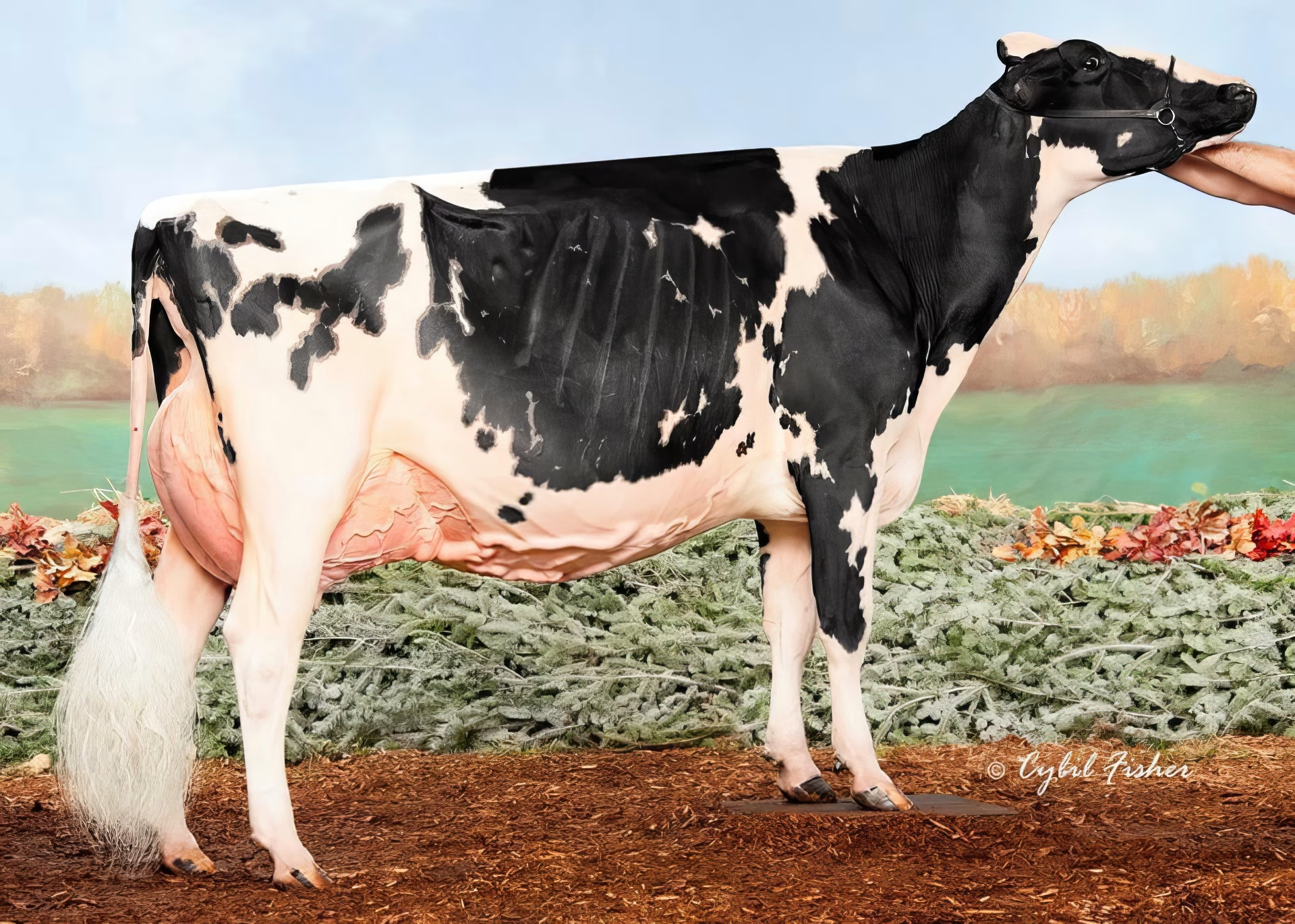
Walkerbrae Doorman Locket EX95
HM All American 5yr old 2018
Nominated AA and AC Junior 3 2016
Doorman x GLORYLAND-I GOLDWYN LOCKET 2E94 )(Full sister to dam of Oham Rocket)
Roxy would have turned 58 this year. She’s been gone since 1984. And there she was, in the bloodlines of the best cow on the tanbark.
An easy choice for first place
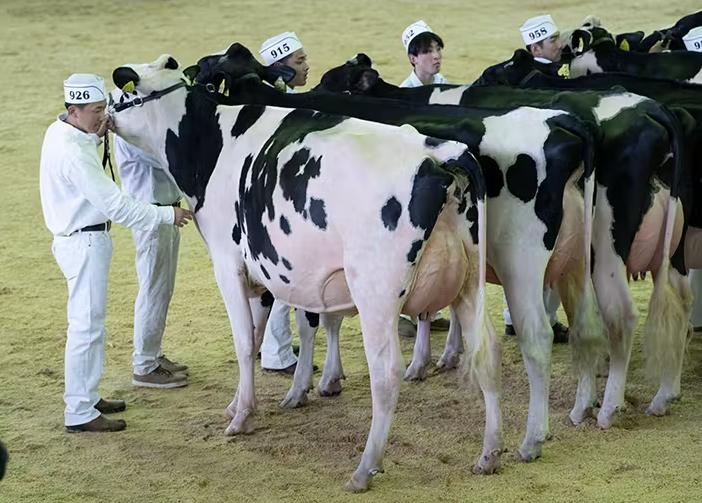
Judge Amida, a dairy producer from Rikubetsu, didn’t make anyone wait for the verdict. He walked the class, looked at Rocket from the side and from behind, and pulled her to the top without ceremony. Then he explained why:
“She displays tremendous dairy character and femininity from her head through her neck. Her openness of rib and width between the ribs are exceptional, creating a very elegant individual. Viewed from the rear, the sharpness of her pins and thurls is impressive, while her udder stands out for both height and texture. She was an easy choice for first place.”
“An easy choice.” Anyone who has ever fitted a cow at 4 a.m. and led her into a ring on no sleep knows exactly what those four words are worth.
What made it an easy choice was a year of maturing. Rocket had already been Grand Champion at the 2025 Nemuro Black & White Show, where GenoSource COO Kyle Demmer placed her on top. But a four-year-old and a five-year-old are different animals. She came back to the 2026 season deeper through the rib, more correct on her feet and legs, her udder carried higher and held together with the kind of texture that doesn’t break down under a hard milking. The cow that won Nemuro was promising. The cow that won Hokkaido was finished.
Prominence Oham Rocket ET, at a glance
- Born: September 22, 2020
- Sire stack: Awesome-Red × Prominence Doorman Rocket ET (by Doorman) × Gloryland-I Goldwyn Locket EX-94
- Show record:
- 2025 Nemuro Black & White Show — Grand Champion
- 2026 Nemuro Black & White Show — Reserve Senior Champion
- 2026 Hokkaido Black & White Show — Grand Champion
A victory written in the pedigree
Here’s the part that turns a good show win into a story worth printing.
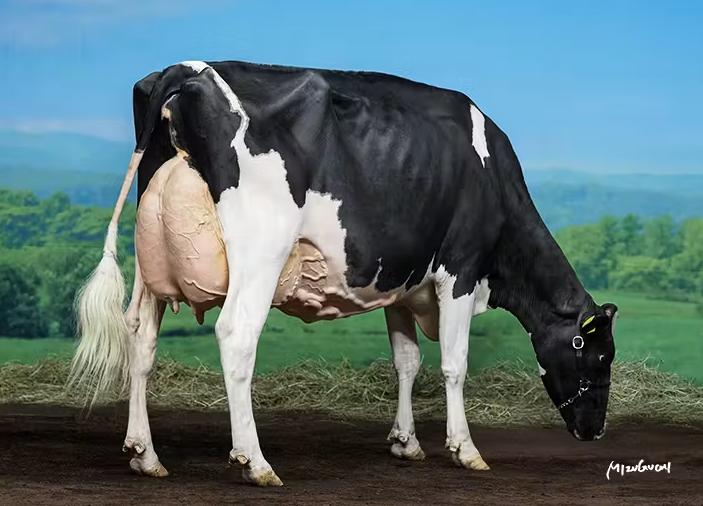
Rocket isn’t a fluke from one lucky flush. A year before her Hokkaido banner, Sakuland Doorman Rocket EX-95-2E(Doorman × Gloryland-I Goldwyn Locket EX-94) took Grand Champion at the 54th Tokachi Livestock Show. More recently, Sakuland Hasit Loewe ET topped the 22nd All-Kyushu Black & White Show, fifteen hundred kilometers to the south.
Three cows. Three rings. One maternal thread — and it runs all the way back to a barn in Grenfell, Saskatchewan.
The chain looks like this:
C Glenridge Citation Roxy EX-97 → Mil-R-Mor Roxette → Hanoverhill TT Roxette ET → Scientific Liza Rae ET → the Gloryland Rae females → Gloryland-I Goldwyn Locket EX-94 → Rocket, Sakuland Doorman Rocket, and Sakuland Hasit Loewe.
It’s a modern twist on a classic legacy: a Black & White ring conquered by a Red Carrier daughter of Awesome-Red, showing just how fluid and dynamic these maternal branches remain.
Roxy was born April 15, 1968, on Lorne Loveridge’s farm — about as far from the center of Holstein power as a cow could start. The gangly heifer nobody looked at twice became the first cow in the world to have ten daughters classified Excellent, the first to combine a 4E-97-GMD score with third-generation 200,000-pound milk status, and the matriarch of more than 380 Excellent descendants. (The Bullvine donor profile)
Half a century after her death, every major sale catalog still carries a Roxy somewhere on the page, and every few months another branch of the family walks out under a banner — a Grand Champion in Hokkaido this spring, a class winner in Switzerland next fall, an EX-95 in someone’s tie-stall barn you’ll never hear about. (How seven franchise cows built modern Holstein)
That’s not luck. That’s a maternal line doing what the great ones do — showing up, generation after generation, in different barns, under different management, on different continents. Rocket is just the latest cow to carry the name into a ring and win with it.
The breeder behind the banner
The man on the halter is Keigo Terasawa, 40, the fourth-generation manager of the family operation. He took the reins about four years ago — right as COVID-19 hit and the dairy industry got hard in a hurry. Not the gentle on-ramp anyone would choose for stepping into a business.
He kept building anyway, and his breeding goal is refreshingly plain:
“We want cows that milk well, remain productive for many lactations, and are easy to manage in the barn.”
High-producing, long-lived, easy to manage. No buzzwords — just the three things that pay the bills in a tie-stall.
The herd rests on three cow families: Rocket, Yukinashi, and Paragon, and Hokkaido wasn’t a one-cow day for Terasawa. Prominence Yukinashi Eye Candy won the Junior Two-Year-Old class and took Honorable Mention Intermediate Champion — and she did it as a first-lactation cow milking 35 kg (approx. 77 lbs) a day, type and production stacked in the same young animal. The Paragon branch has its own ring record: Prominence Paragon Christina Ion was Reserve Intermediate Champion at the 2017 Nemuro Black & White Show and won the Junior Three-Year-Old class at the 2017 Hokkaido National Show, and Prominence Paragon Christina Jagger was Intermediate Champion at the 2024 Nemuro Holstein Show.
Why he keeps bringing cattle
Terasawa came back to the show ring in 2014, nudged by local friends and fellow breeders. He’s the first to admit how green he was about fitting and cattle management back then.
But ask him why he still shows, and the answer has nothing to do with banners:
“Today, people don’t gather and exchange ideas as often as they used to. Having honest conversations with fellow breeders and discussing management and breeding ideas with producers from other regions helps our business more than people realize.”
His read on winning is just as grounded:
“The most important thing is to keep bringing cattle every year. Winning and finding great cattle always involves some degree of timing and luck. What matters is developing the ability to present cattle at their very best year after year.”
He credits his family for all of it — “None of this would be possible without my family” — and he’s not one to stand pat:
“Standing still means falling behind. As breeders, we need to keep moving forward. Whether through type or milk shipped, I want to continue operating a farm where we can see steady progress year after year.”
Terasawa Farm at a glance
| Total cattle | 225 head (125 milking cows) |
| Japanese Black breeding herd | 100 head |
| Housing | Tie-stall |
| Forage area | 150 ha (approx. 370 acres) |
| Main forage species | Timothy, red clover, white clover |
| Annual milk production | ~1,240 tonnes (approx. 2.73 million lbs) |
| Cattle sales | 20–25 head annually |
| Workforce | Keigo, his wife, and three foreign technical trainees |
Behind every champion stands a breeder willing to put in years of quiet work building a better cow. Prominence Oham Rocket ET is the newest chapter in the Roxy story — proof that Japanese Holstein breeding, built on imported North American maternal lines and a discipline all its own, keeps producing cows that can win anywhere.
Fifty-eight years on, the Queen never set foot in that Hokkaido ring. She didn’t have to. She sent a granddaughter.
Related reading on The Bullvine:
- Glenridge Citation Roxy: The Legendary “Queen of the Breed”
- Hokkaido Holstein National Show 2024: The Best of Japanese Dairy Breeding
- From Hokkaido to Holstein Excellence: Tommy Araki’s 50-Year Journey
 The Sunday Read Dairy Professionals Don’t Skip.
 The Sunday Read Dairy Professionals Don’t Skip.
Every week, thousands of producers, breeders, and industry insiders open Bullvine Weekly for genetics insights, market shifts, and profit strategies they won’t find anywhere else. One email. Five minutes. Smarter decisions all week.