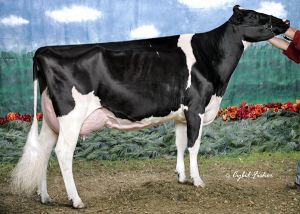
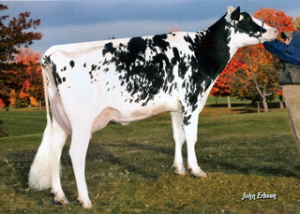
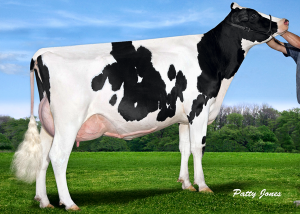
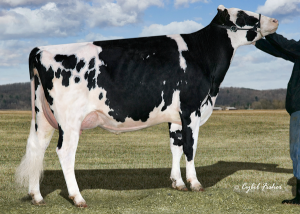
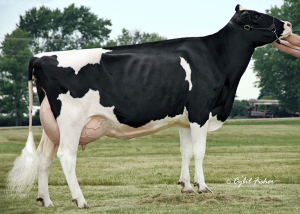
A five-year-old named Prominence Oham Rocket ET walked into Japan’s biggest Black & White ring, and the oldest story in the Holstein breed walked in with her
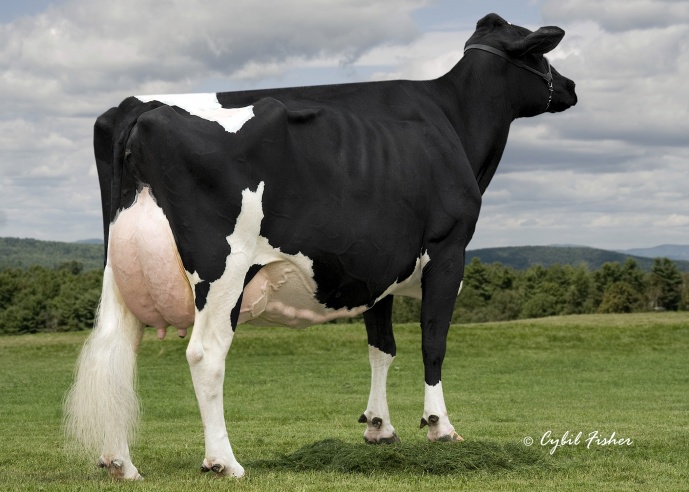
Prominence Oham Rocket ET, Grand Champion, 2026 Hokkaido Black & White Show — Terasawa Farm, Betsukai
A cow born in Saskatchewan in 1968 just won a show in Hokkaido in 2026. Not literally — but stand at ringside and the line between literal and not gets awfully thin.
When Prominence Oham Rocket ET (Awesome-Red × Doorman × Gloryland-I Goldwyn Locket EX-94) led into the Grand Champion lineup at the 2026 Hokkaido Black & White Show, the five-year-old owned by Terasawa Farm of Betsukai carried more than her own show record into the ring. Pull her pedigree back far enough and you arrive at a single name that has been writing winners’ lists for more than half a century: C Glenridge Citation Roxy EX-97 — the cow the breed simply calls “Queen.”
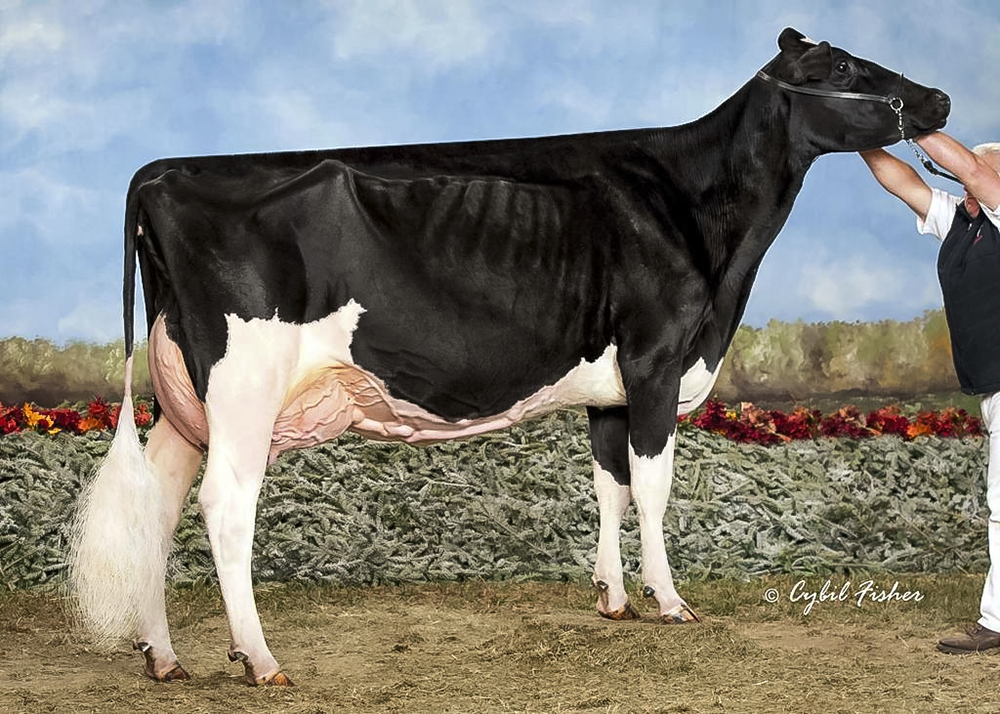
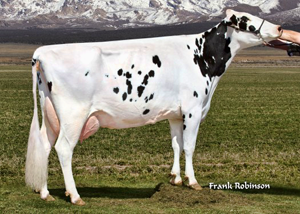
Walkerbrae Doorman Locket EX95 HM All American 5yr old 2018 Nominated AA and AC Junior 3 2016 Doorman x GLORYLAND-I GOLDWYN LOCKET 2E94 )(Full sister to dam of Oham Rocket)
Roxy would have turned 58 this year. She’s been gone since 1984. And there she was, in the bloodlines of the best cow on the tanbark.
An easy choice for first place
Judge Amida, a dairy producer from Rikubetsu, didn’t make anyone wait for the verdict. He walked the class, looked at Rocket from the side and from behind, and pulled her to the top without ceremony. Then he explained why:
“She displays tremendous dairy character and femininity from her head through her neck. Her openness of rib and width between the ribs are exceptional, creating a very elegant individual. Viewed from the rear, the sharpness of her pins and thurls is impressive, while her udder stands out for both height and texture. She was an easy choice for first place.”
“An easy choice.” Anyone who has ever fitted a cow at 4 a.m. and led her into a ring on no sleep knows exactly what those four words are worth.
What made it an easy choice was a year of maturing. Rocket had already been Grand Champion at the 2025 Nemuro Black & White Show, where GenoSource COO Kyle Demmer placed her on top. But a four-year-old and a five-year-old are different animals. She came back to the 2026 season deeper through the rib, more correct on her feet and legs, her udder carried higher and held together with the kind of texture that doesn’t break down under a hard milking. The cow that won Nemuro was promising. The cow that won Hokkaido was finished.
2026 Nemuro Black & White Show — Reserve Senior Champion
2026 Hokkaido Black & White Show — Grand Champion
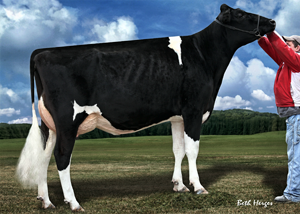
Prominence Doorman Rocket ET — the dam line
A victory written in the pedigree
Here’s the part that turns a good show win into a story worth printing.
Rocket isn’t a fluke from one lucky flush. A year before her Hokkaido banner, Sakuland Doorman Rocket EX-95-2E(Doorman × Gloryland-I Goldwyn Locket EX-94) took Grand Champion at the 54th Tokachi Livestock Show. More recently, Sakuland Hasit Loewe ET topped the 22nd All-Kyushu Black & White Show, fifteen hundred kilometers to the south.
Three cows. Three rings. One maternal thread — and it runs all the way back to a barn in Grenfell, Saskatchewan.
The chain looks like this:
C Glenridge Citation Roxy EX-97 → Mil-R-Mor Roxette → Hanoverhill TT Roxette ET → Scientific Liza Rae ET → the Gloryland Rae females → Gloryland-I Goldwyn Locket EX-94 → Rocket, Sakuland Doorman Rocket, and Sakuland Hasit Loewe.
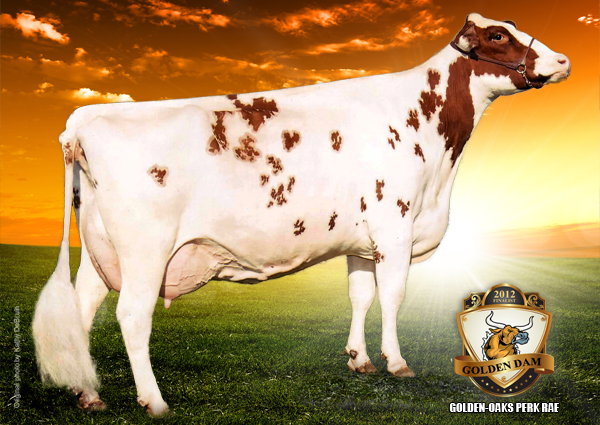
It’s a modern twist on a classic legacy: a Black & White ring conquered by a Red Carrier daughter of Awesome-Red, showing just how fluid and dynamic these maternal branches remain.
Roxy was born April 15, 1968, on Lorne Loveridge’s farm — about as far from the center of Holstein power as a cow could start. The gangly heifer nobody looked at twice became the first cow in the world to have ten daughters classified Excellent, the first to combine a 4E-97-GMD score with third-generation 200,000-pound milk status, and the matriarch of more than 380 Excellent descendants. (The Bullvine donor profile)
Half a century after her death, every major sale catalog still carries a Roxy somewhere on the page, and every few months another branch of the family walks out under a banner — a Grand Champion in Hokkaido this spring, a class winner in Switzerland next fall, an EX-95 in someone’s tie-stall barn you’ll never hear about. (How seven franchise cows built modern Holstein)
That’s not luck. That’s a maternal line doing what the great ones do — showing up, generation after generation, in different barns, under different management, on different continents. Rocket is just the latest cow to carry the name into a ring and win with it.
The breeder behind the banner
The man on the halter is Keigo Terasawa, 40, the fourth-generation manager of the family operation. He took the reins about four years ago — right as COVID-19 hit and the dairy industry got hard in a hurry. Not the gentle on-ramp anyone would choose for stepping into a business.
He kept building anyway, and his breeding goal is refreshingly plain:
“We want cows that milk well, remain productive for many lactations, and are easy to manage in the barn.”
High-producing, long-lived, easy to manage. No buzzwords — just the three things that pay the bills in a tie-stall.
The herd rests on three cow families: Rocket, Yukinashi, and Paragon, and Hokkaido wasn’t a one-cow day for Terasawa. Prominence Yukinashi Eye Candy won the Junior Two-Year-Old class and took Honorable Mention Intermediate Champion — and she did it as a first-lactation cow milking 35 kg (approx. 77 lbs) a day, type and production stacked in the same young animal. The Paragon branch has its own ring record: Prominence Paragon Christina Ion was Reserve Intermediate Champion at the 2017 Nemuro Black & White Show and won the Junior Three-Year-Old class at the 2017 Hokkaido National Show, and Prominence Paragon Christina Jagger was Intermediate Champion at the 2024 Nemuro Holstein Show.
Terasawa came back to the show ring in 2014, nudged by local friends and fellow breeders. He’s the first to admit how green he was about fitting and cattle management back then.
But ask him why he still shows, and the answer has nothing to do with banners:
“Today, people don’t gather and exchange ideas as often as they used to. Having honest conversations with fellow breeders and discussing management and breeding ideas with producers from other regions helps our business more than people realize.”
His read on winning is just as grounded:
“The most important thing is to keep bringing cattle every year. Winning and finding great cattle always involves some degree of timing and luck. What matters is developing the ability to present cattle at their very best year after year.”
He credits his family for all of it — “None of this would be possible without my family” — and he’s not one to stand pat:
“Standing still means falling behind. As breeders, we need to keep moving forward. Whether through type or milk shipped, I want to continue operating a farm where we can see steady progress year after year.”
Terasawa Farm at a glance
Total cattle
225 head (125 milking cows)
Japanese Black breeding herd
100 head
Housing
Tie-stall
Forage area
150 ha (approx. 370 acres)
Main forage species
Timothy, red clover, white clover
Annual milk production
~1,240 tonnes (approx. 2.73 million lbs)
Cattle sales
20–25 head annually
Workforce
Keigo, his wife, and three foreign technical trainees
Behind every champion stands a breeder willing to put in years of quiet work building a better cow. Prominence Oham Rocket ET is the newest chapter in the Roxy story — proof that Japanese Holstein breeding, built on imported North American maternal lines and a discipline all its own, keeps producing cows that can win anywhere.
Fifty-eight years on, the Queen never set foot in that Hokkaido ring. She didn’t have to. She sent a granddaughter.
Every week, thousands of producers, breeders, and industry insiders open Bullvine Weekly for genetics insights, market shifts, and profit strategies they won’t find anywhere else. One email. Five minutes. Smarter decisions all week.
From bachelor farmers to world-class photographers, meet the visionaries who trusted the maternal line when nobody else did — and reshaped the breed one daughter at a time. This is the story of seven of them. And of the breeders who recognized what they had before anyone else did.
One shot. That’s all they took that day.
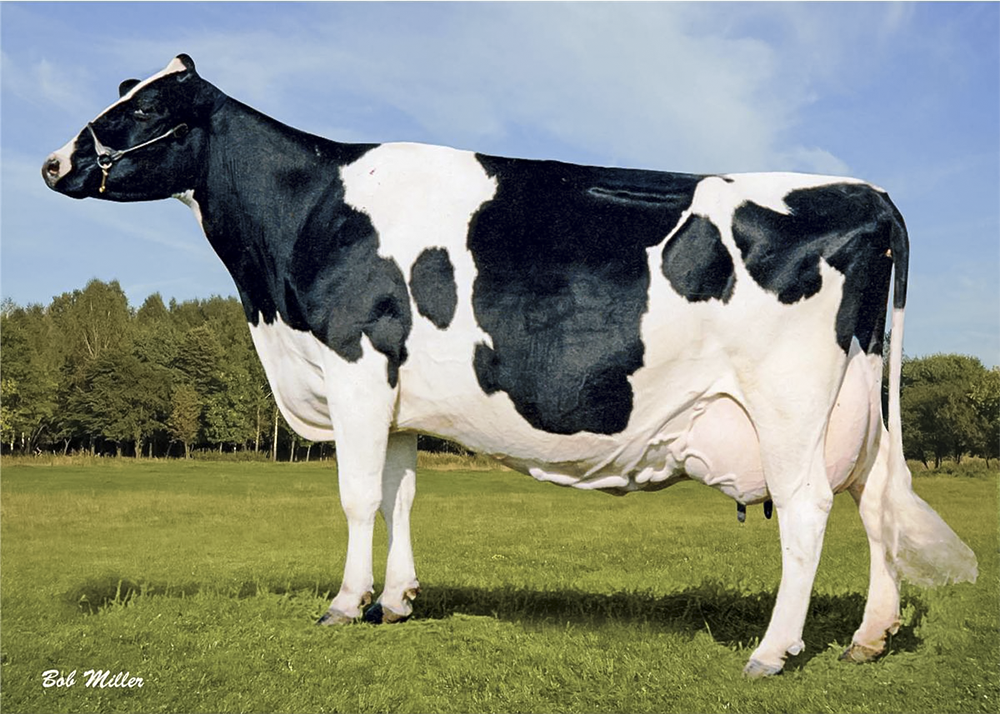
It was sometime in the mid-1970s at Mil-R-Mor Farm in Dundee, Illinois, and the cow standing in front of that camera was Glenridge Citation Roxy — clipped, washed, full of milk after a visit from a group of Japanese buyers. Miller’s son held the halter. His wife worked the trunk. And in that single frame, Miller captured what many consider the finest Holstein photograph ever taken.
Glenridge Citation Roxy EX‑97‑4E — Queen of the Breed I & II, International Cow of the Century (1999), first cow in the breed with 10 Excellent daughters and more than 300 Excellent descendants, foundation of the only 4‑generation direct line with 11+ Excellents and the family behind 30* brood cow Mil‑R‑Mor Roxette, EX‑96 Tony Rae, EX‑97 Rustler‑Red and countless high‑production Roxy daughters worldwide.
But here’s the thing about that picture. It didn’t make Roxy famous. Roxy made the picture famous. Because behind that perfect broadside image stood a cow who would produce 16 Excellent daughters, generate 50 direct maternal lines of four-plus generations of Excellents, and earn more popular-vote titles — Queen of the Breed I, Queen of the Breed II, Top Cow of the Top Ten Cows of the Century, International Cow of the Century — than any Holstein before or since.
She wasn’t the only one. In the three decades between 1968 and 2001, a handful of Holstein cows emerged whose genetic impact was so profound and commercially transformative that calling them “great cows” doesn’t begin to do them justice. They were franchise cows — biological engines that didn’t just win shows or set records but built entire empires of daughters and sons that reshaped the breed worldwide. Good luck finding a sale catalogue without a Roxy on page three.
This is the story of seven of them. And of the three breeders — a bachelor farmer, a livestock photographer, a bankruptcy trustee’s unlikely partner — who recognized what they had before anyone else did.
I. The Photograph and the Cow Behind It
Glenridge Citation Roxy was born on April 15, 1968, on Lorne Loveridge’s farm at Grenfell, Saskatchewan — about as far from the corridors of North American Holstein power as you could get. Loveridge’s grandfather had milked Ayrshires. His father, Gordon, switched to Holsteins in the 1920s. When Lorne took over management in 1957, he changed the prefix from Norton Court to Glenridge and set about his life’s work.
Roxy’s sire was Rosafe Citation R. Her dam, Norton Court Model Vee (EX-6*), was a Star Brood cow whose own dam, Norton Court Reflection Vale (VG-4*), was a Roeland Reflection Sovereign daughter. That gave Roxy two close A.B.C. Reflection Sovereign crosses — and, possibly, the red factor that would surface generations later in one of her most celebrated descendants.
What the pedigree doesn’t tell you is what Roxy looked like in person. Andy Clawson, the classifier who scored her 96 points in 1976, said she was closer to perfection than any cow he’d ever scored. Avery Stafford, who gave her 97 two years later when she was ten, said the same thing. Between them, Clawson and Stafford had classified half a million cows.
R.F. Brown — Bob Brown, who owned Green Elms Echo Christina, a cow who ranked right up there with the best in any era — called Roxy the best he’d laid eyes on. Brown was known for fair assessments, not flattery.
And then there were Doug Blair and Lowell Lindsay. Blair owned Alta Genetics; Lindsay was the sire procurement officer for United Breeders. They’d visited the Loveridge farm a few months before Miller, seen Roxy, and been overwhelmed. They discussed buying her on a 50-50 basis. At the end of the day, they couldn’t come up with the kind of money Loveridge was asking. One has to wonder how long that decision haunted them.
The Move to Illinois
Miller, a transplanted Canadian from Brome, Quebec, worked part-time as a livestock photographer. In 1973, he was summoned to Grenfell to photograph Roxy and her dam. He’d been searching for a cow family for some time, and he had very specific requirements: type, production, and longevity. Roxy and her family met all three.
Loveridge, for his part, was beginning to realize that his farm’s remote location precluded visitors from seeing the cow. Miller’s Illinois base was better suited for promotion and merchandising. Within a year, Miller had bought Roxy and a half-interest in Vee and moved the pair to Dundee.
Even though embryo transfer was still in its infancy — this was the early 1970s, when flushing a cow was more gamble than science — Miller put Roxy on an ET program. Over the years, she produced 30 ET offspring and three natural calves. Twenty daughters. And she became the first cow in the world to have ten of those daughters classify Excellent. By the time the final tally came in, 16 daughters had earned the Excellent designation.
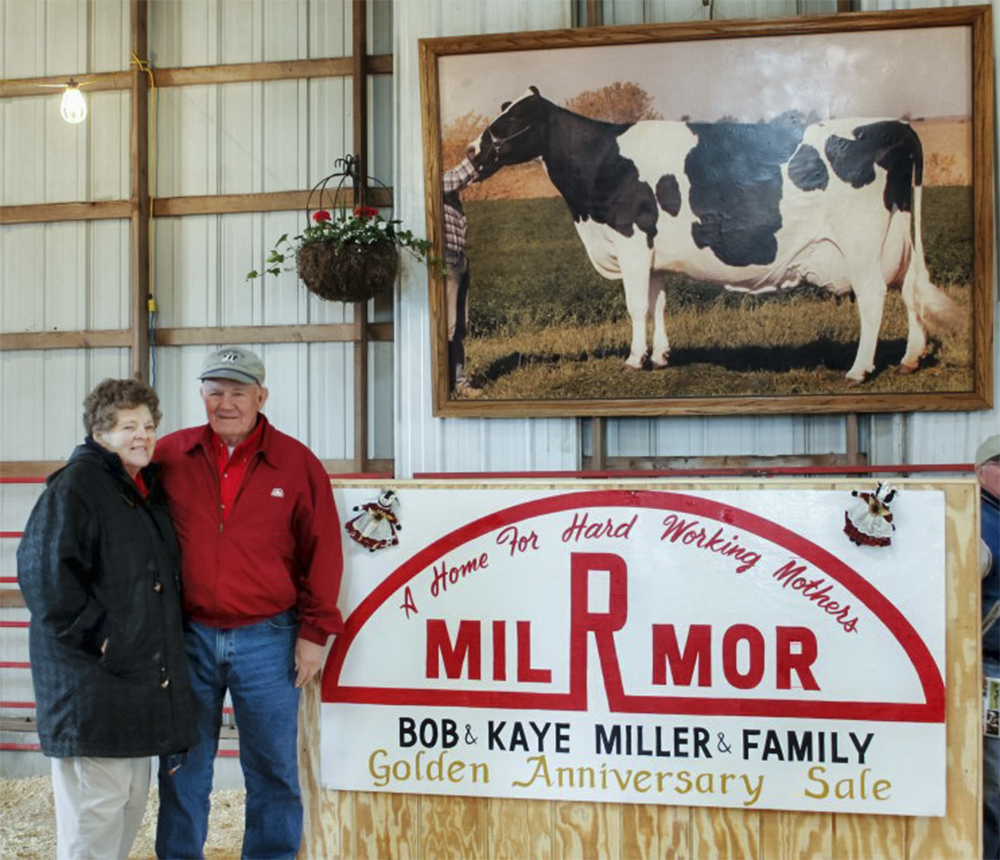
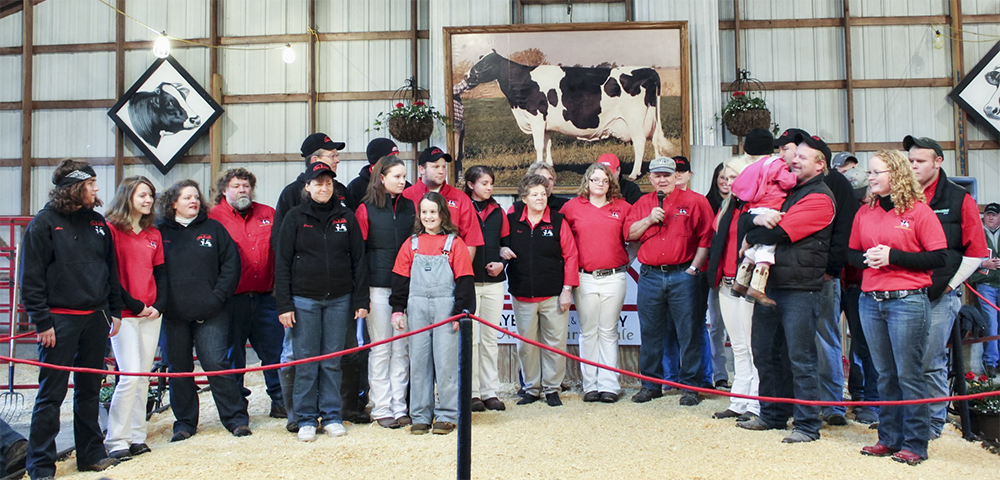
Bob and Kaye Miller at Mil‑R‑Mor’s Golden Anniversary Sale, standing beneath the iconic one‑shot photograph of Glenridge Citation Roxy that helped turn their quiet Illinois herd into one of the most influential cow families in Holstein history.
In Miller’s hands, Roxy made four records over 1,000 pounds of fat, reaching 26,470 pounds of 4.4% milk and 1,166 pounds of fat in her best year. Career total: 209,784 pounds of milk at 4.5% butterfat and 9,471 pounds of fat. She rounded out three generations of 200,000-pound producers — her dam and granddam had both hit that mark. At 12 years of age, she earned a 4E rating, and her show record included All-Illinois honors from 1976 through 1979, a win in the dry-aged class at the 1979 Central National Show, and membership in eight All-American, All-Canadian, or Reserve All-Canadian groups.
The Empire She Built
But the real story wasn’t what Roxy did. It was what her daughters did. And her granddaughters. And their daughters after them.
Seven of Roxy’s daughters earned Gold Medals. By 2004, according to Holstein World, 50 direct maternal lines of at least four generations of Excellents descended from Roxy, with Roxy appearing as the second Excellent dam in each. Her 16 Excellent daughters produced 34 Excellent daughters. Those 34 had 52. Those 52 had 48. That’s the kind of cow family that just keeps writing cheques your herd can cash.
Until 1977, Miller had never sold a Roxy daughter. He relented that year when he consigned Roxy’s Elevation daughter, Mil-R-Mor Roxette, born on Valentine’s Day the year before, to the National Convention Sale at Columbus, Ohio. Peter Heffering bought her for $25,000, the third-highest price of the sale, and took her to Hanover Hill Farms at Port Perry, Ontario.
The transaction nearly collapsed. Miller hadn’t understood his heifer would be sold on investor terms — one-third down and the balance over two years. But years later, Miller acknowledged he was glad Roxette ended up at Hanover Hill. She eventually became an Excellent Gold Medal Dam who lived into her late teens, produced over 100 pregnancies, left 13 Excellent daughters and eight Excellent sons, and added upwards of two million dollars to Hanover Hill coffers.
The Roxette daughters branched in every direction. There was Hanoverhill Star Roxy (EX-92-3E-GMD-DOM), a Starbuck daughter developed by the Conard family at Ridgedale Farm in Sharon Springs, New York, whose Leadman daughter produced a Milestone-Red granddaughter, who in turn produced Sir Ridgedal Rustler-Red (EX-95) at Trans-World Genetics. Rustler became enormously popular in Germany — so popular that grateful German breeders arranged an all-expense-paid trip for Wayne Conard and his wife in 2006.
There was Mil-R-Mor Toprox (EX-94-3E-GMD), Roxy’s highest-record daughter and one of the breed’s first 2,000-pound fat cows, who became the fountainhead of the Brigeen herd’s Roxy family. Mary Briggs of Brigeen Farms described the Roxys this way: “Healthy and fertile — the indexes around the world for somatic cell count, fertility and longevity highlight the family’s real strengths. They just go along doing their business,”
Liddlehome Beemer Rockstar ET EX‑92 — a modern, high‑type show cow whose pedigree runs Beemer × Durham Rhonda EX‑95 × Miss Ridgedale Rhonda EX‑92 × Hanover‑Hill‑R Rhonda EX‑94 × Hanover‑Hill Star Roxy ET EX‑92 × Mil‑R‑Mor Roxette EX‑90 × Glenridge Citation Roxy EX‑97, proof that Roxy’s maternal line is still throwing frame, udders, and banners generations later.
If you’ve ever bought into a cow family and watched it perform under your management the same way it did under theirs — no drama, no fuss, just daughters that score Excellent and milk like freight trains — you know exactly what that consistency feels like.
That’s the kind of cow Roxy was. And her daughters were the same. Wide through the rear end, correct in the rump, sound on their feet, and absolutely relentless at the milk pail. No drama. Just production and reproduction, generation after generation.
On July 8, 1984, Glenridge Citation Roxy died at 16 years of age. A stone monument on the Mil-R-Mor farm reads:
Glenridge Citation Roxy 4E-97-GMD. April 15, 1968 – July 8, 1984. Lifetime 209,784M-4.5%-9,471F. First cow in the world to have ten daughters classified Excellent. First cow in the world to accomplish 4E-97-GMD plus be a 3rd generation 200,000-lb. milk producer.
II. The Bachelor, the Sale Bill, and the Black Cow at Bob Snow’s
Snow‑N Denises Dellia EX‑95 — the quietly powerful brood cow behind Durham, Dundee and Derry, pictured here doing what she did best at Bob Snow’s farm: looking like “just another cow” while building one of the most profitable maternal lines the Holstein breed has ever seen.
Here’s how different the Dellia story is from Roxy’s. No livestock photographer. No Illinois showplace. No Japanese buyers. Just a bachelor farmer sitting in a kitchen corner while his mother made lunch, thumbing through the Holstein-Friesian World.
Robert Snow — “a sober man of direct gaze and resolute jaw; not a man who moves on a whim; reflective; prudent,” as one neighbor described him; “never a man to be anybody’s fool” — started farming in 1951 on a grade herd inherited from his father in Monroe County near Sparta, Wisconsin. The county extension workers pushed him toward purebreds, and Snow liked the idea. There was more to life, he felt, than milking a bunch of grades.
He chose his prefix early. “I wanted to use my last name,” Snow explained, “but I thought just plain ‘Snow’ was too simple. So I added an ‘N’. I can’t tell you why I chose the letter ‘N’. It doesn’t stand for anything. I could just as well have chosen X, Y, or Z. I just thought it sounded nice — ‘Snow-N’.”
That last week of July 1970, what caught Snow’s eye in the magazine was a sale advertisement for the Adolph Buergi dispersal, one of Barron County’s finest groups of registered Holsteins. Buergi had been at the game for 32 years. On the first page of the ad, below a banner headline touting “A Foundation Daughter of Creator Fobes Governor,” were four photographs of the same cow: Ce-Buerg Homestead Governor Jo. Broadside view. Three udder shots — left, right, and rear.
Rice Lake was 125 miles away, and Snow was of no mind to waste time and gasoline. “I wasn’t interested in the middle or the bottom,” he confided 35 years later. “If I was going to the sale, I would buy off the top.”
He picked up an old uncle who lived near Rice Lake and took him out for the day. They bought a sandwich and coffee at the sale, sat down, and watched the cattle come through. Snow bid only on the top animals, as promised. The high seller was the “Jo” cow at $2,800 — Snow was the runner-up bidder. By day’s end, he’d bought three head: an open two-year-old at $1,500, a yearling at $800, and Ce-Buerg Creator Hartog Fobes, an inbred three-year-old right up to calving who looked like a million dollars. Snow paid $2,500 for her.
Almost three decades later, Snow wasn’t entirely sure which of those three cattle was Dellia’s direct ancestor. Turned out he’d bought both dam and daughter — Hartog Fobes and her St. Croixco Pioneer daughter, Ce-Buerg Creator Fobes Garnet — and they became the seventh and sixth dams, respectively, in the maternal line of Snow-N Denises Dellia.
A Breeding Strategy Built on Balance
Now, the thing about Snow’s approach — and this is what made Dellia possible — was his alternating-sire philosophy. He’d follow a strength bull with a dairy one, then back to strength, always maintaining balance and striving for a functional dairy type. Garnet got Cedardale Corporal, a calving-ease sire. That daughter, Edith, got Harborcrest Happy Crusader — strength, substance, square rumps, particularly good udders. Crusader’s daughter, Ellen, inherited Arlinda Commander’s stature and clean bone. Commander’s daughter Ella got MD-Sunset-View R A Wonder — an Elevation son who sired large frames, wide chests, and ample bone.
Snow-N Denises Dellia, the legendary Holstein matriarch, sired by Walkway Chief Mark and out of Snow-N Dorys Denise, with maternal grand sire Carlin-M Ivanhoe Bell. This EX-95 cow revolutionized dairy genetics with her exceptional balance of production and type, leaving an indelible mark on the industry. Her legacy continues to shape modern Holsteins worldwide
Then, in the winter of 1983, Snow won two units of Carlin-M Ivanhoe Bell semen at a barn meeting. He used them on his two best animals. One was Snow-N Ellas Dory, a virgin. From that mating came Snow-N Dorys Denise — a typey cow with considerably more strength than the average Bell daughter, a shapely udder, and correct feet and legs.
Peter Blodgett later explained why the combination worked so well: “There have been thousands of Marks out of Bells, but I think the thing that makes Dellia different is MD-Sunset-View R A Wonder, her granddam’s sire. Wonder was one of those extreme bulls that sired a lot of bone. It’s rare that you combine a bull like Wonder with Bell. The fact that those two bulls were combined is the work of a ‘master breeder’ for sure.”
When it came time to breed Denise, Snow’s hired man, John Steinhoff — a young man just out of high school from the Tomah area who was “up” on his bulls — picked Walkway Chief Mark. The Mark-Bell combination was already considered one of the “golden crosses,” with Mark joining width, capacity, and udders to the correct feet and legs of Bell daughters.
The resulting heifer calf, born December 20, 1986, was registered as Snow-N Denises Dellia.
“Who Is That Cow?”
At the Wisconsin Championship Show, judged by Loren Elsass, Dellia placed second in the senior two-year-old class behind Miklin Starbuck Beth in a class of 23, but won best udder. Frank Regan, one of the partners at Regancrest Farms in Waukon, Iowa, happened to be at the show. It had rained early that morning, and when Frank looked out at his recently cut hay, he decided there’d be no haying that day and bundled up his family for the drive.
They arrived about noon. As Regan walked into the arena, they were starting the two-year-old class. He saw a black cow coming through the gate and said to himself, “Wow! Who is that cow?”
That’s the moment that changed everything — for Regan, for Dellia, and, it’s no exaggeration to say, for the Holstein breed.
After the class, Regan followed her back to the barn. He approached Bob Snow and asked his price. The figure was high, so Regan thought, we’ll get a daughter instead. Snow was flushing Dellia to Blackstar and agreed to sell a Blackstar daughter.
But Regan couldn’t let go. The truth was, he was looking for a herd-building kind of cow — a franchise dam he could flush and make some money on — and he’d looked at other Chief Marks. Dixie-Lee Chief Liza, others. It kept coming back to the black cow at Bob Snow’s. The farm was only a hundred miles away, so Regan made it his business to stop often.
“I started at $10,000,” Snow said. “And every so often, I boosted it by $5,000. I got up past $50,000 pretty quick.”
A couple of weeks before the Wisconsin Spring Show of 1991, Regan paid Snow another visit. Dellia was entered and looked like she might win. They settled on a price. Regan would lead her at the show; Snow would own the cow until after, then Regan would take her home.
The day before the show, Orville Kemmink came up to Regan. “Are you the kid who bought this cow?” Regan said he was. “Don’t you think you paid too much?” Kemmink asked. Dellia had been flushed several times, and a lot of embryos had been sold. “You won’t get your money back,” he warned.
That night, over supper, Regan asked Snow to guarantee a number of embryos. “How many do you want?” Snow replied.
But that night, Dellia looked empty. She had a perfect udder but was a little shallow in the body, and they needed to fill her out. So Regan bought four bales of hay — three grassy and one alfalfa — and a bag of calf feed to mix with her grain. “She likes warm water with her beet pulp,” Snow told him.
Regan started feeding her, and by the next morning, she began to straighten out. By ten o’clock, people were filing into the barn to see her. The word had spread. Instead of looking like a racehorse, Dellia had started to look like a winner.
With Niles Wendorf judging, Dellia topped the four-year-old class, won best udder, and was named grand champion of the Wisconsin Spring Show of 1991. After the show, Bob Snow had to back his car into the arena to load all the trophies.
“There were a lot of disgruntled people,” Snow recalls. “They were upset that a ‘nobody’ could come in and clean up.”
The Dellia Dynasty
What Regan and his partners built from that one cow defies easy summary. According to Regancrest records, Snow-N Denises Dellia produced 76 registered daughters by 21 different sires. Forty-four sons were A.I.-sampled. Three earned Gold Medals: Regancrest Elton Durham, Regancrest Dundee, and Regancrest Emory Derry. Official figures show 34 Excellent and 49 Very Good offspring. Dellia was very fertile, averaging 15 embryos per flush — she once produced 25 Melwood embryos in a single collection.
Sheeknoll Durham Arrow EX‑96, Grand Champion of the 2016 World Dairy Expo, celebrating on the colored shavings and showing exactly what Snow‑N Denises Dellia bred true for through Durham — balance, power, and the kind of udder that still wins when the announcer calls for champions.
Durham, by Emprise Bell Elton, went to Select Sires. Dundee, by Mar-Crest Encore, was proven by A.B.S./St. Jacobs in Canada and eventually scored EX-95. Derry, by MJR Blackstar Emory, landed at Select Sires as well. These three bulls, alongside grandsons like Erbacres Damion (EX-94-GM) and Regancrest-HHF Mac (EX-92-GM), flooded A.I. barns across North America and beyond.
Tim Abbott while at A.B.S. Global put it this way: “Dellia and her family are all about type — just everyday nice-uddered cows that people are happy with. People consistently say their Durham daughters are trouble-free cows. They’re good-uddered young cows that don’t cause any problems and just kind of blend with the herd.”
Scott Culbertson while at Select Sires went further: “Dellia’s impact through her daughters has sent more dollars back into farmers’ pockets across the world than any other cow.”
DH Gold Chip Darling EX‑96‑CH, Swiss Expo Champion and Dellia descendant, lighting up the ring and reminding everyone that Snow‑N Denises Dellia didn’t just make bull mothers — she bred the kind of balance, udder and ring presence that still wins under the brightest lights.
Two months after the Regans took Dellia home from the Wisconsin Spring Show, she took a crampy spell and started kicking at her belly. The vet recommended surgery, cut her open, and removed three gallons of sand from her stomach. Snow had a sandy farm with a creek behind the barn; cows sometimes stirred up the water and drank sand. After the operation, Dellia bounced right back. She was that kind of cow.
S‑S‑I Doc Have Not 8783‑ET EX‑92 — a modern proof that Snow‑N Denises Dellia still stamps cows the same way decades later: tall, sharp, snug‑uddered and built to work, carrying Dellia’s genetics into today’s high‑index, high‑production Holstein era.
She lived until December 8, 2001, with a lifetime record of 180,240 pounds of milk at 3.9% butterfat, 7,108 pounds of fat at 3.2% butterfat, and 5,723 pounds of protein. Even near 15 years old, she walked on a perfect set of legs and feet. The Regans’ tribute in Holstein World read: “She has influenced our lives in ways we never would have imagined. Her legacy will live on not only through her offspring but in the lesson she taught to many — that the demand for high type plus production never goes away.”
Now here’s a story that couldn’t have been invented.
Nandette TT Speckle‑Red EX‑93 — the red‑and‑white Triple Threat daughter whom judge David Houck called “a happy combination of strength, breed character, and sufficient angularity.” When the investor empire around her collapsed, Louis Prange saw what the bankruptcy trustees couldn’t: the cow who would become Blackrose’s dam.
Nandette TT Speckle-Red was bred by Burdette Holt of Delavan, Wisconsin, born November 11, 1978, sired by Hanover-Hill Triple Threat. She first showed up in the magazines in November 1981 when she placed sixth in the two-year-old class at Madison. Her owner at the time was Elm Park Farms Limited, Sheboygan Falls, Wisconsin — Louis Prange’s outfit.
A month later, Prange took Speckle to the Royal Winter Fair in Toronto. His string was tied beside the Browndale and Cher-Own herds of R.F. Brown and his son, David. Dave Brown took a shine to the heifer and helped get her ready. On show day, Prange got the bad news: Speckle was eight days too old for the two-year-old class. She had to show as a three-year-old and placed third.
Two months later, Dave Brown went down to Wisconsin and bought her. Prange’s price was $60,000, and Brown paid it. Title transferred to Browndale Farm.
Speckle aborted her calf and wasn’t shown in 1982, came back in 1983, placing sixth as a four-year-old at Madison, then was second at the Royal that fall behind Brookview Tony Charity, whom judge Doug Wingrove later made grand champion.
Then Jack Stookey showed up.
The Investor Era’s Wild Ride
Flush with investor money, Stookey bought Speckle from the Browns on investor terms: $275,000, one-third down and the balance in two annual payments. He paid the deposit and took her home.
What followed was textbook investor-era madness. Stookey went on a buying rampage, picking up top cows on similar contracts. Before long, he was taking home Premier Exhibitor banners at major shows, including Madison. Under Stookey’s ownership, Speckle showed as a five-year-old at the 1984 Wisconsin Spring Show, where judge David Houck made her grand champion, calling this red-and-white cow “a happy combination of strength, breed character, and sufficient angularity with plenty of chest and heart.”
But the stories were already starting. Some had truth; many were fiction. People whispered that an angry investor had dynamited the porch off Stookey’s house. That the Mafia was involved. That he was a smooth talker who couldn’t follow through.
The reality was messier but more mundane. Stookey’s books were a disaster — piles of paper two feet deep covered the office floor. He’d charge investors $750,000 for cows he’d bought for $250,000. When the returns didn’t materialize, investors stopped paying. Stookey couldn’t honor his own contracts with the breeders who’d sold him the cattle. By the late 1980s, it all collapsed. Bankruptcy. Creditors — including the Browns, who’d only ever seen the initial down payment on Speckle — received legal notices listing large debts and meager assets.
Most took one look and decided there was no point chasing it.
Prange’s Rescue
And this is where the story takes its most improbable turn. Louis Prange — the same man who’d originally owned Speckle before selling her to Brown — received an order for embryos from a Brazilian buyer who wanted the best. Prange knew Stookey’s cattle were now under the control of a bankruptcy trustee. So he went to Leesburg, Indiana, to talk.
He leased a dozen of the Stookey cows, took them home, and flushed them. After filling the Brazil order, he realized what a nucleus he had. He negotiated a longer-term arrangement: Prange would pay all expenses and take full ownership of male calves; all females had to be sold before age two, with sale proceeds divided half to Prange, a quarter to the bank, and a quarter to Stookey.
Stookey insisted on one thing: all calves had to carry the Stookey prefix. He still dreamed of someday returning and winning Premier Breeder banners.
He got his way.
Nandette TT Speckle was one of the cows in the Prange-Stookey ET program. Prange had visited To-Mar Farm in Iowa and been impressed with To-Mar Wayne Hay, dam of To-Mar Blackstar. He thought Blackstar would suit Speckle perfectly. Stookey’s preferred sires were Rosafe Citation R and Browndale Commissioner, and he pushed hard for them. Prange told him to send the semen.
A day or two later, Stookey called back: “Can’t send you the semen, Louie. My semen tank ran dry.”
So Speckle was flushed to Blackstar instead.
Stookey Elm Park Blackrose was born on March 24, 1990 — a cow who never would have existed if Jack Stookey had managed to keep his semen tank topped up.
From $5,400 to Show Ring Royalty
In December 1991, fitter and breeder Mark Rueth of Oxford, Wisconsin, was working the Elm Park Red Futures Sale. His friend Mark VanMersbergen of Lynden, Washington — a Guernsey man switching to Holsteins — was looking for brood cows. Rueth pointed him to an 18-month-old Blackstar heifer: deep-ribbed, wide-rumped, the kind that catches a cattleman’s eye.
They bought her for $5,400 — Rueth, VanMersbergen, and later Bob and Karyn Schauf of Indianhead Holsteins in Barron, Wisconsin, who took a one-third interest in exchange for housing her. The Schaufs were known for big-framed, deep-pedigreed cows and a low opinion of pure index breeding.
What happened next was extraordinary. Blackrose was voted All-American and All-Canadian junior two-year-old in 1992. All-American and All-Canadian junior three-year-old in 1993. In 1995, she became one of the few U.S.-bred cows to win grand champion at the Royal Winter Fair — and was named Reserve All-American and Reserve All-Canadian five-year-old. She came back in 1997 as a Reserve All-American and Reserve All-Canadian aged cow.
Even though she was a Blackstar daughter with two records over 40,000 pounds of milk, Blackrose was never really treated as an “index cow.” Her type credentials told a different story: +3.77 PTAT with udder and feet-and-leg composites of +2.78 and +2.87, making her the No. 1 type cow in the breed at that time.
Stookey Elm Park Blackrose EX — the $5,400 Blackstar daughter born from a bankrupt semen tank, whose massive frame, textbook udder, and +3.77 PTAT made her the No. 1 type cow in the breed and the foundation behind Talent, Advent‑Red, and the EX‑95 Supreme Champion Lavender Ruby Redrose‑Red.
A Brood Cow Without Equal
By 2004, Blackrose had 30 Excellent sons and daughters. Her sons included Markwell Kite (Skychief), marketed by St. Jacobs and A.B.S., who sired KHW Kite Advent-Red; Indianhead Red-Marker (Stardust), a former No. 1 type sire; Rosedale Reflection (Starbuck) at Foundation Sires; and Rosedale Big Sky (Skychief) at Semex. They were promoted under a line that summed it up: “At a time when our breed most needed an infusion of substance and strength, Blackrose and her sons were there.”
The culmination of a dynasty: Lavender Ruby Redrose-Red (EX-96). In 2005, she achieved the impossible, becoming the first and only Red & White cow ever named Supreme Champion at World Dairy Expo, proving the enduring magic of the Blackrose line.
The most remarkable branch came through Kinglea Leader, a red-factor son of Ca-Lill Standout Cavalier from a Conductor dam. Leader to Blackrose produced five Excellent daughters, two of whom — Rosedale Lea-Ann and Markwell Leader Rose — founded the family’s strongest branches. Leader Rose produced the Storm son Ladino Park Talent (EX-ST), a rump and udder specialist at Semex Australia who became one of the most popular red-factor sires of his era. And from Lea-Ann, through a Rudolph daughter named Northrose-I Lavender, came Lavender Ruby Redrose-Red (EX-95) — All-Breed Supreme Champion at World Dairy Expo in 2006.
Ladyrose Caught Your Eye EX‑96 — three consecutive World Dairy Expo Senior Champion titles, dam of champions and high‑demand A.I. sires — showing the rear‑udder width, substance, and sheer presence that trace straight back through the Blackrose dynasty born from a $5,400 bankruptcy‑sale heifer and an empty semen tank.
Speckle herself lived to 18, dying at TransOva in 1996. All nine of her daughters owned by Prange were eventually classified as Excellent. Stookey Elm Park Blackrose died at Alta Genetics in 2004, with seven Excellent daughters, 17 Very Good daughters, and offspring registered in Holland, England, Germany, and Japan.
Jack Stookey never did come back to win those Premier Breeder banners. After leaving the cattle business, he worked as a hospital administrator. His wife, Darla, studied for the ministry at Oral Roberts University and later served as a minister. Jack Stookey died in 2007. But those calves still carry his prefix — and the greatest of them was born because his semen tank ran dry.
IV. The Supporting Cast: Faith, Kaye, Pala, and the Hiawathas
Roxy, Dellia, and Blackrose were the headliners. But they weren’t the only franchise cows rewriting the Holstein playbook in those years. A handful of others — less celebrated, perhaps, but no less consequential — were building their own dynasties in their own quiet corners of the dairy world.
The Cow Charlie Plushanski Wouldn’t Sell
Plushanski Chief Faith EX‑94‑4E — the deep‑bodied, wide‑fronted brood cow Charlie Plushanski refused to sell in 1973, built on heavy‑duty production sires and an udder that defied Chief’s reputation, and whose four main branches would later dominate Locator Lists, fuel Japanese bull sales, and put cows like Quality B C Frantisco in the centre of the Royal ring.
Charlie Backus tried to get her consigned to the National Convention Sale. Pete Heffering, assembling the first cows for Hanover Hill, tried to buy her outright. Neither man could get it done.
When it came to Plushanski Chief Faith, Charlie Plushanski wouldn’t budge. It wasn’t about money. It went deeper.
Plushanski had come home from World War II — where he’d been a Marine Corps boxer who once had a ringside match stopped by none other than Jack Dempsey, who put on the gloves himself and knocked out the winner — and settled on a farm in Berks County, Pennsylvania, at a place called Kutztown. In the fall of 1965, his brother Henry, who worked for what would become Sire Power, told him about a dozen Kingpin daughters on Allen Yoder’s farm in Selinsgrove. Charlie bought the lot. One of them — Ady Whirlhill Frona, exactly one year old that day — became Faith’s dam.
Faith, born in November 1968, scored EX-94 with a 4E rating and piled up lifetime totals of 242,863 pounds of milk and 11,353 pounds of fat. Her early adulthood came just ahead of widespread ET use, so her first calves were natural — and that was fitting, because the Plushanski philosophy was never about show ring flash. The sires they used were heavy-duty production bulls. None of them would ever be accused of siring a show ring champion. They fathered solid type — dairy character, deep barrels, functional legs, and mammary systems — but they weren’t bulls who’d ever threaten to win Premier Sire at Madison.
The four main branches — through Astronaut Frolic (EX-DOM), Valiant Fran (EX-35*), Nugget Fobes (VG-88-GMD), and Job Fancy (VG-87-GMD) — spread across North America. When Plushanski sold Valiant Fran to Paul Ekstein of Quality Holsteins in Woodbridge, Ontario, it was to acquaint Canadians with what this family could do. Fran’s 35 Star Brood Cow points made her the highest-numbered Canadian brood cow, and her descendant Quality B C Frantisco was twice grand champion at the Royal Winter Fair, five times All-Canadian, and International Cow of the Year in 2005.
Quality B C Frantisco‑ET EX‑96‑3E 18* — the twice Royal Winter Fair grand champion and 2005 International Cow of the Year — carrying Plushanski Valiant Fran’s blood and proving just how far Plushanski Chief Faith’s family could climb when given a bigger stage.
By 1996, four of the top 20 animals on the national Locator List were from the Chief Faith family. When Charles Plushanski died in 1991, his obituary noted that more Plushanski-bred bulls had gone to Japan between 1985 and 1991 than from any other herd.
Fred Rice found the source of his family’s future contentment the old-fashioned way: he offered to do chores for an ailing neighbor.
Jay Knepper, down the road, called his place Terracelane. While Knepper recovered from surgery, Fred milked his cows. The first day, he noticed something. One bunch of cows, about five head, seemed to milk way better than the others. Milked their heads off, in fact. Fred checked them out. They were all related.
When Knepper later sold off his heifers, Fred and his brother Dale bought one: Terracelane Ideal Star. She scored 76 points as a two-year-old — nothing to write home about — but climbed to VG-88 at eight and piled up 207,000 pounds of milk lifetime. She was creating a family.
Several generations later, through Ricecrest Elevation Ella and Ricecrest Ned Boy Noreen, came Ricecrest Southwind Kaye — and the protein floodgates opened. Three dozen Kaye sons entered A.I. service. In September 1999, three of them — Ricecrest Lantz, Ricecrest Brett, and Ricecrest Marshall — all placed on the Top 100 TPI list simultaneously, with Lantz at number one. No other Holstein cow had ever accomplished that.
Ricecrest Southwind Kaye EX‑90 — the modest‑looking brood cow who quietly rewrote the TPI lists, dam of three Top 100 TPI sons that all hit No. 1 and the protein powerhouse behind the Ricecrest phenomenon.
Holstein International dubbed it “The Ricecrest Phenomenon.” The herd had placed 10 bulls on the TPI list. Detractors pointed to the family’s modest type scores. Elite sale selectors often walked right past them. “Just good milk bulls, that’s all,” said several anonymous insiders. But through Kaye’s full sister Ricecrest Southwind Amy’s descendants, and through Ricecrest Bwood Brianne at the Bauer brothers’ Sandy-Valley herd, came Sandy-Valley Bolton (EX-GM) — the Luke Hershel son who ranked No. 1 on TPI lists in 2006 and 2007, standing alongside Shottle and Goldwyn as one of the defining bulls of the 2000s.
Next time someone tells you type doesn’t matter, ask them who Bolton’s great-granddam was.
Kaye’s critics don’t have much to say about Bolton.
Jim and Nina Burdette started dairy farming in 1974 on a rented farm with 19 Ayrshires and four Holsteins. They bought cows other men didn’t want — animals with minor defects, maybe slow milking — as long as they had compensating features: strong frames, broad rumps, chest width. Burdette’s quick fix for subpar udders was Round Oak Rag Apple Elevation. On this type of animal, Elevation worked particularly well.
When Quality Ultimate’s daughters swept the four-year-old class at World Dairy Expo in 1983, Burdette rushed home and used Ultimate on two of his cows. One was Windy-Knoll-View Creek Pauline (VG-88). On March 14, 1985, she produced Windy-Knoll-View Ultimate Pala.
It dawned on Burdette how powerful Pala was when she produced Melvin twins, one of whom — Windy-Knoll-View Priss-Twin — was All-American summer yearling of 1990 and later scored EX-93. At the 1991 Pennsylvania Spring Show at Harrisburg, Pala accomplished something that had never been done before: she furnished four class-winning daughters by four different bulls. The five females — Pala and her daughters — won the produce of dam, dam-daughter, and best three females classes.
Three generations in one frame: Windy‑Knoll‑View Pledge‑ET EX‑95‑3E leads the way, followed by her dam Windy‑Knoll‑View Promis‑ET and the matriarch herself, Windy‑Knoll‑View Ultimate Pala EX‑94‑3E‑DOM — the cow who furnished four class winners by four different sires at Harrisburg and whose maternal line stretches 21 generations back to an 1884 Dutch import.
Over time, Pala produced 18 Excellent offspring and 33 Very Good. By 2007, she was dam, granddam, or great-granddam of 23 All-American or Junior All-American nominations. But the A.I. industry, deep in an index binge, wanted nothing to do with her sons because of Quality Ultimate so close in the pedigree.
It took Jim Burdette’s friend Jeff Resner and a marketing pitch called “My Three Grandsons” — brought to Dick Witter at Taurus Service in Mehoopany, Pennsylvania — to break through. Witter, who’d known the Burdettes for years and shared their conviction that the industry put too much emphasis on production indexes, liked the idea. Popular, Promote, and Powerhouse — all Outside grandsons — entered the Taurus lineup.
“The sire analysts focus on the sire stack,” Witter said, “which resulted in the overlooking of the Palas because of the presence of Quality Ultimate. At Taurus Service, we have always selected from a complementary mating sire standpoint and put extra weight on the maternal side of the pedigree.”
Pala’s maternal line goes back 21 generations to Xanthe 8793 H.H.B., imported from Holland in 1884. Sometimes the long view is the only view that matters.
The Hiawathas: A Half-Million-Dollar Heifer and the Kitchen-Table Breeder Who Made Her Possible
The Hiawatha family didn’t begin in the investor-era frenzy that made it famous. It began at a kitchen table in Hoosick Falls, New York, where Sherman Herrington sat with Bill Weeks, the developer of the aAa system, and hammered out a breeding philosophy. Herrington liked Weeks’ way of thinking, but he pushed it further. “I focused on longevity,” he explained. “In my view, a cow was at her best when she was 10 years of age.”
From Herrington’s Sher-Mar Farm came Sher-Mar Lee Mitzi (EX), top Honor List cow for 1979, and her daughter by the Marquis son Puget-Sound Highmark: Sher-Mar Highmark Hiawatha (EX-94-2E), the cow who gave the family its name. In 1981, Hiawatha claimed second position on the Honor List by producing 34,970 pounds of milk, 5.0% fat, and 1,763 pounds of fat as a six-year-old. The June 25, 1980, Holstein World even put a four-generation Hiawatha group on its cover — “these cows had everything,” one observer wrote, “production and pulchritude, both.”
Tyrbach Valiant Hiawatha EX‑94‑DOM — a powerful S‑W‑D Valiant daughter from Dreamstreet Rorae Hesper and Sher‑Mar Highmark Hiawatha, carrying the Sher‑Mar Hiawatha family from Sherman Herrington’s kitchen‑table breeding program into the big‑money investor era without losing the frame, udders, and longevity that made the line famous.
That was when George Morgan of Dreamstreet Holsteins in Walton, New York, stepped in. When news broke that Morgan was buying into the Hiawathas, people were strangely relieved. “This is good for the industry!” they said. “They’re bringing together some great cattle!” — the same people who, not long before, had muttered darkly about the whole investor craze.
Later in 1981, Dreamstreet sold Sher-Mar Highmark Hiawatha privately to Mansion-Valley Farm in South Kortright, New York, for $280,000, where Dave Rama was manager. At Mansion-Valley, Hiawatha produced Mansion-Valley Niagara, a daughter of Ocean-View Sexation born in September 1982. Niagara went through the Designer Fashion Sale of 1983 at the exact same $280,000 price her mother had brought. Hilltop-Hanover Farms, Yorktown Heights, New York, signed the cheque. At 95 points, Niagara became the highest-classified Sexation daughter in the breed and, later in life, completed an eleven-year-old record of 48,910 pounds of 4.0%, 3.0% milk — the highest record for age in North Carolina history under her then-owner Edgar Miller of Winston-Salem.
Back at Sher-Mar, Hiawatha had left more than one mark. She birthed six Excellent daughters, among them Mansion-Valley Precious (EX-94) by Mars Tony. Precious, in turn, was dam of the Blackstar daughter Clover-Mist Black Peach (EX-92), who left Excellent daughters in Ireland and the Netherlands. But it was Precious’s Elevation daughter, Dreamstreet Rorae Pocohontis (EX-93), who lit the biggest fire.
Pocohontis first went through the Designer Fashion Sale in 1981, selling at ten months of age for $225,000 to the Pocohontis Syndicate of Turner, Maine. Two years later, in the 1983 Designer Fashion Sale, she came back as a milking two-year-old and hammered down for $530,000. The buyer was William Ogden, a banker from Stamford, Connecticut. At the time, that price put her in the same rarefied air as the highest-valued cattle in Holstein history.
Ogden boarded Pocohontis at Golden Oaks Farm in Wauconda, Illinois. Golden Oaks’ owner, John Crown, was so impressed by the cow that he wanted a piece of the action himself. Rather than trying to buy her outright, he concentrated on her daughters. He bought Sexation and Valiant daughters from Pocohontis, and each one he took home eventually made an Excellent daughter for him.
One of those branches ran straight into Japan. Ogden Hanover Sexy Prudence (EX), a Sexation daughter from Pocohontis, was sold young to Japanese buyers. Before she left, though, Sexy Prudence dropped a Chief Mark daughter: Golden-Oaks Mark Prudence. As her dam was being exported, Prudence stood in the Golden Oaks heifer pen looking every inch the brood cow. They decided to flush Sexy Prudence to Chief Mark one more time. The flush resulted in four full sisters, among them Golden-Oaks Mark Marion (EX-92) and Golden-Oaks Mark Merle (EX), both of whom found their way to Don Mayer’s Mayerlane Farm in Bloomer, Wisconsin, while another sister went to California and became the dam of four Excellent Prelude daughters.
Mayer later bought Golden-Oaks Mark Prudence herself in the Golden Oaks Top 10 Sale. She’d already been flushed to Prelude and had left two daughters: Golden-Oaks Prelude Pru (EX), who went to Rolling Lawns Farms in Illinois, and Golden-Oaks Prelude Pie (EX), who stayed at Mayerlane. Then, under Mayer’s ownership, Mark Prudence set the world’s highest 3X milk record in December 1996: 62,981 pounds of milk in 365 days — just shy of the 2X record but a world record for three-times-a-day milking.
Ms Crushable Carolina, Reserve Intermediate Champion at World Dairy Expo 2022, carrying a stacked Golden-Oaks Rae family pedigree (Crushabull × Golden-Oaks By Charlotte EX‑90 × Golden-Oaks MCC Charlina EX‑90 × Golden-Oaks ATWD Charla EX‑93 × Golden-Oaks Champ Rae EX‑93) that proves the Roxy–Rae maternal line is still writing banners in the modern show ring.
By the late 2000s, Don Mayer was working with members of several famous maternal lines — Roxy, Dellia’s tribe, and the Hiawathas, among them. Asked to compare them, he didn’t hesitate. “We work with cows from several top families,” he said, “but the Hiawatha family is my absolute favorite. They have a lot in common with the Roxys, and we have a few of those in production here. Both families consistently produce cows with lots of frame and lots of milk.”
It was a neat kind of symmetry: a kitchen-table breeder obsessed with ten-year-old cows, an investor-era banker willing to write a half-million-dollar cheque, a Midwestern dairyman pushing cows to world records — all of them orbiting a family that, like Roxy’s, turned frame and longevity into a global brand.
V. The Long Shadow
What ties all these cows together isn’t just Excellent scores or Gold Medal dams or A.I. contracts worth hundreds of thousands of dollars — though there’s plenty of all that. Here’s the thing nobody wants to say out loud: the conviction, held by a handful of breeders against the prevailing wisdom of their eras, that the maternal line matters.
Bob Snow spent 35 years building toward Dellia — alternating strength sires with dairy sires, generation after generation, never rushing. Bob Miller searched for years before he found a cow family that met his requirements for type, production, and longevity. The Plushanskis used heavy-duty production bulls that would never win a show, but built a family that dominated TPI lists and shipped bulls to Japan. Fred Rice noticed five head that milked their heads off in a neighbor’s barn and had the sense to buy their relative. Jim and Nina Burdette bought cows that other men didn’t want and saw past Quality Ultimate when the rest of the industry couldn’t. Sherman Herrington bred ten-year-old cows while the world chased short-term numbers.
These weren’t accidents. These were philosophies, held with patience and executed over decades.
The Bottom Line
Today, you can’t pick up a sale catalogue without finding a Roxy descendant tracing back to her in the direct maternal line. You can’t look at a TPI list without seeing Dellia’s influence through Durham and Dundee and their sons. Blackrose’s type credentials echo in every Talent or Advent-Red daughter walking into a show ring. Bolton — Kaye’s great-grandson — helped define what a modern sire proof looks like. In Pennsylvania, Pala’s grandsons and great-grandsons are still siring the kind of udders that make a dairyman stop and stare in the milking parlor. And scattered from Illinois to Japan, the Hiawatha daughters and granddaughters carry forward that big-frame, big-milk profile that made them investor darlings in the first place.
Bob Miller took one photograph that afternoon at Mil-R-Mor. One shot, one cow, one moment caught in silver gelatin. But the cows in this story — Roxy, Dellia, Blackrose, Faith, Kaye, Pala, the Hiawathas — they weren’t one-shot wonders. They were the biological engines of a breed, the franchise mothers whose influence would outlast every index revision, every genomic recalculation, every shift in breeding fashion.
They go along doing their business. And the breed is better for it.
So the next time a sire analyst tells you a cow family doesn’t matter because the genomic index says otherwise, ask them one question: where do they think those indexes came from?”
KEY TAKEAWAYS
The maternal line is the most overlooked profit center in your herd. Every franchise cow here was built by breeders who invested decades in dam lines while the industry chased sire stacks. Roxy’s family is still producing Excellents 40 years after her death. Your current genomic rankings won’t be.
The best brood cows don’t announce themselves. Terracelane Ideal Star scored GP-76 as a two-year-old. Blackrose cost $5,400 from a bankruptcy sale. Bolton’s great-granddam was a cow elite sale selectors walked right past. Look harder at what’s already in your barn.
Bob Snow bred strength-dairy-strength-dairy for 35 years. The result was Dellia. One cow. Three Gold Medal A.I. sons. Seventy-six registered daughters. A family that, according to Select Sires’ Scott Culbertson, “sent more dollars back into farmers’ pockets across the world than any other cow.”
The type-vs.-production debate was settled by the cows themselves. Roxy: 97 points, 209,784 lbs lifetime milk. Dellia: EX-95, three Gold Medal sons. Kaye: modest type, three sons on Top 100 TPI at once. The answer was never either/or — it was knowing what your cow family does best and breeding to it.
When the hot sire of 2024 is forgotten by 2027, the brood cow who throws Excellents regardless of the bull she’s mated to is the one asset that holds its value. These seven families prove it. Cow families aren’t nostalgia. They’re the genetic insurance policy genomics can’t replace.
Continue the Story
The 10 Greatest North American Holstein Breeders of All Time – While Miller and Snow were carving out legacies with Roxy and Dellia, these masters were operating in that same high-stakes world. Discover the other visionaries who defined the golden age of pedigree breeding alongside them.
The 10 Most Influential Holstein Sires of All-Time – These franchise mothers didn’t work in a vacuum; they were mated to the giants. Deepen your understanding of the sire side of the era, exploring the genetic forces like Elevation and Starbuck that shaped these dynasties.
Snow-N Denises Dellia – The Empress of the Breed – Follow the thread from a single barn-meeting semen prize to the global dominance of Durham and Dundee. This feature traces how one cow’s influence carried forward to build the very foundation modern Holstein breeders stand upon today.
The Sunday Read Dairy Professionals Don’t Skip.
Every week, thousands of producers, breeders, and industry insiders open Bullvine Weekly for genetics insights, market shifts, and profit strategies they won’t find anywhere else. One email. Five minutes. Smarter decisions all week.
At seven years old—with five calvings behind her—Sakurand Doorman Rocket ET proves that elite genetics paired with patient management can create legends that defy time.
Sakurand Doorman Rocket ET EX-95-2E — At seven years old and five calvings deep, this Val-Bisson Doorman daughter has just tied Japan’s second-highest classification score ever recorded. Tracing directly to Glenridge Citation Roxy EX-97, she embodies the rare combination of elite genetics and functional longevity that defines true breed legends. Photo: Mizuguchi / Yamagishi Farm, Shihoro, Hokkaido
Hokkaido’s autumn classification round just delivered a bombshell. Sakurand Doorman Rocket ET, owned by Tsuyoshi Yamagishi of Shihoro in the Tokachi region, scored EX-95—tying Japan’s second-highest classification ever recorded for a female Holstein. Only one cow sits above her in the national record books: L’Espoir ReganStar Hagen EX-96, bred by the late Nobuo Sato, which remains Japan’s sole EX-96 Holstein. Rocket now stands alongside Essence Lexus Star Apollo in Hokkaido and Fine Rico Dutch (EX-95 in 2017) nationally.
What makes this story remarkable? She achieved it at seven years old with feet and legs that made the classifier pause in disbelief.
The Steady Climb to History
Rocket’s classification progression reads like a masterclass in genetic expression combined with meticulous management:
Age
Score
Progression
2 years
VG-85
Immediate VG status
3 years
VG-89
+4 points
4 years
EX-93
Enters elite EX territory
5 years
EX-93
Maintains excellence
6 years (Sept 2025)
EX-95-2E
Historic achievement
Her September 2025 breakdown tells the story: Frame & Dairy Strength: 93. Feet & Legs: 95. Dairy Strength: 96. Mammary System: 95. The classifier reportedly told Yamagishi: “It’s remarkable that at seven years old, she still maintains feet and legs strong enough to support such a powerful frame.”
That kind of comment echoes through breeding circles for decades.
Royal Blood: The Roxy Foundation
Rocket’s pedigree isn’t merely impressive—it’s historic. She traces directly back to Glenridge Citation Roxy EX-97, universally known as the “Queen of the Breed”. Roxy was the first cow in history to have 10 daughters classified Excellent and to earn the rare EX-97-4E designation while producing over 200,000 pounds of lifetime milk across three generations.
The maternal pathway flows through proven genetics:
Dam: Gloryland I Goldwyn Rocket ET (Goldwyn daughter)
Maternal granddam: Gloryland Lakota Ray ET (by Zenith)
Foundation: The legendary Mil-R-Mor Roxette → Glenridge Citation Roxy EX-97 cow family
More than 381 Roxy descendants have achieved Excellent status worldwide—the most prolific EX-producing family in Holstein history. When Eiichi Takagi of Tokachi Livestock Trading recommended importing these embryos, he told Yamagishi: “The maternal line is one that should be preserved in the herd.” Seven years later, that advice looks prophetic.
Doorman’s Crowning Achievement
Sired by Val-Bisson Doorman, Rocket represents another crown jewel for the legendary Canadian sire. Just days ago, Doorman became one of the most exclusive type sires in Canadian dairy history—surpassing 2,000 daughters classified Excellent in Canada alone. His combination of elite type transmission (+4.59 PTAT), outstanding mammary systems (+3.17 UDC), and functional stature made him a favorite among both index-focused breeders and show enthusiasts globally.
Doorman daughters dominated show rings worldwide during the mid-2010s, capturing championships at World Dairy Expo, the Royal Winter Fair, and national shows across multiple continents. Rocket embodies everything Doorman was bred to produce: silky dairy character, immense capacity, and functional longevity that defies the calendar.
Show Ring Dominance Across Japan
Rocket hasn’t just impressed classifiers—she’s owned the Japanese show circuit year after year:
2022 (3-Year-Old): Tokachi Livestock Show Intermediate Champion & Grand Champion; Hokkaido Holstein National Show Intermediate Champion & Grand Champion
2023 (4-Year-Old): Tokachi Livestock Show Grand Champion
2024 (5-Year-Old): National Show First Prize, Second Place
2025 (Mature Cow): Tokachi Livestock Show Grand Champion; 16th All-Japan Holstein Show Third Prize Award
That 2025 All-Japan appearance carried special significance. The 16th All-Japan Holstein Grand Prix marked a historic comeback after a decade-long hiatus—the 2020 event was cancelled due to COVID-19. Held October 25-26 in Abira Town, Hokkaido, it welcomed a record-high 380 dairy cows from 38 prefectures. For Rocket to compete at this level at seven years old, after five calvings, demonstrates her exceptional durability.
At this year’s Tokachi Livestock Show, judged by Canadian judge Mr. Carscadden, Rocket captured her third Tokachi Grand Championship. For Yamagishi, that moment settled years of internal doubt.
“For me, that settled everything,” he says. “We weren’t wrong. And this year’s Tokachi Grand Championship brought me more joy than any before.”
Tsuyoshi Yamagishi beneath the Grand Champion banners that tell Rocket’s story. Behind him hang the proof of years of patience, breeding decisions, and the conviction that his cow wasn’t wrong—even when trends shifted. “This year’s Tokachi Grand Championship brought me more joy than any before.” Photo: Yamagishi Farm, Shihoro, Hokkaido
The Doubt Before the Dynasty
Here’s the thing—Rocket wasn’t always the obvious superstar. Yamagishi admits her early years in show business raised questions.
“She calved easily and developed smoothly. As a young cow, her height—especially in the front end—was fairly ordinary, though her dairy character stood out. At one Tokachi show, she placed third in her class. At the National Show, she finished third as well.”
Only through successive lactations did her rib capacity and stature fully develop into the powerhouse seen today. When judging trends shifted toward different front-end styles a few years back, Yamagishi questioned whether Rocket’s type was becoming outdated. That third Grand Championship under an American judge silenced those doubts permanently.
Breeding Philosophy: Total Balance
Yamagishi Farm operates a sophisticated 350-head operation: 190 milking cows producing over 1,800 tons annually at 33 kg/day, plus 160 young stock across 78 hectares. Two robots and a parlor handle milking, while show cows receive individual pens, daytime grazing, and parlor milking for specialized attention. The herd carries a type score deviation of 133—well above average.
Rocket grazes Hokkaido’s winter pasture alongside herdmates—proof that a 95-point Feet & Legs score isn’t just a number on paper. At Yamagishi Farm, even elite show cows earn their keep in real conditions. Daytime grazing through Tokachi’s harsh winters builds the functional durability that kept Rocket climbing classifications at seven years old. Photo: Yamagishi Farm, Shihoro, Hokkaido
Yamagishi’s breeding philosophy centers on equilibrium: “The foundation is building a herd strong in both type and production. That means prioritizing total balance when selecting sires.”
Embryos target show-type genetics like Rocket; genomic testing identifies performance standouts. Every animal undergoes genomic testing, with exceptional individuals potentially contributing to future sire development. Each year, the farm imports six to ten embryos, achieving consistently high conception rates.
Rocket’s embryos have been among Japan’s most sought-after genetics this year—reservations stretched into late December, with two to three additional flushes planned. Planned matings include Avenger (Rocket is already confirmed pregnant), Lambda, Jerry Lewis, and Major, with heavy emphasis on Blondin sires that dominated the 2025 Royal Winter Fair.
The Family Behind the Farm
Tsuyoshi Yamagishi (left) and his father Hitoshi share a laugh in the farm office at Yamagishi Farm. Hitoshi’s 2021 Utsunomiya Award–winning management philosophy—balancing efficiency with hands-on care—laid the foundation that Tsuyoshi now builds upon. Three generations of knowledge, one shared commitment to excellence. Photo: Yamagishi Farm, Shihoro, Hokkaido
Yamagishi Farm runs as a true multi-generational operation. Tsuyoshi (41) works alongside his father, Hitoshi (67)—a 2021 Utsunomiya Award recipient for dairy management excellence—his mother, Satomi (65), his wife, Waka (41), four daughters aged 1-10, and one employee.
After attending Shihoro High School, Tsuyoshi trained for six months at Mukai Farm (HM Holstein) in Naganuma, Hokkaido, then spent a year each on farms in the United States and Canada before returning home at 21.
“In the U.S., I learned clipping; in Canada, I learned show preparation,” he explains.
His father, Hitoshi, emphasized hands-on management and efficiency, introducing freestalls and milking robots to establish a productive dairy operation with reduced labor demands. For Tsuyoshi, shows represent an extension of sound management—not the destination, but rather opportunities for networking and information exchange.
The farm weathered COVID-19 and milk production controls that forced 200-ton annual cuts, resulting in roughly ¥20 million in losses. “Those were painful times,” Yamagishi recalls. But improved milk prices and family perseverance pushed through. “This year, we’re finally seeing some brighter signs.”
Looking Forward
Rocket turned seven shortly after her historic classification. She’s confirmed pregnant to Avenger, and Yamagishi hopes to campaign her again next year. With embryos commanding premium prices and her legacy cemented in Japanese dairy history, the Roxy blood powering her pedigree continues to prove what breeders have known for half a century: this family delivers.
Some cows are born into greatness. Others earn it lactation by lactation, classification by classification, championship by championship. Rocket did both—and at seven years old, she’s still climbing.
Complete references and supporting documentation are available upon request by contacting the editorial team at editor@thebullvine.com.
Every week, thousands of producers, breeders, and industry insiders open Bullvine Weekly for genetics insights, market shifts, and profit strategies they won’t find anywhere else. One email. Five minutes. Smarter decisions all week.
Explore the remarkable legacy of Glenridge Citation Roxy, the pioneering cow who achieved unprecedented milestones. Discover how she set new benchmarks in genetic excellence within the dairy breeding industry.
The dairy industry has seen many extraordinary cows, but Glenridge Citation Roxy stands out as the “Queen of the Breed.” She was born over 50 years ago and ushered in a new era for the Holstein breed. Her remarkable lineage and achievements have left a lasting mark on dairy farming worldwide. Bob Miller and Pete Heffering have become legends in the breeding industry with their achievements. The transmitting strength of this family lies predominantly in the female line. No other Holstein family has provided more EX cows than the Roxys. Still today, every significant sale catalog features at least one female descendant of Roxy, showcasing her enduring influence. Join us as we explore her achievements, exceptional genetic lineage, and lasting legacy in the Holstein breed.
The Birth and Rise of Glenridge Citation Roxy: A Legacy Begins
Glenridge Citation Roxy was born on the Lorne Loveridge farm at Grenfell, Saskatchewan, on April 15, 1968. Lorne, who took over management of the farm in 1957, bought the herd and changed the prefix from Norton Court to Glenridge in tribute to his wife, Glenna Loveridge. Loveridge switched to R names for Vee’s offspring (Reba, Roxy, and Rocket) instead of continuing with V names, claiming he was “too dumb” to come up with any more V names.
The seeds of the Roxy story began with youth programs and the Royal in the early 50s. As a kid from Quebec, Millar was at the Royal Winter Fair in 1951 for the 4-H dairy judging contest when he saw an impressive cow named Glenvue Nettie Jemima. Jemima would later become the dam of a bull named Rosafe Citation R. Lorne Loveridge, as a kid from Saskatchewan, was at the Royal a year later in the 4-H small grains judging contest. He was able to sneak away from competition long enough to be blown away by the quality of the Holsteins he saw and went home to convince his dad to use frozen semen and A.I. to improve the family’s herd. One of the first bulls they used was Roeland Reflection Sovereign, the sire of a cow named Norton Court Reflection Vale, Roxy’s dam.
Rosafe Citation R, Roxy’s sire, was purchased as a bull calf for $30,000 by the Ontario Association of Animal Breeders at the 1958 Sale of Stars in Toronto. This acquisition stemmed from the strategic foresight of H.J. Wilcox, who had bought Citation R’s dam, Glenvie Nettie Jemima (EX-13*), hoping she would bear a son. Citation R was aggressively utilized at $7.00 per service, significantly higher than the norm. Despite being a Red Carrier, initially viewed as a drawback, Citation R’s progeny excelled, particularly his daughters, who dominated the show ring. In 1961, Citation R was sold to Santa Monica Ranch in Mexico for $33,000, only to have his semen later repatriated due to high demand in Canada and the US. This timely return facilitated the breeding of Norton Court Model Vee, Roxy’s dam, in 1967, blending top-tier genetics that would lead to the birth of Glenridge Citation Roxy. Notably, Vee’s lineage traced back to remarkable ancestry, including A.B.C. Reflection Sovereign, while her dam, Norton Court Reflection Vale (VG-4*), underscored this genetic treasure trove. Together, these lines culminated in Roxy, an unparalleled bovine legacy.
Roxy also had strong ties to Wisconsin Fobes, partly through the Chip of Nettie & Aaggie cross, enhancing her prestigious lineage. Her maternal line began with Ottile 8807 H.H.B., imported from Holland by B.B. Lord & Son in 1883, and Vrouka 448 C.H.B., brought to America by Holman & Collamer in 1884. These cows were instrumental in shaping Roxy’s pedigree.
As a calf, Roxy was a tall, gangly heifer that didn’t attract much attention until she calved for the second time. At this point, Doug Blair and Lowell Lindsay noticed her. Blair, part owner of Western Breeders’ Services (forerunner to Alta Genetics), and Lindsay, sire procurement officer for United Breeders, were both overwhelmed by her. They contemplated a joint purchase but couldn’t meet Loveridge’s asking price. Enter Bob Miller, a Canadian-born cattle photographer who had immigrated to the US and established the Mill-R-Mor herd. Summoned to photograph Roxy and her dam Vee, Miller had been searching for a cow family with specific requirements: type, production, and longevity. Roxy and her family checked all the boxes for Miller, but he didn’t purchase her immediately. Later, Roxy gained recognition as Reserve Grand Champion at the 1972 Canadian Western Agribition and was nominated for All-Canadian consideration in 1973.
In 1973, Bob Miller bought Roxy and a half interest in her dam, moving them to Illinois, where they continued to thrive. Subsequently, Roxy, her dam, her grand-dam Vale, and her three-quarter sister Glenridge Emperor Rocket (EX-96-3E) were moved to Mil-R-Mor in Illinois, where promotion and marketing were more feasible.
Achieving Unprecedented Success Under Miller’s Stewardship
In Miller’s hands, Roxy made four records over 1,000 lbs. fat, reaching 26,470 lbs. milk, 4.4% fat in her best year. Her career total was 209,784 lbs. milk, 4.5%, 9,471 lbs. fat, rounding out three generations of 200,000-lb. Producers. A rare Holstein to classify 97 points, Roxy earned a 4E rating at 12 years of age. Her show record included All-Illinois honors (1976-1979), a win in the dry-aged class at the 1979 Central National Show, and two All-Canadian nominations. She was part of eight All-American and All-Canadian groups, and with Glenridge Emperor Rocket, became All-Time All-American produce in 1984.
Unanimous Acclaim: The Legendary Assessments of Glenridge Citation Roxy
Between them, Andy Clawson and Avery Stafford have classified over 1,000,000 cows. Their assessments of Glenridge Citation Roxy are nothing short of legendary. Clawson, the classifier who initially scored Roxy with an impressive 96 points, declared, “Roxy was closer to perfection than any cow I ever scored,” underscoring her unparalleled quality. Avery Stafford, who elevated her score to an extraordinary 97 points two years later, echoed this sentiment unequivocally. “Roxy was the best cow who had ever come before me,” Stafford remarked, establishing her status as a pinnacle in the field.
R.F. Brown, known for developing Green Elms Echo Christina, stated, “Roxy was the best I have ever seen,” a high compliment from someone recognized for his discerning eye and high standards.
Roxy captured public affection, winning titles such as Queen of the Breed I & II, Top Cow of the Century, and International Cow of the Century, decided by popular vote in breed magazines.
A Milestone in Bovine Excellence: Roxy’s Unmatched Legacy and Ubiquity
Roxy was the first cow with ten daughters classified Excellent. Achieved 4E-97-GMD and became a 3rd generation 200,000-lb. Milk producer. Member of eight All-American, All-Canadian, or Reserve All-Canadian groups. The Roxy family is everywhere, consistently appearing in sale catalogs and maintaining their proper type and high milk production legacy.
Miller recognized the potential of embryo transfer, a budding technology at the time, and Roxy produced 30 embryos along with three natural offspring. She had 20 daughters, becoming the first cow to have ten Excellent daughters—16 of her daughters eventually scored Excellent, with additional Excellent and Very Good offspring.
Seven of Roxy’s daughters earned Gold Medals, contributing to a cow family of exceptional persistence. There are 50 direct maternal lines of at least four generations of Excellent descending from Roxy. Her 16 Excellent daughters produced 34 Excellent daughters; these 34 had 52 Excellent daughters, who then had 48 Excellent daughters—virtually a nonstop excellence-producing family.
Their consistency as breeders is remarkable. Extensive research reveals an impressive lineage: over 381 Roxy descendants have achieved EX status, tracing directly back to Glenridge Citation Roxy. This legacy expands exponentially when considering the progeny of her sons. A standout in perpetuating this excellence is Gloryland Lana Rae EX-94-2E-USA DOM. An impressive 16 out of Lana Rae’s 21 classified daughters have reached EX status, with an average score of 90.9 points. Lana Rae descends from an exceptional line: an EX Lindy daughter of Hanoverhill Tony Rae EX-96-2E, following Hanoverhill TT Roxette EX-94-2E USA, then back to Roxette.
Good udders, feet, legs, great frames, and diligent milk production mark the Roxy legacy. These cows are healthy, fertile, and resilient, rebounding from stress and not “knuckling under” as some do.
Roxy’s Most Outstanding Daughter Mil-R-Mor Roxette (EX-30*)
Until 1977, Bob Miller had never sold a daughter. He relented that year when he consigned Roxy’s Elevation daughter to the National Convention Sale in Columbus, Ohio. She was Mil-R-Mar Roxette, born on Valentine’s Day the year before and sold openly. Peter Heffering purchased 17 heads, ringing up a bill of $207,600. Among the cattle purchased was J.P.G. Standout Kandy, the top seller at $41,000, and Mulder Elevation Mazie. He also bought Mil-R-Mar Roxette for $25,000, the third highest price of the sale.
R Peter Heffering commented, “We felt that Roxy was one of the breed’s great cows and probably the best daughter of Citation R. Elevation was making a lot of good offspring, so when the Elevation heifer was coming up for sale at the National Convention Sale, we bought her as a foundation female for the herd. Roxette flushed well and became one of Roxy’s strongest transmitting daughters.”
After the sale, Miller raised objections regarding the investor’s terms. A rumor persists that the transaction nearly collapsed. However, years later, Miller expressed his gladness that Roxette ended up at Hanover Hill. Roxette’s son, Hanoverhill Raider (EX-Extra), is sired by Hanoverhill Starbuck (EX-Extra) and ranks among the top Hanover Hill bulls.
Her notable daughters include:
Hanover-Hill Astra Roxie (EX-GMD) This Paclamar Astronaut’s daughter recorded six consecutive records over 22,000 lbs. milk and 1,000 lbs. fat. She was the dam of three Excellent and three Very Good daughters, including Hanoverhill TTA Roxie (EX), one of the first cows to produce over 50,000 lbs. milk in Canada with her record of 52,879 lbs. milk, 2,200 lbs. fat, and 1,801 lbs. protein in 365 days.
Hanoverhill TT Roxette-ET (EX-94-2E-GMD-DOM) Roxette’s Triple Threat daughter was sold for $37,000 in the 1989 Hanover Hill Dispersal. She made 31,790 lbs. milk, 1,303 lbs. fat, and 961 lbs. protein at six years. Her daughter, Hanoverhill Tony Rae, became grand champion at the 1992 Western Spring National and the 1993 Western National. Tony Rae left nine Excellent and 13 Very Good daughters. One of her notable descendants was Scientific Debutante Rae (EX).
Hanoverhill Star Roxy (EX-92-3E-GMD-DOM) She was Roxette’s Hanoverhill Starbuck daughter and a full sister to Hanoverhill Raider. As a four-year-old, she produced 31,779 lbs. milk, 1,393 lbs. fat, and 1,054 lbs. protein and left behind six Excellent daughters. One of her exceptional daughters, Hanover-Hill-R MSCT Roxy (EX-93), was sold for $40,000 in the 1998 Hanover Hill Dispersal.
Hanover-Hill-R Rhonda-TW (EX-94-4E-GMD-DOM) Rhonda, Star Roxy’s Leadman daughter, mothered Hanover-Hill-R MI Rochelle-RC (EX-93), who was dam to Sir Ridgedale Rustler-Red (EX-95). Rustler was exceptionally popular in Germany.
Mil-R-Mor Toprox-ET (EX-94-3E-GMD): This highest-record daughter of Glenridge Citation Roxy produced 43,660 lbs. of milk, 5.3% fat, and 3.4% protein. Described by Mary Briggs of Brigeen Farms as healthy and fertile, Toprox was known for her temperance and capacity—a monument at Mil-R-Mor farm honors Glenridge Citation Roxy’s remarkable achievements and contributions.
Roxy’s Descendants Continue to Make an Impact
Roxy’s descendants continue to make an impact. Their consistency as breeders is remarkable. Breeders who invested in Roxy’s lineage developed strong lines under varied management conditions. Notable descendants still making an impact include:
Golden-Oaks Champ Rae EX-93
Ms Crushable Carolina Reserve Intermediate Champion World Dairy Expo 2022 (Crushabull x GOLDEN OAKS BY CHARLOTTE ET EX 90 x GOLDEN-OAKS MCC CHARLINA-ET EX-90 x GOLDEN-OAKS ATWD CHARLA-ET EX-93 x GOLDEN-OAKS CHAMP RAE-ET EX-93)
(Calbrett-I H H Champion x Scientific Beauty Rae RC EX-90 x Scientific Jubilant Rae RC EX-90 x Hanoverhill Tony Rae EX-96 x Hanoverhill TT Roxette EX-94 x Mil-R-Mor Roxette EX x Glenridge Citation Roxy EX-97) Champ Rae, a foundation dam bred at Golden-Oaks Farm in Wauconda, Illinois, has 47 US-class daughters, with 17 scored VG and 19 EX. Many of these daughters have achieved top records of 35,000-40,000 lb. (18,144 kg) of milk. The dam’s fame is spreading internationally, with Spanish AI Ascol testing Byway son Tec Laureles Sanmames out of granddaughter Charlina. The dam’s daughters and granddaughters have performed well, with Golden-Oaks Sid Charlise VG-87, now at Cherry Crest Holsteins in Canada, and Golden-Oaks Atwood Chloe EX-92 from Cranehill Genetics and Long-Haven Sid Carla EX-94 from Oakfield Corners Dairy. New York’s Kings-Ransom Farm hosts three special sisters: Kings-Ransom Cleavage, Cleo, and Kings-Ransom Epic Cassie, each with EX-94 scores. Jeff King, manager at Golden-Oaks Farm, praises Champ Rae’s enormous frame and her sisters’ functional and productive nature, stating that they give lots of milk with a high-fat test and require minimal attention. The goal is to combine Champ Rae descendants with high-type sires, sacrificing as little as possible for fitness traits and longevity.
Gloryland-I Goldwyn Locket EX-94
Walkerbrae Doorman Locket EX95 HM All American 5yr old 2018 Nominated AA and AC Junior 3 2016 Doormand x GLORYLAND-I GOLDWYN LOCKET 2E94
(Braedale Goldwyn x Gloryland Lakota Rae VG-88 x Gloryland Lana Rae EX-94 x Scientific Liza Rae EX-90 x Hanoverhill Tony Rae EX-96 x Mil-R-Mor Roxette EX x Glenridge Citation Roxy EX-97) Bred by David Tait, goes back to Hanoverhill Tony Rae EX-96. Locket, classified EX-94, through Scientific Liza Rae EX-90 and the notable Gloryland Lana Rae EX-94. Lana, distinguished for her superb udder quality and excellent feet, produced 32 daughters, with 22 achieving EX status, including the illustrious Gloryland Lexie Rae EX-96 and Gloryland Liberty Rae EX-95, who commanded $410,000 in 2008. Locket’s exceptional genetics originated from the Canadian Crasdale herd of Brian Craswell, who produced Locket and her full sister through embryo transfers. Bert Tuytel later acquired a share in Locket.
Brigeen-C Integrit Robin EX-95
Dirigo-Conant Gold Rissa-ET (Ex-91) 1st Aged Cow, BU and Hon. Mention Champion Louisville 2012 Her dam is Brigeen-C Integrit Robin-ET (Ex-95)
(Robthom Integrity x C Haselmere Prelude Rhoda EX-91 x Brigeen Southwind Rhonda VG-88 x Mil-R-Mor SWD Rockette VG-86 x Mil-R-Mor Toprox EX-94 x Glenridge Citation Roxy EX-97) In 1985, the Briggs family from Brigeen in Maine bolstered their herd by selecting six members of the Roxy family. Among them was Mil-R-Mor Toprox, a Hilltop Apollo Ivanhoe daughter from Roxy, who set records with figures of 43,660 lbs of milk at 5.3% fat. Toprox was the highest classified at EX-94. The group also included two Valiant heifers who matured into highly regarded cows. A partnership with David Saunders from Canada led to the purchasing of a Southwind heifer, which eventually scored EX-91 and produced the EX-91 Prelude heifer sold at the Maine State Sale in 1999 named Brigeen-C Integrit Robin. Robin, acquired by Steve Keene and Duane Conant, was flushed to Emory before the sale, resulting in notable offspring like Brigeen Emory Raisa EX-92, a Grand Champion in 2005. Robin’s legacy continued with her daughter, Brigeen Convincer Rhonda EX-95, who also became a champion. Brigeen Atwood Regina EX-90 is a standout, holding a national fat record. Robin’s influence extended globally with exports to Japan and Europe, where her descendants continued to excel, including Ladys-Manor Celebrity EX-94 and Plant-Tree Robin EX-90, solidifying the enduring excellence of the Roxy family.
Sancy MAHOU Grand Champion SUMMIT of Breeding 2021 (Diamondback x Destry x Barbwire mahogany red EX92 x Scientific (Storm)Mahogany Red EX-90-USA x Scientific Jubilant Rae *RC EX-90-USA x Hanoverhill Tony Rae EX-96-USA 3E x Hanoverhill TT Roxette EX-94-USA 2E x Mil-R-Mor Roxette EX-90 )
Liddlehome Beemer Rockstar Et EX 92 (Beemer x Liddlehome-R Durham Rhonda Et EX 95 xMiss Ridgedale Rhonda Et EX 92 x Hanover-Hill-R Rhonda EX 94 x Hanover-Hill Star Roxy Et EX 92 x A Mil-R Mor Roxette EX 90 xGLENRIDGE CITATION ROXY ET EX 97)
The Bottom Line
Glenridge Citation Roxy’s legacy intertwines excellence and remarkable influence. Her outstanding EX 97-point classification and the groundbreaking achievement of producing Excellent daughters established her lineage as a cornerstone in the dairy industry. Born over 50 years ago, Roxy inaugurated a transformative era for the Holstein breed. Renowned breeders like Bob Miller and Pete Heffering have become legends due to their work with her progeny. The strength of Roxy’s lineage is evident in her female descendants, with no other Holstein family producing more EX cows. Numerous branches of this family continue to excel globally. Still today, every significant sales catalog features at least one female descendant of Roxy, highlighting her lasting influence. She truly is the Queen of the Breed.
Key Takeaways:
First cow in the world to have ten daughters classified as Excellent.
First cow to achieve the prestigious 4E-97-GMD classification and be a third-generation 200,000-lb. milk producer.
Member of eight All-American, All-Canadian, or Reserve All-Canadian groups.
Her lineage is omnipresent in the dairy industry, appearing in sale catalogs worldwide.
Renowned for transmitting her superior type and production capabilities consistently across generations.
Summary:
Glenridge Citation Roxy, hailed as the “Queen of the Breed,” is a legendary bovine, noted for being the first cow in the world to have ten daughters classified as Excellent and to achieve the rare 4E-97-GMD designation while also being a third-generation 200,000-pound milk producer. Her remarkable genetics have made an indelible mark on the industry, with her descendants gracing sale catalogs and show rings across the globe. Andy Clawson and Avery Stafford, classifiers who assessed her, spoke in unison about her unparalleled excellence, describing her as the finest cow they had ever encountered. Even decades later, her family lineage continues to influence dairy cattle breeding standards, preserving her legacy of superior type and production. As the definitive example of bovine perfection, Roxy’s influence is perpetuated through an impressive roster of accolades and the enduring popularity of her offspring, ensuring that her name remains synonymous with dairy excellence.
Glenridge Citation Roxy EX-97 is a true legend of the dairy breeding industry. Holstein enthusiasts around the world voted Roxy as the “Cow of the Century.” But did you know this breeding icon almost never existed?
At the 1958 Sale of Stars in Toronto, the Ontario Association of Animal Breeders (eight A.I. units at the time) bought a bull calf, Rosafe Citation R, for an unbelievable price at the time of $30,000 from H.J. Wilcox, who had purchased his dam, Glenvie Nettie Jemima (EX-13*) earlier that year at the age of 15 for $9,000 at the Rosafe Dispersal hedging his bets that she would have a son. Ontario Association of Animal Breeders was placed him in service at a cost of $7.00 per service, $2.00 above the normal rate, and breeders used him enthusiastically. When the first Citation R calves were being born it was discovered that he was a Red Carrier, something that was seen as undesirable at the time (Read more: Is Red Still Relevant?). In line with A.I. practice at the time, Citation R was returned to the Wilcox family, who in 1961 sold Citation R to Don Marcos Ortiz, owner of Santa Monica Ranch in Mexico for $33,000. As those early Citation R daughters developed they dominated the show ring. With a limited supply of semen available and in high demand in Canada and the US, it prompted Curtis Breeding Service and the Canadian A.I. units in 1966 to bring the semen back. This was just in the nick of time for Roxy, as the following year Lorne Loveridge, breeder of Roxy, was looking for the right mating of his top cow Norton Court Model Vee, Roxy’s dam.
As a calf Roxy was a tall, gangly heifer that really did not attract much attention from anyone, until she calved for the 2nd time. It was at this time she caught the eye of Doug Blair and Lowell Lindsay. (Read more: Sire facility dedicated to Alta founder, Doug Blair and Lowell Lindsay To Be Inducted Into Canadian Agricultural Hall of Fame) Blair, part owner of Western Breeders’ Services (forerunner to Alta Genetics) at the time, was looking for bulls to buy, as was Lindsay, who was sire procurement officer for United Breeders. When they saw Roxy, they were overwhelmed. They discussed buying her on a 50-50 basis, but they couldn’t come up with the hefty sum Loverridge was asking for. Enter Bob Miller (Read more: Bob Miller – Outstanding from Any Angle). Miller was a Canadian born cattle photographer who had immigrated into the US and started his own herd Mill-R-Mor. Miller was summoned to the Loveridge farm to photograph Roxy and her dam Vee. Miller for quite some time had been searching for a cow family to build his breeding program around. He had some very specific requirements. Roxy and her family met all of them – type, production and longevity. Miller fell in love with Roxy but didn’t purchase her at this time. Later that year Roxy was named Reserve Grand Champion at the 1972 Canadian Western Agribition, and was nominated for All-Canadian consideration as a four year old in 1973. Loveridge had already started to realize that his location precluded many visitors from seeing the cow and her family. It was at this time Miller returned to Glenridge and purchased Roxy and half interest in her dam. Loverdige considered Miller’s Illinois location more suitable for promotion and marketing and the pair as well as Vale, Roxy’s ganddam, and Glenridge Emperor Rocket (EX-96-3E), Roxy’s three-quarter sister by Downalane Reflection Emperor, moved to Mil-R-Mor.
In Miller’s hands Roxy made four records over 1,000 lbs of fat. With career totals of 209,784 lbs of milk, 9,471 lbs of 4.5% fat. Making her the 3rd generation of 200,000 lbs of lifetime production. She was also one of the very few to ever score EX-97 points. Roxy was also a member of eight All-American, All-Canadian or Reserve All-Canadian groups, and with Glenridge Emperor Rocket was three times All-American Produce of Dam and all-Time All-American Produce of dam in 1984.
Glenridge Citation Roxy EX-97-4E Queen of the Breed I & II Member of the All-American Produce of Dam ’77, ’78 & ’79 Member of the All-American & All Canadian Get of Sire ’79 1st cow of the breed to have 10 Excellent dtrs International Cow of the Century 1999 Dam of the 1st 30* STAR brood cow in Canada 7 of her EX daughters earned Gold Medal Status Dam of 16 EX daughters She has 3 descendents with 15 or more EX Dtrs! (Roxette 17, Lana Rae 20 & Integrity Robin 15) The only 4 Generation direct line group of cows with more than 11 EX dtrs: Roxy 16, Roxette 17, Dixie Rox 11, Bstar Roxie 12) Highest producution Roxy is Brigeen Convincer Rhonda EX-95, 66,320 lbs milk in 365 days Highest Classified Roxy female is C Hanoverhill Tony Rae EX-96 Highest Classified Roxy male is Sir Ridgedal Rustler Red EX-97 Roxy has more than 300 EXCELLENT descendents
Brood Cow Extraordinaire
Even though embryo transfer was in its infancy, Miller placed Roxy on an E.T. program where she produced 30 E.T. offspring and three natural calves. She had 20 daughters and was the first cow to ever have ten Excellent daughters. Eventually, this led to 16 daughters scoring EX, four more were VG and there were 4 Excellent Sons.
Mil-R-Mor Roxette EX-Can GMD-DOM 30*
Roxy’s most impactful daughter Mil-R-Mor Roxette (EX-30*) is not without her own story. Until 1977, Bob Miller had never sold a Roxy daughter. At the encouragement of Horace Backus, Miller consigned Roxy’s Elevation daughter, Roxette, to the National Convention Sale that year, being held in Columbus Ohio. Enter the legendary Peter Heffering (Read more: Hanover Hill Holsteins: Peter Heffering 1931-2012). Heffering had some investors who were looking to purchase some top animals, but would need to a little time to bring the money together. Backus and Heffering agreed to terms and Heffering came to the Convention Sale and purchased 19 head for $207,600. Among the cattle purchased were J.P.G. Standout Kandy, the top seller at $41,000 who was named All-American Aged Cow that year and again two years later. He also purchased Mulder Elevation Mazie, who would become a member of two Elevation All-American Gets. As well he purchased Mil-R-Mor Roxette at $25,000, the third highest seller in the sale.
R Peter Heffering commented “We felt that Roxy was one of the breed’s great cows and probably the best daughter of Citation R. Elevation was making a lot of good offspring, so when the Elevation heifer was coming up for sale at the National Convention Sale, we bought her as a foundation female for the herd. Roxette flushed well and turned out to be one of the strongest transmitting daughters of Roxy.”
After the sale, Miller raised objections. He hadn’t been consulted about his heifer being sold on investor terms, with a third down on sale day and the balance over the next two years. Rumors spread that the deal almost collapsed, though Miller has said years later that he was glad Roxette ended up at Hanover Hill.
Stardale Leader Roxy EX-95-UK 7E 5 Milking dtrs in UK: 1 x EX, 2 x VG-87 & 2 x VG-86 5 generations average over 93 points for type!
Roxette produced 17 EX daughters and helped establish Roxys as the breed’s most consistent Excellent family. She became Canada’s first 30 star brood cow and scored 20 stars in the UK where she had many fans after leaving 11 of 22 daughters scored Excellent. Roxette moved first to Bond Haven, where she bred a Dixiecrat daughter, Bond Haven Dixie Rox, who superseded her dam as EX-93 2E 52* after moving to the UK. Stardale Leader Roxy EX-95 7E, by Comestar Leader from a Mr. Mark Cinder daughter of Rox, is one of the most popular brood cows in the UK. Leader Roxy produced over 100 tons of milk with her eighth lactation totaling almost 14,000 kgs in 305 days after a seventh lactation yield of 15,200 kgs at 5.27% fat and 3.29% protein for her owners, the Willsbro herd. Leader Roxy has proven to be a solid investment. Purchased for 8,500gns at the 2006 Stardale Sale of the milking herd of Robert and James Burrow, she has to date bred 16 daughters, 13 of which hold the Willsbro prefix, and her nine classified daughters have all scored Very Good or Excellent.
According to research, there are now over 381 EX Roxy’s whose pedigrees run in a continuous line of Excellent cows back to Roxy and hundreds more through her sons. One of the greatest contributors to that in recent years has been Gloryland Lana Rae EX-94-2E-USA DOM. So far 16 of her 21 classified daughters have reached EX, with all 20 averaging 90.9 points. Lana is from an EX Lindy daughter of Hanoverhill Tony Rae EX-96-2E, then Hanoverhill TT Roxette EX-94-2E USA, then Roxette. The highest scored daughter of Lana Rae is one of her five Durham daughters, Glory-Land Liberty Rae EX-95 EX-95-3E-USA DOM 4*. Liberty Rae was sold for $410,000 in the 2008 Cowtown Sale. She went on to win first Aged Cow, Best Udder, Senior and Grand Champion at the 2009 Vermont State Show. Liberty Rae has 16 EX daughters.
GLORYLAND LIBERTY RAE EX-95-3E-USA DOM 4* NOM. ALL-AMERICAN 4-YR 2005
It’s also this side of the family that produced Scientific Debutante Rae EX-92-4-YR GMD DOM 3* (Durham x EX-Jubilant x EX-96 Hanoverhill Tony Rae EX-96-3E then TT Roxette) who was the 2005 World Dairy Expo Reserve Champion, 2010 Global Red Impact Cow of the Year, and the dam of many notable Red and White sires, highlighted by Scientific Destry.
SCIENTIFIC GOLD DANA RAE EX-95 2E Reserve All-American 5-Year-Old 2012 Goldwyn x SCIENTIFIC DEBUTANTE RAE-ET *RC EX-92
Also from TT Roxette comes the extremely influential polled brood cow, Golden-Oaks Perk Rae –Red P EX. Perk Rae is an eighth generation Excellent polled Roxy. The polled gene in combination with red and Roxy has made Perk Rae the cornerstone of the marketing program at Golden Oaks Farms. Perk Rae traces back to the Roxys through Scientific Beauty Rae-ET *RC EX-90 who is sired by Rubens, then Jubilant Rae and Tony Rae. Sired by Perk-Red, Perk Rae has numerous daughters worldwide and sons at ABS Global, ABC Genetics and Trans-World Genetics. (Read more: GOLDEN-OAKS PERK RAE – 2012 Golden Dam Finalist).
GOLDEN-OAKS PERK RAE EX-90-5YR-USA 2*
Other notable descendants of Roxette are her sons Raider (Starbuck) who was a very influential bull across Canada and the United States in the mid-1990’s and Royalist (Sheik). A full sister to Hanoverhill Raider is Hanover-Hill Star Roxy EX-92 2E. Star Roxy was twice nominated All-American and had four EX-94 offspring, three daughters and one son. Her great grandson, STBVQ Rubens VG-88 ST’98 GM’03, added udder quality, style and airiness not previously seen in the red and whites. This earned him the Premier Sire banner at World Dairy Expo for six years in a row.
Mil-R-Mor Toprox (EX-94-3E-GMD)
Mil-R-Mor Toprox (EX-94-3E-GMD) was the highest record daughter of Roxy, and one of the breed’s first 2,000 lb. fat cows. Sired by Hilltop Apollo Ivanhoe (VG-GM). Her most famous descendant of recent times is Brigeen-C-Integrit Robin EX-95. One of the highest scoring Integrity daughters worldwide, Brigeen-C Integrit Robin was bred from Haselmere Prelude Rhoda EX-91 3E. Rhoda descends from Brigeen Southwind Rhonda VG-88 2* via Mil-R-Mor SWD Rockette VG-86, who in turn is out of Mil-R-Mor Toprox 3E-94. Mary Briggs, one of the partners in Brigeen Farms, describes Roxy’s in The Holstein History, as “Healthy and fertile – the indexes around the world for somatic cell count, fertility and longevity highlight the family’s real strengths. They are above average in size and substance and are even-tempered, seldom fighting or stupid. They aren’t a nuisance: they just go along doing their business”.
Bottom Line
These days we see the Roxy’s all over the world having great results in the show ring, the bulls are hitting the top Genomic rankings and family members sell for sky-high prices at auctions. You can’t pick up a catalog from a top sale without finding a female descendant that traces back through her maternal line to Roxy. They are all out of different branches, but trace back to the one and only QUEEN- Roxy! Glenridge Citation Roxy has touched every corner of the Holstein world, bringing style, power and longevity to the breed. And she is a real cowman’s favorite with show style to boot. While it was Red factor that almost resulted in the greatest cow in the history of the dairy breed, Glenridge Citation Roxy EX-97 GMD 6* having never been born, it is now the Red factor, re-introduced to the family through Triple Threat that is having the greatest impact on Roxy’s legacy today.
Bob and Kay Miller at the Mil O Mar Golden Anniversary Sale
Bob and Roxy
For most Holstein breeders when they start a sentence with the name Bob Miller they end it with the name Roxy. You see Bob and Roxy and her family have now been together for forty years. It started in the late fall of 1973 after Roxy was Grand Champion at the Regina (Western Canada) Agribition Show. She had been Reserve Grand the year previous. Bob was covering the 1973 show as the photographer. He fell head over healing in love with this, just fresh, fourth calving five year old Citation R daughter, Glenridge Citation Roxy. She matched his dream cow. However it would be another ten months, September 1974, before Roxy would leave her Saskatchewan home, owned by Lorne and Glenda Loveridge, and head to Dundee, Illinois. There Bob Miller would lead the transformation from great cow to supercow.
Bob’s Early Years
John Beerwort – Childhood friend of Bob’s
“All his life Bob has been full of fun and ideas to improve and excel” so says John Beerwort, Master Breeder, show judge and Type Classification Advisor. John is Bob’s boyhood and lifetime friend from Brome Centre, Quebec. ‘We grew up across the road from each other’. Marshall and Sarah Miller had nine children. The two that caught the Holstein bug were Bob, the youngest child, and one of his older brothers Grant, who served over twenty-years as a very well respected classifier for Holstein Canada. Besides formal education and sports, Bob won both provincial and national judging competitions in 1951. Since in a family of nine not all could farm at home, Bob and his wife departed Quebec in 1955 and he became the herdsman at Ravenglen Farms near Chicago.
What People Say about Bob
We often hear that the true worth of a person is what others say about them. Well in Bob Miller’s case words like humble, passionate, eager, curious, honest, high integrity, a true friend, a strong supporter of youth, a family man, a hard worker, able to walk in another’s shoes, thinks of what is best for mankind,….. are all mentioned by people who know him well or have only met him once. Definitely a man for all seasons and all reasons.
Bob’s Breeding Philosophy
Everything old is new again. How’s that you say? Well Bob, from an early age, wanted a cow that would classify Excellent and produce 200,000 lbs of milk with 4% butterfat. And over sixty years later he still wants that kind of a cow. In 2013 that as Bob says ‘is still what most farmer-breeders want from their Holsteins’. Like everyone else Bob has added in some wants including over 3.5% protein (3.2% true protein), high fertility and cows that are low maintenance, thus requiring minimal special care.
Recently Bob expanded his thinking for the Bullvine by saying ‘I want a cow with moderate stature (not show ring tall), wide chest and rump, udder above her hocks, having persistent yield throughout her lactation, calving every 13 months and one that the vet has not had to visit’. ‘Cows that are extremely tall, do not have great udders and are not able to stand in tie stalls or move about freely do not need to apply for work at Mil R Mor’. With practical experience Bob has, over and over again, proven for himself that it is the cow with high but not over the top daily production, with high components and with high fertility that over a lifetime returns the most revenue, at the least total cost, to her owner.
Family is Important to Bob
Bob believes strongly in inheritance and the use of cow families with built in profit traits to produce the next generation of dairy cows. However even more important for him and Kay are their family that they work with every day. The family team members at Mil R Mor include their son who runs the cropping and equipment division covering over 2000 acres, a granddaughter who runs the milking herd side and a daughter who cares for non-milking females. Besides those key family members Bob points out that there are thirty family members, covering three generations, either close by or within an hour’s drive, all of whom help out at various times throughout the year. All are Holstein enthusiasts. Mil R Mor will be a breeding herd into the future as Bob proudly says ‘after I slow down a little more’. “I am so proud of my kids and grandkids, they are all genuine caring people’. A proud man is another thing that Bob Miller is.
Glenridge Citation Roxy EX-97-4E “Queen of the Breed”
Queen of the Breed
Much has been written and yet the story is not finished on the Roxy Effect. Twice named Queen of the Breed and also the International Cow of the Year, now that is like being at the very top of Mt Everest. You can not go any higher up. In fact we often see in print that ‘everyone wants a Roxy’. What they want is exactly what Bob saw in Glenridge Citation Roxy forty years ago. A cow with moderately high production, high components, great dairy strength, width throughout, a capacious soft udder high off the ground and feet and legs capable of long winters in a stall in Saskatchewan or walking the pastures around Grenville. Another way of thinking of it is to think of Roxy’s grandson Hanoverhill Raider (EX – Extra) and the way he left daughters around the globe that fulfilled the need for long lived productive and profitable cows. Over 500 direct female descendents of Roxy have classified Excellent.
When Bob visited Glenridge to picture cows in 1974 he not only found Roxy but also her A.I. sired dam and grand dam both of whom would classify Excellent and produce over 200,000 pounds of high fat milk in their lifetimes. That must have been a very exciting day for Bob to find his dream come true. All that remained for him to do was to somehow be able to get the opportunity to work with this family.
SCIENTIFIC GOLD DANA RAE EX-95 2E Reserve All-American 5-Year-Old 2012 Goldwyn x SCIENTIFIC DEBUTANTE RAE-ET *RC EX-92
Under Bob’s care and breeder instinct Roxy, 4E EX97, GMD 6*, produced sixteen Excellent and four VG daughters (none lower). Most of which were also Gold Metal or Star Brood Cow dams. Her most influential son was Glenridge Citamatt (No-Na-Me Fond Matt) who attained Superior Type for his owner United Breeders. Elevation crossed very well with Roxy, the most complete daughter being Mil R Mor Roxette Ex 30* with 7 EX and 10 VG daughters in addition to son Raider (Hanoverhill Starbuck). Bob started the Roxy Effect and many many top-of-the-line Holstein breeders from around the world have stepped up and bought into the Roxy’s. Notable Roxy’s include Scientific Debutante Rae 2005 World Dairy Expo Reserve Grand Champion and Golden-Oaks Perk Rae – Red as leader in both red and polled (Read more: GOLDEN-OAKS PERK RAE – 2012 Golden Dam Finalist).
GOLDEN-OAKS PERK RAE EX-90-5YR-USA 2*
Pedigrees and Bulls
In conversation with Bob he told the Bullvine that he had always focused on pedigree including both cow families and sire stack when mating for the next generation. Now with genomic evaluations Mil R Mor is using genomics but the animals must still come with strong pedigrees. So Bob continues his pattern of using all the tools. For him genomics is one more, very good, tool.
In case you might be wondering, Mil R Mor is not just a one cow family herd. The Pearl family is one other prominent family and they also match Bob’s breeding philosophy for medium sized cows with outstanding reproductive efficiency and long herd life. One of the Pearls has produced 300,000 pounds of milk. Now that is also some feat. When I hear Bob explain his breeding philosophies it makes me think that I should be booking a trip to Mil R Mor just to see this man in action. Action like 14 cows over 40,000 pounds of milk, 23 cows over 1500 pounds of fat, 194 EX cows, 18 Gold Metal Dams, 30 Dams of Merit as well as 4 national and 25 state production leaders and a herd BAA of 110.3.
Mil R Mor Holstins – Orangeville Illinois
Bob has Done It All
Most of us have three careers in our lifetimes. But not Bob Miller. He has had ten. They are hired man, herdsman, AI technician, breeder-herdowner, photographer, ET recover technician, industry business owner, breeding stock marketer, elected industry leader (in Illinois, the USA and internationally) and now family patriarch. No wonder the breeders of Illinois continue to have him as a Delegate to the Holstein US Annual Meeting. It was interesting to learn that Bob, a pioneer in ET, had developed his own device for the recovery of embryos.
Bob Shares Well
This knowledgeable, humble and caring man has given extensively of his time to youth, fellow North American breeders as well as traveling to numerous other countries. Many others including the National Dairy Shrine and Illinois Youth have honored him. Recently at the 2013 Holstein Canada Annual Meeting where she herself received special recognition Patty Jones, the accomplished livestock photographer, gave much credit to Bob Miller for giving her her start. Yes Bob truly helps others.
The Bullvine Bottom Line
Bob Miller is the Bullvine’s definition of an elite breeder. An elite breeder is a dairy cattle breeder who sets a high goal for the kind of cow he or she wants to have in their herd, starts with a solid foundation and builds from that to a herd of cows or a battery of bulls that moves their breed to new heights. Bob Miller has done that extremely well. He has lead by example. Bob we are all following you.
There is no question that when it comes to understanding what cows will transmit and what cows will not, it is an enigma wrapped in a conundrum. There is much that we don’t know and some would argue it is not meant to be known. The problem is, for those of us with a passion for breeding great dairy cattle, we want to know it all. For that I turn to the three greatest genetic geniuses in the history of the world, Darwin, Mendel and Hunt (No they are not a law firm).
Charles Darwin
Ask anyone in the world to name a geneticist and the first name that comes to mind has to be Charles Darwin. No better demonstration of Darwin’s theory of evolution exists in the world than in dairy cattle breeding. While there is no question that artificial selection and selective breeding exist on a daily basis, a cow’s ability to reproduce and produce milk leads to a natural level of selection that epitomizes Darwin’s theory. “The laws governing inheritance,” Darwin wrote, “are for the most part unknown.” Moreover, while many modern geneticists have theories about the tendencies of the modern Holstein cow, their genetic transmission pathways in large part remain a mystery to this day.
Gregor Mendel
Then along came Gregor Mendel who introduced the concept of “genes” to explain heritability. Mendel changed the whole way we look at breeding when he introduced the theory that the chromosome is the carrier of genetic traits. He also explained why a trait can disappear in one generation and reappear in the next and why these traits occur in a three-to-one ratio. One of Mendel’s disciples, three quarters of a century later, was Thomas B. Macaulay. Macaulay conducted his own studies, on his Mount Victoria Farms (Read more: Mount Victoria Farms – The art and science of great breeding).
Thomas Hunt Morgan
Then along came Hunt. Well, more specifically, Thomas Hunt Morgan, but my ego wouldn’t let this go as my name is Andrew Morgan Hunt (Read more about my ego: I’m Sorry But I’ve Had Just About Enough Of… ). In research that is now reproduced by grade 9 science students around the world, Morgan introduced the concept of X and Y-chromosomes. Morgan concluded that a female has two X chromosomes and that males have both X and Y-chromosomes. He also posited that the male of the species, because of the presence of the Y chromosome, transmits differently than the female.
To get a better understanding of this, let’s look at this from both sides of the story.
His side of the story (XY)
If you look at Holstein bulls throughout history you find four distinct patterns:
Great daughters but no legacy sons These are the bulls that sired amazing brood cows but none of their sons were able to continue their genetic legacy. Examples are Hanover-Hill Triple Threat, Carlin-M Ivanhoe Bell, and Braedale Goldwyn. They all were able to sire brood cow daughters beyond compare, but no real sons to advance that genetic legacy. Why did these sires seem to produce better on the female side than that of the male? For that we need to turn to Morgan and his X and Y chromosome theory. Since the Y chromosome is the only one that is inherited solely via the paternal line, this leads some geneticists to believe that it carries little genetic information, and as a result a great sires genetic legacy rest more with his daughters than with his sons. Therefore, with this first group of sires it is thought that much of their genetics were transmitted on the X chromosome rather than the Y.
Great sons but not as many brood cows
Bulls that sired outstanding sons but never produced a top daughter. A couple of great examples of this are Montvic Rag Apple Sovereign, Maizefield Bellwood and O-Bee Manfred Justice. All of these sires have left outstanding sons, but are not found as often in the maternal sire stack of the great sires. There is no question as to their genetic contribution to the breed, but it was more as a sire of sons than their ability to leave an equal number of brood cows.
Sons and daughters both extraordinary These are the sires that have gone down in history as the all-time greats. Sires like Johanna Rag Apple Pabst, Governor of Carnation, Montvic Chieftain, Wisconsin Admiral Burke Lad, A.B.C. Reflection Sovereign, Round Oak Rag Apple Elevation, Pawnee Farm Alrinda Chief, Walkway Chief Mark, Hanoverhill Starbuck, Madawaska Aerostar and Maughlin Storm. These are the bulls that not only displayed personal greatness but were also able to transmit both outstanding brood cows as well as legacy sons.
Sons and daughters that were inferior Sons and daughters that are both below average. These bulls left inferior daughters and as a result were never even given the chance to produce sons. Bulls in this category are too numerous to mention and loads of their daughters go to the slaughterhouses every day. No explanation necessary other than a lack of genetic merit and here enters the need for genomics (Read more: The Truth About Genomic Indexes – “Show Me” That They Work).
Her side the story (XX)
The female side of the story uses the same four distinct groups.
Great daughters but no legacy sons These are cows with outstanding female descendants but undistinguished males. Great examples of these are the cow families of Hanover Hill Papoose, Krull Broker Elegance and Plunshanski Chief Faith. They all were able to leave outstanding female descendants generation after generation, but were never really able to accomplish the same feat on the male side of the story.
Great sons but not as many brood cows
These are the cows with potent transmitting sons, but daughters who didn’t outperform the average. Examples of these are Wylamyna Tidy Kathleen (dam of Sir Bess Tidy and Sir Bess Ormsby Tidy Fobes) Lakefield Fobes Delight (dam of Lakefield Fond Hope, Lakefield Fond Delight Fobes and Carnation Royal Master) and Pawnee Farm Glenvue Beauty (dam of Pawnee Farm Arlinda Chief). All of these cows had outstanding maternal lines but for some reason were just not able to transmit that legacy through their daughters.
Sons and daughters both extraordinary Among the females in this category are Glenridge Citation Roxy, Mil-R-Mor Roxette, Comestar Laurie Sheik, Braedale Gypsy Grand and Snow-N Denises Dellia.
Sons and daughters that were inferior Cows who, in terms of influence, failed to produce anything worthwhile. Blame it on lack of genetics, bad breeding, improper management, or just bad luck, these cows just didn’t influence the breed. We have all seen examples.
The Bullvine Bottom Line
There has never been a clear explanation of why some bloodlines seem to transmit better through maternal lines, others through the paternal, and still others do well in both. Even genomics does not answer this. There are high genomic animals that still have these same tendencies. Maybe if we could genomic test the genes on each chromosome we might find the answers? Until then Genetic Transmission in the Holstein Cow will remain a mystery.
Everyone loves winning. No one enters a competition to finish last. Regardless of who you are every purebred dairy breeder dreams of winning supreme champion at World Dairy Expo. Your dream of walking in the spotlight, on the colored shavings, with everyone applauding you, starts with choosing the right sires.
Logic would tell you that you take top 10 PTAT sires or Conformation sires and away you go. However, we all know what wins in the barn does not win in the ring. That is because the relative importance/weights are different in each area of the Dairy Cow Scorecard. Therefore, instead of your typical classification weightings that make up the basis of PTAT and Conformation indexes (Udder 40%, Dairy Strength 25%, Feet & Legs 20% and Frame 15%) we decided to place more emphasis on traits that make a difference in the show ring to come up with our short list of sires to use (Udder 35%, Feet & Legs 13%, Stature 13, Strength 13%, Body Depth 14%, Dairy Form 13%). For those of you who think great show cows don’t produce as well we recommend you read Show Cows: All Type and No Action)
We then went to Genomics. Yes genomics for show cattle. Many confuse the word genomics and TPI or LPI index when actually genomics is just a more accurate and earlier-in-life method of evaluating or predicting a sire’s ability to transmit improvement for that specific trait or composite. Therefore, it can actually be a huge tool for breeder who is looking to breed great show cattle. In the case of young sires, we were also careful to make sure we did not use sires with type genomic traits lower than their parent averages, as our previous analysis showed us (Read – 7 Reasons Why You Wouldn’t Use Sires with DGV’s Lower Than Their Parent Averages).
Let`s get a better understanding of what sires will help you win that elusive prize of breeding the next great show cow. The following are the lucky seven sires we would recommend in order to breed the next supreme champion. Having said that, we admit that all great breeding is two parts homework, one part intuition, and three parts luck. Let`s start with the homework.
#7 – MAPLE-DOWNS-I G W ATWOOD
MD-DELIGHT DURHAM ATLEE EX-92-4YR-USA DOM GMD 2* – dam of Atwood
It’s no fluke that MAPLE-DOWNS-I G W ATWOOD EX-90-4YR-USA is probably the next generation of great show bulls available today. Combining Goldwyn on Durham would normally be enough but added to that his dam is the exceptional MD-DELIGHT DURHAM ATLEE EX-92-4YR-USA DOM GMD 2*. Atlee also has extreme conformation herself, winning reserve Intermediate Champion at Madison in 2005, and going to be named unanimous ALL-AMERICAN SR.3-YR that year. She comes by it naturally with her grand dam being MS Kingstead Chief Adeen EX-94 (the full sister to the recently deceased World Champion Shoremar S Alicia EX-97). Combine that with the greatest type sire of the past half-decade and you have yourself an unbeatable show-winning package. Atwood offers the great mammary systems his pedigree would indicate but needs to be protected for flat loins and high pins, much like his sire.
#6 – PINE-SHELTER CLAY WOOD
PINE-SHELTER CHELSY SHO VG-86-2YR-USA DOM – dam of Wood
If you don’t want to use Atwood himself, how about one of his sons? Possessing the highest values of all the bulls on our list for stature (5.09), PINE-SHELTER CLAY WOOD will give you that punch of stature needed for show cows. Not surprisingly since his third dam is none other than 2003 World Dairy Expo Champion, PINE-SHELTER CHEYENNE EX-95-3E-USA DOM. Expect Wood to sire a very balanced cow that needs to be used on cows that have deep ribs and deep heals. He will give you those big wide rear udders that can do wonders when the judge is standing behind you making those critical decisions.
#5 – GIBBS-I CLAYNOOK DUDE
SONNEK BLT DOUBLE DIPPED VG-85-2YR-CAN – dam of Dude
Possessing the highest genomic values for most conformation traits is GIBBS-I CLAYNOOK DUDE VG-87-1YR-CAN. (Not to be confused with the Facebook sensation He is One Ugly Dude) This Atwood son from SONNEK BLT DOUBLE DIPPED VG-85-2YR-CAN has unbelievable genomic values for all major conformation traits, well above his expected parent averages. This is opposite to the situation for most recently proven Claynook bred bulls, whose PAs exceed their genomic values and whose indexes dropped in a major way from when they were sampled to when they were proven. (Read – The Hot House Effect On Sire Sampling). Dude has the genomic values to back it up. Expect Dude to sire breed leading mammary system improvement and loads of dairy strength, though he will need to be protected on high pins.
#4 – REGANCREST-GV S BRADNICK
REGANCREST BREYA VG-88-3YR-USA DOM 1* – dam of Bradnick
For those of you who want a sire other than Atwood and Atwood sons, I offer up the next two selections. In REGANCREST-GV S BRADNICK VG-87-2YR-USA you have no Goldwyn blood at all. From the REGANCREST-PR BARBIE EX-92-7YR-USA DOM GMD 3* (2012 Golden Dam Finalist) family, by way of a VG-88-3YR-USA DOM 1* Shottle daughter REGANCREST BREYA, and sired by GEN-MARK STMATIC SANCHEZ EX-94-6YR-USA ST’12. Breya is the former #3 PTAT Cow in the breed and continues the strong legacy that Barbie started. In Bradnick you get a sire who is over 3 points on all composites except Dairy Comp where he is at 2.92. In every major type trait Bradnick’s DGV’s are higher than expected from his parents.
#3 – SCIENTIFIC B DEFIANT
SCIENTIFIC GOLD DIOR RAE-ET *RC EX-92-4YR-USA DOM – dam of Defiant
As the REGANCREST S BRAXTON EX-95-5YR-USA son of the #4 GTPI RC cow, SCIENTIFIC GOLD DIOR RAE-ET *RC EX-92-4YR-USA DOM, SCIENTIFIC B DEFIANT is doubly blessed as his is also a red carrier. Of course Dior Rae is from none other the great show winning SCIENTIFIC DEBUTANTE RAE-ET EX-92-4YR-USA DOM GMD 2*, tracing back to the Queen of the Breed herself GLENRIDGE CITATION ROXY EX-CAN EX-97-4E-USA GMD 6*. In Defiant you get a sire stack of Braxton from a Goldwyn from Durham that just drips dairy strength. Expect Defiant to sire extremely tall framey cows that have strong, snug, shallow udders. However, you may want to protect him on the cleanliness of bone as well as slight curved legs.
#2 – CANYON-BREEZE AT AIRLIFT
CANYON-BREEZE S AUBURN EX-90 – dam of Airlift
Coming in at #2 is another Atwood son CANYON-BREEZE AT AIRLIFT. While the female side of this cow family may not have won any major shows, they do have generation after generation of outstanding strength, frames and feet and legs, tracing back to the same bloodlines as the great CANYON-BREEZE ALLEN. Combine that with Atwood’s udders and you have the potential for greatness. Expect Airlift to sire extreme feet and leg improvement as well as rumps. For the line breeding fans out there, Airlift would make a great cross with your Goldwyn’s. Bringing the needed rump and dairy strength improvement many Goldwyn’s need. However, much like Allen, you may not want to use him on cattle that are extremely straight legged. Airlift also makes a great option for those looking to sire show-winning calves as Airlift is almost over 4 points on all major type traits outside of mammary system.
#1 – MR ATWOOD BROKAW
REGANCREST MAC BIKASA VG-87-2YR-USA – dam of Brokaw
Leading the way, but surely not a surprise, is MR ATWOOD BROKAW. In Brokaw you combine the two greatest type families in the breed today. On the paternal side you have Atwood and his dam MD-DELIGHT DURHAM ATLEE EX-92-4YR-USA DOM GMD 2*, 2012 Golden Dam finalist and Reserve Intermediate Champion at Madison in 2005 followed by her grand dam being MS Kingstead Chief Adeen EX-94. On the maternal side you have REGANCREST MAC BIKASA VG-87-2YR-USA who is the daughter of REGANCREST-PR BARBIE EX-92-7YR-USA DOM GMD 3*, also a 2012 Golden Dam Finalist. Watch for Brokaw to be extremely tall (4.85 Stature) and have the necessary frame (3.89 Body Comp), dairyness (3.06 Dairy Comp) and bolted on udders (3.77 Udder Comp) to get the job done. While his rumps may not be ideal for classification, expect them to be bang on when it comes to the show ring, demonstrating the necessary width and boxcar rumps that judges love so much.
Side Note on Goldwyn
For those of you wondering how we could leave probably the most dominant show sire of the past decade BRAEDALE GOLDWYN GP-84-8YR-CAN EXTRA’05 GM’12 off of the list. Here is our explanation. While there is no question that Goldwyn is a great sire, and a fantastic type improvement sire, we argue that part of his success came through opportunity as much as through genetic ability. Since Goldwyn was used on so many cattle including the top type cattle in the breed, because of his outstanding proof, he had far more opportunity than most other sires to leave his mark. While he has not disappointed, his sons, such as Atwood and his grandsons as in Defiant, have now surpassed him.
The Bottom Line
The truth is everyone loves a winner. That`s the simple truth. Ask yourself, “How many times have you seen a packed house to hear the naming of the top new TPI or LPI sire?” This is not to say that you can’t strive for both. (Read – Show Cows: All Type and No Action?) Nevertheless, everyone would love to breed the next great show cow. That starts with using the correct sires. In then means using the bloodlines that have proven they have done it before. We have chosen Brokaw as the greatest sire for show type improvement. Of course, as is the case with all mating decisions, you need to make sure the sire you choose crosses well and is a corrective mating with the cow you are breeding.
To provide the best experiences, we use technologies like cookies to store and/or access device information. Consenting to these technologies will allow us to process data such as browsing behavior or unique IDs on this site. Not consenting or withdrawing consent, may adversely affect certain features and functions.
Functional
Always active
The technical storage or access is strictly necessary for the legitimate purpose of enabling the use of a specific service explicitly requested by the subscriber or user, or for the sole purpose of carrying out the transmission of a communication over an electronic communications network.
Preferences
The technical storage or access is necessary for the legitimate purpose of storing preferences that are not requested by the subscriber or user.
Statistics
The technical storage or access that is used exclusively for statistical purposes.The technical storage or access that is used exclusively for anonymous statistical purposes. Without a subpoena, voluntary compliance on the part of your Internet Service Provider, or additional records from a third party, information stored or retrieved for this purpose alone cannot usually be used to identify you.
Marketing
The technical storage or access is required to create user profiles to send advertising, or to track the user on a website or across several websites for similar marketing purposes.
To provide the best experiences, we and our partners use technologies like cookies to store and/or access device information. Consenting to these technologies will allow us and our partners to process personal data such as browsing behavior or unique IDs on this site and show (non-) personalized ads. Not consenting or withdrawing consent, may adversely affect certain features and functions.
Click below to consent to the above or make granular choices. Your choices will be applied to this site only. You can change your settings at any time, including withdrawing your consent, by using the toggles on the Cookie Policy, or by clicking on the manage consent button at the bottom of the screen.
Functional
Always active
The technical storage or access is strictly necessary for the legitimate purpose of enabling the use of a specific service explicitly requested by the subscriber or user, or for the sole purpose of carrying out the transmission of a communication over an electronic communications network.
Preferences
The technical storage or access is necessary for the legitimate purpose of storing preferences that are not requested by the subscriber or user.
Statistics
The technical storage or access that is used exclusively for statistical purposes.The technical storage or access that is used exclusively for anonymous statistical purposes. Without a subpoena, voluntary compliance on the part of your Internet Service Provider, or additional records from a third party, information stored or retrieved for this purpose alone cannot usually be used to identify you.
Marketing
The technical storage or access is required to create user profiles to send advertising, or to track the user on a website or across several websites for similar marketing purposes.







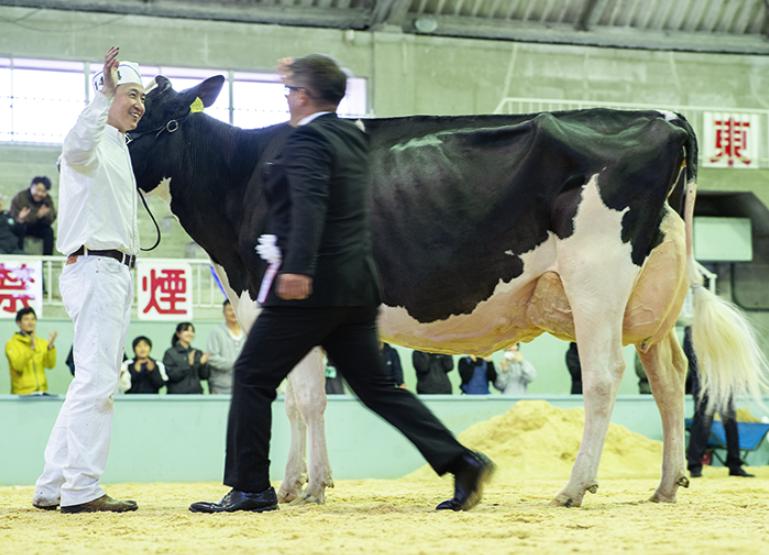
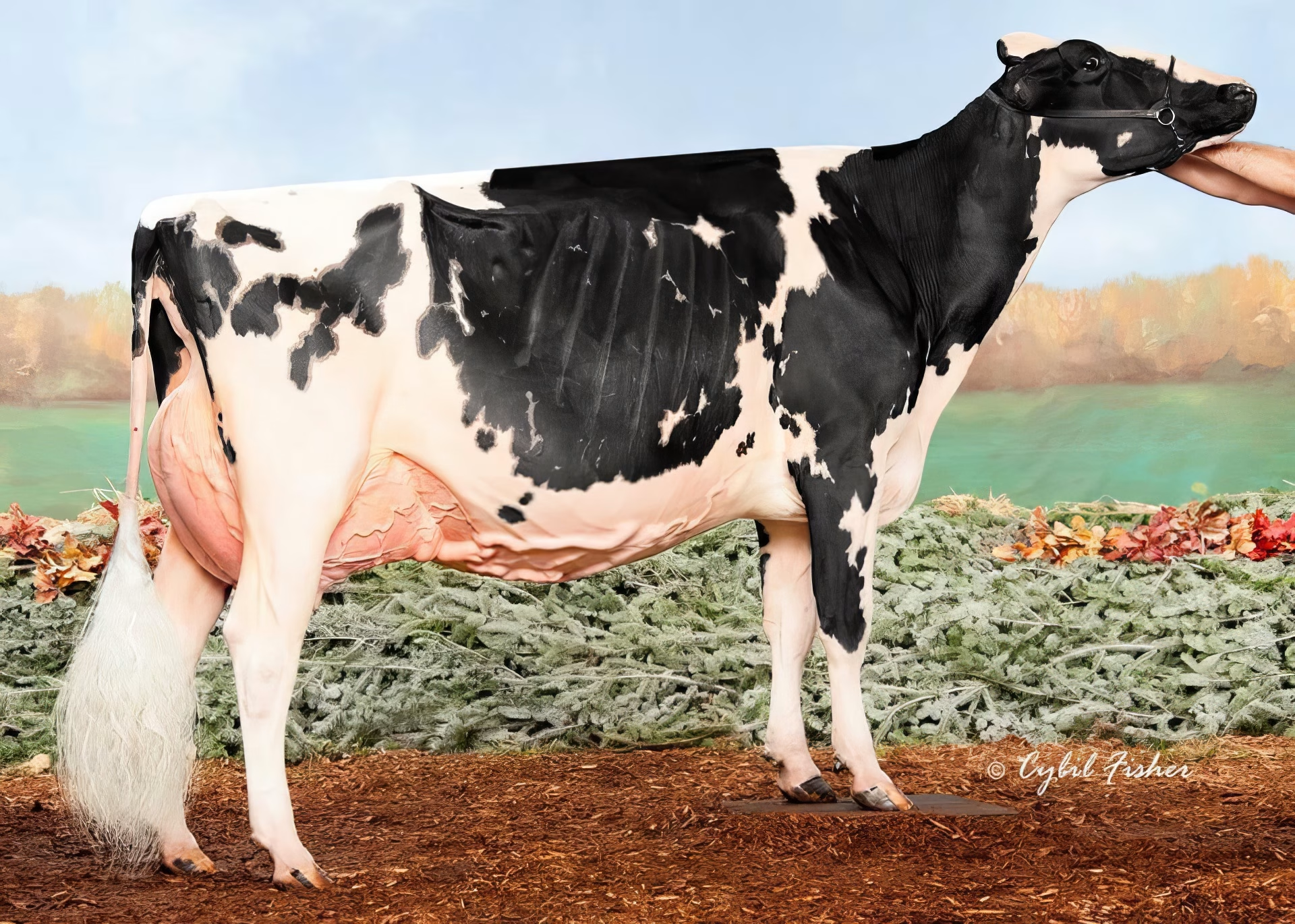
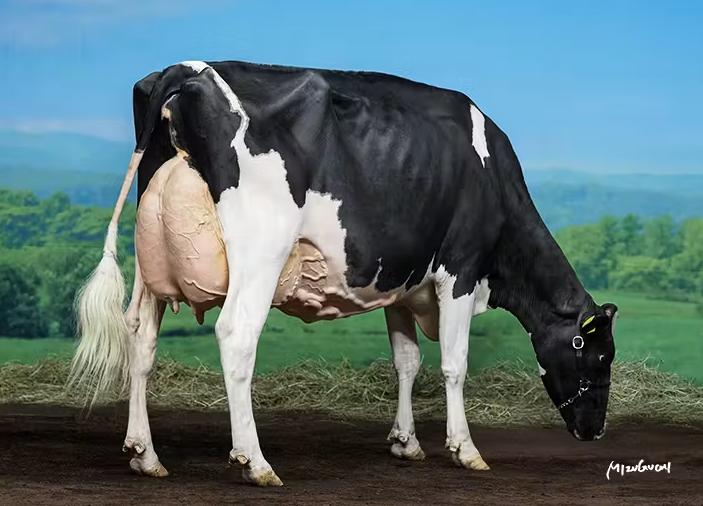
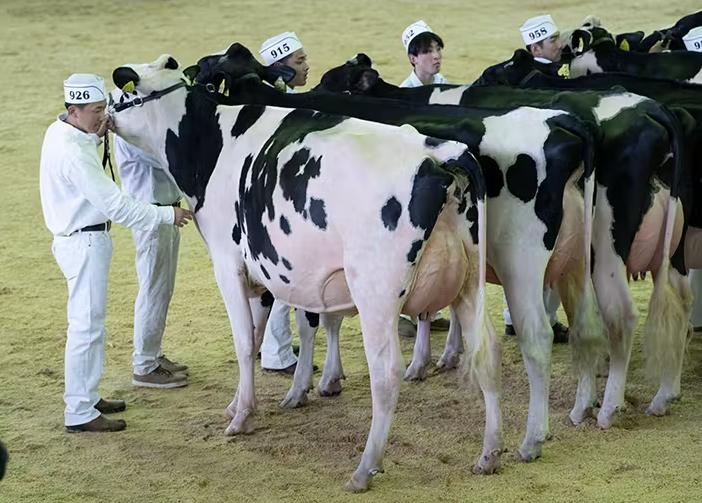

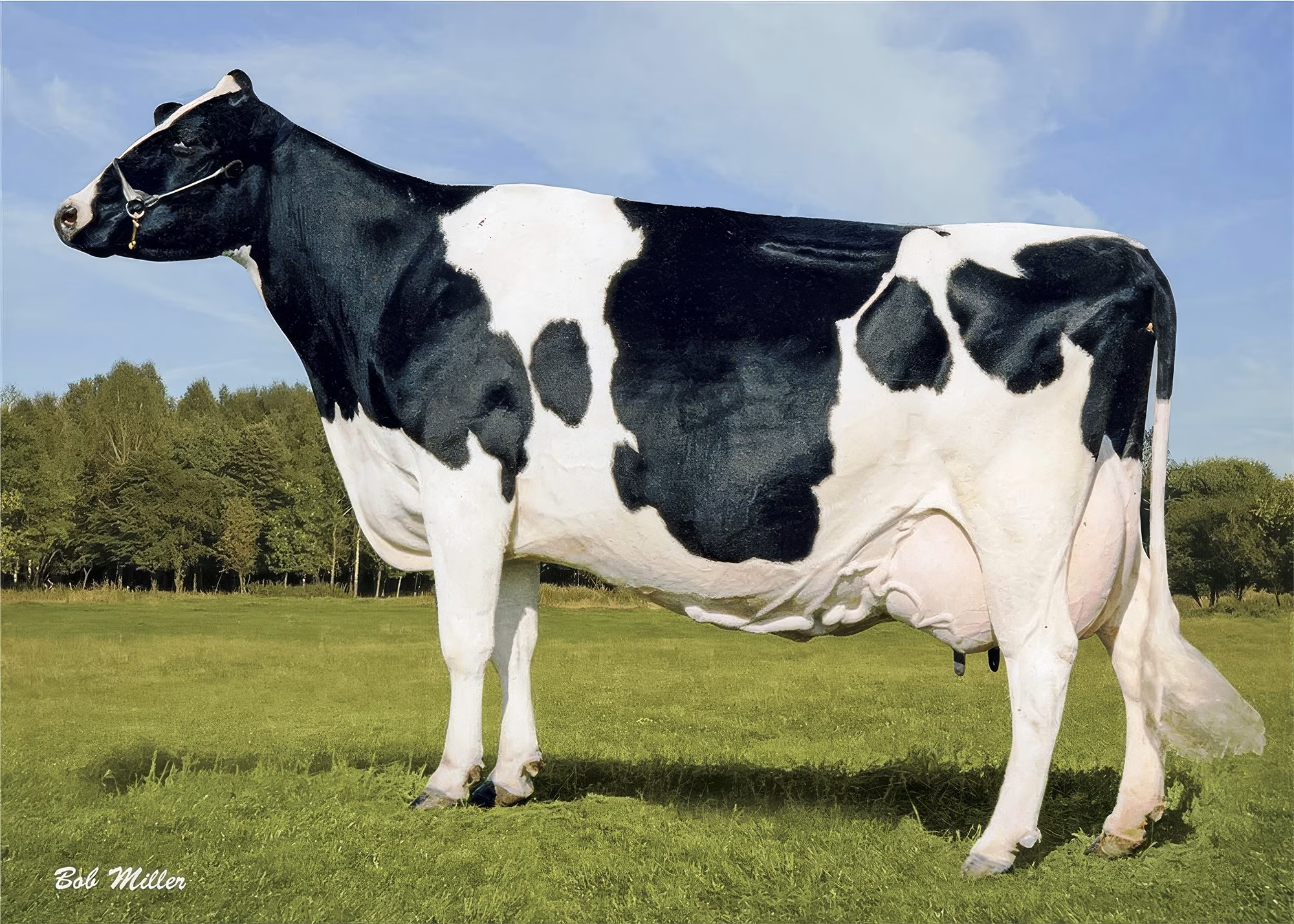
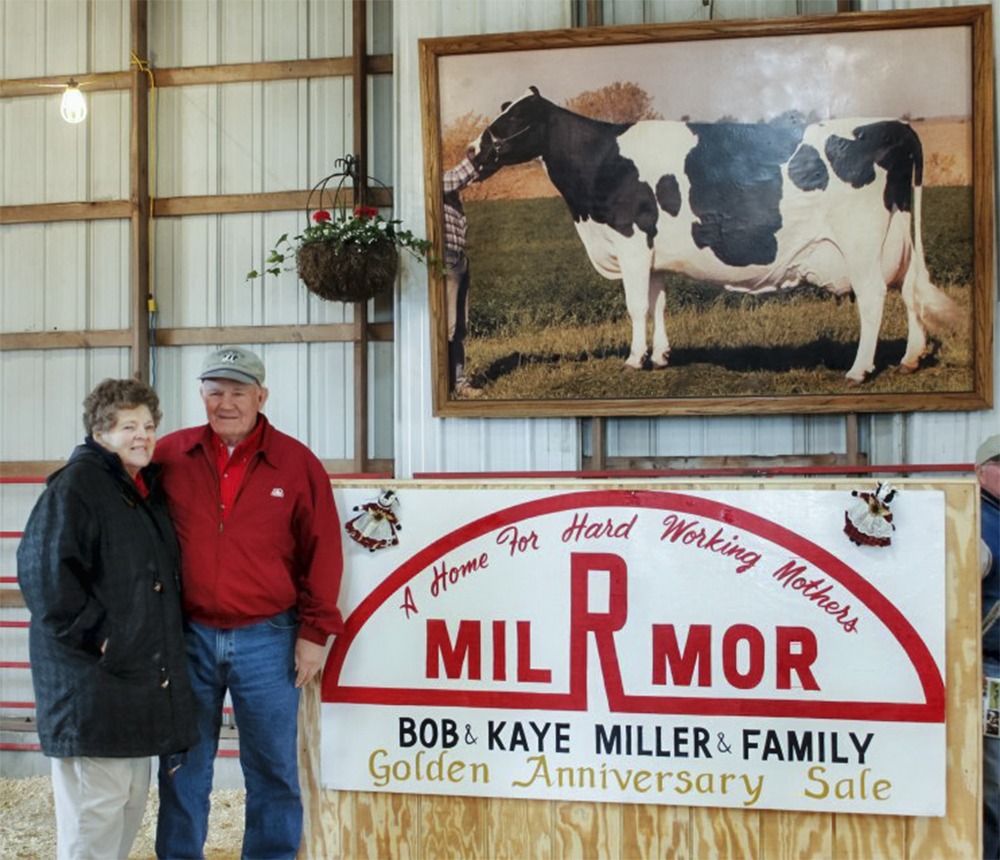
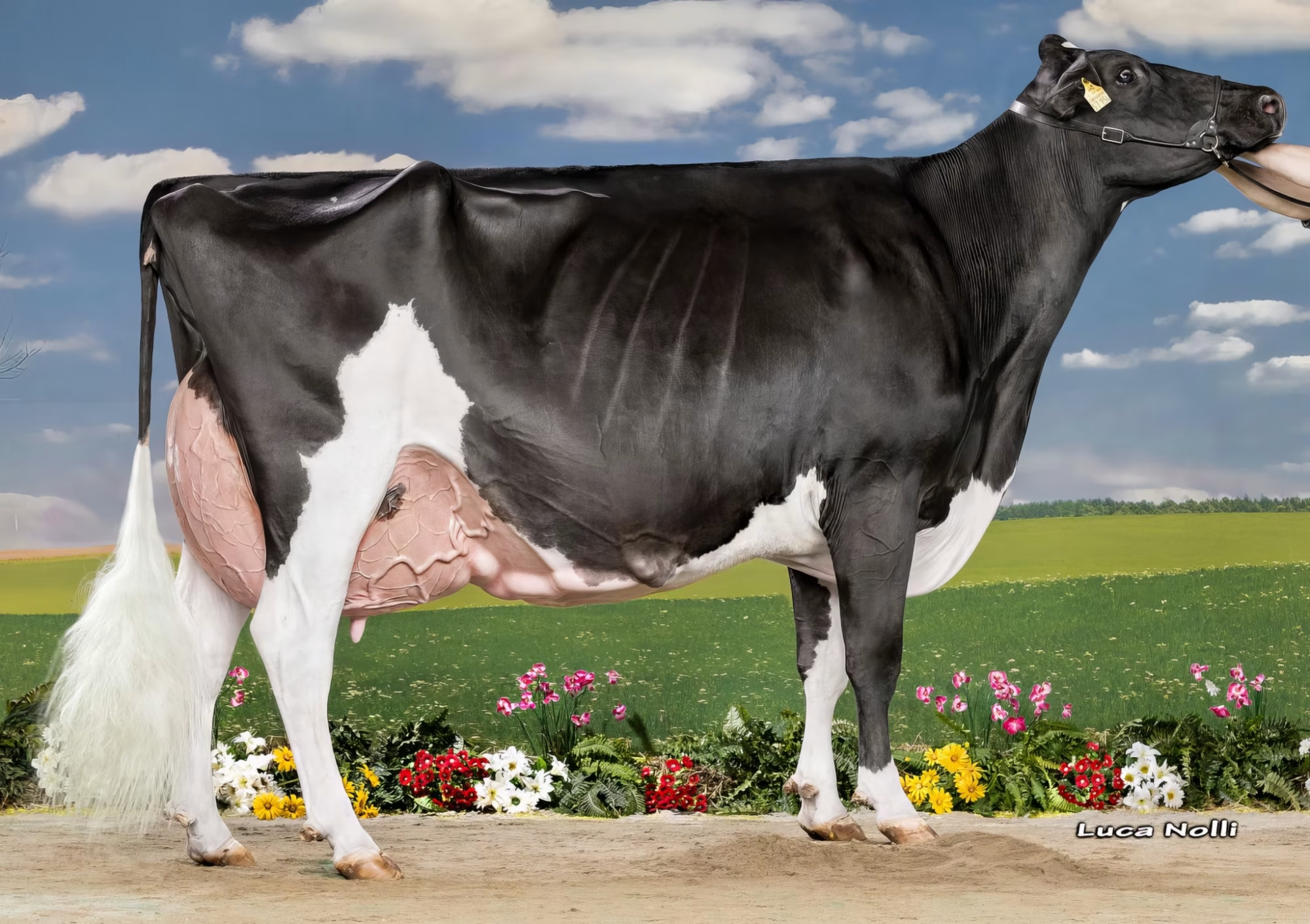
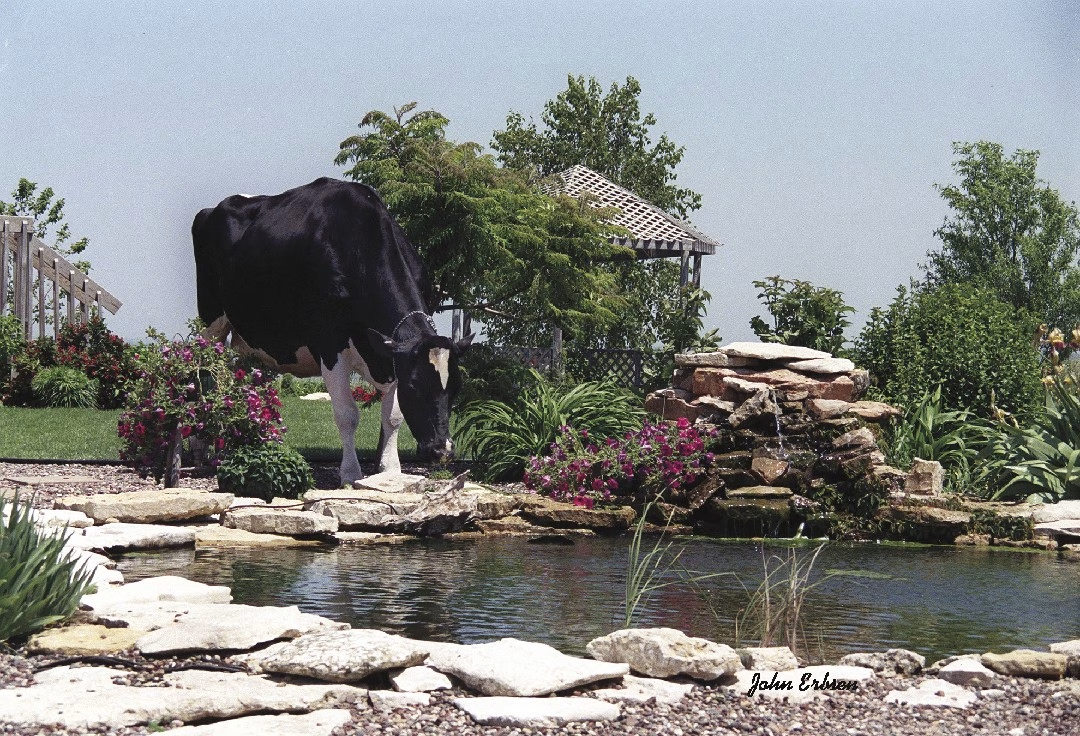
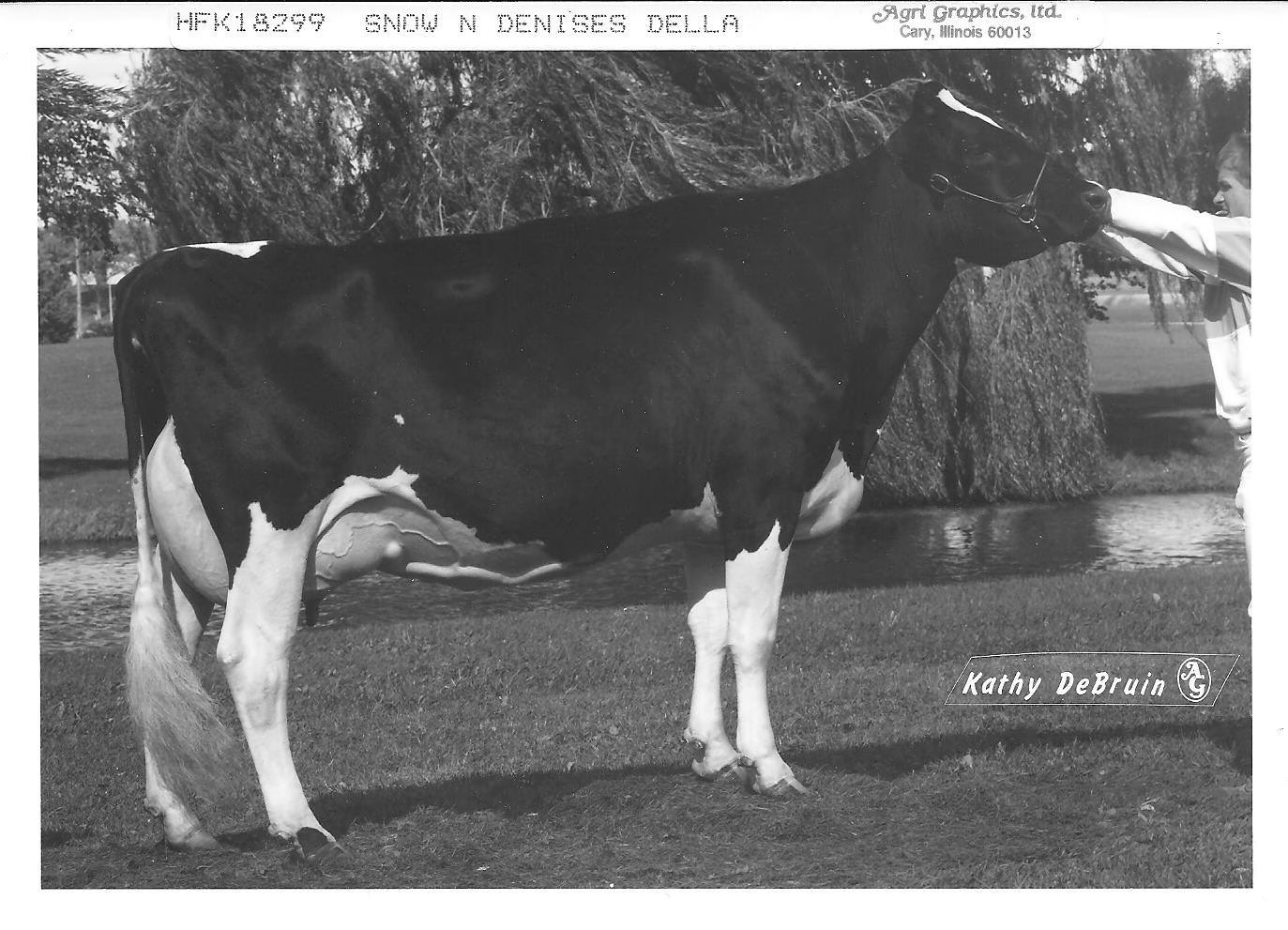
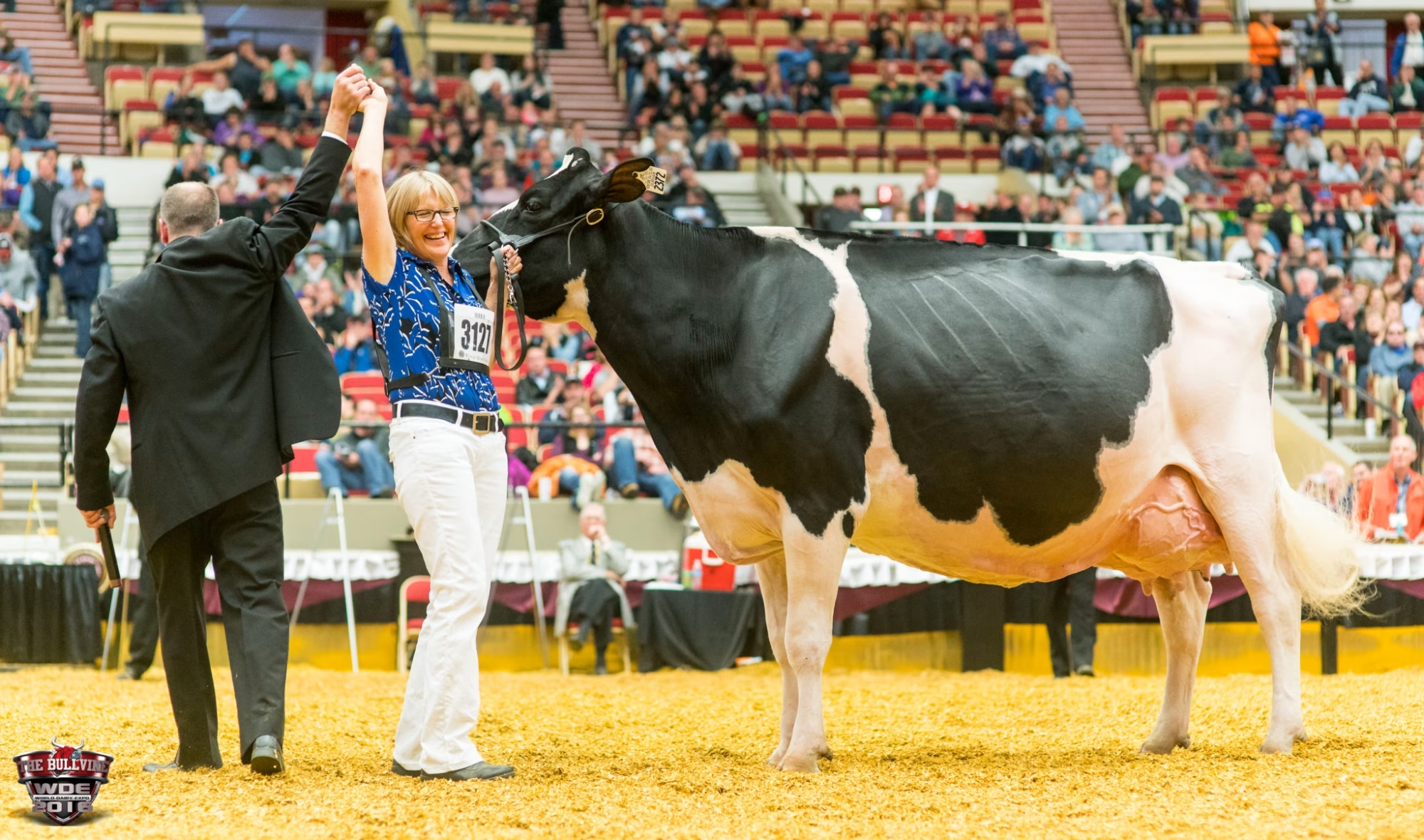
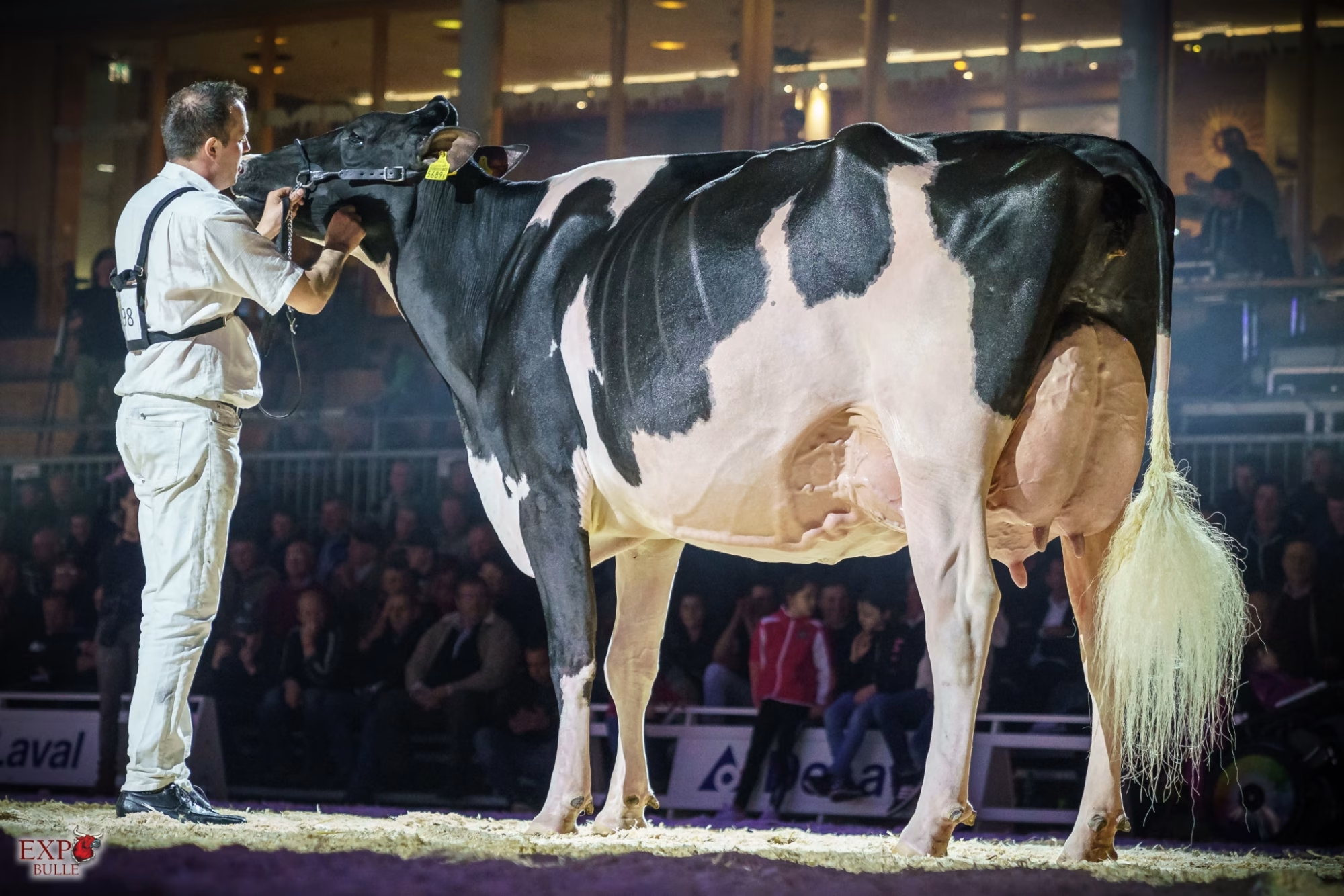
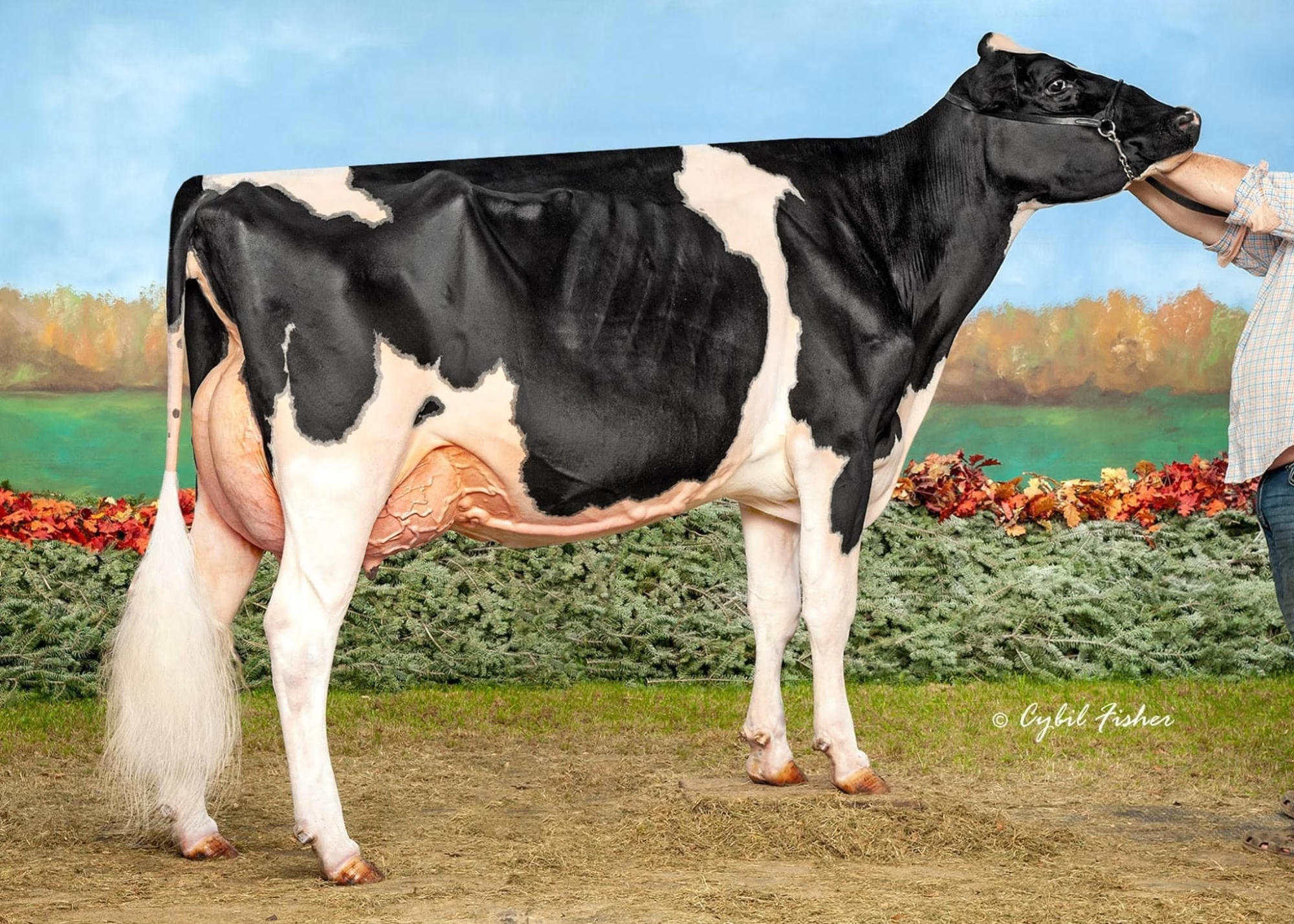
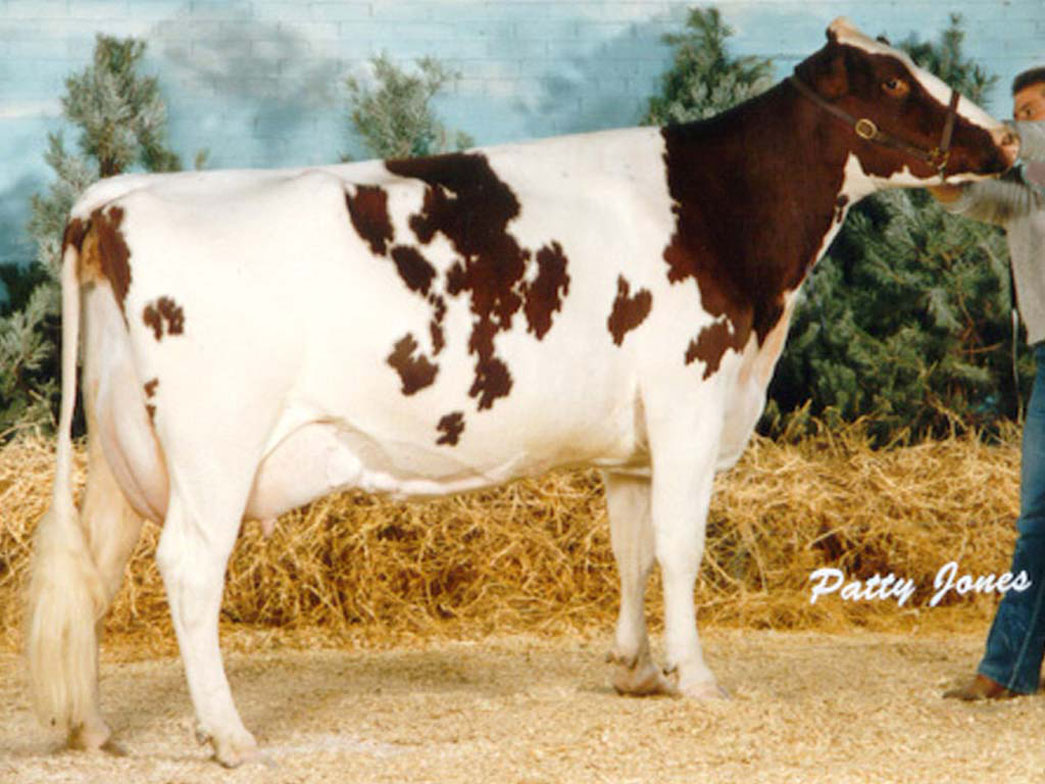
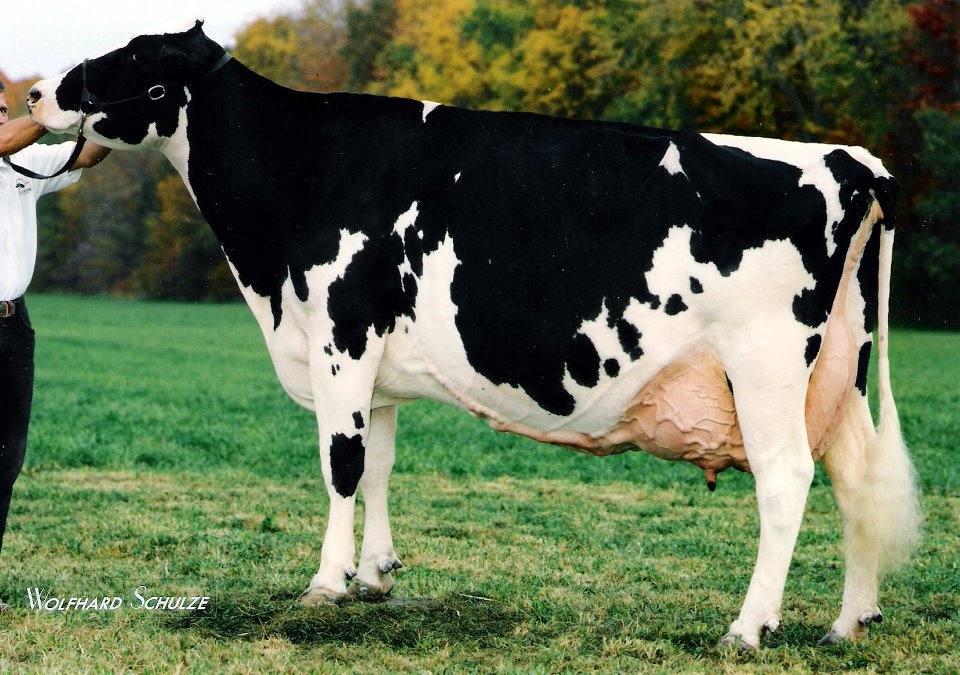

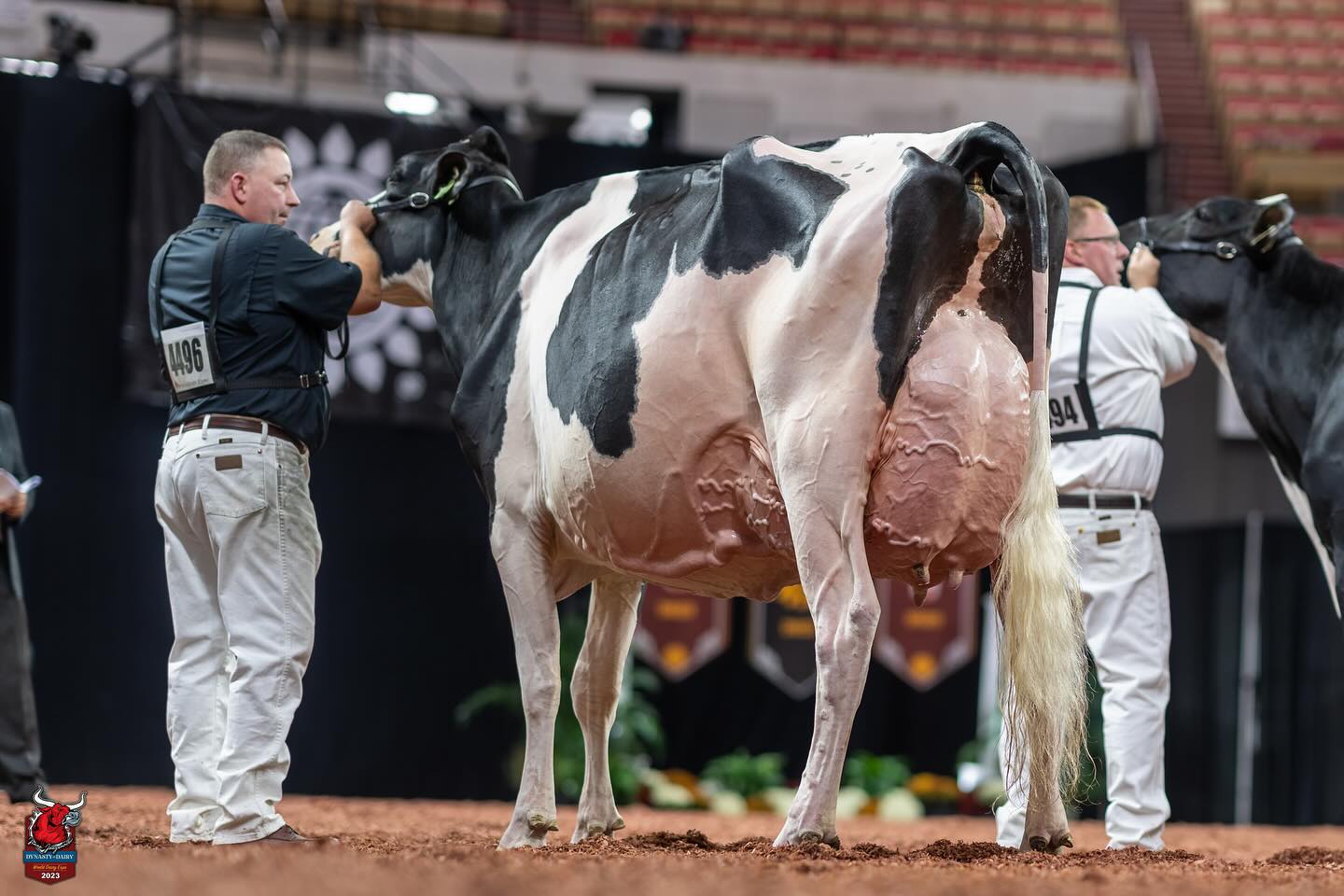
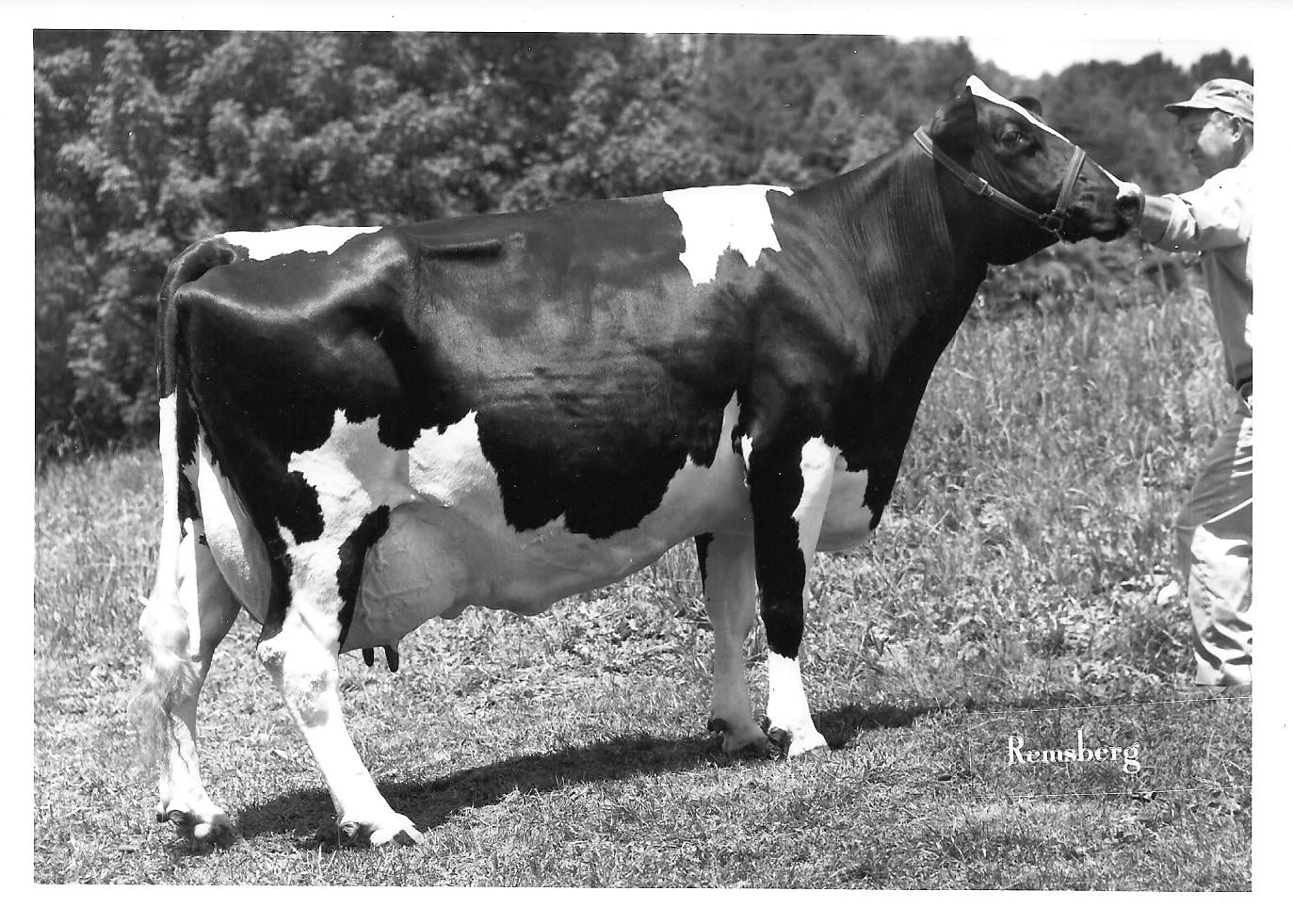
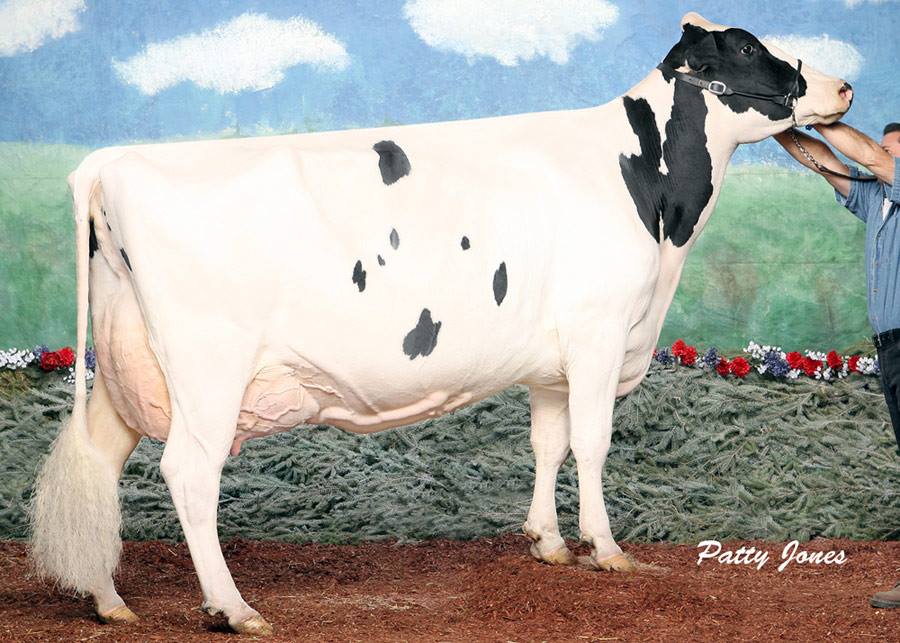
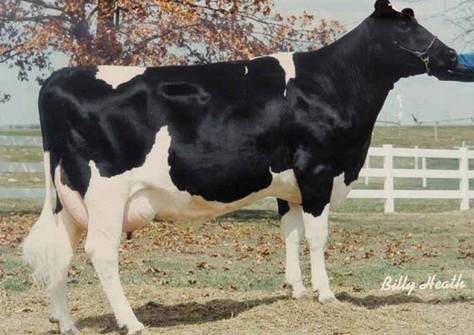
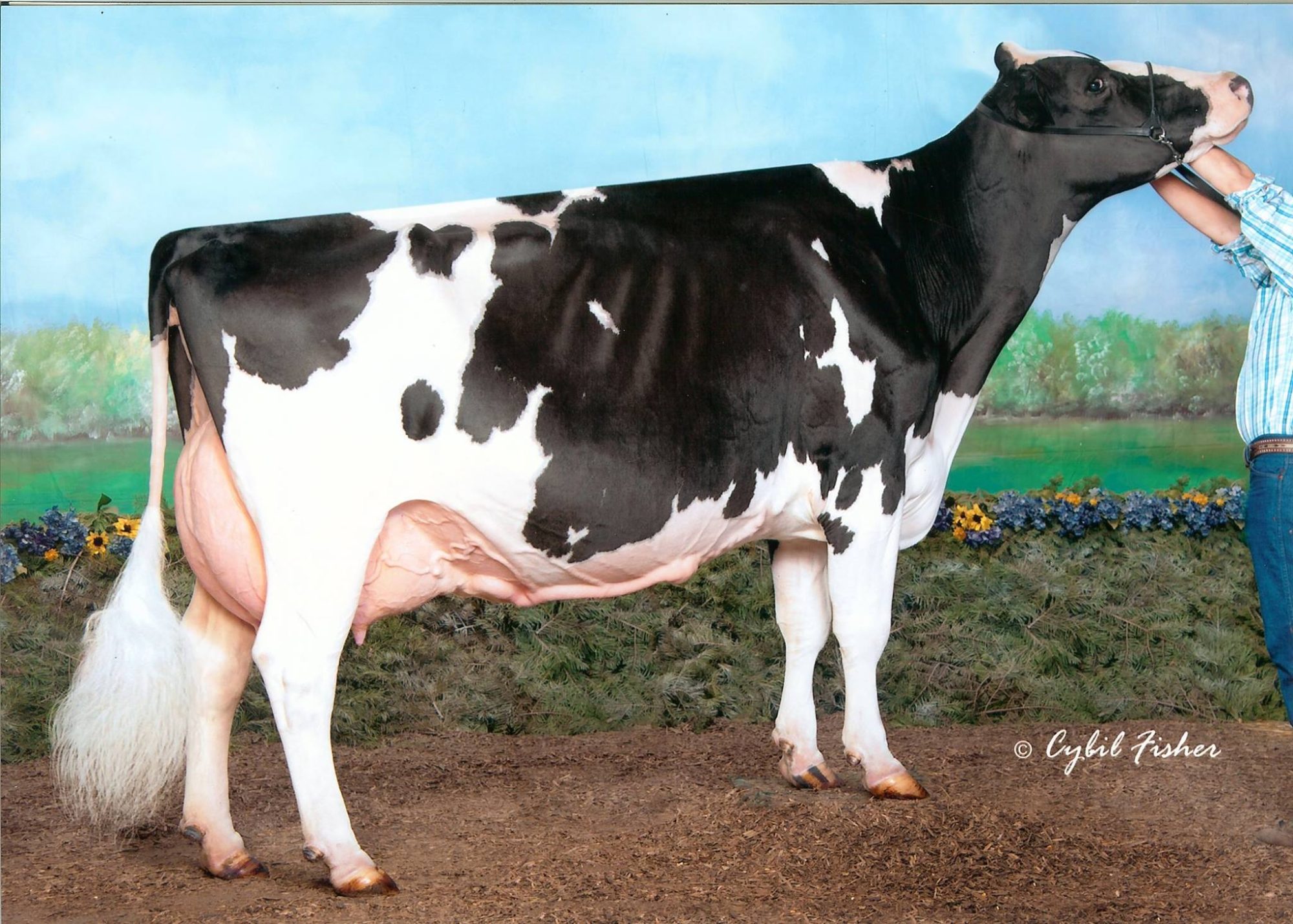
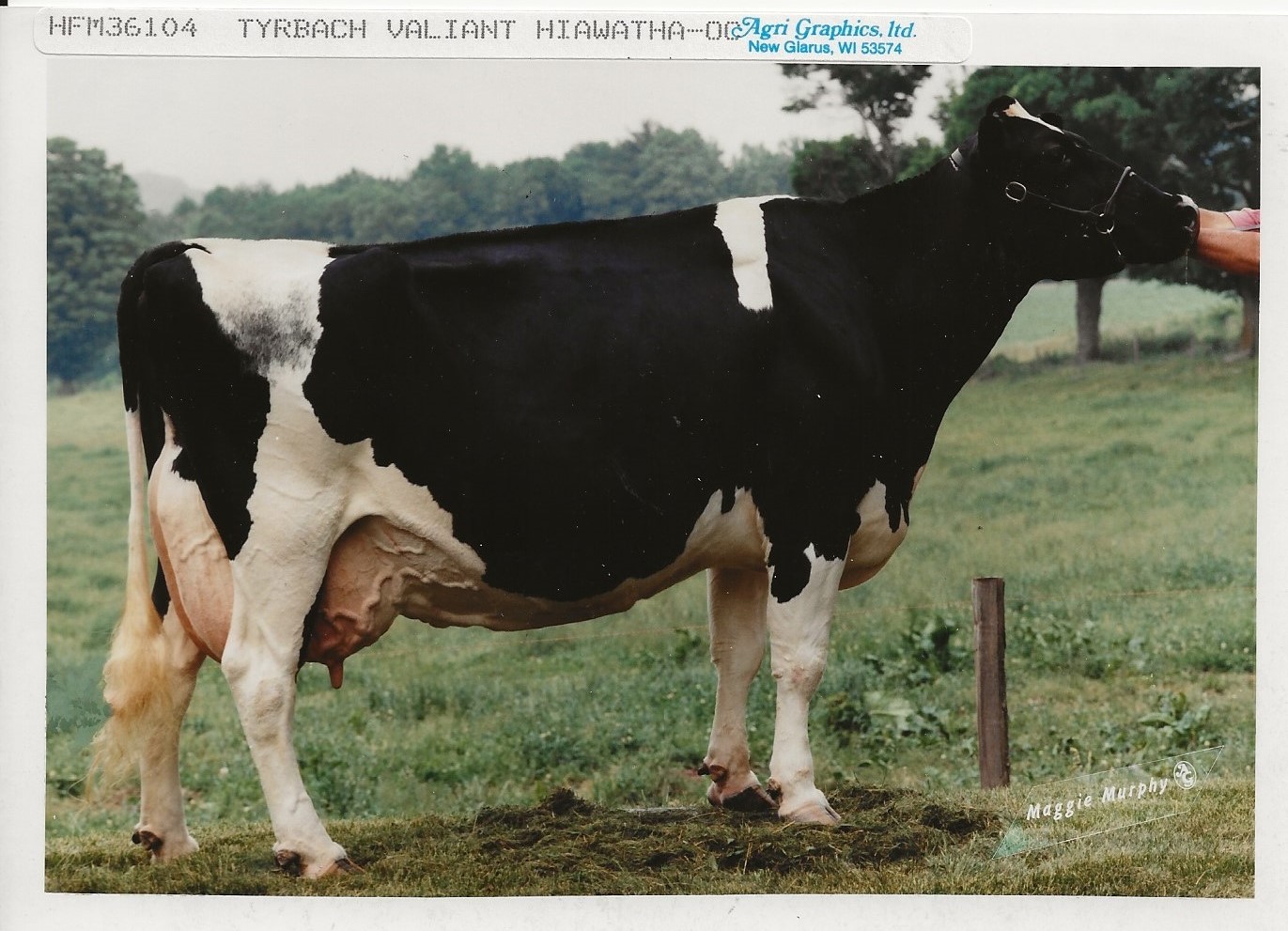
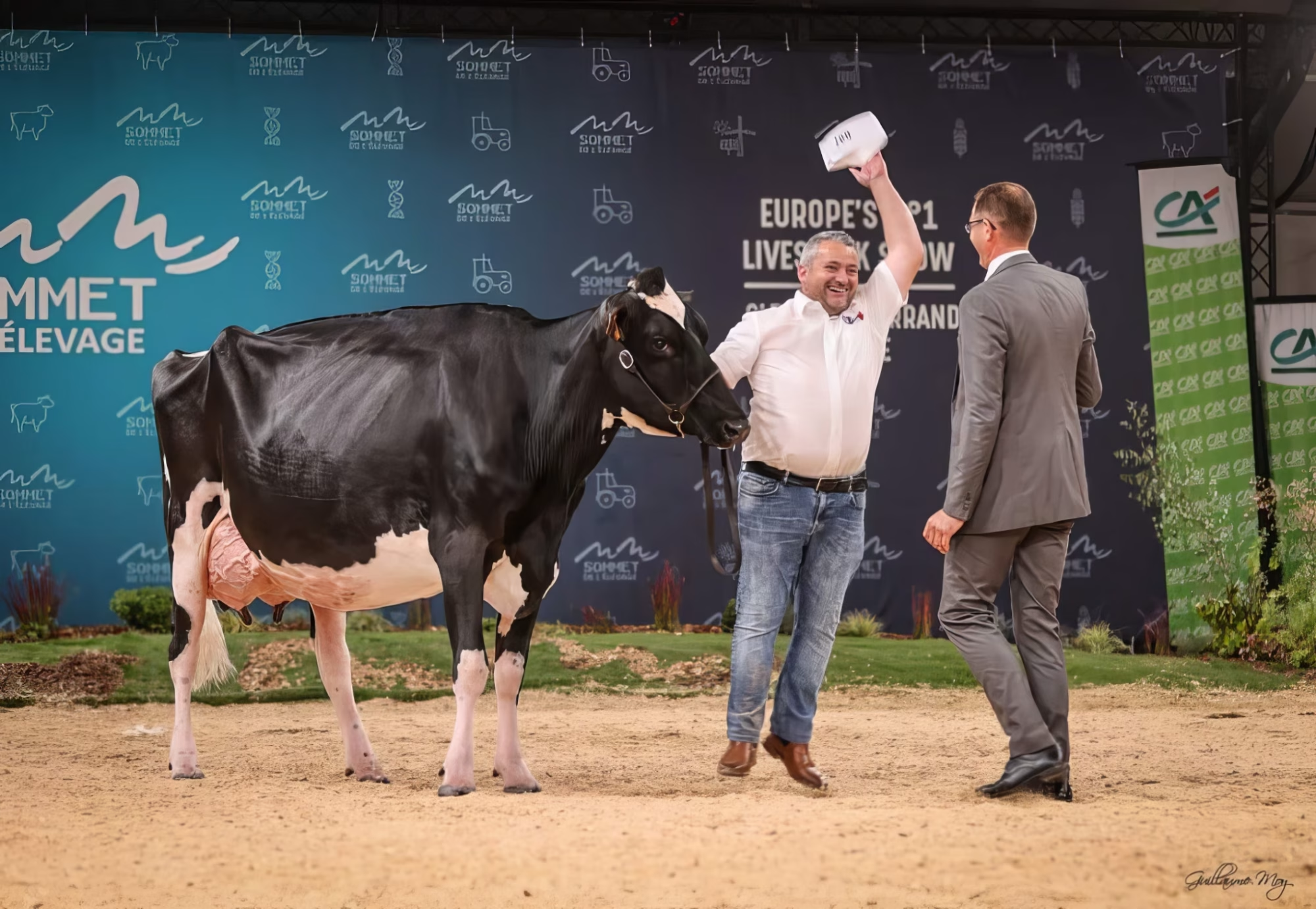


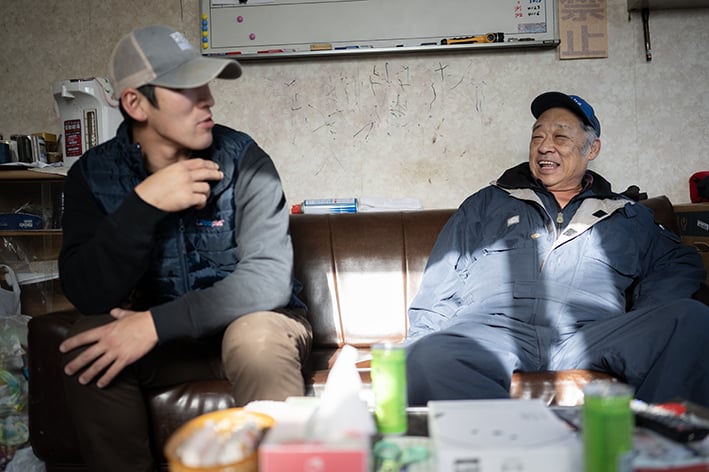
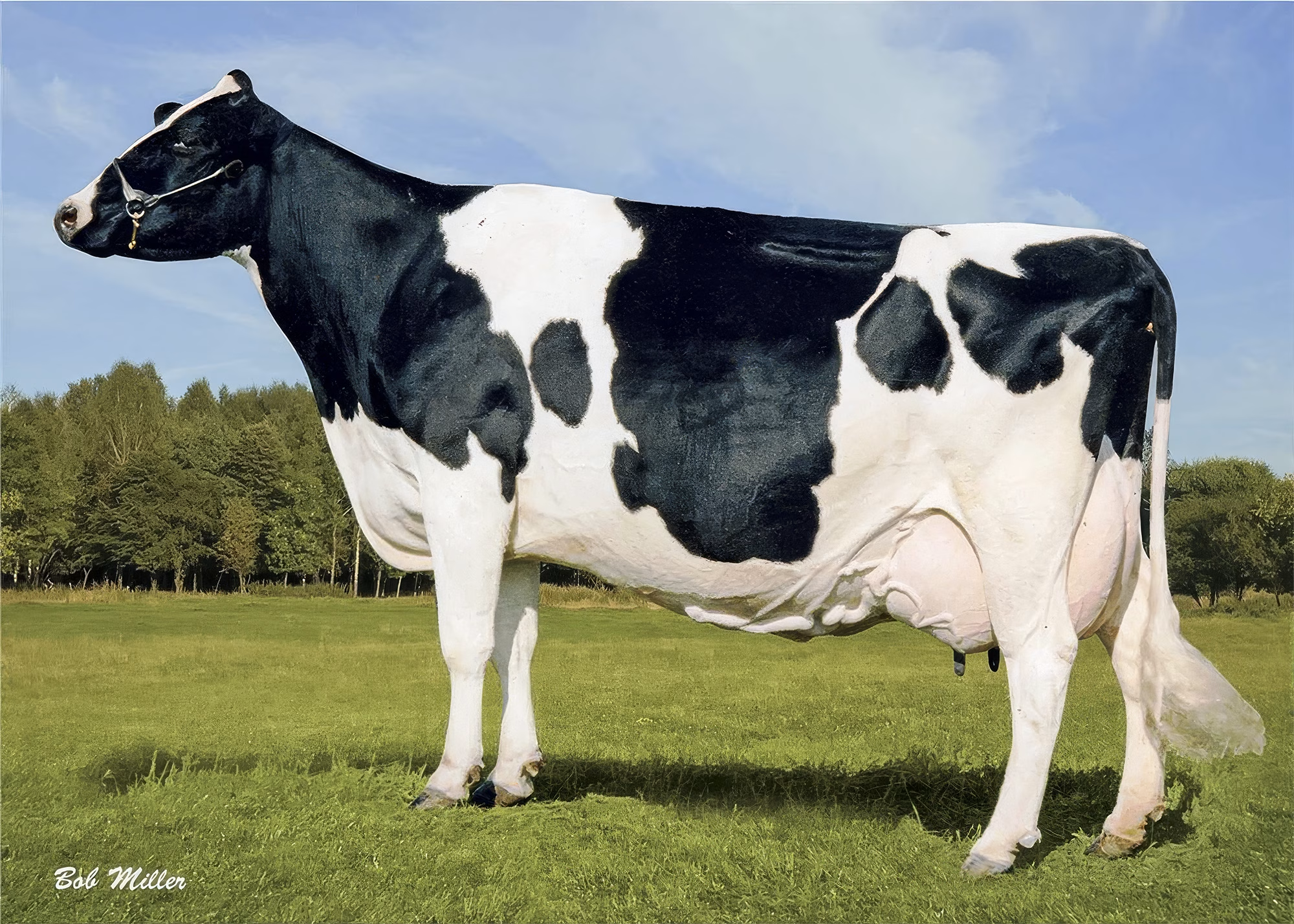

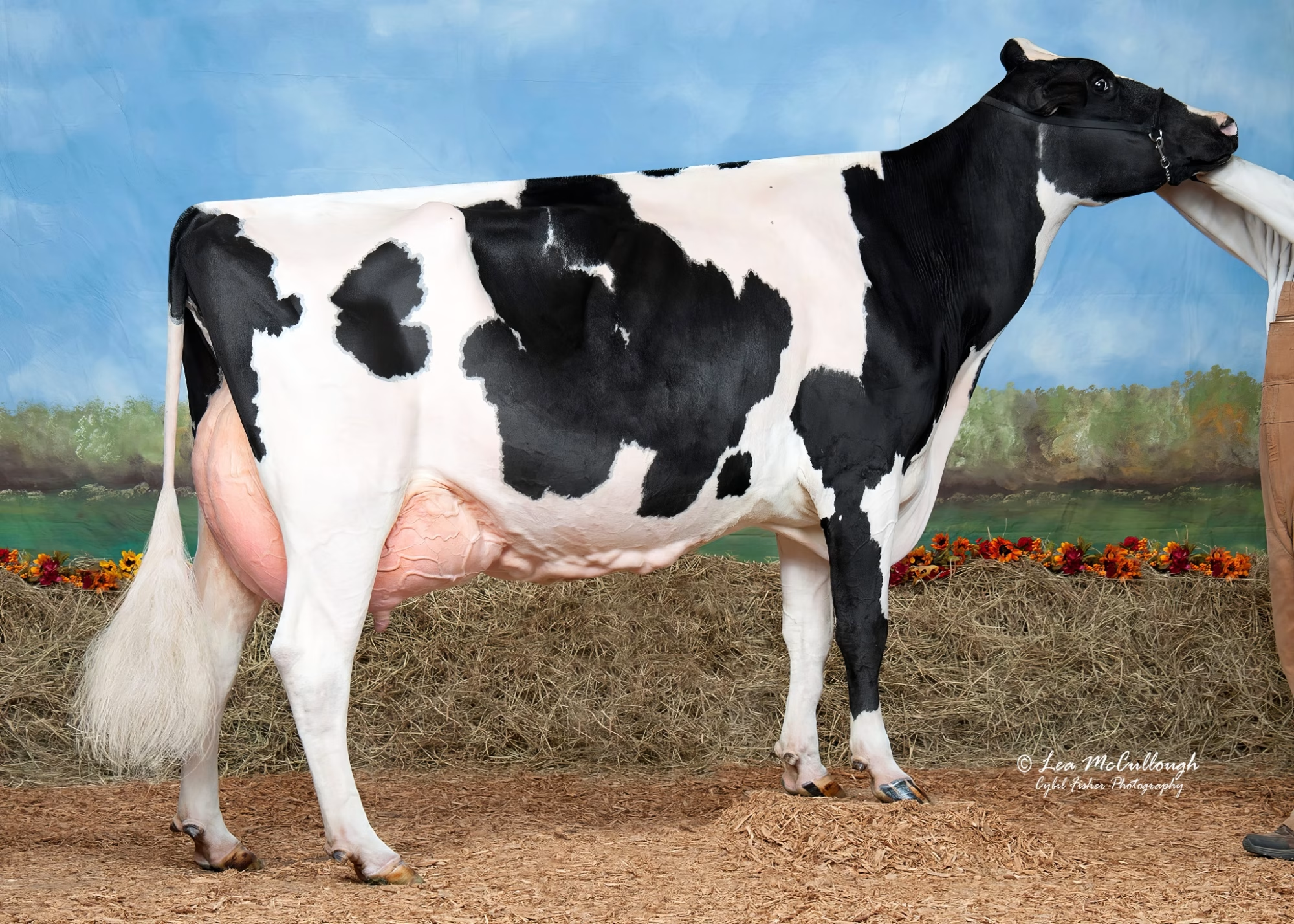
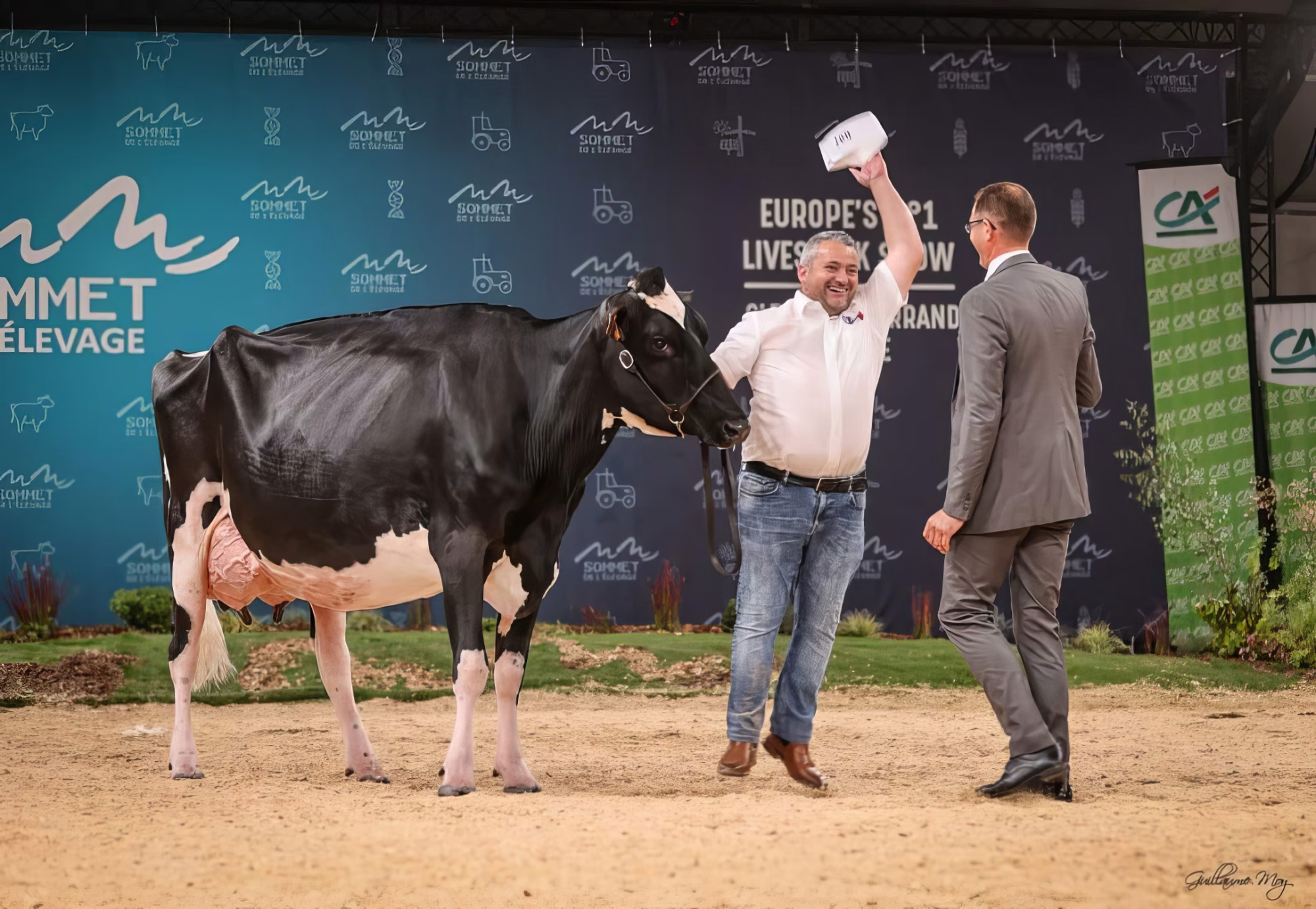
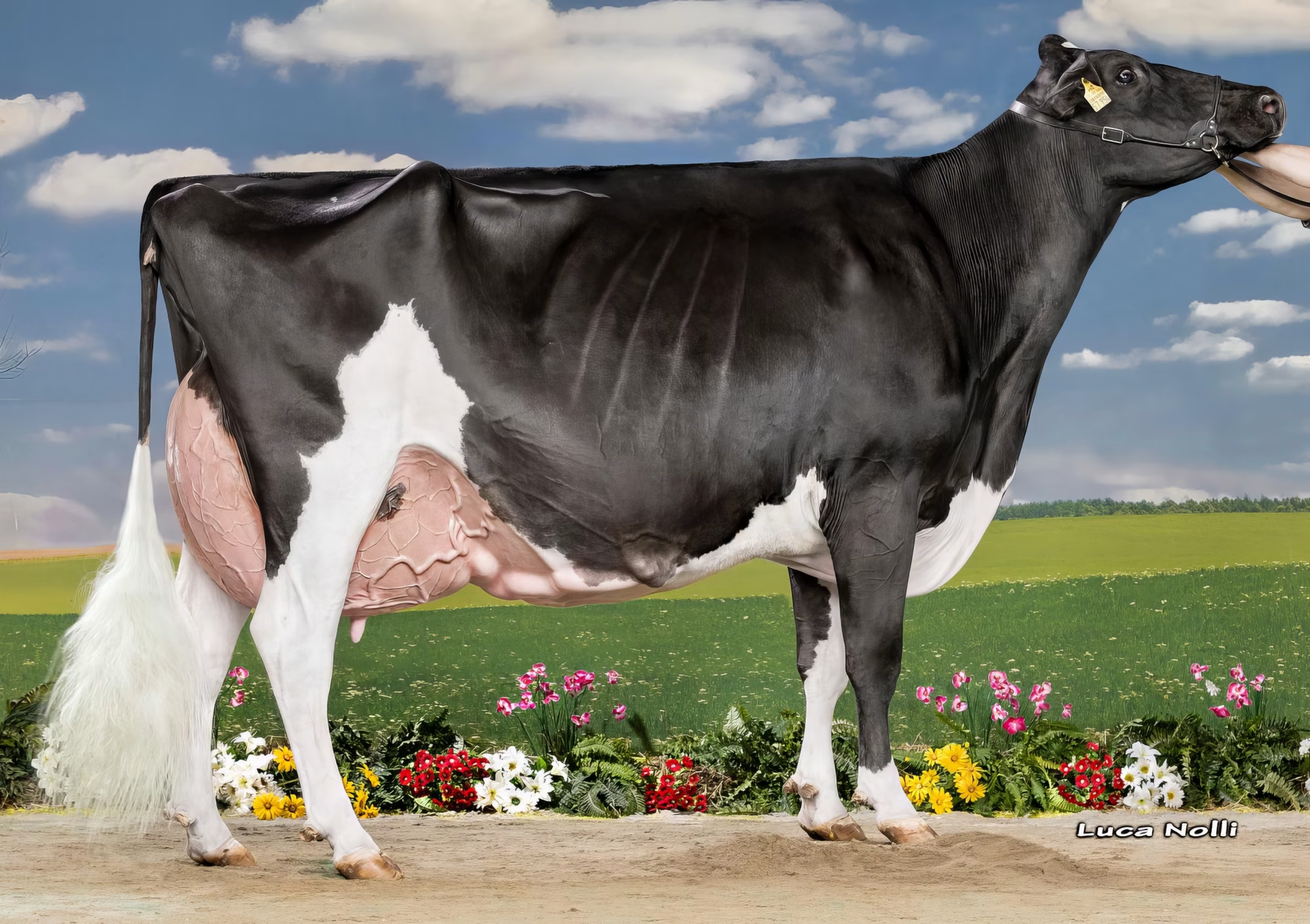
![ho000008724158[1]](https://www.thebullvine.com/wp-content/uploads/2014/07/ho0000087241581-1024x768.jpg)
![54993[1]](https://www.thebullvine.com/wp-content/uploads/2014/07/549931.jpg)