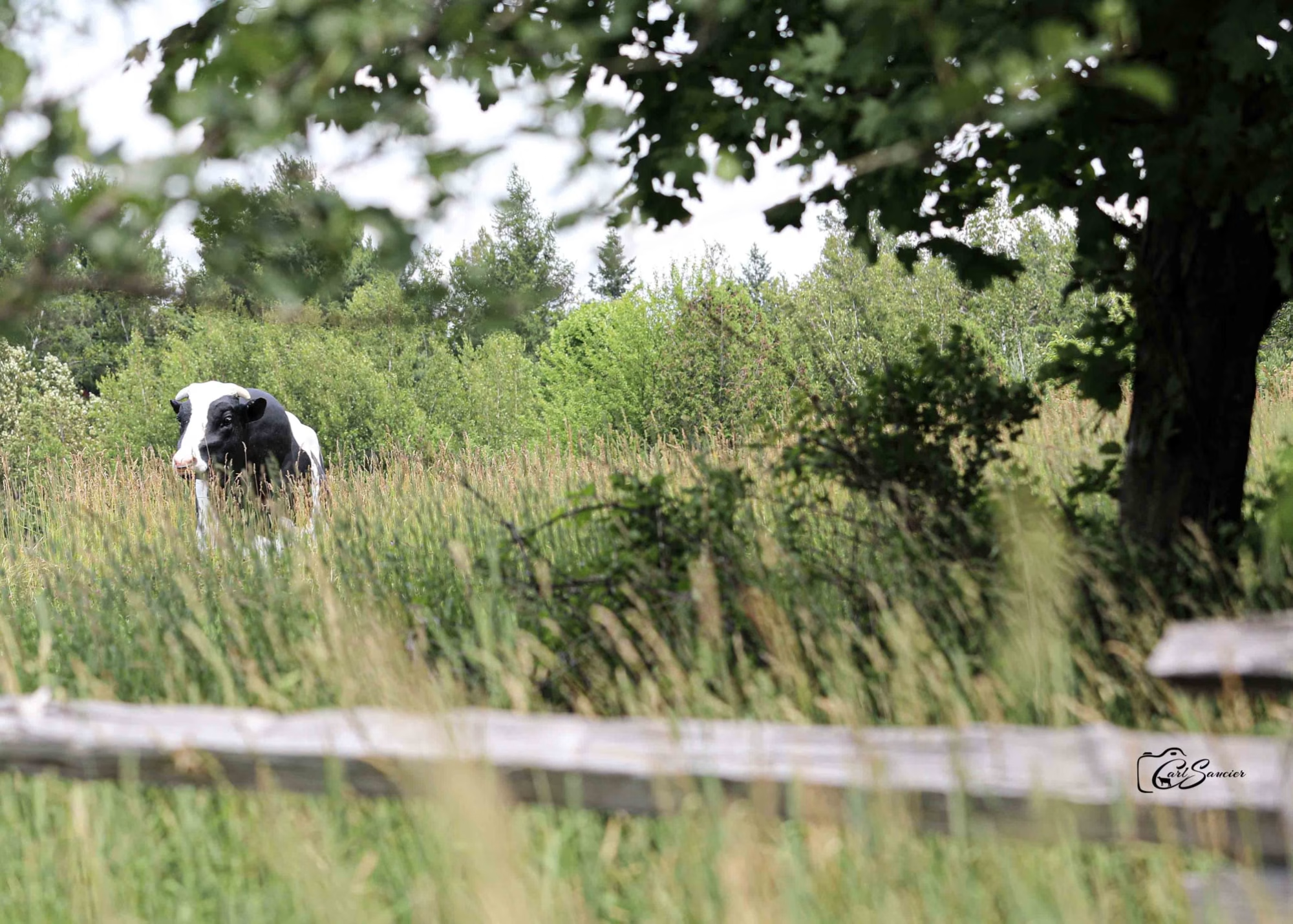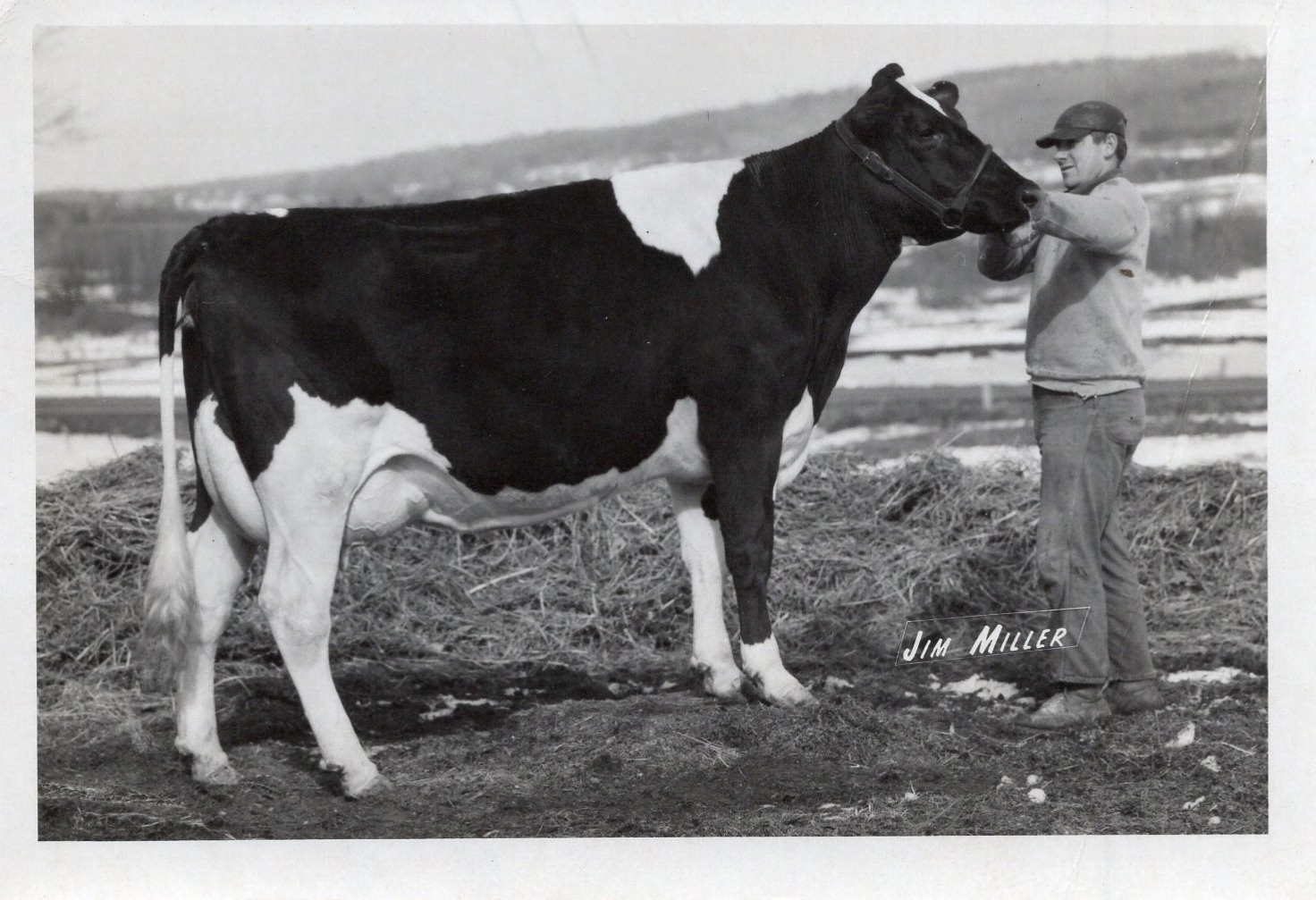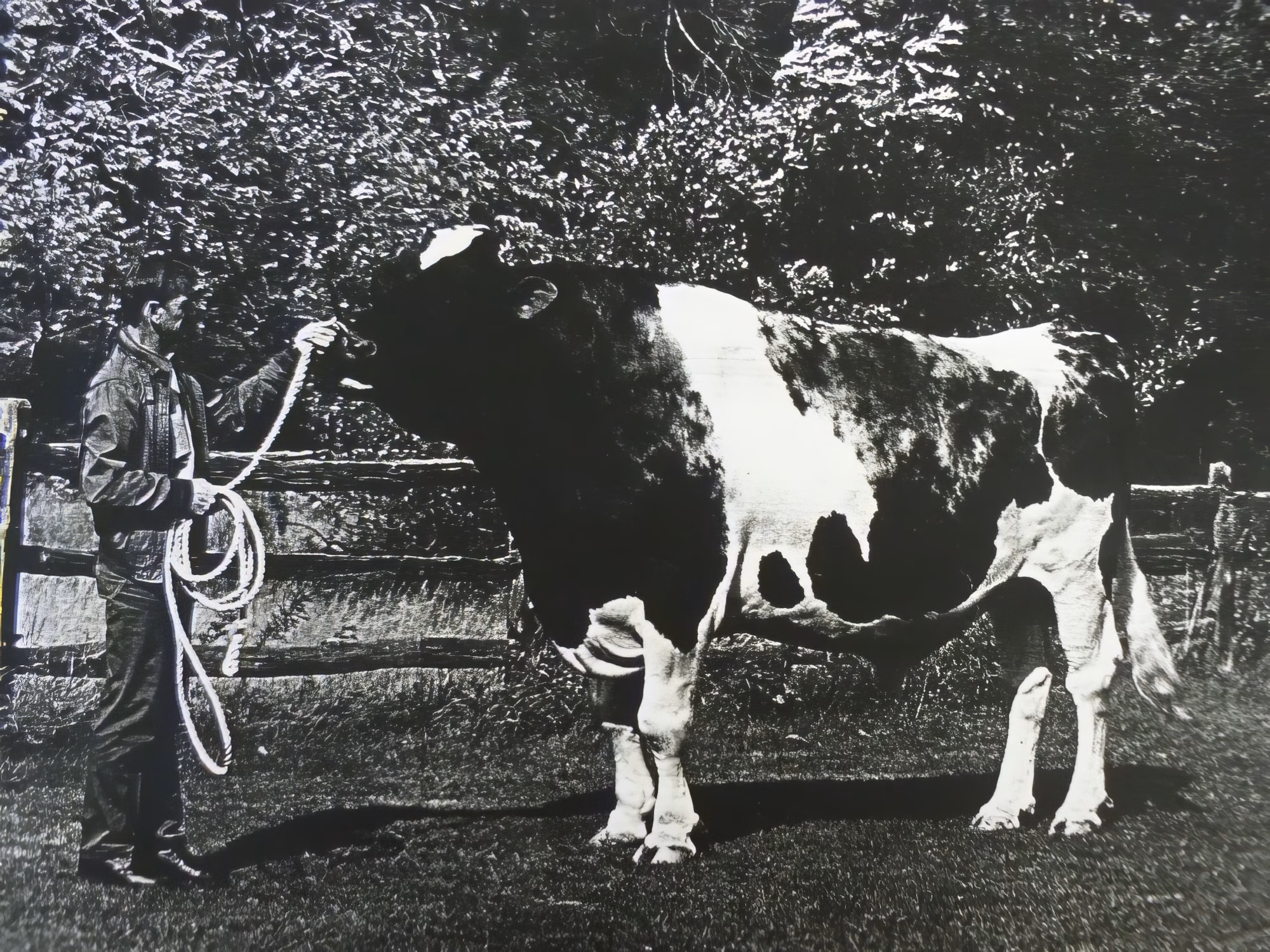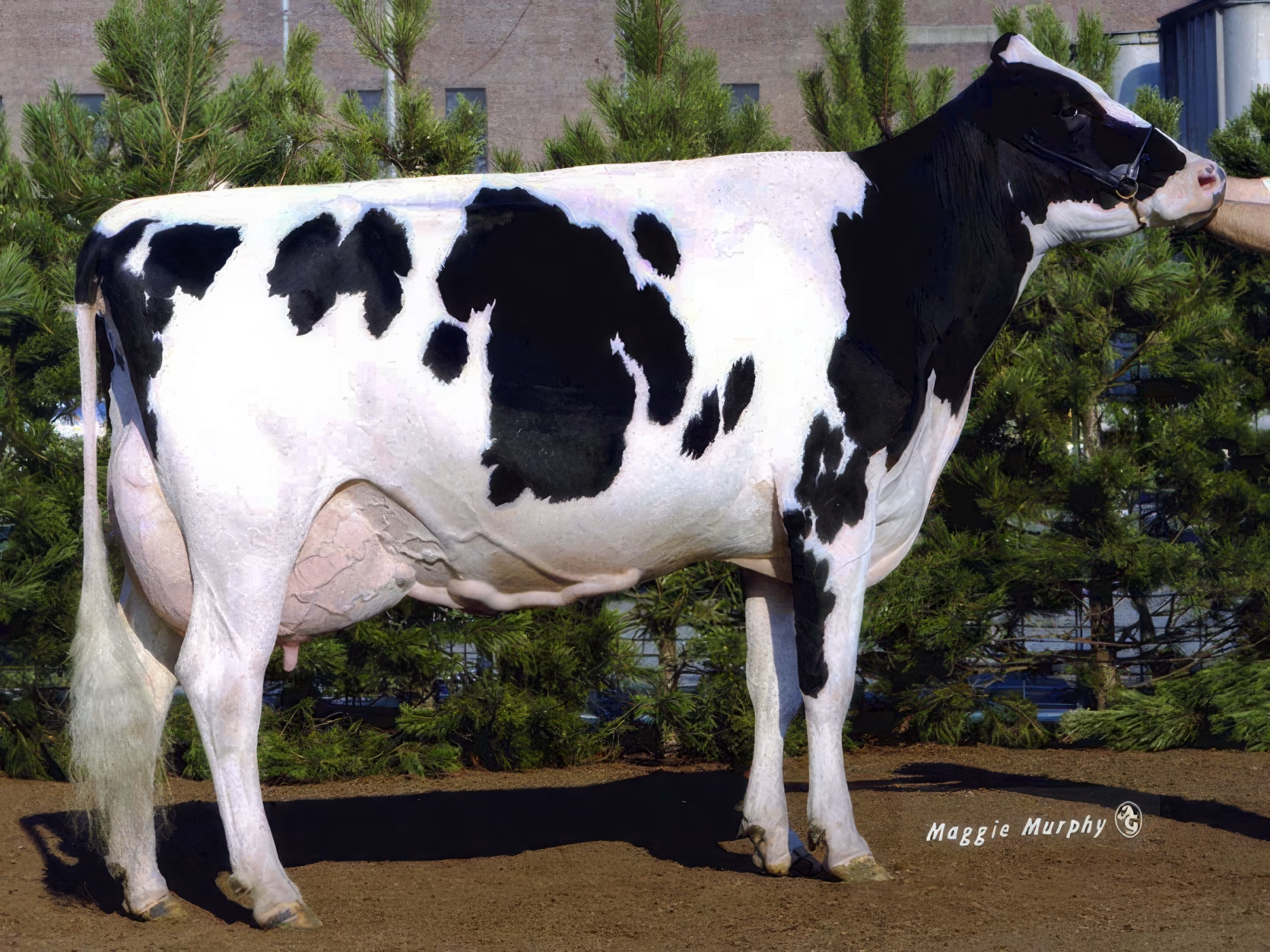


Archive for HANOVERHILL STARBUCK

A Mentor, Six Names and a Board: What Three 2026 Expo Honors Actually Have in Common

A 56-year chain of mentors, a 10,000-cow philosophy, and the boy who couldn’t read the Holstein Journal. Inside the legacies of the 2026 World Dairy Expo honorees.

Corey Geiger was supposed to be judging Ayrshire heifers. It was 1990, the Manitowoc County 4-H team had won the Wisconsin contest, and the kid who was about to start his senior year of high school walked into World Dairy Expo’s ring on the colored shavings and forgot about the heifers. He spent the class looking at the decorations instead. He placed it badly, by his own account, and it never bothered him, because of what he told himself standing there: “I want to be part of the dairy industry the rest of my life.” He said as much decades later to Peggy Coffeen on the Up Level Dairy podcast. Listen closely, and you can hear that the kid in the ring is still running the show. Robert Chicoine’s version of that moment came decades earlier, and he couldn’t even read it. Born on a Quebec dairy farm, he got his first Holstein Journal from a relative who kept purebred cattle. It was in English, and he didn’t know any English at all. So he asked his father to tell him the names of the animals in the pictures, and he remembered them. “I don’t know why,” he told Coffeen in an interview published August 25. By his account, he’d seen every issue since.
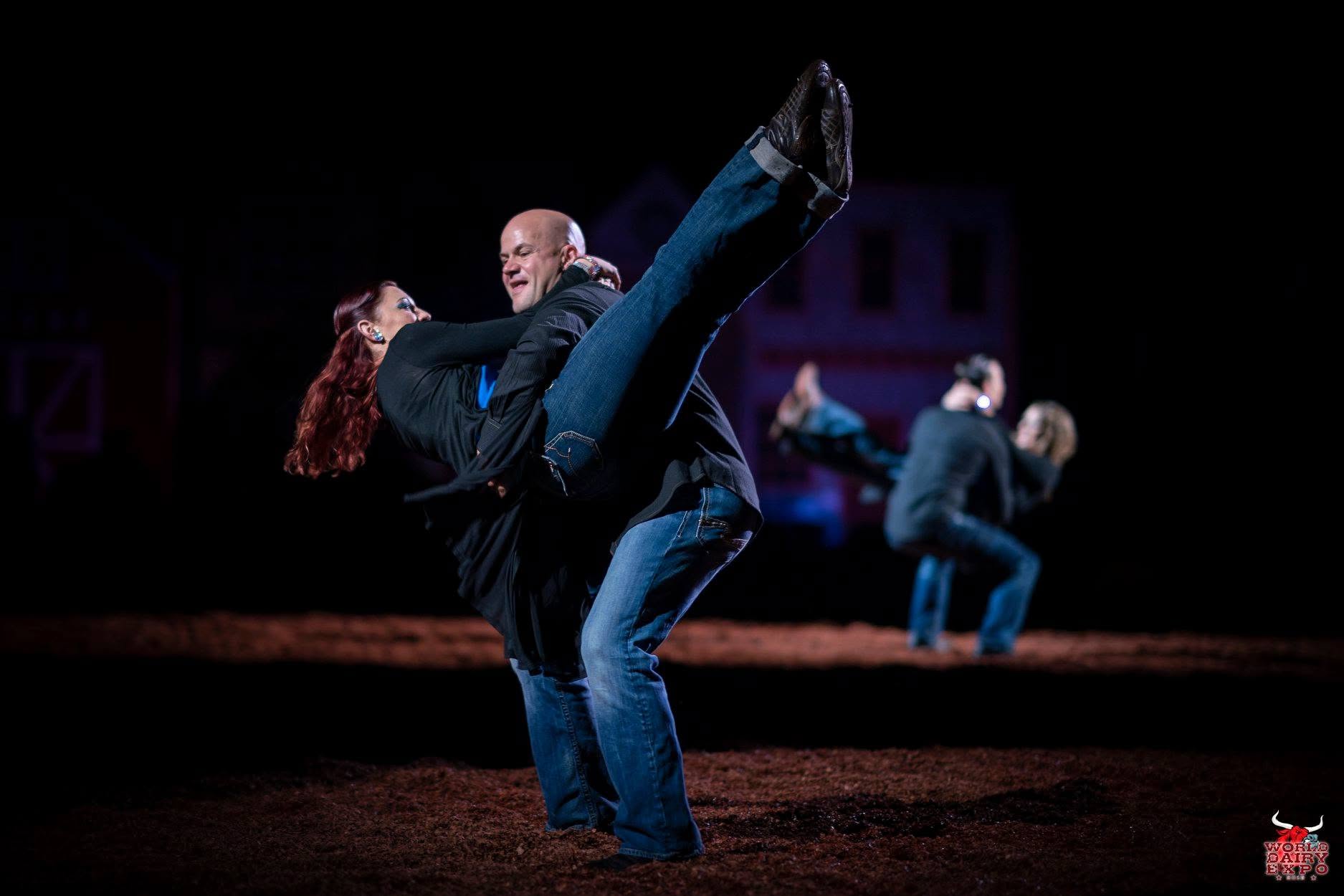
Same ring, same colored shavings, 28 years later: Corey Geiger dances with his wife, Krista, during World Dairy Expo’s 2018 Supreme Champion show. This time, he wasn’t looking at the decorations.

Neither man had any idea what those moments would turn into. This September, World Dairy Expo is naming Geiger its Industry Person of the Year, Oakfield Corners Dairy its Dairy Producers of the Year, and Chicoine, the boy who memorized cow names he couldn’t read, its International Person of the Year.

Ask Geiger who got him here and the list runs long. Bill Borgwardt of Sunnyside Farms watched a teenager read his placings off a clipboard and told him to put it down: “Corey, you know cows. You can tell a good story… tell me a story about those four cows.” Geiger was “nervous as heck,” and he’s been telling stories ever since. Then came the Hoard’s Dairyman crew: Bill Knox, Gene Meyer, Ewing Row and Steve Larson. By Geiger’s count, they had 120 years of editorial experience between them when he walked in. “And I had one day.”

Four editors, one chair

Here’s what a Bullvine check of Expo’s records turned up. Knox, Meyer, Row and Larson each held the managing editor’s chair at Hoard’s, according to the magazine’s own chronology. Geiger later held it for 14 of his nearly 30 years there, per Expo’s citation. Three of those four mentors are already on Expo’s Industry Person of the Year list, the same award Geiger receives this month.

That’s a 56-year span of award dates, from Knox to Geiger. It doesn’t prove mentorship causes awards, and it isn’t a record of continuous teaching. It does make “somebody handed this to me first” a lot more concrete than the usual acceptance-speech line.

Six names, one award

Oakfield’s honor makes the same point in a different way: it names six people, not one. Jonathan and Alicia Lamb, Matthew and Kendra Lamb, Jim Veazey and Janette Veazey-Post. A championship photo fits one cow and one halter, and running 10,000-plus cows across two states takes a lot more hands than that. Add Chicoine, who made sure his board got credit for the idea behind Boviteq, and it’s three for three: nobody here got here alone, and nobody’s keeping the credit to themselves.
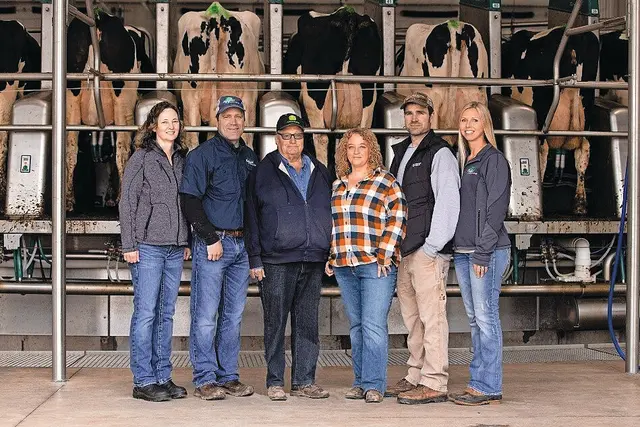
Six names, no show halter. Oakfield Corners’ 2026 Dairy Producers of the Year pose in the parlor, not the ring.

Everyone gets recognized September 29 at Expo’s Recognition Awards Reception and Banquet: social hour at 6, dinner at 7, The Tanbark. For Chicoine, it’s posthumous. Semex announced his death on September 15, three weeks after Up Level Dairy published his interview.

That means he got to tell his own story, in his own words, before anyone else had to tell it for him. A citation tells you what someone accomplished. An interview tells you what it felt like before anyone knew it would matter.

The kid with a breeding budget

Before the judging contest, there was a checking account. In the summer of 1986, the year Geiger started eighth grade, his dad walked him into the local bank and opened one. “You need to learn about money,” he told him. Geiger still has that account, through several bank mergers.

Then came the part that mattered to a cattle-obsessed kid. His dad gave him a budget to pick the bulls and mate the cows. “It’s your baby.” Geiger remembers walking the AI rep into the house so his mom could write the check, and the first couple of times, he said, they wouldn’t even put the semen in the tank because they weren’t sure the story was true. That’s the real origin story of a dairy economist: not the diploma, but the moment his father trusted him with a decision that cost money.

The degrees came later, in dairy science and ag economics at UW–Madison. So did the red ink. During a 1994 summer internship at an AI cooperative, his first articles came back covered in corrections, and his first thought was “Oh, I’m not a good writer.” Someone there told him otherwise: “No, you’re great. These stories will resonate with farmers. You just need to brush up on your grammar.” Word got to Bill Knox, and Hoard’s hired Geiger as an associate 15 months before he graduated. A page of corrections doesn’t crush a young writer when somebody makes clear the work underneath is worth fixing.

Making the numbers mean something
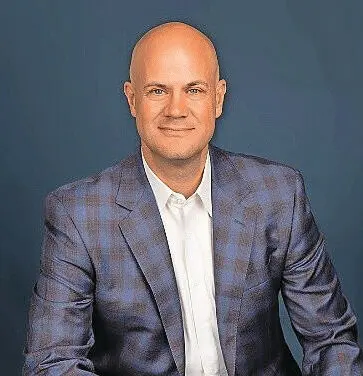
Corey Geiger, Expo’s 2026 Industry Person of the Year, spent 14 years as managing editor at Hoard’s Dairyman. At CoBank, the number he’s chasing now is the economic value of genetics.

At Hoard’s, Geiger learned from people with decades on him. It’s a nice symmetry with the award list, but what he inherited was more useful than a trophy case: how to read an industry and explain it to the people running it.

Now he’s CoBank’s lead dairy economist, one of 12 people on the lender’s Knowledge Exchange team. These days, he’s focused on three targets: putting a real economic value on genetics, getting the industry to pay attention to components instead of just milk volume, and figuring out what beef-on-dairy breeding does to replacement supply. A producer can take any of the three straight into a mating decision or a loan conversation. As he describes it, the whole job is connecting what farmers already know in the barn to the language a lender or an economist uses to talk about the same cow.

The detail that stuck with us wasn’t economic at all. Every year at the Wisconsin Junior Holstein Convention, Geiger and his wife, Krista, give a little nylon halter to every kid attending for the first time. The idea came from watching kids chase candy at parades. “I wanted the young people, and Krista did too, to walk away with something and put a smile on their face,” he said. “If I can spark a youth to be part of this industry, that’s the best honor I can have.”

Beyond the 10,000-cow count at Oakfield

Geiger spends his CoBank career trying to put a real number on genetics. Oakfield Corners is where those genetic values actually hit the shavings. Expo’s citation puts the operation, run today by 12th-generation farmers, at more than 10,000 cows and 15,000 acres across New York and Ohio, up from 65 cows at the start. The same citation credits an energy-corrected milk average above 110 pounds per cow and an 18-year streak of milk-quality awards. That’s the award committee’s read rather than an independent audit, but they’re specific numbers, and they say more than the herd count.

Oakfield runs a 28-cow show herd, kept entirely apart from the rest of the milking herd. Alicia Lamb put it plainly: “They’re two separate philosophies.”

Show cattle and high-index cattle are different breeding targets, and she’s not pretending one mating can chase both. That’s a cleaner admission than most operations make. Pick a lane, and you can judge whether you hit it.

It also means getting the credit right matters. Oakfield bred and developed Oakfield Solom Footloose-ET, then sold her as a four-year-old to Duckett Holsteins. Footloose went on to be Expo’s grand champion in 2022 and again in 2024. The official 2024 results list Showbox Sires and Vierra Dairy as her exhibitors. Oakfield gets the breeder credit.

Kandy Cane and the long wait
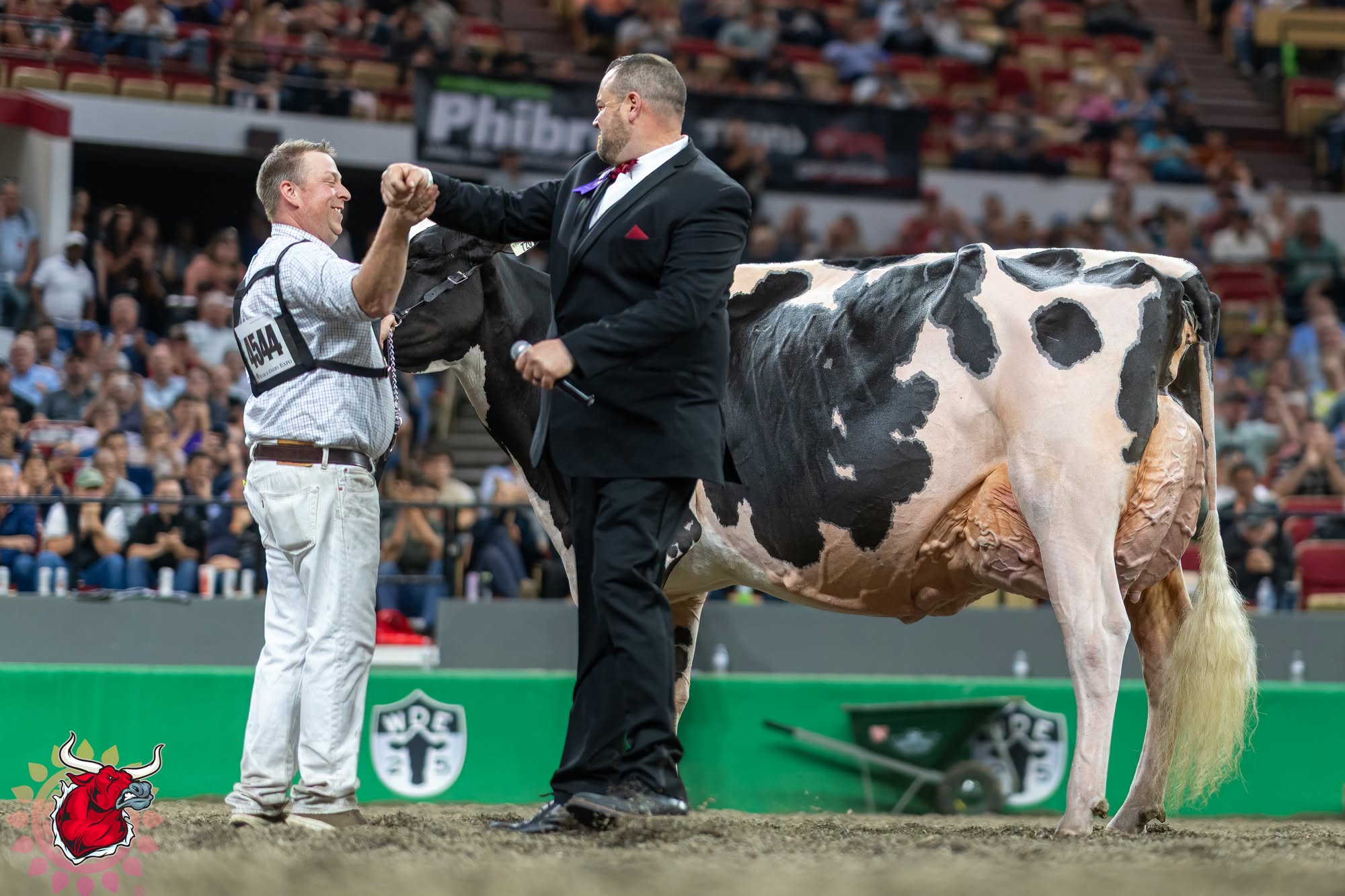
Judge Aaron Eaton fist-bumps Jamie Black after naming Lovhill Sidekick Kandy Cane grand champion of the 2025 International Holstein Show. The Lambs had first spotted her in Saskatchewan three years earlier.

2025 turned the credit around. Oakfield’s own Expo grand champion wasn’t an Oakfield-bred cow. Lovhill Sidekick Kandy Cane won her class, Senior Champion and Grand Champion at Expo’s International Holstein Show, exhibited by Alicia and Jonathan Lamb, with show herd manager Jamie Black at her halter, as The Bullvine reported from Madison.

Jonathan shared that the goal felt too lofty when they started. He also talked about the specific kind of humbling Expo delivers: you show up thinking you’ve got a good one, then you walk the barns and find out how much better “good” gets in Madison. Anybody who’s hauled a cow to a show and then walked the aisles knows that feeling.

The Lambs first saw Kandy Cane as a young cow in Mike and Jessica Lovich’s Saskatchewan herd in 2022. They remembered her, and she came to Oakfield in the spring of 2024. That’s its own kind of judgment: recognizing the right animal, then not letting the moment pass.

None of it happened by accident once she arrived. Alicia described a separate facility, a special diet and year-round attention for the show string, and Jonathan pointed to the team built around the cattle. A banner in Madison doesn’t tell you whether the rest of the farm made money that quarter, and it shouldn’t have to. It tells you the Lambs backed a specific ambition with real resources, and it paid off.

Janette’s part starts in the dirt

The award names six people for a reason, and Janette Veazey-Post is the one least likely to end up in a show photo. American Farmland Trust’s 2023 case study on Lamb Farms names her as crop manager since 2012 and credits her with putting strip-till on 1,000 acres in 2013.

That’s a far better place to start talking sustainability than “big farms are efficient”: a specific person, a specific number of acres, a specific year. The same case study tracks manure injection starting in 2016 and cover crops on 3,500 acres by 2018, including triticale, clover and radish planted after corn silage comes off.

None of that shows up on a banner. It shows up the next spring, in whether the ground can carry the next crop without the inputs it used to need. Janette’s paper trail of specific changes on specific acres is checkable, and it holds up.

If you’re running your own operation and wondering what to take from Oakfield, don’t reach for the herd count. Ask whether every piece of your farm, from the show string to the cropland, has a clear target and somebody who owns hitting it. A show cow and a strip-tilled field get judged on completely different scorecards. That’s fine. Just know which scorecard you’re using before you grade yourself.

Every proof Oakfield reads, and every genetic value Geiger tries to price, rests on an idea that was a hard sell in 1960s Quebec: a bull’s daughters tell you more when you compare them to their herdmates than to their dams. Chicoine was the one selling it.

The allergy that redirected a career
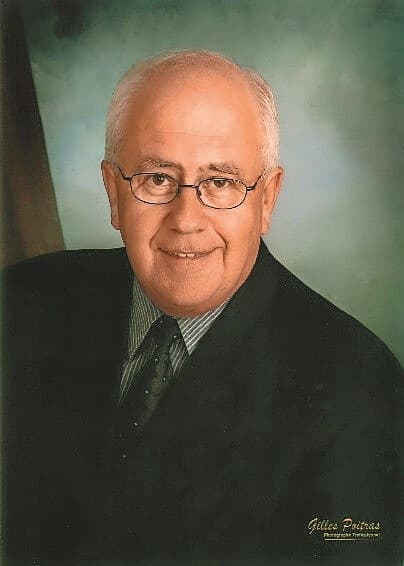
Robert Chicoine, Expo’s 2026 International Person of the Year, honored posthumously. He joined CIAQ in 1966 and spent the years after convincing Quebec breeders to trust the numbers.

Allergies ruled out farming, so Chicoine went to school instead and studied agriculture. In the third year of a four-year program, a teacher suggested he spend a summer at Quebec’s AI centre. It was a revelation, he said. At the end of that summer, the centre told him that if he’d go on to a master’s in animal breeding, there’d be a job waiting: developing its young sire proving program.

He joined CIAQ in 1966, Semex noted in its tribute. What he loved about those early years was getting paid to visit the famous herds he’d read about in the Journal as a kid.

The hard part was the argument. For about 20 years, Quebec farmers had been told to use proven sires to improve their herds, but those bulls had been proven in private herds, and some weren’t as good as their proofs suggested. Chicoine had to explain why herdmate comparisons beat comparing daughters to their dams. “I wrote many articles about that. I went to several meetings, many meetings,” he said. “And it worked. It was a long process.” A good breeding method on paper is worthless until somebody convinces the room.

Trusting the paper, trusting the eye: Senator and Starbuck

Two bulls show how Chicoine worked. In the fall of 1967, at 23, he spotted a Holstein World ad for auctioneer Harris Wilcox’s New York dispersal and fixed on the pedigree of a young bull nobody else wanted: Sevens Burke Skylark on the sire’s side, Osborndale Ivanhoe behind the dam, and three generations of proven AI sires stacked up the male line, as The Bullvine detailed in an earlier profile. The dam didn’t have the look breeders expected. Chicoine trusted the paper over the picture and bought him anyway.

Quebec’s breeding community mostly ignored the calf once he got home. CIAQ’s inseminators used his semen as a last resort, when a farmer didn’t request anything specific. Craiglen Sevens Senator earned Holstein Canada’s EXTRA designation in 1978, more than a decade later. By Chicoine’s own count, Senator now appears in at least half the pedigrees of Canada’s current Holsteins.

Starbuck was the opposite kind of decision, and Chicoine called it luck, twice in one answer. In May 1979, he and fellow CIAQ sire analyst Harley Nicholson were in Ontario signing mating contracts and looking for young sires, according to The Canadian Encyclopedia. They stopped for a quick dinner and happened to be at the same restaurant as Peter Heffering of Hanover Hill Holsteins in Port Perry. Heffering said he was free that evening if they wanted to see the herd. It wasn’t far, so they went, and they found a bull calf about a month old that Chicoine remembered as “already very impressive.” The calf had been born April 26, 1979, by CIAQ’s record. The dam impressed them too.

The pedigree gave them pause. Starbuck was another son of Round Oak Rag Apple Elevation, and CIAQ already had proven Elevation sons. Chicoine and his partner had “a very serious discussion” about whether to sample another one. They bought him anyway, because they liked the family and the calf standing in front of them. Every serious breeder who’s ever found a great one in somebody else’s barn knows luck still has to be recognized before it counts for anything. The Bullvine’s archive digs into Starbuck’s pedigree.
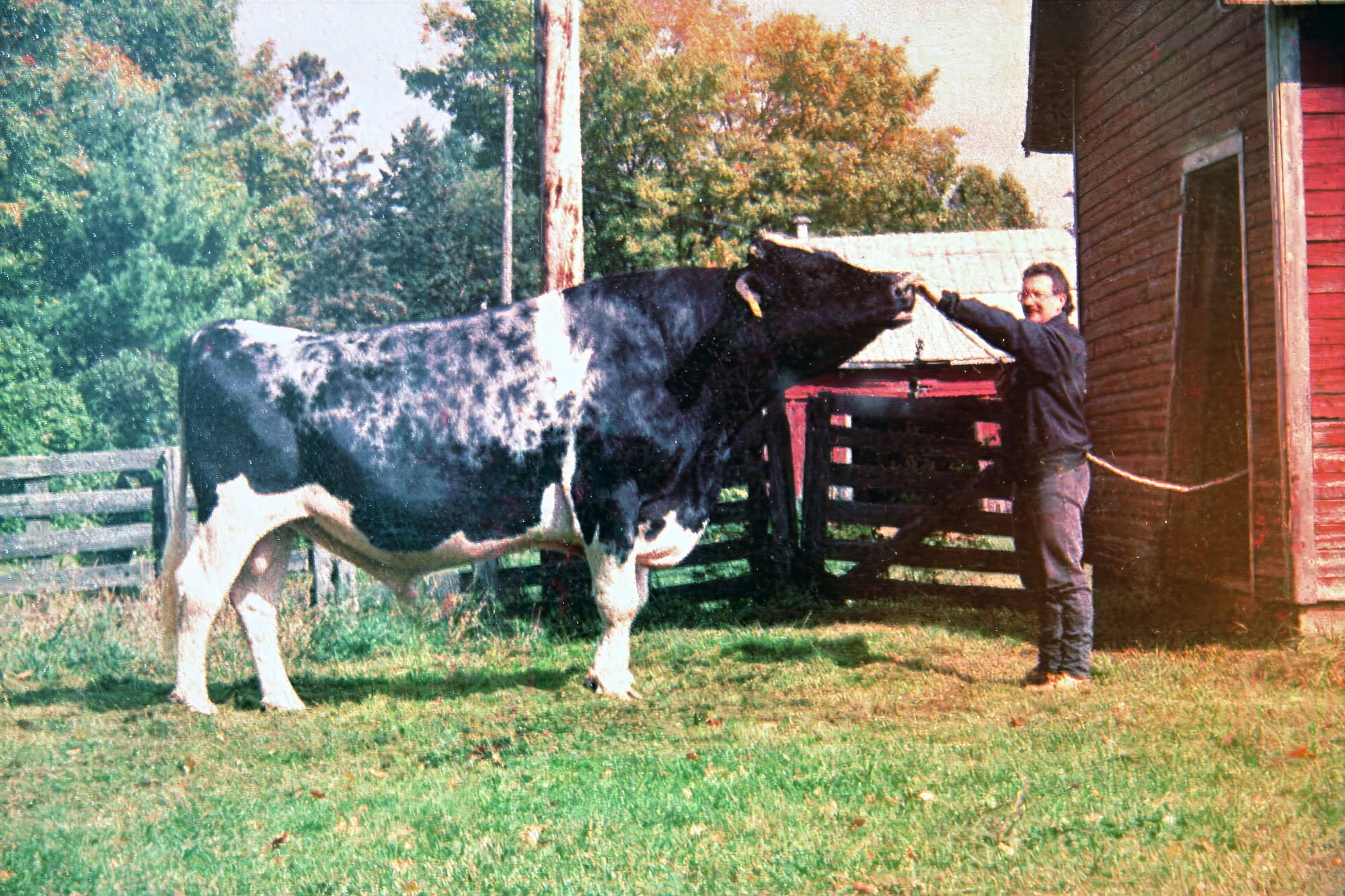
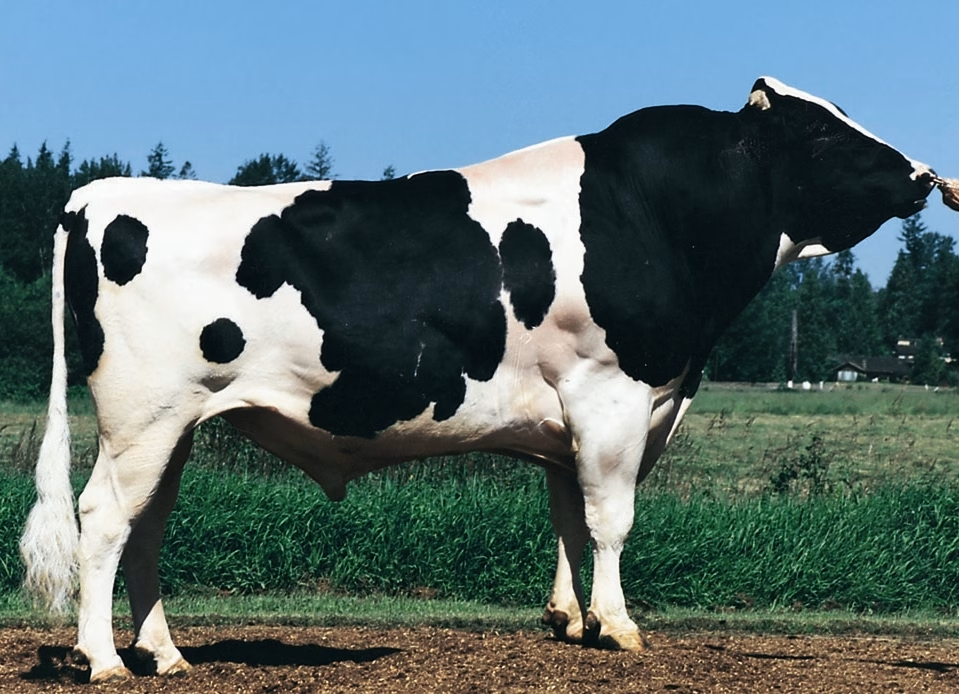
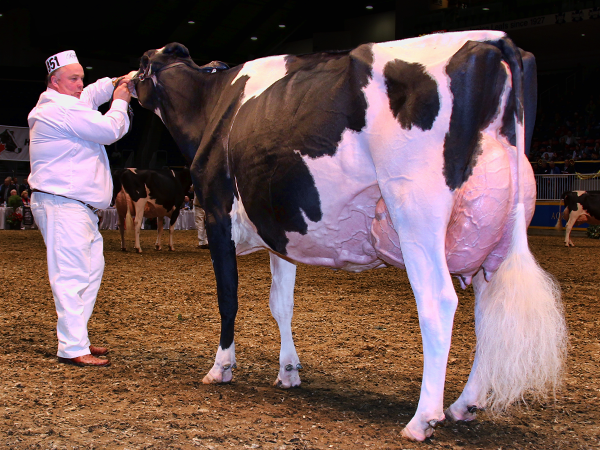
Hanoverhill Starbuck, grown up. The month-old calf Chicoine and Harley Nicholson debated in May 1979 became, in Chicoine’s words, the bull with “the greatest impact, by far.”

Don’t turn either bull into a system, though. He wasn’t right for the same reason both times. He was a breeder weighing whatever evidence he had in front of him, sometimes a pedigree sheet and sometimes his own eye, not a man who could see forty years down the pedigree.

That earlier Bullvine profile dug into how the Senator decision fed into modern genetic evaluation. The podcast adds something it didn’t have: restraint. Asked to put a number on how much faster genetic progress moves today, he said a number “would need some research, I suppose.” What he offered instead was how it had changed. A proven bull in his early years could be used for 10 years and never get any better. Genomic selection keeps moving the target, he said. It would have been easy to toss out a figure, and he didn’t.

He wasn’t uncritical of where genomics has taken the industry, either. He praised the pace of progress, then named the cost: the selection being made now drives inbreeding. He thought research might find a way to handle it, because related animals can still carry different genes. It wasn’t a verdict, just a question he left for whoever comes next, in an interview that was supposed to be a victory lap.

Building something that outlasts you

Asked about his biggest impact, Chicoine didn’t point to a bull. He pointed to cooperation: bringing Canadian AI organizations together into what became the Semex Alliance. His reasoning was about scale. Canada has far fewer dairy cows than the U.S. or Europe, and no single AI organization had enough bulls to be sure of always having superstars. Together, they might. He had to convince the other partners, and they came around gradually.

Semex credits him as the Alliance’s first general manager in 1997, after running CIAQ, and as the force behind Boviteq, where he chaired the board from 1991 to 1996. A bull changes a pedigree. An organization keeps creating chances for people long after the person who built it is gone. He seemed to know which one mattered more.

Coffeen closed the episode with a piece of context Chicoine had asked her to include: early on, his board challenged him to push innovation on the female side of reproduction, and that challenge led to Boviteq. He wanted the record straight. It wasn’t a solo idea.

“You cannot achieve everything by yourself as a person,” he said. “You need partners. You need working companions.” Pick the best people you can find, and they’ll carry the work on when you leave. Asked about the Expo honor itself, he turned it around again: “My merit is limited in that regard. I was there at the beginning.” It’s a tougher standard for a leader than it sounds: counting the next person’s success as part of your own, without angling to keep the credit.

What’s worth carrying home

Three different careers, three different scales, one repeated move: somebody handed off real responsibility, and the person who received it did something with it worth handing off again.

You don’t need 10,000 cows or an international alliance to run that play. Define your breeding goal clearly enough that you can judge whether you hit it. Give a young person a real budget and someone willing to answer their questions. Build people who can keep the operation running without you in the room.

When Expo’s call came, Geiger pulled over to take it, then went straight to the list of past winners. “Just to be considered among them really gave me pause,” he said. Jonathan Lamb did his own version of the same thing, crediting the years of learning and the team behind the Kandy Cane run, not himself alone.

All three get recognized September 29, and Chicoine won’t be in the room for it. You don’t need a banquet invitation to take something from their stories. Somebody, somewhere, is the reason each of these three got a start, and most of those names will never get read from a stage. Be that person for somebody younger, before you’re the one being honored for a career already finished.

Asked how he hoped to be remembered, Chicoine said he didn’t have specific expectations. He was proud to have been there at the beginning, and he’d always enjoyed going to work, because he got to spend his working life on the passion he’d had as a young person. “So life has been good for me.”

Key Takeaways

  • Three of Geiger’s four Hoard’s mentors, Knox (1970), Meyer (1988) and Larson (2007), won Expo’s Industry Person of the Year, the same award Geiger receives in 2026. That’s a 56-year span, not proof mentoring wins awards.
  • CIAQ inseminators used Senator as a last resort, and he didn’t earn EXTRA until 1978. Chicoine’s pedigree bet took more than a decade to pay off, so judge your own breeding calls on that kind of timeline.
  • Oakfield’s honor names six people, including crop manager Janette Veazey-Post, who put strip-till on 1,000 acres in 2013. When your farm gets credit, name the person behind the work nobody photographs.

Learn More

  • Beef-on-Dairy’s $6215 Secret: Why 72% of Herds Are Playing It Wrong — Breaks down the exact math behind Geiger’s replacement supply warning. If your 21-day pregnancy rate sits under 20%, deploying beef semen drains your heifer pipeline and kills profitability, while high-performing herds can net an extra $6,215 monthly.
  • The Holstein Visionaries Who Built Everything You’re Breeding Today — Tracing the money behind historical genetic strategies proves that titans like Stephen Roman treated the show ring strictly as a marketing engine. These foundational decisions deliver the blueprints dictating your herd’s current DNA and long-term financial potential.
  • The Show Ring Showdown—Why Bigger Isn’t Always Better — With financial data calculating the hidden tax on massive frame size, the numbers reveal every vertical inch costs $1.20 daily in feed. This brutally validates Oakfield’s split-herd philosophy: chasing ribbons with your commercial string guarantees a profit-killing disaster.

The Sunday Read Dairy Professionals Don’t Skip.

Every week, thousands of producers, breeders, and industry insiders open Bullvine Weekly for genetics insights, market shifts, and profit strategies they won’t find anywhere else. One email. Five minutes. Smarter decisions all week.
NewsSubscribe
First
Last
Consent

Robert Chicoine, 1943–2026: The Man Who Taught the Industry to Trust the Number

Semex Alliance’s architect and first general manager died Tuesday, fourteen days before World Dairy Expo was to hand him its International Person of the Year award in Madison. Every index you culled on this morning is his argument, still winning.

He was supposed to be in Madison on September 29.

World Dairy Expo announced in April that Robert Chicoine — the man who built the Semex Alliance and became its first general manager — would receive the 2026 International Person of the Year award at the Recognition Awards Banquet on Tuesday, September 29. Semex announced Tuesday that he had died. He was 83.

Fourteen days. There’s no consolation in that arithmetic. There is this, though: the industry decided to honour him while he could still hear it, and he spent the months afterward doing exactly what he’d done since 1966 — explaining, patiently, why the numbers work.

It started with a magazine his uncle had already finished reading

Chicoine was born in 1943 at Saint-Pie-de-Bagot, Quebec (Ordre national du Québec), on a mixed farm he described to us as 15 to 20 dairy cows, laying hens, apple trees and a sugar bush. The milk cheque paid for the rest.

An uncle who belonged to the Holstein Association of Canada noticed the boy’s interest and began passing along each monthly issue of the Holstein-Friesian Journal once he’d read it himself. Chicoine studied the advertised names, the individual lactations, the lifetime totals, the fat percentages. He told us, in the interview behind our January feature Robert Chicoine and the Bull Nobody Wanted: “For me, this was the most beautiful gift I could receive.”

Then he did the thing almost no child does with a hobby. He ran a controlled experiment. The family kept Bantam chickens in assorted colours, so he built a second flock where he decided which male bred which hens, and he watched the colours come through the offspring.

“My little experiments with the Bantam chickens demonstrated to me with certainty that a breeding male can influence an entire herd, and even a whole segment of a population with the use of artificial insemination.”

A farm kid in Saint-Pie had just stated the entire premise of the industry he would spend the next forty years building.

He was hired to sell farmers the opposite of everything they’d been told

Chicoine took a B.Sc. in animal science at Université Laval in 1964 and a master’s in 1966, researching under Dr. C.G. “Charlie” Hickman at the Ottawa Experimental Farm (Ordre national du Québec). A student summer at the Centre d’insémination artificielle du Québec settled the rest of his life — he described that summer as being in heaven.

On March 22, 1966, he walked into CIAQ with one mandate: build Quebec’s young sire proving program. For more than twenty years, extension had told farmers exactly one thing about bull selection — use proven bulls. Chicoine’s job was to visit those same barns and ask breeders to commit 40 per cent of their breedings to unproven young bulls, on the strength of University of Guelph work by Murray Hunt showing that a 40/60 split against proven sires maximized genetic gain.

“It was a great challenge,” he told us. That is a Quebec agronomist’s way of saying it was very nearly impossible.

So he taught. Articles explaining Contemporary Comparison — daughters measured against herdmates of the same age, in the same barns, in the same season, so that management stops masquerading as genetics. Presentations at insemination club and breed association annual meetings across Quebec, some reached by small aircraft. Breeder information days alongside Holstein Canada’s Raymond Corriveau, arguing over whether raw production alone should qualify a cow as a bull mother. “Which often created good discussions!”

And the mailings. Every time CIAQ took on a new young bull, its pedigree and photograph went into the mail to every breeder whose herd qualified for genetic evaluations.

“Over the years, several breeders confided in me that when they were young, they waited impatiently for the arrival by mail of the pedigrees of these young bulls. Thus, a bond of loyalty to the program was created from one generation to the next.”

That’s the whole man in one sentence. He didn’t win the argument by being right. He won it by putting something in the mailbox every month until a generation of farm kids grew up trusting what was inside.

Three of the first seven young bulls into his program earned Holstein Canada’s EXTRA designation. He became CIAQ’s general manager in 1981 (Le Bulletin des agriculteurs).

Two bulls, one lesson

The famous one is Hanoverhill Starbuck. No genomics, no test — two men on a farm visit, stopping at Hanover Hill in Port Perry, Ontario, looking at a calf under a month old.

“There was a young male calf that was barely born. He was less than a month old when we saw him, and even then, we were struck by his exceptional appearance for his age,” Chicoine told Farmtario in April. They took an option and waited to see him develop, with health tests to follow. Born in April, delivered to CIAQ in November.

CIAQ went on to sell 685,000 doses of Starbuck semen into 45 countries, and Le Bulletin des agriculteurs describes the bull as an ancestor of 95 per cent of Quebec’s cows (Le Bulletin). What that dynasty did to the breed is its own story, and we’ve told it in Hanoverhill Starbuck’s DNA Dynasty.

But the bull that explains Chicoine is the one nobody wanted.

In the fall of 1967, working off a Holstein World advertisement for the Harris Wilcox dispersal in New York State, CIAQ bought a young son out of a cow with modest records, a bad photograph and a speckled coat — in an era when breeders hand-drew every calf’s markings on the registration application, which made mottled cattle a nuisance. The dam looked wrong to everyone who saw the picture. The pedigree read right: Sevens Burke Skylark on top, Osborndale Ivanhoe behind the dam, positive production and conformation indices stacked up the male line. “I had never seen such an eloquent pedigree on the male side,” Chicoine told us.

So CIAQ sent someone to the sale to look at the dam in the flesh before bidding. She was far better than her photograph, with an excellent mammary system. They bought her son.

Then almost nobody sampled him. 73HO101 Craiglen Sevens Senator earned EXTRA recognition from Holstein Canada in 1978, and his daughter Proulade Ruth Senator was Grand Champion at the Quebec provincial exhibition in 1981.

Trust the index over the photograph. That was the argument of his life, and he won it so completely that we now run whole herds on genomic values for traits no camera can see.

Boviteq, and the alliance that nearly didn’t happen

In 1986, at the request of the CIAQ board, Chicoine founded Boviteq to do on the female side what the AI centre was mandated to do on the male side (Le Bulletin). He chaired its board from 1991 to 1996, per Semex’s own account of his career. Every sexed-embryo conversation happening in your barn this year runs back through that research infrastructure.

The alliance was harder. It began in September 1988, at a seminar on Canadian genetics in Rennes, France, in a conversation between Chicoine and Doug Blair of Western Breeders Service about sharing income among Canadian centres according to each one’s share of breed numbers. That produced Genexcel by January 1990. Then Western Breeders’ move into Alta Genetics put a proposal on the table to fold Semex Canada into a global distribution system the remaining Canadian partners would not control. The talks broke. Semex Canada’s general manager resigned and left the same day.

“It was quite a dramatic situation,” Chicoine told us.

His answer, worked out with Gordon Souter, was to pool ownership of every bull into a single new legal entity — and, unlike Genexcel with its one-year exit notice, to build it so that walking out was almost impossible. The Semex Alliance became real on January 1, 1997, with CIAQ as principal owner at 45 per cent and Chicoine as first general manager until he retired in 2000.

He justified the whole manoeuvre in four words: “Necessity is the law.” Then, characteristically, he refused to let the phrase off easy. “It has nothing to do with not respecting the law. In a difficult situation, seeking to find the best possible solution becomes the rule to which one must adhere without hesitation.”

Semex says his work now shapes breeding decisions in more than 80 countries (Semex).

He spent a career multiplying genetics, then spent his retirement making sure none were lost

This is the line on the résumé that says the most about him and gets mentioned the least.

After leaving Semex in 2000, the man who had industrialized the spread of a handful of elite sires went to work as vice-president of the Canadian Farm Animal Genetic Resources Foundation, pressing Ottawa to conserve farm animal genetics — not just Holsteins, every breed (Canadian Agricultural Hall of Fame).

“It eventually paid off, since there is now a center at the University of Saskatchewan in Saskatoon with that mandate,” he said.

He understood the bill that comes attached to his own success. Get very good at multiplying the best animals and the population narrows behind you. He didn’t leave that for somebody else to solve. He worked on it for eight more years and finished for good in 2008.

The honours, in order

YearRecognition
1998Doctorat ès sciences honoris causa, Université Laval
2001Temple de la renommée de l’agriculture du Québec
2005Canadian Agricultural Hall of Fame
2008Industry Distinction Award for dairy cattle improvement, Canadian Dairy Network
2010Knight of the Ordre national du Québec, presented by Premier Jean Charest on June 3
2026World Dairy Expo International Person of the Year

Sources: Ordre national du Québec, Le Bulletin des agriculteurs, Semex.

His last argument was that the system should outlive the bull

After Madison named him, Chicoine sat down with host Peggy Coffeen on the Uplevel Dairy Podcast and was asked how much faster genetic progress moves now than when he was building the young sire program.

He wouldn’t put a number on it — “it’s difficult to have a number, really, [we] would need some research, I suppose.” Then he explained the difference anyway, and it is the sharpest thing anyone has said about genomics in a while.

Back then, he said, you identified a proven sire and “he could have been used for 10 years after that, but it was the same potential. It didn’t improve over the years. It was the same.” Now, with genomics, “they look at numbers all the time and they try to have available the young bulls that have the best numbers. So it’s improving all the time, instead of — it was more static before than it is now.”

Sit with that. The man credited with finding Starbuck, one of the most influential bulls ever born, spent his last recorded interview arguing that no single bull should be the point. The system that keeps replacing your best bull is the point. That is not the ego of a man who wanted a monument. That is a builder describing something designed to keep improving after he stopped touching it.

What he actually left in your barn

Not a bull. A habit of mind.

When you cull on an index instead of an eye. When you sample a young sire on a genomic value and a pedigree rather than a photograph. When you buy Canadian genetics from a co-operative that survived a merger fight thirty years ago because one man deliberately designed the exit door too heavy to open. When you sort through health traits, or component values, or a methane figure, and accept a number you cannot see with your own eyes — you are using the argument Robert Chicoine made from 1966 onward, one insemination club meeting at a time, to farmers who had every reason to tell him no.

He also left instructions, which almost nobody asks a genetics man for. “Surround yourself with the most competent people possible, create a healthy and warm working climate, and analyze regularly and seriously the challenges that the company must face as well as the opportunities offered by the industry.” And: “After having planned a project well and executed it rigorously, one should not throw in the towel too quickly if the results do not meet expectations.”

Then he got the last word on himself, before any of us needed it.

“I can summarize my career by saying that I am blessed to have always been passionate about my work. I went to work with enthusiasm daily.”

On September 29 in Madison, the Recognition Awards Banquet will call his name and he won’t stand up. The room should stay standing a long time on his behalf.


Robert Chicoine’s own account of his career, in his words and at length, is in our January 2026 feature Robert Chicoine and the Bull Nobody Wanted: The Data Revolution That Lives in Your Herd’s DNA. Funeral and visitation details will be added here when the family releases them. If you worked with Robert — at CIAQ, at Boviteq, at Semex, or across a kitchen table with a pedigree between you — we want your remembrance for the tribute we’ll publish next.

The Sunday Read Dairy Professionals Don’t Skip.

Every week, thousands of producers, breeders, and industry insiders open Bullvine Weekly for genetics insights, market shifts, and profit strategies they won’t find anywhere else. One email. Five minutes. Smarter decisions all week.
NewsSubscribe
First
Last
Consent

One Ring, Three Dynasties: The 1989 World Dairy Expo Class That Rewrote Holstein History

At the 1989 World Dairy Expo, three Senior Two-Year-Olds came back into the Madison ring after milking. The ribbons settled one afternoon. The consequences are still turning up in pedigrees around the world.

The 1989 Class at a Glance

  • The class: Senior Two-Year-Old, 1989 World Dairy Expo, Madison, Wisconsin. Judge: Howard Binder. Associate judge: Paul R. King. 
  • The result: Dupasquier Starb Winnie 1st, Comestar Laurie Sheik-ET 2nd, Aitkenbrae Starbuck Ada 3rd — reportedly re-sorted after milk-out. 
  • Why it matters: All three founded major maternal lines still active in global pedigrees. 
  • Winnie: GP-83 → EX-3E-CAN. WDE Grand Champion at eight (1994). 97,371 kg lifetime. 
  • Laurie Sheik: $45,000 sale topper; four millionaire AI sires; inaugural Holstein Canada Cow of the Year, 1995. 
  • Ada: Dam of Shoremar S Alicia EX-97-3E and Ms Kingstead Chief Adeen EX-94-2E; grandam of the Atlee/Atwood type dynasty. 

The milk had come down, the udders had changed, and Howard Binder had one more decision to make.

It was October 1989 at World Dairy Expo in Madison, back when cattle people still packed the Coliseum rail to study a cow after milking — because that was when the bloom was gone, and the udder had to speak for itself. Dupasquier Starb Winnie had the class. Behind her, the tension was between Comestar Laurie Sheik-ET and Aitkenbrae Starbuck Ada.

Breed-history accounts say Ada stood second before milk-out. When the three heifers came back, Laurie Sheik moved ahead on the strength of her udder texture, cleft and vein definition, taking second and the Best Udder nod of the class; Ada went third. The documentary trail for that switch is thinner than anyone would like — it runs through breed commentary rather than a recovered official World Dairy Expo results sheet — but the final order is clear. 

That would have been enough for a good Expo story. It became something much bigger, because in those few minutes Madison had placed three young cows who’d each become the head of a major maternal line. Winnie would grow into an eight-year-old World Dairy Expo Grand Champion. Laurie Sheik would turn an unfashionable mating into four millionaire AI sires and a family spread across more than 50 countries. Ada would leave Alicia, Adeen, Atlee and Atwood — a line that carried show-ring power straight into the genomic-type era. 

The ribbons named a winner, a second, and a third. Time sorted them differently.

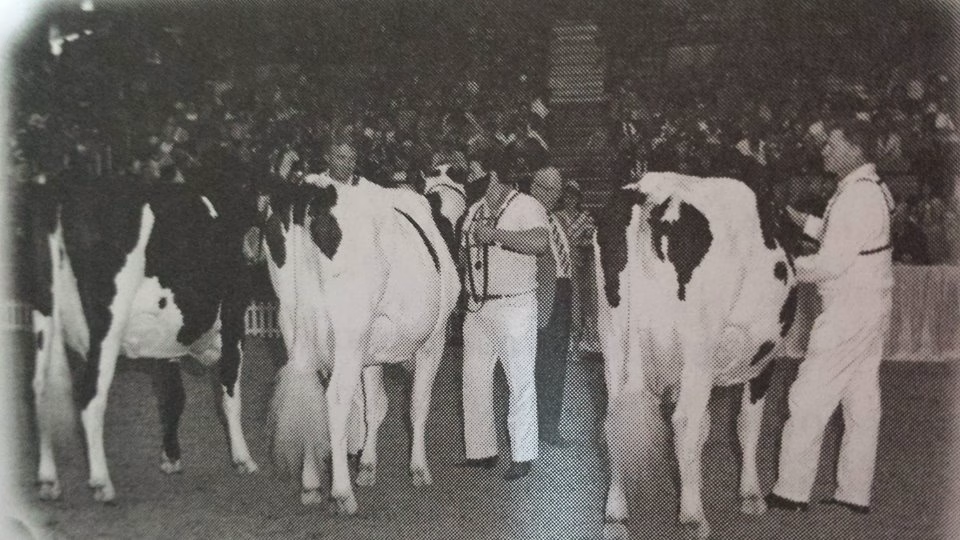
Madison, October 1989: the Senior Two-Year-Old class lines up under the Coliseum lights as Howard Binder makes his final sort. Dupasquier Starb Winnie led, Comestar Laurie Sheik-ET took second and Best Udder after milk-out, and Aitkenbrae Starbuck Ada stood third. Every cow in the top three would go on to found a maternal line still turning up in pedigrees worldwide.

Act I: Before the Numbers Won

Now, the thing about 1989 is that Holstein breeding was already in the middle of an argument.

For decades, show breeders had built programs around the cow standing in front of them: balance, openness, feet and legs, mammary systems, strength where strength had to be. Meanwhile, the genetic evaluations were gaining force, and commercial dairymen were reading milk, fat, protein, and reliability numbers with growing seriousness. One side trusted the eye. The other trusted the index. Most barns, if we’re honest, were trying to figure out how to have both — and World Dairy Expo sat right in the middle of that argument.

This was a different dairy world. Embryo transfer worked, but international work still meant hand-signed health papers, ownership transfers, customs forms, phone calls, and fax machines. You’ll see “-ET” after a cow’s name in this story; that’s the marker for an animal produced by embryo transfer, and in 1989 it still signaled something faintly futuristic.

Classification reads differently through a modern lens, too. A GP-83 two-year-old might look ordinary on paper, but in the late 1980s classifiers didn’t hand lofty scores to first-lactation heifers. A young cow could be Good Plus and still have every bit of the raw material to become a great one. 

That year, Madison was already thick with history. Norm Nabholz took the Klussendorf Trophy. Roy Ormiston of Roybrook became the first Canadian honored with the Dairy Shrine Award. The Coliseum held the usual mix: cattlemen comparing notes, breeders quietly calculating what a good young cow might be worth, kids pressed along the rail trying to decide which animal they’d remember forever. 

Then Winnie, Laurie Sheik, and Ada walked in.

1989 WDE Senior Two-Year-OldCow1989 Owner / ExhibitorSire
1st · 1st BU (pre-milkout)Dupasquier Starb WinnieOscar Dupasquier, Guelph, ONHanoverhill Starbuck
2nd · Best Udder of ClassComestar Laurie Sheik-ETMarc Comtois / Belgistar Syndicate, QCPuget-Sound Sheik
3rdAitkenbrae Starbuck AdaLawson Bennett / Hygerian Associates, OHHanoverhill Starbuck

Best Udder credit reflects the post-milk-out re-sort described in breed-history accounts rather than a recovered official WDE results sheet.

Winnie and Ada were Hanoverhill Starbuck daughters. Laurie Sheik — contrary to a claim that keeps slipping into retellings — was not. She was by Puget-Sound Sheik. That distinction matters, because this wasn’t three Starbuck daughters in a sweep. It was two Starbuck daughters and a Sheik daughter, representing three sharply different breeding decisions. 

Starbuck was still the giant in the background. Bred at Peter Heffering’s Hanover Hill Holsteins in Port Perry, Ontario, he was born April 26, 1979, by Round Oak Rag Apple Elevation and out of Anacres Astronaut Ivanhoe VG-88. CIAQ bought him as a 45-day-old calf for $2,500 — a figure that reads almost absurdly small now. He grew into a 2,580-pound bull, 73.5 inches at the shoulder, and he stamped daughters with the kind of open rib, chest, udder, and consistency that made a breeder stop walking and take a second look. The record credits him with 10 milking-age All-American daughters, more than any bull in Holstein history, plus 82 All-American nominations and 130 All-Canadian honors among his daughters. His reach eventually became so wide that the industry had to take inbreeding and mating management seriously. 

But Starbuck didn’t make this class historic on his own. The story lives in what the three cows did with their chance.

Act II: Three Roads Out of Madison

Winnie and the patience to let a cow become one

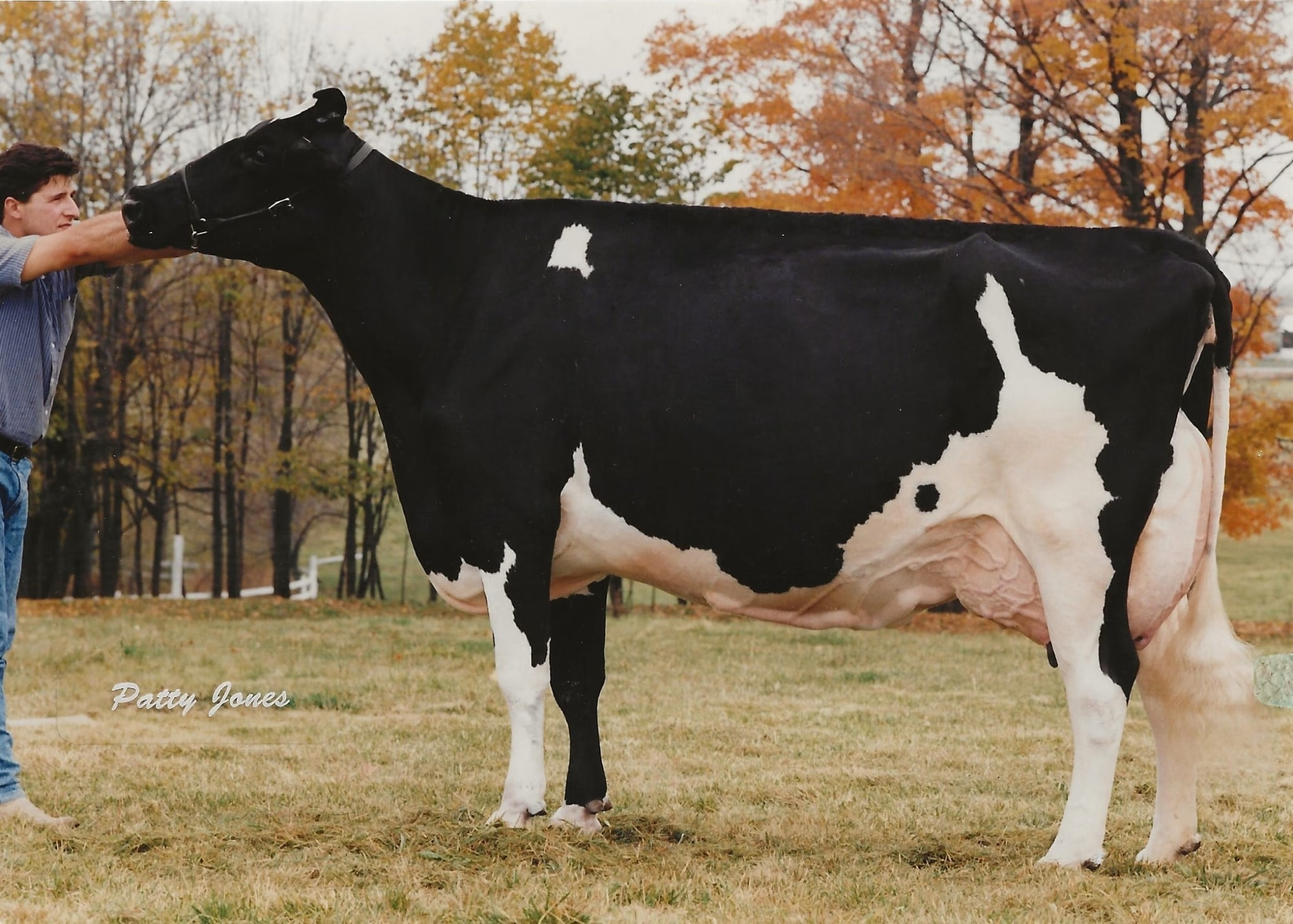
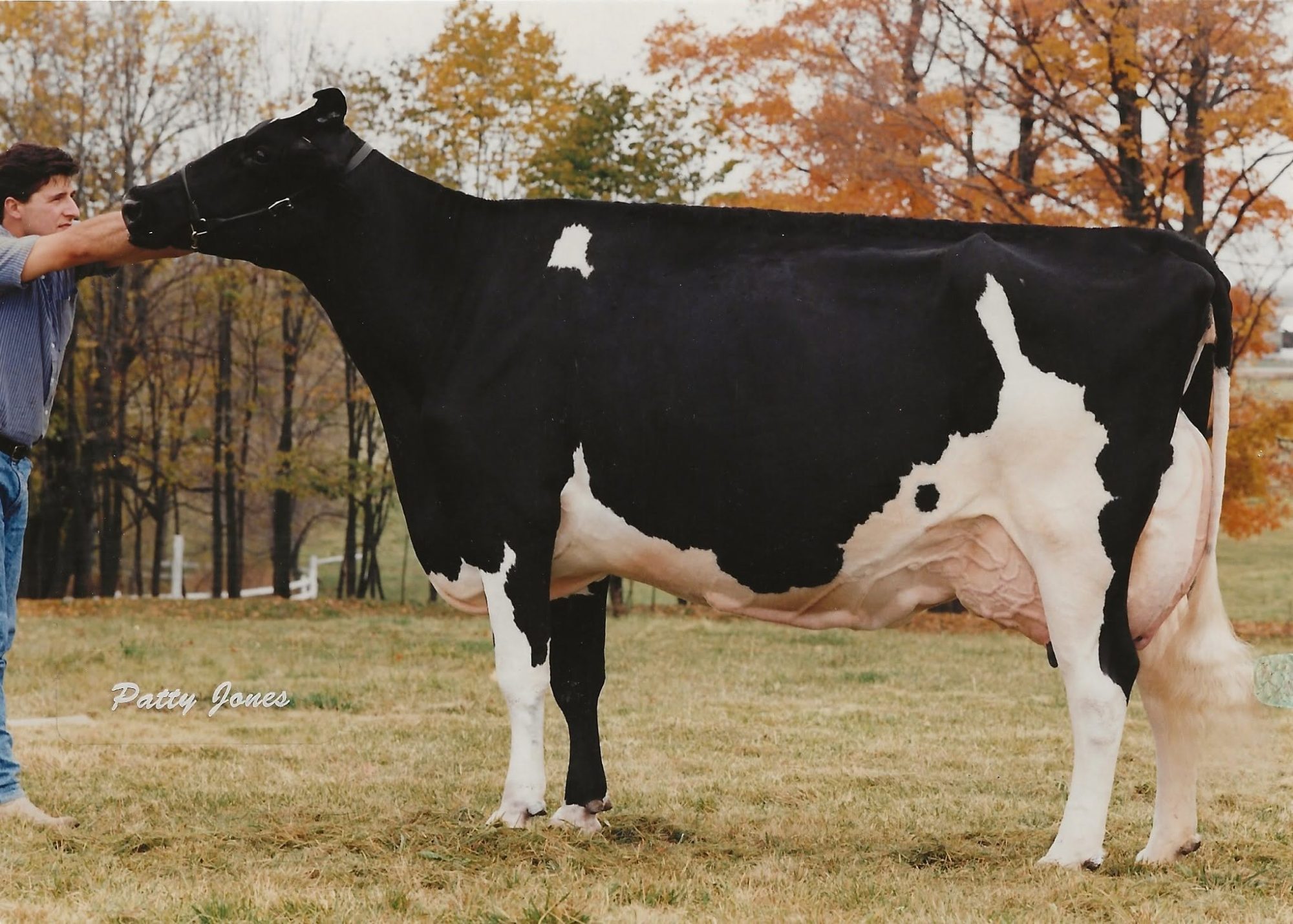
Dupasquier Starb Winnie EX-3E-CAN, posed on an Ontario autumn afternoon — the frame and mammary that took a GP-83 two-year-old all the way to World Dairy Expo Grand Champion at eight. Deep-ribbed, wide through the chest, standing square on the feet and legs Oscar Dupasquier bred for. She’d finish with 97,371 kg of milk across six lactations. Photo: Patty Jones.

Oscar Dupasquier’s kind of breeding didn’t reward impatience.

Winnie was born October 13, 1986, by Starbuck and out of Allangrove AA Winnie VG-85 4* — those stars being Holstein Canada’s way of recognizing a cow whose progeny keep proving her worth. When Winnie won at Madison as a two-year-old, she was GP-83. Not a score to make a sale catalog shout, but one that asked a breeder to see past the first lactation and picture the mature cow waiting underneath. Dupasquier did exactly that. The old cattleman’s rule explains why: a cow had to be built to keep working, feet and legs had to carry the frame, the frame had to hold the capacity, and somebody had to be patient enough to let her prove whether the promise was real. 

Winnie became a case study in that patience. She climbed from GP-83 all the way to EX-3E-CAN — Excellent, reclassified upward three separate times as she matured — and earned eight Brood Cow Stars along the way. Her show record built slowly, then piled up: All-Canadian and All-American Senior Two-Year-Old in 1989, All-Canadian Three-Year-Old in 1990, All-Canadian Four-Year-Old in 1991, Reserve Grand Champion at World Dairy Expo in 1993, All-American Aged Cow in 1993. 

And here’s where it gets interesting.

At the 1991 Royal Agricultural Winter Fair — a 277-head show — Winnie stood Grand Champion. Her daughter, Dupasquier Black Winnie VG-88, was named Junior Champion in the same ring on the same day. Holstein Canada identifies the pair as the only dam and daughter to take those two major titles at the Royal in the same year. 

Think about what that actually requires. Not one great cow — a great cow who can hand the banner forward while she’s still winning it herself. One is memorable. Two is a dynasty.

Three years later came the summit. Winnie was eight years old when she stood Grand Champion at World Dairy Expo in 1994, the third straight Starbuck daughter to win Madison. Holstein International later treated the photograph of Winnie posed with Eric Dupasquier outside the Coliseum as one of those images that carries an entire era inside it: an aged cow, a young handler, the building behind them, and proof that maturity still counted for something in a breed sprinting toward numbers. 

Then she went home and worked — and this is the part that should stop a modern reader cold. Across six lactations, Winnie put 97,371 kilograms of milk in the tank. That’s 214,664 pounds, at 4.1 percent fat and 3.3 percent protein. Her 6-07 record ran 15,229 kilograms in 365 days, with 612 kilograms of fat and 477 of protein. Nobody could ever file Winnie away as a show-ring specialist. She could stand under the lights, then go home and fill the bulk tank for another year. 

Laurie Sheik and the bet nobody could see yet

Laurie Sheik came from a different kind of gamble.

Marc Comtois left school at fifteen to work with cattle. By eighteen he’d bought a farm in Princeville with 44 grade cows. He married France Lemieux on April 23, 1977, and the two of them started swapping grades for registered Holsteins, one practical decision at a time. Comestar didn’t begin as an empire. It began as a young couple putting their confidence into cattle. 

In 1985, Comtois bought Elysa Anthony Lea EX-15, a deep-ribbed daughter of Willowholme Mark Anthony. Then he bred her to Puget-Sound Sheik — a 1972-born VG-85 bull nobody was chasing anymore. In a business that runs on fashion as much as data, that takes some spine. The mating produced Laurie Sheik on December 1, 1986, and she came into the world wearing a broad white starburst on her forehead. A little too perfect, really. 

She won the Senior Two-Year-Old class at Victoriaville in 1989, then came to Madison and finished second with the class Best Udder nod. Picture her walking back in after milking — the Coliseum lights catching that white star, her udder collapsed clean and correct the way only the good ones do. That’s the moment the whole class turned on. 

“Flash gets attention; the empty udder gets respect.”

She’d go on to VG-88-CAN and 23 Brood Cow Stars. That distinction is worth making carefully: the 23 stars measure the strength of her transmitting record — they aren’t a claim that she had 23 Excellent daughters. The source record lists 18 Very Good daughters behind that total. 

This historic image captures a pivotal moment in Holstein history as a young Comestar Laurie Sheik VG-88 23* claims first place in the Senior 2-Year-Old class at Expo Victoriaville. The trophy being presented was sponsored by Edgar Comtois, father of Marc Comtois, creating a meaningful family connection as Laurie Sheik began her remarkable show career. What makes this moment especially significant is that this unassuming cow would go on to become one of the most influential matriarchs in Holstein history, producing four millionaire bulls and establishing a genetic dynasty that continues to influence dairy breeding worldwide today. This early show ring success hinted at the extraordinary genetic potential that would eventually extend to 51 countries and span multiple generations of elite Holstein breeding.

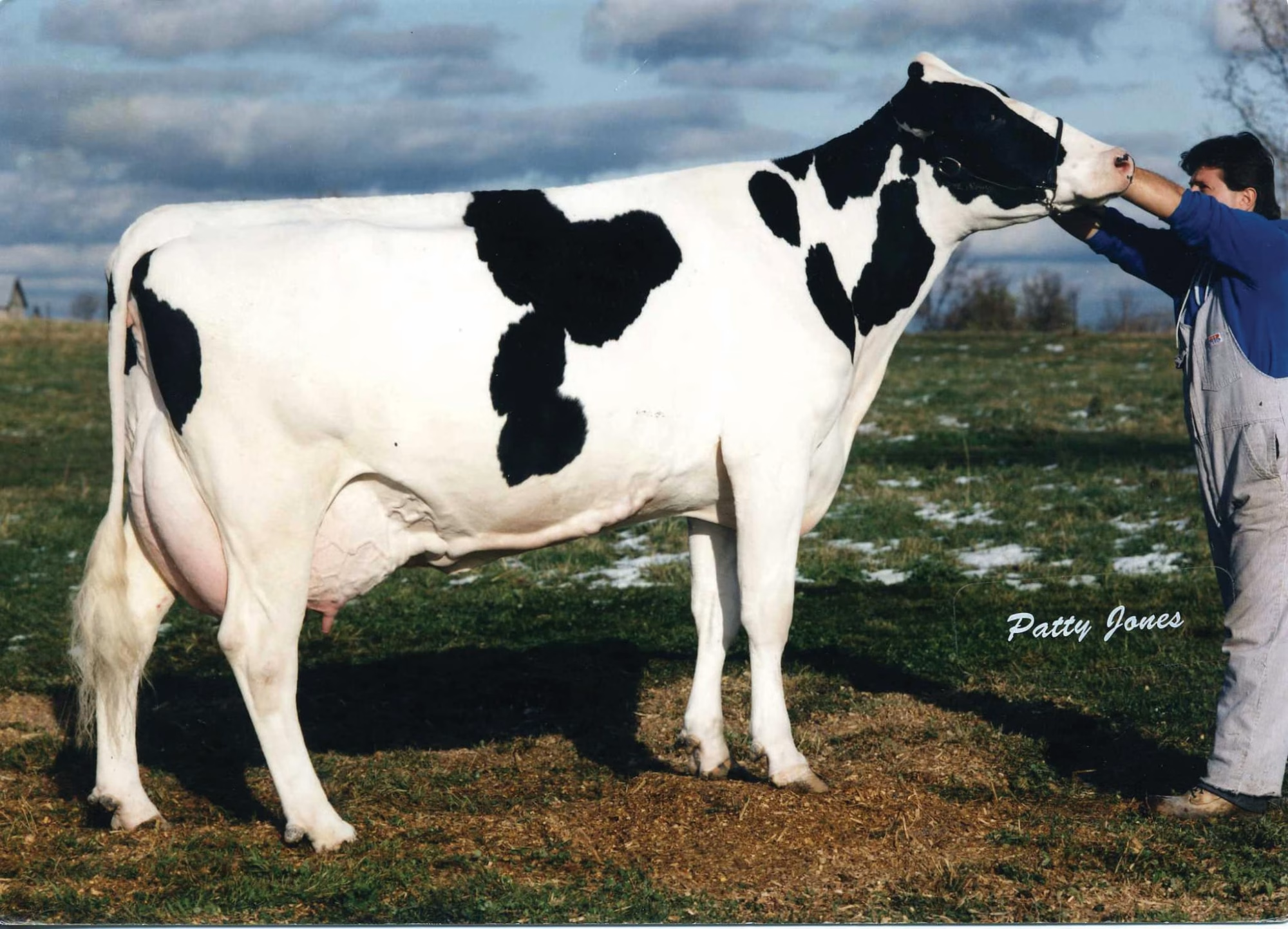
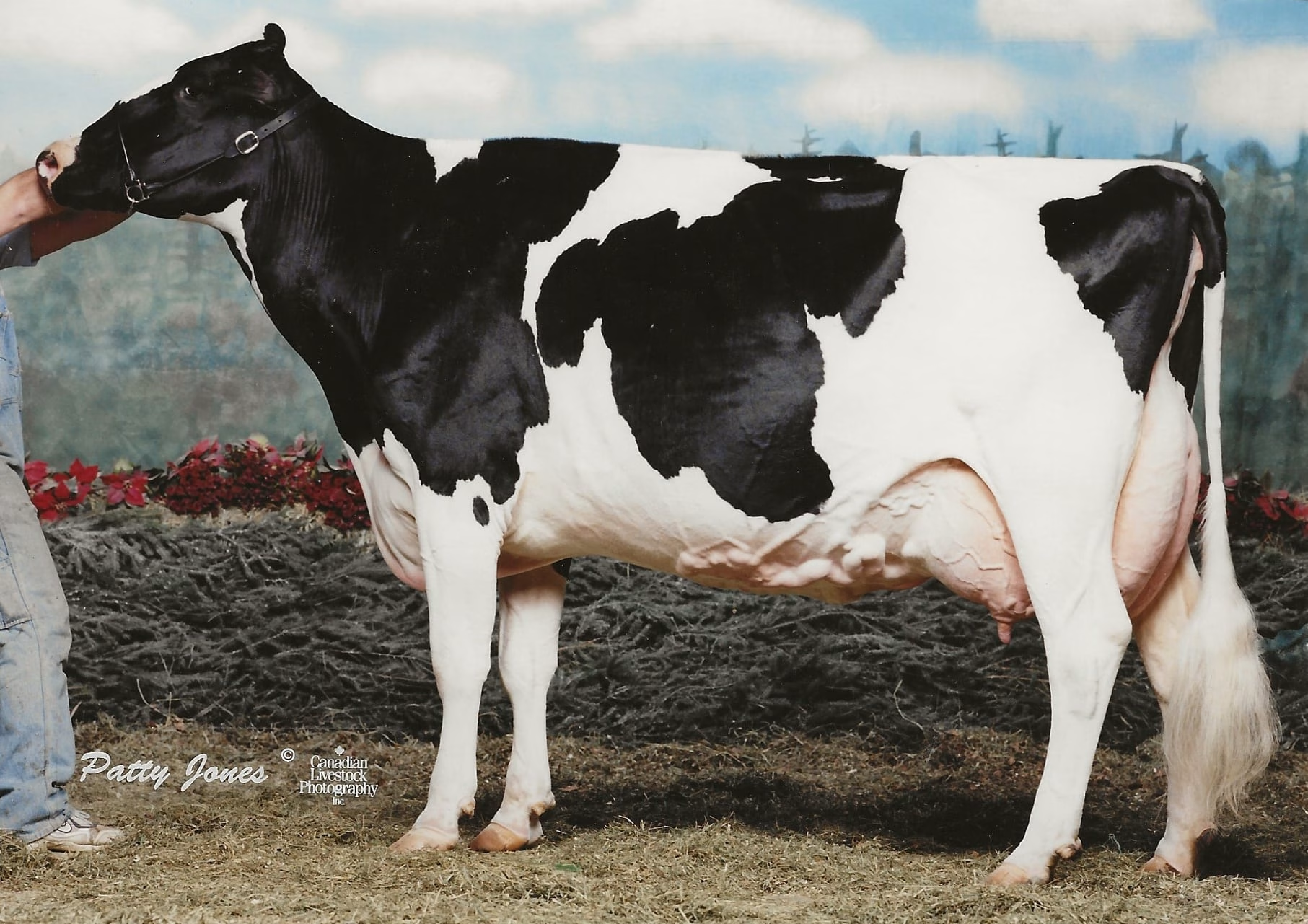
A pivotal moment in Holstein history as a young Comestar Laurie Sheik VG-88 23* claims second place in the Senior 2-Year-Old class at World Dairy Expo. What makes this moment especially significant is that this unassuming cow would go on to become one of the most influential matriarchs in Holstein history, producing four millionaire bulls and establishing a genetic dynasty that continues to influence dairy breeding worldwide today. This early show ring success hinted at the extraordinary genetic potential that would eventually extend to 51 countries and span multiple generations of elite Holstein breeding.

The real turn came at that first Comestar Sale in 1989, where Laurie Sheik topped the day at $45,000, and Eddy and Annie Pussemier of Bois Seigneur Holstein in Belgium bought a 50 percent interest, creating the Belgistar Syndicate. The price was a statement. Getting her genetics home was the hard part. Live-animal import restrictions meant the Pussemiers couldn’t simply load her on a plane, so the two families went the embryo route instead — a cross-border process run on the analog machinery of the day: paperwork, phone calls, faxes, health certificates, customs documents. 

Consider what that decision looked like from the Belgian side. The Pussemiers were converting a beef operation into an elite dairy herd, and they’d just committed serious money to half of a young Quebec cow they had no legal way to bring home. One can only imagine the conversation on the drive back. Everything depended on embryos surviving a paper trail nobody had built yet. 

It worked better than anyone had a right to expect. Laurie Sheik’s three To-Mar Blackstar daughters — Comestar Laura Black VG-87-CAN 24*, Comestar L Or Black VG-87-CAN 16*, and Comestar Lausan Black VG-87-CAN 23* — became the family’s multiplying point. Through Laurie Sheik and those branches came Comestar Leader, Comestar Lee, Comestar Lheros, and Comestar Outside: four millionaire AI sires. Lee alone was credited with 1.5 million doses and more than 183,000 daughters. The family reached 51 countries in the dossier record, and at Bois Seigneur roughly 70 percent of the herd traces to her — including Blacklaure de Bois Seigneur, credited with more than 100,000 kilograms of lifetime milk. 

A mating half the breed had written off ended up rewriting AI lineups on two continents.

Laurie Sheik became Holstein Canada’s first Cow of the Year in 1995. Twenty-seven years later, in 2022, Comestar Lamadona Doorman EX-94-2E — from that same family — took the identical honor. That’s the sort of bookend most breeders only dream about. 

She died April 30, 2004. But the bet Marc and France Comtois made on an out-of-fashion sire didn’t die with her. It became one of the breed’s most profitable arguments for looking past the fashionable page.

Read more: The Cow That Built an Empire: Comestar Laurie Sheik’s Unstoppable Genetic Legacy

Ada and the lesson of third place

Ada’s the reminder not to turn a class placing into a permanent verdict.

Aitkenbrae Starbuck Ada was born September 13, 1986, at Aitkenbrae Farm in Holstein, Ontario. Her sire was Starbuck; her dam, Aitkenbrae Sheik Arlene, was a GP-80 daughter of Puget-Sound Sheik. Before the 1989 Expo, Lawson Bennett and Hygerian Associates — the Ohio group led by Robert Binger and William Atkins — bought Ada after cattleman Ken Empey saw her two months fresh and recognized her dairy strength. And there was plenty to see: the record describes a massive, clean-boned cow with exceptional width of chest and a highly functional mammary system — the kind of animal that looks like she was built to milk hard for years, not just for a season. 

Think about the nerve that purchase took. An Ohio investment group, buying an Ontario heifer barely two months into her first lactation, largely on a cattleman’s word about what she’d become. The record doesn’t preserve what Binger and Atkins said to each other before they wrote that check, but anyone who’s ever syndicated a young cow knows the feeling — you’re not buying what’s standing there, you’re buying what you think is coming.

That’s the kind of call that separates good cattlemen from the rest of us. Some people look at cows. Others see them. But it was still a decision made on a young cow, and those can go either way.

Ada won the Michigan State Fair in 1989, then finished third in Madison. That December she sold again, this time to Gayridge and Kingstead Farms in Maryland — a move that dropped her into a donor-cow setting where a strong young show heifer could be given the chance to become something more.

She took it.

By 1990, Ada was Grand Champion at the Eastern National Show and Unanimous All-American Senior Three-Year-Old. She eventually classified EX-94-2E-USA DOM at fourteen years and two months — the 2E marking two upward reclassifications, and DOM standing, the designation for a cow whose type and production transmit reliably to her offspring. She earned four Brood Cow Stars in Canada and produced 137,732 pounds of milk across six lactations. At 2-05, she made 25,000 pounds in 362 days. 

But the daughters are where Ada’s story starts to feel almost unfair.

Flushed to Donnandale Skychief, she produced two full sisters: Shoremar S Alicia EX-97-3E and Ms Kingstead Chief Adeen-ET EX-94-2E DOM. Alicia reached Excellent-97 — one of roughly 35 Holsteins in North American history to get there, by the count in the breed record. Sit with that number a second. Ninety-seven, in a system where cracking the mid-90s makes a barn go quiet. She was nominated All-American five times in milking form and stood Supreme Champion at the 2000 Royal. And Howard Binder — the same judge who’d placed Ada third at Madison in 1989 — later became a part-owner of Alicia. Eleven years after he set the original order, he ended up connected to the daughter who made that order feel wonderfully incomplete. 

You couldn’t script that.

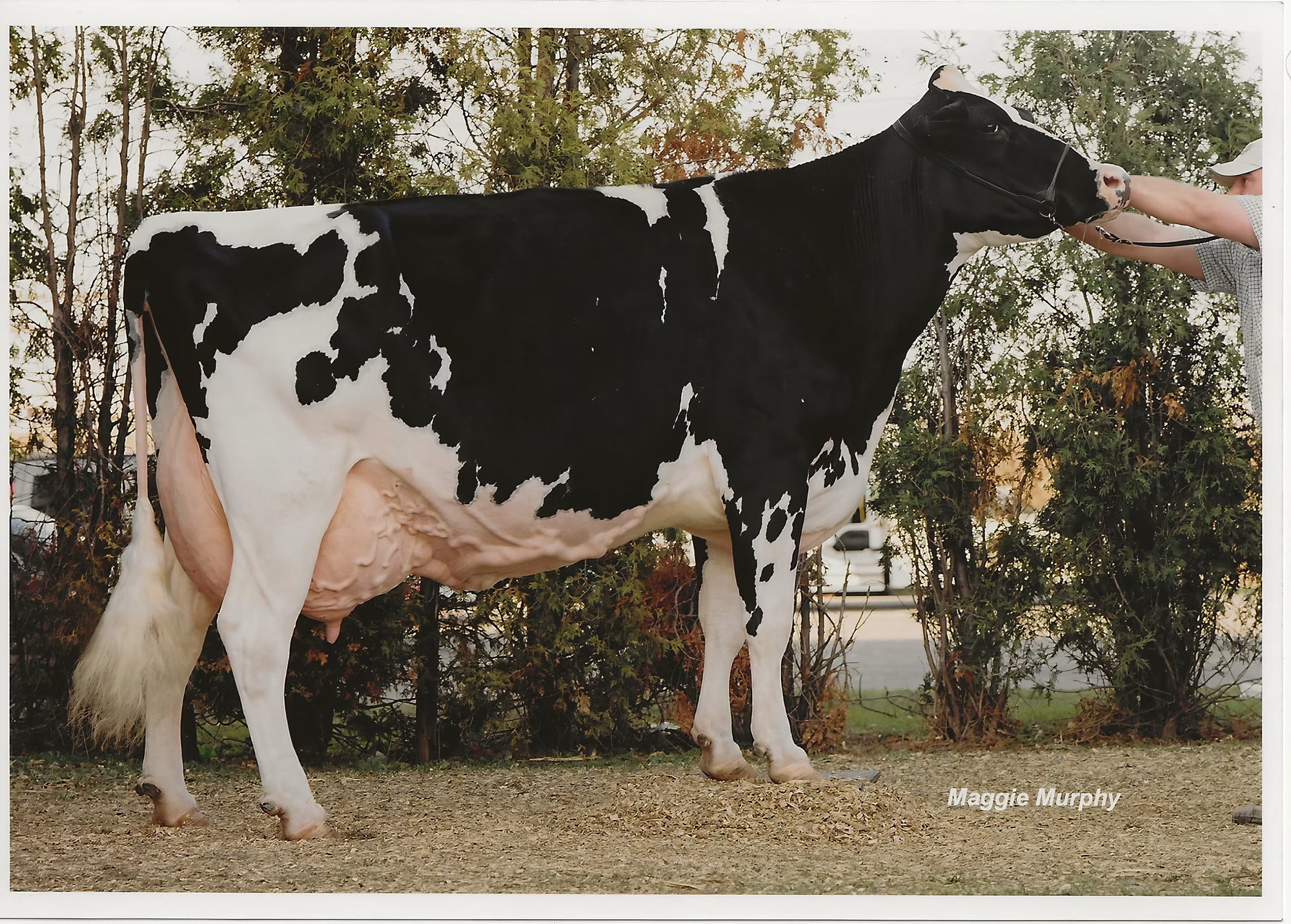
Shoremar S Alicia EX-97-3E — the Donnandale Skychief daughter who took Ada’s line to a score almost nobody reaches. Look at the mammary: high and wide behind, a clean fore attachment, veining you can read across the floor. One of roughly 35 Holsteins in North American history to reach Excellent-97, Supreme Champion at the 2000 Royal, and part-owned by Howard Binder — the judge who’d placed her dam third at Madison eleven years earlier. Photo: Maggie Murphy.

Adeen anchored the foundation at Butlerview Farms from 1999 until she died in 2011 at fourteen. The sources credit her with somewhere between 24 and more than 30 Excellent daughters — the exact count varies by record, which tells you something in itself about how many good cows she left behind. But it was Adeen’s daughter, MD-Delight Durham Atlee EX-92 GMD DOM — the GMD marking her a Gold Medal Dam for the production her progeny delivered — who turned show-ring type into an international commercial force. Atlee gave the breed Maple-Downs-I G W Atwood, the number-one proven type sire in the United States in August 2012 at +4.16 PTAT. And she didn’t stop at one. Ms Atlees Sht Aftershock came out of the same dam at +3.12 PTAT, alongside Mr Atlees AltaAmazing, Allyndale-I Atticus, Maple-Downs-I G.W. Atlantic and Ridgefield Delete. 

Two sire brothers over +3.00 PTAT out of one cow. That’s the number that tells you what actually happened here. Atlee didn’t just produce a good type bull — she produced a bench of them, and that bench is what carried Ada’s branch into the genomic era as the definitive source of global high-type sire stacks for the better part of two decades. So when Ms Atlees Goldwyn Ariel EX-92 sold as part of a $1.5 million package at the 2010 Parade of Perfection Sale, it only confirmed what breeders already knew: the third-place heifer from 1989 had laid the foundation for the most dominant high-type maternal line of the genomic era. 

Here’s what Ada really did, though. She made the jump from show cow to donor matriarch without giving up either side of the equation. Her family turned up in the United Kingdom, France, the Netherlands, Spain, and Japan — including Tanaka Farm’s TMR Adeen Dundee Chief-ET, grand champion at the Hokkaido Black and White Show. It also produced cattle that could compete in a world increasingly run on genomic information and type proofs. 

Third in Madison. Everywhere later.

Read more: From Show Ring to Genomic Legacy: The Transformative Impact of Aitkenbrae Starbuck Ada on Holstein Breeding

Sidebar: Three Families, One Afternoon

  • Winnie’s family. Dupasquier Starb Winnie EX-3E-CAN 8*, whose daughter Dupasquier Black Winnie VG-88 took Junior Champion at the 1991 Royal on the same day her dam took Grand. Other Dupasquier-prefix animals in the line include Starb Whitey and Starb Winda, with Windstar Wanity EX-90-2E-CAN, Rudlph Winnie EX-90-CAN, Rose-Vue Astro Whoosh EX-93-2E-USA and Rose-Vue Damion Wooki EX-91-2E-USA appearing in the family’s later records. 
  • Laurie Sheik’s family. From Elysa Anthony Lea EX-15 came Comestar Laurie Sheik-ET VG-88 23*, then the three To-Mar Blackstar sisters — Laura Black VG-87 24*, L Or Black VG-87 16*, Lausan Black VG-87 23*. Out of those branches: the millionaire sires Comestar Leader, Lee, Lheros and Outside. Further down the line sit Comestar Lautamie Titanic VG-89 33*, Comestar Lautama Goldwyn VG-88 22*, and Comestar Lamadona Doorman EX-94-2E, the 2022 Cow of the Year. 
  • Ada’s family. Aitkenbrae Starbuck Ada EX-94-2E DOM, dam of full sisters Shoremar S Alicia EX-97-3E and Ms Kingstead Chief Adeen-ET EX-94-2E DOM. Adeen’s daughter MD-Delight Durham Atlee EX-92 GMD DOM produced the type-sire bench: Maple-Downs-I G W Atwood (+4.16 PTAT, #1 US proven type sire, August 2012), Ms Atlees Sht Aftershock (+3.12 PTAT), Mr Atlees AltaAmazing, Allyndale-I Atticus, Maple-Downs-I G.W. Atlantic and Ridgefield Delete — plus Ms Atlees Goldwyn Ariel EX-92, sold in a $1.5 million package in 2010. 

Act III: What the Breed Saw — and What It Missed

Looking back, that class wasn’t historic because the cows photographed well or because Binder happened to find a memorable top three. It was historic because three breeding arguments walked into the same ring on the same afternoon.

Winnie was the argument for structure, patience, and the mature cow. GP-83 to EX-3E, major shows won as an aged cow, serious milk in the tank, quality passed to the next generation. Laurie Sheik was the argument for conviction — a young couple picked an unfashionable sire, sold half of their best young cow, moved embryos across an ocean and built a global AI family out of it. Ada was the argument for the long view: a third-place heifer became the dam of Alicia and Adeen, then the grandam of the animals that shaped type breeding in the genomic era. 

And Starbuck? He was the current running under the whole floor, but he wasn’t the whole story.

Hanoverhill Starbuck at fifteen, still carrying the frame that got him bought as a 45-day-old calf for $2,500 — 73.5 inches at the shoulder and 2,580 pounds of bull. He’d leave more than 200,000 daughters across 45 countries and roughly $25 million in semen sales, and his DNA is estimated to persist in about 83 percent of sequenced North American Holsteins today. Two of the three cows in that 1989 Madison class were his.

The record credits him with more than 200,000 daughters across 45 countries, roughly $25 million in semen sales, and 27 Premier Sire honors between 1986 and 1995. By 2000, about 95 percent of registered Holsteins in Quebec carried his genetics, and the research dossier estimates his DNA persists in roughly 83 percent of sequenced North American Holsteins today. That reach brought enormous progress — and a hard lesson in stewardship. When one bull gets that dominant, mating plans have to get smarter. 

“Genetic concentration isn’t a trophy if it quietly narrows the next generation’s options.”

Which brings us to the practical inheritance of that class, the part worth pinning to a barn wall.

Don’t confuse a first-lactation score with the finished cow. Fashion is not a breeding plan — let it make your decisions and eventually it’ll make a bad one for you. Never assume the cow standing third has finished writing her story. And when a sire gets that common? Manage the success instead of just celebrating it.

The best cattle people have always worked that way — looking at the cow, the pedigree, the numbers and the next two generations all at once.

The Tracks They Left

The banners are long folded away now.

Laurie Sheik died in 2004. Winnie lived to twelve, leaving three Excellent and four Very Good daughters behind her. Ada’s own show career gave way to Alicia, Adeen, Atlee, Atwood, and every branch still spreading from them. Starbuck died September 17, 1998, in Saint-Hyacinthe, Quebec, and the clone that followed him, Starbuck II, never entered commercial breeding after mitochondrial DNA discrepancies surfaced — a strangely fitting end to the whole idea of copying a great animal instead of breeding forward from him. 

There’s sadness in that, sure. But no emptiness, because good cows don’t disappear when the halter comes off.

Open a modern type pedigree and find Atwood or Aftershock sitting in it, and Ada’s third-place afternoon is right there in the background. Watch Comestar Lamadona Doorman get named Cow of the Year, and Laurie Sheik’s white-starred gamble is still paying. Stand at the rail while a mature cow comes back after milk-out with a better udder, more strength through her middle, sound feet and legs, and that look of an animal built to last — and Winnie’s standard is still part of the conversation, whether anybody says her name or not.

That’s why the 1989 Senior Two-Year-Old class matters. For a few minutes in Madison, three young cows stood on colored shavings while a judge sorted a class, and a few hundred people thought they were watching good young cattle. What they were really watching was inheritance itself — strength, udder, family, and faith in the cow. Nobody in that ring could have known how far those daughters and granddaughters and sons would travel, across provinces and oceans, through AI studs and donor programs and genomic pedigrees. But the evidence was standing right there the whole time: in the udder after milking, in the frame still growing, in the breeder willing to trust a bull nobody wanted, and in three cow families waiting patiently to become history. 

Key Takeaways

  • Winnie won Madison as a GP-83 two-year-old and finished EX-3E. If you’re culling on a first-lactation score, you’re culling cows before they’ve shown you what they are.
  • Comtois bred Elysa Anthony Lea to a 1972 bull nobody was using and got Laurie Sheik out of it. Pull one mating a year off the popular list and breed to what your cow actually needs.
  • Atlee threw two type sires over +3.00 PTAT. Real brood cows are rare — when one shows up in your barn, flush her while you’ve got her and give the family two generations to prove out.
  • Starbuck’s DNA is in roughly 83 percent of sequenced North American Holsteins. Run your matings for how deep that stacks before the safe, popular bull turns into your inbreeding problem.

Learn More

  • Hanoverhill Starbuck: The Bull That Changed Everything — Arms breeders with the genetic blueprint behind Starbuck’s global dominance, dissecting how his massive bloodline concentration shaped modern inbreeding levels and why managing pedigree depth determines long-term commercial longevity.
  • Marc Comtois: Master Breeder of Comestar Holsteins — Breaks down the high-conviction mating strategies and cross-border syndication models behind Laurie Sheik, delivering proven management tactics for turning out-of-fashion donor genetics into multi-million-dollar AI lineages.
  • MD-Delight Durham Atlee: The Type Queen That Built an Empire — Reveals how Adeen’s greatest daughter transformed third-place show-ring power into commercial dominance, tracing the genomic type stacks that generated six elite sire brothers and multi-million-dollar sale packages.

The Sunday Read Dairy Professionals Don’t Skip.

Every week, thousands of producers, breeders, and industry insiders open Bullvine Weekly for genetics insights, market shifts, and profit strategies they won’t find anywhere else. One email. Five minutes. Smarter decisions all week.

NewsSubscribe
First
Last
Consent

Hanoverhill Starbuck’s DNA Dynasty: The Holstein Legend Bridging 20th-Century Breeding to Genomic Futures

From $2,500 calf to genetic revolution: How one bull’s DNA reshaped global dairy farming and still whispers in 83% of Holsteins today.

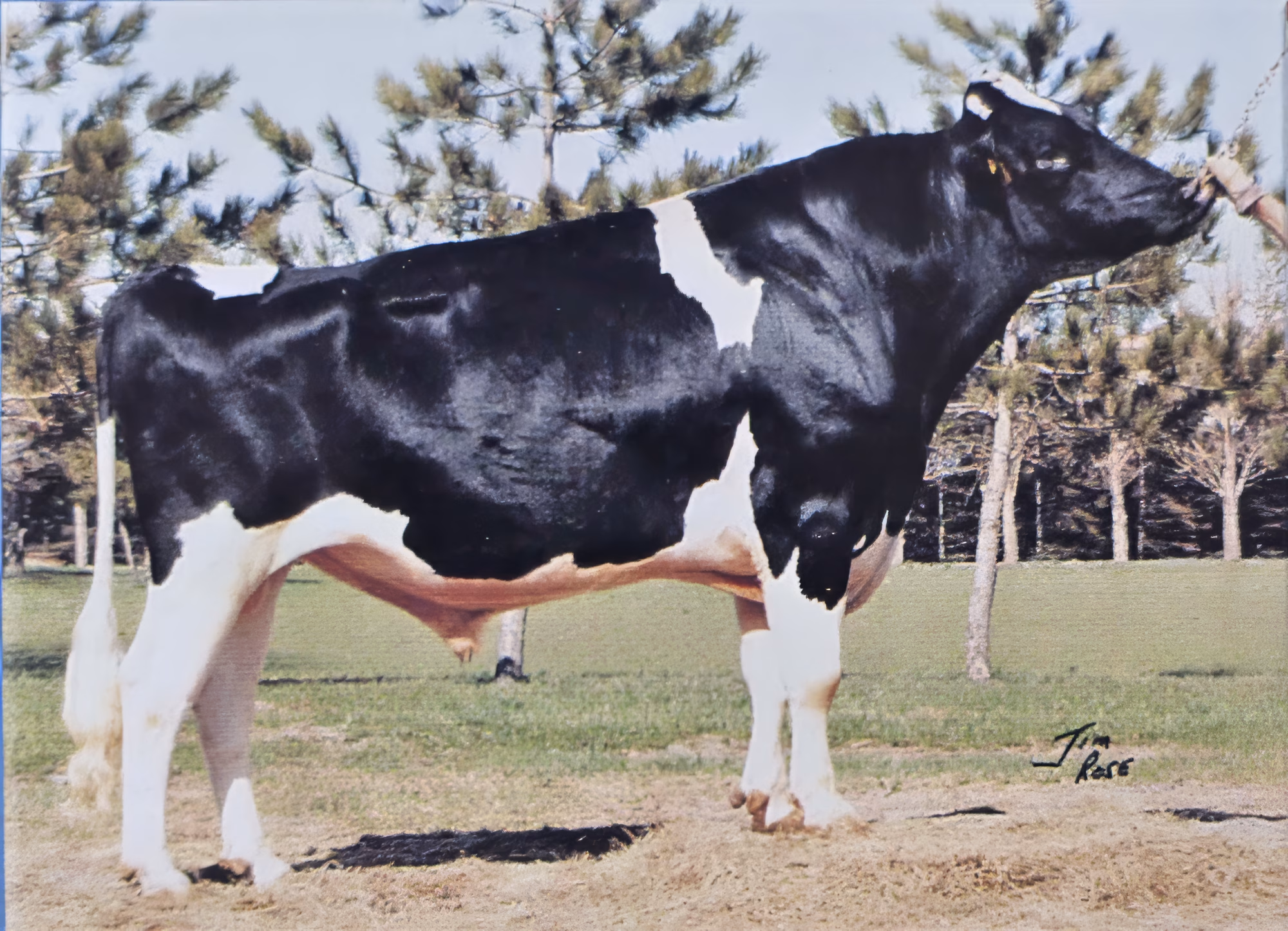
The legendary Hanoverhill Starbuck, pictured here at 5 years old by photographer Jim Rose, stands as a monument to genetic excellence. Measuring an impressive 73½ inches (1.87m) at the shoulder and weighing 2,580 lbs (1,173 kg), his powerful frame supported by what many consider the finest feet and legs ever seen on a Holstein bull. This photograph captures the quiet confidence of a sire whose genes would transform global dairy breeding, father over 200,000 daughters across 45 countries, and generate $25 million in semen sales after being purchased for just $2,500. Behind that steady gaze lies the architecture of modern Holstein genetics – a living blueprint whose DNA still flows through 83% of North America's black and white dairy cows. The $2,500 bull who became a billion-dollar genetic revolution.
The legendary Hanoverhill Starbuck, pictured here at 5 years old by photographer Jim Rose, stands as a monument to genetic excellence. Measuring an impressive 73½ inches (1.87m) at the shoulder and weighing 2,580 lbs (1,173 kg), his powerful frame supported by what many consider the finest feet and legs ever seen on a Holstein bull. This photograph captures the quiet confidence of a sire whose genes would transform global dairy breeding, father over 200,000 daughters across 45 countries, and generate $25 million in semen sales after being purchased for just $2,500. Behind that steady gaze lies the architecture of modern Holstein genetics – a living blueprint whose DNA still flows through 83% of North America’s black and white dairy cows. The $2,500 bull who became a billion-dollar genetic revolution.

Picture this: A crisp Ontario morning in 1979, dew still clinging to the pastures. Two men Robert Chicoine and Harley Nicholson from Quebec’s CIAQ—walk into Peter Heffering’s barn at Hanover Hill Holsteins. They’d been trudging through Central Ontario for days, looking at bull after bull, hoping to find something special, then one night after running into Peter at Hagens Chicken Restaurant.

And then they saw him.

“I remember the first time I laid eyes on Starbuck,” shares Chicoine. “He wasn’t just good—he had that look. You know the one. The kind that makes your jaw drop.”

Just a 45-day-old calf, standing there with what I can only describe as bovine confidence. That starburst blaze on his forehead like nature’s own brand. Those wide-set eyes tracking the men as if he knew his destiny. The physical traits practically shouted genetic gold to those who could read them—squared hip promising easy calving, springy pasterns suggesting longevity, and that perfect forearm-to-stifle ratio whispered of milk production to come.

But what sealed the deal? That uncanny “prepotent aura”—the mysterious quality that tells experienced breeders this animal will stamp his traits onto generation after generation. CIAQ took a $2,500 gamble on that calf. A gamble that would return $25 million in semen sales and rewrite Holstein genetics worldwide.

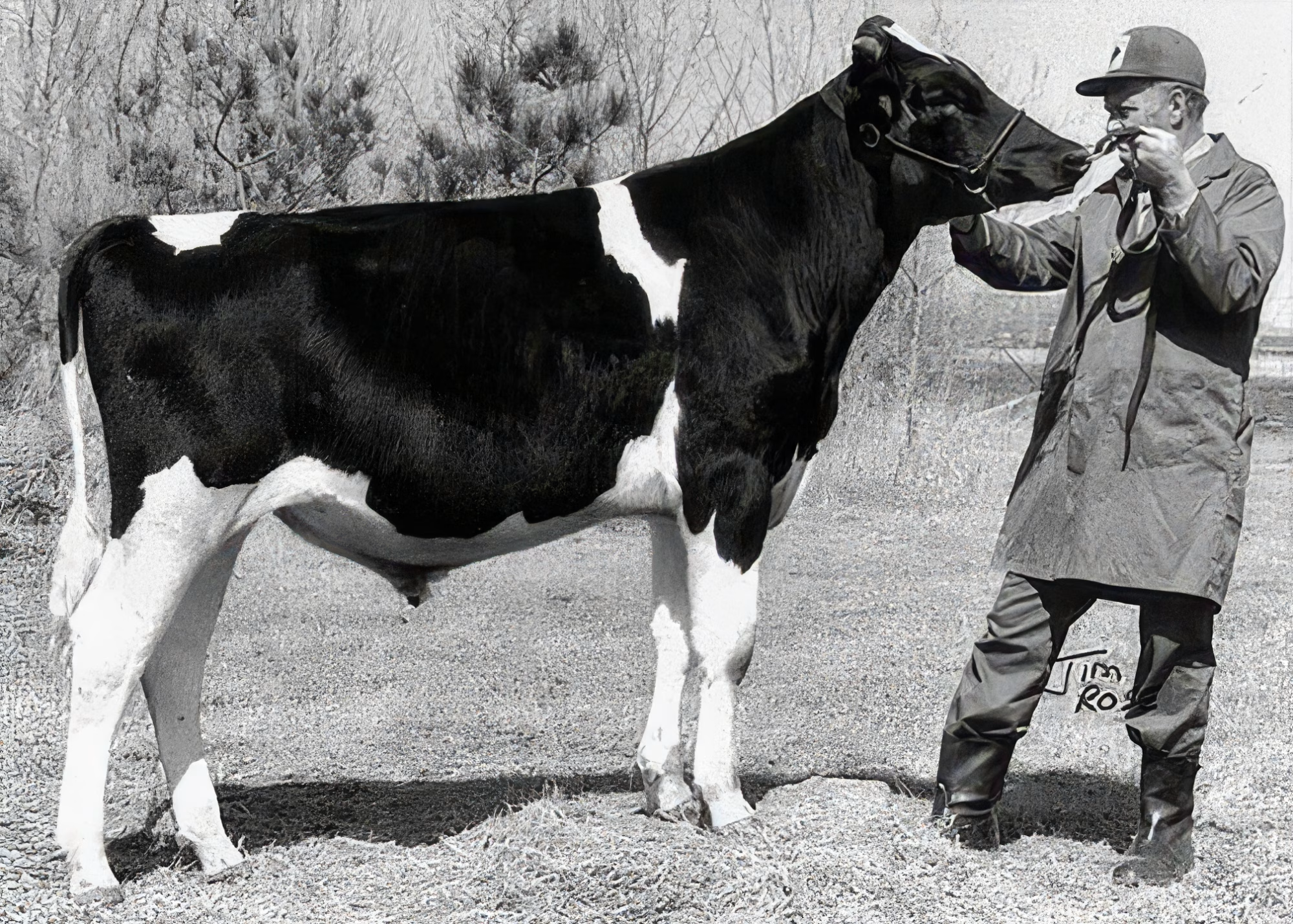
Pictured here at just 11 months old during his young sire program, Hanoverhill Starbuck already displayed the promise of greatness. Standing tall with balanced proportions and a striking black-and-white coat, this future supersire was destined to reshape Holstein genetics worldwide. Even at this age, his physical traits hinted at the prepotency that would define his legacy—strong feet and legs, a robust frame, and an unmistakable presence. Starbuck’s journey from this moment to global dominance began with the vision of breeders who recognized his potential to revolutionize dairy farming.

By the mid-80s, Starbuck’s daughters—200,000 strong—were dominating Quebec milking parlors. Their protein yields hit that sweet 3.2% mark when the cheese market was booming, and their udders? Show-ring perfect. An astonishing 70% scored “Good Plus” or better for conformation. His semen crossed oceans to 45 countries, and those 27 Premier Sire titles between ’86 and ’95? Unheard of. We started calling him agriculture’s first “supersire,” and it wasn’t hyperbole.

But here’s where the story gets complicated, young one. The same genetics that boosted global milk production by 12% also narrowed the breed’s diversity. By 2000, about 95% of Quebec Holsteins were related to Starbuck. It’s the classic dairy farmer’s dilemma—how do you balance genetic ambition with long-term sustainability?

Today, with all our fancy CRISPR technology and genomic tools, Starbuck’s DNA still flows through 83% of sequenced North American Holsteins. His clone might have failed, but his lesson endures: In every Holstein heifer that steps into your milking parlor, there walks a bull who proved one animal could reshape an entire industry—drop by drop, gene by gene.

Johanna Rag Apple Pabst, affectionately called 'Old Joe,' stands immortalized as a life-size sculpture on the site of the historic Mount Victoria farm in Hudson Heights, Quebec. Born on January 24, 1921, this legendary sire appears no less than 45 times in Hanoverhill Starbuck's pedigree, cementing his foundational influence on modern Holstein genetics. With 64 Montvic animals also contributing to Starbuck’s lineage, 'Old Joe' remains a cornerstone of Canadian dairy breeding history. Pictured here in the summer of 2021, his legacy continues to inspire breeders worldwide.
Johanna Rag Apple Pabst, affectionately called ‘Old Joe,’ stands immortalized as a life-size sculpture on the site of the historic Mount Victoria farm in Hudson Heights, Quebec. Born on January 24, 1921, this legendary sire appears no less than 45 times in Hanoverhill Starbuck’s pedigree, cementing his foundational influence on modern Holstein genetics. With 64 Montvic animals also contributing to Starbuck’s lineage, ‘Old Joe’ remains a cornerstone of Canadian dairy breeding history. Pictured here in the summer of 2021, his legacy continues to inspire breeders worldwide.

The 1970s: Setting the Stage for a Genetic Revolution

You’ve got to understand the world Starbuck was born into to appreciate his impact. The 1970s were a time of reckoning in Holstein breeding. Post-war industrialization had pushed milk production to new heights—from about 2,000 kg per cow in the 1920s to over 6,800 kg by the 70s. But the industry was split down the middle.

Commercial dairies wanted efficient milk machines, often at the expense of longevity. Meanwhile, pedigree breeders chased those angular frames, deep ribs, and picture-perfect udders that won ribbons but sometimes left cows broken down before their time.

“It was like two different breeds sharing the same hide,” my old mentor used to say. “Show-ring Holsteins versus working Holsteins.”

Artificial insemination had already transformed the landscape—75% of Canadian herds were using AI by ’75. But this created problems. Elite sires like Round Oak Rag Apple Elevation (Starbuck’s daddy) dominated the catalogs, creating what we now recognize as genetic bottlenecks. Would you believe 99% of Holstein Y chromosomes are traced to just two bulls from the 1960s? Talk about putting all your eggs in one basket!

Round Oak Rag Apple Elevation (1965–1979), hailed as "Bull of the Century," revolutionized Holstein breeding with his unmatched ability to transmit both milk production and flawless conformation. As the sire of Hanoverhill Starbuck, Elevation's genetic legacy continues to shape global dairy herds, ensuring his influence remains unparalleled in modern pedigrees.
Round Oak Rag Apple Elevation (1965–1979), hailed as “Bull of the Century,” revolutionized Holstein breeding with his unmatched ability to transmit both milk production and flawless conformation. As the sire of Hanoverhill Starbuck, Elevation’s genetic legacy continues to shape global dairy herds, ensuring his influence remains unparalleled in modern pedigrees.

The data side was even messier. Only about a third of herds participated in milk recording programs. Sire proofs were patchy at best, and many breeding decisions came down to reputation rather than hard numbers. As Jacques Leclerc told me once, “We were flying half-blind. You trusted names like Elevation because the data wasn’t there to prove otherwise.”

Meanwhile, the market was shifting. The cheese and yogurt boom created demand for protein-rich milk. Holsteins lagged Jerseys in solids (3.2% protein versus 3.8%), but their sheer volume made them the breed of choice for industrial dairies.

Health issues were becoming impossible to ignore. Cows with those pendulous udders faced 84% higher mastitis rates. Poor leg structure was cutting productive lifespans by more than a lactation. Forward-thinking breeders like Peter Heffering started talking about “functional type”—the radical notion that a cow should look good AND last.

This was the world Starbuck entered—a breed at a crossroads, needing a sire who could bridge the divide between show ring and milk tank, between pedigree prestige and commercial practicality. And boy, did he deliver.

In this historic 1994 photograph, the legendary Holstein sire Hanoverhill Starbuck stands at Mount Victoria Farm in Hudson Heights, Québec—the same hallowed ground where his ancestor Johanna Rag Apple Pabst was photographed in 1928. The mature bull, then 15 years old and still in active service at CIAQ, displays the powerful frame and distinctive markings that helped him sire over 200,000 daughters worldwide. This image captures a profound moment of Holstein breeding continuity, connecting Starbuck's revolutionary genetic impact (685,000 semen doses sold across 45 countries) with the pioneering work of T.B. Macaulay's breeding program that began nearly seven decades earlier, symbolizing how thoughtful selection across generations transformed global dairy genetics.
In this historic 1994 photograph, the legendary Holstein sire Hanoverhill Starbuck with Carl Saucier at the halter stands at Mount Victoria Farm in Hudson Heights, Québec—the same hallowed ground where his ancestor Johanna Rag Apple Pabst was photographed in 1928. The mature bull, then 15 years old and still in active service at CIAQ, displays the powerful frame and distinctive markings that helped him sire over 200,000 daughters worldwide. This image captures a profound moment of Holstein breeding continuity, connecting Starbuck’s revolutionary genetic impact (685,000 semen doses sold across 45 countries) with the pioneering work of T.B. Macaulay’s breeding program that began nearly seven decades earlier, symbolizing how thoughtful selection across generations transformed global dairy genetics.

The Perfect Genetic Storm

What made Starbuck special wasn’t just one trait—it was the perfect convergence of elite genetics. His sire, Round Oak Rag Apple Elevation (EX-96), was already legendary for transmitting milk volume and style. Those daughters averaged 29,500 pounds per lactation, with the iconic “Elevation udder”—high, wide, and tightly attached.

His dam, Anacres Astronaut Ivanhoe (VG-88 GMD), was no slouch either. Her 365-day record of 28,677 pounds of milk at 4.2% fat put her among Canada’s elite. Through her grandsire, she contributed exceptional mammary traits and longevity genes.

Anacres Astronaut Ivanhoe VG-88 GMD, the dam of Hanoverhill Starbuck, stands tall in this historical photo, embodying the traits that made her a cornerstone of Holstein breeding. Bred by Dick and Bill Anderson of Jamestown, NY, Ivanhoe was a production powerhouse with a lifetime record of 134,809 lbs of milk at 4.2% fat. She set New York State milk and fat records during her first lactation before being purchased by Peter Heffering for Hanover Hill Holsteins. Her most famous calf, Hanoverhill Starbuck, born in 1979, went on to sire over 200,000 daughters globally and become one of the most influential bulls in Holstein history.

But Starbuck’s true magic was his consistency. Where other bulls might excel in one area, he transmitted a complete package:

“I remember walking through a barn full of his daughters in ’87,” an old Quebec breeder told me. “It was like seeing the same cow repeatedly—those perfect rear udders 12% deeper than average, protein at 3.2% when that meant premium checks, and 82% with textbook leg angles. We’d never seen anything like it.”

This prepotency came from a rare genetic alignment. Elevation contributed dominant alleles for milk synthesis on chromosome 14, while Ivanhoe’s lineage provided favorable SNPs for udder attachment and efficiency. The result? Breeders called him a “genetic photocopier”—94% of his daughters shared his signature broad chest and upright teat placement.

By 1990, his Lifetime Profit Index hit +1,500, combining +2,100 kg milk, +75 kg combined fat/protein, and high conformation. He was the first bull to rank in the top 1% for production and type—something only 0.3% of today’s genomic sires achieve. That year, 38% of Canadian Holstein inseminations used Starbuck semen.

As the British Holstein Journal put it: “The sire that attracts endless superlatives—one of a kind, the greatest, phenomenal, the king, Mr. Excitement, or… ‘Simply the Best’.”

From Quebec to the World

CIAQ knew they had gold in their tanks. By 1998, they’d sold 685,000 semen doses across 45 countries—enough to fill 1,370 liters—generating $25 million in revenue (that’s over $45 million in today’s money).

His daughters thrived everywhere they landed:

  • In Bavaria, they averaged 8,900 kg milk over 305 days—12% above German averages
  • In Ukraine’s Sumy region, his descendants still constitute 21.9–40.3% of the breeding stock
  • In South Africa’s heat, they maintained production where other genetics faltered

But it was in the show ring where Starbuck truly became a brand. Between 1986 and 1995, he earned 27 Premier Sire titles at major North American shows. His daughters, like Hanoverhill S Alicia (EX-97), collected 82 All-American nominations and 130 All-Canadian honors.

“Seeing a Starbuck heifer stride into the ring was like watching royalty enter,” one Quebec farmer told me. “You knew she’d win.”

CIAQ’s windfall wasn’t just profit—it transformed the AI industry. They funded young sire testing for 500+ bulls annually by 1995, invested in early BLUP models that laid the groundwork for today’s genomics, and established distribution hubs across continents.

Their 1987 catalog summed it up perfectly: “Why gamble on untested genetics when Starbuck delivers?” His proven track record convinced even skeptical farmers to embrace AI, pushing Canadian adoption rates to 89% by 1990.

Pictured here is Comestar Outside, one of Canada’s most iconic Holstein sires, celebrated for achieving over 1,000 Excellent-classified daughters—a milestone surpassed only by Braedale Goldwyn. A Prelude son out of Comestar L Or Black VG-87, Outside carries the genetic influence of Hanoverhill Starbuck through his grandsire Prelude, cementing his place in the lineage of dairy greatness. His prepotency for transmitting exceptional type and conformation continues to shape elite herds worldwide.

The Double-Edged Sword

By 2000, Starbucks’s influence had reached levels we’d never seen before—and we hope never to see again. His 200,000+ daughters spanned 45 countries, with 62,000 in Canada alone. In Quebec, 95% of Holsteins carried his genetics, creating both a triumph and a ticking time bomb.

His 209 proven sons, including standouts like Hanoverhill Raider with his +0.07% protein transmission, extended this dynasty into a third generation. The global footprint became staggering—from Japan’s northern island to Brazil’s dairy regions, Starbuck’s genes were reshaping the Holstein breed.

But this dominance came at a cost. By 2000, inbreeding coefficients in Quebec herds hit 6.8%. His daughters, while productive, showed lower numbers for fertility—a stark reminder that genetic concentration has consequences. Their extreme dairy character, while beautiful, correlated with 18% higher culling rates for metabolic disorders compared to outcrossed herds.

Smart breeders adapted. The Danes started crossing Starbuck-line cows with VikingRed cattle to improve hoof health. AI centers eventually limited his lineage to 5% of catalogs, using SNP-guided mating to reduce inbreeding risks. Modern evaluations now actually penalize Starbuck-line bulls for those fertility deficits.

As Lactanet’s 2024 report shows, Holstein inbreeding rates have stabilized around 9.61% in 2023 births. However, the annual increase of +0.25% remains the highest among major dairy breeds—a lingering echo of the Starbuck era.

This rare left-side photo of Hanoverhill Starbuck, taken in the early 1990s at Mount Victoria Farms, captures the legendary Holstein sire in his prime. Posing for CIAQ’s commemorative shoot, Starbuck’s commanding presence reflects the genetic excellence that made him a global icon, reshaping dairy breeding for generations.

The Twilight Years and Beyond

Starbuck’s career spanned an extraordinary 19 years (1979–1998)—most bulls retire by 12. He remained fertile until his death on September 17, 1998, in Saint-Hyacinthe, Quebec. His frozen semen from the early years continued producing daughters well into the 2000s, with a Michigan dairy reporting a 2005-born daughter yielding 18,300 kg milk at 3.7% protein.

Then came the clone. In 2000, scientists at Université de Montréal and L’Alliance Boviteq created Starbuck II using somatic cells frozen before his death. Born September 7, 2000, weighing 54.2 kg, the calf initially showed promise. But mitochondrial DNA discrepancies—his nuclear DNA matched Starbuck at 99.8%, but his mitochondrial DNA came from the host oocyte—led regulators to block commercial use.

The cloning process took 64 attempts initially, though Dr. Lawrence Smith’s team later improved success rates to 1 in 17. Despite the technical achievement, by 2010, genomic selection had made cloning obsolete. Starbuck II was cremated—a symbolic end to an ambitious chapter.

“Cloning taught us precision—but also humility,” Dr. Smith noted. “Nature’s blueprint resists shortcuts.”

Starbuck’s influence extended beyond agriculture. The 2011 Québécois film Starbuck and its Hollywood remake Delivery Man (2013) humorously explored the ethics of mass genetic contribution. More importantly, his story forced the industry to confront inbreeding risks, leading to today’s Optimal Contribution Selection protocols.

In death, he remains both icon and cautionary tale—a bull whose legacy lives not in clones but in the DNA of herds worldwide and the hard-won wisdom of breeders navigating genetic frontiers.

Legacy Through Offspring

Hanoverhill Starbuck’s legacy is profoundly shaped by his extensive and influential offspring, who cemented his status as a Holstein legend and continue to impact the breed today. Starbuck was an exceptional individual and a prepotent sire who consistently transmitted desirable traits to his progeny.

Aitkenbrae Starbuck Ada (1986-?): The legendary Holstein matriarch whose exceptional conformation earned her Unanimous All-American Senior Three-Year-Old honors in 1990, but whose true legacy lives on through her daughters Alicia and Adeen, whose descendants continue to revolutionize Holstein genetics worldwide. Her remarkable balance of show ring excellence and genetic prepotency bridged the divide between type and production, establishing a dynasty that remains influential in modern genomic breeding. Photo: Maggie Murphy
Aitkenbrae Starbuck Ada: The legendary Holstein matriarch whose exceptional conformation earned her Unanimous All-American Senior Three-Year-Old honors in 1990, but whose true legacy lives on through her daughters Alicia and Adeen, whose descendants continue to revolutionize Holstein genetics worldwide. Her remarkable balance of show ring excellence and genetic prepotency bridged the divide between type and production, establishing a dynasty that remains influential in modern genomic breeding. Photo: Maggie Murphy

Starbuck’s daughters achieved remarkable success in various aspects, contributing significantly to his legacy. They were highly regarded for production and conformation, often excelling in show rings and becoming high-producing milk cows.

  • Many of his daughters achieved high classification scores, with 70% scoring Good Plus or better in Canada.
  • He sired more milking-age All-American daughters (10) than any other sire in history. His daughters collectively earned numerous All-Canadian (35) and All-American (42) honors.
  • Notable daughters, such as Hanoverhill S Alicia (EX-97), Dupasquier Starb Winnie (EX-3E-8*), Merkley Starbuck Whitney, and Acme Star Lily (EX), became show-ring champions and iconic figures.
  • Beyond show success, many Starbuck daughters were influential brood cows, such as Aitkenbrae Starbuck Ada (EX), who produced other All-American and All-Canadian winners, and Thiersant Lili Starbuck (E2X-4-94), whose extensive offspring became the “face of Lylehaven” and are ancestors of modern sires like Farnear Delta-Lambda. Hanoverhill Star Lulu (EX) fetched a record price of $635,000.
Madawaska Aerostar (EX-Extra-GM) emerged as one of Hanoverhill Starbuck’s most influential sons, blending production prowess with genetic consistency. Bred by Allan Boese of Renfrew, Ontario, Aerostar topped Canada’s first Lifetime Profit Index in 1991, driven by his ability to transmit high protein yields (+64 kg) and exceptional conformation (+5). His daughters and sons, including Startmore Rudolph and Maughlin Storm, carried his legacy into modern pedigrees, influencing Holstein genetics globally. Aerostar’s impact remains visible in renowned sires like Braedale Goldwyn, ensuring his place as a cornerstone of Holstein breeding history.

Starbuck was also an exceptional sire of sons, extending his genetic influence and shaping the future of the Holstein breed.

  • By January 1994, 25% of Canada’s active AI sires were Starbuck sons.
  • His sons and grandsons consistently topped the index lists in Canada from 1991 to 1998.
  • Influential sons like Madawaska Aerostar (EX-Extra-GM) became a dominant force in production, particularly for protein yield, and sired numerous influential sons themselves, such as Startmore Rudolph and Maughlin Storm.
  • Ronnybrook Prelude (GP-GM-Extra), despite some fluctuations in his proof, also became a significant sire, responsible for notable descendants like Comestar Outside and the sire of Picston Shottle.
  • Duregal Astre Starbuck (EX-Extra) achieved international recognition, with his semen exported to 40 countries. His son STBVQ Rubens significantly impacted the Red & White Holstein breed.
  • Hanoverhill Raider (EX-Extra) was highly regarded by his breeders and sired influential sons like Comestar Lee.

The impact of Starbuck’s genes extends through multiple generations. His grandchildren and great-grandchildren have continued to be prominent in production and type, demonstrating the lasting power of his genetic contribution. For instance, Picston Shottle is described as a “genuine Starbuck ambassador” as both his sire and dam’s sire were Starbuck grandsons. The pedigree of modern influential sires like Farnear Delta-Lambda also shows significant traces of Starbuck’s lineage. By 2000, Starbuck’s influence was so widespread that 95% of Quebec Holsteins carried his genetics. Today, his DNA still flows through 83% of sequenced North American Holsteins, and 35% of the world’s top GTPI females trace back to him.

Hanoverhill Starbuck’s legacy through his offspring is one of unprecedented genetic impact, transforming the Holstein breed globally through his high-performing and phenotypically superior daughters and influential sons. While his prepotency achieved remarkable genetic progress, it also underscored the importance of maintaining genetic diversity for the long-term health and sustainability of the breed. His story is a powerful lesson in balancing genetic ambition and responsible breeding practices.

Show Ring Success

Dupasquier Starb Winnie EX-3E 8*, born October 13, 1986, was sired by Hanoverhill Starbuck and out of Allangrove AA Winnie VG-85 4*. Bred by Oscar Dupasquier of Guelph, Ontario, Winnie had an illustrious show career, earning Grand Champion titles at the Royal Winter Fair and the International Holstein Show in the late 80s and early 90s. She produced Excellent daughters by Boulet Charles and Duregal Starbuck Astre, continuing her legacy through Dupasquier Blac Winnie VG-88. Her exceptional genetics and show-ring dominance cemented her place as one of the era's most influential Holstein brood cows.
Dupasquier Starb Winnie EX-3E 8*, born October 13, 1986, was sired by Hanoverhill Starbuck and out of Allangrove AA Winnie VG-85 4*. Bred by Oscar Dupasquier of Guelph, Ontario, Winnie had an illustrious show career, earning Grand Champion titles at the Royal Winter Fair and the International Holstein Show in the late 80s and early 90s. She produced Excellent daughters by Boulet Charles and Duregal Starbuck Astre, continuing her legacy through Dupasquier Blac Winnie VG-88. Her exceptional genetics and show-ring dominance cemented her place as one of the era’s most influential Holstein brood cows.

Hanoverhill Starbuck’s show ring success, primarily achieved through his progeny, was a crucial element of his widespread acclaim and lasting legacy. The exceptional conformation of his offspring, which translated into significant victories and recognition in major shows.

Starbuck himself was recognized as a Premier Sire at major North American shows 27 times between 1986 and 1995. This indicates his remarkable ability to consistently sire offspring with the desired traits for show ring success.

However, it was his daughters who truly shone in the show ring, solidifying his reputation.

  • An astonishing 70% of his Canadian daughters scored “Good Plus” or better for conformation.
  • He sired more milking-age All-American daughters (10) than any other sire in history.
  • His daughters collected 82 All-American nominations and 130 All-Canadian honors. He sired 32 progeny who earned 42 All-American and 24 Reserve awards, and 41 offspring who won 35 All-Canadian and 27 Reserve awards.
  • Numerous individual Starbuck daughters became show ring champions and iconic figures. Examples include:
    • Dupasquier Starb Winnie (EX-3E-8)*, an All-American aged cow in 1993 and 1994 and a Grand Champion at the Royal Winter Fair and International Holstein Show.
    • Merkley Starbuck Whitney, an All-American junior 3, 4, and 5-year-old in 1991-93.
    • Acme Star Lily (EX), an All-American four and five-year-old in 1997-98.
    • Hanoverhill Star Lulu (EX), All-American senior two-year-old of 1988 and his highest selling offspring at $635,000.
    • Aitkenbrae Starbuck Ada (EX), All-American senior three-year-old in 1990.

Starbuck’s sons also contributed to his show ring legacy, both through their own desirable traits and their ability to sire high-conformation offspring.

  • Madawaska Aerostar (EX-Extra-GM), while primarily known for protein production, also transmitted exceptional conformation (+5 LPI).
  • Duregal Astre Starbuck (EX-Extra) was also Premier Sire at the Royal Winter Fair in 1999, and Reserve in 1997 and 1998.
  • Hanoverhill Raider (EX-Extra) sired Glenridge Raider Cinema (2X-95), noted as the youngest cow to score 95 points in the UK.
  • Marcrest Encore (EX-96-GM) was often advertised as the highest type son of Starbuck.
  • Hanoverhill Skybuck (EX-ST) was known as a sire of show type, siring Llleeta Skybuck Lucy (EX), grand champion at Madison in 2007.
  • Ronnybrook Prelude (GP-GM-Extra) is noted for adding strength and substance to his offspring.

The show ring success of Starbuck’s progeny was integral to his overall impact and commercial appeal. Their victories not only demonstrated his ability to transmit desirable conformation traits but also significantly increased the demand and value of his semen and offspring. The phrase “functional type,” which Peter Heffering emphasized, highlighted the importance of cows that could both perform in the show ring and be productive, long-lasting members of the herd. Starbuck embodied this ideal, bridging the gap between “show-ring Holsteins” and “working Holsteins”.

Furthermore, the influence of Starbuck’s show-winning daughters extended into future generations, as many became influential brood cows, producing more champions and high-quality offspring. For example, Aitkenbrae Starbuck Ada was the dam of Shoremar S Alicia, a Royal Winter Fair grand champion. Thiersant Lili Starbuck became the “face of Lylehaven” due to her extensive and high-scoring offspring. Kingsway Dempsey Nora EX-95, a more modern example, traces her distinguished pedigree back to Starbuck through her maternal line, showcasing the lasting impact of his conformation genetics.

In conclusion, Starbuck’s show ring success, primarily through his remarkably consistent and high-achieving daughters, was a cornerstone of his legendary status. It demonstrated his ability to transmit exceptional conformation, increased his commercial value, and established a lineage of show-winning and influential breeding animals that continue to impact the Holstein breed today. His ability to sire both high-producing and high-conformation offspring was a key reason for his widespread adoption and his place as a truly transformative figure in Holstein history.

Sunnylodge Prelude Spottie VG-87-18*, the iconic daughter of Ronnybrook Prelude—a Starbuck son—helped cement Sunnylodge Farms' legacy. Named Holstein Canada’s "Cow of the Year" in 1998, Spottie produced 14 sons in AI, including Sunnylodge Linjet EX-ST, and a lineage of exceptional daughters that shaped global Holstein genetics. Her transmitting ability to produce high-LPI cows, show winners, and AI bull mothers made her a cornerstone of modern breeding programs.
Sunnylodge Prelude Spottie VG-87-18*, the iconic daughter of Ronnybrook Prelude—a Starbuck son—helped cement Sunnylodge Farms’ legacy. Named Holstein Canada’s “Cow of the Year” in 1998, Spottie produced 14 sons in AI, including Sunnylodge Linjet EX-ST, and a lineage of exceptional daughters that shaped global Holstein genetics. Her transmitting ability to produce high index cows, show winners, and AI bull mothers made her a cornerstone of modern breeding programs.

From Phenotype to Genome: Starbuck’s Modern Legacy

The contrast between Starbuck’s era and today’s breeding methods couldn’t be starker. When Chicoine and Nicholson selected him, they relied on visual assessment and pedigree. Today’s breeders use 50K SNP chips to decode DNA, predicting traits like methane efficiency (-55.8 €/kg DM/day) and feed intake before a calf takes its first breath.

Where Starbuck’s proof required years of daughter testing, genomic evaluations now achieve 85% reliability in calves, cutting generation intervals by 40%. His daughters met 1980s needs for protein and volume; today’s indices prioritize Feed Saved (reducing dry matter intake by 1.2 kg/day) and Methane Efficiency, measured through mid-infrared spectroscopy and SNP markers.

Lactanet Canada’s 2023 methane-adjusted breeding values exemplify this shift, enabling selection for cows producing 20% less methane without sacrificing yield. It’s a different world, focused on efficiency and sustainability rather than just production.

Modern breeding also addresses Starbuck’s greatest weakness—genetic concentration. Optimal Contribution Selection caps single-sire influence at 5% of AI catalogs. SNP-guided mating using 13,250 markers reduces inbreeding by 22%, even in regions like Ukraine, where his descendants remain dominant.

CRISPR trials now target specific genes like ANKS1B and CCSER1 to enhance reproduction and milk yield simultaneously, addressing the fertility deficits his line introduced. Meanwhile, k-means clustering of SNP data helps breeders balance productivity with genetic diversity.

Starbuck’s legacy endures not in clones but in lessons learned. His era’s pursuit of prepotency paved the way for today’s sustainability-driven genomics, where each SNP tells a story of progress and caution—a billion-dollar bull’s blueprint refined for a greener future.

Acme Star Lily 2E-EX-94, a remarkable Holstein female born May 5, 1993. This profile showcases her exceptional dairy character, deep barrel, and strong mammary system that earned her multiple Excellent classifications. Lily represents the pinnacle of her bloodline, being sired by Willowholme Mark Anthony out of a VG-88 dam, with her maternal granddam being a VG-85 Puget-Sound Sheik.
Acme Star Lily 2E-EX-94, a remarkable Starbuck daughter born May 5, 1993. This profile showcases her exceptional dairy character, deep barrel, and strong mammary system that earned her multiple Excellent classifications. Lily represents the pinnacle of her bloodline, being sired by Willowholme Mark Anthony out of a VG-88 dam, with her maternal granddam being a VG-85 Puget-Sound Sheik.

The Man Behind the Bull: Peter Heffering’s Vision

You can’t talk about Starbuck without acknowledging the breeder who created it. Peter Heffering and Ken Trevena built Hanover Hill Holsteins on a revolutionary premise: “Functional type isn’t just about show rings—it’s about cows that last.”

He rejected the false choice between volume and vitality, selecting deep ribs (feed capacity), correct leg angles (longevity), and udders that could withstand high production without breaking down. His mantra—”Breed the best, and the rest will follow”—guided a program that would reshape global genetics.

Brookview Tony Charity: Her Legacy Lives On!
Grand Champion at the Royal Winter Fair four times and just as often the Supreme Champion in Madison. In 1987 for Hanover Hill Holsteins and Romandale Farms, Brookview Tony Charity became the unparalleled Grand Champion.
Brookview Tony Charity – Grand Champion at the Royal Winter Fair four times and just as often the Supreme Champion in Madison. In 1987 for Hanover Hill Holsteins and Romandale Farms, Brookview Tony Charity became the unparalleled Grand Champion.

Heffering’s philosophy crystallized in 1983 with the $1.45 million sale of Brookview Tony Charity, another son of Elevation. “Tony proved that show-stoppers could also be barn survivors,” Heffering once reflected. The sale funded Hanover Hill’s expansion into embryo transfer, allowing him to multiply his best cow families.

His toolkit blended old and new approaches:

  • Regular classification scoring ensured every animal met his standards
  • Embryo transfer accelerated genetic gains while maintaining diversity
  • Strategic outcrossing prevented overreliance on any single-line

Despite Starbucks’ success, Heffering avoided putting all his eggs in one basket, often pairing Starbucks daughters with descendants of Wis Ideal to reinforce rump width and hoof health.

His humility belied his ambition: “We didn’t set out to create a dynasty—we aimed to breed the best.” And: “A cow’s value isn’t in her pedigree; it’s in her ability to outlast the mortgage.”

By 1995, 92% of Canadian heifers carried Hanover Hill genetics, while German breeders praised Starbuck daughters for thriving in free-stall barns—a testament to Heffering’s focus on adaptability. His vision proved that excellence need not sacrifice sustainability, creating a blueprint for today’s breeders.

Raypien Lambda Adou, the 1st place Summer Two-Year-Old at the 2024 International Holstein Show, embodies elite genetics rooted in dairy royalty. Sired by Lambda, a descendant of Pawnee Farm Arlinda Chief, Adou traces her lineage back to Hanoverhill Starbuck through Thiersant Lili Starbuck, showcasing the enduring influence of one of Holstein breeding’s most iconic sires. Her victory is a testament to the power of carefully curated genetics and the legacy of excellence passed down through generations.

Lessons for Today’s Breeders

Starbuck’s story offers timeless wisdom for anyone working with livestock genetics. His dominance—95% of Quebec Holsteins related to him by 2000—revealed the power and peril of genetic concentration.

Today’s tools, like Optimal Contribution Selection, mitigate these risks by limiting individual sire contributions to 5% of breeding programs. Lactanet’s 2025 framework penalizes bulls with high kinship scores to prevent history from repeating itself. With Holstein inbreeding rates at 9.61% (2023 data), Starbuck’s legacy reminds us that genetic progress without diversity is a short-lived triumph.

His success also teaches market responsiveness. Starbuck met the 1980s demand for high-protein milk (3.2%)—just as today’s breeders adapt to new priorities:

  • A2 β-casein (New Zealand now produces 86% A2 milk)
  • Environmental metrics (Canada’s 2025 LPI update includes methane efficiency)
  • Feed efficiency (U.S. Net Merit $ index now prioritizes residual feed intake)

As one Danish breeder put it: “We’re not just selecting cows—we’re curating supply chains.”

The bottom line? Starbuck’s genome is both foundation and warning. Progress without preservation risks extinction. His daughters’ protein yields-built empires, but their fertility struggles revealed the cost of imbalance. Modern tools now let us honor his legacy while avoiding its pitfalls.

Remember, young breeder: “Genetic greatness isn’t measured in semen doses sold, but in herds that thrive across generations.”

The Hoofprint of History

Starbuck’s legacy is etched into the very DNA of modern dairy farming. He redefined what a single bull could achieve, from his 200,000+ daughters to his 27 Premier Sire titles. His story embodies dairy breeding’s central paradoxes: unifying global priorities while narrowing diversity to attain commercial success and raising ethical questions.

His genetic penetration remains unmatched—95% of Quebec Holsteins carried his lineage by 2000, and today, 35% of the world’s top GTPI females still trace to his pedigree. His show ring daughters, like EX-97 Hanoverhill S Alicia, proved that style and substance could coexist, bridging the divide between pedigree prestige and commercial practicality.

Yet his greatest contribution may be the lessons learned from his shortcomings. The fertility deficit and inbreeding spikes forced breeders to confront the cost of unchecked genetic ambition. Today’s approaches—Optimal Contribution Selection, methane efficiency indices, and CRISPR-edited traits—blend his production prowess with ecological stewardship.

As Holsteins face climate mandates and ethical scrutiny, Starbuck’s influence persists: in the udder structure of a champion heifer, the protein yield of a commercial herd, and the algorithms parsing genomic data. His story isn’t just about breeding better cows and building resilient agricultural systems.

In every modern Holstein’s stride, Starbuck’s DNA whispers—a testament to how one bull’s blueprint can milk the future, for better and sometimes for worse, but always with lessons that transcend generations.

Key Takeaways

  • Genetic Influence: Starbuck’s DNA persists in 83% of North American Holsteins, demonstrating how a single exceptional animal can transform an entire industry through consistently transmitting economically valuable traits.
  • Paradoxical Legacy: While Starbuck improved milk production worldwide, his dominance led to inbreeding challenges (6.8% coefficient in Quebec herds), teaching breeders that “genetic progress without diversity is a short-lived triumph.”
  • Market Adaptability: Starbuck’s success coincided perfectly with the 1980s demand for protein-rich milk, highlighting how aligning breeding goals with market trends creates commercial value. This principle continues with today’s focus on A2 milk and methane efficiency.
  • Technological Evolution: His career spans breeding’s transformation from visual selection to genomic science, with his 2000 cloning (Starbuck II) bridging traditional methods and modern techniques that now use 50K SNP chips and CRISPR editing.
  • Ethical Framework: Modern breeding programs directly respond to Starbuck’s overwhelming influence through Optimal Contribution Selection, limiting individual sires to 5% of breeding programs – ensuring today’s genetic progress maintains diversity and sustainability.

Executive Summary

Hanoverhill Starbuck, a Holstein bull born in 1979 and purchased by CIAQ for $2,500, became one of the most influential dairy sires in modern history, generating $25 million through 685,000 semen doses sold across 45 countries. His exceptional genetic “prepotency” consistently passed along superior traits for milk production (+1,200 kg over contemporaries), protein content (3.2%), and udder conformation (70% of daughters scored “Good Plus” or better), creating over 200,000 daughters worldwide and reshaping Holstein genetics to the point where 95% of Quebec Holsteins carried his lineage by 2000. While his contributions dramatically increased global milk productivity and quality, his dominance created genetic bottlenecks that modern breeding programs now carefully manage through genomic selection techniques and diversity preservation strategies. Starbucks’ legacy endures not just in the DNA of today’s dairy cows but also in the fundamental lessons he taught the industry about balancing genetic progress with sustainability.

Join the Revolution!

Join over 30,000 successful dairy professionals who rely on Bullvine Daily for their competitive edge. Delivered directly to your inbox each week, our exclusive industry insights help you make smarter decisions while saving precious hours every week. Never miss critical updates on milk production trends, breakthrough technologies, and profit-boosting strategies that top producers are already implementing. Subscribe now to transform your dairy operation’s efficiency and profitability—your future success is just one click away.

NewsSubscribe
First
Last
Consent

The Genetic Genius of Darwin, Mendel and Hunt – Genetic Transmission and the Holstein Cow

There is no question that when it comes to understanding what cows will transmit and what cows will not, it is an enigma wrapped in a conundrum.  There is much that we don’t know and some would argue it is not meant to be known.  The problem is, for those of us with a passion for breeding great dairy cattle, we want to know it all.  For that I turn to the three greatest genetic geniuses in the history of the world, Darwin, Mendel and Hunt (No they are not a law firm).

Charles Robert Darwin He established that all species of life have descended over time from common ancestors, and proposed the scientific theory that this branching pattern of evolution resulted from a process that he called natural selection, in which the struggle for existence has a similar effect to the artificial selection involved in selective breeding.

Charles Darwin

Ask anyone in the world to name a geneticist and the first name that comes to mind has to be Charles Darwin.  No better demonstration of Darwin’s theory of evolution exists in the world than in dairy cattle breeding.  While there is no question that artificial selection and selective breeding exist on a daily basis, a cow’s ability to reproduce and produce milk leads to a natural level of selection that epitomizes Darwin’s theory.  “The laws governing inheritance,” Darwin wrote, “are for the most part unknown.”  Moreover, while many modern geneticists have theories about the tendencies of the modern Holstein cow, their genetic transmission pathways in large part remain a mystery to this day.

Gregor Mendel

Gregor Mendel

Then along came Gregor Mendel who introduced the concept of “genes” to explain heritability.  Mendel changed the whole way we look at breeding when he introduced the theory that the chromosome is the carrier of genetic traits.  He also explained why a trait can disappear in one generation and reappear in the next and why these traits occur in a three-to-one ratio.  One of Mendel’s disciples, three quarters of a century later, was Thomas B. Macaulay.  Macaulay conducted his own studies, on his Mount Victoria Farms (Read more: Mount Victoria Farms – The art and science of great breeding).

Thomas Hunt Morgan

Thomas Hunt Morgan

Then along came Hunt. Well, more specifically, Thomas Hunt Morgan, but my ego wouldn’t let this go as my name is Andrew Morgan Hunt (Read more about my ego: I’m Sorry But I’ve Had Just About Enough Of… ).  In research that is now reproduced by grade 9 science students around the world, Morgan introduced the concept of X and Y-chromosomes.  Morgan concluded that a female has two X chromosomes and that males have both X and Y-chromosomes.  He also posited that the male of the species, because of the presence of the Y chromosome, transmits differently than the female.

To get a better understanding of this, let’s look at this from both sides of the story.

His side of the story (XY)

If you look at Holstein bulls throughout history you find four distinct patterns:

  1. Great daughters but no legacy sons
    These are the bulls that sired amazing brood cows but none of their sons were able to continue their genetic legacy.  Examples are Hanover-Hill Triple Threat, Carlin-M Ivanhoe Bell, and Braedale Goldwyn.  They all were able to sire brood cow daughters beyond compare, but no real sons to advance that genetic legacy.  Why did these sires seem to produce better on the female side than that of the male?  For that we need to turn to Morgan and his X and Y chromosome theory.  Since the Y chromosome is the only one that is inherited solely via the paternal  line, this leads  some geneticists to believe that it carries little genetic information, and as a result  a great sires genetic legacy rest more with his daughters than with his sons.  Therefore, with this first group of sires it is thought that much of their genetics were transmitted on the X chromosome rather than the Y.
  2. Great sons but not as many brood cows
    Bulls that sired outstanding sons but never produced a top daughter.  A couple of great examples of this are Montvic Rag Apple Sovereign, Maizefield Bellwood and O-Bee Manfred Justice.  All of these sires have left outstanding sons, but are not found as often in the maternal sire stack of the great sires.  There is no question as to their genetic contribution to the breed, but it was more as a sire of sons than their ability to leave an equal number of brood cows.
  3. Sons and daughters both extraordinary
    These are the sires that have gone down in history as the all-time greats.  Sires like Johanna Rag Apple Pabst, Governor of Carnation, Montvic Chieftain, Wisconsin Admiral Burke Lad, A.B.C. Reflection Sovereign, Round Oak Rag Apple Elevation, Pawnee Farm Alrinda Chief, Walkway Chief Mark, Hanoverhill Starbuck, Madawaska Aerostar and Maughlin Storm.  These are the bulls that not only displayed personal greatness but were also able to transmit both outstanding brood cows as well as legacy sons.
  4. Sons and daughters that were inferior
    Sons and daughters that are both below average.  These bulls left inferior daughters and as a result were never even given the chance to produce sons.  Bulls in this category are too numerous to mention and loads of their daughters go to the slaughterhouses every day.  No explanation necessary other than a lack of genetic merit and here enters the need for genomics (Read more: The Truth About Genomic Indexes – “Show Me” That They Work).

Her side the story (XX)

The female side of the story uses the same four distinct groups.

  1. Great daughters but no legacy sons
    These are cows with outstanding female descendants but undistinguished males.  Great examples of these are the cow families of Hanover Hill Papoose, Krull Broker Elegance and Plunshanski Chief Faith.  They all were able to leave outstanding female descendants generation after generation, but were never really able to accomplish the same feat on the male side of the story.
  2. Great sons but not as many brood cows
    These are the cows with potent transmitting sons, but daughters who didn’t outperform the average.  Examples of these are Wylamyna Tidy Kathleen (dam of Sir Bess Tidy and Sir Bess Ormsby Tidy Fobes) Lakefield Fobes Delight (dam of Lakefield Fond Hope, Lakefield Fond Delight Fobes and Carnation Royal Master) and Pawnee Farm Glenvue Beauty (dam of Pawnee Farm Arlinda Chief).  All of these cows had outstanding maternal lines but for some reason were just not able to transmit that legacy through their daughters.
  3. Sons and daughters both extraordinary
    Among the females in this category are Glenridge Citation Roxy, Mil-R-Mor Roxette, Comestar Laurie Sheik, Braedale Gypsy Grand and Snow-N Denises Dellia.
  4. Sons and daughters that were inferior
    Cows who, in terms of influence, failed to produce anything worthwhile.  Blame it on lack of genetics, bad breeding, improper management, or just bad luck, these cows just didn’t influence the breed. We have all seen examples.

The Bullvine Bottom Line

There has never been a clear explanation of why some bloodlines seem to transmit better through maternal lines, others through the paternal, and still others do well in both.  Even genomics does not answer this.  There are high genomic animals that still have these same tendencies.  Maybe if we could genomic test the genes on each chromosome we might find the answers?  Until then Genetic Transmission in the Holstein Cow will remain a mystery.

To read more about this get a copy of The Holstein History by Edward Morwick and read the chapter on Inheritance Patterns.


The Dairy Breeders No BS Guide to Genomics


Not sure what all this hype about genomics is all about?

Want to learn what it is and what it means to your breeding program?

Download this free guide.


[related-posts-thumbnails]

Braedale Goldwyn: Is He The Greatest Type Sire Ever?

Recently Braedale Goldwyn became the 1st sire ever to produce 1000 Excellent daughters in Canada (Read more – Goldwyn First Ever to 1000 EX in Canada).  At this year’s Royal Winter Fair Goldwyn sired 27% of the animals shown, including Grand, Reserve, Honorable Mention, Intermediate, Reserve Intermediate and Honorable Mention Intermediate Champions (Read More – The 2012 Royal Winter Fair Holstein Show – One of the Greatest Stories Ever Told). It is no surprise that many enthusiasts declare Goldwyn to be the greatest type sire ever.

Grand Champion Selection at the 2012 Royal Winter Fair.  All sired by Braedale Goldwyn

Grand Champion Selection at the 2012 Royal Winter Fair. All sired by Braedale Goldwyn

At the Bullvine we wanted to determine the secret to Goldwyn’s tremendous success.  When you look at Goldwyn’s conformation values for Chest Width (-3) and Body Depth (-4) you don’t instantly assume that he would be such a dominant type sire.  In order to analyze Goldwyn’s type transmitting ability versus other great sires, we looked at his ability to sire the pinnacle of the breed – an Excellent cow.  To make it a level playing field, we looked at sires that had a significant number of their daughters that were 5 years or older.  In other words, that were eligible to go Excellent. Here is what we found.

SireBornConf%GPEXVGGPGF%EX
ERBACRES DAMION23-Jul-001590104962125425774
BRAEDALE GOLDWYN3-Jan-0012851017108371449344502713
SHOREMAR BKB ALLEGRO1-Sep-001188221031363327
WILCOXVIEW JASPER5-Jun-991184159251739261211562
INNWOOD TERRASON21-Jun-96108223815832562914484
LADINO PARK TALENT-IMP31-Mar-9810795174624884335831943
BKB AFFIRMED17-Sep-0110843771444201
RENAISSANCE TRIUMPHANT7-May-9598810144643413159
FUSTEAD EMORY BLITZ2-Mar-969752132118439920621532
SUNNYLODGE LINJET1-Mar-928872823921244365712
EK-OSEEANA ASPEN4-May-00883241011615467
REGANCREST DUNDEE3-May-99883480387157371984914
ROYLANE JORDAN1-May-96881195159125831022474
WINDY-KNOLL-VIEW PRIMETIME8-Mar-007819152946831796
DUPASQUIER CARISMA25-Sep-0178359714137741792
BOSS IRON17-Jul-9677521427948439231
MARKWELL KITE12-Mar-99679776191017432274
VALLEYRIVER RUBEN REDMAN17-Jun-99680918141403536253
INDIANHEAD ENCOUNTER28-Nov-995791720035314872
OSEEANA ASTRONOMICAL15-Sep-9048121911571582638556
HANOVER-HILL-R SPIRIT26-Dec-92280127569783347167
HANOVERHILL STARBUCK26-Mar-79-171419725719324108181771
DONNANDALE SKYCHIEF24-Aug-86-2742772573442924231243
MARSHFIELD ELEVATION TONY6-Aug-72-67336776186996071

What stands out when looking at these sires is that, even though Goldwyn has a high conformation index, there are no less than 12 sires (Linjet, Triumphant, Allegro, Aspen, Spirit, Primetime, Astronomical, Damion, Terrason, Dundee, Jordan and Kite) that actually had a higher percentage of their classified daughters score EX.  Linjet, Triumphant, Allegro, Aspen, Spirit, Primetime, and Astronomical have more than double the percentage of their daughters scoring Excellent compared to Goldwyn.

RF GOLDWYN HAILEY EX-97-2E-CAN

RF GOLDWYN HAILEY EX-97-2E-CAN
2012 Supreme Champion World Dairy Expo
2012 Supreme Champion Royal Agriculture Winter Fair

Let’s take a closer look at Linjet, Triumphant, Allegro and Aspen.  These sires not only have a higher percentage of daughters classifying Excellent, they also have a lower percentage scoring Good or lower.  This highlighted something very interesting.  On average, the 2 yr old daughters of this group of sires actually scored lower than Goldwyn’s daughters, but as they matured, they tended to significantly increase in score.  Since the sire conformation index only uses classification scores as 2 year olds, this age improvement was not reflected in all of their conformation scores.  Not being able to foretell this age improvement had a significant effect on semen sales of these bulls because most breeders use conformation to determine what type sires to use.  As a result breeders missed out on these sires whose daughters matured later and scored higher later in life.  This was especially true for Allegro and Aspen, whose later-maturing daughters developed outstanding dairy strength post first lactation.

The Bullvine Bottom Line

There is no question that Goldwyn has had the most number of Excellent daughters, nearly double the number produced by second place sire, LADINO PARK TALENT-IMP.  But why is this? Is it the result of his great type transmitting ability, or is it his type proof combined with his high LPI proof resulted in much greater use.  In other words, is it volume or is it quality?  Undoubtedly,  Goldwyn has been the most dominant type sire of the past decade, the bottom line question is,”Does Goldwyn dominate because of ability or because of opportunity?”

Looking to find out what to breed your Golwyn’s to?  Check this out Breeding the Next Show Winners

[related-posts-thumbnails]

Send this to a friend