






Heat can weaken an egg for weeks or months before breeding, and it hits the embryo hardest in its first few days. Here’s an audit that maps both windows, plus why the feed-bunk fix and the embryo-transfer pitch both need tougher math.
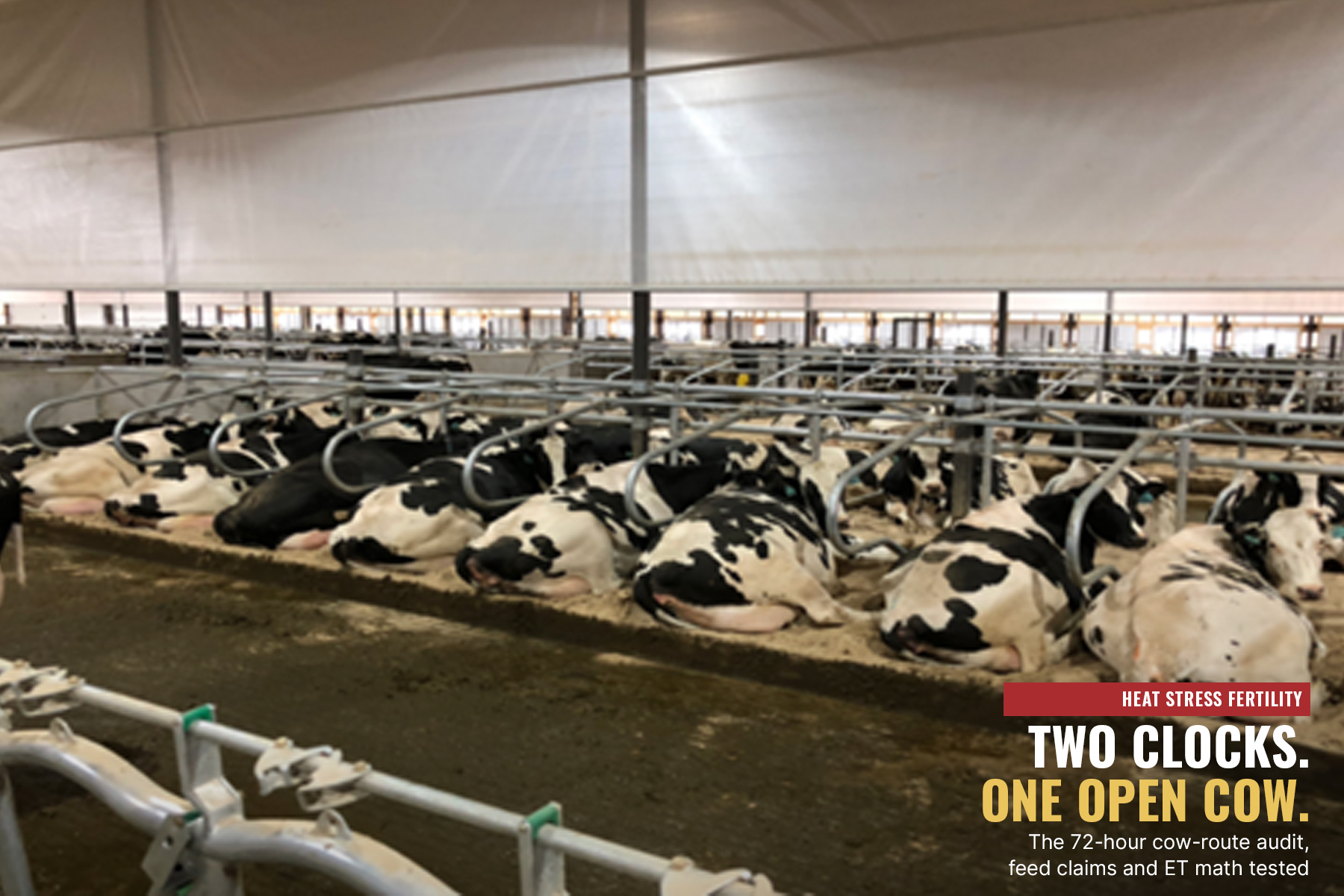
You just pulled your August preg check report, and your conception rate is in the gutter. Your first instinct is to blame the heat, yell at the breeder, or call your feed rep to buy a magic supplement. Stop.
That 18% conception rate isn’t a diagnosis—it’s a graveyard. By the time that number hits your desk, the pregnancies you lost are already ghosts. A cow can show a clean heat, stand perfectly, and get bred on time, and the pregnancy can still vanish before the first check.
If you want to stop lighting semen money on fire, you need to stop managing to the herd report and start managing the biology. Here is the brutal math of summer fertility, and how to audit the 72 hours that are actually robbing you blind.
The 18% That Isn’t a Diagnosis
Picture a herd whose conception rate slides from 32% in spring to 18% in August. That’s 14 percentage points, or about 44% fewer successful services per 100 bred. (Hypothetical figures; Bullvine math.)
Here’s what that 18% actually is. University of Georgia Extension defines conception rate as successful services divided by total services. It isn’t the 21-day pregnancy rate, which divides by eligible open cows and also measures whether those cows got bred at all. Before reading anything into an August dip, confirm the report is sorted by service date, not diagnosis month.
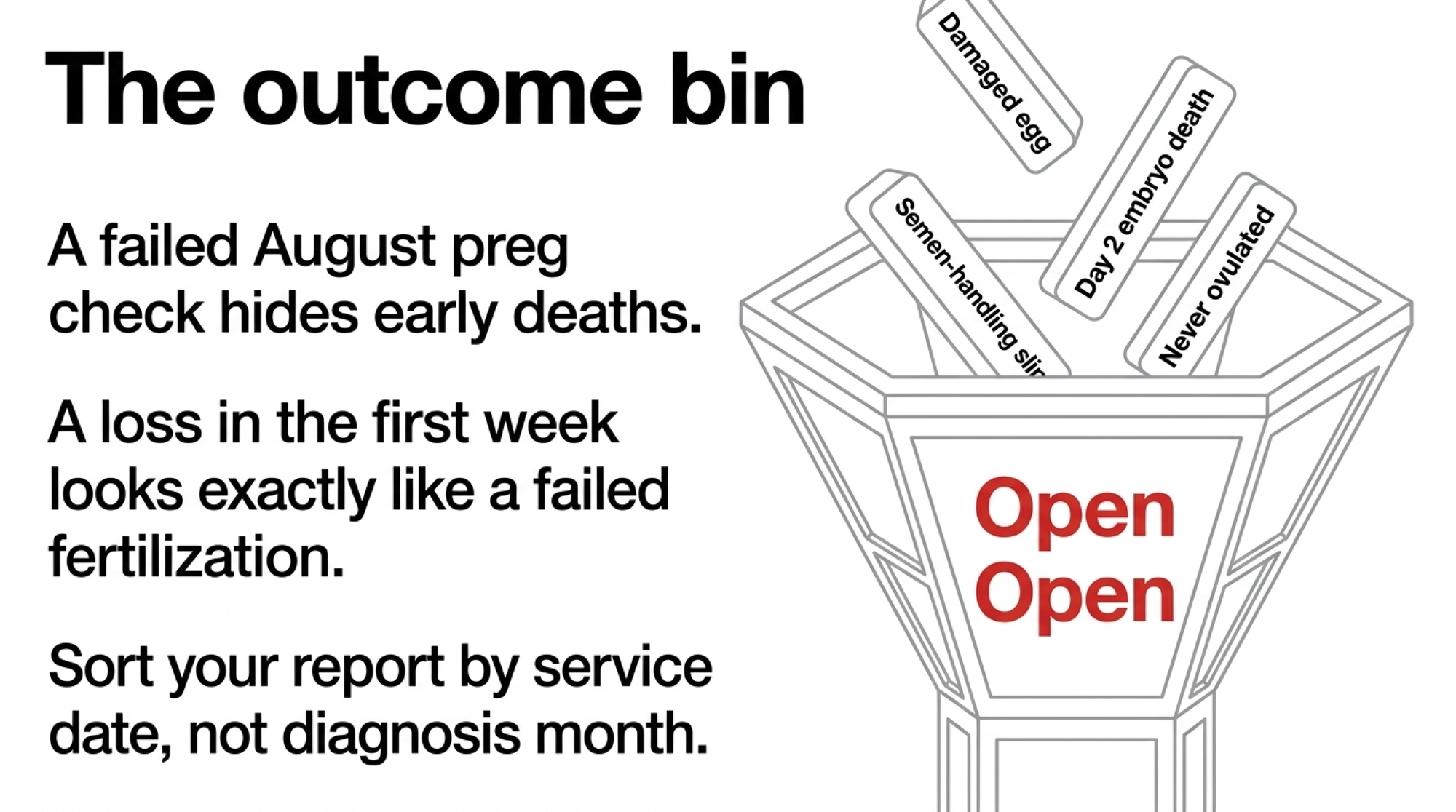
The other 82 services land in one bin. A cow that never ovulated, an egg that was never fertilized, a damaged egg that fertilized and stalled, an embryo that died on Day 2, a semen-handling slip, a data-entry error: the software records every one of them as “open.” In Morton and colleagues’ 2007 Journal of Dairy Science study of 16,878 services across 25 Australian herds, 89% of successful services were confirmed between 35 and 70 days after breeding. A loss in the first week looks exactly like a failed fertilization on that timeline.
Morton’s team also tied lower conception to heat in three separate windows: three to five weeks before service, the week before service, and service through Day 6. Hot days run in streaks, though, so the researchers couldn’t isolate any single bad day.
Conception rate is an outcome bin, not a biological diagnosis.
Before blaming August, split the report: first services versus repeats, timed AI versus heat detection, conventional versus sexed versus beef semen, and AI versus embryo transfer. A change in breeding mix can look a lot like heat damage.
The Long Clock: An Egg With a History
A September egg isn’t built in September. It spends weeks to months inside a growing follicle, supported by granulosa and cumulus cells. During that time it stockpiles the mitochondria, proteins and stored RNA it will run on after fertilization.
The key experiment comes from Brazil. Torres-Júnior and colleagues (Theriogenology, 2008) put five non-lactating Gir cows in a chamber at 38°C (100.4°F) by day and 30°C (86°F) by night, at 80% relative humidity, for 28 days. A second group stayed cool. The heat was real at the cow level: rectal temperature averaged 39.3°C versus 38.7°C, and respiration ran 79.2 versus 20.4 breaths per minute.
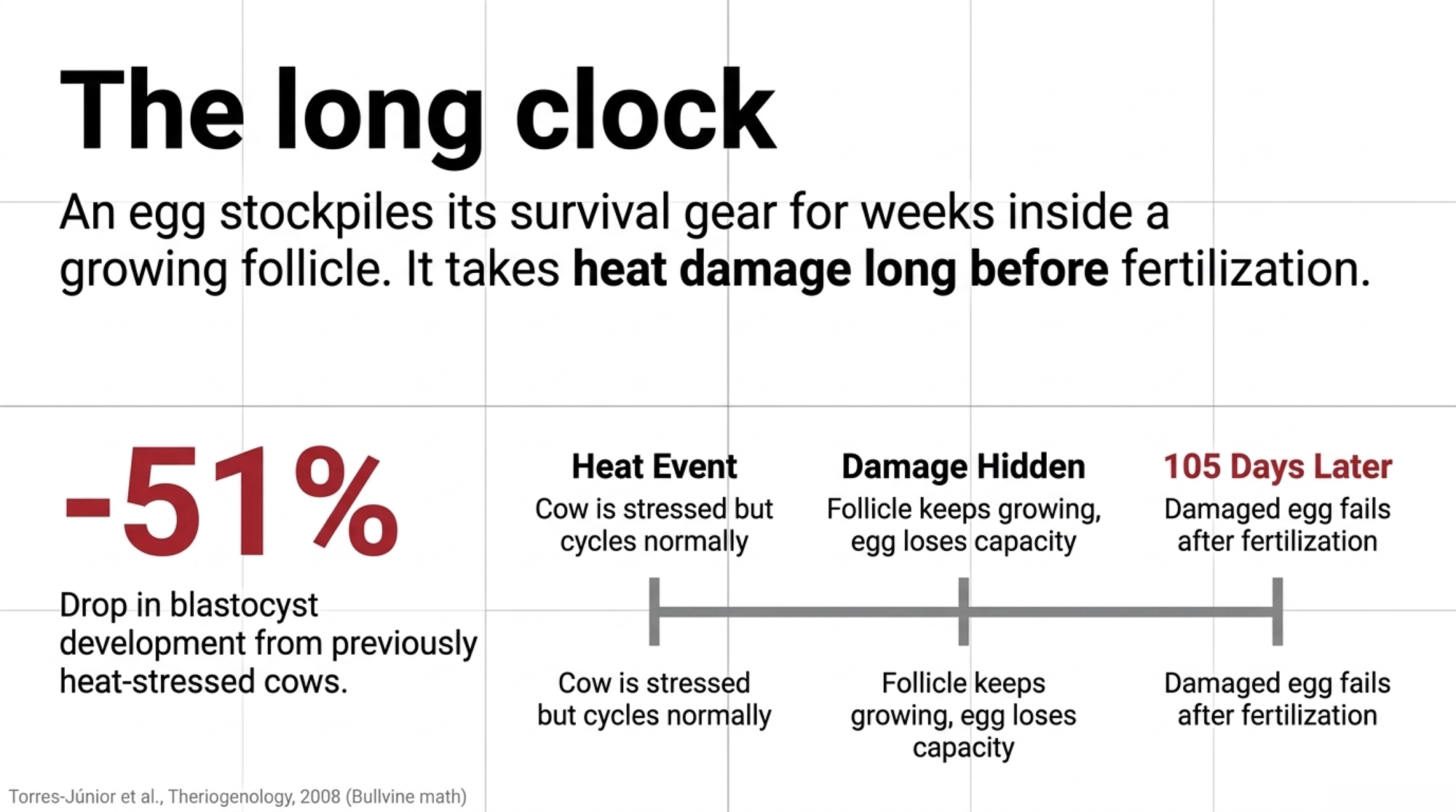
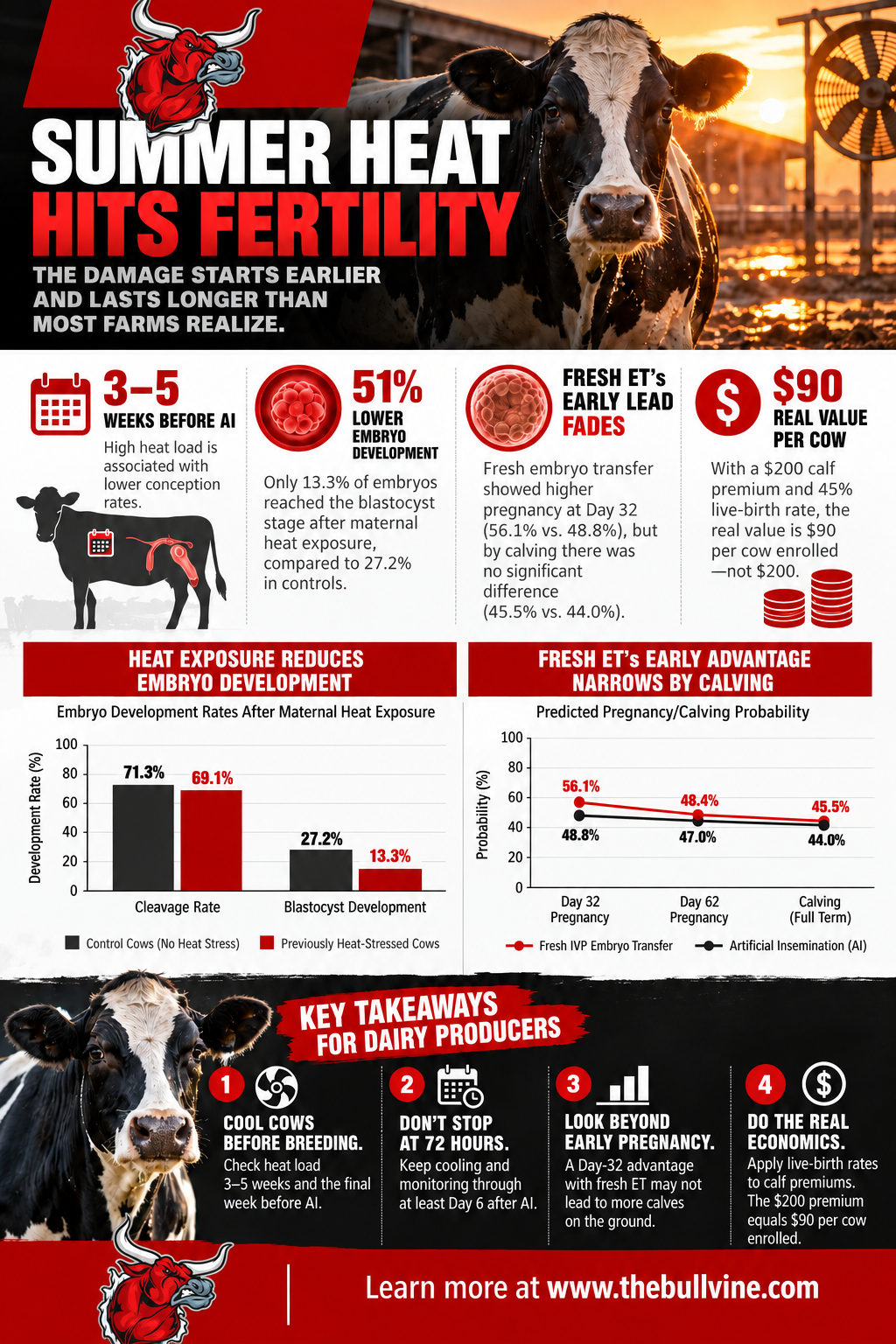
During the heat, the drop in embryo output wasn’t statistically significant: 25.0% of eggs became blastocysts in heat-stressed cows versus 35.5% in controls. After the heat ended, the gap opened up. Only 13.3% of eggs from previously heat-stressed cows reached the blastocyst stage, compared with 27.2% from controls. That’s 13.9 points, or roughly 51% lower (Bullvine math), and the impairment showed up in eggs collected as late as 105 days after the heat ended.
Here’s the unsettling part. Cleavage was basically the same: 69.1% versus 71.3%. The eggs fertilized and divided normally, then failed when development got harder. Previously stressed cows also had more large follicles (1.6 versus 1.0 over 9 mm) and shorter cycles (17.5 versus 20.7 days). On the outside, the cows looked like they were cycling fine.
The follicle can keep growing after the egg inside it has lost developmental capacity.
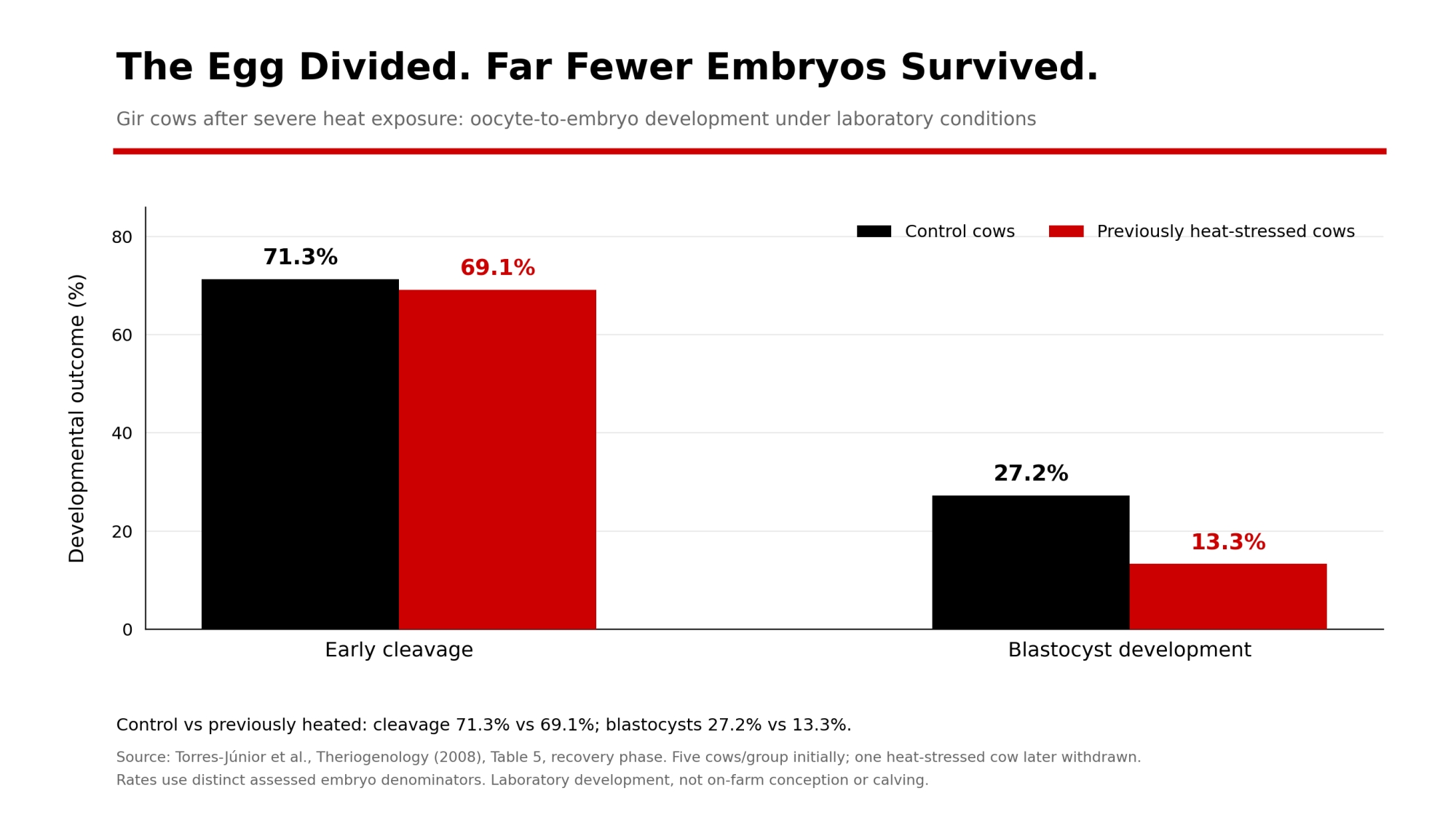
Now the limits. That’s 10 heat-tolerant Bos indicus cows, none milking, under severe chamber heat, and 7 of 17 egg-collection sessions were dropped because of lab problems. The study proves a delayed carryover is biologically real. It doesn’t prove that a specific June heat wave killed a specific September pregnancy, and recovery time varies with how hard the heat hit and which follicle stage took it.
The management call still holds: cooling has to protect cows for weeks before they’re bred, including dry cows and early-lactation cows heading toward first service, not just the breeding pen. Back in May, The Bullvine looked at which cow families quit breeding once THI reaches 60 (“It’s Not Your Fans, It’s Your Genetics”). This piece covers the other half of that question: when the damage lands.
The Short Clock: Dividing Before the Repair Crew Arrives
The second window opens at insemination and closes fast.
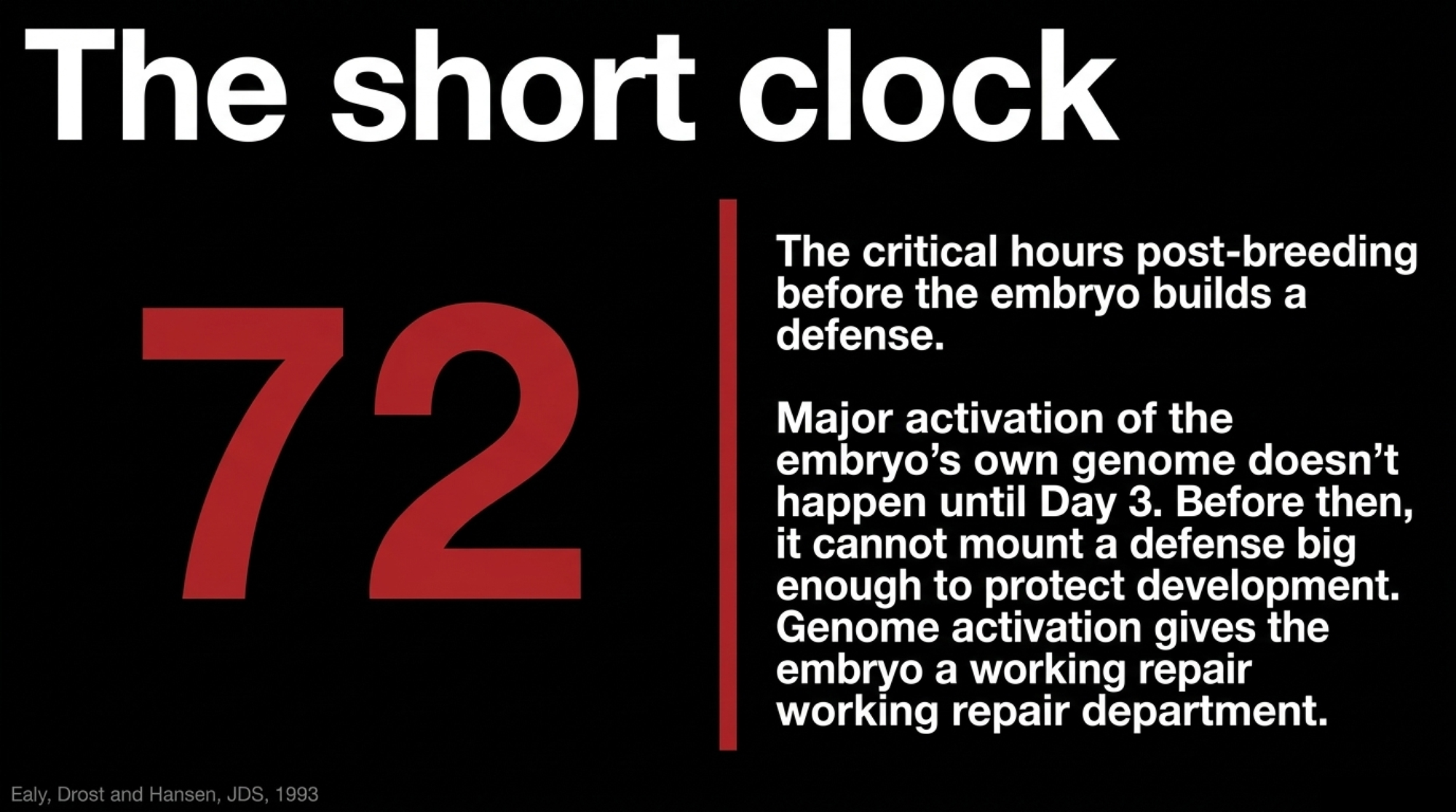
Ealy, Drost and Hansen (Journal of Dairy Science, 1993) heat-stressed superovulated lactating Holsteins on Day 1, 3, 5 or 7 after estrus. Heat on Day 1 reduced embryo viability and development when embryos were recovered on Day 8. Heat on Days 3, 5 and 7 did not.
The reason is construction timing. For its first few divisions, the embryo runs mostly on supplies the egg packed before fertilization. Major activation of the embryo’s own genome doesn’t happen until the eight- to 16-cell stage, around Day 3. A two-cell embryo isn’t completely silent. It can switch on some heat-shock genes, such as HSPA1A. It just can’t mount a defence big enough to protect development.
Several protective systems come online around genome activation. Glutathione, a key cellular antioxidant, rises around the nine- to 16-cell stage. The ability to remove damaged cells through apoptosis appears around the eight- to 16-cell stage, so a multicellular embryo can sacrifice a few cells instead of losing the whole program.
Lab work shows the swing. Sakatani and colleagues (Journal of Dairy Science, 2012) held zygotes at 40°C (104°F) for 12 or 24 hours, and both exposures cut Day 8 blastocyst development. When the same group (Reproductive Biology and Endocrinology, 2013) gave morulae an eight-hour 40°C exposure at 116 hours after insemination, blastocyst development held at 28.8% versus 30.4% in controls, with no loss in cell number.
Genome activation doesn’t make the embryo heatproof. It gives the embryo a working repair department.
Day 3 marks a big gain in resistance, not immunity. Treat “72 hours” as a management window, not a stopwatch.
The 72-Hour Cow-Route Audit
Most farms can show you their fans. Fewer can show you where a cow bred Tuesday morning spent every hour until Friday morning, and whether she stayed cool the whole time.
The audit starts at the insemination timestamp and follows the cow, not the wiring diagram.
| Location | What to verify | Common failure |
| Home pen | Airspeed at standing and lying height, soaker coverage, stocking density, controller runtime | Fans cover the feedline but not the stalls |
| Holding area | Group size, time in pen, nozzle function, airflow | Crowding adds heat while cutting exposed skin |
| Parlor | Air movement during milking | Holding pen is cooled; parlor stalls aren’t |
| Exit lane | Shade, water, optional exit soak | Wet cow walks into dead air or sun |
| Headlocks | Lockup length, time of day, soaker reach | Afternoon herd work locks cows away from air and water |
| Sort or hospital pen | Same checks as the home pen | Secondary pen gets second-rate cooling |
| Overnight | Fan runtime, minimum cow temperature | Controller shuts down before cows shed the day’s heat |
Use published benchmarks as targets, not gospel. Penn State Extension recommends 3.5 to 5 mph of air movement in resting, feeding and holding areas, with soaking for one to three minutes inside a 5- to 15-minute wet-dry cycle. University of Wisconsin–Madison Extension sets a minimum of 200 feet per minute over resting cows, and prefers 400.
Then measure the cow. Wisconsin Extension’s rule of thumb: if at least 25% of a pen is breathing 60 or more times per minute, cooling isn’t keeping up. Mississippi State Extension treats 26 to 50 breaths per minute as normal, suggests sampling about 10% of the herd, and warns against using the crowded holding pen as your baseline.
Owning the equipment isn’t the same as passing the audit. In a March 2025 University of Georgia Extension case, a commercial holding area had both fans and soakers. Clogged nozzles and weak airspeed still let cow body temperature climb through the holding pen and parlor.
Night is where most producers get surprised. In Gaughan and colleagues’ 2023 Journal of Dairy Science trial with 120 Holstein-Friesians, adding night cooling to day cooling cut rumen temperature during the third heat wave from 40.10°C to 39.58°C. That’s 0.52°C, or 0.9°F (Bullvine math). The trial measured physiology and milk, not conception. Separately, Tresoldi and colleagues (Journal of Dairy Science, 2019) recorded cows’ highest hourly body temperature, 39.1°C, around 9 to 10 p.m. in California, hours after the air temperature had peaked.
Don’t ask whether the breeding pen is cooled. Ask where that cow spent every hour after she was bred.
| Exposure window | Published evidence | Farm audit priority | Evidence boundary |
|---|---|---|---|
| 3–5 weeks before AI | High heat load associated with lower conception | Recover pen-level heat history | Association, not an exact day of damage |
| Final week before AI | High heat load also associated with lower conception | Review holding, lockups and nighttime exposure | Adjacent hot days are correlated |
| Service day–Day 3 | Day 1 embryo particularly vulnerable; field association also reported | Intensive cow-route and cow-response checks | 72 hours after AI is a management window |
| Days 4–6 after AI | Commercial-herd association continues through Day 6 | Continue cooling and exposure records | Not evidence of one uniquely damaging day |
Run it like this:
- Export every service with cow ID, date and time, pen, parity, days in milk, technician, semen type and protocol.
- Set each cow’s window from 24 hours before service to 72 hours after.
- Hang temperature-humidity loggers at cow height in every location bred cows pass through, logging every 5 to 15 minutes.
- Pull fan and pump runtime, alarms and power interruptions separately from the weather data.
- Track cow response with respiration counts, panting scores, or continuous vaginal or rumen temperature where you have it.
- Analyze service day, 0–24, 24–48 and 48–72 hours, and each overnight minimum separately. A three-day average hides a two-hour afternoon spike.
Be honest about what it proves. The audit can show that failed services cluster after specific exposure patterns. It can’t prove heat killed a specific embryo. This is The Bullvine’s proposed framework, built from published biology and extension benchmarks. It hasn’t been validated as a protocol.
Where the Feed-Bunk Pitch Stops
Once a herd understands both clocks, someone shows up with a bag. Protected methionine, an antioxidant package, something promising “embryo support” from the bunk.
Put the claim on a ladder. Most stall on the first or second rung.
| Evidence rung | Specific study result | What the result supports | What remains to prove |
|---|---|---|---|
| 1. Cell culture | Cleavage: 84.6% vs. 58.0%; blastocysts: 22.7% vs. 8.1% | Severe laboratory heat impairs development | Feeding a cow prevents that damage |
| 2. Cow metabolism | 32-cow methionine heat challenge | Certain metabolic pathways responded | Improved pregnancy or calving |
| 3. Reproductive tract | No direct reproductive-tract endpoint in the cited feeding trials | Mechanistic possibilities | Product-specific protection under heat |
| 4. Pregnancy | 470 cows: 54.3% vs. 55.1% Day-32 pregnancy per AI | No significant methionine fertility benefit in that trial | Repeatable heat-specific benefit |
| 5. Live calf | No live-calf benefit established by these cited trials | Commercial payoff remains unproven | More live calves per enrolled cow |
Rung 1. In Mzedawee and colleagues’ work, maturing egg complexes held at 40.5°C for 23 hours dropped from 84.6% to 58.0% cleavage and from 22.7% to 8.1% blastocyst formation. Those are relative declines of about 31% and 64% (Bullvine math). Amino-acid turnover shifted too. But altered turnover may simply mark injured cells. It doesn’t prove a deficiency that feed can fix. Even in a dish, more isn’t automatically better: a 2025 Biology of Reproduction study found that removing methionine entirely hurt embryo development, but raising it from 31 to 57 µM didn’t produce more blastocysts.
Rung 2. Coleman and colleagues fed rumen-protected methionine to 32 multiparous Holsteins, half of them under a nine-day heat challenge with electric heat blankets. Some liver signalling pathways changed. Liver glutathione didn’t rise, measured immune-cell function didn’t improve, and no cow was bred. Adisseo, maker of the Smartamine M product tested, partially funded the study.
Rung 4. In the largest direct test, Stangaferro and colleagues enrolled 470 multiparous Holsteins at Cornell and the University of Wisconsin–Madison. Methionine went from roughly 2.1–2.3% to 2.6–2.9% of metabolizable protein. Day 32 pregnancy per AI was 54.3% for controls and 55.1% with methionine. Pregnancy loss from Day 25 to 67 was 22.6% versus 19.2%, and neither difference was significant. This wasn’t a heat-stress trial, and one coauthor had an Adisseo affiliation. It still sets the boundary: a plausible pathway didn’t produce a fertility response.
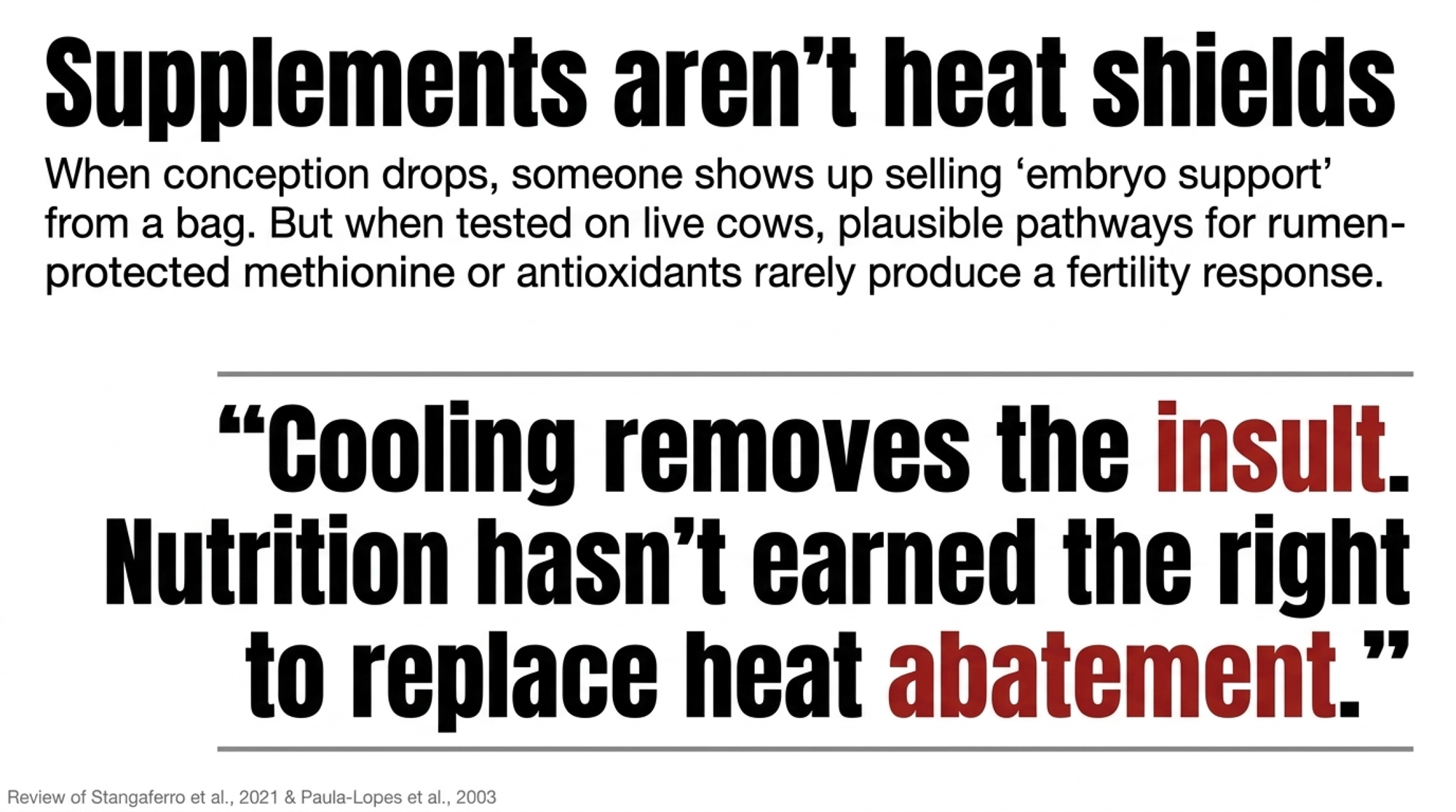
Antioxidants have a similar track record. Paula-Lopes and colleagues (Journal of Dairy Science, 2003) found that vitamin E and selenium injections didn’t improve fertility in three herds. In culture, nine hours at 41°C cut blastocyst development from 51.2% to 3.4% without vitamin E and from 54.0% to 5.2% with it. The early embryo stayed fragile either way.
Nutrition isn’t useless, though. Khemarach and colleagues (Scientific Reports, 2021) gave 400 repeat-breeder Holsteins on 30 Thai farms either a placebo or 400 mg/day of beta-carotene, at an average THI of 82.1. First-service pregnancy didn’t differ, but supplemented cows had a 44% higher modeled probability of pregnancy over 160 days. BASF Thailand supplied the product, and the authors declared no competing interests. Those were low-producing tropical cows, about 15.5 kg of milk a day, and probably not at North American nutrient status. A 2024 meta-analysis of 29 publications found better first-service pregnancy odds with beta-carotene (odds ratio 1.38; 95% CI 1.08–1.76), but 8 of 11 outcomes weren’t significant and the results varied widely between studies.
The line runs between correcting a deficiency and buying a heat shield. Summer intake drops, so rebalance metabolizable protein and amino acids in grams per day at actual dry matter intake, not on the winter formulation. Before paying for embryo protection, ask the supplier:
- Was the evidence from a culture dish or a live cow?
- Were the cows measurably heat-stressed, with barn data and cow temperatures reported?
- Was baseline nutrient status measured?
- Was the endpoint pregnancy and live birth, or a blood or liver marker?
- Was cooling equal across treatments?
- Who funded it, and has anyone independent replicated it?
Cooling removes the insult. Nutrition may support the cow’s response, but it hasn’t earned the right to replace heat abatement.
Embryo Transfer: Count Every Cow You Synchronized
ET gets pitched as a biological bypass. Put a Day 7 embryo, which already has most of its heat resistance, into a cooled recipient and you skip the most fragile stretch.
The biology holds up. The headline number usually doesn’t mean what people think. Peter Hansen’s June 2026 review in the Journal of Reproduction and Development found that across 11 studies, ET pregnancy rates in hot periods averaged only 2.6 points below cool periods. That shows how steady ET results stay across seasons. It is not an ET-over-AI advantage, and Hansen notes that factors other than heat also change by season.
Embryo type is where the money is. In Stewart and colleagues’ 2011 Journal of Dairy Science summer trial, live births per cow enrolled were 27.5% with fresh IVP embryos, 17.1% with vitrified IVP embryos, and 14.6% with AI. That’s 12.9 extra calves per 100 cows for fresh ET, and only 2.5 for vitrified (Bullvine math).
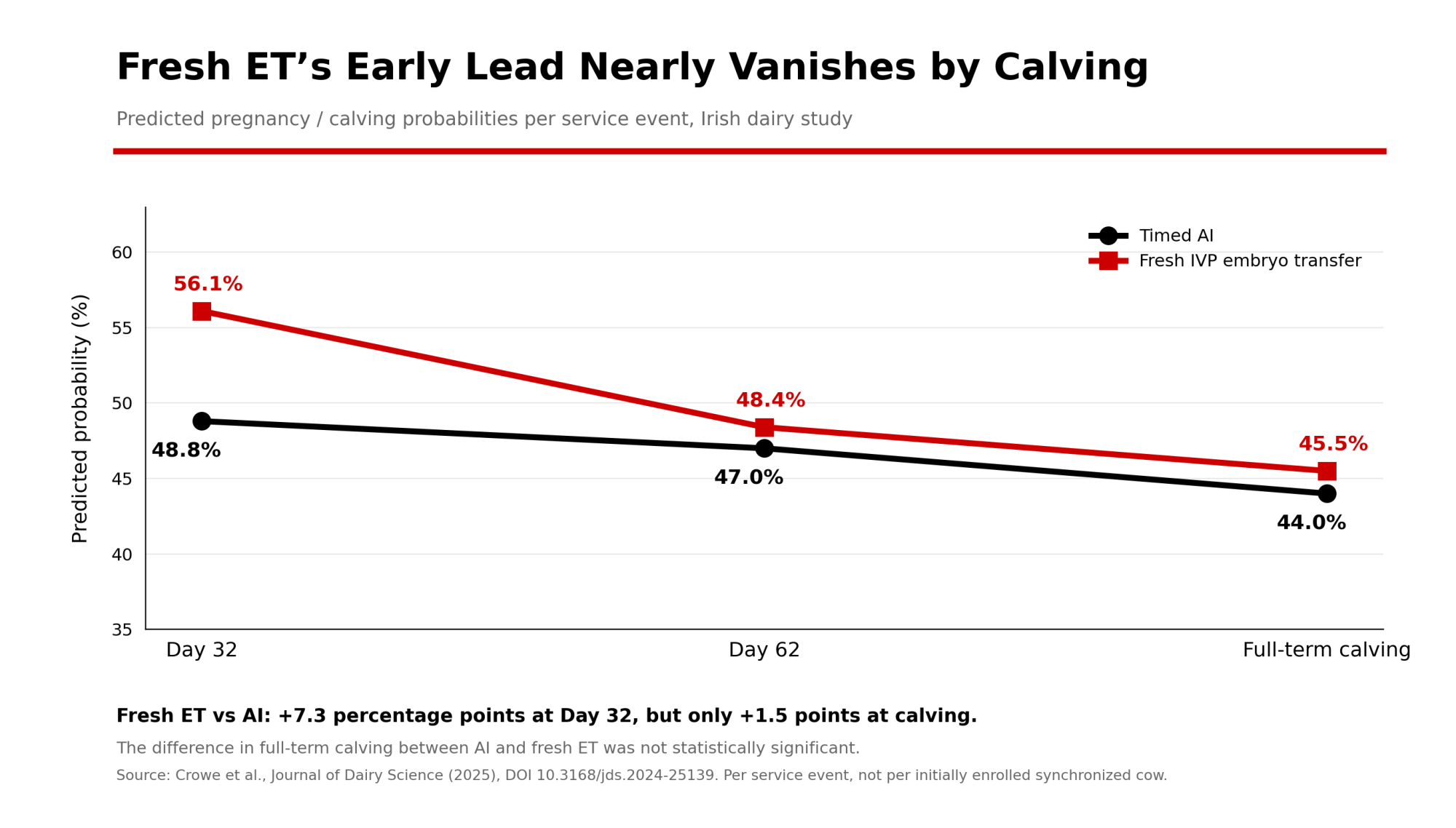
Newer data adds a warning. Crowe and colleagues (Journal of Dairy Science, 2024) enrolled 1,197 lactating cows in 10 Irish herds from March through August. This was a pasture-based trial, not a controlled heat study, and it used proprietary Vytelle culture media. Of the cows synchronized for ET, 9.6% weren’t suitable for transfer on Day 7.
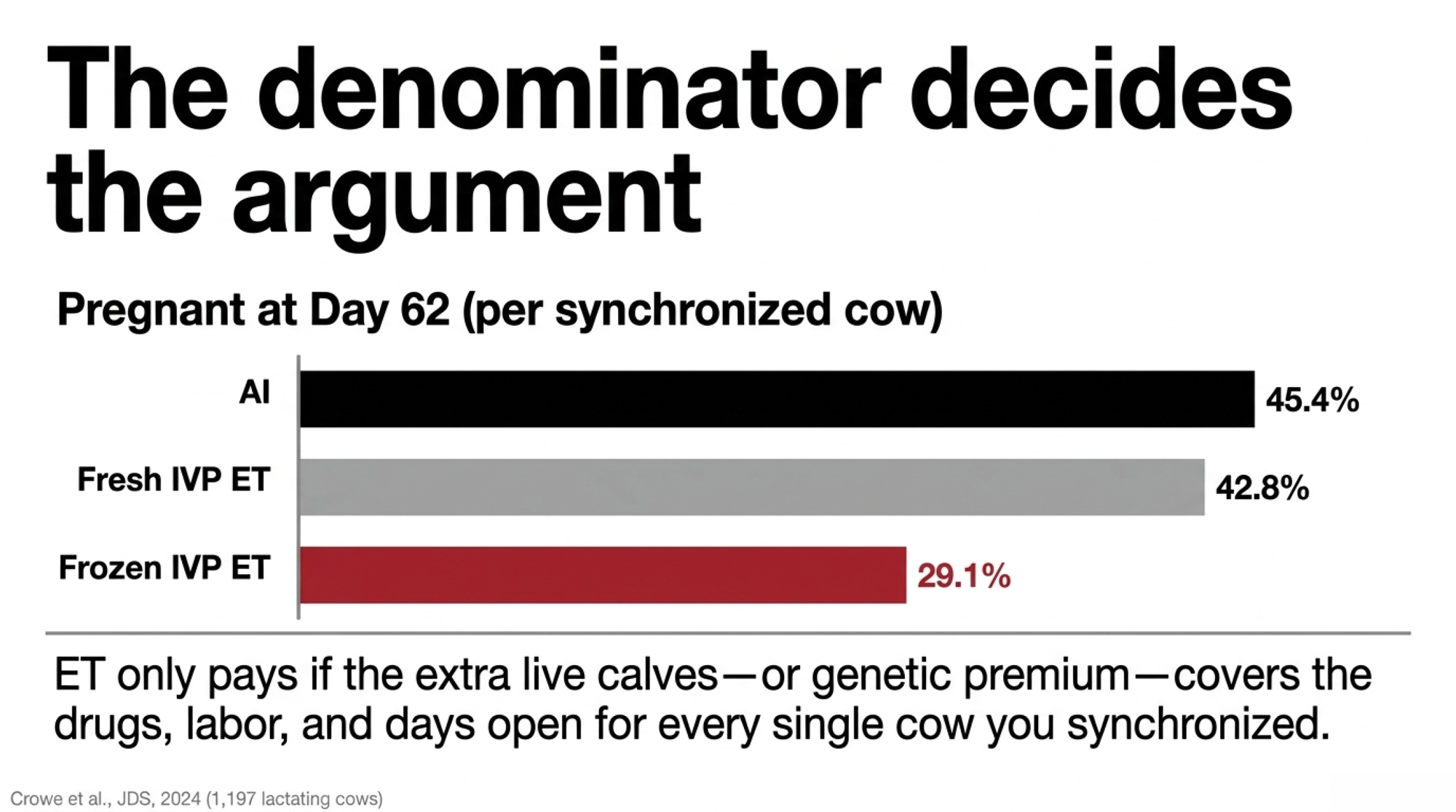
| Outcome | AI | Fresh IVP ET | Frozen IVP ET |
| Pregnant at Day 62, per synchronized cow | 45.4% | 42.8% | 29.1% |
| Loss, Day 32 to 62 | 4.7% | 12.2% | 18.8% |
The denominator decides the argument. Say 100 cows are enrolled, 90 receive embryos, and 38 calve. That’s 42.2% per transfer but 38% per cow enrolled (Bullvine math). The drugs, labour and days open were spent on all 100.
The break-even test is simple:
Maximum extra ET cost per enrolled cow = (ET live-birth rate − AI live-birth rate) × value of one extra live calf, plus any calf or genetic premium you can document separately.
| Component | Calculation | Value per enrolled cow | Interpretation |
|---|---|---|---|
| AI calf value | 40% × $500 | $200 | AI baseline |
| ET calf value before premium | 45% × $500 | $225 | Same baseline calf value |
| Additional live-calf value | 5 percentage points × $500 | +$25 | Fertility contribution |
| Calf premium on ET births | 45% × $200 | +$90 | Premium weighted by live births |
| ET total expected calf value | $225 + $90 | $315 | Before additional ET costs |
| Maximum additional ET cost | $315 − $200 | $115 | Break-even ceiling per cow enrolled |
A 2022 Journal of Dairy Science invited review by Crowe and colleagues found that IVP-ET economics improve as embryo cost falls and calf value rises, and that mixed AI-and-ET programs often beat either one alone. Plug in your own 2026 prices. Older model costs aren’t a budget.
ET belongs in a summer program when four things are true. The cooling audit is done and the gaps are fixed. Summer AI failure looks concentrated before Day 7. Fresh embryos are actually available. And either the extra live calves or the calf premium covers every cow you synchronized.
ET belongs where the bypass has something expensive to bypass.
What This Means for Your Operation
- Re-cut the summer report. Sort it by service date, then split it by service number, protocol, semen type and AI versus ET before you assign blame to August.
- Cool the long clock. Protect cows for weeks before breeding, dry cows and fresh cows included. Morton’s data tied lower conception to heat three to five weeks before service.
- Run the 72-hour route audit during a real heat event. Log every location, every overnight minimum, and how the cow responds.
- Rebalance, don’t gamble. Formulate at actual summer dry matter intake, and make any supplier selling embryo protection show pregnancy data from heat-stressed cows.
- Trial ET honestly. Run fresh ET against AI on cows in the same season, and score both on live calves per cow enrolled.
A pregnancy check can only report what survived long enough to be counted.
🔥 The Bullvine Summer “Burn Rate” Calculator
Your herd software says conception rate dropped. Bullvine Math tells you exactly how much cash you just lit on fire. Plug in your numbers to see the cost of your summer heat gap.
Learn More
- What is the True Cost of a Day Open? — Stop guessing what a missed cycle costs your dairy. This hard-math analysis pinpoints the daily margin bleed per open cow, justifying aggressive reproductive interventions before cull rates inevitably spike.
- Dairy Cattle Fertility: It’s All in the Genes — Breeding for structural fertility outlasts any mechanical heat abatement system. Follow the money on long-term sire selection to permanently elevate your herd’s baseline reproductive performance over the next decade.
- Sexed Semen: Are You Making the Right Choice? — Maximize synchronization ROI by rethinking which straws enter your most valuable heifers. Exposing the hidden financial traps of gender-sorted products, this framework arms you with an unconventional semen allocation strategy.
The Sunday Read Dairy Professionals Don’t Skip.

Every week, thousands of producers, breeders, and industry insiders open Bullvine Weekly for genetics insights, market shifts, and profit strategies they won’t find anywhere else. One email. Five minutes. Smarter decisions all week.