


Archive for Comestar Laurie Sheik

Why Cow Family Beats a +3000 GTPI Calf: The $12,000 Embryo Math Every Breeder Should Run

A dynasty-line heifer can out-earn a flashier genomic pick by roughly $950 to $1,600 over five years — here’s the barn math, and why the surname on your best cow’s ear tag matters more than the index on top.

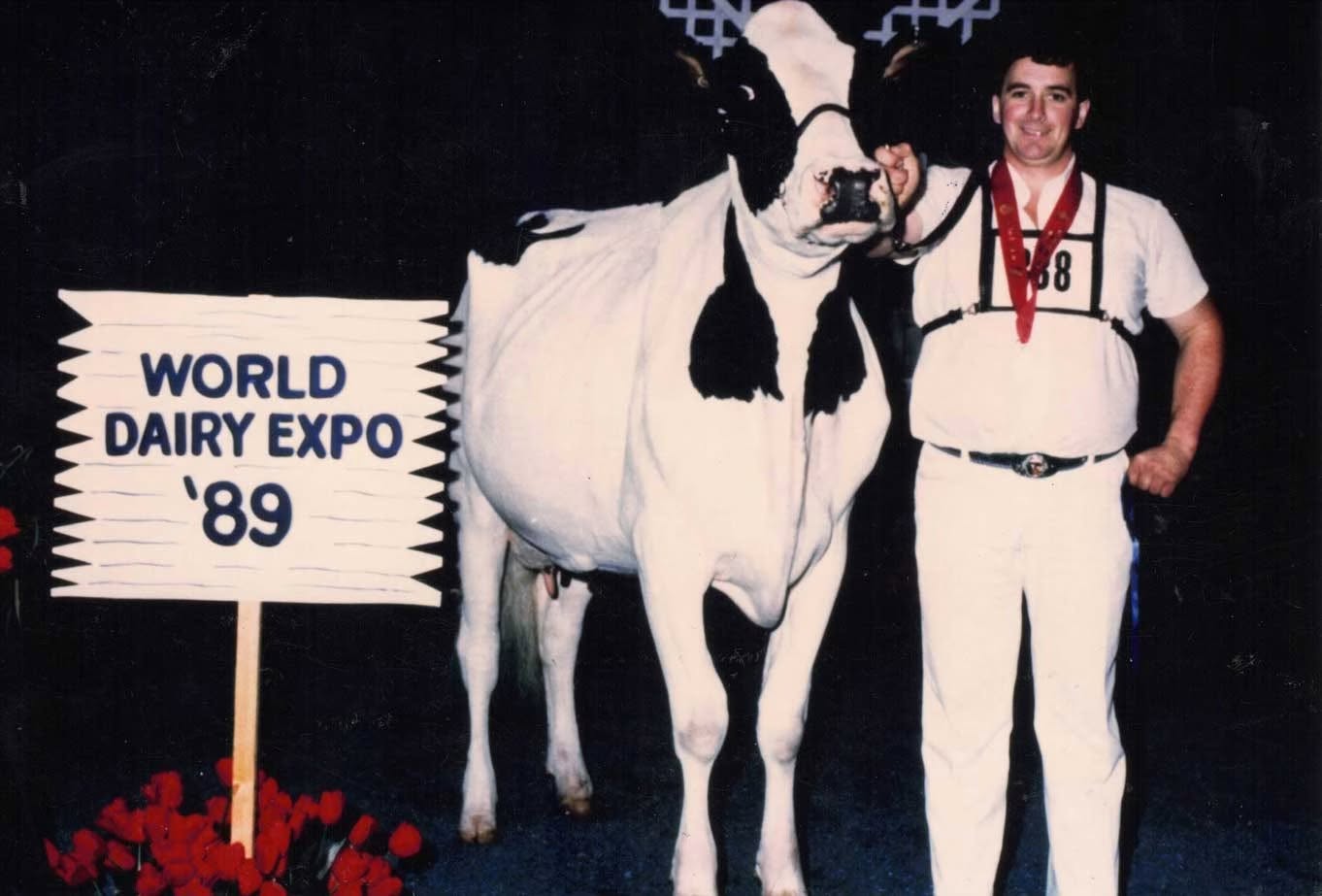
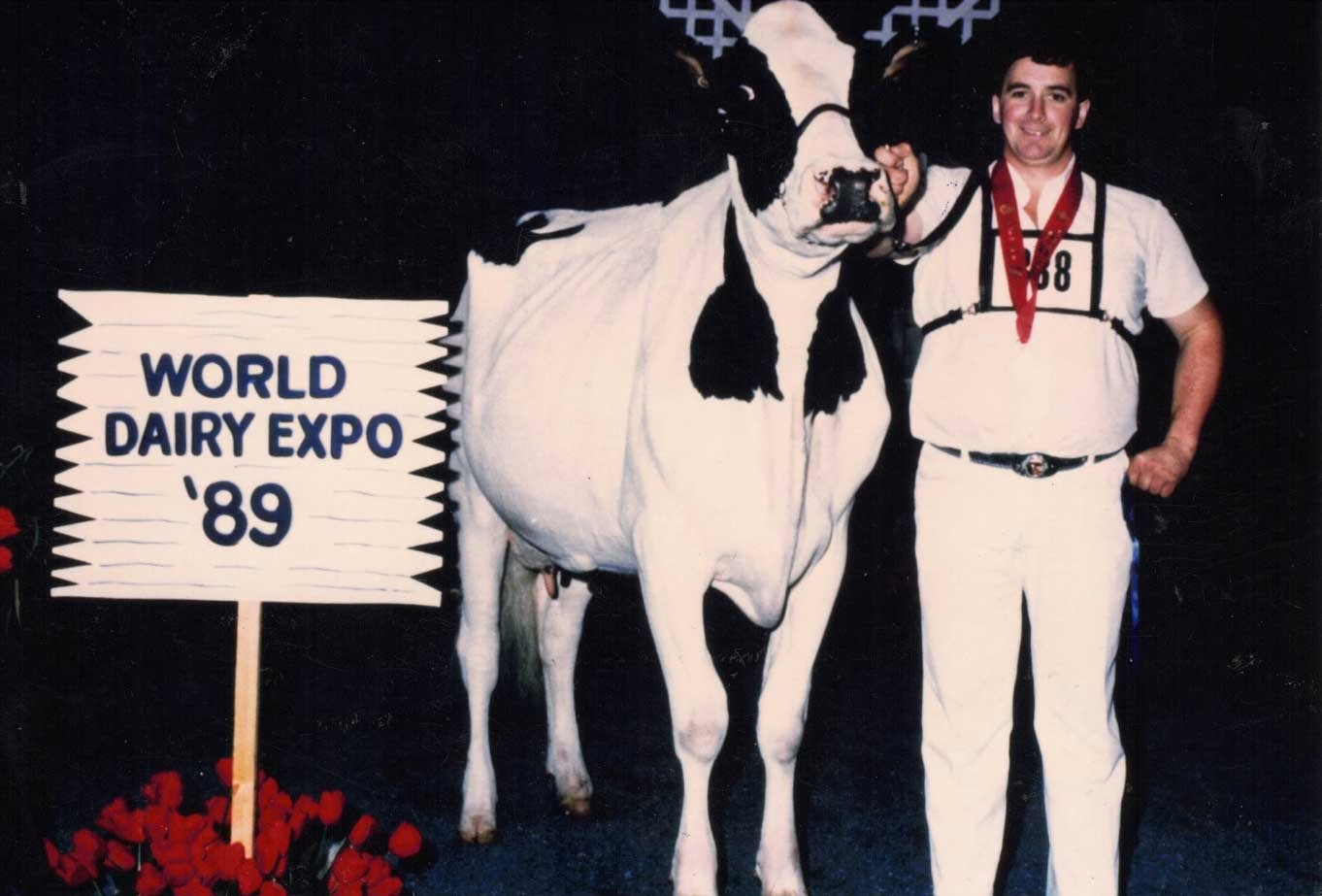
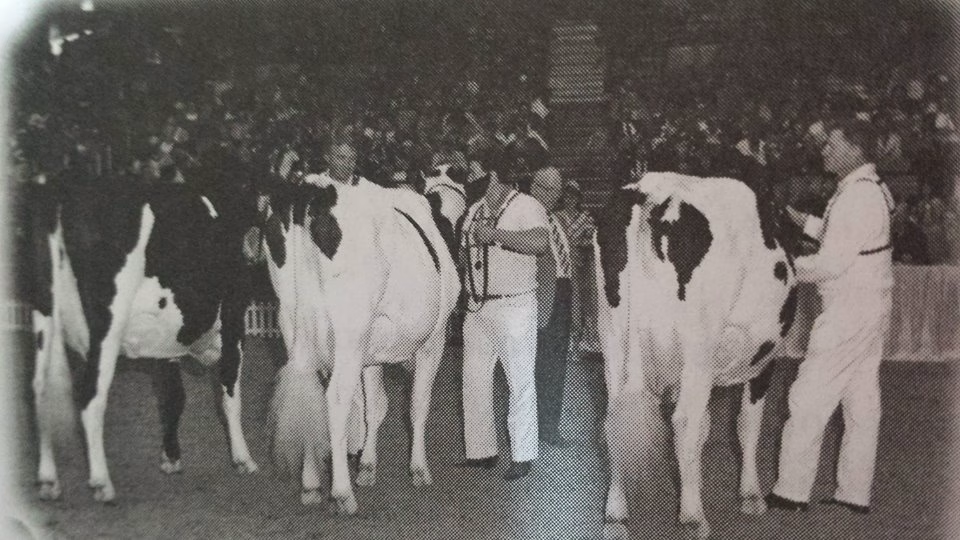
Marc Comtois with Comestar Laurie Sheik VG-88-23* at World Dairy Expo, 1989 — second in her Senior 2-Year-Old class. The judge put another cow ahead of her that day. History didn’t. This is the cow that would go on to anchor 14 Semex Class EXTRA bulls and four millionaire sires — the living proof, decades before genomics, that cow family beats a flashy card.  (Read more: The Cow That Built an Empire: Comestar Laurie Sheik’s Unstoppable Genetic Legacy)

The best argument for cow family over index sheets showed up on Marc Comtois’s trailer in 1985. It was Elysa Anthony Lea EX-15*, one of Willowholme Mark Anthony’s best daughters, and the most important thing he ever bought. Bred to Puget-Sound Sheik, she produced Comestar Laurie Sheik VG-88-23* in December 1986. That one cow went on to anchor 14 Semex Class EXTRA bulls and four millionaire sires — Leader, Lee, Lheros, and Outside. That’s a maternal dynasty, fully cashed in.

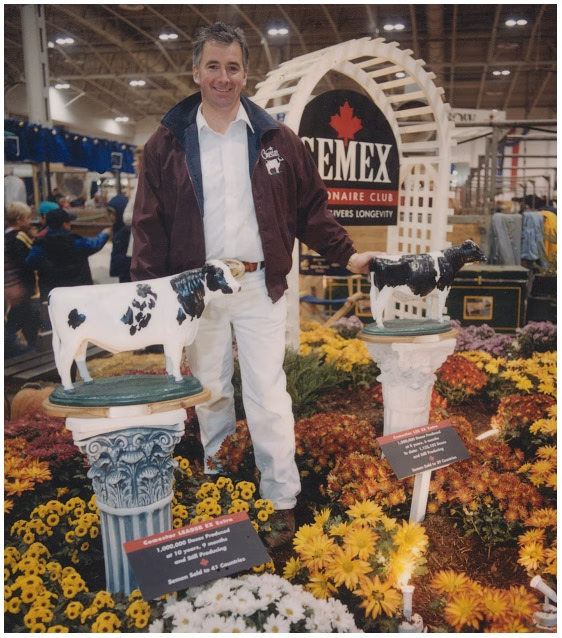
Marc Comtois at the Semex Millionaire Club display, flanked by models of Lee and Leader — two of the four millionaire sires bred off Comestar Laurie Sheik. The placards tell the story in numbers: over a million doses, semen sold in 43 countries. No single index built that. One cow family did — which is exactly the case this article makes

The uncomfortable question is what’s happening in your own barn right now. You’re spending on genomic tests, elite semen, and $3,000-plus embryos without asking whether the cow family underneath those numbers can actually stay in your barn for three or four lactations. That gap between paper merit and staying power is what this piece is about.

From Bull-of-the-Month to Cow Families That Don’t Miss

Genomics promised we could skip generations of slow, patient pedigree-building. But as the index race speeds up, a paper-thin pedigree is turning into a high-maintenance luxury. Let’s look at the real math of what a shallow family costs you once the honeymoon of her first proof wears off.

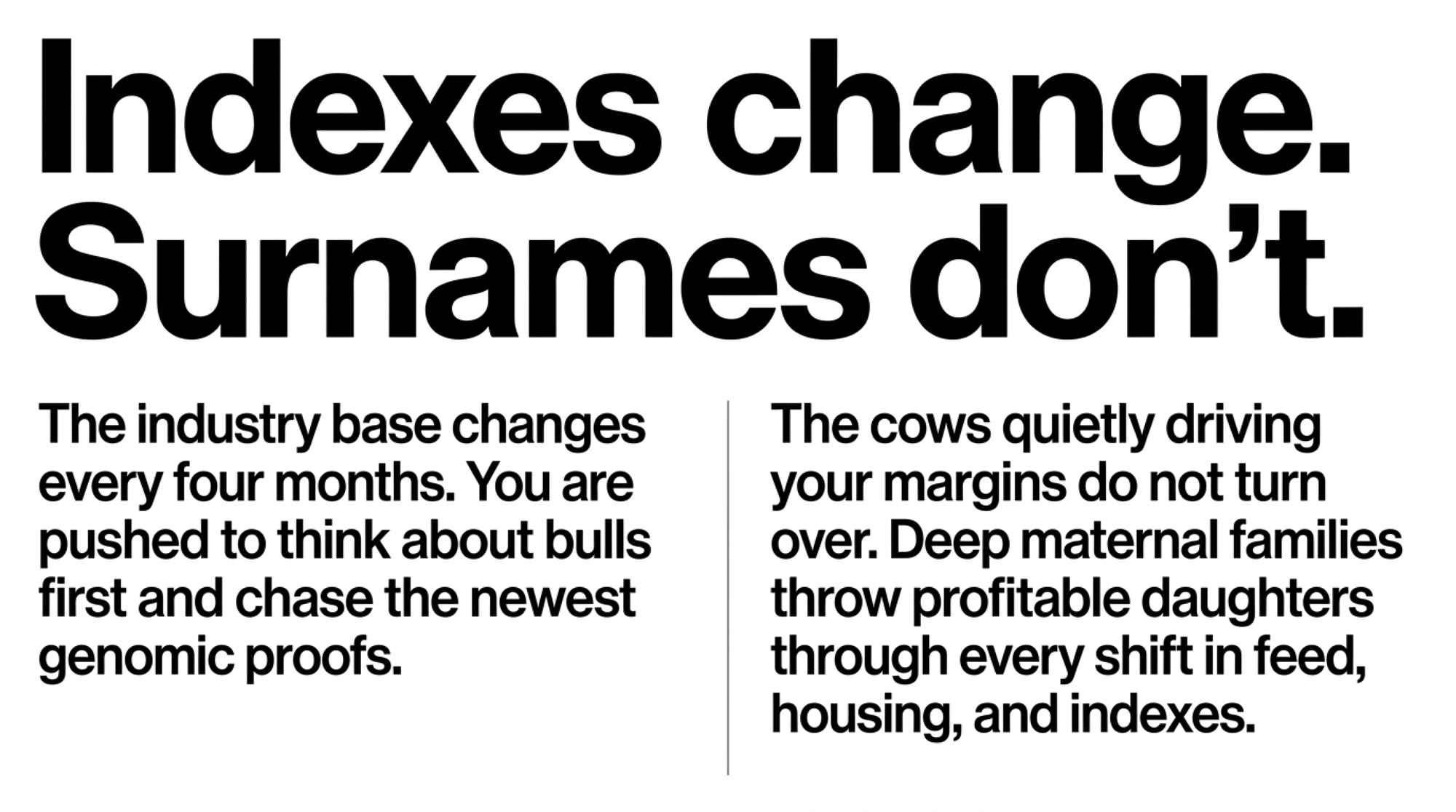
The industry still runs on a four-month heartbeat — new proofs in April, August, December, fresh catalogs, a fresh list of must-use sires. CDCB’s April 2025 base change reset every TPI value in the system, moving the reference point from cows born in 2015 to those born in 2020, and the April 2026 run reshuffled the rankings again, with STgen alone holding 36% of the proven TPI top 100. By design, you’re pushed to think bulls first.

Glenridge Citation Roxy EX-97 — the American answer to the same argument. No genomic test ever scored her; her record did. Generations of Goldwyns, Atwoods, and show-ring champions trace to this one cow, proof that a great maternal line compounds value long after the index that ranked her contemporaries has been forgotten. Read more: Glenridge Citation Roxy: The Legendary “Queen of the Breed”

The cows quietly driving your margins don’t turn over every four months. Strip the brand names off the catalogs, follow the cow side, and the same surnames keep surfacing: Comestar Laurie Sheik, Snow-N-Denises Dellia and her granddaughter Regancrest-PR Barbie, Glenridge Citation Roxy. These families do what no single sire can — throw profitable daughters, generation after generation, through changes in feed cost, housing, indexes, and tools. For the wider story of how 16 years of genomics rewrote which bulls get used — and what it didn’t touch on the cow side — see The Great Holstein Shakeup.

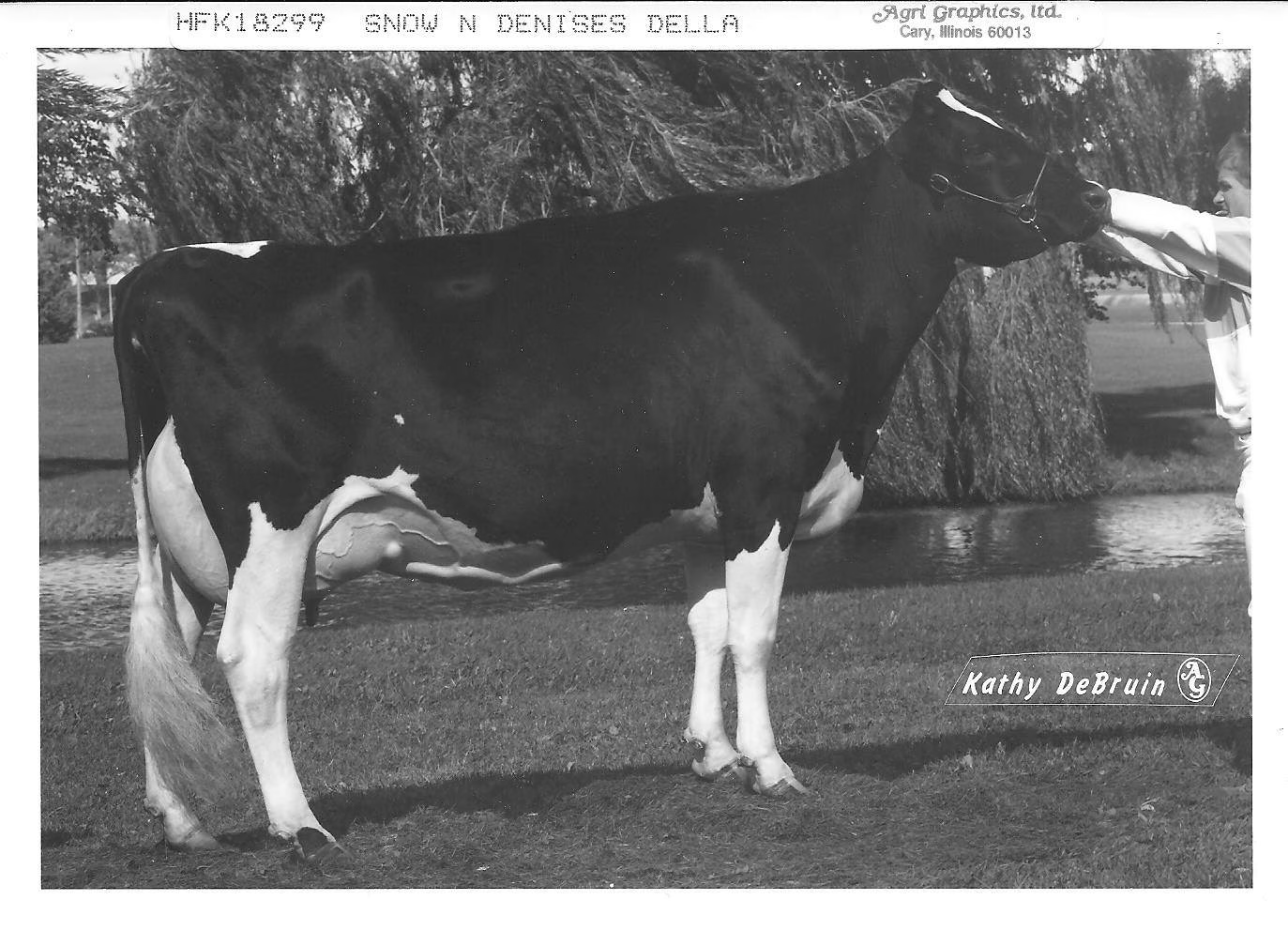
Snow-N Denises Dellia, EX-95-2E-GMD-DOM—Walkway Chief Mark out of Snow-N Dorys Denise, with Carlin-M Ivanhoe Bell as maternal grandsire. “Tall, sharp, clean, beautifully uddered, and trouble-free,” judge Niles Wendorf called her the day she stood grand champion at the 1991 Wisconsin Spring Show. This is the cow Select Sires had passed on. (Read more: Three Gold Medal Sons From One Cow the Studs Didn’t Want)

How Does a Shallow Pedigree Actually Cost You Money?

Bring it down to two heifers walking into your parlor next spring.

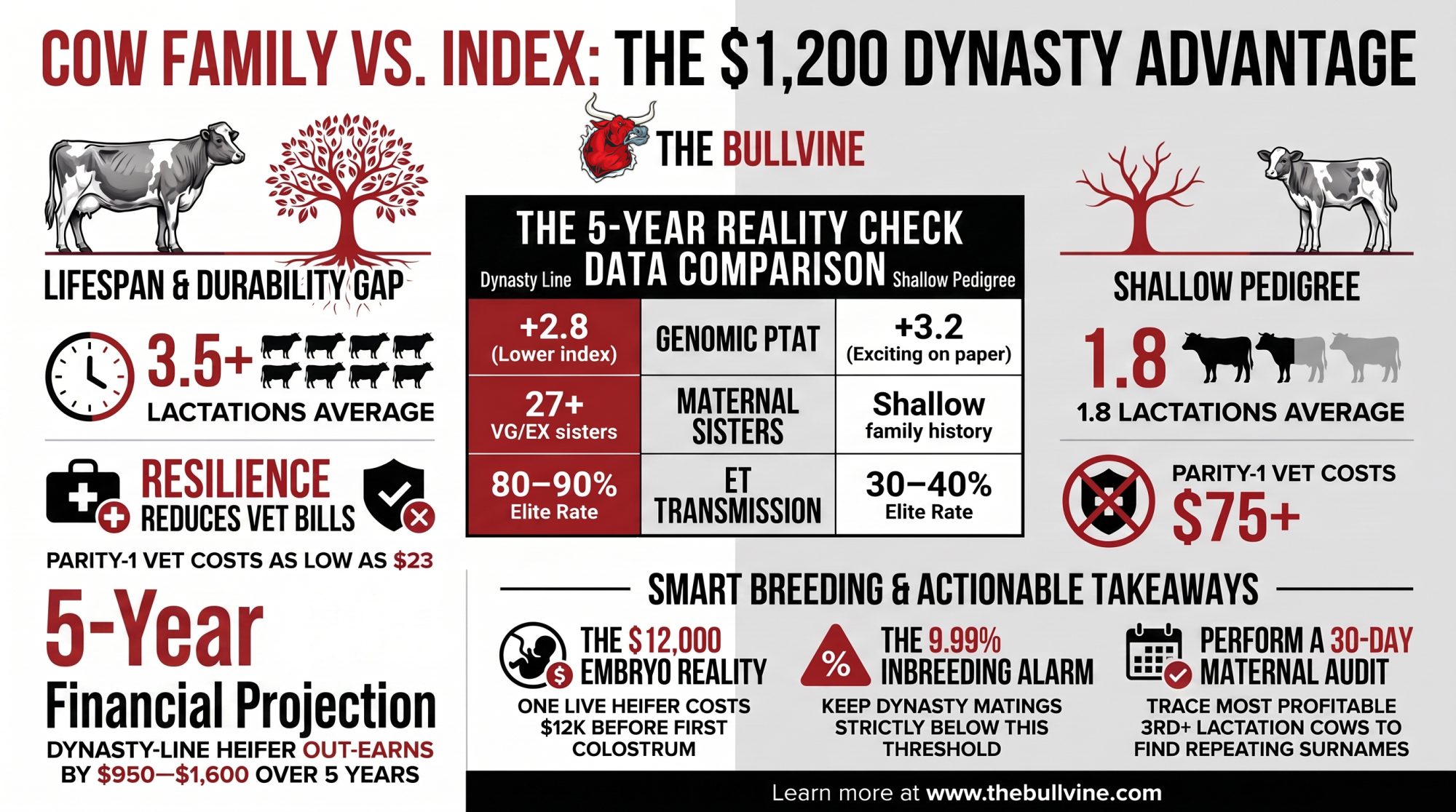
Heifer A is +3.2 PTAT on a genomic-only proof. Her dam’s a GP cow with two quick lactations and not much behind her. On paper, she’s exciting. In reality, you’ve got no idea whether that maternal line survives heat, robot glitches, or your transition pen. Heifer B is +2.8 PTAT — less flashy on the sheet. But she comes from a Barbie-type line where more than 27 daughters have been scored, all but one landing VG or EX on first classification, and where the family now sits behind roughly 36% of top-tier PTAT rankings.

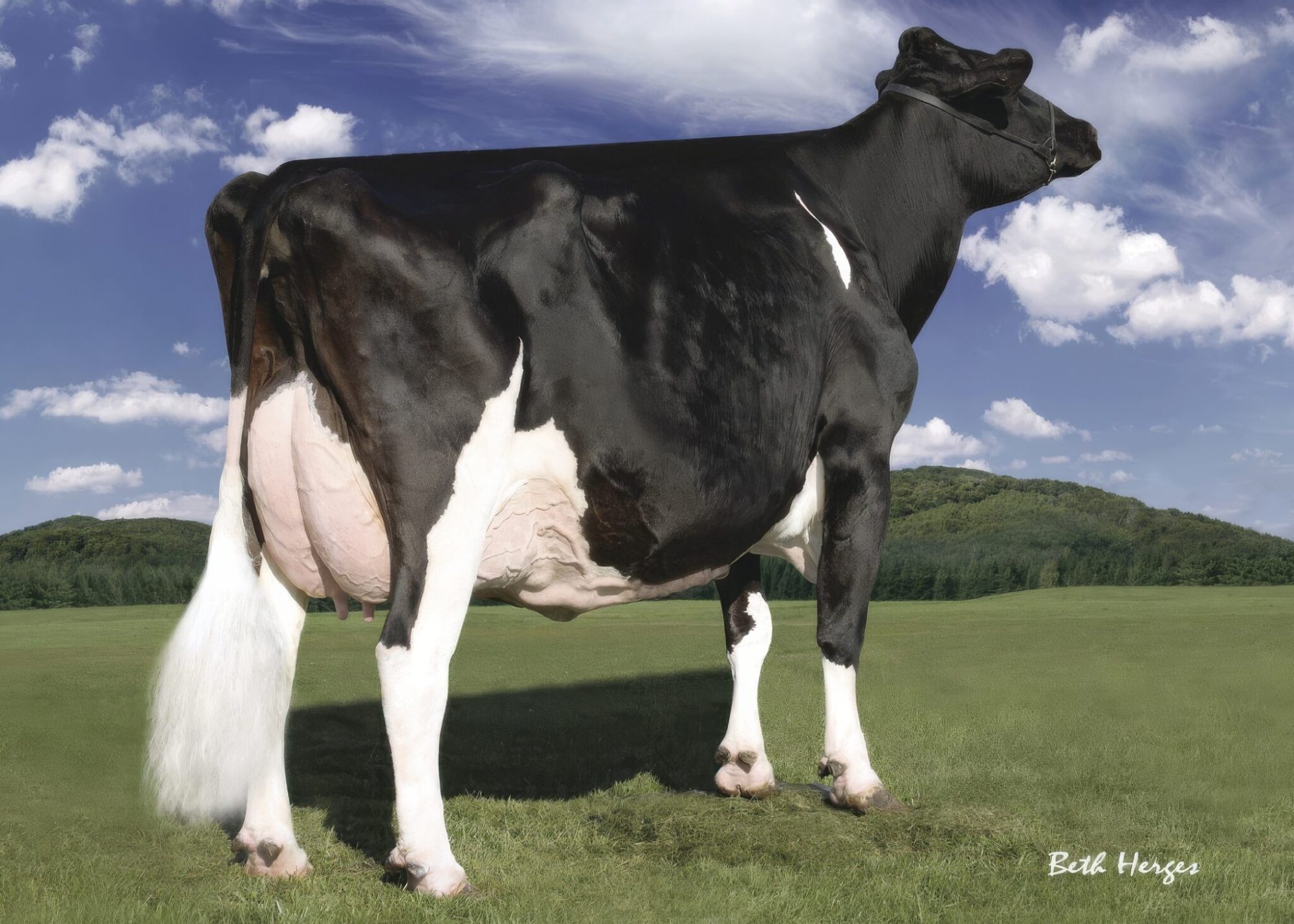
Regancrest-PR Barbie — the cow family that refused to be made obsolete. When genomics arrived promising to replace pedigree with a number, Barbie answered by stacking her sons and daughters at the top of the same index lists. The dynasty didn’t fight the new system. It won inside it — which is the whole point.  (Read more: When Breeding Genius Meets Perfect Timing: How Regancrest-PR Barbie Shaped the Future of Holstein Genetics)

Heifer Comparison: Dynasty vs. Shallow Pedigree

AttributeHeifer A (Shallow Pedigree)Heifer B (Dynasty Line — “Barbie/Roxy”)
Genomic PTAT+3.2 (exciting on paper)+2.8 (slightly lower index)
Maternal backingGP dam, shallow familyDeep line (27+ VG/EX maternal sisters)
Expected lifespan~1.8–2 lactations (early cull risk)3.5+ lactations (proven durability)
Parity-1 vet costs~$75+ (higher stress susceptibility)~$23–$35 (resilient, low drama)
ET/IVF viabilityHigh risk (unproven transmission)High reward (80–90% elite transmission)
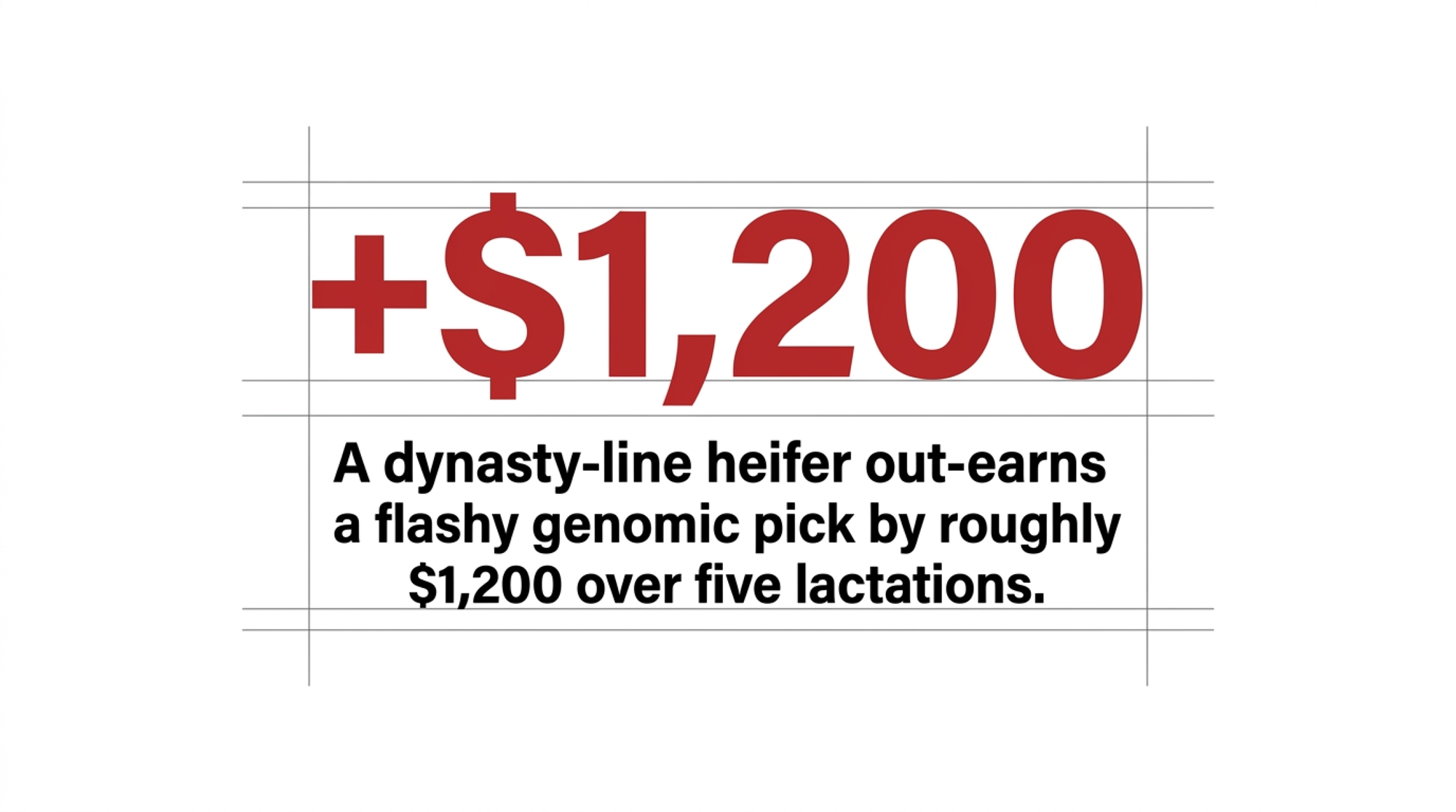
5-year est. marginBaseline+$950 to +$1,600 (midpoint +$1,200)

Note: Parity-1 vet costs (Blom et al., 2023) and maternal backing reflect documented records. Expected lifespan and ET transmission rates are Bullvine illustrative estimates comparing dynasty and shallow lines — not measured population values.

Fast-forward five years. The Barbie-line heifer is far more likely to still be milking in her third or fourth lactation. Published herd-life economics — De Vries (2017, Journal of Dairy Science) on the longevity-versus-genetic-gain trade-off, and Gazzarin et al. (2025, JDS) on optimal productive lifespan — consistently show that spreading rearing cost across more lactations while banking extra peak-milk cycles adds real profit per cow. Our Bullvine analysis, built on those ranges, pegs each additional successful lactation at roughly $400 to $600 per cow, depending on your system.

Health stacks on top. A 2023 study of eight high-performance Minnesota Holstein herds (Blom et al., Animals) found parity-1 treatment costs ranging from about $23 to $75 per cow — and that’s direct vet cost only, before lost milk, discard, and breeding delays. Add it up across three or four lactations and the dynasty cow pulls clear. Our model lands the five-year cash gap between a dynasty-line heifer and an equally fancy but shallow-pedigree heifer at roughly $950 to $1,600 per head — call it $1,200 at the midpoint. Hold that in pencil. It moves with your feed cost, your milk price, and how hard you lean on ET.

On a 300-cow herd raising 40 to 50 donor-candidate heifers over a few years, that gap scales into five-figure territory. The genomic test bills you today. The shallow family bills you in year three.

Three Fingerprints a Dynasty Can’t Fake

The Comestar, Regancrest, and Roxy families don’t look alike. One leans functional type, one extreme PTAT, one fertility and herd-life. Lay their histories side by side, though, and the same fingerprints show up.

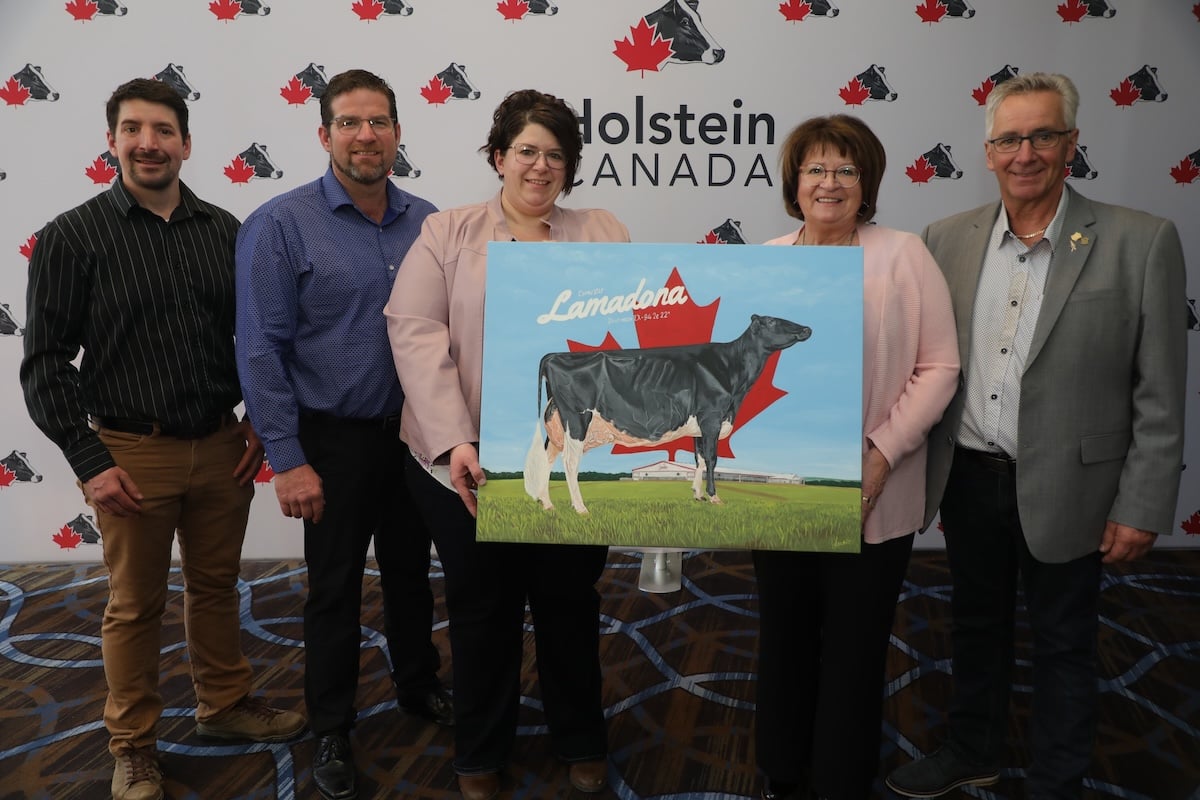
a historic moment for the Comtois family as they receive Holstein Canada’s most prestigious individual honor for Comestar Lamadona Doorman EX-94-2E 27*. The presentation marks a remarkable full-circle achievement, as Lamadona becomes the 2022 Cow of the Year exactly 27 years after her ancestor, Comestar Laurie Sheik, received the inaugural award in 1995. Standing proudly before the Holstein Canada backdrop, the family displays a commissioned portrait of this extraordinary cow who combines exceptional type (EX-94) with remarkable genetic transmission (27 brood stars). Lamadona continues the Laurie Sheik dynasty through her influence on modern breeding programs, with sons like LEMAGIC (Semex), LOYALL (Blondin Sires), LATAYO (Semex) and BARLOT (Semex) carrying her genetics forward. This moment represents not just an individual achievement, but the validation of a breeding philosophy focused on maternal lines that has shaped Holstein breeding across four decades and 51 countries worldwide.
A historic moment for the Comtois family as they receive Holstein Canada’s most prestigious individual honor for Comestar Lamadona Doorman EX-94-2E 27*. The presentation marks a remarkable full-circle achievement, as Lamadona becomes the 2022 Cow of the Year exactly 27 years after her ancestor, Comestar Laurie Sheik, received the inaugural award in 1995.

Depth, not a spike. In the Laurie Sheik family, herdbook stars stack in a way most herds never see once. Laurie Sheik carries 23 brood-cow stars, her Blackstar daughter Laura Black topped her with 24, and L Or Black earned 16. Holstein Canada named Laurie Sheik the inaugural Cow of the Year in 1995; her descendant Comestar Lamadona Doorman took the same title in 2022 — 27 years apart. That one purchase Comtois made in 1985 is still winning national hardware nearly four decades later. Not a one-hit wonder. A conveyor belt. The full story lives in The Cow That Built an Empire.

Barbie’s line runs the same pattern — dams, daughters, granddaughters carrying multiple Excellent daughters and top PTAT slots, not one freak cow surrounded by also-rans. Glenridge Citation Roxy EX-97-4E had 16 Excellent daughters, over 300 Excellent descendants, and a 30-star brood cow in Mil-R-Mor Roxette EX. Families that flat-out refuse to miss.

Volume with the same result. Dynasties don’t get judged on three daughters. Barbie produced more than 27; all but one classified VG or better on first lactation, and by 2010 she’d stacked eight Excellent and nineteen Very Good, with at least eleven daughters in the top-25 PTAT rankings. Give a family 20 to 30 daughters by different bulls and they still hit 80 to 90% of the time — that’s zero-failure transmission in barn terms. No genomic prediction fakes that.

And here’s the real separator: the results hold across different sires and different barns. In the Barbie family, Goldwyn and Shottle daughters both show the same mammary quality. In the Laurie Sheik line, Blackstar, Prelude, and Storm all threw daughters and sons that lifted herds from Quebec to Belgium to modern robot barns — at Bois Seigneur Holstein, roughly 70% of the herd traces back to her. Roxy’s descendants have milked in tie-stalls, free-stalls, and on pasture without losing their reputation for fertility and low SCC. A printout ranks a calf in a population. It can’t tell you how her granddaughters behave across 30 matings and five proof runs. That’s where dynasties live. Read the family trees in Roxy, Dellia and The Mothers Who Built the Breed.

Dynasty familyDepth (brood-cow stars / EX daughters)Volume testedRepeatability signal
Comestar Laurie Sheik23 brood stars; Laura Black 24, L Or Black 16Anchored 14 Class EXTRA bulls2 Cow-of-the-Year titles, 27 yrs apart
Regancrest-PR Barbie8 EX + 19 VG daughters by 201027+ daughters classifiedAll but 1 hit VG/EX on 1st lactation
Glenridge Citation Roxy16 EX daughters; 300+ EX descendantsMil-R-Mor Roxette = 30-star brood cowHeld type across tie-stall, free-stall, pasture
Millionaire sires producedLeader, Lee, Lheros, Outside (Laurie Sheik)Comestar Lee: 1.5M dosesSame result across Goldwyn, Shottle, Blackstar

What Does a $3,000 Embryo Really Buy You?

Here’s the flip side, and it’s the other half of our $93,300-a-year “three cow families” warning. Not the trap of leaning too hard on a handful of dynasties — the opposite mistake, ignoring proven cow families entirely.

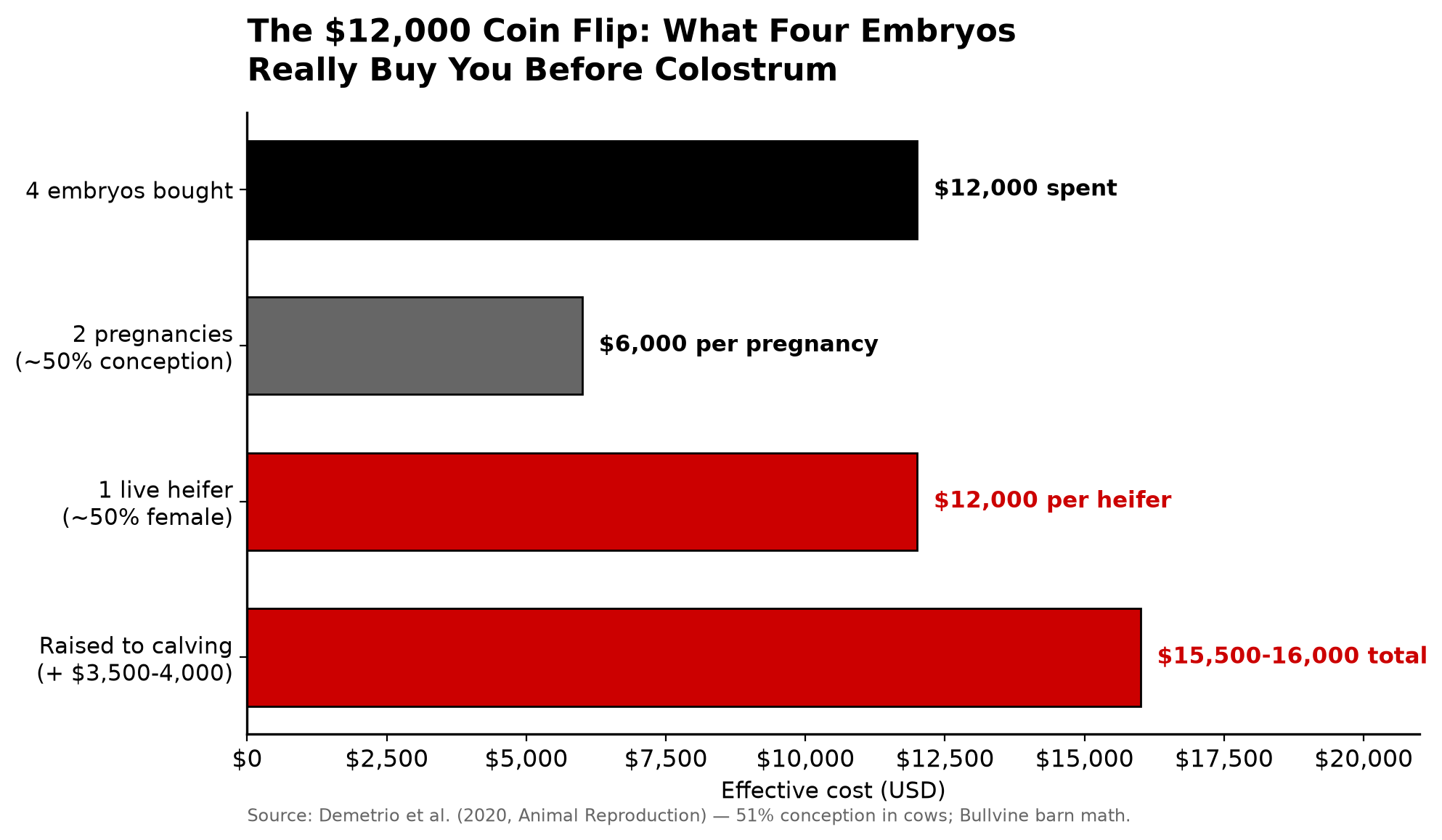
Hand over $3,000 for an embryo and you’re not buying a guarantee. You’re playing biological telephone. Here’s how the cash actually drains:

The Cold Math on $3,000 Embryos

  • The buy-in: 4 embryos × $3,000 = $12,000 spent
  • The reality check: ~50% conception rate = 2 pregnancies
  • The coin flip: ~50% heifer rate = 1 live heifer

You just paid $12,000 for one live heifer before she drinks her first bag of colostrum — and that’s before the $3,500 to $4,000 to raise her to calving. If her donor’s a one-generation wonder, you’ve got a real shot at that $12,000 washing out early. If she’s a Roxy or a Barbie, she’s got the maternal infrastructure to back the price tag. Those conception rates aren’t guesses, either: Demetrio et al. (2020, Animal Reproduction) put in vivo pregnancy at about 51% in lactating cows and 63% in virgin heifers.

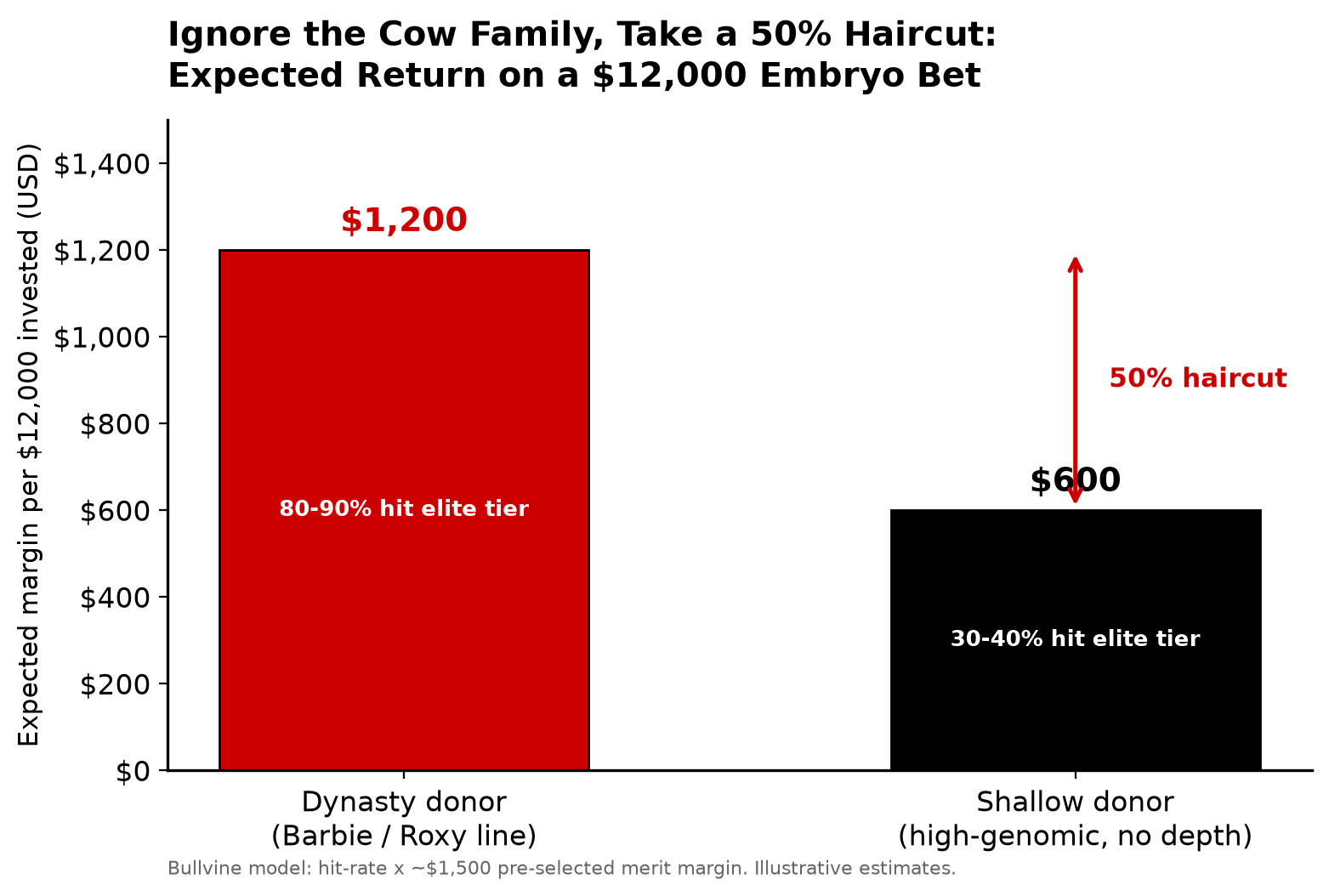
Now overlay the family. From a Barbie/Laurie/Roxy-level dynasty, family data suggests 80 to 90% of those embryo-derived daughters land in your top tier. From a high-genomic young cow with nothing behind her, that “elite” hit rate can realistically slide to 30 to 40% once health, fertility, and cull reasons pile on. Using the upper end of our earlier range — roughly $1,500, since embryo heifers are pre-selected for merit rather than average — the expected margin per $12,000 investment looks like this:

  • Dynasty donor: 0.8 × $1,500 ≈ $1,200 expected margin
  • Shallow donor: 0.4 × $1,500 ≈ $600 expected margin

Ignore maternal proof and you’ve taken a 50% haircut, purely because you never asked whether the donor’s family had proven anything past three generations of names on paper. Run 20 embryos a year in a 300-cow herd and that’s five-figure lost upside over five years — before you count the drain of watching can’t-miss heifers turn into problem cows.

How Do You Lean on Dynasties Without Breeding Yourself Into an Inbreeding Hole?

There’s a real catch. Double down on a few cow families, ignore the sire mix, and you dig an inbreeding hole fast.

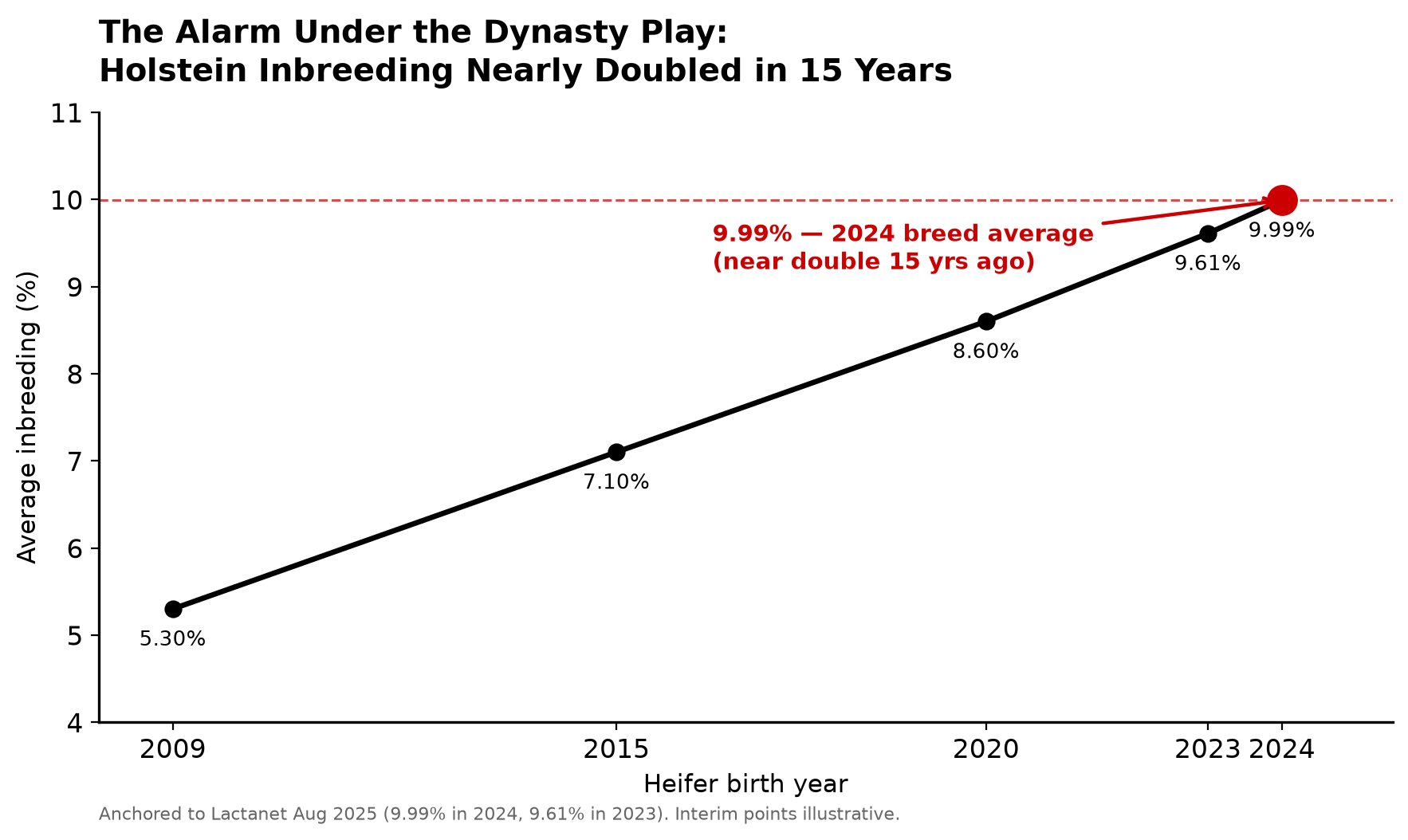
Canadian Holstein heifers born in 2024 now average 9.99% inbreeding, per Lactanet’s August 2025 update — up from 9.61% the year before, and nearly double where it sat 15 years ago. The US doesn’t publish one breed-average figure, but CDCB’s base-change work tells the same story: average Expected Future Inbreeding jumped from 7.5% to 9.4% between the 2015 and 2020 cow bases. Different yardstick. Same direction.

The Inbreeding Alarm: With breed averages sitting at a historic 9.99%, doubling down on “popular” branches of a dynasty without a strict mating guardrail is genetic self-sabotage. Virginia Tech’s benchmark work (Smith et al., 1998, JDS) pegged each 1% rise in inbreeding at roughly $22 to $24 in lost lifetime net income per cow — but that’s in 1999 dollars. Inflation-adjusted and paired with newer genomic milk-loss data, real-world estimates now run about $44 to $100 per cow. And it hits exactly where dynasties are supposed to protect you: fertility, stillbirths, immune-system slack.

So you manage a dynasty like a long-term investment, not a shortcut:

  • Track inbreeding animal by animal, not just as a herd average.
  • Hold expected heifer-crop inbreeding well below the 9.99% breed average — treat whatever number you pick as a brake pedal, not a target.
  • Don’t blackball elite carrier bulls. A +3,200 GTPI carrier mated only to clear (Code 0) cows beats a +2,800 GTPI clean bull — you bank the genetics and dodge the homozygous risk.
  • Use genomic relationship data to find less-related bulls that still fit your dynasty’s type and production goals.

The full barn math on what each point of inbreeding costs is in Holstein’s $40,500 Inbreeding Bill, and the outcross-sourcing playbook is in How Blondin Sires Turned a Bottleneck into 75% Growth. You’re not giving up pedigree depth. You’re keeping inbreeding depression from erasing the exact traits that made you love the family.

Options and Trade-Offs for Farmers

Every herd sits in a different spot on the genetics curve. Three paths fit most 200- to 1,500-cow operations staring at this maternal blind spot.

The 30-Day Maternal Audit (start here). Print three to four years of cows sorted by lifetime milk or margin. Highlight the ones in third lactation or better with solid components and no chronic problems. Trace them back three maternal generations and circle the surnames that repeat. When it makes sense: any herd over ~150 cows with a few years of records. What it takes: a couple hours with herd software and a pen — no consulting fee. The limit: if your records don’t track lifetime performance well, you’ll lean on cull notes and memory as a stopgap. Even that beats flying blind. Tag those dynasty animals in your software this month, and you’ve already started changing daily decisions.

The Dynasty-First Semen Plan. Redirect the budget you already spend. Sexed, high-end semen goes to your top 20 to 30 dynasty cows and heifers first; conventional Holstein or beef goes on the rest unless one has a clear role. Cap expected inbreeding well under 9.99% on dynasty matings, and when a sire pushes those animals toward the line, swap him. When it makes sense: herds already spending real money on elite or sexed semen. The trade-off: you give up chasing every new bull and run a tighter sire list longer. As genomic evaluations put more weight on health and fertility, the smartest move won’t be overriding maternal proof — it’ll be sharpening which sires you use inside families that have already earned their spot in your barn.

The “Stop Guessing” Embryo Rule. Write one rule before the next sale catalog hits: if the donor’s family can’t show three generations of daughters with solid production, decent classification, and real herd life, you don’t write a $3,000 check. When it makes sense: any herd using ET/IVF or tempted by purchased embryos. The trade-off: you’ll walk past a hot donor with sizzling numbers and no cow-family proof, and you might miss the rare new family that would’ve panned out. You’ll dodge far more expensive disappointments. As more ET programs chase feed efficiency and sustainability, donors from proven dynasties are the ones that hit under real-world stress.

Key Takeaways

  • If you can’t name the maternal lines behind your top 10 cows without opening the herd book, run the 30-day audit before you spend another dollar on semen or embryos.
  • If a donor’s family can’t show three generations of daughters that milk, breed back, and stay out of the dead pile, don’t pay brood-cow prices for her embryos.
  • If you’re running more than 15 to 20 Holstein sires in a 300-cow herd over two or three years, you’re spreading the budget too thin — tighten the list and aim it at your top three families.
  • If your embryo-derived heifers aren’t beating your herd’s average retention to a third lactation, your program’s riding shallow families. Rebuild it around lines that have proven they stay.
  • If your herd inbreeding is creeping toward 9.99%, cap dynasty matings below that line, mate elite carriers to Code 0 cows only, and check inbreeding animal by animal — not just as a herd average.

Nobody’s arguing whether Barbie, Laurie Sheik, and Roxy created value. Four millionaire sires — with Comestar Lee alone reaching 1.5 million doses — 16 Excellent daughters in one family, a third of the elite PTAT list: that answer’s already written. The open question is whether your program is built to reward the dynasties quietly carrying your barn, or whether you’re still spending 2026 money like it’s 1998, letting catalogs call the shots instead of the surnames on your best cows’ tags.

So here’s the one to sit with before the next proof run lands in your inbox: print that three-to-four-year cow list tomorrow morning and see which three families are actually holding your barn together. Once you see it, you can’t unsee it. And when you want the full model — exactly how much extra profit per lactation a dynasty cow throws off at 200 cows versus 1,500 — that’s the deeper per-cow math we’re building next, and where Bullvine Weekly readers get it first.

Run Your Numbers

Genomic Testing ROI Calculator — Before you flush a donor or write another $3,000 embryo check, run the numbers on which animals are actually worth testing. It puts a dollar value on the spread between your best and worst genetic quartiles, flags where inbreeding risk needs tighter control, and pressure-tests whether the decision pencils under conservative assumptions — not just the aggressive ones.

Complete references and supporting documentation are available upon request by contacting the editorial team at editor@thebullvine.com.

Learn More

The Sunday Read Dairy Professionals Don’t Skip.

Every week, thousands of producers, breeders, and industry insiders open Bullvine Weekly for genetics insights, market shifts, and profit strategies they won’t find anywhere else. One email. Five minutes. Smarter decisions all week.
NewsSubscribe
First
Last
Consent

The Cow That Built an Empire: Comestar Laurie Sheik’s Unstoppable Genetic Legacy

How an unassuming cow built a global dairy empire. Discover how Laurie Sheik’s genetics dominate barns worldwide—40 years later.

This historic image captures a pivotal moment in Holstein history as a young Comestar Laurie Sheik VG-88 23* claims first place in the Senior 2-Year-Old class at Expo Victoriaville. The trophy being presented was sponsored by Edgar Comtois, father of Marc Comtois, creating a meaningful family connection as Laurie Sheik began her remarkable show career. What makes this moment especially significant is that this unassuming cow would go on to become one of the most influential matriarchs in Holstein history, producing four millionaire bulls and establishing a genetic dynasty that continues to influence dairy breeding worldwide today. This early show ring success hinted at the extraordinary genetic potential that would eventually extend to 51 countries and span multiple generations of elite Holstein breeding.
A pivotal moment in Holstein history as a young Comestar Laurie Sheik VG-88 23* claims second place in the Senior 2-Year-Old class at World Dairy Expo. What makes this moment especially significant is that this unassuming cow would go on to become one of the most influential matriarchs in Holstein history, producing four millionaire bulls and establishing a genetic dynasty that continues to influence dairy breeding worldwide today. This early show ring success hinted at the extraordinary genetic potential that would eventually extend to 51 countries and span multiple generations of elite Holstein breeding.

Do you know how people talk about game-changers in sports or tech visionaries who transform industries overnight? In the dairy cattle breeding world, we also have our legends. And honestly, they don’t come much more significant than Comestar Laurie Sheik.

Picture this: It’s a chilly autumn day in 1989, and the buzz at the first-ever Comestar Sale in Quebec is reaching a fever pitch. Nobody expected much from this modest-looking, more white-than-black cow from Victoriaville when she entered the ring. But when the gavel finally dropped? A staggering $45,000 price, with the Pussemier family from Belgium joining Comestar to take a gamble that would reshape Holstein breeding worldwide.

This pivotal black and white photograph captures Comestar Laurie Sheik VG-88 23* at the first-ever Comestar Sale in 1989, where she commanded an extraordinary $45,000 as the event’s top seller—more than eight times the sale average of $5,605. This historic transaction marked the beginning of the Belgistar Union, as 50% ownership went to Belgian investors who recognized her exceptional genetic potential. With 80 head changing hands that day, nobody could have predicted that this unassuming cow standing calmly in the Comestar spotlight would go on to produce four millionaire bulls and reshape Holstein breeding across 51 countries. This image captures the exact moment when a genetic dynasty was born, forever changing the course of dairy cattle breeding worldwide.
Comestar Laurie Sheik VG-88 23* at the first-ever Comestar Sale in 1989, where she commanded an extraordinary $45,000 as the event’s top seller—more than eight times the sale average of $5,605. This historic transaction marked the beginning of the Belgistar Union, as 50% ownership went to Belgian investors who recognized her exceptional genetic potential. With 80 head changing hands that day, nobody could have predicted that this unassuming cow standing calmly in the Comestar spotlight would go on to produce four millionaire bulls and reshape Holstein breeding across 51 countries. This image captures the exact moment when a genetic dynasty was born, forever changing the course of dairy cattle breeding worldwide.

Talk about an underdog story! This unassuming cow would go on to rewrite the genetic playbook for the next four decades. And I’m not exaggerating when I say her influence is still being felt today in barns across 51 countries.

WHY ONE COW CHANGED EVERYTHING (AND WHY YOU SHOULD CARE)

This historic image captures Comestar Laurie Sheik VG-88 23* alongside her 1995 “La Vache de l’Année” (Cow of the Year) award - the inaugural recipient of Holstein Canada’s most prestigious individual honor. The regal backdrop and elegant trophy presentation befit her status as dairy royalty. Beyond her striking appearance, this unassuming cow from Victoriaville, Quebec would establish one of the most influential maternal bloodlines in Holstein history, producing four millionaire bulls and creating a genetic dynasty that continues to dominate Holstein breeding worldwide. Her selection as Canada’s first Cow of the Year recognized not just her individual excellence, but the extraordinary genetic potential that would transform dairy cattle breeding for generations to come.
Comestar Laurie Sheik VG-88 23* alongside her 1995 “La Vache de l’Année” (Cow of the Year) award – the inaugural recipient of Holstein Canada’s most prestigious individual honor. The regal backdrop and elegant trophy presentation befit her status as dairy royalty. Beyond her striking appearance, this unassuming cow from Victoriaville, Quebec would establish one of the most influential maternal bloodlines in Holstein history, producing four millionaire bulls and creating a genetic dynasty that continues to dominate Holstein breeding worldwide. Her selection as Canada’s first Cow of the Year recognized not just her individual excellence, but the extraordinary genetic potential that would transform dairy cattle breeding for generations to come.

Even if you’re not a Holstein fanatic (though if you’re reading The Bullvine, chances are you might be!), Laurie Sheik’s accomplishments will make anyone’s jaw drop:

  • She produced FOUR millionaire bulls – Leader, Lee, Lheros, and Outside. Can you imagine having just ONE bull reach that status from your breeding program? She gave our industry FOUR.
  • Her maternal line is ridiculous – 23 brood cow stars for Laurie Sheik herself, and her daughter Laura Black topped her with 24. That’s like having a Hall of Fame player whose kid becomes an even bigger star.
  • She bookended Holstein Canada’s Cow of the Year award by winning the inaugural honor in 1995 and having her descendant Lamadona grab the same title in 2022. That’s 27 years of genetic dominance!
  • Her genes are EVERYWHERE – 51 countries have her bloodlines, and at Bois Seigneur Holstein in Belgium, about 70% of their herd traces back to her. That’s not influence; that’s a takeover.

And get this – her descendants are still crushing it in both old-school tie-stall barns AND cutting-edge robotic milking systems. Talk about standing the test of time!

FROM FARM KID TO VISIONARY: THE MAN BEHIND THE LEGEND

I’ve always loved the human stories behind great breeding programs. Marc Comtois wasn’t some corporate genetic wizard with fancy degrees – he was a farm kid who loved cows so much he quit school at 15 to work with them. By 18, he’d already bought his farm in Princeville, Quebec.

Demonstrating his commitment to the industry, Marc became an official Holstein Canada member on February 14, 1977 – a Valentine’s Day dedication to dairy breeding. Just months later, on April 23, 1977, he married France Comtois, forging a personal and professional partnership that would shape Holstein history.
Starting with 44 grade animals, the newlyweds quickly transitioned to purebred Holsteins, setting the foundation for what would become a breeding program of global significance. This rapid progression – from farm purchase to industry membership to marriage – within just 14 months showcased Marc’s relentless drive. The couple’s shared vision would soon give birth to a genetic revolution.

Marc Comtois’ pivotal 1985 purchase of Elysa Anthony Léa EX 15* set the stage for Holstein history. This exceptional daughter of Willowholme Mark Anthony would become the dam of Comestar Laurie Sheik VG-88 23*, founding one of the most influential maternal lines in modern dairy breeding. Her impressive 15 brood cow stars demonstrated extraordinary genetic transmission that would become the hallmark of her daughter’s legacy. The purchase of this remarkable cow represents the foundation decision that ultimately led to four millionaire bulls and a genetic footprint spanning 51 countries worldwide.

The pivotal moment? When he spotted Elysa Anthony Lea EX-15* in 1985. Something about her caught his eye.

“I’ve always believed that exceptional cows build exceptional herds,” Comtois once said. “When I saw Elysa Anthony Lea, I recognized a cow that could be the foundation for something special. But even I couldn’t have predicted just how special her daughter would become.”

That daughter, born in December 1986, was Comestar Laurie Sheik ET VG-88-23*. And man, what a cow she turned out to be!

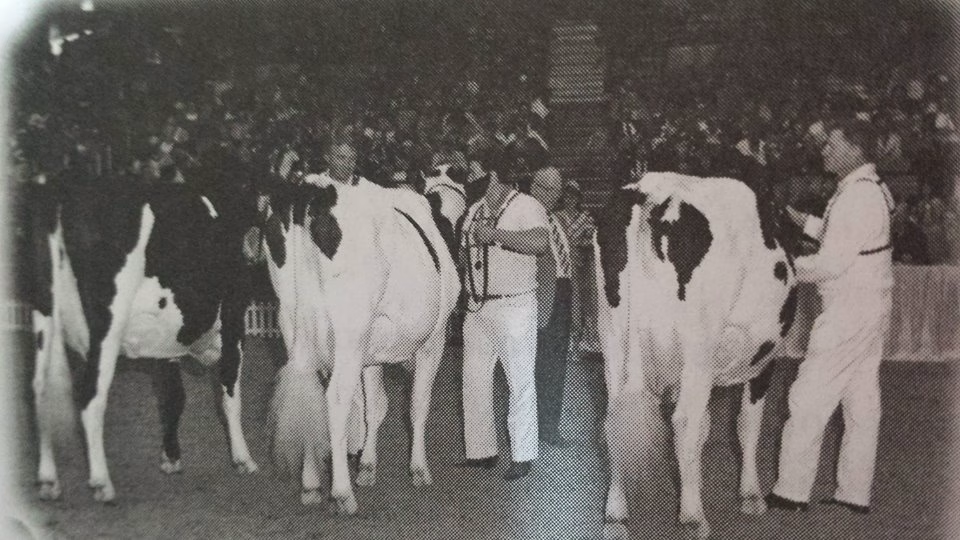
Historic moment... 1989 WDE, when Starbuck Winnie won the sr 2-yr-old class, and Laurie Sheik got 3rd and after milking got switch second and best udder over Starbuck Ada... and the 3 later became bull mother and Extraordinaire Brood Cows. Same year Norm Nabholz won the Klussendorf Trophe and also Roy Ormiston won as the first Canadian the Dairy Shrine Award.
Historic moment… 1989 WDE, when Starbuck Winnie won the sr 2-yr-old class, and Laurie Sheik got 3rd and after milking got switch second and best udder over Starbuck Ada… and the 3 later became bull mother and Extraordinaire Brood Cows. Same year Norm Nabholz won the Klussendorf Trophe and also Roy Ormiston won as the first Canadian the Dairy Shrine Award.

THE BREEDING DECISION THAT BROKE ALL THE RULES

You might think Laurie Sheik came from her time’s trendiest, most fashionable genetics. Nope. Not even close.

Her sire, Puget-Sound Sheik, wasn’t exactly a household name. Born in 1972 and classified VG-85, he brought valuable genetics through his Washington State bloodline sire, Provin Mtn Ivanhoe Jewel, but he wasn’t the “it bull” of his time.

While exceptional, her dam, Elysa Anthony Lea, EX-15*represented Marc’s independent thinking rather than following the crowd. He wasn’t breeding to what was hot; he was breeding what he believed would work.

And boy, did it work! This unconventional pairing created a genetic perfect storm that would redefine what was possible in Holstein breeding.

Comestar Lautamie Titanic becoming the first cow to win both the prestigious #1 IPV (Lifetime Production Index) ranking and a championship at the Royal Winter Fair in Toronto. Shown here claiming the Reserve All-Canadian Junior 2-Year-Old honors at the 2006 Royal, this Laurie Sheik descendant exemplifies the family’s remarkable ability to combine show ring excellence with production superiority. The multiple images showcase her exceptional dairy form from various angles as she competes under the bright lights of Canada’s most prestigious dairy showcase. This unprecedented achievement—winning the Junior 2-Year-Old class while simultaneously holding the nation’s top production ranking—perfectly illustrates the balanced breeding philosophy that has made the Comestar program legendary, proving that elite genetics can excel in both the show ring and the milking parlor.

THE THREE SISTERS WHO MULTIPLIED THE MAGIC

Here’s where the story gets fascinating. Laurie Sheik had 18 Very Good daughters (impressive enough), but three in particular – all sired by Tomar Blackstar – became the genetic highways that spread her influence globally:

Laura Black VG-87-CAN 24* gave us Lee and Lheros – bulls that combined production punch with dairy strength that commercial farmers loved.

L Or Black VG-87-CAN 16* produced Outside, who completely transformed how we think about udders in modern Holsteins. Before Outside, we struggled with udders that couldn’t hold up through multiple lactations. His daughters changed that forever.

Lausan Black VG-87-CAN 23* gave us Stormatic, creating a line that uniquely excels in both genomic rankings AND show rings. My friend who judges major shows likes to say, “They look as good as they test, and they test as good as they look.” That’s rare!

A Quebec farmer friend who milks several Laura Black descendants put it best: “When you milk these cows, you can hear the milk hitting the bucket. They’re not just pretty cows—they’re profit machines.” I can’t argue with that!

THE BELGIAN BREAKTHROUGH THAT NOBODY SAW COMING

four daughters of the legendary Comestar Laurie Sheik grazing peacefully in the pastures of Bois Seigneur Holstein in Belgium. When crossed with Tomar Blackstar, these exceptional females ignited what became known as “Blackstar Mania” across European Holstein breeding circles. This strategic cross revolutionized the Pussemier family’s breeding program, producing influential brood cows like Blacklaure de Bois Seigneur, who achieved lifetime production exceeding 100,000 kg of milk while also claiming championship honors in the show ring. Through these remarkable females, Laurie Sheik’s genetics spread throughout Europe, transforming Bois Seigneur Holstein’s herd (where approximately 70% of today’s animals trace back to this lineage) and establishing a legacy of exceptional milk production combined with show-winning type that continues to influence Holstein breeding worldwide today.
Four daughters of the legendary Comestar Laurie Sheik grazing peacefully in the pastures of Bois Seigneur Holstein in Belgium. When crossed with Tomar Blackstar, these exceptional females ignited what became known as “Blackstar Mania” across European Holstein breeding circles. This strategic cross revolutionized the Pussemier family’s breeding program, producing influential brood cows like Blacklaure de Bois Seigneur, who achieved lifetime production exceeding 100,000 kg of milk while also claiming championship honors in the show ring. Through these remarkable females, Laurie Sheik’s genetics spread throughout Europe, transforming Bois Seigneur Holstein’s herd (where approximately 70% of today’s animals trace back to this lineage) and establishing a legacy of exceptional milk production combined with show-winning type that continues to influence Holstein breeding worldwide today.

I’ve always been fascinated by the international side of this story. When the Pussemier family spotted Laurie Sheik’s potential at that 1989 sale, they faced a significant roadblock: Belgian regulations wouldn’t let them import live cattle from Canada.

So, what did they do? Got creative! They bought partial ownership of Laurie Sheik herself and imported her embryos instead. Talk about thinking outside the box!

The 1989 sale of Laurie Sheik to Belgium marked a groundbreaking moment in international genetics trade, achieved against significant logistical odds. At the time, no formal embryo export agreements existed between Canada and Belgium, forcing Marc and France Comtois to pioneer new bureaucratic pathways. Every document – health certificates, ownership transfers, and customs declarations – required painstaking manual processing without today’s digital tools. In an era before routine computer use, the couple relied on paper records, international phone calls, and the emerging technology of fax machines to coordinate this unprecedented transaction. Their success in navigating these analog-era hurdles not only secured Laurie Sheik’s Belgian partnership but laid the groundwork for modern global embryo trade protocols.

This workaround triggered what became known as “Blackstar Mania” at Bois Seigneur Holstein. They crossed Laurie Sheik with Tomar Blackstar and struck genetic gold. The resulting offspring included standouts like Blacklaure de Bois Seigneur, who produced over 100,000 kg of milk in her lifetime – showcasing this lineage’s remarkable productivity and longevity.

Jonas Pussemier, who now runs the operation his parents started, told me: “What we could never have anticipated was how completely this one genetic investment would reshape our entire breeding program. Today, about 70% of our herd traces back to Laurie Sheik. That single decision in 1989 determined the direction of our breeding program for generations.” (Read more: From Laurie Sheik to Robotic Milking: Bois Seigneur Holstein’s Journey of Innovation)

Isn’t it amazing how one smart purchase can completely transform a herd’s future?

GENERATIONAL EXCELLENCE: THE LAURIE SHEIK GENETIC PROGRESSION

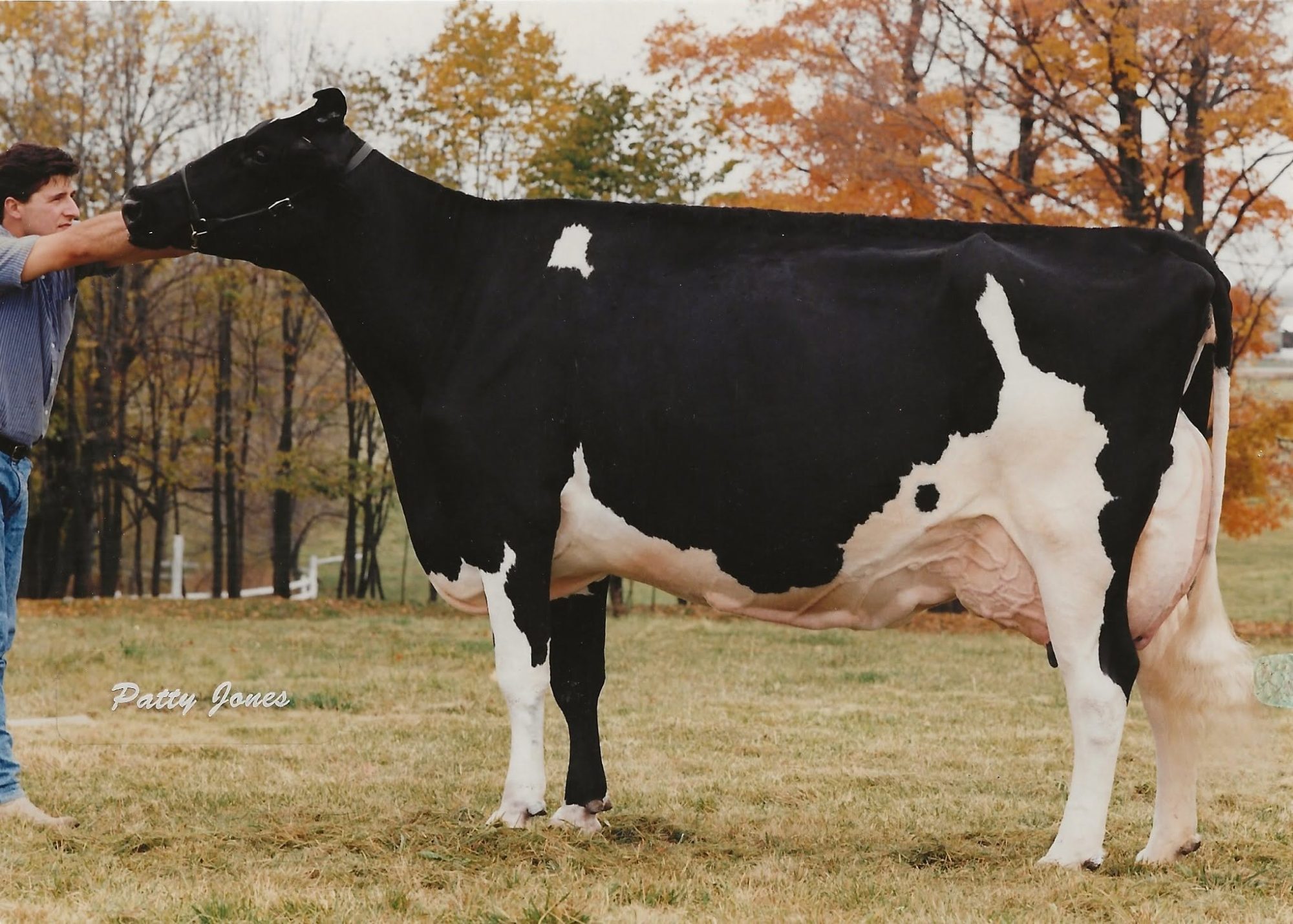
Comestar Lautamie Titanic VG-89 33* grazing peacefully at the renowned Comestar Holstein farm in Quebec. A testament to the extraordinary Laurie Sheik maternal line, this remarkable cow dominated Canadian genetic evaluations by holding the #1 IPV (Lifetime Production Index) position for an unprecedented three consecutive years (2006-2007-2008). Her impressive 33 brood cow stars and VG-89 classification exemplify the perfect balance of production excellence and physical conformation that has made the Comestar program legendary. The iconic Comestar sign in the background represents the breeding philosophy that transformed a Quebec dairy operation into a global genetic powerhouse. Photographer Patty Jones beautifully captured this quiet moment with one of Canada’s most influential Holsteins, whose descendants continue to shape dairy breeding worldwide.

The remarkable consistency of the Laurie Sheik lineage becomes clear when tracking key metrics across generations. While most families show regression toward breed average over time, this extraordinary maternal line has maintained—and often improved upon—elite performance across nearly four decades.

Maternal Line Classification Progression:

  • Elysa Anthony Lea (Dam): EX-15*
  • Laurie Sheik: VG-88-23*
  • Blackstar Daughters: All three key daughters classified VG-87
  • Modern descendant Lamadona: EX-94-2E 21*

Brood Cow Star Progression:

  • Elysa Anthony Lea: 15* (Exceptional for her era)
  • Laurie Sheik: 23* (Near-record achievement)
  • Laura Black: 24* (Exceeded her dam’s remarkable total)
  • Lausan Black: 23* (Matched her dam’s excellence)
  • L Or Black: 16* (Still extraordinary by industry standards)
  • Lamadona: 21* (Continuing the family tradition of elite status)

Genetic Impact Distribution: The influence expanded exponentially through each generation:

  • First generation: Comestar herd improvement
  • Second generation: National impact through Canadian genetics program
  • Third generation: International reach through Semex to 51 countries
  • Current generation: Global distribution plus concentration in specialized herds

This multi-generation excellence isn’t accidental. It represents the extraordinary genetic transmission capacity that makes the Laurie Sheik family the most influential maternal line in modern Holstein history. Notably, the * (brood cow star) designation applies exclusively to animals born in Canada – a testament to her domestic impact. If her global descendants were included, spanning the 51 countries where her genetics took root, Laurie Sheik’s legacy would shine even brighter. From Belgian barns to Brazilian pastures, her uncounted international daughters and granddaughters continue to amplify her unmatched influence.

This striking black and white Holstein dairy cow, likely Maxima de Bois Seigneur (Chief), exemplifies excellent dairy conformation with her strong frame, well-attached udder, and balanced proportions. Photographed on the traditional cobblestone courtyard of Bois Seigneur Holstein in Belgium, she represents the farm’s commitment to quality genetics. The classic brick farmhouse in the background showcases the European architectural heritage of this renowned breeding operation, where approximately 70% of the herd traces back to the influential Comestar Laurie Sheik lineage.

Production Excellence Markers: While specific metrics evolved over generations, the family consistently ranked among the elite. This legacy continues with modern descendants at Bois Seigneur Holstein, where exceptional performers like Maxima de Bois Seigneur (Chief) EX-94 set a farm record of 80 kg milk in 24 hours at just 47 days in milk. Lamadona’s impressive production records (5-09 2x 365d 56,799 lbs milk, 4.9% fat, 3.7% protein) represent the continuation of this family’s excellence.

a historic moment for the Comtois family as they receive Holstein Canada’s most prestigious individual honor for Comestar Lamadona Doorman EX-94-2E 27*. The presentation marks a remarkable full-circle achievement, as Lamadona becomes the 2022 Cow of the Year exactly 27 years after her ancestor, Comestar Laurie Sheik, received the inaugural award in 1995. Standing proudly before the Holstein Canada backdrop, the family displays a commissioned portrait of this extraordinary cow who combines exceptional type (EX-94) with remarkable genetic transmission (27 brood stars). Lamadona continues the Laurie Sheik dynasty through her influence on modern breeding programs, with sons like LEMAGIC (Semex), LOYALL (Blondin Sires), LATAYO (Semex) and BARLOT (Semex) carrying her genetics forward. This moment represents not just an individual achievement, but the validation of a breeding philosophy focused on maternal lines that has shaped Holstein breeding across four decades and 51 countries worldwide.
A historic moment for the Comtois family as they receive Holstein Canada’s most prestigious individual honor for Comestar Lamadona Doorman EX-94-2E 27*. The presentation marks a remarkable full-circle achievement, as Lamadona becomes the 2022 Cow of the Year exactly 27 years after her ancestor, Comestar Laurie Sheik, received the inaugural award in 1995. Standing proudly before the Holstein Canada backdrop, the family displays a commissioned portrait of this extraordinary cow who combines exceptional type (EX-94) with remarkable genetic transmission (27 brood stars). Lamadona continues the Laurie Sheik dynasty through her influence on modern breeding programs, with sons like LEMAGIC (Semex), LOYALL (Blondin Sires), LATAYO (Semex) and BARLOT (Semex) carrying her genetics forward. This moment represents not just an individual achievement, but the validation of a breeding philosophy focused on maternal lines that has shaped Holstein breeding across four decades and 51 countries worldwide.

Adaptability Across Systems: Perhaps most impressive is how this family has maintained superiority through:

  • The classification-focused 1980s
  • The production index era of the 1990s
  • The balanced LPI/TPI approach of the 2000s
  • Today’s genomic evaluation systems

This multi-generation excellence isn’t accidental. It represents the extraordinary genetic transmission capacity that makes the Laurie Sheik family the most influential maternal line in modern Holstein history.

THE MILLION-DOLLAR CLUB: THE SONS THAT CHANGED EVERYTHING

Marc Comtois of Comestar Holsteins stands proudly at the Semex display honoring his breeding program’s extraordinary achievement—producing multiple millionaire bulls. The display showcases models of Lee and Leader, two of Comestar Laurie Sheik’s descendants who achieved the coveted millionaire status, signifying over $1 million in semen sales. This remarkable accomplishment would later expand to include Stormatic and Lheros by 2008, making Comestar the only breeding program in the world to produce four millionaire bulls from a single cow family. This unprecedented genetic success story underscores the extraordinary impact of the Laurie Sheik maternal line, whose influence continues to shape Holstein breeding worldwide. The Semex backdrop represents the global partnership that helped distribute these game-changing genetics to 51 countries and established Comestar as one of the most influential breeding operations in dairy history.

Let’s talk money. Breeding great cows is rewarding, but it doesn’t hurt when they make you a fortune, too! Comestar did something unprecedented by producing FOUR millionaire bulls from the same cow family:

Comestar Leader – Laurie Sheik’s son brought solid production and components. Comestar Lee – Laura Black’s son who dominated Canadian LPI rankings. Comestar Lheros – another Laura Black son known for balance and longevity Comestar Outside – L Or Black’s famous son who revolutionized udder conformation.

I’ve visited herds worldwide where these bulls’ influence is still clearly visible generations later. Their genetic fingerprints are everywhere!

Calbrett Goldwyn Layla proudly displaying her championship ribbons after claiming First Place in the Adult Cow class at the Royal Winter Fair - Canada’s most prestigious dairy cattle exhibition. The striking Holstein stands poised in the spotlight, her exceptional dairy character and balanced conformation on full display as her handler presents her to the appreciative audience. The distinctive red and white championship rosette signifies her elite status among the nation’s finest Holsteins. This championship moment at “The Royal” represents the pinnacle of show ring achievement in Canadian dairy circles, where only the most exceptional animals earn recognition under the critical eyes of international judges. The packed arena and professional presentation highlight the significance of this victory at North America’s premier dairy showcase.
Calbrett Goldwyn Layla proudly displaying her championship ribbons after claiming First Place in the Adult Cow class at the Royal Winter Fair – Canada’s most prestigious dairy cattle exhibition. The striking Holstein stands poised in the spotlight, her exceptional dairy character and balanced conformation on full display as her handler presents her to the appreciative audience. The distinctive red and white championship rosette signifies her elite status among the nation’s finest Holsteins. This championship moment at “The Royal” represents the pinnacle of show ring achievement in Canadian dairy circles, where only the most exceptional animals earn recognition under the critical eyes of international judges. The packed arena and professional presentation highlight the significance of this victory at North America’s premier dairy showcase.

FROM 1995 TO 2022: A DYNASTY THAT WON’T QUIT

Do you want proof that Laurie Sheik’s genetics have staying power? Consider this incredible bookend to her story:

In 1995, Holstein Canada created its prestigious “Cow of the Year” award, and Laurie Sheik herself was the inaugural winner. Fast-forward to 2022 – 27 years later—and her descendant Comestar Lamadona Doorman EX-94-2E 21* won the same award.

Think about that. Laurie Sheik’s family has remained elite for nearly three decades in the rapidly evolving Holstein breeding industry, where genetic trends come faster than smartphone models.

Lamadona is a beast in her own right – EX-94 classification, 21 brood cow stars, and those impressive production records I mentioned earlier. Marc Comtois says she’s “well-known internationally for her numerous exploits at shows and for her milk production records.”

She’s also passing it on through sons, grandsons, and great-grandsons like LEMAGIC (Semex), LOYALL (Blondin Sires), LATAYO (Semex), and BARLOT (Semex).

The dynasty just won’t quit!

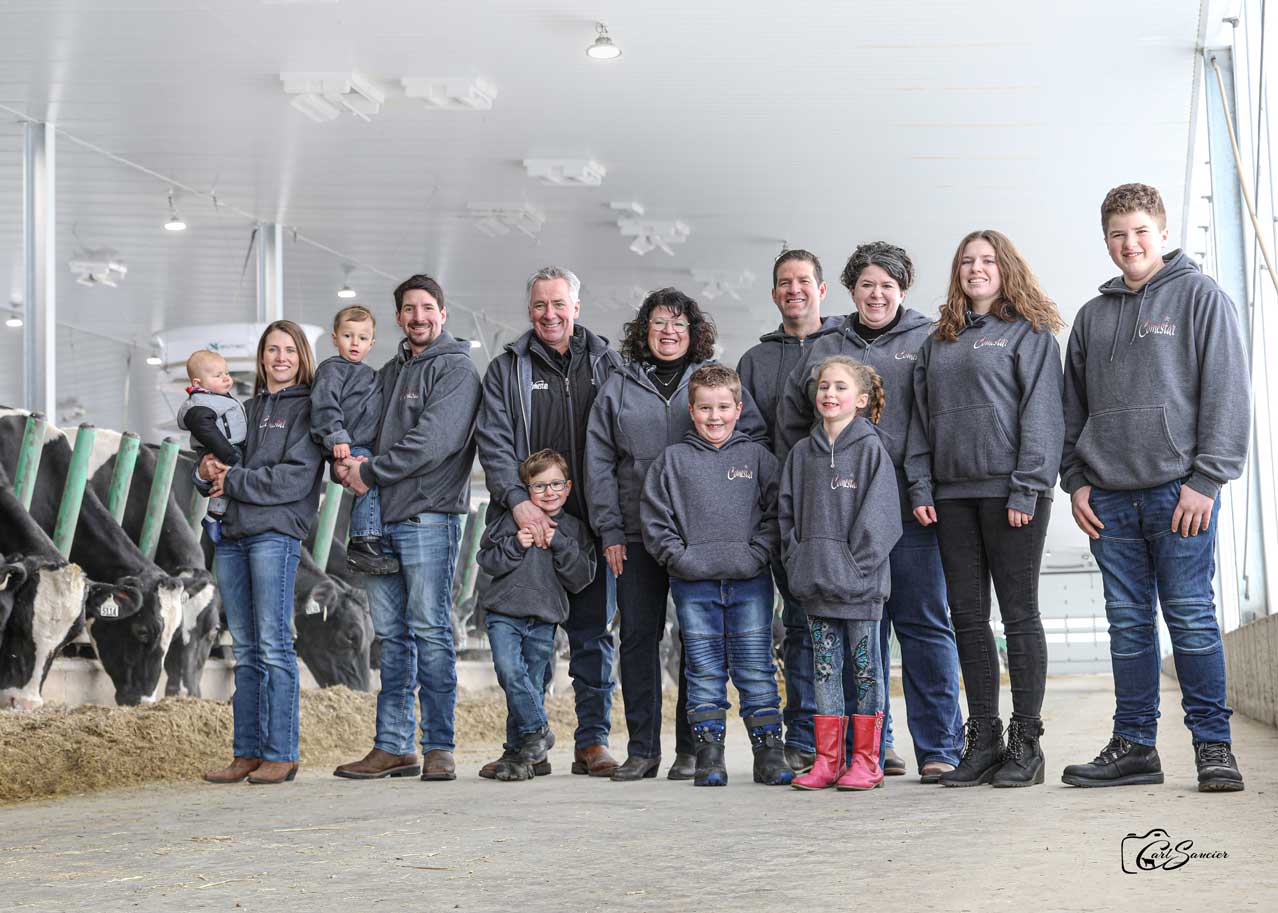
Marc and Steve Comtois proudly stand beside the promotional banner for Comestar LOYALL, the latest elite sire from their legendary breeding program being marketed by Blondin Sires. This impressive banner highlights LOYALL’s exceptional pedigree “FROM THE HEART OF THE LAURIE SHEIKS WITH OVER 170 BROOD STARS!” – underscoring his connection to the most influential Holstein maternal line in modern breeding history. The father-son team, wearing their distinctive Comestar jackets, represent multiple generations of breeding excellence that parallel the genetic dynasty they’ve created. LOYALL continues the Laurie Sheik legacy through his dam Comestar Lamadona Doorman EX-94-2E (the 2022 Holstein Canada Cow of the Year), making him part of the remarkable family that has produced four millionaire bulls and influenced Holstein breeding across 51 countries worldwide.

GENOMIC ERA BLUEPRINT: APPLYING LAURIE SHEIK PRINCIPLES IN TODAY’S BREEDING WORLD

You might wonder if breeding lessons from the 1980s still apply in our genomic selection era. They do – maybe now more than ever.

Laurie Sheik’s success offers a framework that works beautifully alongside modern genomic tools. Here’s how today’s breeders can apply her principles:

Look beyond the numbers for maternal strength. While genomic indexes give us incredible prediction power, they don’t tell the whole story of maternal potential. When evaluating potential brood cows, pay special attention to:

  • Family consistency across generations: Like Laurie Sheik’s family, look for maternal lines showing stable transmission of key traits. The best genomic numbers mean little if they disappear in the next generation.
  • Balanced trait profiles: Laurie Sheik wasn’t extreme in any trait – her power came from combining suitable components, functional type, and production longevity. In genomic selection, prioritize females with balanced profiles over single-trait wonders.
  • Cross-system performance: The Laurie Sheik family thrived as evaluation systems evolved from classification to production indexes to genomics. Look for families that maintain excellence regardless of how they’re measured.

Practical application tip: Create a maternal scorecard that tracks genetic transmission strength across three generations of any potential foundation female. A prepotent maternal line will show consistency in trait expression regardless of what sires were used.

Bois Seigneur Holstein exemplifies this approach, masterfully blending traditional maternal evaluation with modern genomic tools. As noted in The Bullvine’s coverage, they’ve incorporated tried-and-true methods alongside advanced genetics while focusing on the Laurie Sheik lineage.

Their breeding decisions reflect this balance. While using genomic testing, they value good mothering more than high production numbers. Rather than focusing solely on genomic rankings, they select for traits and bloodlines proven to work rather than relying on a single bull. According to The Bullvine, Chief and Lambda are their plan’s top sires. Their breeding goals integrate milk production excellence and show competition success – precisely the kind of balanced approach that made the Laurie Sheik line so successful.

Remember: genomic indexes are potent tools, but they work best when paired with the time-tested maternal selection principles Laurie Sheik’s legacy demonstrates.

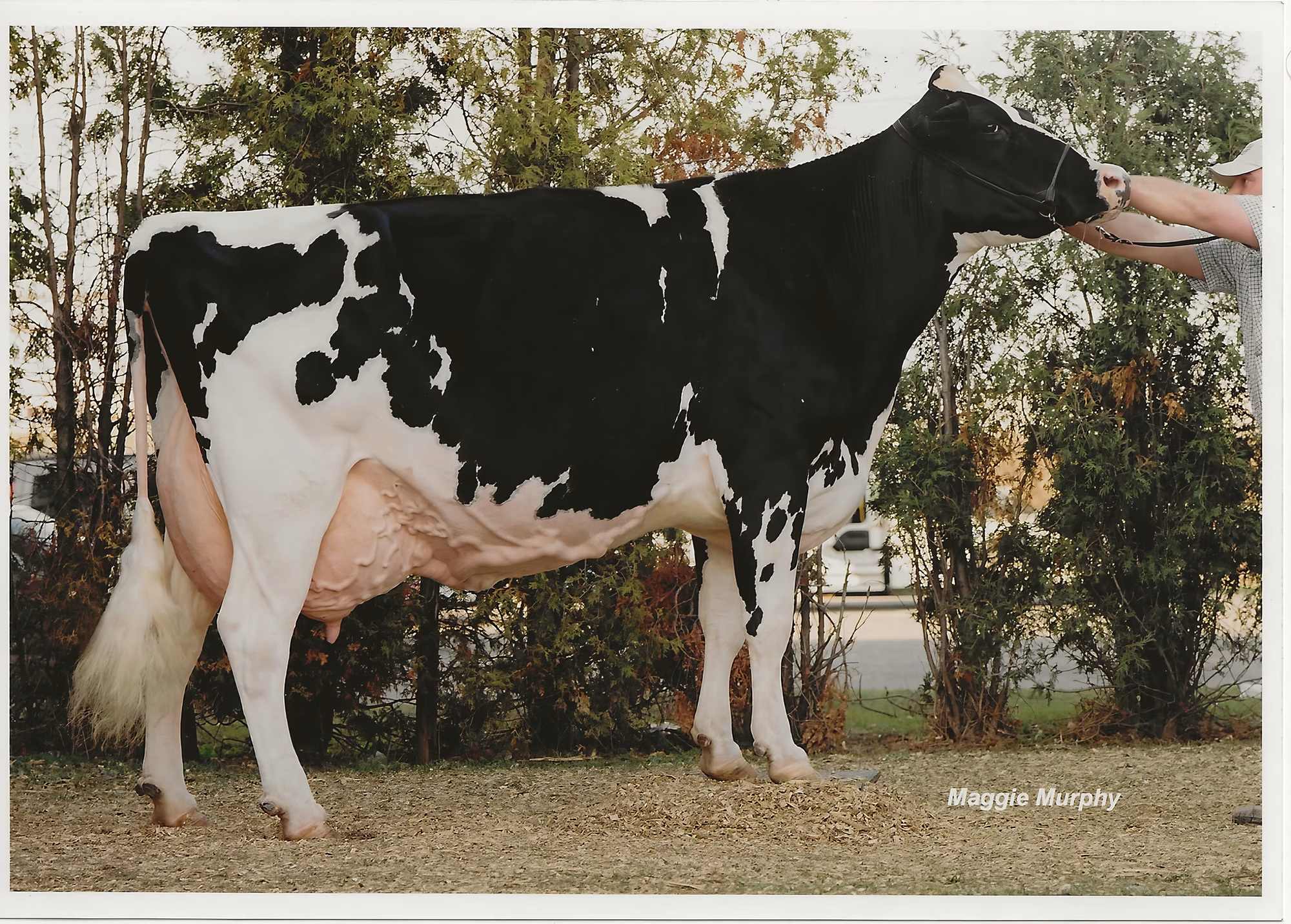
This stunning image by Carl Saucier captures Comestar Lamagic Impression Ex-93 grazing peacefully against the backdrop of modern dairy facilities. As the dam of influential sire Comestar Lemagic marketed by Semex, she represents the continuing excellence of the legendary Laurie Sheik maternal line. Her exceptional dairy strength, balanced frame, and remarkable mammary system that earned her the Excellent-93 classification are beautifully showcased in this professional side profile. Lamagic Impression’s own dam, Comestar Lamadona Doorman Ex-94-2E-19*, was the 2022 Holstein Canada Cow of the Year, demonstrating the multi-generational excellence that has made the Laurie Sheik family one of the most influential breeding lines in modern Holstein history. This image perfectly illustrates how the Comestar program continues to produce elite females that combine show-quality type with the ability to transmit excellence to the next generation.

OLD GENETICS, NEW TECHNOLOGY: WHY LAURIE SHEIK STILL MATTERS

As dairy farming evolves through the technological revolution, Laurie Sheik’s descendants continue demonstrating remarkable adaptability. Bois Seigneur Holstein exemplifies this, as Jonas Pussemier has successfully integrated these genetics into a modern, progressive operation.

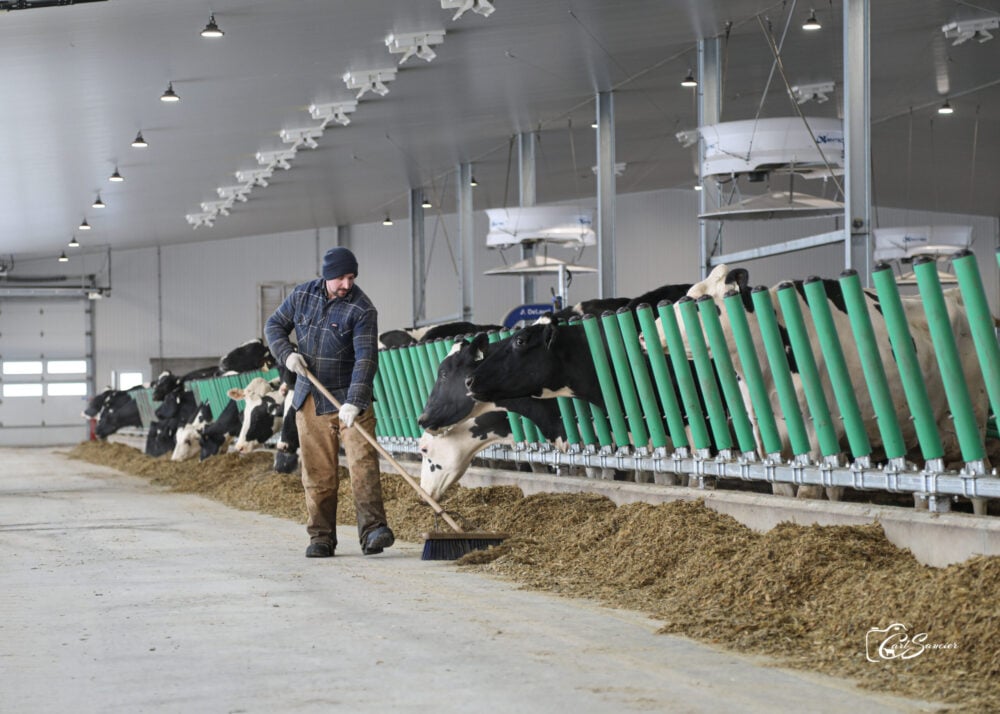
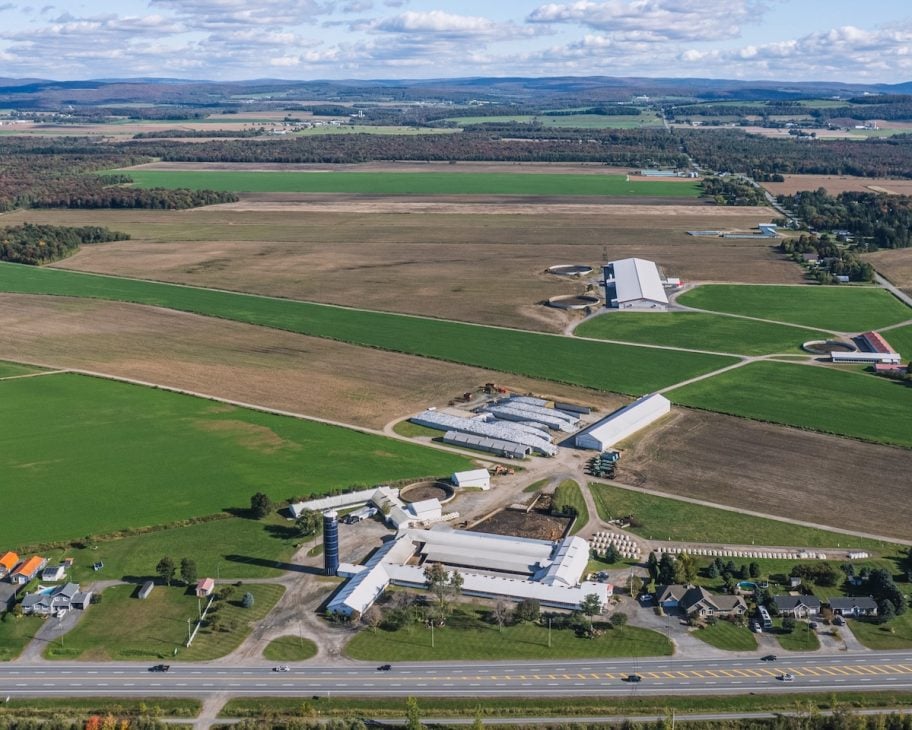
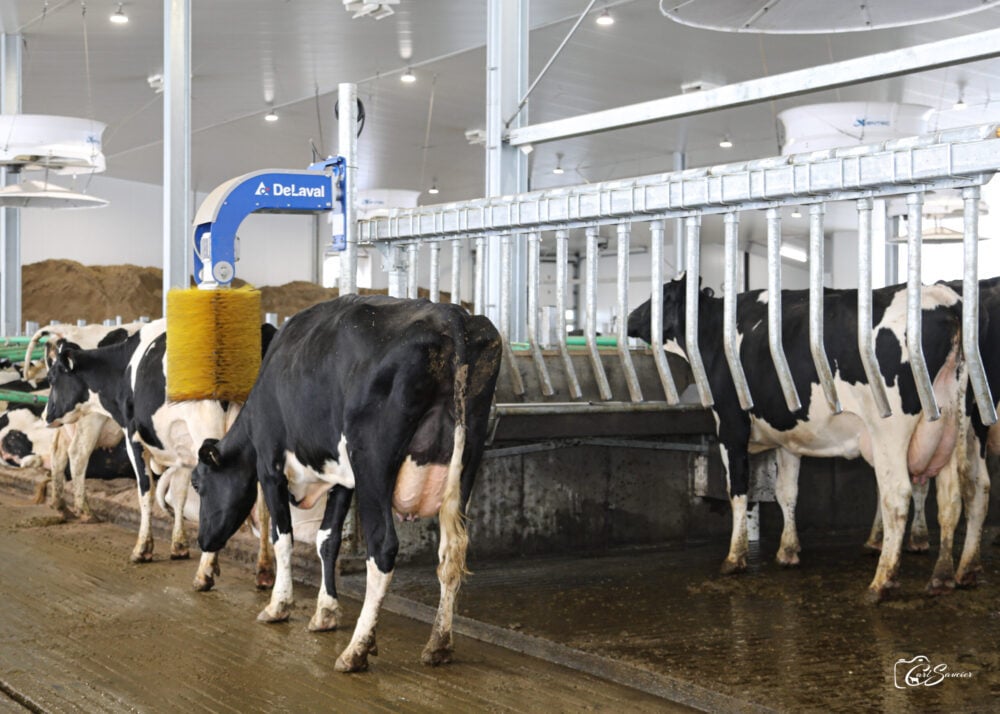
This striking image by Carl Saucier captures the feeding area of Comestar Holstein’s state-of-the-art robotic dairy facility in Victoriaville, Quebec. Completed in 2020 as part of a major technological transition, this 100,000+ square foot facility features 7 DeLaval VMS V300 robots that allow the 400+ cows to choose when they want to be milked. The modern barn utilizes corrosion-resistant galvanized steel construction, advanced ventilation systems (visible overhead), and was designed to optimize both production efficiency and animal welfare. This technological evolution represents the next chapter for the world-renowned Comestar breeding program, famous for Comestar Laurie Sheik and her descendants, as they blend their legendary genetics with cutting-edge dairy automation. The precision alignment of these Holstein cows - many likely carrying the influential Laurie Sheik bloodline - perfectly symbolizes how this operation continues to balance tradition with innovation.
This striking image by Carl Saucier captures the feeding area of Comestar Holstein’s state-of-the-art robotic dairy facility in Victoriaville, Quebec. Completed in 2020 as part of a major technological transition, this 100,000+ square foot facility features 7 DeLaval VMS V300 robots that allow the 400+ cows to choose when they want to be milked. The modern barn utilizes corrosion-resistant galvanized steel construction, advanced ventilation systems (visible overhead), and was designed to optimize both production efficiency and animal welfare. This technological evolution represents the next chapter for the world-renowned Comestar breeding program, famous for Comestar Laurie Sheik and her descendants, as they blend their legendary genetics with cutting-edge dairy automation. The precision alignment of these Holstein cows – many likely carrying the influential Laurie Sheik bloodline – perfectly symbolizes how this operation continues to balance tradition with innovation.

Comestar has embraced the future, transitioning to robotic milking in 2020 with 7 Delaval V300 robots. Laurie Sheik’s descendants are adapting beautifully to being milked by robots instead of human hands. A plus for Comestar will be that the robots will capture additional information that The Comtois Family can use to take the Laurie Sheik family to even greater heights.

What’s most impressive about these genetics is how they’ve maintained their excellence through dramatic changes in evaluation systems and management practices. This cow family has consistently remained at the forefront, from tie-stall barns to robotic milking, from classification to genomics.

FOUR BREEDING LESSONS THAT STILL APPLY TODAY

So, what can today’s breeders learn from the Laurie Sheik phenomenon? Here’s my take:

  1. Focus on females, not just fancy bulls – Marc Comtois built a dynasty by identifying exceptional brood cows rather than chasing the hottest sires. The maternal side matters – a lot.
  2. Sometimes, your best partners are oceans away—the Belgium connection supercharged Laurie Sheik’s impact. Don’t be afraid to look globally for collaboration.
  3. Breed for adaptability, not trends – Laurie Sheik’s family has thrived through multiple evaluation systems and management styles. That’s more valuable than being temporarily “hot” under one system.
  4. Genetic transmission is everything – Those 23 brood cow stars represent extraordinary prepotency. Look for animals that reliably pass their traits to the next generation, not just ones that look good themselves.

WHY I’M STILL FASCINATED BY THIS COW

This poignant memorial at Comestar Holsteins marks the final resting place of Comestar Laurie Sheik VG-88 23* (December 1, 1986 - April 30, 2004). The simple bronze plaque, weathered by Quebec seasons, commemorates “a unique cow whose genetic impact on the Holstein breed internationally, proved to last for generations.” What strikes me most about this memorial isn’t just its permanence, but how rare it is for a dairy cow to be honored this way—with a dedicated marker typically reserved for influential humans or champion racehorses. Standing before this stone, visitors can reflect on how an unassuming <a href='https://www.thebullvine.com/technology/artificial-intelligence-transforming-dairy-farming-for-healthier-cows-and-higher-yields/'>cow from Victoriaville transformed</a> Holstein breeding across five continents, her influence continuing to grow long after her passing. Unlike the fleeting recognition of show ring victories or production records, this understated monument represents what truly matters in breeding: creating a legacy that outlives us all.
This poignant memorial at Comestar Holsteins marks the final resting place of Comestar Laurie Sheik VG-88 23* (December 1, 1986 – April 30, 2004). The simple bronze plaque, weathered by Quebec seasons, commemorates “a unique cow whose genetic impact on the Holstein breed internationally, proved to last for generations.” What strikes me most about this memorial isn’t just its permanence, but how rare it is for a dairy cow to be honored this way—with a dedicated marker typically reserved for influential humans or champion racehorses. Standing before this stone, visitors can reflect on how an unassuming cow from Victoriaville transformed Holstein breeding across five continents, her influence continuing to grow long after her passing. Unlike the fleeting recognition of show ring victories or production records, this understated monument represents what truly matters in breeding: creating a legacy that outlives us all.

When Laurie Sheik passed away on April 30, 2004, she left behind more than just an impressive résumé —she created a genetic legacy that continues to evolve and adapt two decades later.

What fascinates me most about her story is how it challenges our assumptions about what makes a breed-defining cow. She wasn’t the highest classifier or the top producer of her time. She didn’t dominate the show ring or top the genomic lists (which didn’t exist yet).

She consistently produced offspring that improved the breed in meaningful ways. Her legacy wasn’t about flash or hype but about fundamental quality that stood the test of time.

Laurie Sheik may offer the most valuable lesson in our industry’s relentless pursuit of the next big thing: true genetic excellence isn’t measured in the momentary spotlight but in generational impact.

Her story isn’t over. Not by a long shot! And that might be the most remarkable thing about the unassuming, more white-than-black cow from Victoriaville who changed Holstein’s breeding forever.

Key Takeaways:

  • Maternal lines matter most: Laurie Sheik’s 23 brood stars and her daughters’ success prove prepotent cows outlast trendy sires.
  • Adaptability = longevity: Her genetics excelled through classification (1980s), production indexes (1990s), and genomics (today).
  • Global collaboration pays: Belgian embryo imports in 1989 spread her influence to 70% of Bois Seigneur Holstein’s herd.
  • Balance beats extremes: Her descendants succeed in robotic milking systems and show rings by prioritizing balanced traits over single metrics.
  • Legacy over trends: Four decades later, her family still claims top honors—a masterclass in breeding for generational impact.

Executive Summary:

This riveting deep dive traces how Marc Comtois’ 1986 breeding gamble on Comestar Laurie Sheik VG-88-23* reshaped Holstein genetics globally. From her record 23 brood stars to producing four millionaire bulls (Leader, Lee, Lheros, Outside), her lineage thrives in 51 countries. The article reveals how strategic partnerships with Belgian breeders and adaptability across eras—from classification systems to robotic milking—cement her as history’s most influential cow. Modern descendants like 2022 Cow of the Year Lamadona prove her genetics remain elite, offering breeders timeless lessons in maternal selection and genetic prepotency.

The Genetic Genius of Darwin, Mendel and Hunt – Genetic Transmission and the Holstein Cow

There is no question that when it comes to understanding what cows will transmit and what cows will not, it is an enigma wrapped in a conundrum.  There is much that we don’t know and some would argue it is not meant to be known.  The problem is, for those of us with a passion for breeding great dairy cattle, we want to know it all.  For that I turn to the three greatest genetic geniuses in the history of the world, Darwin, Mendel and Hunt (No they are not a law firm).

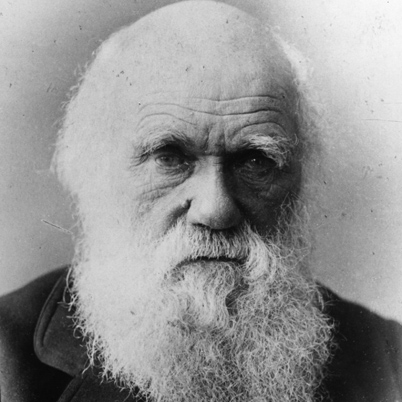
Charles Robert Darwin He established that all species of life have descended over time from common ancestors, and proposed the scientific theory that this branching pattern of evolution resulted from a process that he called natural selection, in which the struggle for existence has a similar effect to the artificial selection involved in selective breeding.

Charles Darwin

Ask anyone in the world to name a geneticist and the first name that comes to mind has to be Charles Darwin.  No better demonstration of Darwin’s theory of evolution exists in the world than in dairy cattle breeding.  While there is no question that artificial selection and selective breeding exist on a daily basis, a cow’s ability to reproduce and produce milk leads to a natural level of selection that epitomizes Darwin’s theory.  “The laws governing inheritance,” Darwin wrote, “are for the most part unknown.”  Moreover, while many modern geneticists have theories about the tendencies of the modern Holstein cow, their genetic transmission pathways in large part remain a mystery to this day.

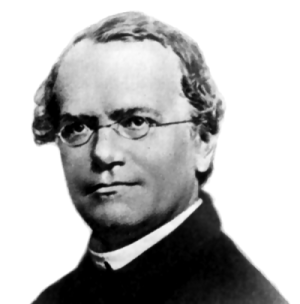
Gregor Mendel

Gregor Mendel

Then along came Gregor Mendel who introduced the concept of “genes” to explain heritability.  Mendel changed the whole way we look at breeding when he introduced the theory that the chromosome is the carrier of genetic traits.  He also explained why a trait can disappear in one generation and reappear in the next and why these traits occur in a three-to-one ratio.  One of Mendel’s disciples, three quarters of a century later, was Thomas B. Macaulay.  Macaulay conducted his own studies, on his Mount Victoria Farms (Read more: Mount Victoria Farms – The art and science of great breeding).

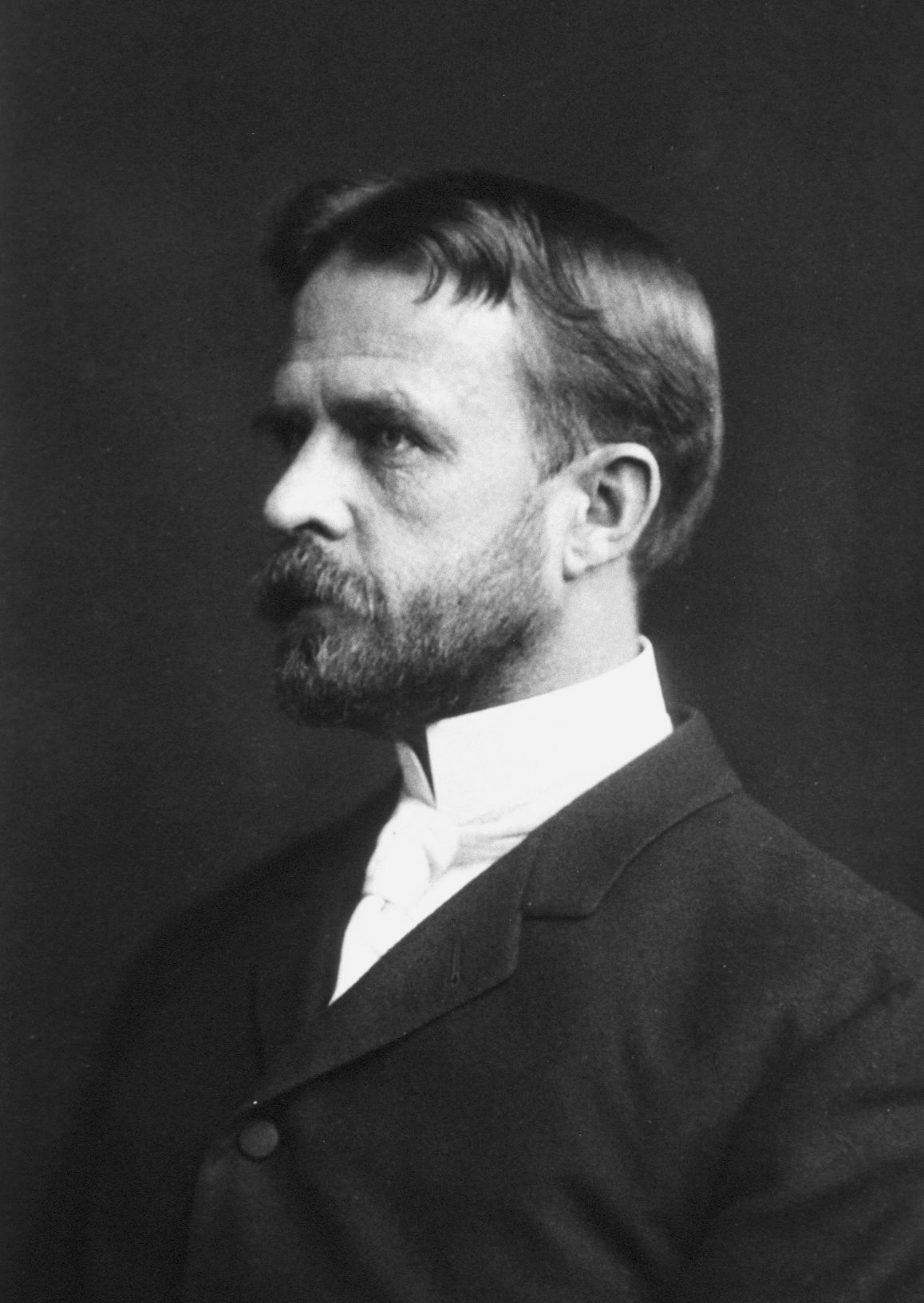
Thomas Hunt Morgan

Thomas Hunt Morgan

Then along came Hunt. Well, more specifically, Thomas Hunt Morgan, but my ego wouldn’t let this go as my name is Andrew Morgan Hunt (Read more about my ego: I’m Sorry But I’ve Had Just About Enough Of… ).  In research that is now reproduced by grade 9 science students around the world, Morgan introduced the concept of X and Y-chromosomes.  Morgan concluded that a female has two X chromosomes and that males have both X and Y-chromosomes.  He also posited that the male of the species, because of the presence of the Y chromosome, transmits differently than the female.

To get a better understanding of this, let’s look at this from both sides of the story.

His side of the story (XY)

If you look at Holstein bulls throughout history you find four distinct patterns:

  1. Great daughters but no legacy sons
    These are the bulls that sired amazing brood cows but none of their sons were able to continue their genetic legacy.  Examples are Hanover-Hill Triple Threat, Carlin-M Ivanhoe Bell, and Braedale Goldwyn.  They all were able to sire brood cow daughters beyond compare, but no real sons to advance that genetic legacy.  Why did these sires seem to produce better on the female side than that of the male?  For that we need to turn to Morgan and his X and Y chromosome theory.  Since the Y chromosome is the only one that is inherited solely via the paternal  line, this leads  some geneticists to believe that it carries little genetic information, and as a result  a great sires genetic legacy rest more with his daughters than with his sons.  Therefore, with this first group of sires it is thought that much of their genetics were transmitted on the X chromosome rather than the Y.
  2. Great sons but not as many brood cows
    Bulls that sired outstanding sons but never produced a top daughter.  A couple of great examples of this are Montvic Rag Apple Sovereign, Maizefield Bellwood and O-Bee Manfred Justice.  All of these sires have left outstanding sons, but are not found as often in the maternal sire stack of the great sires.  There is no question as to their genetic contribution to the breed, but it was more as a sire of sons than their ability to leave an equal number of brood cows.
  3. Sons and daughters both extraordinary
    These are the sires that have gone down in history as the all-time greats.  Sires like Johanna Rag Apple Pabst, Governor of Carnation, Montvic Chieftain, Wisconsin Admiral Burke Lad, A.B.C. Reflection Sovereign, Round Oak Rag Apple Elevation, Pawnee Farm Alrinda Chief, Walkway Chief Mark, Hanoverhill Starbuck, Madawaska Aerostar and Maughlin Storm.  These are the bulls that not only displayed personal greatness but were also able to transmit both outstanding brood cows as well as legacy sons.
  4. Sons and daughters that were inferior
    Sons and daughters that are both below average.  These bulls left inferior daughters and as a result were never even given the chance to produce sons.  Bulls in this category are too numerous to mention and loads of their daughters go to the slaughterhouses every day.  No explanation necessary other than a lack of genetic merit and here enters the need for genomics (Read more: The Truth About Genomic Indexes – “Show Me” That They Work).

Her side the story (XX)

The female side of the story uses the same four distinct groups.

  1. Great daughters but no legacy sons
    These are cows with outstanding female descendants but undistinguished males.  Great examples of these are the cow families of Hanover Hill Papoose, Krull Broker Elegance and Plunshanski Chief Faith.  They all were able to leave outstanding female descendants generation after generation, but were never really able to accomplish the same feat on the male side of the story.
  2. Great sons but not as many brood cows
    These are the cows with potent transmitting sons, but daughters who didn’t outperform the average.  Examples of these are Wylamyna Tidy Kathleen (dam of Sir Bess Tidy and Sir Bess Ormsby Tidy Fobes) Lakefield Fobes Delight (dam of Lakefield Fond Hope, Lakefield Fond Delight Fobes and Carnation Royal Master) and Pawnee Farm Glenvue Beauty (dam of Pawnee Farm Arlinda Chief).  All of these cows had outstanding maternal lines but for some reason were just not able to transmit that legacy through their daughters.
  3. Sons and daughters both extraordinary
    Among the females in this category are Glenridge Citation Roxy, Mil-R-Mor Roxette, Comestar Laurie Sheik, Braedale Gypsy Grand and Snow-N Denises Dellia.
  4. Sons and daughters that were inferior
    Cows who, in terms of influence, failed to produce anything worthwhile.  Blame it on lack of genetics, bad breeding, improper management, or just bad luck, these cows just didn’t influence the breed. We have all seen examples.

The Bullvine Bottom Line

There has never been a clear explanation of why some bloodlines seem to transmit better through maternal lines, others through the paternal, and still others do well in both.  Even genomics does not answer this.  There are high genomic animals that still have these same tendencies.  Maybe if we could genomic test the genes on each chromosome we might find the answers?  Until then Genetic Transmission in the Holstein Cow will remain a mystery.

To read more about this get a copy of The Holstein History by Edward Morwick and read the chapter on Inheritance Patterns.


The Dairy Breeders No BS Guide to Genomics


Not sure what all this hype about genomics is all about?

Want to learn what it is and what it means to your breeding program?

Download this free guide.


[related-posts-thumbnails]

Send this to a friend