







That $1.5M recall was 5% of Raw Farm’s revenue — a parking ticket. On a 400-cow herd, the same 5% is a $100K hole. Same event, very different day. Here’s the math.
Executive Summary: America’s largest raw-milk brand just took its eighth documented outbreak since 2006 — nine sick, three hospitalized, mostly kids under five — and walked away with no mandatory recall, no warning letter, no injunction. Raw Farm’s Mark McAfee recalled about $1.5 million in cheddar “under protest,” clawed most of it back within weeks, and the FDA closed the file April 30 without pulling a single lever it had. Here’s why it lands on your milk check: that $1.5M was roughly 5% of Raw Farm’s ~$30M in revenue — a parking ticket. Run the same 5% against a 400-cow herd grossing ~$2M at USDA’s 2025 numbers and you’re staring at a $100K hole — the difference between a good year and a call to the lender. The government still holds a live 2023 consent decree over the operation, so the enforcement door’s open; nobody’s walked through it. The real lesson isn’t about raw milk — it’s the recall-liability clause buried in your own supply agreement, and whether you know who writes the check if a recall ever traces back to your tank. Your 30-day move: pull that contract and find out before you need to.
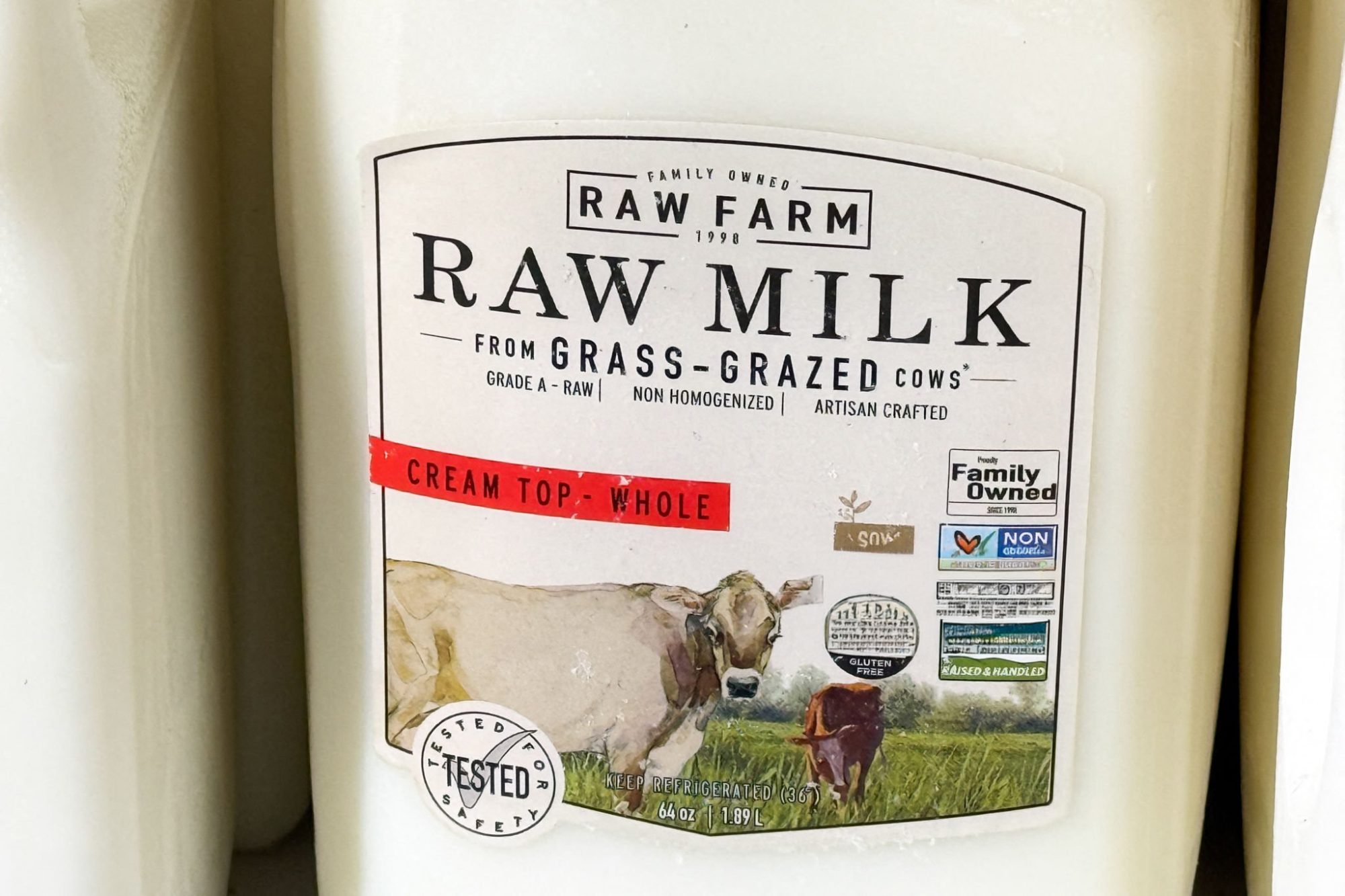
Mark McAfee called it a “big win.” On April 30, 2026, the CDC closed the E. coli outbreak tied to his Fresno-based Raw Farm — nine people sick across three states, three hospitalized, one with hemolytic uremic syndrome, and over half the illnesses in children under five, according to the CDC and a Congressional Research Service report. The federal response to all of it? No mandatory recall. No warning letter. No injunction. The file just closed, and the FDA’s advisory said it would only reopen “if additional information becomes available.”
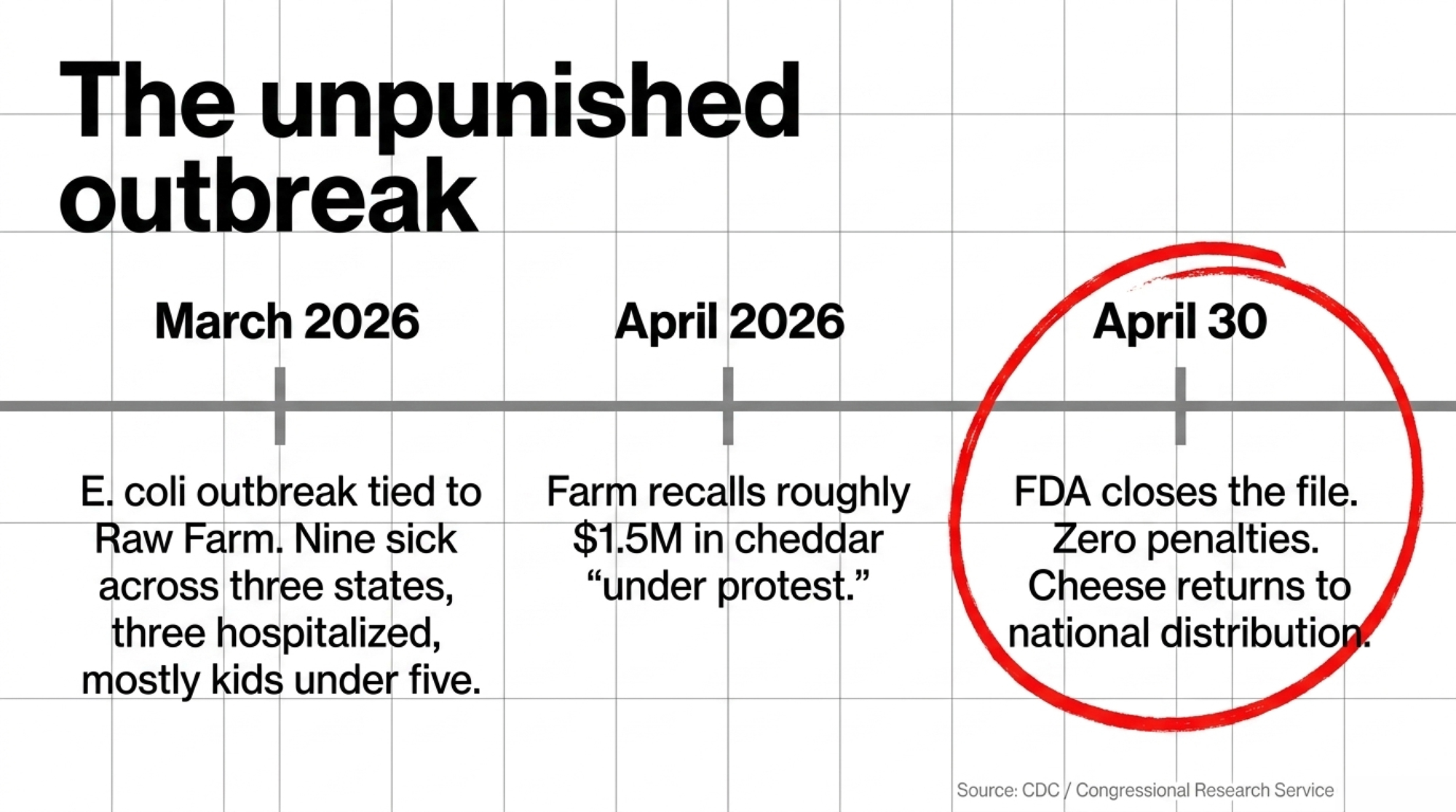
Within weeks, McAfee retracted his own recall and put raw cheddar back into national distribution through distributor KeHE. The CRS calls Raw Farm the largest raw-milk operation in the country; ProPublica put its revenue at roughly $30 million a year. And he just proved something every dairy operator should sit with for a minute: the whole episode cost him a recall he mostly clawed back, and not one federal penalty on top.
You don’t sell raw milk. So why should a Fresno dairy’s parking-ticket recall land anywhere near your milk check? The number is the whole story.
What actually happened between March and April?
Here’s the timeline, and it moves fast. On March 15, the FDA recommended Raw Farm pull its cheese; the farm declined. Two days later, LA County Public Health told people not to eat it. By March 18, state and federal officials had named the operation the likely source while Raw Farm insisted its products tested negative for pathogens.
Then Congress got loud. On March 22, Rep. Rosa DeLauro and the Congressional Food Safety Caucus publicly pressed the FDA to force the product off shelves, per Food Safety Magazine. The FDA inspected the plant on March 26. Raw Farm finally recalled its cheddar on April 2 — the CRS reports the farm said the recall hit about $1.5 million of its product — and stamped it “under protest,” stating it “disputes being the cause of this outbreak.” By April 7, it dropped the “protest” language while holding the denial. On April 30, the outbreak was declared over. No enforcement followed, and the cheese returned to shelves.
This sequence exposes a wide gap between the regulatory power on the books and the regulatory action taken.
The FDA had the tools. Why didn’t it use them?
Most wire coverage skipped this piece. Under the Food Safety Modernization Act, the FDA can force a mandatory recall when there’s a “reasonable probability” a food is adulterated and could seriously hurt or kill someone. Raw Farm sat on the FDA’s recall request for 18 days while kids were sick. That’s the textbook case for using the authority.
The agency didn’t. It has used mandatory recall power exactly once — a 2018 order for Salmonella-tainted pet treats. Food Safety Magazine asked the question flat out after the case closed: why never here? Bill Marler, the food-safety attorney who’s litigated against this farm since 2006, laid out the backdrop in June — by his account, the FDA shed nearly 3,900 staff in 2025 and was already running fewer than one inspector per 80 food facilities before those cuts, while CDC’s FoodNet narrowed from tracking eight pathogens down to two.
ProPublica reported two developments some critics have linked. In January 2025, the DOJ dropped a pending enforcement action tied to the 2024 outbreak. And McAfee has said publicly he applied for an FDA advisory role at the urging of HHS Secretary Robert F. Kennedy Jr., a raw-milk booster. ProPublica did not establish a connection between the two, and neither the DOJ nor McAfee has said one exists. Set them side by side, note the calendar, and draw your own conclusions — carefully.
An outbreak record that isn’t in dispute
McAfee’s denials aside, the government’s own case files tell the story on their own.
Since 2006, federal and state regulators have tied Raw Farm (formerly Organic Pastures) to at least eight documented outbreaks — more than any other U.S. raw-dairy operation on the public record — sickening at least 227 people and hospitalizing dozens. That’s almost certainly low, because most people who get sick on raw milk ride it out at home and never get tested. We laid out the full case-by-case history in our earlier coverage of the Raw Farm outbreak record.
| Year | Pathogen | Confirmed Cases | Hospitalizations | Critical Outcome / Impact |
| 2006 | E. coli O157:H7 | 6 | Multiple | First on record; a child left with permanent kidney damage |
| 2012 | Campylobacter | 10 | Multiple | Patients aged nine months to 38 years |
| 2023–24 | Salmonella | 165 (4 states) | ~20 (CA state data) | Mostly children; among the largest U.S. raw-dairy outbreaks |
| 2024 | E. coli O157:H7 | 11 | 5 (2 with HUS) | Refused, then recalled, then retracted |
| 2025–26 | E. coli O157:H7 | 9 | 3 (1 with HUS) | Closed with no enforcement |
The 2023–24 Salmonella outbreak alone — 165 people across four states, most of them children, per the CDC’s July 2025 report — ranks among the largest documented U.S. raw-dairy outbreaks in recent years. This isn’t a farm that had one bad tank. It’s a two-decade pattern with a paper trail.
The court leash nobody’s pulling
Here’s what genuinely matters for what comes next. Raw Farm isn’t running free and clear. The federal government first sued the operation and McAfee by name in California’s Eastern District back in 2008 — United States v. Organic Pastures Dairy Company, LLC, Case No. 1:08-cv-01786 — over shipping raw milk across state lines through a pet-food labeling loophole the government said endangered public health. That case ran 15 years. In July 2023, U.S. District Judge Jennifer L. Thurston signed a consent decree, agreed to by McAfee and the DOJ, that keeps the court’s oversight live, with Raw Farm able to petition the FDA for relief only after 60 months.
So the government doesn’t have to build a case from scratch. The door’s already open. The court already has jurisdiction, an admitted history, and an audit mechanism on file — the kind of standing that, if inspectors document a fresh violation, hands the DOJ a path without filing anew. The legal footing exists. What’s missing is the will to walk through it.
What would the next enforcement move actually cost?
No new action was announced as of mid-July — nothing in the table below has happened. This is a decision-rule model built only on sourced figures, with the assumptions in plain sight.
The inputs we know: ProPublica’s roughly $30 million a year works out to about $2.5 million a month, call it $577,000 a week. The April recall pulled about $1.5 million in product, per the CRS report. The rule here is simple — scale the exposure to the scope of the action and how fast product restocks.
| Enforcement scenario | Sales interruption | Revenue exposure | Bite vs. the April “parking ticket” |
| Warning letter, no halt | 0–2 weeks | $0–$1.2M | Same ballpark |
| Mandatory recall, cheese only | 3–6 weeks | $1.5M–$3.0M | 1–2× |
| Injunction, all products halted | 4–12 weeks | $2.3M–$6.9M | Up to ~5× |
| Full suspension, all channels | 8–16 weeks | $4.6M–$9.2M | Up to ~6× |
Ranges are illustrative, built on ProPublica’s public revenue figure, and exclude legal fees, settlements, and lost shelf space — all of which land on top. The full-halt row assumes about $2.5M/month at 100%.
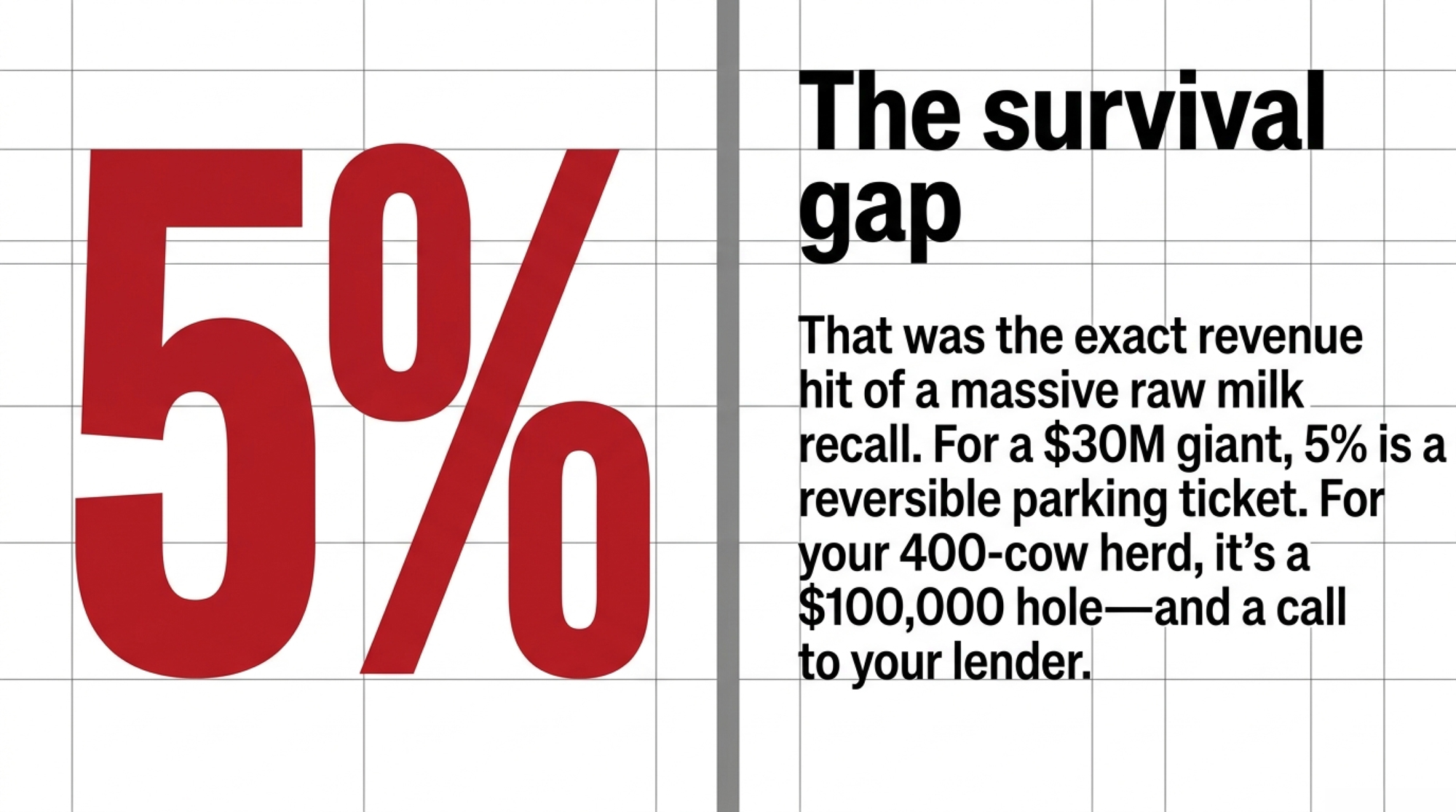
Now run the same hit against your own operation. That $1.5 million recall was almost exactly 5% of Raw Farm’s ~$30 million in annual revenue — the “parking ticket.” Take a 400-cow commercial herd. At the 2025 U.S. average — 24,390 pounds per cow and a $21.19/cwt producer return, per USDA — that herd grosses right around $2 million a year. A 5% hit there runs closer to $100,000. Run it at your own mailbox price if you want it exact, but the order of magnitude holds.
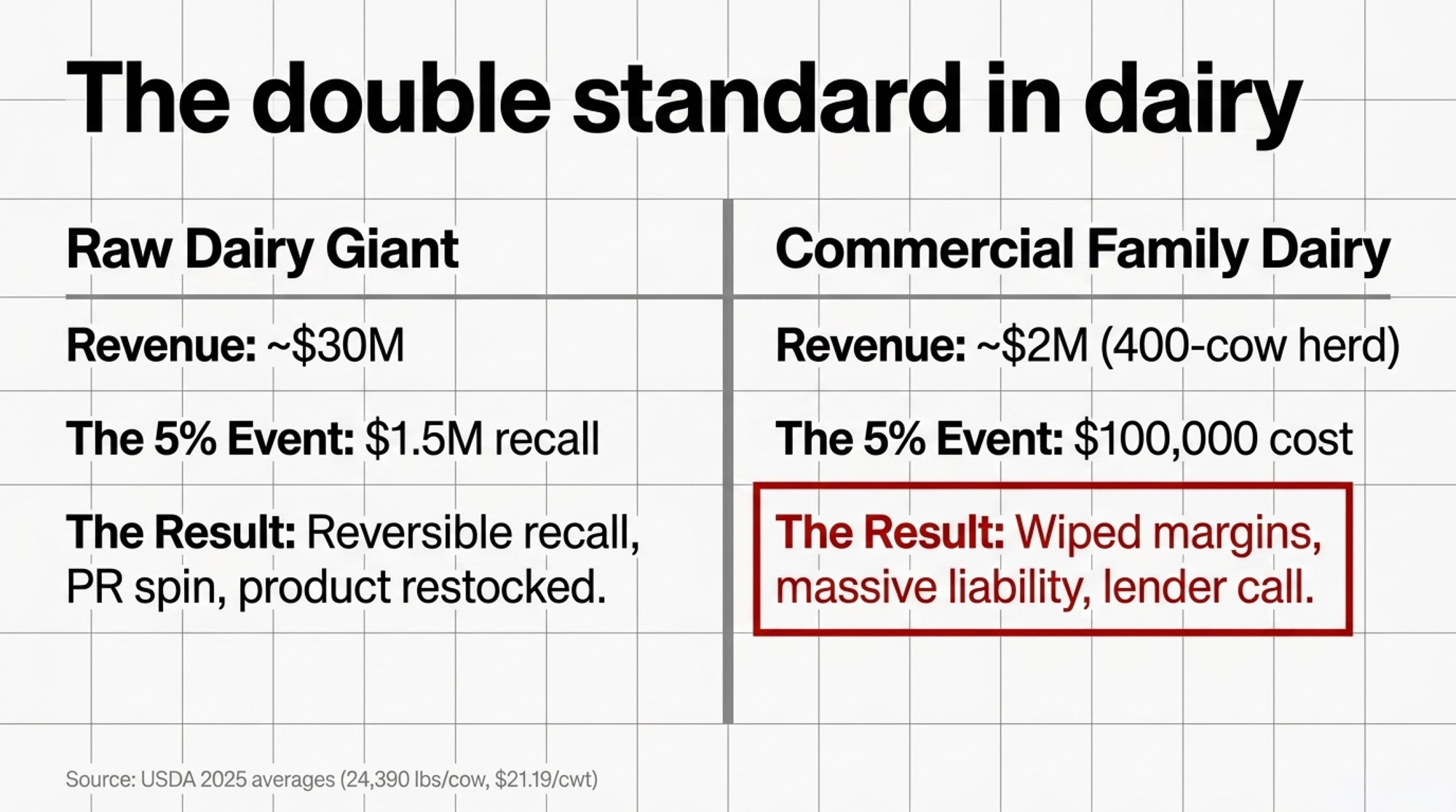
Sit with the gap. Same 5% event. For the raw giant, it’s a reversible recall and a press release. For a family dairy, it’s a six-figure hole — often the difference between a profitable year and a call to the lender. What reads as a nuisance on a $30 million operation reads as a bankruptcy risk on a family farm, and that’s the double standard worth chewing on. If you want the full margin-versus-outbreak model, we ran the deeper version in what one outbreak really costs a herd.
Now flip the lens from the big event to the everyday dock you already watch. Say a quality or safety flag costs you a 12¢/cwt penalty. On 400 cows at a strong 80 lb/day, that’s 320 cwt a day, or about $38 daily — roughly $14,000 over a year on one standing dock. It’s the kind of hit you absorb without blinking, nowhere near the six-figure version above. And that’s exactly the trap: when the consequence is cheap enough to shrug off, nobody changes anything, which is precisely how a farm reaches outbreak number eight.
Why does a raw-milk farm land on your milk check?
Because enforcement asymmetry is contagious. When the operation with the longest documented outbreak record in raw dairy absorbs eight events over 20 years and the worst consequence is a recall it reverses within weeks, that tells every regulator, retailer, and plaintiff’s lawyer where the floor sits. It also hands the anti-dairy crowd a loaded headline. “Milk made kids sick in California” gets stapled to the whole category, and the average shopper never learns the difference between raw and pasteurized. You eat that reputation risk for free.
There’s one lever that doesn’t need Washington’s permission: the retailer. Several stores voluntarily pulled the product during the outbreak. If this brand ever gets delisted for good, that call happens at the shelf, not the courthouse — and it happens fast. Watch that, because it’s the mechanism most likely to actually move.
For its part, Raw Farm has consistently maintained that its products are safe, that its testing found no pathogens in the recalled cheese, and that it disputes being the source of the outbreak.
Options and Trade-Offs for Farmers
You can’t enforce federal food-safety law from your parlor. But you’re not a bystander to how this plays out, either. A few real paths:
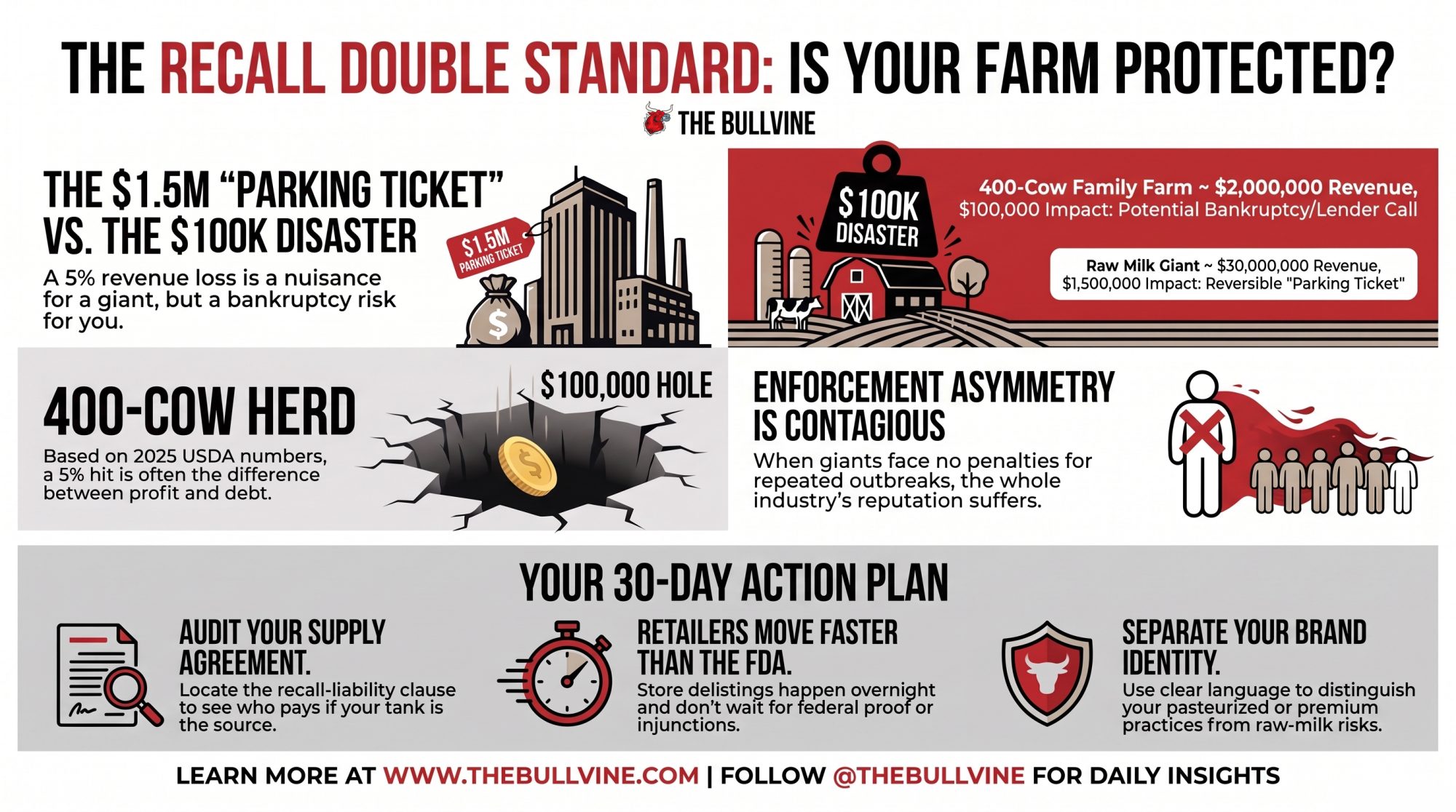
Watch the retail signal, not the FDA. Makes sense if you sell direct, run a farm store, or move product through natural-grocery channels. It requires knowing which of your buyers carry raw or minimally processed dairy and how they’d react to a category scare. The risk: retail delisting moves faster than any recall and doesn’t wait for proof — so the likeliest next domino here is a retailer pullback, not an FDA letter.
Audit your own recall exposure this month. Makes sense for any operation shipping to a processor with a recall-cost clause. It requires pulling your supply agreement and finding the language that says who pays if a downstream recall traces to raw material. Plenty of producers have never read it. The risk: you learn the answer during a recall instead of before one — which is the whole lesson of the Raw Farm sequence. We break down where that clause hides and what to ask your field rep in who pays when a recall traces to your tank.
Separate your brand from the raw-milk fight, deliberately. Makes sense if you market farm identity, A2, grass-fed, or any premium consumer story. It requires clear language distinguishing your practices and testing from raw-milk risk. The trade-off: it costs marketing effort now, but the alternative is letting a Fresno headline define your product for you.
Your 30-day move: In the next 30 days, pull your milk supply agreement and read the recall-liability and quality-dock language. Find the line that says who pays if a downstream recall traces back to your milk. If you can’t tell from the contract who’d write that check — that’s your answer, and it’s your next call to your field rep.
Key Takeaways
- If your buyer’s recall clause doesn’t spell out who pays for a downstream event, treat it as an open liability and get it clarified within 30 days — don’t discover it mid-recall.
- If you sell into raw, direct, or natural-grocery channels, assume a retailer pullback is a faster and likelier threat than any FDA action, and know your buyers’ triggers now.
- If you market a premium consumer story, build the language that separates your testing and practices from raw-milk risk before the next California headline does it for you.
- If you’re pricing a food-safety event as unlikely, price it instead as survivable-but-recurring — the Raw Farm record shows the real risk is a cheap consequence that never changes behavior.
Raw Farm just proved an outbreak can cost as little as a reversible recall and a press release. The government’s case against this operation ran 15 years and ended in a consent decree that’s still live — yet so far, nobody’s used it. So here’s the question worth carrying into your own operation: if a downstream recall traced back to your tank next month, do you actually know who’d write the check — and how many weeks of shipments you’d lose before it cleared?
For the full enforcement-cost model — every scenario and assumption spelled out — that’s where our deeper coverage lives. Start with the two pieces linked above, then hold your own contract up against the numbers.
Run Your Numbers
Farm Benchmark Snap Check — This story turns on one question: could your operation absorb a five-figure hit the way Raw Farm shrugged off its $1.5M recall? Run the DVI Risk Check to see whether your margin, debt load, and working capital land you in the Strong, Watch, or Risk band before a recall or dock ever tests it.
This article is based on public records and reporting available as of July 15, 2026, including CDC (E. coli outbreak declared over April 30, 2026; MMWR July 24, 2025 on the 2023–24 Salmonella outbreak), FDA outbreak investigation updates (most recent June 17, 2026), the Congressional Research Service, Food Safety Magazine, ProPublica, and federal court records in Case No. 1:08-cv-01786 (E.D. Cal.). Raw Farm was contacted for comment; its published statements are reflected above.
Complete references and supporting documentation are available upon request by contacting the editorial team at editor@thebullvine.com.
Learn More
- The $31200 Raw Milk Trap: How a Florida Outbreak Turned One Farm’s Side Hustle Into a Bet‑the‑Farm Lawsuit — Delivers a sobering breakdown of the astronomical liability risks and hidden insurance exclusions that can instantly vaporize your equity, proving how quickly a simple direct-sales side hustle turns into a bet-the-farm lawsuit.
- Organic Valley’s Lawsuit Is About $0.72. The Risk on Your Farm Is $19.89. — Exposes the catastrophic price cliff conventional and organic producers face when premium supply agreements are altered, arming you with the strategic metrics needed to audit contract exposure and shield your debt-service coverage ratio.
- H5N1 Is Back in 15 Dairies in 30 Days – and Only 1 in 4 Parlor Workers Wore a Respirator — Confronts the game-changing reality of lateral biosecurity transmission on commercial operations, dismantling the assumption that safety is just a discipline issue and offering a systems-based approach to protect both your crew and bulk tank.
 The Sunday Read Dairy Professionals Don’t Skip.
 The Sunday Read Dairy Professionals Don’t Skip.
Every week, thousands of producers, breeders, and industry insiders open Bullvine Weekly for genetics insights, market shifts, and profit strategies they won’t find anywhere else. One email. Five minutes. Smarter decisions all week.




