





$87 a cow. About $2,460 across a 30-head dry group. And you’ll never see it — because the loss lands on next year’s tank, not this month’s, and nobody charges it to the dry pen.
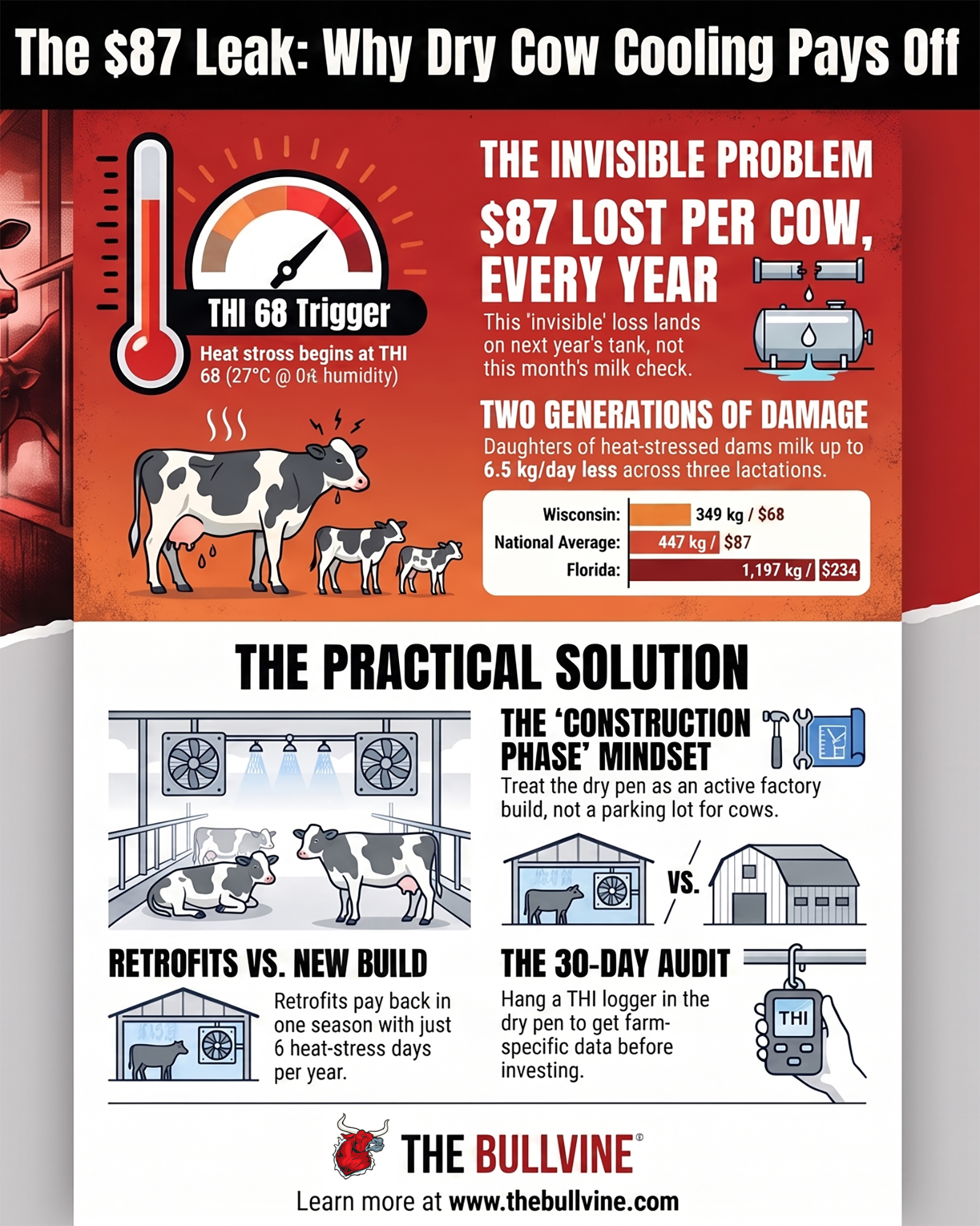
Executive Summary: An uncooled dry cow gives back about 447 kg of milk in her next lactation — roughly $87 a head, or around $2,460 across a 30-head dry group — and almost nobody books it, because the loss shows up on next year’s tank, not this month’s. UF/IFAS pegged the trigger at THI 68, not the old 80°F rule of thumb, so you’re bleeding milk on a muggy 27°C afternoon in Wisconsin or Ontario long before the barn feels hot. The damage is structural: heat during the dry period means the udder rebuilds fewer alveoli, and no amount of fans after calving puts those cells back. It doesn’t stop at her, either — Laporta’s 2020 JDS work found heat-stressed dams throw daughters that milk 2.2 to 6.5 kg/day less across their first three lactations, so you can cook a high-genomic heifer’s expression before she’s born. Retrofits can pay back inside a season at as few as ~6 heat days a year; new cooled dry housing pencils around 5.7 years in humid regions — but “average” is the wrong number, and your own THI count is the one that decides it. The 30-day move: hang a logger in the dry pen and get your real heat-day count before the next capital request. Read the full piece if you cool your milking string but still leave the dry cows in the shade to sweat.
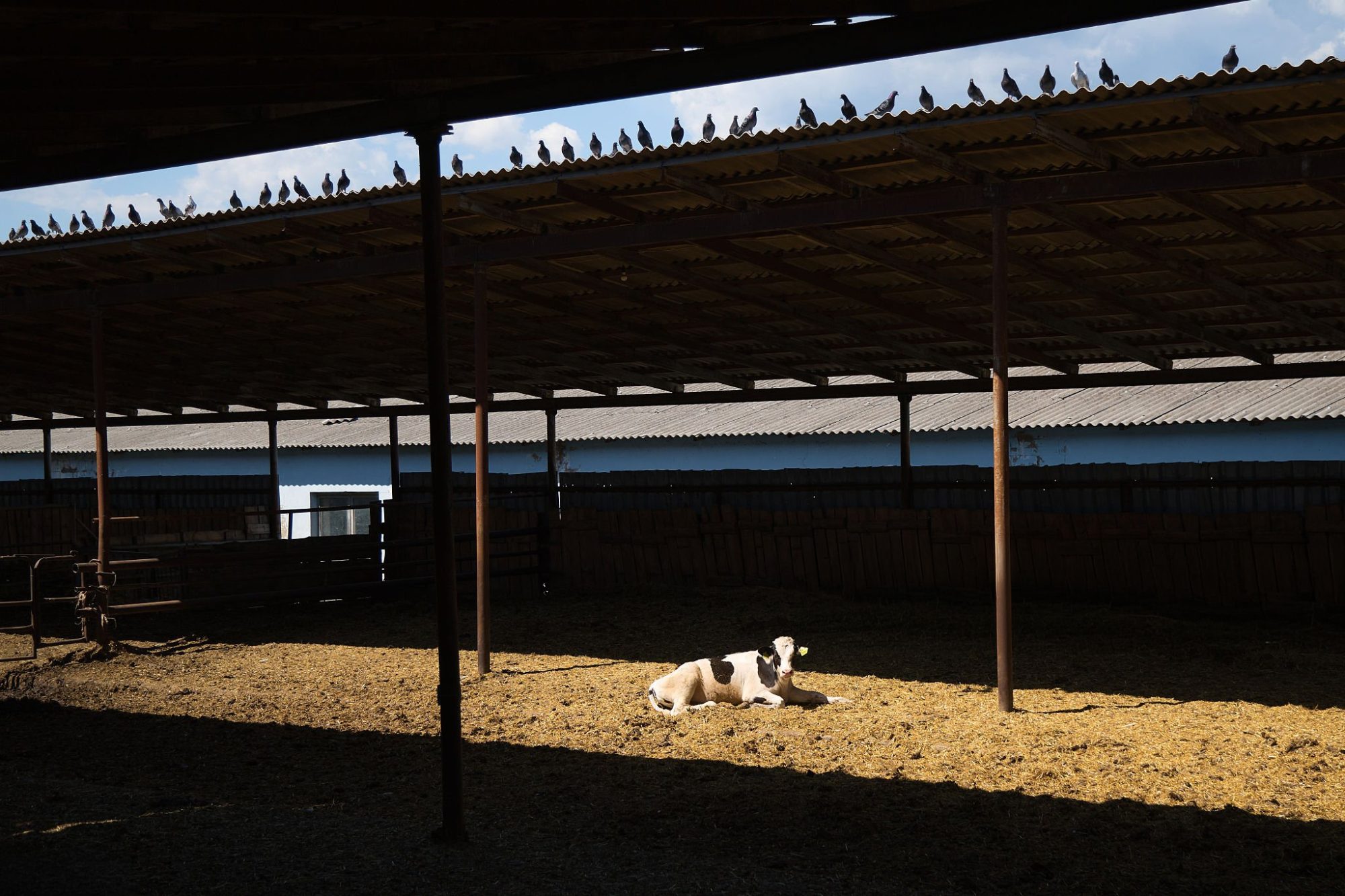
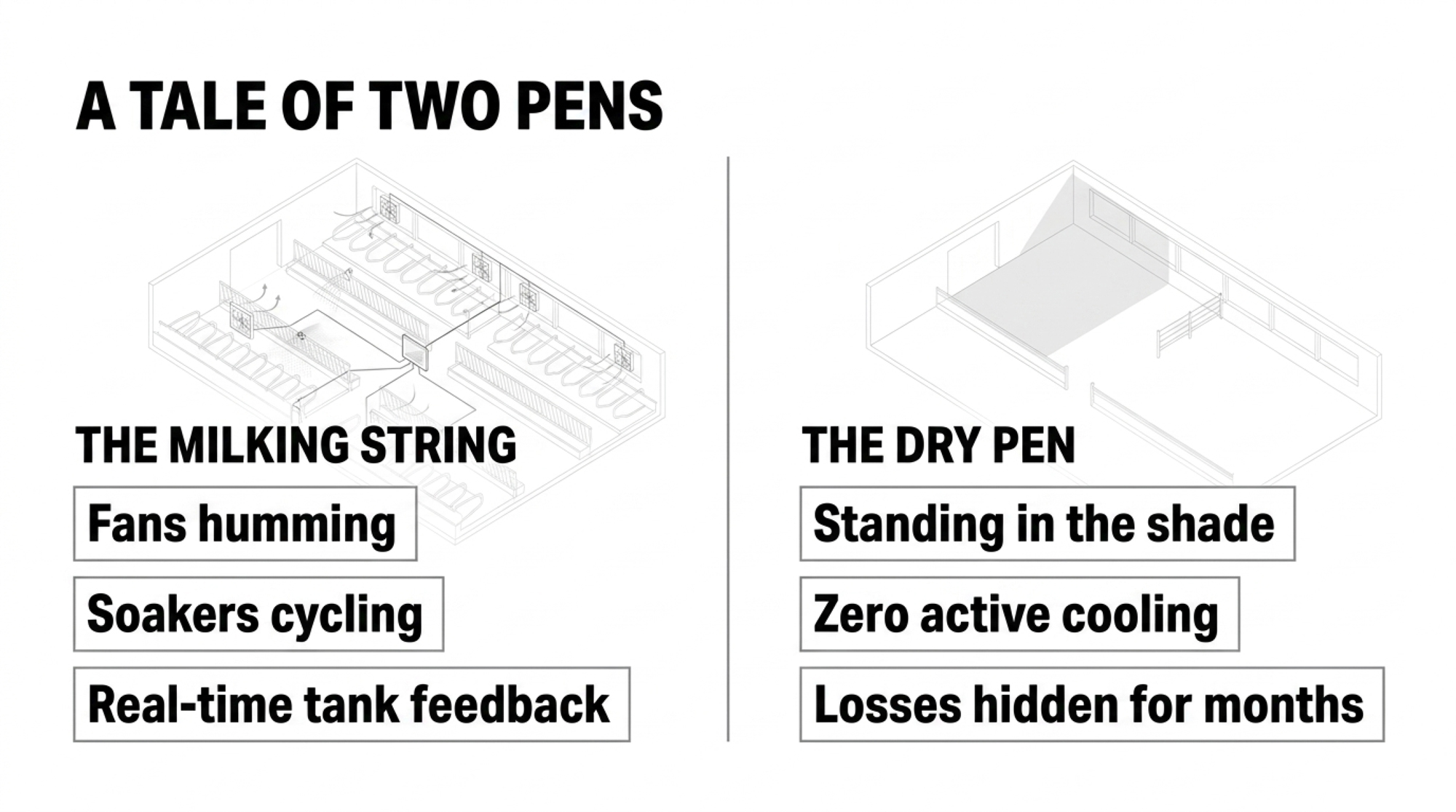
Walk through almost any dairy on a hot July afternoon, and you’ll see the priorities written in aluminum and water. Fans humming over the milking string. Soakers cycling in the holding pen. And off to the side, in the shade, the dry cows — standing under a roof with not a fan in sight.
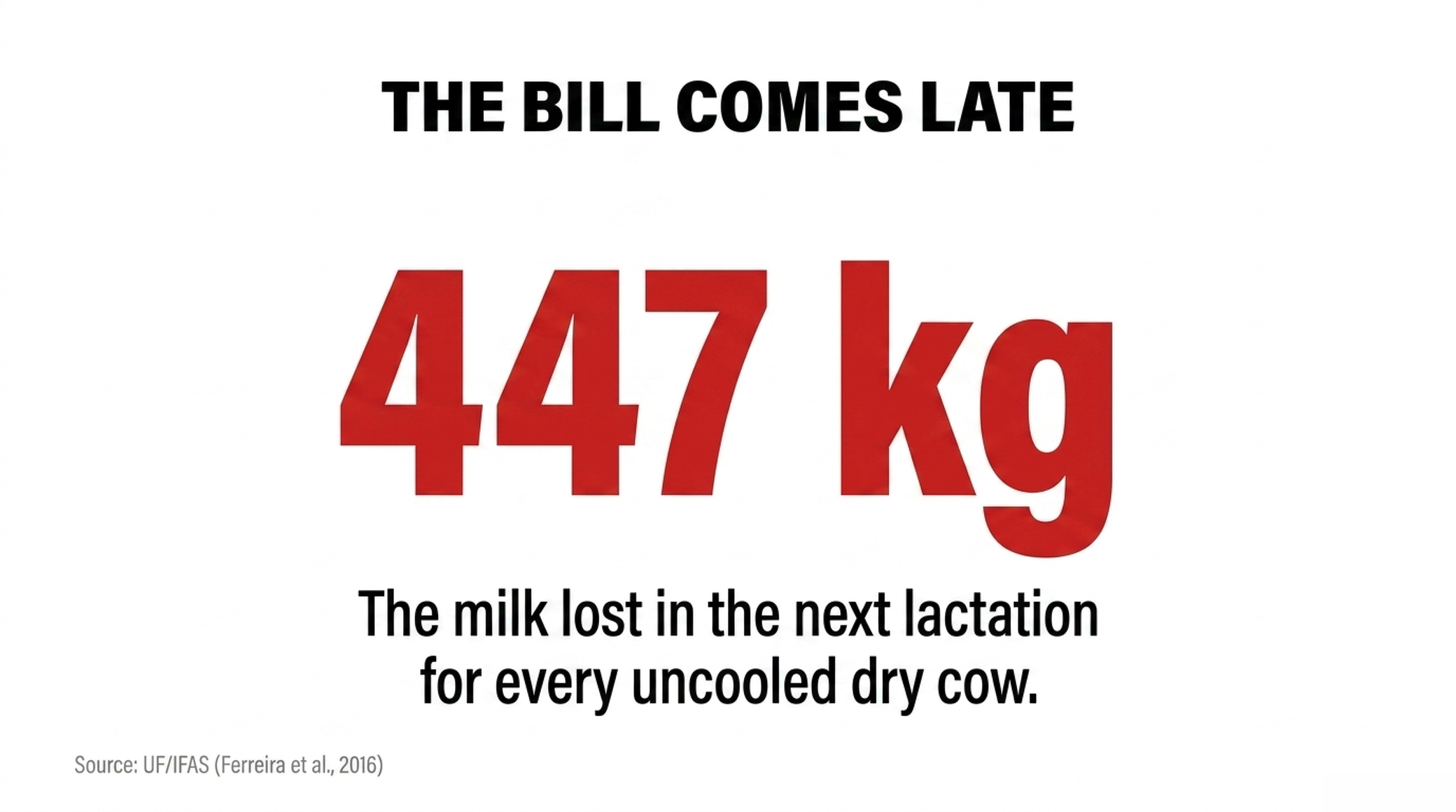
That split-screen is the whole story. Because the research says the cows getting ignored in that far pen are the ones quietly costing you the most next year. About 447 kg of milk per cow in the next lactation. Roughly $87 a head. And nobody writes it down.
The Number That’s Been Sitting There Since 2016
The figure isn’t new, and it isn’t soft. Ferreira, Gennari, Dahl and De Vries published it in the Journal of Dairy Sciencein 2016: leave the average U.S. dry cow uncooled through her hot days, and she gives back about 447 kg of milk in her next lactation. Multiply across the herd, and it’s roughly $87 a cow. Ferreira’s 2016 model puts the national tab near $810 million a year in milk that never gets made.
So the math has been done for the better part of a decade. The behavior hasn’t moved. That gap — between what’s proven and what actually happens in the barn — is the part worth chewing on.
Albert De Vries, the University of Florida dairy management professor behind that paper, put the diagnosis plainly in the UF/IFAS release: “many farmers often ignore cooling dry cows, not realizing that dry cows under heat stress produce less milk later.” Read that twice. It’s not about effort or intelligence. It’s a loss engineered to stay invisible.
Why $87 Doesn’t Change Anybody’s Mind
Here’s the trap. A lactating cow in heat stress shows you the bill in real time — she pants, she drops feed, the tank dips this week. You see it, you act. A dry cow in the same heat looks exactly like she did yesterday, and nothing happens today.
The cost shows up months later, as a slightly flatter peak on a lactation curve nobody thinks to connect back to a hot afternoon in the dry pen. No alarm. No event. Just a number that arrives late and untraceable.
That’s why waving the $87 around doesn’t work. Farmers respond to numbers — that’s never been the problem. The problem is this one shows up in the wrong format, in the wrong pen, at the wrong time to do a thing about it.
The Dry Pen Isn’t a Parking Lot
The deeper issue is a filing error. In most managers’ heads, the dry pen is a holding area — animals waiting to matter again. So when someone floats spending money on fans and soakers out there, it feels like robbing the cows that are paying the bills today.
But that pen isn’t downtime. It’s the construction phase. During the dry period, the udder tears down old tissue and rebuilds the alveoli that’ll make next lactation’s milk. It’s the one window where the factory gets rebuilt for the year ahead.
Cook that process while it’s happening, and you don’t get a temporary dip you can cool your way out of after calving. You get a permanently smaller factory. Studies on the mechanism show heat-stressed dry cows redevelop fewer alveoli and more connective tissue, and the carry-over lands as a 3 to 7.5 kg per day drop in the next lactation — a loss postpartum cooling doesn’t rescue. You cooked it during the build. Fans in September don’t put the missing cells back.
So the honest label for the dry pen isn’t “waiting.” It’s “actively building next year’s milk cheque.” Fix that category, and the $87 finally has somewhere to land. It’s the same logic behind the cooling you’re already paying for on the milking string — you’re just applying it to the pen where it pays off latest.
The Thread That Actually Moves People
If the dollar figure alone won’t do it, what does? The multi-generation thread.
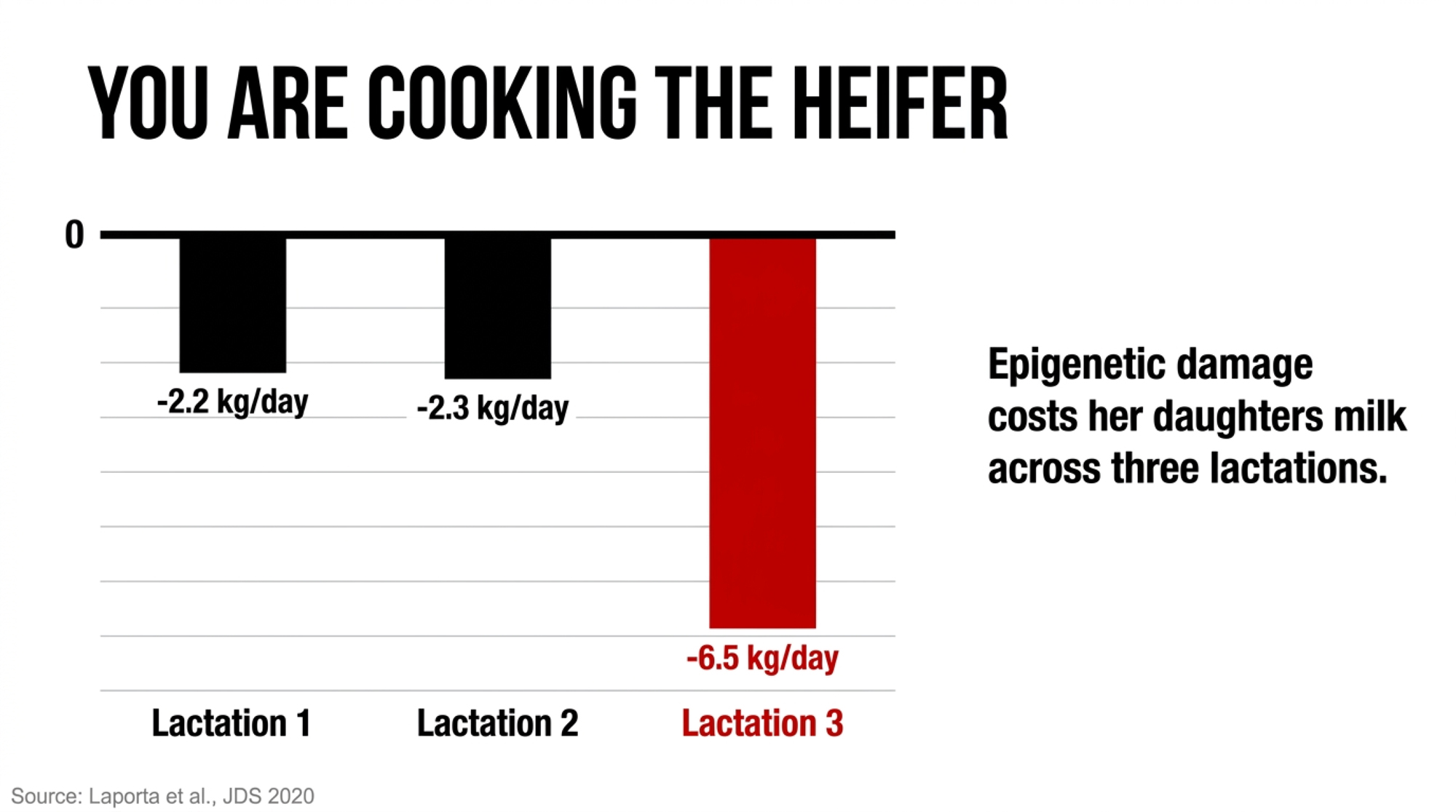
Jacobo Laporta and colleagues (Journal of Dairy Science, 2020) followed the daughters of heat-stressed dams and found the damage doesn’t stop with the dam’s next lactation — it reaches into her calves. Those daughters milked less in each of their first three lactations: 2.2 kg/day lower in the first, 2.3 kg/day lower in the second, and 6.5 kg/day lower in the third, compared with daughters of cooled dams. Their conclusion was blunt: late-gestation heat stress “exerts carryover effects on at least 2 generations.”
This is the ultimate frustration for a progressive breeder. You buy the best genetics, you mate for high genomic merit — and then you choke that heifer’s genetic expression before she’s even born, because her dam spent July panting in a dry pen. You didn’t lose the genetic lottery. You cooked the epigenetic switch. Nobody connects those dots without help, which is exactly why the loss survives — and it’s worth remembering when the daughter proof lands under the catalog number and comes up light.
Where the Clock Actually Starts
Before the barn math, reset one thing: the trigger. The old rule of thumb — cows are fine until it’s about 80°F — is wrong for modern high-producers.
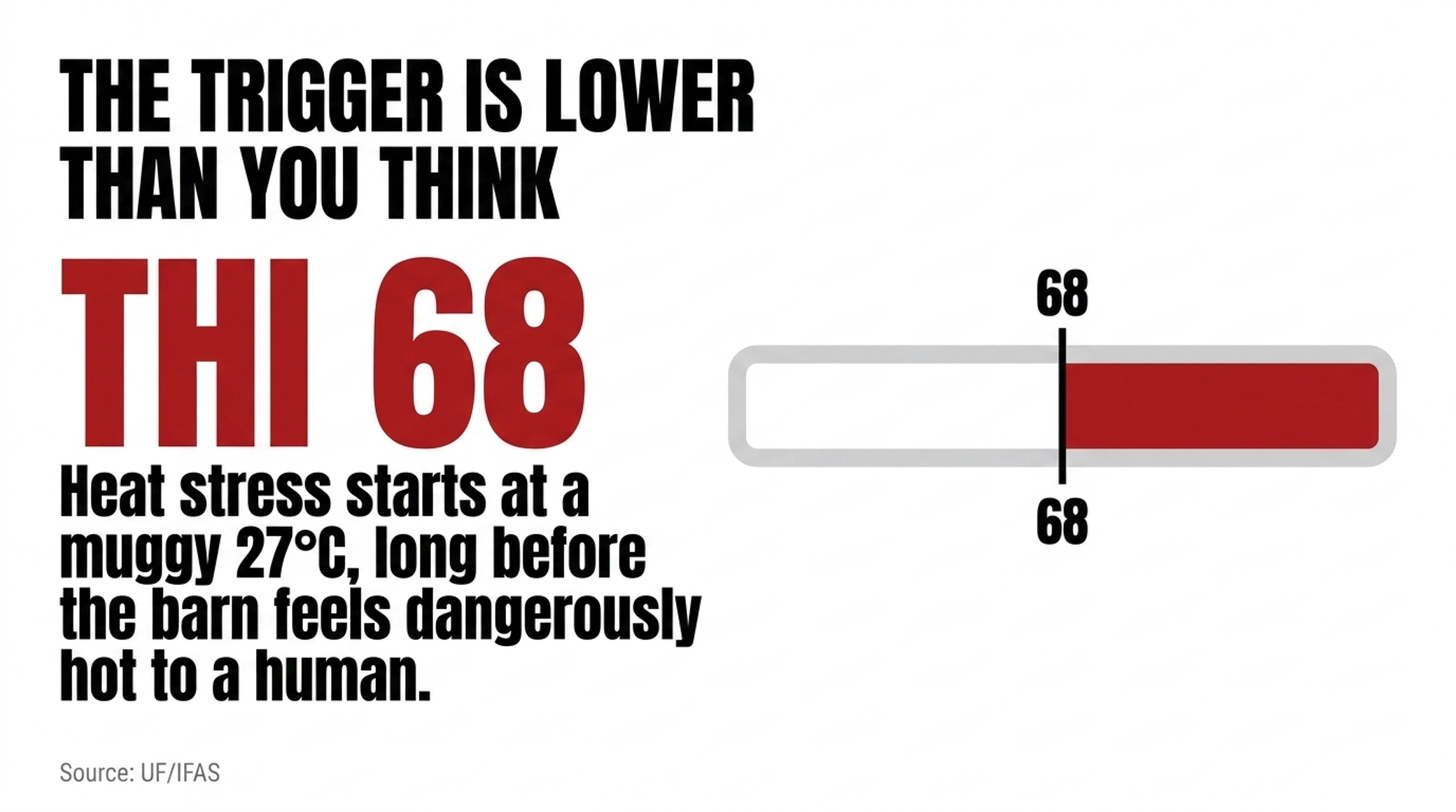
UF/IFAS defines a heat-stress day at an average Temperature-Humidity Index of 68 or higher. That’s a mark you cross on a muggy 27°C afternoon in Wisconsin, New York or Ontario, long before the barn feels dangerously hot. Wait for “hot” by human standards before you worry about the dry pen, and you’ve already been bleeding milk for weeks. If you want the full picture on the trigger, here’s why THI 68 is the number that matters now.
| Standard | Trigger Point | Real-World Example | Risk If Ignored |
|---|---|---|---|
| Old rule of thumb | 80°F ambient | Clear, dry 80°F day | Underestimates humid-day risk |
| THI 68 (UF/IFAS) | ~27°C with humidity | Muggy 80°F afternoon, WI/NY/ON | Losses start weeks earlier than assumed |
| Practical takeaway | Hang a logger, don’t guess | Farm-specific THI count | “Average” data misses your real exposure |
Run It for Your Own Barn
UF/IFAS extension (publication AN342, 2018) turned the research into numbers you can actually use. Each dry-period heat-stress day costs about 10.3 lb (4.66 kg) of next-lactation milk. UF/IFAS values that at roughly $0.91 per cow per day, using their full model, with $14.90/cwt milk income over feed cost — note that’s their discounted per-day figure, not a simple milk-price multiplication of that day’s kilos.
Plug in the U.S. average, and you land right back home: about 96 heat days a year, and a full-model loss near 447 kg and $87 a cow. But “average” is the wrong number for any single farm. The 2016 study modeled New York, California and Wisconsin climate data specifically, and the spread runs wide — Wisconsin sits near 349 kg and $68 a cow, while Florida, at 257 heat days, hits roughly 1,197 kg and $234. Treat all of these as modeled estimates, not guaranteed returns. Wisconsin and Florida bracket the range; the by-state chart with this article lays out where the rest fall in between.
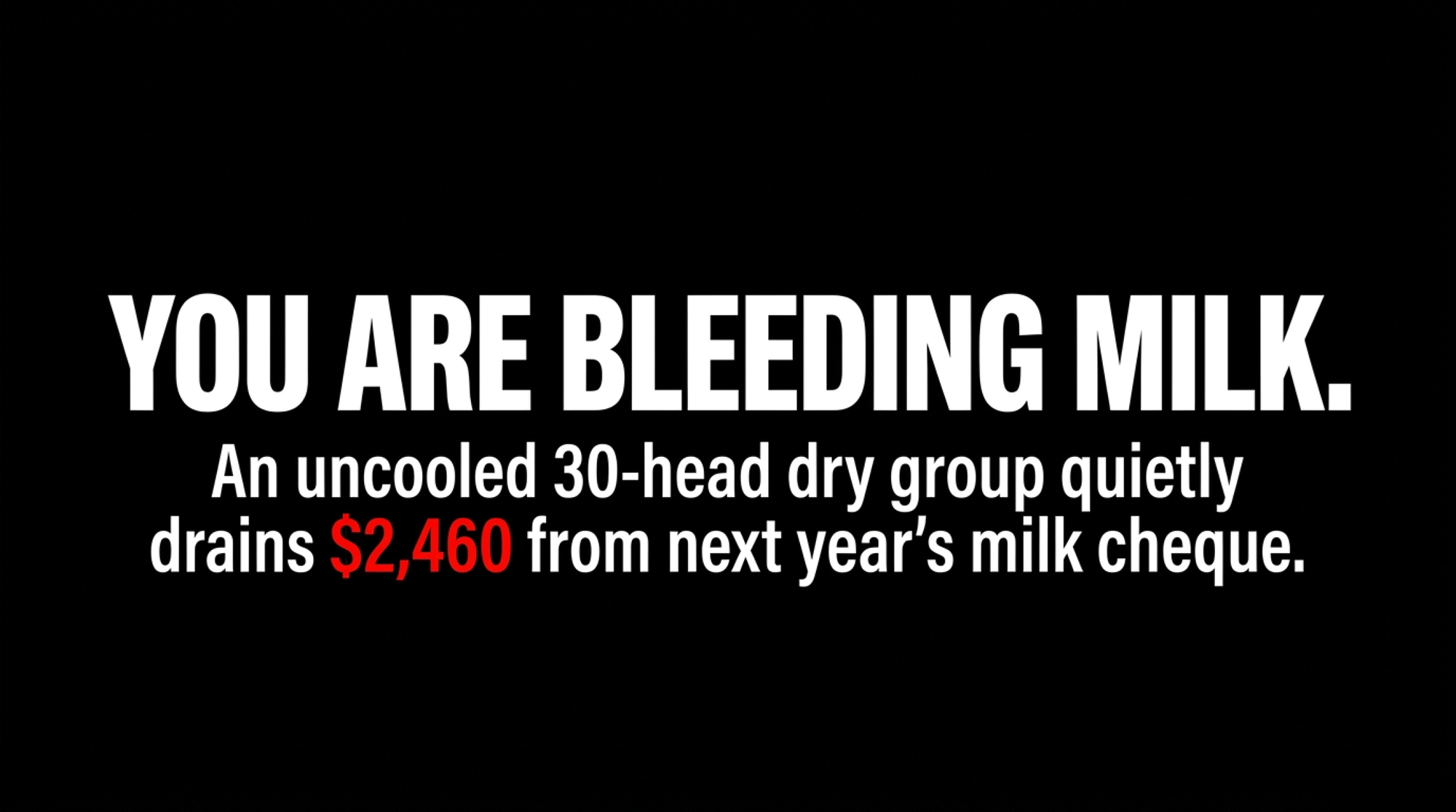
Here’s the micro barn-math, and reset it to your own milk price, because UF’s rides on that $14.90/cwt assumption. Take a 200-cow herd, 15% dry at any time (30 head), through 90 heat-stress days:
- Per cow: 90 days × $0.91 ≈ $82 in lost next-lactation milk (about 925 lb).
- Across 30 dry cows: roughly $2,460 — and that’s the hit to next lactation, not a line item you’ll ever see on this year’s expense sheet before you count a thing on the calf side.
| Metric | Uncooled Dry Cow | Cooled Dry Cow | Standout Impact |
|---|---|---|---|
| Next-lactation milk loss (kg) | 447 | 0 | -447 kg/cow |
| Annual dollar loss per cow | $87 | $0 | -$87/cow |
| Loss across 30-head dry group | $2,460 | $0 | -$2,460/group |
| National annual milk value lost | $810 million | — | Industry-wide blind spot |
Lower your milk price, and the per-day loss shrinks; raise it, and it grows. The point isn’t a magic dollar figure. It’s that even at conservative prices, the leak is real money, and it scales fast from 100 cows to 1,000.
Retrofit, Build New, or Start Measuring
The research points to genuinely different calls depending on your facilities and your climate. Here’s how the three paths stack up:
| Strategy | Best For | Payback / Threshold | Key Risk / Failure Point |
| 1. Retrofit Existing Barn | You already have the structure; moderate-to-hot summers | ~6 heat-stress days/year; payback often within one season | Poorly angled fans or undersized water lines that never drop core body temperature |
| 2. Build New With Cooling | Expanding or replacing dry housing in humid regions | ~55 heat-stress days/year; ~5.7-year payback | Over-building for the national average instead of your local climate — or your milk price |
| 3. Measure Before Spending | Evaluating real risk before committing capital | Low cost, ~30 days: hang a temperature-humidity logger, spot-check respirations | Letting “average” regional data dictate a decision your own micro-climate should make |
Thresholds and payback figures are from Ferreira et al., J. Dairy Sci. 2016, under its default assumptions ($14.90/cwt milk income over feed cost). Your own capital and utility costs will move them.
The direction of travel is clear: extension groups increasingly frame dry-cow cooling as roughly as important as cooling the milking string, even in moderate northern climates. The “only the hot states need to worry” assumption is aging badly — and it ties straight into how dry-pen cooling fits the transition-cow picture.
📋 The Dry-Pen Audit: 4 Questions for Your Next Team Meeting
- How do we file “dry cows” in our budget? Is that pen “downtime” — or “the construction phase of next year’s milk”? Your honest answer probably predicts your cooling budget.
- Are we tracking the grand-offspring? When a heifer underperforms relative to her genomic projection, do our records allow us to check whether her dam was heat-stressed in late gestation?
- What is our actual THI-68 count? Instead of guessing off the local forecast, have we hung a logger in the dry pen to get our own barn-level number before the next capital request?
- Are we doing half the job? If we cool the milking string but leave the dry cows to sweat, we’re actively cooking the factory before it opens — and no amount of post-calving cooling puts those cells back.
The uncomfortable part was never the money. It’s that the dry pen is the one place on the farm where you place a bet you won’t see settled for six months — and whose full cost might not surface until a daughter milks light two years out. Most barns aren’t built to remember that long. So the real question isn’t whether $87 a cow is worth chasing. It’s whether you’re willing to treat “was this cow cooled while she was dry” as a number worth writing down, the same way you already track milk, SCC and genomics. Until you do, the loss stays exactly where it’s always been — out in the far pen, in the shade, where nobody’s looking.
Key Takeaways
- Cooling stops at the milking string on most farms, but the dry pen is where next year’s tank gets built — leave it uncooled and you’re out about 447 kg and $87 a cow, money you’ll never trace back to the pen that cost it.
- The clock starts at THI 68, not 80°F, so hang a logger in the dry pen and get your real heat-day count before the next capital request — that number, not the national average, decides whether cooling pencils on your farm.
- Retrofits can pay back in a season with as few as ~6 heat days a year; new cooled-dry housing runs closer to a 5.7-year payback, so match the spend to your climate and milk price, not somebody else’s.
- Heat stress a dry cow and the loss doesn’t stop with her — her daughters milk 2.2 to 6.5 kg/day less, so you can choke a high-genomic heifer’s expression before she’s ever born.

Run Your Numbers
Dairy Profit Projector — This piece runs on UF’s $14.90/cwt milk-income-over-feed assumption. Swap in your own milk price, feed cost, and IOFC to see what that lost next-lactation milk is actually worth against your margin — and whether cooling the dry pen pencils before the next capital request.
Complete references and supporting documentation are available upon request by contacting the editorial team at editor@thebullvine.com.
Learn More
- Concrete, Air, and Shade: The Real Drivers Behind Milk Yield — Reclaims $1,100 to $2,300 in monthly revenue leaks by executing low-cost, 90-day payback stall modifications. This blueprint breaks down the exact dimensions, airflow settings, and bedding targets needed to force immediate lying-time production responses.
- Fans Won’t Fix It – Heat-Stressed Cows Go Leaky in 3 Days — Exposes the metabolic reality that fan cooling only recovers 60% of summer milk losses. This analysis delivers the gut-health and DCAD nutrition strategies required to stop the remaining 40% from leaking through a compromised digestive tract.
- How Epigenetic Factors Influence the Next Generation of Dairy Cows — Dismantles the assumption that genetics are locked at conception by revealing how maternal environment flips cellular switches. It arms you with the management keys to translate nutritional and environmental comfort into permanent, multi-generational genetic performance.
The Sunday Read Dairy Professionals Don’t Skip.

Every week, thousands of producers, breeders, and industry insiders open Bullvine Weekly for genetics insights, market shifts, and profit strategies they won’t find anywhere else. One email. Five minutes. Smarter decisions all week.