

Archive for SNOW-N DENISES DELLIA

How Seven Franchise Cows: Roxy, Dellia, Blackrose, and Four Others Built Modern Holstein – One Daughter at a Time

From bachelor farmers to world-class photographers, meet the visionaries who trusted the maternal line when nobody else did — and reshaped the breed one daughter at a time. This is the story of seven of them. And of the breeders who recognized what they had before anyone else did.

One shot. That’s all they took that day.

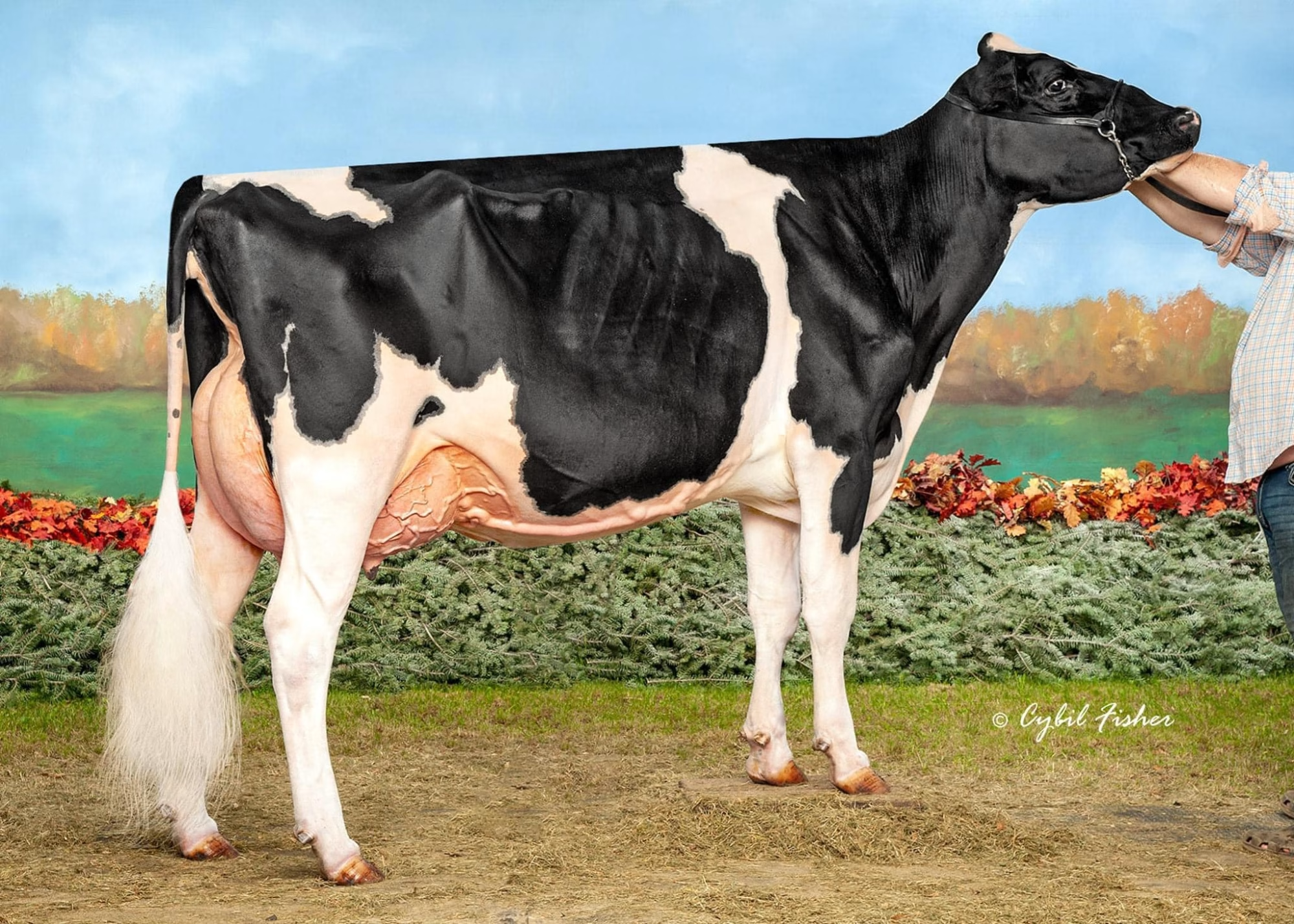
It was sometime in the mid-1970s at Mil-R-Mor Farm in Dundee, Illinois, and the cow standing in front of that camera was Glenridge Citation Roxy — clipped, washed, full of milk after a visit from a group of Japanese buyers. Miller’s son held the halter. His wife worked the trunk. And in that single frame, Miller captured what many consider the finest Holstein photograph ever taken. 
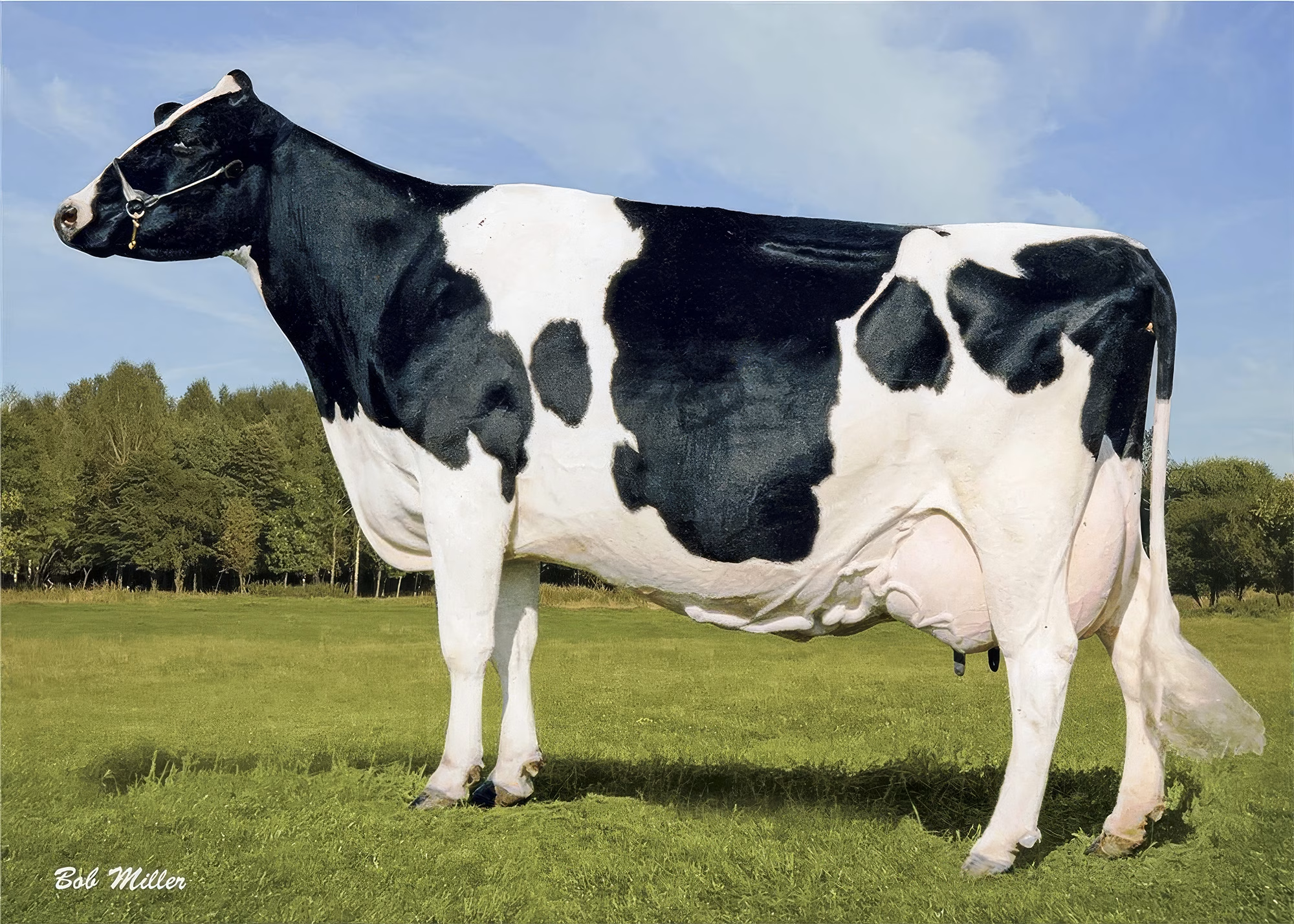
Glenridge Citation Roxy EX‑97‑4E — Queen of the Breed I & II, International Cow of the Century (1999), first cow in the breed with 10 Excellent daughters and more than 300 Excellent descendants, foundation of the only 4‑generation direct line with 11+ Excellents and the family behind 30* brood cow Mil‑R‑Mor Roxette, EX‑96 Tony Rae, EX‑97 Rustler‑Red and countless high‑production Roxy daughters worldwide.

But here’s the thing about that picture. It didn’t make Roxy famous. Roxy made the picture famous. Because behind that perfect broadside image stood a cow who would produce 16 Excellent daughters, generate 50 direct maternal lines of four-plus generations of Excellents, and earn more popular-vote titles — Queen of the Breed I, Queen of the Breed II, Top Cow of the Top Ten Cows of the Century, International Cow of the Century — than any Holstein before or since. 

She wasn’t the only one. In the three decades between 1968 and 2001, a handful of Holstein cows emerged whose genetic impact was so profound and commercially transformative that calling them “great cows” doesn’t begin to do them justice. They were franchise cows — biological engines that didn’t just win shows or set records but built entire empires of daughters and sons that reshaped the breed worldwide. Good luck finding a sale catalogue without a Roxy on page three.

This is the story of seven of them. And of the three breeders — a bachelor farmer, a livestock photographer, a bankruptcy trustee’s unlikely partner — who recognized what they had before anyone else did.

I. The Photograph and the Cow Behind It

Glenridge Citation Roxy was born on April 15, 1968, on Lorne Loveridge’s farm at Grenfell, Saskatchewan — about as far from the corridors of North American Holstein power as you could get. Loveridge’s grandfather had milked Ayrshires. His father, Gordon, switched to Holsteins in the 1920s. When Lorne took over management in 1957, he changed the prefix from Norton Court to Glenridge and set about his life’s work. 

Roxy’s sire was Rosafe Citation R. Her dam, Norton Court Model Vee (EX-6*), was a Star Brood cow whose own dam, Norton Court Reflection Vale (VG-4*), was a Roeland Reflection Sovereign daughter. That gave Roxy two close A.B.C. Reflection Sovereign crosses — and, possibly, the red factor that would surface generations later in one of her most celebrated descendants. 

What the pedigree doesn’t tell you is what Roxy looked like in person. Andy Clawson, the classifier who scored her 96 points in 1976, said she was closer to perfection than any cow he’d ever scored. Avery Stafford, who gave her 97 two years later when she was ten, said the same thing. Between them, Clawson and Stafford had classified half a million cows. 

R.F. Brown — Bob Brown, who owned Green Elms Echo Christina, a cow who ranked right up there with the best in any era — called Roxy the best he’d laid eyes on. Brown was known for fair assessments, not flattery. 

And then there were Doug Blair and Lowell Lindsay. Blair owned Alta Genetics; Lindsay was the sire procurement officer for United Breeders. They’d visited the Loveridge farm a few months before Miller, seen Roxy, and been overwhelmed. They discussed buying her on a 50-50 basis. At the end of the day, they couldn’t come up with the kind of money Loveridge was asking. One has to wonder how long that decision haunted them. 

The Move to Illinois

Miller, a transplanted Canadian from Brome, Quebec, worked part-time as a livestock photographer. In 1973, he was summoned to Grenfell to photograph Roxy and her dam. He’d been searching for a cow family for some time, and he had very specific requirements: type, production, and longevity. Roxy and her family met all three. 

Loveridge, for his part, was beginning to realize that his farm’s remote location precluded visitors from seeing the cow. Miller’s Illinois base was better suited for promotion and merchandising. Within a year, Miller had bought Roxy and a half-interest in Vee and moved the pair to Dundee.

Even though embryo transfer was still in its infancy — this was the early 1970s, when flushing a cow was more gamble than science — Miller put Roxy on an ET program. Over the years, she produced 30 ET offspring and three natural calves. Twenty daughters. And she became the first cow in the world to have ten of those daughters classify Excellent. By the time the final tally came in, 16 daughters had earned the Excellent designation. 
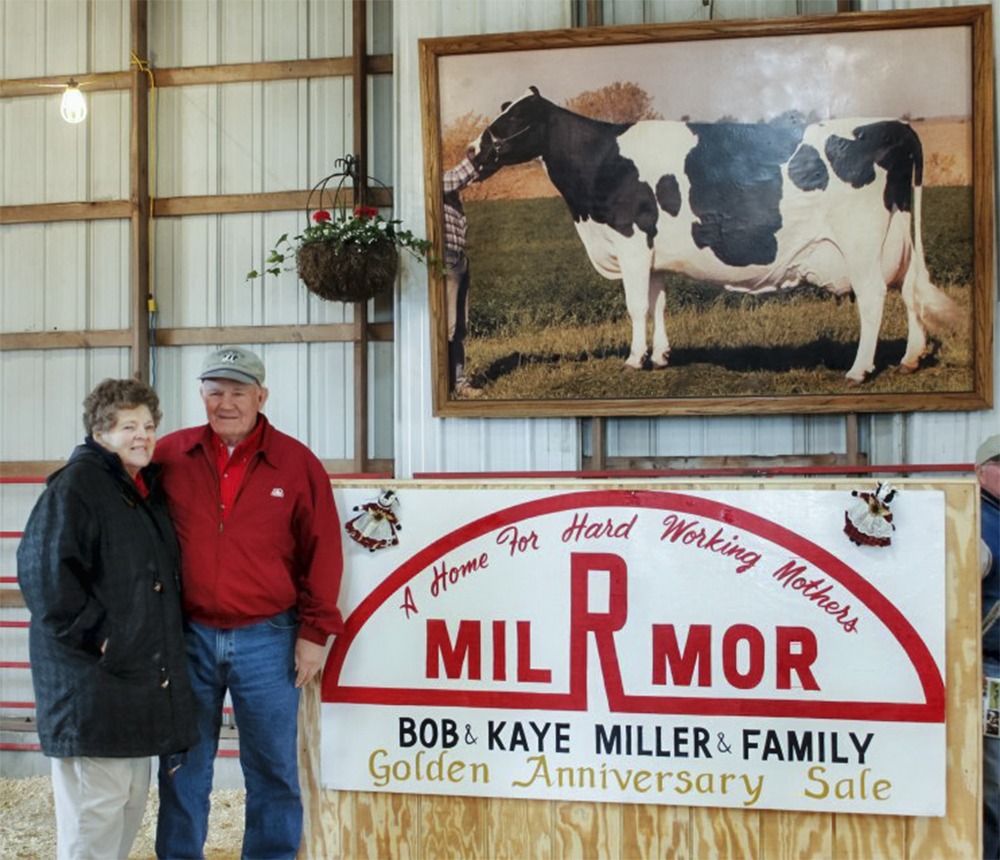
Bob and Kaye Miller at Mil‑R‑Mor’s Golden Anniversary Sale, standing beneath the iconic one‑shot photograph of Glenridge Citation Roxy that helped turn their quiet Illinois herd into one of the most influential cow families in Holstein history.

In Miller’s hands, Roxy made four records over 1,000 pounds of fat, reaching 26,470 pounds of 4.4% milk and 1,166 pounds of fat in her best year. Career total: 209,784 pounds of milk at 4.5% butterfat and 9,471 pounds of fat. She rounded out three generations of 200,000-pound producers — her dam and granddam had both hit that mark. At 12 years of age, she earned a 4E rating, and her show record included All-Illinois honors from 1976 through 1979, a win in the dry-aged class at the 1979 Central National Show, and membership in eight All-American, All-Canadian, or Reserve All-Canadian groups.

The Empire She Built

But the real story wasn’t what Roxy did. It was what her daughters did. And her granddaughters. And their daughters after them.

Seven of Roxy’s daughters earned Gold Medals. By 2004, according to Holstein World, 50 direct maternal lines of at least four generations of Excellents descended from Roxy, with Roxy appearing as the second Excellent dam in each. Her 16 Excellent daughters produced 34 Excellent daughters. Those 34 had 52. Those 52 had 48. That’s the kind of cow family that just keeps writing cheques your herd can cash. 

Until 1977, Miller had never sold a Roxy daughter. He relented that year when he consigned Roxy’s Elevation daughter, Mil-R-Mor Roxette, born on Valentine’s Day the year before, to the National Convention Sale at Columbus, Ohio. Peter Heffering bought her for $25,000, the third-highest price of the sale, and took her to Hanover Hill Farms at Port Perry, Ontario. 

The transaction nearly collapsed. Miller hadn’t understood his heifer would be sold on investor terms — one-third down and the balance over two years. But years later, Miller acknowledged he was glad Roxette ended up at Hanover Hill. She eventually became an Excellent Gold Medal Dam who lived into her late teens, produced over 100 pregnancies, left 13 Excellent daughters and eight Excellent sons, and added upwards of two million dollars to Hanover Hill coffers. 

The Roxette daughters branched in every direction. There was Hanoverhill Star Roxy (EX-92-3E-GMD-DOM), a Starbuck daughter developed by the Conard family at Ridgedale Farm in Sharon Springs, New York, whose Leadman daughter produced a Milestone-Red granddaughter, who in turn produced Sir Ridgedal Rustler-Red (EX-95) at Trans-World Genetics. Rustler became enormously popular in Germany — so popular that grateful German breeders arranged an all-expense-paid trip for Wayne Conard and his wife in 2006. 

There was Mil-R-Mor Toprox (EX-94-3E-GMD), Roxy’s highest-record daughter and one of the breed’s first 2,000-pound fat cows, who became the fountainhead of the Brigeen herd’s Roxy family. Mary Briggs of Brigeen Farms described the Roxys this way: “Healthy and fertile — the indexes around the world for somatic cell count, fertility and longevity highlight the family’s real strengths. They just go along doing their business,”
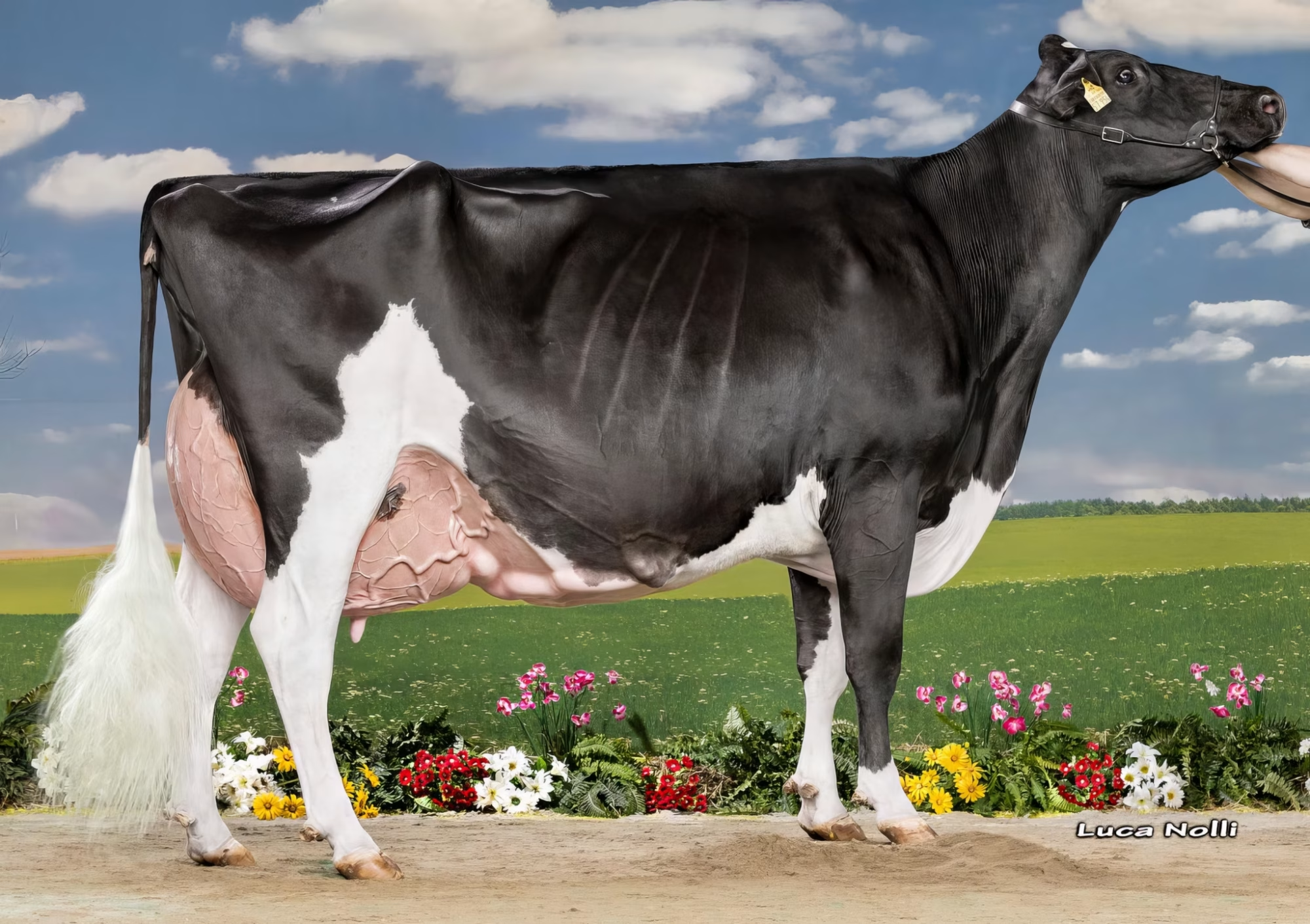
Liddlehome Beemer Rockstar ET EX‑92 — a modern, high‑type show cow whose pedigree runs Beemer × Durham Rhonda EX‑95 × Miss Ridgedale Rhonda EX‑92 × Hanover‑Hill‑R Rhonda EX‑94 × Hanover‑Hill Star Roxy ET EX‑92 × Mil‑R‑Mor Roxette EX‑90 × Glenridge Citation Roxy EX‑97, proof that Roxy’s maternal line is still throwing frame, udders, and banners generations later.

If you’ve ever bought into a cow family and watched it perform under your management the same way it did under theirs — no drama, no fuss, just daughters that score Excellent and milk like freight trains — you know exactly what that consistency feels like.

That’s the kind of cow Roxy was. And her daughters were the same. Wide through the rear end, correct in the rump, sound on their feet, and absolutely relentless at the milk pail. No drama. Just production and reproduction, generation after generation. 

On July 8, 1984, Glenridge Citation Roxy died at 16 years of age. A stone monument on the Mil-R-Mor farm reads:

Glenridge Citation Roxy 4E-97-GMD. April 15, 1968 – July 8, 1984. Lifetime 209,784M-4.5%-9,471F. First cow in the world to have ten daughters classified Excellent. First cow in the world to accomplish 4E-97-GMD plus be a 3rd generation 200,000-lb. milk producer.

Read more: The Real Story Behind Glenridge Citation Roxy, Glenridge Citation Roxy: The Legendary “Queen of the Breed” and Bob Miller – Outstanding from Any Angle.

II. The Bachelor, the Sale Bill, and the Black Cow at Bob Snow’s
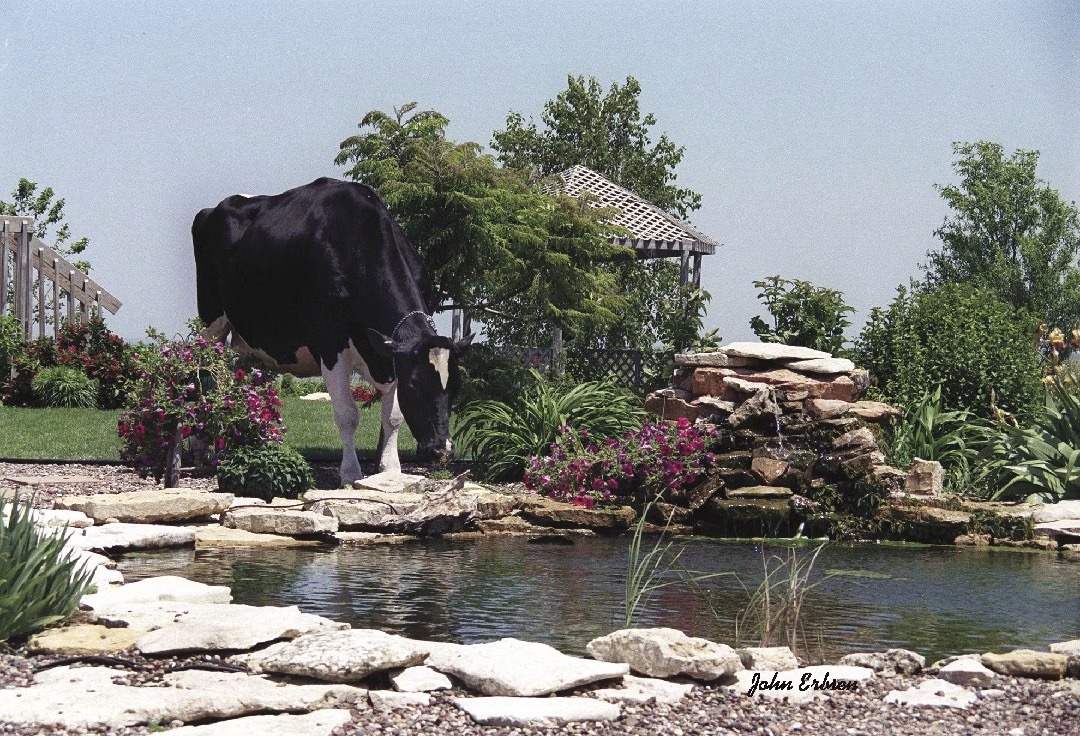
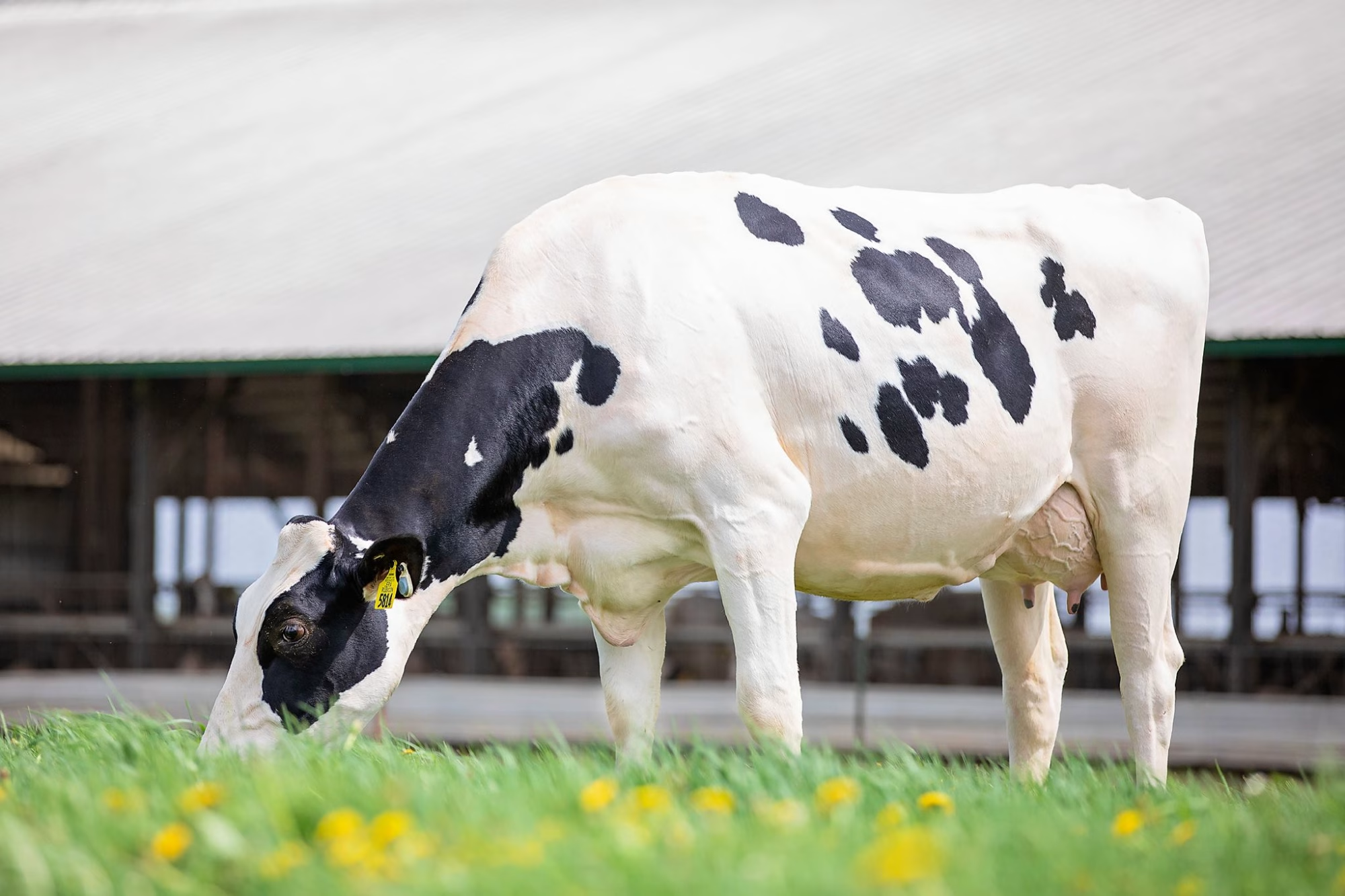
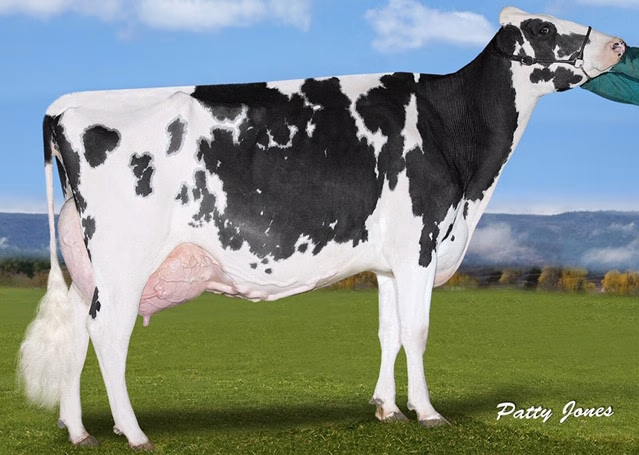
Snow‑N Denises Dellia EX‑95 — the quietly powerful brood cow behind Durham, Dundee and Derry, pictured here doing what she did best at Bob Snow’s farm: looking like “just another cow” while building one of the most profitable maternal lines the Holstein breed has ever seen.

Here’s how different the Dellia story is from Roxy’s. No livestock photographer. No Illinois showplace. No Japanese buyers. Just a bachelor farmer sitting in a kitchen corner while his mother made lunch, thumbing through the Holstein-Friesian World. 

Robert Snow — “a sober man of direct gaze and resolute jaw; not a man who moves on a whim; reflective; prudent,” as one neighbor described him; “never a man to be anybody’s fool” — started farming in 1951 on a grade herd inherited from his father in Monroe County near Sparta, Wisconsin. The county extension workers pushed him toward purebreds, and Snow liked the idea. There was more to life, he felt, than milking a bunch of grades. 

He chose his prefix early. “I wanted to use my last name,” Snow explained, “but I thought just plain ‘Snow’ was too simple. So I added an ‘N’. I can’t tell you why I chose the letter ‘N’. It doesn’t stand for anything. I could just as well have chosen X, Y, or Z. I just thought it sounded nice — ‘Snow-N’.” 

That last week of July 1970, what caught Snow’s eye in the magazine was a sale advertisement for the Adolph Buergi dispersal, one of Barron County’s finest groups of registered Holsteins. Buergi had been at the game for 32 years. On the first page of the ad, below a banner headline touting “A Foundation Daughter of Creator Fobes Governor,” were four photographs of the same cow: Ce-Buerg Homestead Governor Jo. Broadside view. Three udder shots — left, right, and rear. 

Rice Lake was 125 miles away, and Snow was of no mind to waste time and gasoline. “I wasn’t interested in the middle or the bottom,” he confided 35 years later. “If I was going to the sale, I would buy off the top.” 

He picked up an old uncle who lived near Rice Lake and took him out for the day. They bought a sandwich and coffee at the sale, sat down, and watched the cattle come through. Snow bid only on the top animals, as promised. The high seller was the “Jo” cow at $2,800 — Snow was the runner-up bidder. By day’s end, he’d bought three head: an open two-year-old at $1,500, a yearling at $800, and Ce-Buerg Creator Hartog Fobes, an inbred three-year-old right up to calving who looked like a million dollars. Snow paid $2,500 for her. 

Almost three decades later, Snow wasn’t entirely sure which of those three cattle was Dellia’s direct ancestor. Turned out he’d bought both dam and daughter — Hartog Fobes and her St. Croixco Pioneer daughter, Ce-Buerg Creator Fobes Garnet — and they became the seventh and sixth dams, respectively, in the maternal line of Snow-N Denises Dellia. 

A Breeding Strategy Built on Balance

Now, the thing about Snow’s approach — and this is what made Dellia possible — was his alternating-sire philosophy. He’d follow a strength bull with a dairy one, then back to strength, always maintaining balance and striving for a functional dairy type. Garnet got Cedardale Corporal, a calving-ease sire. That daughter, Edith, got Harborcrest Happy Crusader — strength, substance, square rumps, particularly good udders. Crusader’s daughter, Ellen, inherited Arlinda Commander’s stature and clean bone. Commander’s daughter Ella got MD-Sunset-View R A Wonder — an Elevation son who sired large frames, wide chests, and ample bone. 
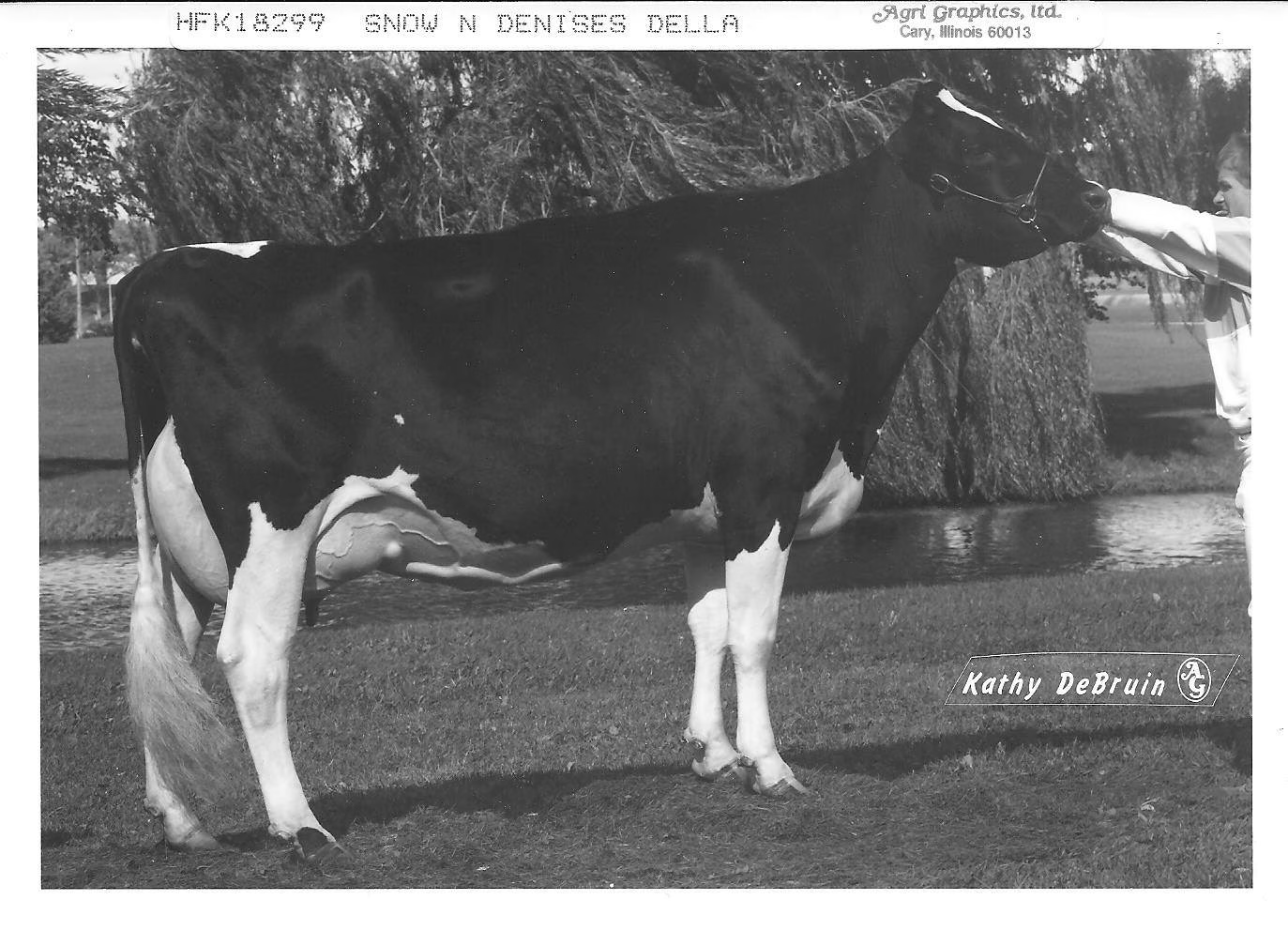
Meet Snow-N Denises Dellia, the legendary Holstein matriarch, sired by Walkway Chief Mark and out of Snow-N Dorys Denise, with maternal grand sire Carlin-M Ivanhoe Bell. This EX-95 cow revolutionized dairy genetics with her exceptional balance of production and type, leaving an indelible mark on the industry. Her legacy continues to shape modern Holsteins worldwide

Snow-N Denises Dellia, the legendary Holstein matriarch, sired by Walkway Chief Mark and out of Snow-N Dorys Denise, with maternal grand sire Carlin-M Ivanhoe Bell. This EX-95 cow revolutionized dairy genetics with her exceptional balance of production and type, leaving an indelible mark on the industry. Her legacy continues to shape modern Holsteins worldwide

Then, in the winter of 1983, Snow won two units of Carlin-M Ivanhoe Bell semen at a barn meeting. He used them on his two best animals. One was Snow-N Ellas Dory, a virgin. From that mating came Snow-N Dorys Denise — a typey cow with considerably more strength than the average Bell daughter, a shapely udder, and correct feet and legs. 

Peter Blodgett later explained why the combination worked so well: “There have been thousands of Marks out of Bells, but I think the thing that makes Dellia different is MD-Sunset-View R A Wonder, her granddam’s sire. Wonder was one of those extreme bulls that sired a lot of bone. It’s rare that you combine a bull like Wonder with Bell. The fact that those two bulls were combined is the work of a ‘master breeder’ for sure.” 

When it came time to breed Denise, Snow’s hired man, John Steinhoff — a young man just out of high school from the Tomah area who was “up” on his bulls — picked Walkway Chief Mark. The Mark-Bell combination was already considered one of the “golden crosses,” with Mark joining width, capacity, and udders to the correct feet and legs of Bell daughters. 

The resulting heifer calf, born December 20, 1986, was registered as Snow-N Denises Dellia. 

“Who Is That Cow?”

At the Wisconsin Championship Show, judged by Loren Elsass, Dellia placed second in the senior two-year-old class behind Miklin Starbuck Beth in a class of 23, but won best udder. Frank Regan, one of the partners at Regancrest Farms in Waukon, Iowa, happened to be at the show. It had rained early that morning, and when Frank looked out at his recently cut hay, he decided there’d be no haying that day and bundled up his family for the drive. 

They arrived about noon. As Regan walked into the arena, they were starting the two-year-old class. He saw a black cow coming through the gate and said to himself, “Wow! Who is that cow?” 

That’s the moment that changed everything — for Regan, for Dellia, and, it’s no exaggeration to say, for the Holstein breed.

After the class, Regan followed her back to the barn. He approached Bob Snow and asked his price. The figure was high, so Regan thought, we’ll get a daughter instead. Snow was flushing Dellia to Blackstar and agreed to sell a Blackstar daughter. 

But Regan couldn’t let go. The truth was, he was looking for a herd-building kind of cow — a franchise dam he could flush and make some money on — and he’d looked at other Chief Marks. Dixie-Lee Chief Liza, others. It kept coming back to the black cow at Bob Snow’s. The farm was only a hundred miles away, so Regan made it his business to stop often. 

“I started at $10,000,” Snow said. “And every so often, I boosted it by $5,000. I got up past $50,000 pretty quick.” 

A couple of weeks before the Wisconsin Spring Show of 1991, Regan paid Snow another visit. Dellia was entered and looked like she might win. They settled on a price. Regan would lead her at the show; Snow would own the cow until after, then Regan would take her home. 

The day before the show, Orville Kemmink came up to Regan. “Are you the kid who bought this cow?” Regan said he was. “Don’t you think you paid too much?” Kemmink asked. Dellia had been flushed several times, and a lot of embryos had been sold. “You won’t get your money back,” he warned. 

That night, over supper, Regan asked Snow to guarantee a number of embryos. “How many do you want?” Snow replied. 

But that night, Dellia looked empty. She had a perfect udder but was a little shallow in the body, and they needed to fill her out. So Regan bought four bales of hay — three grassy and one alfalfa — and a bag of calf feed to mix with her grain. “She likes warm water with her beet pulp,” Snow told him. 

Regan started feeding her, and by the next morning, she began to straighten out. By ten o’clock, people were filing into the barn to see her. The word had spread. Instead of looking like a racehorse, Dellia had started to look like a winner. 

With Niles Wendorf judging, Dellia topped the four-year-old class, won best udder, and was named grand champion of the Wisconsin Spring Show of 1991. After the show, Bob Snow had to back his car into the arena to load all the trophies. 

“There were a lot of disgruntled people,” Snow recalls. “They were upset that a ‘nobody’ could come in and clean up.” 

The Dellia Dynasty

What Regan and his partners built from that one cow defies easy summary. According to Regancrest records, Snow-N Denises Dellia produced 76 registered daughters by 21 different sires. Forty-four sons were A.I.-sampled. Three earned Gold Medals: Regancrest Elton Durham, Regancrest Dundee, and Regancrest Emory Derry. Official figures show 34 Excellent and 49 Very Good offspring. Dellia was very fertile, averaging 15 embryos per flush — she once produced 25 Melwood embryos in a single collection.
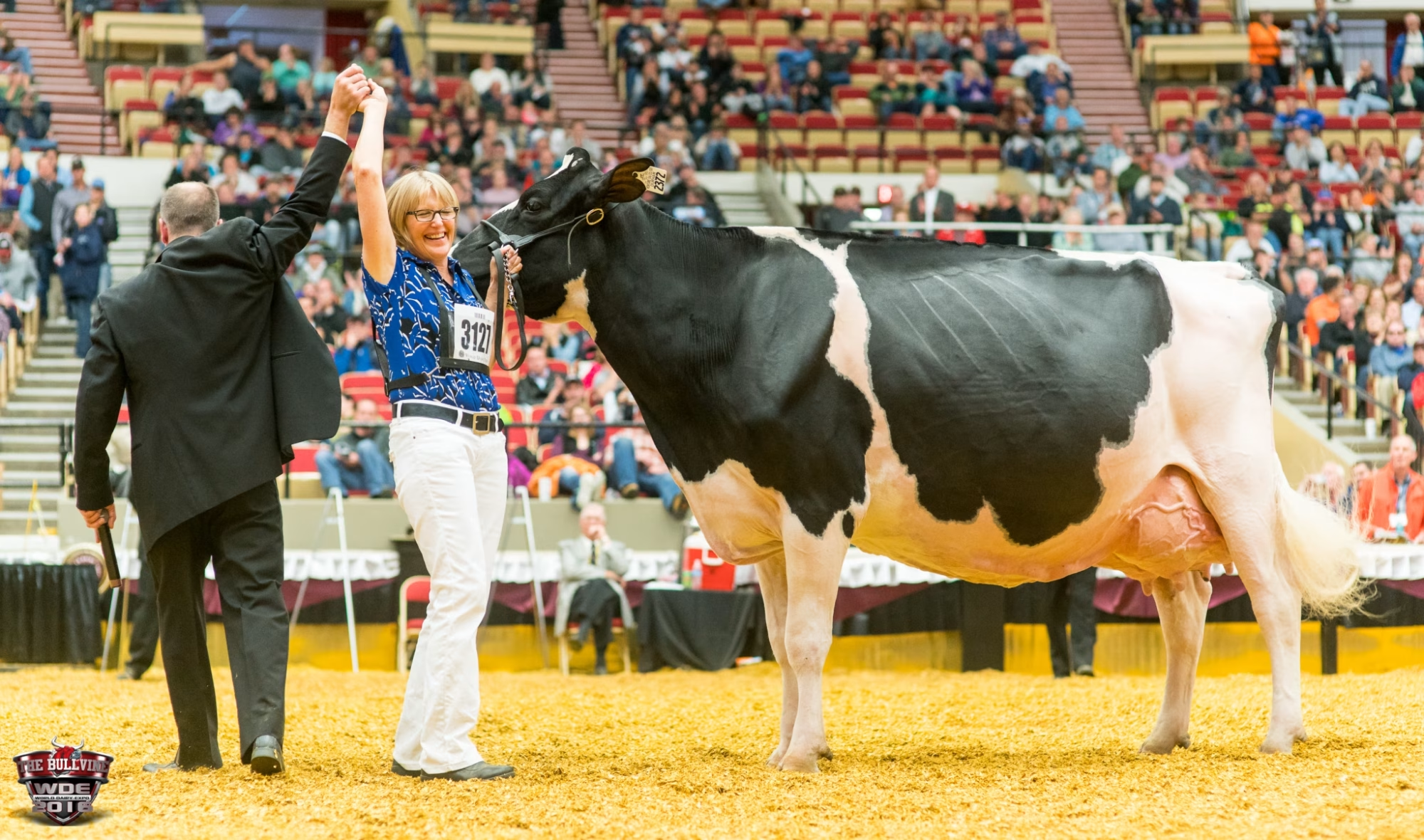
Sheeknoll Durham Arrow EX‑96, Grand Champion of the 2016 World Dairy Expo, celebrating on the colored shavings and showing exactly what Snow‑N Denises Dellia bred true for through Durham — balance, power, and the kind of udder that still wins when the announcer calls for champions.

Durham, by Emprise Bell Elton, went to Select Sires. Dundee, by Mar-Crest Encore, was proven by A.B.S./St. Jacobs in Canada and eventually scored EX-95. Derry, by MJR Blackstar Emory, landed at Select Sires as well. These three bulls, alongside grandsons like Erbacres Damion (EX-94-GM) and Regancrest-HHF Mac (EX-92-GM), flooded A.I. barns across North America and beyond. 

Tim Abbott while at A.B.S. Global put it this way: “Dellia and her family are all about type — just everyday nice-uddered cows that people are happy with. People consistently say their Durham daughters are trouble-free cows. They’re good-uddered young cows that don’t cause any problems and just kind of blend with the herd.” 

Scott Culbertson while at Select Sires went further: “Dellia’s impact through her daughters has sent more dollars back into farmers’ pockets across the world than any other cow.” 
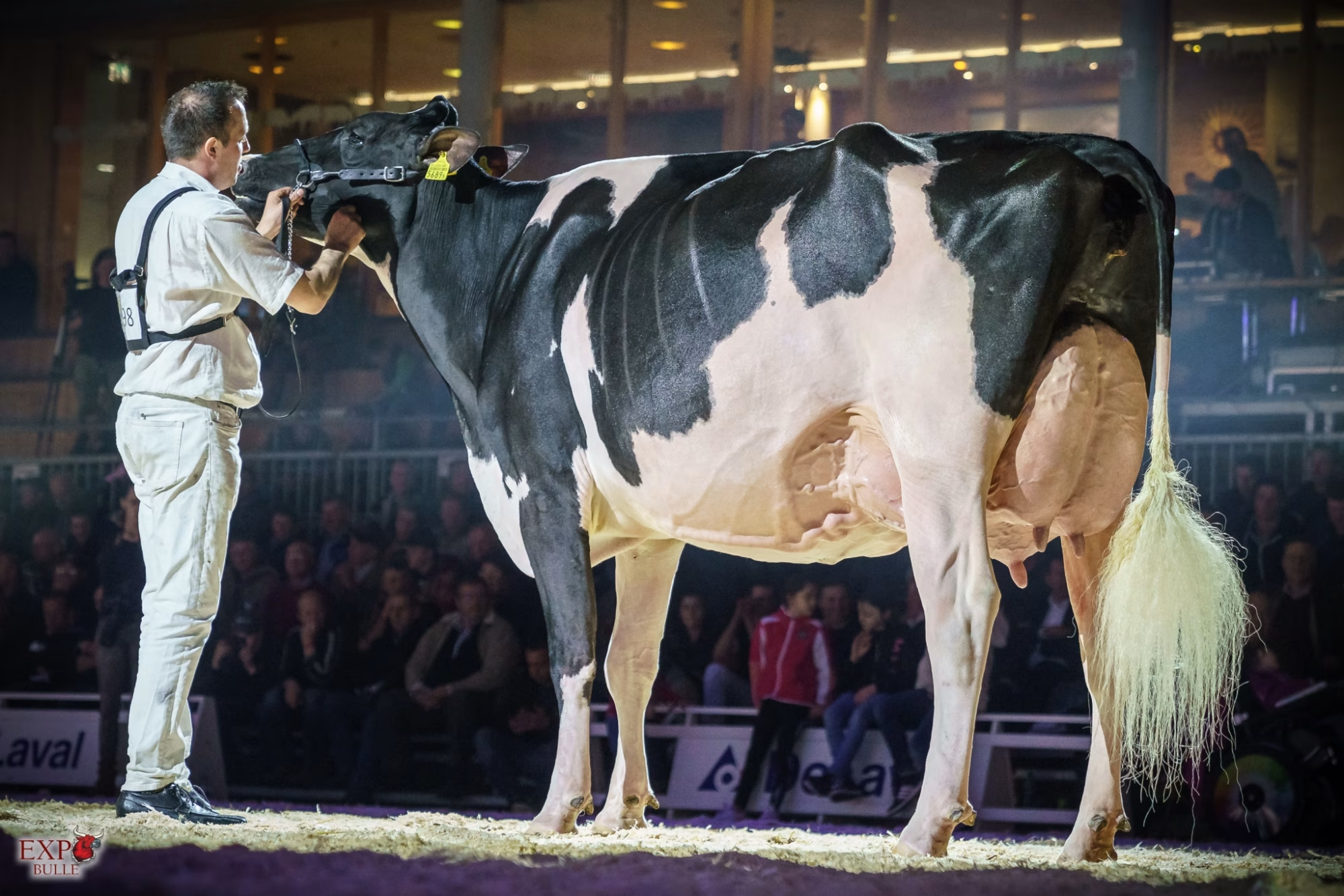
DH Gold Chip Darling EX‑96‑CH, Swiss Expo Champion and Dellia descendant, lighting up the ring and reminding everyone that Snow‑N Denises Dellia didn’t just make bull mothers — she bred the kind of balance, udder and ring presence that still wins under the brightest lights.

Two months after the Regans took Dellia home from the Wisconsin Spring Show, she took a crampy spell and started kicking at her belly. The vet recommended surgery, cut her open, and removed three gallons of sand from her stomach. Snow had a sandy farm with a creek behind the barn; cows sometimes stirred up the water and drank sand. After the operation, Dellia bounced right back. She was that kind of cow. 
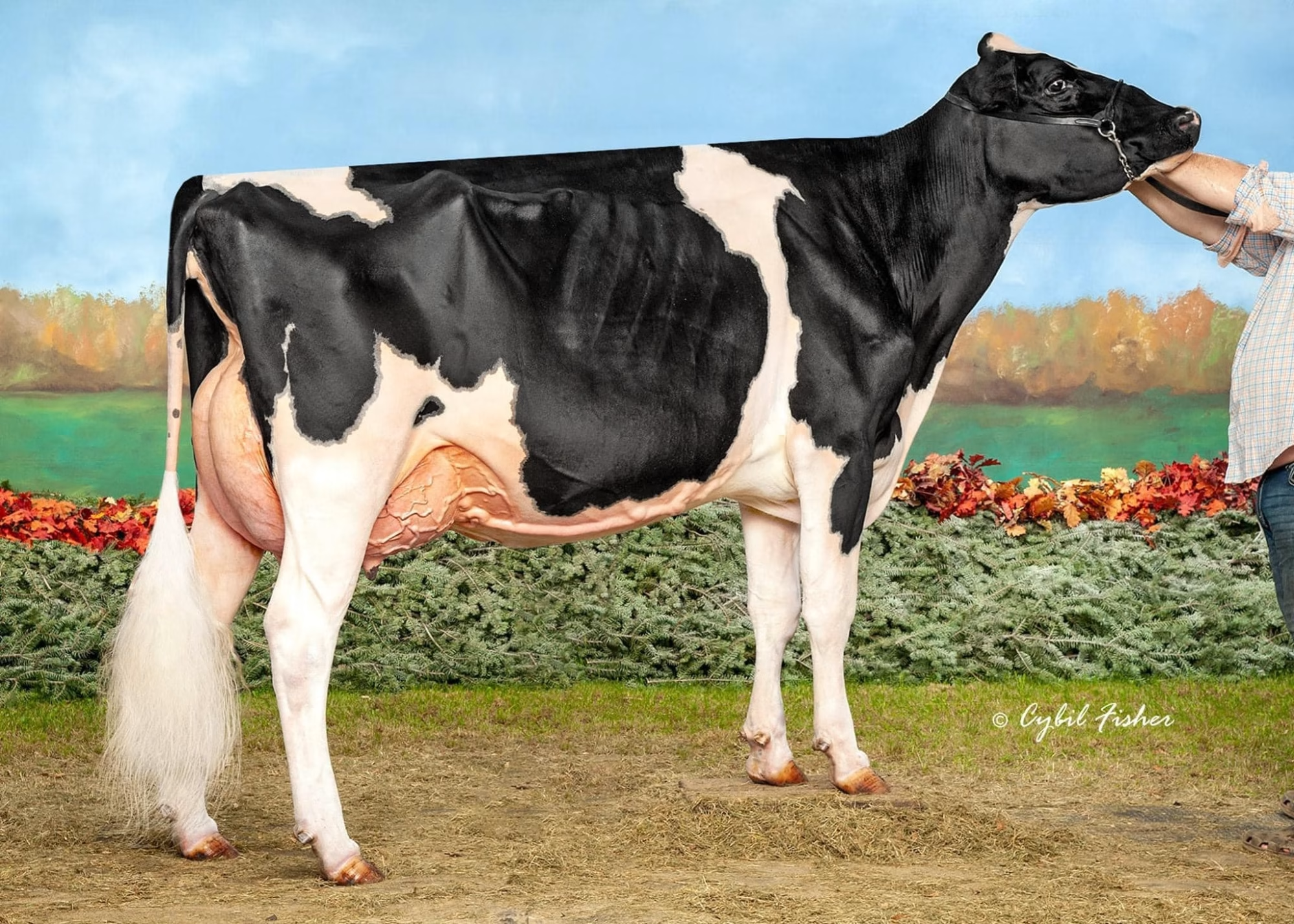
S‑S‑I Doc Have Not 8783‑ET EX‑92 — a modern proof that Snow‑N Denises Dellia still stamps cows the same way decades later: tall, sharp, snug‑uddered and built to work, carrying Dellia’s genetics into today’s high‑index, high‑production Holstein era.

She lived until December 8, 2001, with a lifetime record of 180,240 pounds of milk at 3.9% butterfat, 7,108 pounds of fat at 3.2% butterfat, and 5,723 pounds of protein. Even near 15 years old, she walked on a perfect set of legs and feet. The Regans’ tribute in Holstein World read: “She has influenced our lives in ways we never would have imagined. Her legacy will live on not only through her offspring but in the lesson she taught to many — that the demand for high type plus production never goes away.” 

Read more: Snow-N Denises Dellia: The Holstein Legend Who Redefined Dairy Genetics, Walkway Chief Mark: The Backup Bull Behind Seven Percent of Every Holstein Cow and Bell’s Paradox: The Worst Best Bull in Holstein History

III. Born from a Bankrupt Semen Tank

Now here’s a story that couldn’t have been invented.
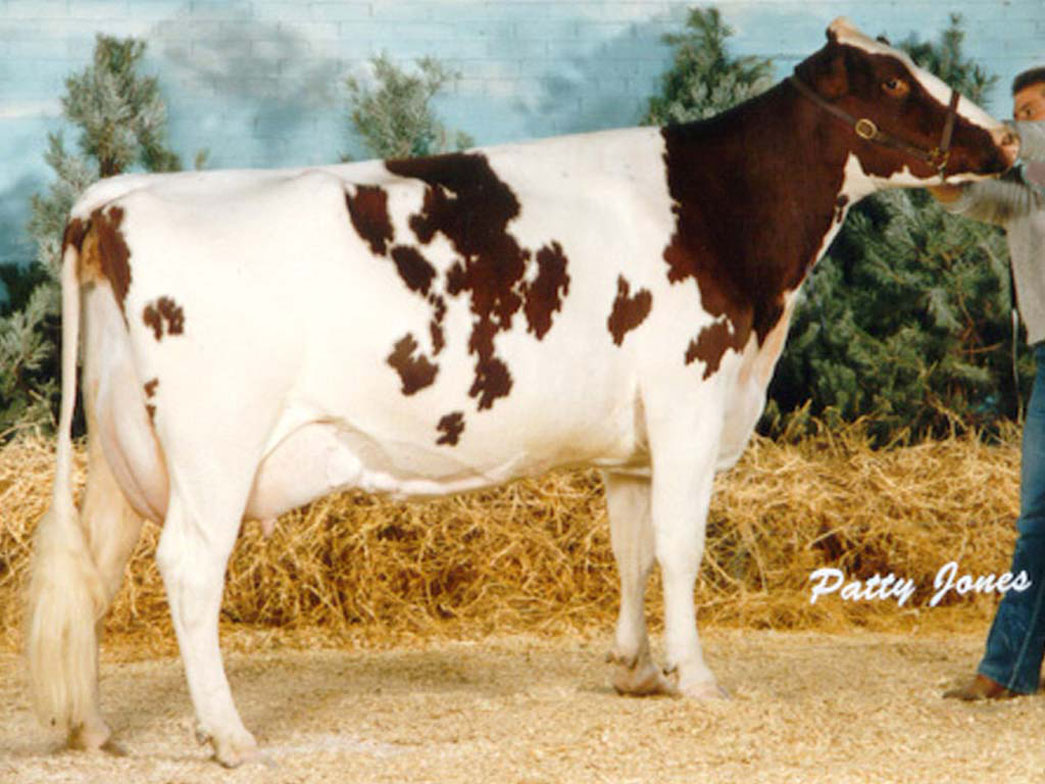
Nandette TT Speckle‑Red EX‑93 — the red‑and‑white Triple Threat daughter whom judge David Houck called “a happy combination of strength, breed character, and sufficient angularity.” When the investor empire around her collapsed, Louis Prange saw what the bankruptcy trustees couldn’t: the cow who would become Blackrose’s dam.

Nandette TT Speckle-Red was bred by Burdette Holt of Delavan, Wisconsin, born November 11, 1978, sired by Hanover-Hill Triple Threat. She first showed up in the magazines in November 1981 when she placed sixth in the two-year-old class at Madison. Her owner at the time was Elm Park Farms Limited, Sheboygan Falls, Wisconsin — Louis Prange’s outfit. 

A month later, Prange took Speckle to the Royal Winter Fair in Toronto. His string was tied beside the Browndale and Cher-Own herds of R.F. Brown and his son, David. Dave Brown took a shine to the heifer and helped get her ready. On show day, Prange got the bad news: Speckle was eight days too old for the two-year-old class. She had to show as a three-year-old and placed third. 

Two months later, Dave Brown went down to Wisconsin and bought her. Prange’s price was $60,000, and Brown paid it. Title transferred to Browndale Farm. 

Speckle aborted her calf and wasn’t shown in 1982, came back in 1983, placing sixth as a four-year-old at Madison, then was second at the Royal that fall behind Brookview Tony Charity, whom judge Doug Wingrove later made grand champion. 

Then Jack Stookey showed up.

The Investor Era’s Wild Ride

Flush with investor money, Stookey bought Speckle from the Browns on investor terms: $275,000, one-third down and the balance in two annual payments. He paid the deposit and took her home. 

What followed was textbook investor-era madness. Stookey went on a buying rampage, picking up top cows on similar contracts. Before long, he was taking home Premier Exhibitor banners at major shows, including Madison. Under Stookey’s ownership, Speckle showed as a five-year-old at the 1984 Wisconsin Spring Show, where judge David Houck made her grand champion, calling this red-and-white cow “a happy combination of strength, breed character, and sufficient angularity with plenty of chest and heart.” 

But the stories were already starting. Some had truth; many were fiction. People whispered that an angry investor had dynamited the porch off Stookey’s house. That the Mafia was involved. That he was a smooth talker who couldn’t follow through. 

The reality was messier but more mundane. Stookey’s books were a disaster — piles of paper two feet deep covered the office floor. He’d charge investors $750,000 for cows he’d bought for $250,000. When the returns didn’t materialize, investors stopped paying. Stookey couldn’t honor his own contracts with the breeders who’d sold him the cattle. By the late 1980s, it all collapsed. Bankruptcy. Creditors — including the Browns, who’d only ever seen the initial down payment on Speckle — received legal notices listing large debts and meager assets. 

Most took one look and decided there was no point chasing it. 

Prange’s Rescue

And this is where the story takes its most improbable turn. Louis Prange — the same man who’d originally owned Speckle before selling her to Brown — received an order for embryos from a Brazilian buyer who wanted the best. Prange knew Stookey’s cattle were now under the control of a bankruptcy trustee. So he went to Leesburg, Indiana, to talk. 

He leased a dozen of the Stookey cows, took them home, and flushed them. After filling the Brazil order, he realized what a nucleus he had. He negotiated a longer-term arrangement: Prange would pay all expenses and take full ownership of male calves; all females had to be sold before age two, with sale proceeds divided half to Prange, a quarter to the bank, and a quarter to Stookey. 

Stookey insisted on one thing: all calves had to carry the Stookey prefix. He still dreamed of someday returning and winning Premier Breeder banners. 

He got his way.

Nandette TT Speckle was one of the cows in the Prange-Stookey ET program. Prange had visited To-Mar Farm in Iowa and been impressed with To-Mar Wayne Hay, dam of To-Mar Blackstar. He thought Blackstar would suit Speckle perfectly. Stookey’s preferred sires were Rosafe Citation R and Browndale Commissioner, and he pushed hard for them. Prange told him to send the semen. 

A day or two later, Stookey called back: “Can’t send you the semen, Louie. My semen tank ran dry.” 

So Speckle was flushed to Blackstar instead.

Stookey Elm Park Blackrose was born on March 24, 1990 — a cow who never would have existed if Jack Stookey had managed to keep his semen tank topped up. 

From $5,400 to Show Ring Royalty

In December 1991, fitter and breeder Mark Rueth of Oxford, Wisconsin, was working the Elm Park Red Futures Sale. His friend Mark VanMersbergen of Lynden, Washington — a Guernsey man switching to Holsteins — was looking for brood cows. Rueth pointed him to an 18-month-old Blackstar heifer: deep-ribbed, wide-rumped, the kind that catches a cattleman’s eye. 

They bought her for $5,400 — Rueth, VanMersbergen, and later Bob and Karyn Schauf of Indianhead Holsteins in Barron, Wisconsin, who took a one-third interest in exchange for housing her. The Schaufs were known for big-framed, deep-pedigreed cows and a low opinion of pure index breeding. 

What happened next was extraordinary. Blackrose was voted All-American and All-Canadian junior two-year-old in 1992. All-American and All-Canadian junior three-year-old in 1993. In 1995, she became one of the few U.S.-bred cows to win grand champion at the Royal Winter Fair — and was named Reserve All-American and Reserve All-Canadian five-year-old. She came back in 1997 as a Reserve All-American and Reserve All-Canadian aged cow. 

Even though she was a Blackstar daughter with two records over 40,000 pounds of milk, Blackrose was never really treated as an “index cow.” Her type credentials told a different story: +3.77 PTAT with udder and feet-and-leg composites of +2.78 and +2.87, making her the No. 1 type cow in the breed at that time. 
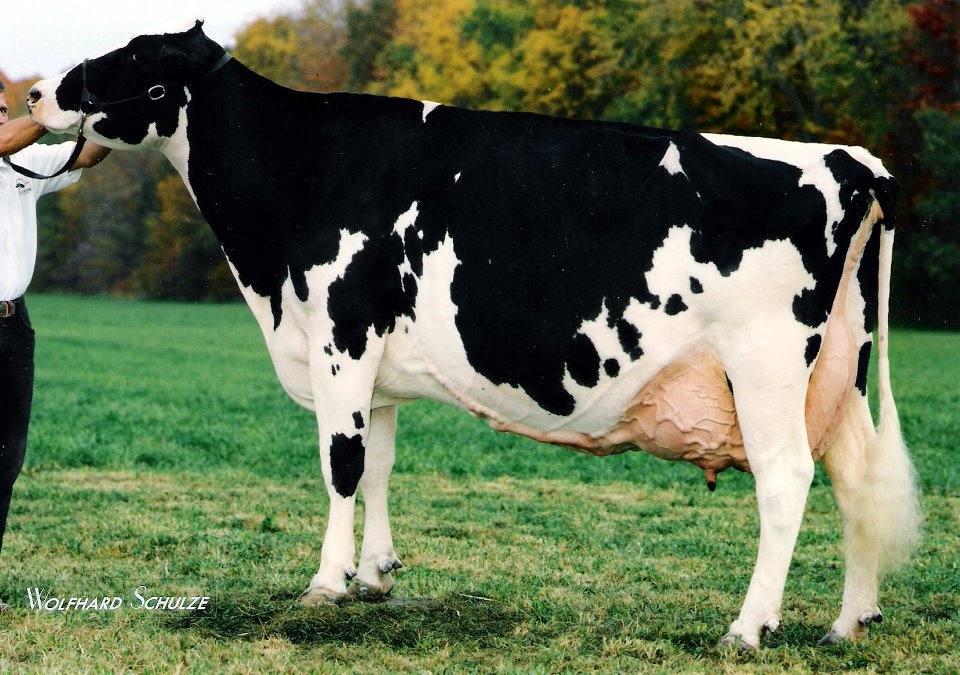
Stookey Elm Park Blackrose EX — the $5,400 Blackstar daughter born from a bankrupt semen tank, whose massive frame, textbook udder, and +3.77 PTAT made her the No. 1 type cow in the breed and the foundation behind Talent, Advent‑Red, and the EX‑95 Supreme Champion Lavender Ruby Redrose‑Red.

A Brood Cow Without Equal

By 2004, Blackrose had 30 Excellent sons and daughters. Her sons included Markwell Kite (Skychief), marketed by St. Jacobs and A.B.S., who sired KHW Kite Advent-Red; Indianhead Red-Marker (Stardust), a former No. 1 type sire; Rosedale Reflection (Starbuck) at Foundation Sires; and Rosedale Big Sky (Skychief) at Semex. They were promoted under a line that summed it up: “At a time when our breed most needed an infusion of substance and strength, Blackrose and her sons were there.” 

The culmination of a dynasty: Lavender Ruby Redrose-Red (EX-96). In 2005, she achieved the impossible, becoming the first and only Red & White cow ever named Supreme Champion at World Dairy Expo, proving the enduring magic of the Blackrose line.

The most remarkable branch came through Kinglea Leader, a red-factor son of Ca-Lill Standout Cavalier from a Conductor dam. Leader to Blackrose produced five Excellent daughters, two of whom — Rosedale Lea-Ann and Markwell Leader Rose — founded the family’s strongest branches. Leader Rose produced the Storm son Ladino Park Talent (EX-ST), a rump and udder specialist at Semex Australia who became one of the most popular red-factor sires of his era. And from Lea-Ann, through a Rudolph daughter named Northrose-I Lavender, came Lavender Ruby Redrose-Red (EX-95) — All-Breed Supreme Champion at World Dairy Expo in 2006. 
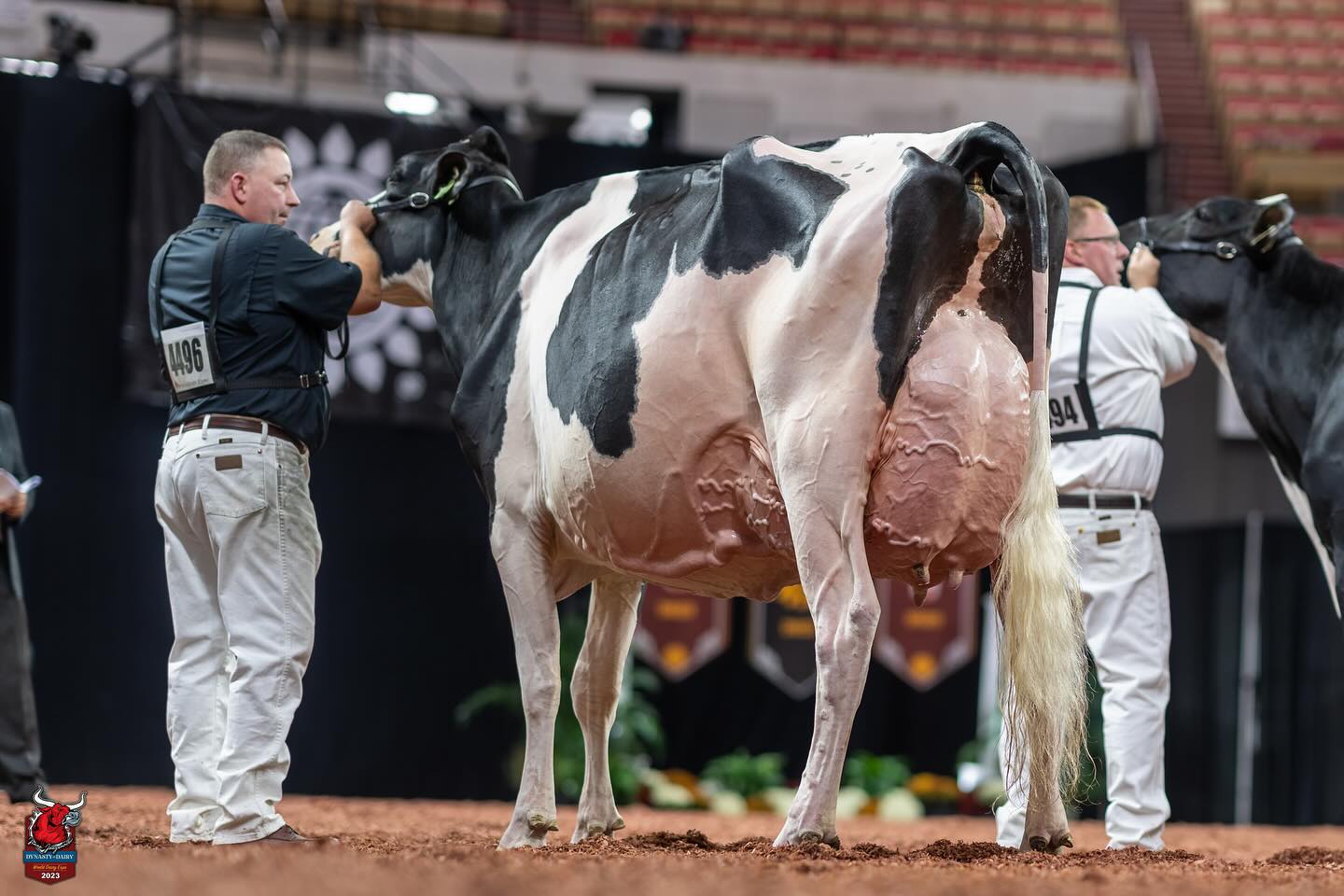
Ladyrose Caught Your Eye EX‑96 — three consecutive World Dairy Expo Senior Champion titles, dam of champions and high‑demand A.I. sires — showing the rear‑udder width, substance, and sheer presence that trace straight back through the Blackrose dynasty born from a $5,400 bankruptcy‑sale heifer and an empty semen tank.

Speckle herself lived to 18, dying at TransOva in 1996. All nine of her daughters owned by Prange were eventually classified as Excellent. Stookey Elm Park Blackrose died at Alta Genetics in 2004, with seven Excellent daughters, 17 Very Good daughters, and offspring registered in Holland, England, Germany, and Japan. 

Jack Stookey never did come back to win those Premier Breeder banners. After leaving the cattle business, he worked as a hospital administrator. His wife, Darla, studied for the ministry at Oral Roberts University and later served as a minister. Jack Stookey died in 2007. But those calves still carry his prefix — and the greatest of them was born because his semen tank ran dry. 

Read more: When Financial Disaster Breeds Genetic Gold: The Blackrose Story That Changed Everything, The Room Went Quiet. Everyone Left. Then an $8,100 Phone Call Changed Holstein History Forever and The Investor Era: How Section 46 Revolutionized Dairy Cattle Breeding

IV. The Supporting Cast: Faith, Kaye, Pala, and the Hiawathas

Roxy, Dellia, and Blackrose were the headliners. But they weren’t the only franchise cows rewriting the Holstein playbook in those years. A handful of others — less celebrated, perhaps, but no less consequential — were building their own dynasties in their own quiet corners of the dairy world.

The Cow Charlie Plushanski Wouldn’t Sell
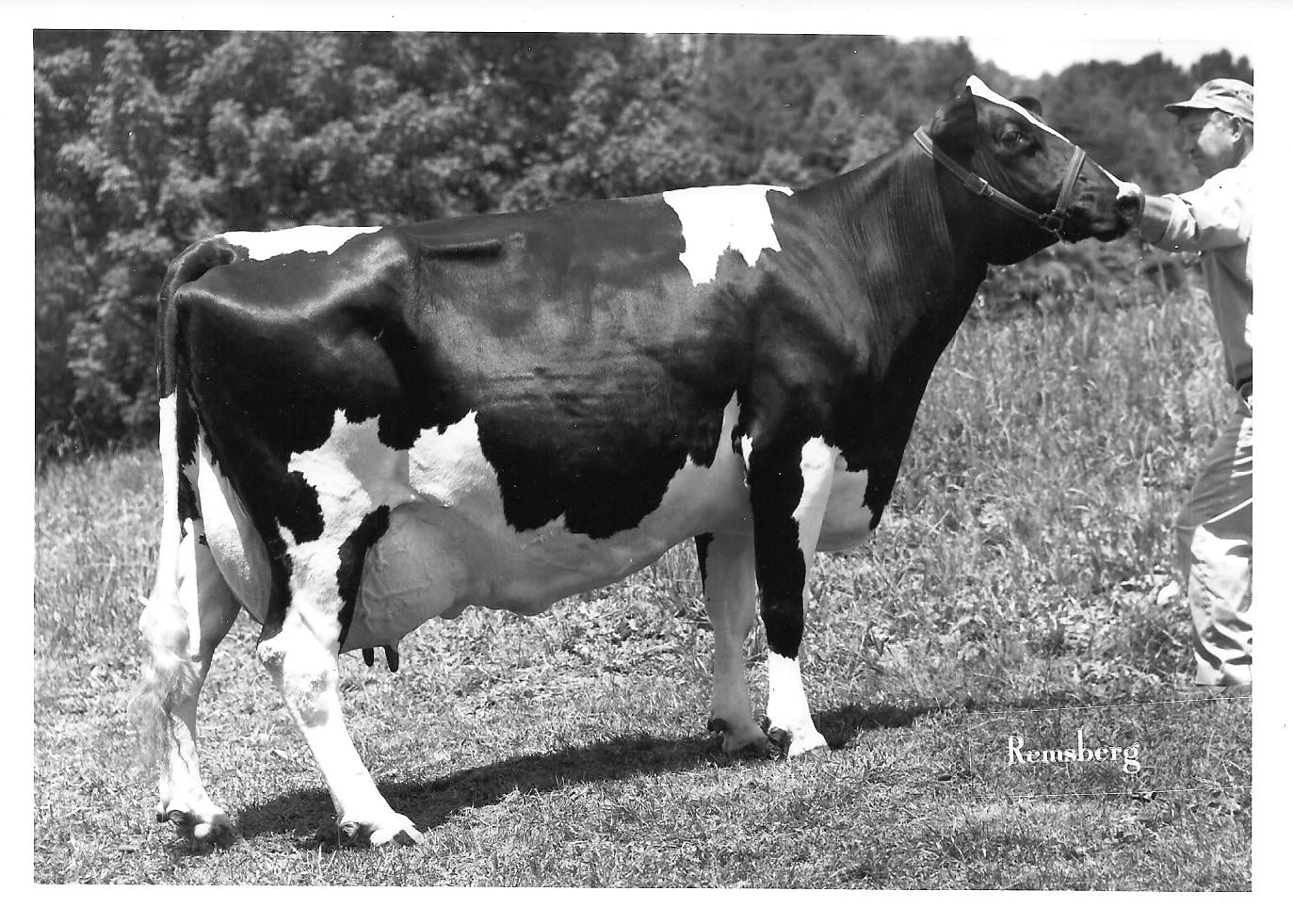
Plushanski Chief Faith EX‑94‑4E — the deep‑bodied, wide‑fronted brood cow Charlie Plushanski refused to sell in 1973, built on heavy‑duty production sires and an udder that defied Chief’s reputation, and whose four main branches would later dominate Locator Lists, fuel Japanese bull sales, and put cows like Quality B C Frantisco in the centre of the Royal ring.

Charlie Backus tried to get her consigned to the National Convention Sale. Pete Heffering, assembling the first cows for Hanover Hill, tried to buy her outright. Neither man could get it done. 

When it came to Plushanski Chief Faith, Charlie Plushanski wouldn’t budge. It wasn’t about money. It went deeper.

Plushanski had come home from World War II — where he’d been a Marine Corps boxer who once had a ringside match stopped by none other than Jack Dempsey, who put on the gloves himself and knocked out the winner — and settled on a farm in Berks County, Pennsylvania, at a place called Kutztown. In the fall of 1965, his brother Henry, who worked for what would become Sire Power, told him about a dozen Kingpin daughters on Allen Yoder’s farm in Selinsgrove. Charlie bought the lot. One of them — Ady Whirlhill Frona, exactly one year old that day — became Faith’s dam. 

Faith, born in November 1968, scored EX-94 with a 4E rating and piled up lifetime totals of 242,863 pounds of milk and 11,353 pounds of fat. Her early adulthood came just ahead of widespread ET use, so her first calves were natural — and that was fitting, because the Plushanski philosophy was never about show ring flash. The sires they used were heavy-duty production bulls. None of them would ever be accused of siring a show ring champion. They fathered solid type — dairy character, deep barrels, functional legs, and mammary systems — but they weren’t bulls who’d ever threaten to win Premier Sire at Madison. 

The four main branches — through Astronaut Frolic (EX-DOM), Valiant Fran (EX-35*), Nugget Fobes (VG-88-GMD), and Job Fancy (VG-87-GMD) — spread across North America. When Plushanski sold Valiant Fran to Paul Ekstein of Quality Holsteins in Woodbridge, Ontario, it was to acquaint Canadians with what this family could do. Fran’s 35 Star Brood Cow points made her the highest-numbered Canadian brood cow, and her descendant Quality B C Frantisco was twice grand champion at the Royal Winter Fair, five times All-Canadian, and International Cow of the Year in 2005. 
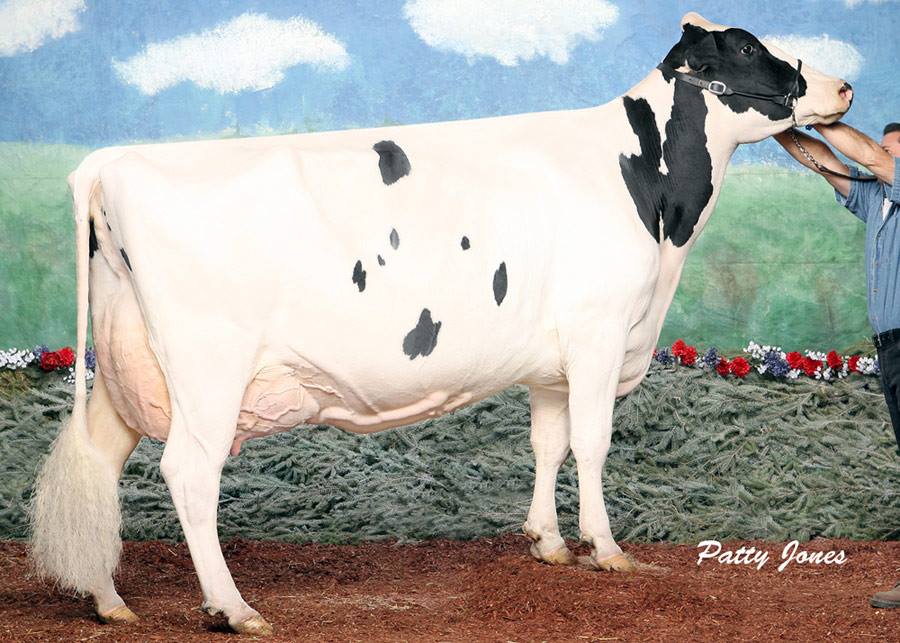
Quality B C Frantisco‑ET EX‑96‑3E 18* — the twice Royal Winter Fair grand champion and 2005 International Cow of the Year — carrying Plushanski Valiant Fran’s blood and proving just how far Plushanski Chief Faith’s family could climb when given a bigger stage.

By 1996, four of the top 20 animals on the national Locator List were from the Chief Faith family. When Charles Plushanski died in 1991, his obituary noted that more Plushanski-bred bulls had gone to Japan between 1985 and 1991 than from any other herd. 

Read more: One Farmer’s ‘No’ Built a Dynasty: How Plushanski Chief Faith’s Genetics Add $1,500 to Your Bottom Line

The Protein Queen from Chambersburg

Fred Rice found the source of his family’s future contentment the old-fashioned way: he offered to do chores for an ailing neighbor. 

Jay Knepper, down the road, called his place Terracelane. While Knepper recovered from surgery, Fred milked his cows. The first day, he noticed something. One bunch of cows, about five head, seemed to milk way better than the others. Milked their heads off, in fact. Fred checked them out. They were all related. 

When Knepper later sold off his heifers, Fred and his brother Dale bought one: Terracelane Ideal Star. She scored 76 points as a two-year-old — nothing to write home about — but climbed to VG-88 at eight and piled up 207,000 pounds of milk lifetime. She was creating a family. 

Several generations later, through Ricecrest Elevation Ella and Ricecrest Ned Boy Noreen, came Ricecrest Southwind Kaye — and the protein floodgates opened. Three dozen Kaye sons entered A.I. service. In September 1999, three of them — Ricecrest Lantz, Ricecrest Brett, and Ricecrest Marshall — all placed on the Top 100 TPI list simultaneously, with Lantz at number one. No other Holstein cow had ever accomplished that. 
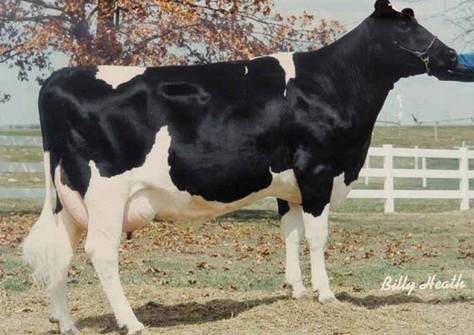
Ricecrest Southwind Kaye EX‑90 — the modest‑looking brood cow who quietly rewrote the TPI lists, dam of three Top 100 TPI sons that all hit No. 1 and the protein powerhouse behind the Ricecrest phenomenon.

Holstein International dubbed it “The Ricecrest Phenomenon.” The herd had placed 10 bulls on the TPI list. Detractors pointed to the family’s modest type scores. Elite sale selectors often walked right past them. “Just good milk bulls, that’s all,” said several anonymous insiders. But through Kaye’s full sister Ricecrest Southwind Amy’s descendants, and through Ricecrest Bwood Brianne at the Bauer brothers’ Sandy-Valley herd, came Sandy-Valley Bolton (EX-GM) — the Luke Hershel son who ranked No. 1 on TPI lists in 2006 and 2007, standing alongside Shottle and Goldwyn as one of the defining bulls of the 2000s. 

Next time someone tells you type doesn’t matter, ask them who Bolton’s great-granddam was.

Kaye’s critics don’t have much to say about Bolton.

Read more: When Good Neighbors Make Great Genetics: The Ricecrest Southwind Kaye’s Genetic Revolution

Pala: 21 Generations Deep

Jim and Nina Burdette started dairy farming in 1974 on a rented farm with 19 Ayrshires and four Holsteins. They bought cows other men didn’t want — animals with minor defects, maybe slow milking — as long as they had compensating features: strong frames, broad rumps, chest width. Burdette’s quick fix for subpar udders was Round Oak Rag Apple Elevation. On this type of animal, Elevation worked particularly well. 

When Quality Ultimate’s daughters swept the four-year-old class at World Dairy Expo in 1983, Burdette rushed home and used Ultimate on two of his cows. One was Windy-Knoll-View Creek Pauline (VG-88). On March 14, 1985, she produced Windy-Knoll-View Ultimate Pala. 

It dawned on Burdette how powerful Pala was when she produced Melvin twins, one of whom — Windy-Knoll-View Priss-Twin — was All-American summer yearling of 1990 and later scored EX-93. At the 1991 Pennsylvania Spring Show at Harrisburg, Pala accomplished something that had never been done before: she furnished four class-winning daughters by four different bulls. The five females — Pala and her daughters — won the produce of dam, dam-daughter, and best three females classes. 
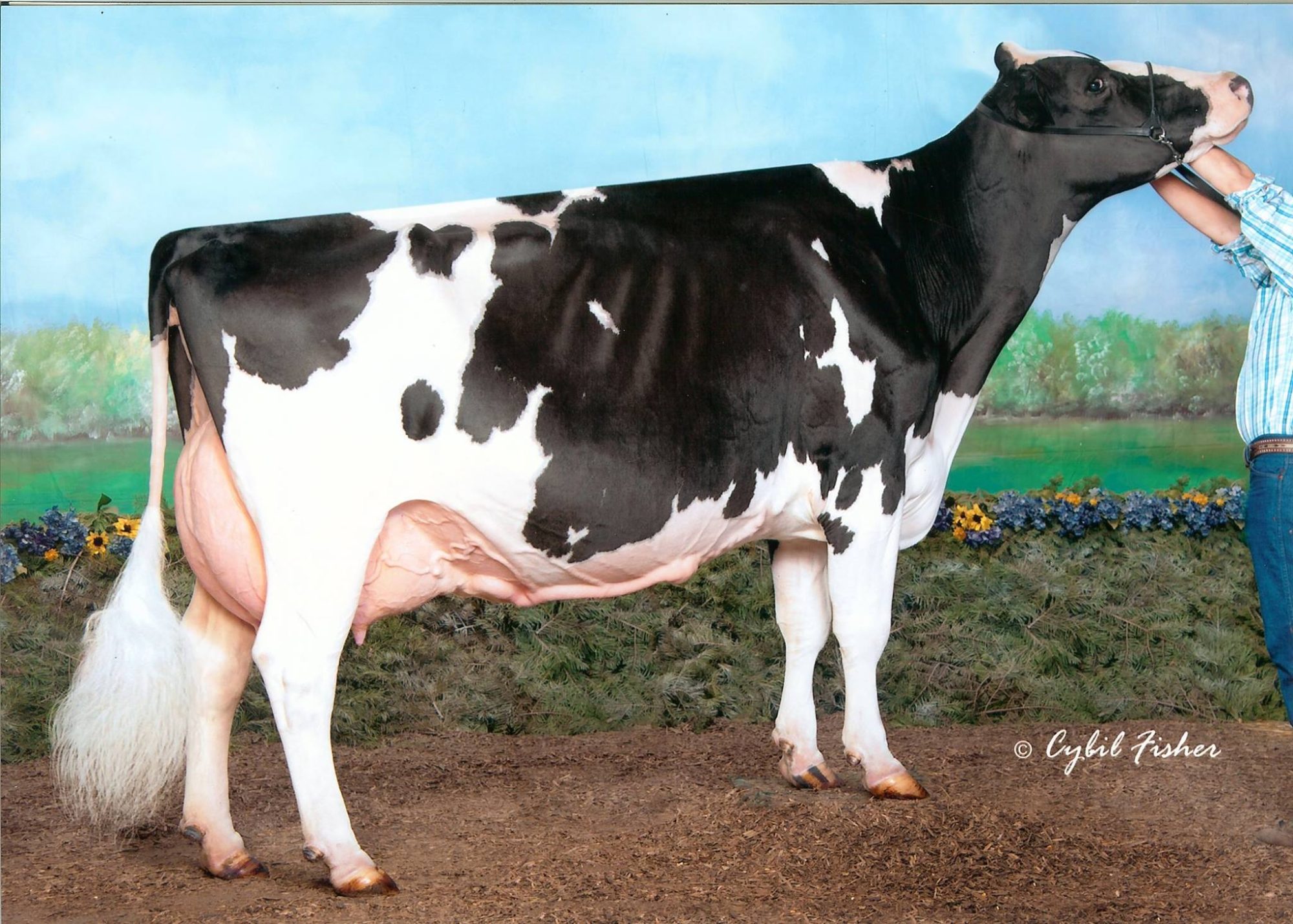
Three generations in one frame: Windy‑Knoll‑View Pledge‑ET EX‑95‑3E leads the way, followed by her dam Windy‑Knoll‑View Promis‑ET and the matriarch herself, Windy‑Knoll‑View Ultimate Pala EX‑94‑3E‑DOM — the cow who furnished four class winners by four different sires at Harrisburg and whose maternal line stretches 21 generations back to an 1884 Dutch import.

Over time, Pala produced 18 Excellent offspring and 33 Very Good. By 2007, she was dam, granddam, or great-granddam of 23 All-American or Junior All-American nominations. But the A.I. industry, deep in an index binge, wanted nothing to do with her sons because of Quality Ultimate so close in the pedigree. 

It took Jim Burdette’s friend Jeff Resner and a marketing pitch called “My Three Grandsons” — brought to Dick Witter at Taurus Service in Mehoopany, Pennsylvania — to break through. Witter, who’d known the Burdettes for years and shared their conviction that the industry put too much emphasis on production indexes, liked the idea. Popular, Promote, and Powerhouse — all Outside grandsons — entered the Taurus lineup. 

“The sire analysts focus on the sire stack,” Witter said, “which resulted in the overlooking of the Palas because of the presence of Quality Ultimate. At Taurus Service, we have always selected from a complementary mating sire standpoint and put extra weight on the maternal side of the pedigree.” 

Pala’s maternal line goes back 21 generations to Xanthe 8793 H.H.B., imported from Holland in 1884. Sometimes the long view is the only view that matters. 

The Hiawathas: A Half-Million-Dollar Heifer and the Kitchen-Table Breeder Who Made Her Possible

The Hiawatha family didn’t begin in the investor-era frenzy that made it famous. It began at a kitchen table in Hoosick Falls, New York, where Sherman Herrington sat with Bill Weeks, the developer of the aAa system, and hammered out a breeding philosophy. Herrington liked Weeks’ way of thinking, but he pushed it further. “I focused on longevity,” he explained. “In my view, a cow was at her best when she was 10 years of age.” 

From Herrington’s Sher-Mar Farm came Sher-Mar Lee Mitzi (EX), top Honor List cow for 1979, and her daughter by the Marquis son Puget-Sound Highmark: Sher-Mar Highmark Hiawatha (EX-94-2E), the cow who gave the family its name. In 1981, Hiawatha claimed second position on the Honor List by producing 34,970 pounds of milk, 5.0% fat, and 1,763 pounds of fat as a six-year-old. The June 25, 1980, Holstein World even put a four-generation Hiawatha group on its cover — “these cows had everything,” one observer wrote, “production and pulchritude, both.” 
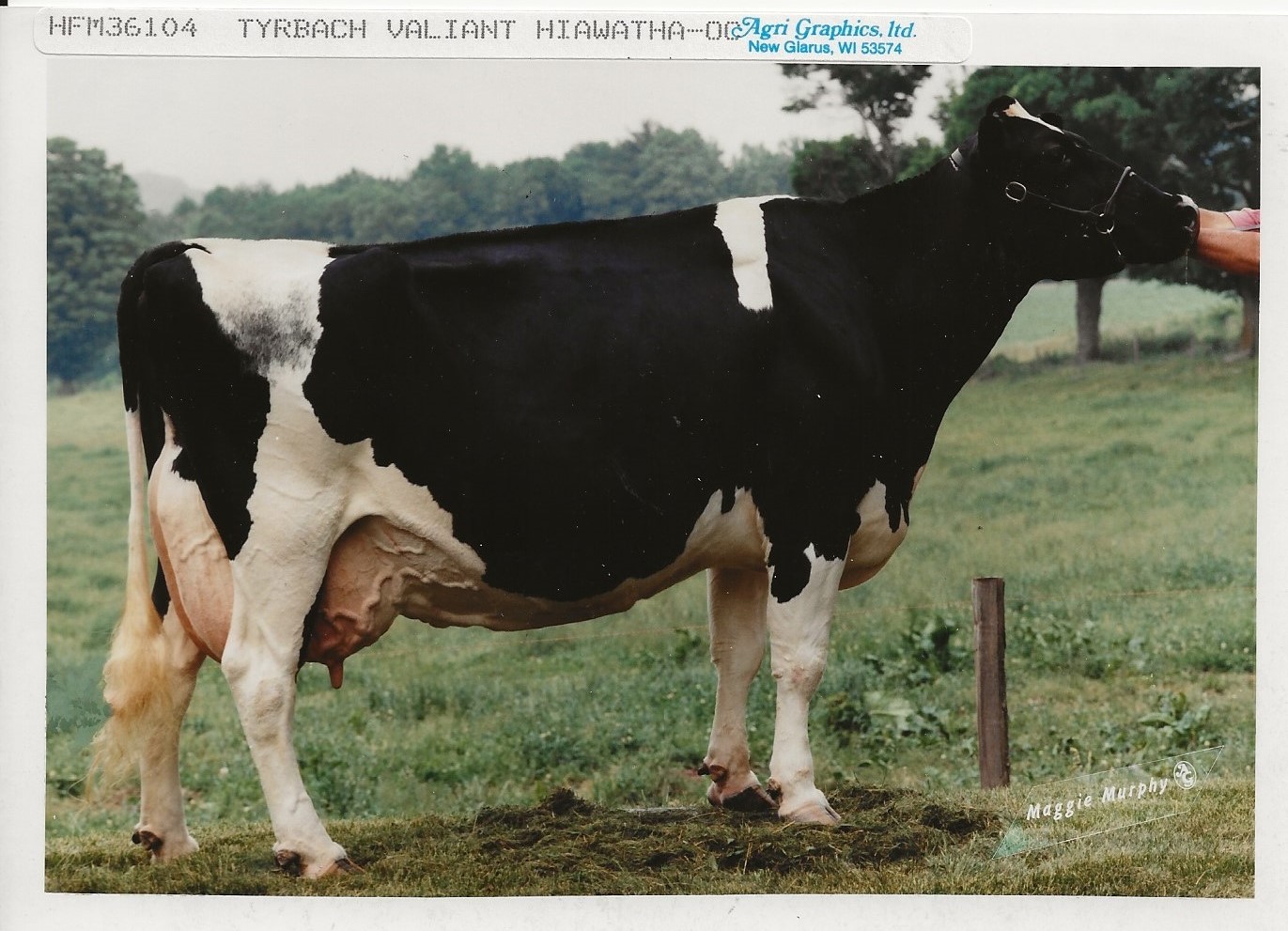
Tyrbach Valiant Hiawatha EX‑94‑DOM — a powerful S‑W‑D Valiant daughter from Dreamstreet Rorae Hesper and Sher‑Mar Highmark Hiawatha, carrying the Sher‑Mar Hiawatha family from Sherman Herrington’s kitchen‑table breeding program into the big‑money investor era without losing the frame, udders, and longevity that made the line famous.

That was when George Morgan of Dreamstreet Holsteins in Walton, New York, stepped in. When news broke that Morgan was buying into the Hiawathas, people were strangely relieved. “This is good for the industry!” they said. “They’re bringing together some great cattle!” — the same people who, not long before, had muttered darkly about the whole investor craze. 

Later in 1981, Dreamstreet sold Sher-Mar Highmark Hiawatha privately to Mansion-Valley Farm in South Kortright, New York, for $280,000, where Dave Rama was manager. At Mansion-Valley, Hiawatha produced Mansion-Valley Niagara, a daughter of Ocean-View Sexation born in September 1982. Niagara went through the Designer Fashion Sale of 1983 at the exact same $280,000 price her mother had brought. Hilltop-Hanover Farms, Yorktown Heights, New York, signed the cheque. At 95 points, Niagara became the highest-classified Sexation daughter in the breed and, later in life, completed an eleven-year-old record of 48,910 pounds of 4.0%, 3.0% milk — the highest record for age in North Carolina history under her then-owner Edgar Miller of Winston-Salem. 

Back at Sher-Mar, Hiawatha had left more than one mark. She birthed six Excellent daughters, among them Mansion-Valley Precious (EX-94) by Mars Tony. Precious, in turn, was dam of the Blackstar daughter Clover-Mist Black Peach (EX-92), who left Excellent daughters in Ireland and the Netherlands. But it was Precious’s Elevation daughter, Dreamstreet Rorae Pocohontis (EX-93), who lit the biggest fire. 

Pocohontis first went through the Designer Fashion Sale in 1981, selling at ten months of age for $225,000 to the Pocohontis Syndicate of Turner, Maine. Two years later, in the 1983 Designer Fashion Sale, she came back as a milking two-year-old and hammered down for $530,000. The buyer was William Ogden, a banker from Stamford, Connecticut. At the time, that price put her in the same rarefied air as the highest-valued cattle in Holstein history. 

Ogden boarded Pocohontis at Golden Oaks Farm in Wauconda, Illinois. Golden Oaks’ owner, John Crown, was so impressed by the cow that he wanted a piece of the action himself. Rather than trying to buy her outright, he concentrated on her daughters. He bought Sexation and Valiant daughters from Pocohontis, and each one he took home eventually made an Excellent daughter for him. 

One of those branches ran straight into Japan. Ogden Hanover Sexy Prudence (EX), a Sexation daughter from Pocohontis, was sold young to Japanese buyers. Before she left, though, Sexy Prudence dropped a Chief Mark daughter: Golden-Oaks Mark Prudence. As her dam was being exported, Prudence stood in the Golden Oaks heifer pen looking every inch the brood cow. They decided to flush Sexy Prudence to Chief Mark one more time. The flush resulted in four full sisters, among them Golden-Oaks Mark Marion (EX-92) and Golden-Oaks Mark Merle (EX), both of whom found their way to Don Mayer’s Mayerlane Farm in Bloomer, Wisconsin, while another sister went to California and became the dam of four Excellent Prelude daughters. 

Mayer later bought Golden-Oaks Mark Prudence herself in the Golden Oaks Top 10 Sale. She’d already been flushed to Prelude and had left two daughters: Golden-Oaks Prelude Pru (EX), who went to Rolling Lawns Farms in Illinois, and Golden-Oaks Prelude Pie (EX), who stayed at Mayerlane. Then, under Mayer’s ownership, Mark Prudence set the world’s highest 3X milk record in December 1996: 62,981 pounds of milk in 365 days — just shy of the 2X record but a world record for three-times-a-day milking. 
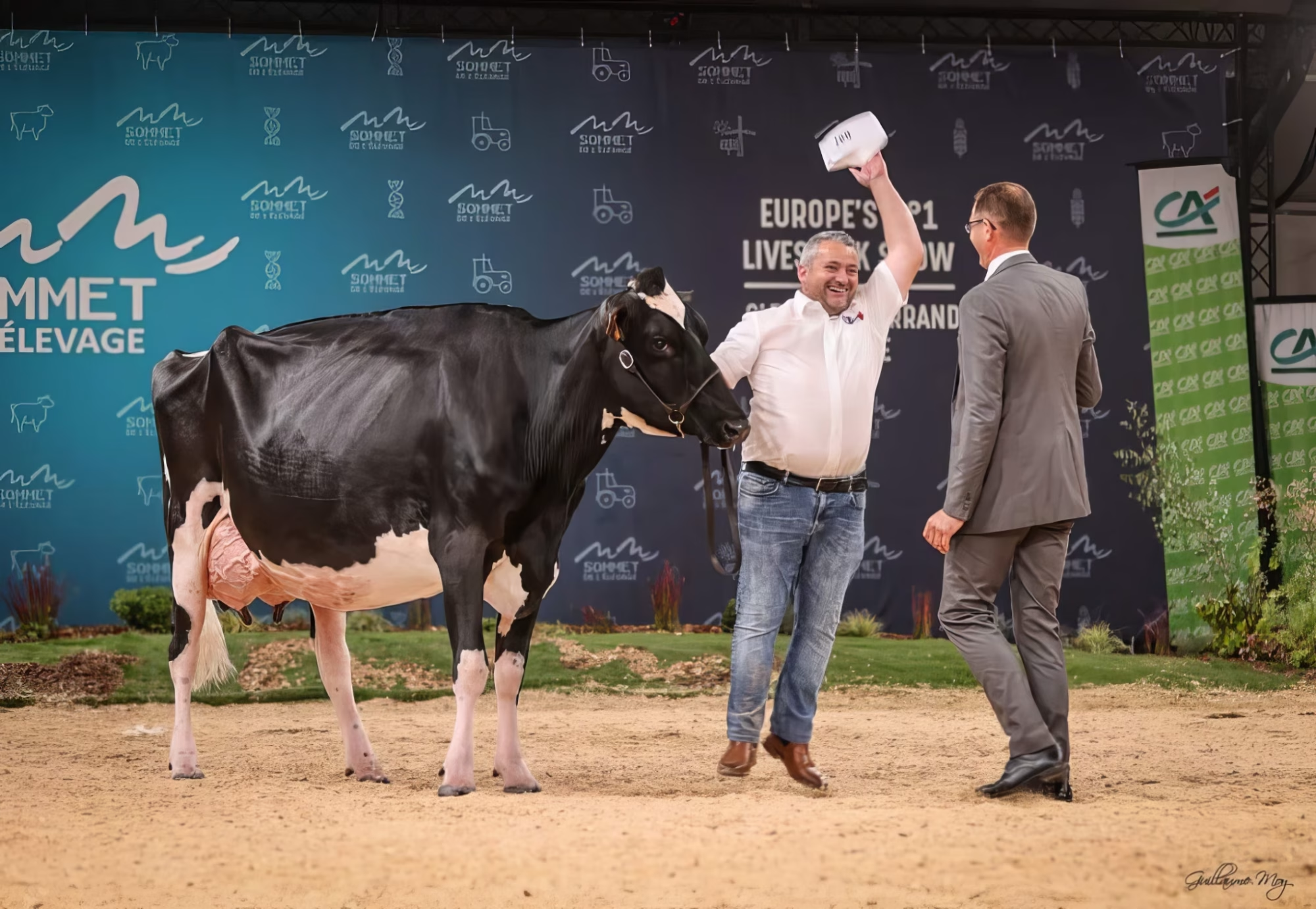
Ms Crushable Carolina, Reserve Intermediate Champion at World Dairy Expo 2022, carrying a stacked Golden-Oaks Rae family pedigree (Crushabull × Golden-Oaks By Charlotte EX‑90 × Golden-Oaks MCC Charlina EX‑90 × Golden-Oaks ATWD Charla EX‑93 × Golden-Oaks Champ Rae EX‑93) that proves the Roxy–Rae maternal line is still writing banners in the modern show ring.

By the late 2000s, Don Mayer was working with members of several famous maternal lines — Roxy, Dellia’s tribe, and the Hiawathas, among them. Asked to compare them, he didn’t hesitate. “We work with cows from several top families,” he said, “but the Hiawatha family is my absolute favorite. They have a lot in common with the Roxys, and we have a few of those in production here. Both families consistently produce cows with lots of frame and lots of milk.” 

It was a neat kind of symmetry: a kitchen-table breeder obsessed with ten-year-old cows, an investor-era banker willing to write a half-million-dollar cheque, a Midwestern dairyman pushing cows to world records — all of them orbiting a family that, like Roxy’s, turned frame and longevity into a global brand.

V. The Long Shadow

What ties all these cows together isn’t just Excellent scores or Gold Medal dams or A.I. contracts worth hundreds of thousands of dollars — though there’s plenty of all that. Here’s the thing nobody wants to say out loud: the conviction, held by a handful of breeders against the prevailing wisdom of their eras, that the maternal line matters.

Bob Snow spent 35 years building toward Dellia — alternating strength sires with dairy sires, generation after generation, never rushing. Bob Miller searched for years before he found a cow family that met his requirements for type, production, and longevity. The Plushanskis used heavy-duty production bulls that would never win a show, but built a family that dominated TPI lists and shipped bulls to Japan. Fred Rice noticed five head that milked their heads off in a neighbor’s barn and had the sense to buy their relative. Jim and Nina Burdette bought cows that other men didn’t want and saw past Quality Ultimate when the rest of the industry couldn’t. Sherman Herrington bred ten-year-old cows while the world chased short-term numbers. 

These weren’t accidents. These were philosophies, held with patience and executed over decades.

The Bottom Line

Today, you can’t pick up a sale catalogue without finding a Roxy descendant tracing back to her in the direct maternal line. You can’t look at a TPI list without seeing Dellia’s influence through Durham and Dundee and their sons. Blackrose’s type credentials echo in every Talent or Advent-Red daughter walking into a show ring. Bolton — Kaye’s great-grandson — helped define what a modern sire proof looks like. In Pennsylvania, Pala’s grandsons and great-grandsons are still siring the kind of udders that make a dairyman stop and stare in the milking parlor. And scattered from Illinois to Japan, the Hiawatha daughters and granddaughters carry forward that big-frame, big-milk profile that made them investor darlings in the first place. 

Bob Miller took one photograph that afternoon at Mil-R-Mor. One shot, one cow, one moment caught in silver gelatin. But the cows in this story — Roxy, Dellia, Blackrose, Faith, Kaye, Pala, the Hiawathas — they weren’t one-shot wonders. They were the biological engines of a breed, the franchise mothers whose influence would outlast every index revision, every genomic recalculation, every shift in breeding fashion. 

They go along doing their business. And the breed is better for it. 

So the next time a sire analyst tells you a cow family doesn’t matter because the genomic index says otherwise, ask them one question: where do they think those indexes came from?”

KEY TAKEAWAYS

  • The maternal line is the most overlooked profit center in your herd. Every franchise cow here was built by breeders who invested decades in dam lines while the industry chased sire stacks. Roxy’s family is still producing Excellents 40 years after her death. Your current genomic rankings won’t be.
  • The best brood cows don’t announce themselves. Terracelane Ideal Star scored GP-76 as a two-year-old. Blackrose cost $5,400 from a bankruptcy sale. Bolton’s great-granddam was a cow elite sale selectors walked right past. Look harder at what’s already in your barn.
  • Bob Snow bred strength-dairy-strength-dairy for 35 years. The result was Dellia. One cow. Three Gold Medal A.I. sons. Seventy-six registered daughters. A family that, according to Select Sires’ Scott Culbertson, “sent more dollars back into farmers’ pockets across the world than any other cow.”
  • The type-vs.-production debate was settled by the cows themselves. Roxy: 97 points, 209,784 lbs lifetime milk. Dellia: EX-95, three Gold Medal sons. Kaye: modest type, three sons on Top 100 TPI at once. The answer was never either/or — it was knowing what your cow family does best and breeding to it.
  • When the hot sire of 2024 is forgotten by 2027, the brood cow who throws Excellents regardless of the bull she’s mated to is the one asset that holds its value. These seven families prove it. Cow families aren’t nostalgia. They’re the genetic insurance policy genomics can’t replace.

Continue the Story

  • The 10 Greatest North American Holstein Breeders of All Time – While Miller and Snow were carving out legacies with Roxy and Dellia, these masters were operating in that same high-stakes world. Discover the other visionaries who defined the golden age of pedigree breeding alongside them.
  • The 10 Most Influential Holstein Sires of All-Time – These franchise mothers didn’t work in a vacuum; they were mated to the giants. Deepen your understanding of the sire side of the era, exploring the genetic forces like Elevation and Starbuck that shaped these dynasties.
  • Snow-N Denises Dellia – The Empress of the Breed – Follow the thread from a single barn-meeting semen prize to the global dominance of Durham and Dundee. This feature traces how one cow’s influence carried forward to build the very foundation modern Holstein breeders stand upon today.

The Sunday Read Dairy Professionals Don’t Skip.
Every week, thousands of producers, breeders, and industry insiders open Bullvine Weekly for genetics insights, market shifts, and profit strategies they won’t find anywhere else. One email. Five minutes. Smarter decisions all week.
NewsSubscribe
First
Last
Consent

Snow-N Denises Dellia: The Holstein Legend Who Redefined Dairy Genetics

Meet Snow-N Denises Dellia, the Holstein that revolutionized dairy genetics. Born in 1986, this Wisconsin wonder cow shattered breeding norms, producing sons that became industry titans and daughters that conquered show rings worldwide. Discover how one remarkable bovine’s legacy still shapes your milk nearly four decades later.

It’s a crisp December morning in 1986, and on a small Wisconsin farm, a Holstein calf takes her first wobbly steps. The farmer, Bob Snow, has no idea he’s just witnessed the birth of a legend. This calf—Snow-N Denises Dellia—is about to rewrite the rules of dairy genetics and leave an indelible mark on the industry for generations to come.

Fast forward to today. Walk into any top-tier dairy farm, flip through AI catalogs, or chat with breeders at elite cattle auctions, and you’ll hear whispers of “Dellia blood.” But how did a single cow from Monroe County become the matriarch of modern Holsteins?

Buckle up, dairy enthusiasts. We’re about to dive into a tale of strategic breeding, record-breaking sons, globe-trotting embryos, and a genetic cocktail so potent it’s still shaping udders and milk checks nearly four decades later. This isn’t just Dellia’s story—it’s how one remarkable cow challenged everything we thought we knew about balancing type and production.

So, grab a glass of milk (preferably from a Delia descendant), and let’s unravel the DNA of a bovine superstar. Trust us, by the end of this, you’ll never look at your herd the same way again.

The Robert Snow farm at Sparta, Wisconsin
Robert Snow’s farm in Sparta, Wisconsin, where a passion for dairy farming and genetics led to the creation of legendary Holsteins like Snow-N Denises Dellia. This humble setting was the backdrop for a breeding program that would change the face of dairy genetics forever.

The Making of a Legend: When Bob Snow Played Genetic Roulette

Bob Snow: The Bachelor with a Bovine Obsession

A Wisconsin bachelor named Bob Snow, whose idea of a hot date was poring over Holstein pedigrees. It sounds like a real party animal, right? But trust me, this guy’s obsession with cow genetics was about to change the dairy game forever.

Now, Bob wasn’t born with a silver milk pail in his mouth. He inherited a run-of-the-mill grade herd from his old man. But he got bit by the registered Holstein bug somewhere along the line. Hard. We’re talking fever-dream levels of Holstein mania here.

The 1970s: When Snow Went Pro

So, the ’70s roll around. While everyone else is doing the Hustle, Bob hustles to turn his “Snow-N” prefix into dairy royalty. His mission? Blend strength, udder quality, and milk yield into the perfect cow cocktail. Sounds simple. It’s about as simple as teaching a cow to tap dance.

But here’s where it gets interesting. In 1970, Bob crashes a herd dispersal sale in Rice Lake, Wisconsin. Now, most folks would be there for the free coffee and donuts. Not our Bob. He’s there with his eye on the prize.

VERADELDA POLLY GOVERNOR (EX-SMP) 1234023
Son of Rainbow Captain Bold 12th with a P.D.M. of +1425 in 1962.
Creator Fobes Governor, his son, sired the seventh and eighth dams in
Dellia’s maternal line.
Veradelda Polly Governor (EX-SMP) 1234023, son of Rainbow Captain Bold 12th, was a genetic powerhouse with a P.D.M. of +1425 in 1962. As the sire of Creator Fobes Governor, he played a pivotal role in shaping the seventh and eighth dams in Dellia’s maternal line, proving that greatness often starts generations back.

The Auction That Changed Everything

Picture the scene: Dust in the air, the rapid-fire chatter of the auctioneer, and Bob Snow cool as a cucumber in a dairy case. He spots two cows that most people wouldn’t look at twice: Ce-Buerg Creator Hartog Fobes and her daughter, Ce-Buerg Creator Fobes Garnet.

“Hold up,” you might be thinking. “Those names sound about as exciting as watching paint dry.” And you’d be right. These gals were sired by some obscure bull called Creator Fobes Governor. It’s not exactly a name that rolls off the tongue.

But Bob? He saw potential. He saw the sixth and seventh dams of a future legend. He saw… well, honestly, who knows what he saw. Maybe he just liked their spots. But whatever it was, he bought ’em.

The Snow-N Strategy: Go Big or Go Home

Here’s where Bob drops a truth bomb that’ll make you spit out your milk. He says, and I quote, “I wasn’t interested in the middle or the bottom. If I went to the sale, I would buy off the top.”

Hold onto your udders, folks. This guy wasn’t messing around. He wasn’t there for the bargain bin bovines. He wanted the cream of the crop, the top of the herd, the… okay, I’ll stop milking these puns now.

The Genetic Cocktail: Shaken, Not Stirred

So what did Bob’s crazy auction adventure get him? It’s a genetic cocktail that would make James Bond jealous. On one side, you’ve got strength courtesy of MD-Sunset-View R A Wonder. On the other hand, Dairy Elegance is available via Carlin-M Ivanhoe Bell.

MD-SUNSET-VIEW R A WONDER (EX-GM) 1674582
The Elevation son of an Ashawaug Admiral of Hillside dam. Bred by
Ardel and James Stonesifer, Westminster, Maryland and proven at Tri-
State. Sire of Dellia’s second dam.
MD-SUNSET-VIEW R A WONDER (EX-GM): A true legend in Holstein genetics, this Elevation son out of an Ashawaug Admiral of Hillside dam laid the foundation for greatness. Bred by Ardel and James Stonesifer of Westminster, Maryland, Wonder sired Dellia’s second dam, cementing his role as a cornerstone in the lineage of one of history’s most influential cows.

Bob was playing genetic Jenga, stacking traits and hoping it wouldn’t all come crashing down. Spoiler alert: It didn’t. This madcap mixture was about to create a cow so legendary that she’d make other Holsteins look like they were still in calf school.

SNOW-N DORYS DENISE (EX: 2E-90-GMD-DOM) 11768236
5-09 365 2X 33,350 3.8% 1,256 3.1% 1,038
Dam of Snow-N Denises Dellia (EX) by Carlin-M Ivanhoe Bell (EX-
GM).
Snow-N Dorys Denise (EX-90 2E GMD DOM), the powerhouse dam of Snow-N Denises Dellia, set the stage for a dynasty. With an impressive record of 33,350 lbs. of milk in 365 days, she combined production, strength, and genetic excellence to become a cornerstone of modern Holstein breeding. Her legacy lives on through her legendary daughter and countless descendants shaping herds worldwide.

The Million-Dollar Question

Now, I know what you’re thinking. “This is all good, but how does this lead to Dellia?” Well, my friend, that’s a tale for another paragraph. But let me tell you, if Bob Snow’s Breeding Strategy were a Netflix series, this would be the cliffhanger ending of season one.

So, are you ready to dive into the next chapter of this moo-ving saga? Because trust me, things are about to get even more enjoyable. And by interesting, I mean we’re talking about a cow that’s about to flip the dairy world upside down. Buckle up, buttercup—this ride’s just getting started!

Meet Snow-N Denises Dellia, the legendary Holstein matriarch, sired by Walkway Chief Mark and out of Snow-N Dorys Denise, with maternal grand sire Carlin-M Ivanhoe Bell. This EX-95 cow revolutionized dairy genetics with her exceptional balance of production and type, leaving an indelible mark on the industry. Her legacy continues to shape modern Holsteins worldwide
Snow-N Denises Dellia, the legendary Holstein matriarch, sired by Walkway Chief Mark and out of Snow-N Dorys Denise, with maternal grand sire Carlin-M Ivanhoe Bell. This EX-95 cow revolutionized dairy genetics with her exceptional balance of production and type, leaving an indelible mark on the industry. Her legacy continues to shape modern Holsteins worldwide

The Golden Cross: When Chief Mark Met Bell (and Magic Happened)

A Match Made in Holstein Heaven

Alright, folks, buckle up your overalls because we’re about to dive into some serious bovine romance. Do you know how people talk about power couples? Well, in the dairy world, we’ve got power pairings, and boy, oh boy, did we hit the genetic jackpot with this one.

Meet the Parents: A Tale of Two Traits

On one side of this love story, we’ve got Walkway Chief Mark. Now, Chief Mark wasn’t just any old bull. He was the Michelangelo of udders, a true specialist in the art of mammary magnificence. With a VG-87 score, he was the kind of sire that made other bulls say, “Dang, I wish I could hang udders like that guy.”

But every great rom-com needs two leads. Enter Snow-N Dorys Denise, our leading lady. This gal was packing some serious Bell family genes. We’re talking about the perfect balance of fame and fertility. She was like the Swiss Army knife of cows—versatile, reliable, and scoring an impressive EX-90 2E GMD DOM. (Don’t worry if that sounds like alphabet soup to you. Just know it’s the cow equivalent of a straight-A report card.)

The “Golden Cross”: More Than Just a Fancy Name

When these two genetic powerhouses got together, something magical happened. The dairy world’s matchmakers dubbed it the “golden cross.” And let me tell you, this wasn’t just some marketing gimmick. This pairing was like peanut butter meeting jelly for the first time—a perfect combination that makes you wonder how we ever lived without it.

Breaking the Mold (and a Few Industry Norms)

Here’s where things get interesting. Back then, farmers often had to choose: Did they want great milk producers or cows that looked good enough to grace the cover of “Holstein Monthly”? It was like trying to find a supermodel who could also deadlift 300 pounds—not impossible, but pretty rare.

But Dellia? She said, “Hold my milk pail,” and proceeded to shatter expectations faster than a bull in a china shop. She was the total package, defying the era’s trade-offs between production and type. It’s like she read the “How to Be a Perfect Cow” manual and decided to check every single box.

X Marks the Spot (Chromosomally Speaking)

Now, let’s get a bit sciency for a second. Tim Abbott puts it this way: “Dellia shattered the maternal-paternal dichotomy.” In plain English? She got the best of both worlds.

Her X chromosomes were like a genetic all-you-can-eat buffet. From Chief Mark, she inherited udder quality that would make any dairy farmer weep with joy. And from the Bell side? Metabolic efficiency that could turn feed into milk like nobody’s business.

This combination was rarer than a cow with a pilot’s license. It’s like Dellia’s DNA looked at the usual genetic rules and said, “Nah, I’m good. I’ll do my own thing.”

One of the breed’s famous heads.
Snow-N Denises Dellia, the legendary Holstein whose iconic head has become synonymous with excellence in dairy genetics. As the matriarch of a dynasty that includes sons like Durham and daughters like DH Gold Chip Darling, Dellia’s influence on modern Holsteins is undeniable. Her legacy continues to shape the breed, making her a strong contender for the title of “Queen of the Breed.”

The Two Million-Dollar Question

So, what happens when you combine udder perfection with metabolic mastery? Well, my friends, that’s where our story kicks into high gear. Dellia wasn’t just a cow; she was a revolution with hooves.

Are you ready to see how this golden girl turned the dairy world upside down? Because trust me, we’re just getting to the good part. Grab your milking stools and hold onto your hats—this ride’s about to get wild!

From Show Ring Sensation to Global Domination: Dellia’s Regancrest Revolution

The Wisconsin Spring Show Showdown

Picture this: It’s 1991, and the Wisconsin Spring Show is hotter than a cow pie in July. The air’s thick with anticipation (and probably a fair bit of manure smell, let’s be honest). Enter our girl Dellia, strutting her stuff like she owns the place. And boy, does she!

Judge Niles Wendorf takes one look at her, and BAM! Grand Champion, baby! He’s gushing about her “tall, sharp frame and trouble-free udder” like he’s describing the Mona Lisa of milk cows. I mean, can you blame the guy? Dellia served looks and utility, a combo rarer than a vegetarian at a barbecue.

Frank Regan: The Man, The Myth, The Madman?

Now, here’s where things get spicy. Enter Frank Regan, an Iowa breeder with more guts than a slaughterhouse. While everyone else is still picking their jaws up off the floor, Frank’s already whipping out his checkbook. He buys Dellia for a sum so hefty that it probably makes other cows jealous.

But hold your horses (or cows, in this case). The dairy world wasn’t exactly rolling out the red carpet for Frank. Bless his heart, Bob Snow spills the tea: “They were upset that a ‘nobody’ could come in and clean up.” Ouch! Talk about a cold glass of milk to the face!

Regancrest Farm: Where Legends Are Born (and Bred)

So, did Frank’s gamble pay off? Does a cow moo? Dellia became the cornerstone of Regancrest Farm faster than you can say, “holy Holstein!” We’re talking:

  • 76 registered daughters (More offspring than a rabbit on espresso!)
  • 44 AI-sampled sons (Spreading the Dellia magic far and wide)
  • Embryos jetting off to Europe, Japan, and Brazil (Talk about international appeal!)

It’s like Dellia looked at Regancrest and said, “Challenge accepted!” She wasn’t just producing calves; she was creating a dynasty!

SNOW-N DELLIAS DARLENE (EX-94-GMD-DOM), a powerhouse Blackstar daughter of the legendary Dellia, showcases her genetic excellence with an impressive record of 32,080 lbs of milk in 365 days. As the dam of Regancrest Jed Deborah (EX-95), she cemented her place as a cornerstone of Holstein breeding and a vital link in the Dellia dynasty. A true icon of production and pedigree!

The Sand Incident: Dellia’s Near-Death Experience

Now, brace yourselves for a plot twist that’ll curdle your milk. After her grand entrance at Regancrest, Dellia spits things up by ingesting sand. Yeah, you heard that right. Sand. If you understand, it’s not strictly part of a balanced bovine breakfast.

Most cows would’ve kicked the bucket after a stunt like that. But Dellia? She bounces back like it’s nothing! She starts pumping out embryos like they’re going out of style—15 per flush on average. That’s not just impressive; that’s downright miraculous!

The Global Dellia Effect

Before you could say “Got Milk?”, Dellia’s genetic material was more sought after than tickets to a rock concert. Breeders from Europe to Japan were lining up, cash in hand, ready to get a piece of the Dellia pie (or should I say, the Dellia cheese?).

Her embryos were sold for prices that would irritate the average dairy farmer. We’re talking premium, top-shelf, crème de la crème stuff here. It was like watching the stock market, but people traded in potential udders and milk production instead of shares.

The Three Million Dollar Question

So, what made Dellia so special? Why were breeders falling over themselves to get their hands on her genetics? Well, my friend, that tale involves more twists and turns than a country road. But let me tell you, it’s a story that’ll make you look at your morning glass of milk in a new light.

Ready to dive deeper into the Dellia dynasty? Buckle up, buttercup—this ride’s about to get even wilder!

The Billionaire Boys Club: Dellia’s Sons Take Over the World

From Momma’s Boy to Dairy Royalty

Alright, folks, grab your wallets because we’re about to talk about some seriously expensive baby-makers. Did you think your kid’s college fund was steep? Ha! That’s chump change compared to what Dellia’s boys are worth. Let’s dive into the crème de la crème of bull-dom, shall we?

Durham: The Five-Time Champ

Sheeknoll Durham Arrow EX-96, the Grand Champion of the 2016 World Dairy Expo, embodies the legacy of her legendary sire, Durham. With her flawless conformation and commanding presence, she dazzled on the tanbark and proved why Durham’s influence continues to shape champions worldwide. A true icon of Holstein excellence!

First up, we’ve got Durham. This guy’s like the Michael Jordan of dairy bulls. He’s been named Premier Sire at the World Dairy Expo not once, not twice, but FIVE times! I mean, come on! At this point, they should rename it the Durham Dairy Expo.

But wait, there’s more! Durham didn’t just look pretty in the show ring. He revolutionized fertility traits with a +0.2 DPR. For you city slickers out there, that’s like turning every cow into a baby-making machine. Moo-raculous, right?

Meet Team Durham Morgan, a Holstein icon sired by the legendary Durham. This EX-96 cow is a testament to Durham’s genetic prowess, showcasing exceptional udder quality and conformation. Morgan’s achievements highlight the enduring impact of Dellia’s lineage on modern dairy excellence.

Die-Hard: The Bull That Keeps On Giving

Next up, we’ve got Die Hard. And boy, does this bull live up to his name! This Roebuck son has sired a mind-boggling 1.75 million semen doses. That’s not a typo, folks. 1.75 MILLION! He’s like the Energizer Bunny of the bull world—he keeps going and going and going…

If Die-Hard’s offspring formed their own country, it’d have a seat at the UN. Talk about leaving a legacy!

Million: The Big Cheese

Last but certainly not least, we’ve got Million. This outside son might not have his brothers’ flashy numbers but don’t underestimate him. His descendants are the kings and queens of cheese merit rankings.

Think about that next time you’re enjoying a nice cheddar. Chances are, you’re tasting a bit of Million’s magic. He’s not just a bull; he’s a one-person cheese factory!

The Dellia Effect: Changing the Game

Now, you might be wondering, “What’s the big deal? They’re just bulls, right?” Oh, my sweet summer child. Let me enlighten you with a quote from Scott Culbertson:

“Dellia’s impact through Durham alone transformed how we approach longevity in herds.”

That’s not just a compliment; that’s a revolution in a sentence. We’re talking about changing the entire approach to dairy farming. It’s like Dellia and her boys rewrote the rulebook overnight!

The Genomic Explosion: Dellia’s 21st Century Takeover

But wait, there’s more! (I feel like an infomercial host, but I swear, this stuff is legit.) Dellia’s influence didn’t stop with her sons. Oh no, this cow’s legacy is the gift that keeps giving.

Sapphire: The Robotic Milking Queen

From promising heifers to dairy legends: Sandy-Valley Rubicon Eternity (left) and Silver Coksincream (right) as striking 2-year-olds. These young cows would go on to leave an indelible mark on the Holstein breed, showcasing the power of strategic breeding and genetic excellence.

Let’s talk about Sandy-Valley Planet Sapphire. This gal is Dellia’s great-granddaughter, and boy, did she inherit the family talent. Her offspring include:

  • Rubicon: The first bull to sell 500,000 sexed semen doses. That’s half a million lady calves, people!
  • Saloon: A former #1 TPI sire. That’s like being the valedictorian of bull school.
Greg Bauer of Sandy-Valley believes that Sandy-Valley Eternity EX-92 is the best cow produced by the Dellias thus far. The former #1 CTPI cow is the dam of sires such as Chesney, Sinatra, and Supercharge, and as a Rubicon daughter, she carries Dellia genetics on both sides of her pedigree.

Greg Bauer from Sandy-Valley Holsteins puts it best:

“The Sapphires are efficiency queens—great udders, trouble-free, and built for robotic milking.”

Imagine a cow so perfect that even robots are impressed. That’s Sapphire for you!

Halo: The Global Superstar

Cookiecutter Mog Hanker EX-94 of Siemers Holsteins is not only the dam of 14 EX and 25 VG daughters, but also of 14 sons available from AI studs, including the conformation sires Hanket, Hankock, Hotspot and Haniko.
Cookiecutter Mog Hanker EX-94, a true icon in the dairy world. This exceptional brood cow has left an indelible mark on modern Holstein genetics, with over 18 sons in AI and numerous high-ranking daughters. Her legacy extends far beyond her own achievements, as she continues to inspire new generations of dairy excellence.

And let’s not forget about Cookiecutter MOM Halo. This Goldwyn descendant is like the Beyoncé of the bovine world. She’s produced:

  • Helix: 2018 Outcross Sire of the Year. It’s like winning a Grammy but for bulls.
  • Halogen: A global conformation leader. Think of him as the Brad Pitt of bulls—he looks good from every angle.

The Four Million Dollar Question

So, what does all this mean for the future of dairy farming? Well, my friends, that’s where things get interesting. We’re not just talking about better milk production or prettier cows. We’re talking about a complete revolution in how we approach breeding, efficiency, and even the definition of what makes a “good” cow.

Are you ready to dive into the brave new world of genomic breeding? Because trust me, after Dellia and her descendants, nothing in the dairy world will ever be the same again!

Delia’s Daughters: The Global Glamour Girls of the Dairy World

From Wisconsin to the World Stage

Alright, folks, buckle up your overalls because we’re about to take a whirlwind tour of Dellia’s international superstars. These girls aren’t just your average Bessies chewing cud in the back forty. Oh no, they’re the Beyoncés of the bovine world, strutting their stuff on the global stage and leaving jaws dropped from Switzerland to British Columbia.

DH Gold Chip Darling: The Swiss Miss with Sass

Swiss Miss with Sass: DH Gold Chip Darling EX-96-CH, the Swiss Expo Champion and maternal sister to Europe’s #1 conformation sire. This Dellia descendant proves that beauty and productivity can go hand in hand, setting new standards for dairy excellence from the Alps to the Americas.

First up, let’s talk about DH Gold Chip Darling. This gal isn’t just a pretty face (though with a name like that, you know she’s got looks for days). She’s a bona fide Swiss Expo Champion. She took on the best of the best in the land of chocolate and cheese and came out on top.

But wait, there’s more! Darling isn’t just winning beauty pageants. She’s got some profound family connections. Her maternal brother, Ptit Coeur Doorman Darlingo, is Europe’s #1 confirmation sire. Talk about keeping it in the family! It’s like the Kardashians of the cow world but with more utility and less drama.

You might think, “Sure, she’s pretty, but can she produce?” Well, let me tell you, this girl’s got the goods to back up her glamour. She’s not just a show cow; she’s a blueprint for the future of dairy. Farmers across Europe are lining up to get a piece of her genetic gold.

Behold Jarlette EX-93, a living testament to the enduring legacy of Snow-N Denises Dellia! At 8 lactations strong and over 90,000 kg of lifetime production, she’s not just competing—she’s conquering the show ring as 1st place in the older cow class. With 7 generations of VG or EX dams tracing back to the legendary Dellia, Jarlette proves that great genetics age like fine wine. Now that’s what we call staying power!

Elmbridge Goldwyn Darling: The Canadian Queen

Let’s move to British Columbia, where Elmbridge Goldwyn Darling holds court. This VG-88-scored beauty isn’t just another pretty face in the barn. She’s a baby-making machine with the credentials to prove it.

Meet Hamming Doorman Darilyn EX-90-3yr, a shining star in the Dellia dynasty. As the daughter of Elmbridge Goldwyn Darling VG-88, she carries the legacy of excellence with grace, strength, and a pedigree that’s rewriting dairy history one generation at a time.
Hamming Doorman Darilyn EX-90-3yr, a shining star in the Dellia dynasty. As the daughter of Elmbridge Goldwyn Darling VG-88, she carries the legacy of excellence with grace, strength, and a pedigree that’s rewriting dairy history one generation at a time.

Get this: Darling has produced 28 brood stars. For you city slickers, that’s like having 28 kids who all grew up to be doctors or lawyers. It’s the cow equivalent of being a supermom. But she didn’t stop there. Oh no, this overachiever also gave birth to 9 EX daughters. Those are NINE daughters who scored excellent in confirmation. It’s like Serena Williams had nine daughters who all won Wimbledon.

All this genetic excellence didn’t go unnoticed. In 2014, Darling was crowned “BC Cow of the Year.” The entire province looked at all its cows and said, “Yep, this one’s the best we’ve got.” It’s like winning an Oscar but with more methane.

S-S-I Doc Have Not 8784-ET, a stunning descendant of the legendary Snow-N Denises Dellia. This EX-94, EX-96-MS Holstein has made headlines with her impressive genetic profile and record-breaking sale price of $1.925 million. With a GTPI of +2742 and a pedigree tracing back to Dellia, Doc 8784 embodies the perfect blend of type and genetic potential, cementing her status as a modern dairy icon.

The Global Impact: More Than Just Pretty Faces

You might wonder, “Why should I care about these glamour girls?” Well, let me tell you: These aren’t just pretty faces chewing cud. These cows are shaping the future of dairy farming worldwide.

Think about it. When a cow like DH Gold Chip Darling wins in Switzerland, it’s not just a blue ribbon for her owner. It’s a statement about what excellence looks like in dairy cattle. Farmers from the Alps to the Andes take notice. They ask, “How can I get Darling magic in my herd?”

And Elmbridge Goldwyn Darling? Her impact goes beyond her impressive personal achievements. Those 28 brood stars and 9 EX daughters? They’re out there, passing on their mother’s excellent genes to the next generation. It’s a genetic ripple effect improving herds across Canada and beyond.

S-S-I Doc Have Not 8783-ET, a direct descendant of the legendary Snow-N Denises Dellia. Classified EX-92, this powerhouse combines elite genetics with exceptional type and production. As part of Dellia’s enduring legacy, 8783 continues to shape the future of Holstein breeding, proving that greatness truly runs in the family.

The Five Million Dollar Question

So, what does this mean for the future of dairy farming? Well, my friends, that’s where things get interesting. We’re not just talking about prettier cows or bigger milk checks (though those are nice perks). We’re talking about a global revolution in dairy genetics.

These global ambassadors prove that Dellia’s influence isn’t confined to one farm, state, or country. It’s a worldwide phenomenon changing how we think about breeding, production, and what makes a truly excellent dairy cow.

Are you ready to see how these international superstars are shaping the future of your morning latte? Because trust me, after learning about these girls, you’ll never look at a glass of milk the same way again!

The Bottom Line

Snow-N Denises Dellia wasn’t just a cow; she was a genetic phenomenon that reshaped the dairy industry. Born from the “golden cross” of Walkway Chief Mark and Snow-N-Dorys Denise, Dellia shattered the either/or mentality of dairy breeding. She proved that a single cow could excel in production, conformation, longevity, and fertility—a combination once thought impossible. From her Grand Champion win at the 1991 Wisconsin Spring Show to becoming the cornerstone of Regancrest Farm, Dellia’s impact was immediate and profound.

But Dellia’s true greatness lies in her enduring legacy. Her sons—Durham, Die-Hard, and Million—became industry titans, revolutionizing everything from fertility traits to cheese merit rankings. Her daughters and granddaughters, like DH Gold Chip Darling and Sandy-Valley Planet Sapphire, took her genetics global, winning championships and setting new standards from Switzerland to Canada. Even in the genomic era of the 21st century, Dellia’s influence continues to shape modern dairy breeding, with her descendants excelling in robotic milking efficiency and cheese yield improvements.

Nearly four decades after her birth, Dellia’s genetic fingerprint remains indelible in dairy herds worldwide. She didn’t just raise the bar; she launched it into the stratosphere, challenging us to think bigger, breed smarter, and never settle for “good enough” in our pursuit of the perfect dairy cow. In a world where change is constant, and progress is measured in increments, Dellia represents a quantum leap—a paradigm shift on four legs that forever altered the course of dairy genetics. That’s why Snow-N Denise’s Dellia will always be remembered as one of the most excellent cows in dairy history, a testament to an exceptional animal’s extraordinary impact on an entire industry.

Key Takeaways

  • Born in 1986, Snow-N Denises Dellia revolutionized Holstein breeding
  • Result of the “golden cross” between Walkway Chief Mark and Snow-N Dorys Denise
  • Excelled in both production and type, breaking industry norms
  • Won Grand Champion at the 1991 Wisconsin Spring Show
  • Became the cornerstone of Regancrest Farm
  • Produced influential sons: Durham, Die-Hard, and Million
  • Her daughters and granddaughters won championships globally
  • Genetic influence spans from fertility traits to cheese merit rankings
  • Descendants excel in robotic milking efficiency, and cheese yield improvements
  • Impact still felt in dairy herds worldwide nearly four decades later
  • Considered one of the most influential cows in dairy history

Summary

Snow-N Denises Dellia, born in 1986 on Bob Snow’s Wisconsin farm, became a legend in Holstein breeding. The result of a “golden cross” between Walkway Chief Mark and Snow-N-Dorys Denise, Dellia shattered industry norms by excelling in production and type. Her impact was immediate, winning Grand Champion at the 1991 Wisconsin Spring Show before becoming the cornerstone of Regancrest Farm. Dellia’s sons, Durham, Die-Hard, and Million, revolutionized the industry with their fertility traits and cheese merit rankings. Her daughters and granddaughters, like DH Gold Chip Darling and Sandy-Valley Planet Sapphire, took her genetics global, winning championships from Switzerland to Canada. Even in today’s genomic era, Dellia’s influence persists, with her descendants excelling in robotic milking efficiency and cheese yield improvements. Nearly four decades after her birth, Dellia’s genetic legacy continues to shape dairy herds worldwide, cementing her status as one of the most influential cows in dairy history.

Learn more:

Join the Revolution!

Bullvine Daily is your essential e-zine for staying ahead in the dairy industry. With over 30,000 subscribers, we bring you the week’s top news, helping you manage tasks efficiently. Stay informed about milk production, tech adoption, and more, so you can concentrate on your dairy operations.

NewsSubscribe
First
Last
Consent

The Genetic Genius of Darwin, Mendel and Hunt – Genetic Transmission and the Holstein Cow

There is no question that when it comes to understanding what cows will transmit and what cows will not, it is an enigma wrapped in a conundrum.  There is much that we don’t know and some would argue it is not meant to be known.  The problem is, for those of us with a passion for breeding great dairy cattle, we want to know it all.  For that I turn to the three greatest genetic geniuses in the history of the world, Darwin, Mendel and Hunt (No they are not a law firm).

Charles Robert Darwin He established that all species of life have descended over time from common ancestors, and proposed the scientific theory that this branching pattern of evolution resulted from a process that he called natural selection, in which the struggle for existence has a similar effect to the artificial selection involved in selective breeding.

Charles Darwin

Ask anyone in the world to name a geneticist and the first name that comes to mind has to be Charles Darwin.  No better demonstration of Darwin’s theory of evolution exists in the world than in dairy cattle breeding.  While there is no question that artificial selection and selective breeding exist on a daily basis, a cow’s ability to reproduce and produce milk leads to a natural level of selection that epitomizes Darwin’s theory.  “The laws governing inheritance,” Darwin wrote, “are for the most part unknown.”  Moreover, while many modern geneticists have theories about the tendencies of the modern Holstein cow, their genetic transmission pathways in large part remain a mystery to this day.

Gregor Mendel

Gregor Mendel

Then along came Gregor Mendel who introduced the concept of “genes” to explain heritability.  Mendel changed the whole way we look at breeding when he introduced the theory that the chromosome is the carrier of genetic traits.  He also explained why a trait can disappear in one generation and reappear in the next and why these traits occur in a three-to-one ratio.  One of Mendel’s disciples, three quarters of a century later, was Thomas B. Macaulay.  Macaulay conducted his own studies, on his Mount Victoria Farms (Read more: Mount Victoria Farms – The art and science of great breeding).

Thomas Hunt Morgan

Thomas Hunt Morgan

Then along came Hunt. Well, more specifically, Thomas Hunt Morgan, but my ego wouldn’t let this go as my name is Andrew Morgan Hunt (Read more about my ego: I’m Sorry But I’ve Had Just About Enough Of… ).  In research that is now reproduced by grade 9 science students around the world, Morgan introduced the concept of X and Y-chromosomes.  Morgan concluded that a female has two X chromosomes and that males have both X and Y-chromosomes.  He also posited that the male of the species, because of the presence of the Y chromosome, transmits differently than the female.

To get a better understanding of this, let’s look at this from both sides of the story.

His side of the story (XY)

If you look at Holstein bulls throughout history you find four distinct patterns:

  1. Great daughters but no legacy sons
    These are the bulls that sired amazing brood cows but none of their sons were able to continue their genetic legacy.  Examples are Hanover-Hill Triple Threat, Carlin-M Ivanhoe Bell, and Braedale Goldwyn.  They all were able to sire brood cow daughters beyond compare, but no real sons to advance that genetic legacy.  Why did these sires seem to produce better on the female side than that of the male?  For that we need to turn to Morgan and his X and Y chromosome theory.  Since the Y chromosome is the only one that is inherited solely via the paternal  line, this leads  some geneticists to believe that it carries little genetic information, and as a result  a great sires genetic legacy rest more with his daughters than with his sons.  Therefore, with this first group of sires it is thought that much of their genetics were transmitted on the X chromosome rather than the Y.
  2. Great sons but not as many brood cows
    Bulls that sired outstanding sons but never produced a top daughter.  A couple of great examples of this are Montvic Rag Apple Sovereign, Maizefield Bellwood and O-Bee Manfred Justice.  All of these sires have left outstanding sons, but are not found as often in the maternal sire stack of the great sires.  There is no question as to their genetic contribution to the breed, but it was more as a sire of sons than their ability to leave an equal number of brood cows.
  3. Sons and daughters both extraordinary
    These are the sires that have gone down in history as the all-time greats.  Sires like Johanna Rag Apple Pabst, Governor of Carnation, Montvic Chieftain, Wisconsin Admiral Burke Lad, A.B.C. Reflection Sovereign, Round Oak Rag Apple Elevation, Pawnee Farm Alrinda Chief, Walkway Chief Mark, Hanoverhill Starbuck, Madawaska Aerostar and Maughlin Storm.  These are the bulls that not only displayed personal greatness but were also able to transmit both outstanding brood cows as well as legacy sons.
  4. Sons and daughters that were inferior
    Sons and daughters that are both below average.  These bulls left inferior daughters and as a result were never even given the chance to produce sons.  Bulls in this category are too numerous to mention and loads of their daughters go to the slaughterhouses every day.  No explanation necessary other than a lack of genetic merit and here enters the need for genomics (Read more: The Truth About Genomic Indexes – “Show Me” That They Work).

Her side the story (XX)

The female side of the story uses the same four distinct groups.

  1. Great daughters but no legacy sons
    These are cows with outstanding female descendants but undistinguished males.  Great examples of these are the cow families of Hanover Hill Papoose, Krull Broker Elegance and Plunshanski Chief Faith.  They all were able to leave outstanding female descendants generation after generation, but were never really able to accomplish the same feat on the male side of the story.
  2. Great sons but not as many brood cows
    These are the cows with potent transmitting sons, but daughters who didn’t outperform the average.  Examples of these are Wylamyna Tidy Kathleen (dam of Sir Bess Tidy and Sir Bess Ormsby Tidy Fobes) Lakefield Fobes Delight (dam of Lakefield Fond Hope, Lakefield Fond Delight Fobes and Carnation Royal Master) and Pawnee Farm Glenvue Beauty (dam of Pawnee Farm Arlinda Chief).  All of these cows had outstanding maternal lines but for some reason were just not able to transmit that legacy through their daughters.
  3. Sons and daughters both extraordinary
    Among the females in this category are Glenridge Citation Roxy, Mil-R-Mor Roxette, Comestar Laurie Sheik, Braedale Gypsy Grand and Snow-N Denises Dellia.
  4. Sons and daughters that were inferior
    Cows who, in terms of influence, failed to produce anything worthwhile.  Blame it on lack of genetics, bad breeding, improper management, or just bad luck, these cows just didn’t influence the breed. We have all seen examples.

The Bullvine Bottom Line

There has never been a clear explanation of why some bloodlines seem to transmit better through maternal lines, others through the paternal, and still others do well in both.  Even genomics does not answer this.  There are high genomic animals that still have these same tendencies.  Maybe if we could genomic test the genes on each chromosome we might find the answers?  Until then Genetic Transmission in the Holstein Cow will remain a mystery.

To read more about this get a copy of The Holstein History by Edward Morwick and read the chapter on Inheritance Patterns.


The Dairy Breeders No BS Guide to Genomics


Not sure what all this hype about genomics is all about?

Want to learn what it is and what it means to your breeding program?

Download this free guide.


[related-posts-thumbnails]

REGANCREST-PR BARBIE – 2012 Golden Dam Finalist

REGANCREST-PR BARBIE is often referred to as the premier brood cow in the Holstein world for type. Barbie and three of her daughters have all topped the USA Cow PTAT list. As a result, many descendants have brought high prices at public auction and in private treaty sales. Barbie spent her entire career under the ownership of her breeder, Regancrest Holsteins in Iowa, but her descendants have traveled the world.

REGANCREST-PR BARBIE EX-92-7YR-USA    DOM GMD   3*

REGANCREST-PR BARBIE EX-92-7YR-USA DOM GMD 3*

Her Pedigree is an Alignment of Stars

Born in 2001, Barbie brought together the two main cow families at Regancrest. Her sire Durham, EX90 and Gold Metal, was known for siring udders and show cows. He was the very best son of the great SNOW-N DENISES DELLIA EX-95-2E-USA GMD DOM 5* that Regancrest also brought to fame. On her dam’s side, Barbie is the eighth generation of Regancrest breeding, which started from the Regan purchased cow ZUBES ORMSBY FAYNE EX90. Barbie’s dam, REGANCREST JUROR BRINA, like Barbie scored EX92 and earned GMD status. In fact Barbie was the fifth generation of Excellents with the Regancrest prefix. Her sire stack is Durham x Juror x Aerostar x Chief Mark x Board Chairman. All well-known and well-respected sires.

Barbie’s dam, Brina, EX92 and GMD, made records to 15,772 kg milk 3.6%F and 3.0%P at 4yrs of age.  As well, Brina had eight other Durham daughters including Bliss VG89 (2yrs), Bianca EX92 3E and Bunny EX93, who crossed extremely well with Goldwyn.

Walkway Chief Mark appears three times in Barbie’s pedigree. Her third dam, REGANCREST MARK CHAIRMAN BEA EX-91-2E-USA GMD DOM, was sired by Chief Mark; her sire’s dam (Dellia) was Chief Mark’s very best daughter; and the dam of her maternal grandsire (Juror) was sired by Chief Mark.  With that much Chief Mark influence, it is relatively easy to see where her width, depth of rear rib, smoothly blending fore udder and boxcar rump came from.

Barbie Shone in Milking Form

Barbie calved at 2-06 and produced (305D) 12,120 kg milk 3.9%F 3.0%P and classified high VG. In 2004 she was nominated All-American Jr 3 Year Old after being Intermediate and Reserve Grand at Minnesota State Fair and 5th at World Dairy Expo. She was raised in score to Ex92 after calving for a second time. In 2010 Global Cow of the Year Competition Barbie was nominated, was the Readers Choice and placed second. Barbie was #1 PTAT Cow. Her indexes were CTPI 2178 and PTAP 4.50. Her star shone brightly.

Barbie’s Progeny Excelled

REGANCREST G BROCADE EX-92-4YR-USA DOM - daughter of Barbie

REGANCREST G BROCADE EX-92-4YR-USA DOM – daughter of Barbie

When looking at Barbie’s progeny, it is not about the performance of Barbie’s more than 27 daughters it is about how many to feature. Shottle followed closely by Goldwyn were her best mates. All but one of her daughters have classified VG in their first lactations. By 2010 she had an unheard of 8 EX and 19 VG daughters. Three of her daughters have held the number one Cow PTAT position and at least eleven have made it to the top twenty-five PTAT Cow ranking.

Barbie’s Dolls Consistently Excel

REGANCREST G BRIZELDA EX-90-4YR-USA DOM - daughter of Barbie

REGANCREST G BRIZELDA EX-90-4YR-USA DOM – daughter of Barbie

REGANCREST G BEDAZZLE EX-91-5YR-USA DOM (Goldwyn) was the first Barbie daughter to be #1 PTAT Cow and was sold to Seimers Holsteins. REGANCREST CINDERELLA EX-92-2E-USA DOM GMD 4* (Champion) is the dam of many top daughters including REGANCREST S CHASSITY  EX-92-4YR-USA DOM the dam of numerous high genomic sons (Chassity is also a Golden Dam Nominee, she will be reported on soon in the Bullvine).  Chassity and her 14 offspring sold for $1.5. REGANCREST BREYA VG-88-3YR-USA DOM 1* (Shottle) was a former #1 PTAT Cow.  REGANCREST G BROCADE EX-92-4YR-USA DOM (Goldwyn), another former #1 PTAT Cow, sold with offspring for $900,000. REGANCREST BARBARA EX-92-4YR-USA DOM GMD (Shottle) made it to #31 CTPI Cow and was first 2yr old and Reserve Intermediate Champion at Iowa State Fair. REGANCREST G BRIZELDA EX-90-4YR-USA DOM (Goldwyn) produced 4-04 (305D) 14,864 kg milk 4.0F 3.4P.  REGANCREST MAC BIKAS VG-87-2YR-USA is the dam of the high genomic type sire MR ATWOOD BROKAW (Read- 7 Sires to Use In Order To Breed the Next World Dairy Expo Champion). Following on from these and other Barbie daughters there are numerous granddaughters that have topped lists and topped sales.

REGANCREST MAC BIKAS VG-87-2YR-USA - daughter of Barbie

REGANCREST MAC BIKAS VG-87-2YR-USA – daughter of Barbie

Barbie’s Sons Line Up Well Too

Five Barbie sons were proven in AI. REGANCREST S BRAXTON EX-95-5YR-USA (Shottle) was returned to active service by Select Sires based on his above average milk yield and superior type (PTAT 3.57) proofs. Baltimor (Shottle), Birk (Toystory) and Bonzai (Dundee) were all proven in Canada and all achieved Superior Type proofs. Mr Blackjack (Dundee) achieved PTAT 2.12 in the USA. There are many grandsons, great grandsons and great great grandsons now being used widely based on their genomic indexes. These sons make another long list of stars for Barbie, which includes Bradnick, Branson, Brokow, Cameron, Carson, Cashcoin, Cashmoney, Circuit, Colt 45, and Gold Chip.

Barbie Breeds True for Type.  She is the Holstein Breed Icon.

High rankings for PTAT are something Barbie and her descendants achieve with ease. With many grand and great granddaughters and grandsons are now receiving high genomic indexes for type, production and functional traits, it appears that Barbie’s legacy of great udders, excellent dairy strength, high classification scores and global demand will continue.

Do you think Barbie deserves to win our 2012 Golden Dam Contest?  Let us know. Your vote counts.


[related-posts-thumbnails]

Send this to a friend