Marc Comtois bought an 18-cow farm at 18. Fifty years later, one Comestar cow family has put at least 4.5 million doses into the world, and a 2003 border closure rebuilt the farm around milk.
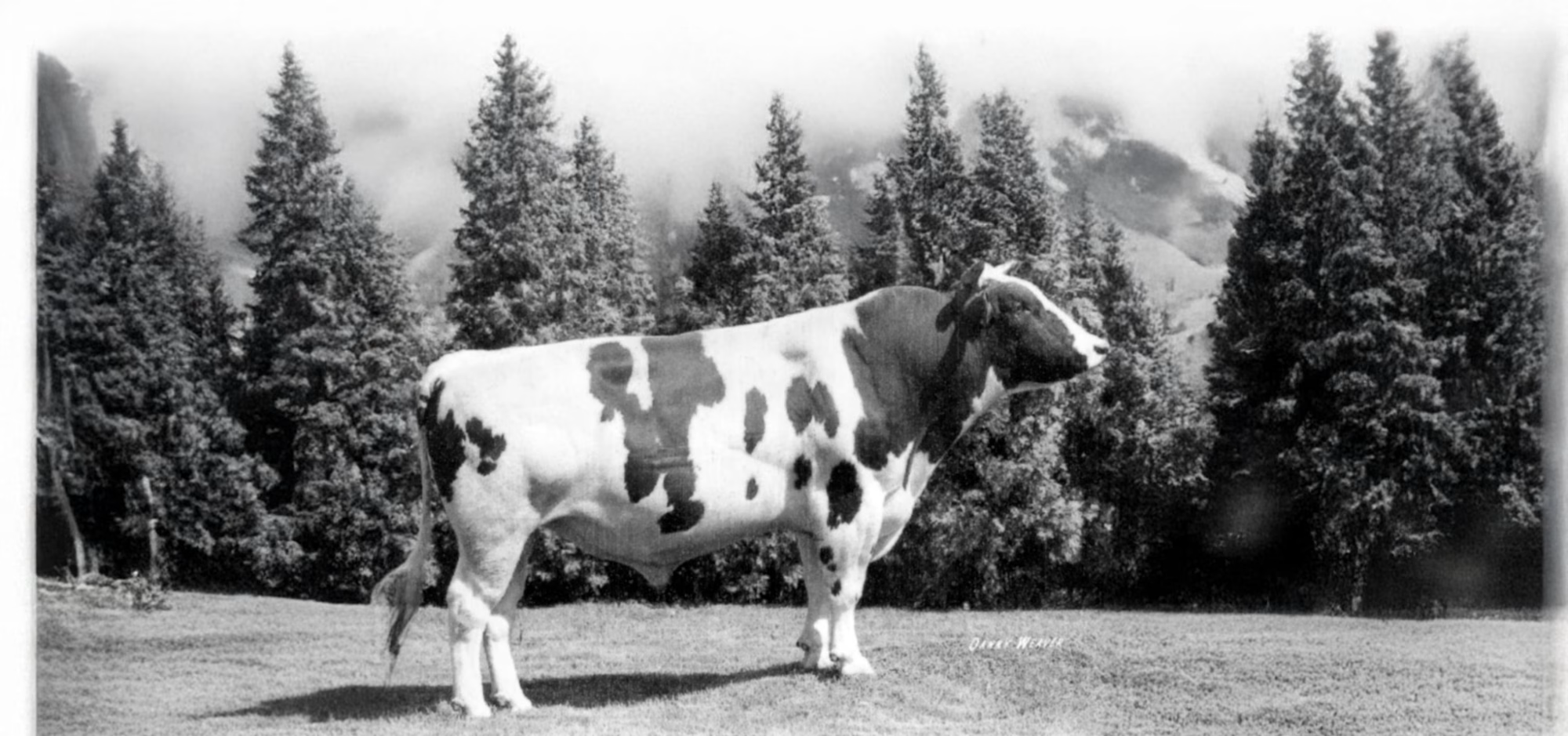
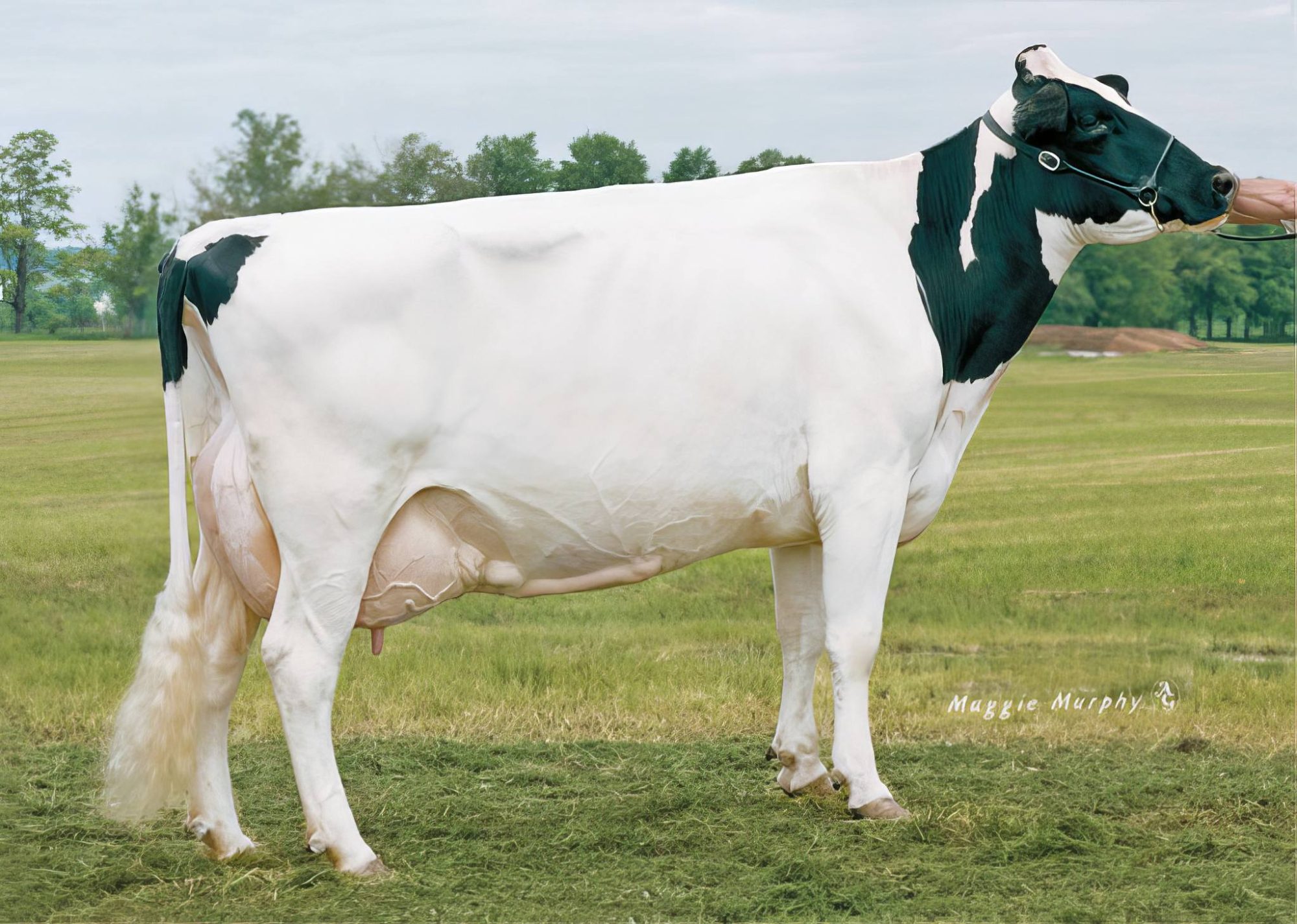
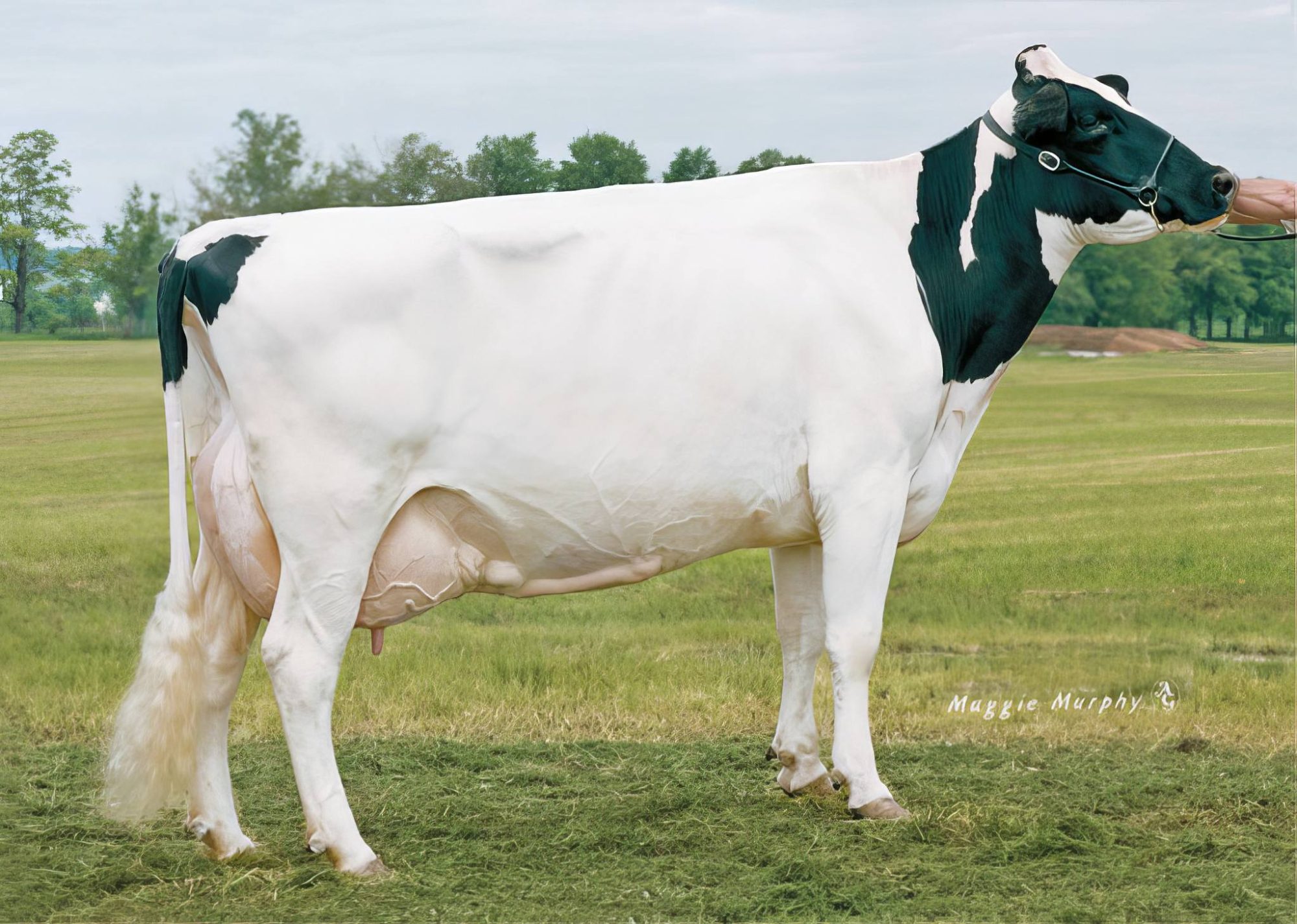
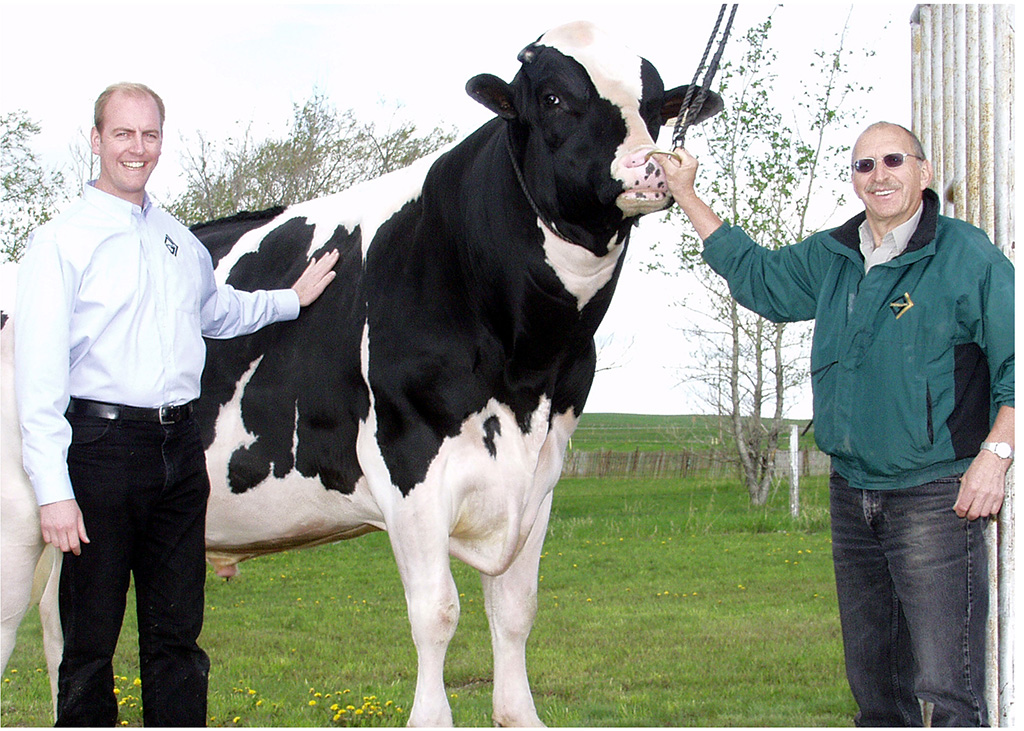
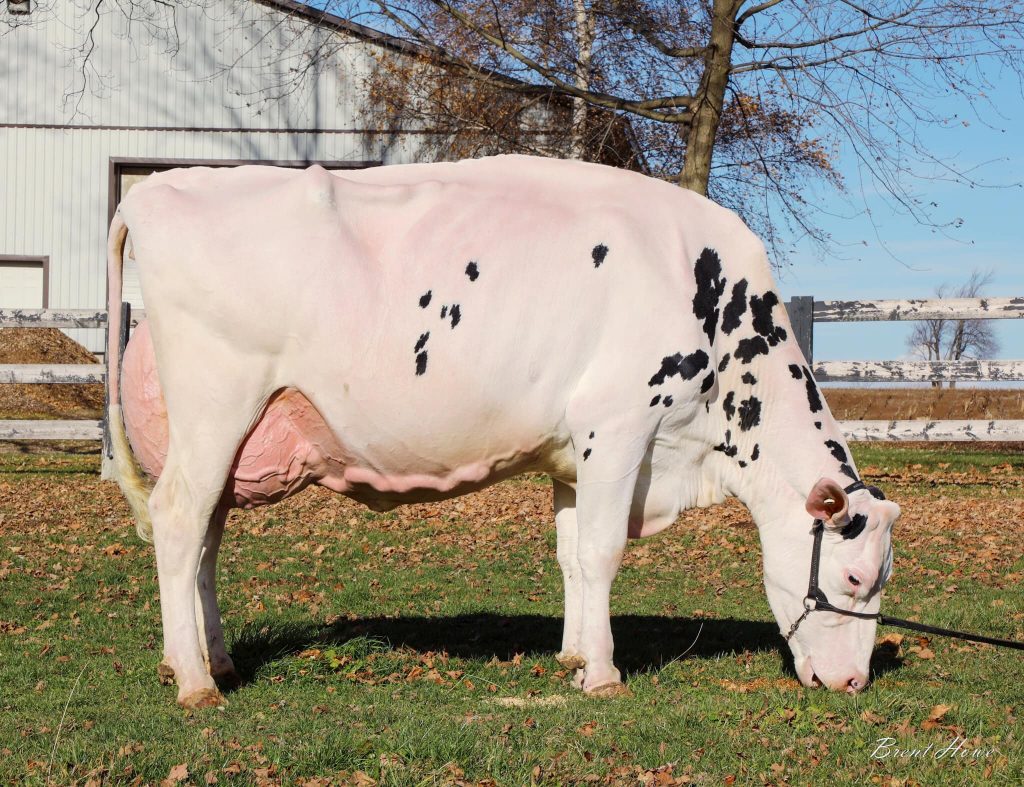
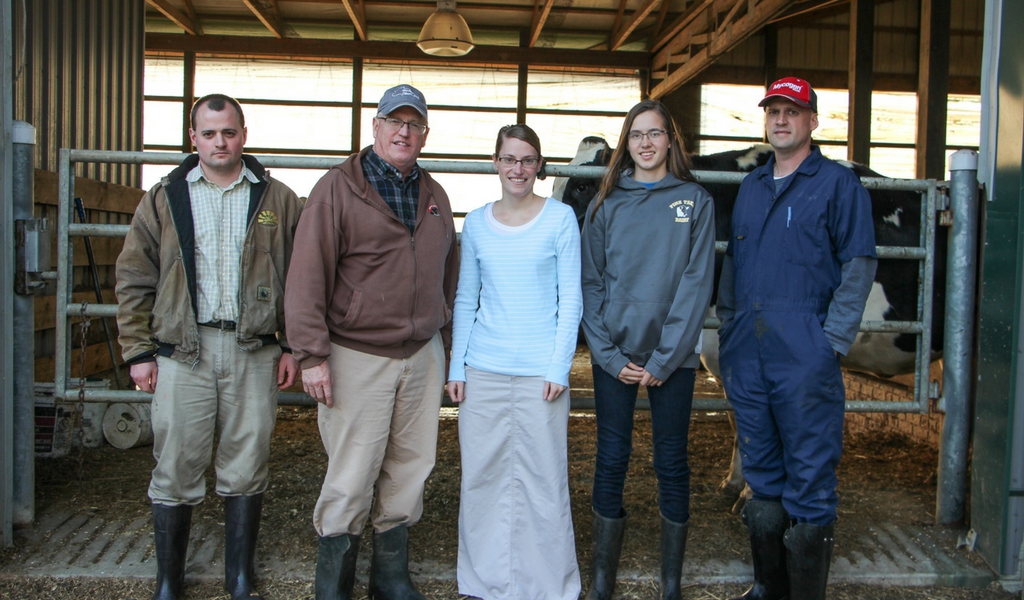
Comestar’s next generation and its founders, from left: Steve Comtois, Julien Turmel, Julie Comtois, France Lemieux and Marc Comtois, with a portrait of Comestar Lamadona Doorman EX-94-2E, Holstein Canada’s 2022 Cow of the Year. She’s the eighth generation of Comestar Laurie Sheik, the first Cow of the Year, in 1995.
On May 20, 2003, nine of every ten dollars Comestar Holstein earned came from selling genetics: bulls, embryos, heifers and cows. That day, Canada confirmed a case of BSE, and borders closed immediately to Canadian live animals and bovine products. The export business that had made Comestar one of the most famous prefixes in the breed stopped overnight.
That month, Marc Comtois and France Lemieux started bidding on milk quota. They have bid every month since, except one.
On September 13, 2026, the farm they started with 18 milking cows turned 50. Marc named it in 1976 for what he wanted it to become: come + star, the farm that wants to become a star. “That’s still our goal,” Marc told Le Bulletin des agriculteurs this month.
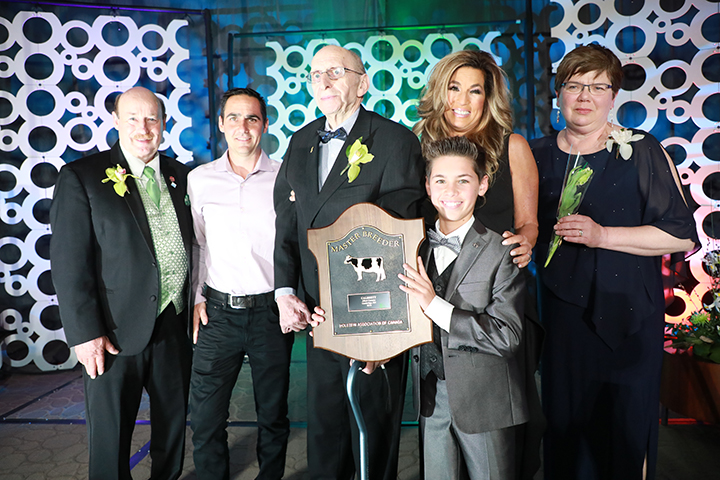
The banners are real: two Holstein Canada Cows of the Year, four millionaire AI sires and two Master Breeder shields. The more useful story is how a genetics house survived losing its main market, and what that cost in quota.
What 50 years changed, by the numbers
Metric
Earlier record
Later record
Cows
18 milking, 1976 · 119-cow herd, 2008
370 milking on six robots, 2021
Milk quota
630 kg butterfat/day, 2021
Close to 800 kg/day, 2026
Class Extra bulls bred
8, 2008
14, the all-time record for any breeder, 2021
All-Canadian nominations
51, 2008
72, 2021
Revenue mix
90% genetics / 10% milk, 2003
90% milk / 10% genetics, 2021
The last row is the story. In under two decades, Comestar flipped its revenue mix end to end without giving up the genetics that built the name.
It started with 18 cows and a father’s example.
Marc was the seventh of nine children, raised at Ferme Comtoise in Victoriaville, Centre-du-Québec. He left school at 15 to work with cattle. At 18, he bought a Princeville farm milking 18 cows. “It was a modest farm,” Marc says.
The example at home was his father, Edgar Comtois, a Holstein Canada Master Breeder in 1985. “I had a passion for cows — really for the animals more than the land,” Marc says. “We started with not much, but we moved up fairly quickly by always buying better-quality animals. I was a genetics fan. I always looked at the bull crosses and the cow crosses. That’s what took us around the world.”
Aramis Marquis sold the prefix abroad in 1979
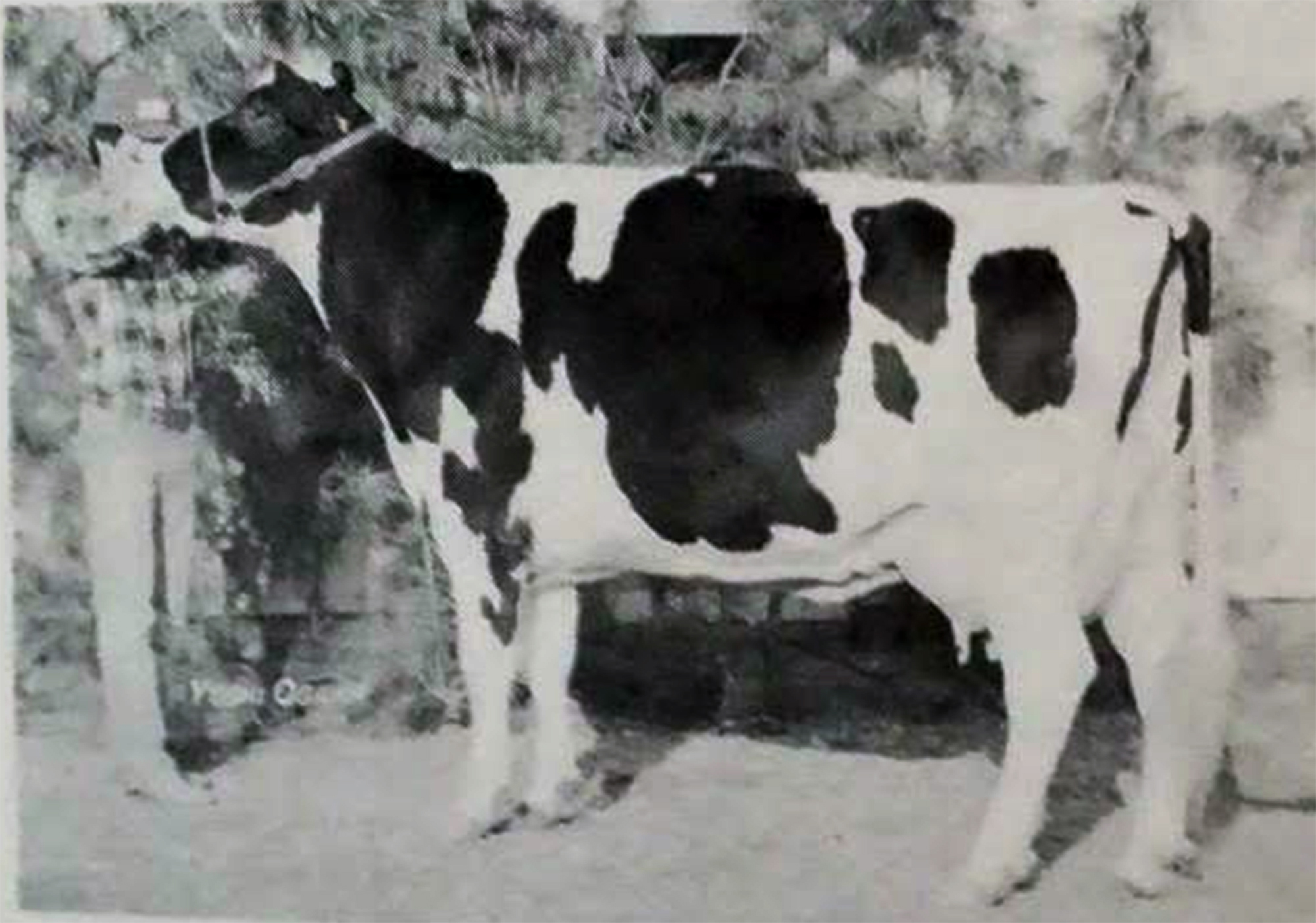
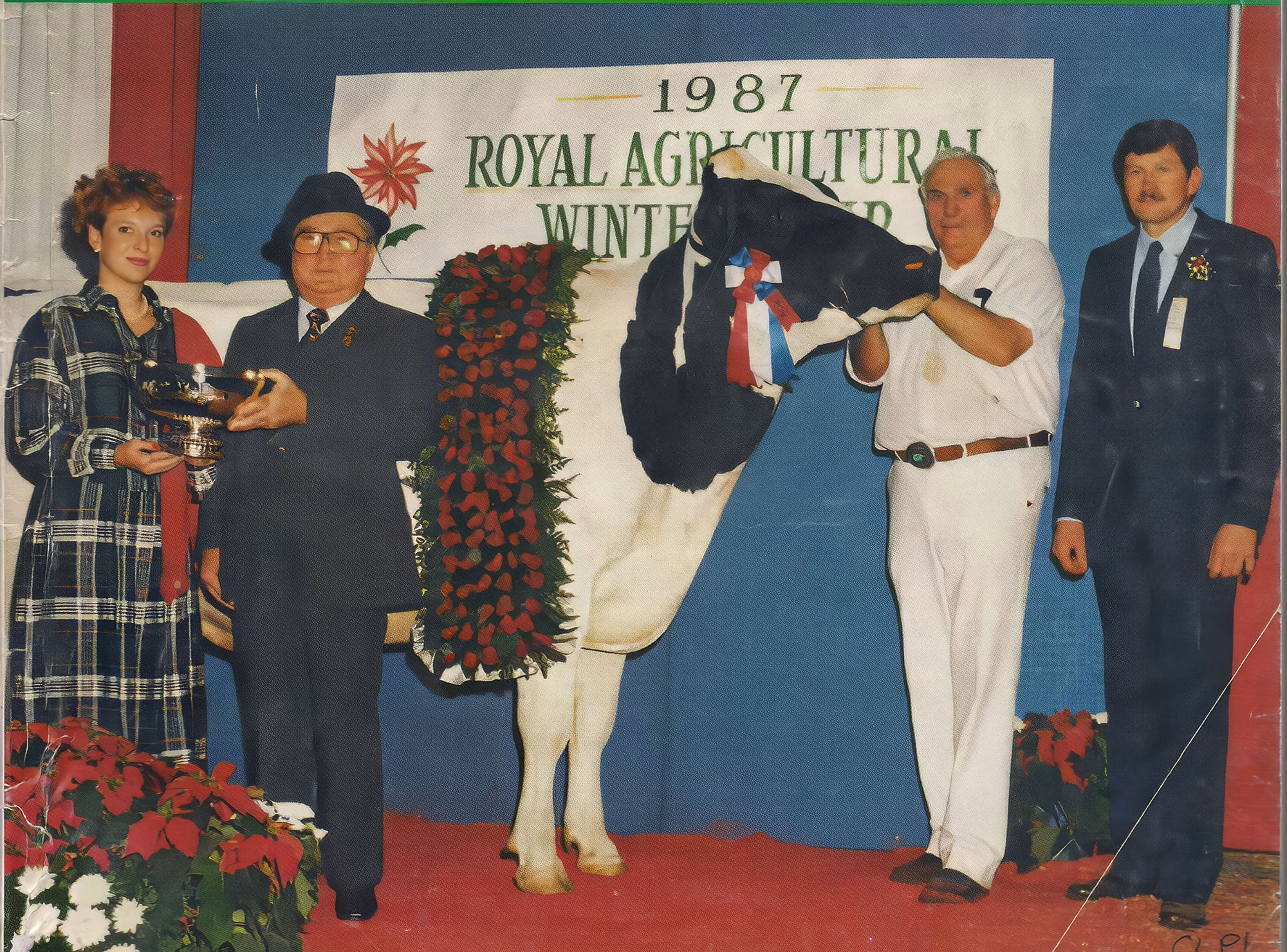
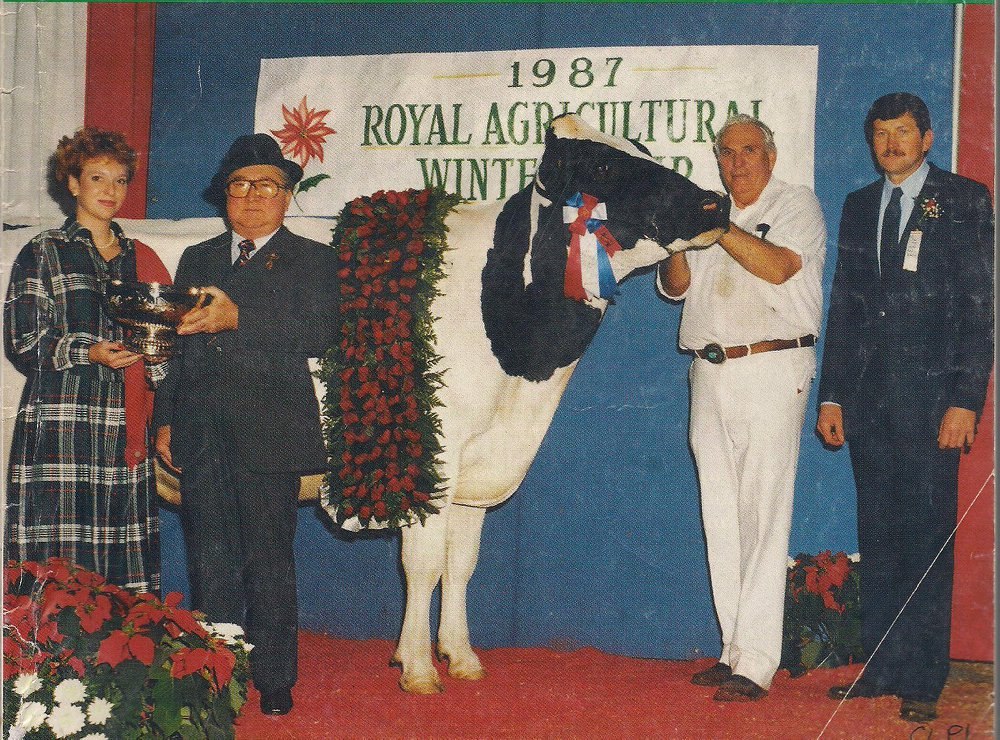
Three years in, Comestar Aramis Marquis won his class at the Royal Agricultural Winter Fair in Toronto and went All-Canadian, the farm’s first. Italian buyers paid $8,000 for him, serious money in 1979. The ribbon and the sale took the Comestar name outside Quebec.
That set the pattern for the next 24 years: win in the ring, then sell to the world. By 2021, that single All-Canadian had grown into 72 nominations: 11 All-Canadian, 10 Reserve and 15 Honorable Mention awards.
The $45,000 cow in 40% of a year’s herdbook
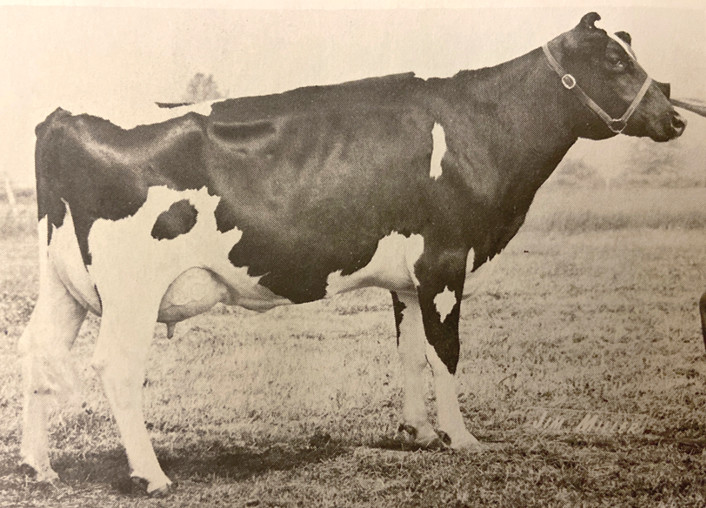
In 1985, Marc bought Elysa Anthony Lea EX-15*, a Willowholme Mark Anthony daughter, and bred her to Puget-Sound Sheik. Comestar Laurie Sheik-ET arrived December 1, 1986.
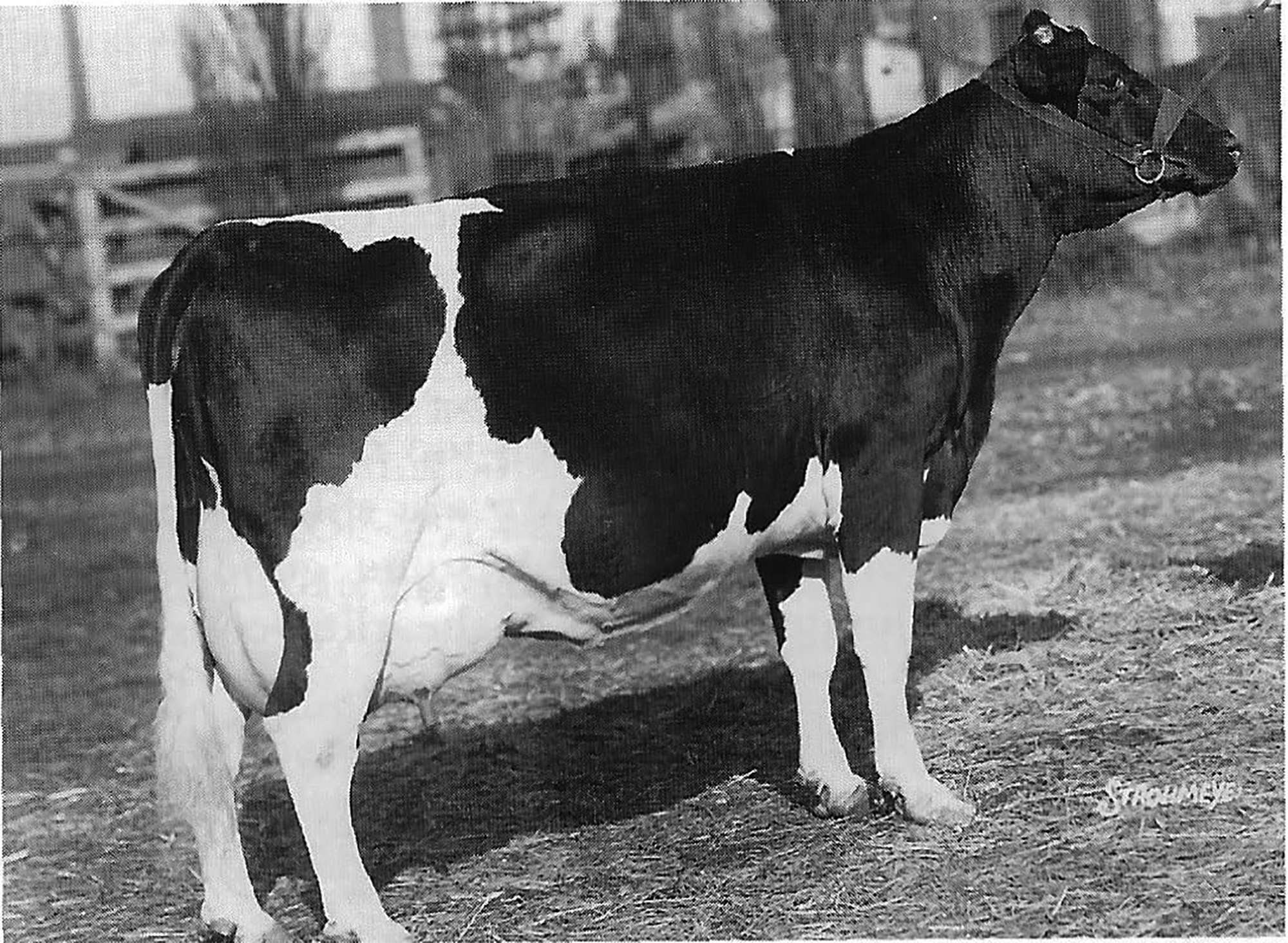
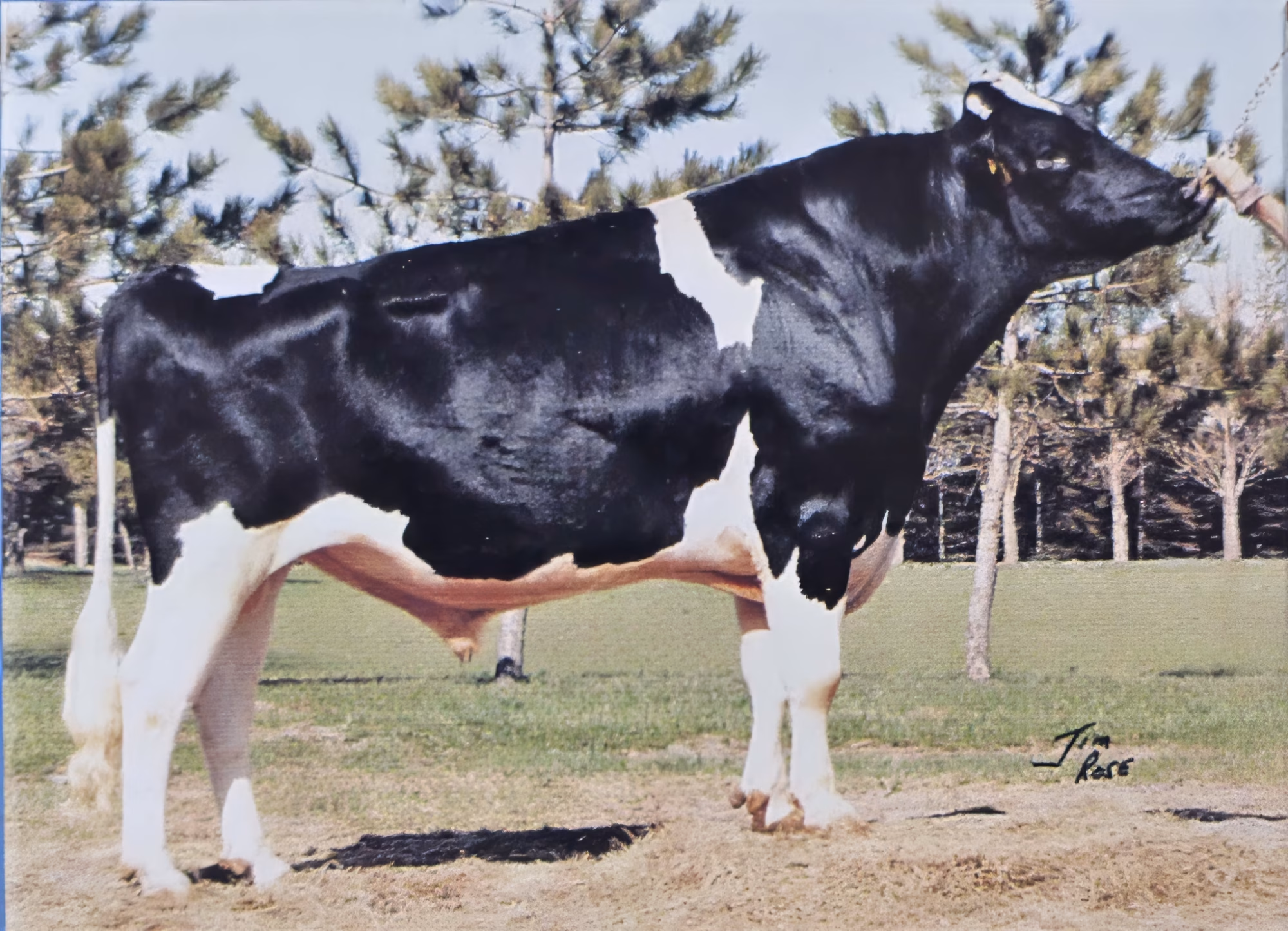
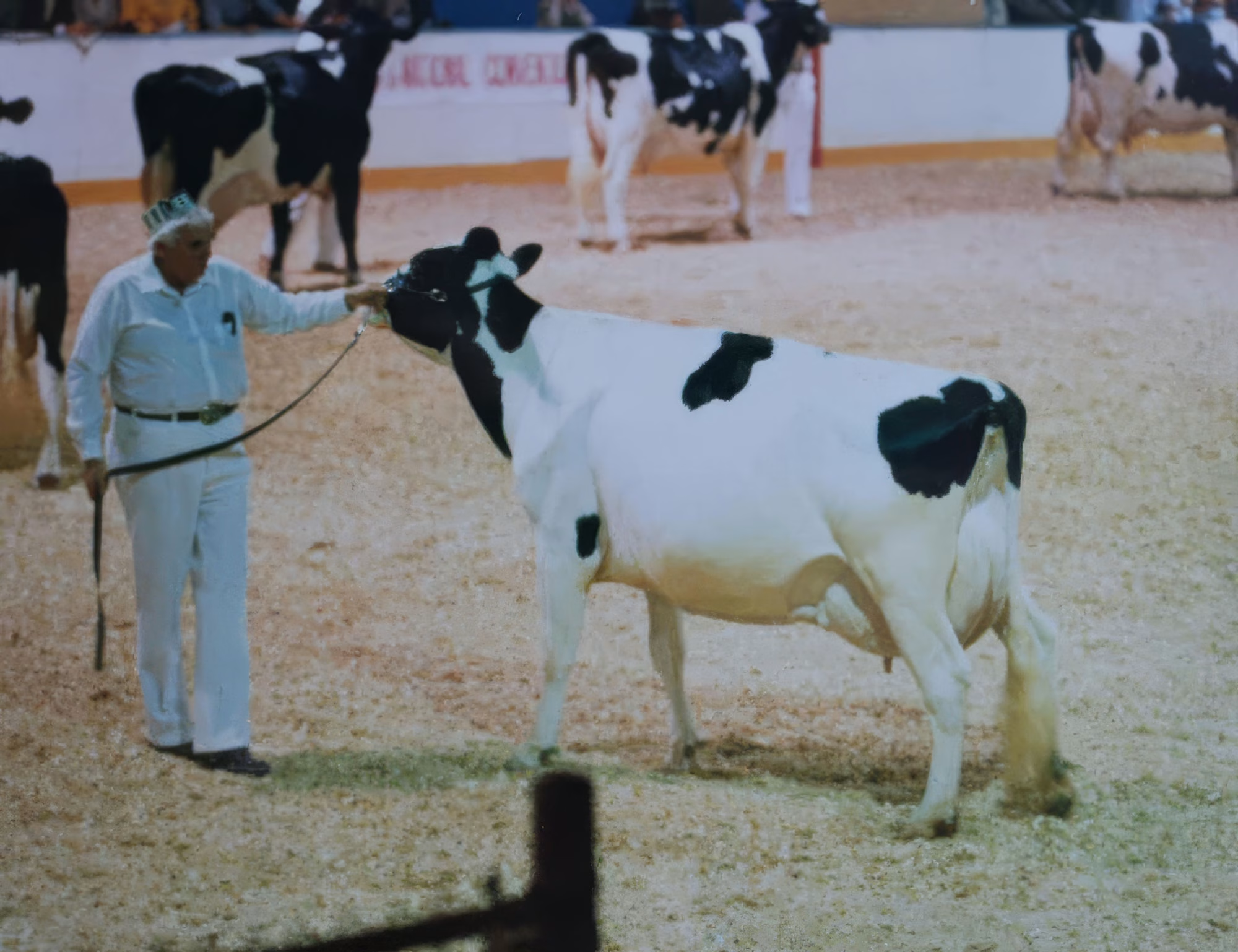
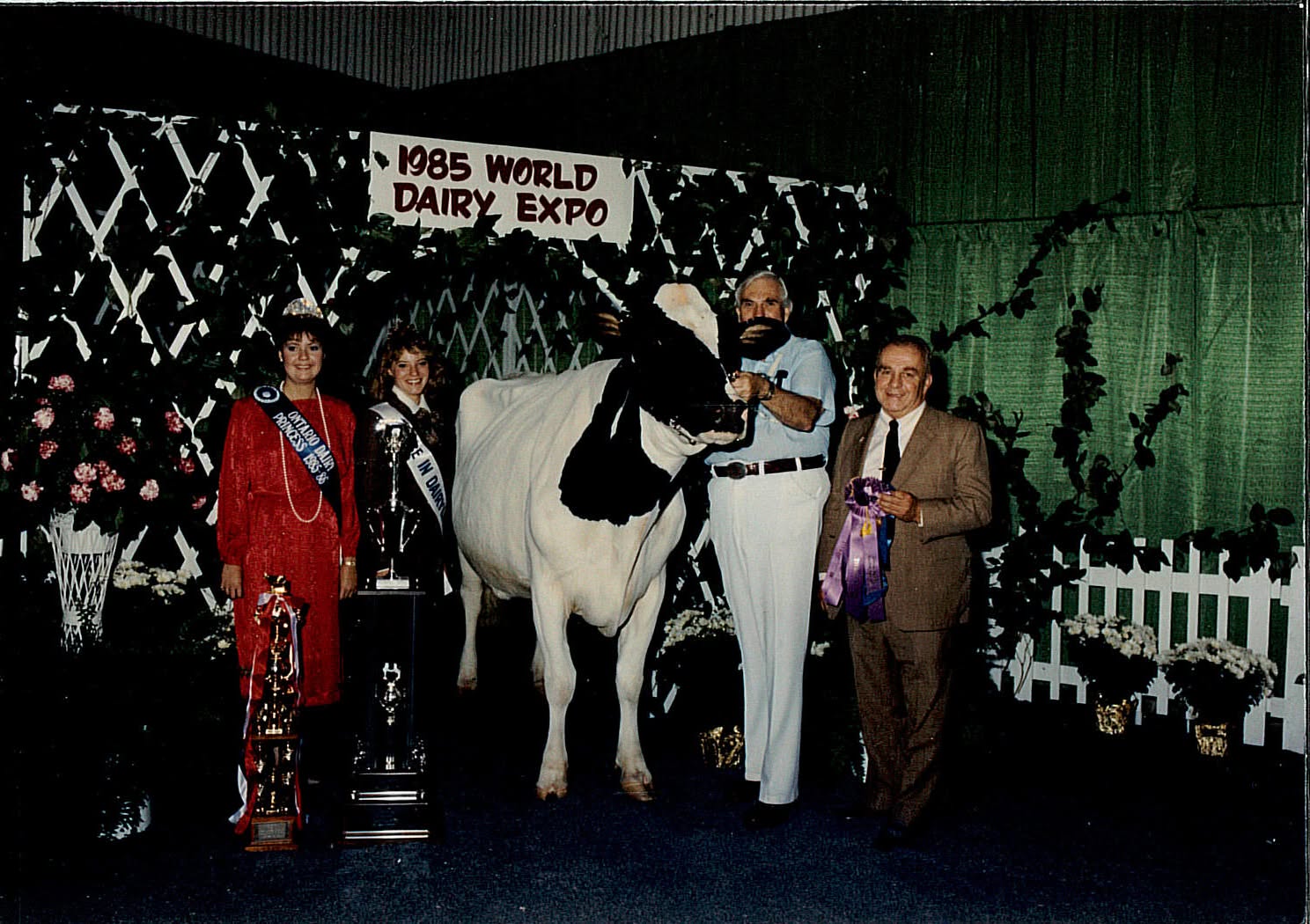
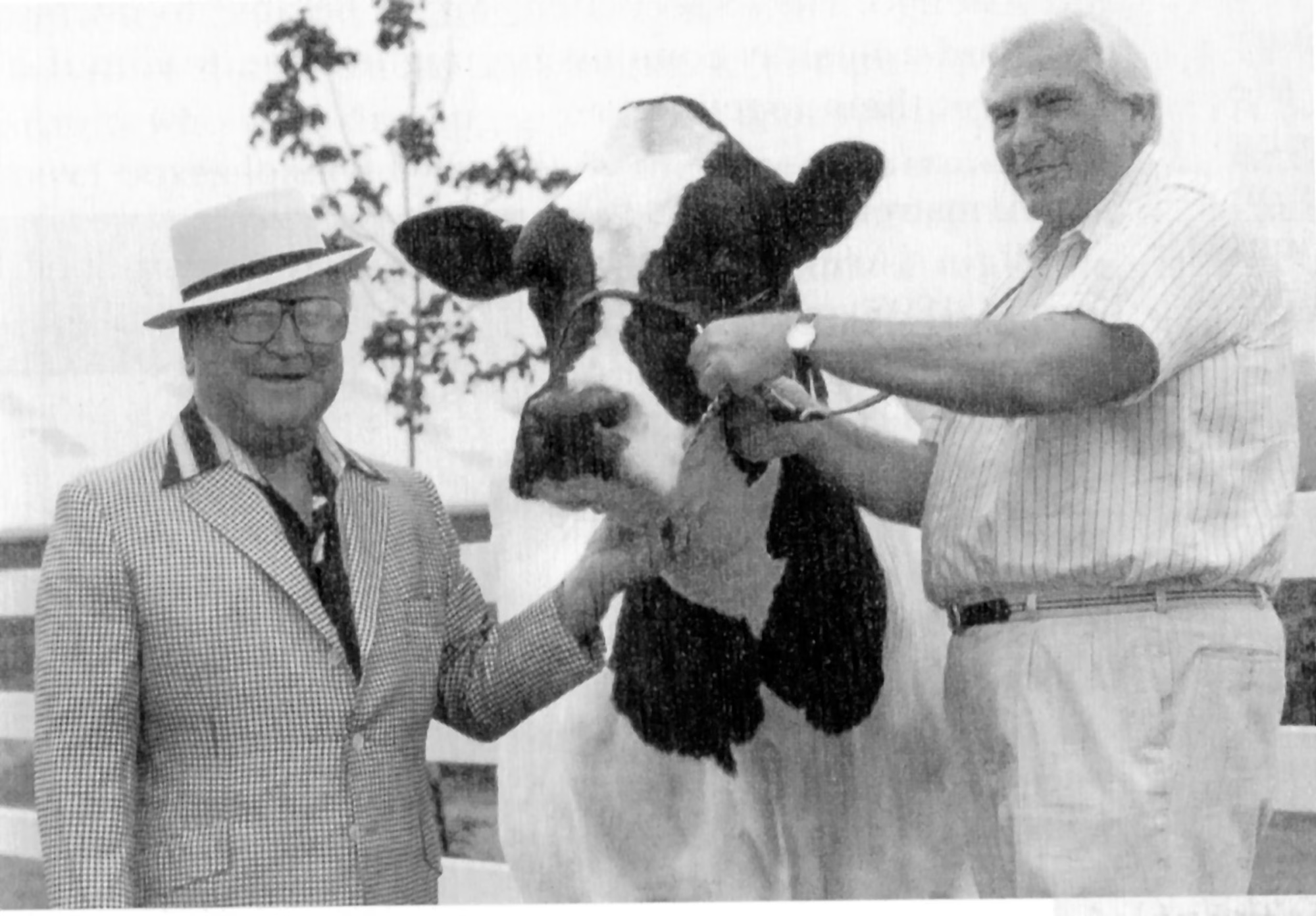
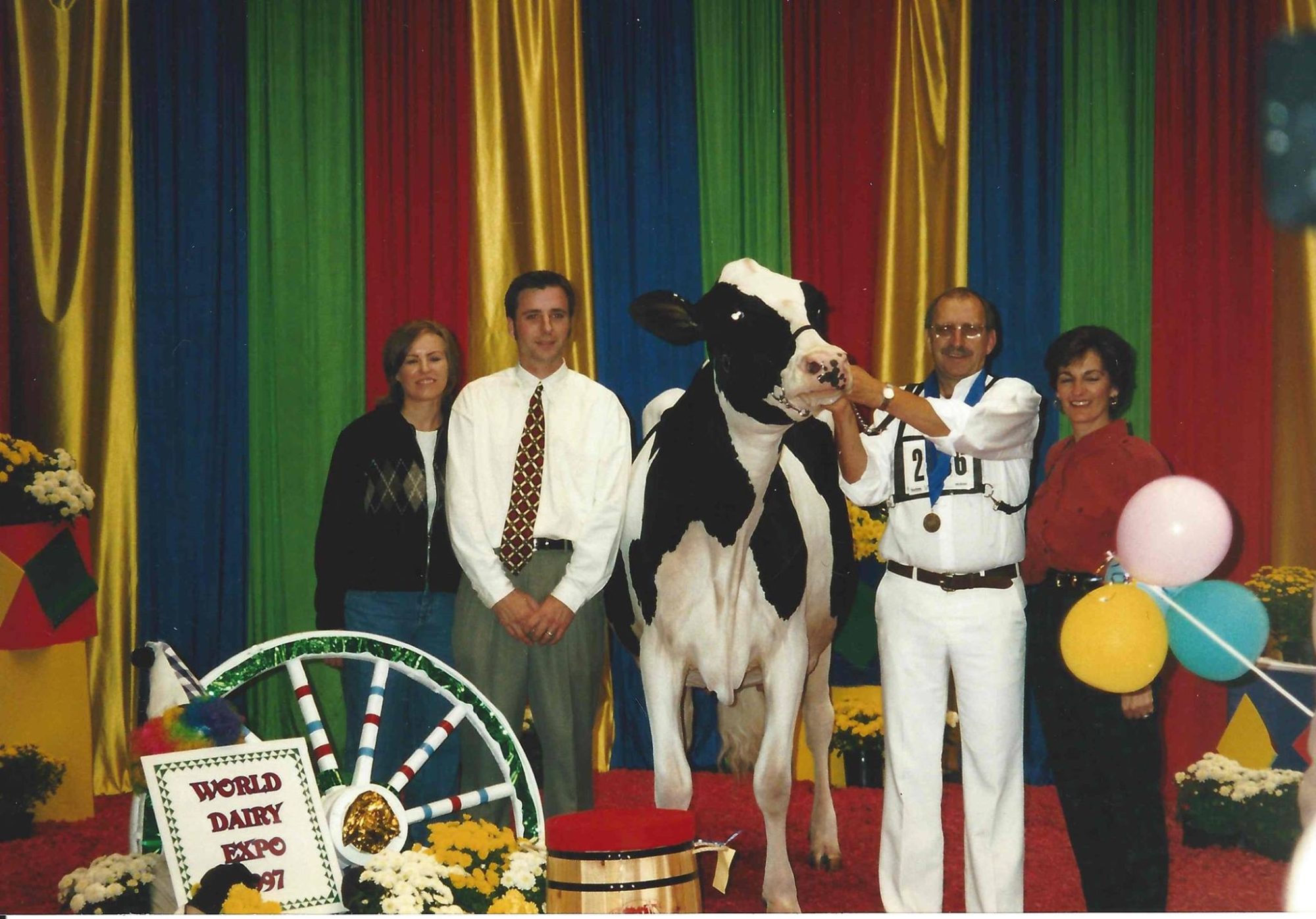
Marc Comtois with Comestar Laurie Sheik-ET at the 1989 World Dairy Expo, where she placed second in the Senior Two-Year-Old class behind Dupasquier Starb Winnie. Six years later, she became Holstein Canada’s first Cow of the Year.
In 1989, she won the Senior Two-Year-Old class at Victoriaville, then went to World Dairy Expo, where she placed second and took the class’s Best Udder nod after the milk-out re-sort. That autumn, she topped Comestar’s first sale at $45,000. Eddy and Annie Pussemier of Bois Seigneur Holstein in Belgium bought half of her. Belgium wouldn’t take live Canadian cattle, so her genetics crossed the Atlantic as embryos. “Today, about 70% of our herd traces back to Laurie Sheik,” the Pussemier family says.
The mating that made her a legend was the one with To-Mar Blackstar. It produced two sons, Leader EX Extra and Lanky EX-Spain, and four famous daughters. Three stayed in Canada and went VG-87: Laura Black 24*, L’Or Black 16*, and Lausan Black 23*. The fourth, Black Laure de Bois Seigneur EX-90, was Grand Champion at Belgium’s 1996 National Show. Laura Black and L’Or Black each made the Cow of the Year final twice. Lausan Black is the only cow to put both a daughter, Lausian Astre, and a son, Stormatic, at No. 1 on Canada’s LPI lists. By 2006, Laurie Sheik sat in the pedigrees of 40% of the animals admitted to Holstein Canada’s herdbook that year.
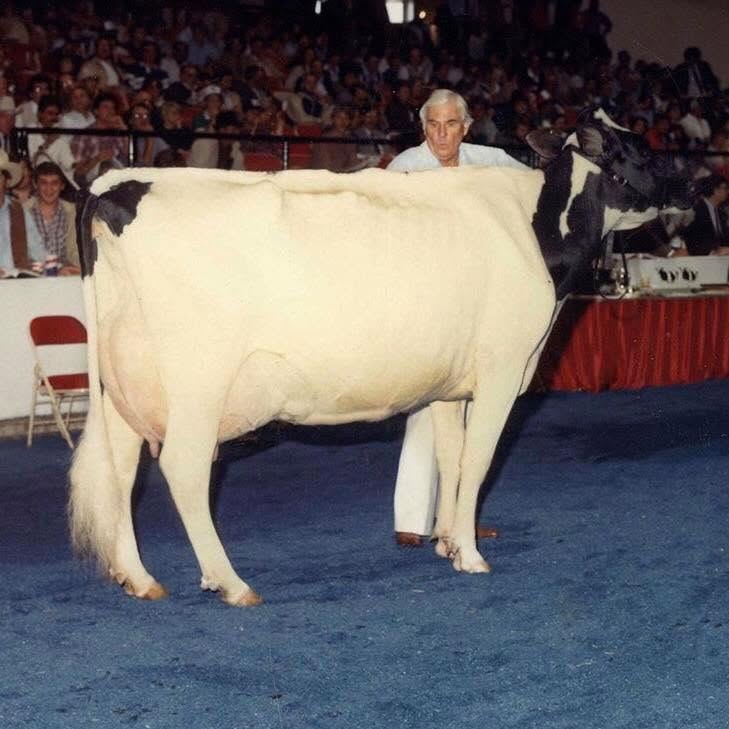
She was Holstein Canada’s first Cow of the Year in 1995 and died April 30, 2004. Her descendant Comestar Lamadona Doorman EX-94-2E took the same title for 2022, 27 years after she did.
Four millionaire sires add up to at least 4.5 million doses
Comestar Lee 73HO2239 in a Semex Alliance ad: by Raider, out of Laura Black, Laurie Sheik’s Blackstar daughter. The pitch was “Cows Built to Last,” shown on two-year-old daughters Claustar Maree Lee GP-83 and Begette Lee Della GP-81.
“A big part of Comestar’s reputation is the bulls in the AI centres,” Marc says. “We’re the only ones in the world to have produced four millionaire bulls — bulls that produced more than a million doses. And we have one that’s a super-millionaire — more than 1.5 million doses.”
Now the floor. Lee’s 1.5 million, plus at least one million each for the other three, comes to no fewer than 4.5 million doses from one cow’s son and grandsons. That’s a minimum, not an estimate.
Three of the four trace to a single daughter. Laura Black is the dam of Lee, his brother Top Gun, and Lheros EX-97 Extra, a former No. 1 LPI sire and Canada’s first 97-point bull. Outside, EX-95 Extra came from L’Or Black. Leader is Laurie Sheik’s own son.
Lee almost never got sampled. CIAQ tested him and Top Gun off a first-calf dam scored Good Plus 84, below the Very Good bar bull studs usually demanded. Both went Extra, and Lee became the family’s super-millionaire.
A partner at home freed Marc to sell the world.
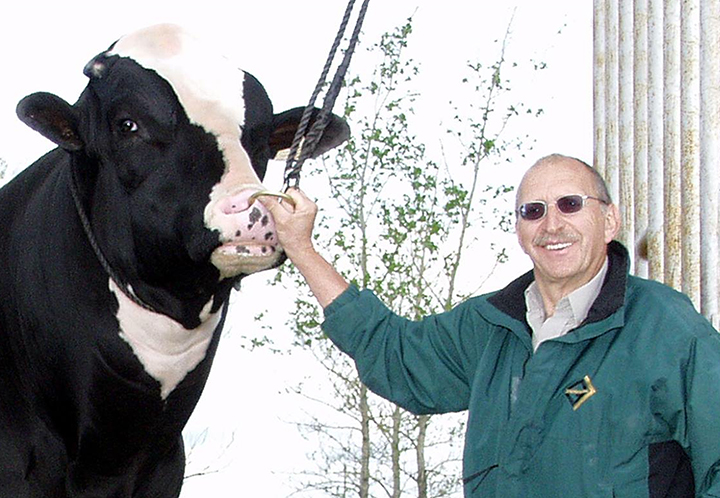
Marc Comtois gives his reasons as official judge of the 2016 National Holstein Show at the Royal Agricultural Winter Fair, his second time in that ring. He named Jacobs Gold Liann Grand Champion and called her “the cow of the future.”
Rewind to 1993, four years after Laurie Sheik’s $45,000 sale and two years before her Cow of the Year title. Overseas demand for Marc was pulling him off the farm. He and France sold half the business to Freddy and Nicole Steen, Belgian breeders who had settled in Quebec looking to buy a farm. With Freddy running things at home, Marc could travel without worrying about the farm.
The Steen years stacked up the results. The first Master Breeder shield came in 1995. In 1996, Marc won the Royal’s Curtis Clark award for exhibitor sportsmanship. A 100-cow barn went up in 1998. In 1999, Marc judged the Holstein show at the Royal. He’d take that ring again in 2016, and he has judged in more than 20 countries.
In 2000, Comestar hosted the Holstein Québec picnic for 8,000 visitors. The same year, the two-day Comestar Sale 2000 sold 269 head at an $8,036 average, topped by Comestar Model Lady VG-89 at $95,000. By 2021, Marc had sold more than 7,000 embryos into 33 countries.
May 20, 2003, turned a genetics house into a milk business
When the border shut, milk made up just 10% of Comestar’s revenue. Marc and France didn’t wait for exports to reopen. They started buying quota to rebalance the farm between milk and genetics.
“Since May 20, 2003, there’s been only one month we didn’t bid on milk quota,” Marc says. Twenty-three years of that discipline adds up to this:
Value at the cap: 800 × $24,000 = about CA$19.2 million
Growth since 2021: 630 kg to about 800 kg = about 170 kg, or 27%, roughly CA$4.1 million at the cap
How scarce it is: on Quebec’s July 2026 exchange, buyers bid for 29,453.80 kg and got 588.74 kg, a 2.0% fill rate
Comestar’s gain since 2021 equals about 29% of everything sold on the entire provincial exchange that month.
The $19.2 million is a ceiling value, not a sale price. It ignores debt, doesn’t split holdings between Comestar and the family’s second company, and starts from a rounded “close to 800.” What the math does prove is that in a market filling 2% of bids, nobody reaches 800 kg by waiting for a good month.
Genomics rewrote the market, and Comestar bred against it
The second shock was genomics, which Semex dates to 2008. AI companies started producing their own bulls and wouldn’t release semen from their top young sires to breeders. Heifers mattered more than cows, the selling window for one shrank, and outside the elite genomic heifers there was no good market for the rest.
“Genomics changed the way I could do business,” Marc told Semex in 2021. “My sales changed. My job of making bulls didn’t exist anymore. It changed my vision.”
Steve Comtois pushes up feed at the bunk. By 2021, he was overseeing the herd’s genetics, its breeding decisions and the new barn. Today he runs the genetics, and his father says he’s excellent at it.
Comestar’s answer went against the grain. In 2021, the herd was still bred about 80% to proven bulls, 10–12% to young genomic sires, and the rest to beef, with sexed semen on every first and second breeding. The farm raised more heifers than it needed and sold the surplus as fresh heifers and second-lactation cows. Marc’s breeding target was a cow that calves three or more times, and he had raised four that reached 18 years old.
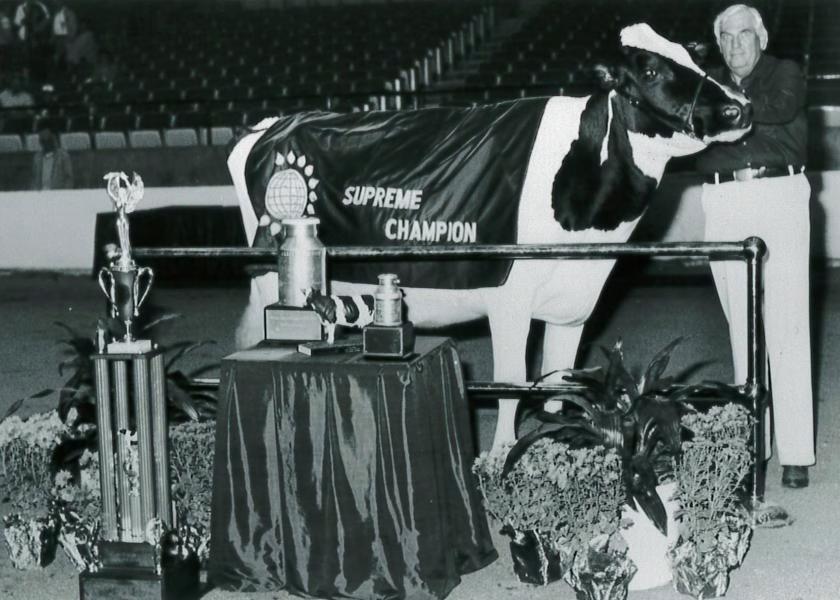
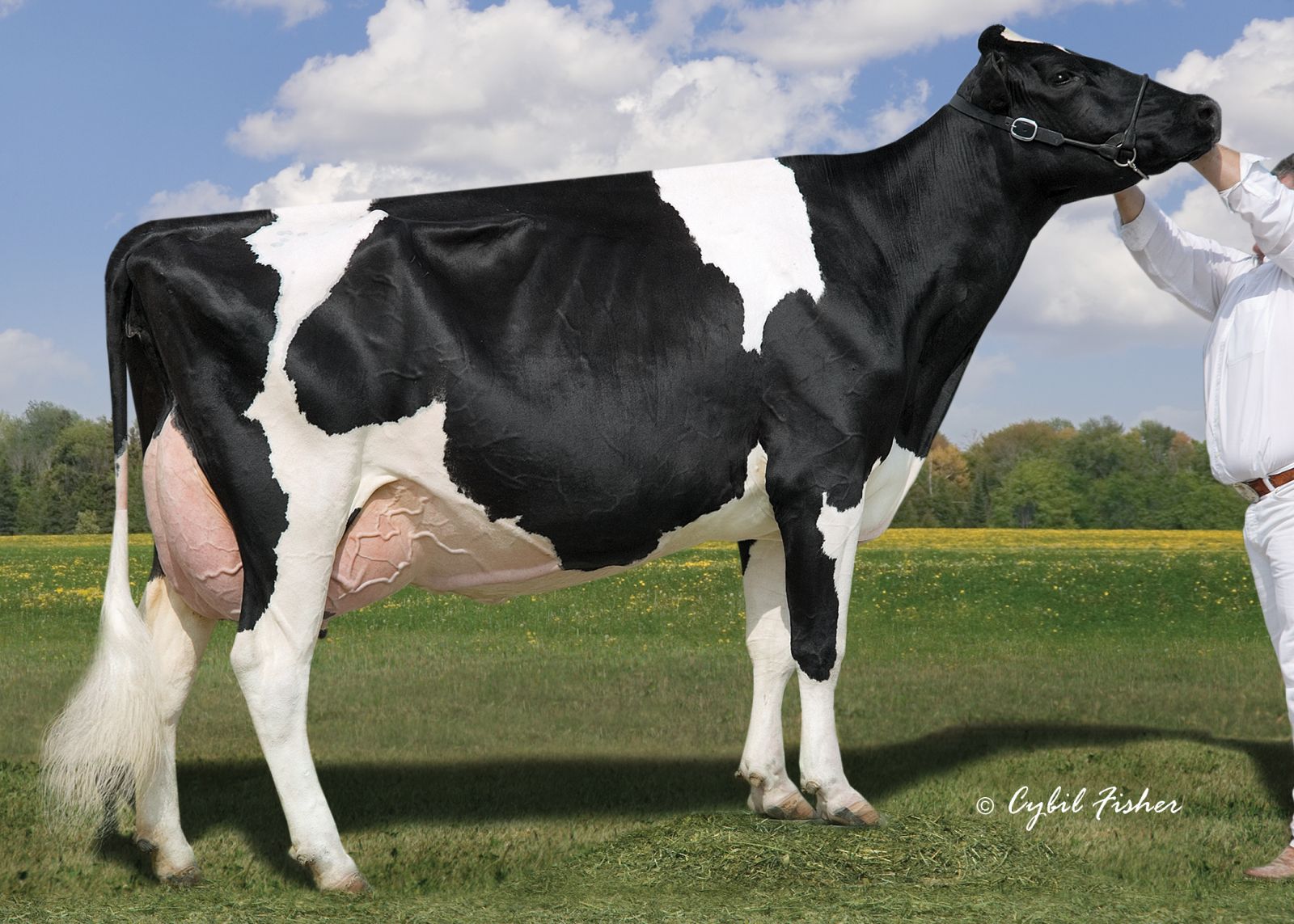
The cow family kept delivering on both sides of the switch. Comestar Lautamie Titanic VG-89 33* was Canada’s No. 1 LPI cow in 2006, 2007 and 2008. Lamadona, from the same Laurie Sheik line, won the Junior Three-Year-Old class and the Genetic & Production trophy at World Dairy Expo in 2016, went Reserve All-American that year, and was HM All-Canadian in 2015 and 2016. She’s the eighth generation of Laurie Sheik to classify VG or EX. The 2023 Comestar Legacy Sale still topped at $42,000.
Succession came before the robot barn.
Even before the genomic shockwaves hit the market, Comestar had already begun future-proofing its ownership. In 2007, Marc and France bought back the Steens’ half, since the Steen children weren’t interested in farming. Julie, her husband Julien Turmel, and Steve had told them they wanted in.
The family handed over the farm in stages. In 2010, it created Oli-Fay Holstein, named after the first two grandchildren, Olivier and Marie-Fay. In 2013, Julie, Steve, Kathleen and Julien became shareholders, and consultant Ann Louise Carson spent three months helping the family set roles, weekly meetings and decision rules.
Comestar Holstein from the air, 50 years after Marc Comtois and France Lemieux started with 18 milking cows. The farm now holds close to 800 kg/day of quota, and the family’s 2020 robotic barn went up near the original farm.
The barn came last. Cows started milking in the new robotic freestall on October 13, 2020: 722 by 142 feet, 586 sand-bedded stalls and room for eight DeLaval VMS 300 units. Natural herd growth filled it without a single purchased animal.
Cows in Comestar’s robotic freestall. “The first cows to move into the new freestall barn were our tiestall cows, because our cows can work anywhere,” Marc told Semex in 2021. “They are all built the same.”
Steve runs the genetics now, and he’s excellent at it, Marc says. Julie handles herd management and the reporting that comes with it. Julien does the embryo transfer and runs the crops. Nicole Steen still keeps the books, 19 years after the partnership ended. Two of the four children, Julie and Steve, are in the business today, and the grandchildren are already showing an interest in farming.
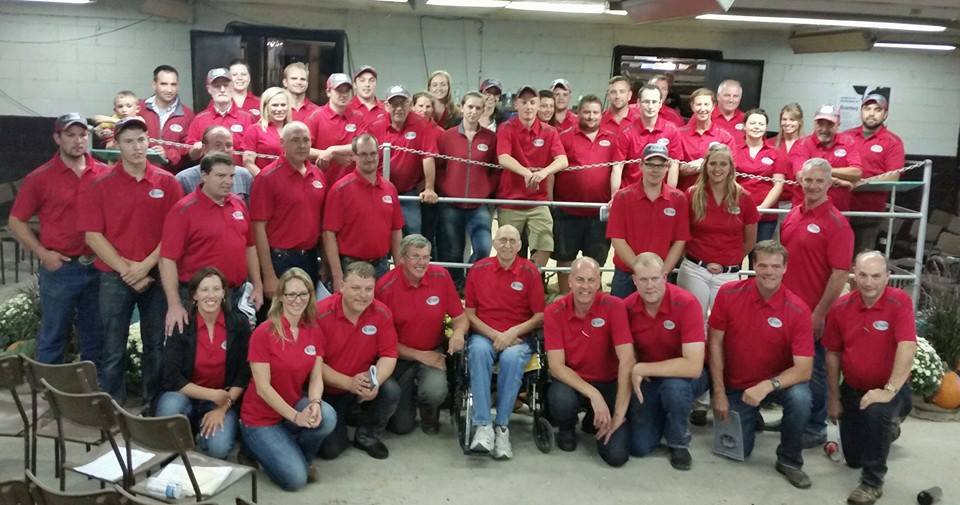
Marc Comtois and France Lemieux (centre) with three generations of the Comtois and Turmel families. “My dream is to see my grandkids have the same passion for cows as I do,” Marc told Semex in 2021.
Five decades of honors
1995, 2009: Holstein Canada Master Breeder
1996: Curtis Clark Award, Royal Agricultural Winter Fair
2007: Premier Breeder, Royal Agricultural Winter Fair
2008:National Dairy Shrine Distinguished Dairy Cattle Breeder, the 36th recipient and the second Canadian, after Roy Ormiston in 1989. “It goes to a breeder who has distinguished himself, who shows sportsmanship and who sets a good example,” France says.
Ask Marc for his proudest achievement, and he doesn’t have to think long. “Being in the Agricultural Hall of Fame in Quebec and in Canada,” he says. “That sums it all up.”
What Comestar’s 50 years say to a breeder today
Stress-test your revenue concentration. In May 2003, 90% of Comestar’s income ran through export channels. If one border, one buyer, or one stud carries more than half your revenue, write down now what you’d do the week it closes.
Build a cow family, not a star cow. Laurie Sheik multiplied through four Blackstar daughters on two continents. One of them, Laura Black, gave AI three Extra bulls, including a super-millionaire her own first-lactation score nearly kept out of sampling. One great cow tops a sale. Several strong daughters make a breeding program.
In quota provinces, bid every month your cash flow can carry it. At a 2% fill rate, the herds that end up with kilograms are the ones in every exchange, not the ones timing it. Price each bid at the full cap (in Quebec, $24,000/kg) and run it past your lender first.
Settle ownership before you pour concrete. Comestar went from new entity (2010) to shares and outside facilitation (2013) to barn (2020). The barn was built for people who already owned the business.
Half a century after an 18-year-old named a Princeville farm for a star it hadn’t reached yet, Marc still says the goal hasn’t changed. By any measure the breed keeps, they reached it a long time ago. The family is still acting like they haven’t.
Learn More
The Proof You Waited Three Years For Averaged a $72 Markdown — Arms you with the math to stop waiting on daughter proofs. Runs the Hold-to-Proof Cost Simulator to quantify the maintenance overhead per sire, exposing why acting on early genomic predictions outpaces the traditional sampling model.
Revolutionary Sperm Testing Exposes Hidden Bull Fertility Crisis — Secures your AI investment against hidden subfertility that conventional testing misses. Breaks down how time-dependent metabolic analysis catches rapidly deteriorating semen, preventing an $8,200 annual drain on your margins from extended calving intervals.
The Sunday Read Dairy Professionals Don’t Skip.
Every week, thousands of producers, breeders, and industry insiders open Bullvine Weekly for genetics insights, market shifts, and profit strategies they won’t find anywhere else. One email. Five minutes. Smarter decisions all week.
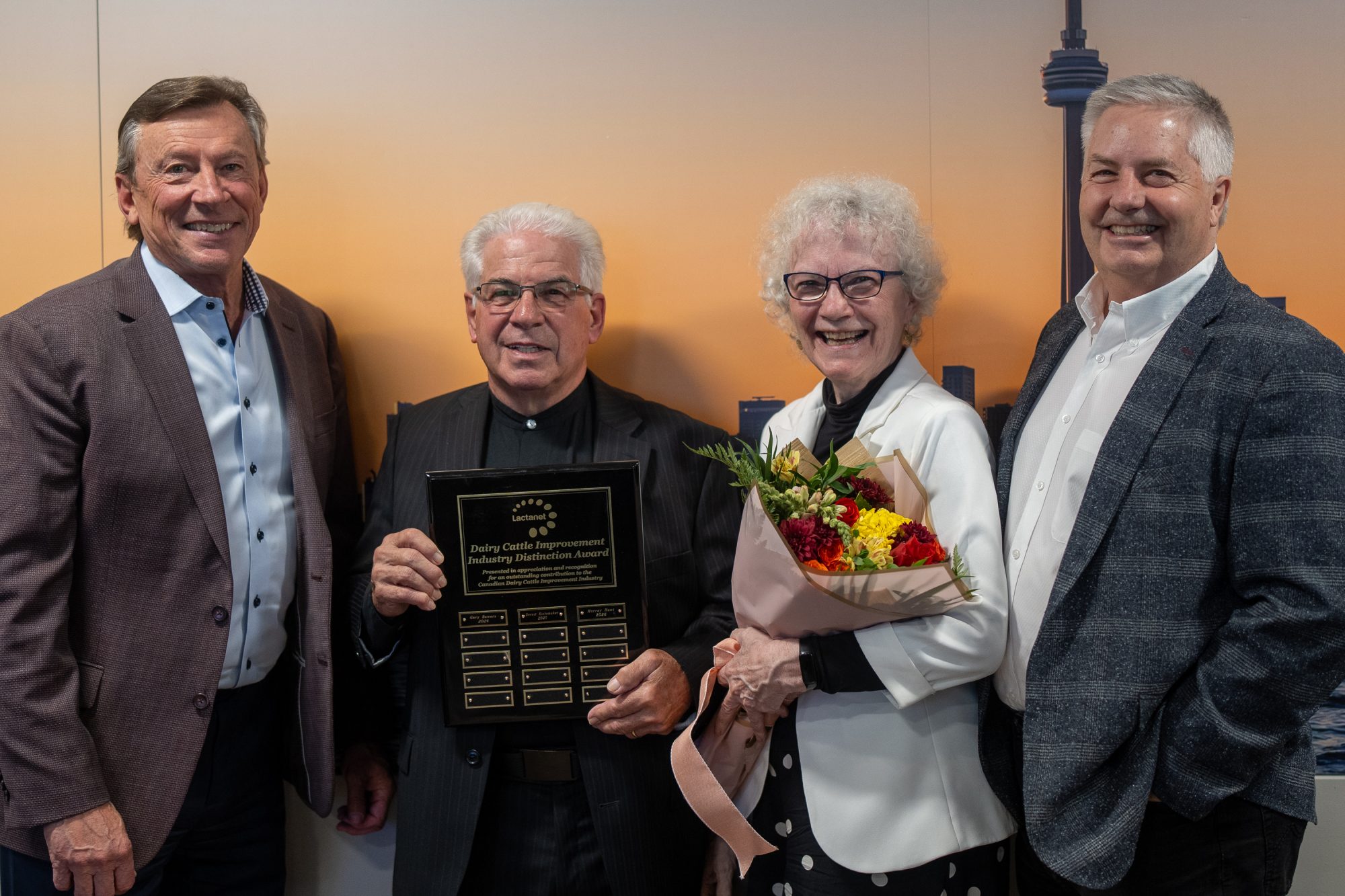
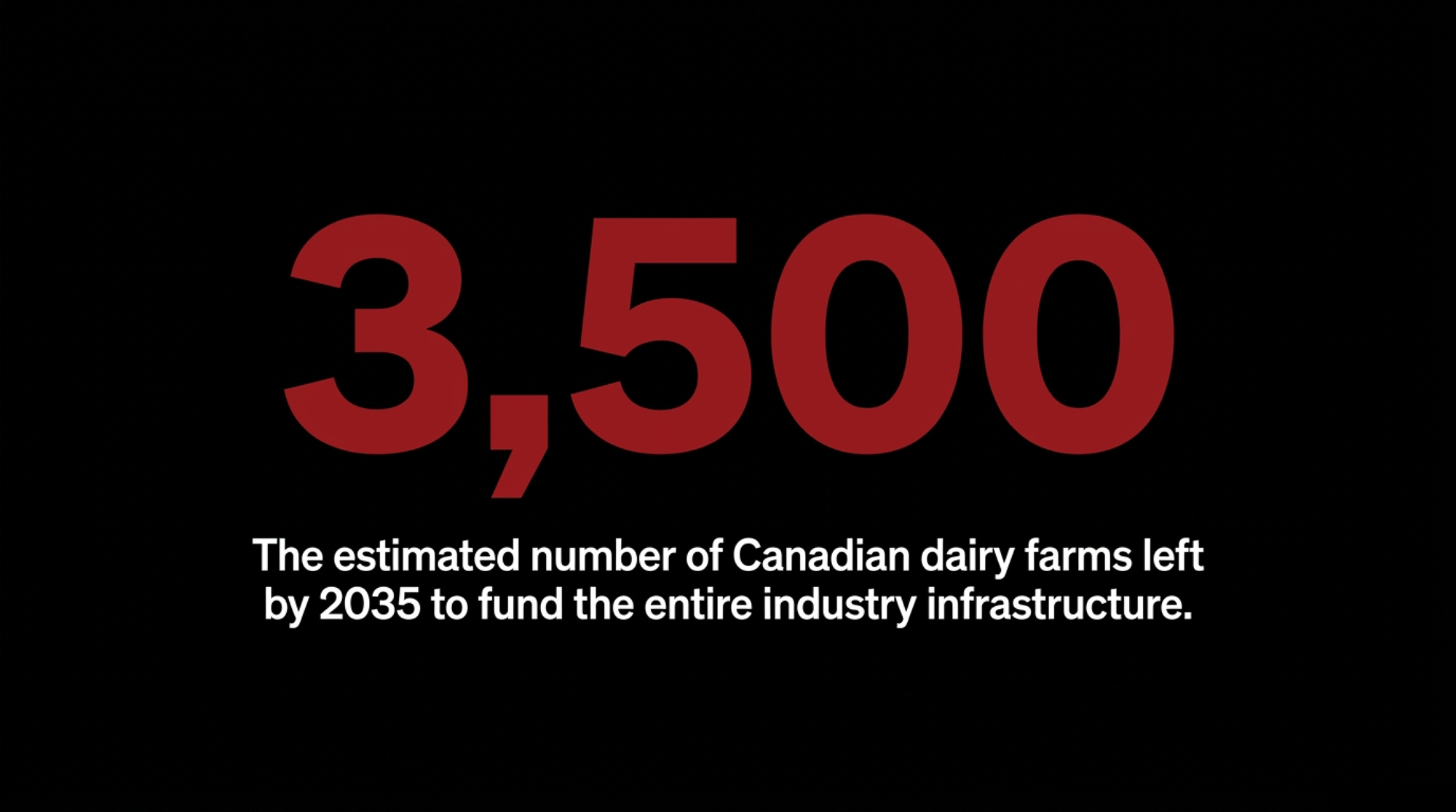
In 1970, Canada had 90,000 dairy herds. By August 2025, there were 9,048. By 2035, there may be just 3,500. Upon receiving Lactanet’s Distinction Award, Murray Hunt challenged the industry: the milk tank can’t pay for the structure we have now.
Murray Hunt thanked Neil Petreny and Paul Larmer for helping him up to the podium. “Age is catching up,” he said, “but I still love the industry.” Then the 81-year-old spent the rest of his time at the podium proving it, first by thanking the people who built his career and then by telling the people who run Canada’s dairy cattle improvement organizations that the structure he spent that career building has outgrown the milk cheque.
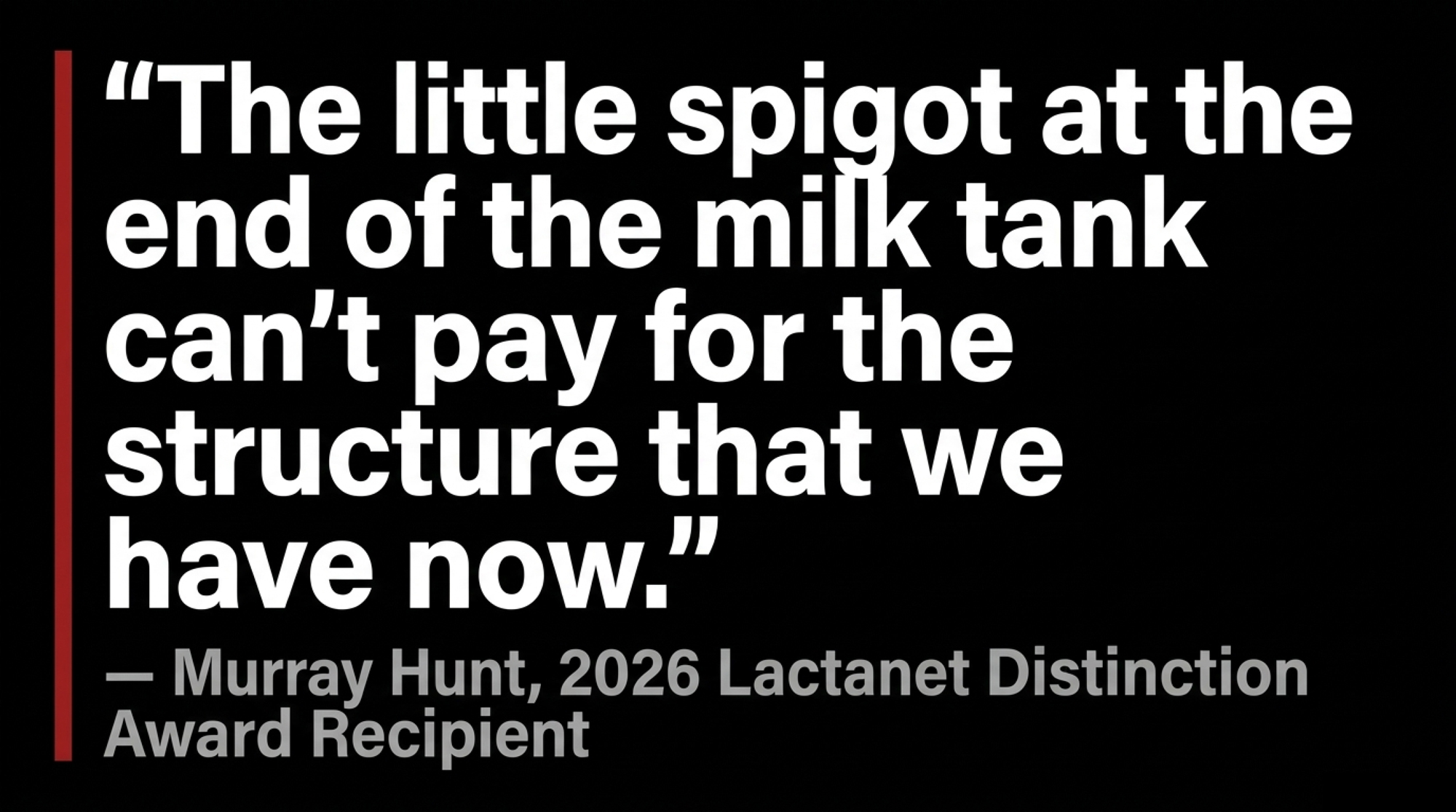
“In 1970 we had 90,000 herds in Canada, 25 cows each, and every farmer organization had its own silo, its own goals, its own area, and you didn’t dare get outside them,” he told the Dairy Cattle Industry Forum at the Sheraton Gateway Hotel in Toronto on September 22, minutes after Lactanet presented him with its 2026 Dairy Cattle Improvement Industry Distinction Award. Canada had 9,048 farms shipping milk on August 1, 2025, according to the latest available Canadian Dairy Information Centre data. The estimate Hunt had read for 2035 is 3,500. “The milk tank, that little spigot at the end of the milk tank, can’t pay for the structure that we have now,” he said.
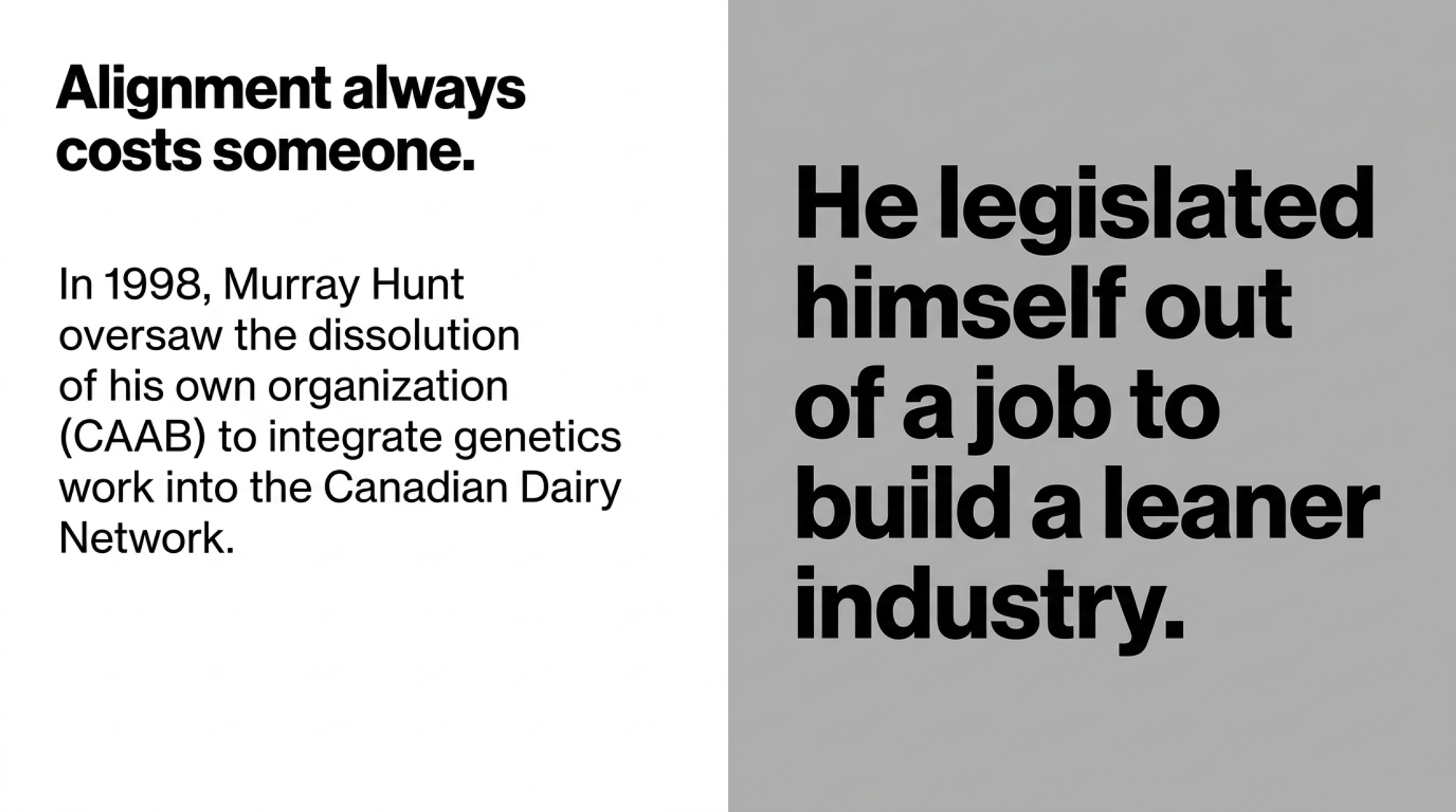
Few people in that room had more standing to say it. In 1998, as executive director of the Canadian Association of Animal Breeders, he saw CAAB dissolved once its genetics work had moved to the new Canadian Dairy Network. Four years earlier, Larmer’s citation noted, he “navigated a successful streamlining and integration of research dollars, people resources, and effort” across industry organizations to create the Cattle Breeding Research Council. On Tuesday, he asked the room to do it again. “Alignment for me and Karen personally was that we were out of a job,” he said.
His 2035 number sounds extreme until you look at who actually buys dairy improvement services. Herds enrolled in milk recording fell 17.3% in five years, against 10.4% for all farms. Hold that pace, and Lactanet records roughly 3,650 herds in 2035, within 150 of Hunt’s figure. That’s a Bullvine calculation, and the math is below.
The Names Read Before His
Larmer read the roll of previous recipients before he read the résumé. Doug Blair and Robert Chicoine shared the first award in 2008. Bonnie Cooper became the first woman honoured in 2019. The 2023 forum made up for three pandemic years with Pierre Laliberté, Dr. David Kelton and a special award to Brian Van Doormaal, according to Lactanet. Gary Bowers followed in 2024, and the late Dr. Gerrit Kistemaker was honoured posthumously in 2025.
Lactanet’s announcement calls Hunt the sixteenth recipient since the award’s creation in 2008. Semex announced Chicoine’s death on September 15, so the name that opened the list was read a week later.
Jack Britt had come up from the United States for the evening. The North Carolina State dean emeritus co-wrote the 2018 Journal of Dairy Science review imagining dairy farms in 2067, a fitting guest for a speech about 2035. Hunt also thanked Van Doormaal for starting the forum at CDN and Lactanet for carrying it on.
Larmer called it “a lengthy résumé, but one of contribution, foundation building, and success that has touched on almost every aspect of our dairy improvement industry.” We covered it in full when Lactanet announced the award in August. The short version: a 1970 University of Guelph master’s thesis under Dr. Ted Burnside arguing for the maximum number of young sires in structured sampling, which at its peak meant more than 500 young bulls sampled in Canada a year. The Production Dollar Difference, Canada’s first sire ranking index built on profit and a forerunner of the Pro$ index that arrived in 2015. Eighteen years at Holstein Canada. Inaugural chair of the Genetic Evaluation Board. A seat in the Futures Group that led to Canadian Dairy Network on May 29, 1995.
A Farm Accident, a Centennial Dance and the Hardest Lesson
He was 15 when his parents, Sterling and Irene Hunt, bought Huntsdale Farm: 22 cows and a 25-acre market garden. The herd went on Record of Performance, started using AI in 1962, and was type classified in 1963. Huntsdale earned Holstein Canada’s Master Breeder shield in 1984.
University wasn’t the plan. “I had a farm accident, and she said, ‘You may not be able to farm,'” he said of his mother. “I wanted to farm. As always, mothers are right.”
He called August 5, 1967 “my greatest blessing.” It was a community centennial dance. “I’m not a very good dancer, mostly a wallflower. She did let me drive her home. We went out on a date the next day, and the rest is history.” Karen was entering her first year at McMaster; he was partway through Guelph. They married two years later. “If I have any communication skills, I learned from Karen. She’s my rock, my support, my everything.”
His first job, running Ontario’s Dairy Herd Improvement Program for the provincial agriculture ministry at 25, taught him business and human resources the hard way. “Firing people. That was the toughest thing I ever had to learn,” he said. “I had to learn to part with people in a good way.”
Larmer’s citation filled in the life around the work: more than 15 years as a 4-H leader coaching teams at what’s now the TD Canadian 4-H Dairy Classic, two decades producing the six-night Rockton Dinner Theatre with Karen to raise money for the Rockton Fair, and service as an elder at West Flamborough Presbyterian and Troy United churches. They have three children and eight grandchildren. None of the grandchildren is in dairy. He listed their careers with obvious pride, from data systems to medicine, in the same speech where he cited a 3,500-herd estimate.
How Did Milk Recording Go From 10% of Cows to 58%?
When Hunt joined Holstein Canada in 1973, he said, 10% of Canada’s dairy cows were milk recorded and 6% were type classified. “We’ve heard here today that we don’t need every animal recorded, but at one time we thought we did, so we pushed hard.”
Pushing meant travelling the country to combine the federal ROP program with the provincial DHI programs. It meant writing the first constitution of the Ontario Dairy Herd Improvement Corporation with a lawyer the Ontario Milk Marketing Board paid for. And it meant spending three hours one day explaining to Lorne Hurd, the board’s general manager, why DHI needed a checkoff. “Now whether it’s being well used or not,” he said, “Neil Petreny will have to explain that.”
It worked. In 2025, 563,492 cows in 5,333 herds were on milk recording, according to Lactanet data published by the Canadian Dairy Information Centre. That’s 58% of Canada’s 971,600 dairy cows.
Classification was the harder fix. “The type classification program may not now be meeting everyone’s needs,” he conceded, but in 1973, 47% of first-lactation cows were classified Good Plus, and there were more Goods than Good Pluses. The scores weren’t separating cows, and the recording needed to be standardized.
The answer turned up at a grounded Ottawa airport. It was February, about minus 20, and planes weren’t leaving because Ottawa didn’t have de-icing yet. Hunt got talking to a man in snow boots working on a portable device. He measured trees for a living, he said. He could only work outside for an hour and a half at a time, then went back inside and worked the data. Hunt wondered whether classifiers could use the same thing.
Dalton Hodgins, the Shawville classifier who later led Holstein Canada’s classification staff, according to Holstein Québec, took the project on with him. He’d drive out from his Brantford hotel to the Hunt home at night, where a young Andrew Hunt would pepper him with questions and then start punching keys. Hodgins would warn the boy, “Oh, don’t do that. You might break it,” Murray told the room. “Andrew’s never been afraid of computers.” Larmer’s citation credits that work as the first handheld device used to standardize classifiers’ records, and the Canadian system was adopted by multiple countries. Hunt trained classifiers in Australia, Japan, Brazil, France, Italy, Cuba, Germany and Spain.
He didn’t oversell the result. “I’m not sure we were successful in getting the right feet and legs on the cow,” he said, “but nevertheless, it was a lot of change.”
The Silo Speech
Hunt said he’d cleared it with the organizers first. “I could throw out a little bit of my bias here.” Then he told a room full of cattle people that he wasn’t there to talk about cows. “I want to challenge you on the infrastructure.”
In the 1970s, he said, Canada sampled 500 young bulls a year, and some herds generated 30% of their revenue from breeding sales. The organizations serving them stayed in their own lanes. Some of those walls have come down since. “In my opinion,” he said, “not enough.”
“It’s going to be a business model on every farm,” he said of 2035, and the milk recording service will have to become a business-model service too. “Are you prepared to take down all the silos and get together for the benefit of the dairy farmers?”
He gave three asks.
Alignment. “Yes, I said alignment, not cooperation, not collaboration, not amalgamation. Alignment.” He held up Lactanet itself, which brought CanWest DHI, Valacta and CDN together in 2019, as the model and said it needs to go further. Then he looked right at the president of Holstein Canada. “It’s going to be a challenge for you, because I think there’s roles for breeds and there’s roles for others.”
Rationalization. Each organization carries its own HR department and its own computer systems. “We need to destroy more silos.”
Innovation. “The dairy industry is bigger than Canada, and we need to be finding partners around the world to work on research and development.” Then came an admission from the man who helped shape the type program. “We used to think we had the Canadian kind. It was unique. We’re not any more unique than anything else. We’re finding out now she was too tall in front, and that chest width didn’t mean anything about how much feed she could take in.”
He also asked for modelling. The Futures Group of 1994 led to CDN the following spring. “It sounds kind of stupid now to say 1994. We were looking to the future.” His master’s was a computer model. Now he wants a new model for 2035, 41 years on.
Can 3,500 Herds Pay for Today’s Structure?
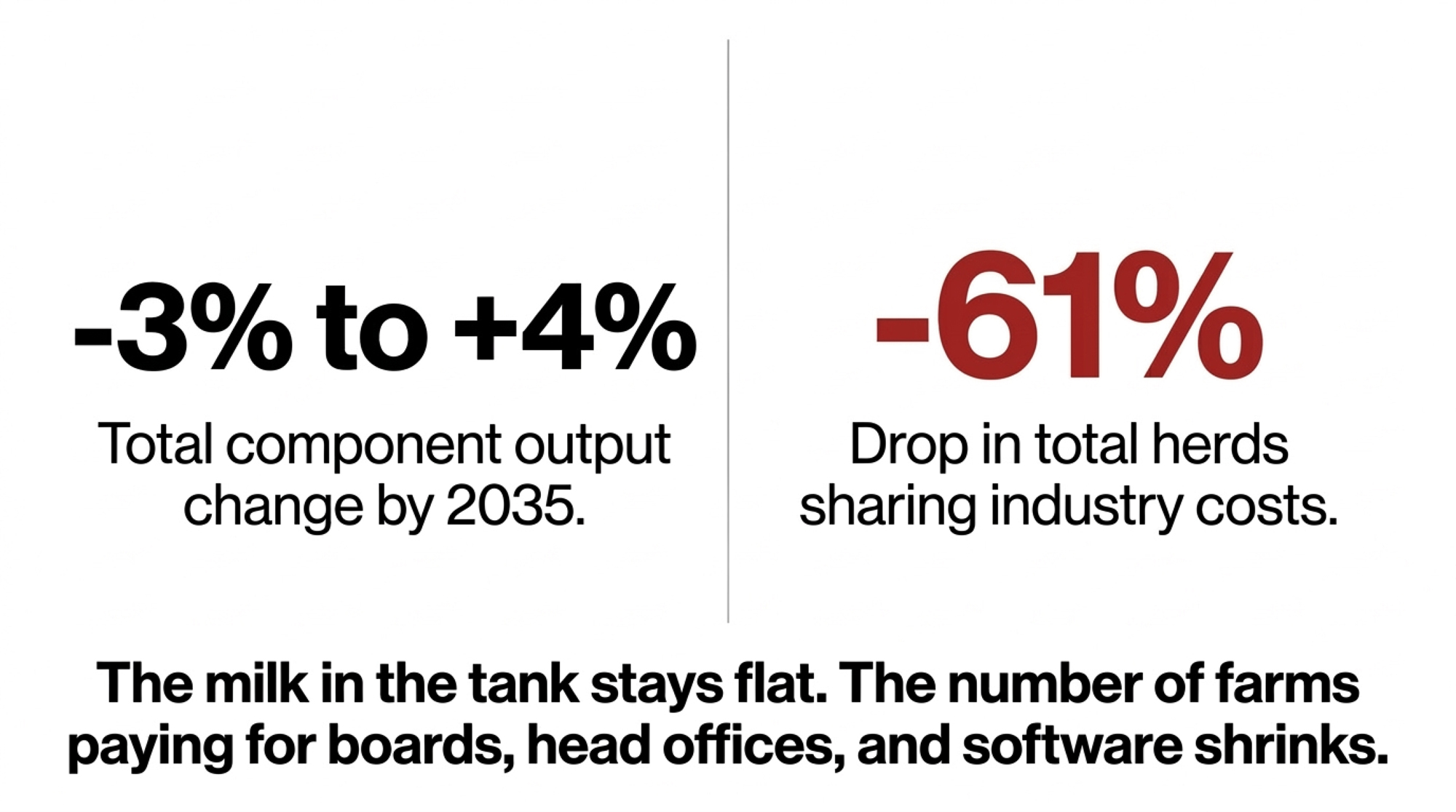
Here’s the surprise in his numbers. The milk in the tank barely moves. At 225 to 240 cows a herd, 3,500 herds is 787,500 to 840,000 cows. Add his 20% more fat and protein per cow, and total component output lands between 3% below and 4% above today’s.
So the spigot pays about what it pays now. What changes is how many farms are left to carry the costs that don’t shrink when a herd sells out: boards, head offices, evaluation runs, software, HR.
“We need to destroy more silos.”
— Murray Hunt, Dairy Cattle Industry Forum, September 22, 2026
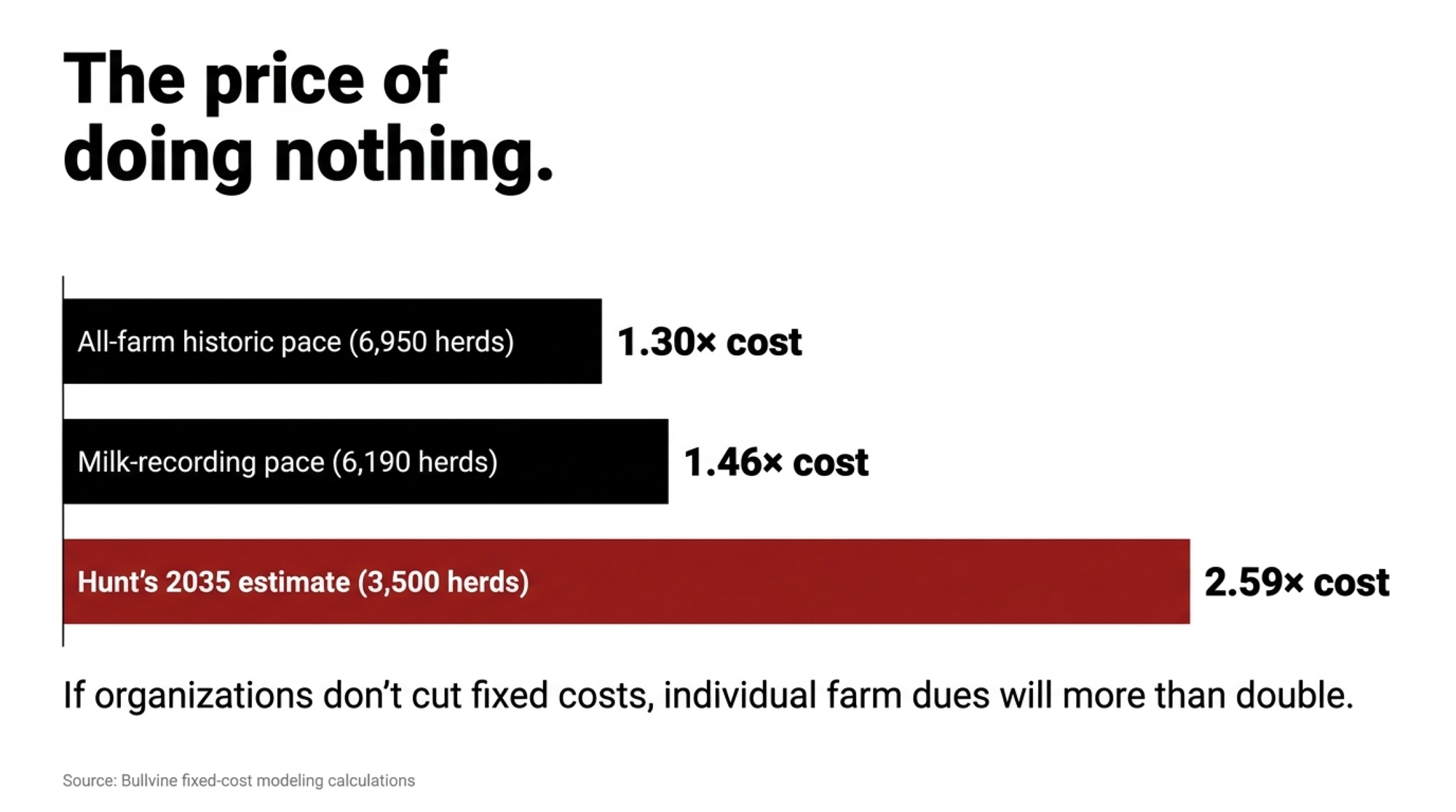
Bullvine calculation: how fast does the fixed-cost share per herd rise?
Path to 2035
Annual decline in herds
Herds in 2035
Fixed cost per herd vs. 2025
All-farm pace (2014–2024)
2.6%
~6,950
1.30×
Milk-recording pace (2020–2025)*
3.7%
~6,190
1.46×
Hunt’s 2035 estimate
9.1% (implied)
3,500
2.59×
All-farm pace from the AAFC Dairy Sector Profile. *Milk-recording enrolment pace, applied to all farms.
For all farms, 3,500 is aggressive. It needs herds to disappear three and a half times faster than they did over the last decade. For the herds that buy milk recording, it’s close to the current trend line.
Milk recording
2020
2025
Change
Herds enrolled
6,446
5,333
−17.3%
All dairy farms
10,095
9,048
−10.4%
Share of farms enrolled
63.9%
58.9%
−5.0 points
Enrolled herds fell 3.7% a year from 2020 to 2025. Hold that pace for a decade, and the recorded-herd base is about 3,650 in 2035. Part of that is deliberate. The forum heard the same day that not every animal needs recording anymore, and genomics has made that true for some decisions. But a deliberate exit still leaves fewer herds carrying the same systems.
Put a dollar on it. Say an organization carries $1 million a year in costs that don’t fall when herds leave. Across 9,048 farms, that’s about $111 a herd. At 6,950 farms, it’s $144. At 3,500, it’s $286. Spread only across milk-recording herds, it goes from $188 today to $274 at 3,650. That’s an illustrative model, not any organization’s budget.
What Should Board Members Ask Before 2035?
Hunt aimed the challenge at the directors and delegates in the room, and he’d been on the staff side of that table. “Elected farmer representatives are a great resource,” he said. “Being young and brash, you think you don’t need to be told, but I did.” Here’s what his three asks look like as board work.
Ask for the fixed-cost split this AGM season. Ask every organization you fund what share of its budget doesn’t fall when herd numbers do, and what that line costs per herd at 6,950 and at 3,500 farms. It’s a 30-day question. A total with no split isn’t an answer.
Price shared services before governance. Shared HR, IT and field systems attack duplicated costs without anyone surrendering a board, which is the distinction Hunt drew between alignment and amalgamation. The trade-off is control, since breed-specific rules have to survive the sharing.
Fund research with partners beyond Canada. Bigger research pools spread cost across more cows. The risk is losing Canadian pricing in the selection goal, the same logic that made PDD and Pro$ Canadian tools in the first place.
Hunt closed with John F. Kennedy, from Frankfurt in June 1963: “Change is the law of life. And those who look only to the past or present are certain to miss the future.”
He’d lived that line once already, in 1998, when the job he’d built was the one that went.
The room gave him a standing ovation. Karen was part of it, as she’s been through every chapter of this story: his biggest supporter and his biggest fan.
If the organization you pay dues to had to run on 6,950 herds tomorrow, what would it cut first, and has anyone on your board asked yet?
We’ll put that question to the organizations Hunt challenged and report their answers in The Bullvine Weekly.
Key Takeaways
Hunt’s 3,500-herd estimate for 2035 is aggressive for all farms, but milk recording is already on that track: enrolled herds fell 17.3% from 2020 to 2025, which projects to about 3,650.
On Hunt’s own 2035 figures, the tank ships about the same fat and protein, between 3% less and 4% more. What shrinks is the number of herds splitting the fixed costs.
Alignment always costs someone. In 1998 it cost Hunt his own job when CAAB dissolved, so any board asking for it should be ready to say who gives up what.
Hunt’s test for any partnership or shared-service plan: “In the end, the group that need to be profitable are the dairy farms, viable and sustainable.”
The Sunday Read Dairy Professionals Don’t Skip.
Every week, thousands of producers, breeders, and industry insiders open Bullvine Weekly for genetics insights, market shifts, and profit strategies they won’t find anywhere else. One email. Five minutes. Smarter decisions all week.
Learn More
Are You Breeding for the Future or the Past? — Align your genetic strategy directly with tomorrow’s milk cheque. Breaks down the hidden costs of outdated selection traits, arming you with the metrics needed to shift your sire criteria toward strict profit margins over show-ring appeal.
What Will the Dairy Industry Look Like in 2030? — Prepare your balance sheet for the consolidation wave Murray Hunt predicts. Maps upcoming bottlenecks in processing capacity against consumer demand, delivering concrete herd-size thresholds your operation must clear to survive the next decade.
Is Crossbreeding the Answer to Dairy’s Problems? — Challenge the purebred status quo with hybrid vigor economics. Follows the money on crossbred herds to reveal exactly how improved conception rates and reduced cull costs offset potential yield drops, fundamentally redefining baseline profitability.
Semex Alliance’s architect and first general manager died Tuesday, fourteen days before World Dairy Expo was to hand him its International Person of the Year award in Madison. Every index you culled on this morning is his argument, still winning.
He was supposed to be in Madison on September 29.
World Dairy Expo announced in April that Robert Chicoine — the man who built the Semex Alliance and became its first general manager — would receive the 2026 International Person of the Year award at the Recognition Awards Banquet on Tuesday, September 29. Semex announced Tuesday that he had died. He was 83.
Fourteen days. There’s no consolation in that arithmetic. There is this, though: the industry decided to honour him while he could still hear it, and he spent the months afterward doing exactly what he’d done since 1966 — explaining, patiently, why the numbers work.
It started with a magazine his uncle had already finished reading
Chicoine was born in 1943 at Saint-Pie-de-Bagot, Quebec (Ordre national du Québec), on a mixed farm he described to us as 15 to 20 dairy cows, laying hens, apple trees and a sugar bush. The milk cheque paid for the rest.
An uncle who belonged to the Holstein Association of Canada noticed the boy’s interest and began passing along each monthly issue of the Holstein-Friesian Journal once he’d read it himself. Chicoine studied the advertised names, the individual lactations, the lifetime totals, the fat percentages. He told us, in the interview behind our January feature Robert Chicoine and the Bull Nobody Wanted: “For me, this was the most beautiful gift I could receive.”
Then he did the thing almost no child does with a hobby. He ran a controlled experiment. The family kept Bantam chickens in assorted colours, so he built a second flock where he decided which male bred which hens, and he watched the colours come through the offspring.
“My little experiments with the Bantam chickens demonstrated to me with certainty that a breeding male can influence an entire herd, and even a whole segment of a population with the use of artificial insemination.”
A farm kid in Saint-Pie had just stated the entire premise of the industry he would spend the next forty years building.
He was hired to sell farmers the opposite of everything they’d been told
Chicoine took a B.Sc. in animal science at Université Laval in 1964 and a master’s in 1966, researching under Dr. C.G. “Charlie” Hickman at the Ottawa Experimental Farm (Ordre national du Québec). A student summer at the Centre d’insémination artificielle du Québec settled the rest of his life — he described that summer as being in heaven.
On March 22, 1966, he walked into CIAQ with one mandate: build Quebec’s young sire proving program. For more than twenty years, extension had told farmers exactly one thing about bull selection — use proven bulls. Chicoine’s job was to visit those same barns and ask breeders to commit 40 per cent of their breedings to unproven young bulls, on the strength of University of Guelph work by Murray Hunt showing that a 40/60 split against proven sires maximized genetic gain.
“It was a great challenge,” he told us. That is a Quebec agronomist’s way of saying it was very nearly impossible.
So he taught. Articles explaining Contemporary Comparison — daughters measured against herdmates of the same age, in the same barns, in the same season, so that management stops masquerading as genetics. Presentations at insemination club and breed association annual meetings across Quebec, some reached by small aircraft. Breeder information days alongside Holstein Canada’s Raymond Corriveau, arguing over whether raw production alone should qualify a cow as a bull mother. “Which often created good discussions!”
And the mailings. Every time CIAQ took on a new young bull, its pedigree and photograph went into the mail to every breeder whose herd qualified for genetic evaluations.
“Over the years, several breeders confided in me that when they were young, they waited impatiently for the arrival by mail of the pedigrees of these young bulls. Thus, a bond of loyalty to the program was created from one generation to the next.”
That’s the whole man in one sentence. He didn’t win the argument by being right. He won it by putting something in the mailbox every month until a generation of farm kids grew up trusting what was inside.
Three of the first seven young bulls into his program earned Holstein Canada’s EXTRA designation. He became CIAQ’s general manager in 1981 (Le Bulletin des agriculteurs).
Two bulls, one lesson
The famous one is Hanoverhill Starbuck. No genomics, no test — two men on a farm visit, stopping at Hanover Hill in Port Perry, Ontario, looking at a calf under a month old.
“There was a young male calf that was barely born. He was less than a month old when we saw him, and even then, we were struck by his exceptional appearance for his age,” Chicoine told Farmtario in April. They took an option and waited to see him develop, with health tests to follow. Born in April, delivered to CIAQ in November.
CIAQ went on to sell 685,000 doses of Starbuck semen into 45 countries, and Le Bulletin des agriculteurs describes the bull as an ancestor of 95 per cent of Quebec’s cows (Le Bulletin). What that dynasty did to the breed is its own story, and we’ve told it in Hanoverhill Starbuck’s DNA Dynasty.
But the bull that explains Chicoine is the one nobody wanted.
In the fall of 1967, working off a Holstein World advertisement for the Harris Wilcox dispersal in New York State, CIAQ bought a young son out of a cow with modest records, a bad photograph and a speckled coat — in an era when breeders hand-drew every calf’s markings on the registration application, which made mottled cattle a nuisance. The dam looked wrong to everyone who saw the picture. The pedigree read right: Sevens Burke Skylark on top, Osborndale Ivanhoe behind the dam, positive production and conformation indices stacked up the male line. “I had never seen such an eloquent pedigree on the male side,” Chicoine told us.
So CIAQ sent someone to the sale to look at the dam in the flesh before bidding. She was far better than her photograph, with an excellent mammary system. They bought her son.
Then almost nobody sampled him. 73HO101 Craiglen Sevens Senator earned EXTRA recognition from Holstein Canada in 1978, and his daughter Proulade Ruth Senator was Grand Champion at the Quebec provincial exhibition in 1981.
Trust the index over the photograph. That was the argument of his life, and he won it so completely that we now run whole herds on genomic values for traits no camera can see.
Boviteq, and the alliance that nearly didn’t happen
In 1986, at the request of the CIAQ board, Chicoine founded Boviteq to do on the female side what the AI centre was mandated to do on the male side (Le Bulletin). He chaired its board from 1991 to 1996, per Semex’s own account of his career. Every sexed-embryo conversation happening in your barn this year runs back through that research infrastructure.
The alliance was harder. It began in September 1988, at a seminar on Canadian genetics in Rennes, France, in a conversation between Chicoine and Doug Blair of Western Breeders Service about sharing income among Canadian centres according to each one’s share of breed numbers. That produced Genexcel by January 1990. Then Western Breeders’ move into Alta Genetics put a proposal on the table to fold Semex Canada into a global distribution system the remaining Canadian partners would not control. The talks broke. Semex Canada’s general manager resigned and left the same day.
“It was quite a dramatic situation,” Chicoine told us.
His answer, worked out with Gordon Souter, was to pool ownership of every bull into a single new legal entity — and, unlike Genexcel with its one-year exit notice, to build it so that walking out was almost impossible. The Semex Alliance became real on January 1, 1997, with CIAQ as principal owner at 45 per cent and Chicoine as first general manager until he retired in 2000.
He justified the whole manoeuvre in four words: “Necessity is the law.” Then, characteristically, he refused to let the phrase off easy. “It has nothing to do with not respecting the law. In a difficult situation, seeking to find the best possible solution becomes the rule to which one must adhere without hesitation.”
Semex says his work now shapes breeding decisions in more than 80 countries (Semex).
He spent a career multiplying genetics, then spent his retirement making sure none were lost
This is the line on the résumé that says the most about him and gets mentioned the least.
After leaving Semex in 2000, the man who had industrialized the spread of a handful of elite sires went to work as vice-president of the Canadian Farm Animal Genetic Resources Foundation, pressing Ottawa to conserve farm animal genetics — not just Holsteins, every breed (Canadian Agricultural Hall of Fame).
“It eventually paid off, since there is now a center at the University of Saskatchewan in Saskatoon with that mandate,” he said.
He understood the bill that comes attached to his own success. Get very good at multiplying the best animals and the population narrows behind you. He didn’t leave that for somebody else to solve. He worked on it for eight more years and finished for good in 2008.
The honours, in order
Year
Recognition
1998
Doctorat ès sciences honoris causa, Université Laval
2001
Temple de la renommée de l’agriculture du Québec
2005
Canadian Agricultural Hall of Fame
2008
Industry Distinction Award for dairy cattle improvement, Canadian Dairy Network
2010
Knight of the Ordre national du Québec, presented by Premier Jean Charest on June 3
His last argument was that the system should outlive the bull
After Madison named him, Chicoine sat down with host Peggy Coffeen on the Uplevel Dairy Podcast and was asked how much faster genetic progress moves now than when he was building the young sire program.
He wouldn’t put a number on it — “it’s difficult to have a number, really, [we] would need some research, I suppose.” Then he explained the difference anyway, and it is the sharpest thing anyone has said about genomics in a while.
Back then, he said, you identified a proven sire and “he could have been used for 10 years after that, but it was the same potential. It didn’t improve over the years. It was the same.” Now, with genomics, “they look at numbers all the time and they try to have available the young bulls that have the best numbers. So it’s improving all the time, instead of — it was more static before than it is now.”
Sit with that. The man credited with finding Starbuck, one of the most influential bulls ever born, spent his last recorded interview arguing that no single bull should be the point. The system that keeps replacing your best bull is the point. That is not the ego of a man who wanted a monument. That is a builder describing something designed to keep improving after he stopped touching it.
What he actually left in your barn
Not a bull. A habit of mind.
When you cull on an index instead of an eye. When you sample a young sire on a genomic value and a pedigree rather than a photograph. When you buy Canadian genetics from a co-operative that survived a merger fight thirty years ago because one man deliberately designed the exit door too heavy to open. When you sort through health traits, or component values, or a methane figure, and accept a number you cannot see with your own eyes — you are using the argument Robert Chicoine made from 1966 onward, one insemination club meeting at a time, to farmers who had every reason to tell him no.
He also left instructions, which almost nobody asks a genetics man for. “Surround yourself with the most competent people possible, create a healthy and warm working climate, and analyze regularly and seriously the challenges that the company must face as well as the opportunities offered by the industry.” And: “After having planned a project well and executed it rigorously, one should not throw in the towel too quickly if the results do not meet expectations.”
Then he got the last word on himself, before any of us needed it.
“I can summarize my career by saying that I am blessed to have always been passionate about my work. I went to work with enthusiasm daily.”
On September 29 in Madison, the Recognition Awards Banquet will call his name and he won’t stand up. The room should stay standing a long time on his behalf.
Robert Chicoine’s own account of his career, in his words and at length, is in our January 2026 feature Robert Chicoine and the Bull Nobody Wanted: The Data Revolution That Lives in Your Herd’s DNA. Funeral and visitation details will be added here when the family releases them. If you worked with Robert — at CIAQ, at Boviteq, at Semex, or across a kitchen table with a pedigree between you — we want your remembrance for the tribute we’ll publish next.
The Sunday Read Dairy Professionals Don’t Skip.
Every week, thousands of producers, breeders, and industry insiders open Bullvine Weekly for genetics insights, market shifts, and profit strategies they won’t find anywhere else. One email. Five minutes. Smarter decisions all week.
Twenty-four cows nobody else wanted from Kansas. One stubborn Ontario dairyman who used an outcross bull exactly once. Between them: 99.84% of every A.I. sire in your barn tonight.
In 1947, at the Wisconsin State Reformatory in Green Bay, a bull calf was loaded onto a truck bound for Kansas, and not one dollar changed hands.
The Reformatory ran the best Holstein herd of all the Wisconsin state institutions — and yes, that’s exactly what it sounds like. A prison. With a bull barn that half the Midwest wanted access to. Their blood went into serious herds, the kind of operations that produced bulls like Osborndale Ivanhoe, and a breeder who got access to it got it because somebody there thought well of him.
Elmer Dawdy had no money to speak of.
What he had was a young bull sired by Dunloggin Golden Cross — and he’d gotten that mating almost by accident. Golden Cross spent fourteen days at Dawdy’s place while en route to Colorado, and Dawdy bred one cow to him during the stopover. One cow. That was the whole opportunity, and he took it.
So he offered that son to the Reformatory, straight across, for a five-week-old calf named Wis Burke Ideal, born May 20, 1947.
They took the deal.
A five-week-old calf. Understand what that means — Dawdy wasn’t buying proven genetics; he was buying a guess. Nobody knew what that calf would become. He could have grown into nothing at all and cost Dawdy the only good bull he’d ever bred by accident.
Instead, Wis Burke Ideal sired Tidy Burke Elevation. Tidy Burke Elevation sired Round Oak Rag Apple Elevation. And Elevation — the bull Holstein International crowned Bull of the Century in 1999 — sits behind roughly half of every active Holstein A.I. sire in North America today.
The other half traces to a man in Brampton, Ontario, whose Glenvue prefix Dawdy had probably never bothered to learn, whose favorite bloodline Dawdy would have thrown him out of the barn for mentioning, and who was building the identical monument from the opposite end.
ACT I: BREEDING BLIND
Understand what these men were working with, because it changes how you read everything that follows.
When Doug Dunton bought his first Holstein in 1920, formal classification didn’t exist in Canada yet. Holstein Canada wouldn’t launch its program until 1925. And even once inspectors were coming through with clipboards and scorecards, what they left behind was a letter on a card — nothing more.
No sire summaries. No daughter averages published in a booklet you could carry to a sale. No reliability figures, no indexes, no way to compare one bull’s daughters against another’s except by driving to see them.
So that’s what you did. If you wanted to know whether a bull’s daughters had udders worth having, you got in a car — or a wagon — and you went and looked. You asked the neighbors. You trusted your eye.
Doug Dunton put it plainly years later: if you couldn’t see an animal’s ancestors to judge how good the type was, and whether it passed along, “you were working blind.”
Compare that to what’s sitting in your pocket. Genomic proofs. Reliability percentages. Haplotype screens on animals that haven’t been born yet. These two men laid the foundation of the modern Holstein cow with less usable information than you’d bring to buying a used truck.
The one cow that ended the Shorthorn experiment
Doug Dunton came to Holsteins sideways, and late.
In 1920 he signed up for a dairy short course run by the Ontario Department of Agriculture. Up to then he and his father had been crossing Dual Purpose Shorthorns — an experiment the record describes, with what I read as considerable mercy, as having “little apparent success.”
During the course, Doug got into some good Holstein barns for the first time. He came home and bought one cow. One. Not a conversion — a test.
She milked 80 pounds in a day.
Twice what any Shorthorn on the place had ever given. Picture her standing in that tie-stall row, a big black-and-white stranger among the roans, filling a pail while the home-bred cows on either side of her filled half of one.
You don’t need a scorecard to read that. Doug and his father went out and bought four more Holsteins, and the Shorthorns were finished.
Three of the four came from Lorne Davidson’s farm at Meadowvale. Two of those three built everything.
Bruach Noelle hit the ground on Christmas Day, 1928 — a daughter of King Segis Vale Spofford. She’d become the maternal great-granddam of two All-Canadian winners.
Her maternal sister, Bruach Luella Acme, was a daughter of King Toitilla Acme, the Davidson herd sire. She started the line that ran down to Glenvue Jean Inka B.
Hold onto Jean Inka B. She comes back at the end, and when she does, it’s going to land.
Dunton had no college degree. What he had instead was a conviction so fixed it worked like faith. He believed in close breeding — “breeding warm,” he called it, which is honestly the most farmer description of inbreeding ever committed to print — and he believed the King Toitilla Acme line was better than whatever anyone else was using.
In roughly four decades of breeding, Doug Dunton used an outcross bull exactly once.
The verdict on that experiment is the driest sentence in the whole record: he “didn’t do much harm,” but “neither did he do much good.”
No more outcross bulls were used. Ever.
The Kansas boy who sold his herd to buy an education
Elmer Alfred Dawdy was born in 1915 on his father’s place in Washington County, north-central Kansas. He came to dairy cattle through 4-H — with a Guernsey calf, which ought to make every Holstein person reading this smile. By the time college came around, he’d built a small herd of his own.
Then he sold it. All of it. For tuition.
He sold the herd. That’s Elmer Dawdy. He’d spend his whole life treating cattle as instruments rather than ornaments, and he opened by liquidating his own to buy an animal husbandry degree from Kansas State.
He graduated in 1938 into extension work — assistant county ag rep for Saline County, then head county agent six months later. That got him named Southwestern fieldman for the Holstein Association, seven states: Texas, New Mexico, Oklahoma, Nebraska, Colorado, Wyoming, Kansas.
And at that point Elmer Dawdy had never owned a Holstein cow in his life.
Think about the strangeness of that. The Association’s man across a seven-state territory, and he didn’t own one of the animals he was paid to promote.
But the job gave him something no amount of money could buy — he now knew where every bargain, every overlooked cow, and every seller in trouble was located across a quarter of the country.
So he bought a hundred acres in Saline County and started collecting.
Crooked cows from institutions
The Tidy Burke herd never exceeded twenty-four head of milking age.
Twenty-four. Smaller than most modern hospital pens. Smaller than the string a lot of you would cull in a bad year. That’s the operation we’re talking about.
And the cows in it were, to put it charitably, crooked. Bought for a song, many carrying some physical defect — the kind of fault that makes a breeder’s eye slide right past an animal at a sale. Dawdy fixed what he could and lived with the rest.
Two came out of Clyde Hill Farm in Clyde, Missouri. One of them, Clyde Hill Jewel Carine Mercedes, was classified Good the day he bought her.
She was never raised. Not once, the entire time he owned her.
Good. In an era when Good meant middling — the score you didn’t mention at the feed store, the cow you apologized for. Year after year the classifier came through, ran his eye over her, and left the card exactly where it was.
That cow founded the family that produced Tidy Burke Elevation.
Sit with that if you’ve ever culled a heifer on her score alone. The maternal foundation behind half the breed’s paternal lineage was a permanently Good cow from a Missouri farm, bought cheap by a man who couldn’t afford better.
The rest of the foundation reads like a list of places nobody shops for cattle.
The other Clyde Hill cow became the dam of Raven Burke Elsie — three Gold Medal sons. And at the Colorado State Home for Dependent Children, Dawdy found Posch Ormsby Johanna Bess. She’d produce Ormsby Burke Pontiac Mose, sire of Paclamar Astronaut.
An orphanage. A children’s home. A prison herd. A Missouri dispersal.
Even his first herd sire came through persuasion. Dawdy talked Sister Xavier of St. Joseph’s Orphanage into buying Sir Bess Tidy from Fred Eiten of Waterloo, Iowa — Eiten proved the bull, the orphanage owned him, and Dawdy used him artificially.
A nun financed the first sire in a program that would reshape the global Holstein population, and there’s nothing in the record suggesting Dawdy ever found that arrangement remarkable.
They would not have gotten along
Doug Dunton was pleasant. Accommodating. The kind of man neighbors dropped in on without calling first. He worked as an official classifier for the Canadian association — not a job they hand to men who can’t be diplomatic in somebody else’s barn. And when his sons Ralph and Earl came of age, they became his partners.
Elmer Dawdy could be abrasive and abrupt, inclined to speak his mind regardless of consequences. His own biographer noted that his normal ways of doing business were at times “very much at odds with accepted methods and behaviours.”
His two sons left home after high school. The record’s phrasing is nine words long and quietly devastating: they couldn’t, it seemed, get away fast enough.
There’s a whole story in those nine words, and I’m not going to pretend I know it. But anyone who’s worked a farm alongside family understands what a kitchen can feel like when the man running things is certain about everything.
Then there’s the bloodline schism, which was absolute. Dunton was a King Toitilla Acme man who braided in the Rag Apple line and spent decades weaving the two together.
Dawdy was a Burke man. Tried and true.
Mention “Rag Apple” in Elmer Dawdy’s barn, and he’d throw you out.
Not argue. Throw you out.
ACT II: THE TRADE AND THE TWELVE-LACTATION COW
A row of matched half-sisters
By the mid-1950s, Glenvue Farm at Brampton was producing cows people drove to see.
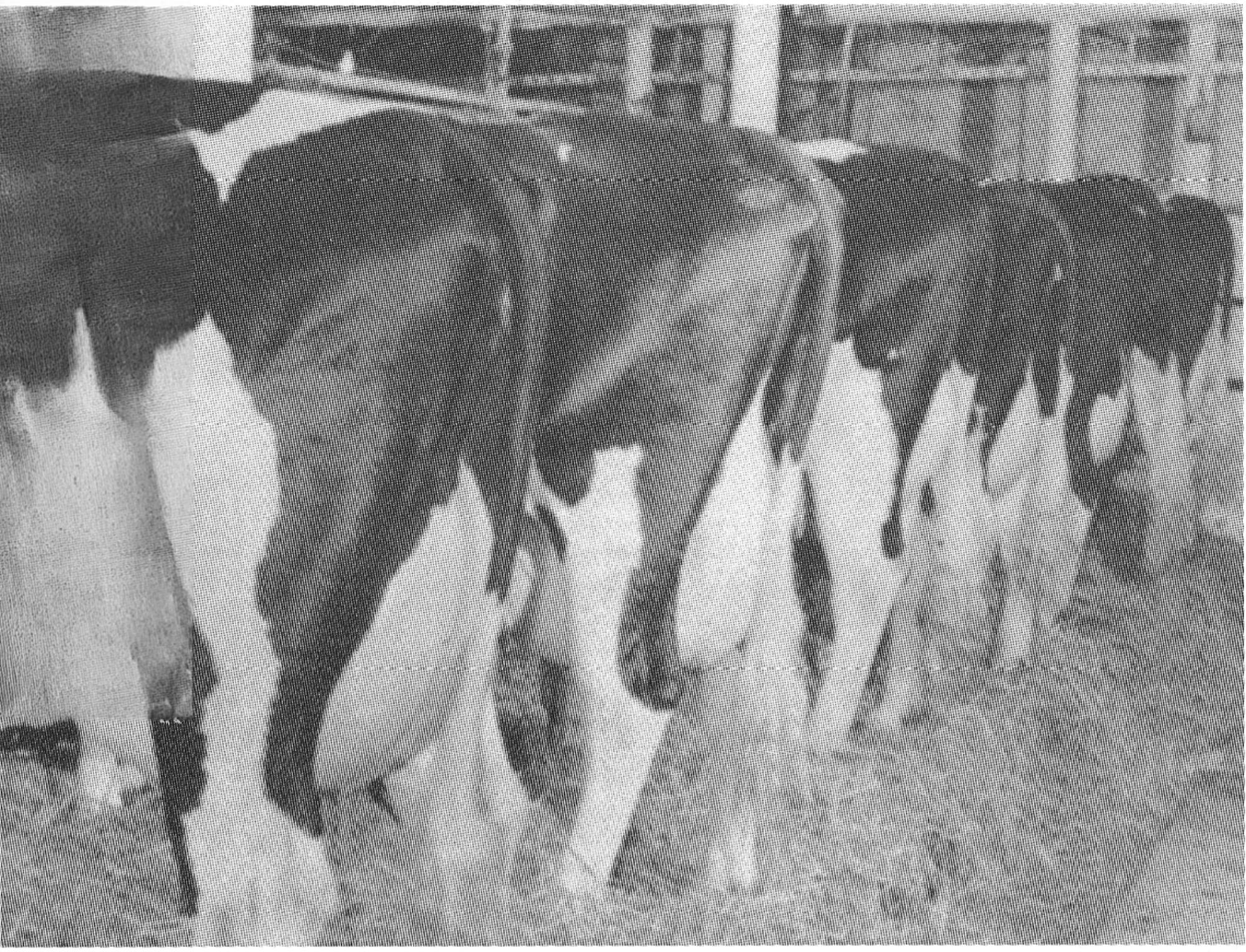
There’s a photograph from those years that captures it better than any production string could — a row of A.B.C. Midnight Joe daughters standing in Dunton’s stable, and the record notes they “made an impressive sight.”
Picture what that actually means. Half-sisters, tied side by side, matched enough in their toplines and udder attachments that a visitor walking the alley could tell before anyone said a word which bull had sired the lot of them.
That’s what breeders came for. Not one great cow — anybody gets lucky once. A row of them, predictable enough to look like they’d been stamped.
The individuals were extraordinary too.
A.B.C. Inka May (EX), All-Canadian 4-year-old in 1947, made 24,142 pounds of milk at 4.67% with 1,128 pounds of fat over 365 days, milked three times a day — that’s what “3X” means on an old record, and it was the going method for pushing a cow to her limit before anyone had heard of a robot.
In 1947. When the good cow in your neighbor’s barn made 12,000, and he talked about her all winter.
Glenvue Noelle Inka (EX-4*), All-American and All-Canadian aged cow, 1947. Haltered and posed against the gate — this is what Dunton’s type-first breeding looked like when it worked. Best in her class on both sides of the border in one season, and her line ran forward to Walkway Chief Mark.
Glenvue Noelle Inka (EX-4*) took All-American and All-Canadian aged cow in 1947 — both sides of the border in one season. Glenvue Rilla Top Grade (EX) was Reserve All-Canadian aged cow in 1951.
And Glenvue Rosalie Fond Hope (VG), out of Rilla Top Grade by Spring Farm Fond Hope, stood grand champion at the Royal Winter Fair in 1955 and took All-Canadian 4-year-old the same year — on the tanbark at Toronto, in front of a crowd that considered the Royal the only show in Canada that truly counted.
Nine Glenvue matrons made Dave Morrow’s list when he asked “Who Breeds the Brood Cows?” in the June 10, 1962 Holstein World. Nine, from one farm.
And standing above all of them, an old cow named Glenvue Nettie Jemima (EX-13*).
Glenvue Nettie Jemima (EX-13*), All-Canadian aged cow, 1954. That’s not a young cow — twelve lactations wore that frame down. In a barn culling on Good Plus, Dunton chose her twelve separate times.
Twelve lactations. 218,215 pounds of milk. 8,193 pounds of fat.
All-Canadian aged cow, 1954 — in a herd where a cow graded Good Plus or she went down the road.
The number that matters there isn’t the milk. It’s the twelve.
Because Dunton ran the hardest cull rule in the country: to stay at Glenvue, a cow had to grade Good Plus or better. One exception, only one — a two-year-old who classified Good but carried a Good Plus udder got another year, because Dunton had seen too many good udders show up late.
Everything else went down the road. No sentiment, no second thoughts.
So twelve lactations in that herd means Doug Dunton stood in front of that cow twelve separate times, in an operation where merely good wasn’t good enough, and chose her. Through her prime and well past it.
A pleasant, accommodating man who culled without mercy kept looking at Nettie Jemima and deciding, again, that she stayed.
Picture her in her later years — a big, well-worn old cow with the hips and the hollows a twelve-lactation record leaves behind, still carrying an Excellent card, standing in a barn full of animals young enough to be her great-granddaughters. Anyone who’s kept an old favorite past the point where the spreadsheet says to knows exactly what that looks like.
She paid him for every one of those decisions. She’s the dam of Rosafe Centurion, and of Magician, Signet, and Citation R.
That “13*” on her card, for anyone under fifty: the star system marked qualifying superior offspring. Thirteen of them, in an era of hand-kept records and postal reporting, was a maternal record that bordered on absurd.
The cruel part of Doug Dunton’s career
Here’s what I find genuinely hard about his story.
Those cows — and type-wise they were far beyond anything Dawdy ever bred, a man who never once placed a cow on the All-American calendar — made other men famous.
A.B.C. Inka May was sold in dam — sold while carrying the calf. A.B.C. Farms bought her mother, Temple Farm May, and under the rules of the day the buyer registered the resulting offspring under his own prefix.
So the cow Doug Dunton bred carried somebody else’s name. And her son by Montvic Rag Apple Sovereign — A.B.C. Reflection Sovereign, called by some the greatest bull the breed has produced — carried it too.
Dunton bred the brood cows. Other men banked the bulls.
In his entire career, exactly one bull carrying the Glenvue prefix achieved major impact. His name was Glenvue Clipper, and he’ll matter shortly.
What he was actually selecting for
Before the trade, sit with Dunton’s philosophy a minute, because it’s the most useful thing in this story for anybody building a mating list in 2026.
“It takes longer to breed type than production,” he told a reporter, “but once you get type, it is not so difficult to get higher production.”
Type first. Always. Forced to choose, type won.
And he selected for three things that appeared nowhere on a pedigree in his day — no index, no proof, no number attached to any of them: temperament. How a cow milks out. Longevity.
Read that list again and tell me it isn’t the conversation this industry is finally having, seventy years late, about functional traits, productive life, and whether we bred ourselves into a corner chasing yield.
Dunton was selecting for traits that wouldn’t get formal evaluations for another half-century. He did it because he’d decided they mattered more than the things he could measure.
His four stated reasons for Glenvue’s consistency, from a 1963 Farmers Advocate interview: strict culling. Slow-maturing animals — his two-year-olds were never pushed, and a thousand pounds of milk in a month satisfied him. Line breeding. The Good Plus rule.
Never pushed. In a business that has spent eighty years pushing.
1947, and the fortnight bull
Down in Kansas, Dawdy had been watching Wisconsin Admiral Burke Lad tear through the breed in the early 1940s — “witnessing the havoc,” the record says — and he jumped in with both feet.
He bought Weber Burke Hazelwooder, a Burke Lad son. Then he borrowed Weber Hazelwood Burke Raven from Jake Zarnowski.
Borrowed. Neighbor to neighbor, on a handshake, the way things actually got done before contracts.
Raven was out of an inbred Burke Lad daughter, and he sired Raven Burke Elsie plus Raven Burke Carine Mercedes — the maternal granddam of Tidy Burke Elevation.
Then came the trade.
Wis Burke Ideal, born May 20, 1947, was sired by Wis Ideal (EX-GM) out of Wis Juanita — and both of them were sired by Weber Burke Cyclone, the great inbred Burke son standing at Green Bay.
A son of Cyclone bred to a daughter of Cyclone. That’s the calf Dawdy got for a bull out of a fourteen-day stopover.
Wis Burke Ideal (VG-88 GM), born May 20, 1947. Cyclone on both sides — a son of Weber Burke Cyclone bred to a Cyclone daughter. Elmer Dawdy got him from the Green Bay Reformatory as a five-week-old calf, for a bull he’d bred almost by accident. Look at the depth through that chest. Half the Holstein breed’s paternal line runs through it.
And then he doubled down. Dawdy bred Wis Burke Ideal to a daughter of Wisconsin Admiral Burke Lad — inbreeding stacked on inbreeding, on purpose, by a man whose entire philosophy on the subject ran five words long:
“You can never get too much of a good thing.”
He meant it literally. He was spectacularly right, and — as the breed would learn expensively, decades later — he was also wrong.
The calf was Tidy Burke Elevation.
August 30, 1965
On Round Oak Farm in Virginia, out of a cow named Round Oak Ivanhoe Eve by Osborndale Ivanhoe, Tidy Burke Elevation’s son hit the ground.
Round Oak Rag Apple Elevation.
Round Oak Rag Apple Elevation (EX-96 GM), b. August 30, 1965 — Bull of the Century, 10,000 A.I. sons, and 51.06% of North America’s active Holstein sire lines. His sire came out of a 24-cow Kansas herd. Read more: Round Oak Rag Apple Elevation: The Bull That Changed Everything)
And here’s the collision that makes these two men inseparable rather than rivals.
Elevation’s sire came from Dawdy. But run up the maternal line: Elevation’s maternal granddam was Round Oak Nettie Emaline, born January 7, 1959, sired by Glenafton Gaiety — and Gaiety was sired by Rosafe Centurion, the son of Dunton’s Inka Supreme Reflection out of Glenvue Nettie Jemima.
The old twelve-lactation cow. The one Doug Dunton kept choosing.
The bull named for the Rag Apple line that Elmer Dawdy would have thrown a man out of his barn for mentioning carried Doug Dunton’s brood cow on his dam’s side.
Neither man had any say in it. Neither, so far as anyone can tell, ever met the other.
May 9, 1962 — and three years earlier, Chief
May 9, 1962 — and three years earlier, Chief
Three years before Elevation, the other half of the breed was born — and not where you’d expect. Lester Fishler’s Pawnee Farm sat on the south edge of Central City, Nebraska, and when he dispersed the herd on April 14, 1962, a pregnant cow named Pawnee Farm Glenvue Beauty sold for $4,300 to Wally Lindskoog of Arlinda Farms. She rode a train to Turlock, California, and calved twenty-five days later.
The dam was Pawnee Farm Glenvue Beauty (EX) — sired by Glenvue Clipper. Dunton’s one great bull.
The sire was Pawnee Farm Reflection Admiral (born February 16, 1960, EX, Gold Medal Sire). Admiral’s sire was Rosafe Pearl Hannibal — bred on Hector Astengo’s Rosafe farm in Ontario by mating Rosafe Shamrock Rosamond to Rosafe Sovereign Supreme, which made Hannibal a double grandson of A.B.C. Reflection Sovereign.
And Rosafe Shamrock Rosamond’s maternal granddam?
Glenvue Jean Inka B.
The cow descending from Bruach Luella Acme — one of the five Holsteins a young Doug Dunton bought in 1920, after a single cow gave him 80 pounds of milk and ended his father’s Shorthorn experiment.
Pawnee Farm Arlinda Chief (EX-94), b. May 9, 1962. Sixteen thousand daughters. Five hundred thousand granddaughters. Two million great-granddaughters — and a lethal recessive nobody would find for another fifty years. Doug Dunton bred into both sides of that pedigree and never owned a share of him.
Elmer Dawdy contributed nothing to Chief — not one gene he was responsible for placing there.
Two bulls, born three years apart. Elevation, built on Dawdy’s paternal line with Dunton’s Nettie Jemima standing in the maternal background. Chief, built on Dunton at both ends.
That’s the climax of this story, and it took two stubborn men roughly forty-five years of refusing to compromise to arrive at it.
Two men, two halves — the ledger
The Dawdy Side(paternal power)
The Dunton Side(brood cow power)
Foundation animal
Wis Burke Ideal (b. May 20, 1947)
Glenvue Nettie Jemima (EX-13*)
Scale / signature
Never above 24 head milking
Nine great matrons on one 1962 list
Key anchor bull
Round Oak Rag Apple Elevation (1965)
Pawnee Farm Arlinda Chief (1962)
Paternal share, 2010s bulls
51.06% of active lines
48.78% of active lines
Breed contribution
10,000+ A.I. sons; Bull of the Century, 1999
~14% of the modern U.S. Holstein genome
The bill that came due
Inbreeding velocity — “never too much of a good thing”
Carried HH1, the APAF1 lethal recessive
Paternal-share figures from the Journal of Dairy Science Y-chromosome study of 62,897 North American bulls born 1950–2013. Note the irony in the bottom row: each man’s signature strength produced the other’s kind of problem.
ACT III: WHAT THEY LEFT
Neither man took a victory lap
This is the part that gets me.
In the late 1960s — right as Elevation was beginning to make his name — Elmer Dawdy got rid of his cattle. And he didn’t hold a dispersal.
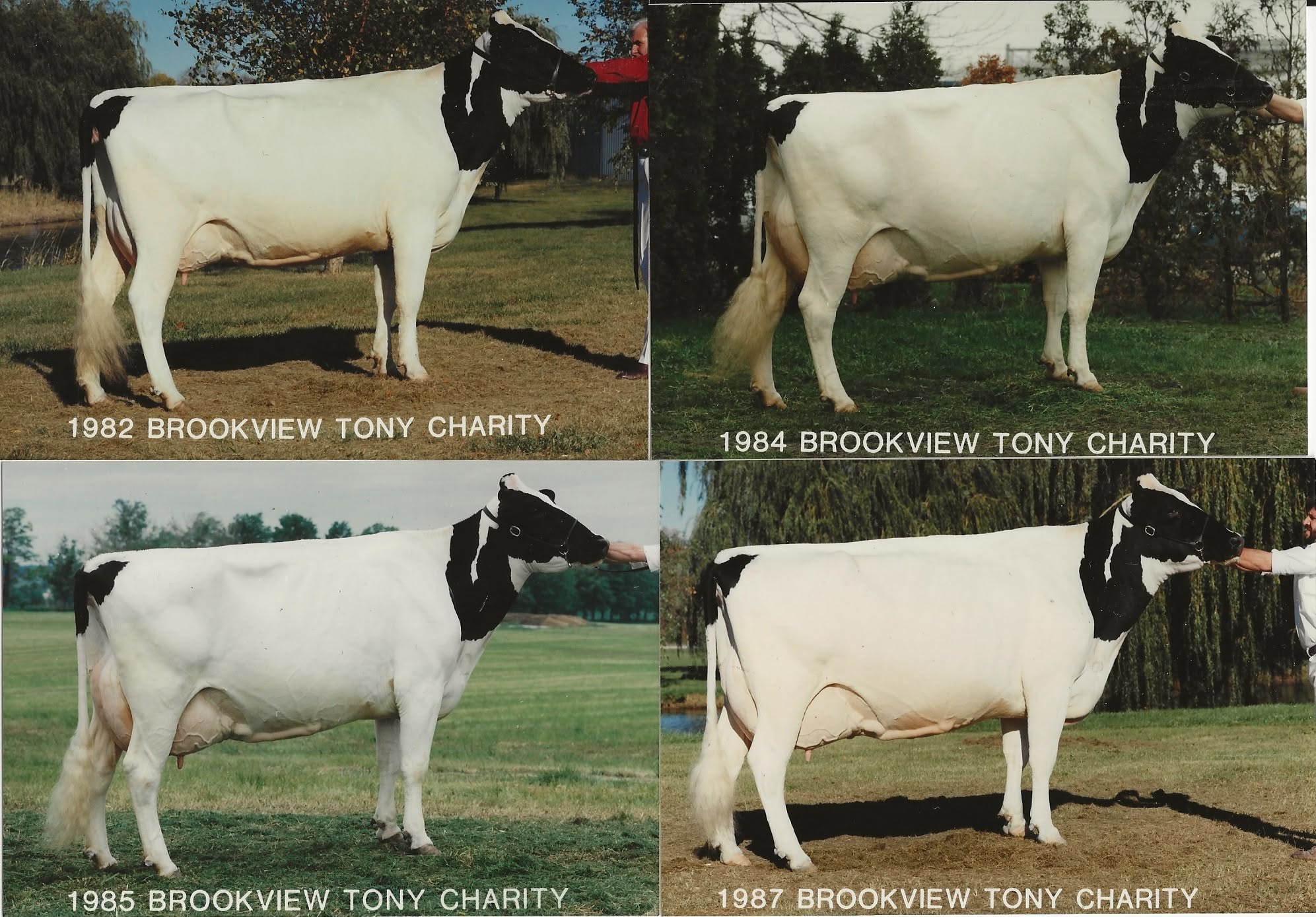
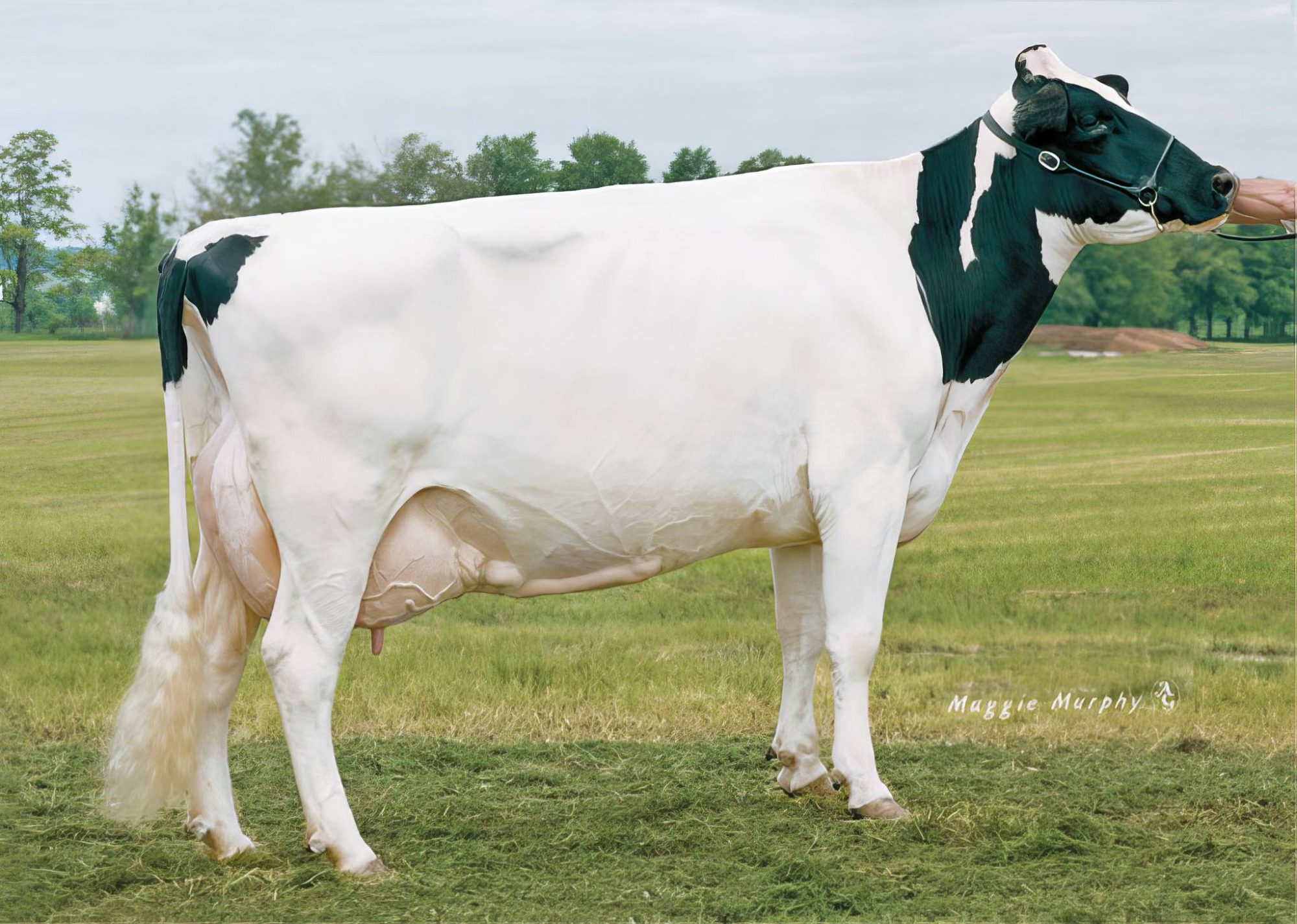
Brookview Tony Charity. A half-interest in this one cow brought $1,450,000 at the 1985 Hanover Hill dispersal — 2,500 people from around the world, Bob Shore working the block, buyers leaning on the rail from three continents. This is the send-off Elmer Dawdy could have had. He handed his twenty-four cows to two young men he trusted and drove home. (Read more: Brookview Tony Charity: A $47,000 Gamble That Outlived Everyone Who Doubted Her)
Understand what that means. On July 15th and 16th, 1985, the Hanover Hill dispersal at Port Perry drew more than 2,500 people from around the world. Auctioneer Bob Shore opened the bidding on Brookview Tony Charity at $50,000. When it stopped, a half-interest in that one cow had brought $1,450,000 — a Canadian record, Stephen B. Roman bidding for Romandale Farms.
That’s what a dispersal was: the moment a breeder’s life’s work got appraised in public, with buyers from three continents leaning on the rail.
Dawdy had bred the sire of Round Oak Rag Apple Elevation. He’d bred Ormsby Burke Pontiac Mose, paternal grandsire of Paclamar Astronaut. His last herd sire was Tidy Burke Cornerstone, a Mose son born in 1957. Any auctioneer in America would have fought for that sale.
He farmed his cows out to a couple of young Kansas breeders he had confidence in, and walked off.
No trumpets. Twenty-four cows quietly handed to two young men he trusted.
Doug Dunton’s ending was quieter still, and to a breeder’s eye it’s the sadder of the two.
He’d built the finest brood cow herd in Canada — and one by one the bulls carrying his blood left. Voyageur. Midnight Joe. Prefect. Radar, Sky Chief, Crown Royal. They finished their careers standing in A.I. studs, working for other people’s catalogs and other people’s prefixes, the same way A.B.C. Inka May’s son had.
Picture Glenvue after they’d gone. The tie-stall rows still full of those matched, deliberate, warm-bred cows. The row of Midnight Joe daughters aging in place. The best young bulls gone to studs whose names would go on the semen straws while the Glenvue prefix quietly stopped appearing at the top of pedigrees.
His best customers — Dawdy’s too — were farmer-breeders who lived no more than twenty miles from the farmgate. That was the distribution network. Neighbors, driving over to look at a young bull.
Twenty miles. For genetics that now circle the planet.
Where they live today — and this part isn’t sentiment; it’s arithmetic
If you breed Holsteins, both of these men are standing in your barn tonight. Not metaphorically.
A Y-chromosome study published in the Journal of Dairy Science traced the paternal pedigrees of 62,897 North American Holstein bulls born between 1950 and 2013 and found the male line had collapsed to essentially two branches.
Among bulls born in the 2010s: Chief’s line at 48.78%. Elevation’s at 51.06%. A third lineage, Penstate Ivanhoe Star, hung on at 0.16% — a whole paternal family down to a rounding error.
Split almost exactly down the middle. Dunton’s bull and Dawdy’s bull, dividing a breed between them.
The Bullvine’s own analysis puts today’s figure at 99.84% of active A.I. sires tracing to those two. Penn State’s Dr. Chad Dechow doesn’t soften it: “When people say 99 percent of Holstein sires in the U.S. today can be traced to only two bulls, both born in the 1960s, it’s absolutely true.”
Chief’s chromosomes account for roughly 14 percent of the entire U.S. Holstein genome. He left about 16,000 daughters, 500,000 granddaughters, and more than two million great-granddaughters.
Elevation sired over 10,000 A.I. sons across 45 countries, with an estimated nine million descendants — and by The Bullvine’s analysis, his DNA still makes up something close to a tenth of the CDCB genomic reference population, the dataset your genomic predictions are trained on.
The pathways run where you’d expect. Chief’s best sons were S-W-D Valiant (June 28, 1973) and Walkway Chief Mark (June 13, 1978, out of Walkway Matt Mamie, a No-Na-Me Fond Matt daughter).
On Elevation’s side: Sweet-Haven Tradition (August 18, 1974) and Hanoverhill Starbuck — born April 26, 1979, out of Anacres Astronaut Ivanhoe, an Astronaut daughter. Which means Dawdy’s Mose line shows up on both sides of Starbuck’s pedigree.
Hanoverhill Starbuck, b. April 26, 1979 — the first bull in this story anybody reading it might have actually used. 200,000-plus daughters across 45 countries. 209 proven sons, 406 proven grandsons. In Canada alone, 36,976 of his daughters got classified, and 70% of them graded Good Plus or better — Doug Dunton’s exact cull rule, cleared at industrial scale by Elmer Dawdy’s bloodline. Read more: Hanoverhill Starbuck’s DNA Dynasty: The Holstein Legend Bridging 20th-Century Breeding to Genomic Futures)
And Starbuck is where you can watch the whole thing come full circle.
He left more than 200,000 daughters across 45 countries and 209 proven sons, which led to 406 proven grandsons. In Canada alone, 36,976 of his daughters were classified — and 70% of them scored Good Plus or better.
Read that number again, because it’s the quiet miracle in this entire story.
Good Plus or better was Doug Dunton’s cull rule. The line he drew in a Brampton tie-stall barn, the standard that decided which cows stayed and which ones went down the road. Seventy percent of thirty-seven thousand daughters of a bull descended from Elmer Dawdy’s overlooked, bought-for-a-song foundation cows would have cleared Doug Dunton’s bar.
The two men never agreed on a bloodline in their lives. Their genetics still met Dunton’s standard anyway.
Ninety-five percent.
One province, one bull, one bloodline.
And in Quebec, 95% of Holsteins carried Starbuck’s genetics. Ninety-five percent — traceable straight back to a five-week-old calf that left Green Bay on a truck in 1947.
Dunton’s Glenvue Noelle Inka threw one more long shadow: her grandson Spring Farm Fond Hope was grandsire of No-Na-Me Fond Matt, and paternal great-grandsire of Hanover-Hill Triple Threat, whose daughter Tora Triple Threat Lulu produced Hanover-Hill Inspiration.
The bill that came due
If this were only a monument, I’d stop there. But these were farmer-breeders, and farmers get the whole ledger.
“You can never get too much of a good thing,” Dawdy said.
He was wrong, and the breed has been paying that invoice ever since.
Chief carried a lethal recessive nobody knew existed — a mutation in the APAF1 gene, now called HH1. One copy makes a carrier. Two copies and there is no calf at all, just a cow that comes back around.
Before it was identified in 2016, that single inherited flaw is estimated to have caused roughly 500,000 spontaneous abortions worldwide and about $420 million in losses across 35 years. Once geneticists found it, carrier frequency fell from 8% to 2% within a few years.
And the concentration those two bulls created is still tightening. Lactanet’s August 2025 figures put average pedigree inbreeding for Canadian Holstein heifers born in 2024 at 9.99%.
Here’s the practical piece, and I think both men would want you to hear it.
That “outcross” bull on your mating list probably isn’t one. When 99.84% of active A.I. sires descend from the same two bulls, a clean-looking four-generation pedigree tells you almost nothing — two animals can show no shared ancestors in three or four generations and still carry a substantial genomic relationship, because the common ancestry sits further back in Chief and Elevation, in both pedigrees, many times over.
That’s what pedigree-based screening can’t see and genomic evaluation can. Run your matings through the CDCB or Lactanet genomic tools rather than reading a paper pedigree and calling it an outcross. The number you want is the genomic inbreeding of the resulting calf, not the count of repeated names on a page.
That’s not a knock on either man. Neither had a sire summary, a daughter proof, or a haplotype screen. They were breeding by eye and by memory. They bred so well, and so consistently, that A.I. took their two best products and made them universal before anybody understood what universal would cost.
The last word
They never met. They’d have argued if they had.
One was a pleasant Ontario dairyman with no degree, two sons who stayed, and a stubborn faith in one bloodline he refused to abandon even once in forty years.
The other was a blunt, degree-holding Kansan who bought crooked cows out of orphanage herds, milked twenty-four of them, traded a fortnight houseguest’s son for a five-week-old calf that became the sire of the century, and had two boys who left and didn’t look back.
Doug Dunton bred the cows. Elmer Dawdy bred the bulls.
E.Y. Morwick spent six pages trying to settle which of them mattered more. He laid out his propositions, ran the pedigrees both directions, weighed Elevation against Chief and Astronaut against Fond Matt, and reached the only honest conclusion available to him: “So far as I can see, they come out pretty well equal.”
Sixty years of genetics have proved him right to two decimal places. 48.78 and 51.06.
And that’s the thing worth carrying out of this story. Some legacies are too large for one man, so history hands them to two — one chasing type when nobody could measure it, one chasing intensity when everybody told him to stop — and lets them build the same thing from opposite ends, in different countries, in barns eleven hundred miles apart, neither one ever knowing the other man was working.
Walk your barn tonight. Look at the udders. Watch how they milk out. Notice which old cow you keep deciding to keep, one more lactation, past what the spreadsheet advises.
Doug Dunton’s three unmeasurable traits are still the ones you’re chasing. Elmer Dawdy’s twenty-four crooked cows are standing in every animal you own.
Two barns. Eleven hundred miles. One breed.
Key Takeaways
Neither man had a sire summary, a daughter proof, or a bank account worth mentioning. Dunton had one bloodline he refused to leave; Dawdy had 24 cows nobody wanted and a trade nobody else would make. Scale was never the moat.
The cow that founded half the breed’s sire line was classified Good and never raised off it. Before you cull a heifer on her card alone, look at her udder, her mother, and what she throws.
Dunton selected for temperament, milk-out, and longevity when none of the three appeared on a pedigree. Seventy years later, that’s the functional-traits conversation the industry finally caught up to.
At 99.84% of A.I. sires tracing to Chief and Elevation, a clean four-generation pedigree isn’t proof of an outcross. Run the mating through CDCB or Lactanet and read the calf’s genomic inbreeding instead.
Continue the Story
Round Oak Rag Apple Elevation: The Bull of the Century – Step inside the world where Elmer Dawdy’s prison-calf gamble took physical form, tracing how Virginia farmer Ronald Hope guided Elevation from an unheralded young sire into the monumental sire line that conquered modern A.I. studs.
Hanoverhill Starbuck – A Legendary Sire – Walk the show barns and test herds where Doug Dunton’s strict type gospel and Dawdy’s linebred genetics finally merged, revealing how one black bull redefined Canadian breeding and proved that the foundation held across generations.
Inbreeding in the Dairy Cattle Industry: Is It Time to Panic? – Confront the modern ledger of Chief and Elevation’s absolute reign, unpacking the mounting genetic bottleneck, lethal recessives, and why today’s commercial breeders are navigating the costly consequences of two men who bred too well.
The Sunday Read Dairy Professionals Don’t Skip.
Every week, thousands of producers, breeders, and industry insiders open Bullvine Weekly for genetics insights, market shifts, and profit strategies they won’t find anywhere else. One email. Five minutes. Smarter decisions all week.
She walked into that 1981 sale ring with recently swollen hocks and a cooling crowd. Heffering paid $47,000 anyway. Four years later, half of her sold for $1.45 million.
Brookview Tony Charity, EX‑97‑3E — the cow Bob Murphy called “probably the best one ever.” Not a freak of height, but a masterpiece of width: the depth of body, the high, wide rear udder, the quiet balance that made hardened judges run out of words. (Photo: Maggie Murphy)
The classifier went quiet.
Bob Murphy had spent the better part of his life crouched behind Holstein cows—running a hand down a topline, stepping back to read the set of a hock, studying the way an udder cleaved and carried. By his own reckoning, he’d put a score on something close to half a million head. A man who’s seen that many cows doesn’t rattle easily. He’s watched the great ones come and go. He knows that “perfect” is a word you save, because the day you spend it carelessly is the day it quits meaning anything.
It was the mid-1980s, in a barn at Hanover Hill Farm outside Port Perry, Ontario. The cow in front of him had already worn more banners than most herds win in a generation. Murphy walked around her. Walked around her again. Then he said the thing breeders still repeat, word for word, more than forty years on—that of the tiny handful of cows ever rated at 97 points, “she’s probably the best one ever,” with the most correct overall conformation of any cow he’d ever seen.
Think about that for a second. Not the best he’d seen that year. Not the best in the barn. The best he’d ever laid eyes on—and this was a man who’d seen damn near everything the breed had to offer.
Her name was Brookview Tony Charity. And here’s the thing most folks get backward: the score didn’t make her. By the time she settled at her famous mark of EX‑97‑3E, the number was just the paperwork catching up. When she was scored on the American system in June 1984, she became the 21st Holstein in the U.S. ever to reach Excellent‑97—the highest score their program had ever awarded. The truth had been spotted years earlier—in a cold sale ring, on a cow nobody else was quite sure about.
The Night Nobody Was Sure
Now, you’ve got to understand the era to understand the gamble.
This was the early 1980s—the golden age of the North American show cow. A great female could become a household name in dairy circles. The Royal Winter Fair and World Dairy Expo were cathedrals, and a Grand Champion banner could rewrite a farm’s future. Embryo transfer was still young enough to feel like wizardry; flushing a single great donor to a half-dozen elite sires was rewriting what one cow could be worth. The big Ontario and New York outfits were assembling the cow families that would shape the breed for decades. And the people doing the buying weren’t gambling on spreadsheets. They were gambling on the eye.
Charity was born on August 6, 1978, bred by John D. and Karl E. Havens at Brookview Farm in Fremont, Ohio. Look at how she was bred, and you’ll see why old-timers nod: she was a Kanza Matt Tony daughter out of Leaderwood Elevation Charmer—and that puts Round Oak Rag Apple Elevation, the most important type bull the breed has ever known, right there as her maternal grandsire. Here’s the bittersweet part: Charmer made nearly 19,160 pounds as a three-year-old and was shipped off to Japan in 1979. Charity was the only daughter she’d ever leave behind on this continent. Matt on Elevation. Bull-power married to the great type-transmitting foundation of the era. The blend that made her wasn’t an accident.
The dam who left only one. Leaderwood Elevation Charmer, VG — a Round Oak Rag Apple Elevation daughter who milked close to 19,160 pounds before she was sold to Japan in 1979. Study the frame and the udder: this is the Elevation strength and dairy quality that would come together one more time, in the white-marked heifer calf she left behind on this continent. Charmer gave the breed exactly one daughter here before she shipped out. That daughter was Charity.Where it all started. Leaderwood L Charmer Dora, born in 1970 — the matriarch standing behind Charity’s dam, and the foundation the whole family was built on. Look at the strength through her body and the quality of that udder for a cow of her era; this is the deep, durable Leaderwood type that Round Oak Rag Apple Elevation would later amplify into Charity herself. Greatness like Charity’s rarely comes from nowhere. Usually, it comes from a cow like this one — a generation or two back, doing the quiet work no banner ever records.
And here’s where the story damn near ended before it began.
By the fall of 1981, she came up for sale as a young cow—and she’d developed fluid in her hocks. Anyone who’s raised cattle knows that sinking feeling. Your best young cow, the one you’ve been bragging on at every coffee shop in the county, suddenly walking out stiff and swollen right when the whole world’s about to look at her. The swelling came down on its own out at pasture—slow, stubborn, on the cow’s own schedule. By sale day, she walked clean.
She didn’t start out as anybody’s sure thing. As a heifer in Ohio she was good, not great—first senior yearling and reserve junior champion at the Ohio District 9 Show, and that was the end of her early show honours. Roger Schug bought her as a bred heifer in 1980. Then, in March 1981, Albert Cormier of Cormdale Farms in Georgetown, Ontario, brought her across the border—the first Canadian chapter in a cow who’d become Canada’s most famous. (Read more: How Albert Cormier Rewrote the Rules of Global Holstein Business – and Made the Whole Industry Catch Up)
Under the Cormdale banner she had her one real humbling. At the Kitchener Championship Show, milking better than nine months, she placed tenth in the three-year-old class. Tenth. The cow who’d go on to never lose her class again, buried in the middle of a Kitchener lineup.
By that fall she was catalogued for the Designer Fashion Sale in Syracuse, New York, on November 21, 1981—and she’d developed fluid in her hocks..By sale day, she walked clean.
But word travels in this business. The buzz had cooled. A few of the buyers who’d circled her were looking elsewhere now.
Not Peter Heffering.
Heffering ran Hanover Hill with Ken Trevena, and he had the gift—the one you can’t teach, the one that separates the breeders we remember from the ones we don’t. He looked past the hocks. He saw the depth through her body, the spring of rib, that rear udder hanging high and wide like somebody had drawn it off the breed standard instead of off a living animal. He saw the way she stood—not nervous, not showing off, just there, filling the space with the kind of quiet authority great cows carry, and lesser ones never learn. (Read more: How Hanover Hill Holsteins Revolutionized the Dairy Breeding Industry)
Heffering didn’t buy her alone, and he didn’t buy her cheap-easy—he outlasted a syndicate of Ontario breeders headed by Ken Empey Jr., and a New York breeder, George Morgan of Tyrbach Farms, who wanted in too. In the end Heffering and Morgan took her in partnership for $47,000, and Charity went home to Port Perry. Two years later, when her brightest days were already showing, Hanover Hill bought out Morgan’s half for $250,000 U.S.
Read those two numbers back to back. Forty-seven thousand for the whole cow in 1981. A quarter-million for half of her by 1983. And we’re only getting started.
Looking back, what they paid would seem almost funny. We’ll get to why.
The eye that saw it: Peter Heffering leads Brookview Tony Charity out at the Ontario Spring Show, a ring of good cattle strung out behind her. This is the quiet authority he’d bought into when others backed away — a cow who didn’t fidget or grandstand, just walked to the front like the front was where she’d always stood.
What Made Breeders Drive All Night to See Her
She walked into the show ring in 1982. And here’s the line you’ll hear repeated wherever old show people gather: in her own class, she was never beaten. Not that year, not the next, not ever—across her whole career, the judge’s hand never came down on another cow in her class.
Look at the width — and look how small the man behind her seems. Brookview Tony Charity takes her second Supreme Champion at World Dairy Expo in 1984, Peter Heffering nearly swallowed up behind that barrel of a body. It’s remembered as the first time Expo crowned its Supreme on the colored shavings rather than the tanbark — a fitting stage, because there wasn’t a cow in the building who belonged on it more.
Let that settle, because in the show business, it borders on impossible. Everybody gets beaten eventually. The good ones get beaten by the great ones, and the great ones get beaten by youth, an off day, or a judge who saw it differently. Charity just… didn’t. Year after year, ring after ring, the placing came back the same.
Supreme at Madison, 1985 — one of four. Peter Heffering steadies Brookview Tony Charity while Stephen Roman holds the purple rosette, flanked by the Ontario Dairy Princesses and a bank of silver. The banner behind them says World Dairy Expo; the cow in front of it said something louder. On this floor, against the best the continent could ship to Wisconsin, she simply didn’t get beaten in her class.
Read the ledger and try not to blink:
The Triple Crown (1982): Grand Champion at all three U.S. National Shows—Harrisburg in the East, Madison in the middle, Fresno out West—in a single calendar year.
The Royal Dominion: Grand Champion at the Royal Agricultural Winter Fair four times—1983, 1984, 1985, and 1987—the first Holstein ever to do it.
World Dairy Expo: Supreme Champion honours four times on the tanbark at Madison.
The full reckoning: Six superior production awards and a string of All-American and All-Canadian nominations, a résumé few cows in history can touch.
The fourth one — the one that made history. Brookview Tony Charity stands Grand Champion at the 1987 Royal Agricultural Winter Fair under Judge Jeff Nurse, draped in roses, with Peter Heffering on the halter and Stephen Roman (in the hat) accepting the trophy. No Holstein had ever won the Royal four times. When the rosette went on that November, no one ever had to wonder again.
And lest anyone think she was all ribbon and no milk pail: at five years old, she pumped out 39,015 pounds of milk at 3.6%, with 1,422 pounds of fat, milking 3X over 365 days—a record that earned her the Erle Kitchen production trophy, putting her among the most productive cows in the world in the 1980s. Show banners and a milk record like that, in the same animal. That’s the part that ought to stop a working breeder cold.
Now, about that “never beaten” business—there’s one honest asterisk, and it’s worth telling straight, because it makes the record more impressive, not less. One cow in history topped Brookview Tony Charity: Continental Scarlet-Red. But read how it happened. Charity was a four-year-old that day; Scarlet was a five-year-old. They never met in the same class. They met only at the Grand Champion drive—the final walk, where age and class fall away, and the best of everything stands together—and there, Scarlet took Grand with Charity standing Reserve. So the in-class record holds, clean and untouched. The only cow ever to beat her had to wait until the very last walk of the show to do it, across an age line, with everything on the line. That’s how close to flawless she really was.
Picture the kind of evening that made her a legend. The Royal Coliseum in Toronto—banks of seats packed in tight, the ring lights burning white against a black November evening outside. The smell of clipped hair and cedar shavings, and that low electric hum a crowd gives off when a great class is grinding toward its finish. Charity led them in. And when the judge made his walk, the hand came down where it always came down—on her.
Supreme Champion, World Dairy Expo — a banner Brookview Tony Charity carried out of Madison four times. The trophies bank at her feet; the seats behind her have emptied. And the cow herself stands the way she always did when the noise died down: calm, square, and done arguing the point.
That’s how you measure a legend, by the way. Not just by the banners she carried. By how rarely, and how narrowly, anybody got close enough to take one from her.
So what made breeders load the truck and drive half the night to stand in front of one cow? Listen to the men who judged her. At Madison, Fred Foreman put it plainly: “When a cow has milked for nearly 14 months we have no trouble starting the class with her and naming her grand champion of the show.” Lowell Lindsay called her flat out “the greatest cow of the breed I’ve seen.” And Loren Elsass said her form would “make her the standard of comparison for a long time.” These weren’t soft men. They didn’t hand out words like that. They just couldn’t find a way around her.
The cathedral she filled: Peter Heffering and Brookview Tony Charity in the lineup at World Dairy Expo, the great class strung across the colored shavings under the Coliseum tiers. This was the room breeders drove all night to reach — and the cow at the end of the strap was the reason the seats stayed full long after the easy classes had emptied them.
The Year She Almost Didn’t Come Back
Here’s the part the show programs never printed.
In 1983 it nearly all ended. A reaction to some of the antibiotics she’d been given cost her her appetite and her strength, and for a stretch of dark days the breed’s living definition of perfection was just a sick animal in a stall. Ken Trevena and Willis Conard practically lived with her through it—not the cow on the magazine cover, just a cow who needed them.
And that ought to stop us, because it’s easy—too easy—to talk about a legend like Charity as if she were a trophy on a shelf instead of a living thing that bled and breathed and could be lost. Anybody who’s ever had a great one knows the truth of it. Great cows aren’t made in the ring. They’re made in the dark mornings and the long nights. In the watching. In the worrying. In that flood of relief when she finally stands, eats, and walks back to being herself.
She came back.
Not just survived—came back to the ring and kept right on winning. And the breeders watching took note, because that kind of resilience isn’t a footnote to them. It’s a trait. The deep, stubborn constitution to take a hard knock and still throw strength to the next generation—you can’t pin a banner on it, but you can build a cow family on it. They would.
There’s one more decision tucked in here that tells you everything about how Hanover Hill saw her. With Charity still capable of winning anywhere they pointed her, they pulled her off the show string for a stretch and put her on an intensive embryo program instead. Sit with that for a moment. The most undefeated cow in the breed, standing home in the barn while lesser cattle paraded for banners she’d have won at a walk. It was the right call, and it was a brutal one—the kind most people can’t make even when they know in their gut they should.
Two bets, one cow. Stephen B. Roman (right), the uranium magnate whose Romandale Farms paid a record $1.45 million for half of her, and Peter Heffering (left) of Hanover Hill, the cattleman who’d staked $47,000 on a swollen-hocked unknown four years earlier — flanking Brookview Tony Charity, EX‑97. Whatever Bay Street thought she was worth, these two had their hands on the halter.
The Financial Shockwave
We said we’d get back to what she cost. Here’s why it matters.
July 15, 1985. The Hanover Hill Dispersal, Port Perry. Some 2,500 people had come from Canada, the United States, England, South and Central America—and about an hour into the second day, the cow they’d all really come for walked in. When Heffering led Charity into that sale ring, the “king and queen of the dairy world” were met with a standing ovation. Auctioneer Bob Shore opened the bidding at $50,000—and it climbed from there until a Canadian record fell. When it was over, Stephen B. Roman’s Romandale Farms had half of her for $1,450,000, outlasting a syndicate headed by Richard Witter of Taurus Service—the bidding handled, remarkably, by Witter’s 14-year-old son, John.
A million-dollar cow, eating her hay. Brookview Tony Charity in her pen at the 1985 Hanover Hill Dispersal, her records tacked to the board behind her, a couple of onlookers studying her through the rail. An hour later she’d walk into the ring to a standing ovation and a Canadian-record bid. Right here, though, she’s just a cow with her head in a bucket — which is exactly what the best of them never forget how to be.
When a single cow walks the road from a sale-barn purchase to an international financial instrument, you’re not watching the dairy world anymore. […] Lay it out, and the line tells its own story:
Year
Financial Event
Value
1981
Purchased by Hanover Hill (Heffering & Trevena) at the Designer Fashion Sale
$47,000
1985
Stephen B. Roman’s Romandale Farms buys a 50% share, July 15
$1,450,000 (CAD), a record
1986
Bay Street limited partnership built on frozen semen from six of her ET sons
$3,500,000
Read that 1986 line again. Stockbrokers in a Toronto financial district, writing up share offerings on the genetics of a cow bred in Fremont, Ohio. The breed had spent a hundred years putting prices on bulls. Now the suits were trying to turn perfection herself into stock certificates.
But none of that—not the million-four, not the three-and-a-half—is really the heart of this. It’s just the world admitting, late and loud, what one cattleman had seen quietly in a sale ring with his own two eyes, years before the rest of them caught on.
The People Who Loved Her
A cow like Charity belongs to history now. But she was never alone in it, and the people around her are half the reason the story still lands the way it does.
The Havens family bred her in Ohio. Heffering saw her when others blinked. Roman backed her with a fortune. And through all the championship years at Hanover Hill, it was Ken Trevena who knew her best—not the cow on the magazine cover, but the cow in the stall at five in the morning. (Read more: THE ROMANDALE REVOLUTION: How a Uranium Billionaire & Cow Sense Conquered the Holstein World)
Away from the tanbark: a quiet morning in the barn at Port Perry, the great cow in her stall and the man who knew her best leaning in to check her over, fork in hand. This is where legends are actually made — not under the lights, but here, in the early quiet, with someone who cared enough to look twice before the day began.
He’s the one who saw the mornings. The feed bunk. The udder filling. The way she handled the trailer, the noise, and the strange barns, and settled in anyway. By every account, she was level-headed—all business, no foolishness, a cow who went about being great without a lick of drama. The kind you could trust at the halter, the kind that never made you nervous walking into a ring full of people.
What none of them knew, in those good years, was how little time was left.
A Photo From a Barnyard, Forty Years On
Here’s something that happened while we were writing this.
When this story first ran, a reader named Cyrus Conard picked it up and recognized a family name in it: Willis Conard, one of the two men who’d nursed Charity through the 1983 illness that nearly took her. Willis was Cyrus’s uncle — brother to his father, Wayne, who himself spent years connected to Hanover Hill. When Wayne passed away last year, the family found this photograph among his things — Charity being classified right there in the Hanover Hill barnyard, the wash water still flecking the air, the classifier working his card at the edge of the frame. By family account, it’s the day she scored the 97.
Think about what that means. The most documented cow of her generation, and the truest picture of her highest moment sat in a family’s keeping for forty years — not in an archive, not on a magazine cover, but with the people who’d been close enough to the cow to be part of her story. That’s where greatness actually lives. Not in the record book. In the family that kept the photo
The moment the number happened. Brookview Tony Charity is classified in the Hanover Hill barnyard — wash water still in the air, the classifier’s card already filling in at right. By the family’s account, this is the day she scored EX‑97. The photograph was kept for forty years by the Conard family — relatives of Willis Conard, the Hanover Hill stockman who helped nurse her through her darkest week — and surfaced only when Wayne Conard’s son found it after his father’s passing. Courtesy of the Conard family.
Twilight
She died on August 10, 1988, at Hanover Hill Farm in Port Perry. She was ten years old. Cancer.
Ten. Think about that—a cow who’d won the breed’s biggest banners four times over, whose genetics got underwritten on Bay Street, gone before she’d reached an age plenty of ordinary cows pass without anyone marking the day. There’s a particular ache in that for anybody who’s lost a good one too soon. All that public glory, the headlines and the seven-figure prices, and it ended in the most private way there is: an empty place in a barn where greatness used to stand, and a man who’d cared for her for most of her life left to find the words.
Trevena buried her right there on the farm, marked by a rock and a plaque on the idyllic Hanover Hill ground in Port Perry.
Incredible Perfection—that’s what they called her, and you could write a whole book around those two words and not improve on them. That’s not ad copy. That’s grief, trying its level best to be precise.
Where She Lives Now
Here’s the thing about a truly great brood cow, though. The finest monument to her was never going to be a plaque on a fence post. It was always going to be a daughter who makes you stop mid-stride and look twice—and then a granddaughter, and then a great-granddaughter you stumble onto three generations down a pedigree when you weren’t even hunting for her.
Now, Wikipedia will tell you her genetic history was “unremarkable” and that none of her offspring matched her own show-ring heights. And on the banner count, that’s fair. But walk the maternal line out forty years and tell me it didn’t matter.
Over in the Netherlands, Charity 504 EX‑94 stood Grand Champion at the National NRM Show back in 2004, carrying the line into a fresh generation of European admiration. In 2022, Het Uilenreef Charity 16 was named Grand Champion at the Neppelenbroek Holstein Show—another branch, still wearing the name like it means something, because it does. That same year in Austria, Jomargo Goldendreams Cheyenne‑RC took Grand Champion at the Austrian Dairy Grand Prix, tracing right back to Charity through the European family. And in Wisconsin, Sellcrest D Cheeto‑Red carried the old blood back toward the coloured shavings at Madison—her owner, Trish Brown, admitting she hadn’t even realized how remarkable Charity’s legacy was when she first bought the cow.
Forty years later, the line still wins. Jomargo Goldendreams Cheyenne‑RC, EX‑90, is mobbed with a high-five the moment she’s named 2022 Grand Champion at the Austrian Dairy Grand Prix for Bernard Unterhofer in South Tyrol — banner on her back, udder swung full. Trace her sires back — Golden Dreams on a Texas‑Red, a Kite‑RC, a Rubens‑RC — and the line runs straight home to Brookview Tony Charity. Look closely at the handler’s number, too: 97. Some things a pedigree doesn’t have to explain.
That’s what a real cow family does. It outruns the people who started it. It crosses oceans and languages and housing systems and forty years of shifting type fashion.
And here’s a word for the present, while we’re at it. Modern Holstein breeding often chases extreme stature—taller, sharper, more. Old-school breeders remember Charity differently. She wasn’t a freak of height. She was a masterpiece of width—chest width, body depth, dairy strength, the whole package in balance. Complete cows age better in pedigrees than flashy ones ever will. Every time a breeder today picks balance and longevity over the freak of the moment, they’re chasing something Charity already had figured out.
Brookview Tony Charity in 1982, 1984, 1985 and 1987 — four lactations apart. Look at what time did to her: more depth, more strength, the udder still riding high and level. This is the difference between a cow who’s merely fashionable and one who’s correct. The fashionable kind break down. Charity just kept getting truer.
The Cow They Built a Statue For
In 2017, nearly thirty years after she died, something happened that no other cow in this breed can claim. They built her a statue—a real one, eight metres tall.
It stands in Cathedraltown, a neighbourhood in Markham, Ontario, built on the former grounds of Romandale Farm. Charity, Perpetuation of Perfection, the sculptor Ron Baird called it—a life-sized Holstein worked in gleaming stainless steel, mounted high on 26-foot posts so she floats above a little parkette, catching the cold Canadian light against the open sky. It was a gift from Helen Roman-Barber, Stephen Roman’s daughter, to the land her father once farmed.
Home, at last, to the right barn. Ron Baird’s stainless-steel Charity — Perpetuation of Perfection — on display beneath the rafters of the Royal Agricultural Winter Fair, draped in a fresh garland like the four she earned here in the flesh. The permanent statue stands in a Markham subdivision she never visited. But for a few November days, eight metres of polished steel came back to the one Coliseum that was always, unmistakably, hers.
And here’s the irony only a dairy person fully feels. Charity never set hoof in Markham. Not once. From the day she landed in Canada to the day she died, she lived at Hanover Hill in Port Perry, and that’s where she’s buried. “She never went to Romandale Farm,” Ken Trevena said years later, standing by her grave. “Anyone in the Holstein business knows that.” The neighbours grumbled about the giant chrome cow on stilts; the city even talked of moving her. None of it touched the truth underneath. You don’t raise eight metres of stainless steel over a subdivision for a cow that didn’t matter.
To somebody outside the dairy world, a monument like that might seem a little strange. A statue. Of a cow.
But ask a Holstein breeder, and you won’t have to explain a thing.
Because they understand it in their bones. They’ve had one like her, or they’ve spent a lifetime hoping they would—the cow that changes how the whole barn feels, the one visitors ask to see before they’ve got their boots off, the one whose daughters you keep when good sense says sell, the one whose name turns up three generations down and makes you smile before you even know why. Charity was that cow, multiplied by history. The one who made a hardened classifier reach past his own vocabulary. The one who made judges keep arriving at the same answer—and made the one cow who ever topped her wait until the final walk of the show to do it. The one who made financiers write numbers that sounded ridiculous right up until the pedigree proved them conservative.
And maybe that’s the truest measure of her—truer than the EX‑97‑3E, truer than the four Royals and the four Madisons, truer than a record million-four for half a cow. It’s that nearly forty years after Ken Trevena laid her to rest on that farm in Port Perry, serious breeders on two continents still argue about her, still breed toward her, still run a finger up a maternal line and go quiet when they hit her name.
Brookview Tony Charity. Incredible Perfection.
She did exactly what her legend promised.
She compelled our imaginations to carry her on—and we’re still carrying.
Ken Trevena — Reveals the operational management and day-to-day husbandry strategies behind Hanover Hill Holsteins, detailing how meticulous transition nutrition and rigorous structural care converted high-potential genetic purchases into legendary, multi-year show ring champions.
Blondin Goldwyn Subliminal EX-97: A Final Bow for the Queen — Dismantles the modern obsession with genomics-only indexing by proving how an elite maternal line delivered over 310,000 pounds of lifetime milk while maintaining a flawless physical score across eight lactations.
The Sunday Read Dairy Professionals Don’t Skip.
Every week, thousands of producers, breeders, and industry insiders open Bullvine Weekly for genetics insights, market shifts, and profit strategies they won’t find anywhere else. One email. Five minutes. Smarter decisions all week.
Summer 2005, Lylehaven Lila Z on the block, gavel falls at $1.15M — first Holstein past seven figures in 20 years. But the real disruption wasn’t the price. It was what that cow became, and why the Canadian co-op system had to adjust its playbook to keep up with the man who sold her.
Fall of 1981. A heifer named A Brookview Tony Charity is booked into the Designer Fashion Sale, and Peter Heffering walks up to take a look. One glance at the hock — swollen up like a grapefruit — and most buyers would’ve been halfway back to the truck. Not Albert Cormier. He’d already seen past the swelling to the cow underneath.
A Brookview Tony Charity — the swollen-hock heifer Albert Cormier saw past in the fall of 1981, and the 1984 Royal Winter Fair Grand Champion he’d warned Peter Heffering he “might need to reconsider selling.” One glance, one grin, one cow that announced the kind of eye the whole Canadian Holstein industry would spend the next four decades catching up to.
A few months later, out in a summer pasture, that swelling had melted clean away. The heifer looked — well, she looked like 1984’s Royal Winter Fair Grand Champion in waiting. Albert, half-teasing, half-serious, told Heffering he “might need to reconsider selling her.” Heffering, the story goes, nearly came unglued. That little moment — the eye that saw past the hock, the grin that knew exactly what it was holding — is pure Cormier. It’s where any honest conversation about the man who pried Canadian Holstein genetics open to the world has to start.
Four decades on, the two men who took the keys from him — Dave Eastman at GenerVations, Yvon Chabot at Cormdale Exports — don’t reach for business-school adjectives when you ask about Albert. They reach for something plainer. “Positive. Tackle things head on — good and bad. Ability to switch gears, refocus, fast. Adaptable. Also a pile of energy,” Eastman says. Chabot nods from Quebec: “He was always very positive, about the markets, about the future of a cow or a new business venture. He believed in the dairy business, and that always improving genetics was the key to success.”
Albert Cormier leading Skys-the-Limit Claire ET to Intermediate Champion at World Dairy Expo, Madison, 1997 — the half-interest purchase that would change everything. Claire’s ET son, Calbrett-I HH Champion, hit #1 LPI in Canada five years later. This is the photo of a thesis being proven in real time: buy the elite female, stack her with the right mates, turn her sons into the bulls the co-op catalogues can’t beat. One banner in Madison. One bull out of her flush. One private Ontario program suddenly competing on the same stage as the institutions.
Honestly? If you want to understand how Canadian dairy got to where it is in 2026, you have to understand the P.E.I. kid with what his peers called “unmatched cow sense.” Albert refused to pick a lane between type and production. Between Ontario and Quebec. Between Canadian pride and European pedigrees. That refusal reshaped a whole breed.
Albert Cormier with Calbrett-I HH Champion — the ET son of Skys-the-Limit Claire who climbed to #1 LPI in Canada in 2002 and hit “Millionaire” sire status by 2007. A private Ontario stud’s bull, bred off a cow Albert bought a half-interest in, outpacing the co-op catalogues. Proof that the kid from St-Philippe had been right all along: type and production could go together, and a private operator could prove it on the national stage.
LEGACY AT A GLANCE
A Brookview Tony Charity — 1984 Royal Winter Fair Grand Champion
Calbrett-I HH Champion — #1 LPI sire in Canada, “Millionaire” sire status (2007)
Lylehaven Lila Z — $1.15M in 2005, first seven-figure Holstein in 20+ years; granddam of Lexor and Lavaman, 5th dam of Lambda
Calbrett Kingboy Miranda P — #1 heterozygous polled female for type and feet & legs in her era; the only cow ever named 2x Global Cow of the Year by Holstein International (and the first polled cow ever to take that honour), plus Polled Cow of the Year
Master Breeder Shields for Calbrett — 2002 and 2018
Certificate of Superior Accomplishment — Holstein Canada, 2017
International footprint: OGER partnership (France — early ’90s); customer barns in Holland, Italy, Germany, UK, U.S.
Why 2026 matters to this story
We’re sitting inside a genomics-driven, semen-and-embryo-exporting industry juggling a lot at once. Lactanet’s Methane Efficiency index for Holsteins is bedding into breeder programs. Feed-efficiency evaluations are working their way into commercial proofs. North American A.I. consolidation is rolling through another wave. And the export side is eyeing shifting U.S. trade posture and tighter EU BTV-3 health certificate paperwork.
Here’s the thing. If Albert were in the barn today, he wouldn’t be fighting the Methane Efficiency index. He’d be figuring out which cow family transmitted it best before the first proof was even published. That’s the whole point of this piece.
The Belfast Kitchen Table
Spring of 1983. Young Yvon Chabot picks up the phone at the family farm in Belfast, Quebec. An Ontarian wants to drive down and see a Marshfield Elevation Tony daughter — interesting pedigree, he’s heard.
By the time the sun goes down, that Ontarian — Albert Cormier, driving fast, asking faster — has crossed the province, talked his way into two barns, and bought two cows he hadn’t laid eyes on that morning. Beaucoise Tempo Kimo had just won her 2-year-old class at the Quebec Spring Show over at Les Fermes Turmel; Chabot pointed the way. The Tony heifer was at Ormstown. Done and done, both on the same trip.
“Both cows have done very well for him,” Chabot says, with the understatement of a man who’s seen a lot of cattle move.
What Chabot might not have clocked that day was that he’d just auditioned for a job. A few years later, as Cormdale’s consulting arm grew, Albert called again — this time to hire him full-time. That’s how Albert worked. Fast. Positive. Decisive. Actually — scratch the adjectives. Let me show you.
The Man in the Barn
Ask Chabot what Albert was actually like working a barn and the answer comes quick. “Patience, willing to share his experience and respect for other people’s opinion. Recognize efforts and success of others. Trust people working with you.” That’s the character sketch in the man’s own words. The physical memory lines up with it — not a big voice, a quick one, and a French that slid into English mid-sentence whenever a conformation point got him fired up, which was often. He didn’t linger. He moved. Every five minutes felt like the start of a new trip. People who only met him at sales describe a man with a half-grin and a notebook. People who rode shotgun between farms describe someone who’d hang up from a client in Saint-Hyacinthe and take the next call from Herefordshire without missing a beat.
That restlessness shaped how he dealt, not just how he drove.
The Deal Maker
Why He Never Got Attached to a Pedigree
Ever wonder why the Cormdale barn was famous as a hard place to walk out of without writing a cheque? Chabot has your answer.
“He loved to do business,” he says. “I very often saw him buying a calf or a cow at a sale and selling her the same day for sometime a not so important profit and sometime a bigger profit. He always said the best time to sell is when you have someone interested in buying.”
Read that again. That’s not a tactic — that’s a worldview.
Most breeders get attached. You nurse a heifer through classifications, wait for the big day, brag a little at the coffee shop. Albert’s line, the one Eastman still quotes: “Life is too short to breed them up and never be afraid to sell them.”Cattle should move. Money should roll. Pedigrees should land with people who’d push them further. In a breed culture where some folks sit on a cow family for three generations waiting for the perfect mating… it was borderline radical.
That ethos shaped the whole operation. Cormdale’s on-farm sales became the kind of auctions where a young Quebec consignor could drop a heifer on the sale card, watch Albert’s network push the price, and walk home with his prefix suddenly known in France and Germany. “With the many sales organized at the farm, many breeders purchased foundation animals, or as consignors got their name and prefix exposed to the world,” Chabot says. “It got many nice Master Breeders started that way.”
And when a deal went sideways? No lawyers, no grudges. “If a client is not happy with his purchase, for any reason, try to see what the problem was and if needed, do something to keep good relationship.” In an era when every other month brings another sale-barn contract dispute hitting the trade press, that one-liner still holds up.
The Million-Dollar Moment
Lylehaven Lila Z — the $1.15 million cow who broke a 20-year ceiling in the summer of 2005 and then kept paying out in pedigrees. Albert and Dave bought her from the Gen-I-Beq / Mary Inn / Yvon syndicate as a Junior Yearling in 2003, fresh off her All-Canadian win, classified her VG-89 at home, and marketed her like a Super Bowl spot. The gavel price was news for a week. The granddam of Lexor and Lavaman, fifth dam of Lambda — that was the thesis. A cow could be a show-ring beauty and a genomic powerhouse at the same time. Lila Z proved it.
Summer 2005. The cow on the block is Lylehaven Lila Z. Albert and Dave had bought her two years earlier from a syndicate (Gen-I-Beq / Mary Inn & Yvon), picking her up as a Junior Yearling right after she took All-Canadian Junior Yearling in 2003. They brought her home, classified her VG-89 — the highest first- or second-lactation score available under Holstein Canada’s classification system at the time — and built a marketing campaign around her the way Madison Avenue builds one around a Super Bowl spot.
The bidding crawled, then sprinted. And then:
$1.15 MILLION — first Holstein past seven figures in over 20 years.
People in the room remember the hush first. Then the whistle. Then the handshakes that didn’t stop for 20 minutes.
Here’s what most retellings miss. Lila Z wasn’t a price. She was a thesis. Albert had been arguing for years that a cow could be a show-ring beauty and a genomic powerhouse at the same time. Lila Z proved it — she went on to become the granddam of Lexor and Lavaman, top genomic sires that anchored the GenerVations lineup for a decade, and she sits as the 5th dam of Lambda. Lexor became the #1 genomic LPI sire in Canada. Calbrett-I HH Champion had already taken the #1 LPI crown and hit “Millionaire” sire status in 2007. The price was news for one week. The genomic result reshaped proofs for a decade.
Calbrett Goldwyn Layla-ET (EX-96-2E-1*) at the Royal Agricultural Winter Fair — the Durham daughter of Lylehaven Lila Z, 2013 Reserve All-Canadian Mature Cow, and living evidence that Albert’s thesis held two generations deep. Lila Z made the auction-block history. Layla made the showring answer to it. Same cow family, same Calbrett prefix, the complete cow Chabot always argued for — type and production, side by side, under the lights at the Royal.
The Fortress, and the Man Who Walked Through the Gate
Here’s where Albert’s story gets interesting — not because he was shut out of the Canadian system (he wasn’t; he sold plenty of bulls into it over the years) but because he forced it to broaden.
Through the ’80s and into the ’90s, Canada acted like a genetic fortress. Our cows were the best in the world — full stop — and the cooperative A.I. system was built to protect that story. The fortress argument officially leaned on sanitary and disease-control grounds. Every importing country has a rational stake in bluetongue, IBR, BVD, and the rest of the watchlist — that’s real. But under the sanitary logic sat a much more commercial motive. The Canadian co-ops had spent decades building the “Canadian Holstein” as a premium export brand, and a private Canadian operator importing Dutch, Italian, French, German, and American genetics straight back into the domestic market didn’t fit the brand story. It widened what a Canadian dairy farmer could put in the tank.
So when Cormier started doing exactly that… a few people got, let’s say, less than thrilled.
“When he started promoting the use of genetic index in breeding decisions and selecting animals with high production potential, and using American bulls or importing US cows to diversify bloodlines, it wasn’t well received by many here in Canada,” Chabot says. “Also, importing semen from foreign countries to distribute in Canada — and later creating an AI company — made a few people not very happy.”
Eastman puts it bluntly — Cormdale was “really at the forefront of Holstein globalization at the time.”
The resistance
Chabot remembers the early reception being frosty enough to need its own fridge. The established co-ops weren’t shy about passing the message that their rep network and their preferred distributors were expected to stick to the domestic catalogue. Private importers learned fast that certain barns were closed doors if the co-op fieldman got there first. Cormdale’s workaround was the thing that made them dangerous — they built their own rep network, ran their own on-farm sales, and shipped directly to the breeders who wanted the imported bloodlines, while still working with the co-ops wherever the bull lineup fit.
And here’s the part that made the old structure stretch. The Canadian A.I. system through that era ran on provincial lines — Eastgen (then EBI / WOBI / United), Eastern Breeders, and CIAQ carving up the east; Western Breeders and BCIA the prairies. A bilingual operator from P.E.I. who could work a Quebec kitchen table in French on Tuesday and an Ontario sale ring in English on Wednesday wasn’t just selling cattle across a provincial border. He was selling across a structural seam that the co-op system had historically used to keep territories tidy. That fluency wasn’t a soft skill. It was a competitive weapon.
Chabot has a line that sticks about the reception Albert got abroad versus at home. Travelling with him was an education, he says: “You could see the respect that people had for him. He was also well respected among other people in the industry in Canada and US as well — even among people that did not agree with him.” Walk a barn in Normandy with Albert and watch a French buyer treat him like a visiting cousin. Land in the UK filling an order of commercial females and watch a British importer already recognize his bull lineup before the handshake.
Albert refused the binary. He was one of the first in Canada to really lean into genetic indexing — American TPI, Canadian LPI — to keep his cattle marketable to commercial dairiesand A.I. companies at the same time.
“Cow families are extremely important,” Chabot says. “A Holstein cow should milk easily, so never neglect production and components when doing mating. Type and production can go together.”
Eastman has his own way of describing how Albert ran the sire side: “Fast to use new high-ranking bulls. Own and market from some of the highest daughters if possible. Advertise to create value and demand — great pictures.” And on the heifer side: “Started investing in females early on to better control, make bulls we wanted to sample — Lila Z, Oman Elita and her daughter Shottle Evett, examples of few.”
That short list is the whole strategy. Find the elite female, flush her early and often, stack her with the right mates, turn her sons into revenue, turn her daughters into the next elite females — and then do it all again.
“Life is too short to breed them up and never be afraid to sell them.” — Albert Cormier, via Dave Eastman
Here’s the part that lands hardest in 2026. Albert was an early, aggressive user of embryo transfer and IVF to multiply those elite females long before flushing was common practice. The whole industry’s current obsession — genetic-progress-per-cow, Lactanet’s methane-efficiency and feed-efficiency indexes, smaller herds producing more per head — sits on exactly the reproductive-tech foundation Albert was pushing when most Canadian breeders still thought IVF was exotic. When genomics hit in the late 2000s and the rest of the industry lurched into a new era, Cormier’s program didn’t lurch. It glided. Because he’d been obsessing over cow families, parent averages, and transmitting ability for twenty years. “When you have a cow family, you have genomics” was the operating theory. The data just confirmed what the pedigree already knew.
The Cliff Edges
GenerVations was never all smooth bidding floors and handshake deals. Eastman tells a story most people outside the boardroom never heard.
“Several times we lost close to 50% of our product line for semen from mergers, sales of companies,” he says. “Never lost reps. Key was distribution and motivated, loyal staff.”
The move that crystallized the whole operating model — and the one Albert would point to years later — was the OGER partnership in France in 1991 through Modern Sires. Picture Albert on one of those long flights out of Toronto. Sale book on his knee. A French phrasebook in the seat pocket he didn’t really need. By the time the wheels hit tarmac, he had a handshake deal to proof young sires simultaneously in Canada and France — effectively doubling the speed and reach of a young-sire program when no single Canadian co-op was structured to do it solo. A few years later he split the export and semen divisions, quietly laying the track for the succession that would change Eastman’s and Chabot’s lives.
Forty Miles of Gravel Road, Sixty Herds
Want to understand why Quebec breeders trusted Albert when plenty of Ontarians couldn’t find Trois-Rivières on a map? Look at 1988.
That’s the year Cormdale Consultant Ltd. went full steam, with Chabot and Ghyslain Coté running a consulting operation that at peak served over 60 Quebec herds — full-herd mating, classification, purchase advice, export sourcing. Sixty herds. Think about what that means in practice. Two guys in trucks, splitting the province, gravel roads in February, tourtière at the kitchen table, talking bull selections on fresh cows heading into their second lactation — and in between, filling orders for UK clients who wanted Canadian type grafted onto British herds.
Albert’s edge? He could sit at that kitchen table in either language. Truly bilingual. In an industry where Quebec is a massive slice of the elite Holstein market, where Anglo-Franco trust is earned one barn visit at a time, and where the co-op system itself had been built along provincial boundaries… that fluency wasn’t a soft skill. It was the whole ball game.
The Handshake Built to Last
Anyone who’s watched a private ag business change hands knows this — the succession is where legacy goes to die. Albert refused to let it.
Early 1997, he starts talking about slowing down. Picture one of those conversations you can almost smell — a Cormdale farm office, coffee going cold, sale-book pages fanned out across the desk, Albert leaning back and floating the word “partner” like he’s tossing a hay-hook onto a stack. Three businesses in play: the farm (Cormdale Genetics), the semen side (GenerVations and Sire Lodge), and the export arm (Cormdale Exports). Two lieutenants who’d earned something bigger. What he drew up was almost old-fashioned. A five-year buyout. No private-equity theatrics. No earn-out clawbacks. Partner up, work the plan, pay him out on schedule.
Dave Eastman and Albert Cormier with Calbrett-I HH Champion at Sire Lodge, Cardston, Alberta — the bull who put the GenerVations crest on Canada’s #1 LPI list in 2002 and hit Millionaire sire status by 2007. Two men, one bull, a five-year buyout quietly running in the background. The hand on the halter was the mentor’s. The hand on the shoulder was the successor’s. No earn-out clawbacks, no private-equity theatrics — just partner up, work the plan, pay him out on schedule. This is what a continuity machine looks like before anyone calls it one.
Eastman took the semen side. “Albert offered me chance to become partner in semen business, and that was when we started GenerVations together in 1999, with structure to buy him out over 5 years, which was in 2004,” he recalls. “At same time, Yvon Chabot offered same chance to take over export and embryo side of business as Cormdale Exports.”
Chabot’s version tracks: “I have been Albert’s partner for 5 years, the time I had repaid him in full for the complete control of it.”
“Smooth,” is how Eastman describes it. “I had worked with Cormdale Genetics before as sales manager, so easy transition.” That word undersells something important. What Albert built wasn’t an exit — it was a continuity machine. The reps stayed. The customers stayed. The international contacts kept taking the calls. Same year — 2004 — Albert and Eastman jointly bought Sire Lodge Inc. and expanded it into a 300-bull custom-housing facility in Cardston, Alberta, which became GenerVations’ production engine. Even in “retirement,” Albert was writing infrastructure cheques.
The operating principles both men carried forward are worth naming. Eastman, who’d worked inside several European and U.S. A.I. houses before Cormdale, came back with a conviction about flat organizations — “Key was involve reps in discussions, product, programs, as they were key to success. (Not sure it happens in many today).” Chabot boils his version down to four words: “Honesty and be loyal.” Then adds the rest — stand behind what you sell, give advice when asked, keep promises. Both cite the same mental model on tough calls: deal with it head-on, today, not next week. And both were pushed onto the world stage by a mentor who insisted on it. “Over the years he had given me confidence to meet people of the industry around the world and always encouraged me to pursue my judging career,” Chabot says. You can draw a line from that kind of mentorship straight to the next generation of marketers — Andrew Hunt, who founded The Bullvine, openly credits Albert and Dave for the “breeding ground” that shaped his instincts about how dairy cattle get sold to the world. Fair warning: a lot of the house style you’re reading right now has Cormdale DNA in it.
The Philosophy That Outlived His Voice
Here’s the single sentence that sums up Albert’s breeding worldview, courtesy of Chabot: “Type and production can go together.”
Sounds obvious today. Wasn’t then.
Through the ’80s and into the ’90s, Canadian Holstein breeders were sorted into two tribes — type breeders chasing Royal banners and production breeders chasing pounds of milk and butterfat numbers. Albert refused the split. He was one of the first in Canada to really lean into genetic indexing — American TPI, Canadian LPI — to keep his cattle marketable to commercial dairiesand A.I. companies at the same time.
Sit with that a second. You’re running a private A.I. company through the Canadian A.I. consolidation era that built today’s Semex footprint, and partnerships keep rearranging underneath anyone not at the head of the biggest co-op. Half your product line evaporates overnight. The bulls you were distributing are suddenly flowing through your competitor’s pipes. What do you do Monday morning?
You pick up the phone. You call the reps — the ones who’ve been out in the trucks selling for you for ten years, the ones whose kids you know, the ones whose loyalty was never actually to the catalogue. You tell them straight: here’s what we lost, here’s what we’re re-sourcing, here’s what I need from you this week. Eastman says not one of them walked. That’s not luck. That’s what Albert had taught him about who the company actually was.
Product comes and goes, but the two things mergers can’t take are your distribution network and your sales force. Protect those. Everything else you rebuild. That instinct — ride the staff, re-source the product — is exactly what a lot of smaller A.I. outfits are grappling with right now as another wave of consolidation works its way across North American genetics.
The 2014 sale of GenerVations to Select Sires wasn’t a surrender. By then Eastman had been sole owner for a decade — he’d completed the buyout in 2004 — and the deal was a calculated exit that gave the GenerVations lineup the global distribution runway it needed. The roots of that lineup, though, traced straight back to the cow-family investments Albert had set in motion years earlier. The sale wasn’t the end of his influence. It was the export of it.
The Legacy Sale
The hardware caught up eventually — two Holstein Canada Master Breeder Shields for Calbrett, in 2002 and again in 2018, a rare double that bridged the classical and genomic eras, plus the 2017 Certificate of Superior Accomplishment citing his “unmatched cow sense” and his work with Tony Charity and Lila Z. Plaques are nice. What happened two years before the second Shield was bigger.
Albert Cormier, flanked by family, accepting Calbrett’s second Holstein Canada Master Breeder Shield — presented at the 2019 National Convention on Prince Edward Island, the province he left as a young man and returned to, decades later, with two shields and a stroke that had taken his voice but not his grin. A rare double that bridged the classical and genomic eras: Shield #1 in 2002 for the cow-family program that built Calbrett-I HH Champion; Shield #2 in 2018 for the polled and genomic era that followed. The plaque in the photo is bronze. The real award was the room — the sons, the grandson, the family who’d watched him build it all — standing beside him while the industry finally said thank you out loud.
Cold day in 2015. Brubacher Sales Arena. The room fills up — Europeans, Americans, both Canadian coasts. A stroke had taken Albert’s speech by then, but not his stubbornness. The sale book was his autobiography written in pedigrees. The bidding was the industry’s way of saying thank you.
People who were there describe the same thing in different words. When Miranda P — that polled female Eastman calls one of the legacy’s finest achievements — went through the ring, the room got quiet in that specific way rooms get quiet when everyone realizes they just witnessed a handoff. Not a sale. A handoff. Someone coughed. Someone else wiped their eyes without pretending they weren’t. A couple of the French buyers in the front rows — men who’d built their herds on Cormdale embryos over two decades of OGER-era partnership — caught each other’s eyes and held the look a beat longer than usual. Albert watched from his seat. He couldn’t speak. He didn’t need to.
The Polled Bet, and Why It Matters More Now
Worth sitting with, because this one matters now more than it did then.
Albert was an early advocate for the polled (naturally hornless) gene in Holsteins, back when most of the industry treated polled animals as a novelty or a compromise. One of his crowning achievements there was Calbrett Kingboy Miranda P — the #1 heterozygous polled female for type and feet & legs in her era, and the only cow ever to be named Holstein International’s Global Cow of the Year twice. She was the first polled cow ever to take that honour, and she also claimed Polled Cow of the Year. Eastman flags her as one of the absolute highlights of the legacy: “Miranda would be one of best achievements. Sold in Legacy Sale in ’15, went on to do great things.”
Calbrett Kingboy Miranda-P-RC — the polled red-carrier heifer who retired the old “yeah, but you give up type” argument in a single generation. Top-selling lot at the 2015 Legacy Sale at $34,000 to Vogue Cattle Company, later named Holstein International’s Global Cow of the Year twice — the first polled cow ever to take that honour — plus Polled Cow of the Year. Elite type, feet and legs, components, and a naturally hornless head, all in the same animal. Albert’s earliest polled investments, bought when most of the industry treated the trait as a novelty, were suddenly the welfare-audit answer European retailers would be asking for a decade later.
“Great things” isn’t just sentiment. Miranda P represented the kind of polled female that proved breeders didn’t have to choose — you could have polled genetics and elite type, components, and feet and legs in the same animal. That proof of concept mattered. Before Miranda P’s generation, the polled conversation was often dismissed with “yeah, but you give up type.” After her, that argument got a lot harder to make in front of a well-informed buyer.
So what’s the deal in 2026? The welfare conversation around dehorning isn’t quietly going away. Several European buyers we’ve spoken with — operators navigating their own retailer and cooperative welfare-audit requirements — are showing noticeably more interest in polled lines from proven type-and-production cow families. Canadian retailers are asking harder questions too. And the NFACC Code of Practice review cycle has the Canadian dairy community itself debating where disbudding standards should land. The debate’s as heated as you’d expect, and it should be. Breeders who invested in polled genetics 15 and 20 years ago aren’t the early adopters anymore. They’re the suppliers. If you’re a mid-size family operation trying to think three breeding decisions ahead, Albert’s polled bet isn’t a quirky side note. It’s a case study.
Chabot, still active in the Quebec dairy industry and spending his judging weeks watching where type-and-production balance is headed, has been pretty clear with the next generation: keep improving genetics using every tool available, stay open to changes, and don’t be afraid to buy and sell. That’s a 2026 voice delivering a 1983 philosophy. The math still works.
What to Do With This in 2026
Here’s the part that matters for whoever’s reading this with a barn boot still on.
If you’re sitting on an ET-eligible heifer from a solid cow family right now, Albert’s playbook is almost embarrassingly simple.
Get involved. Buy a great foundation — embryo, heifer, cow — and develop her. Keep improving with every tool science gives you: classification, milk testing, genomics, IVF, whatever comes next. And right now “next” looks like Lactanet’s Methane Efficiency index, feed-efficiency genomics moving into commercial proofs, and polled lines earning premium interest from European buyers worried about their own welfare audits. Stay flexible when the market shifts. It will shift, probably by next quarter — ask anyone who’s tried to book a June embryo shipment into Germany lately, or anyone watching Class 4a and CUSMA-era TRQ language getting reargued every few months. And don’t be afraid to sell. Keep cattle moving. Stagnation is the real killer.
Walk into a barn in Quebec, France, or southern Alberta today and the odds are real good you’re looking at a cow carrying some Calbrett or GenerVations somewhere in her pedigree. Not sentimentality. Math. But the bigger legacy isn’t in the ear tags. It’s in the posture of the whole Canadian Holstein industry toward the world — from defensive sanctuary to confident exporter, from type-vs-production tribalism to the complete-cow synthesis, from co-op monoculture to a marketplace where private innovators can build global brands alongside the co-ops, not against them.
The Grand Champion He Never Got to Hang
Chabot drops one unrealized dream into the record — the goal he says is still chasing the next generation: “to breed or own a Royal Winter Fair Grand Champion.”
Brookview Tony Charity became the first 4X Grand Champion Holstein at the Royal Winter Fair in 1987,
Tony Charity did it for Hanoverhill and Romdale in 1984. Forty-two years later, that Grand Champion banner is still the crown the old man never got to achieve. Somebody’s going to finish that sentence. Might as well be someone who learned from him.
The hum of milking parlours from Orton to Ormstown to the OGER barns in France still carries something of Albert Cormier in every pulse.
So — which Albert Cormier bet are you making in your barn today?
The polled one? The imported-semen one? The sell-her-the-same-day-you-bought-her one? The flush-her-early-and-often one? Or the quieter one — the decision to treat the first-time Quebec consignor and the big French A.I. house with the same level of show-up?
Let us know in the comments. The next chapter of this story is being written in real Canadian barns right now, and we want to hear whose cow family is going to finish the sentence.
Continue the Story
From Show Ring Legend to Industry Innovator: The David Dyment Story — Dyment credits Albert Cormier with teaching him to “consider bloodlines others might overlook.” This is the story of another contrarian who wrestled with the same type-vs-production divide Albert refused to accept — and built AG3 Genetics on the other side of it.
Dad at 80: How Murray Hunt Revolutionized Canadian Dairy Genetics — Before Albert pushed LPI-based selection into commercial practice, Murray Hunt built the Dollar Difference Formula that made index thinking possible. This is the intellectual landscape Albert was navigating — and the generation of thinkers who made his bet on numbers over ribbons a viable one.
9.99% Inbreeding and Rising: How Blondin Sires Turned a Holstein Bottleneck into 75% Growth — Dann Brady and Simon Lalande couldn’t find the deep-pedigreed bulls they wanted in the big AI catalogues — so they built their own stud. A Quebec-rooted private AI company challenging the co-op establishment? That’s Albert’s playbook, updated for the genomic era, with Yvon Chabot’s Blondin name on the door.
The Sunday Read Dairy Professionals Don’t Skip.
Every week, thousands of producers, breeders, and industry insiders open Bullvine Weekly for genetics insights, market shifts, and profit strategies they won’t find anywhere else. One email. Five minutes. Smarter decisions all week.
The National Dairy Shrine 2026 Awards slate just dropped — and it’s a landmark one. Pine-Tree Dairy takes the Distinguished Dairy Cattle Breeder Award, four Pioneers join a roll that now exceeds 360 names, Vita Plus’s Bob Hagenow is named Guest of Honor, and a brand-new Emerging Leader category debuts with four under-40 honorees.
Executive Director Mike Opperman announced the winners live on the Uplevel Dairy Podcast with host Peggy Coffeen, broadcasting from the Shrine’s Fort Atkinson office beside the original 1949 Dairy Shrine Club sign.
Pine-Tree Dairy: A Legacy That Rewrote the Pedigree Chart
If you’ve opened a Holstein sire summary in the last decade, you’ve probably read Pine-Tree’s fingerprints without realizing it. The Steiner family operation in Marshallville, Ohio — now in its fourth generation — takes the 2026 Distinguished Dairy Cattle Breeder Award, a category dating to 1973.
The operation today: 1,400 milking cows, 1,500 heifers, and 140 bulls across Holstein, Jersey, and Brown Swiss, with a 28,658-lb rolling herd average, 1,000+ embryos produced annually, and 19 consecutive years of Progressive Genetic Herd designation.
Why they reshaped the breed: Matt Steiner was selecting for NM$, cheese merit, daughter fertility, productive life, and calving ability before those traits carried real weight in official indexes. That commercial-first philosophy traced back to one $8,100 phone bid in 2003 — Wesswood-HC Rudy Missy at the Wisconsin Holstein Convention Sweetheart Sale. She grew into an EX-92 GMD DOM brood cow, exceeded 40,000 lbs of milk, and earned Holstein International Global Cow of the Year honors in 2014. (Read more: The $8,100 Gamble on Missy, 198 Dragged Genes, and the 20-Year Breeding Blind Spot Hiding in Your Herd)
Seagull-Bay Supersire — generational commercial sire, from the Missy branch via Ammon-Peachey Shauna
Mountfield SSI Dcy Mogul — one of the most-used Holstein sires in history, from the Missy Miranda branch
De-Su Balisto — highest-ranked Holstein sire ever in Australia, majority Rudy Missy maternal line
AltaOak, Pursuit, Sid, Burley (2021 HI Outcross Sire of the Year), Heroic — all trace back to Pine-Tree
The kicker stat from Opperman’s announcement: 48 of 50 heifers at the 2025 World Dairy Expo World Classic Sale traced back to a Pine-Tree prefix. Matt, Gail, and the next generation also supply A2A2 milk to two small processors, farm entirely on non-GMO inputs, and earned Wayne County Soil & Water Conservation District’s Conservation Farm of the Year — a stewardship legacy started when grandfather Ezra co-founded Wayne SWCD in 1947.
The 2026 Pioneers: Four Careers That Built the Modern Industry
Over 360 Pioneer Awards have been handed out since 1949. Four more join in 2026 — three academics and the duo behind “send her to Sunshine.”
Dr. Larry Chase — Professor Emeritus, Cornell University. Built a dairy nutrition research and extension program where applied research answered real producer questions and moved rapidly into on-farm practice. His research and extension arms reinforced each other, creating immediate industry impact.
Dr. Dennis “Denny” Funk. BS, MS, PhD from Iowa State. Managed Holstein sire development at Holstein Association USA starting in 1988, moved to an assistant professor role at UW–Madison, then joined ABS Global in 1995 as director of genetic programs. His career spans research, education, genetic evaluation systems, global germplasm commerce, and the commercial rollout of reproductive and genomic tech.
Dr. Rick Grant — Past President and Trustee, William H. Miner Agricultural Research Institute. 13 years at the University of Nebraska as professor of ruminant nutrition and extension dairy specialist, then 28 years at Miner with adjunct appointments at Vermont, Cornell, and SUNY Plattsburgh. Thirty-five years of field-shaping work in dairy nutrition, cow comfort, and producer-focused outreach.
Drs. Chris Simon and Dr. Dan Hornickel — the “Sunshine Boys.” University of Illinois vet school classmates in the 1970s who left their practices in 1983 to found Sunshine Genetics in Whitewater, Wisconsin. They built one of the world’s most respected embryo transfer operations — so respected that “send her to Sunshine” became industry shorthand for flushing your best cow at the gold-standard facility.
Emerging Leader Award: Dairy Finally Honors the Under-40s
Dairy has always honored grey hair. It hasn’t always honored the 30-somethings quietly reshaping the industry right now. The Shrine closed that gap in 2026 with a new category for leaders 40 and under — Opperman admits he missed eligibility himself by about six months.
The inaugural class (alphabetical, not ranked):
Bo Harstine — VP Technical Initiatives and Innovation, Select Sires. Driving innovation management and strategic alignment at Select, plus curriculum work with Ohio’s Department of Education ag and environmental systems advocacy committee.
Allison Ryan — Director of Marketing and Communications, MVP Dairy. The force behind two state-of-the-art dairy education visitor centers in Ohio and Kansas, plus active roles with Mercer County Farm Bureau and Fairgrounds.
Lucas Sjostrom — Account Manager, Specialty Herd Solutions; head distiller at Redhead Creamery. By 39, he’d logged trade missions with Russian investors, federal milk marketing order hearings, and leadership roles with Midwest Dairy and Midwest Milk — while co-building Redhead Creamery with his wife Elise as a value-added model for family farm sustainability.
Emily Yeiser Stepp — Senior Director of Industry Affairs, Fairlife. Helped establish the Center for Dairy Excellence Foundation, trained 400+ evaluators through the National Dairy FARM Program, and managed an on-farm social responsibility program covering 99% of U.S. fluid milk supply, 150+ co-ops and processors, and 26,000+ farms.
Guest of Honor: Bob Hagenow
The 84th Guest of Honor in Shrine history is Bob Hagenow, sales manager at Vita Plus Corporation, where he’s clocked 39 years. Dairy knows Bob from somewhere else entirely — the colored shavings at World Dairy Expo, where he’s served as ringmaster for the Holstein and Brown Swiss shows and as secretary-treasurer on the WDE board of directors, keeping Expo on solid financial footing.
Bob Hagenow’s firm handshake reaches your soul, reflecting his 40-year commitment to transforming the dairy industry. From the show ring to the boardroom, Bob’s servant leadership and genuine passion for helping others succeed have made him a trusted voice and mentor, shaping the future of dairy one connection at a time. (Read more: Bob Hagenow: A Legacy Built on a Handshake)
Beyond Expo, he’s board president of the Wisconsin 4-H Dairy Fund, coaches county 4-H judging teams, announces state youth shows including Wisconsin State Fair, serves as off-campus advisor to UW–Madison’s Badger Dairy Club, and mentors University of Minnesota students. As Opperman put it, nobody’s ever seen Bob on a bad day — and if he had one, he’d smile through it.
Save the Date: 2026 Awards Banquet
All 2026 honorees will be recognized at the National Dairy Shrine Annual Awards Banquet on Monday, September 28, 2026, at the Alliant Energy Center Exhibition Hall in Madison, Wisconsin — kicking off World Dairy Expo week.
Capacity is roughly 320 seats, and the 2025 banquet sold out a couple of weeks early. Tickets open July 1 via dairyshrine.org/banquet/. World Dairy Expo itself runs September 29 through October 2, 2026, at the Alliant Energy Center. Winners are permanently installed in the Hall of Fame at the Shrine’s Fort Atkinson museum, with accompanying video interviews.
Also on deck from the Shrine: scholarship winners from a record 207 applications will be announced over the coming weeks, and the May 13 webinar at noon Central tackles “Maximizing Internships in Dairy and Agriculture Careers” with panelists from Midwest Dairy, Oklahoma State, Holstein Association USA, and Cargill.
Your Genetics Rep Has Bad News – But Won’t Tell You Until January — Secure your genetics contracts before an impending $12,000 annual price hike hits your operation. The latest financial data follows the money on the Select Sires combination, exposing why replacement costs are surging and how to strategically defend your margins.
David vs. Goliath: Strategies for Small Dairy Farmers to Challenge Large Processors — Margin protection requires outsmarting the massive processors currently strangling farms with 1-3% profits. Our team dismantles the rigged dairy pricing system and delivers a proven value-added blueprint—inspired by today’s emerging leaders—to help you drastically increase per-cwt revenue.
The Sunday Read Dairy Professionals Don’t Skip.
Every week, thousands of producers, breeders, and industry insiders open Bullvine Weekly for genetics insights, market shifts, and profit strategies they won’t find anywhere else. One email. Five minutes. Smarter decisions all week.
Don Bennink Jr. died April 20, 2026, at 84. If you work in dairy and that name doesn’t stop you cold, you haven’t been paying attention. The man who built North Florida Holsteins from scratch — and rewrote what a hot-climate dairy could be — is gone, but what he left behind will outlive most of us in this business.
The Long Road to Bell, Florida
Don grew up in western New York, started milking cows in junior high, and never really stopped. He graduated from Cornell in 1963, then — because one career apparently wasn’t enough — earned a law degree from Cleveland Marshall and practiced law while he kept expanding his farming operation. The cows won. In 1980 he packed up and moved south to Bell, Florida, where he founded North Florida Holsteins on the premise that humidity, heat, and sand didn’t have to beat you if you out-thought them.
He out-thought them.
Building Something That Shouldn’t Have Worked
North Florida grew into roughly 12,000 head across 3,000 acres — an operation that had no business succeeding in that climate, except Don made it succeed by being relentlessly practical. He put up tunnel-ventilated barns in 2001 when most of the industry was still arguing about whether cows really needed the help. He was right. They did.
Here’s the thing about Don: he didn’t farm for ribbons. He farmed for profit, for longevity, for cows that actually worked in the real world. He once said it out loud — North Florida was about profit, not glory — and he meant it. That clarity is exactly why so many of us kept calling him, visiting him, and quoting him.
The Genetics Guy Who Didn’t Follow the Crowd
Don built his own genetic selection system before genomics was cool, then became one of the earliest and loudest adopters of genomic testing when it arrived. He pushed back on the stature arms race when the rest of the breed was chasing tall cows into stalls that couldn’t hold them — and the data eventually proved him right. He also went after the inbreeding problem head-on, finding workarounds while the industry shrugged at a 9.99% number it should have panicked over.
In 2024, the National Dairy Shrine named him Distinguished Dairy Cattle Breeder. It was overdue.
Mentor, Host, and Unofficial University
North Florida Holsteins doubled as a living laboratory. Don built deep partnerships with the University of Florida and Ohio State, and his international student internship program turned into one of the most respected pipelines in the industry. Generations of researchers, vets, and young dairymen walked that yard and left sharper than they came in. Ask around — the number of careers that started with “Don Bennink gave me a shot” is staggering.
Industry Service That Actually Moved Things
The board seats are a long list: Upper Florida Milk Producers, Florida Dairy Farmers, Southeast Milk. He chaired SMI Trucking for more than 25 years and served as president of Florida Dairy Farmers. The honors track record matches: Florida 4-H Hall of Fame, Florida Agricultural Hall of Fame (2018), World Dairy Expo Dairyman of the Year (2010), and Cornell’s Outstanding Alumni Award in 2024.
He showed up. He served. He said what he thought, even when the room didn’t want to hear it.
The Man Behind the Operation
For all the scale and all the honors, the people who knew Don best will tell you the same thing — he was a husband, father, and grandfather first. He’s survived by his wife Marianne; his daughter Patty Quina and her husband Stephen, with their children Skylar and Kellen; and his son Dan and his wife Brenda.
A Celebration of a Life Well Spent
A celebration of life will be held Friday, May 29, 2026, from 11 AM to 2 PM at his riverfront home: 238 NE 931st St, Branford, FL 32008. If you can make it, go. Stand by that river. Tell a Don story. The industry owes him at least that much.
Rest easy, Don. The barns you built, the cows you shaped, the students you trained, and the family you loved — that’s a legacy most of us will spend a lifetime chasing and never catch.
The Sunday Read Dairy Professionals Don’t Skip.
Every week, thousands of producers, breeders, and industry insiders open Bullvine Weekly for genetics insights, market shifts, and profit strategies they won’t find anywhere else. One email. Five minutes. Smarter decisions all week.
To provide the best experiences, we use technologies like cookies to store and/or access device information. Consenting to these technologies will allow us to process data such as browsing behavior or unique IDs on this site. Not consenting or withdrawing consent, may adversely affect certain features and functions.
Functional
Always active
The technical storage or access is strictly necessary for the legitimate purpose of enabling the use of a specific service explicitly requested by the subscriber or user, or for the sole purpose of carrying out the transmission of a communication over an electronic communications network.
Preferences
The technical storage or access is necessary for the legitimate purpose of storing preferences that are not requested by the subscriber or user.
Statistics
The technical storage or access that is used exclusively for statistical purposes.The technical storage or access that is used exclusively for anonymous statistical purposes. Without a subpoena, voluntary compliance on the part of your Internet Service Provider, or additional records from a third party, information stored or retrieved for this purpose alone cannot usually be used to identify you.
Marketing
The technical storage or access is required to create user profiles to send advertising, or to track the user on a website or across several websites for similar marketing purposes.
To provide the best experiences, we and our partners use technologies like cookies to store and/or access device information. Consenting to these technologies will allow us and our partners to process personal data such as browsing behavior or unique IDs on this site and show (non-) personalized ads. Not consenting or withdrawing consent, may adversely affect certain features and functions.
Click below to consent to the above or make granular choices. Your choices will be applied to this site only. You can change your settings at any time, including withdrawing your consent, by using the toggles on the Cookie Policy, or by clicking on the manage consent button at the bottom of the screen.
Functional
Always active
The technical storage or access is strictly necessary for the legitimate purpose of enabling the use of a specific service explicitly requested by the subscriber or user, or for the sole purpose of carrying out the transmission of a communication over an electronic communications network.
Preferences
The technical storage or access is necessary for the legitimate purpose of storing preferences that are not requested by the subscriber or user.
Statistics
The technical storage or access that is used exclusively for statistical purposes.The technical storage or access that is used exclusively for anonymous statistical purposes. Without a subpoena, voluntary compliance on the part of your Internet Service Provider, or additional records from a third party, information stored or retrieved for this purpose alone cannot usually be used to identify you.
Marketing
The technical storage or access is required to create user profiles to send advertising, or to track the user on a website or across several websites for similar marketing purposes.








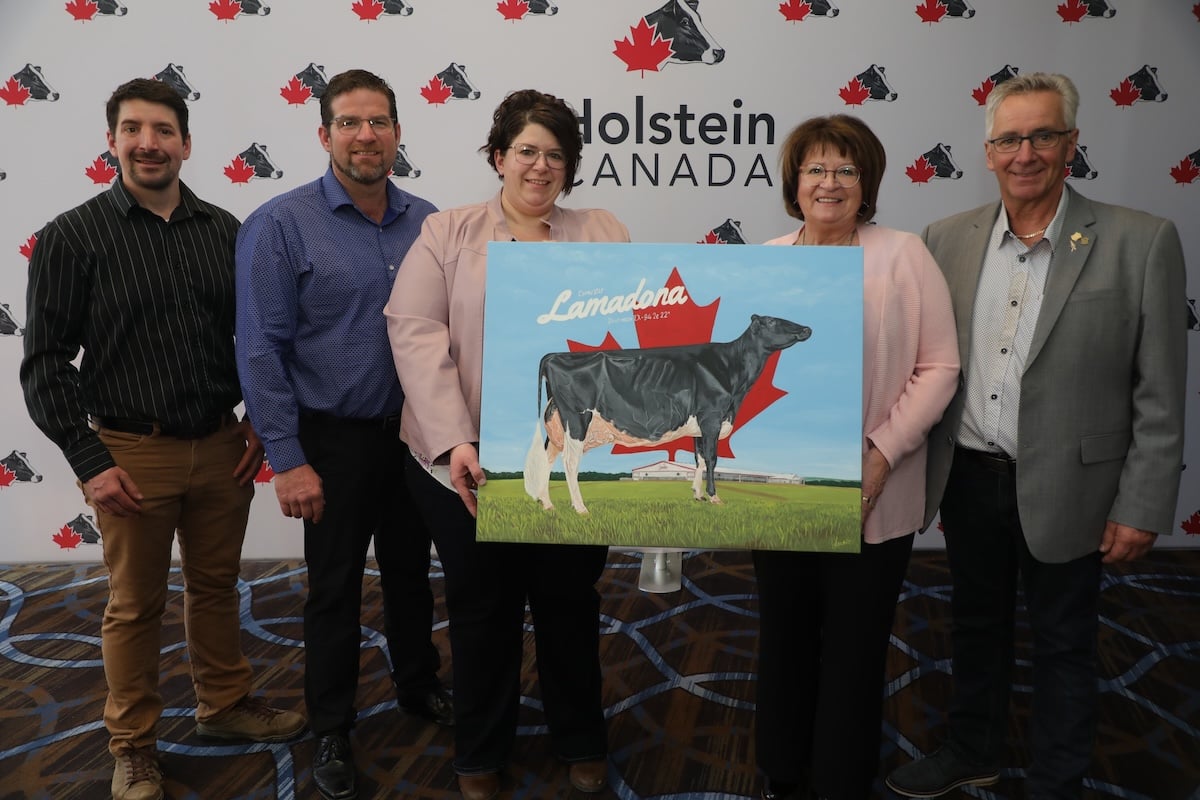
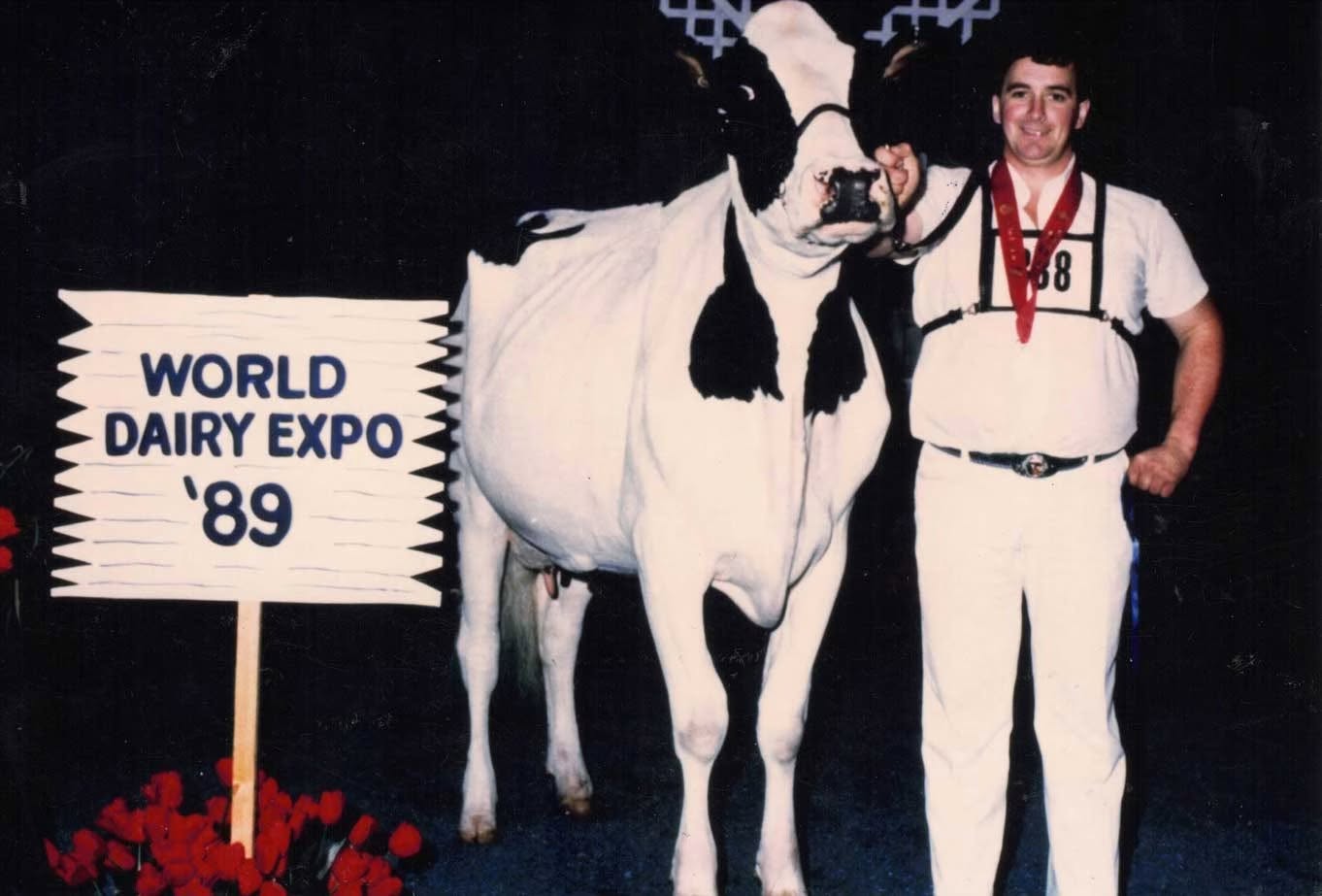
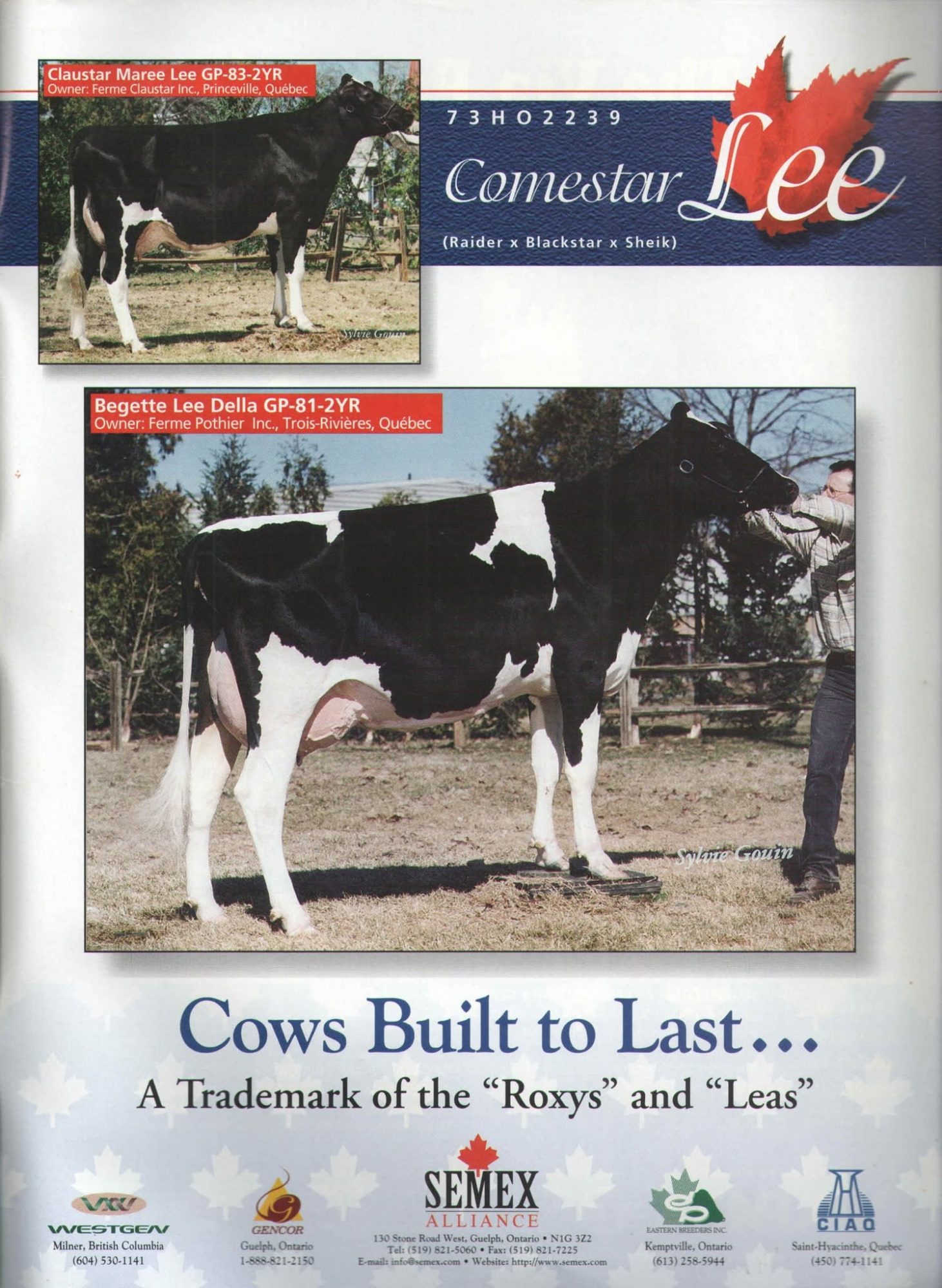
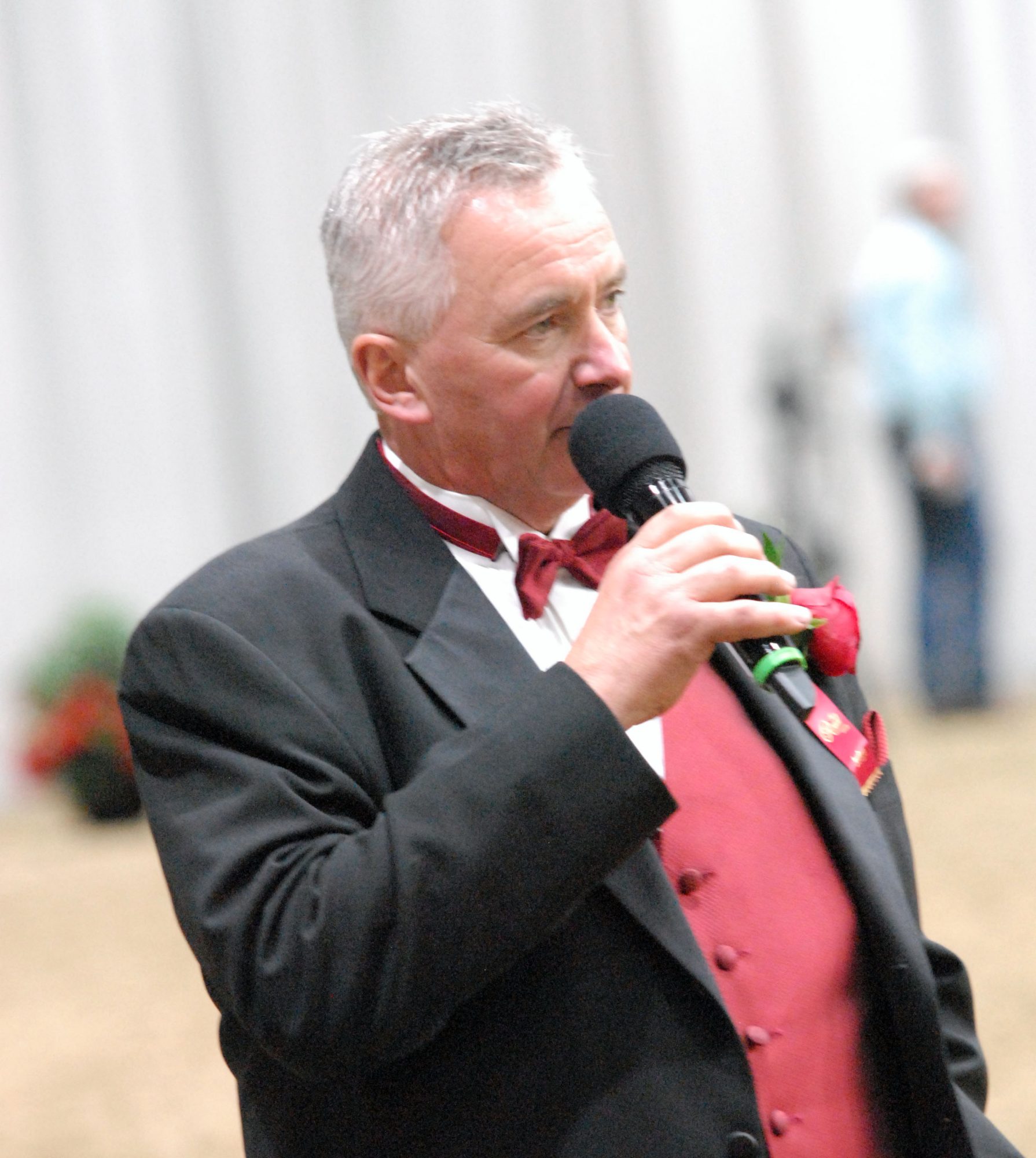
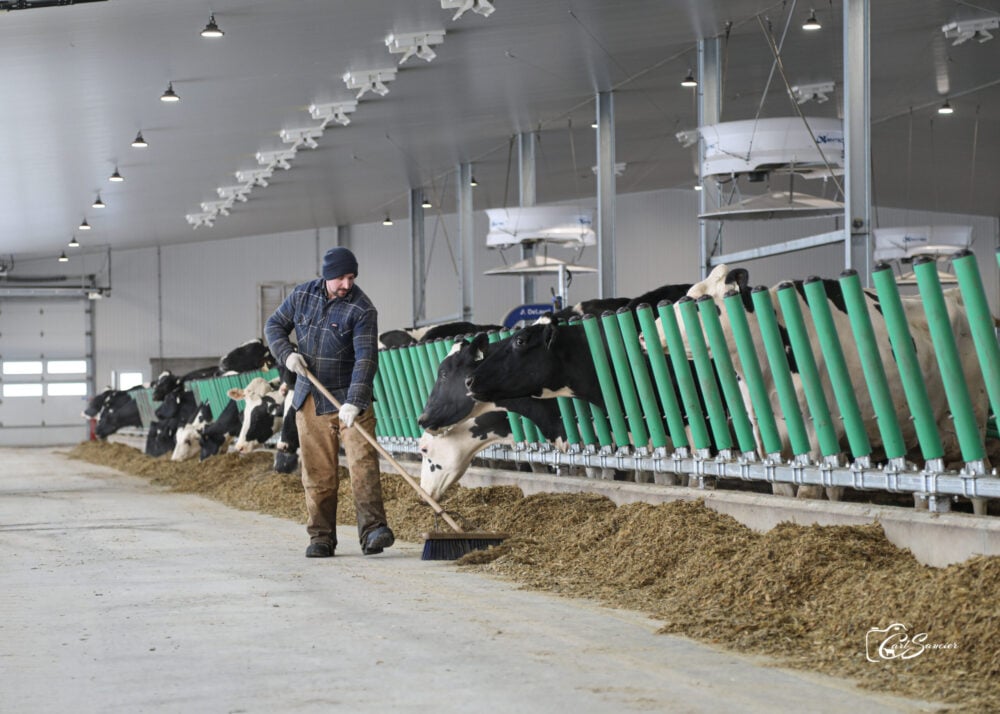
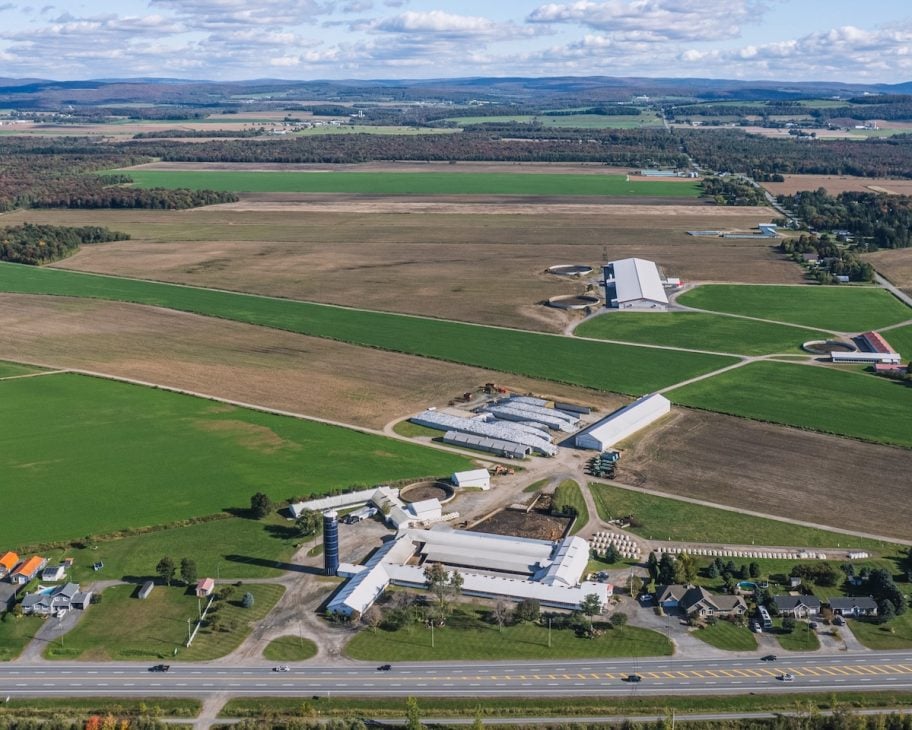
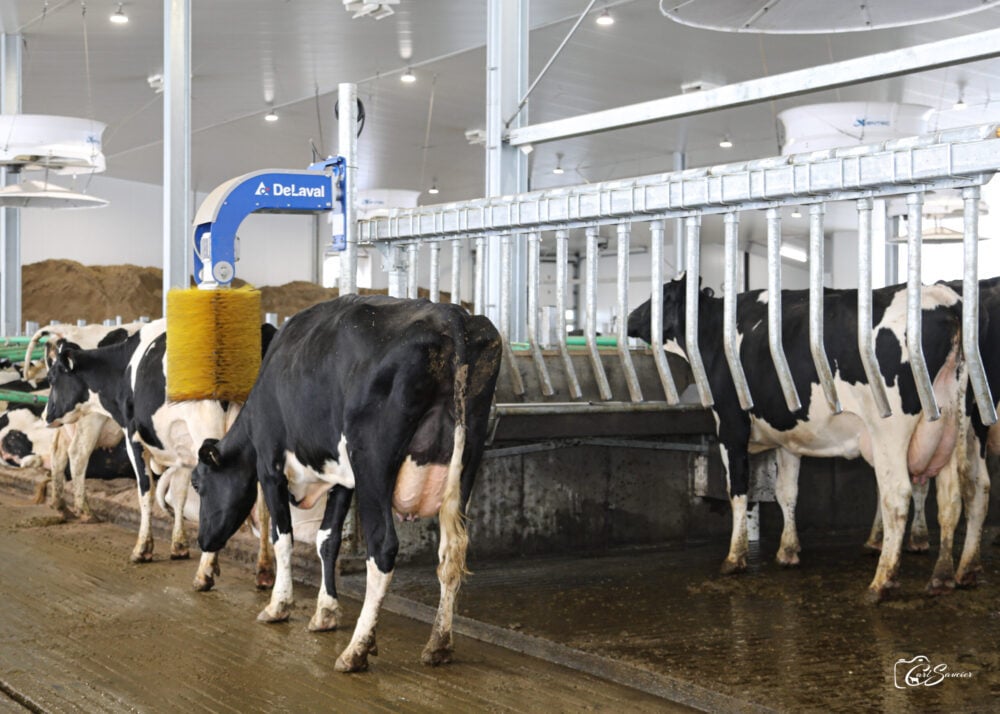
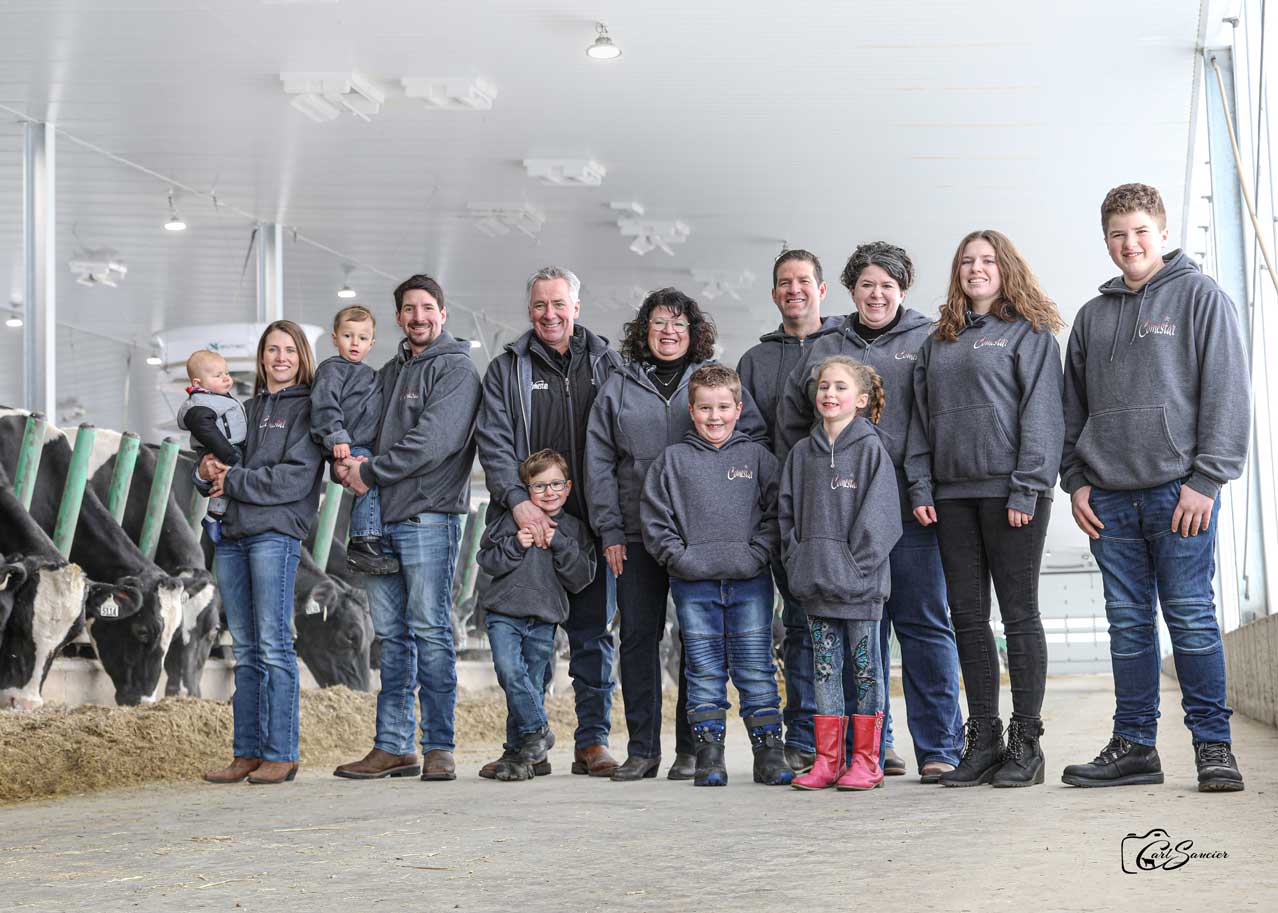
 The Sunday Read Dairy Professionals Don’t Skip.
 The Sunday Read Dairy Professionals Don’t Skip.