
Archive for GenerVations

How Albert Cormier Rewrote the Rules of Global Holstein Business – and Made the Whole Industry Catch Up

Summer 2005, Lylehaven Lila Z on the block, gavel falls at $1.15M — first Holstein past seven figures in 20 years. But the real disruption wasn’t the price. It was what that cow became, and why the Canadian co-op system had to adjust its playbook to keep up with the man who sold her.

Fall of 1981. A heifer named A Brookview Tony Charity is booked into the Designer Fashion Sale, and Peter Heffering walks up to take a look. One glance at the hock — swollen up like a grapefruit — and most buyers would’ve been halfway back to the truck. Not Albert Cormier. He’d already seen past the swelling to the cow underneath.
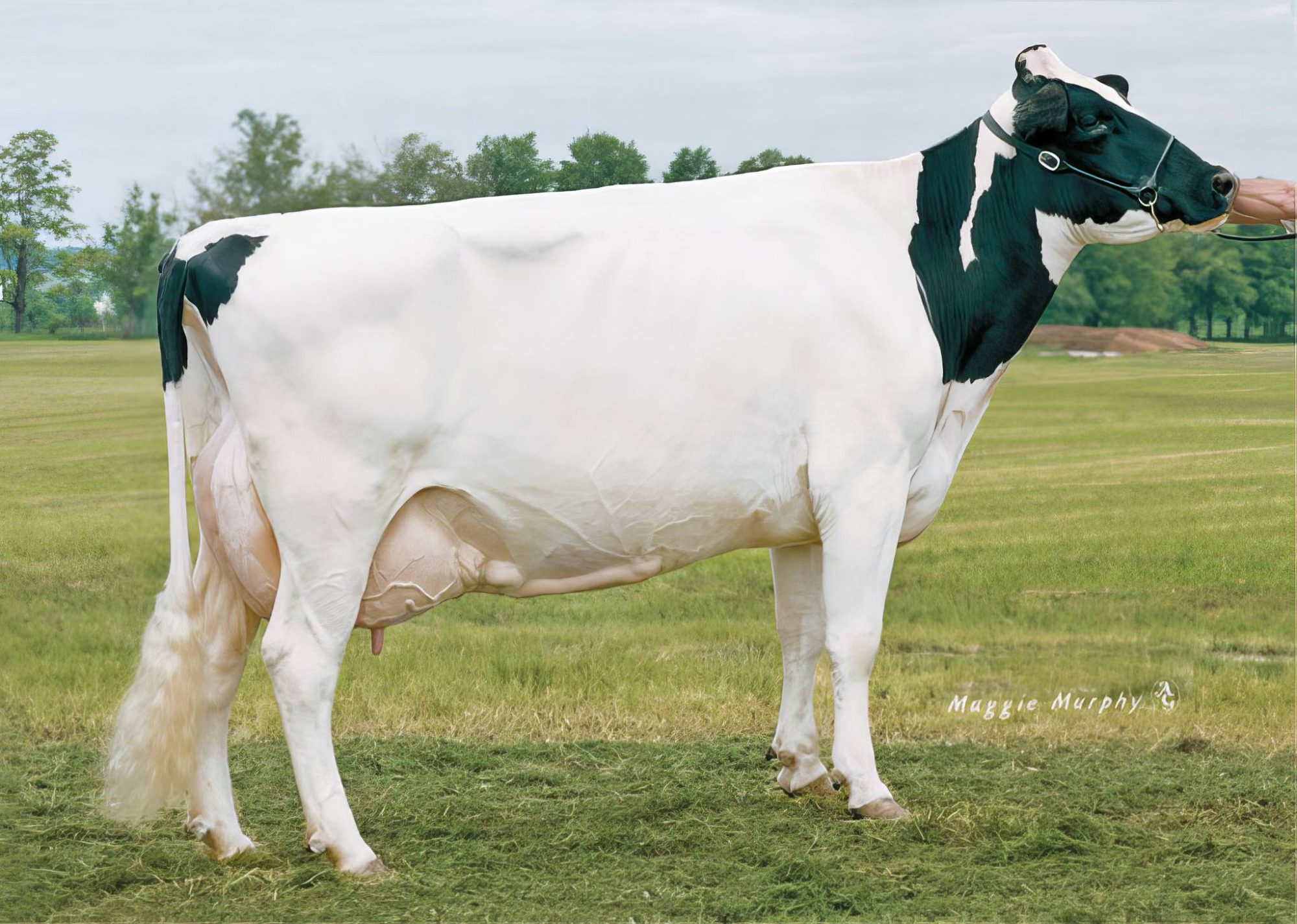
A Brookview Tony Charity — the swollen-hock heifer Albert Cormier saw past in the fall of 1981, and the 1984 Royal Winter Fair Grand Champion he’d warned Peter Heffering he “might need to reconsider selling.” One glance, one grin, one cow that announced the kind of eye the whole Canadian Holstein industry would spend the next four decades catching up to.

A few months later, out in a summer pasture, that swelling had melted clean away. The heifer looked — well, she looked like 1984’s Royal Winter Fair Grand Champion in waiting. Albert, half-teasing, half-serious, told Heffering he “might need to reconsider selling her.” Heffering, the story goes, nearly came unglued. That little moment — the eye that saw past the hock, the grin that knew exactly what it was holding — is pure Cormier. It’s where any honest conversation about the man who pried Canadian Holstein genetics open to the world has to start.

Four decades on, the two men who took the keys from him — Dave Eastman at GenerVations, Yvon Chabot at Cormdale Exports — don’t reach for business-school adjectives when you ask about Albert. They reach for something plainer. “Positive. Tackle things head on — good and bad. Ability to switch gears, refocus, fast. Adaptable. Also a pile of energy,” Eastman says. Chabot nods from Quebec: “He was always very positive, about the markets, about the future of a cow or a new business venture. He believed in the dairy business, and that always improving genetics was the key to success.”
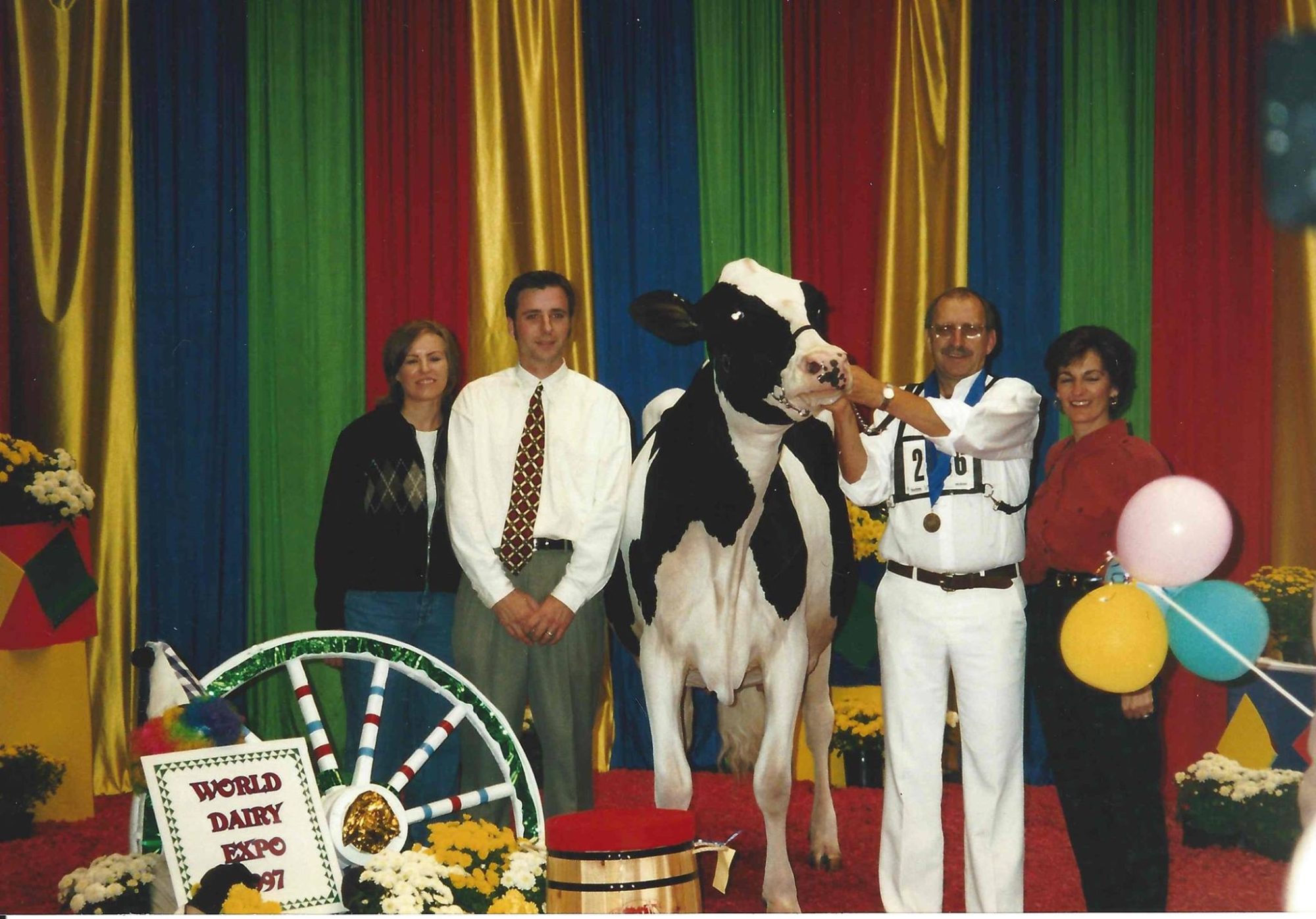
Albert Cormier leading Skys-the-Limit Claire ET to Intermediate Champion at World Dairy Expo, Madison, 1997 — the half-interest purchase that would change everything. Claire’s ET son, Calbrett-I HH Champion, hit #1 LPI in Canada five years later. This is the photo of a thesis being proven in real time: buy the elite female, stack her with the right mates, turn her sons into the bulls the co-op catalogues can’t beat. One banner in Madison. One bull out of her flush. One private Ontario program suddenly competing on the same stage as the institutions.

Honestly? If you want to understand how Canadian dairy got to where it is in 2026, you have to understand the P.E.I. kid with what his peers called “unmatched cow sense.” Albert refused to pick a lane between type and production. Between Ontario and Quebec. Between Canadian pride and European pedigrees. That refusal reshaped a whole breed.
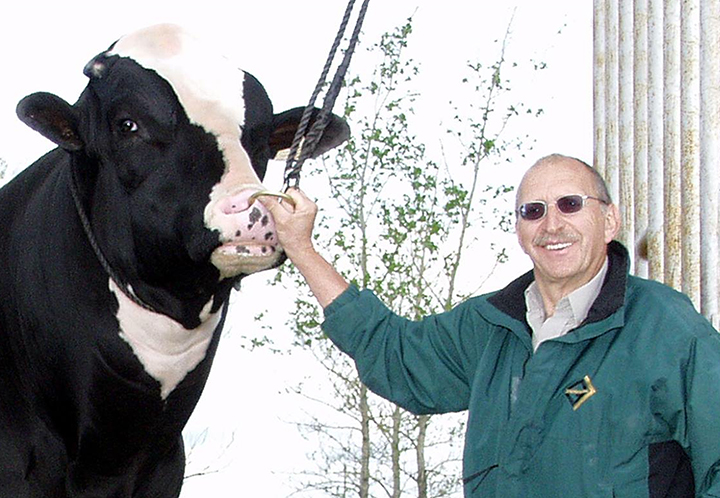
Albert Cormier with Calbrett-I HH Champion — the ET son of Skys-the-Limit Claire who climbed to #1 LPI in Canada in 2002 and hit “Millionaire” sire status by 2007. A private Ontario stud’s bull, bred off a cow Albert bought a half-interest in, outpacing the co-op catalogues. Proof that the kid from St-Philippe had been right all along: type and production could go together, and a private operator could prove it on the national stage.

LEGACY AT A GLANCE

  • A Brookview Tony Charity — 1984 Royal Winter Fair Grand Champion
  • Calbrett-I HH Champion — #1 LPI sire in Canada, “Millionaire” sire status (2007)
  • Lylehaven Lila Z — $1.15M in 2005, first seven-figure Holstein in 20+ years; granddam of Lexor and Lavaman, 5th dam of Lambda
  • Calbrett Kingboy Miranda P — #1 heterozygous polled female for type and feet & legs in her era; the only cow ever named 2x Global Cow of the Year by Holstein International (and the first polled cow ever to take that honour), plus Polled Cow of the Year
  • Master Breeder Shields for Calbrett — 2002 and 2018
  • Certificate of Superior Accomplishment — Holstein Canada, 2017
  • Businesses built: Cormdale Genetics, GenerVations, Sire Lodge, Cormdale Exports
  • International footprint: OGER partnership (France — early ’90s); customer barns in Holland, Italy, Germany, UK, U.S.

Why 2026 matters to this story

We’re sitting inside a genomics-driven, semen-and-embryo-exporting industry juggling a lot at once. Lactanet’s Methane Efficiency index for Holsteins is bedding into breeder programs. Feed-efficiency evaluations are working their way into commercial proofs. North American A.I. consolidation is rolling through another wave. And the export side is eyeing shifting U.S. trade posture and tighter EU BTV-3 health certificate paperwork.

Here’s the thing. If Albert were in the barn today, he wouldn’t be fighting the Methane Efficiency index. He’d be figuring out which cow family transmitted it best before the first proof was even published. That’s the whole point of this piece.

The Belfast Kitchen Table

Spring of 1983. Young Yvon Chabot picks up the phone at the family farm in Belfast, Quebec. An Ontarian wants to drive down and see a Marshfield Elevation Tony daughter — interesting pedigree, he’s heard.

By the time the sun goes down, that Ontarian — Albert Cormier, driving fast, asking faster — has crossed the province, talked his way into two barns, and bought two cows he hadn’t laid eyes on that morning. Beaucoise Tempo Kimo had just won her 2-year-old class at the Quebec Spring Show over at Les Fermes Turmel; Chabot pointed the way. The Tony heifer was at Ormstown. Done and done, both on the same trip.

“Both cows have done very well for him,” Chabot says, with the understatement of a man who’s seen a lot of cattle move.

What Chabot might not have clocked that day was that he’d just auditioned for a job. A few years later, as Cormdale’s consulting arm grew, Albert called again — this time to hire him full-time. That’s how Albert worked. Fast. Positive. Decisive. Actually — scratch the adjectives. Let me show you.

The Man in the Barn

Ask Chabot what Albert was actually like working a barn and the answer comes quick. “Patience, willing to share his experience and respect for other people’s opinion. Recognize efforts and success of others. Trust people working with you.” That’s the character sketch in the man’s own words. The physical memory lines up with it — not a big voice, a quick one, and a French that slid into English mid-sentence whenever a conformation point got him fired up, which was often. He didn’t linger. He moved. Every five minutes felt like the start of a new trip. People who only met him at sales describe a man with a half-grin and a notebook. People who rode shotgun between farms describe someone who’d hang up from a client in Saint-Hyacinthe and take the next call from Herefordshire without missing a beat.

That restlessness shaped how he dealt, not just how he drove.

The Deal Maker

Why He Never Got Attached to a Pedigree

Ever wonder why the Cormdale barn was famous as a hard place to walk out of without writing a cheque? Chabot has your answer.

“He loved to do business,” he says. “I very often saw him buying a calf or a cow at a sale and selling her the same day for sometime a not so important profit and sometime a bigger profit. He always said the best time to sell is when you have someone interested in buying.”

Read that again. That’s not a tactic — that’s a worldview.

Most breeders get attached. You nurse a heifer through classifications, wait for the big day, brag a little at the coffee shop. Albert’s line, the one Eastman still quotes: “Life is too short to breed them up and never be afraid to sell them.”Cattle should move. Money should roll. Pedigrees should land with people who’d push them further. In a breed culture where some folks sit on a cow family for three generations waiting for the perfect mating… it was borderline radical.

That ethos shaped the whole operation. Cormdale’s on-farm sales became the kind of auctions where a young Quebec consignor could drop a heifer on the sale card, watch Albert’s network push the price, and walk home with his prefix suddenly known in France and Germany. “With the many sales organized at the farm, many breeders purchased foundation animals, or as consignors got their name and prefix exposed to the world,” Chabot says. “It got many nice Master Breeders started that way.”

And when a deal went sideways? No lawyers, no grudges. “If a client is not happy with his purchase, for any reason, try to see what the problem was and if needed, do something to keep good relationship.” In an era when every other month brings another sale-barn contract dispute hitting the trade press, that one-liner still holds up.

The Million-Dollar Moment
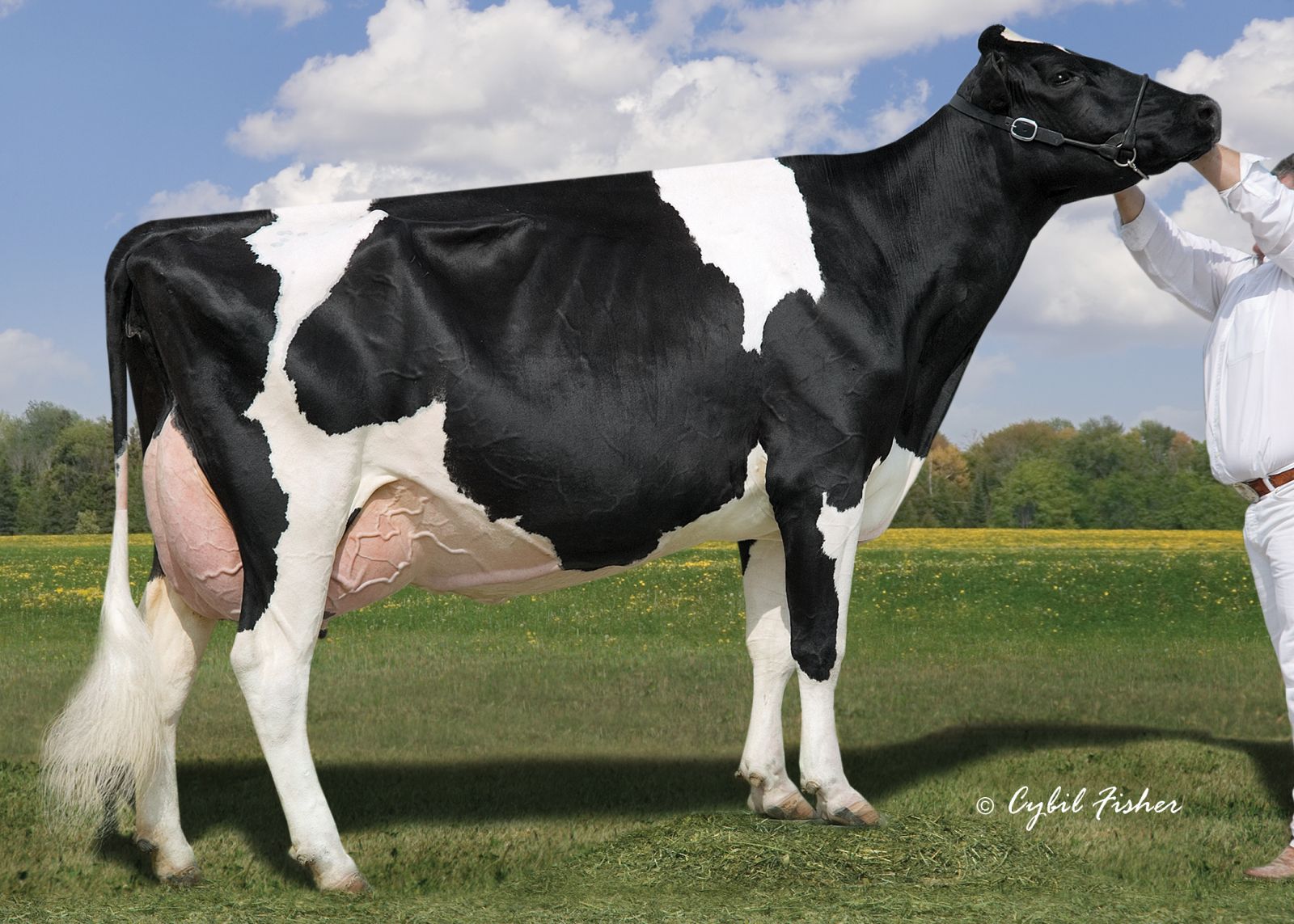
Lylehaven Lila Z — the $1.15 million cow who broke a 20-year ceiling in the summer of 2005 and then kept paying out in pedigrees. Albert and Dave bought her from the Gen-I-Beq / Mary Inn / Yvon syndicate as a Junior Yearling in 2003, fresh off her All-Canadian win, classified her VG-89 at home, and marketed her like a Super Bowl spot. The gavel price was news for a week. The granddam of Lexor and Lavaman, fifth dam of Lambda — that was the thesis. A cow could be a show-ring beauty and a genomic powerhouse at the same time. Lila Z proved it.

Summer 2005. The cow on the block is Lylehaven Lila Z. Albert and Dave had bought her two years earlier from a syndicate (Gen-I-Beq / Mary Inn & Yvon), picking her up as a Junior Yearling right after she took All-Canadian Junior Yearling in 2003. They brought her home, classified her VG-89 — the highest first- or second-lactation score available under Holstein Canada’s classification system at the time — and built a marketing campaign around her the way Madison Avenue builds one around a Super Bowl spot.

The bidding crawled, then sprinted. And then:

$1.15 MILLION — first Holstein past seven figures in over 20 years.

People in the room remember the hush first. Then the whistle. Then the handshakes that didn’t stop for 20 minutes.

Here’s what most retellings miss. Lila Z wasn’t a price. She was a thesis. Albert had been arguing for years that a cow could be a show-ring beauty and a genomic powerhouse at the same time. Lila Z proved it — she went on to become the granddam of Lexor and Lavaman, top genomic sires that anchored the GenerVations lineup for a decade, and she sits as the 5th dam of Lambda. Lexor became the #1 genomic LPI sire in Canada. Calbrett-I HH Champion had already taken the #1 LPI crown and hit “Millionaire” sire status in 2007. The price was news for one week. The genomic result reshaped proofs for a decade.
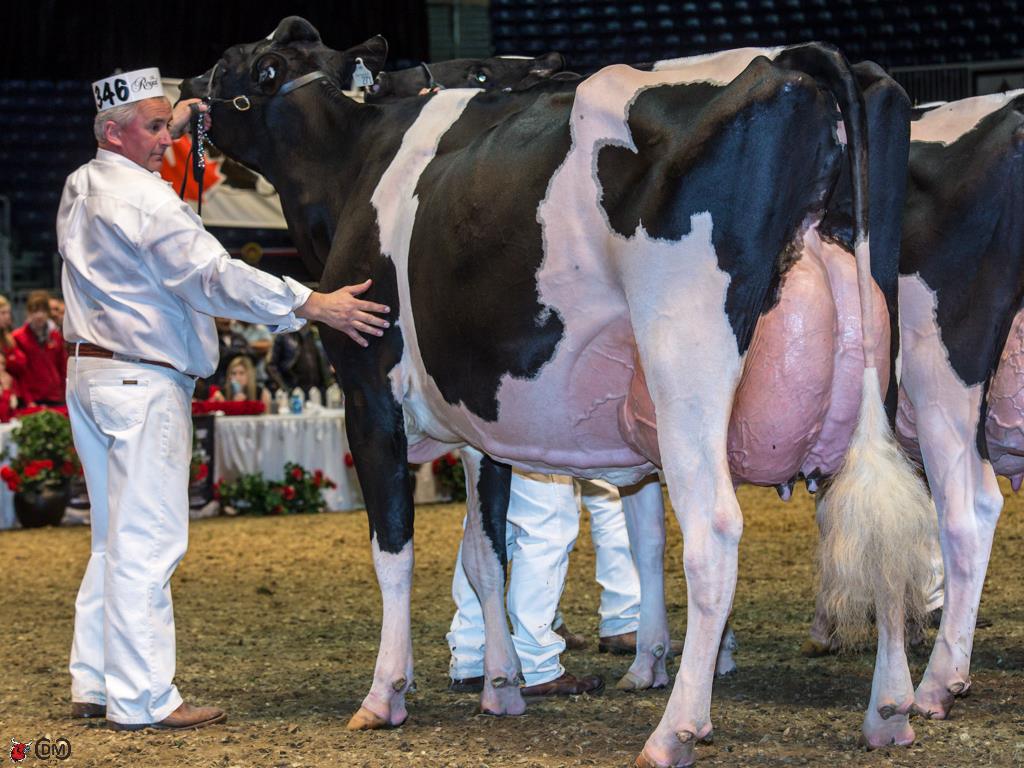
Calbrett Goldwyn Layla-ET (EX-96-2E-1*) at the Royal Agricultural Winter Fair — the Durham daughter of Lylehaven Lila Z, 2013 Reserve All-Canadian Mature Cow, and living evidence that Albert’s thesis held two generations deep. Lila Z made the auction-block history. Layla made the showring answer to it. Same cow family, same Calbrett prefix, the complete cow Chabot always argued for — type and production, side by side, under the lights at the Royal.

The Fortress, and the Man Who Walked Through the Gate

Here’s where Albert’s story gets interesting — not because he was shut out of the Canadian system (he wasn’t; he sold plenty of bulls into it over the years) but because he forced it to broaden.

Through the ’80s and into the ’90s, Canada acted like a genetic fortress. Our cows were the best in the world — full stop — and the cooperative A.I. system was built to protect that story. The fortress argument officially leaned on sanitary and disease-control grounds. Every importing country has a rational stake in bluetongue, IBR, BVD, and the rest of the watchlist — that’s real. But under the sanitary logic sat a much more commercial motive. The Canadian co-ops had spent decades building the “Canadian Holstein” as a premium export brand, and a private Canadian operator importing Dutch, Italian, French, German, and American genetics straight back into the domestic market didn’t fit the brand story. It widened what a Canadian dairy farmer could put in the tank.

So when Cormier started doing exactly that… a few people got, let’s say, less than thrilled.

“When he started promoting the use of genetic index in breeding decisions and selecting animals with high production potential, and using American bulls or importing US cows to diversify bloodlines, it wasn’t well received by many here in Canada,” Chabot says. “Also, importing semen from foreign countries to distribute in Canada — and later creating an AI company — made a few people not very happy.”

Eastman puts it bluntly — Cormdale was “really at the forefront of Holstein globalization at the time.”

The resistance

Chabot remembers the early reception being frosty enough to need its own fridge. The established co-ops weren’t shy about passing the message that their rep network and their preferred distributors were expected to stick to the domestic catalogue. Private importers learned fast that certain barns were closed doors if the co-op fieldman got there first. Cormdale’s workaround was the thing that made them dangerous — they built their own rep network, ran their own on-farm sales, and shipped directly to the breeders who wanted the imported bloodlines, while still working with the co-ops wherever the bull lineup fit.

And here’s the part that made the old structure stretch. The Canadian A.I. system through that era ran on provincial lines — Eastgen (then EBI / WOBI / United), Eastern Breeders, and CIAQ carving up the east; Western Breeders and BCIA the prairies. A bilingual operator from P.E.I. who could work a Quebec kitchen table in French on Tuesday and an Ontario sale ring in English on Wednesday wasn’t just selling cattle across a provincial border. He was selling across a structural seam that the co-op system had historically used to keep territories tidy. That fluency wasn’t a soft skill. It was a competitive weapon.

Chabot has a line that sticks about the reception Albert got abroad versus at home. Travelling with him was an education, he says: “You could see the respect that people had for him. He was also well respected among other people in the industry in Canada and US as well — even among people that did not agree with him.” Walk a barn in Normandy with Albert and watch a French buyer treat him like a visiting cousin. Land in the UK filling an order of commercial females and watch a British importer already recognize his bull lineup before the handshake.

Albert refused the binary. He was one of the first in Canada to really lean into genetic indexing — American TPI, Canadian LPI — to keep his cattle marketable to commercial dairies and A.I. companies at the same time.

“Cow families are extremely important,” Chabot says. “A Holstein cow should milk easily, so never neglect production and components when doing mating. Type and production can go together.”

Eastman has his own way of describing how Albert ran the sire side: “Fast to use new high-ranking bulls. Own and market from some of the highest daughters if possible. Advertise to create value and demand — great pictures.” And on the heifer side: “Started investing in females early on to better control, make bulls we wanted to sample — Lila Z, Oman Elita and her daughter Shottle Evett, examples of few.”

That short list is the whole strategy. Find the elite female, flush her early and often, stack her with the right mates, turn her sons into revenue, turn her daughters into the next elite females — and then do it all again.

“Life is too short to breed them up and never be afraid to sell them.” — Albert Cormier, via Dave Eastman

Here’s the part that lands hardest in 2026. Albert was an early, aggressive user of embryo transfer and IVF to multiply those elite females long before flushing was common practice. The whole industry’s current obsession — genetic-progress-per-cow, Lactanet’s methane-efficiency and feed-efficiency indexes, smaller herds producing more per head — sits on exactly the reproductive-tech foundation Albert was pushing when most Canadian breeders still thought IVF was exotic. When genomics hit in the late 2000s and the rest of the industry lurched into a new era, Cormier’s program didn’t lurch. It glided. Because he’d been obsessing over cow families, parent averages, and transmitting ability for twenty years. “When you have a cow family, you have genomics” was the operating theory. The data just confirmed what the pedigree already knew.

The Cliff Edges

GenerVations was never all smooth bidding floors and handshake deals. Eastman tells a story most people outside the boardroom never heard.

“Several times we lost close to 50% of our product line for semen from mergers, sales of companies,” he says. “Never lost reps. Key was distribution and motivated, loyal staff.”

The move that crystallized the whole operating model — and the one Albert would point to years later — was the OGER partnership in France in 1991 through Modern Sires. Picture Albert on one of those long flights out of Toronto. Sale book on his knee. A French phrasebook in the seat pocket he didn’t really need. By the time the wheels hit tarmac, he had a handshake deal to proof young sires simultaneously in Canada and France — effectively doubling the speed and reach of a young-sire program when no single Canadian co-op was structured to do it solo. A few years later he split the export and semen divisions, quietly laying the track for the succession that would change Eastman’s and Chabot’s lives.

Forty Miles of Gravel Road, Sixty Herds

Want to understand why Quebec breeders trusted Albert when plenty of Ontarians couldn’t find Trois-Rivières on a map? Look at 1988.

That’s the year Cormdale Consultant Ltd. went full steam, with Chabot and Ghyslain Coté running a consulting operation that at peak served over 60 Quebec herds — full-herd mating, classification, purchase advice, export sourcing. Sixty herds. Think about what that means in practice. Two guys in trucks, splitting the province, gravel roads in February, tourtière at the kitchen table, talking bull selections on fresh cows heading into their second lactation — and in between, filling orders for UK clients who wanted Canadian type grafted onto British herds.

Albert’s edge? He could sit at that kitchen table in either language. Truly bilingual. In an industry where Quebec is a massive slice of the elite Holstein market, where Anglo-Franco trust is earned one barn visit at a time, and where the co-op system itself had been built along provincial boundaries… that fluency wasn’t a soft skill. It was the whole ball game.

The Handshake Built to Last

Anyone who’s watched a private ag business change hands knows this — the succession is where legacy goes to die. Albert refused to let it.

Early 1997, he starts talking about slowing down. Picture one of those conversations you can almost smell — a Cormdale farm office, coffee going cold, sale-book pages fanned out across the desk, Albert leaning back and floating the word “partner” like he’s tossing a hay-hook onto a stack. Three businesses in play: the farm (Cormdale Genetics), the semen side (GenerVations and Sire Lodge), and the export arm (Cormdale Exports). Two lieutenants who’d earned something bigger. What he drew up was almost old-fashioned. A five-year buyout. No private-equity theatrics. No earn-out clawbacks. Partner up, work the plan, pay him out on schedule.
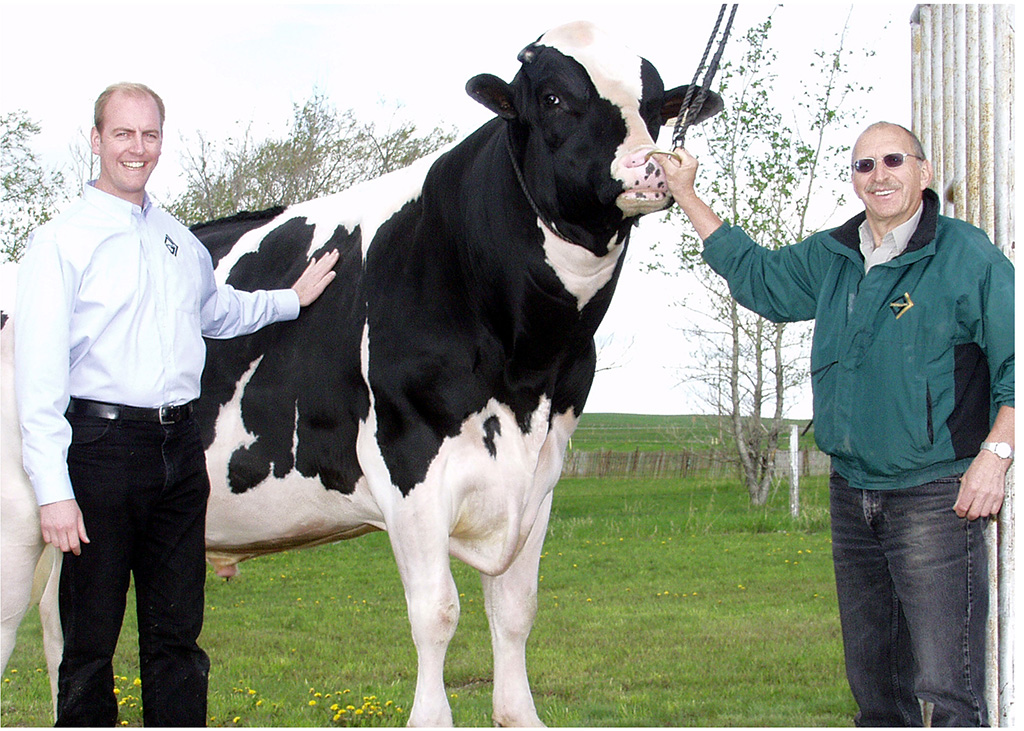
Dave Eastman and Albert Cormier with Calbrett-I HH Champion at Sire Lodge, Cardston, Alberta — the bull who put the GenerVations crest on Canada’s #1 LPI list in 2002 and hit Millionaire sire status by 2007. Two men, one bull, a five-year buyout quietly running in the background. The hand on the halter was the mentor’s. The hand on the shoulder was the successor’s. No earn-out clawbacks, no private-equity theatrics — just partner up, work the plan, pay him out on schedule. This is what a continuity machine looks like before anyone calls it one.

Eastman took the semen side. “Albert offered me chance to become partner in semen business, and that was when we started GenerVations together in 1999, with structure to buy him out over 5 years, which was in 2004,” he recalls. “At same time, Yvon Chabot offered same chance to take over export and embryo side of business as Cormdale Exports.”

Chabot’s version tracks: “I have been Albert’s partner for 5 years, the time I had repaid him in full for the complete control of it.”

“Smooth,” is how Eastman describes it. “I had worked with Cormdale Genetics before as sales manager, so easy transition.” That word undersells something important. What Albert built wasn’t an exit — it was a continuity machine. The reps stayed. The customers stayed. The international contacts kept taking the calls. Same year — 2004 — Albert and Eastman jointly bought Sire Lodge Inc. and expanded it into a 300-bull custom-housing facility in Cardston, Alberta, which became GenerVations’ production engine. Even in “retirement,” Albert was writing infrastructure cheques.

The operating principles both men carried forward are worth naming. Eastman, who’d worked inside several European and U.S. A.I. houses before Cormdale, came back with a conviction about flat organizations — “Key was involve reps in discussions, product, programs, as they were key to success. (Not sure it happens in many today).” Chabot boils his version down to four words: “Honesty and be loyal.” Then adds the rest — stand behind what you sell, give advice when asked, keep promises. Both cite the same mental model on tough calls: deal with it head-on, today, not next week. And both were pushed onto the world stage by a mentor who insisted on it. “Over the years he had given me confidence to meet people of the industry around the world and always encouraged me to pursue my judging career,” Chabot says. You can draw a line from that kind of mentorship straight to the next generation of marketers — Andrew Hunt, who founded The Bullvine, openly credits Albert and Dave for the “breeding ground” that shaped his instincts about how dairy cattle get sold to the world. Fair warning: a lot of the house style you’re reading right now has Cormdale DNA in it.

The Philosophy That Outlived His Voice

Here’s the single sentence that sums up Albert’s breeding worldview, courtesy of Chabot: “Type and production can go together.”

Sounds obvious today. Wasn’t then.

Through the ’80s and into the ’90s, Canadian Holstein breeders were sorted into two tribes — type breeders chasing Royal banners and production breeders chasing pounds of milk and butterfat numbers. Albert refused the split. He was one of the first in Canada to really lean into genetic indexing — American TPI, Canadian LPI — to keep his cattle marketable to commercial dairies and A.I. companies at the same time.

Sit with that a second. You’re running a private A.I. company through the Canadian A.I. consolidation era that built today’s Semex footprint, and partnerships keep rearranging underneath anyone not at the head of the biggest co-op. Half your product line evaporates overnight. The bulls you were distributing are suddenly flowing through your competitor’s pipes. What do you do Monday morning?

You pick up the phone. You call the reps — the ones who’ve been out in the trucks selling for you for ten years, the ones whose kids you know, the ones whose loyalty was never actually to the catalogue. You tell them straight: here’s what we lost, here’s what we’re re-sourcing, here’s what I need from you this week. Eastman says not one of them walked. That’s not luck. That’s what Albert had taught him about who the company actually was.

Product comes and goes, but the two things mergers can’t take are your distribution network and your sales force. Protect those. Everything else you rebuild. That instinct — ride the staff, re-source the product — is exactly what a lot of smaller A.I. outfits are grappling with right now as another wave of consolidation works its way across North American genetics.

The 2014 sale of GenerVations to Select Sires wasn’t a surrender. By then Eastman had been sole owner for a decade — he’d completed the buyout in 2004 — and the deal was a calculated exit that gave the GenerVations lineup the global distribution runway it needed. The roots of that lineup, though, traced straight back to the cow-family investments Albert had set in motion years earlier. The sale wasn’t the end of his influence. It was the export of it.

The Legacy Sale

The hardware caught up eventually — two Holstein Canada Master Breeder Shields for Calbrett, in 2002 and again in 2018, a rare double that bridged the classical and genomic eras, plus the 2017 Certificate of Superior Accomplishment citing his “unmatched cow sense” and his work with Tony Charity and Lila Z. Plaques are nice. What happened two years before the second Shield was bigger.
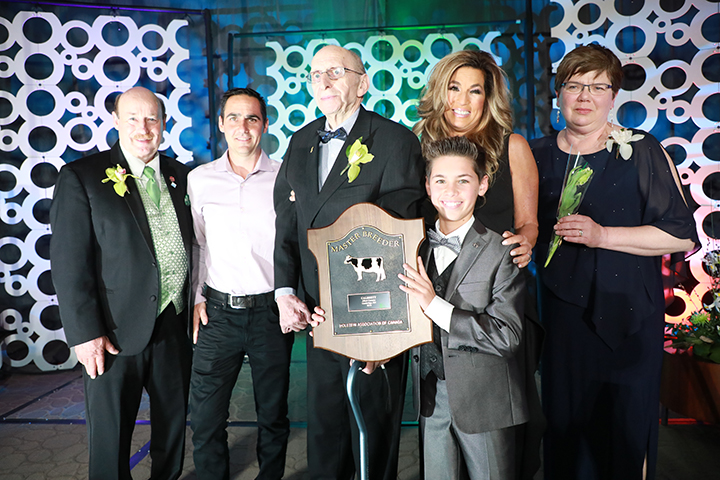
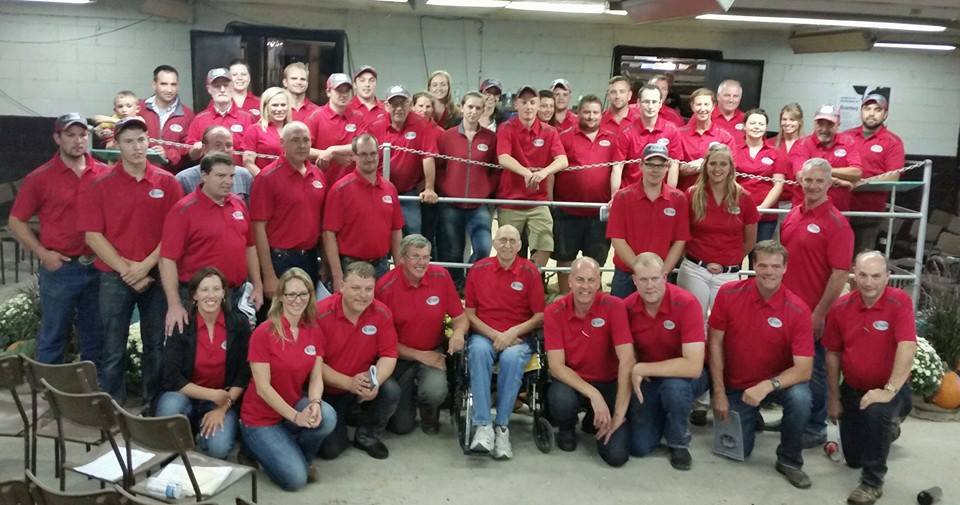
Albert Cormier, flanked by family, accepting Calbrett’s second Holstein Canada Master Breeder Shield — presented at the 2019 National Convention on Prince Edward Island, the province he left as a young man and returned to, decades later, with two shields and a stroke that had taken his voice but not his grin. A rare double that bridged the classical and genomic eras: Shield #1 in 2002 for the cow-family program that built Calbrett-I HH Champion; Shield #2 in 2018 for the polled and genomic era that followed. The plaque in the photo is bronze. The real award was the room — the sons, the grandson, the family who’d watched him build it all — standing beside him while the industry finally said thank you out loud.

Cold day in 2015. Brubacher Sales Arena. The room fills up — Europeans, Americans, both Canadian coasts. A stroke had taken Albert’s speech by then, but not his stubbornness. The sale book was his autobiography written in pedigrees. The bidding was the industry’s way of saying thank you.

People who were there describe the same thing in different words. When Miranda P — that polled female Eastman calls one of the legacy’s finest achievements — went through the ring, the room got quiet in that specific way rooms get quiet when everyone realizes they just witnessed a handoff. Not a sale. A handoff. Someone coughed. Someone else wiped their eyes without pretending they weren’t. A couple of the French buyers in the front rows — men who’d built their herds on Cormdale embryos over two decades of OGER-era partnership — caught each other’s eyes and held the look a beat longer than usual. Albert watched from his seat. He couldn’t speak. He didn’t need to.
The Polled Bet, and Why It Matters More Now

Worth sitting with, because this one matters now more than it did then.

Albert was an early advocate for the polled (naturally hornless) gene in Holsteins, back when most of the industry treated polled animals as a novelty or a compromise. One of his crowning achievements there was Calbrett Kingboy Miranda P — the #1 heterozygous polled female for type and feet & legs in her era, and the only cow ever to be named Holstein International’s Global Cow of the Year twice. She was the first polled cow ever to take that honour, and she also claimed Polled Cow of the Year. Eastman flags her as one of the absolute highlights of the legacy: “Miranda would be one of best achievements. Sold in Legacy Sale in ’15, went on to do great things.”
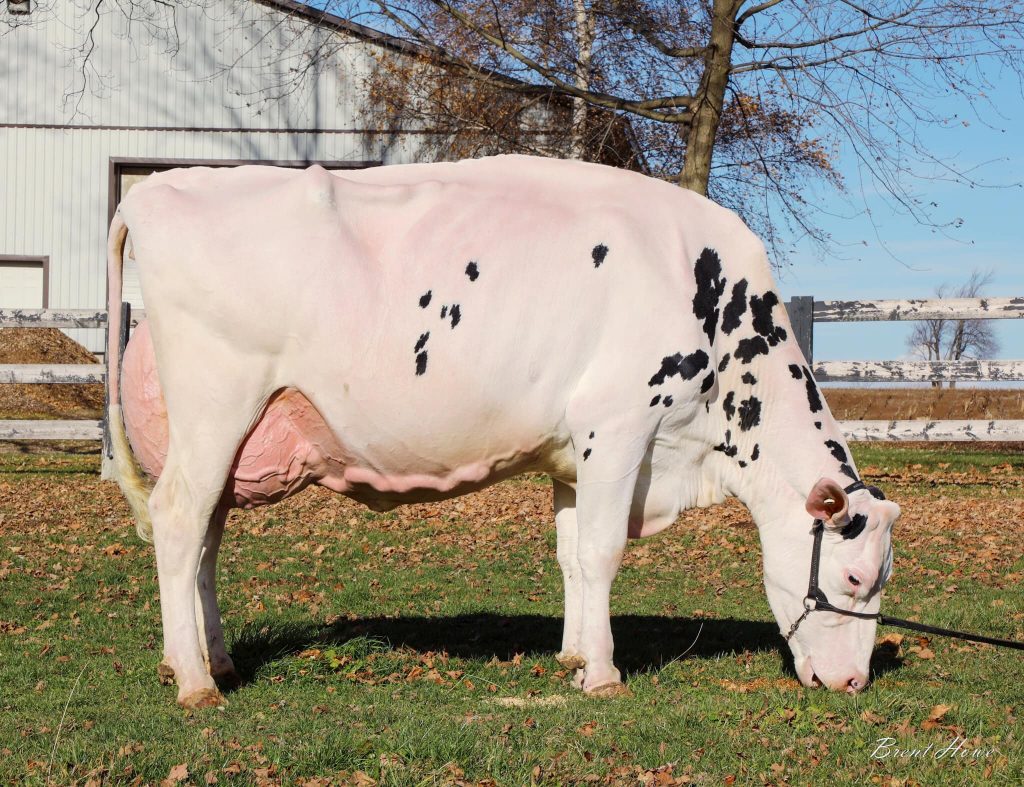
Calbrett Kingboy Miranda-P-RC — the polled red-carrier heifer who retired the old “yeah, but you give up type” argument in a single generation. Top-selling lot at the 2015 Legacy Sale at $34,000 to Vogue Cattle Company, later named Holstein International’s Global Cow of the Year twice — the first polled cow ever to take that honour — plus Polled Cow of the Year. Elite type, feet and legs, components, and a naturally hornless head, all in the same animal. Albert’s earliest polled investments, bought when most of the industry treated the trait as a novelty, were suddenly the welfare-audit answer European retailers would be asking for a decade later.

“Great things” isn’t just sentiment. Miranda P represented the kind of polled female that proved breeders didn’t have to choose — you could have polled genetics and elite type, components, and feet and legs in the same animal. That proof of concept mattered. Before Miranda P’s generation, the polled conversation was often dismissed with “yeah, but you give up type.” After her, that argument got a lot harder to make in front of a well-informed buyer.

So what’s the deal in 2026? The welfare conversation around dehorning isn’t quietly going away. Several European buyers we’ve spoken with — operators navigating their own retailer and cooperative welfare-audit requirements — are showing noticeably more interest in polled lines from proven type-and-production cow families. Canadian retailers are asking harder questions too. And the NFACC Code of Practice review cycle has the Canadian dairy community itself debating where disbudding standards should land. The debate’s as heated as you’d expect, and it should be. Breeders who invested in polled genetics 15 and 20 years ago aren’t the early adopters anymore. They’re the suppliers. If you’re a mid-size family operation trying to think three breeding decisions ahead, Albert’s polled bet isn’t a quirky side note. It’s a case study.

Chabot, still active in the Quebec dairy industry and spending his judging weeks watching where type-and-production balance is headed, has been pretty clear with the next generation: keep improving genetics using every tool available, stay open to changes, and don’t be afraid to buy and sell. That’s a 2026 voice delivering a 1983 philosophy. The math still works.

What to Do With This in 2026

Here’s the part that matters for whoever’s reading this with a barn boot still on.

If you’re sitting on an ET-eligible heifer from a solid cow family right now, Albert’s playbook is almost embarrassingly simple.

Get involved. Buy a great foundation — embryo, heifer, cow — and develop her. Keep improving with every tool science gives you: classification, milk testing, genomics, IVF, whatever comes next. And right now “next” looks like Lactanet’s Methane Efficiency index, feed-efficiency genomics moving into commercial proofs, and polled lines earning premium interest from European buyers worried about their own welfare audits. Stay flexible when the market shifts. It will shift, probably by next quarter — ask anyone who’s tried to book a June embryo shipment into Germany lately, or anyone watching Class 4a and CUSMA-era TRQ language getting reargued every few months. And don’t be afraid to sell. Keep cattle moving. Stagnation is the real killer.

Walk into a barn in Quebec, France, or southern Alberta today and the odds are real good you’re looking at a cow carrying some Calbrett or GenerVations somewhere in her pedigree. Not sentimentality. Math. But the bigger legacy isn’t in the ear tags. It’s in the posture of the whole Canadian Holstein industry toward the world — from defensive sanctuary to confident exporter, from type-vs-production tribalism to the complete-cow synthesis, from co-op monoculture to a marketplace where private innovators can build global brands alongside the co-ops, not against them.

The Grand Champion He Never Got to Hang

Chabot drops one unrealized dream into the record — the goal he says is still chasing the next generation: “to breed or own a Royal Winter Fair Grand Champion.”
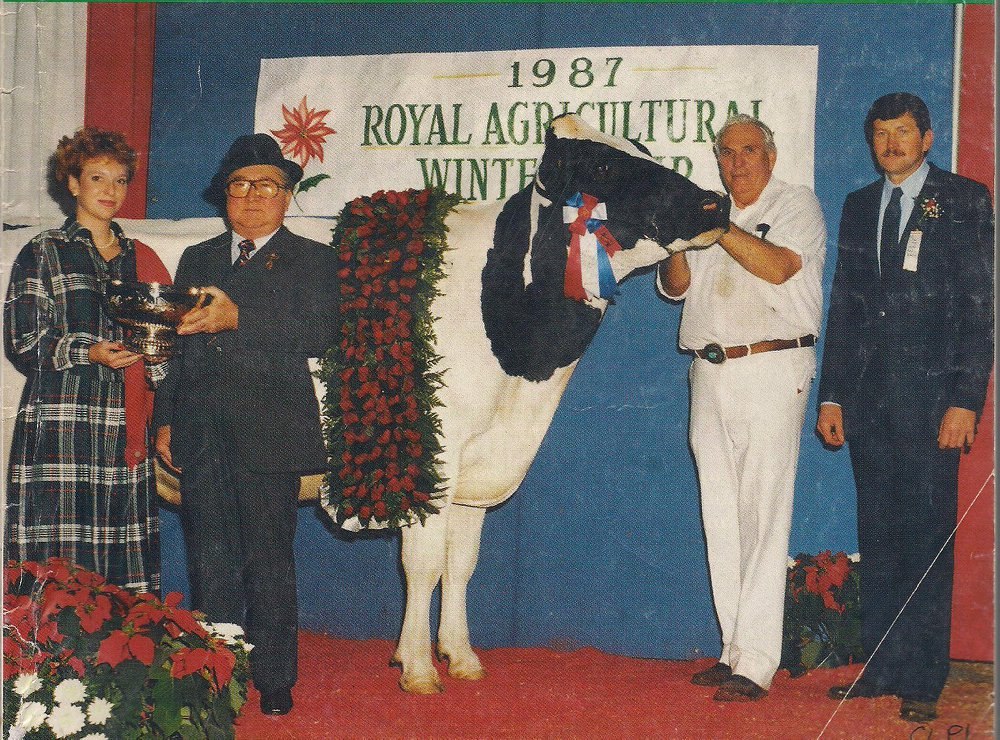
Brookview Tony Charity became the first 4X Grand Champion Holstein at the Royal Winter Fair in 1987,

Tony Charity did it for Hanoverhill and Romdale in 1984. Forty-two years later, that Grand Champion banner is still the crown the old man never got to achieve. Somebody’s going to finish that sentence. Might as well be someone who learned from him.

The hum of milking parlours from Orton to Ormstown to the OGER barns in France still carries something of Albert Cormier in every pulse.

So — which Albert Cormier bet are you making in your barn today?

The polled one? The imported-semen one? The sell-her-the-same-day-you-bought-her one? The flush-her-early-and-often one? Or the quieter one — the decision to treat the first-time Quebec consignor and the big French A.I. house with the same level of show-up?

Let us know in the comments. The next chapter of this story is being written in real Canadian barns right now, and we want to hear whose cow family is going to finish the sentence.

Continue the Story

  • From Show Ring Legend to Industry Innovator: The David Dyment Story — Dyment credits Albert Cormier with teaching him to “consider bloodlines others might overlook.” This is the story of another contrarian who wrestled with the same type-vs-production divide Albert refused to accept — and built AG3 Genetics on the other side of it.
  • Dad at 80: How Murray Hunt Revolutionized Canadian Dairy Genetics — Before Albert pushed LPI-based selection into commercial practice, Murray Hunt built the Dollar Difference Formula that made index thinking possible. This is the intellectual landscape Albert was navigating — and the generation of thinkers who made his bet on numbers over ribbons a viable one.
  • 9.99% Inbreeding and Rising: How Blondin Sires Turned a Holstein Bottleneck into 75% Growth — Dann Brady and Simon Lalande couldn’t find the deep-pedigreed bulls they wanted in the big AI catalogues — so they built their own stud. A Quebec-rooted private AI company challenging the co-op establishment? That’s Albert’s playbook, updated for the genomic era, with Yvon Chabot’s Blondin name on the door.

The Sunday Read Dairy Professionals Don’t Skip.
Every week, thousands of producers, breeders, and industry insiders open Bullvine Weekly for genetics insights, market shifts, and profit strategies they won’t find anywhere else. One email. Five minutes. Smarter decisions all week.
NewsSubscribe
First
Last
Consent

Discover the Visionary Legacy of David Eastman: Pioneering Innovation in Dairy Genetics

Discover Dave Eastman’s transformative impact on dairy genetics. How did his strategic insight and innovation reshape the industry? Uncover his legacy today.

Dave Eastman’s strategic thinking and unwavering devotion have revolutionized the dairy genetics business, establishing unprecedented standards for innovation and quality. From humble origins on a family farm, Eastman rose to prominence in dairy breeding, pioneering genetic improvements and grooming the next generation of industry leaders. His emphasis on mentorship and collaboration has been a cornerstone of his success. Join us as we examine how his insight, passion, and values have influenced dairy genetics globally. Dave Eastman is to dairy genetics what pioneers were to exploration: a visionary mapping the unknown. 

The Humble Beginnings: Where Passion and Curiosity Were First Cultivated 

Dave Eastman, from Kinburn, Ontario, got his start in dairy genetics on his family’s farm. From an early age, he was involved in operating their 35-cow herd, learning directly about herd maintenance and the complexities of milking and feeding. His active participation in 4-H, a program that promotes agricultural knowledge and leadership skills among young people, significantly enhanced his early experience. Eastman thoroughly grasped animal husbandry via 4-H and became fascinated by the possible breeding advances. The combination of hands-on farm experience and the educational framework offered by 4-H sharpened Eastman’s early understanding and piqued his interest in dairy genetics. These formative experiences sparked a lifetime interest and pioneering career in dairy genetics. Eastman’s 4-H experience provided him with valuable agricultural skills and established a deep respect for the complex art of animal breeding, paving the way for his substantial contributions to dairy genetics. 

From Sales Rep to Visionary Leader: Dave Eastman’s Ascendance in Dairy Genetics

Dave Eastman’s professional path in the dairy genetics sector is one of ambition and vision. He started as a sales representative at Cormdale Genetics, where he swiftly rose through the ranks due to his exceptional grasp of the nuances of sales and genetics. His excellent insight was recognized, and he was promoted to National Sales Manager. In this job, Eastman was instrumental in growing the company’s reach throughout Canada, stressing the thorough recruiting and training of new salespeople and establishing a complete distributor network.

As the industry grew more globalized, Eastman’s strategic acumen proved invaluable. Cormdale Genetics, led by Albert Cormier and supported by Eastman’s vision, embraced the globalization of dairy genetics. This was a transformative moment, as they led activities that resulted in the first semen imports from Holland Genetics and other overseas sources. This was a watershed moment for the firm, paving the way for future endeavors.

Eastman made a daring move in 1999, co-founding GenerVations with Albert Cormier, and later bought the firm from him in 2004. This strategic decision was motivated by understanding the inherent instability in distributing semen from other firms, which increased the danger of losing product lines due to industry mergers and acquisitions. Eastman established GenerVations to develop a more reliable business strategy. In his early days, he faced tremendous hurdles, notably the unpredictable nature of young sires whose genetic potential was unknown until demonstrated. To overcome this, Eastman carefully used precision breeding procedures, drawing on his extensive understanding of pedigrees and genetic possibilities to gain a footing in the market. His resilience and determination in these challenges set the stage for his future success in the industry.

Champion: The Beacon in GenerVations’ Formative Years

The purchase and sample of Calbert-I HH Champion, one of the first bulls GenerVations introduced to the market, was a watershed point in their early history. He was born in August 1997 and was among the first few bulls sampled by GenerVations; soon after the company’s foundation, it proved to be a revolutionary hit. His tremendous popularity and excellent genetic quality catapulted the fledgling corporation into the limelight, establishing the groundwork for future success. Champion’s influence provided financial stability, allowing for the employment of additional employees, increased marketing activities, and the development of an extensive worldwide distribution network.

Another significant milestone was the development of SireLodge. This facility, purchased in Alberta, was intended to hold and gather the company’s bulls. It not only maintained a

consistent supply of semen but also met the demands of other AI firms worldwide, strengthening GenerVations’ market position. These methods and accomplishments represented a larger vision of mastering their genetic destiny, giving a foundation for navigating the complicated environment of the dairy genetics sector.

Strategic Vision: Pioneering Genetic Milestones in Dave Eastman’s Career 

Vogue’s 1st purchase was the 35 brood-star Comestar Goldwyn Lilac VG-89 in 2006. She was nominated for All-Canadian, Canadian Cow of the Year & Global Impact Cow of the Year.

In dairy genetics, strategic forethought and decisive action may be the difference between success and failure. Dave Eastman’s time in this challenging sector has been distinguished by critical choices that have improved his operations and established standards for others. Acquiring top-tier females such as Lila Z demonstrates Eastman’s dedication to genetic excellence. Her offspring set the genetic foundation for future success, as seen by bulls like Farnear Delta-Lambda, whose exceptional performance can be linked to this intelligent purchase.

However, one of the most transformational aspects of Eastman’s strategic playbook was the early acceptance and introduction of sexed semen into North America. In collaboration with Cogent, Eastman led his firm into previously uncharted territory. This decision formed market needs rather than just aligning with them. He provided North American breeders with the first sexed semen, which opened up new pathways for genetic gain, improved the quality of herds worldwide, and ensured the long-term profitability of his projects.

These judgments demonstrate Eastman’s interpretative expertise and ability to anticipate more significant market ramifications. This insight increased organizational stability, positioned his companies as innovators, and cemented his status as an industry visionary. His efforts did more than adjust to changes in the field; they sparked alterations that others would ultimately replicate, leaving an enduring stamp on the landscape of dairy genetics. Eastman established a bar for genetic innovation while demonstrating the need for strategic planning to achieve long-term success.

Genomic Prowess: How Eastman’s Vision Transformed Breeding Dynamics at GenerVations 

Dave Eastman’s strategic use of genomic technology has been a revolutionary factor in improving GenerVations’ breeding operations, minimizing risks, and maintaining its competitive advantage. By incorporating genomic data into decision-making procedures, Eastman minimized the uncertainty associated with breeding, enabling early and precise identification of possible high-value genetic features. This foresight streamlined the selection process, ensuring that GenerVations regularly produced bulls with market-leading genetic value. As a result, this creative strategy increased the marketability of their services, assuring long-term high demand and cementing their position at the forefront of the dairy genetics business. Eastman’s innovative approach to breeding, using cutting-edge technology, has set a new standard in the industry and solidified his reputation as a visionary leader.

Forging Alliances: Dave Eastman’s Mastery of Strategic Partnerships in Dairy Genetics

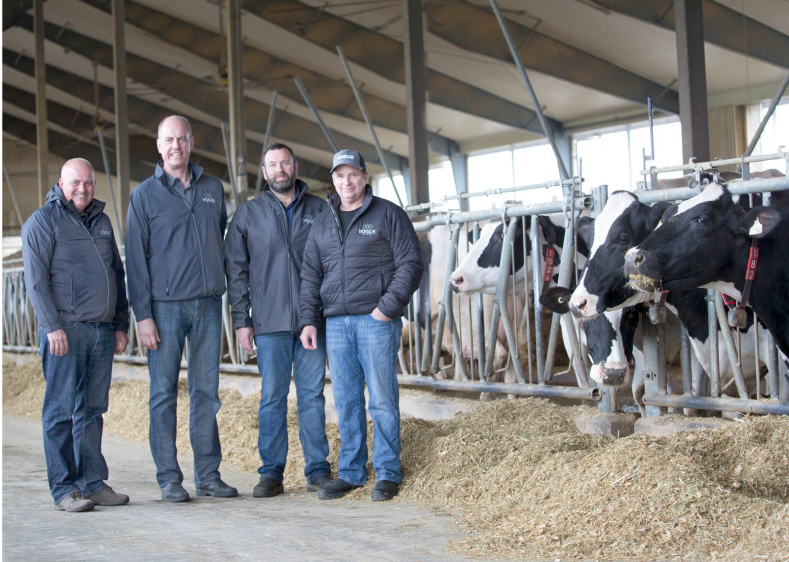
The Vogue partners L-R: Len Vis, Dave Eastman, Sean O’Connor, Kelly O’Connor. The partners have bred Brewmaster, Epic, Lexor, Liquid Gold, Salt and Pepper, and more.

Strategic partnerships have the power to reshape the dairy genetics market, a concept Dave Eastman understood fundamentally. Eastman chose collaboration over costly competition when confronted with the challenge of competing against larger AI firms. This wisdom led to the creation of GMO (GenerVations, Maplewood, and O’Connor), a revolutionary alliance with top breeders like Len Vis of Maplewood and Sean and Kelly O’Connor of O’Connor Land and Cattle Co. This partnership offered GenerVations an unparalleled opportunity to tap into elite pedigrees typically inaccessible to smaller enterprises. By harnessing the strengths of its partners—Maplewood and the O’Connors in raising and developing livestock—each entity gained more than it could achieve alone. 

One of the collaboration’s hallmarks was its innovative branding strategy. The bulls carried the GenerVations prefix, while the female offspring bore the names of their partners’ herds. This mutually beneficial relationship elevated each partner’s standing while giving GenerVations greater control over breeding directions. After GenerVations’ sale in 2014, a strategic move was made to unify the branding under Vogue Cattle Co. By adopting advancements like polled genetics and the A2A2 trait, they stayed ahead of market demands and solidified their influence in dairy genetics. Although the original partnership concluded in 2021, its impact persists, showcasing how strategic alliances drive genetic innovation in the industry.

Strategic Exit: How Dave Eastman’s Sale of GenerVations Shaped the Future of Dairy Genetics

Several strategic considerations impacted Dave Eastman’s decision to sell GenerVations in 2014, demonstrating his excellent financial skills and insight in managing the difficulties of the dairy genetics market. At the heart of it all was GenerVations’ genomic bulls, which had become among the industry’s leading contributors to genetic development. Under Eastman’s leadership, GenerVations proved its capacity to lead the pack in genomic innovation, making it an appealing option for more prominent AI firms looking to expand their genetic portfolios.

Selling time was also an essential factor in the strategic decision-making process. Regular genomic testing began to level the playing field for genetic enterprises during this time. Eastman gained a competitive advantage by using GenerVations’ reputation for developing high-ranking bulls like Epic and securing a successful purchase. This decision was not just about capitalizing on present success but also about conserving the company’s past and ensuring its future effect inside a more extensive organization capable of increasing its reach.

The transaction had a varied influence on Eastman’s career. It enabled him to shift his emphasis to other projects and pursue novel paths in the industry, such as genomic testing  (Validity Genetic Testing )research and the continuous selling of exceptional bulls under Vogue (now Vector prefix). Furthermore, this change demonstrated Eastman’s versatility and dedication to pushing the frontiers of dairy genetics while providing him the stability to pursue his larger goal.

From the industry’s standpoint, selling to a well-established operator such as Select Sires enabled more worldwide access to GenerVations’ outstanding genetic resources. This integration emphasized the importance of intelligent breeding initiatives and the fast-changing genomic environment in propelling industrial growth. It also facilitated the global spread of high-quality genetic material, emphasizing the significance of innovative breeding strategies in improving dairy cow genetics.

Charting New Territories: Dave Eastman’s Visionary Approach to Polled and Homozygous Genetics

Dave Eastman’s continuous endeavors in dairy genetics, concentrating on polled and homozygous genetics, have resulted in substantial advances. Recognizing the growing demand for these features, Eastman carefully manages a portfolio of homozygous bulls for desired genes, guaranteeing that these traits are consistently transmitted to future generations. His strategy emphasizes meeting a significant industry need for high-producing cattle with these advantageous genetic traits.

Eastman’s dedication extends to marketing these high-quality bulls, which he tackled with increased zeal after the sale of GenerVations. He assures the bulls he promotes meet the highest genetic requirements using his vast industrial network and longtime contacts. This endeavor aims to sustain quality while pushing the frontiers of dairy genetics.

The bulls are kept at the cutting-edge ST facility in Listowel, where they are given the best care possible to reach their full genetic potential. The demand for sexed semen, primarily for export, has been robust, with Eastman’s bulls leading the way in supplying this need. As he continues contributing to the genetic enhancement of dairy cattle, Eastman’s diligent bull selection guarantees that they meet global market needs and stay at the forefront of genetic breakthroughs.

A Legacy of Mentorship and Family Support: Dave Eastman’s Path in Dairy Genetics

Dave Eastman’s path in the dairy genetics field was greatly influenced by the profound guidance he got, most notably from Albert. Albert’s inventive energy and commercial ability shaped Eastman into the visionary leader he is today. This mentoring gave Eastman strategic insights and the capacity to handle the complexity of foreign marketplaces, which were critical to his industry-changing breakthroughs.

Equally crucial was his family’s continuous support. They encouraged him to expand his horizons outside the family farm, develop a strong work ethic, and cultivate perseverance. Such solid support was critical to his quest for greatness.

Wendy, Eastman’s wife, was also a rock during tough times. Her support, particularly on critical occasions such as the launch of GenerVations and times of crisis, helped him stay focused and motivated. This emotional support enabled Eastman to accomplish his ambitious vision for the organization.

As a mentor, Eastman has been similarly committed to developing talent across the business. His inclusive mentoring philosophy emphasizes people skills and product expertise, providing opportunities for people from many backgrounds. This strategy has inspired many professions, creating a culture of creativity and devotion that benefits the industry. Andrew Hunt of The Bullvine got his start owing to Dave. While still an undergraduate and just getting into agricultural marketing, Eastman called Andrew and asked him to assist with the marketing of GenerVations as it began and continued through the Champion era, enabling both to build their businesses and establish themselves in the field.

Dave’s mentoring was received and offered, and his strong family support has left an everlasting mark on his legacy. This caring atmosphere fueled his career and prepared him to inspire and educate others, resulting in a progressive and dynamic dairy genetics landscape.

The Bottom Line

Dave Eastman’s career in the dairy genetics sector shows the power of strategic thinking and innovation. Eastman’s path, from his upbringing on the family farm to his transformational responsibilities at Cormdale Genetics and the pioneering founding of GenerVations, is distinguished by a visionary attitude that has continuously pushed limits. His strategic actions, such as applying genomic advancements and forming multinational collaborations, transformed genetic breeding, giving dairy farmers a global competitive advantage. Eastman’s current concentration on polled and homozygous genetics demonstrates his dedication to fulfilling changing business needs. His legacy, defined by a persistent commitment to quality and innovation, is a baseline for future advances in dairy genetics.

Reflecting on Eastman’s history, it’s a necessary time to explore how strategic vision may affect an industry’s future. What can we learn from his path to help you with your challenges? The discourse continues, and I welcome you to add your ideas and observations in the comments section below. Let’s talk about how innovation might generate success in dairy genetics together. Share this article with your coworkers to spark more extensive talks about this critical sector.

Key Takeaways:

  • Dave Eastman’s early experiences on a family farm and in 4-H were foundational to his lifelong engagement with the dairy industry.
  • His rise from a sales representative to a national leader in dairy genetics showcases his business acumen and strategic foresight.
  • Innovative strategies, including early adoption of genomics and groundbreaking partnerships, mark the success of GenerVations.
  • Eastman’s strategic decisions, like expanding into polled and homozygous genetics, underline his visionary approach to breeding innovation.
  • Mentorship and family support were crucial to Eastman’s success, highlighting the importance of personal relationships in professional growth.
  • His decision to sell GenerVations was strategic and timely, setting a precedent for strategic business exits in the industry.
  • Dave Eastman’s legacy in dairy genetics continues to evolve as he focuses on market-leading traits and genetic advancements.

Summary:

Dave Eastman is a visionary pioneer in the dairy genetics industry, transforming it with his relentless pursuit of innovation and excellence. From his beginnings on a modest dairy farm in Kinburn, Ontario, he rose to Cormdale Genetics ranks, eventually co-founding GenerVations with Albert Cormier in 1999 and becoming its sole owner in 2004. Eastman introduced groundbreaking advancements like sexed semen, leveraged genomic technologies, and formed strategic partnerships to redefine dairy genetics. His acquisition of Calbert-I HH Champion brought financial stability and international growth. Choosing collaboration over costly competition, Eastman helped create GMO/Vogue (GenerVations, Maplewood, and O’Connor), an alliance with top breeders. His enduring legacy includes mentorship and a focus on polled and homozygous genetics, profoundly impacting the global dairy landscape.

Learn more: 

Join the Revolution!
Bullvine Daily is your essential e-zine for staying ahead in the dairy industry. With over 30,000 subscribers, we bring you the week’s top news, helping you manage tasks efficiently. Stay informed about milk production, tech adoption, and more, so you can concentrate on your dairy operations. 

NewsSubscribe
First
Last
Consent

Stud Wars: Episode II – April 2014

Just as we have learned with the Rebels versus the Republic in Star Wars, the Stud wars are far from over.  However, instead of clones we have Genomic Sires versus Proven Sires and large A.I. companies versus smaller organizations.  The April 2014 genetic evaluations have seen the gap between the haves and have nots decrease.  Many of the larger studs that had in the past not focused on Genomic sires greatly increased their genomic offerings and some of the smaller studs greatly increased their niche market offerings.  Stud Wars, like Star Wars, thrive on new releases, talent, unexpected changes and rivalries.

TPI

TOP TPI PROVEN SIRES

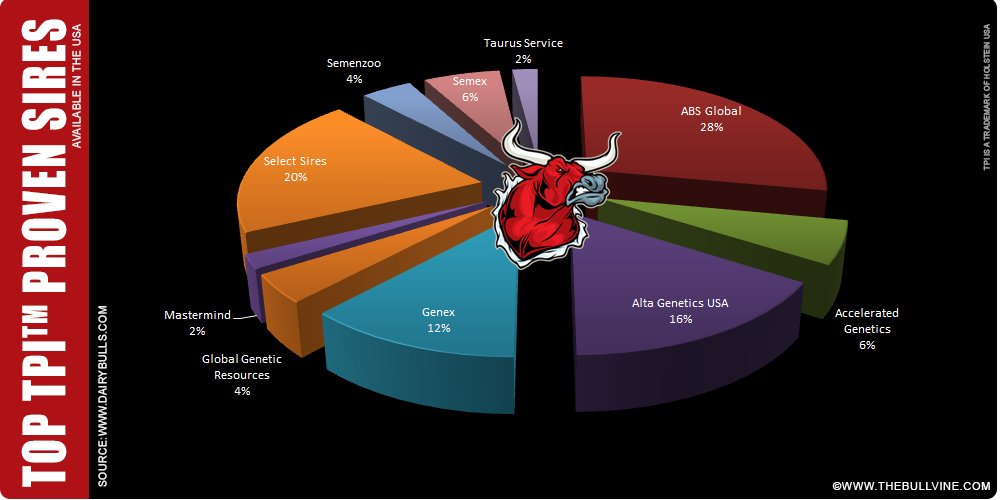
As we found in our initial stud wars (Stud Wars – The Battle for A.I. Supremacy), market share of the pre-genomic era correlates very highly with the big five being ABS, Select Sires, Alta Genetics, Accelerated Genetics and CRI.  Since the last proof run, Select Sires has taken over the top spot with two more sires entering the top 50, and CRI has doubled the number of proven sires they had in the top 50 TPI to move into the #2 Spot.  Former #1 holder ABS Global has dropped from 14 sires to 11 in the top 50 TPI and now holds the #3 position. A sign of the time is the way Accelerated has dropped market share.

TOP TPI GENOMIC SIRES

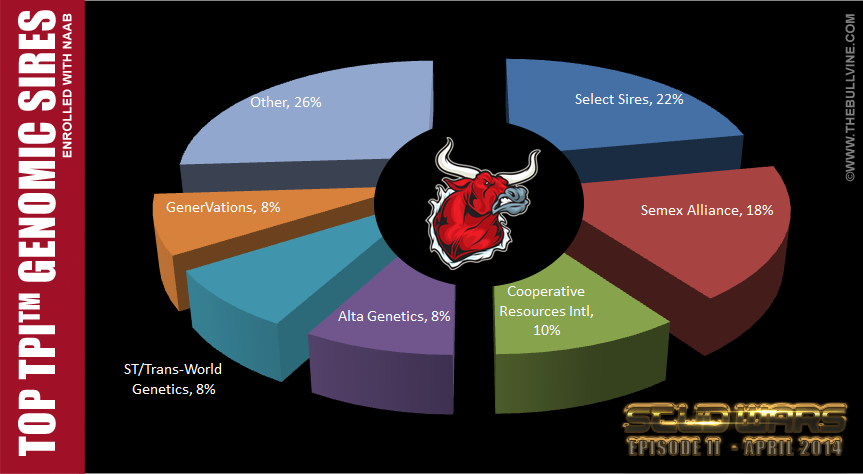
Both our previous gTPI leaders from December 2013 have dropped but still hold the #1, Select Sires, and #2 Semex spots on our list.  Making a significant jump on the list is CRI who now holds the #3 spot on the list with 5 sires in the top 50 gTPI.  Also seeing an increase is Alta Genetics who now has 4 sires in the top 50 gTPI.

TOP TPI SIRES

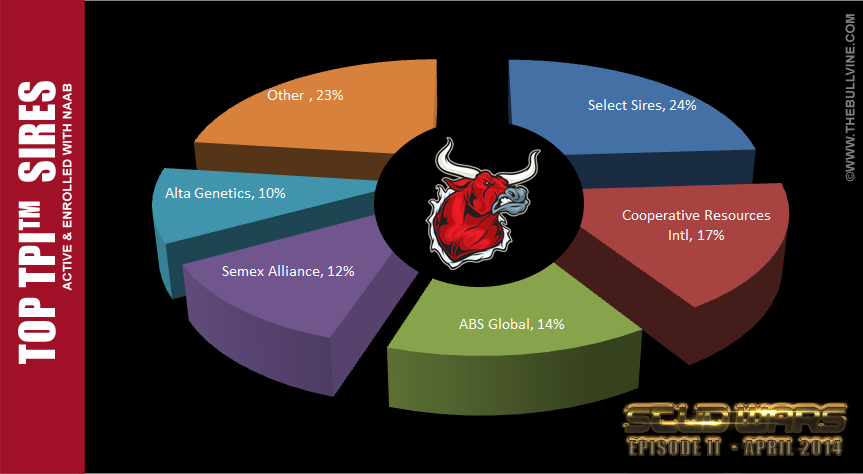
Select Sires continues to lead the way with top TPI offerings both Genomic and Proven. Making a jump into the #2 spot, thanks to an increase in their top TPI proven sires, is CRI. They are followed by Semex who continues to have a strong Genomic TPI offering.  .

NM$

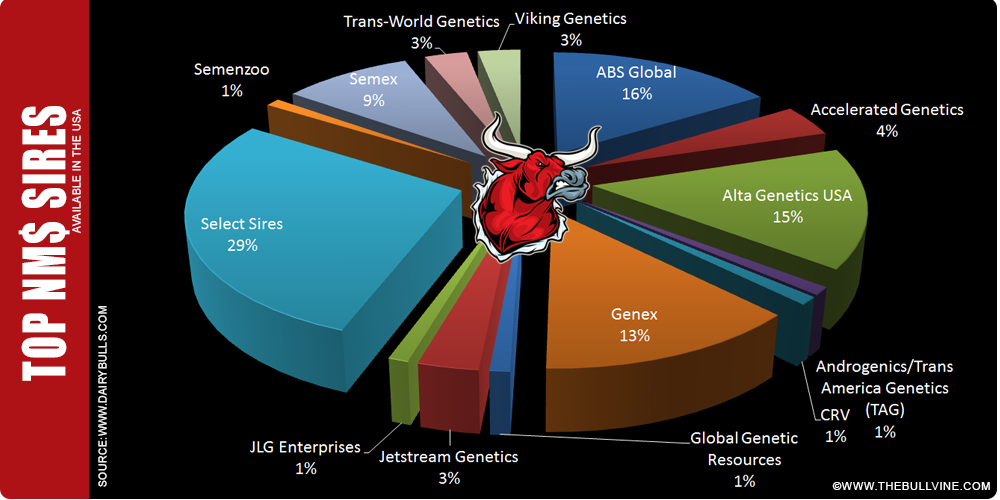
TOP NM$ PROVEN SIRES

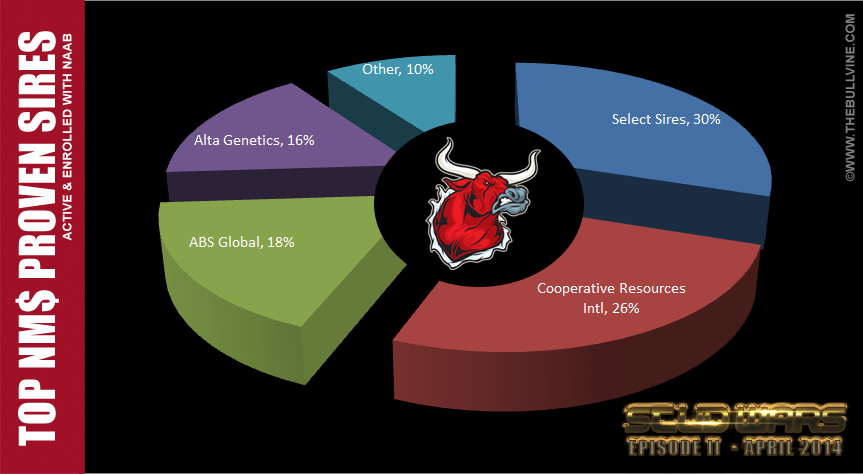
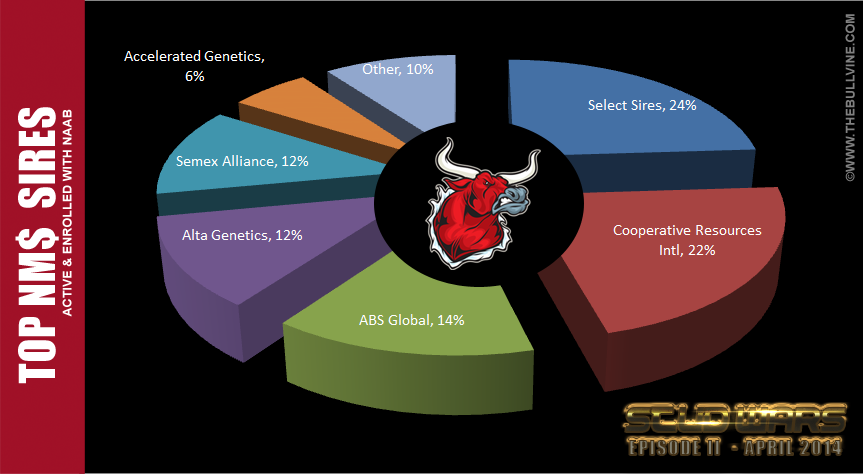
It is no surprise that, for the larger AI centers, the focus on the commercial producer market continues to dominate the proven NM$ list.  Select Sires moves into the #1 position with the two additional sires in the top list, with CRI moving into the #2 position, almost doubling the number of top 50 NM$ sires they have to offer.  Dropping significantly was ABS Global who now finds themselves in the #3 position with 5 fewer  sires in the top 50 NM$ list.

TOP NM$ GENOMIC SIRES

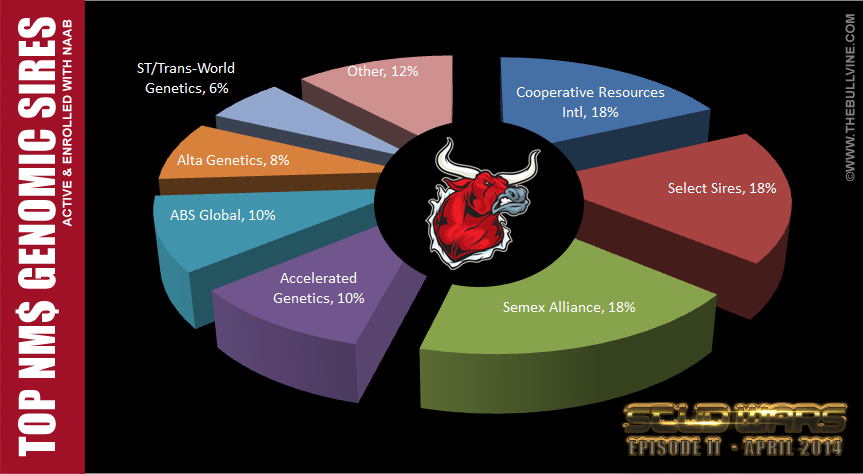
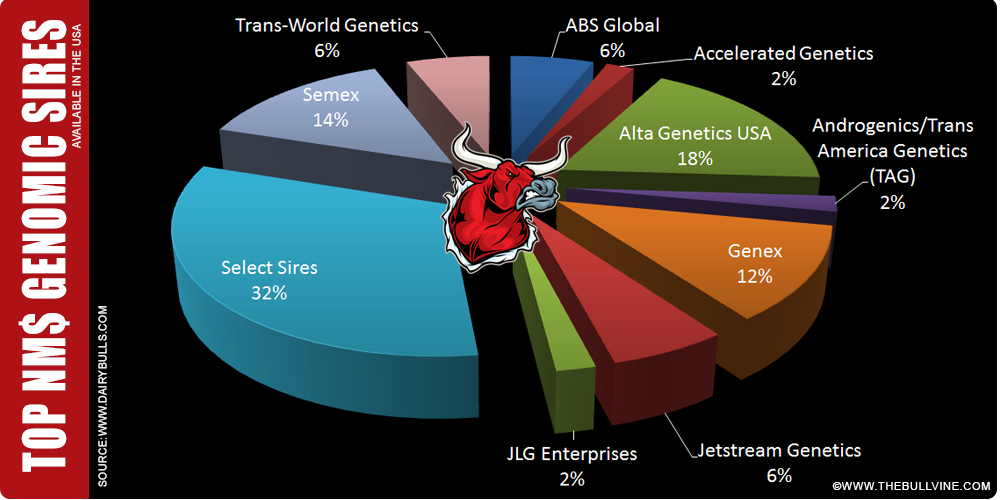
A list that was dominated last round by Select Sires who had 32% of the top sires, now finds them tied with CRI and Semex – all with 18% each.  Also seeing a significant drop in top gNM$ sires is Alta Genetics who went from 9 last round to just 4 this round.

TOP NM$ SIRES

On the strength of their strong proven and genomic NM$ offering, Select Sires retains the strongest NM$ offering in the US.  Thanks to a significant investment in Genomic sires CRI now find themselves with the 2nd strongest NM$ offering.

PTAT

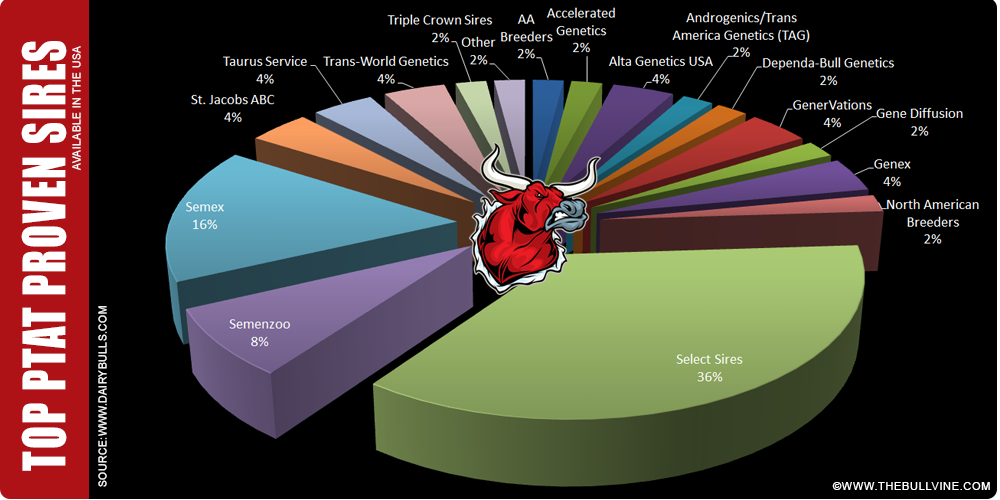
TOP PTAT PROVEN SIRES

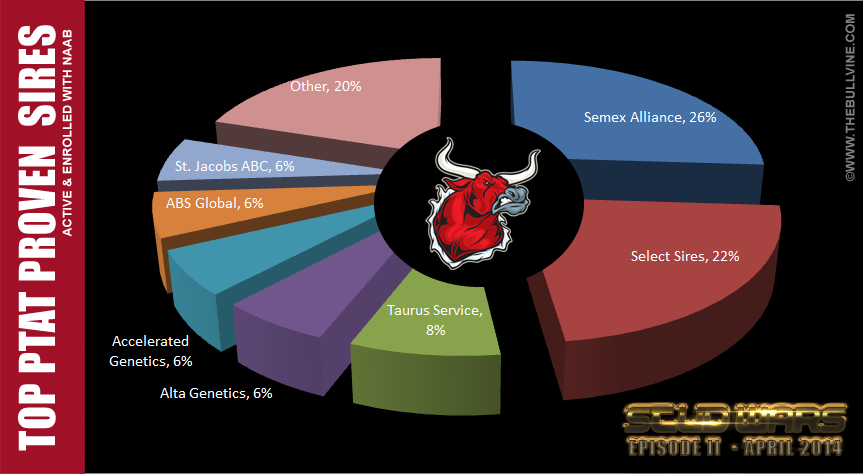
Probably one of the most significant changes of this proof round is Semex moving into the strongest type proven sire offering in the world, with 5 more proven sires moving into the top 50 PTAT.  Former #1 Select Sires goes from having 18 sires in the top 50 to 11 and holds the #2 spot.

TOP PTAT GENOMIC SIRES

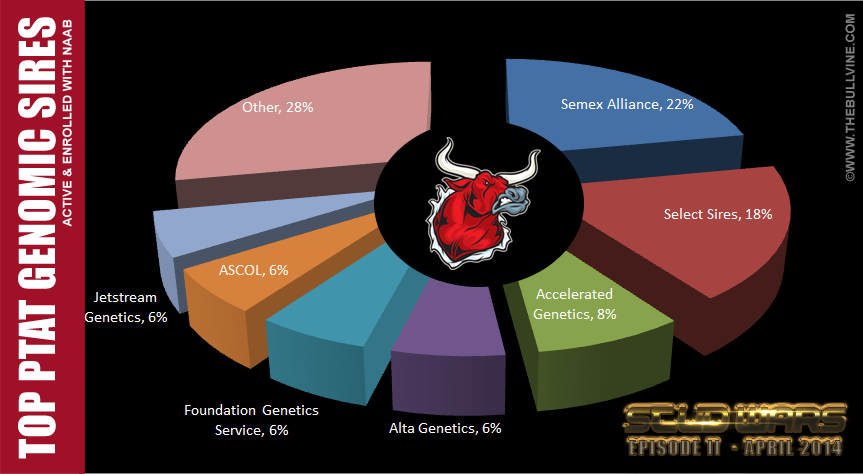
When it comes to the top 50 Genomic PTAT sires, Semex and Select Sires still top the list, but both have seen significant declines in totals.  Many small A.I. studs now find themselves with 1 to 3 sires in the top 50.

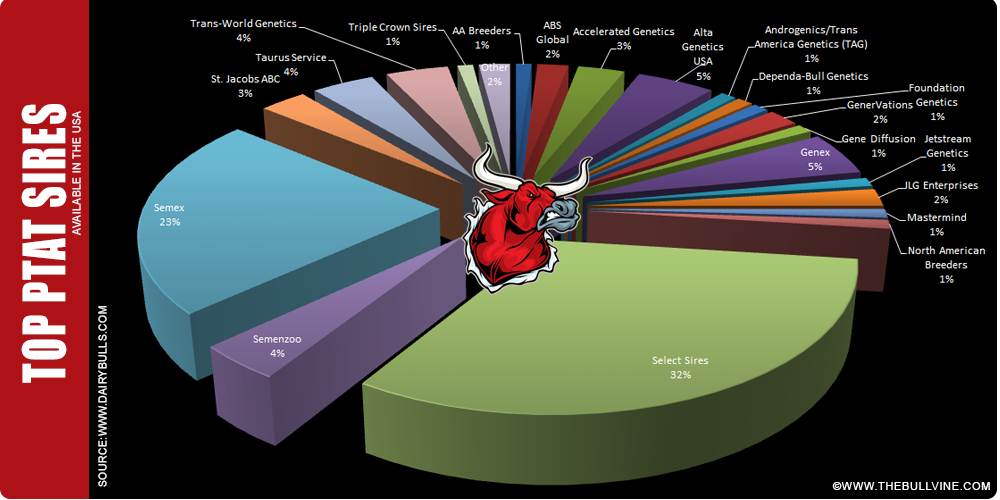
TOP PTAT SIRES

On the strength of a greatly improved proven type sire line up, Semex now find themselves on top of the overall PTAT list, followed by Select Sires.  However the ever increasing trend continues where more and more smaller AI organizations have a top 50 PTAT proven or genomic sire.

Polled

TOP TPI POLLED SIRES

As we continue to see trends change in the industry, we see the sire line-ups in key markets are also starting to change.  Nowhere is it more evident than in the polled trend.  With that in mind, we decided to add two key niche markets to our stud wars analysis: (1) polled TPI sires and (2) Red type sires.  For both of these lists we are using the top 50 proven or genomic sires.

Not surprising DairyBullsOnline.com the Polled specialists lead the list.  Followed by Select Sires and GenerVations.

PTAT R&W SIRES

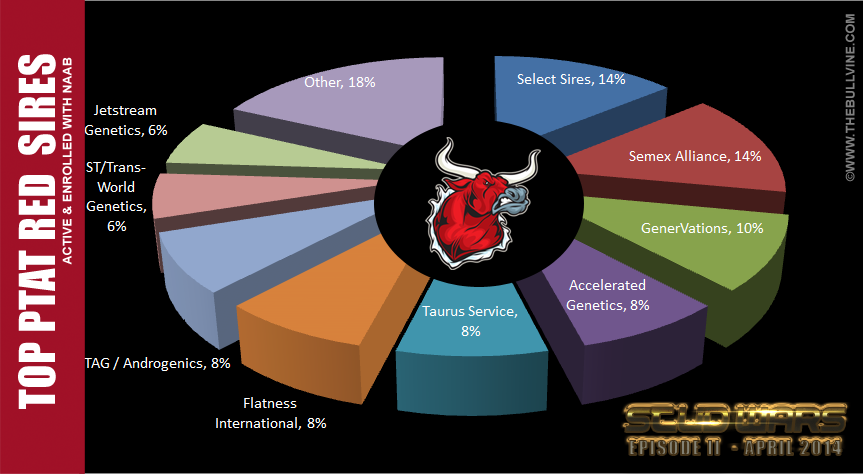
TOP PTAT RED SIRES

As we saw in the overall PTAT list, Semex and Select Sires continue to lead the way in type offerings.  Also similar to the B&W PTAT lists, we find a number of smaller studs also offering 1-4 of the top red and white sires.

The Bullvine Bottom Line

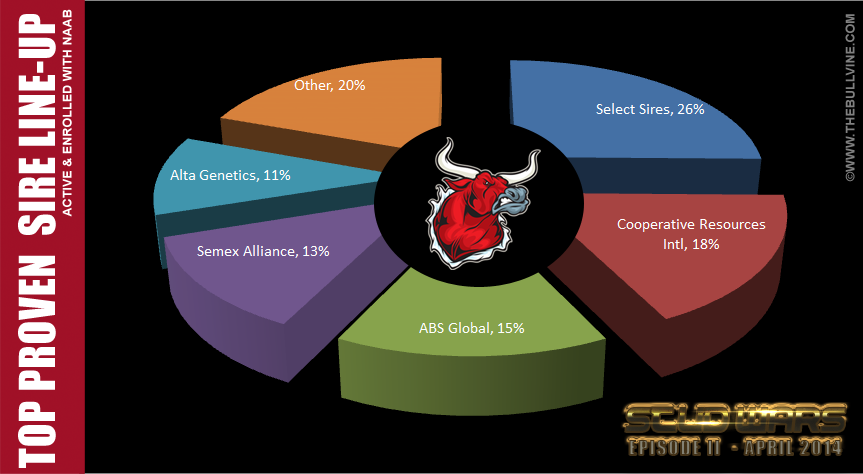
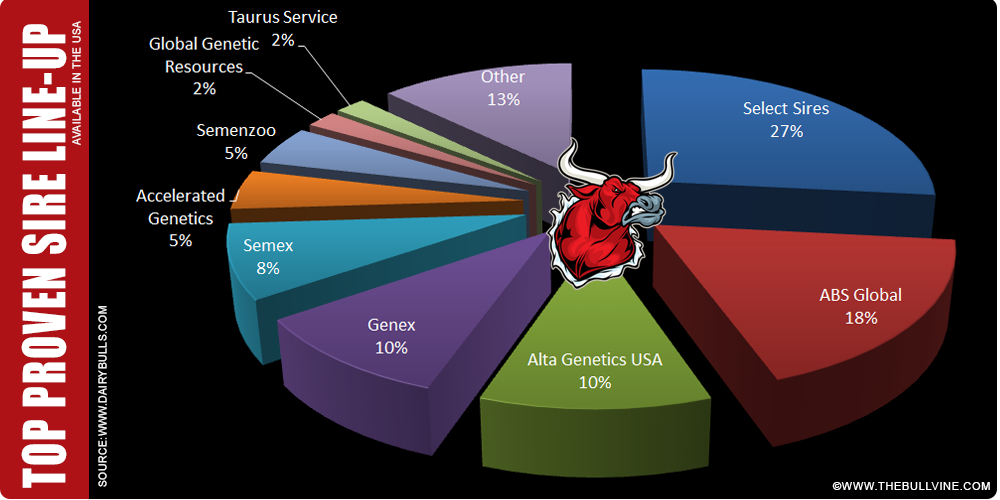
TOP PROVEN SIRE LINE UP

Holding strong with the best proven sire line-up is Select Sires.  Seeing a significant increase and moving into the 2nd strongest proven sire line-up position is CRI.  They rise on the strength of their significant increase in top NM$ proven sires. Also seeing an increase and moving into the #3 position is ABS Global.  Semex finds themselves with 15 less proven sires on our top lists and drops from the #2 position in December to the #4 position currently.

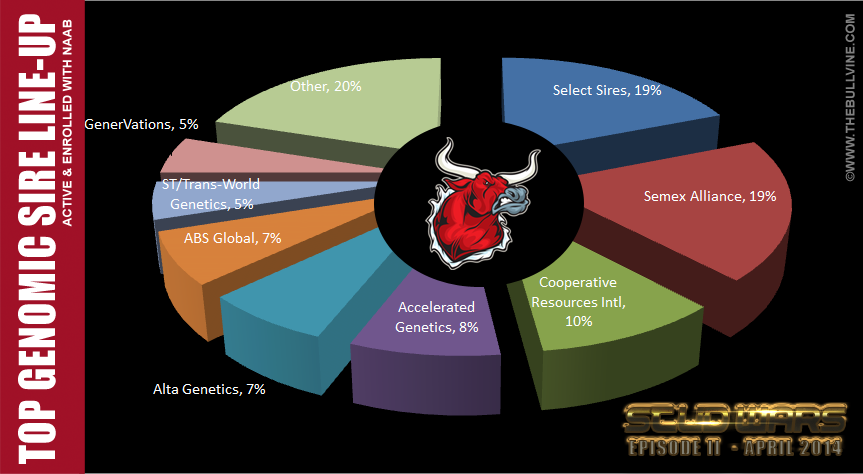
TOP GENOMIC SIRE LINE UP

Tied at the top genomic for genomic sires are Select Sires and Semex.  These are the same two studs that ranked #1 and #2 last round.  Moving up 2 spots from last round is CRI, powered by a significant investment in top gNM$ sires.  Also making a strong showing is the Sexing Technologies / Trans-World Genetics partnership powered by their agreement with the EDG group, who own many of the top genomic females in the world.

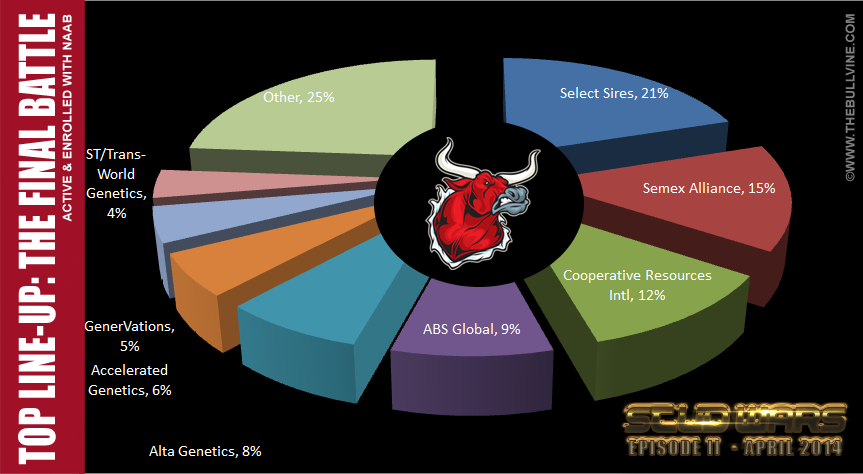
TOP LINE UP

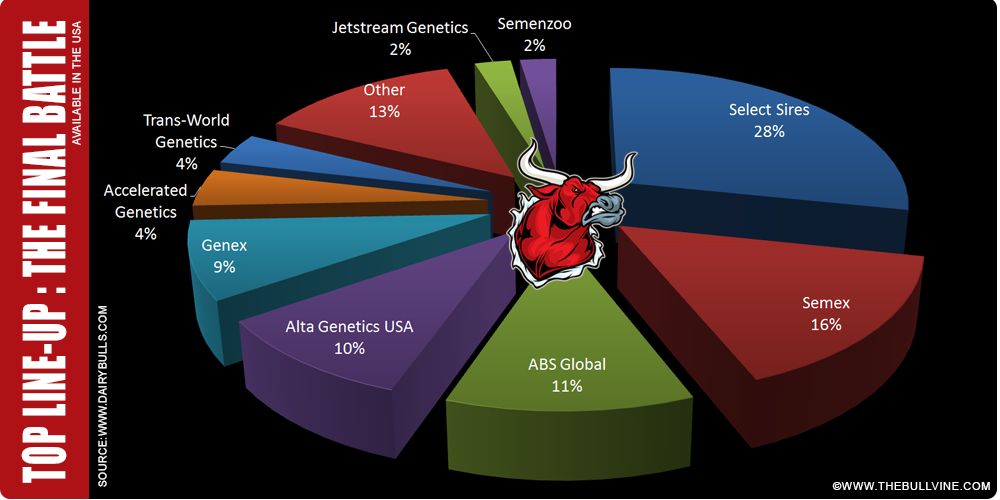
Retaining the title of as the strongest overall sire line-up is Select Sires, though it should be noted that Select went from 28% of the top sires in December 2013 to 21% this time.  Holding steady with increases in their proven sire line-up and slight decreases in their genomic sire line-up, Semex comes in as the 2nd strongest sire line-up.  Moving up to the #3 sire line-up with significant improvements in their proven TPI sire line-up as well as genomic offerings is CRI. ABS Global and Alta Genetics round out the top 5.

Join us in staying tuned to the next order of business in the expanding universe of the Stud Wars.

For complete genetic evaluations from around the world click here.


Get original “Bullvine” content sent straight to your email inbox for free.


[related-posts-thumbnails]

Stud Wars – The Battle for A.I. Supremacy

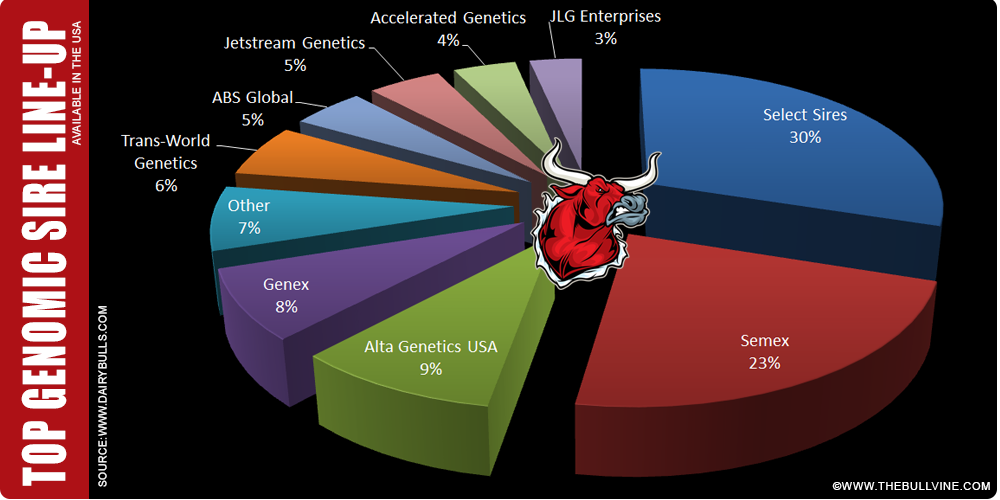
A long time ago in a galaxy far away……Who are we kidding the A.I. stud wars are now and the battleground is the USA, the most lucrative genetics market in the world.  For years I have heard the debate from all sides about which stud has the best sire line-up.  The problem is most of it has been anecdotal and no one has really backed it up with numbers.  So, in true Bullvine fashion, we thought we would bring numbers to this galactic battle.

To settle this confrontation, we decided to let genomics and genetic evaluations determine exactly which stud rules the empire.  Specifically we looked at top 50 proven and genomic sires for TPITM, NM$ and PTAT to determine who are the studs and who are the duds.  The following is what we found.  (Please note we deemed a sire to be available if the had an NAAB Code)

TPI

tpi proven siressw

Click on image for enlargement

It’s interesting to see how the percentages seem to be similar to market share, prior to the genomic era.  The big five being ABS, Select Sires, Alta Genetics, Accelerated Genetics and Genex.

Click on image for enlargement

Click on image for enlargement

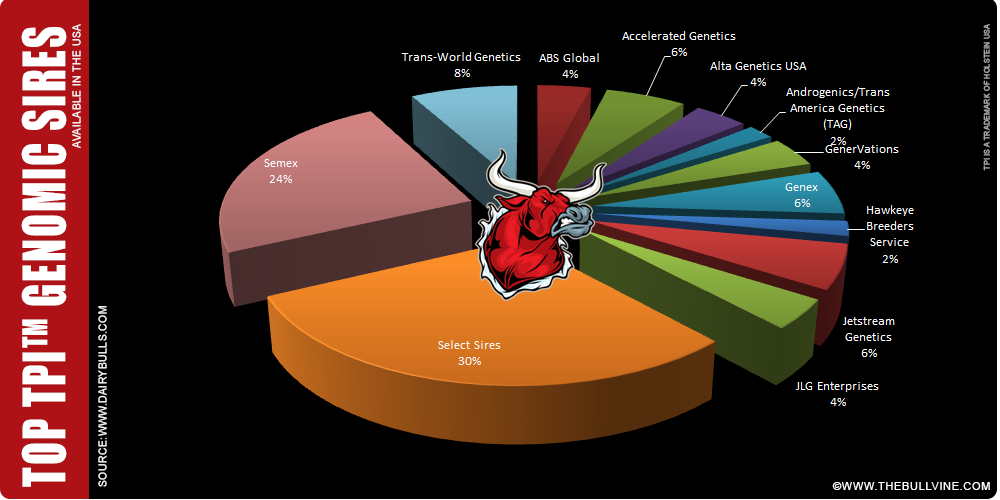
The top gPA TPI sires tell a very different story than that of the proven sires.  Studs like ABS Global and Alta Genetics do not have as large a portion of the top bulls whereas Semex and Select Sires have invested heavily in obtaining top gPA TPI sires.

Click on image for enlargement

Click on image for enlargement

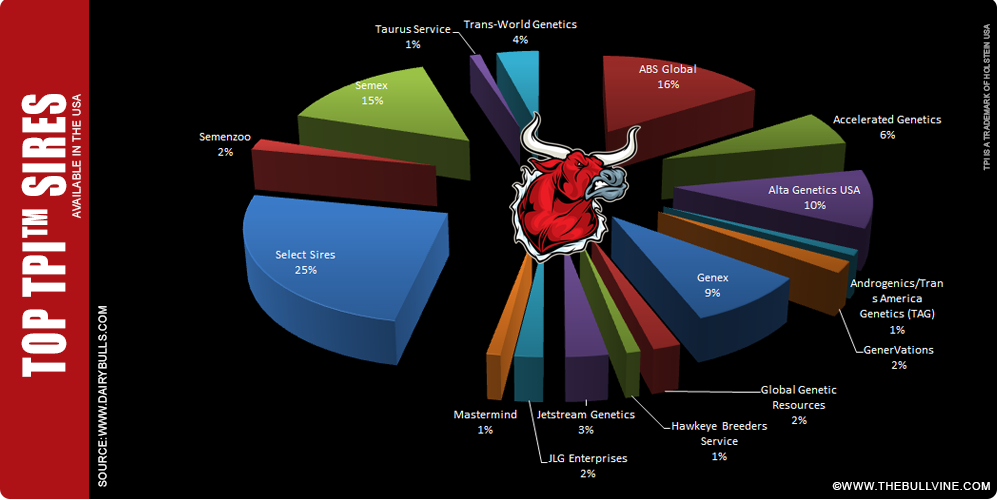
When it comes to strength of line-up from a TPI perspective, it’s interesting to see how Semex and some of the smaller studs have made a big push on getting the top genomic sires, in order to have that stronger line-up in the future.  On the other hand, some of the established studs are resting on their proven laurels. (Please note for top list we used the top 50 genomic and top 50 proven sires.)

NM$

nm$ proven siressw

Click on image for enlargement

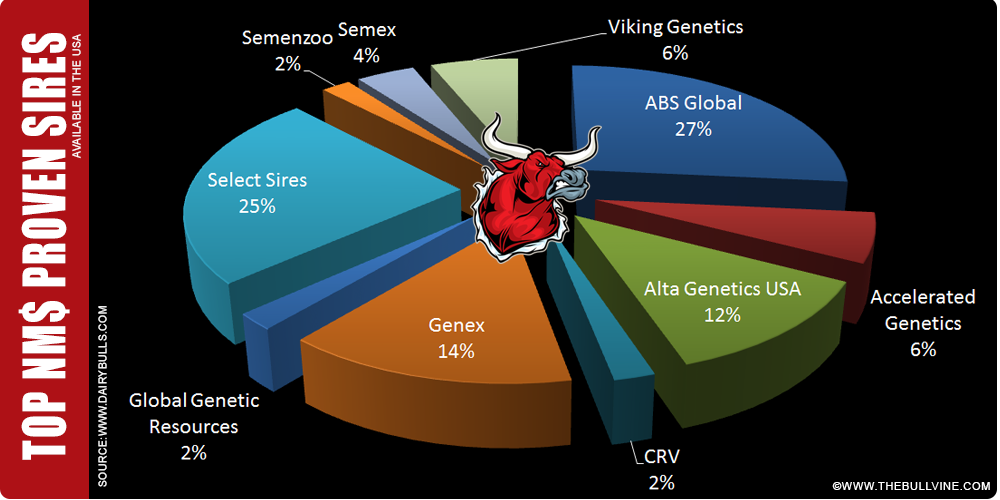
It is interesting how the studs that are more milk producer focused as opposed to breeder focused rise up on this list.  Specifically Genex, Alta Genetics and ABS have their best showings here.

Click on image for enlargement

Click on image for enlargement

Even the studs who have not gone heavily into genomics, are at least sampling some high genomic sires for NM$.  When it comes to selling volumes of semen, nothing compares to a high NM$ sire.  Yes the top TPI sires will sell well, but the high NM$ will move in volume as they attractive the commercial market.


Click on image for enlargement

Click on image for enlargement

The greatest spread of the top sires amongst the studs occurs in NM$.  This is not surprising since this is such a lucrative market for so many studs.  They all are trying to get the top sires.

PTAT

Click on image for enlargement

Click on image for enlargement

When it comes to the top type bulls, it seems like everyone wants a shot at them.  Type sires are a premium market delivering high margins to the units.  This is certainly one area where type oriented countries and their respective studs excel (Example, Semenzoo and Semex).

Click on image for enlargement

Click on image for enlargement

Similar to the proven bull list, this is an area where everyone wants to play.  It is interesting to see that many of the type niche studs don’t have more on these lists.  That could be due to the fact that they are focusing on show type and not necessarily on sires who have high genomic tests for PTAT.

ptat siressw

Click on image for enlargement

A subject of great debate on our Facebook page has been who has the better type sire lineup, Select Sires or Semex.  If you go by the numbers, there is no question that Select Sires has the advantage.  Looking deeper into this, we decided to take the top 5 proven and the top 5 genomic sires from each stud and see whose were better.  Select Sires averaged 4.14 PTAT and Semex averaged 3.72.  So Select not only has an advantage in numbers but also in quality.

The Bullvine Bottom Line

Click on image for enlargement

Click on image for enlargement

Click on image for enlargement

Click on image for enlargement

Click on image for enlargement

Click on image for enlargement

It’s always interesting when you get into the debate about which studs have the best sire lineup to see the perceptions people have.  Most look at it based on what their breeding goals are and state their opinion relative to that.  Nevertheless there are many that are guilty of looking at things through rose colored glasses for the studs they prefer and hence discrediting other studs because of it.  The one thing you cannot deny is that, when you look across the board,   the US sire line up at Select Sires has the largest market share and are a player in each major market.  Studs like Semex (type) and ABS, Alta Genetics, and Genex (NM$ and TPI) do well in niche segments.

For complete genetic evaluations from around the world click here.


Get original “Bullvine” content sent straight to your email inbox for free.


[related-posts-thumbnails]

Semex – The Rise and Fall of a Semen Empire

I have seen men who once screamed EBI green turn to the dark side.  Men who used to bleed WOBI blue now openly criticize the organization that was the epitome, half a century ago, of everything Dairy in Canada.  The Semex Alliance that once dominated, no longer owns the Canadian marketplace.  There is criticism from within.  How did the organization that once defined the Canadian marketplace lose control of it?

I’ll establish my personal allegiances before the hate mail commences.  I grew up with the belief that the Canadian cow was the best in the world and that the Canadian dairy cattle improvement system was second to none.  This was so heartfelt for me that I have the Holstein Canada logo tattooed on my chest.  I believed that the likes of Moe Freeman, Roy Snyder and George Clemons were super heroes who could leap tall buildings in a single bound.  At that time, there was leadership, teamwork and cooperation that pulled differences together for the common good.  Today?  Not so much.  (Read more – Select Sires vs. Semex – A contrast in cooperatives) The reason for this decline and fall has gradually kicked in for me.  When Doug Blair and Alta Genetics decided to purchase Landmark Genetics, the foundation of what was Semex and the partnership and cooperation that made Canada great, started to crumble.  That was the first crack in the cooperation and teamwork that had lead Semex and Canada to global prominence.  Later, when GenerVations, a stud other than Semex, had produced the #1 sire (Calbertt-I H H Champion) in Canada that further ate away at what was the core of Semex.

Canadiens vs. Nordiques

As I was thinking about this a situation came to my mind.  Like most Canadians, I am a huge hockey fan and I am reminded of what has been the downfall of the once mighty Montreal Canadiens.  The Canadiens once had it all. They had hockey dominance all to themselves, just as Semex had controlled the Canadian marketplace.  However, in hockey, when the WHA launched, one of the first steps made by the Nordiques was the hiring of the Canadiens legend, Maurice Richard, as their coach.  It didn’t work out – the Rocket’s personality was no fit at all for the job and he lasted a couple of games.  However, the strategic move of his signing was a golden one that set a precedent, much like Blair’s and the leadership team at Alta Genetics.  There was now another option in Canada.  Hockey fans had a choice.

The other part that I think is even more telling for the Semex fall from dominance is that they no longer always had the best Canadian product.  This compares to the Canadiens having to give up their territorial exemption in 1970.  You see in the days of the Original Six, the Canadiens had all but exclusive rights to any junior player in Quebec.  That singular grasp over one of the greatest sources of talent gave the Canadiens a significant advantage in assembling talent.  It was as if they were starting every poker game with an ace in hand.  Semex had a similar success story.  But when GenerVations had the #1 LPI sire, there was a clear message that Semex was not the only option. Even today GenerVations works at showing breeders there are other options (Read more –$750 Dollar Semen! Are you crazy?).  Even in Quebec with the great work Trans America Genetics (TAG) is doing they are not even the only option in the hockey and genetic heartland of Canada.

Furthermore, today’s generation of active breeders hasn`t grown up with Semex as the impenetrable force.  There was a time when merely uttering a negative thought about Semex was considered high treason.  But think about how things have changed. Through MACE, Genomics, social media and a globalizing of the marketplace, today’s generation of breeders has not known Semex Sires as the only super stars.  This is the same as today`s Quebecois growing  up with the likes of Mario Lemieux, Ray Bourque, Luc Robitaille, Vincent Lecavalier, Martin St. Louis or Martin Brodeur not wearing a Canadien’s jersey.  Even one Canadien who did rank among them, Patrick Roy, demanded a trade out of Montreal.

The Bullvine Bottom Line

Semex’s superior place in Canadian and global dairy cattle breeding history remains almost unequaled.  However, that position is less secure today than many would like to admit.  I am not saying they can’t regain prominence or even be a major global player.  What I am saying is that we all need to remember that cooperation is what made Canada great in the first place.  All players working together will build a product that is greater than the sum of its parts. That is what made Canada great and that is what will help Canada rise back to the top of the genetic empire.

[related-posts-thumbnails]

A Wake-up Call to All A.I. Companies

Lately, there has been a great deal of discussion regarding March 2013 when dairy breeders will be able to genomically test their own bulls.  (Read – How Genomics Is Killing the Dairy Industry)  One thing for sure is that it is forcing many Artificial Insemination companies to re-think their corporate strategy.

Probably one of the greatest areas for executives at the AI companies to look at for examples on how to position their companies is the retail industry.  There are many similarities between A.I. and retail, especially considering the need for product differentiation as well as being a service organization.  Three great retail examples to look at are Wal-Mart, Apple, and Amazon.

Wal-Mart

If you look at the large artificial insemination companies, you can already see that many of them are heading toward the Wal-Mart model, where they try to offer the highest quality product at “always low prices.”  Companies like Alta Genetics, ABS Global, Accelerated, and CRI have identified the largest portion of the marketplace, the commercial producer.  This is where they can sell the highest volume semen and maximize profit not through the semen prices they charge but rather through how efficiently they can operate.

Similar to the Wal-Mart, one stop shopping model, many of these A.I. organizations now try to be a complete solution to their customers offering such services as, herd health, feed & nutrition in addition to their genetic and reproductive services.

When it comes to their genetic offerings, the key here is that they are selling shelf space.  No longer is it as much about the product they are selling, as it is about the complete package they are trying to offer to the commercial breeder.  That means that they are looking to provide  a consistent product rather than seeking  to have the #1 TPI or LPI sire.  Therefore, they do not have to go out and source the top sires but, rather, they need to provide consistent reliable genetics that can help advance their commercial partner herds.  This means they will not have to get as aggressive on their lease deals and can still focus on their efficiencies and volumes as opposed to the ultra-aggressive sourcing of top gPA TPI and gPA LPI sires.

Once the world’s most dominating retail entity, there is no question that the Wal-Mart model works, Although  it was once believed that only one company could survive and thrive in the ultra-competitive big box store world.  The recent performance of companies like Target does hold out some hope for the many A.I. companies looking to battle for this large market segment.

Apple

In  contrast to the Wal-Mart model is Apple.  The most admired company in the world has built its market position through developing, marketing and direct selling their own unique product to what most would consider a niche market.  They key part to this model is having a very clear vision who your marketplace is and developing an extremely differentiated product in the eyes of their customers. A.I. companies that seem to be emulating this model are GenerVations with their work with the Lylehaven Lila Z and Wabash-Way Evett families, JetStream Genetics with their work with Regancrest  S Chassity, and Select Sires through their Aggressive Reproductive Technologies (ART) program, though to a much larger audience that the first two (Read – Select Sires vs Semex: A contrast in Cooperatives).

Similar to how Apple has received widespread criticism for some of their own business practices, companies like Select Sires have received criticism for owning females (Read –Should A.I. Companies Own Females ). Though as the Apple model demonstrates you need to have a distinctive product in order to survive. The biggest thing that all three of these companies have learned is that, in order to compete in this ultra-competitive marketplace, they need to cost effectively source their genetics.  That means producing their own sires and accelerating their rate of genetic advancement so that they can have a product that is unique in the marketplace. (Read – The Genomic Advancement Rate – The Battle for Genetic Supremacy)

There are two main lessons I think many of these A.I. companies can learn.  First always be innovative and at the front of the marketplace.  If you are not pushing the front end of product development/sire sampling, you will fall behind your competitors and get lost in no man’s land.  The second lesson is that you have to control the license to your product.  Apple has never allowed other companies to come in and license their product.  They also did not create the iPhone or iPad and then the next day let their competitors take their products and designs and create their own versions knock off versions.  Companies that did allow this to happen, like Microsoft, have developed much larger market share, but have fallen on financial challenges. For A.I. companies that means you need to control your young sire sampling so that you have the next generation of genetics before your competitors do.  While some would say that is not fair, in order for these companies to compete they have no option but to do so.  While having negative sentiment in a small segment of  the marketplace is not ideal, the risk of not having a differentiated product is a much bigger gamble.

Amazon.com

More recently, I have seen the emergence of online semen retailers akin to the amazon.com model.  Companies like DairyBullsOnline in North America and Dairy Daughters in the UK, are able to compete not on their size and scale, or their own distinctive product (though DairyBullsOnline does have a strong segment in the polled and red and white market) but rather through their efficiencies.  These companies do not have large facilities with great numbers of staff, but rather they are extremely efficient in their operations and source their product direct from breeders or smaller A.I. organizations.  Leveraging technology both on the web as well as for shipping semen internationally these companies are able to operate at much higher efficiency, passing benefits back to the producers and the breeders they source their genetics from.  Despite what they lack in market share, they are able to attract unique genetics through offering seed stock breeders a much higher royalty percentage.

The interesting part about this model is that Amazon was able to stay competitive and fight off many competitors by developing private labels and exclusive marketing arrangements, including being the online e-tailer for many large retail companies.  As many of the organizations are forced to get more efficient will they be able to reduce costs and develop their own platforms that will take away the advantage these companies have?  You can already see it in the retail world with traditional companies like Wal-Mart and Best Buy committing significant resources to their web properties.

The Bullvine Bottom Line

The artificial insemination world is changing very rapidly.  While many companies have already identified what part of the market segment they are going to try to occupy, others seem to be taking a sit and wait approach.  The problem is, if they have not already identified whether they are going to be a Wal-Mart, Apple, or Amazon, it is too late, as many of the other companies already have a significant head start.

[related-posts-thumbnails]

Send this to a friend