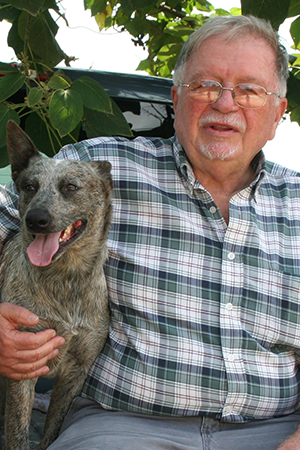
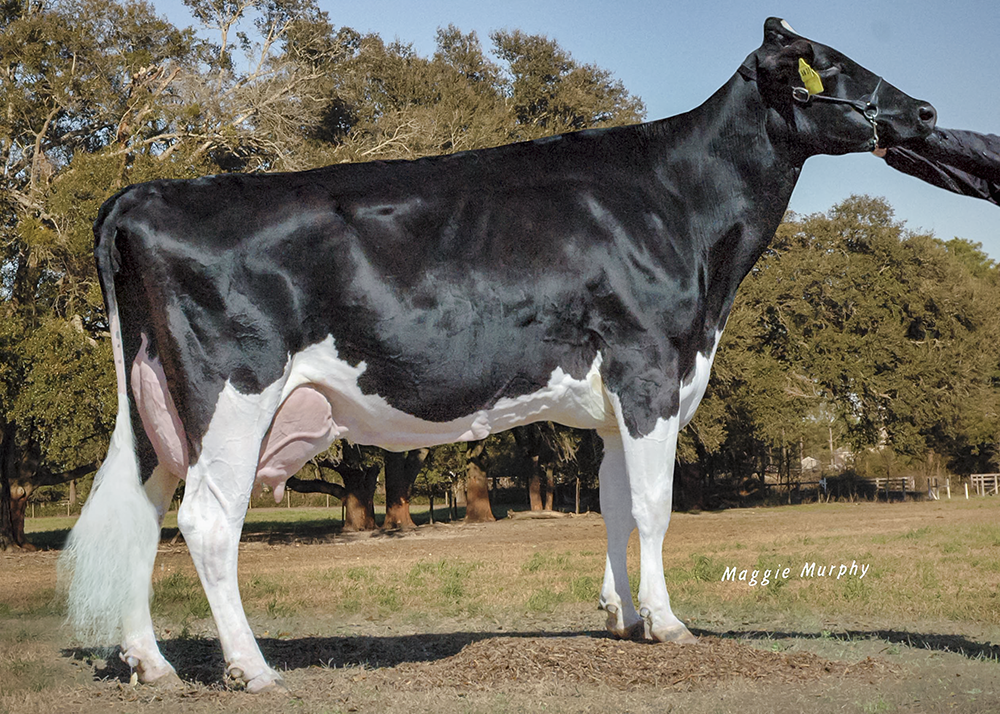
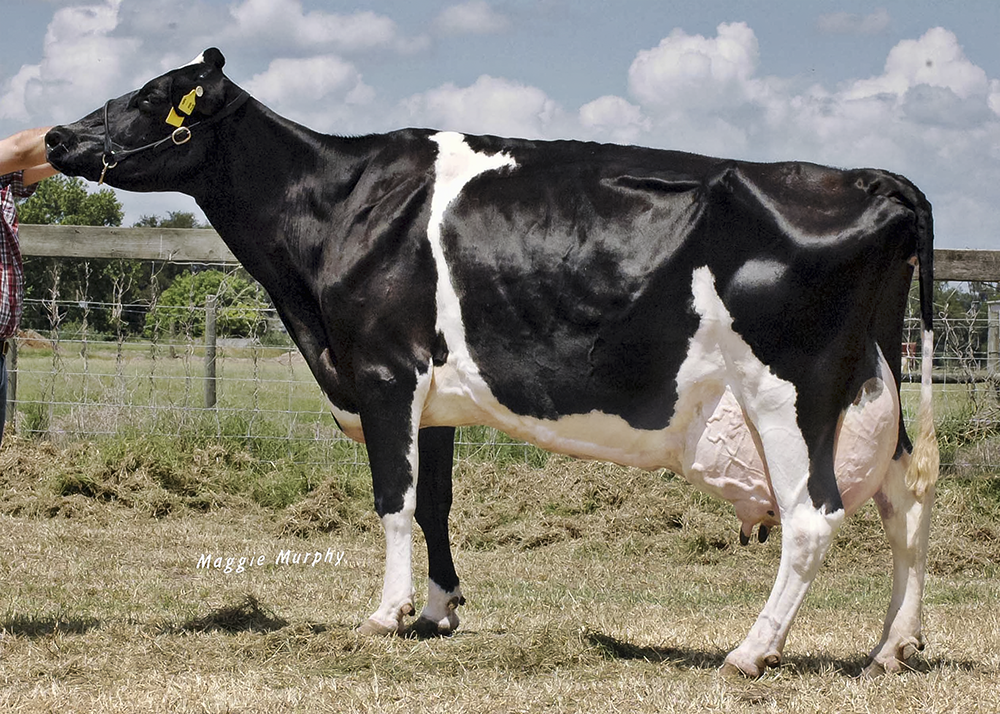
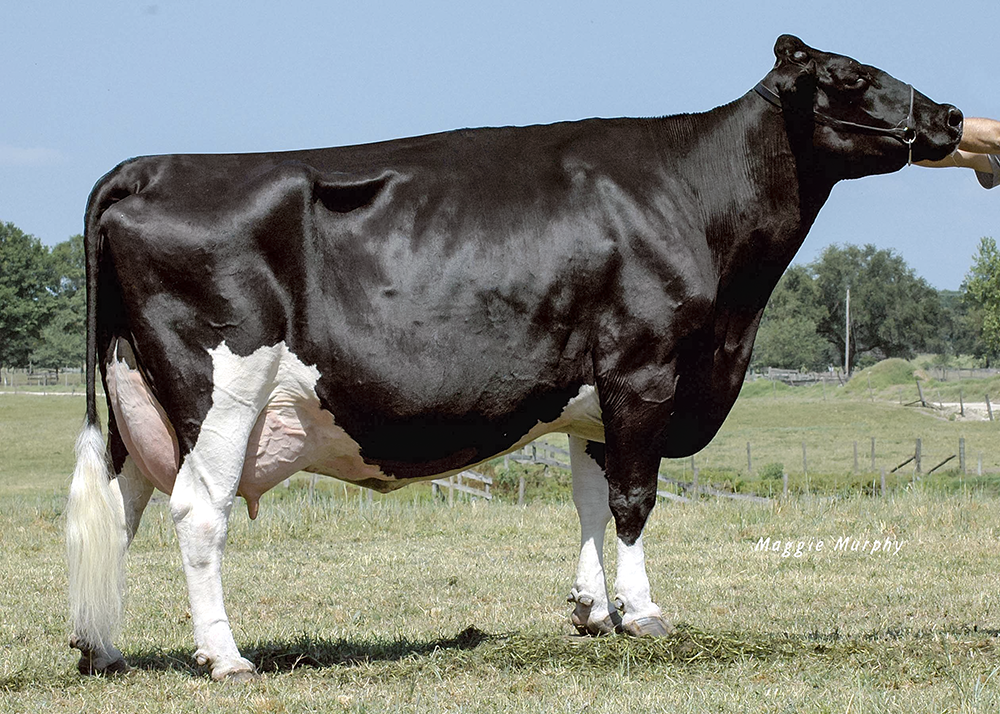
Don Bennink Jr. died April 20, 2026, at 84. If you work in dairy and that name doesn’t stop you cold, you haven’t been paying attention. The man who built North Florida Holsteins from scratch — and rewrote what a hot-climate dairy could be — is gone, but what he left behind will outlive most of us in this business.
The Long Road to Bell, Florida
Don grew up in western New York, started milking cows in junior high, and never really stopped. He graduated from Cornell in 1963, then — because one career apparently wasn’t enough — earned a law degree from Cleveland Marshall and practiced law while he kept expanding his farming operation. The cows won. In 1980 he packed up and moved south to Bell, Florida, where he founded North Florida Holsteins on the premise that humidity, heat, and sand didn’t have to beat you if you out-thought them.
He out-thought them.
Building Something That Shouldn’t Have Worked
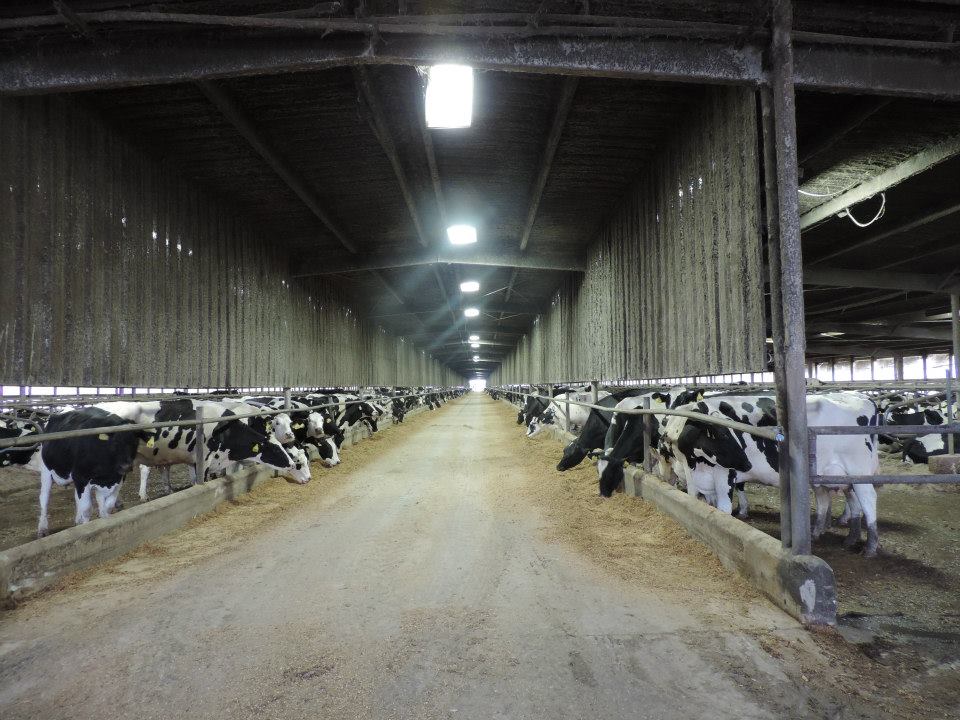
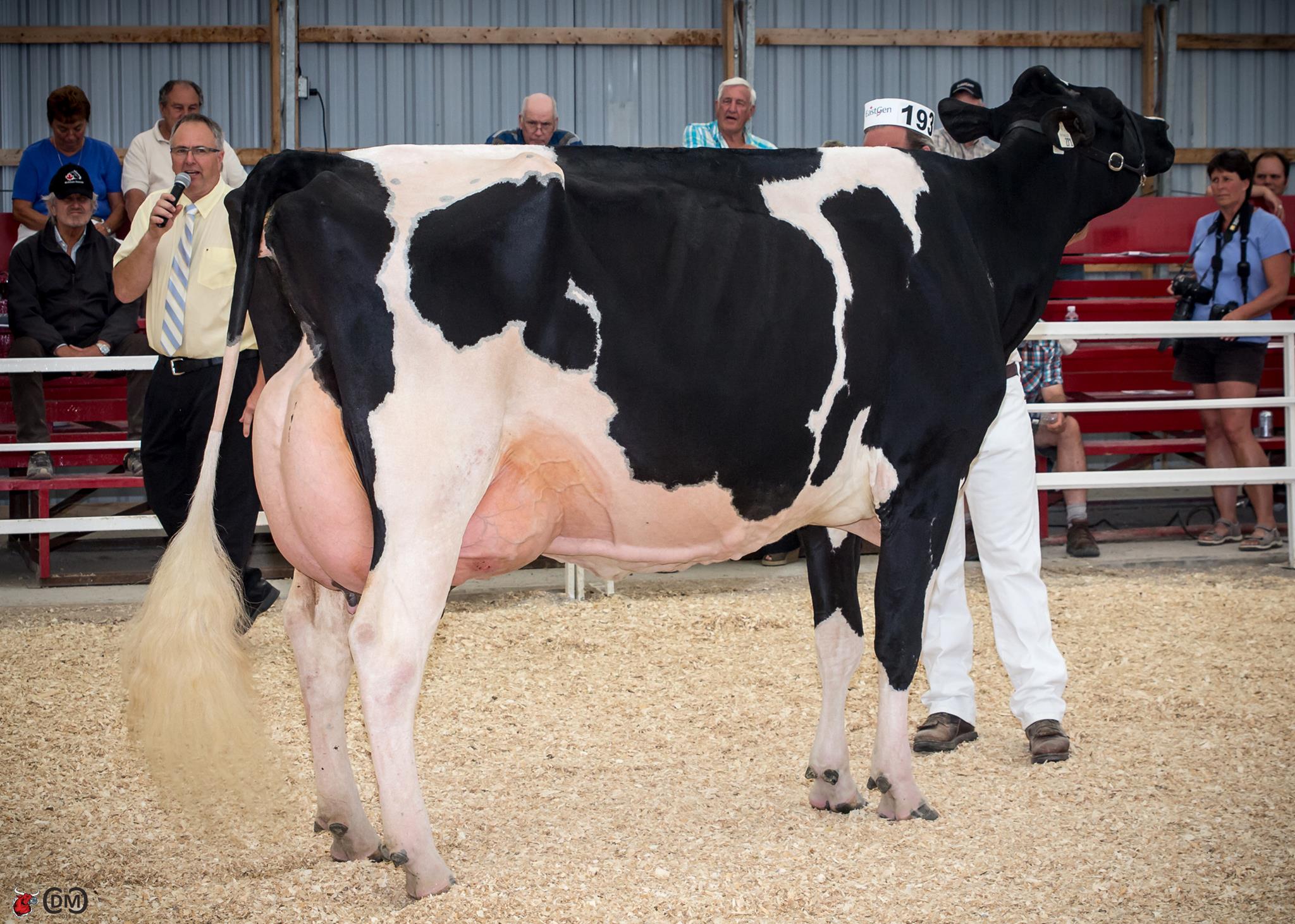
North Florida grew into roughly 12,000 head across 3,000 acres — an operation that had no business succeeding in that climate, except Don made it succeed by being relentlessly practical. He put up tunnel-ventilated barns in 2001 when most of the industry was still arguing about whether cows really needed the help. He was right. They did.
Here’s the thing about Don: he didn’t farm for ribbons. He farmed for profit, for longevity, for cows that actually worked in the real world. He once said it out loud — North Florida was about profit, not glory — and he meant it. That clarity is exactly why so many of us kept calling him, visiting him, and quoting him.
The Genetics Guy Who Didn’t Follow the Crowd
Don built his own genetic selection system before genomics was cool, then became one of the earliest and loudest adopters of genomic testing when it arrived. He pushed back on the stature arms race when the rest of the breed was chasing tall cows into stalls that couldn’t hold them — and the data eventually proved him right. He also went after the inbreeding problem head-on, finding workarounds while the industry shrugged at a 9.99% number it should have panicked over.
In 2024, the National Dairy Shrine named him Distinguished Dairy Cattle Breeder. It was overdue.
Mentor, Host, and Unofficial University
North Florida Holsteins doubled as a living laboratory. Don built deep partnerships with the University of Florida and Ohio State, and his international student internship program turned into one of the most respected pipelines in the industry. Generations of researchers, vets, and young dairymen walked that yard and left sharper than they came in. Ask around — the number of careers that started with “Don Bennink gave me a shot” is staggering.
Industry Service That Actually Moved Things
The board seats are a long list: Upper Florida Milk Producers, Florida Dairy Farmers, Southeast Milk. He chaired SMI Trucking for more than 25 years and served as president of Florida Dairy Farmers. The honors track record matches: Florida 4-H Hall of Fame, Florida Agricultural Hall of Fame (2018), World Dairy Expo Dairyman of the Year (2010), and Cornell’s Outstanding Alumni Award in 2024.
He showed up. He served. He said what he thought, even when the room didn’t want to hear it.
The Man Behind the Operation
For all the scale and all the honors, the people who knew Don best will tell you the same thing — he was a husband, father, and grandfather first. He’s survived by his wife Marianne; his daughter Patty Quina and her husband Stephen, with their children Skylar and Kellen; and his son Dan and his wife Brenda.
A Celebration of a Life Well Spent
A celebration of life will be held Friday, May 29, 2026, from 11 AM to 2 PM at his riverfront home: 238 NE 931st St, Branford, FL 32008. If you can make it, go. Stand by that river. Tell a Don story. The industry owes him at least that much.
Rest easy, Don. The barns you built, the cows you shaped, the students you trained, and the family you loved — that’s a legacy most of us will spend a lifetime chasing and never catch.
The Sunday Read Dairy Professionals Don’t Skip.
Every week, thousands of producers, breeders, and industry insiders open Bullvine Weekly for genetics insights, market shifts, and profit strategies they won’t find anywhere else. One email. Five minutes. Smarter decisions all week.
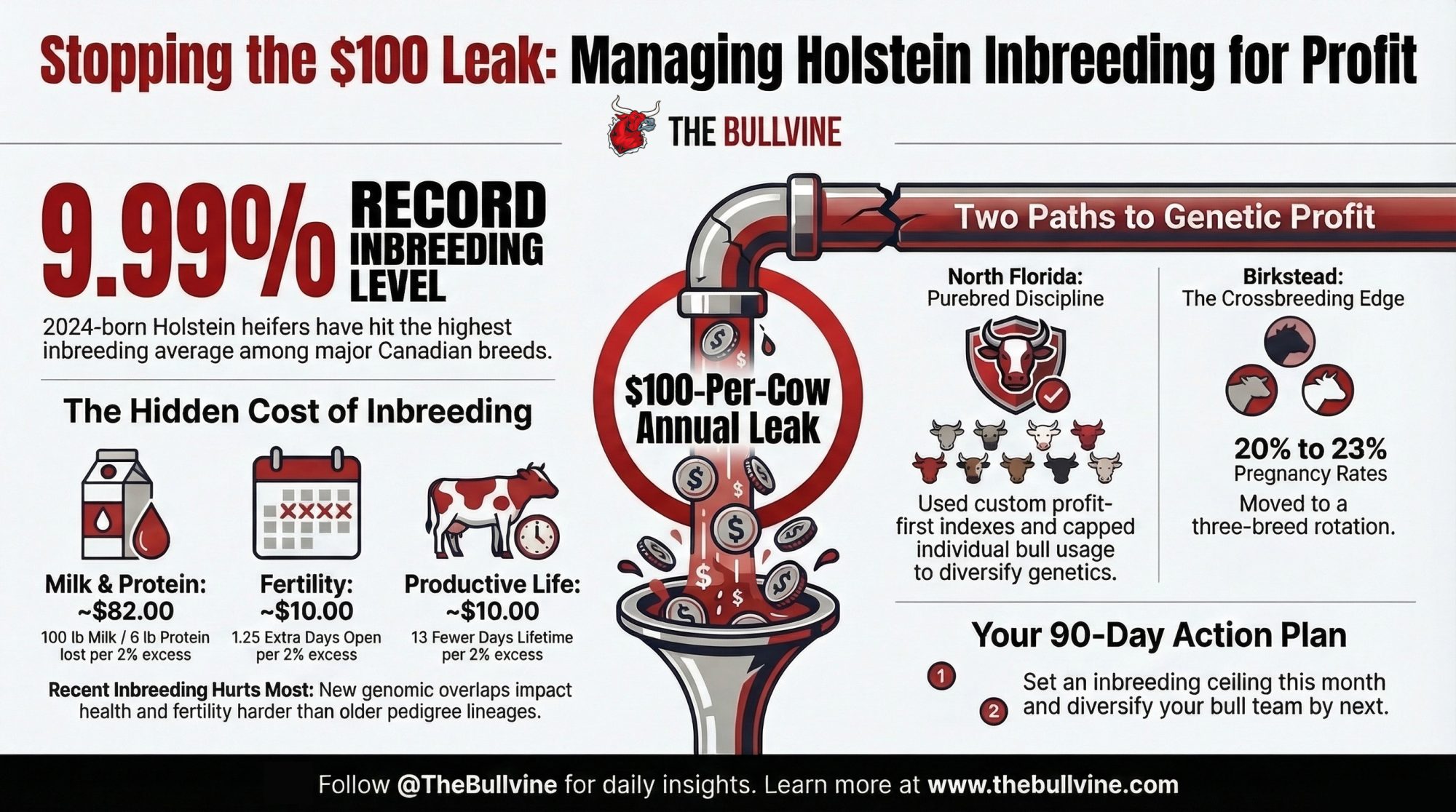
Holstein inbreeding hit 9.99%. Birkstead and North Florida took opposite paths to slash a $60–$ 100-per-cow leak without sacrificing genetic progress.
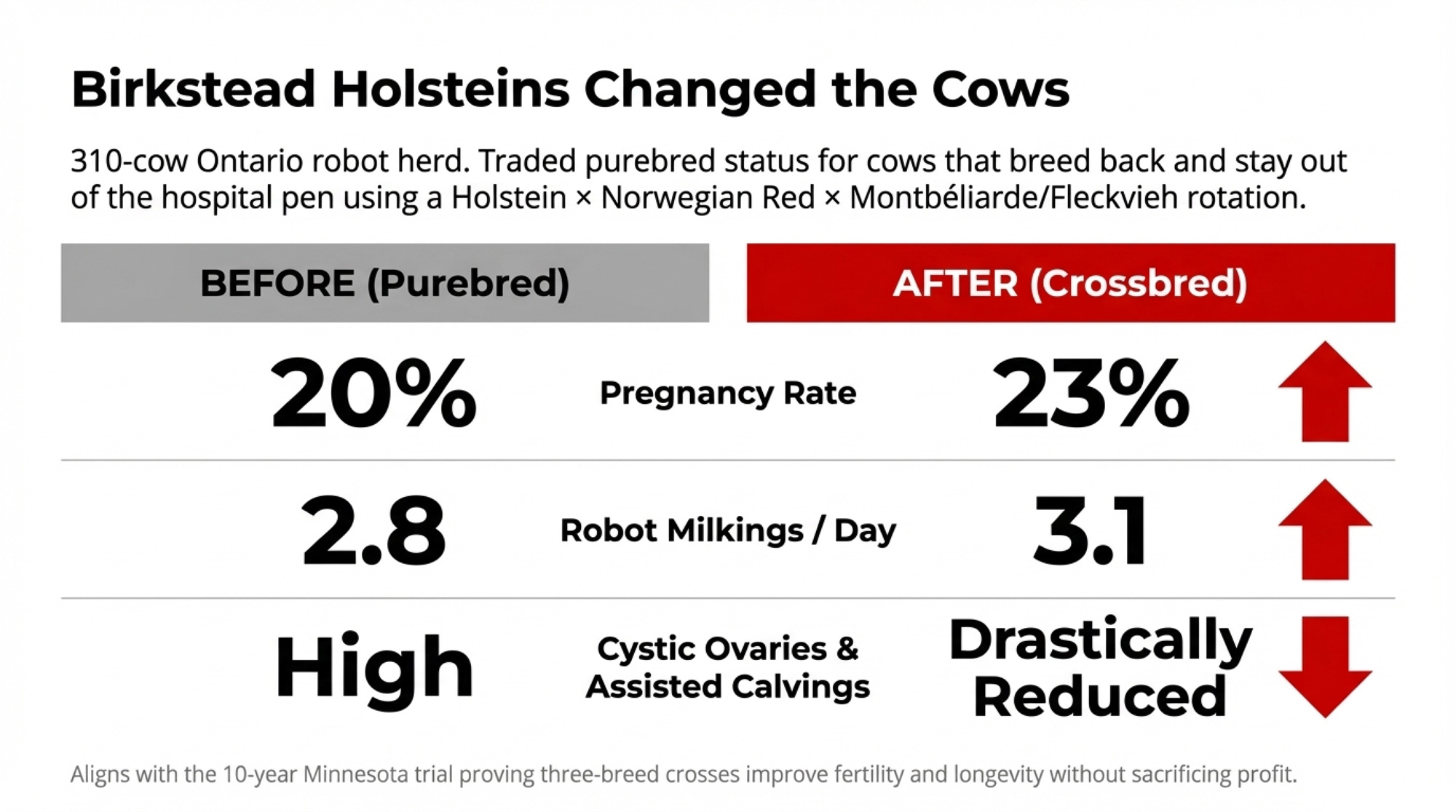
Executive Summary: Holstein heifers born in 2024 now average 9.99% inbreeding, and conservative barn‑math from peer‑reviewed studies puts the cost at roughly $60–$100 per cow per lactation. The article shows how that hit comes together — a little lost milk and protein, a few extra days open, shorter productive life — and why recent inbreeding does more damage than old pedigree overlap. It then uses two real herds as case studies: Birkstead Holsteins in Ontario, which pushed a 20% pregnancy rate higher and cut health problems by moving to a Holstein × Norwegian Red × Montbéliarde/Fleckvieh cross, and North Florida Holsteins, which stayed pure Holstein but built its own profit‑first index and capped how much any single bull could influence the herd. The core argument is that the real risk isn’t genomics itself, but letting catalog rankings quietly stack the same sire lines until inbreeding becomes a five‑figure annual leak. For a 300–600‑cow herd, the piece lays out a simple playbook: in the next 30 days, turn on and enforce an inbreeding ceiling in your mating program, over the next 90 days build a genuinely diverse bull team, and over the next breeding season stop raising replacements from the most inbred, lowest‑merit females. It’s written for owners and breeding decision‑makers who want to keep riding the top of the genetics wave without paying for 9.99% inbreeding on every proof run.
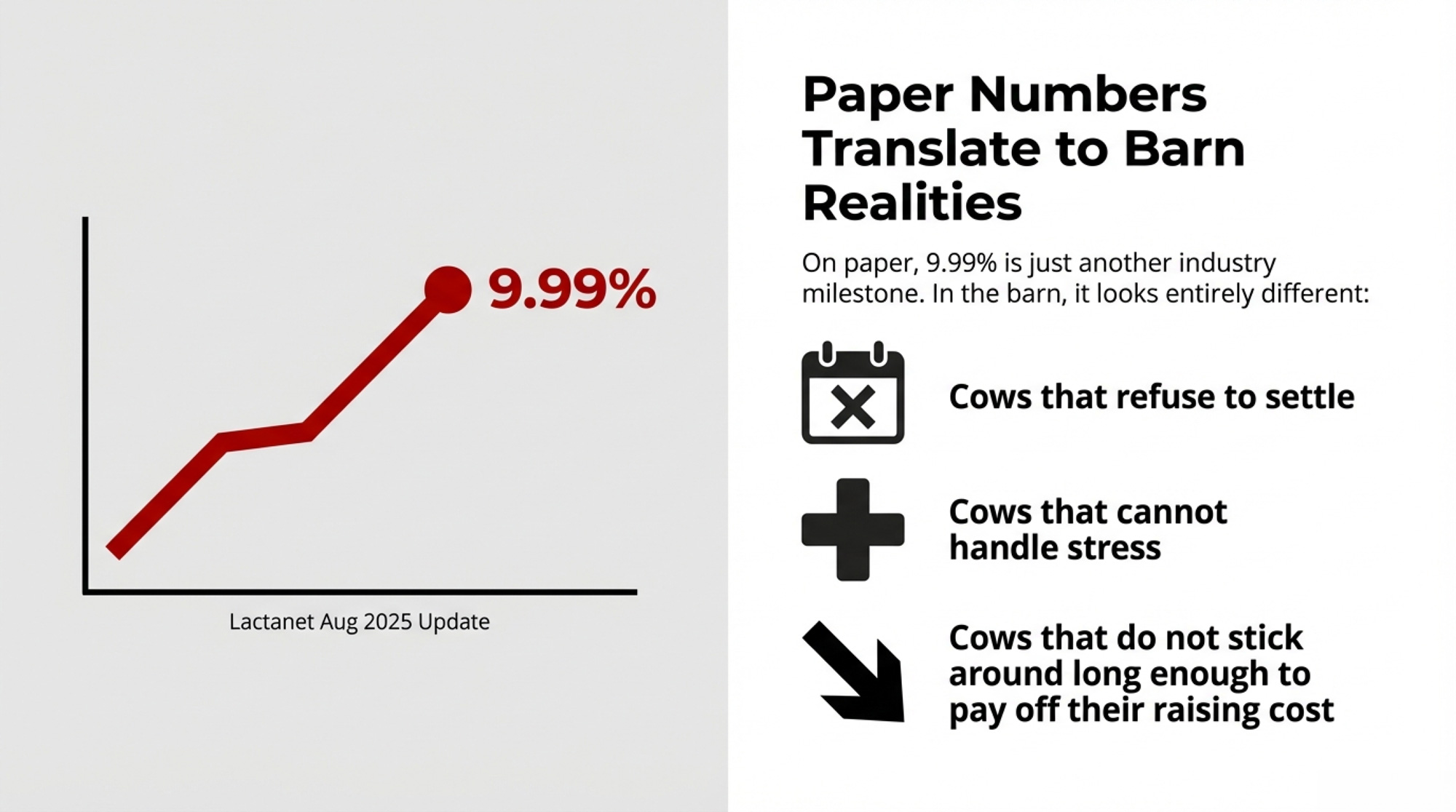
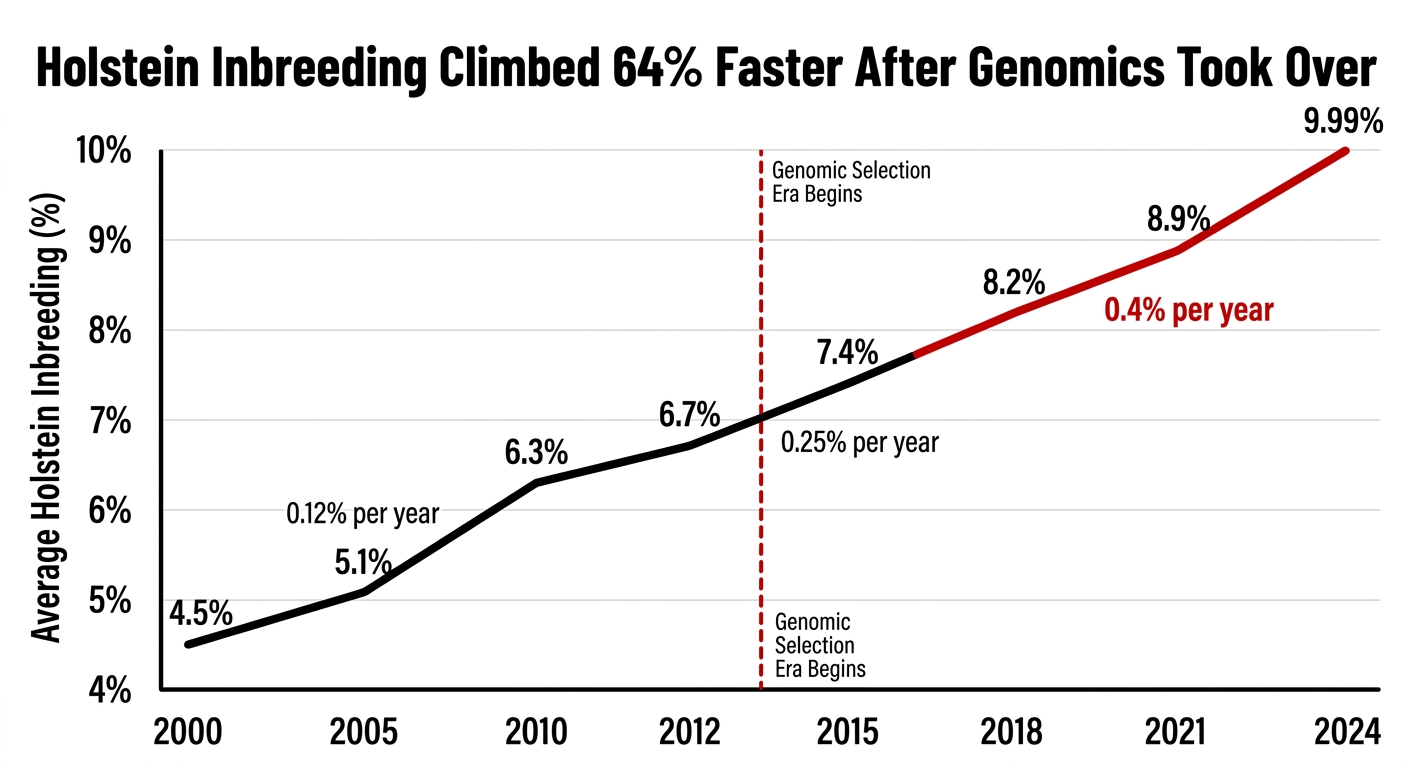
Canadian Holstein heifers born in 2024 now average 9.99% inbreeding, according to Lactanet’s August 2025 inbreeding update. That’s up from 9.61% the year before and the highest among the major dairy breeds in Canada. On paper, it’s just another number. In the barn, it’s the cows that don’t settle, don’t handle stress, and don’t stick around long enough to pay off their raising cost.
Thomas Wantenaar at Birkstead Holsteins in Elora, Ontario, was already seeing that drag in his own herd numbers. In 2008, with a purebred Holstein herd and a new robot barn, he was staring at an annual pregnancy rate of about 20% and, as he told Progressive Dairy, “spending half the morning just treating cows.” A thousand miles south at North Florida Holsteins, Don Bennink was looking at the same breed from the other end of the telescope: about 4,800 cows and 4,400 heifers on roughly 2,400 acres in Florida heat, and a classification and type evaluation system he publicly described as “180 degrees away from cattle that pay the bills.”
How Much Does 1% of Holstein Inbreeding Really Cost Per Cow?
You’ve heard for years that inbreeding costs money. That doesn’t help when you’re trying to decide whether one more high‑index bull out of the same sire line is worth it.
Lactanet and other summaries estimate that every 1% increase in inbreeding knocks roughly $60–$78 off a cow’s lifetime profit, once you add up lost milk, weaker fertility, and fewer productive days. Makanjuola and colleagues (2020) put a finer point on it for Canadian Holsteins: each 1% increase in genomic inbreeding cut 305‑day first‑lactation milk yield by about 40–50 kg. At typical Canadian milk prices, that’s over $40 per cow per lactationfrom milk volume alone.
That’s still fairly abstract. The real question is: if your herd is, say, 2 percentage points more inbred than you’d like, what’s the per‑cow, per‑lactation hit?
Step 1: Define “excess inbreeding”
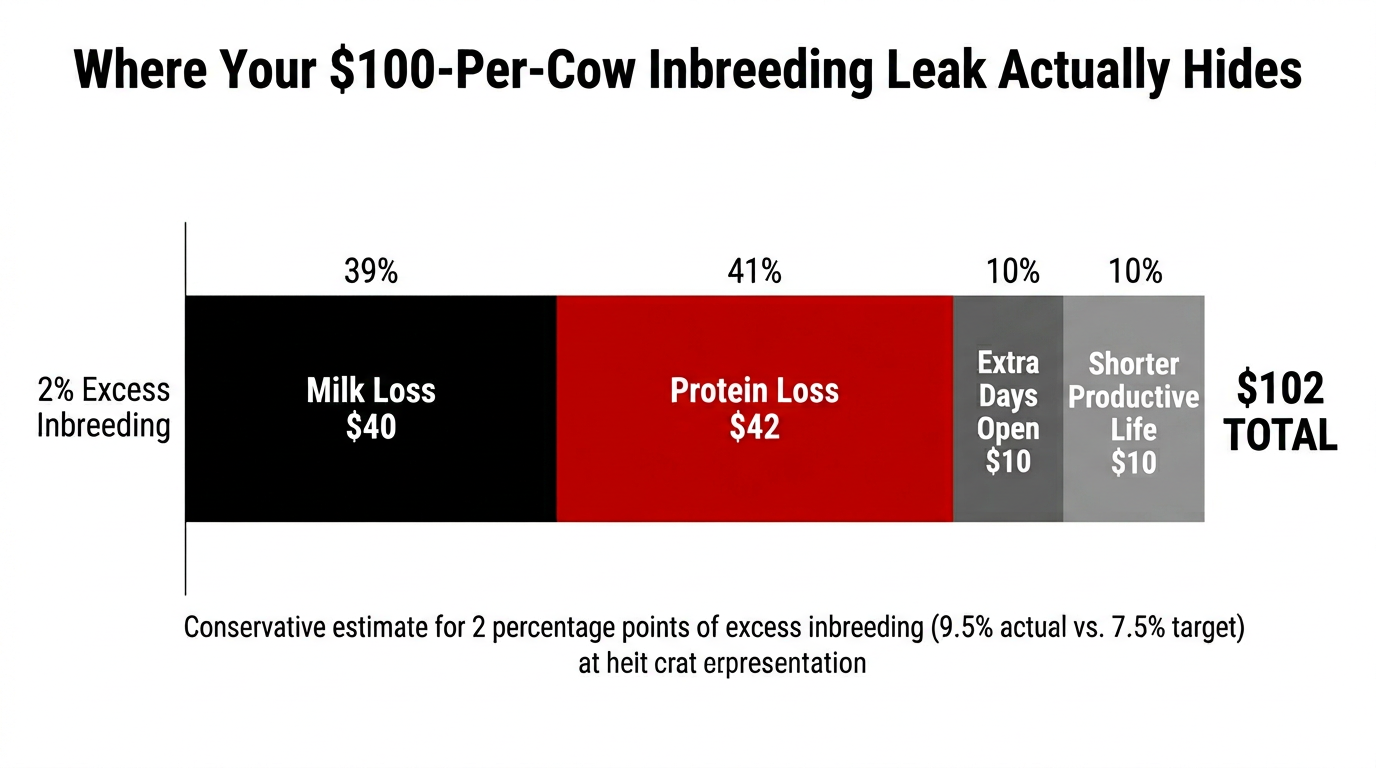
Suppose you’d be comfortable with a herd average around 7.5% inbreeding. Instead, your young stock are coming in around 9.5%, which isn’t unusual given where Holsteins are heading. That’s 2 percentage points of excess inbreedingcompared with the level you’d like to be at.
Step 2: Milk and protein that never make it onto the truck
Doekes et al. (2019) and Makanjuola (2020) both found that each 1% increase in inbreeding reduced 305‑day milk by roughly 36–49 kg (80–108 lb). To stay conservative and easy to work with, call that about 100 lb of milk per 1%.
At 2 excess points: ~200 lb less milk per cow per lactation.
At $20/cwt: 200 ÷ 100 × $20 = $40 per cow per lactation from milk.
StrataGEN work suggests about 25 lb lifetime protein loss per 1% inbreeding, which averages out to roughly 6–7 lb per lactation. Use 6 lb per 1%.
At 2 excess points: 12 lb less protein per lactation.
At $3.50/lb: 12 × $3.50 = $42 per cow per lactation from protein.
Right there, you’re at around $82 per cow per lactation in very basic, conservative component math.
Step 3: Days open that hide inside your repro numbers
Genetic and economic work often uses about 1 extra day open per 1% inbreeding as a planning number, once you account for later first service, lower conception rates, and early embryonic loss. It’s not a hard rule, but it’s a realistic average.
At 2 excess points: assume 2.5 extra days open.
At $4 per day open (mid‑range of common $3–$5 estimates): 2.5 × $4 = $10 per cow per lactation.
You can argue the exact cost per day. You can’t honestly argue that it’s zero.
Step 4: Productive life and replacements
StrataGEN data show about 13 fewer productive days per 1% inbreeding; at 2 excess points, that’s around 26 fewer productive days in that cow’s lifetime.
Spread across a cow you expect to last around 3½ lactations, that’s about 7–8 fewer productive days per lactation. Put a conservative $10 per cow per lactation value on that in terms of extra replacement pressure, fewer older “easy money” cows, and more fresh‑heifer risk.
Step 5: Put the conservative math together
Conservative totals on 2 points of excess inbreeding per cow, per lactation:
Milk loss: ~$40
Protein loss: ~$42
Extra days open: ~$10
Shorter productive life/replacements: ~$10
That’s roughly $100 per cow per lactation.
Loss Category
Impact per 1% Inbreeding
Cost at 2% “Excess” (per lactation)
Milk Yield
~100 lb
$40.00
Protein
~6 lb
$42.00
Fertility (Days Open)
1.25 Days
$10.00
Productive Life
13 Days (Lifetime)
$10.00
ESTIMATED TOTAL
$102.00 per cow
If you squeeze every assumption down to the low end and ignore some of the lifetime effects, you can justify a smaller number in the $60–$70 per cow range. If you take the upper end of the published production losses and value days open closer to $5, you can also defend numbers over $100 without exaggerating.
Either way, on a 300‑cow milking herd, even a $60 per cow leak is around $18,000 per year until your mating strategy changes. On a 500‑cow herd, you’re looking at $30,000–$55,000 per year — not in theory, but in realistic, research‑based barn math.
At Birkstead, that money didn’t show up on a line called “inbreeding.” It showed up as a 20% pregnancy rate, more sick cows than they liked, and robots spending too much time fetching stubborn Holsteins. At North Florida Holsteins, it showed up in a Holstein system that rewarded the same narrow sire lines and type composites even as inbreeding climbed.
Why Recent Inbreeding Hurts More Than Old Inbreeding
One of the traps with inbreeding is treating all of it as doing the same damage. It doesn’t.
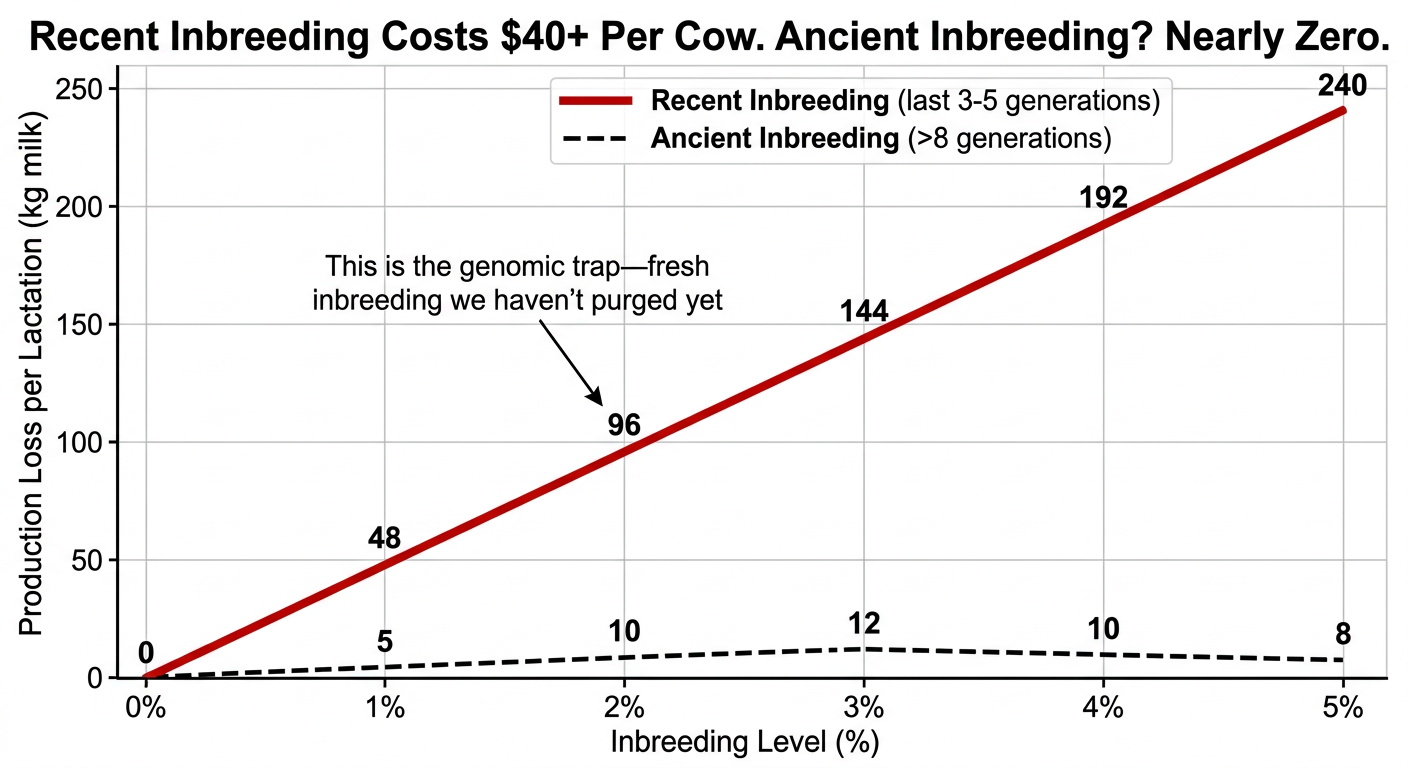
Doekes and co‑authors split inbreeding into “recent” (last few generations) and “ancient” (deeper in the pedigree) and then tracked what each type did to production and fitness in Holsteins. Each 1% of new inbreeding cuts fat yield by about 2.4 kg per lactation, while the oldest pedigree class had little to no negative effect — in some models, even a small positive one.
Makanjuola’s work on Canadian Holsteins using runs of homozygosity (ROH) told the same story: recent inbreeding reduced milk and protein yields, while ancient inbreeding had far weaker effects. When you turn that into dollars, you end up in that >$40 per lactation per 1% range for first‑lactation milk alone.
Why the difference?
Ancient inbreeding has already been through decades of selection. The worst double‑copy combinations have largely been purged from the population.
Recent inbreeding creates new double copies in parts of the genome that haven’t had enough generations under selection pressure, especially for fertility and health.
Irish Holstein‑Friesian work suggests that purging has been more effective for production traits than for fertility.We’ve been selecting hard for milk and components for a long time. Fertility and health only really got major index weight in the past 10–15 years. The harshest fertility and survival recessives haven’t been under the hammer as long.
Once you layer genomics on top, the curve steepens. Hansen showed that Holstein female inbreeding rose at about 0.12% per year from 2000 to 2012, then 0.25% per year from 2013 to 2016, and then around 0.4% per year as genomic selection really took over. By the early 2020s, average Holstein females were already in the 8–9% inbreeding range, and by 2024, Canadian Holstein heifers hit 9.99%.
Genomics helped us identify the top animals faster. It also helped us stack the same families faster than purging could clean up fertility and survival.
The Bottleneck Hiding Inside Every Bull Catalog
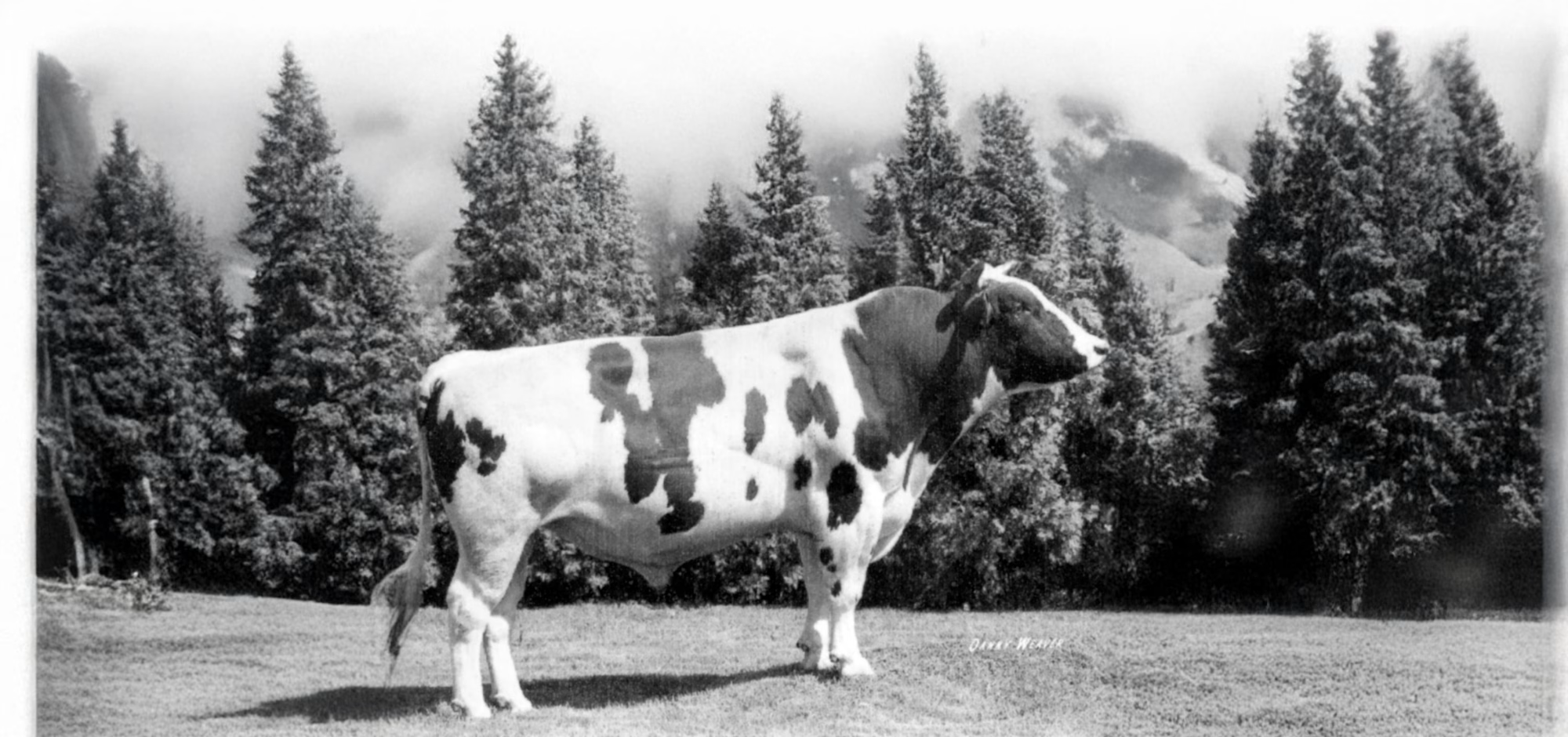
Talk about Elevation and Chief dominating Holstein pedigrees can sound like coffee‑shop folklore. The data back it up.
If you were the coach of an NFL football team, would you select your players based solely on looking at them or would you want to see their performance statistics, in order to decide how to assemble the best team possible? That is the question that Don Bennink (Read more: NORTH FLORIDA HOLSTEINS. Aggressive, Progressive and Profitable!!) asked at the recent genomics conference. (Read more. Genetics in the Age of Genomics – Seminar Recordings and Recap) While it’s a pretty simple question, it may forever change the way you make your mating decisions.
For generations, we have all been taught to look at a cow the same way, and that’s the way we continue to teach the next generation to look at dairy cows today. But just because that is the way it has always been done, does not mean that we have been doing it correctly. We all start out learning the parts of the dairy cow and have learned the same way as we always have on how to evaluate cows. In fact, one major publication did seven editions in a row about how to evaluate cows, and each one presented the same way it’s been done for generations. It doesn’t seem to matter that evaluating type or conformation has been proven not to be the most accurate way to determine longevity (Read more: She ain’t pretty she just milks that way).
For years, it has been assumed that, if a cow had “high type” and lots of production, she was the perfect cow. But we all know that perfect cows don’t always exist (Read more: The Perfect Holstein Cow). Nevertheless, we have bred for these two key areas: high type and lots of production. We totally disregarded that we did not make substantial gains in profitability. And, furthermore, herd life actually decreased, even though we all bought into to the theory that a high type cow is a long lasting cow. Unfortunately, actual performance data shows that, as we bred for this the cows were actually lasting less time than before. In fact mortality rates increased; conception decreased and the number of lactations that most cows lasted decreased.
Through the years, the use of high production and low fertility bulls has actually decreased overall herd conception rates. Don points out that when he “first started milking cows, and AI was in it’s infancy, farmers up and down the road, had a 60% conception rate. Today people brag if they have a 30% conception rate.” Don also points out that in 1996, 93.4% of the calves that were born in the US lived, (i.e. a 6.4% stillborn rate). In 2002, the stillborn rate increased to 11% (i.e. 89% lived) and by 2007, 14% of the dairy calves died at birth. It’s only in more recent years that the industry has acknowledged this trend and has started to put more emphasis on conception and the significant impact it has on profitability. The reason for this is we put so much emphasis on a two-year-old production that we were killing reproduction. That is because cows that get back in calf regularly drop in production because they have to use some of their energy to support the development of their calves. So the sires that gave the maximum amount of milk were also the sires who had the lowest conception rates. We all know that a cow that is milking hard is the hardest cow to get back in calf. No matter what their conformation.
The thing is that we have the systems and technology to make the changes we need to make for the future. As Don points out, we don’t need to go to the 125-year old technology of type evaluation to solve this problem. Instead of having to use theory to predict longevity, we can actually measure productive life through the actual length in months that cows last in herds compared to their herd mates. We don’t need type evaluation to guess who will last longer; we have the actual information. We have the ability to see just which cows will last longer, not from trying to figure out what type trait links best to longevity. We have actual longevity data, SCS, fertility, conception, still births, etc.
We are all armchair quarterbacks. We are all willing to second guess the mating decisions of others after the fact. The challenge is that, with the technology we have available today, we don’t have to do as much second guessing as in the past. Tools like genomics and new performance data such as DPR, Still Birth Rate, and Productive Life tell us everything we need to make an informed decision. Don asks, “Can you just pick the perfect team by just looking at your players? Or would it help to know which players have drug issues, which ones will end up in jail, which ones will last a full season, and which quarterbacks can actually complete a pass, or know how many sacks your linebackers have made in the past. As a coach, you want all this data to choose your team. Well we are not coaches we are dairy farmers, and we make our money milking cows. Don’t you want that data on your animals? Or are you just going to keep looking at them and think that you can guess which ones could perform?”
In today’s day and age, we not only have traits that are more directly connected to longevity than type evaluation, we also have genomic testing that can more accurately predict what sires and cows will last longer. Every Tuesday we now receive genomic predictions on animals. We don’t need to wait till for a quarterly classification visit, that may or may not catch a cow on her best day, to evaluate what we think from looking at her is the probability that she will last more lactations. We can actually get much more accurate data at a younger age on how long she will stay in the herd.
The Bullvine Bottom Line
Sometimes it can be hard to change the way we have always played the game. When something has been done for generations, there will always be those who are resistant to change. However, the industry has changed and the amount of information available today to make mating decisions is light years ahead of what it was just a few years ago. The game is changing, and you need to change what you base your breeding decisions on. . The best coaches and quarterbacks make their decisions based on performance data, not on hypothesis. Genomics has helped take away the guessing game. We can now know at a very young age, what the genetic potential of that calf is. We can make better decisions faster. In the past art and practical knowledge was what drove mating decisions. However, today’s breeding world calls for a different approach. It takes a level of focus and commitment, and it’s a business. It is just like football, where the coaches now use all the information possible to decide what players to put on the field and how to use those players for the big game on Monday nights. Tools like genomics have changed the game forever.
Not sure what all this hype about genomics is all about?
Want to learn what it is and what it means to your breeding program?
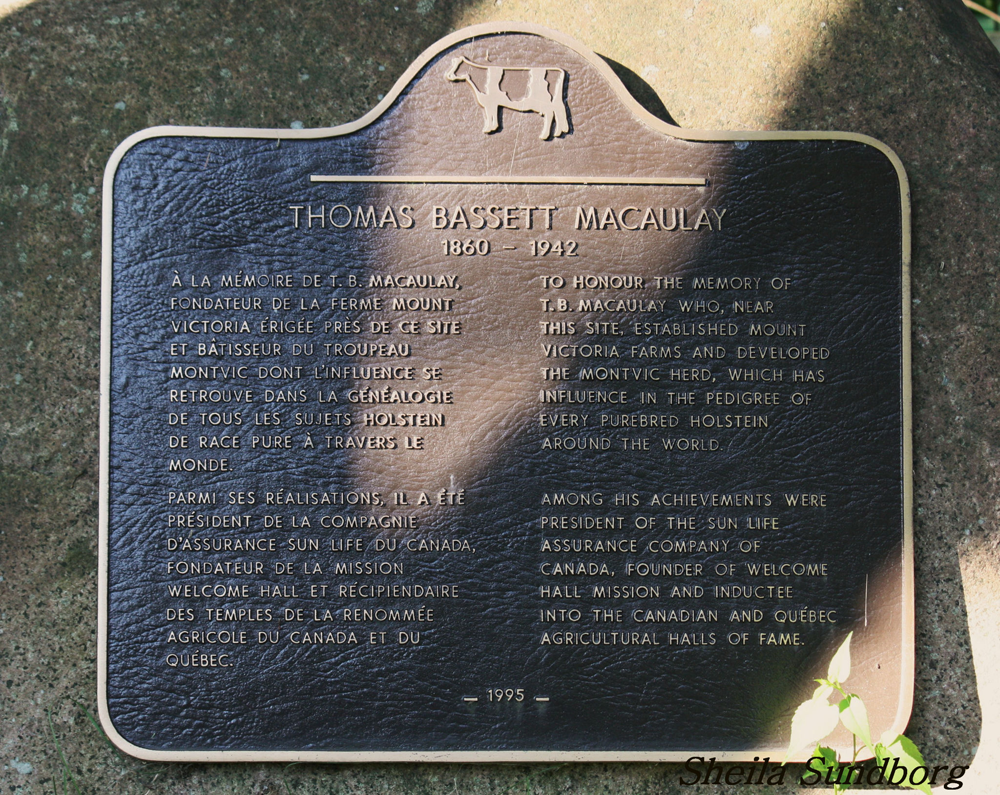
T. B. Macaulay, Mount Victoria Farms (Montvic), (Read more: Mount Victoria Farms: The Art and Science of Great Breeding) ninety years ago had a plan. One component of his plan was 4% butterfat. He built his herd around Johanna Rag Apple Pabst and his 4% fat daughters. The history books do not specifically identify Macaulay’s reason for wanting 4% butterfat except we know that back then Holsteins were considered to be ‘low testers’.
Roy Ormiston, breeder of the world famous Roybrook Farms, developed an excellent herd with the three pillars being high % fat, excellent conformation and high lifetime production.
The importance of fat yield has also been stressed by many leading USA breeders. Over forty years ago Dr. Gene Starkey, the very well respected Wisconsin Dairy Extension Specialist, in his speeches talked about herds where cows averaged over 900 pounds of butterfat per year with only limited reference to the milk yield number for top herds.
When Protein Ruled
Fat took a backseat to show conformation and then to % protein in the later 1970’s and into the 1980’s. The trendy thing was to use a bull the improved % protein but dropped % fat. The thinking was that consumers wanted to exclude fat from their diets but that protein was needed to make cheese. The trend meant the majority of breeders paid only limited attention to % fat and the national Holstein averages for % fat dropped.
How Milk is Sold
On a global basis the majority of milk is sold in a solid and not a liquid state (Read more: “Got Milk” is becoming “Got More” and MILK MARKETING: How “Got Milk?” BECAME “Got Lost”). Milk processors and marketers recognized this and so payment to farmers changed from volume and % fat to become based on the component yields. This is known as MCP, multiple component pricing. Today the pendulum has swung to where butterfat is back in fashion. Thus the quantity of solids a cow produces is important to her ability to generate income.
Milk is sold as a drink often has fat removed by processors. That fat is used to make other products and thus it is a source of revenue, not a cost, for the processor. .
The end result is that breeders are paid for the total fat and protein content in the milk they ship. And in the future it is entirely possible that breeders will be paid for the specific fats (i.e. conjugated linoleic acid) and proteins (i.e. casein) they ship.
Avoid the Water
In today’s and likely tomorrow’s world having more water than necessary in milk is a cost and not a source of income. These cost factors include:
high peak milk yields adds stress on the cow and increased labor and health costs
high milk yields magnifies the challenge and cost to getting cows to conceive
to achieve higher milk yield adds to cow feed costs for high energy grains
cows and their rumens function best when a high percent of the diet is high quality but low cost forages
longer milking times to harvest the higher volume of milk adds labor and utility costs
on-farm more volume adds to cooling cost and the need for increased storage capacity
water removal at the farm is costly
extra milk volume adds to transportation cost
added volume increases processor cooling costs and storage capacity
high volumes adds to environmental costs and the disposal of water at the processing plant
If we could calculate the total for those ten items it might shock us how much money could be saved by having a higher content of fat and protein in milk. It all starts with the milk our cows produce.
Let’s Talk Genetics
At the farm level cows that produce 85 pounds at 4.0% fat and 3.4% protein are generating the same revenue and at less cost to all the partners in the supply chain than cows that produces 100 pounds at 3.4% fat and 2.9% protein. For sire selection this means selecting for fat yield, protein yield, % fat and % protein. Ideally, although not always possible, this means selecting bulls for less milk yield. Today most total merit index formulas (TPI™, LPI, NM$,…etc.) are based on fat and protein yield of a bull’s daughters without regards to the volume of milk they produce. This means that high yield bulls that drop % fat and/or % protein do not ranking near the top on these indexes. A help to breeders when selecting bulls to use.
Top Sires
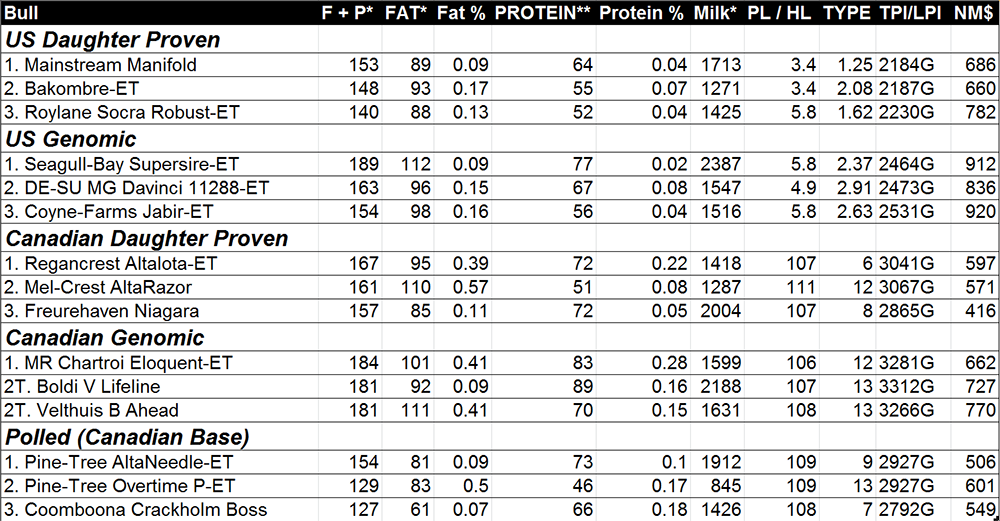
The following table identifies top total merit bulls for their daughters’ genetic ability to produce fat and protein and have a high % fat and % protein. For bulls to appear in this table they had to be breed improvers for productive life or herd life.
Bulls Ranked by Fat plus Protein Yields * USA – pounds / Canada – kilograms Click on image for enlargement
Supersire tops the list for the ability to sire daughters for fat yield and total fat and protein yield Jabir is high in all areas including NM$. For breeders wanting higher % fat and % protein should consider AltaIota, AltaRazor, Eloquent, Ahead or Overtime P.
The Bullvine Bottom Line
Much emphasis is currently being placed on cows that are functional and healthy, yet productivity can’t be ignored. Without the ability to generate high levels of revenue from milk sales, it is hard to make a profit from dairy farming. When it comes to production, don’t let low component milk water down your success.
Not sure what all this hype about genomics is all about?
Want to learn what it is and what it means to your breeding program?
There is no question that social media has changed our world. From the ability to talk to people of like mind from anywhere in the world to the ability to learn the latest news instantly, the dairy industry has changed dramatically as a direct result of social media.(Read more: How Social Media Is Changing the Holstein World)
Every second 2,200 tweets are posted, 580 users update their Facebook status and 24 minutes of video are uploaded to YouTube. The scary part is that adoption rates of new social networks are accelerating. It took LinkedIn 3.5 years to reach 10 million users. The same feat took Twitter just over 3 years, and Facebook 2.5 years. Most recently Google+ did it in just 2 weeks. The reach of social networks is spreading faster than any infectious disease in the history of mankind. From 2005 to2010, Facebook gained over 500 million users. More than the entire world population at the time of the Black Death. (Read more: How Social Media Is Changing the Holstein World)
Shocked and Amazed in the Show Ring at Summer Show
This past week’s events highlighted for me just how astonishingly fast social media is. First, while attending the Ontario Summer Show, the power of the Internet and social media certainly flexed its muscle (Read more: Ontario Summer Show 2013 Holstein Results). Coming into the show, I would have told you that Valleyville Rae Lynn VG-89-2yr, the Res. All-Canadian Sr. 2yr old from 2012 and 1st Senior 3 & Intermediate and Reserve Grand Champion Ontario Spring Show 2013 would be able to stroll her way to an easy win. Then entered Raivue Sanchez Pamela and Desnette Alexia Roseplex and you could hear the excitement in the crowd rise to another level. Roseplex, a cow that probably has one of the greatest side profiles I have ever seen, has been developing well since winning Intermediate Champion at the 2013 Quebec Spring Show and has gained more chest width and rear udder width to go with that amazing profile. Then there is Pamela that on any other day, against any other competition might have been the talk of the town. Instantly, I was getting messages from breeders around the world saying how amazing that class was and speculating about who would win. The shared pictures from all three cows were extremely popular. But once you saw these three amazing cows in line, you realized that Rae Lynn was simply that much longer and dairier than these other two also outstanding cows.
Valleyville Rae Lynn VG-89-2YR First Senior 3 year old, Intermediate Champion and Reserve Grand Champion Owned by Quality, Granja Ponderosa, Al-Be-Ro Land & Cattle, ON and Spain
Almost instantly the questions switched to asking when we will see Rae Lynn against the likes of Butz-Butler Gold Barbara VG-89-2yr and Eastriver Gold Deb 850 EX-92 EX-92 MS? The challenge is that since Rae Lynn has been milking since last October and is not due again until March 2014, we may not see her again until the Royal, passing on the long trip to World Dairy Expo. Let’s hope that we may see her at Madison to give us the greatest Senior 3 year old class in history.
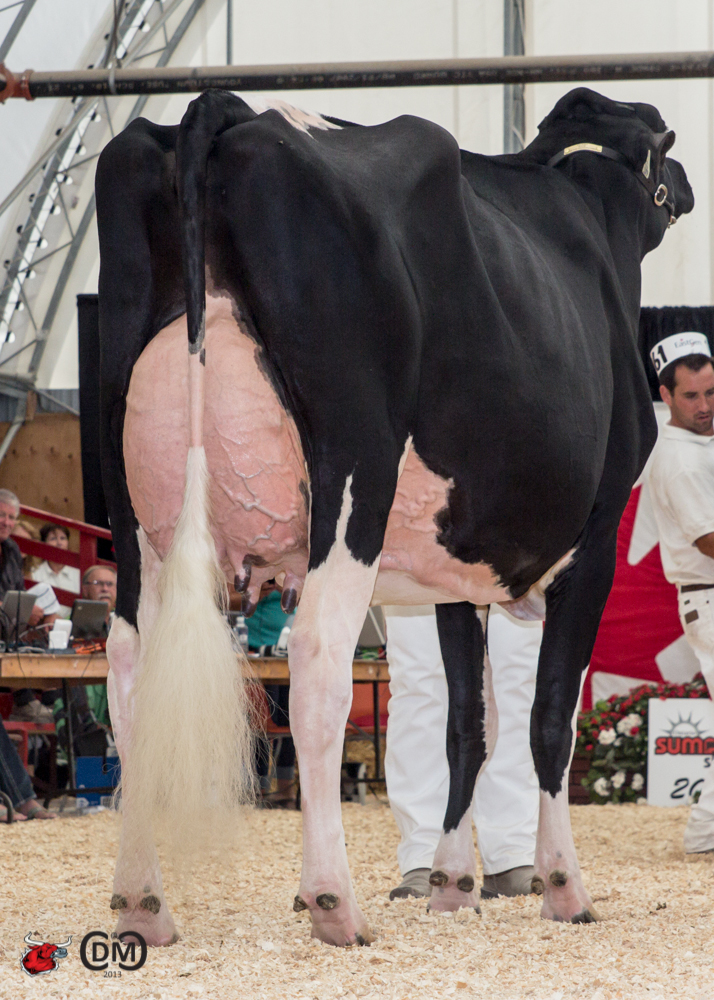
Calbrett Goldwyn Layla EX-95 1st Mature Cow and Grand Champion Ontario Summer Show For then owners: Cormdale, Genervations, Kruger, Al-Be-Ro land and cattle. Now owned by Comestar Holsteins and Ponderosa farms of Spain.
Having said that, none of this chatter could compare to what was to follow around Calbrett Goldwyn Layla EX-95. Normally, when it’s time for the mature cow class, it comes down to which cow has had held up to the wear and tear. However, this year at Ontario Summer Show, things were a little different. The winning mature cow was a 3rd calf 7 year old. This became a subject that was very polarizing to breeders at ringside and especially online. She was shown perfectly by the great showman David Dyment. He always seems to know how to make a cow stand out. There is no question that Layla catches your eye. She is extremely dairy and strong and looked the part. She did handily win the class. The part that shocked many was when Judge Bruce Mode went on to name Goldwyn Layla Grand Champion of the show. We are certainly fans of judges who take bold moves here at the Bullvine (Read more: Dairy Show Judging – It Takes Courage)
The reaction online was certainly mixed. Almost instantly, there were comments being posted either in agreement or disagreement. Questions starting coming in about just how good did she look and did she need extra help in order to make it to the ring? It’s not unusual for these rumors to swirl around champions. And stories — true and false — begin to be shared. Today they’re shared instantly!! Call it marketing. Call it borderline ethical. The concern is there, especially for young breeders who are looking to get into the marketing of elite cattle genetics. If the concerns are true, what message does this send to them? Here we may have a cow being rewarded for all the wrong reasons. Will she contend at Madison or the Royal? Will she even be there? Moreover, how is she beating a cow that has the potential to become one of the greatest of all time?
Changing the Conversation
Fortunately, it didn’t take long for the conversation to change to a more positive note. This year’s International Intrigue Sale hosted by Ferme Blondin was certainly a positive for the industry. (Read more: International Intrigue: Forget the Records It’s About the People and International Intrigue at Ferme Blondin Sale Results 2013). While the sale didn’t have some big name World Dairy Expo Grand or Intermediate Champion contender, it certainly did have a strong line up with many outstanding individuals. Extremely popular online was Jacobs Sid Bamba, a Sid from World Dairy Expo contender Jacobs Goldwyn Britany EX-96 who sold for $50,000 and Ms C-Haven Oman Kool-ET (VG-87-2YR), the former number one gTPI “Man-O-Man” daughter in the U.S. and second highest protein cow at +80, who sold for $92,000.
Jacobs Sid Bamba A Sid from World Dairy Expo contender Jacobs Goldwyn Britany EX-96 Sold for $50,000 at the International Intrigue Sale
While Layla selling to Comestar and Ponderosa for $125,000 at the Cormdale Summer Sale on Monday (Read more: Cormdale Summer Sale Results) re-ignited the conversation, I thought we would have a quieter time for the rest of the week. However, that certainly was not the case. Normally it’s my personal opinion editorial pieces that get us here at The Bullvine in trouble. This time it was our interview with Don Bennink (Read more: North Florida Holsteins: Aggressive, Progressive and Profitable!!) that took the conversation in a different direction and to completely new levels. This time is wasn’t just the small segment of the marketplace that follow the shows, but rather it was the dairy community at large who felt the need to let their opinions be known. There is no question that Don’s opinions about type classification, type evaluations and how they predict longevity have fueled this polarizing subject. . As a strong supporter of type classification, it has caused mixed thoughts in my own head (Read more: The Truth About Type and Longevity) and has generated some amazing conversation on Facebook.
Just When You Think It’s All Over
Just when I think that it’s all over, and that we can now settle down to a holiday long weekend with the family, a completely new fire erupts. One of our news items from the weekend about how the Whitaker family of Georgia had the unfortunate occurrence of having one of their trusted employees suspected of illegal activities leading to 40+ cop cars, and SWAT personnel in cooperation with the family descending on the farm. This led to the finding of several guns, marijuana and methamphetamines, which investigators estimated could be worth $50,000. While this is certainly unfortunate for a great family who are strong members of the dairy community, the reaction to the news article we collated “FBI Storms Whitaker Farm For Drug Bust”, certainly caused a commotion on Facebook with a few breeders who felt the title did a disservice to this family. Yet another example of the power and speed of social media.
The Bullvine Bottom Line
Everyone is entitled to his or her own opinion. Dairy farmers have never been short on having them. The difference is that, through social media platforms like Facebook and Twitter, breeders can now share their opinion with thousands instantly instead only with a few local breeders. You no longer have to call several breeders to find out what happened at the show or sale. You don’t even have to wait for it to be printed in one of the old school magazines. Things are happening in real time and the news is now coming to you, instead of you having to go and find it. One of the biggest changes we have noticed since starting the Bullvine is how many breeders no longer go to the news sections of the dairy publications anymore. They now watch their Facebook news feed and if there is an article or news item of interest that has been shared by a fellow breeder or company they follow, they go ahead and read it. No longer do they have to surf through many sites just to find the few tidbits they would be interested in. Now they can get it all in their Facebook news stream complete with the ability to share their opinion with their friends and fellow breeders. It is truly shocking the speed of Social Media and how it has affected the dairy industry.
“With persistence and a plan anything is possible”. Don Bennink grew up in Western New York in a small family who were not farmers. Early cattle purchases which he housed in the garage were the first remarkable chapter of this lawyer-cattleman’s inspiring story. Don looks back. “I started accumulating Holsteins while in junior high school and high school and managed to maintain them through college. On graduating from college, a 35 stall tie stall barn was rented and a small Farmers Home loan obtained. Eventually several farms were purchased and the herd size expanded cow by cow. In 1980, the move from New York to Florida was made.” He makes the evolution sound easy but we know that there are many blanks that had to be filled in between those early highlights and the 10,000 head that comprise the current operation known as North Florida Holsteins!
North Florida Holsteins Sets Example of 180 Degree Turn Toward Healthy and Profitable
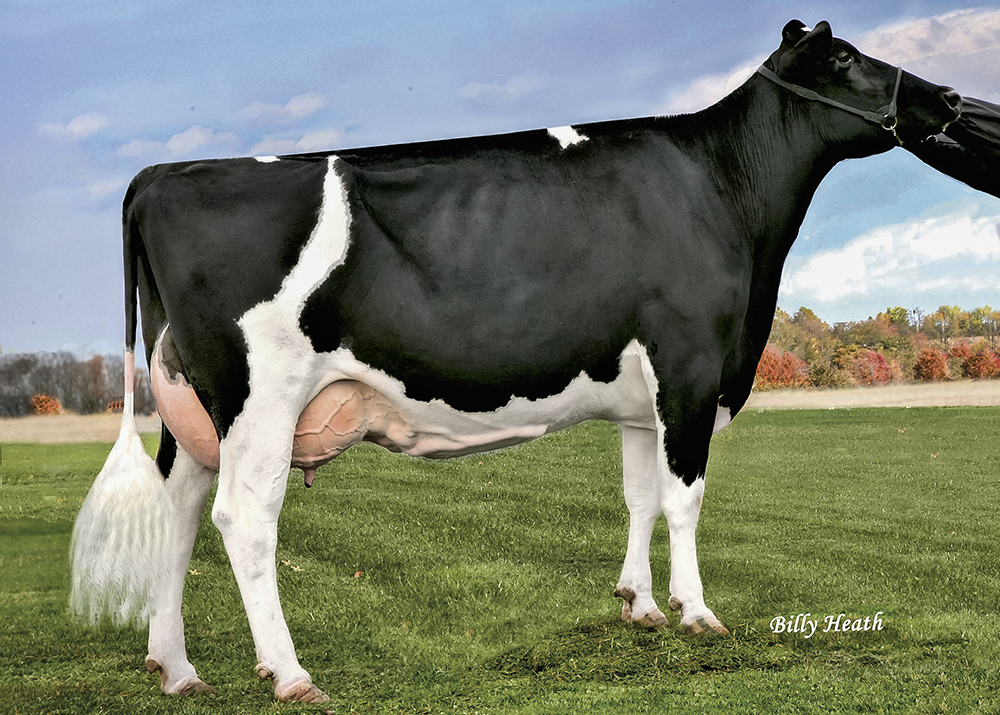
North Florida Holsteins is the single largest dairy in Florida and home to roughly 4800 cows and 4400 heifers. The balance are bulls and steers. The current acreage is about 2,400 acres. Don outlines a very clear mission statement for their dairy genetics. “We believe that the function of a seed stock producer is to produce the animal that is the most profitable for the commercial dairyman.” He doesn’t mince words in referring to the breed association. “Don feels that the current philosophy of the Holstein Association is very contrary to this.” He gives three main targets that he seeks out as profitable. “High production with health traits and feed efficiency are our by words. The present classification and type evaluation system are 180 degrees away from cattle that pay the bills. Bigger, taller, sharper doesn’t cut it. The latest correlation of final type score with stature is .77. Worse yet, the correlation of udder composite with stature is .57. That means if you breed 100% for udder composite, you will increase stature at more than half the rate that you would if you bred for stature alone.” There is only one conclusion for this dairy farmer. “The current 88 and 89 point 2 year olds are dysfunctional for the guy making milk for a living.” (Read more: The Perfect Holstein Cow)
Focused on Generations of High Health Produces Results
With such extensive experience, it is exciting to have Don describe an outstanding example of North Florida breeding. “The individual cow that has had the largest effect on our breeding is NO-FLA Oman Heidi 20611. Heidi was the result of us stacking high health sires up for generations. We have not used a negative DPR bull for decades. One of her sons is either the highest or second highest DPR available in AI. He also has a 9.1 PL. An added bonus is he is a 4 on both sire and daughter calving ease.” Thus it isn’t a surprise that nearly every major bull stud has one or more of her active sons and Don expands on Heidi’s impact. “Her daughters are among our best individuals and indications are they are transmitters. Her dam is an Excellent Mtoto with over 200,000 milk and the next dam an EX Rudolph. This is a cow family that came down with us from NY. A major portion of the herd traces to this family.”
NO-FLA DA RUDO SUE 15039 EX-94 Lifetime 259,313 8069F 7374P Dam – EX-93 Blackstar
Major emphasis has been placed on established cow families.
Early North Florida breeding decisions were very specific. “These were largely centered around tough, rugged, long lived, high producing, consistent individuals. Commonly whole herds were bought to get a cow family. Don prefaces this list with the comment, “These kind of folks are way under recognized! Some of our best cow families came from Joe Dell in New York, Dick Wheeler in Pennsylvania, Brian Young, CV Vincent in Tennessee, Ted Olsen in Kentucky, David Greene from Tennessee, DeWitt Head from New York and the Newberry family from Georgia. We then used the best production and health traits sires that were outcrosses to them and balanced their weakest traits.”
By-My Rudolph Salley
“Genomics has added an enormous opportunity to breeding Holsteins.”
So says this early adaptor of many leading edge technologies. “When I was young, a common statement was you have a maximum of about 10 generations of dairy cattle breeding to prove yourself as a breeder. That was because a bull or cow was about 5 or 6 years old before you knew whether he or she met the standards you were breeding for. Now that I am in my seventies, with a new generation every year, we can do 10 generations in a decade. With a considerable number of examples in stock to prove it, I place a lot of confidence in production and health trait genomics. “
Woodwind Juror Gutele
“I place no confidence in type genomics.”
Once again Don holds a firm position supported by numbers. “With the current correlation of .59 between udder composite and stature, it is not unusual to see the same udder scored good on a short or medium sized heifer that is very good on a tall heifer. No study including the ones done by Holstein show any real correlation of foot and leg composite with foot health or herd life. Bulls with + 3 and + 4 type proofs have daughters that are too big and too sharp for commercial dairymen. For this reason gTPI or TPI are essentially ignored in bull or female selection. Net Merit $ has some value.”
Jerseys Show and Work. Holsteins are the Princess Breed.
My good friend in New Mexico, Buster Goff, and his son milk 5,000 Holsteins on one farm and 5,000 Jerseys on another. Buster loves to show. He shows his Jerseys because when the shows are over, he can take his Jerseys home and turn them in with the other cows. If he were to show winning Holsteins, he would have to have a special barn because show type Holsteins can’t survive commercial conditions.
WAKEUP HOLSTEIN AMERICA!
Don feels strongly about the urgency of the issues facing the Holstein dairy industry. “Today in the US, 3 % of the dairy farms make half the milk. A decade ago Jerseys were 2% of the cow population. Today 15% to 17% of the population is Jersey and Jersey crosses. There are about 7 herds over 30,000 cows. These are either all Jersey or switching to Jersey. The difference between 1% too much milk in the market and 1% too little milk in the market is $4 per cwt. The difference between 15% too many Holstein heifers in the market and 15% too few is $500 to $1,000 per head. The people that used to buy surplus Holstein heifers in volume are switching breeds.” This is a crisis which Bennink sums up this way, “ The US Holstein Association badly needs a wakeup call. Our Holstein cow and our Holstein breeders are the losers if we continue to ignore the obvious long term stable customer.”
Choose Lifetime Achievement Over Star Chasing
With almost his entire lifetime devoted to dairy cattle, Bennink accepts the changes as well as the challenges. “Early on the grade dairyman looked to the purebred breeder as a source of genetic improvement. Today the commercial dairyman looks at a purebred breeder as someone chasing stars. The incomes of a substantial number of commercial dairymen are on par with CEO’s of substantial corporations and that of professional sports stars. Rather than tap this resource, the typical purebred breeder is trying to market to someone wanting a winning show cow or a fly by night individual with a dream of owning some fancy cows.” Certainly never one to be defined as “typical”, Don outlines the parameters that he uses.
“We are using the highest production and health sires we can find.
All AI matings have inbreeding coefficients run on them. About two thirds of our heifers and a substantial portion of our cows are pregnant to IVF embryos from the top 3% of our females. We breed the type of cow that is most profitable for us. The market is ignored. If folks like what we are doing and want to be part of it, they are welcome to see if there is a fit. Our milk market doesn’t pay for protein but we emphasize it because it is in our future.”
Making Milk for a Living
Don urges all dairy breeders to weigh decisions carefully. “Even though bigger, taller, sharper means shorter life, lower feed efficiency and fewer bottom line dollars, the show ring and the classifier prevail. What we have found to be the best index for the person making milk for a living is one put out by John Metzger. It prioritizes factors according to their effect on bottom line.
With sixty years of experience Don recommends anyone starting out not to use the established dairy farm as his example. “The first test is to be sure that you have the right stuff in the form of integrity, knowledge, ambition, reliability and performance. If you have these, opportunities will come because you are a commodity in short supply.” After that Don Bennink, progressive dairy breeder, has five important principles that he feels are key to dairy success.
Pay your bills and keep your word.
You can rent a lot better setup than you can own when funds are low.
Don’t be too proud to milk three titters or whatever to get your start.
Don’t try it if your family is not behind it and willing to participate.
Seven day weeks and long days will be in your future for some time.
The Best of Mentors. A Network of Friends.
As a responsible mentor himself, Donn Bennink looks to a special friend who excelled in this role. “Undoubtedly the major influence on me was Pete Blodgett. The last 15 years of his life, he would come by and stay with us 4 or 5 days about 8 to 10 times a year. Much time was spent on how to create the kind of beast that would best pay the bills for a dirt farmer like myself. Digging out early health trait data any way we could was actively pursued.” Whether it’s staff, customers, friends or peers, Don puts people first on every major list at North Florida Holsteins. “Our greatest accomplishment in dairy farming and Holstein breeding is the network of friends that we have established around the country and around the world. They inspire us and add satisfaction to the challenges of a 24/7 lifestyle. Helping them achieve as they have helped us achieve is the reward.
The Bullvine Bottom Line
When it comes to the Bottom Line, as every sustainable business should, Don has a clear formula for success. “The quality of the team is a major contributor. We have tools available to fix the problem within our breed. The future is to be had by those that please the commercial producer and the consumer.” Wise words from a recognized advocate, educator and leader. No doubt there will be continuing achievements for North Florida Holsteins!
To provide the best experiences, we use technologies like cookies to store and/or access device information. Consenting to these technologies will allow us to process data such as browsing behavior or unique IDs on this site. Not consenting or withdrawing consent, may adversely affect certain features and functions.
Functional
Always active
The technical storage or access is strictly necessary for the legitimate purpose of enabling the use of a specific service explicitly requested by the subscriber or user, or for the sole purpose of carrying out the transmission of a communication over an electronic communications network.
Preferences
The technical storage or access is necessary for the legitimate purpose of storing preferences that are not requested by the subscriber or user.
Statistics
The technical storage or access that is used exclusively for statistical purposes.The technical storage or access that is used exclusively for anonymous statistical purposes. Without a subpoena, voluntary compliance on the part of your Internet Service Provider, or additional records from a third party, information stored or retrieved for this purpose alone cannot usually be used to identify you.
Marketing
The technical storage or access is required to create user profiles to send advertising, or to track the user on a website or across several websites for similar marketing purposes.
To provide the best experiences, we and our partners use technologies like cookies to store and/or access device information. Consenting to these technologies will allow us and our partners to process personal data such as browsing behavior or unique IDs on this site and show (non-) personalized ads. Not consenting or withdrawing consent, may adversely affect certain features and functions.
Click below to consent to the above or make granular choices. Your choices will be applied to this site only. You can change your settings at any time, including withdrawing your consent, by using the toggles on the Cookie Policy, or by clicking on the manage consent button at the bottom of the screen.
Functional
Always active
The technical storage or access is strictly necessary for the legitimate purpose of enabling the use of a specific service explicitly requested by the subscriber or user, or for the sole purpose of carrying out the transmission of a communication over an electronic communications network.
Preferences
The technical storage or access is necessary for the legitimate purpose of storing preferences that are not requested by the subscriber or user.
Statistics
The technical storage or access that is used exclusively for statistical purposes.The technical storage or access that is used exclusively for anonymous statistical purposes. Without a subpoena, voluntary compliance on the part of your Internet Service Provider, or additional records from a third party, information stored or retrieved for this purpose alone cannot usually be used to identify you.
Marketing
The technical storage or access is required to create user profiles to send advertising, or to track the user on a website or across several websites for similar marketing purposes.









 The Sunday Read Dairy Professionals Don’t Skip.
 The Sunday Read Dairy Professionals Don’t Skip.