








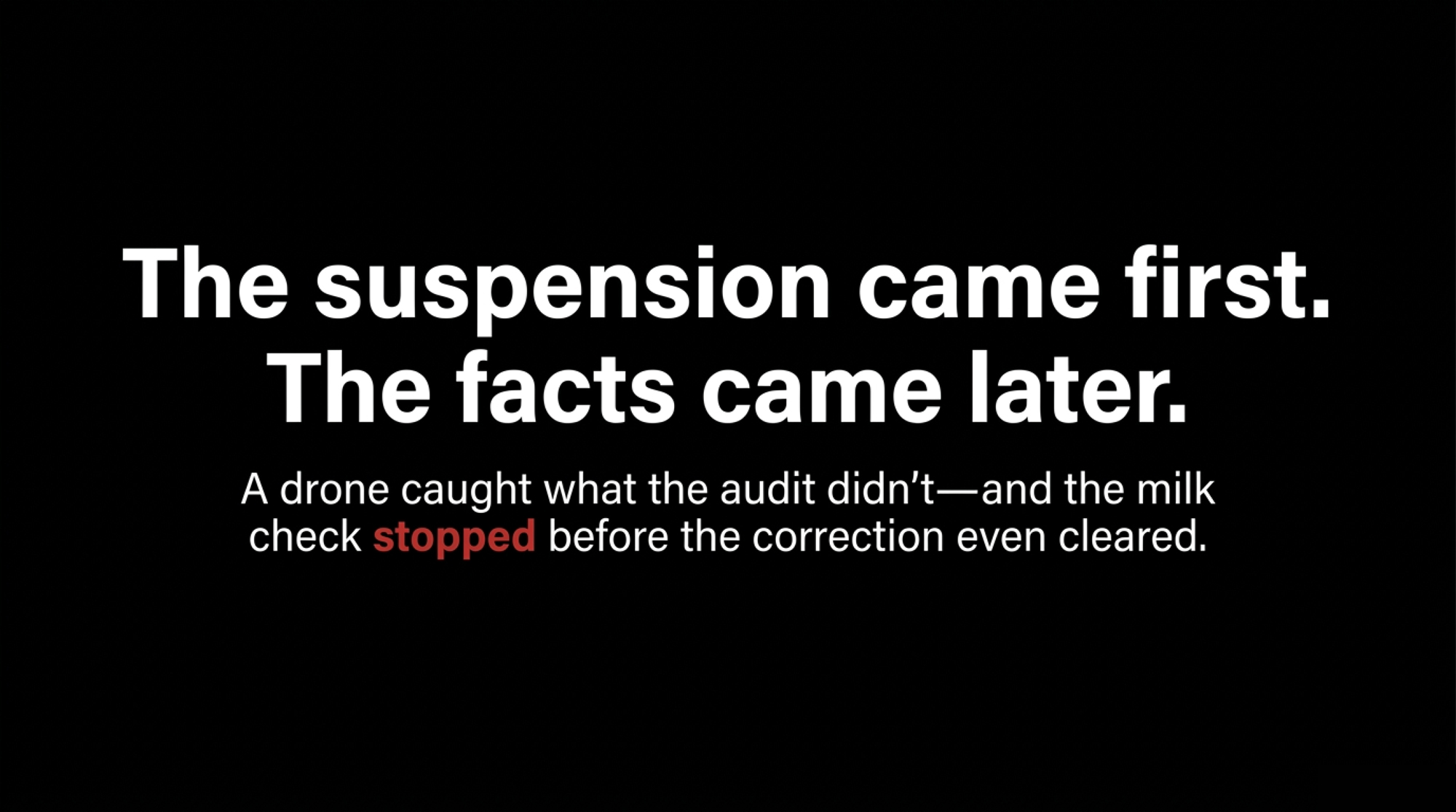
A drone caught what the audit didn’t — and Double D’s milk was suspended before the correction even cleared. The seal protected the brand. Your contract’s the only thing that protects you.
Executive Summary: A drone caught calf abuse at California’s Agresti Calf Ranch that an American Humane audit hadn’t — and Clover Sonoma suspended the connected supplier, Double D Dairy, before a correction even cleared the milk-supply link. That’s the part every producer who outsources calves should sit with: the suspension came first, the facts came later, and the contract — not the audit seal — was the only thing standing between the dairy and a stopped milk check. American Humane can certify a farm at 85% of the criteria, and the “isolated incident” finding rested on one terminated worker, not on any unannounced observation of daily handling when no supervisor’s in the barn. Run your own exposure: a 500-cow herd ships about 375 cwt a day, and distressed spot milk hit $7/cwt under Class III in the spring 2025 flush — that’s roughly $2,625 a day gone before you’ve sorted out hauling or reinstatement. The fix isn’t outrage; it’s three contract clauses — a named welfare standard, an unconditional right to inspect, and a vet-written disbudding protocol with treatment logs — plus one email to your processor asking exactly what triggers a suspension and what ends it. FARM 5.0 already makes disbudding pain control mandatory as of July 2024, so the standard’s set; the open question is whether your custom-raising paperwork actually names it. If a camera showed up tomorrow at every facility touching your animals, your contract’s either your proof or your problem.
Temple Grandin watched the Agresti Calf Ranch footage and didn’t reach for soft language. The Colorado State University livestock-welfare expert, reviewing the video for the Los Angeles Times, said the kicking, punching, and use of pliers on calves amounted to abuse — and that one calf’s violent thrashing and collapse during hot-iron disbudding indicated no pain mitigation had been used.
That’s the first shock. The second is the one producers should sit with longer: the welfare-audit system didn’t catch what the video showed. A drone did.
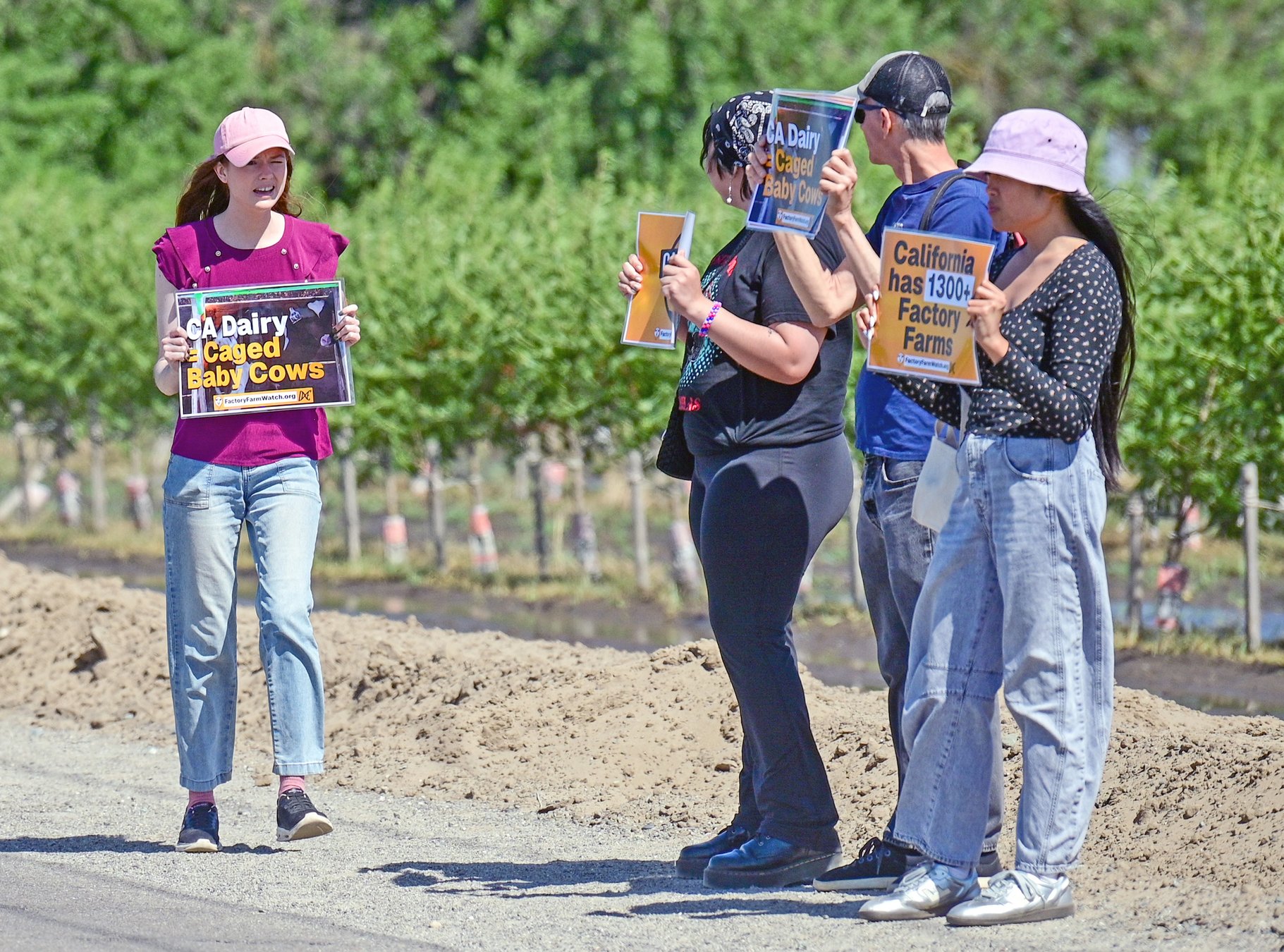
The footage was recorded in late February 2026 at the Ceres, California, facility by investigators with the activist group Direct Action Everywhere and was then reported by the Los Angeles Times on May 12, 2026. It shows a worker booting a calf in the face three times while its head was locked in a stanchion, another worker yanking a calf by the tail, a worker using pliers to drag a calf by its nose, and hot-iron disbudding performed without visible anesthesia. One worker filmed in the video was terminated; as of late June 2026, no charges have been publicly reported, though the Stanislaus County Sheriff and District Attorney received a cruelty referral on February 27, 2026.
Here’s the part that matters before you read another word. The Los Angeles Times issued a correction on May 14, 2026, clarifying that Agresti Calf Ranch opened in 2025 and that no animals reared there had ever supplied milk for Clover Sonoma. But Agresti and Double D Dairy aren’t strangers — the calf ranch is owned and operated by the principals of Double D Dairy, which has supplied raw milk to Clover Sonoma since 2016. The contract questions in this piece apply to any producer using any off-site calf raiser. The lesson isn’t about Agresti. It’s that any off-site agreement is only as strong as what’s written into it.
The Bullvine NOTE: In a branded supply chain, reputational risk moves faster than a fact pattern. Even after the correction cleared Clover’s milk supply, the brand had already suspended Double D and commissioned an audit. The phone call came before the facts settled.
The Footage Was Hard to Watch. The Audit Was the Bigger Warning
The conduct in the footage is hard to defend, and an expert didn’t try to defend it. But the sharper lesson for producers isn’t about one facility. It’s that a paper-based audit process cleared the supplier within weeks — based on what the records showed, not on what the daily work culture looked like when no supervisor was present. That gap is exactly why unannounced inspection matters more than a clean file.
Disbudding hurts — that isn’t in dispute among the people who actually do it. The FARM Animal Care program, which covers most U.S. milk, elevated pain management for all disbudding from a Continuous Improvement Plan to a Mandatory Corrective Action Plan under Version 5.0, effective July 1, 2024. This isn’t a guideline anymore. For producers shipping to major processors, it’s a condition of market access.
The science behind that rule is settled. University of Wisconsin guidance recommends a cornual nerve block with 2% lidocaine before hot-iron disbudding, plus an NSAID such as meloxicam for longer-lasting relief. Published research on co-administering lidocaine and meloxicam reports clear benefits in cutting pain and inflammation. Dairy Farmers of Canada landed in the same place: a local anesthetic plus an NSAID beats either one alone.
So when an expert called the footage abuse, the industry didn’t need a vocabulary lesson. It needed to answer a harder question. If the standard is mandatory and the science is settled, why did the accountability structure miss what a drone caught?
After Clover Sonoma suspended Double D Dairy’s shipments, American Humane — the body behind Clover’s welfare label — conducted a specialized audit and concluded the filmed events were an isolated failure of individual protocol rather than systemic practice, which cleared the dairy to resume shipments. That sequence is verified through public corporate actions and advocacy records, but the complete internal audit report remains proprietary to American Humane and Clover Sonoma. So read “isolated” carefully. It’s the audit’s conclusion — not a set of findings anyone outside the process can inspect.
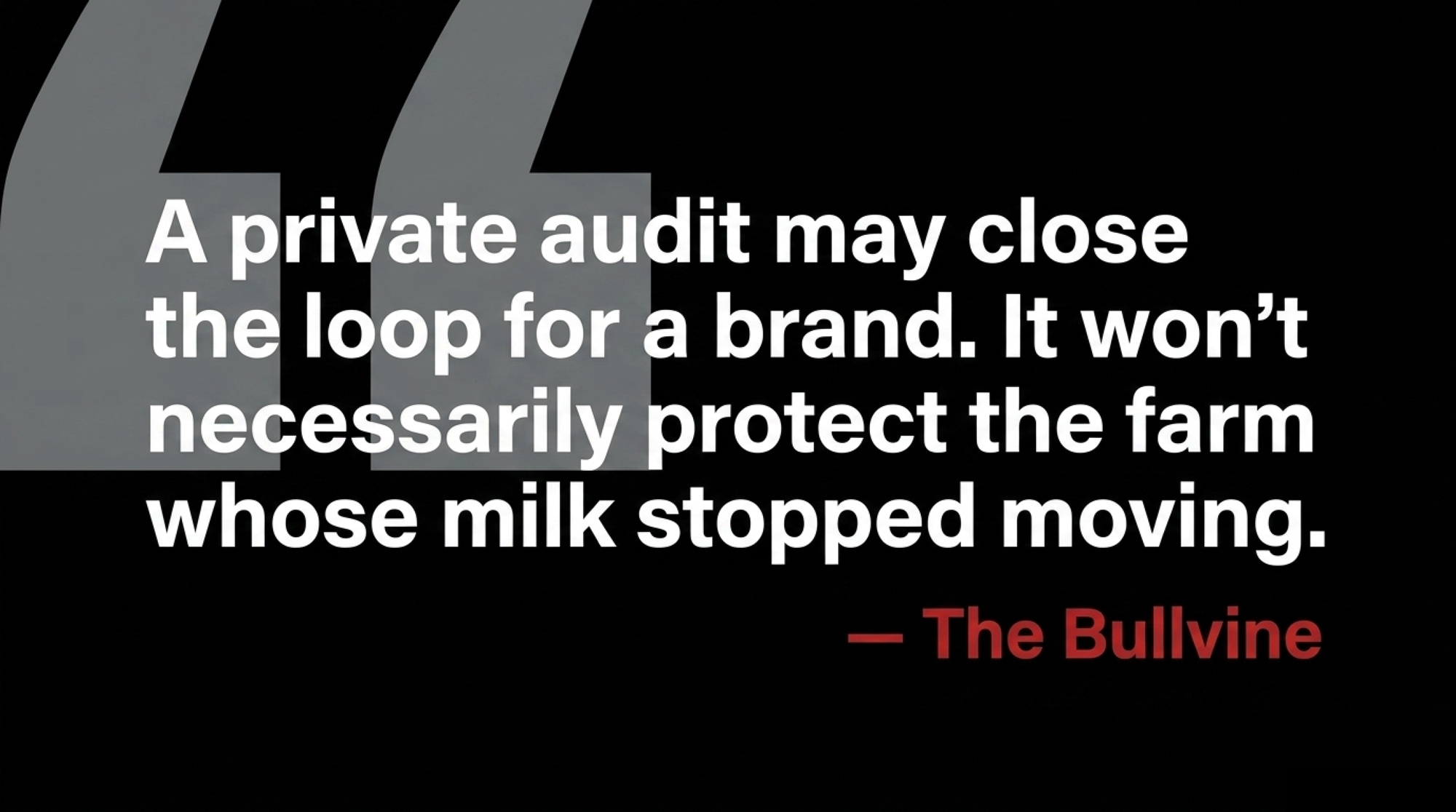
That distinction matters for producers. A private audit may close the loop for a brand. It won’t necessarily protect the farm whose milk stopped moving while that loop closed.
The Bullvine has walked through how thin paperwork and the wrong contract leave producers exposed when a crisis hits — the weak spots tend to be the same ones every time.
Picture the Producer Two Steps Down the Chain
Forget the named parties for a second and picture a producer we’ll call the kind you already know — a 500-cow operation that ships to a branded processor and sends its bull and dairy calves to an off-site ranch 40 minutes up the road. Good handshake relationship. Twelve years running. No complaints.
Now a drone films something ugly at that ranch, and the story doesn’t stop to check whose calves were in frame. The processor’s brand team sees the footage, sees the connection to animals from that producer’s herd, and makes a call to protect the label first. That’s the scenario that should keep you reading — not because it’s likely tomorrow, but because the cost of being unprepared for it is asymmetric. Cheap to prevent. Expensive to survive.
That producer’s exposure isn’t the abuse. It’s the contract that never said what happens next. Hold onto that 500-cow operation — we’ll walk it through the actual decision a few sections down, because the math and the renewal conversation are where this stops being a news story and starts being your Tuesday.
What Changed Isn’t Welfare. It’s Visibility.
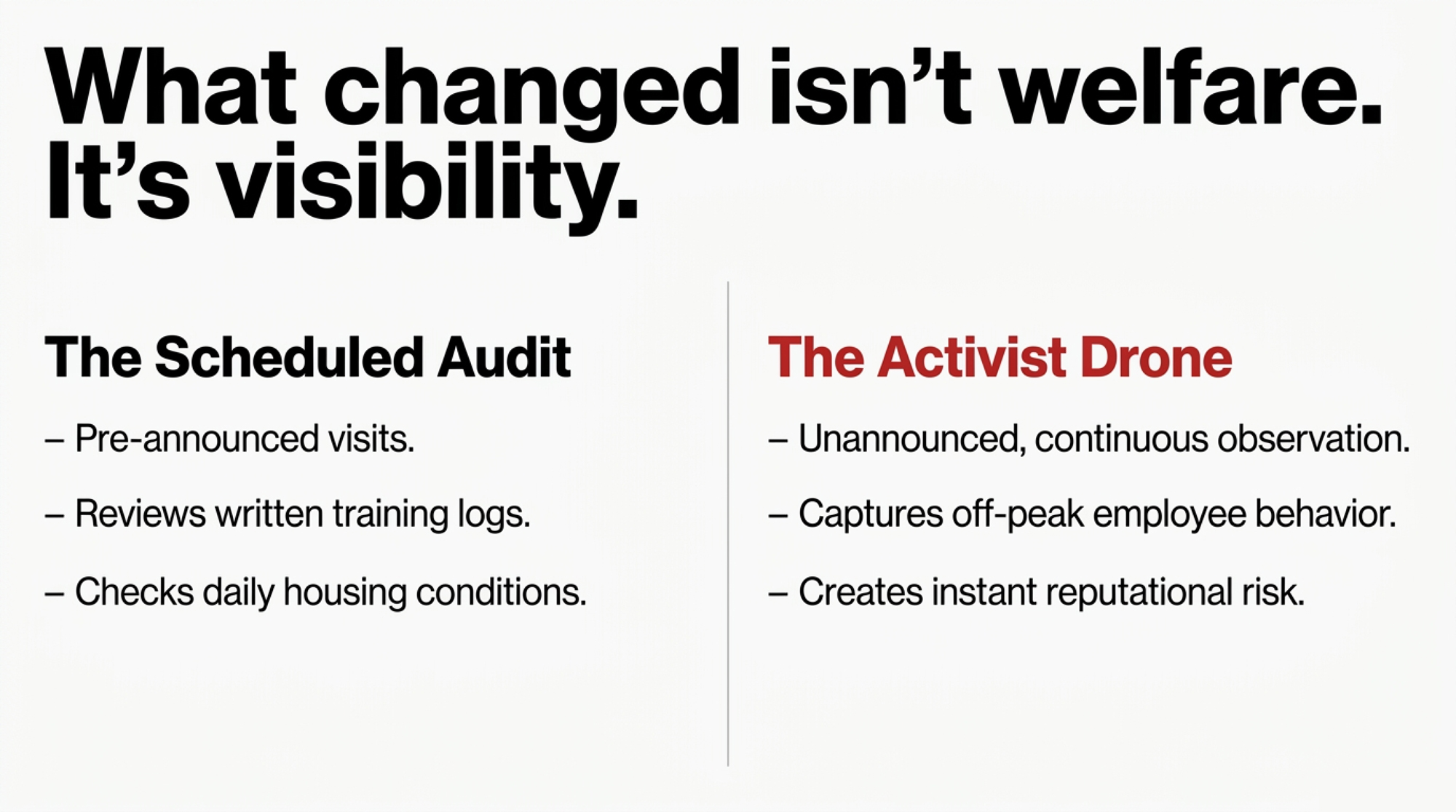
Animal welfare didn’t suddenly become important in 2026. Every serious producer already knows calf care matters — morally, operationally, and financially. What changed is who can document a failure. In the Agresti case, the drone footage came first, and the supply-chain response came after. That sequence should make every producer with a custom-raising agreement open the file drawer.
The old model was episodic. Annual audit, scheduled in advance with management. Written protocol. Training log. Corrective action if something slipped. Under standard American Humane protocols, audits review written herd-health plans, employee training logs, and a physical inspection of housing, bedding, and animal health.
None of that is useless. Paper matters. Training matters. Corrective action matters. But a pre-announced audit doesn’t show what happens when a tired employee is handling calves at 2:30 on a July afternoon with no supervisor in the barn. It doesn’t tell you whether the person holding the iron waited long enough after the lidocaine block. And it can’t tell you whether a treatment log reflects real practice or just tidy intent. The Agresti audit verified a written care policy and the worker’s termination — but it did not include unannounced, continuous, or off-peak observation of employee behavior.
Consumer Reports flags exactly this gap: a farm can be certified if it meets 85 percent of the criteria at the time of inspection, “but the consumer has no way of knowing which criteria were met”. That doesn’t prove what happened at any one facility. It does explain why a pass/fail welfare seal can feel a lot stronger at the grocery shelf than it looks when you’re the producer holding the risk.
What Does One Day Without a Milk Home Actually Cost You?
Start with milk flow, because the cows don’t care what the press release says. Distressed milk doesn’t sell at list price — and your exposure swings hard with the calendar. USDA AMS Dairy Market News reported Midwest spot milk trading as much as $7.00 under Class III during the spring 2025 flush. By the June 4, 2026 DMN report, spot trades had tightened to a range of $1-under to $2-over Class.
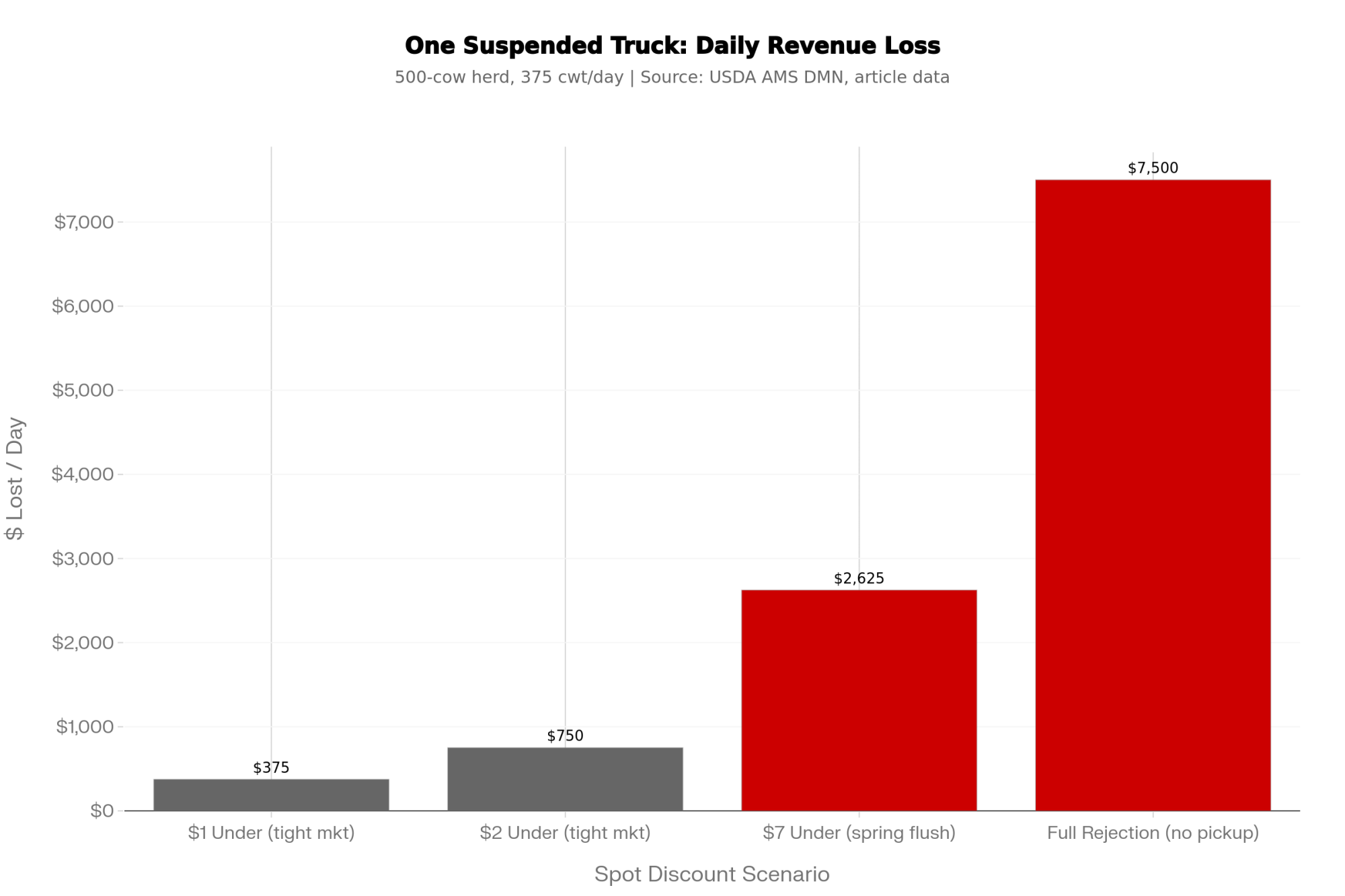
| Scenario | $/cwt Discount | Daily Loss (375 cwt) | Weekly Loss (7 days) | 30-Day Loss |
|---|---|---|---|---|
| Tight market — low end | $1.00 under | $375 | $2,625 | $11,250 |
| Tight market — high end | $2.00 under | $750 | $5,250 | $22,500 |
| Spring flush extreme | $7.00 under | $2,625 | $18,375 | $78,750 |
| Full suspension / reroute cost | $15–$20 est. | $5,625–$7,500 | $39,375–$52,500 | $168,750–$225,000 |
| Complete milk rejection (no pickup) | Full check lost | 100% daily revenue | 100% × 7 days | 100% × 30 days |
Take that same 500-cow operation shipping 75 lbs per cow per day — and run your own numbers in the right-hand column:
| Market Scenario | 500-Cow Farm Impact (375 cwt/day) | Your Farm’s Exposure |
| Daily milk volume | 37,500 lbs (375 cwt) | ________ cwt |
| Tight market discount ($1–$2 under Class) | $375–$750 / day | $________ / day |
| Spring flush discount ($7 under Class III) | $2,625 / day | $________ / day |
| Total rejection / dumped milk (full value) | Full milk check + disposal | 100% of daily revenue |
The $7 figure is a spring-flush extreme, not a typical week — but it’s the number that shows up exactly when you can least afford a rerouted truck. Plug in your own pounds and your own mailbox price; the gap is the number that should worry you. Don’t start with a dramatic loss figure. Start with your pounds, your cwt, and the discount your processor agreement actually puts on you when the truck reroutes.
The higher cost may not even be day one. It’s the uncertainty. If pickup gets suspended “pending review,” who pays for emergency hauling? Who approves alternate placement? What documentation triggers reinstatement? Does your processor owe you a timeline — or just a decision whenever they’re ready to make one?
Most supply agreements were built around milk quality, delivery, pricing, and termination. Welfare-liability language tends to sit in a softer corner, leaning on phrases like “humane treatment” or “industry standards.” Those words sound reassuring right up until a processor’s legal team decides whether your milk moves tomorrow morning. The Bullvine has reported on how thin milk-contract language quietly decides who absorbs a supply-chain shock — the welfare clause is the same blind spot wearing a different hat.
Does an “Isolated Incident” Verdict Actually Protect You?
Here’s where the language gets slippery. An incident can be called “isolated” if one employee was let go, written protocols exist, and the facility files corrective action. In the Agresti case, the “isolated” finding rested specifically on the strikes and unanesthetized disbudding being attributed to a single employee who has since been terminated. That doesn’t mean the animal’s experience was isolated. And it doesn’t mean the daily work culture got observed across shifts, weather, staffing gaps, and procedure days.
A welfare audit is a snapshot. A calf-raising operation is a movie. There’s also a structural reality worth naming plainly. A buyer-commissioned audit is built to answer the buyer’s question — is this supplier compliant? Clover Sonoma was the first commercial dairy brand in the U.S. to secure American Humane certification, and it leveraged that designation to secure premium shelf space and build consumer trust. That’s a different question from the one our 500-cow producer two steps down the chain needs answered: if something goes wrong here, am I protected? Same audit. Different stakes.
So here’s the line. A certification audit isn’t worthless. But an audit whose findings you can’t see, whose trigger you don’t control, and whose reinstatement criteria aren’t written into your contract isn’t your safety net. It’s built for somebody else’s question. We’ve made the same argument about show-ring judging — big banners, real prestige, and accountability standards that never kept pace.
| Protection Dimension | Welfare Audit Seal (e.g., American Humane) | Producer’s Signed Contract with Calf Raiser |
|---|---|---|
| Who it primarily protects | Brand / retailer | The producing farm |
| Inspection type | Pre-announced, scheduled | Unconditional right to appear unannounced (if written in) |
| Pass threshold | 85% of criteria met at time of visit | 100% of named clauses enforceable at any time |
| Findings public? | No — audit report proprietary | Yes — contract terms visible to both parties |
| Pain management standard | May reference “industry standards” | Should name FARM 5.0, specific drug/dose/timing |
| Covers all calf types? | Depends on scope of certification | Only if contract explicitly includes beef/bull calves |
| Suspension trigger defined? | Processor decides unilaterally | Can be written into contract with reinstatement criteria |
| Protects milk check if footage emerges? | No | Yes — if clauses are in place and exercised |
Can You Inspect the Calf Raiser Before the Drone Does?
This is the operational question that belongs on the kitchen table within 30 days.
If your calves are raised off-site, do you have the right to show up unannounced? Not “with reasonable notice.” Not “by mutual agreement.” A real right-to-inspect clause lets you or your designated herd veterinarian walk in during active operations, review treatment logs, watch handling, and document what you saw. Penn State Extension’s heifer-contracting guidance already treats monitoring, reporting, and animal-identification terms as standard contract elements — the welfare-specific access right is the natural extension nobody’s adding yet.
That clause isn’t a trust issue. It’s an ownership issue.
Picture our 500-cow producer walking into that renewal meeting. Twelve years of handshake history sits between them and the calf raiser, and asking for a written inspection right feels like an accusation. A good calf raiser may bristle the first time it comes up. That’s human — nobody wants to turn a working partnership into a legal seminar.
But the conversation shifts when you frame it in terms of shared exposure. Our producer doesn’t say, “I don’t trust you.” They say, “If a video from your facility hits my milk market, both of us need written proof we agreed to a standard and followed it.” That framing gives a good operator room to say yes. And it tells you something if the answer is no.
The Human Part Is the Hardest
Dominic Assali, co-owner of Double D Dairy, told the Turlock Journal that the dairy held a zero-tolerance policy for animal mistreatment. That reflects what most producers and operators would say — and mean — when confronted with footage like this.
Most calf raisers aren’t hunting for a loophole to mistreat animals. The investigative record itself notes that the vast majority of U.S. custom calf-raisers operate with high professional standards and trained staff who understand low-stress handling. They’re trying to feed calves, keep crews trained, hit health targets, and make thin margins work in a labor market that hasn’t gotten any easier since 2020. Producers know that. It’s exactly why these conversations are uncomfortable.
The problem is that a long relationship is no longer enough of an answer.
Fifteen years of trust tells you something about character. It doesn’t define a pain-management protocol. It doesn’t create a treatment log. And it won’t force a processor to keep picking up your milk while a brand reviews an allegation. The relationship still matters. It just can’t be the only document in the file.
There’s a respectful way to do this. Tell your raiser the truth: your processor can suspend your milk over what happens at any facility connected to your animals, so if something ever goes wrong and it’s on camera, the contract is what proves you both took the standard seriously before the footage existed. That keeps the relationship intact while moving the risk into writing.
A Wrinkle Worth Naming: Dairy Calf or Beef Calf?
One detail the public record never settled: whether the calves in the footage were dairy replacement heifers or beef-on-dairy and bull calves headed to feedlots. Agresti functions as a heifer-raising arm for Double D, but commercial dairies also generate male and crossbred calves that route into the beef chain.
It matters for your contract for one reason: custom operations that raise both dairy and beef calves have to apply one welfare standard across the whole barn — because a camera doesn’t sort calves by destination, and neither does a brand’s crisis team. If your agreement only names “replacement heifers,” it may say nothing about the bull calves leaving the same property under your operation’s name.
Three Clauses That Move the Risk Into Writing
| Contract Clause | What It Does | What It Doesn’t Do | Urgency |
|---|---|---|---|
| Named welfare standard (FARM 5.0) | Sets enforceable floor; drug/dose/timing legally specified | Doesn’t enforce itself — requires inspection to verify | Add at next renewal |
| Unconditional right to inspect | You or your vet can walk in unannounced during operations | Worthless if you never exercise it | Add this month |
| Vet-written disbudding protocol + treatment logs | Creates paper trail; proves intent before footage exists | Log proves intent, not every act | Add this month |
| Suspension/reinstatement terms in writing | Defines what triggers stoppage and what ends it | Processor may still act first; writing limits liability | Email processor now |
| Coverage of beef/bull calves explicitly named | Closes the gap when calves of mixed destination are on-site | Requires separate clause — “replacement heifers” doesn’t cover it | Review current contract |
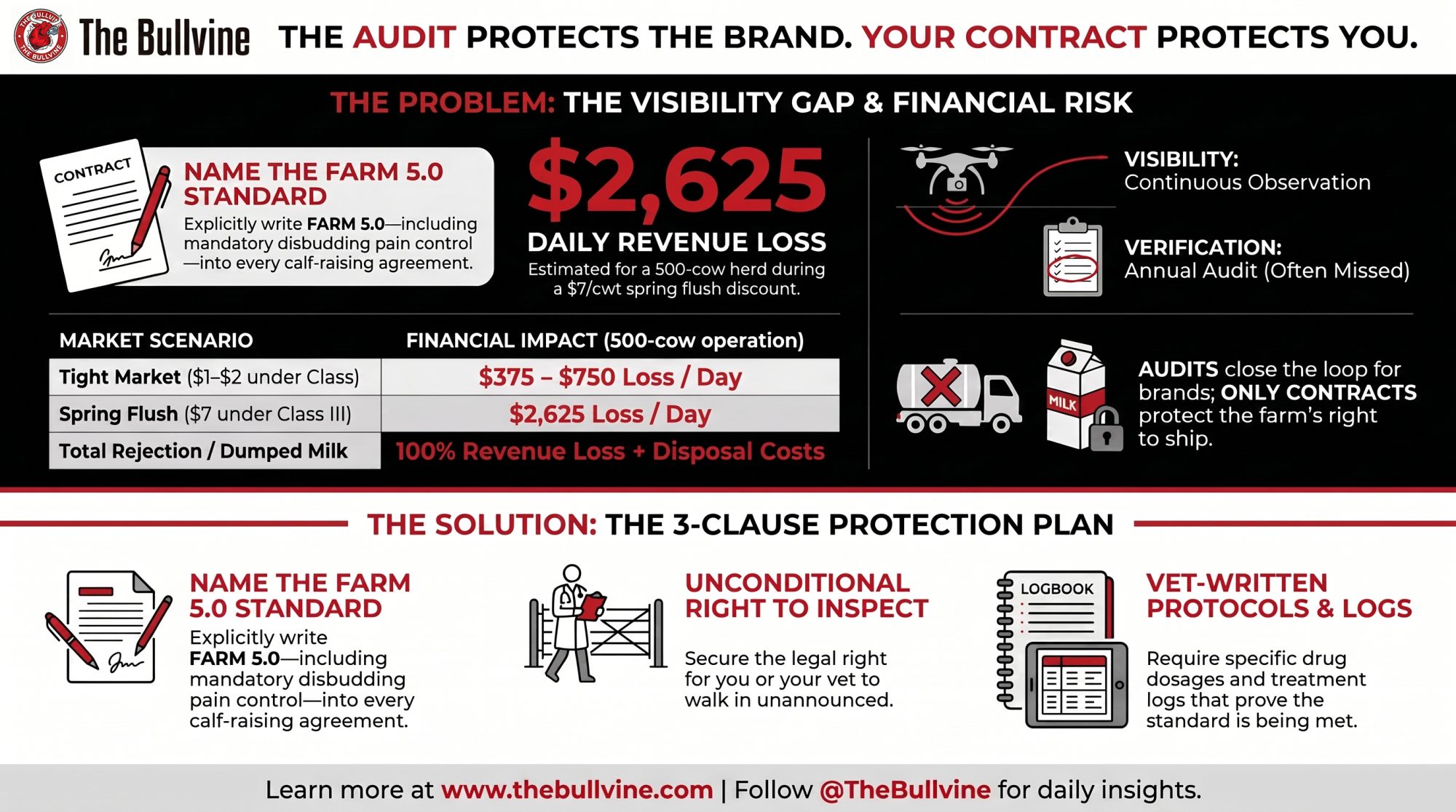
The fix isn’t complicated, and it isn’t a lawyer’s retainer. It’s three pieces of language most custom-raising agreements are missing, plus one phone call. Here’s what each one does and where it falls short:
- A named welfare standard, not a vibe. Write FARM Animal Care Version 5.0 — including mandatory disbudding pain control — directly into the agreement as the floor. When it makes sense: always. The limit:naming a standard doesn’t enforce it, which is why it only works paired with the next clause.
- An unconditional right to inspect. You or your herd vet can show up during active operations, unannounced, and review logs. When it makes sense: any off-site arrangement. The limit: it depends on you actually using it — an unexercised right protects no one.
- A vet-written disbudding protocol with treatment logs. Specific drugs, doses, timing, and a log that gets reviewed. When it makes sense: any operation disbudding your calves. The limit: a log proves intent, not every act — which is exactly why the inspection right backs it up.
Key Takeaways
- If your calves are raised off-site and your contract says “humane treatment” or “industry standards” without naming FARM 5.0, you have a welfare clause that won’t survive a processor’s legal review — fix the language at your next renewal.
- If you can’t legally show up at your calf raiser’s facility unannounced, you don’t have oversight — you have hope. Add an inspection right this month.
- Run the one-day number before you need it: your daily cwt times the worst spot discount your processor agreement allows. That’s your floor exposure if the truck reroutes.
- A welfare seal on the retail carton answers the buyer’s question, not yours. Ask your processor in writing what triggers a milk suspension and what ends it.
- If your agreement only names replacement heifers, confirm it also covers every bull and beef-cross calf leaving the property under your name.
- A long handshake relationship isn’t a document. Character doesn’t write a treatment log — get the protocol on paper without blowing up the partnership.
The One Email to Send This Week
Here’s the move that costs you ten minutes: email your processor field rep and ask, in writing, exactly what would trigger a suspension of your milk pickup over a welfare allegation at a facility connected to your animals — and exactly what documentation gets you reinstated. Save the answer. If they can’t give you one, that silence is itself the answer, and it’s worth more to you than any seal on the carton.
So where does your breakeven sit if the truck doesn’t come Thursday — and is the proof that protects you sitting in a signed contract, or in twelve years of goodwill that a thirty-second video can override? We’re breaking down the full calf-raising contract language — clause by clause, with the FARM 5.0 and inspection-right wording you can hand your raiser — in next week’s Bullvine Weekly. That’s where the real paperwork lives.
Run Your Numbers
Farm Benchmark Snap Check — Before you assume a suspended milk check won’t happen to you, run your daily cwt and spot-discount exposure through Farm Benchmark Snap Check. It turns “what could a rerouted truck cost me” into a number, and flags whether your margin sits strong, worth watching, or already in the risk zone.
Methodology note: This piece draws on the Los Angeles Times’ May 12, 2026 reporting and its May 14 correction, the Turlock Journal, Consumer Reports’ assessment of the American Humane Certified seal, USDA AMS Dairy Market News, National Dairy FARM Program Version 5.0 documentation, and University of Wisconsin and Dairy Farmers of Canada disbudding guidance.
Limitations: The full American Humane audit report is not public; the “isolated” characterization is the audit’s conclusion, not independently verifiable findings. The dairy-versus-beef destination of the filmed calves was never settled in the public record. As of June 29, 2026, no charges have been publicly reported.
Corrections: editor@thebullvine.com. Conflict-of-interest disclosure: The Bullvine has no commercial relationship with any entity named in this piece.
Learn More
- UK milk price 2026: why your contract decides survival — Exposes how the massive structural spread between protected aligned agreements and raw manufacturing pricing determines whether your operation can withstand sudden supply shocks or slowly bleeds capital into the bank account.
- 40 Years of Breeding. One Müller Letter. Six Figures Gone. — Reveals the staggering $260,000 equity threat hidden inside short-notice termination clauses, arming producers with an emergency playbook to insulate herd assets before a buyer alters market access.
- The $73-a-Cow Gap Hiding in Your 2027 Bovaer Contract — Dismantles the financial illusion of standard processor sustainability premiums by tracking the compliance clawbacks and hidden costs that penalize dairies relying on paper-thin sustainability audits.
 The Sunday Read Dairy Professionals Don’t Skip.
 The Sunday Read Dairy Professionals Don’t Skip.
Every week, thousands of producers, breeders, and industry insiders open Bullvine Weekly for genetics insights, market shifts, and profit strategies they won’t find anywhere else. One email. Five minutes. Smarter decisions all week.




