




Holstein inbreeding hit 9.99%. Birkstead and North Florida took opposite paths to slash a $60–$ 100-per-cow leak without sacrificing genetic progress.
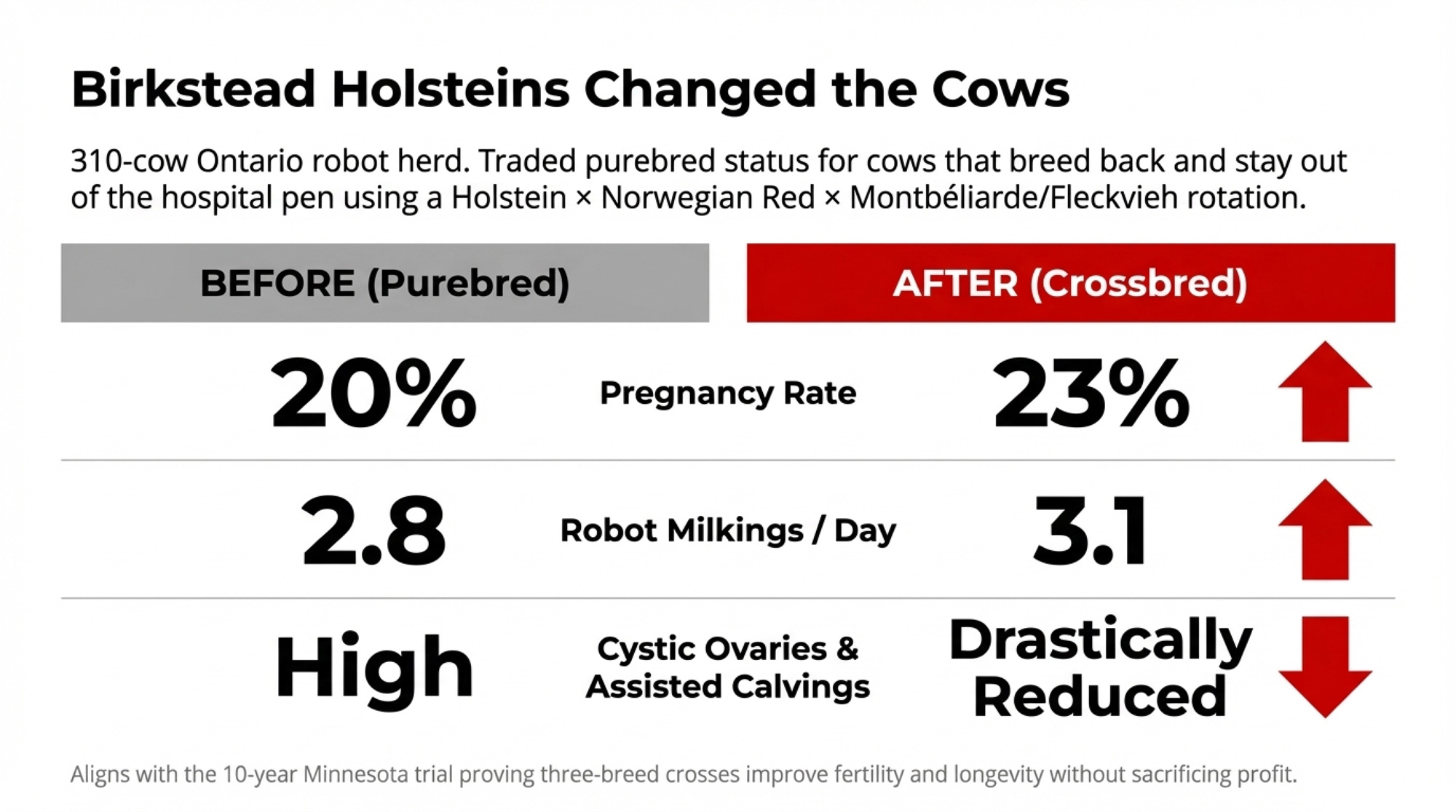
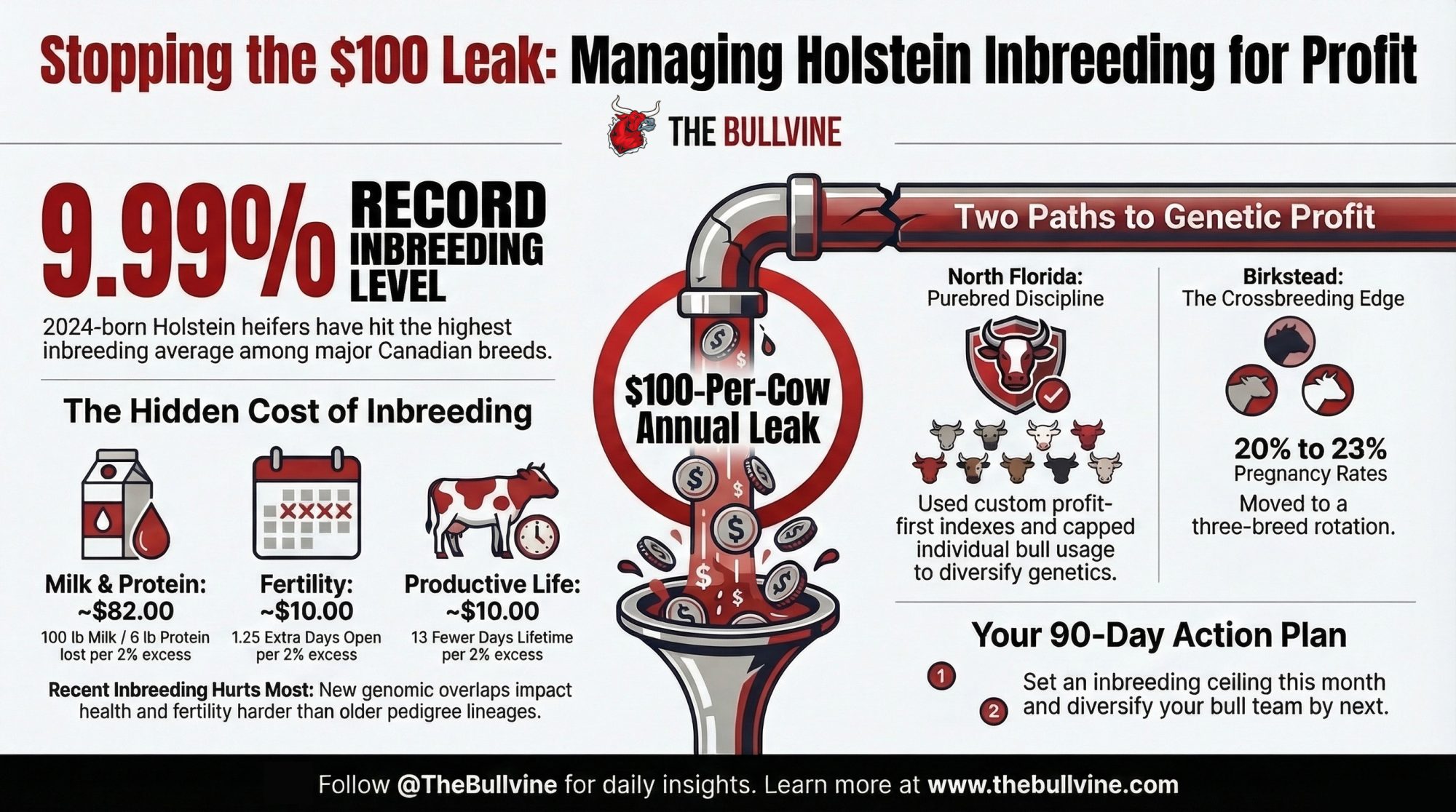
Executive Summary: Holstein heifers born in 2024 now average 9.99% inbreeding, and conservative barn‑math from peer‑reviewed studies puts the cost at roughly $60–$100 per cow per lactation. The article shows how that hit comes together — a little lost milk and protein, a few extra days open, shorter productive life — and why recent inbreeding does more damage than old pedigree overlap. It then uses two real herds as case studies: Birkstead Holsteins in Ontario, which pushed a 20% pregnancy rate higher and cut health problems by moving to a Holstein × Norwegian Red × Montbéliarde/Fleckvieh cross, and North Florida Holsteins, which stayed pure Holstein but built its own profit‑first index and capped how much any single bull could influence the herd. The core argument is that the real risk isn’t genomics itself, but letting catalog rankings quietly stack the same sire lines until inbreeding becomes a five‑figure annual leak. For a 300–600‑cow herd, the piece lays out a simple playbook: in the next 30 days, turn on and enforce an inbreeding ceiling in your mating program, over the next 90 days build a genuinely diverse bull team, and over the next breeding season stop raising replacements from the most inbred, lowest‑merit females. It’s written for owners and breeding decision‑makers who want to keep riding the top of the genetics wave without paying for 9.99% inbreeding on every proof run.
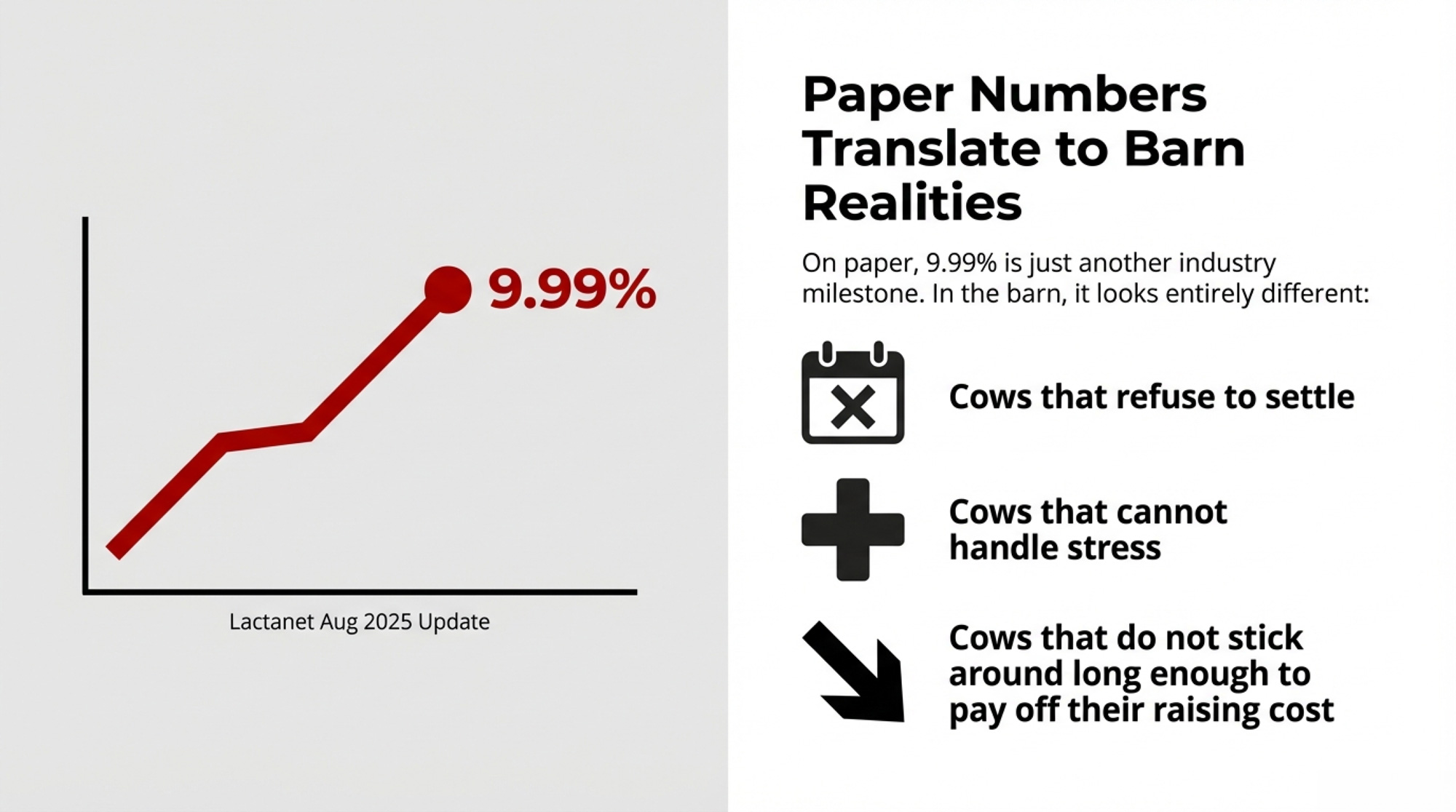
Canadian Holstein heifers born in 2024 now average 9.99% inbreeding, according to Lactanet’s August 2025 inbreeding update. That’s up from 9.61% the year before and the highest among the major dairy breeds in Canada. On paper, it’s just another number. In the barn, it’s the cows that don’t settle, don’t handle stress, and don’t stick around long enough to pay off their raising cost.
Thomas Wantenaar at Birkstead Holsteins in Elora, Ontario, was already seeing that drag in his own herd numbers. In 2008, with a purebred Holstein herd and a new robot barn, he was staring at an annual pregnancy rate of about 20% and, as he told Progressive Dairy, “spending half the morning just treating cows.” A thousand miles south at North Florida Holsteins, Don Bennink was looking at the same breed from the other end of the telescope: about 4,800 cows and 4,400 heifers on roughly 2,400 acres in Florida heat, and a classification and type evaluation system he publicly described as “180 degrees away from cattle that pay the bills.”
Neither herd was willing to let inbreeding dictate its future. One changed how it used Holstein genetics. The other changed the cows.
How Much Does 1% of Holstein Inbreeding Really Cost Per Cow?
You’ve heard for years that inbreeding costs money. That doesn’t help when you’re trying to decide whether one more high‑index bull out of the same sire line is worth it.
Lactanet and other summaries estimate that every 1% increase in inbreeding knocks roughly $60–$78 off a cow’s lifetime profit, once you add up lost milk, weaker fertility, and fewer productive days. Makanjuola and colleagues (2020) put a finer point on it for Canadian Holsteins: each 1% increase in genomic inbreeding cut 305‑day first‑lactation milk yield by about 40–50 kg. At typical Canadian milk prices, that’s over $40 per cow per lactationfrom milk volume alone.
That’s still fairly abstract. The real question is: if your herd is, say, 2 percentage points more inbred than you’d like, what’s the per‑cow, per‑lactation hit?
Step 1: Define “excess inbreeding”
Suppose you’d be comfortable with a herd average around 7.5% inbreeding. Instead, your young stock are coming in around 9.5%, which isn’t unusual given where Holsteins are heading. That’s 2 percentage points of excess inbreedingcompared with the level you’d like to be at.
Step 2: Milk and protein that never make it onto the truck
Doekes et al. (2019) and Makanjuola (2020) both found that each 1% increase in inbreeding reduced 305‑day milk by roughly 36–49 kg (80–108 lb). To stay conservative and easy to work with, call that about 100 lb of milk per 1%.
- At 2 excess points: ~200 lb less milk per cow per lactation.
- At $20/cwt: 200 ÷ 100 × $20 = $40 per cow per lactation from milk.
StrataGEN work suggests about 25 lb lifetime protein loss per 1% inbreeding, which averages out to roughly 6–7 lb per lactation. Use 6 lb per 1%.
- At 2 excess points: 12 lb less protein per lactation.
- At $3.50/lb: 12 × $3.50 = $42 per cow per lactation from protein.
Right there, you’re at around $82 per cow per lactation in very basic, conservative component math.
Step 3: Days open that hide inside your repro numbers
Genetic and economic work often uses about 1 extra day open per 1% inbreeding as a planning number, once you account for later first service, lower conception rates, and early embryonic loss. It’s not a hard rule, but it’s a realistic average.
- At 2 excess points: assume 2.5 extra days open.
- At $4 per day open (mid‑range of common $3–$5 estimates): 2.5 × $4 = $10 per cow per lactation.
You can argue the exact cost per day. You can’t honestly argue that it’s zero.
Step 4: Productive life and replacements
StrataGEN data show about 13 fewer productive days per 1% inbreeding; at 2 excess points, that’s around 26 fewer productive days in that cow’s lifetime.
Spread across a cow you expect to last around 3½ lactations, that’s about 7–8 fewer productive days per lactation. Put a conservative $10 per cow per lactation value on that in terms of extra replacement pressure, fewer older “easy money” cows, and more fresh‑heifer risk.
Step 5: Put the conservative math together
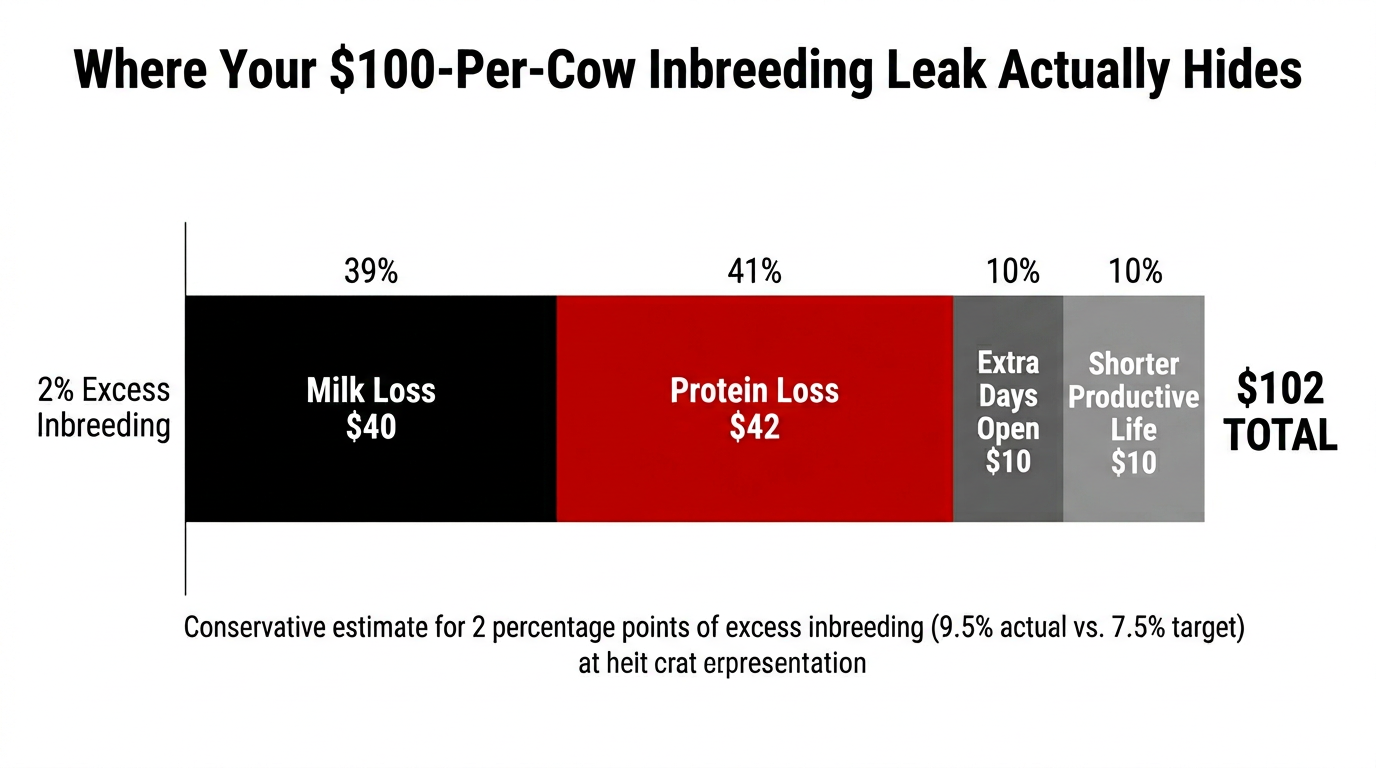
Conservative totals on 2 points of excess inbreeding per cow, per lactation:
- Milk loss: ~$40
- Protein loss: ~$42
- Extra days open: ~$10
- Shorter productive life/replacements: ~$10
That’s roughly $100 per cow per lactation.
| Loss Category | Impact per 1% Inbreeding | Cost at 2% “Excess” (per lactation) |
| Milk Yield | ~100 lb | $40.00 |
| Protein | ~6 lb | $42.00 |
| Fertility (Days Open) | 1.25 Days | $10.00 |
| Productive Life | 13 Days (Lifetime) | $10.00 |
| ESTIMATED TOTAL | $102.00 per cow |
If you squeeze every assumption down to the low end and ignore some of the lifetime effects, you can justify a smaller number in the $60–$70 per cow range. If you take the upper end of the published production losses and value days open closer to $5, you can also defend numbers over $100 without exaggerating.
Either way, on a 300‑cow milking herd, even a $60 per cow leak is around $18,000 per year until your mating strategy changes. On a 500‑cow herd, you’re looking at $30,000–$55,000 per year — not in theory, but in realistic, research‑based barn math.
At Birkstead, that money didn’t show up on a line called “inbreeding.” It showed up as a 20% pregnancy rate, more sick cows than they liked, and robots spending too much time fetching stubborn Holsteins. At North Florida Holsteins, it showed up in a Holstein system that rewarded the same narrow sire lines and type composites even as inbreeding climbed.
Why Recent Inbreeding Hurts More Than Old Inbreeding
One of the traps with inbreeding is treating all of it as doing the same damage. It doesn’t.
Doekes and co‑authors split inbreeding into “recent” (last few generations) and “ancient” (deeper in the pedigree) and then tracked what each type did to production and fitness in Holsteins. Each 1% of new inbreeding cuts fat yield by about 2.4 kg per lactation, while the oldest pedigree class had little to no negative effect — in some models, even a small positive one.
Makanjuola’s work on Canadian Holsteins using runs of homozygosity (ROH) told the same story: recent inbreeding reduced milk and protein yields, while ancient inbreeding had far weaker effects. When you turn that into dollars, you end up in that >$40 per lactation per 1% range for first‑lactation milk alone.
Why the difference?
- Ancient inbreeding has already been through decades of selection. The worst double‑copy combinations have largely been purged from the population.
- Recent inbreeding creates new double copies in parts of the genome that haven’t had enough generations under selection pressure, especially for fertility and health.
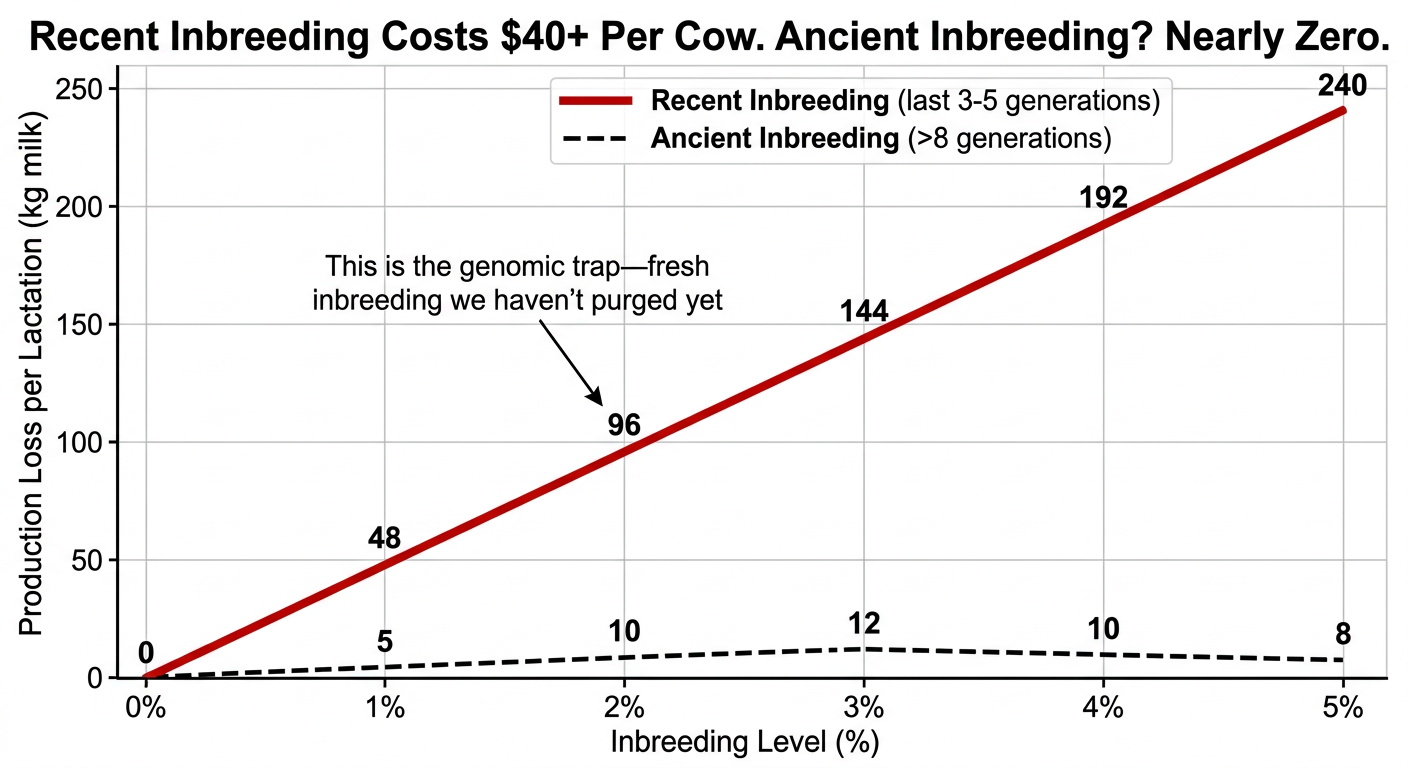
Irish Holstein‑Friesian work suggests that purging has been more effective for production traits than for fertility.We’ve been selecting hard for milk and components for a long time. Fertility and health only really got major index weight in the past 10–15 years. The harshest fertility and survival recessives haven’t been under the hammer as long.
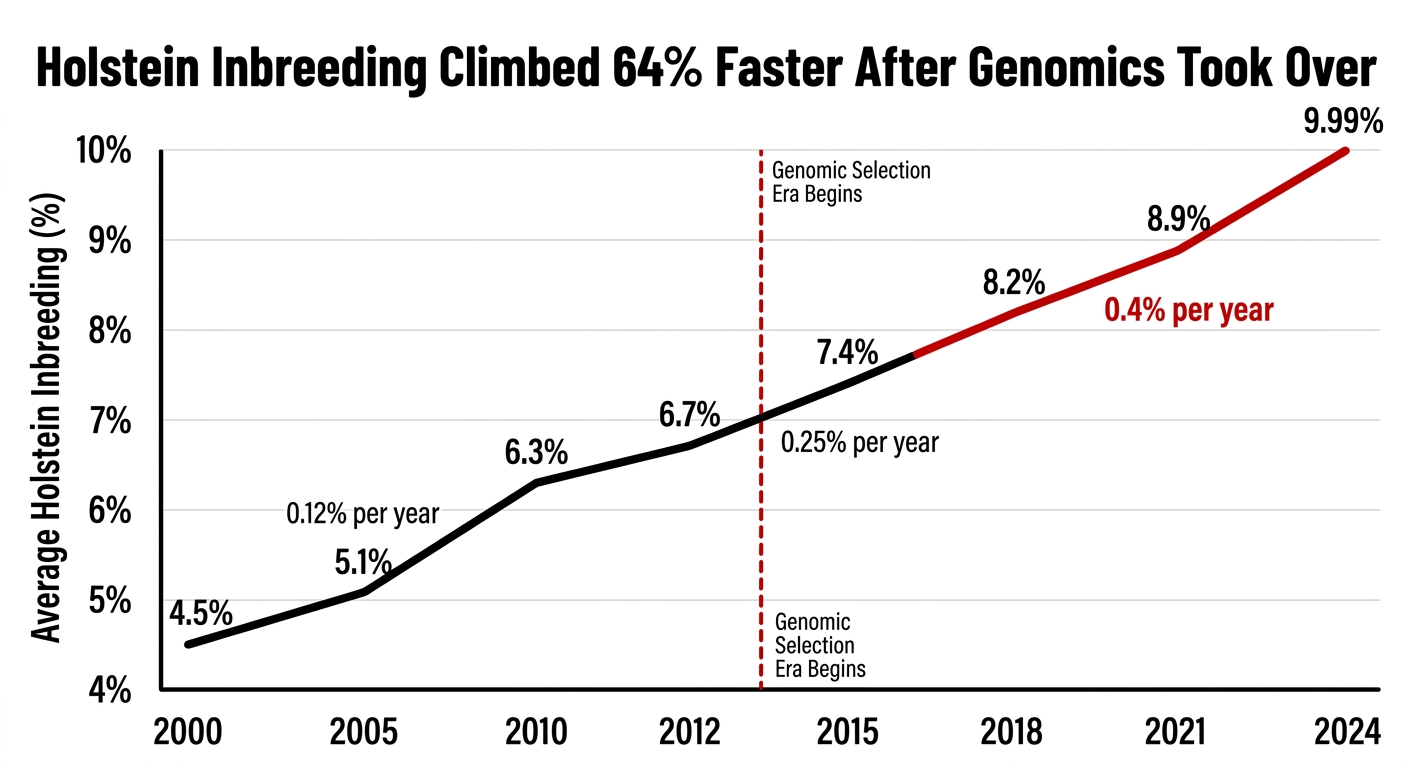
Once you layer genomics on top, the curve steepens. Hansen showed that Holstein female inbreeding rose at about 0.12% per year from 2000 to 2012, then 0.25% per year from 2013 to 2016, and then around 0.4% per year as genomic selection really took over. By the early 2020s, average Holstein females were already in the 8–9% inbreeding range, and by 2024, Canadian Holstein heifers hit 9.99%.
Genomics helped us identify the top animals faster. It also helped us stack the same families faster than purging could clean up fertility and survival.
The Bottleneck Hiding Inside Every Bull Catalog
Talk about Elevation and Chief dominating Holstein pedigrees can sound like coffee‑shop folklore. The data back it up.